1. Introduction
Fiscal decentralization reforms are typically based on the simplifying assumption that observed economic activity will serve as an acceptable proxy for the local fiscal capacity. Intergovernmental transfer programs use a variety of indicators such as GDP per capita, taxable income per capita, population, area, and/or observed tax collections to design resource allocations. However, when there is unevenly spread informal economic activity within a jurisdiction, this assumption may be significantly flawed.
In cases of substantial informal economic activity (e.g., portions of production, employment and transactions that remain unreported to government authorities), regional measures of economic capacity vary substantially from actual economic activity. Therefore, territorial variations in the degree of formality of economic activities can represent a critical problem for the design and implementation of decentralized fiscal systems. Regions with large informal economies may appear to have lower fiscal capacities than those with relatively smaller informal economies, because their measurable economic activity may underestimate their actual fiscal capacity. Similarly, systems of equalization (inter-governmental) grants may compensate jurisdictions that conceal their economic activities instead of those that lack them. Moreover, informality tends to reduce local tax bases, weaken fiscal efforts and reinforce longer-term dependence on intergovernmental transfers.
Research on the impact of decentralization has extensively studied its impacts on efficiency, accountability, growth and equity (e.g.,
Prud’Homme, 1995;
Martínez-Vázquez et al., 2017;
S. Lago-Peñas et al., 2023). Studies on the informal economy have focused on tax evasion, institutional weaknesses, governance quality and macroeconomic performance (
Schneider & Enste, 2013;
Medina & Schneider, 2018;
Ohnsorge & Yu, 2022). However, little research attention has been devoted to the implications of informality for the measurement of subnational fiscal capacities and for the functioning of intergovernmental fiscal relations. This is especially important for transition economies, which continue to experience significant regional disparities and substantial levels of informal economic activity. Such jurisdictions tend to have limited fiscal discretion for subnational governments and rely primarily on central government transfers. Thus, the extent of informal economic activity may influence whether subnational government fiscal dependence is structural rather than merely a matter of tax compliance.
The central objective of this study is to explore the linkages between regional informality and local fiscal performance in North Macedonia. This EU candidate country presents a suitable case study for several reasons. Firstly, the informal economy is relatively large compared to most EU member states. Secondly, the country has implemented successive rounds of fiscal decentralization reforms while continuing to exhibit significant vertical fiscal imbalances. Lastly, the country exhibits large regional disparities combined with similar disparities in terms of local fiscal performance and reliance on intergovernmental transfers.
The article contributes to knowledge in three areas. Firstly, it produces regional estimates of the informal economy for each of eight statistical regions in North Macedonia using a latent variable Multiple Indicators, Multiple Causes (MIMIC) Framework. Estimates of the informal economy at the national level are somewhat common, whereas, to the best of our knowledge, estimates at the subnational level are non-existent in the context of the Western Balkans. Secondly, the study views informality as a distortion mechanism for estimating the fiscal capacity of local governments in a system of fiscal decentralization. Traditional systems of equalization transfers rely upon observable indicators of local economic performance. These indicators may, however, fail to accurately capture the true revenue-generating potential of local governments when the informal economy varies geographically. Lastly, this paper demonstrates that decentralized systems exhibiting both high levels of and spatial concentrations of informality create a self-reinforcing equilibrium. In other words, local governments face diminished ability to develop strong tax bases, reduced incentives to formally report all taxable income and increased dependence on intergovernmental transfers.
In empirical terms, the paper analyzes the relationship between regional informality and local fiscal performance through two distinct stages. Stage one involves an estimate of regional informality using a MIMIC methodological approach applied to data spanning from 2008–2023 and aggregated at the level of eight Planning Regions in North Macedonia. In stage two, the estimated degrees of regional informality are analyzed in relation to selected fiscal variables at the local government level including own-source revenue mobilization, local government fiscal effort and dependence on central government transfers.
The analysis reveals systematic associations between higher degrees of regional informality and lower levels of own-source revenue mobilization. Additionally, the analysis suggests that failure to account for informal economic activity could potentially lead to inadequate design of equalization schemes. Ultimately, the research adds new insights into ongoing discussions surrounding fiscal decentralization in developing economies with large informal sectors.
The remainder of the paper is organized as follows.
Section 2 reviews the existing literature on fiscal decentralization, informality, and territorial fiscal disparities.
Section 3 designs a simple analytical framework to investigate these relationships.
Section 4 presents the empirical strategy and justifies the selected estimation method. In
Section 5, we present the main empirical findings, whereas in
Section 6, we discuss the importance of the empirical findings.
Section 7 evaluates policy implications and outlines the main avenues for future research.
2. Literature Review
2.1. Fiscal Decentralization and the Problem of Local Fiscal Capacity
Fiscal decentralization has been one of the dominant public sector reform trends across the globe over the past four decades. The theoretical justification largely originates from the fiscal federalism literature, which suggests that subnational units have a comparative advantage with respect to providing public services tailored to their specific, local preferences and conditions. Based on these premises, decentralized service delivery was advocated as an efficient means of improving allocative efficiency, promoting governmental accountability, and increasing government responsiveness.
However, there is substantial evidence that decentralization’s effectiveness depends heavily on the quality of institutions and the design of fiscal arrangements.
Prud’Homme (
1995) demonstrated how decentralization could increase inequality and diminish central government ability to coordinate macroeconomic policy if local authorities lack sufficient administrative capabilities. Similarly,
Rodríguez-Pose and Ezcurra (
2011) argued that decentralization will likely exacerbate existing regional economic differences in those countries where subnational institutional capacities are disparate.
A central issue in decentralized systems relates to measuring subnational fiscal capacities. The aim of intergovernmental equalization schemes is to mitigate horizontal fiscal disparities via a redistribution mechanism among subnational units with high fiscal capacity vis-a-vis those with low fiscal capacity (e.g.,
Boadway & Shah, 2009). Fiscal capacity is usually approximated through empirical indicators like GDP per capita, taxable income, population, and/or collected taxes (
S. Lago-Peñas et al., 2023). However, these indicators rely upon the implicit hypothesis that recorded economic activities are sufficiently representative of the actual underlying economic base.
This assumption is problematic when it comes to economies characterized by large informal economic activity. When informality varies substantially between different regions or municipalities, then observed fiscal indicators will inevitably produce underestimates of the real economic capacities of some jurisdictions. Therefore, equalization schemes could potentially reward concealed activity instead of genuinely poor fiscal conditions. Recent contributions to the field of intergovernmental transfers increasingly acknowledge that poorly designed formulas for transferring funds can induce perverse incentives and decrease local fiscal effort (e.g.,
M. E. Lago-Peñas et al., 2024). Nonetheless, the contribution of territorial informality to create such distortions has been largely downplayed by researchers on decentralization. The issue is particularly relevant in transition and developing economies, where subnational governments frequently rely on intergovernmental transfers due to weak local revenue bases and limited tax autonomy. In such systems, informality may become structurally linked to fiscal dependence and local governance performance.
2.2. Informal Economy and Public Finance
The informal economy has long attracted attention in economic literature because of its important implications for taxation, governance, productivity, and institutional development.
Schneider and Enste (
2000,
2013) define the shadow economy as market-based legal production of goods and services deliberately concealed from public authorities to avoid taxes, social contributions, labor regulations, or administrative requirements.
Dell’Anno (
2022) further emphasizes that informality is not merely a residual phenomenon, but rather a rational response of economic agents to institutional incentives, regulatory burdens, and state capacity limitations.
Empirical studies consistently demonstrate that large informal sectors reduce tax revenues and undermine fiscal sustainability (e.g.,
Tanzi, 1999;
Medina & Schneider, 2018). Informality narrows the effective tax base, weakens tax morale, and limits the ability of governments to finance public goods and social protection systems.
Ohnsorge and Yu (
2022) also argue that countries with extensive informal economies often face persistent institutional traps characterized by low productivity, weak governance, and reduced state legitimacy.
A substantial body of the literature also examines the determinants of informality. Common explanatory factors include unemployment, weak institutions, corruption, excessive regulation, low trust in government, agricultural dominance, and low levels of economic development (e.g.,
Schneider et al., 2010;
Williams & Horodnic, 2015). Recent research additionally emphasizes digitalization and electronic payments as important mechanisms that reduce cash-based informal transactions and improve tax compliance.
Institutional factors can be very important driving force of the persistence of informal economy. Weak governance quality, inefficient tax administration, corruption perceptions, and limited administrative capacity may increase the incentives for economic agents to remain outside the formal economy. In decentralized systems, these institutional weaknesses would also vary territorially. Therefore, regional informality might reflect not only economic structure, but also differences in enforcement capacity and local public-sector performance (
Schneider & Enste, 2000;
Torgler & Schneider, 2009;
Schneider et al., 2010;
Williams & Horodnic, 2015;
Dell’Anno, 2022;
Ohnsorge & Yu, 2022).
Despite this extensive literature, most empirical evidence remains focused at the national level. Relatively little is known about how informal economic activity varies within countries and how territorial informality affects subnational public finance systems. This gap is significant because local governments operate within territorially differentiated economic structures and depend heavily on locally generated fiscal resources.
2.3. Territorial Dimensions of Informality
Recent research recognizes that informality can be spatially unbalanced (e.g.,
Herwartz & Schneider, 2010;
Buehn, 2012;
Herwartz et al., 2015;
Marshall et al., 2023). As a result of regional variations in institutional performance, economic structures, labor markets, regulatory capability and demography, there can be significant variations in informal economic activities at the subnational level.
Regional data for Europe demonstrate that the informal economy tends to concentrate in regions with poor economic conditions, where institutional capacity is weak, productivity is low, and a high proportion of employment is in agriculture or seasonal work (
Herwartz et al., 2015). For example,
González-Fernández and González-Velasco (
2015) have shown large regional differences in levels of informality in Spain. They have demonstrated that Spanish regions that are less developed have systematically larger informal economies.
The territorial dimension of informality is particularly relevant for decentralised fiscal systems. Each municipality does not experience similar economic conditions. Municipalities in a region with greater levels of informality may experience weaker tax bases due to structural factors even when they exhibit equivalent amounts of economic activity. Hence, differences in the observed fiscal capacity may also represent differences in non-reporting rather than differences in actual economic activity.
The political economy implications of the uneven territorial dispersion of informality may also generate additional regional tensions. If these regions are ethnically more homogenous, the problems easily escalate to inter-ethnic tensions. The perception that some regions pay significantly less into the tax system whilst simultaneously benefiting disproportionately from fiscal transfers may generate a lack of confidence in equality of treatment. Ultimately, this can reduce support for interregional redistribution mechanisms. Still, these political economy implications remain relatively underdeveloped in existing empirical literature.
2.4. Informality and Fiscal Decentralization
The interaction between decentralization and informality has only recently emerged as a distinct research area. One strand of the literature argues that decentralization may reduce informality by improving government accountability and bringing the government closer to people (e.g.,
Oates, 1972;
Goel & Saunoris, 2014;
Dell’Anno & Teobaldelli, 2015). Local governments may possess valuable information regarding local economic activity and therefore can monitor tax compliance more effectively.
Another strand of the literature focuses on fiscal dependence. When decentralization occurs without sufficient administrative capacity or revenue autonomy, local governments may become dependent on intergovernmental transfers and develop very weak incentives to expand the formal tax base (
Prud’Homme, 1995). Under such conditions, informality may persist or even expand. This relationship can generate a self-reinforcing equilibrium. High informality reduces local tax revenues and weakens service provision. Weak services reduce trust in government and willingness to comply with taxes. Lower compliance further enlarges informality and reinforces fiscal dependence (e.g.,
Tanzi, 1999;
Schneider et al., 2010).
Empirical evidence on subnational outcomes remains limited but growing.
Rubolino (
2023) demonstrates that weak enforcement affects local tax structures and revenue outcomes in Italian municipalities.
Marshall et al. (
2023) document substantial variation in shadow economy size across U.S. states and highlight its fiscal relevance. Nevertheless, very few studies explicitly examine how regional informality affects local fiscal dependence and equalization mechanisms. This omission is particularly relevant for the Western Balkans, where informal economic activity remains high and fiscal decentralization reforms are still evolving.
2.5. Measuring Fiscal Capacity Under Informal Economic Activity
One of the less explored issues in intergovernmental finance concerns the reliability of fiscal capacity indicators in economies characterized by substantial informal activity. When a considerable portion of production remains informal, recorded indicators may significantly underestimate actual economic capacity.
This creates two interconnected problems. First, transfer allocations may become distorted. Regions (or municipalities) with sizeable informal sectors may qualify for larger equalization transfers because their recorded economic activity appears artificially low. Second, intergovernmental transfer systems based on observed collections may weaken incentives for formalization and tax enforcement, particularly when additional local effort reduces transfer eligibility. In such environments, territorial informality may shape not only revenue collection, but also long-term patterns of fiscal dependence and political perceptions of fairness. Yet existing literature rarely incorporates informal economic activity directly into the analysis of fiscal capacity and equalization design. Most studies continue to treat fiscal capacity indicators as objectively measurable variables rather than institutionally conditioned approximations.
2.6. Gap in the Literature
The literature review identifies several major findings. First, decentralization outcomes depend heavily on institutional quality and transfer design. Second, informality undermines tax collection, governance quality, and fiscal sustainability. Third, informal economic activity may display strong territorial variation within a country. However, these strands of the literature remain insufficiently integrated. Existing research rarely examines how territorially uneven informality affects the measurement of subnational fiscal capacity and the design and functioning of decentralized fiscal systems. Little research attention has been devoted to the possibility that informal economic activity systematically biases equalization outcomes and reinforces local fiscal dependence. Our paper addresses that gap by estimating the size of the informal economy at the subnational level and linking these estimates to local fiscal performance. The study contributes to literature by conceptualizing informality not merely as informal production, but as a structural distortion within decentralized public finance systems.
3. Theoretical Framework
3.1. Conceptual Basis
This paper examines how territorial informality interacts with fiscal decentralization and local public finance outcomes. The central argument is that the informal economy influences decentralized systems through two simultaneous channels. First, informality reduces the effective taxable base available to local governments. Economic activity that remains outside official channels generates limited tax revenue and weakens local fiscal capacity. Municipalities operating in highly informal environments therefore face structural difficulties in mobilizing own-source revenues. Second, informality distorts the observable indicators commonly used to measure fiscal capacity within intergovernmental transfer systems. Equalization mechanisms typically rely on reported GDP, registered income, employment, or realized tax collections. However, when a significant share of economic activity remains informal, these indicators may systematically underestimate the actual economic base of certain jurisdictions.
The interaction of these two channels may generate a self-reinforcing equilibrium. Weak formal tax bases increase local dependence on transfers from central government. Simultaneously, transfer systems based on imperfect fiscal capacity measures may weaken incentives for formalization and local revenue mobilization. Over time, regions characterized by persistent informality may become trapped in a ‘bad equilibrium’, or a combination of low fiscal autonomy and structural transfer dependence.
The simple analytical framework draws conceptually from fiscal federalism theory, institutional economics, and political economy approaches to informality. Fiscal federalism emphasizes the importance of accurate fiscal capacity measurement for effective equalization systems (
Boadway & Shah, 2009). Institutional approaches stress that informal economic activity emerges when the costs of formalization exceed perceived benefits (
Schneider & Enste, 2013). Political economy perspectives further suggest that persistent dependence on transfers may weaken local accountability and reduce incentives for fiscal effort.
3.2. Informality and Local Fiscal Capacity
Local fiscal capacity refers to the ability of subnational governments to generate revenues from their own economic base. In decentralized systems, fiscal capacity is shaped by the size and structure of local economies, administrative effectiveness, tax compliance, and legal revenue authority.
Let total regional economic activity be denoted by Yi, which represents the sum of formal and informal economic output of region i. Assume that a proportion of this activity (θ) remains informal or concealed from public authorities, so that θi ∈ [0, 1].
The observable or taxable component of economic activity can therefore be expressed as:
where
Bi denotes the effective formal tax base, and
θi captures the share of regional informal economy. An increase in informality reduces the observable economic base available for taxation. Hence, municipalities located in regions with higher levels of informal activity are expected to collect lower own-source revenues relative to their true economic potential.
3.3. Fiscal Dependence and Transfer Systems
Decentralized systems commonly rely on intergovernmental transfers to address horizontal fiscal imbalances across regions and/or municipalities. Transfer allocations are based on indicators of measured fiscal capacity such as GDP or actual tax collections (e.g.,
Boadway & Shah, 2009;
S. Lago-Peñas et al., 2023). Suppose that measured fiscal capacity is proxied by recorded regional or subnational output. Under this formulation, regions with larger informal sectors appear economically weaker than their actual productive capacity would suggest. Assume that intergovernmental transfers are inversely related to measured fiscal capacity:
where
Ti denotes transfers allocated to region
i,
represents a baseline transfer,
captures intensity of equalization based on fiscal capacity,
is the weight or sensitivity of transfers to expenditure needs, and
Ni reflects expenditure needs such as population or poverty indicators. Under this structure, higher informality lowers measured fiscal capacity and may mechanically increase transfer allocations. The transfer system therefore risks confusing informal activity with genuine fiscal weakness.
3.4. Fiscal Effort and Incentives
Local governments also differ in their fiscal effort, commonly defined as their willingness and administrative ability to mobilize revenues from the existing tax base. Own-source revenues of municipalities within a region can be expressed as:
where
Ri denotes local own-source revenues,
represents effective tax instruments, and
ei captures fiscal effort and enforcement intensity. The formulation implies that informality weakens the effectiveness of local fiscal effort because part of economic activity remains outside formal taxation. Even if municipalities intensify collection efforts, the informal portion of the economy constrains revenue mobilization.
In line with
S. Lago-Peñas et al. (
2023), fiscal dependence can be defined as the share of transfers in total local revenues:
The simple analytical framework guides us to generate four hypotheses.
H1. Informality and fiscal dependence: Regions with larger informal economies are expected to display greater dependence on intergovernmental transfers.
H2. Informality and own-source revenues: Higher regional informality is associated with lower own-source revenue mobilization relative to regional economic activity.
H3. Informality and equalization bias: Adjusting regional GDP per capita for estimated informal economic activity can change equalization allocations, although the direction and magnitude of this effect depend on the regional distribution of informality and population-weighted fiscal capacity gaps.
H4. Informality and weak fiscal equilibrium: Persistent informality may contribute to a long-term equilibrium characterized by constrained own-source revenue mobilization, weak incentives for formalization, and fiscal dependence.
The theoretical framework directly informs the empirical strategy of the paper. Since regional informality is not directly observable, the study estimates the size of the informal economy using a latent variable (MIMIC) approach. The estimated regional informality shares are subsequently linked to indicators of fiscal dependence, fiscal effort, and local revenue performance. The approach allows the paper to evaluate whether territorially uneven informality systematically shapes decentralized fiscal outcomes.
4. Research Design
The empirical analysis proceeds in two stages. In the first stage, the study estimates the relative size of the informal economy across the eight statistical regions of North Macedonia using a Multiple Indicators, Multiple Causes (MIMIC) model. In the second stage, the estimated levels of regional informality are contrasted with indicators of local fiscal performance, including fiscal dependence and fiscal effort. The analysis covers the period from 2008 to 2023. The territorial unit of analysis corresponds to the eight planning regions of North Macedonia, classified at the NUTS 2 level under the European Union statistical framework. These include the Skopje, Vardar, East, Southeast, Pelagonia, Polog, Southwest, and Northeast regions. The empirical strategy is designed to examine whether territorially uneven informal economic activity systematically influences local fiscal outcomes under decentralization.
4.1. The MIMIC Approach
The MIMIC framework conceptualizes the informal economy as a latent variable that cannot be observed directly. It manifests itself through observable indicators while simultaneously being influenced by a set of explanatory causes. Such an approach is also suitable for regional analysis because it enables the inclusion of multiple dimensions of informality, including labor market characteristics, sectoral structure, digitalization, demographic pressures, and payment behavior. Compared with single indicator methods, such as electricity consumption discrepancies or currency demand approaches, the MIMIC model provides a broader institutional and structural representation of informal economic activity.
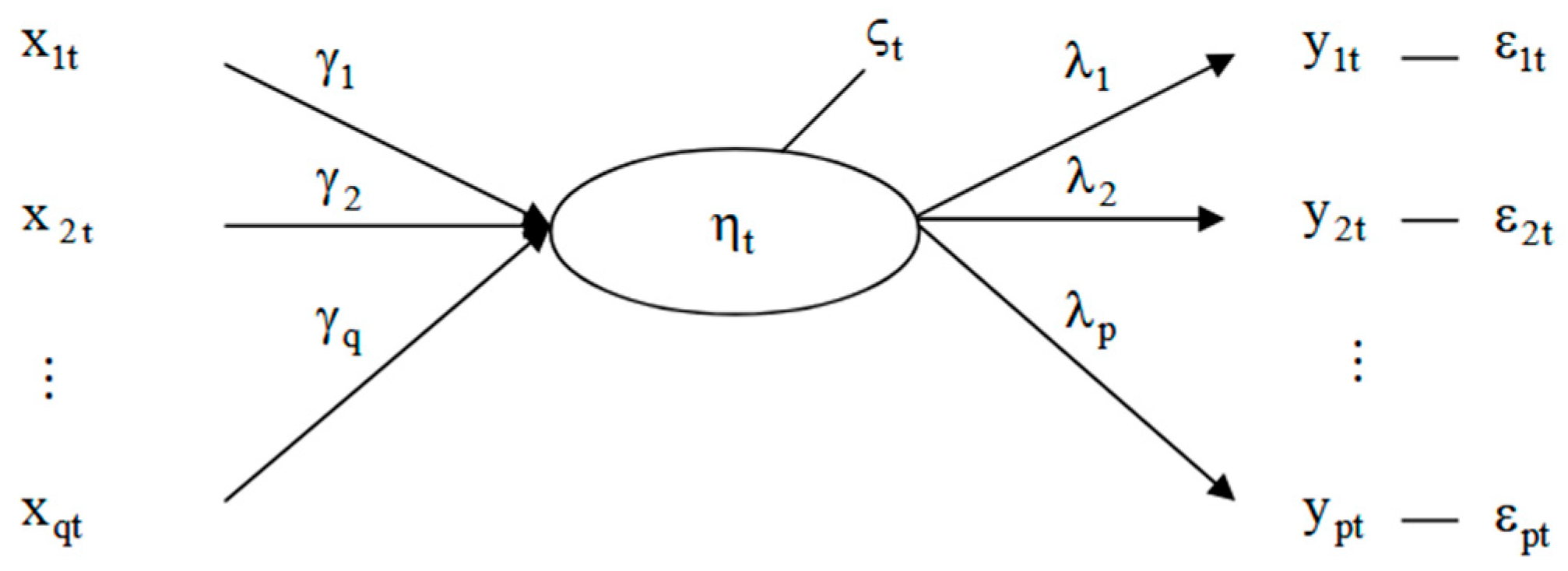
Based on the statistical theory of unobserved variables, the MIMIC model is a unique type of Structural Equation Modeling (SEM). It is a theoretical method for verifying the impact of one or more exogenous causal variables (causes) on the latent variable, which in turn, affects a few macroeconomic variables (indicators). In our case, the unobservable or latent variable is the size of the informal economy expressed as a percentage of regional GDP. The two pillars of the MIMIC model are the structural block and the measurement block (
Bollen, 1989). The structural block conceptualizes a set of external causal variables that linearly determines the latent variable (
Figure 1). The specification has the following form:
where
x is a vector of causal variables (where
x =
x1,
x2, …,
xq) of the unobserved or latent variable
η (the size of the informal economy in percent of regional GDP),
γ is a vector of scalars, and
is a structural disturbance term. The
is directly affected by one or more
x variables, and it is indicated by one or more
y variables.
The measurement block links the latent variable with a few indicators and takes the following form:
where
y is a vector of indicator variables (
y =
y1, y2, …,
yp), and
λ is a vector of loading factors used to represent the magnitude of the expected change for a unit change in the latent variable
η. The symbol
ε refers to the measurement error term. The MIMIC model assumes that the variables are measured as deviations from their means and that the error term does not correlate to the causes.
The estimated latent factor is subsequently transformed into regional shadow economy shares expressed as percentages of regional GDP. The selection of explanatory variables is guided by both theoretical literature and regional data availability.
Labour force participation. Higher labour force participation is generally associated with stronger integration into formal labour markets. In environments where formal employment creation remains limited, increased participation may also generate growth in informal employment (
Schneider et al., 2010;
Williams & Horodnic, 2015;
Ohnsorge & Yu, 2022). The expected effect is therefore theoretically ambiguous.
Agricultural share. Agriculture is traditionally associated with higher frequency of cash-based transactions, seasonal employment, and underreporting (
Schneider et al., 2010;
Medina & Schneider, 2018;
Ohnsorge & Yu, 2022). Regions with larger agricultural sectors are therefore expected to exhibit higher levels of informality.
ICT usage. Digitalization and internet access may reduce informal transactions by facilitating electronic payments and increasing transaction traceability. However, well-educated individuals in an environment characterized by weak institutional capacity may easily circumvent the channels of official economy. For example, the anecdotal evidence suggests that many freelancers and digital nomads are heavily involed in informal economic activity. The net effect therefore depends on the relative strength of formalization versus concealment channels.
The latent variable is linked to three observable indicators commonly associated with informality.
Unemployment rate. Higher unemployment is expected to correlate positively with informal economic activity due to labour market exclusion from formal employment.
Social assistance dependence. The number of households receiving Guaranteed Minimum Assistance per 1000 inhabitants captures economic vulnerability and may indicate stronger incentives for participation in undeclared work.
Regional GDP per capita. Higher levels of regional development are generally associated with stronger institutions, improved enforcement capacity, and lower informality. GDP per capita is therefore expected to exhibit a negative relationship with the shadow economy.
Institutional variables were not included in the MIMIC specification because consistent institutional indicators at the regional level are not available for North Macedonia. This limitation is also acknowledged when discussing the data limitations.
The analysis relies on official regional level statistics obtained from the
State Statistical Office (
2024), Ministry of Finance, and municipal budget reports. Regional fiscal indicators are constructed by aggregating municipal budget data for all 81 municipalities into their corresponding planning regions. Fiscal dependence is measured as the share of intergovernmental transfers in total local government revenues. Fiscal effort is approximated through the ratio of own-source revenues to regional GDP.
4.2. Calibration, Identification, Normalization, and Validation
The MIMIC model produces a latent regional informality score. It provides information on the relative prevalence of informal economic activity across regions and years. However, it is not directly expressed as a percentage of regional GDP. An additional calibration step is needed to transform the latent index into economically interpretable regional estimates.
Let
denote the estimated latent informality score for region
i in year
t, so that higher values are associated with a larger informal economy. Since the latent score is scale free, it must be first transformed into a positive regional informality index:
The exponential transformation preserves the ranking of regions and ensures positive values. The regional index is then normalized by its GDP-weighted national average:
where
wi,t denotes the share of region
i in country’s GDP in year
t. The calibrated share of the informal economy of region
i is then calculated as:
where
is the external national benchmark estimate of the informal economy as a percentage of official GDP. This calibration ensures that the GDP-weighted regional average is equal to the national benchmark.
The adjusted measure of regional economic activity (
) is calculated as:
where
is regional GDP. The estimated informal economy is therefore interpreted as unrecorded output expressed as a percentage of official regional GDP. The national calibration benchmarks used in the estimation are the international estimates of the informal economy for North Macedonia produced by
Asllani et al. (
2026).
The model is identified through standard restrictions used in structural equation modelling with latent variables. Since the latent variable is not directly observed, its sign and scale must be fixed. The loading of the unemployment rate is normalized to one because unemployment is theoretically and empirically expected to move positively with informal economic activity. The remaining indicator loadings are estimated relative to this restriction. The sign convention is defined so that higher values of the latent factor indicate higher regional informality.
All observed variables are standardized before estimation. This reduces scale effects and allows the estimated coefficients to be interpreted as standardized associations. The measurement errors are assumed to be uncorrelated with the causal variables. The causal variables affect the latent variable, while the indicators reflect the latent variable.
Goodness-of-fit statistics are reported in
Table 1. The model shows acceptable fit; the Chi-square test does not reject the model at conventional significance levels. The RMSEA is below the usual 0.06 threshold, the Comparative Fit Index (CFI) and Tucker-Lewis Index (TLI) are close to or above the 0.95 benchmark. The Standardized Root Mean Square Residual is below 0.08. The results indicate that the covariance structure implied by the MIMIC specification is consistent with the observed regional data.
Several validation checks were also performed. Firstly, construct validity was assessed by examining whether the signs of the structural and measurement coefficients were consistent with theoretical expectations. Secondly, external validity was assessed through calibration to national benchmark estimates from reputable international studies. Thirdly, robustness checks were conducted using alternative normalizations of the measurement block. The regional ranking remained stable across specifications, with Spearman rank correlations above 0.90. The resulting regional informality shares changed only moderately, but the main territorial pattern remained unchanged. The calibration and validation procedures indicate that the MIMIC model provides a consistent and interpretable measure of regional informality.
5. Results
5.1. Regional Distribution of the Informal Economy
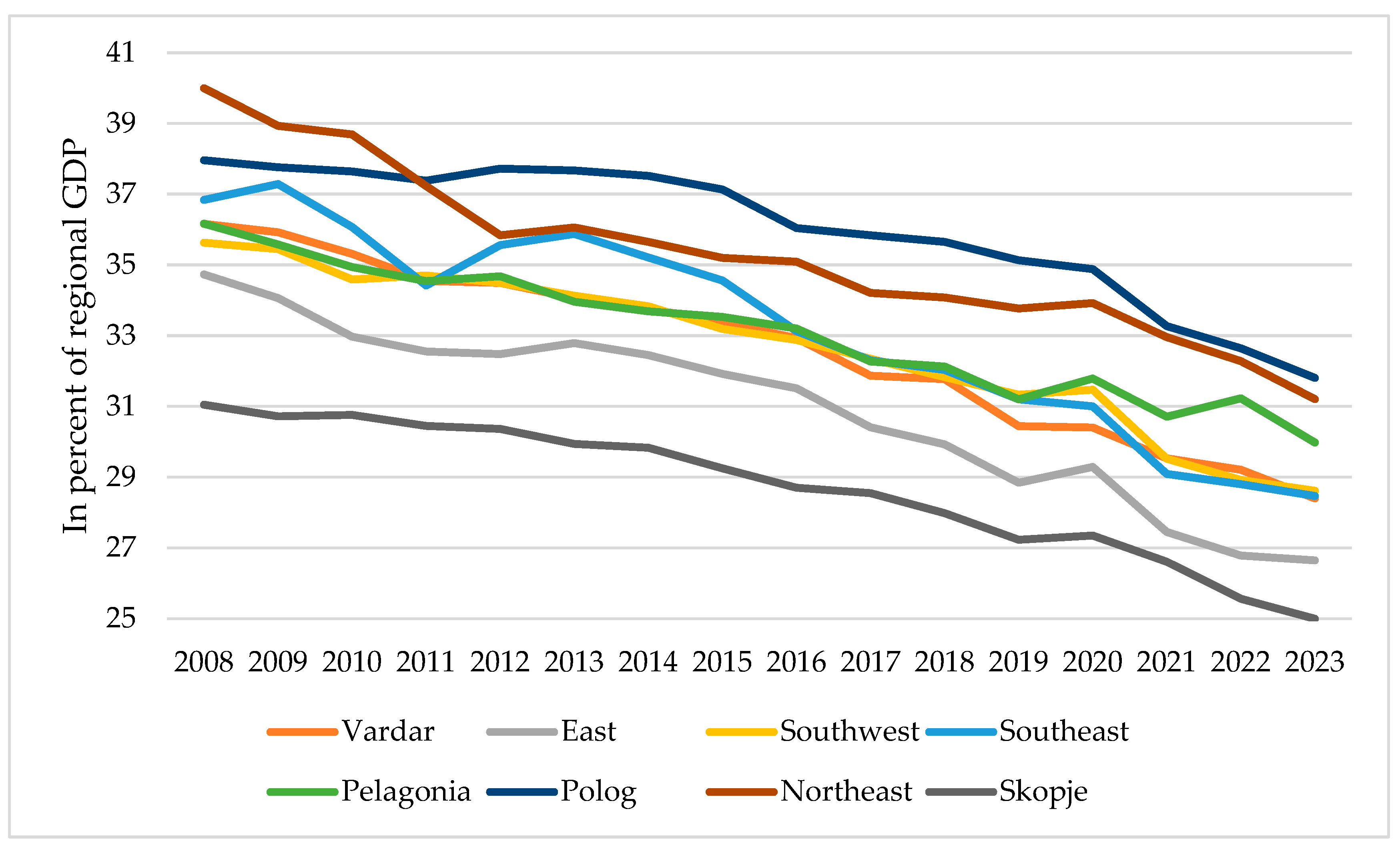
The estimated results indicate that the informal economy remains persistently large across all statistical regions of North Macedonia during the 2008 to 2023 period (
Figure 2). The regional estimates range between approximately 25% and 40% of regional GDP, suggesting that informal economic activity represents an indispensable component of the national economy.
As presented in
Figure 2, the results further reveal a signficant degree of territorial variation. The Polog region consistently exhibits the highest estimated levels of informality, with informal economy shares fluctuating between 32% and 38% of regional GDP. Elevated levels are also observed in Pelagonia and Southwest regions (
Figure 2). In contrast, the Skopje and East regions display comparatively lower estimated shares of informal activity.
Although regional differences may initially appear moderate in absolute terms, even relatively small variations in informal activity can produce significant differences in fiscal outcomes once translated into taxable capacity and local revenue mobilization. Several structural characteristics appear consistent with the estimated patterns. Regions with stronger agricultural activity, greater reliance on cash transactions, and lower levels of digitalization generally display larger shadow economies. In contrast, regions characterized by stronger educational attainment and greater ICT penetration tend to exhibit relatively lower levels of informality. The results also suggest that the COVID-19 period temporarily increased informality across most regions, particularly during 2020. The pattern is consistent with broader international evidence indicating that economic disruptions, labour market instability, and weakened enforcement conditions tend to expand informal economic activity (e.g.,
Asllani et al., 2026).
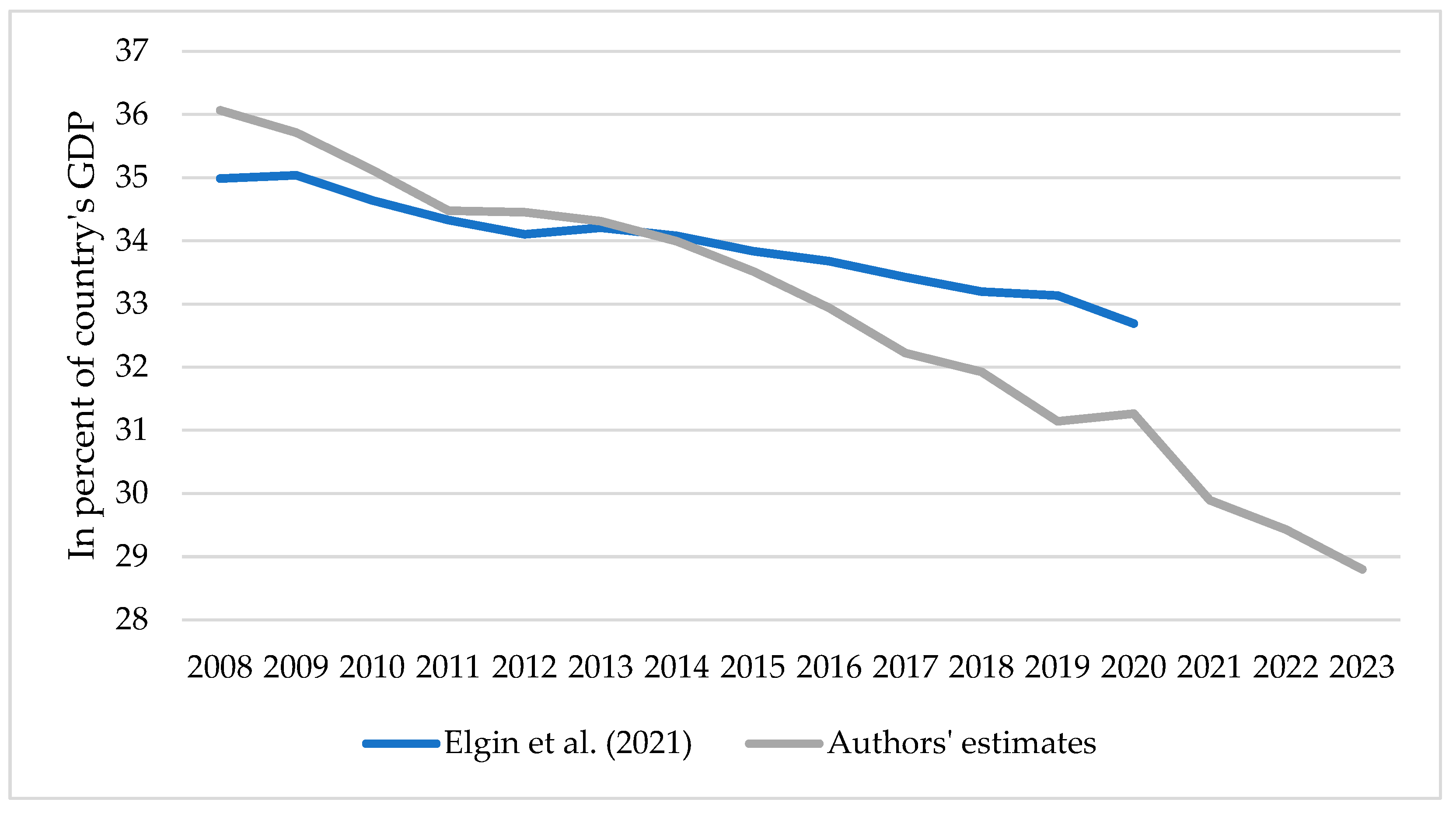
The results for the informal economy at the national level are similar to the internationally comparable estimates produced by
Elgin et al. (
2021), which are also used by the World Bank Group (
Figure 3).
5.2. Structural Determinants of Regional Informality
As presented in
Table 2 and
Table 3, the structural and measurment blocks of the MIMIC model produce results broadly consistent with theoretical expectations.
Labour force participation exhibits a statistically significant negative relationship with informality. Regions characterized by stronger labour market participation tend to display lower levels of informal economic activity, suggesting that integration into formal employment reduces incentives for undeclared work.
Regional agricultural output as a percent of regional GDP has a statistically significant impact on regional informality. The findings may indicate continued use of cash-based transactions, temporary or seasonal employee arrangements, and underdeveloped systems for tracking income in agriculture. A negative and statistically significant relationship was found between the tertiary education component of regional GDP and the shadow economy. It does suggest that higher levels of human capital and educational attainment are positively correlated to being formally employed. In addition, ICT access had a stronger negative correlation than most other variables included in the model. As such, it supports previous research suggesting that digitalization and electronic connectivity limit opportunities for illegal financial transactions. Positive correlations were also seen with tourism intensity. However, the strength and statistical significance of the relationships varied from region to region. While these results may be indicative of some of the characteristics of tourism-related businesses such as unreported accommodation, cash payments and/or non-declaration of services. The structural model suggests that regional informality is not random but systematically associated with economic structure, labour market conditions, digitalization, and institutional modernization.
5.3. Informality and the System of Equalization Grants
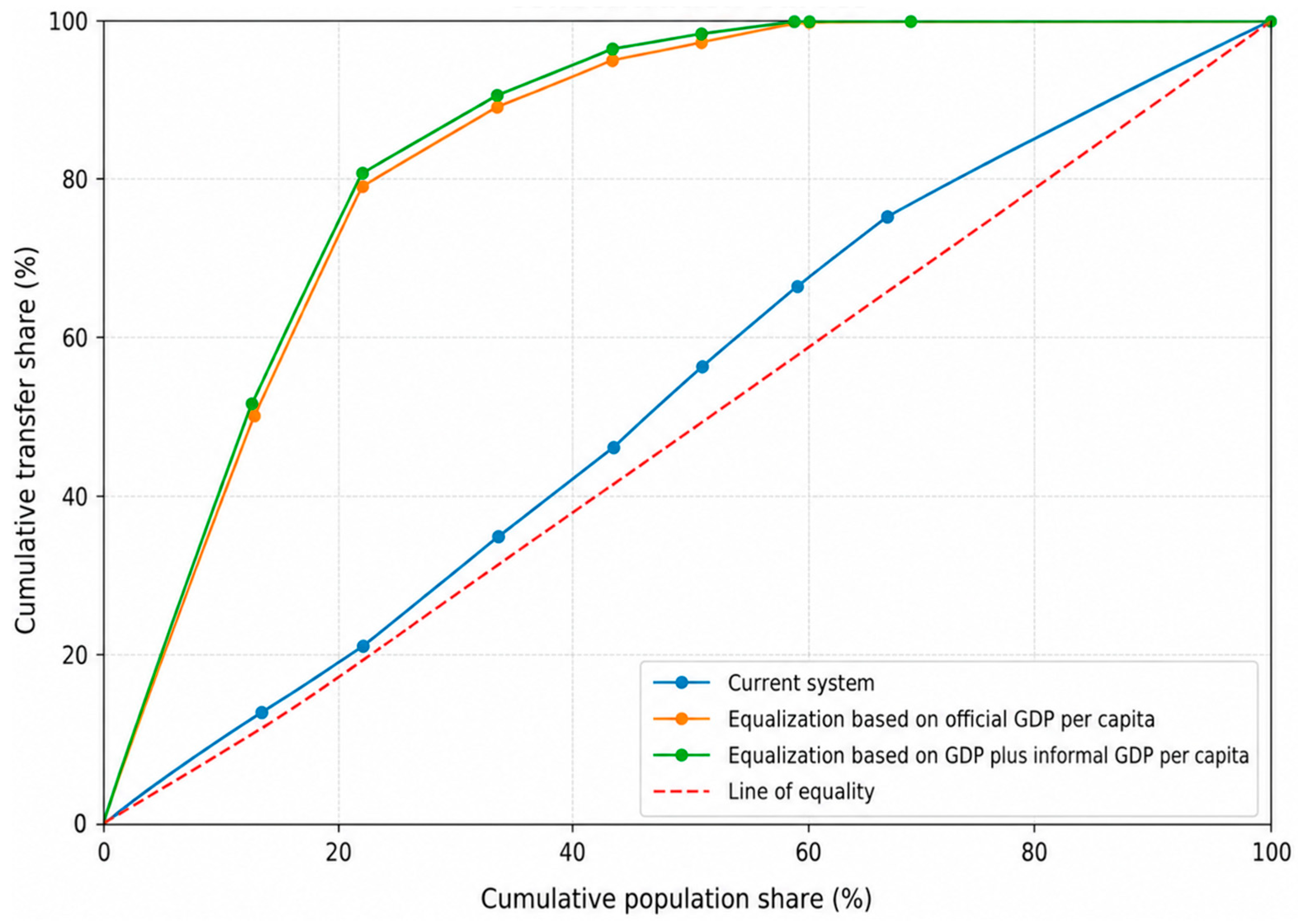
In this sub-section, we explore potential changes of the system of equalization grants, if regional GDP per capita or regional GDP per capita corrected for informal economy were adopted as allocation criteria. Alternative weightings demonstrate that the redistributive effect of the equalization formula, is determined by how regional fiscal capacity is to be measured. The present system is only mildly pro-poor, as evidenced by the concentration curves in
Figure 4. Yet if using an official measure (regional GDP per capita), the system is strongly pro-poor. When GDP per capita is the sole criterion, the equalization pool is allocated according to each region’s population-weighted fiscal capacity gap. It provides transfers only to regions below the national GDP-per-capita benchmark. If the estimate of informal economy activity is added the resulting transfer allocations are altered so that the system becomes even more heavily weighted towards the poorest regions. While the general order of rank does not alter significantly it does suggest that while the overall conclusions will remain largely unaffected. We argue that combining the current formula with an economic capacity indicator, preferably with the estimated informal economy, would strengthen the equalizing effect of the transfer system.
5.4. Informality, Fiscal Dependence, and Fiscal Effort
We also estimate two-way fixed-effects panel regressions to examine the relationship between regional informality, fiscal dependence, and fiscal effort. The results in
Table 4 show a strong positive association between the estimated informal economy and fiscal dependence. In the baseline empirical specification, a one percentage-point increase in the informal economy share is associated with a 1.240 percentage-point increase in fiscal dependence. The coefficient remains positive and statistically significant after adding controls. It does suggest that regions with larger informal sectors tend to rely more heavily on intergovernmental transfers, even after controlling for regional fixed effects, year effects, GDP per capita, unemployment, and agricultural structure.
The results also show a negative association between informality and fiscal effort. They indicate that informal economic activity constrains own-source revenue mobilization relative to regional GDP. Having in mind the important small sample limitation, the panel estimates support the view that informality weakens effective fiscal autonomy. It does so by increasing transfer dependence and reducing the capacity of municipalities to convert economic activity into formal local revenues.
5.5. Limitations
The empirical analysis is constrained by the small sample and the limited availability of regional data. The panel covers eight statistical regions over 16 years, producing 128 region-year observations. The relatively small sample requires caution when interpreting the estimation results. Firstly, regional aggregation may mask important municipal level variation (or intra-regional variation). The municipality of Centar and the municipality of Suto Orizari are part of the Skopje region, but the differences in income per capita and fiscal capacities are vast. Secondly, the results can be very sensitive to the applied econometric technique or the selection of variables in the measurement or the structural block.
6. Discussion
The findings of the study suggest that the informal economy has important repercussions for subnational public finance. Municipalities and regions that operate in an environment of large informal economies show a higher degree of dependence upon central government transfers. Simultaneously, informal economic activities reduce the actual local tax base and distort the indicators of sub-national fiscal capacity. Therefore, high-informality sub-national units experience structural constraints in generating sustainable own-source revenues.
The findings also present serious concerns regarding the design of redistribution mechanisms (equalization schemes). Most transfer schemes depend almost entirely on visible and comprensible indicators such as population, area, realized tax collection, or registered incomes. Where there exist significant differences in the level of GDP and/or concealed economic activity among the regions, however, these indicators may often fail to measure accurately the real economic capacity of those jurisdictions.
The high degree of informality and its uneven territorial distribution create distortion in decentralized systems. Subnational units that have substantial levels of informal economic activity may appear to be financially weaker than they really are and thus will qualify for larger amounts of transfers. In contrast, sub-national units that have formally organized economies will contribute disproportionately more to the overall national fiscal system while receiving fewer resources for equalization purposes over time. These dynamics may negatively affect how citizens perceive fairness and create opposition to redistribution mechanisms.
Furthermore, our research indicates that fiscal dependence and informality may be mutually reinforcing. When local administrations depend largely on central government transfers, the incentives to build a more efficient tax administration and promote formalization may be reduced. Similarly, persistent informality restricts the growth of own-source revenues and limits true fiscal autonomy. As a result, sub-national units may find themselves locked into long term equilibria characterized by poor local tax capacity, weak formalization incentives and structural transfer dependence.
Finally, large urban agglomerations can partially counteract negative fiscal impacts of informality due to higher concentration of businesses, higher property values and better administrative capacity. From a policy perspective, our research implies that fiscal decentralization reforms must go together with broader formalization strategies. Strengthening local fiscal autonomy requires not only designing new transfer systems but also increasing the formal economic base itself.
These findings qualify the more optimistic view in
Buehn et al. (
2013) and
Dell’Anno and Teobaldelli (
2015). They suggest that decentralization can reduce informality, because local governments have better information and stronger accountability. In the case of North Macedonia, decentralization operates under limited local revenue autonomy and high transfer dependence, which may weaken incentives for formalization rather than strengthen them. The results are also consistent with
Marshall et al. (
2023), because they demonstrate that informality is not only a national phenomenon but a territorially differentiated fiscal issue with direct implications for subnational revenue capacity and equalization design.
There are several policy implications from our analysis. First, equalization schemes should rely less exclusively on reported GDP or realized tax collections when measuring sub-national fiscal capacity in highly informal economies. Additional weight could be given to expenditure needs indicators, population pressure and development characteristics. Second, inter-governmental transfers should include performance-based incentives based on formalization initiatives at the local level. For example, municipalities improving cadastre coverage, property registration, electronic payments etc., and ultimately, own-source revenues, would receive additional financial rewards for doing so. Third, digitalization is particularly interesting. The strong relationship found between ICT penetration/payment infrastructure/informality suggests that promoting electronic transactions and diminishing reliance on cash will increase both fiscal transparency and mobilize local revenues.
7. Conclusions
This study has investigated the relationship between regional informality and fiscal decentralization outcomes, using the case of North Macedonia. The results indicate that the informal sector is not just an informal labour market issue or a matter of tax compliance; it is also an institutional constraint to the functioning of decentralized public finances systems, as it distorts the measurement of fiscal capacities themselves.
Empirical analysis shows that municipalities with larger informal sectors are characterized by high levels of fiscal dependency on inter-governmental transfers. The informal sector weakens observable taxable bases, hampers the ability of local authorities to collect their own revenues, and restricts the effective fiscal autonomy of local administrations. Additionally, equalisation mechanisms that depend mainly on GDP or realised taxation can underestimate the actual economic potential of municipalities with high levels of hidden economic activities.
Therefore, this study presents a more general argument. Decentralised fiscal policies may lead to unequal distribution of redistributive flows in countries where there are large differences in the degree of informality across regions. On one hand, municipalities that have large amounts of unreported economic activity will appear as economically weaker than they are and therefore will be entitled to greater inter-governmental transfers. On the other hand, areas that operate in relatively formalised economic conditions will generate proportionately more income for the overall public financing system but will receive less compensation through equalization funds.
Equalization reform could therefore account not only for regional GDP per capita, but also a correction factor for the estimated degree of regional informality. One option is to adjust fiscal capacity indicators by adding an informality-corrected measure of regional output, so that regions are not overcompensated simply because part of their economic base remains unrecorded. A second option is to combine fiscal capacity measures with much stronger incentives for own-source revenue mobilization. In that way, performance-based transfers can support poorer regions without weakening incentives for formalization and local tax collection.
These dynamics have important institutional and political economy implications. Fiscal dependence over time may create disincentives for local administrative bodies to pursue formalisation processes and mobilise own-source revenue collection which would then maintain a stable state of low-fiscal-effort and permanent reliance on structural funding. As such, inequality in perceptions regarding fiscal contributions and redistributions among territories may decrease taxpayers’ sense of responsibility towards institutions and further diminish national cohesion and solidarity.
Consequently, the study suggests that discussions about decentralisation in transition economies should go beyond the conventional issues of expenditure assignments and vertical revenue-sharing arrangements. In addition to these aspects, the efficiency of decentralisation schemes also depends on whether fiscal capacity indicators provide accurate information concerning the economic potential of regions experiencing high degrees of informal activity.
The study offers several important policy recommendations. Firstly, equalisation mechanisms in countries with high levels of informal sectors should place less emphasis on GDP and collected taxes as indicators of fiscal capacity. Secondly, equalisation mechanisms should include incentives for formalising activity and increasing local fiscal efforts. Finally, digitalisation appears crucial to ensure sustainable local public finance. In fact, regions characterised by higher Information and Communication Technologies (ICT) penetration and lower cash usage always show lower estimated informality. Therefore, expanding electronic transactions and decreasing reliance on cash can improve transparency in public finance at the local level and support local revenue collection.




 ,
,