1. Introduction
Digital transformation has moved from a strategic option to an operational imperative. Meta-analyses of 3142 manufacturing plants show that firms adopting artificial intelligence (AI), cloud platforms, and Internet-of-Things (IoT) sensors record average productivity gains of 14 percent, yet only 6 percent realise system-wide integration, demonstrating a persistent deployment gap between pilot projects and full-scale use (
Timperi et al., 2024). Simultaneously, global extraction of virgin materials is forecast to reach 190 billion tons by 2060, intensifying environmental pressures and exposing firms to new regulatory and reputational risks (
Huang & Zhang, 2023). Because roughly two-thirds of world trade now passes through global value chains (GVCs) (
Zarea & Su, 2026), which are multi-tier networks that disperse design, production, and service activities across borders (
Butollo et al., 2022;
Zarea et al., 2026), any attempt to decouple growth from material throughput must focus on the digital-resource nexus across entire value networks rather than on isolated plants or technologies.
Digital tools promise to provide the real-time, multi-tier visibility that resource-efficient GVCs demand. IoT-enabled energy dashboards have been shown to reduce average electricity use in discrete manufacturing by 9 percent (
Lee & Gereffi, 2021;
K. Haverila et al., 2026), while machine learning algorithms can cut raw-material scrap by up to 17 percent through predictive process control (
Silva et al., 2023). Digital twins, which are virtual replicas populated with live process data, are emerging as a pivotal orchestration layer, with recent experiments demonstrating significant reductions in inventory holding costs and order-to-delivery cycles when twins are linked to supplier portals (
Jackson et al., 2024;
M. Haverila et al., 2025). These studies, however, consistently fail to connect operational gains to systemic resource efficiency outcomes, leaving open how digital affordances scale, interact, or conflict along upstream, mid-stream, and downstream tiers.
A growing stream of international business research recognises the transformative power of digital platformisation in reshaping GVC topology, shortening chains, flattening hierarchies, and shifting power from lead firms to data-rich intermediaries (
Sanguineti et al., 2023;
Huang & Zhang, 2023;
Kamali et al., 2025). Yet most empirical work treats resource efficiency and digitalisation as parallel rather than intertwined phenomena. Reviews of AI in operations and supply chain management still code sustainability as a peripheral category (
Agarwal, 2025), while syntheses of digital twin research prioritise resilience over eco-efficiency metrics (
Khan et al., 2022). This fragmentation means that neither the operations literature nor the IB literature offers an integrative account of how, and under what conditions, digital technologies translate into resource efficiency gains across geographically dispersed, multi-governed networks.
This gap carries real costs. Recent flood and wildfire events triggered
$342 billion in supply-chain losses, and simulation studies show that climate-risk shocks propagate faster along digitally opaque chains than along data-transparent ones (
Ivanov, 2025). Meanwhile, the EU Corporate Sustainability Due-Diligence Directive (2024/1760) (
Morris, 2026) mandates auditable chain-wide environmental disclosures, effectively turning digital traceability from a competitive advantage into a compliance threshold. Managers, therefore, face twin pressures: scale digital capabilities and demonstrate measurable reductions in material, energy, and carbon footprints throughout their chain partners. Existing theoretical frameworks, including Transaction Cost Economics, the Resource-Based View, and classic IB theories, were not built to explain these dynamics and are showing their limits.
Against this backdrop, this review is organised around three research questions. RQ1 asks how dominant theoretical frameworks must be extended to account for digitalisation-driven sustainability outcomes. RQ2 asks what governance conditions and capability configurations enable or constrain the relationship between digital technologies and resource efficiency in GVCs. RQ3 asks through what mechanisms specific digital technologies generate resource efficiency gains across multiple GVC tiers, and what boundary conditions shape these effects. Answering these questions collectively advances both the scholarly understanding of digital GVCs and the practical toolkit available to managers and policymakers navigating the sustainability-driven digital transition.
4. Results and Discussion
4.1. Theoretical Contributions (RQ1)
The evidence synthesised in RQ1 exposes clear limits in the explanatory reach of dominant theoretical frameworks. This section examines where each framework holds, where it falls short, and what extensions are required to account for the sustainability and platform dimensions of contemporary digitalised GVCs.
Transaction Cost Economics (TCE) predicts that richer information flows reduce coordination costs and extend supply chains outward by making distant sourcing relationships more governable. The digital-regionalisation paradox documented in RQ2 directly contradicts this prediction. When data-compliance demands and regulatory congruence requirements become binding constraints, firms prefer proximate partners embedded in compatible institutional environments, concentrating rather than extending GVC geography. Risk externalities and non-tariff regulatory burdens now outweigh pure coordination cost logic, and TCE offers no mechanism to account for this inversion. An adequate theoretical extension must incorporate regulatory fit as a location advantage that can override coordination cost minimisation in digitally intensive governance contexts. This extension is distinct from, though related to, the institutional-economics literature on regulatory distance and its effect on FDI location decisions, which treats regulatory difference as a cost to be minimised rather than, as here, a fit condition that can actively re-anchor sourcing.
The Resource-Based View (RBV) fares better in explaining why some firms capture larger efficiency dividends from identical digital investments but requires substantive recalibration. Cloud, blockchain, and AI bundles exhibit the VRIN properties
Barney (
1991) articulated, but recent empirical work published in leading IB journals demonstrates that value materialises only when firms develop analytics orchestration and data sharing capabilities across organisational and national boundaries (
Huang & Zhang, 2023;
Sanguineti et al., 2023). These inter-firm routines correspond to
Teece’s (
2007) dynamic-capabilities micro-foundations of sensing, seizing, and reconfiguring, but add a layer of platform curation: firms must continuously manage external API partners and tokenise process data to sustain systemic efficiencies. The RBV conversation must therefore shift from asset ownership to what we term ecosystemic capability bundling, which captures the distributed, cross-firm nature of digital-sustainability advantages and responds to longstanding critiques that the RBV under-theorises inter-firm complementarities.
Dunning’s eclectic paradigm offers useful framing for understanding how digital connectivity reshapes location and internalisation advantages but also requires extension. Digital connectivity attenuates classic location advantages yet accentuates regulatory fit advantages:
Han et al. (
2025) show that suppliers located in jurisdictions with robust digital-compliance regimes attract more platform-mediated contracts than equally productive peers elsewhere, a finding that the original OLI framework cannot explain. Internalisation logic likewise needs recalibration. The cost-minimisation logic of
Buckley and Casson (
2003) struggles to explain why lead firms now open-source carbon-tracking algorithms, a behaviour that platform-based international business theory (
Kano et al., 2022) captures better. Our review adds a sustainability layer to this explanation: open architectures are adopted not merely for scalability but to diffuse audit costs and compliance burdens across the chain (
Bals et al., 2024). This motivates the construct of digital-sustainability spillovers, which we define as the process by which data made transparent for compliance purposes rapidly diffuses as operational knowledge, amplifying resource efficiency along the chain beyond the originating firm. These extensions rest on a more basic distinction between digital and traditional value chains. A traditional chain coordinates the sequential transformation of physical inputs, where value is added through tangible processing and location is governed by factor costs and logistics. A digital value chain instead coordinates flows of data alongside physical goods, so that value is created less through the transformation of materials and more through the capture, integration, and recombination of information across tiers. Because data exhibits increasing returns and near-zero replication cost, value concentrates wherever the capability to govern and analyse it is densest, which helps explain why digital intensity reinforces rather than disperses regional production blocs, the mechanism underlying the digital-regionalisation paradox. This shift also reshapes governance: coordination authority migrates from owners of physical assets toward orchestrators of data and standards, so that the firms setting interoperability protocols and compliance rules increasingly govern the chain, independent of where physical production occurs.
The Technology-Organisation-Environment (TOE) framework continues to predict initial digital adoption decisions effectively, as confirmed by recent multi-country surveys (
Liu et al., 2022). However, our synthesis reveals that cross-border complementarities, regulatory alignment, and data-sovereignty considerations now play roles equal to or greater than traditional organisational readiness variables. The environmental dimension of the TOE framework must be expanded beyond home-country institutional contexts to encompass bilateral trade agreements, cybersecurity standards, and sustainability regimes that collectively shape firms’ digitalisation strategies across GVC tiers (
Nguyen & Zuidwijk, 2025). Without this internationalisation, the TOE framework cannot explain why otherwise digitally ready firms fail to realise efficiency gains when their chain partners operate under incompatible regulatory environments.
A socio-technical transition perspective, which treats technological affordances and institutional responses as co-evolving systems, offers the most promising integrative frame for the patterns identified in our corpus. Recent conceptual pieces have begun applying this lens to digitalised supply chains (
Bals et al., 2024), but it has not yet been operationalised at scale. Drawing on
Geels (
2002) and
Smith et al. (
2005), our synthesis points toward a third construct, distributed eco-innovation, which captures how digital twins modularise tasks, blockchain orchestrates knowledge flows, and AI unlocks generative recombination of process data that cascades efficiency improvements through supplier networks. This construct synthesises the fragmented notions of modularity, collaboration, and value co-creation into a coherent explanatory package grounded in empirical evidence from 76 studies in our corpus.
Together, the three theoretical extensions proposed here, namely ecosystemic capability bundling, digital-sustainability spillovers, and distributed eco-innovation, address the gaps that TCE, RBV, dynamic capabilities, and classic IB theories leave when confronted with the sustainability and platform realities of contemporary GVCs. They are not wholesale replacements of existing frameworks but targeted extensions that restore explanatory power where legacy theories fall short. Each extension generates testable propositions and opens new empirical avenues, which are developed further in
Section 5 alongside the digital-resource synergy framework.
4.2. Challenges of Digitalization of the GVCs (RQ2)
The relationship between digital technologies and resource efficiency in GVCs is neither automatic nor linear. It is shaped by a set of enabling conditions and structural barriers that determine whether digital adoption translates into measurable chain-wide gains or remains confined to isolated operational improvements.
The most consistent finding across the corpus is that resource efficiency gains are contingent on integrated deployment rather than piecemeal adoption. Studies comparing standalone versus bundled digital implementations show that firms deploying integrated stacks combining IoT sensing, AI analytics, blockchain traceability, and digital twins achieve efficiency outcomes that are substantially larger than the sum of individual technology contributions.
Huang and Zhang (
2023) demonstrate that coupling digital twins with blockchain-verified traceability reduced material loss by 18 percent and compliance-audit time by half at a European white-goods producer, an outcome that neither technology achieved independently.
Governance arrangements represent the second critical enabling condition. Data-governance structures, including data-sovereignty rules, interoperability standards, and access protocols, determine whether efficiency-relevant information flows freely across organisational and national boundaries or accumulates in data silos that constrain systemic optimisation. Where governance frameworks are misaligned across trading partners, the efficiency potential of otherwise capable digital stacks is significantly dampened. This finding aligns with recent institutional perspectives arguing that the organisational and regulatory environment shapes digital value creation as much as the technology itself (
Bals et al., 2024).
Regulatory congruence emerges as a closely related but distinct barrier. The post-2021 surge in sustainability regulation, most notably the EU Corporate Sustainability Due-Diligence Directive (2024/1760) (
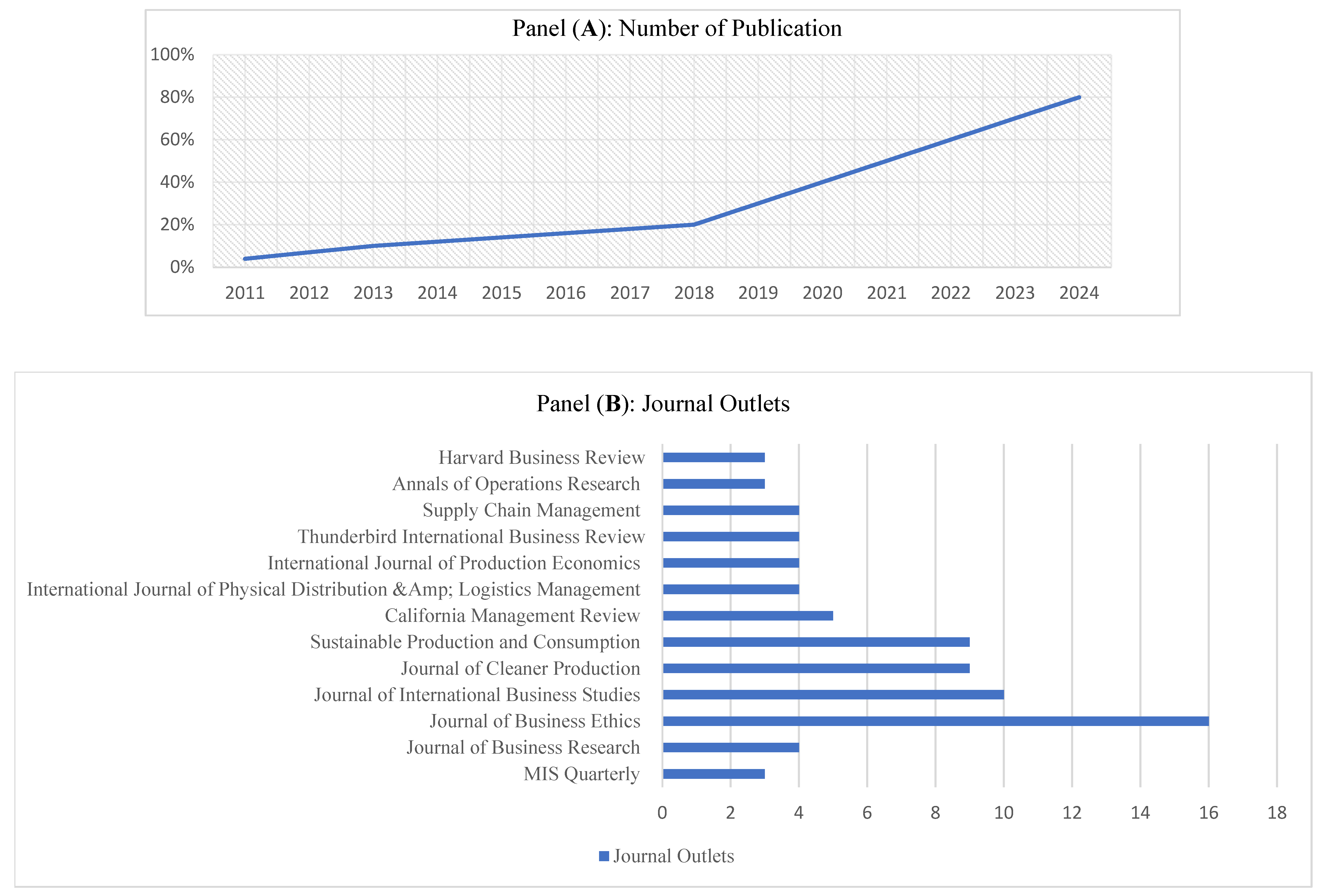
Morris, 2026) and the forthcoming EU Digital Product Passport requirements, has elevated digital traceability from a competitive option to a compliance necessity. Citation-burst analyses in our corpus show that “scope-3 emissions” and “circular economy” supplanted “lean logistics” and “agility” among the top ten keywords from 2022 to 2024, reflecting this regulatory shift.
Giunta et al. (
2025) observe that sustainability now rivals speed as the primary supply-chain objective, and our synthesis suggests that regulatory pressure is associated with greater digital investment than competitive mimicry alone, though the cross-sectional nature of the underlying evidence precludes a firm causal claim.
Cyber-risk maturity constitutes a fourth boundary condition.
ENISA (
2025) reports that supply-chain cyber incidents rose 47 percent year-on-year, predominantly in multi-tier ecosystems where governance is weakest. As digital integration deepens across GVC tiers, the attack surface expands proportionally, and firms with low cyber-risk maturity face a structural ceiling on how far they can safely extend data sharing with chain partners. This finding introduces an important qualification to the integration argument: deeper digital stacks amplify efficiency gains but also amplify systemic vulnerability when not accompanied by adequate security governance.
A persistent structural barrier cutting across all four conditions is the digital divide. The regional integration benefit of digital capital is estimated to be 30 percent smaller for SMEs in peripheral regions compared to incumbents in digital hubs, a disparity traced to unequal access to cloud infrastructure and specialised digital skills (
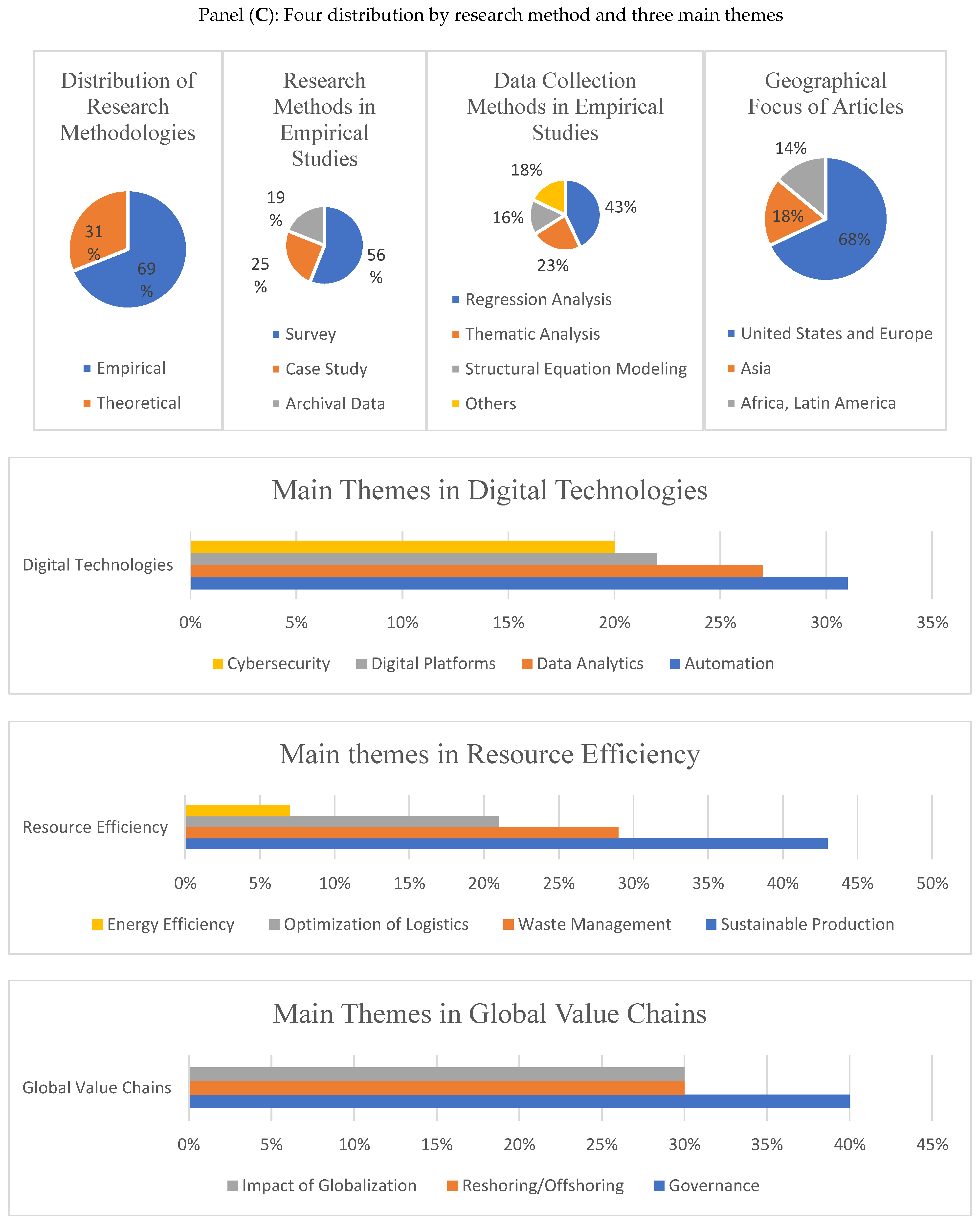
Díaz-Mora et al., 2022). Papers originating from Africa and Latin America, which represent fewer than 14 percent of our corpus, consistently highlight how resource-constrained contexts force leapfrog solutions such as off-grid IoT and smartphone-based traceability that challenge the assumption of advanced infrastructure as a precondition for digital upgrading.
Finally, our synthesis identifies an important paradox at the intersection of digital integration and GVC geography. Rather than extending supply chains outward as Transaction Cost Economics would predict, greater digital intensity is associated with stronger intra-regional trade concentration.
Díaz-Mora et al. (
2022) report that a 10 percent increase in digital capital boosts intra-EU trade by 8 percent while leaving extra-EU volumes unchanged, consistent with evidence reported by
Giunta et al. (
2025). We term this the digital-regionalisation paradox: digital technologies intended to transcend distance can instead reinforce regional production blocs when stringent data-compliance demands require sourcing partners to operate within congruent regulatory environments. This paradox represents the most significant and least theorised finding in the corpus, and motivates the theoretical extensions developed in RQ1.
In sum, RQ2 is answered by identifying four interlocking enablers and barriers: integrated capability deployment, data-governance alignment, regulatory congruence, and cyber-risk maturity, all of which are unevenly distributed across firm sizes, regions, and GVC tiers. Together, they establish that the efficiency dividend of digitalisation is structurally conditioned rather than technologically determined.
4.3. Digital Technologies and Resource Efficiency Mechanisms Across GVC Tiers (RQ3)
The third research question moves from conditions and theories to mechanisms, asking specifically how individual and bundled digital technologies generate resource efficiency gains across upstream, mid-stream, and downstream GVC tiers, and what boundary conditions shape these effects.
Blockchain traceability delivers a second layer of efficiency by aligning stakeholder incentives through information symmetry. Pharmaceutical sector pilots documented by
Klarin et al. (
2024) reduced product-recall times from weeks to hours, confirming
Freeman’s (
1984) stakeholder theory assertion that reduced information asymmetry dampens opportunistic behaviour across chain tiers. Our synthesis adds an institutional dimension to this mechanism:
Giunta et al. (
2025) show that EU due diligence legislation triggered a 37 percent surge in blockchain keyword intensity across sustainability journals, indicating that normative regulatory pressures mobilise digital investment in traceability more powerfully than competitive mimicry. This finding operationalises the digital-sustainability spillovers construct introduced in RQ1: data made transparent for compliance purposes diffuses rapidly as operational knowledge, generating efficiency improvements downstream of the originating compliance requirement. The mechanism, therefore, runs from regulation through transparency to operational efficiency, a pathway that neither TCE nor classic RBV theorised.
Digital twins amplify both sensing and traceability mechanisms by enabling virtual experimentation across GVC configurations without incurring the cost or disruption of physical trials. Recent twin-blockchain pilots in European electronics demonstrate that full-stack deployment reduces scrap by approximately 18 percent while shortening audit cycles by 40 percent, outcomes that isolated implementations cannot replicate (
Huang & Zhang, 2023). The efficiency mechanism of digital twins operates through three pathways: modularisation of tasks into digitally legible units that can be optimised independently, simulation-based scenario planning that identifies resource-efficient configurations before physical commitment, and generative recombination of process data that surfaces non-obvious efficiency opportunities across tier boundaries (
Vallée et al., 2026). These three pathways collectively constitute what we termed distributed eco-innovation in RQ1, and the twin-blockchain combination is its primary empirical instantiation in the current corpus.
AI analytics close the loop by transforming the data generated through sensing, traceability, and simulation into prescriptive recommendations at the speed and scale that multi-tier GVCs require.
Han et al. (
2025) provide firm-level evidence from China showing that suppliers adopting AI analytics are associated with measurable reductions in their customers’ downstream carbon emissions, a cross-tier pattern consistent with the ecosystemic rather than firm-bounded nature of digital efficiency gains. This dyadic finding should be read as correlational, since lead firms may strategically select AI-capable suppliers, and remains to be tested with instrumental-variable or natural-experiment identification. This finding is particularly significant for the ecosystemic capability bundling construct: the efficiency benefit does not reside in any single firm’s AI capability but in the complementarity between the supplier’s sensing and cognition infrastructure and the customer’s data-governance and analytics routines. Where this complementarity is absent, AI adoption at one tier generates no measurable efficiency gain at adjacent tiers.
Taken together, the five mechanisms identified across the corpus, namely real-time sensing, blockchain traceability, digital twin simulation, AI-driven analytics, and automation, operate as a mutually reinforcing system rather than as independent efficiency levers. The efficiency gains documented in the literature are largest when all five mechanisms are active and when the boundary conditions of regulatory synchronisation, cyber-risk maturity, ecosystemic capability complementarity, and labour-institutional fit are satisfied simultaneously. When any of these conditions is absent, the system degrades toward partial optimisation, confirming the central argument that the efficiency dividend of digitalisation is structurally conditioned rather than technologically determined.
RQ3 is therefore answered by a mechanism-level account that moves beyond cataloguing which technologies improve which metrics, toward explaining the causal pathways through which integrated digital stacks generate chain-wide resource efficiency gains, the cross-tier spillover effects that make those gains systemic rather than firm-level, and the boundary conditions that determine whether the full efficiency potential is realised or truncated at the level of isolated pilots.
5. Discussion
5.1. The Digital-Resource Synergy Framework
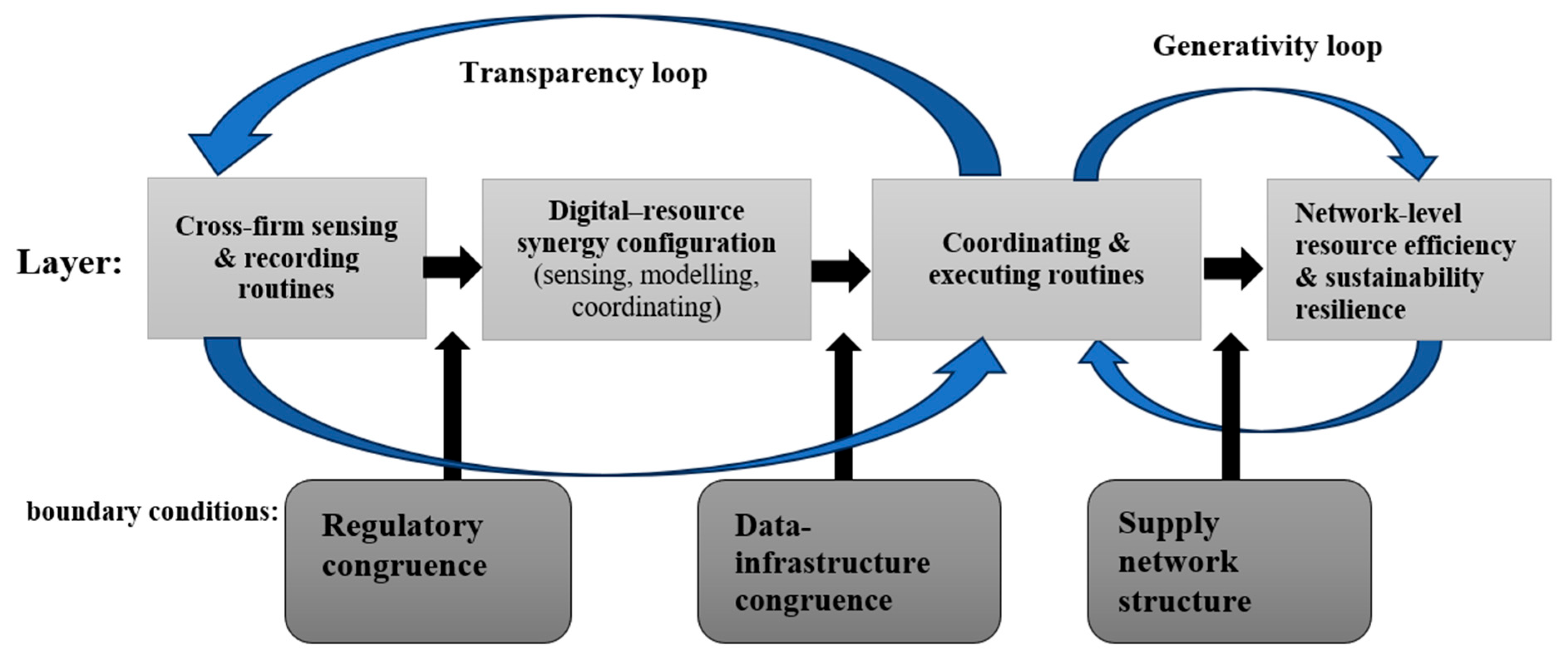
The findings across the three research questions converge on a common structural insight: digital technologies generate resource efficiency gains in GVCs not through isolated deployment but through layered, mutually reinforcing configurations that span firm boundaries, GVC tiers, and regulatory environments. To synthesise this insight and provide a foundation for future empirical and managerial work, we propose the digital-resource synergy (DRS) framework, presented in
Figure 3.
The framework links four layers: technology, capability orchestration, governance, and outcomes. In defining these layers, we draw on
Koch et al.’s (
2022) criteria for digital ecosystems, which specify that a true ecosystem requires not merely co-located actors but shared digital infrastructure, interdependent value creation, and coordinated governance. The DRS framework satisfies these criteria: its technology layer supplies the shared infrastructure, its capability and governance layers establish interdependence and coordination, and its outcome layer captures the jointly created value that distinguishes an ecosystem from a simple buyer–supplier chain through testable propositions. P1: The greater the integration of the four technology pillars (IoT sensing, AI analytics, blockchain traceability, digital twins), the larger the resource efficiency gains, relative to standalone deployment. P2: The effect of the technology stack on efficiency is mediated by ecosystemic capability bundling; firms that jointly develop cross-firm data sharing and orchestration routines capture larger gains than firms with equivalent technology but weaker inter-firm capabilities. P3: Blockchain-enabled transparency increases the strategic value of compliance data over time (the transparency circuit), strengthening the link between governance and outcomes. P4: Digital twin experimentation diffuses process innovations through the supplier network as distributed eco-innovation (the generativity circuit), amplifying chain-wide efficiency. P5: Regulatory congruence across trading partners moderates the technology-to-outcome path; where congruence is low, efficiency gains concentrate within regulatory blocs, producing the digital-regionalisation paradox. P6: Contextual moderators (digital-divide asymmetry, energy-mix elasticity, labour-institutional fit) condition the strength of all preceding relationships.
The framework is organised across four layers: technology, capability orchestration, governance, and outcomes. Each layer builds on the one below it, and the overall architecture is bounded by contextual moderators that determine whether synergies are realised or truncated.
At the technology layer, four mutually reinforcing pillars constitute the sense–cognise–record–simulate stack. Pervasive IoT and edge sensing convert material, energy, and carbon flows into real-time data streams. AI and advanced analytics transform those streams into predictive and prescriptive intelligence, closing the cognition gap that previously limited data-driven optimisation. Blockchain-enabled ledgers furnish tamper-proof provenance records, ensuring that data generated upstream remains trustworthy as it travels downstream. Digital twins synthesise sensor feeds and ledger data in simulation environments, allowing firms to rehearse resource efficiency scenarios without incurring the cost of physical trials. As documented in RQ3, this full stack reduces scrap by approximately 18 percent and shortens audit cycles by 40 percent in documented pilots (figures reported illustratively from individual high-quality case studies, not pooled across the corpus), outcomes that no single technology achieves independently.
At the capability-orchestration layer, the framework explains how technological artefacts become organisational outcomes. Ecosystemic capability bundling, the first theoretical extension proposed in RQ1, operates here. Joint development of data-exchange protocols, governance APIs, and cross-cultural analytics skills across chain partners determines whether firms can operationalise the technology stack or remain constrained by data silos and incompatible systems. Building on dynamic-capability theory, sensing and cognition create sensing-seizing complementarities, but only organisations that master data sharing and partner curation routines across national boundaries can fully exploit them. This layer also explains why identical technology investments yield divergent efficiency outcomes across firms and regions: the capability configuration, not the technology itself, is the primary source of differential performance.
At the governance layer, system performance depends on two mutually reinforcing circuits represented in
Figure 3. The transparency circuit couples blockchain traceability with external regulatory oversight: tamper-proof eco-ledgers satisfy regulators and buyers demanding verifiable sustainability data, encouraging richer disclosure and increasing the strategic value of the ledger over time. The generativity circuit links digital twin experimentation to innovation diffusion: virtual trials uncover superior process configurations that cascade through supplier networks as distributed eco-innovation, the third theoretical construct introduced in RQ1. If either circuit is disrupted by cyber breaches, data hoarding, or misaligned incentives, the architecture degrades into fragmented and sub-optimal optimisation at the firm level rather than generating chain-wide efficiency gains.
At the outcome layer, the framework distinguishes between operational resource efficiency and strategic sustainability advantage. Operational efficiency emerges from real-time optimisation of material, energy, and emission flows across tiers. Strategic advantage accrues when firms leverage verifiable eco-performance to shape industry standards, qualify for green public procurement, or attract platform-mediated contracts from lead firms that require regulatory-fit partners, as documented by
Han et al. (
2025). Because strategic advantage is path-dependent, early movers that establish ecosystemic capability bundles create durable competitive positions that late movers cannot easily replicate, a VRIN-like dynamic updated for the platform and sustainability era.
Contextual moderators complete the framework and connect it to the digital-regionalisation paradox identified in RQ2. Digital divide asymmetry dampens synergy in low-infrastructure regions unless leading firms invest in supplier enablement. Energy-mix elasticity captures rebound risks: cloud workloads powered by carbon-intensive grids can partially erase efficiency gains, highlighting the need to couple digital adoption with renewable-energy sourcing. Labour-institutional fit shapes social acceptability of automation-driven efficiency gains, as documented in RQ3. Most importantly, regulatory congruence across trading partners determines whether the transparency and generativity circuits operate smoothly or generate the paradoxical regionalisation effect in which digital intensity strengthens intra-bloc trade rather than extending global reach.
5.2. Future Research Agenda
The DRS framework and the three research questions collectively surface several critical gaps that the current corpus cannot resolve and that represent the most productive avenues for future inquiry.
The most pressing gap concerns causal architecture. Most efficiency claims in the corpus still rest on cross-sectional correlations. Natural experiment designs that exploit exogenous regulatory shocks, such as the phased implementation of the EU Digital Product Passport from 2026 or the Carbon Border Adjustment Mechanism from 2027, would allow researchers to identify whether integrated digital stacks genuinely reduce material intensity or merely shift it geographically across regulatory boundaries. Such designs would also test the digital-regionalisation paradox under controlled conditions, providing the first rigorous causal evidence on a pattern that our synthesis can currently only document correlatively.
A second avenue concerns rebound-effect accounting. High-resolution life-cycle assessments should be integrated with real-time energy-metering data from hyperscale data centres to weigh the energy overhead of blockchain and AI operations against the supply-chain savings they generate. This issue has received minimal attention since
Masanet et al.’s (
2020) global ICT audit and is becoming more urgent as digital stack deployments scale.
Third, the governance of data commons represents an emerging research frontier. The rise in data trusts and federated-learning protocols opens questions about how value-chain actors can share sensitive scope-3 emissions data without surrendering competitive intelligence. Comparative institutional analyses across the EU, ASEAN, and the African Continental Free Trade Area would illuminate whether data-trust architectures or centralised regulatory mandates generate faster and more equitable diffusion of digital-sustainability spillovers.
Fourth, the inclusion and digital justice dimension of the corpus remains underdeveloped. Case evidence from Nigeria’s agri-tech clusters and India’s ONDC platform shows that low-cost smartphone-based traceability can leapfrog legacy ERP systems, challenging the assumption that advanced cloud infrastructure is a precondition for digital upgrading. Longitudinal work is needed to determine whether such lightweight stacks translate into durable participation gains for SMEs or create new forms of platform lock-in that replicate existing power asymmetries in digital form.
Fifth, human-algorithm co-production at the operational level remains a theoretical blind spot. Micro-ethnographic research inside digitally retrofitted plants could unpack how operators recalibrate tacit routines in response to prescriptive AI analytics, extending socio-technical theory beyond its current macro-level focus on automation and job displacement toward the micro-politics of technology assimilation that shape whether efficiency gains are sustained or eroded over time.
Finally, sector-specific deep dives into battery and semiconductor chains would provide living laboratories for studying the digital-regionalisation paradox under conditions of acute geopolitical and net-zero pressure, precisely the contexts where the tension between global digital connectivity and regional regulatory cohesion is most visible and most consequential for both scholars and policymakers.
6. Conclusions
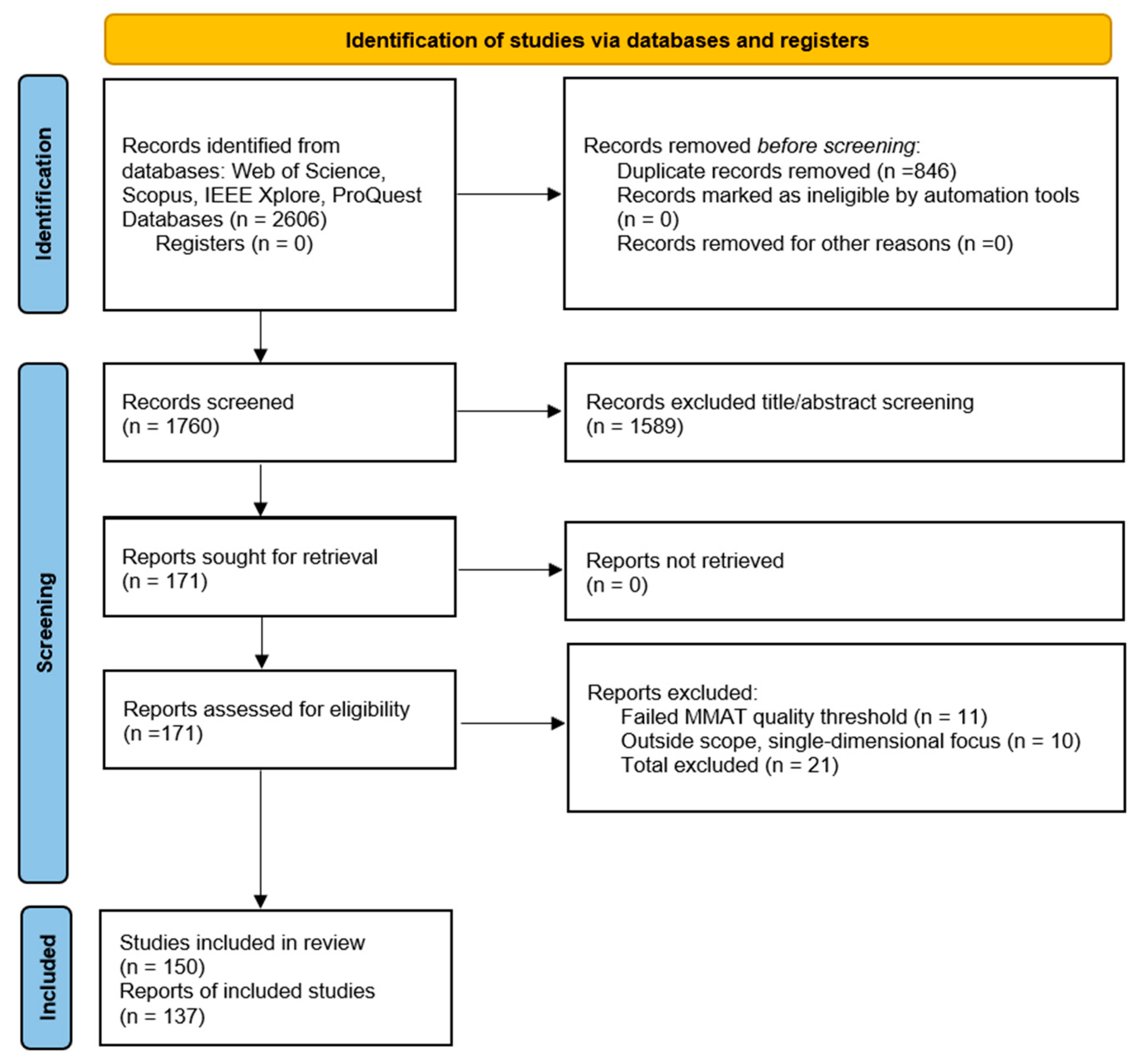
This review set out to answer three questions about the relationship between digital technologies, resource efficiency, and the spatial organisation of global value chains. The answers that emerge from 150 peer-reviewed studies are consequential for theory, practice, and policy alike.
On the first question, canonical frameworks including Transaction Cost Economics, the Resource-Based View, Dynamic Capabilities, and Dunning’s eclectic paradigm each illuminate part of the picture but leave significant explanatory gaps when confronted with the sustainability and platform realities of contemporary GVCs. The three theoretical extensions proposed here, ecosystemic capability bundling, digital-sustainability spillovers, and distributed eco-innovation, address those gaps by reframing digital advantage as inter-firm and ecosystemic rather than firm-bounded, by explaining how compliance-driven data transparency cascades as operational knowledge across chain tiers, and by capturing how virtual experimentation diffuses process innovations through supplier networks. These constructs are not replacements for existing frameworks but targeted extensions that restore explanatory power where legacy theories fall short.
On the second question, the evidence is unambiguous that efficiency gains are contingent rather than automatic. Integrated digital stacks combining IoT sensing, AI analytics, blockchain traceability, and digital twins deliver chain-wide efficiency improvements averaging 10 to 25 percent in material scrap, idle energy, and audit lead times, a range drawn illustratively from the highest-quality studies in the corpus rather than from meta-analytic pooling, but only when cross-firm capability complementarities, data-governance alignment, regulatory congruence, and cyber-risk maturity are simultaneously present. Piecemeal digitalisation strands firms on efficiency plateaus that isolated technology investments cannot overcome, regardless of their individual sophistication.
On the third question, the mechanism-level account developed in RQ3 establishes that the five core digital mechanisms, real-time sensing, blockchain traceability, digital twin simulation, AI-driven analytics, and automation, function as a mutually reinforcing system. Their efficiency effects are largest when all five are active and when the boundary conditions identified in RQ2 are satisfied. The cross-tier spillover effects documented in the corpus, most notably the finding that supplier AI adoption measurably reduces customer downstream emissions, confirm that the efficiency dividend is systemic rather than firm-level and therefore requires inter-organisational and cross-border governance frameworks to be fully realised.
The digital-regionalisation paradox cutting across all three research questions represents the most novel and least theorised finding of this review. The tendency of greater digital intensity to strengthen intra-regional rather than global trade concentration challenges both TCE predictions and conventional narratives about digital technologies as forces of globalisation. It suggests that the next frontier for GVC scholarship is not simply understanding how digital technologies improve efficiency within existing network structures, but understanding how they are actively reshaping those structures in ways that have profound implications for the geography of global production, the distribution of efficiency gains across development contexts, and the design of international trade and digital governance frameworks.
Practically, the evidence points to three strategic imperatives. Firms should pursue full-stack digital deployment rather than piecemeal implementation, co-invest in supplier enablement and renewable-energy integration to mitigate rebound effects and reduce inequitable lock-in, and actively participate in multi-stakeholder standard-setting to ensure that digital product passports and due diligence regulations function as efficiency enablers rather than compliance burdens. Policymakers should prioritise open data-trust infrastructures that lower SME onboarding costs, harmonise interoperability standards across regulatory blocs, and fund longitudinal research that can establish the causal pathways this review can only document correlatively.
This review is not without limitations. Restricting the corpus to English-language publications across four databases may underrepresent regional innovations from the Global South, precisely the contexts where leapfrog digital solutions are most likely to challenge established assumptions about infrastructure prerequisites. The predominance of cross-sectional designs in the corpus means that causal claims about digital technologies and resource efficiency remain provisional. These limitations are themselves a research agenda: the field needs more longitudinal, multi-region, mixed-method studies that combine the causal rigour of quasi-experimental econometrics with the contextual depth of process tracing and ethnographic observation.
Digital technologies are reshaping global value chains faster than the theories built to explain them. This review provides a consolidated empirical foundation and a set of theoretical tools to close that gap, but sustained collaboration among scholars, practitioners, and policymakers will be essential to align digital-resource governance with the dual objectives of global competitiveness and planetary stewardship.