1. Introduction
Understanding the determinants of economic growth remains one of the central questions in macroeconomics and economic development. Over recent decades, a growing body of theoretical and empirical research has emphasized the role of investment, human capital, and institutional quality as key drivers of long-term economic performance. Within this context, increasing attention has also been directed toward public spending, particularly health expenditure, as well as foreign direct investment and capital accumulation, as important forces shaping the development process.
Health spending contributes to human capital formation and productivity improvements, while gross fixed capital formation and foreign direct investment constitute critical channels through which technological diffusion, capital deepening, and structural transformation occur. At the same time, institutional quality plays a fundamental role in determining the effectiveness of these factors, influencing resource allocation, the investment climate, and the overall functioning of the economy. Consequently, analyzing the interaction between economic growth, health spending, institutional quality, investment, and foreign direct investment is essential for understanding the mechanisms underpinning sustainable economic growth.
A growing body of empirical evidence suggests that health spending and high-quality institutions act as key drivers of long-term growth by strengthening human capital and fostering stable and efficient economic environments. Improved and well-managed health investments reduce morbidity and enhance labour productivity. For instance, increased health expenditure has been shown to significantly stimulate economic growth (
Dritsaki et al., 2025). However, the magnitude of this effect depends critically on institutional quality. While higher health spending can improve health outcomes, its contribution to economic growth is substantially greater in the presence of strong and effective institutions (
Faruk et al., 2022). Conversely, weak institutions characterized by government inefficiency, lack of transparency, and corruption can undermine both health outcomes and economic performance (
Lewis, 2006). In such contexts, the positive effects of health spending and investment may be significantly diminished (
Sethi et al., 2024).
In this regard, institutional quality, encompassing governance effectiveness, rule of law, and control of corruption, acts as a key moderating factor. Empirical studies indicate that strong institutions amplify the positive impact of health investments, whereas weak institutional environments can neutralize or even reverse these gains (
Rizvi, 2019;
Aalipour et al., 2023;
Silabi, 2026). The evolution of the literature on institutional economics further highlights the central role of institutions in fostering economic opportunity, innovation, and long-term development (
Buitrago & Barbosa Camargo, 2021;
Tibrewal & Chaudhuri, 2022;
Roffia et al., 2023). In this study, institutional quality is treated as a governance-related determinant of economic growth and as an interpretive factor for understanding cross-country heterogeneity. The empirical specification estimates the direct association between institutional quality and economic growth, alongside health expenditure, gross fixed capital formation and foreign direct investment. While the theoretical literature suggests that institutions may influence the effectiveness of public spending and investment, the present study does not estimate a formal moderation, threshold or interaction model. Therefore, references to the role of institutional quality are interpreted in a comparative and country-specific sense rather than as evidence of a statistically identified conditioning mechanism.
Despite the extensive literature on the determinants of economic growth, important gaps remain. Much of the empirical work examines either the relationship between economic growth and health spending, the role of investment and foreign direct investment, or the influence of institutional quality. However, relatively few studies integrate these factors within a unified empirical framework. In particular, the joint interaction between health spending, institutional quality, gross fixed capital formation, and foreign direct investment and their combined effect on economic growth remains underexplored. Furthermore, the dynamic relationships among these variables, including both long-run equilibria and short-run adjustments, have received limited attention.
This paper aims to provide an empirical investigation of the dynamic relationship between economic growth, health spending, institutional quality, gross fixed capital formation, and foreign direct investment, with a particular focus on how institutional quality conditions the effectiveness of investment and public spending. The focus on EU countries outside the euro area is motivated by their distinctive position within the European integration process. These economies are members of the EU single market and operate within a common institutional and regulatory framework, yet they remain outside the eurozone’s common monetary-policy regime. As a result, they combine elements of European economic integration with greater heterogeneity in monetary arrangements, institutional development, investment dynamics and convergence trajectories. This makes them a particularly relevant group for examining whether health expenditure, institutional quality, gross fixed capital formation and FDI contribute to economic growth in similar or country-specific ways. Moreover, several non-euro area EU countries have experienced substantial institutional and structural transformation since EU accession, making the role of governance quality especially important in explaining how public spending and investment are translated into long-term economic performance.
To achieve this aim, this study pursues the following specific objectives:
To examine the long-run equilibrium relationship between economic growth and its key determinants, including health spending, institutional quality, investment, and foreign direct investment.
To analyze the short-run dynamics and adjustment mechanisms among these variables.
To examine the direct association between institutional quality and economic growth and to assess how differences in institutional quality help interpret cross-country heterogeneity in the estimated growth dynamics.
To provide evidence-based insights that can inform policy design aimed at promoting sustainable economic development.
This study contributes to the international literature in several ways. First, it develops an integrated empirical framework that simultaneously examines the dynamic relationship between economic growth, health spending, institutional quality, fixed capital formation, and foreign direct investment. In contrast to much of the existing literature, which tends to analyze these variables in isolation or in limited combinations, this paper explores their interaction, offering a more integrated understanding of the development process.
Second, this study contributes by positioning institutional quality not merely as an independent determinant of economic growth, but as a conditioning factor that shapes the growth effects of health expenditure, domestic investment and foreign direct investment. This allows the analysis to move beyond estimating separate effects and instead examine how governance quality influences the transmission of public and private investment into long-term economic performance.
Third, this paper employs modern time-series econometric techniques, including unit root tests, cointegration methods, and dynamic adjustment models, enabling the simultaneous investigation of both long-run relationships and short-run dynamics. This approach allows for a more nuanced understanding of the underlying transmission mechanisms.
Finally, the empirical findings provide a basis for evidence-based policy recommendations, emphasizing the importance of institutional quality, investment activity, and health spending as core pillars of sustainable economic growth.
The remainder of this paper is structured as follows.
Section 2 provides a review of the empirical literature.
Section 3 outlines the model specification, while
Section 4 describes the data.
Section 5 presents the preliminary analysis, and
Section 6 reports the unit root tests.
Section 7 discusses the empirical results, and finally,
Section 8 concludes with the main findings and policy implications.
2. Empirical Literature
Health is a crucial element of people’s well-being. At both the macroeconomic and microeconomic levels, health has been found to contribute positively to economic growth. The positive impact of health on economic growth has been recognized by many studies both theoretically (
Barro, 1996) and empirically (
Bloom et al., 2004). The relationship between health expenditure and economic growth has led many researchers to examine the issue with different variables, periods, countries or groups of countries, and methods.
Many studies have focused primarily on macroeconomic variables, developing a conceptual framework that explores the macroeconomic factors that determine economic growth such as foreign direct investment, inflation, investment, population growth, and trade openness. These studies reveal different findings on this research topic. Some of the studies suggest that there is unidirectional causality between the variables, while others indicate bidirectional causality. For example,
Erdil and Yetkiner (
2004) determined the causality relationship from health spending to economic growth in high-income countries and from economic growth to health spending in low- and middle-income countries with data from 75 countries over the period 1990–2000.
Faruk et al. (
2022) use longitudinal data to examine the relationship between health spending and economic growth in seven countries in the Middle East and North Africa from 2000 to 2017. Examining the long-term relationship of the variables with the Pedroni test, they found that there is a cointegration relationship. In contrast, the Granger causality test did not find causal relationships between health spending and economic growth. Furthermore, panel data models show that health spending does not directly contribute to higher economic growth. The authors conclude that this result may be due to the poor quality of institutions in the countries they examine.
Senturk et al. (
2023) examine the causal interaction between total health expenditure, direct expenditure, human capital and sustainable development in eleven EU member countries over the period 2000–2020 through panel causality testing. The results of the causality testing show that health expenditure, human capital and sustainable development indicators are closely related, but the causal interaction between health expenditure, human capital and sustainable development indicators differs among the new EU members.
Dritsaki et al. (
2025) examines the impact of health spending on economic growth in BRICS countries over the period 2000–2021. In line with the framework of endogenous growth theory, which conceives health as a form of human capital that enhances productivity, they additionally incorporate natural capital, education, and population share as control variables. Methodologically, their analysis uses panel unit root tests under cross-stratum dependence and estimates a dynamic panel ARDL model to assess both short- and long-run effects. The results show that, in the long run, all explanatory variables exert a statistically significant influence on the economic growth of the BRICS countries. In the short run, however, only per capita health expenditure demonstrates a positive and statistically significant effect on per capita GDP, while the other variables do not yield significant short-term effects.
The quality of institutions plays an important role in shaping economic growth, influencing how economies grow and perform. The literature addresses the relationship between the quality of health spending institutions and economic growth. Findings are often contradictory, creating knowledge gaps. Some work reveals that the quality of institutions affects health outcomes (
De Luca et al., 2021,
Sharma et al., 2022,
Chen & Zhang, 2025).
Rizvi (
2019) examines the determination of the impact of health expenditure on economic growth, taking into account the quality of health institutions using data from 20 developing countries in South, East Asia and the Pacific for the period 1995–2017. In the analysis of the work, he uses the production function adding the quality of institutions as a proxy for government effectiveness along with other variables such as health expenditure, primary education completion rate, population growth. The results of the work showed that if health spending is adjusted to the quality of public spending and increased by 100%, then economic growth will increase by 5%.
Kur et al. (
2020) examine the role of institutional quality in enhancing growth and the precise role it plays through the health expenditure channel in Nigeria. The ARDL model was used between the period 1984 to 2019 to establish the link between these variables. The findings of their work reveal that institutional quality moderates the effect of health expenditure on growth. Specifically, when institutional quality is maintained at the threshold of 0.52, growth will be at least positive. This means that, with institutional quality at a level less than the threshold, economic growth will become negative.
Socoliuc et al. (
2022), using data from EU countries for the period 2000–2019 and applying panel models in their analysis, examine the impact of perceived corruption on population health. The findings of the study revealed that strengthening anti-corruption policies in various sectors, including the health sector, led to a notable reduction in infant mortality rates and an overall improvement in life expectancy in EU countries.
Carcaba et al. (
2022) investigate the effects of good governance in local governments on individual subjective well-being in Spain over the period 2013 to 2018. The study defined three dimensions of good governance at the municipal level, namely accountability, government effectiveness and control of corruption. Furthermore, they argue that individual quality of life variables, such as social connections or health status, are important determinants of individual well-being. The results of their study reveal that in terms of good governance, there is a direct positive effect of government effectiveness on levels of individual subjective well-being.
Miao et al. (
2023) investigate the quality of institutions in 25 Asian countries from 2009 to 2020, taking Country Politics and Institutional Assessment as a proxy for Institutional Quality as the dependent variable and the determinants of State Fragility (SF) and Institutional Governance (IG) as independent variables. The two-stage estimation of the GMM model shows that the determinants of Institutional Governance (IG), corruption control measures, political stability and voice, and accountability environment significantly affect Institutional Quality (IQ) and growth in Asian economies. On the contrary, Foreign Intervention in politics and state affairs and State Instability have a negative impact on IQ and degrade the country’s developmental progress.
Abbas et al. (
2023) investigated the factors affecting the administrative capacity of the state in 23 Asian economies during the period 2006–2020. The factors studied refer to the quality of bureaucracy, (BQ) military involvement in politics (MP), and their impact on the quality of sustainable public health (PHQ). The research reveals that the insufficient quality of bureaucracy (BQ), influenced by political pressures and policy inconsistencies, has significantly and negatively affected the quality of sustainable public health (PHQ) in the Asian countries they examine. In contrast, the strong presence of military involvement in politics (MP) and military influence has positively affected sustainable public health quality (PHQ) in Asian economies.
Hadipour et al. (
2023) investigate the impact of institutional quality on the health system using global governance indicators, analyzing data from 158 countries between 2001 and 2020. Using Principal Component Analysis (PCA) to create a composite indicator of institutional quality, they conducted several checks to select the appropriate econometric model. The role of institutional quality, along with other variables, on health outcomes was estimated using fixed effects models and the generalized method of moments (GMM). The results of their study revealed that the quality of institutions had a negative impact on infant mortality rates and a positive impact on life expectancy. Also, variables such as GDP, average years of schooling, total health expenditure and urbanization rate showed a negative correlation with infant mortality rates and a positive correlation with life expectancy. In contrast, CO
2 emissions showed a positive effect on infant mortality rates and a negative effect on life expectancy.
Sethi et al. (
2024) study the investigation of the short-run and long-run effects of healthcare expenditure, quality of institutions, and domestic and foreign investment on economic growth of South Asian countries during the period 1996–2018. To assess the short-run and long-run relationships and the direction of causality between the variables, they use Johansen–Fisher cointegration test and Granger causality test. The results of their work reveal that there is a two-way causality from health expenditure to economic growth in these countries in the short run. Furthermore, the quality of institutions appears to have a unidirectional effect on health spending.
Gebrihet et al. (
2024) examine the interaction between institutional quality, health, and economic growth in 35 sub-Saharan African countries over the period 2012 to 2022. Life expectancy at birth and real GDP per capita are used as proxies for health outcomes and economic growth, respectively. The results show that life expectancy at birth has a strong positive effect on economic growth in all sub-Saharan African countries. Furthermore, indicators of institutional quality are positively correlated with economic growth.
Ghosh and Saha (
2025) empirically examine the impact of institutional quality on FDI-driven economic growth in 135 developing countries from 1996 to 2020. The research uses six institutional quality measures from the World Governance Indicators (WGI) and their interaction with FDI inflows to identify key indicators of institutional quality for developing countries. The results show a positive and significant effect of FDI on economic growth in developing countries. Furthermore, improvements in three specific indicators of institutional quality, government effectiveness, regulatory quality, and the rule of law, enhance the impact of foreign direct investment on economic growth.
Kouadio (
2026). investigates the role of governance quality in moderating the relationship between foreign direct investment and the human development index in 15 West African countries over the period 1996–2022. In the analysis of the paper, he applies Generalized Least Squares to address heteroscedasticity and serial correlation, as well as the ARDL-PMG method to capture the short-term and long-term dynamics between foreign direct investment and the human development index. The results show that foreign direct investment positively affects human development in West Africa, with governance also enhancing the human development index. Although the foreign direct investment–governance interaction is slightly negative in the short run, it becomes positive and significant in the long run, indicating that stronger institutions enhance the development impact of foreign direct investment over time.
3. Methodology
3.1. Theoretical Framework
The usual theoretical framework for empirically investigating the factors of economic growth comes from the standard neoclassical growth theory of
Solow (
1956) and the endogenous growth theory of
Romer (
1986). Changes in output are caused primarily through changes in capital and labour as factors of production. However, other factors such as the saving rate, population, and technology are measured exogenously in the Solow model.
Mankiw et al. (
1992) modified Solow’s work to explain that human capital is critical as an input to the production function. According to this approach to human capital, e.g., education and health status are considered as separate inputs or complements to labour in the production process (
Mankiw et al., 1992).
On the other hand, the endogenous growth theory considers that innovation, human capital and knowledge are the main determinants of growth. Thus, technology, human knowledge and resources are the main factors for the economic growth of a country, if the appropriate configuration of an endogenous growth model is adopted. Regardless of the growth theories, economists generally accept that the accumulation of human capital, i.e., the acquisition of health and education services, contributes to economic growth. Thus, health capital could be taken as a separate input to the production function as capital and labour (
Dritsaki et al., 2025).
Furthermore, the literature also supports the indirect impact of institutional quality on Gross Domestic Product, through the growth effect of trade openness and the growth effect of foreign direct investment (see
Mackenbach & McKee, 2015). Furthermore, the literature argues that institutional quality enhances the effect of trade openness on economic growth, and can amplify the effect of foreign direct investment on economic growth, by better facilitating the processes of technology transfer and knowledge diffusion (
Rosenberg, 2018).
3.2. Model Specification
Based on recent research and empirical studies, health spending, institutional quality, gross fixed capital formation, and foreign direct investment are critical factors of economic growth, with their effects often being interdependent (see
Hu & Wang, 2024;
Nia et al., 2025). To measure the impact of health spending, institutional quality, fixed capital formation, and foreign direct investment on economic growth in non-euro area economies, we use the following function:
where GDP is the Gross Domestic Product, and CHE is the current health expenditure as a percentage of GDP and has been considered as a proxy for measuring the health status of economies in order to avoid the problems associated with their estimation when other proxy variables, such as morbidity rate, mortality rate, and other demographic factors, are taken into account (
Bleakley, 2007). IQI is the institutional quality index (IQI), calculated through a Principal Component Analysis that takes into account six components defined by the Global Governance Indicators such as control of corruption, government effectiveness, political stability and absence of violence/terrorism, regulatory quality, rule of law, and voice and accountability. GFCF is gross fixed capital formation (% of GDP). FDI is foreign direct investment net inflow (% of GDP).
It should be noted that institutional quality enters the empirical model additively rather than through interaction terms or a threshold structure. Consequently, the estimated coefficient on IQI captures its direct association with economic growth within each country-specific ARDL/ECM. The analysis does not claim to identify a formal moderating effect of institutional quality on the relationship between health expenditure, investment or FDI, and growth. Instead, institutional quality is used to interpret differences in the magnitude, direction and adjustment dynamics observed across countries.
By converting the variables to logarithmic form to reduce the variance in the data set, we obtain the following function:
represents the country and is the time period. The parameters , , and are the long-run GDP elasticities with respect to health spending, institutional quality, domestic investment, and foreign direct investment, eit is the white noise error term.
In this paper, a positive relationship between current health spending and economic growth is expected, ; a positive relationship between institutional quality indicators and growth, ; as well as positive relationships between gross fixed capital formation and net inflow of foreign direct investment with economic growth, , .
The choice of methodology is guided by the time-series nature of the data, the relatively small annual sample, and the possibility of heterogeneous adjustment patterns across countries. Since macroeconomic variables often exhibit persistence, nonlinearity, and structural breaks, the empirical strategy begins with linear and nonlinear unit root tests and structural break analysis before proceeding to cointegration and dynamic modelling. The ARDL/ECM framework is particularly suitable in this context because it can be applied when variables are integrated of order I(0) or I(1), allowing the estimation of both long-run relationships and short-run dynamics and performing well in relatively small samples. The use of diagnostic and causality tests further strengthens the reliability of the empirical interpretation by assessing model adequacy and the direction of dynamic interactions among the variables.
The evidence of nonlinearity and structural breaks is therefore used to inform the modelling strategy and the interpretation of the results, rather than to imply that a fully nonlinear specification is necessarily required. Given the relatively short annual country-specific samples, estimating fully nonlinear models would substantially increase model complexity and reduce degrees of freedom. The linear ARDL/ECM framework is consequently used as a parsimonious approximation of the dominant short-run and long-run dynamics, while the evidence of nonlinearity and structural breaks is taken into account when interpreting the country-specific findings. This approach preserves methodological consistency and comparability across countries, while acknowledging that the underlying adjustment processes may be more complex than the baseline linear specification can fully capture.
4. Data
The dataset covers six non-euro area EU member states, namely Czechia, Denmark, Hungary, Poland, Romania and Sweden, over the period 2000–2024. The data are extracted from the World Development Indicators (WDI) and the World Government Indicators (WGI). GDP is in millions of US
$ in constant 2015 prices. CHE is current health expenditure as a percentage of GDP. IQI is the institutional quality index (IQI), taken from the World Governance Indicators (WGI) database of the World Bank. The WGI framework reports six dimensions of governance: control of corruption, government effectiveness, political stability and absence of violence/terrorism, regulatory quality, rule of law, and voice and accountability. In the present study, the institutional quality variable is taken from the WGI/World Bank source and is used as a relative measure of governance performance across countries and over time. Since WGI are relative measures, the institutional quality variable should not be interpreted as an absolute institutional scale. Rather, it captures relative differences in governance performance within the sample and period examined. GFCF is gross fixed capital formation (% of GDP). FDI is foreign direct investment net inflow (% of GDP). According to
Nawaz (
2015), institutions and investments play an important role in development. The description of all the variables under consideration and their respective sources are depicted in
Table 1.
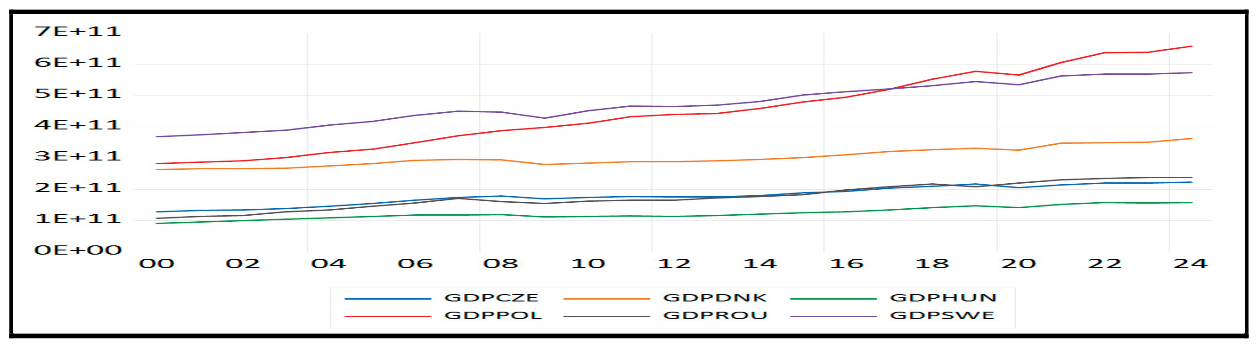
Figure 1,
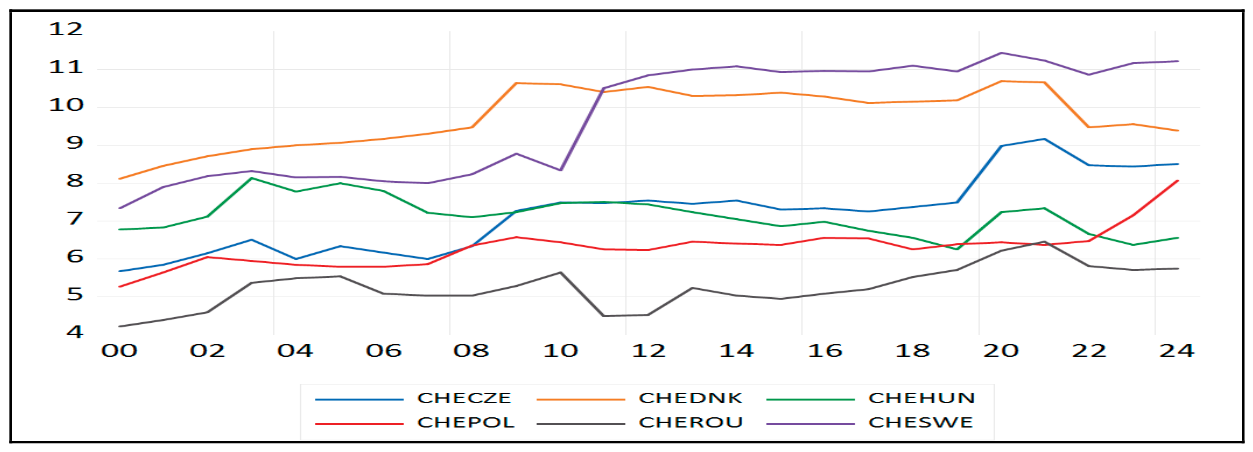
Figure 2,
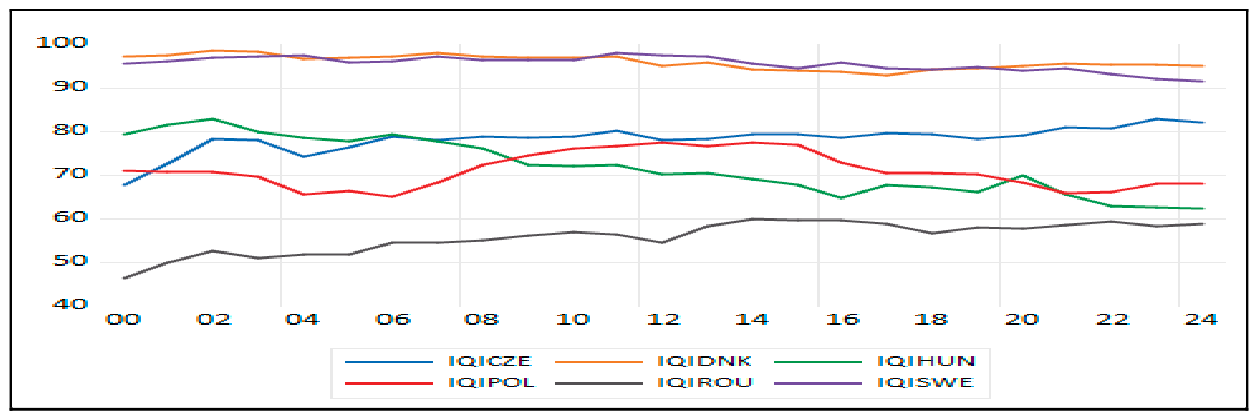
Figure 3,
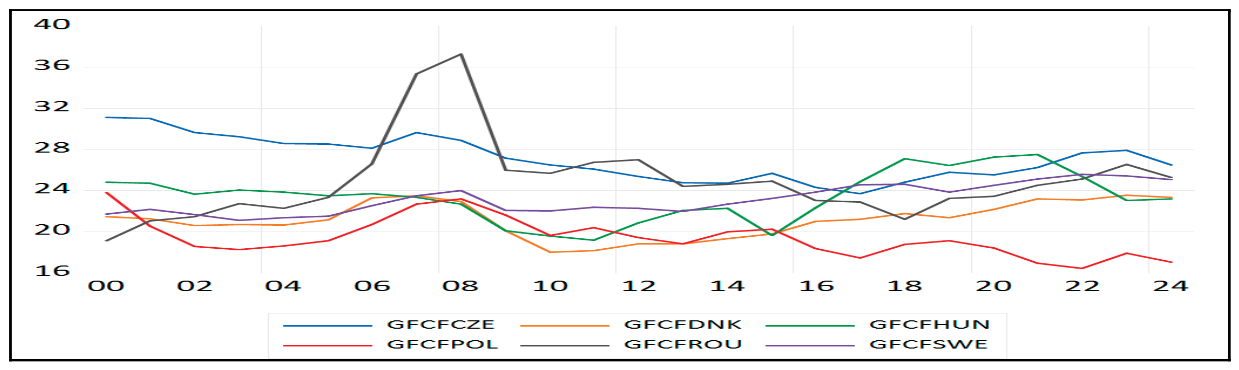
Figure 4 and
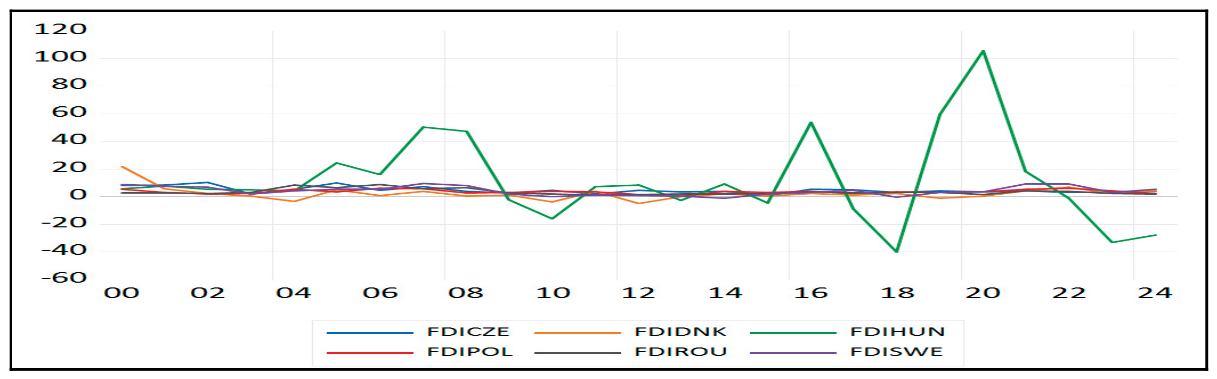
Figure 5 provide an overview of the evolution of GDP, current health expenditure, institutional quality, gross fixed capital formation, and FDI inflows across the six non-euro area EU countries over 2000–2024. Overall, GDP displays an upward long-run trend, while the 2019–2020 period marks a visible disruption associated with the COVID-19 shock. Health expenditure generally increases over time, although with country-specific deviations. Institutional quality remains highest in Denmark and Sweden, while transition economies display more heterogeneous patterns. Gross fixed capital formation and FDI show greater cyclical variation, particularly around the global financial crisis and the pandemic period. These patterns indicate cross-country heterogeneity and the presence of potential structural breaks, supporting the subsequent use of time-series methods that account for nonlinearity and structural change.
Table 2 reports the descriptive statistics for the five variables across the six countries. The results confirm substantial heterogeneity in economic size, health expenditure, institutional quality, investment, and FDI inflows. Sweden and Denmark display the highest average institutional quality and relatively high health expenditure, while Romania records the lowest average institutional quality. FDI is the most volatile variable, particularly in Hungary, reflecting the sensitivity of foreign investment flows to large individual transactions and external shocks. Most variables show acceptable distributional properties, although some departures from normality are observed, particularly for FDI and selected country-specific series. These features support the need for further diagnostic testing before estimating the ARDL/ECMs.
In summary, the descriptive evidence points to long-run growth dynamics, visible crisis-related disruptions, marked institutional heterogeneity, and higher volatility in investment-related variables, especially FDI. These characteristics provide the empirical motivation for the preliminary tests of linearity, structural breaks, and unit roots presented in the following sections.
5. Preliminary Analysis
The investigation of linearity and the existence of structural changes is a crucial stage before estimating dynamic ARDL/ECMs, as it directly affects the correctness of the specification, the stability of the parameters and the reliability of the long-term estimates. In addition, the unit root tests to be applied in the work require that the series be examined for linearity and their structural changes. Therefore, linearity and structural changes are among the basic diagnostic tests that a researcher should investigate before performing data analysis (
Dritsaki & Dritsaki, 2022).
5.1. Linear and Nonlinear Time Series Test
Harvey et al. (
2008) examine the linearity of a series starting from a nonlinear first-order autoregressive model AR(1) for a time series
stationary in the levels (zero-order integrated I(0)), with
, where
T is the sample size.
The regression model with the observed components of
is given as follows:
More information about the Harvey linearity test is provided in
Appendix A.
Appendix B reports the results of the
Harvey et al. (
2008) linearity test, where the null hypothesis assumes linearity of the series and the Wald statistic is used for testing. The findings indicate that the assumption of linearity does not hold uniformly across countries and variables. Evidence of nonlinearity is found in GDP and institutional quality for Czechia, FDI for Denmark, GDP for Hungary, institutional quality for Romania, and GDP and current health expenditure for Sweden. By contrast, Poland is the only country where the null hypothesis of linearity is not rejected for any variable.
Overall, these results suggest that several of the examined economies exhibit nonlinear dynamics, particularly in relation to output growth and institutional quality. Nonlinearity in GDP may reflect the presence of different growth regimes, asymmetric responses to economic shocks, or differences between crisis and stability periods. Nonlinearity in institutional quality, observed in Czechia and Romania, may be associated with governance reforms, political transitions, or changes in institutional performance over time. The absence of nonlinear patterns in Poland suggests comparatively more stable dynamics among the variables during the sample period.
These findings provide an important diagnostic basis for the subsequent empirical strategy. They indicate that conventional linear assumptions may be restrictive in some cases and justify the use of unit-root tests and modelling choices that account for nonlinear adjustment, structural change, or regime-specific behaviour. At the same time, they support a cautious interpretation of the ARDL/ECM estimates as average dynamic relationships rather than as fully invariant structural parameters.
5.2. Bai–Perron Multiple Structural Breaks Test
The test proposed by
Bai and Perron (
1998) is based on the following multiple structural break model with m breaks (m + 1 regimes).
The Bai–Perron test (
Bai & Perron, 1998,
2003) detects multiple unknown structural breaks in time series or panel data by minimizing the sum of squared residuals (SSR). The test allows for some structural breaks in the regression coefficients, adjusting for serial correlation and heteroscedasticity, with optimal choice of the breakpoint using a dynamic programming to manage computational complexity. The Global Breaks Methodology, commonly denoted as breaks vs. none, finds the combination of break dates that minimizes the total sum of squares of the residuals. A common procedure for choosing the dimension of a model is to consider an information criterion. Bai–Perron uses the Bayesian Information Criterion (BIC), proposed by
Yao (
1988), and a modified Schwarz criterion (LWZ) proposed by
Liu et al. (
1997) for the Global Breaks Methodology. BIC and LWZ perform quite well in the absence of serial correlation in the errors, but they choose a much higher value than the actual presence of serial correlation. When there is no serial correlation in the errors, but there is a lagged dependent variable, BIC performs poorly when the coefficient on the lagged dependent variable is large. In such cases, LWZ performs better under the null of zero outliers but underestimates the number of outliers when there are outliers (see
Bai & Perron, 2003). The two assumptions in testing for total model breaks in (4) are as follows:
H0: The parameters are constant across all segments .
H1: There exists at least one such that , indicating a structural break in the parameters at unknown dates.
Appendix C shows the Global Breaks Methodology results of the Bai–Perron test using the Schwarz and LWZ criteria. The maximum number of structural changes is set to M = 5, and a cut-off of ε = 0.15 is used to determine the minimum number of observations in each segment h = [eT] where
T is the sample size. The significance level is set to 5%.
The results indicate that the application of the global structural break methodology of
Bai and Perron (
1998), based on the Schwarz and LWZ information criteria, identifies a substantial number of structural breaks across all countries. A pronounced clustering of these breaks is observed around specific periods, namely the following: 2003–2006, corresponding to a phase of European Union integration and deepening; 2008–2009, associated with the global financial crisis; 2011–2015, reflecting the sovereign debt crisis and subsequent fiscal adjustment within Europe; and 2020–2021, linked to the COVID-19 pandemic. The systematic appearance of cross-sections in approximately the same periods in different variables suggests that the shocks were macroeconomic, exogenous, and structural in nature.
In addition, the results reveal the presence of both spatial and variable-specific heterogeneity across countries. With regard to GDP, almost all countries exhibit multiple structural breaks (typically four to five), indicating that their growth trajectories were not smooth but instead characterized by distinct regime shifts. For current health expenditure as a percentage of GDP, the identified breakpoints frequently coincide with periods of fiscal adjustment, particularly around 2009, 2011, and 2020, suggesting the presence of cyclical patterns and shifts in fiscal policy. Institutional indicators display notable variation across countries. In particular, Hungary, Poland, and Sweden exhibit multiple structural changes, likely reflecting political transitions, institutional reforms, or broader shifts in governance frameworks. In the case of gross capital formation, the concentration of structural breaks around 2009 highlights the significant impact of the global financial crisis on investment activity. Finally, foreign direct investment (FDI) shows structural breaks primarily during periods of international instability, notably 2008–2009 and 2020–2021, confirming its pronounced cyclical sensitivity to global economic conditions.
The results of the linearity and structural break tests carry important implications. First, the presence of non-linearity in certain countries suggests that the underlying relationships may not be stable over time. Second, the identification of multiple structural breaks necessitates methodological adjustments, such as the inclusion of dummy variables, the application of unit root tests that account for structural breaks, or the estimation of models that allow for parameter variation. Finally, the observed heterogeneity across countries supports the use of the ARDL framework, particularly due to its ability to accommodate heterogeneous short-run dynamics.
Table 3 presents both linearity and structural break results to determine the appropriate unit root test to use. The choice of unit root tests in the table below is consistent with the results of the preliminary analysis.
The results of the linearity and structural break tests demonstrate that the dynamics of aggregate output variables in the countries we examine are not homogeneous but differ both across countries and across variables. The coexistence or non-existence of linearity and structural break suggests that the process of adjustment of aggregate growth to economic shocks may be either asymmetric or affected by permanent regime changes.
6. Unit Root Tests
Linear unit root tests (such as
Dickey & Fuller, 1979,
1981) assume a linear random walk of the time series, while nonlinear unit root tests (such as
Kapetanios et al., 2003) detect non-stationary processes with abrupt shifts or gradual changes (structural breaks). The main difference lies in the data generation process. FADF (Fourier Augmented Dickey–Fuller) and FKSS (Fourier Kapetanios–Shin–Snell) are advanced unit root tests that incorporate Fourier functions to account for unknown, smooth structural breaks in time series data. Details of the ADF, Kapetanios–Shin,–Snell (KSS) Unit Root Test, Fourier ADF and KSS unit root test are provided in
Appendix D.
6.1. Co-Integration Analysis Using the ARDL Model
In order to measure the dynamic relationships of health spending, institutional quality, gross fixed capital formation, and foreign direct investment on economic growth, Equation (2) can be expressed in an autoregressive distributed lag (ARDL) model of
Pesaran et al. (
2001). The ARDL model is extremely flexible and suitable for small sample sizes. It can handle variables with different order of integration, thus simplifying the modelling process and avoiding potential misspecification errors. Furthermore, the ARDL model allows for the estimation of both short-run and long-run dynamics between economic growth and the variables of health expenditure, institutional quality, gross fixed capital formation, and foreign direct investment.
The form of the ARDL model can be formulated as follows:
where Δ is the differenced operator;
is a white noise term
representing the maximum lags for the dependent and independent variables. The parameter
indicates the presence or absence of long-run equilibrium.
The ARDL technique is applied in two stages. In the first stage, the existence of long-run relationships is tested based on bounds testing procedures which require the F or Wald test procedures.
The null hypothesis of non-cointegration between the variables in Equation (5) is
H0: (there is no cointegrating-long-run relationship).
Versus the alternative hypothesis for cointegrating
H1: (there is a cointegration-long-term relationship).
If there is cointegration (long-term relationship), we apply the second step by estimating the short-term and long-term dynamics with a VECM model.
The error correction model of the ARDL technique can be formulated as follows:
where
is the error correction term with a time lag taken from the long-run relationship.
is the adjustment speed for
. The sign of the coefficient
is expected to be between 0 and 1 and to be negative and statistically significant. The value of the coefficient
indicates that the system returns to equilibrium after a shock. In the case of positive
the deviation from equilibrium cannot be neutralized.
Diagnostic and Stability Models Tests
After estimating the model (5), various diagnostic tests are performed, such as normality, with the
Jarque and Bera (
1980) test, serial correlation, with the
Breusch and Godfrey (
1978) test, heteroscedasticity (ARCH) Engle test (
Engle, 1982) and specification of the model form, with the
RESET Ramsey (
1969) test, as well as stability tests of the coefficients with the CUSUM and CUSUMSQ tests of
Brown et al. (
1975). Diagnostic and stability tests are applied to check the consistency of the model as well as to ensure the reliability of the results.
6.2. ECM Granger Causality Test
The presence of cointegrating between variables may indicate Granger causality in some direction. Granger causality (
Granger, 1983) in an ARDL-ECM framework identifies short-run and long-run causal relationships between cointegrated, non-stationary variables. The approach involves estimating an error correction model, where the significance of the lagged differences indicates short-run causality and the coefficient of the speed of adjustment indicates long-run causality. Granger causality testing based on the error correction model (ECM) can be formulated as follows:
where
and
are the magnitudes of the time lags,
is the lagged error correction term, and
is the first difference for examining short-run dynamics. The coefficients
and
represent the error terms and should be white noise and serially uncorrelated. The error correction model (ECM) is important because it can distinguish between short-run and long-run Granger causality. The lag of the individual coefficients is used to test the significance of the short-run relationship. The negative and statistically significant coefficient
indicates that there is a long-run relationship in the given variables. It also indicates that the given model can adjust from short-run shocks to the long-run period. In addition, a negative and statistically significant error term indicates that the variables are correlated in the long run and the system converges to equilibrium. The differentiated form of the model explores short-run causality (
Zhang & Zhang, 2021).
7. Empirical Results and Discussion
7.1. Linear and Nonlinear Unit Root Tests
Table 4 presents the linear and nonlinear unit root tests with and without structural breaks.
Based on the results of the preliminary linearity and structural changes checks, the ADF (Augmented Dickey–Fuller), KSS (Kapetanios–Shin–Snell), FADF (Fourier ADF) and FKSS (Fourier KSS) were applied in order to take into account both the possible nonlinearity and the existence of structural changes. This multi-methodological approach is considered necessary, as ignoring nonlinear dynamic or structural sections can lead to biased acceptance of the unit root.
The results of
Table 4 demonstrate significant heterogeneity between countries and variables, both in terms of their stochastic nature (I(0) or I(1)) and their linear or nonlinear behaviour. Furthermore, from
Table 4 it is observed that in several cases GDP appears I(1) with structural breaks, institutional indicators show mixed behaviour (in some countries stagnant, in others I(1)), foreign direct investment often shows stagnation, but with a strong presence of structural sections, and almost all variables are affected by structural breaks.
The country-specific results can be summarized as follows.
7.1.1. Czechia
GDP exhibits unit root behaviour and non-linearity, accompanied by structural breaks, indicating the presence of distinct growth regimes. Institutional indicators are stationary and nonlinear but without structural breaks, suggesting endogenous institutional adjustment rather than responses to exogenous shocks. The remaining variables are integrated of order one (I(1)), linear, and characterized by structural changes.
7.1.2. Denmark
GDP and most variables display unit root behaviour with structural breaks. In contrast, foreign direct investment is stationary and nonlinear, pointing to a potentially asymmetric response to external shocks.
7.1.3. Hungary
GDP is stationary but nonlinear, indicating asymmetric adjustment dynamics. Institutional indicators exhibit a unit root, reinforcing the presence of ongoing structural changes in the institutional framework.
7.1.4. Poland
Most variables are I(1), linear, and subject to structural breaks, while foreign direct investment is stationary and does not exhibit structural breaks. Overall, the results suggest relatively stable macroeconomic dynamics.
7.1.5. Romania
GDP is I(1), linear, and characterized by structural breaks. Institutional indicators are stationary but nonlinear, possibly reflecting a process of institutional convergence accompanied by short-term fluctuations.
7.1.6. Sweden
GDP and health expenditure are stationary, nonlinear, and exhibit structural breaks, suggesting stable yet regime-dependent adjustment mechanisms. In contrast, institutional indicators and investment variables display unit root behaviour.
These findings support the methodological choice of the ARDL/ECM framework while also clarifying how the preliminary diagnostics inform the empirical strategy. First, none of the variables are integrated of order two, I(2), while the series display a mixed order of integration, I(0) and I(1). This confirms the suitability of the ARDL approach, which is specifically appropriate for modelling variables with different integration properties within the same framework.
At the same time, the evidence of nonlinearity and structural breaks indicates that the data have a complex stochastic structure. These diagnostic tests are therefore not interpreted as requiring a fully nonlinear model but as serving two important purposes: they guide the selection of appropriate unit-root tests under conditions of possible nonlinear adjustment and structural change, and they inform the cautious interpretation of the subsequent ARDL/ECM estimates. The detection of nonlinearities suggests the possibility of asymmetric responses and different short-run and long-run adjustment mechanisms, while the widespread presence of structural breaks points to the influence of regime shifts and external shocks over the period 2000–2024.
Accordingly, the linear ARDL specification is used as a parsimonious baseline model that captures average long-run relationships and short-run dynamics across the sample period. However, given the evidence of nonlinear adjustment and structural change, the estimated coefficients should be interpreted as average dynamic associations rather than as invariant structural parameters across all regimes. Taken together, the unit-root, nonlinearity and structural-break results confirm that the ARDL/ECM framework is methodologically consistent with the empirical characteristics of the data, while also requiring careful interpretation of the estimated relationships.
7.2. Co-Integration Analysis Using the ARDL Model
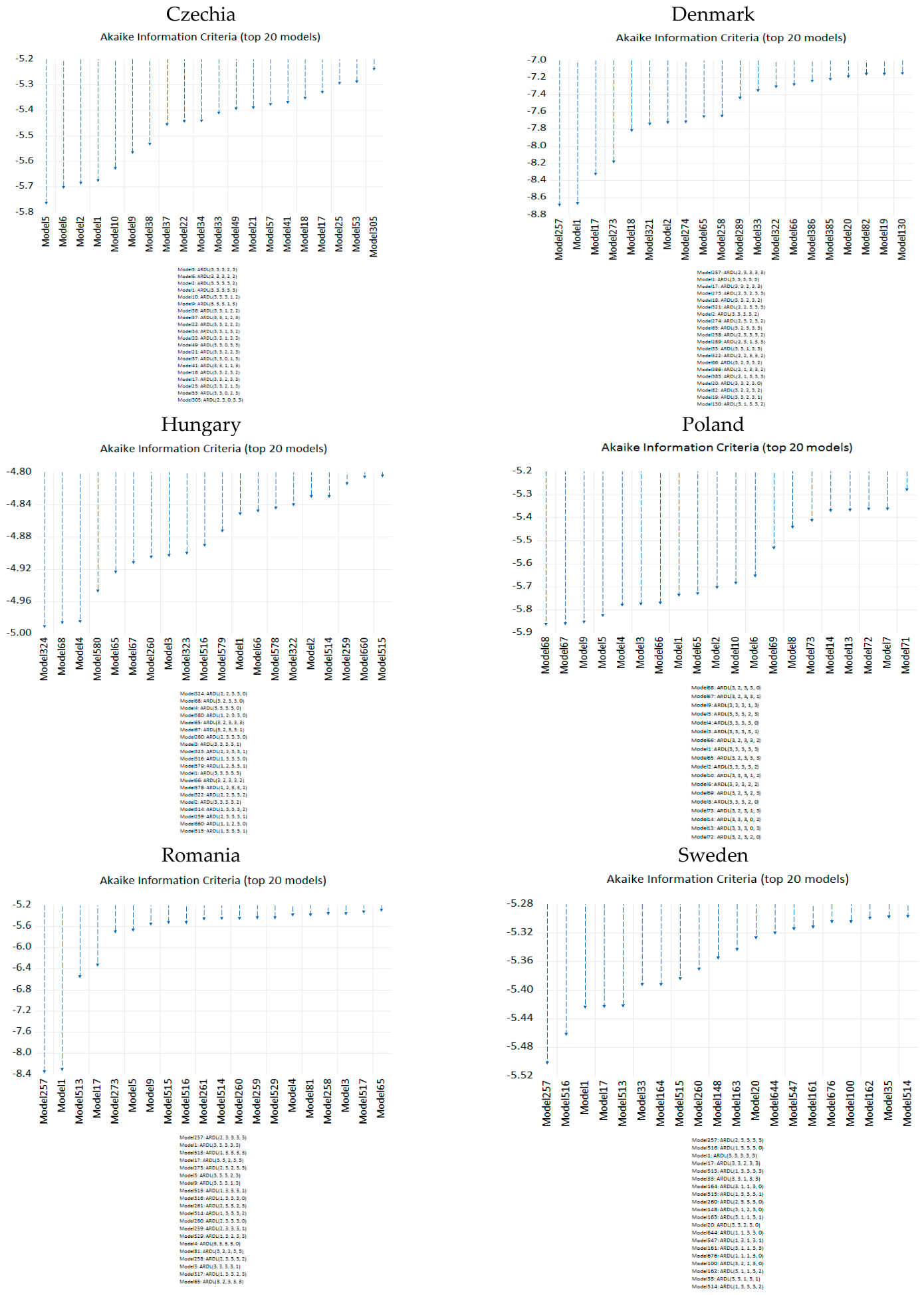
Given the unit root results for the countries under consideration, we apply the ARDL model. To choose the length of the lags for the ARDL model, we use the Akaike Information Criterion (AIC). The following chart shows the results from the lags of 20 linear models for all countries. The smallest value of the Akaike Criterion gives the optimal length of the lags of the variables in the linear model. From
Figure 6, we observe that the linear ARDL(3,3,3,2,3) model is the most suitable for Czechia (it presents the fewest errors), the linear ARDL(2,3,3,3,3) model is the most suitable for Denmark, the linear ARDL(2,2,3,3,0) model is the most suitable for Hungary, the linear ARDL(3,2,3,3,0) model is the most suitable for Poland, the linear ARDL(2,3,3,3,3) model is the most suitable for Romania, and the linear ARDL(2,3,3,3,3) model is the most suitable for Sweden.
Although the lag length was selected using the Akaike Information Criterion, the relatively short annual sample must be taken into account when interpreting the results. Each country-specific model is estimated using 25 annual observations, and the effective number of observations is further reduced once differencing and lagged terms are introduced. Therefore, higher-order specifications such as ARDL(2,3,3,3,3), selected for Denmark, Romania and Sweden, may place considerable pressure on the available degrees of freedom. This increases the risk that some estimated coefficients capture within-sample fit rather than stable long-run structural relationships. For this reason, the reported ARDL/ECM estimates are interpreted as country-specific dynamic associations rather than as precise structural elasticities.
Table 5 presents the results of the linear ARDL bound test model for the cointegration of the variables of the countries we examine.
Based on the optimal model (for all countries), the results of the cointegration test (Bounds Test) in
Table 5 confirm the existence of a long-run relationship between economic growth and its determinants in most countries in the sample.
Specifically,
For Denmark, Hungary, Poland and Romania, the F-statistic exceeds the upper critical limit at the 1% and 5% significance levels, leading to a clear rejection of the null hypothesis of no cointegration.
For Czechia and Sweden, the rejection is achieved only at 10%, which indicates a weaker but still significant evidence of a long-run relationship.
The existence of cointegration fully justifies the application of linear ARDL and confirms that the variables converge to a common long-run equilibrium. Furthermore, this result confirms that linear ARDL can be used not only for reliable long-run estimation, but also for short-run dynamics.
Furthermore, the linear ARDL form offers an additional advantage that allows for the simultaneous estimation of long-run elasticities, short-run dynamics, speed of adjustment via ECM and short-run and long-run directions of causality via ECM.
Thus, ARDL constitutes a single and integrated framework that links stability, cointegration and causality.
Table 6 presents the short-run and long-run coefficient estimates of the linear ARDL models for all countries (dependent variable D(LGDP). According to the results, the long-run coefficient estimates from the linear ARDL model reveal distinct cross-country patterns.
7.2.1. Czechia and Poland
The long-run coefficients are not statistically significant. This suggests that, despite evidence of cointegration, the examined determinants do not exert a sustained long-run effect on GDP. Economic growth in these countries may instead be driven by exogenous factors or by institutionally embedded mechanisms not fully captured within the model specification. It is important to distinguish between evidence of cointegration and the interpretation of individual long-run coefficients. In the cases of Czechia and Poland, the bounds tests indicate long-run co-movement among the variables, but the statistical insignificance of the long-run coefficients suggests that these results should not be interpreted as evidence of stable structural long-run effects. Rather, they point to a long-run equilibrium association whose specific transmission channels remain weak, unstable, or not fully captured by the estimated specification.
7.2.2. Denmark and Hungary
A consistent pattern emerges across both countries. The institutional quality indicator is negative and statistically significant at the 1% level, while gross fixed capital formation is positive and statistically significant at the same level. The positive contribution of capital accumulation is in line with endogenous growth theory. In contrast, the negative long-run coefficients on institutional quality in Denmark and Hungary should be interpreted cautiously. They should not be read as evidence that stronger institutions reduce growth. In Denmark, where institutional quality is already high and displays limited variation over time, the negative coefficient may reflect restricted in-sample variation, model sensitivity or the difficulty of identifying marginal institutional effects in a mature governance environment. In Hungary, the coefficient may reflect country-specific political-economic dynamics, omitted variables or simultaneity between institutional change and macroeconomic performance. Overall, these results are best interpreted as conditional associations within the estimated model rather than as structural evidence of a growth-reducing effect of institutional quality.
7.2.3. Romania
All long-run coefficients—except for gross fixed capital formation—are positive and statistically significant at the 1% level. This pattern is indicative of an economy undergoing institutional and investment convergence, where institutional improvements, health expenditure, and foreign direct investment function as key structural drivers of growth.
7.2.4. Sweden
Only gross fixed capital formation is positive and statistically significant at the 5% level. The limited long-run significance of the remaining variables may reflect the characteristics of a mature economy, in which institutional quality and social spending are already deeply embedded within the growth process and therefore exert less measurable marginal effects.
Table 6 also presents the short-run estimates of the linear ARDL model for all countries. Before interpreting the short-run coefficients, it is important to note that the ECM(−1) coefficient in all countries under study is negative, less than one, and statistically significant at the 1% significance level. This result of the ECM(−1) coefficient confirms the long-run relationship between economic growth, current health expenditure, the quality of institutions index, gross fixed capital formation, and foreign direct investment in all countries over the period 2000–2024.
The ECM(−1) coefficient is highest in Hungary (−0.92) and lowest in Czechia and Poland with (−0.001) and (−0.004), respectively. This shows that the speed of adjustment towards equilibrium is −0.92 for Hungary, and −0.001 and −0.004 for Czechia and Poland, meaning that short-term deviations in the previous period are corrected at a speed of 92% for Hungary and 0.1% and 0.4% for Czechia and Poland within one year. Furthermore, it should be noted that countries with higher adjustment speeds quickly return to long-run equilibrium after short-run shocks, while countries with lower speeds take longer to stabilize. The low values in Czechia and Poland indicate almost sluggish adjustment, which is consistent with the non-statistical significance of the long-run coefficients. The ECM(−1) coefficient is expected to be low, as convergence to equilibrium takes time when several factors are involved in an economy.
The short-run dynamics reported in
Appendix C Table 6 reveal a highly heterogeneous and time-sensitive adjustment process across countries. Health expenditure exhibits alternating effects, with a positive impact in the contemporaneous period and negative effects in subsequent lags, indicating possible short-term stimulus followed by adjustment. Institutional indicators primarily display lagged effects, suggesting that their influence on economic activity materializes gradually over time. Gross fixed capital formation tends to exert a positive immediate impact, which is often offset by negative lagged effects, pointing to potential over-adjustment or cyclical investment patterns. Foreign direct investment appears to have predominantly short-term effects, with considerable variation across countries.
Overall, this pattern suggests that, in several economies, growth dynamics are driven more by short-term shocks and adjustment mechanisms than by stable long-run relationships.
In addition,
Table 6 reports the results of the diagnostic tests, which confirm the robustness of the estimated models. The coefficient of determination ranges between 91% and 99% across countries. While this indicates strong within-sample fit, it should not be interpreted mechanically as evidence of superior explanatory power, particularly given the small sample size and the relatively high dimensionality of some ARDL specifications. In this context, high R
2 values may partly reflect overfitting. The diagnostic tests provide useful information on residual behaviour and model adequacy, but they do not fully eliminate the concern that the estimated long-run coefficients may be sensitive to lag selection and degrees-of-freedom constraints. The Breusch–Godfrey test provides no evidence of autocorrelation in the residuals, with the exception of Romania. The ARCH test indicates the absence of heteroscedasticity in all cases, while the Jarque–Bera test confirms the normality of the residuals. Finally, the Ramsey RESET test supports the correct specification of the models across all countries, suggesting no evidence of functional form misspecification.
Overall, the VECM estimation results are reliable and offer effective recommendations on the relationship between growth, health expenditure, institutional quality indicators, gross fixed capital formation, and foreign direct investment in all the countries we examine. Furthermore, the diagnostic tests strengthen the reliability of the ARDL model estimates for both long- and short-run dynamics, confirming that the relationships we observe between GDP and inputs are statistically valid and consistent.
In addition to the diagnostic tests, we examine the stability of the coefficients across countries using the cumulative sum of recursive residuals (CUSUM) and cumulative sum of squared residuals (CUSUMQ) tests of
Brown et al. (
1975). The first test examines whether the coefficients of the model change systematically or not, while the second test illustrates the possibility of sudden changes in the coefficients. The stability of the coefficients enhances the reliability of the long- and short-run conclusions, as the relationships between GDP and the explanatory variables included in the current study remain consistent and reliable.
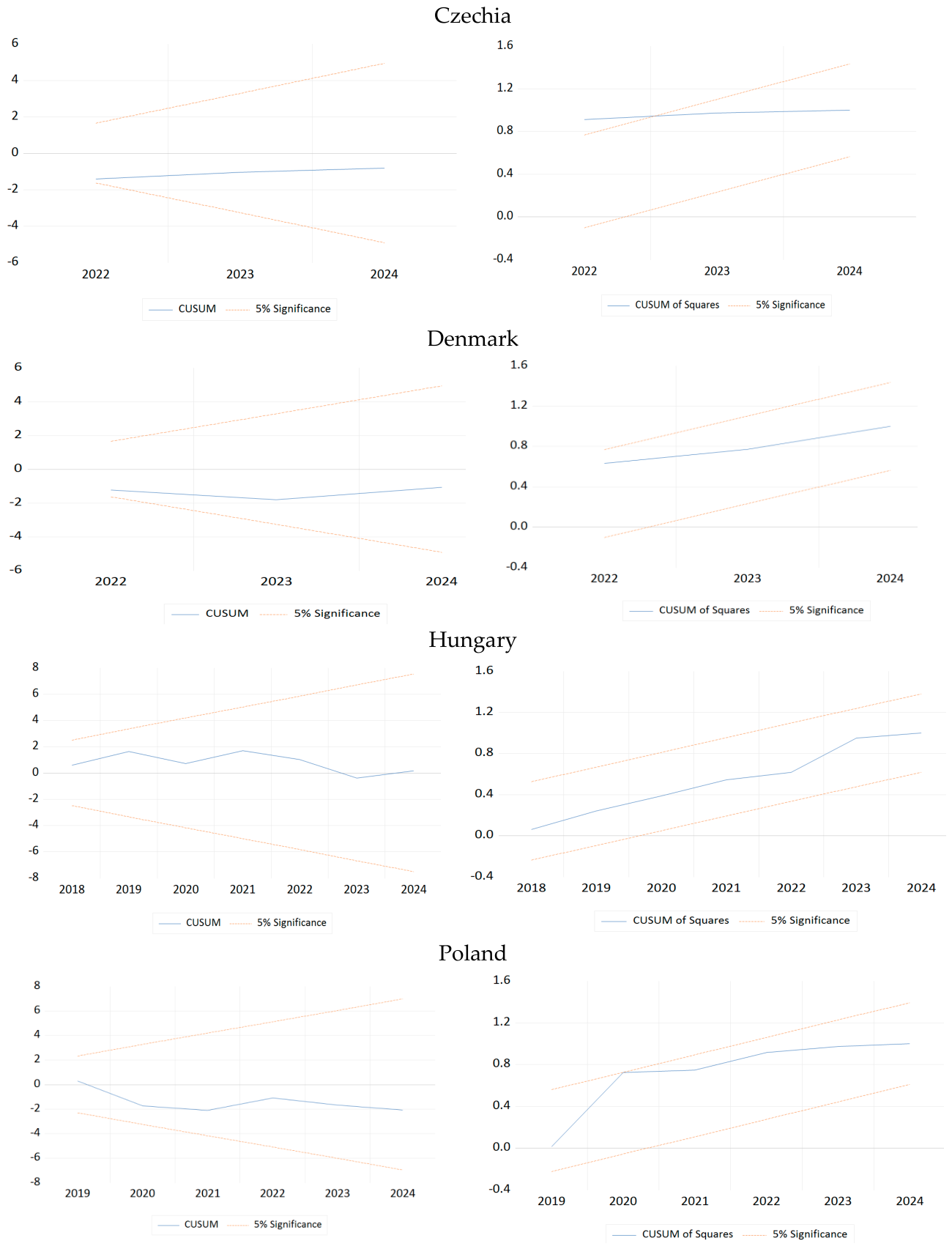
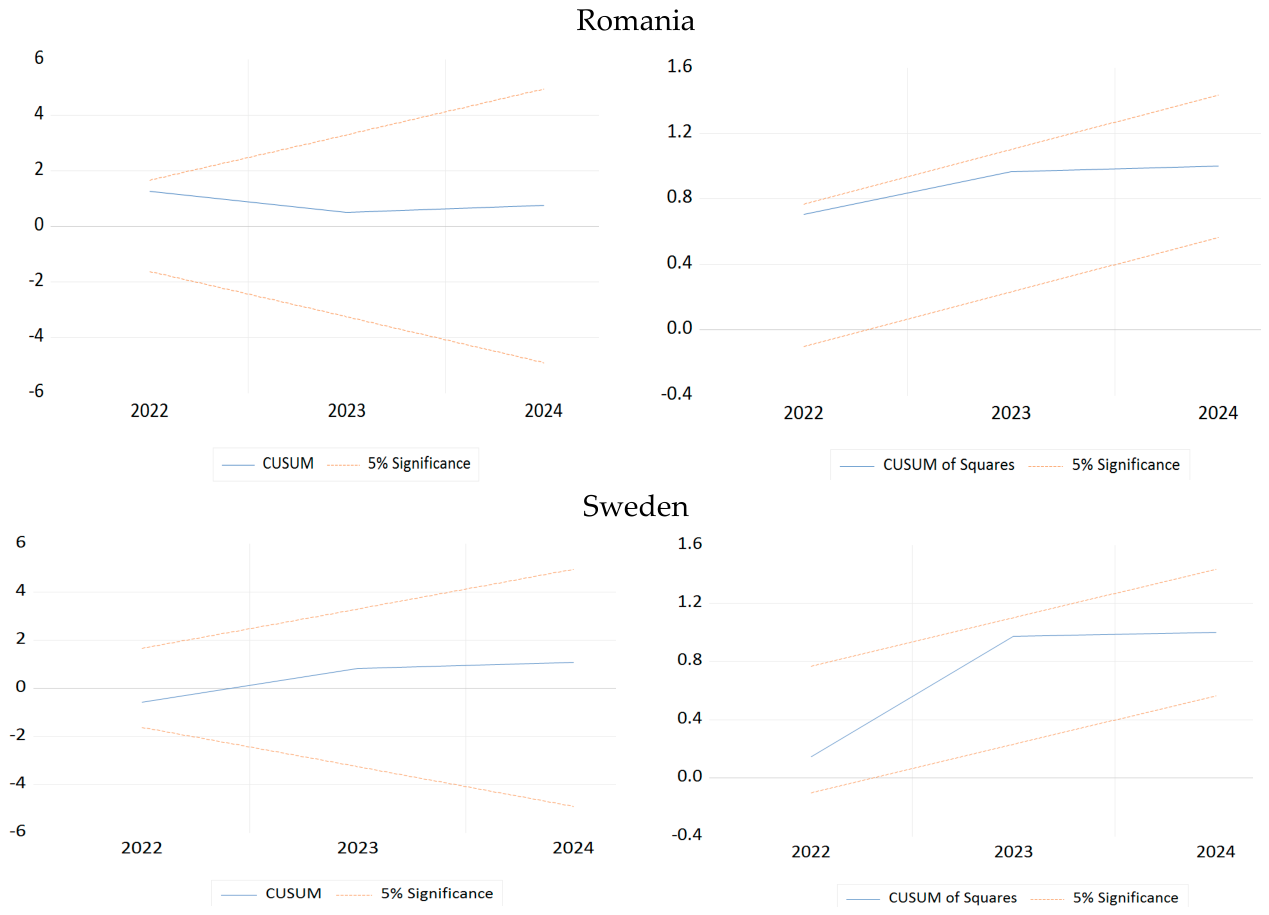
Figure 7 shows the results of the two tests for the countries we examine.
From
Figure 7 and the CUSUM test, we observe that the stability values of the coefficients in all countries are within the two critical lines at a significance level of 5%. So, we can say that the model we are examining has stable coefficients, that is, it does not present the problem of structural instability. In the same chart from the CUSUMSQ test we observe that the stability values of the coefficients in all countries are within the two critical lines, (except for Czechia) without being subject to structural changes in the period we are examining. So, we can say that Czechia is subject to structural instability in the period under consideration. Here, we can point out that the only indication of structural instability in Czechia is compatible with the previous findings of a weak long-term relationship.
The overall interpretation of the cointegration results can be summarized as follows. The key conclusion is not simply that all variables exert an influence on GDP. Rather, the central finding is the existence of a stable long-run relationship among the variables across all countries, albeit with substantial cross-country variation in both the magnitude and direction of the effects. In particular, mature economies tend to exhibit weaker long-run impacts, likely reflecting already well-established structural conditions. By contrast, transition economies display stronger dynamics related to institutional quality and investment activity, indicating ongoing structural adjustment processes. Moreover, the speed of adjustment emerges as a crucial distinguishing factor, highlighting differences in how quickly economies respond to deviations from long-run equilibrium.
7.3. Granger Causality Using ECM and the ARDL Model
Since the presence of cointegration implies that there must be a causal relationship in at least one direction, the next step is to reveal the direction of causality between the variables in the countries we are examining. This causal relationship can be estimated by applying the Granger causality test in the context of the multivariate VECM model. It should also be noted that, since the study has variables in the countries we are studying that also present zero order of integration I(0), we define these variables in the corresponding countries as exogenous and the rest as endogenous. For the presence or absence of short-run and long-run causality between the variables, the Wald test was applied to the time-lagged terms of the variables and the t-statistic to the error term. Coefficients with common lags and ECT are used to verify common causality between the variables (
Davidson & MacKinnon, 2004).
Appendix E provides important insights into the causal relationships among the variables. First, the short-run causality analysis reveals that economic dynamics are strongly interconnected, with changes in investment, institutional quality, and health expenditure exerting both direct and indirect effects across the system. Second, the presence of bidirectional causality in countries such as Hungary and Sweden indicates circular interactions, whereby institutions and investment mutually reinforce one another. This finding is consistent with the core principles of institutional economics, according to which strong institutions enhance economic performance, which in turn further strengthens institutional quality. Third, unidirectional causal relationships point to the leading role of specific variables, such as investment or GDP, in driving broader economic dynamics, a pattern often observed in transition economies or in countries with clearly identifiable “growth engines.”
Before interpreting the country-specific causality results, it is important to distinguish between statistical Granger predictability and evidence of stable structural causality. This distinction is particularly relevant for countries where the evidence of cointegration is borderline or where the error-correction coefficient indicates very slow adjustment. In such cases, the causality results should be interpreted as short-run predictive associations within the estimated ECM framework, rather than as evidence of strong long-run causal mechanisms.
A more detailed examination by country yields the following insights.
7.3.1. Czechia
For Czechia, short-run unidirectional Granger causality is identified from foreign direct investment to institutional quality, as well as from gross fixed capital formation to foreign direct investment. However, these results should be interpreted with particular caution. The evidence of long-run adjustment is weak, as reflected in the near-zero error-correction coefficient, while the long-run coefficients are not statistically significant. Therefore, the Czech results are better understood as indicating short-run predictive linkages among investment-related variables and institutional quality, rather than as evidence of a stable investment-driven growth model or a robust long-run causal mechanism. The findings point to long-run co-movement with weak adjustment rather than to a clearly identified structural relationship.
7.3.2. Denmark
The results indicate a short-run unidirectional causal relationship from gross fixed capital formation to GDP and from foreign direct investment to both health expenditure and institutional quality. This pattern reflects a stable and mature economy, where capital accumulation and FDI act as catalysts for growth, while institutions play a more limited but strategic role—consistent with the notion of diminishing marginal returns to institutional quality.
7.3.3. Hungary
A bidirectional short-run causal relationship exists between health expenditure and institutional quality, alongside several unidirectional linkages—from health expenditure to GDP, from gross fixed capital formation to health expenditure, and from foreign direct investment to both health expenditure and institutional quality. These findings highlight the active role of both institutions and health in the adjustment process. The high speed of adjustment (ECM coefficient of −0.92) indicates strong responsiveness to short-term shocks, combined with rapid convergence to equilibrium—characteristic of an economy undergoing dynamic institutional transformation.
7.3.4. Poland
The results reveal short-run unidirectional causality from institutional quality, gross fixed capital formation, and foreign direct investment to health expenditure, as well as from GDP to institutional quality. In addition, all variables exhibit long-run causality toward institutional quality. This suggests that institutions act as a central coordinating mechanism within the economy, supporting the fact that institutional quality shows stronger predictive links with the other variables in the estimated system.
7.3.5. Romania
Short-run unidirectional causal relationships are observed from health expenditure to institutional quality, from GDP to foreign direct investment, and from institutional quality to foreign direct investment. Furthermore, both short-run and long-run causality run from GDP and institutional quality to gross fixed capital formation. These findings point to a transition economy in which GDP contains predictive information for subsequent movements in institutional quality.
7.3.6. Sweden
Bidirectional short-run causality is identified between foreign direct investment and institutional quality, as well as between foreign direct investment and gross fixed capital formation. Additional unidirectional relationships run from GDP to both investment and FDI and from institutional quality to investment. This configuration reflects a mature economy with strong institutional foundations, where investment and institutions are mutually reinforcing, supporting stable, long-term growth through a high level of integration between capital markets and governance structures.
Overall, the causal patterns observed across countries can be interpreted as follows. Institutional quality plays a more decisive role in transition economies (Poland, Romania, Hungary), whereas its marginal impact is more limited in mature economies (Denmark, Sweden), where institutional frameworks are already well established. Investment and capital formation remain key drivers in economies with high capital accumulation and stable institutional environments. Health expenditure functions as an investment in human capital, exerting a delayed but significant effect on growth, particularly in countries undergoing institutional transition.
Finally, the error correction mechanism (ECM) results indicate that short-term disequilibria are corrected more rapidly in transition economies and more gradually in mature ones, in line with convergence theory and differing speeds of economic adjustment. The presence of bidirectional causality in more advanced economies, such as Sweden and, to some extent, Hungary, further suggests a high degree of integration between institutions and capital markets, consistent with growth occurring within a “high-equilibrium” regime.
8. Conclusions and Policy Implications
This study examined the dynamic relationship between economic growth, health expenditure, institutional quality, gross fixed capital formation, and foreign direct investment in EU countries outside the euro area over the period 2000–2024. By employing an ARDL/ECM framework, together with structural break and nonlinearity analysis, this study provides evidence on both long-run equilibrium relationships and short-run adjustment dynamics. The results confirm the existence of cointegration across all countries, suggesting that economic growth, institutional quality, health expenditure, and investment-related variables are linked through stable long-run relationships. However, the magnitude, direction, and transmission mechanisms of these effects differ substantially across countries, reflecting differences in economic structure, institutional maturity, and development trajectories.
A key finding of the analysis concerns the differentiated role of institutional quality across countries. In transition economies such as Poland, Romania, and Hungary, institutional quality appears to be more closely associated with growth dynamics and adjustment processes than in more mature institutional settings. However, because institutional quality enters the empirical model additively, these findings should be interpreted as evidence of direct country-specific associations rather than as evidence of a formally estimated moderating effect on health expenditure, gross fixed capital formation or FDI. In contrast, in mature economies such as Denmark and Sweden, weak or negative coefficients on institutional quality should not be interpreted as evidence that strong institutions constrain growth. Rather, they may reflect institutional saturation, limited variation in high-quality governance indicators, or the fact that institutional effects operate indirectly through investment, health expenditure and broader macroeconomic stability. This distinction highlights the importance of considering the stage of institutional development when assessing the growth effects of governance quality.
Investment, both domestic and foreign, also plays an important role in shaping growth dynamics. Gross fixed capital formation generally exerts a positive influence, particularly in the long run, confirming the importance of capital accumulation for economic performance. Foreign direct investment, by contrast, appears to have stronger short-run effects and greater sensitivity to external shocks. These findings underline the importance of maintaining stable investment environments, reducing uncertainty, and strengthening the channels through which capital inflows contribute to productivity, technological diffusion, and structural transformation.
Health expenditure also contributes to economic growth, mainly through its role as an investment in human capital. However, its effects are often lagged and appear to depend on the broader institutional environment. This finding supports the view that health spending is not automatically growth-enhancing; rather, its effectiveness depends on the capacity of institutions to allocate resources efficiently, reduce waste, and translate expenditure into improved health outcomes and labour productivity.
The short-run analysis reveals considerable heterogeneity across countries. In several cases, economic growth appears to be influenced by short-term shocks and cyclical adjustments, while in others the long-run mechanisms are more stable. The error correction results further suggest that transition economies tend to adjust more rapidly to disequilibria, whereas mature economies display slower but more stable adjustment paths. These differences reinforce the argument that non-euro area EU countries should not be treated as a homogeneous group, despite sharing a common broader European institutional framework.
The findings have several policy implications. First, strengthening institutional quality should remain a priority, particularly for transition economies. Improvements in governance, transparency, regulatory effectiveness and control of corruption may contribute to a more favourable economic environment in which public spending and private investment are more likely to be associated with sustainable growth. However, the present empirical specification does not directly estimate whether institutional quality moderates the productivity of health expenditure or investment. Second, policies aimed at promoting domestic and foreign investment remain essential. A stable macroeconomic environment, predictable regulatory conditions, and effective institutional frameworks can support capital accumulation and long-term growth. Third, health expenditure should be viewed not merely as a social cost, but as a strategic investment in human capital. Policymakers should therefore focus not only on the level of health spending, but also on its efficiency and capacity to generate measurable improvements in health and productivity.
Fourth, the presence of structural breaks and nonlinearities suggests that economic policy should be flexible and adaptive. Uniform policy approaches may be insufficient, especially in the presence of external shocks such as the global financial crisis, the sovereign debt crisis, or the COVID-19 pandemic. Country-specific strategies that take account of institutional conditions, investment structures, and stages of development are therefore required. Finally, the evidence of dynamic interrelationships among institutions, investment, health expenditure, and growth highlights the importance of policy coordination. These factors should not be treated in isolation but as interconnected components of a broader strategy for sustainable and inclusive economic development.
This study is subject to certain limitations. Most importantly, the analysis is based on annual data covering the period 2000–2024, providing 25 observations for each country. Although this reflects the availability of consistent data for health expenditure, institutional quality, and macroeconomic variables, the relatively small sample size requires caution in interpreting the results. The ARDL/ECM framework is suitable for small-sample time-series analysis, but the findings should be understood as country-specific evidence rather than definitive or universally generalizable causal estimates. Future research could extend the analysis by using longer time periods when data become available, applying complementary panel techniques, or incorporating additional institutional and health-system variables to test the robustness of the results.
A further interpretative limitation concerns the role of institutional quality. Although institutional quality is theoretically expected to shape the effectiveness of public spending and investment, the ECM-based Granger causality results indicate feedback relationships between institutional quality and other variables in several countries. A further interpretative limitation concerns the role of institutional quality. Although the theoretical literature suggests that institutions may influence how effectively public spending and investment are translated into economic performance, the empirical model used in this study does not include interaction terms, threshold effects or a formal moderation structure. Institutional quality is therefore interpreted as an additive explanatory variable and as a factor that helps contextualize cross-country heterogeneity, rather than as a statistically identified conditioning mechanism. The ECM-based Granger causality results also indicate feedback relationships between institutional quality and other variables in several countries. Accordingly, institutional quality should be understood as part of a system of dynamic country-specific associations and not as a purely one-directional determinant of growth A further limitation concerns endogeneity, simultaneity and omitted variables. Gross fixed capital formation, FDI and GDP are likely to be jointly determined, while institutional quality may both influence and respond to economic performance. Although the ARDL/ECM framework captures dynamic adjustment and allows for lagged relationships among variables, it does not fully resolve simultaneity, reverse causality or omitted-variable bias. In addition, although the theoretical and empirical literature identifies trade openness, education, labour-force characteristics and population dynamics as relevant determinants of economic growth, these variables are not included in the baseline country-specific specification. Their exclusion reflects the need to preserve a tractable model given the short annual sample and the number of parameters introduced by lagged regressors. However, the estimated coefficients may partly capture the influence of omitted macroeconomic and structural factors. For this reason, the estimated long-run coefficients and ECM-based Granger causality results should be interpreted as country-specific dynamic associations and predictive relationships, rather than as fully identified structural causal effects. This caution is particularly relevant for the negative institutional quality coefficients observed in Denmark and Hungary, which may reflect diminishing marginal effects or regulatory complexity, but may also arise from limited in-sample variation in high-quality governance indicators, omitted variables or model-specific dynamics.
In conclusion, this study shows that sustainable economic growth in EU non-euro-area countries is associated with a combination of capital accumulation, health expenditure, foreign investment and institutional quality. The results highlight substantial cross-country heterogeneity, suggesting that the role of these factors differs between transition economies and mature institutional environments. Rather than identifying institutional quality as a formal moderating mechanism, this paper shows that institutional quality is an important governance-related variable whose association with growth differs across national contexts. The evidence therefore supports country-specific development strategies that combine sound governance, efficient health investment and stable investment conditions, while avoiding uniform policy prescriptions across heterogeneous non-euro-area EU economies.