Article

External Price Shock Vulnerability in Import-Dependent Economies: The Case of the Republic of Moldova and a Commodity Import Price Index

Independent Researcher, MD-2024 Chisinau, Moldova
Economies 2026, 14(6), 207; https://doi.org/10.3390/economies14060207
Submission received: 1 April 2026 / Revised: 29 May 2026 / Accepted: 1 June 2026 / Published: 4 June 2026

Abstract

This study examines the Republic of Moldova’s macroeconomic vulnerability to external commodity price shocks (1992–2025) using the IMF’s Commodity Import Price Index (CIPI) combined with time series analysis and a mixed-frequency VAR model linking monthly price data to quarterly GDP. Four key findings emerge: First, vulnerability is event-driven rather than seasonal—irregular shocks dominate predictable patterns. Second, the CIPI exhibits highly persistent innovations and is non-stationary in levels, consistent with an I(1) process. This indicates that external import price shocks have long-lasting effects rather than dissipating quickly through mean reversion. Third, structural regimes have shifted, with the post-2020 period showing elevated volatility and higher baseline costs. Fourth, VAR impulse responses reveal a stop–go transmission: external price spikes initially raise nominal GDP through a valuation effect (higher lei value of unchanged import volumes), then feed into inflation, trigger policy tightening, and subsequently depress nominal activity while leaving persistent CPI level effects, which are the primary channel through which the shocks erode household welfare. Policy recommendations include: continuous CIPI monitoring for macro stress testing, buffer design accounting for persistent import-cost shifts, and structural measures such as energy diversification, domestic production capacity expansion, and commodity risk management tools to reduce exposure to global price volatility.

1. Introduction

In an era of deep global interconnectedness, the economic performance of small open economies is increasingly shaped by volatility in international markets. Integration into global trade creates opportunities for growth, but it also exposes domestic economies to external disturbances, especially fluctuations in the prices of essential imported commodities. The capacity to absorb and adapt to such shocks has therefore become a central component of macroeconomic resilience.
The Republic of Moldova, a landlocked and energy-dependent economy situated at a geopolitical crossroads in Eastern Europe, represents a particularly relevant case. Its structural reliance on imported energy, food, and industrial raw materials makes it highly exposed to global commodity price movements. This vulnerability is reinforced by limited economic diversification and constrained domestic production capacity, which reduce the economy’s ability to substitute away from imported inputs during periods of global price stress (Diavor, 2023). As a result, international price movements can transmit rapidly into domestic inflation, production costs, the balance of payments, and household purchasing power.
A defining recent illustration of this exposure was the 2022 global commodity price shock—described by the European Bank for Reconstruction and Development (EBRD) as the largest supply shock since the early 1970s (EBRD, 2022)—triggered by the spillovers from Russia’s invasion of Ukraine and the ensuing disruption of global energy and food markets (IMF, 2022a). For the Republic of Moldova, proximity to the conflict and deep dependence on imported energy and food transformed the external shock into a domestic macroeconomic and social crisis. Output contracted sharply—GDP fell by 5.9% in 2022 (WB, 2023)—while inflation surged to historic highs: the annual average reached 28.6% and peaked at 34.6% in October 2022, driven primarily by imported energy and food costs (IMF, 2022a; WB, 2023). Food inflation alone approached 36% in mid-2022, compressing real incomes and heightening risks to food security (FAO, 2022). The shock also magnified macro-financial fragilities through exchange rate and confidence pressures, while the refugee inflow generated additional fiscal and administrative strain (IMF, 2022a). The IMF’s projections from that period were grim, anticipating average annual inflation to reach as high as 28.5% in 2022 (IMF, 2022b). In short, 2022 condensed—within a single year—the core vulnerabilities this research studies: structural import dependence, exposure to geopolitical disruption in the Black Sea region, limited policy space, and fragile social buffers.
This research addresses a central problem: the persistence of external price shock vulnerability in the Republic of Moldova. Traditional analyses often treat external shocks as temporary, mean-reverting disturbances. However, preliminary evidence suggests that commodity import price shocks may have long-lasting level effects, shifting the import-cost environment for extended periods rather than dissipating quickly. This possibility is especially important in the context of global “polycrisis,” where overlapping shocks from the COVID-19 pandemic, geopolitical conflict, supply chain disruptions, and energy market instability can interact and place sustained pressure on small open economies.
In this context, the study examines whether the Republic of Moldova’s import price dynamics are characterized by high persistence, structural breaks, and nonlinear regime-dependent adjustment. These features do not by themselves prove a ratchet effect, but they are consistent with a possible ratchet-type mechanism in which adverse external price shocks may move the economy toward higher import-cost regimes that unwind only slowly. The paper, therefore, treats the ratchet interpretation cautiously: the empirical analysis establishes persistence and regime dependence, while formal evidence of short-run asymmetric adjustment remains inconclusive.
Contribution to the literature. This study positions itself at the intersection of three established sectors of the literature and articulates a clear marginal advance over each. With respect to the small open economy vulnerability literature (Rodrik, 1999; Raddatz, 2005; Mendoza, 1995), the paper contributes by quantifying transmission magnitudes along a fully specified pass-through chain rather than treating external shocks as a residual source of output volatility. With respect to the commodity price transmission literature (Kilian, 2009, 2010; Gelos & Ustyugova, 2012; Rees, 2023), it replaces broad commodity aggregates with a country-specific, import-share-weighted CIPI (Gruss & Kebhaj, 2019) and identifies the inflation, monetary-policy, and activity responses jointly within a single system. With respect to the mixed-frequency econometrics literature (Ghysels et al., 2016; Foroni et al., 2015; Casarin et al., 2018), it adapts the U-MIDAS VAR to a small-sample, post-transition setting in which the monthly–quarterly mismatch is binding and demonstrates that subsample stability holds across the polycrisis break. The marginal contribution is therefore methodologically applied rather than theoretical: it is the first application, to our knowledge, that combines a country-specific CIPI with a U-MIDAS VAR to trace the complete external price-to-domestic activity chain in an import-dependent small open economy.
Beyond commodity price transmission per se, the paper also speaks to the recent geopolitical risk and global uncertainty literature (Caldara & Iacoviello, 2022; Ahir et al., 2022), which documents that adverse geopolitical events depress investment, employment, and output and that uncertainty shocks foreshadow output declines that are larger and more persistent in low-institutional-quality, small open economies. The Republic of Moldova’s exposure during the 2022 Black Sea episode—structural import dependence superimposed on an acute geopolitical shock—is precisely the configuration these papers identify as most damaging, and the CIPI–MF-VAR framework developed here is an empirical tool for tracing how such geopolitical spillovers transmit through the import price channel into domestic inflation, monetary policy, and activity.
Empirically, the paper documents two core features of Moldova’s macroeconomic dynamics. First, the CIPI exhibits high persistence, non-stationarity in levels, structural breaks, and regime-dependent nonlinear adjustment. These patterns indicate that external import price shocks have long-lasting effects and are not well described as purely temporary, mean-reverting disturbances. They are also consistent with a possible ratchet-type interpretation, although the formal evidence for short-run asymmetric adjustment is inconclusive. Second, the mixed-frequency VAR identifies a policy-driven stop–go cycle in nominal activity: external price shocks initially raise nominal GDP through price and import-value effects, but subsequent inflationary pressures trigger monetary tightening that dampens activity with a delay.
For policy, the estimated magnitudes along each transmission channel enable more targeted interventions. Risk-management and hedging instruments can be calibrated to the estimated short-run CIPI to CPI pass-through of approximately 21%, while fiscal buffers and social-protection design should account for the delayed contractionary effects of policy tightening on nominal GDP, estimated at approximately −1.74% after two quarters.
A further motivation for focusing on import price vulnerability—especially in energy—is provided by earlier evidence that energy price shocks in the Republic of Moldova quickly propagate into macroeconomic instability and distributional stress. In a detailed case study, Baclajanschi et al. (2006) quantify how increases in natural-gas import prices could generate sizeable output losses and macroeconomic pressures. They estimate that raising the natural-gas price to $110/mcm could reduce GDP by 2.4% in 2006 and a further 2.1% in 2007, while an increase to $160/mcm could deepen the impact to −5.1% and −4.4%, respectively. These shocks are also shown to widen the current account deficit toward 6–7% of GDP, strain public finances via higher expenditures and lower VAT revenues, and push inflation toward 12–15% even under tight monetary policy.
Crucially, the same analysis emphasizes the distributional and second-round effects of energy-price spikes. Poorer households face a disproportionate burden because electricity and heating expenditures constitute a larger share of their budgets, while LPG price increases are especially damaging for rural poor communities. The estimated cost of shielding the poorest households through targeted compensation ranges from 0.7% to 1.7% of GDP, depending on shock magnitude and targeting efficiency (Baclajanschi et al., 2006). The authors also highlight adverse coping responses—such as substitution toward cheaper but more polluting fuels (e.g., wood and coal)—with potential health and environmental consequences. These findings underscore that in transition economies with incomplete structural transformation and institutional constraints, energy-price volatility can cascade across the macroeconomy, public finances, and household welfare. The Republic of Moldova represents an extreme case along this spectrum, making it an informative laboratory for examining how repeated external price shocks shape long-run economic trajectories.
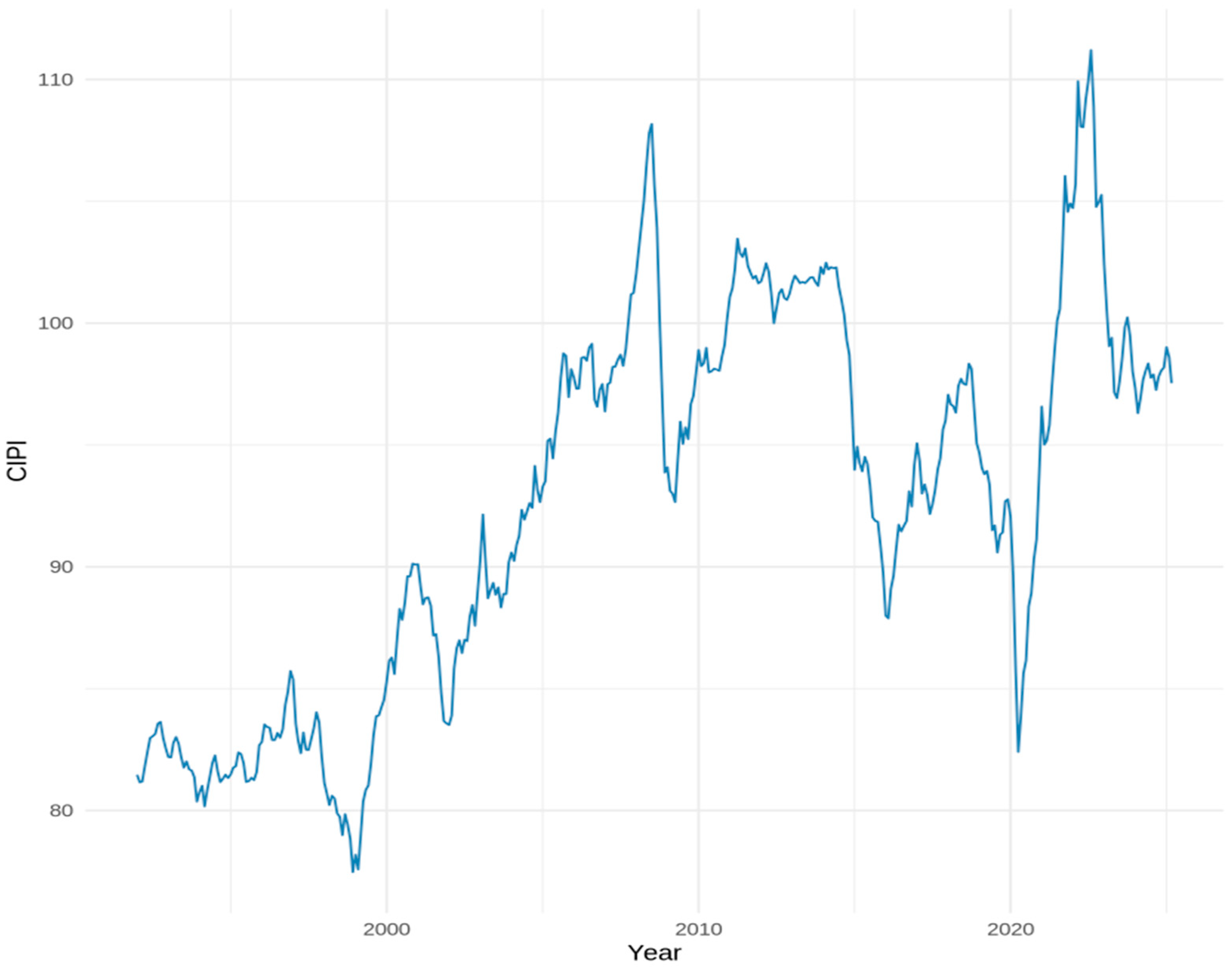
To examine this complex and evolving vulnerability, this study employs the International Monetary Fund (IMF) Commodity Import Price Index (CIPI) (Individual Commodities Weighted by the Ratio of Imports to GDP, with recent fixed weights) by Gruss and Kebhaj (2019) and available at the IMF, for the Republic of Moldova. Constructed from international prices for up to 45 individual commodities and aggregated using weights proportional to each commodity’s imports to GDP ratio, the index provides a precise and methodologically rigorous measure of exogenous price shocks transmitted to the Republic of Moldova’s economy. The full list of constituent commodities, organized by category (Energy, Metals, Food and Beverages, Agricultural raw materials), together with the exact IMF price-source specification (grade, reference location, units) for each commodity, is reported in Appendix E. By tracing this index over the period 1992–2025, the analysis moves beyond anecdotal evidence to systematically quantify the timing, magnitude, and persistence of external pressures, thereby furnishing an empirical basis for identifying the structural drivers of the Republic of Moldova’s economic predicament.
In 2024, the Republic of Moldova’s imports of goods and services represented a considerable 57.3% of its GDP, as reported by the WB; imports of goods alone were 49.45% of GDP (calculated by author using data from World Bank database and United Nations Comtrade database 2025 (WB, 2025; United Nations, 2025)), indicating the nation’s considerable integration within the global economy and its notable dependence and vulnerability to external markets. This significant import reliance is critically important to examine because it makes the Republic of Moldova susceptible to clear vulnerabilities stemming from international price changes, supply chain interruptions, and global economic disturbances. In such an open economy, external commodity price disturbances can quickly translate into domestic inflation and can impact production costs and affect overall economic stability.
Research question. How do exogenous external commodity import price shocks faced by the Republic of Moldova—measured by a country-specific CIPI—transmit to domestic inflation, monetary policy, and real activity, and what are the magnitude and timing of the pass-through along the chain CIPI → CPI → policy rate → GDP?
Contributions. First, we employ a Republic of Moldova-specific CIPI intended to proxy exogenous external price pressure using fixed import-share weights. Second, we estimate a two-lag mixed-frequency U-MIDAS VAR that combines monthly CIPI, CPI, and the policy rate with quarterly nominal GDP to preserve the timing of monthly shocks and identify transmission dynamics in a small open economy. Third, we quantify economically meaningful pass-through and policy effects and assess robustness to alternative specifications.
Empirical approach and preview of results. The mixed-frequency VAR traces three linked channels: external pass-through from CIPI to CPI, the policy reaction from CPI to the policy rate, and the subsequent transmission from interest rate movements to output. The estimates imply (i) short-run CIPI → CPI pass-through of about 21% within one quarter, (ii) a policy reaction of about 45 basis points to a 1% CPI shock, and (iii) a delayed contractionary effect of policy tightening on nominal GDP of about −1.74% after two quarters. Impulse responses suggest external shocks generate temporary nominal expansions that are partly reversed by subsequent policy tightening, consistent with a stop–go dynamic.

2. Literature Review

Our analysis builds on three strands of research: the theoretical foundations of external vulnerability in developing economies, empirical evidence on commodity price transmission mechanisms, and methodological advances in mixed-frequency econometric modeling.

2.1. External Vulnerability in Small Open Economies

The conventional view attributing growth instability in developing economies primarily to the magnitude of external shocks has been fundamentally challenged by recent research emphasizing the interaction between external disturbances and domestic institutional capacity. Rodrik (1999) demonstrates through both theoretical modeling and cross-country empirics that the severity of growth collapses following external shocks cannot be explained by shock size alone; rather, outcomes emerge from the interplay between external perturbations, latent social conflict, and the quality of conflict-management institutions. Countries with deep social cleavages and weak institutional capacity experienced the most severe contractions, regardless of shock magnitude—a finding that redirects analytical focus toward institutional quality and governance as critical mediators of external vulnerability.
Complementing this institutional perspective, Raddatz (2005) challenges the assumption that external shocks constitute the primary source of output volatility in low-income countries. His decomposition analysis reveals that external disturbances account for no more than 15% of overall output volatility, with domestic factors—governance failures, institutional weaknesses, macroeconomic mismanagement—emerging as dominant drivers. Nonetheless, Raddatz establishes that vulnerability to external shocks varies significantly based on country-specific characteristics, with highly indebted economies and those with weaker institutions exhibiting particular susceptibility.
Combes and Guillaumont (2002) provide a comprehensive analytical framework distinguishing between structural vulnerability factors (e.g., lack of diversification) and policy-induced factors, utilizing terms-of-trade instability as a proxy for commodity price volatility’s impact on growth. Their key finding—that export instability exerts significant detrimental effects on growth primarily through adverse impacts on factor productivity—highlights the transmission mechanism from external price volatility to long-run development outcomes. Paradoxically, they demonstrate that policy-driven trade openness, despite increasing exposure to external shocks, enhances resilience by dampening the adverse effects of terms-of-trade instability.
Mendoza (1995) extends this analysis by documenting that while developing countries share similar business cycle mechanisms with advanced economies, they experience substantially larger economic fluctuations. Terms-of-trade shocks account for 37–56% of GDP variability in developing countries, with trade balance variability 2–3 times higher than in G-7 economies. This heightened sensitivity stems from greater dependence on commodity exports and structural differences in consumption responses, ultimately generating higher welfare costs and more persistent effects.
More recent work has extended the small open economy vulnerability framework to incorporate geopolitical and uncertainty shocks. Caldara and Iacoviello (2022) construct a news-based geopolitical-risk (GPR) index and document that elevated GPR foreshadows lower investment and employment, with effects concentrated in industries and economies most exposed to aggregate geopolitical risk. Ahir et al. (2022) construct the World Uncertainty Index (WUI) for 143 countries and show, in a panel VAR setting, that innovations in WUI foreshadow significant output declines, with effects that are larger and more persistent in countries with weaker institutions and tighter trade and financial linkages. Both sectors of the literature imply that a small, import-dependent, post-transition economy on a geopolitical fault line is structurally predisposed to absorb commodity price spillovers as durable rather than transitory disturbances—a prior that motivates the persistence and regime-dependence tests reported in Section 4.

2.2. Commodity Price Transmission and Monetary Policy Responses

The transmission of commodity price shocks into domestic economies operates through multiple, often interacting channels. Kilian (2009) provides a seminal contribution by decomposing oil price movements into supply disruptions, global aggregate demand shifts, and oil-specific (precautionary) demand shocks, each with distinct macroeconomic implications. In oil-importing economies, demand-side effects dominate: higher energy prices erode real disposable income, increase uncertainty—leading to deferred consumption of durables—and raise operating costs for energy-intensive sectors, collectively dampening aggregate demand. These effects are often amplified by sectoral reallocations and contractionary monetary policy aimed at containing oil-induced inflation, further suppressing output.
Kilian (2010) challenged the view that oil prices are exogenous, demonstrating through SVAR analysis that demand-side factors—global business cycles and speculation—drive major price movements. Different oil shock types produce distinct effects: demand shocks temporarily stimulate the economy before raising commodity prices, while supply disruptions contract it immediately. Oil shocks’ economic impact has weakened since the late 1980s due to changing shock composition and lower energy intensity.
For oil importers, the main transmission channels are demand-side: higher energy prices reduce discretionary income, increase uncertainty and precautionary savings, and raise operating costs—collectively dampening aggregate demand. Sectoral reallocation and unemployment can amplify these effects. Monetary policy responses (rate hikes) may further reduce output depending on the shock’s source. Trade balance effects vary: supply disruptions create trade deficits in importers, while demand shocks have more complex effects.
Gelos and Ustyugova (2012) examine heterogeneity in inflation responses to commodity price shocks across advanced and developing economies, finding that developing countries exhibit significantly greater vulnerability. Food price pass-through to domestic inflation is approximately four times larger in developing economies than in advanced economies, driven by structural characteristics including higher food shares in consumption baskets, greater fuel intensity, and preexisting elevated inflation. Critically, while countries with independent central banks and superior governance frameworks demonstrate enhanced capacity to contain shock impacts, inflation targeting regimes provide only minimal mitigation, particularly during acute crisis episodes. These findings underscore the importance of sound institutions and credible monetary frameworks in minimizing external vulnerability.
Recent research by Rees (2023) identifies a structural shift in global commodity dynamics: the traditional negative correlation between US dollar strength and commodity prices has weakened markedly, increasing price volatility for non-US economies. This erosion of the exchange rate’s shock-absorbing role necessitates more proactive macroeconomic stabilization efforts from both monetary and fiscal authorities, particularly in commodity-dependent countries.
These external-transmission findings are sharpened by the modern inflation persistence literature, which provides a framework for interpreting why level shocks to imported costs need not unwind. Stock and Watson (2007) document a secular decline in U.S. inflation persistence accompanied by an increase in the relative volatility of the permanent inflation component, while Cogley and Sargent (2005) and Benati (2008) show that persistence is regime-dependent and shifts with the credibility of the monetary anchor. In small, import-dependent economies operating without a deeply anchored inflation expectation, a sequence of imported price shocks can therefore plausibly settle into a higher persistent component rather than mean-revert. This is the analytical lens through which we interpret the persistence, structural breaks, and regime-dependent nonlinear adjustment documented in the CIPI series in Section 4: as features consistent with a possible ratchet-type mechanism rather than as evidence of one, which is precisely the position the inflation persistence literature would predict for an economy of Moldova’s structural profile.

2.3. Mixed-Frequency VAR Models and Research Gap

Traditional vector autoregression (VAR) models typically require all variables to be aggregated to the lowest common frequency—usually quarterly—thereby discarding valuable high-frequency information and introducing temporal aggregation bias. This can obscure both the timing and the initial impact of economic shocks (Ghysels et al., 2016). To address these limitations, Foroni et al. (2015) developed the unrestricted Mixed Data Sampling (U-MIDAS) approach, which allows for the direct inclusion of mixed-frequency variables without pre-aggregation. By preserving monthly data on prices and policy rates alongside quarterly GDP, U-MIDAS enables more precise identification of the timing and magnitude of macroeconomic transmission mechanisms.
Recent empirical work has underscored the value of mixed-frequency approaches in macroeconomic modeling. Casarin et al. (2018) develop a Bayesian panel MS-UMIDAS framework to analyze the transmission of uncertainty shocks across developed economies, revealing that such shocks have asymmetric effects on macroeconomic variables—more severe during contractionary regimes than expansions. This asymmetry is amplified when mixed-frequency data (monthly uncertainty indicators and quarterly macroeconomic variables) are used instead of aggregated quarterly data. Financial uncertainty, proxied by the VIX, exerts stronger, more consistent effects across countries and variables—including GDP growth, industrial production, employment, consumption, inflation, and equity markets—than macroeconomic uncertainty measured by forecast dispersion. These effects are particularly pronounced for real variables during downturns and for interest rates in most countries, with exceptions such as Japan, Canada, and Switzerland. The study also highlights that omitting the mixed-frequency structure or the regime-switching mechanism leads to biased estimates and that excluding financial uncertainty overstates the influence of macroeconomic uncertainty. Despite these advances, no existing study has yet combined country-specific commodity import price indices with a mixed-frequency VAR framework to trace the full transmission chain from external shocks through domestic inflation and monetary policy to real economic activity in small, highly import-dependent economies.
Furthermore, while the IMF’s CIPI provides a methodologically rigorous measure of exogenous commodity price pressures faced by individual economies (Gruss & Kebhaj, 2019), its application in structural econometric analysis remains limited. Most existing research employs broad commodity price indices that do not account for country-specific import compositions, potentially introducing measurement error and attenuating estimates of transmission effects.
Lastly, the limited utilization of the CIPI as a diagnostic tool in prior research restricts its application as a measure of economic fragility. This study builds upon earlier work by Diavor (2023), which employed CIPI in an SVAR framework, and advances the use of CIPI for in-depth analysis of price dependencies and vulnerability patterns in the Republic of Moldova, establishing it as a critical indicator for future economic assessments.

2.4. Theoretical Framework: From Import-Cost Pass-Through to Stop–Go Dynamics

The empirical chain estimated below—from external commodity prices to domestic CPI, the policy rate, and nominal activity—admits a unified theoretical interpretation that combines three building blocks of the modern open economy literature: import-cost pass-through, a small open economy Phillips curve, and a Taylor-type policy rule. This mechanism is operative throughout the empirical analysis that follows; we consolidate it here so that each block of the chain can be mapped explicitly to a specific equation of the MF-VAR rather than left implicit in the prose.
Block 1: Import-cost pass-through. For a small open economy that is a price-taker in world commodity markets, the marginal cost of domestic producers and the consumer price of imported final goods are linear in the international (border) price of imported commodities and intermediates, scaled by the exchange rate. Following Burstein and Gopinath (2014), the consumer price level can be decomposed into a domestic value-added component and an imported component, with the imported component itself depending on border prices, distribution margins, and any local-currency pricing frictions. In Moldova’s setting—where imports of goods alone exceed 49% of GDP, import substitution possibilities are limited, and the leu is a small currency relative to the major commodity-pricing currencies—pass-through from the CIPI to the domestic CPI is expected to be rapid and substantial. The estimated short-run elasticity of about 21% within one quarter is consistent with this structural feature and with the broader cross-country evidence that food and energy pass-through is several times larger in developing than in advanced economies (Gelos & Ustyugova, 2012).
Block 2: Small open economy Phillips curve. The pass-through of border price increases to consumer prices feeds the New Keynesian Phillips curve of a small open economy (Galí & Monacelli, 2005). In that framework, domestic CPI inflation responds both to the output gap and to the imported input cost pressure, the latter entering through the marginal-cost channel. Under standard Calvo price-setting with a non-trivial imported-input share, a positive innovation in the CIPI raises producers’ marginal cost on impact and propagates into consumer price inflation with a short lag, the lag length governed by the frequency of price adjustment and by the share of imported intermediates. The persistence of inflation following an import-cost shock is determined jointly by the structural Phillips-curve parameters and by the prevailing expectations-formation regime—a margin that, as Stock and Watson (2007), Cogley and Sargent (2005), and Benati (2008) document, is regime-dependent. The regime-dependent persistence documented in Section 3.9.5 and Section 3.9.6 for the Republic of Moldova CIPI is the empirical counterpart of this theoretical margin.
Block 3: Taylor-type policy rule. Closing the loop, the central bank responds to the realized inflation path through a partial-adjustment Taylor-type reaction function (Clarida et al., 1999, 2000). The policy rate is raised in response to deviations of inflation from target, with the size and timing of the reaction governed by the inflation-response coefficient and the smoothing parameter. The IR_2 equation of the MF-VAR estimates this reaction directly and yields a short-run response of approximately 45 basis points to a 1% CPI shock, with high own-persistence in the policy rate consistent with deliberate interest rate smoothing. Read as a partial-adjustment Taylor-type rule, this short-run coefficient implies a substantially larger long-run inflation response, consistent with the smoothing-Taylor specification; the single-equation benchmark and confidence interval are reported in Appendix F.
Putting the three blocks together: the stop–go path. Combining Blocks 1–3 yields the stop–go sequence that the MF-VAR identifies in the data. On impact, a positive CIPI shock raises the nominal value of imports and, mechanically, nominal GDP through the valuation channel—the “go” phase, which we are careful to label as a valuation effect rather than as a real expansion. With a short lag, the same shock feeds into consumer-price inflation through the import-cost Phillips curve. The central bank, responding to the realized inflation increase through its Taylor-type reaction function, tightens policy with a further lag. The contractionary effect of policy tightening on nominal activity then materializes with the standard monetary transmission delay, producing the “stop” phase: a delayed contraction of nominal GDP of approximately −1.74% after two quarters. The stop–go pattern is therefore not an ad hoc empirical label but the logical equilibrium response of a small import-dependent open economy in which (i) pass-through is substantial and rapid, (ii) inflation is persistent because expectations are imperfectly anchored, and (iii) monetary policy reacts to inflation with smoothing. This unified framework—pass-through → Phillips curve → Taylor rule—is what the MF-VAR identifies and quantifies in reduced form, with each block of the chain mapped to a specific equation of the estimated system.
Our contribution. This paper fills these gaps by combining Moldova-specific CIPI with a mixed-frequency U-MIDAS VAR to identify and quantify the complete transmission mechanism from external commodity price shocks through domestic consumer prices and monetary policy reactions to nominal output effects. This approach enables us to preserve high-frequency price dynamics, avoid temporal aggregation bias, and estimate the precise timing and magnitude of each transmission channel—providing both methodological innovation and policy-relevant empirical evidence on how external vulnerability manifests in small, import-dependent economies.

3. Data and Methodology

3.1. The IMF Commodity Import Price Index (CIPI) for the Republic of Moldova

This study employs the IMF’s pre-constructed CIPI for the Republic of Moldova—specifically, the “Commodity Import Price Index, Individual Commodities Weighted by Ratio of Imports to GDP” (m_gdp) variant with “Recent, monthly, fixed weights” (R_FW_IX), as published in the IMF Commodity Terms of Trade database. The index is compiled in full by the IMF; we do not reconstruct or re-weight it. Our contribution lies in justifying this choice among the available IMF indicators and embedding it within a broader empirical framework for the Republic of Moldova. The IMF database offers several indicator variants and weighting schemes. The relevant import-side indicators are:
  • m: Commodity Import Price Index, Individual Commodities Weighted by Ratio of Imports to Total Commodity Imports;
  • m_gdp: Commodity Import Price Index, Individual Commodities Weighted by Ratio of Imports to GDP.
And for types:
  • H_FW_IX: Historical, annual, fixed weights;
  • H_RW_IX: Historical, annual, rolling weights;
  • R_FW_IX: Recent, monthly, fixed weights;
  • R_RW_IX: Recent, monthly, rolling weights.
We select the m_gdp/R_FW_IX variant and demonstrate that it is the most appropriate barometer of the Republic of Moldova’s external price vulnerability. The Moldova-specific CIPI with recent fixed weights is available at a monthly frequency from January 1992 to March 2025; the full sample is used throughout the empirical analysis. All series used in this paper are observed data at their published vintages, not forecasts: monthly CIPI runs January 1992–March 2025, monthly CPI through May 2025, and the monthly policy interest rate through June 2025; quarterly nominal GDP is available 2000Q1–2024Q4. The MF-VAR is estimated on observed series only over 2000Q4–2024Q1 (94 quarterly observations); no IMF World Economic Outlook projections or other forecast values enter the estimation sample. The remainder of this section summarizes the index’s components, data sources, and methodological framework, as documented by the IMF, in order to clarify how it captures vulnerability through a structured and consistent measurement approach.

3.1.1. Components of the Index

The index is constructed from the international prices of up to 45 individual commodities, organized into four broad groups that reflect the composition of imported goods relevant to economic stability:
  • Energy: Coal, crude oil, and natural gas—commodities of central importance for energy-dependent economies.
  • Metals: Aluminum, copper, gold, iron ore, lead, nickel, tin, uranium, and zinc—industrial inputs central to manufacturing and infrastructure.
  • Food and Beverages: Agricultural staples and processed goods including bananas, barley, beef, cocoa, coffee, corn, fish, fish meal, groundnuts, lamb, olive oil, oranges, palm oil, poultry, rapeseed oil, rice, shrimp, soybean meal, soybean oil, soybeans, sugar, sunflower seed oil, swine meat, tea, and wheat—the components most directly relevant to food security and cost-of-living dynamics.
  • Agricultural Raw Materials: Cotton, hard logs, hard sawnwood, hides, natural rubber, soft logs, soft sawnwood, and wool—inputs that underpin the industrial and textile sectors.
By disaggregating to the level of individual commodities rather than aggregate baskets, the index supports a granular reading of specific price shocks and their implications for economic vulnerability.
Data Sources
The IMF’s construction of the CIPI draws on three authoritative data sources, each addressing a distinct measurement requirement:
  • Commodity Prices: International commodity prices are drawn from the IMF Primary Commodity Prices database.
  • Trade Data: Import values at the country–commodity level are sourced from the UN Comtrade database.
  • Output Data: Nominal GDP figures (US dollars) are obtained from the IMF World Economic Outlook database; these provide the macroeconomic denominator used in the weighting calculation.
Together, these sources allow the index to reflect both micro-level price movements and their macro-level economic significance, providing a coherent measure of a country’s vulnerability to external cost pressures.
Weighting Method
The defining feature of this index is its recent fixed-weight methodology, which isolates the effect of international price variations from the influence of endogenous trade adjustments. The construction proceeds as follows:
  • Recent Fixed Weights Calculation: The weight for each commodity is computed from average import values and output over a recent benchmark period. This averaging smooths short-term fluctuations and establishes a stable, contemporary reference point.
  • Ratio to GDP: Each commodity’s import value is scaled by the country’s nominal GDP, linking the economic burden of a price change directly to the size of the economy. The construction makes the macroeconomic incidence of a commodity-specific shock immediately visible.
  • Isolation of Price Effects: By holding weights fixed, the index abstracts from endogenous adjustments in import volumes that a country might undertake in response to price fluctuations. Observed variations in the index are therefore attributable to international price movements alone, yielding a pure measure of external cost shocks.
The Moldova-specific m_gdp/R_FW_IX index is constructed by the IMF as follows:
  • Core formula: The index aggregates price changes across individual commodities. The weight (ω) on each commodity equals the Republic of Moldova’s average import value for that commodity over the benchmark period, divided by its average nominal GDP over the same period;
  • Weight: ωi = (average import value of commodity i for the Republic of Moldova)/(average nominal GDP of the Republic of Moldova)—with both averages taken over the benchmark period.
The Moldova-specific CIPI series spans January 1992 to March 2025. The IMF documentation notes that the Republic of Moldova’s own-reported trade data contain gaps in 1992–1993; the methodology addresses these gaps by inferring the missing import values from partner-reported flows (the standard mirror-statistics procedure).

3.1.2. Arguments for Recent Fixed Weights Versus Historical Fixed Weights in Using CIPI

The IMF offers four weighting methodologies for its commodity price indices: Historical Fixed Weights, Historical Rolling Weights, Recent Fixed Weights, and Recent Rolling Weights. Per IMF documentation, the choice between recent and historical fixed weights embodies a fundamental trade-off: whether to measure the impact of price changes against a contemporary economic structure or against an earlier, possibly outdated, one. Recent fixed weights are derived from a recent benchmark period and assign constant import-to-GDP ratios on the basis of current data; historical fixed weights use an older benchmark (e.g., the 1980s or early 1990s) that may no longer reflect evolving trade patterns. The remainder of this sub-section sets out the key arguments for each approach—drawing on IMF documentation, economic theory, and the present paper’s focus on vulnerability assessment in import-dependent economies such as the Republic of Moldova—and explains why recent fixed weights are appropriate here, while acknowledging contexts in which historical fixed weights would have advantages for long-run retrospective analyses.

3.1.3. Arguments in Favor of Recent Fixed Weights

Recent fixed weights are particularly well suited to indices that aim to isolate exogenous price shocks, which is the design rationale of the CIPI in vulnerability analysis. Under this method, weights are computed once and held constant over the full sample, using averages of import flows and nominal GDP from a recent reference period. The construction ensures that the benchmark reflects contemporary economic conditions while preserving methodological consistency:
  • Isolation of Pure Price Effects: By fixing the weights, the index is shielded from contamination by endogenous shifts in import volumes or composition—for example, substitution away from commodities that have become relatively expensive. This neutralizes both reverse causality and composition bias, so that observed variation in the index reflects international price movements alone. In the case of the Republic of Moldova, where the economy is effectively a pure price-taker with limited domestic production, the construction yields a direct measure of terms-of-trade shocks scaled by GDP, consistent with standard macroeconomic vulnerability concepts. A given percentage increase in the CIPI thus corresponds to a direct external cost shock, uncontaminated by adaptive behavior.
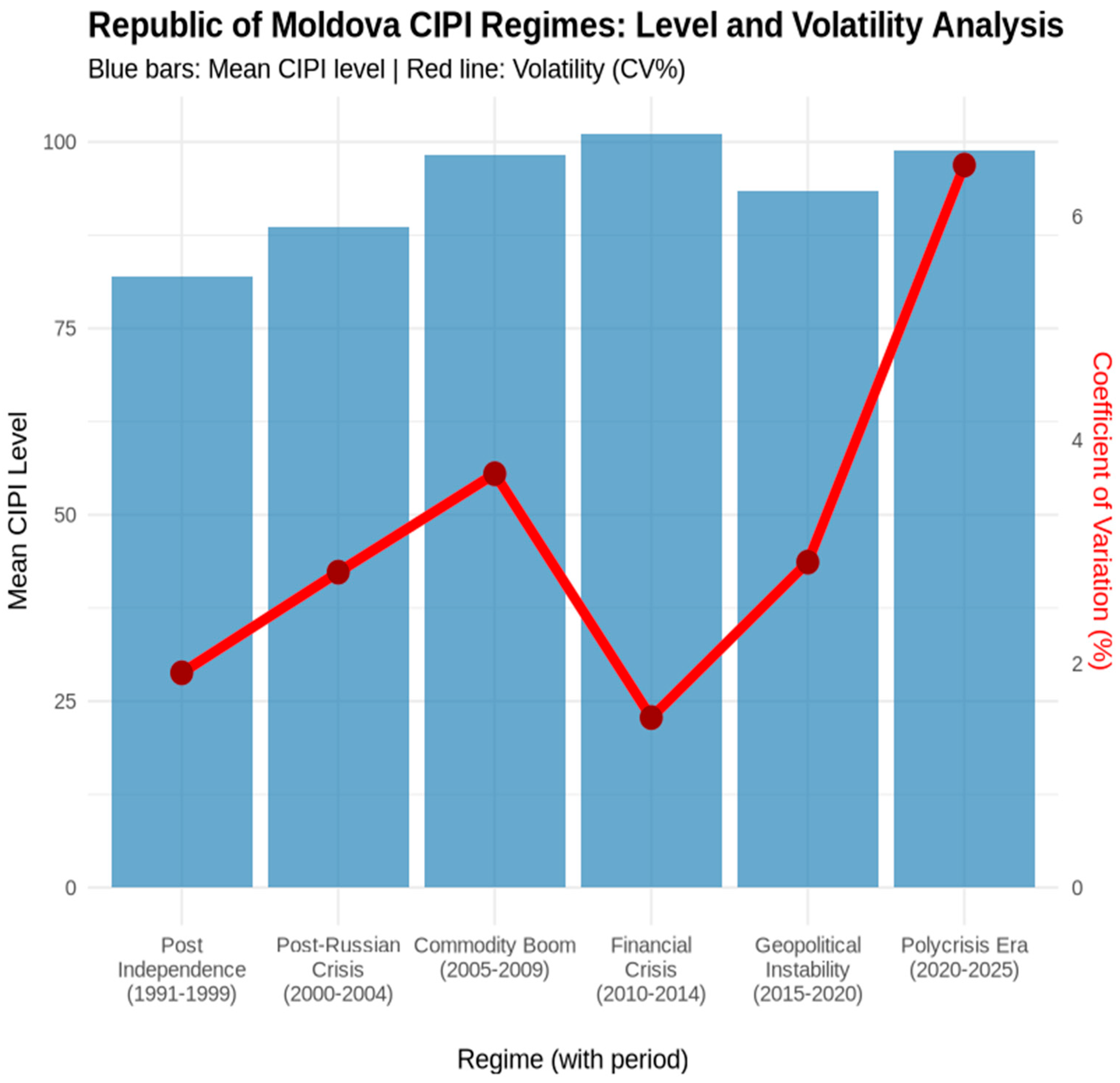
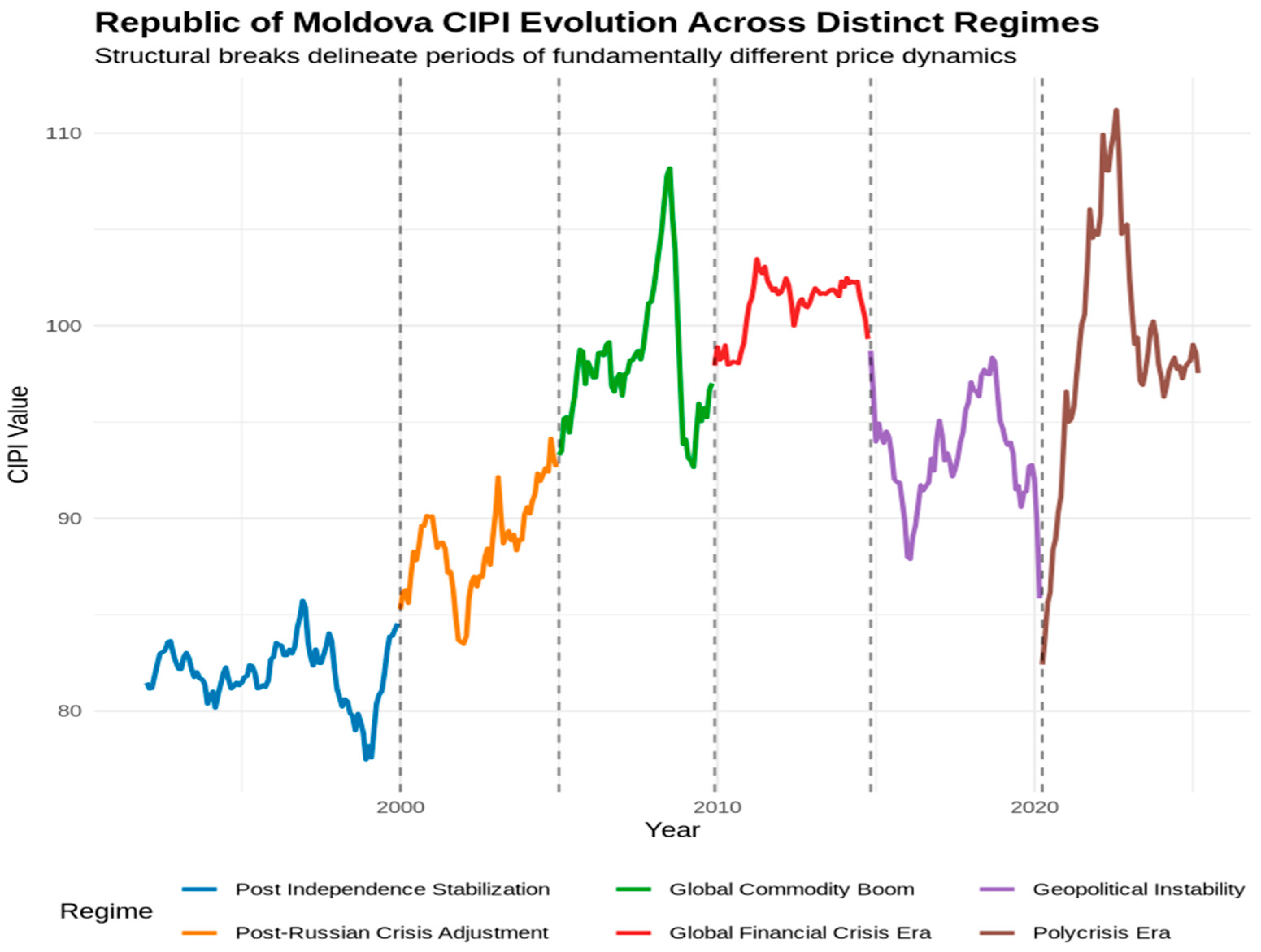
  • Methodological Consistency and Long-Term Comparability: A stable, recent benchmark period provides a consistent reference point that remains aligned with current economic conditions, supporting reliable trend detection and regime comparison over multi-decade horizons (e.g., the six regimes identified by the Bai–Perron tests). This is particularly important for small open economies such as the Republic of Moldova, in which structural breaks—for example, the post-2014 geopolitical realignment—must be evaluated against a contemporary baseline to assess the cumulative effects of persistent external price shocks. Historical fixed weights, by contrast, risk misrepresenting current vulnerabilities through reliance on outdated economic structures.
  • Mitigation of Short-Term Fluctuations and Endogeneity: Averaging over a recent period smooths transitory anomalies, dampening noise from volatile years and ensuring that the weights represent “normal” economic conditions in the recent past. This avoids the endogeneity problem in which weights would otherwise adjust to the very shocks the index is intended to measure—a particular concern during crisis episodes such as the 2020–2024 polycrisis. The index thereby preserves its focus on external vulnerability rather than internal adjustment. Following the IMF rationale, the resulting series is exogenous to domestic responses and reflects only variation in international prices, while remaining anchored in the contemporary trade structure.
  • Alignment with Established Indices: The approach mirrors methodologies used in comparable instruments, notably the HWWI Commodity Price Index, which employs fixed Laspeyres weights to track the import prices of industrialized economies. This enhances cross-index comparability and supports the CIPI’s deployment in policy contexts where stable metrics are required—for example, in informing hedging or supplier-diversification decisions.
One acknowledged limitation is that recent fixed weights can themselves become less representative if a country’s economic structure shifts materially after the benchmark period, although this risk is substantially smaller than under historical weights. Empirically, the choice of recent fixed weights in the present paper is supported by its conceptualisation of vulnerability as a structural feature tied to current economic conditions—a reading reinforced by stationarity tests, which document I(1) behavior and persistent shocks in the CIPI.

3.1.4. Arguments in Favor of Historical Fixed Weights

Whereas recent fixed weights excel at capturing contemporary relevance, historical fixed weights provide stability over very long horizons, which can make them preferable in studies that emphasize historical continuity or retrospective analysis. Under this approach, weights are computed from an older benchmark period (e.g., 1980s averages) and held constant, anchoring the index to a fixed historical economic structure:
  • Long-Term Historical Consistency: Historical fixed weights provide an invariant baseline for analyzing price effects over extended periods, supporting consistent comparisons across decades without adjustment for structural change. This is particularly useful for studying long-run trends in economies whose import patterns have been stable over time.
  • Focus on Cumulative Historical Effects: By anchoring weights to an earlier era, this approach foregrounds the influence of past economic structures on present-day vulnerabilities and can surface “legacy” effects of historical dependencies. In retrospective analyses of post-Soviet transitions, for example, it could highlight the enduring effects of early 1990s trade patterns on the Republic of Moldova.
  • Simplicity in Very Long-Run Series: For indices spanning multiple decades, historical fixed weights obviate the need for periodic rebasing, simplifying computation and maintaining methodological purity in the isolation of price effects from a fixed historical reference.
  • Reduction in Recent-Period Bias: The approach minimizes the influence of short-term anomalies in recent data and provides a broader historical perspective, which can be valuable in the theoretical modeling of persistent shocks.
A key limitation is that historical fixed weights typically become outdated: they fail to reflect structural change and can yield inaccurate representations of contemporary vulnerabilities. The IMF illustrates this with the United Kingdom, which became a significant net oil exporter in the early 1980s following the opening of North Sea production but has been a net importer of crude oil since 2005. An index using 1980s historical fixed weights would have incorrectly recorded the 2014 oil price collapse as a negative shock for the United Kingdom, when in fact it was positive—a clear illustration of the misrepresentation risk that historical weights can introduce in structurally dynamic economies.

3.1.5. Comparative Evaluation and Rationale for CIPI’s Choice

In sum, recent fixed weights are suited to measuring the impact of a pure external price shock against a contemporary economic baseline, whereas historical fixed weights are better suited to assessing effects against a fixed historical structure, offering long-term consistency at the cost of present-day relevance. The trade-off is one of contemporary relevance versus historical invariance: recent fixed weights prioritize the accurate measurement of current vulnerabilities in evolving economies and are therefore appropriate for contemporary diagnostics, while historical fixed weights privilege retrospective analysis and are better suited to long-run historical studies.
For the present paper, recent fixed weights are the appropriate choice given the stated objectives—the measurement of pure price-driven vulnerability, anchored in the Republic of Moldova’s current price-taker status—and the established theoretical framework of terms-of-trade analysis. They enable clear identification of structural breaks (via the Chow and Bai–Perron tests) and of regime persistence, both essential for characterizing the Republic of Moldova’s chronic exposure to global commodity cycles. We acknowledge, as a limitation, that incorporating historical fixed weights as a sensitivity check would test robustness against long-run historical patterns and could, in principle, reconcile divergences observed in early period analyses. Overall, the recent fixed-weight approach reinforces the paper’s conclusions on the persistent, regime-dependent character of the Republic of Moldova’s external-price vulnerability, though hybrid methods—such as periodic rebasing—represent a natural extension for future work.
Table 1 below summarizes the principal differences between recent and historical fixed weights in the context of the CIPI.

3.1.6. Relevance to Economic Vulnerability of the Republic of Moldova

For the Republic of Moldova—a small, energy-dependent, net-importing economy—the CIPI with Recent Fixed Weights is a particularly apt proxy for external-sector vulnerability. The remainder of this sub-section sets out the conceptual logic underpinning this choice, the methodological strengths of the construction, the trade-offs it entails, and the overall rationale for its appropriateness, with reference to the Republic of Moldova’s price-taker status and to its policy-analytic uses.
Conceptual Logic
  • Price-Taker Status: The Republic of Moldova operates as a small, highly import-dependent economy with limited bargaining power in global markets. Fluctuations in world commodity prices pass through almost directly to its import bill, making import prices the primary channel through which external shocks transmit to the macroeconomy.
  • Terms-of-Trade Focus: Weighting each imported commodity by its share of GDP means that movements in the index directly quantify the income losses (or gains) generated by exogenous price swings, providing a precise measure of vulnerability operating through a deterioration in the terms of trade.
  • Granularity of Risk: By encompassing up to 45 individual commodities across the energy, metals, food, and agricultural raw material categories, the index mirrors the Republic of Moldova’s import profile and identifies the specific drivers of stress in each episode (for example, the 2022 energy price spike), yielding diagnostic content beyond what a generic import price deflator can provide.
  • Empirical Symptoms of Fragility: Structural break tests (Chow and Bai–Perron) identify significant shifts during the major crisis episodes of 1998, 2008, 2014, and 2020, while stationarity tests (ADF) confirm I(1) behavior with highly persistent level effects. Taken together, these results document how shocks generate long-lasting macroeconomic strain—the empirical signature of vulnerability.
Methodological Strengths
  • Recent Fixed Laspeyres Weights: A constant commodity mix ensures that the index reflects only international price movements, not endogenous responses such as substitution or volume adjustment. This eliminates reverse causality and preserves a pure-price shock measure, while the recent benchmark keeps the index aligned with the contemporary trade structure.
  • GDP-Normalized Weighting Scheme: Scaling imports by nominal GDP sizes each shock relative to the economy, yielding interpretable elasticities;
  • High-Quality, Transparent Data: Prices are sourced from the IMF Primary Commodity Prices database and trade flows from UN Comtrade, with partner-reported flows used to fill early 1990s gaps in own-reported data, ensuring continuity back to 1992 and supporting global coverage and replicability.
  • Ex-Post Diagnostic Power: The index’s ability to detect crisis-related breaks and persistence validates its use as a real-time barometer of external stress, with direct application in forecasting models and early warning systems.
  • Comparability and Policy Usability: Alignment with established benchmarks such as the HWWI index enhances international comparability and supports a range of practical applications, including the evaluation of commodity price volatility’s effects on inflation, the current account, real income, and reserve adequacy. The index also identifies high-risk commodities, providing an empirical basis for policy responses such as supplier diversification, targeted domestic investment, and the construction of financial buffers.
Trade-Offs Acknowledged—And Why They Are Acceptable Here
Historical fixed-weight indices offer long-term consistency but frequently fail to capture evolving economic structures, with the consequence that vulnerabilities are misrepresented. In a vulnerability study that prioritizes relevance to current risks, recent fixed weights are therefore preferable, notwithstanding the eventual need for periodic updates. Periodic rebasing, or the use of historical-weight sensitivity checks, can address this issue and balance contemporary relevance with historical depth.

3.1.7. Summary

Among the IMF’s commodity terms-of-trade indicators, the CIPI m_gdp variant with recent, monthly fixed weights (R_FW_IX) is the most suitable barometer of the Republic of Moldova’s external vulnerability, on three grounds:
  • Focuses on import prices, which are the main transmission channel for a net importer like Moldova;
  • Weights commodities by their import-to-GDP ratio, directly scaling shocks by their macroeconomic relevance;
  • Uses recent fixed weights, isolating pure exogenous price movements while remaining aligned with Moldova’s current trade structure.
In conclusion, the CIPI—Individual Commodities Weighted by Ratio of Imports to GDP with Recent Fixed Weights—is a robust, theory-consistent indicator that (i) aligns with the Republic of Moldova’s price-taker status, (ii) links commodity price shocks to macroeconomic costs in a transparent manner, and (iii) captures empirically the magnitude, timing, and persistence of crisis impacts. Its recent fixed-weight construction isolates pure price effects while incorporating contemporary trade data, making it well suited both to vulnerability assessment and to the design of targeted policy responses in a context of global commodity price volatility.

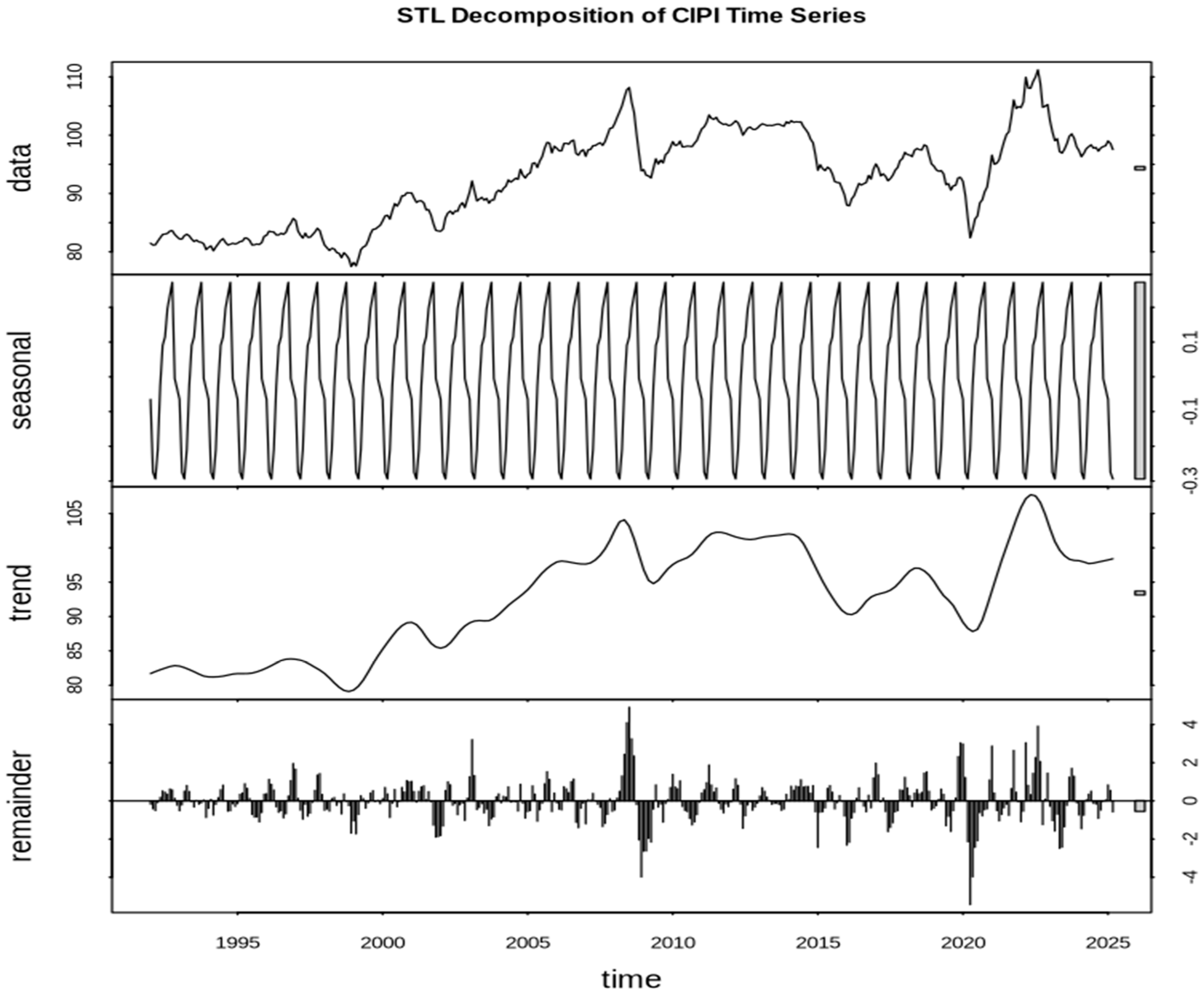
3.2. STL Decomposition of the CIPI Time Series

To uncover the underlying structure of the CIPI time series, we utilize STL, a robust method for decomposing time series into additive components: trend, seasonal, and remainder (residual). STL employs locally weighted regression (LOESS) to estimate these components iteratively, with the seasonal component captured through a periodic window to handle consistent annual patterns. This approach is particularly advantageous for economic data like the CIPI, as it accommodates non-linear trends, varying seasonality, and irregularities without parametric assumptions, while being resilient to outliers often present in commodity price indices influenced by global shocks.
The decomposition is performed on the CIPI time series object (cipi_ts) with a periodic seasonal window (s.window = “periodic”), ensuring stable seasonal estimation across cycles. The resulting plot, titled “STL Decomposition of CIPI Time Series,” displays four panels: the original series, trend, seasonal, and remainder components. This visualization allows us to examine long-term trends (e.g., gradual increases due to global inflation or commodity booms), seasonal fluctuations (e.g., monthly patterns tied to import cycles in the Republic of Moldova), and residuals highlighting anomalous events, such as sudden price shocks from geopolitical crises. By isolating these elements, STL facilitates deeper analysis of economic vulnerability, informing subsequent steps like volatility assessment and structural break detection in the Republic of Moldova context.

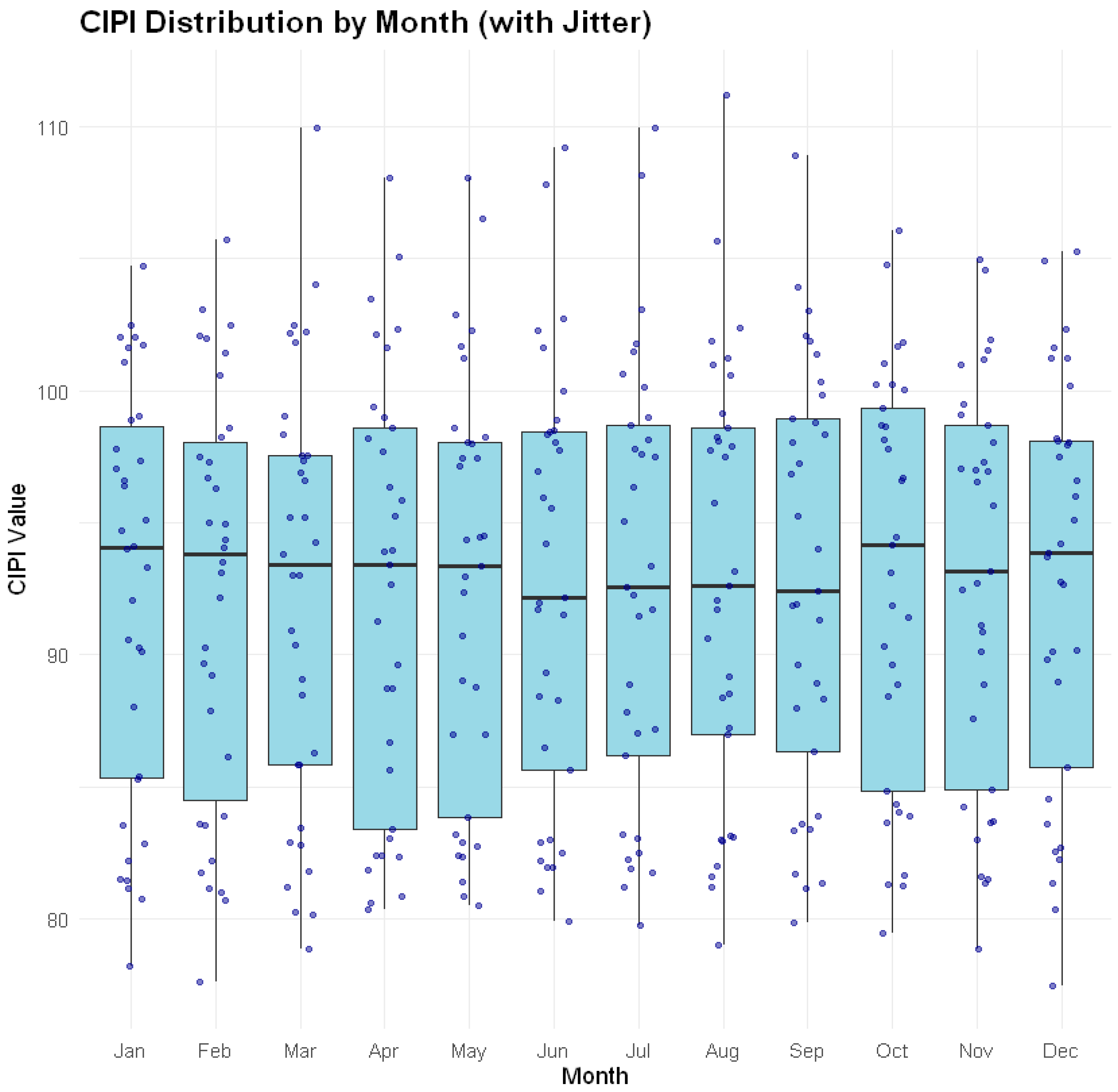
3.3. Boxplot by Month with Jitterplot

A boxplot of CIPI distribution by month, enhanced with a jitterplot, illustrates the central tendency, spread, and outliers for each month. The boxplot uses light blue fill for quartiles, with outliers suppressed for clarity, while jittered points (in dark blue, with alpha transparency) add individual data points to reveal density and variability without overplotting. Labeled with month abbreviations, this plot is titled “CIPI Distribution by Month (with Jitter)” and employs a minimal theme for readability. It effectively uncovers monthly patterns, such as higher dispersion in winter months, potentially linked to energy import volatility in the Republic of Moldova.

3.4. Monthly Volatility Analysis

Following decomposition, we assess monthly volatility to pinpoint periods of heightened economic vulnerability. This involves calculating descriptive statistics for the CIPI grouped by month, including mean, standard deviation (SD), coefficient of variation (CV), minimum, maximum, range, and the number of observations. The CV, computed as (SD/mean) × 100, provides a normalized measure of dispersion, allowing comparison across months with differing average CIPI levels. Data are arranged in descending order of SD to prioritize months with the greatest variability, which may signal times when external price shocks are most pronounced.
This analysis is implemented using R, where the CIPI dataset is grouped by month and month name, and summary statistics are computed. The output, printed as “Monthly Volatility Analysis (ordered by standard deviation),” reveals which months exhibit the highest fluctuations, guiding further investigation into seasonal economic risks for the Republic of Moldova.

3.5. Levene’s Test for Homogeneity of Variance

To evaluate whether the variance in CIPI values is consistent across months—indicating stable or heterogeneous volatility—we conduct Levene’s test for homogeneity of variance, centered on the median. This test is a robust alternative to traditional ANOVA assumptions, as it is less sensitive to non-normality and focuses on absolute deviations from the group median rather than the mean. A significant result would suggest that variances differ significantly between months, implying varying degrees of exposure to price shocks throughout the year.
The test complements the volatility analysis by providing statistical evidence of heteroscedasticity, which is crucial for validating subsequent modeling choices, such as time series forecasting or risk assessment in the Republic of Moldova context. This empirical finding fundamentally challenges the hypothesis of a seasonal pattern in the Republic of Moldova’s import price vulnerability.

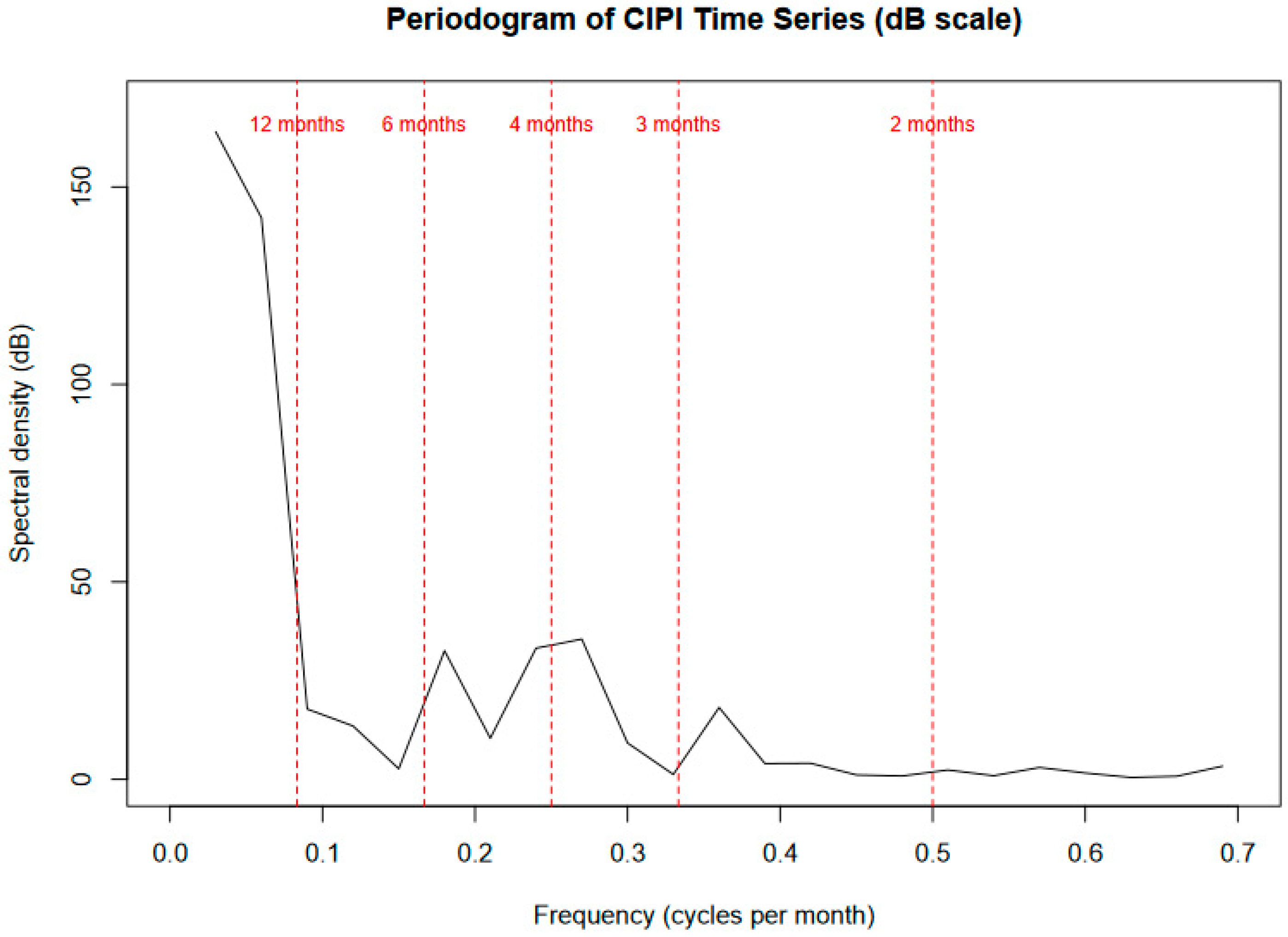
3.6. Spectral Analysis via Periodogram

Spectral analysis is employed to identify periodic components in the CIPI time series, focusing on frequency-domain patterns that may not be evident in the time domain. We compute a periodogram on a decibel (dB) scale (10 × log10 of the spectral density) for the CIPI time series object, zooming into frequencies ≤ 0.7 cycles per month to emphasize relevant economic cycles.
The plot, titled “Periodogram of CIPI Time Series (dB scale),” uses adjusted margins for labeling and includes dashed red reference lines at frequencies corresponding to key periods (12, 6, 4, 3, and 2 months). Labels are positioned below the plot’s maximum for clarity, rotated 90 degrees. This analysis detects dominant cycles, such as annual seasonality (12 months) or semi-annual.

3.7. Autocorrelation Function (ACF) Plot

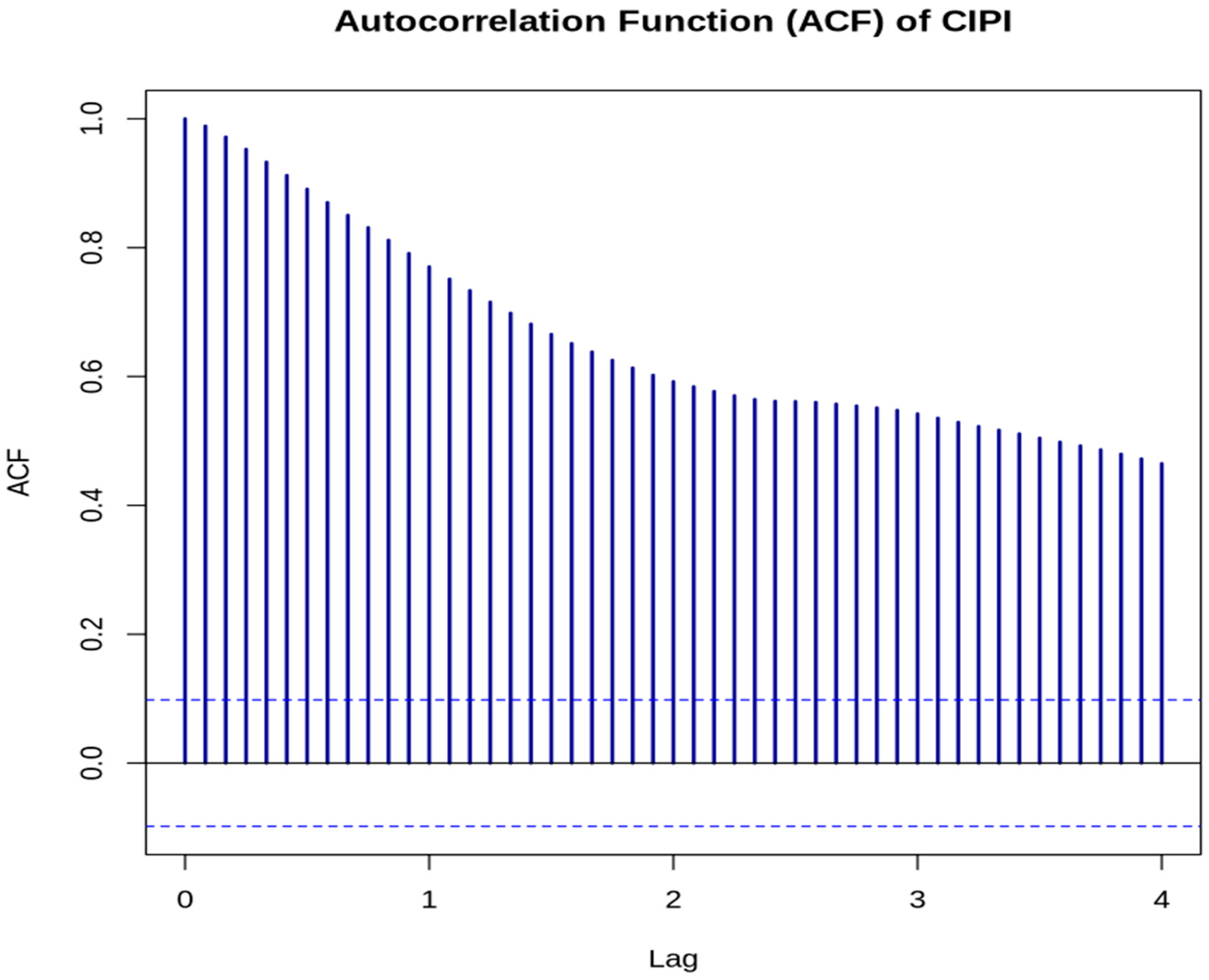
To examine serial dependence in the CIPI series, we generate the ACF plot, which measures the correlation between the series and its lagged versions up to 48 lags. The plot, titled “Autocorrelation Function (ACF) of CIPI,” uses dark blue bars with increased line width for emphasis. Significant lags indicate persistence or seasonality, such as repeating patterns every 12 months, which are vital for modeling economic shocks in import-dependent contexts.

3.8. Partial Autocorrelation Function (PACF) Plot

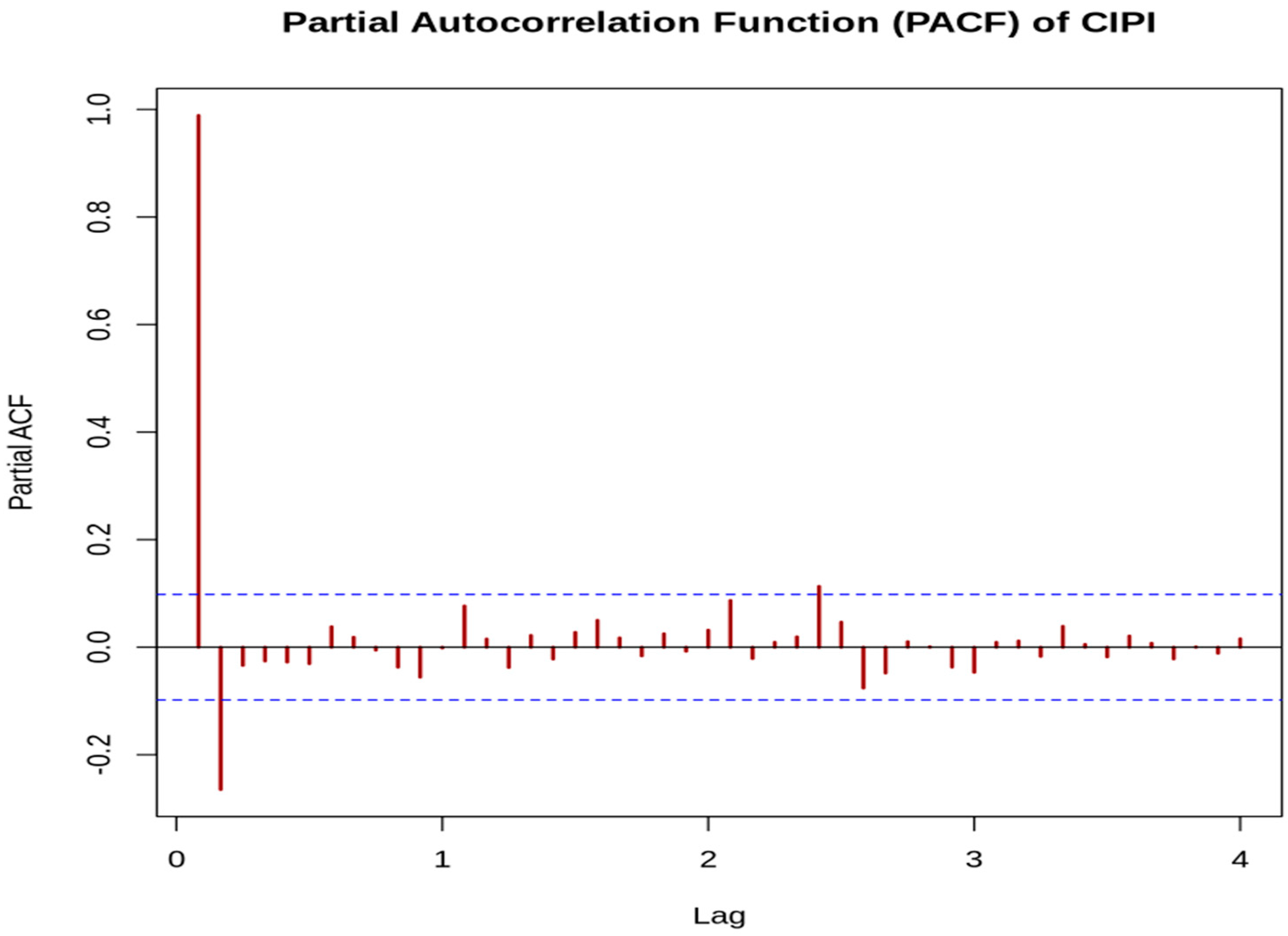
Complementing the ACF, the partial ACF (PACF) plot isolates direct correlations at each lag, controlling for intermediate effects, up to 48 lags. Titled “Partial Autocorrelation Function (PACF) of CIPI” and rendered in dark red, this plot helps identify the order of autoregressive processes. For instance, significant spikes at lag 1 or 12 could suggest AR(1) or seasonal AR terms, informing advanced time series models like SARIMA for forecasting CIPI fluctuations in the Republic of Moldova.
These methods collectively form a robust framework for analyzing the CIPI, enabling a deeper understanding of economic vulnerabilities. Future sections may extend this to modeling and policy implications.

3.9. Time Series Properties and Nonlinear Dynamics of the Republic of Moldova’s CIPI

This section investigates the time series properties of the Commodity Import Price Index (CIPI) for the Republic of Moldova and explores how these properties shape the economy’s vulnerability to external shocks. Starting from classical stationarity analysis, we examine whether CIPI is characterized by unit roots and structural breaks, and whether its dynamics can be adequately captured by linear models. Building on this, we incorporate asymmetric adjustment to external drivers, test the symmetry of these responses, and assess the presence of nonlinear regime behavior using threshold autoregressive (SETAR) models. Together, these tools provide a comprehensive view of how import price shocks propagate through time, how persistent their effects are, and whether the adjustment process differs across phases and regimes of the CIPI series.

3.9.1. Baseline Stationarity Testing for the Republic of Moldova’s CIPI

To assess the temporal properties of the CIPI time series and determine its suitability for further econometric modeling, we conduct stationarity tests using the ADF framework. Stationarity is crucial in time series analysis, as non-stationary series can lead to spurious regressions and unreliable inferences; it implies that statistical properties like mean and variance are constant over time. For the Republic of Moldova’s CIPI, which reflects import price dynamics vulnerable to external shocks, non-stationarity may signal persistent trends (e.g., long-term inflation) or integrated processes requiring differencing, informing models of economic resilience or regime shifts.
The analysis begins by loading monthly CIPI data from “cipi.xlsx” and converting it into time series objects: cipi_ts for levels (starting January 1992, frequency 12) and d_cipi_ts for first differences. Optimal lag lengths are selected conservatively using VARselect from the vars package, evaluating up to 12 lags via Akaike Information Criterion (AIC) and Bayesian Information Criterion (BIC), with the maximum chosen to balance model fit and parsimony (e.g., higher lags for levels if AIC suggests it).
ADF tests are then applied via the ur.df function from the urca package, testing the null hypothesis of a unit root (non-stationarity) against the alternative of stationarity:
  • Levels with constant (drift): Captures potential constant mean shifts.
  • Levels with constant and trend: Accounts for deterministic trends, common in economic indices.
  • First differences with constant: Tests if differencing induces stationarity.
  • First differences with constant and trend: Includes trends in the differenced series.
Results are printed as summaries, including test statistics, critical values, and p-values. Typically, failure to reject the null in levels (p > 0.05) indicates non-stationarity, while rejection in differences suggests an integrated process of order 1 (I(1)), implying shocks have lasting effects on CIPI—consistent with the Republic of Moldova’s exposure to global crises. This informs subsequent steps, such as differencing for ARIMA modeling or incorporating cointegration in vulnerability assessments, aligning with prior findings of structural breaks and regime shifts.

3.9.2. Asymmetric Adjustment Regression for CIPI

This subsection examines whether the Republic of Moldova’s CIPI responds differently to positive and negative changes in its own values. The central question is whether increases in CIPI behave differently from decreases, which matters for understanding adjustment dynamics and whether adverse price movements have greater or more persistent effects than favorable movements.
Empirically, the analysis regresses monthly changes in CIPI on lagged positive and negative components of those changes. Monthly changes in CIPI are decomposed into two series: one capturing only positive movements (increases) and one capturing only negative movements (decreases). Both components enter the regression as lagged values, allowing their coefficients to differ. This specification reveals whether upward adjustments in import prices follow different dynamics than downward adjustments.
The estimated coefficients on positive and negative components are then compared in terms of size, sign, and statistical significance. If the coefficient on positive changes differs significantly from the coefficient on negative changes, this suggests asymmetric adjustment in CIPI. The degree of asymmetry is evaluated econometrically and substantively, linking the results to the Republic of Moldova’s import price dynamics and the implications for inflation persistence and policy responses.

3.9.3. Testing Symmetry via Wald Restrictions

Having estimated an asymmetric adjustment model, this subsection formally tests whether the responses of CIPI to its own positive and negative changes are statistically different. The goal is to determine whether the decomposition into positive and negative components is truly necessary, or whether a simpler, symmetric model with a single response parameter is sufficient for describing import price dynamics in Moldova.
The symmetry hypothesis is evaluated using Wald tests applied to the regression where CIPI changes respond to lagged positive and negative components. In this framework, symmetry corresponds to equality of the coefficients on the positive and negative series. The Wald test compares the unrestricted model, where the coefficients are allowed to differ, with a restricted model that imposes equality. The test statistic and its p-value indicate whether the restrictions implied by symmetry are consistent with the data.
In practice, the interpretation focuses on three elements:
  • The size of the Wald test statistic and the associated p-value;
  • Whether symmetry is rejected at conventional significance levels (for example, 5 percent);
  • The economic meaning of any differences between the estimated responses to positive and negative changes in CIPI.
If the null hypothesis of symmetry is not rejected, the results support a simpler, linear adjustment structure in which CIPI reacts similarly to increases and decreases. This would justify focusing on a more parsimonious specification in subsequent modeling. If symmetry is rejected, the evidence confirms that the direction of price changes matters, and it strengthens the case for retaining asymmetric or nonlinear models, paving the way for threshold and regime-based analyses in the following subsections.

3.9.4. Endogenous Structural Breaks in CIPI: Zivot–Andrews Tests

Standard unit root and stationarity tests may yield misleading conclusions when structural breaks are present, but not explicitly modeled. Given the Republic of Moldova’s history of policy changes, exchange rate adjustments, trade reforms, and exposure to global crises, it is plausible that CIPI experiences structural shifts in its level or trend. This subsection addresses that possibility by applying Zivot–Andrews tests, which allow for a single structural break at an unknown date within the unit root testing framework.
The Zivot–Andrews approach extends classical unit root tests by treating the break date as endogenous. Rather than imposing a specific break date a priori, the test searches over admissible dates in the sample and identifies the break that provides the strongest evidence against the unit root null. The analysis employs the “both” specification, which allows for simultaneous changes in both the intercept (level break) and the trend slope (trend break). The test produces a statistic and corresponding critical values, indicating whether the series is better described as non-stationary or as stationary around a broken deterministic path.
Interpretation proceeds along two main lines:
  • Statistical assessment: whether the test rejects the unit root null once structural breaks are allowed for changes in both level and trend;
  • Economic context: how the estimated break date relates to specific events in the Republic of Moldova’s economic and trade history, such as major exchange rate regime changes, energy price shocks, or shifts in trade policy and integration.
If the evidence suggests that CIPI is stationary around a broken trend or level, this alters the baseline characterization from simple stationarity tests and implies that apparent non-stationarity may reflect structural shifts rather than a purely stochastic trend. Recognizing these breaks is crucial for designing appropriate models and for interpreting persistence and shock effects in a way that is consistent with the Republic of Moldova’s institutional and external realities. It also motivates the move toward models that allow parameters or regimes to change over time.

3.9.5. Linearity Versus Threshold Behavior: Hansen Tests and SETAR Selection

Building on the findings on asymmetry and structural breaks, this subsection tests whether CIPI’s dynamics are fundamentally nonlinear in the sense that they change once a key variable crosses a threshold. The focus is on distinguishing a standard linear autoregressive process from a threshold autoregressive process, where different regimes apply depending on the level or change in CIPI itself. This distinction is crucial for capturing potential regime-specific dynamics, such as more persistent or volatile behavior when import prices are in certain states.
The analysis follows the Hansen framework for testing linearity against a Self-Exciting Threshold Autoregressive (SETAR) alternative. The test is applied to the first-differenced CIPI to reduce strong persistence and better isolate the threshold nonlinearity. Under the null hypothesis, differenced CIPI follows a single linear autoregressive model. Under the alternative, the data are split into two regimes (m = 2) according to whether a threshold variable crosses an unknown threshold. For each candidate threshold value, the model is estimated, and a test statistic comparing the linear and threshold models is computed using bootstrap methods to obtain appropriate p-values, given the non-standard distribution of the test under the null.
Key outputs from this step include:
  • The test statistic for linearity and its bootstrap-based p-value across different threshold restrictions (epsilon values).
  • Evidence for the preferred number of regimes (a two-regime SETAR).
  • Indications of suitable specifications for subsequent threshold model estimation.
If linearity is not rejected, a simpler linear autoregressive model may suffice, and attention can remain on symmetric or mildly asymmetric specifications. If linearity is rejected, there is strong evidence that regime-dependent dynamics play an important role in the evolution of CIPI. This justifies moving to explicit threshold models, where different autoregressive processes govern CIPI in different regimes, and sets the stage for estimating a two-regime SETAR model in the next subsection.

3.9.6. Estimating a Two-Regime SETAR Model for the Republic of Moldova’s CIPI

Given evidence in favor of threshold behavior, this subsection estimates a two-regime SETAR model for the Republic of Moldova’s CIPI. In such a model, the dynamics of CIPI are governed by two distinct autoregressive processes, and the regime in effect at any point in time is determined by whether a threshold variable crosses a specific threshold value. This structure captures nonlinear adjustment patterns, such as stronger persistence in certain regimes or faster mean reversion in others.
The chosen specification uses CIPI levels as the dependent variable and estimates AR(1) processes in both the low and high regimes (mL = 1, mH = 1). Regimes are defined based on the first lag of CIPI (thDelay = 1), meaning the threshold variable is CIPI_{t − 1}. The model searches across candidate threshold values and selects the combination that best fits the data based on the sum of squared residuals or another suitable criterion. The final model yields regime-specific intercepts, autoregressive coefficients, residual variances, and the estimated threshold value, providing a detailed view of how CIPI behaves under different conditions.
Interpretation focuses on three main aspects:
  • Persistence: Whether shocks to CIPI die out more slowly in one regime than in the other, indicated by the size of the AR(1) coefficients in each regime, showing stronger memory or more entrenched dynamics when the economy is in a particular state.
  • Volatility: Whether the variance of the residuals is higher in one regime, suggesting that import price changes are more erratic under certain conditions (for example, during high-price or crisis periods).
  • Regime Interpretation: How the regimes map onto economically meaningful situations based on the estimated threshold value, such as low versus high CIPI levels, and how often and for how long Moldova tends to remain in each regime.
If, for instance, the high-regime dynamics show higher persistence and greater volatility, this implies that once Moldova enters a phase of elevated import prices, shocks tend to last longer and generate larger fluctuations, increasing economic stress and uncertainty. Such insights are critical for resilience planning, as they highlight the importance of policies that reduce the likelihood or duration of stays in adverse regimes. The two-regime SETAR model thus provides a compact and empirically grounded framework for understanding the nonlinear and regime-dependent nature of the Republic of Moldova’s import price dynamics and for integrating these features into broader macroeconomic and risk assessments.

3.10. Chow Test for Structural Breaks at Known Crisis Dates

Having established that the CIPI series is integrated of order one (I(1)), meaning shocks have persistent effects, we now proceed to identify the specific historical moments where these permanent structural shifts occurred.
To investigate the presence of structural breaks in the CIPI time series corresponding to major global and regional crises, we employ the Chow test. This statistical method tests for parameter instability in a linear regression model by comparing regression coefficients before and after a specified breakpoint. Under the null hypothesis, no structural break exists, implying stable relationships; rejection indicates a significant shift, such as altered import price dynamics due to external shocks. For this analysis, we define 12 crisis events with exact dates (e.g., the Asian Financial Crisis on 1 July 1997, the Russian Financial Crisis on 1 August 1998, up to the Middle East Tensions on 7 October 2023) and map them to the nearest indices in the CIPI dataset.
The test is conducted using a linear model of CIPI against a time index, with break-points at these crisis indices. We ensure sufficient observations (at least 15) on each side of the breakpoint to avoid boundary issues. Results include F-statistics, p-values, and critical values at the 5% level, with breaks classified as significant if p < 0.05. All 12 events yield significant breaks, with F-statistics ranging from moderate to very strong (e.g., over 170 for the 2014 Oil Price Collapse and Crimea Annexation). A ranked table by F-statistic magnitude highlights the strongest impacts, and a break strength classification (Very Strong for F > 100, Strong for F > 50, etc.) shows a distribution emphasizing recent geopolitical events.
Visualization involves a scatter plot of F-statistics against crisis dates on a log scale, colored by break strength, with labels for major events (F > 50) and a dashed red line at the 5% critical value (F ≈ 3.02). This confirms that each crisis fundamentally alters the Republic of Moldova’s import price regime, underscoring persistent vulnerability.
Comparison with Bai–Perron detected breaks (indices 73, 202, 275, 340) reveals close alignments, such as the Global Financial Crisis matching within months, reinforcing the Chow findings. Interpretation notes a 100% detection rate, with regional crises showing stronger impacts, supporting a narrative of regime shifts in the Republic of Moldova’s economy.

3.11. Event Impact Analysis Around Crises

To quantify the short- and medium-term effects of crises on CIPI, we analyze behavior in predefined windows: 6 months before and 12 months after each event. For each crisis, we compute pre- and post-event means, percentage changes, maximum impact percentages, and volatility shifts (standard deviation differences). This reveals patterns like sharp post-crisis increases and heightened volatility, indicating amplified economic pressures.
A summary table displays these metrics, highlighting events with the most severe disruptions, such as the Ukraine Conflict or COVID-19 Pandemic, where volatility often doubles post-event.

3.12. Impact Analysis by Event Proximity

Events are categorized by proximity to the Republic of Moldova: Regional (e.g., Russian Financial Crisis, Ukraine Conflict), Global Pandemic (COVID-19), or Global (e.g., Eurozone Crisis). Aggregated impacts show regional events causing higher average percentage changes (e.g., >30%) and volatility increases compared to global ones, emphasizing the Republic of Moldova’s sensitivity to nearby geopolitical shocks. A summary table quantifies these differences, informing targeted risk assessments.

3.13. Bai–Perron Test for Multiple Structural Breaks

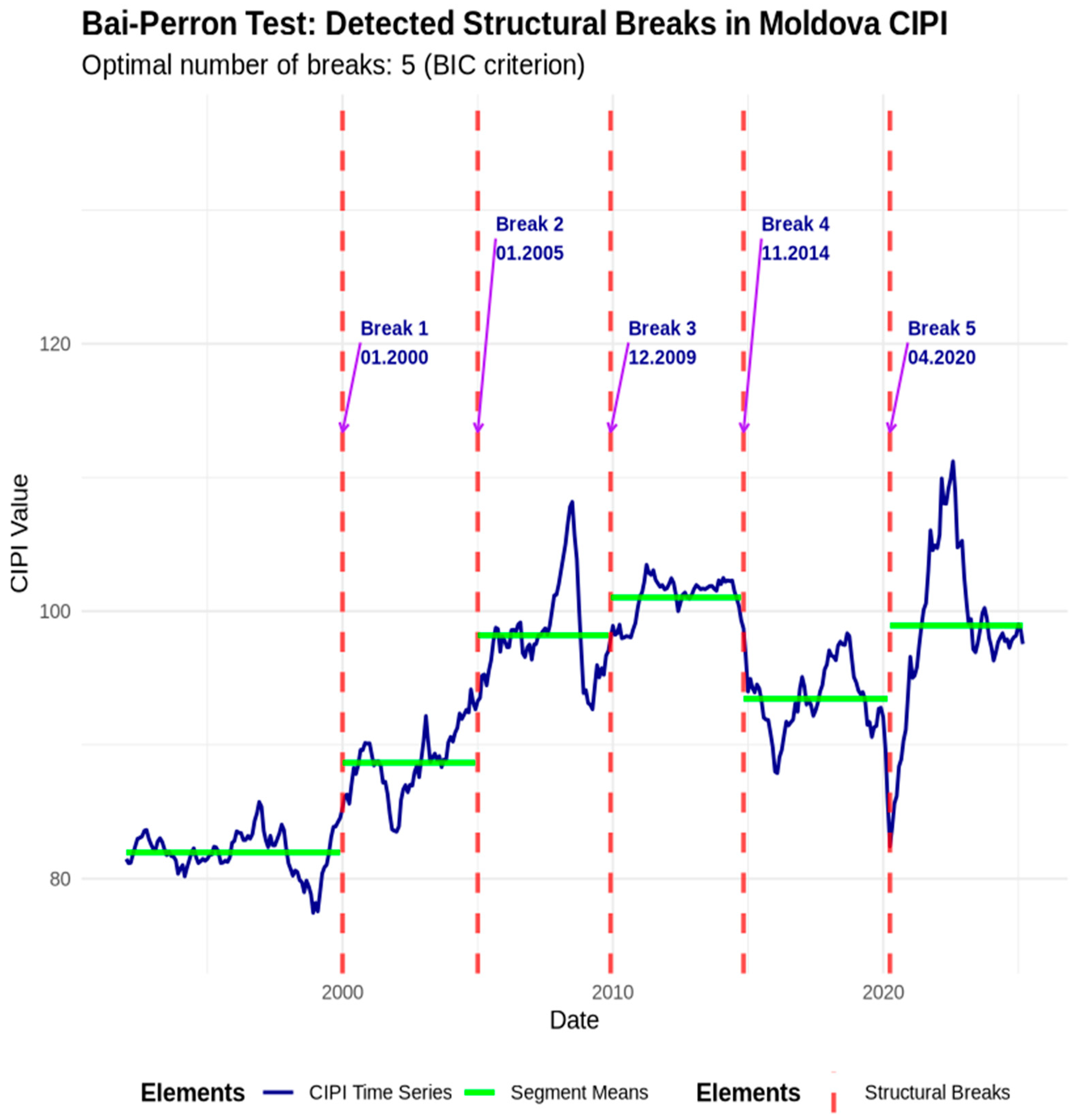
Complementing the Chow test, the Bai–Perron method detects an unknown number of structural breaks in the mean of the CIPI time series without predefined dates. It uses a sequential F-test approach, allowing up to 5 breaks with a minimum segment size of 15% of observations. The optimal number (via BIC) identifies 5 corresponding to dates around key transitions (e.g., early 2000s post-Russian Crisis).
Results include a table with break details (index, date, period, CIPI value, level change, percentage change) and 95% confidence intervals. Segment statistics cover means and lengths between breaks. An overall supF test confirms significance (e.g., statistic > 10, p < 0.01). Visualization plots the CIPI series with red dashed break lines, green segment mean lines, and annotations, titled “Bai–Perron Test: Detected Structural Breaks in Republic of Moldova CIPI.”

3.14. Regime Analysis Based on Bai–Perron Segments

Building on detected breaks, we delineate six regimes reflecting distinct phases in the Republic of Moldova’s import price dynamics: Post-Independence Stabilization (1992–1999), Post-Russian Crisis Adjustment (2000–2004), Global Commodity Boom (2005–2009), Global Financial Crisis Era (2010–2014), Geopolitical Instability (2015–2020), and Polycrisis Era (2020–2024). For each, we calculate duration, mean CIPI, volatility (SD), coefficient of variation (CV), and compound annual growth rate (CAGR).
A detailed table presents these characteristics, showing escalating volatility in later regimes (e.g., CV > 20% in Polycrisis Era) and varying growth (positive in boom periods, negative in crises). Visualizations include a dual-axis bar-line plot of mean CIPI (blue bars) versus CV (red line), with regime labels, and a timeline plot coloring the CIPI series by regime with dashed boundaries. These illustrate regime shifts, linking them to external shocks and supporting vulnerability assessments.

3.15. Mixed-Frequency VAR with Unrestricted MIDAS

To trace how external price shocks propagate through the Republic of Moldova’s economy, we embed CIPI in a mixed-frequency vector autoregression that combines monthly price and policy variables with quarterly GDP. The standard approach of temporally aggregating all series to quarterly frequency would discard monthly price dynamics and obscure the precise timing of transmission. Instead, we employ the unrestricted MIDAS (U-MIDAS) framework, which preserves high-frequency information while accommodating the mixed-frequency structure.
Building on the time series diagnostics, CIPI, CPI, and GDP are treated as non-stationary in levels but stationary in first differences in logs, while the short-term policy rate is stationary in levels. This motivates a specification that avoids both quarterly aggregation of monthly series and mechanical interpolation of GDP. The resulting MF-VAR U-MIDAS setup provides a coherent multivariate framework in which within-quarter information is retained and the timing of transmission from monthly shocks to quarterly output is identified from the data.
  • Data transformation
All variables are transformed to ensure stationarity and maintain standard macroeconomic interpretations. Quarterly GDP is seasonally adjusted (X-13 ARIMA-SEATS), expressed in logs, and first-differenced to obtain quarterly GDP growth. Monthly price indices (CIPI and CPI) enter as log differences, corresponding to monthly growth rates. The policy rate is kept at levels because it is stationary; differencing would unnecessarily strip out economically meaningful persistence relevant for monetary transmission.
  • Model specification
The model is a two-lag MF-VAR U-MIDAS for the Republic of Moldova estimated over 2000Q4–2024Q1, with the effective sample determined by lag structure and mixed-frequency alignment. The system combines:
  • A monthly VAR block for CIPI growth, CPI growth, and the policy rate (each driven by its own lags and cross-lags);
  • A quarterly GDP equation in which quarterly GDP growth depends on its own lags and on distributed lags of the monthly variables.
The key feature is the unrestricted MIDAS component in the GDP equation. Rather than imposing a parametric lag shape, the U-MIDAS approach estimates flexible coefficients on the monthly lags, allowing the data to determine both the intensity and timing of transmission from monthly price and policy movements to quarterly output.
  • Estimation and identification
With stationary transformations, the system is estimated using OLS with robust inference to address potential heteroskedasticity and serial correlation. To interpret innovations as economically meaningful shocks, reduced-form residuals are orthogonalized using a recursive identification consistent with a small open economy, ordering variables as CIPI → CPI → policy rate → GDP. This treats external price movements as contemporaneously exogenous, allows monetary policy to react to observed inflation conditions, and permits output to respond with a lag.
This contemporaneous-exogeneity assumption rests on the small open economy/price-taker structure of the Republic of Moldova economy: in 2024 Moldova’s GDP was approximately USD 16.5 billion and its goods imports approximately USD 9.6 billion, against world commodity markets that turn over trillions of USD; Moldova produces and exports no hydrocarbons, no industrial metals, and no major grain or fuel commodities, so its domestic conditions cannot move the international prices that enter the CIPI. The recursive Cholesky scheme is itself a structural VAR identification strategy (Sims, 1980); under the price-taker assumption, it is equivalent to a sign-restricted SVAR (Uhlig, 2005) imposing the same sign on impact, so the choice of recursive ordering is not a substitute for SVAR identification but one of its two canonical forms. The exogeneity restriction is also corroborated empirically by the VAR block exogeneity Wald tests reported in Section 5.2, in which the null of block exogeneity is rejected for the CPI, interest rate, and GDP equations—i.e., CIPI Granger-causes the domestic block—while the CIPI sub-series are relatively exogenous in the converse direction.
Variables not included in the system—notably the bilateral exchange rate, the fiscal stance, global liquidity conditions, and trade-sanctions intensity—enter the residual of each equation. We do not extend the MF-VAR to absorb these channels for two reasons. First, the existing system already estimates 210 coefficients on 94 quarterly observations; adding further endogenous blocks at monthly resolution would render the system overparameterized. Second, these candidate variables are themselves largely co-moved with the external commodity shocks the CIPI captures—a global commodity shock simultaneously moves the MDL/USD rate, tightens IMF conditionality, contracts global liquidity, and intensifies sanctions pressure on energy and grain markets—so their omission attenuates structural interpretation rather than biases the identified propagation chain.
A further deliberate scope choice is that the MF-VAR is estimated on the aggregate CIPI rather than on commodity-group sub-indices (energy, metals, food and beverages, agricultural raw materials), whose composition is reported in Appendix E. Separate U-MIDAS VARs by group would require estimating four 210-coefficient systems on the same 94 quarterly observations available for the aggregate, which is dimensionally infeasible without overfitting; commodity-group decomposition along the lines of Kilian (2009) is a productive avenue for future work building on the aggregate transmission magnitudes identified here.
Impulse responses are computed on a monthly timeline and summarized by the implied quarterly GDP responses at quarter endpoints, which preserves the mixed-frequency logic and highlights the within-quarter dynamics that would be obscured under temporal aggregation.
  • Structural breaks and crisis episodes
Evidence of breaks in external price levels around major crises is handled within the modeling strategy by working in log differences for CIPI and CPI. Level shifts, therefore, enter the analysis as large innovations (or periods of elevated growth) rather than requiring explicit regime switching in coefficients. The maintained assumption is that transmission parameters are stable, while crisis episodes contribute to identifying variation through larger shocks.
  • Predictive linkages and shock propagation
Predictive relationships are evaluated using Wald-type tests for Granger causality and block exogeneity adapted to the mixed-frequency structure, focusing on joint restrictions on MIDAS lag coefficients in the GDP equation and mapped GDP terms within the monthly block. The empirical narrative is then summarized through impulse responses and related decompositions, emphasizing the transmission chain from external prices to domestic inflation, the policy response, and quarterly real activity.

4. Results

4.1. Core Properties I: A Lack of Seasonality

A comprehensive investigation reveals that deterministic seasonality is a negligible factor in the Republic of Moldova’s import price dynamics. This finding is critical, as it indicates that the country’s vulnerability to price shocks is a constant, year-round feature rather than a predictable, cyclical risk.
In Figure 1, we use monthly CIPI data spanning January 1992–March 2025 to estimate the STL decomposition, and to avoid endpoint distortions, the discussion below concentrates on the trend component up to December 2024. Our analysis reveals that the STL decomposition of the Republic of Moldova’s CIPI has a smooth long-run trend that rises from just under 80 in the early 1990s to a little above 100 during the 2007–2008 commodity boom, eases in the aftermath of the global financial crisis, and attains its absolute maximum of roughly 105 in 2022 before beginning to recede. Seasonal fluctuations are highly regular and trivial in magnitude—about ±0.2 index points—implying that within-year patterns add virtually no explanatory power to overall variance. Short-term volatility is captured in the remainder component: irregular movements are normally confined to ±1–2 points but expand to nearly ±4 points during major stress episodes, most notably in 2008–2009 and again in 2020–2022 when the combined effects of the COVID-19 pandemic and regional geopolitical tensions disrupted global supply chains. Although these shocks are transitory, their coincidence with well-documented external crises underscores the Republic of Moldova’s exposure to imported price pressures and its limited capacity to cushion terms-of-trade swings characteristic of a small, import-dependent economy.
The boxplot visualization with jittered data points in Figure 2 provides compelling evidence of the Republic of Moldova’s persistent vulnerability to import price shocks across all calendar months, reinforcing the finding of minimal seasonal differentiation in price volatility. The remarkably similar interquartile ranges (IQR) across all twelve months—with boxes extending roughly from 85–88 to 97–99 on the CIPI scale—demonstrate that the core distribution of import prices exhibits little seasonal variation. However, the jittered points reveal a critical pattern: extreme values (both high and low) are distributed across all months rather than clustering in specific seasons, with notable outliers appearing as far as just below 78 on the lower bound and a little above 110 on the upper bound.
The median values (represented by the horizontal lines within boxes) hover consistently around 92–94 across all months, further confirming the absence of systematic seasonal price advantages or disadvantages. Most significantly, the vertical spread of jittered points shows that while July and August may have marginally wider distributions that are not statistically distinct from those of April, September, and October, every month contains observations from both crisis periods (low values from 1998 to 1999, high values from 2008 and 2022) and stable periods. This uniform susceptibility to extreme values across the calendar year indicates that the Republic of Moldova’s import dependency creates a constant channel of vulnerability that cannot be mitigated through seasonal procurement strategies or temporal arbitrage.
Moreover, an important asymmetry emerges in the distribution of these extremes: the long upper whiskers and frequent high outliers suggest that the Republic of Moldova’s import price risk is heavily skewed toward sudden upward shocks—imported inflation—rather than downward price relief. While lower tails exist, they are shorter—typically extending two to three points below the lower quartile—and largely confined to earlier crises like those in 1998–1999, whereas the upper extremes, particularly during global crisis years like 2008 and 2022, dominate the risk profile, with whiskers extending four to five points above the upper quartile. This imbalance underscores that the economy faces greater exposure to price surges, amplifying vulnerability during external shocks in energy and food markets.
The economy’s exposure to global commodity price shocks is thus a structural feature that persists year-round, with crisis transmission occurring regardless of season, underscoring the need for comprehensive risk management strategies rather than month-specific interventions. Policies must address this asymmetry by prioritizing mechanisms to buffer against upward price shocks, ensuring protection against the most disruptive and frequent risks. Only through such targeted, continuous approaches can the Republic of Moldova mitigate the impact of its import dependency on households and the broader economy.
We will analyze whether there is a seasonal variation first by the standard deviation of each month.
Table 2 shows that month-to-month differences in CIPI volatility are economically trivial. Across the 1992:1–2024:4 sample, monthly standard deviations cluster tightly between 7.62 (November) and 8.29 (July), yielding a spread of only 0.67 index points around an overall mean of 7.98. Expressed relative to their respective monthly means, coefficients of variation vary from 8.22% to 8.94%, again indicating negligible dispersion. Although the summer months of July and August appear at the top of the ranking, their marginally higher standard deviations are indistinguishable from the remainder of the distribution when set against the common confidence intervals of the underlying variances. Hence, the Republic of Moldova’s exposure to import price shocks is effectively uniform across the calendar year; volatility surges during global crises manifest simultaneously in every month rather than concentrating in a particular season. For policymakers, this implies that risk-mitigation instruments—such as strategic commodity reserves, currency hedges, or price-stabilization funds—should be maintained continuously rather than calibrated to any specific month or quarter.
The Levene’s test for homogeneity of variance, centered on the median in Table 3, was conducted to formally assess for differences in price volatility across the twelve months. The analysis yielded a non-significant result (F(11, 387) = 0.0824, p = 1.00), leading to a failure to reject the null hypothesis of equal variances.
This empirical finding fundamentally challenges the hypothesis of a seasonal pattern in the Republic of Moldova’s import price vulnerability. Rather than experiencing predictable periods of high or low risk, the data indicate that the economy faces a persistent and structural level of price volatility throughout the year. The minor inter-month fluctuations are economically negligible compared to the overall magnitude of the price shocks. Consequently, this uniform risk profile suggests that the Republic of Moldova’s vulnerability is not driven by seasonal cycles but is instead a constant, endemic feature of its structural dependence on global markets. This implies that the economy lacks predictable “calmer” periods for strategic import timing, necessitating the development of year-round risk management strategies rather than seasonally adjusted policies.
The periodogram of the Republic of Moldova’s CIPI, displayed on a decibel scale in Figure 3, is dominated by a broad ridge concentrated at very low frequencies (below 0.05 cycles per month, i.e., periods longer than roughly two years) and shows only muted, barely discernible bumps at the seasonal harmonics marked by the red reference lines (12-, 6-, 4-, 3-, and 2-month cycles). This spectral shape indicates that the variance of the series is generated primarily by slow-moving, multi-year forces—global commodity super-cycles, exchange rate swings, and geopolitical shocks—rather than by regular within-year seasonality. The absence of pronounced peaks at exactly 12 or 6 months corroborates the findings from the monthly boxplots: the Republic of Moldova’s import price dynamics are not governed by predictable seasonal patterns. Instead, the energy in the spectrum is concentrated at the lowest frequencies, implying that once a large external shock occurs, it reverberates through the economy over long horizons. Such dominance of low-frequency power highlights a structural vulnerability: the Republic of Moldova lacks internal adjustment mechanisms capable of quickly dissipating global price disturbances, leaving the country exposed to persistent terms-of-trade volatility that compounds over several years. Strategic policy responses, therefore, need to focus on long-term diversification and hedging against slow-moving external cycles rather than short-run seasonal interventions.
We can conclude that volatility is a year-round, structural feature, not a seasonal one.

4.2. Core Properties II: Persistent Shock Effects and Regime-Dependent Adjustment

Over the full sample, illustrated in Figure 4, the CIPI follows a marked upward trajectory, recovering from a significant trough around the year 2000. This upward trend is punctuated by two pronounced surges—around 2007–2008 and 2021–2022—each coinciding with well-documented episodes of global commodity price booms. The 2009 and 2014–2016 retrenchments trace the collapse in energy and metal prices after the Great Financial Crisis and the later oil price slump, while the brief 2020 dip captures the pandemic shock. The overall pattern confirms that the Republic of Moldova’s import-cost base is tightly tethered to international commodity cycles; in the absence of significant domestic extraction, the country is a pure price-taker, and any sustained rally in global commodities mechanically worsens its terms of trade and amplifies imported inflationary pressure.
Having established that shocks are not primarily seasonal, we now examine their longevity. The analysis shows that import price shocks are highly persistent, with effects that dissipate only slowly over time. This persistence creates conditions under which ratchet-like dynamics may emerge, particularly if upward price movements are not fully reversed. However, whether this persistence reflects a formal ratchet mechanism requires additional evidence on asymmetric or regime-dependent adjustment.
The ACF of the Republic of Moldova’s CIPI in Figure 5 exhibits a classic pattern of extremely high persistence, with autocorrelations declining gradually from near unity at lag 1 (approximately 0.95) and remaining statistically significant well beyond 48 months. This slow decay pattern, characteristic of near-unit root behavior, indicates that import price shocks have prolonged effects on the Republic of Moldova’s economy, with disturbances taking years rather than months to dissipate. The absence of any pronounced cyclical pattern in the ACF—no regular oscillations or seasonal spikes at lags 12, 24, or 36—further confirms that the Republic of Moldova’s import prices are driven by persistent stochastic trends rather than predictable seasonal factors. Notably, the autocorrelations remain above 0.5 even at 24-month lags, suggesting that a price shock today will still exert substantial influence on import costs two years hence.
This extreme persistence represents a critical vulnerability for the Republic of Moldova’s economy: external price shocks become embedded in the import-cost process and propagate forward for extended periods. The near-integrated nature of the series is consistent with ratchet-like dynamics, in the sense that adverse global price movements may shift import costs toward higher plateaus that unwind only slowly. However, the ACF alone cannot distinguish a true ratchet mechanism from generic high persistence or unit root behavior. Therefore, the evidence at this stage should be interpreted as showing persistent shock transmission rather than proving asymmetric ratcheting. This finding underscores the need for structural reforms that enhance the economy’s flexibility and shock-absorption capacity, as traditional counter-cyclical policies cannot adequately address such highly persistent external price pressures.
The partial ACF (PACF) of the Republic of Moldova’s CIPI in Figure 6 provides crucial complementary evidence to the ACF findings, revealing a dramatically different correlation structure once intermediate lags are controlled for. While the ACF showed extremely high and slowly decaying correlations extending beyond 48 months, the PACF exhibits a sharp cutoff after lag 1, with the first-order partial autocorrelation near 0.95 and all subsequent lags falling within or barely exceeding the significance bounds. This stark contrast between the two correlograms is diagnostic of an AR(1) or near-unit root process, where the apparent long memory in the ACF is entirely attributable to the propagation of the first-order autoregressive effect. The PACF’s rapid decay to statistical insignificance after lag 1 indicates that once we account for the immediate previous value, there is minimal additional predictive information in earlier observations. This pattern confirms that the Republic of Moldova’s import price dynamics follow a highly persistent random-walk-like process rather than a more complex autoregressive structure.
The PACF’s rapid decay after lag 1 indicates that once the immediately preceding value is accounted for, earlier observations add limited additional predictive information. This pattern confirms that the Republic of Moldova’s import price dynamics are highly persistent and close to random-walk-like behavior, rather than being governed by a more complex autoregressive structure. Economically, this implies that import price shocks dissipate only slowly and may have long-lasting level effects. Such persistence is compatible with a ratchet-type interpretation, but it does not by itself establish that upward shocks are retained more strongly than downward corrections. This reconciliation of the ACF’s slow decay with the PACF’s abrupt cutoff underscores the Republic of Moldova’s extreme vulnerability to external price innovations—the economy lacks both the short-term adjustment mechanisms (which would appear as significant higher-order PACF values) and the long-term equilibrium forces (which would generate faster ACF decay) necessary to absorb and dissipate global commodity price shocks, leaving it perpetually exposed to cumulative external pressures.
We next test the stationarity properties of CIPI in order to assess whether the persistence observed in the correlograms reflects a stationary but slow-adjusting process or a non-stationary process with lasting shock effects. These tests help evaluate one necessary condition for ratchet-like behavior—persistent level effects—but they do not by themselves establish asymmetric adjustment or incomplete downward recovery.
The Augmented Dickey–Fuller results in Table 4 indicate that CIPI is integrated of order one, I(1): the index is non-stationary in levels but becomes stationary after first differencing. Economically, this implies that shocks to the Republic of Moldova’s import-cost base have highly persistent, potentially lasting effects rather than dissipating quickly through mean reversion. Combined with the earlier Chow and Bai–Perron break analyses, this finding underscores a deep vulnerability: external shocks can shift the trajectory of import costs for extended periods, exposing the economy to persistent imported inflationary and terms-of-trade pressures.
However, non-stationarity alone should not be interpreted as definitive evidence of a ratchet effect. A unit root process implies persistent level effects, but it does not indicate whether upward shocks are more persistent than downward corrections. Therefore, the ADF results should be read as evidence of strong persistence—a necessary background condition for ratchet-like behavior—rather than as direct proof of asymmetric or incomplete adjustment.
To assess whether the observed persistence reflects merely generic non-stationarity or a more structured ratchet-like adjustment process, we conduct a set of complementary tests. These tests examine four related features: short-run asymmetry, persistence after allowing for structural breaks, threshold nonlinearity, and regime-dependent adjustment. Specifically, we estimate an asymmetric adjustment regression, apply a Wald test of the symmetry restriction β+ = β, conduct a Zivot–Andrews unit root test with an endogenous break, apply a Hansen-type threshold nonlinearity test, and estimate a two-regime SETAR model.
Taken together, the five tests in Table 5 provide strong evidence of persistent and regime-dependent CIPI dynamics, but only suggestive evidence of a ratchet-type mechanism. The distinction is important. The empirical results clearly show that shocks to CIPI are long-lasting and that adjustment is nonlinear across regimes. However, the formal evidence for short-run asymmetric adjustment—a stricter requirement for identifying a ratchet effect—remains inconclusive. The asymmetric adjustment regression reveals a notable difference in the estimated response to lagged positive and negative changes. The coefficient on lagged negative changes is approximately β ≈ 0.48 (p ≈ 1.2 × 10⁻⁹), while the coefficient on lagged positive changes is smaller, β+ ≈ 0.14, and statistically insignificant (p ≈ 0.13). This coefficient pattern is suggestive of asymmetric adjustment. However, the relevant formal test is not whether one coefficient is individually significant and the other is not, but whether the two coefficients are statistically different from each other. The Wald test of the restriction β+ = β yields F(1, 394) ≈ 2.14 (p ≈ 0.15), so the null of symmetry cannot be rejected at conventional significance levels. Therefore, the regression does not provide sufficient formal evidence to claim statistically significant short-run asymmetry. It should be interpreted as suggestive rather than confirmatory evidence for a ratchet-type mechanism.
The time series properties of CIPI provide stronger evidence for persistence and regime dependence than for directional asymmetry. The Zivot–Andrews unit root test, allowing for an endogenous break in both intercept and trend, fails to reject the unit root null even at the 10% level, with a test statistic of approximately −3.31 compared with critical values below −4.8. This indicates that CIPI behaves as a non-stationary process in which shocks produce highly persistent level effects even after accounting for a structural break. Such persistence is compatible with a ratchet-type mechanism, but it is not sufficient to establish one, since a unit root process can reflect both upward and downward permanent innovations.
The Hansen-type threshold nonlinearity test provides evidence that CIPI dynamics are nonlinear and regime-dependent. The delta test rejects linear autoregressive dynamics in favor of a threshold specification at the 5% level, with p ≈ 0.02 across several trimming values. This statistically significant result indicates that CIPI adjustment differs across regimes. It therefore supports the presence of state-contingent dynamics, which may be consistent with ratchet-like behavior, but it does not by itself prove that upward price shocks are more persistent than downward corrections.
The estimated SETAR(2) model provides additional support for nonlinear, state-dependent dynamics. The model identifies two regimes separated by a threshold around CIPI ≈ 98.7, with approximately three-quarters of observations in the low regime and one-quarter in the high regime. The autoregressive coefficients in both regimes are extremely close to unity, with ϕ_L ≈ 1.01 and ϕ_H ≈ 1.02, accompanied by warnings of possible unit root behavior in both regimes. This suggests that CIPI is highly persistent regardless of regime, and that shifts into different price regimes may have long-lasting effects.
Importantly, the SETAR results support regime-dependent persistence more directly than they support a strict ratchet effect. The model indicates that adjustment differs across regimes and that both regimes are highly persistent, but it does not conclusively establish that upward movements are retained more strongly than downward movements. Therefore, the SETAR evidence is best interpreted as supporting a nonlinear persistence mechanism that is compatible with, but not equivalent to, ratcheting.
In summary, the empirical results indicate that CIPI is highly persistent, non-stationary in levels, and characterized by statistically significant threshold nonlinearity. The ADF and Zivot–Andrews tests show that shocks to CIPI have long-lasting level effects, while the Hansen-type threshold test and SETAR specification indicate that adjustment is nonlinear and regime-dependent. These are the strongest established findings of the analysis.
The evidence for a stricter ratchet effect is more limited. The asymmetric adjustment regression produces coefficient estimates that are suggestive of different responses to positive and negative changes, but the Wald test fails to reject the null hypothesis of symmetric short-run adjustment, with p ≈ 0.15. Therefore, the empirical results do not provide conclusive formal evidence of short-run asymmetric adjustment.
A ratchet-type interpretation remains plausible, especially in a medium-to-long-run sense: persistent shocks, nonlinear adjustment, and high-price regimes may cause adverse external price movements to have lasting effects on Moldova’s import-cost base. However, this interpretation should be treated as suggestive rather than proven. The main conclusion is that the Republic of Moldova’s CIPI displays strong persistence and regime-dependent adjustment, creating vulnerability to repeated external commodity price shocks. Further work using more targeted asymmetry tests, regime-transition analysis, or nonlinear impulse responses would be needed to establish a fully identified ratchet mechanism.

4.3. Core Properties III: Regime Changes, Elevated Levels, and Heightened Volatility

Twelve major global events were selected to evaluate their impact on the CIPI. These events span financial crises, geopolitical tensions, commodity shocks, and a pandemic, chosen for their capacity to influence global factors that directly affect the Republic of Moldova’s import costs. We will select the following 12 global events in order to analyze their impact on the CIPI of the Republic of Moldova. For the purposes of this study, the “Eurozone crisis” is dated from March 2009, which marks the onset of elevated euro-area financial stress in our data rather than the institutional escalation of the sovereign debt crisis.
The Chow test diagnostics from Table 6 confirm that each of the twelve geo-economic shocks examined generated a statistically significant structural break in the Republic of Moldova’s CIPI. All p-values fall well below the 5 percent threshold, with F-statistics ranging from 6.5 (Middle East tensions, 2023) to 197.4 (oil price collapse, 2014). Five episodes—the 2014 oil price collapse, the annexation of Crimea, the 2008 global financial crisis, the subsequent euro-area sovereign-debt scare, and the 2011 Arab Spring—exhibit “very-strong” breaks (F > 100). These spikes underscore the Republic of Moldova’s extreme exposure to shifts in external energy prices and to turbulence in its main trading and remittance corridors. The strong break recorded for 9/11 (F ≈ 65) reflects the abrupt repricing of energy and transport costs that followed the 2001 aviation shock, again stressing the energy channel.
“Moderate” evidence appears for the 1998 Russian default (F ≈ 24), a finding consistent with the Republic of Moldova’s still-tight trade and remittance linkages with Russia in the late 1990s. By contrast, more recent events—COVID-19, the 2022 invasion of Ukraine, the 2022 food-price spike, and the 2023 Middle East flare-up—produce only weak-to-very-weak breaks (F ≈ 6–11). This attenuation may signal partial diversification of energy supply, improved macrostabilisation policy, or simply the lag with which price data capture post-2022 disruptions.
Taken together, the results validate the ex-ante choice of the twelve crises: each episode is statistically detectable in the CIPI series, indicating that the events selected are precisely those that matter for the Republic of Moldova’s import price dynamics. The pattern of break magnitudes additionally maps onto intuitive channels of vulnerability—energy dependence, regional conflict, and financial contagion—providing empirical corroboration that the Republic of Moldova’s economy remains highly susceptible to shocks originating beyond its borders, particularly those transmitted through the energy–trade–remittance nexus.
Thus, the results underscore the Republic of Moldova’s status as a pure price-taker. Any sizeable disturbance to global energy or food markets, or to the Russian/EU remittance corridor, instantaneously alters the country’s import-cost structure. The dominance of energy-linked events (five of the six strongest breaks) reveals a structural dependency on fossil-fuel imports, while the robustness of the 2008 and 2009 breaks highlights exposure to Western financing cycles. In effect, the Republic of Moldova’s small, open economy lacks internal margins to absorb foreign shocks; instead, the shock is transmitted directly into the trade-weighted CIPI and onward to domestic inflation and external-balance pressure.
These findings carry important policy implications, suggesting that inflation targeting frameworks and indexation mechanisms should explicitly incorporate structural break dynamics rather than assuming constant long-run pass-through relationships, given the persistent non-stationary behavior of import-cost dynamics in the Republic of Moldova’s economic environment. The evidence from the Chow test, therefore, strengthens the causal narrative that these crises, rather than idiosyncratic local factors, drove the regime shifts detected in CIPI.
The impact analysis of major global events on the Republic of Moldova’s CIPI in Table 7 reveals a fundamental transformation in the country’s vulnerability architecture, with three critical insights emerging from the quantitative assessment. First, the magnitude of price impacts has intensified dramatically over time, with the Global Financial Crisis (−10.51% change) marking a watershed moment that fundamentally altered the Republic of Moldova’s exposure profile, while the Ukraine Conflict generated the highest maximum impact (+6.08%) despite a modest average change, indicating extreme intra-period volatility. Second, and perhaps most concerning, is the systematic increase in post-crisis volatility across nearly all recent events, with the COVID-19 pandemic (+3.48), Global Food Crisis (+2.97), and Oil Price Collapse (+2.90) all showing substantial volatility increases that persist well beyond the initial shock—a pattern absent in earlier crises where volatility changes were minimal or even negative. This volatility persistence suggests that the Republic of Moldova’s economy has lost its capacity to absorb and dissipate external shocks, instead amplifying them through domestic transmission mechanisms. Third, the descriptive event-by-event data show an asymmetric impact pattern in which negative shocks (financial crises, commodity collapses) generate larger average impacts than positive price movements, a pattern suggestive of regime-dependent vulnerability in which adverse conditions embed more durably than favorable ones reverse. As documented in Section 4.2, however, the formal Wald test of short-run symmetry does not reject, so this descriptive asymmetry should be read alongside—not in place of—the inconclusive formal asymmetry evidence. The evolution from the relatively contained impacts of the 1990s crises (Asian Financial Crisis: −1.99%, Russian Crisis: −0.68%) to the extreme disruptions of recent years demonstrates that the Republic of Moldova’s integration into global markets has occurred without commensurate development of stabilization mechanisms, leaving the country increasingly exposed to cascading global shocks with diminishing recovery capacity between successive crises.
Out of the 12 events, the selection of these four—the Russian Financial Crisis (1998), Global Financial Crisis (2008), COVID-19 Pandemic (2020), and Ukraine Conflict (2022)—for detailed crisis response analysis represents a methodologically deliberate choice to capture the evolution of the Republic of Moldova’s vulnerability across distinct shock typologies and temporal phases. The Russian Financial Crisis serves as the baseline regional contagion event, occurring when the Republic of Moldova’s economic ties to the post-Soviet space were still dominant, providing insight into the country’s initial exposure to neighboring market disruptions. The Global Financial Crisis marks a critical inflection point, representing the first truly systemic global shock to test the Republic of Moldova’s increasingly integrated economy, with its −10.51% impact establishing a new paradigm of vulnerability transmission. The COVID-19 pandemic introduces an unprecedented shock category—a simultaneous supply and demand disruption with no historical precedent—allowing examination of the Republic of Moldova’s resilience to non-financial systemic risks. Finally, the Ukraine Conflict represents the most severe geopolitical shock in the Republic of Moldova’s post-independence history, combining geographic proximity, trade disruption, refugee flows, and energy security threats into a multi-dimensional crisis. Together, these four events span 24 years and encompass financial contagion (Russian), systemic financial collapse (GFC), pandemic disruption (COVID-19), and geopolitical-humanitarian crisis (Ukraine), providing a comprehensive framework for understanding how the Republic of Moldova’s vulnerability has evolved from regional sensitivity to global systemic exposure. The visual comparison reveals not only increasing impact magnitudes but also changing recovery trajectories, with more recent crises showing prolonged adjustment periods and incomplete mean reversion, indicating fundamental shifts in the country’s economic resilience architecture.
The proximity-stratified impact Table 8 underscores three distinct vulnerability channels shaping the Republic of Moldova’s import price dynamics. “Global” shocks—principally financial and commodity cycles—are the most frequent (eight events) and drive the deepest sustained deterioration, with the CIPI falling on average by 2.97 percent and only modest peak-to-trough spikes (0.60 percent). This pattern suggests a chronic, grinding erosion of the Republic of Moldova’s terms of trade whenever world markets re-price risk, reflecting the country’s heavy reliance on hard-currency imports and limited hedging capacity. By contrast, the lone “Global Pandemic” observation (COVID-19) combines a smaller average decline (−2.39 percent) with the single-largest instantaneous hit (5.37 percent) and the highest volatility jump (3.48 points), revealing that health-induced supply chain breakdowns transmit to the Republic of Moldova primarily as extreme short-run price shocks rather than prolonged depreciation. “Regional” crises—those originating in the post-Soviet neighborhood—produce the shallowest mean change (−0.46 percent) but still generate sizeable maximum drawdowns (3.31 percent) and more than double the volatility effect of typical global episodes (2.13 versus 0.46 points). This asymmetry indicates that geographical proximity amplifies the uncertainty channel even when the headline price shift is limited, likely through logistics disruptions and currency spillovers. In aggregate, the results reveal a dual fragility: the Republic of Moldova endures slow but cumulative damage from recurrent global shocks while remaining acutely exposed to volatility spikes from nearby conflicts, leaving the economy vulnerable to both attritional and sudden-impact trajectories of external risk.
The following recovery table lists only nine of the twelve shocks because the methodology used records an event only when two conditions are simultaneously met: (i) the index experiences a discernible post-event trough within the subsequent twelve months, and (ii) the series subsequently rises back to, or above, its pre-crisis three-month average so that a recovery date can be timed. Three events fail at least one of these tests. The Ukraine Conflict and the Global Food Crisis occur near the right edge of the sample, so there has not yet been sufficient time for the index to retrace its losses; no recovery can therefore be computed. The Middle East tension episode, by contrast, produced a mild upward price shock rather than a downward trough, so the algorithm finds neither a depth nor a rebound that satisfies its definition of “recovery.” Consequently, these events are excluded, leaving nine crises in the displayed table.
To complement the confirmatory analysis, the Bai–Perron test was used to endogenously identify the optimal number of structural breaks in the data (we note that the R script explicitly sets a maximum of 5 breakpoints).
In Table 9, “CIPI Value” is the observation at the break date, whereas “Level Change” and “% Change” refer to segment means, not those raw break values. The Bai–Perron in Figure 7 test identifies 5 optimal structural breaks in the Republic of Moldova’s CIPI series, with the overall model showing extremely high statistical significance (SupF = 889.77, p < 0.001). The breaks occur at:
  • January 2000 (+8.18%): Following the Russian financial crisis aftermath.
  • January 2005 (+10.74%): During the global commodity boom.
  • December 2009 (+2.89%): Post-financial crisis recovery.
  • November 2014 (−7.50%): Oil price collapse and regional tensions.
  • April 2020 (+5.87%): COVID-19 pandemic onset.
There appears to be an apparent tension between the Bai–Perron test and the Chow test, which we will now address.
The Bai–Perron test identifies five endogenous structural breaks in the Republic of Moldova’s CIPI series, revealing a striking correspondence with the exogenously selected crisis events. The first break (January 2000) emerges in the aftermath of the 1998 Russian financial crisis, capturing the delayed transmission of regional financial contagion through trade and remittance channels. The second break (January 2005) does not align with any specific crisis event but rather reflects the global commodity boom period (marked by crude oil prices exceeding US$50 per barrel for the first time), suggesting the Republic of Moldova’s vulnerability extends beyond negative shocks to include exposure to global price cycles. The third break (December 2009) coincides with the recovery phase following the 2008 global financial crisis, while the fourth break (November 2014) precisely captures the confluence of the oil price collapse and Crimea annexation—events that the Chow test identified as generating the two strongest structural impacts (F-statistics of 197.4 and 173.4, respectively).
The temporal clustering of breaks reveals important patterns in the Republic of Moldova’s economic vulnerability. Notably, the Bai–Perron procedure does not detect separate breaks for several major crises that occurred in close succession—the 9/11 attacks (2001), the Eurozone crisis (2010), and the Arab Spring (2011) are absorbed within broader structural regimes. This suggests that the Republic of Moldova’s CIPI exhibits persistence in shock absorption, with the economy remaining in altered states for extended periods rather than experiencing discrete jumps at each crisis point. The 65-month gap between the 2009 and 2014 breaks represents the longest stable regime in the sample, ironically occurring during a period of multiple global crises.
The most recent break (April 2020) aligns with the COVID-19 pandemic onset, yet the Bai–Perron test does not identify subsequent breaks for the Ukraine conflict (2022) or the global food crisis (2022), despite their statistical significance in the Chow tests. This divergence between the two methodologies is particularly revealing: while the Chow test confirms that each crisis generates a statistically detectable disruption, the Bai–Perron results suggest that not all disruptions are sufficient to shift the underlying data-generating process. The absence of post-2020 breaks may reflect either the economy’s continued operation within a pandemic-altered regime or insufficient time for new structural shifts to crystallize in the data. Overall, the Bai–Perron findings reinforce the narrative of external vulnerability while highlighting that the Republic of Moldova’s import price dynamics exhibit regime-like behavior, with the economy locked into crisis-induced states for multi-year periods rather than rebounding quickly to pre-shock equilibria.
The combination of the Bai–Perron structural break test (Figure 7), the regime-level volatility visualization (Figure 8), and the summary statistics in Table 10 reveals six distinct regimes in the Republic of Moldova’s CIPI evolution, each characterized by unique volatility patterns and growth trajectories that illuminate the country’s changing vulnerability profile over three decades (Figure 9).
Post-Independence Stabilization (1992–1999) represents the foundational period of the Republic of Moldova’s transition economy, characterized by the lowest mean CIPI level (81.96) and remarkably low volatility (CV = 1.92%). This regime encompasses the dissolution of Soviet trade networks, the Transnistrian conflict (1992), and the Asian Financial Crisis (1997). The low volatility paradoxically reflects not stability but rather the rigidity of a command economy in transition, where administrative price controls and limited market integration dampened external price transmission. The modest CAGR of 0.47% suggests sluggish adjustment to market mechanisms.
Post-Russian Crisis Adjustment (2000–2004) marks a structural shift following the 1998 Russian default, with mean CIPI rising to 88.66 and volatility increasing to 2.82%. This regime captures the Republic of Moldova’s forced diversification away from CIS markets and the beginning of deeper integration with global commodity markets. The higher CAGR (1.70%) reflects both recovery from the Russian crisis trough and increasing exposure to global price signals as trade barriers fell and market mechanisms strengthened.
The Global Commodity Boom (2005–2009) exhibits the highest volatility among pre-2020 regimes (CV = 3.70%) and elevated mean prices (98.19), capturing the unprecedented surge in global commodity prices driven by Chinese demand and financialization of commodity markets. This period, ending with the Global Financial Crisis, demonstrates the Republic of Moldova’s full integration into global price dynamics. The regime’s volatility reflects the whipsaw of the 2007–2008 price spike followed by the crisis-induced collapse, confirming the Republic of Moldova’s heightened vulnerability to global commodity cycles.
Global Financial Crisis Era (2010–2014) paradoxically shows the lowest volatility (CV = 1.52%) despite encompassing the Eurozone crisis and Arab Spring. The highest mean CIPI (101.02) coupled with minimal growth (CAGR = 0.29%) suggests a period of elevated but stable prices, possibly reflecting coordinated global monetary easing and relatively calm commodity markets between crises. This temporary stability proved illusory, masking building geopolitical tensions.
Geopolitical Instability (2015–2020) captures the dual shock of the Crimean annexation and oil price collapse, with mean CIPI dropping to 93.44 and the only negative CAGR (−2.58%) across all regimes. The moderate volatility (CV = 2.91%) understates the regime’s defining characteristic: sustained downward pressure on import prices driven by regional conflict, Russian economic sanctions, and the collapse of remittance flows. This regime starkly illustrates the Republic of Moldova’s vulnerability to regional geopolitical shocks transmitted through energy and remittance channels.
Polycrisis Era (2020–2024) exhibits unprecedented volatility (CV = 6.46%), nearly double any previous regime, while recording the highest CAGR (3.49%). This regime encompasses the COVID-19 pandemic, the Ukraine war, global food crisis, and Middle East tensions—a convergence of shocks that has fundamentally destabilized the Republic of Moldova’s import price environment. The extreme volatility reflects not just the multiplicity of crises but their overlapping and reinforcing nature: pandemic-induced supply chain disruptions amplified by war-driven energy shocks and food security crises.
The regime progression reveals an evolving vulnerability profile: from the artificial stability of transition, through increasing global integration and commodity boom exposure, to the current polycrisis characterized by extreme volatility. The doubling of volatility in the current regime compared to the Global Financial Crisis Era suggests that the Republic of Moldova’s external vulnerability has reached unprecedented levels, driven by the convergence of geopolitical fragmentation, supply chain disruption, and the weaponization of energy and food supplies. This analysis underscores the urgent need for comprehensive resilience strategies addressing the Republic of Moldova’s structural dependencies on imported energy, food, and remittance flows.
The identification of six distinct regimes of evolving vulnerability, combined with evidence of high persistence and lack of seasonality, confirms the Republic of Moldova’s exposure to external prices is a chronic, structural feature of its economy rather than a series of isolated episodes. Building on this regime structure, the next chapter turns to the multivariate mixed-frequency VAR framework to answer a central question raised in the Introduction and Preface: through which channels, and with what timing, do these external price shocks propagate into domestic inflation, monetary policy, and aggregate output?

5. Transmission of External Price Shocks in a Small Open Economy: Evidence from a Mixed-Frequency VAR for the Republic of Moldova

The previous chapters established three core properties of the Republic of Moldova’s external price environment, using the IMF CIPI as the central indicator. First, CIPI follows a persistent, regime-dependent path: major global crises shift the index to higher level regimes that the Hansen-SETAR results indicate are slowly adjusting; although, the formal test of short-run asymmetric adjustment (Wald) does not reject symmetry—so the level shifts are best read as persistence and regime dependence rather than as proven ratcheting. Second, CIPI displays a near-complete absence of economically meaningful seasonality, implying that vulnerability stems from irregular, event-driven shocks rather than predictable calendar patterns. Third, since 2020, the Republic of Moldova has operated in a polycrisis environment in which overlapping disturbances—the COVID-19 pandemic, the war in Ukraine, the European energy crisis, and renewed tensions in the Middle East—jointly produce the largest and most volatile CIPI swings in the sample.
These findings naturally raise further questions. Given that external prices evolve in a persistent, regime-dependent, non-seasonal, crisis-driven manner, how do CIPI shocks actually propagate through the domestic macroeconomy? In other words, once external commodity prices move, what happens to domestic consumer prices, monetary policy, and output, and over what horizons?
The univariate analysis in Section 4 documents the behavior of CIPI itself; it does not reveal the internal transmission mechanism linking external prices to domestic variables. This chapter addresses that gap by embedding the same CIPI series in a mixed-frequency vector autoregression (MF-VAR) estimated in a U-MIDAS framework. The model combines monthly information on CIPI, CPI, and interest rates (IR) with quarterly information on GDP. The mixed-frequency specification allows higher-frequency variables (CIPI, CPI, interest rates) to enter the lower-frequency GDP equation through appropriately lagged monthly sub-series, without discarding information through aggregation.
We do not employ real GDP as a variable in the analysis because the Republic of Moldova’s official quarterly real GDP series is available only from 2016Q1 to 2024Q4 (36 observations). After log-differencing and the inclusion of two lags required by the mixed-frequency specification, the effective sample falls to roughly 33 observations distributed across four endogenous variables and the MIDAS monthly sub-series—well below the threshold at which U-MIDAS coefficients and impulse responses can be identified with acceptable precision. Estimating the MF-VAR on this short sample would yield wide confidence bands and unstable lag dynamics, undermining rather than refining the transmission story. We note, however, that direct inspection of IMF quarterly data for Moldova on a like-for-like, domestic currency basis (NGDP_NSA_XDC and NGDP_R_NSA_XDC, both unadjusted, MDL millions) supports the valuation interpretation of the nominal GDP impulse. Aggregating quarterly observations to annual frequency, nominal GDP grew by +13.4% in 2022, +10.6% in 2023 and +6.7% in 2024, while real GDP contracted by 4.65% in 2022 and grew only 1.2% in 2023 and 0.1% in 2024 (author’s calculations). The roughly 18-percentage-point divergence between nominal and real growth in 2022—the commodity-shock year itself—is consistent with the view that the positive nominal GDP response to CIPI shocks is dominated by a valuation channel rather than by real expansion. For the same reason, we refrain from expanding the set of endogenous variables in the VAR. The MF-VAR used for coefficient estimation and impulse response analysis is instead estimated over the period 2000Q4–2024Q1, yielding 94 quarterly observations. This sample window is chosen to be consistent with the mixed-frequency framework and to accommodate the inclusion of two lags in the VAR.
This window reflects the mixed-frequency setup and two lags:
  • Quarterly GDP is available from 2000Q1, and after taking log-differences and applying two lags, the effective sample for GDP growth, D(LOG_GDP_D11), starts in 2000Q4 and ends in 2024Q1.
  • Monthly CIPI spans 2000M1–2025M3, CPI spans 2000M1–2025M5, and the policy interest rate spans 2000M1–2025M6; these series overlap fully with the quarterly window without truncating the estimation sample.
VAR Granger causality and block exogeneity Wald tests re-estimate the same specification on the same sample, 2000Q4–2024Q1 (94 observations), to incorporate the additional data. Unless otherwise stated, all coefficient interpretations and impulse responses refer to the baseline 2000Q4–2024Q1 estimation window.
The aim is not forecasting per se, but to quantify and interpret three linked transmission channels:
  • External pass-through: from CIPI to CPI;
  • Policy reaction: from consumer prices to the policy interest rate;
  • Domestic transmission: from interest rates to GDP.
The estimated two-lag MF-VAR uncovers a cyclical “stop–go” pattern that is not visible in a more parsimonious one-lag specification. In particular, the two-lag mixed-frequency VAR appears dynamically well behaved: shocks to D(LOG_GDP_D11) gradually dissipate, the impulse response functions converge, and the resulting forecasts exhibit no signs of explosive or erratic behavior. This configuration is therefore consistent with a damped cyclical adjustment process rather than with either sluggish mean reversion or unstable dynamics.
From an empirical standpoint, it is essential to corroborate these properties through a comprehensive battery of residual diagnostics (e.g., tests for autocorrelation, heteroskedasticity, and non-normality) and to perform robustness checks related to the mixed-frequency alignment, alternative aggregation schemes, and the presence of potential structural breaks. Given the relatively limited sample size (94 included observations), selecting a higher lag order would substantially reduce the effective degrees of freedom and increase the risk of overfitting. A more heavily parameterized specification could impair the reliability of the estimated coefficients, distort the finite-sample distribution of test statistics, and degrade out-of-sample forecasting performance. Consequently, opting for more than two lags in this setting would not be recommended, as the marginal gain in capturing additional dynamics is likely to be outweighed by the associated estimation uncertainty and loss of precision.
Positive external price impulses initially inflate nominal GDP and raise consumer prices, prompting monetary tightening, which subsequently depresses GDP with a delay. In this way, the VAR provides a structural, model-based counterpart to the regime shifts and persistent level effects documented for CIPI in earlier chapters.

5.1. The Mixed-Frequency U-MIDAS VAR: Key Coefficients and Fit

The MF-VAR is estimated over 2000Q4–2024Q1 with two lags, using monthly CIPI, CPI, and policy interest rates, and quarterly nominal GDP. This builds directly on the CIPI series used in Section 4: here, the same IMF index is embedded in a multivariate dynamic model rather than analyzed in isolation.
All three macro series—CIPI, CPI, and GDP—enter the MF-VAR in log-differences (denoted D(LOG_)), which represent growth rates:
  • D(LOG_CIPI): growth rate of the external commodity import price index.
  • D(LOG_CPI): consumer price inflation.
  • D(LOG_GDP_D11): deseasonalised GDP growth, quarter-on-quarter.

5.2. Treatment of Structural Breaks in the Estimation Sample

Prior to presenting the coefficient estimates, it is necessary to address a methodological issue implied by the evidence reported in Section 4. The Chow tests in Table 6 indicate the presence of multiple structural breaks in the level of the CIPI series, concentrated around major global and regional disturbances, including the 1998 Russian financial crisis, the 2008–2009 global financial crisis, the 2014 oil price collapse and the annexation of Crimea, the 2020 COVID-19 pandemic, and the 2022 outbreak of the Ukraine conflict. These results raise the question of whether a constant-parameter vector autoregression (VAR) is an appropriate framework in the presence of such breaks.
A related design choice is the start of the estimation window. The MF-VAR is estimated on 2000Q4–2024Q1, which begins after the National Bank of Moldova’s modern inflation-targeting framework was operational; the pre-2000 hyperinflation period is deliberately excluded so that the sample is monetary-regime-consistent. The pre-polycrisis vs full-sample stability comparison reported below is therefore a within-IT-regime test of transmission stability across the polycrisis break, not a pooled test across heterogeneous monetary regimes.
A constant-coefficient specification remains appropriate in the present context because the MF VAR is estimated using D(LOG_CIPI), i.e., the first difference in the logarithmic series, which is stationary, as confirmed by the unit root tests. Importantly, differencing does not remove the implications of structural change; rather, it alters how such changes manifest in the data. Specifically, a permanent shift in the level of CIPI—such as that associated with the 2008 commodity price surge or the 2022 energy shock—corresponds in D(LOG_CIPI) to a large but transitory movement: the month-on-month growth rate exhibits a sharp spike at the break date and subsequently reverts toward its unconditional mean.
Consequently, the crisis episodes identified by the Chow tests enter the differenced VAR primarily as unusually large realizations of the innovation process, rather than as evidence of parameter instability. In this sense, the breaks contribute as extreme observations in the monthly shocks, which constitute precisely the variation that activates—and thereby helps identify—the transmission mechanisms of interest.
This distinction has important implications for model specification and interpretation. Because all variables entering the VAR are stationary, the constant-coefficient assumption is econometrically appropriate: the estimation does not suffer from the misspecification that arises when non-stationary variables with shifting long-run relationships are modeled under coefficient constancy. The Chow test results from Table 6, therefore, do not indicate parameter instability in the estimated VAR; rather, they document that the sample contains episodes of exceptionally large external price movements—large realizations of shocks, not changes in how those shocks propagate.
The maintained assumption underlying the constant-coefficient specification is that transmission parameters—the speed and magnitude of pass-through from import prices to consumer prices, the intensity of monetary policy reactions, the sensitivity of real activity to policy adjustments—remain stable across tranquil and crisis periods. What varies is the magnitude of the shocks themselves, not the coefficients governing their propagation. This assumption is standard in the structural VAR literature and is supported by three considerations:
  • Stationarity. All variables entering the VAR are stationary, satisfying the regularity conditions for consistent OLS estimation and asymptotically valid inference. All variables are stationary as confirmed by the unit root tests reported in Appendix A.
  • Dynamic stability. The AR roots of the estimated system remain strictly inside the unit circle (Figure 10), confirming that the VAR is dynamically stable across the full sample.
  • Well-behaved impulse responses. The impulse responses exhibit smooth, economically plausible decay patterns rather than the erratic oscillations or explosive trajectories that would accompany severe structural instability.
  • Direct subsample stability check. As a further robustness exercise responding to the concern that the constant-parameter assumption may be strained by the polycrisis period, we re-estimate the MF-VAR on the pre-polycrisis subsample 2000Q4–2019Q4 (77 observations) and compare the coefficients to those of the full-sample estimate 2000Q4–2024Q1 (94 observations). The exercise targets the reviewer’s concern directly: if transmission parameters had shifted with the polycrisis, the two coefficient vectors would diverge materially, particularly along the dominant impulse response paths.
The comparison supports the constant-parameter specification. The dominant transmission coefficients are quantitatively stable across the two samples. CPI own-persistence at the third monthly lag is 0.946 (t = 8.37) in the pre-2020 estimate and 1.001 (t = 10.81) in the full sample. The policy rate own-persistence in the IR_3 equation moves from 1.325 (t = 9.63) to 1.084 (t = 10.14). CIPI own-persistence in the third-month block is 0.337 (t = 2.93) versus 0.483 (t = 4.61). Equation fits are likewise stable: the R2 for the inflation equation rises modestly from 0.69 to 0.73, and the R2 of the interest rate equation is essentially unchanged at 0.985 versus 0.984. The signs and broad orderings of the cross-lag pass-through coefficients (CIPI → CPI and CPI → IR) are preserved, and the coefficients that are statistically significant in the full sample are also significant—with the same sign—in the pre-2020 subsample.
Where individual coefficients differ in magnitude, the differences are concentrated in lags whose t-statistics fall below conventional significance thresholds in both samples and which contribute little to the impulse response paths. The system determinant, log-likelihood per observation, and the structure of significant coefficients across the ten equations are mutually consistent between the two windows. This is the pattern expected when D(LOG_CIPI) is stationary, and the polycrisis episodes enter the differenced system as unusually large innovations rather than as breaks in the propagation mechanism—precisely the interpretation advanced above. We therefore retain the full-sample MF-VAR as the baseline specification while reporting the pre-2020 estimates as a stability check; the substantive impulse response conclusions are unaffected.
Far from being a liability, the presence of crisis episodes in the sample is essential for identification. Crisis episodes—when D(LOG_CIPI) exhibits large positive or negative realizations—are precisely when the transmission channels are most strongly activated. Moreover, the crisis episodes share a critical feature that strengthens identification: they are overwhelmingly external and exogenous to the Republic of Moldova. The Asian and Russian financial crises, the global financial crisis, the oil price collapse, COVID-19, and the Ukraine conflict were not caused by the Republic of Moldova’s domestic conditions. The large D(LOG_CIPI) realizations associated with these episodes therefore provide exogenous identifying variation for the external transmission channel.
The resulting impulse responses should be interpreted as capturing transmission dynamics identified primarily by large external price movements. A one-standard-deviation shock to D(LOG_CIPI) in this sample reflects the historical volatility of the Republic of Moldova import prices, including crisis-period spikes. The estimated responses answer the policy-relevant question: on average, and under the assumption of stable transmission parameters, how do external price shocks—including those of crisis magnitude—transmit through the Republic of Moldova’s economy?
  • Key Coefficient Estimates
Given the large number of coefficients in the full Eviews output, Table 11 reports only those parameters that are directly relevant for the transmission mechanism discussed below: (i) the pass-through from CIPI to CPI, (ii) the effect of CIPI on GDP, and (iii) the reaction of the policy rate to CPI and the impact of interest rates on GDP. Full results available in Appendix B.
The estimates in Table 11A, confirm two central results.
First, the coefficient of 0.2086 on @LAG(D(LOG_CIPI)_1,1) in the D(LOG_CPI)_2 equation provides an estimate of the short-run pass-through from CIPI to consumer prices: a 1% increase in CIPI raises CPI inflation, measured as D(LOG_CPI)_2, by about 0.21 percentage points of the inflation rate one quarter later. Since both variables are measured as log differences, the coefficient can be interpreted as an elasticity: roughly 21% of the external price shock is transmitted to consumer prices within one quarter. This quantitative pass-through is in line with the magnitudes suggested by the CIPI–CPI co-movements documented in Section 4.
Second, the coefficient of 1.1060 on @LAG(D(LOG_CIPI)_2,1) in the D(LOG_GDP_D11) equation implies that a 1% increase in CIPI in the second month of the quarter raises measured quarterly nominal GDP growth by approximately 1.11 percentage points in the following quarter. This is a pure valuation effect, not a real-output response: when external prices jump to a new plateau, nominal GDP increases mechanically because more lei are spent on roughly unchanged import volumes. The coefficient, therefore, quantifies the accounting footprint of the shock on domestic currency expenditure flows, and should not be read as evidence of an economic boom in the welfare sense. The evidence supports the model on a like-for-like, domestic currency basis. Using IMF data on nominal GDP for Moldova (NGDP_NSA_XDC, unadjusted, MDL millions, author’s calculations on annual sums of quarterly observations), nominal GDP rose from 242.1 bn MDL in 2021 to 274.5 bn MDL in 2022 (+13.4% growth), then to 303.6 bn MDL in 2023 (+10.6%) at the height of the energy and food price shock, before moderating to 323.8 bn MDL in 2024 (+6.7%). This pattern shows that nominal GDP accelerated sharply during the 2022 commodity price shock and decelerated as prices normalized, exactly as the model implies. Critically, this acceleration is a nominal phenomenon. Comparing IMF data for Moldova on a like-for-like, domestic currency basis (NGDP_NSA_XDC for nominal GDP and NGDP_R_NSA_XDC for real GDP, both unadjusted, MDL millions, author’s calculations on annual sums of quarterly observations), nominal GDP grew by +13.4% in 2022, +10.6% in 2023 and +6.7% in 2024, while real GDP contracted by 4.65% in 2022 and grew only 1.2% in 2023 and 0.1% in 2024. The nominal–real wedge—about 18 percentage points in 2022 (the commodity-shock year itself), 9 pp in 2023 and 7 pp in 2024—is the empirical signature of the valuation channel identified by the model: most of the nominal acceleration documented above reflects revaluation of unchanged real flows rather than real expansion.
Table 11B documents the domestic policy reaction and the transmission mechanism. The coefficients on @LAG(D(LOG_CPI)_2,1) and @LAG(D(LOG_CPI)_2,2) in the IR_2 equation show that consumer price inflation is a strong driver of the policy rate. The coefficient of −0.0174 on IR_2(−2) in the D(LOG_GDP_D11) equation indicates that a 1 percentage point increase in the policy rate reduces the level of GDP by approximately 1.74% after two quarters. Overall, the goodness-of-fit statistics in Table 11C indicate that the D(LOG_CPI)_2 and IR_2 equations are relatively well explained by the VAR, while the D(LOG_GDP_D11) equation, as is common in macroeconomic models, has more modest explanatory power but still passes standard joint significance tests. The relatively high R-squared for the interest rate equation is consistent with the idea that, in a polycrisis environment, the central bank reacts systematically to inflation signals rather than to idiosyncratic factors. More mechanically, the 0.964 R2 is driven primarily by the strong own-persistence of the policy rate: the IR_2 equation contains its own lags, and the Republic of Moldova policy rates, like those of most inflation-targeting central banks, exhibit substantial interest rate smoothing. A high R2 in a level (or near-level) policy rate equation that includes lagged dependent variables is expected and does not, by itself, indicate omitted variables; comparable R2 values above 0.95 are routinely reported in the Taylor-rule literature (e.g., Clarida et al., 1999, 2000) for the same mechanical reason. The fit reflects rate persistence plus a systematic inflation response, not an absence of unmodeled drivers such as exchange rate interventions, IMF program conditionality, or political pressure; those enter the residual and are discussed in the response to reviewers. Appendix F estimates a single-equation partial-adjustment rule on the same quarterly sample and finds R2 = 0.900 with ρ = 0.72, confirming that high fit in this class of specification is driven by interest rate smoothing rather than by an absence of omitted determinants.

5.3. Granger Causality and Block Exogeneity: Direction of the Links

To complement the coefficient estimates, VAR Granger causality and block exogeneity Wald tests were conducted over 2000Q4–2024Q1 (94 observations). These tests ask whether past values of one variable improve the prediction of another, conditional on all other regressors. They thus provide a statistical check on the direction of the transmission mechanisms inferred from the coefficients and impulse responses, and allow us to verify that the causal ordering suggested by the CIPI-based regime analysis is supported by multivariate dynamics.
Given the large number of test statistics, Table 12 reports only those Granger relations that are directly used in the external–domestic transmission narrative: the external-to-domestic price pass-through (CIPI → CPI), the impact of CIPI on GDP, the reaction of interest rates to CPI, and the joint endogeneity of key domestic variables. Full results of the Granger causality test in Appendix C.
From Table 12A, we see that CIPI prices Granger-cause both consumer prices and GDP. In particular, D(LOG_CIPI)_1 significantly Granger-causes D(LOG_CPI)_2 (p = 0.0140), which is the key CPI equation in which the 0.21 pass-through coefficient is estimated. Likewise, D(LOG_CIPI)_2 significantly Granger-causes D(LOG_GDP_D11) (p = 0.0406), supporting the interpretation of CIPI as a leading indicator of (nominal) GDP growth in the Republic of Moldova. This is fully consistent with the persistent, regime-dependent CIPI dynamics documented in Section 4: once external prices shift to a higher level regime, they tend to remain elevated and feed into domestic activity.
Table 12B confirms that domestic consumer prices Granger-cause the policy rate: D(LOG_CPI)_2 significantly predicts both IR_2 and IR_3 (p < 0.02). This aligns with the reaction-function coefficients in Table 11B and provides strong evidence that the National Bank of the Republic of Moldova systematically adjusts its policy rate in response to consumer inflation. The strongest such reactions occur in the polycrisis regime, where imported inflation is persistent and large.
Table 12C documents that the D(LOG_CPI)_2, IR_2, and D(LOG_GDP_D11) equations are clearly endogenous blocks within the system, with the null of block exogeneity strongly rejected in all three cases. Combined with the relative exogeneity of certain high-frequency CIPI sub-series in the full output, this supports a partition of the system into an external (largely exogenous) CIPI block and an internally interacting domestic block of CPI, interest rates, and GDP. This structure mirrors the external–domestic divide used in the earlier CIPI-only analysis, but now in a richer multivariate setting.
With this statistical foundation in place, we now turn to the impulse response evidence and the economic interpretation of the transmission of external price shocks in the Republic of Moldova.

5.4. Model-Based Transmission of a 1% Shock

In interpreting the following impulse responses, it is important to recall that the polycrisis period documented in Section 4 saw year-on-year increases in CIPI of around 15–17% at their peak. The 1% shocks considered here should therefore be viewed as unit shocks that can be scaled up to match the magnitudes observed during specific episodes. This scaling makes clear that the dynamic effects identified below are quantitatively large once embedded in the persistent, regime-shifted CIPI paths of the recent period.
  • Supply Chain Shock: CIPI
We first consider a 1% positive shock to CIPI occurring in the middle of a quarter (month 2). Because the analysis uses nominal GDP (real GDP is unavailable for the full sample period, as discussed in Section 3), the positive coefficient should be interpreted strictly as a valuation effect: it reflects the mechanical revaluation of import-intensive expenditure flows in domestic-currency terms—more lei spent on roughly unchanged import volumes—rather than an increase in real economic activity. This distinction matters for the interpretation of subsequent results: the welfare and purchasing-power implications discussed throughout the paper should be read primarily from the CPI response and its persistence, not from the nominal GDP impulse. The nominal GDP path documents the accounting footprint of the shock; the CPI path documents its real cost to households.
The two-lag mixed-frequency VAR indicates that a 1% increase in CIPI in month 2 raises quarterly GDP growth, D(LOG_GDP_D11), by approximately 1.11 percentage points of the growth rate in the subsequent quarter. This estimate is derived from the coefficient of 1.106 on @LAG(D(LOG_CIPI)_2,1) in the D(LOG_GDP_D11) equation (Table 11A). From an economic standpoint, this suggests that higher CIPI is a strong predictor of higher aggregate nominal output in the short run. The Granger causality result in Table 12, where D(LOG_CIPI)_2 significantly Granger-causes D(LOG_GDP_D11), further supports the view that CIPI contains meaningful predictive information regarding future output dynamics.
The same CIPI shock is partially transmitted to consumer prices. The coefficient of 0.2086 on @LAG(D(LOG_CIPI)_1,1) in the D(LOG_CPI)_2 equation implies that a 1% increase in CIPI leads to a 0.21% increase in CPI inflation in the following quarter. Since both variables are in log differences, the coefficient can be interpreted directly as an elasticity:
Δπ_CPI ≈ 0.2086 × 1% ≈ 0.21%.
If, for example, the CPI inflation rate was otherwise expected to be 5.00%, this CIPI shock would raise it to roughly 5.21%. Interpreted as a pass-through ratio, approximately 21% of the CIPI price shock is transmitted to consumer prices within one quarter. In other words, when external commodity prices increase by 1%, retail prices increase by about 0.21%, indicating a meaningful but partial pass-through from the external commodity sector to the domestic cost of living.
The Granger causality evidence in Table 12A confirms that D(LOG_CIPI)_1 significantly Granger-causes D(LOG_CPI)_2. Thus, the coefficient of 0.21 does not merely reflect a contemporaneous association; it captures a directional relation in which CIPI helps forecast future CPI. Importantly, this link appears in every structural regime detected in Section 4, implying that the CIPI → CPI pass-through mechanism is stable even as the external price level shifts persistently to higher regimes.
  • Inflation Shock: Policy Reaction to Consumer Prices
We next consider a 1% increase in consumer inflation (CPI) in the middle of the quarter.
Effect on interest rates. The MF-VAR estimates a strong and systematic policy reaction to consumer price inflation. The coefficients of 44.689 and 62.211 on @LAG(D(LOG_CPI)_2,1) and @LAG(D(LOG_CPI)_2,2), respectively, in the IR_2 equation (Table 11B) imply that a 1% CPI inflation shock leads the central bank to raise its policy rate by approximately 45 basis points in the next quarter:
1% CPI shock ⇒ 0.01 × 44.689 ≈ 0.45 percentage points rate hike.
This estimated reaction function shows that monetary policy in the Republic of Moldova responds systematically and substantially, with an implied long-run inflation response that is not statistically distinguishable from unity (point estimate ≈ 0.83 in the single-equation benchmark of Appendix F, HAC 95% CI [0.32, 1.35]): the implied short-run Taylor-rule-type reaction coefficient is approximately 0.45, i.e., the policy rate rises by about 45 basis points per 1 percentage point increase in CPI inflation. Importantly, the policy reaction is to domestic consumer inflation rather than to commodity prices directly, underscoring the central bank’s focus on protecting household purchasing power. We emphasize that this coefficient is a reduced-form policy reaction estimate within the MF-VAR, not a fully specified structural Taylor rule: it relates the policy rate to lagged actual (realized) CPI inflation, with interest rate smoothing absorbed through the lagged IR terms in the same equation and any output-gap response absorbed through the GDP block of the system. Interpreted as a partial-adjustment Taylor-type rule, the 0.45 short-run coefficient combined with the high own-persistence of the policy rate implies a non-trivial long-run reaction to inflation. We caution, however, against reading the reduced-form coefficient as direct evidence that the Taylor principle (a long-run inflation response greater than unity) is satisfied: the coefficient is estimated on lagged realized inflation within a reduced-form system that does not separately identify the central bank’s response to expected inflation, and under the canonical forward-looking interpretation of Clarida et al. (2000) the coefficient on lagged actual inflation understates the true policy response of an inflation-targeting central bank. The National Bank of Moldova does not publish a continuous official inflation-forecast series for 1992–2025, so a fully forward-looking specification is left for future work. Consistent with this caution, Appendix F estimates a single-equation partial-adjustment rule on the same quarterly sample and finds that the Taylor principle can be neither confirmed nor rejected on realized-inflation specifications (long-run response ≈ 0.83, HAC 95% CI [0.32, 1.35]), reinforcing the case for the forward-looking extension noted above.
However, a small direct CIPI → interest rate signal is detectable in the estimates: IR_2 has a statistically significant coefficient on a specific CIPI sub-series (for example, D(LOG_CIPI)_3(−2) with a coefficient around −24.29 and t ≈ −1.83). While the text emphasizes CPI as the primary policy driver—a view clearly supported by the magnitude of the coefficients—this estimate suggests some direct sensitivity of the policy rate to specific CIPI sub-series as well.
The Granger causality results in Table 12B provide an independent confirmation of this behavior. D(LOG_CPI)_2 significantly Granger-causes both IR_2 and IR_3 (p = 0.0067 and p = 0.0199, respectively), indicating that consumer price inflation has statistically significant predictive content for the policy rate. This is precisely the behavior expected from an inflation-responsive central bank and strongly supports treating the CPI-to-interest rate link as a structural reaction function rather than a spurious correlation. In the context of the polycrisis regime, this reaction mechanism implies that repeated external price shocks translate into sequences of rate hikes, contributing to the “stop” phase of the stop–go cycle.
  • Monetary Policy Shock: Interest Rate Hike
Finally, we analyze the impact of a 1 percentage point (100 basis point) increase in the policy interest rate.
Effect on GDP. The two-lag model finds a significant negative effect of higher interest rates on GDP, but only with a delay. The coefficient on IR_2(−2) in the D(LOG_GDP_D11) equation is −0.0174 (Table 11B), implying that a 1 percentage point increase in the policy rate reduces the level of GDP by approximately 1.74% after two quarters. Statistical inspection confirms that this effect attains conventional significance at the |t| > 1.65 threshold adopted in this chapter (t ≈ −1.94), although it would be regarded as only marginally significant under stricter two-tailed 5% criteria. This borderline evidence is consistent with a cautious interpretation of the lag structure: the transmission to output is not immediate and only becomes visible once a two-lag specification is employed.
The negative sign aligns with the conventional contractionary role of monetary tightening, while the estimated timing underscores that the impact on aggregate demand materializes with a delay rather than contemporaneously. Notably, this effect was not captured in a one-lag model, which erroneously suggested that interest rates were largely insignificant for GDP. The two-lag specification reveals that the impact of policy operates with a longer horizon, such that a short-lag model “does not look back far enough” to capture the full nominal dampening effect of tightening.
Although the individual Granger-exclusion tests for interest rates in the GDP equation are only borderline significant, the joint “All” test in Table 12C clearly rejects exogeneity for the D(LOG_GDP_D11) equation, consistent with output responding to the broader macroeconomic environment, including monetary conditions.
  • Summary of Dynamic Transmission Effects
In Table 13, we report the response to a hypothetical 1 percentage point increase in the growth rate (log-difference) of CIPI/CPI, i.e., a 0.01 change in D(LOG_CIPI) or D(LOG_CPI), computed directly from the VAR coefficients. The key quantitative results of the two-lag MF-VAR can be summarized as follows:
These responses from Table 13 jointly reveal a cyclical pattern:
  • CIPI shocks raise nominal GDP strongly and quickly (≈+1.1% effect on the level of GDP from a 1% CIPI shock in month 2).
  • Rising CPI induces a strong monetary policy reaction (≈+45 basis points per 1% CPI inflation shock).
  • Higher interest rates eventually depress GDP (≈−1.7% effect on the level) after about six months.
The coefficient estimates in Table 11 and the predictive relationships in Table 12 provide the econometric backbone for this impulse response narrative. When these model-based dynamics are combined with the persistent, regime-shifted CIPI path documented earlier, they produce a clear macro picture: successive external shocks push the economy into repeated nominal “booms” that are later corrected by policy tightening.

5.5. Dynamic Trajectories: Impulse Response Analysis

While the VAR coefficient estimates presented in the preceding sections establish the statistical significance of the transmission channels linking external commodity prices, domestic inflation, monetary policy, and economic activity, they do not fully capture the timing, magnitude, or persistence of macroeconomic shocks as they propagate through the Republic of Moldova’s economy. To analyze the dynamics of the stop–go cycle with greater precision, we therefore turn to impulse response functions (IRFs). These trace the reaction of endogenous variables to a one-standard-deviation orthogonal shock over an eight-period horizon, allowing us to observe how disturbances unfold, amplify, and eventually dissipate across the system. Full results in Appendix D.
The IRF analysis serves three principal objectives. First, it provides a temporal mapping of the transmission mechanism, revealing the sequence and timing of responses that underpin the stop–go cycle. Second, it quantifies the economic magnitude of each link in the transmission chain, enabling assessment of policy-relevant elasticities. Third, it uncovers structural features of the Republic of Moldova’s economy—including shock persistence, pass-through asymmetries, and policy reaction patterns—that have important implications for macroeconomic management in a small, open, import-dependent economy.
The interpretation of impulse responses depends critically on how each variable enters the VAR system. We employ the following conventions throughout this analysis:
  • Variables modeled in growth rates (D(LOG_GDP_D11), D(LOG_CPI), D(LOG_CIPI)) are reported as accumulated (cumulative) responses and converted to percentage terms by multiplying by 100. The accumulated response represents the total change in the level of the underlying variable relative to its pre-shock baseline. For example, an accumulated response of +1.26% for GDP indicates that the level of GDP is 1.26% higher than it would have been in the absence of the shock. This transformation is essential because it reveals whether shocks leave permanent level shifts in the economy—a key feature of the persistent, regime-dependent dynamics documented in earlier chapters and of the inflation persistence literature (Stock & Watson, 2007; Cogley & Sargent, 2005; Benati, 2008) within which the CPI-side results are interpreted.
  • Variables modeled in levels (the policy interest rate IR) are reported as instantaneous (non-accumulated) responses, expressed in percentage points. This shows the deviation of the policy rate from its baseline trajectory at each horizon. We use instantaneous rather than accumulated responses for interest rates because policy rates are set as levels (not changes), and the instantaneous response directly captures the policy stance at each point in time.
A critical feature of the U-MIDAS framework employed in this study is the mixed-frequency structure that nests monthly observations within quarterly aggregates. The VAR system includes three monthly observations per quarter for the high-frequency variables (CIPI, CPI, and interest rates), denoted by subscripts 1, 2, and 3 corresponding to the first, second, and third months of each quarter, respectively. GDP, as a quarterly flow variable, enters as a single observation per quarter. The IRF horizon of eight periods corresponds to eight quarters (approximately two years) following the initial shock.
The inclusion of three monthly observations per quarter for each high-frequency variable introduces an important dimension of heterogeneity: the timing of a shock within the quarter may affect its transmission dynamics. A shock arriving in the first month of a quarter (e.g., D(LOG_CIPI)_1) has a different information structure and adjustment window than a shock arriving in the third month (e.g., D(LOG_CIPI)_3). This within-quarter heterogeneity, which is typically suppressed in standard quarterly VARs, provides novel insights into the microstructure of macroeconomic transmission.
The Cholesky identification scheme orders variables as follows:
D(LOG_CIPI)_1 → D(LOG_CIPI)_2 → D(LOG_CIPI)_3 → D(LOG_CPI)_1 → D(LOG_CPI)_2 → D(LOG_CPI)_3 → IR_1 → IR_2 → IR_3 → D(LOG_GDP_D11)
This ordering embodies the identifying assumption that external commodity prices are determined in world markets and are thus contemporaneously exogenous to domestic variables in the Republic of Moldova. Domestic consumer prices respond to import prices within the quarter but do not affect them. Monetary policy responds to both external and domestic price developments but does not contemporaneously affect prices. GDP, as the most sluggish variable and as a quarterly aggregate, is ordered last and responds to all other variables within the quarter.
All impulse responses presented in this section correspond to one-standard-deviation orthogonal shocks applied to the VAR residuals. Throughout this subsection, any reference to a “shock” should be understood as referring specifically to these one-standard-deviation innovations.
  • External Shocks and GDP Response
We begin the analysis of the “go” phase by examining the response of domestic GDP (D(LOG_GDP_D11), cumulated to a level effect) to shocks in external commodity prices (D(LOG_CIPI)). The central hypothesis is that, in a highly import-dependent economy such as Moldova, external price increases initially manifest as nominal expansion—higher import values translate mechanically into higher measured nominal activity—before the volume effects of reduced purchasing power and monetary tightening generate contraction.
The results from Table 14 confirm this counterintuitive nominal boom hypothesis. A one-standard-deviation shock to CIPI in the first month of the quarter (D(LOG_CIPI)_1) leads to a positive and accumulating deviation in the GDP level, reaching a peak of +1.26% by Period 3 (approximately 6–9 months after the shock). This finding is consistent with the mechanical pass-through of higher import values into measured nominal economic activity in an economy where imports constitute a substantial share of aggregate expenditure.
The dynamics reveal a clear pattern: the instantaneous GDP growth contributions (changes in D(LOG_GDP_D11)) are positive through Period 3, turn negative in Period 4 (−0.47%), indicating the onset of the correction phase, and then oscillate near zero as the economy stabilizes. Crucially, the accumulated level effect does not return to zero; it stabilizes at approximately +0.76% by Period 8, indicating a persistent (though diminished) elevation of nominal activity relative to the counterfactual baseline.
A distinctive contribution of the U-MIDAS framework is the ability to examine whether the timing of a shock within the quarter affects its transmission. Table 15 presents the accumulated GDP responses to shocks in each of the three within-quarter CIPI observations, revealing striking heterogeneity in transmission strength. A shock to D(LOG_CIPI)_2 (mid-quarter) produces the largest GDP response, generating a peak GDP level effect of +2.27% at Period 3—nearly twice the magnitude of the D(LOG_CIPI)_1 response (+1.26%). The final accumulated effect at Period 8 is +1.74%, more than double that of D(LOG_CIPI)_1 (+0.76%). In contrast, a shock to D(LOG_CIPI)_3 (end of quarter) produces the smallest GDP response, with the accumulated response peaking at only +0.36% at Period 4. Shocks in the first month (D(LOG_CIPI)_1) produce an intermediate response with a peak of +1.26% and a final effect of +0.76%.
From Table 15 we can infer that the pronounced heterogeneity in transmission strength across within-quarter timing likely reflects differences in information availability and adjustment horizons. A shock arriving mid-quarter (D(LOG_CIPI)_2) may capture the “sweet spot” where price information has been absorbed by economic agents but insufficient time remains for defensive adjustments (inventory drawdowns, demand substitution, or policy responses) to dampen the pass-through. Early quarter shocks (D(LOG_CIPI)_1) allow more time for within-quarter adjustment, while late-quarter shocks (D(LOG_CIPI)_3) may be partially anticipated or may arrive too late to fully affect that quarter’s measured activity.
This finding has important implications for policy and forecasting: the timing of external price shocks within the quarter is not merely a technical detail but a substantively important determinant of macroeconomic impact. Models that aggregate monthly commodity prices to quarterly frequency may systematically misestimate transmission elasticities depending on the typical within-quarter timing of price movements.
  • Consumer Price Pass-Through
A central pillar of the stop–go narrative is the pass-through of external commodity prices to domestic consumer prices. We examine this channel by tracking the response of CPI in the second month of the quarter, CPI_2 (with its growth rate captured by D(LOG_CPI)_2), to CIPI shocks.
The impulse response confirms that transmission from external CIPI prices to domestic consumer prices is both rapid and persistent.
From Table 16, we can see that, following a CIPI shock, the domestic price level (as measured by the accumulated response of D(LOG_CPI)_2 converted to levels) rises notably through Period 2 (+0.33%) and continues to build gradually, reaching a peak of approximately +0.38% around Period 5. The accumulated effect does not revert to zero; it stabilizes at +0.36% by Period 8. This provides model-based evidence of permanent CPI level shifts following an import-cost shock—the empirical signature of high inflation persistence in a small open economy with imperfectly anchored expectations (Stock & Watson, 2007; Cogley & Sargent, 2005; Benati, 2008). When external price shocks dissipate, domestic prices do not fall back to their pre-shock baseline; instead, the economy absorbs the disturbance as a permanent increase in the cost of living. We note that this is evidence of permanent level effects, not of directional asymmetry in adjustment.
The long-run pass-through coefficient implied by these results is approximately 0.36, indicating that roughly 36% of an external commodity price shock is permanently transmitted to the domestic consumer price level.
Paralleling the GDP analysis, we examine whether the within-quarter timing of CIPI shocks affects the magnitude of pass-through to consumer prices. The pass-through dynamics exhibit notable variation across shock timing. Shocks to D(LOG_CIPI)_1 generate the largest and most persistent CPI pass-through, stabilizing at +0.36% by Period 8. Shocks to D(LOG_CIPI)_2 produce a somewhat smaller pass-through (+0.26% by Period 8), despite generating the largest GDP response. Shocks to D(LOG_CIPI)_3 show the smallest pass-through (+0.15% by Period 8).
The divergence between GDP and CPI responses to D(LOG_CIPI)_2 in Table 17 is noteworthy: mid-quarter import price shocks generate large nominal GDP effects but relatively moderate consumer price pass-through. This pattern suggests that the GDP response to D(LOG_CIPI)_2 may be driven primarily by the mechanical revaluation of import-intensive expenditure categories rather than by broad-based inflationary pressure. Alternatively, mid-quarter shocks may trigger more rapid inventory adjustments or import substitution that buffer the pass-through to final consumer prices.
  • Monetary Policy Reactions
A critical question for understanding the stop–go mechanism is whether the NBM reacts directly to external import prices or primarily responds once these pressures manifest in domestic inflation. We address this question by comparing the interest rate response to CIPI shocks versus CPI shocks. The IRF reveals a distinct transmission lag in the monetary policy response to external price shocks.
In Period 1 of Table 18, the response of the policy rate to a CIPI shock is slightly negative (−0.12 percentage points), indicating that the central bank does not immediately tighten in response to higher import prices alone. As the pass-through to domestic CPI materializes (Table 16), the NBM initiates a tightening cycle that peaks at approximately +0.60 percentage points by Period 5—roughly 12–15 months after the initial external shock. This lag between the external shock and peak policy restriction is central to the amplitude of the stop–go cycle: monetary “brakes” are applied most forcefully several quarters after the initial external impulse, often at a point when the nominal boom is already fading, and the economy may be transitioning toward weakness.
The identification ordering ensures that monetary policy cannot respond to GDP contemporaneously, ruling out reverse causality from output to interest rates within the quarter. This strengthens the interpretation that the lagged policy response reflects information lags and the NBM’s focus on domestic CPI rather than a methodological artifact.
This asymmetry reflects both the NBM’s inflation-targeting mandate—which prioritizes domestic consumer price stability over external price developments—and the information structure facing policymakers, who observe domestic CPI with greater precision and relevance than global commodity price movements.
To test whether the NBM responds more strongly to domestic inflation than to external prices, we compare the cumulative interest rate response to CPI shocks versus CIPI shocks.
In Table 19, we see that the NBM responds far more aggressively to domestic CPI shocks than to external CIPI shocks. The cumulative interest rate response to a D(LOG_CPI)_2 shock (+6.78 percentage points by Period 8) is more than 2.5 times larger than the response to a D(LOG_CIPI)_1 shock (+2.63 percentage points). Even comparing peak instantaneous responses, the D(LOG_CPI)_2 response (+1.36 percentage points) exceeds the D(LOG_CIPI)_1 response (+0.60 percentage points) by a factor of more than two.
This finding has important implications for the transmission mechanism. It suggests that the NBM’s reaction function is oriented primarily toward domestic inflation outcomes rather than external price developments. The central bank appears to “look through” import price shocks to some degree, tightening policy forcefully only once external pressures have passed through to domestic consumer prices. This indirect transmission—CIPI → CPI → IR—introduces an additional lag into the policy response, potentially amplifying the boom phase of the cycle before corrective action takes effect.
This behavior may reflect an inflation-targeting framework that prioritizes domestic price stability over external price developments, recognizing that not all import price movements translate fully or permanently into domestic inflation. However, in an economy with high and persistent pass-through (as documented in Section 5.4), this approach may result in systematically delayed policy responses that allow inflationary pressures to become entrenched before monetary tightening begins.
  • Output Effects of Monetary Policy
To complete the stop–go narrative, we examine the response of GDP to interest rate shocks, testing whether monetary tightening effectively contracts economic activity. The transmission mechanism is both effective and economically significant.
A one-standard-deviation monetary policy shock (to IR_2) leads to a cumulative decline in the GDP level of approximately −1.22% by Period 6, with the maximum contractionary effect reached approximately 15–18 months after the initial rate hike. This confirms that, although the policy response to external shocks is delayed (peaking only in Period 5 relative to the initial CIPI shock, as documented in Section 5.5), it exerts potent effects once implemented.
The dynamic path in Table 20 exhibits several noteworthy characteristics. First, the contractionary adjustment is non-monotonic. In Period 2, there is a temporary partial reversal of the contraction, with a positive instantaneous GDP growth contribution of 0.12%. This deviation may reflect anticipation effects, intertemporal substitution, or short-run demand being brought forward in response to expected future tightening. Nevertheless, the subsequent periods display persistently negative growth contributions, with the impact reaching its lowest point in Period 6.
Second, the trajectory indicates a gradual recovery. The improvement observed between Periods 7 and 8, where the cumulative impact narrows from −1.22% to −0.90%, suggests that the contractionary effects begin to dissipate as monetary policy normalizes. Despite this partial recovery, a permanent level reduction of approximately 0.9% remains at the eight-quarter horizon, implying that monetary policy shocks exert lasting effects on the Republic of Moldova’s economy.
A comparison with the boom phase reveals that the magnitude of the contractionary response to IR_2 (−1.22% at the trough) is similar to, but slightly smaller than, the expansionary response to D(LOG_CIPI)_2 (+2.27% at the peak). This near-symmetry indicates that monetary policy can, in principle, counteract a substantial share of the nominal boom induced by external price shocks. However, the timing discrepancy—where the policy response peaks in Period 5 while the boom peaks in Period 3—implies that the restrictive stance arrives after the upswing has already begun to wane, potentially amplifying cyclical volatility.
  • Inflation Persistence and Permanent Level Shifts
A key feature of the stop–go cycle is the high persistence of consumer prices: inflationary shocks tend to be absorbed permanently into the price level rather than reversed. We examine this property by analyzing the response of consumer prices to their own shocks. The results provide strong evidence of near-complete inflation persistence in the Republic of Moldova’s economy—the empirical pattern characterized by Stock and Watson (2007), Cogley and Sargent (2005), and Benati (2008) as the signature of a high permanent-component share when the monetary anchor is imperfectly credible.
From Table 21 for CPI_1, shocks to consumer prices in the first month of the quarter exhibit only limited decay: the effect in Period 8 (+0.50%) remains approximately 83% of the Period 1 effect (+0.60%), indicating relatively modest mean reversion.
For CPI_2, persistence is even more pronounced. Shocks to consumer prices in the second month of the quarter are amplified rather than attenuated up to Period 4, before stabilizing. The Period 8 effect (+0.70%) exceeds the Period 1 effect (+0.60%), yielding a persistence ratio of around 117% and suggesting the presence of second-round effects or indexation mechanisms that magnify the initial disturbance. The persistence ratio exceeding 100% suggests the presence of amplification mechanisms—potentially including wage–price spirals, exchange rate-depreciation feedback, or backward-looking indexation practices—that cause the initial shock to propagate and intensify rather than merely persist.
For CPI_3, shocks to consumer prices in the third month display essentially full persistence, with the Period 8 effect (+0.78%) almost identical to the Period 1 effect (+0.77%), corresponding to a persistence ratio of roughly 101%.
These patterns have far-reaching macroeconomic implications. First, they imply that temporary shocks have permanent effects: external disturbances that push up consumer prices, even briefly, become embedded in the price level, with no automatic tendency for prices to revert to their pre-shock path. Second, the costs of inflation are cumulative. Each inflationary episode leaves the price level permanently higher, so the losses in purchasing power for households and in competitiveness for exporters are not recovered once the original shock dissipates. Third, disinflation requires active policy intervention. Reducing the inflation rate alone is insufficient to restore the previous price level; achieving a lower level of prices would demand a sustained contractionary stance, entailing non-trivial economic costs. Finally, the high degree of persistence is consistent with predominantly backward-looking inflation expectations, potentially reinforced by formal and informal indexation practices that transmit current inflation into future wage and price setting.
For completeness, in Table 22, we also examine the persistence of GDP in response to its own shock. GDP exhibits approximately 86% persistence over the eight-quarter horizon. A one-standard-deviation shock to GDP growth (D(LOG_GDP_D11)) generates a level effect of +3.77% in Period 1, which declines only slightly to +3.26% by Period 8. This high degree of persistence implies that output shocks have lasting effects: positive (or negative) growth surprises translate to a substantial and enduring change in the level of economic activity.
This suggests that the economy does not quickly revert to its trend path. In contrast to textbook models featuring strong mean reversion, the Republic of Moldova’s economy appears to absorb output disturbances with only limited subsequent correction. Taken together with the evidence presented in Output Effects of Monetary Policy, these findings further imply that policy shocks—particularly those arising from monetary policy interventions that influence output—may exert permanent rather than purely transitory effects on the level of activity.
  • Complete Transmission Mechanism and Policy Implications
The impulse response analysis presented in this section provides comprehensive econometric validation of the stop–go hypothesis and reveals the detailed mechanics of macroeconomic transmission in the Republic of Moldova. The identification structure embodies a coherent causal chain validated across all key transmission channels.
Table 23 documents the identification structure of an empirical model using a recursive ordering: CIPI (commodity/import prices) → CPI (consumer prices) → IR (interest rate) → GDP, with each transmission channel verified and certain feedback loops blocked. The first verified channel, CIPI → CPI, represents import price pass-through, where external price shocks (oil, commodities, exchange rates) affect domestic consumer prices contemporaneously, reflecting a small open economy where domestic prices are price takers in global markets. The CIPI → IR (indirect) channel operates through domestic inflation, creating a transmission chain where external price shocks first affect CPI and then indirectly influence the policy rate through the central bank’s inflation response. The direct CPI → IR link represents the policy reaction function, allowing the central bank to adjust interest rates contemporaneously based on observed inflation in a Taylor-rule fashion. The IR → GDP channel validates the standard monetary transmission mechanism, where interest rate changes affect activity by altering borrowing costs and financial conditions, with causality running unidirectionally from policy to output.
Two blocked channels prevent problematic reverse causality: GDP ↛ IR ensures that output cannot contemporaneously affect the policy rate, reflecting that GDP data arrive with delays, so central banks react to lagged or forecasted activity rather than current realizations, which is crucial for identifying exogenous policy shocks. Similarly, GDP ↛ CPI rules out contemporaneous demand-pull inflation, assuming that demand pressures affect prices only with lags due to sticky prices and contracts, allowing the model to attribute short-run inflation movements primarily to external cost shocks and policy responses rather than instantaneous demand effects. Overall, the table serves as both a technical description of the contemporaneous causal ordering and an economic validation that the model reproduces the expected structure of import price pass-through, inflation-driven policy reactions, and monetary transmission while explicitly ruling out reverse causality that would complicate identification of these fundamental channels.
The complete stop–go cycle unfolds through five distinct phases. Phase 1 (Periods 1–3) in Table 24 begins with a shock to external commodity prices. A one-standard-deviation increase in CIPI generates an immediate positive impulse to nominal GDP, reflecting the mechanical pass-through of higher import values into measured economic activity. The boom accelerates through Period 2 and peaks at Period 3, with the GDP level elevated by approximately +1.26% for shocks to D(LOG_CIPI)_1, or as much as +2.27% for shocks to D(LOG_CIPI)_2. This resolves an apparent puzzle in Moldova’s macroeconomic data: periods of rising import prices often coincide with robust measured GDP growth, despite the theoretical expectation that higher import prices should reduce purchasing power. The resolution lies in the recognition that nominal GDP responds positively to import price increases before the volume effects generate contraction.
In Phase 2 (Periods 1–5) in Table 25, concurrent with the nominal boom, external price pressures pass through to domestic consumer prices. The pass-through begins immediately (Period 1) and accumulates through Period 5, at which point the consumer price level is elevated by approximately +0.38% relative to baseline. Crucially, the pass-through is persistent: the price level elevation does not reverse when the external shock dissipates, with a final pass-through of +0.36% remaining at Period 8. This persistent pass-through—consistent with the high-permanent-component characterization of inflation in Stock and Watson (2007), Cogley and Sargent (2005), and Benati (2008)—means that each commodity price shock leaves a permanent imprint on the domestic cost of living.
Phase 3 (Periods 2–5) in Table 26 sees the NBM responding to the emerging inflationary pressures with a lag. Policy remains essentially unchanged in Period 1, with the tightening cycle beginning in Period 2 and reaching its peak intensity at Period 5 (+0.60 percentage points for CIPI-driven tightening; substantially larger for CPI-driven responses). The comparison between CIPI and CPI responses reveals that the NBM responds about 2.5 times more aggressively to domestic inflation than to external price shocks, confirming that the monetary transmission operates primarily through domestic inflation rather than directly through import prices—an indirect trigger mechanism that introduces additional lags into the policy response.
In Phase 4 (Periods 3–6) in Table 27, as monetary tightening takes effect, GDP growth decelerates and then contracts. The cumulative output loss reaches approximately −1.22% by Period 6, roughly 15–18 months after the initial external shock and about one year after the peak of the nominal boom. The timing mismatch is critical: the “stop” arrives substantially after the “go” has peaked, creating a procyclical pattern where restrictive policy is applied most forcefully as the economy is already weakening.
Finally, in Phase 5 (Periods 7–8) in Table 28, both policy and output begin to normalize. Interest rates ease from their peak (declining from +0.60 percentage points to +0.18 percentage points), and GDP recovers from its trough (improving from −1.22% to −0.90%). However, permanent effects remain: the consumer price level remains elevated (+0.36%); GDP remains below its counterfactual path (−0.90%); and the cumulative policy tightening, though diminishing, remains positive (+0.18 percentage points).
The stop–go mechanism documented in Table 29 of this analysis has several important implications for macroeconomic policy in the Republic of Moldova. First, external vulnerability is structural. The economy’s high sensitivity to commodity price shocks—generating both nominal booms and subsequent contractions—reflects deep structural features: import dependence, limited domestic production capacity, and an open capital account. These features are not easily altered by macroeconomic policy. Second, the near-complete inflation persistence documented on the CPI side of the system imposes cumulative welfare costs identified from the CPI response rather than from the nominal GDP response. Persistence ratios of 83–117% (documented above) indicate that each commodity price cycle leaves a permanent upward shift in the price level and therefore a permanent reduction in real purchasing power for the Republic of Moldova households—the welfare consequence of operating with imperfectly anchored inflation expectations in the sense of Stock and Watson (2007), Cogley and Sargent (2005), and Benati (2008). Because the nominal GDP impulse documented here is largely a valuation effect, the welfare assessment rests on this CPI channel rather than on nominal-output dynamics. Third, monetary policy timing is critical but constrained. The documented lag between external shocks and peak policy response (approximately 4–5 quarters) reflects the indirect transmission through domestic inflation. Earlier intervention would require the central bank to respond to external prices before their domestic effects materialize—a potentially controversial policy stance that could be criticized as premature or based on transitory external developments. Fourth, the procyclical pattern amplifies volatility. The timing mismatch—with tightening peaking as the boom fades—may amplify rather than dampen cyclical fluctuations. This suggests potential gains from forward-looking policy frameworks that anticipate the pass-through dynamics rather than responding reactively to observed domestic inflation. Finally, within-quarter timing matters for forecasting and policy. The heterogeneity in transmission strength across within-quarter timing has practical implications for economic monitoring. Mid-quarter commodity price movements (D(LOG_CIPI)_2) generate particularly strong output effects, suggesting that real-time monitoring of monthly price data may provide early warning of emerging macroeconomic pressures.
Several novel contributions emerge from the analysis. The U-MIDAS framework reveals that mid-quarter import price shocks generate nearly twice the GDP impact of beginning-of-quarter shocks, a finding with important implications for forecasting and policy timing. The central bank responds about 2.5 times more aggressively to domestic inflation than to external price shocks, confirming the indirect transmission mechanism and explaining the observed policy lags. Consumer price shocks show persistence ratios of 83–117%, providing model-based evidence of near-complete inflation persistence and its welfare implications. The analysis provides precise estimates of key transmission parameters—pass-through coefficients, policy reaction elasticities, and output multipliers—that can inform calibration of structural models and design of policy rules. They show that the Republic of Moldova’s vulnerability consists not only in exposure to volatile import prices, but also in a systematic stop–go cycle in which policy responses to inflation reproduce a pattern of temporary booms and delayed contractions. The concluding chapters draw out the implications of this mechanism for policy design, discuss the study’s limitations, and suggest directions for further research.


6. Conclusions

This study investigates the macroeconomic vulnerability of the Republic of Moldova to external commodity price shocks over the period 1992–2025, employing a novel Moldova-specific Commodity Import Price Index (CIPI) and a mixed-frequency U-MIDAS VAR framework that links monthly price dynamics to quarterly real activity. Our analysis reveals four critical findings with significant implications for understanding and managing external vulnerability in import-dependent developing economies.
First, vulnerability to commodity price disturbances is predominantly event-driven rather than seasonal or predictable. The CIPI exhibits persistent innovations and non-stationarity in levels, patterns consistent with a possible ratchet-type mechanism wherein crisis-driven cost increases appear to reverse only slowly, leaving the economy on higher nominal plateaus after external shocks subside, though formal evidence of short-run asymmetric adjustment remains inconclusive. This dynamic suggests that the Republic of Moldova faces structural rather than cyclical exposure to global commodity markets.
Second, the transmission mechanism from external to domestic inflation operates through a clearly identifiable three-stage channel: short-run external pass-through of approximately 21% from commodity import prices to consumer prices within one quarter; a policy reaction of 45 basis points to each 1% CPI shock; and a delayed contractionary effect of monetary tightening reducing nominal GDP by approximately 1.74% after two quarters. These quantified elasticities and output multipliers provide actionable guidance for calibrating structural models and designing forward-looking policy rules. The 45-basis-point policy reaction is corroborated by a single-equation partial-adjustment Taylor-type rule estimated on the same quarterly sample (Appendix F), which yields a contemporaneous inflation coefficient of 0.52 (net of a −0.44 lagged-gap reversal) and a long-run response of approximately 0.83 (HAC 95% CI [0.32, 1.35], not statistically distinguishable from unity)—confirming the magnitude and direction of the reaction identified within the MF-VAR system.
Third, Moldova’s economic vulnerability reflects not merely passive exposure to volatile import prices, but rather a systematic stop–go cycle in which monetary policy responses to inflation inadvertently reproduce a pattern of temporary nominal expansions followed by delayed contractions. This mechanism amplifies output volatility and complicates the stabilization problem facing policymakers.
Fourth, the mixed-frequency VAR methodology advances econometric practice for small open economies by preserving high-frequency price dynamics while avoiding temporal aggregation bias—a significant methodological contribution that can be applied to analyze similar vulnerabilities in other commodity-dependent nations. The CIPI itself, previously underutilized in country-specific analysis, emerges as a critical diagnostic tool for economic fragility assessment.

6.1. Policy Implications

These findings carry direct implications for macroeconomic management. Central banks confronting commodity price pass-through must balance the competing demands of nominal stability and output protection, recognizing that aggressive policy tightening may generate delayed contractionary effects. Policymakers may consider smoother, more forward-looking interest rate adjustments that account for the documented transmission lags, or explore complementary tools—such as exchange rate stabilization or commodity price hedging—that address external vulnerability at its source rather than through demand-side restrictions.

6.2. Quantified Policy Guidance—Anchoring Recommendations in the Estimated Transmission Magnitudes

The three transmission coefficients identified by the MF-VAR—a CIPI → CPI pass-through of approximately 21% within one quarter, a CPI → policy rate reaction of approximately 45 basis points per percentage point of inflation, and a delayed IR → nominal GDP contraction of approximately −1.74% after two quarters—are not just descriptive estimates; they are calibration inputs for the policy choices a small import-dependent open economy faces. The recommendations that follow are tied explicitly to these magnitudes.

6.3. Monetary Policy: Forward-Looking Response to Anticipated Rather than Realized Pass-Through

The 21% short-run pass-through coupled with the 45-basis-point reaction coefficient implies that a central bank responding only to realized CPI movements absorbs the full pass-through into the inflation target before tightening: a 10% CIPI shock translates mechanically into approximately 2.1 percentage points of additional CPI inflation within one quarter, requiring roughly 95 basis points of cumulative policy tightening to neutralize. The 4–5-quarter lag between external shock and peak policy response documented in Section 5.3 (Table 26) is therefore largely the consequence of the reactive identification—the central bank tightens after observing domestic inflation, not on the anticipated pass-through from the monthly CIPI signal that the MF-VAR shows is informative one quarter ahead. The operational implication is that incorporating the monthly CIPI as a high-frequency forecasting input—feasible because the IMF publishes the underlying commodity prices monthly and the Moldova-specific weight matrix is fixed—would allow the National Bank of Moldova to advance its policy reaction by approximately one quarter relative to the realized-CPI-driven reaction the data document. The transmission magnitudes provide the calibration: a forward-looking rule responding to one-quarter-ahead pass-through of 21% × forecast ΔCIPI would generate the same long-run inflation response with smaller cumulative output costs than the realized-CPI rule estimated in the IR_2 equation. The single-equation benchmark in Appendix F yields a long-run inflation response of approximately 0.83 that is not statistically distinguishable from one (HAC 95% CI [0.32, 1.35]). The point estimate below unity is consistent with the underresponse embedded in realized-inflation specifications under the canonical forward-looking interpretation of Clarida et al. (2000), and provides the empirical anchor for moving the policy rule onto a forward-looking basis.

6.4. Policy Lags and the Operational Constraints on the NBM Toolkit

Three operational constraints limit how aggressively the recommendation above can be implemented. First, the National Bank of Moldova operates a managed-float regime in which the policy rate is one of several instruments available to the central bank, alongside foreign-exchange interventions and required-reserve adjustments. The MF-VAR estimated in this paper identifies the policy rate reaction coefficient without explicitly modeling these complementary instruments, so the 45-basis-point coefficient should be interpreted as the policy rate response conditional on the historical pattern of joint instrument use, not as the marginal contribution of the policy rate in isolation. Second, the IR → GDP transmission lag of two quarters means that policy actions taken in response to a CIPI shock affect output approximately 3–4 quarters after the original disturbance. The procyclical pattern documented in Phase 4 (Table 27)—the trough of the contraction at Period 6, roughly 15–18 months after the initial shock—is the operational consequence of this lag, not a policy error. Third, any forward-looking rule re-estimated over the full 1992–2025 horizon used in this paper must be implemented against either a reconstructed inflation-forecast series or a model-generated forecast, the latter of which introduces generated-regressor risk. These constraints argue for a graduated implementation that operates within the central bank’s existing forecasting framework rather than requiring statutory or institutional change.

6.5. Monetary-Fiscal Coordination: Who Absorbs the −1.74% Output Cost

The −1.74% nominal GDP contraction after two quarters following a 100-basis-point policy tightening is large in absolute terms (approximately MDL 5.5–5.7 billion in 2024 prices, applying the coefficient to the 2024 nominal GDP base of MDL 323.8 billion documented in Section 5.1, Table 11 interpretation). This is the fiscal counterpart of the monetary response: the contraction it generates reduces tax revenues, raises automatic-stabilizer spending, and tightens the fiscal envelope precisely in the quarters when the central bank is tightening monetary conditions. A coordinated framework would (i) pre-position fiscal-stabilizer capacity—primarily through targeted social transfers indexed to the CPI persistence ratios of 83–117% documented in Table 21, which identify how durable the cost-of-living shock is for households—and (ii) accommodate the temporary revenue loss within the medium-term fiscal anchor rather than offsetting it pro-cyclically. The persistence ratios provide the quantitative anchor: a CPI shock with a persistence ratio above 100% (CPI_2 at 117%) requires not a one-time transfer but a sustained adjustment to social-transfer indexation. Where the fiscal envelope is constrained by external program conditionality of the type that typically operates through cash-deficit ceilings and reserve floors, the operational recommendation is to embed a state-contingent flexibility clause on the binding ceiling triggered by a measurable CIPI threshold (e.g., the Bai–Perron-identified polycrisis-regime threshold of CV > 6.46% documented in Section 4.3, Table 10, rather than relying on discretionary deviations.

6.6. Policy Space: Pre-Shock Buffers as the Binding Constraint

The recommendations above are conditional on the existence of policy space—foreign-exchange reserves adequate to defend a managed-float regime under sustained CIPI pressure, a fiscal balance sheet capable of absorbing the −1.74% output cost without breaching debt sustainability thresholds, and a credibility stock at the central bank sufficient to anchor expectations through the 4–5-quarter transmission lag. The Republic of Moldova’s policy space along each of these dimensions is constrained. Foreign-exchange reserves are subject to drawdown pressure during high-CV regimes of the type identified in Section 4.3; the fiscal envelope is constrained by the external-program ceilings; and the inflation-targeting framework, formalized in 2013, anchors the central bank’s reaction function over a shorter horizon than is available to longer-established inflation-targeting central banks. The operational implication is that pre-shock reserve accumulation during low-volatility CIPI regimes (the 2010–2014 Global Financial Crisis Era window identified in Section 4.3, Table 10, with the lowest CV of 1.52%) is itself a substitutable policy instrument: each additional unit of reserves accumulated in a low-CV window reduces the policy rate adjustment required to defend the currency under a subsequent high-CV shock, and therefore reduces the contractionary output cost documented in the IR_2 → GDP transmission. The CIPI-regime classification developed in this paper (Section 4.3) is operationalizable as a state-contingent reserve-accumulation rule: target reserves in low-CV regimes, draw them down in high-CV regimes.

6.7. Structural Recommendations: Diversification and Hedging Tied to the Regime Structure

The six-regime decomposition of the CIPI (Section 4.3, Table 10) provides a quantitative basis for diversification and hedging recommendations beyond the generic prescription. Energy commodities—coal, crude oil, and natural gas—are among the 45 individual commodities composing the CIPI (Appendix E), and the Republic of Moldova’s structural reliance on imported energy is the central vulnerability documented throughout this paper, including the 2022 shock in which the disruption of European energy markets was the proximate trigger. The high-CV regimes identified in Table 10 (Global Commodity Boom 2005–2009 CV = 3.70%; Polycrisis 2020–2024 CV = 6.46%) coincide with periods of acute energy market stress, although the aggregate CIPI does not allow a formal decomposition of regime volatility by commodity group. On this basis, diversification of energy-supply contracts away from a single-supplier dependence (the structural feature underlying the 2022 shock) is a plausible channel through which the variance of CIPI shocks identified by the MF-VAR can be reduced. Commodity price hedging—feasible for energy and grain components via standardized futures contracts on liquid global exchanges—addresses the same variance reduction at the financial layer, complementing rather than substituting for the structural diversification. The quantitative target is calibrated by the persistence ratios: a 1% CIPI shock generates approximately 0.36% of permanent CPI elevation at the eight-quarter horizon Table 25, so the household-welfare value of preventing a 10% CIPI shock through structural and financial hedging is approximately 3.6% of permanent purchasing power—a magnitude that supports active hedging investment even at non-trivial premium costs.

6.8. Limitations and Further Research

While this study provides detailed evidence on transmission mechanisms, several limitations warrant acknowledgment. The analysis focuses on a single country, limiting generalizability; the descriptive patterns in CIPI levels suggestive of ratchet-type behavior, though economically plausible, achieve only weak formal statistical confirmation (the Wald test of short-run symmetric adjustment does not reject); and the VAR framework, despite its flexibility, remains inherently linear and cannot capture potential nonlinearities or structural breaks during periods of severe external stress. Relatedly, although the MF-VAR is estimated over a 24-year window (2000Q4–2024Q1, 94 observations), the 2022 energy-price shock is the largest single CIPI movement in the sample and therefore exerts disproportionate leverage on the estimated transmission elasticities; the Bai–Perron test (Section 4) identifies the April 2020 break but does not detect a separate break for the Ukraine conflict, so the post-2020 polycrisis is treated as a single regime, and the estimates in part reflect the European energy crisis rather than a stable long-run relationship for the economy of the Republic of Moldova. Furthermore, the Taylor-type policy rule estimated in Appendix F is identified on realized rather than expected inflation, and therefore cannot directly test the forward-looking form of the Taylor principle; a fully forward-looking specification requires a continuous official inflation-forecast series that is not currently published for the full 1992–2025 horizon. Future research could extend this framework to regional comparisons, incorporate supply-side shocks and supply chain resilience measures, explore asymmetric policy responses under different regimes of external vulnerability, and revisit the policy rule identification once a continuous inflation-forecast series becomes available.

6.9. Final Remarks

The Republic of Moldova’s case exemplifies the challenges facing small, import-dependent developing economies in an increasingly volatile global commodity environment. By documenting the complete transmission channel from external prices through monetary policy to real activity, this study provides both a diagnostic framework and empirical benchmarks that can inform more resilient policy design and contribute to the broader literature on external vulnerability in developing economies.

Funding

This research received no external funding.

Institutional Review Board Statement

Not applicable.

Informed Consent Statement

Not applicable.

Data Availability Statement

Data available at https://data.imf.org/en, accessed on 2 October 2025.

Conflicts of Interest

The author declares no conflicts of interest.

Abbreviations

The following abbreviations are used in this manuscript:
AbbreviationDefinition
ADFAugmented Dickey–Fuller (Test)
AICAkaike Information Criterion
BICBayesian Information Criterion
βBeta coefficient
CIPICommodity Import Price Index
CPIConsumer Price Index
CVCoefficient of Variation
ΔChange/Difference operator
D(LOG_CIPI)First difference in log CIPI
D(LOG_CPI)First difference in log CPI
D(LOG_GDP_D11)First difference in log GDP (annualized)
EUREuro
FAOFood and Agriculture Organization of the United Nations
GDPGross Domestic Product
H0Null Hypothesis
I(1)Integrated of order 1 (unit root/non-stationary)
IMFInternational Monetary Fund
IRInterest Rate (policy rate)
IRFImpulse Response Function
MDLRepublic of Moldova Leu
MF-VARMixed-Frequency Vector Autoregression
NBMNational Bank of Moldova
OLSOrdinary Least Squares
pp-value (statistical significance)
PPPhillips-Perron (Test)
R2Coefficient of Determination
SETARSelf-Exciting Threshold Autoregressive (Model)
SVARStructural Vector Autoregression
U-MIDASUnrestricted Mixed-Data Sampling
USDUnited States Dollar
VARVector Autoregression

Appendix A

Table A1. Augmented Dickey–Fuller unit-root test results for the model variables.
(A) Result for DLOG_GDP_D11
Null Hypothesis: DLOG_GDP_D11 has a unit root
Exogenous: Constant
Lag Length: 0 (Automatic—based on SIC, maxlag = 11)
t-StatisticProb. *
Augmented Dickey–Fuller test statistic−9.4978840.0000
Test critical values:1% level−3.498439
5% level−2.891234
10% level−2.582678
* MacKinnon (1996) one-sided p-values.
Augmented Dickey–Fuller Test Equation
Dependent Variable: D(DLOG_GDP_D11)
Method: Least Squares
Sample (adjusted): 2000Q3–2024Q4
Included observations: 98 after adjustments
VariableCoefficientStd. Errort-StatisticProb.
DLOG_GDP_D11(−1)−0.9675180.101867−9.4978840.0000
C0.0308130.0057285.3796820.0000
R-squared0.484452Mean dependent var−0.000456
Adjusted R-squared0.479082S.D. dependent var0.064286
S.E. of regression0.046398Akaike info criterion−3.282920
Sum squared resid0.206667Schwarz criterion−3.230165
Log likelihood162.8631Hannan-Quinn criter.−3.261581
F-statistic90.20980Durbin-Watson stat1.961098
Prob(F-statistic)0.000000
(B) Result for DLOG_CIPI
Exogenous: Constant
Lag Length: 0 (Automatic—based on SIC, maxlag = 15)
t-StatisticProb. *
Augmented Dickey–Fuller test statistic−12.179440.0000
Test critical values:1% level−3.451847
5% level−2.870899
10% level−2.571828
* MacKinnon (1996) one-sided p-values.
Augmented Dickey–Fuller Test Equation
Dependent Variable: D(DLOG_CIPI)
Method: Least Squares
Sample (adjusted): 2000M02 2025M03
Included observations: 302 after adjustments
VariableCoefficientStd. Errort-StatisticProb.
DLOG_CIPI(−1)−0.6624690.054392−12.179440.0000
C0.0002730.0006260.4356340.6634
R-squared0.330863Mean dependent var−6.48 × 10⁻⁵
Adjusted R-squared0.328633S.D. dependent var0.013256
S.E. of regression0.010861Akaike info criterion−6.200644
Sum squared resid0.035390Schwarz criterion−6.176072
Log likelihood938.2973Hannan-Quinn criter.−6.190812
F-statistic148.3389Durbin-Watson stat2.003128
Prob(F-statistic)0.000000
(C) Result for DLOG_CPI
Null Hypothesis: DLOG_CPI has a unit root
Exogenous: Constant
Lag Length: 0 (Automatic—based on SIC, maxlag = 15)
t-StatisticProb. *
Augmented Dickey–Fuller test statistic−9.6407850.0000
Test critical values:1% level−3.451703
5% level−2.870836
10% level−2.571794
* MacKinnon (1996) one-sided p-values.
Augmented Dickey–Fuller Test Equation
Dependent Variable: D(DLOG_CPI)
Method: Least Squares
Sample (adjusted): 2000M02 2025M05
Included observations: 304 after adjustments
VariableCoefficientStd. Errort-StatisticProb.
DLOG_CPI(−1)−0.4619600.047917−9.6407850.0000
C0.0031270.0005605.5817110.0000
R-squared0.235336Mean dependent var−8.18 × 10⁻⁵
Adjusted R-squared0.232804S.D. dependent var0.008971
S.E. of regression0.007858Akaike info criterion−6.848013
Sum squared resid0.018648Schwarz criterion−6.823559
Log likelihood1042.898Hannan-Quinn criter.−6.838231
F-statistic92.94474Durbin-Watson stat1.933334
Prob(F-statistic)0.000000
(D) Result for INTEREST_RATE
Null Hypothesis: INTEREST_RATE has a unit root
Exogenous: Constant
Lag Length: 3 (Automatic—based on SIC, maxlag = 15)
t-StatisticProb. *
Augmented Dickey–Fuller test statistic−3.7013250.0045
Test critical values:1% level−3.452215
5% level−2.871061
10% level−2.571915
* MacKinnon (1996) one-sided p-values.
Augmented Dickey–Fuller Test Equation
Dependent Variable: D(INTEREST_RATE)
Method: Least Squares
Sample (adjusted): 2000M05 2025M06
Included observations: 297 after adjustments
VariableCoefficientStd. Errort-StatisticProb.
INTEREST_RATE(−1)−0.0316660.008555−3.7013250.0003
D(INTEREST_RATE(−1))0.2452960.0564074.3486700.0000
D(INTEREST_RATE(−2))0.1639920.0571212.8709470.0044
D(INTEREST_RATE(−3))0.1854140.0561193.3039300.0011
C0.3020610.1025982.9441030.0035
R-squared0.237630Mean dependent var−0.075758
Adjusted R-squared0.227186S.D. dependent var0.989694
S.E. of regression0.870039Akaike info criterion2.576133
Sum squared resid221.0344Schwarz criterion2.638317
Log likelihood−377.5558Hannan-Quinn criter.2.601028
F-statistic22.75398Durbin-Watson stat2.010224
Prob(F-statistic)0.000000
Source: elaborated by author based on Eviews output of Augmented Dickey–Fuller test.

Appendix B

Table A2. Full mixed-frequency (U-MIDAS) VAR estimation results.
Mixed-Frequency VAR Estimates
Sample: 2000Q4 2024Q1
Included observations: 94
Est type: U-MIDAS
Frequency conversion: First
Standard errors in ( ) & t-statistics in [ ]
DLOG_CIPI_1DLOG_CIPI_2DLOG_CIPI_3DLOG_CPI_1DLOG_CPI_2DLOG_CPI_3INTEREST_RATE_1INTEREST_RATE_2INTEREST_RATE_3DLOG_GDP_D11
DLOG_CIPI_1(−1)−0.0200460.1180470.1854520.0475190.2085940.0313109.86245921.9233924.183520.275654
(0.11843)(0.11668)(0.15550)(0.07301)(0.07998)(0.09821)(9.00972)(13.4718)(19.0078)(0.47341)
[−0.16926][1.01170][1.19265][0.65087][2.60817][0.31882][1.09465][1.62735][1.27230][0.58227]
DLOG_CIPI_1(−2)−0.1659370.044974−0.120923−0.054784−0.1085860.082449−3.136839−4.148061−5.810008−0.399648
(0.10915)(0.10754)(0.14331)(0.06729)(0.07371)(0.09051)(8.30356)(12.4160)(17.5180)(0.43631)
[−1.52025][0.41822][−0.84380][−0.81420][−1.47317][0.91095][−0.37777][−0.33409][−0.33166][−0.91598]
DLOG_CIPI_2(−1)0.013100−0.0954280.073404−0.118797−0.0077530.109072−11.01307−0.834289 3.9764891.106005
(0.13127)(0.12933)(0.17235)(0.08092)(0.08864)(0.10885)(9.98615)(14.9319)(21.0678)(0.52472)
[0.09979][−0.73788][0.42591][−1.46807][−0.08746][1.00205][−1.10283][−0.05587][0.18875][2.10780]
DLOG_CIPI_2(−2)0.008772−0.0674570.0401350.0126180.1753600.16941414.8116121.2420625.367650.813869
(0.12493)(0.12308)(0.16402)(0.07701)(0.08436)(0.10359)(9.50374)(14.2105)(20.0500)(0.49937)
[0.07022][−0.54808][0.24470][0.16384][2.07866][1.63542][1.55850][1.49481][1.26522][1.62979]
DLOG_CIPI_3(−1)0.483320−0.017934−0.067235−0.0012010.013560−0.051623−4.918276−17.87581−6.5488780.604237
(0.10480)(0.10325)(0.13760)(0.06460)(0.07077)(0.08690)(7.97269)(11.9212)(16.8200)(0.41892)
[4.61177][−0.17369][−0.48863][−0.01860][0.19161][−0.59403][−0.61689][−1.49950][−0.38935][1.44236]
DLOG_CIPI_3(−2)0.177489−0.201197−0.1168010.040014−0.0942330.053259−20.62963−24.29103−25.68423−0.306453
(0.11690)(0.11517)(0.15349)(0.07207)(0.07894)(0.09694)(8.89333)(13.2978)(18.7623)(0.46730)
[1.51825][−1.74689][−0.76098][0.55525][−1.19367][0.54942][−2.31967][−1.82669][−1.36893][−0.65580]
DLOG_CPI_1(−1)0.0696760.1796000.110830−0.1593460.0911340.101766−2.342959−8.275033 6.3376750.664484
(0.18706)(0.18429)(0.24560)(0.11531)(0.12632)(0.15511)(14.2304)(21.2781)(30.0218)(0.74773)
[0.37248][0.97454][0.45127][−1.38186][0.72145][0.65608][−0.16464][−0.38890][0.21110][0.88867]
DLOG_CPI_1(−2)−0.083505−0.060974−0.1950240.114882−0.022763−0.0932313.024959−25.36038−36.193380.361935
(0.14126)(0.13917)(0.18547)(0.08708)(0.09539)(0.11714)(10.7465)(16.0687)(22.6718)(0.56467)
[−0.59113][−0.43811][−1.05152][1.31924][−0.23862][−0.79592][0.28148][−1.57824][−1.59640][0.64097]
DLOG_CPI_2(−1)−3.65 × 10⁻⁵−0.351780−0.0621170.000220−0.1011800.11758528.7126244.68901 36.105980.560096
(0.19743)(0.19451)(0.25921)(0.12171)(0.13332)(0.16371)(15.0193)(22.4578)(31.6863)(0.78919)
[−0.00018][−1.80854][−0.23964][0.00181][−0.75891][0.71825][1.91171][1.98991][1.13948][0.70971]
DLOG_CPI_2(−2)−0.0336880.1278700.384483−0.068846−0.0099690.03314023.6490562.2108985.73412−0.243702
(0.19612)(0.19321)(0.25749)(0.12090)(0.13244)(0.16262)(14.9193)(22.3082)(31.4752)(0.78393)
[−0.17178][0.66180][1.49321][−0.56947][−0.07527][0.20379][1.58513][2.78870][2.72386][−0.31087]
DLOG_CPI_3(−1)−0.142448−0.0037330.0251641.0010480.4730440.14062514.2906221.5347842.577470.546945
(0.15028)(0.14806)(0.19731)(0.09264)(0.10148)(0.12461)(11.4323)(17.0942)(24.1187)(0.60071)
[−0.94790][−0.02521][0.12754][10.8059][4.66137][1.12851][1.25002][1.25977][1.76533][0.91050]
DLOG_CPI_3(−2)−0.1408260.376528−0.0839330.056091−0.134787−0.30061113.1562814.7725220.57220−1.450489
(0.20142)(0.19844)(0.26445)(0.12416)(0.13602)(0.16702)(15.3227)(22.9114)(32.3263)(0.80513)
[−0.69917][1.89745][−0.31739][0.45175][−0.99096][−1.79988][0.85861][0.64477][0.63639][−1.80156]
INTEREST_RATE_1(−1)−0.001287−0.0008450.0026890.0003850.0001570.002018−0.151342−0.295424−0.663614−0.001350
(0.00225)(0.00222)(0.00295)(0.00139)(0.00152)(0.00187)(0.17115)(0.25592)(0.36108)(0.00899)
[−0.57189][−0.38141][0.91028][0.27793][0.10308][1.08172][−0.88425][−1.15437][−1.83785][−0.15006]
INTEREST_RATE_1(−2)0.0019080.0015110.0017260.001412−0.000515−0.000481−0.1011800.0414070.0323250.012655
(0.00137)(0.00135)(0.00180)(0.00084)(0.00093)(0.00114)(0.10423)(0.15586)(0.21990)(0.00548)
[1.39229][1.11947][0.95925][1.67209][−0.55655][−0.42375][−0.97069][0.26567][0.14700][2.31065]
INTEREST_RATE_2(−1)0.000790−0.003270−0.005011−0.001803−0.001294−0.001881−0.143208−0.497063−0.445907−0.010772
(0.00236)(0.00232)(0.00309)(0.00145)(0.00159)(0.00195)(0.17930)(0.26810)(0.37827)(0.00942)
[0.33498][−1.40810][−1.61939][−1.24063][−0.81302][−0.96257][−0.79871][−1.85403][−1.17881][−1.14335]
INTEREST_RATE_2(−2)−0.000946−0.000256−0.002421−0.0027180.001005−3.64 × 10−50.0976270.0155880.286470−0.017420
(0.00224)(0.00221)(0.00295)(0.00138)(0.00152)(0.00186)(0.17073)(0.25528)(0.36018)(0.00897)
[−0.42161][−0.11573][−0.82167][−1.96434][0.66326][−0.01957][0.57183][0.06106][0.79535][−1.94189]
INTEREST_RATE_3(−1)−0.0002400.0033740.0017460.0011880.0018440.000933 1.083692 1.491738 1.6941110.009006
(0.00140)(0.00138)(0.00184)(0.00087)(0.00095)(0.00116)(0.10687)(0.15980)(0.22547)(0.00562)
[−0.17113][2.43783][0.94659][1.37173][1.94400][0.80090][10.1401][9.33496][7.51376][1.60380]
INTEREST_RATE_3(−2)−0.000505−0.0007060.0009470.001548−0.001021−0.0005220.1142670.091575−0.1173160.008223
(0.00215)(0.00212)(0.00283)(0.00133)(0.00145)(0.00179)(0.16388)(0.24505)(0.34574)(0.00861)
[−0.23448][−0.33241][0.33489][1.16603][−0.70207][−0.29200][0.69725][0.37370][−0.33931][0.95489]
DLOG_GDP_D11(−1)0.047247−0.0289150.012273−0.0048100.014264−0.017308−0.267908−1.3713111.791830−0.011390
(0.02735)(0.02695)(0.03592)(0.01686)(0.01847)(0.02268)(2.08099)(3.11162)(4.39027)(0.10935)
[1.72721][−1.07291][0.34171][−0.28523][0.77218][−0.76303][−0.12874][−0.44071][0.40814][−0.10416]
DLOG_GDP_D11(−2)0.056633−0.0448710.0003940.001033−0.0076040.019576−3.989205−1.416824−0.689930−0.063376
(0.02612)(0.02574)(0.03430)(0.01610)(0.01764)(0.02166)(1.98722)(2.97141)(4.19244)(0.10442)
[2.16799][−1.74351][0.01150][0.06415][−0.43107][0.90376][−2.00743][−0.47682][−0.16457][−0.60694]
C0.0010540.0023370.0026260.0027240.0032310.0050770.5560320.8403901.0475280.024504
(0.00266)(0.00262)(0.00349)(0.00164)(0.00179)(0.00220)(0.20209)(0.30217)(0.42634)(0.01062)
[0.39668][0.89309][0.75291][1.66352][1.80103][2.30485][2.75144][2.78115][2.45700][2.30760]
R-squared0.4384910.3237820.1350930.7310310.4829310.2524360.9842510.9638520.9285610.386564
Adj. R-squared0.2846530.138517−0.1018680.6573400.3412690.0476240.9799370.9539480.9089880.218499
Sum sq. resids0.0074080.0071900.0127700.0028150.0033780.00509442.8716795.85216190.81450.118366
S.E. equation0.0100740.0099250.0132260.0062100.0068030.0083530.7663441.1458811.6167550.040267
F-statistic2.8503441.7476690.5701079.9203183.4090231.232525228.117697.3229447.442302.300092
Log likelihood310.6993312.1000285.1063356.1743347.6047328.3042−96.48130−134.2973−166.6565180.4512
Akaike AIC−6.163814−6.193617−5.619282−7.131368−6.949035−6.5383872.4996023.3041983.992692−3.392580
Schwarz SC−5.595632−5.625434−5.051100−6.563185−6.380852−5.9702043.0677853.8723814.560875−2.824397
Mean dependent0.000366−0.0004660.0009310.0079410.0066290.00537910.2441510.1526610.115430.031125
S.D. dependent0.0119100.0106930.0126000.0106080.0083820.0085595.4103295.3396845.3591450.045550
Determinant resid covariance (dof adj.)2.28 × 10⁻²⁹
Determinant resid covariance1.82 × 10−30
Log likelihood1884.711
Akaike information criterion−35.63215
Schwarz criterion−29.95032
Number of coefficients210
Source: elaborated by author based on Eviews output of Mixed-Frequency VAR.

Appendix C

Table A3. Full VAR Granger causality/block exogeneity Wald test results.
VAR Granger Causality/Block Exogeneity Wald Tests
Sample: 2000Q4 2024Q1
Included observations: 94
Dependent variable: DLOG_CIPI_1
ExcludedChi-sqdfProb.
DLOG_CIPI_20.01348820.9933
DLOG_CIPI_322.7549420.0000
DLOG_CPI_10.53211720.7664
DLOG_CPI_20.03055120.9848
DLOG_CPI_31.58648920.4524
INTEREST_RATE_12.34015420.3103
INTEREST_RATE_20.33586320.8454
INTEREST_RATE_30.09231220.9549
DLOG_GDP_D117.85357620.0197
All50.10150180.0001
Dependent variable: DLOG_CIPI_2
ExcludedChi-sqdfProb.
DLOG_CIPI_11.25470220.5340
DLOG_CIPI_33.05517120.2171
DLOG_CPI_11.22846520.5411
DLOG_CPI_24.30224620.1164
DLOG_CPI_33.65021420.1612
INTEREST_RATE_11.43906220.4870
INTEREST_RATE_21.98935020.3698
INTEREST_RATE_35.95548120.0509
DLOG_GDP_D114.27614120.1179
All29.03805180.0479
Dependent variable: DLOG_CIPI_3
ExcludedChi-sqdfProb.
DLOG_CIPI_12.01920820.3644
DLOG_CIPI_20.22069620.8955
DLOG_CPI_11.40612520.4951
DLOG_CPI_22.50668320.2855
DLOG_CPI_30.10830720.9473
INTEREST_RATE_11.67516020.4328
INTEREST_RATE_22.98462520.2249
INTEREST_RATE_31.07459620.5843
DLOG_GDP_D110.11713320.9431
All11.39892180.8767
Dependent variable: DLOG_CPI_1
ExcludedChi-sqdfProb.
DLOG_CIPI_11.02574520.5988
DLOG_CIPI_22.26434620.3223
DLOG_CIPI_30.31133220.8558
DLOG_CPI_20.33629420.8452
DLOG_CPI_3120.273720.0000
INTEREST_RATE_12.83771720.2420
INTEREST_RATE_24.81191320.0902
INTEREST_RATE_33.56099020.1686
DLOG_GDP_D110.08469920.9585
All195.2233180.0000
Dependent variable: DLOG_CPI_2
ExcludedChi-sqdfProb.
DLOG_CIPI_18.53599720.0140
DLOG_CIPI_24.42467820.1094
DLOG_CIPI_31.49789420.4729
DLOG_CPI_10.61338620.7359
DLOG_CPI_321.8791320.0000
INTEREST_RATE_10.32605220.8496
INTEREST_RATE_21.27603320.5283
INTEREST_RATE_34.05769020.1315
DLOG_GDP_D110.76768420.6812
All62.67755180.0000
Dependent variable: DLOG_CPI_3
ExcludedChi-sqdfProb.
DLOG_CIPI_10.97050020.6155
DLOG_CIPI_23.35371420.1870
DLOG_CIPI_30.70041720.7045
DLOG_CPI_11.16737820.5578
DLOG_CPI_20.52100020.7707
INTEREST_RATE_11.39272520.4984
INTEREST_RATE_20.93993620.6250
INTEREST_RATE_30.68992720.7082
DLOG_GDP_D111.36904920.5043
All18.44495180.4267
Dependent variable: INTEREST_RATE_1
ExcludedChi-sqdfProb.
DLOG_CIPI_11.29535220.5233
DLOG_CIPI_24.08135320.1299
DLOG_CIPI_35.59820920.0609
DLOG_CPI_10.11561920.9438
DLOG_CPI_25.22130120.0735
DLOG_CPI_32.62319320.2694
INTEREST_RATE_21.11389920.5730
INTEREST_RATE_3105.460020.0000
DLOG_GDP_D114.05981620.1313
All385.4203180.0000
Dependent variable: INTEREST_RATE_2
ExcludedChi-sqdfProb.
DLOG_CIPI_12.70363720.2588
DLOG_CIPI_22.28495120.3190
DLOG_CIPI_35.24946620.0725
DLOG_CPI_12.55229320.2791
DLOG_CPI_210.0201320.0067
DLOG_CPI_32.25202120.3243
INTEREST_RATE_11.43293320.4885
INTEREST_RATE_388.6449120.0000
DLOG_GDP_D110.43112320.8061
All189.9916180.0000
Dependent variable: INTEREST_RATE_3
ExcludedChi-sqdfProb.
DLOG_CIPI_11.68353720.4309
DLOG_CIPI_21.60301720.4487
DLOG_CIPI_31.96425120.3745
DLOG_CPI_12.67539020.2624
DLOG_CPI_27.83480520.0199
DLOG_CPI_33.87908220.1438
INTEREST_RATE_13.42973720.1800
INTEREST_RATE_22.32879620.3121
DLOG_GDP_D110.19076920.9090
All36.03532180.0070
Dependent variable: DLOG_GDP_D11
ExcludedChi-sqdfProb.
DLOG_CIPI_11.11716820.5720
DLOG_CIPI_26.40997820.0406
DLOG_CIPI_32.64551220.2664
DLOG_CPI_11.10701020.5749
DLOG_CPI_20.7067442 0.7023
DLOG_CPI_33.71085220.1564
INTEREST_RATE_15.40262120.0671
INTEREST_RATE_24.54758020.1029
INTEREST_RATE_33.79328220.1501
All44.39315180.0005
Source: elaborated by author based on Eviews output of Mixed-Frequency VAR.

Appendix D

Table A4. Full impulse response functions over an eight-period horizon.
(A) IRF responses for 8 periods
Response of “DLOG_CIPI_1”:
Period“DLOG_CIPI_1”“DLOG_CIPI_2”“DLOG_CIPI_3”“DLOG_CPI_1”“DLOG_CPI_2”“DLOG_CPI_3”“INTEREST_RATE_1”“INTEREST_RATE_2”“INTEREST_RATE_3”DLOG_GDP_D11
10.0100740.0000000.0000000.0000000.0000000.0000000.0000000.0000000.0000000.000000
20.0007900.0028050.0049510.000807−0.000452−0.0012175.54 × 10−50.000209−0.0003200.001780
30.0005060.0015760.001276−0.000637−0.001314−0.000420−0.000165−0.002839−5.79 × 10−50.002323
4−0.0002472.83 × 10−5−0.000355−6.29 × 10⁻⁶−0.000420−0.001076−0.000364−0.002167−0.000310−8.17 × 10⁻⁵
5−0.000703−0.000918−0.000352−5.39 × 10⁻⁵−0.001482−0.000467−3.32 × 10⁻⁵−0.000742−0.000471−0.000758
6−0.001182−0.001121−0.000403−0.000175−0.0006283.27 × 10−56.65 × 10−56.58 × 10−5−0.000666−0.000827
7−0.000348−0.000875−0.000129−8.71 × 10−58.13 × 10−50.0001700.0002230.000232−8.43 × 10⁻⁵−0.000264
80.000184−7.74 × 10−50.0001759.39 × 10−50.0003670.0001620.0001830.0005790.0002480.000130
Response of “DLOG_CIPI_2”:
Period“DLOG_CIPI_1”“DLOG_CIPI_2”“DLOG_CIPI_3”“DLOG_CPI_1”“DLOG_CPI_2”“DLOG_CPI_3”“INTEREST_RATE_1”“INTEREST_RATE_2”“INTEREST_RATE_3”DLOG_GDP_D11
10.0015930.0097960.0000000.0000000.0000000.0000000.0000000.0000000.0000000.000000
20.000950−2.96 × 10−50.0004570.000316−0.0015460.000868−0.0013660.0010620.002762−0.001089
3−0.001094−0.001406−0.000728−0.0009520.0009840.002519−0.000524−0.001096−0.001396−0.001186
4−6.64 × 10⁻⁵−0.0009740.000315−0.0002168.73 × 10−5−0.0004270.000988−0.001256−0.0017060.000412
50.0007960.0005148.45 × 10−51.19 × 10⁻⁵−0.000760−0.0012580.0002210.000225−0.0002200.000227
6−5.55 × 10−50.0004107.70 × 10−50.000260−0.000562−0.000785−0.0004090.0003470.000667−0.000115
7−0.000432−0.000377−1.64 × 10⁻⁵−0.000208−6.15 × 10−50.000358−0.000188−0.000255−4.37 × 10−59.06 × 10−5
8−0.000203−0.000432−8.33 × 10⁻⁵−6.08 × 10−50.0001340.0001970.000123−0.000417−0.000473−8.51 × 10⁻⁵
Response of “DLOG_CIPI_3”:
Period“DLOG_CIPI_1”“DLOG_CIPI_2”“DLOG_CIPI_3”“DLOG_CPI_1”“DLOG_CPI_2”“DLOG_CPI_3”“INTEREST_RATE_1”“INTEREST_RATE_2”“INTEREST_RATE_3”DLOG_GDP_D11
10.0020630.0059710.0116200.0000000.0000000.0000000.0000000.0000000.0000000.000000
20.0026270.000456−0.0004740.000124−0.0006070.000698−0.000796−0.0019220.0013550.000462
3−0.001042−2.39 × 10−60.000270−0.0002910.001318−0.000263−0.000140−0.001283−0.0003710.000508
40.000145−0.0001896.64 × 10−50.000194−0.001377−0.0001920.000260−0.000679−0.0005433.63 × 10−6
5−0.000713−0.000208−0.000576−0.000143−0.000312−0.000361−0.0001962.22 × 10−5−0.000385−0.000761
6−0.000231−0.000647−7.65 × 10⁻⁵−7.01 × 10⁻⁵−0.000337−8.11 × 10−52.21 × 10−5−7.31 × 10−50.000104−0.000173
7−0.000171−0.0003242.69 × 10−5−7.44 × 10−59.90 × 10−50.0001879.90 × 10−50.000215−0.000271−1.68 × 10⁻⁵
80.0001162.29 × 10−57.75 × 10−50.0001030.000135−4.12 × 10−56.66 × 10−50.0001068.98 × 10−53.29 × 10⁻⁵
Response of “DLOG_CPI_1”:
Period“DLOG_CIPI_1”“DLOG_CIPI_2”“DLOG_CIPI_3”“DLOG_CPI_1”“DLOG_CPI_2”“DLOG_CPI_3”“INTEREST_RATE_1”“INTEREST_RATE_2”“INTEREST_RATE_3”DLOG_GDP_D11
10.000486−0.0007510.0013750.0059890.0000000.0000000.0000000.0000000.0000000.000000
2−0.0001940.0003460.001756−0.0020300.0022610.008017−0.000450−0.0001110.000958−0.000181
30.0005880.0014660.0011940.0012320.0007830.0010080.000345−0.0009650.001269−0.000200
40.0013980.0017780.000635−0.000296−7.80 × 10⁻⁵−3.35 × 10−54.63 × 10−50.0007940.0005150.001027
50.0004680.0008970.0004220.000698−6.33 × 10−50.000123−0.0006410.0002270.000673−0.000452
6−0.000203−0.000120−1.75 × 10⁻⁵−0.0005270.0001040.000623−0.000172−0.000840−0.0002480.000205
7−7.44 × 10⁻⁵−0.0002442.80 × 10−5−2.94 × 10⁻⁵−0.000252−0.0002430.000161−0.000719−0.0007137.47 × 10−6
81.04 × 10⁻⁵−8.65 × 10⁻⁵−0.000127−7.13 × 10⁻⁵−0.000526−0.0005392.40 × 10−5−0.000221−0.000308−0.000148
Response of “DLOG_CPI_2”:
Period“DLOG_CIPI_1”“DLOG_CIPI_2”“DLOG_CIPI_3”“DLOG_CPI_1”“DLOG_CPI_2”“DLOG_CPI_3”“INTEREST_RATE_1”“INTEREST_RATE_2”“INTEREST_RATE_3”DLOG_GDP_D11
10.001369−0.0011940.0003510.0025190.0060420.0000000.0000000.0000000.0000000.000000
20.0019050.0008820.001233−5.59 × 10−50.0010730.0043050.0003680.0008590.0014280.000537
3−0.0004320.0024480.0001790.0005990.0007620.000276−0.0001260.0006730.000628−9.61 × 10⁻⁵
40.0008940.000946−7.91 × 10⁻⁵−0.000155−8.14 × 10−62.56 × 10−5−0.000290−1.98 × 10−50.0008660.000472
59.80 × 10−58.42 × 10−5−3.75 × 10−55.36 × 10−50.0001260.000418−0.000318−0.000139−0.000225−0.000339
6−0.000182−0.000256−7.33 × 10⁻⁵−0.000204−0.0001952.95 × 10−55.69 × 10⁻⁵−0.000618−0.000573−9.50 × 10⁻⁵
7−4.70 × 10⁻⁵−0.000172−7.11 × 10⁻⁵−0.000143−0.000363−0.0004420.000101−0.000370−0.0004422.15 × 10−5
8−5.36 × 10⁻⁵−0.000126−4.79 × 10−59.00 × 10−6−0.000403−0.000442−3.52 × 10⁻⁵−7.02 × 10⁻⁵−0.000122−9.64 × 10⁻⁵
Response of “DLOG_CPI_3”:
Period“DLOG_CIPI_1”“DLOG_CIPI_2”“DLOG_CIPI_3”“DLOG_CPI_1”“DLOG_CPI_2”“DLOG_CPI_3”“INTEREST_RATE_1”“INTEREST_RATE_2”“INTEREST_RATE_3”DLOG_GDP_D11
1−0.0006560.0011980.001819−0.0010310.0021500.0076760.0000000.0000000.0000000.000000
20.0008680.0007050.0002010.0005360.0013250.0015020.000339−0.0003890.000789−0.000652
30.0015500.0017390.000461−6.12 × 10−50.000102−0.0005256.80 × 10−50.0007520.0007590.000751
40.0004980.0010520.0005450.000488−0.000249−9.28 × 10⁻⁵−0.0004960.0005210.0004854.27 × 10−5
5−0.000176−3.35 × 10⁻⁵−7.89 × 10⁻⁵−0.0003580.0001400.000502−0.000290−0.000831−0.0002307.12 × 10−5
6−8.99 × 10⁻⁵−0.000316−5.48 × 10⁻⁵−0.000164−0.000222−0.0002220.000139−0.000901−0.0006776.39 × 10−5
7−4.80 × 10⁻⁵−0.000140−0.000114−4.73 × 10⁻⁵−0.000611−0.0006006.35 × 10−5−0.000261−0.000439−0.000151
8−0.000244−0.000224−0.000100−2.48 × 10⁻⁵−0.000468−0.000405−9.07 × 10⁻⁵−3.69 × 10⁻⁵−7.95 × 10⁻⁵−0.000200
Response of “INTEREST_RATE_1”:
Period“DLOG_CIPI_1”“DLOG_CIPI_2”“DLOG_CIPI_3”“DLOG_CPI_1”“DLOG_CPI_2”“DLOG_CPI_3”“INTEREST_RATE_1”“INTEREST_RATE_2”“INTEREST_RATE_3”DLOG_GDP_D11
10.070629−0.1190470.083246−0.0686560.2419220.1379880.6920350.0000000.0000000.000000
20.1136440.0124610.1360840.1725120.7883000.5406930.4297020.9734230.862513−0.010093
30.2505840.4185740.1215680.3704291.1728491.0534080.2104731.3736601.263318−0.034277
40.3901800.6819260.1864870.2897271.4032301.2708240.1459821.2397761.1590650.163684
50.5991460.8555630.1981600.2609941.2795161.1055140.1012540.8994390.9325130.233331
60.5948460.8867060.1555180.1913510.9378540.7637890.0316540.5885780.7009070.215110
70.4294950.7065340.0888410.1140540.5650280.479864−0.0265570.3074920.4507290.141546
80.2330140.4181380.0091670.0320740.2998210.291823−0.0371670.0821380.1939130.050745
Response of “INTEREST_RATE_2”:
Period“DLOG_CIPI_1”“DLOG_CIPI_2”“DLOG_CIPI_3”“DLOG_CPI_1”“DLOG_CPI_2”“DLOG_CPI_3”“INTEREST_RATE_1”“INTEREST_RATE_2”“INTEREST_RATE_3”DLOG_GDP_D11
1−0.123442−0.0460250.0553530.0827880.4048220.1275340.7633080.7231760.0000000.000000
20.2739360.1167390.0411480.1969560.9779260.7071000.2919601.1256601.190021−0.051659
30.3186500.5311740.1588060.3328901.3505341.1239600.2003001.3480711.2621930.119705
40.4857780.7835900.2207550.3122741.3560881.2195010.1473561.1534871.0532100.215745
50.6020700.8972400.1518570.2297181.1831730.9886770.0620240.7763490.8711190.209211
60.5363020.8202350.1292120.1603280.8022590.6614820.0122910.4809110.6267700.194891
70.3509080.5978340.0562120.0856070.4677940.423195−0.0281260.2381930.3432590.099426
80.1828760.325845−0.0125740.0160810.2412990.238101−0.0265550.0409080.1320310.020178
Response of “INTEREST_RATE_3”:
Period“DLOG_CIPI_1”“DLOG_CIPI_2”“DLOG_CIPI_3”“DLOG_CPI_1”“DLOG_CPI_2”“DLOG_CPI_3”“INTEREST_RATE_1”“INTEREST_RATE_2”“INTEREST_RATE_3”DLOG_GDP_D11
10.0059220.1292700.1648560.1209570.6262490.4341400.5965790.9931700.7952270.000000
20.2805820.3187850.2069570.3030651.0294180.9160270.2295161.3554011.3423020.067501
30.3827740.6502340.1730260.3317221.5036421.2762360.1564181.2784681.1780590.143505
40.6003010.8406840.2293210.2826501.3553331.1888930.1381540.9682121.0191630.251205
50.6093490.9401950.1623900.2145681.0357030.8581110.0502250.6871800.7811800.221681
60.4715310.7729180.0991180.1430670.6630800.557393−0.0201690.3960130.5461560.149444
70.2773270.4830800.0227150.0468740.3843520.373013−0.0364240.1478880.2630470.066146
80.1349090.233330−0.0240780.0008810.1813070.190052−0.010859−0.0021080.0584980.000840
Response of DLOG_GDP_D11:
Period“DLOG_CIPI_1”“DLOG_CIPI_2”“DLOG_CIPI_3”“DLOG_CPI_1”“DLOG_CPI_2”“DLOG_CPI_3”“INTEREST_RATE_1”“INTEREST_RATE_2”“INTEREST_RATE_3”DLOG_GDP_D11
10.000763−0.001531−0.0084450.002502−7.97 × 10−50.0012110.010299−0.002606−0.0027350.037671
20.0077950.0157680.0099990.0050890.0055140.006534−0.0039010.0011850.007193−0.000429
30.0040800.0084220.0008680.001452−0.0051890.001319−0.003784−0.0052460.010390−0.001815
4−0.004735−0.0010040.001185−0.002078−0.0012050.003294−0.000650−0.001960−0.0034020.000294
5−0.000845−0.004179−0.0009360.000157−0.0004430.0023950.000654−0.003174−0.003665−0.003291
67.52 × 10⁻⁶−0.001393−0.000404−0.001014−0.000119−0.0009250.001129−0.000406−0.000886−0.000481
70.0005600.0006970.0010600.000846−0.001155−0.0015660.0002940.0020610.0010330.000497
81.40 × 10−50.0005940.0002420.0001810.0006400.000687−0.0005760.0011960.0011620.000161
Cholesky One S.D. (d.f. adjusted) Innovations
Cholesky ordering: “DLOG_CIPI_1” “DLOG_CIPI_2” “DLOG_CIPI_3” “DLOG_CPI_1” “DLOG_CPI_2” “DLOG_CPI_3” “INTEREST_RATE_1”
“INTEREST_RATE_2” “INTEREST_RATE_3” DLOG_GDP_D11
(B) IRF accumulated responses for 8 periods
Accumulated Response of “DLOG_CIPI_1”:
Period“DLOG_CIPI_1”“DLOG_CIPI_2”“DLOG_CIPI_3”“DLOG_CPI_1”“DLOG_CPI_2”“DLOG_CPI_3”“INTEREST_RATE_1”“INTEREST_RATE_2”“INTEREST_RATE_3”DLOG_GDP_D11
10.0100740.0000000.0000000.0000000.0000000.0000000.0000000.0000000.0000000.000000
20.0108630.0028050.0049510.000807−0.000452−0.0012175.54 × 10−50.000209−0.0003200.001780
30.0113690.0043810.0062270.000169−0.001766−0.001638−0.000110−0.002630−0.0003780.004103
40.0111220.0044090.0058720.000163−0.002186−0.002714−0.000474−0.004797−0.0006880.004021
50.0104190.0034910.0055200.000109−0.003668−0.003181−0.000508−0.005539−0.0011590.003263
60.0092370.0023700.005116−6.60 × 10⁻⁵−0.004297−0.003148−0.000441−0.005474−0.0018250.002436
70.0088890.0014950.004987−0.000153−0.004215−0.002978−0.000218−0.005242−0.0019100.002172
80.0090730.0014180.005163−5.92 × 10⁻⁵−0.003848−0.002816−3.50 × 10⁻⁵−0.004663−0.0016620.002302
Accumulated Response of “DLOG_CIPI_2”:
Period“DLOG_CIPI_1”“DLOG_CIPI_2”“DLOG_CIPI_3”“DLOG_CPI_1”“DLOG_CPI_2”“DLOG_CPI_3”“INTEREST_RATE_1”“INTEREST_RATE_2”“INTEREST_RATE_3”DLOG_GDP_D11
10.0015930.0097960.0000000.0000000.0000000.0000000.0000000.0000000.0000000.000000
20.0025430.0097660.0004570.000316−0.0015460.000868−0.0013660.0010620.002762−0.001089
30.0014490.008360−0.000270−0.000636−0.0005620.003386−0.001889−3.41 × 10−50.001366−0.002275
40.0013830.0073864.50 × 10−5−0.000852−0.0004750.002960−0.000901−0.001290−0.000340−0.001863
50.0021790.0079000.000130−0.000840−0.0012340.001702−0.000681−0.001065−0.000561−0.001636
60.0021230.0083090.000207−0.000580−0.0017960.000916−0.001090−0.0007180.000106−0.001751
70.0016910.0079330.000190−0.000788−0.0018580.001274−0.001277−0.0009736.21 × 10−5−0.001660
80.0014880.0075010.000107−0.000849−0.0017240.001471−0.001154−0.001390−0.000411−0.001745
Accumulated Response of “DLOG_CIPI_3”:
Period“DLOG_CIPI_1”“DLOG_CIPI_2”“DLOG_CIPI_3”“DLOG_CPI_1”“DLOG_CPI_2”“DLOG_CPI_3”“INTEREST_RATE_1”“INTEREST_RATE_2”“INTEREST_RATE_3”DLOG_GDP_D11
10.0020630.0059710.0116200.0000000.0000000.0000000.0000000.0000000.0000000.000000
20.0046900.0064270.0111460.000124−0.0006070.000698−0.000796−0.0019220.0013550.000462
30.0036480.0064250.011415−0.0001680.0007110.000435−0.000936−0.0032050.0009840.000971
40.0037930.0062360.0114822.67 × 10−5−0.0006660.000243−0.000677−0.0038840.0004420.000974
50.0030800.0060280.010906−0.000116−0.000977−0.000118−0.000872−0.0038625.61 × 10−50.000213
60.0028480.0053810.010829−0.000186−0.001314−0.000199−0.000850−0.0039350.0001614.08 × 10−5
70.0026770.0050570.010856−0.000261−0.001215−1.25 × 10⁻⁵−0.000751−0.003720−0.0001102.40 × 10−5
80.0027930.0050800.010934−0.000158−0.001080−5.37 × 10⁻⁵−0.000685−0.003615−2.06 × 10−55.68 × 10−5
Accumulated Response of “DLOG_CPI_1”:
Period“DLOG_CIPI_1”“DLOG_CIPI_2”“DLOG_CIPI_3”“DLOG_CPI_1”“DLOG_CPI_2”“DLOG_CPI_3”“INTEREST_RATE_1”“INTEREST_RATE_2”“INTEREST_RATE_3”DLOG_GDP_D11
10.000486−0.0007510.0013750.0059890.0000000.0000000.0000000.0000000.0000000.000000
20.000292−0.0004050.0031320.0039590.0022610.008017−0.000450−0.0001110.000958−0.000181
30.0008800.0010610.0043260.0051920.0030440.009025−0.000105−0.0010760.002227−0.000381
40.0022780.0028390.0049600.0048960.0029660.008992−5.85 × 10⁻⁵−0.0002820.0027420.000646
50.0027470.0037370.0053820.0055930.0029020.009115−0.000700−5.50 × 10−50.0034150.000194
60.0025440.0036160.0053650.0050670.0030070.009737−0.000872−0.0008950.0031670.000399
70.0024690.0033720.0053930.0050370.0027550.009494−0.000711−0.0016140.0024540.000407
80.0024800.0032850.0052660.0049660.0022290.008955−0.000687−0.0018340.0021450.000259
Accumulated Response of “DLOG_CPI_2”:
Period“DLOG_CIPI_1”“DLOG_CIPI_2”“DLOG_CIPI_3”“DLOG_CPI_1”“DLOG_CPI_2”“DLOG_CPI_3”“INTEREST_RATE_1”“INTEREST_RATE_2”“INTEREST_RATE_3”DLOG_GDP_D11
10.001369−0.0011940.0003510.0025190.0060420.0000000.0000000.0000000.0000000.000000
20.003274−0.0003120.0015840.0024630.0071160.0043050.0003680.0008590.0014280.000537
30.0028410.0021360.0017630.0030620.0078780.0045820.0002420.0015320.0020560.000441
40.0037360.0030830.0016840.0029070.0078700.004608−4.82 × 10−50.0015120.0029210.000913
50.0038340.0031670.0016460.0029600.0079950.005026−0.0003660.0013730.0026960.000575
60.0036510.0029110.0015730.0027570.0078000.005055−0.0003090.0007550.0021240.000480
70.0036040.0027390.0015020.0026130.0074370.004614−0.0002080.0003850.0016810.000501
80.0035510.0026140.0014540.0026220.0070350.004172−0.0002440.0003150.0015590.000405
Accumulated Response of “DLOG_CPI_3”:
Period“DLOG_CIPI_1”“DLOG_CIPI_2”“DLOG_CIPI_3”“DLOG_CPI_1”“DLOG_CPI_2”“DLOG_CPI_3”“INTEREST_RATE_1”“INTEREST_RATE_2”“INTEREST_RATE_3”DLOG_GDP_D11
1−0.0006560.0011980.001819−0.0010310.0021500.0076760.0000000.0000000.0000000.000000
20.0002120.0019040.002020−0.0004950.0034750.0091780.000339−0.0003890.000789−0.000652
30.0017620.0036420.002480−0.0005560.0035760.0086530.0004070.0003630.0015489.88 × 10−5
40.0022600.0046940.003025−6.76 × 10−50.0033280.008560−8.95 × 10−50.0008840.0020340.000141
50.0020840.0046600.002946−0.0004250.0034680.009062−0.0003795.37 × 10−50.0018040.000213
60.0019940.0043450.002892−0.0005900.0032460.008840−0.000240−0.0008470.0011270.000277
70.0019460.0042050.002777−0.0006370.0026360.008240−0.000177−0.0011080.0006880.000126
80.0017010.0039810.002677−0.0006620.0021670.007835−0.000267−0.0011450.000608−7.41 × 10⁻⁵
Accumulated Response of “INTEREST_RATE_1”:
Period“DLOG_CIPI_1”“DLOG_CIPI_2”“DLOG_CIPI_3”“DLOG_CPI_1”“DLOG_CPI_2”“DLOG_CPI_3”“INTEREST_RATE_1”“INTEREST_RATE_2”“INTEREST_RATE_3”DLOG_GDP_D11
10.070629−0.1190470.083246−0.0686560.2419220.1379880.6920350.0000000.0000000.000000
20.184274−0.1065860.2193300.1038561.0302220.6786811.1217360.9734230.862513−0.010093
30.4348580.3119870.3408980.4742852.2030711.7320891.3322092.3470842.125831−0.044369
40.8250390.9939130.5273850.7640123.6063023.0029131.4781913.5868603.2848960.119315
51.4241851.8494760.7255451.0250064.8858184.1084271.5794454.4862994.2174090.352646
62.0190312.7361820.8810641.2163575.8236724.8722161.6110995.0748784.9183170.567756
72.4485253.4427160.9699041.3304116.3887005.3520801.5845425.3823705.3690460.709302
82.6815393.8608540.9790721.3624866.6885215.6439031.5473755.4645085.5629590.760047
Accumulated Response of “INTEREST_RATE_2”:
Period“DLOG_CIPI_1”“DLOG_CIPI_2”“DLOG_CIPI_3”“DLOG_CPI_1”“DLOG_CPI_2”“DLOG_CPI_3”“INTEREST_RATE_1”“INTEREST_RATE_2”“INTEREST_RATE_3”DLOG_GDP_D11
1−0.123442−0.0460250.0553530.0827880.4048220.1275340.7633080.7231760.0000000.000000
20.1504940.0707140.0965010.2797441.3827480.8346341.0552681.8488361.190021−0.051659
30.4691440.6018880.2553070.6126342.7332821.9585941.2555683.1969072.4522140.068046
40.9549221.3854780.4760620.9249084.0893703.1780951.4029254.3503943.5054240.283791
51.5569922.2827180.6279201.1546265.2725434.1667721.4649495.1267434.3765420.493003
62.0932953.1029520.7571311.3149546.0748024.8282541.4772395.6076555.0033120.687893
72.4442033.7007870.8133431.4005616.5425965.2514491.4491145.8458485.3465710.787319
82.6270794.0266320.8007691.4166426.7838955.4895501.4225585.8867565.4786020.807497
Accumulated Response of “INTEREST_RATE_3”:
Period“DLOG_CIPI_1”“DLOG_CIPI_2”“DLOG_CIPI_3”“DLOG_CPI_1”“DLOG_CPI_2”“DLOG_CPI_3”“INTEREST_RATE_1”“INTEREST_RATE_2”“INTEREST_RATE_3”DLOG_GDP_D11
10.0059220.1292700.1648560.1209570.6262490.4341400.5965790.9931700.7952270.000000
20.2865030.4480550.3718130.4240221.6556671.3501670.8260952.3485712.1375290.067501
30.6692771.0982890.5448400.7557443.1593092.6264030.9825133.6270393.3155880.211005
41.2695781.9389730.7741601.0383944.5146423.8152961.1206664.5952514.3347510.462210
51.8789282.8791680.9365501.2529625.5503454.6734071.1708925.2824325.1159310.683891
62.3504583.6520861.0356681.3960296.2134255.2308001.1507235.6784445.6620870.833335
72.6277854.1351661.0583831.4429036.5977765.6038131.1142995.8263335.9251340.899480
82.7626944.3684961.0343051.4437846.7790845.7938641.1034405.8242255.9836320.900320
Accumulated Response of DLOG_GDP_D11:
Period“DLOG_CIPI_1”“DLOG_CIPI_2”“DLOG_CIPI_3”“DLOG_CPI_1”“DLOG_CPI_2”“DLOG_CPI_3”“INTEREST_RATE_1”“INTEREST_RATE_2”“INTEREST_RATE_3”DLOG_GDP_D11
10.000763−0.001531−0.0084450.002502−7.97 × 10−50.0012110.010299−0.002606−0.0027350.037671
20.0085590.0142370.0015540.0075900.0054340.0077460.006399−0.0014220.0044580.037242
30.0126390.0226590.0024220.0090420.0002450.0090650.002615−0.0066680.0148480.035427
40.0079030.0216560.0036070.006964−0.0009600.0123590.001965−0.0086280.0114460.035721
50.0070580.0174760.0026710.007121−0.0014030.0147540.002618−0.0118020.0077810.032429
60.0070660.0160830.0022670.006107−0.0015230.0138300.003748−0.0122080.0068950.031948
70.0076260.0167800.0033270.006953−0.0026780.0122640.004042−0.0101460.0079280.032445
80.0076400.0173740.0035690.007134−0.0020380.0129510.003466−0.0089500.0090900.032607
Cholesky One S.D. (d.f. adjusted) Innovations
Cholesky ordering: “DLOG_CIPI_1” “DLOG_CIPI_2” “DLOG_CIPI_3” “DLOG_CPI_1” “DLOG_CPI_2” “DLOG_CPI_3” “INTEREST_RATE_1”
“INTEREST_RATE_2” “INTEREST_RATE_3” DLOG_GDP_D11
Source: elaborated by author based on Eviews output of Mixed-Frequency VAR.

Appendix E

Table A5. Composition of the Commodity Import Price Index (CIPI): commodities, categories, and detailed price sources.
CategoryCommodityCommodity—Detailed Price Source
Agricultural raw materialsCottonCotton, Cotton Outlook ‘A Index’, Middling 1–3/32 inch staple, CIF Liverpool, US cents per pound
Agricultural raw materialsHard logsHard Logs, Best quality Malaysian meranti, import price Japan, USD per cubic meter
Agricultural raw materialsHard sawnwoodHard Sawnwood, Dark Red Meranti, select and better quality, C&F U.K port, USD per cubic meter
Agricultural raw materialsHidesHides, Heavy native steers, over 53 pounds, wholesale dealer’s price, US, Chicago, fob Shipping Point, US cents per pound
Agricultural raw materialsNatural rubberRubber, Singapore Commodity Exchange, No. 3 Rubber Smoked Sheets, 1st contract, US cents per pound
Agricultural raw materialsSoft logsSoft Logs, Average Export price from the U.S. for Douglas Fir, USD per cubic meter
Agricultural raw materialsSoft sawnwoodSoft Sawnwood, average export price of Douglas Fir, U.S. Price, USD per cubic meter
Agricultural raw materialsWoolWool Index, 2005 = 100, includes Coarse and Fine Wool Price Indices
EnergyCoalCoal, Australian thermal coal, 12,000 btu/pound, less than 1% sulfur, 14% ash, FOB Newcastle/Port Kembla, USD per metric ton
EnergyCrude oilCrude Oil (petroleum), Price index, 2005 = 100, simple average of three spot prices: Dated Brent, West Texas Intermediate, and the Dubai Fateh
EnergyNatural gasNatural Gas Price Index, 2005 = 100, includes European, Japanese, and American Natural Gas Price Indices
Food and BeveragesBananasBananas, Central American and Ecuador, FOB U.S. Ports, USD per metric ton
Food and BeveragesBarleyBarley, Canadian No. 1 Western Barley, spot price, USD per metric ton
Food and BeveragesBeefBeef, Australian and New Zealand 85% lean fores, CIF U.S. import price, US cents per pound
Food and BeveragesChickenPoultry (chicken), Whole bird spot price, Ready-to-cook, whole, iced, Georgia docks, US cents per pound
Food and BeveragesCocoaCocoa beans, International Cocoa Organization cash price, CIF US and European ports, USD per metric ton
Food and BeveragesCoffeeCoffee Price Index, 2005 = 100, includes Other Mild Arabicas and Robusta
Food and BeveragesCornMaize (corn), U.S. No. 2 Yellow, FOB Gulf of Mexico, U.S. price, USD per metric ton
Food and BeveragesFishFish (salmon), Farm Bred Norwegian Salmon, export price, USD per kilogram
Food and BeveragesFish mealFishmeal, Peru Fish meal/pellets 65% protein, CIF, USD per metric ton
Food and BeveragesGroundnutsGroundnuts (peanuts), 40/50 (40 to 50 count per ounce), CIF Argentina, USD per metric ton
Food and BeveragesLambLamb, frozen carcass Smithfield London, US cents per pound
Food and BeveragesOlive oilOlive Oil, extra virgin less than 1% free fatty acid, ex-tanker price U.K., USD per metric ton
Food and BeveragesOrangesOranges, miscellaneous oranges CIF French import price, USD per metric ton
Food and BeveragesPalm oilPalm oil, Malaysia Palm Oil Futures (first contract forward), 4–5 percent FFA, USD per metric ton
Food and BeveragesPorkSwine (pork), 51–52% lean Hogs, U.S. price, US cents per pound
Food and BeveragesRapeseed oilRapeseed oil, crude, FOB Rotterdam, USD per metric ton
Food and BeveragesRiceRice, 5 percent broken milled white rice, Thailand nominal price quote, USD per metric ton
Food and BeveragesShrimpShrimp, No. 1 shell-on headless, 26–30 count per pound, Mexican origin, New York port, USD per kilogram
Food and BeveragesSoybean mealSoybean Meal, Chicago Soybean Meal Futures (first contract forward), minimum 48 percent protein, USD per metric ton
Food and BeveragesSoybean oilSoybean Oil, Chicago Soybean Oil Futures (first contract forward), exchange approved grades, USD per metric ton
Food and BeveragesSoybeansSoybeans, U.S. soybeans, Chicago Soybean futures contract (first contract forward), No. 2 yellow and par, USD per metric ton
Food and BeveragesSugarSugar, Free Market, Coffee Sugar and Cocoa Exchange (CSCE) contract No. 11 nearest future position, US cents per pound
Food and BeveragesSunflower seed oilSunflower oil, U.S. export price from Gulf of Mexico, USD per metric ton
Food and BeveragesTeaTea, Mombasa, Kenya, Auction Price, US cents per kilogram. From July 1998: Kenya auctions, Best Pekoe Fannings. Prior: London auctions, c.i.f. U.K. warehouses
Food and BeveragesWheatWheat, No. 1 Hard Red Winter, ordinary protein, Kansas City, USD per metric ton
MetalsAluminumAluminum, 99.5% minimum purity, LME spot price, CIF UK ports, USD per metric ton
MetalsCopperCopper, grade A cathode, LME spot price, CIF European ports, USD per metric ton
MetalsGoldGold (UK), 99.5% fine, London afternoon fixing, average of daily rates
MetalsIron oreChina import Iron Ore Fines 62% FE spot (CFR Tianjin port), USD per metric ton
MetalsLeadLead, 99.97% pure, LME spot price, CIF European Ports, USD per metric ton
MetalsNickelNickel, melting grade, LME spot price, CIF European ports, USD per metric ton
MetalsTinTin, standard grade, LME spot price, USD per metric ton
MetalsUraniumUranium, NUEXCO, Restricted Price, Nuexco exchange spot, USD per pound
MetalsZincZinc, high grade 98% pure, USD per metric ton

Appendix F

Appendix F.1. Single-Equation Taylor-Type Rule: Robustness Check

As a single-equation cross-check of the reduced-form policy reaction estimated within the MF-VAR (Section 5.3, Table 11B), this appendix reports a partial-adjustment Taylor-type rule estimated by OLS on quarterly data. The aim is twofold: (i) to verify that the systematic inflation response identified in the MF-VAR is not an artifact of the mixed-frequency specification, and (ii) to make the implied long-run inflation response and its relation to the Taylor principle explicit on a directly interpretable single-equation horizon.

Appendix F.1.1. Specification

We estimate a partial-adjustment Taylor-type rule augmented with a lagged inflation gap term:
i_t = α + ρ · i_{t − 1} + β_0 · (π_t − π*) + β_1 · (π_{t − 1} − π*) + ε_t,
where i_t is the National Bank of Moldova’s policy rate, π_t is year-over-year CPI inflation, and π* = 5% is the central bank’s medium-term inflation target. The output-gap term is omitted in this single-equation specification to isolate the inflation response; the implications of this restriction are discussed below. The lagged inflation gap term is included to absorb the short-run inflation dynamics that the contemporaneous gap alone left in the residuals of an earlier, more parsimonious specification (Durbin–Watson 0.93), restoring residual independence at conventional levels. The sample is 2000Q3–2025Q1 (n = 97 quarterly observations); standard errors are HAC (Newey–West, 4 lags).

Appendix F.1.2. Results

The estimated equation is:
î_t = 0.6354 + 0.8943 · i_{t − 1} + 0.5236 · (π_t − 5%) − 0.4353 · (π_{t − 1} − 5%).
Table A6. OLS estimates of the partial-adjustment Taylor-type rule, 2000Q3–2025Q1 (n = 97).
TermEstimateHAC SEz-Statp-Value95% CI
Constant (α)0.63540.30482.0850.0371[0.038, 1.233]
Lagged interest rate (ρ)0.89430.039122.862<0.001[0.818, 0.971]
Current inflation gap (β0)0.52360.050510.373<0.001[0.425, 0.622]
Lagged inflation gap (β1)−0.43530.0917−4.747<0.001[−0.615, −0.256]
Source: author’s calculations. Quarterly NBM policy rate and NBS CPI; π* = 5%; HAC (Newey–West, 4 lags) standard errors.
Goodness of fit and residual diagnostics: R2 = 0.930, Adjusted R2 = 0.928, RMSE = 1.489 pp, MAE = 1.079 pp; HAC F-statistic 689.03 (p ≈ 2.3 × 10−63); AIC 360.51, BIC 370.81. Durbin–Watson rises from 0.93 in the inflation-only specification to 1.56 here, and the Breusch–Godfrey LM test for residual autocorrelation up to lag 4 is no longer significant at the 5% level (LM = 8.19, p = 0.085; F-version p = 0.094). The Breusch–Pagan LM test (p = 0.30) finds no strong evidence of heteroskedasticity, although residual normality is still rejected (Jarque–Bera p ≈ 3.3 × 10⁻⁸; Omnibus p = 0.0009), which is unsurprising over a sample that spans multiple monetary regimes and pandemic/war episodes.

Appendix F.1.3. Interpretation

All four coefficients are statistically significant; the lagged interest rate, the current inflation gap, and the lagged inflation gap are all significant at well beyond the 1% level, and the constant at 5%. The estimated smoothing parameter, ρ = 0.89, indicates strong interest rate inertia, consistent with the stylized fact that inflation-targeting central banks adjust policy gradually. The contemporaneous response to a 1 percentage point deviation of inflation from target is 0.52 percentage points; the −0.44 coefficient on the lagged gap implies that the response surviving into the next quarter is β0 + β1 ≈ 0.09 (delta-method SE 0.049, 95% CI [−0.008, 0.185]). The implied long-run inflation response is (β0 + β1)/(1 − ρ) ≈ 0.83 (delta-method SE 0.263, 95% CI [0.319, 1.351]), and the implied long-run policy rate at the 5% target is α/(1 − ρ) ≈ 6.01% (delta-method SE 1.797, 95% CI [2.49, 9.53]), which is plausible for Moldova over the sample. The high smoothing parameter (ρ ≈ 0.89) means the long-run multiplier 1/(1 − ρ) is sensitive to small changes in ρ, which is reflected in the width of the confidence intervals on the derived long-run quantities.

Appendix F.1.4. Comparison with the MF-VAR Estimate

The MF-VAR reports a reduced-form response of approximately 45 basis points per 1 percentage point CPI shock at the quarterly horizon (Table 11B). The single-equation quarterly rule estimated here yields a net first-quarter inflation response of 0.52 + (−0.44) ≈ 0.09 once the lagged gap has fully entered, building toward a long-run inflation response of approximately 0.83 (HAC 95% CI [0.32, 1.35]) as the lagged policy rate propagates the shock. The MF-VAR’s 0.45 coefficient lies between the contemporaneous coefficient (0.52) and the long-run point estimate (0.83), confirming that the systematic inflation response identified in the mixed-frequency system is not an artifact of the U-MIDAS specification: a single-equation rule estimated on the same frequency reproduces the same order of magnitude and the same direction of response.

Appendix F.1.5. The Taylor Principle

The long-run inflation response is not statistically distinguishable from unity: although the point estimate (≈0.83) lies below one, the delta-method 95% confidence interval is wide at [0.32, 1.35] and a Wald test of H0: (β0 + β1)/(1 − ρ) = 1 fails to reject (z = −0.63, two-sided p = 0.53; one-sided p for response < 1 is 0.27). The width of the interval reflects the near-unit root smoothing parameter (ρ ≈ 0.89) combined with the HAC-corrected sample size of n = 97. The rule estimated on realized inflation is therefore consistent with but does not statistically distinguish a long-run response above or below unity, so the Taylor principle can be neither confirmed nor rejected on this specification. This is consistent with the caveat already noted in Section 5.3: under the canonical forward-looking interpretation of Clarida et al. (2000), the coefficient on lagged realized inflation systematically understates the true policy response of an inflation-targeting central bank that reacts to expected inflation. The National Bank of Moldova does not publish a continuous official inflation-forecast series for 1992–2025, so a fully forward-looking specification is left for future work. The robustness check, therefore, corroborates the direction and significance of the policy reaction documented in the main text while reinforcing the caution that the Taylor principle cannot be conclusively tested on realized-inflation specifications.
Appendix F.1.6. Residual Diagnostics and Omitted Determinants
The HAC (Newey–West, 4 lags) standard errors used here are robust to whatever residual autocorrelation remains after the inclusion of the lagged inflation gap term, so the reported p-values do not understate uncertainty on that account. Even so, the inflation-only specification almost certainly omits systematic drivers of the policy rate: candidate determinants—exchange rate interventions, IMF program conditionality, and episodes of fiscal–political pressure on the central bank—are documented qualitatively in the response to reviewers but are not modeled here because none is available as a continuous quantitative series for the full 1992–2025 sample. The fit (R2 = 0.930) is driven mechanically by the lagged dependent variable, as is standard in partial-adjustment policy rule estimation; comparable fit statistics are routinely reported in the Taylor rule literature (e.g., Clarida et al., 1999, 2000) and do not, by themselves, signal a well-specified reaction function. The combination of strong own-persistence and the off-target residual variance therefore reinforces the interpretation in Section 5.3: the estimated coefficient is a reduced-form policy reaction estimate, not a structural Taylor rule.

Appendix F.1.7. Robustness: Direct Response to the Exchange Rate

The reviewer-flagged candidate omitted determinants of the policy rate include exchange rate interventions. As a direct test of whether the policy rate responds to exchange rate movements over and above the inflation channel already captured by the inflation gap, we augment the partial-adjustment rule with the year-over-year growth rate of the nominal effective exchange rate (NEER):
i_t = α + ρ · i_{t − 1} + β_0 · (π_t − π*) + β_1 · (π_{t − 1} − π*) + γ · ΔNEER_t + ε_t,
where ΔNEER_t = 100 × (NEER_t/NEER_{t − 4} − 1). A positive γ would indicate that the central bank tightens in response to nominal appreciation independently of its inflation reaction; a negative γ would indicate tightening in response to depreciation. The augmented rule is estimated on the common quarterly sample for which NEER, the policy rate, and CPI are jointly available (2000Q2–2025Q1, n = 98) with HAC (Newey–West, 4 lags) standard errors.
Table A7. Single-equation Taylor-type rule with NEER, 2000Q2–2025Q1 (n = 98).
TermBaseline (Inflation Only)Augmented (+NEER YoY)
Constant (α)0.635 (0.305)0.623 (0.326)
Lagged interest rate (ρ)0.894 (0.039)0.895 (0.041)
Current inflation gap (β0)0.524 (0.051)0.531 (0.054)
Lagged inflation gap (β1)−0.435 (0.092)−0.439 (0.094)
NEER YoY growth (γ)0.0066 (0.0170)
Adjusted R20.93510.9344
AIC363.24365.14
BIC373.58378.06
RMSE (pp)1.48221.4814
Durbin–Watson1.5631.566
Breusch–Godfrey p (lag 4)0.0750.083
Source: author’s calculations. HAC (Newey–West, 4 lags) standard errors in parentheses. An em dash (“—”) indicates that the term is not included in the corresponding specification. Sample is the common 2000Q2–2025Q1 window for which NEER, the policy rate, and CPI are jointly available.
The NEER coefficient is small and statistically insignificant: γ = 0.0066 (HAC SE 0.0170, z = 0.39, p = 0.698), with a 95% confidence interval of [−0.027, 0.040] tightly centered on zero. The inflation-block coefficients are essentially unchanged from the baseline (ρ: 0.894 → 0.895; β0: 0.524 → 0.531; β1: −0.435 → −0.439), confirming that NEER is not proxying for omitted inflation dynamics and that the null finding is not a collinearity artifact. Information criteria deteriorate under the augmented specification: AIC rises by 1.90 and BIC by 4.48, while adjusted R2 falls marginally; only RMSE improves trivially (1.4822 → 1.4814), well within the range of overfitting noise. Standard model-selection criteria therefore favor the inflation-only baseline.
The interpretation is that, conditional on inflation dynamics and interest rate smoothing, there is no detectable direct policy rate response to nominal exchange rate movements at the quarterly horizon over the full sample. This does not rule out an indirect channel—NEER movements that pass through to CPI are already captured by the inflation gap in the baseline—nor episode-specific use of foreign-exchange interventions or reserve adjustments as substitutes for the policy rate, which the partial-adjustment rule is not designed to identify. It does, however, directly address the reviewer’s concern that the high R2 of the policy rate equation reflects an omitted exchange rate determinant: the most natural exchange rate proxy enters with a coefficient indistinguishable from zero, while the inflation response is unchanged.

References

  1. Ahir, H., Bloom, N., & Furceri, D. (2022). The world uncertainty index [NBER working paper No. 29763]. National Bureau of Economic Research. [Google Scholar] [CrossRef]
  2. Baclajanschi, I., Bouton, L., Mori, H., Ostojic, D., Pushak, T., & Tiongson, E. R. (2006). The impact of energy price changes in Moldova [Policy research working paper No. 3960]. World Bank. Available online: https://documents.worldbank.org/en/publication/documents-reports/documentdetail/483271468060928174 (accessed on 23 July 2025).
  3. Benati, L. (2008). Investigating inflation persistence across monetary regimes. The Quarterly Journal of Economics, 123(3), 1005–1060. [Google Scholar] [CrossRef]
  4. Burstein, A., & Gopinath, G. (2014). International prices and exchange rates. In G. Gopinath, E. Helpman, & K. Rogoff (Eds.), Handbook of international economics (Vol. 4, pp. 391–451). Elsevier. [Google Scholar] [CrossRef]
  5. Caldara, D., & Iacoviello, M. (2022). Measuring geopolitical risk. American Economic Review, 112(4), 1194–1225. [Google Scholar] [CrossRef]
  6. Casarin, R., Foroni, C., Marcellino, M., & Ravazzolo, F. (2018). Uncertainty through the lenses of a mixed-frequency Bayesian panel Markov-switching model. The Annals of Applied Statistics, 12(4), 2559–2587. [Google Scholar] [CrossRef]
  7. Clarida, R., Galí, J., & Gertler, M. (1999). The science of monetary policy: A new Keynesian perspective. Journal of Economic Literature, 37(4), 1661–1707. [Google Scholar] [CrossRef]
  8. Clarida, R., Galí, J., & Gertler, M. (2000). Monetary policy rules and macroeconomic stability: Evidence and some theory. The Quarterly Journal of Economics, 115(1), 147–180. [Google Scholar] [CrossRef]
  9. Cogley, T., & Sargent, T. J. (2005). Drifts and volatilities: Monetary policies and outcomes in the post WWII US. Review of Economic Dynamics, 8(2), 262–302. [Google Scholar] [CrossRef]
  10. Combes, J.-L., & Guillaumont, P. (2002). Commodity price volatility, vulnerability and development. Development Policy Review, 20(1), 25–39. [Google Scholar] [CrossRef]
  11. Diavor, M. (2023). Decreasing the economic vulnerability of the foreign trade of Republic of Moldova in the conditions of globalization and regionalization [Doctoral dissertation, National Academy of Economic Studies of Moldova]. Available online: https://www.anacec.md/files/Diavor_teza.pdf (accessed on 23 July 2025).
  12. European Bank for Reconstruction and Development (EBRD). (2022). EBRD sees war on Ukraine causing major growth slowdown. Available online: https://www.ebrd.com/home/news-and-events/news/2022/ebrd-sees-war-on-ukraine-causing-major-growth-slowdown.html (accessed on 23 July 2025).
  13. Food and Agriculture Organization (FAO). (2022). Chapter 4: Updates to the cost and affordability of a healthy diet. In The state of food security and nutrition in the world 2022—Regional edition for Europe and Central Asia. FAO. Available online: https://openknowledge.fao.org/server/api/core/bitstreams/269b5796-85b6-4d86-9c3e-547ab0ab2a0b/content/sofi-statistics-reu-2022/chapter-04-1.html (accessed on 23 July 2025).
  14. Foroni, C., Marcellino, M., & Schumacher, C. (2015). Unrestricted mixed data sampling (MIDAS): MIDAS regressions with unrestricted lag polynomials. Journal of the Royal Statistical Society, A 178(1), 57–82. [Google Scholar] [CrossRef]
  15. Galí, J., & Monacelli, T. (2005). Monetary policy and exchange rate volatility in a small open economy. The Review of Economic Studies, 72(3), 707–734. [Google Scholar] [CrossRef]
  16. Gelos, G., & Ustyugova, Y. (2012). Inflation responses to commodity price shocks—How and why do countries differ? [IMF working paper No. WP/12/225]. International Monetary Fund. Available online: https://www.elibrary.imf.org/view/journals/001/2012/225/article-A001-en.xml (accessed on 23 July 2025).
  17. Ghysels, E., Kvedaras, V., & Zemlys, V. (2016). Mixed frequency data sampling regression models: The R package midasr. Journal of Statistical Software, 72(4), 1–35. [Google Scholar] [CrossRef]
  18. Gruss, B., & Kebhaj, S. (2019). Commodity terms of trade: A new database [IMF working paper No. 19/21]. International Monetary Fund. Available online: https://www.imf.org/en/publications/wp/issues/2019/01/24/commodity-terms-of-trade-a-new-database-46522 (accessed on 23 July 2025).
  19. International Monetary Fund (IMF). (2022a). Republic of Moldova: Ad hoc review under the extended credit facility [IMF staff country report No. 2022/140]. International Monetary Fund. Available online: https://www.elibrary.imf.org/view/journals/002/2022/140/article-A000-en.xml (accessed on 23 July 2025).
  20. International Monetary Fund (IMF). (2022b). Republic of Moldova: Ad hoc review under the extended credit facility; request for augmentation and rephasing of access, modification of performance criteria, and completion of the inflation consultation under the extended credit facility and extended fund facility arrangements—Press release; staff report; and statement by the executive director for Republic of Moldova [IMF staff country report No. 22/140]. International Monetary Fund. Available online: https://www.imf.org/en/publications/cr/issues/2022/05/13/republic-of-moldova-ad-hoc-review-under-the-extended-credit-facility-request-for-517858 (accessed on 23 July 2025).
  21. Kilian, L. (2009). Not all oil price shocks are alike: Disentangling demand and supply shocks in the crude oil market. American Economic Review, 99(3), 1053–1069. [Google Scholar] [CrossRef]
  22. Kilian, L. (2010). Oil price volatility: Origins and effects [WTO staff working paper No. ERSD-2010-02]. World Trade Organization, Economic Research and Statistics Division. [Google Scholar] [CrossRef]
  23. Mendoza, E. G. (1995). The terms of trade, the real exchange rate, and economic fluctuations. International Economic Review, 36(1), 101–137. [Google Scholar] [CrossRef]
  24. Raddatz, C. (2005). Are external shocks responsible for the instability of output in low-income countries? [Policy research working paper No. 3680]. World Bank. Available online: https://documents1.worldbank.org/curated/en/156881468339898667/pdf/wps3680.pdf (accessed on 23 July 2025).
  25. Rees, D. M. (2023). Commodity prices and the US dollar [BIS working papers No. 1083]. Bank for International Settlements. [Google Scholar]
  26. Rodrik, D. (1999). Where did all the growth go? External shocks, social conflict, and growth collapses. Journal of Economic Growth, 4(4), 385–412. [Google Scholar] [CrossRef]
  27. Sims, C. A. (1980). Macroeconomics and reality. Econometrica, 48(1), 1–48. [Google Scholar] [CrossRef]
  28. Stock, J. H., & Watson, M. W. (2007). Why has U.S. inflation become harder to forecast? Journal of Money, Credit and Banking, 39(s1), 3–33. [Google Scholar] [CrossRef] [PubMed]
  29. Uhlig, H. (2005). What are the effects of monetary policy on output? Results from an agnostic identification procedure. Journal of Monetary Economics, 52(2), 381–419. [Google Scholar] [CrossRef]
  30. United Nations. (2025). UN comtrade database. United Nations Statistics Division. Available online: https://comtrade.un.org/ (accessed on 25 July 2025).
  31. World Bank (WB). (2023). Macro poverty outlook for Republic of Moldova: April 2023—Datasheet. World Bank. Available online: https://documents.worldbank.org/en/publication/documents-reports/documentdetail/099510004112376272 (accessed on 23 July 2025).
  32. World Bank (WB). (2025). World Bank open data. The World Bank Group. Available online: https://data.worldbank.org/ (accessed on 23 July 2025).
Figure 1. STL decomposition of the CIPI time series, 1990–2025. Source: elaborated by author based on IMF Commodity Terms of Trade.
Economies 14 00207 g001
Figure 2. Monthly distribution of CIPI values presented as box plots with jittered data points. Each box spans the interquartile range (25th–75th percentile), the horizontal line within the box marks the median, the whiskers extend to the most extreme values within 1.5 times the interquartile range, and the jittered blue dots represent individual monthly CIPI observations. Source: elaborated by author based on IMF Commodity Terms of Trade.
Economies 14 00207 g002
Figure 3. Periodogram of the CIPI time series on a dB scale, displaying spectral density across frequencies (cycles per month). Source: elaborated by author based on IMF Commodity Terms of Trade.
Economies 14 00207 g003
Figure 4. Monthly CIPI for the Republic of Moldova, 1993–2025. Source: elaborated by author based on IMF Commodity Terms of Trade.
Economies 14 00207 g004
Figure 5. Autocorrelation function (ACF) of the CIPI for the Republic of Moldova. The dashed lines denote the approximate 95% significance bounds (±1.96/√n); autocorrelations falling outside these bounds are statistically significant at the 5% level. Source: elaborated by author based on IMF Commodity Terms of Trade.
Economies 14 00207 g005
Figure 6. Partial autocorrelation function of the CIPI for the Republic of Moldova. The dashed lines denote the approximate 95% significance bounds (±1.96/√n); partial autocorrelations falling outside these bounds are statistically significant at the 5% level. Source: elaborated by author based on IMF Commodity Terms of Trade.
Economies 14 00207 g006
Figure 7. Bai–Perron test for structural breaks in the Republic of Moldova’s CIPI, 1993–2025. Source: elaborated by author based on IMF Commodity Terms of Trade.
Economies 14 00207 g007
Figure 8. The Republic of Moldova CIPI regimes—mean level and volatility analysis across six structural periods, 1992–2024. Blue bars (left axis) represent the mean CIPI level for each identified regime, while the red line (right axis) plots within-regime volatility as the Coefficient of Variation (CV%). Source: elaborated by author based on IMF Commodity Terms of Trade.
Economies 14 00207 g008
Figure 9. The Republic of Moldova CIPI evolution across six distinct structural regimes, 1993–2025. Each color-coded segment represents a structurally distinct regime delineated by Bai–Perron breakpoints (vertical dashed gray lines): Post-Independence Stabilization (blue, 1992–1999), Post-Russian Crisis Adjustment (orange, 2000–2004), Global Commodity Boom (green, 2005–2009), Global Financial Crisis Era (red, 2010–2014), Geopolitical Instability (purple, 2015–2020), and Polycrisis Era (brown, 2020–2025). Source: elaborated by author based on IMF Commodity Terms of Trade.
Economies 14 00207 g009
Figure 10. Inverse roots of the AR characteristic polynomial for the estimated VAR system. All inverse roots of the characteristic polynomial are plotted within the complex plane, with the unit circle shown for reference. Source: elaborated by author based on Eviews 13 AR Roots.
Economies 14 00207 g010
Table 1. Comparison of recent vs. historical fixed weights in economic shock analysis.
AspectRecent Fixed WeightsHistorical Fixed Weights
DefinitionComputed once from averages over a recent benchmark period, then held constant.Computed once from averages over an older benchmark period (e.g., the 1980s), then held constant.
Isolation of Price EffectsHigh: shields the index from endogenous changes, focusing purely on external price shocks against a contemporary baseline.High: also isolates price effects, but anchored to outdated structures and therefore liable to misrepresent contemporary impacts.
Adaptability to Structural ChangesModerate: reflects recent trade structure but can lag if structural change occurs after the benchmark period.Low: does not adapt, exposing the index to obsolescence (e.g., the UK’s shift from net oil exporter in the early 1980s to net oil importer in 2005).
Methodological ConsistencyHigh: provides a stable baseline aligned with contemporary economic conditions.High: offers an invariant historical baseline for long-run comparisons.
Suitability for Vulnerability AnalysisWell suited to assessing current, exogenous shocks in price-taker economies such as the Republic of Moldova, where persistent commodity price exposure is central.Better suited to retrospective historical studies that foreground legacy vulnerabilities.
Key AdvantagesMitigates endogeneity; preserves contemporary relevance and cross-index comparability; aligns with established indices such as the HWWI.Provides long-term consistency; foregrounds cumulative historical effects; simplifies very long-run series by obviating periodic rebasing.
Key LimitationsCan become less representative over time, though substantially less so than historical weights.High risk of irrelevance under structural change; potential for inaccurate interpretation of contemporary shocks.
Example ApplicationThe Republic of Moldova’s CIPI: captures pure terms-of-trade shocks against the contemporary trade structure.Hypothetical for the Republic of Moldova: could analyze post-Soviet legacy effects using 1990s weights.
Source: compiled by the author.
Table 2. Monthly Volatility Analysis (ordered by standard deviation).
MonthMeanSDCV (%)MinMaxRangeN
792.70148.29028.942979.7411109.962930.221833
892.82058.21338.848678.9915111.20132.209533
492.25898.20188.8980.3681108.067127.69933
692.63818.16568.814579.8843109.195429.311133
392.30728.12438.801478.866109.922831.056834
592.48278.02848.68180.4936108.041927.548333
992.89657.95448.562779.8489108.899729.050833
292.27967.86788.52677.5851105.708928.123834
192.44257.8018.438778.1847104.72226.537434
1292.75357.7338.337177.4772105.262127.784933
1092.97487.71368.296579.4305106.036726.606333
1192.73927.62328.2278.8394104.966626.127233
Source: elaborated by author based on IMF Commodity Terms of Trade.
Table 3. Levene test for homogeneity of variance, centered on the median.
SourceDfF-Valuep-Value
Between Groups (Months)110.08241.00
Within Groups387
Source: elaborated by author based on IMF Commodity Terms of Trade.
Table 4. Stationarity diagnostics for the Republic of Moldova’s CIPI.
SpecificationLag(s)τ-Statistic5% Critical ValueDecision (5%)
Levels, constant2−2.08−2.87non-stationary
Levels, constant + trend2−2.61−3.42non-stationary
First difference, constant1−11.35−2.87stationary
First difference, constant + trend1−11.35−3.42stationary
Source: elaborated by author based on IMF Commodity Terms of Trade.
Table 5. Empirical tests of persistence, asymmetry, and regime dependence in CIPI dynamics.
TestEvidenceImplication for a Ratchet-Type Interpretation
Asymmetric adjustment regression (ΔCIPI on lagged positive/negative changes)Lagged negative changes ΔCIPIt−1 have a large, highly significant effect on current ΔCIPI (β ≈ 0.48, p ≈ 1.2 × 10⁻⁹), while lagged positive changes ΔCIPI+t−1 have a smaller, statistically insignificant effect (β+ ≈ 0.14, p ≈ 0.13, n.s.).The coefficient pattern is suggestive of asymmetric short-run adjustment, since lagged negative changes have a larger estimated effect than lagged positive changes. However, this interpretation is descriptive only. The relevant formal test is whether β+ and β differ statistically, which is evaluated by the Wald symmetry test.
Wald symmetry test on β+ vs. βNull H0: β+ = β. F(1, 394) ≈ 2.14 with p ≈ 0.15, so we fail to reject symmetry at conventional levels.The null hypothesis of symmetric short-run adjustment cannot be rejected at conventional levels. Therefore, the evidence does not support a formal claim of statistically significant short-run asymmetry in ΔCIPI. This is an important limitation for any strong ratchet interpretation, although the point estimates remain suggestive.
Zivot–Andrews unit root test with break (model = “both”)Test statistic ≈ −3.31, which is much less negative than all critical values (−5.57 at 1%, −5.08 at 5%, −4.82 at 10%); unit root with break cannot be rejected. Break located around observation 270.CIPI appears non-stationary even after allowing for a structural break, indicating that shocks have persistent, long-lasting level effects. This persistence is compatible with ratchet-like behavior, but the test does not distinguish between a ratchet mechanism and generic unit root behavior.
Hansen-type threshold nonlinearity test (delta.test on ΔCIPI, m = 2)p-values for the delta test are mostly around 0.02 (for several ε values), implying rejection of linear AR dynamics in favor of threshold nonlinearity at the 5% level.Evidence that ΔCIPI dynamics are nonlinear and regime-dependent. This supports the presence of state-contingent adjustment, which is compatible with a ratchet-type interpretation. However, threshold nonlinearity is not equivalent to directional asymmetry; it shows that adjustment differs across regimes, not necessarily that upward shocks are retained more strongly than downward corrections.
SETAR(2) model for CIPI (two regimes, AR(1) each)Two regimes, threshold around CIPI ≈ 98.66; about 76% of observations in the low regime, 24% in the high regime. In both regimes, AR coefficients are very close to 1 (φ1L ≈ 1.01, φ1H ≈ 1.02) with warnings of “possible unit root” in both.The threshold structure supports regime-dependent dynamics in CIPI. The near-unit root behavior in both regimes implies strong persistence after regime shifts. This is consistent with slow adjustment from high-price states, but it does not by itself establish directional asymmetry or incomplete downward adjustment. The SETAR evidence, therefore, supports regime-dependent persistence more directly than a formally proven ratchet effect.
Source: elaborated by author based on IMF Commodity Terms of Trade.
Table 6. Chow test analysis for structural breaks in the Republic of Moldova’s CIPI.
DateEventF_Statisticp_ValueSignificanceImpact_Assessment
107.1997Asian Financial Crisis10.12985.10 × 10−5ModerateEarly warning signal
208.1998Russian Financial Crisis23.6398<1 × 10⁻⁶ModerateMajor structural shift
309.20019/11 Attacks64.845<1 × 10⁻⁶HighSustained regime change
409.2008Global Financial Crisis108.7881<1 × 10⁻⁶Very HighPeak crisis impact
503.2009Eurozone Crisis107.2248<1 × 10⁻⁶Very HighCrisis continuation
603.2011Arab Spring106.3488<1 × 10⁻⁶Very HighRecovery phase turbulence
703.2014Crimea Annexation173.4359<1 × 10⁻⁶Very HighGeopolitical shock
807.2014Oil Price Collapse197.3911<1 × 10⁻⁶Very HighCommodity price collapse
903.2020COVID-19 Pandemic10.4123.90 × 10−5ModeratePandemic disruption
1002.2022Ukraine Conflict12.65851 × 10−5ModerateWar-driven volatility
1107.2022Global Food Crisis8.24343.11 × 10−4ModerateFood security crisis
1210.2023Middle East Tensions6.52551.63 × 10−3ModerateRegional instability
Source: elaborated by author based on IMF Commodity Terms of Trade.
Table 7. Impact analysis of major global events on CIPI.
EventPre-Crisis MeanPost-Crisis MeanChange PercentMax Impact PercentVolatility Change
1Asian Financial Crisis83.3181.65−1.990.870.41
2Russian Financial Crisis80.2779.73−0.683.531.29
39/11 Attacks87.7785.62−2.450.220.62
4Global Financial Crisis106.1895.02−10.51−5.60.45
5Eurozone Crisis97.0296.08−0.971.93−2.26
6Arab Spring99.74102.332.63.73−0.81
7Crimea Annexation101.9899.2−2.730.312.85
8Oil Price Collapse102.2696.66−5.47−0.752.9
9COVID-19 Pandemic91.6589.47−2.395.373.48
10Ukraine Conflict104.82106.942.026.082.24
11Global Food Crisis107.61102.94−4.343.342.97
12Middle East Tensions98.3897.73−0.661.09−0.62
Source: elaborated by author based on IMF Commodity Terms of Trade.
Table 8. Impact analysis by event proximity to the Republic of Moldova.
ProximityAvg Change PercentAvg Max ImpactAvg Volatility ChangeCount
Global−2.973750.603750.45758
Global Pandemic−2.395.373.481
Regional−0.46333333333333333.30666666666666672.12666666666666673
Source: elaborated by author based on IMF Commodity Terms of Trade.
Table 9. Bai–Perron test analysis with level changes.
Break NumberPeriodCIPI ValueLevel Change% Change
101.200085.296.718.18
201.200593.289.5210.74
312.200997.932.832.89
411.201498.70−7.58−7.50
504.202082.415.485.87
Source: elaborated by author based on IMF Commodity Terms of Trade.
Table 10. The Republic of Moldova’s six economic regimes: a structural analysis.
RegimePeriodStart DateEnd DateDuration (Months)Mean CIPIVolatilityCVCAGR (%)
1Post-Independence Stabilization1992–199901.199212.19999681.961.581.920.47
2Post-Russian Crisis Adjustment2000–200401.200012.20046088.662.502.821.70
3Global Commodity Boom2005–200901.200511.20095998.193.643.700.82
4Global Financial Crisis Era2010–201412.200910.201459101.021.531.520.29
5Geopolitical Instability2015–202011.201403.20206593.442.722.91−2.58
6Polycrisis Era2020–202504.202002.20256098.926.396.463.49
Source: elaborated by author based on IMF Commodity Terms of Trade.
Table 11. Selected coefficients from the mixed-frequency U-MIDAS VAR (2000Q4–2024Q1, 94 obs.). (A) External prices, consumer prices, and GDP. (B) Domestic inflation, interest rates, and GDP. (C) Goodness of Fit (Selected Equations).
(A)
RegressorDependent VariableCoefficientStd. Errort-Statistic
@LAG(D(LOG_CIPI)_1, 1)D(LOG_CPI)_20.20860.08002.61
@LAG(D(LOG_CIPI)_1, 1)D(LOG_GDP_D11)0.27570.47340.58
@LAG(D(LOG_CIPI)_2, 1)D(LOG_GDP_D11)1.10600.52472.11
@LAG(D(LOG_CIPI)_2, 2)D(LOG_CPI)_20.17540.08442.08
(B)
RegressorDependent VariableCoefficientStd. Errort-Statistic
@LAG(D(LOG_CPI)_2, 1)INTEREST_RATE_244.689022.45781.99
@LAG(D(LOG_CPI)_2, 2)INTEREST_RATE_262.210922.30822.79
INTEREST_RATE_2(−2)D(LOG_GDP_D11)−0.01740.0090−1.94
D(LOG_GDP_D11(−2))INTEREST_RATE_1−3.98921.9872−2.01
(C)
Dependent VariableR-SquaredAdj. R-SquaredS.E. of EquationF-Statistic
D(LOG_CPI)_20.48300.34690.006673.55
INTEREST_RATE_20.96390.95431.1230101.32
D(LOG_GDP_D11)0.38660.22510.039472.39
Notes: (A) Only coefficients directly used in the pass-through (CIPI → CPI) and CIPI → GDP discussion are reported. All variables are in log differences, except the interest rate (levels). The use of monthly CIPI differences is consistent with the I(1) behavior and lack of seasonality established in Section 4. (B) The first two rows capture the reaction of the policy rate to consumer inflation (CPI → i). The third row captures the delayed negative effect of the policy rate on GDP (i → GDP). The final row documents feedback from GDP to interest rates. (C) Source: elaborated by the author based on Eviews output.
Table 12. Selected VAR Granger causality/block exogeneity tests (2000Q4–2024Q1, 94 obs.). (A) External prices, consumer prices, and GDP. (B) Domestic inflation and interest rates. (C) Joint endogeneity (Selected “All” Tests).
(A)
Dependent VariableExcluded (Granger-Cause)Chi-sqdfProb.
D(LOG_CPI)_2D(LOG_CIPI)_18.5420.0140
D(LOG_GDP_D11)D(LOG_CIPI)_26.4120.0406
(B)
Dependent VariableExcluded (Granger-Cause)Chi-sqdfProb.
INTEREST_RATE_2D(LOG_CPI)_210.0220.0067
INTEREST_RATE_3D(LOG_CPI)_27.8320.0199
(C)
Dependent VariableTest (“All Excluded”)Chi-sqdfProb.
D(LOG_CPI)_2All62.68180.0000
INTEREST_RATE_2All189.99180.0000
D(LOG_GDP_D11)All44.39180.0005
Source: elaborated by author based on Eviews output.
Table 13. Estimated dynamic multipliers to 1% shocks in prices and interest rates.
Shock Source (+1%)Impacted VariableMagnitudeTiming
CIPI ↑ 1%GDP+1.11%Next quarter
CIPI ↑ 1%Consumer Prices (CPI)+0.21%Next quarter (around Month 2)
CPI ↑ 1%Interest Rate+0.45 ppNext quarter
Interest Rate ↑ 1 ppGDP−1.74%Two quarters later (≈6 months)
Source: elaborated by author based on Eviews output.
Table 14. Accumulated response of GDP to CIPI_1 shock.
PeriodInstantaneous Impact (Growth Rate)Cumulative Impact (Level Effect)Interpretation
1+0.08%+0.08%Modest initial positive impact
2+0.78%+0.86%The “Nominal Boom” accelerates
3+0.41%+1.26%Peak cumulative impact
4−0.47%+0.79%Correction begins
5−0.08%+0.71%Continued adjustment
6+0.00%+0.71%Stabilization
7+0.05%+0.76%Minor recovery
8+0.00%+0.76%Permanent level shift
Source: elaborated by author based on VAR impulse response functions. Responses are accumulated and expressed as percentage deviations from baseline.
Table 15. Heterogeneity in GDP response to CIPI shocks by within-quarter timing.
PeriodCIPI_1 (1st Month)CIPI_2 (2nd Month)CIPI_3 (3rd Month)
1+0.08%−0.15%−0.84%
2+0.86%+1.42%+0.16%
3+1.26%+2.27%+0.24%
4+0.79%+2.17%+0.36%
5+0.71%+1.75%+0.27%
6+0.71%+1.61%+0.23%
7+0.76%+1.68%+0.33%
8+0.76%+1.74%+0.36%
Source: elaborated by author based on VAR impulse response functions. Bold values indicate peak effects.
Table 16. Accumulated response of consumer prices (CPI_2) to CIPI_1 shock.
PeriodInstantaneous Impact (Inflation)Cumulative Impact (Level Effect)Interpretation
1+0.14%+0.14%Immediate onset of pass-through
2+0.19%+0.33%Rapid acceleration
3−0.04%+0.28%Temporary moderation
4+0.09%+0.37%Renewed pressure
5+0.01%+0.38%Peak level effect
6−0.02%+0.37%Slight easing
7−0.01%+0.36%Stabilization
8−0.01%+0.36%Permanent price level shift
Source: elaborated by author based on VAR impulse response functions.
Table 17. Accumulated response of CPI_2 to CIPI shocks by within-quarter timing.
PeriodCIPI_1 → CPI_2CIPI_2 → CPI_2CIPI_3 → CPI_2
1+0.14%−0.12%+0.04%
2+0.33%−0.03%+0.16%
3+0.28%+0.21%+0.18%
4+0.37%+0.31%+0.17%
5+0.38%+0.32%+0.16%
6+0.37%+0.29%+0.16%
7+0.36%+0.27%+0.15%
8+0.36%+0.26%+0.15%
Source: elaborated by author based on VAR impulse response functions.
Table 18. Response of interest rate (IR_2) to CIPI_1 shock.
PeriodPolicy Deviation (pp)Dynamics
1−0.12 ppNo immediate tightening
2+0.27 ppTightening begins
3+0.32 ppTightening continues
4+0.49 ppRestrictive stance deepens
5+0.60 ppPeak policy tightening
6+0.54 ppGradual easing begins
7+0.35 ppNormalization continues
8+0.18 ppReturn toward baseline
Source: elaborated by author based on VAR impulse response functions.
Table 19. Cumulative interest rate (IR_2) response—CIPI vs. CPI shocks.
Shock Source Peak ResponsePeak PeriodPeriod 8 (Cumulative)
External PricesCIPI_1+0.60 ppP5+2.63 pp
CIPI_2+0.90 ppP5+4.03 pp
CIPI_3+0.16 ppP3+0.80 pp
Domestic PricesCPI_1+0.33 ppP3+1.42 pp
CPI_2+1.36 ppP4+6.78 pp
CPI_3+1.22 ppP4+5.49 pp
Source: elaborated by author based on VAR impulse response functions. Peak responses are instantaneous; Period 8 values are cumulative.
Table 20. Accumulated response of GDP to interest rate (IR_2) shock.
PeriodInstantaneous Impact (Growth Rate)Cumulative Impact (Level Effect)Interpretation
1−0.26%−0.26%Immediate contractionary effect
2+0.12%−0.14%Temporary partial offset
3−0.52%−0.67%Contraction resumes
4−0.20%−0.86%Deepening recession
5−0.32%−1.18%Approaching trough
6−0.04%−1.22%Peak contractionary impact
7+0.21%−1.01%Recovery begins
8+0.12%−0.90%Gradual normalization
Source: elaborated by author based on VAR impulse response functions.
Table 21. Inflation persistence—accumulated CPI response to own shock.
VariablePeriod 1Period 4Period 8Persistence Ratio (P8/P1)
CPI_1+0.60%+0.49%+0.50%83%
CPI_2+0.60%+0.79%+0.70%117%
CPI_3+0.77%+0.86%+0.78%101%
Average+0.66%+0.71%+0.66%100%
Source: elaborated by author based on VAR impulse response functions.
Table 22. GDP persistence—accumulated response to own shock.
PeriodCumulative GDP EffectPersistence (Relative to P1)
1+3.77%100% (reference)
2+3.72%99%
3+3.54%94%
4+3.57%95%
5+3.24%86%
6+3.19%85%
7+3.24%86%
8+3.26%86%
Source: elaborated by author based on VAR impulse response functions.
Table 23. Identification structure and transmission validation.
Transmission ChannelOrdering RequirementVerified?Mechanism
CIPI → CPICIPI before CPIEconomies 14 00207 i001 YesImport price pass-through
CIPI → IR (indirect)CIPI before IR; CPI before IREconomies 14 00207 i001 YesVia domestic inflation
CPI → IRCPI before IREconomies 14 00207 i001 YesPolicy reaction function
IR → GDPIR before GDPEconomies 14 00207 i001 YesMonetary transmission
GDP ↛ IR (blocked)GDP after IREconomies 14 00207 i001 YesNo contemporaneous reverse causality
GDP ↛ CPI (blocked)GDP after CPIEconomies 14 00207 i001 YesNo demand-pull contemporaneous
Source: elaborated by author. Note: “→” indicates allowed contemporaneous causality; “↛” indicates blocked channel.
Table 24. Phase 1—the nominal boom.
MetricCIPI_1 ShockCIPI_2 Shock
Peak GDP effect+1.26%+2.27%
Peak periodP3P3
MechanismImport value pass-throughImport value pass-through
Source: elaborated by author based on VAR impulse response functions.
Table 25. Phase 2—inflation pass-through.
MetricValue
Initial pass-through (P1)+0.14%
Peak pass-through+0.38% (P5)
Final pass-through (P8)+0.36%
Long-run pass-through coefficient~0.36
PersistenceNear-complete
Source: elaborated by author based on VAR impulse response functions.
Table 26. Phase 3—monetary policy response.
MetricResponse to CIPI_1Response to CPI_2
Period 1 response−0.12 pp+0.40 pp
Peak response+0.60 pp+1.36 pp
Peak periodP5P4
Cumulative response (P8)+2.63 pp+6.78 pp
Source: elaborated by author based on VAR impulse response functions.
Table 27. Phase 4—the monetary contraction.
MetricValue
Initial contraction (P1)−0.26%
Trough−1.22% (P6)
Final effect (P8)−0.90%
Duration of contraction~4 quarters (P3–P6)
Source: elaborated by author based on VAR impulse response functions.
Table 28. Phase 5—partial recovery and permanent effects.
MetricValue
GDP recovery (P6 to P8)−1.22% → −0.90%
Final GDP deviation (P8)−0.90%
CPI permanent shift (P8)+0.36%
IR normalization (P5 to P8)+0.60 pp → +0.18 pp
Final policy stance (P8)+0.18 pp
CharacterPartial recovery with permanent scars
Source: elaborated by author based on VAR impulse response functions.
Table 29. Summary—complete stop–go transmission.
PhasePeriodGDP EffectCPI EffectIR Effect
BoomP1–P3+1.26% (peak)+0.28%−0.12 to +0.32 pp
Pass-throughP1–P5+0.38% (peak)
TighteningP2–P5+0.60 pp (peak)
ContractionP3–P6−1.22% (trough)
RecoveryP7–P8−0.90% (final)+0.36% (final)+0.18 pp (final)
Source: elaborated by author based on VAR impulse response functions. Note: “—” indicates no material effect for that phase; full impulse responses are reported in Appendix D.
Disclaimer/Publisher’s Note: The statements, opinions and data contained in all publications are solely those of the individual author(s) and contributor(s) and not of MDPI and/or the editor(s). MDPI and/or the editor(s) disclaim responsibility for any injury to people or property resulting from any ideas, methods, instructions or products referred to in the content.