1. Introduction
Crude oil plays a central role in the global economic system, serving simultaneously as a key production input, a strategic commodity, and a financial asset. Over the past two decades, the increasing financialization of oil markets—driven by the rapid expansion of futures trading and derivative instruments—has strengthened the links between commodity markets and the broader financial system (
Tang & Xiong, 2012;
Antonakakis et al., 2023). Macroeconomic linkages further reinforce this integration (
Humpe & McMillan, 2020). As a result, oil prices have become highly sensitive to geopolitical developments, policy interventions, and episodes of global uncertainty.
Among geopolitical shocks, wars represent some of the most disruptive events for energy markets. Armed conflicts can impair production capacity, disrupt supply chains, alter trade routes, and reshape expectations regarding future energy availability (
Chupilkin & Kóczán, 2022). These effects are often amplified in oil markets due to the strategic importance of energy security and the concentration of supply in geopolitically sensitive regions. Consequently, geopolitical conflicts frequently trigger sharp price movements and heightened uncertainty in crude oil markets.
In parallel, historically, wars and major geopolitical conflicts have generated substantial disruptions in financial markets (
Harrison, 2000;
Choudhry, 2010). Sanction regimes and cross-border financial restrictions represent additional transmission channels through which conflicts affect markets (
Besedes et al., 2017). The Russia–Ukraine war, which began in February 2022, constitutes one of the most significant geopolitical disruptions to global energy markets in recent decades. The conflict and the subsequent sanctions regime have affected oil and gas flows, particularly in Europe, and have altered the structure of energy trade relationships (
Boungou & Yatié, 2022;
Lo et al., 2022;
Saad, 2023). The conflict also triggered asymmetric reactions across foreign exchange and global asset markets (
Chortane & Pandey, 2022;
Aliu et al., 2023).
The war has not only affected the supply side, but it has also impacted investor sentiment, risk perception, and expectations across global markets. Initial responses from markets may have been somewhat muted, and the prolonged conflict has produced uncertainty and episodes of market stress (
Boubaker et al., 2022). Within this context, understanding how geopolitical shocks impact crude oil prices cannot just be achieved in terms of average price changes or standard volatility measures. A factor of paramount significance is the behavior of tail risk, reflecting extreme price movements, highly related to risk handling, policy formulation, and financial stability. Extreme downside risk is particularly important for energy-dependent economies, institutional investors, and policymakers working to control exposure to sudden market shocks (
Caldara & Iacoviello, 2022).
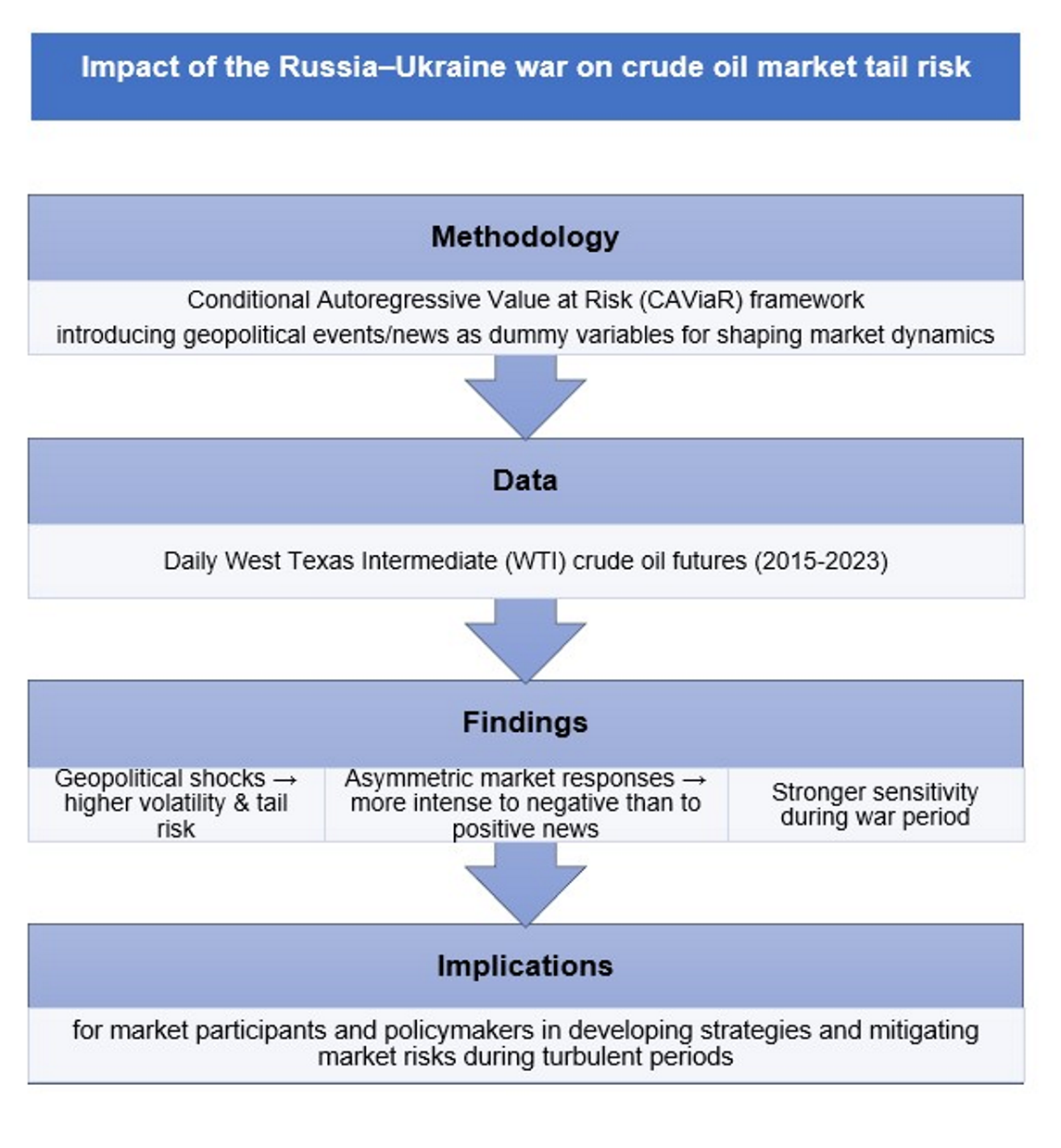
This empirical research specifically focuses on the tail risk of crude oil prices in the Russia–Ukraine war. Using daily data from the West Texas Intermediate (WTI) crude oil futures market, the analysis takes advantage of the Conditional Autoregressive Value at Risk (CAViaR) framework proposed by
Engle and Manganelli (
2004) to model extreme price fluctuations without using overly restrictive distributional assumptions. The study uses important war-related geopolitical shocks as dummy variables to investigate the impact of distinct geopolitical shocks on the evolution of downside risk in crude oil.
This paper is organized as follows. An extensive survey of the existing literature is detailed in
Section 2 through four main strands: (i) Oil Markets, Financialization and Geopolitical Risk; (ii) Oil Markets under Wars and Extreme Global Shocks; (iii) Tail Risk, Value at Risk (VaR) and the CAViaR Framework; (iv) Research Gap and Contribution of the Current Study; and (v) Hypothesis Setting. This section intends to enhance our understanding of times of deep shock and high geopolitical risk, focusing primarily on the application of CAViaR-type models. It also highlights some important gaps in the current literature, which can be used to motivate and validate the study in this context. Our analysis is described in
Section 3: it outlines the methodological framework used and important milestone dates that motivated and shaped our focused research.
Section 4 provides the empirical results for the study and describes those in detail.
Section 5 outlines the main contributions to the field, discusses the limitations of this paper and suggests future directions for research. At the end of the study, the most relevant and interesting results are discussed and connected to prior relevant and noteworthy research efforts.
2. Literature Review
2.1. Oil Markets, Financialization, and Geopolitical Risk
The growing integration of oil markets with global financial markets is clearly and largely documented by the literature. As oil markets have moved forward since the market and financial assets became increasingly integrated, prices of oil were further affected by macroeconomic conditions, monetary policy, and investor sentiment (
Tang & Xiong, 2012;
Antonakakis et al., 2023). However, this integration has made geopolitical events affecting oil supply or expectations have deep implications, which can have wide-ranging impacts on asset classes and economies. Geopolitical risk is a well-established determinant of oil price dynamics.
Wars, sanctions and political tensions primarily affect oil markets through supply disruptions, precautionary demand and uncertainty channels (
Caldara & Iacoviello, 2022). In the past few years, it has been demonstrated that geopolitical conflicts can significantly intensify oil price volatility and also change the return trends, especially in the context of conflicts involving major energy producers or transit routes (
Adekoya et al., 2022;
Adekoya et al., 2023). The Russia–Ukraine war in particular has generated much attention owing to its reconfiguration in energy trade patterns and its growing uncertainty on future supply conditions, particularly in Europe (
Lo et al., 2022).
Recent contributions emphasize that geopolitical risk (GPR) is not merely a temporary burst of shock but rather an intractable structure that is driving oil price formation.
Caldara and Iacoviello (
2022) propose an evidence base to propose a holistic geopolitical risk index considering global disturbances related to global tensions and conflict-related uncertainty and show its considerable effect on commodity prices and macro-financial conditions. Previous research evidence has noted that high GPR increases downside risks in oil markets through uncertainty about supply disruptions, transportation routing and precautionary stockpiling actions.
Policy institutions such as the
European Central Bank (
2024), and empirical results provided by
Mignon and Saadaoui (
2024) show that oil price responds asymmetrically via geopolitical tensions—being amplified and more pronounced at times of international anxiety. Volatility modeling studies further confirm regime-dependent effects of geopolitical risk on commodity futures (
Özdemir, 2025). These results present powerful theoretical and empirical evidence to support adding geopolitical risk to models that prioritize movements of the extremes of the downside over normal volatility.
2.2. Oil Markets Under Wars and Extreme Global Shocks
Besides international conflicts, oil markets appear to be particularly sensitive to extreme events worldwide, including financial crises, pandemics, and trade wars. They are characterized by nonlinear dynamics, structural breaks, and persistent changes in volatility (
Yao et al., 2020;
Rehman et al., 2022;
Tiwari et al., 2022). Structural break evidence further supports the view that global crises generate regime shifts in financial and commodity markets.
Karamti and Jeribi (
2023) identify significant structural breaks in global stock markets during the transition from the COVID-19 pandemic to the Russia–Ukraine war, highlighting how crisis phases alter market interdependencies and volatility transmission. Their findings reinforce the interpretation of the Russia–Ukraine conflict as a distinct regime change rather than a continuation of pandemic-related turbulence.
The literature on crisis periods indicates that oil prices tend to become more sensitive to news, that the shock spreads to other asset markets and that adjustment periods will be more prolonged on the part of oil prices (
H. Zhang et al., 2022).
The war between Russia and Ukraine is a structural break to world energy markets with unparalleled volatility and changed risk transmission dynamics during oil and gas markets. The evidence for the extreme volatility and downside risks are found once the conflict starts (
Fang & Shao, 2022;
Pan & Sun, 2023). Recent studies indicate that the war-induced shock proceeds beyond a short-term disruption and in effect alters oil price dynamics on more than one frequency and time scale (
Q. Zhang et al., 2024;
Xu et al., 2024). Spillover and dependency studies confirm intensified cross-market transmission following the war (
C. Zhang et al., 2025;
Zhao et al., 2024). Natural gas markets and broader energy systems also experienced elevated systemic stress (
Saad, 2023).
These findings justify treating the war as a distinct event-driven shock and support the use of event-dummy specifications to isolate its impact on crude oil prices and their tail behavior.
During the Russia–Ukraine war, empirical evidence suggests that oil has acted as a central transmitter of shocks to other markets, including equities, bonds, currencies, and alternative assets (
Adekoya et al., 2022,
Fasanya et al., 2021,
Oliyide et al., 2021). Energy dependence on Russian supplies has amplified market reactions in European economies, increasing volatility and exacerbating financial instability (
Boungou & Yatié, 2022). These findings underscore the importance of analyzing oil markets not only in isolation but also as a core component of broader crisis dynamics.
However, much of this literature focuses on average volatility, connectedness, or spillover effects. While these approaches provide valuable insights, they offer limited information about extreme price movements, which are particularly relevant during periods of sustained geopolitical stress.
2.3. Tail Risk, Value at Risk, and the CAViaR Framework
To overcome the shortcomings of volatility-based measures, an increasing amount of the literature is focusing on tail risk modeling. While Value at Risk (VaR) has become a common measure for extreme losses, classical parametric and GARCH-based VaR models draw on strong distributional assumptions which can be violated during crisis periods (
Basdekis et al., 2021).
A more flexible alternative comes in the form of the Conditional Autoregressive Value at Risk (CAViaR) framework proposed by
Engle and Manganelli (
2004), which directly models conditional quantiles of returns. This approach enables tail risk to be updated according to new information and is particularly applicable for market stress analysis. CAViaR models have proved successful in finance and in energy-related markets (
Trabelsi et al., 2024) like shipping and freight markets as these industries are closely linked to global oil trade (
Basdekis et al., 2021,
2022).
A growing strand of the literature moves beyond volatility-based measures and explicitly models extreme downside movements in energy markets. Studies employing VaR and CAViaR-type models show that oil prices exhibit pronounced asymmetries, with negative shocks generating disproportionately large effects during periods of elevated uncertainty.
Salisu et al. (
2022,
2023) demonstrate that oil tail risks contain valuable predictive information for macroeconomic and inflation dynamics, while
Jia et al. (
2024) establish a direct link between geopolitical risk, economic policy uncertainty, and extreme downside movements in crude oil prices. Nevertheless, the interaction between war-related geopolitical shocks and oil price tail risk remains underexplored, particularly within event-based econometric frameworks that isolate discrete conflict periods.
2.4. Research Gap and Contribution of the Current Study
Recent evidence further highlights that connectedness under geopolitical stress exhibits pronounced quantile and frequency characteristics. The role of the market and time regimes in the magnitude and character of spillovers depends on market state and time horizon. Extreme downside conditions tend to increase the influence of short-/medium-run transmission channels (
Zeng & Zhang, 2025). Quantile-frequency analyses show that war uncertainty acts as a multi-horizon event rather than a one-period shock, underlining the importance of fitting geopolitical events into systems able to account for dynamic tail behavior.
There are two points of discrepancy exposed by the literature review. First, although the Russia–Ukraine war has been extensively studied in terms of volatility spillovers and linkages in the market, little is known as to what extent this conflict affects extreme downside risk in crude oil markets (
Adekoya et al., 2023). Secondly, the application of CAViaR techniques for modeling tail risk in oil markets during geopolitical stress has been neglected.
To fill these voids, this study proposes combining multiple CAViaR models to predict crude tail risk for the Russia–Ukraine war by explicitly associating extreme risk characteristics with the key geopolitical factors, and acknowledging the multi-horizon character of war-induced uncertainty. It also adds to the energy finance literature by providing a tail-risk perspective on geopolitical shocks, in this way providing insights for practitioners in the investor, risk manager, and policy context operating in such scenarios.
2.5. Hypotheses Development
Building on the literature on geopolitical risk, energy-market volatility, and tail-risk modeling, we pose specific key research questions in order formulate the testable hypotheses setting. More specifically:
H1. Do major geopolitical events related to the Russia–Ukraine conflict lead to a statistically significant increase in crude oil downside tail risk?
Geopolitical conflicts and energy-supply disruptions increase uncertainty, precautionary demand, and risk premia in commodity markets (
Kilian, 2009;
Antonakakis et al., 2017;
Caldara & Iacoviello, 2018). War-related shocks generate expectations of supply constraints and sanctions, which amplify volatility and downside risk in oil prices (
Baumeister & Peersman, 2013). So far, escalatory events should be reflected in higher Value at Risk (VaR) levels.
H2. At which VaR level is the impact of geopolitical events on conditional downside tail risk expected to be stronger?
Extreme quantiles capture severe market stress episodes and systemic downside movements (
Adrian & Brunnermeier, 2016;
Acharya et al., 2017). Geopolitical shocks tend to produce nonlinear and fat-tailed responses in commodity markets (
Baur & Lucey, 2010;
Reboredo, 2012). Therefore, if war escalation induces systemic stress, its effect should be more pronounced in the extreme tail of the return distribution.
H3. Does negative geopolitical news generate a stronger increase in oil tail risk compared to stabilizing or non-escalatory developments?
According to seminal bibliography, financial markets exhibit asymmetric responses to bad versus good news, consistent with loss aversion and leverage effects (
Black, 1976;
Campbell & Hentschel, 1992). Empirical evidence suggests that oil markets respond more strongly to adverse supply-side or geopolitical shocks than to positive news (
Kilian & Park, 2009;
Bouri et al., 2019). Thus, downside tail risk should increase disproportionately during negative escalatory events.
H4. Do dynamic volatility-based CAViaR specifications exhibit greater sensitivity to geopolitical shock compared to adaptive or symmetric specifications?
Volatility persistence and regime shifts are central features of commodity markets (
Hamilton, 2009). Models incorporating autoregressive volatility dynamics are better suited to capture time-varying risk and clustering effects (
Engle & Manganelli, 2004;
Bollerslev, 1986). Therefore, specifications embedding GARCH-type dynamics should detect stronger and more persistent geopolitical effects on tail risk.
3. Data and Methods
This study analyzes the daily changes in the price of crude oil from 1 January 2015, to 11 December 2023, covering a total of 2364 trading days. We use data covering West Texas Intermediate (WTI) futures, a widely recognized benchmark for the pricing of oil. Therefore, there is a potential to employ this perspective and to identify market sensitivity to geopolitical disruptions. In so doing we carefully selected a broad temporal range to give us the opportunity to explore crude oil price patterns in both the tranquility before the war and during the Russia–Ukraine conflict, since this war has been characterized as the most prominent war in Europe after the Second World War (
Adekoya et al., 2022).
Four dates are particularly important in operationalizing the Russia–Ukraine war as an event-driven shock in energy markets.
- (i)
21 February 2022 marks Russia’s official recognition of the Donetsk and Luhansk regions as independent entities, an escalation that materially increased the perceived probability of large-scale conflict and, by extension, the risk of sanctions and supply disruptions.
- (ii)
24 February 2022 marks the launch of the full-scale military offensive by land, air and sea, a discrete regime shift that triggered immediate repricing of energy risk and a sharp increase in uncertainty about production, shipping and policy responses.
- (iii)
11 May 2022 marks Ukraine’s restrictions on Russian gas transit through its territory, which signaled that energy infrastructure and transit routes had become active nodes of the conflict, raising the risk of broader European supply stress.
- (iv)
15 June 2022 marks Russia’s reduction in gas supplies to Europe via the Nord Stream 1 pipeline, a key episode in the energy-security dimension of the war that intensified European price pressures and reinforced the linkage between geopolitical escalation and energy market stress. These dates provide theoretically grounded breakpoints for identifying shifts in oil-market tail risk associated with escalating geopolitical and energy-supply conditions.
Analysis of these critical dates allows for a deeper understanding of how geopolitical developments influence crude oil markets and their future trends.
Supporting evidence for these breakpoints is available from official and widely cited sources: the EU’s legal act on restrictive measures explicitly refers to the 21 February 2022 recognition decision (
Council of the European Union, 2022), while Russia’s Foreign Ministry statement documents the same recognition (
Ministry of Foreign Affairs of the Russian Federation, 2022). The start of the full-scale invasion on 24 February 2022 is widely documented (
Encyclopaedia Britannica, 2022). Regarding the energy dimension, contemporaneous reporting documents Ukraine’s May 2022 transit restriction through the Sokhranivka route (
S&P, 2022) and the June 2022 reduction in Nord Stream 1 flows to around 40% capacity (
WEF, 2022), both of which heightened European supply concerns and contributed to elevated energy-price uncertainty.
Here, we adopt a two-step methodological approach to investigate the impact of geopolitical events on crude oil market risk. In the first step, we estimate Value at Risk (VaR) using various Conditional Autoregressive Value at Risk (CAViaR) model specifications. The CAViaR models are implemented within a rolling window framework to capture the dynamic evolution of tail risk over time, producing time series of VaR estimates that reflect market volatility under changing conditions. In the second step, these rolling-window VaR estimates are treated as dependent variables in a regression framework. We introduce dummy variables corresponding to key geopolitical events during the Russia–Ukraine conflict to examine how these specific events influence the estimated risk levels. This two-step approach allows us to disentangle the effect of external shocks on oil price volatility and provides a structured way to quantify the relationship between geopolitical developments and market risk. To address the potential generated-regressor bias inherent in two-step estimation procedures (
Pagan, 1984), our second-stage regressions are estimated using robust standard errors (Newey-West) to ensure valid statistical inference. To this end, we utilize the Conditional Autoregressive Value at Risk (CAViaR) framework, introduced by
Engle and Manganelli (
2004), which is intended to reflect the complex dynamics of market volatility, especially when it comes to the effect of geopolitical events on crude oil prices. Our use of the CAViaR model has been meticulously split into four separate versions, each selected for its special ability to highlight certain aspects of the data being analyzed.
3.1. The Adaptive CAViaR Model
This variation uses an iterative procedure to improve its forecasts based on past performance and dynamically adapts to changes in market conditions.
The following defines the adaptive model:
where
represents the predicted Value at Risk for the next period,
is the return at time t, θ = quantile level (0.05 or 0.01), GGG = scaling parameter and
is the parameter estimated by the model.
3.2. The Symmetric CAViaR Model
This model captures the symmetric character of market responses by assuming that both positive and negative market shocks have an equal influence on volatility. The following is its formula:
Here, the squared returns highlight the model’s focus on the magnitude of market movements, independently of their direction.
3.3. The Asymmetric CAViaR Model
To account for the possibility of divergent market reactions to gains and losses, this model incorporates an asymmetry with regard to how positive and negative returns are treated. The asymmetric model’s specification is as follows:
where
is an indicator function that takes the value 1 if
is negative and 0 otherwise, allowing the model to differentiate between the impacts of gains and losses on predicted risk levels.
3.4. The Indirect GARCH(1,1) Model
By incorporating the insights from the GARCH(1,1) model into the CAViaR framework, this method provides a more nuanced understanding of volatility clustering and its effects on VaR. The following is how the model is expressed:
In this expression, are parameters to be estimated, with capturing the asymmetry in the impact of shocks, reflecting the essence of the GARCH(1,1) methodology within the CAViaR structure.
Each of these models provides a means of investigating the complex dynamics that are present in the crude oil markets. We further enhance our research and are able to analyze the particular effects of these events on market volatility and risk by incorporating dummy variables that correspond to important dates within the conflict chronology, as previously mentioned.
This approach allows us to better understand how geopolitical developments affect the crude oil markets and to identify the vulnerabilities and opportunities that arise from price fluctuations.
4. Empirical Results
In
Table 1, we present basic statistics for the 5% and 1% 1-day VaR series using the four CAViaR model specifications considered. We report the mean, standard deviation (denoted as std.), the maximum, and the minimum for the VaR series.
The descriptive statistics results indicate conservative losses as the mean and standard deviation exhibit moderate values, suggesting moderate uncertainty and variability in worst-case scenarios. The highest undertaken risk appears, applying the adaptive model, while all the other models highlight corresponding levels of risk.
Using regression analysis, we assess the effect of news and key dates pertaining to the conflict between Russia and Ukraine on the VaR of crude oil estimates as time series. We utilize the CAViaR modeling specifications to employ VaR as a tail risk indicator (i.e., the dependent variable). The following CAViaR models are taken into consideration: (i) the adaptive, (ii) the symmetric, (iii) the asymmetric, and (iv) the Indirect GARCH(1,1). The outcomes are shown in
Table 2, indicating the regression estimates (in absolute values) with standard errors given below in parentheses.
Notable are the outcomes of the Indirect GARCH(1,1) model, which show a strong positive effect on risk levels at both the 5% and 1% VaR. This implies that there is a correlation between the release of new information regarding the war and a rise in the perceived risk associated with crude oil prices. It appears that the market is sensitive to this kind of information and reacts cautiously when new information comes to light. In contrast, the Adaptive and Symmetric CAViaR models tell a story of the market’s attempt to stabilize after absorbing new information. The Adaptive model, with negative coefficients, suggests a decrease in risk predictions on days without influential news, possibly indicating a return to more typical risk levels after the market has processed previous news events. The Symmetric model aligns with this, showing the market’s balanced response to both positive and negative shocks. The Asymmetric CAViaR model, on the other hand, reveals that the market reacts more intensely to negative news than to positive, as seen by its negative coefficients. This could reflect the market’s tendency to be more sensitive to potential losses than to gains.
Overall, the regression results in
Table 2 highlight the relationship between key geopolitical events and crude oil market risk as captured by different CAViaR model specifications. The coefficients indicate that the occurrence of significant news and events during the Russia–Ukraine conflict is associated with measurable changes in the Value at Risk (VaR) estimates for crude oil prices. This suggests that the market adjusts its risk perception dynamically in response to geopolitical developments. The different CAViaR models capture varying sensitivities and patterns in this adjustment process, reflecting the complex interactions between external shocks and oil price volatility. These findings underscore the importance of incorporating geopolitical variables into risk modeling frameworks to better understand and anticipate market behavior under conditions of heightened uncertainty.
It is important to note that by systematically comparing four distinct specifications—ranging from the Symmetric to the Indirect GARCH(1,1)—the study establishes an internal robustness check. This comparative framework demonstrates how different assumptions about volatility updating affect the captured risk. We intentionally bypass simpler historical simulation (HS) baselines, as traditional non-parametric models are well-documented to underperform during extreme structural breaks and unprecedented geopolitical crises, whereas the CAViaR suite dynamically adapts to new informational shocks.
5. Contribution, Limitations and Potential Future Research
5.1. Contribution
The present study contributes to the literature in four main ways. First, it shifts the focus from volatility-based responses to explicitly modeling downside tail risk of WTI crude oil, using CAViaR to capture asymmetric and time-varying quantile dynamics that are particularly relevant under geopolitical stress. Second, it treats the Russia–Ukraine war as an event-driven shock by introducing carefully chosen war-related event dummies, enabling a cleaner identification of war phases and their incremental effect on tail risk beyond standard determinants. Third, by bringing together the GPR framework (e.g.,
Caldara & Iacoviello, 2022) with war-specific energy disruptions and spillover evidence (
Fang & Shao, 2022;
Pan & Sun, 2023;
Naeem et al., 2024), the study offers an integrated view of how geopolitical risk translates into extreme downside oil-market outcomes. Fourth, the empirical design allows for a critical comparison of pre-war and war-period tail behavior, which helps reconcile why some studies emphasize variance dynamics while others highlight tail contagion, and positions tail risk as a complementary—rather than competing—dimension of oil-market risk.
5.2. Research Limitations
Limitations should be acknowledged. First, although the selected event dummies capture key turning points, war dynamics are continuous and may not be fully summarized by discrete dates; results therefore reflect an empirically useful approximation rather than an exhaustive mapping of battlefield developments into prices. Second, CAViaR captures conditional quantiles but does not by itself identify the structural channels (e.g., supply disruptions versus demand expectations) through which geopolitical shocks affect tail risk. Third, results can be sensitive to the choice of quantile levels, sample window, and the specific benchmark (WTI), and may not generalize one-to-one to other benchmarks such as Brent during periods of dislocation. Finally, the analysis abstracts from some policy responses (e.g., strategic stockpile releases, sanctions enforcement intensity) that may confound war effects and could be explored more explicitly.
Furthermore, while the theoretical validity of the CAViaR models is well-established (
Engle & Manganelli, 2004), this study relies on their structural properties without performing formal out-of-sample backtesting (such as Dynamic Quantile tests), as the primary focus is explanatory—isolating event shocks—rather than evaluating predictive performance. Future studies focusing on forecasting should incorporate rigorous backtesting protocols. Finally, while we employed robust standard errors to mitigate inference issues, the two-step econometric approach inherently carries a degree of generated-regressor bias that remains a methodological limitation compared to joint-estimation frameworks.
5.3. Potential Future Research
Future research could extend the analysis in several directions. A natural extension is a multi-market setting that jointly models WTI and Brent tail risks and their time-varying connectedness with gas and electricity markets, to better capture substitution and regional bottlenecks. Another avenue is to incorporate higher-frequency geopolitical news measures or text-based indicators to distinguish ‘threat’ from ‘realized’ conflict risk, and to test whether such information improves real-time tail-risk forecasting (
Chowdhury et al., 2025). Methodologically, combining CAViaR with state-space or regime-switching specifications could better reflect abrupt transitions between war phases, and linking tail risk to option-implied measures could further validate the quantile-based estimates. Finally, policy-oriented work could examine how sanctions packages and strategic stockpile policies interact with tail risk and volatility (
Almutairi et al., 2025).
6. Discussion and Conclusions
Comparing the expected findings with prior work on oil markets under geopolitical stress suggests three central themes. First, consistent with the GPR literature, elevated geopolitical risk should be associated with stronger downside oil-market responses than upside responses, reflecting precautionary behavior and uncertainty-driven risk premia (
Caldara & Iacoviello, 2022;
Mignon & Saadaoui, 2024;
European Central Bank, 2024). Second, the war period is expected to exhibit a clear intensification of risk transmission, aligning with evidence that the Russia–Ukraine conflict increased volatility risk and spillovers in commodity markets (
Fang & Shao, 2022;
Pan & Sun, 2023) and repriced broader market risk (
Assaf et al., 2023;
Izzeldin et al., 2023). Third, a tail-risk perspective helps interpret why volatility-based studies may underestimate the severity of downside exposure: recent evidence indicates that extreme-risk contagion can dominate during geopolitical crises (
Naeem et al., 2024;
Gong et al., 2025), and that connectedness depends on horizon and market state (
Zeng & Zhang, 2025). Therefore, if the empirical results reveal significant war effects in lower quantiles even when average-return effects are muted, this will support the view that geopolitical shocks primarily operate through the distribution’s left tail rather than through its center.
We identify that geopolitical events were interconnected with crude oil market volatility and that an accounting of both movements was necessary for any reasonable inference, as indicated by the varied reaction demonstrated in our CAViaR modeling approach. The application of these CAViaR model variants—Adaptive, Symmetric, Asymmetric, and Indirect GARCH(1,1)—to this study has provided us with a deep-dive insight into the behaviors of the market in the midst of the geopolitical narrative.
All these models highlight the importance of integrating geopolitical risk into every stage of market risk assessment, which is perhaps most visible for a commodity extremely sensitive to shocks like crude oil. The increased reaction times to news, especially politically sensitive events, may indicate that participants adjust their risk expectations quickly with news. This change is manifested in the shift in VaR estimates across various CAViaR specifications.
This research contributes to our understanding of how geopolitical shocks reverberate through the tail of crude oil market price and risk as such in a complex manner. With emerging market dynamics and economic events taking on a special emphasis in the current global economic context, such as a complex response by the global economy, the work described here offers us a pertinent perspective to the ongoing academic topic for researchers, market analysts and decision-makers.
Understanding how and why these geopolitical events affect the crude oil markets is key if they are to help investors and policy makers mitigate risk. Such factors must be taken into consideration by policies in implementing measures to minimize the harmful impacts of market volatility, contributing to a more stable and sustainable economy. One of the consequences of dependence—the implications of a dependent economy—are of serious interest to investors, managers, policymakers and researchers as policymakers frame policy in the area of diversification (and trade too) strategies and their ramifications for global supply chains in the face of wars and global conflicts.
Author Contributions
C.V.B.: Conceptualization, Validation, Investigation, Data Curation, Writing, Review & Editing, Visualization, Supervision, Project administration. A.G.C.: Conceptualization, Validation, Investigation, Review & Editing, Visualization, Supervision, Project administration. K.G.: Conceptualization, Methodology, Software, Formal Analysis, Resources, Data Curation, Writing, Review & Editing, Visualization, Supervision, Project administration. L.G.: Conceptualization, Methodology, Software, Formal Analysis, Resources, Writing. All authors have read and agreed to the published version of the manuscript.
Funding
This research received no external funding.
Institutional Review Board Statement
Not applicable.
Informed Consent Statement
Not applicable.
Data Availability Statement
The data that support the findings of this study are available from the corresponding author upon reasonable request.
Conflicts of Interest
The authors declare no conflicts of interest.
References
- Acharya, V. V., Pedersen, L. H., Philippon, T., & Richardson, M. (2017). Measuring systemic risk. Review of Financial Studies, 30(1), 2–47. [Google Scholar] [CrossRef]
- Adekoya, O. B., Asl, M. G., Oliyide, J. A., & Izadi, P. (2023). Multifractality and cross-correlation between the crude oil and the European and non-European stock markets during the Russia-Ukraine war. Resources Policy, 80, 103134. [Google Scholar] [CrossRef]
- Adekoya, O. B., Oliyide, J. A., Yaya, O. S., & Al-Faryan, M. A. S. (2022). Does oil connect differently with prominent assets during war? Analysis of intra-day data during the Russia-Ukraine saga. Resources Policy, 77, 102728. [Google Scholar] [CrossRef]
- Adrian, T., & Brunnermeier, M. K. (2016). CoVaR. American Economic Review, 106(7), 1705–1741. [Google Scholar] [CrossRef]
- Aliu, F., Haskova, S., & Bajra, U. (2023). Consequences of Russian invasion on Ukraine: Evidence from foreign exchange rates. The Journal of Risk Finance, 24(1), 40–58. [Google Scholar] [CrossRef]
- Almutairi, H., Pierru, A., & Smith, J. L. (2025). Pandemic, Ukraine war, OPEC+ and strategic oil stockpiles: Implications for crude oil volatility. Energy Economics, 144, 108319. [Google Scholar] [CrossRef]
- Antonakakis, N., Chatziantoniou, I., & Filis, G. (2017). Oil price shocks and stock markets: Dynamic connectedness under the prism of recent geopolitical and economic uncertainty. International Review of Financial Analysis, 50, 1–26. [Google Scholar] [CrossRef]
- Antonakakis, N., Cunado, J., Filis, G., Gabauer, D., & Gracia, F. P. (2023). Dynamic connectedness among the implied volatilities of oil prices and financial assets: New evidence of the COVID-19 pandemic. International Review of Economics & Finance, 83, 114–123. [Google Scholar] [CrossRef]
- Assaf, A. G., Gupta, D., & Kumar, R. (2023). The price of war: The effect of the Russia–Ukraine war on global markets. The Journal of Economic Assymetries, 28, e00328. [Google Scholar] [CrossRef]
- Basdekis, C., Christopoulos, A., Gkolfinopoulos, A., & Katsampoxakis, I. (2021). VaR as a risk management framework for the spot and futures tanker markets. Operational Research, 22, 4287–4352. [Google Scholar] [CrossRef]
- Basdekis, C., Katsampoxakis, I., & Gkolfinopoulos, A. (2022). VaR as a mitigating risk tool in the maritime sector: An empirical approach on freight rates. Quantitative Finance and Economics, 6(2), 158–176. [Google Scholar] [CrossRef]
- Baumeister, C., & Peersman, G. (2013). Time-varying effects of oil supply shocks on the US economy. American Economic Journal: Macroeconomics, 5(4), 1–28. [Google Scholar] [CrossRef]
- Baur, D. G., & Lucey, B. M. (2010). Is gold a hedge or a safe haven? An analysis of stocks, bonds and gold. Financial Review, 45(2), 217–229. [Google Scholar] [CrossRef]
- Besedes, T., Goldbach, S., & Nitsch, V. (2017). You’re banned! The effect of sanctions on German cross-border financial flows. Economic Policy, 32(90), 263–318. [Google Scholar] [CrossRef]
- Black, F. (1976). Studies of stock price volatility changes. In Proceedings of the 1976 Meetings of the American Statistical Association (pp. 177–181). American Statistical Association. [Google Scholar]
- Bollerslev, T. (1986). Generalized autoregressive conditional heteroskedasticity. Journal of Econometrics, 31(3), 307–327. [Google Scholar] [CrossRef]
- Boubaker, S., Goodell, J. W., Pandey, D. K., & Kumari, V. (2022). Heterogeneous impacts of wars on global equity markets: Evidence from the invasion of Ukraine. Finance Research Letters, 48, 102934. [Google Scholar] [CrossRef]
- Boungou, W., & Yatié, A. (2022). The impact of the Ukraine–Russia war on world stock market returns. Economics Letters, 215, 110516. [Google Scholar] [CrossRef]
- Bouri, E., Demirer, R., Gupta, R., & Marfatia, H. A. (2019). Geopolitical risks and movements in Islamic bond and equity markets: A note. Defence and Peace Economics, 30(3), 367–379. [Google Scholar] [CrossRef]
- Caldara, D., & Iacoviello, M. (2018). Measuring geopolitical risk (International Finance Discussion Papers, 1222). Board of Governors of the Federal Reserve System. [Google Scholar] [CrossRef]
- Caldara, D., & Iacoviello, M. (2022). Measuring geopolitical risk. American Economic Review, 112(4), 1194–1225. [Google Scholar] [CrossRef]
- Campbell, J. Y., & Hentschel, L. (1992). No news is good news: An asymmetric model of changing volatility in stock returns. Journal of Financial Economics, 31(3), 281–318. [Google Scholar] [CrossRef]
- Chortane, S. G., & Pandey, D. K. (2022). Does the Russia-Ukraine war lead to currency asymmetries? A US dollar tale. The Journal of Economic Asymmetries, 26, e00265. [Google Scholar] [CrossRef]
- Choudhry, T. (2010). World war II events and the Dow Jones industrial index. Journal of Banking & Finance, 34(5), 1022–1031. [Google Scholar] [CrossRef]
- Chowdhury, M. A. F., Abdullah, M., Abakah, E. J. A., & Tiwari, A. K. (2025). Geopolitical risk and energy market tail risk forecasting: An explainable machine learning approach. Journal of Commodity Markets, 39, 100478. [Google Scholar] [CrossRef]
- Chupilkin, M., & Kóczán, Z. (2022). The economic consequences of war: Estimates using synthetic controls (Working Paper No. 271). European Bank for Reconstruction and Development. [Google Scholar]
- Council of the European Union. (2022). Council Decision (CFSP) 2022/266 of 23 February 2022 amending Decision 2014/145/CFSP concerning restrictive measures in respect of actions undermining or threatening the territorial integrity, sovereignty and independence of Ukraine. Official Journal of the European Union, L 42I, 98–99. Available online: https://eur-lex.europa.eu/legal-content/EN/TXT/?uri=CELEX:32022D0266 (accessed on 9 March 2026).
- Encyclopaedia Britannica. (2022). Russia–Ukraine war. Encyclopaedia Britannica. Available online: https://www.britannica.com/event/2022-Russian-invasion-of-Ukraine (accessed on 9 March 2026).
- Engle, R. F., & Manganelli, S. (2004). CAViaR: Conditional autoregressive value at risk by regression quantiles. Journal of Business & Economic Statistics, 22(4), 367–381. [Google Scholar] [CrossRef]
- European Central Bank. (2024). Geopolitical risk and oil prices. In Economic bulletin, issue 5/2024. European Central Bank. [Google Scholar]
- Fang, Y., & Shao, Z. (2022). The Russia–Ukraine conflict and volatility risk of commodity markets. Finance Research Letters, 50, 103264. [Google Scholar] [CrossRef]
- Fasanya, I. O., Oyewole, O., Adekoya, O. B., & Odie-Mensah, J. (2021). Dynamic spillovers and connectedness between COVID-19 pandemic and global foreign exchange markets. Economic Research, 34, 2059–2084. [Google Scholar] [CrossRef]
- Gong, X. L., Jia, K. W., & Xiong, X. (2025). How major geopolitical events affect tail risk contagion in crude oil markets: Evidence from the Russia–Ukraine conflict. International Review of Economics & Finance, 103, 104523. [Google Scholar] [CrossRef]
- Hamilton, J. D. (2009). Causes and consequences of the oil shock of 2007–08 (pp. 215–283). Brookings Papers on Economic Activity. National Bureau of Economic Research. [Google Scholar] [CrossRef]
- Harrison, M. (Ed.). (2000). The economics of world war II: Six great powers in international comparison. Cambridge University Press. [Google Scholar]
- Humpe, A., & McMillan, D. G. (2020). Macroeconomic variables and long-term stock market performance. A panel ARDL cointegration approach for G7 countries. Cogent Economics and Finance, 8(1), 1816257. [Google Scholar] [CrossRef]
- Izzeldin, M., Muradoglu, Y. G., Pappas, V., Petropoulou, A., & Sivaprasad, S. (2023). The impact of the Russian–Ukrainian war on global financial markets. International Review of Financial Analysis, 87, 102598. [Google Scholar] [CrossRef]
- Jia, W., Zhang, Y., & Chen, Y. (2024). The tail risk of crude oil prices: Evidence from economic policy uncertainty and geopolitical risk. Energy Policy, 187, 114027. [Google Scholar] [CrossRef]
- Karamti, C., & Jeribi, A. (2023). Stock markets from COVID-19 to the Russia–Ukraine crisis: Structural breaks in interactive effects panels. The Journal of Economic Asymmetries, 28, e00340. [Google Scholar] [CrossRef]
- Kilian, L. (2009). Not all oil price shocks are alike: Disentangling demand and supply shocks in the crude oil market. American Economic Review, 99(3), 1053–1069. [Google Scholar] [CrossRef]
- Kilian, L., & Park, C. (2009). The impact of oil price shocks on the U.S. stock market. International Economic Review, 50(4), 1267–1287. [Google Scholar] [CrossRef]
- Lo, G. D., Marcelin, I., Bassène, T., & Sène, B. (2022). The Russo-Ukrainian war and financial markets: The role of dependence on Russian commodities. Finance Research Letters, 50, 103194. [Google Scholar] [CrossRef]
- Mignon, V., & Saadaoui, J. (2024). How do political tensions and geopolitical risks impact oil prices? Energy Economics, 129, 107219. [Google Scholar] [CrossRef]
- Ministry of Foreign Affairs of the Russian Federation. (2022). Statement by the Ministry of Foreign Affairs of the Russian Federation on the recognition of the Donetsk People’s Republic and the Luhansk People’s Republic. Ministry of Foreign Affairs of the Russian Federation. Available online: https://mid.ru/en/foreign_policy/news/ (accessed on 9 March 2026).
- Naeem, M. A., Gul, R., Shafiullah, M., Karim, S., & Lucey, B. M. (2024). Tail risk spillovers between Shanghai oil and other markets. Energy Economics, 130, 107182. [Google Scholar] [CrossRef]
- Oliyide, J. A., Adekoya, O. B., & Khan, M. A. (2021). Economic policy uncertainty and the volatility connectedness between oil shocks and metal market: An extension. International Economics, 167, 136–150. [Google Scholar] [CrossRef]
- Özdemir, L. (2025). Volatility modeling of the impact of geopolitical risk on commodity futures returns. Economies, 13(4), 88. [Google Scholar] [CrossRef]
- Pagan, A. (1984). Econometric issues in the analysis of regressions with generated regressors. International Economic Review, 25(1), 221–247. [Google Scholar] [CrossRef]
- Pan, Q., & Sun, Y. (2023). Changes in volatility leverage and spillover effects of crude oil futures markets affected by the 2022 Russia–Ukraine conflict. Finance Research Letters, 58, 104442. [Google Scholar] [CrossRef]
- Reboredo, J. C. (2012). Modelling oil price and exchange rate co-movements. Journal of Policy Modeling, 34(3), 419–440. [Google Scholar] [CrossRef]
- Rehman, M. U., Ahmad, N., & Vo, X. V. (2022). Asymmetric multifractal behaviour and network connectedness between socially responsible stocks and international oil before and during COVID-19. Physica A: Statistical Mechanics and Its Applications, 587, 126489. [Google Scholar] [CrossRef]
- Saad, G. (2023). The impact of the Russia–Ukraine war on the United States natural gas futures prices. Kybernetes, 53(10), 3430–3443. [Google Scholar] [CrossRef]
- Salisu, A. A., Gupta, R., & Ji, Q. (2022). Forecasting oil prices over 150 years: The role of tail risks. Resources Policy, 75, 102508. [Google Scholar] [CrossRef]
- Salisu, A. A., Raheem, I. D., & Vo, X. V. (2023). Oil tail risks and the realized variance of consumer prices. Energy Policy, 180, 113693. [Google Scholar] [CrossRef]
- S&P Global Commodity Insights. (2022, May 10). Ukraine’s gas grid operator to suspend Russian gas flows via Sokhranivka. Available online: https://www.spglobal.com/commodityinsights/en/market-insights/latest-news/natural-gas/051022-ukraines-gas-grid-operator-to-suspend-russian-gas-flows-via-sokhranivka (accessed on 9 March 2026).
- Tang, K., & Xiong, W. (2012). Index Investment and the Financialization of commodities. Financial Analysts Journal, 68(6), 54–74. [Google Scholar] [CrossRef]
- Tiwari, A. K., Abakah, E. J. A., Gabauer, D., & Dwumfour, R. A. (2022). Dynamic spillover effects among green bond, renewable energy stocks and carbon markets during COVID-19 pandemic: Implications for hedging and investments strategies. Global Finance Journal, 51, 100692. [Google Scholar] [CrossRef]
- Trabelsi, N., Tiwari, A. K., Ghallabi, F., & Khemakhem, I. (2024). Nexus of crude oil and clean energy stock indices: Evidence from time-varying parameter VAR in conjunction with conditional autoregressive value-at-risk (CAViaR). Heliyon, 10(24), e40970. [Google Scholar] [CrossRef]
- World Economic Forum. (2022). Russia cuts Nord Stream gas supplies to Europe. Available online: https://www.weforum.org/stories/2022/09/nord-stream-gas-pipeline-russia-europe-energy-halt/ (accessed on 9 March 2026).
- Xu, Y., Liu, T., & Du, P. (2024). Volatility forecasting of crude oil futures based on Bi-LSTM-Attention model: The dynamic role of the COVID-19 pandemic and the Russian-Ukrainian conflict. Resources Policy, 88, 104319. [Google Scholar] [CrossRef]
- Yao, C., Liu, C., & Ju, W. (2020). Multifractal analysis of the WTI crude oil market, US stock market and EPU. Physica A: Statistical Mechanics and its Applications, 550, 124096. [Google Scholar] [CrossRef]
- Zeng, H., & Zhang, D. (2025). Quantile-frequency connectedness between crude oil prices and geopolitical uncertainty. Applied Economics, 57(14), 1621–1643. [Google Scholar] [CrossRef]
- Zhang, C., Tian, S., & Ji, Q. (2025). Dependency structure of international commodity markets after the Russia–Ukraine war. PLoS ONE, 20(1), e0316288. [Google Scholar] [CrossRef]
- Zhang, H., Jin, C., Bouri, E., Gao, W., & Xu, Y. (2022). Realized higher-order moments spillovers between commodity and stock markets: Evidence from China. Journal of Commodity Markets, 30, 100275. [Google Scholar] [CrossRef]
- Zhang, Q., Hu, Y., Jiao, J., & Wang, S. (2024). The impact of Russia–Ukraine war on crude oil prices: An EMC framework. Humanities and Social Sciences Communications, 11, 8. [Google Scholar] [CrossRef]
- Zhao, Y., Chen, L., & Zhang, Y. (2024). Spillover effects of geopolitical risks on global energy markets: Evidence from CoVaR and CAViaR-EGARCH model. Energy Exploration & Exploitation, 42(2), 772–788. [Google Scholar] [CrossRef]
Table 1.
CAViaR basic estimate statistics.
Table 1.
CAViaR basic estimate statistics.
| | Mean | Std. Deviation | Maximum | Minimum |
|---|
| CAViaR—Adaptive (5% VaR) | −4.658 | 3.0325 | −0.396 | −21.279 |
| CAViaR—Adaptive (1% VaR) | −8.923 | 6.739 | −0.684 | −35.685 |
| CAViaR—Symmetric (5% VaR) | −3.737 | 1.487 | −1.360 | −12.726 |
| CAViaR—Symmetric (1% VaR) | −6.015 | 2.359 | −2.288 | −18.953 |
| CAViaR—Asymmetric (5% VaR) | −3.646 | 1.694 | −0.338 | −13.328 |
| CAViaR—Asymmetric (1% VaR) | −5.455 | 2.275 | −0.898 | −18.639 |
| CAViaR—Indirect GARCH(1,1) (5% VaR) | −3.723 | 1.371 | −1.958 | −11.506 |
| CAViaR—Indirect GARCH(1,1) (1% VaR) | −5.926 | 2.341 | −2.406 | −21.934 |
Table 2.
CAViaR model regression estimates for geopolitical event effects.
Table 2.
CAViaR model regression estimates for geopolitical event effects.
| | Coefficients |
|---|
| CAViaR—Adaptive (5% VaR) | 0.606 *** (0.042) |
| CAViaR—Adaptive (1% VaR) | 2.002 *** (0.101) |
| CAViaR—Symmetric (5% VaR) | 0.305 *** (0.007) |
| CAViaR—Symmetric (1% VaR) | 0.073 *** (0.016) |
| CAViaR—Asymmetric (5% VaR) | 0.007 *** 0.005) |
| CAViaR—Asymmetric (1% VaR) | 0.451 *** (0.011) |
| CAViaR—Indirect GARCH(1,1) (5% VaR) | 0.795 *** (0.016) |
| CAViaR—Indirect GARCH(1,1) (1% VaR) | 0.710 *** (0.065) |
| Disclaimer/Publisher’s Note: The statements, opinions and data contained in all publications are solely those of the individual author(s) and contributor(s) and not of MDPI and/or the editor(s). MDPI and/or the editor(s) disclaim responsibility for any injury to people or property resulting from any ideas, methods, instructions or products referred to in the content. |



 ,
,