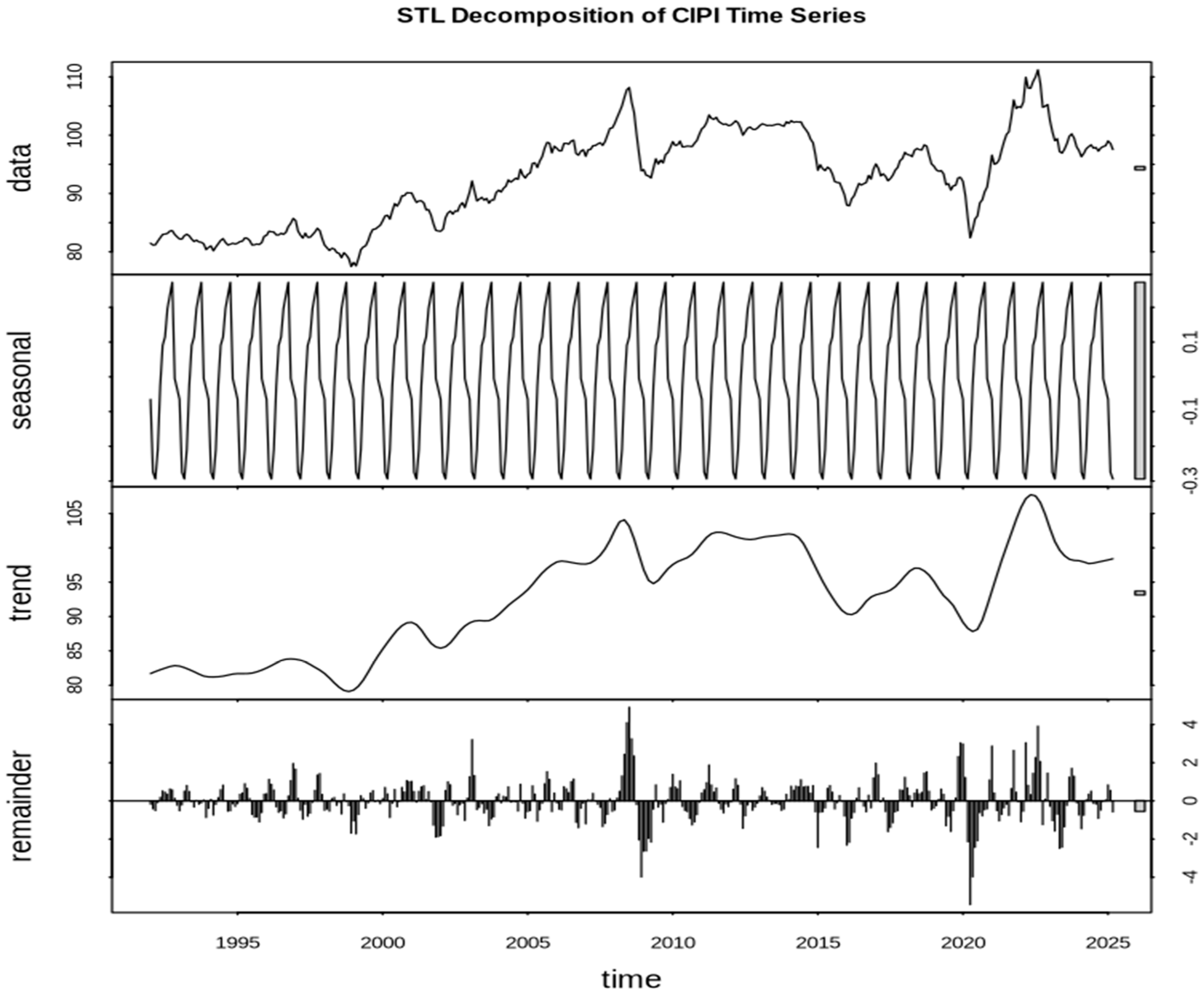
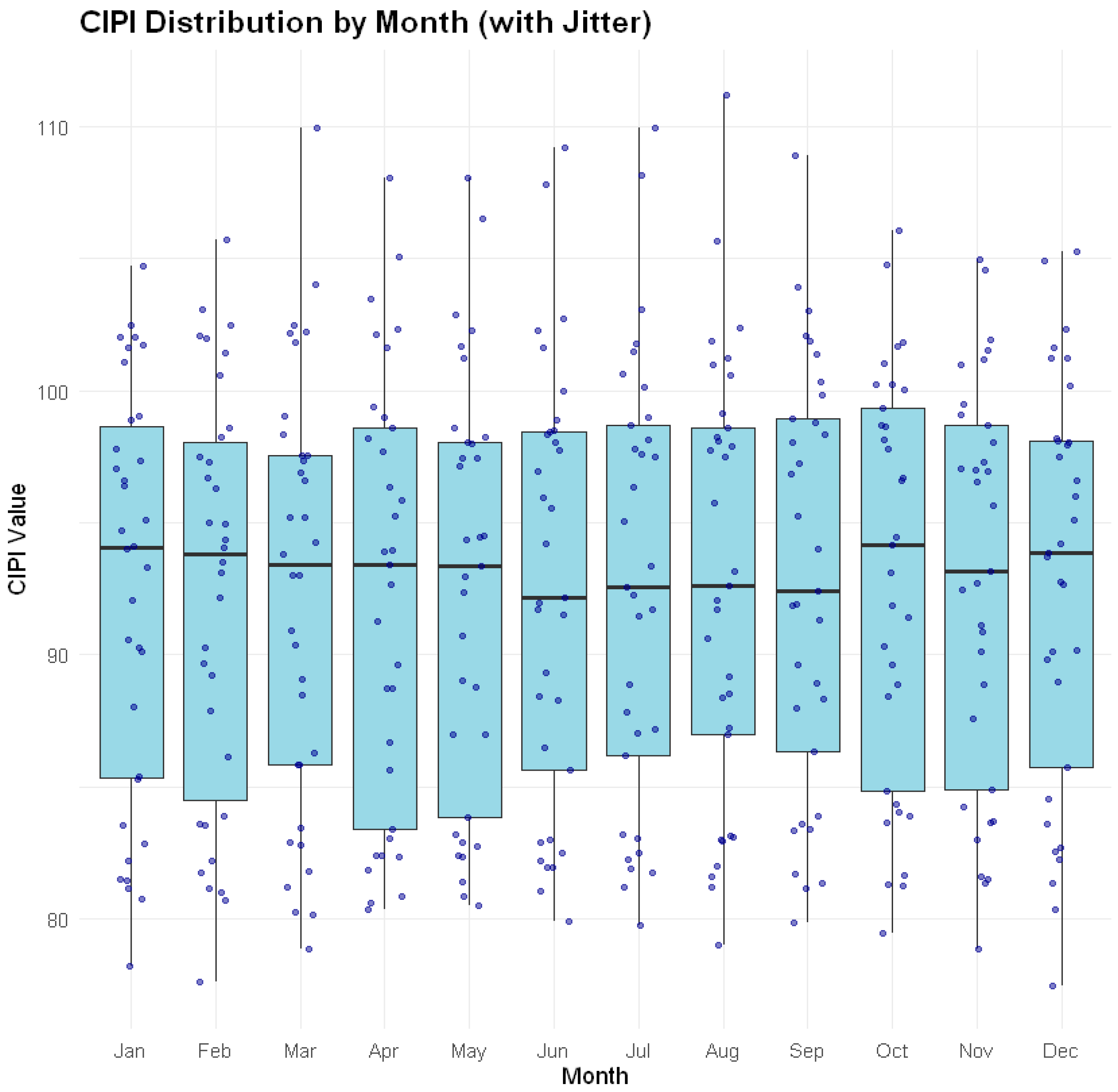
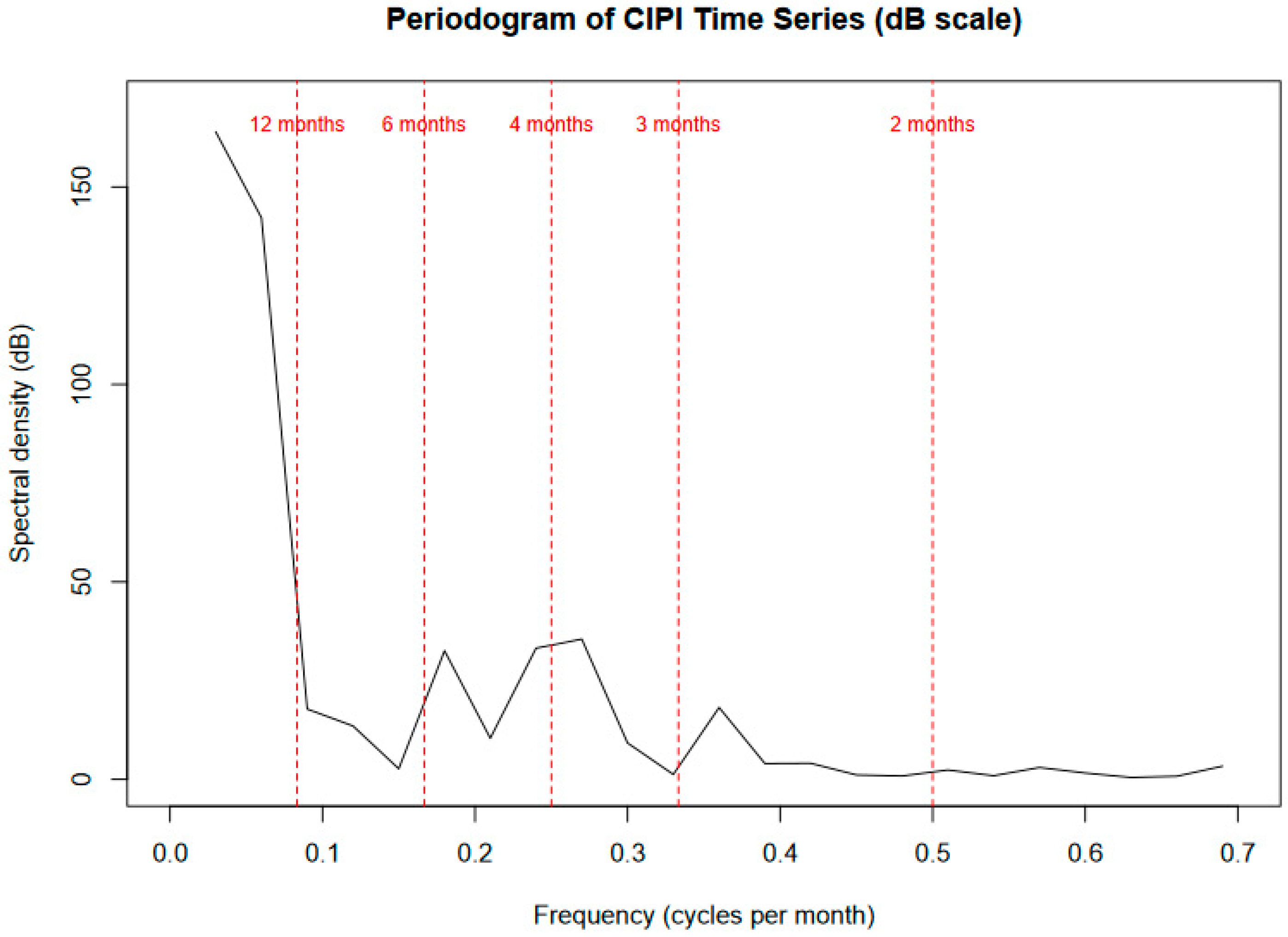
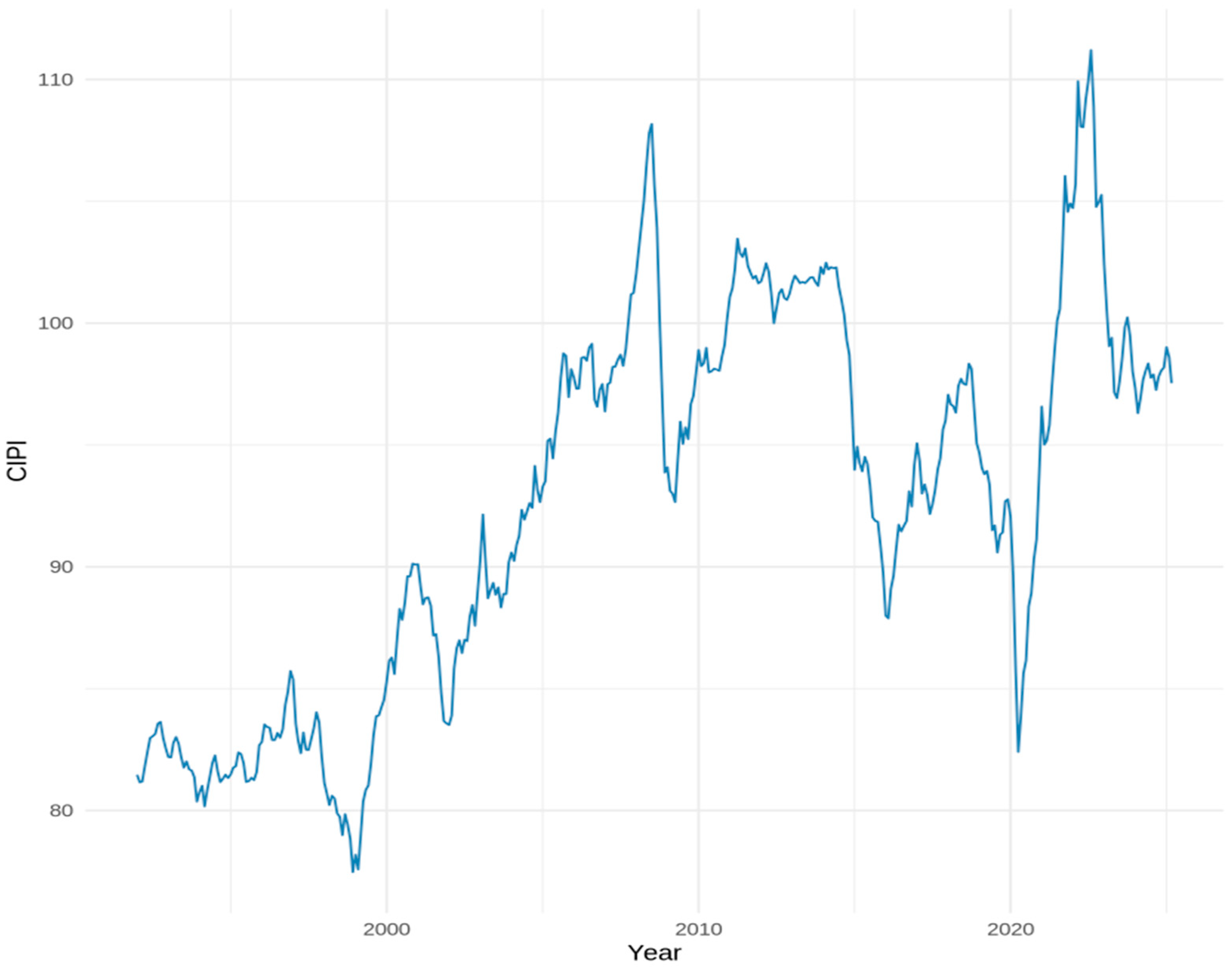
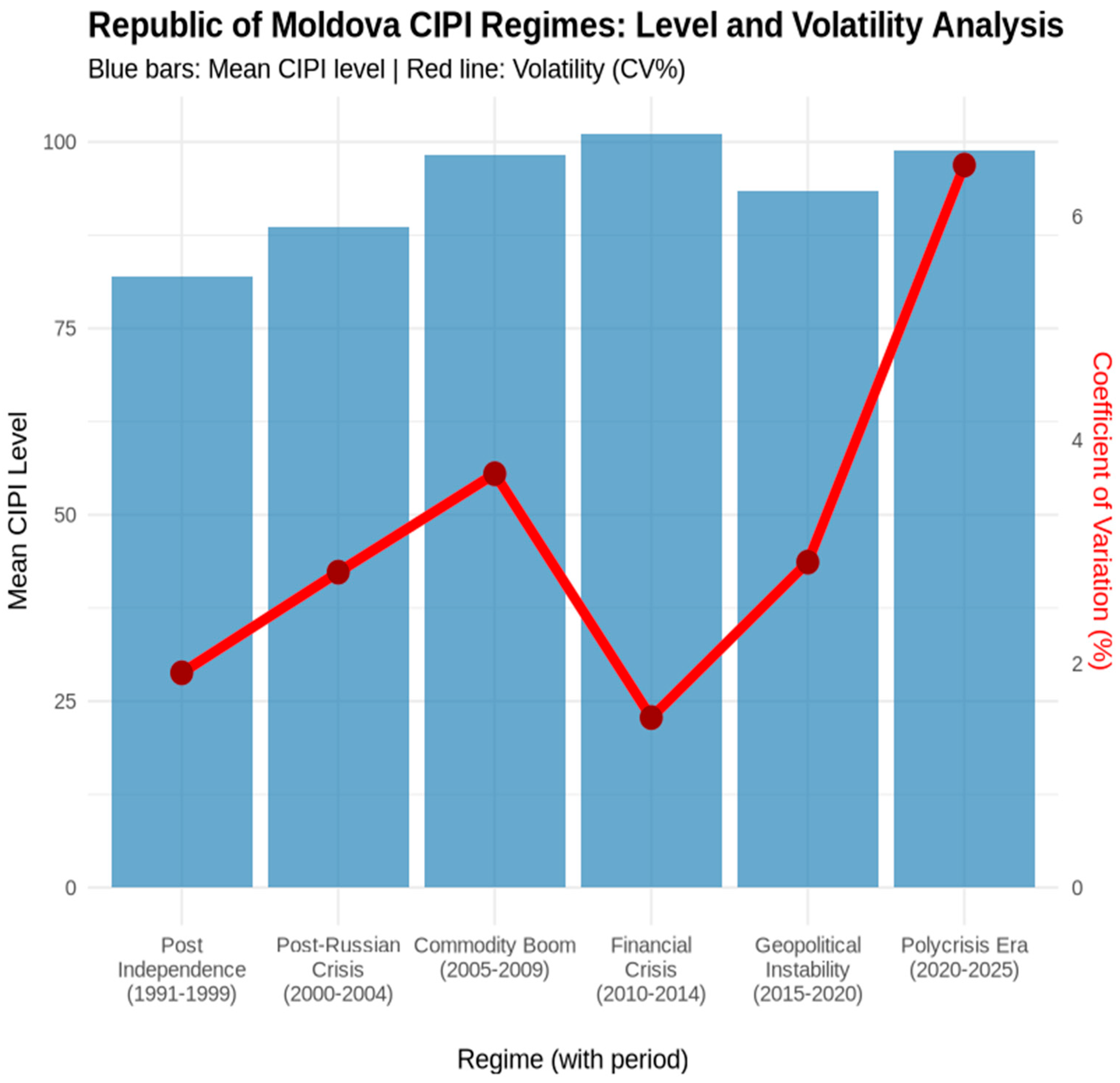
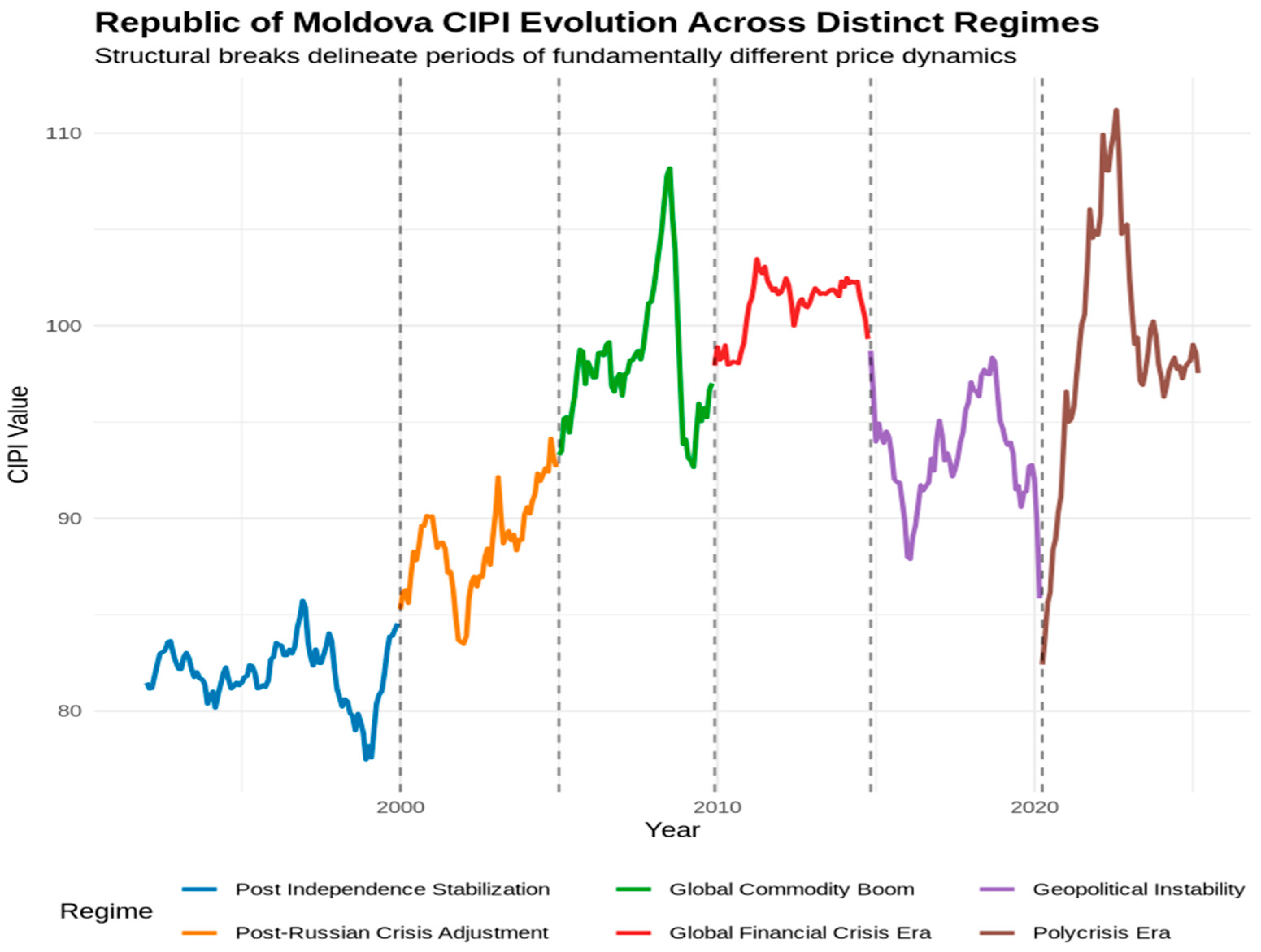
The previous chapters established three core properties of the Republic of Moldova’s external price environment, using the IMF CIPI as the central indicator. First, CIPI follows a persistent, regime-dependent path: major global crises shift the index to higher level regimes that the Hansen-SETAR results indicate are slowly adjusting; although, the formal test of short-run asymmetric adjustment (Wald) does not reject symmetry—so the level shifts are best read as persistence and regime dependence rather than as proven ratcheting. Second, CIPI displays a near-complete absence of economically meaningful seasonality, implying that vulnerability stems from irregular, event-driven shocks rather than predictable calendar patterns. Third, since 2020, the Republic of Moldova has operated in a polycrisis environment in which overlapping disturbances—the COVID-19 pandemic, the war in Ukraine, the European energy crisis, and renewed tensions in the Middle East—jointly produce the largest and most volatile CIPI swings in the sample.
These findings naturally raise further questions. Given that external prices evolve in a persistent, regime-dependent, non-seasonal, crisis-driven manner, how do CIPI shocks actually propagate through the domestic macroeconomy? In other words, once external commodity prices move, what happens to domestic consumer prices, monetary policy, and output, and over what horizons?
We do not employ real GDP as a variable in the analysis because the Republic of Moldova’s official quarterly real GDP series is available only from 2016Q1 to 2024Q4 (36 observations). After log-differencing and the inclusion of two lags required by the mixed-frequency specification, the effective sample falls to roughly 33 observations distributed across four endogenous variables and the MIDAS monthly sub-series—well below the threshold at which U-MIDAS coefficients and impulse responses can be identified with acceptable precision. Estimating the MF-VAR on this short sample would yield wide confidence bands and unstable lag dynamics, undermining rather than refining the transmission story. We note, however, that direct inspection of IMF quarterly data for Moldova on a like-for-like, domestic currency basis (NGDP_NSA_XDC and NGDP_R_NSA_XDC, both unadjusted, MDL millions) supports the valuation interpretation of the nominal GDP impulse. Aggregating quarterly observations to annual frequency, nominal GDP grew by +13.4% in 2022, +10.6% in 2023 and +6.7% in 2024, while real GDP contracted by 4.65% in 2022 and grew only 1.2% in 2023 and 0.1% in 2024 (author’s calculations). The roughly 18-percentage-point divergence between nominal and real growth in 2022—the commodity-shock year itself—is consistent with the view that the positive nominal GDP response to CIPI shocks is dominated by a valuation channel rather than by real expansion. For the same reason, we refrain from expanding the set of endogenous variables in the VAR. The MF-VAR used for coefficient estimation and impulse response analysis is instead estimated over the period 2000Q4–2024Q1, yielding 94 quarterly observations. This sample window is chosen to be consistent with the mixed-frequency framework and to accommodate the inclusion of two lags in the VAR.
VAR Granger causality and block exogeneity Wald tests re-estimate the same specification on the same sample, 2000Q4–2024Q1 (94 observations), to incorporate the additional data. Unless otherwise stated, all coefficient interpretations and impulse responses refer to the baseline 2000Q4–2024Q1 estimation window.
The aim is not forecasting per se, but to quantify and interpret three linked transmission channels:
The estimated two-lag MF-VAR uncovers a cyclical “stop–go” pattern that is not visible in a more parsimonious one-lag specification. In particular, the two-lag mixed-frequency VAR appears dynamically well behaved: shocks to D(LOG_GDP_D11) gradually dissipate, the impulse response functions converge, and the resulting forecasts exhibit no signs of explosive or erratic behavior. This configuration is therefore consistent with a damped cyclical adjustment process rather than with either sluggish mean reversion or unstable dynamics.
From an empirical standpoint, it is essential to corroborate these properties through a comprehensive battery of residual diagnostics (e.g., tests for autocorrelation, heteroskedasticity, and non-normality) and to perform robustness checks related to the mixed-frequency alignment, alternative aggregation schemes, and the presence of potential structural breaks. Given the relatively limited sample size (94 included observations), selecting a higher lag order would substantially reduce the effective degrees of freedom and increase the risk of overfitting. A more heavily parameterized specification could impair the reliability of the estimated coefficients, distort the finite-sample distribution of test statistics, and degrade out-of-sample forecasting performance. Consequently, opting for more than two lags in this setting would not be recommended, as the marginal gain in capturing additional dynamics is likely to be outweighed by the associated estimation uncertainty and loss of precision.
Positive external price impulses initially inflate nominal GDP and raise consumer prices, prompting monetary tightening, which subsequently depresses GDP with a delay. In this way, the VAR provides a structural, model-based counterpart to the regime shifts and persistent level effects documented for CIPI in earlier chapters.
5.2. Treatment of Structural Breaks in the Estimation Sample
Prior to presenting the coefficient estimates, it is necessary to address a methodological issue implied by the evidence reported in
Section 4. The Chow tests in
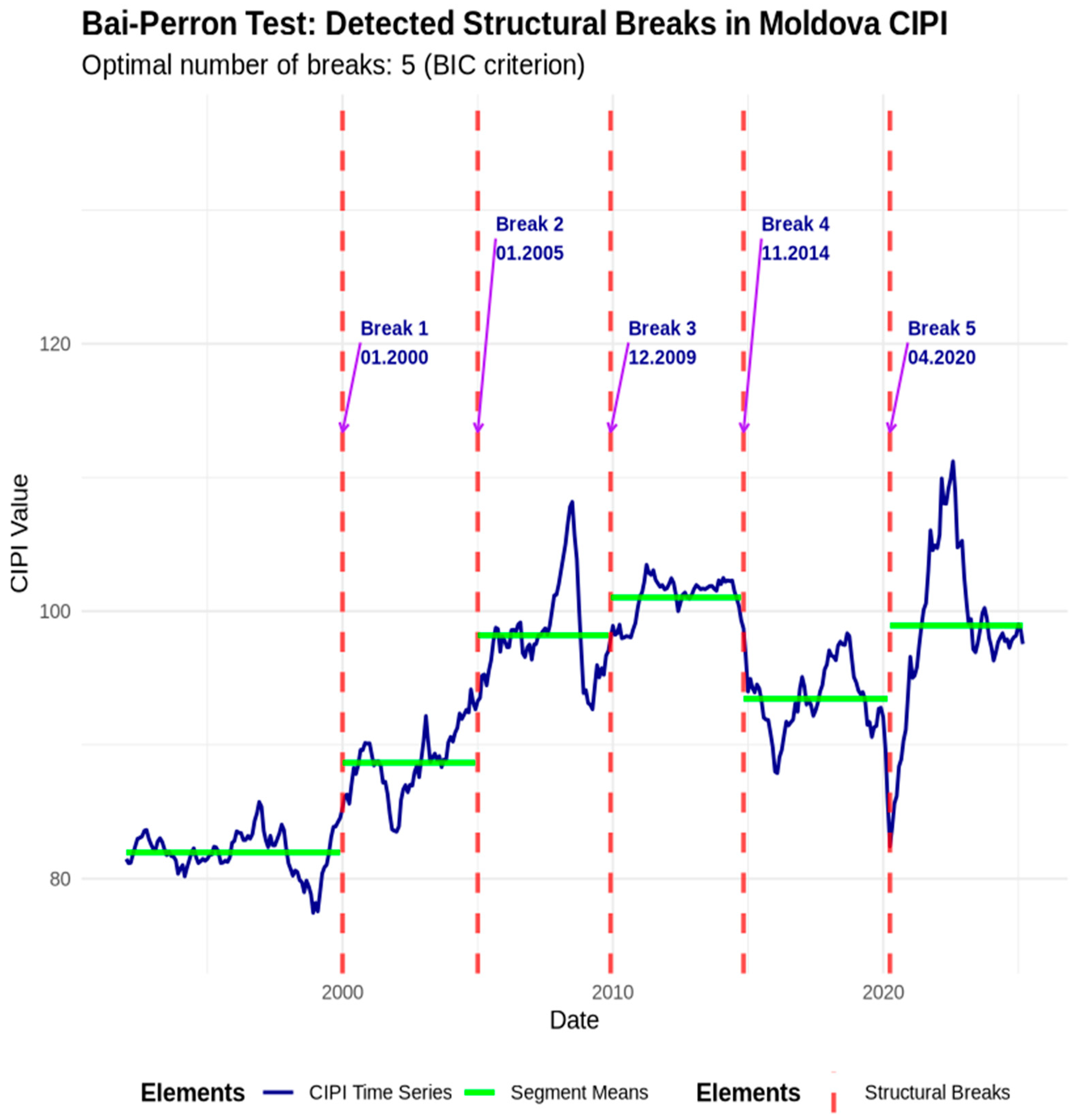
Table 6 indicate the presence of multiple structural breaks in the level of the CIPI series, concentrated around major global and regional disturbances, including the 1998 Russian financial crisis, the 2008–2009 global financial crisis, the 2014 oil price collapse and the annexation of Crimea, the 2020 COVID-19 pandemic, and the 2022 outbreak of the Ukraine conflict. These results raise the question of whether a constant-parameter vector autoregression (VAR) is an appropriate framework in the presence of such breaks.
A related design choice is the start of the estimation window. The MF-VAR is estimated on 2000Q4–2024Q1, which begins after the National Bank of Moldova’s modern inflation-targeting framework was operational; the pre-2000 hyperinflation period is deliberately excluded so that the sample is monetary-regime-consistent. The pre-polycrisis vs full-sample stability comparison reported below is therefore a within-IT-regime test of transmission stability across the polycrisis break, not a pooled test across heterogeneous monetary regimes.
A constant-coefficient specification remains appropriate in the present context because the MF VAR is estimated using D(LOG_CIPI), i.e., the first difference in the logarithmic series, which is stationary, as confirmed by the unit root tests. Importantly, differencing does not remove the implications of structural change; rather, it alters how such changes manifest in the data. Specifically, a permanent shift in the level of CIPI—such as that associated with the 2008 commodity price surge or the 2022 energy shock—corresponds in D(LOG_CIPI) to a large but transitory movement: the month-on-month growth rate exhibits a sharp spike at the break date and subsequently reverts toward its unconditional mean.
Consequently, the crisis episodes identified by the Chow tests enter the differenced VAR primarily as unusually large realizations of the innovation process, rather than as evidence of parameter instability. In this sense, the breaks contribute as extreme observations in the monthly shocks, which constitute precisely the variation that activates—and thereby helps identify—the transmission mechanisms of interest.
This distinction has important implications for model specification and interpretation. Because all variables entering the VAR are stationary, the constant-coefficient assumption is econometrically appropriate: the estimation does not suffer from the misspecification that arises when non-stationary variables with shifting long-run relationships are modeled under coefficient constancy. The Chow test results from
Table 6, therefore, do not indicate parameter instability in the estimated VAR; rather, they document that the sample contains episodes of exceptionally large external price movements—large realizations of shocks, not changes in how those shocks propagate.
The maintained assumption underlying the constant-coefficient specification is that transmission parameters—the speed and magnitude of pass-through from import prices to consumer prices, the intensity of monetary policy reactions, the sensitivity of real activity to policy adjustments—remain stable across tranquil and crisis periods. What varies is the magnitude of the shocks themselves, not the coefficients governing their propagation. This assumption is standard in the structural VAR literature and is supported by three considerations:
Stationarity. All variables entering the VAR are stationary, satisfying the regularity conditions for consistent OLS estimation and asymptotically valid inference. All variables are stationary as confirmed by the unit root tests reported in
Appendix A.
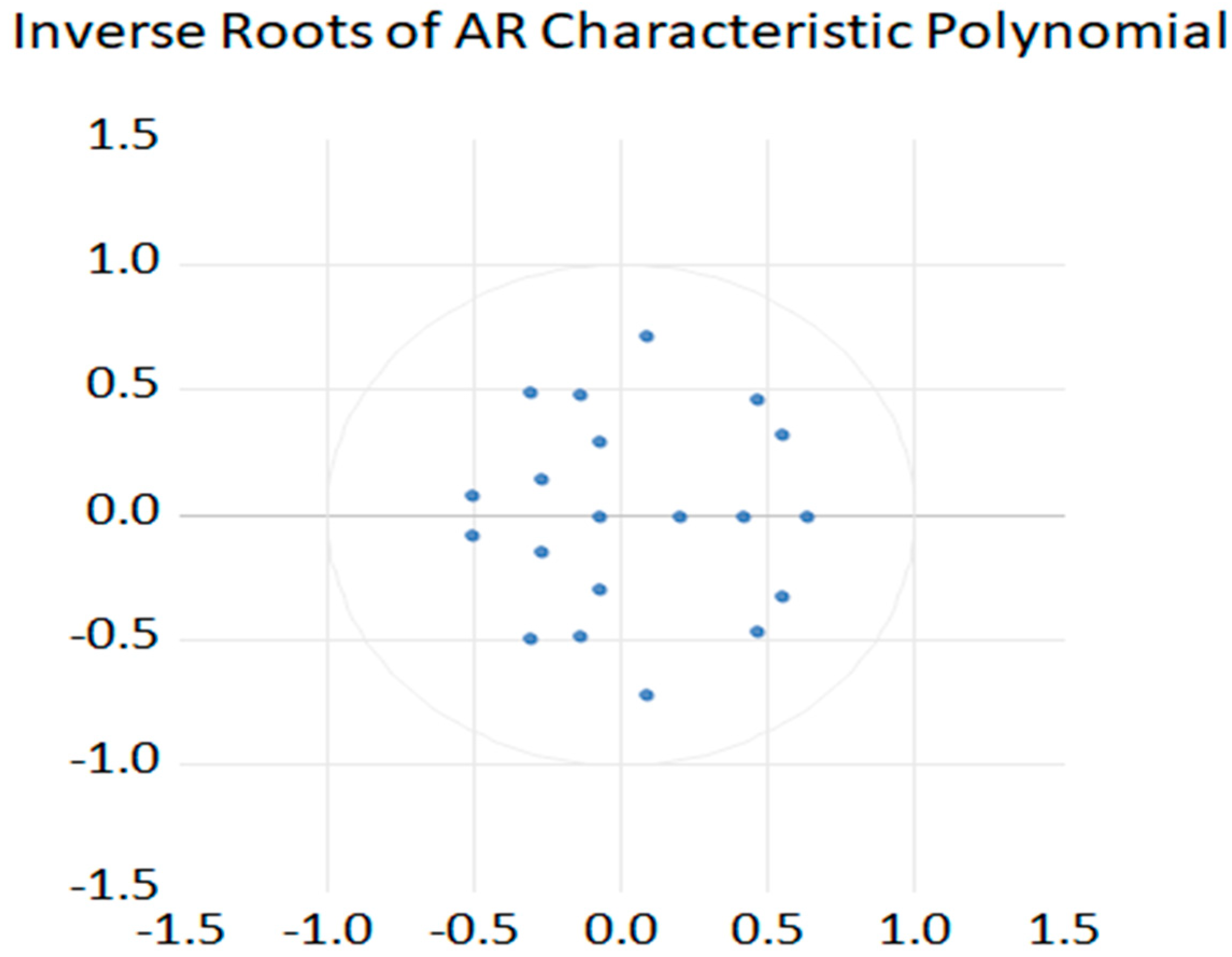
Dynamic stability. The AR roots of the estimated system remain strictly inside the unit circle (
Figure 10), confirming that the VAR is dynamically stable across the full sample.
Well-behaved impulse responses. The impulse responses exhibit smooth, economically plausible decay patterns rather than the erratic oscillations or explosive trajectories that would accompany severe structural instability.
Direct subsample stability check. As a further robustness exercise responding to the concern that the constant-parameter assumption may be strained by the polycrisis period, we re-estimate the MF-VAR on the pre-polycrisis subsample 2000Q4–2019Q4 (77 observations) and compare the coefficients to those of the full-sample estimate 2000Q4–2024Q1 (94 observations). The exercise targets the reviewer’s concern directly: if transmission parameters had shifted with the polycrisis, the two coefficient vectors would diverge materially, particularly along the dominant impulse response paths.
The comparison supports the constant-parameter specification. The dominant transmission coefficients are quantitatively stable across the two samples. CPI own-persistence at the third monthly lag is 0.946 (t = 8.37) in the pre-2020 estimate and 1.001 (t = 10.81) in the full sample. The policy rate own-persistence in the IR_3 equation moves from 1.325 (t = 9.63) to 1.084 (t = 10.14). CIPI own-persistence in the third-month block is 0.337 (t = 2.93) versus 0.483 (t = 4.61). Equation fits are likewise stable: the R2 for the inflation equation rises modestly from 0.69 to 0.73, and the R2 of the interest rate equation is essentially unchanged at 0.985 versus 0.984. The signs and broad orderings of the cross-lag pass-through coefficients (CIPI → CPI and CPI → IR) are preserved, and the coefficients that are statistically significant in the full sample are also significant—with the same sign—in the pre-2020 subsample.
Where individual coefficients differ in magnitude, the differences are concentrated in lags whose t-statistics fall below conventional significance thresholds in both samples and which contribute little to the impulse response paths. The system determinant, log-likelihood per observation, and the structure of significant coefficients across the ten equations are mutually consistent between the two windows. This is the pattern expected when D(LOG_CIPI) is stationary, and the polycrisis episodes enter the differenced system as unusually large innovations rather than as breaks in the propagation mechanism—precisely the interpretation advanced above. We therefore retain the full-sample MF-VAR as the baseline specification while reporting the pre-2020 estimates as a stability check; the substantive impulse response conclusions are unaffected.
Far from being a liability, the presence of crisis episodes in the sample is essential for identification. Crisis episodes—when D(LOG_CIPI) exhibits large positive or negative realizations—are precisely when the transmission channels are most strongly activated. Moreover, the crisis episodes share a critical feature that strengthens identification: they are overwhelmingly external and exogenous to the Republic of Moldova. The Asian and Russian financial crises, the global financial crisis, the oil price collapse, COVID-19, and the Ukraine conflict were not caused by the Republic of Moldova’s domestic conditions. The large D(LOG_CIPI) realizations associated with these episodes therefore provide exogenous identifying variation for the external transmission channel.
The resulting impulse responses should be interpreted as capturing transmission dynamics identified primarily by large external price movements. A one-standard-deviation shock to D(LOG_CIPI) in this sample reflects the historical volatility of the Republic of Moldova import prices, including crisis-period spikes. The estimated responses answer the policy-relevant question: on average, and under the assumption of stable transmission parameters, how do external price shocks—including those of crisis magnitude—transmit through the Republic of Moldova’s economy?
Given the large number of coefficients in the full Eviews output,
Table 11 reports only those parameters that are directly relevant for the transmission mechanism discussed below: (i) the pass-through from CIPI to CPI, (ii) the effect of CIPI on GDP, and (iii) the reaction of the policy rate to CPI and the impact of interest rates on GDP. Full results available in
Appendix B.
The estimates in
Table 11A, confirm two central results.
First, the coefficient of 0.2086 on @LAG(D(LOG_CIPI)_1,1) in the D(LOG_CPI)_2 equation provides an estimate of the short-run pass-through from CIPI to consumer prices: a 1% increase in CIPI raises CPI inflation, measured as D(LOG_CPI)_2, by about 0.21 percentage points of the inflation rate one quarter later. Since both variables are measured as log differences, the coefficient can be interpreted as an elasticity: roughly 21% of the external price shock is transmitted to consumer prices within one quarter. This quantitative pass-through is in line with the magnitudes suggested by the CIPI–CPI co-movements documented in
Section 4.
Second, the coefficient of 1.1060 on @LAG(D(LOG_CIPI)_2,1) in the D(LOG_GDP_D11) equation implies that a 1% increase in CIPI in the second month of the quarter raises measured quarterly nominal GDP growth by approximately 1.11 percentage points in the following quarter. This is a pure valuation effect, not a real-output response: when external prices jump to a new plateau, nominal GDP increases mechanically because more lei are spent on roughly unchanged import volumes. The coefficient, therefore, quantifies the accounting footprint of the shock on domestic currency expenditure flows, and should not be read as evidence of an economic boom in the welfare sense. The evidence supports the model on a like-for-like, domestic currency basis. Using IMF data on nominal GDP for Moldova (NGDP_NSA_XDC, unadjusted, MDL millions, author’s calculations on annual sums of quarterly observations), nominal GDP rose from 242.1 bn MDL in 2021 to 274.5 bn MDL in 2022 (+13.4% growth), then to 303.6 bn MDL in 2023 (+10.6%) at the height of the energy and food price shock, before moderating to 323.8 bn MDL in 2024 (+6.7%). This pattern shows that nominal GDP accelerated sharply during the 2022 commodity price shock and decelerated as prices normalized, exactly as the model implies. Critically, this acceleration is a nominal phenomenon. Comparing IMF data for Moldova on a like-for-like, domestic currency basis (NGDP_NSA_XDC for nominal GDP and NGDP_R_NSA_XDC for real GDP, both unadjusted, MDL millions, author’s calculations on annual sums of quarterly observations), nominal GDP grew by +13.4% in 2022, +10.6% in 2023 and +6.7% in 2024, while real GDP contracted by 4.65% in 2022 and grew only 1.2% in 2023 and 0.1% in 2024. The nominal–real wedge—about 18 percentage points in 2022 (the commodity-shock year itself), 9 pp in 2023 and 7 pp in 2024—is the empirical signature of the valuation channel identified by the model: most of the nominal acceleration documented above reflects revaluation of unchanged real flows rather than real expansion.
Table 11B documents the domestic policy reaction and the transmission mechanism. The coefficients on @LAG(D(LOG_CPI)_2,1) and @LAG(D(LOG_CPI)_2,2) in the IR_2 equation show that consumer price inflation is a strong driver of the policy rate. The coefficient of −0.0174 on IR_2(−2) in the D(LOG_GDP_D11) equation indicates that a 1 percentage point increase in the policy rate reduces the level of GDP by approximately 1.74% after two quarters. Overall, the goodness-of-fit statistics in
Table 11C indicate that the D(LOG_CPI)_2 and IR_2 equations are relatively well explained by the VAR, while the D(LOG_GDP_D11) equation, as is common in macroeconomic models, has more modest explanatory power but still passes standard joint significance tests. The relatively high R-squared for the interest rate equation is consistent with the idea that, in a polycrisis environment, the central bank reacts systematically to inflation signals rather than to idiosyncratic factors. More mechanically, the 0.964 R
2 is driven primarily by the strong own-persistence of the policy rate: the IR_2 equation contains its own lags, and the Republic of Moldova policy rates, like those of most inflation-targeting central banks, exhibit substantial interest rate smoothing. A high R
2 in a level (or near-level) policy rate equation that includes lagged dependent variables is expected and does not, by itself, indicate omitted variables; comparable R
2 values above 0.95 are routinely reported in the Taylor-rule literature (e.g.,
Clarida et al., 1999,
2000) for the same mechanical reason. The fit reflects rate persistence plus a systematic inflation response, not an absence of unmodeled drivers such as exchange rate interventions, IMF program conditionality, or political pressure; those enter the residual and are discussed in the response to reviewers.
Appendix F estimates a single-equation partial-adjustment rule on the same quarterly sample and finds R
2 = 0.900 with ρ = 0.72, confirming that high fit in this class of specification is driven by interest rate smoothing rather than by an absence of omitted determinants.
5.4. Model-Based Transmission of a 1% Shock
In interpreting the following impulse responses, it is important to recall that the polycrisis period documented in
Section 4 saw year-on-year increases in CIPI of around 15–17% at their peak. The 1% shocks considered here should therefore be viewed as unit shocks that can be scaled up to match the magnitudes observed during specific episodes. This scaling makes clear that the dynamic effects identified below are quantitatively large once embedded in the persistent, regime-shifted CIPI paths of the recent period.
We first consider a 1% positive shock to CIPI occurring in the middle of a quarter (month 2). Because the analysis uses nominal GDP (real GDP is unavailable for the full sample period, as discussed in
Section 3), the positive coefficient should be interpreted strictly as a valuation effect: it reflects the mechanical revaluation of import-intensive expenditure flows in domestic-currency terms—more lei spent on roughly unchanged import volumes—rather than an increase in real economic activity. This distinction matters for the interpretation of subsequent results: the welfare and purchasing-power implications discussed throughout the paper should be read primarily from the CPI response and its persistence, not from the nominal GDP impulse. The nominal GDP path documents the accounting footprint of the shock; the CPI path documents its real cost to households.
The two-lag mixed-frequency VAR indicates that a 1% increase in CIPI in month 2 raises quarterly GDP growth, D(LOG_GDP_D11), by approximately 1.11 percentage points of the growth rate in the subsequent quarter. This estimate is derived from the coefficient of 1.106 on @LAG(D(LOG_CIPI)_2,1) in the D(LOG_GDP_D11) equation (
Table 11A). From an economic standpoint, this suggests that higher CIPI is a strong predictor of higher aggregate nominal output in the short run. The Granger causality result in
Table 12, where D(LOG_CIPI)_2 significantly Granger-causes D(LOG_GDP_D11), further supports the view that CIPI contains meaningful predictive information regarding future output dynamics.
The same CIPI shock is partially transmitted to consumer prices. The coefficient of 0.2086 on @LAG(D(LOG_CIPI)_1,1) in the D(LOG_CPI)_2 equation implies that a 1% increase in CIPI leads to a 0.21% increase in CPI inflation in the following quarter. Since both variables are in log differences, the coefficient can be interpreted directly as an elasticity:
If, for example, the CPI inflation rate was otherwise expected to be 5.00%, this CIPI shock would raise it to roughly 5.21%. Interpreted as a pass-through ratio, approximately 21% of the CIPI price shock is transmitted to consumer prices within one quarter. In other words, when external commodity prices increase by 1%, retail prices increase by about 0.21%, indicating a meaningful but partial pass-through from the external commodity sector to the domestic cost of living.
The Granger causality evidence in
Table 12A confirms that D(LOG_CIPI)_1 significantly Granger-causes D(LOG_CPI)_2. Thus, the coefficient of 0.21 does not merely reflect a contemporaneous association; it captures a directional relation in which CIPI helps forecast future CPI. Importantly, this link appears in every structural regime detected in
Section 4, implying that the CIPI → CPI pass-through mechanism is stable even as the external price level shifts persistently to higher regimes.
We next consider a 1% increase in consumer inflation (CPI) in the middle of the quarter.
Effect on interest rates. The MF-VAR estimates a strong and systematic policy reaction to consumer price inflation. The coefficients of 44.689 and 62.211 on @LAG(D(LOG_CPI)_2,1) and @LAG(D(LOG_CPI)_2,2), respectively, in the IR_2 equation (
Table 11B) imply that a 1% CPI inflation shock leads the central bank to raise its policy rate by approximately 45 basis points in the next quarter:
This estimated reaction function shows that monetary policy in the Republic of Moldova responds systematically and substantially, with an implied long-run inflation response that is not statistically distinguishable from unity (point estimate ≈ 0.83 in the single-equation benchmark of
Appendix F, HAC 95% CI [0.32, 1.35]): the implied short-run Taylor-rule-type reaction coefficient is approximately 0.45, i.e., the policy rate rises by about 45 basis points per 1 percentage point increase in CPI inflation. Importantly, the policy reaction is to domestic consumer inflation rather than to commodity prices directly, underscoring the central bank’s focus on protecting household purchasing power. We emphasize that this coefficient is a reduced-form policy reaction estimate within the MF-VAR, not a fully specified structural Taylor rule: it relates the policy rate to lagged actual (realized) CPI inflation, with interest rate smoothing absorbed through the lagged IR terms in the same equation and any output-gap response absorbed through the GDP block of the system. Interpreted as a partial-adjustment Taylor-type rule, the 0.45 short-run coefficient combined with the high own-persistence of the policy rate implies a non-trivial long-run reaction to inflation. We caution, however, against reading the reduced-form coefficient as direct evidence that the Taylor principle (a long-run inflation response greater than unity) is satisfied: the coefficient is estimated on lagged realized inflation within a reduced-form system that does not separately identify the central bank’s response to expected inflation, and under the canonical forward-looking interpretation of
Clarida et al. (
2000) the coefficient on lagged actual inflation understates the true policy response of an inflation-targeting central bank. The National Bank of Moldova does not publish a continuous official inflation-forecast series for 1992–2025, so a fully forward-looking specification is left for future work. Consistent with this caution,
Appendix F estimates a single-equation partial-adjustment rule on the same quarterly sample and finds that the Taylor principle can be neither confirmed nor rejected on realized-inflation specifications (long-run response ≈ 0.83, HAC 95% CI [0.32, 1.35]), reinforcing the case for the forward-looking extension noted above.
However, a small direct CIPI → interest rate signal is detectable in the estimates: IR_2 has a statistically significant coefficient on a specific CIPI sub-series (for example, D(LOG_CIPI)_3(−2) with a coefficient around −24.29 and t ≈ −1.83). While the text emphasizes CPI as the primary policy driver—a view clearly supported by the magnitude of the coefficients—this estimate suggests some direct sensitivity of the policy rate to specific CIPI sub-series as well.
The Granger causality results in
Table 12B provide an independent confirmation of this behavior. D(LOG_CPI)_2 significantly Granger-causes both IR_2 and IR_3 (
p = 0.0067 and
p = 0.0199, respectively), indicating that consumer price inflation has statistically significant predictive content for the policy rate. This is precisely the behavior expected from an inflation-responsive central bank and strongly supports treating the CPI-to-interest rate link as a structural reaction function rather than a spurious correlation. In the context of the polycrisis regime, this reaction mechanism implies that repeated external price shocks translate into sequences of rate hikes, contributing to the “stop” phase of the stop–go cycle.
Finally, we analyze the impact of a 1 percentage point (100 basis point) increase in the policy interest rate.
Effect on GDP. The two-lag model finds a significant negative effect of higher interest rates on GDP, but only with a delay. The coefficient on IR_2(−2) in the D(LOG_GDP_D11) equation is −0.0174 (
Table 11B), implying that a 1 percentage point increase in the policy rate reduces the level of GDP by approximately 1.74% after two quarters. Statistical inspection confirms that this effect attains conventional significance at the |t| > 1.65 threshold adopted in this chapter (t ≈ −1.94), although it would be regarded as only marginally significant under stricter two-tailed 5% criteria. This borderline evidence is consistent with a cautious interpretation of the lag structure: the transmission to output is not immediate and only becomes visible once a two-lag specification is employed.
The negative sign aligns with the conventional contractionary role of monetary tightening, while the estimated timing underscores that the impact on aggregate demand materializes with a delay rather than contemporaneously. Notably, this effect was not captured in a one-lag model, which erroneously suggested that interest rates were largely insignificant for GDP. The two-lag specification reveals that the impact of policy operates with a longer horizon, such that a short-lag model “does not look back far enough” to capture the full nominal dampening effect of tightening.
Although the individual Granger-exclusion tests for interest rates in the GDP equation are only borderline significant, the joint “All” test in
Table 12C clearly rejects exogeneity for the D(LOG_GDP_D11) equation, consistent with output responding to the broader macroeconomic environment, including monetary conditions.
In
Table 13, we report the response to a hypothetical 1 percentage point increase in the growth rate (log-difference) of CIPI/CPI, i.e., a 0.01 change in D(LOG_CIPI) or D(LOG_CPI), computed directly from the VAR coefficients. The key quantitative results of the two-lag MF-VAR can be summarized as follows:
These responses from
Table 13 jointly reveal a cyclical pattern:
CIPI shocks raise nominal GDP strongly and quickly (≈+1.1% effect on the level of GDP from a 1% CIPI shock in month 2).
Rising CPI induces a strong monetary policy reaction (≈+45 basis points per 1% CPI inflation shock).
Higher interest rates eventually depress GDP (≈−1.7% effect on the level) after about six months.
The coefficient estimates in
Table 11 and the predictive relationships in
Table 12 provide the econometric backbone for this impulse response narrative. When these model-based dynamics are combined with the persistent, regime-shifted CIPI path documented earlier, they produce a clear macro picture: successive external shocks push the economy into repeated nominal “booms” that are later corrected by policy tightening.
5.5. Dynamic Trajectories: Impulse Response Analysis
While the VAR coefficient estimates presented in the preceding sections establish the statistical significance of the transmission channels linking external commodity prices, domestic inflation, monetary policy, and economic activity, they do not fully capture the timing, magnitude, or persistence of macroeconomic shocks as they propagate through the Republic of Moldova’s economy. To analyze the dynamics of the stop–go cycle with greater precision, we therefore turn to impulse response functions (IRFs). These trace the reaction of endogenous variables to a one-standard-deviation orthogonal shock over an eight-period horizon, allowing us to observe how disturbances unfold, amplify, and eventually dissipate across the system. Full results in
Appendix D.
The IRF analysis serves three principal objectives. First, it provides a temporal mapping of the transmission mechanism, revealing the sequence and timing of responses that underpin the stop–go cycle. Second, it quantifies the economic magnitude of each link in the transmission chain, enabling assessment of policy-relevant elasticities. Third, it uncovers structural features of the Republic of Moldova’s economy—including shock persistence, pass-through asymmetries, and policy reaction patterns—that have important implications for macroeconomic management in a small, open, import-dependent economy.
The interpretation of impulse responses depends critically on how each variable enters the VAR system. We employ the following conventions throughout this analysis:
Variables modeled in growth rates (D(LOG_GDP_D11), D(LOG_CPI), D(LOG_CIPI)) are reported as accumulated (cumulative) responses and converted to percentage terms by multiplying by 100. The accumulated response represents the total change in the level of the underlying variable relative to its pre-shock baseline. For example, an accumulated response of +1.26% for GDP indicates that the level of GDP is 1.26% higher than it would have been in the absence of the shock. This transformation is essential because it reveals whether shocks leave permanent level shifts in the economy—a key feature of the persistent, regime-dependent dynamics documented in earlier chapters and of the inflation persistence literature (
Stock & Watson, 2007;
Cogley & Sargent, 2005;
Benati, 2008) within which the CPI-side results are interpreted.
Variables modeled in levels (the policy interest rate IR) are reported as instantaneous (non-accumulated) responses, expressed in percentage points. This shows the deviation of the policy rate from its baseline trajectory at each horizon. We use instantaneous rather than accumulated responses for interest rates because policy rates are set as levels (not changes), and the instantaneous response directly captures the policy stance at each point in time.
A critical feature of the U-MIDAS framework employed in this study is the mixed-frequency structure that nests monthly observations within quarterly aggregates. The VAR system includes three monthly observations per quarter for the high-frequency variables (CIPI, CPI, and interest rates), denoted by subscripts 1, 2, and 3 corresponding to the first, second, and third months of each quarter, respectively. GDP, as a quarterly flow variable, enters as a single observation per quarter. The IRF horizon of eight periods corresponds to eight quarters (approximately two years) following the initial shock.
The inclusion of three monthly observations per quarter for each high-frequency variable introduces an important dimension of heterogeneity: the timing of a shock within the quarter may affect its transmission dynamics. A shock arriving in the first month of a quarter (e.g., D(LOG_CIPI)_1) has a different information structure and adjustment window than a shock arriving in the third month (e.g., D(LOG_CIPI)_3). This within-quarter heterogeneity, which is typically suppressed in standard quarterly VARs, provides novel insights into the microstructure of macroeconomic transmission.
The Cholesky identification scheme orders variables as follows:
This ordering embodies the identifying assumption that external commodity prices are determined in world markets and are thus contemporaneously exogenous to domestic variables in the Republic of Moldova. Domestic consumer prices respond to import prices within the quarter but do not affect them. Monetary policy responds to both external and domestic price developments but does not contemporaneously affect prices. GDP, as the most sluggish variable and as a quarterly aggregate, is ordered last and responds to all other variables within the quarter.
All impulse responses presented in this section correspond to one-standard-deviation orthogonal shocks applied to the VAR residuals. Throughout this subsection, any reference to a “shock” should be understood as referring specifically to these one-standard-deviation innovations.
We begin the analysis of the “go” phase by examining the response of domestic GDP (D(LOG_GDP_D11), cumulated to a level effect) to shocks in external commodity prices (D(LOG_CIPI)). The central hypothesis is that, in a highly import-dependent economy such as Moldova, external price increases initially manifest as nominal expansion—higher import values translate mechanically into higher measured nominal activity—before the volume effects of reduced purchasing power and monetary tightening generate contraction.
The results from
Table 14 confirm this counterintuitive nominal boom hypothesis. A one-standard-deviation shock to CIPI in the first month of the quarter (D(LOG_CIPI)_1) leads to a positive and accumulating deviation in the GDP level, reaching a peak of +1.26% by Period 3 (approximately 6–9 months after the shock). This finding is consistent with the mechanical pass-through of higher import values into measured nominal economic activity in an economy where imports constitute a substantial share of aggregate expenditure.
The dynamics reveal a clear pattern: the instantaneous GDP growth contributions (changes in D(LOG_GDP_D11)) are positive through Period 3, turn negative in Period 4 (−0.47%), indicating the onset of the correction phase, and then oscillate near zero as the economy stabilizes. Crucially, the accumulated level effect does not return to zero; it stabilizes at approximately +0.76% by Period 8, indicating a persistent (though diminished) elevation of nominal activity relative to the counterfactual baseline.
A distinctive contribution of the U-MIDAS framework is the ability to examine whether the timing of a shock within the quarter affects its transmission.
Table 15 presents the accumulated GDP responses to shocks in each of the three within-quarter CIPI observations, revealing striking heterogeneity in transmission strength. A shock to D(LOG_CIPI)_2 (mid-quarter) produces the largest GDP response, generating a peak GDP level effect of +2.27% at Period 3—nearly twice the magnitude of the D(LOG_CIPI)_1 response (+1.26%). The final accumulated effect at Period 8 is +1.74%, more than double that of D(LOG_CIPI)_1 (+0.76%). In contrast, a shock to D(LOG_CIPI)_3 (end of quarter) produces the smallest GDP response, with the accumulated response peaking at only +0.36% at Period 4. Shocks in the first month (D(LOG_CIPI)_1) produce an intermediate response with a peak of +1.26% and a final effect of +0.76%.
From
Table 15 we can infer that the pronounced heterogeneity in transmission strength across within-quarter timing likely reflects differences in information availability and adjustment horizons. A shock arriving mid-quarter (D(LOG_CIPI)_2) may capture the “sweet spot” where price information has been absorbed by economic agents but insufficient time remains for defensive adjustments (inventory drawdowns, demand substitution, or policy responses) to dampen the pass-through. Early quarter shocks (D(LOG_CIPI)_1) allow more time for within-quarter adjustment, while late-quarter shocks (D(LOG_CIPI)_3) may be partially anticipated or may arrive too late to fully affect that quarter’s measured activity.
This finding has important implications for policy and forecasting: the timing of external price shocks within the quarter is not merely a technical detail but a substantively important determinant of macroeconomic impact. Models that aggregate monthly commodity prices to quarterly frequency may systematically misestimate transmission elasticities depending on the typical within-quarter timing of price movements.
A central pillar of the stop–go narrative is the pass-through of external commodity prices to domestic consumer prices. We examine this channel by tracking the response of CPI in the second month of the quarter, CPI_2 (with its growth rate captured by D(LOG_CPI)_2), to CIPI shocks.
The impulse response confirms that transmission from external CIPI prices to domestic consumer prices is both rapid and persistent.
From
Table 16, we can see that, following a CIPI shock, the domestic price level (as measured by the accumulated response of D(LOG_CPI)_2 converted to levels) rises notably through Period 2 (+0.33%) and continues to build gradually, reaching a peak of approximately +0.38% around Period 5. The accumulated effect does not revert to zero; it stabilizes at +0.36% by Period 8. This provides model-based evidence of permanent CPI level shifts following an import-cost shock—the empirical signature of high inflation persistence in a small open economy with imperfectly anchored expectations (
Stock & Watson, 2007;
Cogley & Sargent, 2005;
Benati, 2008). When external price shocks dissipate, domestic prices do not fall back to their pre-shock baseline; instead, the economy absorbs the disturbance as a permanent increase in the cost of living. We note that this is evidence of permanent level effects, not of directional asymmetry in adjustment.
The long-run pass-through coefficient implied by these results is approximately 0.36, indicating that roughly 36% of an external commodity price shock is permanently transmitted to the domestic consumer price level.
Paralleling the GDP analysis, we examine whether the within-quarter timing of CIPI shocks affects the magnitude of pass-through to consumer prices. The pass-through dynamics exhibit notable variation across shock timing. Shocks to D(LOG_CIPI)_1 generate the largest and most persistent CPI pass-through, stabilizing at +0.36% by Period 8. Shocks to D(LOG_CIPI)_2 produce a somewhat smaller pass-through (+0.26% by Period 8), despite generating the largest GDP response. Shocks to D(LOG_CIPI)_3 show the smallest pass-through (+0.15% by Period 8).
The divergence between GDP and CPI responses to D(LOG_CIPI)_2 in
Table 17 is noteworthy: mid-quarter import price shocks generate large nominal GDP effects but relatively moderate consumer price pass-through. This pattern suggests that the GDP response to D(LOG_CIPI)_2 may be driven primarily by the mechanical revaluation of import-intensive expenditure categories rather than by broad-based inflationary pressure. Alternatively, mid-quarter shocks may trigger more rapid inventory adjustments or import substitution that buffer the pass-through to final consumer prices.
A critical question for understanding the stop–go mechanism is whether the NBM reacts directly to external import prices or primarily responds once these pressures manifest in domestic inflation. We address this question by comparing the interest rate response to CIPI shocks versus CPI shocks. The IRF reveals a distinct transmission lag in the monetary policy response to external price shocks.
In Period 1 of
Table 18, the response of the policy rate to a CIPI shock is slightly negative (−0.12 percentage points), indicating that the central bank does not immediately tighten in response to higher import prices alone. As the pass-through to domestic CPI materializes (
Table 16), the NBM initiates a tightening cycle that peaks at approximately +0.60 percentage points by Period 5—roughly 12–15 months after the initial external shock. This lag between the external shock and peak policy restriction is central to the amplitude of the stop–go cycle: monetary “brakes” are applied most forcefully several quarters after the initial external impulse, often at a point when the nominal boom is already fading, and the economy may be transitioning toward weakness.
The identification ordering ensures that monetary policy cannot respond to GDP contemporaneously, ruling out reverse causality from output to interest rates within the quarter. This strengthens the interpretation that the lagged policy response reflects information lags and the NBM’s focus on domestic CPI rather than a methodological artifact.
This asymmetry reflects both the NBM’s inflation-targeting mandate—which prioritizes domestic consumer price stability over external price developments—and the information structure facing policymakers, who observe domestic CPI with greater precision and relevance than global commodity price movements.
To test whether the NBM responds more strongly to domestic inflation than to external prices, we compare the cumulative interest rate response to CPI shocks versus CIPI shocks.
In
Table 19, we see that the NBM responds far more aggressively to domestic CPI shocks than to external CIPI shocks. The cumulative interest rate response to a D(LOG_CPI)_2 shock (+6.78 percentage points by Period 8) is more than 2.5 times larger than the response to a D(LOG_CIPI)_1 shock (+2.63 percentage points). Even comparing peak instantaneous responses, the D(LOG_CPI)_2 response (+1.36 percentage points) exceeds the D(LOG_CIPI)_1 response (+0.60 percentage points) by a factor of more than two.
This finding has important implications for the transmission mechanism. It suggests that the NBM’s reaction function is oriented primarily toward domestic inflation outcomes rather than external price developments. The central bank appears to “look through” import price shocks to some degree, tightening policy forcefully only once external pressures have passed through to domestic consumer prices. This indirect transmission—CIPI → CPI → IR—introduces an additional lag into the policy response, potentially amplifying the boom phase of the cycle before corrective action takes effect.
This behavior may reflect an inflation-targeting framework that prioritizes domestic price stability over external price developments, recognizing that not all import price movements translate fully or permanently into domestic inflation. However, in an economy with high and persistent pass-through (as documented in
Section 5.4), this approach may result in systematically delayed policy responses that allow inflationary pressures to become entrenched before monetary tightening begins.
To complete the stop–go narrative, we examine the response of GDP to interest rate shocks, testing whether monetary tightening effectively contracts economic activity. The transmission mechanism is both effective and economically significant.
A one-standard-deviation monetary policy shock (to IR_2) leads to a cumulative decline in the GDP level of approximately −1.22% by Period 6, with the maximum contractionary effect reached approximately 15–18 months after the initial rate hike. This confirms that, although the policy response to external shocks is delayed (peaking only in Period 5 relative to the initial CIPI shock, as documented in
Section 5.5), it exerts potent effects once implemented.
The dynamic path in
Table 20 exhibits several noteworthy characteristics. First, the contractionary adjustment is non-monotonic. In Period 2, there is a temporary partial reversal of the contraction, with a positive instantaneous GDP growth contribution of 0.12%. This deviation may reflect anticipation effects, intertemporal substitution, or short-run demand being brought forward in response to expected future tightening. Nevertheless, the subsequent periods display persistently negative growth contributions, with the impact reaching its lowest point in Period 6.
Second, the trajectory indicates a gradual recovery. The improvement observed between Periods 7 and 8, where the cumulative impact narrows from −1.22% to −0.90%, suggests that the contractionary effects begin to dissipate as monetary policy normalizes. Despite this partial recovery, a permanent level reduction of approximately 0.9% remains at the eight-quarter horizon, implying that monetary policy shocks exert lasting effects on the Republic of Moldova’s economy.
A comparison with the boom phase reveals that the magnitude of the contractionary response to IR_2 (−1.22% at the trough) is similar to, but slightly smaller than, the expansionary response to D(LOG_CIPI)_2 (+2.27% at the peak). This near-symmetry indicates that monetary policy can, in principle, counteract a substantial share of the nominal boom induced by external price shocks. However, the timing discrepancy—where the policy response peaks in Period 5 while the boom peaks in Period 3—implies that the restrictive stance arrives after the upswing has already begun to wane, potentially amplifying cyclical volatility.
A key feature of the stop–go cycle is the high persistence of consumer prices: inflationary shocks tend to be absorbed permanently into the price level rather than reversed. We examine this property by analyzing the response of consumer prices to their own shocks. The results provide strong evidence of near-complete inflation persistence in the Republic of Moldova’s economy—the empirical pattern characterized by
Stock and Watson (
2007),
Cogley and Sargent (
2005), and
Benati (
2008) as the signature of a high permanent-component share when the monetary anchor is imperfectly credible.
From
Table 21 for CPI_1, shocks to consumer prices in the first month of the quarter exhibit only limited decay: the effect in Period 8 (+0.50%) remains approximately 83% of the Period 1 effect (+0.60%), indicating relatively modest mean reversion.
For CPI_2, persistence is even more pronounced. Shocks to consumer prices in the second month of the quarter are amplified rather than attenuated up to Period 4, before stabilizing. The Period 8 effect (+0.70%) exceeds the Period 1 effect (+0.60%), yielding a persistence ratio of around 117% and suggesting the presence of second-round effects or indexation mechanisms that magnify the initial disturbance. The persistence ratio exceeding 100% suggests the presence of amplification mechanisms—potentially including wage–price spirals, exchange rate-depreciation feedback, or backward-looking indexation practices—that cause the initial shock to propagate and intensify rather than merely persist.
For CPI_3, shocks to consumer prices in the third month display essentially full persistence, with the Period 8 effect (+0.78%) almost identical to the Period 1 effect (+0.77%), corresponding to a persistence ratio of roughly 101%.
These patterns have far-reaching macroeconomic implications. First, they imply that temporary shocks have permanent effects: external disturbances that push up consumer prices, even briefly, become embedded in the price level, with no automatic tendency for prices to revert to their pre-shock path. Second, the costs of inflation are cumulative. Each inflationary episode leaves the price level permanently higher, so the losses in purchasing power for households and in competitiveness for exporters are not recovered once the original shock dissipates. Third, disinflation requires active policy intervention. Reducing the inflation rate alone is insufficient to restore the previous price level; achieving a lower level of prices would demand a sustained contractionary stance, entailing non-trivial economic costs. Finally, the high degree of persistence is consistent with predominantly backward-looking inflation expectations, potentially reinforced by formal and informal indexation practices that transmit current inflation into future wage and price setting.
For completeness, in
Table 22, we also examine the persistence of GDP in response to its own shock. GDP exhibits approximately 86% persistence over the eight-quarter horizon. A one-standard-deviation shock to GDP growth (D(LOG_GDP_D11)) generates a level effect of +3.77% in Period 1, which declines only slightly to +3.26% by Period 8. This high degree of persistence implies that output shocks have lasting effects: positive (or negative) growth surprises translate to a substantial and enduring change in the level of economic activity.
This suggests that the economy does not quickly revert to its trend path. In contrast to textbook models featuring strong mean reversion, the Republic of Moldova’s economy appears to absorb output disturbances with only limited subsequent correction. Taken together with the evidence presented in Output Effects of Monetary Policy, these findings further imply that policy shocks—particularly those arising from monetary policy interventions that influence output—may exert permanent rather than purely transitory effects on the level of activity.
The impulse response analysis presented in this section provides comprehensive econometric validation of the stop–go hypothesis and reveals the detailed mechanics of macroeconomic transmission in the Republic of Moldova. The identification structure embodies a coherent causal chain validated across all key transmission channels.
Table 23 documents the identification structure of an empirical model using a recursive ordering: CIPI (commodity/import prices) → CPI (consumer prices) → IR (interest rate) → GDP, with each transmission channel verified and certain feedback loops blocked. The first verified channel, CIPI → CPI, represents import price pass-through, where external price shocks (oil, commodities, exchange rates) affect domestic consumer prices contemporaneously, reflecting a small open economy where domestic prices are price takers in global markets. The CIPI → IR (indirect) channel operates through domestic inflation, creating a transmission chain where external price shocks first affect CPI and then indirectly influence the policy rate through the central bank’s inflation response. The direct CPI → IR link represents the policy reaction function, allowing the central bank to adjust interest rates contemporaneously based on observed inflation in a Taylor-rule fashion. The IR → GDP channel validates the standard monetary transmission mechanism, where interest rate changes affect activity by altering borrowing costs and financial conditions, with causality running unidirectionally from policy to output.
Two blocked channels prevent problematic reverse causality: GDP ↛ IR ensures that output cannot contemporaneously affect the policy rate, reflecting that GDP data arrive with delays, so central banks react to lagged or forecasted activity rather than current realizations, which is crucial for identifying exogenous policy shocks. Similarly, GDP ↛ CPI rules out contemporaneous demand-pull inflation, assuming that demand pressures affect prices only with lags due to sticky prices and contracts, allowing the model to attribute short-run inflation movements primarily to external cost shocks and policy responses rather than instantaneous demand effects. Overall, the table serves as both a technical description of the contemporaneous causal ordering and an economic validation that the model reproduces the expected structure of import price pass-through, inflation-driven policy reactions, and monetary transmission while explicitly ruling out reverse causality that would complicate identification of these fundamental channels.
The complete stop–go cycle unfolds through five distinct phases. Phase 1 (Periods 1–3) in
Table 24 begins with a shock to external commodity prices. A one-standard-deviation increase in CIPI generates an immediate positive impulse to nominal GDP, reflecting the mechanical pass-through of higher import values into measured economic activity. The boom accelerates through Period 2 and peaks at Period 3, with the GDP level elevated by approximately +1.26% for shocks to D(LOG_CIPI)_1, or as much as +2.27% for shocks to D(LOG_CIPI)_2. This resolves an apparent puzzle in Moldova’s macroeconomic data: periods of rising import prices often coincide with robust measured GDP growth, despite the theoretical expectation that higher import prices should reduce purchasing power. The resolution lies in the recognition that nominal GDP responds positively to import price increases before the volume effects generate contraction.
In Phase 2 (Periods 1–5) in
Table 25, concurrent with the nominal boom, external price pressures pass through to domestic consumer prices. The pass-through begins immediately (Period 1) and accumulates through Period 5, at which point the consumer price level is elevated by approximately +0.38% relative to baseline. Crucially, the pass-through is persistent: the price level elevation does not reverse when the external shock dissipates, with a final pass-through of +0.36% remaining at Period 8. This persistent pass-through—consistent with the high-permanent-component characterization of inflation in
Stock and Watson (
2007),
Cogley and Sargent (
2005), and
Benati (
2008)—means that each commodity price shock leaves a permanent imprint on the domestic cost of living.
Phase 3 (Periods 2–5) in
Table 26 sees the NBM responding to the emerging inflationary pressures with a lag. Policy remains essentially unchanged in Period 1, with the tightening cycle beginning in Period 2 and reaching its peak intensity at Period 5 (+0.60 percentage points for CIPI-driven tightening; substantially larger for CPI-driven responses). The comparison between CIPI and CPI responses reveals that the NBM responds about 2.5 times more aggressively to domestic inflation than to external price shocks, confirming that the monetary transmission operates primarily through domestic inflation rather than directly through import prices—an indirect trigger mechanism that introduces additional lags into the policy response.
In Phase 4 (Periods 3–6) in
Table 27, as monetary tightening takes effect, GDP growth decelerates and then contracts. The cumulative output loss reaches approximately −1.22% by Period 6, roughly 15–18 months after the initial external shock and about one year after the peak of the nominal boom. The timing mismatch is critical: the “stop” arrives substantially after the “go” has peaked, creating a procyclical pattern where restrictive policy is applied most forcefully as the economy is already weakening.
Finally, in Phase 5 (Periods 7–8) in
Table 28, both policy and output begin to normalize. Interest rates ease from their peak (declining from +0.60 percentage points to +0.18 percentage points), and GDP recovers from its trough (improving from −1.22% to −0.90%). However, permanent effects remain: the consumer price level remains elevated (+0.36%); GDP remains below its counterfactual path (−0.90%); and the cumulative policy tightening, though diminishing, remains positive (+0.18 percentage points).
The stop–go mechanism documented in
Table 29 of this analysis has several important implications for macroeconomic policy in the Republic of Moldova. First, external vulnerability is structural. The economy’s high sensitivity to commodity price shocks—generating both nominal booms and subsequent contractions—reflects deep structural features: import dependence, limited domestic production capacity, and an open capital account. These features are not easily altered by macroeconomic policy. Second, the near-complete inflation persistence documented on the CPI side of the system imposes cumulative welfare costs identified from the CPI response rather than from the nominal GDP response. Persistence ratios of 83–117% (documented above) indicate that each commodity price cycle leaves a permanent upward shift in the price level and therefore a permanent reduction in real purchasing power for the Republic of Moldova households—the welfare consequence of operating with imperfectly anchored inflation expectations in the sense of
Stock and Watson (
2007),
Cogley and Sargent (
2005), and
Benati (
2008). Because the nominal GDP impulse documented here is largely a valuation effect, the welfare assessment rests on this CPI channel rather than on nominal-output dynamics. Third, monetary policy timing is critical but constrained. The documented lag between external shocks and peak policy response (approximately 4–5 quarters) reflects the indirect transmission through domestic inflation. Earlier intervention would require the central bank to respond to external prices before their domestic effects materialize—a potentially controversial policy stance that could be criticized as premature or based on transitory external developments. Fourth, the procyclical pattern amplifies volatility. The timing mismatch—with tightening peaking as the boom fades—may amplify rather than dampen cyclical fluctuations. This suggests potential gains from forward-looking policy frameworks that anticipate the pass-through dynamics rather than responding reactively to observed domestic inflation. Finally, within-quarter timing matters for forecasting and policy. The heterogeneity in transmission strength across within-quarter timing has practical implications for economic monitoring. Mid-quarter commodity price movements (D(LOG_CIPI)_2) generate particularly strong output effects, suggesting that real-time monitoring of monthly price data may provide early warning of emerging macroeconomic pressures.
Several novel contributions emerge from the analysis. The U-MIDAS framework reveals that mid-quarter import price shocks generate nearly twice the GDP impact of beginning-of-quarter shocks, a finding with important implications for forecasting and policy timing. The central bank responds about 2.5 times more aggressively to domestic inflation than to external price shocks, confirming the indirect transmission mechanism and explaining the observed policy lags. Consumer price shocks show persistence ratios of 83–117%, providing model-based evidence of near-complete inflation persistence and its welfare implications. The analysis provides precise estimates of key transmission parameters—pass-through coefficients, policy reaction elasticities, and output multipliers—that can inform calibration of structural models and design of policy rules. They show that the Republic of Moldova’s vulnerability consists not only in exposure to volatile import prices, but also in a systematic stop–go cycle in which policy responses to inflation reproduce a pattern of temporary booms and delayed contractions. The concluding chapters draw out the implications of this mechanism for policy design, discuss the study’s limitations, and suggest directions for further research.






 Yes
Yes