
Review

A Structured Literature Review of Remittances, Migration and Economic Policymaking in Countries of Origin: Evidence from Kenya, Kerala (India) and Sri Lanka

1
School of Demography, Australian National University, Canberra 0200, Australia
2
PoliSync Centre for International Policy Engagement, 1204 Geneva, Switzerland
3
African Migration and Development Policy Centre, Nairobi 00800, Kenya
4
International Institute of Migration and Development, Trivandrum 695011, India
*
Author to whom correspondence should be addressed.
Economies 2026, 14(6), 205; https://doi.org/10.3390/economies14060205
Submission received: 27 March 2026 / Revised: 15 May 2026 / Accepted: 18 May 2026 / Published: 3 June 2026
(This article belongs to the Special Issue Unveiling the Power of Remittances: Drivers, Effects, and Trends)

Abstract

This article presents a structured literature review of remittances, migration and economic policymaking in countries of origin, with a focus on Kenya, Kerala (India), and Sri Lanka. It examines three linked bodies of scholarship: migration as a driver of economic growth, the political economy of migration policymaking, and evidence-informed policymaking (EIPM). Conducted with a scoping orientation, the review focuses on contemporary academic and policy literature published since 2000 and shows that the evidence base on the economic value of international remittances in the context of labour migration is extensive, including findings on poverty reduction, macroeconomic stability, financial inclusion and diaspora engagement. However, this evidence is unevenly integrated into policymaking. The review finds that under-utilisation is not simply a problem of insufficient data or weak analytical capacity. Rather, it reflects structural, political and epistemic dynamics that shape how evidence is produced, legitimised, filtered and used in origin-country settings. It further shows that destination-centred perspectives continue to dominate migration scholarship, while gender and digitalisation are best understood as cross-cutting features of evidence systems rather than peripheral themes. The article concludes that strengthening the developmental contribution of migration and remittances requires greater attention to the institutional and political conditions under which economic evidence becomes policy-relevant and actionable.

1. Introduction

International migration has become an increasingly central feature of contemporary development processes, with growing recognition of its potential to contribute to economic growth in countries of origin. Among the various channels through which migration shapes development outcomes, international remittances have received particular attention due to their scale, growth and direct impact on households and national economies (World Bank, 2019; Ratha, 2013; Khan, 2025). In many low- and middle-income countries, remittance inflows exceed foreign direct investment (FDI) and official development assistance (ODA), positioning migration as a critical, if uneven, driver of economic transformation (World Bank, 2019; Khan, 2025).
Despite this, the economic contributions of migration, and remittances in particular, remain unevenly integrated into policymaking in origin countries. While a substantial body of literature has documented the macroeconomic and microeconomic effects of international remittances, including their roles in poverty reduction, consumption smoothing, investment, and financial inclusion, less is known about how this evidence is interpreted, filtered and used within policymaking processes (Giuliano & Ruiz-Arranz, 2009; IMF, 2015; OECD, 2017). In practice, migration policy is often shaped as much by political narratives, institutional constraints and geopolitical dynamics as by economic evidence, resulting in a persistent gap between the documented developmental potential of migration and its policy uptake (Boswell, 2009; De Haas & Vezzoli, 2011; Natter & Welfens, 2024).
This article addresses that gap through a structured review of the literature on migration as a driver of economic growth in countries of origin, with a particular focus on remittances, labour mobility and diaspora engagement as policy-relevant economic levers in the context of evidence-informed policymaking (EIPM). It critically examines not only what is known about the economic impacts of migration, but also how such knowledge is mobilised (or not) within policymaking systems. In doing so, the article contributes to an emerging body of work on the political economy of evidence use in developing countries, highlighting the processes through which certain forms of evidence gain traction while others are marginalised.
The review has been developed in the context of a research project funded by the United Kingdom’s Foreign, Commonwealth & Development Office (FCDO), which examines migration as an economic asset in policymaking contexts in selected origin settings (Kenya, Kerala (India) and Sri Lanka).1 The project focuses on how evidence on migration’s economic contributions is generated, interpreted and applied in practice, with particular attention to countries with significant labour emigration and remittance inflows.2 While the empirical components of the project are ongoing, this article provides the conceptual and analytical foundation by reviewing existing literature across economics, development studies and political science.
The choice of Kenya, Kerala (India) and Sri Lanka is consistent with the wider geographic scope of the FCDO programme, which encompasses Sub-Saharan Africa and South Asia, while also focusing on origin settings in which migration is increasingly visible as an economic asset through international remittances, labour emigration strategies and diaspora engagement. These cases were selected because they combine significant labour emigration and remittance relevance with distinct policy and institutional contexts, including Kenya and Sri Lanka as national cases and Kerala as a subnational case with a particularly well-developed migration evidence base. This scope allows for an examination of how migration-related evidence is interpreted and used across different origin-country policymaking environments.
The analysis proceeds in three steps. First, it reviews the literature on migration as a driver of economic growth, with particular emphasis on the scale, characteristics and impacts of remittances and related financial flows. Second, it examines the political economy of migration policymaking, highlighting how migration is framed, contested and governed across different contexts. Third, it analyses the use of evidence in migration-related policymaking, drawing on the EIPM literature to explore how economic evidence on migration is filtered through institutional and political processes. Across these sections, the article reviews global literature as well as existing evidence on the three study locations (Kenya, Kerala (India) and Sri Lanka).
By bringing together these strands of literature, the article advances a more integrated understanding of migration, international remittances and policymaking in origin countries. It finds that the evidence based on the economic value of international remittances is extensive. However, the review also shows that the under-utilisation of migration-related economic evidence is not simply a problem of data availability or analytical capacity. Rather, it reflects deeper structural, political and epistemic dynamics that shape how evidence is produced, legitimised and used in origin-country settings. This has important implications for both research and policy, suggesting that efforts to strengthen the developmental impact of migration and remittances must engage not only with economic mechanisms but also with the institutional and political contexts in which evidence is embedded.
The next section outlines the review methodology. Section 3 provides a brief overview of migration and remittance patterns in Kenya, Kerala and Sri Lanka. Section 4 reviews the literature on migration as an economic driver, including remittances, labour mobility and diaspora engagement. Section 5 examines migration, politics and policy framing in countries of origin, and Section 6 analyses evidence use and non-use in migration-related economic policymaking, including the implications of digitalisation and AI. Section 7 draws together the main conceptual gaps and contributions of the review, and Section 8 provides a conclusion.

2. Methods

2.1. Review Approach

This article was conducted as a structured literature review with a scoping orientation and is reported in line with the PRISMA-ScR reporting guideline. It examines literature on migration, remittances and economic policymaking in countries of origin, with particular attention to Kenya, Kerala (India) and Sri Lanka, and explores how evidence on migration’s economic value is produced, interpreted and used in policymaking contexts.
The review was guided by three research questions: why evidence on the economic value of migration has been under-utilised in national economic planning; when migration-related evidence has informed policy, how it has been used; and how emerging factors such as AI and gender perspectives affect evidence use in migration policymaking.

2.2. Search Strategy and Sources

The literature search and review were conducted between 20 November 2025 and 15 February 2026 using Google Scholar as the primary search platform. Google Scholar was selected because of the interdisciplinary nature of the topic and the need to capture literature spanning migration studies, development studies, political science and public policy, including both academic and policy-relevant sources.
Search strings were developed around the core themes of evidence-informed policymaking, economic planning, remittances, diaspora engagement, labour migration governance, gender, AI and digitalisation, together with geographic filters relating to Kenya, Kerala and Sri Lanka. The review focused primarily on literature published from 2000 onwards, while also drawing on a limited number of earlier sources where these were foundational to the conceptual or historical framing of the analysis.
Given the review’s scoping orientation and the inclusion of heterogeneous academic and grey literature sources, no formal critical appraisal tool was applied across all included documents; instead, sources were assessed on the basis of substantive relevance, conceptual contribution, empirical grounding and policy significance.

2.3. Eligibility Criteria

Sources were included where they were substantively relevant to one or more of the review questions and addressed migration, remittances, diaspora engagement, labour emigration, evidence use, economic policymaking, or related governance issues in countries of origin. Both academic and grey literature were included.
The inclusion of grey literature was important given the nature of the topic, for which a substantial share of policy-relevant evidence is published in reports by international organisations and governments rather than only in academic journals. This was particularly important for the selected geographies, where excluding such material would have significantly narrowed the evidence base and reduced the review’s policy relevance.
Sources were excluded where they were not substantively relevant to the review questions, focused primarily on destination-country migration politics without a meaningful link to origin-country economic policymaking, or did not offer sufficient conceptual, empirical or policy-related insight for the purposes of the review. Only English-language sources were included.

2.4. Screening and Selection

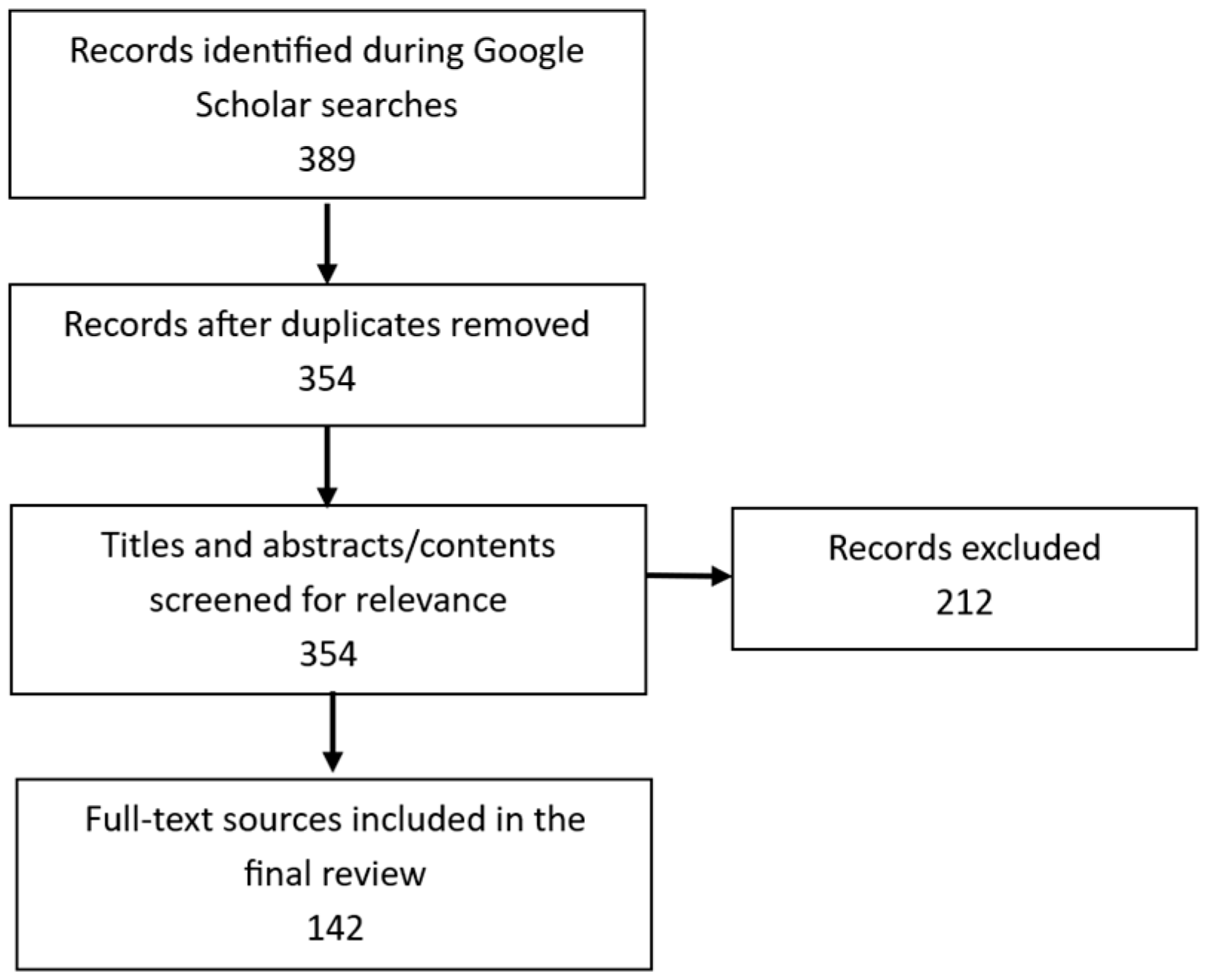
Screening and selection were conducted in stages on the basis of relevance. Titles and abstracts, or (where relevant) executive summaries in the case of grey literature, were first reviewed to assess their fit with the review questions and thematic scope. Potentially relevant sources were then read in full and assessed for inclusion according to their substantive relevance, conceptual contribution, empirical value and fit with the geographic and thematic focus of the study. Figure 1 below summarises the search and selection process used in the review, showing the number of records identified through Google Scholar searches, the removal of duplicates, the screening of titles, abstracts and contents for relevance and the final inclusion of 142 sources in the review.
In total, 354 sources were initially identified, of which 142 were included in the final review (see Figure 1). Backward citation searching was not used.

2.5. Data Extraction and Synthesis

For included sources, information was extracted on the main topic, conceptual or empirical contribution, geographic relevance and relationship to the review questions. The material was then analysed using a thematic narrative synthesis approach. This involved grouping sources into recurring themes across the literature and comparing them in order to identify areas of convergence, divergence and conceptual tension.
The final synthesis was organised around three broad areas: migration as a driver of economic growth; the political economy of migration policymaking; and evidence use and non-use in migration-related economic policymaking.

2.6. Protocol and Registration

This review was not prospectively registered in a public registry. No formal protocol was published in advance.

3. Migration and Remittance Dynamics in the Selected Cases

Before turning to the thematic review, it is useful to briefly situate the three cases in terms of their migration and remittance dynamics. Kenya, Kerala (India) and Sri Lanka are all origin settings in which migration has become economically and politically significant, but they differ in migration profile, institutional configuration and scale. This section, therefore, provides a brief overview of major migration patterns, main destination regions and the economic significance of remittance inflows in each case, in order to ground the subsequent analysis of migration as an economic driver, the political framing of migration and the use and non-use of evidence in policymaking.
At the same time, the remittance figures discussed in the literature refer primarily to formally recorded transfers and may therefore understate the full scale of migrant and diaspora financial contributions. Across all three contexts, the literature points to the continued relevance of informal or “shadow” remittance channels, which can be meaningful in scale but are inherently difficult to quantify. As a result, the figures presented in this section should be understood as indicative of the economic significance of remittances rather than as exhaustive measures of migration-related international remittance flows.

3.1. Migration and Remittance Dynamics in Kenya

Kenya functions as a prominent migration hub within East Africa, characterized by dynamic outward and inward mobility. Driven largely by the pursuit of employment and education, over half a million Kenyans resided abroad by 2020 (Mutava, 2024). Major destination regions for these emigrants include other African nations, such as Uganda, Tanzania and South Africa, as well as North America, Europe and the Middle East (Mutava, 2024; Oucho et al., 2023). In particular, the Gulf Cooperation Council (GCC) countries have emerged as a significant destination for Kenyan labour migrants seeking semi-skilled and domestic work (Mbabu & Ondere, 2024; Oucho et al., 2023). Concurrently, Kenya hosts a substantial immigrant population, including over 500,000 refugees from neighbouring countries, illustrating its dual role as both an origin and host country (Korir, 2025; Mutava, 2024).
The economic impact of this emigration is profound, with diaspora remittances emerging as a cornerstone of Kenya’s macroeconomy. By 2022, annual remittance inflows grew to approximately $4 billion, constituting roughly 3 to 4 percent of the national gross domestic product and surpassing traditional foreign exchange earners like tourism and agriculture (Mutai et al., 2024; Mutava, 2024). These funds are crucial for household consumption, education, healthcare, and entrepreneurial investments, thereby driving sustainable economic development and poverty alleviation (Mbabu & Ondere, 2024). In response to these financial inflows, the Kenyan government has formalized diaspora engagement through frameworks such as the 2014 National Diaspora Policy and various bilateral labour agreements intended to facilitate labour export and protect migrant workers (Mbabu & Ondere, 2024; Mutava, 2024). However, Kenya’s migration governance remains somewhat bifurcated in that the state actively promotes diaspora economic contributions while simultaneously applying more restrictive policies toward its refugee populations (Korir, 2025; Mutava, 2024).

3.2. Migration and Remittance Dynamics in Kerala

Emigration is a foundational pillar of Kerala’s socio-economic landscape. The total stock of emigrants from the state has consistently hovered around 2.1 to 2.4 million in recent decades, representing a substantial portion of its working-age population (Rajan, 2024; Zachariah et al., 2001). The GCC countries, particularly the United Arab Emirates and Saudi Arabia, have historically absorbed the vast majority of these workers, accounting for over 80 percent of the state’s total emigrant outflow (Rajan, 2024). However, contemporary migration channels are diversifying rapidly. There is a marked rise in the emigration of skilled female professionals, predominantly nurses, to Western destinations, alongside a massive recent surge in student migration, which doubled to approximately 250,000 by 2023 (Rajan, 2024).
The financial influx from this mobile workforce profoundly shapes Kerala’s macroeconomy. In 2023, remittances reached INR 216,893 crores, constituting 23.2 percent of the Net State Domestic Product (NSDP) and amounting to 1.7 times the state government’s total revenue receipts (Rajan, 2024). Historically, these external financial inflows have routinely exceeded both total government expenditure and the value added in the state’s manufacturing sector. While early remittance utilization was heavily skewed toward conspicuous consumption and real estate, recent longitudinal data indicate a structural maturation; migrant households are increasingly directing funds toward debt servicing, education, and human capital formation (Xavier, 2025; Rajan, 2024).
To govern this transnational mobility and harness diaspora wealth, Kerala has pioneered distinctive subnational policy frameworks. The Department of Non-Resident Keralites Affairs (NORKA) and its field agency NORKA-ROOTS represent a unique institutional infrastructure that manages migrant welfare, state-sponsored recruitment, and returnee reintegration schemes (Adhikari, 2022). Furthermore, the state actively mobilizes diaspora capital for public infrastructure through targeted financial instruments, such as “Masala bonds” issued via the Kerala Infrastructure Investment Fund Board (Adhikari, 2022).

3.3. Migration and Remittance Dynamics in Sri Lanka

Sri Lanka’s economy is highly dependent on international labour migration, with an estimated three million Sri Lankans currently residing abroad (Ranaraja, 2025). This outbound workforce is overwhelmingly concentrated in GCC countries, such as Saudi Arabia, Qatar, Kuwait and the United Arab Emirates, which host the vast majority of Sri Lankan migrant workers (Ranaraja, 2025). Migration from Sri Lanka is characterised predominantly by low-skilled and semi-skilled contract labour, functioning as a critical safety valve for domestic unemployment and a pillar of macroeconomic stability (Withers, 2017).
Sri Lanka has developed a “remittance economy” that is heavily reliant on the capital inflows generated by migrant workers, which has been intensified by economic crises. Personal transfers from international migrants constitute the country’s single largest source of foreign exchange, routinely generating between USD 5.9 and USD 6.9 billion annually and contributing approximately 8 to 10 per cent of the national Gross Domestic Product (Dharmadasa & Karunarathna, 2022; Ranaraja, 2025). These remittances consistently surpass earnings from traditional export sectors like tea and garment manufacturing (Ranaraja, 2025). This capital provides an essential buffer for Sri Lanka’s balance of payments while simultaneously funding daily consumption and poverty reduction at the household level (Dharmadasa & Karunarathna, 2022; Withers, 2017).
The demographic composition and policy governance of this migration have experienced fluctuating shifts. For decades, the outflow was overwhelmingly dominated by female domestic workers, but state interventions actively restructured this pattern to promote male emigration (Gunaratne, 2023; Ranaraja, 2025; Withers, 2017). Driven by concerns over the social costs of maternal absence, the government implemented policies that effectively restricted mothers of young children from migrating as domestic workers and imposed age regulations (Amirthalingam et al., 2025; Gunaratne, 2023). While these interventions temporarily inverted the migration flow to a male majority, the severe economic crisis and the COVID-19 pandemic compelled the state to alter this approach (Ranaraja, 2025). To bolster declining foreign reserves through increased remittance inflows, the government softened regulations in late 2021 (Gunaratne, 2023). As a result, the migration of female workers, particularly younger women, has risen once again (Gunaratne, 2023; Ranaraja, 2025).

4. Migration as an Economic Driver: Established Evidence and Policy-Relevant Insights

The economic relationship between international migration and origin countries is characterized by a complex interplay of financial flows, labour market adjustments and transnational exchanges (De Haas, 2010; IMF, 2015; Clemens, 2014). Historically viewed through the lens of labour surplus or “brain drain”, contemporary literature increasingly frames migration as an intrinsic component of broader development processes rather than an antithesis to them (De Haas, 2005; De Haas, 2010; Docquier & Rapoport, 2012). While the magnitude of remittance flows often dominates the discourse, the economic impacts are multifaceted, operating through micro-level household consumption, meso-level community structures, and macro-level national accounts. The literature indicates that these impacts are rarely uniform; they are mediated by the specific developmental and demographic transition stages of the origin country, the skill composition of migrants and the institutional environment (De Haas, 2010; Clemens, 2014; Docquier & Rapoport, 2012). This section synthesizes the current literature on the economic impacts of international migration on origin countries, which are multifaceted, reciprocal and highly context-dependent.

4.1. Macroeconomic and Demographic Contributions

International migration is increasingly recognized as a structural feature of the global economy, significantly influencing macroeconomic stability and demographic transitions in origin countries.
The most distinct economic transmission mechanism is the flow of international remittances, which has grown to surpass ODA and, in many years and contexts, also FDI, as a source of external finance for low- and middle-income countries (World Bank, 2019; Khan, 2025). These financial flows are distinct from private capital because they frequently exhibit counter-cyclical properties, functioning as a stabilizing buffer that allows households to smooth consumption during economic downturns, disasters, crises or conflicts, whereas FDI and private debt flows tend to be pro-cyclical and volatile (IMF, 2015; Warnecke-Berger, 2021). This counter-cyclical effect has been most evident during global crises, such as the 2008 global financial crisis and the COVID-19 pandemic (Gamlen et al., 2024; McAuliffe et al., 2026), but also occurs during national and local crises, such as those related to severe economic domestic shocks and disaster events (Savage & Harvey, 2007; World Bank, 2013).
While the capacity of remittances to alleviate immediate poverty and loosen household budget constraints is robustly supported in the literature, evidence regarding their contribution to long-term aggregate economic growth remains mixed and context-dependent (Adams & Page, 2005; Ratha, 2013). Some analyses suggest a positive correlation between remittances and GDP growth, particularly in economies with higher levels of human capital and sound financial institutions (Azizi, 2023; Giuliano & Ruiz-Arranz, 2009). In Kenya, for example, international remittances grew by nearly 500% between 2010 and 2022 to reach $4 billion, accounting for approximately 4% of GDP and surpassing tourism and agriculture as the country’s primary source of foreign exchange (Mutava, 2024). Long-term empirical analysis confirms that these inflows have a positive, significant impact on Kenya’s economic development, with evidence suggesting a unidirectional causal relationship where remittances actively accelerate economic growth (Mutai et al., 2024).
Conversely, other studies indicate that remittances may have negligible or even negative impacts on growth due to “Dutch disease” effects (where real exchange rate appreciation reduces the competitiveness of the tradable sector) or by reducing labour supply incentives among recipients (Amuedo-Dorantes & Pozo, 2004; Fullenkamp et al., 2008). However, in India, the remittance-to-GDP ratio remains below the threshold often associated with Dutch disease effects (around 6%), as discussed in Taguchi and Batool (2025). Similarly, in Kenya, some evidence indicates that remittances are associated with exchange rate depreciation rather than appreciation, implying no Dutch disease effect (Musakwa & Odhiambo, 2023). Consequently, while remittances are a vital lifeline for household welfare, their evidence on their ability to independently drive structural economic transformation remains contested (De Haas, 2010).
Demographically, migration serves as a safety valve for origin countries characterized by labour surpluses and high youth unemployment, relieving immediate pressure on domestic resource allocation and public services (IMF, 2015). This dynamic is part of a broader “mobility transition”, where economic development in low-income countries initially increases rather than decreases emigration rates (Clemens, 2014; De Haas, 2005). In the case of Kerala, for example, while early migration waves from Kerala were driven by high population density and unemployment during the 1970s Gulf boom (Aneja & Praveen, 2020), recent trends reflect evolving demographic strategies. The number of student emigrants doubled between 2018 and 2023 to approximately 250,000, indicating that younger cohorts are increasingly utilizing educational channels to bypass domestic labour market stagnation and access global opportunities (Rajan, 2024).
As incomes rise, liquidity constraints are relaxed and aspirations expand, enabling more individuals to finance the costs of migration; emigration rates typically only begin to fall once countries reach upper-middle-income levels (Clemens, 2014; De Haas, 2019); however, other global analysis that spans 25 years and utilises the human development index (HDI) rather than national income levels finds that migrants from low and medium HDI countries have become increasingly locked out of mobility to high and very HDI countries, which increasingly attract/allow immigrants from other high/very high HDI countries, thereby posing major structural challenges for ‘upward migration mobility’ between countries (McAuliffe et al., 2022).

4.2. National Economic Effects and Gendered Dimensions

The national economic effects of migration are mediated by labour market adjustments and human capital dynamics, both of which are deeply stratified by gender (Bachan, 2018; Elson, 1999). At an aggregate level, emigration can tighten domestic labour markets, potentially exerting upward pressure on wages for non-migrants, although this depends on the substitutability between migrant and non-migrant labour (Dustmann et al., 2015; Mishra, 2007). A central debate concerns the net impact on human capital: while the “brain drain” of highly skilled professionals (particularly in health and science) can deplete the essential skills base in origin countries, the “brain gain” hypothesis posits that the prospect of migration incentivizes educational investments that may eventually increase the total human capital stock if not all educated individuals emigrate (Docquier & Rapoport, 2012; Kalipeni et al., 2012). However, the realization of these gains is contingent on the domestic economy’s absorptive capacity to employ skilled returnees or non-migrants (Agrawal et al., 2011; De Haas, 2010).
The net economic utility of migration is further conditioned by the magnitude of recruitment costs, which frequently function as a regressive tax on migrant earnings. Evidence indicates that low-skilled workers often incur transaction costs exceeding several months of foreign wages, primarily driven by fees paid to private intermediaries (Abella & Martin, 2014; UNDP & IOM, 2020). High recruitment fees directly erode the potential for remittances and asset accumulation in the origin country, occasionally resulting in debt bondage that negates the economic benefits of mobility (ILO, 2014). In many corridors, a significant gap persists between the policy rhetoric of “fair recruitment” and the empirical reality of exploitative cost structures that dampen development outcomes (Wickramasekara, 2015). For example, data from the 2023 Kerala Recruitment Cost Survey reveals that the median recruitment cost for migrants is INR 61,156, resulting in a Recruitment Cost Indicator (RCI) of 2.11, meaning workers must spend over two months’ earnings just to recover initial migration expenses (Rajan & Akhil, 2025). This financial burden is unevenly distributed, with less-educated migrants often facing higher relative costs due to a continued reliance on informal intermediaries and private agencies, highlighting the limitations of current regulatory frameworks in curbing exploitative practices (Rajan & Akhil, 2025).
Gender is analytically central to these economic outcomes, extending beyond simple sex-disaggregated data to the structural organization of production and social reproduction (Elson, 2025; Joseph et al., 2022). Evidence indicates that while female migrants often earn less than men due to labour market segmentation into lower-paid care and domestic sectors, they tend to remit a higher proportion of their income and do so more regularly (IOM, 2023; McAuliffe et al., 2026). Furthermore, the economic behaviour of households left behind is gendered; male migration frequently necessitates “role-shifting,” where women increase participation in subsistence agriculture and unpaid family labour (Slavchevska et al., 2020). Conversely, other studies suggest remittance income can raise reservation wages, potentially reducing female participation in the formal paid workforce (IMF, 2015; Saani et al., 2023).
Crucially, standard macroeconomic assessments often obscure the “reproductive economy” (the unpaid care work essential for maintaining the workforce), which is disproportionately performed by women (Elson, 2025). The care drain resulting from the emigration of female caregivers often shifts the burden of care to other female relatives (e.g., grandmothers or eldest daughters) rather than public services or men, representing a transfer of costs from the paid to the unpaid economy that is rarely accounted for in GDP calculations (Elson, 2025; UNDP & IOM, 2020). Consequently, while migration may increase financial capital through remittances, it carries the risk of depleting human capabilities and social infrastructure if the gendered costs of social reproduction are ignored (Elson, 2025; Joseph et al., 2022).

4.3. Key Economic Levers in Origin Countries

This section synthesises evidence on three distinct, key economic levers available to origin country governments that are the focus of this study: the regulation of remittance infrastructure, the governance of labour emigration and the engagement of diasporas. While government ambitions often focus on maximising development benefits and retaining human capital, the empirical record suggests that influence is constrained by structural economic forces and global market dynamics.
The literature shows that policy frameworks frequently prioritize the reduction in remittance transfer costs and the channelling of these flows into productive assets (Ratha et al., 2011; OECD, 2017). There is robust consensus that high transaction costs (often averaging around 7%) significantly reduce the net resources available to households, and that reducing these costs towards the SDG target of 3% would increase total remittance volumes (OECD, 2017; Mohieldin & Ratha, 2018). Evidence indicates that governments can influence these costs through regulatory changes that increase competition among service providers and by adopting new financial technologies, although stringent anti-money laundering regulations in destination countries often create countervailing “de-risking” pressures that limit formal access (Ratha et al., 2011; OECD, 2017; Mohieldin & Ratha, 2018). To lower remittance costs and enhance financial inclusion, Kenya has leveraged digital transfer infrastructure, with 50% of the diaspora preferring mobile money platforms like the long-standing M-PESA over traditional banks due to speed, convenience, and favourable transaction charges enabled by regulatory reforms (Mbabu & Ondere, 2024). While this private-sector-led leverage of technology allows actors like Safaricom and Equity Bank to offer financial products to migrants and refugees, these interventions face the limitation of becoming “experimental” or potentially predatory in the absence of robust legislative moderation (Mutava, 2024).
The link between remittances and financial inclusion is well-supported in the literature; households with access to formal banking services receive higher volumes of remittances and are more likely to save (OECD, 2017). However, the assumption that governments can easily steer private remittances from consumption toward productive investment is less supported by evidence. While remittances alleviate credit constraints and can facilitate business formation, studies suggest they are primarily used for consumption and essential services (education, health) unless the broader investment climate is favourable (Carling, 1996; Ratha et al., 2011; OECD, 2017). Financial literacy training has shown mixed results, often failing to significantly alter investment behaviours in the absence of structural economic opportunities.
Gender dynamics critically mediate the effectiveness of these levers. While women are often the primary managers of remittance income, legal and structural barriers to accessing credit and land titles frequently limit their ability to convert these funds into productive assets (Carling, 1996; OECD, 2017). Consequently, financial inclusion policies that do not address these gender-specific constraints are likely to yield suboptimal development outcomes. Furthermore, evidence highlights a distinct gender gap in remittance behaviour that renders female migration disproportionately valuable to household economies relative to their income levels (IOM, 2023). In Sri Lanka, for example, Withers (2017) found that female domestic workers remitted approximately 86 per cent of their income compared to 71 per cent for men, largely because the “live-in” nature of domestic work absorbs living costs that male workers in open employment must bear themselves. This reveals a structural paradox where the Sri Lankan economy is heavily substantiated by the commodification of female reproductive labour abroad, which extracts a higher rate of return per worker, even as these women face the greatest social stigma and state-imposed mobility restrictions (Withers, 2017; Dharmadasa & Karunarathna, 2022).
Governments often operate under the assumption that economic development and vocational training will reduce emigration pressures (Nyberg-Sorensen et al., 2002; OECD, 2017). However, established evidence identifies a “mobility transition”, where rising incomes and education levels in low-income countries initially increase emigration by relaxing budget constraints and raising aspirations (Simpson, 2022; Clemens, 2025). Consequently, policy interventions intended to address the “root causes” of migration through development aid may inadvertently increase outflows in the short to medium term (Nyberg-Sorensen et al., 2002; Clemens, 2025).
The literature also finds that governments may seek to influence labour emigration not only by managing outflows, but by increasing the attractiveness of their nationals within destination labour markets. This can involve strategic efforts to align vocational training with external labour demand, negotiate access through bilateral agreements, and reduce recruitment frictions that undermine workers’ competitiveness relative to migrants from other origin countries (World Bank, 2006; OECD, 2017; Clemens, 2025). Such strategies become particularly salient during periods of economic crisis, when governments may place greater emphasis on overseas employment as a source of foreign exchange and household income. In Sri Lanka, for example, the economic importance of remittance inflows has reinforced policy incentives to sustain labour market access abroad during crises, even where this may entail difficult trade-offs between protection, regulation and deployment (Withers, 2017; Gunaratne, 2023; Amirthalingam et al., 2025).
Strategies to engage diasporas focus on attracting direct investment, philanthropy, and knowledge transfer (World Bank, 2006; Ratha et al., 2011). The evidence is strongest regarding the role of diasporas in facilitating trade and FDI by reducing information asymmetries and transaction costs (World Bank, 2006; Clemens, 2025). Diasporas also function as reliable counter-cyclical insurers, increasing transfers during economic shocks or natural disasters in the origin country (Ratha et al., 2011; Bossavie & Özden, 2023). However, the effectiveness of specific financial instruments like diaspora bonds is mixed. Despite high policy interest, their success relies heavily on the diaspora’s trust in origin-country governance and the sovereign credit rating, limiting their viability for many fragile states (Ratha et al., 2011; Clemens, 2025). Similarly, policies designed to induce return migration through financial incentives generally show limited effectiveness; structural economic conditions and political stability are far more significant determinants of return and reintegration than specific returnee packages (World Bank, 2006; OECD, 2017).
Knowledge transfer, or “social remittances”, is a significant but complex lever. While diasporas can transfer technical skills and democratic norms, the economic impact of these transfers is difficult to quantify and conditional on the absorptive capacity of the origin country (World Bank, 2006; Bossavie & Özden, 2023). Furthermore, while gender is recognized in the context of social remittances (e.g., changing fertility norms), it is largely absent from the design of economic engagement strategies, potentially neglecting the distinct investment patterns and reintegration needs of female diaspora members (OECD, 2017; Bossavie & Özden, 2023).

5. Migration, Politics and Policy Framing in Countries of Origin

This section reviews literature on migration as a politically salient domain in countries of origin, drawing primarily on scholarship on diaspora engagement, statehood beyond borders, and the political uses of migration in national and subnational governance. Across these strands, a recurring gap concerns how far the symbolic and institutional incorporation of migrants translates into substantive influence over economic policymaking.

5.1. Migration as a Highly Salient Policy Domain

Migration is a highly salient policy domain in countries of origin, characterized by a persistent ambivalence between economic necessity and political risk. Governments frequently face a trade-off between the economic benefits of migration, most notably international remittances and the use of emigration as a “safety valve” for unemployment, and its political costs, including concerns over “brain drain” and the potential mobilization of diasporas as political opposition from abroad (De Haas et al., 2018).
The political salience of migration is deeply intertwined with constructions of national identity and state responsibility beyond territorial borders. Historically, some States viewed emigrants as “traitors” or “deserters”, but there has been a notable shift toward recasting them as “national heroes” or development actors in order to harness their financial and human capital resources (Leblang, 2017; Gamlen, 2019). This reframing has been accompanied by an expansion of state responsibility, including obligations of consular and diplomatic protection for citizens abroad, allowing States to symbolically maintain a sense of nationhood despite population outflows (Leblang, 2017). At the same time, domestic policy elites in some countries tend to adopt an instrumental view of migrants, valuing them primarily in terms of their perceived net worth to the State (Boampong & Mouthaan, 2025). Core values such as honour and dignity are mobilized in contradictory ways, used both to legitimize the sacrifice of emigration and to promote belonging in order to persuade citizens to remain, thereby creating tension between state objectives of population retention and social validation of mobility (Ruiz Soto et al., 2023).
At the same time, the salience of migration as a policy domain is evident in the growing institutionalization of diaspora engagement. In many countries of origin, engagement with diasporas has shifted from ad hoc interactions to more formalized governance arrangements through the creation of diaspora institutions and consultative mechanisms. Governments increasingly portray diasporas as “partners in development” and political constituencies, leading to the establishment of ministries, sub-ministerial units and advisory councils designed to incorporate expatriate voices into national decision-making (Gamlen, 2019; Vezzoli & Lacroix, 2010). These efforts have often been accompanied by the extension of external voting rights, dual citizenship and consultative representation, thereby redefining the boundaries of the polity to include non-residents (Gamlen, 2008; Gamlen, 2014). However, this engagement remains marked by tension between the desire to harness economic resources and the political risks associated with mobilizing potentially critical voices abroad (Ebang Njikang, 2020; Gamlen, 2019).
In Kenya, Kerala and Sri Lanka, diaspora engagement in policy redesign takes distinct institutional and political forms. In Kenya, engagement has been formalized through the Kenya Diaspora Policy (2014, revised 2024) and the establishment of the State Department for Diaspora Affairs, which facilitates “continuous dialogue” through town hall meetings, webinars and diaspora summits (Republic of Kenya, 2024; The Commonwealth, 2024). The diaspora is symbolically recognized as the “48th County”, with ongoing efforts to operationalize voting rights and link diaspora participation to the Bottom-Up Economic Transformation Agenda (IOM, 2017; Mutava, 2024).
Kerala represents a pioneering case of subnational migration governance. The establishment of the Non-Resident Keralites Affairs (NORKA) Department institutionalized the state’s interface with migrants (Burmeister-Rudolph, 2023). The creation of the Loka Kerala Sabha (World Kerala Assembly) has provided a structured platform for dialogue between elected representatives and diaspora members, supporting participation in policy deliberation despite the absence of direct voting power in the legislative assembly (Akhil & Ganga, 2022).
In Sri Lanka, diaspora engagement is shaped by post-conflict reconciliation dynamics and economic dependence on labour migration. The Government has sought to engage overseas Sri Lankan communities through initiatives such as the National Policy and Action Plan for Employment 2023–2027, which aims, among others, to register migrant associations and groups and consult them in policy dialogue (Government of Sri Lanka, 2023). Nevertheless, the relationship remains complex and contested, as civil society organizations and trade unions have often had to lobby actively for migrant voting rights and improved protection (Gamlen, 2019; Gamburd, 2009).

5.2. National Economic Narratives and Migration

The literature on economic discourse and migration in countries of origin identifies three dominant narratives: migration as a safety valve, migration as an economic asset and migration as a social or political risk. A key gap across the literature concerns how growth-oriented migration narratives are sustained, modified or disavowed when they come into tension with domestic legitimacy, gender norms and political risk.
The safety-valve narrative frames emigration as a functional mechanism for maintaining domestic political and economic stability by exporting surplus labour and mitigating unrest. Authoritarian States have historically employed safety-valve emigration policies to relieve unemployment pressures during periods of regime stress (Gamlen, 2019). Related accounts note that governments often tacitly encourage low-skilled emigration to reduce poverty and avoid political tensions, drawing on longer-standing narratives of emigration as relief from population pressure or as an “outside option” to reduce the risk of violent contestation, particularly among unemployed young men (De Haas & Vezzoli, 2011; Peters & Miller, 2022).
A second dominant narrative reframes migrants from “traitors” or “victims” into “national heroes” or agents of development in order to legitimize reliance on remittances. States increasingly celebrate diasporas through symbolic recognition, including national ceremonies, as part of a broader shift towards valuing migrants through an economic gains lens (Gamlen, 2019). In this framing, domestic elites value migrants according to their perceived net worth to the State (Boampong & Mouthaan, 2025). Migrant women are often cast as economic heroes or martyrs whose social acceptance is conditional on remittance-sending, normalizing transnational sacrifice and reinforcing gendered expectations of care and provision (Shivakoti et al., 2021; Diker et al., 2025).
This narrative is particularly evident in Kerala, where migration is framed as a structural necessity and a defining feature of regional identity, contributing to the deterritorialization of the socio-political community (Harilal & Akhil, 2016; Zachariah et al., 2001). It underpins a transnational social contract in which the subnational government assumes moral and welfare responsibility for its global citizens through institutions such as NORKA (Burmeister-Rudolph, 2023; Ennis & Blarel, 2022). At the same time, celebratory economic narratives coexist with growing concern over inequality and the social costs borne by families left behind (Rajan & Zachariah, 2019).
Migration as an economic asset also features prominently in Kenya’s national discourse, where the diaspora is framed as the “48th County” and a contributor to Kenya’s Vision 2030 through remittances and skills transfer (Mutava, 2024; The Commonwealth, 2024). This asset-based framing contrasts with security-oriented narratives surrounding migrants and refugees, particularly in relation to terrorism and resource pressures (Agwanda, 2022; Korir, 2025).
Despite the prominence of asset-based narratives, explicitly growth-oriented migration discourses face significant political limits. High emigration rates are frequently interpreted as evidence of governance failure, undermining domestic legitimacy. In Northern Central America, political leaders have portrayed emigration as immoral or shameful despite economic reliance on remittances (Ruiz Soto et al., 2023). In Central and Eastern Europe, migration is framed as a demographic threat rather than an opportunity, producing an “emigration conundrum” in which economic benefits are tacitly acknowledged but publicly disavowed (Kyriazi et al., 2023; Roos et al., 2025). Consequently, elites often tacitly encourage migration for economic relief while publicly denouncing it to satisfy nationalist or protectionist constituencies, creating a persistent discursive gap (De Haas & Vezzoli, 2011). Reliance on remittance-led development models is also politically risky, as it signals long-term subordination within the international division of labour and exposes States to external shocks, such as, as noted above, unilateral cancellation of recruitment schemes by countries of destination (Castles, 2007).
The political viability of growth-oriented narratives is further constrained by gendered moral economies surrounding labour and social reproduction. In many contexts, the economic imperative to export female labour clashes with patriarchal norms that associate women with caregiving and national dignity (Gamlen, 2019; Withers, 2017; Gunaratne, 2023). As a result, countries like Bangladesh, Cambodia, India, Indonesia, Nepal, the Philippines, Sri Lanka and Myanmar have adopted bans on female migration or pre-migration clearance to certain countries to allegedly protect women and families (Shivakoti et al., 2021; Weeraratne, 2023; Joseph et al., 2022; Henderson, 2022). In Sri Lanka, pre-migration clearance requirements for mothers with young children were introduced in 2013 and later relaxed in 2022 in response to acute foreign exchange shortages and the need to boost remittance inflows (Shivakoti et al., 2021; Gunaratne, 2023; Weeraratne, 2023; Economynext, 2022). Post-conflict dynamics further complicate diaspora engagement, particularly in relation to Tamil communities alternately framed as security threats or economic partners, resulting in bifurcated approaches of surveillance and engagement (Gamlen, 2019; Jayasuriya, 2014).
These political and moral constraints profoundly shape the types of evidence policymakers are willing to acknowledge or utilize. As further analysed in the next sub-section, governments may consequently tend to disregard robust empirical evidence that contradicts political narratives (Clemens, 2025; De Haas, 2024; Shivakoti et al., 2021; Boampong & Mouthaan, 2025).
Overall, the literature reviewed here suggests a high degree of convergence on the coexistence of asset-based and risk-based migration narratives, but more limited clarity on the conditions under which one narrative becomes dominant in policymaking practice.

5.3. Political-Economic Asymmetries in Origin-Destination Migration Dynamics

The literature on migration governance consistently highlights that policymaking in countries of origin is shaped by a distinctive set of structural constraints and policy logics that differ fundamentally from those prevailing in countries of destination. These differences are rooted in asymmetric power relations within the international system, uneven control over mobility regimes and structural dependence on external labour markets. As a result, migration policies in countries of origin often reflect a complex balancing act between economic necessity, political risk management and limited policy autonomy (Castles, 2007; De Haas & Vezzoli, 2011).
A central constraint identified in the literature is the asymmetry embedded in the global governance of migration. While international law guarantees the right to leave one’s country, it does not guarantee the right to enter another, granting countries of destination disproportionate control over mobility pathways (De Haas & Vezzoli, 2011). This structural imbalance shapes the bargaining position of countries of origin in bilateral and multilateral negotiations, particularly in the context of labour migration (De Haas & Vezzoli, 2011; Shivakoti et al., 2021). The scope of potential labour-sending countries, combined with persistent demand for flexible and low-cost labour in countries of destination, further weakens the negotiating power of individual countries of origin (Shivakoti et al., 2021). Although some scholars emphasize the agency of countries of origin through “migration diplomacy” or “refugee rent-seeking” (Boampong & Mouthaan, 2025; Tolay, 2022), the dominant view remains that structural relations are imbalanced, leaving countries of countries vulnerable to unilateral policy shifts during economic downturns (De Haas & Vezzoli, 2011; Castles, 2007).
These asymmetries are particularly pronounced in relations between countries of origin and labour-importing economies in the Gulf Cooperation Council. Countries of destination retain the ability to shift recruitment across origin countries in response to regulatory changes or political pressures, thereby disciplining labour-sending states that attempt to improve protection standards or restrict deployment (Malit & Al Youha, 2016; Shivakoti et al., 2021). The literature emphasizes that this “exit option” available to countries of destination severely constrains the policy space of countries of origin, even where formal bilateral agreements exist (Castles, 2007).
At the same time, countries of origin are structurally dependent on external labour markets as safety valves for domestic unemployment and social pressure. As noted above, emigration has long functioned as a mechanism for managing labour surpluses, alleviating poverty and reducing the risk of political contestation, particularly in contexts characterized by limited job creation and youthful demographic structures (De Haas & Vezzoli, 2011; De Haas et al., 2018). This dependence produces a fundamental tension: governments may publicly express concern over emigration, skills loss, or family separation, while privately relying on continued out-migration to sustain macroeconomic stability and social order.
This tension is clearly visible in Sri Lanka, where labour migration has become a structural component of the national economy. Remittances have historically played a critical role in financing imports, stabilizing foreign exchange reserves and offsetting trade deficits (Withers, 2017). Despite recurrent public debates about the social costs of migration, particularly female labour migration, policy frameworks continue to prioritize overseas employment promotion, reflecting the state’s reliance on remittance inflows (Gunaratne, 2023). This reliance constrains the extent to which protection-oriented reforms can be pursued without jeopardizing economic stability.
Kerala presents a distinct but related configuration of constraints. As a subnational government within India’s federal system, Kerala faces high emigration rates and strong dependence on remittance-fuelled consumption and fiscal revenues (Ennis & Blarel, 2022), rendering it vulnerable to external policy shocks such as Saudi Arabia’s Nitaqat labour localization programme (Rajan & Zachariah, 2019; Zachariah et al., 2014). Its inability to directly negotiate with countries of destination or access central migration data further limits its policy autonomy and reinforces vertical incoherence between state-level evidence and national decision-making (Rajan & Zachariah, 2019).
In Kenya, policy logics are similarly shaped by external dependence and internal fragmentation. Labour migration to the Gulf has been promoted as a solution to youth unemployment, particularly following periods of domestic economic stress (Mutava, 2024). However, Kenyan authorities have faced constraints in enforcing labour standards or securing protections for migrant workers. Despite bilateral labour agreements concluded after migration bans in 2012 and 2014, abuses linked to the kafala system persist, revealing the limits of the country’s leverage in strengthening the protection of its nationals (Mutava, 2024).
Where governments have demonstrated effective influence is in the management of flows. Bilateral labour agreements (BLAs) and programmes like Global Skill Partnerships can successfully regulate recruitment costs and facilitate skills transfer, turning potential brain drain into brain gain (World Bank, 2006; OECD, 2017; Clemens, 2025). Conversely, restrictive policies attempting to ban specific types of emigration often fail to stop movement, instead driving migrants (particularly women in the domestic work sector) into irregular and more dangerous channels (World Bank, 2006). Policies focusing on the regulation of recruitment agencies have been shown to reduce the high fees that erode the welfare gains of migration, although enforcement remains a challenge (World Bank, 2006; Ratha et al., 2011). Furthermore, as evident in Kenyan emigration contexts, gender is frequently marginalized or treated through a patriarchal lens in the implementation of migration policy, specifically regarding the “right of establishment” and family reunification. This means that in Kenya, male spouses of female migrant workers encounter significantly higher bureaucratic barriers when seeking dependant passes compared to female spouses of male workers, as authorities often perceive foreign men as security risks or economic burdens attempting to reside indefinitely (Oucho et al., 2023). This administrative practice economically marginalizes international/transnational female primary earners by hindering their ability to leverage household support systems and stabilize their economic presence in the host country (Oucho et al., 2023).
Furthermore, Sri Lanka utilizes BLAs and Memoranda of Understanding (MoUs) with key destination states like Saudi Arabia and Qatar as governance tools to secure labour market access and sustain remittance inflows for national development (Amirthalingam et al., 2025). However, a major trade-off of this strategy is that these agreements are frequently “gender-blind,” facilitating the recruitment of women into low-skilled domestic sectors to meet economic targets without incorporating gender-specific protections, thereby perpetuating labour market segmentation and leaving female workers vulnerable to exploitation (Amirthalingam et al., 2025). On the other hand, these tensions have been managed by origin countries through temporary bans or (re)negotiated agreements. In 2021, for example, Kenya imposed a temporary ban on domestic workers traveling to Saudi Arabia due to widespread abuse, highlighting how gendered vulnerabilities in specific economic sectors drive reactive national policy shifts (Oucho et al., 2023; Mutava, 2024).
Taken together, the literature portrays origin-country migration policymaking as operating within a narrow corridor of constrained choice. Economic dependence on migration, geopolitical asymmetries with countries of destination and donor-driven governance arrangements interact to limit policy autonomy, shape institutional incentives and structure the kinds of evidence that can be politically acknowledged. These constraints provide essential context for understanding why economic migration evidence, even when robust, often remains under-utilised in national policymaking processes.

6. Evidence Use and Non-Use in Economic Policymaking on Migration

6.1. Evidence Quality, Contestation and the Limits of Linear Models

This section reviews literature on evidence-informed policymaking, evidence quality, and the political uses of knowledge in migration policymaking. Across these strands, a central point of convergence is that evidence does not operate as a neutral input to policy, while a key unresolved issue concerns how different policy actors define and prioritise credibility, relevance and usability in practice.
In migration policymaking, evidence use is an important though somewhat under-researched topic. It is important because international migration intersects with questions of sovereignty, labour markets, social norms (including gender) and international relations. Rather than serving as a neutral tool for optimization, the utilization of economic evidence in migration policy is fundamentally shaped by power dynamics, political contestation, and institutional incentives (Boswell, 2009; Gatune et al., 2021). In this polarized arena, evidence is frequently deployed not to guide decision-making, but to substantiate pre-determined political preferences or bolster the legitimacy of state agencies (Boswell, 2009; Punton et al., 2016). Consequently, an analysis of migration-related economic policymaking must move beyond technical assessments of data availability to examine the political economy that determines which evidence is amplified, ignored, or symbolically deployed (Gatune et al., 2021; Natter & Welfens, 2024).
Standard theories of evidence-based policymaking often rely on a “linear” or “instrumental” model, assuming that high-quality data is directly applied to solve technical problems (Boswell, 2009; Punton et al., 2016). This may be relevant in many policy domains; however, this rationalist perspective is increasingly viewed as an unrealistic ideal, particularly within the highly contested field of migration governance (Boswell, 2009; Natter & Welfens, 2024).
The literature on EIPM indicates that “evidence” is not a neutral or singular category, but rather a contested concept defined differently across varying evidence cultures and policy domains (Boswell, 2009; Bandola-Gill et al., 2024). While traditional hierarchies often privilege scientific or codified research outputs (particularly quantitative data) as the highest form of knowledge (Punton et al., 2016; Suazo-Galdames et al., 2025), many contemporary frameworks adopt a much broader definition to reflect the realities of policymaking (Gatune et al., 2021; Nduku et al., 2025). These inclusive definitions encompass not only academic research and administrative statistics, but also monitoring and evaluation data, practitioner expertise, citizen insights and tacit knowledge (Punton et al., 2016; Slootjes & Zanzuchi, 2023), and are particularly relevant to migration policymaking. From this perspective, evidence quality encompasses not only credibility, but also relevance and usability, criteria that are deeply contingent on institutional context and political incentives (Scheel & Ustek-Spilda, 2019).
Policymakers tend to assign credibility to institutionally proximate or authoritative sources, such as international organizations or national statistical offices, even when alternative evidence may be methodologically robust (Boswell, 2019; Pettrachin & Hadj Abdou, 2024). Relevance is similarly shaped by organizational mandates and policy responsibilities, remaining dependent on the focus of particular ministries and departments (MacKillop & Downe, 2023; Withers, 2017). Usability further narrows the scope of what counts as quality evidence, with policymakers privileging simplified, communicable indicators that align with policy timelines and political narratives, disadvantaging complex or politically sensitive findings (Dempster, 2024; Boswell et al., 2011). Evidence quality is also highly gendered, both in terms of what is measured and how findings are interpreted, marginalizing women’s labour, care work and social reproduction, even where sex-disaggregated data exist (Schwenken & Eberhardt, 2008; Young & Scherrer, 2010).

6.2. Political Salience, Agenda-Setting and the Uses of Evidence

In the contested arena of migration governance, economic evidence is frequently utilized to substantiate policy preferences that have already been established rather than to guide initial decision-making (Boswell, 2009; Natter & Welfens, 2024). This mode of evidence use functions primarily to confer “epistemic authority” upon state agencies, signalling to external stakeholders that decisions are grounded in rational, technical analysis rather than political ideology (Boswell, 2009). By commissioning research or citing specific economic data, policymakers can bolster the credibility of their institutions and defend controversial positions against political rivals (Boswell, 2009). Similarly, governments may deploy economic research retrospectively to justify liberal labour migration reforms, using expert knowledge to secure public trust and diffuse political risk in a polarized policy environment (Boswell, 2009; Natter & Welfens, 2024).
In many origin-country contexts, the production and utilization of economic evidence are governed less by a desire for technical optimization than by the imperatives of institutional survival and resource dependence (Boswell, 2009; Vogel & Punton, 2018). Because research agendas are frequently dominated by external financing, national and regional bodies often align their evidence activities with donor priorities to secure essential funding, leading to a landscape where local strategic needs can be marginalized (Liverani et al., 2013; Gatune et al., 2021; Thoto et al., 2025). This dynamic fosters “isomorphic mimicry,” where government agencies adopt the performative structures of evidence-based policy (e.g., commissioning evaluations or other reviews) primarily to signal competence and satisfy international compliance requirements rather than to genuinely guide practice (Vogel & Punton, 2018). Furthermore, bureaucratic incentives often favour risk aversion; policymakers may suppress or ignore rigorous evidence if negative findings threaten funding flows or political standing (Hunsmann, 2012; Waldman, 2014). Consequently, evidence systems can function as mechanisms for legitimisation and budgetary continuity (Weiss, 1979; Boswell, 2009).
This literature emphasizes that funding power and technical authority enable external actors to define research agendas, indicators and methodological standards in ways that reflect the priorities of countries of destination (Amelung et al., 2024; Maru, 2021). This dynamic constrains national ownership of evidence and contributes to policy-based evidence-making (Boswell, 2019). Research frequently influences policymaking not by dictating immediate technical decisions, but by gradually altering the “intellectual frameworks” and mental models through which officials understand societal issues (Weiss, 1979; Sempé et al., 2025). This process, often described as “conceptual use” or “enlightenment,” operates by defining the boundaries of policy problems rather than providing specific solutions to them (Boswell, 2009; Nduku et al., 2024). In migration governance, for example, the narrative of addressing “root causes” through development aid persists as a powerful conceptual frame, even when specific economic evidence suggests such interventions may actually increase emigration in the short term (Natter & Welfens, 2024).
Beyond mere oversight, the non-utilisation of evidence in migration policy often reflects a pattern of “strategic ignorance,” where valid knowledge is actively dismissed because it contradicts political interests or ideological commitments (Boswell, 2009; Natter & Welfens, 2024). This phenomenon is not passive; rather, findings may be deemed “unacceptable” if they challenge established “common sense” narratives or pose political risks to decision-makers (Punton et al., 2016; Natter & Welfens, 2024). For instance, robust economic evidence regarding the limitations of development aid in curbing migration is frequently disregarded in favour of politically expedient “root causes” narratives (Natter & Welfens, 2024). Furthermore, this exclusionary dynamic can reinforce epistemic hierarchies, where quantitative data and “Western” scientific standards are prioritized while qualitative insights, practitioner experience and local knowledge are systematically marginalized (Punton et al., 2016; Bandola-Gill et al., 2024; Suazo-Galdames et al., 2025).
Gatekeeping operates through multiple mechanisms. Policymakers and senior bureaucrats act as “active choosers” of evidence, validating knowledge that aligns with institutional mandates and ideological preferences while sidelining inconvenient findings (Pettrachin & Hadj Abdou, 2024). This process is reinforced by control over commissioning, validation and dissemination channels, including which datasets are publicly released, which research is cited in policy documents and which experts are invited into advisory processes (Boswell, 2019).
Collectively, these four mechanisms—political substantiation, institutional compliance, conceptual framing, and strategic non-use—demonstrate why the linear model of evidence-based policy is insufficient for understanding migration governance. Rather than serving as an impartial input for problem-solving, economic evidence is selectively filtered and mediated through complex power dynamics and bureaucratic incentives. Policymakers and intermediaries actively curate knowledge to align with political narratives or institutional survival strategies, notwithstanding that research evidence may in fact be irrelevant in policy settings due to the very different sectoral differences associated with evidence production and incentive structures (McAuliffe & Parrinder, 2015; McAuliffe et al., 2017). This political economy of knowledge usage helps explain why, despite a proliferation of migration research, significant misalignments can persist between the evidence produced and the strategic needs of decision-makers, a tension explored in the following section.
Overall, the literature converges strongly on the symbolic, selective and strategic uses of evidence in migration governance, while remaining less conclusive on the conditions under which such patterns can be institutionally displaced by more instrumental forms of evidence use.

6.3. Structural and Institutional Factors in Evidence Use

The disconnect between migration-related economic evidence and the needs of origin-country policymakers is rarely a simple product of information scarcity. Rather, as the mechanisms of political substantiation and institutional compliance described in Section 5.1 suggest, this “relevance gap” is due to structural misalignments. The literature identifies three core deficits that render much existing evidence operationally irrelevant for decision-makers in the Global South: the political economy of dependency, bureaucratic-temporal mismatches, and epistemic exclusion.
Because research funding is frequently tied to the priorities of Global North donors, which focus on issues such as migration management, security or root causes/drivers of irregular movement, local research agendas often mirror the political categories of destination states rather than the strategic economic needs of the origin country (Liverani et al., 2013; Natter & Welfens, 2024; Thoto et al., 2025). Consequently, evidence produced under these conditions often addresses donor concerns while neglecting indigenous economic imperatives, such as the facilitation of informal remittance flows or the protection of rights in labour migration (Deshingkar, 2019; Natter & Welfens, 2024).
Even when relevant evidence exists, a fundamental disconnect often remains between the linear timelines of research production and the “messy,” non-linear reality of policymaking. Academic and rigorous economic research operates on extended cycles that rarely align with the rapid, short-term “policy windows” driven by electoral cycles, budget negotiations, or sudden displacement crises (Punton et al., 2016; Malich & Ho Previsealma, 2025). Policymakers require evidence that is available and actionable at the exact moment a decision is compelled, which traditional research outputs rarely provide (Malich & Ho Previsealma, 2025). This gap is exacerbated by systemic capacity constraints within ministries, particularly high staff turnover and the reliance on short-term political appointees (Punton et al., 2016; Vogel & Punton, 2018; Gatune et al., 2021). These institutional factors erode the capacity and institutional memory necessary to retain complex economic evidence (Punton et al., 2016; Oliver et al., 2022; Mnguni, 2025). This is particularly relevant because migration evidence often exists as a patchwork of reports with limited comparability or institutional memory, leading to what has been described as a “multidimensional engagement paradox” where high volumes of research fail to translate into sustained policy impact due to misaligned timeframes and priorities between researchers and policymakers (Milazzo et al., 2025).
Finally, the relevance of evidence is constrained by rigid “epistemic hierarchies” that privilege specific types of knowledge while actively excluding others. Policy systems frequently prioritize quantitative, state-centric data and “Western” scientific standards, systematically marginalizing qualitative insights, practitioner experience, and knowledge regarding the informal economy (Punton et al., 2016; Bandola-Gill et al., 2024). This exclusion is particularly detrimental in migration policy, where informal brokerage and labour markets constitute a significant portion of economic activity (Deshingkar, 2019). Furthermore, robust findings that contradict established narratives (e.g., evidence questioning the efficacy of development aid in curbing migration) can be disregarded or deemed “unacceptable” (Punton et al., 2016; Natter & Welfens, 2024). This dynamic ensures that while a wealth of data may exist, only evidence that aligns with the political economy of the state is rendered visible and relevant (Boswell, 2009; Natter & Welfens, 2024).
The filtering of migration-related economic evidence is conditioned by the power asymmetry between central management agencies and sectoral ministries (Boswell, 2009; Gatune et al., 2021). This hierarchy enforces a specific demand for evidence that aligns with fiscal logic (such as revenue generation or austerity) rather than social welfare or long-term development (Gatune et al., 2021). Evidence that does not fit these rigid fiscal templates is often structurally marginalised, regardless of its relevance to the livelihoods of migrants or their communities (Punton et al., 2016; Gatune et al., 2021).
In addition to dependence on external funding and donor projectization (Schachter, 2019; Stielike, 2022; Dini et al., 2025), a key driver of fragmentation lies in institutional coordination. Data collection, analysis and dissemination are typically dispersed across multiple ministries, agencies and external actors, with limited mechanisms for coordination or integration (IOM, 2021; Maru, 2021). Furthermore, the absence of formalized coordination bodies often leads to policy incoherence, where different government sectors pursue conflicting objectives, resulting in wasted resources and negative spillover effects (Lansakara, 2022). Even where inter-agency mechanisms exist, they often lack the authority to enforce data sharing, resulting in a landscape where administrative data remains underutilized and fragmented (Yar et al., 2023; OECD & European Commission, 2025).
Finally, the systematic marginalisation of gender functions as a distinct form of epistemic exclusion, driven by the structural incentives of the policy environment rather than a lack of substantive relevance. Gender-sensitive evidence may not be used, despite high-level commitments, because bureaucratic systems may view disaggregated data as technically cumbersome to integrate into rapid decision-making cycles (Vogel & Punton, 2018; Gatune et al., 2021). This exclusion is reinforced by the political economy of dependency; because gender mainstreaming is often pursued to satisfy external donor conditionality, institutions may adopt gender indicators performatively rather than utilizing them instrumentally to solve local economic problems (Vogel & Punton, 2018; Gatune et al., 2021). Consequently, within patriarchal political settlements that code the “public space” of economic planning as male, gendered evidence is structurally treated as residual, rendering the distinct economic realities of female migrants invisible to policymakers (Gatune et al., 2021; Natter & Welfens, 2024).
In summary, the literature indicates that the limited uptake of migration-related economic evidence is not merely a failure of supply, but a product of systemic institutional filtering. Evidence can be used symbolically to substantiate pre-existing political preferences or performatively to satisfy external compliance requirements. These dynamics are sometimes entrenched by bureaucratic incentives that often privilege fiscal logic and risk aversion over complex social analysis. Taken together, these studies provide strong support for understanding evidence under-use as a structurally produced condition rather than a simple informational deficit, although the relative weight of donor influence, institutional design and epistemic hierarchy varies across contexts. Recognizing that evidence use is politically mediated and institutionally bounded provides the necessary context for analysing the specific intervention mechanisms and capacity-building strategies examined in the subsequent sections.

6.4. Digitalisation, AI and the Changing Evidence Environment

Recent advances in digitalisation and artificial intelligence (AI) are reshaping the evidence environment in which migration-related economic policymaking takes place. The digitisation of migration has altered the production of evidence by shifting reliance from episodic administrative statistics to more continuous and granular data streams. This “datafication of migration management” involves the aggregation of large datasets, including remittance-related data, in ways that render migrant populations increasingly visible to state and institutional actors (Beduschi, 2021; McAuliffe et al., 2021). While these developments can expand the evidence base available for policymaking, they do so unevenly. Digital traces allow for near real-time monitoring of some populations, but groups with lower digital access or literacy, particularly women in developing contexts, risk becoming “data invisible” and therefore excluded from evidence-based policy considerations (Franklinos et al., 2021; McAuliffe, 2023).
For origin countries, the significance of digitalisation lies not simply in the availability of more data, but in the conditions under which usable evidence can be produced. The literature suggests that the adoption of AI-enabled and digitally mediated evidence systems is constrained by foundational data and infrastructure prerequisites, including reliable administrative systems, interoperable datasets, internet access, electricity supply and local technical capacity (Folorunsu et al., 2024; Okolo, 2021). In many origin-country contexts, these prerequisites remain uneven, limiting the extent to which digital and AI tools can be domestically embedded in policymaking processes. As a result, the apparent expansion of migration-related data does not necessarily translate into greater national ownership of evidence.
These inequalities are reinforced by the location of technological control. The infrastructure required to collect, process, and analyse migration-related data is increasingly owned or mediated by private technology firms and external actors rather than by state institutions in origin countries, creating dependence on proprietary systems and algorithms that governments cannot fully audit (Beduschi & McAuliffe, 2021; Bircan & Korkmaz, 2021). More broadly, the integration of AI into migration and development systems is characterised by pronounced global asymmetries, producing what some scholars describe as an “AI divide” that disproportionately affects origin countries in the Global South (Beduschi, 2021; McAuliffe, 2023).
These asymmetries matter for evidence-informed policymaking because they affect not only the volume of available data, but also its ownership, legitimacy and usability. AI models trained on data from elsewhere may fail to account for local linguistic, cultural and socio-economic realities, creating risks of algorithmic bias when such tools are applied to economic forecasting in origin-country settings (Folorunsu et al., 2024; Jejeniwa et al., 2024). At the same time, humanitarian and migration governance settings in origin and transit regions have often served as testing grounds for biometric and predictive systems introduced by international organisations and private vendors, frequently in contexts where regulatory oversight is weaker and domestic audit capacity is limited (Bircan & Korkmaz, 2021; McAuliffe et al., 2021). This raises important questions about whose knowledge is being produced, by whom and for what purposes.
In this sense, digitalisation and AI do not depoliticise evidence use. Rather, they reconfigure existing power relations in the evidence landscape. The categories through which migration is measured, the indicators prioritised, and the actors with access to data continue to reflect institutional mandates and broader political economy dynamics. Even where digital tools improve the speed or granularity of migration-related information, their connection to broader economic datasets and policy systems often remains fragmented (Franklinos et al., 2021; Szwed, 2022). For origin-country economic policymaking, including policymaking related to remittances and migration-related financial flows, the central issue is therefore not simply technological innovation, but whether these evolving forms of evidence can be accessed, interpreted, and used on nationally relevant terms.
Overall, the literature on AI and digitalisation suggests that the production, speed and ownership of migration-related economic evidence are changing. However, these developments do not override the institutional and political processes through which evidence is filtered, legitimised and used. Instead, they reinforce the broader argument of this review: that the uptake of migration-related economic evidence in origin-country policymaking depends not only on the existence of data, but on the power-laden structures through which evidence is produced and made actionable.

7. Synthesis: Conceptual Gaps and Contributions of the Review

This literature review has examined remittances, migration and economic policymaking in countries of origin, with particular attention to how evidence on migration’s economic value is produced, interpreted and used. Across the literature, a substantial body of research documents the economic significance of migration through remittance inflows, labour mobility, and diaspora engagement. Remittances, in particular, emerge as a central channel through which migration contributes to household welfare, macroeconomic stability, foreign exchange earnings, and, in some cases, wider development outcomes. Yet the review also highlights a persistent disconnect between the availability of this evidence and its uptake in economic policymaking in countries of origin.
Rather than treating the under-utilisation of migration-related economic evidence as a technical failure of supply, the reviewed literature points to a more complex set of dynamics operating across evidence systems, actor configurations, and political economy contexts. These dynamics shape not only what evidence exists, but how it is interpreted, prioritised, and ultimately used or not used in policy processes. Three interrelated conclusions emerge from the review. First, the limited uptake of evidence on remittances and migration is structurally produced rather than incidental. Second, existing scholarship remains overly destination-centric and insufficiently attentive to the policy logics of countries of origin. Third, while gender and digitalisation are increasingly visible in migration scholarship, they are most usefully understood as structuring features of evidence systems rather than peripheral or stand-alone concerns.

7.1. Why Evidence on Remittances and Migration Remains Under-Utilised

A central finding across the literature is that the limited uptake of evidence on the economic value of migration cannot be explained by data scarcity or weak analytical capacity alone. Significant volumes of statistical, administrative, and research-based evidence exist on remittances, labour migration, and diaspora engagement, yet this evidence often fails to translate into sustained policy influence. Under-utilisation instead emerges from the interaction of political sensitivity, institutional constraints, and relevance deficits that shape demand for evidence within policymaking systems.
Migration is a politically charged policy domain, intersecting with questions of sovereignty, labour markets, national identity, gender norms, and international relations. Within such contexts, evidence is rarely assessed solely on technical merit. Rather, it is filtered through political narratives and institutional priorities that determine which forms of knowledge are considered legitimate, useful, or actionable. Evidence that aligns with dominant framings—for example, remittances as macroeconomic stabilisers or migration as a safety valve for unemployment—may be selectively mobilised, while evidence that complicates these narratives is more likely to be marginalised or ignored.
Institutional arrangements further shape these dynamics. Economic migration policymaking typically spans multiple ministries and agencies with distinct mandates, incentives, and accountability structures. This fragmentation encourages selective engagement with evidence that supports institutional interests or jurisdictional claims, while bureaucratic incentives often privilege short-term fiscal logic, risk aversion, and compliance with external reporting requirements. Within such settings, evidence may be used symbolically to legitimise pre-existing decisions, procedurally to reinforce institutional authority, or strategically to secure resources, rather than instrumentally to inform policy design.
These challenges are compounded by persistent relevance deficits. Much migration-related economic evidence is produced at levels of abstraction, temporal scale, or spatial aggregation that do not align well with the needs of economic policymakers in origin countries. Even where robust evidence exists, its usability may be constrained by mismatches in timing, framing, and format. The literature, therefore, suggests that the under-utilisation of evidence on remittances and migration is best understood as an outcome of systemic institutional filtering rather than a simple failure of evidence generation.

7.2. The Need for Origin-Country-Centred Analytical Approaches

A second key gap concerns the continued dominance of destination-centred perspectives in migration scholarship. Much of the literature on migration and its economic effects has been shaped by the policy concerns of destination countries, particularly around labour market needs, border management, and migration control. While this literature remains important, it often obscures the distinct policy logics, strategic constraints, and evidence needs of countries of origin.
The literature points to the need for analytical approaches that are explicitly grounded in origin-country policy and political economy contexts. This requires attention not only to migration as a social or governance issue, but to migration as an economic policy issue, including how remittances are understood within national development strategies, how labour migration is positioned within employment and growth agendas, and how diaspora engagement is linked to broader economic planning. It also requires closer examination of the institutional architectures through which evidence moves, including the mandates, incentives, and interactions of ministries responsible for finance, labour, planning and foreign affairs.
Reframing migration in this way opens important analytical space. It shifts attention from migration as a problem to be controlled toward migration as an economic phenomenon that is politically mediated and unevenly governed. It also helps explain why some forms of evidence gain traction within origin-country policymaking while others do not.

7.3. Gender and Digitalisation as Structuring Features of Evidence Systems

A further insight from the review concerns the treatment of gender and digitalisation within the literature. Both are increasingly recognised in scholarship on migration and development, but they are often addressed as supplementary themes rather than as integral features of evidence systems.
Gendered dimensions of migration are widely acknowledged in relation to remittance behaviour, labour market segmentation, care work, and household welfare. However, gendered patterns of evidence production and use remain less visible. Data on women’s labour, social reproduction, and the unpaid care economy are frequently incomplete, undervalued, or treated as secondary to aggregate macroeconomic indicators. As a result, gender-sensitive evidence may be acknowledged rhetorically while remaining marginal in substantive economic policymaking.
Digitalisation similarly reshapes the evidence environment by altering the speed, volume, and ownership of migration-related data. However, these changes do not bypass the political and institutional filters that govern evidence uptake. Instead, they can reinforce existing asymmetries by privileging actors with greater technological capacity, data access, and analytical control. For countries of origin, the significance of digitalisation lies less in technical novelty alone than in how evolving data systems affect the production, accessibility, and legitimacy of evidence on migration and remittances.

7.4. Contribution of the Review

Taken together, these strands of literature suggest that the policy relevance of migration-related economic evidence depends not only on the existence of data, but on the institutional and political conditions under which that evidence becomes usable. This review contributes to the literature in three respects. First, it conceptualises the under-utilisation of evidence on remittances and migration as a systemic and politically mediated phenomenon rather than a simple problem of insufficient data. Second, it advances an origin-country-centred perspective that foregrounds migration as an issue of economic policymaking rather than only migration management. Third, it treats gender and digitalisation as cross-cutting features of evidence systems that shape what is visible, measurable, and actionable in policy terms.
Overall, the review suggests that strengthening the developmental contribution of remittances and migration requires more than improving data availability. It also requires greater attention to how evidence is filtered through institutional mandates, political narratives, and unequal knowledge infrastructures. For scholarship and policy alike, this points to the importance of analysing migration, remittances, and economic policymaking together rather than as separate domains.

8. Conclusions

International remittances remain one of the most significant external financial flows for many countries of origin, and the literature reviewed here confirms their importance for poverty reduction, macroeconomic resilience and wider development processes. However, this review also shows that the developmental value of international remittances cannot be understood through financial flows alone. Their policy relevance depends on how migration is framed, how evidence is filtered through institutions, and how origin-country governments navigate structural asymmetries, political constraints and competing development priorities.
The article, therefore, argues for a broader approach to remittances in economic policymaking. In the cases examined, migration is not simply a source of international remittances, but a politically mediated economic phenomenon shaped by labour mobility regimes, diaspora engagement, gendered dynamics and rapidly evolving digital data collection and analysis systems. Future research would accordingly benefit from paying closer attention to the institutional and political conditions under which evidence on remittances can be produced and used effectively, as well as how origin-country perspectives can be more fully incorporated into debates on migration and economic development.
A better understanding of how migration-related evidence is produced, interpreted and used also has wider strategic value for policymaking in countries of origin. This includes attention to newer forms of data generation, digital systems and emerging technologies, which have the potential to strengthen how past, current and emerging knowledge is used across policy processes. If approached in ways that are context-sensitive, inclusive and institutionally grounded, these evolving evidence environments can support more sustainable and systemic approaches to policymaking, helping to ensure that migration- and remittance-related knowledge is used not only more effectively, but also in ways that continue to prioritise societal prosperity and peace in origin settings.

Author Contributions

Conceptualization, M.M.; methodology, M.M.; literature search, M.M. and C.B.; screening and selection, M.M. and C.B.; data extraction, M.M. and C.B.; formal analysis, M.M. and C.B.; resources, M.M., C.B., L.A.O. and S.I.R.; writing—original draft preparation, M.M. and C.B.; writing—review and editing, M.M., C.B., L.A.O. and S.I.R.; visualization, M.M.; supervision, M.M.; project administration, M.M. All authors have read and agreed to the published version of the manuscript.

Funding

This project is funded by the UK government’s Foreign, Commonwealth and Development Office through its Research Commissioning Centre (RCC) and is part of the Global Research and Technology Development portfolio (grant number RCC024ODAPCIPE). The RCC is managed by 3ie and the University of Birmingham.

Institutional Review Board Statement

Not applicable.

Informed Consent Statement

Not applicable.

Data Availability Statement

Data sharing is not applicable to this article as it is based on published sources cited in the reference list.

Conflicts of Interest

The authors declare no conflict of interest.

Notes

1
The project webpage can be accessed here https://www.polisync.org/migration-asset-for-growth (accessed on 15 March 2026). This project is funded by the UK government’s Foreign, Commonwealth and Development Office through its Research Commissioning Centre (RCC) and is part of the Global Research and Technology Development portfolio. The RCC is managed by 3ie and the University of Birmingham. It is the only project focusing on remittances and migration.
2

References

  1. Abella, M., & Martin, P. (2014). Migration costs of low-skilled labor migrants: Key findings from pilot surveys in Korea, Kuwait, and Spain. KNOMAD. [Google Scholar]
  2. Adams, R. H., & Page, J. (2005). Do international migration and remittances reduce poverty in developing countries? World Development, 33(10), 1645–1669. [Google Scholar] [CrossRef]
  3. Adhikari, S. (2022). Labour migration as a development strategy: Policy lessons from the Philippines and Kerala (India) for Nepal [Doctoral dissertation, University of Tasmania]. University of Tasmania Open Access Repository. [Google Scholar] [CrossRef]
  4. Agrawal, A., Kapur, D., McHale, J., & Oettl, A. (2011). Brain drain or brain bank? The impact of skilled emigration on poor-country innovation. Journal of Urban Economics, 69(1), 43–55. [Google Scholar] [CrossRef]
  5. Agwanda, B. (2022). Securitization and forced migration in Kenya: A policy transition from integration to encampment. Population and Development Review, 48(3), 723–743. [Google Scholar] [CrossRef]
  6. Akhil, C. S., & Ganga, A. (2022). State and non-state actors in subnational migration governance from Andhra Pradesh and Kerala to the Gulf: A comparative study. In G. Y. Iwamasa, & P. A. Hays (Eds.), Culturally responsive cognitive behavior therapy: Practice and supervision (2nd ed., pp. 287–314). American Psychological Association. [Google Scholar]
  7. Amelung, N., Scheel, S., & van Reekum, R. (2024). Reinventing the politics of knowledge production in migration studies: Introduction to the special issue. Journal of Ethnic and Migration Studies, 50(9), 2163–2187. [Google Scholar] [CrossRef]
  8. Amirthalingam, K., Ekanayake, A., Perera, E. L. S. J., Piper, N., & Seneviratne, W. (2025). Bilateral labour agreements as a tool for managing gendered migration from Sri Lanka. In J. Crush, A. Chikanda, & S. Ramachandran (Eds.), New directions in South-South migration (pp. 133–153). Springer. [Google Scholar]
  9. Amuedo-Dorantes, C., & Pozo, S. (2004). Workers’ remittances and the real exchange rate: A paradox of gifts. World Development, 32(8), 1407–1417. [Google Scholar] [CrossRef]
  10. Aneja, R., & Praveen, A. (2020). International migration remittances and economic growth in Kerala: An econometric analysis. Journal of Public Affairs, 22, e2411. [Google Scholar] [CrossRef]
  11. Azizi, S. (2023). Remittances and economic growth. Journal of Economic Studies, 51, 1285–1303. [Google Scholar] [CrossRef]
  12. Bachan, A. (2018). An exploration of the gender-migration-development nexus: The impact of labor migration on women’s empowerment. Consilience, 20(1), 1–22. [Google Scholar] [CrossRef]
  13. Bandola-Gill, J., Andersen, N. A., Leng, R., Pattyn, V., & Smith, K. E. (2024). A matter of culture? Conceptualizing and investigating “evidence cultures” within research on evidence-informed policymaking. Policy and Society, 43(4), 397–413. [Google Scholar] [CrossRef]
  14. Beduschi, A. (2021). International migration management in the age of artificial intelligence. Migration Studies, 9(3), 576–596. [Google Scholar] [CrossRef]
  15. Beduschi, A., & McAuliffe, M. (2021). Artificial intelligence, migration and mobility: Implications for policy and practice. In M. McAuliffe, & A. Triandafyllidou (Eds.), World migration report 2022 (pp. 265–287). International Organization for Migration. [Google Scholar]
  16. Bircan, T., & Korkmaz, E. E. (2021). Big data for whose sake? Governing migration through artificial intelligence. Humanities and Social Sciences Communications, 8(1), 241. [Google Scholar] [CrossRef]
  17. Boampong, M., & Mouthaan, M. (2025). Confronting mainstream migration narratives in Ghana: Everyday youth aspirations as part of a decentring agenda. Journal of Ethnic and Migration Studies, 51(18), 4760–4779. [Google Scholar] [CrossRef]
  18. Bossavie, L., & Özden, Ç. (2023). Impacts of temporary migration on development in origin countries. The World Bank Research Observer, 38(2), 249–294. [Google Scholar] [CrossRef]
  19. Boswell, C. (2009). The political uses of expert knowledge: Immigration policy and social research. Cambridge University Press. [Google Scholar]
  20. Boswell, C. (2019). Research, ‘experts’ and the politics of migration. In M. Ruhs, K. Tamas, & J. Palme (Eds.), Bridging the gaps: Linking research to public debates and policy-making on migration and integration (pp. 21–33). Oxford University Press. [Google Scholar]
  21. Boswell, C., Geddes, A., & Scholten, P. (2011). The role of narratives in migration policy-making: A research framework. British Journal of Politics and International Relations, 13(1), 1–11. [Google Scholar] [CrossRef]
  22. Burmeister-Rudolph, M. (2023). A transnational social contract: Social protection policies toward non-resident Keralites. Migration Studies, 11(2), 286–311. [Google Scholar] [CrossRef]
  23. Carling, J. (1996). International labour migration: Consequences for countries of origin (Occasional paper no. 21). Department of Sociology and Human Geography, University of Oslo. [Google Scholar]
  24. Castles, S. (2007). Comparing the experience of five major emigration countries (International Migration Institute working papers no. 7). University of Oxford. [Google Scholar]
  25. Clemens, M. A. (2014). Does development reduce migration? In R. E. B. Lucas (Ed.), International handbook on migration and economic development. Edward Elgar Publishing. [Google Scholar]
  26. Clemens, M. A. (2025). From root causes to shared gains: Migration policy for low-income countries in a labor-scarce world (Discussion paper series no. 152/25). Rockwool Foundation Berlin. [Google Scholar]
  27. De Haas, H. (2005). International migration, remittances and development: Myths and facts. Third World Quarterly, 26(8), 1269–1284. [Google Scholar] [CrossRef]
  28. De Haas, H. (2010). Migration and development: A theoretical perspective. International Migration Review, 44(1), 227–264. [Google Scholar] [CrossRef]
  29. De Haas, H. (2019). International migration: Trends, determinants and policy effects (Working paper series no. 157). International Migration Institute. [Google Scholar]
  30. De Haas, H. (2024). Changing the migration narrative: On the power of discourse, propaganda and truth distortion (PACES project working paper no. 3). University of Amsterdam. [Google Scholar]
  31. De Haas, H., Czaika, M., Flahaux, M. L., Mahendra, E., Natter, K., Vezzoli, S., & Villares-Varela, M. (2018). International migration: Trends, determinants and policy effects (Working paper series no. 142). International Migration Institute Network. [Google Scholar]
  32. De Haas, H., & Vezzoli, S. (2011). Leaving matters: The nature, evolution and effects of emigration policies (Working paper series no. 34). International Migration Institute. [Google Scholar]
  33. Dempster, H. (2024). Influencing migration policy and public debate through targeted communications: Lessons for researchers and practitioners as to what, who, how and when to engage. Center for Global Development. [Google Scholar]
  34. Deshingkar, P. (2019). The making and unmaking of precarious, ideal subjects—Migration brokerage in the Global South. Journal of Ethnic and Migration Studies, 45(14), 2638–2654. [Google Scholar] [CrossRef]
  35. Dharmadasa, R. A. P. I. S., & Karunarathna, G. K. S. S. (2022). Migration, remittances and household welfare: Evidence from Sri Lanka. Sri Lanka Journal of Economic Research, 10(1), 37–62. [Google Scholar] [CrossRef]
  36. Diker, E., Cohee, S., & Kossowska, N. (2025). Migrant women: Narratives and perceptions (Policy brief, Oxfam Novib and UN Women. Working Paper 688, March). Available online: https://www.unwomen.org/en/digital-library/publications/2025/12/policy-brief-migrant-women-narratives-and-perceptions (accessed on 20 December 2025).
  37. Dini, S., Fine, S., & Pécoud, A. (2025). Rethinking the international organization for migration. Geopolitics, 30, 1525–1552. [Google Scholar] [CrossRef]
  38. Docquier, F., & Rapoport, H. (2012). Globalization, brain drain, and development. Journal of Economic Literature, 50(3), 681–730. [Google Scholar] [CrossRef]
  39. Dustmann, C., Frattini, T., & Rosso, A. (2015). The effect of emigration from Poland on polish wages. Scandinavian Journal of Economics, 117(2), 522–564. [Google Scholar] [CrossRef]
  40. Ebang Njikang, K. (2020). Diaspora, home-state governance and transnational political mobilisation. Migration Letters, 1, 71–80. [Google Scholar] [CrossRef]
  41. Economynext. (2022, June 28). Sri Lanka allows women with young children to go abroad for work after money printing. Economynext. Available online: https://economynext.com/sri-lanka-allows-women-with-young-children-to-go-abroad-for-work-after-money-printing-96598/ (accessed on 22 December 2025).
  42. Elson, D. (1999). Labor markets as gendered institutions: Equality, efficiency and empowerment issues. World Development, 27(3), 611–627. [Google Scholar] [CrossRef]
  43. Elson, D. (2025). Gender, development and macroeconomic policy. Agenda Publishing. [Google Scholar]
  44. Ennis, C. A., & Blarel, N. (2022). Contested governance and sovereignty in the Kerala-Dubai migration corridor. In C. A. Ennis, & N. Blarel (Eds.), The South Asia to gulf migration governance complex (pp. 147–172). Bristol University Press. [Google Scholar]
  45. Folorunsu, A., Olanipekun, K., Adewumi, T., & Samuel, B. (2024). A policy framework on AI usage in developing countries and its impact. Global Journal of Engineering and Technology Advances, 21(1), 154–166. [Google Scholar] [CrossRef]
  46. Franklinos, L. H. V., Parrish, R., Burns, R., Caflisch, A., Mallick, B., Rahman, T., Routsis, V., López, A. S., Tatem, A. J., & Trigwell, R. (2021). Key opportunities and challenges for the use of big data in migration research and policy. UCL Open: Environment, 3, 14. [Google Scholar] [CrossRef]
  47. Fullenkamp, C., Cosimano, M. T., Gapen, M. T., Chami, M. R., Montiel, M. P., & Barajas, M. A. (2008). Macroeconomic consequences of remittances. International Monetary Fund. [Google Scholar]
  48. Gamburd, M. R. (2009). Advocating for Sri Lankan migrant workers: Obstacles and challenges. Anthropology Faculty Publications and Presentations, 41, 61–88. [Google Scholar] [CrossRef]
  49. Gamlen, A. (2008). The emigration state and the modern geopolitical imagination. Political Geography, 27, 840–856. [Google Scholar] [CrossRef]
  50. Gamlen, A. (2014). Diaspora institution and diaspora governance. International Migration Review, 48(1), 180–217. [Google Scholar] [CrossRef]
  51. Gamlen, A. (2019). Human geopolitics: States, emigrants and the rise of diaspora institutions. Oxford University Press. [Google Scholar]
  52. Gamlen, A., McAuliffe, M., & Rajan, S. I. (2024). A post-pandemic rebound? Migration and mobility globally after COVID-19. In M. McAuliffe, & L. A. Oucho (Eds.), World migration report 2024. International Organization for Migration (IOM). [Google Scholar]
  53. Gatune, J., Commodore, R., Darko, R., Atengble, K. O., Harris, D., Osei, D. R., Oteng-Abayie, F. E., Shah, N., Bainson, A. K., Fenny, A., Osei, C., & Rosengren, A. (2021). The role of evidence in policymaking in Ghana: A political economy analysis. Strengthening Evidence for Development Impact (SEDI). [Google Scholar]
  54. Giuliano, P., & Ruiz-Arranz, M. (2009). Remittances, financial development, and growth. Journal of Development Economics, 90(1), 144–152. [Google Scholar] [CrossRef]
  55. Government of Sri Lanka. (2023). National policy and action plan on migration for employment—Sri Lanka 2023–2027. Ministry of Labour and Foreign Employment.
  56. Gunaratne, J. (2023). Governmentality and labour migration policy of Sri Lanka. Sri Lanka Journal of Social Sciences, 46(1), 65–80. [Google Scholar] [CrossRef]
  57. Harilal, K. N., & Akhil, C. S. (2016). Deterritorialisation of Kerlam. In S. I. Rajan (Ed.), India migration report 2016 (pp. 1–22). Routledge. [Google Scholar]
  58. Henderson, S. (2022). Protecting the rights of women migrant domestic workers: Structural violence and competing interests in the Philippines and Sri Lanka. Routledge. [Google Scholar]
  59. Hunsmann, M. (2012). Limits to evidence-based health policymaking: Policy hurdles to structural HIV prevention in Tanzania’. Social Science & Medicine, 74(10), 1477–1485. [Google Scholar] [CrossRef]
  60. International Labour Organisation. (2014). Profits and poverty: The economics of forced labour. ILO. [Google Scholar]
  61. International Monetary Fund (IMF). (2015). Immigration: Economic impacts. IMF. [Google Scholar]
  62. International Organization for Migration (IOM). (2021). How countries manage migration data: Evidence from six countries. IOM. [Google Scholar]
  63. International Organization for Migration (IOM). (2023). Leveraging human mobility to rescue the 2030 Agenda: IOM flagship report. IOM. [Google Scholar]
  64. IOM. (2017). Send money & invest in Kenya: A practical guide to remittances and investment for the Kenyan Diaspora. IOM. [Google Scholar]
  65. Jayasuriya, D. (2014). Drivers of irregular and regular migration from Sri Lanka: Evidence from a large scale survey (Irregular migration research programme, occasional paper series 9/2014). Department of Immigration and Border Protection, Australian Government.
  66. Jejeniwa, T. O., Mhlongo, N. Z., & Jejeniwa, T. O. (2024). AI solutions for developmental economics: Opportunities and challenges in financial inclusion and poverty alleviation. International Journal of Advanced Economics, 6(4), 108–123. [Google Scholar] [CrossRef]
  67. Joseph, Q., Wang, Q., Chellaraj, G., Tas, E. O., Andres, L., Uman Javaid, S., & Irudaya Rajan, S. (2022). Beyond money: Does migration experience transfer gender norms? Empirical evidence from Kerala, India (Policy research working papers 9966). World Bank Group. [Google Scholar]
  68. Kalipeni, E., Semu, L. L., & Mbilizi, M. A. (2012). The brain drain of health care professionals from sub-Saharan Africa: A geographic perspective. Progress in Development Studies, 12(2–3), 153–171. [Google Scholar] [CrossRef]
  69. Khan, M. A. (2025). The impact of migrant remittances on economic development: Empirical evidence from the developing world. Journal of Social and Economic Development, 27, 323–351. [Google Scholar] [CrossRef]
  70. Korir, S. J. (2025). How are migration and the relationship between migration and development framed in public debates in Kenya and Rwanda [Ph.D. thesis, Università degli Studi di Padova]. [Google Scholar]
  71. Kyriazi, A., Mendes, M. S., Rone, J., & Weisskircher, M. (2023). The politics of emigration in Europe: A research agenda. Journal of Common Market Studies, 61(2), 563–575. [Google Scholar] [CrossRef]
  72. Lansakara, M. (2022). Labour migration research on Sri Lanka: What do we know? What don’t we know? International Labour Organization. [Google Scholar]
  73. Leblang, D. (2017). Harnessing the diaspora: Dual citizenship, migrant remittances and return. Comparative Political Studies, 50(1), 1–36. [Google Scholar] [CrossRef]
  74. Liverani, M., Hawkins, B., Parkhurst, J. O., & Derrick, G. E. (2013). Political and institutional influences on the use of evidence in public health policy. A systematic review. PLoS ONE, 8(10), e77404. [Google Scholar] [CrossRef]
  75. MacKillop, E., & Downe, J. (2023). What counts as evidence for policy? An analysis of policy actors’ perceptions. Public Administrative Review, 83, 1037–1050. [Google Scholar] [CrossRef]
  76. Malich, E., & Ho Previsealma, G. (2025). Increasing knowledge exchange to inform policymaking: A research accessibility framework. International Development Research Centre. [Google Scholar]
  77. Malit, F., Jr., & Al Youha, A. (2016, May 18). Kenyan migration to the Gulf countries: Balancing economic interests and workers protection. Migration information source. Migration Policy Institute. [Google Scholar]
  78. Maru, M. T. (2021). Migration policy-making in Africa: Determinants and implication for cooperation with Europe (Working papers 2021/54). Robert Schuman Centre for Advanced Studies, Migration Policy Centre. [Google Scholar]
  79. Mbabu, N. M., & Ondere, P. K. (2024). Investment strategies used by diaspora citizens in social economic development in Kenya. Journal of African Interdisciplinary Studies, 8(6), 177–191. [Google Scholar]
  80. McAuliffe, M. (2023). AI in migration is fuelling global inequality: How can we bridge the gap? World Economic Forum. [Google Scholar]
  81. McAuliffe, M., Abel, G., Oucho, L., & Sawyer, A. (2022). International migration as a stepladder of opportunity: What do the global data actually show? In M. McAuliffe, & A. Triandafyllidou (Eds.), World migration report 2022. IOM. [Google Scholar]
  82. McAuliffe, M., Blower, J., & Beduschi, A. (2021). Digitalization and artificial intelligence in migration and mobility: Transnational implications of the COVID-19 pandemic. Societies, 11(4), 135. [Google Scholar] [CrossRef]
  83. McAuliffe, M., Irudaya Rajan, S., Faal, G., & Lincango, M. (2026). Migration and development: A strategic global asset at risk. In M. McAuliffe, & P. Ceriani Cernadas (Eds.), World migration report 2026. IOM. [Google Scholar]
  84. McAuliffe, M., & Parrinder, A. (2015). Expanding the evidence base on irregular migration through research partnerships: Australia’s irregular migration research programme. Migration Policy Practice, 5(1), 22–27. [Google Scholar]
  85. McAuliffe, M., Pedrotti, M., & Weerasinghe, S. (2017). Migration research and analysis: Growth, reach and recent contributions. In M. McAuliffe, & M. Ruhs (Eds.), World migration report 2018. IOM. [Google Scholar]
  86. Milazzo, E., Geddes, A., Delle Cese, F., Glöckner, J., Glorius, B., Ineli-Ciger, M., Yigit-Aksu, Ö., Karoszewicz, M., Pachocka, M., Porwit, K., Lepsa-Rogoz, M., Wagner, M., & Bilger, V. (2025). More research, less impact? Insights from Horizon-Funded Projects on migration. Deep Dive, European University Institute. Available online: https://migrationresearchtopolicy.eu/wp-content/uploads/2025/10/How-to-build-stronger-and-more-effective-engagement-D1.1.pdf (accessed on 22 December 2025).
  87. Mishra, P. (2007). Emigration and wages in source countries: Evidence from Mexico. Journal of Development Economics, 82(1), 180–199. [Google Scholar] [CrossRef]
  88. Mnguni, H. (2025). Barriers to evidence-based policymaking in Africa: A literature review. International Journal of Development and Sustainability, 14(2), 166–180. [Google Scholar]
  89. Mohieldin, M., & Ratha, D. (2018). Migration can support economic development if we let it. Here’s how. World Economic Forum. [Google Scholar]
  90. Musakwa, M. T., & Odhiambo, N. M. (2023). Remittance inflows and exchange rate in Kenya: An empirical investigation (Working papers 31197). University of South Africa, Department of Economics. [Google Scholar]
  91. Mutai, N. C., Ibeh, L., Cuong, N. M., Kiarie, J. W., & Ikamari, C. (2024). Sustainable economic development in Kenya: Analysing the influence of diaspora remittances, foreign direct investment, and imports. African Journal of Economic and Management Studies, 16(1), 61–78. [Google Scholar] [CrossRef]
  92. Mutava, M. (2024). An analysis of migration governance frameworks in Kenya (5th MIGRA report). New South Institute. [Google Scholar]
  93. Natter, K., & Welfens, N. (2024). Why has migration research so little impact? Examining knowledge practices in migration policy making and migration studies. International Migration Review, 58(4), 1669–1700. [Google Scholar] [CrossRef]
  94. Nduku, P., Ategeka, J., Madonsela, A., Mdlalose, T., Stevenson, J., Shisler, S., Pande, S., & Mahlanza-Langer, L. (2024). Protocol: What works to increase the use of evidence for policy decision-making: A systematic review. Campbell Systematic Reviews, 20, e1435. [Google Scholar] [CrossRef]
  95. Nduku, P., Stevenson, J., Ategeka, J., Mdlalose, T., Mutanha, T., Shisler, S., Pande, S., & Mahlanza-Langer, L. (2025). What works to increase the use of evidence for policy decision-making: A systematic review. International Initiative for Impact Evaluation. [Google Scholar]
  96. Nyberg-Sorensen, N., Van Hear, N., & Engberg-Pedersen, P. (2002). The migration-development nexus: Evidence and policy options (Migration research series no. 8). IOM. [Google Scholar]
  97. OECD. (2017). Interrelations between public policies, migration and development. OECD Publishing. [Google Scholar]
  98. OECD & European Commission. (2025). Strengthening national evidence-informed policymaking ecosystems: Lessons from seven European countries. OECD Publishing. [Google Scholar]
  99. Okolo, C. T. (2021). AI in the Global South: Opportunities and challenges towards more inclusive governance. International Journal of Innovative Research in Arts, Education and Technology, 2(1), 82–86. [Google Scholar]
  100. Oliver, K., Hopkins, A., Boaz, A., Guillot-Wright, S., & Cairney, P. (2022). What works to promote research-policy engagement? Evidence & Policy, 18(4), 691–713. [Google Scholar] [CrossRef]
  101. Oucho, L. A., Kandilige, L., & Kazmierkiewicz, P. (2023). Labour mobility and regional integration in East and Horn of Africa. IOM. [Google Scholar]
  102. Peters, M. E., & Miller, M. K. (2022). Emigration and political contestation. International Studies Quarterly, 66(1), sqab088. [Google Scholar] [CrossRef]
  103. Pettrachin, A., & Hadj Abdou, K. (2024). Beyond evidence-based policymaking? Exploring knowledge formation and source effects in US migration policymaking. Policy Sciences, 57, 3–28. [Google Scholar] [CrossRef]
  104. Punton, M., Brown, C., Echt, L., Fisher, C., Lloyd, R., Morton, S., & Vogel, I. (2016). How can capacity development promote evidence-informed policy making? Literature review for the BCURE programme. Institute of Development Studies (IDS). [Google Scholar]
  105. Rajan, S. I. (2024). Migration and development: New evidence from the Kerala Migration Survey 2023. Migration and Development, 13(2), 139–175. [Google Scholar] [CrossRef]
  106. Rajan, S. I., & Akhil, C. S. (2025). Recruitment costs of migrant workers: Insights from the 2023 Kerala recruitment cost survey (Working paper no. 14). The International Institute of Migration and Development. [Google Scholar]
  107. Rajan, S. I., & Zachariah, K. C. (2019). Emigration and remittances: New evidences from the Kerala migration survey, 2018 (Working paper 483). Centre for Development Studies. [Google Scholar]
  108. Ranaraja, S. (2025). Sri Lanka: Profile of migration. Friedrich Naumann Foundation for freedom. Available online: https://www.freiheit.org/sites/default/files/2025-08/sl-migration_8.pdf (accessed on 26 November 2025).
  109. Ratha, D. (2013). The impact of remittances on economic growth and poverty reduction (Policy brief 8). Migration Policy Institute. [Google Scholar]
  110. Ratha, D., Mohapatra, S., & Scheja, E. (2011). Impact of migration on economic and social development: A review of evidence and emerging issues (Policy research working paper 5558). World Bank. [Google Scholar]
  111. Republic of Kenya. (2024). Kenya diaspora policy 2024. Office of the Prime Cabinet Secretary & Ministry of Foreign and Diaspora Affairs, State Department for Diaspora Affairs.
  112. Roos, C., Nagel, M., Kieschnick, H., & Cherniak, K. (2025). The emigration conundrum: EU countries of origin of migration between integration and demarcation. Journal of Common Market Studies, 63(1), 160–178. [Google Scholar] [CrossRef]
  113. Ruiz Soto, A. G., Banulescu-Bogdan, N., & Clark-Ginsberg, A. (2023). Migration narratives in Northern Central America: How competing stories shape policy and public opinion in Guatemala, Honduras, and El Salvador. Metropolitan Group, National Immigration Forum, Rand Corporation and Migration Policy Institute. [Google Scholar]
  114. Saani, M. R., Abdulai, A.-M., & Salifu, M. (2023). Unemployment and remittances nexus in Ghana: The gender perspective. Cogent Economics & Finance, 11(2), 2243068. [Google Scholar] [CrossRef]
  115. Savage, K., & Harvey, P. (2007). Remittances during crises: Implications for humanitarian response. Humanitarian Policy Group. [Google Scholar]
  116. Schachter, J. (2019). Building migration data capacity: Examples of good practices for the African Region (Central mediterranean route thematic report series, issue no. 3). IOM. [Google Scholar]
  117. Scheel, S., & Ustek-Spilda, F. (2019). The politics of expertise and ignorance in the field of migration management. Society and Space, 37(4), 663–681. [Google Scholar] [CrossRef]
  118. Schwenken, H., & Eberhardt, P. (2008). Gender knowledge in economic migration theories and in migration practices (GARNET working paper no. 58/08). University of Kassel. [Google Scholar]
  119. Sempé, L., Pande, S., Kelly, C., Anwar, H. B., Echt, L., & Jessani, N. (2025). Evidence-informed policymaking: A conceptual framework. Research Commissioning Centre. [Google Scholar]
  120. Shivakoti, R., Henderson, S., & Withers, M. (2021). The migration policy ban policy cycle: A comparative analysis of restrictions on the emigration of women domestic workers. Comparative Migration Studies, 9(1), 36. [Google Scholar] [CrossRef]
  121. Simpson, N. B. (2022). Demographic and economic determinants of migration. IZA World of Labor. [Google Scholar]
  122. Slavchevska, V., Doss, C., Mane, E., Kaaria, S., Kar, A., & Villa, V. (2020). Rural outmigration and the gendered patterns of agricultural labor in Nepal (IFPRI discussion paper no. 01981). International Food Policy Research Institute. [Google Scholar]
  123. Slootjes, J., & Zanzuchi, M. B. (2023). Toolkit for evidence-informed policymaking in migrant integration. Migration Policy Institute Europe. [Google Scholar]
  124. Stielike, L. (2022). Producing migration knowledge: From big data to evidence-based policy? In S. Ehlers, & S. Esselbron (Eds.), Evidence in action between science and policy: Constructing, validating and contesting knowledge. Routledge. [Google Scholar]
  125. Suazo-Galdames, I. C., Saracostti, M., & Chaple-Gil, A. M. (2025). Scientific evidence and public policy: A systematic review of barriers and enablers for evidence-informed decision-making. Frontiers in Communication, 10, 1632305. [Google Scholar] [CrossRef]
  126. Szwed, A. (2022). The use of artificial intelligence in migration-related procedures in the European Union—Opportunities and threats. Procedia Computer Science, 207, 3639–3645. [Google Scholar] [CrossRef]
  127. Taguchi, H., & Batool, B. (2025). Threshold effects of emigrant’s remittances on Dutch disease and economic growth in Pakistan. Economies, 13(6), 156. [Google Scholar] [CrossRef]
  128. The Commonwealth. (2024). Charting a course for diaspora investment in Kenya. Commonwealth Secretariat.
  129. Thoto, F., Gbedomon, R. C., & Todome, L. (2025). Evidence-informed agricultural policymaking at regional level within the Economic Community of West African States (ECOWAS). Available online: https://www.preprints.org/manuscript/202507.0258 (accessed on 20 December 2025).
  130. Tolay, J. (2022). Interrogating and broadening the emerging narrative on migration diplomacy: A critical assessment. Millennium: Journal of International Studies, 51(1), 354–375. [Google Scholar] [CrossRef]
  131. UNDP & IOM. (2020). Human mobility, shared opportunities: A review of the 2009 human development report and the way ahead. UNDP & IOM. [Google Scholar]
  132. Vezzoli, S., & Lacroix, T. (2010). Building bonds for migration and development. Diaspora engagement policies of Ghana, India and Serbia. Discussion paper. International Migration Institute, Oxford and Technische Zusammearbeit GmbH. [Google Scholar]
  133. Vogel, I., & Punton, M. (2018). Final evaluation of the Building Capacity to Use Research Evidence (BCURE) programme: Final comparative report. Institute of Development Studies (IDS). [Google Scholar]
  134. Waldman, T. (2014). The use of statebuilding research in fragile contexts: Evidence from British policymaking in Afghanistan, Nepal and Sierra Leone. Journal of Intervention and Statebuilding, 8(2–3), 149–172. [Google Scholar] [CrossRef]
  135. Warnecke-Berger, H. (2021). Dynamics of global asymmetries: How migrant remittances (re-)shape North-South relations. Third World Quarterly, 42(11), 2767–2784. [Google Scholar] [CrossRef]
  136. Weeraratne, B. (2023). Relaxing the ban on female migration: Will it help solve the economic crisis in Sri Lanka? Migration Policy Practice, 12(1), 4–10. [Google Scholar]
  137. Weiss, C. H. (1979). The many meanings of research utilization. Public Administration Review, 39(5), 426. [Google Scholar] [CrossRef]
  138. Wickramasekara, P. (2015). Bilateral agreements and memoranda of understanding on migration of low skilled workers: A review. ILO. [Google Scholar]
  139. Withers, M. (2017). Remittance economy: Migration-underdevelopment in Sri Lanka [Ph.D. thesis, University of Sydney]. [Google Scholar]
  140. World Bank. (2006). The policy challenges of migration: The origin countries’ perspective. In Global economic prospects 2006: Economic implications of remittances and migration. World Bank. [Google Scholar]
  141. World Bank. (2013). Let workers move: Using bilateral labor agreements to increase trade in services. World Bank. [Google Scholar]
  142. World Bank. (2019). Migration and remittances: Recent developments and outlook (Migration and development brief 31). KNOMAD/World Bank Group. [Google Scholar]
  143. Xavier, S. (2025). Return migration and remittance use in reshaping Kerala’s rural economy: An analysis of economic transformation and rural development patterns (1998–2023). Journal of Economic Insights and Research, 1(1), 23–28. [Google Scholar] [CrossRef]
  144. Yar, A., Wali, A., & Tuba, B. (2023). Challenges with international migration data: An analysis of the experience of national statistical institutions. International Migration Review, 59(3), 1332–1366. [Google Scholar] [CrossRef]
  145. Young, B., & Scherrer, C. (Eds.). (2010). Gender knowledge and knowledge networks in international political economy. Nomos Verlagsgesellschaft + Co. KG. [Google Scholar]
  146. Zachariah, K. C., Irudaya Rajan, S., & Joseph, J. (2014). Kerala emigration to Saudi Arabia: Prospects under the Nitaqat Law. In S. I. Rajan (Ed.), India migration report 2014 (pp. 229–248). Routledge. [Google Scholar]
  147. Zachariah, K. C., Mathew, E. T., & Irudaya Rajan, S. (2001). Impact of migration on Kerala’s economy and society. International Migration, 39(1), 63–87. [Google Scholar] [CrossRef]
Figure 1. PRISMA-style flow diagram of the literature search and selection process.
Economies 14 00205 g001
Disclaimer/Publisher’s Note: The statements, opinions and data contained in all publications are solely those of the individual author(s) and contributor(s) and not of MDPI and/or the editor(s). MDPI and/or the editor(s) disclaim responsibility for any injury to people or property resulting from any ideas, methods, instructions or products referred to in the content.