Article

The Impact of Climate and Environmental Governance Policy Uncertainty on Corporate Tax Avoidance: Does Financial Constraint Matter? Evidence from China


Department of Accounting and Finance, School of Economics and Business Administration, University of Thessaly, Gaiopolis Campus, 41500 Larissa, Greece
*
Author to whom correspondence should be addressed.
Economies 2026, 14(6), 202; https://doi.org/10.3390/economies14060202
Submission received: 30 April 2026 / Revised: 24 May 2026 / Accepted: 28 May 2026 / Published: 3 June 2026
(This article belongs to the Section Growth, and Natural Resources (Environment + Agriculture))

Abstract

This study investigates whether and how climate and environmental governance policy uncertainty shapes corporate tax avoidance. Using a comprehensive panel of 25,316 firm-year observations from 4700 Chinese listed firms over 2002–2024, we document that both climate and environmental governance policy uncertainty are associated with significantly lower effective tax rates, reflecting changes in firms’ tax planning behavior under policy uncertainty. Further, we show that this effect is economically and statistically transmitted through firms’ financing conditions. A battery of identification strategies, including lagged specifications, propensity score matching, and entropy balancing, confirms the robustness of the findings. Cross-sectional analyses further reveal that the effect is more pronounced among carbon-intensive, climate-sensitive, and less regulated firms. These findings imply that policy instability in climate and environmental governance may unintentionally incentivize corporate tax avoidance, thereby undermining both fiscal capacity and the effectiveness of environmental policy frameworks.

1. Introduction

China provides a uniquely fertile setting for examining corporate tax avoidance due to its rapidly evolving institutional environment, strong state involvement, and ongoing regulatory transformation. Within this setting, corporate tax behavior has been shown to respond systematically to a wide range of determinants identified in the recent literature. First, institutional and political factors play a central role: corruption and government–firm relationships shape enforcement intensity and firms’ incentives to engage in tax avoidance, while reforms such as anti-corruption campaigns and fiscal centralization significantly alter compliance outcomes (C. Ma et al., 2025; Pan & Wu, 2026). Second, regulatory and governance mechanisms, including digitalized tax administration, preventive inspections, and the presence of monitoring institutions, have been found to reduce tax avoidance by increasing transparency and detection risk (Y. Chen & Lei, 2025; Yuan & Bai, 2025). Third, firm-level characteristics and informal institutions, such as managerial traits, cultural background, and ownership structures, further explain heterogeneity in tax behavior, highlighting the importance of micro-level incentives and governance quality (Cui et al., 2025; Su et al., 2025). Finally, a growing strand of research emphasizes the role of economic and environmental pressures, showing that firms facing higher operational risk, environmental regulation, or external shocks often increase tax avoidance as a means of preserving internal liquidity (Jing et al., 2025; Lin & Song, 2025; Q. Dai et al., 2026).
Further, China’s environmental transition has created a highly uncertain regulatory environment that significantly shapes corporate decision-making. Prior studies show that environmental regulation and environmental uncertainty affect firms through multiple channels, including productivity, innovation, investment, financing, relocation, and risk management. In carbon-intensive industries, environmental regulation imposes substantial compliance costs and alters firms’ productivity and competitiveness, particularly because these sectors are directly exposed to emission-reduction targets and carbon-control policies (Y. Zhao et al., 2018; Yang et al., 2021). Related evidence further suggests that heterogeneous environmental regulation across Chinese regions influences firms’ location choices and investment behavior, generating relocation incentives and carbon transfer effects as firms respond to differences in regulatory intensity (Qi et al., 2011; Long et al., 2014; X. Zhao et al., 2020). At the firm level, environmental uncertainty also affects strategic and financial decisions by increasing operational risk, constraining investment, and intensifying financing pressures (Ng et al., 2015; Huo et al., 2018; J. X. Chen et al., 2019; H. Chen & Tian, 2022). More recent studies reinforce this view by showing that environmental regulation and uncertainty influence corporate innovation, green transformation, financial constraints, and sustainable investment decisions, indicating that firms adjust both real and financial policies in response to environmental pressures (H. Liu et al., 2011; S. Lu et al., 2022; M. Song et al., 2023; Xu & Liu, 2024; Han et al., 2026). Upon these findings, the previous literature indicates that environmental uncertainty is not merely an external background condition in China, but a central determinant of corporate behavior, shaping firms’ incentives to preserve flexibility, manage liquidity, and adjust financial strategies under regulatory ambiguity.
Building on the role of environmental uncertainty in shaping corporate decisions in China, a growing stream of the literature suggests that uncertainty more broadly constitutes a key driver of corporate tax avoidance. Prior research shows that uncertainty, particularly economic and policy-related uncertainty, alters firms’ expectations about future cash flows, increases risk exposure, and tightens financing conditions, thereby incentivizing firms to intensify tax planning as a means of preserving internal liquidity. Empirical evidence consistently indicates that firms facing higher uncertainty engage in more aggressive tax avoidance, as uncertainty raises the marginal value of internal funds and reduces the attractiveness of external financing (M. Nguyen & Nguyen, 2020; Benkraiem et al., 2022; He, 2025). At the same time, the effect is not uniform, as institutional quality, governance mechanisms, and regulatory frameworks may moderate firms’ responses, leading to context-dependent outcomes (Shen et al., 2021; Taherinia et al., 2022; Gaio et al., 2026). More recent contributions extend this perspective to environmental and climate-related uncertainty, showing that firms exposed to climate risk and environmental pressures tend to increase tax avoidance as a strategic response to heightened regulatory costs, cash flow volatility, and financing frictions. Despite these important insights, the existing literature remains fragmented and incomplete. In particular, prior studies primarily focus on either general economic uncertainty or firm-level exposure to environmental and climate risks, without explicitly examining how country-level climate and environmental governance policy uncertainty influences firm-level corporate tax avoidance.
Moreover, limited attention has been given to the mechanisms through which such uncertainty translates into corporate tax behavior, particularly in relation to firms’ financing conditions. Prior research shows that financial constraints play a central role in shaping corporate decisions, intensifying under uncertainty as external financing becomes more costly and less accessible. Specifically, firms prioritize internal liquidity, with corporate tax avoidance emerging as an effective tool to preserve cash flows (Haque et al., 2023; Jin et al., 2022). Moreover, financial constraints not only increase tax avoidance directly but also amplify firms’ responsiveness to uncertainty shocks, acting as a key transmission channel (Mohamad Ariff et al., 2024; Cumming & Nguyen, 2025). Despite these insights, the joint role of climate and environmental governance policy uncertainty and financial constraints in shaping corporate tax avoidance, especially in China, remains largely unexplored.
To address these gaps, this study examines the impact of climate and environmental governance policy uncertainty on corporate tax avoidance and explicitly investigates the role of financial constraints as a key transmission mechanism. Empirically, we employ a large panel dataset of Chinese listed firms over the period 2002–2024, comprising 25,316 firm-year observations from approximately 4700 firms. Grounded in the pecking order theory, which predicts that firms rely more heavily on internally generated funds when external financing becomes costly under uncertainty, we hypothesize that heightened policy uncertainty is associated with lower effective tax rates through intensified financing frictions. The empirical findings provide strong and consistent support for this prediction. Specifically, both climate and environmental governance policy uncertainty measures are negatively associated with effective tax rates, indicating lower effective tax burdens and stronger tax planning incentives. Moreover, the path analysis confirms that financial constraints act as a significant transmission channel, as uncertainty increases financing frictions, which in turn amplify firms’ reliance on tax planning strategies to preserve internal liquidity.
This study makes four contributions. First, this study extends by advancing the analysis of climate-related uncertainty and corporate tax avoidance along two critical dimensions. While Amin et al. (2023) document a positive effect of climate policy uncertainty on tax avoidance in the U.S., we broaden the scope by incorporating both climate and environmental governance policy uncertainty, thereby capturing a more comprehensive and policy-relevant measure of regulatory ambiguity. In addition, we examine this relationship in China, a markedly different institutional setting characterized by stronger state involvement, evolving regulatory frameworks, and heterogeneous enforcement, thus enhancing the external validity and generalizability of prior findings.
Second, this study advances the measurement of climate-related uncertainty in the tax avoidance literature by addressing important limitations in prior proxies. Existing studies predominantly rely on firm-level or risk-based measures of climate exposure, such as climate risk indices, temperature-based proxies, or transition risk indicators, which capture physical or firm-specific vulnerability to climate change but do not fully reflect the broader regulatory and policy environment (Ni et al., 2022; Dong & Zhang, 2025; Y. Song & Xian, 2025; Sun et al., 2025). These measures typically overlook the role of government actions, regulatory ambiguity, and policy implementation uncertainty, which are central to firms’ strategic responses. In contrast, our study employs climate and environmental governance policy uncertainty indices developed by Y. R. Ma et al. (2023) and Wu et al. (2025) accordingly, which capture uncertainty surrounding environmental regulations, policy direction, and enforcement at the country level. This approach provides a more comprehensive and policy-relevant measure of uncertainty, encompassing not only climate-related risks but also the institutional and regulatory dynamics that directly shape firms’ expectations and behavior in China. These measures offer a more accurate representation of the uncertainty environment in which firms operate in China, thereby refining the empirical identification of the relationship between climate and environmental-related uncertainty and corporate tax avoidance.
Third, this study provides a clear theoretical foundation for the relationship between climate and environmental governance policy uncertainty and corporate tax avoidance by drawing on the pecking order theory (Miglo, 2011; Agliardi et al., 2016). While prior research documents that uncertainty increases tax avoidance, it offers limited explanation of the underlying economic mechanism. We argue that heightened policy uncertainty raises information asymmetries and financing costs, constraining access to external capital. Consistent with the pecking order theory, firms respond by relying more heavily on internal funds, with tax avoidance serving as an efficient tool to preserve liquidity. By linking uncertainty to firms’ financing hierarchy, this study provides a parsimonious and theoretically grounded explanation for why policy uncertainty systematically affects firms’ effective tax outcomes and tax planning behavior.
Fourth, this study extends the emerging literature on climate and environmental-related uncertainty and corporate tax avoidance (e.g., Ni et al., 2022; Amin et al., 2023; Dong & Zhang, 2025) by providing direct evidence on the role of financial constraints as a key transmission channel. Our study explicitly models and empirically validates the financing channel, demonstrating that financial constraints systematically mediate and amplify the impact of climate and environmental governance policy uncertainty on tax avoidance. By uncovering this mechanism, we provide a structurally grounded explanation of firms’ behavior under uncertainty, showing that tax planning behavior is not merely a response to risk, but a financing-driven adjustment to constrained external capital.
The remainder of the paper is organized as follows. Section 2 reviews the relevant literature and develops the hypotheses. Section 3 describes the data, variables, and empirical methodology. Section 4 presents the baseline results and main empirical findings. Section 5 provides additional analyses, including endogeneity tests, heterogeneity effects, and quantile regression results. Section 6 concludes the paper.

2. Literature Review and Hypotheses Development

2.1. Climate and Environmental Governance Policy Uncertainty and Corporate Tax Avoidance

Uncertainty has long been viewed as an intrinsic characteristic of economic activity (Knight, 1921; Keynes, 1965). A central dimension of this concept is fundamental uncertainty, which originates from the underlying dynamics of a non-ergodic economic environment (Dequech, 2006). Within this broader framework, policy uncertainty, arising from frequent and often unpredictable changes in governmental and regulatory decisions, constitutes a critical source of instability, reshaping the business landscape in which firms operate (Gulen & Ion, 2016). Such policy-driven uncertainty influences firms’ expectations and strategic responses, as economic agents reassess future conditions. However, the effectiveness of policy reforms ultimately depends on how firms react to these changes. In many cases, firms may adopt a wait-and-see approach, particularly when investments are partially irreversible, delaying action until residual uncertainty surrounding policy outcomes is sufficiently resolved (Rodrik, 1991). Policy uncertainty therefore has profound economic implications for corporate decision-making, as it alters expectations regarding future cash flows, regulatory costs, financing conditions, and the option value of delaying irreversible commitments. A growing body of empirical evidence shows that economic policy uncertainty affects firms through both real and financial channels, leading managers to revise a wide range of decisions, including investment, employment, innovation, financing, risk-taking, and internationalization strategies. On the one hand, higher uncertainty generally discourages real and financial investment, reduces labor demand, constrains innovation, and weakens firm value by increasing external risk, information asymmetry, and financing frictions (Chu & Fang, 2021; Sarwar & Hassan, 2021; Y. Dai et al., 2024; G. Liu & Zhang, 2020; Boumparis et al., 2017). On the other hand, its effects are not uniformly negative, as moderate levels of uncertainty may stimulate strategic responses, such as innovation or resource reallocation, while excessive uncertainty induces precautionary behavior and investment retrenchment (W. Zhou et al., 2022). Beyond domestic activities, policy uncertainty also reshapes firms’ global strategies, influencing the allocation of resources across markets, the organization of global value chains, and exposure to cross-border spillovers (X. Hu & Li, 2025; Li, 2021; X. Zhou et al., 2024). Moreover, it affects firms’ risk profiles and financial policies, prompting adjustments in liquidity management, risk-taking behavior, and market exposure in response to volatile policy signals (Jing et al., 2023; T. Liu et al., 2022; T. C. Nguyen et al., 2025). Recent evidence further suggests that domain-specific forms of uncertainty, including climate, environmental, and monetary policy uncertainty, exert similarly important effects on innovation incentives, financing decisions, and corporate outcomes, particularly in settings characterized by unstable or inconsistent policy frameworks (Ren et al., 2024; Sultanbawa et al., 2025; Xie et al., 2026). Overall, this literature establishes that policy uncertainty is not merely a background macroeconomic condition but a central determinant of firm behavior, operating through real options effects, financing frictions, and risk considerations, and prompting firms to balance opportunity-seeking strategies against precautionary retrenchment in uncertain institutional environments.
A substantial body of literature demonstrates that uncertainty constitutes a central and systematic determinant of corporate tax avoidance. Early evidence indicates that uncertainty affects firms’ tax behavior by altering both the expected benefits and the risks associated with tax planning, thereby reshaping corporate incentives (Jacob & Schütt, 2020). Empirical studies consistently show that economic policy uncertainty plays a predominantly positive role in driving tax avoidance, as firms respond to heightened risk, increased cash flow volatility, and tighter financing conditions by intensifying tax planning activities (M. Nguyen & Nguyen, 2020; He, 2025). This relationship is further reinforced by evidence that uncertainty increases the marginal value of internal funds, encouraging firms to preserve liquidity through reduced tax payments (Benkraiem et al., 2022; F. Lu & Yang, 2023). Further, the effect of uncertainty is not entirely uniform, as it may depend on institutional and governance contexts. For instance, Shen et al. (2021) and Gaio et al. (2026) document a nuanced and context-dependent relationship, while Taherinia et al. (2022) show that uncertainty can reinforce opportunistic tax behavior under weaker monitoring conditions. Similarly, uncertainty surrounding tax incentives and regulatory frameworks has been found to directly influence firms’ tax strategies, often acting as a catalyst for more aggressive tax avoidance (G. Hu & Wang, 2025). Complementary evidence also highlights that political and economic uncertainty can amplify tax avoidance, although moderating factors such as tax morale and institutional quality may attenuate this effect (Negkakis et al., 2025).
Extending the analysis to environmental dimensions, a growing body of literature examines how environmental uncertainty and climate risk influence corporate tax avoidance. Early evidence indicates that environmental uncertainty plays a significant and generally positive role in shaping corporate tax behavior, as firms adjust their strategies in response to increased regulatory complexity and operational risk (Huang et al., 2017; Arieftiara et al., 2020). More recent studies provide consistent evidence that climate risk exerts a predominantly positive and economically significant effect on corporate tax avoidance, as firms facing heightened exposure to environmental pressures and transition risks intensify tax planning to preserve internal liquidity (Ni et al., 2022; Dong & Zhang, 2025; Zhang et al., 2025). Similarly, climate uncertainty has been shown to increase firms’ incentives to engage in tax avoidance by raising compliance costs, cash flow volatility, and financing frictions (Amin et al., 2023; Sun et al., 2025). Complementary evidence from firm-level analyses further confirms that climate risk—particularly in the Chinese context—significantly drives corporate tax avoidance, reinforcing the view that environmental and climate-related risks constitute an important determinant of firms’ tax behavior (Y. Song & Xian, 2025). At the same time, some studies suggest that the effect of environmental uncertainty may be context-dependent, shaped by governance structures and institutional environments (Septriani et al., 2025). However, despite these advances, existing research has primarily focused on firm-level exposure to environmental and climate risks or specific regulatory shocks, and there is still no systematic empirical evidence on how country-level climate and environmental governance policy uncertainty influences firm-level corporate tax avoidance. At the same time, lower effective tax rates under climate and environmental governance policy uncertainty may also partly reflect firms’ increased utilization of environmentally related tax incentives, accelerated depreciation provisions, and other policy-supported tax expenditures designed to encourage green investment and sustainable transition activities.
Beyond financing frictions, climate and environmental governance policy uncertainty may also influence corporate tax behavior through liquidity pressures, information asymmetry, and broader forms of political and regulatory risk. Prior literature suggests that uncertainty surrounding governmental actions and policy direction increases informational opacity and reduces firms’ access to external capital, thereby impairing market liquidity and increasing financing costs (Y. Liu et al., 2025). In uncertain regulatory environments, investors and creditors face greater difficulty in assessing firms’ future cash flows and regulatory exposure, which intensifies information asymmetries between firms and external capital providers. As a result, firms become more reliant on internally generated funds and precautionary liquidity management strategies. Consistent with this view, evidence indicates that financial and regulatory obstacles constrain firms’ operational flexibility and growth opportunities (Bui & Pham, 2021). Within this context, corporate tax avoidance may function as a liquidity-preserving mechanism that allows firms to retain cash flows and mitigate the adverse effects of uncertainty-driven financing constraints.
Building on the above discussion, we argue that climate and environmental governance policy uncertainty may increase corporate tax avoidance primarily through firms’ financing behavior, as explained by the pecking order theory (Miglo, 2011; Agliardi et al., 2016). According to this framework, firms prioritize internal financing over external sources, particularly when uncertainty raises the cost of external capital and intensifies information asymmetries between firms and investors. Climate and environmental policy uncertainty amplifies these frictions by increasing unpredictability in future cash flows, regulatory costs, and compliance requirements, thereby making external financing more expensive, less accessible, and riskier. In addition, heightened political and regulatory uncertainty may impair market liquidity and increase perceived firm-level risk, further discouraging external financing and reinforcing firms’ incentives to preserve internal cash flows (Y. Liu et al., 2025). As a result, firms face stronger incentives to rely on internally generated funds to sustain operations and maintain financial flexibility. In this context, corporate tax avoidance serves as an efficient and flexible internal financing mechanism, allowing firms to reduce cash tax payments and retain liquidity without altering their real investment activities. This channel is particularly relevant under heightened uncertainty, where preserving cash becomes critical for coping with potential shocks and financing constraints. Therefore, as climate and environmental governance policy uncertainty increases, firms are more likely to intensify tax avoidance strategies in order to secure internal resources, leading to lower effective tax rates. Accordingly, we hypothesize the following:
H1. 
Climate and environmental governance policy uncertainty is negatively associated with effective tax rates, indicating higher corporate tax avoidance.

2.2. Financial Constraints and Corporate Tax Avoidance Under Policy Uncertainty

A large body of empirical evidence consistently demonstrates that financial constraints exert a pervasive and economically significant influence on firms’ decision-making across multiple domains, including investment, financing, innovation, and internationalization. Saltari and Travaglini (2001) and Klassen et al. (2004) highlight that liquidity frictions shape investment allocation, although their relative importance may vary depending on alternative incentives such as taxation. Further, there is empirical evidence that constrained firms systematically reduce investment and adjust financing choices due to limited access to external capital (Bassetto & Kalatzis, 2011; Črnigoj & Verbič, 2014; Li et al., 2021), with financial constraints often emerging as a primary determinant of corporate investment behavior (de Guevara et al., 2021). This effect is particularly pronounced during periods of heightened uncertainty or tightening credit conditions, where firms exhibit precautionary behavior by postponing or scaling down capital expenditures (Kalatzis et al., 2011; C. L. Liu & Lin, 2018). Beyond investment, financial constraints also shape strategic decisions, including trade and export participation, by restricting firms’ ability to bear fixed and sunk costs associated with international markets (Qasim et al., 2021; V. T. Nguyen & Doan, 2023). Importantly, recent evidence suggests that the impact of financial constraints is not uniformly negative. In some contexts, constraints may induce efficiency, enhancing adjustments or even stimulate innovation as firms seek alternative growth strategies (Doan et al., 2020; Hong & Ren, 2025). Moreover, short-term liquidity constraints appear particularly binding, significantly limiting firms’ operational flexibility and investment capacity (Nicolas, 2022).
Consistent with the documented effects of financial constraints on firms’ real and financial decisions, a growing stream of research has examined their implications for corporate tax avoidance. For example, Haque et al. (2023) indicate that firms facing tighter financial conditions respond by intensifying tax avoidance as a means of alleviating liquidity pressures and sustaining operations. This relationship is further reinforced by Jin et al. (2022), who show that financial constraints constitute a key economic driver of banks’ tax avoidance behavior, suggesting that institutions with limited access to external funding rely more heavily on tax planning to preserve internal resources. Further, Mohamad Ariff et al. (2024) demonstrate that financial constraints play a critical moderating role in shaping firms’ financial strategies, including tax-related decisions, thereby amplifying the use of tax avoidance under constrained conditions. Nie et al. (2025) show that corporate tax avoidance has significant real effects through the financial constraints channel, underscoring the close linkage between liquidity conditions and tax strategies, while Cumming and Nguyen (2025) document that financial constraints represent a dominant determinant of firms’ engagement in tax avoidance. Collectively, these findings indicate that financial constraints systematically increase firms’ incentives to engage in tax avoidance, as constrained firms substitute toward internally generated funds by reducing tax payments in order to overcome limited access to external capital markets.
In the presence of policy uncertainty, the role of financial constraints becomes even more critical, as uncertainty exacerbates financing frictions and amplifies firms’ reliance on internal funds. This relationship can be understood through the lens of the pecking order theory (De Jong et al., 2010; Miglo, 2011), which predicts that firms prioritize internal financing when external capital becomes more costly and less accessible. Heightened climate and environmental governance policy uncertainty increases volatility in expected cash flows, raises compliance and regulatory costs, and intensifies information asymmetries between firms and investors. These effects restrict access to external financing and increase its cost, thereby worsening firms’ financial constraints. As a result, firms, particularly those already facing limited financing capacity, become more dependent on internally generated funds to maintain operations and preserve financial flexibility. In this context, corporate tax avoidance emerges as a key strategic tool, enabling firms to reduce cash tax payments and generate internal liquidity without altering their core investment activities. Consequently, financial constraints act as a transmission mechanism through which policy uncertainty increases corporate tax avoidance, while simultaneously amplifying firms’ sensitivity to uncertainty shocks. Accordingly, we hypothesize the following:
H2. 
Financial constraints mediate and strengthen the positive effect of climate and environmental governance policy uncertainty on corporate tax avoidance.

3. Research Design

3.1. Data

This study employs a sample of Chinese listed firms spanning the period 2002–2024. Consistent with the screening criteria reported in Table 1, we exclude firm-year observations with abnormal effective tax rates, defined as values below zero or above one (e.g., Qin et al., 2024; Pan et al., 2024), together with observations missing key variables. To reduce the influence of extreme values, all continuous variables are winsorized at the 1st and 99th percentiles. The final sample consists of 25,316 firm-year observations from 4700 unique Chinese listed firms.

3.2. Variable Definitions

Dependent variable: Corporate tax avoidance. Consistent with Tang (2020), C. Ma et al. (2025), and Wang and Li (2025), we employ the effective tax rate (ETR) and the adjusted effective tax rate (AdjETR) as the primary proxies for tax avoidance. Specifically, ETR is defined as total income tax expense scaled by pre-tax book income, while AdjETR is computed as the deviation of ETR from the statutory tax rate. Consistent with prior literature, lower values of ETR and AdjETR are interpreted as reflecting lower effective tax burdens and potentially higher tax avoidance and tax planning behavior. Nevertheless, we acknowledge that ETR-based measures may also capture the effects of legislatively permitted tax incentives, tax expenditures, accelerated depreciation provisions, and other government-supported deductions, particularly within environmental and climate-related policy frameworks.
Independent variables: China environmental governance policy uncertainty (CEGPU) and China climate policy uncertainty (CCPU). Consistent with Wu et al. (2025), the CEGPU index is constructed as the standardized proportion of newspaper articles containing terms related to environmental policy, uncertainty, and economic conditions, identified through text analysis and aggregated over time across major Chinese media outlets. In parallel, following Y. R. Ma et al. (2023), the CCPU index is measured as the standardized share of news articles capturing climate policy–related uncertainty, identified using deep learning techniques applied to major Chinese newspapers and aggregated over time. Both CEGPU and CCPU are country-level measures.
Mediator variable: Financing constraints (KZ index). Following Kaplan and Zingales (1997), we use the KZ index as the baseline measure. A higher KZ Index value suggests more financing constraints of the firm.
Detailed explanations regarding the formulation and computation of all variables are provided in Appendix A.

3.3. Model Specification

To examine the impact of China environmental governance policy uncertainty and China climate policy uncertainty on corporate tax avoidance, we estimate the following baseline regression model:
Corporate tax avoidancei,t = β0 + β1Uncertainty indecest + ∑γkControlsk,i,t + IndustryFE + εi,t
where corporate tax avoidance is proxied by ETR and AdjETR; the uncertainty indices correspond to CEGPU and CCPU; and Controls denotes a vector of firm-level control variables. Industry fixed effects are included to account for time-invariant industry heterogeneity, and standard errors are clustered at the firm level. Consistent with Gulen and Ion (2016), M. Nguyen and Nguyen (2020), and Kang and Wang (2021), we do not include time fixed effects, as they would absorb the variation in the policy uncertainty measures. All specifications therefore control for industry fixed effects.
Further, to empirically investigate whether financial constraint is an economic channel through which CEGPU and CCPU influence firms’ effective tax outcomes and tax planning behavior, we employ a system of equations through path analysis (e.g., Baron & Kenny, 1986; Bhattacharya et al., 2012; Cumming & Nguyen, 2025). The path model is mathematically expressed as follows:
Corporate tax avoidancei,t = β0 + β1Uncertainty indicest + β2Financing constraintsi,t + ∑γkControlsk,i,t + IndustryFE + εi,t
Financing constraintsi,t = δ0 + δ1Uncertainty indicest + ∑γkControlsk,i,t + IndustryFE + εi,t
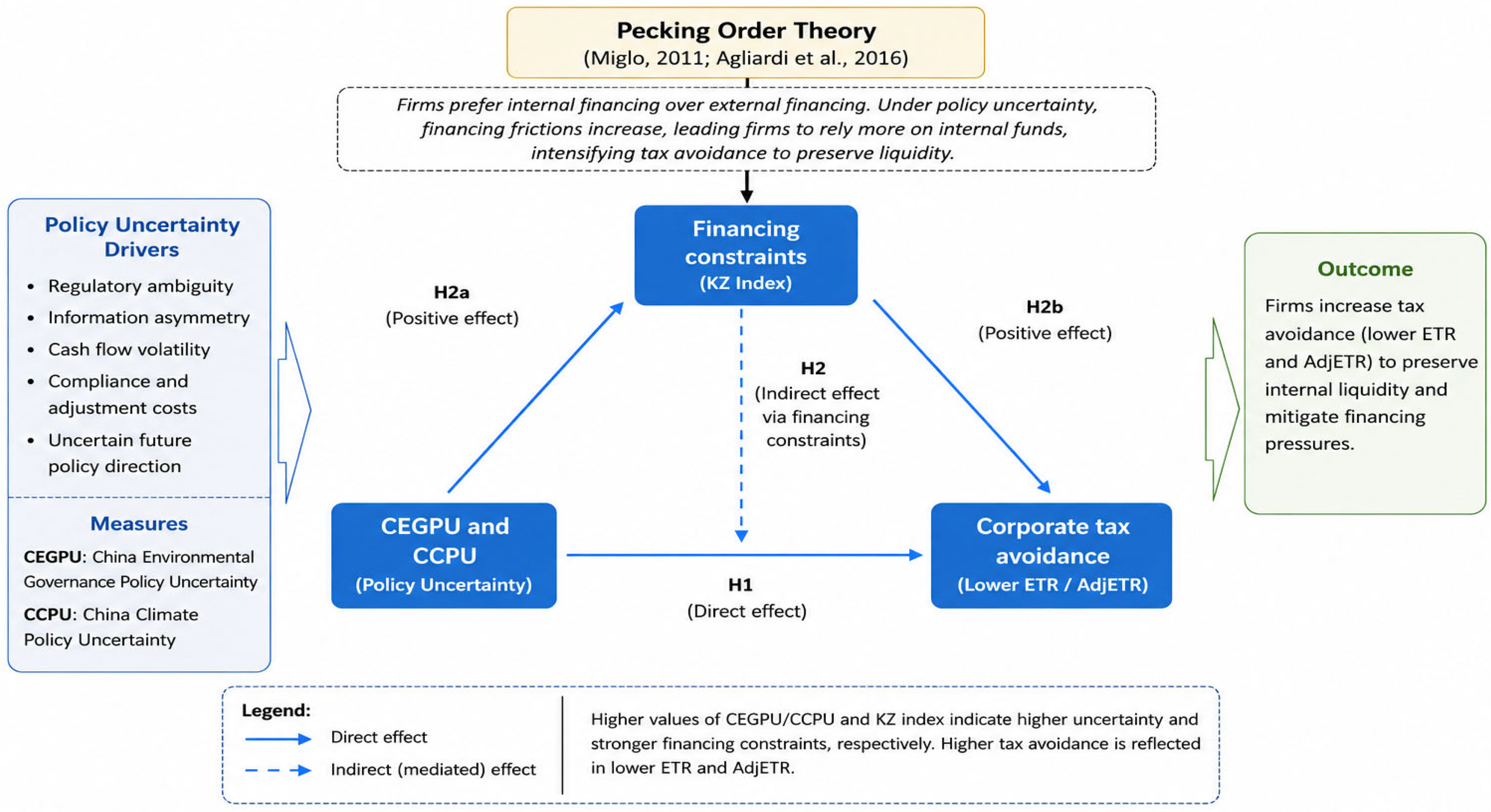
where, in Equations (2) and (3), the variables are the same in Equation (1), except for financing constraints, which is measured by KZ index. The direct path from CEGPU and CCPU to ETR and AdjETR is denoted as β1, while the path coefficient δ1 represents the magnitude of the path from CEGPU and CCPU to KZ index. Additionally, β2 represents the magnitude of the path from KZ index to ETR and AdjETR, while δ1 × β2 quantifies the total magnitude of the indirect path from CEGPU and CCPU to ETR and AdjETR mediated through KZ index. We depict the relation in Figure 1 below.

4. Results

4.1. Descriptive Statistics and Correlation Matrix

Table 2 presents the descriptive statistics for all variables used in the empirical analysis. The mean value of the ETR is 0.153, with a standard deviation of 0.071, while the AdjETR exhibits a mean of −0.097 and a similar level of dispersion. Notably, both measures display values significantly below the statutory tax rate on average, providing preliminary evidence of widespread corporate tax avoidance among Chinese listed firms, albeit with considerable heterogeneity across observations.
Examining the key explanatory variables, both climate and environmental governance policy uncertainty proxies exhibit meaningful variation. The average value of CEGPU is 66.007 (Std. Dev. = 5.314), while CCPU also shows non-trivial dispersion across the sample period, indicating that firms operate under substantially varying levels of policy uncertainty. This variability is critical for identification, as it ensures that the empirical analysis captures meaningful fluctuations in the policy environment. In addition, the KZ index displays a wide distribution (mean = −0.451; Std. Dev. = 0.908), suggesting significant heterogeneity in firms’ access to external financing, which is central to the mediation analysis.
Table 3 reports the Pearson correlation matrix. The results reveal that both CEGPU and CCPU are negatively correlated with ETR and AdjETR, providing preliminary evidence consistent with the hypothesis that higher policy uncertainty is associated with increased corporate tax avoidance. Moreover, the KZ index is negatively associated with tax rate measures, suggesting that more financially constrained firms tend to exhibit lower effective tax rates, in line with the financing-based explanation of tax avoidance. Importantly, the pairwise correlations among the explanatory variables are relatively modest, indicating the absence of severe multicollinearity concerns. This is further supported by the lack of excessively high correlations among control variables, suggesting that the regression estimates are unlikely to be biased due to collinearity issues. This is further corroborated by variance inflation factor (VIF) diagnostics, which are consistently below conventional critical values, confirming that multicollinearity is not a concern and ensuring the reliability and stability of the estimated coefficients.

4.2. Climate and Environmental Governance Policy Uncertainty and Corporate Tax Avoidance

Table 4 presents the baseline regression results on the relationship between climate and environmental governance policy uncertainty and corporate tax avoidance. The coefficients on both CEGPU and CCPU are negative and statistically significant across all specifications and alternative measures of tax avoidance (ETR and AdjETR), indicating that higher levels of policy uncertainty are associated with lower effective tax rates and, therefore, greater tax avoidance. This evidence is robust and provides strong empirical support for H1. Economically, the coefficient estimates imply that a one-standard-deviation increase in CEGPU is associated with an approximately 0.53 percentage point decline in ETR, corresponding to nearly 3.5% of the sample mean ETR (0.153), indicating economically meaningful effects on firms’ tax planning behavior. The findings are consistent with the pecking order theory, which suggests that policy uncertainty affects firms’ financial decisions by increasing risk, information asymmetry, and financing frictions (Gulen & Ion, 2016; M. Nguyen & Nguyen, 2020; Kang & Wang, 2021). It also suggests that firms respond to these conditions by relying more heavily on internally generated funds, thereby intensifying tax avoidance as a mechanism to preserve liquidity. Heightened climate and environmental governance policy uncertainty may also increase perceived political and regulatory risk, thereby impairing external financing conditions and intensifying firms’ precautionary liquidity management incentives. In response to these conditions, firms may rely more heavily on internally generated funds and intensify tax planning activities as a mechanism to preserve internal liquidity and maintain financial flexibility during periods of elevated uncertainty. This interpretation is consistent with prior evidence suggesting that political and regulatory risk impairs market liquidity and financing conditions through increased informational opacity and risk perceptions (Y. Liu et al., 2025), while financial and regulatory obstacles materially constrain firms’ operational and financing decisions (Bui & Pham, 2021).

4.3. Financial Constraints and Corporate Tax Avoidance Under Policy Uncertainty

Table 5 presents the path analysis results, providing direct evidence that financial constraints constitute a key transmission mechanism through which climate and environmental governance policy uncertainty increases corporate tax avoidance. Specifically, both CEGPU and CCPU are positively and statistically significantly associated with financing constraints, indicating that higher levels of policy uncertainty exacerbate firms’ financing frictions. In turn, financing constraints are negatively and significantly related to ETR and AdjETR, implying that more financially constrained firms engage in higher levels of tax avoidance. The estimated indirect effects are statistically significant across all specifications, confirming the presence of a transmission channel through which policy uncertainty affects corporate tax behavior via financing constraints, although the magnitude of the mediated effect varies across models. Economically, the mediated effects are also meaningful, as financing constraints account for between 2.33% and 23.24% of the total effect of climate and environmental governance policy uncertainty on corporate tax avoidance, indicating that financing frictions constitute a non-trivial transmission channel. Importantly, the total effects remain negative and significant, suggesting that policy uncertainty influences corporate tax avoidance both directly and indirectly through this channel. These findings are consistent with the pecking order theory, which predicts that firms facing increased financing frictions under uncertain policy environments which substitute toward internal financing. In this context, tax avoidance serves as an effective internal financing mechanism, allowing firms to reduce cash tax payments and retain liquidity. Consequently, as policy uncertainty intensifies and financial constraints worsen, firms increasingly rely on tax avoidance to secure internal funds and sustain their operations. This interpretation is also consistent with prior evidence suggesting that political and regulatory risk impairs financing conditions and market liquidity through heightened informational opacity and risk perceptions (Y. Liu et al., 2025), while financial and regulatory obstacles materially constrain firms’ operational and financing decisions (Bui & Pham, 2021).

5. Further Analysis

5.1. Endogeneity Tests

To address potential endogeneity concerns, we employ multiple robustness checks, including lagged independent variables, propensity score matching, and entropy balancing. Table 6 reports endogeneity tests using lagged values of the main independent variables, providing further support for the robustness of the baseline results. Both one-year (L1) and two-year (L2) lagged values of CEGPU and CCPU remain negative and statistically significant across all specifications and for both ETR and AdjETR, indicating that policy uncertainty has a persistent effect on corporate tax avoidance. The use of lagged variables mitigates reverse causality concerns, as current tax avoidance is unlikely to influence past uncertainty levels. Moreover, the results remain stable after including controls and industry fixed effects, confirming that the observed relationship is not driven by simultaneity bias but reflects a robust causal link between policy uncertainty and increased tax avoidance.
Table 7 reports the results of the endogeneity test using propensity score matching, providing further evidence on the robustness of the baseline findings. After matching firms with similar observable characteristics, the coefficients on both CEGPU and CCPU remain negative and statistically significant across all specifications and for both measures of corporate tax avoidance (ETR and AdjETR). Notably, the magnitude of the estimated coefficients is economically meaningful and, in some cases, larger than those reported in the baseline regressions, suggesting that the effect of policy uncertainty on tax avoidance is not driven by systematic differences between treated and control firms. By constructing a more balanced sample, the propensity score matching approach mitigates concerns related to selection bias and omitted variable bias arising from observable firm characteristics.
Table 8 reports the results of the entropy balancing approach, providing an additional and more stringent test of the robustness of the baseline findings. By reweighting the sample to achieve covariate balance across treatment groups, entropy balancing effectively eliminates differences in observable firm characteristics, thereby addressing concerns related to selection bias and model dependence. The results show that both CEGPU and CCPU retain negative and statistically significant coefficients across all specifications and for both ETR and AdjETR, consistent with the baseline and previous robustness tests. The magnitude and significance of the coefficients remain stable after the reweighting procedure, indicating that the relationship between policy uncertainty and corporate tax avoidance is not driven by imbalances in observable covariates.

5.2. Heterogeneity Effects

To further explore whether the baseline relationship varies across firm characteristics, we examine heterogeneity in the effect of climate and environmental governance policy uncertainty on corporate tax avoidance across different groups of firms.
We first distinguish between carbon-intensive and non-carbon-intensive firms. Carbon-intensive industries are typically defined as sectors characterized by both high carbon emission intensity and large emission scale, which together account for a substantial share of total emissions and are primary targets of environmental regulation (Y. Zhao et al., 2018). These industries also face higher compliance costs, stricter environmental policies, and greater exposure to regulatory shocks, as environmental regulation disproportionately targets high-emission sectors (X. Zhao et al., 2020). Therefore, Table 9 show that the negative relationship between climate and environmental governance policy uncertainty and effective tax rates is significantly stronger for carbon-intensive firms, while the effect is weaker and less significant for non-carbon-intensive firms. This pattern suggests that firms operating in high-emission sectors adjust their tax behavior more intensively in response to policy uncertainty, reflecting their greater exposure to environmental regulation and associated economic pressures.
Second, we examine heterogeneity between climate-sensitive and non-climate-sensitive firms. Climate-sensitive firms are those whose operations are more exposed to physical and transition risks associated with climate change, including regulatory, environmental, and operational risks (Dong & Zhang, 2025). Prior evidence shows that such firms face higher operating costs, increased financial distress, and more volatile cash flows under climate risk, which can influence their financial and strategic decisions, including tax behavior. Consistent with this, Table 9 indicates that the effect of policy uncertainty on tax avoidance is significantly stronger for climate-sensitive firms, whereas non-climate-sensitive firms exhibit a weaker response. This finding suggests that firms more exposed to climate-related risks respond more actively to uncertainty by adjusting their tax strategies.
Third, we investigate differences between regulated and unregulated firms. Regulated firms operate under stricter oversight, increased monitoring, and greater compliance requirements imposed by regulatory authorities, which limit managerial discretion and increase scrutiny over corporate behavior (Becher & Frye, 2011). In contrast, unregulated firms face fewer external constraints and greater flexibility in financial decision-making. Table 9 show that the effect of policy uncertainty on corporate tax avoidance is more pronounced among unregulated firms, while regulated firms exhibit a weaker response. This pattern suggests that regulatory oversight constrains firms’ ability or incentives to adjust tax strategies in response to uncertainty.

5.3. Quantile Regression Analysis

Table 10 reports the quantile regression results, providing additional evidence on how the effect of climate and environmental governance policy uncertainty varies across the distribution of corporate tax avoidance. The findings suggest that coefficients on CEGPU are negative and statistically significant across all quantiles for ETR, AdjETR, and AdjETR1, confirming the robustness of the baseline findings. The magnitude of the coefficients gradually declines from lower to higher quantiles, indicating that environmental governance policy uncertainty has a stronger effect among firms with lower effective tax rates (i.e., firms already engaging in higher tax avoidance), while the effect weakens for firms with relatively higher tax rates.
In contrast, the impact of CCPU exhibits a different pattern. The coefficients become increasingly negative and statistically significant at the median and upper quantiles, particularly for the 0.50, 0.75, and 0.90 quantiles. This suggests that climate policy uncertainty has a stronger effect on firms with higher effective tax rates, implying that these firms adjust their tax behavior more intensively when facing heightened climate-related uncertainty.

6. Conclusions

This study investigates how climate and environmental governance policy uncertainty shapes corporate tax avoidance, with a particular emphasis on the role of financial constraints as a key transmission mechanism. Against the backdrop of increasing volatility in environmental and climate-related regulatory frameworks, the analysis seeks to explain how firms adjust their tax strategies in response to heightened uncertainty. Empirically, the study exploits a large and comprehensive panel dataset of Chinese listed firms over the period 2002–2024, comprising 25,316 firm-year observations from approximately 4700 firms.
The findings provide robust evidence that climate and environmental governance policy uncertainty significantly increases corporate tax avoidance, as indicated by the consistently negative relationship between uncertainty measures and effective tax rates. Crucially, the path analysis shows that financial constraints serve as a significant transmission channel, whereby policy uncertainty intensifies financing frictions and, in turn, amplifies firms’ tax avoidance behavior. These results are strongly consistent with the pecking order theory, which predicts that firms substitute toward internal financing when external capital becomes more costly and less accessible. Heightened policy uncertainty increases cash flow volatility, raises compliance costs, and exacerbates information asymmetries, thereby tightening firms’ access to external funding. Under these conditions, firms rely more heavily on internally generated funds, with tax avoidance functioning as an immediate and flexible mechanism to preserve liquidity.
These findings have important theoretical and practical implications. From a theoretical perspective, this study extends the literature on policy uncertainty and corporate tax avoidance by identifying climate and environmental governance policy uncertainty as a distinct and economically meaningful driver of firms’ tax behavior, while providing direct evidence on the financing channel through which this effect operates. By grounding the analysis in the pecking order theory, the results clarify the mechanism linking uncertainty to tax avoidance, showing that firms respond to heightened uncertainty by substituting toward internal financing through tax planning. From a practical perspective, the results highlight the critical role of policy stability and regulatory clarity. For policymakers, the evidence suggests that unstable or unpredictable environmental policies may unintentionally encourage more aggressive tax avoidance, thereby undermining fiscal objectives. For firms and investors, the findings underscore the importance of financial flexibility and liquidity management in uncertain policy environments.
Notwithstanding these contributions, the study is subject to certain limitations. The analysis focuses on a single-country setting, which may limit generalizability, and relies on specific proxies for policy uncertainty. In addition, although the empirical analysis incorporates several firm-level controls and robustness tests, it does not fully capture all potential exogenous determinants and interaction effects that may simultaneously influence effective tax rates and corporate tax avoidance behavior. Moreover, although ETR- and AdjETR-based measures are widely employed in the tax avoidance literature, they may not exclusively capture aggressive tax avoidance behavior. Lower effective tax rates may also reflect firms’ utilization of legally permitted tax incentives, environmental tax concessions, accelerated depreciation schemes, and other policy-induced tax expenditures. Therefore, the findings should be interpreted as evidence of changes in firms’ effective tax outcomes and tax planning behavior under climate and environmental governance policy uncertainty. Future research could extend this framework to cross-country contexts, explore alternative measures of uncertainty, and examine the role of governance and institutional factors in moderating the relationship between policy uncertainty and corporate tax behavior.

Author Contributions

Conceptualization, A.P.; methodology, A.P.; software, A.P.; validation, A.P.; formal analysis, C.P.; investigation, C.P.; resources, C.P.; data curation, A.P. and C.P.; writing—original draft preparation, A.P. and C.P.; writing—review and editing, C.P.; visualization, C.P.; supervision, A.P. All authors have read and agreed to the published version of the manuscript.

Funding

This research received no external funding.

Institutional Review Board Statement

Not applicable.

Informed Consent Statement

Not applicable.

Data Availability Statement

The raw data supporting the conclusions of this article will be made available by the authors on request.

Conflicts of Interest

The authors declare no conflicts of interest.

Appendix A. Variable Definitions

VariablesMeasuresDefinition
Dependent Variable
ETREffective tax rateTotal tax expense divided by pre-tax income.
AdjETRAdjusted effective tax rateEffective tax rate minus statutory tax rate.
Independent Variables
CEGPUChina Environmental Governance Policy UncertaintyEnvironmental governance policy uncertainty for China developed by Wu et al. (2025)
CCPUChina Climate Policy UncertaintyClimate policy uncertainty for China developed by Y. R. Ma et al. (2023)
Mediator Variable
KZ indexFinancing constraintsKZ index developed by Kaplan and Zingales (1997)
Control Variables
BGBoard gender diversityPercentage of female on the board.
BIG4Big 4 auditAn indicator variable, equaling 1 if the firm’s financial reports are audited by the internationally top four auditing firms and 0 otherwise.
BSBoard sizeLog value of number of board member.
CASHCash holdingsOperating cash flow divided by total assets.
FAFirm ageNumber of years since the firm’s IPO.
FSFirm sizeNatural logarithm of total assets.
INTAIntangible assetsIntangible assets divided by total assets.
LEVLeverageDebt-to-equity ratio.
MtBMarket to book ratioMarket capitalization devided by total book value.
PPEProperty, plant, and equipmentProperty, plant, and equipment divided by total assets.
ROAReturn on assetsNet income divided by total assets.
ROEReturn on equityNet income divided by shareholders’ equity

References

  1. Agliardi, E., Agliardi, R., & Spanjers, W. (2016). Corporate financing decisions under ambiguity: Pecking order and liquidity policy implications. Journal of Business Research, 69(12), 6012–6020. [Google Scholar] [CrossRef]
  2. Amin, M. R., Akindayomi, A., Sarker, M. S. R., & Bhuyan, R. (2023). Climate policy uncertainty and corporate tax avoidance. Finance Research Letters, 58, 104581. [Google Scholar] [CrossRef]
  3. Arieftiara, D., Utama, S., Wardhani, R., & Rahayu, N. (2020). Contingent fit between business strategies and environmental uncertainty: The impact on corporate tax avoidance in Indonesia. Meditari Accountancy Research, 28(1), 139–167. [Google Scholar] [CrossRef]
  4. Baron, R. M., & Kenny, D. A. (1986). The moderator–mediator variable distinction in social psychological research: Conceptual, strategic, and statistical considerations. Journal of Personality and Social Psychology, 51(6), 1173. [Google Scholar] [CrossRef] [PubMed]
  5. Bassetto, C. F., & Kalatzis, A. E. (2011). Financial distress, financial constraint and investment decision: Evidence from Brazil. Economic Modelling, 28(1–2), 264–271. [Google Scholar] [CrossRef]
  6. Becher, D. A., & Frye, M. B. (2011). Does regulation substitute or complement governance? Journal of Banking & Finance, 35(3), 736–751. [Google Scholar] [CrossRef]
  7. Benkraiem, R., Gaaya, S., & Lakhal, F. (2022). Corporate tax avoidance, economic policy uncertainty, and the value of excess cash: International evidence. Economic Modelling, 108, 105738. [Google Scholar] [CrossRef]
  8. Bhattacharya, N., Ecker, F., Olsson, P. M., & Schipper, K. (2012). Direct and mediated associations among earnings quality, information asymmetry, and the cost of equity. The Accounting Review, 87(2), 449–482. [Google Scholar] [CrossRef]
  9. Boumparis, P., Milas, C., & Panagiotidis, T. (2017). Economic policy uncertainty and sovereign credit rating decisions: Panel quantile evidence for the Eurozone. Journal of International Money and Finance, 79, 39–71. [Google Scholar] [CrossRef]
  10. Bui, A. T., & Pham, T. P. (2021). Financial and labour obstacles and firm employment: Evidence from Europe and Central Asia firms. Sustainability, 13(15), 8650. [Google Scholar] [CrossRef]
  11. Chen, H., & Tian, Z. (2022). Environmental uncertainty, resource orchestration and digital transformation: A fuzzy-set QCA approach. Journal of Business Research, 139, 184–193. [Google Scholar] [CrossRef]
  12. Chen, J. X., Sharma, P., Zhan, W., & Liu, L. (2019). Demystifying the impact of CEO transformational leadership on firm performance: Interactive roles of exploratory innovation and environmental uncertainty. Journal of Business Research, 96, 85–96. [Google Scholar] [CrossRef]
  13. Chen, Y., & Lei, S. (2025). Tax avoidance opportunity for multinational enterprises: Effects of digitalized tax administration in China. Journal of International Financial Markets, Institutions and Money, 102, 102177. [Google Scholar] [CrossRef]
  14. Chu, J., & Fang, J. (2021). Economic policy uncertainty and firms’ labor investment decision. China Finance Review International, 11(1), 73–91. [Google Scholar] [CrossRef]
  15. Cui, H., Chen, S., Kong, D., & Luo, Y. (2025). Collectivist culture and corporate tax avoidance: Evidence from China. Journal of Business Ethics, 200(2), 417–443. [Google Scholar] [CrossRef]
  16. Cumming, D., & Nguyen, M. (2025). The impact of asset specificity on corporate tax avoidance: Do financial constraints and product market power matter? The British Accounting Review, 57(3), 101515. [Google Scholar] [CrossRef]
  17. Črnigoj, M., & Verbič, M. (2014). Financial constraints and corporate investments during the current financial and economic crisis: The credit crunch and investment decisions of Slovenian firms. Economic Systems, 38(4), 502–517. [Google Scholar] [CrossRef]
  18. Dai, Q., Wang, J., Liu, S., & Zhang, H. (2026). The impact and mechanisms of green agency costs on corporate tax avoidance tendencies. Finance Research Letters, 96, 109760. [Google Scholar] [CrossRef]
  19. Dai, Y., Wang, Y., & Li, R. (2024). Overcoming the “diversification trap”: Firm investment decisions and innovation under policy uncertainty. International Review of Economics & Finance, 91, 492–504. [Google Scholar] [CrossRef]
  20. de Guevara, J. F., Maudos, J., & Salvador, C. (2021). Effects of the degree of financial constraint and excessive indebtedness on firms’ investment decisions. Journal of International Money and Finance, 110, 102288. [Google Scholar] [CrossRef]
  21. De Jong, A., Verbeek, M., & Verwijmeren, P. (2010). The impact of financing surpluses and large financing deficits on tests of the pecking order theory. Financial Management, 39(2), 733–756. [Google Scholar] [CrossRef]
  22. Dequech, D. (2006). The new institutional economics and the theory of behaviour under uncertainty. Journal of Economic Behavior & Organization, 59(1), 109–131. [Google Scholar] [CrossRef]
  23. Doan, N. T., Vu, T. K. C., Nguyen, T. C. T., Nguyen, T. H. H., & Nguyen, K. T. (2020). Cash-in-advance, export decision and financial constraints: Evidence from cross-country firm-level data. International Review of Economics & Finance, 69, 75–92. [Google Scholar]
  24. Dong, H., & Zhang, L. (2025). Climate risk and tax avoidance of climate-sensitive firms. Business Strategy and the Environment, 34(7), 8429–8449. [Google Scholar] [CrossRef]
  25. Gaio, L. E., Lucas, A. C., Stefanelli, N. O., & Grespan Bonacim, C. A. (2026). Board gender diversity: Impact on corporate tax avoidance in response to economic policy uncertainty. Journal of Sustainable Finance & Investment, 16(1), 1–21. [Google Scholar]
  26. Gulen, H., & Ion, M. (2016). Policy uncertainty and corporate investment. The Review of Financial Studies, 29(3), 523–564. [Google Scholar] [CrossRef]
  27. Han, D., Zhao, Y., & Hao, S. (2026). ESG effects on the competitive advantage of construction enterprises in China: The mediating role of innovation under environmental uncertainty. Engineering, Construction and Architectural Management, 1–15. [Google Scholar] [CrossRef]
  28. Haque, T., Pham, T. P., & Yang, J. (2023). Geopolitical risk, financial constraints, and tax avoidance. Journal of International Financial Markets, Institutions and Money, 88, 101858. [Google Scholar] [CrossRef]
  29. He, Z. (2025). Goodwill impairment, economic uncertainty and corporate tax avoidance. Asian Review of Accounting, 33(5), 816–839. [Google Scholar] [CrossRef]
  30. Hong, C., & Ren, T. (2025). Financial constraints and firm innovation decision: The roles of corporate governance and risk diversification. Emerging Markets Finance and Trade, 61(5), 1428–1445. [Google Scholar] [CrossRef]
  31. Hu, G., & Wang, W. (2025). Tax incentive uncertainty and corporate tax avoidance: Evidence from high-Tech enterprises in China. Applied Economics, 1–16. [Google Scholar] [CrossRef]
  32. Hu, X., & Li, D. (2025). Foreign business exposure, policy uncertainty, and investment allocation decisions of Chinese multinational corporations. Pacific-Basin Finance Journal, 89, 102586. [Google Scholar] [CrossRef]
  33. Huang, H., Sun, L., & Zhang, J. (2017). Environmental uncertainty and tax avoidance. In Advances in taxation (Vol. 24). Emerald Publishing Limited. [Google Scholar]
  34. Huo, B., Ye, Y., Zhao, X., Wei, J., & Hua, Z. (2018). Environmental uncertainty, specific assets, and opportunism in 3PL relationships: A transaction cost economics perspective. International Journal of Production Economics, 203, 154–163. [Google Scholar] [CrossRef]
  35. Jacob, M., & Schütt, H. H. (2020). Firm valuation and the uncertainty of future tax avoidance. European Accounting Review, 29(3), 409–435. [Google Scholar] [CrossRef]
  36. Jin, J., Liu, Y., Zhang, Z., & Zhao, R. (2022). The impact of financial constraints on banks’ cash tax avoidance. Review of Accounting and Finance, 21(3), 109–129. [Google Scholar] [CrossRef]
  37. Jing, Z., Lu, S., Zhao, Y., & Zhou, J. (2023). Economic policy uncertainty, corporate investment decisions and stock price crash risk: Evidence from China. Accounting & Finance, 63, 1477–1502. [Google Scholar] [CrossRef]
  38. Jing, Z., Zhang, W., Zhao, P., & Zhao, Y. (2025). Environmental tax reform and corporate tax avoidance: A quasi-natural experiment on China’s environmental protection tax law. The North American Journal of Economics and Finance, 76, 102367. [Google Scholar] [CrossRef]
  39. Kalatzis, A. E., Bassetto, C. F., & Azzoni, C. R. (2011). Multicollinearity and financial constraint in investment decisions: A Bayesian generalized ridge regression. Journal of Applied Statistics, 38(2), 287–299. [Google Scholar] [CrossRef]
  40. Kang, W., & Wang, J. (2021). Corporate tax effects of economic policy uncertainty. Accounting & Finance, 61, 2577–2600. [Google Scholar]
  41. Kaplan, S. N., & Zingales, L. (1997). Do investment-cash flow sensitivities provide useful measures of financing constraints? The Quarterly Journal of Economics, 112(1), 169–215. [Google Scholar] [CrossRef]
  42. Keynes, J. M. (1965). The general theory of employment, interest, and money. Harper Business. [Google Scholar]
  43. Klassen, K. J., Pittman, J. A., Reed, M. P., & Fortin, S. (2004). A cross-national comparison of R&D expenditure decisions: Tax incentives and financial constraints. Contemporary Accounting Research, 21(3), 639–680. [Google Scholar]
  44. Knight, F. H. (1921). Risk, uncertainty and profit. University of Chicago Press. [Google Scholar]
  45. Li, J. (2021). Economic policy uncertainty, contracting frictions and imports sourcing decisions. Economics Letters, 200, 109772. [Google Scholar] [CrossRef]
  46. Li, J., Huddleston, P., & Good, L. (2021). Financial constraints and financing decision in cross-border mergers & acquisitions: Evidence from the US retail sector. The International Review of Retail, Distribution and Consumer Research, 31(4), 411–431. [Google Scholar]
  47. Lin, Y., & Song, Z. (2025). Biodiversity risks and corporate tax avoidance. Applied Economics Letters, 1–6. [Google Scholar] [CrossRef]
  48. Liu, C. L., & Lin, Y. M. (2018). Do mispricing and financial constraints matter for investment decisions? Applied Economics, 50(54), 5877–5892. [Google Scholar] [CrossRef]
  49. Liu, G., & Zhang, C. (2020). Economic policy uncertainty and firms’ investment and financing decisions in China. China Economic Review, 63, 101279. [Google Scholar] [CrossRef]
  50. Liu, H., Luo, J. H., & Huang, J. X. F. (2011). Organizational learning, NPD and environmental uncertainty: An ambidexterity perspective. Asian Business & Management, 10(4), 529–553. [Google Scholar] [CrossRef]
  51. Liu, T., Chen, X., & Yang, S. (2022). Economic policy uncertainty and enterprise investment decision: Evidence from China. Pacific-Basin Finance Journal, 75, 101859. [Google Scholar] [CrossRef]
  52. Liu, Y., Yang, J., & Pham, T. P. (2025). The hidden cost of firm-level political risk: Impairing liquidity in corporate bond markets. Finance Research Letters, 85, 108058. [Google Scholar] [CrossRef]
  53. Long, Y., Li, P., & You, B. (2014). Knowledge transfer, governance mechanisms in alliance and environmental uncertainty: An empirical study. Chinese Management Studies, 8(3), 438–472. [Google Scholar] [CrossRef]
  54. Lu, F., & Yang, S. (2023). IPO suspension, financing uncertainty and corporate tax avoidance. China Journal of Accounting Research, 16(4), 100329. [Google Scholar] [CrossRef]
  55. Lu, S., Shan, B., & Fei, Y. (2022). Exploring an inverted U-shaped relationship between entrepreneurial experience and Chinese new venture performance: The moderating role of environmental uncertainty. Asia Pacific Business Review, 28(4), 518–535. [Google Scholar] [CrossRef]
  56. Ma, C., Feng, S., Huang, W., & Chen, A. (2025). Political corruption and corporate tax avoidance: A quasi-natural experiment. International Review of Financial Analysis, 99, 103917. [Google Scholar] [CrossRef]
  57. Ma, Y. R., Liu, Z., Ma, D., Zhai, P., Guo, K., Zhang, D., & Ji, Q. (2023). A news-based climate policy uncertainty index for China. Scientific Data, 10(1), 881. [Google Scholar] [CrossRef]
  58. Miglo, A. (2011). Chapter 10—Trade-off, pecking order, signaling, and market timing models. In H. Kent, & G. Baker (Eds.), Capital structure and corporate financing decisions: Theory, evidence, and practice (pp. 171–191). Wiley and Sons. [Google Scholar]
  59. Mohamad Ariff, A., Kamarudin, K. A., Musa, A. Z., & Mohamad, N. A. (2024). Financial constraints, corporate tax avoidance and environmental, social and governance performance. Corporate Governance: The International Journal of Business in Society, 24(7), 1525–1546. [Google Scholar] [CrossRef]
  60. Negkakis, C. I., Negkakis, I. C., Pavlou, C., & Persakis, A. (2025). Tax avoidance and evasion under economic political uncertainty: The moderating roles of tax morale and religiosity. Journal of International Accounting, Auditing and Taxation, 59, 100717. [Google Scholar] [CrossRef]
  61. Ng, S. C., Rungtusanatham, J. M., Zhao, X., & Ivanova, A. (2015). TQM and environmental uncertainty levels: Profiles, fit, and firm performance. International Journal of Production Research, 53(14), 4266–4286. [Google Scholar] [CrossRef]
  62. Nguyen, M., & Nguyen, J. H. (2020). Economic policy uncertainty and firm tax avoidance. Accounting & Finance, 60(4), 3935–3978. [Google Scholar]
  63. Nguyen, T. C., Nguyen, T. V. H., Schinckus, C., & Chu, T. T. (2025). Excess liquidity and risk: How economic policy uncertainty shapes corporate decisions post-crisis? Finance Research Letters, 83, 107739. [Google Scholar] [CrossRef]
  64. Nguyen, V. T., & Doan, N. T. (2023). Open account, import decision and financial constraints: A cross-country firm-level study. International Journal of Finance & Economics, 28(4), 3918–3937. [Google Scholar]
  65. Ni, Y., Chen, Z., Li, D., & Yang, S. (2022). Climate risk and corporate tax avoidance: International evidence. Corporate Governance: An International Review, 30(2), 189–211. [Google Scholar] [CrossRef]
  66. Nicolas, T. (2022). Short-term financial constraints and SMEs’ investment decision: Evidence from the working capital channel. Small Business Economics, 58(4), 1885–1914. [Google Scholar] [CrossRef]
  67. Nie, Z., Li, K., & Zheng, Q. (2025). Corporate tax avoidance, financing constraints, and pollution emissions: A moral consistency theory perspective. Finance Research Letters, 86, 108943. [Google Scholar] [CrossRef]
  68. Pan, Y., Liao, L., Yao, D., & Zhang, J. H. (2024). Board chairs’ early-life experience and tax avoidance. Journal of Business Ethics, 192(4), 897–917. [Google Scholar] [CrossRef]
  69. Pan, Y., & Wu, X. (2026). The role of local governments in tax enforcement and tax avoidance by local state-owned enterprises: Evidence from China. Journal of Contemporary Accounting & Economics, 22, 100541. [Google Scholar] [CrossRef]
  70. Qasim, S., Rizov, M., & Zhang, X. (2021). Financial constraints and the export decision of Pakistani firms. International Journal of Finance & Economics, 26(3), 4557–4573. [Google Scholar]
  71. Qi, Y., Zhao, X., & Sheu, C. (2011). The impact of competitive strategy and supply chain strategy on business performance: The role of environmental uncertainty. Decision Sciences, 42(2), 371–389. [Google Scholar] [CrossRef]
  72. Qin, J., Lin, J., & Xin, Y. (2024). Corporate tax avoidance: The impact of performance above aspiration and CEO experience. Asia Pacific Journal of Management, 41(4), 2301–2331. [Google Scholar] [CrossRef]
  73. Ren, Y. S., Klein, T., & Jiang, Y. (2024). Monetary policy uncertainty and green investment decisions: A cross-national spillover perspective. International Review of Financial Analysis, 96, 103642. [Google Scholar] [CrossRef]
  74. Rodrik, D. (1991). Policy uncertainty and private investment in developing countries. Journal of Development Economics, 36(2), 229–242. [Google Scholar] [CrossRef]
  75. Saltari, E., & Travaglini, G. (2001). Financial constraints and investment decisions. Scottish Journal of Political Economy, 48(3), 330–344. [Google Scholar] [CrossRef]
  76. Sarwar, B., & Hassan, M. (2021). Impact of economic policy uncertainty on dividend decision: A moderating role of board financial expertise. Journal of Public Affairs, 21(3), e2613. [Google Scholar] [CrossRef]
  77. Septriani, Y., Wardhani, R., Adhariani, D., & Samingun. (2025). Tax avoidance in Southeast Asia: Unraveling the effects of environmental uncertainty and governance. Cogent Business & Management, 12(1), 2473031. [Google Scholar] [CrossRef]
  78. Shen, H., Hou, F., Peng, M., Xiong, H., & Zuo, H. (2021). Economic policy uncertainty and corporate tax avoidance: Evidence from China. Pacific-Basin Finance Journal, 65, 101500. [Google Scholar] [CrossRef]
  79. Song, M., Wang, L., Wang, L., & Chen, W. (2023). Environmental uncertainty, participative corporate political activity and radical innovation in China: A sensemaking perspective. Journal of Business & Industrial Marketing, 38(3), 593–608. [Google Scholar]
  80. Song, Y., & Xian, R. (2025). The effect of firm-level climate change risk on tax avoidance: Evidence from China. Applied Economics Letters, 32(9), 1221–1225. [Google Scholar] [CrossRef]
  81. Su, Y., Liu, A., & Lei, W. (2025). The impact of managers’ overconfidence and corporate tax avoidance: A full-life-cycle perspective. Finance Research Letters, 90, 109244. [Google Scholar] [CrossRef]
  82. Sultanbawa, F., Chowdhury, H., Malik, I. A., & Haque, A. (2025). Does climate policy uncertainty affect a firm’s lease versus buy decision? Evidence from the US. International Review of Economics & Finance, 104, 104647. [Google Scholar]
  83. Sun, H., Lin, Y., Zhang, T., & Cai, C. (2025). Climate policy risk and the uncertainty of future tax planning decision: Evidence from China. Applied Economics Letters, 1–7. [Google Scholar] [CrossRef]
  84. Taherinia, M., Abdi, M., & Dormishi, M. (2022). Tax avoidance and the auditor’s opinion: The role of uncertainty and government ownership (evidence from the stock market of Iran). Australasian Accounting, Business and Finance Journal, 16(3), 73–94. [Google Scholar] [CrossRef]
  85. Tang, T. Y. (2020). A review of tax avoidance in China. China Journal of Accounting Research, 13(4), 327–338. [Google Scholar] [CrossRef]
  86. Wang, Z., & Li, S. (2025). To the best of both worlds: Firm’s nationalism and corporate tax. Economics Letters, 247, 112094. [Google Scholar] [CrossRef]
  87. Wu, R., Zeng, H., Yan, J., & Işık, C. (2025). Introducing the environmental governance policy uncertainty (EGPU) for China. Journal of Environmental Management, 386, 125748. [Google Scholar] [CrossRef] [PubMed]
  88. Xie, X., Lan, R., Li, X., & Li, J. (2026). A game-theoretic real options approach to CCUS investment decisions: Comparative analysis of business models under market and policy uncertainties. Technological Forecasting and Social Change, 223, 124417. [Google Scholar] [CrossRef]
  89. Xu, W., & Liu, C. (2024). External environment uncertainty, key resources acquisition, and corporate technological innovation. Managerial and Decision Economics, 45(1), 4–18. [Google Scholar] [CrossRef]
  90. Yang, Q., Geng, R., Jiang, Y., & Feng, T. (2021). Governance mechanisms and green customer integration in China: The joint effect of power and environmental uncertainty. Transportation Research Part E: Logistics and Transportation Review, 149, 102307. [Google Scholar] [CrossRef]
  91. Yuan, Q., & Bai, J. (2025). Preventive regulation and corporate tax avoidance: Evidence from China. Accounting & Finance, 65(1), 819–856. [Google Scholar]
  92. Zhang, Y., Yuan, L., Ibrahim, I., & Omar, R. (2025). Sustainability in question: Climate risk, environment, social and governance performance, and tax avoidance. Sustainability, 17(4), 1400. [Google Scholar] [CrossRef]
  93. Zhao, X., Liu, C., Sun, C., & Yang, M. (2020). Does stringent environmental regulation lead to a carbon haven effect? Evidence from carbon-intensive industries in China. Energy Economics, 86, 104631. [Google Scholar] [CrossRef]
  94. Zhao, Y., Feng, T., & Shi, H. (2018). External involvement and green product innovation: The moderating role of environmental uncertainty. Business Strategy and the Environment, 27(8), 1167–1180. [Google Scholar] [CrossRef]
  95. Zhou, W., Huang, X., Dai, H., Xi, Y., Wang, Z., & Chen, L. (2022). Research on the impact of economic policy uncertainty on enterprises’ green innovation—Based on the perspective of corporate investment and financing decisions. Sustainability, 14(5), 2627. [Google Scholar] [CrossRef]
  96. Zhou, X., Xiao, M., Wu, H., & You, J. (2024). Does policy uncertainty travel across borders? Evidence from MNC subsidiary investment decisions. Journal of Banking & Finance, 163, 107195. [Google Scholar] [CrossRef]
Figure 1. The figure integrates the theoretical framework and research model. It depicts the direct and indirect paths through which China environmental governance policy uncertainty (CEGPU) and China climate policy uncertainty (CCPU) affect corporate tax avoidance through financing constraints, grounded in the pecking order theory (e.g., Miglo, 2011; Agliardi et al., 2016).
Economies 14 00202 g001
Table 1. Sample selection.
Firm-Year Observation Selection
Initial sample39,955
Exclude observations with abnormal effective tax rates(8304)
Exclude firm-year observations with missing data for key variables(6335)
Final sample used in the empirical analysis25,316
Unique firms4700
Note: This table presents the step-by-step sample selection procedure and the associated exclusion criteria used to derive the final sample.
Table 2. Descriptive statistics.
VariablesObs.MeanStd. Dev.MinMax
ETR25,3160.1530.0710.0100.396
AdjETR25,316−0.0970.071−0.2410.144
CEGPU24,33466.0075.31455.22973.684
CCPU20,92725170.4140.8823.199
KZ index25,316−0.4510.908−3.6471.215
BG25,31649.3918.35812.09889.128
BIG425,3160.0640.2450.0001.000
BS25,3160.9970.0270.8451.113
CASH25,3160.0350.0240.0100.097
FA25,31618.8276.0267.00036.000
FS25,3167.5810.6116.4889.583
INTA25,3160.0460.0490.00020.306
LEV25,3160.3810.2510.0590.975
MtB25,3163.2472.2100.71112.707
PPE25,3160.2270.1470.0030.576
ROA25,3160.0580.0310.0080.143
ROE25,3160.0940.0430.0150.193
Note: This table presents the summary statistics for the variables used in the analysis. The description of these variables is presented in Appendix A.
Table 3. Correlation matrix.
ETRAdjETRAdjETR1CEGPUCCPUKZ indexBGBIG4BSCASHFAFSINTALEVMtBPPEROAROEVIF
ETR1.000
AdjETR 1.000
AdjETR1 1.000
CEGPU−0.143 ***−0.143 ***−0.143 ***1.000 1.20
CCPU−0.085 ***−0.043 ***−0.058 ***0.228 ***1.000 1.08
KZ index0.073 ***0.073 ***0.073 ***0.037 ***0.043 ***1.000 1.521.51
BG−0.016 ***−0.016 ***−0.016 ***−0.0010.007−0.033 ***1.000 1.011.01
BIG40.090 ***0.091 ***0.091 ***0.022 ***−0.0030.029 ***−0.035 ***1.000 1.181.18
BS0.0080.0060.007−0.049 ***−0.021 ***0.016 ***0.043 ***0.016 ***1.000 1.031.02
CASH−0.012 *−0.010 *−0.011 *0.015 **0.024 ***0.024 ***−0.009−0.009−0.019 ***1.000 1.011.01
FA−0.082 ***−0.073 ***−0.077 ***0.375 ***0.215 ***−0.0010.7040.016 **−0.042 ***0.014 **1.000 1.171.06
FS0.201 ***0.206 ***0.205 ***0.088 ***0.071 ***0.175 ***−0.051 ***0.378 ***−0.101 ***−0.014 **0.052 ***1.000 1.731.70
INTA0.074 ***0.076 ***0.075 ***−0.041 ***−0.019 ***0.051 ***−0.024 ***0.032 ***−0.013 **0.013 **−0.030 ***0.036 ***1.000 1.061.06
LEV−0.004−0.005−0.005−0.0000.0100.139 ***0.002−0.0000.012 **−0.034 ***−0.017 ***0.026 ***0.024 ***1.000 1.041.04
MtB−0.118 ***−0.114 ***−0.116 ***−0.068 ***0.031 ***−0.063 ***0.040 ***−0.078 ***0.014 **−0.026 ***0.006−0.311 ***−0.022 ***−0.015 **1.000 1.181.16
PPE0.016 **0.010 *0.012 **−0.038 ***−0.056 ***0.039 ***0.003−0.039 ***−0.0090.047 ***−0.029 ***−0.058 ***0.215 ***0.074 ***−0.049 ***1.000 1.091.09
ROA−0.196 ***−0.192 ***−0.194 ***0.011 *0.039 ***−0.421 ***0.042 ***−0.061 ***−0.016 ***−0.022 ***−0.001−0.331 ***−0.009−0.028 ***0.257 ***0.075 ***1.000 5.525.26
ROE−0.089 ***−0.087 ***−0.087 ***−0.011 *0.014 **−0.120 ***0.019 ***0.037 ***−0.002−0.030 ***−0.022 ***−0.049 ***−0.018 ***0.051 ***0.211 ***0.025 ***0.800 ***1.0004.223.99
Note: This table presents the correlation matrix and Variance Inflation Factor for the variables used in the analysis. The description of these variables are presented in Appendix A. The ***, **, and * refer to two-tailed significance at the 1%, 5% and 10% level, respectively.
Table 4. Baseline results.
VariableETRAdjETR
(1)(2)(3)(4)(5)(6)(7)(8)
CEGPU−0.001 ***−0.001 *** −0.001 ***−0.001 ***
(0.0001)(0.0001) (0.00009)(0.0001)
CCPU −0.013 ***−0.010 *** −0.006 ***−0.003 **
(0.001)(0.001) (0.001)(0.001)
BG 0.000008 −0.00005 0.000008 −0.00005
(0.00007) (0.00008) (0.00007) (0.00008)
BIG4 0.007 ** 0.008 ** 0.007 ** 0.008 **
(0.003) (0.004) (0.003) (0.004)
BS 0.021 0.035 0.021 0.035
(0.024) (0.029) (0.024) (0.029)
CASH −0.035 * −0.032 −0.035 * −0.027
(0.021) (0.022) (0.021) (0.022)
FA −0.0002 *** −0.0008 *** −0.0002 *** −0.0008 ***
(0.00007) (0.00008) (0.00007) (0.00008)
FS 0.014 *** 0.011 *** 0.014 *** 0.012 ***
(0.001) (0.001) (0.001) (0.001)
INTA 0.083 *** 0.079 *** 0.083 *** 0.084 ***
(0.018) (0.019) (0.018) (0.019)
LEV −0.007 *** −0.009 *** −0.007 *** −0.009 ***
(0.002) (0.002) (0.002) (0.002)
MtB −0.001 *** −0.001 *** −0.001 *** −0.001 ***
(0.0002) (0.0002) (0.0002) (0.0002)
PPE 0.007 0.008 0.007 0.005
(0.005) (0.005) (0.005) (0.005)
ROA −0.046 *** −0.577 *** −0.467 *** −0.559 ***
(0.045) (0.047) (0.045) (0.047)
ROE 0.147 *** 0.183 *** 0.147 *** 0.177 ***
(0.029) (0.029) (0.029) (0.029)
Constant0.273 ***0.161 ***0.191 ***0.095 ***0.023 ***−0.088 ***−0.078 ***−0.180 ***
(0.006)(0.030)(0.003)(0.034)(0.006)(0.030)(0.003)(0.034)
Industry F.E.YESYESYESYESYESYESYESYES
Observations24,33424,33420,92720,92724,33424,33420,92720,927
Adj. R20.0380.1050.0230.0990.0380.1050.0170.092
Note: This table reports the baseline regression results examining the relationship between China environmental governance policy uncertainty (CEGPU), China climate policy uncertainty (CCPU), and corporate tax avoidance proxied by ETR and AdjETR. Industry fixed effects are included in all specifications, and firm-clustered standard errors are reported in parentheses. Lower values of ETR and AdjETR indicate higher levels of corporate tax avoidance. The ***, **, and * denote statistical significance at the 1%, 5%, and 10% levels, respectively. Variable definitions are provided in Appendix A.
Table 5. Path analysis: Financing constraints channel.
VariableETRAdjETR
Direct path
P (CEGPU, Corporate tax avoidance)−0.0017 *** −0.0018 ***
(0.00001) (0.00001)
P (CCPU, Corporate tax avoidance) −0.0095 *** −0.0026 *
(0.001) (0.001)
Indirect path
P (CEGPU, Financing constraints)0.0135 *** 0.0135 ***
(0.001) (0.001)
P (CCPU, Financing constraints) 0.1771 *** 0.1771 ***
(0.012) (0.012)
P (Financing constraints, corporate tax avoidance)−0.0031 ***−0.0046 ***−0.0031 ***−0.0044 ***
(0.00008)(0.00009)(0.00008)(0.00009)
P (CEGPU, Financing constraints) × P (Financing constraints, corporate tax avoidance)−0.000004 *** −0.000004 ***
(0.000001) (0.00001)
P (CCPU, Financing constraints) × P (Financing constraints, corporate tax avoidance) −0.00008 *** −0.00007 ***
(0.00001) (0.00001)
Total effect−0.0018 ***−0.0103 ***−0.0018 ***−0.0033 **
(0.00009)(0.001)(0.00001)(0.001)
Mediated % in Total2.333%7.890%2.333%23.24%
Observations24,33420,92724,33420,927
Note: This table reports the path analysis examining the mediating role of financing constraints in the relationship between climate and environmental governance policy uncertainty and corporate tax avoidance. Industry fixed effects are included in all specifications, and firm-clustered standard errors are reported in parentheses. The indirect effect represents the transmission channel through financing constraints. The ***, **, and * denote statistical significance at the 1%, 5%, and 10% levels, respectively. Variable definitions are provided in Appendix A.
Table 6. Endogeneity test using lag of independent variables (L1 for 1 year lag and L2 for 2 years lag).
Panel A. Dependent Variable: ETR
(1)(2)(3)(4)(5)(6)(7)(8)
L1.CEGPU−0.001 ***−0.002 ***
(0.0001)(0.0001)
L1.CCPU −0.014 ***−0.015 ***
(0.001)(0.001)
L2.CEGPU −0.001 ***−0.002 ***
(0.0001)(0.0001)
L2.CCPU −0.015 ***−0.013 ***
(0.001)(0.001)
ControlsNOYESNOYESNOYESNOYES
Industry F.E.YESYESYESYESYESYESYESYES
Observations15,99615,99612,90412,90414,75114,75113,34313,343
Adj. R20.0370.1130.0370.1150.0250.1000.0250.097
Panel B. Dependent Variable: AdjETR
(1)(2)(3)(4)(5)(6)(7)(8)
L1.CEGPU−0.001 ***−0.002 ***
(0.0001)(0.0001)
L1.CCPU −0.012 ***−0.013 ***
(0.001)(0.001)
L2.CEGPU −0.001 ***−0.002 ***
(0.0001)(0.0001)
L2.CCPU −0.014 ***−0.013 ***
(0.001)(0.001)
ControlsNOYESNOYESNOYESNOYES
Industry F.E.YESYESYESYESYESYESYESYES
Observations15,99615,99612,90412,90414,75114,75113,34313,343
Adj. R20.0370.1130.0370.1150.0230.0970.0250.097
Note: This table reports the endogeneity tests using one-year (L1) and two-year (L2) lagged values of China environmental governance policy uncertainty (CEGPU) and China climate policy uncertainty (CCPU). Industry fixed effects are included in all specifications, and firm-clustered standard errors are reported in parentheses. The use of lagged independent variables mitigates potential reverse causality concerns. The *** denote statistical significance at the 1%, 5%, and 10% levels, respectively. Variable definitions are provided in Appendix A.
Table 7. Endogeneity test using propensity score matching.
VariableETRAdjETR
(1)(2)(3)(4)
CEGPU−0.005 *** −0.005 ***
(0.001) (0.001)
CCPU −0.005 *** −0.003 ***
(0.001) (0.001)
ControlsYESYESYESYES
Observations24,33420,92724,33420,927
Note: This table reports the endogeneity tests using the propensity score matching (PSM) approach. The results examine whether the relationship between climate and environmental governance policy uncertainty and corporate tax avoidance remains robust after matching firms with similar observable characteristics. Firm-clustered standard errors are reported in parentheses. The *** denote statistical significance at the 1%, 5%, and 10% levels, respectively. Variable definitions are provided in Appendix A.
Table 8. Endogeneity test using entropy balancing.
VariableETRAdjETR
(1)(2)(3)(4)(5)(6)(7)(8)
CEGPU−0.001 ***−0.002 *** −0.001 ***−0.002 ***
(0.0001)(0.0001) (0.0001)(0.0001)
CCPU −0.009 ***−0.007 *** −0.009 ***−0.007 ***
(0.001)(0.001) (0.001)(0.001)
Constant0.274 ***0.192 ***0.180 ***0.088 ***0.024 ***−0.057 *−0.069 ***
(0.007)(0.031)(0.003)(0.033)(0.007)(0.031)(0.003)
ControlsNOYESNOYESNOYESNOYES
Industry F.E.YESYESYESYESYESYESYESYES
Observations24,33424,33419,94519,94524,33424,33419,945−0.161 ***
Adj. R20.0430.1090.0210.0980.0430.1090.0210.033
Note: This table reports the endogeneity tests using the entropy balancing approach. The entropy balancing procedure reweights the sample to achieve covariate balance across treatment groups and mitigate potential selection bias arising from observable firm characteristics. Industry fixed effects are included in all specifications, and firm-clustered standard errors are reported in parentheses. The *** and * denote statistical significance at the 1%, 5%, and 10% levels, respectively. Variable definitions are provided in Appendix A.
Table 9. Heterogeneity effects.
VariableETRAdjETR
Carbon-intensive firms
(1)(2)(3)(4)
CEGPU−0.001 *** −0.001 ***
(0.0001) (0.0001)
CCPU −0.011 *** −0.003 **
(0.001) (0.001)
Constant0.190 ***0.122 ***−0.059−0.151 ***
(0.040)(0.045)(0.040)(0.045)
ControlsYESYESYESYES
Industry F.E.YESYESYESYES
Observations12,55310,73712,55310,737
Adj. R20.0920.0890.0920.082
Non-carbon-intensive firms
(1)(2)(3)(4)
CEGPU−0.001 *** −0.001 ***
(0.0001) (0.0001)
CCPU −0.009 *** −0.002 ***
(0.002) (0.002)
Constant0.125 ***0.062 ***−0.124 ***−0.214 ***
(0.042)(0.047)(0.042)(0.040)
ControlsYESYESYESYES
Industry F.E.YESYESYESYES
Observations11,78110,19011,78110,190
Adj. R20.1180.1090.1180.102
Climate-sensitive firms
(1)(2)(3)(4)
CEGPU−0.001 *** −0.001 ***
(0.0001) (0.0001)
CCPU −0.010 *** −0.003 *
(0.002) (0.002)
Constant0.181 ***0.115 *−0.068−0.156 ***
(0.053)(0.060)(0.053)(0.060)
ControlsYESYESYESYES
Industry F.E.YESYESYESYES
Observations8737754487377544
Adj. R20.0740.0730.0740.068
Non-climate-sensitive firms
(1)(2)(3)(4)
CEGPU−0.001 *** −0.001 ***
(0.0001) (0.0001)
CCPU −0.010 *** −0.003 *
(0.001) (0.001)
Constant0.140 ***0.077 *−0.109 ***−0.202 ***
(0.035)(0.040)(0.035)(0.041)
ControlsYESYESYESYES
Industry F.E.YESYESYESYES
Observations15,59713,38315,59713,383
Adj. R20.1230.1140.1230.107
Regulated firms
(1)(2)(3)(4)
CEGPU−0.001 *** −0.001 ***
(0.0001) (0.0001)
CCPU −0.019 *** −0.011 *
(0.006) (0.007)
Constant0.313 ***0.312 ***0.0630.045
(0.093)(0.095)(0.093)(0.095)
ControlsYESYESYESYES
Industry F.E.YESYESYESYES
Observations11039651103965
Adj. R20.0930.1080.0930.099
Unregulated firms
(1)(2)(3)(4)
CEGPU−0.001 *** −0.001 ***
(0.0001) (0.0001)
CCPU −0.010 *** −0.003 **
(0.001) (0.001)
Constant0.141 ***0.072 ***−0.107 ***−0.205 ***
(0.032)(0.037)(0.032)(0.037)
ControlsYESYESYESYES
Industry F.E.YESYESYESYES
Observations23,23119,96223,23119,962
Adj. R20.1050.0980.1050.091
Note: This table reports the heterogeneity analysis examining whether the relationship between climate and environmental governance policy uncertainty and corporate tax avoidance varies across different firm characteristics and institutional environments. Industry fixed effects are included in all specifications, and firm-clustered standard errors are reported in parentheses. The ***, **, and * denote statistical significance at the 1%, 5%, and 10% levels, respectively. Variable definitions are provided in Appendix A.
Table 10. Quantile regression analysis.
VariableETR
Quantiles0.100.250.500.750.90
(1)(2)(3)(4)(5)(6)(7)(8)(9)(10)
CEGPU−0.0021 *** −0.0021 *** −0.0019 *** −0.0017 *** −0.0015 ***
(0.001) (0.00001) (0.00008) (0.0001) (0.0001)
CCPU −0.0014 −0.0063 *** −0.0103 *** −0.0149 *** −0.0224 ***
(0.002) (0.001) (0.001) (0.001) (0.002)
Constant0.158 ***0.0160.123 ***−0.0140.144 ***0.0320.117 ***0.094 ***0.312 ***0.333 ***
(0.036)(0.042)(0.023)(0.026)(0.020)(0.022)(0.033)(0.035)(0.046)(0.055)
ControlsYESYESYESYESYESYESYESYESYESYES
Industry F.E.YESYESYESYESYESYESYESYESYESYES
Observations24,33420,92724,33420,92724,33420,92724,33420,92724,33420,927
Psuedo R20.0430.0230.0450.0260.0610.0540.1070.1100.1120.114
VariableAdjETR
Quantiles0.100.250.500.750.90
(1)(2)(3)(4)(5)(6)(7)(8)(9)(10)
CEGPU−0.0021 *** −0.0021 *** −0.0019 *** −0.0017 *** −0.0015 ***
(0.0001) (0.00009) (0.00008) (0.0001) (0.0001)
CCPU 0.0072 *** −7.388 × 10⁻⁴ −0.0074 *** −0.0086 *** −0.0133 ***
(0.002) (0.001) (0.001) (0.001) (0.002)
Constant−0.091 **−0.268 ***−0.126 ***−0.291 ***−0.105 ***−0.224 ***−0.132 ***−0.169 ***0.0620.046
(0.036)(0.044)(0.023)(0.027)(0.020)(0.022)(0.033)(0.034)(0.046)(0.054)
ControlsYESYESYESYESYESYESYESYESYESYES
Industry F.E.YESYESYESYESYESYESYESYESYESYES
Observations24,33420,92724,33420,92724,33420,92724,33420,92724,33420,927
Psuedo R20.0430.0210.0450.0240.0610.0510.1070.1080.1130.111
Note: This table reports the additional robustness and cross-sectional analyses examining whether the relationship between climate and environmental governance policy uncertainty and corporate tax avoidance varies across firm-specific and institutional characteristics. Industry fixed effects are included in all specifications, and firm-clustered standard errors are reported in parentheses. The *** and ** denote statistical significance at the 1%, 5%, and 10% levels, respectively. Variable definitions are provided in Appendix A.
Disclaimer/Publisher’s Note: The statements, opinions and data contained in all publications are solely those of the individual author(s) and contributor(s) and not of MDPI and/or the editor(s). MDPI and/or the editor(s) disclaim responsibility for any injury to people or property resulting from any ideas, methods, instructions or products referred to in the content.