1. Introduction
In the contemporary discourse on sustainable development, unraveling the intricate relationship between economic growth and environmental quality has gained paramount importance. The Environmental Kuznets Curve (EKC) hypothesis provides a foundational framework suggesting an inverted U-shaped relationship whereby environmental degradation initially worsens with economic growth but eventually improves after surpassing a certain income threshold (
Grossman & Krueger, 1991;
Panayotou, 1993). While this hypothesis has been extensively investigated, the empirical evidence remains mixed, especially among emerging economies where complex socio-economic dynamics, energy consumption patterns, and policy contexts influence environmental outcomes in distinctive ways.
The BRICS countries—Brazil, Russia, India, China, and South Africa—stand as pivotal players in the global economic and environmental arena, collectively representing a substantial share of global GDP, energy demand, and carbon emissions. These economies are undergoing rapid structural transformations marked by increasing urbanization, industrialization, and energy consumption, often dominated by fossil fuels. Such dynamics challenge the EKC hypothesis as the BRICS nations display heterogeneous environmental trajectories that reflect differing stages of development, energy infrastructures, and policy environments (
Shahbaz et al., 2016;
Apergis & Ozturk, 2015). Therefore, revisiting the EKC in the BRICS context necessitates a nuanced approach that accounts for key mediating factors influencing environmental quality beyond economic growth alone.
Central to this reconsideration is the role of energy risk improvement—a critical yet underexplored dimension linking economic development to environmental outcomes. Energy risk, encompassing factors such as supply security, price volatility, geopolitical uncertainties, and regulatory instability, profoundly impacts both the economic performance and environmental footprint of countries. Energy risk refers to the vulnerability of an economy to disruptions in energy supply, price volatility, and structural imbalances in the energy system. It captures the extent to which countries are exposed to energy-related uncertainties that may affect economic and environmental outcomes (
Zhang & Usman, 2025). While energy security broadly reflects the availability, affordability, and sustainability of energy, energy risk focuses more specifically on the potential threats and instabilities within the energy system.
In BRICS economies, energy risk manifests through frequent supply disruptions, dependence on imported fuels, and fluctuating energy prices, which collectively hinder investment in cleaner technologies and the transition towards sustainable energy systems. Conversely, improvements in managing and mitigating these energy risks—through diversification of energy sources, enhanced infrastructure resilience, and effective governance—can facilitate more stable and sustainable economic growth paths while enabling environmental quality enhancement.
Despite its critical importance, energy risk improvement remains largely absent or insufficiently incorporated in EKC-related empirical analyses of emerging economies. Traditional EKC models primarily focus on income levels and environmental indicators, often neglecting how energy security and risk management shape the environmental impact of economic growth. This omission overlooks a vital channel through which energy system vulnerabilities translate into environmental degradation or improvement. Therefore, this study uniquely contributes to the literature by explicitly integrating energy risk improvement into the EKC framework for BRICS countries, thereby offering fresh insights into the complex interplay between economic development, energy system stability, and environmental quality.
This focus on energy risk improvement is especially timely in light of recent global developments. The acceleration of renewable energy investments shifts in energy policy priorities, and international commitments to climate change mitigation have heightened the importance of robust energy systems. The COVID-19 pandemic and geopolitical tensions have further exposed vulnerabilities in global energy markets, emphasizing the necessity for risk-resilient energy systems to support sustainable development agendas. For BRICS countries, which face competing demands of economic growth and environmental protection amid significant energy challenges, understanding how energy risk improvement shapes the EKC trajectory is critical for informed policymaking.
This study offers several significant contributions to the field of environmental economics and sustainable development, particularly in the context of emerging economies. First, it advances EKC literature by explicitly integrating energy risk improvement as a key explanatory variable in the relationship between economic growth and environmental quality. Unlike traditional EKC models that predominantly focus on income levels and environmental indicators, this study highlights the critical role of energy system stability—encompassing supply security, price volatility, and regulatory quality—in shaping environmental outcomes. By incorporating this dimension, the study provides a richer theoretical framework that better reflects the complexities of the growth–environment nexus.
Second, the focus on BRICS offers valuable, context-specific insights given their prominence as major emerging economies that collectively account for a substantial share of global energy consumption, economic output, and carbon emissions. This geographical and economic emphasis addresses a notable gap in EKC research, which often overlooks the heterogeneity and unique energy challenges faced by such economies.
Methodologically, the study distinguishes itself by employing advanced panel econometric techniques. The use of FMOLS enables the estimation of long-run relationships while correcting for potential endogeneity and serial correlation biases inherent in panel data. Additionally, the application of Driscoll–Kraay standard errors addresses issues of heteroskedasticity, serial correlation, and cross-sectional dependence, thereby enhancing the robustness and reliability of empirical findings. This rigorous methodological approach strengthens the validity of the conclusions drawn.
Another contribution lies in the multidimensional measurement of energy risk. Unlike studies that rely on simplistic proxies such as total energy consumption or fossil fuel dependence, this research uses a composite energy risk index that captures various facets of energy vulnerability, including supply disruptions, market instability, and governance challenges. This comprehensive perspective allows for a more nuanced examination of how improvements in diverse aspects of energy risk influence environmental quality.
Furthermore, the findings offer practical policy relevance by underscoring the importance of managing energy risks to achieve environmental quality improvements. This study provides actionable insights for policymakers in BRICS countries, emphasizing the need for integrated strategies focused on energy diversification, infrastructure resilience, and regulatory reforms that align energy security objectives with environmental sustainability goals. This is particularly timely given the heightened global awareness of energy security following recent geopolitical tensions, the COVID-19 pandemic, and the accelerating shift toward renewable energy sources.
This study addresses key gaps in the EKC literature by highlighting energy risk improvement as an important determinant of environmental outcomes in emerging economies. It strengthens theoretical understanding, provides robust empirical evidence, and offers relevant insights for policy discussions on sustainable development in the global South. Overall, this paper contributes to the EKC literature by highlighting the role of energy risk in shaping environmental quality in BRICS countries. By incorporating this dimension, the study provides both theoretical and policy-relevant insights into sustainable development pathways.
The remainder of the paper is structured as follows:
Section 2 reviews the existing literature on the EKC, energy risk, and environmental outcomes;
Section 3 details the data sources and econometric methodology;
Section 4 presents empirical results and discussion; and
Section 5 concludes with policy implications and suggestions for future research.
2. Literature Review
The determinants of greenhouse gas (GHG) emissions, particularly carbon dioxide (CO
2) per capita, have attracted significant scholarly attention in the context of emerging economies. Among the most widely debated explanations is the EKC hypothesis, which posits an inverted U-shaped relationship between income and environmental degradation. Early studies (
Grossman & Krueger, 1995) proposed that emissions initially rise with economic growth but decline once a certain income threshold is surpassed due to structural transformation, technological improvements, and stronger environmental regulation. Empirical evidence for BRICS countries, however, is mixed. While
Shahbaz et al. (
2017) and
Destek and Sarkodie (
2019) provide support for the EKC in China and India, research on Russia and South Africa suggests a monotonic relationship without a turning point, implying that emissions continue to increase with income. This heterogeneity underlines the importance of testing both the linear and nonlinear effects of GDP on emissions, where higher income levels are expected to initially raise CO
2 per capita, but the squared term may reveal eventual mitigation consistent with the EKC framework.
Another important driver of emissions in BRICS is urbanization. Rapid rural-to-urban migration has accelerated industrial expansion, transportation needs, and infrastructure development, contributing to increased energy use and emissions. Empirical studies show that urban growth exerts upward pressure on CO
2 emissions in China and India (
Jones & Kammen, 2014;
Wang et al., 2018). However, the relationship is not strictly linear. Evidence from Brazil and South Africa suggests that advanced urban density may generate efficiency gains through compact infrastructure and mass transit systems, thereby moderating emissions (
Al-Mulali et al., 2015).
Energy-related dynamics remain central to the emissions trajectory of BRICS economies. Per capita energy use is consistently identified as a dominant driver of emissions, given the reliance on coal, oil, and natural gas in countries such as Russia, South Africa, and India (
Mohanty, 2021;
Mehta, 2024). Although improvements in energy intensity and efficiency have partially offset emissions, the scale of fossil-fuel dependence continues to dominate carbon outcomes (
Sobirov et al., 2024). Beyond consumption, energy security introduces an additional layer of complexity. Risks related to fuel import dependency, price volatility, and supply instability heighten carbon vulnerability, as governments often respond with short-term reliance on carbon-intensive sources (
Jewell & Cherp, 2014). In BRICS, India’s dependence on imported oil and South Africa’s unstable electricity sector exemplify how energy insecurity reinforces emissions.
Zhao et al. (
2021) further show that geopolitical risks asymmetrically influence energy use and emissions, yet explicit incorporation of comprehensive energy security indices into BRICS studies remains scarce. Consequently, higher per capita energy use and lower energy security are expected to increase emissions, although the adverse impact of energy risk may be alleviated in institutional contexts with stronger regulatory frameworks and policy stability. Additionally,
Kartal et al. (
2025) examine the marginal effects of energy consumption (by source), GDP, geopolitical risk (GPR), energy transition, and energy prices on CO
2 emissions in the industry, power, and transport sectors of BRICS countries over 2000–2022. Applying the kernel-based regularized least squares (KRLS) method, the study reveals that these impacts vary significantly across sectors, countries, and variable levels, with some factors proving more critical than others. The findings show notable benefits from gas/renewable energy, nuclear energy, GDP, GPR, and energy prices in specific sectors and countries, while the KRLS approach achieves superior predictive accuracy of up to 99.8%, offering nuanced insights into sectoral decarbonization in emerging economies.
Sułek and Borowski (
2024) highlight the emergence of innovative business models in the energy market that align with zero-emission growth objectives. Their analysis emphasizes the integration of renewable energy sources and advanced digital technologies, such as IoT and AI, which enhance operational efficiency and customer engagement. By examining the impact of these models on energy management and sustainability, the study underscores the transformative potential of hybrid energy solutions in fostering a more resilient and environmentally friendly energy landscape.
The expansion of renewable energy provides a counterbalance to these carbon-intensive pathways. Brazil has long been a leader in renewable integration through hydropower and biofuels, while China has emerged as a global leader in solar and wind investments, although fossil fuels remain dominant. Empirical evidence consistently shows that renewables mitigate emissions (
Apergis & Payne, 2010;
Dogan & Seker, 2016,
Sobirov et al., 2025). In the BRICS context,
Almulhim et al. (
2025) find that renewable energy reduces consumption-based emissions, but effects vary across different stages of development.
Mehta (
2024) highlights asymmetric effects, where emission reductions become significant only once renewables reach a critical share of total energy consumption. Thus, renewable energy is expected to exert a negative effect on emissions, with its effectiveness strengthening as its contribution to the energy mix increases.
Institutional quality further shapes environmental outcomes by influencing the enforcement of regulations, the efficiency of renewable adoption, and the governance of energy transitions. Stronger institutions enhance environmental performance through compliance, stability, and transparency (
Kaufmann et al., 2010). Within BRICS, governance effectiveness remains uneven: China has leveraged regulatory strength to promote renewable energy and reduce emissions, whereas Russia and South Africa suffer from policy inconsistency and weak enforcement.
Chhabra et al. (
2023) finds that it mitigates the environmental costs of trade openness. Moreover,
Almulhim et al. (
2025) emphasize that institutional quality amplifies the effectiveness of renewable energy adoption, suggesting an interaction effect between governance and technological transitions.
In sum, the literature demonstrates that greenhouse gas emissions in BRICS economies are shaped by a multifaceted interaction of economic growth, urbanization, energy use, renewable adoption, and institutional quality. While income growth, rapid urban expansion, and continued dependence on fossil fuels exert upward pressure on emissions, renewable energy consumption and effective governance emerge as critical countervailing forces. Yet, important gaps remain unresolved. The evidence for the EKC hypothesis is inconsistent across BRICS, with income thresholds for decoupling growth from emissions not clearly established. Urbanization and renewable adoption are recognized as influential, but their country-specific pathways and potential moderating effects of governance require further exploration. Moreover, despite the increasing salience of energy security in shaping national energy strategies, comprehensive indices of energy risk are seldom incorporated into empirical analyses of emissions in BRICS. These gaps highlight the need for an integrated framework that jointly considers growth dynamics, demographic transitions, energy dependencies, renewable deployment, and institutional capacity. Addressing these issues will provide more robust insights into the drivers of carbon emissions in BRICS and inform the design of policies aimed at reconciling economic growth with environmental sustainability.
3. Data and Methodology
3.1. Data
The main objective of this study is to empirically examine the nexus between energy risk and environmental quality (as a proxy by greenhouse gas emissions) by analyzing the relationship among energy consumption, renewable energy use, and GDP per capita (measured in constant US-dollars) over the period 2000–2024 for BRICS countries. To further assess the EKC hypothesis, the squared term of GDP per capita is incorporated into the model. In addition, urbanization and institutional quality are included as explanatory variables to strengthen the robustness of empirical evidence regarding environmental quality.
Table 1 provides detailed definitions of these variables. Almost all data are provided from World Band Indicators (
WDI, 2025), except for the data on energy risk which is imported from World Energy Council (
WEC, 2025). The energy risk improvement index used in this study measures the degree to which countries reduce energy-related vulnerabilities over time. It incorporates multiple dimensions, including energy supply diversification, dependence on energy imports, and resilience to external shocks. Higher values indicate stronger energy security, reflected in greater system reliability, resilience, and lower vulnerability to supply-related risks.
3.2. Model Specification
The relationship between environmental quality, energy risk, economic growth, energy consumption, renewable energy, urbanization and institutional quality are shown Equations (1) and (2).
To establish a linear empirical framework, the values of the main variables are transformed into their logarithmic form, while the remaining variables are expressed in ratio format.
where
is for panel countries and
is for time, from 2000 to 2024. In addition,
values are coefficients, and
is the error term.
3.3. Econometric Approaches
3.3.1. Slope Homogeneity and Cross-Sectional Dependence Tests
First, regarding the estimation strategy, this study applies the homogeneity test proposed by
Hashem Pesaran and Yamagata (
2008) alongside the cross-sectional dependence (CD) test developed by
Pesaran (
2004). Accounting for heterogeneity and cross-sectional dependence is critical in panel data analysis, as neglecting these issues can lead to biased or misleading benefits (
Liu et al., 2021). Therefore, assessing cross-sectional dependence on panel data is essential, as the expansion of socio-economic networks and the presence of unforeseen common shocks can induce interdependencies across different cross sections (
Khan et al., 2021). For this purpose, our study employs more advanced CD tests (
Pesaran, 2004). The equation of CD test is given as follows:
where
represents the sample estimates of the residual pairwise correlation coefficients.
denotes the cross-sectional units (countries),
represents the period,
is the total number of countries, and
is the number of time observations.
Moreover, to address the heterogeneity,
Hashem Pesaran and Yamagata (
2008) test was applied for the study. The test equation is given as follows:
where
and
indicate the delta tilde and adjusted delta tilde, respectively.
3.3.2. Unit Root Test
To investigate the integration properties of the variables, this study employs the cross-sectional Augmented Dickey–Fuller (CADF) unit root test proposed by
Pesaran (
2007). Using an appropriate unit root test that accounts for cross-sectional dependence is crucial, as most first-generation tests assume cross-sectional independence, potentially leading to biased estimates. The CADF test is widely used for detecting unit roots in the presence of cross-sectional dependence and suitable for both balanced and unbalanced panel data.
3.3.3. Pedroni Cointegration Test
Following the stationarity diagnostics, the next step is to examine the long-term cointegration relationships among the variables. Given the presence of heterogeneity and cross-sectional dependence, it is appropriate to employ
Pedroni (
1999,
2004) panel cointegration techniques. The
Pedroni (
1999,
2004) panel cointegration test is employed to assess the existence of a long-run equilibrium relationship among two or more non-stationary variables in a panel data framework. Unlike traditional time series approaches such as the Engle-Granger method, Pedroni’s test accommodates heterogeneity in both short-run dynamics and long-run relationships across cross-sectional units (e.g., countries or firms). While the original methodology assumes cross-sectional independence, subsequent extensions have addressed potential cross-sectional dependence. By examining the stationarity of residuals from panel-level cointegration regressions using seven test statistics, the Pedroni test provides a flexible and widely applied approach for detecting cointegration in heterogeneous panels.
3.3.4. Fully Modified OLS Approach
The estimation of long-run coefficients represents a pivotal stage in the empirical framework, as delineated in Equations (1) and (2), and is undertaken after the verification of cointegration among the underlying variables. In this study, the Fully Modified Ordinary Least Squares (FMOLS) approach is employed (
Phillips & Hansen, 1990). Empirical literature frequently notes that conventional OLS methods for panel data may yield biased or inefficient estimates due to issues such as endogeneity and serial correlation. The FMOLS technique, widely applied in panel data research is specifically designed to address these problems by incorporating corrections for heteroskedasticity and serial correlation, thereby providing more reliable long-run estimates (
Sobirov et al., 2023).
Moreover, the FMOLS technique offers a notable advantage in evaluating the effectiveness of an indicator when the cointegrating structure comprises variables of mixed integration orders. Therefore, FMOLS is applied within a heterogeneous panel framework, permitting individual-specific cointegrating vectors and accounting for cross-sectional heterogeneity. This feature renders FMOLS particularly well-suited for estimating long-run relationships in panels where countries may display distinct structural dynamics (
Doğan et al., 2022;
Liu et al., 2021).
Equation (7) shows that the mathematical forms of the FMOLS approach:
Equation (7) shows the mathematical form of the FMOLS approach, where is the explanatory variable, denotes the dependent variable, and the underlined τ represents the long-run parameter estimate.
3.3.5. Robustness Check
To verify the robustness of the regression outcomes, the main specifications are re-estimated using Driscoll–Kraay standard errors, which are robust to a wide range of econometric issues commonly encountered in panel data analysis. This approach corrects for heteroskedasticity, autocorrelation, and cross-sectional dependence in the error structure. Unlike conventional clustered standard errors, which assume independence across cross-sectional units, the Driscoll–Kraay procedure (
Driscoll & Kraay, 1998) in the context of fixed effects explicitly accommodates cross-sectional correlation and heterogeneity, making it particularly appropriate for panels characterized by a relatively small-time dimension and a larger number of cross-sectional units.
The choice of econometric techniques is guided by the key properties of the panel data, namely cross-sectional dependence, heterogeneity, and non-stationarity. The CADF unit root test is employed to account for cross-sectional dependence, while the Pedroni cointegration test is used to examine long-run relationships across heterogeneous countries. The FMOLS estimator is applied to obtain consistent long-run estimates, as it addresses endogeneity and serial correlation under cointegration. For robustness, Driscoll–Kraay standard errors are used due to their ability to handle heteroskedasticity, autocorrelation, and cross-sectional dependence. To sum up, these methods ensure reliable estimation and strengthen the robustness of empirical findings.
4. Results and Discussion
Table 2 demonstrates the descriptive statistics of the variables employed in the empirical model. The findings indicate that the mean and median values of all variables within the observed minimum and maximum bounds, thereby confirming the internal consistency of the data. Furthermore, the relatively low standard deviations suggest limited dispersion around the mean, implying that the variables are characterized by a stable distribution with modest variability across the sample.
The results of the slope homogeneity and cross-sectional dependence tests are reported in
Table 3, indicate that the model coefficients are heterogeneous across cross-sectional units. Likewise, the findings confirm the presence of cross-sectional dependence among all variables. Consequently, the null hypothesis of slope homogeneity and cross-sectional independence is rejected at the 1% level of significance.
Table 4 demonstrates the results of CADF unit root test. The findings reveal that all variables become stationary after first differences, indicating that they are integrated into order one I (1). This outcome justifies the application of cointegration techniques and long-run dynamics among the variables.
Table 5 reveals the outcomes of Pedroni cointegration test (
Pedroni, 1999,
2004). In the “within-dimension” analysis, the probability values associated with all statistics are found to be statistically significant, whereas the ADF and PP statistics are insignificant in the “between-dimension”. Taken together, these results provide evidence of a long-run equilibrium relationship among the variables under investigation.
Moving to the primary long-term estimation techniques, we apply the FMOLS approach divided into the homogenous (overall) and heterogenous (country-specific) covariance structures of the estimation method.
Table 6 shows the results of overall outcomes of the FMOLS among countries. The FMOLS estimates under the homogenous covariance assumption confirm a statistically significant inverted-U relationship between GDP and environmental quality, lending support to the EKC hypothesis. Specifically, emissions initially increase with economic growth at lower income levels but begin to decline once income surpasses a certain threshold effect (
Aziz et al., 2020). Our result aligns with the literature of
Hasanov et al. (
2021) and
Hassan et al. (
2024). Energy consumption and urbanization exert a statistically positive impact on emissions, whereas renewable energy consumption is associated with a significant improvement of environmental quality. These findings are similar with the outcomes of
Cui et al. (
2022) and
Tunio et al. (
2025). By contrast, energy risk exhibits a negative impact but statistically insignificant effect on environmental sustainability.
Finally, institutional quality displays a positive relationship with emissions (0.03 ***), which may contribute to increasing environmental degradation. This somewhat counterintuitive finding in the BRICS context can be explained by the fact that, despite improvements in institutional quality, many BRICS economies are still in a rapid industrialization phase where institutions primarily prioritize economic growth and energy-intensive development over stringent environmental enforcement. Weak implementation of environmental regulations, corruption in resource allocation, and the dominance of fossil fuel-based industries often undermine the potential environmental benefits of better institutions. In such settings, stronger institutions may facilitate faster economic expansion and attract more investment in polluting sectors before sufficient green regulations and enforcement mechanisms are fully established. This result highlights the need for BRICS countries to strengthen the environmental dimension of institutional quality to fully realize its expected positive role in sustainability.
Table 7 reports the results of country-specific structures (heterogeneous) under the FMOLS estimator. The FMOLS results with a heterogeneous covariance structure reveal considerable variation in the determinants of greenhouse gas emissions across BRICS countries.
The EKC is supported in Brazil, India, and South Africa, where the coefficient of GDP is positive and significant, while GDP squared is negative and significant, indicating that these countries have reached or are approaching the turning point of the EKC. In contrast, China and Russia exhibit inconsistent EKC patterns, with no clear evidence of an inverted-U relationship. This heterogeneity can be explained by differences in the stage of economic development and industrial structure. Brazil, India, and South Africa benefit from relatively more diversified economies and ongoing structural shifts toward services and cleaner energy sources, allowing emissions to decline after a certain income threshold. Conversely, China’s continued heavy reliance on energy-intensive manufacturing and Russia’s dependence on fossil fuel extraction and exports appear to delay the emergence of the EKC turning point. Our results support the findings of
Fu et al. (
2021) but contradict those of
Nica et al. (
2025) in BRICS economies.
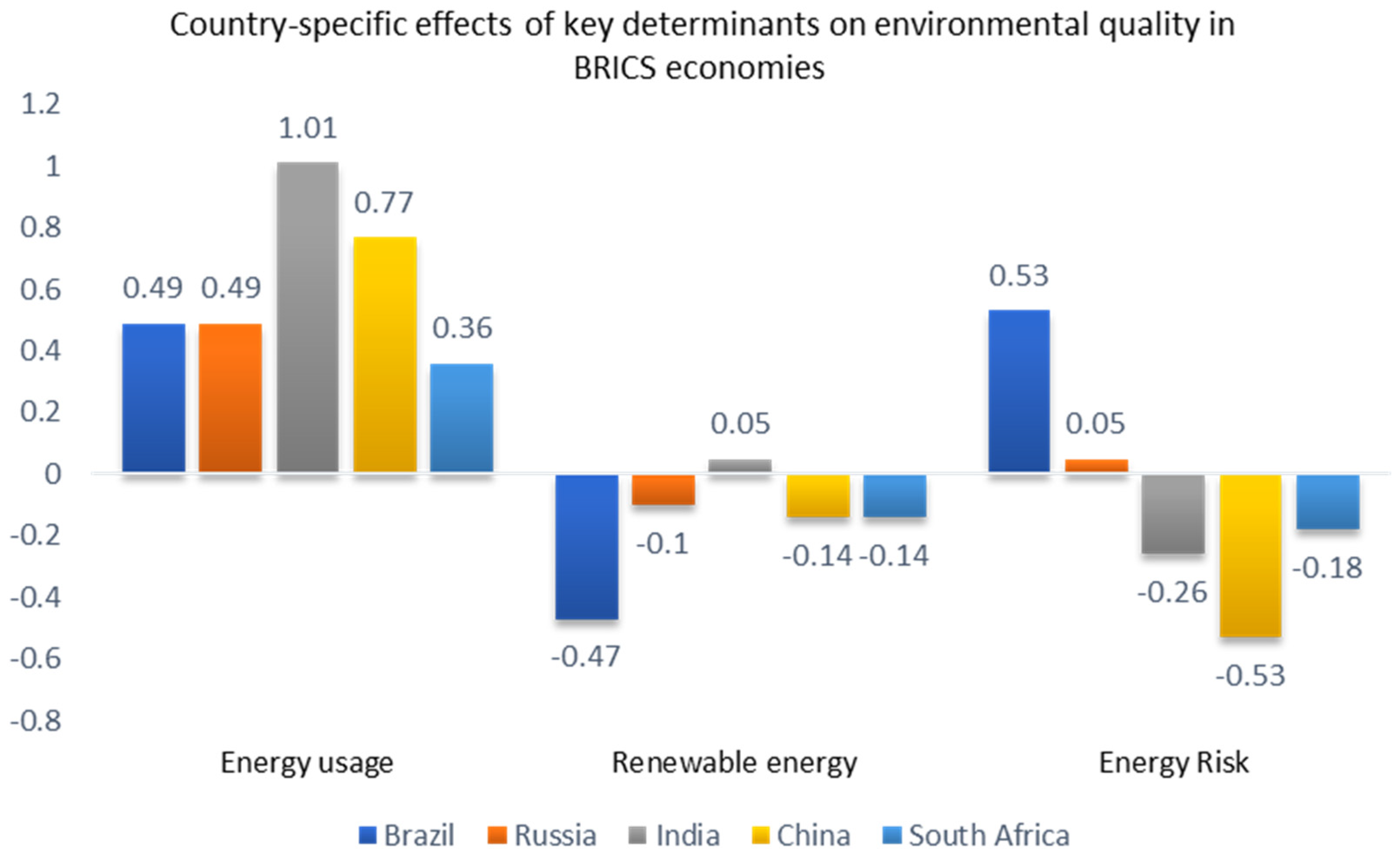
Energy consumption remains a strong and significant driver of emissions in all BRICS countries. Renewable energy consumption generally contributes to emission reductions, most notably in Brazil, China, and South Africa. However, its effect is insignificant or even positive in India. This difference likely stems from the fact that in India, rapid growth in electricity demand has led to renewables acting mainly as additional capacity rather than a direct substitute for coal-based generation. Urbanization is positively and significantly associated with emissions across all countries, with particularly large effects observed in Russia and Brazil due to their highly urban-concentrated industrial and energy systems. Institutional quality shows mixed effects, being positively significant in Brazil and Russia—suggesting that improvements in institutions in these countries may currently facilitate faster economic expansion and resource extraction with limited environmental safeguards. The impact of energy risk on environmental quality also varies across countries: it increases emissions in Brazil and Russia but reduces them in China, India, and South Africa.
Figure 1 presents the country-specific effects of key variables on environmental quality across BRICS economies. The results show clear heterogeneity, particularly in the effects of energy risk and renewable energy. While energy consumption consistently increases emissions across all countries, the impacts of renewable energy and energy risk vary, reflecting differences in energy structures and policy frameworks. These findings highlight the need for country-specific policy approaches.
Table 8 presents the validity of the EKC hypothesis across BRICS countries based on the estimated coefficients of GDP and its squared term. The empirical results provide clear evidence supporting the EKC hypothesis in Brazil, India, and South Africa. In these countries, GDP has a positive and statistically significant coefficient, while its squared term is negative and significant, confirming the existence of an inverted U-shaped relationship between economic growth and environmental degradation. This implies that environmental pressures initially intensify with rising income levels but begin to decline once a certain threshold of economic development is reached. In contrast, the EKC hypothesis is not supported in China and Russia. For China, the negative coefficient of GDP combined with a positive and significant squared term indicates a U-shaped relationship, suggesting that environmental degradation may intensify again at higher stages of economic development. This pattern deviates from the conventional EKC framework and reflects a different trajectory in the growth–environment nexus. In the case of Russia, both the linear and quadratic GDP terms are negative, with the squared term being statistically insignificant, indicating the absence of a meaningful nonlinear relationship and, therefore, no clear turning point in the growth-environment dynamic. Overall, these findings reveal substantial cross-country heterogeneity within the BRICS group. They emphasize that the relationship between economic growth and environmental quality is not uniform but is shaped by country-specific factors such as energy composition, regulatory frameworks, and institutional effectiveness. Consequently, policy responses aimed at achieving sustainable development must be tailored to the unique structural and institutional conditions of each country.
To achieve more reliable results of the FMOLS, we apply the Driscoll–Kraay standard errors as a robustness test based on the fixed-effect regression. The results of robustness test are demonstrated in
Table 9. The Driscoll–Kraay fixed-effects estimation broadly corroborates the FMOLS results, thereby reinforcing the robustness and validity of the core empirical findings by supporting the existence of EKC hypothesis in BRICS economies.
The coefficient on economic growth (lngdp) is positive and statistically significant, while its squared term (lngdp2) is negative and significant, providing further evidence in support of the inverted U-shaped EKC hypothesis. Energy consumption (lnenergy) and energy risk (lnerisk) are both positively associated with environmental degradation, indicating that increased reliance on energy and heightened energy-related uncertainties exacerbate environmental pressure. Conversely, renewable energy consumption (lnrec) exhibits a negative and significant coefficient, highlighting its mitigating effect on environmental degradation. Institutional quality (lninstquality) is found to have a negative and statistically significant impact, suggesting that stronger institutional frameworks contribute to environmental improvement. In contrast, urbanization (lnurb) exerts a positive and significant effect, implying that urban expansion intensifies environmental degradation. Overall, these findings reinforce the robustness and reliability of the main results.
5. Conclusions and Policy Implications
This study applies advanced panel econometric techniques to investigate the relationship between energy risk and environmental quality in BRICS countries over the period 2000–2024. By employing second-generation panel methods, including cross-sectional Augmented Dickey–Fuller (CADF) unit root tests, the Pedroni panel cointegration approach, and Fully Modified Ordinary Least Squares (FMOLS), the analysis accounts for cross-sectional dependence, heterogeneity, and potential endogeneity.
The empirical findings provide partial support for the EKC hypothesis. Specifically, an inverted U-shaped relationship between economic growth and environmental degradation is confirmed for Brazil, India, and South Africa, while no such pattern is observed for China and Russia. These results highlight the non-uniform nature of the growth–environment nexus across BRICS economies. Furthermore, energy consumption and urbanization are identified as key drivers of environmental degradation, whereas renewable energy consumption contributes significantly to emissions reduction. The effects of energy risk and institutional quality vary considerably across countries, underscoring the importance of country-specific structural and policy conditions. The robustness of these findings is confirmed through Driscoll–Kraay standard errors.
From a policy perspective, the results suggest that environmental and energy strategies must be carefully tailored to national contexts. Countries where the EKC is validated should reinforce this transition by integrating stricter environmental regulations and promoting green technological innovation, particularly in energy-intensive and urban sectors. In contrast, economies where the EKC pattern is absent should prioritize structural transformation aimed at decoupling economic growth from environmental degradation, with a stronger emphasis on clean energy adoption and sustainable industrial policies. Additionally, the heterogeneous impact of energy risk highlights the need for differentiated energy security strategies, including diversification of energy sources, improved infrastructure resilience, and expanded access to low-carbon technologies.
The findings also reveal that institutional quality alone is insufficient to guarantee environmental improvement unless it is explicitly aligned with sustainability objectives. Strengthening regulatory enforcement, enhancing governance transparency, and embedding environmental priorities into policy frameworks are therefore critical.
Despite its contributions, this study is subject to several limitations. Data constraints, particularly in measuring complex constructs such as energy risk and institutional quality, may affect the precision of the estimates. Although robust econometric techniques are employed, potential issues related to model specification and omitted variables cannot be entirely excluded. Moreover, the reliance on aggregated national-level data may obscure important subnational variations. Finally, the focus on BRICS countries over the 2000–2024 period may limit the generalizability of the findings to other regions or time horizons.
Overall, this study contributes to the growing literature on energy–environment dynamics by providing nuanced, country-specific insights and emphasizing the need for differentiated and context-sensitive policy approaches to achieve sustainable development.





 ,
,