

Exploring the Gap in the Dynamic Financial Resilience of Urban and Rural SMEs


Abstract
1. Introduction
2. Theoretical Background
2.1. Rural vs. Urban SMEs
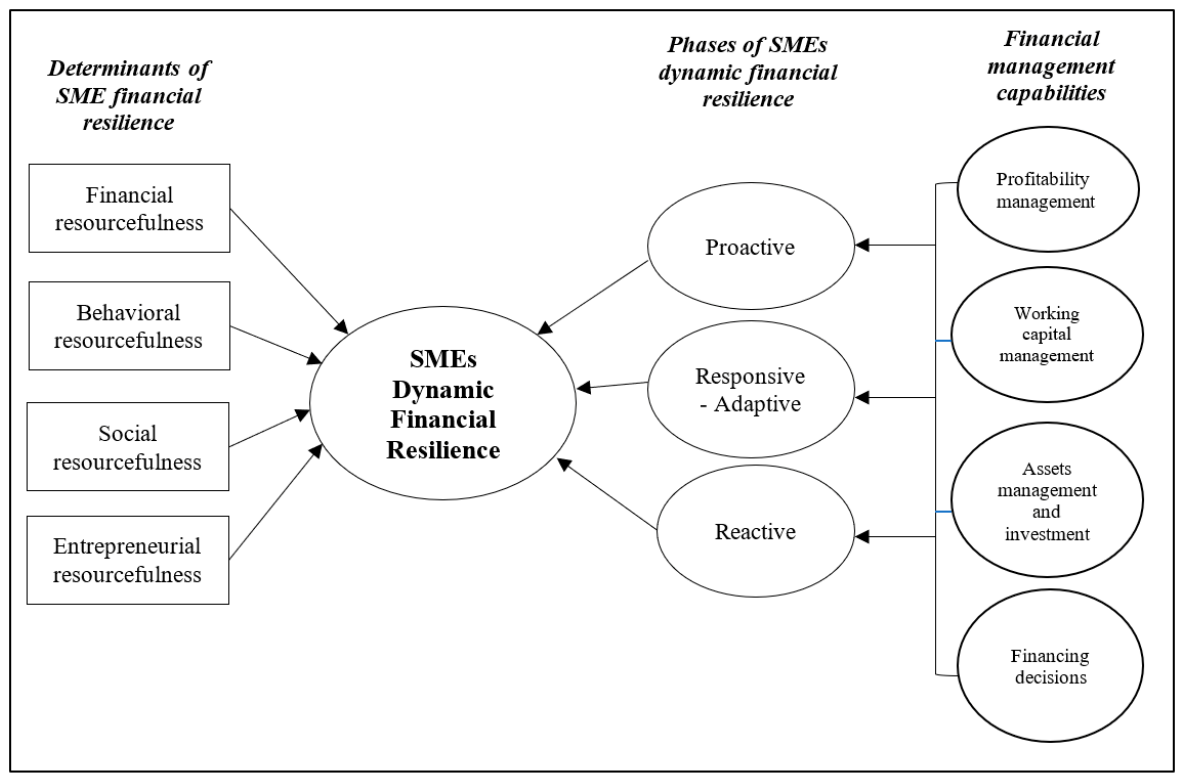
2.2. Dynamic Financial Resilience
2.3. SMEs’ Financial Resilience and Resourcefulness
3. Methodology
3.1. Analytical Strategy and Methods
3.2. Variables and Measures
3.3. Data and Sample
4. Results
4.1. Reliability and Validity Analysis
4.2. Multigroup Confirmatory Factor Analysis (MGCFA)
4.3. Multigroup SEM Analysis
5. Discussion
6. Conclusions
Author Contributions
Funding
Institutional Review Board Statement
Informed Consent Statement
Data Availability Statement
Conflicts of Interest
References
- Ananda, G. C., Faried, A. I., Syaula, M., & Malay, I. (2023). The effect of financial literacy and financial technology on financial performance (case study: Desa Kebun Kelapa). International Journal of Management, Economic and Accounting, 1(2), 81–93. [Google Scholar] [CrossRef]
- Barney, J. (1991). Firm resources and sustained competitive advantage. Journal of Management, 17(1), 99–120. [Google Scholar] [CrossRef]
- Battisti, M., & Deakins, D. (2015). The relationship between dynamic capabilities, the firm’s resource base and performance in a post-disaster environment. International Small Business Journal, 35(1), 78–98. [Google Scholar] [CrossRef]
- Battisti, M., Deakins, D., & Perry, M. (2013). The sustainability of small businesses in recessionary times: Evidence from the strategies of urban and rural small businesses in New Zealand. International Journal of Entrepreneurial Behaviour and Research, 19(1), 72–96. [Google Scholar] [CrossRef]
- Beckmann, M., Garkisch, M., & Zeyen, A. (2021). Together we are strong? A systematic literature review on how SMEs use relation-based collaboration to operate in rural areas. Journal of Small Business & Entrepreneurship, 35(4), 515–549. [Google Scholar] [CrossRef]
- Bolt, J. S. (2019). Financial resilience of Kenyan smallholders affected by climate change, and the potential for blockchain technology. CCAFS. Available online: https://edepot.wur.nl/472583 (accessed on 4 March 2026).
- Bradley, S. W., McMullen, J. S., Atmadja, A. S., Simiyu, E., & Artz, K. (2011). Self-employed or employing others? Pre-entry capabilities, entrepreneurial action, and the learned resourcefulness of microcredit firm founders. Frontiers of Entrepreneurship Research, 31(19), 2. [Google Scholar]
- Chen, R., Xie, Y., & Liu, Y. (2021). Defining, conceptualizing, and measuring organizational resilience: A multiple case study. Sustainability, 13(5), 2517. [Google Scholar] [CrossRef]
- Cowling, M., Liu, W., Ledger, A., & Zhang, N. (2014). What really happens to small and medium-sized enterprises in a global economic recession? UK evidence on sales and job dynamics. International Small Business Journal, 33(5), 488–513. [Google Scholar] [CrossRef]
- Cowling, M., Liu, W., & Zhang, N. (2018). Did firm age, experience, and access to finance count? SME performance after the global financial crisis. Journal of Evolutionary Economics, 28(1), 77–100. [Google Scholar] [CrossRef]
- Doern, R., Williams, N., & Vorley, T. (2019). Special issue on entrepreneurship and crises: Business as usual? An introduction and review of the literature. Entrepreneurship and Regional Development, 31(5–6), 400–412. [Google Scholar] [CrossRef]
- Duchek, S. (2020). Organizational resilience: A capability-based conceptualization. Business Research, 13, 215–246. [Google Scholar] [CrossRef]
- Eggers, F. (2020). Masters of disasters? Challenges and opportunities for SMEs in times of crisis. Journal of Business Research, 116, 199–208. [Google Scholar] [CrossRef]
- European Commission. (2022). Cohesion in Europe towards 2050. Eighth report on economic, social and territorial cohesion. Available online: https://ec.europa.eu/regional_policy/information-sources/8cohesion-report_en (accessed on 4 March 2026).
- Eurostat. (2024). Urban-rural Europe–economy. Statistics explained. European Commission. Available online: https://ec.europa.eu/eurostat/statistics-explained/index.php?title=Urban-rural_Europe_-_economy (accessed on 12 March 2026).
- Farja, Y., Gimmon, E., & Greenberg, Z. (2017). The developing in the developed: Rural SME growth in Israel. The International Journal of Entrepreneurship and Innovation, 18(1), 36–46. [Google Scholar] [CrossRef]
- Fornell, C., & Larcker, D. F. (1981). Evaluating structural equation models with unobservable variables and measurement error. Journal of Marketing Research, 18(1), 39–50. [Google Scholar] [CrossRef]
- Gaganis, C., Pasiouras, F., & Voulgari, F. (2019). Culture, business environment and SMEs’ profitability: Evidence from European countries. Economic Modelling, 78, 275–292. [Google Scholar] [CrossRef]
- George, D., & Mallery, P. (2010). SPSS for Windows step by step: A simple guide and reference, 17.0 update. Allyn & Bacon. [Google Scholar]
- Giannakis, E., & Bruggeman, A. (2020). Regional disparities in economic resilience in the European Union across the urban–rural divide. Regional Studies, 54(9), 1200–1213. [Google Scholar] [CrossRef]
- Greenberg, Z., Farja, Y., & Gimmon, E. (2018). Embeddedness and growth of small businesses in rural regions. Journal of Rural Studies, 62, 174–182. [Google Scholar] [CrossRef]
- Gunasekaran, A., Rai, B. K., & Griffin, M. (2011). Resilience and competitiveness of small and medium size enterprises: An empirical research. International Journal of Production Research, 49(18), 5489–5509. [Google Scholar] [CrossRef]
- Hair, J. F., Hult, G. T. M., Ringle, C. M., & Sarstedt, M. (2022). A primer on partial least squares structural equation modeling (PLS-SEM) (3rd ed.). Sage. [Google Scholar]
- Hair, J. F., Risher, J. J., Sarstedt, M., & Ringle, C. M. (2019). When to use and how to report the results of PLSSEM. European Business Review, 31(1), 2–24. [Google Scholar] [CrossRef]
- Hamel, G., & Välikangas, L. (2003). The quest for resilience. Harvard Business Review, 81, 52–63. [Google Scholar]
- Hettihewa, S., & Wright, C. S. (2018). Nature and importance of small business in regional Australia, with a contrast to studies of urban small businesses. The Australasian Journal of Regional Studies, 24(1), 96–121. [Google Scholar]
- Hillmann, J., & Guenther, E. (2021). Organizational resilience: A valuable construct for management research? International Journal of Management Reviews, 23, 7–44. [Google Scholar] [CrossRef]
- Hong, S., Malik, M. L., & Lee, M. K. (2003). Testing configural, metric, scalar, and latent mean invariance across genders in sociotropy and autonomy using a non-western sample. Educational and Psychological Measurement, 63(4), 636–654. [Google Scholar] [CrossRef]
- Huiban, J. P. (2011). The spatial demography of new plants: Urban creation and rural survival. Small Business Economics, 37(1), 73–86. [Google Scholar] [CrossRef]
- Jansson, C. (2018). Financial resilience: The role of financial balance, profitability, and ownership. In S. Tengblad, & M. Oudhuis (Eds.), The resilience framework. Work, organization, and employment. Springer. [Google Scholar] [CrossRef]
- Jindrichovska, I. (2013). Financial management in SMEs. European Research Studies, 16(4), 79–96. [Google Scholar] [CrossRef]
- Johnson, H., Roberts, O., & Wilson, G. (2024). Exploring the economic resilience of small and medium enterprises (SMEs) during financial crises. Preprints. [Google Scholar] [CrossRef]
- Kelley, K., & Pornprasertmanit, S. (2016). Confidence intervals for population reliability coefficients: Evaluation of methods, recommendations, and software for composite measures. Psychological Methods, 21(1), 69. [Google Scholar] [CrossRef] [PubMed]
- Kenny, D. A. (2016). Multiple latent variable models: Confirmatory factor analysis. Available online: https://davidakenny.net/cm/mfactor.htm (accessed on 8 January 2026).
- Khafagy, A., Nguyen, T., Gorton, M., & Phillipson, J. (2024). External finance and the growth of rural and urban SMEs in England. Journal of Small Business Management, 63(5), 2455–2483. [Google Scholar] [CrossRef]
- Lampel, J., Ajay, B., & Pushkar, P. J. (2014). Does governance confer organisational resilience? Evidence from UK employee owned businesses. European Management Journal, 32, 66–72. [Google Scholar] [CrossRef]
- Latipah, L., Fauziyah, A., & Yusup, I. (2023). The effect of financial literacy and inclusion on the level of business resilience in SMEs in Tasikmalaya. Jurnal Ekonomi, 12(02), 678–685. [Google Scholar]
- Laurin, F., Pronovost, S., & Carrier, M. (2020). The end of the urban-rural dichotomy? Towards a new regional typology for SME performance. Journal of Rural Studies, 80, 53–75. [Google Scholar] [CrossRef]
- Legenzova, R., Leckė, L., & Lupeikytė, L. (2025). How prepared are SMEs for market disturbances? A dynamic approach to SMEs’ financial resilience. Cogent Business & Management, 12(1), 2520463. [Google Scholar] [CrossRef]
- Leick, B., Gretzinger, S., & Makkonen, T. (2022). The rural enterprise economy. Routledge. [Google Scholar] [CrossRef]
- Lengnick-Hall, C. A., & Beck, T. E. (2016). Resilience capacity and strategic agility: Prerequisites for thriving in a dynamic environment. In Resilience engineering perspectives (Vol. 2, pp. 61–92). CRC Press. [Google Scholar]
- Lestari, E. D., Hamid, N. A., Rizkalla, N., Purnamaningsih, P., & Urus, S. B. T. (2022). The effect of financial literacy, cost of technology adoption, technology perceived usefulness, and government support on MSMEs’ business resilience. GATR Global Journal of Business Social Sciences Review, 10(3), 132–147. [Google Scholar] [CrossRef]
- Linnenluecke, M. K. (2017). Resilience in business and management research: A review of influential publications and a research agenda. International Journal of Management Reviews, 19(1), 4–30. [Google Scholar] [CrossRef]
- Magdalena, A. S., Fernández, B. C., & Callén, Y. F. (2025). Financial performance of new circular economy companies in rural settings. Small Business Economics, 64(4), 1953–1980. [Google Scholar] [CrossRef]
- Maknickienė, N., Lapinskaitė, I., Miečinskienė, A., & Skačkauskienė, I. (2018). Patterns of inequality of Lithuanian regions. Journal of Business Economics and Management, 19(2), 323–342. [Google Scholar] [CrossRef]
- Malekinezhad, F., Micha, E., & Maye, D. (2024). Examining the connection between resourcefulness and resilience: Analysis of UK rural SME firm-level enterprise characteristics. Journal of Rural Studies, 112, 103450. [Google Scholar] [CrossRef]
- Mayer, H., & Baumgartner, D. (2014). The role of entrepreneurship and innovation in peripheral regions. DisP-The Planning Review, 50(1), 16–23. [Google Scholar] [CrossRef]
- Mazzarol, T. (2014). Research review: A review of the latest research in the field of small business and entrepreneurship: Financial management in SMEs. Small Enterprise Research, 21(1), 2–13. [Google Scholar] [CrossRef]
- Musah, A., Padi, A., Blay, M. W., Okyere, D. O., & Ofori, B. (2025). Ethical organisational culture, effective internal control systems and tax compliance of small and medium scale enterprises (SMEs): The role of corporate governance. Social Sciences & Humanities Open, 11, 101331. [Google Scholar] [CrossRef]
- Newman, A., Obschonka, M., & Block, J. (2022). Small businesses and entrepreneurship in times of crises: The renaissance of entrepreneur-focused micro perspectives. International Small Business Journal, 40(2), 119–129. [Google Scholar] [CrossRef]
- Ortiz-de-Mandojana, N., & Bansal, P. (2016). The long-term benefits of organizational resilience through sustainable business practices. Strategic Management Journal, 37(8), 1615–1631. [Google Scholar] [CrossRef]
- OSP. (2022). Urban and rural residents. Available online: https://osp.stat.gov.lt/en/lietuvos-gyventojai-2022/salies-gyventojai/miesto-ir-kaimo-gyventojai (accessed on 24 January 2026).
- Rao, K. K., Mackenzie, C., & Subedi, S. (2024). The dynamic capabilities approach and regional business resilience: An Australian case study. Regional Studies, Regional Science, 11(1), 175–191. [Google Scholar] [CrossRef]
- Rodrigues, M., Franco, M., Sousa, N., & Silva, R. (2021). COVID-19 and the business management crisis: An empirical study in SMEs. Sustainability, 13(11), 5912. [Google Scholar] [CrossRef]
- Roffia, P., & Dabić, M. (2024). The role of management control and integrated information systems for the resilience of SMEs. Review of Managerial Science, 18, 1353–1375. [Google Scholar] [CrossRef]
- Saad, M. H., Hagelaar, G., Van der Velde, G., & Omta, S. W. F. (2021). Conceptualization of SMEs’ business resilience: A systematic literature review. Cogent Business & Management, 8(1), 1938347. [Google Scholar] [CrossRef]
- Saezow, K., & Sukhabot, S. (2025). Synthesizing the resilience elements of small and medium enterprises (SMEs) amidst the COVID-19 pandemic crisis: A systematic review. Cogent Business & Management, 12(1), 2512823. [Google Scholar] [CrossRef]
- Salignac, F., Marjolin, A., Reeve, R., & Muir, K. (2019). Conceptualizing and measuring financial resilience: A multidimensional framework. Social Indicators Research, 145, 17–38. [Google Scholar] [CrossRef]
- Sánchez-Zamora, P., Gallardo-Cobos, R., & Ceña-Delgado, F. (2014). Rural areas face the economic crisis: Analyzing the determinants of successful territorial dynamics. Journal of Rural Studies, 35, 11–25. [Google Scholar] [CrossRef]
- Sensier, M., Bristow, G., & Healy, A. (2016). Measuring regional economic resilience across Europe: Operationalizing a complex concept. Spatial Economic Analysis, 11(2), 128–151. [Google Scholar] [CrossRef]
- Sevilla, J., Ruiz-Martín, C., Nebro, J. J., & López-Paredes, A. (2023). Why can organizational resilience not be measured? Journal of Business Economics and Management, 24(2), 199–220. [Google Scholar] [CrossRef]
- Sreenivasan, A., & Suresh, M. (2023). Readiness of financial resilience in start-ups. Journal of Safety Science and Resilience, 4(3), 241–252. [Google Scholar] [CrossRef]
- Stathopoulou, S., Psaltopoulos, D., & Skuras, D. (2004). Rural entrepreneurship in Europe: A research framework and agenda. International Journal of Entrepreneurial Behavior & Research, 10(6), 404–425. [Google Scholar] [CrossRef]
- Stevens, J. (2002). Applied multivariate statistics for the social sciences (Vol. 4). Lawrence Erlbaum Associates. [Google Scholar]
- Sullivan-Taylor, B., & Branicki, L. (2011). Creating resilient SMEs: Why one size might not fit all. International Journal of Production Research, 49(18), 5565–5579. [Google Scholar] [CrossRef]
- Sumidartini, A. N., & Muhyi, H. A. (2022). Does financial literacy affect the resilience of small businesses in traditional markets? PalArch’s Journal of Archaeology of Egypt/Egyptology, 19(2), 252–262. [Google Scholar]
- Supardi, S., & Hadi, S. (2020). New perspective on the resilience of SMEs proactive, adaptive, reactive to business turbulence: A systematic review. Journal of Xi’an University of Architecture & Technology, 12, 1265–1275. [Google Scholar]
- Teece, D. J. (2007). Explicating dynamic capabilities: The nature and microfoundations of (sustainable) enterprise performance. Strategic Management Journal, 28(13), 1319–1350. [Google Scholar] [CrossRef]
- Tiwasing, P., Gorton, M., Phillipson, J., & Maioli, S. (2023). Rural businesses and levelling up: A rural-urban analysis of business innovation and exporting in England’s north and midlands. Journal of Rural Studies, 100, 103007. [Google Scholar] [CrossRef]
- Tognazzo, A., Gubitta, P., & Favaron, S. D. (2016). Does slack always affect resilience? A study of quasi-medium-sized Italian firms. Entrepreneurship & Regional Development, 28(9–10), 768–790. [Google Scholar] [CrossRef]
- Ursachi, G., Horodnic, I. A., & Zait, A. (2015). How reliable are measurement scales? External factors with indirect influence on reliability estimators. Procedia Economics and Finance, 20, 679–686. [Google Scholar] [CrossRef]
- van Leuven, A. J., Low, S. A., & Hill, E. (2023). What side of town? How proximity to critical survival factors affects the longevity of rural businesses. Growth and Change, 54(2), 352–385. [Google Scholar] [CrossRef]
- Vogus, T. J., & Sutcliffe, K. M. (2007, October). Organizational resilience: Towards a theory and research agenda. In 2007 IEEE international conference on systems, man and cybernetics (pp. 3418–3422). IEEE. [Google Scholar] [CrossRef]
- YahiaMarzouk, Y., & Jin, J. (2022). Does relational capital matter to food and beverage SMEs’ resilience? The mediating role of environmental scanning. Frontiers in Psychology, 13, 1033837. [Google Scholar] [CrossRef]
- Ye, J., & Kulathunga, K. M. M. C. B. (2019). How does financial literacy promote sustainability in SMEs? A developing country perspective. Sustainability, 11(10), 2990. [Google Scholar] [CrossRef]
- Yilmaz, Y., Raetze, S., de Groote, J., & Kammerlander, N. (2024). Resilience in family businesses: A systematic literature review. Family Business Review, 37(1), 60–88. [Google Scholar] [CrossRef]
- Zahedi, J., Salehi, M., & Moradi, M. (2023). Identifying and classifying the financial resilience measurement indices using intuitive fuzzy DEMATEL. Benchmarking: An International Journal, 30(4), 1300–1321. [Google Scholar] [CrossRef]


| SME Characteristics | Urban SMEs, Number (%) N = 161 | Rural SMEs, Number (%) N = 90 | |
|---|---|---|---|
| Annual sales revenue | EUR 10,000–49,999 | 15 (9%) | 15 (17%) |
| EUR 50,000–99,999 | 17 (11%) | 25 (28%) | |
| EUR 100,000–499,999 | 56 (35%) | 26 (29%) | |
| More than EUR 500,000 | 73 (45%) | 24 (27%) | |
| Number of employees | 0–4 | 31 (19%) | 28 (31%) |
| 5–9 | 46 (29%) | 33 (37%) | |
| 10–19 | 35 (22%) | 11 (12%) | |
| Variables | Items | M | SD | Cronbach’s α | CFA Loadings | CR | AVE | |
|---|---|---|---|---|---|---|---|---|
| Proactive phase of financial resilience | Profitability management (PM1) | PP1 | 3.16 | 1.04 | 0.74 | 0.72 | 0.71 | 0.45 |
| PP2 | 3.26 | 0.99 | 0.59 | |||||
| PP3 | 3.88 | 0.81 | 0.69 | |||||
| Working capital management (WCM1) | PP4 | 3.55 | 0.99 | 0.78 | 0.98 | 0.88 | 0.71 | |
| PP5 | 3.22 | 0.98 | 0.78 | |||||
| PP6 | 3.80 | 0.82 | 0.75 | |||||
| Assets management and investments (AMI1) | PP7 | 3.72 | 0.91 | 0.77 | 0.81 | 0.78 | 0.54 | |
| PP8 | 2.95 | 0.91 | 0.76 | |||||
| PP9 | 3.58 | 1.17 | 0.62 | |||||
| Financing decisions (FD1) | PP10 | 3.68 | 1.13 | 0.82 | 0.75 | 0.82 | 0.61 | |
| PP11 | 3.29 | 1.12 | 0.85 | |||||
| PP12 | 3.73 | 0.99 | 0.74 | |||||
| Responsive–adaptive phase of financial resilience | Profitability management (PM2) | RAP1 | 3.22 | 1.10 | 0.76 | 0.76 | 0.77 | 0.53 |
| RAP2 | 3.41 | 0.82 | 0.56 | |||||
| RAP3 | 3.12 | 0.88 | 0.84 | |||||
| Working capital management (WCM2) | RAP4 | 2.87 | 0.99 | 0.73 | 0.75 | 0.79 | 0.56 | |
| RAP5 | 2.39 | 0.81 | 0.76 | |||||
| RAP6 | 2.76 | 0.97 | 0.73 | |||||
| Assets management and investments (AMI2) | RAP7 | 3.38 | 0.83 | 0.73 | 0.73 | 0.70 | 0.54 | |
| RAP9 | 3.44 | 0.82 | 0.74 | |||||
| Financing decisions (FD2) | RAP10 | 3.17 | 1.03 | 0.75 | 0.95 | 0.78 | 0.65 | |
| RAP11 | 3.26 | 0.91 | 0.63 | |||||
| Reactive phase of financial resilience | Profitability management (PM3) | RP1 | 3.72 | 0.71 | 0.71 | 0.73 | 0.70 | 0.45 |
| RP2 | 3.49 | 0.75 | 0.66 | |||||
| RP3 | 3.80 | 0.72 | 0.60 | |||||
| Working capital management (WCM3) | RP4 | 3.54 | 0.83 | 0.75 | 0.78 | 0.77 | 0.53 | |
| RP5 | 3.38 | 0.85 | 0.71 | |||||
| RP6 | 3.37 | 0.77 | 0.69 | |||||
| Assets management and investments (AMI3) | RP7 | 3.45 | 0.73 | 0.69 | 0.56 | 0.72 | 0.47 | |
| RP8 | 3.01 | 0.87 | 0.82 | |||||
| RP9 | 3.04 | 0.96 | 0.65 | |||||
| Financing decisions (FD3) | RP10 | 3.39 | 0.84 | 0.70 | 0.69 | 0.74 | 0.51 | |
| RP11 | 3.67 | 0.69 | 0.92 | |||||
| RP12 | 3.82 | 0.88 | 0.44 | |||||
| SME Resourcefulness | Internal control | 4.10 | 0.64 | |||||
| Access to finance | 3.31 | 0.94 | ||||||
| Mentoring | 2.90 | 1.11 | ||||||
| Entrepreneurial knowledge | 3.71 | 0.87 | ||||||
| Latent Variables | Third-Order CFA Factor Loadings | ωh | AVE | Latent Variables | Second-Order CFA Factor Loadings | ωh | AVE |
|---|---|---|---|---|---|---|---|
| Proactive phase of financial resilience | 0.83 | 0.86 | 0.16 | PM1 | 0.88 | 0.84 | 0.33 |
| WCM1 | 0.40 | ||||||
| AMI1 | 0.79 | ||||||
| FD1 | 0.91 | ||||||
| Responsive & Adaptive phase of financial resilience | 0.74 | PM2 | 0.81 | 0.72 | 0.20 | ||
| WCM2 | 0.52 | ||||||
| AMI2 | 0.37 | ||||||
| FD2 | 0.63 | ||||||
| Proactive phase of financial resilience | 0.80 | PM3 | 0.77 | 0.74 | 0.20 | ||
| WCM3 | 0.44 | ||||||
| AMI3 | 0.70 | ||||||
| FD3 | 0.66 |
| Second-order constructs | ||||||||||||
| PP | RAP | RP | ||||||||||
| PP | 1 | |||||||||||
| RAP | 0.617 | 1 | ||||||||||
| RP | 0.663 | 0.596 | 1 | |||||||||
| First-order constructs | ||||||||||||
| PM1 | WCM1 | AMI1 | FD1 | PM2 | WCM2 | AMI2 | FD2 | PM3 | WCM3 | AMI3 | FD3 | |
| PM1 | 1 | |||||||||||
| WCM1 | 0.819 | 1 | ||||||||||
| AMI1 | 0.691 | 0.617 | 1 | |||||||||
| FD1 | 0.767 | 0.701 | 0.736 | 1 | ||||||||
| PM2 | 0.564 | 0.522 | 0.379 | 0.594 | 1 | |||||||
| WCM2 | 0.228 | 0.304 | 0.045 | 0.171 | 0.522 | 1 | ||||||
| AMI2 | 0.018 | −0.015 | 0.021 | 0.016 | 0.363 | −0.012 | 1 | |||||
| FD2 | 0.243 | 0.311 | 0.089 | 0.184 | 0.384 | 0.741 | 0.619 | 1 | ||||
| PM3 | 0.495 | 0.420 | 0.479 | 0.451 | 0.347 | 0.050 | −0.093 | 0.136 | 1 | |||
| WCM3 | 0.473 | 0.456 | 0.384 | 0.461 | 0.476 | 0.227 | −0.085 | 0.197 | 0.656 | 1 | ||
| AMI3 | 0.383 | 0.218 | 0.432 | 0.442 | 0.448 | 0.246 | −0.005 | 0.211 | 0.510 | 0.626 | 1 | |
| FD3 | 0.446 | 0.380 | 0.334 | 0.351 | 0.454 | 0.226 | 0.011 | 0.214 | 0.559 | 0.552 | 0.452 | 1 |
| Types of Indices | Information About Stepwise Testing | |||
|---|---|---|---|---|
| Configural Invariance | Metric Invariance | Scalar Invariance | Invariance of Latent Means | |
| Chi square/df | 1783.105/df = 986 | 1794.845/df = 1008 | 1810.465/df = 1019 | 1882.798/df = 1053 |
| p ≤ 0.05 | p = 0.000 | p = 0.963 | p = 0.744 | p = 0.006 |
| RMSEA | 0.049 | 0.048 | 0.048 | 0.050 |
| CFI | 0.850 | 0.851 | 0.850 | 0.843 |
| TLI | 0.829 | 0.834 | 0.835 | 0.833 |
| AIC | 1987.105 | 1958.845 | 1952.465 | 2080.788 |
| BIC | 2170.963 | 2122.875 | 2106.581 | 2265.547 |
| Types of Indices | Information About Stepwise Testing | |||
|---|---|---|---|---|
| Configural Invariance | Metric Invariance | Scalar Invariance | Invariance of Latent Means | |
| Chi square/df | 1650.713/df = 986 | 1668.440/df = 1008 | 1685.840/df = 1017 | 1749.970/df = 1051 |
| p ≤ 0.05 | p = 0.000 | p = 0.722 | p = 0.279 | p = 0.004 |
| RMSEA | 0.052 | 0.051 | 0.051 | 0.050 |
| CFI | 0.823 | 0.825 | 0.824 | 0.814 |
| TLI | 0.803 | 0.805 | 0.804 | 0.802 |
| AIC | 2058.713 | 2032.440 | 2031.840 | 2163.970 |
| BIC | 2248.662 | 2201.905 | 2192.925 | 2356.712 |
| Estimate | S.E. | C.R. | p-Value | |
|---|---|---|---|---|
| Dynamic financial resilience | −0.222 | 0.098 | −2.259 | 0.024 |
| Proactive phase | −0.120 | 0.119 | −1.005 | 0.315 |
| Responsive–adaptive phase | −0.287 | 0.097 | −2.962 | 0.003 |
| Reactive phase | −0.173 | 0.083 | −2.096 | 0.036 |
| Items | Mean | SD | Levene’s Test | t-Test for Equality of Means | ||||||
|---|---|---|---|---|---|---|---|---|---|---|
| F | p | t | df | p | Mean Diff | S.E. Diff | ||||
| Financial resourcefulness | Urban | 3.51 | 0.860 | 11.827 | 0.001 | −2.594 | 156.244 | 0.010 | −0.309 | 0.119 |
| Rural | 2.97 | 9.77 | ||||||||
| Behavioral resourcefulness | Urban | 4.14 | 0.627 | 0.971 | 0.325 | −1.227 | 249 | 0.221 | −0.103 | 0.084 |
| Rural | 4.03 | 0.661 | ||||||||
| Social resourcefulness | Urban | 2.95 | 1.123 | 0.115 | 0.735 | −0.874 | 249 | 0.383 | −0.128 | 0.147 |
| Rural | 2.82 | 1.097 | ||||||||
| Entrepreneurial resourcefulness | Urban | 3.82 | 0.790 | 0.322 | 0.571 | −4.565 | 249 | 0.000 | −0.543 | 0.119 |
| Rural | 3.51 | 0.963 | ||||||||
| Path | Urban | Rural | Chi-Square/df | ||||||
|---|---|---|---|---|---|---|---|---|---|
| Estimate | S.E. | C.R. | β | Estimate | S.E. | C.R. | β | ||
| Financial resourcefulness → Dynamic financial resilience | 0.147 | 0.038 | 3.838 *** | 0.570 | 0.342 | 0.105 | 3.258 ** | 0.879 | 1.832 |
| Behavioral resourcefulness → Dynamic financial resilience | 0.158 | 0.047 | 3.350 *** | 0.448 | 0.046 | 0.074 | 0.624 | 0.081 | 1.833 |
| Social resourcefulness → Dynamic financial resilience | 0.070 | 0.024 | 2.848 ** | 0.353 | 0.117 | 0.054 | 2.156 * | 0.338 | 1.830 |
| Entrepreneurial resourcefulness → Dynamic financial resilience | 0.166 | 0.042 | 3.970 *** | 0.591 | 0.129 | 0.061 | 2.107 * | 0.326 | 1.834 * |
| Path | Urban | Rural | Chi-Square/df | ||||||
|---|---|---|---|---|---|---|---|---|---|
| Estimate | S.E. | C.R. | β | Estimate | S.E. | C.R. | β | ||
| Financial resourcefulness → Proactive phase | 0.160 | 0.049 | 3.238 ** | 0.600 | 0.198 | 0.082 | 2.402 * | 0.733 | 2.136 |
| Financial resourcefulness → Responsive–adaptive phase | 0.079 | 0.067 | 1.181 | 0.278 | 0.129 | 0.059 | 2.180 * | 0.511 | 2.139 * |
| Financial resourcefulness → Reactive phase | 0.098 | 0.036 | 2.739 ** | 0.360 | 0.129 | 0.059 | 2.180 *** | 0.922 | 2.139 * |
| Behavioral resourcefulness → Proactive phase | 0.156 | 0.054 | 2.879 ** | 0.426 | 0.009 | 0.048 | 0.194 | 0.023 | 2.139 * |
| Behavioral resourcefulness → Responsive–adaptive phase | 0.082 | 0.073 | 1.124 | 0.285 | −0.108 | 0.076 | −1.435 | −0.290 | 2.138 |
| Behavioral resourcefulness → Reactive phase | 0.162 | 0.052 | 3.090 ** | 0.435 | 0.148 | 0.065 | 2.261 * | 0.373 | 2.134 |
| Social resourcefulness → Proactive phase | 0.086 | 0.030 | 2.860 ** | 0.420 | 0.104 | 0.049 | 2.119 * | 0.434 | 2.136 |
| Social resourcefulness → Responsive–adaptive phase | 0.016 | 0.022 | 0.693 | 0.200 | 0.124 | 0.054 | 2.285 * | 0.552 | 2.141 * |
| Social resourcefulness → Reactive phase | 0.081 | 0.028 | 2874 ** | 0.387 | 0.020 | 0.032 | 0.625 | 0.084 | 2.139 * |
| Entrepreneurial resourcefulness → Proactive phase | 0.154 | 0.049 | 3.124 ** | 0.531 | 0.144 | 0.064 | 2.243 * | 0.524 | 2.138 |
| Entrepreneurial resourcefulness → Responsive & adaptive phase | 0.013 | 0.029 | 0.457 | 0.118 | 0.152 | 0.064 | 2.377 * | 0.592 | 2.141 * |
| Entrepreneurial resourcefulness → Reactive phase | 0.216 | 0.055 | 3.936 *** | 0.729 | 0.017 | 0.036 | 0.467 | 0.063 | 2.145 ** |
Disclaimer/Publisher’s Note: The statements, opinions and data contained in all publications are solely those of the individual author(s) and contributor(s) and not of MDPI and/or the editor(s). MDPI and/or the editor(s) disclaim responsibility for any injury to people or property resulting from any ideas, methods, instructions or products referred to in the content. |
© 2026 by the authors. Licensee MDPI, Basel, Switzerland. This article is an open access article distributed under the terms and conditions of the Creative Commons Attribution (CC BY) license.
Share and Cite
Leckė, G.; Legenzova, R. Exploring the Gap in the Dynamic Financial Resilience of Urban and Rural SMEs. Economies 2026, 14, 160. https://doi.org/10.3390/economies14050160
Leckė G, Legenzova R. Exploring the Gap in the Dynamic Financial Resilience of Urban and Rural SMEs. Economies. 2026; 14(5):160. https://doi.org/10.3390/economies14050160
Chicago/Turabian StyleLeckė, Gintarė, and Renata Legenzova. 2026. "Exploring the Gap in the Dynamic Financial Resilience of Urban and Rural SMEs" Economies 14, no. 5: 160. https://doi.org/10.3390/economies14050160
APA StyleLeckė, G., & Legenzova, R. (2026). Exploring the Gap in the Dynamic Financial Resilience of Urban and Rural SMEs. Economies, 14(5), 160. https://doi.org/10.3390/economies14050160