Article

Exploring the Gap in the Dynamic Financial Resilience of Urban and Rural SMEs

Vytautas Kavolis Transdisciplinary Research Institute, Faculty of Economics and Management, Vytautas Magnus University, 44248 Kaunas, Lithuania
*
Author to whom correspondence should be addressed.
Economies 2026, 14(5), 160; https://doi.org/10.3390/economies14050160
Submission received: 23 March 2026 / Revised: 28 April 2026 / Accepted: 28 April 2026 / Published: 5 May 2026
(This article belongs to the Special Issue Regional Economic Development: Policies, Strategies and Prospects)

Abstract

This study examines the differences in dynamic financial resilience between urban and rural small and medium entities (SMEs) and investigates how these differences are affected by SME resourcefulness. SMEs in urban areas generally benefit from higher productivity, stronger innovation capacity, and better access to financial resources, resulting in superior performance during both stable periods and crises. However, empirical evidence on SMEs’ financial resilience, particularly across spatial contexts, remains limited. Addressing this gap, the study adopts a capabilities-based perspective, assessing SMEs’ financial resilience across proactive, responsive–adaptive, and reactive phases. SME resourcefulness, as a key determinant of financial resilience, is captured through behavioural, financial, entrepreneurial, and social dimensions. The empirical analysis is based on a dataset of 251 Lithuanian SMEs. It employs multi-group confirmatory factor analysis (MGCFA) and multi-group structural equation modelling (MGSEM) to compare urban and rural SMEs. The results show that, compared to rural SMEs, urban SMEs demonstrate higher overall financial resilience (latent mean difference = −0.222), with significant differences particularly evident in the responsive–adaptive (−0.287) and reactive phases (−0.173). Access to finance (t = −2.594, p = 0.010) and entrepreneurial knowledge (t = −4.565, p = 0.000) emerge as the main determinants explaining the financial resilience gap between urban and rural SMEs, while mentoring remains the least utilised social resource (mean = 2.90 out of 5). To bridge the gap and enhance rural SMEs’ financial resilience, it is essential to implement policies that expand access to finance, strengthen adaptive financial capacities, and promote mentoring and financial education.

1. Introduction

Many European Union (EU) countries, including Lithuania, which is the focus of this study, exhibit significant spatial disparities in economic development, with urban areas concentrating higher productivity, innovation capacity, and financial resources, while rural and peripheral regions often lag in competitiveness and firm performance (Giannakis & Bruggeman, 2020, Maknickienė et al., 2018). Small and medium-sized enterprises (SMEs) are widely recognised as the backbone of national economies, accounting for approximately 70 per cent of jobs and generating between 50 and 60 per cent of value added in developed economies (Tiwasing et al., 2023). Their pervasive presence and economic significance highlight the importance of understanding how SMEs adapt to turbulent environments and the factors that shape their resilience and long-term performance.
Lithuania, which is the focus of this study, represents a particularly interesting case within the EU. Similar to other Central and Eastern European countries, it has a relatively short experience within the EU economic framework, which contributes to persistent differences in economic development compared to Western European countries (European Commission, 2022). At the same time, Lithuania demonstrates rapid economic growth, convergence towards the EU average in terms of SME prevalence, and a relatively balanced contribution of both urban and rural areas to overall economic activity (Eurostat, 2024).
Rural disparities in economic performance across EU member states, as well as endogenous rural development within a country, are often reflected in differences in the development and performance of SMEs (Gaganis et al., 2019). In this context, these disparities are particularly relevant for Central and Eastern European countries, including Lithuania, where institutional maturity, access to finance, and support ecosystems for SMEs remain less developed than in Western Europe. Despite recent progress, these structural limitations may constrain firm competitiveness and resilience. As a result, SMEs in such environments are especially sensitive to institutional quality and regional development conditions. The SMEs’ financial resilience, especially their ability to withstand economic shocks, financial constraints, and market disruptions, is closely linked to their competitiveness (Gunasekaran et al., 2011). Firms with stronger financial capabilities and adaptive resources are better positioned to sustain operations and maintain competitive advantages during periods of uncertainty (Doern et al., 2019), thereby contributing to the financial resilience and competitiveness of the entire economy. However, despite their importance, SMEs are more vulnerable to economic disturbances than their larger counterparts, as evidenced by the 2008 global financial crisis, the COVID-19 pandemic, and recent geopolitical conflicts (Battisti & Deakins, 2015). SMEs often operate with limited resources and access to financing, undeveloped business structures, a lack of formalised internal controls and crisis management strategies, which can exacerbate their exposure to shocks (Laurin et al., 2020). Moreover, research examining the resilience of SMEs to disruptions is relatively scarce if compared to the large companies, particularly in terms of empirical evidence on how these firms develop and deploy resilience capabilities in practice (Linnenluecke, 2017; Rodrigues et al., 2021) and on the impact of SMEs’ resourcefulness on building such capabilities (Malekinezhad et al., 2024; Saezow & Sukhabot, 2025). Dynamic financial resilience, characterised as a firm’s ability to maintain financial performance and position, adapt resources, and sustain competitiveness during and after a shock, remains especially underexplored in the SME context (Newman et al., 2022).
Within this broader context, rural SMEs face additional challenges. The identity and resourcefulness of rural SMEs differ significantly from those of their urban counterparts (Rao et al., 2024). Rural businesses often operate in geographically isolated areas with smaller markets, limited access to services, constrained growth opportunities, and weaker structural support, making them inherently more vulnerable to crises (Hettihewa & Wright, 2018). In contrast, prior research indicates that urban SMEs typically exhibit greater capabilities, resourcefulness, and higher survival rates during crises (Rao et al., 2024). Yet, comparative studies on the financial resilience of rural versus urban SMEs remain limited. Most existing comparative research either assumes homogeneity within spatial or sectoral contexts or focuses on broader rural–urban comparisons, overlooking the diversity of contexts and the relational factors that influence SME financial resilience (Malekinezhad et al., 2024).
The present study addresses these research gaps by examining differences in dynamic financial resilience between rural and urban SMEs and investigating the role of SME resourcefulness as a key determinant of such resilience. Specifically, this research makes three key contributions. First, it provides a comparative study of the financial resilience of rural and urban SMEs, contributing to a better understanding of their expected behaviour during future disruptive events. Second, it applies a capabilities-based perspective to dynamic financial resilience, an underexplored dimension in SME research, capturing relevant financial management capabilities that SMEs should possess to support their performance, survival, recovery, and growth before, during, and after turbulent times. Finally, it examines how SMEs’ resourcefulness impacts financial resilience, providing practical insights into how access to finance, entrepreneurial knowledge, social capital, and other resources can enable SMEs to withstand disturbances of various types and scales more prepared. By doing so, the study enhances the understanding of SME financial resilience in both rural and urban contexts, guiding policymakers and practitioners seeking to strengthen the financial robustness and adaptive capacity of these vital economic actors.
The remainder of the paper is structured as follows. The first section reviews relevant concepts and previous research, including differences between rural and urban SMEs, the concept of dynamic financial resilience, and the role of SMEs’ resourcefulness. The second section presents the research methodology. The third section reports the empirical findings, followed by a discussion of the results, including practical and policy implications. The final section outlines the conclusions of the study.

2. Theoretical Background

This section reviews theoretical concepts and previous research underpinning the study. It begins by examining the key differences between rural and urban SMEs. It then discusses the concept of dynamic financial resilience. Finally, it explores the relationship between SMEs’ financial resilience and resourcefulness, emphasizing the role of different forms of resourcefulness in shaping firms’ ability to withstand and adapt to disruptions.

2.1. Rural vs. Urban SMEs

The rural–urban dynamic lies at the centre of many contemporary transformations in late modernity (Leick et al., 2022). Multiple scholars suggest that SME performance is influenced not only by a firm’s internal resources and capabilities but also by the economic conditions of its surrounding region (Laurin et al., 2020). Even though both rural (often also referred to as rural in a firm setting) and urban (urban) areas exhibit considerable heterogeneity, they differ significantly in their physical, social, and economic characteristics, market opportunities, and the resources available to local actors (Stathopoulou et al., 2004). These differences may also affect the financial resilience of rural and urban SMEs. However, as discussed above, empirical evidence regarding their behaviour during market disturbances, the nature of their dynamic capabilities, and particularly their dynamic financial resilience, remains scarce and often contradictory. For instance, Battisti et al. (2013) found that geographical location matters, reporting that SMEs in independent urban areas and small-town settlements display distinctive characteristics, performance patterns, and strategic behaviour during recessions. In contrast, Huiban (2011) and van Leuven et al. (2023) observed higher survival rates among rural firms compared to their urban counterparts.
Urban areas are widely acknowledged as favourable environments for SMEs (Laurin et al., 2020), conferring advantages such as economies of scale, superior resource alignment, advanced innovation capacity, access to financial, human, and social capital, extensive infrastructure, and diverse amenities (Cowling et al., 2014). Crucially, the financial resilience of urban SMEs is enhanced by proximity to banks, investors, and venture capital, as well as access to skilled management and opportunities for revenue diversification across various sectors and customer segments. Collectively, these factors constitute a self-reinforcing ecosystem that not only facilitates SME growth but also strengthens their capacity to absorb economic shocks and adapt to evolving market conditions. In contrast, as emphasised by Laurin et al. (2020), SMEs in rural areas operate under a distinct set of structural constraints that can limit financial sustainability and growth. Such firms frequently experience spatial and market isolation, restricted export potential, and small local populations that curtail the scale and diversity of potential customers and business partners (Mayer & Baumgartner, 2014; Farja et al., 2017). These challenges are compounded by institutional voids, including inadequate physical and social infrastructure, limited access to specialized resources, lower workforce qualification levels, youth migration, and a declining labour pool (Mayer & Baumgartner, 2014; Malekinezhad et al., 2024).
Scholars highlight the complex linkages between rural and urban businesses. Prior research has shown that rural SMEs do not necessarily underperform compared to their urban counterparts. For instance, Magdalena et al. (2025) found that rural circular economy companies exhibit lower bankruptcy rates than those located in cities, mainly due to fewer alternative opportunities and stronger communal support. Although their growth tends to be slower, it is characterized by higher profitability. Greenberg et al. (2018) and Sánchez-Zamora et al. (2014) add that additional resources, such as local business networks, community ties, and region-specific knowledge, can partially offset structural disadvantages, supporting operational continuity and strengthening financial resilience.
Research on rural–urban differences further acknowledges that rurality is a highly heterogeneous concept that cannot be captured by a simple rural–urban dichotomy (Sánchez-Zamora et al., 2014). Rural areas can range from semi-urban and easily accessible to remote and peripheral, and from manufacturing-based to resource-dependent economies (Laurin et al., 2020). The classification of rural and urban areas is therefore typically based on a combination of criteria, including population density, infrastructure, and access to economic opportunities (Beckmann et al., 2021).
The classification of regions into urban and rural categories is often considered an oversimplification that may obscure important spatial heterogeneity. Rural characteristics frequently overlap with other non-urban factors, including remoteness and sectoral specialisation, which create distinct challenges and opportunities for SMEs. Consequently, rurality affects SME performance in diverse ways—both relative to urban areas and across rural subtypes (Sánchez-Zamora et al., 2014). Some researchers have therefore advocated for alternative terminology to better capture this diversity. For example, Hettihewa and Wright (2018) suggest that the term “rural” may be overly restrictive and advocate for “regional” to encompass rural communities, towns, and small regional cities. In practice, the EU adopts a more nuanced classification that distinguishes between urban, intermediate, and rural regions, reflecting the continuum of spatial and economic characteristics rather than a strict dichotomy. EU data (Eurostat, 2024) indicate that in 2021, a majority (50.9%) of the EU’s Gross Domestic Product (GDP) was concentrated in predominantly urban regions, with the remainder distributed across intermediate and rural regions. In most EU countries, so-called intermediate regions contribute a substantially larger share of GDP than purely rural regions. Lithuania, where SMEs are examined in this study, follows this pattern: it has the highest share of GDP concentrated in intermediate regions (52.2%) among EU countries, while only 4.7% of GDP originates from rural regions. Given this distribution, distinguishing between intermediate and rural regions in Lithuania and the broader EU context adds limited analytical value. Therefore, the present study adopts a binary classification of SMEs into urban and rural categories. In this context, “urban” refers to major cities and their metropolitan areas, while “rural” encompasses smaller towns, settlements and less densely populated areas. This choice is intentional, as intermediate regions are heterogeneous and difficult to define consistently, which can weaken comparisons. A binary approach provides greater clarity, enables a more straightforward analysis of spatial differences in financial resilience, and yields more relevant policy insights.

2.2. Dynamic Financial Resilience

Resilience is commonly viewed as a set of abilities that allow organisations to respond effectively to disruptive events (Yilmaz et al., 2024). Despite growing academic interest in resilience, a clear consensus on its definition or the specific elements it encompasses remains unsettled (Duchek, 2020). In this context, financial resilience is a component of organisational resilience that addresses the financial dimension, yet it lacks a clear conceptualisation and operationalisation (Zahedi et al., 2023; Legenzova et al., 2025). Research generally identifies a range of determinants, such as organisational structures, processes, behaviours, strategies, and resources, that play a crucial role in fostering resilience (Hillmann & Guenther, 2021). Recent studies increasingly emphasise the dynamic and active nature of organisational (Chen et al., 2021) and, more specifically, financial resilience (Legenzova et al., 2025) encompassing not only the ability to cope with adverse events but also to adapt to changing conditions. In this context, Duchek (2020) identifies three main perspectives: resisting and recovering from disruptions, advancing processes and capabilities beyond simple restoration, and anticipation, which involves proactive measures to address future challenges. Scholars often combine these perspectives in the concept of dynamic financial resilience, framing resilience as an ongoing, process-oriented capability rather than a static state (Chen et al., 2021; Legenzova et al., 2025; Sevilla et al., 2023; Yilmaz et al., 2024). Building on this, dynamic resilience is operationalised through the phases an organisation experiences before, during, and after a disruptive event—such as anticipation, coping, and adaptation (Duchek, 2020), or proactive, responsive–adaptive, and reactive stages (Supardi & Hadi, 2020). The latter framework is adopted in the current study.
Measuring dynamic financial resilience presents a distinct set of challenges. The literature highlights that assessing organisational resilience, and particularly financial resilience, remains unclear and inconsistent in empirical research (Legenzova et al., 2025; Saad et al., 2021). In general, resilience is measured either through organisations’ capabilities, which reflect dynamic resilience, or through outcomes, which are more closely associated with static resilience (Saad et al., 2021). Building on Duchek’s (2020) conceptual framework, resilience can be understood as a meta-capability—a higher-order construct composed of a set of organisational capabilities and routines that enable organisations to successfully navigate the proactive, responsive–adaptive, and reactive stages of resilience. Dynamic capabilities are widely recognised as essential for allowing resilience in turbulent or disruptive environments, including crises and disasters (Rao et al., 2024). Dynamic capabilities refer to a firm’s capacity to develop, extend, or reconfigure its resource base, enabling it to adapt, respond effectively, and maintain performance in the face of uncertainty (Teece, 2007).
Dynamic financial resilience, particularly in SME settings, which is the focus of this study, is a relatively recent concept in business research (Salignac et al., 2019), and there remains no consensus on a standardised approach to creating, measuring, or preserving financial resilience (Zahedi et al., 2023). Similar to the general conceptualisation of dynamic resilience, dynamic financial resilience is commonly framed into similar phases: anticipating potential financial shocks from disruptive events, responding and adapting during disruptions, and recovering while capitalising on new opportunities (Yilmaz et al., 2024). A capabilities-based approach to measuring financial resilience is also commonly used (Sreenivasan & Suresh, 2023). However, despite broad agreement on its importance, there is still no clear consensus on which specific financial capabilities most strongly contribute to SMEs’ financial resilience (Linnenluecke, 2017; Saad et al., 2021). Previous research highlights a range of relevant areas, including income and asset management (Bolt, 2019), cash flow and working capital management (Mazzarol, 2014), cash and liquidity management, asset acquisition, and capital structure decisions (Jindrichovska, 2013), as well as reducing financial volatility and maintaining sales growth (Ortiz-de-Mandojana & Bansal, 2016). Synthesising perspectives from multiple scholars (Jansson, 2018; Legenzova et al., 2025; Sreenivasan & Suresh, 2023), the current study measures SME financial resilience through key financial management capabilities: profitability management, working capital management, asset management and investment, and the ability to attract financing. These capabilities guide SMEs through each phase of financial resilience, utilising processes such as financial planning, analysis, and control, risk management, and strategic investment decisions.

2.3. SMEs’ Financial Resilience and Resourcefulness

Organisations are affected by disruptive events in different ways, and their resilience is shaped by a range of characteristics and determinants (Sensier et al., 2016). Malekinezhad et al. (2024) advocate that resourcefulness, together with firm-level characteristics, is frequently examined in resilience research to explain why some organisations are more capable of anticipating and responding to shocks, while others struggle to cope (Sullivan-Taylor & Branicki, 2011). Resourcefulness can be understood as a managerial ability to access resources and deploy relevant skills to identify problems, prioritise solutions, and mobilise resources to prevent system disruption (Sullivan-Taylor & Branicki, 2011), thereby impacting its resilience. Although closely related, resourcefulness and resilience are distinct concepts: resourcefulness refers to the availability of resources, whereas resilience reflects the capability to withstand and adapt to disruptions while using such resources.
The importance of maintaining a broad and accessible resource for rapid and appropriate responses under challenging conditions are highlighted in numerous studies (e.g., Hamel & Välikangas, 2003; Lengnick-Hall & Beck, 2016; Vogus & Sutcliffe, 2007). This perspective is closely aligned with the Resource-Based View theory, which posits that SMEs can build competitive advantage and organisational resilience through the strategic deployment of their existing resources, particularly under conditions of rapid change (Saezow & Sukhabot, 2025). Tognazzo et al. (2016) argue that the Resource-Based View provides the most suitable theoretical framework for examining resilience in SMEs, especially when compared to studies that primarily focus on large firms. However, resourcefulness does not necessarily lead to resilience, as possessing resources and capabilities does not ensure that they will be mobilised in a timely or appropriate manner during disruptions.
While Barney (1991) classified resourcefulness into physical, human, and organisational capital, Bradley et al. (2011) expanded this categorisation to include financial, social, and behavioural components. In this study, financial, social, behavioural, and entrepreneurial resourcefulness are examined as the most relevant determinants of dynamic financial resilience, considering the differences between urban and rural SMEs.
Financial resourcefulness refers to SMEs’ ability to access external financing and governmental support or effectively mobilise internal funds (Lampel et al., 2014; Malekinezhad et al., 2024). Among the other factors, access to finance has been consistently highlighted as a critical enabler of SME growth and resilience (Cowling et al., 2018). Recent studies indicate that rural SMEs benefit more from external finance compared to their urban counterparts, due to fewer alternative support mechanisms (Khafagy et al., 2024).
Social resourcefulness is defined as existing firm’s networks and relationships as well as the ability to build, maintain, and leverage them to overcome challenges (Bradley et al., 2011). Strong social capital provides SMEs with access to external information, knowledge sharing, trust-based partnerships, and opportunities for collaboration, thereby enhancing their resilience (Lengnick-Hall & Beck, 2016). Other studies confirm that social networks provide legitimacy, access to institutional support, and opportunities for collaborative adaptation, thereby positioning SMEs to buffer against shocks and maintain competitiveness (YahiaMarzouk & Jin, 2022).
Behavioural resourcefulness reflects how managers and entrepreneurs mobilise routines, practices, and control mechanisms to guide behaviour in ways that strengthen adaptation and resilience. In SMEs, where resource constraints are often critical, behavioural resourcefulness enables the organisation to remain disciplined and agile in the face of shocks (Duchek, 2020). Roffia and Dabić (2024) found that SMEs using structured internal controls were more resilient during COVID-19, as these mechanisms enhanced coordination, adaptability, and operational continuity. Similarly, Musah et al. (2025) document that adequate internal controls, when reinforced by an ethical organisational culture, enhance SMEs’ resilience by improving financial monitoring, ensuring compliance, and promoting sustainable business practices. Existing research has not yet examined the role of internal controls as a resource for enabling SMEs’ resilience in rural and urban contexts.
Another determinant that emerged as a critical intangible resource facilitating SME financial resilience is entrepreneurial financial literacy, defined as a business owner’s ability to understand and apply financial knowledge (Ye & Kulathunga, 2019). Studies show that financially literate entrepreneurs are better equipped to navigate uncertainty, adjust to volatile financial markets, and make informed decisions that sustain performance and ensure financial resilience over time (Lestari et al., 2022). Empirical evidence consistently demonstrates a positive relationship between financial literacy and both financial performance and financial resilience (Ananda et al., 2023; Latipah et al., 2023). However, some research highlights that financial literacy may not directly translate into financial resilience outcomes unless complemented by enabling factors such as access to finance and supportive policy frameworks (Sumidartini & Muhyi, 2022).

3. Methodology

3.1. Analytical Strategy and Methods

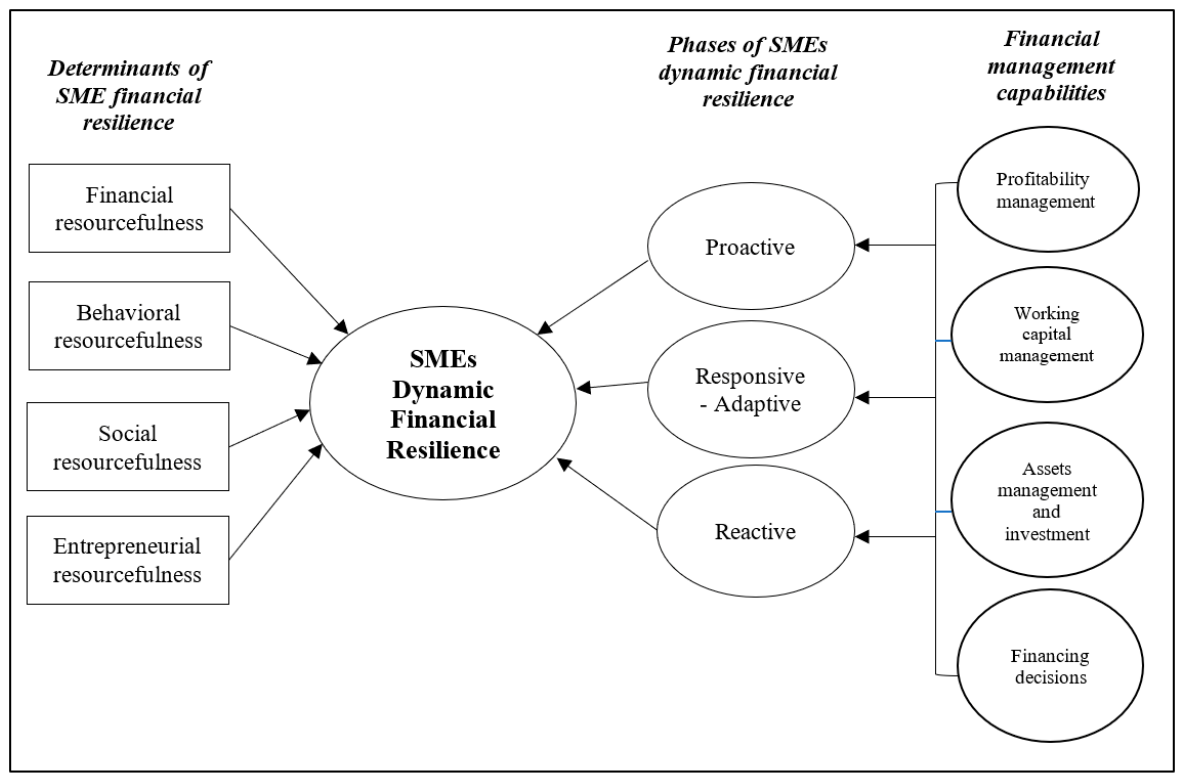
SMEs’ ability to withstand, adapt to, and recover from disruptions is increasingly recognized as a key determinant of their long-term performance. Previous research (Cowling et al., 2014; Malekinezhad et al., 2024) has provided evidence that urban and rural enterprises may differ not only in terms of environmental influences but also in their resourcefulness, which can affect their respective capacities to withstand, survive, and recover from crises or other disruptive events. However, despite these insights, there remains insufficient research on urban and rural differences, specifically with respect to their financial resilience. To address this gap, the current study focuses on comparing urban and rural SMEs in terms of dynamic financial resilience, both overall and across distinct phases, and on examining the extent to which differences in SME resourcefulness, as a determinant of financial resilience, contribute to financial resilience gaps between these enterprises. The conceptual model of research is presented in Figure 1.
The current study employed a multi-step methodological approach. The first step involved reliability and validity analysis. The reliability of the research instrument was assessed using Cronbach’s alpha (Ursachi et al., 2015). To analyse dynamic financial resilience, a third-order confirmatory factor analysis (CFA) model was constructed. Convergent and discriminant validity were evaluated using composite reliability (CR), hierarchical omega (ωh), average variance extracted (AVE), and the correlations between the individual constructs (Hair et al., 2022; Kelley & Pornprasertmanit, 2016).
The second step assessed the gap in the dynamic financial resilience between urban and rural SMEs employing multigroup confirmatory factor analysis (MGCFA). The second step was conducted in two sub-steps: the first sub-step involved assessing the gap in the composite measure of dynamic financial resilience between urban and rural SMEs, while the second sub-step focused on assessing the gap in distinct phases of dynamic financial resilience between urban and rural SMEs. To evaluate the gap in dynamic financial resilience (overall and in distinct phases), this research aimed to identify statistically significant differences in the mean values of latent variables between urban and rural SMEs groups, thereby evaluating the invariance of latent means. The invariance of latent means can be examined if configural, metric, and scalar invariance were supported (Hong et al., 2003). The third step aimed to investigate whether the financial resilience gap was influenced by SME resourcefulness through multigroup structural equation modelling (MGSEM). This step was also conducted in two sub-steps. The first sub-step examined the effect of SME resourcefulness on overall dynamic financial resilience for urban and rural SMEs and compared these effects between the groups. The second sub-step assessed the effect of SME resourcefulness on distinct phases of dynamic financial resilience for urban and rural SMEs, while evaluating potential differences between the groups.

3.2. Variables and Measures

In this study, dynamic financial resilience was measured through self-reported financial management capabilities across four key areas: profitability management, working capital management, asset management and investments, and financing decisions, assessed in three distinct phases—the proactive phase (before a disruptive event or crisis), the responsive–adaptive phase (during a crisis or disruptive event), and the reactive phase (after a crisis or disruptive event). The measurement instrument for financial management capabilities was used from Legenzova et al. (2025). For each area, three 5-point Likert scale items were used, with the exception of asset management and investments and financing decisions in the responsive–adaptive phase, where two items were employed. In the current study, this resulted in a total of 34 self-reported financial management capability statements, which were used to measure overall dynamic financial resilience as well as resilience within each distinct phase.
The study assessed four groups of SME resourcefulness, treating them as determinants of financial resilience: financial, behavioural, social, and entrepreneurial, all measured using a 5-point Likert scale. Financial resourcefulness, defined as the firm’s ability to access external finance, was measured using the statement: “When necessary, external financing (e.g., a bank loan) is available to the company.” Behavioural resourcefulness, reflecting the firm’s internal control practices, was measured with the statement: “We have established processes and procedures to monitor changes in financial performance regularly.” Social resourcefulness, defined as the firm’s ability to leverage mentors or other social agents (socialisation process), was measured using the statement: “We have access to mentors who can contribute to financial decision-making in our company.” Entrepreneurial resourcefulness, referring to the financial knowledge of SME entrepreneurs (owners), was measured with the statement: “The company owner (entrepreneur) has sufficient knowledge and skills to manage the financial performance.”

3.3. Data and Sample

Research data were collected through an online survey of Lithuanian SMEs, resulting in a total of 251 valid responses from both urban and rural SMEs. Data on dynamic financial resilience and SME resourcefulness were collected between March and May 2024 via a questionnaire distributed by email to Lithuanian SME entrepreneurs, achieving a response rate of 25.6%. Urban SMEs were defined as SMEs located in cities and their surrounding suburbs, which account for 68.2% of the Lithuanian population (OSP, 2022). Rural SMEs operated smaller urban settlements and rural communities, representing 31% of the Lithuanian population (OSP, 2022). Descriptive statistics of urban and urban SMEs are presented in Table 1.
In this study, a total of 161 urban SMEs and 90 rural SMEs were analysed. Based on Table 1, urban SMEs tended to have higher annual sales revenues and employ more staff compared to rural SMEs. Specifically, 45% of urban SMEs reported annual sales exceeding EUR 500,000, compared to 27% of rural SMEs. In contrast, more rural SMEs reported lower revenue levels, with 28% earnings of EUR 50,000–99,999 and 17% earnings of EUR 10,000–49,999, compared to 11% and 9% of rural SMEs, respectively. In terms of employee numbers, urban SMEs were generally larger, with 30% having more than 20 employees, compared to only 20% of rural SMEs. Smaller companies with 0–4 employees were more common in rural areas (31%) than in urban areas (19%). These data show that the analysed Lithuanian urban SMEs were, on average, larger in terms of both revenue and number of employees.

4. Results

4.1. Reliability and Validity Analysis

First, reliability and validity analyses were conducted; Table 2 and Table 3 summarise their results. Based on the Skewness and Kurtosis values, the data were normally distributed, as all values fell within the recommended range of −2 to +2 (George & Mallery, 2010). All values of Cronbach’s α were highly reliable (over 0.7, as suggested by Ursachi et al., 2015), implying that the instrument of the model was reliable. To analyse dynamic financial resilience, a third-order CFA model was constructed.
Table 2 summarises the factor loading of observed items (first-order CFA), CR, and AVE values. In contrast, Table 3 presents the factor loading of latent variables (second and third-order CFA), hierarchical omega (ωh), and AVE values. Composite reliability (CR) values for first-order CFA were greater than 0.7, also indicating good reliability (Hair et al., 2019). For second and third-order CFA, hierarchical omega (ωh) was calculated, which is more appropriate for measuring second-order reliability (Kelley & Pornprasertmanit, 2016). Since the ωh values for both second and third-order CFA were greater than 0.7, reliability was considered assured. All observed items’ standardised factor loadings exceeded the minimum threshold of 0.4 (Stevens, 2002), as well as for latent variables, with only one exception for assets management and investments (AMI2) in the responsive–adaptive phase of financial resilience.
Convergent validity was assessed by calculating the average variance extracted (AVE) and values exceeded the 0.5 threshold (Fornell & Larcker, 1981) for first-order CFA with one exception for the PM1 scale, where AVE = 0.45 (since the CR value was greater than 0.7, the scale was considered as valid). For second and third-order CFA, AVE values were less than the 0.5 threshold; however, the convergent validity of the scales can be considered adequate, because the omega value is a more important measure of reliability for higher-level constructs (Hair et al., 2022).
Discriminant validity was assessed by comparing correlations between constructs against a threshold of 0.85 (Kenny, 2016). The values of the correlations (see Table 4) between the first and second-order constructs revealed no discriminant validity issues.

4.2. Multigroup Confirmatory Factor Analysis (MGCFA)

The reliability and validity analysis revealed that the model for assessing the dynamic financial resilience is suitable for further study. To test the dynamic financial resilience differences between urban and rural SMEs, multigroup confirmatory factor analysis (MGCFA) was conducted. To verify the mean differences in dynamic financial resilience between the urban and rural SME groups, configural, metric, and scalar invariance should be ensured. Third-order MGCFA results are provided in Table 5.
The results indicated that configural invariance (i.e., no constraints across groups) was achieved, as evidenced by an acceptable fit (CFI = 0.850, TLI = 0.829, RMSEA = 0.049), indicating that the factor structure was consistent across the urban and rural SME groups. These results suggest that the latent variable of dynamic financial resilience in the total sample, together with its factorial structure, was optimally represented by the CFA model.
For metric invariance, when factor loadings were constrained to be equal across groups, model fit remained basically unchanged (RMSEA = 0.048; CFI = 0.851; TLI = 0.834) and the chi-square difference test was non-significant (p = 1.000), suggesting that urban and rural SMEs attributed the same meaning to the latent variables.
When intercepts were constrained to be equal, the model demonstrated an acceptable and nearly unchanged fit (CFI = 0.850, TLI = 0.836, RMSEA = 0.048), and the chi-square difference test was non-significant (p = 0.744), supporting scalar invariance that both the factor loadings and intercepts were the same across urban and rural SMEs groups.
As configural, metric, and scalar invariance were supported, the comparison of dynamic financial resilience latent means between urban and rural SMEs groups was possible. For invariance of latent means (i.e., latent means were constrained to be equal across groups), the model fit got worse (χ2 = 1882.798/df = 1056, p = 0.006), with a slight drop in CFI to 0.843 and a small increase in RMSEA and AIC/BIC values, suggesting that differences in latent means between urban and rural SMEs were statistically significant.
After identifying statistically significant differences in the overall dynamic financial resilience between urban and rural SMEs, second-order MGCFA was applied to assess whether differences exist across distinct phases of dynamic financial resilience. Second-order MGCFA results are provided in Table 6.
Based on the second-order MGCFA results, configural invariance was achieved with a model that provided an acceptable fit to the data (CFI = 0.823, TLI = 0.803, RMSEA = 0.052). The second-order CFA model optimally represented the latent variables of distinct phases of dynamic financial resilience.
The metric invariance was satisfied as model fit remained almost unchanged (RMSEA = 0.051; CFI = 0.825; TLI = 0.805) and the chi-square difference test was non-significant (p = 0.722), implying that urban and rural SMEs assigned identical meaning to the latent variables of distinct phases of dynamic financial resilience.
The scalar invariance was also achieved as the chi-square difference test was non-significant (p = 0.279) and model fit remained basically unchanged (CFI = 0.824, TLI = 0.804, RMSEA = 0.051).
As configural, metric, and scalar invariance were supported, the invariance of latent means was tested, which was rejected, as the model fit got worse (χ2 = 1749.97/df = 1051, p = 0.004), as well as with a drop in CFI to 0.814 and an increase in AIC/BIC values. This indicated that latent means for distinct phases of dynamic financial resilience differed between urban and rural SMEs; however, the differences were not statistically significant in all phases.
Table 7 summarizes the results of latent mean differences in dynamic financial resilience and across distinct phases between urban and rural SMEs. The estimated latent mean difference for dynamic financial resilience was −0.222, indicating that rural SMEs had a lower latent mean for dynamic financial resilience by 0.222 units compared to urban SMEs. Across the distinct phases, latent means statistically significantly differed in the responsive–adaptive (p = 0.003) and the reactive phases (p = 0.036), but not in the proactive phase (p = 0.315). In both the responsive–adaptive and the reactive phases, the estimated latent mean differences were lower for rural SMEs by 0.287 and 0.173 units than for urban SMEs.

4.3. Multigroup SEM Analysis

Multigroup confirmatory factor analysis revealed that rural SMEs had statistically significantly lower latent means for overall dynamic financial resilience and its distinct phases (the responsive–adaptive and the reactive) than urban SMEs. Therefore, t-test and multigroup SEM analysis were employed to examine whether SME resourcefulness accounts for the differences in both the overall dynamic financial resilience and its distinct phases across urban and rural SMEs groups. Table 8 summarizes the results of the t-test.
The average values of all SME resourcefulness were higher for urban SMEs than for rural ones. Statistically significant differences were found for entrepreneurial resourcefulness (t = −4.565, p = 0.000) and financial resourcefulness (t = −2.594, p = 0.010), but not for behavioral resourcefulness or social resourcefulness, indicating that urban SMEs can be characterized by entrepreneurs with more sophisticated knowledge and greater potential for attracting financing. Statistically significant mean differences in entrepreneurial resourcefulness and financial resourcefulness may determine lower dynamic financial resilience of rural SMEs; to test this, multigroup SEM analysis was employed (see Table 9).
For overall dynamic financial resilience, all four SME resourcefulness had statistically significant and positive effects on dynamic financial resilience, with one exception for the behavioural resourcefulness, as its effect on rural SMEs’ dynamic financial resilience was not statistically significant. The differences in the effect of SME resourcefulness between urban and rural SME groups were statistically significant only for the entrepreneurial resourcefulness, with a more substantial effect on urban SMEs’ dynamic financial resilience than on rural SME. Table 10 presents the results of the second-order MGSEM.
The second-order MGSEM revealed that all analysed SME resourcefulness exhibited statistically significant and positive effects on urban SMEs’ financial resilience in the proactive and the reactive phases, but not in the responsive–adaptive phase, indicating that SME resourcefulness was not a significant tool that can help SME to survive crises and increase their financial resilience during them. For rural SMEs, financial and social resourcefulness exhibited statistically significant positive effects on financial resilience across all phases, whereas behavioural resourcefulness had a significant positive effect only in the reactive phase, and entrepreneurial resourcefulness had a significant positive effect on financial resilience in the proactive and responsive–adaptive phases. The most considerable statistically significant differences in SME resourcefulness’s effect on financial resilience were found in the responsive–adaptive phase, where financial, social, and entrepreneurial resourcefulness strongly affected rural SMEs’ financial resilience compared to urban SMEs’ financial resilience. Additionally, statistically significant differences were observed for the effect of behavioral resourcefulness in the proactive phase, as well as for the effects of financial and entrepreneurial resourcefulness in the reactive phase. In these cases, the effects were generally stronger for urban SMEs’ financial resilience, except for the effect of financial resourcefulness, which was stronger for rural SMEs.

5. Discussion

The present study offers new evidence regarding geographical differences in SMEs’ financial resilience and its determinants. The findings confirm that urban SMEs exhibit higher overall dynamic financial resilience than their rural counterparts, although this relationship may also be influenced by structural and contextual factors beyond geographical location. These results are consistent with prior research. For example, Johnson et al. (2024) found that geographical location influences SME financial resilience, while Rao et al. (2024) concluded that urban SMEs benefit from greater access to resources, stronger financial management capabilities, and higher survival rates during crises.
When examining the phases of financial resilience, the results were mixed. The research findings are in line with Duchek (2020), who clearly demonstrated that firms’ abilities across these stages may vary depending on market conditions. A similar view was expressed by Malekinezhad et al. (2024), who suggest that SMEs’ resilience during crises varies, and there is no single method that works best for all SMEs. The findings show no statistically significant differences in the proactive phase, implying that urban and rural SMEs possess comparable financial capabilities to sustain performance and financial resilience during periods of relative stability. The most significant gap was observed in the responsive–adaptive phase, indicating that rural SMEs were more vulnerable to ongoing crises and market shocks and assessed their financial capabilities more pessimistically than their urban counterparts. Similar findings were reported by Hettihewa and Wright (2018), who argued that during disruptions, the market size, flexibility, and access to resources of rural SMEs may be limited due to geographical isolation. A smaller, yet still statistically significant, gap was found in the reactive phase, suggesting that rural SMEs face greater difficulty in recovering from disruptions, potentially due to depleted resources or slower rural market recovery (Johnson et al., 2024). Overall, the results indicate that urban and rural SMEs anticipate crises to a similar degree, but rural SMEs tend to lag in the coping and adaptation stages. This highlights their heightened vulnerability during crises and underscores the need to strengthen both their financial management capabilities, resourcefulness, and their adaptive capacity. The financial resilience gap between rural and urban SMEs, particularly during the reactive phase, along with differences in financial capabilities, needs further research. In countries such as Lithuania, where rural SMEs contribute more than half of the national GDP (Eurostat, 2024), this vulnerability could threaten not only rural recovery but also the financial resilience and growth of the entire economy. However, this difference may also partly reflect variations in sectoral composition or firm size and the subjective nature of self-reported measures, rather than purely spatial factors.
Analysing SMEs’ resourcefulness, results indicated that urban SMEs consistently scored higher than rural SMEs, highlighting structural advantages that enhance their competitive position. However, these differences may partly reflect firm-level characteristics such as size, experience, or access to external support. Although the intensity of resource utilisation varied across different resources, the overall patterns of use were broadly similar in both groups. Both urban and rural SMEs reported that internal controls were their most frequently employed resource, whereas access to mentoring was the least utilised. Notably, neither of these resources showed statistically significant differences between the two groups. By contrast, statistically significant differences were found in entrepreneurial and financial resourcefulness, with the largest gap in entrepreneurial financial literacy. Results for entrepreneurial financial literacy suggest that urban SME owners generally possess more advanced business knowledge, skills, and financial expertise than their rural counterparts. The substantially lower level of entrepreneurial knowledge among rural SME owners may hinder effective decision-making, constrain innovation, and weaken their capacity to adapt to changing market conditions. However, these differences may also be shaped by variations in education, training opportunities, and local support ecosystems. Prior research underscores the critical role of entrepreneurial knowledge in supporting informed decision-making, sustaining performance, and enhancing financial resilience over time (Ye & Kulathunga, 2019; Lestari et al., 2022). Entrepreneurial knowledge enables SMEs to identify opportunities, evaluate risks, and mobilise resources effectively—capabilities that are especially important during crises or periods of uncertainty. In rural contexts, the absence of this knowledge base may exacerbate financial vulnerability by constraining SMEs’ ability to diversify, restructure operations, or pursue innovative responses to shocks. The gap in financial resourcefulness similarly indicates that rural SMEs face more constrained access to financial resources and are consequently less prepared to manage financial strains, consistent with findings that access to finance is a critical enabler of SME growth and financial resilience (Cowling et al., 2018). However, this may also be influenced by differences in financial infrastructure and institutional environments.
The current study also sought to close a gap in understanding how SMEs’ resourcefulness influences financial resilience and the gaps between rural and urban SMEs. Examining the effect of SMEs’ resourcefulness on the financial resilience of urban SMEs compared to rural SMEs, the results revealed that only two indicators—access to finance and entrepreneurial knowledge—had statistically significant explanatory power in accounting for this gap, particularly across distinct phases of financial resilience. These findings have important implications for competitiveness and suggest that improving access to finance and strengthening entrepreneurial knowledge are critical for enhancing SME financial resilience and narrowing competitiveness gaps between urban and rural firms.
For both urban and rural SMEs, financial, social, and entrepreneurial resourcefulness exerted a significant positive effect on overall financial resilience, indicating that access to finance, strong social networks, and knowledgeable entrepreneurs enhance SMEs’ ability to withstand and recover from shocks. Behavioural resourcefulness, however, had a statistically significant positive effect only for urban SMEs, confirming prior research (Musah et al., 2025), which argues that adequate internal controls can strengthen financial resilience but primarily in urban contexts. Although the effects of all types of SME resourcefulness on overall dynamic financial resilience were generally stronger for urban SMEs (except for financial resourcefulness), the difference was statistically significant only in the case of entrepreneurial resourcefulness. This suggests that urban SMEs are distinguished not only by having entrepreneurs who are more confident in their knowledge, but also by the relatively greater contribution of entrepreneurial knowledge to enhancing their overall dynamic financial resilience.
The explanatory power of resourcefulness for the financial resilience gap between urban and rural SMEs yielded some interesting results across the financial resilience phases. The most prominent differences emerged in the responsive–adaptive phase, where financial, social, and entrepreneurial resourcefulness had comparatively stronger effects for rural SMEs. This indicates that improvements in access to finance, stronger social networks, and enhanced entrepreneurial knowledge can yield relatively greater financial resilience gains for rural firms in times of crisis. By contrast, in the proactive and reactive phases, behavioural and entrepreneurial resourcefulness were generally more influential for urban SMEs, while financial resourcefulness remained more influential for rural SMEs. This suggests that during crises, urban SMEs expect to benefit from stronger internal controls and entrepreneurial financial literacy to prepare for and respond to disruptions, whereas rural SMEs expect to rely more heavily on access to finance to sustain operations and recover. Yet, because rural SMEs typically have more limited access to financial resources, this reliance may leave them particularly vulnerable when crises persist or when external funding is constrained. Consequently, disparities in financial resilience may translate into differences in SME competitiveness, particularly during periods of economic disruption when the ability to mobilise financial and entrepreneurial resources becomes critical for sustaining market performance (Eggers, 2020).
The results of this study highlight several important practical and policy implications. The differences in financial resilience between urban and rural SMEs suggest that policy should not adopt a one-size-fits-all approach. Since urban SMEs demonstrate stronger coping and adaptation capacities, while rural SMEs lag in the responsive–adaptive and reactive phases, policies should prioritise the development of the crisis-management and recovery capabilities of rural firms. This could be done by introducing tailored measures, such as region-specific support schemes and capacity-building programs. In addition, the findings suggest that differences in entrepreneurial and financial resourcefulness play a key role in explaining the financial resilience gap. Meanwhile, mentoring remains underutilised in both urban and rural SMEs, which limits the development of entrepreneurial knowledge and thereby constrains financial resilience. Moreover, while resourcefulness does not significantly enhance the financial resilience of urban SMEs during crises, it has the potential to substantially strengthen the financial resilience of rural SMEs. However, comparatively lower levels of rural SMEs’ resourcefulness limit this potential, leaving them more exposed to shocks and slower to recover. Addressing all these disparities requires targeted interventions such as training programs, mentoring schemes, and broader access to financial literacy initiatives. To close the financial resilience gap, these implemented programmes do not need to be fundamentally different in rural and urban areas, but they should be more strongly promoted and made more accessible in rural contexts, where engagement is often weaker. Such measures would not only enhance decision-making and adaptive capacity but also reduce the financial resilience gap and strengthen the long-term sustainability of rural economies. At the same time, SMEs themselves can take practical steps by actively engaging in training opportunities, seeking out mentoring relationships, and fostering peer-to-peer learning networks.

6. Conclusions

The current study aimed to compare financial resilience between rural and urban SMEs to gain a deeper understanding of their likely behaviour during future disruptive events. To achieve this, a capabilities-based perspective to dynamic financial resilience was applied, conceptualising the overall financial resilience as a cumulative outcome across three phases: proactive, responsive–adaptive, and reactive. This framework allowed us to evaluate the gap in financial resilience between urban and rural SMEs both as an overall compound measure and at the level of individual phases. The assessment was based on SMEs’ self-reported financial management capabilities, including profitability and working capital management, asset management and investments, and financing decisions, aligned with the characteristics of each financial resilience phase.
The findings reveal that urban SMEs demonstrate higher levels of financial resilience, not only overall (latent mean difference = −0.222) but particularly during the responsive–adaptive (−0.287) and reactive (−0.173) phases of disruptions. Urban firms also exhibit stronger resourcefulness across most dimensions and their indicators. However, mentoring, as a social resource, remains an underutilised support mechanism among both urban and rural SMEs (mean = 2.90 out of 5). When measuring the gap in financial resilience between urban and rural SMEs, access to finance, representing financial resourcefulness, (t = −2.594, p = 0.010) and entrepreneurial knowledge, representing entrepreneurial resourcefulness, (t = −4.565, p = 0.000) emerged as the only resourcefulness indicators with statistically significant explanatory power.
The results suggest that rural SMEs remain more vulnerable to economic shocks due to comparatively weaker financial capabilities and lower levels of resourcefulness. From a competitiveness perspective, improving rural SMEs’ resourcefulness, especially in access to finance and entrepreneurial knowledge, could be an important measure to enhance their ability to adapt to disruptions and sustain competitive performance.
The current study is not without limitations. First, the classification of urban and rural SMEs was based solely on geographical criteria; future research could apply more sophisticated classifications to capture additional nuances. Second, the study focused on a relatively small and open economy within the EU, characterised by a relatively balanced contribution of urban and rural firms towards national GDP. The results may differ in countries where either urban or rural firms dominate more strongly. Future research could therefore extend this analysis to economies with different urban–rural structures or undertake cross-country comparisons to test the broader applicability of these findings.

Author Contributions

Conceptualization, G.L. and R.L.; methodology, G.L. and R.L.; software, G.L.; validation, G.L. and R.L.; formal analysis, G.L.; data curation, G.L.; writing—original draft preparation, G.L. and R.L.; writing—review and editing, G.L. and R.L.; visualization, G.L. and R.L.; project administration, R.L.; funding acquisition, R.L. All authors have read and agreed to the published version of the manuscript.

Funding

This research was funded by the Research Council of Lithuania (LMTLT) under the project “The Impact of Entrepreneurial Socialisation on the Financial Resilience of Young Small Businesses (SOPFA)”, agreement No [S-MIP-24-71].

Institutional Review Board Statement

Not applicable.

Informed Consent Statement

Not applicable.

Data Availability Statement

The dataset is available at doi.org/10.7220/20.500.12259/272445.

Conflicts of Interest

The authors declare no conflicts of interest.

References

  1. Ananda, G. C., Faried, A. I., Syaula, M., & Malay, I. (2023). The effect of financial literacy and financial technology on financial performance (case study: Desa Kebun Kelapa). International Journal of Management, Economic and Accounting, 1(2), 81–93. [Google Scholar] [CrossRef]
  2. Barney, J. (1991). Firm resources and sustained competitive advantage. Journal of Management, 17(1), 99–120. [Google Scholar] [CrossRef]
  3. Battisti, M., & Deakins, D. (2015). The relationship between dynamic capabilities, the firm’s resource base and performance in a post-disaster environment. International Small Business Journal, 35(1), 78–98. [Google Scholar] [CrossRef]
  4. Battisti, M., Deakins, D., & Perry, M. (2013). The sustainability of small businesses in recessionary times: Evidence from the strategies of urban and rural small businesses in New Zealand. International Journal of Entrepreneurial Behaviour and Research, 19(1), 72–96. [Google Scholar] [CrossRef]
  5. Beckmann, M., Garkisch, M., & Zeyen, A. (2021). Together we are strong? A systematic literature review on how SMEs use relation-based collaboration to operate in rural areas. Journal of Small Business & Entrepreneurship, 35(4), 515–549. [Google Scholar] [CrossRef]
  6. Bolt, J. S. (2019). Financial resilience of Kenyan smallholders affected by climate change, and the potential for blockchain technology. CCAFS. Available online: https://edepot.wur.nl/472583 (accessed on 4 March 2026).
  7. Bradley, S. W., McMullen, J. S., Atmadja, A. S., Simiyu, E., & Artz, K. (2011). Self-employed or employing others? Pre-entry capabilities, entrepreneurial action, and the learned resourcefulness of microcredit firm founders. Frontiers of Entrepreneurship Research, 31(19), 2. [Google Scholar]
  8. Chen, R., Xie, Y., & Liu, Y. (2021). Defining, conceptualizing, and measuring organizational resilience: A multiple case study. Sustainability, 13(5), 2517. [Google Scholar] [CrossRef]
  9. Cowling, M., Liu, W., Ledger, A., & Zhang, N. (2014). What really happens to small and medium-sized enterprises in a global economic recession? UK evidence on sales and job dynamics. International Small Business Journal, 33(5), 488–513. [Google Scholar] [CrossRef]
  10. Cowling, M., Liu, W., & Zhang, N. (2018). Did firm age, experience, and access to finance count? SME performance after the global financial crisis. Journal of Evolutionary Economics, 28(1), 77–100. [Google Scholar] [CrossRef]
  11. Doern, R., Williams, N., & Vorley, T. (2019). Special issue on entrepreneurship and crises: Business as usual? An introduction and review of the literature. Entrepreneurship and Regional Development, 31(5–6), 400–412. [Google Scholar] [CrossRef]
  12. Duchek, S. (2020). Organizational resilience: A capability-based conceptualization. Business Research, 13, 215–246. [Google Scholar] [CrossRef]
  13. Eggers, F. (2020). Masters of disasters? Challenges and opportunities for SMEs in times of crisis. Journal of Business Research, 116, 199–208. [Google Scholar] [CrossRef]
  14. European Commission. (2022). Cohesion in Europe towards 2050. Eighth report on economic, social and territorial cohesion. Available online: https://ec.europa.eu/regional_policy/information-sources/8cohesion-report_en (accessed on 4 March 2026).
  15. Eurostat. (2024). Urban-rural Europe–economy. Statistics explained. European Commission. Available online: https://ec.europa.eu/eurostat/statistics-explained/index.php?title=Urban-rural_Europe_-_economy (accessed on 12 March 2026).
  16. Farja, Y., Gimmon, E., & Greenberg, Z. (2017). The developing in the developed: Rural SME growth in Israel. The International Journal of Entrepreneurship and Innovation, 18(1), 36–46. [Google Scholar] [CrossRef]
  17. Fornell, C., & Larcker, D. F. (1981). Evaluating structural equation models with unobservable variables and measurement error. Journal of Marketing Research, 18(1), 39–50. [Google Scholar] [CrossRef]
  18. Gaganis, C., Pasiouras, F., & Voulgari, F. (2019). Culture, business environment and SMEs’ profitability: Evidence from European countries. Economic Modelling, 78, 275–292. [Google Scholar] [CrossRef]
  19. George, D., & Mallery, P. (2010). SPSS for Windows step by step: A simple guide and reference, 17.0 update. Allyn & Bacon. [Google Scholar]
  20. Giannakis, E., & Bruggeman, A. (2020). Regional disparities in economic resilience in the European Union across the urban–rural divide. Regional Studies, 54(9), 1200–1213. [Google Scholar] [CrossRef]
  21. Greenberg, Z., Farja, Y., & Gimmon, E. (2018). Embeddedness and growth of small businesses in rural regions. Journal of Rural Studies, 62, 174–182. [Google Scholar] [CrossRef]
  22. Gunasekaran, A., Rai, B. K., & Griffin, M. (2011). Resilience and competitiveness of small and medium size enterprises: An empirical research. International Journal of Production Research, 49(18), 5489–5509. [Google Scholar] [CrossRef]
  23. Hair, J. F., Hult, G. T. M., Ringle, C. M., & Sarstedt, M. (2022). A primer on partial least squares structural equation modeling (PLS-SEM) (3rd ed.). Sage. [Google Scholar]
  24. Hair, J. F., Risher, J. J., Sarstedt, M., & Ringle, C. M. (2019). When to use and how to report the results of PLSSEM. European Business Review, 31(1), 2–24. [Google Scholar] [CrossRef]
  25. Hamel, G., & Välikangas, L. (2003). The quest for resilience. Harvard Business Review, 81, 52–63. [Google Scholar]
  26. Hettihewa, S., & Wright, C. S. (2018). Nature and importance of small business in regional Australia, with a contrast to studies of urban small businesses. The Australasian Journal of Regional Studies, 24(1), 96–121. [Google Scholar]
  27. Hillmann, J., & Guenther, E. (2021). Organizational resilience: A valuable construct for management research? International Journal of Management Reviews, 23, 7–44. [Google Scholar] [CrossRef]
  28. Hong, S., Malik, M. L., & Lee, M. K. (2003). Testing configural, metric, scalar, and latent mean invariance across genders in sociotropy and autonomy using a non-western sample. Educational and Psychological Measurement, 63(4), 636–654. [Google Scholar] [CrossRef]
  29. Huiban, J. P. (2011). The spatial demography of new plants: Urban creation and rural survival. Small Business Economics, 37(1), 73–86. [Google Scholar] [CrossRef]
  30. Jansson, C. (2018). Financial resilience: The role of financial balance, profitability, and ownership. In S. Tengblad, & M. Oudhuis (Eds.), The resilience framework. Work, organization, and employment. Springer. [Google Scholar] [CrossRef]
  31. Jindrichovska, I. (2013). Financial management in SMEs. European Research Studies, 16(4), 79–96. [Google Scholar] [CrossRef]
  32. Johnson, H., Roberts, O., & Wilson, G. (2024). Exploring the economic resilience of small and medium enterprises (SMEs) during financial crises. Preprints. [Google Scholar] [CrossRef]
  33. Kelley, K., & Pornprasertmanit, S. (2016). Confidence intervals for population reliability coefficients: Evaluation of methods, recommendations, and software for composite measures. Psychological Methods, 21(1), 69. [Google Scholar] [CrossRef] [PubMed]
  34. Kenny, D. A. (2016). Multiple latent variable models: Confirmatory factor analysis. Available online: https://davidakenny.net/cm/mfactor.htm (accessed on 8 January 2026).
  35. Khafagy, A., Nguyen, T., Gorton, M., & Phillipson, J. (2024). External finance and the growth of rural and urban SMEs in England. Journal of Small Business Management, 63(5), 2455–2483. [Google Scholar] [CrossRef]
  36. Lampel, J., Ajay, B., & Pushkar, P. J. (2014). Does governance confer organisational resilience? Evidence from UK employee owned businesses. European Management Journal, 32, 66–72. [Google Scholar] [CrossRef]
  37. Latipah, L., Fauziyah, A., & Yusup, I. (2023). The effect of financial literacy and inclusion on the level of business resilience in SMEs in Tasikmalaya. Jurnal Ekonomi, 12(02), 678–685. [Google Scholar]
  38. Laurin, F., Pronovost, S., & Carrier, M. (2020). The end of the urban-rural dichotomy? Towards a new regional typology for SME performance. Journal of Rural Studies, 80, 53–75. [Google Scholar] [CrossRef]
  39. Legenzova, R., Leckė, L., & Lupeikytė, L. (2025). How prepared are SMEs for market disturbances? A dynamic approach to SMEs’ financial resilience. Cogent Business & Management, 12(1), 2520463. [Google Scholar] [CrossRef]
  40. Leick, B., Gretzinger, S., & Makkonen, T. (2022). The rural enterprise economy. Routledge. [Google Scholar] [CrossRef]
  41. Lengnick-Hall, C. A., & Beck, T. E. (2016). Resilience capacity and strategic agility: Prerequisites for thriving in a dynamic environment. In Resilience engineering perspectives (Vol. 2, pp. 61–92). CRC Press. [Google Scholar]
  42. Lestari, E. D., Hamid, N. A., Rizkalla, N., Purnamaningsih, P., & Urus, S. B. T. (2022). The effect of financial literacy, cost of technology adoption, technology perceived usefulness, and government support on MSMEs’ business resilience. GATR Global Journal of Business Social Sciences Review, 10(3), 132–147. [Google Scholar] [CrossRef]
  43. Linnenluecke, M. K. (2017). Resilience in business and management research: A review of influential publications and a research agenda. International Journal of Management Reviews, 19(1), 4–30. [Google Scholar] [CrossRef]
  44. Magdalena, A. S., Fernández, B. C., & Callén, Y. F. (2025). Financial performance of new circular economy companies in rural settings. Small Business Economics, 64(4), 1953–1980. [Google Scholar] [CrossRef]
  45. Maknickienė, N., Lapinskaitė, I., Miečinskienė, A., & Skačkauskienė, I. (2018). Patterns of inequality of Lithuanian regions. Journal of Business Economics and Management, 19(2), 323–342. [Google Scholar] [CrossRef]
  46. Malekinezhad, F., Micha, E., & Maye, D. (2024). Examining the connection between resourcefulness and resilience: Analysis of UK rural SME firm-level enterprise characteristics. Journal of Rural Studies, 112, 103450. [Google Scholar] [CrossRef]
  47. Mayer, H., & Baumgartner, D. (2014). The role of entrepreneurship and innovation in peripheral regions. DisP-The Planning Review, 50(1), 16–23. [Google Scholar] [CrossRef]
  48. Mazzarol, T. (2014). Research review: A review of the latest research in the field of small business and entrepreneurship: Financial management in SMEs. Small Enterprise Research, 21(1), 2–13. [Google Scholar] [CrossRef]
  49. Musah, A., Padi, A., Blay, M. W., Okyere, D. O., & Ofori, B. (2025). Ethical organisational culture, effective internal control systems and tax compliance of small and medium scale enterprises (SMEs): The role of corporate governance. Social Sciences & Humanities Open, 11, 101331. [Google Scholar] [CrossRef]
  50. Newman, A., Obschonka, M., & Block, J. (2022). Small businesses and entrepreneurship in times of crises: The renaissance of entrepreneur-focused micro perspectives. International Small Business Journal, 40(2), 119–129. [Google Scholar] [CrossRef]
  51. Ortiz-de-Mandojana, N., & Bansal, P. (2016). The long-term benefits of organizational resilience through sustainable business practices. Strategic Management Journal, 37(8), 1615–1631. [Google Scholar] [CrossRef]
  52. OSP. (2022). Urban and rural residents. Available online: https://osp.stat.gov.lt/en/lietuvos-gyventojai-2022/salies-gyventojai/miesto-ir-kaimo-gyventojai (accessed on 24 January 2026).
  53. Rao, K. K., Mackenzie, C., & Subedi, S. (2024). The dynamic capabilities approach and regional business resilience: An Australian case study. Regional Studies, Regional Science, 11(1), 175–191. [Google Scholar] [CrossRef]
  54. Rodrigues, M., Franco, M., Sousa, N., & Silva, R. (2021). COVID-19 and the business management crisis: An empirical study in SMEs. Sustainability, 13(11), 5912. [Google Scholar] [CrossRef]
  55. Roffia, P., & Dabić, M. (2024). The role of management control and integrated information systems for the resilience of SMEs. Review of Managerial Science, 18, 1353–1375. [Google Scholar] [CrossRef]
  56. Saad, M. H., Hagelaar, G., Van der Velde, G., & Omta, S. W. F. (2021). Conceptualization of SMEs’ business resilience: A systematic literature review. Cogent Business & Management, 8(1), 1938347. [Google Scholar] [CrossRef]
  57. Saezow, K., & Sukhabot, S. (2025). Synthesizing the resilience elements of small and medium enterprises (SMEs) amidst the COVID-19 pandemic crisis: A systematic review. Cogent Business & Management, 12(1), 2512823. [Google Scholar] [CrossRef]
  58. Salignac, F., Marjolin, A., Reeve, R., & Muir, K. (2019). Conceptualizing and measuring financial resilience: A multidimensional framework. Social Indicators Research, 145, 17–38. [Google Scholar] [CrossRef]
  59. Sánchez-Zamora, P., Gallardo-Cobos, R., & Ceña-Delgado, F. (2014). Rural areas face the economic crisis: Analyzing the determinants of successful territorial dynamics. Journal of Rural Studies, 35, 11–25. [Google Scholar] [CrossRef]
  60. Sensier, M., Bristow, G., & Healy, A. (2016). Measuring regional economic resilience across Europe: Operationalizing a complex concept. Spatial Economic Analysis, 11(2), 128–151. [Google Scholar] [CrossRef]
  61. Sevilla, J., Ruiz-Martín, C., Nebro, J. J., & López-Paredes, A. (2023). Why can organizational resilience not be measured? Journal of Business Economics and Management, 24(2), 199–220. [Google Scholar] [CrossRef]
  62. Sreenivasan, A., & Suresh, M. (2023). Readiness of financial resilience in start-ups. Journal of Safety Science and Resilience, 4(3), 241–252. [Google Scholar] [CrossRef]
  63. Stathopoulou, S., Psaltopoulos, D., & Skuras, D. (2004). Rural entrepreneurship in Europe: A research framework and agenda. International Journal of Entrepreneurial Behavior & Research, 10(6), 404–425. [Google Scholar] [CrossRef]
  64. Stevens, J. (2002). Applied multivariate statistics for the social sciences (Vol. 4). Lawrence Erlbaum Associates. [Google Scholar]
  65. Sullivan-Taylor, B., & Branicki, L. (2011). Creating resilient SMEs: Why one size might not fit all. International Journal of Production Research, 49(18), 5565–5579. [Google Scholar] [CrossRef]
  66. Sumidartini, A. N., & Muhyi, H. A. (2022). Does financial literacy affect the resilience of small businesses in traditional markets? PalArch’s Journal of Archaeology of Egypt/Egyptology, 19(2), 252–262. [Google Scholar]
  67. Supardi, S., & Hadi, S. (2020). New perspective on the resilience of SMEs proactive, adaptive, reactive to business turbulence: A systematic review. Journal of Xi’an University of Architecture & Technology, 12, 1265–1275. [Google Scholar]
  68. Teece, D. J. (2007). Explicating dynamic capabilities: The nature and microfoundations of (sustainable) enterprise performance. Strategic Management Journal, 28(13), 1319–1350. [Google Scholar] [CrossRef]
  69. Tiwasing, P., Gorton, M., Phillipson, J., & Maioli, S. (2023). Rural businesses and levelling up: A rural-urban analysis of business innovation and exporting in England’s north and midlands. Journal of Rural Studies, 100, 103007. [Google Scholar] [CrossRef]
  70. Tognazzo, A., Gubitta, P., & Favaron, S. D. (2016). Does slack always affect resilience? A study of quasi-medium-sized Italian firms. Entrepreneurship & Regional Development, 28(9–10), 768–790. [Google Scholar] [CrossRef]
  71. Ursachi, G., Horodnic, I. A., & Zait, A. (2015). How reliable are measurement scales? External factors with indirect influence on reliability estimators. Procedia Economics and Finance, 20, 679–686. [Google Scholar] [CrossRef]
  72. van Leuven, A. J., Low, S. A., & Hill, E. (2023). What side of town? How proximity to critical survival factors affects the longevity of rural businesses. Growth and Change, 54(2), 352–385. [Google Scholar] [CrossRef]
  73. Vogus, T. J., & Sutcliffe, K. M. (2007, October). Organizational resilience: Towards a theory and research agenda. In 2007 IEEE international conference on systems, man and cybernetics (pp. 3418–3422). IEEE. [Google Scholar] [CrossRef]
  74. YahiaMarzouk, Y., & Jin, J. (2022). Does relational capital matter to food and beverage SMEs’ resilience? The mediating role of environmental scanning. Frontiers in Psychology, 13, 1033837. [Google Scholar] [CrossRef]
  75. Ye, J., & Kulathunga, K. M. M. C. B. (2019). How does financial literacy promote sustainability in SMEs? A developing country perspective. Sustainability, 11(10), 2990. [Google Scholar] [CrossRef]
  76. Yilmaz, Y., Raetze, S., de Groote, J., & Kammerlander, N. (2024). Resilience in family businesses: A systematic literature review. Family Business Review, 37(1), 60–88. [Google Scholar] [CrossRef]
  77. Zahedi, J., Salehi, M., & Moradi, M. (2023). Identifying and classifying the financial resilience measurement indices using intuitive fuzzy DEMATEL. Benchmarking: An International Journal, 30(4), 1300–1321. [Google Scholar] [CrossRef]
Figure 1. Conceptual model.
Economies 14 00160 g001
Table 1. Descriptive statistics of urban and rural SMEs.
SME CharacteristicsUrban SMEs,
Number (%)
N = 161
Rural SMEs,
Number (%)
N = 90
Annual sales revenueEUR 10,000–49,999 15 (9%)15 (17%)
EUR 50,000–99,999 17 (11%)25 (28%)
EUR 100,000–499,999 56 (35%)26 (29%)
More than EUR 500,000 73 (45%)24 (27%)
Number of employees0–431 (19%)28 (31%)
5–946 (29%)33 (37%)
10–1935 (22%)11 (12%)
Table 2. Reliability and convergent validity indices for first-order constructs.
VariablesItemsMSDCronbach’s αCFA LoadingsCRAVE
Proactive phase of financial resilienceProfitability
management (PM1)
PP13.161.040.740.720.710.45
PP23.260.990.59
PP33.880.810.69
Working capital
management (WCM1)
PP43.550.990.780.980.880.71
PP53.220.980.78
PP63.800.820.75
Assets
management and investments (AMI1)
PP73.720.910.770.810.780.54
PP82.950.910.76
PP93.581.170.62
Financing
decisions (FD1)
PP103.681.130.820.750.820.61
PP113.291.120.85
PP123.730.990.74
Responsive–adaptive phase of financial resilienceProfitability
management (PM2)
RAP13.221.100.760.760.770.53
RAP23.410.820.56
RAP33.120.880.84
Working capital
management (WCM2)
RAP42.870.990.730.750.790.56
RAP52.390.810.76
RAP62.760.970.73
Assets
management and investments (AMI2)
RAP73.380.830.730.730.700.54
RAP93.440.820.74
Financing
decisions (FD2)
RAP103.171.030.750.950.780.65
RAP113.260.910.63
Reactive phase of financial resilienceProfitability
management (PM3)
RP13.720.710.710.730.700.45
RP23.490.750.66
RP33.800.720.60
Working capital
management (WCM3)
RP43.540.830.750.780.770.53
RP53.380.850.71
RP63.370.770.69
Assets
management and investments (AMI3)
RP73.450.730.690.560.720.47
RP83.010.870.82
RP93.040.960.65
Financing
decisions (FD3)
RP103.390.840.700.690.740.51
RP113.670.690.92
RP123.820.880.44
SME ResourcefulnessInternal control4.100.64
Access to finance3.310.94
Mentoring2.901.11
Entrepreneurial knowledge3.710.87
Table 3. Reliability and convergent validity indices for second- and third-order constructs.
Latent VariablesThird-Order CFA Factor LoadingsωhAVELatent VariablesSecond-Order CFA Factor LoadingsωhAVE
Proactive phase of financial resilience0.830.860.16PM10.880.840.33
WCM10.40
AMI10.79
FD10.91
Responsive & Adaptive phase of financial resilience0.74PM20.810.720.20
WCM20.52
AMI20.37
FD20.63
Proactive phase of financial resilience0.80PM30.770.740.20
WCM30.44
AMI30.70
FD30.66
Table 4. Discriminant validity.
Second-order constructs
PPRAPRP
PP1
RAP0.6171
RP0.6630.5961
First-order constructs
PM1WCM1AMI1FD1PM2WCM2AMI2FD2PM3WCM3AMI3FD3
PM11
WCM10.8191
AMI10.6910.6171
FD10.7670.7010.7361
PM20.5640.5220.3790.5941
WCM20.2280.3040.0450.1710.5221
AMI20.018−0.0150.0210.0160.363−0.0121
FD20.2430.3110.0890.1840.3840.7410.6191
PM30.4950.4200.4790.4510.3470.050−0.0930.1361
WCM30.4730.4560.3840.4610.4760.227−0.0850.1970.6561
AMI30.3830.2180.4320.4420.4480.246−0.0050.2110.5100.6261
FD30.4460.3800.3340.3510.4540.2260.0110.2140.5590.5520.4521
Table 5. Third-order CFA model fit information in joint groups.
Types of IndicesInformation About Stepwise Testing
Configural InvarianceMetric
Invariance
Scalar
Invariance
Invariance of Latent Means
Chi square/df1783.105/df = 9861794.845/df = 10081810.465/df = 10191882.798/df = 1053
p ≤ 0.05p = 0.000p = 0.963p = 0.744p = 0.006
RMSEA0.0490.0480.0480.050
CFI0.8500.8510.8500.843
TLI0.8290.8340.8350.833
AIC1987.1051958.8451952.4652080.788
BIC2170.9632122.8752106.5812265.547
Table 6. Second-order CFA model fit information in joint groups.
Types of IndicesInformation About Stepwise Testing
Configural InvarianceMetric
Invariance
Scalar
Invariance
Invariance of Latent Means
Chi square/df1650.713/df = 9861668.440/df = 10081685.840/df = 10171749.970/df = 1051
p ≤ 0.05p = 0.000p = 0.722p = 0.279p = 0.004
RMSEA0.0520.0510.0510.050
CFI0.8230.8250.8240.814
TLI0.8030.8050.8040.802
AIC2058.7132032.4402031.8402163.970
BIC2248.6622201.9052192.9252356.712
Table 7. Latent mean differences across groups.
EstimateS.E.C.R.p-Value
Dynamic financial resilience−0.2220.098−2.2590.024
Proactive phase−0.1200.119−1.0050.315
Responsive–adaptive phase−0.2870.097−2.9620.003
Reactive phase−0.1730.083−2.0960.036
Table 8. t-test results.
ItemsMeanSDLevene’s Testt-Test for Equality of Means
FptdfpMean DiffS.E. Diff
Financial
resourcefulness
Urban3.510.86011.8270.001−2.594156.2440.010−0.3090.119
Rural2.979.77
Behavioral
resourcefulness
Urban4.140.6270.9710.325−1.2272490.221−0.1030.084
Rural4.030.661
Social
resourcefulness
Urban2.951.1230.1150.735−0.8742490.383−0.1280.147
Rural2.821.097
Entrepreneurial
resourcefulness
Urban3.820.7900.3220.571−4.5652490.000−0.5430.119
Rural3.510.963
Table 9. Third-order MGSEM results.
PathUrbanRuralChi-Square/df
EstimateS.E.C.R.βEstimateS.E.C.R.β
Financial resourcefulness → Dynamic financial resilience0.1470.0383.838 ***0.5700.3420.1053.258 **0.8791.832
Behavioral resourcefulness → Dynamic financial resilience0.1580.0473.350 ***0.4480.046 0.0740.6240.0811.833
Social resourcefulness → Dynamic financial resilience0.0700.0242.848 **0.3530.1170.0542.156 *0.3381.830
Entrepreneurial resourcefulness
→ Dynamic financial resilience
0.1660.0423.970 ***0.5910.1290.0612.107 *0.3261.834 *
Note: *** p < 0.01, ** p < 0.05, * p < 0.1.
Table 10. Second-order MGSEM results.
PathUrbanRuralChi-Square/df
EstimateS.E.C.R.βEstimateS.E.C.R.β
Financial resourcefulness →
Proactive phase
0.1600.049 3.238 **0.6000.1980.0822.402 *0.7332.136
Financial resourcefulness →
Responsive–adaptive phase
0.079 0.067 1.181 0.2780.1290.0592.180 *0.5112.139 *
Financial resourcefulness →
Reactive phase
0.098 0.036 2.739 **0.3600.1290.0592.180 ***0.9222.139 *
Behavioral resourcefulness →
Proactive phase
0.1560.0542.879 **0.4260.0090.0480.1940.0232.139 *
Behavioral resourcefulness →
Responsive–adaptive phase
0.0820.0731.1240.285−0.1080.076−1.435−0.2902.138
Behavioral resourcefulness →
Reactive phase
0.1620.0523.090 **0.4350.1480.0652.261 *0.3732.134
Social resourcefulness →
Proactive phase
0.0860.0302.860 **0.4200.1040.0492.119 *0.4342.136
Social resourcefulness →
Responsive–adaptive phase
0.0160.0220.6930.2000.1240.0542.285 *0.5522.141 *
Social resourcefulness →
Reactive phase
0.0810.0282874 **0.3870.0200.0320.6250.0842.139 *
Entrepreneurial resourcefulness
→ Proactive phase
0.1540.0493.124 **0.5310.1440.0642.243 *0.5242.138
Entrepreneurial resourcefulness
→ Responsive & adaptive phase
0.0130.0290.4570.1180.1520.0642.377 *0.5922.141 *
Entrepreneurial resourcefulness
→ Reactive phase
0.2160.0553.936 ***0.7290.0170.0360.4670.0632.145 **
Note: *** p < 0.01, ** p < 0.05, * p < 0.1.
Disclaimer/Publisher’s Note: The statements, opinions and data contained in all publications are solely those of the individual author(s) and contributor(s) and not of MDPI and/or the editor(s). MDPI and/or the editor(s) disclaim responsibility for any injury to people or property resulting from any ideas, methods, instructions or products referred to in the content.