
Article

The Monetary “Black Box” in India Revisited: Nonlinear Transmission Across Yield Regimes
1
Department of Economics, Faculty of Science and Humanities, SRM Institute of Science and Technology, Kattankulathur, Chennai 603203, India
2
Faculty of Management, SRM Institute of Science and Technology, Kattankulathur, Chennai 603203, India
*
Author to whom correspondence should be addressed.
Economies 2026, 14(5), 152; https://doi.org/10.3390/economies14050152
Submission received: 15 February 2026 / Revised: 11 April 2026 / Accepted: 21 April 2026 / Published: 26 April 2026
(This article belongs to the Special Issue Monetary Policy and Inflation Dynamics)

Abstract

This study re-examines the monetary “black box” in India by investigating whether monetary-policy transmission is state-dependent across different interest-rate environments. Using quarterly data spanning 1993Q1–2024Q2, it constructs a Taylor rule-based monetary-policy shock to mitigate the endogeneity of raw policy rates and estimates dynamic discrete-threshold regressions with endogenously determined regimes. The results provide strong evidence of nonlinearity and structural instability in India’s transmission process. For real output, the weighted average call money rate (WACR) emerges as the more informative threshold variable, while wholesale price inflation is more effectively segmented by the 91-day Treasury bill yield. The findings show that the contractionary effect of monetary policy on output is most evident in the intermediate-rate regime, whereas low- and high-rate regimes exhibit weaker or counterintuitive short-run responses, consistent with crisis accommodation, delayed pass-through, and state-specific frictions. For inflation, monetary tightening is associated with a short-run price puzzle in low- and intermediate-yield regimes but produces the expected disinflationary effect in the high-yield regime. Across channels, the credit and asset-price channels matter selectively for output, while the exchange-rate channel is the most relevant for inflation only in the intermediate regime. Overall, the evidence suggests that monetary-policy transmission in India is regime-dependent and that policy assessment should distinguish between operating-rate conditions and broader market-rate regimes.

1. Introduction

Central banks have evolved their roles in response to crises such as the Global Financial Crisis (GFC) and the COVID-19 pandemic over the past few decades. They have implemented unprecedented measures to address the severe repercussions of these crises. The expansion of quantitative easing and successive reductions in short-term interest rates have underscored that a well-structured monetary policy can serve as a lifeline for economies during periods of stress. However, the transmission of monetary-policy actions to the broader economy remains uncertain, particularly in emerging economies such as India, where institutional reforms and financial-market development are still ongoing. Since the onset of the liberalization era in India in 1991, the country has experienced three major transformations in its monetary-policy framework: it moved from monetary targeting to the multiple indicator approach (MIA), then to the augmented multiple indicator approach (AMIA), and ultimately to flexible inflation targeting (FIT) from 2016 onward. Each of these frameworks has been associated with different instruments, operating targets and intermediate goals. This raises an important question: have these successive changes in India’s monetary-policy framework enhanced the effectiveness of monetary transmission to the wider economy?
Monetary-policy transmission channels have been widely identified in the literature and are commonly classified into five major channels, namely, the interest-rate, credit, asset-price, exchange-rate, and forward-guidance channels. In emerging markets such as India, however, these channels do not operate as effectively as they do in developed economies. Structural rigidities may weaken the pass-through of monetary actions through the interest-rate channel, while the heavy reliance on the banking sector tends to make the credit channel more prominent, especially under the monetary-targeting framework. Most studies on monetary-policy pass-through in India have employed linear VAR and SVAR approaches (Aleem, 2010; Bhoi et al., 2017; Dua & Tuteja, 2023; Kapur & Behera, 2012; Mohan & Patra, 2009). While these studies are informative, a key limitation is that they impose linearity despite the presence of frequent structural breaks and institutional changes that call for closer attention to the nonlinear dynamics shaping the Indian economy. Although a more recent strand of research has begun to examine monetary policy using nonlinear models, including Khundrakpam (2017) and Shah and Kundu (2024), this literature remains limited both in number and in the dimensions of pass-through it covers, particularly when compared with the large body of linear VAR-based studies in the Indian context. Accordingly, the principal contribution of this paper is to examine monetary transmission in India using a unified nonlinear framework that allows the effects of monetary policy and its transmission channels to vary across endogenously determined regimes over a long sample covering major monetary-policy transitions.
This paper seeks to discover the extent to which India’s monetary policy has been contingent upon state factors over the analyzed period (1993–2024), characterized by recurrent crises, financial deepening, and significant alterations in the operational framework. We employed dynamic threshold regression, allowing the elasticity of transmission to vary endogenously across different regimes defined by short-term rates, namely, the WACR (weighted average call money rate), which represents the overnight liquidity (operating rate), as well as 91-day T-bills, which represent market-based policy expectations. To investigate the interaction of monetary policy with transmission channels, output, and inflation, this study employs a Taylor rule-based monetary-policy shock measure to reduce the endogeneity associated with raw policy rates. Structural instability is further verified through formal diagnostic tests, which strengthens the motivation for adopting a nonlinear empirical framework. Moreover, lag length is selected on parsimonious and econometrically defensible grounds. Collectively, these steps establish an appropriate empirical basis for assessing which monetary-policy transmission channels are active across different states of the economy and which remain muted. To our knowledge, this article represents the inaugural effort to analyze the monetary-policy transmission channels in India over an extended timeframe utilizing thresholding regression models. This paper is anticipated to yield novel insights on states where monetary policy is likely to have traction versus states where coefficients reflect crisis correlations or muted effect. The remainder of the paper is organized as follows: Section 2 reviews the literature. Section 3 presents the methodology and empirical design. Section 4 reports the results. Section 5 discusses the findings. Section 6 concludes and provides policy recommendations.

2. Literature Review

India’s monetary-policy framework and its transmission mechanism have evolved alongside financial liberalization, capital-account opening, and repeated crises, making the narrative of Indian monetary transmission inherently regime-dependent. In early discussions of the conduct of monetary policy in India, Mohanty and Mitra (1999) and Mohanty (2010) describe a monetary-targeting-with-feedback framework that prevailed during the 1980s and early 1990s, when broad money (M3) was aligned with projected real growth and an assumed income elasticity of money demand, with price stability serving as the dominant objective. As financial liberalization and innovation weakened the stability of the money-demand function, the Reserve Bank of India (RBI) formally adopted the multiple indicator approach (MIA) in April 1998, placing greater weight on a broad information set and on the call money rate as the key operating signal (Mohan, 2005; Mohanty, 2010; Patel et al., 2014). Through the 2000s, an augmented MIA—supported by the Liquidity Adjustment Facility and progressive market development—made the framework increasingly rate-centric, although still without a single explicit nominal anchor (Adil & Rajadhyaksha, 2021; Bhoi et al., 2017; Kapur & Behera, 2012; Mohan & Patra, 2009). Persistent high inflation after the Global Financial Crisis (GFC), together with concerns over weakly anchored expectations, led to the Urjit Patel Committee report, which recommended the adoption of flexible inflation targeting (FIT) with headline CPI as the nominal anchor, a 4% target with a ±2 percentage-point band, and a statutory Monetary Policy Committee (Adrian et al., 2018; Dua, 2020; Patel et al., 2014; Patnaik & Pandey, 2020). These recommendations were implemented through amendments to the RBI Act in 2016, and subsequent assessments generally conclude that the FIT–MPC regime has improved the credibility of monetary policy and the anchoring of inflation expectations while still leaving room for growth considerations (Dua, 2020; Eichengreen & Gupta, 2024; Patnaik & Pandey, 2020). This institutional evolution provides the backdrop against which the transmission channels must be understood. The bank credit channel is widely viewed as the core of India’s monetary transmission mechanism. Using VAR models with the overnight call money rate as the policy indicator, Bhoi et al. (2017) show that an unexpected tightening raises lending rates, compresses bank credit, and reduces output, with peak effects on activity after two–three quarters and on prices after three–four quarters. Using a quarterly macro-model for India, Kapur and Behera (2012) find that policy shocks significantly affect non-agricultural output and non-food manufacturing inflation, confirming a meaningful interest-rate channel broadly comparable to that found in advanced economies. Dua and Tuteja (2023), using monthly data for 1998–2015 and an SVAR framework, also report that an interest-rate shock has a contractionary effect on inflation, although its effect on output is weak and statistically insignificant. Focusing on the pass-through from the policy rate and liquidity to market rates, Goyal and Agarwal (2020) conclude that the interest-rate channel is dominant in money markets, with short-run G-Sec yields being the most responsive. More granular evidence on bank rates documents incomplete, slow, and asymmetric pass-through from the policy rate to deposit and lending rates. Das (2015) finds significant but gradual transmission from the policy rate to bank interest rates, with lending rates adjusting faster to tightening than to easing, while Chattopadhyay and Mitra (2023) show that pass-through strengthened under the base-rate and MCLR regimes, albeit with substantial heterogeneity across banks. Recent discussions of post-reform evidence likewise suggest that monetary-policy shocks primarily work through short-term rates and then through bank lending rates, although the magnitude and speed of pass-through vary over time and across regimes (Kumawat, 2023).
Given India’s traditionally bank-dominated financial system, the credit channel has attracted considerable attention. Using reduced-form models for nominal and real bank credit, Khundrakpam and Jain (2012) show that policy-induced changes in money-market rates significantly affect credit volumes with multi-quarter lags, and that credit growth in turn exerts a strong influence on real activity. Aleem (2010) reaches a similar conclusion in a VAR framework, emphasizing that banks play a pivotal role in transmitting policy shocks to the real sector. Later studies further relate the strength of the credit channel to bank-specific characteristics and capital conditions (Bhat et al., 2020; Farajnezhad et al., 2022). The exchange-rate channel in India operates against the backdrop of a managed float, partial capital-account openness, and the high import content of investment and intermediate inputs. Early assessments by the BIS and IMF suggest that although monetary policy affects the exchange rate and net exports, the aggregate impact of the exchange-rate channel is typically smaller than that of the interest-rate channel (Mohan, 2005; Mohan & Patra, 2009; Patra & Kapur, 2012). Substantial research also quantifies exchange-rate pass-through (ERPT) to domestic prices. Bhattacharya et al. (2008) estimate that a 10% depreciation raises the CPI by about 1–1.1% in the short run and the WPI by around 1.3%, with somewhat larger long-run elasticity. Later work shows that ERPT in India is nonlinear and time-varying, depending on the inflation regime, the direction of exchange-rate movement, and global commodity-price conditions (Kumawat, 2024; Parab, 2022; Patra & Kapur, 2012).
The asset-price channel, particularly through equity markets, appears weaker and more episodic in India than in advanced economies. Using VAR models that include equity prices, Aleem (2010) finds that stock prices respond to monetary-policy shocks but contribute relatively little to explaining output dynamics compared with interest rates and credit. Wavelet-based studies, however, uncover stronger low-frequency co-movement among stock prices, inflation, and output, indicating that long-horizon wealth and collateral effects may be more important than short-run ones (Durai & Bhaduri, 2009; Mitra, 2006; Raghutla et al., 2020; Tiwari, 2012).
Methodologically, most Indian studies have relied on linear VAR/SVAR models and small macroeconometric frameworks to trace monetary transmission across channels (Aleem, 2010; Bhoi et al., 2017; Dua & Tuteja, 2023; Mohan & Patra, 2009). Yet the co-existence of structural reforms, institutional regime shifts, and repeated crisis episodes has motivated more recent work that explicitly allows for time variation and nonlinearity. Time-varying parameter VARs and related approaches indicate that the responses of inflation and output to monetary-policy shocks have changed across sub-periods and that the relative strength of the interest-rate, credit, exchange-rate, and asset-price channels is not constant over time (Bhat et al., 2020; Kumawat, 2024; Patra et al., 2018; Shah & Kundu, 2024). Parallel work using wavelet analysis likewise suggests that macro-financial relationships in India are strongly frequency-dependent: Mitra (2006) shows that money, output, and prices are more tightly connected at low frequencies, while Durai and Bhaduri (2009) find similar long-horizon co-movement for stock prices, inflation, and output. Subsequent studies on Indian data reach a similar conclusion, namely, that relationships that appear weak in standard time-domain models may become much stronger at specific time scales.

3. Materials and Methods

3.1. Research Design and Empirical Strategy

Indian monetary policy has undergone substantial change since the beginning of the liberalization era, with the most important shifts arising from changes in the monetary-policy framework itself. Against this background, the present study examines whether the transmission of monetary policy to macroeconomic outcomes in India is state-dependent across different interest-rate environments. To address this question, this study adopts a nonlinear empirical framework that is better suited to a sample spanning multiple policy regimes. Among the main candidate nonlinear models, such as Markov-switching models and smooth transition regression (STR/STAR) models, the dynamic discrete-threshold regression model is preferred because it provides explicit and observable cutoff values that divide the sample into sharply interpretable regimes. By contrast, Markov-switching models rely on latent probabilistic states, while STR/STAR models assume gradual transitions rather than abrupt regime changes.
To test whether monetary transmission in India is state-dependent, this study estimates a dynamic discrete-threshold regression in which the effects of monetary-policy shocks and transmission-channel variables are allowed to vary across endogenously identified regimes:
y t = j = 1 m + 1 α j + = 1 p ρ j M P _ s h o c k t + β j z t 1 1 τ j 1 q t < τ j + γ X t 1 + ε t .
y t denotes the dependent variable at time t, corresponding in alternative specifications to real output growth or wholesale price inflation; M P _ s h o c k t denotes the identified monetary-policy shock lagged by periods; z t 1 is a vector of threshold-varying transmission variables whose coefficients are allowed to differ across regimes, including the exchange-rate, asset-price, and credit-channel proxies; X t 1 is a vector of non-threshold control variables whose coefficients remain constant across regimes; q t is the observable threshold variable that determines the regime, namely, the weighted average call money rate (WACR) in the GDP specification and the 91-day Treasury bill yield in the WPI specification; τ j denotes the estimated threshold values, with m representing the number of thresholds; 1 ( τ j 1 q t < τ j ) is an indicator function that takes the value of one when observation t belongs to regime j and zero otherwise; α j is the regime-specific intercept; ρ j and β j are regime-dependent coefficients that capture state-dependent monetary transmission; γ is the vector of coefficients on variables that do not vary across regimes; and ε t is the error term.
This specification allows the response of macroeconomic outcomes to differ across observable monetary states while retaining a parsimonious set of controls that remain invariant across regimes.

3.2. Identification of Monetary-Policy Shocks

A key challenge in specifying the dynamic discrete-threshold regression model is the choice of a variable that accurately reflects the monetary-policy stance. Several candidates are available, including Treasury bill yields, repo rates, call rates, and the cash reserve ratio. However, these variables are not fully exogenous, since they typically respond to prevailing macroeconomic conditions. The objective of the present study is to examine how macroeconomic variables, specifically output and inflation, respond to changes in monetary policy across different liquidity regimes. Yet the monetary-policy indicators commonly used for this purpose are themselves reactive to movements in these macroeconomic conditions. As a result, the direct use of raw policy rates may bias the estimated transmission effects.
To address the endogeneity inherent in raw policy rates, this study constructs a monetary-policy shock measure based on a Taylor-type policy rule. Although such a rule does not fully capture the conduct of monetary policy in India (Reserve Bank of India, 2021), it provides a useful benchmark for separating the systematic component of policy from unexpected monetary-policy innovations. The estimated rule is specified as follows:
W A C R t = α 0 + ρ W A C R t 1 + β π t π t * + γ y ˜ t + δ Δ R E E R t + u t .
W A C R t denotes the weighted average call money rate, π t π t * is the inflation gap, y ˜ t is the output gap, and Δ R E E R t captures exchange-rate movements. The residual term u t represents the unexpected component of monetary policy and is used as the monetary-policy shock measure, denoted by M P _ s h o c k t , in the subsequent threshold regressions. Full details of variable construction, estimation, and residual extraction are reported in Appendix A.
To examine whether monetary transmission in India is state-dependent, the study estimates a dynamic discrete-threshold regression in which the effects of monetary-policy shocks and transmission-channel variables are allowed to vary across endogenously identified regimes. Let y t denote the dependent variable, which corresponds, in different specifications, to either real output growth or wholesale price inflation. The estimated model is written as
y t = r = 1 R I r , t ( α r + ϕ 1 r y t 1 + β 1 r M P _ s h o c k t 1 + β 2 r M P _ s h o c k t 2 + β 3 r M P _ s h o c k t 3 + β 4 r M P _ s h o c k t 4 + γ 1 r E X t 1 + δ 1 r A P t 1 + κ 1 r C R t 1 ) + θ X t 1 + ε t
where
I r , t = 1 ( τ r 1 q t < τ r ) , r = 1 , , R .
Here, y t denotes the dependent variable, corresponding in different specifications to real output growth or wholesale price inflation; M P _ s h o c k denotes the identified monetary-policy innovation; E X , A P , and C R denote the exchange-rate, asset-price, and credit-channel proxies, respectively; and X t 1 is a vector of non-threshold control variables whose coefficients remain constant across regimes. The term I r , t is the regime indicator function, equal to one when the threshold variable q t lies between the estimated threshold values τ r 1 and τ r , and zero otherwise. The intercept and the slope coefficients on the lagged dependent variable, monetary-policy shocks, and transmission-channel variables are therefore allowed to vary across regimes.
In the GDP specification, regime classification is based on the weighted average call money rate (WACR), whereas in the WPI specification it is based on the 91-day Treasury bill yield.

3.3. Variable Definition and Measurement

This study uses quarterly data over the broader period 1993Q1–2024Q2. However, because of data-availability constraints and sample adjustments required for estimation, the threshold regressions are estimated on a common adjusted sample spanning 1996Q4–2023Q3, yielding 108 quarterly observations. The variables are grouped into three blocks: the dependent variables (output growth or inflation), the monetary-policy and threshold variables, and the transmission-channel proxies representing the exchange-rate, bank-credit, and asset-price channels. Where necessary, non-quarterly series are converted into quarterly frequency by using appropriate aggregation procedures or, when required, the Denton temporal-disaggregation method. In addition, variables exhibiting pronounced trend behavior in levels are transformed into growth rates or first differences, as appropriate, and their time-series properties are assessed using formal unit-root tests. Table 1 summarizes the definition, measurement and transformation of each variable.
The main variables employed in the analysis are constructed as follows: Real output is measured using the quarterly series on Gross Domestic Product at market prices in constant prices, harmonized to a common 2011–2012 base year. To ensure comparability over time, the earlier 1999–2000 and 2004–2005 base series were linked to the 2011–2012 base by using conversion factors derived from overlapping observations. The resulting quarterly series provides a consistent measure of real economic activity across the full sample and is transformed into differenced logged terms for the empirical analysis. Inflation is proxied by the Wholesale Price Index (WPI), obtained from the Office of the Economic Adviser. Since the study period spans multiple WPI base revisions, the 1993–1994 and 2004–2005 series were harmonized with the 2011–2012 base by using the official linking-factor method. After rebasing, the monthly observations were aggregated to quarterly frequency. To capture inflation dynamics consistently over time, the analysis employs the year-on-year quarterly growth rate of the WPI, defined as the change in each quarter relative to the corresponding quarter of the previous year.
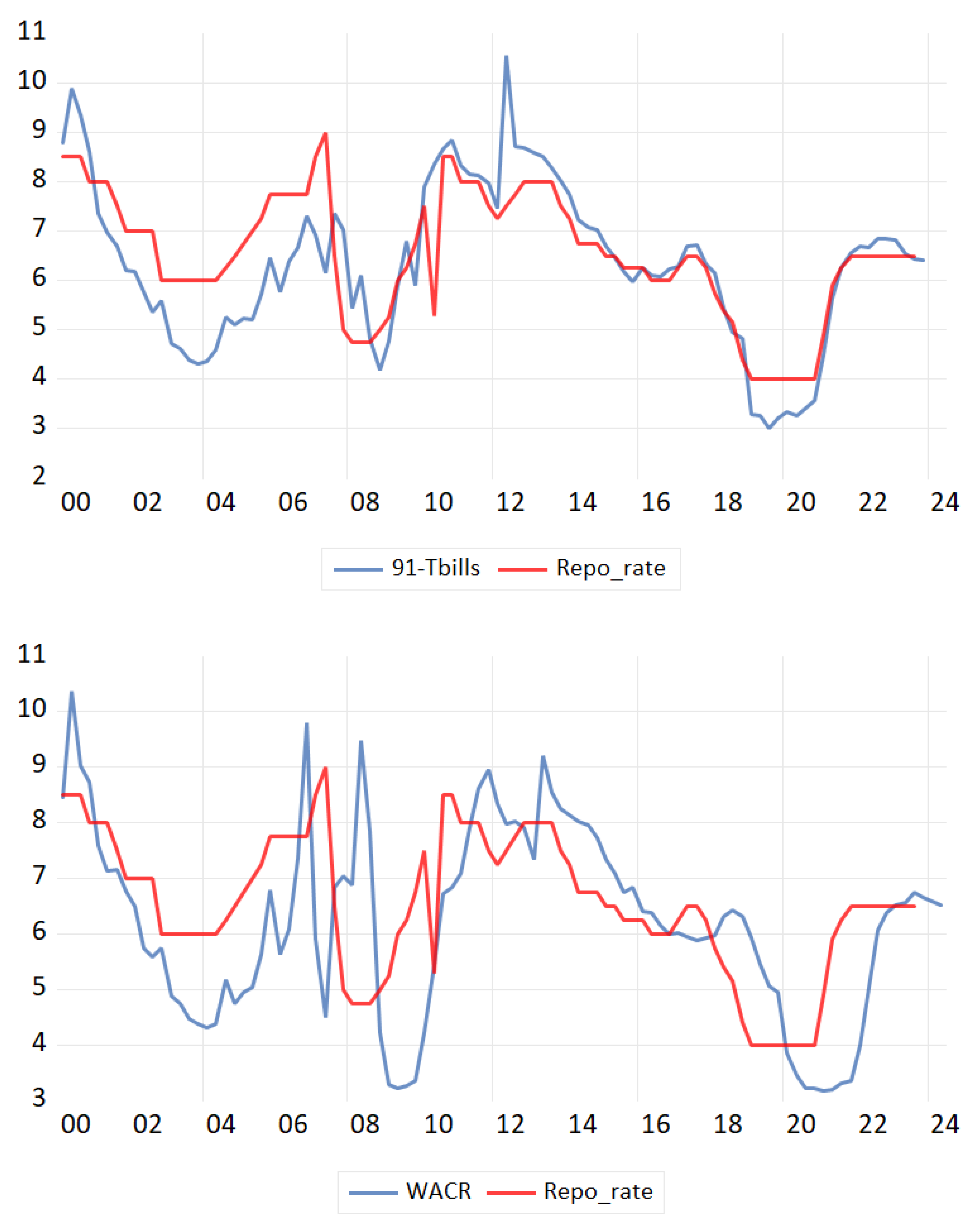
Selecting the threshold variables is a somewhat challenging task. Several conditions should be satisfied by the selected variables. First, they should represent the monetary-policy stance well over the study period, since the purpose of the analysis is to examine monetary-policy transmission across different states. Therefore, the threshold variable should, to some extent, reflect the monetary-policy stance. Furthermore, it should maintain a sufficiently close link with the target variables so that changes in it are associated with meaningful differences in output and inflation regimes. In principle, several candidates are available, including the bank rate, reserve money or M3 growth, the cash reserve ratio and other reserve requirements, the reverse repo and marginal standing facility rates, various money-market and bond yields, and composite indicators such as monetary conditions indices. However, the post-reform literature and the RBI’s own descriptions of its operating framework suggest that the stance is better summarized by short-term interest rates than by quantity aggregates, with the weighted average call money rate (WACR) emerging as the key operating target under the liquidity adjustment facility (Acharya, 2017), while the 91-day Treasury bill yield has become a widely used market benchmark that embeds both the current policy rate and expectations of its future path. Consistent with this evolution, Figure 1 shows that both the WACR and 91-day Treasury bills track the repo rate closely across regimes, suggesting that they internalize the policy stance more faithfully than alternative instruments whose roles have either been de-emphasized (bank rate, monetary aggregates, and CRR/SLR) or are better interpreted as transmission variables rather than policy levers (deposit and lending rates and longer-maturity bond yields).
Based on the characteristics of the WACR and the 91-day Treasury bill yield, the latter is expected to provide a more suitable state variable for inflation than the former. While the WACR primarily reflects the RBI’s operating liquidity conditions, the 91-day Treasury bill yield is a traded market benchmark that incorporates both the current policy stance and expectations regarding its future path. Since inflation dynamics are shaped by broader short-term financing conditions and expectation formation, rather than solely by the overnight operating rate, the 91-day Treasury bill yield should, in principle, provide a more appropriate basis for identifying inflation regimes. By contrast, given the operating role of the WACR in the Indian monetary-policy framework, it is used to extract the monetary-policy shock through the above-mentioned Taylor rule and utilized as a threshold variable to capture the response of the output. The weighted average call money rate is obtained from the RBI’s Database on the Indian Economy under the monthly weighted average call/notice rate series and is available from 1993Q1 onward; the monthly observations are converted into quarterly frequency for estimation. In the Indian monetary-policy framework, particularly since the adoption of flexible inflation targeting, the repo rate serves as the main policy signal, whereas the WACR functions as the operating target and therefore provides a more appropriate measure of short-term liquidity conditions in the money market. The series is stationary in levels and is therefore used in level form in the empirical analysis.
The 91-day Treasury bill series is also drawn from the RBI’s Database on the Indian Economy, using the monthly yield on Subsidiary General Ledger (SGL) transactions for residual maturities in Treasury bills. The data are available from 1996Q1 onward and are converted into quarterly frequency by simple averaging. This secondary-market yield is preferred to primary auction cutoff yields because it reflects continuous market pricing and incorporates monetary-policy developments more promptly, thereby providing a more suitable measure of short-term market-rate conditions.
The real effective exchange rate (REER) is used as the indicator for the exchange-rate channel. It is measured as a trade-weighted multilateral index of the external value of the Indian rupee, such that an increase in the index denotes an appreciation and a decline denotes a depreciation. Monthly REER data were obtained from the Reserve Bank of India’s Handbook of Statistics on the Indian Economy, using the 36-currency bilateral-weights series for 1993–2004 and the 40-currency bilateral-weights series thereafter.
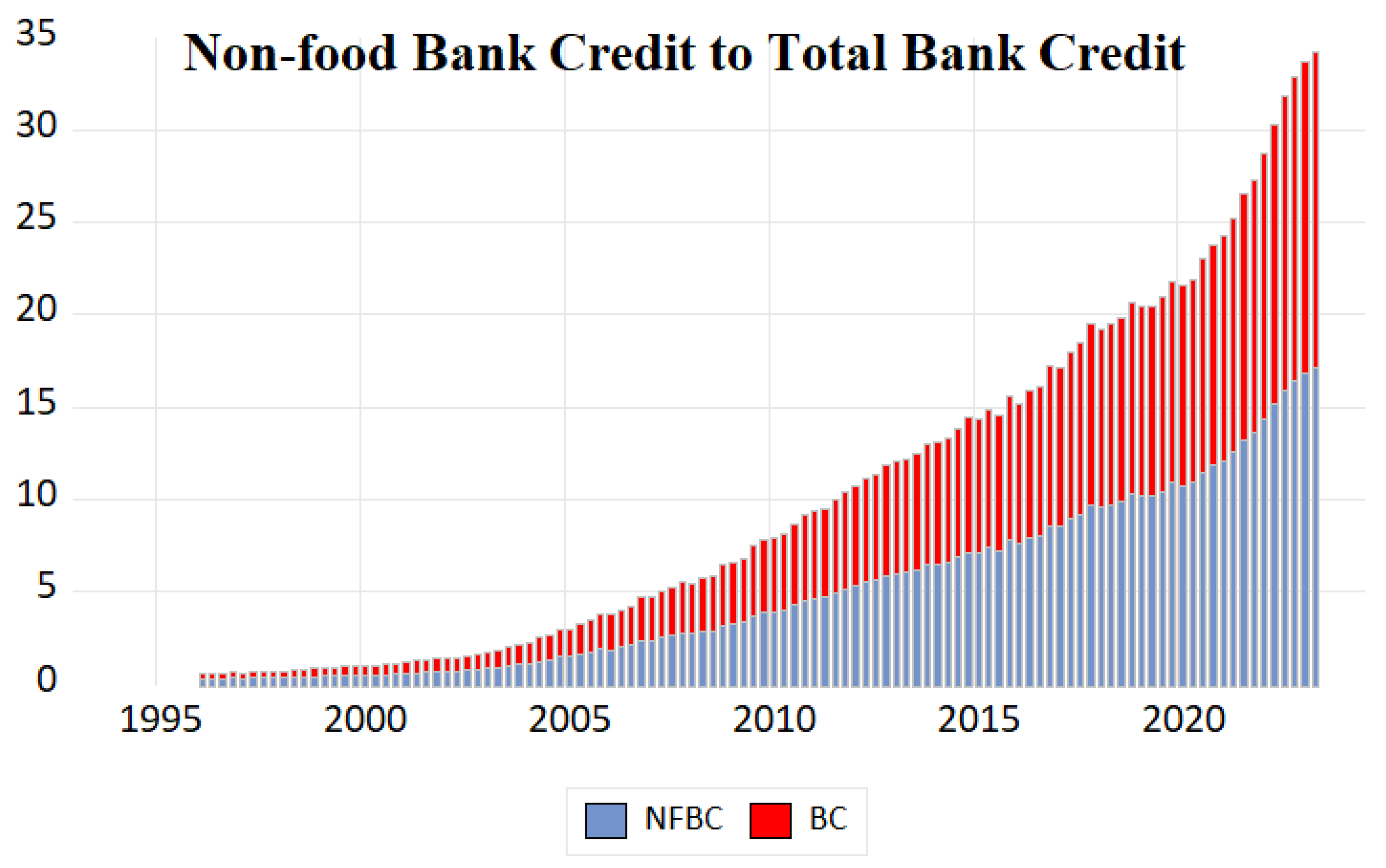
NFBC (non-food bank credit) is selected as the proxy for the bank-credit channel for several reasons. First, it more appropriately captures commercial lending conditions, since food credit in India has historically been closely associated with government procurement operations and food-policy interventions; by contrast, non-food credit better reflects lending to the broader non-food sectors of the economy (Reserve Bank of India, 2004). Second, Figure 2 shows that NFBC accounts for a substantial share of total bank credit over time, which supports its use as a representative indicator of the bank-credit channel.

3.4. Pre-Estimation Diagnostics

3.4.1. Unit-Root Tests

Prior to estimating the threshold regressions, the time-series properties of the variables are examined to verify the suitability of the transformed series for empirical estimation. To this end, Augmented Dickey–Fuller (ADF) tests are employed to determine the order of integration of each variable and to reduce the risk of spurious inference in the subsequent threshold models. Table 2 reports the preferred ADF specification and the corresponding test results for each variable. The ADF results reported in Table 2 indicate that all variables used in the estimation are stationary in the forms employed in the empirical analysis. DLGDP, GWPI, GASSETS, WACR, and TBILLS reject the unit-root null under the intercept specification, whereas MP_SHOCK and DGNFBC reject the null even under the specification without deterministic terms. REER is the only variable for which the result depends on the deterministic component: although the null is not rejected under the intercept-only specification, it is rejected once a linear trend is included, suggesting that the series is more appropriately characterized as trend-stationary. Overall, the results support the use of the transformed variables in the subsequent threshold regressions.

3.4.2. Structural Instability Test

To further assess whether a single linear relationship is adequate over the full sample, structural instability is examined using the Bai–Perron multiple-breakpoint test. The test is implemented sequentially, with a trimming parameter of 15%, a maximum of five breaks, and a 5% significance level. Table 3 reports the sequential test results and the associated break dates.
The Bai–Perron results provide strong evidence of structural instability in the linear specification. The null hypothesis is rejected sequentially up to four breaks, whereas the test for a fifth break is not statistically significant. This implies that the preferred specification contains four statistically significant breakpoints, located at 2000Q3, 2009Q3, 2013Q4, and 2019Q1. These break dates indicate that the underlying relationship is not stable over the full sample, thereby supporting the use of a threshold framework that allows the transmission process to vary across regimes rather than imposing a single constant-parameter specification throughout.

3.5. Lag-Length Criteria

Lag selection was treated as an empirical guide rather than as a mechanical rule. In the unrestricted VAR estimated on a common sample, the information criteria were not unanimous: AIC, FPE, and HQ selected three lags; the sequential LR test selected four lags; and SC preferred one lag. Taken together, these results point to medium-order quarterly dynamics rather than to a purely contemporaneous or one-quarter response. More importantly, the residual LM diagnostics showed that the remaining serial dependence was repeatedly concentrated around the fourth quarter. In quarterly data, such a pattern is consistent with delayed policy transmission and annual carryover effects rather than with the need to load all regressors symmetrically with long lag structures. This consideration is especially important in the present framework, which is already nonlinear and regime-dependent. The dynamic threshold regressions allow for regime-specific coefficients and up to two thresholds, implying a potentially large expansion in the parameter space once additional lags are introduced. Table 4 summarizes the empirical basis for the asymmetric lag structure adopted in the baseline specification.
Accordingly, the final specification allows the monetary-policy shock to enter with four lags, while the transmission-channel variables are restricted to their first lag. This asymmetric lag structure is justified on both econometric and economic grounds. Econometrically, it preserves parsimony in a threshold setting in which unrestricted lag symmetry would sharply reduce regime-specific precision. Economically, it assigns richer dynamics to the policy innovation itself, where delayed pass-through is most plausible, while treating the exchange-rate, asset-price and credit variables as proximate propagation channels. This choice is also consistent with the broader Indian evidence reviewed in the manuscript, which suggests that the peak effects of policy tightening on activity typically emerge after two to three quarters and on prices after three to four quarters, while the magnitude and speed of channel transmission vary across sub-periods and institutional regimes.

4. Results

4.1. GDP Threshold

4.1.1. GDP Model Nonlinearity

The regime classification reported in Table 5 is not imposed arbitrarily, but is supported by formal threshold specification testing. To verify the appropriateness of a nonlinear specification for estimating the output response to monetary-policy shocks and transmission-channel variables, sequential Bai–Perron threshold tests are conducted using the weighted average call money rate (WACR) as the threshold variable. The results confirm the presence of two statistically significant thresholds and therefore support the three-regime specification adopted for the GDP equation.
The Bai–Perron sequential threshold tests support the presence of two statistically significant thresholds in the GDP equation when the WACR is used as the threshold variable. The null hypothesis of no threshold is rejected, and the null hypothesis of a single threshold is also rejected, indicating that the GDP response is better characterized by a three-regime structure than by either a linear or a single-threshold specification. The estimated threshold values are therefore used to define the low-, intermediate-, and high-rate regimes in the subsequent threshold regression.

4.1.2. GDP Threshold Outcomes

As anticipated, the threshold regression for output reveals state-dependent responses that differ meaningfully across the regimes defined by the WACR. The estimated thresholds partition the sample into three regimes: a low-rate regime with the WACR below 5.5867, an intermediate-rate regime with the WACR between 5.5867 and 7.7200, and a high-rate regime with the WACR above 7.7200. Table 6 reports the corresponding threshold estimates.
In the low-rate regime, output growth exhibits a counterintuitive response to short-term monetary-policy shocks. This is evident from the positive and highly significant coefficient on MP_SHOCK(-1), at 0.0716, and the smaller but still positive and significant coefficient on MP_SHOCK(-2), at 0.0221. Although such a pattern has often been attributed in the Indian literature to the endogeneity of raw policy-rate measures, the present specification mitigates this concern by using residuals from the Taylor rule equation as the monetary-policy shock. The positive response may therefore reflect weak or delayed transmission, anticipation effects, or other state-dependent offsetting forces. The lagged dependent variable also enters with a negative and statistically significant coefficient, suggesting short-run adjustment dynamics in this regime.
The asset-price and bank-credit channels are both positive and statistically significant in the low-rate regime, with coefficients of 0.3080 and 0.6096, respectively. This suggests that output transmission is reinforced through these channels under accommodative monetary conditions. Since the credit variable enters in first-differenced growth form, its coefficient should be interpreted as the effect of an acceleration in credit growth rather than the effect of credit growth itself. By contrast, the coefficient on REER is statistically insignificant, indicating that the exchange-rate channel does not appear to be an important driver of output in this regime.
Under the intermediate-rate regime, output begins to respond to monetary-policy shocks in a more economically conventional manner, although the response remains delayed and limited. The second and third lags of MP_SHOCK are negative and statistically significant, suggesting that monetary tightening begins to restrain output growth after a lag under more normal monetary conditions. At the same time, the exchange-rate, asset-price, and credit variables remain statistically insignificant, implying that no single observable transmission channel dominates in this regime. The output response therefore appears to operate through a weaker and more diffuse tightening of overall financing conditions.
In the high-rate regime, the positive response of output to monetary-policy shocks re-emerges in the first, third, and fourth lags. These coefficients should be interpreted with caution because the number of observations in this regime is relatively small. Nevertheless, the pattern is consistent with the broader evidence from the low-rate regime and may reflect delayed transmission and crisis-related accommodation dynamics. Among the transmission channels, the asset-price channel is the only statistically significant variable, with a negative coefficient of 0.2402 . This indicates that asset-price movements retain explanatory power for output under tight monetary conditions, whereas the credit and exchange-rate channels remain insignificant.
The non-threshold variables do not add meaningful explanatory power once the regime-specific structure is taken into account. Both DWPI(-1) and DEFRED(-1) are statistically insignificant, indicating that they do not exert an independent effect on output beyond the domestic regime-dependent dynamics captured in the threshold specification.
Overall, the diagnostics suggest that the model is statistically acceptable. The R-squared of 0.5049 indicates moderate explanatory power, which is reasonable for a quarterly macroeconomic threshold model with multiple regimes. Although the adjusted R-squared is lower, this reflects the cost of estimating a richer nonlinear specification and remains acceptable in the present setting. The F-statistic confirms that the model is jointly significant, while the Durbin–Watson statistic, being close to two, does not indicate severe first-order serial correlation. Inference is based on HAC standard errors, which are robust to both heteroskedasticity and autocorrelation in the estimated covariance matrix.
Given the relatively small number of observations in the high-rate regime, additional robustness checks are conducted using ridge regularization and stability diagnostics.

4.1.3. Robustness Checks for the GDP Threshold Model

To assess whether the high-rate GDP results are excessively influenced by the relatively small number of observations in this regime, ridge regularization is estimated for the subsample defined by a WACR 7.7200 . Table 7 reports the ridge coefficients and compares them with the corresponding threshold estimates for the high-rate regime.
The ridge estimates preserve the main directional patterns for the variables that are statistically significant in the threshold regression: MP_SHOCK(-1), MP_SHOCK(-3), MP_SHOCK(-4), and DGNFBC(-1) remain positive, while GASSETS(-1) remains negative. As expected, coefficient magnitudes are noticeably compressed under penalization. By contrast, several variables that are not statistically significant in the threshold regression, including DLGDP(-1), MP_SHOCK(-2), REER(-1), and the constant term, change sign under ridge regularization. Overall, the ridge exercise suggests that the main high-rate regime results are not merely an artifact of small-sample overfitting, although coefficient-level inference should still be interpreted with caution.

4.2. WPI Threshold

4.2.1. WPI Model Nonlinearity

As noted earlier, inflation, measured by the wholesale price index (WPI), is analyzed using the yield on 91-day Treasury bills in order to assess its response under different liquidity conditions. The threshold structure is first evaluated using sequential Bai–Perron tests, with the results reported in Table 8.
The results of the Bai–Perron sequential threshold tests support the choice of two thresholds in the WPI equation, with TBILLS serving as the threshold variable. Specifically, the null hypothesis of no threshold is rejected in the zero- versus one-threshold test, while the null hypothesis of a single threshold is also rejected in the one- versus two-threshold test. This indicates that wholesale price inflation is more appropriately characterized by a three-regime structure. The estimated threshold values of 5.041 and 7.5952 are therefore used to define the low-, intermediate-, and high-yield regimes in the subsequent threshold regression.

4.2.2. WPI Threshold Outcomes

The WPI threshold regression indicates that inflation dynamics vary across different interest-rate environments. The estimated thresholds of 5.0408 and 7.5952 partition the sample into three distinct regimes, low yield, intermediate yield, and high yield, as reported in Table 9. This pattern highlights that the response of wholesale prices to monetary-policy shocks, as well as the role of the transmission channels, differs across Treasury bill regimes.
In the low-yield regime, the monetary-policy shock is associated with a delayed but persistent increase in WPI inflation. While the first lag is statistically insignificant, the second, third, and fourth lags are all positive and statistically significant. This suggests that disinflation does not materialize immediately under easy financial conditions, which is consistent with a short-run price-puzzle interpretation in which tightening is followed by a temporary increase in prices rather than an immediate decline. In this regime, REER is statistically insignificant, indicating that the exchange-rate channel does not provide additional explanatory power, while the asset-price and credit proxies are likewise insignificant.
In the intermediate-yield regime, the response of WPI to the monetary-policy shock remains positive, but it becomes more concentrated at shorter horizons. The coefficients on MP_SHOCK(-1) and MP_SHOCK(-2) are both positive and statistically significant, whereas the third and fourth lags lose significance. This indicates that the pass-through to wholesale prices is more immediate in the intermediate regime than in the low-yield regime. The exchange-rate proxy enters with a negative and statistically significant coefficient, which is consistent with the conventional disinflationary role of the exchange-rate channel. By contrast, the asset-price and credit variables remain insignificant.
In the high-yield regime, which is more consistent with the expected disinflationary role of monetary policy, the coefficients on the monetary-policy shock turn negative. The first lag is negative but insignificant, while the second lag is negative and weakly significant; the remaining lags are also negative but statistically insignificant. This pattern suggests that under relatively tight yield conditions, monetary-policy shocks are associated with a short-run disinflationary effect on wholesale prices. In this regime, the REER is no longer statistically significant, indicating a weaker exchange-rate contribution to WPI dynamics, while the remaining transmission-channel proxies also remain insignificant. At the same time, the lagged dependent variable enters with a positive and statistically significant coefficient, suggesting a stronger degree of inflation persistence in the high-yield regime.
The non-threshold variables, DGDP(-1) and DEFRED(-1), are both statistically insignificant, indicating that once regime-specific dynamics are taken into account, lagged output growth and the external control variable do not exert an independent effect on WPI inflation in the estimated specification. At the model level, the threshold regression produces an R-squared of 0.4687 and an adjusted R-squared of 0.2804, while the overall F-statistic remains statistically significant. The Durbin–Watson statistic of 2.2060 does not suggest severe first-order serial correlation, and inference is based on HAC standard errors to account for heteroskedasticity and autocorrelation in the covariance matrix. Overall, the results support the view that the inflationary effects of monetary-policy shocks in India are state-dependent, with the sign and lag structure of pass-through varying across Treasury bill regimes.

4.2.3. Robustness Checks for the WPI Threshold Model

To examine whether the low-yield WPI results are overly sensitive to the limited number of observations in that regime, ridge regularization is estimated for the subsample defined by TBILLS < 5.0408 . The results, reported in Table 10, provide a shrinkage-based robustness check for the low-yield regime. The optimal penalty selected by cross-validation is λ = 0.57 .
The ridge estimates preserved the sign of the main coefficients obtained from the threshold regression, particularly those that were statistically significant, indicating that the underlying directional relationships remained stable after penalization. In particular, the second, third, and fourth lags of the monetary-policy shock remained positive, REER(-1) remained positive, and DGNFBC(-1) remained negative. By contrast, MP_SHOCK(-1) and GASSETS(-1) changed sign under penalization, although both variables were statistically insignificant in the threshold regression. As expected, coefficient magnitudes were compressed substantially under ridge regularization, especially for DGNFBC(-1) and the longer lags of the monetary-policy shock. Overall, the ridge exercise suggests that the low-yield WPI results are not merely an artifact of small-sample overfitting, although the strength of individual effects should still be interpreted with caution.

5. Discussion

5.1. GDP Results

The findings indicate that monetary-policy transmission in India over the extended sample period is distinctly nonlinear and state-dependent. In particular, the effects of monetary conditions on real activity and wholesale prices do not remain constant across regimes, but vary with the prevailing monetary and financial environment. At the same time, the results show that the criterion used to identify these regimes is not uniform across macroeconomic outcomes. While liquidity-related operating conditions are more relevant for segmenting output responses, wholesale price dynamics are better differentiated by broader short-term market conditions. This pattern suggests that output and prices respond to different dimensions of the transmission process, reflecting the fact that monetary impulses are filtered through multiple channels whose strength varies across states of the economy.
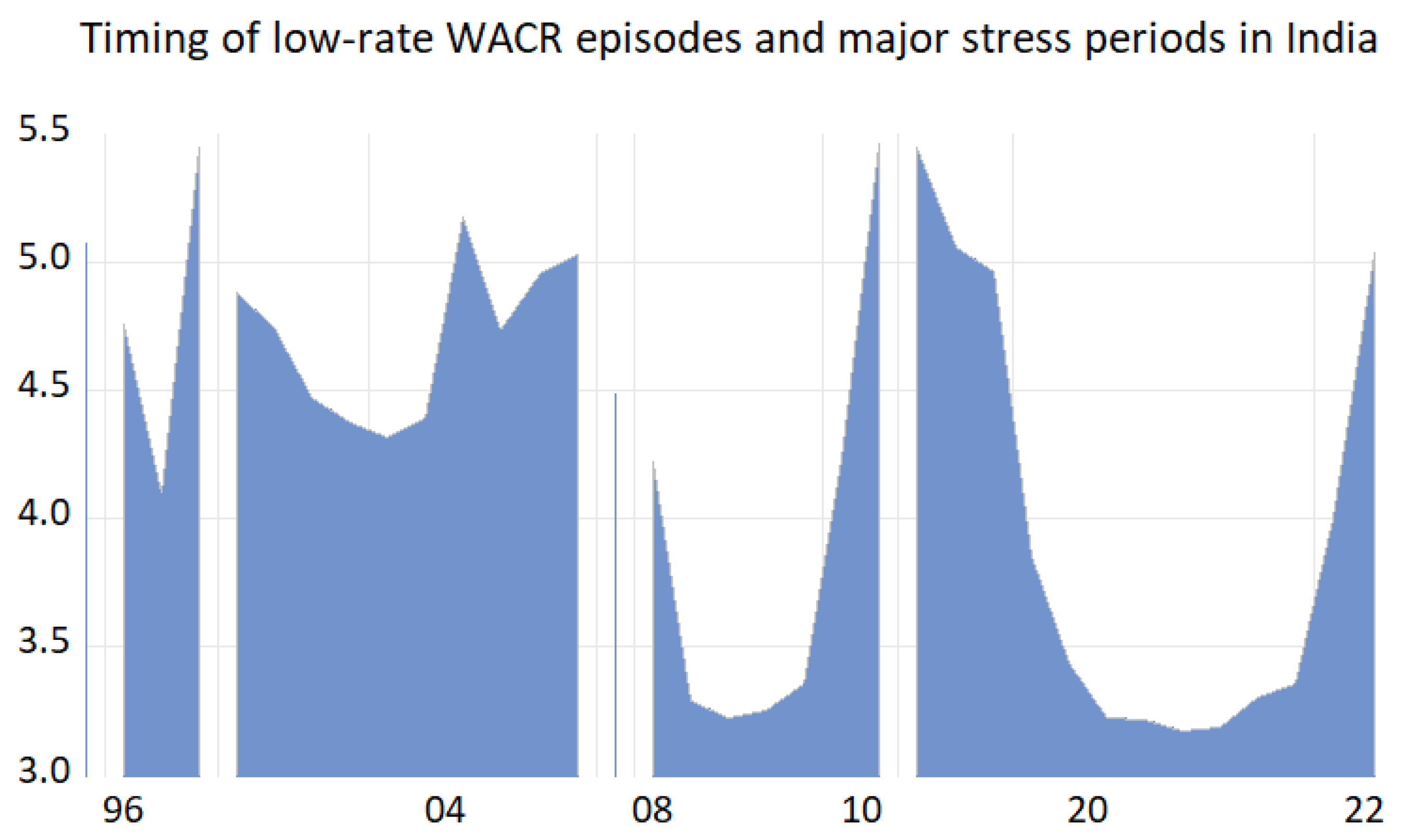
To interpret the low-rate GDP regime more carefully, Figure 3 plots the timing of quarters in which the WACR falls below the estimated threshold. The visual pattern suggests that these observations are not randomly distributed across the sample but cluster around periods associated with major stress episodes and accommodative policy phases, including the late-1990s Asian financial turmoil, the Global Financial Crisis, and the COVID-19 period. This timing does not imply that every low-rate quarter is itself a crisis quarter, but it does support interpreting the low-rate regime as one shaped by crisis accommodation, unusually easy liquidity conditions, and heightened macro-financial frictions.
The figure shows that quarters classified in the low-rate WACR regime cluster around episodes of stress and accommodative monetary conditions rather than being randomly distributed across the sample. Within such an environment, the positive short-run response of GDP to monetary-policy shocks becomes more understandable. Rather than reflecting standard contractionary transmission, it may indicate that policy traction is weakened when interest rates remain persistently low and the economy is affected by uncertainty, risk aversion, and balance-sheet pressures. In such states, the immediate restraining effect of a monetary shock may be dampened by offsetting forces, including liquidity support, delayed bank pass-through, and concurrent fiscal or financial stabilization measures. At the same time, the positive and significant coefficient on the credit channel remains consistent with the broader Indian evidence that monetary transmission is heavily bank-centered, even when pass-through to output is weak on average. Interpreted in line with the transformed specification, this finding suggests that a faster pace of credit expansion is associated with stronger output support in this regime. Similarly, the positive role of asset prices may reflect wealth and collateral effects that temporarily sustain spending and financing conditions under accommodative monetary settings. The output response under the intermediate regime is economically more plausible, as it aligns with standard monetary theory, which predicts a negative association between economic activity and contractionary monetary-policy innovations. This pattern is visible in the second and third lags of the monetary-policy shock. By contrast, the insignificance of the first and fourth lags may reflect the reduced influence of crisis-related distortions and exceptional policy interventions, which often blur the immediate effect of monetary tightening. At the same time, the exchange-rate, asset-price, and credit channels are all statistically insignificant in this regime, indicating that output adjustment under normal liquidity conditions does not propagate through a single dominant channel. Rather, it appears to occur through a weaker and more diffuse tightening of aggregate financing and demand conditions. In this respect, the intermediate regime helps reconcile the present findings with earlier Indian studies, such as Bhattacharya et al. (2011), which reported weak average real effects of monetary policy. What appears weak in linear models may therefore conceal a delayed but economically meaningful contractionary response concentrated in the middle regime.
While much of the existing literature, especially linear studies, attributes the weakness of monetary transmission to channel-specific frictions, the present results call for a more nuanced interpretation. For example, Reserve Bank of India (2004) emphasized that the exchange-rate channel in India is naturally muted under a managed-float regime. Singh and Pattanaik (2012) likewise argued that the asset-price channel is weak because only a small share of household financial wealth is held in equity, thereby limiting the effect of stock-price movements on consumption. In addition, Chattopadhyay and Mitra (2023) suggest that the rising share of low-quality assets in banks’ portfolios constrains the effectiveness of monetary transmission. Considered together, these observations imply that transmission channels may become operative only under particular conditions, such as banking-sector weakness, crisis episodes, inflationary pressures, or tight liquidity. If such conditions are episodic rather than permanent, output may appear to respond only weakly to policy on average, while traditional transmission channels appear muted because they become significant only in specific states of the economy.
In the high-rate regime, positive output responses re-emerge at the first, third, and fourth lags of the monetary-policy shock. These estimates should be interpreted with caution because the number of observations in this regime is relatively limited. Importantly, however, ridge regularization does not alter the sign of the main positive lags; only the second lag changes sign under penalization, and that coefficient is statistically insignificant in the threshold regression. This suggests that the broader high-rate pattern is not merely a small-sample artifact. The key feature of this regime is that the asset-price channel is the only transmission channel that remains statistically significant. This indicates that under tight monetary conditions, output dynamics are more closely linked to asset-price adjustments than to exchange-rate or credit effects, both of which remain insignificant. Rather than pointing to a standard expansionary effect of tightening, the results instead suggest that asset-price movements exert a contractionary influence on output even when policy rates are high, while the other channels remain muted. Overall, the evidence indicates that the most conventional contractionary output response appears in the intermediate regime, even though the observable transmission channels are less pronounced there. By contrast, the asset-price channel is significant in both extreme regimes, whereas the credit channel is statistically significant only in the easing regime.

5.2. WPI Results

As discussed earlier in the methodology section, the threshold results confirm the prior expectation that 91T-BILLS, which reflect both the current monetary stance and expectations regarding short-term liquidity conditions, generate economically interpretable inflation regimes. Under the easy regime, characterized by low 91-day Treasury bill yields and an accommodative liquidity environment, an increase in monetary-policy innovations is associated with a subsequent rise in wholesale inflation rather than with immediate disinflation. This pattern can be understood in terms of the price puzzle in the Indian context and the limited short-run effectiveness of monetary policy in controlling inflation during periods of unusually easy liquidity.
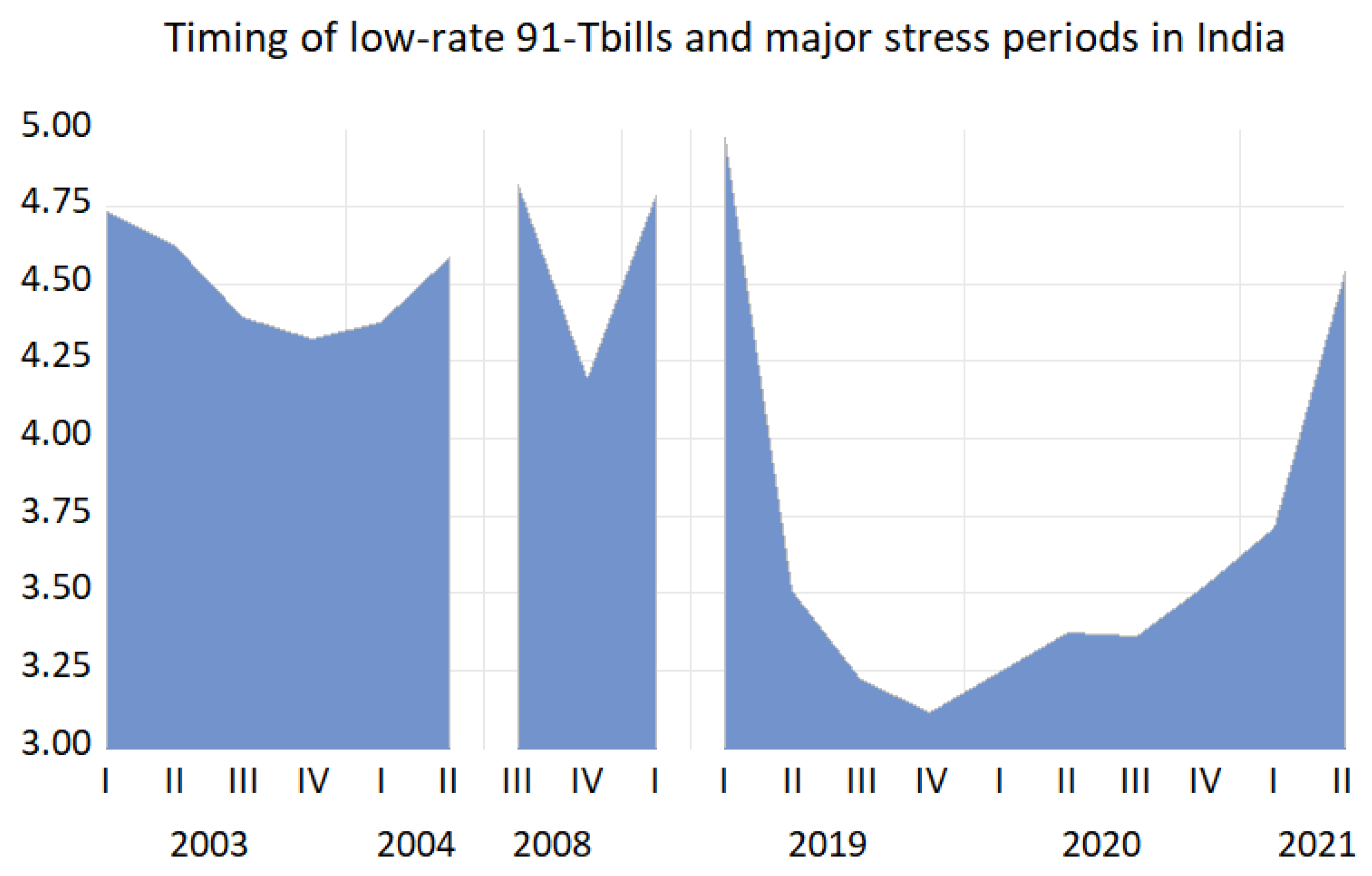
To interpret the low-yield regime more carefully, Figure 4 plots the timing of quarters in which TBILLS fall below the estimated threshold. The visual pattern suggests that these observations cluster around crisis-related or post-shock accommodative episodes rather than being randomly distributed across the sample.
The figure shows that quarters classified in the low-yield TBILLS regime cluster around periods of stress and accommodative monetary conditions rather than being randomly distributed across the sample. For instance, they occurred in the aftermath of the severe drought of 2002–2003, during the Global Financial Crisis of 2008–2009, and again during the COVID-19 pandemic. This does not imply that every low-yield quarter was itself a crisis quarter, but it does support the interpretation of this regime as one shaped by stress accommodation and policy support. In such periods, the inflationary effects of pre-existing price pressures, liquidity expansion, and delayed transmission may dominate the immediate disinflationary effect of policy shocks. The ridge-regularization results, which preserve the direction of the main statistically relevant coefficients in this regime, further support the credibility of these findings. Mohanty (2013) noted a similar pattern in wholesale prices during crisis periods and argued that under a highly accommodative monetary stance, such as crisis-time stimulus, large liquidity injections may raise household inflation expectations and thereby push up the headline WPI even while the central bank is attempting to support economic recovery. The exchange-rate channel also appears weak for the WPI in this regime, as the REER is not statistically significant.
The positive association between monetary-policy shocks and wholesale prices persists into the first two lags in the intermediate-yield regime, which remains consistent with the short-run price-puzzle phenomenon in the Indian context. The muted impact of the monetary shock over the following two quarters may reflect inflation persistence and the adaptive nature of price setting, whereby firms adjust prices only gradually in response to monetary innovations. Nevertheless, the monetary authority appears to retain some capacity for disinflation through the exchange-rate channel, which is statistically significant for the WPI in this regime. While several studies, such as Mohan and Patra (2009), associate this disinflationary effect with lower import costs, it may also be interpreted as a clearer signal of genuine domestic tightening. This is especially plausible because India’s managed float is less dominated by crisis intervention in the intermediate regime, making appreciation more informative for price setters than in the two extreme yield regimes. By contrast, neither the asset-price channel nor the credit channel is statistically significant.
In the high-yield regime, wholesale prices display the most standard response to monetary-policy shocks, with negative coefficients on the first two lags. This pattern highlights the importance of the surrounding monetary environment in shaping policy effectiveness. Specifically, under high-yield conditions, additional tightening produces a short-run disinflationary effect on the WPI. This weakens the short-run price puzzle and restores a more conventional role for monetary policy. However, this standard response is not reinforced by the other transmission channels, which remain statistically insignificant. This suggests that inflation dynamics in the high-yield regime are influenced more directly by the overall tightening stance than by any single observable transmission channel. At the same time, the positive and significant coefficient on GWPI(-1) indicates that inflation persistence becomes more pronounced in this regime.
The lack of significance of the asset-price and credit channels across all three WPI regimes is noteworthy. The weakness of the asset-price channel may reflect the relatively limited depth of financial markets in an emerging economy such as India, as argued by Singh and Pattanaik (2012). The weak role of the credit channel is also notable, but it becomes more understandable once the underlying drivers of wholesale inflation are considered. In India, WPI inflation is influenced more strongly by supply-side factors, commodity prices, tradable costs, and expectations than by changes in bank credit quantities. As a result, although credit may matter for real activity, it does not appear to be the marginal force behind wholesale price formation. In addition, bank-credit pass-through in India is partial and slow, which makes non-food bank credit, measured here as DGNFBC, too indirect and sluggish to explain WPI movements effectively within quarterly inflation horizons.

6. Conclusions

This study revisits the monetary-policy transmission mechanism in India by examining whether its effects on real output and wholesale prices are state-dependent across different interest-rate environments. Using quarterly data over a long post-liberalization sample, the analysis combines a Taylor rule-based monetary-policy shock measure with dynamic discrete-threshold regressions in order to mitigate the endogeneity of raw policy rates and to allow transmission effects to vary across observable regimes. The pre-estimation diagnostics confirm the presence of structural instability, thereby supporting the use of a nonlinear empirical framework rather than a single linear specification.
The results show that monetary transmission in India is distinctly regime-dependent. For output, the weighted average call money rate serves as the more informative threshold variable, and the most economically plausible contractionary response to monetary-policy shocks appears in the intermediate-rate regime rather than in the low- or high-rate regimes. For wholesale prices, the 91-day Treasury bill yield provides the more suitable threshold variable, and the inflation response becomes more consistent with standard monetary theory only in the high-yield regime, while the low- and intermediate-yield regimes display patterns consistent with a short-run price puzzle. The evidence further indicates that the transmission channels do not operate uniformly across regimes: the credit and asset-price channels matter selectively for output, while the exchange-rate channel is more relevant for inflation under intermediate market-rate conditions.
Taken together, these findings suggest that the monetary transmission mechanism in India cannot be adequately understood through linear average relationships alone. The strength, timing, and even direction of policy effects depend on the surrounding monetary and financial environment, as well as on the indicator used to identify that environment. This paper therefore contributes to the literature by showing that output and inflation are segmented by different monetary-state variables and by identifying the specific regimes in which transmission becomes stronger, weaker, or distorted. From a policy perspective, the results imply that the assessment of monetary policy in India should explicitly distinguish between operating-rate conditions and broader short-term market-rate regimes, since the effectiveness of policy and the relevance of individual channels vary across states of the economy.
A limitation of this study lies in its reliance on aggregate macroeconomic variables and regime-specific subsamples, which may obscure important sectoral, institutional, and bank-level heterogeneity in the transmission process. In addition, some threshold-defined regimes contain relatively few observations, requiring cautious interpretation of coefficient estimates despite the robustness checks employed. Accordingly, the results should be interpreted as evidence on broad state-dependent transmission patterns rather than as a complete account of all micro-level channels through which monetary policy operates in India.
Future research may extend the present framework by incorporating bank-level, sectoral, or firm-level data, as well as alternative measures of expectations and financial stress, in order to refine further the understanding of state-dependent monetary transmission in India.

Author Contributions

Conceptualization, D.A. and N.A.; methodology, H.M.; software, H.M.; validation, D.A. and N.A.; formal analysis, H.M.; investigation, H.M.; resources, H.M.; data curation, H.M.; writing—original draft preparation, H.M.; writing—review and editing, D.A. and N.A.; visualization, H.M.; supervision, D.A. and N.A. All authors have read and agreed to the published version of the manuscript.

Funding

This research study received no external funding.

Institutional Review Board Statement

Not applicable.

Data Availability Statement

The data supporting the findings of this study were obtained from the Database on Indian Economy (DBIE), Reserve Bank of India, available online at https://data.rbi.org.in/#/dbie/home (accessed on 9 April 2026).

Conflicts of Interest

The authors declare no conflicts of interest.

Appendix A. Augmented Taylor Rule Framework

The standard Taylor rule posits that a central bank adjusts its policy rate in response to inflation and output gaps. For an open emerging market such as India, this framework is augmented to incorporate exchange-rate dynamics and policy inertia through interest-rate smoothing.
The target nominal interest rate, i t * , is defined as
i t * = α + β π t π t * + γ y ˜ t + δ Δ R E E R t .
Because central banks adjust interest rates gradually, the actual policy rate incorporates a smoothing parameter, ρ :
i t = ( 1 ρ ) i t * + ρ i t 1 + ϵ t .
By substituting the target rate into the partial-adjustment rule, the estimable equation becomes
W A C R t = α 0 + ρ W A C R t 1 + β 0 π t π t * + γ 0 y ˜ t + δ 0 Δ R E E R t + u t .
α 0 , ρ , β 0 , γ 0 , and δ 0 are reduced-form coefficients that absorb the ( 1 ρ ) scaling implied by policy smoothing.

Variable Construction

The Taylor rule equation is estimated using the weighted average call money rate (WACR) as the operating target of monetary policy. The WACR is preferred because it closely reflects the Reserve Bank of India’s short-term operating stance and provides a consistent policy-rate series over the sample. The output gap is constructed as the cyclical component of real GDP obtained by applying the Hodrick–Prescott filter to the natural logarithm of quarterly real GDP. The inflation gap is defined as the deviation of actual inflation (CPI) from the relevant policy benchmark. For the pre-FIT period, when no explicit numerical inflation target was in place, the target is proxied by a trailing moving average of inflation. For the post-2016 period, the target inflation rate is set to 4 percent, consistent with the flexible inflation-targeting framework. The quarter-on-quarter change in the real effective exchange rate, denoted by Δ R E E R t , captures exchange-rate conditions. Together, these variables summarize the systematic component of the monetary-policy reaction function, while the unexplained component is interpreted as the monetary-policy innovation.
Table A1. Definition and construction of variables in the Taylor rule equation.
VariableDefinitionTransformationSource
W A C R t Weighted average call money rate, used as the operating target of monetary policyQuarterly average/levelReserve Bank of India, DBIE
y ˜ t Output gap, measured as the cyclical component of real GDPHP filter applied to log real GDPRBI/national accounts data
π t π t * Inflation gap, defined as actual inflation minus target inflationActual inflation (CPI) minus target; pre-2016 target proxied by trailing moving average, post-2016 target fixed at 4%Office of the Economic Adviser/CPI source/authors’ calculations
Δ R E E R t Change in the real effective exchange rateQuarter-on-quarter percentage changeReserve Bank of India
u t Monetary-policy innovation from the Taylor rule equationEstimated residualAuthors’ calculations
Table A2. Augmented Taylor rule estimation.
Variable/StatisticValue
Constant2.2138 ***
W A C R t 1 0.6749 ***
Inflation gap−9.7837
Output gap5.8435 **
Δ R E E R t −0.2199
Observations118
Sample1995Q1–2024Q2
R 2 0.5942
Adjusted R 2 0.5798
F-statistic41.3621 ***
Durbin–Watson stat.2.1171
EstimationOLS with HAC (Newey–West) standard errors
Notes: HAC standard errors are computed using the Newey–West method with Bartlett kernel and fixed bandwidth of 5. ***, and ** denote significance at the 1%, and 5% levels, respectively. Source: Authors.

Appendix B. Augmented Dickey–Fuller Unit Root Test

Table A3 reports the Augmented Dickey–Fuller (ADF) unit root test results under alternative deterministic specifications. The null hypothesis in each case is that the variable contains a unit root.
Table A3. Augmented Dickey–Fuller unit root test results.
SpecificationStatisticDLGDPGWPIGASSETSREERWACRTBILLSMP_SHOCKDGNFBC
Panel A. At Level
With constantt-statistic−7.6819−4.1803−9.6149−1.4724−4.5856−3.7935−11.3845−16.2239
Prob.00.001100.54440.00020.004000
Sig.*********No************
With constant & trendt-statistic−7.6884−4.2161−9.5765−4.6285−4.9624−3.6446−11.5172−16.1474
Prob.00.005900.00150.00040.030600
Sig.***********************
Without constant & trendt-statistic−1.3075−4.1841−8.59550.5976−1.7907−1.5532−11.4338−16.3035
Prob.0.1757000.84420.06980.112700
Sig.No******No*No******
Panel B. At First Difference
With constantt-statistic−8.8253−7.8513−7.9209−10.1948−12.7032−12.7032−8.3690−8.3480
Prob.00000000
Sig.************************
With constant & trendt-statistic−8.7894−7.8210−7.9028−10.1695−12.6473−12.6640−8.2922−8.2950
Prob.00000000
Sig.************************
Without constant & trendt-statistic−8.8655−7.8916−7.9579−10.2009−12.7565−12.7512−8.4194−8.3923
Prob.00000000
Sig.************************
Notes: The null hypothesis of the Augmented Dickey–Fuller (ADF) test is that the variable has a unit root. (*) denotes significance at the 10% level, (**) at the 5% level, and (***) at the 1% level; “No” indicates nonsignificance. Lag length is selected on the basis of the Schwarz information criterion (SIC). Source: Authors.

References

  1. Acharya, V. V. (2017). Monetary transmission in India: Why is it important and why hasn’t it worked well. Reserve Bank of India Bulletin, 71(12), 7–16. [Google Scholar]
  2. Adil, M. H., & Rajadhyaksha, N. (2021). Evolution of monetary policy approaches: A case study of Indian economy. Journal of Public Affairs, 21(1), e2113. [Google Scholar] [CrossRef]
  3. Adrian, T., Laxton, D., & Obstfeld, M. (Eds.). (2018). Advancing the frontiers of monetary policy. International Monetary Fund. [Google Scholar] [CrossRef]
  4. Aleem, A. (2010). Transmission mechanism of monetary policy in India. Journal of Asian Economics, 21(2), 186–197. [Google Scholar] [CrossRef]
  5. Bhat, S. A., Kamaiah, B., & Acharya, D. (2020). Examining the differential impact of monetary policy in India: A policy simulation approach. Journal of Economics, Finance and Administrative Science, 25(50), 339–362. [Google Scholar] [CrossRef]
  6. Bhattacharya, R., Patnaik, I., & Shah, A. (2008). Exchange rate pass-through in India (Macro/Finance Group (NIPFP) Working Paper). Macro/Finance Group (NIPFP). Available online: https://macrofinance.nipfp.org.in/PDF/BPS2008_erpt.pdf (accessed on 11 April 2026).
  7. Bhattacharya, R., Patnaik, I., & Shah, A. (2011). Monetary policy transmission in an emerging market setting (IMF Working Paper WP/11/5). International Monetary Fund. [Google Scholar] [CrossRef]
  8. Bhoi, B. K., Mitra, A. K., Singh, J. B., & Sivaramakrishnan, G. (2017). Effectiveness of alternative channels of monetary policy transmission: Some evidence for India. Macroeconomics and Finance in Emerging Market Economies, 10(1), 19–38. [Google Scholar] [CrossRef]
  9. Chattopadhyay, S. K., & Mitra, A. K. (2023). Monetary policy transmission in India under the base rate and MCLR regimes: A comparative study. Humanities and Social Sciences Communications, 10, 408. [Google Scholar] [CrossRef]
  10. Das, S. (2015). Monetary policy in India: Transmission to bank interest rates (IMF Working Paper No. 15/129). International Monetary Fund. [Google Scholar] [CrossRef]
  11. Dua, P. (2020). Monetary policy framework in India. Indian Economic Review, 55(1), 117–154. [Google Scholar] [CrossRef] [PubMed]
  12. Dua, P., & Tuteja, A. (2023). Monetary transmission in the Indian economy. In P. Dua (Ed.), Macroeconometric methods: Applications to the Indian economy (pp. 97–122). Springer Nature. [Google Scholar] [CrossRef]
  13. Durai, S. R. S., & Bhaduri, S. N. (2009). Stock prices, inflation and output: Evidence from wavelet analysis. Economic Modelling, 26(5), 1089–1092. [Google Scholar] [CrossRef]
  14. Eichengreen, B., & Gupta, P. (2024). Inflation targeting in India: A further assessment. Margin: The Journal of Applied Economic Research, 18(1–2), 7–42. [Google Scholar] [CrossRef]
  15. Farajnezhad, M., Idrus, D., & Shehni Karam Zadeh, M. (2022). New evidence on credit channel of monetary policy transmission in India. Future Technology, 1(1), 14–20. [Google Scholar] [CrossRef]
  16. Goyal, A., & Agarwal, D. K. (2020). Policy transmission in Indian money markets: The role of liquidity. The Journal of Economic Asymmetries, 21, e00137. [Google Scholar] [CrossRef]
  17. Kapur, M., & Behera, H. K. (2012). Monetary transmission mechanism in India: A quarterly model (Reserve Bank of India Working Paper No. 09/2012). Reserve Bank of India. [CrossRef]
  18. Khundrakpam, J. K. (2017). Examining the asymmetric impact of monetary policy in India. Margin: The Journal of Applied Economic Research, 11(3), 290–314. [Google Scholar] [CrossRef]
  19. Khundrakpam, J. K., & Jain, R. (2012). Monetary policy transmission in India: A peep inside the black box (RBI Working Paper Series, WPS (DEPR): 11/2012). Reserve Bank of India. Available online: https://rbidocs.rbi.org.in/rdocs/Publications/PDFs/WP5C8D664788CA641DFAF55D67D23B2BF8B.PDF (accessed on 11 April 2026).
  20. Kumawat, L. (2023). Pami Dua (ed.): Macroeconometric methods: Applications to the Indian economy. Indian Economic Review, 58(2), 457–460. [Google Scholar] [CrossRef]
  21. Kumawat, L. (2024). Time-variation in response of inflation to monetary policy shocks in India: Evidence from TVP-VAR models. Indian Economic Review, 59(1), 233–248. [Google Scholar] [CrossRef]
  22. Mitra, S. (2006). A wavelet filtering based analysis of macroeconomic indicators: The Indian evidence. Applied Mathematics and Computation, 175(2), 1055–1079. [Google Scholar] [CrossRef]
  23. Mohan, R. (2005). Globalisation, financial markets and the operation of monetary policy in India. In Globalisation and monetary policy in emerging markets (BIS Papers No. 23, pp. 161–170). Bank for International Settlements. Available online: https://www.bis.org/publ/bppdf/bispap23m.pdf (accessed on 11 April 2026).
  24. Mohan, R., & Patra, M. (2009). Monetary policy transmission in India. In G. Hammond, R. Kanbur, & E. Prasad (Eds.), Monetary policy frameworks for emerging markets (pp. 153–179). Edward Elgar Publishing. [Google Scholar] [CrossRef]
  25. Mohanty, D. (2010, February 21). Monetary policy framework in India: Experience with multiple-indicators approach [Speech]. Conference of the Orissa Economic Association, Baripada, Orissa, India. BIS Review. Available online: https://www.bis.org/review/r100304e.pdf (accessed on 11 April 2026).
  26. Mohanty, D. (2013, January 31). Indian inflation puzzle [Speech]. Function of Late Dr Ramchandra Parnekar Outstanding Economics Award 2013, Mumbai, India. [Google Scholar]
  27. Mohanty, D., & Mitra, A. K. (1999). Experience with monetary targeting in India. Economic and Political Weekly, 34(3–4), 123–125, 127–132. [Google Scholar]
  28. Parab, P. (2022). Exchange rate pass-through in India (IGIDR Working Paper No. 2022-012). Indira Gandhi Institute of Development Research. Available online: https://www.igidr.ac.in/pdf/publication/WP-2022-012.pdf (accessed on 11 April 2026).
  29. Patel, U. R., Chinoy, S., Darbha, G., Ghate, C., Montiel, P., Mohanty, D., & Patra, M. (2014). Report of the expert committee to revise and strengthen the monetary policy framework. Reserve Bank of India.
  30. Patnaik, I., & Pandey, R. (2020). Four years of the inflation targeting framework (NIPFP Working Paper No. 325). National Institute of Public Finance and Policy. Available online: https://www.nipfp.org.in/media/documents/WP_325_2020.pdf (accessed on 11 April 2026).
  31. Patra, M. D., & Kapur, M. (2012). Alternative monetary policy rules for India (IMF Working Paper No. WP/12/118). International Monetary Fund. [CrossRef]
  32. Patra, M. D., Khundrakpam, J. K., & John, J. (2018). Non-linear, asymmetric and time-varying exchange rate pass-through: Recent evidence from India (RBI Working Paper Series, WPS (DEPR): 02/2018). Reserve Bank of India. Available online: https://www.rbi.org.in/scripts/PublicationsView.aspx?Id=18106 (accessed on 11 April 2026).
  33. Raghutla, C., Sampath, T., & Vadivel, A. (2020). Stock prices, inflation, and output in India: An empirical analysis. Journal of Public Affairs, 20(3), e2052. [Google Scholar] [CrossRef]
  34. Reserve Bank of India. (2004). Report on currency and finance 2002–03. Reserve Bank of India.
  35. Reserve Bank of India. (2021). Minutes of the monetary policy committee meeting, December 6 to 8, 2021 [Press release]. Reserve Bank of India.
  36. Shah, I. A., & Kundu, S. (2024). Asymmetric effects of monetary policy: Evidence from India. Empirical Economics, 66(1), 243–277. [Google Scholar] [CrossRef]
  37. Singh, B., & Pattanaik, S. (2012). Monetary policy and asset price interactions in India: Should financial stability concerns from asset prices be addressed through monetary policy? Journal of Economic Integration, 27(1), 167–194. Available online: http://www.jstor.org/stable/41473736 (accessed on 11 April 2026). [CrossRef]
  38. Tiwari, A. K. (2012). Decomposing time-frequency relationship between interest rates and share prices in India through wavelets (MPRA Paper No. 39693). Munich Personal RePEc Archive. Available online: https://mpra.ub.uni-muenchen.de/39693/ (accessed on 11 April 2026).
Figure 1. Co-movement between the policy repo rate and short-term interest-rate indicators in India. (top) Relationship between the repo rate and the 91-day Treasury bill yield. (bottom) Relationship between the repo rate and the weighted average call money rate (WACR).
Economies 14 00152 g001
Figure 2. Non-food bank credit relative to total bank credit in India. The figure shows that non-food bank credit constitutes a substantial share of total bank credit over time, supporting its use as a proxy for the bank-credit channel in the empirical analysis.
Economies 14 00152 g002
Figure 3. Timing of low-rate WACR episodes and major stress periods in India.
Economies 14 00152 g003
Figure 4. Timing of low-yield Treasury bill episodes and major stress periods in India.
Economies 14 00152 g004
Table 1. Definition and measurement of variables.
VariableSymbolRole in ModelMeasurementTransformation
Real output growthDLGDPDependent variableQuarterly real GDP at constant 2011–12 pricesLog difference
Wholesale inflationGWPIDependent variableQuarterly Wholesale Price IndexYear-on-year growth rate
Operating rateWACRMonetary stance/GDP thresholdQuarterly weighted average call money rateLevel
Market-policy-expectation rateTBILLSPrice thresholdWeighted average yield on 91-day Treasury billsLevel
Exchange-rate channelREERProxy for the exchange-rate channelTrade-weighted real effective exchange rateLevel
Asset-price channelGASSETSProxy for the asset-price channelBombay Stock Exchange market capitalizationGrowth rate
Credit channelDGNFBCProxy for the bank-credit channelNon-food bank creditFirst difference of the growth rate
Note: DLGDP = first difference of log GDP; GWPI = growth of the Wholesale Price Index; GASSETS = growth of market capitalization; DGNFBC = first difference of the growth of non-food bank credit. Source: Authors’ compilation based on the indicated data sources.
Table 2. Augmented Dickey–Fuller unit-root test results.
VariablePreferred SpecificationADF t-Statisticp-ValueOrder of Integration/Decision
DLGDPWith constant−7.6820.0010I(0), stationary in the form used for estimation
GWPIWith constant−4.1800.0011I(0), stationary in the form used for estimation
GASSETSWith constant−9.6150.0010I(0), stationary in the form used for estimation
REERWith constant and trend−4.6280.0015Trend-stationary in the form used for estimation
WACRWith constant−4.5860.0002I(0), stationary in level
TBILLSWith constant−3.7940.0040I(0), stationary in level
MP_SHOCKWithout constant and trend−11.4340.0010I(0), stationary in the form used for estimation
DGNFBCWithout constant and trend−16.3040.0010I(0), stationary in the form used for estimation
Note: The null hypothesis of the Augmented Dickey–Fuller (ADF) test is that the series contains a unit root. Preferred specifications are selected according to the deterministic properties of each variable. The full set of ADF results under alternative deterministic specifications is reported in Appendix B.
Table 3. Bai–Perron test for structural instability.
Break TestF-StatisticScaled F-StatisticCritical Value (5%)Decision
0 vs. 193.113465.56318.23Reject null of no break
1 vs. 28.40542.02519.91Reject null of one break
2 vs. 311.67258.35920.99Reject null of two breaks
3 vs. 45.38426.92121.71Reject null of three breaks
4 vs. 50.0000.00022.37Fail to reject null of four breaks
Selected number of breaks: 4
Included observations: 110
Trimming parameter: 0.15
Maximum allowed breaks: 5
Estimated break dates (repartition): 2000Q3, 2009Q3, 2013Q4, 2019Q1
Note: The Bai–Perron sequential procedure tests the null hypothesis of L breaks against the alternative of L + 1 breaks. The repartition break dates are reported as the final break estimates because they provide the chronologically ordered partition of the sample. Source: Authors.
Table 4. Empirical basis for the asymmetric lag structure.
Evidence BlockNumerical ResultInterpretationSpecification Implication
VAR lag-order criteria (common sample, 102 observations)AIC = 1.697751 at lag 3; FPE = 0.000128 at lag 3; HQ = 0.864072 at lag 3; LR = 37.75938 at lag 4; SC = 0.296828 at lag 1The unrestricted linear system supports medium-order dynamics centered on lags 3–4 rather than a one-quarter specificationMonetary-policy effects should be allowed to extend beyond the first quarter
VAR(4) LM test: individual lag hp-values: lag 1 = 0.8141; lag 2 = 0.4448; lag 3 = 0.2595; lag 4 = 0.0002; lag 5 = 0.8843Residual dependence is not general; it is strongly concentrated at lag 4The policy shock block should retain the fourth lag
VAR(4) LM test: cumulative lags 1 to hp-values: h = 1 0.8141; h = 2 0.0785; h = 3 0.0109; h = 4 0.0002; h = 5 0.0066Rejection strengthens once higher-order dependence accumulates, again around the annual quarterly horizonTruncating policy shocks at one or two lags would risk omitting delayed effects
VAR(5) LM test: individual lag hp-values: lag 1 = 0.0006; lag 2 = 0.0098; lag 3 = 0.1994; lag 4 = 0.0003; lag 5 = 0.0213Increasing all lags symmetrically does not resolve misspecification; lag 4 remains problematicThe solution is not to add long lag structures to every transmission channel
Threshold-model structureUp to 2 thresholds and hence up to 3 regimesA symmetric multi-lag specification would multiply regime-specific coefficients and weaken precision in smaller regimesKeep the nonlinear model parsimonious
Final baseline choice M P _ S H O C K t 1 to M P _ S H O C K t 4 ; channel variables at t 1 onlyRich lag depth is assigned where delayed effects are theoretically most credible while preserving tractability for regime-dependent estimationBaseline specification adopted
Note: The lag diagnostics are reported from the author’s unrestricted VAR exercises. Their purpose is to identify the approximate dynamic horizon of the system, not to impose a fully symmetric lag structure on the nonlinear threshold model. Source: Authors.
Table 5. Sequential Bai–Perron threshold tests for the GDP equation.
Threshold TestF-StatisticScaled F-StatisticCritical Value (5%)Decision
0 vs. 1 threshold3.07427.67225.65Reject linearity
1 vs. 2 thresholds6.86061.74527.66Reject one-threshold model
Estimated thresholds: 5.5867 and 7.7200
Threshold variable: WACR
Note: Threshold specification is evaluated using sequential Bai–Perron tests of L + 1 versus L thresholds. HAC standard errors are employed using a Bartlett kernel with Newey–West fixed bandwidth. Trimming is set to 15%, and the maximum number of thresholds is two. Source: Authors.
Table 6. Discrete-threshold regression results for output.
VariableLow-Rate RegimeIntermediate-Rate RegimeHigh-Rate Regime
(WACR < 5.5867)(5.5867 ≤ WACR < 7.7200)(WACR ≥ 7.7200)
34 Obs.46 Obs.28 Obs.
DLGDP(-1) 0.2541 *** ( 0.0847 ) 0.2095   ( 0.1797 ) 0.1265   ( 0.1863 )
MP_SHOCK(-1) 0.0716 *** ( 0.0129 ) 0.0073   ( 0.0074 ) 0.0383 ** ( 0.0158 )
MP_SHOCK(-2) 0.0221 *** ( 0.0084 ) 0.0181 ** ( 0.0087 ) 0.0072   ( 0.0089 )
MP_SHOCK(-3) 0.0031   ( 0.0074 ) 0.0313 * ( 0.0187 ) 0.0242 * ( 0.0129 )
MP_SHOCK(-4) 0.0002   ( 0.0084 ) 0.0001   ( 0.0163 ) 0.0160 * ( 0.0083 )
GASSETS(-1) 0.3080 ** ( 0.1240 ) 0.1085   ( 0.1687 ) 0.2402 ** ( 0.1058 )
REER(-1) 0.0003   ( 0.0020 ) 0.0010   ( 0.0013 ) 0.0002   ( 0.0018 )
DGNFBC(-1) 0.6096 *** ( 0.1856 ) 0.0010   ( 0.2016 ) 0.3491   ( 0.4673 )
C 0.0184   ( 0.1935 ) 0.1060   ( 0.1254 ) 0.0257   ( 0.1728 )
Non-threshold variables
DWPI(-1) 0.5317   ( 0.4058 )
DEFRED(-1) 0.0071   ( 0.0173 )
Model statistics
R-squared0.5049
Adjusted R-squared0.3295
S.E. of regression0.0688
F-statistic2.8778
Prob(F-statistic)0.0001
Durbin–Watson stat.2.1994
Note: HAC standard errors are reported in parentheses. Thresholds are estimated using a trimming parameter of 0.15 with a maximum of two thresholds. Threshold-varying regressors include the monetary-policy shock and the transmission-channel variables, while DWPI(-1) and DEFRED (Federal Funds rate)(-1) enter as non-threshold variables. ***, **, and * denote significance at the 1%, 5%, and 10% levels, respectively. Source: Authors.
Table 7. Ridge regularization as a robustness check for the high-rate GDP regime.
VariableThreshold EstimateRidge CoefficientDirection Preserved?
(High-Rate Regime)(λ = 1.9530)
DLGDP(-1)0.1265−0.0182No
MP_SHOCK(-1)0.03830.0085Yes
MP_SHOCK(-2)0.0072−0.0040No
MP_SHOCK(-3)0.02420.0021Yes
MP_SHOCK(-4)0.01600.0018Yes
GASSETS(-1)−0.2402−0.0472Yes
REER(-1)0.0002−0.0002No
DGNFBC(-1)0.34910.3168Yes
Constant−0.02570.0449No
Model summary
Sample1993Q1–2024Q2, conditional on WACR 7.7200
Included observations28
Penalty typeRidge
Alpha0
Lambda at minimum MSE1.9530
Cross-validation3-fold
R-squared0.309
Note: Ridge coefficients are reported at the penalty value that minimizes the cross-validated mean squared error. Because ridge is used as a shrinkage-based robustness device, no coefficient-level significance tests are reported. The optimal penalty selected by cross-validation is λ = 1.9530 . Source: Authors.
Table 8. Sequential Bai–Perron threshold tests for the WPI equation.
Null HypothesisF-StatisticScaled F-Statistic5% Critical ValueDecision
0 vs. 1 threshold34.06306.6225.65Reject linearity
1 vs. 2 thresholds4.0736.6727.66Reject one-threshold model
Estimated thresholds: 5.041 and 7.5952
Threshold variable: TBILLS
Note: Threshold specification is evaluated using sequential Bai–Perron tests of L + 1 versus L thresholds. HAC standard errors are employed using a Bartlett kernel with Newey–West fixed bandwidth. Trimming is set to 15%, and the maximum number of thresholds is two. Source: Authors.
Table 9. Discrete-threshold regression results for WPI.
VariableLow-Yield RegimeIntermediate-Yield RegimeHigh-Yield Regime
(TBILLS < 5.0408)(5.0408 ≤ TBILLS < 7.5952)(TBILLS ≥ 7.5952)
19 Obs.59 Obs.30 Obs.
GWPI(-1) 0.0317   ( 0.1560 ) 0.1830   ( 0.1422 ) 0.3365 *** ( 0.1223 )
MP_SHOCK(-1) 0.0007   ( 0.0078 ) 0.0049 * ( 0.0026 ) 0.0019   ( 0.0013 )
MP_SHOCK(-2) 0.0342 *** ( 0.0053 ) 0.0052 ** ( 0.0023 ) 0.0012 * ( 0.0007 )
MP_SHOCK(-3) 0.0252 *** ( 0.0057 ) 0.0018   ( 0.0014 ) 0.0013   ( 0.0013 )
MP_SHOCK(-4) 0.0575 *** ( 0.0172 ) 0.0006   ( 0.0016 ) 0.0013   ( 0.0012 )
GASSETS(-1) 0.0057   ( 0.0308 ) 0.0152   ( 0.0221 ) 0.0064   ( 0.0199 )
REER(-1) 0.0007   ( 0.0005 ) 0.0009 ** ( 0.0004 ) 0.0005   ( 0.0004 )
DGNFBC(-1) 0.2417   ( 0.1514 ) 0.0111   ( 0.0373 ) 0.0539   ( 0.0851 )
Constant 0.0034   ( 0.0506 ) 0.0886 ** ( 0.0405 ) 0.0463   ( 0.0413 )
Non-threshold variables
DGDP(-1) 0.0054   ( 0.0190 )
DEFRED(-1) 0.0055   ( 0.0061 )
Model statistics
R-squared0.4687
Adjusted R-squared0.2804
S.E. of regression0.0175
F-statistic2.4890
Prob(F-statistic)0.0008
Durbin–Watson statistic2.2060
Note: HAC standard errors are reported in parentheses. Thresholds are estimated using a trimming parameter of 0.15 with a maximum of two thresholds. Threshold-varying regressors include MP_SHOCK(-1) to MP_SHOCK(-4), GASSETS(-1), REER(-1), DGNFBC(-1), and the constant term, while DGDP(-1) and DEFRED(-1) are treated as non-threshold variables. ***, **, and * denote significance at the 1%, 5%, and 10% levels, respectively. Source: Authors.
Table 10. Ridge regularization as a robustness check for the low-yield WPI regime.
VariableThreshold EstimateRidge CoefficientDirection Preserved?
(Low-Yield Regime)(λ = 0.57)
GWPI(-1)−0.0317−0.0097Yes
MP_SHOCK(-1)−0.00070.0013No
MP_SHOCK(-2)0.03420.0093Yes
MP_SHOCK(-3)0.02520.0041Yes
MP_SHOCK(-4)0.05750.0113Yes
GASSETS(-1)0.0057−0.0370No
REER(-1)0.00070.0003Yes
DGNFBC(-1)−0.2417−0.0415Yes
Constant−0.0034−0.0013Yes
Model summary
Sample1993Q1–2024Q2, conditional on TBILLS < 5.0408
Included observations19
Penalty typeRidge
Alpha0
Lambda at minimum MSE0.57
Cross-validation3-fold
R-squared0.4178
Note: Ridge coefficients are reported at the penalty value that minimizes the cross-validated mean squared error. Because ridge is used here as a shrinkage-based robustness check for the short low-yield regime, no coefficient-level significance tests are reported. Source: Authors.
Disclaimer/Publisher’s Note: The statements, opinions and data contained in all publications are solely those of the individual author(s) and contributor(s) and not of MDPI and/or the editor(s). MDPI and/or the editor(s) disclaim responsibility for any injury to people or property resulting from any ideas, methods, instructions or products referred to in the content.