1. Introduction
The persistence of the shadow economy (SE) remains a central challenge for economic governance, particularly in advanced economies where informality coexists with high institutional development and expanding digital infrastructure (
Schneider, 2010;
Medina & Schneider, 2019). While a large body of literature documents that stronger institutions and improved governance are associated with lower levels of informal economic activity (
Schneider, 2010;
Nguyen et al., 2024;
Ameer et al., 2025), recent evidence suggests that these effects are neither linear nor uniform across contexts. At the same time, rapid digital transformation has introduced new tools for monitoring, compliance, and service delivery, raising expectations that digitalization can accelerate formalization processes (
Ajide & Dada, 2022;
Bojan & Achim, 2025). Yet empirical findings on the role of technology remain mixed, reflecting differences in digital domains, institutional environments, and stages of development (
Gaspareniene et al., 2016;
Syed et al., 2021).
Most studies examine institutional quality and digitalization in isolation or in pairwise combinations (
Ajide & Dada, 2022;
Dada & Ajide, 2021;
Silalahi, 2022). As a result, it remains unclear whether digitalization primarily complements strong institutions, substitutes for weak ones, or alters the marginal effectiveness of governance reforms. This gap is particularly relevant in the European Union, where advanced digital public services coexist with heterogeneous institutional quality and persistent informal activity.
This paper addresses this gap by developing an integrated panel-based framework that models the shadow economy as the outcome of conditional and nonlinear interactions between institutional quality and digitalization. By combining governance indicators with detailed DESI-based measures of digital public services and digital human capital, and by explicitly testing interaction and threshold effects, this study provides new evidence on how digitalization reshapes the institutional channels through which formalization occurs. In doing so, it offers a more nuanced understanding of why similar digital reforms may produce divergent outcomes across countries and highlights the importance of aligning digital strategies with institutional maturity. This matters because EU formalization policy increasingly relies on digital tools without knowing whether they substitute for weak institutions or merely reinforce strong ones.
This study contributes to the literature in three specific ways. First, it employs a dual-dataset panel design that balances temporal depth with analytical granularity across two complementary time horizons. Second, it explicitly models interaction and threshold effects rather than treating digitalization and institutional quality as independent or additive determinants. Third, it distinguishes between citizen-facing and business-facing digital public services, revealing domain-specific mechanisms that are obscured when digitalization is treated as a homogeneous variable.
The primary aim of this study is to examine how digitalization and institutional quality jointly shape the size and evolution of the shadow economy in EU member states, adopting an integrated framework in which digital capacity is treated as a functional component of state administrative infrastructure.
2. Literature Review
2.1. Institutional Quality and the Shadow Economy
The shadow economy (SE) refers to value-creating activities deliberately concealed from public authorities to avoid taxation, social contributions, regulation, or administrative obligations (
Schneider, 2010), constituting a persistent structural phenomenon with implications for fiscal capacity, public trust, economic growth, and institutional legitimacy (
Lyulyov & Moskalenko, 2020;
Nguyen et al., 2024;
Eng & Lim, 2025;
Aivaz et al., 2024).
Institutional quality is widely recognized as a robust determinant of the size and dynamics of the shadow economy. It captures the effectiveness of formal rules, governance structures, and enforcement mechanisms shaping economic behaviour, commonly operationalized through composite indicators such as the Worldwide Governance Indicators (WGI) (
Barbier & Burgess, 2021;
Schneider, 2010;
Koeswayo et al., 2024;
Munteanu et al., 2024). Within this framework, government effectiveness reflects public service quality, bureaucratic competence, and policy implementation capacity (
Alwated et al., 2024). Weak government effectiveness raises transaction costs and uncertainty, incentivizing shifts toward informality, while also limiting the ability of public interventions to generate behavioural change (
Akintunde & Aribatise, 2022;
Ameer et al., 2025;
Bayai et al., 2024). However, the strength of this relationship may not be constant across the full range of institutional development. In highly advanced governance settings, the residual shadow economy may become structurally resilient to further broad-based reforms, suggesting diminishing marginal returns at higher institutional levels (
Schneider, 2010;
Ameer et al., 2025).
It is also well established that shadow activity is not uniformly distributed across the economy but concentrates disproportionately in specific sectors and enterprise types. Construction, small-scale trade, personal services, agriculture, and household-related work consistently exhibit the highest prevalence of undeclared activity across European countries (
Schneider, 2010;
Enste, 2018). Eurobarometer surveys confirm that home repairs, car maintenance, and cleaning services account for the largest shares of undeclared purchases in the EU (
Enste, 2018). At the firm level, smaller enterprises and self-employed individuals face structurally higher incentives for informality, as compliance costs represent a proportionally larger burden relative to turnover (
Ván et al., 2022).
These considerations give rise to two testable expectations. Higher institutional quality is associated with lower informality (H1), and this effect exhibits diminishing returns at advanced governance levels, where the residual shadow economy becomes structurally resistant to further broad-based reforms (H4).
2.2. Digitalization, the Platform Economy, and Informal Activity
Parallel to the institutional strand, a growing literature examines digitalization as a determinant of economic formalization. Digitalization refers to the diffusion of digital infrastructure, skills, and technologies that reshape production processes and state-citizen interactions, with implications that extend beyond productivity to monitoring capacity, tax administration, and regulatory enforcement (
Ahmadova et al., 2025;
Silalahi, 2022;
Bojan & Achim, 2025;
Du et al., 2023;
Aivaz & Tofan, 2022). While higher ICT penetration, broadband access, and digital financial services are often associated with lower informality through reduced cash usage and greater traceability (
Ajide & Dada, 2022;
Syed et al., 2021), digitalization may also generate new informal channels when regulatory frameworks lag behind technological change (
Gaspareniene et al., 2016), particularly among small firms, micro-entrepreneurs, and vulnerable labour market groups whose integration into formal employment remains structurally constrained (
Ván et al., 2022;
Teodorescu et al., 2025). As a result, its impact on the shadow economy is conditional rather than universal.
This duality is particularly visible in the rise of the platform and gig economy across EU member states. Digital labour platforms, including food delivery, ride-hailing, and freelance marketplaces, have expanded rapidly, often operating in regulatory grey zones where workers are classified as independent contractors rather than employees (
Pesole et al., 2018;
Eurofound, 2020). Such arrangements frequently escape standard tax reporting and social contribution frameworks, enabling informal activity to grow alongside digital infrastructure rather than being reduced by it. This suggests that digitalization may exhibit a paradoxical short-term association with the shadow economy, particularly where new digital tools lower barriers for informal transactions faster than regulatory frameworks can adapt (
Gaspareniene et al., 2016;
Ván et al., 2022).
In the European context, the Digital Economy and Society Index (DESI) serves as the primary benchmark for national digital performance, capturing digital skills, infrastructure, firm-level adoption, and digital public services (
Obelovska et al., 2025). Its alignment with the EU’s Digital Decade and European Gigabit Society objectives, together with marked cross-country heterogeneity, makes DESI particularly suitable for analysing formalization dynamics across member states (
European Parliament and Council of the European Union, 2022;
Kuś et al., 2025;
Obelovska et al., 2025).
These observations lead to the expectation that higher levels of digitalization exhibit a positive within-country association with the shadow economy in the short term, reflecting a phase where technological facilitation of informal platform activity outpaces the adaptive capacity of regulatory enforcement (H2).
2.3. Institutional–Digital Interactions and the Research Gap
The relationship between the shadow economy, institutional quality, and digitalization has been studied extensively but predominantly in pairwise combinations. A substantial body of work confirms a negative association between institutional quality and the shadow economy (
Schneider, 2010;
Lyulyov & Moskalenko, 2020;
Nguyen et al., 2024). Another strand focuses on digitalization–informality linkages, showing that ICT diffusion, digital finance, and broadband access can reduce informal activity under certain conditions (
Ajide & Dada, 2022;
Bojan & Achim, 2025;
Syed et al., 2021). A third stream introduces moderation effects, demonstrating that institutional quality can condition the economic and environmental consequences of informality (
Dada & Ajide, 2021;
Zhang et al., 2025). These findings suggest that the effect of digitalization on the shadow economy may be conditional on the institutional environment, with different digital domains like citizen-facing versus business-facing services, potentially operating through distinct mechanisms of substitution or complementarity depending on governance maturity (
Suliman & Adedokun, 2025;
Zhang et al., 2025).
Yet, fully integrated analyses that conceptualize institutional quality and digitalization as jointly shaping the shadow economy remain limited. A targeted bibliometric verification conducted on the Web of Science Core Collection (articles in English, up to 2025) supports this assessment. A broad search combining shadow economy, digitalization, and institutional quality returned 87 results (2016–2025). However, when a structured topic search was applied using expanded terms (such as shadow economy OR informal economy OR informality combined with digitalization OR ICT OR digital public services OR e-government and institutional quality OR governance OR government effectiveness), only 16 articles were identified (2014–2025). A further narrowed search requiring explicit terms for the exact three-concept intersection (shadow economy AND digitalization AND institutional quality) returned a single result published in 2024. When the query was refined to capture interaction-based modelling by adding interaction OR complementarity OR substitution, no results were returned. This progressive narrowing confirms that while the individual pairwise relationships have received attention, studies explicitly modelling the joint and conditional effects of digitalization and institutional quality on the shadow economy remain virtually absent, reinforcing the gap addressed by the present study.
Several studies implicitly treat technology as exogenous to governance capacity, while others assume institutional quality operates independently of digital infrastructure (
Ameer et al., 2025;
Suliman & Adedokun, 2025). Emerging evidence from entrepreneurial and sustainability research suggests instead that digitalization functions as an extension of institutional capacity, amplifying institutional strengths where governance is effective and partially compensating for weaknesses where traditional administrative mechanisms are constrained (
Suliman & Adedokun, 2025;
Zhang et al., 2025). At the micro level, individual and cultural values embedded in managerial decision-making further condition how institutional frameworks are perceived and respected, adding a behavioural dimension to compliance and formalization outcomes (
Petre & Aivaz, 2025).
Methodologically, panel data approaches dominate this literature due to their ability to capture both cross-country heterogeneity and within-country dynamics over time while controlling for unobserved institutional characteristics (
Silalahi, 2022;
Bojan & Achim, 2025). Panel techniques such as Fixed-Effects (FE), Random-Effects (RE), Driscoll–Kraay standard errors, and dynamic estimators are particularly suited to governance–technology–informality research, where endogeneity and persistence are central concerns (
Mehmood & Mustafa, 2014;
Supianti, 2023;
Jula et al., 2026).
These considerations motivate the expectation that the effect of digitalization on the shadow economy is conditional on institutional quality, with citizen-oriented digital services tending to substitute for weak governance and business-oriented digital services complementing strong institutional frameworks (H3).
Despite significant advances, three gaps persist. The literature rarely models the shadow economy as the outcome of joint interactions between institutional quality and digitalization, underutilizes comprehensive indicators such as DESI that capture domain-specific digital governance mechanisms, and seldom examines whether digitalization complements or substitutes governance across institutional contexts. As a result, existing research cannot explain why similar digital reforms produce divergent formalization outcomes across countries. This study addresses these gaps through an integrated panel framework applied to European economies.
3. Methodology
3.1. Research Aims and Hypotheses
The primary aim of this study is to examine how digitalization and institutional quality jointly shape the size and evolution of the shadow economy in EU member states. The analysis adopts an integrated framework in which digital capacity is treated as an operational extension of state capacity, capable of either amplifying institutional strengths or compensating for institutional weaknesses.
To this end, the study pursues three research objectives: (1) assessing the joint influence of institutional quality and digitalization on the shadow economy, (2) determining whether digitalization functions as a complement to strong institutions or a compensatory mechanism for weak ones and (3) evaluating nonlinearities or diminishing returns in the governance–informality relationship. These objectives give rise to four interrelated research questions:
RQ1: How does institutional quality influence the size of the shadow economy across EU member states over time?
RQ2: Do digitalization indicators, ranging from digital human capital to digital public services, exert a systematic effect on informality?
RQ3: Is the impact of digitalization on the shadow economy conditional on institutional quality and market conditions, indicating patterns of substitution or complementarity?
RQ4: Does the relationship between institutional quality and informality exhibit a non-monotonic relationship or threshold effects, and does digitalization modify these dynamics?
Drawing on the theoretical discussion developed in
Section 2, the analysis is guided by four hypotheses:
H1 (Institutional Effect). Higher institutional quality is associated with a lower share of the shadow economy, but the marginal effect weakens at advanced levels of institutional development.
H2 (Digitalization Paradox). Higher levels of digitalization exhibit a positive within-country association with the shadow economy, reflecting a phase where technological facilitation of informal platform activities outpaces the adaptive capacity of regulatory enforcement.
H3 (Conditional Substitution and Complementarity). The effect of digitalization on the shadow economy is conditional on institutional quality and the business environment. Citizen-oriented digital services tend to substitute for weak governance, while business-oriented digital services and digital labour capacity complement strong institutional frameworks.
H4 (Nonlinear Institutional Dynamics). The relationship between government effectiveness and the shadow economy is nonlinear, with governance improvements yielding the largest formalization gains at low-to-moderate institutional levels and diminishing marginal effects beyond a threshold.
3.2. Data Dictionary and Variable Construction
The empirical analysis is conducted on a panel of 27 EU member states (2013–2022), combining indicators of the shadow economy, institutional quality, and digitalization (
Table 1). The dependent variable in all specifications is the size of the shadow economy expressed as a percentage of GDP, while the remaining variables enter the models as explanatory factors or controls.
The study adopts a two-dataset design reflecting both data availability and a deliberate methodological strategy aimed at balancing temporal depth with analytical richness. The upper bound of the analysis is fixed at 2022, dictated by the availability of harmonized shadow economy estimates at the European level. Although more recent national or experimental estimates exist, their lack of comparability would compromise cross-country consistency. Accordingly, 2022 represents the latest year for which a coherent EU-wide panel can be constructed without introducing measurement inconsistencies.
The variables reported (
Table 1) are organized into analytically coherent blocks reflecting distinct yet interrelated mechanisms shaping informal economic activity. Institutional quality indicators capture state enforcement capacity, policy credibility, and administrative effectiveness. Digitalization indicators, derived from the DESI framework, are interpreted as components of digital state capacity and compliance infrastructure, capturing how technology reshapes interactions between citizens, firms, and public authorities. Business environment measures provide contextual information on regulatory uncertainty and firm-level constraints, while macroeconomic controls capture fundamental structural conditions such as income levels and labour market pressures.
All model specifications include GDP per capita and the unemployment rate as baseline controls. GDP per capita proxies overall economic development, while unemployment captures labour market pressures associated with incentives for informality. Their inclusion mitigates omitted-variable bias and ensures that governance and digitalization effects are interpreted relative to underlying structural conditions rather than cyclical variation.
3.3. The Two-Dataset Architecture
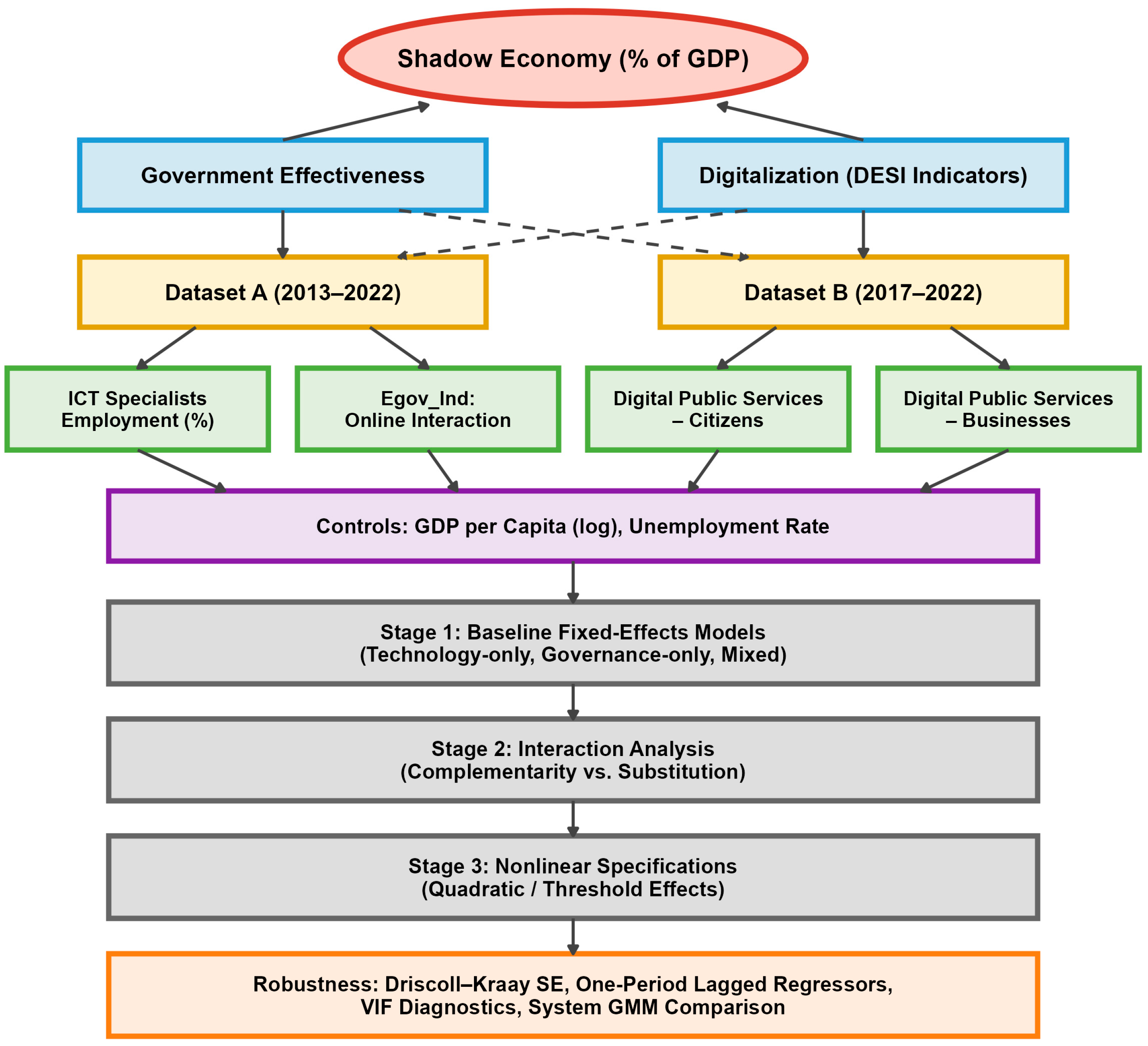
The empirical analysis adopts a two-dataset design reflecting data availability and the evolving coverage of DESI indicators. Dataset A (2013–2022) prioritizes temporal depth. It enables the identification of medium-term relationships between the shadow economy, institutional quality, and early digitalization proxies such as ICT specialists’ employment while controlling for unobserved country heterogeneity. Dataset B (2017–2022) captures more policy-relevant DESI indicators, particularly digital public services for citizens and businesses. Thus, allowing a focused assessment of digital governance mechanisms. This structure balances temporal consistency with analytical richness and permits comparison between broad digital capacity and institutionalized digital governance.
The adoption of two distinct temporal scopes is not an inconsistency but a deliberate methodological choice driven by data availability constraints. A unified time frame would require either restricting the analysis to 2017–2022, thereby sacrificing the medium-term institutional dynamics observable over a decade, or excluding the most granular DESI indicators (Digital Public Services for Citizens and Businesses), which are only available from 2017 onward. Neither compromise was considered acceptable. The dual-dataset design addresses this trade-off transparently, and the consistency of results across both datasets, particularly the stability of governance effects and the directional alignment of digitalization coefficients, serves as an indirect robustness check confirming that the findings are not an artifact of temporal scope.
Figure 1 provides a conceptual overview of the empirical strategy and the analytical logic underpinning the study. Institutional quality and digitalization jointly shape the shadow economy through distinct channels, while also highlighting the rationale for the dual-dataset design. The figure also summarizes the progression from baseline effects to interaction and nonlinear analyses.
3.4. Descriptive Diagnostics
Correlation matrices (
Table 2) were used for variable screening and model pairing. Inference relies exclusively on multivariate panel estimates. To mitigate multicollinearity, variables exhibiting very high inter-correlations were not jointly included in the same specification. This was particularly relevant for governance indicators, where strong correlations among them reflect a common institutional dimension. Consequently, governance indicators were rotated across specifications rather than mechanically stacked. A similar approach was applied to digitalization measures, which were treated as alternative representations of digital state capacity. This screening process resulted in three coherent model families: technology-only, governance-only, and mixed governance–technology specifications.
The data (
Table 3) exhibit substantial cross-country dispersion in informality, governance, and digitalization. Thus, motivating the use of Fixed-Effects (FE) and robust inference.
Government effectiveness was selected as the institutional anchor for all final models. Unlike control of corruption, which primarily captures outcomes of institutional failure, government effectiveness directly reflects administrative capacity, public service quality, and policy implementation credibility. In the context of digital transformation, this capacity is central to the functioning of digital public services as formalization tools.
Baseline pooled OLS estimates (
Table 4) are reported solely as a diagnostic benchmark to verify sign consistency across model families. Formal diagnostic tests reject pooled OLS in favour of panel estimators, with Breusch–Pagan and Hausman tests indicating the presence of unobserved, time-invariant country effects correlated with the regressors.
FE models are therefore adopted as the baseline specification. Statistical inference relies on Driscoll–Kraay (DK) standard errors, which are robust to heteroskedasticity, serial correlation, and cross-sectional dependence. Variance Inflation Factors (VIF) confirm that multicollinearity does not compromise estimation reliability, and residual diagnostics indicate no violations that would affect inference under the chosen estimation framework. Notably, the sign reversal of digitalization indicators between pooled OLS and FE estimates suggests that omitted time-invariant country characteristics significantly bias cross-sectional results, further justifying the adoption of the FE framework to isolate within-country dynamics.
3.5. Robustness Strategy and Endogeneity Considerations
The empirical analysis incorporates several robustness provisions to ensure the reliability of the estimated relationships. These include the rotation of governance and digitalization indicators across specifications to avoid multicollinearity, the use of Driscoll–Kraay standard errors robust to heteroskedasticity, serial correlation, and cross-sectional dependence, the Variance Inflation Factor (VIF) diagnostics confirming the absence of problematic collinearity, and the consistency of results across both datasets as an indirect robustness check. Additionally, specific attention is given to endogeneity concerns, as detailed below.
A standard concern in governance–informality research is reverse causality. Several features of the present design mitigate this. The key explanatory variables, WGI governance indicators and DESI digitalization measures, are structurally slow-moving, reflecting cumulative institutional and infrastructure investments that are unlikely to respond meaningfully to short-run fluctuations in informal activity. The Fixed-Effects (FE) estimator additionally absorbs all time-invariant country characteristics that could jointly drive governance and informality, eliminating the most dangerous source of omitted variable bias. The sign reversal between pooled OLS and FE estimates is itself evidence that the FE framework is correcting for cross-sectional sorting rather than reproducing it.
System GMM was tested but proved unstable as the instrument count approached N = 27, producing over-fitted models and weakened Hansen statistics. This is a known limitation in short panels of this size. FE with Driscoll–Kraay standard errors is therefore retained.
As an additional robustness check, all independent variables were re-estimated with a one-period lag (t − 1), so that prior-year regressors predict the current shadow economy share. This temporal ordering mitigates simultaneity bias without requiring external instruments. The lagged specifications, reported in
Appendix A, preserve the direction and significance of all core findings across both datasets. Results should be interpreted as robust conditional associations rather than structural causal effects, a qualification standard in observational studies of institutional determinants of shadow activity.
4. Results
4.1. Dataset A
In Dataset A (
Table 5), governance variables remain the only stable within-country correlates of informality, while the formalizing potential of digital human capital is suppressed by institutional noise until governance quality is controlled for.
The mixed models confirm this pattern. In the full specification, government effectiveness and the business environment retain negative and statistically significant coefficients, confirming their independent roles in constraining informality. ICT specialist employment achieves significance only in their presence, reinforcing its role as a governance-dependent formalization channel. The refined specification preserves all substantively meaningful relationships while improving model economy.
Across all specifications, the unemployment rate remains positive and significant, indicating that labour market pressures continue to sustain informal activity alongside institutional and technological factors.
Having established that governance is the dominant within-country correlate of informality over the longer horizon, and that digital human capital gains explanatory power only when institutional quality is controlled for, the analysis now turns to Dataset B. This shorter but more granular panel allows for a direct assessment of whether specific digital governance tools, citizen- and business-oriented public services, exert independent effects on the shadow economy, and whether their role differs from the broad digital capacity measures examined in Dataset A.
4.2. Dataset B
Table 6 reports FE estimates for Dataset B. To isolate digitalization channels, we estimate technology-only specifications (M4–M6) and a governance-only baseline (M7). In technology-only models, both digital public services (DPS) for citizens and businesses display positive, statistically significant associations with the shadow economy. In the combined specification (M6), both remain significant, confirming they capture distinct mechanisms rather than overlapping effects. In the governance-only model (M7), government effectiveness is negative and significant, while the business environment does not exhibit a significant within-country effect.
A key finding in Dataset B is the Digitalization Paradox. Higher levels of digital integration correlate with a larger shadow economy. This counter-intuitive positive association suggests that in the EU context, digital adoption may initially lower barriers for informal transactions (e.g., the gig economy) or outpace the state’s current enforcement capacity.
Table 7 presents the mixed models, where governance and digitalization are analysed jointly. The inclusion of government effectiveness partially adjusts the magnitude of the digitalization coefficients without eliminating their significance, confirming that institutional quality and digitalization operate through distinct rather than overlapping channels. This separation is analytically important. It means the positive digitalization association cannot be dismissed as a proxy for weak governance.
In the refined mixed model (8b), the DPS for businesses coefficient stabilizes at 0.084. This robustness indicates that digitalization exerts an independent structural influence on the shadow economy that is not merely a proxy for institutional quality. From the institutional side, government effectiveness remains the primary driver of formalization, with a large, negative, and highly significant coefficient.
Overall, Dataset B indicates that while digitalization in isolation may facilitate informal activity, its role is transformed when embedded within strong governance structures. Reductions in the shadow economy are driven by the joint presence of effective institutions and advanced digital public services, with business-oriented digitalization emerging as the most stable independent channel.
The preceding results establish the main effects of governance and digitalization on the shadow economy. However, these estimates treat institutional quality and digitalization as operating through independent channels. The next stage of the analysis examines whether their effects are in fact conditional on each other, that is, whether digitalization complements strong institutions or substitutes for weak ones, and whether these patterns differ by digital domain.
4.3. Interactions
The interaction analysis examines whether digitalization operates as a complement to institutional quality or as a substitute for it in reducing the shadow economy. Interaction terms between governance, digitalization indicators, and the business environment are estimated using mean-centred variables to mitigate multicollinearity and to preserve the interpretation of main effects as average marginal impacts.
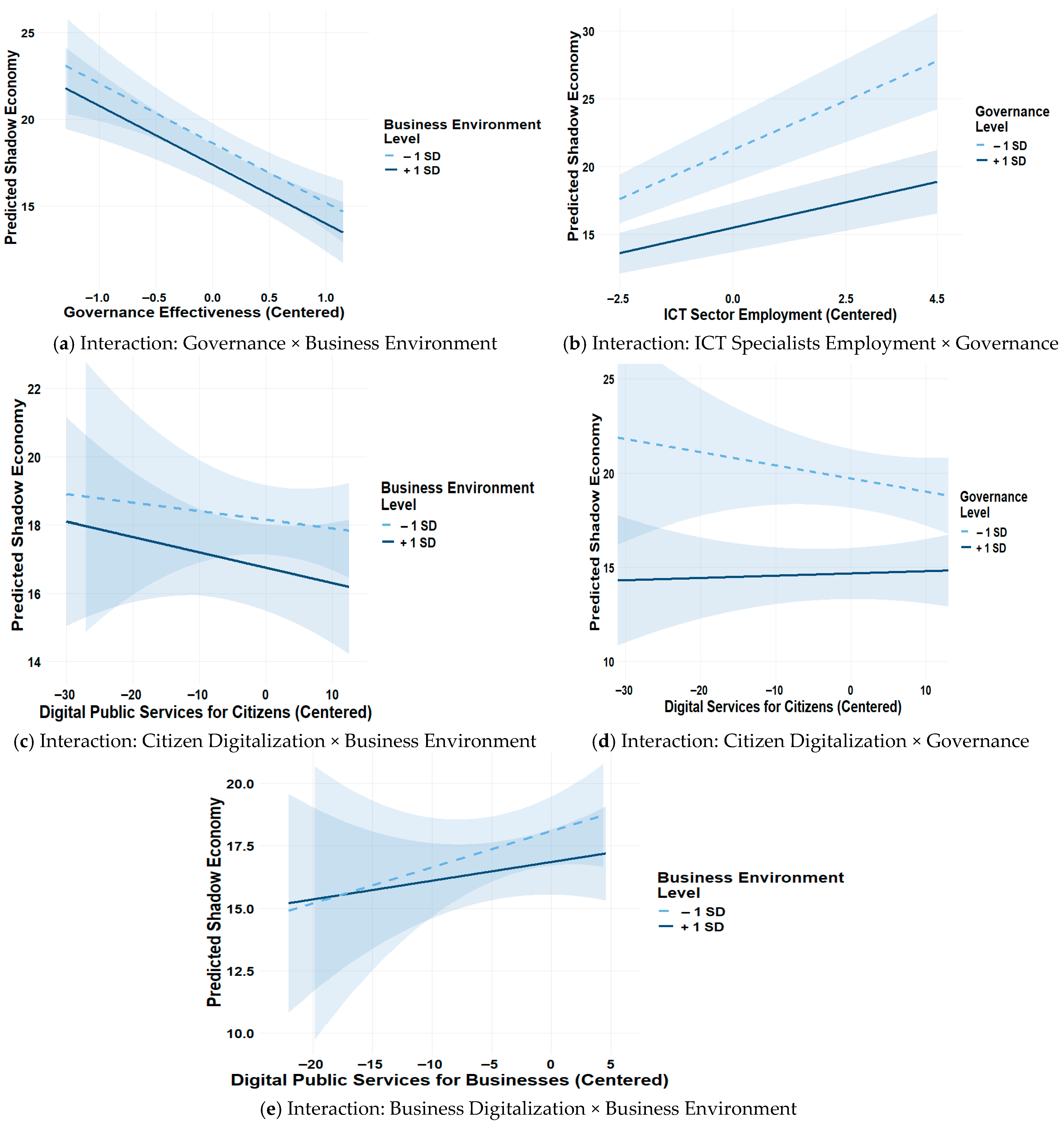
In Dataset A, two distinct interaction mechanisms emerge (
Table 8). The negative and statistically significant interaction between ICT specialist employment and government effectiveness (−0.797) indicates complementarity. Thus, improvements in governance amplify the formalizing effect of digital human capital. In contrast, the interaction between government effectiveness and the business environment is positive (+0.046), suggesting substitution. Governance improvements yield larger reductions in informality where market and regulatory conditions are weaker, with diminishing marginal effects as the business environment improves.
In Dataset B, interaction effects are more policy-specific and domain-dependent. Citizen-oriented digital public services interact negatively with government effectiveness (−0.072), indicating a compensatory mechanism whereby digital interfaces partially substitute for weak institutional capacity. At the same time, both citizen- and business-oriented DPS display positive interactions with the business environment, consistent with complementarity. Digital service delivery is more effective in reducing informality when embedded in stable and predictable regulatory frameworks.
The interaction results confirm that digitalization alternates between substitution and complementarity depending on the institutional context. While the main effects of digital services remain positive, the negative interaction terms confirm that high-quality governance and strong regulatory environments can pivot the role of digital services from facilitation toward formalization.
Figure 2 illustrates these interaction patterns.
Figure 2a,b capture structural and slow-moving complementarities between governance, ICT capacity, and market institutions, while
Figure 2c–e reflect more immediate, policy-driven digital governance effects.
The consistency across these plots indicates that recent DESI-based digital tools do not replace underlying governance mechanisms but activate and reshape pre-existing institutional–technological dynamics.
The interaction analysis demonstrates that the governance–digitalization relationship is conditional and domain-specific. A further question remains. Is the direct effect of institutional quality on the shadow economy itself constant across levels of governance, or does it exhibit threshold dynamics? The final stage of the empirical analysis addresses this by testing for nonlinear patterns in the governance–informality relationship.
4.4. Nonlinearity
The relationship between institutional quality and the shadow economy is unlikely to be linear across stages of economic development. While early improvements in governance typically generate substantial formalization gains, marginal effects may weaken at higher institutional levels due to administrative saturation, regulatory complexity, or the persistence of structurally resilient informal activity. To test for such threshold dynamics, quadratic specifications are estimated as mechanism checks rather than structural causal models.
Nonlinearity is examined by introducing squared terms for government effectiveness, with all variables mean-centred prior to estimation to ensure stable inference and meaningful interpretation of linear effects at average institutional levels. Across both datasets, government effectiveness emerges as the only variable exhibiting a consistent and interpretable nonlinear relationship with the shadow economy (
Table 9).
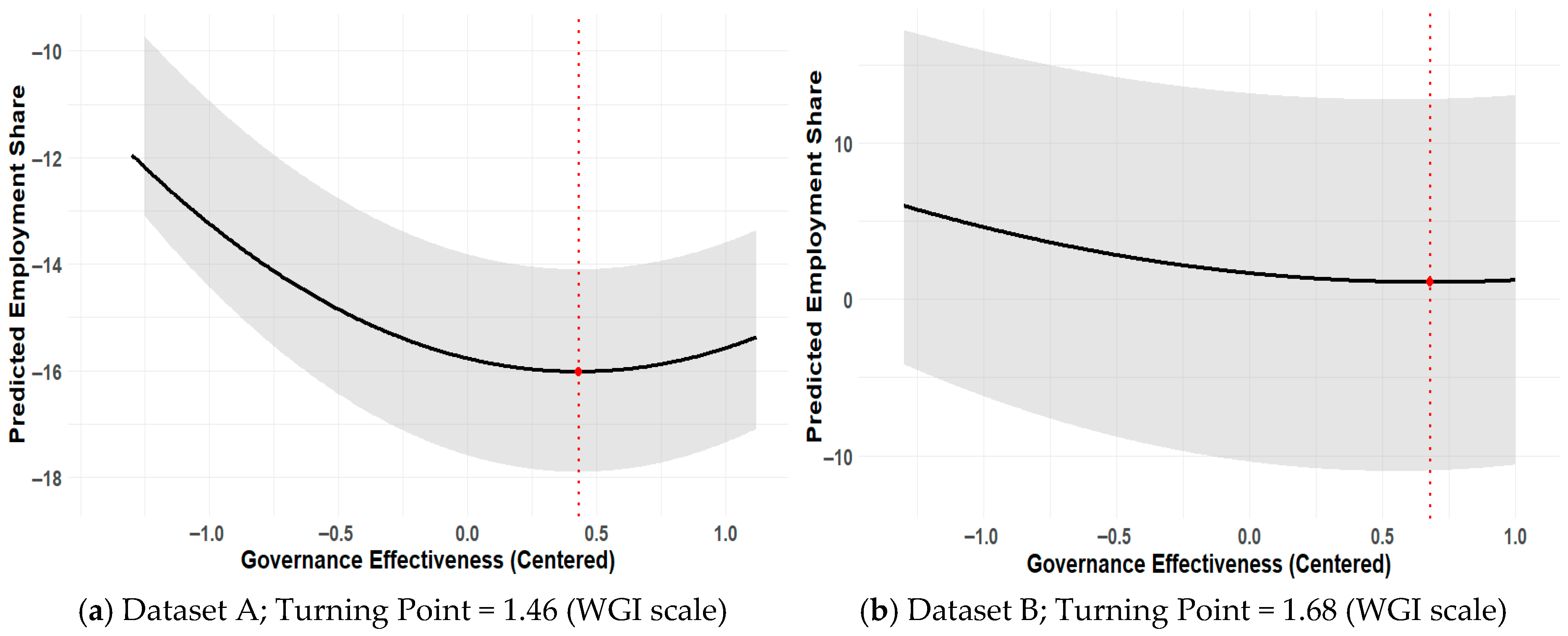
Dataset A reveals a statistically significant convex relationship, where the positive quadratic term for government effectiveness indicates that formalization gains follow a path of diminishing returns. Initial improvements in governance yield substantial reductions in informality. However, beyond a WGI turning point of 1.46, these gains reach a structural floor. This saturation effect, supported by the strongly significant squared term, suggests that in highly mature institutional settings, the residual shadow economy becomes structurally resilient to further broad administrative reforms. In Dataset B, this convexity becomes even more pronounced (turning point 1.68), particularly when digital governance variables are included, suggesting that digitalization clarifies the threshold at which traditional governance reaches its maximum formalizing impact. Notably, excluding digital governance variables from the Dataset B specification renders the nonlinear effect unstable and statistically insignificant. This indicates that digital public services condition the observed shape of the governance–informality relationship in the contemporary period (
Figure 3a,b).
Figure 3a,b visualizes these quadratic effects, supporting the idea that institutional quality exhibits diminishing returns as digital governance reshapes the informality–governance link.
5. Discussion
The empirical evidence supports a demanding but coherent interpretation. The shadow economy in the EU is shaped less by technology or institutions in isolation and more by how digital capacity becomes embedded within the institutional structures that govern compliance, monitoring, and enforcement. The subsections below discuss these results in detail, addressing each research question and hypothesis in turn (RQ1–RQ4; H1–H4).
5.1. Governance and Digitalization as Connected Formalization Mechanisms
The two-dataset design reveals how different stages of digital development correspond to distinct formalization mechanisms. In the earlier period, digital capacity operated primarily through reinforcement, with ICT specialists’ employment strengthening the effectiveness of existing governance structures. In the later period, advanced digital public services act as the new administrative backbone, though their impact is contingent on the regulatory environment. Business-oriented digital services emerge as the most robust correlates of formalization when integrated with strong regulatory frameworks. This reflects their potential role in reporting, licensing, and enforcement. While their isolated association is positive, suggesting they may facilitate informal entry, their interaction with institutional quality confirms they are the most effective digital tools for reducing informality in high-governance contexts. This evolution suggests a transition from general digital readiness toward institutionalized digital governance, where digital interfaces become integral components of formalization rather than auxiliary tools (RQ1–RQ2, H1–H2).
This finding extends the work of
Schneider (
2010) and
Nguyen et al. (
2024), who document the negative governance–informality association but do not examine how digital tools reshape the channels through which governance operates. It also advances the argument of
Suliman and Adedokun (
2025), who suggest that digitalization amplifies institutional capacity in entrepreneurial contexts by demonstrating that this amplification is domain-specific and stage-dependent within the formalization process.
5.2. Conditional Effects: Complementarity and Substitution
Interaction results show that technology and institutions do not relate through a single mechanism. In Dataset A, the interaction between ICT employment and government effectiveness reveals complementarity. A digitally capable workforce strengthens the governance–formalization link, enabling institutions to operate with greater reach and precision. Technology here expands, rather than replaces, governance capacity (RQ3, H3). This complementarity pattern is consistent with
Zhang et al. (
2025), who find that technological innovation strengthens the governance–sustainability link in emerging economies, though their analysis does not distinguish between digital domains. The present study refines this insight by showing that complementarity operates specifically through digital human capital rather than through aggregate technology measures.
A different pattern emerges when governance interacts with the business environment. Where regulatory and market conditions are weak, improvements in governance yield larger reductions in informality. As the business environment improves, marginal governance effects flatten. Governance thus acts as a corrective mechanism in incomplete institutional ecosystems, with diminishing returns once complementary structures are already in place (RQ1, RQ3, H1, H3).
In Dataset B, substitution becomes most visible in the citizen-facing digital channel. The negative interaction between citizen-facing digital services and government effectiveness suggests a mitigating substitution effect. While digitalization alone shows a positive association with informality, strong institutional quality acts as a necessary filter. In countries with low governance, digital tools may inadvertently facilitate informality. However, as government effectiveness increases, it captures these digital processes, neutralizing their potential to support informal activity (RQ3, H3).
By contrast, business-oriented digital public services exhibit clear complementarity with the business environment. Their effectiveness increases with regulatory predictability and legal certainty, indicating that digital compliance tools for firms require supportive institutional frameworks to generate sustained reductions in informality. This distinction underscores that citizen- and business-facing digitalization are not interchangeable policy instruments (RQ2–RQ3, H3). This domain-specific finding addresses a limitation noted by
Bojan and Achim (
2025) and
Ajide and Dada (
2022), whose analyses treat digitalization as a homogeneous variable and consequently report ambiguous or mixed effects on the shadow economy. The present results suggest that these mixed findings may partly reflect the aggregation of opposing mechanisms operating through distinct administrative channels.
5.3. Why Advanced Digital Public Services Matter
Dataset B shows that digitalization embedded in core administrative processes carries greater explanatory power than broad access or usage measures. While connectivity and skills are necessary conditions, they are insufficient for formalization. The positive coefficients observed for digital public services (DPS) suggest a Digitalization Paradox within the EU.
The positive correlation between digitalization and informality in Dataset B suggests that, in the short term, the facilitation effect outpaces formalization. While digital tools aim to streamline tax compliance (formalization), they also lower entry barriers for the gig economy and peer-to-peer platforms, which often operate in regulatory grey zones. This digitalization paradox implies that technological adoption can temporarily expand the shadow economy by providing clandestine activities with more efficient infrastructure before regulatory frameworks and e-government monitoring systems can catch up (RQ2, H2).
This paradox resonates with the findings of
Gaspareniene et al. (
2016), who conceptualized a digital shadow economy emerging from technologically enabled but inadequately regulated transactions. It also aligns with evidence from
Ván et al. (
2022), who show that smaller firms disproportionately exploit digital channels for informal activity. In the EU context, gig economy platforms exemplify this dynamic. Food delivery, ride-hailing, and freelance labour marketplaces have expanded rapidly across member states, often operating in regulatory grey zones where workers are classified as independent contractors rather than employees (
Pesole et al., 2018;
Eurofound, 2020). Such arrangements frequently escape standard tax reporting and social contribution frameworks, enabling informal activity to grow alongside digital infrastructure rather than being reduced by it.
5.4. Nonlinearity and Governance Saturation
Quadratic specifications reveal a convex pattern between government effectiveness and the shadow economy across both datasets. Governance reforms generate large formalization gains at low-to-moderate levels of institutional quality, but marginal returns diminish in highly advanced settings. This does not imply that strong governance increases informality. Rather, it suggests saturation. This convex pattern is consistent with the theoretical expectation articulated by
Schneider (
2010) that the relationship between governance and informality may exhibit threshold effects, though empirical evidence for such nonlinearity has been scarce.
Ameer et al. (
2025) observe diminishing institutional returns in their cross-country analysis but do not model explicit turning points. The present study advances this literature by identifying specific governance thresholds (WGI turning points of 1.46 and 1.68) beyond which traditional reforms yield limited additional formalization gains. In advanced economies, remaining informal activity tends to be structurally resilient and more responsive to targeted, technologically enabled enforcement than to further broad institutional improvements (RQ4, H1).
In Dataset B, this nonlinear relationship becomes statistically clearer only after controlling for advanced DPS. These indicators capture how governance increasingly operates through digital delivery channels. Once digital governance is accounted for, the curvature of the governance effect becomes empirically visible. Thus, indicating that institutional quality in the late 2010s and early 2020s increasingly manifests its formalization impact through digital mechanisms rather than traditional administrative channels alone (RQ4, H4).
The temporal comparison suggests that while nonlinearity reflects slow-moving institutional maturation in the longer horizon, recent digital governance reforms extend the effective range of governance improvements before returns diminish (RQ4, H1, H4).
5.5. Institutional–Digital Co-Evolution
The contrast between Dataset A and Dataset B reflects stages of institutional–digital co-evolution rather than conflicting results. The earlier period is dominated by capacity building, where digital readiness reinforces existing governance. The later period reveals a more differentiated pattern in which digital tools alternate between compensating for institutional gaps and amplifying institutional strengths, depending on domain and context (RQ3–RQ4, H3–H4).
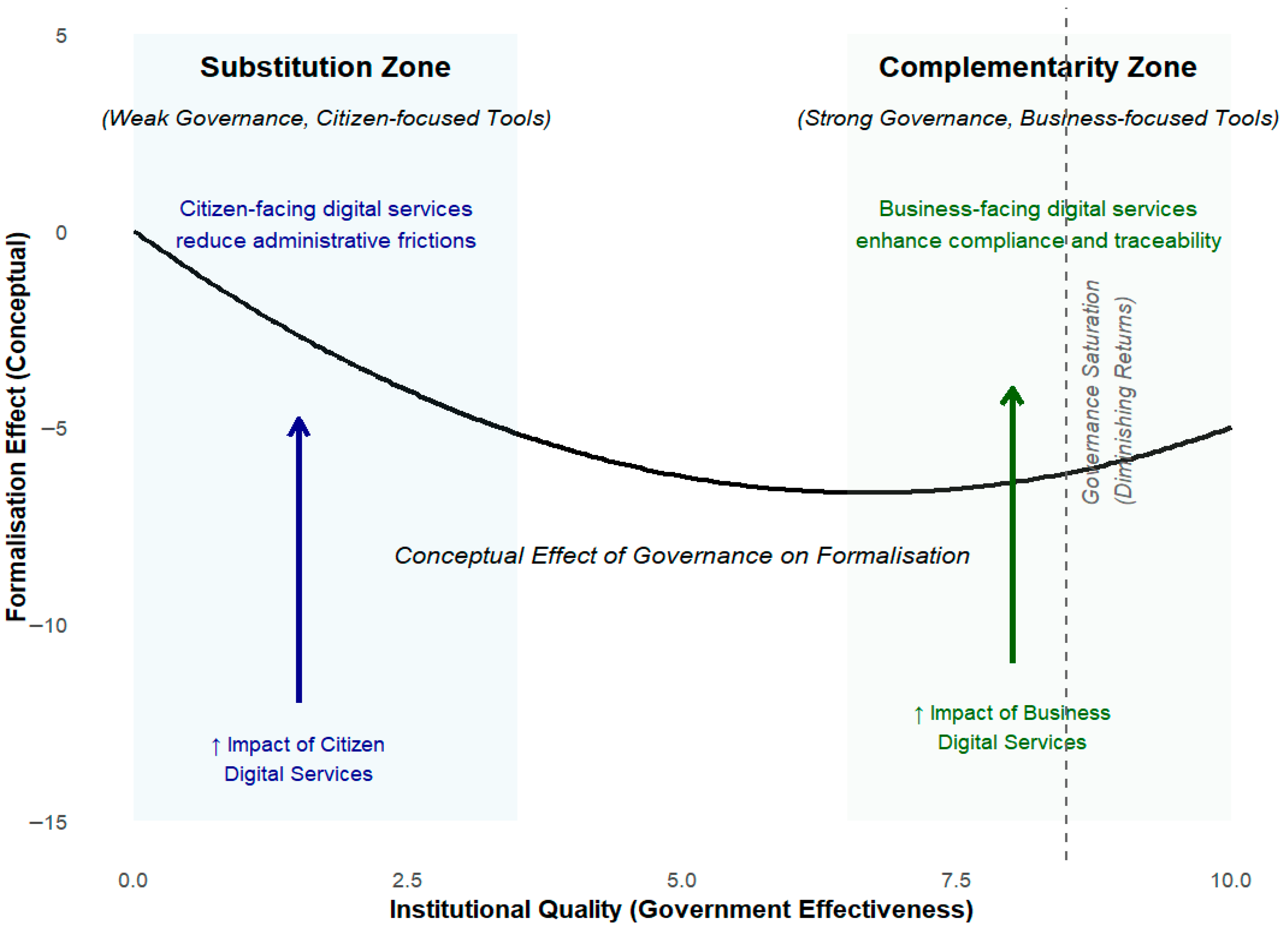
Figure 4 synthesizes the institutional–digital co-evolution under interaction conditions, illustrating the transition from citizen-facing substitution at lower governance levels to business-oriented complementarity in mature settings, and the convex path toward a saturation floor where digital tools become the primary levers for addressing persistent residual informality.
5.6. Policy Implications
The empirical findings point to a differentiated and sequenced approach to formalization policy, rather than a uniform strategy based on generic improvements in governance or digitalization. The effectiveness of policy instruments depends on institutional maturity, regulatory conditions, and the administrative domain in which digital tools are deployed.
Table 10 synthesizes the main policy implications by mapping the study’s empirical mechanisms to concrete intervention priorities.
These policy implications (
Table 10) underscore that digitalization is neither a universal substitute for weak institutions nor a simple accelerator of strong ones. Its formalization impact depends on how digital tools are embedded within existing administrative and regulatory structures. Future research should investigate whether the observed positive association between digitalization and the shadow economy is driven by the rise of the digital platform economy, where informal labour often thrives under the guise of digital entrepreneurship. A differentiated strategy that aligns digital investments with institutional maturity is therefore more likely to produce sustained reductions in informality than uniform technology-first or governance-first approaches.
6. Conclusions
This study examined how digitalization and institutional quality jointly shape the size of the shadow economy across EU member states, moving beyond approaches that treat governance and technology as independent or additive determinants. By adopting an integrated framework, the analysis conceptualized digital capacity as an extension of administrative capacity that can either complement institutional strength or compensate for institutional weaknesses, depending on the context. Empirically, this perspective was implemented through a two-dataset panel design that balances temporal depth (2013–2022) with the analytical precision offered by advanced digital governance indicators available for the period 2017–2022.
This study makes four distinct contributions to the existing literature. First, it develops an integrated analytical framework that treats digitalization not as an independent determinant of informality but as an operational extension of state capacity, whose formalizing potential is conditional on institutional context. Second, it identifies domain-specific interaction patterns, demonstrating that citizen-oriented digital public services tend to substitute for weak governance while business-oriented digital services complement strong institutional frameworks, a distinction absent from prior studies that treat digitalization as a homogeneous variable. Third, it provides empirical evidence of nonlinear governance effects on the shadow economy, showing that these diminishing returns become statistically visible only when digital governance indicators are explicitly incorporated into the analysis. Fourth, it translates these empirical mechanisms into differentiated, country-specific policy recommendations (
Table 10), moving beyond the generic prescriptions that characterize much of the existing policy literature on formalization.
Three main conclusions emerge from the empirical results. First, digitalization does not simply reduce or increase informality, but it reshapes the channels through which institutional quality translates into formalization outcomes, making its ultimate impact conditional rather than universal. Second, this conditionality is domain-specific. Citizen-oriented digital services tend to offset governance limitations, while business-oriented services reinforce strong institutional frameworks. Third, the effect of institutional quality on the shadow economy is nonlinear. Governance improvements generate the largest formalization gains at low-to-moderate levels of institutional development. Beyond this threshold, diminishing marginal returns set in, and residual informality reaches a structural floor in more advanced institutional settings. In these advanced convex settings, the shadow economy becomes resilient to broad administrative reforms, requiring a shift toward the targeted, digitally mediated enforcement.
In the more recent period, digital public services for citizens and businesses have emerged not as auxiliary controls but as structuring components that clarify how government effectiveness operates in practice. This key finding indicates that, in contemporary European economies, institutional quality increasingly exerts its formalization impact through digitally mediated administrative processes rather than through traditional bureaucratic channels alone.
Taken together, the findings caution against framing formalization policy as a simple more governance plus more technology strategy. Instead, they point to a coordinated and context-sensitive logic in which the role of digitalization depends on institutional maturity, administrative domain, and policy sequencing. This perspective helps reconcile mixed results in the existing literature and explains why similar digital reforms may produce divergent outcomes across countries.
From a policy standpoint, these findings point to a sequenced approach to formalization. Early-stage economies should prioritize citizen-facing digital access to bypass administrative friction. Intermediate economies benefit most from investing in digital human capital within public administration. Advanced economies, where broad governance reforms yield diminishing returns, should shift toward precision digital enforcement. Across all contexts, aligning digital reform with institutional maturity is more effective than uniform technology-first or governance-first strategies.
Finally, the study highlights the growing analytical potential of DESI-style indicators as their time coverage expands. While current data limitations constrain long-run inference for advanced digital public services, continued availability will enable future research to move beyond static associations toward dynamic analyses. As the EU transitions further into the digital decade, future research must address the regulatory grey zones created by the digital platform economy. Investigating whether digitalization facilitates digital informality in the absence of updated labour frameworks remains a critical frontier for ensuring that technology serves as a true catalyst for economic formalization.
Naturally, the study is subject to several delimitations. The analysis operates at the country level, which captures macro-institutional dynamics but does not disaggregate by sector or firm size. The time coverage of advanced DESI indicators extends only to 2017–2022, and the upper bound of the analysis is fixed at 2022 by the availability of harmonized shadow economy estimates. As with all observational panel studies in this field, the findings represent robust conditional associations within a carefully specified econometric framework. These boundaries simultaneously define productive avenues for future research such as sector-disaggregated analyses, extended temporal coverage as harmonized data become available, and the systematic grouping of EU member states according to their institutional–digital profiles. While the present study identifies country-specific policy recommendations based on observed empirical mechanisms (
Table 10), a formal cluster analysis, such as grouping countries by levels of governance quality, digital public service maturity, and shadow economy size, could reveal whether the complementarity and substitution patterns identified here operate differently across distinct institutional–digital clusters, particularly for countries at intermediate stages where the transition from substitution to complementarity dynamics is most likely to occur.