1. Introduction
In recent decades, monetary policy has transcended its traditional role of controlling inflation and stabilizing macroeconomic variables to also emerge as a decisive factor in the dynamics of aggregate investment. Representative agent models, such as that of
Clarida et al. (
2000), show how a change in the monetary policy rate uniformly modifies the cost of financing and, consequently, the aggregate demand for capital. However, this approach omits the heterogeneity in different levels of indebtedness and the equity buffers that characterize firms, especially in emerging economies with less developed financial markets and high bank spreads (
Feyen & Zuccardi, 2020).
This study addresses this gap by exploring financial heterogeneity as an essential transmission channel of monetary policy in Latin America. While
Ottonello and Winberry (
2020) established the theoretical and empirical relevance of firm-level financial heterogeneity for the transmission of monetary policy in the United States, three important questions remain unanswered. First, it is unclear whether the same mechanism operates in emerging economies, where financial frictions are structurally more severe—characterized by shallower credit markets, higher bank concentration, and procyclical sovereign risk premiums (
Feyen & Zuccardi, 2020). Second, existing DSGE models with heterogeneous firms have not been calibrated or adapted to reflect the institutional features of Latin American financial systems, such as the sensitivity of borrowing constraints to sovereign risk. Third, no study to date has attempted a direct, specification-symmetric comparison between simulated and empirical local projections for the region, which is essential to validate whether the theoretical mechanism has quantitative relevance in this context.
This paper fills these three gaps simultaneously. It develops an extended DSGE model with heterogeneous firms, calibrated for Latin American economies, incorporating a borrowing constraint that is sensitive to sovereign risk (), and complements it with an empirical analysis conducted through local projections on a quarterly panel of 72 of the largest listed firms in six countries of the region during the 2015–2025 period. The key methodological innovation lies in the design symmetry: identical local projection specifications are applied to both the simulated panel and the empirical data, so that differences in results can be attributed to the transmission mechanism itself rather than to econometric choices.
The central premise is simple: the relevant price for investment decisions is not limited to the risk-free rate but also incorporates an idiosyncratic premium. This premium is determined by the specific balance sheet situation of each firm—particularly its level of leverage and its distance to default—as well as by aggregate financial conditions, captured by a parameter sensitive to each country’s sovereign risk. From this perspective, the same interest rate cut does not generate a homogeneous response in investment. Firms with lower risk exposure tend to take advantage of the stimulus and increase their capital expenditure, while those with more fragile structures direct their efforts toward strengthening their balance sheets rather than expanding.
In the theoretical block, a model is proposed that incorporates convex capital adjustment costs, a payout constraint that implies zero dividends in its vicinity, and a spread function that is decreasing in net worth, designed to reflect characteristic institutional features of the region captured as high and procyclical risk premiums. Monetary policy is modeled using a Taylor-type rule, where an expansionary shock reduces the ex-ante real interest rate and increases the price of capital, operating through Tobin’s Q channel. Under this framework, the model predicts that, following a monetary stimulus, firms with greater financial soundness respond with a positive increase in investment, while firms with greater financial fragility reduce investment, as they take advantage of the monetary easing to restructure their balance sheets and reduce debt.
In the empirical block, Local Projection models are estimated, identifying monetary shocks as innovations derived from a country-specific Taylor rule. Cumulative investment responses are reported, controlling for firm, sector, country, and period fixed effects, with errors clustered robustly at the country and period level. At the aggregate level, the results corroborate the mechanism predicted by the theoretical model: faced with an expansionary monetary policy shock, firms with greater financial soundness increase their investment to a greater extent than firms with weaker financial positions. However, this effect is less persistent than that predicted by the theoretical model. These results show qualitative behavior and statistical significance similar to that reported by
Ottonello and Winberry (
2020), indicating that these heterogeneities are important channels for the transmission of monetary policy to investment in the observed dynamics.
The contribution of the work is threefold. First, it presents a unified framework that aligns the discipline of a structural theoretical model with empirical evidence based on microeconomic and macroeconomic data. The theoretical model shows in detail the channels through which the transmission of the monetary shock’s effect on aggregate investment operates (decision rules, IRFs, decomposition of heterogeneity channels), applying similar Local Projection models to simulated panels and real data to obtain comparable metrics that allow for the quantification and verification of the quantitative similarity reported by both methodological frameworks.
Second, it is documented that, in Latin America, the effectiveness of monetary stimulus on investment depends on how much of the policy rate cut is passed through to the effective financing cost of firms (pass-through to spreads) and on the initial distribution of firms’ balance sheets. When the mass of firms is concentrated in balance sheets near the financial constraint, the impulse is allocated to balance sheet repair and not to capex.
Third, it is demonstrated that the proposed framework reproduces and extends the central findings of
Ottonello and Winberry (
2020) to the Latin American context. At the micro level, the impulse response functions order the investment reactions by leverage and liquidity, such that the most indebted firms or those closest to the financial constraint adjust more intensely and prioritize balance sheet repair, while the less constrained ones generate higher levels of investment. In the aggregate, the average effect of a policy rate cut is smaller than what a representative agent would anticipate because the relief is partially channeled into deleveraging and balance sheet recomposition.
The remainder of the paper is organized as follows.
Section 2 and
Section 3 state the research problem and review the relevant literature.
Section 4 describes the methodology for both the theoretical model and the empirical estimation.
Section 5 and
Section 6 present the DSGE model with heterogeneous firms and analyze its results, including impulse responses, the contrast with a representative agent, and local projections on a simulated panel.
Section 7 and
Section 8 detail the empirical specification and report the estimated investment responses by leverage and distance to default, closing with a comparison between theoretical and empirical findings.
Section 9 discusses the results in light of the existing literature, and
Section 10 concludes.
2. Problem Statement
The dynamics of investment in Latin American economies present unique characteristics that demand a detailed analysis of how monetary policy affects corporate decisions. Unlike developed countries, the region relies heavily on external capital flows, shows high vulnerability to exogenous shocks, and has less deep and diversified financial systems. In this context, investment responds not only to changes in interest rates and growth expectations but also to constraints on firms’ borrowing capacity, equity levels, capital adjustment costs, and inequalities in access to financing (
Gertler & Gilchrist, 2018).
The central question of this research is: How do monetary policy shocks affect the investment dynamics of Latin American economies, once firm-level financial heterogeneity is considered?
Answering this question is of special importance, as the effectiveness of monetary tools can vary drastically depending on the equity structure and sectoral composition of each country. Previous studies have shown that the same monetary shock generates divergent effects among firms based on their size, degree of leverage, and liquidity level (
Gertler & Gilchrist, 2018;
Aktar et al., 2021). However, empirical evidence in emerging markets—and particularly in Latin America—is still limited and presents dissimilar results, depending on the type of shock (conventional, unconventional, or productivity) and the methodology applied.
This research addresses this gap with two fundamental contributions. First, a DSGE model with heterogeneous firms, inspired by
Ottonello and Winberry (
2020), is calibrated and simulated, expanding the model and adapting its assumptions regarding financial structure, firm distribution, and monetary policy rule to the Latin American context. Second, an empirical analysis is conducted on a panel composed of 72 of the main companies from six Latin American countries (defined by their high relative weight in national economic activity), all listed on local and international markets. To do this, monetary shocks are constructed using econometric estimation of a Taylor rule following the strategy of
Clarida et al. (
2000), and interactions with financial vulnerability indicators—leverage and distance to default—obtained from OpenBB (version 4.7.1, OpenBB, Venice, CA, USA), databases are incorporated to estimate their effects on net and gross investment. The empirical results are directly compared with similar Local Projection models against the estimates from the panel simulated by the theoretical model. Through this dual approach, the effect of financial heterogeneity on the response of aggregate investment to monetary shocks is evaluated robustly.
Understanding these heterogeneous effects is essential for designing more effective and equitable monetary policy strategies. The findings of this study can guide central banks and policymakers in implementing differentiated instruments aimed at reducing asymmetries in monetary transmission and promoting a more balanced investment recovery across different business segments in the region.
3. Literature Review
The study of monetary policy in the presence of financial frictions and firm heterogeneity has evolved along three interconnected strands that jointly motivate the present research.
3.1. Monetary Policy and Corporate Investment
A first strand examines how monetary policy affects corporate investment decisions when firms differ in their financial characteristics.
Hori (
2019) introduces an endogenous growth model with heterogeneous firms in research and development (R&D), showing that financial constraints shape R&D investment decisions and that, in the presence of severe frictions, a positive nominal interest rate can be optimal by improving resource allocation and excluding less productive firms from the R&D market. More recently,
Gnewuch and Zhang (
2025) document that expansionary monetary policies significantly alter the distribution of investment rates in the U.S. economy, reducing the proportion of low or zero investment episodes while increasing the prevalence of high investment rates—an effect especially pronounced among young firms. Their model, which incorporates capital adjustment frictions and business life-cycle dynamics, reveals that the extensive investment margin (i.e., whether a firm invests or not) is a crucial factor in explaining these heterogeneous responses. Together, these contributions establish that the investment channel of monetary policy cannot be understood without accounting for firm-level differences in financial position and life-cycle stage.
3.2. Financial Frictions and Heterogeneous Firm Models
A second strand focuses on the structural modeling of financial frictions and their interaction with firm heterogeneity. The seminal contributions of
Bernanke et al. (
1999) and
Kiyotaki and Moore (
1997) established the financial accelerator as a core propagation mechanism, showing how collateral constraints and credit cycles amplify macroeconomic shocks. Building on this tradition,
Ottonello and Winberry (
2020) develop a DSGE model with heterogeneous firms for the U.S. economy, finding that contractionary monetary policies have more adverse effects on firms facing greater financial constraints, and that the investment response to monetary shocks depends critically on leverage and equity levels. Their central insight—that the aggregate effect of monetary policy is shaped by the distribution of financial positions across firms—constitutes the main theoretical benchmark for the present study.
Complementing this line,
Khan and Thomas (
2008) demonstrate that non-convex adjustment costs, combined with idiosyncratic productivity shocks, generate investment dynamics characterized by large, discrete jumps (“lumpy”) rather than gradual adjustments, a phenomenon that affects the transmission of monetary policy in environments with high financial uncertainty.
Adda and Cooper (
2003) provide a detailed analysis of how capital adjustment costs influence investment responses to monetary and fiscal shocks, revealing limitations in traditional models that assume smooth adjustment.
McKay et al. (
2016) examine the role of incomplete markets, arguing that liquidity constraints and income risks reduce the effectiveness of monetary policy on investment and consumption. Finally,
Krusell and Smith (
2006) develop an approximate aggregation approach for modeling economies with heterogeneous agents and aggregate shocks, enabling computational simplifications through solution by simulation—a methodology widely adopted in DSGE models with heterogeneity and employed in the numerical solution of the model presented in this paper.
3.3. Empirical Evidence from Emerging Markets
A third strand, still nascent, extends these insights to emerging economies where financial frictions are structurally more severe.
Hong (
2020) develops an open economy model with heterogeneous agents to analyze business cycles in emerging markets, highlighting the amplifying role of marginal propensities to consume (MPCs) in macroeconomic volatility—a finding that challenges traditional representative agent approaches and underscores the need for heterogeneity in modeling these economies.
Silva et al. (
2022) investigate the impact of expectations shocks on business dynamics in Brazil using panel VAR models with microdata, showing that idiosyncratic shocks generate faster and more pronounced effects on investment and employment than aggregate expectations shocks, which suggests that firm-level heterogeneity is a first-order driver of investment dynamics in emerging contexts.
Aktar et al. (
2021) provide direct evidence that firms with different levels of leverage and liquidity respond differently to monetary policy shocks, confirming that smaller firms or those with limited credit access are more sensitive to restrictive monetary policies. Their findings reinforce the theoretical prediction that financial heterogeneity is a crucial determinant of how monetary policy affects investment and economic growth.
Despite these advances, the existing literature presents two important limitations. First, the structural models developed by
Ottonello and Winberry (
2020) and others have been calibrated exclusively for developed economies, without adapting the institutional features—such as higher bank concentration, shallower credit markets, and procyclical sovereign risk premiums—that characterize Latin American financial systems (
Feyen & Zuccardi, 2020). Second, no study to date has attempted a direct, specification-symmetric comparison between simulated and empirical local projections for the region, which is essential to validate whether the theoretical mechanism has quantitative relevance in this context. This dual gap—theoretical adaptation and empirical validation for Latin America—motivates the present research.
4. Methodology
The research adopted a mixed quantitative approach, integrating a structural framework based on a theoretical DSGE model with heterogeneous firms and an empirical validation supported by observational firm-level data.
Coherence between both approaches is ensured through direct comparison: dynamic local projection models in the style of
Jordà (
2005) are estimated, using equivalent specifications on both a simulated panel generated by the theoretical model and the panel of real data. This procedure allows for the alignment of key metrics—such as the signs, magnitudes, and temporal profiles of the estimated effects—without imposing additional identification restrictions that could diminish the precision of the results. Thus, the empirical evidence does not seek to discover an ex ante causal channel, but rather to directly test the mechanism that emerges endogenously in the model, under a common econometric syntax and comparable analysis horizons.
4.1. Methodology for the Solution and Simulation of the Theoretical Model
The solution is developed in two complementary stages. The first is analytical, formulating the dynamic problem of the heterogeneous firms, the representative household, and the monetary authority, identifying the relevant states and controls, from which the first-order conditions and equilibrium relationships can be extracted.
The second stage is numerical: a parametric approximation of the distribution in the style of
Winberry (
2018) is implemented, which allows one to reduce the problem’s infinite dimensionality by representing firm heterogeneity through a bounded set of endogenous parameters. The resulting system is solved using perturbation methods and iterated until consistency is achieved among decision rules, aggregate prices, and the distribution of firms, thus facilitating the efficient solution of the model in Dynare (version 6.3, Dynare Team, Paris, France), with high computational efficiency. This combination of analytical approximation and numerical solution makes it possible to avoid interpretative gaps without sacrificing the model’s quantitative power at the aggregate level.
With the economy fully characterized, the set of structural parameters is calibrated using values established in the literature and empirical constraints extracted from the sample (
Section S2). Subsequently, the economy is simulated under stochastic trajectories of aggregate and idiosyncratic shocks. This simulation generates equilibrium series for aggregate prices and quantities, as well as macroeconomic trajectories, from which a quarterly simulated panel is constructed with the same frequency and definitions as the real data panel. A local projection model with an equivalent specification to that used in the empirical estimation is applied to this simulated panel, allowing for a set of parameters strictly comparable to their empirical counterparts.
This design symmetry constitutes the key element that bridges the gap between theory and data.
To clarify this linkage: the theoretical model generates a simulated panel of 5000 firms observed quarterly, each characterized by endogenous leverage, distance to default, and investment rates. The same local projection specification—Equation (1) in
Section 7—is then estimated on both the simulated and empirical panels. Because the econometric specification is identical in both cases (same dependent variable, same interaction terms, same fixed-effects structure), any difference in the estimated coefficients can be attributed to the transmission mechanism itself rather than to methodological asymmetries between the theoretical and empirical exercises.
Regarding the calibration strategy, parameters are sourced from three channels: (i) values established in the DSGE literature for emerging economies (e.g.,
Valdivia & Pérez, 2013;
Lama, 2009;
Castillo & Rojas, 2014), (ii) values from
Ottonello and Winberry (
2020) that are not region-specific (e.g., elasticity of substitution, recovery rates), and (iii) empirical moments computed directly from the firm-level database (distributions of leverage, distance to default, and capital stocks). The complete calibration table, including sources and reference links for each parameter, is provided in
Section S2 of the Supplementary Material.
4.2. Methodology for Empirical Estimation and Comparison with Simulated Data
In the empirical block, dynamic local projections à la
Jordà (
2005) are implemented with the objective of reconstructing the cumulative responses of investment to monetary shocks at different time horizons. The econometric specification includes fixed effects at the firm, sector, and country-by-quarter levels, as well as standard microeconomic and macroeconomic controls.
The monetary shock is identified as the residual from a Taylor-type rule estimated in a panel framework with country and quarter fixed effects, following the methodology of
Clarida et al. (
2000). This approach was chosen for three reasons. First, it ensures theoretical consistency: the empirically estimated rule replicates the same monetary policy rule embedded in the DSGE model, strengthening the comparability between the simulated and empirical panels—which is the central methodological contribution of this paper. Second, it is the most viable strategy given the data constraints of the region. Alternative identification methods—such as high-frequency identification (
Gurkaynak et al., 2005) or narrative Romer–Romer shocks—require either liquid central-bank-rate future markets or comprehensive narrative records of policy decisions, neither of which are consistently available across the six Latin American economies in the sample. Third, the direction of any potential bias is conservative: if the residuals capture systematic policy components not modeled by the rule, this introduces attenuation bias that pushes the estimated semi-elasticities toward zero, meaning that any statistically significant finding understates rather than overstates the true effect. The complete specification, variable definitions, and rescaling procedure are documented in
Section S6.
An equivalent specification of this local projection model—including the interaction with leverage and distance-to-default variables—is applied to the simulated panel generated by the theoretical model (
Section S8). This symmetry allows for a direct validation and comparison between the theoretical results and the data.
4.3. Data and Sample
With the methodological architecture established, we proceed to describe the database that supports the empirical estimation. For this, an unbalanced quarterly panel is used, covering the 2015–2025 period and comprising 2371 observations corresponding to 72 of the most representative companies from six Latin American economies (Argentina, Brazil, Chile, Colombia, Mexico, and Peru). The selection of these firms responded to two main criteria: their relative weight in the national economic activity and their listing on both local and international stock markets, which ensured more complete coverage and an adequate sample size for statistical tests.
Additionally, in order to focus the study on productive dynamics and private capital demand, state-owned enterprises (given that their borrowing and risk patterns differ markedly from those of the private sector) and financial entities (whose capital needs operate under different logics than those of productive firms) were deliberately excluded. Likewise, the representation of different economic sectors was ensured, so that the database has better representativeness of aggregate activity.
It is important to acknowledge the limitations of this sample. The 72 firms are large, publicly listed corporations and therefore do not fully represent the broader corporate sector in Latin America, where small and medium-sized enterprises (SMEs) account for a substantial share of economic activity and are typically subject to more severe financial constraints (
World Bank, 2020). However, the focus on listed firms is deliberate and responds to three considerations. First, reliable quarterly financial data—including market values required for the construction of distance to default—are only available for listed firms. Second, these firms account for a significant share of formal GDP, aggregate investment, and employment in their respective economies (
Gonzalez-Ortiz, 2023). Third, the identification strategy requires equity market prices to construct volatility-based risk measures, which restricts the feasible sample to listed corporations.
Nevertheless, the results should be interpreted with caution regarding their external validity. The estimated semi-elasticities likely represent a lower bound on the heterogeneity channel, since SMEs facing tighter credit constraints would be expected to exhibit even stronger differential responses to monetary shocks. Additionally, the sample may be subject to survivorship bias, as firms that exited the market during the 2015–2025 period are underrepresented. To mitigate concerns about results being driven by a small number of large firms or specific sectors, the econometric specification includes firm, sector, and country × quarter fixed effects, and variables of interest are demeaned within each firm. Detailed descriptive statistics—including coverage by country and sector, marginal distributions, percentiles, and correlations—are provided in
Section S5.
The microeconomic financial variables were obtained from OpenBB (version 4.7.1, OpenBB, Venice, CA, USA), an open data platform that offers coverage similar to Bloomberg. Macroeconomic indicators, in turn, were retrieved from the databases of the World Bank, the Central Reserve Bank of Peru, and the Economic Commission for Latin America and the Caribbean (ECLAC).
Section S4 presents a detailed list of the variables used, along with their respective sources and reference links.
To facilitate the replication of the research, the codes for the theoretical model and the empirical estimation, along with the necessary databases, are publicly available in the GitHub repository:
https://github.com/Rodney-Menezes/Master_Tesis_Economics (accessed on 25 February 2026).
5. Theoretical Model
In order to connect the empirical results and local projections with a structural framework, a Dynamic Stochastic General Equilibrium (DSGE) model was developed, inspired by
Ottonello and Winberry (
2020), which was expanded and adapted to the macro-financial particularities of Latin America. In this setup, monetary policy affects investment through the credit channel, under conditions of firm and financial heterogeneity.
5.1. The Household’s Problem
The model considers an infinitely lived representative household that maximizes its expected intertemporal utility:
where
represents consumption and
is the labor supply. The Euler equation, which characterizes the intertemporal behavior of consumption, is:
Households receive income from labor, capital returns, and dividends from firms, subject to the following budget constraint:
where
represents financial assets,
is the real wage,
is the rate of return on assets, and
represents aggregate firm profits.
5.2. The Problem of the Intermediate Goods-Producing Firms
The productive sector is composed of a fixed mass of firms
that produce a homogeneous good, using capital
and labor
according to the following production function:
where
represents the firm-specific total factor productivity (TFP), which follows a stochastic AR(1) process, and
is an idiosyncratic shock to the quality of capital. The parameters
and
determine the elasticity of capital and labor in production, with the constraint
ensuring decreasing returns to scale.
Each firm decides its level of investment
and its financing
, being subject to a financial constraint that limits its access to credit based on its net worth:
where
is the permitted leverage ratio, which is influenced by sovereign risk or financing conditions in the capital markets
. Furthermore, this coefficient follows a smooth functional approximation to avoid inconsistencies in the model, as specified below:
This formulation captures the idea that higher sovereign risk reduces the borrowing capacity of firms by tightening financial constraints and limiting the fraction of net worth that firms can use as collateral. The exponential specification guarantees a gradual and continuous adjustment, instead of abrupt changes in credit conditions, reflecting the empirical evidence on how sovereign risk impacts financial markets.
The modeling of responds to the need to represent the structural differences in credit markets between developed countries and Latin America and the Caribbean (LAC), where financing conditions are less favorable due to several factors. Specifically, capital markets in LAC tend to be less competitive and more restrictive than in advanced economies due to:
Lower financial depth: Capital markets in Latin America and the Caribbean (LAC) are less developed, which reduces the availability of corporate financing beyond bank credit (
Heng et al., 2016).
Higher bank concentration: A small number of banks dominate the financial system, which leads to less competition in the credit supply and higher interest rate spreads (
Feyen & Zuccardi, 2020).
Greater exposure to sovereign risk: In emerging markets, corporate financing is more influenced by the sovereign risk premium, which restricts credit availability during periods of macroeconomic uncertainty (
Feyen & Zuccardi, 2020).
Given that explicitly modeling all these imperfections would make the model unnecessarily complex, a reduced-form representation is chosen through , which varies between developed and emerging economies according to these structural differences. Specifically, in advanced economies, is relatively high, reflecting greater access to credit, whereas in Latin American and Caribbean (LAC) economies, higher sovereign risk reduces the permitted leverage.
It is important to note that this abstraction does not explicitly model the determination of interest rates or the response of the banking sector, but rather assumes that external financial conditions determine borrowing limits. This simplification is in line with previous macroeconomic models on credit frictions, although future extensions could incorporate a more detailed financial sector to endogenize the interaction between bank competition, interest rates, and firm-level credit constraints.
Furthermore, firms follow the capital accumulation law given by:
where
is the depreciation rate. Furthermore, investment is subject to adjustment costs, which create frictions in firms’ responses to monetary shocks:
where the parameter
determines the rigidity in capital adjustment.
Each firm maximizes its expected present value:
Subject to the financial constraint and capital dynamics.
The default risk of each firm is determined by its distance to default , which measures its probability of default based on its market value and debt level:
Firms with higher financial risk face higher financing costs, which amplifies the investment response to monetary policy.
It should be noted that the choice was made to specify sovereign risk as affecting the borrowing capacity rather than directly impacting financing costs. In the context of emerging economies, sovereign risk premiums primarily influence credit availability rather than corporate interest rates.
5.3. Retail Firms and Price Rigidities
The retail sector is composed of firms that buy intermediate goods from producing firms and sell them in monopolistically competitive markets. Each retailer sets its Price and faces price adjustment costs, which introduces nominal rigidities into the economy.
The price-setting problem is subject to the following adjustment cost constraint:
where
represents aggregate output.
The resulting equation is a New Keynesian Phillips Curve:
where
is the relative price in the steady state.
5.4. The Monetary Authority
Monetary policy in this model is conducted by a monetary authority that implements an extended Taylor rule, in which the nominal interest rate responds not only to inflation and the output gap, but also to fluctuations in the sovereign risk premium. The new monetary policy rule is given by:
where
is the nominal interest rate,
is a parameter that captures the persistence of monetary policy,
and
represent the elasticities of the interest rate in response to deviations in inflation and output, respectively. Furthermore,
is the sovereign risk premium, an exogenous parameter that determines the borrowing capacity of firms,
measures the sensitivity of the interest rate to changes in the sovereign risk premium, and
represents an exogenous (i.i.d.) monetary shock.
In this framework, a contractionary monetary policy shock (an increase in ) raises the cost of credit, reducing firm investment, with a differential impact depending on their levels of leverage and access to financing. Conversely, a reduction in the interest rate incentivizes investment, although the magnitude of this effect will depend on the financial constraints present in the economy.
5.5. Equilibrium
Equilibrium in this economy is reached when the decisions of all agents are mutually consistent and markets clear. Households optimize their consumption and labor supply decisions according to the Euler equation, while producing firms maximize their value, subject to financial constraints and capital adjustment frictions. Additionally, the financial market determines interest rates based on firms’ default risk, while the monetary authority adjusts the interest rate in response to inflation and output. Aggregate variables are the continuous aggregation of the distribution of firms over the state space for any measurable function, following the same methodology as
Ottonello and Winberry (
2020). Finally, equilibrium in the goods market requires that aggregate production equals the total demand for goods.
6. Theoretical Model Results
This section presents the results of the implementation and simulation of the theoretical general equilibrium model with heterogeneous firms for Latin American economies, inspired by the
Ottonello and Winberry (
2020) model. The focus is concentrated on the economy’s transition dynamics in response to an expansionary monetary shock; the results concerning the long-run equilibrium or steady state are consigned as
Supplementary Material in Section S3.
To analyze the economy’s dynamic transition, an expansionary monetary shock is generated, affecting the economy at
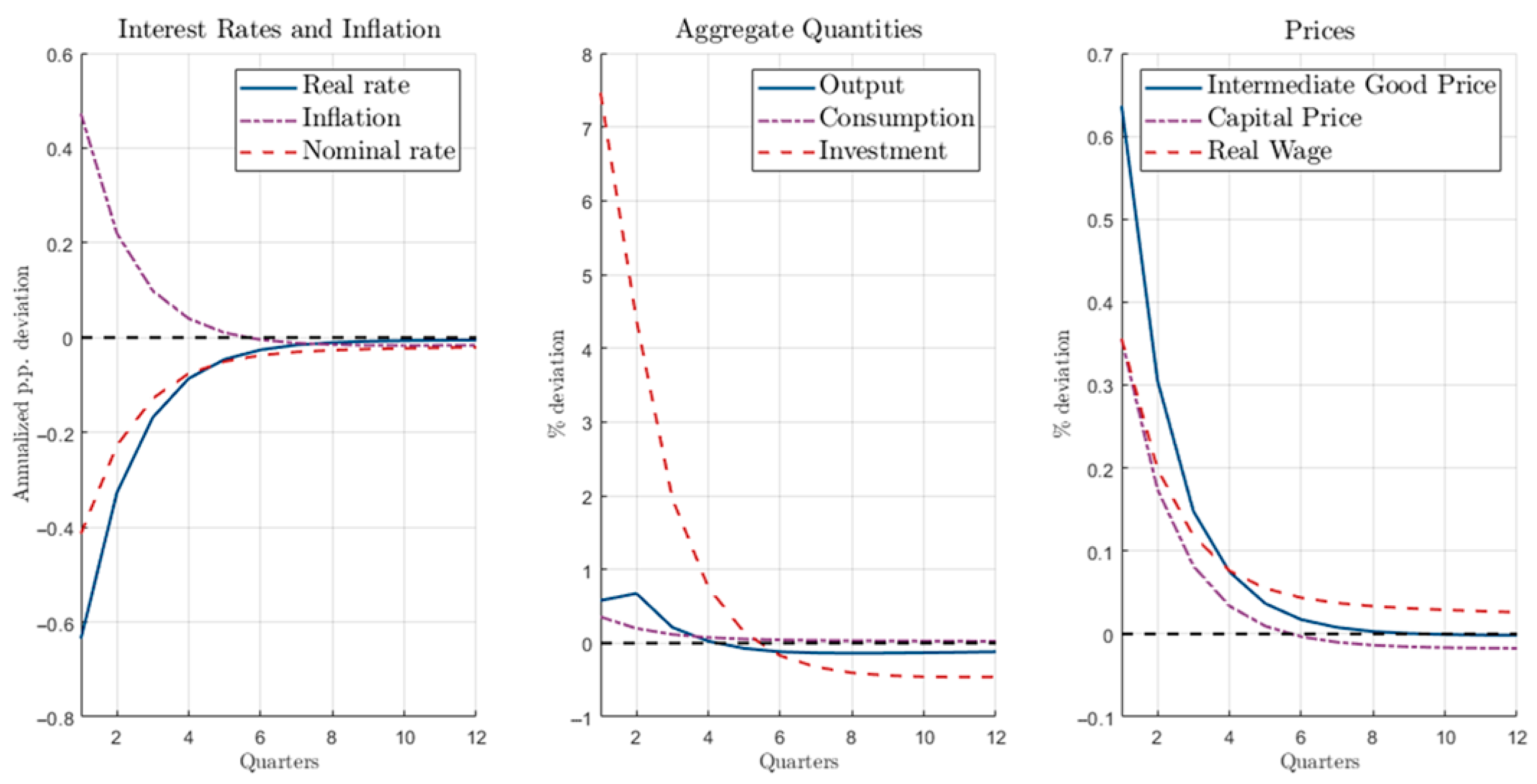
, equivalent to a 25 basis point (–0.25%) reduction in the nominal interest rate, with first-order autoregressive decay. The impulse-response functions for the main macroeconomic variables are traced from this impulse (
Figure 1).
Following an unanticipated and persistent expansionary monetary shock, the nominal interest rate immediately reduces by around −0.4 annualized percentage points (p.p.), and inflation increases by about +0.5 p.p. This is due to Calvo-style price rigidities that convert the higher spending into inflationary pressure. The combination of both reactions implies a more pronounced fall in the real interest rate, close to −0.67 p.p., which subsequently returns gradually to the steady state as inflation dissipates and the authority normalizes the nominal rate. This sequence—where the real rate adjusts first, followed by prices, and finally quantities—structures the entire transition dynamics.
With the real rate compressed, the marginal cost increases and margins contract, so the price of the intermediate good rises sharply and then smoothly declines as margins are reconstituted. In parallel, the price of capital, , also increases because the marginal value of an additional unit of capital grows; however, this impulse is intense but brief and fades as inflationary pressures dissipate. The real wage accompanies the initial movement, increasing as firms utilize their capacity more intensively and hire more labor; however, it moderates subsequently when margins return to normal and capital accumulation reduces the marginal productivity of labor.
This behavior of prices determines the trajectory of quantities. Investment shows an increase, reaching its maximum effect in the first period; this effect persists until around the fifth period, at which point it shows a slight downward overshooting. This is because the increase in and the reduction of the external premium make it profitable to bring projects forward, but capital accumulation and the normalization of later require an adjustment below the steady-state level to rebalance the stock. Production shows a modest and transitory response compared to investment, given that the capital stock adjusts slowly, while consumption increases only modestly, as the intertemporal incentive is offset by inflation and the relative price increase of the intermediate input.
Financial heterogeneity explains the asymmetry at the micro level. When the financial position is fragile, the fall in the spread relaxes the constraint, but the relief is mainly allocated to financial recomposition and balance sheet improvement through refinancing, cash accumulation, and deleveraging; therefore, investment reacts little compared to a model without heterogeneity. In contrast, when the financial position is solid, the constraint is not binding, and the shock is channeled primarily through the price of capital, which facilitates a greater expansion of investment. Furthermore, convergence occurs at different paces, as prices return quickly to their steady-state or equilibrium level, while quantities do so gradually due to accumulation and adjustment costs.
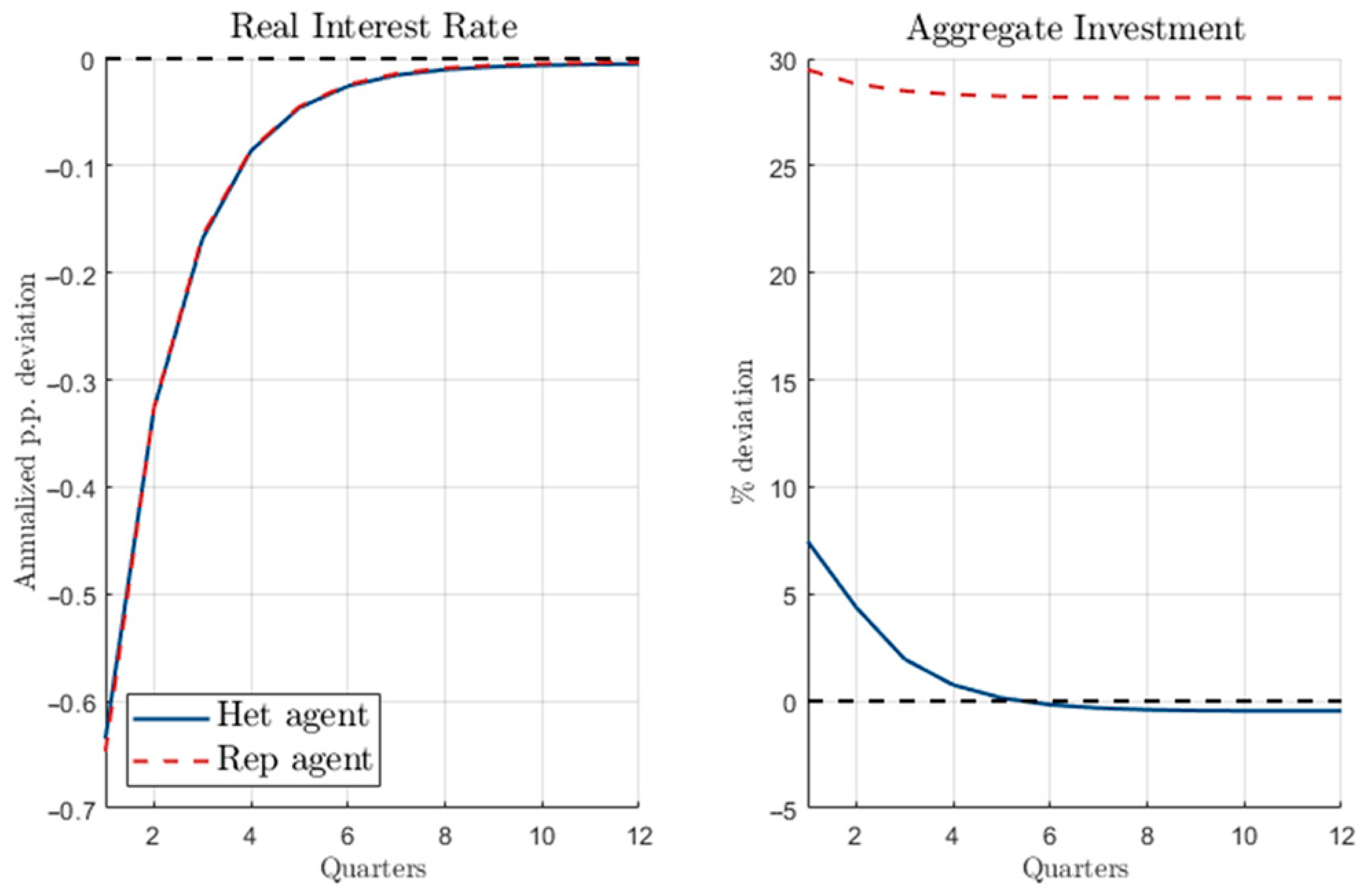
If the dynamic transition under the same monetary impulse is compared between an economy with representative agents and the heterogeneous economy with financial frictions (
Figure 2), it is observed that both economies show exactly the same transition path for the real interest rate, with a rapid fall close to −0.6 p.p. and subsequent convergence toward the steady state. This makes sense, as both models are very similar, with the only difference being the specification of the firms; that is, households use the same temporal optimization mechanisms, and the monetary authority uses the same monetary policy rule. Thus, any difference in quantities is attributed to the difference in the firms’ financial microfoundations.
In the representative–agent economy, the fall in the real rate translates uniformly into higher q and lower financing costs, producing a large and persistent investment increase. In the heterogeneous economy, the same rate cut produces a smaller and shorter-lived aggregate response because financially constrained firms allocate the relief to balance sheet repair rather than capital expansion. Only firms with solid financial positions convert the stimulus into investment. This composition effect—where opposing reactions partially offset each other in the aggregate—explains why the representative–agent model overestimates both the magnitude and persistence of the investment response.
The comparison between both model specifications shows that the policy’s ability to affect aggregate investment depends on the distribution of financial positions and the slope of the external premium. The representative agent overestimates the magnitude and persistence of the effect, while the heterogeneous economy reproduces a pattern consistent with empirical evidence, with larger responses in financially sound firms and weak or negative responses in highly leveraged firms with a lower distance to default, especially in the intermediate horizons.
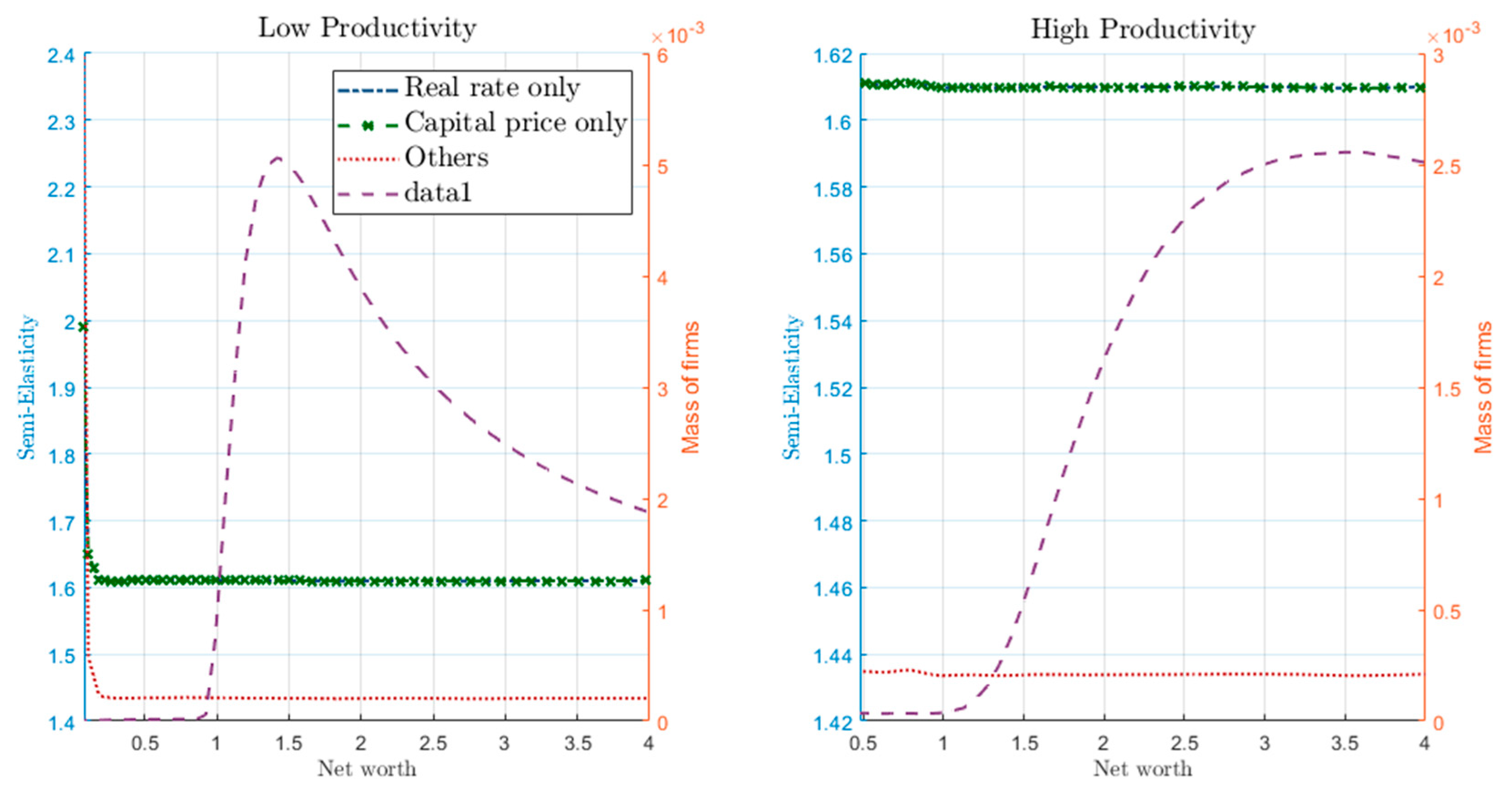
When examining the decomposition of the investment semi-elasticity in response to an expansionary monetary shock (
Figure 3), the model shows that when productivity is low, the semi-elasticity of the real interest rate and the price of capital
are similar in magnitude and dynamics. They are reduced at very low equity levels; however, once this threshold is surpassed, it stabilizes quickly, and the curve flattens and remains almost constant for the rest of the equity range. This discontinuity is consistent with a binding financial constraint in the vicinity of minimum equity. With reduced equity, monetary relief is primarily allocated to compressing the financing spread and repairing the balance sheet, so each additional unit of monetary stimulus translates into little marginal investment. Once equity exceeds that threshold and the constraint is no longer binding, the response becomes homogeneous, and the semi-elasticities remain practically constant for each equity level.
When productivity is high, the relationship between equity and marginal response is more regular. The semi-elasticity remains practically constant throughout the net worth range; however, the contribution of the elasticity of the price of capital and the real interest rate show similar levels and dynamics, while the residual component remains small. At the same time, the distribution of firms shifts toward high equity levels, indicating that most of the mass is located in areas not subject to financial constraints. In this environment, the monetary shock is transmitted almost one-to-one into an increase in and, consequently, into higher investment, such that the response’s dependence on the initial balance sheet is minimal, and the transmission operates mainly through the price of capital or Tobin’s channel.
In other words, with low productivity, the concentration of firms with very low equity levels introduces a non-linearity that depresses the semi-elasticity; with high productivity, the financial constraint ceases to be binding, and the gradient by equity practically disappears. In both cases, the price channel—real rate and, above all, —dominates, and the residual is secondary. Given that the mass of firms is located where the semi-elasticity is flat, the aggregate effect depends more on the composition between productivity states and the proximity to the lower equity threshold than on marginal variations within each state.
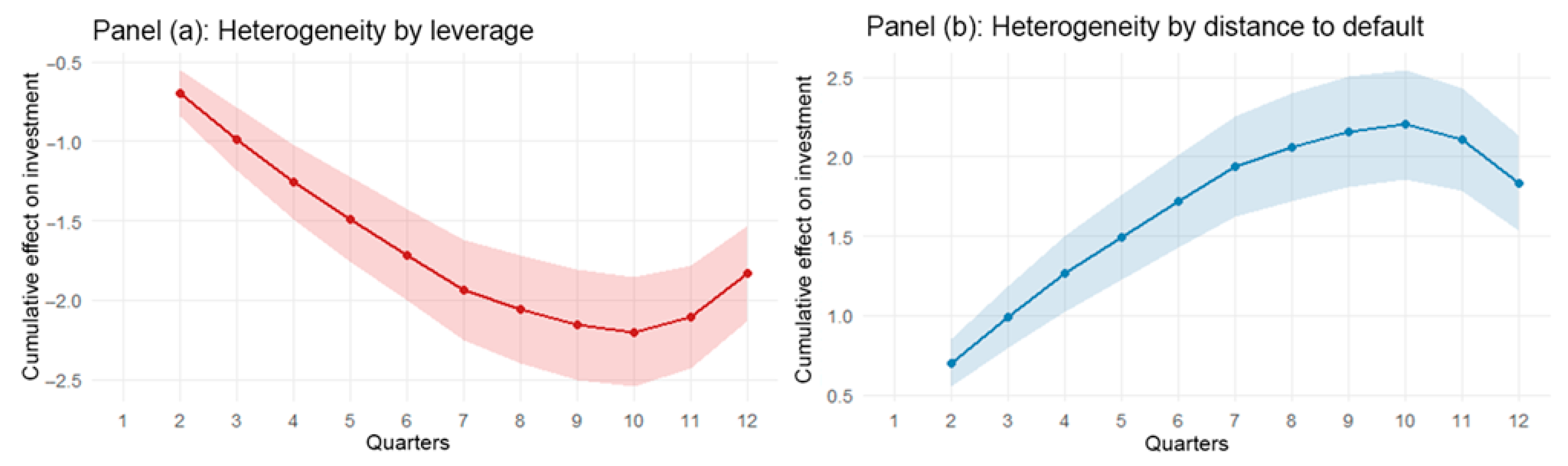
Finally, to conclude the results of the theoretical model, a simulation of 5000 firms is conducted, taking into account the moments and calibrations specified by the empirical data. An estimation of local projections is developed on this simulated panel, using a specification similar to that of the empirical model (
Section S8), so that the coefficient plotted at each horizon h is interpreted as a heterogeneous semi-elasticity—that is, how much the cumulative investment response changes when the firm’s financial heterogeneity increases by one standard deviation (
Figure 4).
The results show that, with higher leverage, the cumulative investment response is smaller, showing a negative semi-elasticity; that is, investment decreases throughout the analyzed period, reaching its minimum around the ninth quarter. On the other hand, with a greater distance to default—that is, a better financial position—the semi-elasticity is positive, meaning investment increases and also reaches its maximum in the ninth quarter.
The transmission mechanism operates through the balance sheet channel described above: when equity is low, the financial relief is absorbed by balance sheet repair rather than capital expansion; when the constraint is not binding, the increase in q is easily converted into investment spending. As q and spreads return to equilibrium and the marginal return on accumulated capital decreases, the gradient by balance sheet attenuates.
The temporal dynamics are also consistent with the theoretical model, as prices and margins move first, and quantities follow, which explains why the maximum effect is concentrated in the intermediate horizons and then dissipates.
To ensure comparability between the simulated and empirical panels, the following correspondences are maintained. Investment is measured as the cumulative log-change in capital
in both panels. In the simulated panel, leverage is constructed as the ratio of debt to capital stock (
), demeaned within each firm; in the empirical panel, leverage is total debt to total assets (
), also demeaned. The distance-to-default proxy in the simulated panel is the liquidity buffer (
), demeaned; in the empirical panel, it is the structural Merton-based distance to default, demeaned. Both panels apply 0.5% winsorization and use one-period lags. The monetary shock in the simulation is a 25-basis-point common surprise with geometric decay, while in the data, it is the Taylor-rule residual. Fixed effects are applied in both cases: firm and time in the simulation; firm, sector, and country×quarter in the data. This specification symmetry, documented in detail in
Section S8, ensures that differences in the estimated coefficients reflect differences in the data-generating process rather than in the econometric methodology.
7. Empirical Model
To empirically evaluate the relationship between monetary policy and the investment dynamics of firms in Latin American economies, an econometric model using a microeconomic firm-level fixed-effects panel was employed. This model allowed for the estimation of the heterogeneous response of net and gross investment to monetary shocks, considering differences in the firms’ financial structures. The objective of the empirical model was to assess the differential impact of monetary policy on different types of firms and to identify whether significant differences exist in corporate responses based on their financial characteristics.
Dynamic Local Projection Models
To delve deeper into the temporal dynamics of investment following a monetary shock, dynamic local projections in the style of
Jordà (
2005) were applied. This methodology allowed for the reconstruction of impulse-response functions at the firm level, without imposing the linearity restrictions of a traditional VAR, and enabled the evaluation of how cumulative investment evolved up to twelve quarters after the shock.
The monetary shock is identified as the Taylor-rule residual described in
Section 4.2, where the rationale for this identification strategy—including its theoretical consistency with the model, its feasibility given the absence of high-frequency or narrative alternatives in the region, and the conservative direction of any potential bias—is discussed in detail. The complete specification and rescaling procedure are documented in
Section S6, and robustness checks using residual investment are reported in
Section S7.
We acknowledge that this approach is not free of limitations. Taylor-rule residuals may capture not only genuine monetary surprises but also systematic components of policy that the estimated rule fails to capture (e.g., responses to financial stability considerations or exchange rate pressures). This introduces a potential attenuation bias rather than a spurious positive finding, since misclassified systematic policy responses would add noise to the shock measure, pushing the estimated semi-elasticities toward zero. As a robustness consideration, we note that the qualitative pattern of results—negative semi-elasticity for leverage, positive for distance to default, with peaks at intermediate horizons—is consistent across specifications and robust to alternative controls, as documented in
Section S7 (residual investment specifications).
The econometric specification for the dynamic local projections was formulated for each horizon
, and the equation is shown below:
where
represents the cumulative effect of net investment for firm up to quarters after the shock.
, and are the firm, sector, and country × quarter fixed effects, respectively, which capture unobserved heterogeneity and common macro impacts for each firm, sector, and country-quarter combination.
and represent the lagged leverage level and distance to default and, as specified, are demeaned within each firm.
The distance-to-default measure is constructed following the structural methodology of
Merton (
1974), using market equity, total debt, and asset volatility estimated from equity price returns; the complete derivation and formula are documented in
Section S5. This measure is subject to noise in emerging markets due to unstable equity volatilities and incomplete debt structures, which is expected to introduce attenuation bias in the estimated coefficients.
is the country-level monetary shock, re-scaled and identified according to
Clarida et al. (
2000).
groups the firm-level controls (sales growth, size, and liquidity) as well as the macroeconomic variables (GDP growth, inflation, unemployment, and country risk).
is the idiosyncratic error term at horizon h, clustered at the country× quarter level.
The reason for using this specification, and demeaning the variables of interest within each firm, lies in the need to estimate an intra-firm semi-elasticity. This eliminates time-invariant heterogeneity between firms—such as size, management, or idiosyncratic technology—and avoids attributing structural “between-firm” differences, which are not part of the transmission mechanism, to the estimated effects. In this sense, the heterogeneity identified is the temporal variation within each firm. Along these same lines, the fixed effects complete this refinement, isolating persistent sectoral traits and shocks, and absorbing the common macroeconomic and cyclical conjuncture. Thus, the comparison is made between firms exposed to the same aggregate environment and ensures the orthogonality of the shocks.
The coefficients and capture the semi-elasticities, or differential intensity with which the monetary shock interacts with each firm’s leverage and distance to default relative to its historical mean, thereby modulating the cumulative investment response at each horizon. This specification allows for the isolation of the financial heterogeneity channels and the evaluation of how each variable—leverage and distance to default—modulates the effectiveness of monetary transmission among firms with heterogeneous financial and risk profiles.
8. Empirical Model Results
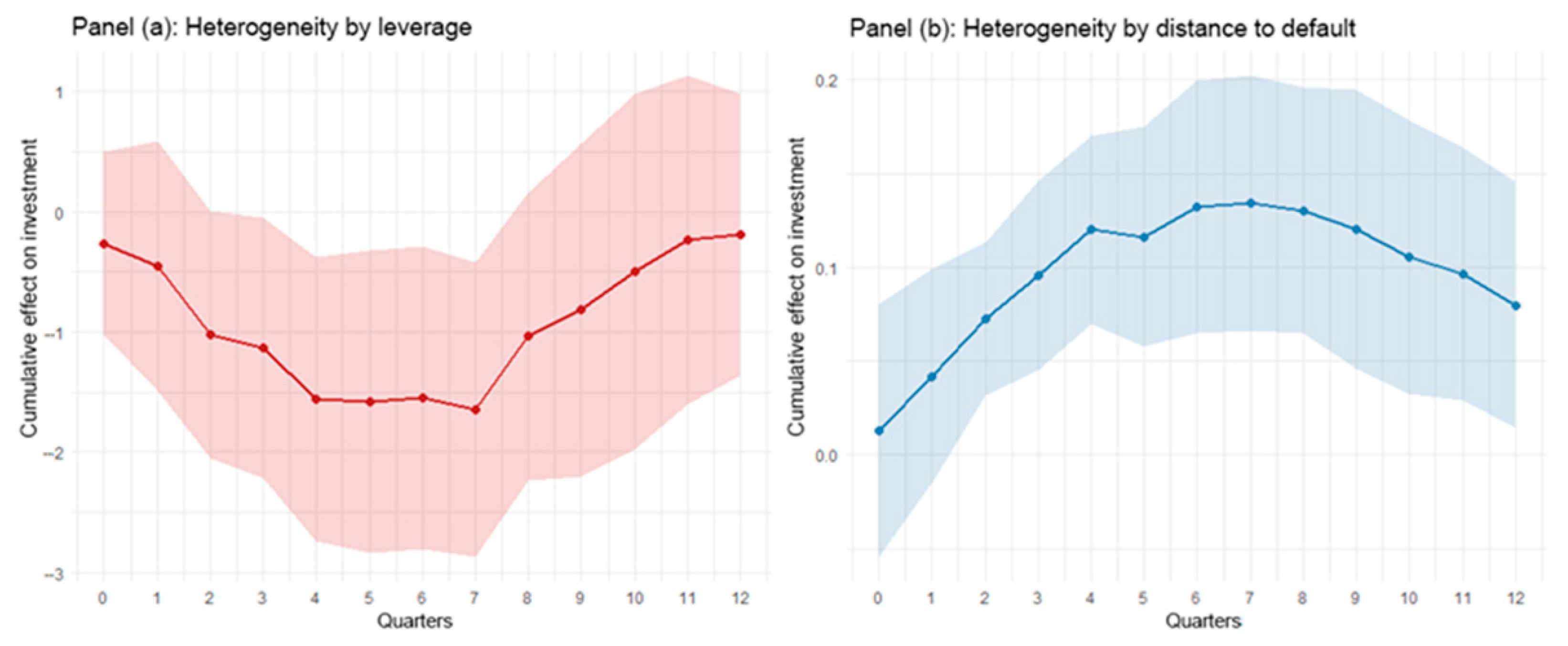
To empirically validate the results of the theoretical model, the empirical local projection model is estimated on a quarterly panel of 72 of the largest listed firms in six Latin American countries, during the 2015–2025 period (
Figure 5). A specification similar to that used in the simulation exercises is maintained so that, at each horizon
, the coefficient represents the cumulative semi-elasticity of investment in response to an expansionary monetary shock when the firm’s financial characteristic increases by one standard deviation. Furthermore, the shaded areas correspond to the confidence intervals (at 90%) and allow for the assessment of the estimates’ precision as well as a direct comparison with the results reported by the theoretical model.
Regarding heterogeneity by leverage, the empirical results show similar findings to those reported by the theoretical model; that is, as the firm’s level of indebtedness is higher, the cumulative investment response becomes more negative, with a minimum in the intermediate quarters and a subsequent convergence toward values close to zero.
These results are consistent with the balance sheet channel described in
Section 6: constrained firms allocate cheaper financing to deleveraging rather than capex, while unconstrained firms convert it into investment. The differential diminishes as q and spreads normalize toward the end of the horizon, and statistical significance concentrates in the intermediate quarters where the model predicts the heterogeneity channel to be most potent.
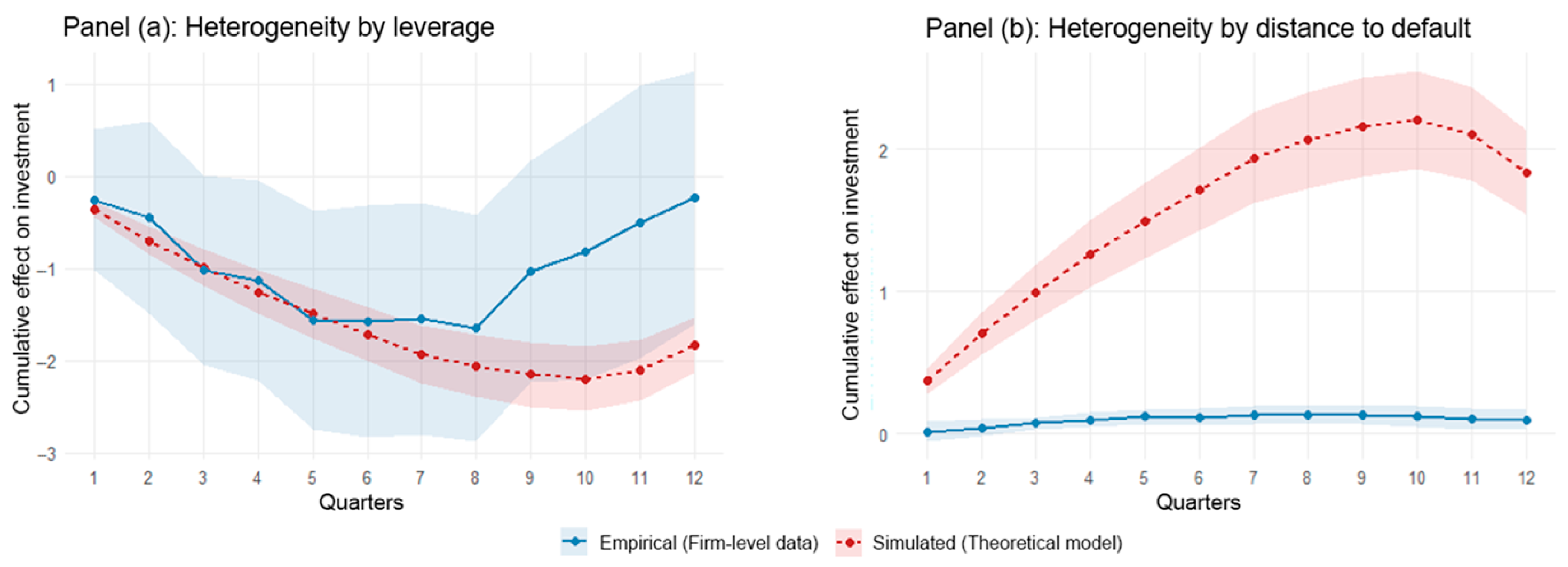
If the results of this local projection model estimated with firm-level data for Latin America are directly compared with the results of the local projections from the panel simulated by the theoretical model, it is observed that it matches and supports the model’s mechanism and, at the same time, reveals certain differences in scale (
Figure 6).
On the side of heterogeneity by leverage, the empirical evidence replicates the magnitude, sign, and temporal profile of the results reported by the theoretical model well. The cumulative investment response is more negative for more indebted firms, reaches its lowest point in the middle of the analyzed horizon, and then trends toward zero. However, small discrepancies exist: in the data, the initial drop tends to be somewhat more pronounced and the closing somewhat faster, suggesting that highly indebted firms prioritize immediate balance sheet repair and that, once q and spreads normalize, the differential reduces quickly.
Regarding heterogeneity by default, the validation is partial. The empirical model replicates the positive sign and the intermediate peak of the investment increase quite accurately, but it underestimates the magnitude compared to the simulated results of the theoretical model. However, there are economic and statistical reasons that explain this slight reported magnitude gap. On the theoretical side, the quality and enforceability of collateral, bank dominance with costly guarantees, and the high imported content of capital goods limit the pass-through of financial relief, even for firms with relatively solid financial positions. On the statistical side, the distance to default constructed with market prices in emerging economies is noisy due to unstable equity volatilities, incomplete debt structures, and off-balance-sheet exposures, besides considering that the database used for Latin America is limited in the number of firms and time periods, which induces attenuation of the coefficients and flattens the empirical curve even when the constraint is not binding.
All in all, the qualitative coincidence in signs, chronology, and shape confirms the validity of the theoretical model, showing that monetary policy does not have a homogeneous effect on investment and that its potency depends on the distribution of firms’ financial positions in the economy. The model faithfully reproduces the gradient by leverage and over-predicts the one associated with financial slack—measured by distance to default—in an expected direction given Latin America’s credit environment. This joint reading reinforces the central interpretation of the research and attributes the differences in scale to institutional and measurement factors rather than flaws in the mechanism.
Both results maintain a single economic mechanism which shows that prices and margins adjust first—particularly the real interest rate, , and spreads—and only afterward do quantities adjust. For this reason, the semi-elasticities of the heterogeneity channels reach their maximums in the intermediate horizons and are diluted when and spreads return toward equilibrium.
9. Discussion of Results
The findings, theoretical and empirical, are consistent and show that the transmission of monetary policy to investment depends on the distribution of firms’ financial positions. When comparing the local projections estimated with simulated panels from the model with financial frictions and the local projections with firm-level data for Latin America, a qualitative coincidence emerges in signs, temporal profiles, and the chronology of the responses. The semi-elasticity of investment with respect to leverage is negative and intensifies in intermediate horizons, while the semi-elasticity of investment with respect to distance to default is positive and reaches its maximum in that same window. This correspondence in dynamic behavior—same curvature, peaks at similar times, and aligned relative magnitudes—under an identical econometric specification in both exercises validates the financial mechanism.
The theoretical mechanism—whereby the fall in the real rate compresses spreads and raises q, with constrained firms absorbing the relief through balance-sheet repair while unconstrained firms convert it into investment (detailed in
Section 6)—is fully corroborated by the empirical evidence. The peak of the differential effects appears at intermediate horizons, consistent with the price-then-quantity sequence described in the model. Importantly, the average investment response without heterogeneity interactions is statistically insignificant, confirming that the robust signal resides in the distributional channel rather than in the mean response, in line with
Ottonello and Winberry (
2020).
The empirical results for Latin America show mechanisms similar to those found in the literature and confirm the mechanism reported by
Ottonello and Winberry (
2020). A negative semi-elasticity of investment with respect to the leverage level (
) and a positive semi-elasticity of investment with respect to the distance to default (
are obtained, with peaks around the eighth quarter and statistical significance concentrated in that time window. In magnitude, the semi-elasticity of investment with respect to the leverage level dominates that of distance to default. These features are consistent with the macro-financial literature that emphasizes the role of frictions in the propagation of shocks, both in contractionary phases and in episodes of monetary easing (
Gertler & Gilchrist, 2018;
Bernanke et al., 1999;
Kiyotaki & Moore, 1997).
The differences in scale between theory and data are informative. In the region, distance to default yields less than in the laboratory, and the penalty for debt is greater. This suggests that the relevant policy margin involves the state of the balance sheet, leverage, mismatches, and collateral, rather than size or productivity, and, consequently, there is no homogeneous multiplier. The potency of a rate cut depends on how much mass of firms is located near the financial constraint threshold when the monetary shock arrives. This message is consistent with recent international evidence and with the core of Ottonello and Winberry, now documented for Latin America with an explicit bridge between theory and empirical evidence.
10. Conclusions
This research analyzed the transmission of expansionary monetary shocks to aggregate investment in Latin America and, in particular, how this transmission varies with the financial position of the economy’s firms. The strategy followed maintained a deliberate symmetry between theory and data, as the theoretical model with heterogeneous firms and financial frictions generated simulated panels on which local projection models were estimated, similar to those used in an empirical firm-level panel data model for six economies in the region. This methodological symmetry allowed divergences to be interpreted as differences in the transmission mechanism and not as differences in estimation methodology.
Two stylized facts emerge from this comparison. First, the average investment response to an expansionary monetary shock is small and of limited precision. Second, the relevant and significant signal resides in the financial heterogeneity of the firms. Faced with the same expansionary monetary shock, firms with a higher leverage level invest less, while those with a greater distance to default invest more. Both semi-elasticities reach their maximum intensity in intermediate horizons and converge subsequently. The qualitative coincidence in signs, temporal profiles, and chronology between simulation and empirical evidence supports that the financial channel is what organizes the adjustment and transmission mechanism of the monetary shock.
The mechanism that rationalizes these results relies on a price–quantity sequence. In other words, the fall in the real interest rate compresses spreads and raises the price of capital, q. When the financial constraint is binding, monetary easing is absorbed by balance sheet repair, which is why capital expenditure decreases. When the constraint is not binding, the increase in is more easily transformed into investment. This temporal hierarchy, with prices adjusting first and quantities later, explains why heterogeneity is concentrated in the intermediate horizons.
The magnitudes reported by the paper offer informative nuances. The negative semi-elasticity between investment and the leverage level observed in the data replicates reasonably well the one provided by the theoretical model, both in intensity and in shape. In contrast, the positive semi-elasticity between investment and distance to default is much smaller in magnitude than that reported by the theoretical model. The gap is plausible given the institutional and financial characteristics of the region, including bank dominance with costly collateral and shallower debt markets, as well as a database that is somewhat noisy and limited for Latin America.
On the other hand, in contrast to theoretical model specifications, the representative agent model tends to overestimate the impact of the monetary shock on investment compared to the heterogeneous firms model. Both models show the same adjustment path for the real interest rate, so the difference stems from the distribution of balance sheets and financial frictions. In the homogeneous economy, the reduction in the intertemporal cost translates almost one-to-one into capital accumulation, without financing constraints or binding wedges, and thus investment shows a very high level with high persistence. In contrast, in the economy with heterogeneous firms, a relevant fraction of firms absorbs the monetary easing through the balance-sheet channel rather than expanding capacity, which generates a more moderate and short-lived response, with an early hump and rapid convergence. Therefore, ignoring financial heterogeneity induces an upward bias in both the magnitude and the persistence of the investment response to the monetary shock.
These findings carry concrete implications for monetary and macroprudential policy in the region. First, central banks should recognize that the effectiveness of interest rate cuts in stimulating aggregate investment depends critically on the prevailing distribution of corporate balance sheets. When a large fraction of firms is near the financial constraint, rate cuts are partially absorbed by deleveraging rather than capital formation, reducing the investment multiplier. This suggests that the timing of monetary easing matters: stimulus is most effective when the corporate sector has already undergone balance-sheet repair.
Second, the results support the case for complementary macroprudential instruments. If monetary easing alone is insufficient to reach financially constrained firms, targeted credit facilities, collateral relaxation measures, or differentiated reserve requirements could help channel financial relief toward investment rather than debt reduction. Third, for economies where sovereign risk amplifies financial frictions (as captured by the λ() mechanism in the model), reducing sovereign risk premiums through fiscal consolidation may be a prerequisite for effective monetary transmission to corporate investment. Finally, the documented heterogeneity underscores the importance of monitoring firm-level financial indicators—not just aggregate credit conditions—when assessing the expected potency of monetary policy actions.
Finally, it is necessary to acknowledge the scope and limitations of the research. First, the identification based on residuals from Taylor-type rules, the relatively long projection horizons, and the limited regional sample size increase the variance of the estimates toward the temporal extremes. Furthermore, measuring the distance to default with market information introduces additional noise. Nonetheless, the qualitative pattern of the results remains stable, significant, and robust, so that qualitative aspects such as the sequence of signs, intermediate peaks, and convergence support the causal interpretation of the financial channel reported in the research.