Article

Towards Common Prosperity: The Impact of Targeted Poverty Alleviation Policy on Multidimensional Income Disparities Among Rural Poor Households

1
School of Economics, Sichuan University of Science and Engineering, Yibin 644005, China
2
School of Economics, Southwestern University of Finance and Economics, Chengdu 611130, China
3
Academic Affairs Office, Qingdao University, Qingdao 266071, China
4
Rural Development Research Center, Sichuan University, Chengdu 611130, China
*
Author to whom correspondence should be addressed.
Economies 2026, 14(4), 114; https://doi.org/10.3390/economies14040114
Submission received: 22 February 2026 / Revised: 28 March 2026 / Accepted: 30 March 2026 / Published: 2 April 2026
(This article belongs to the Special Issue Income Inequality, Poverty and Economic Growth)

Abstract

The issues of income inequality and poverty are intrinsically linked and represent persistent global governance challenges. China faced significant hurdles, including absolute rural poverty and a widening urban–rural development gap. The “Targeted Poverty Alleviation” policy (TPA), implemented from 2014 onward, employed comprehensive measures, including household registration, industrial support, and skills training. By the end of 2020, this policy successfully eradicated absolute rural poverty under the prevailing standard, contributing a Chinese solution to global poverty reduction. Beyond addressing absolute deprivation, whether this policy has impacted relative rural poverty and urban–rural inequality remains a subject of debate in existing literature. Utilizing microdata from the China Family Panel Studies (CFPS) from 2014 to 2020, this study employs the Kakwani measure to measure relative deprivation levels, thereby identifying income disparities both within rural areas and between urban and rural regions. Combining empirical tools, including a Difference-in-Differences (DID) framework, Propensity Score Matching (PSM), and Entropy Balancing method, the analysis finds that the Targeted Poverty Alleviation policy significantly curbs income inequality both within rural areas and across the urban–rural divide. Further investigation reveals that this effect operates through three primary mechanisms: promoting diversified rural livelihoods, improving incomes for impoverished households, and bridging knowledge and information gaps. Heterogeneity analysis indicates that the inequality-reducing effect of the policy is more pronounced in non-major grain-producing regions, low-income provinces, and among vulnerable groups such as the elderly, low-income individuals, and women. This study addresses the lack of detailed micro-level measurement, deepens the explanatory analysis of mechanisms and heterogeneity, and provides a basis for formulating differentiated policies in line with the vision of common prosperity.

1. Introduction

Income inequality and poverty, as persistent global governance challenges, have long constrained social harmony and stability, impeded sustainable economic growth, and hindered the overall enhancement of human development and well-being. The United Nations’ 2030 Agenda for Sustainable Development explicitly identifies “ending poverty in all its forms” and “reducing inequality within and among countries” as core imperatives, calling upon nations to fulfill their shared development commitments through inclusive policies. This international consensus underscores a critical contradiction in contemporary global development: despite significant progress in poverty reduction, hundreds of millions of people—in both developed and developing countries—remain trapped in intergenerational cycles of poverty due to systemic resource deprivation in key areas such as education, healthcare, and employment. This condition constitutes a major bottleneck constraining both social equity and economic efficiency.
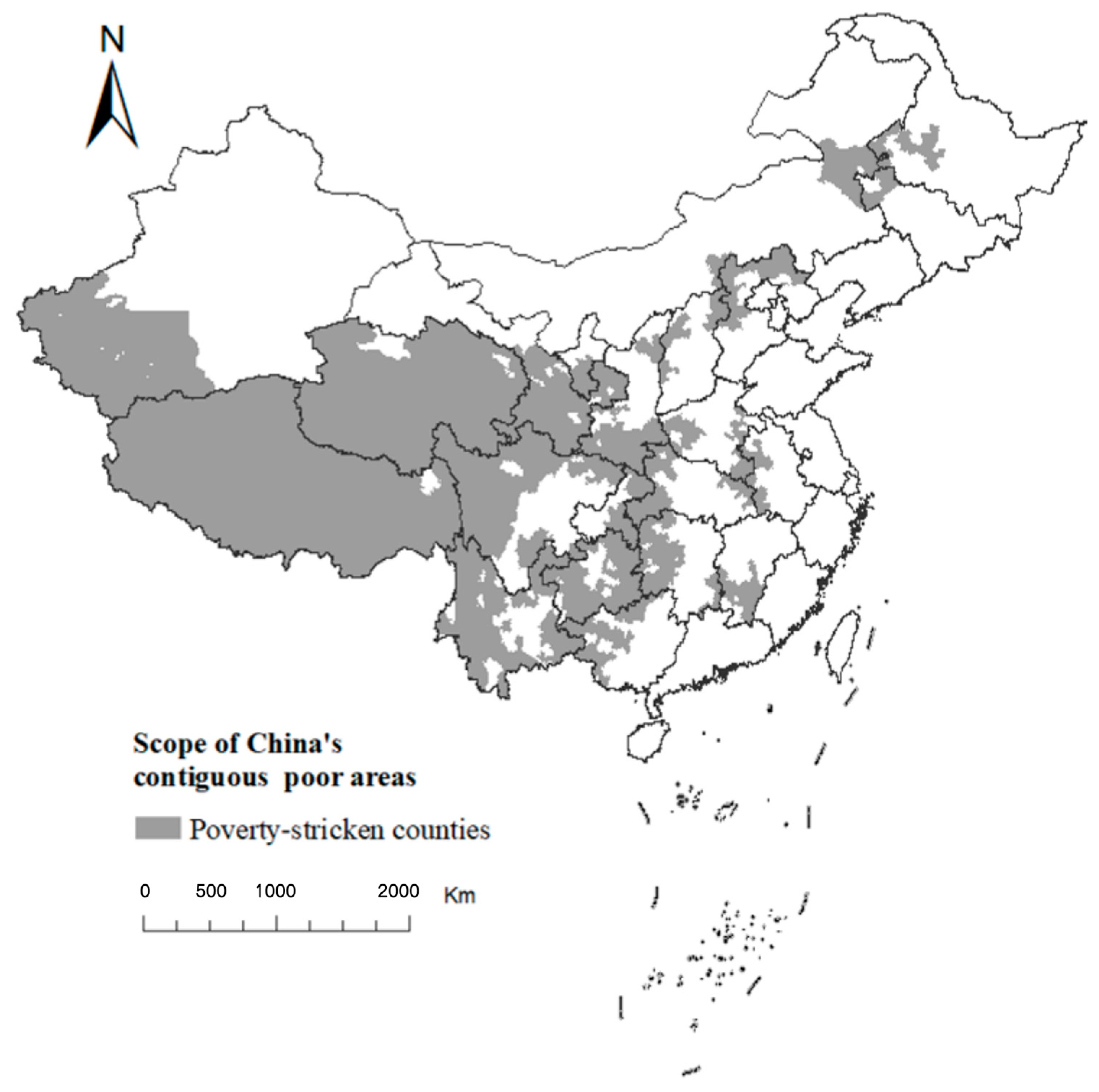
As the world’s second-largest country in terms of both population and economic aggregate, China has long grappled with persistent challenges in its modernization process, including rural poverty, income inequality, and the urban–rural development gap, which have constrained high-quality development and social fairness and justice. Since the initiation of reform and opening-up, rapid economic growth—while creating a developmental miracle—has also been accompanied by structural contradictions. The urban-to-rural resident income ratio increased from 2.57:1 in 1978 to 3.23:1 in 2009. Concurrently, the impoverished rural population remained substantial, with nearly 100 million people living in poverty as of 2012. Figure 1 shows the scope of contiguous poverty-stricken areas in China. Furthermore, poverty exhibited distinct regional concentration, with 14 contiguous destitute regions covering over 86% of the nation’s poverty-stricken counties. As a core indicator for measuring income inequality, China’s Gini coefficient remained above the international alert level for over a decade, consistently exceeding 0.47.
In response, the Chinese government implemented a systematic and targeted poverty-reduction strategy. In December 2014, the government introduced the “Targeted Poverty Alleviation” policy for the first time, marking a transition in China’s poverty alleviation practice from a broad-brush approach to a precision-oriented model. Thereafter, the Chinese government designated poverty eradication as a fundamental baseline task and a symbolic indicator for “building a moderately prosperous society in all respects,” officially launching the largest and most intensive poverty alleviation campaign in human history. Through a combination of comprehensive measures such as household registration and profiling, dispatched village support teams, industrial development assistance, financial inclusion programs, educational support, and healthcare initiatives, the Targeted Poverty Alleviation policy enabled precise identification, tailored assistance, and dynamic management of the impoverished population.
This policy yielded remarkable outcomes. According to official data from China’s National Bureau of Statistics and the State Council Leading Group Office of Poverty Alleviation and Development, by the end of 2020, all 98.99 million rural residents living below the current poverty line had been lifted out of poverty (State Council Information Office of the People’s Republic of China, 2021). Additionally, all 832 designated impoverished counties had been removed from the poverty list, and all 128,000 impoverished villages had exited poverty status, thereby resolving regional, overall poverty and eradicating absolute poverty. This achievement enabled China to meet the United Nations’ 2030 Agenda for Sustainable Development poverty-reduction target a decade ahead of schedule. Moreover, it also contributed Chinese solutions and wisdom to global poverty-reduction efforts, accounting for over 70% of the world’s total poverty reduction during the same period.
The successful implementation of the Targeted Poverty Alleviation (TPA) policy has significantly improved the incomes of rural residents, a conclusion well substantiated by numerous research studies. Research indicates that from 2013 to 2020, the average annual growth rate of per capita disposable income for rural residents in China exceeded the national average. The per capita net income of registered impoverished households also increased from approximately 2600 yuan in 2013 to over 10,000 yuan in 2020, representing a real increase of more than 200% (Y. Zhou et al., 2023). Furthermore, an analysis based on panel data from 1661 Chinese counties from 2009 to 2018 found that the implementation of the TPA policy increased per capita income for residents in poverty-stricken counties by 504 yuan (Chai et al., 2025; Sun, 2025).
However, following the eradication of absolute poverty, issues of relative poverty and multidimensional income inequality have gradually become more apparent. Particularly within the strategic context of “common prosperity” proposed by the Chinese government, understanding whether and how the TPA policy has affected the sense of relative deprivation among rural households has become a critical issue for comprehending China’s transition from poverty reduction experience to high-quality development. Consequently, the focus on assessing the policy’s impact should extend beyond simply evaluating poverty reduction performance to include its spillover effects on the structure of wealth distribution. However, existing research presents divergent conclusions.
Some studies utilizing the Foster–Greer–Thorbecke (FGT) index and Shapley decomposition found that both the incidence and depth of poverty in China decreased significantly between 2013 and 2019. The income growth effect contributed as much as 92.78% to poverty reduction, confirming the policy’s core role in enhancing the material living standards of impoverished households (X. Li & Li, 2021). Regarding the urban–rural gap, an analysis employing a Difference-in-Differences (DID) model suggests that the TPA policy, through infrastructure investment and industrial intervention, significantly narrows the urban–rural income ratio in central and western regions, effectively alleviating regional development imbalances (Tang et al., 2022; Z. Zhang, 2017). These studies collectively argue that government-led resource allocation, safeguarded by administrative power, enabled the TPA policy not only to reduce the scale of absolute poverty but also to effectively mitigate income disparities within rural areas (Z. Chen & Guo, 2024). Conversely, other research presents contrasting conclusions. These studies posit that, under the dominant influence of market mechanisms, households possessing absolute or relative advantages in production factors are likely to capture a disproportionate share of the benefits from poverty alleviation programs. This dynamic, they argue, may ultimately widen the income gap among impoverished households themselves (Hu & Wang, 2017; Wen et al., 2016).
A review of existing literature reveals several unresolved questions that warrant further investigation. Firstly, a degree of controversy persists regarding the impact of poverty alleviation policies on income inequality. A closer examination of publication timelines suggests that studies predating the completion of the Targeted Poverty Alleviation (TPA) policy (prior to 2020) frequently expressed concerns about potential issues such as “elite capture.” In contrast, the literature published after 2020 has predominantly affirmed the positive effects of the policy on reducing income disparities. This fundamental discrepancy necessitates further discrimination based on factors such as varying policy systems, data precision, and identification metrics. Notably, the period of TPA implementation saw significant improvements in the foundation of microdata, identification indicators, and analytical methodologies compared to earlier periods, which may partly explain the divergence in conclusions. Secondly, regarding the measurement of income inequality, most studies rely on macro-level data and traditional indicators, such as the Gini coefficient, to identify urban–rural and intra-rural disparities. There remains a need to strengthen refined research utilizing microdata. Thirdly, from a mechanistic perspective, previous studies offer limited depth in exploring the logical transmission processes of policy implementation. Analysis of crucial influencing factors, such as diversified livelihood strategies and information acquisition capabilities, remains insufficient. Within the TPA framework, tailoring diversified industrial support to the specific circumstances of individual households was a central focus of implementation. Furthermore, the policy period coincided with China’s technological transition from 3G to 5G networks, characterized by an unprecedented expansion in mobile internet penetration, which provided vital infrastructural support for achieving policy objectives. Finally, significant scope exists for enhancing research on heterogeneity across specific demographic groups and geographic regions. China’s vast territory encompasses regions with diverse resource endowments, and some areas bear significant responsibilities, such as ensuring food security. At the individual level, factors such as wealth accumulation and educational attainment may also influence policy effectiveness. These dimensions require more nuanced and targeted investigation.
Therefore, this study utilizes microdata from the China Family Panel Studies (CFPS) spanning 2014 to 2020 to construct a relative deprivation index based on the Kakwani measure, thereby identifying the extent of multidimensional income inequality within rural areas and between urban and rural regions before and after the implementation of the Targeted Poverty Alleviation policy. Furthermore, employing empirical models such as the Difference-in-Differences (DID) method, Propensity Score Matching (PSM), and Entropy Balancing method, this study finds that the Targeted Poverty Alleviation policy exerted a significant negative impact on both intra-rural and urban–rural income disparities. This conclusion remains robust after undergoing various robustness checks, including placebo tests and parallel trend tests. Building on this, the study further analyzes the mechanistic pathways through which the Targeted Poverty Alleviation policy achieved this effect. It identifies that the policy suppressed intra-rural and urban–rural income gaps through three primary channels: directly promoting diversified rural livelihoods, improving the income levels of impoverished rural households, and bridging knowledge and information divides. Heterogeneity analysis reveals that the inequality-reducing effect of the policy is more pronounced in non-major grain-producing regions, low-income provinces, and among samples characterized by medium-scale property holdings, completion of compulsory education, older age, lower income, female gender, and larger household size. These findings reflect the differential impact of the policy across regions and demographic groups.
This study contributes to the existing literature. By utilizing CFPS microdata and the Kakwani measure for refined measurement, combined with rigorous causal identification methods, it provides new micro-evidence that the Targeted Poverty Alleviation policy significantly reduces multidimensional income inequality. This helps clarify the ongoing debate in the literature regarding the policy’s distributional effects. Secondly, the study specifies and empirically tests the mechanisms through which the policy narrows disparities via three pathways: “promoting livelihood diversification,” “directly increasing incomes,” and “bridging the information gap.” This deepens the understanding of how the policy fosters endogenous development capacity. Finally, a detailed heterogeneity analysis reveals that the policy effects are more pronounced in non-major grain-producing regions, low-income provinces, and among vulnerable groups such as the elderly and women. This not only addresses earlier concerns about “elite capture” but also provides a basis for formulating differentiated policies targeted at the most vulnerable groups, in line with the goal of “common prosperity.”

2. Theoretical Analysis and Research Hypothesis

2.1. Theoretical Framework of Rural Poverty and Income Inequality

2.1.1. The Formation of Rural Poverty and Income Inequality

The mechanisms underlying rural poverty and income inequality arise from the confluence of multiple theoretical perspectives. From a structuralist paradigm, Lewis’s Dual Economy Model elucidates barriers to factor mobility arising from the coexistence of traditional agricultural and modern industrial sectors. This traps rural labor in a low-productivity equilibrium, hindering effective transfer and thereby entrenching the rural-urban income gap (Castle et al., 2011). Building on this, the Kuznets Curve Hypothesis posits that in the early stages of economic development, market mechanisms and capital-biased technological progress tend to exacerbate income distribution disparities, a non-linear relationship partially validated by empirical studies in rural China (Z. Chen et al., 2025).
Concurrently, Human Capital Theory emphasizes that initial disparities in individual endowments—such as education and health—are perpetuated across generations due to credit constraints and inadequate provision of public goods, leading to increasing income stratification within rural areas (J. Chen et al., 2016; N. Yang et al., 2023). From an Institutional Economics perspective, deficiencies in both formal and informal institutions—including ambiguous land property rights, weak grassroots governance, and uneven social security coverage—collectively reinforce the Matthew Effect in resource distribution. This traps relatively poor groups in a vicious cycle of multidimensional deprivation (Y. Zhou et al., 2018).
The Spatial Mismatch Hypothesis within the Spatial Economics framework further explains how geographical isolation and elevated market access costs inhibit the capacity of rural areas to participate in regional divisions of labor and global value chains, limiting their opportunities to benefit from high-value-added industries (Feng et al., 2024). In recent years, research expanding on Amartya Sen’s Capability Approach has redefined poverty as a systemic deprivation of functionings. It highlights that multidimensional deprivations in education, health, social participation, and digital literacy endogenously drive income inequality, offering a new theoretical perspective on the persistence of relative poverty (Peng et al., 2023).
In summary, rural poverty and income inequality are not the result of a single factor. They represent a complex outcome arising from the dynamic interplay and co-evolution of structural constraints, institutional deficiencies, spatial isolation, and capability deprivation, necessitating multidimensional and coordinated policy interventions for resolution.

2.1.2. The Impacts of Poverty Alleviation Policies

Theories concerning the impact of policies on rural poverty and income inequality primarily focus on two dimensions: intervention pathways and mechanisms of action. They emphasize how policy, as an exogenous variable, can alter the structural conditions underpinning poverty and inequality. From the state-led developmentalism perspective, the government can directly intervene in regional development processes through resource allocation, industrial planning, and the provision of public services, thereby reducing rural poverty and mitigating the urban–rural income gap (Lewis, 1954). Simultaneously, theories of institutional change and property rights underscore that policies can alter the distribution and efficiency of production factors through institutional reforms such as land titling and rural financial innovation. North’s institutional economics posits that clearly defined property rights and effective market institutions lower transaction costs, enabling impoverished groups to participate in economic activities more equitably and reducing inequality stemming from institutional barriers (North, 1990).
At the mechanism level, Schultz’s Human Capital Theory argues that policies, through investments in education subsidies, skills training, and health security, enhance the labor productivity and off-farm employment capabilities of the poor, thereby breaking the vicious cycle of low human capital and low income (Schultz, 1961). The mechanism of Social Capital and Network Effects suggests that policies can strengthen the social capital of impoverished groups by establishing farmer cooperatives and e-commerce platforms for poverty alleviation, thereby improving their access to resources, technology, and market opportunities, and alleviating marginalization caused by a lack of social networks (Putnam, 1993). Furthermore, Spatial and Regional Equilibrium mechanisms, drawing on New Economic Geography theory, indicate that policies can reduce market access costs for remote areas by investing in transportation and communication infrastructure, thereby promoting factor mobility and mitigating income disparities caused by geographical disadvantages (Krugman, 1991).
However, policy interventions also have potential limitations. Theories of government failure and targeting errors point out that policies may lead to resource misallocation—due to information asymmetry, inefficient implementation, or elite capture—potentially exacerbating internal inequality (Hu & Wang, 2017). Dependency theory posits that over-reliance on transfer payments may weaken individual work incentives, creating welfare dependency and affecting the sustainability of poverty reduction (Banerjee & Duflo, 2011). Therefore, modern anti-poverty theories emphasize that effective policies require multidimensional coordination: providing a social security safety net to alleviate absolute poverty in the short term, enhancing endogenous drivers through human capital and industrial support in the medium term, and eliminating structural inequality through institutional reform and regional balance in the long term. China’s practice of Targeted Poverty Alleviation, characterized by its “Six Precisions,” embodies this theory of systemic intervention (S. Wang & Zhao, 2024). Its effectiveness hinges on the policy’s ability to accurately identify diverse poverty-causing mechanisms, dynamically adjust the mix of policy tools, and ultimately break the self-reinforcing cycle of poverty by changing resource allocation rules, enhancing individual capabilities, and optimizing the development environment.

2.2. Policy Context: Targeted Poverty Alleviation

China’s poverty alleviation policies have undergone a deepening evolution from a relief-based approach to a development-oriented model. Following the reform and opening-up, the implementation of the Household Responsibility System liberated productive forces. By 1990, the impoverished population had decreased from 770 million to 658 million, with the poverty incidence rate dropping from 97.5% to 73.5%. An institutional framework was established during the 1980s and 1990s. In 1986, the State Council Leading Group for Poverty Alleviation and Development was founded, promoting development-oriented poverty reduction targeting 592 nationally designated poor counties. The “Seven-Year Program for Lifting 80 Million People Out of Poverty” (1994–2000) focused on infrastructure construction and the development of township enterprises, further reducing the impoverished population to 462 million and the poverty incidence to 49.8%.
In the 21st century, poverty alleviation policies became more systematic. The Outline for Development-Oriented Poverty Alleviation for China’s Rural Areas (2001–2010) shifted the focus to impoverished villages while strengthening social protection measures, including the abolition of the agricultural tax and the establishment of the New Rural Cooperative Medical System. By 2010, the impoverished population stood at 166 million, with a poverty incidence rate of 17.2%. The subsequent outline (2011–2020) further targeted contiguous destitute areas, marking a transition toward more precise and targeted poverty alleviation strategies. Accelerated urbanization and the outward migration of rural workers also contributed significantly to poverty reduction. China achieved the United Nations Millennium Development Goals ahead of schedule, with the extreme poverty rate falling to 0.7% by 2015, well below the global average (Xie & Wen, 2023).
However, the issue of absolute poverty persisted. Based on the national poverty standard of an annual per capita net income of 2300 yuan at 2010 constant prices, the rural impoverished population reached 98.99 million, with a poverty incidence rate of 10.2% (Tan & Li, 2017). This impoverished population was primarily concentrated in 14 contiguous destitute regions, characterized by underdeveloped infrastructure, scarce educational and medical resources, and inefficiencies in traditional poverty alleviation models, including imprecise targeting and resource wastage (Liu et al., 2019).
In December 2014, the Central Economic Work Conference in China, for the first time, proposed the requirement to achieve targeted poverty alleviation and formulated a series of corresponding policies. These policies constitute a systematic and targeted poverty alleviation strategy implemented by the Chinese government to thoroughly eradicate absolute poverty and build a moderately prosperous society in all respects. The core of this strategy lies in shifting from a “broad-brush approach” to a “targeted and precision-oriented approach.” Through the principle of “Six Precisions”—precise identification of poverty targets, precise project arrangement, precise use of funds, precise implementation of measures tailored to households, precise dispatch of personnel to villages, and precise assessment of poverty alleviation outcomes—resources are ensured to be accurately directed to those most in need.
The policy encompasses multidimensional measures, including industrial poverty alleviation (such as developing specialty agriculture, rural tourism, and e-commerce), employment support (such as skills training, public welfare job creation, and labor service coordination), social safety nets (such as subsistence allowances, medical insurance, and education subsidies), relocation from inhospitable areas, and infrastructure improvement. These initiatives aim to stimulate the internal drive of the impoverished population while providing external support, thereby establishing a sustainable poverty reduction pathway that combines the enhancement of “self-generating capacity” with necessary external assistance (Meng et al., 2024; W. Zhang & Wang, 2013).
The implementation of the Targeted Poverty Alleviation policy achieved remarkable results. By the end of 2020, China announced that all 832 designated impoverished counties had been removed from the poverty list, all 128,000 impoverished villages had exited poverty status, and all 98.99 million rural residents living below the current poverty line had been lifted out of poverty. Infrastructure in impoverished areas improved significantly, with coverage rates for paved roads, broadband access, and power grid upgrades approaching 100%. The average annual growth rate of per capita disposable income for rural residents in these areas exceeded the national average. After 2021, the policy focus shifted to consolidating and expanding poverty alleviation achievements and effectively linking them with rural revitalization efforts, ensuring that poverty does not return (S. Wang et al., 2024).
Empirical research provides robust micro-level evidence for these macro-narratives. The policy has significantly increased the income levels of poor households. Studies show that the Targeted Poverty Alleviation (TPA) policy led to a significant rise in the per capita disposable income of poor households, effectively reducing the poverty incidence (L. Wang & Xu, 2019; F. Li et al., 2020). In the health domain, a study in Shaanxi Province found that the TPA policy significantly improved the health status and health equity of the rural poor, effectively mitigating the vicious cycle of “poverty caused by illness and returning to poverty due to illness” (Dai et al., 2020). Regarding income, an empirical examination of 124 counties in Yunnan Province indicated that the policy effectively narrowed the urban–rural income gap, laying a foundation for the subsequent Rural Revitalization Strategy (R. Yang et al., 2022). Particularly noteworthy is China’s integration of emerging technologies with traditional industries, which has led to innovative projects such as PV Poverty Alleviation. Research using the Difference-in-Differences (DID) method found that the pilot PV Poverty Alleviation policy increased per capita disposable income in pilot counties by approximately 7–8% (H. Zhang et al., 2020), and the project promoted environmental sustainability while enhancing socioeconomic status (Z. Wang et al., 2020).
In terms of absolute economic data, the TPA policy undoubtedly significantly improved the income levels of poor rural households. However, considering that this policy was implemented during a period of sustained high economic growth in China, a comprehensive assessment requires extracting relative levels from the absolute data. Therefore, this study proposes Hypothesis 1: The Targeted Poverty Alleviation policy mitigated multidimensional income inequality both within rural areas and between rural and urban areas.

2.3. The Mechanisms of the TPA Policy Affect Income Inequality

The Targeted Poverty Alleviation policy effectively reduces income disparities across two dimensions—within rural areas and between urban and rural regions—through a synergistic effect of three mechanisms: directly augmenting the incomes of impoverished rural households, enhancing rural income resilience through livelihood diversification, and bridging knowledge and information gaps in rural areas.

2.3.1. Directly Augmenting the Incomes of Impoverished Rural Households

The Targeted Poverty Alleviation policy effectively reduces income disparities across various dimensions by directly increasing the incomes of impoverished rural households. This mechanism is primarily achieved through non-industrial direct interventions such as transfer payments, social security enhancements, and employment support.
Firstly, the policy directly boosts the disposable income of poor households through fiscal transfer payments. For instance, direct cash subsidies for specific impoverished groups, ecological compensation funds, and various production and living allowances provide immediate and stable economic resources for the most vulnerable households (Leng et al., 2021). These funds are directly infused into the daily finances of poor families, narrowing the gap in basic consumption capacity between them and higher-income groups.
Secondly, the strengthening of the social security system plays a crucial redistributive role. By raising the standard of rural subsistence allowances, expanding pension coverage, and implementing critical illness medical assistance, the policy significantly reduces the risk of poor families falling into distress due to rigid expenditures such as healthcare and elderly care. This equates to the targeted redistribution of societal wealth to low-income households through social transfers, directly enhancing their net income levels and alleviating relative deprivation caused by unexpected expenses.
Lastly, targeted employment support creates direct wage income. The government helps poor laborers secure stable non-agricultural employment opportunities by developing public welfare positions, organizing labor migration with transportation and living subsidies, and providing free vocational skills training. This not only directly increases household wage income but also lays the foundation for sustained income growth by enhancing workers’ long-term employability, thereby dynamically curbing the widening of income disparities (Miao & Li, 2023).
In summary, the Targeted Poverty Alleviation policy rapidly and precisely elevates the absolute income levels of poor households (Huang et al., 2023). This process improves the pattern of both the primary distribution and redistribution of national income, enabling faster income growth for low-income groups. Consequently, it plays a key role in narrowing overall income disparities and alleviating relative poverty. The study also proposes Hypothesis 2: The Targeted Poverty Alleviation policy mitigated multidimensional income inequality both within rural areas and between rural and urban areas by directly increasing the incomes of poor rural households.

2.3.2. Enhancing Rural Income Resilience Through Livelihood Diversification

The Targeted Poverty Alleviation policy significantly enhances income resilience among impoverished rural households by encouraging and supporting livelihood diversification, thereby effectively reducing income inequality. The core of this process lies in guiding farmers to move beyond dependence on a single agricultural income source. By fostering the development of diverse non-agricultural economic activities such as specialty cultivation and breeding, rural tourism, e-commerce, and handicraft production, the policy facilitates the construction of a composite income structure (Wu et al., 2024).
When a household possesses multiple income streams, its capacity to withstand external shocks—such as natural disasters and market volatility—is strengthened. For example, losses from a poor agricultural harvest may be offset by stable income from tourism services or profits from e-commerce sales, thereby ensuring relative stability in total household income. This enhancement in income resilience means reduced volatility and increased sustainability of income for poor households, making them less susceptible to falling into absolute poverty or experiencing sharp income declines during economic downturns (Guo et al., 2022).
From an income distribution perspective, the increased income resilience derived from diversification yields particularly significant marginal utility for low-income groups. Higher-income households typically already possess stronger risk resistance and diversified asset allocation, whereas poor households initially suffer from singular, highly vulnerable income sources. Diversified livelihoods, supported by the policy, directly ameliorate this structural disadvantage in the income composition of poor households, making their income growth more stable and predictable (Zang et al., 2019). Consequently, the income growth rate and stability of low-income groups improve, while the income growth trajectory of higher-income groups remains relatively less affected by such measures. This dynamic narrows the growth rate differential between the two groups, thereby reducing long-term income inequality (Tian et al., 2021).
Therefore, by empowering poor households to engage in diversified livelihoods, the Targeted Poverty Alleviation policy not only directly expands their income channels but, more importantly, smoothens income fluctuations and enhances the stability and long-term share of low-income groups within the economic distribution through bolstered income resilience. This contributes to reducing income inequality from both structural and dynamic perspectives. The study also proposes Hypothesis 3: The Targeted Poverty Alleviation policy mitigated multidimensional income inequality both within rural areas and between rural and urban areas by encouraging diversified livelihood strategies for farming households, thereby increasing rural income resilience.

2.3.3. Bridging Knowledge and Information Gaps in Rural Areas

The Targeted Poverty Alleviation policy provides a crucial mechanism for reducing income disparities by systematically bridging the knowledge and information gap in rural areas. This process is mainly reflected in the policy’s focus on dismantling barriers that prevent impoverished groups from accessing information, acquiring skills, and seizing development opportunities.
On one hand, the policy has implemented large-scale construction of rural information infrastructure (such as the “Broadband China” strategy) and organized targeted digital skills training, enabling poor households to access the internet and obtain key information on market prices, agricultural technologies, and employment opportunities (X. Zhang & Yang, 2023). This directly mitigates the “transactional disadvantages” caused by information asymmetry. For example, farmers can use e-commerce platforms to sell agricultural products at fairer prices, thereby avoiding underpricing by middlemen and directly increasing their operational income (Si & Wang, 2024; Fang et al., 2024).
On the other hand, the policy has established a multi-level system for knowledge transmission and capacity building. By dispatching village-based task forces and science and technology commissioners, and by carrying out “intelligence-focused” training programs, advanced agricultural techniques, management knowledge, and market concepts are directly delivered to impoverished households. This not only enhances agricultural productivity but also equips low-income groups to engage in high-value-added economic activities, expanding their income sources from low-skilled manual labor to knowledge- and skill-based activities (J. Zhang et al., 2024).
Ultimately, bridging the knowledge and information gap has driven significant growth. Since the marginal returns on information and knowledge are higher for previously isolated poor groups, this empowerment has markedly accelerated the income growth rate of low-income families. Meanwhile, high-income groups, who already have better access to information channels and human capital, experience relatively limited income improvement from policy interventions (Akca et al., 2007). Therefore, the “catch-up” of poor groups in knowledge acquisition and application capabilities narrows the human capital gap with high-income groups, thereby curbing the expansion of income disparities at its root and promoting the equalization of development opportunities. The study also proposes Hypothesis 4: The Targeted Poverty Alleviation policy mitigated multidimensional income inequality both within rural areas and between rural and urban areas by bridging the information gap in rural areas.

3. Materials and Methods

3.1. Data Sources

In terms of data processing, this study utilizes the China Family Panel Studies (CFPS) database from 2014 to 2020, which is released biannually. The survey content underwent some changes across waves, and the data contain a certain degree of missing values. The survey samples for the periods before 2014 (the 2010 and 2012 CFPS data) were adjusted compared to the 2014–2020 samples, compromising longitudinal consistency. This significantly reduces the number of samples covered in every wave of CFPS data. Furthermore, the 2022 data also involved sample adjustments and was potentially affected by the COVID-19 pandemic. To meet the design requirements of this study’s dependent variables, we constructed a balanced panel dataset using only the 2014, 2016, 2018, and 2020 waves. The final sample consists of urban and rural households that participated in the survey in all selected years, forming the data basis for calculating income relative deprivation both within rural households and between urban and rural areas. For the subsequent baseline model and empirical analysis, only rural household samples were retained. After initial screening and removal of samples with poor data quality, a final four-wave balanced panel dataset was constructed, comprising 2978 rural households from 25 provinces, yielding 11,912 observations. This dataset provides a solid foundation for applying the Difference-in-Differences (DID) method for causal identification.

3.2. Variable Design

3.2.1. Dependent Variable

The primary function of the dependent variable in this study is to depict the level of income disparity, encompassing both the urban–rural income gap and the income gap within rural areas. To this end, this study selects the Relative Deprivation index (RD) calculated based on the Kakwani measure (Kakwani, 1984, 2003). Furthermore, based on the household registration status within the sample, the index is further differentiated into the Rural Relative Deprivation index (RRD), which includes only samples with rural household registration, and the Overall Relative Deprivation index (ORD), which includes all samples. In this study, rural households refer to families registered as rural under the household registration system (hukou).
The Measurement Method and Explanation of the Kakwani Income Relative Deprivation Index are as follows:
Let X represent a reference group containing n individuals. Arrange the individuals within the group in ascending order of their incomes to obtain the overall income distribution of this reference group: X = x 1 , x 2 , x 3 , , x n . According to its definition, by comparing each individual to all other individuals in the reference group, the relative deprivation of an individual i can be expressed as follows:
R D x j , x i = x j x i , i f ( x j > x i ) 0 , i f ( x j x i )
The relative deprivation of the i-th farmer, R D x j , x i , denotes the relative deprivation of x i with respect to x j . By summing R D x j , x i over all j and then dividing by the mean income of the farming households, the average relative deprivation for the i-th unit is obtained as follows:
R D x i = 1 n μ X ( n x i + × μ x i + n x i + × x i ) = 1 n μ X ( x j > x i , x j X x j x j > x i , x j X x i )
Decomposing Equation (2), the average relative deprivation of an individual’s income can be expressed as follows:
R D x i = 1 n μ X ( n x i + × μ x i + n x i + × x i ) = 1 μ X γ x i + ( μ x i + x i )
In this formula, μ X represents the mean income of all individuals within the group, μ x i + denotes the mean income of samples in group X whose income exceeds x i , and γ x i + is the percentage of samples in X whose income exceeds x i relative to the total sample size. The use of the Kakwani measure to measure economic disparities between individuals is a well-established method in academia (J. Yang & Deng, 2020; F. Li & Zhang, 2021; Ren & Shang, 2011), significantly enhancing the persuasiveness of this study’s identification of income inequality levels. The Kakwani consumption inequality index derived from the aforementioned method ranges from 0 to 1. Since RD x i is a decreasing function of the consumption level, a higher Kakwani measure score indicates greater consumption disparity within the population group, and a higher level of exploitation in terms of consumption and income. In this study, the index is presented as the initial value multiplied by 100 to facilitate intuitive interpretation.

3.2.2. Core Explanatory Variable

This study examines whether a farmer benefits from the Targeted Poverty Alleviation policy, using it as the core explanatory variable. Specifically, the policy dummy variable equals 1 if the farmer benefited from the policy and 0 otherwise. The time dummy variable is defined to take a value of 1 for 2016 and subsequent years, and 0 otherwise.
Given that key indicators such as “whether the household is registered in the poverty registry system” are not publicly available in the CFPS data, existing literature primarily employs two criteria to identify poor households: some studies rely on whether farmers receive government subsidies (Q. Zhou et al., 2022), while others apply the national absolute poverty line based on income (W. Wang & Che, 2022; Ding et al., 2025). This study argues that relying solely on income standards can easily lead to misclassification of farmers near the poverty line. Therefore, it is more reasonable to regard households receiving government subsidies such as the Dibao (Minimum Living Standard Guarantee), Wubao (Five Guarantees), and special hardship assistance as registered poor households.

3.2.3. Mediating Variables

Household Per Capita Net Income (Income). This variable represents the mechanism by which the income of poor rural households is directly increased. It is operationalized as the natural logarithm of household per capita net income.
Engagement in Non-Agricultural Employment (NAE). This variable captures the level of diversified operations. It is determined by assessing whether individuals are engaged in non-agricultural employment using survey questionnaire responses.
Internet Access (Internet). This variable is constructed by integrating responses to two separate survey questions regarding internet access via mobile phones and computers.

3.2.4. Control Variables

In addition to the aforementioned variables, we controlled for household savings, assets, and the number of household members. The specific details can be found in Table 1, and the descriptive statistics are presented in Table 2.

3.3. Model Specification

This study employs a Difference-in-Differences (DID) model to evaluate the impact of the Targeted Poverty Alleviation policy on the within-group (rural-only) income-related relative deprivation index and the between-group (urban–rural) income-related relative deprivation index among rural households. The model is constructed as follows:
xRD it = α + β · DID it + k = 1 K γ k X it ( k ) + ρ t + θ i + ε it
x = R ,   O X it ( k ) = Sa , Ta , Fa , Statu ,   Health , Edu , Age ,   Ownership
In Equation (1), the subscript i denotes the county/district, representing samples under the same county/district pseudo-code. xRD it is the dependent variable, where t indicates the year (t = 2014, 2016, 2018, 2020). When x = R, it represents the Rural Relative Deprivation index, and when x = O, it represents the Overall Relative Deprivation index between urban and rural areas. X it ( k ) is a vector of control variables. ρ t denotes the time fixed effects, and θ i represents the county fixed effects for observations sharing the same county pseudo-code.
Furthermore, to investigate whether the three mediating effects exist at the individual level, three types of models were constructed. First, regarding the universal income-increasing pathway, this study establishes a high-dimensional fixed-effects model. It employs a stepwise regression approach to analyze the effect of DID it on Income it , and subsequently incorporates Income it into the baseline regression.
Income it = α + β · Did it + k = 1 K γ k X it ( k ) + ρ t + θ i + ε it xRD it = α + β · Did it + λ · Income it + k = 1 K γ k X it ( k ) + ρ t + θ i + μ it
Second, concerning the diversified operation mechanism, this study constructs a mediating effect model based on a logit model (Equation (4)) to analyze the effect of the income diversification pathway through engagement in non-agricultural employment. First, a discrete binary model is constructed to examine whether the Targeted Poverty Alleviation policy affects participation in non-agricultural employment. Subsequently, the variable indicating participation in the non-agricultural economy is incorporated into the baseline regression. If the coefficient of DID it on NAE it is statistically significant in the discrete binary model, and NAE it remains significant after being included in the baseline regression, then the mediating effect of NAE it is considered significant.
Logit NAE it = ln P NAE it = 1 | Did it 1 P NAE it = 1 | Did it = α + β · Did it + k = 1 K γ k X it ( k ) + ε ij xRD it = α + β · Did it + λ · NAE it + k = 1 K γ k X it ( k ) + ρ t + θ i + μ it
Finally, this study employs subgroup regression analysis to examine the impact of the conceptual advancement pathway on xRD it . The sample is divided into two groups based on internet access and incorporated into the baseline regression separately. If the significance level and coefficient magnitude differ between the group with internet access and the group without, it indicates that internet access exerts a differential moderating effect on the policy’s implementation outcomes.

4. Empirical Analysis Results

4.1. Benchmark Regression

Table 3 reports the benchmark regression results of the impact of the Targeted Poverty Alleviation policy (DID) on the urban–rural income gap (ORD) and the within-rural income gap (RRD). A Difference-in-Differences (DID) model framework is employed, controlling for county fixed effects (County FE) and year fixed effects (Year FE) to mitigate the interference of regional heterogeneity and time trends. The four columns in the table are structured as follows: Columns (1) and (2) use ORD as the dependent variable, while Columns (3) and (4) use RRD as the dependent variable. Columns (1) and (3) present models containing only the core explanatory variable and fixed effects, whereas Columns (2) and (4) present extended models that incorporate a series of household and socio-economic control variables.
In Column (1), the DID coefficient for ORD is −0.36, and in Column (3), the DID coefficient for RRD is −0.78. Neither coefficient passed the significance test, indicating that the direct effect of the policy on income disparities is difficult to identify without controlling for confounding factors. However, the policy effect becomes significant and evident in the extended models that include control variables: the DID coefficient for ORD in Column (2) is −0.88, and for RRD in Column (4), it is −1.30. This suggests that the Targeted Poverty Alleviation policy has a significant inhibitory effect on both the urban–rural income gap and the within-rural income gap, with a stronger mitigating effect on the within-rural income gap (RRD). Consequently, Hypothesis 1 has received preliminary verification. That is, the Targeted Poverty Alleviation policy has exerted a significant inhibitory effect on both the urban–rural income gap and the income disparity within rural areas.
The regression results for the control variables show that the coefficient for household savings (Sa) is significantly negative in both extended models, indicating that household savings accumulation is associated with a reduction in income disparity. The coefficient for total assets (Ta) is also significantly negative, confirming the role of increased asset holdings in promoting income distribution fairness. The coefficients for the number of family members (Fa) are −4.05 and −4.47, respectively, suggesting that an increase in family size may dilute poverty through a labor scale effect. The coefficients for perceived social status (Status) and education level (Edu) are both significantly negative, indicating that improvements in perceived social status and educational attainment can effectively narrow disparities. The coefficient for health status (Health) is significantly positive, suggesting that health deterioration may exacerbate income inequality. The coefficient for the household head’s age (Age) is significantly positive, potentially related to income differentiation associated with aging. The coefficient for housing ownership (Ownership) is significantly positive, reflecting the potential widening effect of property rights differences on income gaps.

4.2. Endogeneity Tests

4.2.1. PSM-DID

Furthermore, this study employs a counterfactual Propensity Score Matching-Difference-in-Differences (PSM-DID) model to address potential endogeneity issues. Table 4 reports the endogeneity test results after applying the counterfactual PSM-DID model, aimed at verifying the robustness of the impact of the Targeted Poverty Alleviation policy on the urban–rural income gap (ORD) and the within-rural income gap (RRD). In the model specification, the core explanatory variable is the policy dummy variable (DID), with the dependent variables being ORD (Columns (1)–(2)) and RRD (Columns (3)–(4)), respectively. Columns (1) and (3) present simplified models containing only the DID variable and fixed effects (County FE, Year FE). Meanwhile, Columns (2) and (4) present extended models incorporating control variables such as household savings (Sa), total assets (Ta), number of family members (Fa), perceived social status (Status), health status (Health), education level (Edu), household head’s age (Age), and housing ownership (Ownership).
The results show that, after controlling for sample selection bias, the policy effect remains significant. In the models of Columns (1) and (3), the coefficient of DID on ORD is −1.54, and on RRD is −1.60. In the models of Columns (2) and (4), the coefficient of DID on ORD increases to −1.46, and on RRD is −1.59, consistently indicating that the Targeted Poverty Alleviation policy has a significant inhibitory effect on both urban–rural and within-rural income gaps. The effect estimates become more precise after including control variables. The direction of influence for the control variables is also as expected.
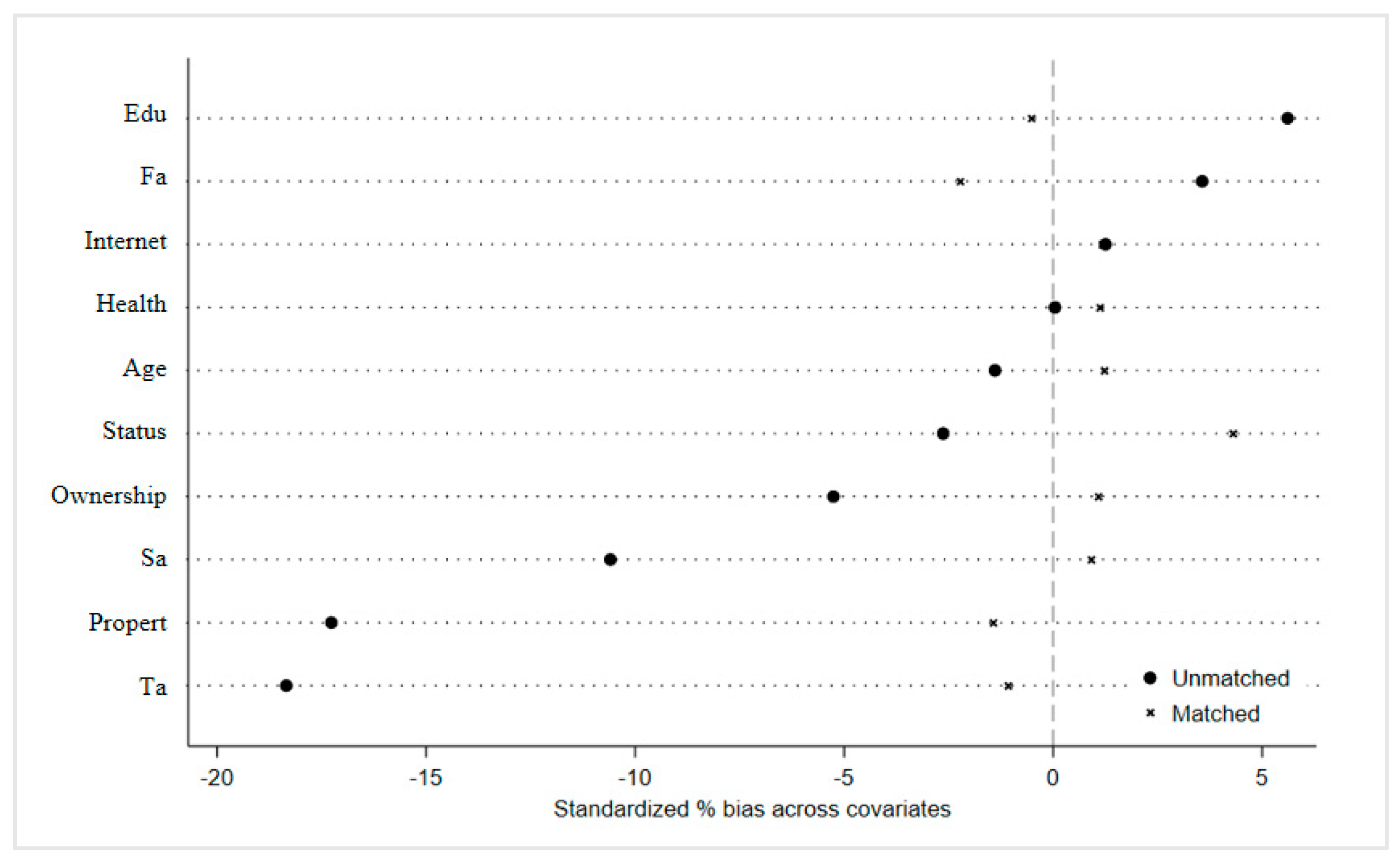
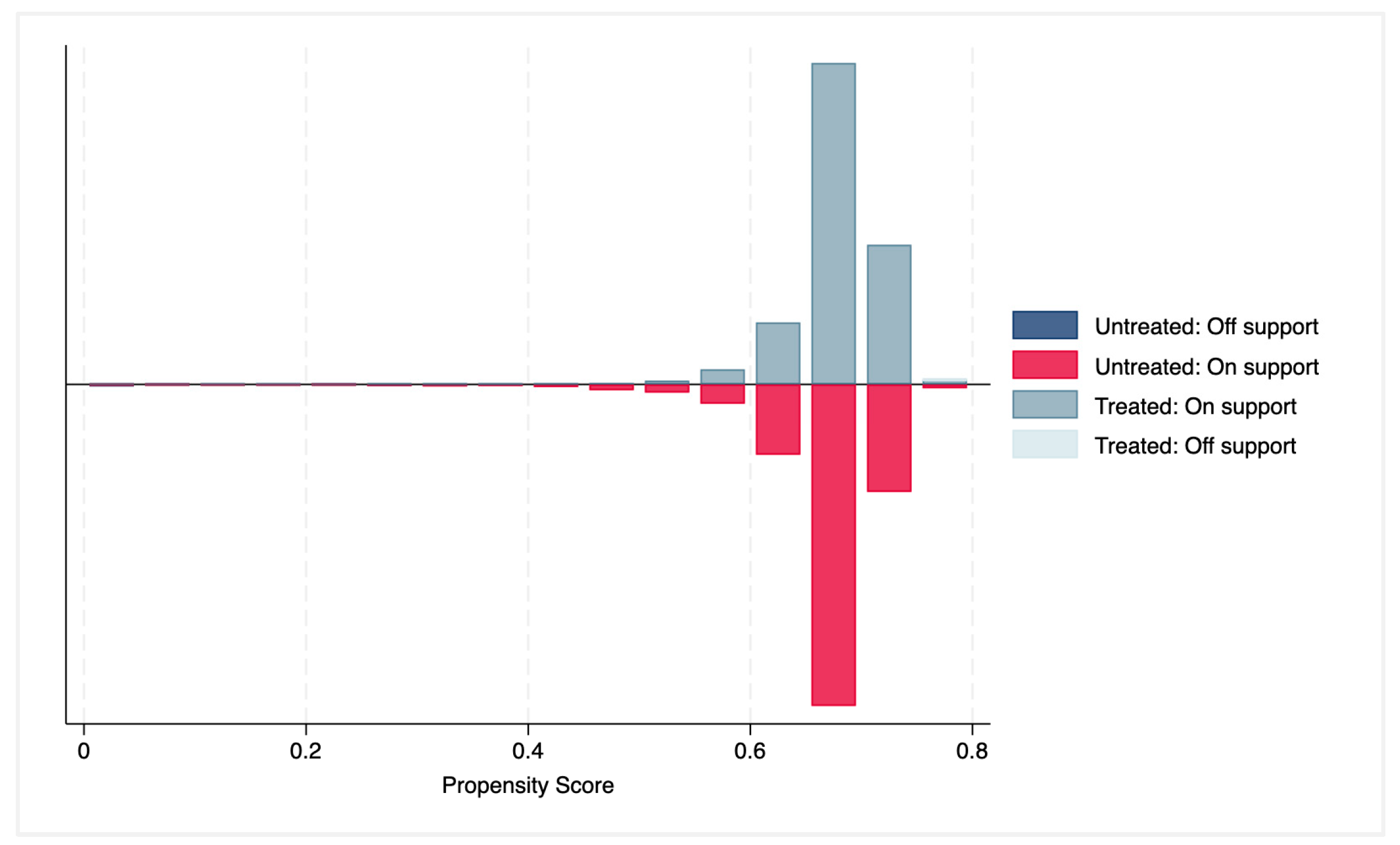
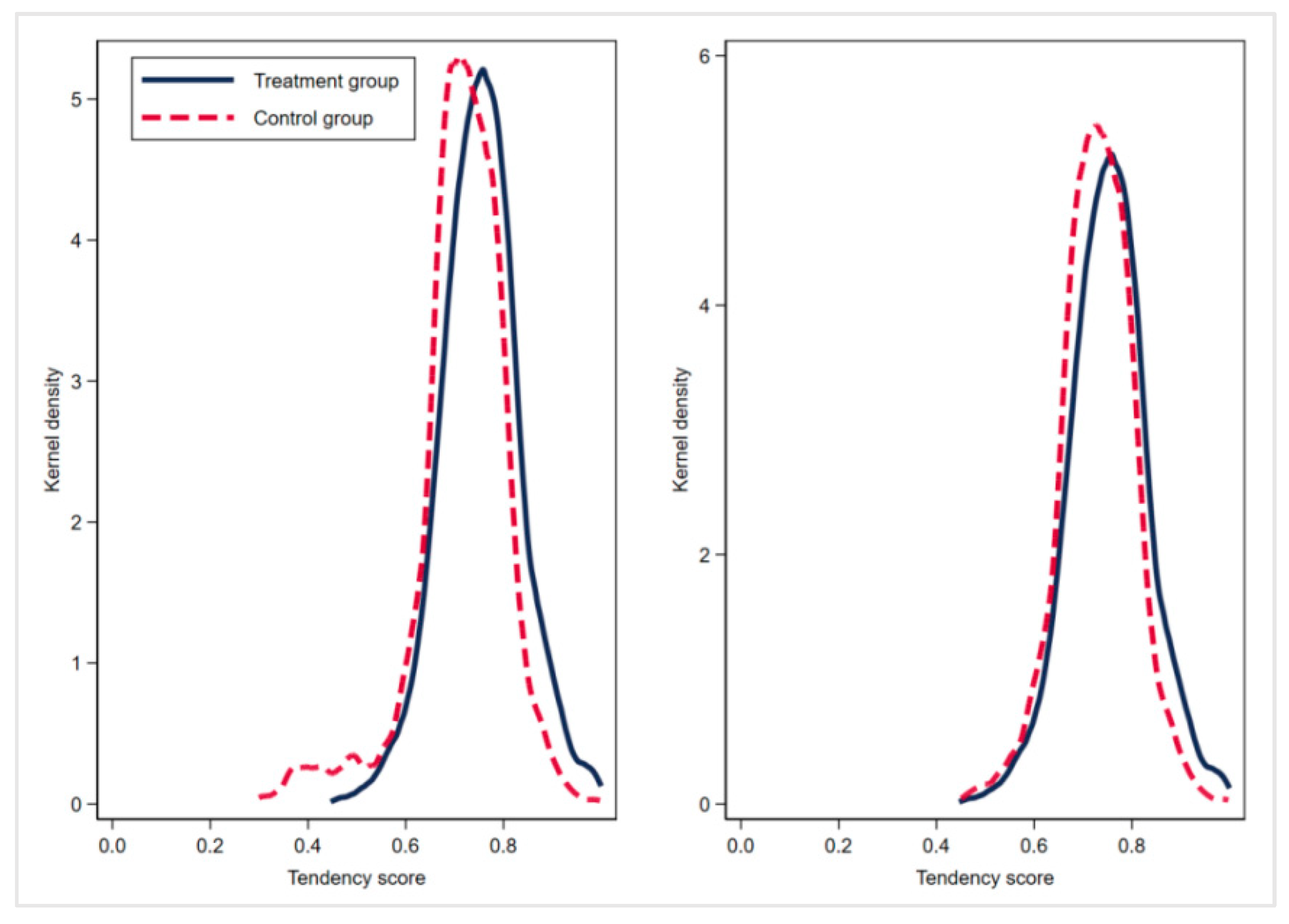
The robustness of the conclusions in Table 4 is further supported by visual evidence of the PSM effectiveness. Figure 2 shows that before matching (Unmatched), the biases of the various covariates are mostly distributed to the left of 0. After matching (Matched), the scatter points converge significantly towards 0, indicating that PSM effectively reduces the differences in observable characteristics between the treatment and control groups, thereby mitigating sample selection bias. Figure 3 indicates that after matching, there are sufficient samples within the common support region for both the treatment and control groups, meeting the balancing condition for PSM. Figure 4 further validates the matching effectiveness: in the left sub-figure, the propensity scores for the treatment and control groups peak in the 0.7–0.8 range, with the treatment group’s peak slightly higher and a small distribution in the left tail. In the right sub-figure, the distribution shapes of the two groups are more similar, with consistent peak ranges. The overall distribution is more concentrated with thinner tails, indicating that after matching, the covariate characteristics of the two groups are highly balanced, and PSM effectively isolates interference from non-policy factors.
In summary, after controlling for endogeneity using the PSM-DID model, the benchmark regression results remain valid. Moreover, the significance levels and the absolute values of the coefficients have increased. The matching process effectively achieved a characteristic balance between the treatment and control groups, providing solid evidence for the robustness of the benchmark regression conclusions. This indicates that the policy’s optimizing effect on income distribution is not driven by sample selection bias but represents a genuine causal effect.

4.2.2. Entropy Balancing Method

Entropy balancing was further employed to address potential endogeneity issues. In the regression results presented in Table 5, the core explanatory variable DID exhibits a significant negative impact in both the ORD model (Column 1) and the RRD model (Column 3). Specifically, the estimated coefficient for DID in Column (1) is −0.80 and is significant at the p < 0.1 level. In Column (3), the estimated coefficient is −0.79, also meeting the significance requirement of p < 0.1. This result indicates that the policy shock has a statistically significant inhibitory effect on both ORD and RRD, suggesting that the levels of the dependent variables decreased after policy implementation.
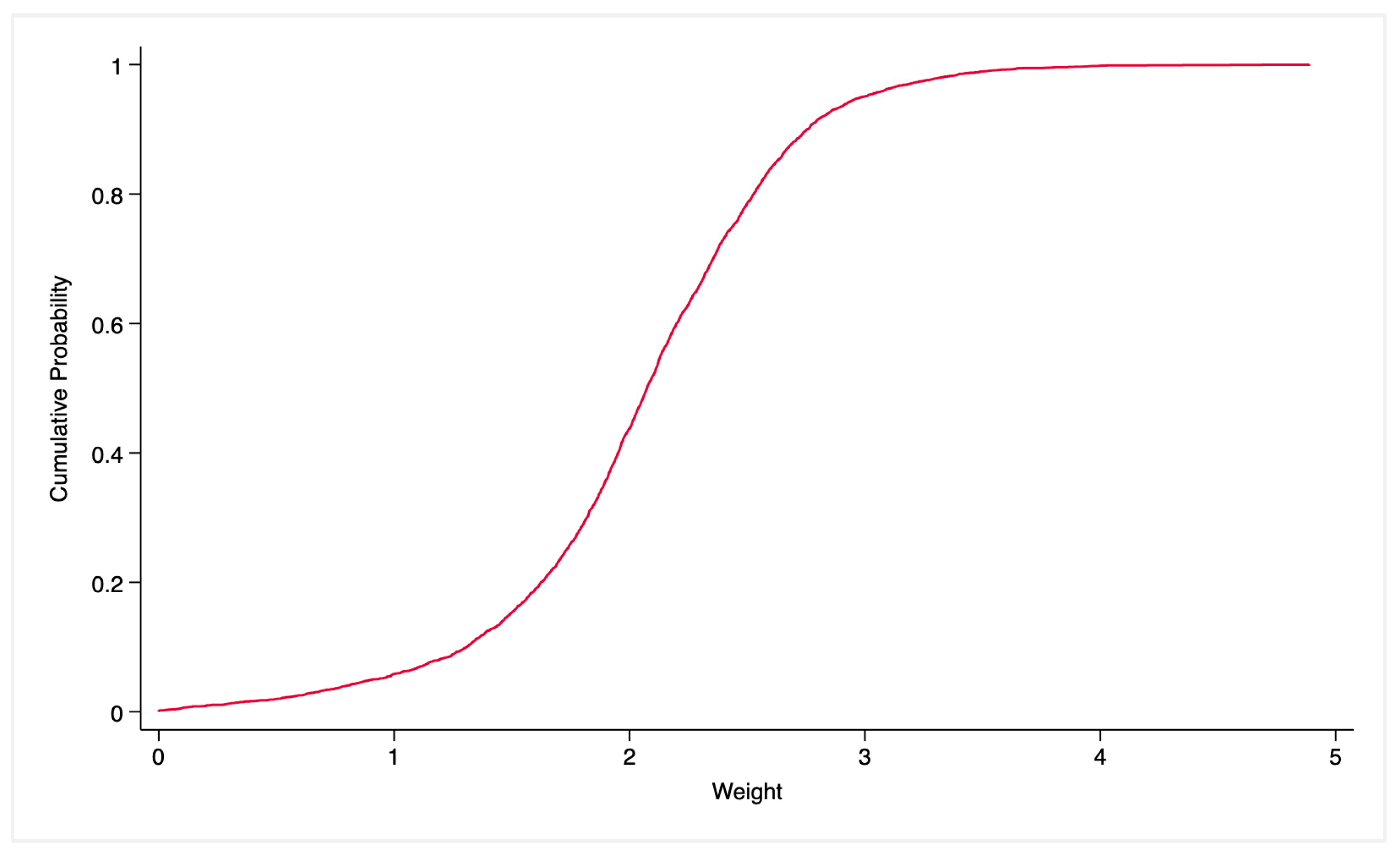
Furthermore, the validation of the entropy balancing effect is supported by the Cumulative Distribution Function (CDF) plot in Figure 5. The cumulative probability curve under the weight distribution is smooth and continuous, with no significant abnormal fluctuations. This indicates that after entropy-balancing treatment, the distribution of covariates between the treatment and control groups shows good convergence, substantially reducing estimation bias caused by imbalance in covariate distributions and providing additional support for the robustness of the DID coefficient. In summary, whether judged by coefficient significance, model endogeneity control, or the entropy-balancing distribution test, the negative impact of the policy shock (DID) on the dependent variables demonstrates strong explanatory power both statistically and economically.

4.3. Robustness Checks

4.3.1. Parallel Trends Test

The results of the parallel trends test (Table 6) show the following characteristics regarding the dynamic effects of the core explanatory variable DID when ORD and RRD are used as dependent variables: Before the implementation of the poverty alleviation policy, the coefficient for the current period is statistically insignificant. This indicates that, prior to the policy implementation, there was no significant difference in the changing trends of household wealth deprivation between poor and non-poor households. As the policy progressed, the coefficients for the last_2 and last_4 periods are both negative and statistically significant. This suggests that after the implementation of the Targeted Poverty Alleviation policy, the wealth deprivation status of poor households improved significantly compared to non-poor households.
Furthermore, in the ORD dimension, comparing the absolute values of the coefficients for last_2 and last_4 reveals that the absolute value of the latter is larger, and its significance level is also higher. This indicates that the inhibitory effect of the Targeted Poverty Alleviation policy on the relative deprivation of wealth among urban and rural poor households gradually strengthened as the policy continued. This result not only demonstrates the deepening of the policy effect over time but also reflects that the positive impact of targeted poverty alleviation on narrowing the social wealth gap between urban and rural areas and on improving household economic status is continually being reinforced.

4.3.2. Placebo Test

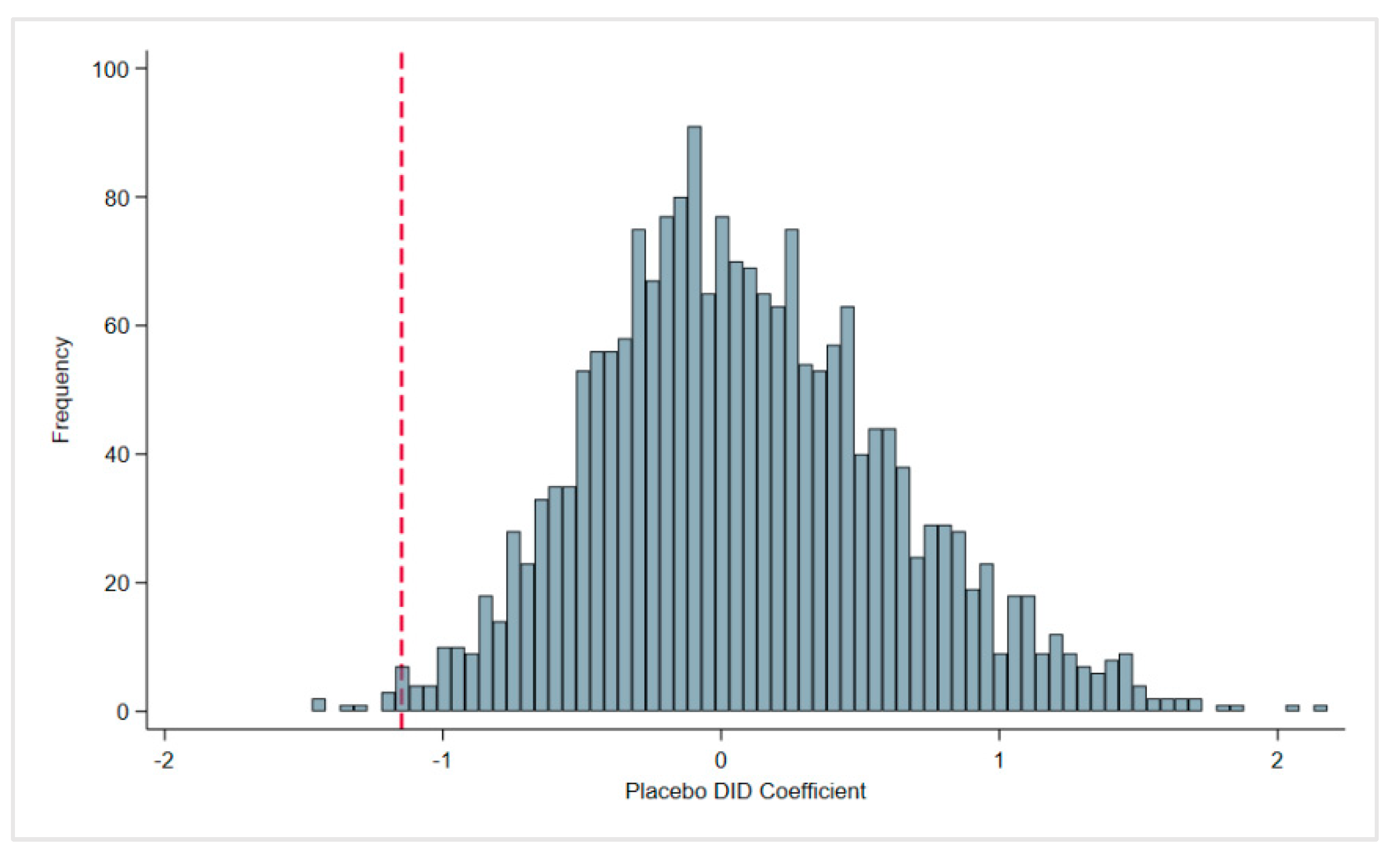
To further confirm that the benchmark regression results are not driven by random chance, this study conducted a placebo test. As a core component of robustness checks for the Difference-in-Differences (DID) model, the placebo test operates on the core logic of randomly generating a “virtual treatment group” to simulate a scenario without a genuine policy intervention. Repeatedly estimating the treatment effect under this simulation helps determine whether the observed real policy effect is driven by random factors.
As shown in Figure 6, the horizontal axis represents the treatment effect coefficients obtained from placebo simulations, and the vertical axis represents the frequency of occurrence for each coefficient. The red-dashed line indicates the position of the coefficient in the actual policy treatment. The figure shows that the frequency distribution of the simulated coefficients exhibits a significant “central clustering” feature, with most coefficients densely distributed around zero. In contrast, the red dashed line corresponding to the real policy coefficient clearly deviates from this dense cluster. This distribution pattern visually indicates that under the simulated scenario with randomly assigned virtual treatment groups, the simulated treatment effects are almost entirely statistically insignificant. Only when a genuine policy intervention exists does an effect of distinctly different magnitude emerge, compared to effects driven by random noise.
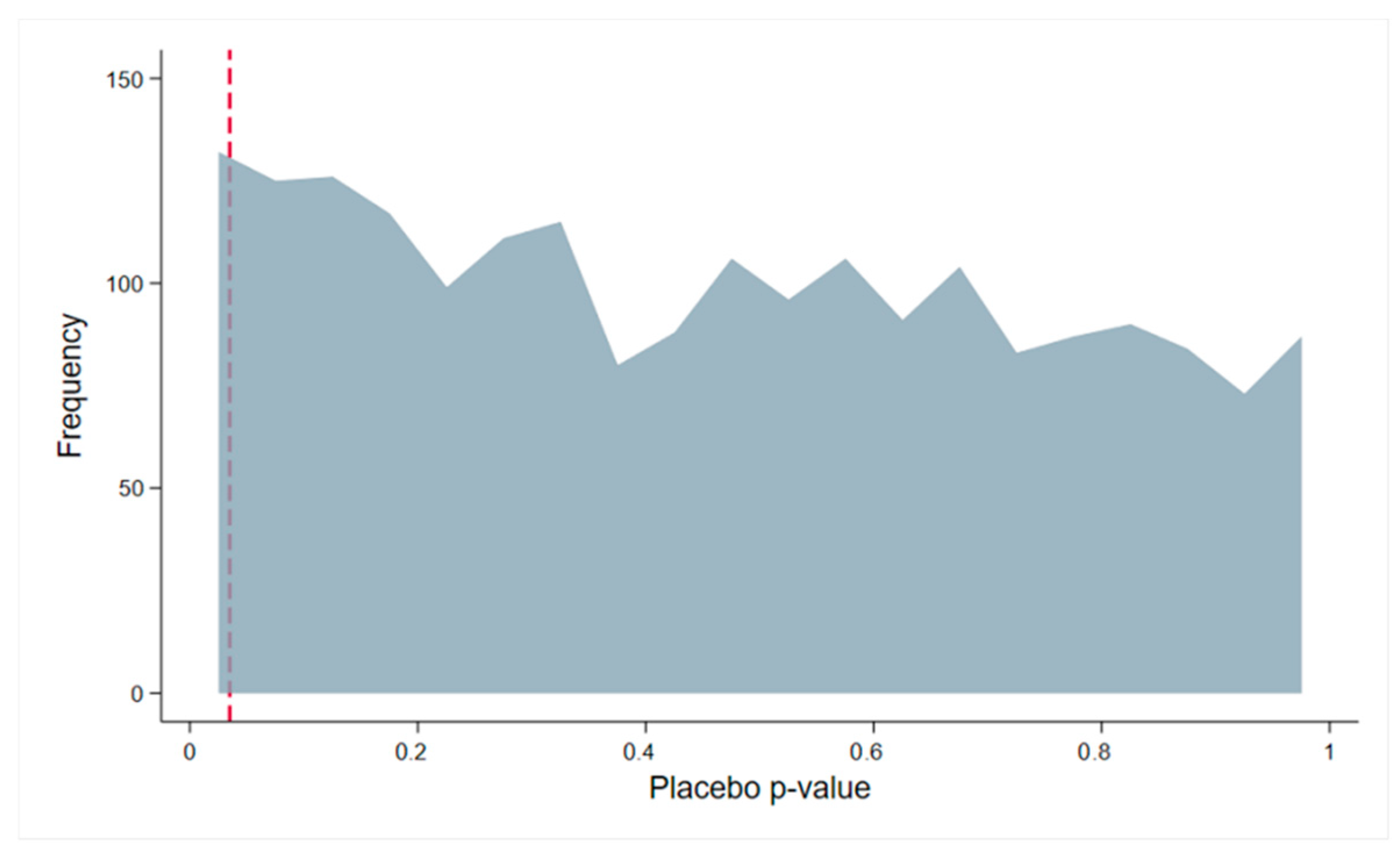
In Figure 7, the horizontal axis represents p-values, and the vertical axis represents their corresponding frequency of occurrence. The theoretical expectation for the distribution pattern under the placebo test logic is that p-values should approximately follow a uniform distribution. The distribution of p-values in this figure helps assess the validity of the simulation procedure. Simultaneously, if the p-value corresponding to the real policy treatment indicates significance and forms a stark contrast with the overall uniform distribution characteristic of p-values from the placebo simulations, it further strengthens the conclusion that the “real policy effect possesses statistical significance and is not caused by random fluctuations.”
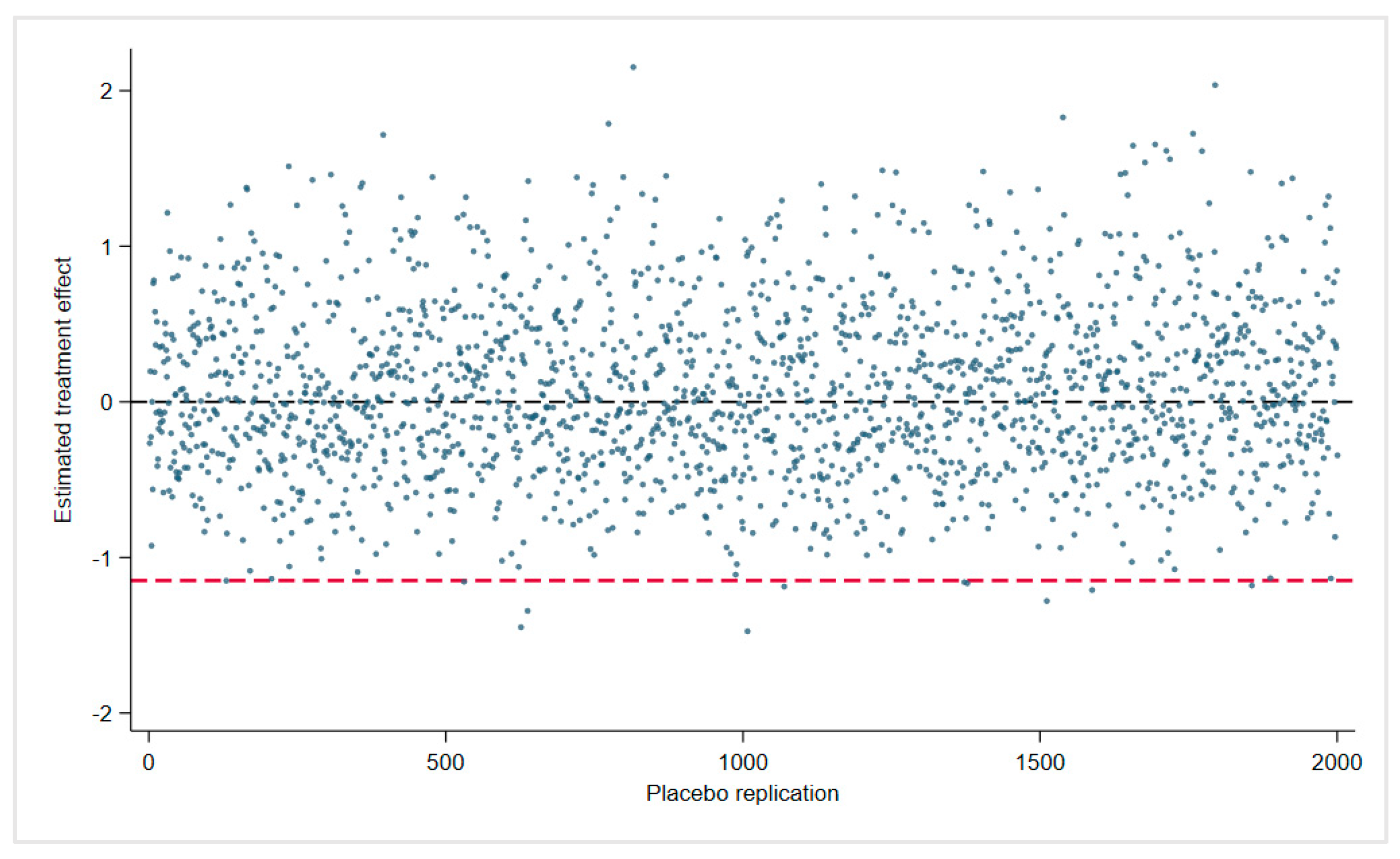
Focusing on Figure 8, the horizontal axis represents the number of placebo simulation repetitions, and the vertical axis represents the estimated treatment effect from a single simulation. The red dashed line still corresponds to the treatment coefficient of the real policy. The vast majority of simulated points in the figure show estimated treatment effects with a “discrete” distribution pattern, highly concentrated near zero. Only a very few simulated points approach the location of the real policy coefficient. The key information conveyed by this distribution pattern is that if the policy effect stems from random noise, the “simulated estimates” should converge closely to the real coefficient. However, the widespread dispersion of the actual points precisely provides counter-evidence that the real policy effect does not belong to the realm of chance under random simulation.
In summary, the three placebo test results collectively validate, across three progressive dimensions—“the central clustering of simulated coefficients,” “the conformity of p-values to their theoretical distribution,” and “the dispersion degree of simulated effects”—that the real policy effect is both statistically significant and non-random. That is, the observed policy impact in the study is not a product of confounding factors or random errors, but rather a genuine causal effect triggered by policy intervention within the economic system. This provides solid robustness support for the core conclusions of the DID model.

4.3.3. Other Robustness Tests

In Columns (1) and (2) of Table 7, we added one to the continuous control variables and then took the natural logarithm. The results remain robust, with the direction and significance of the effects consistent with the benchmark regression and expectations. In Columns (3) and (4), the timing of the policy shock was altered to 2014. As anticipated, the adjusted core explanatory variable becomes statistically insignificant.

5. Mechanism Analysis

5.1. Improving the Income Level of Poor Households

Table 8 presents the test results for the mediating effect of the Targeted Poverty Alleviation policy on the income level of poor households, where Income is the natural logarithm of poor household income. Regarding the direct effect, the regression coefficient of DID in Column (1) is 0.07, indicating that the Targeted Poverty Alleviation policy has a significant direct positive effect on the income of poor households. In Column (2), the regression coefficient of Income on ORD (urban–rural income gap) is −4.12, suggesting that a higher income level among poor households leads to a more balanced income distribution between urban and rural areas. In Column (3), the regression coefficient of Income on RRD (within-rural income gap) is −4.53, indicating that an increase in poor household income can effectively reduce income inequality within rural areas. This finding aligns with the theoretical expectation that “income growth promotes equity” and confirms Hypothesis 2: an increase in income levels not only directly enhances household welfare but also optimizes the distribution structure through the mechanism of “diluting disparities,” thereby providing evidence for the synergistic poverty reduction effects of the Targeted Poverty Alleviation policy.

5.2. Enhancing the Level of Diversified Operations in Rural Areas

Based on the mediating effect test results in Table 9, the mechanism by which the Targeted Poverty Alleviation policy affects income disparity through enhancing the level of diversified operations in rural areas is validated. Firstly, in the regression where the proxy variable for the level of diversified operations, NAE, serves as the core explanatory variable (Column (1)), the estimated coefficient for the policy dummy variable (DID) is 0.83 and statistically significant. This indicates that the Targeted Poverty Alleviation policy can significantly promote farmers’ participation in non-agricultural economic activities, thereby effectively enhancing the level of diversified operations in rural areas.
Secondly, after incorporating the mediating variable NAE, the direct impact of the policy on ORD (Column (2)) and RRD (Column (3)) was examined. The estimated coefficients for DID are −0.95 and −1.18, respectively, both significant at the 5% statistical level. This demonstrates that the policy has a direct inhibitory effect on both the urban–rural income gap and the within-rural income gap. Meanwhile, the estimated coefficients for the mediating variable NAE are −6.62 and −6.52 in the two columns, both significant at the 1% statistical level. This implies that an increase in the level of diversified operations can significantly narrow both the urban–rural and within-rural income gaps.
Furthermore, by comparing the changes in the DID coefficients from Column (1) to Columns (2) and (3), it can be inferred that part of the inhibitory effect of the Targeted Poverty Alleviation policy on income disparity is realized by raising the level of diversified rural operations. In other words, the level of diversified operations partially mediates the process through which the policy influences income disparity. In summary, Hypothesis 3 is thus validated. The enhancement of diversified livelihood operations in rural areas constitutes a significant transmission pathway through which the Targeted Poverty Alleviation policy improves the income distribution structure.

5.3. Bridging the Urban–Rural Knowledge and Information Gap

Furthermore, this study divides the sample into an internet-access group and a non-internet-access group based on survey responses regarding internet usage. The subgroup regression results (in Table 10) indicate that the Targeted Poverty Alleviation policy bridges the knowledge and information gap, thereby reducing both urban–rural and within-rural income disparities. Regarding the urban–rural income gap dimension, the coefficient for the policy variable (DID) in the non-internet-access sample (Column (1)) is −0.89 and statistically insignificant. In contrast, the DID coefficient of the internet-access sample (Column (2)) is −1.27 and significant at the 5% level. For the within-rural income gap dimension, the DID coefficient of the non-internet-access sample (Column (3)) is −1.13 and insignificant, while the coefficient of the internet-access sample (Column (4)) is −1.51 and significant at the 5% level.
These results confirm Hypothesis 4, suggesting that the policy exerts a stronger mitigating effect on the urban–rural income gap for the population with internet access. This difference suggests that the infrastructure development brought by the Targeted Poverty Alleviation policy has made internet access more prevalent in impoverished rural areas. The resulting advantage in accessing knowledge and information enables the policy to more effectively bridge the development opportunity and income gaps between urban and rural areas through these channels. Within rural communities, groups with the ability to access online information are more likely to benefit from the policy’s redistribution of resources, leading to more effective intervention in income disparities.

6. Heterogeneity Analysis

6.1. Grouping by Whether the Province Is a Major Grain-Producing Area

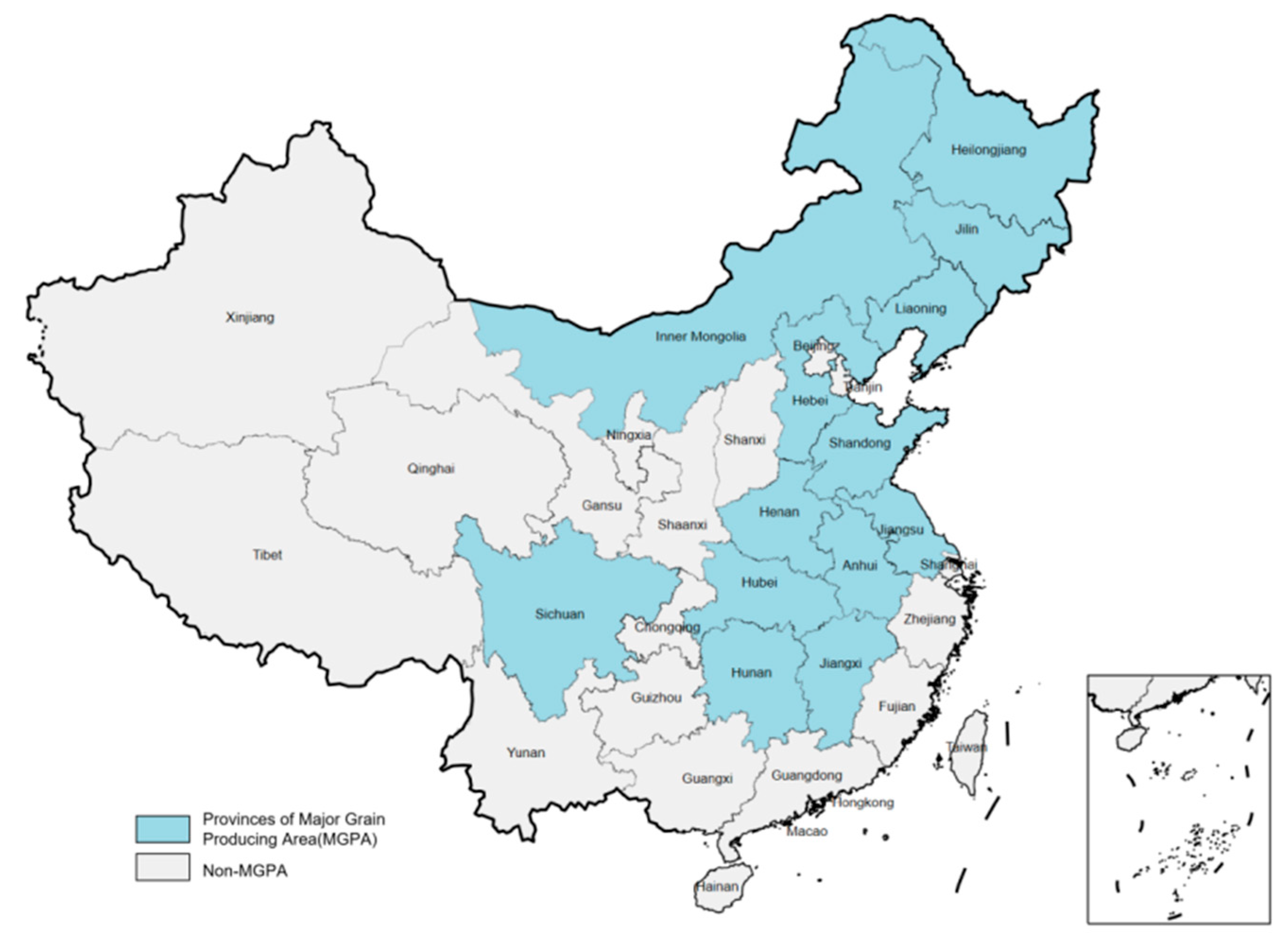
This study examines the differential impact of the Targeted Poverty Alleviation policy on income disparities by distinguishing between major grain-producing and non-major grain-producing areas (the scope of China’s major grain-producing areas is shown in Figure 9). Table 11 shows significant heterogeneity in the effects of the Targeted Poverty Alleviation policy on ORD and RRD across regions, depending on whether a region is a major grain-producing area. Specifically, in non-major grain-producing areas, the coefficient for the policy variable (DID) on ORD is significantly negative at the 10% level, and its coefficient on RRD is significantly negative at the 5% level. This indicates that the policy significantly narrowed both the urban–rural and within-rural income gaps in these regions. Conversely, in major grain-producing areas, the coefficient for the policy variable on RRD is significantly negative at the 5% level, suggesting the policy significantly reduced the within-rural income gap, but had no significant moderating effect on the urban–rural income gap.
These results indicate that the Targeted Poverty Alleviation policy’s disparity-reducing effect differs across the two types of regions. Its effect on reducing within-rural disparities is universal, while its mitigating effect on the urban–rural gap is concentrated in non-major-producing areas. Considering regional characteristics, this heterogeneity may stem from differences in the effectiveness of stimulating diversified rural operations—a key mechanism. Non-major grain-producing areas typically have more active non-agricultural industries. In these areas, the policy can more effectively raise rural residents’ income through diversified industrial support and employment assistance, thereby simultaneously narrowing both urban–rural and within-rural gaps. In contrast, major grain-producing areas have grain production as their core function. The relative singularity of industries leads to slightly lower elasticity in farmers’ income growth, and restricted urban–rural factor flows may prevent the policy’s moderating effect on the urban–rural gap from being fully realized. Nonetheless, within rural areas of these regions, the policy still improved income distribution through industrial upgrading and subsidies. In major grain-producing areas, local governments often encourage agricultural stakeholders to cultivate staple crops through measures such as subsidies, tax incentives, and the conferral of elevated social status. Some local officials also persuade farming households to prioritize grain cultivation, which, to some extent, impedes the adoption of diversified livelihood strategies by local farmers.
Therefore, in major grain-producing areas, efforts should focus on reasonably expanding the downstream industries of staple grains to ensure national food security, thereby increasing diversified operations without compromising food safety. Strengthening policies that promote urban–rural integration to activate factor flows and targeting value-added segments of the grain industry chain to broaden farmers’ income channels are essential to balance food security with the optimization of income distribution.

6.2. Grouping by Provincial GDP per Capita

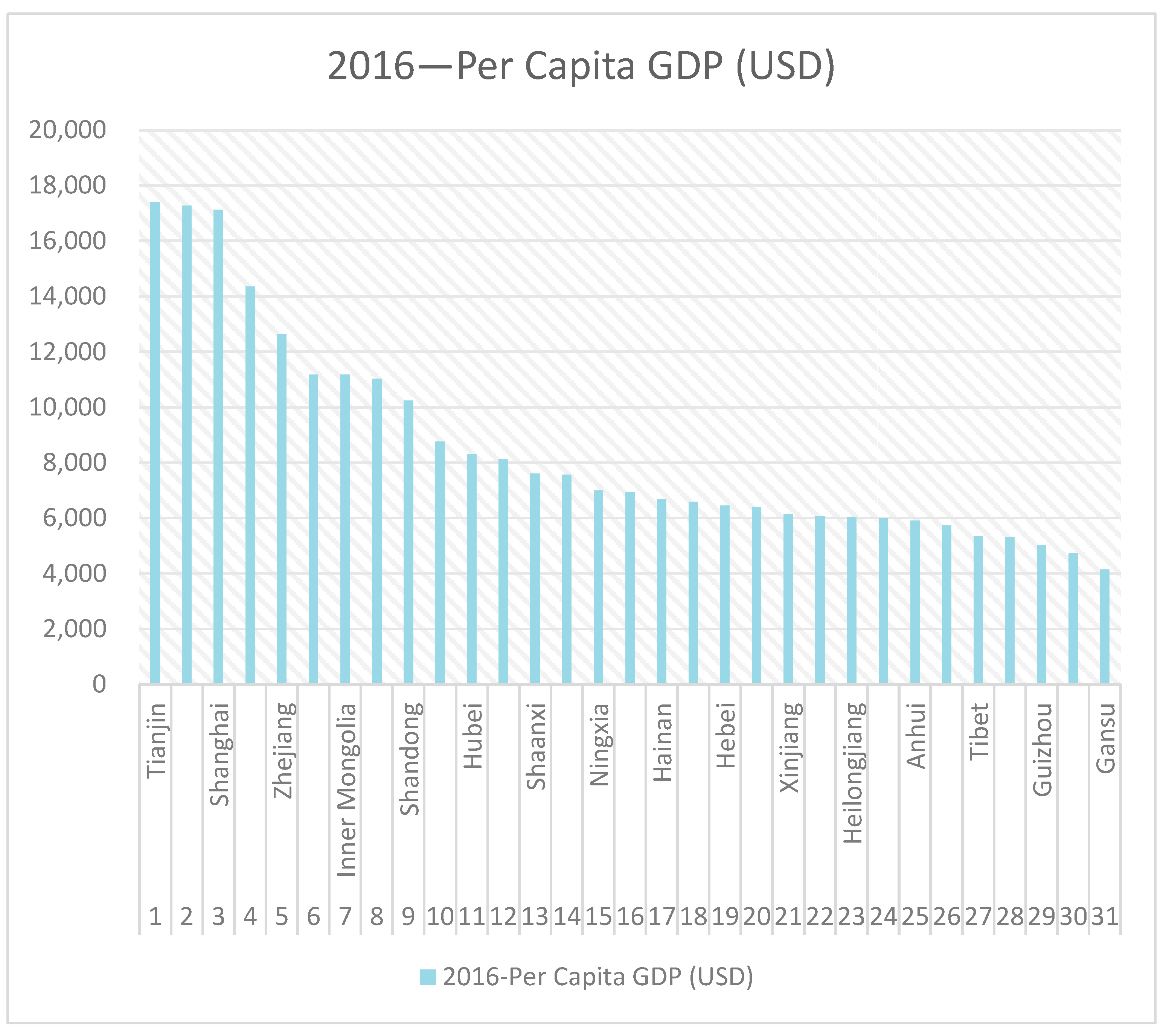
Based on the 2016 GDP levels of each province (see Figure 10), the sample provinces were divided into high, medium, and low groups according to their GDP per capita to investigate the heterogeneous impact of the Targeted Poverty Alleviation policy on the urban–rural income gap (ORD) and the within-rural income gap (RRD). The regression results are presented in Table 12. Herein, highly developed provinces are defined as having a GDP per capita greater than 68,000 RMB (10,237.72 USD), medium-developed provinces between 40,000 and 68,000 RMB (6022.04 USD to 10,237.72 USD), and less-developed provinces below 40,000 RMB.
From the perspective of the urban–rural income gap (ORD), only the low-GDP-per-capita group (Column (3)) shows a significant DID coefficient of −1.63, which is statistically significant at the 5% level. This indicates that the Targeted Poverty Alleviation policy significantly narrowed the urban–rural income gap in provinces with relatively low GDP per capita.
Regarding the within-rural income gap (RRD), the medium GDP per capita group (Column (5)) shows a DID coefficient of −1.39, significant at the 5% level. Meanwhile, the low-GDP-per-capita group (Column (6)) shows a DID coefficient of −2.11, significant at the 1% level. It is evident that the policy significantly inhibited the within-rural income gap in both medium- and low-GDP-per-capita provinces, with a stronger effect observed in the lower-income provinces.
In summary, the regulatory effect of the Targeted Poverty Alleviation policy on income disparities exhibits distinct regional heterogeneity. The policy’s effect on narrowing the “urban–rural income gap” and suppressing the “within-rural income gap” is simultaneously significant only in provinces with relatively low GDP per capita. Furthermore, the policy’s strength in regulating the within-rural income gap intensifies as the provincial GDP per capita decreases.

6.3. Grouping by Net Housing Asset Scale

During the period from 2014 to 2020 covered in this study, China remained in a phase of rising housing prices. Could differences among rural residents in terms of homeownership and the scale of their housing assets also influence the effectiveness of the policy? To investigate this, a heterogeneity test was designed by dividing the samples into high, medium and low housing asset groups. As shown in Table 13, the impact of the core explanatory variable DID varies significantly across groups with different housing asset scales.
Regarding the ORD indicator, the DID coefficient for the medium housing asset group is −1.54 and significant at the 10% level, indicating that households with intermediate levels of housing assets are more susceptible to the policy shock. For the RRD indicator, the DID coefficient for the medium housing asset group reaches −2.02 and is significant at the 1% level. Not only is the absolute value of this coefficient larger than that of the other two groups, but its statistical significance is also stronger, further supporting the moderating role of housing asset stratification on the policy effect.
The ancient Chinese proverb, “Only with constant property can one have a steadfast heart,” sheds light on these findings. The medium housing asset group possesses the stable expectations conferred by property ownership, yet avoids the predicament of diminishing marginal utility associated with excessive accumulation. For this group, housing as “constant property” retains greater elasticity in both its resource attributes and social functions. In contrast, for the high-housing-asset group, the marginal utility of property declines as holdings increase. Meanwhile, the low-housing-asset group focuses more on meeting basic housing needs or is in the early stages of asset accumulation, with survival and development priorities elsewhere.

6.4. Grouping by Different Educational Attainment Levels

The subgroup regression results based on completion of compulsory education (Table 14) reveal significant educational stratification in the effect of the Targeted Poverty Alleviation policy (DID) on the urban–rural income gap (ORD) and the within-rural income gap (RRD). All models controlled for individual characteristics as well as county and year fixed effects to ensure the robustness of the estimated values.
Regarding the urban–rural income gap (ORD), the DID coefficient for the group that completed compulsory education (Column (2)) is −1.06, showing a stronger negative regulatory effect that is statistically significant compared to the group that did not complete it. This suggests that higher educational attainment enhances the group’s responsiveness to policies such as employment support and industrial poverty alleviation, narrowing urban–rural income polarization through better job matching and skill transformation.
For the within-rural income gap (RRD), the DID coefficient for the education-completed group (Column (4)) reaches −1.61 and is statistically significant. Education enables the rural poor to achieve a more balanced income distribution in terms of resource access and occupational differentiation, highlighting the policy’s targeted effectiveness in reducing poverty and narrowing disparities.
Overall, the regulatory effectiveness of the policy on income disparities strengthens with higher educational attainment. The magnitude of improvement in the within-rural gap (1.61) is greater than that for the urban–rural gap (1.06), reflecting higher policy implementation efficiency within county-level rural settings. In contrast, cross-regional urban–rural distribution adjustments are constrained by deeper structural factors, such as the household registration system and lagging equalization of public services, which lengthen the policy transmission cycle. This heterogeneity confirms the critical role of human capital accumulation in converting policy dividends into tangible benefits, providing empirical evidence for optimizing the inclusiveness and equity of the Targeted Poverty Alleviation policy.

6.5. Grouping by Different Age Cohorts

A subgroup regression analysis was conducted based on age, categorizing the sample into a Young group (under 40 years old), a Middle-aged group (40 to 60 years old), and an Older group (over 60 years old). Judging from the coefficients and significance of the core variable DID in Table 15, in the Young group (Columns (1) and (4)), the effect of DID on both ORD and RRD was not statistically significant. In the Middle-aged group (Columns (2) and (5)), DID showed a significant negative effect only on RRD. Conversely, in the Older group (Columns (3) and (6)), the negative effects of DID on both ORD and RRD were significant at the 5% level, with a stronger impact on RRD than on ORD.
In terms of heterogeneity across groups, the policy effect was statistically significant only among the older population, with no significant response observed in the young and middle-aged groups. This reflects a differentiated pattern of policy impact under “age stratification,” indicating higher policy sensitivity among older individuals. Overall, the Targeted Poverty Alleviation policy had a significant negative effect on both ORD and RRD for the Older group. However, its impact on the Young and Middle-aged groups was not statistically significant.
The heterogeneity in policy effects across age groups among the rural poor stems from the interaction between policy logic and group characteristics. The most immediate policy impacts are often concentrated in social safety net programs, such as pensions, healthcare, and subsistence allowances, which more directly affect the older, impoverished population and better support their basic survival needs. In contrast, poverty alleviation measures targeting the young and middle-aged, such as entrepreneurship and industry support, require a longer timeframe to yield substantial effects.

6.6. Grouping by Household per Capita Income

The subgroup regression results in Table 16, based on a heterogeneity test that divides the sample into low, medium, and high capita income groups, indicate significant stratified differences in the policy effect of the core explanatory variable across income levels. In the low-income group (Columns (1) and (4)), the DID coefficient is −1.85 and is statistically significant at the 1% level. This signifies a strong negative impact of the policy intervention targeted at the low-income population. In contrast, for the medium-income (Columns (2) and (5)) and high-income groups (Columns (3) and (6)), the estimated coefficients for DID are −0.41 and −0.15, respectively, neither of which passed conventional significance tests. This suggests that the policy shock did not exhibit a statistically consistent effect among middle- and high-income groups.
These results demonstrate that the effectiveness of the policy instrument is not uniformly distributed across income strata. The low income group’s heightened sensitivity to the policy makes it the primary recipient of its effects. In contrast, the middle and high income groups exhibit a weaker, statistically insignificant response.

6.7. Grouping by Gender

Table 17 presents the regression results grouped by gender. Regarding the within-rural income gap (RRD), the policy significantly reduced the mean RRD for males by 0.86 units and for females by 1.56 units. The policy effect for females was 1.81 times that for males, with higher statistical significance, indicating a stronger effect of the policy in reducing within-village income inequality for the female group.
In the dimension of the urban–rural income gap (ORD), the policy significantly reduced the mean ORD for males by 1.21 units and for females by 2.11 units. The policy effect for females was 1.74 times that for males, with a better significance level, reflecting that the policy’s role in mitigating urban–rural income disparity was more pronounced and precise for the female group.

6.8. Grouping by Household Size

The sample households were categorized into three groups based on household size, from large to small (see Table 18). Regarding the urban–rural income gap dimension, none of the coefficients were statistically significant. This suggests that across groups with different urban–rural income gaps, the Targeted Poverty Alleviation policy did not have a statistically significant differential impact by household size.
However, in the within-rural income gap dimension, the coefficients for the medium- and large-household-size samples are negative and significant at the 10% level. Furthermore, the absolute value of the coefficient increases with larger household size. This indicates that, with respect to the reduction in the within-rural income gap, larger household size is associated with a more pronounced effect of the Targeted Poverty Alleviation policy.

7. Conclusions and Policy Recommendations

This study finds that the Targeted Poverty Alleviation policy, while eradicating absolute poverty and significantly increasing rural residents’ incomes, has also played a positive role in curbing income disparities within and between rural and urban areas. This is achieved through key mechanisms such as enhancing the level of diversified operations, improving the incomes of poor households, and bridging the knowledge and information gap. The research further reveals that the policy’s disparity-reducing effect shows differentiated performance across regions and demographic groups, particularly in non-major grain-producing areas, low-income provinces, and among specific vulnerable groups such as the elderly, low-income individuals, and women. This indicates that the Targeted Poverty Alleviation policy has not only achieved its core objectives but has also laid an important foundation for alleviating multidimensional income inequality.
Based on the findings of this study, future policies should prioritize the formulation of a targeted policy framework aimed at mitigating multidimensional inequalities, establishing a long-term mechanism characterized by categorized and precise interventions.
At the regional level, differentiated strategies should be implemented as follows:
In major grain-producing areas, while ensuring national food security, policies should focus on extending the industrial chain and reforming factor markets. This can be achieved by developing deep processing of agricultural products, strengthening compensation mechanisms for major grain-producing counties, and promoting the two-way flow of urban–rural factors such as land and capital. These measures aim to overcome the constraints imposed by industrial singularity on income growth and unleash the potential for regulating the urban–rural income gap. For non-major grain-producing areas and provinces with lower GDP per capita, given the policy’s significant inhibitory effect on both urban–rural and within-rural disparities, efforts should continue to deepen industrial diversification and employment promotion. Key focuses include cultivating distinctive industrial clusters, enhancing cross-regional labor cooperation and skills training, and establishing a dynamic monitoring system for return-to-poverty risks to consolidate poverty alleviation achievements.
At the group level, a refined support framework must be designed as follows:
For groups highly responsive to the policy, such as the elderly, women, individuals with low educational attainment, and low-income households, a dual-driven approach that strengthens social safety nets and human capital investment is essential. This includes improving social security benefits in rural areas (e.g., pensions, medical insurance), implementing gender-sensitive vocational skills training and entrepreneurship support, and ensuring educational opportunities for left-behind children to break the intergenerational transmission of poverty. For middle-aged and young individuals, households with medium housing assets, and middle-income groups, the policy focus should shift towards capacity building and opportunity creation. This can be achieved by providing entrepreneurship guarantee loans, tax incentives, and digital skills training to support their participation in new business formats such as rural e-commerce and courtyard economy, thereby enhancing their endogenous development capacity. Mechanistically, it is recommended to leverage new technologies to construct a dynamic monitoring platform for the low-income population, integrating multidimensional information on income, assets, education, and health. This would enable precise, full-process management from identification to assistance, promoting the organic integration of poverty reduction strategies with rural revitalization and common prosperity policies.

Author Contributions

Conceptualization, X.S. and S.G.; methodology, X.S.; software, X.S.; validation, X.S., L.Y. and D.H.; formal analysis, S.G.; investigation, S.G.; resources, X.S.; data curation, X.S.; writing—original draft preparation, S.G.; writing—review and editing, D.H.; visualization, D.H.; supervision, L.Y.; project administration, L.Y.; funding acquisition, L.Y. All authors have read and agreed to the published version of the manuscript.

Funding

This research was funded by the Sichuan Province Philosophy and Social Sciences 14th Five-Year Plan 2025 Project (grant number SC25TJ015), the Sichuan Provincial Bureau of Statistics 2025 Statistical Science Research Program Project (grant number 2025SC14), and the 2025 First Cohort of Talent Recruitment Research Projects at Sichuan University of Science & Engineering (grant number RCS2025021). The APC was also funded by the same funders.

Institutional Review Board Statement

Not applicable.

Informed Consent Statement

Not applicable.

Data Availability Statement

The data used in this article is sourced from the China Family Panel Studies Database of Peking University. https://cfpsdata.pku.edu.cn/, accessed on 27 March 2026.

Conflicts of Interest

The authors declare no conflict of interest.

References

  1. Akca, H., Sayili, M., & Esengun, K. (2007). Challenge of rural people to reduce digital divide in the globalized world: Theory and practice. Government Information Quarterly, 24(2), 404–413. [Google Scholar] [CrossRef]
  2. Banerjee, A. V., & Duflo, E. (2011). Poor economics: A radical rethinking of the way to fight global poverty. PublicAffairs. [Google Scholar]
  3. Castle, E. N., Wu, J., & Weber, B. A. (2011). Place orientation and rural–Urban interdependence. Applied Economic Perspectives and Policy, 33(2), 179–204. [Google Scholar] [CrossRef]
  4. Chai, W., Zhao, Z., & Xia, F. (2025). The relationship between poverty-stricken counties, personal income, and industrial economy: An empirical study based on China’s targeted poverty alleviation policy. Sustainable Futures, 10, 101517. [Google Scholar] [CrossRef]
  5. Chen, J., Wang, Y., Wen, J., Fang, F., & Song, M. (2016). The influences of aging population and economic growth on Chinese rural poverty. Journal of Rural Studies, 47, 665–676. [Google Scholar] [CrossRef]
  6. Chen, Z., & Guo, H. (2024). The impact of targeted poverty alleviation policies on reducing the rural income gap: An empirical study based on RIF method and CHFS data. Nankai Journal (Philosophy, Literature and Social Science Edition), 3, 90–106. [Google Scholar]
  7. Chen, Z., Zhang, J., & Ayaz, M. (2025). A reevaluation of the inverted-U theory of income distribution in China’s public economy. China Economic Journal, 18(3), 345–384. [Google Scholar] [CrossRef]
  8. Dai, X., Wang, L., & Ren, Y. (2020). The effects of China’s targeted poverty alleviation policy on the health and health equity of rural poor residents: Evidence from Shaanxi province. Healthcare, 8(3), 256. [Google Scholar] [CrossRef]
  9. Ding, X., Zhang, Z., & Jiang, H. (2025). Has targeted poverty alleviation policy alleviated farmers’ multidimensional subjective relative poverty? Population and Development, 31(2), 27–40. [Google Scholar]
  10. Fang, C., Chen, Z., Liao, X., Sun, B., & Meng, L. (2024). Urban-rural digitalization evolves from divide to inclusion: Empirical evidence from China. Npj Urban Sustainability, 4(1), 51. [Google Scholar] [CrossRef]
  11. Feng, D., Jiang, Y., Long, H., & Huang, Y. (2024). Spatio-temporal patterns and correlation effects of regional rurality and poverty governance change: A case study of the rocky desertification area of Yunnan-Guangxi-Guizhou, China. Habitat International, 146, 103044. [Google Scholar] [CrossRef]
  12. Guo, Y., Zhou, Y., & Liu, Y. (2022). Targeted poverty alleviation and its practices in rural China: A case study of Fuping county, Hebei province. Journal of Rural Studies, 93, 430–440. [Google Scholar] [CrossRef]
  13. Hu, L., & Wang, S. (2017). Does the poor household registration system in China face the challenge of elite capture? Management World, 1, 89–98. [Google Scholar] [CrossRef]
  14. Huang, X., Shen, Y., & Zhou, Y. (2023). Analysis of the long-term poverty reduction effect of targeted poverty alleviation policies: From the perspective of poverty vulnerability. Contemporary Economic Science, 45(4), 97–110. [Google Scholar] [CrossRef]
  15. Kakwani, N. (1984). The relative deprivation curve and its applications. Journal of Business & Economic Statistics, 2, 384–405. [Google Scholar]
  16. Kakwani, N. (2003, June 1). Pro-poor growth strategies in Africa: Poverty equivalent growth rate: With applications to Korea and Thailand. Economic Commission for Africa, Economic Policy Research Center, Expert Group Meeting, Addis Ababa, Ethiopia. [Google Scholar]
  17. Krugman, P. (1991). Increasing returns and economic geography. Journal of Political Economy, 99(3), 483–499. [Google Scholar] [CrossRef]
  18. Leng, G., Feng, X., & Qiu, H. (2021). Income effects of poverty alleviation relocation program on rural farmers in China. Journal of Integrative Agriculture, 20(4), 891–904. [Google Scholar] [CrossRef]
  19. Lewis, W. A. (1954). Economic development with unlimited supplies of labour. The Manchester School, 22(2), 139–191. [Google Scholar] [CrossRef]
  20. Li, F., & Zhang, H. (2021). Does intergenerational mobility affect subjective well-being? Evidence from CGSS2015. Statistical Research, 38(3), 107–121. [Google Scholar] [CrossRef]
  21. Li, F., Zhang, Y., & Zheng, X. (2020). Evaluation of targeted poverty alleviation policy effects: Based on micro-tracking data of the poor. Economic Research Journal, 55(8), 171–187. [Google Scholar]
  22. Li, X., & Li, L. (2021). Evaluation of China’s targeted poverty alleviation policies: A decomposition analysis based on the poverty reduction effects. Sustainability, 13(21), 11691. [Google Scholar] [CrossRef]
  23. Liu, M., Feng, X., Wang, S., & Qiu, H. (2019). China’s poverty alleviation over the last 40 years: Successes and challenges. Australian Journal of Agricultural and Resource Economics, 64(1), 209–228. [Google Scholar] [CrossRef]
  24. Meng, Y., Lu, Y., & Chen, L. (2024). A study on the impact of targeted poverty alleviation policy on the household consumption of farmers out of poverty: Evidence from a survey in the contiguous ethnic areas of Hunan, Hubei, Chongqing, and Guizhou. Management Review, 36(1), 236–250. [Google Scholar] [CrossRef]
  25. Miao, Y., & Li, Z. (2023). The poverty alleviation effect of transfer payments: Evidence from China. Humanities and Social Sciences Communications, 10(1), 910. [Google Scholar] [CrossRef]
  26. North, D. C. (1990). Institutions, institutional change and economic performance. Cambridge University Press. [Google Scholar]
  27. Peng, Y., Peng, X., Yin, M., He, J., & Ma, L. (2023). The welfare effects of impoverished rural areas: Review and research prospects. Heliyon, 9(9), e19513. [Google Scholar] [CrossRef]
  28. Putnam, R. D. (1993). The prosperous community: Social capital and public life. The American Prospect, 13(4), 35–42. [Google Scholar]
  29. Ren, G., & Shang, J. (2011). A study on subgroup decomposition method of the Gini coefficient based on relative deprivation theory. The Journal of Quantitative & Technical Economics, 28(8), 103–114. [Google Scholar] [CrossRef]
  30. Schultz, T. W. (1961). Investment in human capital. The American Economic Review, 51(1), 1–17. [Google Scholar]
  31. Si, L., & Wang, C. (2024). The effect of digital infrastructure on income inequality among rural residents. Seeking Truth, 51(3), 62–78. [Google Scholar] [CrossRef]
  32. State Council Information Office of the People’s Republic of China. (2021). China’s practice of poverty reduction. The State Council Information Office, Beijing, China.
  33. Sun, P. (2025). Does the targeted poverty alleviation program reduce income inequality in China? Review of Development Economics, 30(1), 484–502. [Google Scholar] [CrossRef]
  34. Tan, X., & Li, J. (2017). Research on the practical deepening of Xi Jinping’s targeted poverty alleviation thought. Chinese Rural Economy, 9, 2–16. [Google Scholar] [CrossRef]
  35. Tang, J., Gong, J., Ma, W., & Rahut, D. B. (2022). Narrowing urban–rural income gap in China: The role of the targeted poverty alleviation program. Economic Analysis and Policy, 75, 74–90. [Google Scholar] [CrossRef]
  36. Tian, J., Zeng, S., & Zeng, J. (2021). Reconstruction, rebirth, reappearance: Strategies and practical exploration of “micro” revitalization of traditional villages based on action planning. Urban Development Studies, 28(1), 60–70. [Google Scholar]
  37. Wang, L., & Xu, M. (2019). A study on the poverty reduction effect of China’s targeted poverty alleviation policy: Empirical evidence from a quasi-natural experiment. Statistical Research, 36(12), 15–26. [Google Scholar] [CrossRef]
  38. Wang, S., Ma, L., & Sun, J. (2024). From absolute poverty to common prosperity: Historical coordination, realistic foundation and future enlightenment. Guizhou Social Sciences, 2, 148–155. [Google Scholar] [CrossRef]
  39. Wang, S., & Zhao, H. (2024). Do village cadres “favor relatives” in industrial poverty alleviation cooperatives? Evidence from the World Bank’s sixth poverty alleviation project. Journal of South China Normal University (Social Science Edition), 6, 5–16+199. [Google Scholar]
  40. Wang, W., & Che, H. (2022). An empirical study on the impact of China’s targeted poverty alleviation policy on residents’ subjective well-being. Journal of Nanchang Hangkong University (Social Sciences), 24(2), 61–67. [Google Scholar]
  41. Wang, Z., Huang, F., Liu, J., Shuai, J., & Shuai, C. (2020). Does solar PV bring a sustainable future to the poor?—An empirical study of anti-poverty policy effects on environmental sustainability in rural China. Energy Policy, 145, 111723. [Google Scholar] [CrossRef]
  42. Wen, T., Zhu, J., & Wang, X. (2016). The “elite capture” mechanism of agricultural loans in China: A stratified comparison between poor and non-poor counties. Economic Research Journal, 51(2), 111–125. [Google Scholar]
  43. Wu, B., Rong, Y., Liang, X., Zhu, H., & Shi, X. (2024). Can land transfer alleviate multidimensional relative poverty in rural areas? Land, 13(11), 1743. [Google Scholar] [CrossRef]
  44. Xie, X., & Wen, L. (2023). Viewing the historical miracle of poverty alleviation from the great changes in China’s poverty alleviation policies: A retrospective analysis based on actor-network theory. Social Sciences in Shenzhen, 6(3), 5–20. [Google Scholar] [CrossRef]
  45. Yang, J., & Deng, Y. (2020). The impact of China’s rural pension system on rural household income inequality. The Journal of Quantitative & Technical Economics, 37(10), 83–100. [Google Scholar] [CrossRef]
  46. Yang, N., Gao, J., Han, F., Sun, M., Yang, D., Shi, F., & Zhang, L. (2023). The material stock inequality in Chinese rural households. Sustainable Production and Consumption, 41, 179–186. [Google Scholar] [CrossRef]
  47. Yang, R., Zhong, C., Yang, Z., & Wu, Q. (2022). Analysis on the effect of the targeted poverty alleviation policy on narrowing the urban-rural Income gap: An empirical test based on 124 counties in Yunnan province. Sustainability, 14(19), 12560. [Google Scholar] [CrossRef]
  48. Zang, Y., Liu, Y., Yang, Y., & Wang, Y. (2019). Typical models of land consolidation for targeted poverty alleviation in China. Geographical Research, 38(4), 856–868. [Google Scholar]
  49. Zhang, H., Wu, K., Qiu, Y., Chan, G., Wang, S., Zhou, D., & Ren, X. (2020). Solar photovoltaic interventions have reduced rural poverty in China. Nature Communications, 11(1), 1969. [Google Scholar] [CrossRef]
  50. Zhang, J., Wang, D., Ji, M., Yu, K., Qi, M., & Wang, H. (2024). Digital literacy, relative poverty, and common prosperity for rural households. International Review of Financial Analysis, 96, 103739. [Google Scholar] [CrossRef]
  51. Zhang, W., & Wang, S. (2013). Poverty alleviation policy, income distribution and poverty reduction in rural China. Issues in Agricultural Economy, 2, 66–75. [Google Scholar]
  52. Zhang, X., & Yang, F. (2023). What contextual factors affect information poverty? Evidence from ethnic villages in rural Southwest China. Library & Information Science Research, 45(1), 101224. [Google Scholar] [CrossRef]
  53. Zhang, Z. (2017). Research on medical security and anti-poverty in the context of targeted poverty alleviation policy. Probe, 2, 81–85. [Google Scholar] [CrossRef]
  54. Zhou, Q., Wang, Q., & Luo, L. (2022). The impact of targeted poverty alleviation policy on residents’ subjective well-being and its enlightenment for rural revitalization: An empirical analysis based on China family panel studies data. Journal of Guizhou University of Finance and Economics, 3, 90–101. [Google Scholar]
  55. Zhou, Y., Guo, Y., Liu, Y., Wu, W., & Li, Y. (2018). Targeted poverty alleviation and land policy innovation: Some practice and policy implications from China. Land Use Policy, 74, 53–65. [Google Scholar] [CrossRef]
  56. Zhou, Y., Liu, Z., Wang, H., & Cheng, G. (2023). Targeted poverty alleviation narrowed China’s urban-rural income gap: A theoretical and empirical analysis. Applied Geography, 157, 103000. [Google Scholar] [CrossRef]
Figure 1. Scope of China’s contiguous poor areas.
Economies 14 00114 g001
Figure 2. Standardized deviation plot.
Economies 14 00114 g002
Figure 3. Common trend range plot.
Economies 14 00114 g003
Figure 4. Kernel density plot.
Economies 14 00114 g004
Figure 5. Cumulative Distribution Function (CDF) Plot.
Economies 14 00114 g005
Figure 6. The placebo test for DID (1).
Economies 14 00114 g006
Figure 7. The placebo test for DID (2).
Economies 14 00114 g007
Figure 8. The placebo test for DID (3).
Economies 14 00114 g008
Figure 9. Scope of Major Grain-Producing Areas in China.
Economies 14 00114 g009
Figure 10. GDP per Capita Levels by Provincial-Level Administrative Divisions in Mainland China, 2016.
Economies 14 00114 g010
Table 1. Variable definition table.
Variable TypeVariable NameVariable
Symbol
Definition
Dependent
Variable
Rural Relative Deprivation IndexRRDThe relative deprivation index is calculated based only on the agricultural population, indicating income disparity within rural areas.
Overall Relative Deprivation IndexORDThe relative deprivation index, which takes into account both urban and rural populations, indicates the overall income disparity in the entire society.
Independent
Variable
Precision poverty alleviation policyDIDThe value of 0 indicates that the sample is not subject to the policy, whereas the value of 1 indicates that the sample is affected by the policy.
Mediating
Variable
The per capita net incomeIncomeNatural logarithm of per capita net income.
Engaged in non-agricultural employmentNAEAccordingly, 0 indicates that the sample does not participate in non-agricultural employment; 1 represents sample participation in non-agricultural employment.
Whether to access the internetInternetAccordingly, 1 indicates daily internet access, while 0 indicates no internet access.
Control VariableSavingsSaFamily savings.
Total assetsTaTotal household assets, including liabilities.
Family sizeFaNumber of family members under the same registered residence.
Social statusStatusThe self-social status score obtained from a questionnaire survey reflects the household head’s self-perception of social status, with a value range of 0 to 5 points.
Health levelHealthThe health level index for household heads, obtained through a questionnaire survey, ranges from 0 to 5 points, with lower scores indicating poorer health.
Educational levelEdu0 = No data available; 1 = illiterate or semi illiterate; 2 = Primary school; 3 = Junior high school; 4 = High school; 5 = Junior college; 6 = Bachelor’s degree; 7 = Graduate degree.
Age of head of householdAgeAge of the registered residence head.
Housing ownership situationOwnership0 = Others; 1 = Family members own the full property rights; 2 = Family members own partial property rights; 3 = Public housing (houses provided by the unit); 4 = Low-rent housing; 5 = Public rental housing; 6 = Market-rented commercial housing; 7 = Houses of relatives or friends.
GenderSexGender of the head of household, 0 = Female, 1 = Male.
Property net valuePropertThe total value of a household’s real estate minus its total liabilities.
Table 2. Descriptive statistical analysis.
VariableObsMeanSDMinMax
RRDI11,91247.21 24.93 0.00 96.54
ORDI11,91255.39 23.00 0.00 96.63
Years11,9122017.002.2420142020
DID11,9120.50 0.50 0.00 1.00
NAE91420.09 0.29 0.00 1.00
Income72078.60 1.46 2.08 13.56
Internet11,9120.78 0.42 0.00 1.00
Sa11,89025,665.99 74,641.84 0.00 4,500,000
Ta11,516284,587.22 596,110.20 −846,85322,000,000
Fa11,9124.15 1.97 1.00 21.00
Status11,9123.09 1.17 0.00 5.00
Health11,9122.83 1.27 1.00 5.00
Edu11,9122.22 1.08 0.00 7.00
Age11,91252.99 12.57 13.00 90.00
Ownership11,9121.17 1.02 0.00 7.00
Sex11,9120.63 0.48 0.00 1.00
Propert11,823189,828.52 581,961.80 −920,00030,000,000
Table 3. Results of the main regression test.
(1)(2)(3)(4)
ORDORDRRDRRD
DID−0.36−0.88 **−0.78−1.30 ***
(0.47)(0.41)(0.52)(0.45)
Sa −0.00 ** −0.00 **
(0.00) (0.00)
Ta −0.00 *** −0.00 ***
(0.00) (0.00)
Fa −4.05 *** −4.47 ***
(0.11) (0.12)
Status −0.98 *** −1.09 ***
(0.15) (0.16)
Health 0.53 *** 0.59 ***
(0.14) (0.15)
Edu −1.55 *** −1.69 ***
(0.16) (0.18)
Age 0.24 *** 0.28 ***
(0.02) (0.02)
Ownership 0.04 *** 0.04 ***
(0.01) (0.02)
County FEYesYesYesYes
Year FEYesYesYesYes
N11,89911,33011,89911,330
R20.1280.3440.1280.347
F98.24341.02112.72358.21
Standard errors in parentheses * p < 0.1, ** p < 0.05, *** p < 0.01.
Table 4. Endogeneity analysis (PSM-DID).
(1)(2)(3)(4)
ORDORDRRDRRD
DID−1.54 *−1.46 **−1.60 *−1.59 **
(0.79)(0.65)(0.86)(0.71)
Sa −0.00 *** −0.00 ***
(0.00) (0.00)
Ta −0.00 *** −0.00 ***
(0.00) (0.00)
Fa −3.99 *** −4.37 ***
(0.19) (0.21)
Status −0.94 *** −1.01 ***
(0.22) (0.24)
Health 0.61 *** 0.68 ***
(0.21) (0.22)
Edu −2.57 *** −2.79 ***
(0.30) (0.32)
Age 0.25 *** 0.30 ***
(0.03) (0.03)
Ownership 0.03 0.03
(0.02) (0.02)
County FEYesYesYesYes
Year FEYesYesYesYes
N4084400240844002
R20.1460.4240.1420.420
F27.77175.6925.74174.23
Standard errors in parentheses * p < 0.1, ** p < 0.05, *** p < 0.01.
Table 5. Results of Entropy Balancing Treatment.
(1)(3)
ORDRRD
DID−0.80 *−0.79 *
(0.45)(0.46)
Sa−0.00 ***−0.00 ***
(0.00)(0.00)
Ta−0.00 ***−0.00 ***
(0.00)(0.00)
Fa−4.40 ***−4.40 ***
(0.12)(0.13)
Status−0.83 ***−0.85 ***
(0.18)(0.18)
Health0.57 ***0.48 ***
(0.16)(0.17)
Edu−1.47 ***−1.34 ***
(0.18)(0.20)
Age0.25 ***0.26 ***
(0.02)(0.02)
Ownership0.03 **0.04 **
(0.02)(0.02)
County FEYesYes
Year FEYesYes
N11,33011,330
R20.3470.345
F346.68335.59
Standard errors in parentheses * p < 0.1, ** p < 0.05, *** p < 0.01.
Table 6. Parallel Trends Test Results.
(1)(2)
ORDRRD
current−1.32−1.98
(0.70)(0.76)
last_2−2.12 **−2.44 **
(0.89)(0.95)
last_4−2.24 **−2.21 *
(1.12)(1.20)
ControlYesYes
County FEYesYes
Year FEYesYes
N11,34111,341
R20.2990.301
F240.28251.57
Standard errors in parentheses * p < 0.1, ** p < 0.05, *** p < 0.01.
Table 7. Other robustness regression results.
(1)(2)(3)(4)
ORDRRDORDRRD
DID−0.67 *−0.74 *
(0.40)(0.43)
DID-Adjust the policy timing −0.31−0.48
(0.44)(0.48)
ControlYesYesYesYes
County FEYesYesYesYes
Year FEYesYesYesYes
N10,93510,93511,33011,330
R20.3970.4060.3440.347
F466.31506.27340.99357.69
Standard errors in parentheses * p < 0.1, ** p < 0.05, *** p < 0.01.
Table 8. Regression results of the mediating effect (1).
(1)(2)(3)
IncomeORDRRD
DID0.07 **−1.92 ***−2.39 ***
(0.03)(0.49)(0.53)
Income −4.12 ***−4.53 ***
(0.18)(0.19)
ControlYesYesYes
County FEYesYesYes
Year FEYesYesYes
N692969296929
R20.2500.4140.411
F36.63319.75317.32
Standard errors in parentheses * p < 0.1, ** p < 0.05, *** p < 0.01.
Table 9. Regression results of the mediating effect (2).
(1)(2)(3)
NAEORDRRD
DID0.83 ***−0.95 **−1.18 **
(0.08)(0.46)(0.51)
NAE −6.62 ***−6.52 ***
(0.75)(0.77)
ControlYesYesYes
County FEYesYesYes
Year FEYesYesYes
N860485918591
R2 0.4020.397
Pseudo R20.0919
F 294.90294.94
Standard errors in parentheses * p < 0.1, ** p < 0.05, *** p < 0.01.
Table 10. Regression results of the mediating effect (3).
(1)(2)(3)(4)
ORD (Non-Internet)ORD (Internet)RRD (Non-Internet)RRD (Internet)
DID−0.89−1.27 **−1.13−1.51 **
(0.75)(0.57)(0.82)(0.62)
ControlYesYesYesYes
County FEYesYesYesYes
Year FEYesYesYesYes
N5507582155075821
R20.3030.3950.3130.389
F116.50221.62127.83218.69
Standard errors in parentheses * p < 0.1, ** p < 0.05, *** p < 0.01.
Table 11. Regression results for major grain producers (MGPA) vs. non-MGPA regions.
(1)(2)(3)(4)
ORD (Non-MGPA)ORD (MGPA)RRD (Non-MGPA)RRD (MGPA)
DID−1.07 *−0.87−1.46 **−1.32 **
(0.60)(0.56)(0.65)(0.61)
ControlYesYesYesYes
County FEYesYesYesYes
Year FEYesYesYesYes
N5430590054305900
R20.2940.4030.2940.408
F138.45227.11145.41238.43
Standard errors in parentheses * p < 0.1, ** p < 0.05, *** p < 0.01.
Table 12. Regression Results Grouped by GDP per Capita.
(1)(2)(3)(4)(5)(6)
ORD (High)ORD (Middle)ORD (Low)RRD (High)RRD (Middle)RRD (Low)
DID0.42−0.90−1.63 **0.26−1.39 **−2.11 ***
(1.14)(0.57)(0.68)(1.22)(0.62)(0.75)
ControlYesYesYesYesYesYes
County FEYesYesYesYesYesYes
Year FEYesYesYesYesYesYes
N192655173887192655173887
R20.3800.3880.2990.3810.3940.298
F61.35193.03126.0464.43203.58128.82
Standard errors in parentheses * p < 0.1, ** p < 0.05, *** p < 0.01.
Table 13. Regression Results Grouped by Net Housing Asset.
(1)(2)(3)(4)(5)(6)
ORD (High)ORD (Middle)ORD (Low)RRD (High)RRD (Middle)RRD (Low)
DID−0.83−1.54 **−0.66−1.11−2.02 ***−1.17
(0.65)(0.72)(0.73)(0.74)(0.78)(0.76)
ControlYesYesYesYesYesYes
County FEYesYesYesYesYesYes
Year FEYesYesYesYesYesYes
N392138293565392138293565
R20.3510.2670.3110.3590.2710.303
F120.7168.4384.44130.8672.2783.19
Standard errors in parentheses * p < 0.1, ** p < 0.05, *** p < 0.01
Table 14. Regression Results Grouped by Educational Attainment.
(1)(2)(3)(4)
ORD
(Lower Education)
ORD
(Higher Education)
RRD
(Lower Education)
RRD
(Higher Education)
DID−0.48−1.06 *−0.77−1.61 **
(0.54)(0.62)(0.60)(0.67)
ControlYesYesYesYes
County FEYesYesYesYes
Year FEYesYesYesYes
N6510467365104673
R20.3450.3400.3540.334
F187.99118.76202.97120.18
Standard errors in parentheses * p < 0.1, ** p < 0.05, *** p < 0.01.
Table 15. Regression Results Grouped by Age Cohort.
(1)(2)(3)(4)(5)(6)
ORD
(Youth)
ORD
(Middle-Aged)
ORD
(Senior)
RRD
(Youth)
RRD
(Middle-Aged)
RRD
(Senior)
DID−0.30−0.80−1.60 **−0.79−1.24 **−1.88 **
(1.02)(0.54)(0.78)(1.09)(0.59)(0.86)
ControlYesYesYesYesYesYes
County FEYesYesYesYesYesYes
Year FEYesYesYesYesYesYes
N179862613256179862613256
R20.3540.2930.4680.3500.2890.472
F30.84112.00122.3433.12118.62129.94
Standard errors in parentheses * p < 0.1, ** p < 0.05, *** p < 0.01.
Table 16. Regression Results Grouped by Household Per Capita Income.
(1)(2)(3)(4)(5)(6)
ORD
(Low)
ORD
(Middle)
ORD
(High)
RRD
(Low)
RRD
(Middle)
RRD
(High)
DID−1.85 ***−0.41−0.15−1.85 ***−0.41−0.15
(0.36)(0.28)(0.43)(0.36)(0.28)(0.43)
ControlYesYesYesYesYesYes
County FEYesYesYesYesYesYes
Year FEYesYesYesYesYesYes
N382936633707382936633707
R20.5130.7530.5100.5130.7530.510
F199.90493.22187.91199.90493.22187.91
Standard errors in parentheses * p < 0.1, ** p < 0.05, *** p < 0.01.
Table 17. Regression Results Grouped by Gender.
(1)(2)(3)(4)
RRD (Male)RRD (Female)ORD (Male)ORD (Female)
DID−0.86 *−1.56 **−1.21 **−2.11 ***
(0.52)(0.67)(0.56)(0.74)
ControlYesYesYesYes
County FEYesYesYesYes
Year FEYesYesYesYes
N7097422970974229
R20.3720.3410.3720.349
F264.85104.27269.89112.48
Standard errors in parentheses * p < 0.1, ** p < 0.05, *** p < 0.01.
Table 18. Regression Results Grouped by Household Size.
(1)(2)(3)(4)(5)(6)
ORD
(Low)
ORD
(Middle)
ORD
(Large)
RRD
(Low)
RRD
(Middle)
RRD
(Large)
DID0.16−0.93−1.26−0.09−1.43 *−1.71 *
(0.63)(0.69)(0.85)(0.70)(0.75)(0.90)
ControlYesYesYesYesYesYes
County FEYesYesYesYesYesYes
Year FEYesYesYesYesYesYes
N461140362675461140362675
R20.3660.2740.3010.3820.2660.291
F154.1445.5736.38174.4648.1636.29
Standard errors in parentheses * p < 0.1, ** p < 0.05, *** p < 0.01.
Disclaimer/Publisher’s Note: The statements, opinions and data contained in all publications are solely those of the individual author(s) and contributor(s) and not of MDPI and/or the editor(s). MDPI and/or the editor(s) disclaim responsibility for any injury to people or property resulting from any ideas, methods, instructions or products referred to in the content.