1. Introduction
Over the past four decades, the rapid diffusion of automation and digital technologies has fundamentally reshaped labor markets worldwide. In advanced economies, these transformations are commonly explained through the framework of Routine-Biased Technological Change (RBTC), which posits that modern technologies, such as computers and industrial machinery, tend to substitute for routine tasks governed by explicit and codifiable rules (e.g., clerical and assembly work), while complementing non-routine activities (
Acemoglu & Autor, 2011;
Autor et al., 2003). As a result, demand declines for routine-intensive middle-skill jobs while expanding at both the upper end of the skill distribution (abstract, analytical and interpersonal work) and the lower end (non-routine manual tasks), generating the well-documented phenomenon of job polarization (
Goos & Manning, 2007).
Whether similar task-based adjustments emerge in developing economies remains contested. Existing evidence is fragmented and often contradictory (
Martins-Neto et al., 2024), partly because RBTC is capital-embodied and therefore more likely to operate where technology adoption is technologically feasible and economically viable. In developing countries, this typically characterizes the formal firms, which are larger, more exposed to competitive pressure, and more likely to engage in capital deepening (
Acemoglu & Autor, 2011;
Gomez, 2021). By contrast, informal establishments operate at a smaller scale and lag substantially in technology adoption. Consequently, analyses that pool formal and informal workers may obscure task-based adjustment mechanisms concentrated within formal wage employment. Evaluating RBTC in a setting such as Indonesia therefore requires an explicit focus on the formal wage worker segment, where capital labor substitution is most binding.
Importantly, the distributional consequences of RBTC are not gender neutral. On the one hand, automation and digital technologies may act as equalizers by reducing the importance of physical strength and expanding women’s access to paid employment (
Goldin, 2014). On the other hand, a growing body of literature emphasizes that the realized gender impact of technological change depends critically on pre-existing occupational segregation (
Aksoy et al., 2021;
Blau & Kahn, 2017;
Cortes et al., 2020;
Ge & Zhou, 2020). Indonesia presents a distinctive segregation profile within the formal sector. Unlike in advanced economies where women have historically clustered in routine cognitive jobs such as clerical work, female formal workers in Indonesia have long been concentrated in routine manual occupations, particularly in labor-intensive manufacturing such as textiles and garments. This placement implies higher exposure to factory-floor automation. By contrast, men are relatively more represented in non-routine manual jobs (e.g., construction and transport-related work), where tasks are often more difficult to codify.
This divergence in exposure raises a critical but underexplored question regarding gender wage inequality. While recent studies have begun to document signs of job polarization and wage penalties for routine manual tasks, consistent with the RBTC hypothesis (
Wicaksono & Mangunsong, 2025;
Wihardja et al., 2024;
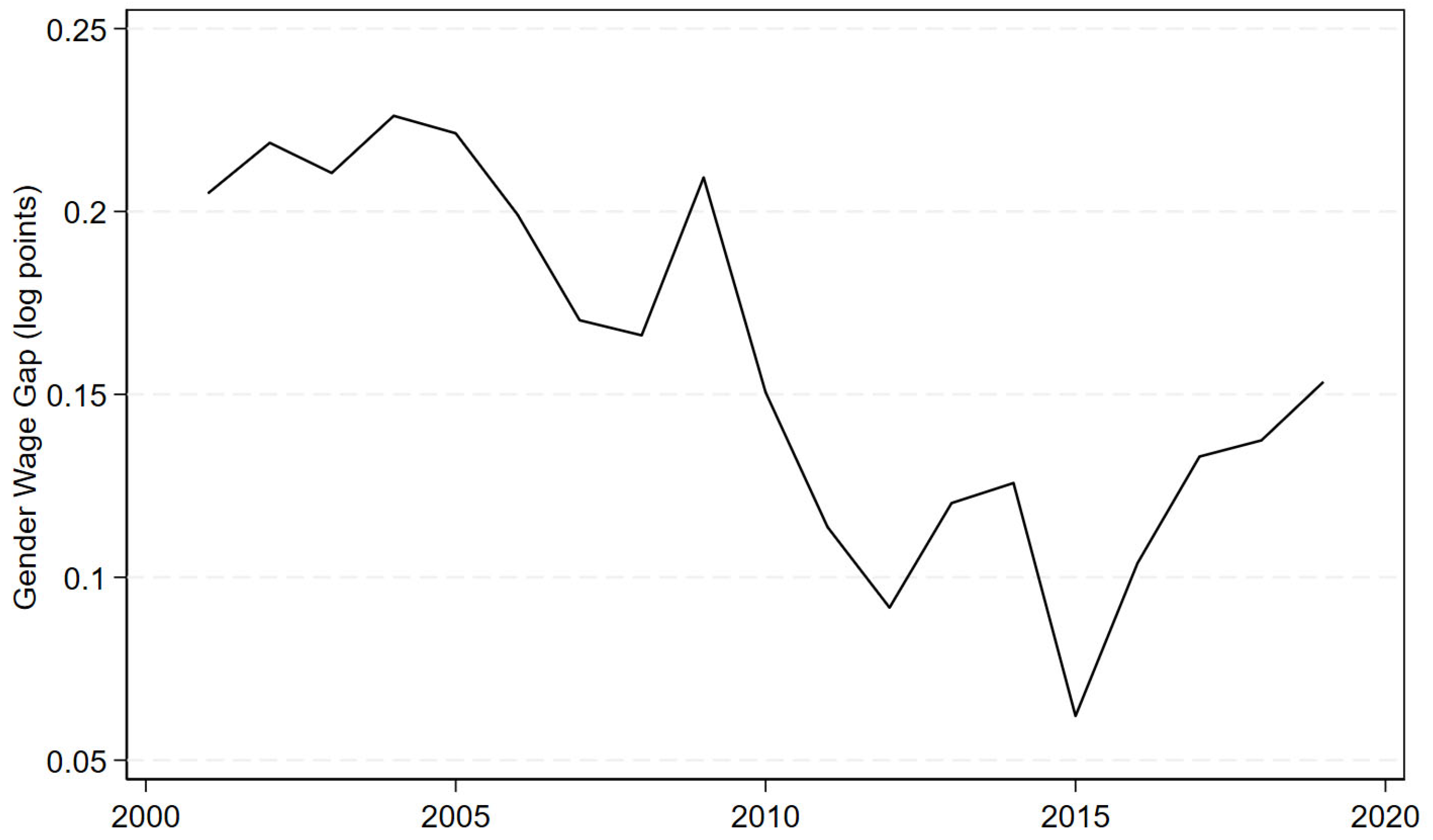
Yusuf & Halim, 2021), their implications for the gender wage gap remain poorly understood. Notably, the gender wage gap in the formal sector (wage-worker segment) has followed a non-monotonic U-shaped trajectory. As illustrated in
Figure 1, the gap narrowed significantly between 2005 and 2015, only to re-widen after 2015, as digitalization accelerated. Existing studies typically rely on period-averaged estimates, implicitly assuming that the impact of technology is constant over time. As a result, it remains unclear whether the recent resurgence of the gender wage gap reflects a temporary fluctuation or a structural outcome of evolving RBTC dynamics.
This paper addresses these gaps by examining how RBTC relates to gender wage inequality among formal wage workers in Indonesia over the period 2001–2019. We explicitly account for temporal heterogeneity by dividing the analysis into distinct sub-periods to capture changes in the nature and intensity of technological, macroeconomic, and institutional shocks. Using harmonized National Labor Force Survey (SAKERNAS) data combined with O*NET-based occupational task measures, we adopt
Acemoglu and Autor’s (
2011) strategy by estimating stacked first-difference models at the demographic-industry skill-cell level. This approach allows us to examine how initial task specialization predicts subsequent employment and wage dynamics. To assess gender heterogeneity, models are estimated separately for male and female subsamples, enabling a comparison of gender-specific labor market adjustments. Finally, we connect these structural adjustments to aggregate inequality using a dynamic shift-share decomposition developed by
Cortes et al. (
2020), which disentangles changes in the gender wage gap into employment exposure (quantity), wage exposure (price), and residual within-task group components.
Our analysis delivers three main contributions. First, we show that task displacement in Indonesia’s formal labor market follows sequential waves, distinct from the simultaneous polarization often documented in advanced economies. The formal sector experienced an early post-crisis contraction in routine cognitive roles (2001–2005), a manufacturing-linked contraction in routine manual jobs (2005 to 2010)—which interacted strongly with minimum wage policies—and renewed digital pressure on cognitive tasks (2015–2019) that affected the intensive rather than the extensive margin of labor. This pattern suggests that RBTC in developing contexts is episodic, with its timing and expression shaped by macroeconomic cycles and institutional forces. Second, we document that these adjustments are gendered in important ways. Because women were historically over-represented in routine-intensive work, they faced greater exposure to displacement. However, employment regressions indicate that this exposure coincided with substantial reallocation toward non-routine interpersonal occupations. We argue that this occupational upgrading is consistent not only with task-based demand shifts associated with technological change but also with the supply-side entry of younger, more educated female cohorts.
Third, we show that a quantity–price disconnect helps explain the non-monotonic trajectory of the gender wage gap. Employment reallocation contributed to a narrowing of the gap, especially during 2005–2010. However, this equalizing role weakened over time as market valuation became increasingly unfavorable to female-concentrated non-routine roles, contributing to a renewed widening in 2015–2019. Ultimately, while task-based quantity and price channels critically shape the timing and direction of these shifts, residual within-group dynamics account for a large share of the aggregate gender wage gap. Taken together, these findings suggest that in developing economies, occupational upgrading alone may be insufficient to deliver gender-equal outcomes when technological change and related structural forces jointly reshape occupational sorting and market valuation.
2. Literature Review
2.1. Task-Based Framework and Limited Evidence in Developing Economies
The theoretical foundation of this study rests on the Routine-Biased Technological Change (RBTC) hypothesis. Departing from the traditional Skill-Biased Technological Change (SBTC) framework, the task-based approach distinguishes between skills (worker endowments) and tasks (activities used to produce output). In their seminal contribution,
Autor et al. (
2003) show that computerization substitutes for routine tasks—activities governed by explicit, codifiable rules—while complementing non-routine cognitive tasks and having more limited direct effects on non-routine manual tasks.
Acemoglu and Autor (
2011) formalized this intuition by modeling the endogenous assignment of skills to tasks, in which workers sort into tasks based on comparative advantage
1. In this framework, RBTC can be interpreted as a decline in the effective price of capital embodied in machines and software that perform routine tasks. Rather than uniformly reducing labor demand, technological change reshapes the task structure, displacing the groups most specialized in routine activities and inducing their reallocation toward the tails of task distribution. Workers may upgrade into abstract, non-routine cognitive tasks or move into non-routine manual tasks, generating the canonical prediction of job polarization and changing wage inequality across groups.
A large empirical body of literature documents these patterns in advanced economies, including the U.S. (
Autor et al., 2006;
Autor & Dorn, 2013), Western Europe (
Goos et al., 2009,
2014), and other OECD countries (
Michael et al., 2014). In developing economies, however, evidence remains fragmented and often mixed. For example,
Gasparini et al. (
2021) found declining routine employment in Latin America without the accompanying expansion of non-routine manual jobs typically associated with job polarization. Other studies, such as
Hardy et al. (
2016,
2018), document occupational upgrading rather than polarization in Central and Eastern Europe. A growing view attributes this divergence to structural features of developing economies, particularly the prevalence of informality and heterogenous technology adoption.
Martins-Neto et al. (
2024) argue that the RBTC-related mechanism may be attenuated when a large share of employment remains outside the modern sector. Informal firms often operate at a small scale, rely on low-cost labor, and face weaker incentives or tighter constraints to adopt advanced technologies (
Cirera et al., 2021;
Gomez, 2021;
La Porta & Shleifer, 2014). As a result, empirical analyses that pool formal and informal workers may understate task-based adjustments if it is concentrated in formal wage employment where capital labor substitution is technologically feasible and economically viable. This motivates an explicit focus on formal wage workers as a relevant segment for testing RBTC mechanisms in developing economies.
2.2. RBTC’s Implication on Gender Wage Gap
A key implication of the task-based framework is that technological change is not distributionally neutral. Because workers sort into tasks based on comparative advantage, pre-existing patterns of occupational segregation imply that RBTC can affect groups asymmetrically. Gender represents one of the most persistent sources of such segregation (
Cerina et al., 2021;
Cortés et al., 2024;
Rendall, 2022). In advanced economies, women have historically been overrepresented in routine cognitive occupations (e.g., clerical and administrative work), which were among the earliest targets of computerization (
Black & Spitz-Oener, 2010;
Cortes et al., 2020). In developing economies, although data limitations can blur the distinction between routine cognitive and routine manual tasks, evidence suggests that female-dominated occupations tend to exhibit higher routine-task intensity across several regions, including Latin America, Asia, and Africa (
Brambilla et al., 2023;
Pieters et al., 2021). By contrast, men are more represented in non-routine manual jobs (e.g., construction, transport) that remain difficult and costly to automate. These segregation patterns can translate into systematically different exposures to routinization across gender.
The implications of such exposure for the gender wage gap are theoretically ambiguous. If displaced women are absorbed into lower-valued non-routine occupations with limited wage progression, gender wage inequality may widen. Conversely, if women upgrade into higher-value non-routine cognitive occupations, the wage gap may narrow. Evidence from advanced economies indicates that some women have transitioned into higher-valued non-routine interpersonal roles, contributing to convergence in gender wages (
Black & Spitz-Oener, 2010). In developing economies, however, structural constraints—including the limited creation of high-productivity non-routine jobs, persistent segmentation, and barriers to mobility—may restrict such upgrading. Consequently, RBTC may either alleviate or exacerbate gender wage inequality depending on whether occupational reallocation is matched by favorable changes in the market valuation of the destination occupations.
2.3. RBTC and the Indonesian Labor Market
Indonesian literature on technological change and labor markets has evolved alongside the country’s structural transformation. Earlier studies, largely focused on the industrial expansion of the 2000s, emphasized SBTC mechanisms linked to trade liberalization (
Lee & Wie, 2013). More recent work has adopted a task-based perspective and uncovered patterns consistent with RBTC, albeit with temporal, sectoral, and measurement limitations.
Viollaz et al. (
2019) provide early evidence linking technology adoption to labor demand in Indonesia over 2005–2015, showing that routine displacement is concentrated in tradable, export-oriented industries. However, their findings diverge from the canonical U-shaped polarization observed in advanced economies, which may partly reflect the scope of their analysis and task measurement constraints. First, their analysis is restricted to tradable sectors, abstracting from non-tradable services where non-routine manual employment often expands during polarization episodes. Second, their reliance on the Philippines STEP survey as a proxy for task measures may introduce measurement error, as such surveys are not designed primarily to capture task content at the occupational level (
Sebastian & Biagi, 2018). Moreover, their sample ends prior to the post-2015 acceleration of digital adoption and focuses largely on employment adjustments, leaving wage and inequality implications less explored.
Subsequent studies have refined this evidence.
Yusuf and Halim (
2021,
2023) document a robust negative relationship between employment growth and routine task intensity at the occupational level, consistent with routinization. More recent contributions suggest that task-biased technological shocks increasingly operate through wage channels in Indonesia.
Wihardja et al. (
2024) and
Wicaksono and Mangunsong (
2025) document wage penalties associated with routine manual occupations, indicating that RBTC-related adjustment may be reshaping not only employment but also wage structures.
Despite these advances, two gaps remain. First, relatively little is known about the temporal sequencing of RBTC in Indonesia, specifically whether task displacement occurs simultaneously across task groups or unfolds in episodes that shift across routine cognitive and routine manual activities. Second, the implications of evolving task-based shocks for the gender wage gap remain underexplored, particularly within the formal wage sector where technology adoption is most plausible. This study addresses both gaps by examining how sequential RBTC interacts with gendered task allocation to shape the gender wage gap among formal wage workers in Indonesia over time.
3. Methodology
3.1. Data Source and Sample Construction
This study primarily relies on the National Labor Force Survey (SAKERNAS), conducted annually by BPS Statistics Indonesia. To capture long-run structural adjustments rather than short-term labor market fluctuations, we use the August waves from 2001 to 2019. The observation window is partitioned into four sub-periods: 2001–2005, 2005–2010, 2010–2015, and 2015–2019. These cut points are not arbitrary. They align with major shifts in Indonesia, as well as with observed shifts in routine employment patterns documented later in our stylized facts. Specifically, 2001–2005 corresponds to the post-Asian Financial Crisis recovery and early decentralization reforms. The 2005–2010 period coincides with the global commodity boom, rising export prices, and capital deepening in resources sectors (
Ing & Zhang, 2022;
Wihardja, 2016). The 2010–2015 period reflects the commodity downturn, declining exports, and slower growth following the global financial crisis (
Viollaz et al., 2019). Finally, 2015–2019 marks the acceleration of Indonesia’s digital economy through rapid e-commerce expansion, digital platforms, and infrastructure investment (
Wihardja et al., 2024). This periodization allows us to examine the time-varying dynamics of RBTC and its interaction with concurrent macroeconomic and institutional change, rather than imposing constant effects over the full sample period.
Consistent with the capital-embodied nature of RBTC and our focus on technology adoption in the modern sector, the analytical sample is restricted to formal wage workers. Specifically, we restrict the sample to working-age individuals (15–64) whose primary employment status is reported as “employee/laborer”, excluding the self-employed, employers, casual workers, and unpaid family workers. We retain only observations with complete information on demographic characteristics (gender, age, region, and highest educational attainment) and employment profiles (industry, occupation, hours worked, and monthly earning from the main job). Real hourly wages are constructed by deflating nominal monthly earnings using the national Consumer Price Index (2001 = 100), and then converting monthly earnings into hourly terms by dividing by average weeks per month and reported weekly hours worked. We use 4.33 weeks per month to convert monthly earnings into weekly terms. To reduce the influence of reporting errors, we exclude observations with non-positive earnings or non-positive hours.
Given changes in Indonesia’s occupational classification over time, we harmonize occupation codes by constructing a unified crosswalk that maps all observations to ISCO-88 at the 2-digit level, yielding 24 consistent occupational groups. Similarly, industries are harmonized to ISIC Rev. 3.1 at the 1-digit level, yielding 10 broad sectors. We then exclude public administration, defense, and extraterritorial organizations because employment and wage setting in these activities are driven primarily by institutional and fiscal considerations rather than market forces. After these restrictions, the final pooled sample consists of approximately 407,229 individual observations.
For the regression analysis, individual observations are aggregated into skill cells defined by the interaction of gender (male, female), age group (15–24, 25–54, 55–64), education (primary or less, secondary, tertiary), region (urban, rural), and industry (nine broad sectors after excluding the public sector). This aggregation serves two purposes. First, it approximates groups with similar skill endowments and occupational task specialization, consistent with the task-biased framework. Second, it mitigates measurement error in occupational transitions and wages while preserving heterogeneity across demographic and sectoral dimensions. All cell-level employment and wage moments are computed using SAKERNAS sampling weights so that the constructed cells represent nationally representative aggregates within each year. In particular, total hours and mean log real hourly wages are calculated as weighted aggregates within each year cell.
To provide transparency on the underlying data structure, we construct between 233 and 304 populated demographic–industry cells per sub-period, yielding 1088 cell-period observations over 2001–2019. On average, each cell contains 346 raw worker observations, which scale up to represent approximately 548,268 formal wage workers at the population level. This produces an average of 305 clusters for standard error calculation. These cell sizes are sufficiently large to support reliable estimation and are broadly in line with standard practices in the literature (
Acemoglu & Autor, 2011;
Autor et al., 2003;
Fonseca et al., 2018;
Yusuf et al., 2020).
3.2. Occupational Task Content Measurement
To measure occupational exposure to technological change, we adopt a task-based approach. In the absence of locally harmonized task surveys for Indonesia, we follow the standard practice in the RBTC literature and construct task measures from the U.S. Occupational Information Network (O*NET). We use O*NET version 5.0 (released in 2003) to proxy baseline occupational task requirements prior major technology-driven reorganization within jobs during our sample period. This choice helps mitigate concerns that task measures mechanically reflect endogenous task redefinition associated with capital deepening and digital adoption, rather than pre-existing task content. While absolute task levels may differ across countries, evidence suggests that relative occupation rankings are moderately preserved across contexts.
Lewandowski et al. (
2022) show that rank correlations between survey-based country measures and O*NET-based measures increase with development levels and remain moderate even in lower-income settings. This supports using O*NET as a proxy for baseline task ordering, while acknowledging that measurement error may be larger and likely attenuates estimated relationships.
Following
Acemoglu and Autor (
2011), we construct five composite task indices: non-routine analytical, non-routine interpersonal, routine cognitive, routine manual, and non-routine manual. Relevant items are drawn from the “Work Activities” and “Work Context” modules of O*NET and are measured on Importance and Content scales ranging from 1 to 5 (
Appendix A,
Table A1 lists all items). All items are standardized to mean zero and unit variance before aggregation into composite indices. To merge O*NET SOC codes with Indonesian SAKERNAS occupations, we apply the crosswalk developed by the Instytut Badan Strukturalnych (
Hardy et al., 2016). We aggregate task measures to ISCO-88 at the 2-digit level using U.S. 2003 employment weights. Each occupation is then classified by its predominant task intensity, defined as the task category with the highest standardized score.
3.3. Econometric Strategy: Stacked First-Difference Models
To test the RBTC-consistent patterns in Indonesian formal wage labor market, we adopt the empirical strategy of
Acemoglu and Autor (
2011), which estimates relative labor market adjustments across skill cells using stacked first-difference specifications. Rather than identifying causal effects in an experimental sense, this approach assesses whether the initial patterns of occupational task-group specialization predict subsequent changes in employment and wages across periods. While the original framework emphasizes wage dynamics, we extend the application to examine both employment and wages, allowing us to capture the joint quantity and price adjustments emphasized in the RBTC framework.
Following
Fonseca et al. (
2018), we incorporate industry affiliation into skill-cell construction to account for sector-specific exposure to technology, which is particularly relevant in developing economies where adoption varies sharply across industries. Skill cells are defined by gender (male, female), age groups (15–24, 25–54, 55–64), education (primary or less, secondary, tertiary), regions (urban, rural), and industry (nine sectors). For each cell, we compute the initial employment share of each occupational task group in 2001, where occupational task groups are defined by mapping ISCO-88 (
ILO, 1990) 2-digit occupations into five groups based on predominant task intensity. These initial shares are time-invariant, while their associations with outcomes are allowed to vary across sub-periods through interactions with period dummies. The unit of observations is the change in log total hours worked (employment) or the change in mean log real hourly wages for each cell over each sub-period. Each observation therefore corresponds to a cell-by-sub-period change, so identification comes from cross-cell differences in baseline task-group specialization interacting with period indicators.
The estimating equation is:
where
denotes the change in the outcome variable (employment or wages) for cell
—defined by gender
, age
, education
, region
, and industry
—over period
. The outer summation runs over the
occupational task groups,
, with a non-routine manual as the omitted reference category, while the inner summation runs over the end-years of each period (
). The key regressors,
, are the 2001 employment shares of each occupational task group
within cell
, representing initial task specialization (time-invariant exposure). These initial shares interact with period indicators, denoted as
, which equal one only when period
ends in year
(e.g.,
when
is 2001–2005 and
is 2005). This structure yields a separate coefficient
for each occupational task group
and each period ending in year
, capturing the period-specific association between a cell’s initial specialization in occupational task group
and subsequent changes in employment or wages, relative to the omitted non-routine manual category.
Although each cell is defined by the full interaction of gender , age group , education , region , and industry , we include separate additive fixed effects for each of these components (, , , , and ). This choice is intentional and does not create perfect collinearity with the cell structure. Because the model is estimated in first differences, full-cell fixed effects would be differenced out and, therefore, not separately identified. The additive fixed effects instead flexibly absorb systematic differences in growth rates common to all cells sharing the same gender, age cohort, education level, region, or broad industry—such as overall gender-specific wage trends, education-expansion effects, or industry-wide shocks—while leaving cross-cell variation in initial task-group shares available for the identification of . We also include period fixed effects, , to absorb macroeconomic shocks common across all cells within each sub-period, helping to isolate the role of initial task specialization from broader structural forces.
Regressions are weighted by the average employment share of each cell over the corresponding sub-period, so that larger cells receive greater influence and the estimates reflect economy-wide adjustment rather than idiosyncratic movements in small cells. Sampling weights are used to construct cell-level outcomes and task-group shares, while regression weights based on average cell employment shares ensure that the estimates are representative of aggregate adjustment rather than driven by small cells. Standard errors are clustered at the cell level to account for serial correlation and heteroscedasticity within cells across periods.
Under the RBTC hypothesis, routine-intensive specialization should be associated with declines in employment and wages. We therefore expect negative coefficients for routine cognitive and routine manual occupation shares relative to non-routine manual. By contrast, coefficients on non-routine analytical and non-routine interpersonal shares are expected to be positive or statistically indistinguishable from zero, consistent with a U-shaped pattern in which the tails outperform the middle. To assess gender heterogeneity, we estimate the specification separately by gender. Groups that are more concentrated in routine occupations are expected to exhibit more negative routine coefficients, reflecting greater exposure to routine-task contraction.
3.4. Decomposition of the Gender Wage Gap
To quantify how task-based structural shifts relate to the changes in gender inequality, we employ the dynamic shift-share decomposition proposed by
Cortes et al. (
2020). Unlike decompositions that emphasize human capital differences, this framework links changes in the gender wage gap to task-based employment reallocation (quantity adjustment) and changes in the market valuation of task-intensive occupations (price adjustment). It also benchmarks the importance of these technology-related channels against residual factors that operate within occupational task groups.
Let
denote the gender wage gap, defined as the difference in mean log real hourly wages between male and female formal workers at time
. Changes in the gap over period
are decomposed into three additive components:
where
(employment exposure) captures how differential reallocation of men and women across occupational task groups affects the gap holding task wages constant;
(wage exposure) captures changes in the market valuation (relative returns) of occupational task groups, weighted by gender-specific task-group specialization; and
captures gender-specific wage changes within occupational task groups that are not explained by common task valuation shifts.
Because the analysis conditions on remaining in formal wage employment, the employment exposure component reflects reallocation within the formal sector, rather than transitions into informality or non-employment. A positive contribution indicates that among formal workers, women disproportionately shift toward lower-valued occupational task groups relative to men. Wage exposure is positive when changes in market valuation disproportionately penalize female-concentrated occupational task groups or favor male-concentrated occupational task groups, widening the gap independently of occupational mobility. The residual component captures within-task gender wage dynamics associated with non-task factors such as discrimination, bargaining, and unobserved skill differences. Together, the framework allows us to assess whether changes in the gender wage gap are driven primarily by quantity adjustments, price adjustments, or residual within-group dynamics.
4. Results
4.1. Stylized Facts: Employment and Wage Trends by Task Intensity and Gender
Before examining how RBTC relates to labor market structures and the gender wage gap, we first document descriptive patterns in occupational sorting and wage dynamics within Indonesia’s formal wage worker segment. Occupations are mapped to task groups using composite task indices constructed from O*NET following
Acemoglu and Autor (
2011), and then classified by predominant task intensity, defined as the highest standardized task score for each ISCO-88 2-digit occupation. As reported in
Appendix A,
Table A2, the resulting classification aligns with theoretical priors and Indonesian labor market realities. Managerial and professional occupations score highest in non-routine cognitive tasks (both in analytical and interpersonal), clerical occupations are concentrated in routine cognitive tasks, and machine operators and assemblers exhibit the highest routine manual intensity.
An important contextual nuance concerns service and sales occupations. Although personal services (ISCO 51) and sales occupations (ISCO 52) score highly on the non-routine interpersonal index in O*NET, in Indonesia, these jobs are predominantly supplied by lower-educated workers and exhibit wage profiles closer to low-value manual services. To preserve comparability with the Indonesian wage structure and keep the high-value interpersonal category aligned with professional and managerial work, we therefore classify these occupations as non-routine manual rather than non-routine interpersonal. This adjustment is also consistent with the conceptual definition of non-routine manual tasks, which emphasize situational adaptability and in-person interaction with limited formal education requirements (
Acemoglu & Autor, 2011).
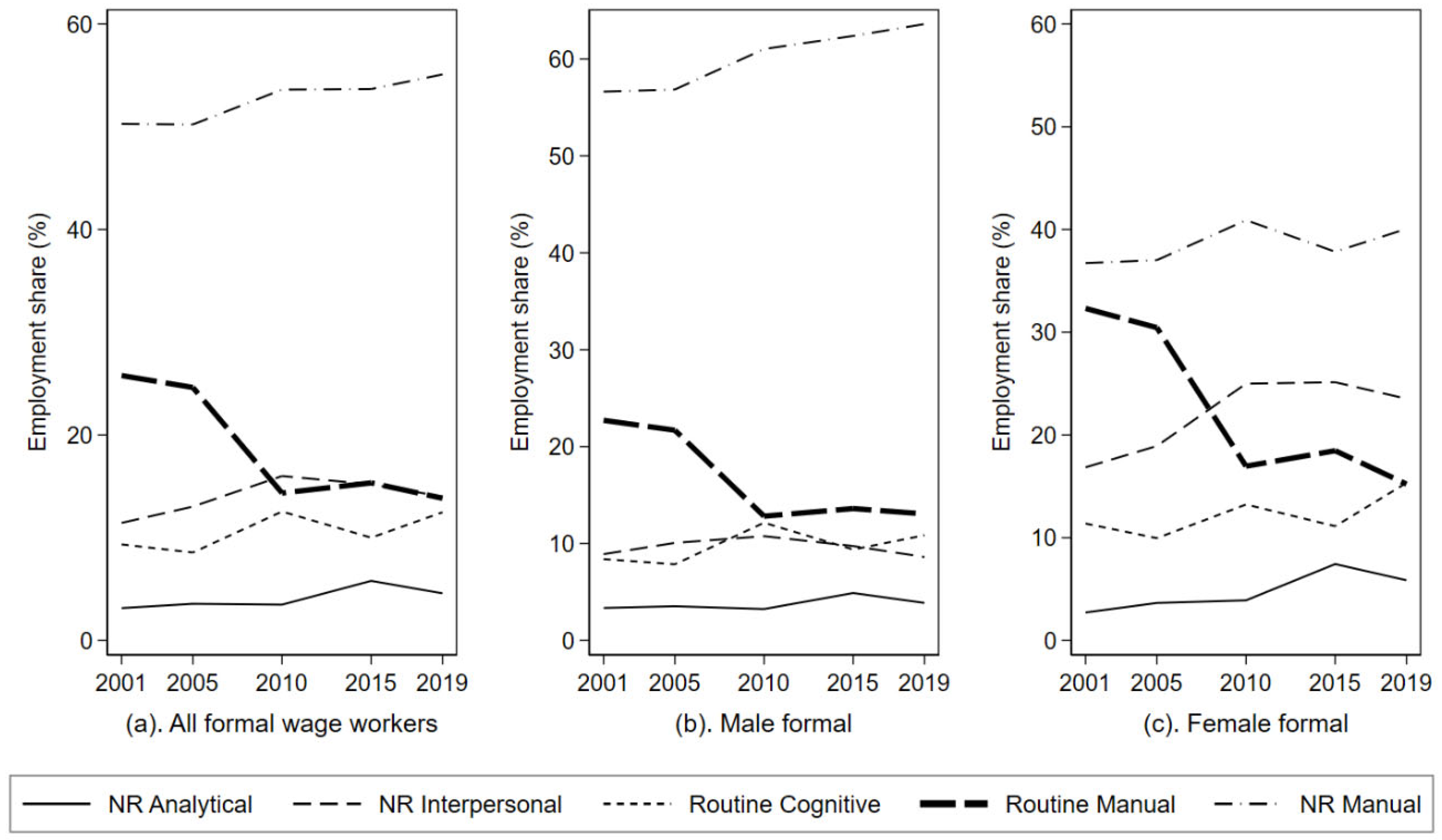
Figure 2 illustrates the evolution of employment shares by occupational task group within the formal wage segment. Panel (a) shows a clear contraction in routine manual employment accompanied by an expansion of non-routine jobs, particularly during 2005–2010. Routine cognitive employment remains relatively stable early on but begins to contract visibly after 2010. Disaggregating by gender reveals pronounced asymmetries consistent with persistent occupational segregation. Although non-routine manual occupations account for the largest share of employment for both men and women, specialization within this category differs sharply by gender. Male employment is dominated by physically intensive occupations (e.g., extraction and construction trades), whereas female employment is concentrated in interactive service and sales-related roles that fall into non-routine manual under our classification (
Appendix A,
Table A3). Women also exhibit a substantial higher initial concentration in routine manual jobs, exceeding 30 percent in the early 2000s, followed by a pronounced contraction during 2005–2010. This decline coincides with an expansion of female employment in non-routine interpersonal occupations, suggesting that high-value interpersonal roles in the professional and managerial segment served as an important upgrading path for women within formal employment.
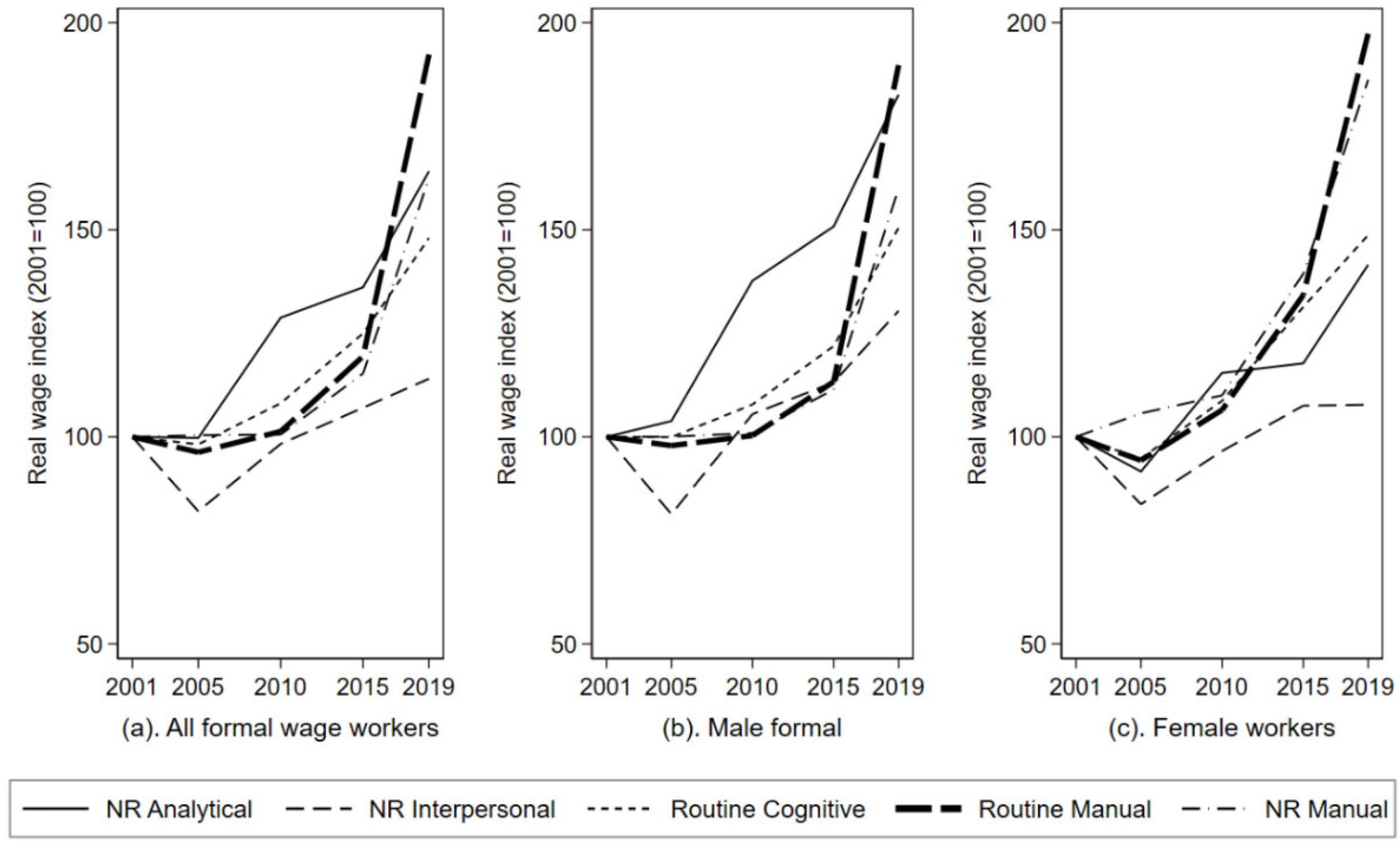
Figure 3 complements these employment trends by showing divergent real wage trajectories across occupational task groups and genders. For male formal workers, wage growth accelerates in non-routine analytical occupations over much of the sample and rises sharply in routine manual jobs in the final period (2015–2019). For female formal workers, wage growth is persistently slower in non-routine interpersonal occupations, the category absorbing a growing share of female employment. This indicates that occupational upgrading in employment shares does not necessarily translate into faster wage growth in the destination occupations. Together, these descriptive patterns motivate regression tests of whether baseline task group specialization predicts subsequent changes in employment and wages.
4.2. Stacked First-Difference Estimation Results
This subsection presents the estimation results from the stacked first-difference specifications at the skill-cell level, restricted to formal wage workers. The coefficients of interest are the interactions between initial occupational task-group specialization, measured as employment shares in 2001, and period indicators. These interaction terms capture the extent to which initial intensity in a particular occupational task group predicts subsequent relative changes in employment, measured as changes in log total hours worked, and wages, measured as changes in mean log real hourly wages, within demographic-industry skill cells, with non-routine manual tasks serving as the omitted reference category. All specifications include fixed effects for period, gender, age, education, region, and industry, with standard errors clustered at the skill-cell level. Results are first presented for the pooled sample (
Table 1), followed by gender-disaggregated estimates (
Figure 4 and
Figure 5) to highlight heterogeneity. These estimates should be interpreted as period-specific associations between baseline task-group specialization and subsequent changes in employment and wages.
4.2.1. Employment Dynamics: Labor Displacement and Reallocation
Table 1 (Column 1) reports the stacked first-difference estimates for employment in the pooled sample. The results broadly align with the RBTC hypothesis, which predicts relative employment declines in routine-intensive occupations. Skill cells with initial specialization in routine cognitive (RC) occupations experience significant relative declines in employment during the early period (
) and, to a lesser extent, in the final period (
). Meanwhile, skill cells with initial specialization in routine manual (RM) occupations show a significant relative decline only during 2005–2010 (
). Overall, these results indicate time-varying employment contractions among routine-intensive cells across distinct periods.
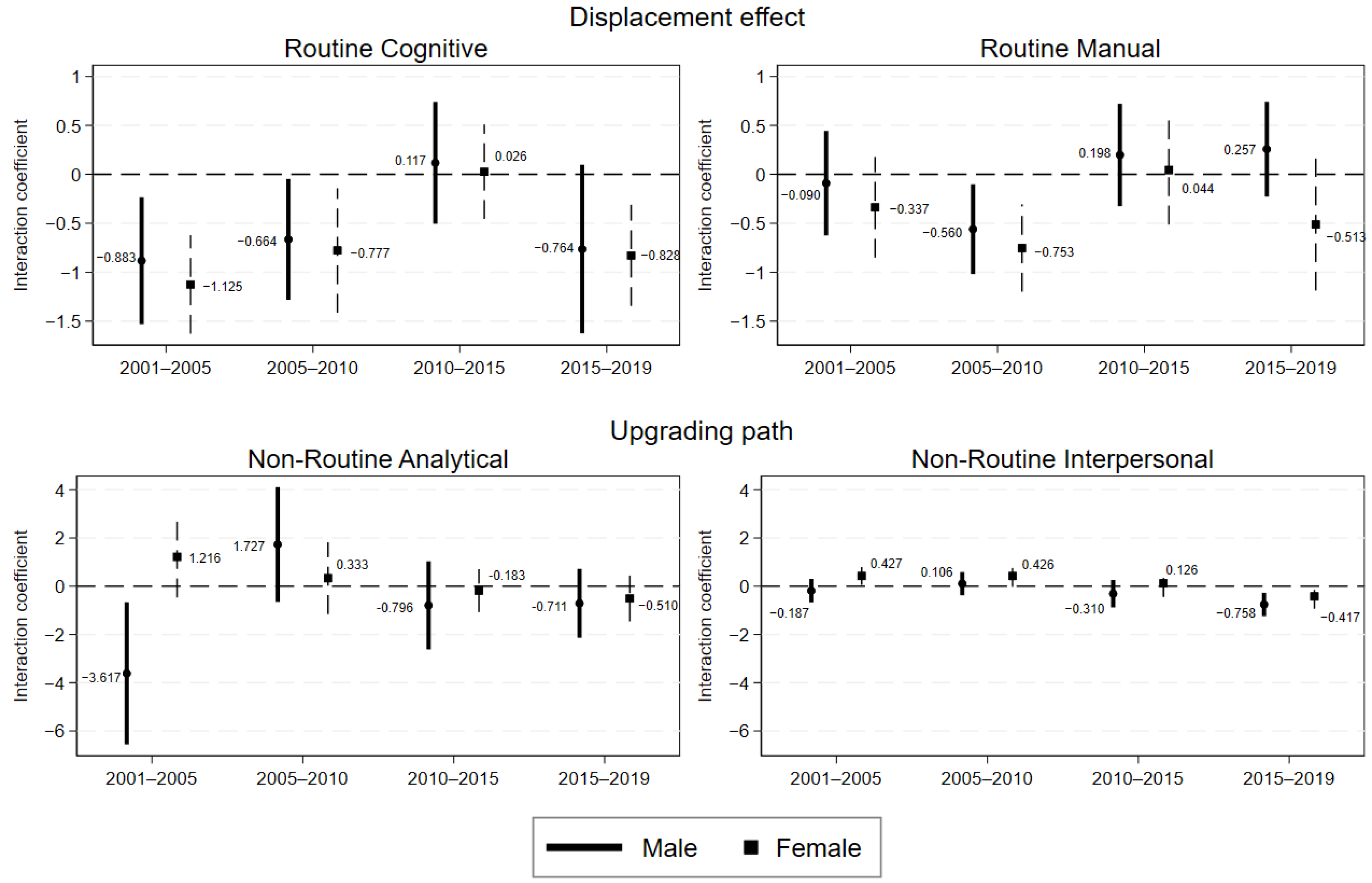
Gender-disaggregated estimates, as seen in
Figure 4 (upper panels), reveal stronger and more persistent negative associations for routine occupations in certain periods, particularly for routine cognitive tasks. Although the pooled routine cognitive coefficient is insignificant in 2005–2010, it becomes significant and negative when estimated separately for males (
) and females (
). Negative effects are also observed in the early period (
for male;
for females;
) and in the final period (
for males
;
for females;
). Similarly, cells with initial specialization in routine manual occupations also experience significant relative declines for both genders, but only during 2005–2010 (
for males,
;
for females,
). Although these differences are not statistically significant, the contraction is larger in magnitude for female cells.
Turning to the upper-tail segment, skill cells with initial specialization in non-routine interpersonal (NRI) occupations exhibit a significant relative increase in employment during 2005–2010 (
). This suggests that the mid-2000s display a polarization pattern, marked by a relative decline in routine manual employment and a relative expansion in non-routine interpersonal employment. However, the coefficient turns negative in the final period (
). Gender-disaggregated estimates in
Figure 4 (lower panels) show additional heterogeneity among non-routine occupations. For non-routine analytical (NRA) occupations, the lower-left panel shows a large negative coefficient for males in 2001–2005 (
), with no significant effects for females. Meanwhile the lower-right panel indicates that female cells initially specialized in non-routine interpersonal occupations experience significant relative increases in the early periods (
), whereas male cells show a sharp decline in the final period (
).
4.2.2. Wage Dynamics: Upgrading Without Reward
Table 1 (Column 2) presents the stacked first-difference estimates for wages in the pooled sample of formal wage workers. For skill cells initially specialized in routine cognitive occupations, relative employment declines in the early and final periods are accompanied by corresponding relative wage declines (
). In contrast, cells initially specialized in routine manual occupations experience relative employment declines in 2005–2010 without a corresponding significant relative wage penalty.
Gender-disaggregated results in
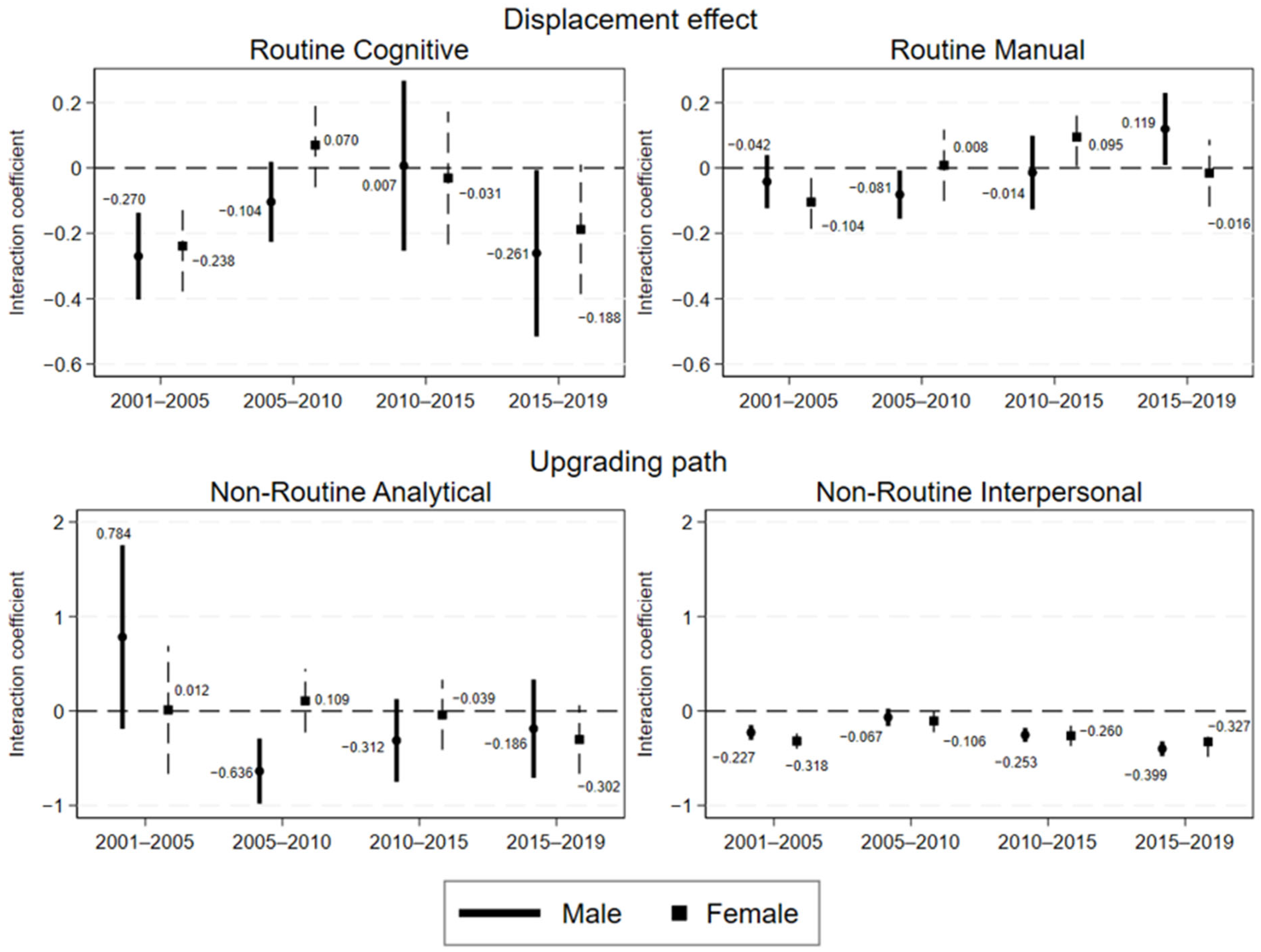
Figure 5 (upper panels) largely mirror the pooled pattern for routine cognitive specialization (upper-left panel), showing significant wage declines for both males and females in the early period (
for males;
for females;
) and the final period (
for males,
;
for females,
). For male cells, wage penalties are also observed in 2005–2010, although with weaker statistical significance. The upper-right panel shows gender heterogeneity in wage dynamics for routine manual specialization. For male cells, routine manual occupations exhibit a negative coefficient in 2005–2010 (
) that turns positive in the final period (
). In contrast, routine manual occupations for females exhibit a negative wage association in the early period (
) that becomes positive in 2010–2015 (
).
Differences between employment and wage adjustments are also evident in the non-routine coefficients.
Table 1 (Column 2) shows more pronounced wage compression in non-routine interpersonal occupations. Skill cells initially specialized in non-routine interpersonal occupations experience significant relative wage declines across all periods, although the decline is weaker in 2005–2010 (
). Similarly, skill cells initially specialized in non-routine analytical occupations experience relative wage declines in 2005–2010 and 2010–2015, although at weaker significance levels (
). The lower-left panel of
Figure 5 shows that the negative wage penalty for non-routine analytical occupations during 2005–2010 is concentrated primarily among male cells (
), with no significant association for female cells. Meanwhile, both males and females experience significant relative wage declines in non-routine interpersonal occupations. However, in 2005–2010, the negative association is concentrated among female cells and is smaller in magnitude than in other periods. Notably, the wage patterns are not symmetric to the employment patterns: the task groups that expand for women do not exhibit commensurate relative wage gains.
4.3. The Gender Wage Gap Decomposition Results
To quantify how task-based adjustments relate to changes in the aggregate gender wage gap among formal wage workers, we apply a dynamic shift-share decomposition.
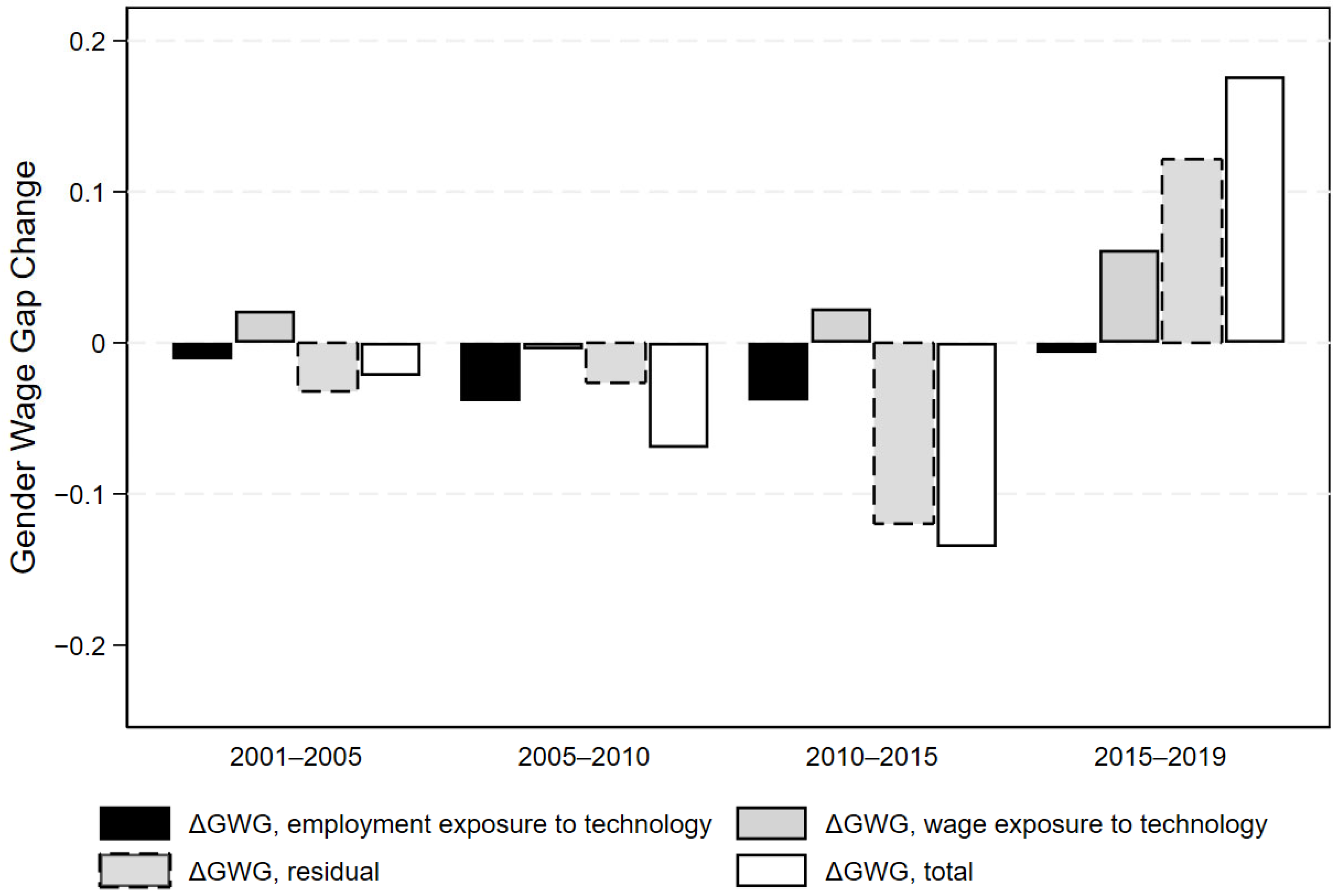
Figure 6 summarizes the contributions of employment exposure (black bars), wage exposure (gray bars), and the residual component (striped, gray bars) to the total change in the gap (white bars) across the four sub-periods. Employment and wage exposure components capture the task-based channels most closely linked to RBTC: the former reflects changes in the gender composition of employment across occupational task groups, while the latter reflects changes in market valuation (relative returns) of those task groups. The residual component captures within-task-group gender wage dynamics that are not explained by common valuation shifts.
The decomposition shows that the residual component accounts for a large share of the gap’s evolution in most periods, with the exception of 2005–2010. This pattern broadly aligns with prior studies using Indonesian data (
Schaner & Das, 2016;
Taniguchi & Tuwo, 2014) and with wider evidence from developing economies where unexplained or residual factors often play an important role in gender wage gap decompositions. In our setting, the residual component should be interpreted cautiously, as it may reflect a range of within-group mechanisms not captured by the task-based decomposition, including gender discrimination, firm-specific wage premia, sorting of unobservables, bargaining dynamics, and other non-technological factors. Its relative importance also varies across macroeconomic contexts. In the early recovery period (2001–2005), the residual accounts for most of the observed change in the gap. During the commodity boom (2005–2010), it remains sizeable but is partly offset by strong narrowing from employment exposure. In the later periods (2010–2015 and 2015–2019), the residual regains prominence. This pattern is consistent with the possibility that as women’s educational attainment expanded and the digital economy accelerated, within-group factors outside measured task composition and common task-price shifts became increasingly important in shaping the gender wage gap. Nevertheless, while these residual forces account for a large share of the aggregate wage structure, the task-based channels remain central for understanding the timing and direction of changes in gender inequality over the analysis period.
Focusing on task-based technological channels, employment exposure acts as a narrowing force across all periods. This indicates that changes in the distribution of male and female workers across occupational task groups consistently exerted downward pressure on the wage gap over the two decades. The equalizing role of employment reallocation is most pronounced in 2005–2010, when employment exposure (
) constituted the largest contributor to the overall narrowing of the gap in that period (
). However, the magnitude of this contribution weakens over time, reaching its smallest absolute value in the final period (
). Decomposing employment exposure by occupational task group highlights offsetting forces (
Appendix A,
Table A4). While changes associated with routine cognitive occupations continue to contribute to narrowing, this effect is increasingly counterbalanced by widening contributions from routine manual occupations, consistent with the diminishing net impact of employment reallocation in the later periods.
In contrast, wage exposure operates primarily as a widening force, indicating that market valuation becomes increasingly unfavorable to female-concentrated occupations. The only exception occurred in 2005–2010, when wage exposure made a small negative contribution (
), temporarily reinforcing the narrowing effect of employment exposure. This convergence was short-lived. In subsequent periods, wage exposure re-emerged as a widening component and strengthened over time, reaching its largest magnitude in 2015–2019. In the final period, the widening pressure was driven predominantly by the non-routine manual category (
Appendix A,
Table A4), underscoring that late-stage widening is linked more strongly to valuation dynamics rather than employment reallocation alone.
5. Discussion
The empirical evidence presented in this study indicates that task-based adjustments in the Indonesian formal labor market differ from the simultaneous job polarization typically documented in advanced economies. Instead, our findings point to a more a nuanced, episodic pattern of relative labor displacement and gender-asymmetric reallocation. One central insight is that task displacement in Indonesia appears to unfold in a staggered sequence shaped by technological change alongside concurrent macroeconomic and institutional forces. Our analysis highlights a critical distinction in how technological change is associated with routine manual versus routine cognitive tasks across different economic phases.
Relative declines in routine cognitive occupations appear early, in 2001–2005, followed by a sharp contraction in routine manual employment during 2005–2010 and renewed routine cognitive pressures in 2015–2019. These time-varying patterns are consistent with the RBTC hypothesis, but their timing and intensity also appear to be shaped by concurrent macroeconomic and structural forces, including post-crisis restructuring (2001–2005), the commodity boom and initial capital deepening (2005–2010), the commodity downturn (2010–2015), and digital economy acceleration (2010–2019). Robustness checks, including unweighted regressions and alternative clustering (provided in
Appendix B Table A5,
Table A6,
Table A7 and
Table A8), confirm that the baseline patterns remain qualitatively unchanged. Notably, when restricting the subsample to workers earning at least 90% of the provincial minimum wage, the 2005–2010 female routine manual employment penalty loses statistical significance. This pattern suggests that mid-2000s task displacement was concentrated near the lower end of the wage distribution and is consistent with the possibility that statutory minimum wage hikes during that period amplified incentives for capital-labor substitution (
Lordan & Neumark, 2018). Conversely, the weakening of routine manual displacement in the subsequent 2010–2015 period is consistent with offsetting demand from commodity-related exports during that specific window (
Viollaz et al., 2019).
In contrast to the sharper contraction of routine manual employment in the mid-2000s, routine cognitive adjustments during the 2015–2019 digital acceleration phase reveal an important divergence between intensive and extensive margins of labor. While the regressions show a negative association between initial routine cognitive specialization and subsequent total hours worked, our descriptive evidence (
Figure 2) indicates that the overall employment share of routine cognitive workers expanded, particularly for women. This pattern suggests that the digital era was associated less with outright job destruction in routine cognitive roles than with changes in the organization and use of such work. One possible interpretation is that digital tools, software adoption, and e-commerce expansion increased efficiency in administrative and clerical tasks, reducing aggregate hours within demographic–industry cells while simultaneously expanding the numbers of workers performing related roles. In this sense, digitalization may have altered the balance between intensive and extensive margins rather than simply eliminating routine cognitive work.
Gender plays a critical role in these dynamics because men and women entered these episodes with different baseline task exposures. Women were more concentrated in routine manual occupations within formal manufacturing at the start of the period. The sharp relative contraction of these jobs in 2005–2010 coincides with a narrowing of the gender wage gap through employment exposure. In principle, this narrowing could reflect a mechanical composition effect if displaced low-wage women exited formal employment or moved into informality. However, aggregate trends suggest a more nuanced pattern. Based on our calculations using SAKERNAS data, the female informal employment share declined from 74.39% to 71.72% during this peak displacement period. While this aggregate evidence does not allow us to track individual transitions directly, it is more consistent with concurrent formal absorption than with a purely mechanical narrowing driven by exit into informality. In that sense, the reallocation of female workers toward non-routine interpersonal occupations may reflect occupational upgrading within formal employment, rather than merely a statistical artifact of selection out of the formal sector.
However, the equalizing role of employment reallocation weakens over time as market valuation becomes less favorable to female-concentrated occupations. In 2015–2019, wage exposure emerges as a strong widening force that outweighs the remaining narrowing contribution from employment exposure, reflecting slower wage growth in non-routine interpersonal roles relative to male-dominated non-routine manual occupations. This asymmetry suggests that occupational reallocation alone may be insufficient to sustain gender wage convergence when destination occupations do not experience commensurate improvements in relative returns (
Cortes et al., 2020).
Several structural caveats help bound these interpretations. Most notably, demographic cohort effects—specifically the retirement of older, less-educated workers and their replacement by a more educated incoming workforce—likely act as an important complementary mechanism alongside task-based adjustment. This generational turnover is especially pronounced among women, whose educational attainment expanded rapidly over the two decades of our analysis: the share of female formal workers with tertiary education doubled from 15.83% in 2001 to 30.20% in 2019. As a result, younger cohorts of more educated female entrants likely sorted into different occupational trajectories than older generations of women, who were more concentrated in routine manual or lower-tier non-routine manual jobs. Equipped with higher education, these newer cohorts increasingly entered non-routine interpersonal roles, and later into routine cognitive roles within the expanding digital economy. Accordingly, the occupational reallocation documented here is consistent with the combined influence of task-based demand shifts associated with technological change, concurrent macroeconomic forces, and evolving supply-side characteristics of the Indonesia workforce.
Finally, the dynamic shift-share decomposition shows that residual within-task-group dynamics account for a large share of the gender wage gap’s evolution in most periods. Consistent with prior Indonesian studies (
Schaner & Das, 2016;
Taniguchi & Tuwo, 2014), unexplained factors continue to play an important role. These may include gender discrimination, motherhood penalties, firm-specific wage premia, sorting of unobservables, bargaining dynamics, and other within-group mechanisms not captured by the task-based decomposition. The prominence of the residual component underscores that, while task-based channels provide a structured explanation for the timing and direction of wage-gap shifts, a substantial share of gender inequality remains linked to institutional, organizational, and social forces beyond measured technological channels.
From a policy perspective, these results suggest that narrowing gender wage gaps requires more than encouraging occupational mobility or generic upskilling. Complementary measures to reduce occupational segregation, strengthen wage progression and bargaining power in female-concentrated non-routine occupations, and address residual sources of inequality are likely to be important, particularly as digital adoption continues to reshape the formal labor market.
6. Conclusions
This study examines associations between Routine-Biased technological Change (RBTC) and the evolution of the gender wage gap among formal wage workers in Indonesia from 2001 to 2019. Using stacked first-difference estimations and a dynamic shift-share decomposition, we document time-varying patterns of task-based adjustments in the formal sector, characterized by the sequential relative displacement of routine occupations, gender-asymmetric adjustments, and a non-monotonic trajectory of gender inequality.
Three main conclusions emerge. First, routine task displacement unfolded episodically rather than simultaneously, with relative contractions in routine cognitive jobs appearing early (2001–2005), routine manual jobs during the initial capital deepening phase (2005–2010), and renewed routine cognitive pressures in the digital acceleration phase (2015–2019). These patterns are consistent with RBTC, although their timing and intensity appear to be shaped by concurrent macroeconomic and structural forces, including post-crisis restructuring, commodity cycles, trade dynamics, and minimum wage adjustments. Second, these adjustments were gendered in important ways. Women, initially overrepresented in routine manual occupations within formal manufacturing, experienced greater exposure to displacement and reallocated substantially toward non-routine interpersonal roles. Third, employment reallocation exerted a narrowing influence on the gender wage gap—most pronounced in 2005–2010—but this equalizing channel weakened over time as wage exposure became increasingly unfavorable to women, contributing to renewed widening in 2015–2019. The disconnect between quantities (employment shifts) and prices (relative returns) highlights that occupational upgrading alone does not guarantee convergence when destination occupations face weak wage growth.
Although task-based technological channels play an important role in shaping the evolution of the gender wage gap in Indonesia, residual factors account for a large share of these changes across most periods. This persistent residual may reflect discrimination, firm-specific wage premia, sorting of unobservables, and other within-group mechanisms not captured by the task-based framework. This pattern underscores that while technological and structural shifts help explain the timing and direction of specific adjustments, a substantial share of gender inequality in the formal sector remains linked to factors outside the measured task-based channels.
These findings carry important policy implications. Supply-side interventions such as training or occupational mobility promotion may be insufficient if they direct women into segments with weak wage progression. Complementary demand-side measures—such as raising productivity and strengthening returns in female-concentrated non-routine interpersonal occupations (e.g., professional and care services)—alongside efforts to reduce barriers to higher-return non-routine manual roles, could help sustain convergence. Addressing residual sources of inequality through the stronger enforcement of equal-pay standards and workplace policies remains important.
This study has several limitations that point to avenues for future research. First, the focus on formal wage workers abstracts from informality, limiting our ability to capture broader labor market adjustments in a dual economy. Second, the empirical framework does not explicitly model other concurrent forces that may shape employment and wage dynamics in Indonesia, such as trade shocks, minimum wage adjustments, or demographic cohort effects. Third, the task measures rely on U.S.-based O*NET mappings, which are standard in the absence of local task surveys but may not fully capture the local task content of Indonesian occupations. Future research could address these limitations by modeling formal–informal employment flows more explicitly and by using individual longitudinal data to better isolate technological adjustment from life cycle or cohort dynamics. Subsequent work could also strengthen inference by incorporating direct indicators of technology adoption (e.g., firm-level or worker-level ICT use) and by leveraging local task surveys where available. Finally, extending the analysis beyond 2019 to include the COVID-19 period and the diffusion of more advanced technologies (e.g., artificial intelligence) remains a critical agenda for understanding the future trajectory of gender inequality.
Author Contributions
Conceptualization, W.I.J., B.B. and D.W.; methodology, W.I.J.; software, W.I.J.; validation, B.B. and D.W.; formal analysis, W.I.J.; investigation, B.B. and D.W.; resources, W.I.J.; data curation, W.I.J.; writing—original draft preparation, W.I.J.; writing—review and editing, W.I.J., B.B. and D.W.; visualization, W.I.J.; supervision, B.B. and D.W.; project administration, W.I.J.; funding acquisition, W.I.J. All authors have read and agreed to the published version of the manuscript.
Funding
This research received no external funding.
Institutional Review Board Statement
Ethical review and approval were waived for this study, as it relies entirely on pre-existing, fully anonymized secondary data provided by Statistics Indonesia (BPS). The authors were not involved in the primary data collection or any direct human subject research.
Informed Consent Statement
Informed consent was waived due to the use of strictly secondary, anonymized data. Patient/participant consent for the original survey was obtained by Statistics Indonesia (BPS) during their primary data collection.
Data Availability Statement
The raw microdata used in this study, specifically the detailed occupation codes, were obtained from BPS-Statistics Indonesia through a restricted data use agreement and are not publicly available due to confidentiality and privacy protocols. However, aggregated data at the 2-digit occupational level and the code used for the analysis are available from the corresponding author upon reasonable request.
Acknowledgments
The authors express their gratitude to BPS-Statistics Indonesia for the administrative support and for providing access to the National Labor Force Survey (SAKERNAS) microdata used in this study. During the preparation of this manuscript, the authors used Gemini 3.1 Pro (Google, Large Language, and Model) for the purposes of assisting in the translation, language editing, and refinement of the narrative structure. The authors have reviewed and edited the output and take full responsibility for the content of this publication.
Conflicts of Interest
The authors declare no conflicts of interest. The funders (BPS-Statistics Indonesia) had no role in the design of this study; in the collection, analyses, or interpretation of data; in the writing of the manuscript; or in the decision to publish the results.
Abbreviations
The following abbreviations are used in this manuscript:
| BPS | Badan Pusat Statistik |
| COVID-19 | Corona Virus Disease of 2019 |
| ICT | Information and Communication Technology |
| ISCO | International Standard Classification of Occupations |
| GWG | Gender Wage Gap |
| O*NET | Occupational Information Network |
| RBTC | Routine-Biased Technological Change |
| SAKERNAS | Survei Angkatan Kerja Nasional |
| SBTC | Skill-Biased Technological Change |
| SOC | Standard Occupational Classification |
| STEP | Skills Towards Employment and Productivity |
Appendix A
Table A1.
O*NET job descriptor associated with each task measure.
Table A1.
O*NET job descriptor associated with each task measure.
| Task | O*NET’s Descriptor | Scale Type |
|---|
| Non-Routine Analytical | 4.A.2.a.4 | Analyzing data/information | Importance |
| | 4.A.2.b.2 | Thinking creatively | Importance |
| | 4.A.4.a.1 | Interpreting information for others | Importance |
| Non-Routine Interpersonal | 4.A.4.a.4 | Establishing and maintaining personal relationships | Importance |
| | 4.A.4.b.4 | Guiding, directing, and motivating subordinates | Importance |
| | 4.A.4.b.5 | Coaching/developing others | Importance |
| Routine Cognitive | 4.C.3.b.8 | Structured vs. unstructured work (reversed) | Content |
| | 4.C.3.b.7 | Importance of repeating the same tasks | Content |
| | 4.C.3.b.4 | Importance of being exact or accurate | Content |
| Routine Manual | 4.A.3.a.3 | Controlling machines and processes | Importance |
| | 4.C.3.d.3 | Pace determined by speed of equipment | Content |
| | 4.C.2.d.1.i | Spend time making repetitive motions | Content |
| Non-Routine Manual | 1.A.2.a.2 | Manual dexterity | Importance |
| | 4.C.2.d.1.g | Spend time using hands to handle, control, or feel objects, tools, or controls | Content |
| | 1.A.1.f.1 | Spatial orientation | Importance |
| | 4.a.3.a.4 | Operating vehicles, mechanized devices or equipment | Importance |
Table A2.
Occupational task content measures.
Table A2.
Occupational task content measures.
| Occupation | ISCO-88 2-Digit Level | Non-
Routine Analytical | Non-
Routine
Interpersonal | Routine Cognitive | Routine Manual | Non-
Routine Manual |
|---|
| Corporate managers | 12 | 1.24 | 2.31 | −0.17 | −1.10 | −1.02 |
| Small enterprise managers | 13 | 0.78 | 2.14 | −0.61 | −1.01 | −0.79 |
| Physical, math, and engineering science prof. | 21 | 2.02 | 0.55 | 0.67 | −0.71 | −0.64 |
| Life science and health prof. | 22 | 1.42 | 0.76 | 0.53 | −0.67 | −0.45 |
| Teaching prof and associates | 23 | 1.59 | 1.67 | −1.08 | −1.58 | −1.54 |
| Other prof. | 24 | 1.30 | 0.62 | −0.28 | −1.34 | −1.48 |
| Physical, math, and engineering science associate prof. | 31 | 0.55 | −0.08 | 1.22 | 0.21 | 0.33 |
| Life science and health associate prof. | 32 | 0.40 | 0.52 | 0.52 | −0.52 | −0.62 |
| Other associate prof. | 34 | 0.65 | 0.36 | 0.62 | −1.08 | −1.06 |
| Office clerks | 41 | −0.19 | −0.35 | 2.44 | −0.10 | −0.81 |
| Customer services clerks | 42 | 0.20 | 0.16 | 1.03 | −0.21 | −0.98 |
| Personal and protective services workers | 51 | −0.25 | 0.13 | −1.31 | −0.59 | 0.09 |
| Models, salespersons, and demonstrators | 52 | −0.19 | 0.03 | −1.06 | −0.93 | −0.80 |
| Skilled agricultural workers | 61 | −0.10 | 0.21 | −1.37 | 0.23 | 0.98 |
| Extraction and building trades workers | 71 | −1.08 | −0.92 | 0.21 | 0.61 | 0.98 |
| Metal, machinery, and related trades workers | 72 | −0.97 | −0.99 | 0.65 | 0.84 | 0.99 |
| Precision, handcraft, print, and related trades workers | 73 | −0.63 | −1.07 | 0.63 | 0.88 | 0.21 |
| Other craft and related trade workers | 74 | −0.89 | −1.07 | 0.64 | 1.28 | 0.21 |
| Stationary plant and related operators | 81 | −0.96 | −0.85 | 0.19 | 1.74 | 0.24 |
| Machine operators and assemblers | 82 | −1.10 | −1.08 | 0.67 | 2.13 | 0.88 |
| Drivers and mobile-plant operators | 83 | −0.97 | −0.70 | −0.47 | 0.74 | 2.01 |
| Sales and services elementary occupations | 91 | −0.72 | −0.69 | −1.51 | −0.14 | 0.41 |
| Agricultural laborers | 92 | −0.61 | −0.74 | −1.40 | 0.35 | 1.64 |
| Laborers in mining, construction, manufacturing, and transport | 93 | −1.50 | −0.93 | −0.75 | 0.97 | 1.23 |
Table A3.
Summary data for employment share by occupation and gender.
Table A3.
Summary data for employment share by occupation and gender.
| Occupation | Task Group | Employment Share (%) | Wages |
|---|
| Male | Female | Male | Female |
|---|
| 2001 | 2019 | 2001 | 2019 | 2001 | 2019 | 2001 | 2019 |
|---|
| 12 | Corporate managers | NRI | 1.26 | 1.65 | 0.89 | 1.43 | 8734 | 15,402 | 4406 | 11,859 |
| 13 | Small enterprise managers | NRI | 0.44 | 0.91 | 0.14 | 0.53 | 7782 | 13,599 | 4188 | 7020 |
| 21 | Physical, math, and engineering science prof. | NRA | 0.19 | 0.84 | 0.05 | 0.28 | 6476 | 10,577 | 3299 | 8590 |
| 22 | Life science and health prof. | NRA | 0.13 | 0.60 | 0.72 | 3.21 | 8590 | 9508 | 5659 | 6676 |
| 23 | Teaching prof and associates | NRI | 6.97 | 5.51 | 14.44 | 19.42 | 6912 | 7110 | 5808 | 5642 |
| 24 | Other prof. | NRA | 0.33 | 1.08 | 0.38 | 1.21 | 8676 | 9468 | 6141 | 8122 |
| 31 | Physical, math, and engineering science associate prof. | RC | 0.84 | 3.26 | 0.18 | 0.85 | 5726 | 8140 | 3403 | 6279 |
| 32 | Life science and health associate prof. | NRI | 0.23 | 0.54 | 1.38 | 2.14 | 5253 | 6569 | 4149 | 5266 |
| 34 | Other associate prof. | NRA | 2.70 | 1.36 | 1.57 | 1.16 | 4316 | 7976 | 4732 | 7786 |
| 41 | Office clerks | RC | 7.14 | 5.55 | 9.97 | 9.79 | 4438 | 6735 | 3738 | 5667 |
| 42 | Customer services clerks | RC | 0.42 | 2.05 | 1.22 | 4.69 | 4786 | 5373 | 3226 | 4907 |
| 51 | Personal and protective services workers | NRM | 3.23 | 3.73 | 2.24 | 7.42 | 2429 | 3944 | 2370 | 2720 |
| 52 | Models, salespersons, and demonstrators | NRM | 5.02 | 7.65 | 7.80 | 10.93 | 2483 | 3923 | 1903 | 3038 |
| 61 | Skilled agricultural workers | NRM | 2.22 | 0.74 | 0.28 | 0.17 | 2759 | 4353 | 1374 | 3428 |
| 71 | Extraction and building trades workers | NRM | 14.37 | 5.30 | 1.61 | 0.18 | 2641 | 4816 | 2140 | 5131 |
| 72 | Metal, machinery, and related trades workers | NRM | 4.70 | 4.25 | 0.60 | 0.18 | 2862 | 4279 | 2030 | 3754 |
| 73 | Precision, handcraft, print, and related trades workers | RM | 1.87 | 2.21 | 0.77 | 2.34 | 2306 | 3765 | 1304 | 2839 |
| 74 | Other craft and related trade workers | RM | 8.67 | 2.92 | 16.95 | 5.84 | 2327 | 3765 | 1304 | 2991 |
| 81 | Stationary plant and related operators | RM | 3.77 | 2.29 | 2.15 | 0.59 | 2834 | 3495 | 1886 | 4989 |
| 82 | Machine operators and assemblers | RM | 8.41 | 5.64 | 12.45 | 6.45 | 2880 | 6095 | 1914 | 4430 |
| 83 | Drivers and mobile-plant operators | NRM | 7.52 | 8.26 | 0.18 | 0.13 | 2909 | 5727 | 1829 | 4686 |
| 91 | Sales and services elementary occupations | NRM | 6.89 | 10.79 | 16.26 | 11.29 | 2299 | 4853 | 2687 | 2558 |
| 92 | Agricultural laborers | NRM | 10.09 | 6.89 | 7.30 | 3.16 | 2139 | 3731 | 1162 | 2782 |
| 93 | Laborers in mining, construction, manufacturing, and transport | NRM | 2.60 | 16.01 | 0.46 | 6.61 | 2176 | 3523 | 1495 | 3075 |
Table A4.
Dynamic decomposition on the gender wage gap by task.
Table A4.
Dynamic decomposition on the gender wage gap by task.
| Occupational Task Group | 2001–2005 | 2005–2010 | 2010–2015 | 2015–2019 |
|---|
| Non-Routine Analytical | | | | |
| Total ∆ | −0.053 | −0.046 | −0.156 | 0.047 |
| Employment exposure | −0.062 | −0.046 | −0.156 | 0.046 |
| Wage exposure | 0.000 | −0.001 | 0.000 | −0.005 |
| Residual | 0.009 | 0.001 | 0.000 | 0.006 |
| Non-Routine Interpersonal | | | | |
| Total ∆ | −0.060 | −0.426 | −0.086 | 0.034 |
| Employment exposure | −0.073 | −0.439 | −0.098 | 0.034 |
| Wage exposure | 0.015 | 0.000 | 0.015 | −0.024 |
| Residual | −0.002 | 0.012 | −0.002 | 0.024 |
| Routine Cognitive | | | | |
| Total ∆ | 0.068 | 0.079 | −0.066 | −0.223 |
| Employment exposure | 0.069 | 0.090 | −0.057 | −0.225 |
| Wage exposure | 0.000 | −0.001 | −0.001 | −0.007 |
| Residual | −0.001 | −0.010 | −0.008 | 0.010 |
| Routine Manual | | | | |
| Total ∆ | 0.065 | 0.292 | −0.083 | 0.225 |
| Employment exposure | 0.059 | 0.315 | −0.053 | 0.209 |
| Wage exposure | 0.003 | −0.002 | −0.001 | −0.019 |
| Residual | 0.003 | −0.021 | −0.029 | 0.035 |
Appendix B
This appendix presents the results of several robustness checks designed to test the sensitivity of our baseline stacked first-difference estimates. We sequentially implement three alternative specifications: (1) unweighted regression to ensure results are not exclusively driven by large demographic-industry cells, (2) alternative clustering of standard errors at the industry-by-period level to account for potential serial correlation within industries over time, and (3) a restricted subsample excluding workers earning below 90% of the applicable provincial minimum wage; this was done to isolate task-based adjustments from the mechanical effects of statutory wage floors. Across specifications (1) and (2), the magnitude, direction, and statistical significance of the primary associations remain qualitative consistent with our baseline findings. Notably, under specification (3), the employment contraction associated with female routine manual specialization during 2005–2010 loses its statistical significance, highlighting the interaction between technological displacement and minimum wage policies at the bottom of the wage distribution.
Table A5.
Robustness checks for employment dynamics: male subsample.
Table A5.
Robustness checks for employment dynamics: male subsample.
| Interaction Coefficient | Baseline | Unweighted | Alternative Clustering | ≥90% of
Minimum Wage Sub-
Samples |
|---|
| (1) | (2) | (3) | (4) |
|---|
| Non-routine analytical occupation share | | | | |
| 2001 share × 2001–2005 time dummy | −3.617 ** | −1.363 | −3.617 *** | −2.421 ** |
| | (1.491) | (0.911) | (1.247) | (1.034) |
| 2001 share × 2005–2010 time dummy | 1.727 | 0.422 | 1.727 | 1.317 |
| | (1.206) | (0.999) | (1.407) | (1.073) |
| 2001 share × 2010–2015 time dummy | −0.796 | 0.943 *** | −0.796 | 0.009 |
| | (0.924) | (0.327) | (1.606) | (0.759) |
| 2001 share × 2015–2019 time dummy | −0.711 | −0.096 | −0.711 | −2.009 ** |
| | (0.723) | (0.354) | (1.121) | (0.295) |
| Non-routine interpersonal occupation share | | | | |
| 2001 share × 2001–2005 time dummy | −0.187 | 0.882 ** | −0.187 | −0.135 |
| | (0.249) | (0.438) | (0.276) | (0.295) |
| 2001 share × 2005–2010 time dummy | 0.106 | 0.506 * | 0.106 | 0.085 |
| | (0.244) | (0.273) | (0.275) | (0.272) |
| 2001 share × 2010–2015 time dummy | −0.310 | 0.054 | −0.310 | 0.021 |
| | (0.289) | (0.248) | (0.253) | (0.322) |
| 2001 share × 2015–2019 time dummy | −0.758 *** | −0.207 | −0.758 *** | −1.198 *** |
| | (0.246) | (0.144) | (0.278) | (0.281) |
| Routine cognitive occupation share | | | | |
| 2001 share × 2001–2005 time dummy | −0.883 *** | −0.164 | −0.883 ** | −0.980 *** |
| | (0.328) | (0.245) | (0.405) | (0.348) |
| 2001 share × 2005–2010 time dummy | −0.664 ** | −0.128 | −0.665 | −0.465 |
| | (0.312) | (0.216) | (0.452) | (0.339) |
| 2001 share × 2010–2015 time dummy | 0.117 | 0.611 *** | 0.117 | 0.239 |
| | (0.315) | (0.207) | (0.406) | (0.392) |
| 2001 share × 2015–2019 time dummy | −0.764 * | −0.214 | −0.764 ** | −0.946 ** |
| | (0.436) | (0.176) | (0.317) | (0.480) |
| Routine manual occupation share | | | | |
| 2001 share × 2001–2005 time dummy | −0.090 | 0.130 | −0.090 | −0.068 |
| | (0.270) | (0.189) | (0.279) | (0.258) |
| 2001 share × 2005–2010 time dummy | −0.560 ** | −0.333 | −0.560 * | −0.489 ** |
| | (0.232) | (0.218) | (0.327) | (0.229) |
| 2001 share × 2010–2015 time dummy | 0.198 | 0.012 | 0.198 | 0.291 |
| | (0.265) | (0.201) | (0.278) | (0.248) |
| 2001 share × 2015–2019 time dummy | 0.257 | 0.595 *** | 0.257 | 0.270 |
| | (0.245) | (0.173) | (0.282) | (0.279) |
| R-squared | 0.771 | 0.724 | 0.771 | 0.761 |
Period, age, education, region, and
industry fixed effects | Yes | Yes | Yes | Yes |
| Observations | 601 | 601 | 601 | 595 |
Table A6.
Robustness checks for employment dynamics: female subsample.
Table A6.
Robustness checks for employment dynamics: female subsample.
| Interaction Coefficient | Baseline | Unweighted | Alternative Clustering | ≥90% of
Minimum Wage Sub-
Samples |
|---|
| (1) | (2) | (3) | (4) |
|---|
| Non-routine analytical occupation share | | | | |
| 2001 share × 2001–2005 time dummy | 1.216 | 0.168 | 1.216 | 1.109 |
| | (0.851) | (0.311) | (0.856) | (0.868) |
| 2001 share × 2005–2010 time dummy | 0.333 | 0.638 | 0.333 | 0.108 |
| | (0.753) | (0.576) | (0.463) | (0.819) |
| 2001 share × 2010–2015 time dummy | −0.183 | 0.371 | −0.183 | −0.175 |
| | (0.450) | (0.364) | (0.476) | (0.564) |
| 2001 share × 2015–2019 time dummy | −0.510 | 0.083 | −0.510 | −0.842 |
| | (0.482) | (0.201) | (0.607) | (0.542) |
| Non-routine interpersonal occupation share | | | | |
| 2001 share × 2001–2005 time dummy | 0.427 ** | 0.893 *** | 0.427 | 0.273 |
| | (0.186) | (0.227) | (0.296) | (0.203) |
| 2001 share × 2005–2010 time dummy | 0.426 * | 0.836 *** | 0.426 | 0.587 *** |
| | (0.230) | (0.243) | (0.286) | (0.218) |
| 2001 share × 2010–2015 time dummy | 0.126 | −0.010 | 0.126 | −0.021 |
| | (0.290) | (0.218) | (0.290) | (0.339) |
| 2001 share × 2015–2019 time dummy | −0.417 | 0.121 | −0.417 | −0.518 ** |
| | (0.264) | (0.189) | (0.333) | (0.254) |
| Routine cognitive occupation share | | | | |
| 2001 share × 2001–2005 time dummy | −1.125 *** | −0.291 | −1.125 *** | −1.088 *** |
| | (0.254) | (0.229) | (0.339) | (0.228) |
| 2001 share × 2005–2010 time dummy | −0.777 ** | 0.081 | −0.777 ** | −0.387 |
| | (0.322) | (0.268) | (0.383) | (0.295) |
| 2001 share × 2010–2015 time dummy | 0.026 | −0.063 | 0.026 | −0.032 |
| | (0.244) | (0.225) | (0.306) | (0.277) |
| 2001 share × 2015–2019 time dummy | −0.828 *** | 0.244 | −0.828 *** | −0.579 *** |
| | (0.261) | (0.190) | (0.290) | (0.212) |
| Routine manual occupation share | | | | |
| 2001 share × 2001–2005 time dummy | −0.337 | 0.271 | −0.337 | −0.408 * |
| | (0.260) | (0.280) | (0.368) | (0.211) |
| 2001 share × 2005–2010 time dummy | −0.753 *** | 0.043 | −0.753 ** | −0.331 |
| | (0.226) | (0.373) | (0.309) | (0.284) |
| 2001 share × 2010–2015 time dummy | 0.044 | −0.224 | 0.044 | 0.145 |
| | (0.282) | (0.189) | (0.345) | (0.338) |
| 2001 share × 2015–2019 time dummy | −0.513 | 0.433 * | −0.513 | −0.432 |
| | (0.341) | (0.228) | (0.318) | (0.333) |
| R-squared | 0.885 | 0.679 | 0.885 | 0.846 |
Period, age, education, region, and
industry fixed effects | Yes | Yes | Yes | Yes |
| Observations | 487 | 487 | 487 | 448 |
Table A7.
Robustness checks for wage dynamics: male subsample.
Table A7.
Robustness checks for wage dynamics: male subsample.
| Interaction Coefficient | Baseline | Unweighted | Alternative Clustering | ≥90% of
Minimum Wage Sub-
Samples |
|---|
| (1) | (2) | (3) | (4) |
|---|
| Non-routine analytical occupation share | | | | |
| 2001 share × 2001–2005 time dummy | 0.784 | 0.317 | 0.784 *** | 0.600 |
| | (0.492) | (0.693) | (0.258) | (0.420) |
| 2001 share × 2005–2010 time dummy | −0.636 *** | −0.319 * | −0.636 ** | −0.140 |
| | (0.175) | (0.182) | (0.281) | (0.193) |
| 2001 share × 2010–2015 time dummy | −0.312 | −0.010 | −0.312 | −0.144 |
| | (0.222) | (0.189) | (0.198) | (0.143) |
| 2001 share × 2015–2019 time dummy | −0.186 | 0.027 | −0.186 | 0.122 |
| | (0.264) | (0.241) | (0.384) | (0.187) |
| Non-routine interpersonal occupation share | | | | |
| 2001 share × 2001–2005 time dummy | −0.227 *** | −0.278 *** | −0.227 *** | −0.183 *** |
| | (0.040) | (0.098) | (0.074) | (0.038) |
| 2001 share × 2005–2010 time dummy | −0.067 | 0.077 | −0.067 | 0.123 ** |
| | (0.047) | (0.106) | (0.073) | (0.052) |
| 2001 share × 2010–2015 time dummy | −0.253 *** | 0.104 | −0.253 *** | −0.148 *** |
| | (0.038) | (0.151) | (0.077) | (0.038) |
| 2001 share × 2015–2019 time dummy | −0.399 *** | −0.136 | −0.399 *** | −0.213 *** |
| | (0.040) | (0.100) | (0.080) | (0.047) |
| Routine cognitive occupation share | | | | |
| 2001 share × 2001–2005 time dummy | −0.270 *** | 0.118 | −0.270 *** | −0.193 *** |
| | (0.067) | (0.200) | (0.090) | (0.061) |
| 2001 share × 2005–2010 time dummy | −0.104 * | 0.067 | −0.104 | 0.001 |
| | (0.062) | (0.102) | (0.103) | (0.073) |
| 2001 share × 2010–2015 time dummy | 0.007 | 0.394 *** | 0.007 | −0.038 |
| | (0.132) | (0.118) | (0.145) | (0.076) |
| 2001 share × 2015–2019 time dummy | −0.261 ** | −0.098 | −0.261 *** | −0.029 |
| | (0.129) | (0.108) | (0.095) | (0.073) |
| Routine manual occupation share | | | | |
| 2001 share × 2001–2005 time dummy | −0.042 | −0.102 | −0.042 | 0.005 |
| | (0.041) | (0.083) | (0.099) | (0.034) |
| 2001 share × 2005–2010 time dummy | −0.081 ** | 0.153 | −0.081 | −0.038 |
| | (0.037) | (0.107) | (0.097) | (0.027) |
| 2001 share × 2010–2015 time dummy | −0.014 | 0.093 | −0.014 | 0.033 |
| | (0.057) | (0.077) | (0.099) | (0.028) |
| 2001 share × 2015–2019 time dummy | 0.119 ** | 0.242 *** | 0.119 | 0.122 *** |
| | (0.056) | (0.077) | (0.104) | (0.036) |
| R-squared | 0.891 | 0.326 | 0.891 | 0.875 |
Period, age, education, region, and
industry fixed effects | Yes | Yes | Yes | Yes |
| Observations | 601 | 601 | 601 | 595 |
Table A8.
Robustness checks for wage dynamics: female subsample.
Table A8.
Robustness checks for wage dynamics: female subsample.
| Interaction Coefficient | Baseline | Unweighted | Alternative Clustering | ≥90% of
Minimum Wage Sub-
Samples |
|---|
| (1) | (2) | (3) | (4) |
|---|
| Non-routine analytical occupation share | | | | |
| 2001 share × 2001–2005 time dummy | 0.012 | −0.141 | 0.012 | 0.019 |
| | (0.343) | (0.481) | (0.418) | (0.323) |
| 2001 share × 2005–2010 time dummy | 0.109 | −0.032 | 0.109 | −0.067 |
| | (0.170) | (0.170) | (0.276) | (0.176) |
| 2001 share × 2010–2015 time dummy | −0.039 | −0.432 *** | −0.039 | 0.034 |
| | (0.188) | (0.099) | (0.266) | (0.208) |
| 2001 share × 2015–2019 time dummy | −0.302 | −0.210 | −0.302 | −0.230 |
| | (0.184) | (0.177) | (0.202) | (0.152) |
| Non-routine interpersonal occupation share | | | | |
| 2001 share × 2001–2005 time dummy | −0.318 *** | −0.248 ** | −0.318 *** | −0.320 *** |
| | (0.041) | (0.097) | (0.097) | (0.036) |
| 2001 share × 2005–2010 time dummy | −0.106 * | −0.200 ** | −0.106 | 0.059 * |
| | (0.060) | (0.097) | (0.093) | (0.033) |
| 2001 share × 2010–2015 time dummy | −0.260 *** | −0.428 *** | −0.260 ** | −0.141 *** |
| | (0.056) | (0.098) | (0.099) | (0.029) |
| 2001 share × 2015–2019 time dummy | −0.327 *** | −0.020 | −0.327 *** | −0.269 *** |
| | (0.080) | (0.104) | (0.087) | (0.035) |
| Routine cognitive occupation share | | | | |
| 2001 share × 2001–2005 time dummy | −0.238 *** | −0.201 | −0.238 | −0.292 *** |
| | (0.071) | (0.144) | (0.173) | (0.072) |
| 2001 share × 2005–2010 time dummy | 0.070 | −0.241 ** | 0.070 | 0.053 |
| | (0.065) | (0.122) | (0.160) | (0.045) |
| 2001 share × 2010–2015 time dummy | −0.031 | −0.163 | −0.031 | −0.051 |
| | (0.103) | (0.106) | (0.176) | (0.069) |
| 2001 share × 2015–2019 time dummy | −0.188 * | 0.018 | −0.188 | −0.171 *** |
| | (0.100) | (0.095) | (0.186) | (0.050) |
| Routine manual occupation share | | | | |
| 2001 share × 2001–2005 time dummy | −0.104 ** | −0.228 | −0.104 | −0.106 *** |
| | (0.042) | (0.149) | (0.101) | (0.039) |
| 2001 share × 2005–2010 time dummy | 0.008 | −0.268 ** | 0.008 | 0.022 |
| | (0.055) | (0.118) | (0.099) | (0.027) |
| 2001 share × 2010–2015 time dummy | 0.095 * | −0.123 | 0.095 | 0.042 |
| | (0.046) | (0.122) | (0.090) | (0.027) |
| 2001 share × 2015–2019 time dummy | −0.016 | −0.065 | −0.016 | −0.017 |
| | (0.052) | (0.107) | (0.088) | (0.031) |
| R-squared | 0.792 | 0.241 | 0.792 | 0.893 |
Period, age, education, region, and
industry fixed effects | Yes | Yes | Yes | Yes |
| Observations | 487 | 487 | 487 | 448 |
Note
| 1 | Comparative advantage in this context is similar to a feature in Ricardian trade model. It captures workers’ relative productivity across tasks, proxied empirically by their initial task specialization across occupations. |
References
- Acemoglu, D., & Autor, D. (2011). Skills, tasks and technologies: Implications for employment and earnings. Handbook of Labor Economics, 4(PART B), 1043–1171. [Google Scholar] [CrossRef]
- Aksoy, C. G., Özcan, B., & Philipp, J. (2021). Robots and the gender pay gap in Europe. European Economic Review, 134, 103693. [Google Scholar] [CrossRef]
- Autor, D. H., & Dorn, D. (2013). The growth of low-skill service jobs and the polarization of the US labor market. American Economic Review, 103(5), 1553–1597. [Google Scholar] [CrossRef]
- Autor, D. H., Katz, L. F., & Kearney, M. S. (2006). The polarization of the U.S. labor market. American Economic Review, 96(2), 189–194. [Google Scholar] [CrossRef]
- Autor, D. H., Levy, F., & Murnane, R. J. (2003). The skill content of recent technological change: An empirical exploration. The Quarterly Journal of Economics, 118(4), 1279–1333. [Google Scholar] [CrossRef]
- Black, S. E., & Spitz-Oener, A. (2010). Explaining women’s success: Technological change and the skill content of women’s work. The Review of Economics and Statistics, 92(1), 187–194. [Google Scholar] [CrossRef]
- Blau, F. D., & Kahn, L. M. (2017). The gender wage gap: Extent, trends, and explanations. Journal of Economic Literature, 55(3), 789–865. [Google Scholar] [CrossRef]
- Brambilla, I., César, A., Falcone, G., & Gasparini, L. (2023). The impact of robots in Latin America: Evidence from local labor markets. World Development, 170, 106271. [Google Scholar] [CrossRef]
- Cerina, F., Moro, A., & Rendall, M. (2021). The role of gender in employment polarization. International Economic Review, 62(4), 1655–1691. [Google Scholar] [CrossRef]
- Cirera, X., Comin, D., Cruz, M., & Lee, K. M. (2021). Firm-level adoption of technologies in Senegal. In Policy research working paper
(9657; Policy Research Working Paper). World Bank. [Google Scholar]
- Cortes, G. M., Oliveira, A., & Salomons, A. (2020). Do technological advances reduce the gender wage gap? Oxford Review of Economic Policy, 36(4), 903–924. [Google Scholar] [CrossRef]
- Cortés, P., Feng, Y., Guida-Johnson, N., & Pan, J. (2024). Automation and gender: Implications for occupational segregation and the gender skill gap (32030; NBER Working Paper). NBER. Available online: http://www.nber.org/papers/w32030 (accessed on 26 July 2025).
- Fonseca, T., Lima, F., & Pereira, S. C. (2018). Job polarization, technological change and routinization: Evidence for Portugal. Labour Economics, 51, 317–339. [Google Scholar] [CrossRef]
- Gasparini, L., Lombardo, C., Brambilla, I., César, A., & Falcone, G. (2021). Routinization and employment: Evidence for Latin America (276; Documentos de Trabajo). CEDLAS-Universidad Nacional de La Plata. [Google Scholar]
- Ge, S., & Zhou, Y. (2020). Robots, computers, and the gender wage gap. Journal of Economic Behavior and Organization, 178, 194–222. [Google Scholar] [CrossRef]
- Goldin, C. (2014). A grand gender convergence—Its last chapter. The American Economic Review, 104(4), 1091–1119. [Google Scholar] [CrossRef]
- Gomez, M. A. (2021). Job polarization and the informal labor market. In Documentos de trabajo-Alianza EFI (WP5-2021–003; Documento de Trabajo, Number 19418). Alianza EFI. [Google Scholar]
- Goos, M., & Manning, A. (2007). Lousy and lovely jobs: The rising polarization of work in Britain. The Review of Economics and Statistics, 89(1), 118–133. [Google Scholar] [CrossRef]
- Goos, M., Manning, A., & Salomons, A. (2009). Job polarization in Europe. American Economic Review, 99(2), 58–63. [Google Scholar] [CrossRef]
- Goos, M., Manning, A., & Salomons, A. (2014). Explaining job polarization: Routine-biased technological change and offshoring. American Economic Review, 104(8), 2509–2526. [Google Scholar] [CrossRef]
- Hardy, W., Keister, R., & Lewandowski, P. (2016). Technology or upskilling? Trends in the task composition of jobs in central and eastern European
(HKUST IEMS Working Paper No. 2016-40). HKUST IEMS. [Google Scholar]
- Hardy, W., Keister, R., & Lewandowski, P. (2018). Educational upgrading, structural change and the task composition of jobs in Europe. Economics of Transition, 26(2), 201–231. [Google Scholar] [CrossRef]
- ILO. (1990). International standard classification of occupations (ISCO-88). ILO.
- Ing, L. Y., & Zhang, R. (2022). Automation in Indonesia: Productivity, quality, and employment. In Robots and AI: A new economic era (1st ed., pp. 275–309). Routledge. [Google Scholar] [CrossRef]
- La Porta, R., & Shleifer, A. (2014). Informality and development. Journal of Economics Perspectives, 28(3), 109–126. [Google Scholar] [CrossRef]
- Lee, J.-W., & Wie, D. (2013). Technological change, skill demand, and wage inequality in Indonesia (340; ADB Economics Working Paper Series, Number 340). ADB. Available online: www.adb.org/ (accessed on 16 June 2022).
- Lewandowski, P., Park, A., Hardy, W., Du, Y., & Wu, S. (2022). Technology, skills, and globalization: Explaining international differences in routine and nonroutine work using survey data. World Bank Economic Review, 36(3), 687–708. [Google Scholar] [CrossRef]
- Lordan, G., & Neumark, D. (2018). People versus machines: The impact of minimum wages on automatable jobs. Labour Economics, 52, 40–53. [Google Scholar] [CrossRef]
- Martins-Neto, A., Mathew, N., Mohnen, P., & Treibich, T. (2024). Is there job polarization in developing economies? A review and outlook. World Bank Research Observer, 39(2), 259–288. [Google Scholar] [CrossRef]
- Michael, G., Matraj, A., & Van Reenan, J. (2014). Has ICT polarized skill demand? Evidence from eleven countries over twenty-five years. The Review of Austrian Economics, 96(1), 60–77. [Google Scholar] [CrossRef]
- Pieters, J., Kujundzic, A., Burger, R., & Gondwe, J. (2021). Inequality at risk of automation? Gender differences in routine tasks intensity in developing country labor markets. In R. Albrieu (Ed.), Cracking the future of work. Automation and labor platforms in the Global South (pp. 83–147). CIPPEC. Available online: https://arxiv.org/pdf/2504.07689 (accessed on 7 October 2025).
- Rendall, M. (2022). The link between gender gaps and employment polarization. CESifo Forum, 23(2), 12–16. [Google Scholar]
- Schaner, S., & Das, S. (2016). Female labor force participation in Asia: Indonesia country study (474; ADB Economics Working Paper Series). ADB. Available online: www.adb.org (accessed on 10 March 2026).
- Sebastian, R., & Biagi, F. (2018). The routine biased technical change hypothesis: A critical review. In JRC technical reports. Eurepean Commission. [Google Scholar] [CrossRef]
- Taniguchi, K., & Tuwo, A. (2014). New evidence on the gender wage gap in Indonesia. In ADB economics working paper series (404). ADB. [Google Scholar] [CrossRef]
- Viollaz, M., Darko, F. A., & Mason, A. D. (2019). How technology adoption and trade are shaping Indonesian labor markets. In Policy research working paper (9095). World Bank. [Google Scholar] [CrossRef]
- Wicaksono, T. Y., & Mangunsong, C. (2025). Disruptive technology, skills, and tasks: Evidence from Indonesia. Bulletin of Indonesian Economic Studies, 61, 229–260. [Google Scholar] [CrossRef]
- Wihardja, M. M. (2016). The effect of the commodity boom on Indonesia’s macroeconomic fundamentals and industrial development. International Organisations Research Journal, 11(1), 39. [Google Scholar] [CrossRef]
- Wihardja, M. M., Tegar, A., Wibisana, P. S., & Swarnata, A. (2024). The heterogeneous impacts of digital transformation and investment on Indonesia’s labour market (524; ERIA Discussion Paper Series). ERIA. Available online: https://www.eria.org/uploads/The-Heterogeneous-Impacts-of-Digital-Transformation-Investment-Indonesia.pdf (accessed on 3 July 2025).
- Yusuf, A. A., Anglingkusumo, R., Sumner, A., Halim, P. R., & Kusuma, A. C. M. (2020). Routinization and the changing task composition in the labor market: Evidence from Indonesia (WP/6/2020). Bank Indonesia. [Google Scholar]
- Yusuf, A. A., & Halim, P. R. (2021). Inequality and structural transformation in the changing nature of work: The case of Indonesia Arief (WIDER Working Paper, Number May 2021). UNU-WIDER. [Google Scholar]
- Yusuf, A. A., & Halim, P. R. (2023). Indonesia: Employment and inequality trends. In C. Gradin, P. Lewandowski, S. Schotte, & K. Sen (Eds.), Tasks, skills, and institutions: The changing nature of work and inequality (pp. 193–208). Oxford University Press. [Google Scholar] [CrossRef]
| Disclaimer/Publisher’s Note: The statements, opinions and data contained in all publications are solely those of the individual author(s) and contributor(s) and not of MDPI and/or the editor(s). MDPI and/or the editor(s) disclaim responsibility for any injury to people or property resulting from any ideas, methods, instructions or products referred to in the content. |