1. Introduction
A heightened inflation rate in the modern globalized world is indeed undesirable as it has many adverse consequences on all sectors of the economy. For instance, a heightened inflation creates uncertainty for all stakeholders in the economy, due to which their efficiency and profitability decrease enormously (
Tahir & Azid, 2015). Generally, inflation distorts the calculations and biases the growth forecasts of economic agents, as pointed out by
Mignamissi et al. (
2023).
Bagus et al. (
2014) endorsed that inflation is more like an indirect taxation by which resources are shifted to the government from the residents, and hence, fixed-income earners and individuals suffer due to the decline in their overall wealth.
Akinsola and Odhiambo (
2017) summarized the available literature on the consequences of inflation and reported that there is firm support in favor of an adverse relationship that exists between inflation and economic growth. It means that inflation is detrimental to the improved quality of life due to its adverse influence on economic growth, which is the key factor behind improved quality of life. Therefore, higher inflation in the modern globalized world has created serious concerns among policymakers, global organizations, and governments.
Looking into the severe consequences of heightened inflation, researchers have attempted, over the years, to explore its root causes. For instance,
Bane (
2018) focused on Ethiopia and demonstrated that inflation is impacted by both structural and monetary factors. Similarly, based on data from Ghana,
Woblesseh et al. (
2022) empirically showed that broad money and inflation inertia are the main factors behind the acceleration of inflation. They further reported that inflation is indirectly impacted by fiscal factors. Moreover, the recent study by
Rizky and Utomo (
2024) quantitatively displayed that the inflation rate of the Indonesian economy is influenced by oil prices, while all macroeconomic variables are unable to explain variations in the inflation rate. Furthermore, recent research (
Sajid et al., 2024) provided evidence based on the data of South Asian economies about the positive impacts of trade openness, exchange rate, money supply, and oil prices on the inflation rate.
Rogers and Wang (
1993) commented that there is a consensus among economists that inflation is a monetary phenomenon ultimately.
The Gulf Cooperation Council (GCC) was established in 1981 and comprises six economies, including Bahrain, Kuwait, Oman, Qatar, Saudi Arabia, and the United Arab Emirates. Members of the GCC are rich in terms of natural resources, and hence, they have performed well over the years, improving their economic performance.
Kim and Hammoudeh (
2013) documented that the GCC economies are heavily dependent on their rich natural resources, while their oversized public sector is dominated by foreign workers. The GCC economies are indeed rich, and the per capita income has surpassed the global average, as reported by
Hasan (
2024). The inflationary pressure, which was heightened in 2003, has moderated in recent times, as noted by
Kandil and Morsy (
2011). More recently,
Fareed et al. (
2023) endorsed that inflation pressure in GCC economies has become more intensified in 2021–2022. The
International Monetary Fund (IMF) (
2023) documented that inflation in GCC regions reached to 3.3% in 2022, which was significantly higher compared to 2021.
The inflation rate has recently attracted considerable attention in GCC economies, particularly after the global financial crisis of 2008. All GCC members are rich in natural resources and enjoy relatively open trade regimes under a fixed exchange rate. Most of the GCC economies have pegged their exchange rate to the US dollar, which makes them vulnerable to external shocks. For instance, fluctuations in international trade and global supply shocks are the key factors behind the inflationary pressure in the GCC economies.
International trade, as a determinant of inflation, has received significant attention in the literature, specifically after Romer’s hypothesis (
Romer, 1993). Romer’s theory postulates that open trade policies reduce inflation in the host economies. Empirical papers have extensively researched the trade–inflation relationship using Romer’s hypothesis (
Altwijry & Tahir, 2025;
Tahir et al., 2023;
Atabay, 2016). Similarly, money supply also generates significant inflationary pressure, particularly in resource-rich economies such as those of the GCC.
Gharehgozli and Lee (
2022) and
Tahir et al. (
2023) documented the role of money supply in shaping inflationary pressure. The relationship between money supply and inflation rate is more relevant in GCC economies since increased oil revenue and subsequent fiscal expansion lead to demand-side inflation. The money–inflation relationship could be explained by the well-known quantity theory of money. The quantity theory postulates that an increase in the money supply brings an increase in the inflation rate while holding all other determinants constant. In addition to trade and money supplies, recent studies have also produced evidence regarding the role of supply chain disruptions and oil prices in shaping inflationary pressure (
Zakaria et al., 2021;
Diaz et al., 2024). Due to the integrated nature of GCC economies, global supply chain disruptions and fluctuations in oil prices are the main driving forces behind inflationary pressure. Therefore, studies focusing on the determination of inflation in the context of GCC economies must consider the role of both supply chain disruptions and global oil prices.
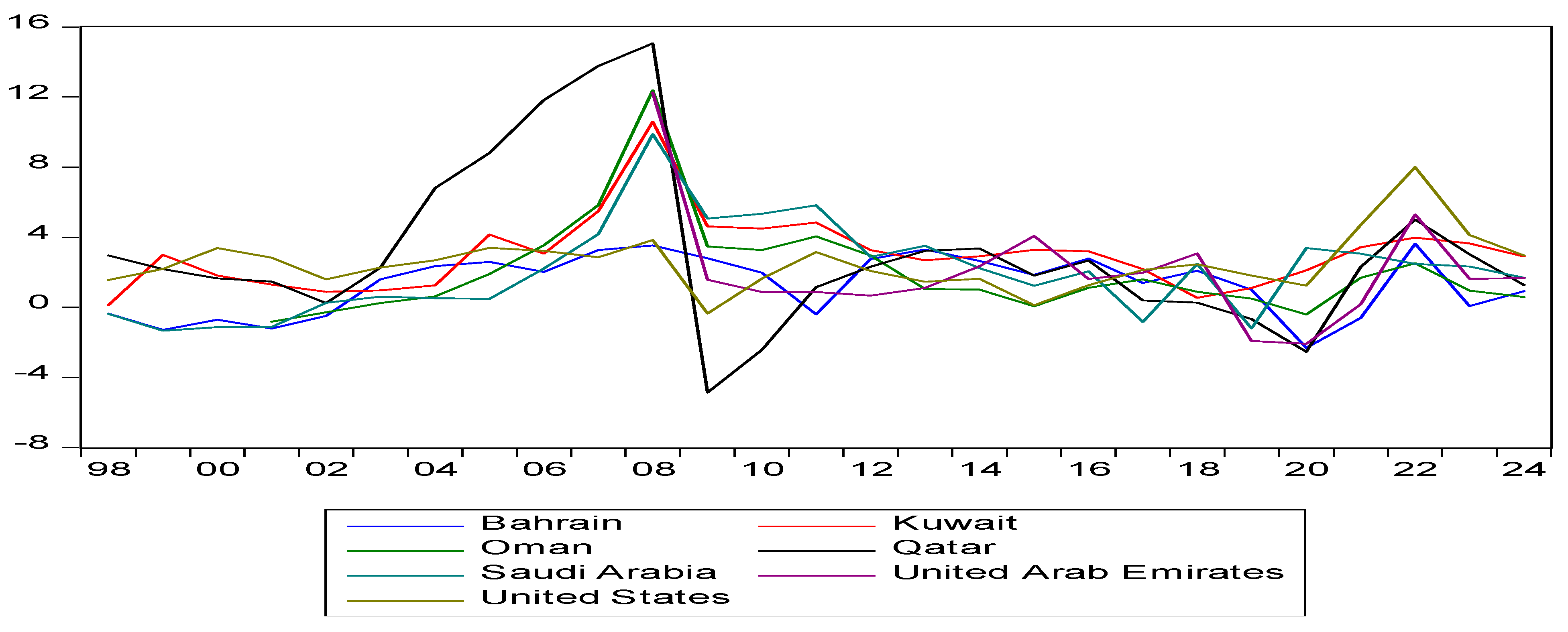
Figure 1, presented below, shows the trend of inflation in GCC economies over the last couple of decades. The inflation rate has drastically increased for all GCC economies, excluding Bahrain, during the early part of the 2000s. For instance, inflation reached its peak point in 2008 in GCC economies, such as Qatar (15.050%), Oman (12.375%), Saudi Arabia (9.870%), UAE (12.250%), and Kuwait (10.582%). In Bahrain, the inflation rate has remained modest during the last couple of decades, and it reached its highest level of 3.625% in 2022. Since 2008, inflation has sharply declined in all GCC economies. Inflation turned negative during the COVID-19 pandemic in all GCC economies, excluding Kuwait, where inflation remained positive. However, since the COVID-19 pandemic, inflation has increased in all economies belonging to the GCC. It is also witnessed that the post-pandemic inflation rate in GCC economies is much higher compared to the pre-pandemic level. The observed inflationary pressure in GCC economies has created fears among policymakers, as inflation is the root cause of numerous socioeconomic issues.
For a deeper understanding of inflationary pressure in GCC economies, we have also graphed the inflation rate of the United States in
Figure 1. In 2008, inflation in the United States also reached its highest level (3.839%) as compared to 1998. However, inflation remained relatively low in the United States as compared to the GCC economies. It is pertinent to mention that the United States also experienced a significant increase in the inflation rate since 2008. However, after the financial crisis, inflation has reduced considerably in the United States in a similar fashion to the GCC economies. On the other hand, post-pandemic, inflation has increased significantly, and it reached more than 8 percent in 2022, which is consistent with the inflationary trend in GCC economies. It means that inflationary trends are similar both in the GCC economies as well as in the United States. The observed similarity in inflationary trends could be explained by the greater economic integration of the GCC economies with the global world.
The current study contributes to the literature on the determinants of inflation in three important ways. Firstly, the current study has considered both internal and external factors to figure out the true determinants of the inflation rate, since there is no consensus among researchers about the relative role of internal and external factors in shaping inflation dynamics. Secondly, our study contributes to the literature on GCC economies, as prior literature has hardly paid attention to figuring out the determinants of the inflation rate in the context of GCC economies in recent times. Thirdly, the current study is also keen on testing the direction of the relationship among the chosen variables, as prior studies have not paid attention to the causality aspect. In summary, the contribution of the current study to the ongoing literature is significant and is expected to shape policy formulation regarding the management of inflation.
This research paper is segmented into several important interconnected sections.
Section 2 primarily focuses on a discussion of previous studies on the determinants of inflation, both globally as well as on GCC economies. The development of relevant econometric models and data collection is shown in
Section 3.
Section 4 includes the econometric methodology used for analysis. The results are reported and analyzed in the penultimate section. Concluding remarks, policy implications, and limitations of the current study are documented in the final section.
2. Literature Review
Inflation and its determinants have long been debated and researched in empirical literature over the last several decades due to their severe consequences for global as well as individual economies. A heightened inflation rate generally harms the overall growth process due to its devastating influence on all sectors of the economy, including both consumers and producers (
Tahir & Azid, 2015). Given the adverse consequences of inflation, several researchers have attempted to figure out the factors responsible for the inflationary pressure in economies (
Moser, 1995;
Khan & Gill, 2010;
Mohanty & John, 2015).
Mohanty and John (
2015) have analyzed the data of the Indian economy and reported that oil prices and fiscal deficit are the main determinants of the inflation rate. On the other hand,
Deniz et al. (
2016) demonstrated that money growth has positively impacted the inflation rate in the case of developing economies.
Increased money supply, specifically in the context of resource-rich economies, may increase inflationary pressure in economies as it generates extra demand in the market. Normally, inflation occurs in economies where the output growth falls short of money growth. The quantity theory of money is the starting point for linking the money supply to the inflation rate. The quantity theory of money endorses that the inflation rate responds positively to an increase in money supply while holding all other factors constant. In light of the quantity theory of money, numerous studies have been conducted in the existing body of knowledge to assess the role of money supply in shaping inflation dynamics. There is much empirical evidence about the relationship between money supply and inflation rate. For instance, in a recent study,
Stylianou et al. (
2024) provided convincing evidence about the positive impact of money supply on the inflation rate in the case of the Pakistan economy. Similarly,
Tahir et al. (
2023) also displayed a positive relationship between money supply and inflation by utilizing empirical data of the Chinese economy and using the ARDL technique. Finally,
Al-Shammari and Al-Sabaey (
2012) displayed that increased money supply leads to an increased inflation rate. The findings of the mentioned studies imply that money supply is the major contributor to inflation.
Similarly, the degree of trade openness of economies could also impact the level of inflation in these economies. In this regard, the novel study of
Romer (
1993) endorsed that generally, more open economies experience a relatively lower inflation rate as compared to closed economies. Romer’s theory is the starting point for linking trade to the inflation rate. Several researchers have attempted to test the validity of the famous Romer’s hypothesis about the trade–inflation relationship. For example,
Tahir et al. (
2023) focused on the Chinese economy and confirmed the validity of Romer’s hypothesis by displaying an inverse relationship between trade openness and inflation rate. On the other hand,
Mukhtar (
2012) utilized long historical data of Pakistan and confirmed the validity of Romer’s hypothesis by establishing an inverse long-run relationship between trade openness and inflation. However, there are some studies where researchers have rejected the validity of Romer’s hypothesis by demonstrating a long-run relationship between trade openness and inflation. For instance,
Samimi et al. (
2012) and
Chhabra and Alam (
2020) demonstrated a positive relationship between trade openness and inflation. Moreover,
Sepehrivand and Azizi (
2016) also rejected the presence of Romer’s hypothesis in the context of D-8 economies. It means that the relationship between trade openness and inflation rate is still an open question in the research literature.
Global oil price is also capable of explaining the variation in the inflation rate across countries. In the modern globalized world, all economies are completely dependent on the consumption of oil, as it is the backbone of industrial production, agricultural production, and transportation systems. Therefore, any positive or negative shocks in oil prices directly impact general price levels in all economies. In this regard, empirical studies have repeatedly tested the influence of oil prices on the inflation rate during the last couple of decades. For instance,
Choi et al. (
2018) have focused on a sample of 72 developed and developing economies and proved that an increase in global oil prices is responsible for inflationary pressure. They further quantitatively demonstrated that a 10 percent rise in global oil price can explain a 0.40 percent variation in the domestic inflation rate. Furthermore, the comprehensive study by
Ha et al. (
2023) shows that oil price contributes more to inflation in the case of developed economies, net commodity importers, and countries with strong increased global trade. Lastly,
Mohanty and John (
2015) also demonstrated the inflationary pressure of crude oil prices on the Indian economy by utilizing data from the Indian economy for the period 1996–2014.
Moreover, global supply chain disruptions in the modern globalized world could also significantly explain inflation rates in the modern globalized world. Exposure to global supply chain disruptions is expected to generate inflationary pressure in the domestic economy. In this regard,
Santacreu and LaBelle (
2022) empirically demonstrated a positive impact that supply chain disruptions have on inflation in the United States. More recently,
Diaz et al. (
2023) endorsed that inflationary pressure created by supply chain disruptions in the United States via the SVAR model.
Diaz et al. (
2024) highlighted the role of supply chain disruptions and documented that they are responsible for the rising inflation rate that occurred in the mid-2010s. It appears that supply chain disruption is one of the major causes of inflation.
Andriantomanga et al. (
2023) also focused on the impact of supply chain disruptions on the inflation rate of 29 Sub-Saharan African economies for the period 2020 to 2022. They concluded that supply chain disruptions have a positive, significant, and sizable influence on the inflation rate in selected African economies.
In the context of GCC economies, some researchers have attempted to explore the determinants of inflation. For instance,
Kandil and Morsy (
2011) concluded that inflation in the partner countries can explain the inflationary pressure in GCC economies. Similarly,
Basher and Elsamadisy (
2012) utilized data from 1980 to 2008 and demonstrated that money supply is positively associated with the inflation rate in the context of GCC economies. In the context of Kuwait,
Abdullah et al. (
2020) showed that inflation is primarily influenced by money supply, interest rates, and the imports of goods and services.
In summary, the determinants of inflation are not well-explored, specifically in the context of GCC economies, as evident from the brief review of the literature. Still, it is not clear whether inflation in the GCC countries is driven by internal factors or external factors. This lack of research on the determinants of inflation in GCC countries is the main motivation behind the current research study. Consequently, this study expects to add to the literature on the determinants of inflation in GCC economies. Hence, GCC policymakers and government authorities will find the outcomes of this study indeed useful. Our results would therefore be used for effective policy formulation regarding the management of inflation in GCC economies.
3. Model Design and Data
In this section, this study focuses on the development of the model for achieving the objectives of the study. As mentioned earlier, our prime objective is to assess the response of the inflation rate to the changes in external and internal factors in GCC economies. For internal factors, we have selected money supply and trade liberalization policies. Among the external factors, we have selected only global oil prices and global supply chain disruptions. It is an undeniable fact that inflation has several other key determinants. However, to ensure a sufficient degree of freedom, we have restricted our analysis to only two external and two internal determinants of inflation. We include real GDP as a control variable, as it accounts for demand-pull inflation from economic growth, and to mitigate the omitted variable bias. The exclusion of RGDP would distort the expected effects of other variables and overlook a key structural driver of inflation in oil-dependent GCC economies. The following functional form is specified for the purpose of analysis.
The functional form presented above shows that the inflation rate in GCC economies could be explained by money supply, trade openness, global oil prices, global supply chain disruptions, and real GDP. The modified form of expression (1) is presented below.
In model 2, the dependent variable is the consumer price index, which is consistent with prior studies on the inflation rate (
Tahir et al., 2023). For measuring money supply (MONS), we have used “(Broad money as % of GDP)” while openness to trade (TRADE) is approximated by considering the “trade to GDP ratio”. Global oil prices (LOILP) are measured in “US
$ per barrel West Texas Intermediate crude oil prices per barrel (WTI)”. Finally, the “global supply chain pressure index” (GSCPI), developed by
Benigno et al. (
2022), is used for measuring global supply shocks, while real GDP is taken in the form of constant prices. Data for the global supply index, which were available monthly, are converted into yearly data to match their frequency with other variables. Furthermore, it is useful to mention that only GDP and oil prices are expressed in natural logarithms. In addition, variables such as money supply and trade are not log-transformed as they are expressed in percentages. Finally, the logarithmic transformation is also not applied to the inflation rate and supply chain disruption due to the small and negative values in their series.
Data for money supply, inflation rate, and trade openness are sourced from the “World Development Indicators (WDIs)”. Data on global oil prices are taken from the Macrotrend database, which is available freely. Finally, for supply chain disruptions, we have used the index developed by
Benigno et al. (
2022). We include real GDP (RGDP) as a control variable to avoid omitted variable bias, which is extracted from the WDIs. The data cover the period from 1998 to 2023, which was selected based on the availability of the required data, particularly the data for GSCPI, which was introduced in 1998.
Table 1 exhibits complete descriptions of the variables and sources of data.
4. Estimation Methods
4.1. Panel Cointegration
For testing cointegration in the panel data, several tests have been developed in the existing body of literature. For instance,
Kao (
1999) presents the DF and ADF tests for cointegration, which consider the endogeneity among variables. The test specification is outlined below using expression (3).
In expression (3),
and
are presumed to be integrated of order one, and
represents the error term. The Kao panel cointegration test is formulated to assess the absence of cointegration under the null hypothesis, which relies on the unit root test for the residual term
, utilizing the subsequent unit root equation, as shown below, using expression (4).
The
Westerlund (
2007) cointegration test accounts for cross-sectional dependence and variability within the panel. The Westerlund test for cointegration determines if the variables exhibit a long-term relationship. The null hypothesis of the Westerlund test posits the absence of cointegration within the panel, while the alternative hypothesis asserts that one or more panels exhibit cointegration.
4.2. PMG-ARDL
The panel ARDL model or pooled mean group (PMG) estimation allows the detection of dynamic short-run and long-run relationships.
Akinlo and Olayiwola (
2021) endorsed that the PMG-ARDL estimation is based on the pooling and averaging of the coefficient over the cross-sectional entities. The PMG estimator may evaluate short-run associations while considering heterogeneity, long-run equilibrium adjustments (adjustment speed), and error variance. The long-run coefficients must demonstrate consistency throughout the panel. This approach is suitable for analyzing long-term relationships with reliable outcomes.
Pesaran et al. (
1999) endorsed that the PMG-ARDL, grounded in the maximum likelihood technique, provides a practical advantage by distinguishing both short- and long-run coefficients and identifying the long-run equilibrium relationship. This approach guarantees consistency between groups for intercepts, error variance, and both short-term and long-term coefficients. In the long run, the PMG-ARDL methodology allows for the similarity of coefficients. In contrast to the long run, the short-run intercepts and coefficients’ variance may different across economies. In other words, the PMG-ARDL is capable of addressing the problem of long-run consistency and short-run heterogeneity. The PMG-ARDL estimation methodology is a robust technique for concurrently analyzing long- and short-run cointegration among selected variables, effectively accommodating the presence of unit root characteristics. The PMG-ARDL model can be expressed within the subsequent panel ARDL structure. Numerous studies have utilized the PMG-ARDL techniques for the estimation of models. We have converted the specified model 2 in the PMG-ARDL framework as shown below.
In Equation (5), the term ECT indicates the error correction term, whereas and stand for the short-run and long-run coefficients, respectively. The sign Δ denotes the first difference operator, and the parameter ( indicates the coefficient of the error correction term.
4.3. Panel Causality Testing
In addition to the cointegration analysis, the present study also attempted to investigate the direction of the relationship among the chosen variables. For this purpose, the study utilized the procedure of
Dumitrescu and Hurlin’s (
2012) heterogeneous causality method (D.H). The D.H method has two advantages over traditional panel causality techniques: (a) it is applicable for T > N and for unbalanced data and heterogeneous panels; and (b) it accommodates cross-sectional dependency in panels. The D.H approach is specified using expression (6) provided below.
The subscript (i) indicates the individual cross-sectional unit, while (t) signifies the time period. Similarly, () represents individual effects assumed to be constant over time, (j) denotes the optimal lag interval relevant to all cross-sections, () shows the autoregressive coefficients, and () denotes the regression parameter that may vary across groups. Finally, is the vector of error terms, while x and y represent the series for which causality will be assessed. The aim of this test is to ascertain whether X induces Y.
4.4. Preliminary Testing and Analysis
In the first step, this study assessed cross-sectional dependency (CD) using several tests, including the
Pesaran et al. (
2004) test. The outcome demonstrated in
Table A1 (
Appendix A) confirmed the likely cross-sectional dependency and hence the first-generation tests of the unit root are not applicable. In light of cross-sectional dependency, we have utilized the second-generation unit root tests, such as the cross-sectional-augmented Dickey-Fuller (CADF) and cross-sectional-augmented IPS (CIPS). The results shown in
Table A2 (
Appendix A) reveal inconsistencies among the assessments; nevertheless, all variables exhibit stationarity only after first differencing. After the unit root analysis, the study additionally employed the Pesaran and Yamagata approach to evaluate the homogeneity of the variables. The findings demonstrated in
Table A3 (
Appendix A) confirmed the heterogeneity of the variables.
Furthermore, this study also used the variance inflation factor test for assessing multicollinearity. The findings of VIF, endorsed in
Table A4 (
Appendix A), validated the absence of multicollinearity, as all values of the VIF test are less than 5, which is required. Finally, the findings of Kao and Westerlund’s cointegration tests, reported in
Table A5 and
Table A6 (
Appendix A), respectively, confirmed the presence of cointegration.
4.5. Descriptive Analysis
Descriptive statistics are presented for selected variables in
Table 2. The mean value of inflation remained 2.279 percent in GCC economies during the study period, while its standard deviation was 2.983. The highest inflation (15.050%) was recorded in Qatar in 2008. In contrast, the lowest inflation (deflation) was also experienced by the economy of Qatar in 2009. Similarly, money supply as a percentage of GDP indicates differing levels of financial sector development. The average value of money supply is 54.329 with a standard deviation of 8.528. The highest value of money supply is 72.370, while the lowest value is 44.337 percent.
Due to the GCC’s reliance on oil, West Texas Intermediate (WTI) crude prices (OILP) substantially impact fiscal and external balances. The mean value of oil price was $53.33 per barrel during the study period, exhibiting significant volatility as evident from the standard deviation. The oil prices range from $15.71 (2016 oil crash) to $94.24 (post-pandemic increase). Historically, these changes have prompted fiscal adjustments, with oil revenues influencing government expenditure and economic cycles.
The GSCPI averaged 0.019, with values fluctuating between −0.897 (indicating stability) and 3.05 (indicating significant disruptions), illustrating the logistics bottlenecks and recoveries associated with the pandemic era. The uniformity of the index among GCC members underscores their collective vulnerability to global trade disruptions. Moreover, the income statistics measured by real GDP data indicate significant inequalities in economic magnitude. Saudi Arabia, with an average of $548 billion, dominated the region, but Bahrain, with an average of $25.8 billion, constituted the smallest economy. Qatar and the UAE exhibited significant GDP volatility, presumably attributable to extensive infrastructure investments (e.g., World Cup 2022, Expo 2020) and diversification initiatives.
Finally, the trade performance of GCC economies is exemplary, as evident from the statistics. The average value of openness to trade “(Exports + Imports/GDP) × 100” is (107.885%) which is an indication of the trade liberalization policies exercised by the policymakers and authorities of GCC economies. The economy of Bahrain achieved the highest trade openness index (191.872%) in 2013, while the lowest trade openness index (59.905%) was observed and recorded in 2016 for Saudi Arabia.
The GCC economies exhibit structural commonalities, such as oil dependence, fixed currency rates, and trade openness; yet, their macroeconomic performance diverges owing to varying policy frameworks and degrees of economic diversification. Kuwait and Bahrain demonstrate increased monetary depth, while Oman and Saudi Arabia display more conservative financial systems. Inflation and trade dynamics underscore the UAE’s distinctive position as an economic and commercial hub, yet oil price fluctuations continue to pose a global challenge. These observations highlight the necessity for customized policy measures to address inflation, fiscal sustainability, and external shocks in a post-oil context.
4.6. Correlation Analysis
The correlation matrix presented in
Table 3 indicated a noticeable linear association among the chosen variables. All correlation coefficients are different from zero in terms of statistical significance at the 1 percent level. The highest linear association is witnessed between trade openness and oil prices (0.771). It means that the oil-dependent trade structure of the GCC; however, oil prices do not exhibit a significant relationship with the money supply. In contrast, the lowest correlation (−0.017) is observed between oil prices and money supply. The observed inverse correlation between oil prices and money supply appears counterintuitive, specifically for the oil-exporting nations. This result contradicts traditional assumptions regarding oil revenue monetization, potentially indicating the presence of effective sterilization policies. In addition, it is possible that increased revenues from the oil exports are channeled either towards the sovereign wealth funds or asset accumulation. All other variables are moderately correlated with each other.
5. Results and Analysis
5.1. Regression Results and Discussion
The PMG-ARDL estimation results are presented in
Table 4. The results revealed that increased money supply is the root cause of rising inflation in GCC economies. The coefficient of money supply is positive and significant. Our findings about the relationship between money supply are consistent with the prior literature (
Greenwood & Hanke, 2021;
Doan Van, 2020;
Mbongo et al., 2014). Our results are strongly supported by the monetary theory of inflation, which predicts that excessive liquidity in the form of increased money supply leads to heightened inflation. This finding is especially pertinent due to the distinctive monetary system in GCC nations, where the majority of currencies are tied to the US dollar. This exchange rate system constrains central banks’ capacity to implement autonomous monetary policy, rendering the regulation of domestic money supply particularly vital for sustaining price stability. Controlling inflation will not only improve economic growth but will also solve socioeconomic problems. The insignificant short-run coefficient indicates that monetary policy functions with substantial lags in the GCC economies, which is perhaps attributable to institutional issues or structural inflexibilities in financial markets.
Similarly, the coefficient of openness is negative but insignificant in the estimated model. It means that enhanced trade openness is responsible for creating a deflationary influence. The negative coefficient of trade openness is consistent with the prediction of the well-known theory of
Romer (
1993), which suggests that open economies experience relatively less inflation. However, the insignificance of the coefficient indicates that the role of trade openness is not dominant in altering inflation in GCC economies. Our results are also in line with the recent empirical literature (
Tahir et al., 2023;
Chhabra & Alam, 2020). It is a fact that trade openness promotes healthy competition, and hence the price level faces downward pressure. In contrast, the short-run findings indicated that trade openness has produced a positive and significant influence on the inflation rate. Several factors, such as exchange rate pass-through effects or transient price adjustments in import-competing industries, could explain the positive impact of trade openness on the inflation rate. This duality highlights the complex relationship between trade liberalization and price stability in the region.
Moreover, the results underscore that oil prices are responsible for the observed inflationary pressure in GCC economies. This relationship illustrates the essential function of oil resources in GCC economies, wherein oil price volatility influences inflation through several mechanisms. Higher oil prices enhance government revenues, resulting in increased public expenditure and domestic demand, while simultaneously escalating production costs in energy-intensive industries. The study by
Choi et al. (
2018) empirically showed that a 10% rise in global oil prices raises domestic inflation by 0.40%. Therefore, amid rising global oil prices, policymakers are advised to adopt some credible monetary measures to minimize their adverse consequences. The unexpected negative short-run coefficient may indicate the influence of temporary price restrictions or subsidy systems that initially mitigate the inflationary consequences of oil price shocks, but these effects diminish with time.
Furthermore, our results demonstrated that the inflation rate responds positively to increased global supply chain disruptions. This finding indicates the region’s significant reliance on imported food, manufactured products, and industrial resources. The insignificant short-run coefficient indicates that GCC nations may possess a degree of resilience to transient supply shocks, either via strategic reserves or inventory management techniques. It means that the inflation rate in GCC economies is less affected by global supply chain disruptions. In other words, other factors such as money supply, global oil prices, and trade openness are more important in explaining the inflation rate in the GCC economies instead of global supply chain disruptions in the short run.
In contrast, real GDP exhibits a positive and statistically significant influence on the inflation rate, both in the long and short terms, albeit with varying degrees of intensity. The positive impact of GDP on the inflation rate is well-supported by the demand-pull theory. The demand-pull theory suggests that an increased income level amid increased economic activities generally produces significant inflationary pressure. It means swift economic expansions and rising income generate significant inflationary pressure in GCC economies. This pattern may indicate capacity limitations in non-oil sectors as GCC nations implement diversification efforts through various national vision projects.
Moreover, to shed some light on the possible impacts of the financial crisis on inflation dynamics in the GCC, we have performed a structural break analysis. To serve this purpose, this study utilized the well-known Chow test to explore the possibility of a structural break. The Chow test indicated the presence of a structural break for the year 2008, as the F-test value is statistically significant. To accommodate the structural break, the study included a dummy variable for the year 2008 in the specified model. In the estimated model, the dummy used for the structural break is not only negative but also statistically significant. It implies that structural changes have occurred post the crisis period. The negative sign of the crisis dummy shows that inflation dynamics experienced a downward adjustment in the post-crisis period in the GCC economies. However, in the short run, the crisis dummy is negative but insignificant. It means that the crisis has not impacted the inflation dynamics immediately. These results suggest that inflation in GCC economies is mainly driven by domestic factors in the short run, while the financial crisis has shaped the long-term inflation rate.
It is pertinent to mention that separate regressions for the post-crisis and pre-crisis periods and interactive regression models are not estimated, mainly due to the limited number of observations. This could potentially be one of the main limitations of the current study. Nevertheless, the combined use of the Chow test and the D2008 dummy effectively captures the structural change in inflation dynamics.
According to the report of the
European Investment Bank (
2013), the GCC economies are enjoying one of the world’s largest sovereign wealth funds (SWFs). The SWFs provide a valid institutional channel that could be used to tackle global shocks in the form of fluctuations in oil prices, as well as supply chain disruptions, effectively. In other words, the GCC economies need to revisit their policies and utilize their rich SWFs to protect their economies from global shocks and promote economic stability, which is a prerequisite for addressing the problem of inflation. The dummy used for the 2008 crisis clearly indicated the vulnerability of GCC economies to global shocks. Therefore, the authorities of GCC economies need to revisit their existing policies on the management and utilization of their SWFs and take remedial measures to win the fight against the rising inflation.
Finally, the coefficient of ECT is −0.602, which is significant, validating the presence of a stable long-term equilibrium relationship among the variables. The projected adjustment rate indicates that around 60% of any imbalance is rectified each period, reflecting a reasonable adjustment mechanism in GCC economies.
5.2. Robustness Testing
For the purpose of robustness of the findings reported, we have applied two alternative estimators, such as the fully modified least squares (FMOLS), as well as the dynamic least squares (DOLS), to investigate the robustness of the findings. Moreover, given the possibility of the likely endogeneity issue and reverse causality between the independent variables and the dependent variable, the two-step system generalized method of moments (GMM) estimator, presented by
Arellano and Bond (
1991), is also used for estimation purposes. A key feature of the Arellano–Bond difference GMM estimator is its ability to instrument a first-differenced endogenous variable in the modified regression equation using its lagged values. In addition to the GMM estimator, findings of FMOLS, DOLS, and System GMM are shown in
Table 5.
The findings of FMOLS and DOLS provided firm support for the earlier results of PMG-ARDL. Money supply, oil prices, and GDP have maintained their positive and significant influences on the inflation rate. In contrast, the supply chain disruption variable has lost its significance but importantly retained its positive coefficient sign, both in the FMOLS and DOLS estimation. In addition, the negative impact of trade openness on inflation turned significant in the FMOLS and DOLS estimations. Moreover, the GMM-based results also validated the results of PMG-ARDL. All variables have retained both their coefficient signs, as well as significance levels, in the GMM-based results. Lastly, it is important to mention that the GMM estimation has passed all diagnostic tests, including the significance of AR (1) and insignificance of AR (2). Finally, the Hansen and Sargen tests have confirmed the validity of the instruments utilized in the estimation.
5.3. Causality Testing
The direction of causation helps policymakers in formulating relevant economic policies for sustainable economic growth and development. We applied the D.H heterogeneous Granger causality method to forecast both short-term and long-term causality. The results of causality are shown in
Table 6.
The unidirectional causality from oil prices to inflation ( → ) underscores the essential influence of oil revenues on domestic price levels. It means that the region’s economic framework is such that oil profits stimulate domestic demand via government expenditure and private sector liquidity. The lack of reverse causality indicates that GCC countries are price-takers in global oil markets, with domestic inflation levels incapable of affecting international crude prices. This negative relationship significantly influences monetary policy, suggesting that central banks must primarily respond to, rather than predict, oil price shocks.
The results of trade openness indicate a notably robust unidirectional causality to inflation ( ↔ ). It indicates that higher trade integration serves as a notable inflationary catalyst in GCC countries, probably via three principal processes. Initially, increased trade openness causes domestic markets to experience global price volatility, especially for food and manufactured products in which GCC nations exhibit significant import reliance. Secondly, trade liberalization may diminish the pricing power of domestic producers, engendering competitive forces that initially elevate prices as firms adapt. Thirdly, the effects of a currency rate pass-through may be intensified in more liberalized trade environments. The absence of reverse causality suggests that inflation levels do not consistently affect trade policy decisions, indicating that trade openness in GCC states is primarily motivated by strategic diversification goals rather than short-term price stability concerns.
The dynamics of the money supply exhibit a bidirectional yet asymmetric link with inflation ( ↔). This pattern may indicate multiple institutional factors: (1) the limitations imposed by currency pegs on autonomous monetary policy, (2) the liquidity impacts of oil revenue inflows during periods of elevated prices, and (3) the possibility of fiscal dominance wherein monetary policy facilitates government expenditure priorities. The reciprocal nature of this relationship establishes a possible feedback loop that policymakers must diligently oversee, as monetary reactions to inflation could inadvertently exacerbate price increases if not accurately regulated.
The relationship between growth and inflation exhibits a similarly intricate bidirectional causation ( ↔ ). This observed relationship presumably functions via traditional demand-pull mechanisms, wherein economic development enhances consumption and investment demand, surpassing short-term supply capacity. The notable, although diminished, reverse causality may indicate various factors as follows: (1) inflation-induced uncertainty suppressing investment, (2) real balance effects diminishing consumption, or (3) policy responses to inflation that unintentionally hinder growth. The results indicate that GCC policymakers encounter a complex tradeoff between growth and inflation, which fluctuates depending on the phases of the business cycle and global oil prices.
The indicates its function as both a recipient and conduit of economic shocks. The important causation from supply chain pressures to oil prices ( → ) certainly illustrates how global production disruptions influence energy demand patterns, especially during industrial downturns. The lack of reverse causality implies that oil price swings do not consistently affect global supply chain conditions, suggesting that these are predominantly influenced by non-energy sources. The observation that money supply impacts supply chain disruptions ( → ) may appear paradoxical, yet it may indicate how GCC liquidity conditions affect the availability of trade finance in the region. This intricate network of relationships highlights how GCC economies are both influenced by and contribute to global economic processes.
The oil price transmission mechanisms exhibit notably significant impacts on both monetary aggregates ( → ) and real output ( → ). These findings validate the essential role of oil revenue in influencing GCC economic circumstances via many transmission mechanisms, such as (1) direct fiscal channels through government budgets, (2) banking sector liquidity effects, and (3) private sector investment reactions. The intensity of these correlations differs among GCC governments based on their fiscal reserves and diversification advancements; yet, the constant trends underscore the persistent significance of oil prices in regional macroeconomic dynamics.
The trade–GDP–money supply triangle illustrates significant interconnections relevant to the GCC development strategy. It indicates that trade openness influences both money supply ( →), and GDP ( → ) indicates that effective diversification initiatives can create positive cycles of expansion. The bidirectional relationship between GDP and money supply ( ↔ ) suggests that these advantages may entail inflationary concerns if inadequately managed. These intricate linkages underscore the precarious equilibrium that GCC authorities must achieve between fostering diversification and preserving macroeconomic stability.
6. Conclusions, Implications, Limitations, and Future Research Avenues
6.1. Conclusions
The present study was aimed at investigating the impacts of external and internal determinants on the inflation rate in GCC economies, which is an interesting, significant, and under-examined area in the literature. Panel data of the GCC economies were gathered from several reliable sources for the period 1998–2023 and analyzed using relevant and advanced econometric tools of estimation.
The results obtained using PMG-ARDL analysis indicate that the growth of the money supply is the predominant long-term determinant of inflation. This finding highlights the limitations of GCC central banks, whose monetary policies are significantly affected by the US dollar peg. Due to restricted interest rate modifications, GCC monetary authorities must depend on macro instruments and liquidity management strategies to regulate domestic money supply and uphold price stability. Trade openness demonstrates an insignificant long-term deflationary impact and a significant deflationary impact in the short run, corroborating Romer’s hypothesis. Moreover, our results demonstrated that high oil prices directly translate into inflation in the long run. However, in the short run, fluctuations in oil prices are unable to explain the inflation dynamics, mostly due to the fuel subsidies and price restrictions, which may provide a temporary alleviation of oil-induced inflation; nevertheless, these interventions are not viable in the long term.
The GSCPI indicates a moderate yet statistically significant long-term effect, underscoring the vulnerability of GCC economies to global trade shocks. The temporary insignificance indicates that strategic reserves and inventory management offer a degree of resilience. To further alleviate supply chain vulnerabilities, GCC nations should augment local production capabilities—especially in food security and essential manufacturing—while reinforcing regional trade alliances through initiatives such as the GCC Common Market. Real GDP growth influences inflation in both the short and long term, having a more significant impact in the short term. This suggests that swift economic growth, propelled by diversification initiatives within national vision plans (e.g., Saudi Vision 2030, UAE Vision 2071), could exert pressure on production capacities, resulting in demand-pull inflation. Policymakers must prioritize the elimination of structural impediments—such as labor market inflexibilities, regulatory obstacles, and infrastructural deficiencies—to guarantee that non-oil development does not induce undue inflationary pressures. Finally, the D.H causality demonstrated several one-way, as well as two-way, causal relationships among the selected variables.
In conclusion, this research study enriches the ongoing literature by identifying the impacts of internal and external factors on inflation both in the long run and the short run. The study’s results underscore that the role of oil prices, supply chain disruptions, and trade openness in shaping the inflation dynamics is different in the short- and long-run horizons. These results imply that the mentioned determinants of inflation do not impact inflation in GCC economies in a uniform manner. To put it differently, it could be said that the roles of structural and institutional factors are dominant in shaping the inflation dynamics in GCC economies.
6.2. Implications for Policymakers
The current study suggests the following points based on the robust findings obtained using advanced econometric methodologies. These points, if considered by the policymakers, would help the GCC economies significantly to address the problem of the rising inflation rate, which is the root cause of numerous socioeconomic problems.
The first step the GCC economies could take is to keep control over the money supply, as an increased money supply is the major cause of inflation in GCC economies. The existing money supply policy must be rethought, and it should be linked with growth in the real sector of the economy. Considering the dollar peg limitation, GCC central banks ought to improve liquidity management instruments and macro policies to effectively regulate money supply expansion. However, the limited independence of central banks shall be taken into account while formulating policies. It is a fact that central banks can play an important role in bringing stability to prices and the overall growth performance of economies. Secondly, this study suggests that the trade liberalization policies of GCC economies need to be continued. The results provided significant evidence about the important role that trade openness could play in solving the problem of rising inflation in GCC economies. Thirdly, allocating resources to local manufacturing, strategic reserves, and regional trade networks can alleviate external supply disruptions.
Fourthly, reconsidering labor market reforms, regulatory simplification, and more infrastructure investments are essential for maintaining non-oil growth without exacerbating inflation. Finally, amid the rise in global prices, the GCC economies need to focus on implementing more appropriate monetary policies in order to fight inflationary pressures. The authorities of GCC economies could follow a contractionary monetary policy to minimize the inflationary pressures of rising global oil prices.
By implementing these strategies, the GCC countries can more effectively control inflationary pressures while progressing towards their long-term diversification and stability objectives. Future studies may investigate sector-specific inflation determinants and the efficacy of different monetary policy instruments in dollar-pegged systems.
6.3. Limitations and Future Research Directions
The present study has focused on six GCC economies. The GCC economies are unique in terms of their economic and political structure. Therefore, our results could not be generalized at a global level. Hence, future researchers are suggested to test the proposed model of our study by focusing on other regions of the world to assess its validity.
Secondly, the current study has considered only two external and two internal determinants; however, it is a fact that inflation is dependent on several other factors, including institutional factors. Future research studies are advised to search for the institutional determinants of inflation in GCC economies, which are rarely researched.