

Digital Development Levels in the European Union: Measurement and Analysis

Abstract
1. Introduction
- (a)
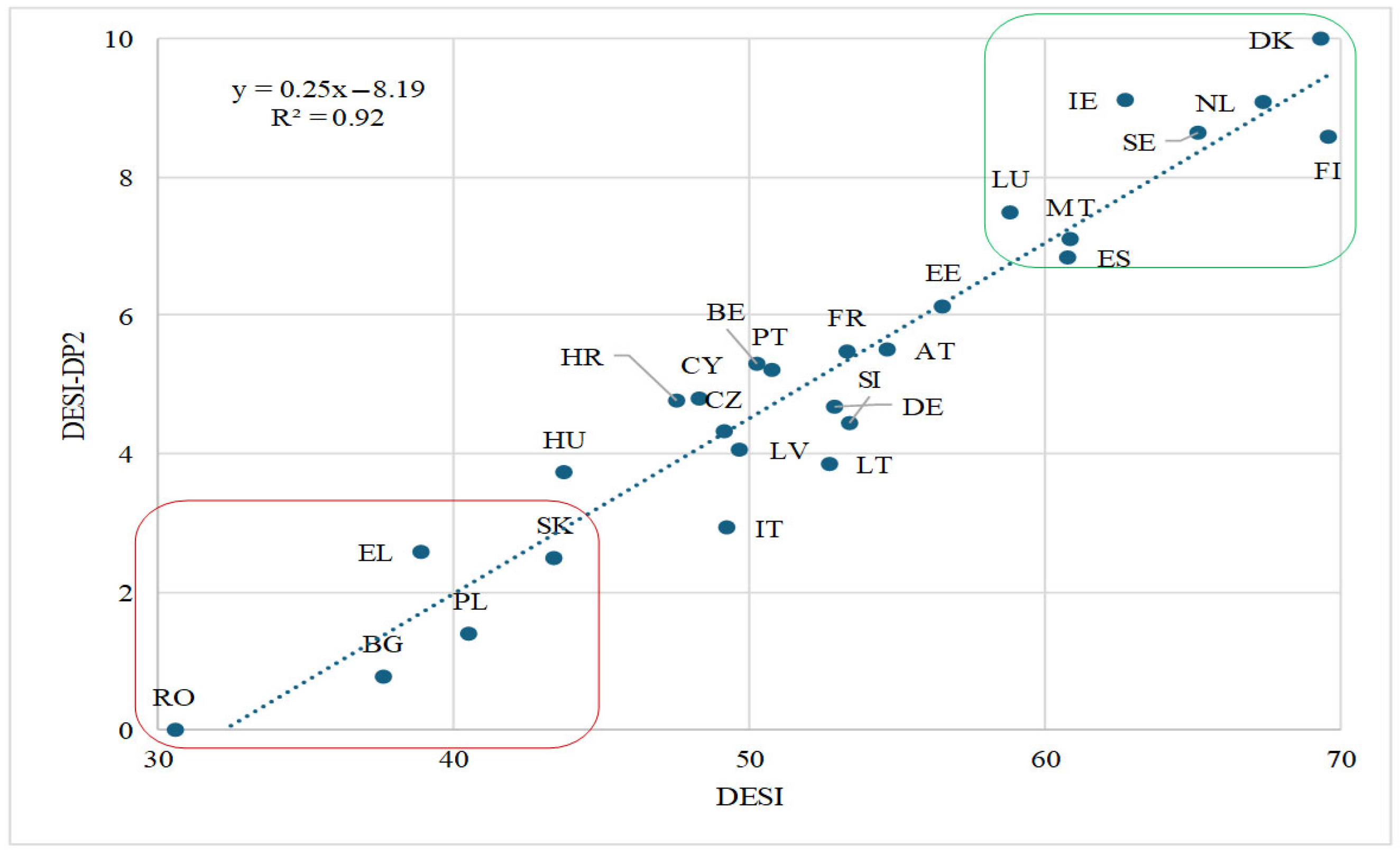
- To compare the results obtained by applying the DP2 methodology with those derived from the DESI in 2022 and to assess whether it can serve as a substitute indicator.
- (b)
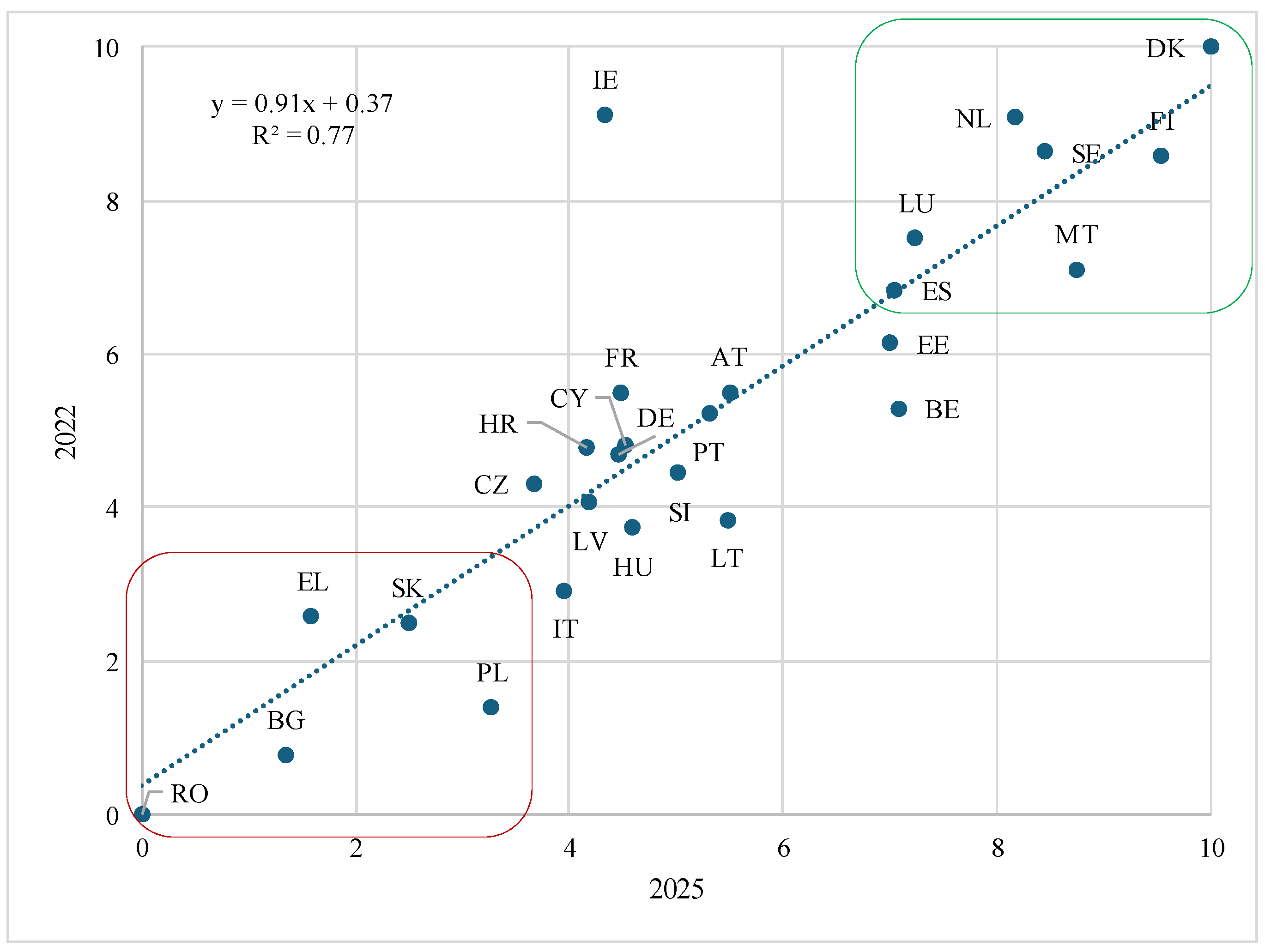
- To compare the situation of DESI-DP2 in 2022 and 2025 in the EU countries.
- (c)
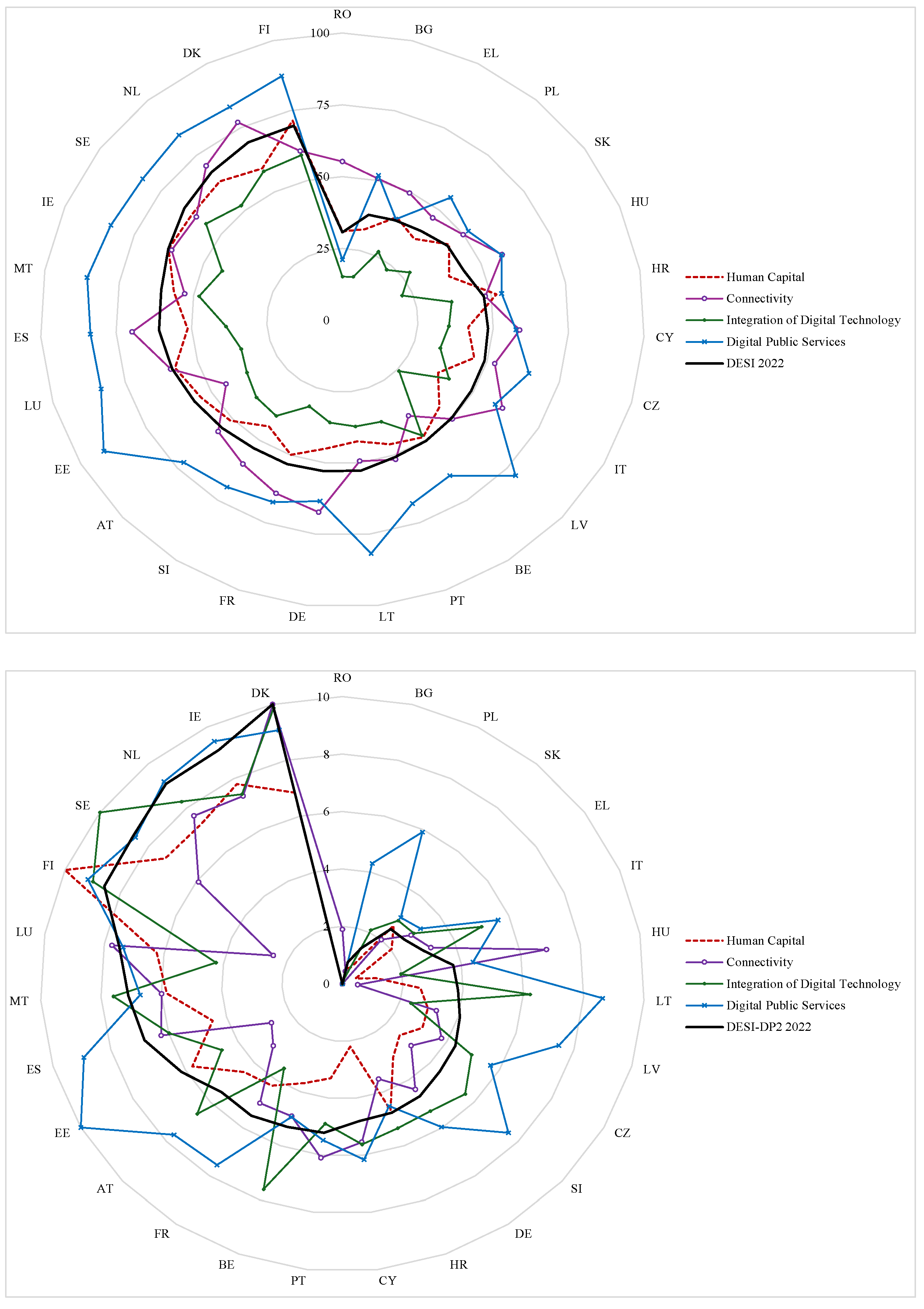
- To identify the importance of the different dimensions in explaining the inequalities in the digitalisation level of EU countries.
2. Methodology
3. Results
3.1. The DESI-DP2 as an Approximation to the DESI for Assessing the Overall Level of Digitalisation
3.2. Comparison of the Level of Digitalisation in 2022 and 2025 Using the DESI-DP2
3.3. Dimensions of Digitalisation
4. Discussion and Conclusions
4.1. Discussion
- —
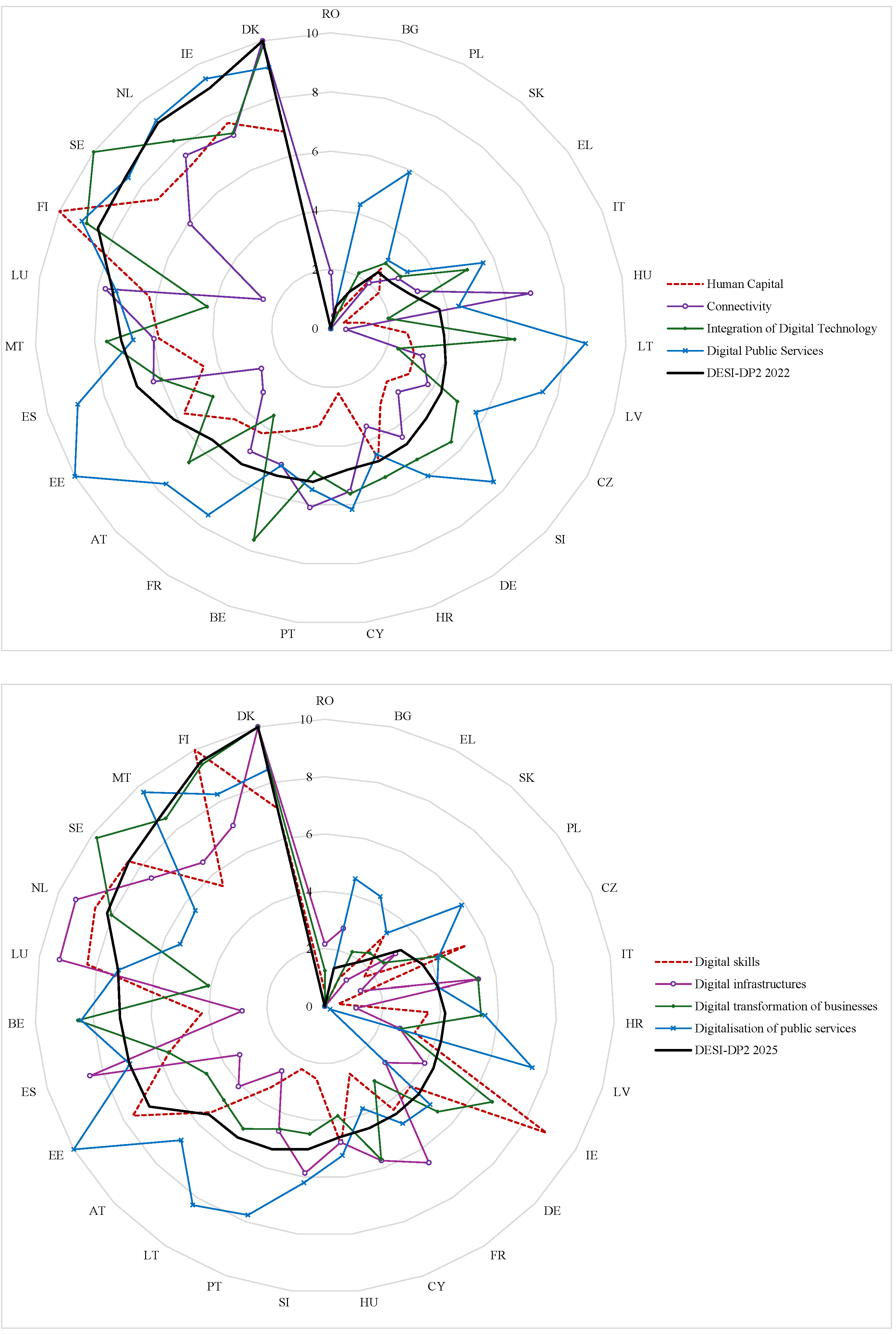
- The leaders in digitalisation are Denmark, Finland, the Netherlands, Sweden, and Ireland; the level of digital development in Malta, Spain, and Luxembourg is also noteworthy. At the opposite end, the lowest positions are occupied by Slovakia, Poland, Greece, Bulgaria, and Romania. Applying different methods and using data from different years, the literature also identifies the first four aforementioned countries as leaders, and Bulgaria and Romania as lagging behind, generally alongside Greece (Bánhidi et al., 2020; Laitsou & Xenakis, 2023). No significant changes were observed in country rankings when comparing the DESI-DP2 for 2022 and 2025, except for specific cases such as Ireland, Malta, Lithuania, and Belgium. Fidan (2024), using different analysis methods to cluster countries by similar digitalisation levels, also maintains that most remain within the same group. As previously mentioned, some countries, such as Ireland, show a significant decline, while others, such as Malta, have improved. In order to identify the factors that explain cases such as that of Ireland (which worsens sharply) or that of Malta (which improves significantly), the Digital Decade 20255 reports for both countries were reviewed, showing that “Ireland maintains a high level of SME digitalisation, but growth has been stagnating since 2022”, while “Malta performs very well on the uptake of AI and digitalisation of businesses […] Significant progress has been achieved over the last year, particularly in the share of enterprises adopting AI”.
- —
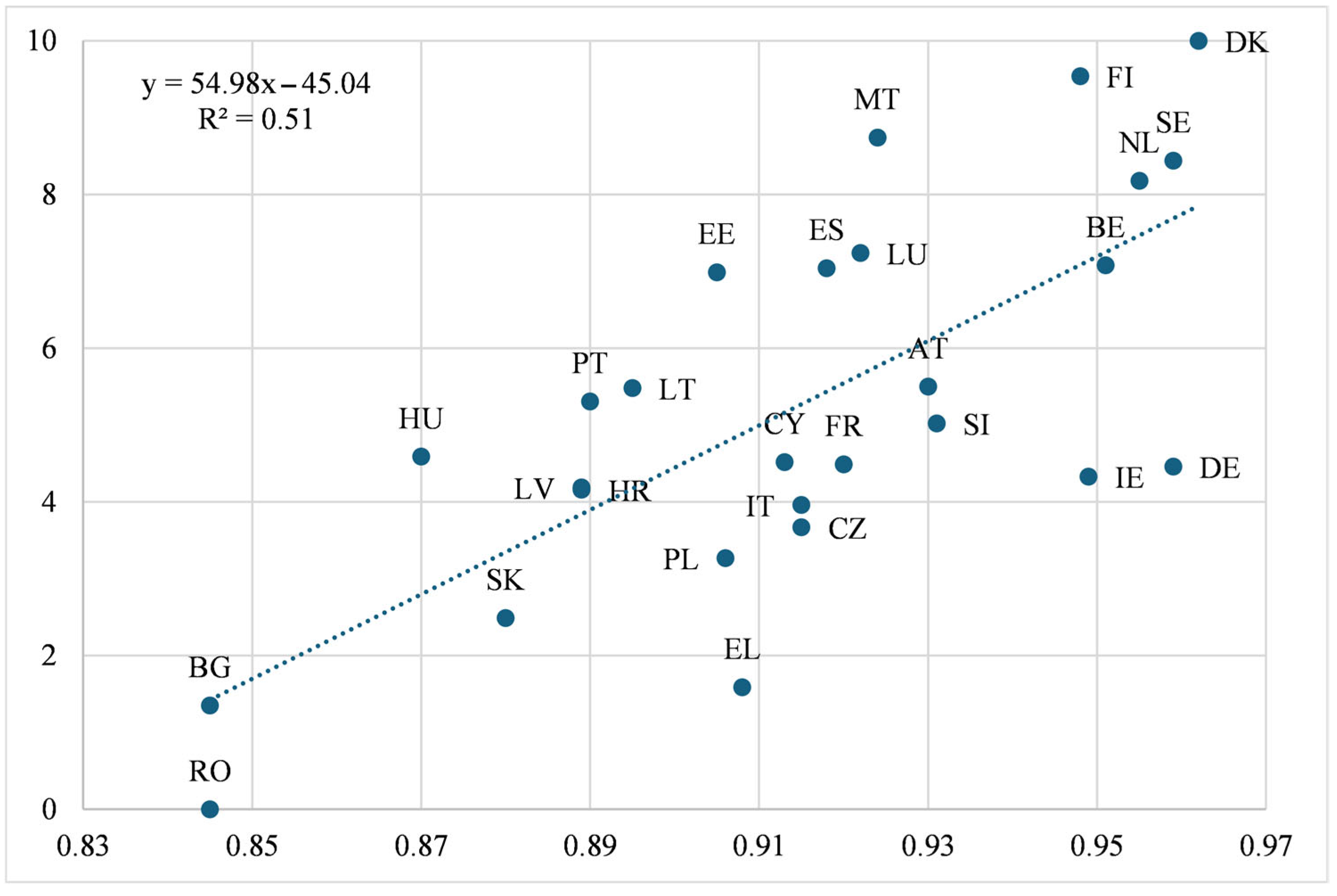
- Regarding the relationship between digitalisation and development, while a correlation exists, many countries with similar HDI values exhibit markedly different digitalisation levels, or vice versa (i.e., very close DESI and DESI-DP2 scores despite highly divergent HDIs). This result, which is consistent with Laitsou and Xenakis (2023), suggests that factors beyond those included in the HDI (income, education, and health) influence digitalisation levels, although the two are correlated. Consequently, achieving a high level of development is insufficient to advance digital transformation: a firm commitment to fostering digitalisation is also required, both at national level and through coordinated action between Member States and European institutions. Among the measures that can accelerate digital development, Ciacci et al. (2024) highlight the regulatory framework (simplification of bureaucratic procedures, tax incentives, etc.) and national and international collaboration between public authorities, academic institutions, and businesses.
- —
- An additional contribution of this study is the identification of a shift in the explanatory factors behind cross-country differences in the digitalisation process. Whereas in earlier stages digital skills played a predominant role, the results for 2025 point to the growing relevance of the digital transformation of businesses, particularly the adoption of digital technologies and digital intensity. This finding provides clear guidance for public policies, which should intensify their focus on the business sphere—especially on small and medium-sized enterprises—where significant barriers to digital adoption persist. Nevertheless, this shift in emphasis does not diminish the importance of digital skills, which remain a fundamental requirement both for the effective use of digital public services and for the successful integration of digital technologies within firms (Fidan, 2024; Magoutas et al., 2024; Török, 2024).
4.2. Policy Implications
4.3. Limitations and Future Research
4.4. Conclusions
Author Contributions
Funding
Institutional Review Board Statement
Informed Consent Statement
Data Availability Statement
Conflicts of Interest
Appendix A
Appendix A.1. DESI. Dimensions, Sub-Dimensions and Indicators, Year 2022
| Dimensions | Sub-Dimensions | Indicators |
| 1 Human capital | 1a Internet user skills | 1a1 At least basic digital skills |
| 1a2 Above basic digital skills | ||
| 1a3 At least basic digital content creation skills | ||
| 1b Advanced skills and development | 1b1 ICT specialists | |
| 1b2 Female ICT specialists | ||
| 1b3 Enterprises providing ICT training | ||
| 1b4 ICT graduates | ||
| 2 Connectivity | 2a Fixed broadband take-up | 2a1 Overall fixed broadband take-up |
| 2a2 At least 100 Mbps fixed broadband take-up | ||
| 2a3 At least 1 Gbps take-up | ||
| 2b Fixed broadband coverage | 2b1 Fast broadband (NGA) coverage | |
| 2b2 Fixed Very High Capacity Network (VHCN) coverage | ||
| 2b3 Fibre to the Premises (FTTP) coverage | ||
| 2c Mobile broadband | 2c1 5G spectrum | |
| 2c2 5G coverage | ||
| 2c3 Mobile broadband take-up | ||
| 2d Broadband prices | 2d1 Broadband price index | |
| 3 Integration of digital technology | 3a Digital intensity | 3a1 SMEs with at least a basic level of digital intensity |
| 3b Digital technologies for businesses | 3b1 Electronic information sharing | |
| 3b2 Social media | ||
| 3b3 Big data | ||
| 3b4 Cloud | ||
| 3b5 AI | ||
| 3b6 ICT for environmental sustainability | ||
| 3b7 e-Invoices | ||
| 3c e-Commerce | 3c1 SMEs selling online | |
| 3c2 e-Commerce turnover | ||
| 3c3 Selling online cross-border | ||
| 4 Digital public services | 4a e-Government | 4a1 e-Government users |
| 4a2 Pre-filled forms | ||
| 4a3 Digital public services for citizens | ||
| 4a4 Digital public services for businesses | ||
| 4a5 Open data |
Appendix A.2. DESI. Dimensions, Sub-Dimensions and Indicators, Year 2025
| Dimensions | Sub-Dimensions | Indicators |
| 1 Digital skills | Internet user skills | Internet use |
| At least basic digital skills | ||
| Above basic digital skills | ||
| At least basic digital content creation skills (*) | ||
| Advanced skills and development | ICT specialists | |
| ICT graduates (*) | ||
| 2 Digital infrastructure | Fixed broadband | Overall Internet take-up |
| Share of fixed broadband subscription ≥ 100 Mbps | ||
| Share of fixed broadband subscription ≥ 1 Gbps | ||
| Fixed Very High Capacity Network (VHCN) coverage | ||
| Fibre to the Premises (FTTP) coverage | ||
| Mobile broadband | Mobile broadband take-up | |
| Overall 5G coverage | ||
| 5G coverage in the 3.4–3.8 GHz band | ||
| 5G spectrum | ||
| 5G SIM cards (share of population) | ||
| Edge nodes | ||
| 3 Digital transformation of businesses | Digital intensity | SMEs with at least a basic level of digital intensity |
| Digital technologies for businesses | Electronic information sharing | |
| Social media | ||
| Data Analytics—former Big Data | ||
| Cloud | ||
| Artificial Intelligence (AI) | ||
| AI or Cloud or Data Analytics | ||
| e-Invoices | ||
| Unicorns | ||
| e-Commerce | SMEs selling online | |
| e-Commerce turnover | ||
| 4 Digitalisation of public services | e-Government | e-Government users |
| Digital public services for citizens | ||
| Digital public services for businesses | ||
| Pre-filled forms | ||
| Transparency of service delivery, design and personal data | ||
| User support | ||
| Mobile friendliness | ||
| e-Health | Access to e-Health records | |
| Source: European Commission (2022, 2025) and (*) https://digital-decade-desi.digital-strategy.ec.europa.eu/datasets/desi/charts/desi-indicators?period=desi_2025 (accessed on 7 May 2025). | ||
| 1 | As seen here: https://digital-strategy.ec.europa.eu/en/policies/desi (accessed on 7 May 2025). |
| 2 | In this article, for the indicators or variables used, the influence of outliers is small, so the estimate based on the DP2 distance can be considered robust. |
| 3 | There is an inherent time lag in the data included in both HDI and our DESI-DP2 indicator, as they rely on the most recent data available at the time of publication. |
| 4 | Information available at: https://hdr.undp.org/data-center/documentation-and-downloads (accessed on 7 May 2025). |
| 5 | Available at: https://digital-strategy.ec.europa.eu/es/library/digital-decade-2025-country-reports (accessed on 7 May 2025). |
References
- Abellán-Salinas, M. D., López-Martínez, M., & Soto, G. M. (2026). Measuring global sustainable development and the impact of SDG interlinkages in the XXI century. Social Indicators Research, 181, 64. [Google Scholar] [CrossRef]
- Arvanitis, S., & Loukis, E. N. (2009). Information and communication technologies, human capital, workplace organization and labour productivity: A comparative study based on firm-level data for Greece and Switzerland. Information Economics y Policy, 21(1), 43–61. [Google Scholar] [CrossRef]
- Atkinson, R. D., & Nager, A. B. (2014). The 2014 State New Economy Index. Information Technology & Innovation Foundation. Available online: https://ssrn.com/abstract=3066392 (accessed on 7 May 2025).
- Bánhidi, Z., Dobos, I., & Nemeslaki, A. (2020). What the overall digital economy and society index reveals: A statistical analysis of the DESI EU28 dimensions. Regional Statistics, 10(2), 42–62. [Google Scholar] [CrossRef]
- Ciacci, A., Ivaldi, E., Penco, L., & Testa, G. (2024). Measuring digital sustainability paying attention to the economic, social, and environmental dimensions: A European perspective. Social Indicators Research, 177, 1–29. [Google Scholar] [CrossRef]
- Criveanu, M. M. (2023). Investigating digital intensity and E-commerce as drivers for sustainability and economic growth in the EU countries. Electronics, 12(10), 2318. [Google Scholar] [CrossRef]
- Dedrick, J., Gurbaxani., V., & Kraemer, K. L. (2003). Information technology and economic performance: A critical review of the empirical evidence. ACM Computing Surveys, 35(1), 1–28. [Google Scholar] [CrossRef]
- Denissova, O., Konurbayeva, Z., Kulisz, M., Yussubaliyeva, M., & Suieubayeva, S. (2025). Measuring the digital economy in Kazakhstan: From global indices to a contextual composite index (IDED). Economies, 13(8), 225. [Google Scholar] [CrossRef]
- European Commission. (2022). Digital economy and society index 2022 methodological note. Available online: https://ec.europa.eu/newsroom/dae/redirection/document/88557 (accessed on 5 May 2025).
- European Commission. (2025). Digital decade 2025: DESI methodological note. Available online: https://ec.europa.eu/newsroom/dae/redirection/document/116792 (accessed on 5 May 2025).
- Fernández-Portillo, A., Almodóvar-González, M., & Hernández-Mogollón, R. (2020). Impact of ICT development on economic growth. A study of OECD European union countries. Technology in Society, 63, 101420. [Google Scholar] [CrossRef]
- Fidan, U. (2024). Convergence or divergence? Trends in the digitalisation index cluster over the years. Regional Statistics, 14(6), 1050–1068. [Google Scholar] [CrossRef]
- Hong, M., Lariviere, M., & Ko, K. (2025). Post-COVID, digital societies: Opportunities and policy challenges for human security in the United Kingdom and South Korea. Social Policy and Society, 24, 499–514. [Google Scholar] [CrossRef]
- Jin, C., Xu, A., Zhu, Y., & Li, J. (2023). Technology growth in the digital age: Evidence from China. Technological Forecasting and Social Change, 187, 122221. [Google Scholar] [CrossRef]
- Jorgenson, D. W. (2001). Information technology and the U.S. economy. American Economic Review, 91, 1–32. [Google Scholar] [CrossRef]
- Laitsou, E., & Xenakis, A. (2023, June 19–20). The impact of digital development on human well-being and vice versa. 32nd European Conference of the International Telecommunications Society (ITS): “Realising the Digital Decade in the European Union—Easier Said than Done?”, Madrid, Spain. Available online: https://hdl.handle.net/10419/277995 (accessed on 1 June 2025).
- Magoutas, A. I., Chaideftou, M., Skandali, D., & Chountalas, P. T. (2024). Digital progression and economic growth: Analyzing the impact of ICT advancements on the GDP of European Union countries. Economies, 12(3), 63. [Google Scholar] [CrossRef]
- Nayak, P., & Mishra, S. K. (2012). Efficiency of Pena’s P2 distance in construction of human development indices (MPRA Paper 39022). Munich Personal RePEc Archive (MPRA). Available online: https://mpra.ub.uni-muenchen.de/39022/ (accessed on 15 November 2025).
- Obelovska, K., Abziatov, A., Doroshenko, A., Dronyuk, I., Liskevych, O., & Liskevych, R. (2025). Analysis of digital skills and infrastructure in EU countries based on DESI 2024 data. Future Internet, 17(6), 228. [Google Scholar] [CrossRef]
- OECD. (2014). Measuring the digital economy: A new perspective. OECD Publishing. [Google Scholar] [CrossRef]
- OECD. (2019). Measuring the digital transformation: A roadmap for the future. OECD Publishing. [Google Scholar] [CrossRef]
- Olczyk, M., & Kuc-Czarnecka, M. (2022). Digital transformation and economic growth—DESI improvement and implementation. Technological and Economic Development of Economy, 28(3), 775–803. [Google Scholar] [CrossRef]
- Rodríguez-Pasquín, M., García-Luque, O., & López-Martínez, M. (2023). Digitalisation and skills in Spain: Regional differences and gender gaps. Sociología y Tecnociencia, 13(2), 94–117. [Google Scholar] [CrossRef]
- Roszko-Wójtowicz, E., Plesniarka, A., & Grzelak, M. M. (2024). Determinants of digital economy development in the EU member states: The role of technological infrastructure, human capital, and innovation (2017–2022). Ekonomia I Prawo. Economics and Law, 23(4), 611–635. [Google Scholar] [CrossRef]
- Somarriba-Arechavala, N., & Pena-Trapero, J. B. (2009a). La medición de la calidad de vida en Europa, el papel de la información subjetiva. Estudios de Economía Aplicada, 27(2), 373–396. [Google Scholar] [CrossRef]
- Somarriba-Arechavala, N., & Pena-Trapero, J. B. (2009b). Synthetic indicators of quality of life in Europe. Social Indicators Research, 94(1), 115–133. [Google Scholar] [CrossRef]
- Somarriba-Arechavala, N., & Zarzosa-Espina, M. P. (2019). Quality of life in the European Union: An econometric analysis from a gender perspective. Social Indicators Research, 142, 179–200. [Google Scholar] [CrossRef]
- Somarriba-Arechavala, N., Zarzosa-Espina, M. P., & Pena-Trapero, J. B. (2015). The economic crisis and its effects on the quality of life in the European Union. Social Indicators Research, 120(2), 323–343. [Google Scholar] [CrossRef]
- Szajt, M., Smoląg, K., & Chomiak-Orsa, I. (2024). Digitization in European Union countries. Convergence analysis based on DESI. Procedia Computer Science, 246, 5448–5457. [Google Scholar] [CrossRef]
- Török, L. (2024). The relationship between digital development and economic growth in the European Union. International Review of Applied Sciences and Engineering, 15(3), 375–389. [Google Scholar] [CrossRef]
- Traversa, S., & Ivaldi, E. (2024). eGovernment implementation in Italy. Regional index for NRRP goals evaluation. Social Indicators Research, 178, 1125–1144. [Google Scholar] [CrossRef]
- Van Dijk, J. A., Peters, O., & Ebbers, W. (2008). Explaining the acceptance and use of government Internet services: A multivariate analysis of 2006 survey data in the Netherlands. Government Information Quarterly, 25(3), 379–399. [Google Scholar] [CrossRef]
- Vuorikari, R., Jerzak, N., Karpinski, Z., Pokropek, A., & Tudek, J. (2022). Measuring digital skills across the EU: Digital skills indicator 2.0. European Commission, Joint Research Centre (JRC), Publications Office of the European Union. [Google Scholar] [CrossRef]
- Zarzosa-Espina, M. P. (1996). Aproximación a la medición del bienestar social. Idoneidad del indicador sintético “Distancia-P2”. (Aplicación al caso español). Cuadernos de Economía, 24, 139–163. [Google Scholar]
- Zarzosa-Espina, M. P. (2009). Estimación de la pobreza en las comunidades autónomas españolas, mediante la distancia DP2 de Pena. Estudios de Economía Aplicada, 27(2), 397–416. [Google Scholar] [CrossRef]
- Zarzosa-Espina, M. P., & Somarriba-Arechavala, N. (2013). An assessment of social welfare in Spain: Territorial analysis using a synthetic welfare indicator. Social Indicators Research, 111(1), 1–23. [Google Scholar] [CrossRef]



| 2022 | 2025 | ||
|---|---|---|---|
| Dimensions | Sub-Dimensions | Dimensions | Sub-Dimensions |
| Human capital | Internet user skills | Digital skills | Internet user skills |
| Advanced skills and development | Advanced skills and development | ||
| Connectivity | Fixed broadband take-up | Digital infrastructure | Fixed broadband |
| Fixed broadband coverage | |||
| Mobile broadband | Mobile broadband | ||
| Broadband prices | |||
| Integration of digital technology | Digital intensity | Digital transformation of businesses | Digital intensity |
| Digital technologies for businesses | Digital technologies for businesses | ||
| e-Commerce | e-Commerce | ||
| Digital public services | e-Government | Digitalisation of public services | e-Government |
| e-Health | |||
| 2022 | |||||
|---|---|---|---|---|---|
| Code | Countries | DESI | Order | DESI-DP2 | Order |
| FI | Finland | 69.6 | 1 | 8.6 | 5 |
| DK | Denmark | 69.3 | 2 | 10.0 | 1 |
| NL | Netherlands | 67.4 | 3 | 9.1 | 3 |
| SE | Sweden | 65.2 | 4 | 8.6 | 4 |
| IE | Ireland | 62.7 | 5 | 9.1 | 2 |
| MT | Malta | 60.9 | 6 | 7.1 | 7 |
| ES | Spain | 60.8 | 7 | 6.8 | 8 |
| LU | Luxembourg | 58.9 | 8 | 7.5 | 6 |
| EE | Estonia | 56.5 | 9 | 6.1 | 9 |
| AT | Austria | 54.7 | 10 | 5.5 | 10 |
| SI | Slovenia | 53.4 | 11 | 4.4 | 17 |
| FR | France | 53.3 | 12 | 5.5 | 11 |
| DE | Germany | 52.9 | 13 | 4.7 | 16 |
| LT | Lithuania | 52.7 | 14 | 3.8 | 20 |
| PT | Portugal | 50.8 | 15 | 5.2 | 13 |
| BE | Belgium | 50.3 | 16 | 5.3 | 12 |
| LV | Latvia | 49.7 | 17 | 4.1 | 19 |
| IT | Italy | 49.3 | 18 | 2.9 | 22 |
| CZ | Czechia | 49.1 | 19 | 4.3 | 18 |
| CY | Cyprus | 48.4 | 20 | 4.8 | 14 |
| HR | Croatia | 47.5 | 21 | 4.8 | 15 |
| HU | Hungary | 43.8 | 22 | 3.7 | 21 |
| SK | Slovakia | 43.4 | 23 | 2.5 | 24 |
| PL | Poland | 40.5 | 24 | 1.4 | 25 |
| EL | Greece | 38.9 | 25 | 2.6 | 23 |
| BG | Bulgaria | 37.7 | 26 | 0.8 | 26 |
| RO | Romania | 30.6 | 27 | 0.0 | 27 |
| 2022 | 2025 | ||||
|---|---|---|---|---|---|
| Code | Countries | DESI-DP2 | Order | DESI-DP2 | Order |
| DK | Denmark | 10.0 | 1 | 10.0 | 1 |
| FI | Finland | 8.6 | 5 | 9.5 | 2 |
| MT | Malta | 7.1 | 7 | 8.7 | 3 |
| SE | Sweden | 8.6 | 4 | 8.4 | 4 |
| NL | Netherlands | 9.1 | 3 | 8.2 | 5 |
| LU | Luxembourg | 7.5 | 6 | 7.2 | 6 |
| BE | Belgium | 5.3 | 12 | 7.1 | 7 |
| ES | Spain | 6.8 | 8 | 7.0 | 8 |
| EE | Estonia | 6.1 | 9 | 7.0 | 9 |
| AT | Austria | 5.5 | 10 | 5.5 | 10 |
| LT | Lithuania | 3.8 | 20 | 5.5 | 11 |
| PT | Portugal | 5.2 | 13 | 5.3 | 12 |
| SI | Slovenia | 4.4 | 17 | 5.0 | 13 |
| HU | Hungary | 3.7 | 21 | 4.6 | 14 |
| CY | Cyprus | 4.8 | 14 | 4.5 | 15 |
| FR | France | 5.5 | 11 | 4.5 | 16 |
| DE | Germany | 4.7 | 16 | 4.5 | 17 |
| IE | Ireland | 9.1 | 2 | 4.3 | 18 |
| LV | Latvia | 4.1 | 19 | 4.2 | 19 |
| HR | Croatia | 4.8 | 15 | 4.2 | 20 |
| IT | Italy | 2.9 | 22 | 4.0 | 21 |
| CZ | Czechia | 4.3 | 18 | 3.7 | 22 |
| PL | Poland | 1.4 | 25 | 3.3 | 23 |
| SK | Slovakia | 2.5 | 24 | 2.0 | 24 |
| EL | Greece | 2.6 | 23 | 1.6 | 25 |
| BG | Bulgaria | 0.8 | 26 | 1.4 | 26 |
| RO | Romania | 0.0 | 27 | 0.0 | 27 |
| Year 2022 | ||||||
|---|---|---|---|---|---|---|
| Dimensions | Sub-Dimensions | (1) | (2) | (3) | (4) | (5) |
| Human capital | Internet user skills | 0.91 | 47.85 | 44.09 | 0.90 | 0.93 |
| Advanced skills and development | 0.83 | 52.15 | 0.69 | |||
| Connectivity | Fixed broadband take-up | 0.75 | 28.56 | 30.06 | 0.39 | 0.76 |
| Fixed broadband coverage | 0.51 | 20.49 | 0.28 | |||
| Mobile broadband | 0.54 | 29.27 | 0.66 | |||
| Broadband prices | 0.62 | 21.69 | 0.49 | |||
| Integration of digital technology | Digital intensity | 0.97 | 51.73 | 14.05 | 0.85 | 0.86 |
| Digital technologies for businesses | 0.87 | 11.74 | 0.83 | |||
| e-Commerce | 0.84 | 36.53 | 0.64 | |||
| Digital public services | e-Government | 1.00 | 100.00 | 11.80 | 0.79 | |
| Year 2025 | ||||||
| Dimensions | Sub-Dimensions | (1) | (2) | (3) | (4) | (5) |
| Digital skills | Internet user skills | 0.93 | 55.04 | 20.89 | 0.80 | 0.78 |
| Advanced skills and development | 0.84 | 44.96 | 0.54 | |||
| Digital infrastructure | Fixed broadband | 0.75 | 53.72 | 24.14 | 0.35 | 0.76 |
| Mobile broadband | 0.75 | 46.28 | 0.79 | |||
| Digital transformation of businesses | Digital intensity | 0.88 | 12.73 | 31.26 | 0.79 | 0.88 |
| Digital technologies for businesses | 0.95 | 49.51 | 0.90 | |||
| e-Commerce | 0.83 | 37.76 | 0.61 | |||
| Digitalisation of public services | e-Government | 0.74 | 61.33 | 23.70 | 0.79 | 0.70 |
| e-Health | 0.74 | 38.67 | 0.25 |
Disclaimer/Publisher’s Note: The statements, opinions and data contained in all publications are solely those of the individual author(s) and contributor(s) and not of MDPI and/or the editor(s). MDPI and/or the editor(s) disclaim responsibility for any injury to people or property resulting from any ideas, methods, instructions or products referred to in the content. |
© 2026 by the authors. Licensee MDPI, Basel, Switzerland. This article is an open access article distributed under the terms and conditions of the Creative Commons Attribution (CC BY) license.
Share and Cite
de Maya Matallana, M.; García-Luque, O.; López-Martínez, M.; Rodríguez-Pasquín, M. Digital Development Levels in the European Union: Measurement and Analysis. Economies 2026, 14, 58. https://doi.org/10.3390/economies14020058
de Maya Matallana M, García-Luque O, López-Martínez M, Rodríguez-Pasquín M. Digital Development Levels in the European Union: Measurement and Analysis. Economies. 2026; 14(2):58. https://doi.org/10.3390/economies14020058
Chicago/Turabian Stylede Maya Matallana, Manuel, Olga García-Luque, María López-Martínez, and Myriam Rodríguez-Pasquín. 2026. "Digital Development Levels in the European Union: Measurement and Analysis" Economies 14, no. 2: 58. https://doi.org/10.3390/economies14020058
APA Stylede Maya Matallana, M., García-Luque, O., López-Martínez, M., & Rodríguez-Pasquín, M. (2026). Digital Development Levels in the European Union: Measurement and Analysis. Economies, 14(2), 58. https://doi.org/10.3390/economies14020058