
Article

Digital Pathways to Stability: A Cross-Country Analysis of the Fintech–Inclusion–Stability Nexus Across Selected Countries

Department of Economics, College of Business, Imam Mohammad Ibn Saud Islamic University (IMSIU), Riyadh 11432, Saudi Arabia
Economies 2026, 14(1), 8; https://doi.org/10.3390/economies14010008 (registering DOI)
Submission received: 21 November 2025 / Revised: 19 December 2025 / Accepted: 21 December 2025 / Published: 25 December 2025
(This article belongs to the Section Macroeconomics, Monetary Economics, and Financial Markets)

Abstract

This paper examines the impact of fintech adoption and financial inclusion on financial stability in selected countries. Using panel data from 30 countries spanning 2011–2024, the study employs an empirical strategy based on Two-Way Fixed Effects, a dynamic two-step System GMM estimator, and Panel Quantile Regression. This multi-method approach captures both average and distributional effects while addressing key econometric challenges, including endogeneity, heteroskedasticity, serial correlation, and cross-sectional dependence. The empirical findings differ across estimation techniques but reveal two consistent patterns: financial inclusion exerts a positive and significant effect on financial stability across all models, whereas the impact of fintech is model-dependent. While fintech appears insignificant under the Two-Way Fixed Effects and Driscoll–Kraay specifications, the System GMM and quantile regression analyses confirm that both fintech and financial inclusion significantly enhance financial stability. Overall, the results show that fintech can boost financial stability, but only when supported by broad financial inclusion and solid institutions. The findings highlight that policymakers must pair the growth of digital finance with clear regulatory standards and programs designed to deepen financial inclusion.

1. Introduction

Financial stability was considered a key driver for sustainable development and the soundness of the economy. It is also a key prerequisite for sustaining public trust in the financial system (Awdeh et al., 2024a; Jiang et al., 2019; Arnone et al., 2024). Financial stability refers to a condition in which institutions and financial markets operate soundly and efficiently, even in times of stress and economic shock. A stable financial system facilitates the flow of savings into productive investments that help the economy to grow. It also provides credit to households and businesses (World Bank, 2016). All these factors are necessary to ensure economic performance, innovation, and employment. A stable financial system enhances investor confidence, lowers uncertainty, and strengthens the resilience of the banking system and the overall economy. As observed during the global financial crisis of 2008, financial instability can lead to liquidity shortages, banking crises, sharp declines in asset and other prices, and economic slowdowns. These harmful consequences have negative social and fiscal consequences, which the government must address while simultaneously undermining confidence in supervision or regulatory authorities to address instability (IMF, 2018). Therefore, financial stability is more than a regulatory concern; it is also a process that involves sound monetary and financial policies, supervision, and prudent risk management. Finally, financial stability enhances the resilience of the economy, contributing to inclusive economic growth and prosperity (Davoodi et al., 2021).
The existing literature has revealed a number of key determinants of financial stability. One key determinant is the macroeconomic environment, which includes variables such as GDP growth, inflation, interest rates, and exchange rate volatility. Under stable circumstances, strong bank balance sheets will be present, but economic shocks can increase credit risk and make financial stability fragile (Nsengiyumva et al., 2025; Ullah et al., 2024; Pasha, 2024). Additionally, specific bank factors also play a crucial role in assessing whether financial institutions could support internal and external shocks (Hai et al., 2022; Kharabsheh & Gharaibeh, 2022). Furthermore, a robust institutional and regulatory framework can serve as a key determinant of stability. The higher the strength of supervision, governance, and risk management, the lower the chances of systemic risk (Rubio Misas, 2024; Sodokin et al., 2023; Ullah et al., 2022). Some previous research considered innovation in finance and digitalization as double-edged factors, resulting in either higher inclusion or efficiency or in higher costs, with downside risks associated with cybersecurity and operational risks (Chu et al., 2023; Q. Zhang et al., 2023)
Recently, a significant part of the literature has examined the growing role of Fintech and financial inclusion in influencing financial stability (Ha et al., 2025; Sant’Anna & Figueiredo, 2024; Safiullah & Paramati, 2024). Fintech innovations like digital banking, mobile payments, blockchain and peer-to-peer lending have innovated traditional financial systems and increased real-time efficiency, transparency and, pertinently, access to formal financial services. These technologies can diversify financial intermediation, offer reduced transaction costs, and develop risk monitoring, while injecting resiliency into the financial system. Financial inclusion furthers financial system resiliency by expanding the customer services, mobilizing savings, and decreasing reliance on informal and volatile forms of finance. Increased inclusion or involvement of individuals and small businesses increases the resilience of the economy to shocks and liquidity pressures (Zou et al., 2024; Gao & Gao, 2024). Nevertheless, the literature on fintech and financial inclusion warns that, as fintech evolves rapidly, new challenges arise, including cyber risk, gaps in the regulation of new risks and market turbulence if they are not properly regulated (AlBenJasim et al., 2024; Vučinić, 2022).
Nonetheless, the extent of fintech development and the beneficial impact for financial inclusion differ across countries and hence have different implications for financial stability. In advanced economies, fintech is typically regulated and integrated into existing financial systems, promoting efficiency and risk management (Yudaruddin et al., 2023). For example, in developing and emerging economies, structural constraints, including inadequate digital infrastructure, ineffective regulatory systems, and low levels of financial literacy may inhibit the positive impact of fintech and financial inclusion on stability. In these economies, rapid digitalization without appropriate oversight may cause several risks including fraud, cyber risk, and financial exploitation of consumers which reduce trust in financial systems. The disadvantaged or disproportionately limited access to digital financial services may also create widening of existing socioeconomic divides in the form of unequal benefits and associated risks between and within those regions (Mandić et al., 2025; Khera et al., 2021). Consequently, fintech and financial inclusion have the potential to exert both positive effects and benefits on global financial stability. Indeed, their effects depend on context, requiring tailored regulatory policies, capacity development, and inclusive digital development strategies.
The existing literature provides conflicting and mixed conclusions regarding the implications of financial inclusion and fintech for financial stability. Some studies conclude that financial inclusion contributes to financial stability since it enhances depositor bases, additional diversification of credit risk, and resilience in an economy with better access to formal financial services. In addition, innovations promoted within the scope of fintech may improve the efficiency of operations, transparency, risk management, and financial stability (Ben Naceur et al., 2024; Anarfo & Kyereboah Coleman, 2022; BIS, 2015). However, other studies have suggested that financial inclusion and fintech may also have harmful and destabilizing effects. Inadequately supervised and managed Fintech may lead to systemic risk through cyber risks, operational risk, and misallocation of credit. Similarly, unmonitored access to financial inclusion may have the opposite effect, generating a high level of credit and a high level of debt, which may increase the rate of bank failures and the financial system’s vulnerability. Across all these in-congruent or mixed outcomes in empirical research findings, some of the differences may be country-specific, financial stability may be moderated by regulatory quality, and financial and digital developmental levels (Sant’Anna & Figueiredo, 2024; Y. Zhang & Chen, 2023). Therefore, the linkage between financial inclusion, fintech, and financial stability is complex and context-specific, which requires additional research to further understand the ways financial inclusion and fintech conditions are stabilizing or de-stabilizing for the financial system.
Although there is a significant part of the literature studying the relationship between financial inclusion, fintech, and financial stability, is still exhibits several notable gaps. First, most studies are focused on advanced, developed countries, where regulatory frameworks and digital infrastructure are well-established. The issue is that the effects of regulation in advanced contexts are mostly unexplored in emerging and developing economies considering fintech models and financial inclusion. Second, the evidence is often mixed and dependent on context; some findings suggest stabilizing features while others designate possible risks associated with fintech. This urges studies that permit heterogeneity, and to account for the effects of fixed contextual factors such as country context, institutional quality, and levels of digital adoption. Third, there is a lack of longitudinal studies investigating the effect of fintech and financial inclusion, particularly in relation to systemic stability. Most of studies rely on short-term and/or cross-sectional data. Finally, less abundant studies with even fewer theoretical frame-works specifically considering the intersection of fintech, financial inclusion, and financial stability and outlined the mechanisms and channels through which these factors interact and are affected.
The objective of this paper is to investigate how fintech and financial inclusion affect financial stability, specifically focusing on how these elements affect the resilience of the banking industry and the financial system. To this end, we used a panel of 30 countries observed over the period 2011–2024, covering economies at various stages of financial and digital development. Overall, findings indicate that in all econometric approaches, financial inclusion significantly enhances financial stability; while the effect of Fintech differs from one econometric method to another. We also found that institutional quality improves financial stability, while inflation and external debt threaten it.
This study contributes to the existing literature in several ways. First, it provides cross-country empirical analyses, especially from the diverse economic and regulatory contexts of selected countries, which broadens the understanding of the nexus between financial inclusion, fintech, and financial stability. Second, it addresses the literature by examining the underexplored questions of the quality of institutions and other factors, beyond the direct effects of fintech and financial inclusion. Third, it examines extensively how both the adoption of digital financial services and the growing accessibility of financial services can enhance financial stability. Finally, the trade-offs needed to be managed to achieve innovations in the financial system that are inclusive, stable, and safe are articulated and the corresponding risks of digitalization and provision of finance are diagnosed.
This paper is organized as follows. In Section 2, we review the literature and develop the hypotheses. In Section 3, we outline the sample selection, and the method we applied. The empirical results are given and discussed in Section 4. Finally, Section 6, provides a summary of the main results, discusses limitations, provides some practical implications and recommendations, and suggests future research.

2. Related Literature and Hypotheses Development

2.1. Financial Inclusion & Financial Stability

Over the last two decades, research on financial inclusion has grown significantly, driven by the understanding that having access to formal financial services plays a crucial role in supporting both economic development and the resilience of financial systems (Sant’Anna & Figueiredo, 2024; Safiullah & Paramati, 2024). It’s frequently claimed that financial inclusion improves financial stability. As more individuals and businesses are incorporated into the formal financial system, the banking sector’s deposit grows, risk-sharing improves, and informal financing decreases (Beck et al., 2007; Demirgüç-Kunt et al., 2018; Hakimi et al., 2025). In this way, financial inclusion acts as a shock-resistant buffer: a more diverse set of stakeholders may help the financial system to absorb negative events rather than amplify them. The theoretical framework of this paper is focused on the relationship between financial stability and financial inclusion. Financial stability refers to the ability of the financial system to operate effectively, absorb shocks, and maintain confidence while providing critical functions such as credit allocation, payment services, and liquidity management (World Bank, 2016). However, financial inclusion refers to the availability and utilization of formal financial services by people, households, and businesses, particularly those who have been marginalized or excluded.
According to the theory of financial intermediation, banks and financial institutions act as intermediaries between depositors and borrowers. Within greater financial inclusion, banks or other financial institutions can use a larger pool of depositors and borrowers (Nguyen & Du, 2022; Saidi et al., 2025). This enables the institution to increase the mobilization of savings, diversify its risk portfolio, and effectively allocate credit for productive projects. To further improve liquidity buffers and increase the system’s resilience to shocks, a larger deposit base and/or a greater number of more active borrowers in the formal financial system reduce reliance on informal, unregulated sources of financing, such as suspending loan payments (Hannig & Jansen, 2010). Moreover, the systemic risk theory states that stability is determined by the interdependence of individual institutions and the financial system. By diversifying risk over a wider base, financial inclusion lessens the likelihood of shocks to specific individuals or sectors that make the overall system more unstable and vulnerable. The benefits of inclusion require supportive factors like governance, risk management practices, and institutional quality. Uncontrolled or insufficiently supervised credit allocation can lead to vulnerabilities like excessive debt or higher default rates, which could threaten stability (Ben Naceur et al., 2024; Harun & Gunadi, 2022).
Some empirical studies support the positive relationship between financial inclusion and financial stability. For example, Ozili (2018) suggests that, under strong regulatory and supervisory contexts, greater inclusion is associated with greater institutional resilience. In the same vein, Nguyen and Du (2022) show that in ASEAN countries, greater financial inclusion strengthens financial stability by broadening the depositor base and improving liquidity, though excessive credit expansion without adequate regulation can increase risk. Similarly, Hannig and Jansen (2010) argue that wider access to financial services promotes savings mobilization, risk diversification, and system resilience, but caution that poorly managed or rapid inclusion may generate instability. Some other studies highlighted that if access to credit is rapidly liberalized in weak regulatory environments, it may result in higher default rates and increased vulnerability (Allen et al., 2016). Therefore, the literature emphasizes that for stability-enhancing outcomes, inclusion needs to be accompanied by strong governance, sufficient risk management, and consumer protection. Harun and Gunadi (2022) underscore that the interconnectedness of financial institutions can amplify systemic shocks, emphasizing the role of macroprudential regulation and coordinated policy interventions in maintaining overall financial stability. Together, these studies suggest that financial inclusion can enhance stability, but its benefits depend critically on effective regulation, risk management, and systemic oversight. Based on the development above, we formulate the first hypothesis:
H1. 
Financial inclusion enhances financial stability.

2.2. Fintech and Financial Inclusion

The rise of fintech has created new avenues for increasing access to financial services, which aligns with the inclusion literature. Digital banking platforms, peer-to-peer lending, mobile payments, blockchain solutions, and other innovations that lower transaction costs, improve convenience, and get around conventional infrastructure limitations are all included in the fintech category. Fintech has accelerated inclusion in many developing and advanced markets, according to studies. For example, digital payments and mobile money have given previously excluded populations formal financial access (Amnas et al., 2024; Warokka et al., 2025).
According to financial intermediation theory, fintech can enhance the stability of the financial system by facilitating better monitoring and management of financial risks. It can also lower transaction costs, and increase resource allocation efficiency. For instance, digital platforms enable banks and non-bank financial institutions to diversify their funding sources, increase their customer base, and ensure credit and liquidity oversight, all of which can improve shock resilience (Tello-Gamarra et al., 2022). Fintech-related risks are also highlighted by the theory of systemic risk and technology adoption. Although innovation improves access and efficiency, its quick or unregulated adoption can lead to risks like market disruption, operational failures, cyberattacks, and insufficient risk assessment. These risks could increase systemic instability if the infrastructure, regulation, and institutional capacity are insufficient to manage them (Wang et al., 2024; Al Shari & Lokhande, 2023). Thus, the framework suggests that fintech has two effects on financial stability. The first is that fintech can increase the resilience of banks and financial systems by enhancing efficiency, transparency, risk management, and access to financial services. Second, without strong regulatory supervision, fintech leads to operational and systemic risks that threaten stability.
Nonetheless, the literature also simultaneously identifies the risks. Fintech facilitates access, but it often lacks clear underwriting standards, has insufficient risk controls, and can enable rapid credit expansion. These features raise concerns about potential instability, consumer protection, and operational risk (IMF, 2022). The effect of fintech-driven inclusion on system stability may be ambiguous and heavily reliant on institutional capacity, context, and regulations (Sant’Anna & Figueiredo, 2024). Recently, Safiullah and Paramati (2024) used a sample of 26 Malaysian banks from 2003 to 2018 and found that FinTech generally enhances financial stability, especially for small banks and those with weaker governance, though results are specific to Malaysia and pre-2018 developments. However, based on 26 African economies over the period 2004–2021, Okoli (2024) reports an U-shaped relationship: FinTech adoption may initially reduce financial stability but improves it in the long run, depending on regulatory and institutional capacity. Results vary due to broad fintech measures and heterogeneous country contexts. Based on the above development, we can put the following hypothesis.
H2. 
The adoption of fintech positively contributes to financial stability.

2.3. Fintech, Financial Inclusion & Financial Stability

A more recent corpus of literature specifically looks at the triangular relationship between financial stability, financial inclusion, and fintech. Although fintech and inclusion can both improve system resilience, their combined effect on stability is mediated by a number of variables, including institutional quality, legal frameworks, digital infrastructure, and market maturity. For instance, Ha et al. (2025) conduct a systematic review of the literature and identify three main clusters: ecosystem stakeholders, market transformation, and new fintech services such as lending, Crowdfunding, and payments. They report that while fintech has a lot of potential to promote inclusion, little is known about how it affects stability. In the meantime, empirical research conducted by Kamara and Yu (2024) in sub-Saharan Africa reveals that the adoption of fintech had a detrimental impact on usage and access dimensions of inclusion but a favorable impact on demographic inclusion, demonstrating how fintech’s influence varies depending on the context. Based on the development above, we can formulate the following hypothesis:
H3. 
Fintech and financial inclusion simultaneously enhance financial stability.
Despite the growing literature on the inclusion-fintech-stability relationship, there are still a lot of gaps. Firstly, few studies explore how fintech-enabled inclusion could affect financial stability in the long term. Secondly, the majority of empirical evidence is derived from developed or emerging markets with relatively developed financial sectors. However, very low-income or structurally weak economies are the subject of fewer studies. Thirdly, a lot of research treats fintech, inclusion, and stability separately instead of looking at how they simultaneously affect financial stability. This study aims to fill these gaps by exploring how Fintech and financial inclusion affect financial stability in selected countries. Table 1 gives a summary of the hypotheses.

3. Empirical Design

3.1. The Sample

The data relies on a panel of 30 countries observed over the period 2011–2024, covering economies at various stages of financial and digital development. The sample comprises advanced, emerging, and developing countries, as described in more detail in Appendix B. The countries are selected following an OECD-consistent classification that distinguishes advanced, emerging, and developing economies based on OECD membership, income level, and financial and institutional development. Advanced economies correspond to high-income OECD members with mature financial systems, while emerging economies include non-OECD countries with increasing global integration and expanding financial sectors. Developing economies comprise non-OECD countries with lower income levels and less developed financial and institutional structures, in line with OECD analytical practices. This diversified selection enables meaningful cross-country comparisons and captures heterogeneity in the fintech–inclusion–stability relationship. The selected period covers the recovery from the post-global financial crisis and the rapid expansion of fintech and digital finance, providing both temporal and structural variation sufficient to analyze both the short- and long-term dynamics of financial stability. There are four main sources for the selected variables. The variable of Fintech was collected for the Global Financial Index. Variables used in the construction of the index of financial inclusion were retrieved from the Global Financial Indicators database of the World Bank. Institutional quality variables are collected from the World Governance Indicators (WGI) database of the World Bank. Finally, macroeconomic variables are retrieved from the World Development Indicators (WDI) database.
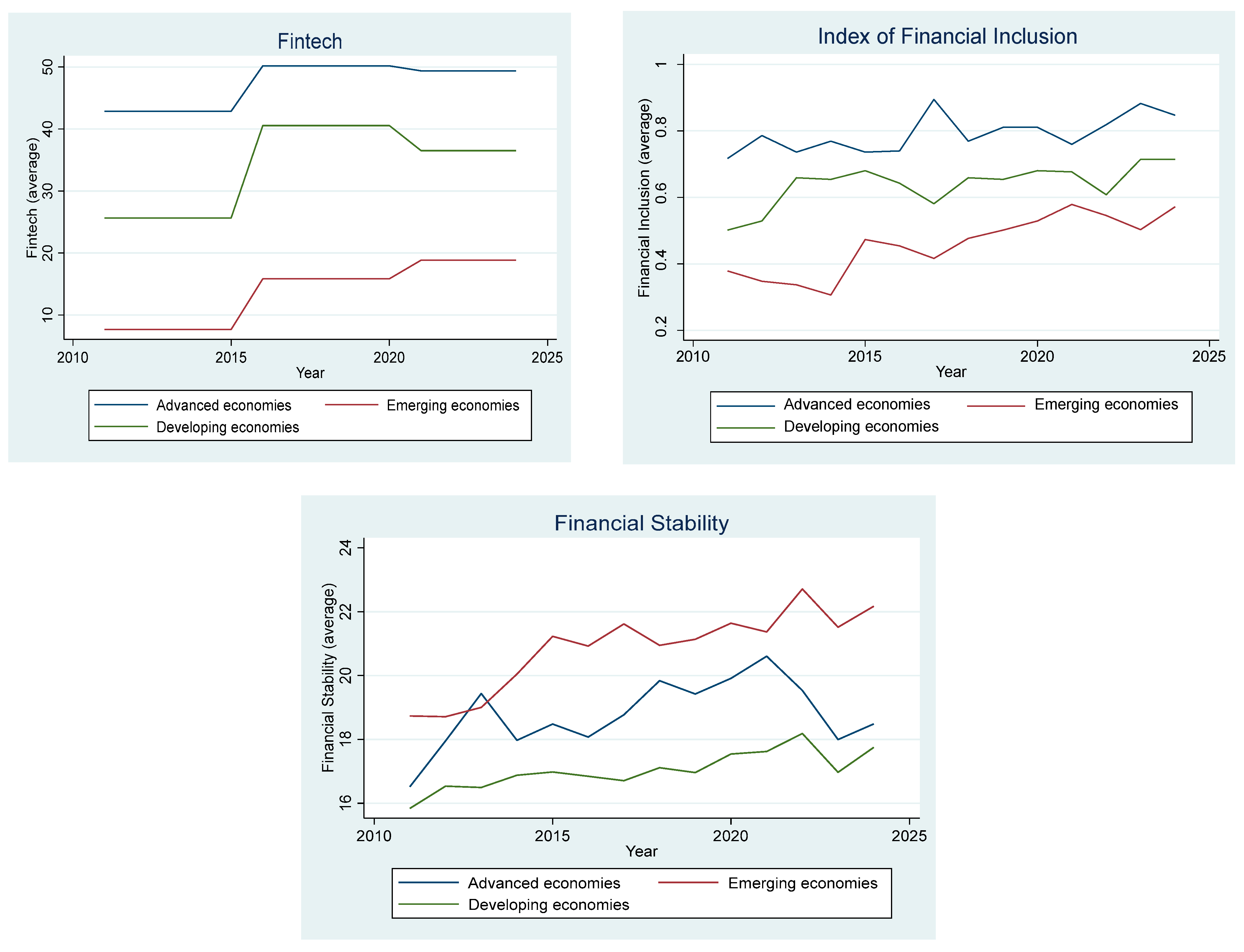
For a more general idea on how the trends for the core variables considered in this paper have evolved across countries over time, Figure 1 is used to display the average trends for financial stability, inclusion, and fintech development for the three country groups considered in this work for the years between 2011 and 2024. This visual summary complements the sample description by illustrating broad differences in trajectories between advanced, emerging, and developing economies and highlights the structural heterogeneity that motivates the empirical analysis.

3.2. Econometric Approach and Models

This empirical analysis uses a rigorous panel econometric strategy designed to capture the multifaceted relationship between fintech development, financial inclusion, and financial stability across countries with differing levels of economic and institutional maturity. This methodological design lies at the core of this study’s objective of reassessing the nexus of fintech, inclusion, and stability from a comparative and dynamic perspective. First, the baseline relationship is estimated using a Two-Way Fixed Effects (TWFE) model with conventional standard errors that controls for unobserved time-invariant country characteristics and common global shocks by including country and year fixed effects. This specification dampens the bias from omitted variables arising due to structural heterogeneity across countries and temporally. Standard diagnostic tests are applied to check for the presence of heteroskedasticity, serial correlation, and cross-sectional dependence reveals violations of classical assumptions. In response, the model is re-estimated using Driscoll–Kraay standard errors. This two-step fixed-effects approach ensures reliable inference while preserving the structural interpretation of the baseline results. Second, to formally consider dynamic persistence and possible endogeneity, the model will be estimated again using two-step System GMM with the Arellano-Bond (Arellano & Bond, 1991) and Blundell-Bond (Blundell & Bond, 1998) linearization. This allows including the lagged dependent variable to control for dynamic persistence, which uses internal instruments derived from lagged levels and differences in endogenous variables. Instrument proliferation is controlled through lag restrictions and instrument collapsing, and inference is based on Windmeijer-corrected standard errors. Standard model specifications will be used to check model validity, which include tests for specifications in dynamic panels such as the Arellano-Bond tests for serial correlation. Third, to analyze the distributional heterogeneity with regards to the relationship between fintech, inclusion, and stability, the model employs the use of Panel Quantile Regression with fixed effects. The model employs the use of Panel Quantile Regression because, unlike the common practice of estimating the model at the median, the model seeks to analyze the relationship across all the points in the conditional distributions. The model examines the relationship at the lower, median, and upper quantiles.
The effect of Fintech and financial inclusion on financial stability is estimated using the following regression model:
F S i , t = α + β 1 F I N T E C H i , t + β 2 I F I i , t + k = 3 6 β k C o n t r o l i t + μ i + λ t + ε i t
In this Equation, i denotes the cross-sectional units (countries), and t represents the time dimension. The dependent variable, FS, refers to the Financial Stability and is measured by the Bank Z-Score, while IFI denotes the Index of Financial Inclusion1. Control is a vector of control variables that include GDP growth (GDPG), inflation (INF), IQ_INDEX captures the institutional quality, and external debt (EXDBT).
There are four main sources for the selected variables. The variable of Fintech was collected for the Global Financial Index. Variables used in the construction of the index of financial inclusion were retrieved from the Global Financial Indicators (GFI) database of the World Bank. Institutional quality variables are collected from the World Governance Indicators (WGI) database of the World Bank. Finally, macroeconomic variables are retrieved from the World Development Indicators (WDI) database. All definitions of variables are given in Table 2.

4. Empirical Results

First, this section presents a descriptive analysis of the data used in the study and checks for multicollinearity issues. Second, it offers a thorough analysis of the empirical findings, evaluating their coherence and implications by relating them to the theoretical framework and earlier research.

4.1. Descriptive Statistics and Correlation Matrix

The summary statistics are shown in Table 3. The results provide an overview of variation across the different variables used in the study. Financial stability records an average value of 14.98, showing moderate levels of stability. The value of FinTech shows wide dispersion with a standard deviation of 18.04. The average value of financial inclusion is 0.63, demonstrating a high and fairly inclusive level. GDP growth shows extreme values of negative and positive growth of −28.76% and 37.51% respectively, demonstrating high volatility in the economy. Variation in inflation is also high, as shown by the standard deviation of 18.22. The institutional quality index indicates the presence of moderate variability, with an average of 0.68, while the average of 50.16% on external debt indicates varying levels of external vulnerability across countries.
Following the descriptive statistics, the next step consists of checking whether potential multicollinearity is present to guarantee the accuracy of the results in the regression analysis. Table 4 describes the correlation matrix between the explanatory variables. The result of the analysis indicates that all correlation coefficients are low, thereby indicating on weak associations between the variables. Such weak associations lead to conclude that there is no issue with multicollinearity in the estimated models.

4.2. Discussion of the Empirical Findings

The analysis begins with the estimation of the standard FE model, including country and year effects, to obtain the within-country estimates and residuals. These residuals were submitted to a series of post-estimation diagnostic tests in order to check for the model assumptions: the modified Wald test for groupwise heteroskedasticity, the Wooldridge test for serial correlation and the Pesaran (2004) CD test for cross-sectional dependence. Table 5 reports the baseline TWFE estimates, which give the effects of fintech and financial inclusion on financial stability. The results set the direction and magnitude of the relationships.
The first Two-Way Fixed Effects-regression, (country + year), depicts that FI, inflation, and institutional quality are the main drivers of FS, while FINTECH and some of the macro controls are not significant. Consequently, the hypotheses H2 and H3 are rejected. FI exerts a positive and significant effect on financial stability, suggesting that greater access to formal finance is associated with higher financial stability. Hence, we accept the hypothesis H1. This result is in line with Sahay et al. (2015) and Čihák and Sahay (2020). Similarly, we found the coefficient of IQ_INDEX is positive and significant. This association supports the view that better governance and greater institutional quality strengthen supervision and enhance risk management. This finding is similar to (Boulanouar et al., 2021; Bogari, 2023). In contrast to the effect of financial inclusion and institutional quality, the results show that inflation enters negatively and highly significantly, in line with the view that price instability erodes bank balance sheets and raises credit risk. This result corroborates the findings of Awdeh et al. (2024b).
However, the diagnostic tests indicated violations of classical assumptions (p < 0.05 in all cases), the modified Wald test confirmed the presence of groupwise heteroskedasticity, the Wooldridge test indicated serial correlation, and the Pesaran (2004) CD test revealed cross-sectional dependence. Consequently, the Two-Way Fixed Effects model was estimated using Driscoll–Kraay standard errors, which are robust to all three forms of misspecification. The results in Table 6 are consistent in the presence of heteroskedasticity, autocorrelation, and cross-sectional dependence.
In large part, the Driscoll–Kraay estimation confirms the baseline findings while enhancing the reliability of inference. With standard errors corrected for heteroskedasticity, autocorrelation, and cross-sectional dependence, the key relationships remain stable: financial inclusion and institutional quality continue to exert significant and positive effects on financial stability, while inflation retains its strong destabilizing influence. As a consequence, we accept the hypothesis H1. GDP growth becomes weakly significant, suggesting a modest stabilizing contribution of economic performance. Fintech development remains statistically insignificant, which suggests that, on average, digital finance is not yet a clear stabilizing force in this sample and remains conditional on regulatory maturity and institutional depth (Frost, 2020). Hence, we reject the hypotheses H2 and H3. Overall, the adjustment according to Driscoll–Kraay strengthens the robustness of the fixed-effects results and reinforces the conclusion that inclusion, governance, and macroeconomic stability are the key structural pillars of financial stability.
To account for possible endogeneity and persistence in financial stability, the study re-estimates the same model using the two-step System GMM estimator of Blundell and Bond (1998). Table 7 reports the dynamic results of the effects of fintech and inclusion on financial stability. The GMM estimates reinforce causal interpretation by controlling for potential feedback effects between financial stability and the expanding use of fintech.
The results confirm the dynamic and persistent nature of financial stability, as indicated by the highly significant lagged dependent variable. Although the coefficient exceeds unity, this pattern is common for financial stability measures such as the Z-score, which evolve slowly and exhibit strong structural inertia. This reflects the gradual adjustment of banking systems, a conclusion further supported by the AR (2) and over-identification (Sargan) tests, which indicate correct dynamic specification. Once controls for endogeneity and persistence are taken into consideration, both fintech development and financial inclusion become positively significant determinants of financial stability, reinforcing the view that digital innovation and wider financial access improve intermediation and risk sharing and fortify resilience. This is also in line with recent evidence from the IMF (2022) and the BIS (2019) that fintech has contributed to stability in a sound regulatory environment. Inflation remains a destabilizing force; the role of institutional quality is limited to a modest stabilizing effect, while external debt continues to have a significant negative impact, reflecting into the sovereign–bank risk channel. Overall, the dynamic specification bolsters the causal interpretation of the digital–inclusion–stability nexus by suggesting that fintech and inclusion favor stability significantly under strong macroeconomic and institutional frameworks (Čihák & Sahay, 2020; Ozili, 2018). The results of the SGMM approach lead to accept the three hypotheses: H1, H2 and H3.
Following the dynamic estimation, additional robustness checks are recommended using Panel Quantile Regression (PQR) to ensure the consistency of the results and to capture potential distributional heterogeneity.

5. Robustness Checks: The Use of the Panel Quantile Regression (PQR)

While the first two estimations focus on mean effects, they assume homogeneity across countries and over the distribution of financial stability. To capture possible distributional heterogeneity, the same model is re-estimated using Panel Quantile Regression (PQR) at the 25th, 50th, and 75th conditional quantiles. The Canay (2011) two-step fixed-effects quantile approach is adopted: in the first stage, country fixed effects are estimated from an OLS regression; in the second stage, the dependent variable is regressed on the explanatory variables at the specified quantiles. This will show whether fintech and financial inclusion exert a different influence under the low-stability versus high-stability regime. It also controls for robust inference by using clustered standard errors.
The Panel quantile regression results in Table 8 show evident distributional heterogeneity in the relationship between the fintech–inclusion–stability linkage and the conditional distribution of financial stability. Although the signs of the coefficients remain consistent with theoretical expectations, their magnitudes increase noticeably from the lower to the higher quantiles, suggesting that the stabilizing role of fintech and financial inclusion is stronger as financial systems become more mature and resilient. Fintech exerts only a marginal effect in the low-stability (developing) economies but becomes more important in the middle and upper quantiles, indicating that its contribution to stability is contingent on institutional depth and regulatory capacity.
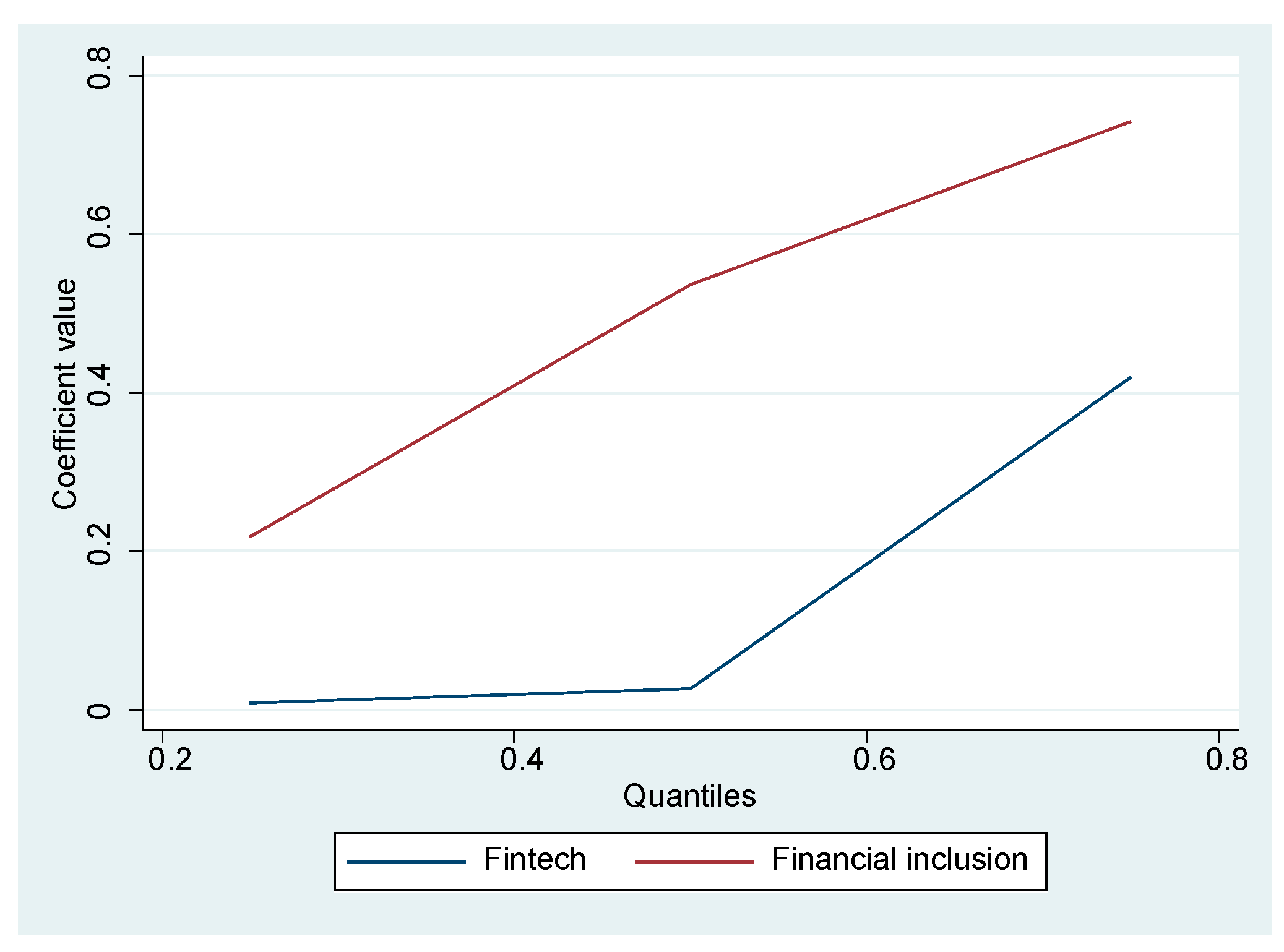
To further illustrate the heterogeneity observed in the quantile estimates, Figure 2 plots the coefficients of the key explanatory variables (fintech and financial inclusion) across the selected quantiles. This visual summary highlights how the magnitude of these effects evolves along the distribution of financial stability, complementing the patterns identified in the regression table.
The insignificance of FinTech in baseline models in Table 5 and Table 6 (Two-Way Fixed Effects and Driscoll–Kraay) likely reflects their limited ability to account for endogeneity, dynamic effects, and unobserved heterogeneity. In contrast, System GMM and quantile regression (Table 7 and Table 8), which better address these issues, reveal a significant positive impact of FinTech on bank stability. This suggests that the stabilizing effect of FinTech is conditional on the presence of broad financial inclusion and strong institutional frameworks, highlighting the importance of supportive economic and regulatory environments for realizing the benefits of financial technology.
Financial inclusion exhibits an even more pronounced gradient, developing from modest effects in fragile systems to substantial, statistically significant impacts in emerging and advanced economies reflecting the nonlinear nature of the inclusion-stability relationship highlighted by Nizam et al. (2020). For the controls, GDP growth fosters stability at all quantiles, inflation remains consistently destabilizing, institutional quality becomes increasingly important at higher levels of stability, and public debt becomes insignificant at the very top quantile, as macro credibility and market depth mitigate its risk. Overall, quantile results confirm that stability gains from digital and inclusion-related forces are conditional on the state of institutions and macroeconomic strength. Hence, we accept the three hypotheses H1, H2 and H3. It pinpoints some clear differentiated pathways through which fintech and inclusion promote resilience across different development stages.

6. Concluding Remarks and Recommendations

This study offers a comprehensive analysis of the connection between financial stability, financial inclusion, and fintech adoption in 30 countries between 2011 and 2024. Several econometric methods, such as System Generalized Method of Moments (SGMM), Panel Quantile Regression, and Two-Way Fixed Effects (TWFE), are used to account for potential endogeneity, heteroskedasticity, serial correlation, cross-sectional dependence, and heterogeneous effects across nations. When analyzing cross-country financial data, it is crucial to address econometric challenges, as evidenced by the slightly different results depending on the approach taken. Overall, the results show that financial inclusion improves financial stability, highlighting the contribution of widespread access to financial services to robust financial systems. However, TWFE estimates indicate that fintech adoption does not exert any significant impact. When taking into consideration dynamic interactions and distributional heterogeneity, the results of SGMM and panel quantile regressions support evidence that both fintech and financial inclusion significantly enhance financial stability.
Based on the results of the Two-Way Fixed effect estimate and the Two-Way Fixed effects estimation with Driscoll–Kraay Robust Standard Errors, we accept the hypothesis H1 and we reject the hypotheses H2 and H3. However, the results of the SGMM approach and the panel quantile regression technique lead to accept the three hypotheses H1, H2 and H3.
These findings have significant policy ramifications. First, programs that increase financial services’ accessibility, use, and penetration should be the first step taken by policymakers to advance financial inclusion. As supported by empirical evidence, financial stability is clearly improved by greater inclusion. Second, since fintech’s effects on financial stability differ depending on the context and econometric viewpoint, its adoption should be encouraged with caution and consideration for institutional quality and economic situation. Hence, it’s imperative to improve institutional quality. Third, risk management and the stability of the financial system can be supported by policies that strengthen governance and effective regulation. Fourth, since both inflation and external debt threaten financial stability, macroeconomic stability should be safeguarded by controlling inflation and managing external debt.
Although this research offers some interesting results, it also has some limitations. First, we acknowledge that the heterogeneity of institutional quality, regulatory frameworks, and financial systems across countries may limit the generalizability of the findings. Second, financial stability is measured solely by the Z-score, which may not capture other dimensions such as capital adequacy or NPL ratios. In addition, there is a potential measurement error in FinTech and financial inclusion variables due to inconsistent data collection across countries. Third, although a variety of econometric techniques were used, the results show that the results are sensitive to the econometric approach. Fourth, the sample was analyzed as a single panel, despite the existence of significant heterogeneity in financial, economic, institutional, and regulatory conditions across countries. Finally, the use mobile/internet for bill payment as proxy of Fintech captures only a narrow aspect of Fintech adoption and does not reflect more advanced services such as digital lending, wealth management, or blockchain-based applications. It may therefore underestimate the breadth and sophistication of Fintech development across countries.
This analysis could be expanded in future studies by looking at sub-samples to account for more diverse countries and differences in institutional and regulatory quality. It could be extended to include a broader set of countries from the Findex database to enhance the generalizability of the results. Second, conducting a comparative analysis between advancing economies, emerging countries and developing nations could improve the results of this paper. Third, to better understand financial stability, it can also take into account macro-financial factors like global shocks and technological disruptions, as well as employ alternative econometric techniques to address model sensitivity. Finally, qualitative case studies or region-specific analyses could be conducted to explore the mechanisms of financial inclusion and FinTech in enhancing bank stability.

Funding

This work was supported and funded by the Deanship of Scientific Research at Imam Mohammad Ibn Saud Islamic University (IMSIU) (grant number IMSIU-DDRSP2504).

Institutional Review Board Statement

Not applicable.

Informed Consent Statement

Not applicable.

Data Availability Statement

Derived data supporting the findings of this study are available from the corresponding author on request.

Conflicts of Interest

The author declares no conflict of interest.

Appendix A. The Construction of the Financial Inclusion Index

To construct an index of financial inclusion, we have selected four indicators. Two indicators represent the access dimension of financial inclusion (ATMs per 100,000 adults, and Bank branches per 100,000 adults) and the two other indicators represent the usage dimension (Bank deposits as a percentage of GDP, and credit as a percentage of GDP). These four indicators are equally weighted, with a weight of 1/4 assigned to each indicator. The second step consists of calculating the normalized value of each indicator. The literature identifies two main standardization methods: statistical standardization and empirical standardization. We opted for empirical standardization in this study. Empirical normalization offers greater interpretability and robustness than statistical normalization, as it relies on economically meaningful benchmarks rather than purely distributional properties. It is less sensitive to outliers and non-normality, which are common in empirical financial data. Moreover, it improves comparability across heterogeneous samples by reflecting observed, context-relevant variation. The empirical normalization formula is as follows:
I n i , t = I i , t min ( I i ) max ( I i ) min ( I i )
where Ini,t represents the normalized value of indicator I at time t, and min (Ii) and max (Ii) are the minimum and maximum values of the indicator, respectively.

Appendix B. Countries List

  • Category 1: Advanced economies (7 countries): The United States, the United Kingdom, Germany, Japan, Singapore, Australia, Canada, and Italy. These countries are classified as advanced economies due to their high income levels, strong institutions, and highly developed financial systems. Most are long-standing OECD members, and all exhibit deep market integration and economic diversification, which are key OECD characteristics of advanced economies.
  • Category 2: Emerging economies (11 countries): China, India, Brazil, Mexico, Turkey, South Africa, Malaysia, Bahrain, Kuwait, Qatar, and Saudi Arabia. These countries are categorized as emerging economies. They are non-OECD advanced members but play a growing role in the global economy, with expanding financial sectors and increasing international integration, while still facing structural and institutional constraints typical of emerging markets.
  • Category 3: Developing economies (12 countries): Kenya, Ghana, Egypt, Morocco, Tunisia, Pakistan, Vietnam, the Philippines, Paraguay, Sri Lanka, and Ukraine. These countries are classified as developing economies. These countries have lower income levels, less developed financial systems, and greater structural and institutional vulnerabilities, consistent with OECD and World Bank development classifications.

Note

1
For more details on the construction of the financial inclusion index, see Appendix A.

References

  1. AlBenJasim, S., Takruri, H., & Al Zaidi, R. (2024). Development of cybersecurity framework for FinTech innovations: A case study of Bahrain. International Cybersecurity Law Review, 5, 501–532. [Google Scholar] [CrossRef]
  2. Allen, F., Demirgüç-Kunt, A., Klapper, L., & Martinez Peria, M. S. (2016). The foundations of financial inclusion: Understanding ownership and use of formal accounts. Journal of Financial Intermediation, 27, 1–30. [Google Scholar] [CrossRef]
  3. Al Shari, H. A., & Lokhande, M. A. (2023). The relationship between the risks of adopting FinTech in banks and their impact on performance. Cogent Business & Management, 10(1), 2174242. [Google Scholar] [CrossRef]
  4. Amnas, M. B., Selvam, M., & Parayitam, S. (2024). FinTech and financial inclusion: Exploring the mediating role of digital financial literacy and the moderating influence of perceived regulatory support. Journal of Risk and Financial Management, 17(3), 108. [Google Scholar] [CrossRef]
  5. Anarfo, E. B., & Kyereboah Coleman, A. (2022). The effect of financial inclusion and competitiveness on financial stability: Why financial regulation matters in developing countries? Journal of Risk and Financial Management, 15(3), 122. [Google Scholar] [CrossRef]
  6. Arellano, M., & Bond, S. (1991). Some tests of specification for panel data: Monte Carlo evidence and an application to employment equations. The Review of Economic Studies, 58(2), 277–297. [Google Scholar] [CrossRef]
  7. Arnone, M., Costantiello, A., Leogrande, A., Naqvi, S. K. H., & Magazzino, C. (2024). Financial stability and innovation: The role of non-performing loans. FinTech, 3(4), 496–536. [Google Scholar] [CrossRef]
  8. Awdeh, A., Assaf, R., & Ghosn, F. (2024a). How do financial development and stability shape human development? Review of Middle East Economics and Finance, 20(1), 77–111. [Google Scholar] [CrossRef]
  9. Awdeh, A., El Moussawi, C., & Hamadi, H. (2024b). The impact of inflation on bank stability: Evidence from the MENA banks. International Journal of Islamic and Middle Eastern Finance and Management, 17(2), 379–399. [Google Scholar] [CrossRef]
  10. Bank for International Settlements (BIS). (2015). Financial inclusion and financial stability. BIS Quarterly Review. Available online: https://www.bis.org/publ/qtrpdf/r_qt1503.pdf (accessed on 13 October 2025).
  11. Bank for International Settlements (BIS). (2019). Big tech in Finance: Opportunities and risks (BIS Annual Economic Report 2019, Chapter III). Bank for International Settlements. [Google Scholar]
  12. Beck, T. H. L., & de La Torre, A. (2007). The basic analytics of access to financial services. Financial Markets, Institutions & Instruments, 16(2), 79–117. [Google Scholar] [CrossRef]
  13. Ben Naceur, S., Candelon, B., & Mugrabi, F. (2024). Systemic implications of financial inclusion (IMF Working Paper/2024/203). International Monetary Fund. [Google Scholar] [CrossRef]
  14. Blundell, R., & Bond, S. (1998). Initial conditions and moment restrictions in dynamic panel data models. Journal of Econometrics, 87(1), 115–143. [Google Scholar] [CrossRef]
  15. Bogari, A. (2023). Does institutional quality matter to the inflation targeting financial stability nexus? Business and Economic Analysis, 12(3), 45–60. [Google Scholar] [CrossRef]
  16. Boulanouar, Z., Alqahtani, F., & Hamdi, B. (2021). Bank ownership, institutional quality and financial stability: Evidence from the GCC region. Pacific Basin Finance Journal, 66, 101510. [Google Scholar] [CrossRef]
  17. Canay, I. A. (2011). A simple approach to quantile regression for panel data. The Econometrics Journal, 14(3), 368–386. [Google Scholar] [CrossRef]
  18. Chu, Y., Ye, S., Li, H., Strauss, J., & Zhao, C. (2023). Can digitalization foster sustainable financial inclusion? Opportunities for both banks and vulnerable groups. Sustainability, 15(8), 6727. [Google Scholar] [CrossRef]
  19. Čihák, M., & Sahay, R. (2020). Finance and inequality: How are they related? (IMF Staff Discussion Note No. SDN/20/01). International Monetary Fund. [Google Scholar]
  20. Davoodi, H. R., Montiel, P. J., & Ter Martirosyan, A. (2021). Macroeconomic stability and inclusive growth (IMF Working Paper No. 2021/081). International Monetary Fund. [Google Scholar] [CrossRef]
  21. Demirgüç-Kunt, A., Klapper, L., Singer, D., Ansar, S., & Hess, J. (2018). The global findex database 2017: Measuring financial inclusion and the fintech revolution. World Bank. [Google Scholar] [CrossRef]
  22. Frost, J. (2020). The economic forces driving fintech adoption across countries (BIS Working Papers No. 838). Bank for International Settlements. [Google Scholar]
  23. Gao, X., & Gao, R. (2024). A study of the impact of digital financial inclusion on the resilience of the agricultural chain. Frontiers in Sustainable Food Systems, 8, 1448550. [Google Scholar] [CrossRef]
  24. Ha, D. T. T., Le, P., & Nguyen, D. K. (2025). Financial inclusion and fintech: A state of the art systematic literature review. Financial Innovation, 11, 69. [Google Scholar] [CrossRef]
  25. Hai, Z., Sadiq, M. N., Ali, N., Malik, M., & Hamid, S. A. R. (2022). Bank specific risks and financial stability nexus: Evidence from Pakistan. Frontiers in Psychology, 13, 909141. [Google Scholar] [CrossRef]
  26. Hakimi, A., Saidi, H., & Adili, L. (2025). Does financial inclusion affect non-performing loans and liquidity risk in the MENA region? A comparative analysis between GCC and Non-GCC countries. Economies, 13(5), 143. [Google Scholar] [CrossRef]
  27. Hannig, A., & Jansen, S. (2010). Financial inclusion and financial stability: Current policy issues (ADBI Working Paper 259). Asian Development Bank Institute. Available online: https://www.econstor.eu/handle/10419/53699 (accessed on 17 October 2025).
  28. Harun, C. A., & Gunadi, I. (2022). Financial stability and systemic risk. In P. Warjiyo, & S. M. Juhro (Eds.), Central bank policy mix: Issues, challenges, and policy responses (pp. 73–89). Springer. [Google Scholar] [CrossRef]
  29. International Monetary Fund. (2018). Global financial stability report: A decade after the global financial crisis: Are we safer? (GFSR 2018/002). International Monetary Fund. [Google Scholar] [CrossRef]
  30. International Monetary Fund. (2022). BigTech in financial services: Regulatory approaches and implications (Fintech Notes, January). International Monetary Fund. [Google Scholar]
  31. Jiang, Y., Li, C., Zhang, J., & Zhou, X. (2019). Financial stability and sustainability under the coordination of monetary policy and macroprudential policy: New evidence from China. Sustainability, 11(6), 1616. [Google Scholar] [CrossRef]
  32. Kamara, A. K., & Yu, B. (2024). The impact of FinTech adoption on traditional financial inclusion in sub Saharan Africa. Risks, 12(7), 115. [Google Scholar] [CrossRef]
  33. Kharabsheh, B., & Gharaibeh, O. K. (2022). Determinants of banks’ stability in Jordan. Economies, 10(12), 311. [Google Scholar] [CrossRef]
  34. Khera, P., Ng, S. Y., Ogawa, S., & Sahay, R. (2021). Digital financial inclusion in emerging and developing economies: A new index (IMF Working Paper No. 2021/090). International Monetary Fund. [Google Scholar] [CrossRef]
  35. Mandić, A., Marković, B., & Žigo, I. R. (2025). Risks of the use of FinTech in the financial inclusion of the population: A systematic review of the literature. Journal of Risk and Financial Management, 18(5), 250. [Google Scholar] [CrossRef]
  36. Nguyen, D. D. T., & Du, Q. L. T. (2022). The effect of financial inclusion on bank stability: Evidence from ASEAN. Cogent Economics & Finance, 10(1), 2040126. [Google Scholar] [CrossRef]
  37. Nizam, R., Karim, Z. A., Rahman, A. A., & Sarmidi, T. (2020). Financial inclusiveness and economic growth: New evidence using a threshold regression analysis. Economic Research-Ekonomska Istraživanja, 33(1), 1465–1484. [Google Scholar] [CrossRef]
  38. Nsengiyumva, E., Akims, M., & Kamau, G. (2025). Macroeconomic factors and financial stability of commercial banks in Rwanda. International Journal of Finance and Accounting, 10(7), 1–15. [Google Scholar] [CrossRef]
  39. Okoli, T. T. (2024). Financial technology adoption and bank stability among African economies: Is the relationship monotonic? Investment Management and Financial Innovations, 21(4), 385–399. [Google Scholar] [CrossRef]
  40. Ozili, P. K. (2018). Impact of digital finance on financial inclusion and stability. Borsa Istanbul Review, 18(4), 329–340. [Google Scholar] [CrossRef]
  41. Pasha, A. (2024). Analyzing the impact of macroeconomic variables on financial stability: Evidence from South Asian economies. Journal of Economics and Management Sciences, 7(2), 1–15. [Google Scholar] [CrossRef]
  42. Pesaran, M. H. (2004). General diagnostic tests for cross section dependence in panels. Cambridge working papers. Economics, 1240(1), 1. [Google Scholar] [CrossRef]
  43. Rubio Misas, M. (2024). Supervisory power and insurer financial stability: The role of institutional quality. The Geneva Papers on Risk and Insurance—Issues and Practice, 49(4), 804–830. [Google Scholar] [CrossRef]
  44. Safiullah, M., & Paramati, S. R. (2024). The impact of FinTech firms on bank financial stability. Electronic Commerce Research, 24, 453–475. [Google Scholar] [CrossRef]
  45. Sahay, R., Čihák, M., N’Diaye, P., Barajas, A., Mitra, S., Kyobe, A., Mooi, M., & Yousefi, R. (2015). Financial inclusion: Can it meet multiple macroeconomic goals? (IMF Staff Discussion Note No. SDN/15/17). International Monetary Fund. [Google Scholar]
  46. Saidi, H., Rachdi, H., Hakimi, A., & Alnabulsi, K. (2025). Do financial market openness and stock market returns drive economic growth in GCC countries? New investigation from panel structural breaks. International Journal of Financial Studies, 13(1), 40. [Google Scholar] [CrossRef]
  47. Sant’Anna, D. A. L. M., & Figueiredo, P. N. (2024). Fintech innovation: Is it beneficial or detrimental to financial inclusion and financial stability? A systematic literature review and research directions. Emerging Markets Review, 60, 101140. [Google Scholar] [CrossRef]
  48. Sodokin, K., Egbeleo, E., Kuessi, R., Couchoro, M. K., & Agbodji, A. E. (2023). Regulation, institutional quality, and stability of the banking system in West African Economic and Monetary Union. Cogent Economics & Finance, 11(2), 2256127. [Google Scholar] [CrossRef]
  49. Tello-Gamarra, J., Campos-Teixeira, D., Longaray, A. A., Reis, J., & Hernani-Merino, M. (2022). Fintechs and institutions: A systematic literature review and future research agenda. Journal of Theoretical and Applied Electronic Commerce Research, 17(2), 722–750. [Google Scholar] [CrossRef]
  50. Ullah, S., Hussain, S. I., Nabi, A. A., & Mubashir, K. A. (2022). Role of regulatory governance in financial stability: A comparison of high and low income countries. Journal of Central Banking Theory and Practice, 11(1), 207–226. [Google Scholar] [CrossRef]
  51. Ullah, S., Ullah, A., & Zaman, M. (2024). Nexus of governance, macroeconomic conditions, and financial stability of banks: A comparison of developed and emerging countries. Financial Innovation, 10, 30. [Google Scholar] [CrossRef]
  52. Vučinić, M., & Luburić, R. (2022). Fintech, risk based thinking and cyber risk. Journal of Central Banking Theory and Practice, 11(2), 27–53. [Google Scholar] [CrossRef]
  53. Wang, R., He, Z., & Yang, S. (2024). FinTech monopoly and systemic risk: Evidence from China. SAGE Open, 14(4). [Google Scholar] [CrossRef]
  54. Warokka, A., Setiawan, A., & Aqmar, A. Z. (2025). Key factors influencing fintech development in ASEAN-4 countries: A mediation analysis. FinTech, 4(2), 17. [Google Scholar] [CrossRef]
  55. World Bank. (2016). Financial stability (key terms explained). In Global financial development report 2016—Background (GFDR 2016). World Bank. Available online: https://www.worldbank.org/en/publication/gfdr/gfdr-2016/background/financial-stability (accessed on 21 October 2025).
  56. Yudaruddin, R., Soedarmono, W., Nugroho, B. A., Fitrian, Z., Mardiany, M., Purnomo, A. H., & Nor Santi, E. (2023). Financial technology and bank stability in an emerging market economy. Heliyon, 9(5), e16183. [Google Scholar] [CrossRef] [PubMed]
  57. Zhang, Q., Ou, Y., & Chen, R. (2023). Digitalization and stability in banking sector: A systemic risk perspective. Risk Management, 25, 11. [Google Scholar] [CrossRef]
  58. Zhang, Y., & Chen, M. (2023). Fintech, inclusive finance, and bank’s risk-taking. Atlantis Highlights in Economics, Business and Management, 1, 302–307. [Google Scholar] [CrossRef]
  59. Zou, X., Dai, W., & Meng, S. (2024). The impacts of digital finance on economic resilience. Sustainability, 16(17), 7305. [Google Scholar] [CrossRef]
Figure 1. Time Trends of Key variables averages across country groups (2011–2024).
Economies 14 00008 g001
Figure 2. Coefficient Plots Across Quantiles.
Economies 14 00008 g002
Table 1. Summary of Hypotheses.
HypothesisDescription
H1Financial inclusion enhances financial stability.
H2The adoption of fintech positively contributes to financial stability.
H3Fintech and financial inclusion simultaneously enhance financial stability.
Table 2. Variable definition, measurement and source.
AcronymsVariables DefinitionSource
FSFinancial stability measured by Bank Z-scoreGFI
FINTECHUsed a mobile phone or the internet to pay bills (% age 15+)Global financial index
IFIATMs per 100,000 adultsGFI
Bank branches per 100,000 adults
Borrowers from commercial banks (per 1000 adults)
Depositors with commercial banks (per 1000 adults)
IQ_INDEXControl of Corruption: Score that ranges from [−2.5 to 2.5]WGI
Government stability: Score that ranges from [−2.5 to 2.5]
Rule of law: Score that ranges from [−2.5 to 2.5]
Voice and Accountability: Score that ranges from [−2.5 to 2.5]
Government Effectiveness: Score that ranges from [−2.5 to 2.5]
Regulatory quality: Score that ranges from [−2.5 to 2.5]
INFInflation, consumer prices (annual % growth)WDI
GDPGGDP (annual % growth)WDI
EXDBTExternal debt stocks (% of GNI)WDI
Table 3. Descriptive statistics.
VariableMeanStd. Dev.MinMax
FS14.9807.2220.53638.681
FINTECH19.23518.0430.06985.338
FI0.6310.1730.3030.813
GDPG4.3224.207−28.75937.508
INF8.26318.223−6.687219.884
IQ_INDEX0.6810.2760.2710.976
EXDBT50.15613.6071.252195.922
Table 4. Correlation matrix.
FINTECHFIGDPGINFIQ_INDEXEXDBT
FINTECH1.0000
FI0.19921.0000
GDPG0.16320.09231.0000
INF−0.0165−0.0285−0.34051.0000
IQ_INDEX−0.0641−0.09700.12240.01681.0000
EXDBT0.06380.1285−0.05350.1349−0.10791.0000
Table 5. Baseline Results: Two-Way Fixed Effect Estimate.
Dependent Variable Is FS
CoefficientsStd. Errp-Value
FINTECH−0.0840.5560.180
IFI0.123 **0.1010.018
GDPG0.0340.0240.158
INF−0.207 ***0.0670.003
IQ_INDEX0.464 **0.5360.012
EXDBT−0.0070.1020.439
Within R20.232
F-stat2.12 (0.0086)
Modified Wald test for groupwise heteroskedasticity6257.69 (0.0000)
Wooldridge test for autocorrelation40.697 (0.0001)
Pesaran’s test of cross-sectional independence−2.373 (0.0176)
*** and ** indicate the level of significance at 1% and 5% respectively.
Table 6. Two-Way Fixed Effects Estimation with Driscoll–Kraay Robust Standard Errors.
Dependent Variable Is FS
CoefficientsDrisc/Kraay
Std. Err
p-Value
FINTECH−0.0840.2900.177
IFI0.123 **0.1060.027
GDPG0.034 *0.0170.069
INF−0.207 ***0.0680.010
IQ_INDEX0.464 **0.7020.034
EXDBT−0.0070.0130.456
Within R20.243
F-stat491.53 (0.0000)
***, ** and * indicate level of significance at 1%, 5% and 10% respectively.
Table 7. Dynamic Estimation Results: Two-Step System GMM.
Dependent Variable Is FS
CoefficientsZp-Value
FS (−1)1.026 ***13.880.000
FINTECH0.015 **3.010.034
IFI0.227 **2.460.014
GDPG0.0090.350.723
INF−0.075 *−1.980.077
IQ_INDEX0.064 *1.720.085
EXDBT−0.014 ***−3.010.002 ***
AR(2) test 0.37 (0.709)
Sargan test 14.66 (0.949)
***, ** and * indicate level of significance at 1%, 5% and 10% respectively.
Table 8. Panel quantile regression.
Dependent Variable Is FS
Q25Q50Q75
FINTECH0.009 *
(1.81)
0.027 **
(2.39)
0.42 *
(1.69)
IFI0.218 *
(1.82)
0.537 **
(1.94)
0.742 **
(2.01)
GDPG0.048 *
(1.81)
0.053 *
(1.89)
0.112
(1.47)
INF−0.212 *
(−1.79)
−0.207 *
(−1.81)
−0.269
(−1.43)
IQ_INDEX0.681
(0.79)
0.845 **
(2.89)
0.882 ***
(4.01)
EXDBT−0.027 **
(−2.09)
−0.013 **
(−2.29)
−0.047
(−1.32)
Pseudo-R20.7350.6990.721
***, ** and * indicate level of significance at 1%, 5% and 10% respectively.
Disclaimer/Publisher’s Note: The statements, opinions and data contained in all publications are solely those of the individual author(s) and contributor(s) and not of MDPI and/or the editor(s). MDPI and/or the editor(s) disclaim responsibility for any injury to people or property resulting from any ideas, methods, instructions or products referred to in the content.