
Article

Trade, Growth, and Logistics Performance: Dynamic and Distributional Insights into the Drivers of CO2 Emissions in the Mediterranean Basin
by
Ioannis Katrakylidis
1,
Athanasios Athanasenas
1,
Michael Madas
2 and
Constantinos Katrakilidis
3,*
1
Department of Business Organization and Management, International Hellenic University, 62124 Serres, Greece
2
Information Systems and eBusiness (ISEB) Laboratory, Department of Applied Informatics, School of Information Sciences, University of Macedonia, 54636 Thessaloniki, Greece
3
Department of Economics, Aristotle University of Thessaloniki, 54124 Thessaloniki, Greece
*
Author to whom correspondence should be addressed.
Economies 2026, 14(1), 24; https://doi.org/10.3390/economies14010024
Submission received: 30 November 2025 / Revised: 29 December 2025 / Accepted: 5 January 2026 / Published: 15 January 2026

Abstract

This paper examines how logistics performance conditions the relationship between trade openness, economic growth and per capita CO2 emissions in Mediterranean economies. Using an unbalanced panel of 20 countries over the period 2007–2022, we combine static fixed-effects, dynamic panel generalized method of moments (GMM) estimators and Method-of-Moments Quantile Regression (MM-QR). CO2 emissions per capita, the World Bank Logistics Performance Index (LPI), trade openness and GDP per capita are drawn from World Bank databases, and interaction terms between LPI and both income and trade openness are constructed to capture conditional effects. The results from fixed-effects and system GMM estimations show that logistics performance exerts a robust and statistically significant negative effect on emissions, whereas GDP per capita is a positive driver and trade openness tends to reduce emissions when logistics capacity is sufficiently strong. Negative and significant interaction terms between LPI and both income and openness indicate that logistics efficiency amplifies the environmental benefits of trade and growth. Quantile regressions reveal that these patterns are most pronounced in high-emission countries, where improvements in logistics performance and its interaction with trade and income generate larger marginal reductions in CO2 emissions. Overall, the findings highlight the central role of logistics modernization and green trade facilitation in reconciling trade-led growth with decarbonization in the Mediterranean Basin. From a policy perspective, the evidence suggests that prioritizing green logistics and trade facilitation—particularly in high-emission Mediterranean economies—can yield the largest marginal reductions in CO2 emissions.

1. Introduction

The Mediterranean Basin has become a focal arena for the global sustainability transition. Sitting at the intersection of Europe, North Africa and Western Asia, the region hosts some of the world’s most important maritime corridors, energy gateways, and tourism- and trade-intensive economies. At the same time, Mediterranean countries exhibit markedly uneven levels of infrastructure quality, institutional capacity and income. This structural heterogeneity implies that similar shocks—such as trade expansion, transport modernization or climate regulation—can generate very different environmental outcomes across the Basin.
These regional challenges unfold against an intensifying global climate context. Energy-related CO2 emissions have continued to rise to record levels in recent years, despite some progress in advanced economies, and the transport sector remains one of the hardest to decarbonize, with freight and maritime activity playing a disproportionately large role in international emissions and policy debates. In parallel, Mediterranean economies are exposed to ambitious multi-level policy pressures. Within the European Union, the European Climate Law and the “Fit for 55” package establish legally binding objectives for achieving climate neutrality by 2050 and at least a 55% reduction in net greenhouse-gas emissions by 2030. At the global level, shipping and port systems—central to Mediterranean growth—are subject to the International Maritime Organization’s revised greenhouse-gas strategy, which calls for net-zero emissions from international shipping by or around 2050, with intermediate checkpoints for 2030 and 2040. Taken together, these frameworks make the Mediterranean a natural laboratory for studying how economic integration and logistics modernization can reconcile competitiveness with decarbonization.
Beyond trade dependence, the Mediterranean is a climate change hotspot with highly concentrated maritime and port activity and a marked policy gradient between EU and non-EU members, which together make it a particularly informative setting for identifying heterogeneous decarbonization responses.
A key feature of the Mediterranean growth model is its dependence on trade and logistics networks. Trade openness has historically been a major driver of income and structural change in the region, but it is also associated with higher production volumes, energy use and freight movements. The environmental effects of openness therefore remain theoretically ambiguous. The canonical trade–environment framework decomposes trade impacts into scale, composition and technique effects, indicating that emissions may rise or fall depending on which channel dominates (Antweiler et al., 2001; Copeland & Taylor, 2004). At the same time, the Environmental Kuznets Curve (EKC) hypothesis posits that emissions initially increase with economic growth and later decline after a turning point, as structural change, technological progress and environmental regulation strengthen (Grossman & Krueger, 1995; Sarkodie & Strezov, 2019; Stern, 2017). Empirical evidence for the EKC is mixed and highly context-dependent, which is particularly relevant for a structurally diverse region such as the Mediterranean.
Within this nexus, the role of logistics performance is still insufficiently understood. Logistics affects the carbon footprint of trade not only through transport intensity and fuel use, but also through congestion, idle time, modal choice and supply chain coordination. The World Bank’s Logistics Performance Index (LPI) provides a widely used composite measure of customs efficiency, infrastructure quality, shipment reliability, tracking and tracing, and timeliness, and has become a standard proxy for national logistics quality (World Bank, 2018, 2024a, 2024b). Recent studies suggest that logistics performance is closely linked to both competitiveness and environmental outcomes: improved logistics can facilitate trade and economic growth but may also influence emissions through their effects on transport patterns and supply chain efficiency (Karaduman et al., 2020; Magazzino et al., 2021; Zaman & Shamsuddin, 2017; Wan et al., 2022; Özçelik & Töngür, 2024). Nevertheless, while a large body of work examines growth–emissions and trade–emissions relationships, far fewer studies treat logistics as a central environmental driver or as a moderating condition shaping how trade and income translate into emissions, and even fewer focus specifically on the Mediterranean Basin.
This gap is particularly relevant for Mediterranean economies. Several countries in the region, including Spain, Italy, Greece, Türkiye, Morocco and Egypt, are actively investing in ports, intermodal corridors and digital trade facilitation, expecting gains in competitiveness and resilience. Whether these logistics improvements generate net CO2 reductions, however, depends on two competing mechanisms. On the one hand, efficiency and technique gains can reduce emissions per unit of activity through better routing, lower delays, modern and cleaner vehicle fleets, greener ports and improved supply chain management. On the other hand, rebound and scale effects can arise when cheaper and faster logistics stimulate additional trade and production, potentially increasing total emissions. Because Mediterranean countries differ sharply in income level, trade openness and logistics capability, the net outcome is likely to be nonlinear and heterogeneous—precisely the aspect that existing evidence has not pinned down for this region.
Against this backdrop, the present paper investigates the emissions–trade–growth nexus in the Mediterranean Basin by explicitly incorporating logistics performance as both a direct determinant of per capita CO2 emissions and a moderating factor. Using a balanced panel of Mediterranean economies for 2007–2022, the empirical analysis combines fixed-effects and random-effects estimators with dynamic system GMM in order to obtain endogeneity-robust average effects and to account for persistence in emissions (Roodman, 2009). System GMM is particularly suited to this setting because it allows lagged values of endogenous regressors to serve as internal instruments in a short-time, medium-country panel. To capture distributional heterogeneity, the paper further applies panel quantile regression methods, which permit the impact of logistics performance, trade openness and income to vary between low- and high-emission economies (Koenker, 2005). This approach aligns with the region’s pronounced heterogeneity in emissions, income and logistics performance.
The empirical inquiry is organized around four related research questions. First, it asks whether logistics performance reduces CO2 emissions in Mediterranean economies once economic growth and trade openness are considered. Second, it examines how trade openness affects CO2 emissions in the region and whether this effect is conditioned by logistics performance. Third, it explores whether the level of economic development, proxied by GDP per capita, moderates the logistics–emissions relationship in a manner consistent with EKC-type dynamics. Fourth, it investigates whether the impacts of logistics performance and its interactions with trade openness and income are heterogeneous across the emissions distribution, for example being stronger in high-emitting Mediterranean economies.
In addressing these questions, the paper contributes to the literature in several ways. It advances the trade–growth–emissions debate by positioning logistics performance, as captured by the LPI, as a core explanatory variable in the Mediterranean context rather than a purely background facilitator. It explicitly tests two moderating channels—trade openness and income—thereby clarifying the conditions under which logistics improvements are associated with environmental gains or losses. Methodologically, it combines dynamic system GMM with panel quantile regressions, capturing both endogeneity-robust mean effects and distributional heterogeneity across emitting countries. Substantively, it offers region-specific insights for a trade-dependent basin facing stringent EU and maritime decarbonization timelines, thereby providing evidence that is directly relevant for policy design in Mediterranean economies.
The remainder of the paper is structured as follows. Section 2 reviews the relevant literature, focusing on the growth–emissions nexus, the environmental effects of trade openness and the role of logistics performance. Section 3 describes the data and variables used, as well as the econometric methodology. Section 4 presents and discusses the empirical results, including static panel models, dynamic GMM estimations with diagnostic tests and quantile regressions supported by tables and figures. Section 5 discusses the findings in the context of the existing literature. Finally, Section 6 concludes with key policy implications, acknowledges the study’s limitations and offers suggestions for future research.

2. Literature Review

2.1. Economic Growth and Emissions: EKC Evidence and Limitations

The modern growth–environment debate is anchored in the Environmental Kuznets Curve (EKC), which posits an inverted-U relationship between income and pollution: emissions rise in early stages of development and then decline beyond a certain turning point as economies adopt cleaner technologies, strengthen environmental regulation and shift towards services. A seminal formulation of this relationship is provided by Grossman and Krueger (1995), who examine the link between economic growth and a range of environmental indicators in a trade context.
Three decades later, the EKC remains influential but contested. Large-scale empirical evidence shows that estimated turning points vary widely across pollutants, country groupings and econometric designs, and that no universal EKC pattern emerges. A comprehensive bibliometric and meta-analysis by Sarkodie and Strezov (2019) underscores this heterogeneity, documenting inverted-U, monotonic and more complex income–emissions profiles depending on the specific context. Stern (2017) similarly argues that income alone does not “cause” emissions to decline; where EKC-like behavior is observed, it often reflects regulatory change, technological progress and structural transformation rather than an automatic market mechanism associated with rising income.
For Mediterranean economies, this EKC ambiguity is particularly relevant. The Basin includes high-income EU members, upper-middle-income transition economies and lower-income Southern neighbors. Given these disparities in income levels, energy structures, institutional quality and technological capacity, a uniform growth–emissions slope is implausible. This motivates empirical specifications that allow for income-conditioned environmental impacts and heterogeneity across countries, rather than imposing a single, global EKC.

2.2. Trade Openness and Emissions: Scale, Composition, Technique and Nonlinearities

A parallel literature examines how trade integration affects emissions (Zhou et al., 2025). Copeland and Taylor (2004) formalize the decomposition of trade effects into scale, composition and technique components. Trade can increase pollution through a scale effect when openness leads to higher output and energy consumption, holding technologies and sectoral structure constant. At the same time, trade may reduce emissions by inducing changes in the composition of production towards less pollution-intensive sectors and by facilitating the diffusion of cleaner technologies and production methods, generating composition and technique effects. Antweiler et al. (2001) provide an early empirical implementation of this framework, showing that in some settings the technique effect associated with openness can offset scale pressures.
Empirical findings on the trade–emissions link are mixed. Some studies support pollution-haven or offshoring dynamics, in which trade and foreign direct investment shift emission-intensive production towards countries with laxer environmental standards. Cole et al. (2021), for example, document evidence of pollution offshoring for Japan, consistent with the relocation of dirty production abroad. Other cross-country analyses find that trade openness can improve environmental quality once cleaner technologies diffuse through trade and when regulatory and institutional conditions are supportive. Shahbaz et al. (2017) show that trade–emissions relationships are often nonlinear, with openness becoming environmentally beneficial only beyond certain thresholds in income or institutional quality. More recent threshold-based work echoes this conditionality, emphasizing that trade may reduce CO2 emissions only when technology, governance and policy frameworks create favorable conditions for cleaner production.
Overall, the trade literature suggests that openness is not environmentally “good” or “bad” in itself. Instead, outcomes depend on complementary factors such as institutional quality, technological capability, energy structure and regulatory design. These are precisely the dimensions in which logistics performance may play a central conditioning role.

2.3. Logistics Performance and Environmental Outcomes

Logistics systems determine the energy intensity of trade by shaping transport mode choice, border and terminal delays, warehousing efficiency, shipment reliability and last-mile coordination. The Logistics Performance Index (LPI) has become the standard cross-country proxy for these multidimensional capabilities, capturing customs efficiency, infrastructure quality, international shipment arrangements, logistics competence, tracking and tracing, and timeliness (World Bank, 2018, 2024a, 2024b).
Empirical findings on the relationship between logistics performance and emissions are far from settled. For Europe, Zaman and Shamsuddin (2017) show that specific LPI components—particularly infrastructure quality and timeliness—are associated with lower emissions, while other dimensions can be linked to higher emissions, indicating substantial sub-component and regional heterogeneity. In a panel of Balkan countries, Karaduman et al. (2020) find that higher overall LPI scores significantly reduce CO2 emissions, suggesting that efficiency effects dominate in relatively constrained transport systems.
By contrast, evidence from high-logistics-capacity countries points to rebound dynamics. Magazzino et al. (2021), analyzing top-LPI economies with a combination of FMOLS, GMM and quantile regression, report that logistics expansion can increase total CO2 emissions, consistent with scale effects outweighing efficiency gains when freight activity accelerates. Cross-regional work reinforces this ambiguity. Wan et al. (2022) show for emerging economies that logistics improvements may raise emissions in contexts where freight demand grows faster than decarbonization efforts. Özçelik and Töngür (2024), examining MENA countries, also document mixed impacts of LPI on environmental degradation and stress that effects differ sharply by LPI dimension and development level.
Taking it together, the literature converges on one robust conclusion: logistics performance matters for environmental outcomes, but its net effect on emissions is highly context-specific and may differ by income, openness, energy mix and baseline emission intensity.
Recent studies (2024–2025) deepen this debate by refining measurement of “green logistics performance” and by connecting logistics outcomes to decarbonization channels such as digitalization and eco-efficiency. Starostka-Patyk et al. (2024) discuss GLPI benchmarking for EU countries, while Rastegardehbidi and Su (2025) synthesize key drivers and policy levers for green logistics adoption. These contributions reinforce our motivation to link trade and logistics efficiency with environmental outcomes.
Another strand documents heterogeneity across income groups and emissions regimes. Tetteh et al. (2025) compare OECD and developing markets using dynamic panel methods, and Al-Majali et al. (2026) report performance-dependent effects via quantile approaches. Kulagin et al. (2025) further show that recent logistics disruptions can affect greenhouse-gas outcomes, highlighting the importance of openness–logistics interaction effects.

2.4. Interactions Between Logistics, Trade and Income; Distributional Heterogeneity

While direct logistics effects are increasingly analyzed, the interactive role of logistics with trade and growth remains comparatively underexplored. Conceptually, logistics is the physical transmission mechanism through which trade expands in space. Improved logistics lowers transport and transaction costs, which can reduce the carbon footprint per unit shipped through route optimization, better load factors, smoother border procedures and the facilitation of modal shifts towards cleaner modes. At the same time, more efficient logistics can stimulate additional trade volumes and production, raising aggregate emissions if scale effects dominate. This suggests a moderation channel in which logistics performance conditions the environmental impact of trade openness in both directions. Despite this clear theoretical logic, relatively few studies explicitly test logistics as a moderator in the trade–emissions relationship, particularly in regionally focused analyses outside broad global samples.
A second underexplored dimension concerns distributional heterogeneity across countries. Mediterranean economies differ not only in average income and openness but also in their position along the emissions distribution. Some are relatively low emitters per capita, while others lie in the upper tail due to more energy-intensive production structures, denser urbanization and large logistics and port complexes. Quantile-based environmental studies indicate that policy and structural drivers often exert stronger effects among high emitters than among low emitters, which motivates the use of quantile regression methods to uncover heterogeneous responses (Koenker, 2005). Recent work employing quantile approaches in the logistics–environment nexus suggests that the impact of logistics performance on emissions may be more pronounced in high-emission regimes (Magazzino et al., 2021; Wan et al., 2022). However, quantile evidence on logistics–emissions links, and especially on interactive effects between logistics and trade or income, remains scarce for the Mediterranean Basin.

2.5. Research Gaps

The preceding review yields several consistent insights that motivate the empirical design of the present study. First, both economic growth and trade openness influence emissions in nonlinear and context-dependent ways. EKC-based research shows that the income–emissions relationship can take inverted-U, monotonic or more complex shapes depending on pollutants, regions and institutional settings (Grossman & Krueger, 1995; Sarkodie & Strezov, 2019; Stern, 2017). Trade–environment studies, drawing on the scale–composition–technique framework, demonstrate that openness can either increase or decrease emissions, with the net outcome depending on structural and policy conditions (Antweiler et al., 2001; Copeland & Taylor, 2004; Shahbaz et al., 2017; Cole et al., 2021).
Second, logistics performance has a clear environmental relevance, but its net effect on CO2 emissions is ambiguous and highly context specific. Evidence for Europe, the Balkans, top-LPI economies, emerging markets and MENA countries shows that logistics improvements can be associated with both emission reductions and increases, depending on regional structure, LPI sub-dimensions, the pace of freight growth and the underlying energy and policy environment (Zaman & Shamsuddin, 2017; Karaduman et al., 2020; Magazzino et al., 2021; Wan et al., 2022; Özçelik & Töngür, 2024).
Third, interactive and distributional channels have not been fully explored, particularly in heterogeneous trade hubs such as the Mediterranean Basin. The potential for logistics performance to moderate the environmental impacts of trade openness and income, and the possibility that these effects differ between low- and high-emitting countries, have received limited attention. Existing quantile-based applications point to the importance of considering the entire emissions distribution rather than focusing solely on mean effects (Koenker, 2005; Magazzino et al., 2021; Wan et al., 2022).
These gaps justify the empirical strategy adopted in this paper. Logistics performance is modeled both as a direct determinant of per capita CO2 emissions and as a moderator of trade and income impacts, and the analysis explicitly tests whether these effects become stronger in the upper tail of the emissions distribution. In this way, the study extends the trade–growth–environment literature by integrating logistics performance into a dynamic and distributional framework tailored to the Mediterranean region. Table 1 below summarizes the related literature.
Synthesis and contribution. Taken together, prior evidence suggests that the environmental effects of trade and growth are highly conditional on complementary capabilities, while the net impact of logistics performance remains context-dependent. Building on these insights, our study bridges the identified gaps by (i) modeling logistics performance (LPI) as both a direct determinant of CO2 emissions and a moderator of the trade- and income-emissions relationships, (ii) addressing endogeneity and emissions persistence through dynamic GMM estimators, and (iii) uncovering distributional heterogeneity across low- and high-emission Mediterranean economies using MM-QR.

3. Methodology

3.1. Empirical Model and Hypotheses

We model per capita CO2 emissions as a function of income, trade openness and logistics performance, allowing for interaction effects that capture how logistics capabilities condition the trade–emissions and growth–emissions nexuses. In compact form:
LCO2PCit = α + β1·LGDPRPCit + β2·LOPENit + β3·LLPINit + β4·(LLPINit × LOPENit) + β5·(LLPINit × LGDPRPCit)
+ μi + λt + εit
In this setting, μ i captures unobserved time-invariant country heterogeneity, λ t denotes time effects common to all countries, and ε i t is the idiosyncratic error term. The interaction coefficients β 4 and β 5 test whether improvements in logistics performance attenuate (or amplify) the marginal environmental pressure associated with greater trade exposure and higher income levels.
The empirical strategy of this study relies on a multi-step panel econometric approach that combines static and dynamic methods. The choice of techniques responds to the need to address unobserved heterogeneity, endogeneity and persistence in carbon emissions, while ensuring robustness across alternative specifications.

3.2. Baseline Panel Estimators

The baseline analysis begins with fixed-effects (FE) and random-effects (RE) models. The FE estimator controls for country-specific unobservable factors that may be correlated with the explanatory variables, whereas the RE estimator assumes that these factors are orthogonal to the regressors (Wooldridge, 2010). The Hausman (1978) test is employed to statistically discriminate between the two estimators, ensuring that the consistent specification is retained for inference. Although these static models provide useful benchmark results, they are limited in their ability to capture dynamic adjustment processes and to fully address endogeneity in the regressors.

3.3. Dynamic Panel Strategy: Difference and System GMM

To overcome these limitations, the study adopts a suite of dynamic panel estimators based on the generalized method of moments (GMM), which provide more reliable estimates under weaker assumptions about error structure and endogeneity. Four GMM specifications are implemented: difference GMM (GMM1), system GMM (GMM2), restricted system GMM (GMM3) and extended system GMM (GMM4). Each specification builds upon the previous one, addressing specific econometric challenges and collectively offering a robust framework for causal interpretation.
For ease of exposition, Table 2, below, provides a compact overview of the four dynamic GMM specifications and their role in the empirical strategy.
The first specification, GMM1, applies the difference GMM estimator of Arellano and Bond (1991). By transforming the model into first differences, this method removes time-invariant country-specific effects that would otherwise bias the estimates. Lagged levels of the endogenous regressors are then used as instruments for the differenced equation, exploiting internal instruments generated by the panel structure. This approach is particularly suitable for datasets with a relatively large cross-sectional dimension and a moderate time dimension, such as the panel considered in this study.
However, difference-GMM has two well-known limitations. First, when the explanatory variables are highly persistent, lagged levels can be weak instruments for first differences, leading to biased and imprecise estimates (Blundell & Bond, 1998). Second, differencing tends to amplify measurement error, which further reduces efficiency. For these reasons, while GMM1 serves as a valuable starting point, it is complemented by more efficient alternatives.
To mitigate these issues, the study employs system GMM (Arellano & Bover, 1995; Blundell & Bond, 1998), denoted as GMM2. This estimator augments the differenced equation with the original equation in levels, creating a system of two equations. In the differenced equation, lagged levels of the regressors continue to serve as instruments, while in the levels equation, lagged differences are used as instruments under appropriate stationarity and moment conditions. System GMM improves efficiency by exploiting additional moment conditions and alleviates weak-instrument problems that arise in purely differenced models. It is particularly effective when the dependent variable and key explanatory variables—such as CO2 emissions and GDP per capita—are highly persistent.
The gains in efficiency from system GMM come at the cost of a potential proliferation of instruments, especially when the time dimension is not very large. An excessive number of instruments can overfit endogenous variables and weaken the power of the Hansen test of overidentifying restrictions (Roodman, 2009). To address this concern, the third specification, GMM3, introduces a restricted system GMM estimator. In practice, this involves limiting the lag depth of instruments and/or collapsing the instrument matrix (Roodman, 2009), thereby reducing the number of instruments relative to the number of cross-sectional units. By constraining instrument proliferation, GMM3 enhances the reliability of the Hansen and Sargan tests, which might otherwise fail to detect overfitting.
Although restricted system GMM typically sacrifices some efficiency relative to the full system GMM, it yields more trustworthy inference in panels where the number of time periods is short relative to the cross-sectional dimension. Given that the dataset used in this study comprises 319 observations for Mediterranean economies, controlling the instrument count is critical for robust estimation.
The fourth specification, GMM4, represents an extended system GMM model that incorporates alternative lag structures and instrument sets, allowing for more flexible identification strategies. This specification includes additional robustness checks, such as excluding potentially problematic variables from the instrument set, experimenting with different lag lengths and using difference-in-Hansen tests to evaluate the validity of specific subsets of instruments (Blundell & Bond, 1998; Roodman, 2009). By broadening the instrument strategy in a controlled manner, GMM4 ensures that the main results are not driven by a particular choice of instruments or by a narrow set of modeling assumptions. It thus serves as a robustness benchmark that validates the stability of the estimated coefficients across alternative dynamic specifications.
Across all GMM models, standard diagnostic tests are reported to assess estimator validity. The Arellano–Bond tests for first- and second-order serial correlation in the differenced residuals (AR(1) and AR(2)) are used to verify that the error terms are not serially correlated beyond the first order, a necessary condition for consistent GMM estimation (Arellano & Bond, 1991). The Hansen and Sargan tests of overidentifying restrictions evaluate the joint validity of the instruments, with failure to reject the null hypothesis providing support for the chosen instrument set (Roodman, 2009). Difference-in-Hansen tests further assess the validity of instrument subsets specific to the levels equation in system GMM.
Taken together, these four GMM specifications provide a layered framework that balances efficiency, robustness and reliability. GMM1 offers a baseline dynamic specification, GMM2 enhances efficiency through system estimation, GMM3 tackles instrument proliferation and overfitting, and GMM4 explores robustness through extended instrument strategies. This sequence strengthens the credibility of the results and ensures that policy inferences are based on estimates that are resilient to methodological concerns.

3.4. Distributional Heterogeneity: Quantile Regressions

In addition to the mean effects captured by the FE, RE and GMM models, the study employs quantile regressions to examine distributional heterogeneity in the determinants of emissions. The quantile method of moments allows the coefficients to vary across the conditional distribution of carbon emissions, thereby providing insight into how the impact of logistics performance, income and trade openness differs between low-, medium- and high-emitting economies (Koenker, 2005). By estimating coefficients at multiple quantiles (from the 10th to the 90th), the analysis identifies whether the drivers of emissions are more pronounced among countries with relatively high per capita emissions. This distributional perspective offers a more granular view of environmental dynamics across the Mediterranean Basin than a purely mean-based analysis.

4. Data and Empirical Results

4.1. Data

This study uses a panel dataset of 19 Mediterranean economies covering the period 2007–2022. The sample includes both EU member states (such as Spain, Italy, Greece, France and Cyprus) and non-EU economies (including Israel, Türkiye, Morocco, Egypt, Lebanon and Tunisia), thus ensuring substantial heterogeneity in income, trade intensity and logistics capacity.
All variables are drawn from World Bank sources. Per capita CO2 emissions (CO2PC) are taken from the World Development Indicators (WDI) and measure territorial CO2 emissions in metric tons per person. This indicator provides a comparable measure of each country’s average contribution to global emissions and reflects the carbon intensity of production structures, energy use and lifestyles. Logistics performance is captured by the World Bank’s Logistics Performance Index (LPI), obtained from the LPI database. The LPI is a composite indicator based on surveys of logistics professionals and assesses customs efficiency, the quality of trade and transport infrastructure, the ease of arranging international shipments, logistics competence, tracking and tracing, and timeliness. It has become a standard proxy for national logistics and supply chain capability. The Logistics Performance Index (LPI) is produced periodically, and annual panels require careful interpolation across survey-based editions The years available from the Logistics Performance Index and its components are 2007, 2010, 2012, 2014, 2016, 2018, and 2022. Extending the sample beyond 2022 would therefore increase missingness and measurement noise, so we retain 2007–2022 as the maximum common span. The final sample was determined by the availability of complete data for all the involved variables over the entire study period, resulting in a balanced panel of 19 countries.
Trade openness (OPEN) is defined as the ratio of exports plus imports to GDP, also taken from the WDI, and captures the degree of integration into international markets. Real GDP per capita (GDPRPC), expressed in constant 2015 US dollars, is likewise obtained from the WDI and serves as a proxy for the level of economic development. Two interaction variables are constructed to capture conditional effects: the product of LPI and GDP per capita, and the product of LPI and trade openness. These interactions are designed to identify whether income and trade conditions amplify or attenuate the impact of logistics performance on emissions. For empirical analysis, all variables are transformed into natural logarithms, denoted by LCO2PC, LLPIN, LOPEN and LGDPRPC, respectively, with the interaction terms defined accordingly.
Descriptive statistics for the main variables are reported in Table 3, below.
For per capita CO2 emissions (LCO2PC), the mean is 1.465 metric tons with a median of 1.591, indicating a slightly left-skewed distribution (skewness −0.661). The maximum value of 2.317 reflects the presence of relatively high-emission economies, whereas the minimum of 0.214 points to low-emission countries within the sample. The standard deviation of 0.532 suggests moderate variation across countries and over time, while a kurtosis of 2.479 indicates a distribution somewhat flatter than the normal distribution, with moderate dispersion around the mean.
The logistics performance index (LLPIN), in logarithmic form, has a mean of 1.086 and lies between 0.468 and 1.361. The relatively narrow standard deviation (0.171) implies that logistics performance among Mediterranean economies does not differ as dramatically as income or trade openness, but non-trivial variation remains. The negative skewness (−0.443) indicates that most observations are concentrated at the higher end of the logistics distribution, suggesting that logistics systems in many countries perform at comparatively good levels. The kurtosis of 2.755 is close to the normal benchmark, pointing to a moderately well-behaved distribution.
GDP per capita (LGDPRPC) exhibits greater dispersion. Its mean is 9.240 (in logs), with a range from 6.568 to 10.662, reflecting significant developmental heterogeneity across the region—from high-income EU members to lower- and upper-middle-income North African and Eastern Mediterranean countries. The distribution is left-skewed (−0.544), indicating that relatively fewer observations are located at the very high-income end, while the kurtosis of 2.426 suggests a somewhat flat distribution with substantial spread in income levels.
Trade openness (LOPEN) has a mean of 4.346, with a minimum of 3.396 and a maximum of 5.548, indicating meaningful variation in trade intensity, though not as wide as in income. Positive skewness (0.655) shows that more countries cluster at lower levels of openness, with a subset of highly open economies pushing up the upper tail. A kurtosis of 3.316 suggests a distribution close to normal with slightly heavier tails, implying the presence of some outliers in terms of very high or very low openness.
Overall, the descriptive statistics highlight key structural features of Mediterranean economies. Carbon emissions and income levels display substantial heterogeneity, logistics performance shows moderate convergence with some variation, and trade openness exhibits a moderate spread concentrated around the mean. These patterns underscore the importance of modeling heterogeneous responses in the subsequent econometric analysis.
To assess potential multicollinearity—particularly given the interaction terms—Table 4 reports the pairwise correlation matrix for the logged variables used in the estimations.
Table 4 shows several notable bivariate associations in the sample. The correlation between per capita CO2 emissions and income is strong (LCO2PC–LGDPRPC = 0.758), indicating that higher-income economies tend to exhibit higher per capita emissions over the period considered. The association between CO2 emissions and logistics performance is moderate (LCO2PC–LLPIN = 0.448), which is consistent with the idea that improved logistics may be linked to greater economic and transport activity, although these correlations are descriptive and do not imply causality. Trade openness displays only a weak relationship with emissions (LCO2PC–LOPEN = 0.203) and is essentially uncorrelated with logistics performance (LLPIN–LOPEN = −0.036), suggesting that openness is not mechanically collinear with LPI in this dataset. Logistics performance is strongly correlated with income (LLPIN–LGDPRPC = 0.766), reflecting the structural co-movement of development level and logistics capacity. Very high correlations involving the interaction terms are expected by construction: LLPIN × LGDPRPC is highly correlated with both LLPIN (0.961) and LGDPRPC (0.908), and LLPIN × LOPEN is strongly correlated with LLPIN (0.846) and LGDPRPC (0.802), while the two interaction terms are also strongly correlated (0.871). These patterns reflect construction-induced collinearity rather than an underlying data anomaly, and their main implication is the potential for inflated standard errors and reduced precision in specifications that include interaction terms alongside their constituent variables. A standard way to mitigate this issue is to mean-center the variables prior to forming the interactions, which typically reduces collinearity while preserving the interpretation of marginal effects.

4.2. Empirical Results

Empirical literature identifies several potential sources of cross-sectional dependence in panel data, including unobserved common shocks, spillover effects and omitted variables that affect multiple units simultaneously (De Hoyos & Sarafidis, 2006). Ignoring such dependence can lead to biased test statistics and misleading inference. As an initial step, therefore, the variables are examined for cross-sectional dependence using a battery of tests. Table 5, below, reports results from the Breusch–Pagan LM test (Breusch & Pagan, 1980), the Pesaran scaled LM test, the Pesaran CD test and the bias-corrected scaled LM test (Pesaran et al., 2008, Pesaran, 2021).
For all variables, the null hypothesis of cross-sectional independence is strongly rejected at conventional significance levels. This suggests that common shocks and interdependencies are present in the data, consistent with the idea that Mediterranean economies are exposed to shared regional and global factors, such as oil price fluctuations, EU-wide policies and shipping-market conditions. To account for this cross-sectional dependence, all subsequent estimations are carried out using transformed data expressed as deviations from time-specific means, following the approach proposed by Sarafidis and Robertson (2009). This transformation removes common time effects and mitigates the influence of cross-sectionally correlated shocks.
The analysis then proceeds with static panel models estimated by FE and RE. The corresponding results are reported in Table 6, below.
The FE and RE estimates exhibit similar qualitative patterns. Logistics performance (LLPIN) enters with a statistically significant negative coefficient, indicating that improvements in logistics performance are associated with reductions in per capita CO2 emissions. Quantitatively, a 1% increase in LPI is linked to roughly a 0.38–0.43% decrease in emissions, depending on the estimator. LGDPRPC is a robust positive determinant of emissions, with coefficients around 0.44, reflecting a strong scale effect whereby higher income levels are associated with higher per capita emissions in the Mediterranean sample.
Trade openness (LOPEN) has a negative and statistically significant coefficient of about −0.21 in both FE and RE models, suggesting that more open economies tend, on average, to emit less CO2 per capita once income and logistics performance are controlled for. This finding is in line with the notion that openness can facilitate cleaner technologies and more efficient production and logistics practices. The interaction terms are negative and highly significant: the coefficient on LLPIN × LGDPRPC is approximately −0.31 and that on LLPIN × LOPEN is around −0.85. These results indicate that the emissions-reducing effect of logistics performance is stronger in higher-income and more trade-open economies. A Hausman test rejects the null in favor of the FE specification (p = 0.035), implying that unobserved country effects are correlated with the regressors and that FE estimates should be preferred for inference.
Although these static models provide important baseline insights, they do not fully capture dynamic persistence in emissions or adequately address potential endogeneity in the regressors. To cope with these limitations, the study employs dynamic panel estimators based on GMM, as outlined in Section 3. Table 7, below, presents the results of four specifications: difference GMM (GMM1), system GMM (GMM2), restricted system GMM (GMM3) and extended system GMM (GMM4).
The dynamic estimates reinforce and refine the static findings. First, per capita emissions exhibit clear persistence. The lagged dependent variable is statistically significant in all GMM specifications, with the magnitude depending on the estimator. In the system GMM models (GMM2–GMM4), the lag coefficient lies in the range of approximately 0.73–0.77, indicating strong inertia in emissions. This suggests that current policy interventions will alter emissions trajectories gradually rather than instantaneously, underscoring the importance of sustained mitigation strategies.
Second, logistics performance remains a significant and robust negative determinant of emissions in the dynamic setting. While the exact magnitude of LLPIN varies across GMM specifications (from around −0.17 to −0.75), the sign is consistently negative. Trade openness generally retains a negative coefficient, though its significance is somewhat less stable in some specifications. The interaction terms LLPIN × LGDPRPC and LLPIN × LOPEN remain negative and significant in most cases, indicating that higher income and greater openness enhance the emissions-reducing impact of improved logistics performance.
We note that the estimated coefficient on trade openness varies somewhat across GMM specifications, which is common in short panels when regressors are persistent and when interaction terms are included. In this setting, differences in instrument depth, the treatment of openness as (predetermined vs. endogenous), and instrument-count restrictions can affect precision and the relative contribution of openness versus its interaction with logistics performance. Importantly, the openness coefficient remains negative across specifications, and the consistently negative and significant LPI × openness interaction indicates that the environmental payoff from openness is strongest when logistics capacity is sufficiently high.
The diagnostic tests support the reliability of the GMM results. The Arellano–Bond tests for serial correlation display the expected pattern: significant first-order correlation in first differences (AR(1)), which is consistent with the inclusion of the lagged dependent variable, but no significant second-order correlation (AR(2)), which is a key requirement for the validity of the internal instruments (Arellano & Bond, 1991). Overidentification tests (Sargan and Hansen statistics) do not reject the null hypothesis that the instruments are valid, with p-values comfortably above conventional thresholds. Difference-in-Hansen tests, where applicable, further support the validity of the instrument subsets associated with the levels equation in system GMM. Taken together, these diagnostics indicate that endogeneity and persistence concerns are satisfactorily addressed and that the GMM specifications are well behaved.
To complement the mean-based FE, RE and GMM estimates, and to explore distributional heterogeneity, the final step of the analysis employs the Method-of-Moments Quantile Regression (MM-QR) approach. This framework allows the coefficients on logistics performance, income and trade openness to vary across the conditional distribution of emissions, thereby distinguishing between low-, medium- and high-emitting economies. Table 8, below, reports MM-QR estimates for quantiles from the 10th to the 90th percentile.
Across all quantiles, LGDPRPC per capita remains positive and highly significant, with coefficients rising modestly from about 0.41 at the 10th quantile to roughly 0.46 at the 90th quantile. This pattern confirms that income growth is consistently associated with higher emissions and suggests that the scale effect of income is particularly pronounced in higher-emission regimes. Logistics performance retains a negative and statistically significant coefficient at all quantiles, with values clustered around −0.39 at lower quantiles and −0.37 at higher quantiles. This indicates that improvements in logistics performance reduce emissions across the entire distribution and that the effect does not vanish in high-emission economies.
We also acknowledge that the LLPIN coefficient at the 90th quantile is marginally significant (p = 0.067), suggesting slightly weaker statistical precision at the extreme upper tail; nevertheless, the point estimate remains negative and economically meaningful, consistent with the broader pattern across quantiles.
Trade openness also exhibits a negative and significant effect throughout the distribution, with coefficients ranging from about −0.19 at the 10th quantile to −0.23 at the 90th quantile. This suggests that more open economies systematically benefit from mechanisms such as technology transfer, participation in cleaner value chains and more efficient logistics practices, and that these benefits are at least as important in high-emission contexts as in low-emission ones.
The interaction terms reveal strong conditional effects. The coefficient on LLPINPI × LGDPRC is negative and significant across quantiles, decreasing in absolute value from roughly −0.35 at the lower quantiles to about −0.27 at the upper tail. This indicates that richer economies derive greater environmental benefits from improvements in logistics performance, although the marginal gain moderates slightly at the highest emission levels. The LLPIN × LOPEN interaction is likewise negative and statistically significant, with larger effects at higher quantiles. This pattern highlights that the combined effect of logistics efficiency and trade openness is particularly effective in curbing emissions in high-emission economies.
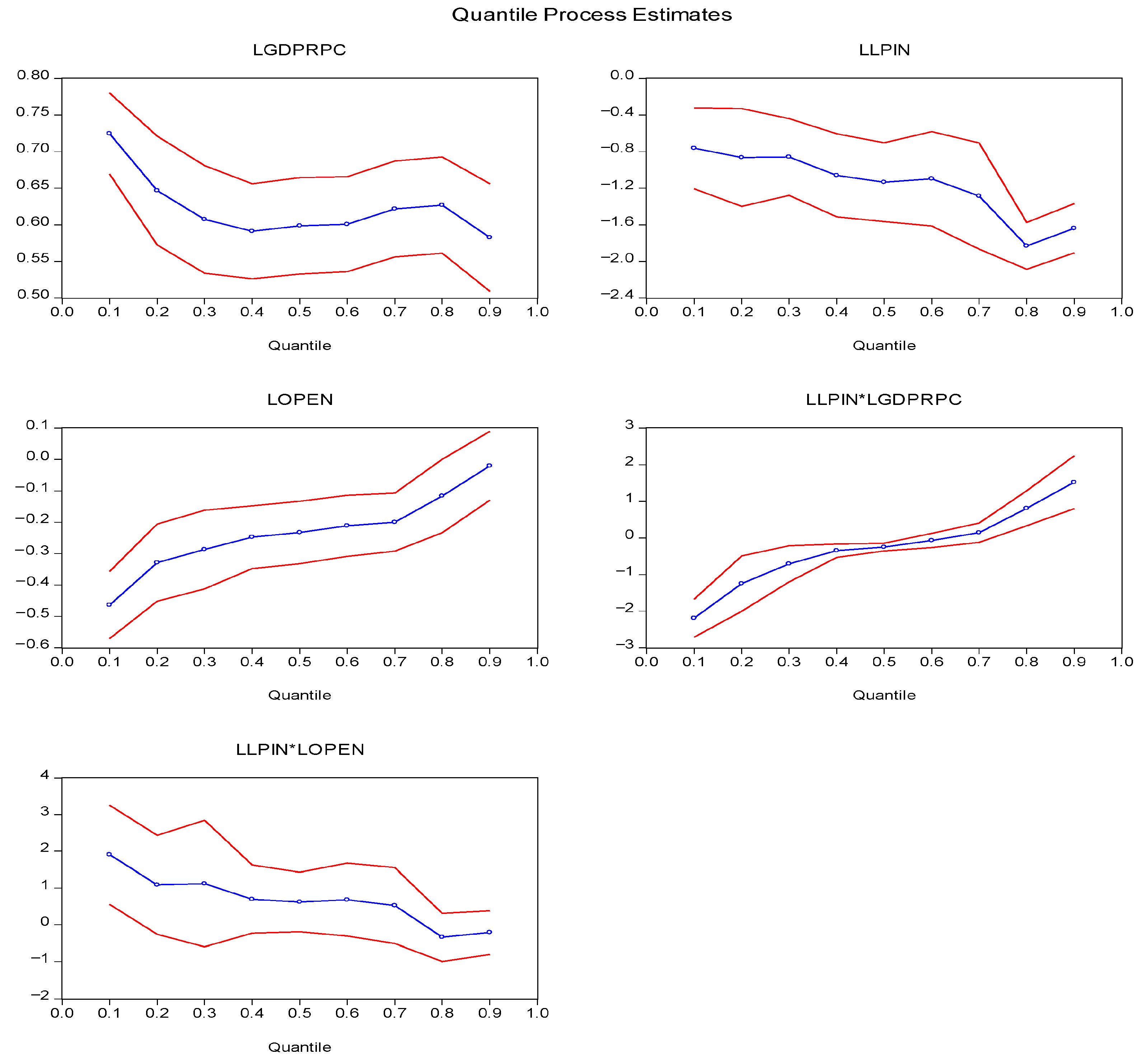
Figure 1, below, presents the quantile process estimates graphically. The blue line represents the point estimates β ^ ( τ ) for quantiles τ [ 0.10 , 0.90 ] , while the red band reports the corresponding 95% confidence bounds.
The panel for LGDPRC illustrates that the positive impact of income on emissions remains substantial across the distribution, with only a modest weakening at the very upper quantiles. The LLPIN panel clearly shows that the effect of logistics performance is negative at all quantiles and remains sizeable in high-emission regimes, consistent with the interpretation that logistics improvements are especially relevant where emissions are large. The trade openness panel indicates that the environmental benefits of openness tend to strengthen towards the upper part of the distribution.
The panels for the interaction terms provide further nuance. The LLPIN × LOPEN plot shows increasingly negative coefficients at higher quantiles, underlining that the synergy between logistics efficiency and trade liberalization yields disproportionately large environmental benefits in high-emission economies. The LLPIN × LGDPRC panel displays a similar pattern of more negative coefficients in the upper half of the distribution, reinforcing the idea that wealthier, high-emission Mediterranean countries stand to gain the most from green logistics strategies.
Overall, the quantile results complement the baseline and GMM estimations by demonstrating that the effects of logistics performance, trade openness and income are not uniform across the emissions distribution. Policy interventions that target logistics efficiency and its interaction with trade and income are likely to be particularly effective in the region’s most carbon-intensive economies, where the potential for emission reductions is greatest.

5. Discussion

To make the link to the research questions explicit, our results imply: (RQ1) logistics performance is associated with lower per capita CO2 emissions, both on average and across the emissions distribution; (RQ2) trade openness tends to reduce emissions in the region, with its environmental benefit increasing with stronger logistics capacity (negative LPI × openness); (RQ3) income growth raises emissions on average, but higher income strengthens the emissions-reducing role of logistics (negative LPI × GDP), consistent with technique/efficiency channels; and (RQ4) the logistics and interaction effects are most policy-relevant for high-emission economies, where marginal emissions reductions from logistics upgrades are largest.
The empirical evidence for the twenty Mediterranean economies over the period 2007–2022 indicates that logistics performance plays a robust and statistically significant role in reducing per capita CO2 emissions. GDP per capita tends to increase emissions, while trade openness exerts a conditional effect that depends on a country’s logistics capacity and income. These patterns are consistent across static (FE/RE) and dynamic (GMM) estimators and are further nuanced by the quantile regressions, which show larger marginal benefits from logistics improvements in the upper tail of the emissions distribution. Overall, the results suggest that logistics efficiency directly mitigates transport- and trade-related emissions and that its environmental benefits are amplified in wealthier and more open economies. This configuration resonates with several strands of recent empirical research on trade, growth and the environment.
In comparative terms, our Mediterranean results are broadly consistent with Balkan evidence where logistics efficiency gains tend to dominate and reduce emissions, yet they differ from several MENA and emerging-economy findings that document rebound/scale effects when freight activity expands faster than decarbonization. This contrast supports the interpretation that baseline institutional capacity, the energy mix, and the maturity of trade facilitation systems shape whether logistics upgrades translate into net CO2 reductions.
Mechanistically, the emissions-reducing role of logistics performance is consistent with (i) digital customs and single-window systems that shorten border delays and idle time, (ii) port electrification and shore power, greener terminal equipment and optimized vessel calls in major hubs, (iii) route optimization, load-factor improvements and shipment consolidation enabled by digital tracking and data sharing, and (iv) modal shifts toward rail or short-sea shipping where feasible. These interventions reduce fuel consumption per unit shipped and, when combined with cleaner energy inputs, can offset scale effects from trade expansion.
Cross-country and regional studies have shown that trade openness can be associated with lower emissions when it operates through channels such as technology diffusion, cleaner production techniques and institutional capacity building (Zafar et al., 2019). Panel analyses that employ distributional methods similarly find that the environmental impact of trade varies by income group and emission intensity, and that quantile approaches reveal heterogeneity that mean regressions conceal. These complementary insights help to explain why the interaction terms LPI × Trade and LPI × GDP are negative and significant in our estimations: logistics performance appears to strengthen the technique and technology channels through which trade and income can translate into cleaner outcomes.
At the same time, a contrasting body of literature documents positive links between trade openness and CO2 emissions in lower-income or institutionally weaker settings. Country-level and regional studies (e.g., Mahmood et al., 2019; Shahbaz et al., 2017) show that, in the absence of efficient logistics, regulatory safeguards and cleaner energy inputs, trade liberalization may expand emissions-intensive activities and reinforce scale and composition effects. Synthesized panel evidence confirms that the net impact of trade openness depends on whether the scale effect (which increases emissions) is dominated by technique and composition effects (which reduce emissions), and that this balance is shaped by infrastructure quality, institutional strength and technological absorptive capacity (Shahbaz et al., 2017). Our results fit this conditional narrative: Mediterranean countries with higher LPI scores and higher income levels appear better able to exploit trade-driven technology transfer and logistics efficiencies to reduce emissions, whereas countries lacking these capacities may experience neutral or adverse environmental consequences from trade expansion.
Examining the mechanisms more closely, the negative direct effect of logistics performance on emissions provides clear evidence that better logistics performance is associated with lower carbon intensity in transportation, storage and trade activities. Efficiency gains in logistics—such as transport route optimization, improved scheduling and network planning—reduce travel distances, idle times and fuel consumption. These gains are often reinforced by shifts towards less carbon-intensive modes (e.g., railways, inland waterways, low-emission trucks, electric or alternative-fuel vehicles) and by the adoption of cleaner technologies, which are facilitated by greener intermodal infrastructure including logistics hubs, freight centers, green ports, rail terminals and energy-efficient warehouses. In addition, efficient logistics systems tend to promote supply chain-wide collaboration, such as shipment consolidation, urban consolidation centers and shared logistics schemes. These practices contribute to inventory optimization, reduced waste and overproduction, better vehicle utilization and fewer empty runs and unnecessary kilometers, all of which lower embedded emissions. Such mechanisms are widely reported in empirical and review studies on transport and logistics (Demir et al., 2014; Zafar et al., 2019).
The positive effect of GDP per capita on emissions is consistent with a scale channel through which economic expansion raises energy use and industrial activity. However, the negative LPI × GDP interaction suggests that higher income enables greater investment in green logistics and more stringent environmental regulation, thereby magnifying the technique effect and allowing for partial decoupling of growth from emissions. The quantile results show that these efficiency gains are not uniformly distributed. High-emission economies—many of which host concentrated industrial activity, large urban agglomerations and intensive port operations—achieve larger emission reductions from logistics improvements. This pattern mirrors findings from regional studies employing quantile and other distributional methods, which often report stronger environmental impacts of structural and policy variables in high-emission regimes.
The dynamic estimations further reveal substantial persistence in emissions, indicating that logistical and policy interventions act cumulatively and must be sustained over time to produce sizeable long-run reductions. Short-lived or fragmented initiatives are unlikely to fully offset the inertia embedded in existing capital stock, infrastructure and transport systems. Taken together, the results complement and refine the existing literature by showing that logistics performance is a necessary moderating factor for trade and growth to deliver environmental improvements. Policy design should therefore be combinatorial, pairing trade liberalization with logistics modernization, cleaner energy policies and institutional strengthening, to ensure that technique and composition effects dominate simple scale expansions in Mediterranean economies.

6. Conclusions and Future Research

This study has investigated the dynamic and conditional effects of logistics performance, trade openness and economic growth on CO2 emissions across 20 Mediterranean countries over the period 2007–2022. The empirical results show that logistics performance has a strong and robust negative effect on emissions, a finding that holds across fixed-effects, GMM and quantile regression frameworks. Economic growth is confirmed as a positive driver of emissions. Trade openness generally reduces emissions, especially in countries with high-quality logistics systems or higher income levels, and the interaction terms between logistics performance and both trade openness and GDP per capita are significantly negative. Quantile regressions reveal that these patterns are particularly pronounced in high-emission countries, underscoring the critical role of logistics modernization and digitalization for environmental progress in the region.
Beyond confirming that growth and openness matter, the analysis reveals three non-trivial patterns for the Mediterranean Basin: (i) logistics performance is not environmentally neutral—improvements are associated with lower per capita CO2 emissions on average and across the emissions distribution; (ii) the trade–emissions relationship is conditional, in the sense that the emissions-reducing effect of openness is stronger when logistics performance is higher (negative LLPIN × OPEN); and (iii) higher income strengthens the emissions-reducing role of logistics (negative LLPIN × GDPRPC), consistent with technique/efficiency channels and the diffusion of cleaner technologies. These results suggest that trade integration can be more compatible with decarbonization when accompanied by targeted logistics upgrading.
The study makes three interrelated contributions to the literature on trade, growth and the environment, and to policy debates concerning sustainable logistics in the Mediterranean Basin. First, by introducing the World Bank Logistics Performance Index explicitly as a core explanatory variable and by estimating both its direct and interaction effects with trade openness and GDP per capita, the paper demonstrates that logistics performance is not merely a background determinant of competitiveness but a decisive environmental lever. Whereas prior work often treats trade openness and income as the primary drivers of emissions and focuses on their net sign, our analysis shows that logistics efficiency conditions these relationships: trade and growth generate environmental benefits primarily when logistics performance is sufficiently high (Shahbaz et al., 2017).
Second, from a methodological perspective, the paper combines fixed-effects estimators with several difference and system GMM variants and with quantile regressions, thereby addressing persistence, endogeneity and distributional heterogeneity in emissions. This multi-method strategy strengthens causal interpretation relative to cross-sectional or simple time-series designs and allows us to identify that high-emission economies derive larger marginal gains from logistics upgrades. This insight complements quantile-based findings in the Belt and Road and emerging-country literature, which also highlights stronger environmental responses among high emitters.
Third, the paper provides region-specific policy guidance. It identifies logistics modernization and efficiency improvements—such as supply chain optimization technologies, digital customs and trade facilitation, green modal shifts, adoption of cleaner vehicle technologies, improved intermodal infrastructure, green port investments and supply chain-wide collaborative initiatives—as high-impact and scalable instruments for reconciling trade-led growth with climate goals in Mediterranean economies. These interventions appear particularly effective in the upper quantiles of emissions, where the potential returns in terms of emission reductions are greatest. In contrast to studies that find trade openness raises emissions in certain developing-country contexts (Mahmood et al., 2019), our results underscore that logistics performance acts as a mediating capacity that can change the sign of the trade–emissions relationship.
The evidence supports several actionable policy recommendations. Logistics performance is directly shaped by transport network design, infrastructure provision and operational management, which together determine efficiency, cost-effectiveness and service quality. Strategic decisions regarding facility locations, corridor development, traffic and transport management, and the choice of transportation modes influence both economic and environmental outcomes. Prudent fiscal policies and the effective use of structural funds require robust financial and economic appraisal to channel resources towards productive and cost-effective investments in logistics and related transport infrastructure (Athanasenas, 1997). Policymakers should prioritize and incentivize investments in smart and sustainable logistics infrastructure, since these have demonstrated direct and amplifying effects on emission reductions.
To sharpen feasibility and impact, we propose the following prioritization: (1) rapid, low-to-medium cost reforms such as digital customs modernization, paperless trade, and risk-based inspections; (2) targeted high-impact investments in green ports and intermodal nodes (e.g., shore power, electrified handling equipment, and rail connections); (3) fleet renewal and efficiency programs (e.g., cleaner trucks, eco-driving, and routing platforms) paired with standards and incentives; and (4) longer-horizon corridor upgrades and regional “green corridor” coordination. Consistent with the quantile evidence, these measures should be concentrated first in the region’s high-emission economies, where the marginal returns in CO2 reductions are greatest.
Trade liberalization, when paired with advanced and eco-efficient logistics systems, can help decouple economic growth from environmental degradation. However, stand-alone trade growth, without corresponding improvements in logistics and energy systems, may increase emissions. The heterogeneity identified in the quantile estimations indicates that marginal environmental benefits from logistics reforms are highest in high-emission economies. Mediterranean strategies should therefore give priority to logistics reforms and technology adoption in these countries to maximize impact. In parallel, attention should be devoted to synergistic policies that combine renewable energy promotion with the digital transformation of logistics, thereby reinforcing long-run climate and competitiveness’ gains.
Limitations. Two data constraints should be noted. First, the LPI is not reported continuously for every year and country, which can introduce measurement noise when constructing annual panels. Second, the use of aggregate territorial CO2 emissions per capita does not isolate transport-sector emissions, implying that the estimated logistics effects should be interpreted as economy-wide associations operating partly through trade- and transport-related channels.
Regional and sectoral cooperation is pivotal because Mediterranean freight flows are highly networked across ports, corridors and customs regimes. Priority actions include the following: harmonized digital single-window procedures and interoperability standards; coordinated investment in shore-side electricity and alternative-fuel bunkering infrastructure at key ports; and aligned monitoring, reporting and verification (MRV) practices for maritime emissions in light of the EU ETS extension to maritime transport from 1 January 2024. Such coordination can reduce transaction costs while ensuring that competitiveness gains from faster logistics do not translate into higher carbon intensity.

Author Contributions

Conceptualization, I.K., A.A. and M.M.; methodology, I.K., A.A. and C.K.; software, I.K. and C.K.; validation, A.A., M.M. and C.K.; formal analysis, I.K., M.M. and C.K.; investigation. I.K., A.A. and M.M.; data curation, I.K. and C.K.; writing—original draft preparation, I.K.; writing—review and editing, M.M. and A.A.; supervision, A.A., M.M. and C.K. All authors have read and agreed to the published version of the manuscript.

Funding

This research received no external funding.

Institutional Review Board Statement

Not applicable.

Informed Consent Statement

Not applicable.

Data Availability Statement

Publicly available datasets were analyzed in this study. Data on CO2 emissions per capita, trade openness, and GDP per capita are available from the World Bank World Development Indicators (WDI) database (https://databank.worldbank.org/source/world-development-indicators, accessed on 1 August 2024). Logistics Performance Index (LPI) data are available from the World Bank LPI database (https://lpi.worldbank.org/, accessed on 1 August 2024). The compiled panel dataset used in the analysis is available from the corresponding author upon reasonable request.

Conflicts of Interest

The authors declare no conflicts of interest.

References

  1. Al-Majali, A., Alsarayreh, A., & Alqaralleh, H. (2026). Beyond average effects: Performance-dependent logistics challenges in emerging Asian transportation trade. Logistics, 10, 2. [Google Scholar] [CrossRef]
  2. Antweiler, W., Copeland, B. R., & Taylor, M. S. (2001). Is free trade good for the environment? American Economic Review, 91, 877–908. [Google Scholar] [CrossRef]
  3. Arellano, M., & Bond, S. (1991). Some tests of specification for panel data: Monte Carlo evidence and an application to employment equations. Review of Economic Studies, 58, 277–297. [Google Scholar] [CrossRef]
  4. Arellano, M., & Bover, O. (1995). Another look at the instrumental variable estimation of error-components models. Journal of Econometrics, 68, 29–51. [Google Scholar] [CrossRef]
  5. Athanasenas, A. (1997). Traffic simulation models for rural road network management. Transportation Research Part E: Logistics and Transportation Review, 33(3), 233–243. [Google Scholar] [CrossRef]
  6. Blundell, R., & Bond, S. (1998). Initial conditions and moment restrictions in dynamic panel data models. Journal of Econometrics, 87, 115–143. [Google Scholar] [CrossRef]
  7. Breusch, T. S., & Pagan, A. R. (1980). The Lagrange multiplier test and its application to model specification in econometrics. Review of Economic Studies, 47, 239–253. [Google Scholar] [CrossRef]
  8. Cole, M. A., Elliott, R. J. R., Okubo, T., & Zhou, Y. (2021). Importing, outsourcing and pollution offshoring. Journal of Public Economics, 201, 104478. [Google Scholar] [CrossRef]
  9. Copeland, B. R., & Taylor, M. S. (2004). Trade, growth, and the environment. Journal of Economic Literature, 42, 7–71. [Google Scholar] [CrossRef]
  10. De Hoyos, R. E., & Sarafidis, V. (2006). Testing for cross-sectional dependence in panel-data models. Stata Journal, 6, 482–496. [Google Scholar] [CrossRef]
  11. Demir, E., Bektaş, T., & Laporte, G. (2014). A review of recent research on green road freight transportation. European Journal of Operational Research, 237, 775–793. [Google Scholar] [CrossRef]
  12. Grossman, G. M., & Krueger, A. B. (1995). Economic growth and the environment. Quarterly Journal of Economics, 110, 353–377. [Google Scholar] [CrossRef]
  13. Hausman, J. A. (1978). Specification tests in econometrics. Econometrica, 46, 1251–1271. [Google Scholar] [CrossRef]
  14. Karaduman, H. A., Karaman-Akgül, A., Çağlar, M., & Akbaş, H. E. (2020). The relationship between logistics performance and carbon emissions: An empirical investigation on Balkan countries. International Journal of Climate Change Strategies and Management, 12, 449–461. [Google Scholar] [CrossRef]
  15. Koenker, R. (2005). Quantile regression. Cambridge University Press. [Google Scholar]
  16. Kulagin, V., Kuklina, A., & Grushevenko, D. (2025). The impact of logistics and political decisions on greenhouse gas emissions in market transformation. Carbon Research, 4, 8. [Google Scholar] [CrossRef]
  17. Magazzino, C., Mele, M., & Schneider, N. (2021). The trilemma of innovation, logistics performance, and environmental quality in 25 topmost logistics countries: A quantile regression evidence. Journal of Cleaner Production, 322, 129050. [Google Scholar] [CrossRef]
  18. Mahmood, H., Maalel, N., & Zarrad, O. (2019). Trade openness and CO2 emissions: Evidence from Tunisia. Sustainability, 11(12), 3295. [Google Scholar] [CrossRef]
  19. Özçelik, S. E., & Töngür, Ü. (2024). Logistics performance and environmental degradation: The case of MENA countries. Ekonomi-tek, 13, 198–229. [Google Scholar]
  20. Pesaran, M. H. (2021). General diagnostic tests for cross-sectional dependence in panels. Empirical Economics, 60(1), 13–50. [Google Scholar] [CrossRef]
  21. Pesaran, M. H., Ullah, A., & Yamagata, T. (2008). A bias-adjusted LM test of error cross-section independence. Econometrics Journal, 11, 105–127. [Google Scholar] [CrossRef]
  22. Rastegardehbidi, P., & Su, Z. (2025). Key drivers of green logistics: A systematic literature review and conceptual framework. Sustainability, 17(21), 9604. [Google Scholar] [CrossRef]
  23. Roodman, D. (2009). How to do xtabond2: An introduction to difference and system GMM in Stata. Stata Journal, 9, 86–136. [Google Scholar] [CrossRef]
  24. Sarafidis, V., & Robertson, D. (2009). On the impact of cross-sectional dependence in short dynamic panel estimation. Econometrics Journal, 12, 62–81. [Google Scholar] [CrossRef]
  25. Sarkodie, S. A., & Strezov, V. (2019). A review on environmental Kuznets curve hypothesis using bibliometric and meta-analysis. Science of the Total Environment, 649, 128–145. [Google Scholar] [CrossRef] [PubMed]
  26. Shahbaz, M., Nasreen, S., Ahmed, K., & Hammoudeh, S. (2017). Trade openness–carbon emissions nexus: The importance of turning points of trade openness for country panels. Energy Economics, 61, 221–232. [Google Scholar] [CrossRef]
  27. Starostka-Patyk, M., Bajdor, P., & Białas, J. (2024). Green logistics performance Index as a benchmarking tool for EU countries environmental sustainability. Ecological Indicators, 158, 111396. [Google Scholar] [CrossRef]
  28. Stern, D. I. (2017). The environmental Kuznets curve after 25 years. Journal of Bioeconomics, 19, 7–28. [Google Scholar] [CrossRef]
  29. Tetteh, F. K., Kwateng, K. O., Tukue, T., Mensah, J., & Atiase, D. D. (2025). Effect of logistics performance on transport environmental quality: Comparative insight from Sub-Saharan Africa and OECD markets. The Asian Journal of Shipping and Logistics, 41(4), 216–227. [Google Scholar] [CrossRef]
  30. Wan, B., Wan, W., Hanif, N., & Ahmed, Z. (2022). Logistics performance and environmental sustainability: Do green innovation, renewable energy, and economic globalization matter? Frontiers in Environmental Science, 10, 996341. [Google Scholar] [CrossRef]
  31. Wooldridge, J. M. (2010). Econometric analysis of cross section and panel data (2nd ed.). MIT Press. [Google Scholar]
  32. World Bank. (2018). Connecting to compete 2018: Trade logistics in the global economy—The logistics performance index and its indicators. World Bank. [Google Scholar]
  33. World Bank. (2024a). Logistics Performance Index (LPI) database. World Bank. Available online: https://lpi.worldbank.org (accessed on 15 March 2024).
  34. World Bank. (2024b). World Development Indicators (WDI) database. World Bank. Available online: https://databank.worldbank.org/source/world-development-indicators (accessed on 15 March 2024).
  35. Zafar, M. W., Shahbaz, M., Hou, F., & Sinha, A. (2019). From nonrenewable to renewable energy and its impact on economic growth: The role of research and development expenditures in Asia-Pacific economic cooperation countries. Journal of Cleaner Production, 212, 1166–1178. [Google Scholar] [CrossRef]
  36. Zaman, K., & Shamsuddin, S. (2017). Green logistics and national-scale economic indicators: Evidence from a panel of selected European countries. Journal of Cleaner Production, 143, 51–63. [Google Scholar] [CrossRef]
  37. Zhou, R., Guan, S., & He, B. (2025). The impact of trade openness on carbon emissions: Empirical evidence from emerging countries. Energies, 18(3), 697. [Google Scholar] [CrossRef]
Figure 1. Quantile regression coefficient estimates for LGDP, LLPI, LOPEN, and interaction terms.
Economies 14 00024 g001
Table 1. Summary of related literature on growth, trade, logistics and CO2 emissions.
Authors (Year)Region/SampleMethodologyMain FindingsRelation to Present Study
Grossman and Krueger (1995)Multi-country pollution panelReduced-form tests of the EKCIntroduces the EKC hypothesis, showing that the income–pollution link may follow an inverted-U pattern with a turning point.Provides baseline theoretical motivation for income-conditioned emissions effects.
Antweiler et al. (2001)Cross-country trade–pollution dataEmpirical trade–environment decompositionShows that trade affects emissions through scale, composition and technique effects; the net impact of openness depends on which channel dominates.Justifies modeling trade effects as conditional and potentially nonlinear.
Copeland and Taylor (2004)Global theoretical and empirical synthesisUnified trade–growth–environment frameworkFormalizes the scale/composition/technique decomposition and pollution-haven logic in a coherent framework.Serves as the core conceptual link between trade openness and emissions in this study.
Sarkodie and Strezov (2019)Global EKC literature (over 1000 studies)Bibliometric and meta-analysisDocuments substantial heterogeneity in EKC evidence across regions, pollutants and methods; no universal EKC pattern.Supports the need for region-specific EKC analysis and heterogeneous modeling for the Mediterranean.
Shahbaz et al. (2017)Multi-country panelNonlinear and threshold panel estimatorsFinds that trade–emissions relationships are often nonlinear; trade may reduce emissions only beyond certain income or institutional thresholds.Motivates testing for interaction effects between trade openness, income and logistics performance.
Cole et al. (2021)Japan (industry-level data)Offshoring and pollution-haven testsProvides evidence of pollution offshoring consistent with relocation of emission-intensive activity abroad.Illustrates the risk that trade-driven scale and relocation can increase emissions.
Zaman and Shamsuddin (2017)27 European countriesDynamic panel GMM with LPI componentsShows that logistics dimensions have mixed effects on emissions; infrastructure and timeliness can reduce CO2, while other components may increase it.Demonstrates that the LPI is environmentally relevant and that component-specific effects matter.
Karaduman et al. (2020)Balkan countriesFixed-effects panel estimationsFinds that higher overall LPI significantly reduces CO2 emissions, suggesting that efficiency gains dominate in constrained transport systems.Provides geographically proximate evidence supporting a negative logistics–CO2 link.
Magazzino et al. (2021)Top-LPI countriesFMOLS, GMM and quantile regressionShows that logistics expansion can raise CO2 emissions due to rebound and scale effects, with substantial heterogeneity across the emissions distribution.Confirms the need for both quantile and interaction approaches in studying logistics and emissions.
Wan et al. (2022)Emerging economiesMethod of Moments Quantile Regression/dynamic panelReports that logistics improvements may increase CO2 in some emerging contexts where freight demand outpaces decarbonization.Highlights the context dependence of logistics–emissions links and distributional heterogeneity.
Özçelik and Töngür (2024)MENA countriesPanel econometrics with LPI indicatorsFinds that the effects of logistics performance on environmental degradation vary by LPI dimension and development level.Strengthens the rationale for a Mediterranean-specific, moderating and heterogeneous analysis.
Table 2. GMM specifications.
SpecificationEstimatorPurpose/Key Feature
GMM1Difference GMM (Arellano–Bond)Baseline dynamic model; removes fixed effects by differencing; uses lagged levels as instruments.
GMM2System GMM (Blundell–Bond)Improves efficiency and addresses weak instruments under persistence by adding the levels equation.
GMM3Restricted system GMMLimits instrument proliferation (e.g., collapsed instruments/shorter lag depth) to strengthen diagnostic tests.
GMM4Extended system GMM (robustness)Checks sensitivity to alternative lag/instrument sets; supports stability of core coefficients.
Table 3. Data description.
VariableLCO2PCLLPINLGDPRPCLOPEN
Mean1.4651.0869.2404.346
Median1.5911.1039.4164.290
Maximum2.3171.36110.6625.548
Minimum0.2140.4686.5683.396
Std. Dev.0.5320.1711.0070.408
Skewness−0.661−0.443−0.5440.655
Kurtosis2.4792.7552.4263.316
Observations319319319319
Table 4. Correlation matrix (logged variables).
LCO2PCLLPINLGDPRPCLOPENLPI × GDPLPI × OPEN
LCO2PC1.0000.4480.7580.2030.5940.483
LLPIN0.4481.0000.766−0.0360.9610.846
LGDPRPC0.7580.7661.0000.2830.9080.802
LOPEN0.203−0.0360.2831.0000.0810.498
LPI × GDP0.5940.9610.9080.0811.0000.871
LPI × OPEN0.4830.8460.8020.4980.8711.000
Table 5. Cross-sectional dependence test results.
Cross-Sectional Dependence Tests
Null Hypothesis: No Cross-Sectional Dependence
VariableBreusch–Pagan LMPesaran Scaled LMBias-Corrected Scaled LMPesaran CD
LCO2PC1370.70
(0.000)
60.568
(0.000)
59.90
(0.000)
4.66
(0.000)
LGDPPC1241.19
(0.000)
53.92
(0.000)
53.25
(0.000)
13.89
(0.000)
LLPIN793.94
(0.000)
30.98
(0.000)
30.31
(0.000)
12.51
(0.000)
LOPEN1171.42
(0.000)
50.34
(0.000)
49.67
(0.000)
14.80
(0.000)
Note: Figures in parentheses report the p-values from the respective Tests, Null Hypothesis: no cross-sectional dependence.
Table 6. Fixed effects (FE) and random effects (RE) results (reproduced).
VariableFE (coef) (p-Value)RE (coef) (p-Value)
LLPIN−0.382 (0.007) ***−0.426 (0.002) ***
LGDPRPC0.437 (0.000) ***0.441 (0.000) ***
LOPEN−0.213 (0.000) ***−0.203 (0.000) ***
LLPIN × LGDPRPC−0.310 (0.000) ***−0.330 (0.000) ***
LLPIN × LOPEN−0.871 (0.000) ***−0.828 (0.000) ***
Constant0.038 (0.004) **0.040 (0.592)
R20.9460.614
Hausman testχ2 = 15.070 (p = 0.035) → FE preferred
Note: p-values in parentheses. Significance: *** p < 0.01, ** p < 0.05.
Table 7. GMM results.
GMM1GMM2GMM3GMM4
LCO2PC(-1)−0.286 (0.000)0.736 (0.000)0.398 (0.000)0.769 (0.000)
LGDPRPC0.711 (0.000)0.128 (0.003)0.317 (0.000)0.191 (0.020)
LLPIN−0.260 (0.011)−0.338 (0.000)−0.167 (0.010)−0.745 (0.003)
LOPEN−0.180 (0.000)−0.054 (0.000)−0.077 (0.059)−0.129 (0.052)
LLPIN × LGDPRPC−0.345 (0.000)−0.113 (0.000)−0.105 (0.023) −0.206 (0.029)
LLPIN × LOPEN−0.515 (0.000)−0.538 (0.000)−0.640 (0.000)−0.515 (0.026)
CONSTANT−0.360 (0.000)−0.338 (0.000)−0.013 (0.807)0.032 (0.086)
Arellano-Bond Serial Cor. tests
H0: no serial correlation
AR(1):
Z = −7.281 (0.000)
AR(2):
Z = 1.326 (0.184)
AR(1):
Z = −2.678 (0.0007)
AR(2):
Z = 0.772 (0.441)
AR(1):
Z = −2.900 (0.000)
AR(2):
Z = 0.881 (0.378)
AR(1): Z = −2.99 (0.003)
AR(2): Z = 0.59 (0.555)
Sargan-Hansen Overidentifying Restrictions tests
H0: Overidentifying restrictions are valid
J = 192.716 (0.278)X2(28) = 19.157 (0.893)X2(13) = 17.887 (0.161)X2(2) = 0.40 (0.819)
Note: p-values in parentheses.
Table 8. Quantile method of moments results.
Variable102030405060708090
LGDPRPC0.409 (0.000)0.418 (0.000)0.423 (0.000)0.430 (0.000)0.436 (0.000)0.443 (0.000)0.449 (0.000)0.455
(0.000
0.464 (0.000)
LLPIN−0.395 (0.041)−0.391 (0.020)−0.389 (0.014)−0.385 (0.010)−0.383 (0.010)−0.379 (0.013)−0.376 (0.021)−0.373 (0.034−0.369 (0.067)
LOPEN−0.192 (0.002)−0.199 (0.000)−0.203
(0.000)
−0.208
(0.000)
−0.212
(0.000)
−0.217
(0.000)
−0.222
(0.000)
−0.226 (0.000−0.232 (0.000)
LLPIN × LGDPRPC−0.346 (0.006)−0.334 (0.002)−0.327 (0.002)−0.318 (0.001)−0.310 (0.001)−0.302 (0.002)−0.293 (0.006−0.286 (0.013−0.274 (0.037)
LLPIN × LOPEN−0.604
(0.065)
−0.694
(0.015)
−0.694
(0.006)
−0.694
(0.001)
−0.694
(0.001)
−0.694
(0.000)
−0.694
(0.000)
−0.694
(0.000)
−0.694
(0.001)
CONSTANT−0.721
(0.000)
−0.675
(0.000)
−0.651
(0.000)
−0.615
(0.000)
−0.587
(0.000)
−0.553
(0.000)
−0.522
(0.000)
−0.493
(0.000)
−0.450
(0.000)
Disclaimer/Publisher’s Note: The statements, opinions and data contained in all publications are solely those of the individual author(s) and contributor(s) and not of MDPI and/or the editor(s). MDPI and/or the editor(s) disclaim responsibility for any injury to people or property resulting from any ideas, methods, instructions or products referred to in the content.