1. Introduction
The recent movement of the international scenario toward a new protectionism policy has opened the debate on the impact of tariffs as an instrument of market power and geopolitical pressure. As shown by the repeated imposition of high duties from the USA followed by retreats in front of resistances from trade partners as well as negative domestic reactions, uncertainty on the outcome of any commercial policy is today much larger than in the past. This is because of the long and intricate value chains developed during the accelerated phase of globalization and the unprecedented degree of connectivity induced across all countries and sectors. At the same time, trade itself has become more volatile, with its vulnerability increased by the length of many value chains and their dependence on a handful of critical materials and intermediate inputs.
The imposition of new and high tariffs on the part of the US government seems also to be inspired by a new set of beliefs in relations arising from international trade. While these beliefs have not been fully articulated as yet, they appear to be based on denial of the mutual advantage of country specialization and trade and on the adoption of the view that any set of protracted transactions ends up with a zero-sum result with winners and losers. This in turn brings about a sort of warfare theory of international relations, where protectionist policies are weaponized and prevention and deterrence are invoked as key instruments of explicit and implicit negotiations.
Within this context, uncertainty appears to have a special role, since countries’ reaction to the new paradigm can only be discovered either by declaration of intentions, or by testing their reaction to the imposition of tariffs or other measures. Uncertainty has also become central to trade relations, as countries’ reactions to tariff measures can only be observed through successive rounds of announcements, retaliations, and withdrawals. Recent patterns of trade-policy escalation and negotiation between major economies such as the United States, China, and the European Union, well documented in the
World Trade Organization (
2024) and in
Bown’s (
2020) analysis of the 2018–2020 trade conflict, illustrate how recurrent cycles of tariff threats and revisions persist in the current trade environment. In any case, it is clear that much of the action consists in activities of implicit and explicit negotiations that reflect the countries’ different posture vis a vis the new threats and opportunities.
Taking into account this entirely new scenario, in this paper I address the question of a tariff equilibrium under uncertainty from the point of view of an importing country with market power confronting a “small” exporting country. The faculty of a large country to impose a tariff on a smaller country with lower market power can be considered a contingent security, which is an opportunity for the larger country and a threat for the smaller one. I treat this relationship as an asymmetric Stackelberg game in which the small country holds in fact the faculty for the first move, while the large country, even though it possesses market power, has the faculty to react to the leader’s choices. In this regard, the relationship between the two countries is modeled as the writing and the holding of a real option (
Scandizzo & Ventura, 2015). Having the power to impose unilaterally the tariff is interpreted as holding a real option implicitly written by the exporting country. Unequal market power is thus captured by the asymmetric relation between the importing country as the holder of the option as an asset, and the exporting country as the holder of the same option as a liability. While retaliation is not a credible threat due to its lack of market power, the exporting country can resort to a series of preventive actions to discourage the importing country from imposing the tariff. These actions would have the effect of reducing the incentive for the exporting country to invest in the bureaucratic and financial apparatus needed to effectively impose the tariff, by securing its implementation.
These actions may be of a multiple nature, and include operational, legal, as well as political instruments of defense and adaptation. Among the operational instruments, exporters can use the option of trans-shipment via third countries, as well as repackaging or relabeling of products to conceal their point of origin, thereby evading tariffs. Among the legal-institutional instruments, exporters can also use the formal challenge procedure available within the WTO Dispute Settlement Mechanism. The procedure has dual intention, as it both delays the implementation of the tariff option while demonstrating a willingness to be part of the rules-based order, although a final decision takes a long time. A third group of actions would be political and diplomatic deterrence, which involves lobbying the importing country’s constituencies to resist tariffs. The idea would be to use domestic interests, be it importers, consumers, or industries, to weaken popular and political support to the tariff. Finally, exporters may rely on multilateral or regional counterweights, including the use of instruments like the EU Anti-Coercion Instrument, reciprocal tariff threats, or coalition-building within international fora.
In essence, the exporting country can exploit several instruments to increase the cost of enforcement of the tariff for the importing country, even though they themselves are costly for the exporting country, with their effectiveness depending on its administrative and management capacity. In order to discourage the imposition of the tariff, these instruments must have a degree of ex ante credibility, which may be the result of past experience (past reaction to earlier episodes of tariff levies), or of credible communication and information activities. By properly advertising the official measures that it intends to undertake to counter the tariff, such as, for example, legal recourse and active lobbying, the exporting country may gain a degree of deterrence on the importing country’s decision. This position would also serve to signal that less public measures, such as transshipment and relabeling, would be quietly undertaken to reduce tariff effectiveness and economic appeal for the importing country. Perhaps at the end of a series of skirmishes, as we have seen recently in countries’ reaction to USA tariffs, an equilibrium between the two countries may be reached that reflects the respective implicit and explicit bargaining power. This will be based not only on market shares, but also on the degree of uncertainty and the capacity of the exporting country to adapt to a regime change.
2. Literature Review
The real-options framework provides the theoretical foundation for understanding investment decisions under uncertainty. The seminal work by
Dixit and Pindyck (
1994) conceptualized investment timing as a real economy equivalent to the exercise of a financial call option, where uncertainty and irreversibility jointly determine strategic delay. In addition to activities traditionally classified as investment, this perspective has been applied to various fields, where economic action requires the commitment of unrecoverable resources under uncertainty. Among many applications, these fields have included for instance criminal behavior and law enforcement (
Engelen, 2004;
Scandizzo & Ventura, 2015), tax evasion (
Levaggi & Menoncin, 2016), and regulatory compliance (
Scandizzo & Knudsen, 2024). In each of these domains, agents face a choice between acting immediately or waiting for more information, balancing potential gains against the cost of irreversibility.
In the context of trade, this framework captures how an importing country, endowed with enforcement capacity, treats tariffs as a contingent opportunity: an option that can be exercised depending on evolving trade conditions. The exporting country, in contrast, faces a liability option analogous to those explicitly or implicitly described in the real options literature and/or in the law and economic literature of contract breaches (
Bar-Gill, 2004;
Scandizzo & Ventura, 2015;
Scandizzo & Knudsen, 2024). This asymmetry forms the basis for interpreting the tariff game as a stochastic deterrence system, where waiting and signaling constitute equilibrium strategies.
In recent years, trade policy uncertainty (TPU) has emerged as a central determinant of international economic relations. Empirical studies have shown that uncertainty regarding tariffs and trade agreements significantly affects export participation, investment, and productivity.
Handley and Limão (
2017) demonstrated that reductions in TPU, such as through trade agreements, act as implicit subsidies for exporters by lowering option values of waiting.
Caldara et al. (
2020) constructed indices of global TPU and found that spikes in uncertainty are systematically associated with contractions in trade and output.
Amiti et al. (
2019) documented that the U.S.–China tariff conflict raised domestic prices and welfare costs, while
Steinberg (
2019) found that policy volatility—such as Brexit—delayed investment and supply-chain reorganization. More recent theoretical contributions, such as
Caldara et al. (
2023), model trade uncertainty as an endogenous outcome of strategic interaction, while
Crowley et al. (
2018) emphasize its amplifying effects on intermediate goods and value-chain disruptions. These works collectively reinforce the present paper’s focus on tariffs as dynamic deterrence mechanisms: uncertainty and irreversibility expand the option value of waiting for the dominant country while imposing sustained costs on the weaker partner.
The Stackelberg leadership model (
Nash, 1951;
Harsanyi, 1967,
1968) provides the structure for the bilateral deterrence game analyzed here. Strategic asymmetry, where one player leads and another follows, has been a cornerstone of non-cooperative game theory and a useful model for hierarchical power relations.
Shubik (
1991) formalized political economy as a game of strategic dominance, while
Farrell (
1987) emphasized the informational dimension of commitment and signaling.
In this regard, applications to taxation and enforcement by
Levaggi and Menoncin (
2016) and
Abbas (
2017) have shown that deterrence equilibria can emerge where the threat of punishment, rather than its actual implementation, is used to maintain compliance.
Scandizzo and Ventura (
2015) applied similar logic to models of extortion and protection, introducing the concept of preventive equilibria under uncertainty. These contributions underpin the present study’s notion of a preventive Stackelberg equilibrium in which the follower’s continuous expenditure deters the leader’s action and stabilizes an otherwise unstable power relationship.
This broader approach to the political economy of contemporary protectionism is strengthened by the increasing attention of modern trade theory to tariffs not merely as protectionist tools but as strategic instruments in geopolitical bargaining. For example,
Baldwin (
2019) and
Bown (
2020) have examined how contemporary trade wars deploy tariffs as coercive levers rather than revenue instruments, while
Handley and Limão (
2017) formalized trade-policy uncertainty as a source of deterrence that shapes exporters’ behavior.
Bagwell and Staiger (
2016) extended this reasoning to the institutional level, highlighting how the credibility of tariff threats is conditioned by enforcement costs and the World Trade Organization’s dispute mechanisms. These works establish the empirical and theoretical relevance of treating tariff decisions as dynamic processes of deterrence and counter-deterrence. This paper’s approach extends this literature by modeling the inaction zone that arises when enforcement costs, deterrence expenditures, and uncertainty interact to make non-action optimal for the stronger country and continuous deterrence optimal for the weaker one.
A further body of work linking law and economics strengthens the interpretation of tariffs as
real option entitlements.
Calabresi and Melamed’s (
1972) distinction between property and liability rules laid the foundation for modern analyses of entitlements under uncertainty. Subsequent extensions by
Ayres and Talley (
1995),
Ayres and Goldbart (
2001,
2003), and
Bebchuk (
2001) showed how entitlements could be decomposed into option-like instruments. These analogies inspired models of legal deterrence and contract design under uncertainty (
Mahoney, 1995;
Katz, 2004), which parallel the asymmetric relation between tariff imposition and compliance.
In this view, the importer’s right to impose tariffs is a contingent asset: a real option whose exercise transfers part of the uncertainty burden to the exporter. The exporter, by contrast, holds a corresponding liability option, facing potential loss unless credible deterrence expenditures sustain a stable equilibrium. This interpretation integrates legal and economic reasoning into a unified analytical structure of strategic deterrence.
Economic models of enforcement and compliance further contextualize the deterrence mechanism.
Polinsky (
1979) and
Cooter and Ulen (
1995) analyzed the optimal balance between punishment probability and severity under uncertainty, while
Rosato (
2008) and
Levaggi and Menoncin (
2016) developed dynamic portfolio models of tax evasion. These studies converge on a key insight also central to this paper: enforcement is costly, and rational agents optimize deterrence and evasion expenditures relative to uncertainty and expected gain.
Within this line of reasoning, the exporting country’s preventive actions—legal appeals, logistical adjustments, or lobbying—represent optimal deterrence investments akin to private enforcement. Such actions transform uncertainty into strategic restraint, effectively broadening the follower’s inaction zone while stabilizing the system asymmetrically.
The literature cited above provides the theoretical basis for this paper’s central innovation: the modeling of tariff deterrence as a preventive Stackelberg equilibrium in a real-options framework. By integrating insights from trade theory, law and economics, and real-options analysis, this work demonstrates how uncertainty and irreversibility jointly stabilize international trade relations while transferring costs asymmetrically. The result is a novel theoretical perspective: one where power operates through potentiality rather than action, and stability arises from costly deterrence rather than cooperation.
3. The Model
In what follows, the interaction between two trading countries is represented as a Stackelberg game under uncertainty. In this strategic framework, the exporting country (B) is the leader, taking the first move through preventive measures intended to deter the larger, importing country from imposing a tariff. The importing country (A) is the follower, responding to these deterrence efforts by deciding if and when to exercise its option to enforce the tariff. This hierarchical structure captures the asymmetry of power that characterizes trade relations: the stronger country sets the potential terms of intervention, while the weaker one seeks to delay or prevent that intervention through costly defensive measures.
Consider a scenario in which Country A contemplates imposing a tariff on imports originating from Country B. Such a measure would allow Country A to appropriate a portion of Country B’s export revenue, but it would also entail administrative and enforcement costs, some of which are irreversible. Country A thus threatens to extract a tariff, modeled as a tax-equivalent percentage of Country B’s gain from trade, proxied here by the present value of its expected future export income. The enforcement process may involve expenditures related to bureaucracy, intelligence gathering, coordination with collection agencies, and legal procedures. Before the tariff is levied, Country B may take action by trying to negotiate trade or nontrade concessions, threatening retaliations, and generally trying to dissuade Country A from proceeding. Country B’s preventive action not only aims to deter the imposition of the tariff but also foreshadows the strategies it would adopt if the tariff were enacted. Once the tariff is imposed, Country B may retaliate through measures such as tariffs or import quotas on goods from Country A, or it may seek to mitigate the tariff’s negative effects through evasive strategies, for instance, rerouting trade through third countries.
Altogether, these measures are manifested by a given amount of expenditures of the exporting country, as well as by appropriate information and communication activities, aimed to discourage the importing country from imposing the tariff. The measures can be fragmented, indirect, and partially irreversible; however, they can be complementary to a degree. Their common objective is twofold: first, to offset or reduce the impact of a tariff once it has been imposed; and second, in anticipation of such action, to broaden the zone of inaction in which it becomes optimal for the importing country to delay or avoid imposing tariff measures altogether. More generally, these measures exemplify how economic actors can transform abstract deterrence costs into a mix of logistical innovation, legal procedure, and political influence: channels through which the weaker actor converts defensive spending into strategic restraint on the stronger one.
The timing of the actions and counter actions is as follows. First, country B considers the value of the equivalent tax it would have to pay and makes its decision on whether to comply or to attempt to reduce the tariff impact by undertaking specific costs. These costs are not fixed, but contingent on country B’s expected gains from trade and the corresponding level of the expected tariff. Although they may not be known or otherwise made public, it is assumed that country A can estimate them accurately so that it can make an enforcing decision based on optimal dynamic planning under uncertainty. The interaction between the two countries is thus assumed to take the form of a dynamic Stackelberg game under uncertainty, with country B as the leader and country A as the follower. By accounting for Country A’s expected future moves, Country B can calibrate its counter-tariffs for maximum effectiveness. This creates a backward-induction framework: the analysis first quantifies the “threat value” of Country B’s option, determines Country B’s resulting decision rule, and concludes by solving Country A’s optimization problem.
Assume that the net flow of trade between Country A and Country B is governed by stochastic processes of the geometric Brownian motion variety:
where
X and
M indicate, respectively the expected export and import flow between A and B,
and
are, respectively a trend (the “drift”) and a volatility parameter,
t is time and
(
is a random variable with zero mean and variance equal to
dt. In the remainder of the paper, the analysis will center on the exporter’s income
, which is assumed to be the state variable driving both tariff enforcement and deterrence, with
αAB =
α and
σAB =
σ.
The model structure is based on the assumption that the importing country (A) faces a stochastic stream of potential tariff revenues derived from the exporting country’s (B) expected export income. The parameter α represents the drift (expected growth rate of trade), while σ captures trade-income volatility, reflecting shocks from global demand, supply disruptions, or policy changes. The discount rate ρ reflects intertemporal preferences and opportunity costs of enforcement, whereas δ = ρ − α (the ‘convenience yield’) measures the cost of waiting to act. Enforcement costs K0 represent sunk administrative and political investments required to implement tariff policy. The parameter p measures the relative cost-effectiveness of the exporting country’s deterrence effort: a higher p implies that one unit of B’s deterrence expenditure translates into a larger perceived enforcement cost for A.
Country A holds an option to engage in its revenue raising activity, vis a vis B as an exporting country, by imposing a tariff. In line with
Engelen (
2004), in the real option set up, country A has the faculty, but not the obligation, to commit resources to pursue this particular type of activity. Under a linear approximation of demand, country A incurs a total public cost of enforcement:
In expression (3)
is the elasticity of demand for B’s export goods for country A.
represents the discounted import flow,
is the elasticity parameter measuring how enforcement costs rise with the tariff rate
.
1 This specification distinguishes between the investment costs in the bureaucratic apparatus needed to administer the tariffs and the variable cost generated by tariffs’ declining effectiveness as the elasticity of foreign supply increases.
In order to decide whether to exercise its option, country A solves the problem:
where
. Note that
implies
and
, which is
as
. For
we also obtain the familiar expression for the optimal tariff
.
As
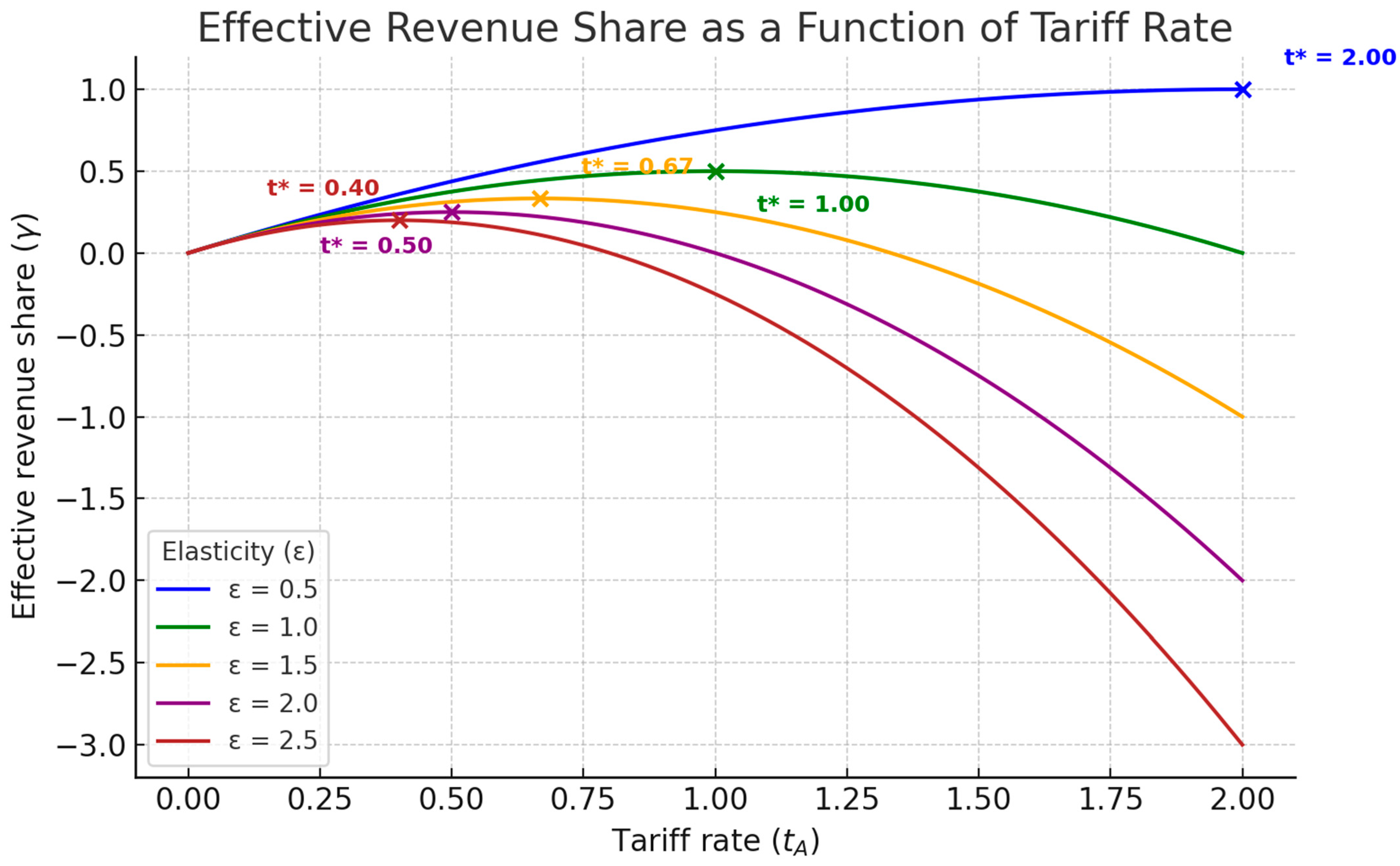
Figure 1 shows, the effective revenue share is a parabolic function of the tariff rate, with a maximum corresponding to the optimal tariff.
In Equation (4), A’s maximizing problem is given, for any given level of the tariff, by the net expected discounted value of the future payoff, which is larger, ceteris paribus, at the “optimal” tariff rate . The symbol on the left-hand side of Equation (4) represents the value of the option to engage in collecting tariffs from exporting country B. In the right-hand-side, ρ is a discount rate, is the share of B’s export income that would be appropriated by country A for any given tariff rate and elasticity of demand; p is a measure of the effectiveness of the costs C which would be borne by country B to elude or evade the action by country A. As indicated before, denotes other costs, including monetary expenditures to perform the tariff collection activity, such as hiring employees, collecting information, auditing the agent’s accounting, conducting studies on agent’s performance, or any other activity necessary to control tax compliance.
In addition to the variable enforcement costs that arise from declining tariff efficacy—as an inverse function of demand elasticity— represents Country A’s fixed tariff entry costs, that is, the irreversible investment required to establish and operate the tariff system. They thus represent an investment whose effects are twofold: on one hand, they are sunk costs whose undertaking must a priori be justified by a sufficiently large expectation of future gains. Once undertaken, since they are largely unrecoverable, they demonstrate the commitment of country A to proceed with the protectionist policy into the future and may deter the exporting country from engaging in retaliation through a reciprocal tariff or other countermeasures. On the other hand, they represent an investment for the importing country that can only be justified by the expectation of sufficiently high net gains from the tariff, taking into account the conditions of uncertainty.
It is important to note that the cost associated with retaliation or countermeasures does not need to be actually incurred by Country B, but only credibly signaled as a potential response to the imposition of the tariff. While other formulations would be possible, this threat of retaliation and other defensive actions could be for example represented using Equation (2):
where the first term on the right-hand side denotes the
retaliatory tariff that B could apply,
is the relative convenience yield,
is the price elasticity of country A’s export supply, and
represents the costs of evasion, diversion, or other actions aimed at achieving noncompliance. The credible threat of imposing such costs on Country A, rather than their actual implementation, is aimed at raising A’s expected enforcement cost and expanding the zone of inaction in which it becomes optimal for A to postpone or refrain from tariff measures.
In other words, by undertaking, or threatening to undertake, costly actions to counter the tariff, country B can further increase the tariff entry costs of country A. The parameter p can be considered as a measure of differential effectiveness of country B’s deterrence costs, in terms of its own public costs (which are taken as numeraire so that they have an effectiveness equal to one). It can also be seen as a conversion factor translating country B’s costs into country A’s costs. The model is a model of partial equilibrium, in that it only considers the interaction between two countries, with the government and the justice system playing the role of an impersonal machinery that incorporates the social contract.
Proposition 1. Country A will commit resources to collect tariffs from an exporting country when the value of the expected imports without the tariff is greater than or equal to a critical value at which the value of her option to impose a tariff reaches its maximum. This value is an increasing function of country A’s enforcement costs, country B’s deterrence costs and uncertainty.
Proof. As shown in the
Appendix A, the evaluation problem in (4) has a state dependent solution, contingent on whether the value of the stochastic variable
X is above or below a critical threshold:
where
δ = ρ − α is the so-called convenience yield, a discount rate measuring the opportunity cost of waiting,
is a parameter inversely related to volatility that can be determined as the positive (and strictly greater than 1) root of the fundamental quadratic expression:
while
XM is the tariff threshold, or entry value. This threshold is the minimum value of
X that makes A willing to impose an effective tariff of size
on B. Hence, whenever
X (randomly fluctuating) reaches (from below)
XM, country A would be rationally willing to impose the tariff. The value of such a threshold increases as the costs to be borne by country A
) and the payoff volatility
σ increase, and may thus induce country A to postpone the exercise of the option, namely the decision to impose the tariff:
, where
and
from the fundamental quadratic Equation (9) (see
Dixit & Pindyck, 1994, p. 144).
Intuitively, expressions (6) and (7) say that enforcing the tariff becomes worthwhile for the exporting country only if trade volumes are high enough (large ), so that the expected revenue more than offsets enforcement costs. Expression (8), on the other hand, indicates the critical level of trade at which the importing country decides that imposing a tariff finally pays off. Below that point, expected revenues are too small or too uncertain to justify the costs of action. The threshold rises when bureaucracy or foreign resistance makes enforcement expensive, or when uncertainty makes waiting more valuable. It falls when tariff collection becomes more efficient. □
Corollary 1. An increase in the tariff rate will reduce the tariff threshold, thereby encouraging country A to act—but only as long as the tariff remains below the optimal level . For tariff rates above this level, higher expected revenues from the exporting country (country B) will be needed to make the tariff economically attractive for country A.
Proof. Condition (4) states that the highest possible value of the entry option is the expected net present value
2 gained from a successful investment in imposing the tariff and recovering its proceeds. This value is achieved by values greater than the threshold,
XM. For values of
X lower than the threshold, the option value is below its maximum by a quantity
, which is a positive function of the ratio between the current and the critical value of
X.
From (8), we can derive the level of country B’s deterrence costs that would convince country A to refrain from immediate action:
Inequality (10) represents the threshold value of combined enforcement costs from country A and preventive costs from country B that would discourage A from imposing the tariff. This implies that country B has the power to prevent country A’s action at the expected current value of trade , by threatening to enact counter tariff measures and other deterring policies (e.g., quantitative measures, fiscal treatment of country A’s firms) at a level that pushes the threshold of country A’s entry below the active tariff area (i.e., at a level such as XM > X). Note that country A and country B costs are perfect substitutes with a rate of substitution equal to the effectiveness parameter p, which can be interpreted as the unit value of country B’s expenditure for tariff avoidance, taking A’s enforcement expenditure as the numeraire. This implies that for any given level of A’s expenditure , there is one and only one correspondent level of expenditure on the part of country B that will achieve the same goal. Hence, for a given value of , the correspondent value of C is the minimum value of B’s counter-protection measures that would deter A from imposing or enforcing the tariff.
Given any level of A’ s expenditure, the correspondent level of B’s deterrence costs which can be determined from (10), however, even though sufficient to prevent collection at the current levels of expectations, is not necessarily the best, from B’s point of view, for two different reasons: (i) first, it may be more expensive to enact countermeasures in response to A’s tariff, than to accept to pay it without any counteraction; (ii) second, there may be a level of counteracting costs higher than the one indicated by (10) that might convince country A to desist temporarily from collecting for a wider range of expected gains. Because B’s gains move in a random environment, in fact, noncompliance costs that are at one point effective to deter A from acting may be excessive or inadequate at the next moment, due to the fact that expected gains have changed.
Rather than deterring A from collecting only at the current level of expected gains, country B can maintain it in a zone of inaction by increasing the overall level of deterrence expenditure by an arbitrary multiple
, provided that this is not more expensive than accepting the tariff. More precisely, A will be confined to a band of inaction given by the interval
if country B applies the protection cost:
By substituting the value of given by (11) into A’s threshold value given by (8), we find that B’s costs creates a positive zone of inaction for TA only if or, in other words, only if B’s costs are not less than the amount that would deter A from imposing the tariff just at the present level of expected gains. □
Corollary 2. The exporting country will find it optimal to invest in preventive measures that raise the importing country enforcement threshold to the deterrence level μ when deterrence is relatively efficient and the effective tariff burden lies within the feasible enforcement range . For below , deterrence can prevent tariff enforcement; for above , the tariff becomes self-defeating, and the importing country will rationally refrain from acting even without deterrence. Thus, deterrence is both relevant and necessary only in the intermediate range of tariff profitability.
Proof. By comparing the costs undergone by country B, implied by (11), to the costs under the compliance alternative
, we find that engaging in tariff avoidance for country B is more cost-effective than paying the tariff if:
where
is the value of the tariff option at the time of its exercise.
This implies that deterrence is a superior strategy for country B for regardless of the tariff level. On the other hand, if , where , deterrence is preferable for country B only if , where .
When the deterrence level , that is, the size of the inaction zone that Country B can create, is lower than its cost-effectiveness adjusted for uncertainty , committing resources to deterrence is always preferable to accepting the tariff. In this case, preventive spending yields a higher expected payoff for Country B regardless of its income level or Country A’s enforcement costs. Moreover, the higher the uncertainty, the stronger this advantage becomes, since greater volatility enlarges the option value of waiting for the leader and thereby makes deterrence more effective.
A special case occurs when the exporting country’s goal is limited to preventing the importer from imposing a tariff at the current expected trade level (μ = 1), and when both countries exhibit equal deterrence efficiency (p = 1). Under these conditions, discouraging the tariff is a dominant strategy for B across all tariff levels: any positive deterrence expenditure is superior to non-compliance.
Conversely, when
, expression (12) shows that the cost of non-compliance rises proportionally with the tariff rate. Deterrence then remains optimal only if both the effective tariff share
and the nominal tariff rate
remain below their respective critical thresholds:
where
represents the maximum self-enforcing tariff rate consistent with deterrence. In this region, deterrence is economically sustainable; beyond it, the tariff becomes self-defeating, and compliance or accommodation becomes the rational response. This implies that country B will prefer a strategy of preventing the tariff through deterrence or avoidance whenever the tariff rate exceeds the optimum tariff and the more so, the higher the excess of the actual tariff over the optimum where
is the optimum tariff. □
This result implies that uncertainty and deterrence efficiency jointly expand Country B’s strategic space: greater volatility and higher cost-effectiveness both enlarge the range of conditions under which deterrence dominates compliance. When uncertainty raises the the importing country’s incentive to wait, even moderate deterrence expenditures can secure stability at lower cost, allowing the weaker country to transform volatility itself into a protective asset.
Returning to expression (13), the term
can be interpreted as an index of tariff enforceability, the numerator being a volatility-adjusted coefficient capturing Country A’s incentive to enforce, and the numerator representing the balance between the extent of deterrence and the cost-effectiveness of B’s evasive policies. More specifically, the numerator expresses how far the current level of export income is from the enforcement threshold, while the denominator indicates how much cost effectiveness corrected for uncertainty supports the extent of A’s inaction area targeted. For the case
,
, in particular,
will be equal to 1. As
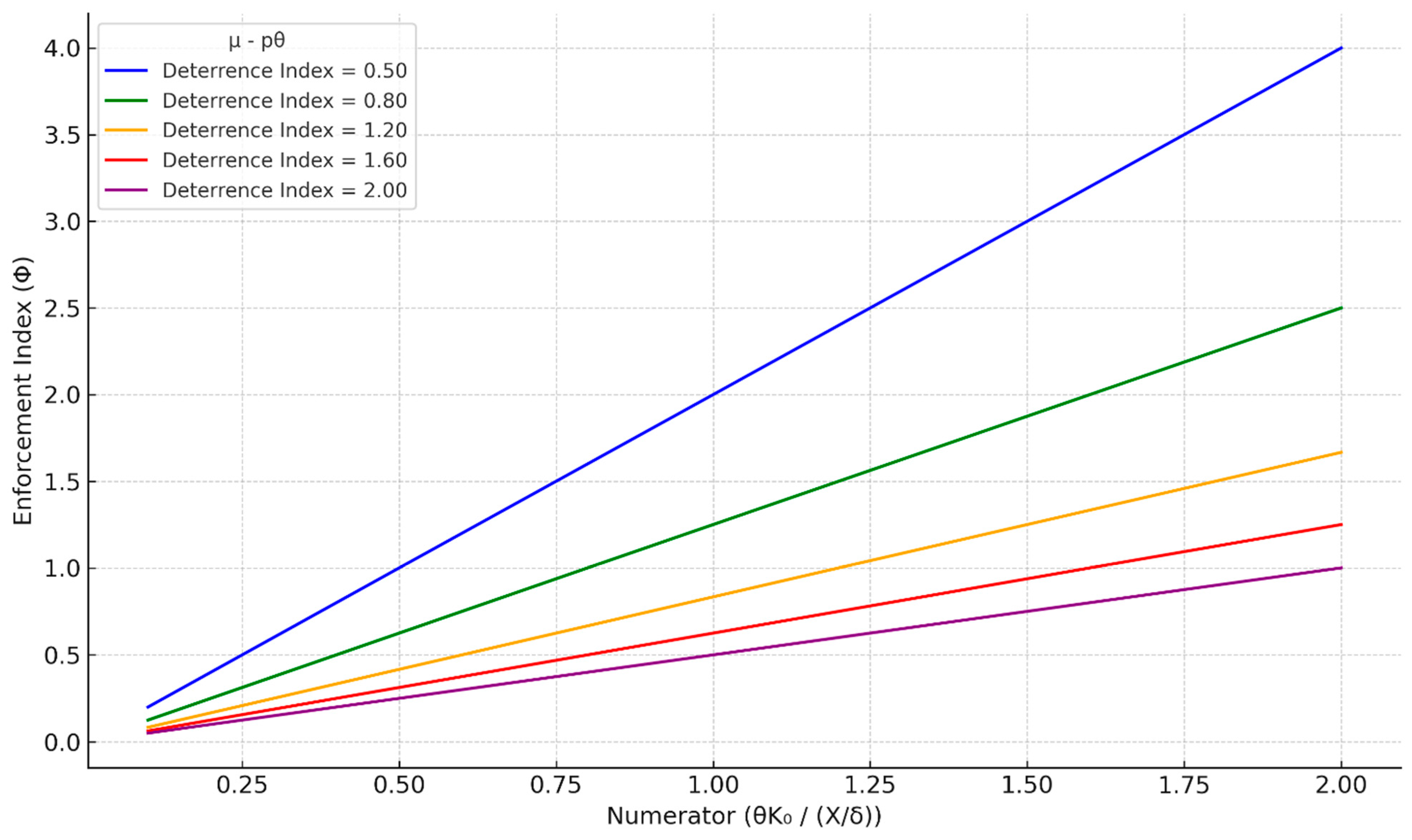
Figure 2 shows, where for simplicity it is assumed that
K =
K0, the enforcement index
increases linearly with enforcement costs, but the slope declines as the deterrence index rises, indicating that stronger deterrence efforts reduce the sensitivity of enforcement intensity to cost increases.
As illustrated in
Figure 3 and
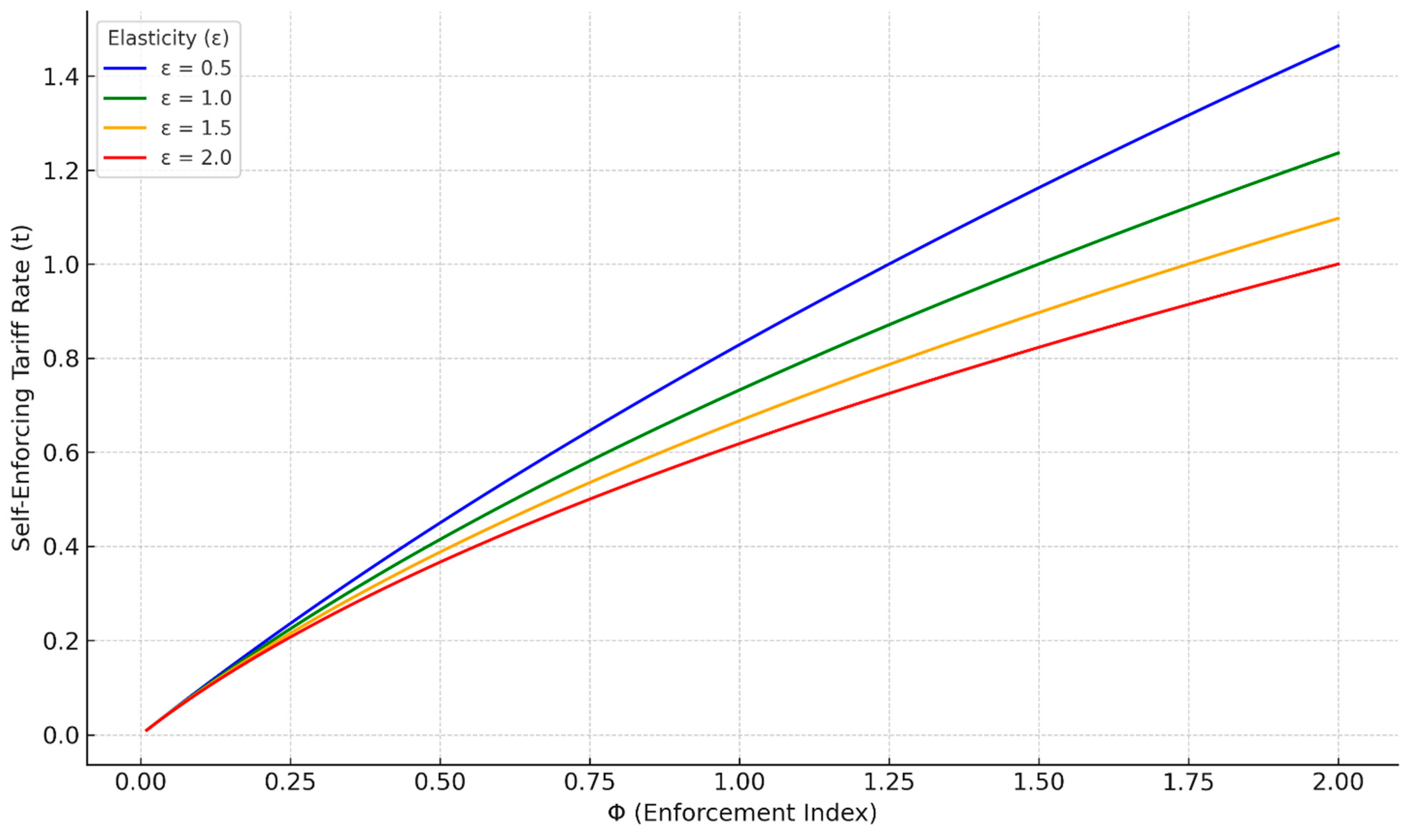
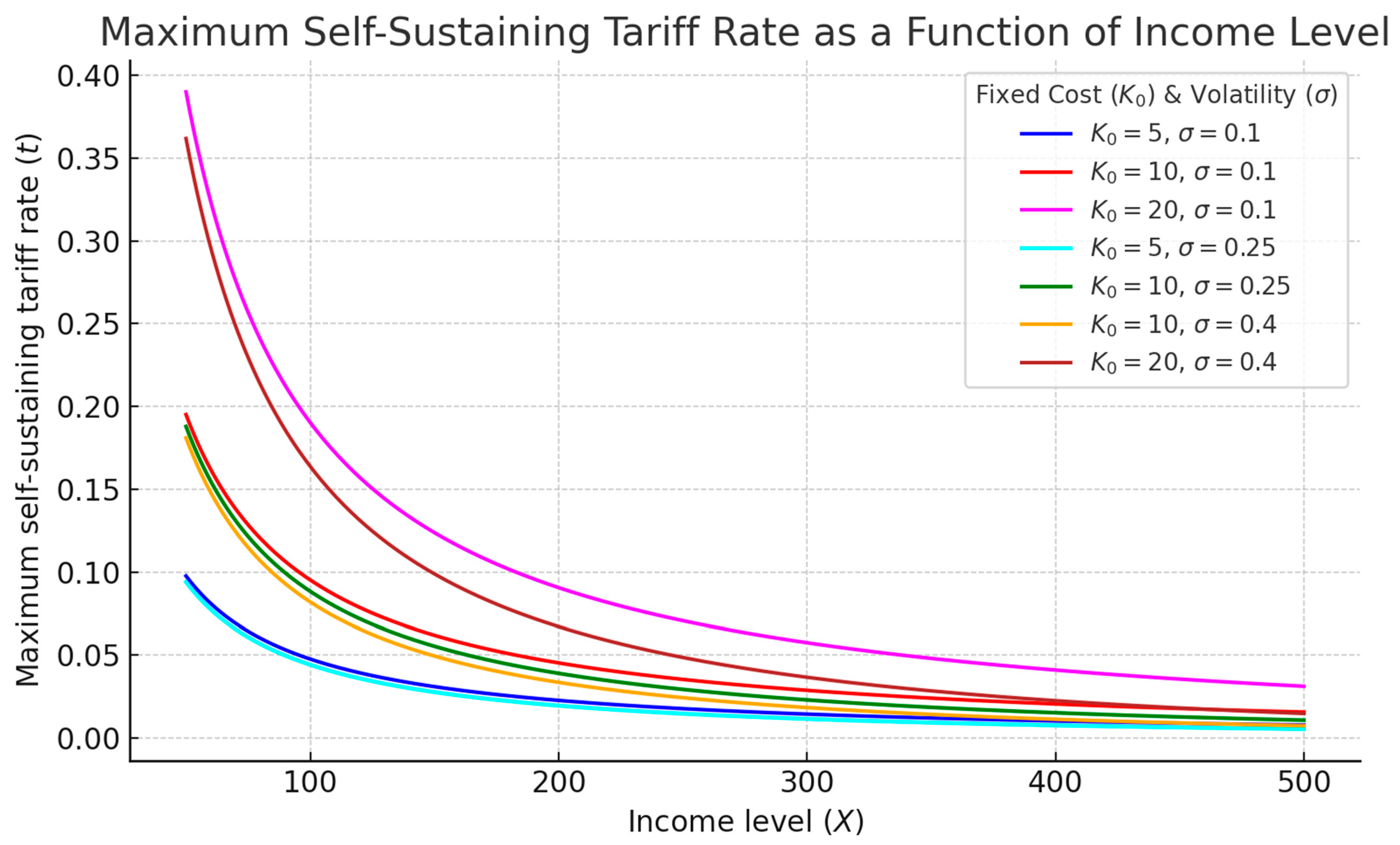
Figure 4, for
,
, and
, the resulting curves show that the maximum self-enforcing tariff rate: the highest rate that Country B would accept without resorting to evasion, declines sharply with export income. This curve divides the plane into two regions: a compliance area below the boundary and a noncompliance area above it. Both figures reveal that the compliance area shrinks rapidly as the exporter’s income rises and expands as B’s deterrence costs fall, confirming that higher-income exporters are more likely to engage in deterrence or avoidance behavior when faced with high tariffs.
4. The Preventive Stackelberg Equilibrium
Consider now the determination of a Stackelberg equilibrium through the commitment of optimal deterrence costs on the part of country B. For this purpose, we have to consider B’s objective function, as an estimate of its contingent wealth,
ΠN:
Country B maximizes the present value of its export income, X/δ, net of evasion-deterrence costs, C, and the value of a function depending on the option held by country A, VM(X). This option is a contingent liability for country B and must be thus considered as a potential source of losses in its objective function.
In order to determine the value of the function
, for
, the corresponding expression for the expected present value of country A’s revenue can be written as:
where
ρ is the rate of discount and
is the expected discount factor (the expectation being taken with respect to the time of exercise as a random variable, (
Dixit & Pindyck, 1994, pp. 315–316), which is less than or equal to one, according to whether the value of the payoff
X is below or above the threshold of entry
XM. Thus, the value of the option for country A is equal to the expected net present value of its earnings upon and after the successful imposition of the tariff. The value of the threat from the same option for country B, however, does not include the costs paid by country A, but only the amount of export earnings that A would be able to appropriate. It follows that for country B the value of the threat is a function of A’s value function,
f(
VM(
X)), where
VM(
X) takes the value found in (8), and defined as follows:
Notice that the value of the contingent liability for the agent expressed by Equation (16) and corresponding to country A’s option, but with a negative sign, is smaller, the larger, ceteris paribus, the effective cost created by country B’s expenditure for country A and the more distant in time, correspondingly, appears the exercise of the tariff option by A. This is simply the result of the fact that greater deterrence costs on the part of country B will increase the threshold of entry, enlarge the zone of inaction and reduce A’s option value, thereby improving B’s expected wealth. However, the value of B’s liability from the tariff option decreases less than proportionally with the increase in costs. From Country B’s standpoint, deterrence reaches its optimal level when the marginal cost of an additional dollar of preventive spending equals the marginal benefit derived from reducing by one dollar its expected liability under Country A’s tariff option. The optimal value of therefore represents the level of deterrence expenditure that Country B should undertake when it is aware of the tariff threat but the tariff has not yet been imposed, that is, when .
It is possible now to restate country B’s optimal tariff prevention strategy as a constrained maximization problem in which the constraint is given by the condition required to create a zone of inaction. Formally, the latter condition is derived by setting
Cμ > 0 i.e.,
μ1 in (8). Therefore, country B’s problem can be rewritten as:
subject to:
The solution is obtained by substituting the definition of
f(
VM(
X)) in (16) into (17) and solving for
C:
where
if
,
if
.
Proposition 2. Under the conditions of Proposition 1 a preventive Stackelberg equilibrium will exist. If
, it will be characterized by a degree of deterrence on the part of the exporting country, with the importing country being discouraged from imposing the tariff and left in a zone of inaction, from which it will exit only if the underlying conditions undergo a change larger than . Alternatively, if a preventive degenerate Stackelberg equilibrium will prevail with deterrence operating only at the current value of expected gains.
Proof. Substituting Equation (18) into Equation (11) and imposing the constraint
yields the critical entry point for Country A:
where
This expression indicates that optimal preventive expenditure can deter the tariff option from being exercised, unless B’s income rises above the threshold of an amount equal to the factor i.e., XM > X, if . Because its threshold of action is kept above the expected gain of an amount greater than 1, country A will be in a band of inaction equal to and the size of this area as a percentage of country B’s income will equal the difference . Note that this area increases proportionally with country B’s income X, so that in percentage terms it has the same value regardless of B’s income level, for the same value of cost effectiveness p. On the other hand, since higher income countries may have access to more effective ways to elude or evade the tariffs than lower income ones, the size of the area is likely to be larger, the larger country B’s income and the less uncertain cost effectiveness of legal and financial preventive expenditures (). Therefore, if , the preventive cost level from tariff collection in Equation (18) will be optimal and effective, and likely to be proportionally larger for larger incomes. If on the other hand, the preventive Stackelberg problem will only have a corner solution equal to the constraint in (17). In both cases, country B will rationally choose the Stackelberg solution or compliance depending on which of the two alternatives is more convenient. □
Corollary 3. The width of the inaction zone for the importing country for from optimal prevention costs will be determined by the product
. This term increases with export revenue (import expenditure) and declines or grows with uncertainty depending on whether
it is above or below a threshold approximately equal to 2.78 times the income of the exporting country.
Proof. Differentiating w.r.t. , we obtain: , which is greater than or equal to zero if . Consequently, the size of the inaction zone first expands as uncertainty declines, reaches its maximum when , that is, when , and then begins to increase again with rising uncertainty. The expression shows that the inaction zone grows proportionally with export income , meaning richer exporters generate wider deterrence buffers. The sensitivity of this buffer to uncertainty, however, is non-monotonic:
For moderate uncertainty (), lower uncertainty enlarges the inaction zone.
For high uncertainty (), volatility itself strengthens deterrence by raising the leader’s incentive to wait. The critical value therefore marks the turning point between these two regimes. □
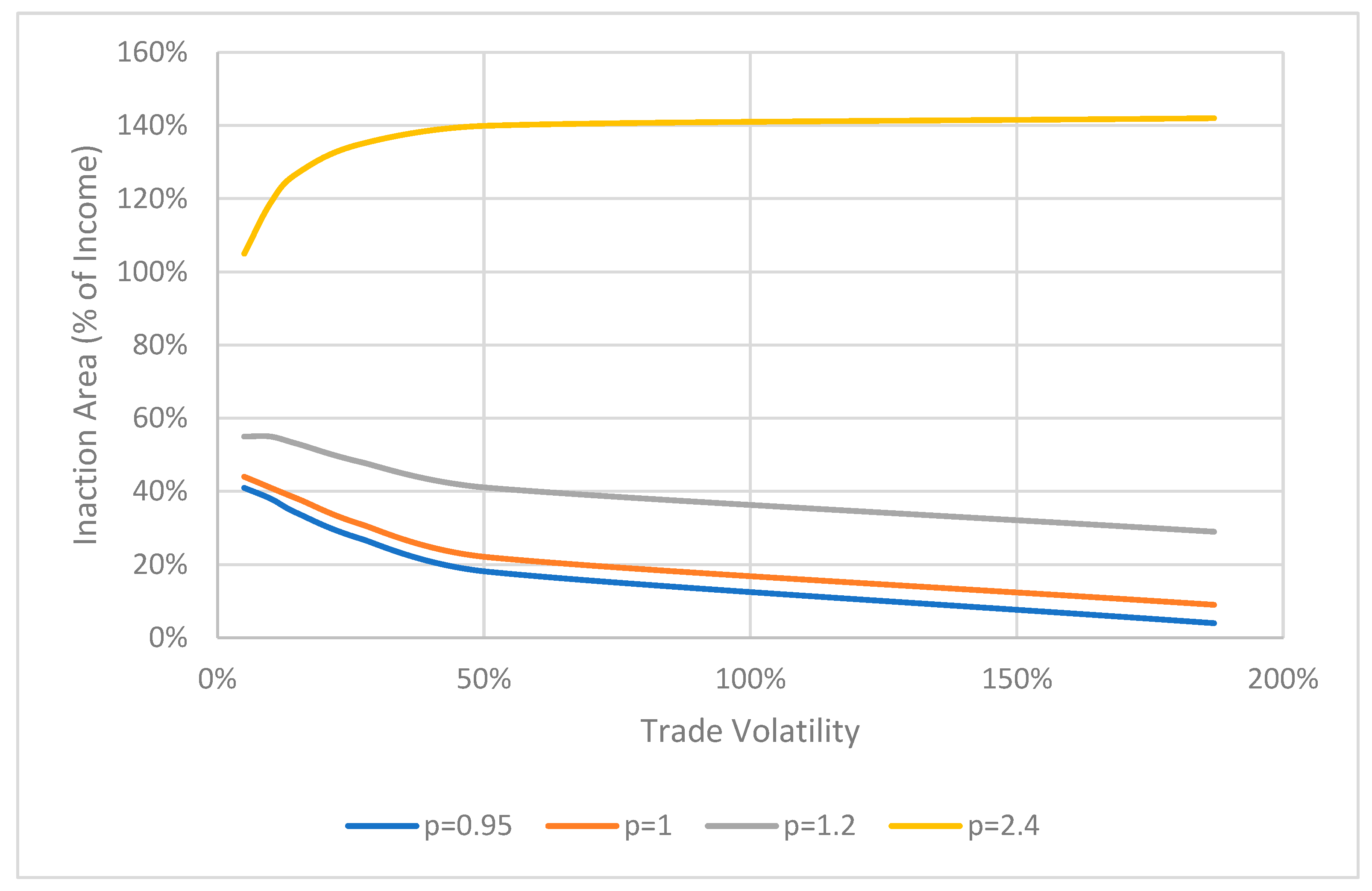
As shown in
Figure 5, for moderate levels of Country B’s cost-effectiveness, the inaction zone expands as uncertainty decreases, and this expansion occurs more rapidly the greater B’s cost-effectiveness. Conversely, when cost-effectiveness is sufficiently high, greater uncertainty is associated with a larger inaction zone. Intuitively, by boosting the cost-effectiveness of its tariff deterring and evading actions, country B can take advantage of uncertainty to increase the holding (and reduce the exercising) value of the tariff option and indefinitely delay country A’s action.
Corollary 4. If its optimal preventive expenditure can deter the importing country from acting (i.e., ) the exporting country will choose deterrence over compliance. In this case a preventive Stackelberg equilibrium will exist, provided that the importing country enforcement costs are low enough to ensure that it would act if unopposed, but high enough that optimal preventive actions from the exporting country can deter enforcement at lower cost than full compliance.
Proof. From Equation (11) it follows that
requires
At the same time, substituting the value of
in the expression for country A’s revenue, we find that A’s gain under optimal preventive expenditure is:
where
if
,
if
. This value will be nonnegative only if:
By combining (20) and (22), we finally obtain:
The upper bound indicates a threshold above which enforcement costs are so high that A won’t act even without the threat of country B’s preventive measures, while the lower bound ensures that the costs of these measures for country B would not be excessive relative to simply accepting the tariff. If , on the other hand, and public costs . This inequality thus defines a corner condition where country B chooses the minimum level of prevention effort required to just deter country A from acting at the current level of trade, but not beyond.
In sum, non-compliance supported by preventive expenditures will be preferred to full tariff compliance, and a preventive Stackelberg equilibrium will arise only when Country A’s collection or enforcement costs are sufficiently high relative to the potential tariff revenues, Country B’s export income, the level of uncertainty, and the effectiveness of B’s preventive measures. Under these conditions, several combinations of parameters may deter Country A from acting immediately. A preventive equilibrium emerges when B’s export revenues are volatile, A’s enforcement costs are substantial, and the tariff that could be collected is large enough to make deterrence more attractive than enforcement. Importantly, for any given tariff level, higher export revenues by Country B reduce the likelihood of compliance. Greater income increases the opportunity cost of accepting the tariff and strengthens the incentive to engage in deterrence or evasion. At the same time, higher tariff rates can, in principle, reduce non-compliance, but only if the resulting increase in tariff revenue does not simultaneously raise A’s enforcement costs or amplify uncertainty. Finally, as shown by the earlier derivation of the inaction zone, higher export revenues in non-compliant countries are associated with wider inaction ranges for Country A. Intuitively, a more profitable exporting partner effectively widens the range of conditions under which it is rational for the importer to delay or refrain from enforcement. This dynamic magnifies the asymmetry in the preventive equilibrium: the powerful importer waits costlessly, while the weaker exporter must continue spending resources to maintain deterrence and avoid sanctions. □
Proposition 3. The preventive Stackelberg equilibrium may consist of two distinct regimes, depending on whether the exporting country (B) chooses to invest in preventive measures or to comply and pay the tariff. The prevailing regime is determined by the ratio between the importing country’s expected tariff revenues and the exporting country’s prevention (or enforcement) costs. A preventive equilibrium arises only when this ratio is high enough to make deterrence investment profitable for B, yet not so high that the importer’s expected gains are outweighed by its own enforcement costs.
Proof. From Equation (11), the optimal preventive expenditure will be non-negative (i.e., B will engage in costly deterrence) only if the tariff level is sufficiently high and/or A’s public enforcement costs
are sufficiently low. Conversely, if public enforcement costs are high relative to potential tariff revenue, compliance is preferable to deterrence. These conditions can be summarized by the following double inequality:
and
Hence, two regimes emerge according to whether the ratio between the exporter’s income and A’s enforcement costs lies inside or outside the interval defined by inequality (24).
Regime1 (Preventive equilibrium): When the ratio falls within the bounds of (24), the exporting country’s preventive investment is both feasible and optimal. B actively protects itself, thereby deterring any enforcement action by A. The system stabilizes in a preventive Stackelberg equilibrium, with A in the inaction zone.
Regime2 (Compliance or corner equilibrium): When the ratio falls outside the interval, prevention is either unnecessary or too costly. Deterrence becomes redundant if enforcement costs are already so high, or B’s income so low, that A is self-deterred (upper bound violated). Alternatively, deterrence is inefficient if enforcement costs are too low and the private cost of prevention exceeds the expected tariff loss (lower bound violated). In either case, a preventive Stackelberg equilibrium does not exist, and compliance is the rational outcome.
Finally, variations in the parameters of Equation (7) may produce either incremental effects—when they change the equilibrium within a regime—or pivotal effects—when they push the system across the boundaries of (24), causing a regime switch between compliance and deterrence. □
Corollary 5. The impact of changes in entry or enforcement costs, preventive effectiveness, uncertainty, or expected trade gains on tariff collection depends on whether these changes are incremental (within the same regime) or pivotal (causing a shift between compliance and deterrence).
Proof. Consider the ratio between the exporter’s income () and the importer’s public protection or enforcement costs (). When this ratio is low, the exporter can achieve a high degree of deterrence, corresponding to a wide inaction zone for the importing authority. If the ratio remains small, the exporter has a strong incentive to maintain costly legal and financial protection. Under such conditions, a modest (incremental) increase in income will typically lead the exporter to reduce preventive spending, since deterrence remains effective even with lower private effort. However, if the increase in income is pivotal, i.e., large enough to push the ratio above the upper threshold defined in Equation (24), the exporter will shift to compliance, as costly evasion becomes less advantageous. In the opposite regime, where the income-to-cost ratio already lies above the upper bound of Equation (24) and no preventive deterrence is undertaken, a small fall in income will have no effect. Only a pivotal decline, i.e., a decline large enough to bring the ratio below the lower threshold, will make costly deterrence rational again, inducing a switch from compliance to prevention.
Changes in the effectiveness of private protection () display the same dual behavior. When (the optimal deterrence regime), an incremental increase in merely widens A’s enforced inaction zone, while a decrease narrows it. A sufficiently large fall in , however, can be pivotal, reducing preventive effectiveness to the point where the exporter finds it preferable to risk enforcement. Conversely, when (the compliance regime), small changes in are inconsequential. Only a pivotal rise in , enough to shift the system into , allows the exporter to create a significant inaction zone for the importing country.
In sum, Incremental changes affect behavior within a given regime, producing smooth adjustments in deterrence or compliance. Pivotal changes, by contrast, move the system across the boundary between regimes, leading to discrete shifts in strategy, from compliance to costly deterrence or vice versa. The corollary thus formalizes how nonlinear transitions in income, cost-effectiveness, or uncertainty can abruptly alter the equilibrium outcome of the preventive Stackelberg game. Intuitively, the model captures how seemingly gradual economic changes can trigger sudden strategic reversals, much like tipping points in real-world trade disputes, where one side’s small advantage or shock can completely alter the balance between deterrence and compliance. □
5. A Numerical Example
The following numerical example aims to quantify how enforcement costs, deterrence costs, and uncertainty determine the critical tariff threshold
, the deterrence cost
, and the size of the inaction zone. The parameter values used for this example and presented in
Table 1 are consistent with standard real-options models of investment under uncertainty and are chosen to reflect stylized facts from the literature on trade friction costs and deterrence efficiency (
Dixit & Pindyck, 1994;
Handley & Limão, 2017;
Caldara et al., 2020). The discount rate and drift reflect typical macroeconomic magnitudes (5% and 3%, respectively). Volatility values between 0.10 and 0.30 correspond to empirical estimates of trade growth uncertainty found in recent global trade data. The enforcement cost (
) and deterrence effectiveness parameter (
) are normalized to represent moderate asymmetry between countries.
The numerical results presented in
Table 2 below, are only illustrative, but they clearly highlight how uncertainty, irreversibility, and deterrence efficiency jointly determine the size of the inaction zone, the magnitude of deterrence expenditures, and the feasibility of tariff enforcement. Under low uncertainty (
σ = 0.10), the critical tariff threshold (
) is relatively low, and the implied tariff rate
3 (
) remains economically viable. Because volatility is limited, the importer’s expected gain from immediate enforcement outweighs the option value of waiting, so that the importer (the Stackelberg leader) has to act early to prevent the importer’s action. Deterrence costs for the exporter (
) are moderate, and the equilibrium resembles a stable, low-risk trade relationship. In the baseline case (
σ = 0.20), the threshold rises to around 53, while deterrence costs increase to approximately 1780. The importer’s incentive to act weakens, generating a broader inaction zone. At this intermediate level of uncertainty, both players engage in strategic inertia: the leader delays tariff imposition, and the follower sustains continuous deterrence. The equilibrium therefore represents a balanced but costly deterrence regime.
With higher volatility (σ = 0.30), the critical threshold expands dramatically (), implying that the importer would require a much higher expected gain to justify enforcement. Although deterrence costs () also rise, the resulting inaction zone becomes very wide, effectively neutralizing tariff threats. The corresponding tariff rate () is low, confirming that volatility suppresses enforcement incentives and stabilizes trade through inaction.
When irreversibility is increased (K0 = 20), the leader’s sunk enforcement cost doubles, and the effective threshold () mirrors the high-volatility scenario. Even with moderate uncertainty, the large sunk cost discourages action, creating a very wide inaction band. The equilibrium thus shows that irreversibility amplifies deterrence by raising the opportunity cost of intervention, making tariffs self-defeating.
Finally, reducing the follower’s deterrence efficiency (p = 1.0) weakens the exporter’s capacity to influence the leader’s cost structure. The inaction zone narrows relative to the baseline, and the critical threshold () lies between the baseline and high-irreversibility cases. The implied tariff rate () suggests that partial deterrence remains credible, though less effective. This intermediate outcome illustrates the sensitivity of equilibrium behavior to the relative efficiency of deterrence expenditures.
In sum, the numerical exercise illustrates how uncertainty, irreversibility, and deterrence efficiency shape the asymmetric equilibrium of a tariff-deterrence game. As volatility rises, the leader’s optimal threshold for action increases, from about half of trade value under low uncertainty to nearly four-fifths when volatility is high, making tariff imposition less likely. Yet the follower’s deterrence cost grows even faster, from roughly 13 to more than 20 times export income. Greater uncertainty thus stabilizes behaviorally: no one acts but raises the weaker actor’s burden. When enforcement costs are partly irreversible, the leader’s hesitation intensifies, while the follower continues paying for credibility. If deterrence efficiency declines, tariffs regain limited feasibility, and the inaction zone shrinks. Overall, the leader’s waiting remains costless; the follower’s deterrence is costly. Volatility and irreversibility enlarge stability but deepen inequality: the powerful extracts rent through potential action, while the weaker side sustains continuous expenditures for peace.
Sensitivity Analysis
To assess robustness, the model’s outcomes were simulated under variations in three key parameters: volatility (σ), enforcement cost (K0), and deterrence effectiveness (p). Results show that the critical tariff threshold and deterrence cost (CN) are most sensitive to volatility changes. A 10% increase in σ raises the tariff threshold by approximately 20%, expanding the inaction zone, while a comparable rise in K0 shifts the threshold upward by about 15%. By contrast, higher p values enhance the exporting country’s deterrence capacity, reducing and widening the inaction zone. These comparative statics confirm that the model’s qualitative results are robust: uncertainty and irreversibility jointly stabilize the system by discouraging premature enforcement, while asymmetry in cost-effectiveness determines the extent of deterrence.
6. Conclusions
Through the application of the real options approach, this paper has analyzed the interaction between two trading partners in an environment characterized by dynamic uncertainty. The situation between Country A, which enjoys superior market power, and Country B may be seen as an implicit real-option transaction in the sense that Country A may exercise an import tariff real option against Country B’s exports, and the tariff enforcement entails an unrecoverable cost as well as an uncertain return based on tariff revenues. As shown in other applications of this liability option principle (
Scandizzo & Ventura, 2015;
Scandizzo & Knudsen, 2024) Country B is effectively short on the same option, as it faces both an obligation tied to A’s potential tariff move and uncertainty about the resulting downside.
From this framework, the following results emerge, and their implications are distinct from the conventional wisdom in both the trade literature and the literature on tax enforcement. The framework suggests that raising tariff schedules may not serve as an effective policy tool for the principal importing nation, even when substantial market power is present. The greater the tariff level and the corresponding uncertainty associated with it, the greater the ‘liability risk’ burden on the other country, and the greater the motive to engage in ‘evasion’ and ‘deterrence’ efforts on the part of the exporting trade partner. Second, the analysis recognizes an inaction zone where country A as the de facto follower of a Stackelberg game, chooses not to play the tariff game because the costs of enforcement are offset by deterrence and evasion strategies used by the other country (the leader). The size of the inaction zone expands with greater uncertainty, stronger deterrence capacity by the weaker country, and higher enforcement costs for the dominant country. In this equilibrium, the game settles into an asymmetric stable state in which the dominant country is the follower, but can afford to wait costlessly, while the weaker one, as the leader of the game, must sustain continuous costs to preserve the credibility of its deterrence.
Third, the results demonstrate the maximum enforceable tariff, i.e., the tariff level Country B faces without turning to non-compliance solutions, further depletes as export income and uncertainty equalize. To exceed this tariff level becomes progressively inefficient for Country A, since the size of the zone of inaction grows and evasion increases. Moreover, beyond the optimum tariff level, the expected revenues for the tax will tend to progressively shrink. At last, for the Stackelberg game where Country B leads and Country A follows, three possible outcomes emerge: (i) effective deterrence where Country A is limited to doing nothing; (ii) mutual inaction because of high costs of enforcement; and (iii) compliance where Country B complies because Country A’s enforcement costs are sufficiently low to make its action credible, or because A’s policy measures weaken B’s ability to deter. In every single one of these possible outcomes for the Stackelberg game, it’s never optimal for country A, the dominant country in terms of market power, to increase uncertainty because such an approach makes both the leader’s enforcement costs higher and the follower’s defensive costs lower, resulting in decreasing expected revenues and/or compliance. As a result, uncertainty widens the strategic asymmetry between the two countries: the dominant importer waits longer and earns less, whereas the weaker exporter sustains deterrence more cheaply and more effectively.
Future research could extend the bilateral deterrence framework by incorporating asymmetric information, multi-country trade linkages, and empirical calibration using trade-policy-uncertainty indices. The structure developed here may also be adapted to study deterrence mechanisms in environmental or technological trade conflicts, where uncertainty and irreversibility similarly shape strategic stability.