


Abstract
Recent studies have focused on the detrimental effects of global economic policy uncertainty (EPU) on firm profitability. Nevertheless, none of these studies has focused on a developing economy like Nigeria. To understand this, the study conducted a host of regression analyses using the Driscoll and Kraay fixed-effect estimator and the two-step system generalised method of moments to examine the effects of global crude oil prices and domestic and global economic policy uncertainty on firm profitability in Nigeria from 2005 to 2024. The findings indicate that while global EPU had a minimal impact on firm profitability, domestic EPU had a substantial negative impact. The findings remain consistent even across the sub-samples, sensitivity, and robustness analyses. Furthermore, the findings showed that firm size and capital are significant determinants of profitability for Nigerian firms. At the same time, oil prices and their interactions do not affect firm profitability in Nigeria. The study suggests that regulators in the Nigerian business environment can contribute to building a more resilient environment by implementing systems to monitor critical economic indicators and ensure timely responses to emerging challenges. Systematic evaluations of economic uncertainties, including business sentiment, inflation rates, exchange rates, interest rates, and economic growth, can provide valuable insights for policy formulation and interventions aimed at enhancing the profitability of Nigerian firms.
1. Introduction
Economic uncertainty is rapidly becoming a global issue due to the interconnectedness of global economies and international trade, which affects many economies, particularly Emerging Markets and Developing Economies (EMDEs). Uncertainty can occur in several ways. This may be due to rising global prices, political uncertainty, geopolitical risks, and wars, among other factors. More recently, uncertainty has taken the form of the COVID-19 pandemic, the Russian invasion of Ukraine, rising global commodity prices, and their effects on the global community. As a result, several studies have sought to examine the impact of economic policy uncertainty (EPU) on various macroeconomic variables (Iqbal et al., 2020; Boungou & Mawusi, 2022; Jumah et al., 2023).
Since the 2008 financial crisis, several events have prompted governments to adjust their budgets, monitor, and implement other regulatory policy changes (Owusu, 2016; Shabir et al., 2021; Tang et al., 2021; Almustafa et al., 2023). As a result of these changes and structural transformations, EPU has weakened the economic systems of many countries and affected governments’ ability to plan future activities and make informed policy decisions. Several studies, such as those by Tournus et al. (2022), Wang et al. (2022), Sharfaei et al. (2023), Hamdy et al. (2024), Jumah et al. (2024), and many more, have been able to establish that the effect of EPU has negative consequences on many economies as well as business performance, slowing down recovery and economic growth in these economies. On the other hand, several other studies have sought to establish the connection between EPU and firm performance (Jabbouri et al., 2023; Kahloul et al., 2023; Li et al., 2023; Sharfaei et al., 2023; Jumah et al., 2025; Marín-Rodríguez et al., 2025). These studies also found a negative connection between EPU and firm performance.
S. R. Baker et al.’s (2016) EPU index has recently been recognised in the literature as a very effective way to measure EPU. As a result, several studies used this index to examine the effects of EPU at the micro and macro levels. At the macro level, several studies have utilised this index to examine its impact on macroeconomic performance (Fountas et al., 2006; Bredin & Fountas, 2009; Bredin et al., 2009; Mohapatra & Purohit, 2021; Ayeni & Fanibuyan, 2022). Several other studies have utilised the index at the micro level to examine its impact on firm-level performance. Despite enormous research in this area, relatively few studies have examined the effect of oil prices on the nexus between EPU and firm profitability (FP). To the authors’ knowledge, empirical investigations focusing on oil prices within the uncertainty nexus include T. P. T. Nguyen et al. (2021) and Song and Yang (2022). These studies, although focused on EMDEs such as India and China, did not focus on Nigeria.
Crude oil is a vital component of Nigeria’s economy. It constitutes more than 80% of government revenue and foreign exchange earnings. As previously reported by T. P. T. Nguyen et al. (2021) and Stojkov et al. (2023), crude oil is a vital component of many manufacturing processes. It is directly connected to inflation in many countries. Therefore, the success of many firms may be influenced by their consumption and investments in oil production. While national governments are responsible for setting economic policies, global supply and demand ultimately determine oil prices. Furthermore, shocks in crude oil prices may lead to inflation, prompting policymakers to implement new energy and economic measures to mitigate the resulting impact (Youssef & Mokni, 2019). This, in turn, raises questions regarding the efficacy of these measures. Oil price shocks could exacerbate the existing uncertainty caused by economic policies. Therefore, it is essential to examine whether fluctuations in international oil prices amplify the impact of EPU on firm profitability in Nigeria.
Based on the foregoing, this study makes a significant contribution to EPU literature in several ways. First, to the best of our knowledge, this study is the first to undertake rigorous microdata analysis of the linkage between EPU and firm profitability in Nigeria. By extension, this study considered 91 publicly listed firms in the Nigerian Exchange Group. This study focuses on these firms due to the availability of data for the study period. Second, the breadth of the firms spans financial sector firms (including commercial banks, investment banks, insurance companies, and mortgage banks), manufacturing sector firms (such as the health and pharmaceuticals sector, consumer goods, industrial goods sector, and others), agricultural sector firms, and oil and gas sector firms. These firms span the breadth of sectors in the Nigerian economy, ensuring that this study can effectively establish the effect of EPU on firm profitability in Nigeria.
Third, this study contributes to the literature by establishing the role of oil prices in the EPU–FP nexus in Nigeria. This allows us to understand the role of oil prices in the relationship between policy uncertainty and firm profitability, as Nigeria’s economy depends on international crude oil prices. Fourth, this study employed several measures of uncertainty to assess their impact on firm profitability. The first was the EPU provided by S. R. Baker et al. (2016), representing uncertainty in global economic policy. Furthermore, the study constructs an index of domestic macroeconomic variables to establish the effect of domestic EPU on profitability. The only study (Tumala et al., 2023) that attempted this started in 2016. Therefore, the study employed macroeconomic variables, including real GDP, inflation, monetary policy rate, and exchange rate, to construct the domestic EPU index, following the approach of Jurado et al. (2015) and Tran et al. (2019). Fifth, to measure firm profitability, this study uses two measures. Therefore, profitability metrics, such as returns on assets (ROA) and returns on equity (ROE), were used to compute firm profitability. By doing so, this study contributes to the existing literature on the EPU-FP nexus.
Based on the above, this study makes a clear contribution to the literature by moving away from existing frameworks that undertake firm-level studies as if EPU has the same effect across firms within different industries. Most existing studies assume that EPU has a uniform effect on firm profitability. However, while the study examines the effect of EPU on firm profitability across different sectors, it goes further by examining these effects across industries to understand better how EPU affects firm profitability within the Nigerian economic environment. Moreover, studies on EPU and firm profitability in Nigeria are very scanty. Therefore, by contextualising this relationship, the study contributes to literature in this regard.
Additionally, this research distinguishes between global and domestic EPU, acknowledging that their impacts on business performance may differ in institutionally constrained emerging market environments. In contexts marked by low policy credibility and discretionary measures, global uncertainty is expected to affect companies mainly through domestic policy responses rather than through direct firm-specific mechanisms. Consequently, domestic EPU is expected to be the primary source of uncertainty affecting companies’ actual alternatives, while local institutional processes may mitigate the effects of global uncertainty.
As a result, the study focuses on the Nigerian economy because the country represents a structural case in which EPU, oil price dependence, and institutional constraints amplify negative consequences for the economy. This phenomenon is very similar in many resource-dependent economies and EMDEs. Therefore, Nigeria’s heavy reliance on crude oil sales, susceptibility to global policy uncertainties, and inconsistent policy environment have exacerbated uncertainty across the macro and microeconomic environments. Consequently, it becomes crucial to understand how firms respond to uncertainties and oil price shocks, allowing the paper to speak to a broader class of economies facing similar challenges. In essence, by focusing on Nigeria, the study enhances our understanding of how EPU and oil price changes affect the country, lessons that are transferable to other oil-exporting economies in EMDEs.
By combining oil prices and EPU in firm profitability studies, this helps clarify their distinct and overlapping roles, rather than assuming either has a more dominant role in firm profitability in an oil-exporting economy such as Nigeria. By jointly modelling both parameters, the study will demonstrate how firm performance is both hindered and supported by uncertainty and oil shocks, rather than by either alone. This helps us to better understand and reframe the debate from oil prices versus uncertainty to how uncertainty mediates the economic impact of commodity dependence, thereby offering a more nuanced and policy-relevant interpretation of firm behaviour. In essence, the findings from the study are crucial for policymakers, including the fiscal and monetary authorities, as well as Nigerian firms whose activities are affected by uncertainties arising from domestic and global economic policies.
The rationale for undertaking this study is that understanding the impacts of EPU and global oil price fluctuations on profitability is essential, given the country’s reliance on oil revenues and their consequences for the volatility of the Nigerian macroeconomic and firm-level environment. Oil price shocks have profound implications on the Nigerian economy, especially when the shocks lead to a fall in crude oil price, thereby exposing the economy to external shocks, affecting fiscal revenues, exchange rate stability, inflation and overall business performance, which are all critical variables within the Nigerian macroeconomic and firm-level environment performance (Adekoya & Oliyide, 2021). Additionally, uncertainty within the domestic environment, stemming from macroeconomic shocks such as changes in fiscal and monetary policy, regulatory environment uncertainty, or political instability, may exacerbate business uncertainty and weaken firm investment decisions and profit margins (S. R. Baker et al., 2016). Therefore, examining how domestic and global EPU, as well as global oil prices, two important sources of uncertainty in Nigeria, affect firm profitability helps provide empirical evidence to enhance macroeconomic and firm-level management and strengthen private-sector resilience strategies in Nigeria.
Consequently, the study derives its motivation from the increasing vulnerability of firms within the Nigerian macroeconomic environment to domestic and global shocks arising from policy uncertainty and oil price shocks. Moreover, more recently, the fiscal and monetary frameworks in Nigeria have been affected by exchange rate instability, policy reversals, fluctuating crude oil prices, reduced investor confidence, altered firm cost structures, and constrained profitability (Eregha & Mesagan, 2016). While previous studies have examined how oil prices have affected macroeconomic indicators in Nigeria, less attention has been given to how this volatility interacts with policy uncertainties to influence firm-level operations and profitability. Moreover, Nigerian firms are impacted by global shocks and local institutional weaknesses. This intersection establishes a distinct conduit through which uncertainty can influence business profitability, necessitating the simultaneous examination of both risk sources and opportunities.
Based on this, the study’s uniqueness lies in its integrative approach, which examines both global and domestic sources of uncertainty and their combined effects on firm profitability in Nigeria. Nigeria is an economy heavily dependent on oil revenue, making it vulnerable to global oil price fluctuations that affect oil revenues. Unlike previous studies that have examined macroeconomic performance or capital market research, this study explores how firm profitability is affected by EPU and global crude oil prices. Additionally, the study relies on advanced econometric methods to interpret the results, thereby helping us generate actionable insights for policymakers seeking to stabilise the business environment and for firms motivated to adopt adaptive frameworks under different uncertainty conditions.
The remainder of this paper is organised into four sections. The first section revisits the literature on EPU and firm profitability, while the following section delves into the methods adopted to establish the results. The section that follows attempts to establish a connection between EPU and firm profitability using descriptive and econometric techniques, while the final section concludes the study with key policy considerations.
2. Literature Review
Regarding the connection between EPU and bank profitability, Shabir et al. (2021) investigate the impact of EPU on the stability and profitability of firms across various countries. The findings reveal that uncertainty reduces stability and profitability among observed banks. The findings also show that countries above the threshold level of institutional quality could significantly reduce the impact of EPU on profitability. In contrast, those below the threshold were more susceptible to EPU. Shabir et al. (2023) also found results similar to those of earlier studies on the link between EPU and firm performance, as reported across a panel of studies. T. C. Nguyen (2021) surveyed 950 commercial firms across eight European countries, and Zhang and Wang (2023), who focused on 32 commercial banks in China, found similar results to those of Shabir et al. (2021) regarding the adverse effects of EPU on stability and profitability.
In the nexus between EPU, systemic risks, and stock market returns, Duan et al. (2022) examine EPU’s role in mitigating systemic risk. The study showed that during periods of EPU, firms’ systemic risk is most likely to rise compared to periods of certainty. T. P. T. Nguyen et al. (2021) believed that EPU worsens the risks they face, but this makes them more creative and increases profits. Oil prices aggravate this relationship, as evidenced by the analysis results. Yuan et al. (2022) opined that EPU heightens the risks of a stock price crash among Chinese firms, particularly banks. Ugurlu-Yildirim et al. (2021) examined the impact of monetary policy uncertainty on US stock market performance. The findings confirm a negative relationship between monetary policy uncertainty and US stock performance. Several other studies, such as those by Gozgor et al. (2019) and Demir and Danisman (2021) have found similar outcomes. Regarding the link between EPU, credit, and liquidity growth, Wang et al. (2022) also examined the effect of EPU and country governance on liquidity. They show that EPU weakens asset liquidity but strengthens liability liquidity across panels.
Regarding the relationship between EPU and macroeconomic performance, Ayeni and Fanibuyan (2022) suggest that EPU does not have a significant impact on macroeconomic variables in Nigeria. In contrast, crude oil does affect these variables in Nigeria. Bredin and Fountas (2009) created two uncertainty indices based on nominal GDP and inflation to establish the link between domestic EPU and economic performance in the European Union. The results of their analysis across the area indicate that GDP growth depends on GDP uncertainty, whereas inflation uncertainty has heterogeneous effects on inflation and output growth. This result aligns with earlier studies by Fountas et al. (2006) and Bredin et al. (2009), which found that inflation uncertainty had heterogeneous impacts across their samples. However, Mohapatra and Purohit (2021) find that banks prefer to provide credit to households rather than firms during periods of greater uncertainty, a result that is more pronounced in smaller banks than in larger banks.
By focusing on bank profitability and categorising banks into commercial banks and other financial institutions, Bilgin et al. (2021) sought to address the dichotomy between conventional commercial banks and Islamic banks, examining the role of uncertainty in the stability and performance of these institutions. The study found that EPU affects the stability of conventional banks but not that of non-conventional/Islamic banks. The paper argued that this may be because conventional banks focus more on profit-making. In contrast, Islamic banks do not, and this may account for the heterogeneity in the effects of EPU across these banks. In addition, Boungou and Mawusi (2022) focused on EPU and banks’ non-interest income. The results show no significant relationship between EPU and bank non-interest income. Albaity et al. (2023) study the link between EPU, investor sentiment, and geopolitical risks. This study demonstrates that geopolitical risks and EPU have an indirect impact on bank returns among Islamic banks. The findings from Albaity et al. (2023) aligned with those of Athari (2021), who focused on the Ukrainian economy between 2005 and 2015. Hamdi and Hassen (2021) believed that state-owned banks were more susceptible to EPU, while they also found significant indirect effects of EPU on loan size but positive effects on credit risk.
Focusing on countries in Asia, Desalegn and Zhu (2021) demonstrated that EPU reduces bank opacity. This implies that EPU affects bank earnings in China and that these earnings depend largely on banks’ financial strength. T. V. Nguyen et al. (2022) also found that EPU weakened bank linkages across the countries studied, and this became more pronounced during periods of greater uncertainty. Regarding the link between EPU, non-performing loans, and loan loss provisioning, Wu et al. (2020) find that firm risk increases with rising uncertainty. Wu et al. (2021) found similar results to their 2020 study on a panel of 500 firms across seven Asian countries, while other studies, such as Ashraf and Shen (2019), Baum et al. (2021), and Shabir et al. (2023), also found the same results in their panel studies of firms across several countries.
In summary, several studies in the literature have engaged in the EPU-FP nexus, cutting across panel data studies, cross-sectional elements, country-specific studies and a combination of regional studies employing different panel data and time series techniques, including the two-step system generalised method of moments (GMM), fixed effects, and random effects, among many others. In addition, the literature review revealed that many country-specific studies tend to focus on the US, China, India, Ukraine, and several other European and Asian countries. Despite several studies in this area, research on the oil price–EPU–firm profitability nexus in Nigeria remains scarce. The only other study to focus on this nexus was Ayeni and Fanibuyan’s (2022) study, which also examined the Nigerian macroeconomic environment. Moreover, the current study extends these works by also considering the effects of oil prices and global and domestic EPU on firm profitability, as both forms of uncertainty may impact profitability within the Nigerian economy. Therefore, this study contributes to the literature by examining the effects of oil price, global EPU, and domestic EPU on firm profitability in Nigeria.
3. Methodology
3.1. Theoretical Framework
The theoretical framework of this study is based on the Real Options Theory. The Real Options Theory offers a crucial understanding of how uncertainty, including economic policy uncertainty, oil price volatility, and other types of macroeconomic uncertainty, affects firm-level decision-making and profitability. The theory rests on the view that during periods of uncertainty in firm-level and macroeconomic environments, firms are more cautious in their investment decisions, often delaying them until the information about the uncertainty becomes clearer (Dixit & Pindyck, 1994). Moreover, a higher level of EPU can lead firms to pause investment decisions, as they may deem them too risky due to potential regulatory policy adjustments that could affect the macroeconomic environment, ultimately impacting firm returns. Similarly, oil price volatility can affect the predictability of the firm’s production costs because it depends on crude oil derivatives in the Nigerian economy. These derivatives serve as alternative sources of electricity, as many firms cannot rely on government-generated electricity due to its erratic nature. Therefore, oil price volatility affects input expenses, which, in turn, impact overall production costs, particularly for companies that rely heavily on energy resources to operate efficiently. Consequently, any hesitation or delay in investment decisions may reduce profitability, even when it could alleviate long-term firm risk exposure (Bloom, 2009).
Despite the theory’s suitability for this type of research, it has limitations. For instance, the Real Options Theory posits that corporations act rationally by postponing or modifying investment decisions due to uncertainty. However, in reality, firms may not consistently operate optimally by delaying or postponing decisions. Sometimes, factors such as risk aversion, institutional pressures, or bounded rationality led firms to make irrational decisions, thereby diverging from the theory’s predictions (Trigeorgis & Reuer, 2017). Moreover, the theory streamlines decision-making by simplifying investment options into distinct choices that can be executed at the right time. In reality, investment choices and decisions are interdependent, and firms consider sunk costs and other irreversibilities that can constrain decision flexibility (Dixit & Pindyck, 1994). Despite the limitations of the theory, the Real Options Theory provides an ideal framework for this study due to its strong conceptual foundations in understanding firm responses to uncertainty resulting from EPU and oil price volatility. Moreover, the theory’s main points regarding investment flexibility and timing are especially relevant to the Nigerian environment, where many firms often delay or diversify their investments due to unpredictable policy shocks or external shocks within the global oil markets and the broader global macroeconomic environment. In essence, the Real Options Theory provides a cohesive framework that connects uncertainty, strategic decision-making, and business profitability, rendering it a relevant and robust framework for empirical investigation within the study.
3.2. An Index for Domestic Economic Policy Uncertainty
To create an index for domestic EPU, the paper corroborates the work of Jurado et al. (2015) and Tran et al. (2019) in developing such an index. According to Jurado et al. (2015), what matters is to better understand whether the economy has become more or less predictable. These studies demonstrated that macroeconomic uncertainty had a significant adverse impact on macroeconomic activities, through the application of the Jurado et al. (2015) method. As a result, Jurado et al. (2015) employed the following statistical formula (Equation (1)) to calculate the uncertainty index. This formula can create uncertainty in a host of economic variables. Consequently, the formula was used to calculate uncertainties for four key macroeconomic variables: inflation, exchange rates, interest rates, and real GDP. This is represented as:
where expectation is defined by the information available at time t. Equation (1) was used to create four different uncertainty measures. These include inflation, real GDP, exchange rate, and monetary policy uncertainties. Thus, if today’s anticipation of an increase in domestic EPU is high, the uncertainty variable will also be high. Therefore, this study uses this formula to calculate an aggregate domestic EPU index from these four variables.
Equation (2), which is the statistical expression of the mean, is Jurado et al.’s (2015) way of aggregating the uncertainty index. Therefore, Equation (2) is then used to aggregate these four measures of uncertainty to generate an index of domestic EPU in Nigeria. The reason for adopting these four variables was that they directly and indirectly affect the macroeconomic environment, and their movements have a significant impact on the economy. Moreover, each component influences the index via its own unforeseen variations, and no one variable is predetermined to have a predominant weight in advance. Additionally, the study adopted the Jurado et al. (2015) technique because it is specifically intended to extract the common uncertainty factor from comprehensive information collection, despite composite uncertainty measurements necessarily abstracting from particular macroeconomic components. Moreover, the supplementary diagnostics reveal that the domestic uncertainty index used in this research captures widespread macroeconomic uncertainty rather than being driven by a specific uncertainty indicator.
3.3. Estimation Technique
To estimate results, this study uses Driscoll and Kraay’s (1998) (D-K) robust standard-error-type technique, which accounts for cross-sectional dependence. This is nested within the fixed-effects model. The empirical form of the model is as follows:
FP denotes a vector of variables used to measure firm profitability, such as Return on Assets (ROA) and Return on Equity (ROE). GEPU represents global economic policy uncertainty (S. R. Baker et al., 2016). DEPU represents domestic EPU created using the method described by Jurado et al. (2015). B represents a vector of firm-specific variables intended to capture the influence of firm characteristics on firm profitability (firm size and firm capital). and are the firm- and time-specific effects, respectively, and is the residual error term. are the parameters to be estimated in the regression. Equation (3) captures the effects of global EPU on firm profitability in Nigeria, while Equation (4) captures the effects of domestic EPU on firm profitability in Nigeria.
To examine the effect of oil price on the EPU–firm profitability nexus, we estimate the model in Equations (5) and (6). The difference between Equations (3) and (4) from Equations (5) and (6) is that Equations (5) and (6) include oil prices and their interactions with EPU within the models, unlike the previous two equations, which do not.
Equation (5) illustrates the impact of oil prices, global EPU, and their interaction on corporate firm profitability. At the same time, Equation (6) shows the influence of oil prices and domestic EPU, as well as their interaction, on corporate firm profitability. The models also confirm whether interactions between oil prices and economic uncertainties affect firm profitability. The essence of this objective is to confirm whether oil prices, a significant source of government revenue in the Nigerian economy, mediate or aggravate the role of EPU on firm profitability. Therefore, the question of whether an increase in oil prices exacerbates the effect of uncertainty on the profitability of Nigerian companies can be addressed by examining the interaction between oil prices and uncertainty. Additionally, from a real options perspective, firm-level profitability is expected to respond most to the source of uncertainty that limits irreversible investment and operational decisions. In contexts of enduring domestic policy uncertainty and erratic policy responses to global shocks, domestic EPU is anticipated to prevail over global uncertainty in influencing business outcomes. This suggests that global uncertainty may have little or no direct consequences if domestic uncertainty is taken into account.
For robustness, the study employed the two-step system generalised method of moments (two-step system GMM) method as a triangulation of the primary findings using the D-K method. The use of both D-K and two-step system GMM estimators fulfils separate but complementary objectives, rather than only serving as a mechanical robustness assessment. The D-K estimator is utilised in a fixed-effects framework to mitigate cross-sectional dependence, heteroskedasticity, and serial correlation, which are likely to be present in a panel of Nigerian firms exposed to shared macroeconomic shocks and policy contexts, thereby ensuring reliable inference about average partial effects. In contrast, the two-step System GMM addresses a distinct econometric issue by explicitly modelling the dynamic characteristics of business profitability and by rectifying potential endogeneity arising from reverse causality and omitted variables through the use of internal instruments. D-K demonstrates that the estimated associations are not influenced by contemporaneous correlation or by incorrectly specified standard errors. In contrast, the two-step System GMM facilitates a more credible interpretation of the dynamic adjustment process and reduces bias associated with persistence in company performance. The alignment of results from these two estimators enhances the credibility of the findings, indicating that the observed impacts of uncertainty are robust to both cross-sectional dependency and dynamic endogeneity.
3.4. Data Sources, Measurements, and Sources
This study utilises annual data from the audited financial results of publicly listed Nigerian firms, gathered over 20 years, from 2005 to 2024, for 91 Nigerian firms that were available during this period. To discuss the employed datasets, the news-based uncertainty proposed by S. R. Baker et al. (2016) was employed as a global EPU measure. This index measures the extent to which policy uncertainty has increased or decreased over time in a particular economy. The main strength of this index is that it utilises news information to construct country-specific uncertainty, unlike other measures that focus on identifying specific events of uncertainty. According to Wu et al. (2020), T. C. Nguyen (2021), and Adediran et al. (2023), EPU differs slightly from economic uncertainty, as it concerns the failure of macroeconomic agents to accurately predict the outcomes of fiscal, regulatory, trade, and monetary policies. Therefore, this study incorporates S. R. Baker et al.’s (2016) EPU index for the US as our measure of global EPU since Nigeria has strong ties with the US, much of our trade relations have been carried out in US dollars, and economic events affecting the US tend to have severe impacts on the Nigerian economy. The S. Baker (2023) website gathered data on US Economic Policy Uncertainty.
Furthermore, firm size and capital are meant to capture the effects of firms on their financial performance, while ROA and ROE capture firm profitability within the models. Additionally, the paper employed the method developed by Jurado et al. (2015) to create a domestic EPU index for Nigeria. This is because there is no widely accepted measure of domestic EPU for Nigeria. Moreover, the study employs the EPU index, as in previous studies by Jurado et al. (2015), Tran et al. (2019), to construct an index of domestic economic policy uncertainty in Nigeria, as it captures uncertainties arising from the domestic macroeconomic environment.
The conceptual distinction between global EPU and domestic EPU is based on the distinct transmission mechanisms through which uncertainty influences company behaviour. Global EPU, as indicated by U.S. policy uncertainty, primarily operates through external mechanisms, including global financial conditions, capital flows, risk premiums, and trade-related expectations. Nigerian enterprises often engage with these channels indirectly, influenced by local institutions, currency rate regulation, and capital restrictions. Conversely, domestic uncertainty directly influences enterprises’ operations through fluctuations in fiscal policy, regulatory changes, exchange rate shifts, and macroeconomic instability, promptly affecting costs, revenues, and planning timelines. From a real options perspective, companies are more inclined to postpone or reduce investments when uncertainty directly affects the payoffs of projects they can control or respond to, rendering domestic uncertainty more prominent in firm-level decision-making than foreign policy uncertainty.
By defining the uncertainty variables, the EPU index encapsulates the ambiguity and unpredictability associated with prospective governmental actions on monetary, fiscal, and regulatory policies, complicating businesses’ and investors’ ability to anticipate economic conditions and formulate long-term strategies, frequently resulting in deferred expenditures and investments (S. R. Baker et al., 2016). Exchange rate uncertainty refers to the unpredictability of a currency’s value relative to other currencies, often arising from fluctuations in international markets, policy changes, or economic instability. Conversely, inflation uncertainty refers to the unpredictability of the pace at which prices for goods and services escalate, complicating investment, consumption, and income choices owing to indeterminate future costs. Interest rate uncertainty refers to the unpredictability of future interest rates, which may impact financing costs, savings yields, and investment choices, and is shaped by economic circumstances and monetary policy. The real GDP uncertainty refers to the condition in which economic performance and planning expectations are affected by the volatility of an economy’s production growth or contraction, adjusted for inflation. The remaining information regarding the data used in the analysis is provided in Table 1. Appendix A, Table A1 lists all the firms included in the analysis.
Table 1.
Data Sources and Measurement.
4. Results
4.1. A Construction of Domestic Economic Policy Uncertainty
To create an index of domestic EPU, the paper uses the Jurado et al. (2015) and Tran et al. (2019) method. The paper uses four measures of uncertainty to construct the overall DEPU index. This index was created using real GDP growth, the inflation rate, the exchange rate, and the monetary policy rate (interest rate). Figure 1 displays the results of the DEPU that was created using the Jurado et al. (2015) method. A higher index score indicates greater uncertainty in the Nigerian economy. The index provides evidence that the global financial crisis in 2008–2009, the 2016 economic recession, which coincided with the fall in crude oil prices that year and a rise in exchange rate depreciation also in 2016, represented peak periods of domestic EPU in Nigeria. Furthermore, the COVID-19 pandemic in 2020 also introduced some uncertainty into the Nigerian economy.
Figure 1.
Domestic Economic Policy Uncertainty (2005–2024). Source: Author’s Computation.
In recent times, however, the Russian–Ukraine war, the run-up to the 2023 elections in 2022, the 2023 elections, the cash-crunch policies in 2023, the persistent depreciation in the exchange rate between 2022 and 2024, and the rise in inflation between 2022 and 2024 also represented periods of heightened domestic EPU in Nigeria, peaking in 2024 due to a combination of these effects on the Nigerian economy. In essence, the EPU index displays pronounced increases around well-documented episodes of policy disruption in Nigeria, including significant exchange rate regime changes, heightened inflation and periods of heightened fiscal and monetary policy uncertainty. This temporal behaviour supports the index’s construct validity and its interpretation as capturing broad policy-related uncertainty rather than noise from a single macroeconomic variable.
Furthermore, the paper also examined the correlation coefficients among the four economic uncertainty indices created. From Table 2, the correlation coefficients among the four uncertainty measures range from low to moderate. At the same time, these four variables correlate moderately to strongly with DEPU, allowing us to use them independently and jointly in formulating a macroeconomic uncertainty index for Nigeria. This pattern demonstrates that each variable significantly contributes to the shared uncertainty component without allowing any one indication to have undue influence. The results corroborate the view that the index serves as a coherent and internally consistent gauge of overall macroeconomic uncertainty. The mean of the four uncertainty indexes was used to construct macroeconomic uncertainty as stipulated in Tran et al. (2019) and depicted in Equation (2) above.
Table 2.
Correlation among Economic Uncertainty Measures.
4.2. Descriptive Statistics and Correlation Matrix Results
The study begins by presenting valuable statistics from the dataset. From Table 3, 1820 observations were used to analyse the bank-level and macroeconomic datasets. Furthermore, the average global economic policy uncertainty (EPU) was 144.70, with a minimum EPU of 67.14 in 2006 and a maximum value of 326.32 during the COVID-19 pandemic. Moreover, oil prices averaged $75.60 over the study period, with a standard deviation of $22.85, a minimum price of $42, and a maximum price of $111.60. In addition, the average firm capital (FC) was 25.5%, with a deviation of 27.59% and a maximum capital of 51.95%. In addition, ROA had the highest deviation from its average mean of 90.84, with a maximum ROA of 17.41 and a minimum ROA of −2.28. The skewness statistic showed that ROA, ROE and FC are negatively skewed, while the rest are positively skewed. The kurtosis results showed that only firm size and oil prices are less peaked, while the rest are more peaked than the mean. Jarque–Bera statistics indicated that all datasets are normal, as their p-values are greater than 5%.
Table 3.
Summary Characteristics of the Variables. Source: Authors’ Computations.
Table 4 presents the correlation matrix, which was used to check the extent of correlation among the variables and the extent of multicollinearity among the independent variables. ROA and ROE are dependent variables, while the rest are the independent variables. Overall, the analysis in Table 4 shows that none of the independent variables exhibit elements of multicollinearity, while the correlation analysis was very mild to normal. Specifically, ROA and ROE show a significant positive correlation (ρ = 0.1076, p < 0.01), suggesting that firms with higher profitability on an asset basis are likely to provide better returns to equity investors. Firm size and firm capital also show positive correlations with ROA and ROE, suggesting that larger businesses may yield somewhat higher equity and asset returns. On the other hand, oil prices have a weak and insignificant relationship with the other variables except for the global and domestic EPU, providing early indications that oil prices may not directly impact firm profitability. Whereas, oil prices have negative and significant correlations with domestic and global EPU, suggesting that global and domestic uncertainty episodes coincide with lower commodity prices. Finally, both EPU indicators have negative and statistical relationships. In essence, the low correlation among the variables suggests the absence of multicollinearity, while the strong associations among some of the variables suggests their relevance in influencing firm profitability among Nigerian firms within a bi-variate framework.
Table 4.
Correlation Matrix.
4.3. Main Analyses
4.3.1. Baseline Results
The baseline results for global EPU in Table 5 indicate that global EPU does not affect firm profitability in Nigeria. Furthermore, when oil prices were included in the models, neither the global EPU nor oil prices, nor their interactions, had an impact on firm profitability. However, firm size and capital have a significant positive relationship with firm stability and profitability in both the baseline results and when oil price interactions are included in the models. In the baseline scenario, a percentage increase in firm size results in a 42.38% increase in firm profitability, as measured by both the return on assets (ROA) and the return on equity (ROE). The results for firm capital show that a capital increase will result in a 35% increase in ROA and a 20% increase in ROE. When oil prices were included in the model, a percentage increase in firm size led to a 65.07% increase in profitability, as measured by ROA, while a percentage increase in firm size led to an 11.51% increase in ROE. For firm capital, a percentage increase in capital results in increases of 35% and 20% in ROA and ROE, respectively. These results imply that firm size has a greater impact on profitability. A firm’s size is associated with higher asset returns than equity returns for Nigerian firms.
Table 5.
The Impact of Economic Policy Uncertainty on Firm Profitability using Driscoll and Kraay Fixed Effects. Source: Authors’ Computations.
The second section of Table 5 focuses on the effects of domestic EPU on firm performance in Nigeria. The negative coefficients for domestic EPU in the baseline results indicate that higher levels of domestic EPU are detrimental to firm profitability. This implies that, during periods of increased uncertainty in the domestic macroeconomic environment, firms may experience a fall in profitability. These findings, which demonstrate that domestic policy uncertainty adversely affects company profitability in a statistically meaningful manner, but global economic policy uncertainty is statistically not significant, reflect the predominance of domestic policy risk in Nigeria, where corporate decision-making is more profoundly influenced by domestic regulatory, fiscal, and monetary uncertainties than by international policy indicators.
Significant control variables (firm size and capital) highlight the importance of internal firm characteristics in determining performance outcomes. The lack of significant interaction effects between the domestic EPU and oil prices suggests that changes in oil prices do not substantially modify the domestic EPU’s impact on firm profitability. These findings underscore the significance of managing and mitigating domestic EPU for firms to maintain their financial health. Policymakers and business leaders should consider strategies to address domestic EPU and support firm profitability and resilience.
The study employed the two-step system GMM estimation technique to enhance the robustness of the principal analysis. This is done to ascertain whether the primary analysis will be robust in the presence of an alternative estimation strategy. The reason for adopting the two-step GMM method is that it helps account for endogeneity in the model, while the Driscoll and Kraay method addresses heteroscedasticity, serial correlation, and cross-sectional dependence. According to Table 6, the two-step system GMM results indicated that the global EPU had no significant effect on firm profitability in Nigeria. On the other hand, domestic EPU hurts firm profitability, which aligns with the main findings. Furthermore, firm size and capital are significant determinants of firm profitability in Nigeria. In contrast, oil prices and their interactions with EPU do not have a significant impact on firm profitability in Nigeria. These findings, obtained using the two-step GMM methods, align with the principal analysis employing the Driscoll and Kraay fixed effects method, indicating that the analysis is robust when an alternative empirical setup is used.
Table 6.
The Impact of Economic Policy Uncertainty on Firm Profitability using Two-Step System GMM Method. Source: Authors’ Computations.
To check the post-estimation tests and how significant the results of the two-step system GMM method are, the study checked the Arellano-Bond test for AR(1) and AR(2) in the first differences. At the same time, it also checked the Sargan and Hansen tests of overidentification restrictions. For the AR(1) and AR(2) tests, the null hypothesis (H0) of the test is that there is no first-order serial correlation in the first-differenced residuals. Since the p-value of the AR(1) and AR(2) exceeds 0.05 in the respective models, we fail to reject the null hypothesis. This suggests no significant evidence of first-order autocorrelation in the first-differenced residuals. However, we typically expect AR(1) to be present in dynamic panel models due to the nature of the differencing process.
The Sargan test of overidentifying restrictions null hypothesis states that the instruments are valid (i.e., not correlated with the error term). We reject the null hypothesis because the p-values in the respective models exceed the 0.05 critical value. This suggests that the instruments are valid and not correlated with the error term. Furthermore, for the Hansen Test of Overidentifying Restrictions, the null hypothesis states that the instruments are valid. With p-values greater than 0.05, we fail to reject the null hypothesis, suggesting that the instruments are valid and uncorrelated with the error term.
4.3.2. A Test for Firm Performance Across Different Sectors
This section examines the impacts of economic policy uncertainty and oil prices on firm profitability in Nigeria. Ninety firms across the four sectors are used to run the regression. The only firm excluded from the analysis, Universal Press Plc, was excluded because it did not fall under any of the four main sectors of the economy. The objective is to disaggregate firms by their respective industries and examine the effects of global and domestic economic policy uncertainty, as well as oil prices, on firm profitability in Nigeria.
Financial Sector
We begin by analysing the effects on the financial sector, including commercial banks, insurance firms, mortgage banks, and other financial services firms. In total, there are 38 firms in this category. The results in Table 7 indicate that firm capital and size have a significant impact on profitability for financial firms. On the other hand, global EPU, oil prices, and their interaction do not significantly affect firm profitability. Furthermore, in our assessment of the impact of domestic EPU on a firm’s profitability, we discover that firm size and capital have a positive and statistically significant relationship with firm profitability.
Table 7.
The Impacts of EPU on the Financial Sector Profitability (Commercial & Mortgage Banks, Insurance, and Others). Source: Authors’ Computations.
On the other hand, we find that domestic EPU has significant adverse effects on firm profitability in the baseline analysis and assessment of the impact of oil prices. Finally, the overall financial sector regression results align with the sub-regressions for commercial banks, insurance firms, mortgage banks, and other financial sector players, demonstrating robustness across the primary and sub-regressions. These sub-regression results are presented in the Appendix A (Table A2, Table A3 and Table A4).
Agricultural Sector
The results in Table 8 focus on regressions for the agricultural sector, which include five agricultural firms. The results were consistent with the financial-sector regression, indicating that global economic policy uncertainty, oil prices, and their interaction do not have a significant effect on firm profitability. Furthermore, in assessing the impact of domestic EPU on the profitability of agricultural firms, we find that domestic EPU has a significant adverse effect on profitability in Nigeria. Finally, firm size and capital are positively and statistically significantly associated with firm stability and profitability.
Table 8.
The Impacts of Economic Policy Uncertainty on the Agriculture Sector Profitability. Source: Authors’ Computations.
Industrial and Manufacturing Sector
In total, 38 firms were in this category. The results in Table 9 indicate that firm capital and size have a significant impact on profitability for industrial and manufacturing firms. On the other hand, global EPU, oil prices, and their interaction do not significantly affect firm profitability within the models. Furthermore, in our assessment of the impact of domestic EPU on the profitability of industrial and manufacturing firms, we found, as in the financial and agricultural sectors, that domestic EPU had significant adverse effects on their profitability. On the other hand, we find that domestic EPU had significant adverse effects on firm profitability in both the baseline analysis and the assessment of oil price impacts. Finally, we regress the three subsectors of the industrial and manufacturing sectors: consumer goods, industrial goods, and health and pharmaceuticals. The results for these sub-sectors align with those for the leading industrial and manufacturing sectors. This means that global EPU does not impact firm profitability in Nigeria, whereas domestic EPU has a significantly adverse effect on firm profitability. In addition, firm size and capital have positive and significant effects on firm profitability, whereas oil prices have no significant effects on the models. These results are presented in the Appendix A (Table A5, Table A6 and Table A7).
Table 9.
The Impacts of Economic Policy Uncertainty on the Industrial and Manufacturing Sector Profitability. Source: Authors’ Computations.
Oil and Gas Sector
The final regression analysis for the subsectors focuses on Nigeria’s oil and gas sectors. The results in Table 10 include nine oil and gas firms in the regression analysis. The results were in line with the regression estimates for the other sectors (financial, agricultural, and industrial and manufacturing), indicating that global EPU, oil prices, and their interaction do not significantly affect firm profitability within the models. On the other hand, firm capital and size significantly influence the profitability of oil and gas sector firms. At the same time, the findings demonstrated that domestic EPU had a significant and negative impact on firm profitability in Nigeria.
Table 10.
The Impacts of Economic Policy Uncertainty on the Oil & Gas Sector Profitability. Source: Authors’ Computations.
5. Discussion
This study examines the effects of oil prices, global and domestic EPU on firm profitability in Nigeria from 2005 to 2024, using annual bank-level and macroeconomic data. Furthermore, the study also analysed an alternative setup to estimate the effects of oil prices and their joint interactions with global economic policy uncertainty and domestic EPU on firm performance in Nigeria. The study employed the fixed effects method of Driscoll and Kraay (1998) and employed the two-step system GMM method for robustness. Furthermore, the study employed firm-level variables, such as firm capital and size, as control variables in each model. In contrast, the study employed other firm-level variables, such as ROA and ROE, as dependent variables within the models. In addition, the study employed macroeconomic variables, including oil prices, global EPU, and domestic EPU, to capture the effects of oil prices and uncertainty on domestic firm profitability in Nigeria.
The findings across the different regressions indicate that global EPU has no significant impact on firm profitability in Nigeria. These findings suggest that the persistent insignificance of global policy uncertainty illustrates the institutional filtering of external shocks in Nigeria. In environments where domestic policy responses to global events are arbitrary and erratic, companies face heightened uncertainty from local policy measures rather than from global indicators. Thus, global uncertainty indirectly affects business profitability by influencing local policy uncertainty, rather than through a direct mechanism. Consistent with the real options framework, domestic policy uncertainty serves as the primary constraint, diminishing the value of investment and operational flexibility. This indicates that global uncertainty plays a secondary role until it prompts modifications in domestic policy. The findings reflect a distinct hierarchy of uncertainty sources in developing economies restricted by institutions. Global EPU presents a baseline risk, but domestic policy uncertainty is the principal source of firm-specific uncertainty, limiting actual alternatives and profitability. This hierarchy explains why global uncertainty may seem empirically weak.
On the contrary, domestic EPU has a significantly negative impact on firm profitability, as indicated by the main regression results. The findings of a significant adverse effect between domestic EPU and firm performance align with those of Kong et al. (2022), Bayar and Ceylan (2017), and Bredin and Fountas (2009). The adverse impact of domestic EPU on corporate profitability indicates that increased uncertainty over fiscal, monetary, and regulatory policies hampers company performance in Nigeria. In contrast to the transitory uncertainty observed in more stable institutional contexts, domestic policy uncertainty in Nigeria is often enduring and closely linked to policy reversals, credibility deficits, and discretionary interventions. Consequently, companies face prolonged uncertainty about future operational conditions, which deters investment, hinders planning, and escalates operating expenses. This conclusion aligns with extensive EPU research; however, the Nigerian setting suggests that uncertainty acts as a structural constraint rather than a transient shock. In terms of theoretical contributions to the real options theory, the Nigerian findings reveal that the considerable adverse impact of domestic policy uncertainty indicates that, in fragile institutional contexts, uncertainty functions not just as a catalyst for delayed investment but also as an enduring state that consistently undermines business profitability. Instead of temporarily using the decision to delay, firms operate under extended uncertainty, which limits both investment and operational efficiency. This study indicates that, when applied in EMDEs, the real options theory must account for structural, policy-driven uncertainty rather than short-term or ephemeral uncertainty.
Furthermore, firm capital and size have significant positive effects on profitability. These findings suggest that firm size is a positive and substantial factor influencing profitability, indicating that larger organisations are better able to endure uncertainty. In Nigeria’s institutional context, business size presumably indicates not only economies of scale but also greater access to financing, diverse income sources, and greater resilience to policy-induced shocks. More substantial enterprises may hold greater negotiating leverage and political connections, enabling them to navigate unpredictable policy landscapes more effectively. This indicates that business size serves as a protective mechanism against domestic policy uncertainty, rather than just an attribute that enhances efficiency. The beneficial role of firm size aligns with the real options theory, suggesting that larger organisations have greater flexibility in addressing uncertainty. The bigger size improves the capacity to defer, expand, or redistribute investments without significantly undermining performance. In this regard, company size broadens the array of genuine alternatives available to companies, allowing them to navigate uncertainty more effectively. This recontextualises business heterogeneity within the real options framework, emphasising size as a factor influencing the maintenance of option value in uncertain policy contexts.
Likewise, firm capital intensity is positively correlated with corporate profitability. Companies with robust capital reserves exhibit reduced reliance on external financing and possess enhanced capacity to self-finance operations during times of increased uncertainty. In a context of shallow financial markets and credit conditions responsive to policy signals, internal capital serves as a vital stabilising element. The beneficial role of capital, therefore, lies in its capacity as a safeguard against uncertainty, enabling enterprises to sustain production and investment despite unfavourable policy indicators. In the real options framework, capital mitigates the cost of deferral and maintains strategic flexibility amidst uncertainty. The beneficial impact of capital, therefore, reinforces the notion that internal financial robustness enhances organisations’ capacity to navigate uncertainty, especially in environments marked by flaws in financial markets. The main results on the effects of firm size and capital on performance are consistent with previous studies such as T. P. T. Nguyen et al. (2021), Shabir et al. (2021), Shabir et al. (2023), Zhang and Wang (2023).
Simultaneously, oil prices and their interactions with global EPU do not significantly affect firm profitability and stability. The negative but statistically insignificant impact of oil prices on corporate profitability indicates that fluctuations in oil prices do not directly affect firm-level performance in Nigeria. This may indicate intricate transmission dynamics among oil prices, macroeconomic conditions, and corporate behaviour, alongside the presence of government actions that mitigate or delay the pass-through effects of oil price shocks. The triviality of oil prices further emphasises the dominance of internal policy uncertainty over external commodity price variations in influencing company profitability. This discovery refines real options theory by suggesting that the origin of uncertainty is significant, as domestic uncertainty produced by policy may overshadow exogenous shocks in influencing business behaviour in contexts of weak institutions and policy legitimacy. This finding aligns with a previous study by T. P. T. Nguyen et al. (2021) on India.
The study also extends the analysis by exploring how uncertainty affects different sectors of the economy by drawing lessons from the financial sector (commercial banks, insurance sector, mortgage banks, and other financial services sectors), the agriculture sector, manufacturing and industrial sector (consumer goods sector, industrial goods sector, and health and pharmaceutical sectors), and oil and gas sector. The findings from these sectors aligned with the main results, indicating that global EPU did not have a significant impact on firm profitability in Nigeria. In contrast, domestic EPU had a significantly adverse impact on firm profitability in Nigeria. On the other hand, the different sector analyses further show that firm size and capital are significant in the profitability of these firms. At the same time, oil prices and their interaction do not significantly impact the performance of these sectors. The findings from the various sector analyses align with previous studies, including Athari (2021), Bilgin et al. (2021), and Hamdi and Hassen (2021).
In general, the insignificance of global EPU alongside the strong effects of domestic uncertainty should therefore be interpreted as evidence of limited pass-through rather than irrelevance of global conditions. U.S. policy uncertainty may affect Nigeria at the macro level. However, its impact on firm profitability is filtered through domestic policy responses and structural features of the Nigerian economy, including a relatively shallow financial market, limited exposure of many firms to U.S. trade and finance, and the dominance of local demand conditions. Also, this suggests that these domestic firms have developed highly resilient systems and adaptive capabilities, thereby incorporating them into their operations to mitigate the adverse effects of direct global economic policy uncertainty shocks. As a result, global uncertainty shocks may be absorbed or offset before they materially affect firm-level cash flows and investment decisions. Domestic uncertainty, by contrast, generates immediate “wait-and-see” behaviour consistent with real options theory, as firms postpone irreversible decisions in the face of unpredictable local policy and macroeconomic outcomes.
Explicitly connecting these conclusions to real options theory enhances their comprehension. The real options theory posits that uncertainty significantly impacts enterprises when they encounter irreversible investments in unhedgeable regulatory contexts. Domestic instability in Nigeria aligns well with this state, as companies have limited capacity to hedge against abrupt policy reversals, currency rate fluctuations, or fiscal disturbances. The global EPU, even when elevated, does not inherently alter the value of deferring decisions until they result in specific domestic policy implementations. The data indicate that company profitability in Nigeria is influenced more by local policy regime changes than by global uncertainty, thus validating the theoretical differentiation between foreign and internal causes of uncertainty.
Finally, when oil prices do not significantly affect firm profitability, several implications follow. First, this may suggest that firms have successfully decoupled their operations from the volatility of oil markets through diversification, risk management, efficiency improvements, market positioning, or adaptability. This enhances resilience and the ability to thrive in various economic scenarios. Second, when domestic EPU is explicitly included, oil prices may become less significant, as their impacts are indirectly reflected through uncertainty channels. In Nigeria, swings in oil prices often prompt policy adjustments that exacerbate domestic instability (such as exchange rate changes, fiscal consolidation, or monetary tightening). In this regard, oil prices may influence uncertainty rather than directly and independently affect corporate profitability. Therefore, these findings may indicate a mediating mechanism where oil price shocks primarily affect enterprises by eliciting unanticipated policy responses rather than through commodity prices alone. This view aligns with the observation that uncertainty factors are robust, whereas oil prices are not, without necessitating a substantial assertion about firm profitability.
Indeed, these findings underscore the significance of managing and mitigating domestic EPU for firms to maintain financial health and stability. Policymakers and business leaders should consider strategies to address domestic EPU, thereby supporting firm performance, profitability and economic resilience.
6. Conclusions
Recent research has centred on the detrimental consequences of increased global EPU. Nevertheless, none of these recent studies has focused on developing economies like Nigeria. To understand this dynamic relationship, the study conducted various regression analyses using a baseline set-up and an alternative set-up that introduced the effects of oil prices and their interactions on firm profitability. By analysing the effects of economic policy uncertainty on firm profitability, using data compiled by S. R. Baker et al. (2016) for global economic policy uncertainty, and creating an index for domestic EPU based on the Jurado et al. (2015) method, this study fills a gap in the prior literature.
The findings indicate that while global EPU had minimal impact on firm profitability in Nigeria, domestic EPU had a substantial impact on Nigerian firms’ profitability. These findings suggest that firms exhibit a diminished propensity to take on risk and mature into risk-averse approaches when confronted with heightened domestic economic policy uncertainty. According to these findings, the EPU–firm profitability nexus is also influenced by the size and capital of firms in the country. The detrimental influence of domestic EPU on firms’ profitability diminishes in the presence of oil prices, while firm size and capital intensity enhance their contribution to profitability. These findings remain consistent even after controlling for various bank-specific and country-specific variables. The outcomes remain remarkably robust in the face of diverse identification approaches that mitigate endogeneity issues, as well as the implementation of various subsector analyses and country-specific uncertainty measures.
In essence, the limited direct impact of global EPU does not indicate insignificance; instead, it highlights its indirect influence in contexts where domestic policy risk predominates in corporate decision-making. The findings indicate that in EMDEs marked by institutional fragility, uncertainty transmission is mainly domestic, with global shocks affecting companies primarily through domestic policy mechanisms.
The findings of this study carry substantial policy ramifications, as they contribute to the formulation of suitable approaches to preserve firms’ profitability while mitigating the detrimental impacts of domestic and global economic uncertainties on it in Nigeria. Therefore, establishing a clear and consistent policy framework to mitigate uncertainty and bolster corporate assurance is vital to boosting corporate resilience. Furthermore, by preventing unanticipated changes to trade agreements, regulations, or tax policies that may interfere with business operations and investment decisions, the government will create an enabling environment that helps most firms thrive in Nigeria.
Additionally, maintaining a stable and transparent policy environment is essential for fostering a conducive business climate and ensuring sustainable profitability. In addition, the government can help identify the more vulnerable sectors to economic uncertainties and volatility and implement targeted assistance initiatives to fortify them against these uncertainties. Potential measures include helping firms transition to new opportunities, implementing sector-specific assistance programmes, providing transitional subsidies, or offering customised training and retraining exercises. Finally, the government can contribute to building a more resilient business environment by implementing systems that monitor critical economic indicators and ensure timely responses to emerging challenges. Systematic evaluations of economic uncertainties, including business sentiment, inflation rates, exchange rates, interest rates, and economic growth, can provide valuable insights for policy formulation and interventions aimed at enhancing the profitability of Nigerian firms. The limitation of this study stems from the fact that it could only assess data from 91 of the 155 publicly listed firms on the Nigerian Exchange from 2005, due to data accessibility constraints. Finally, the study can be further enhanced by establishing the effects of economic policy uncertainty on firm-level profitability across sub-Saharan African countries.
Author Contributions
Conceptualization, O.O.O., E.U. and E.O.O.; methodology, O.O.O.; software, O.O.O.; validation, O.O.O., E.U. and E.O.O.; formal analysis, O.O.O.; investigation, O.O.O., E.U. and E.O.O.; resources, O.O.O.; data curation, O.O.O., E.U. and E.O.O.; writing—original draft preparation, O.O.O.; writing—review and editing, O.O.O., E.U. and E.O.O.; visualization, O.O.O.; supervision, O.O.O., E.U. and E.O.O.; project administration, O.O.O. and E.U. All authors have read and agreed to the published version of the manuscript.
Funding
This research received no external funding.
Institutional Review Board Statement
Not applicable.
Informed Consent Statement
Not applicable.
Data Availability Statement
The data that support the findings of this study are available from the author upon reasonable request.
Conflicts of Interest
The authors declare no conflicts of interest.
Appendix A
Table A1.
List of Firms.
Table A2.
The Impacts of Economic Policy Uncertainty on Commercial Banks Profitability.
Table A3.
The Impacts of Economic Policy Uncertainty on Insurance Firms Profitability. Source: Authors’ Computations.
Table A4.
The Impacts of Economic Policy Uncertainty on Mortgage Banks and Other Financial Institutions’ Profitability. Source: Authors’ Computations.
Table A5.
The Impacts of Economic Policy Uncertainty on the Consumer Goods Sector Profitability. Source: Authors’ Computations.
Table A6.
The Impacts of Economic Policy Uncertainty on the Industrial Goods Sector Profitability. Source: Authors’ Computations.
Table A7.
The Impacts of Economic Policy Uncertainty on the Health and Pharmaceutical Sector Profitability. Source: Authors’ Computations.
References
- Adediran, I. A., Bewaji, P. N., & Oyadeyi, O. (2023). Climate risk and stock markets: Implications for market efficiency and return predictability. Emerging Markets Finance and Trade, 60, 1908–1928. [Google Scholar] [CrossRef] [Scilit]
- Adekoya, O. B., & Oliyide, J. A. (2021). How COVID-19 drives connectedness among commodity and financial markets: Evidence from TVP-VAR and causality-in-quantiles techniques. Resources Policy, 70, 101898. [Google Scholar] [CrossRef] [Scilit] [PubMed]
- Albaity, M., Mallek, R. S., & Mustafa, H. (2023). Heterogeneity of investor sentiment, geopolitical risk and economic policy uncertainty: Do Islamic banks differ during COVID-19 pandemic? International Journal of Emerging Markets, 19(11), 4094–4115. [Google Scholar] [CrossRef] [Scilit]
- Almustafa, H., Jabbouri, I., & Kijkasiwat, P. (2023). Economic policy uncertainty, financial leverage, and corporate investment: Evidence from U.S. firms. Economies, 11, 37. [Google Scholar] [CrossRef] [Scilit]
- Ashraf, B. N., & Shen, Y. (2019). Economic policy uncertainty and banks’ loan pricing. Journal of Financial Stability, 44, 100695. [Google Scholar] [CrossRef] [Scilit]
- Athari, S. A. (2021). Domestic political risk, global economic policy uncertainty, and banks’ profitability: Evidence from Ukrainian banks. Post-Communist Economies, 33(4), 458–483. [Google Scholar] [CrossRef] [Scilit]
- Ayeni, E., & Fanibuyan, O. (2022). The dynamics of uncertainty, macroeconomic variables, and capital market performance: A case study of Nigeria. Research in Globalization, 5, 100107. [Google Scholar] [CrossRef] [Scilit]
- Baker, S. (2023). Economic policy uncertainty index. Available online: https://www.policyuncertainty.com/ (accessed on 11 September 2023).
- Baker, S. R., Bloom, N., & Davis, S. J. (2016). Measuring economic policy uncertainty. Quarterly Journal of Economics, 131, 1593–1636. [Google Scholar] [CrossRef] [Scilit]
- Baum, C. F., Caglayan, M., & Xu, B. (2021). The impact of uncertainty on financial institutions: A cross-country study. International Journal of Finance and Economics, 26, 3719–3739. [Google Scholar] [CrossRef] [Scilit]
- Bayar, Y., & Ceylan, I. E. (2017). Impact of macroeconomic uncertainty on firm profitability: A case of BIST non-metallic mineral products sector. Journal of Business, Economics and Finance (JBEF), 6(4), 318–327. [Google Scholar] [CrossRef] [Scilit]
- Bilgin, M. H., Danisman, G. O., Demir, E., & Tarazi, A. (2021). Economic uncertainty and bank stability: Conventional vs. Islamic banking. Journal of Financial Stability, 56, 100911. [Google Scholar] [CrossRef] [Scilit]
- Bloom, N. (2009). The impact of uncertainty shocks. Econometrica, 77(3), 623–685. [Google Scholar] [CrossRef] [Scilit]
- Boungou, W., & Mawusi, C. (2022). The impact of economic policy uncertainty on banks’ non-interest income activities. International Economics, 169, 89–97. [Google Scholar] [CrossRef] [Scilit]
- Bredin, D., Elder, J., & Fountas, S. (2009). Macroeconomic uncertainty and performance in Asian countries. Review of Development Economics, 13(2), 215–229. [Google Scholar] [CrossRef] [Scilit]
- Bredin, D., & Fountas, S. (2009). Macroeconomic uncertainty and performance in the European Union. Journal of International Money and Finance, 28, 972–986. [Google Scholar] [CrossRef] [Scilit]
- Central Bank of Nigeria. (2024). CBN statistical bulletin (2021 edition). Available online: https://www.cbn.gov.ng/documents/QuarterlyStatbulletin.html (accessed on 19 September 2025).
- Demir, E., & Danisman, G. O. (2021). The impact of economic uncertainty and geopolitical risks on bank credit. North American Journal of Economics and Finance, 57, 101444. [Google Scholar] [CrossRef] [Scilit]
- Desalegn, T. A., & Zhu, H. (2021). Does economic policy uncertainty affect bank earnings opacity? Evidence from China. Journal of Policy Modeling, 43, 1000–1015. [Google Scholar] [CrossRef] [Scilit]
- Dixit, A. K., & Pindyck, R. S. (1994). Investment under uncertainty. Princeton University Press. [Google Scholar] [CrossRef] [Scilit]
- Driscoll, J. C., & Kraay, A. C. (1998). Consistent covariance matrix estimation with spatially dependent panel data. Review of Economics and Statistics, 80, 549–560. [Google Scholar] [CrossRef] [Scilit]
- Duan, Y., Kraay, X., & Wang, Y. (2022). Economic policy uncertainty and bank systemic risk: A cross-country analysis. Pacific-Basin Finance Journal, 75, 101828. [Google Scholar] [CrossRef] [Scilit]
- Energy Information Administration. (2024). Brent spot prices (crude oil in dollars per barrel, products in dollars per gallon). Available online: https://www.eia.gov/dnav/pet/pet_pri_spt_s1_a.htm (accessed on 19 September 2025).
- Eregha, P. B., & Mesagan, E. P. (2016). Oil resource abundance, institutions and growth: Evidence from oil producing African countries. Journal of Policy Modeling, 38(3), 603–619. [Google Scholar] [CrossRef] [Scilit]
- Fountas, S., Karanasos, M., & Kim, J. (2006). Inflation uncertainty, output growth uncertainty and macroeconomic performance. Oxford Bulletin of Economics and Statistics, 68(3), 319–343. [Google Scholar] [CrossRef] [Scilit]
- Gozgor, G., Demir, E., Belas, J., & Yesilyurt, S. (2019). Does economic uncertainty affect domestic credits? An empirical investigation. Journal of International Financial Markets, Institution and Money, 63, 101147. [Google Scholar] [CrossRef] [Scilit]
- Hamdi, K., & Hassen, G. (2021). Economic policy uncertainty effect on credit risk, lending decisions and banking performance: Evidence from Tunisian listed banks. Journal of Economic and Administrative Sciences, 38(2), 287–303. [Google Scholar] [CrossRef] [Scilit]
- Hamdy, A., Eissa, A. M., & Diab, A. (2024). Economic policy uncertainty, managerial ability, and cost of equity capital: Evidence from a developing country. Economies, 12, 244. [Google Scholar] [CrossRef] [Scilit]
- Iqbal, U., Gan, C., & Nadeem, M. (2020). Economic policy uncertainty and firm performance. Applied Economics Letters, 27(10), 765–770. [Google Scholar] [CrossRef] [Scilit]
- Jabbouri, I., Farooq, O., & Jabbouri, R. (2023). Economic policy uncertainty nexus with the value relevance of advertising: Evidence from an emerging market. International Journal of Finance & Economics, 29(2), 2342–2359. [Google Scholar] [CrossRef] [Scilit]
- Jumah, Z., Moazzam, M., Manzoor, W., & Safdar, N. (2025). Economic policy uncertainty and firm’s profitability: The role of logistics infrastructure. International Journal of Productivity and Performance Management, 74(1), 180–202. [Google Scholar] [CrossRef] [Scilit]
- Jumah, Z., Safdar, N., Younas, Z. I., & Ahmed, A. (2024). Economic policy uncertainty, corporate diversification and firm value: The global evidence. Quality & Quantity, 58, 2677–2707. [Google Scholar] [CrossRef] [Scilit]
- Jumah, Z., Younas, Z. I., Safdar, N., & Al-Faryan, M. A. S. (2023). Economic policy uncertainty and corporate leverage: Does cash holdings matter? Evidence from the U.S. Cogent Economics & Finance, 11(1), 2223809. [Google Scholar] [CrossRef] [Scilit]
- Jurado, K., Ludvigson, S. C., & Ng, S. (2015). Measuring uncertainty. The American Economic Review, 105, 1177–1216. [Google Scholar] [CrossRef] [Scilit]
- Kahloul, I., Grira, J., & Hlel, K. (2023). The trilogy of economic policy uncertainty, earnings management and firm performance: Empirical evidence from France. Journal of Economics and Finance, 47, 184–206. [Google Scholar] [CrossRef] [Scilit]
- Kong, Q., Li, R., Wang, Z., & Peng, D. (2022). Economic policy uncertainty and firm investment decisions: Dilemma or opportunity? International Review of Financial Analysis, 83, 102301. [Google Scholar] [CrossRef] [Scilit]
- Li, G., Ma, Q., Khan, S., & Aliani, K. (2023). Economic policy uncertainty: A new firm-level measurement and impact on enterprise innovation strategies. Managerial and Decision Economics, 44(8), 4671–4685. [Google Scholar] [CrossRef] [Scilit]
- Marín-Rodríguez, N. J., González-Ruíz, J. D., & Botero, S. (2025). Dynamic spillovers of economic policy uncertainty: A TVP-VAR analysis of Latin American and global EPU indices. Economies, 13, 11. [Google Scholar] [CrossRef] [Scilit]
- Mohapatra, S., & Purohit, S. M. (2021). The implications of economic uncertainty for bank loan portfolios. Applied Economics, 53(45), 5242–5266. [Google Scholar] [CrossRef] [Scilit]
- Nguyen, T. C. (2021). Economic policy uncertainty and bank stability: Does bank regulation and supervision matter in major European economies? Journal of International Financial Markets, Institutions & Money, 74, 101387. [Google Scholar] [CrossRef] [Scilit]
- Nguyen, T. P. T., Nghiem, S., & Tripe, D. (2021). Does oil price aggravate the impact of economic policy uncertainty on bank performance in India? Energy Economics, 104, 105529. [Google Scholar] [CrossRef] [Scilit]
- Nguyen, T. V., Hoang, D. P., & Doan, T. N. (2022). On the uncertainty-global bank linkage nexus: The moderation of crises, financial regulations, and institutional quality. Journal of Economics and Finance, 46, 623–645. [Google Scholar] [CrossRef] [Scilit]
- Owusu, E. L. (2016). Stock market and sustainable economic growth in Nigeria. Economies, 4, 25. [Google Scholar] [CrossRef] [Scilit]
- Shabir, M., Jiang, P., Bakhsh, S., & Zhao, Z. (2021). Economic policy uncertainty and bank stability: Threshold effect of institutional quality and competition. Pacific-Basin Finance Journal, 68, 101610. [Google Scholar] [CrossRef] [Scilit]
- Shabir, M., Jiang, P., Shahab, Y., & Wang, P. (2023). Geopolitical, economic uncertainty and bank risk: Do CEO power and board strength matter? International Review of Financial Analysis, 87, 102603. [Google Scholar] [CrossRef] [Scilit]
- Sharfaei, S., Ong, J. W., & Ojo, A. O. (2023). The impact of market uncertainty on international SME performance. Cogent Business & Management, 10(1), 2198160. [Google Scholar] [CrossRef] [Scilit]
- Song, X., & Yang, B. (2022). Oil price uncertainty, corporate governance, and firm performance. International Review of Economics and Finance, 80, 469–487. [Google Scholar] [CrossRef] [Scilit]
- Stojkov, S., Pucar, E. B., Glavaški, O., & Beljić, M. (2023). Oil price spillover effects to the stock market sentiment: The case of higher vs. lower oil import EU countries. Economies, 11, 279. [Google Scholar] [CrossRef] [Scilit]
- Tang, W., Ding, S., & Chen, H. (2021). Economic uncertainty and its spillover networks: Evidence from Asia-Pacific countries. Pacific Basin Finance Journal, 67, 101539. [Google Scholar] [CrossRef] [Scilit]
- Tournus, P. S., Didin-Sonmez, F., & Akben-Selcuk, E. (2022). How does the economic policy uncertainty affect the relationship between financial slack and firm performance in emerging countries? Managerial and Decision Economics, 44, 171–186. [Google Scholar] [CrossRef] [Scilit]
- Tran, T. D., Vehbi, T., & Wong, B. (2019). Measuring uncertainty for New Zealand using data-rich approach. The Australian Economic Review, 52(3), 344–352. [Google Scholar] [CrossRef] [Scilit]
- Trigeorgis, L., & Reuer, J. J. (2017). Real options theory in strategic management. Strategic Management Journal, 38(1), 42–63. [Google Scholar] [CrossRef] [Scilit]
- Tumala, M. M., Omotosho, B. S., Mohammed, M. G., Musa, M., & Eguasa, B. E. (2023). Economic policy uncertainty index for Nigeria. Available online: https://www.policyuncertainty.com/nigeria_monthly.html (accessed on 28 June 2025).
- Ugurlu-Yildirim, E., Kocaarslan, B., & Ordu-Akkaya, B. M. (2021). Monetary policy uncertainty, investor sentiment, and US stock market performance: New evidence from nonlinear cointegration analysis. International Journal of Finance and Economics, 26, 1724–1738. [Google Scholar] [CrossRef] [Scilit]
- Wang, C.-W., Lee, C.-C., & Chen, M.-C. (2022). The effects of economic policy uncertainty and country governance on banks’ liquidity creation: International evidence. Pacific-Basin Finance Journal, 71, 101708. [Google Scholar] [CrossRef] [Scilit]
- Wu, J., Yao, Y., Chen, M., & Jeon, B. N. (2020). Economic uncertainty and bank risk: Evidence from emerging economies. Journal of International Financial Markets, Institutions & Money, 68, 101242. [Google Scholar] [CrossRef] [Scilit]
- Wu, J., Yao, Y., Chen, M., & Jeon, B. N. (2021). Does economic uncertainty affect the soundness of banks? Evidence from emerging Asian economies. Journal of Asian Economics, 77, 101394. [Google Scholar] [CrossRef] [Scilit]
- Youssef, M., & Mokni, K. (2019). Do crude oil prices drive the relationship between stock markets of oil-importing and oil-exporting countries? Economies, 7, 70. [Google Scholar] [CrossRef] [Scilit]
- Yuan, M., Zhang, L., & Lian, Y. (2022). Economic policy uncertainty and stock price crash risk in commercial banks: Evidence from China. Economic Analysis and Policy, 74, 587–605. [Google Scholar] [CrossRef] [Scilit]
- Zhang, R., & Wang, S. (2023). Economic policy uncertainty and bank stability: An analysis based on the intermediary effects of opacity. Sustainability, 15, 4084. [Google Scholar] [CrossRef] [Scilit]
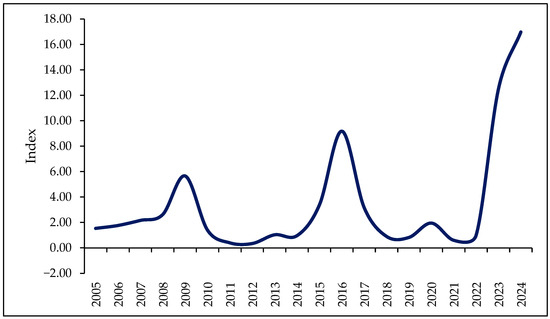
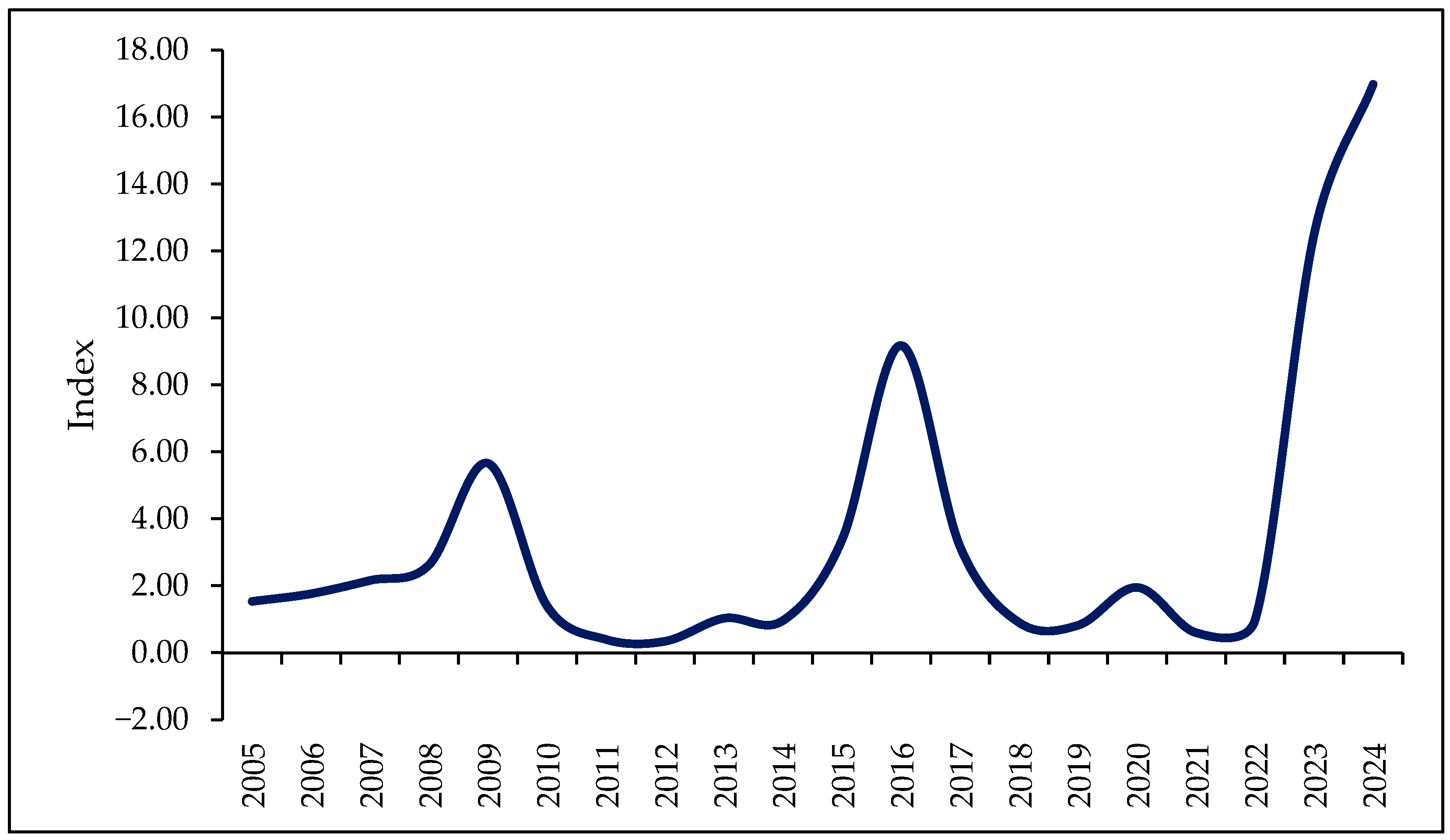

Disclaimer/Publisher’s Note: The statements, opinions and data contained in all publications are solely those of the individual author(s) and contributor(s) and not of MDPI and/or the editor(s). MDPI and/or the editor(s) disclaim responsibility for any injury to people or property resulting from any ideas, methods, instructions or products referred to in the content. |
© 2026 by the authors. Licensee MDPI, Basel, Switzerland. This article is an open access article distributed under the terms and conditions of the Creative Commons Attribution (CC BY) license.