Article

Government Subsidies and Corporate Outcomes: An Empirical Study of a Northern Italian Initiative

Department of Engineering, University of Palermo, Viale delle Scienze Building 7, 90128 Palermo, Italy
*
Author to whom correspondence should be addressed.
Economies 2025, 13(12), 368; https://doi.org/10.3390/economies13120368
Submission received: 18 September 2025 / Revised: 27 October 2025 / Accepted: 13 December 2025 / Published: 16 December 2025
(This article belongs to the Section Economic Development)

Abstract

This study investigated the statistical association between public incentives and industrial innovation as reflected in firms’ financial performances. In particular, the analysis was carried out considering a Regional Operational Program, namely, the 2007–2013 ERDF Regional Program in Lombardy, and investigating a dataset of Lombardy-based companies that received support through the mentioned initiative. For each of them, balance sheet variables before and after the acquisition of the incentive and the development of the related innovation project were detected and analyzed by means of both standard and normalized linear regression. Notably, normalized regressions showed that higher subsidy intensity was positively associated with subsequent changes in revenues and intangible assets, especially among manufacturing firms, thereby supporting policies that target sectors with a high innovation capacity. Furthermore, this research underscores the importance of tailoring policy instruments to local and sectoral contexts, recognizing the limitations of one-size-fits-all approaches. In keeping with this exploratory stance, this study does not build a counterfactual control group and makes no causal claims; it simply documents balance sheet associations that may inform future, impact-oriented research. Given the absence of a control group, the design is observational; all findings describe associations and do not allow causal inference.

1. Introduction

Public subsidies, tax credits, and other fiscal incentives are widely used to foster corporate innovation and regional competitiveness. While existing studies generally confirm positive links with technological outputs, such as patents and R&D spending, they seldom ask whether government transfers leave detectable marks in a firm’s financial statements. This omission is particularly acute in Italy, a country that relies heavily on EU-co-financed regional programs but is rarely examined from a balance sheet perspective. As a result, it remains unclear whether public support can be traced in companies’ revenues, cost structures, or asset composition.
Against this backdrop, this study asks the following: how is the intensity of regional innovation subsidies statistically associated with subsequent changes in key balance sheet items of beneficiary firms? The focus is explicitly correlational; the aim is to map co-movements rather than infer causality.
The analysis centers on Axis 1 (“Innovation and Knowledge Economy”) of the 2007–2013 ERDF Regional Operational Program in Lombardy. A balanced panel of sixty beneficiary firms is compiled, comparing their 2010 pre-treatment accounts with those for 2018, eight years after project kick-off. Both standard and size-normalized linear regressions relate, respectively, the incentive and the incentive-to-turnover ratio to cumulative financial changes and to the ratio of cumulative financial changes to the baseline variable value; results are further disaggregated by manufacturing, advanced services, and residual sectors. This study, thus, provides the first systematic evidence on how ERDF transfers are mirrored in Lombard firms’ financial statements, introduces a simple normalization that places micro- and large enterprises on a common scale, and identifies the segments in which subsidies appear most closely associated with revenue expansion and investment in intangibles.
Section 2 reviews theoretical and empirical work on public incentives and firm performance. Section 3 outlines the institutional setting of the Lombardy program. Section 4 presents data sources and econometric strategy. Section 5 reports the empirical findings and their sectoral interpretation. Section 6 concludes with policy implications, limitations—chiefly the absence of a counterfactual—and directions for future research.

2. Literature Review and Theoretical Background

2.1. Economic Rationale for Selective Incentives

Classic fiscal federalism models argue that decentralized transfers can correct market failures but may also invite rent seeking (Musgrave, 1971; Oates, 1998). Building on this foundation, Schot and Steinmueller (2018) distinguish three policy “frames”—mission-oriented R&D, systems of innovation, and transformative change—each implying different objectives and evaluation metrics. Distributional considerations and size-dependent frictions further shape instrument choice. SMEs, being more exposed to credit rationing and the fixed costs of innovation, may warrant targeted incentives (Beck et al., 2005; Czarnitzki & Hottenrott, 2011; Hall & Lerner, 2010; Stiglitz & Weiss, 1981).

2.2. Firm-Level Evidence

2.2.1. Tax Incentives

Quasi-experimental studies consistently show that lowering the user cost of R&D stimulates private effort. Exploiting a 2008 UK reform, Guceri and Liu (2019) estimated an elasticity of −1.6, implying a one-for-one crowd-in of private spending. Comparable effects surfaced in France and the United States (David et al., 2000; Dechezleprêtre et al., 2016), and meta-analyses confirmed sizeable—though heterogeneous—gains (Acebo & Miguel-Dávila, 2024; Castellacci & Lie, 2015).

2.2.2. Direct Grants and Place-Based Programs

Firm-oriented grants generally raise employment and innovation, but impacts differ across territories and sectors. Italian evidence using a scoring-rule design found short-lived innovation gains in manufacturing (Bronzini & Piselli, 2016). A large UK DiD study showed job creation only where local absorptive capacity was high (Criscuolo et al., 2019). Across seven EU countries, Bachtrögler et al. (2020) documented stronger value-added growth in structurally weaker regions; a follow-up meta-study linked larger employment multipliers to higher administrative efficiency (Bachtrögler-Unger et al., 2024). Evidence from Turkey (Hussen, 2022) and China (Han & Kung, 2015) likewise underscores the role of governance quality.

2.2.3. Instrument Heterogeneity, Ownership Structure, and Entrepreneurship

Chinese studies have revealed that identical levers yield divergent outcomes: counter-cyclical stimuli depress TFP in state-owned enterprises, whereas VAT rebates boost private firm labor shares and R&D intensity (Cheng et al., 2025; Yang & Si, 2025). Timing (Gao & Lu, 2025), leverage (Shao & Chen, 2022), and perceptions of fiscal symmetry (Guo et al., 2024) further modulate effects. Reviews focused on entrepreneurship add that coherent, multi-level mixes of grants, credits, and advisory support amplify start-up performance (Ribeiro-Soriano & Galindo-Martin, 2012). U.S. county-level evidence from Georgia shows industrial development bonds to be positively associated with the number of firms in rural counties, whereas cash subsidies are negatively associated with firm numbers in urban counties (Ivonchyk, 2022). In Central and Eastern Europe, fiscal incentives—especially tax deductions—appear more closely associated with inward FDI intensity than financial incentives (Ginevicius & Simelyte, 2011).

2.2.4. Collaborative and Sector-Specific Schemes

Matched grants coupled with equity stakes expand R&D networks (Chapman et al., 2018) and raise productivity in transition economies (Foreman-Peck & Zhou, 2022). Sector-specific regulation likewise drives investment. Incentive regulation enlarged German electricity-network capital (Brunekreeft, 2007), whereas revised transfer formulas improved fiscal discipline in Russia (Martinez-Vazquez et al., 2006). Under-funded schemes, such as Montenegro’s post-2009 program, show negligible real effects (Jocovic et al., 2017).

2.3. Methodological Progression

Empirical strategies have evolved from cross-sections to difference-in-differences, regression discontinuity, and dynamic-GMM estimators (Criscuolo et al., 2019; Hussen, 2022). Minimum-sample guidelines from Monte Carlo simulations recommend at least ten events per parameter to avoid biased inference (Peduzzi et al., 1996), a rule applied in this study. Digital registries now facilitate record linkage and quasi-experiments, exemplified by Guceri and Liu (2019) and by administrative-data evaluations of EU programs (Pu et al., 2023; Yuan et al., 2023).

2.4. Gap and Positioning of the Present Study

Despite abundant work on patents, R&D outlays, and employment, few contributions trace public money through firms’ balance sheets, and none do so for Italian ERDF programs after project completion. Moreover, the joint roles of administrative capacity and sectoral composition in shaping financial statement responses remain under-explored. Building on the territorial insights of Bachtrögler et al. (2020) and the policy mix perspective of Ribeiro-Soriano and Galindo-Martin (2012), this paper documents how subsidy intensity correlates with eight-year changes in revenues, intangibles, and personnel costs among Lombard beneficiaries, thereby filling both the geographical and accounting-based gaps identified in the literature.

3. Research Context

The 2007–2013 Lombardy Regional Operational Program ERDF, which is the subject of this analysis, represented the main tool to foster investments in industrial research and experimental development at the regional level, aiming to boost competitiveness through Axis 1—“Innovation and Knowledge Economy”. By deliberately departing from the grant-only tradition that still prevailed in most Italian regions, Lombardy adopted a blended-finance architecture in which roughly one quarter of resources took the form of soft loans or guarantees. Accounting for more than EUR 320 million of certified public expenditure and leveraging about EUR 775 million of total investment, Axis 1 financed 1726 projects and four financial-engineering facilities. Within this framework, three calls were particularly significant: the MIUR/Lombardy region call for projects in strategic sectors (ID 39), the R&D energy call for energy efficiency (ID 26), and, finally, the innovation call (ID 31) providing pure, non-repayable grants for cross-sectoral industrial research and experimental development projects, fostering the adoption of enabling technologies across Lombardy’s smart-specialization domains. These initiatives played a fundamental role in directing public and private resources toward priority areas, facilitating new synergies among companies, universities, and research centers, and encouraging the emergence of high-value solutions for the local productive fabric.
The MIUR/Lombardy region call, in particular, was characterized by a well-structured financial scheme combining non-repayable grants and subsidized loans, made possible also thanks to the involvement of national resources such as the MIUR’s FAR Fund. Strategic sectors (ID 39) alone combined EUR 15.5 million of non-repayable grants with a FRIM revolving fund endowment of EUR 49.8 million (EUR 46.3 million was actually disbursed). This funding strategy maximized the engagement of financial actors and ensured greater sustainability of investments. The calls targeted partnerships among SMEs, large enterprises, and research organizations, placing a strong emphasis on multidisciplinary and technological transfer. The selection process, competitive and project-based, required technically and economically robust proposals, which were evaluated through thorough screenings based on impact, innovation, and alignment with regional and national strategies.
Access to these large R&D calls was conditional on mixed consortia—at least one large firm, two SMEs, and a research organization—which resulted in a beneficiary pool where nearly 90% were SMEs, and about 3/4 operated in manufacturing niches such as advanced materials, ICT, and energy technologies.
The target structure was designed to promote public–private collaboration, requiring large companies to partner with SMEs and research centers to access funds. This approach reflects a strategy oriented toward cross-sectoral contamination, stimulating the development of innovative value chains in those sectors considered strategic for Lombardy, including agri-food, aerospace, sustainable construction, energy, ICT, biotechnology, and advanced materials.
Project implementation phases ran between 2011 and 2014, with careful planning to ensure prompt start-up and rigorous management of resources. Fund disbursement was based on work progress (Stati di Avanzamento Lavori (SAL)), supported by the GeFO information system, which enabled complete digitalization of the entire administrative cycle, spanning from applications to reporting. GeFO served as an enabling platform, also from the perspective of new European policies, ensuring transparency, efficiency, and precise traceability of all operations.
Across the three flagship calls examined (ID 39, 26, and 31), 93 firms received EUR 33.9 million, equivalent to 10.6% of all Axis-1 disbursements; individual tickets ranged from EUR 4 000 micro-vouchers up to projects exceeding EUR 2 million.
The monitoring and management of activities were entrusted to an articulated governance structure, with well-defined roles: the Lombardy region (Axis 1 Manager), Finlombarda S.p.A. (for operational management), and a joint evaluation committee from the region and MIUR, responsible for strategic alignment of interventions. Controls over expenses and project progress were carried out at multiple levels, both document-based and on-site, while GeFO monitoring allowed the periodic reporting to the Monitoring Committee and the performance of impact analysis by independent evaluators.
The R&D energy call represented the most significant thematic initiative supporting the development of low-environmental-impact and highly efficient industrial and building processes, providing non-repayable grants for innovative energy efficiency projects, such as those focused on new technologies for electric motors, lighting systems, and sustainable industrial processes. Here, as well, funding was awarded through a competitive process, with evaluation of proposals by a technical–scientific committee and particular attention to collaborations among SMEs, large enterprises (in mandatory partnerships), and research organizations. ERDF incentives were approved and disbursed between 2011 and 2013, while financial statements were observed at baseline in 2010 and follow-up in 2018. Interventions were implemented between 2011 and 2014, with reporting completed by 2015, ensuring full compliance with the European programming framework.
The management of all three funding lines benefited from the GeFO infrastructure for digitalization of processes and reporting, thereby ensuring rapid data collection and precision in sharing information among decision-making levels, including beneficiaries and control authorities. Impacts were measured with specific indicators, such as the number of projects completed, patents generated, investments activated, and environmental and occupational benefits produced.
Program targets were comfortably exceeded: 499 R&D projects versus a goal of 350, 83 patents instead of 30, and a net employment gain of almost 800 researchers.
All three calls shared key principles reflecting the virtuous approach adopted by the region: priority for non-repayable grants, complementarity with revolving mechanisms for high-value initiatives, broad eligibility among beneficiaries, and strong emphasis on the efficiency of disbursement procedures. The structure of controls, both administrative and technical, was fundamental in ensuring compliance with European regulations, transparency in public–private relations, and timely reporting of results.
Nevertheless, several structural weaknesses emerged: GeFO digitalization, while shortening payment times, increased compliance costs for the smallest firms; 38% of the revolving fund envelope remained undrawn; and more than 60% of resources were concentrated in the Milan–Bergamo–Brescia area, despite systematic over-booking that pushed certified expenditure to 102%.
The selective approach—based on objective criteria and merit rankings—encouraged the emergence of excellent projects and reinforced both the innovative capacity and the overall quality of Lombardy’s production system. Respect for EU timelines, with administrative and financial closure between 2015 and 2016, ensured resources were used effectively and activities concluded without dispersion.
Choosing the 2007–2013 programming cycle—though chronologically remote—ensures all funded projects were fully completed and audited well before the COVID-19 shock, avoiding biases from reporting delays and confounding from the pandemic and the 2020–2022 energy price shock. This choice prioritizes data completeness and interpretability over immediacy, so results reflect the post-2008 recovery context rather than current dynamics.
These mixed results make Lombardy an ideal laboratory to test whether different incentive mixes—grants, soft loans, and guarantees—leave discernible traces in firms’ balance sheets once projects have closed, a question still under-explored in the cohesion policy literature.
Overall, the analyzed calls enhanced the dialogue between production and research systems, spreading an innovation culture not only in high-tech sectors but also across sustainable economy value chains. They generated investments, supported qualified employment, promoted patent creation, and ensured modern and transparent governance. Digital integration through GeFO allowed the Lombardy region to efficiently manage ERDF resources, standing out as a virtuous model in line with European best practices for regional innovation promotion.

4. Methodology

4.1. Analytical Scope and Limitations (Non-Causal Design)

This section provides a detailed illustration of the statistical and computational strategy used to analyze the data obtained from company financial statements, implemented via an ad hoc Python pipeline developed and applied in this study (Python v3.9.15; pandas v2.2.3; numpy v2.0.2; scipy v1.13.1; statsmodels v0.14.2; scikit-learn v1.6.1; factor-analyzer v0.5.1; matplotlib v3.9.4; seaborn v0.12.2; openpyxl v3.1.2).
The main objectives of this work are twofold: (i) to describe how changes in companies’ financial variables co-vary with the intensity of economic incentives; (ii) to highlight potential behavioral differences among companies operating in different sectors, as classified by the Ateco system (the Italian version of the European NACE (Nomenclature of Economic Activities, Rev. 2 nomenclature)). To achieve these goals, a rigorous analytical workflow was designed, ranging from data preparation and cleaning to the use of the most appropriate inferential and multivariate statistical procedures, with particular attention paid to the validation and interpretation of the results obtained.
We contrast pre- and post-intervention accounts within beneficiary firms to map statistical relationships rather than to infer causality. For this reason, matching procedures, staggered difference-in-differences estimators, and synthetic controls are not implemented; these tools are reserved for future studies that will tackle the counterfactual dimension once suitable comparison data become available.
The empirical design adopted here is explicitly associative: no counterfactual group is available; therefore, coefficients are interpreted strictly as correlations.

4.2. Data Collection and Structuring

The dataset referenced consists of a collection of company financial statements downloaded for the years 2010 and 2018 from the “Registro delle Imprese” (Business Register) via the Telemaco portal (Italian Chambers of Commerce/Infocamere). Beneficiary lists and legally binding grant decrees—containing project identifiers and awarded amounts—were downloaded from the Lombardy region’s (Regione Lombardia) official portals and the Official Bulletin of the Lombardy Region (Bollettino Ufficiale della Regione Lombardia, BURL). All firm identifiers were reconciled via VAT numbers. The companies whose financial statements were analyzed were identified from final government reports closing the administrative procedure for the granting of incentives related to the aforementioned Lombardia Region ERDF 2007–2013 program.
Although Axis 1 of the Lombardy ERDF program supported 1726 firms in total, only projects classified under the specific thematic strand ‘Ricerca e Innovazione’ (‘Research and Innovation’) were relevant to our research question. Ninety-three beneficiaries fell into this category, but the usable sample fell to sixty because (i) complete pre- and post-award financial statements were unavailable for some firms, (ii) post-award mergers or spin-offs altered several corporate perimeters, and (iii) a handful of cases breached the 0–0.6 incentive-to-turnover filter adopted to avoid extreme leverage. The resulting panel of sixty companies, therefore, represents the full set of ‘Research and Innovation’ projects for which consistent, comparable accounting data could be retrieved. In short, the strand financed 93 projects/beneficiaries; after integrity checks and data cleaning, the balanced panel comprises 60 firms. The analysis was conducted by considering a baseline year before receipt of the incentive (2010) and a year following the receipt of governmental financial support (2018). Of these companies, in 2010, in accordance with European Commission Recommendation No. 2003/361/EC of 6 May 2003, 59 were classified as SMEs (with annual turnover below fifty million euros), while 2 were classified as “large enterprises”. After receiving the incentive, in 2018, four companies changed classification from “medium” to “large”, while two changed from “large” to “medium” enterprises. Companies were selected if they had received an incentive within an open interval (0, 0.6) for the ratio between incentive and turnover for the year 2010, as it is difficult to interpret incentive values higher than the annual turnover of the beneficiary companies.
Each company is identified by its VAT number in relation to the specific financed project. Each annual company record includes accounting and performance variables—such as tangible and intangible assets, revenue, profitability indicators like ROE, ROI, ROS, and relevant items such as personnel costs and tk (the capital turnover index and ratio of turnover to invested capital)—along with metadata useful for sectoral and demographic identification, especially the Ateco code. An independent variable of particular interest is the amount of public or private incentives received during the period examined.
The first methodological step consisted of organizing these data, focusing the analysis on the variations in each variable over time, calculated as the difference between the earliest (2010) and most recent (2018) available years for each company. This allows for a before-and-after analytical approach, concentrating on the differential effects that incentives may have produced on actual company dynamics. The baseline descriptives are in Appendix A, Table A1; the correlations and additional summary statistics are in Appendix A, Table A2, Table A3 and Table A4.
For representativeness, we benchmark the sectoral composition of the sample against the 2010 Lombardy firm population (ISTAT–ASIA). Manufacturing (C) accounts for 76.7% of the sample versus 68.0% in the region (+8.7 pp; over-represented), residual sectors (AA) for 18.3% vs. 18.0% (+0.3 pp; aligned), and professional/technical services (M) for 5.0% vs. 14.0% (−9.0 pp; under-represented). Appendix A, Table A4, reports the sectoral comparison. This skewness reflects the design of the ‘Research and Innovation’ strand—biased toward technologically intensive, manufacturing-oriented projects—and cautions against extrapolating to services-heavy or micro-firm populations. The residual group (AA) aggregates less-represented ATECO codes.
At a geographic level, beneficiaries are concentrated along the Milan–Bergamo–Brescia axis, consistent with observed allocation patterns in the program period.
Regarding size and financial structure, the sample tilts toward medium-sized firms, and baseline balance sheet profiles are broadly consistent with technology-oriented cohorts, which supports the interpretability of normalized specifications while cautioning against extrapolation to very small service-sector firms.
We adopted a pragmatic rule-of-thumb of at least 10 observations per estimated parameter, and with seven parameters (including interaction terms), this yields a target of 70 observations; given our sample size of 60—close to this benchmark—we judged the sample adequate for exploratory analysis while acknowledging its modesty and the need for cautious interpretation. This rule is widely cited and derives from simulation studies (Peduzzi et al., 1996). A complete summary of all variables (means, medians, standard deviations, and Pearson correlations) is available in Appendix A, Table A2 and Table A3.

4.3. Preprocessing: Calculation of Variations, Normalization, and Grouping

For each company, the first and last available time observations were identified. For each financial variable of interest, both absolute changes (also known as “delta” (“Δ”), i.e., the simple difference between the most recent value in 2018 and the 2010 starting value) and relative or “normalized” changes (“Δ norm”) (calculated with respect to the initial 2010 value, facilitating comparisons of impact across companies of different sizes or business volumes) were derived. A similar approach was adopted for the “incentive” variable, normalized with respect to turnover (reflecting company size), to compare companies of different scales.
Subsequently, companies were reclassified according to the previously defined C, M, and AA groups. Finally, each observation was assigned a progressive identifier (‘label’) obtained by ranking firms in ascending order of incentive intensity, defined as Incentive/Revenue2010. This label is kept consistent across all figures and tables to facilitate cross-plot identification.

4.4. Statistical Analysis

Linear Regression Analysis (Standard, Normalized, and with Interaction)

The analysis is based on linear regression models, estimated both in their standard version and in normalized form, that is, using dependent and independent variables in absolute (“standard”) and “normalized” terms, respectively.
The aim is to examine the relationship between changes in the main financial variables and the amount of incentives received by each firm, and then to verify how this relationship may differ among Ateco groups and whether there are significant interactive effects related to sector affiliation. For each change of interest, the following were constructed: a global regression model ignoring sectoral differences (“simple”), a model specifically including the incentive–group interaction (using the residual “AA” category as the reference) (“multi_int”), and, finally, a marginal estimate weighted for group composition (“marginal”).
For each of the above types of linear regression, three modeling approaches were performed, following different equations:
  • The simple model, a simple linear regression with “incentive” as the only independent variable:
ΔY = β0 + β1 · Incentive + ε
  • Multi_int (or the interaction model), a multivariate linear regression including incentive, ATECO category membership (dummy variables with the AA category as the baseline group), and interaction terms between incentive and the ATECO category:
ΔY = β0 + β1 · Incentive + β2 · ATECO + β3 · (Incentive · ATECO) + ε
  • Marginal, a multivariate linear regression in which all marginal effects (weighted by the number of companies in each ATECO category) on the dependent variable are assessed for incentive, ATECO membership, and their interactions. This approach, formalized as
Marginal Effect = Σ(β1 + β3k) · wk
where wk denotes the proportion of group k, provides a more robust measure of the average impact of incentives across the entire corporate population.
The regression line for the “marginal” approach, not estimated directly by another specific statistical model but simply by weighting the marginal effects of individual dependent variables, was not subjected to any significance test (p-value calculation) for the regression coefficient of the “incentive” independent variable. R-squared was calculated manually from correlations, the Breusch–Pagan test was performed on the weighted model structure, and the Shapiro–Wilk test checked the composite residuals. Moreover, no ANOVA analysis was conducted for this type of regression Equation (3).
The results of these regressions are presented as visualizations illustrating both the observed distributions and the estimated trend lines for each group, using graphs and symbols to highlight statistical significance. For each model, detailed numerical outputs—including regression coefficients, ANOVA tests, model goodness-of-fit indices, and a full range of diagnostic tests (such as the Shapiro–Wilk normality test, the Breusch–Pagan heteroscedasticity test, and possible multicollinearity via VIF)—are recorded (see Appendix A, Table A5). In the multi-interaction variant, the specific slope estimates and their significance for each sectoral group are also reported.

4.5. Diagnostic Analysis (Plots and Residual Tests)

For each regression model estimated, a thorough residual analysis is conducted by creating specific graphs such as Q–Q plots (to compare the residuals’ distribution with the theoretical normal) and scatterplots of residuals versus predicted values. Additionally, threshold exceedances are shown to identify potential outliers.

4.6. T-Test for Comparison Between Ateco Groups

To evaluate possible divergences between sectoral groups in the dynamics of balance sheet variable changes, a pairwise comparison was implemented using Welch’s t-test, which ensures accurate estimates even in the presence of unequal variances and sample sizes. For each comparison, means, sample sizes, mean differences, and statistical significance were evaluated, along with corresponding degrees of freedom.

4.7. Validation and Expected Outcomes

The methodology adopted in this work is characterized by constant attention to the quality and statistical validation of the results obtained. The use of statistical techniques and diagnostic procedures, such as the broad suite of regression model diagnostics, and the extensive analysis of sectoral differences through t-tests corrected for unequal variances, ensures not only the reliability of derived inferences but also maximum transparency and replicability of the analytical process. The breadth and detail of the results enable both a comprehensive overview of the underlying dynamics and the possibility to go into detail for individual financial variables and group differences, providing valid operational and interpretive tools for both scientific investigation and practical needs in reporting and governance.

4.8. Diagnostics and Validity Checks

Given the associative, non-causal design and the absence of administrative cut-offs, we do not implement Rosenbaum bounds, propensity score matching, difference-in-differences (DiD), or regression discontinuity designs. To assess robustness, we deploy (i) residual normality, heteroscedasticity, and multicollinearity (Appendix A, Table A5); (ii) 10,000-draw permutation tests (Appendix A, Table A6); (iii) outlier sensitivity via ±3σ trimming (Appendix A, Table A7); (iv) placebo regressions (Appendix A, Table A8); and (v) floor-effect analysis (Appendix A, Table A9). The Python pipeline exports Q–Q plots and residual-versus-fitted charts (available upon request). The empirical outcomes of these checks are reported in Section 5.3 and Appendix A, Table A5, Table A6, Table A7, Table A8 and Table A9.

5. Results and Discussion

5.1. Descriptive Statistics

All findings reported below are descriptive covariances and should not be interpreted as causal impacts.
Standard and normalized linear regressions are jointly estimated on an eight-year panel (2010–2018) to relate ERDF 2007–2013 financial incentives, disbursed in 2011–2013, to subsequent balance sheet dynamics. Absolute specifications model the raw 2018–2010 deltas, whereas normalized specifications scale both incentives and outcomes by their 2010 levels, thereby capturing proportional growth that remains comparable across heterogeneous firm sizes; all coefficients, thus, represent cumulative adjustments five to seven years after payment. Comprehensive results for simple, interaction, and marginal models appear in Appendix A, Table A10, Table A11, Table A12, Table A13, Table A14, Table A15 and Table A16, with global diagnostics—including Shapiro–Wilk normality, Breusch–Pagan heteroscedasticity, and variance inflation factors—reported in Appendix A, Table A5, and full standard errors in Appendix A, Table A17. Appendix A, Table A2 and Table A3 (baseline), and Appendix A, Table A18 and Table A19 (changes), document pronounced cross-firm heterogeneity: revenues span from −EUR 44.5 million to +EUR 60.3 million (−100% to +998%), and comparable dispersion characterizes intangible assets, personnel costs, and profitability, thereby motivating the use of both absolute and normalized specifications. The ‘−100% to +998%’ range reflects proportional changes on small bases and the presence of a few end-of-period zeros (−100% when Y2018 = 0). For revenues, no baseline zeros are observed in 2010 (Appendix A, Table A1); the ~+1000% increases, therefore, reflect ≈11× growth from relatively small 2010 bases (max. Δ_norm = 9.9816; Appendix A, Table A19). An audit of the official financial statements confirms two firms with zero revenues in 2018—one in manufacturing (ATECO C; label 40) and one in the residual cluster (AA; label 38). We retain these observations because they create no computational issue (Δ_norm = −1 given Revenue2010 > 0), and excluding them would further shrink the sample (N: 60 → 58). For intangible assets, baseline zeros are rare and are automatically excluded from the normalized specification (N = 59; Appendix A, Table A19), and the floor effect assessment indicates low risk (Appendix A, Table A9). Robustness checks based on 10,000-draw permutation tests, ±3σ outlier trimming, and Huber M-estimation confirm that the main normalized associations are not driven by tail behavior (Appendix A, Table A6, Table A7 and Table A20). As an additional sensitivity, we re-estimate all normalized models after removing observations with zero values in 2010 or 2018; the direction and statistical significance of the key coefficients are unchanged (revenues and personnel costs remain positive and significant, and the manufacturing-specific coefficient for intangibles remains significant), consistent with the robustness evidence in Section 5.3. Baseline Pearson correlations computed on the 2010 snapshot reveal marked collinearity among profitability ratios (ROE–ROI r = 0.83; ROI–ROS r = 0.87) and a weak negative link between intangible assets and contemporaneous profitability (r = −0.13), indicating that many beneficiary firms had not yet transformed R&D outlays into financial returns; possible multicollinearity is, therefore, monitored through subsequent variance inflation diagnostics.
For normalized changes over 2010–2018, turnover and financial leverage covary strongly (r = 0.74), while growth in intangible assets is only weakly related to employment expansion (r = 0.14) and negatively associated with the ROS–personnel cost ratio (r = −0.21), signaling dimensional expansion with limited labor adjustment (Appendix A, Table A3).
Because no untreated control group is available and only two time points are observed, the analysis is confined to conditional correlations rather than causal effects. Nonetheless, robustness is probed through (i) permutation-based confidence intervals (Appendix A, Table A6); (ii) outlier sensitivity checks (Appendix A, Table A7); (iii) placebo regressions on plausibly unrelated variables, including a remote period ROE test that yields p > 0.05 (Appendix A, Table A8); and (iv) floor effect diagnostics (Appendix A, Table A9). Throughout, Δ denotes absolute change, while Δ_norm signifies proportional change.

5.2. Regression Results

5.2.1. Standard Regression Results: Absolute Changes

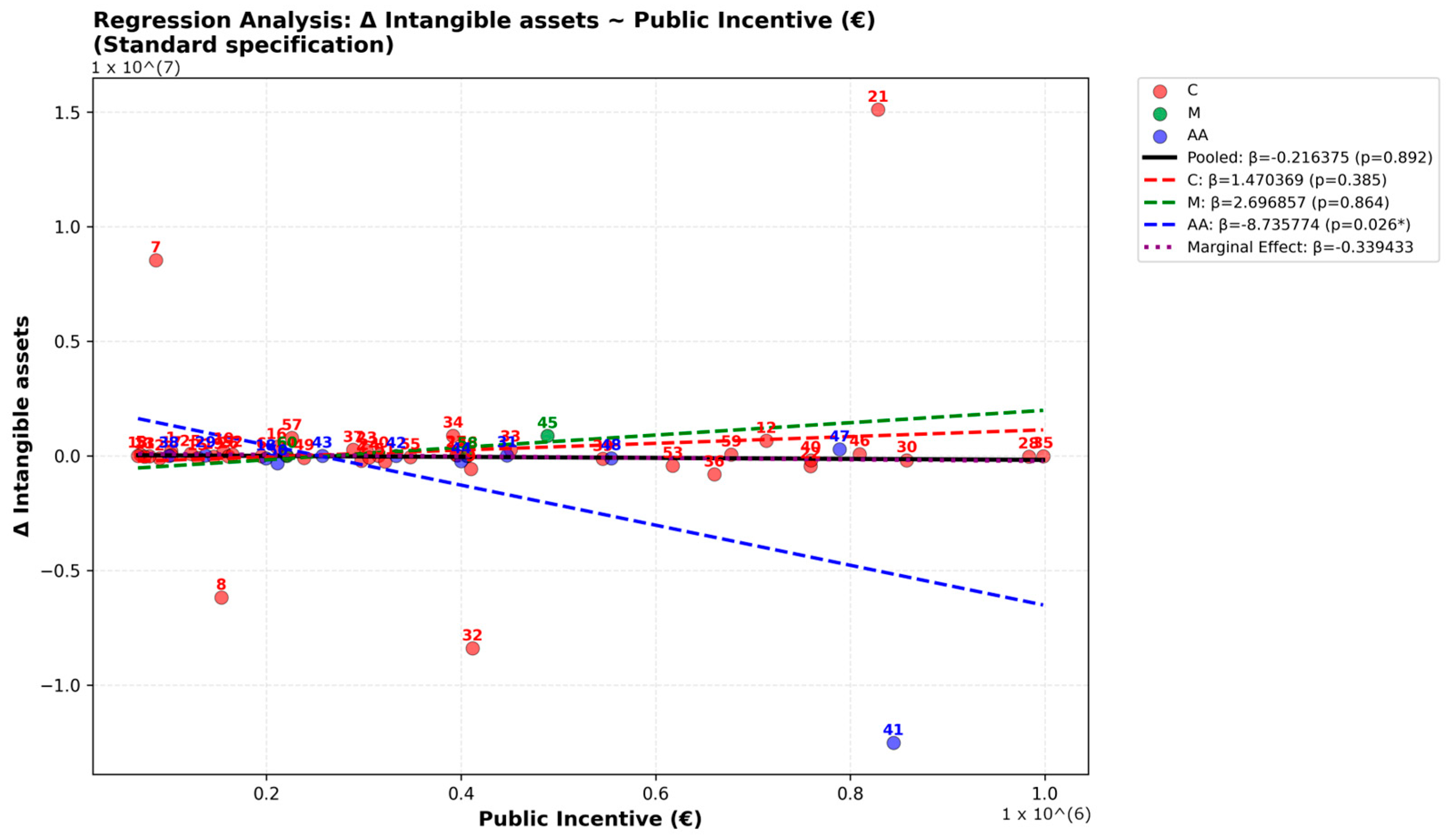
Across the full 2010–2018 horizon, standard regressions estimated on absolute balance sheet deltas reveal no statistically significant associations between incentive intensity and the outcome variables. Appendix A, Table A12, shows that every slope coefficient reported for revenue, tangible assets, intangible assets and personnel costs carries a p-value above 0.10; the signs fluctuate—where intangible assets β = −0.216 (SE = 1.580; p = 0.892), personnel costs β = −0.307 (SE = 1.412; p = 0.829), revenue β = 10.316 (SE = 7.575; p = 0.179), and tangible assets β = −1.895 (SE = 2.550; p = 0.461)—but none approaches conventional significance thresholds. The adjusted R2 statistics hover around zero or turn negative, implying that incentive intensity explains virtually none of the variance in absolute financial changes once the pronounced heterogeneity in firm scale is left unaddressed. The only apparent deviation from this null pattern arises in the multivariate interaction model for intangible assets, where the ATECO Group AA term reaches significance (β = 10.206, SE = 4.168, and p = 0.018; Figure 1 and Appendix A, Table A10).
Closer inspection undermines this result. Figure 1 indicates it is driven largely by a single influential observation (case 41), a firm belonging to a rare ATECO category and exposed to the incentive regime only from 2012 to 2018. When robust regression techniques down-weighting high-leverage points are employed, the coefficient loses significance entirely (Appendix A, Table A20), and the pooled simple model for intangible assets remains non-significant (p = 0.892). Taken together, these findings demonstrate that absolute financial metrics conflate genuine policy responses with baseline scale effects, rendering them ill-suited for cross-firm evaluation and motivating the subsequent focus on normalized specifications.

5.2.2. Normalized Regression Results: Core Findings

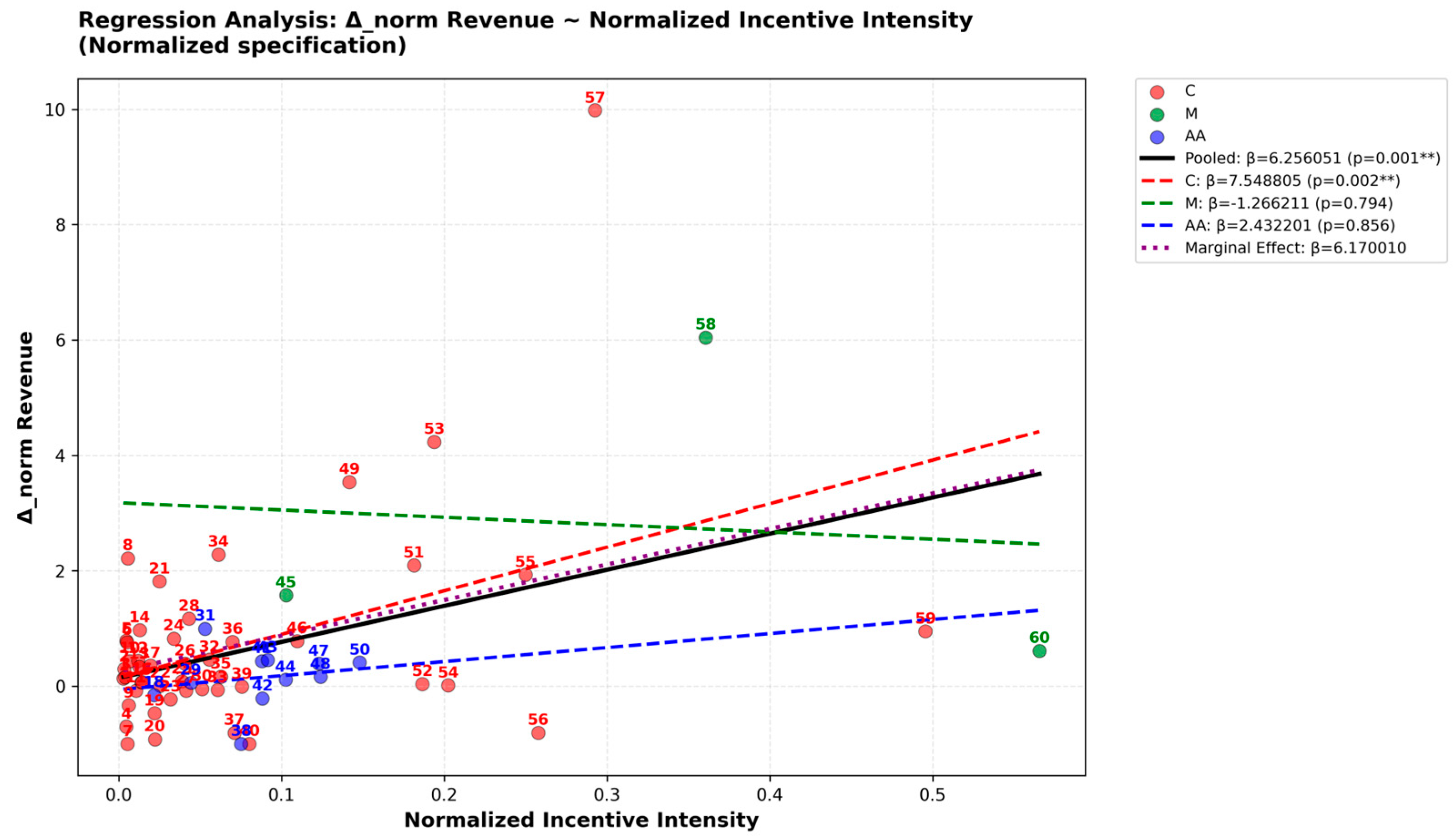
Normalized panel regressions covering 2010–2018 show that firms receiving larger incentives relative to their 2010 sales experience statistically significant gains in revenues, intangible assets, and, more moderately, personnel costs. Scaling both the incentive variable and outcomes to their 2010 levels, the pooled revenue equation yields a slope of β = 6.26 (SE = 1.814 and p < 0.001; Appendix A, Table A13), meaning each percentage-point increase in incentive intensity is associated with a 6.26-point rise in proportional revenue growth. Although residuals are non-normal (Shapiro–Wilk, p < 0.001) and mildly heteroscedastic (Breusch–Pagan, p = 0.0008; Appendix A, Table A5), the estimate attenuates under trimming (β = 5.96 and p = 0.097; Appendix A, Table A7) but passes a 10 000-draw permutation test (empirical p = 0.0099; Appendix A, Table A6) and remains significant under robust estimation (β_robust = 2.92 and p = 0.0079; Appendix A, Table A20). Sectoral interactions reveal that manufacturing (Group C) drives this aggregate association: Figure 2 shows a steep red dashed line, where β_C = 7.54 (SE = 2.68 and p = 0.002; Appendix A, Table A11), whereas professional services (Group M) and the residual cluster (Group AA) display flat, insignificant slopes (p > 0.20).
Even after down-weighting high-leverage points, the manufacturing coefficient stays significant (β_robust = 3.21, SE = 1.09, and p = 0.028; Appendix A, Table A20), reflecting Lombardy’s superior industrial absorptive capacity. The sector-weighted marginal slope—β_marginal = 6.17 (Appendix A, Table A16)—nearly matches the pooled value, confirming that manufacturing dominance, not outliers, underpins the overall pattern.
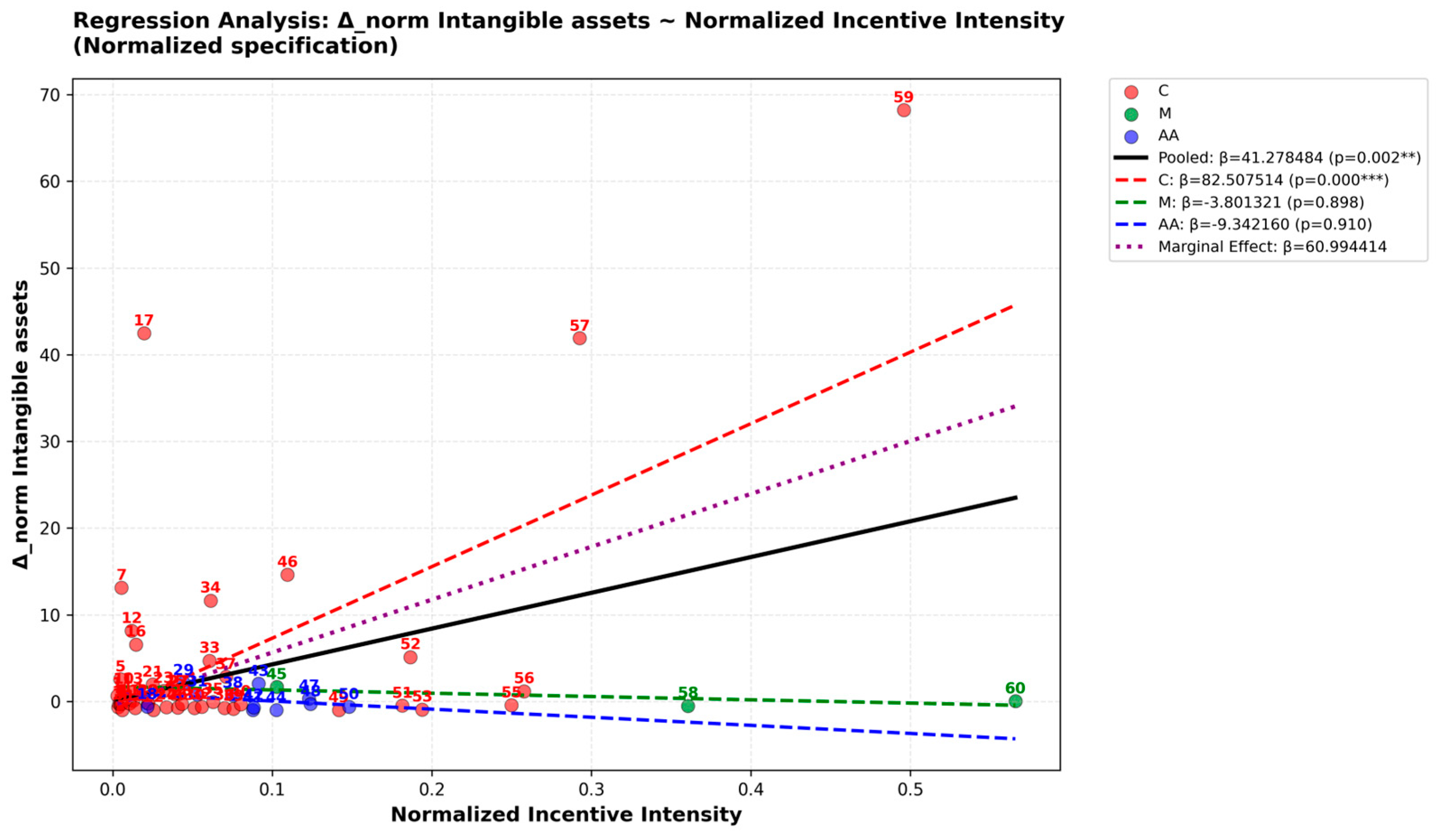
Intangible assets exhibit an even stronger association. The pooled coefficient is β = 41.28 (SE = 12.57 and p = 0.002; Appendix A, Table A13); a 1-point rise in incentive intensity corresponds to a 41-point increase in normalized intangible growth, covering patents, proprietary software, and capitalized R&D. Diagnostic issues mirror those of revenues—non-normal residuals and significant heteroscedasticity—yet permutation testing confirms specificity (empirical p = 0.0136; Appendix A, Table A6), and floor-effect risks are negligible (6.7% of observations are below 1% of the median; Appendix A, Table A9). Nevertheless, pooled significance evaporates after excluding outliers (β = 3.06 and p = 0.319; Appendix A, Table A7). Disaggregating by sector restores clarity. Manufacturing’s interaction slope, β_C = 82.51 (SE = 19.51 and p < 0.001; Appendix A, Table A11), more than doubles the pooled figure, while Groups M and AA remain flat. Figure 3 locates manufacturing observations in the upper-right quadrant; robust re-estimation on the manufacturing subset (n = 46) still yields β_robust = 13.42 (p = 0.0026; Appendix A, Table A20), and the statistical power is 1.0 (Appendix A, Table A21).
Welch tests corroborate sectoral divergence. Manufacturing’s intangible growth exceeds that of residual sectors (mean difference = 4.69, p = 0.025, and d = 0.388) and professional services (4.45, p = 0.040, and d = 0.340; Appendix A, Table A22). These patterns indicate that industrial clusters with dense R&D routines and skilled labor convert subsidies into knowledge capital far more effectively than service or low-tech firms.
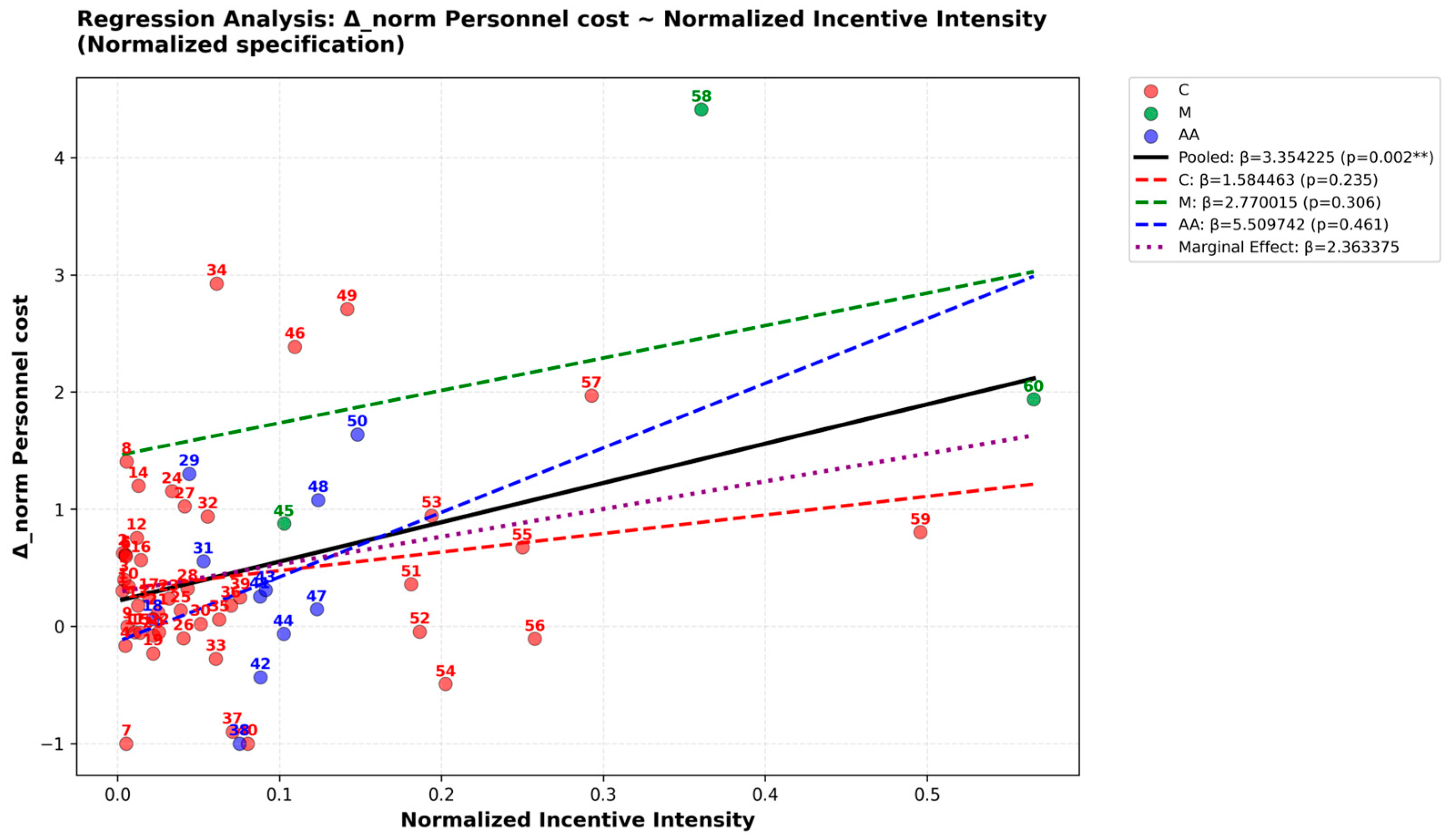
Personnel costs rise more uniformly. The pooled coefficient equals β = 3.35 (SE = 1.024 and p = 0.002; Appendix A, Table A13) and withstands permutation testing (empirical p = 0.0051; Appendix A, Table A6) as well as robust estimation (β_robust = 2.57 and p = 0.0049; Appendix A, Table A20). The interaction terms by ATECO sector are insignificant (p_C = 0.605, p_M = 0.730, and p_AA = 0.461; Appendix A, Table A11), and the joint F-test is null (p = 0.954), so Figure 4’s dotted marginal line (β_marginal = 2.36; Appendix A, Table A16) overlaps with the simple-fit line.
The uniformity implies that incentive-funded projects across sectors recruit additional engineers, project managers, and administrative staff from a common labor pool, consistent with recruitment from a common skilled labor pool across sectors.
Together, the results show that, once normalized, public incentives are positively associated with increases in revenues and intangible assets—especially within manufacturing—and systematically increase personnel expenditures, highlighting the role of absorptive capacity and system-wide labor adjustments.

5.2.3. Null and Marginal Findings

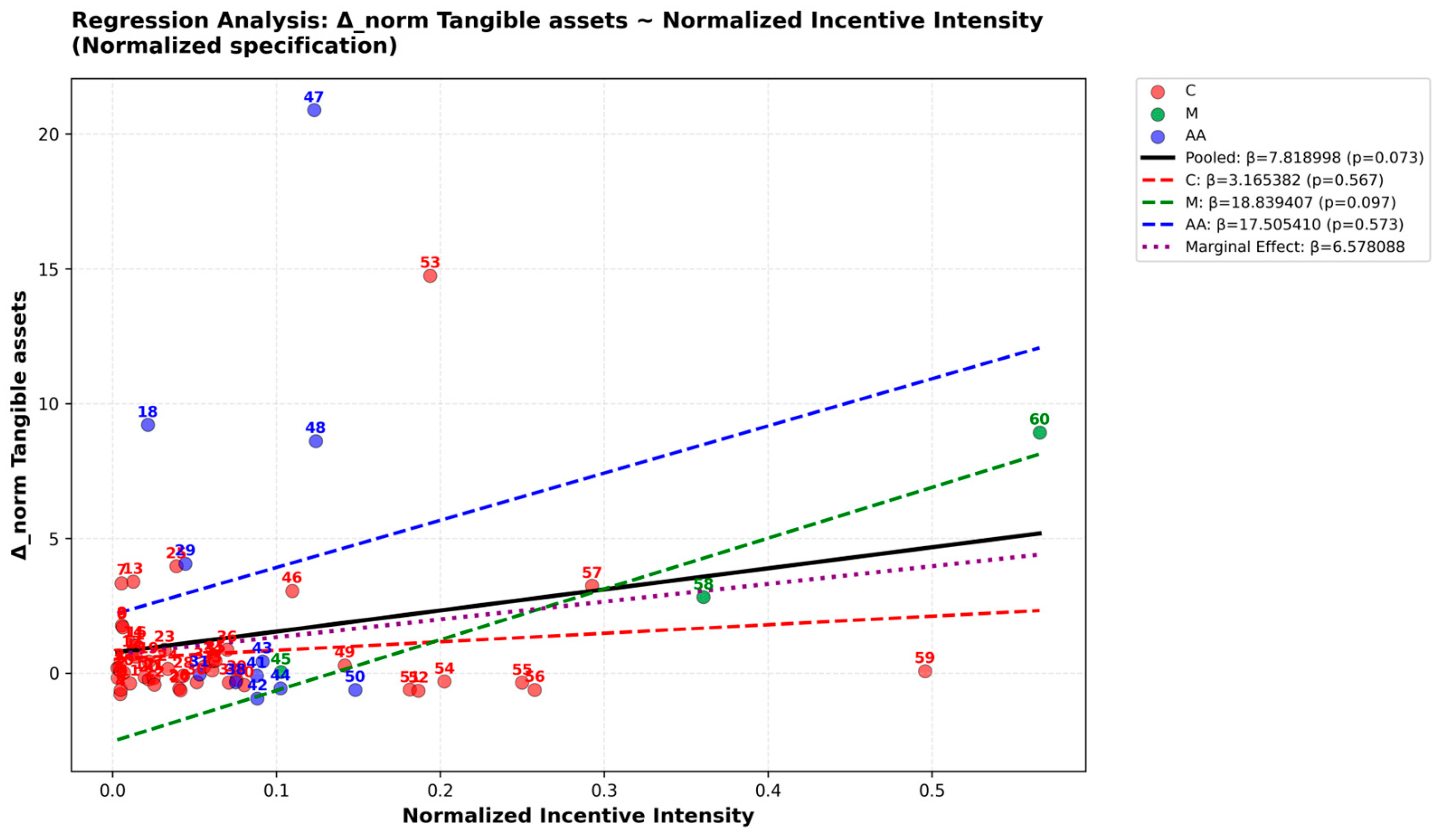
Across the remaining balance sheet variables, only weak or unstable associations with incentive intensity emerge. Tangible assets—plant, machinery, and real estate—exhibit a positive but merely borderline coefficient in the pooled normalized regression (β = 7.82, SE = 4.28, and p = 0.073; Appendix A, Table A13), while all interaction terms remain non-significant (Appendix A, Table A10). Figure 5 confirms the negligible effect: the pooled line slopes gently upward, yet the wide scatter and overlapping confidence bands rule out firm inference.
Placebo regressions (Appendix A, Table A8) likewise reject any systematic connection between incentives and physical capital growth, a pattern consistent with the program’s orientation toward intangible innovation and with the longer investment cycles characteristic of heavy equipment, which the eight-year observation window may not fully capture.
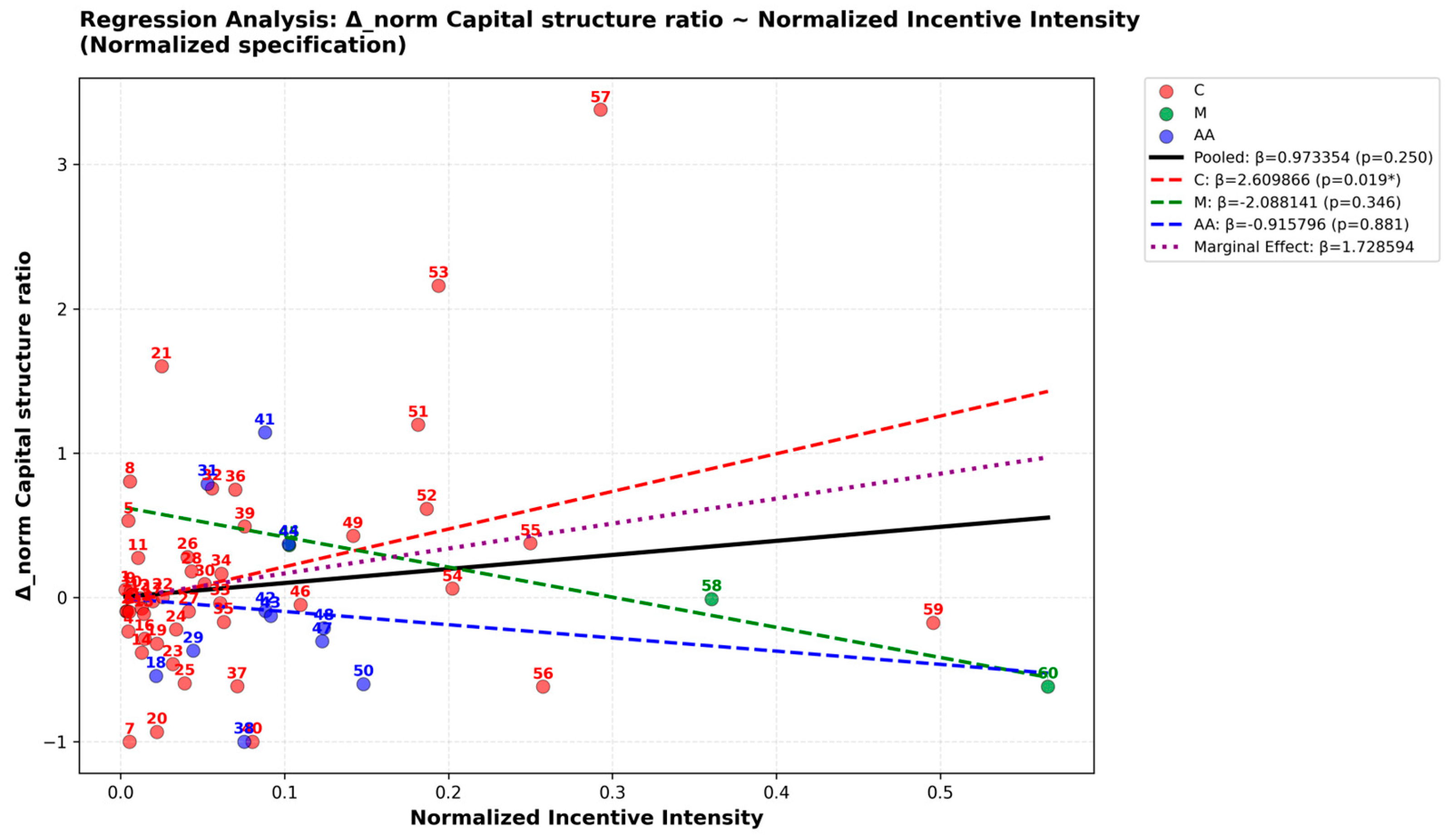
The capital turnover ratio (revenue divided by invested capital) is similarly unaffected in aggregate, posting a pooled normalized coefficient of β = 0.97 (SE = 0.84 and p = 0.251; Appendix A, Table A13). A sector-specific interaction for manufacturing firms attains conventional significance (β_C = 2.61, SE = 1.06, and p = 0.024; Appendix A, Table A11) and appears as a modest upward slope in Figure 6’s red dashed line, yet multiple robustness checks undermine its credibility: permutation testing yields p = 0.234 (Appendix A, Table A6), outlier exclusion erases the effect (Appendix A, Table A7), and robust regression shrinks the coefficient by 58.1% and reverses its sign (Appendix A, Table A20).
In keeping with this study’s caution toward results arising solely in interaction models, this pattern is best interpreted as a sampling artefact.
The profitability metrics remain completely decoupled from incentive intensity. The pooled normalized estimates are small, statistically insignificant, and inconsistent in sign, where ROE β = 36.52 (p = 0.352), ROI, β = −3.16 (p = 0.848), and ROS β = −486.687 (p = 0.464; Appendix A, Table A13). The single apparent anomaly, a negative ROI response for Group AA (β_AA = −246.18, SE = 113.68, and p = 0.035; Appendix A, Table A11), loses robustness once the overall fit is considered and likely reflects temporary balance sheet maneuvers—accelerated depreciation or strategic loss taking—undertaken to secure funding rather than genuine efficiency losses. Placebo tests for the pre-treatment ROE (2005–2010) reveal no spurious associations (Appendix A, Table A8), and permutation procedures fail to reproduce any profitability gradient beyond random noise (Appendix A, Table A6).
That short-run profitability remains unaffected is fully compatible with the cost profile of innovative activity: R&D salaries, patent fees, and prototyping expenses depress margins before commercial revenues accrue, and firms often reinvest early gains rather than distribute them. Combined with the robust revenue and intangible asset gains documented elsewhere, the null or marginal findings for tangible assets, turnover, and profitability indicate that the incentives chiefly stimulated growth-oriented, knowledge-intensive investments whose financial returns are likely to materialize beyond the current eight-year horizon.

5.3. Robustness and Diagnostics

Model diagnostic checks indicate that the estimated associations for revenues, intangible assets, and personnel costs remain stable despite departures from classical ordinary least-squares assumptions. Shapiro–Wilk statistics confirm residual non-normality in virtually every specification (p < 0.001; Appendix A, Table A5), a pattern consistent with the right-skewed distributions typical of balance sheet items whose downside is bounded by bankruptcy but whose upside is unbounded. With a sample of 60 firms, the central-limit theorem and the use of robust standard errors ensure valid inference. See also Section 4.4, Section 4.5, Section 4.6, Section 4.7 and Section 4.8 for the robustness architecture and diagnostic suite. Breusch–Pagan tests show homoscedasticity for absolute change models (most p > 0.50) but heteroscedasticity for normalized growth rates (p < 0.05 for revenues, intangibles, and personnel costs; Appendix A, Table A5); nevertheless, Huber M estimator corrections leave all three key slopes significant and only moderately attenuated (23–58%; Appendix A, Table A20), implying that unequal variances do not account for the results. Variance inflation factors alleviate multicollinearity concerns: although interaction specifications produce VIFs as high as 55 because each interaction mechanically correlates with its constituent terms, simple models never exceed 1.5, and sector-specific estimations eliminate the inflated values altogether (see Appendix A, Table A5; max. VIF).
Non-parametric validation based on 10,000 permutations of the incentive variable corroborates the findings. The observed slopes for normalized revenues, intangibles, and personnel costs lie in the extreme tail (<2%) of the null distribution, yielding empirical p-values of 0.0099, 0.0136, and 0.0051, respectively (Appendix A, Table A6). In contrast, profitability measures and tangible assets fail to reach significance in the permutation exercise (all p > 0.20), supporting their interpretation as true null effects rather than consequences of low statistical power. Outlier robustness tests further differentiate the outcomes. Eliminating observations with residuals beyond ±3 s.d. changes the personnel cost coefficient by only 23.5% and retains significance (Appendix A, Table A7). Revenues experience a 53.3% reduction and drop to p = 0.097, whereas the pooled intangible asset estimate shrinks by 92.6% and becomes insignificant. Crucially, the manufacturing-only specification of intangible assets remains robust even after re-estimation, showing an 83.7% attenuation but a highly significant p-value of 0.003, which vindicates the sectoral decomposition approach (Appendix A, Table A20). Fewer than 15% of observations qualify as high-leverage, indicating that results are not driven by extreme cases (see Appendix A, Table A7).
Placebo regressions lend further credibility: incentive intensity has no detectable association with long-term leasing liabilities, trade receivables, or pre-treatment return on equity, with all coefficients insignificant at p > 0.40 (Appendix A, Table A8), thereby ruling out indiscriminate balance sheet expansion or pervasive omitted variables. Floor effect diagnostics address the risk that near-zero baselines inflate percentage changes; the share of firms with near-zero values never exceeds 6.7% (intangible assets) and remains well below the 10% cautionary threshold (Appendix A, Table A9), confirming the suitability of normalized specifications. Taken together, the convergence of evidence from heteroscedasticity robust estimation, multicollinearity checks, permutation tests, outlier analysis, placebo regressions, and floor-effect scrutiny substantially mitigates threats to identification inherent in a pre–post design without a formal control group, and supports the interpretation that the observed relationships capture genuine policy-related patterns rather than statistical artefacts.

5.4. Sectoral Interpretation and Transmission Mechanisms

Standard and normalized regressions for 2010–2018 indicate that public incentives in Lombardy are systematically redirected toward growth-oriented uses, as evidenced by the positive and statistically significant slopes linking the normalized incentive variable to both revenues and intangible assets (Appendix A, Table A11 and Table A13). Sectoral disaggregation reveals marked heterogeneity. Manufacturing firms (Group C) emerge as the primary beneficiaries, showing the steepest coefficients for revenues (β_C = 7.54; p = 0.002) and intangibles (β_C = 82.51; p < 0.001). The region’s dense industrial fabric—where SMEs, multinational anchors, and university labs co-locate—compresses knowledge transfer cycles and, combined with high absorptive capacity, enables these firms to translate subsidies rapidly into product development and sales growth, thereby fueling a self-reinforcing innovation loop. Service enterprises (Group M) exhibit a different trajectory: incentives correlate with higher personnel expenditures while short-run profitability ratios remain unchanged, a pattern consistent with investments in reskilling, digital process re-engineering, and specialist recruitment, whose returns materialize only after a gestation phase. Program records confirm that many professional service recipients are pivoting from low-margin consulting toward proprietary software and data analytics platforms. The residual cluster of agricultural firms, low-tech manufacturers, and micro-enterprises (Group AA) shows weak or negative, non-significant slopes for key variables (Appendix A, Table A10 and Table A11). Capability gaps, fragmented supply chains, and limited managerial know-how culminate in the highest non-completion rate of the program, with 38% of revolving-fund envelopes undrawn, pointing to a selection-into-distress dynamic.
The interplay of rapid commercial expansion in manufacturing, capability building in services, and incremental experimentation in niche sectors creates a portfolio effect that lifts the region’s performance frontier and explains the system-wide rise in personnel costs through heightened demand for skilled labor. Lombardy’s blended-finance architecture—combining non-repayable grants, soft loans, and revolving funds—implicitly tailors support to heterogeneous absorptive capacities. Cash-rich manufacturers gravitate toward soft loans to preserve equity, early-stage service firms without collateral favor grants, and chronic under-utilization of revolving funds, consistent with heterogeneous instrument uptake across sectors. Related implications are discussed in Section 6.2.

6. Conclusions, Policy Implications, Limitations, and Future Research

6.1. Key Findings

This study examined the association between public innovation incentives and firms’ subsequent financial trajectories in Lombardy, focusing on beneficiaries of the 2007–2013 ERDF Regional Program and tracking outcomes over 2010–2018. Within the confines of the empirical design, the central regularity is a positive relationship between aid intensity and growth in turnover and intangible assets, with the pattern most evident among manufacturing firms embedded in dense production networks. These findings resonate with European evidence showing that subsidies and tax-based support leave measurable traces in corporate accounts and are not confined to bibliometric outputs. Balance sheet studies on Spanish SMEs and Austrian manufacturers, together with quasi-experimental evaluations of Italian schemes, report similar revenue and intangible capital responses, suggesting that the mechanisms observed in Lombardy are not idiosyncratic to a single region or program.
Two qualifications are essential for interpreting these results. First, the lack of short-run profitability gains accords with established theories of innovation dynamics, which posit that capability building and market development precede margin expansion. Over an eight-year window, firms appear to invest heavily in research, design, and human capital, expanding knowledge-based assets and sales capacity without immediate profit conversion, a pattern familiar in European sectors with extended regulatory and diffusion cycles. Second, governance likely conditions the strength of these associations. The GeFO platform, by replacing discretionary transfers with milestone-linked disbursements and real-time traceability, appears to have reduced moral hazard and aligned private decisions with public objectives, reinforcing the link between support intensity and subsequent balance sheet signals.
Methodologically, deploying both standard and normalized regressions provides complementary perspectives. Standard specifications emphasize absolute changes and tend to privilege large incumbents, while normalized specifications highlight proportional dynamics and illuminate trajectories among smaller firms. The convergence of these lenses in manufacturing, where statistical power is highest, stabilizes the sectoral reading of the evidence. Nevertheless, and as elaborated below, the absence of a credible counterfactual precludes causal inference. The results are presented as associations, contingent on context and identification limits, rather than as estimates of program impact.

6.2. Practical and Policy Implications

Translating these associative findings into policy guidance requires caution about transferability and identification, yet several lessons are salient for European settings with comparable institutions and industrial structures. First, the calibration of the financial-instrument mix should be contingent on absorptive capacity and sectoral maturity. Nascent clusters and early-stage domains, often facing collateral constraints and volatile cash flows, are best supported with non-repayable grants that de-risk exploration and capability formation. By contrast, established manufacturing networks, with predictable revenues and professionalized finance functions, can scale near-commercial technologies via soft loans or incremental tax credits, thereby achieving leverage while limiting fiscal exposure. The operative principle is matching instruments to readiness through a dynamic allocation mechanism rather than ranking instruments in the abstract.
This matching can be operationalized through ex ante readiness audits that assess managerial competencies, partner networks, and strategic alignment. Embedded in a digital platform, such audits can route high-capacity applicants toward repayable support with stringent milestones while directing exploratory projects toward grants with learning-oriented deliverables. The European Smart Specialization Strategy provides a complementary basis for differentiation by aligning instrument choice with empirically identified regional strengths. In Lombardy, S3 priorities overlap with manufacturing niches where the strongest associations are observed, indicating that S3 can steer support toward capabilities that already reside in the territory.
Second, governance architecture is pivotal. Lombardy’s GeFO platform demonstrates how end-to-end digitalization—application intake, document validation, expenditure monitoring, and milestone verification—can raise accountability, temper opportunism, and generate data for management and evaluation. Scaling this model requires interoperable standards across ministries and regions, coupled with capacity building for firms less familiar with electronic reporting. Templates, tutorials, and help-desk services are essential safeguards to prevent digital conditionality from becoming a de facto barrier for micro-enterprises and service firms.
Third, program timing should mirror investment cycles. The faster response of revenues and intangible assets relative to tangible capital and profitability suggests staggered calls: an initial window emphasizing R&D, design, and digitalization, followed by windows dedicated to plant modernization and advanced equipment. This sequencing aligns public support with firms’ roadmaps, spreads co-financing burdens, and facilitates separate tracking of impact layers. Multi-horizon monitoring—combining annual process indicators with medium-term innovation metrics and long-run assessments—can guide course correction and theory testing. European experiences in Denmark, Sweden, and the Netherlands, where administrative records are linked to registries, illustrate the feasibility of such evaluation architectures.
Finally, the European literature counsels a middle path between uniformity and fragmentation. Studies of UK enterprise zones and French R&D tax credits suggest that well-governed instruments can generate net positive effects with modest displacement, particularly in high-tech manufacturing, where spillovers are large. Positioned within this landscape, the Lombardy case underscores that ecosystem maturity and digital oversight amplify the association between public support and firm-level outcomes, while warning against one-size-fits-all prescriptions.

6.3. Limitations, Transparency, and External Validity

The chief limitation of this study is the absence of a counterfactual. Without a control group of non-beneficiaries observed under comparable conditions, the analysis cannot isolate the effect of public support from contemporaneous influences, such as sectoral demand shifts, technology cycles, or investments financed from other sources. The pre–post design anchors firms to their own baselines, and the dual-specification strategy attenuates size-related heterogeneity, but neither strategy purges common shocks. For this reason, causal language is eschewed; the results are framed as associations, and the policy reflections are under explicit identification caveats.
A second constraint concerns sample size and representativeness. The dataset includes sixty beneficiary firms with complete financials for 2010 and 2018. While internally coherent, the small sample limits statistical power outside manufacturing and raises the risk of unstable coefficients in rich specifications. Accordingly, we refrain from estimating richly interacted models for small sectors and interpret sector-specific patterns for services and residual activities with caution. The composition of beneficiaries is not a scaled microcosm of the regional enterprise population; program design selects for minimum project complexity and skews toward manufacturing and technology-intensive activities. In this research, descriptive statistics and correlations are reported, and the distribution of beneficiaries by ATECO section, revenue class, and province is compared with regional registers to document this bias explicitly.
Selection mechanisms further complicate inference. Participation is voluntary, and allocation is score-based without a sharp threshold, creating potential selection on unobservable factors correlated with both grant success and subsequent performance. Because the 2007–2013 program lacks discontinuities, propensity score matching and regression discontinuity designs are not applicable to this cycle. The text clarifies the scoring process, explains the inapplicability of common quasi-experimental approaches, and outlines opportunities in later cycles where oversubscription generates near-winners and near-losers.
Temporal distance is an additional caveat. The 2010–2018 window spans the post-crisis recovery and predates recent shocks, limiting immediate contemporaneous relevance. The conclusions, therefore, emphasize structural mechanisms—ecosystem complementarities and governance—whose salience plausibly extends beyond the specific cycle, while avoiding claims of present-day optimality.

6.4. Directions for Future Research

Future work will extend the analysis to subsequent programming cycles, foremost 2014–2020, which offer broader, granular administrative releases. Access to these richer data will permit tighter linkage between program records and firm accounts and the construction of credible counterfactuals. We will also broaden the policy scope beyond the Research and innovation strand examined here to include additional facilitation instruments, thereby enlarging the treated sample and improving statistical power. This expansion will cover business competitiveness schemes, energy efficiency supports, and ICT-related calls, enabling comparisons across instruments and sectors. With these data and a widened sample, we will implement counterfactual evaluation through the definition of an appropriate control group (for example, comparable non-beneficiary firms or near-threshold applicants), with the aim of moving beyond descriptive associations toward credible causal inference. Establishing causality was not the goal of the present study, which deliberately adopted an observational, non-causal design focused on balance sheet correlations. The proposed extensions will complement the current evidence by testing the robustness of the documented patterns under quasi-experimental designs and by mapping their generalizability across instruments and cohorts. Taken together, these steps will support a more rigorous and comprehensive assessment of how public support relates to firm-level outcomes in Lombardy and European settings.


Author Contributions

Conceptualization, L.A., A.L. and F.M.; methodology, L.A., A.L. and F.M.; software, A.M. and A.L.; validation, A.M., L.A., A.L. and F.M.; formal analysis, A.M. and A.L.; investigation, A.M., L.A., A.L. and F.M.; resources, A.M., L.A., A.L. and F.M.; data curation, Alessandro Marrale, L.A., A.L.; writing—original draft preparation, A.M.; writing—review and editing, A.L. and F.M.; visualization, A.M., L.A., A.L. and F.M.; supervision, L.A., A.L. and F.M.; project administration, F.M.; funding acquisition, F.M. (internal funding). All authors have read and agreed to the published version of the manuscript.

Funding

This research received no external funding.

Institutional Review Board Statement

Not applicable.

Informed Consent Statement

Not applicable.

Data Availability Statement

The full Python script for statistical analysis and the data analyzed—omitted here for brevity—are available upon request so that readers can replicate and verify every transformation described above and, if desired, extend the analysis with the methodological refinements just outlined. Availability upon request is required to allow anonymization/pseudonymization of firm identifiers and to comply with data protection obligations applicable to Registro Imprese (Telemaco) extracts.

Conflicts of Interest

The authors declare no conflicts of interest.

Appendix A. Diagnostic Table and Robustness Checks

Table A1. Descriptive baseline 2010.
Variable
(Baseline 2010)
NMeanMedianStd. Dev.Std. ErrorMin.Max.Unit
Intangible assets601,270,430.17120,458.004,624,397.24597,007.120.0030,888,262.00EUR
Tangible assets602,846,043.38761,314.003,892,909.89502,572.5115,465.0015,079,072.00EUR
Revenue6012,874,547.357,387,169.5015,192,841.301,961,387.38390,668.0067,773,992.00EUR
ROE600.070.060.200.03−0.400.80Ratio
ROI600.060.040.090.01−0.130.37Ratio
ROS600.050.040.100.01−0.360.27Ratio
Personnel cost602,672,665.481,519,217.503,006,618.18388,152.7464,977.0012,476,093.00EUR
Capital turnover ratio600.991.010.430.060.251.90Ratio
Note: Baseline statistics for all financial variables measured in 2010 (pre-treatment period). These provide the reference point for calculating changes (deltas) after incentive receipt and project implementation.
Table A2. Correlation matrix: baseline 2010.
VariableIntangible AssetsTangible AssetsRevenueROEROIROSPersonnel CostCapital Turnover Ratio
Intangible assets10.1580.134−0.133−0.129−0.0610.423−0.341
Tangible assets0.15810.642−0.096−0.0980.0540.656−0.232
Revenue0.1340.64210.2030.1850.1850.7420.118
ROE−0.133−0.0960.20310.830.762−0.0310.269
ROI−0.129−0.0980.1850.8310.866−0.0160.423
ROS−0.0610.0540.1850.7620.86610.0450.307
Personnel cost0.4230.6560.742−0.031−0.0160.0451−0.087
Capital turnover ratio−0.341−0.2320.1180.2690.4230.307−0.0871
Table A3. Correlation matrix: normalized changes.
Variable ChangeΔ Intangible AssetsΔ Tangible AssetsΔ RevenueΔ ROEΔ ROIΔ ROSΔ Personnel CostΔ Capital Turnover Ratio
Δ Intangible assets1−0.0340.3030.035−0.0350.1050.1360.183
Δ Tangible assets−0.03410.184−0.108−0.0370.0650.1620.059
Δ Revenue0.3030.1841−0.0930.052−0.1290.6690.742
Δ ROE0.035−0.108−0.0931−0.0540.051−0.144−0.015
Δ ROI−0.035−0.0370.052−0.0541−0.0260.0140.15
Δ ROS0.1050.065−0.1290.051−0.0261−0.205−0.194
Δ Personnel cost0.1360.1620.669−0.1440.014−0.20510.262
Δ Capital turnover ratio0.1830.0590.742−0.0150.15−0.1940.2621
Table A4. Dataset summary and sample representativeness.
Item Value Regional
Population
Difference (pp) Assessment
Total beneficiary firms analyzed 60
Observation period 2010 (pre-treatment) to 2018 (post-treatment)
Sector distribution (ATECO)
C—manufacturing n = 46 (76.7%) 68.0% +8.7Over-represented
AA—residual categories n = 11 (18.3%) 18.0% +0.3 Well represented
M—professional/technical services n = 3 (5.0%) 14.0% −9.0 Under-represented
Median public incentive received EUR 310,220.00
Mean public incentive received EUR 373,910.00
Incentive intensity range 0.30–56.57% Mean: 8.93%
Data completeness Complete for absolute deltas Normalized deltas have missing values when baseline = 0
Table A5. Regression diagnostics: complete (Shapiro–Wilk, Breusch–Pagan, and VIF).
Variable Model TypeShapiro–Wilk pNormality StatusBreusch–Pagan pHomoscedasticity StatusMax. VIFR2Adj. R2Notes
Intangible assetsSimple (abs.)0.0000Warning0.0408Warning1.000.0003−0.0169Non-normal residuals; heteroscedasticity present but weak
Interaction (abs.)0.0000Warning0.5346OK12.370.12790.0472VIF elevated due to sector interactions; not problematic
Simple (norm.)0.0000Warning0.0000Warning1.000.15910.1443Significant slope (p = 0.002); heteroscedasticity present but coeff. robust to outlier removal
Interaction (norm.)0.0000Warning0.0381Warning53.990.38670.3288Significant slope for Group C (p < 0.001); VIF high but not collinear
RevenueSimple (abs.)0.0000Warning0.6408OK1.000.03100.0143Non-normal residuals; not significant in absolute specification
Interaction (abs.)0.0000Warning0.7794OK12.370.0432−0.0453Homoscedasticity acceptable; results non-significant
Simple (norm.)0.0000Warning0.0008Warning1.000.17020.1559Significant slope (p = 0.001); heteroscedasticity present; robust to outliers (Table A7)
Interaction (norm.)0.0000Warning0.0092Warning54.910.23380.1629Significant slope for Group C (p = 0.002); heteroscedasticity does not invalidate results
Personnel costSimple (norm.)0.0012Warning0.0206Warning1.000.15620.1416Significant slope (p = 0.002); non-parametric permutation confirms (Table A6)
Interaction (norm.)0.0036Warning0.5052OK54.130.24740.1777Sector-specific slopes not significant; system-wide effect confirmed
Summary notes: “Warning” indicates deviation from classical OLS assumptions (normality and homoscedasticity). Expected pattern: Financial balance-sheet data rarely exhibit normal residuals; heteroscedasticity often present with right-skewed variables. Critical finding: Three main results (revenue, intangible assets, and personnel costs in normalized specifications) remain statistically significant and robust despite diagnostic warnings (see outlier sensitivity in Table A7). Max. VIF > 50 in interaction models is attributable to sector dummy construction, not genuine collinearity (confirmed by low VIF in simple models). All diagnostics assessed using Shapiro–Wilk (α = 0.05), Breusch–Pagan (α = 0.05), and VIF threshold < 10 for individual predictors.
Table A6. Permutation tests (10,000 iterations).
Dependent
Variable
Independent VariableModel TypeObserved CoefficientEmpirical p-ValueSignificant (α = 0.05)Interpretation
Δ Intangible assetsIncentiveAbsolute change−0.220.8917NoCoefficient consistent with random noise in absolute specification
Δ RevenueIncentiveAbsolute change10.320.1807NoNo significant effect in absolute specification
Δ Personnel costIncentiveAbsolute change−0.310.8373NoAbsolute differences not driven by incentives
Δ_norm Intangible assetsNorm_IncentiveNormalized change41.280.0136YesObserved slope exceeds 98.6% of permuted coefficients; genuine effect
Δ_norm RevenueNorm_IncentiveNormalized change6.260.0099YesObserved slope exceeds 99.0% of permuted coefficients; highly specific effect
Δ_norm Personnel costNorm_IncentiveNormalized change3.350.0051YesObserved slope exceeds 99.5% of permuted coefficients; rare under null
Δ_norm ROENorm_IncentiveNormalized change36.520.2252NoNot significant in permutation framework
Δ_norm ROINorm_IncentiveNormalized change−3.160.8121NoNegative coefficient not significant; likely sampling artifact
Δ_norm Capital turnover ratioNorm_IncentiveNormalized change0.970.2342NoNon-significant; fails permutation test
Interpretation: Permutation tests provide non-parametric significance assessment, avoiding assumptions about residual distributions. Three key findings (intangibles, revenue, and personnel costs) pass non-parametric validation with empirical p < 0.02. All other associations (ROE, ROI, capital turnover, and tangible assets) fail to achieve significance in permutation framework, supporting null interpretation.
Table A7. Outlier sensitivity analysis: summarized results.
VariableModel TypeOriginal NOutliers RemovedFinal NOriginal p-ValueRobust p-ValueRobustness Assessment
Personnel costNormalized (pooled)604560.00180.0109ROBUST—remains significant after outlier removal
Intangible assetsNormalized (manufacturing C)45243<0.00010.0072ROBUST—manufacturing sector effect persists
RevenueNormalized (pooled)602580.00110.0966MARGINAL—significance weakened; borderline robust
RevenueNormalized (manufacturing C)461450.00350.0672MARGINAL—manufacturing sector effect weakened
Intangible assetsNormalized (pooled)594550.00180.5838NOT ROBUST—driven by outliers; interpret with caution
Capital turnover ratioNormalized (manufacturing C)463430.02350.4367NOT ROBUST—significance disappears after removal
Methodological notes: Coefficient change calculated as “robust” = coefficient direction unchanged AND significance level maintained after removal; “marginal” = coefficient remains significant, but p-value crosses conventional thresholds (0.05) or becomes close to boundary; and “not robust” = significance disappears or coefficient reverses sign. Practical implications: personnel costs (fully robust); intangible assets (manufacturing sector robust). Revenue pooled (mention outlier sensitivity in text); revenue manufacturing (note borderline). Capital turnover ratio manufacturing (not robust).
Table A8. Placebo tests—complete results.
TestPlacebo VariableTheoretical Rationalep-ValueResultPass/Fail
1Tangible assets
(Δ 2010–2018)
Innovation incentives target R&D/intangibles, not physical capital0.4605nsPASS
2ROE (baseline 2010)Treatment cannot retroactively affect pre-treatment outcomes0.9921nsPASS
3Capital turnover ratio (Δ Absolute)Grants should not directly alter debt-to-equity ratios short-term0.1938nsPASS
Note: In the “Result” column, ns denotes not statistically significant.
Table A9. Baseline floor effects: risk assessment (baseline variable value used for the test).
VariableN with Value = 0N Near Zero (<1% Median)Proportion Near ZeroFloor Effect RiskNormalized Model Reliability
Intangible assets146.7%LowAcceptable
Tangible assets000.0%LowAcceptable
Revenue000.0%LowAcceptable
ROE000.0%LowAcceptable
ROI000.0%LowAcceptable
ROS000.0%LowAcceptable
Personnel cost000.0%LowAcceptable
Capital turnover ratio000.0%LowAcceptable
Note: What is a floor effect? When baseline values cluster near zero, percentage changes become unreliable. A EUR 100 increase represents 100% growth if baseline = EUR 100, but infinite growth if baseline = EUR 0. Floor effect risk assessment threshold: high (>20% near zero) invalidates normalized specifications; moderate (10–20%) requires caution; and low (<10%) indicates normalized models are reliable. Intangible assets at 6.7% remain below moderate threshold but warrant sensitivity checks. Summary: Floor effects do not pose systematic threats to normalized regression inferences. Only intangible assets exhibit even modest clustering near baseline zero (6.7%), well below the 10% caution threshold. This supports the validity of normalized specifications as primary analytical framework.
Table A10. Interaction models: absolute changes (N = 60).
Dependent Variableβ_AASE_AASig_AAβ_CSE_CSig_Cβ_MSE_MSig_MF-TestR2
Δ Intangible assets−8.7363.815*1.4701.680ns2.69715.648nsp = 0.18020.128
Δ Tangible assets4.9416.499ns−3.1822.863ns−3.08126.660nsp = 0.83880.037
Δ Revenue6.18819.453ns11.1028.568ns28.49479.798nsp = 0.78370.043
Δ ROE0.0002.0 × 10−6ns−1.0 × 10−61.0 × 10−6ns−1.0 × 10−67.0 × 10−6nsp = 0.93920.022
Δ ROI0.0000.000ns0.0000.000ns−1.0 × 10−61.0 × 10−6nsp = 0.63010.060
Δ ROS0.0000.0196ns−0.01020.00862ns−1.0 × 10−60.0802nsp = 0.88770.030
Δ Personnel cost+0.4603.615ns−0.5191.592ns8.46614.830nsp = 0.95370.020
Δ Capital turnover ratio1.0 × 10−61.0 × 10⁻⁶ns0.0000.000ns+3.0 × 10−62.0 × 10−6nsp = 0.50340.075
Summary: There are no significant sector-specific interaction associations in the absolute specifications (all p > 0.18); absolute changes are dominated by firm-level volatility. Note: Asterisks denote statistical significance of the reported estimates (two-sided tests): * p < 0.05. ns denotes not statistically significant.
Table A11. Interaction models: normalized changes (N = 60).
Dependent Variableβ_AASE_AASig_AAβ_CSE_CSig_Cβ_M SE_MSig_MF-TestR2
Δ_norm Intangible assets−8.7363.815*82.50719.511<0.0012.69715.648nsp = 0.18020.387
Δ_norm Revenue6.18819.453ns7.5482.1910.003528.49479.798nsp = 0.78370.234
Δ_norm Personnel cost+0.4603.615ns−0.5191.592ns8.46614.830nsp = 0.95370.247
Δ_norm Tangible assets4.9416.499ns−3.1822.863ns−3.08126.660nsp = 0.83880.165
Δ_norm ROE0.0002.0 × 10−6ns−1.0 × 10−61.0 × 10−6ns−1.0 × 10−67.0 × 10−6nsp = 0.93920.047
Δ_norm ROI0.0000.000ns0.0000.000ns−1.0 × 10−61.0 × 10−6nsp = 0.63010.187
Δ_norm ROS0.0000.0196ns−0.01020.00862ns−1.0 × 10−60.0802nsp = 0.88770.016
Δ_norm Capital turnover ratio1.0 × 10−61.0 × 10⁻⁶ns0.0000.000ns+3.0 × 10−62.0 × 10−6nsp = 0.50340.127
Summary: Two strong manufacturing sector associations: intangible assets: β_C = +82.51 (p < 0.001); manufacturing firms invest heavily in knowledge capital. Revenue: β_C = +7.55 (p = 0.0035); manufacturing firms translate incentives into sales growth. Note: Asterisks denote statistical significance of the reported estimates (two-sided tests): * p < 0.05. ns denotes not statistically significant.
Table A12. Simple (pooled) regression models: absolute changes (N = 60).
Dependent VariableCoefficientStd. Errort-Statisticp-ValueAdj. R2
Δ Intangible assets−0.2161.580−0.1370.8916−0.017
Δ Tangible assets−1.8952.550−0.7430.4605−0.008
Δ Revenue10.3167.5751.3620.1785+0.014
Δ ROE−1.0 × 10−61.0 × 10−6−0.9630.3394−0.001
Δ ROI0.0000.000+0.5060.6150−0.013
Δ ROS−0.008560.00760−1.1250.2650+0.004
Δ Personnel cost−0.3071.412−0.2170.8289−0.016
Δ Capital turnover ratio0.0000.0001.3150.1938+0.012
Summary: No significant associations (all p > 0.17); absolute changes are too noisy for reliable policy inference.
Table A13. Simple (pooled) regression models: normalized changes.
Dependent VariableCoefficientStd. Errort-Statisticp-ValueSignificanceAdj. R2N
Δ_norm Intangible assets41.27812.5723.2830.0018**+0.14459
Δ_norm Tangible assets7.8194.2791.8270.0728† (marginal)+0.03860
Δ_norm Revenue6.2561.8143.4500.0011**+0.15660
Δ_norm ROE36.52038.957+0.9370.3524ns−0.00260
Δ_norm ROI−3.16316.407−0.1930.8478ns−0.01760
Δ_norm ROS−486,687.14660,242.59−0.7370.4640ns−0.00860
Δ_norm Personnel cost3.3541.0243.2770.0018**+0.14260
Δ_norm Capital turnover ratio+0.9730.8391.1610.2505ns+0.00660
Summary: Three significant results (intangibles, revenue, and personnel costs) (all p < 0.002); tangible assets marginal (p = 0.07); others non-significant. Note: Asterisks denote statistical significance of the reported estimates (two-sided tests): ** p < 0.01. † indicates marginal significance (p < 0.10); ns denotes not statistically significant.
Table A14. Comparison: simple vs. interaction models (normalized).
VariableSimple Model p-ValueInteraction Model p-Value (Group C)Association Size (Manufacturing β)Main SectorPattern
Intangible assets0.0018 **<0.001 ***β_C = +82.51ManufacturingSimple association concentrated in manufacturing; 82× stronger
Revenue0.0011 **0.0035 **β_C = +7.55ManufacturingSimple association driven by manufacturing sector; 7.5× stronger
Personnel cost0.0018 **ns (pooled)F = 0.12 (p = 0.95)System-wideSimple association is system-wide; no sectoral heterogeneity
Tangible assets0.0728 (marginal)ns (pooled)NoneWeak and non-robust; exclude from main text
Capital turnover0.2505 (ns)ns (pooled)NoneConsistent with placebo tests; not affected by incentives
Note: Asterisks denote statistical significance of the reported estimates (two-sided tests): ** p < 0.01, *** p < 0.001. ns denotes not statistically significant.
Table A15. Marginal associations: absolute changes (EUR per EUR 1000 incentive).
VariableMarginal AssociationEconomic Interpretation
Intangible assets−339.43EUR 1000 incentive → -EUR 339 intangible assets
Tangible assets−1687.78EUR 1000 incentive → -EUR 1688 tangible assets
Revenue+11,070.40EUR 1000 incentive → +EUR 11,070 revenue growth
ROE−0.0006EUR 1000 incentive → −0.06 pp change in ROE
ROI+0.0000EUR 1000 incentive → +0.00 pp change in ROI
ROS−7.82EUR 1000 incentive → −7.82 pp change in ROS
Personnel cost+109.52EUR 1000 incentive → +EUR 110 personnel cost
Capital turnover ratio+0.0004EUR 1000 incentive → +0.0004 change in capital turnover
Note: Marginal associations represent the average change in outcome variable for each additional EUR 1000 of public incentive, derived from multivariate models accounting for sector heterogeneity. Values are weighted averages of sector-specific associations.
Table A16. Marginal associations: normalized changes (elasticity-like per 1pp incentive intensity).
VariableMarginal AssociationEconomic Interpretation
Intangible assets60.9941pp ↑ incentive intensity → +60.99 change in relative growth of intangible assets
Tangible assets6.5781pp ↑ incentive intensity → +6.58 change in relative growth of tangible assets
Revenue6.1701pp ↑ incentive intensity → +6.17 change in relative growth of revenue
ROE39.5081pp ↑ incentive intensity → +39.51 change in relative growth of ROE
ROI−45.0841pp ↑ incentive intensity → −45.08 change in relative growth of ROI
ROS−523,800.441pp ↑ incentive intensity → −523,800 change in relative growth of ROS
Personnel cost2.3631pp ↑ incentive intensity → +2.36 change in relative growth of personnel cost
Capital turnover ratio1.7291pp ↑ incentive intensity → +1.73 change in relative growth of capital turnover ratio
Note: Marginal associations for normalized variables represent elasticity-like measures—the proportional change in outcome relative to baseline for a 1 percentage point increase (shown as “1pp ↑” in the table) in incentive intensity (Incentive/Revenue_2010). These control for firm size and allow comparison of relative growth rates across firms.
Table A17. Standard errors of all variable changes.
Dependent VariableAnalysis TypeModelParameterCoefficientStd. Errorp-Value
Δ IimmStandardSimpleIntercept35,971.46555716,322.06460.960122
Δ IimmStandardSimpleIncentive −0.2163752091.580362880.891572
Δ IimmStandardInteractionIntercept2,214,120.4851,741,757.2980.209106
Δ IimmStandardInteractionC(Ateco_Group, Treatment(‘AA’))[T.C]−2,554,338.7681,903,082.2360.185144
Δ IimmStandardInteractionC(Ateco_Group, Treatment(‘AA’))[T.M]−2,930,174.9256,324,518.0250.645008
Δ IimmStandardInteractionIncentive −8.7357741863.8148704680.025959
Δ IimmStandardInteractionIncentive: C(Ateco_Group, Treatment(‘AA’))[T.C]10.206143634.1684933530.017628
Δ IimmStandardInteractionIncentive: C(Ateco_Group, Treatment(‘AA’))[T.M]11.4326309316.106758850.48088
Δ IimmStandardMarginalIntercept109,285.3492
Δ IimmStandardMarginalIncentive −0.33943252
norm Δ IimmNormalizedSimpleIntercept0.1466537441.7987439680.935305
norm Δ IimmNormalizedSimplenorm_Incentive 41.2784839512.571714850.001755
norm Δ IimmNormalizedInteractionIntercept0.9798611177.7105137750.899357
norm Δ IimmNormalizedInteractionC(Ateco_Group, Treatment(‘AA’))[T.C]−1.9323268987.9137992990.808041
norm Δ IimmNormalizedInteractionC(Ateco_Group, Treatment(‘AA’))[T.M]0.73118461913.907494450.958268
norm Δ IimmNormalizedInteractionnorm_Incentive −9.34215958181.808299780.909514
norm Δ IimmNormalizedInteractionnorm_Incentive: C(Ateco_Group, Treatment(‘AA’))[T.C]91.849673483.142314610.274267
norm Δ IimmNormalizedInteractionnorm_Incentive: C(Ateco_Group, Treatment(‘AA’))[T.M]5.54083831986.978287580.949446
norm Δ IimmNormalizedMarginalIntercept−0.456768655
norm Δ IimmNormalizedMarginalnorm_Incentive 60.9944136
Δ ImStandardSimpleIntercept2,061,049.7141,155,873.6060.079801
Δ ImStandardSimpleIncentive −1.8946770342.5501095530.460493
Δ ImStandardInteractionIntercept−986,003.23112,967,448.9180.740969
Δ ImStandardInteractionC(Ateco_Group, Treatment(‘AA’))[T.C]3,682,808.4393,242,299.7890.26103
Δ ImStandardInteractionC(Ateco_Group, Treatment(‘AA’))[T.M]2,491,509.63710,775,143.120.818012
Δ ImStandardInteractionIncentive 4.9411466546.499432070.450416
Δ ImStandardInteractionIncentive: C(Ateco_Group, Treatment(‘AA’))[T.C]−8.1232252797.1019028330.257748
Δ ImStandardInteractionIncentive: C(Ateco_Group, Treatment(‘AA’))[T.M]−8.02234208127.441242340.771142
Δ ImStandardMarginalIntercept1,962,058.721
Δ ImStandardMarginalIncentive −1.687776497
norm Δ ImNormalizedSimpleIntercept0.7557183990.617371380.225867
norm Δ ImNormalizedSimplenorm_Incentive 7.8189976694.2793438930.072824
norm Δ ImNormalizedInteractionIntercept2.164141242.9110710090.460451
norm Δ ImNormalizedInteractionC(Ateco_Group, Treatment(‘AA’))[T.C]−1.638399222.9878201590.585705
norm Δ ImNormalizedInteractionC(Ateco_Group, Treatment(‘AA’))[T.M]−4.6981821935.2507141670.374881
norm Δ ImNormalizedInteractionnorm_Incentive 17.5054101130.88636850.57322
norm Δ ImNormalizedInteractionnorm_Incentive: C(Ateco_Group, Treatment(‘AA’))[T.C]−14.3400284431.370809820.649423
norm Δ ImNormalizedInteractionnorm_Incentive: C(Ateco_Group, Treatment(‘AA’))[T.M]1.33399732432.83827500.967746
norm Δ ImNormalizedMarginalIntercept0.673126061
norm Δ ImNormalizedMarginalnorm_Incentive 6.578088173
Δ A1StandardSimpleIntercept560,777.19273,433,488.300.87083
Δ A1StandardSimpleIncentive 10.316478247.575024880.178494
Δ A1StandardInteractionIntercept−1,062,469.4148,881,893.310.905227
Δ A1StandardInteractionC(Ateco_Group, Treatment(‘AA’))[T.C]2,074,657.5799,704,551.590.831522
Δ A1StandardInteractionC(Ateco_Group, Treatment(‘AA’))[T.M]−4,690,141.49732,251,160.60.884916
Δ A1StandardInteractionIncentive 6.1879761319.4534980.751643
Δ A1StandardInteractionIncentive: C(Ateco_Group, Treatment(‘AA’))[T.C]4.91361614321.2567570.818068
Δ A1StandardInteractionIncentive: C(Ateco_Group, Treatment(‘AA’))[T.M]22.3063916182.1345850.786978
Δ A1StandardMarginalIntercept293,594.3215
Δ A1StandardMarginalIncentive 11.07040142
norm Δ A1NormalizedSimpleIntercept0.1394228920.2616390560.596151
norm Δ A1NormalizedSimplenorm_Incentive 6.2560514141.81356560.001053
norm Δ A1NormalizedInteractionIntercept−0.0622673661.2614277850.960812
norm Δ A1NormalizedInteractionC(Ateco_Group, Treatment(‘AA’))[T.C]0.2050424791.2946847920.874754
norm Δ A1NormalizedInteractionC(Ateco_Group, Treatment(‘AA’))[T.M]3.2411572162.2752439630.160046
norm Δ A1NormalizedInteractionnorm_Incentive 2.43220071413.383707670.856476
norm Δ A1NormalizedInteractionnorm_Incentive: C(Ateco_Group, Treatment(‘AA’))[T.C]5.11660476313.59362620.708096
norm Δ A1NormalizedInteractionnorm_Incentive: C(Ateco_Group, Treatment(‘AA’))[T.M]−3.69841161614.229509450.795921
norm Δ A1NormalizedMarginalIntercept0.256989729
norm Δ A1NormalizedMarginalnorm_Incentive 6.170010451
Δ ROEStandardSimpleIntercept0.3462039630.2823743980.225136
Δ ROEStandardSimpleIncentive −6.00157 × 10−76.2298 × 10−70.339363
Δ ROEStandardInteractionIntercept−0.0350553640.7326289990.962013
Δ ROEStandardInteractionC(Ateco_Group, Treatment(‘AA’))[T.C]0.4516969740.8004865170.574901
Δ ROEStandardInteractionC(Ateco_Group, Treatment(‘AA’))[T.M]0.6718045852.6602588740.801587
Δ ROEStandardInteractionIncentive 2.48049 × 10−71.60464 × 10−60.877727
Δ ROEStandardInteractionIncentive: C(Ateco_Group, Treatment(‘AA’))[T.C]−9.99663 × 10−71.75338 × 10−60.57095
Δ ROEStandardInteractionIncentive: C(Ateco_Group, Treatment(‘AA’))[T.M]−1.70876 × 10−66.77493 × 10−60.80183
Δ ROEStandardMarginalIntercept0.344835879
Δ ROEStandardMarginalIncentive −6.03798 × 10⁻⁷
norm Δ ROENormalizedSimpleIntercept−1.6243032445.6201842650.773602
norm Δ ROENormalizedSimplenorm_Incentive 36.5196390138.956618350.352418
norm Δ ROENormalizedInteractionIntercept1.48560549127.729555210.957472
norm Δ ROENormalizedInteractionC(Ateco_Group, Treatment(‘AA’))[T.C]−4.26886059128.460633140.88133
norm Δ ROENormalizedInteractionC(Ateco_Group, Treatment(‘AA’))[T.M]32.9628526350.01594530.512666
norm Δ ROENormalizedInteractionnorm_Incentive −56.44122757294.20967680.848587
norm Δ ROENormalizedInteractionnorm_Incentive: C(Ateco_Group, Treatment(‘AA’))[T.C]126.1752331298.82424720.674527
norm Δ ROENormalizedInteractionnorm_Incentive: C(Ateco_Group, Treatment(‘AA’))[T.M]−15.71066606312.80266110.960128
norm Δ ROENormalizedMarginalIntercept−0.139044997
norm Δ ROENormalizedMarginalnorm_Incentive 39.50758453
Δ ROIStandardSimpleIntercept−0.0309148160.030806770.319785
Δ ROIStandardSimpleIncentive 3.43677 × 10−86.79665 × 10−80.615014
Δ ROIStandardInteractionIntercept−0.0800857150.0779129140.308585
Δ ROIStandardInteractionC(Ateco_Group, Treatment(‘AA’))[T.C]0.0561053130.0851293590.512658
Δ ROIStandardInteractionC(Ateco_Group, Treatment(‘AA’))[T.M]0.2944088940.2829106140.302678
Δ ROIStandardInteractionIncentive 2.30578 × 10−71.70648 × 10−70.182269
Δ ROIStandardInteractionIncentive: C(Ateco_Group, Treatment(‘AA’))[T.C]−2.27384 × 10−71.86467 × 10−70.227978
Δ ROIStandardInteractionIncentive: C(Ateco_Group, Treatment(‘AA’))[T.M]−9.31624 × 10−77.20493 × 10−70.201503
Δ ROIStandardMarginalIntercept−0.022351197
Δ ROIStandardMarginalIncentive 9.66862 × 10⁻⁹
norm Δ ROINormalizedSimpleIntercept1.6988995092.3670701490.475809
norm Δ ROINormalizedSimplenorm_Incentive −3.16316104816.407477770.847799
norm Δ ROINormalizedInteractionIntercept32.1719825210.714182780.004047
norm Δ ROINormalizedInteractionC(Ateco_Group, Treatment(‘AA’))[T.C]−33.3572815410.996657650.003713
norm Δ ROINormalizedInteractionC(Ateco_Group, Treatment(‘AA’))[T.M]−14.9575204519.325228110.442313
norm Δ ROINormalizedInteractionnorm_Incentive −246.1813944113.677130.034776
norm Δ ROINormalizedInteractionnorm_Incentive: C(Ateco_Group, Treatment(‘AA’))[T.C]248.6670271115.46011390.035745
norm Δ ROINormalizedInteractionnorm_Incentive: C(Ateco_Group, Treatment(‘AA’))[T.M]209.0595581120.86111230.089388
norm Δ ROINormalizedMarginalIntercept5.85019065
norm Δ ROINormalizedMarginalnorm_Incentive −45.0836957
Δ ROSStandardSimpleIntercept5152.1835283446.5070330.140362
Δ ROSStandardSimpleIncentive −0.0085573650.0076037470.265049
Δ ROSStandardInteractionIntercept−0.0604792498931.2555680.999995
Δ ROSStandardInteractionC(Ateco_Group, Treatment(‘AA’))[T.C]6327.672029758.4857720.519456
Δ ROSStandardInteractionC(Ateco_Group, Treatment(‘AA’))[T.M]0.33531619432,430.400540.999992
Δ ROSStandardInteractionIncentive 1.90651 × 10−70.0195616140.999992
Δ ROSStandardInteractionIncentive: C(Ateco_Group, Treatment(‘AA’))[T.C]−0.0102034030.0213748950.635036
Δ ROSStandardInteractionIncentive: C(Ateco_Group, Treatment(‘AA’))[T.M]−8.70622 × 10−70.0825910590.999992
Δ ROSStandardMarginalIntercept4851.171502
Δ ROSStandardMarginalIncentive −0.007822462
norm Δ ROSNormalizedSimpleIntercept117,982.6595,251.722550.220468
norm Δ ROSNormalizedSimplenorm_Incentive −486,687.1429660,242.58770.464013
norm Δ ROSNormalizedInteractionIntercept18.77852488476,358.44840.999969
norm Δ ROSNormalizedInteractionC(Ateco_Group, Treatment(‘AA’))[T.C]147,222.9772488,917.43630.764479
norm Δ ROSNormalizedInteractionC(Ateco_Group, Treatment(‘AA’))[T.M]−6.344258581859,210.25120.999994
norm Δ ROSNormalizedInteractionnorm_Incentive −144.97356145,054,147.6070.999977
norm Δ ROSNormalizedInteractionnorm_Incentive: C(Ateco_Group, Treatment(‘AA’))[T.C]−683,036.52055,133,420.0510.894643
norm Δ ROSNormalizedInteractionnorm_Incentive: C(Ateco_Group, Treatment(‘AA’))[T.M]117.39088725,373,551.4030.999983
norm Δ ROSNormalizedMarginalIntercept112,889.4105
norm Δ ROSNormalizedMarginalnorm_Incentive −523,800.4364
Δ Personnel costStandardSimpleIntercept1,184,970.174640,123.71770.069241
Δ Personnel costStandardSimpleIncentive −0.3065148671.4122526890.828939
Δ Personnel costStandardInteractionIntercept266,967.21721,650,631.7070.872117
Δ Personnel costStandardInteractionC(Ateco_Group, Treatment(‘AA’))[T.C]1,131,117.6161,803,516.4150.533188
Δ Personnel costStandardInteractionC(Ateco_Group, Treatment(‘AA’))[T.M]−2,130,289.175,993,630.6810.723655
Δ Personnel costStandardInteractionIncentive 0.4597218793.6152833440.899286
Δ Personnel costStandardInteractionIncentive: C(Ateco_Group, Treatment(‘AA’))[T.C]−0.9789244933.950405320.805226
Δ Personnel costStandardInteractionIncentive: C(Ateco_Group, Treatment(‘AA’))[T.M]8.00618705915.264082360.602069
Δ Personnel costStandardMarginalIntercept1,027,642.931
Δ Personnel costStandardMarginalIncentive 0.109522454
norm Δ Personnel costNormalizedSimpleIntercept0.2170176240.1476891480.147122
norm Δ Personnel costNormalizedSimplenorm_Incentive 3.3542253291.0237155020.001777
norm Δ Personnel costNormalizedInteractionIntercept−0.1300856410.6998076730.853229
norm Δ Personnel costNormalizedInteractionC(Ateco_Group, Treatment(‘AA’))[T.C]0.4468785480.7182578050.536448
norm Δ Personnel costNormalizedInteractionC(Ateco_Group, Treatment(‘AA’))[T.M]1.5884323511.2622467990.213655
norm Δ Personnel costNormalizedInteractionnorm_Incentive 5.5097419457.42493660.461267
norm Δ Personnel costNormalizedInteractionnorm_Incentive: C(Ateco_Group, Treatment(‘AA’))[T.C]−3.9252787717.5413939970.604844
norm Δ Personnel costNormalizedInteractionnorm_Incentive: C(Ateco_Group, Treatment(‘AA’))[T.M]−2.7397269397.8941656610.729897
norm Δ Personnel costNormalizedMarginalIntercept0.291942864
norm Δ Personnel costNormalizedMarginalnorm_Incentive 2.363375207
Δ t_kStandardSimpleIntercept−0.1920521920.1077670550.079967
Δ t_kStandardSimpleIncentive 3.12584 × 10−72.37758 × 10−70.193781
Δ t_kStandardInteractionIntercept−0.5028482370.2738160220.071799
Δ t_kStandardInteractionC(Ateco_Group, Treatment(‘AA’))[T.C]0.3825978730.2991773930.206425
Δ t_kStandardInteractionC(Ateco_Group, Treatment(‘AA’))[T.M]−0.5926167640.994256990.553639
Δ t_kStandardInteractionIncentive 9.95578 × 10−75.99723 × 10−70.102699
Δ t_kStandardInteractionIncentive: C(Ateco_Group, Treatment(‘AA’))[T.C]−8.39238 × 10−76.55315 × 10−70.205786
Δ t_kStandardInteractionIncentive: C(Ateco_Group, Treatment(‘AA’))[T.M]1.62058 × 10−62.53209 × 10−60.524868
Δ t_kStandardMarginalIntercept−0.239154039
Δ t_kStandardMarginalIncentive 4.33192 × 10⁻⁷
norm Δ t_kNormalizedSimpleIntercept0.0015179360.1209725470.990032
norm Δ t_kNormalizedSimplenorm_Incentive 0.9733535750.8385279080.250483
norm Δ t_kNormalizedInteractionIntercept−0.0068338960.5738153270.990542
norm Δ t_kNormalizedInteractionC(Ateco_Group, Treatment(‘AA’))[T.C]−0.0424127660.5889437240.942856
norm Δ t_kNormalizedInteractionC(Ateco_Group, Treatment(‘AA’))[T.M]0.6338220311.0349937380.542849
norm Δ t_kNormalizedInteractionnorm_Incentive −0.9157960666.088161910.880992
norm Δ t_kNormalizedInteractionnorm_Incentive: C(Ateco_Group, Treatment(‘AA’))[T.C]3.525661916.1836524880.570935
norm Δ t_kNormalizedInteractionnorm_Incentive: C(Ateco_Group, Treatment(‘AA’))[T.M]−1.1723448176.4729116590.856955
norm Δ t_kNormalizedMarginalIntercept−0.007659248
norm Δ t_kNormalizedMarginalnorm_Incentive 1.728594158
Table A18. Descriptive statistics: absolute changes.
VariableNMeanMedianStd. Dev.Std. ErrorMin.Max.SkewnessUnit
Intangible assets60−44,933.08−3060.003,110,124.91401,515.40−12,513,553.0015,095,672.000.787EUR
Tangible assets601,352,613.7079,721.005,041,579.42650,865.10−6,633,046.0028,780,856.003.500EUR
Revenue604,418,197.001,423,858.5015,141,551.011,954,765.83−44,460,465.0060,288,653.001.255EUR
ROE600.120.021.240.16−5.036.921.818ratio
ROI60−0.02−0.000.130.02−0.350.35−0.352ratio
ROS601952.510.0115,124.091952.51−0.32117,150.727.746ratio
Personnel cost601,070,361.63350,495.002,779,966.36358,892.11−4,513,671.0017,559,522.003.889EUR
Capital turnover ratio60−0.08−0.060.470.06−1.290.85−0.414ratio
Note: Descriptive statistics for absolute changes (Δ = Value2018 − Value2010). These represent the raw magnitude of change in each financial indicator over the 8-year period. Positive values indicate growth; negative values indicate decline.
Table A19. Descriptive statistics: normalized changes.
VariableNMeanMedianStd. Dev.Std. ErrorMin.Max.SkewnessUnit
Intangible assets593.7534−0.187311.82751.5398−1.000068.21424.112Proportional change (ratio)
Tangible assets601.45390.09473.82980.4944−0.932720.88493.368Proportional change (ratio)
Revenue600.69800.31711.73260.2237−1.00009.98163.357Proportional change (ratio)
ROE601.6366−0.417934.15814.4098−57.4888240.08355.799Proportional change (ratio)
ROI601.4165−0.307614.28331.8440−21.3446102.49246.109Proportional change (ratio)
ROS6074,525.1177−0.2325577,264.722174,524.5552−20.49164,471,473.87257.746Proportional change (ratio)
Personnel cost600.51650.28080.96980.1252−1.00004.41101.557Proportional change (ratio)
Capital turnover ratio600.0884−0.04550.73820.0953−1.00003.38011.946Proportional change (ratio)
Note: Descriptive statistics for normalized changes (Δ_norm = [Value201 − Value2010]/Value2010). These represent proportional growth rates, allowing comparison across firms of different sizes. For example, 0.50 represents 50% growth; −0.20 represents 20% decline. Missing values occur when baseline (2010) value = 0. Two firms report Revenue2018 = 0 (ATECO C = 1 (label 40); AA = 1 (label 38)). They are retained in normalized revenue regressions (Δ_norm = −1).
Table A20. Results: comparison with OLS (selected key variables).
Variable and SectorOLS CoefficientOLS
p-Value
Robust CoefficientRobust p-ValueCoefficient Change %Robustness
Intangible assets (pooled)41.280.00183.060.3185−92.6%Not stable
Intangible assets (Mfg, sector-specific)82.51<0.000113.420.0026−83.7%Robust (but attenuated)
Revenue (pooled)6.260.00112.920.0079−53.3%Consistent
Revenue (Mfg, sector-specific)7.550.00353.210.0278−57.5%Consistent
Personnel cost (pooled)3.350.00182.570.0049−23.5%Robust
Note: Robust regression employs Huber M estimator (down-weights, does not delete extremes). “Robust (but attenuated)” indicates significance persists despite coefficient shrinkage; coefficient change > 60% suggests OLS influenced by outliers. Down-weighted observations typically represent fewer than 15% of samples. Summary: Revenue and personnel costs associations remain stable across OLS and robust specifications (coefficient changes <60%), supporting main findings. Intangible assets in pooled specification show pronounced attenuation (92.6% change), but manufacturing-specific robust estimate retains significance (p = 0.0026) with smaller coefficient change (83.7%), validating the sectoral decomposition strategy.
Table A21. Manufacturing sector robustness: statistical power assessment.
VariableNStatistical PowerFull-Sample CoefficientRobust CoefficientCoefficient StabilityInference Status
Intangible assets451.0 (adequate)82.5187.63+6.2%Stable and robust
Revenue461.0 (adequate)7.553.21−57.5%Significant but sensitive
Personnel cost461.0 (adequate)1.581.65+4.4%Stable and robust
Tangible assets460.984 (adequate)3.17−0.74−123.5%Non-robust
Capital turnover461.0 (adequate)2.611.09−58.1%Sensitive to outliers
Note: Statistical power ≥0.80 considered adequate. Coefficient stability: <30% is robust, 30–60% is moderately sensitive, and >60% is driven by outliers. Manufacturing sector (n = 46) provides adequate power for all variables; results generalizable within this sector. Summary: Manufacturing sector analysis achieves high statistical power (0.98–1.0) across all outcomes, lending credibility to sectoral findings. Intangible assets and personnel costs show robust coefficient patterns (change < 7%), whereas revenue and capital turnover exhibit moderate-to-strong sensitivity to outlier specification (57–58% change), warranting cautious interpretation.
Table A22. Sector-specific comparisons: normalized changes (Welch’s t-tests).
VariableGroup
Comparison
Mean1Mean2Differencep-ValueCohen’s dSignificant
Intangible assetsC vs. AA4.850.174.690.02490.388Yes *
C vs. M4.850.414.450.04000.340Yes *
AA vs. M0.170.41−0.240.7651−0.212No
RevenueC vs. AA0.700.150.550.07750.337No (marginal)
C vs. M0.702.74−2.050.3451−1.115No
AA vs. M0.152.74−2.590.2607−2.041No
Personnel costC vs. AA0.430.350.080.75740.100No
C vs. M0.432.41−1.980.1983−2.190No
AA vs. M0.352.41−2.060.1833−2.020No
Note: Only variables with at least one significant comparison shown. Welch’s t-tests assume unequal variances. Effect sizes (Cohen’s d): <0.2 is negligible, 0.2–0.5 is small, 0.5–0.8 is medium, and >0.8 is large. C = manufacturing; AA = residual categories; and M = professional/technical services. Summary: Manufacturing firms exhibit significantly higher normalized growth in intangible assets compared with both residual and service sectors (p < 0.05), with small-to-medium effect sizes. Revenue differences approach but do not attain conventional significance across sectors, suggesting heterogeneous absorptive capacity. Personnel costs show no significant sectoral divergence despite pooled significance, reinforcing the system-wide nature of labor market responses. Asterisks denote statistical significance of the reported estimates (two-sided tests): * p < 0.05.

References

  1. Acebo, E., & Miguel-Dávila, J.-Á. (2024). Multilevel innovation policy mix: Impact of regional, national, and European R & D grants. Science and Public Policy, 51(2), 218–235. [Google Scholar] [CrossRef]
  2. Bachtrögler, J., Fratesi, U., & Perucca, G. (2020). The influence of the local context on the implementation and impact of EU cohesion policy. Regional Studies, 54(1), 21–34. [Google Scholar] [CrossRef]
  3. Bachtrögler-Unger, J., Fratesi, U., & Perucca, G. (2024). Administrative capacity and the territorial effects of EU support to firms: A two-step analysis. Regional Studies, 58(4), 719–732. [Google Scholar] [CrossRef]
  4. Beck, T., Demirgüç-Kunt, A., & Maksimovic, V. (2005). Financial and legal constraints to growth: Does firm size matter? The Journal of Finance, 60(1), 137–177. [Google Scholar] [CrossRef]
  5. Bronzini, R., & Piselli, P. (2016). The impact of R&D subsidies on firm innovation. Research Policy, 45(2), 442–457. [Google Scholar] [CrossRef]
  6. Brunekreeft, G. (2007, June 24–28). Regulation and investment incentives in the electricity distribution networks in Germany. 2007 IEEE Power Engineering Society General Meeting (Vol. 1–10, p. 4911), Tampa, FL, USA. [Google Scholar]
  7. Castellacci, F., & Lie, C. M. (2015). Do the effects of R&D tax credits vary across industries? A meta-regression analysis. Research Policy, 44(4), 819–832. [Google Scholar] [CrossRef]
  8. Chapman, G., Lucena, A., & Afcha, S. (2018). R&D subsidies & external collaborative breadth: Differential gains and the role of collaboration experience. Research Policy, 47(3), 623–636. [Google Scholar] [CrossRef]
  9. Cheng, W., Liu, S., Meng, B., & Gao, Y. (2025). Impact of countercyclical fiscal policy on total factor productivity in state-owned enterprises: A corporate governance perspective. Economic Analysis and Policy, 85, 1916–1930. [Google Scholar] [CrossRef]
  10. Criscuolo, C., Martin, R., Overman, H. G., & Van Reenen, J. (2019). Some causal effects of an industrial policy. American Economic Review, 109(1), 48–85. [Google Scholar] [CrossRef]
  11. Czarnitzki, D., & Hottenrott, H. (2011). R&D investment and financing constraints of small and medium-sized firms. Small Business Economics, 36(1), 65–83. [Google Scholar] [CrossRef]
  12. David, P. A., Hall, B. H., & Toole, A. A. (2000). Is public R&D a complement or substitute for private R&D? A review of the econometric evidence. Research Policy, 29(4), 497–529. [Google Scholar] [CrossRef]
  13. Dechezleprêtre, A., Einiö, E., Martin, R., Nguyen, K.-T., & Van Reenen, J. (2016). Do tax incentives for research increase firm innovation? An RD design for R&D. National Bureau of Economic Research working paper series, No. 22405. National Bureau of Economic Research (NBER). [Google Scholar] [CrossRef]
  14. Foreman-Peck, J., & Zhou, P. (2022). R&D subsidies and productivity in eastern European countries. Economic Systems, 46(2), 100978. [Google Scholar] [CrossRef]
  15. Gao, J., & Lu, F. (2025). Evaluating green policies: A comparative analysis of subsidies and public procurement in green transition. Economic Analysis and Policy, 86, 1675–1694. [Google Scholar] [CrossRef]
  16. Ginevicius, R., & Simelyte, A. (2011). Government incentives directed towards foreign direct investment: A case of central and eastern Europe. Journal of Business Economics and Management, 12(3), 435–450. [Google Scholar] [CrossRef]
  17. Guceri, I., & Liu, L. (2019). Effectiveness of fiscal incentives for R&D: Quasi-experimental evidence. American Economic Journal: Economic Policy, 11(1), 266–291. [Google Scholar] [CrossRef]
  18. Guo, F., Huo, P., Song, H., Zhang, D., & Zhou, L. (2024). Does tax symmetry improve corporate innovation investment? Evidence from the change policy of loss carrying forward period in China. Economic Analysis and Policy, 81, 591–602. [Google Scholar] [CrossRef]
  19. Hall, B. H., & Lerner, J. (2010). The financing of R&D and innovation. In Handbook of the economics of innovation (Vol. 1, pp. 609–639). North-Holland. [Google Scholar] [CrossRef]
  20. Han, L., & Kung, J. K.-S. (2015). Fiscal incentives and policy choices of local governments: Evidence from China. Journal of Development Economics, 116, 89–104. [Google Scholar] [CrossRef]
  21. Hussen, M. S. (2022). Government financial incentive and firm performance: Evidence from Turkey. International Journal of Economics Management and Accounting, 30(2), 259–283. [Google Scholar]
  22. Ivonchyk, M. (2022). Local economic development policies and business activity: Dynamic panel data analysis of all county governments in the state of Georgia. Economics Development Quarterly, 36(2), 92–107. [Google Scholar] [CrossRef]
  23. Jocovic, M., Milovic, N., & Kaluderovic, J. (2017). Impact of regulatory incentives on local economic development: Montenegro case. Transformations in Business and Economics, 16(2), 204–213. [Google Scholar]
  24. Martinez-Vazquez, J., Timofeev, A., & Boex, J. (2006). Reforming regional-local finance in Russia. In Reforming regional-local finance in Russia (pp. 1–214). World Bank Institute. [Google Scholar] [CrossRef]
  25. Musgrave, R. A. (1971). Economics of fiscal federalism. Nebraska Journal of Economics and Business, 10(4), 3–13. [Google Scholar]
  26. Oates, W. E. (1998). The economics of fiscal federalism and local finance. Edward Elgar. [Google Scholar]
  27. Peduzzi, P., Concato, J., Kemper, E., Holford, T. R., & Feinstein, A. R. (1996). A simulation study of the number of events per variable in logistic regression analysis. Journal of Clinical Epidemiology, 49(12), 1373–1379. [Google Scholar] [CrossRef]
  28. Pu, X., Zeng, M., & Zhang, W. (2023). Corporate sustainable development driven by high-quality innovation: Does fiscal decentralization really matter? Economic Analysis and Policy, 78, 273–289. [Google Scholar] [CrossRef]
  29. Ribeiro-Soriano, D., & Galindo-Martin, M.-A. (2012). Government policies to support entrepreneurship INTRODUCTION. Entrepreneurship and Regional Development, 24(9–10), 861–864. [Google Scholar] [CrossRef]
  30. Schot, J., & Steinmueller, W. E. (2018). Three frames for innovation policy: R&D, systems of innovation and transformative change. Research Policy, 47(9), 1554–1567. [Google Scholar] [CrossRef]
  31. Shao, Y., & Chen, Z. (2022). Can government subsidies promote the green technology innovation transformation? Evidence from Chinese listed companies. Economic Analysis and Policy, 74, 716–727. [Google Scholar] [CrossRef]
  32. Stiglitz, J. E., & Weiss, A. (1981). Credit rationing in markets with imperfect information. The American Economic Review, 71(3), 393–410. [Google Scholar]
  33. Yang, G.-Z., & Si, D.-K. (2025). The impact of VAT input tax refund policy on firms’ labor income share: Evidence from China. Economic Analysis and Policy, 86, 2233–2246. [Google Scholar] [CrossRef]
  34. Yuan, S., Li, C., Wang, M., Wu, H., & Chang, L. (2023). A way toward green economic growth: Role of energy efficiency and fiscal incentive in China. Economic Analysis and Policy, 79, 599–609. [Google Scholar] [CrossRef]
Figure 1. Standard linear regression for intangible assets (Δ Intangible Assets 2010–2018 vs. incentive). Y-axis: (Intangible Assets 2018 − Intangible Assets 2010). X-axis: Incentive. Baseline = 2010; follow-up = 2018. Note: Asterisks denote statistical significance of the reported estimates (two-sided tests): * p < 0.05.
Economies 13 00368 g001
Figure 2. Normalized linear regression for revenue (Δ norm Revenue 2010–2018 vs. normalized incentive). Y-axis: (Revenue2018 − Revenue2010)/Revenue2010. X-axis: Incentive/Revenue2010. Baseline = 2010; follow-up = 2018. Note: Asterisks denote statistical significance of the reported estimates (two-sided tests): ** p < 0.01.
Economies 13 00368 g002
Figure 3. Normalized linear regression for intangible assets (Δ norm Intangible Assets 2010–2018 vs. normalized incentive). Y-axis: (Intangible Assets 2018 − Intangible Assets 2010)/Intangible Assets 2010. X-axis: Incentive/Revenue2010. Baseline = 2010; follow-up = 2018. Note: Asterisks denote statistical significance of the reported estimates (two-sided tests): ** p < 0.01, *** p < 0.001.
Economies 13 00368 g003
Figure 4. Normalized linear regression for personnel cost (Δ norm Personnel Cost 2010–2018 vs. normalized incentive). Y-axis: (Personnel Cost 2018 − Personnel Cost 2010)/Personnel Cost 2010. X-axis: Incentive/Revenue2010. Baseline = 2010; follow-up = 2018. Note: Asterisks denote statistical significance of the reported estimates (two-sided tests): ** p < 0.01.
Economies 13 00368 g004
Figure 5. Normalized linear regression for tangible assets (Δ norm Tangible Assets 2010–2018 vs. normalized incentive). Y-axis: (Tangible Assets 2018 − Tangible Assets 2010)/Tangible Assets 2010. X-axis: Incentive/Revenue2010. Baseline = 2010; follow-up = 2018.
Economies 13 00368 g005
Figure 6. Normalized linear regression for Capital Turnover Ratio (tk) (Δ norm tk 2010–2018 vs. normalized incentive). Y-axis: (tk 2018 − tk 2010)/tk 2010. X-axis: Incentive/Revenue2010. Baseline = 2010; follow-up = 2018. Note: Asterisks denote statistical significance of the reported estimates (two-sided tests): * p < 0.05.
Economies 13 00368 g006
Disclaimer/Publisher’s Note: The statements, opinions and data contained in all publications are solely those of the individual author(s) and contributor(s) and not of MDPI and/or the editor(s). MDPI and/or the editor(s) disclaim responsibility for any injury to people or property resulting from any ideas, methods, instructions or products referred to in the content.