
The Interplay Between Governance and R&D Investment in Driving Asia’s Economic Growth: An Empirical Inquest



Abstract
1. Introduction
2. Literature Review
2.1. R&D Investments and Economic Growth
2.2. Governance and R&D Investments
2.3. Interplay of Governance and R&D Investment for Economic Growth
2.4. Research Gap
3. Data and Methodology
3.1. Variables
3.2. Sample
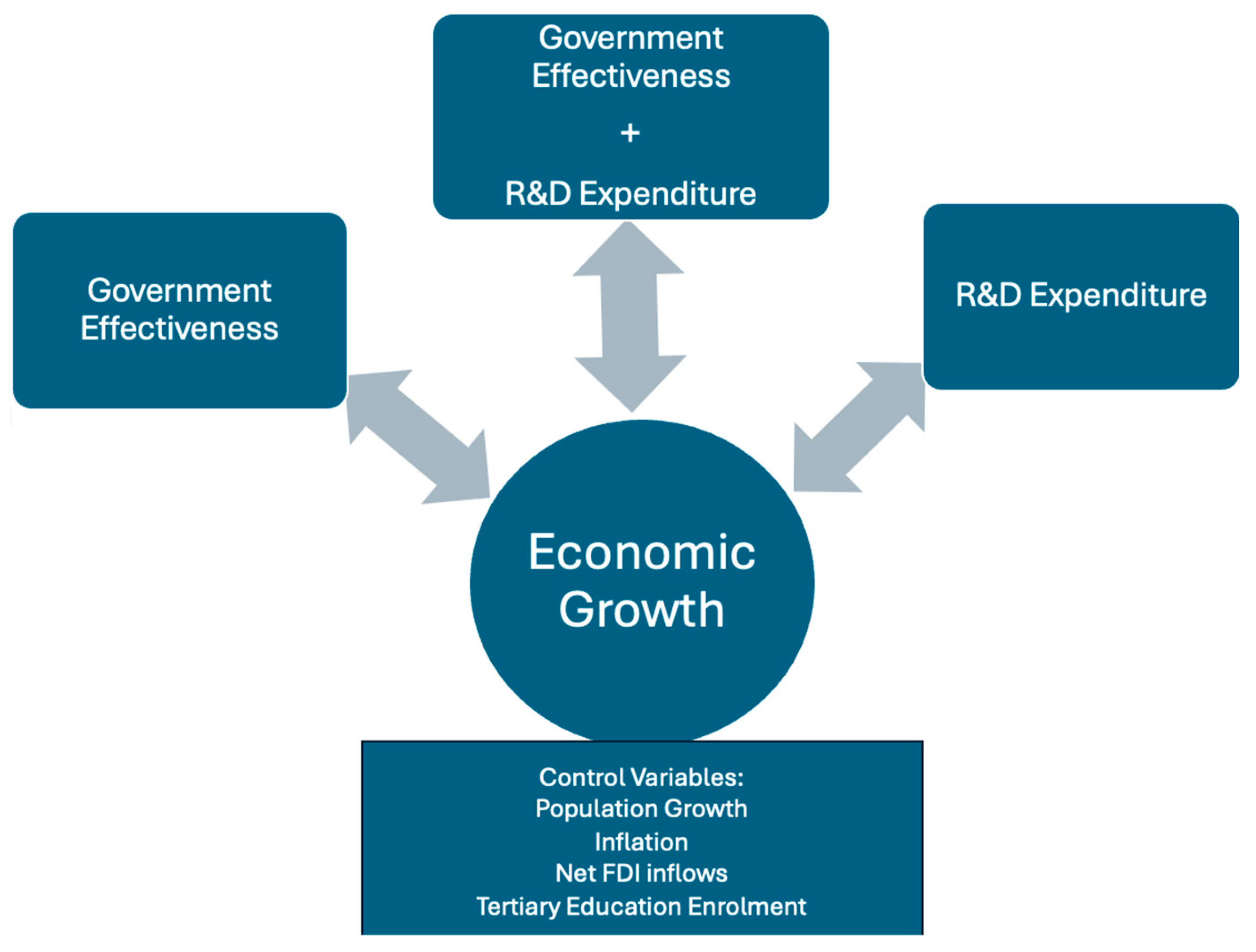
3.3. Theoretical Framework
3.4. Empirical Model
4. Findings
4.1. Results of Static Panel Estimation
4.2. Results of GMM Estimation
5. Results and Discussion
5.1. Scientific Contribution of the Study
5.2. Policy Recommendations
6. Conclusions
Limitations and Future Scope
Author Contributions
Funding
Informed Consent Statement
Data Availability Statement
Conflicts of Interest
References
- Acemoglu, D., Johnson, S., & Robinson, J. A. (2001). The colonial origins of comparative development: An empirical investigation. The American Economic Review, 91(5), 1369–1401. Available online: http://www.jstor.org/stable/2677930 (accessed on 10 November 2025). [CrossRef]
- Adams, S., & Mengistu, B. (2008). Privatization, governance and economic development in developing countries. Journal of Developing Societies, 24(4), 415–438. [Google Scholar] [CrossRef]
- Aghion, P., & Howitt, P. (1990). A model of growth through creative destruction (No. w3223). National Bureau of Economic Research.
- Aghion, P., & Howitt, P. (1992). A model of growth through creative destruction. Econometrica, 60(2), 323–351. [Google Scholar] [CrossRef]
- Aiello, F., & Bonanno, G. (2019). Explaining differences in efficiency: A meta-study on local government literature. Journal of Economic Surveys, 33(3), 999–1027. [Google Scholar] [CrossRef]
- Akcali, B. Y., & Sismanoglu, E. (2015). Innovation and the effect of research and development (R&D) expenditure on growth in some developing and developed countries. Procedia—Social and Behavioral Sciences, 195, 768–775. [Google Scholar]
- Alam, A., Uddin, M., & Yazdifar, H. (2019). Institutional determinants of R&D investment: Evidence from emerging markets. Technological Forecasting & Social Change, 138, 34–44. [Google Scholar]
- Alesina, A., & Dollar, D. (2000). Who gives foreign aid to whom and why? Journal of Economic Growth, 5(1), 33–63. [Google Scholar] [CrossRef]
- Anand, J., McDermott, G., Mudambi, R., & Narula, R. (2021). Innovation in and from emerging economies: New insights and lessons for international business research. Journal of International Business Studies, 52(6), 1003–1024. [Google Scholar] [CrossRef]
- Anderson, E., Jalles d’Orey, M., Duvendack, M., & Esposito, L. (2018). Does government spending affect income poverty? A meta-regression analysis. World Development, 103, 60–68. [Google Scholar] [CrossRef]
- Anokhin, S., & Schulze, W. (2009). Entrepreneurship, innovation, and corruption. Journal of Business Venturing, 24(5), 465–476. [Google Scholar] [CrossRef]
- Arellano, M., & Bond, S. (1991). Some tests of specification for panel data: Monte carlo evidence and an application to employment equations. The Review of Economic Studies, 58(2), 277–297. [Google Scholar] [CrossRef]
- Arshed, N. (2022). Exploring the potential of institutional quality in determining innovation. Technological Forecasting and Social Change, 176, 121462. [Google Scholar] [CrossRef]
- Asiedu, E. (2013). Foreign direct investment, natural resources and institutions. International Growth Centre Working Paper, 3, 1–38. [Google Scholar]
- Bai, J., Cai, Q., Yao, N., & Guo, Q. (2025). Government industrial priorities, public corporate governance and corporate innovation: A political push perspective. Economic Analysis and Policy, 85, 1885–1900. [Google Scholar] [CrossRef]
- Barba-Sánchez, V., Meseguer-Martínez, A., Gouveia-Rodrigues, R., & Raposo, M. L. (2024). Effects of digital transformation on firm performance: The role of IT capabilities and digital orientation. Heliyon, 10(6), e27725. Available online: https://pubmed.ncbi.nlm.nih.gov/38509885/. [CrossRef]
- Becheikh, N., Landry, R., & Amara, N. (2006). Lessons from innovation empirical studies in the manufacturing sector: A systematic review of the literature from 1993–2003. Technovation, 26(5–6), 644–664. [Google Scholar] [CrossRef]
- Benhabib, J., & Spiegel, M. M. (2005). Human capital and technology diffusion. In Handbook of economic growth (Vol. 1, pp. 935–966). Elsevier North-Holland. [Google Scholar] [CrossRef]
- Bhujabal, P., Sethi, N., & Padhan, P. C. (2024). Effect of institutional quality on FDI inflows in South Asian and Southeast Asian countries. Heliyon, 10(5), e27060. [Google Scholar] [CrossRef]
- Bichaka, F., & Christian, N. (2013). The impact of governance on economic growth: Further evidence for Africa. The Journal of Developing Areas, 47(1), 91–108. [Google Scholar]
- Bilbao-Osorio, B., & Rodríguez-Pose, A. (2004). From R&D to innovation and economic growth in the EU. Growth and Change, 35(4), 434–455. [Google Scholar] [CrossRef]
- Blanco, L., Prieger, J., & Gu, J. (2013). The impact of research and development on economic growth and productivity in the US states. In (Working Paper No. 48). Pepperdine University, School of Public Policy. [Google Scholar]
- Blank, R. M., & Blinder, A. S. (1985). Macroeconomics, income distribution, and poverty. (NBER Working Paper No. 1567). National Bureau of Economic Research. [Google Scholar] [CrossRef]
- Bloom, N., Jones, C. I., Van Reenen, J., & Webb, M. (2017). Are ideas getting harder to find? (NBER Working Paper No. 23782). National Bureau of Economic Research. [Google Scholar]
- Boeing, P. (2021). Estimating treatment effects with one-sided noncompliance: Evidence on mis-appropriation of R&D subsidies. (IZA Discussion Paper No. 14852). Institute of Labor Economics. [Google Scholar]
- Boudreaux, C. J. (2017). Institutional quality and innovation: Some cross-country evidence. Journal of Entrepreneurship and Public Policy, 6(4), 472–498. [Google Scholar] [CrossRef]
- Bozkurt, C. (2015). R&D expenditures and economic growth relationship in Turkey. International Journal of Economics and Financial Issues, 5(1), 188–198. [Google Scholar]
- Bucci, V., Ferrara, G., & Resce, G. (2023). Local government spending efficiency and fiscal decentralization: Evidence from Italian municipalities. Applied Economics, 55(1), 1–16. [Google Scholar] [CrossRef]
- Burnside, C., & Dollar, D. (2000). Aid, policies, and growth. American Economic Review, 90(4), 847–868. [Google Scholar] [CrossRef]
- Callegati, E., Grandi, S., & Napier, G. (2005). Business incubation and venture capital: An international survey on synergies and challenges (Joint IPI/IKED Working Paper). Available online: https://www.scirp.org/reference/referencespapers?referenceid=2089917 (accessed on 10 November 2025).
- Capolupo, R. (2009). The new growth theories and their empirics after twenty years. Economics, 3(1), 1–72. [Google Scholar] [CrossRef]
- Celikel, E. F. (2007). The link between innovation performance and governance: Country-level evidence. JRC/European Commission. [Google Scholar]
- Center for International Development. (2015). Development and international foreign aid: Governance information bulletin 2015:2. Rockefeller College of Public Affairs and Policy, State University of New York. [Google Scholar]
- Chang, C. C. (2023). The impact of quality of institutions on firm performance. Technological Forecasting & Social Change, 186, 122241. [Google Scholar]
- Cheng, Y., Zhou, X., & Li, Y. (2023). The effect of digital transformation on real economy enterprises’ total factor productivity. International Review of Economics & Finance 85, 488–501. [Google Scholar] [CrossRef]
- Chomen, M. (2022). Institutions-economic growth nexus in sub-saharan Africa. Heliyon, 8(12), e12251. [Google Scholar] [CrossRef]
- Clarysse, B., Wright, M., Bruneel, J., & Mahajan, A. (2014). Creating value in ecosystems: Crossing the chasm between knowledge and business ecosystems. Research Policy, 43(7), 1164–1176. [Google Scholar] [CrossRef]
- Coe, D. T., Helpman, E., & Hoffmaister, A. W. (1997). North–South R&D spillovers. Economic Journal, 107(440), 134–149. [Google Scholar] [CrossRef]
- Coe, D. T., Helpman, E., & Hoffmaister, A. W. (2009). International R&D spillovers and institutions. European Economic Review, 53(7), 723–741. [Google Scholar] [CrossRef]
- Cohen, W. M., & Levinthal, D. A. (1990). Absorptive capacity: A new perspective on learning and innovation. Administrative Science Quarterly, 35(1), 128–152. [Google Scholar] [CrossRef]
- Crespi, F., & Pianta, M. (2008). Diversity in innovation and productivity in Europe. Journal of Evolutionary Economics, 18(3–4), 529–545. [Google Scholar] [CrossRef]
- Cruz, M. D., Jha, C. K., Kırşanlı, F., & Sedai, A. K. (2023). Corruption and FDI in natural resources: The role of economic downturn and crises. Economic Modelling, 119, 106122. [Google Scholar] [CrossRef]
- Cvetanović, S., Mitrović, U., & Jurakić, M. (2019). Institutions as the driver of economic growth in classical, neoclassical, and endogenous theory. Economic Themes, 57(1), 111–125. [Google Scholar] [CrossRef]
- Çeştepe, H., Çetin, M., Avcı, P., & Bahtiyar, B. (2024). The link between technological innovation and financial development: Evidence from selected OECD countries. International Journal of Finance & Economics, 29(2), 1219–1235. [Google Scholar] [CrossRef]
- Danta, S., & Rath, S. (2024). Do institutional quality and human capital matter for innovation in Asian economies? Technological Forecasting & Social Change, 189, 122349. [Google Scholar]
- Das, R. C. (2020). Interplays among R&D spending, patent and income growth: New empirical evidence from the panel of countries and groups. Journal of Innovation and Entrepreneurship, 9(1), 1–22. [Google Scholar] [CrossRef]
- Das, R. C., & Mukherjee, S. (2020). Do Spending on R&D Influence Income? An Enquiry on the World’s Leading Economies and Groups. Journal of the Knowledge Economy, 11(4), 1295–1315. [Google Scholar]
- De, P. (2006). Trade, infrastructure and transaction costs: The imperatives for Asian economic cooperation. Journal of Economic Integration, 21(4), 708–735. [Google Scholar] [CrossRef]
- De Groot, H. L. F., Linders, G. J., Rietveld, P., & Subramanian, U. (2004). The institutional determinants of bilateral trade patterns. Kyklos, 57(1), 103–123. [Google Scholar] [CrossRef]
- Degong, M., Ullah, R., Ullah, F., & Mehmood, S. (2021). Financial liberalization, economic growth, and capital flight: The case of Pakistan economy. In M. Shahbaz, A. Soliman, & S. Ullah (Eds.), Economic growth and financial development: Effects of capital flight in emerging economies (pp. 115–134). Springer. [Google Scholar] [CrossRef]
- De Haan, J., & Siermann, C. (1996). Political instability, freedom and economic growth: Some further evidence. Economic Development and Cultural Change, 44(2), 339–350. [Google Scholar] [CrossRef]
- Dempere, J., de los Santos, J. A., & Ramírez, J. (2023). The impact of innovation on economic growth, foreign direct investment, and self-employment: A global perspective. Economies, 11(7), 182. [Google Scholar] [CrossRef]
- Devassia, B. P., Karma, E., & Muço, K. (2024). Role of human capital as a driver for sustainable development (SDG) in Western Balkan countries. Journal of Lifestyle and SDGs Review, 4(2), 02051. [Google Scholar] [CrossRef]
- Diamond, P. A., & Mirrlees, J. A. (1971). Optimal taxation and public production. I. Production efficiency. American Economic Review, 61(1), 8–27. [Google Scholar]
- Diebolt, C., & Perrin, F. (2016). Growth theories. In Handbook of cliometrics (pp. 177–195). Springer. [Google Scholar] [CrossRef]
- Dokas, I., Panagiotidis, M., Papadamou, S., & Spyromitros, E. (2023). Does innovation affect the impact of corruption on economic growth? International evidence. Economic Analysis and Policy, 77, 1030–1054. [Google Scholar] [CrossRef]
- Donges, A., Meier, J., & Silva, R. (2023). The impact of institutions on innovation. Management Science, 69(11), 6421–6442. [Google Scholar] [CrossRef]
- Eaton, J., & Kortum, S. (2001). Trade in capital goods. European Economic Review, 45(7), 1195–1235. [Google Scholar] [CrossRef]
- Elfaki, K. E., & Ahmed, E. M. (2024). Digital technology adoption and globalization innovation implications on Asian pacific green sustainable economic growth. Journal of Open Innovation, Technology, Market, & Complexity, 10(1), 100221. [Google Scholar] [CrossRef]
- Fadic, M., Garda, P., & Pisu, M. (2019). The effect of public sector efficiency on firm-level productivity growth: The Italian case (Volume No. 1573). (OECD Economics Department Working Papers, No. 1573). OECD Publishing. [Google Scholar]
- Fakhimi, M. A., & Miremadi, I. (2022). The impact of technological and social capabilities on innovation performance: A technological-catch-up perspective. Technology in Society, 68, 101890. [Google Scholar] [CrossRef]
- Fawaz, F., Mnif, A., & Popiashvili, A. (2021). Impact of governance on economic growth in developing countries: A case of HIDC vs. LIDC. Journal of Social and Economic Development, 23, 44–58. [Google Scholar] [CrossRef]
- Fayissa, B., & Nsiah, C. (2013). The impact of governance on economic growth in Africa. Journal of Developing Areas, 47(1), 91–108. [Google Scholar] [CrossRef]
- Fayyaz, A., & Bartha, Z. (2025). Research and development as a driver of innovation and economic growth: Case of developing economies. In Journal of Social and Economic Development. Advance online publication. [Google Scholar]
- Fieldhouse, A. J., & Mertens, K. (2023). The returns to government R&D: Evidence from U.S. appropriations shocks (Federal Reserve Bank of Dallas Working Paper WP-2305). Federal Reserve Bank of Dallas.
- Gani, A. (2011). Governance and growth in developing countries. Journal of Economic Issues, 45(1), 19–39. [Google Scholar] [CrossRef]
- Ge, S., & Liu, X. (2022). The role of knowledge creation, absorption and acquisition in determining national competitive advantage. Technovation 112, 102396. [Google Scholar] [CrossRef]
- Ginsburg, T. (2011). The “China problem” Reconsidered: Property rights and economic development in Northeast Asia (Working paper). University of Chicago. Available online: https://home.uchicago.edu/tginsburg/pdf/workingpapers/TheChinaProblemRevisited.pdf (accessed on 10 November 2025).
- Giordano, R., Lanau, S., Tommasino, P., & Topalova, P. (2020). Does public sector inefficiency constrain firm productivity? Evidence from Italian provinces. International Tax and Public Finance, 27(4), 1019–1049. [Google Scholar] [CrossRef]
- Gocer, I. (2013). Effects of R&D expenditures on high technology exports, balance of foreign trade and economic growth. Maliye Dergisi, 165, 215–240. [Google Scholar]
- Gompers, P. A., Kovner, A., Lerner, J., & Scharfstein, D. S. (2005). Venture capital investment cycles: The impact of public markets (NBER Working Paper No. 11385). Available online: http://www.nber.org/papers/w11385 (accessed on 10 November 2025).
- Gonzalez Parrao, C., Lwamba, E., Khan, L., Nabi, A., Lierl, M., Berretta, M., Hammaker, J., Lane, C., Quant, K., Eyers, J., & Glandon, D. (2022). Strengthening good governance in low- and middle-income countries: An evidence gap map. International Initiative for Impact Evaluation (3ie). [Google Scholar]
- Goñi, E., & Maloney, W. F. (2017). Why don’t poor countries do R&D? Varying rates of factor returns across the development process. European Economic Review, 94, 126–147. [Google Scholar]
- Griffith, R., Redding, S., & Van Reenen, J. V. (2004). Mapping the two faces of R&D: Productivity growth in a panel of OECD industries. The Review of Economics and Statistics, 86(4), 883–895. [Google Scholar]
- Griliches, Z. (1998). R&D and productivity: The econometric evidence. University of Chicago Press. [Google Scholar]
- Griliches, Z., & Mairesse, J. (1984). Productivity and R&D at the firm level. In Z. Griliches (Ed.), R&D, patents, and productivity (pp. 339–374). University of Chicago Press. [Google Scholar]
- Grindle, M. (2004). Good enough governance: Poverty reduction and reform in developing countries. Development Policy Review, 22(4), 525–548. [Google Scholar] [CrossRef]
- Guellec, D., & Van Pottelsberghe, B. (2001). R&D and productivity growth: Panel data analysis of 16 OECD countries. OECD Economic Studies, 103–126. [Google Scholar] [CrossRef]
- Han, X., Khan, H. A., & Zhuang, J. (2014). Do governance indicators explain development performance? A cross-country analysis. (Asian Development Bank Economics Working Paper Series, No. 417). Asian Development Bank. [Google Scholar] [CrossRef]
- Hoang, N. T., & Yarram, S. R. (2024). The transition from middle-income trap: Role of innovation and economic globalisation. Applied Economics, 56(1), 1–21. [Google Scholar] [CrossRef]
- Hu, A. G. Z. (2015). Innovation and economic growth in East Asia. Japan Center for Economic Research. [Google Scholar]
- Hu, A. G. Z., & Jaffe, A. B. (2003). Patent citations and international knowledge flow: The cases of Korea and Taiwan. International Journal of Industrial Organization, 21(6), 849–880. [Google Scholar] [CrossRef]
- Huang, Y. (2010). Political institutions and financial development: An empirical study. World Development, 38(12), 1667–1677. [Google Scholar] [CrossRef]
- Huggins, R., & Thompson, P. (2015). Entrepreneurship, innovation and regional growth: A network theory. Small Business Economics, 45, 103–128. [Google Scholar] [CrossRef]
- Hwang, B.-Y., Lee, C., & Yang, H.-D. (2021). Efficiency of public R&D management agency and innovation performance: A cross-country empirical analysis. Technological Forecasting & Social Change, 171, 120907. [Google Scholar]
- Iansiti, M., & Levien, R. (2004). Strategy as ecology. Harvard Business Review, 82(2), 68–78. [Google Scholar]
- Jalilian, H., Kirkpatrick, C., & Parker, D. (2007). The impact of regulation on economic growth in developing countries: A cross-country analysis. World Development, 35(1), 87–103. [Google Scholar] [CrossRef]
- Javorcik, B. S. (2004). Does foreign direct investment increase the productivity of domestic firms? In search of spillovers through backward linkages. American Economic Review, 94(3), 605–627. [Google Scholar] [CrossRef]
- Jäntti, M. (1994). A More Efficient Estimate of the Effects of Macroeconomic Activity on the Distribution of Income. The Review of Economics and Statistics, 76(2), 372–378. [Google Scholar] [CrossRef]
- Kaira, C., & Omoke, P. C. (2020). Institutions, governance and economic growth in sub-Saharan Africa. South African Journal of Economic and Management Sciences, 23(1), a1647. [Google Scholar]
- Khan, H., Khan, S., & Zuojun, F. (2022). Institutional quality and financial development: Evidence from developing and emerging economies. Global Business Review, 23(4), 971–983. [Google Scholar] [CrossRef]
- Khan, M. A., John, K., & Lemma, T. (2023). Country-level institutional quality and financial system efficiency. Cogent Economics & Finance, 11(1), 2145793. [Google Scholar]
- Khan, M. S. (2022). Estimating a panel MSK dataset for comparative analyses of national absorptive capacity systems, economic growth, and development in low and middle income countries. PLoS ONE, 17(10), e0274402. [Google Scholar] [CrossRef] [PubMed]
- Kim, J. U., & López-Bazo, E. (2020). Technology diffusion, absorptive capacity, and income convergence: A spatial panel approach for Asian developing countries. Empirical Economics, 59, 1415–1442. [Google Scholar] [CrossRef]
- Kim, L. (1997). Imitation to innovation: The dynamics of Korea’s technological learning. Harvard Business School Press. [Google Scholar]
- Kim, Y. (2024). Assessing the economic impact of innovative cities. Policy Studies, 46(4), 603–627. [Google Scholar] [CrossRef]
- Knack, S., & Keefer, P. (1995). Institutions and economic performance: Cross-country tests using alternative institutional measures. Economics and Politics, 7(3), 207–227. [Google Scholar] [CrossRef]
- Kneller, R., Bleaney, M. F., & Gemmell, N. (1999). Fiscal policy and growth: Evidence from OECD countries. Journal of Public Economics, 74(2), 171–190. [Google Scholar] [CrossRef]
- Kong, Y., Pan, D., Liu, Z., Nuo, Z., & Li, D. (2022). The effect of government intervention on self innovation of strategic emerging enterprises based on the role of financial intermediary. Frontiers in Humanities and Social Sciences, 2(11), 367–374. [Google Scholar] [CrossRef]
- Kumar, R. K., Hoor, A., Jain, S. K., Singh, R., Kumar, K., Kumar, P., & Chamaria, A. (2024). Role of technological innovation and its governance in entrepreneurial evolution. International Journal of Electronic Government Research (IJEGR), 20(1), 1–25. [Google Scholar] [CrossRef]
- Lee, Y. S. (2009). Balanced development in globalizing regional development? Unpacking the new regional policy of South Korea. Regional Studies, 43(3), 353–367. [Google Scholar] [CrossRef]
- Lerner, J. (1999). The government as venture capitalist: The long-run impact of the SBIR program. Journal of Business, 72(3), 285–318. [Google Scholar] [CrossRef]
- Li, C., Wan, J., Xu, Z., & Lin, T. (2021). Impacts of green innovation, institutional constraints and their interactions on high-quality economic development across China. Sustainability, 13(9), 5277. [Google Scholar] [CrossRef]
- Li, E., An, Z., Zhang, C., Li, H., & Fan, M. (2022). Impact of economic growth target constraints on enterprise technological innovation: Evidence from China. PLoS ONE, 17(8), e0272003. [Google Scholar] [CrossRef] [PubMed]
- Lucas, R. E. (1988). On the mechanics of economic development. Journal of Monetary Economics, 22(1), 3–42. [Google Scholar] [CrossRef]
- Lundvall, B.-Å. (1992). National systems of innovation: Towards a theory of innovation and interactive learning. Pinter Publishers. [Google Scholar]
- Maskus, K. E., & Penubarti, M. (1995). How trade-related are intellectual property rights? Journal of International Economics, 39(3–4), 227–248. [Google Scholar] [CrossRef]
- McGuinness, S., Gorg, H., & Kurekova, L. (2019). Skills-displacing technological change and its impact on jobs, tasks and skills: Evidence from the European Skills and Jobs Survey. In (IZA discussion paper 12541). IZA. [Google Scholar]
- Mehmood, W., Mohd-Rashid, R., Khalid, A., Aman-Ullah, A., & Abbas, Y. A. (2022). Empirical analysis of country-level institutional quality and public debt: Perspective of South Asian countries (Bangladesh, Bhutan, India, Nepal, Pakistan & Sri Lanka) 2002–2018. Journal of Economic Cooperation and Development, 43(1), 103–132. [Google Scholar]
- Méon, P.-G., & Sekkat, K. (2004). Does the quality of institutions limit the MENA’s integration in the world economy? The World Economy, 27(9), 1475–1496. [Google Scholar] [CrossRef]
- Mickiewicz, T. (2023). Middle-income trap and the evolving role of institutions along the development path. In J. Ricz, & T. Gerőcs (Eds.), The political economy of emerging markets and alternative development paths (pp. 37–60). Palgrave Macmillan. [Google Scholar] [CrossRef]
- Mincer, J. (1993). Human capital, technology, and the wage structure: What do time series show? In J. Mincer (Ed.), Studies in human capital: Collected essays of Jacob Mincer (Vol. 1, pp. 366–406). Edward Elgar Publishing. [Google Scholar] [CrossRef]
- Mini, L., Moyo, C., & Phiri, A. (2024). Governance, institutional quality and economic complexity in selected African countries. International Journal of Economic Policy Studies, 19, 159–181. [Google Scholar] [CrossRef]
- Minniti, M., & Palubinskas, A. (2023). The influence of regulation on technological innovation and entry. Handbook of Innovation and Regulation. Edward Elgar Publishing. [Google Scholar]
- Minviel, J.-J., & Ben Bouheni, F. (2022). The impact of research and development (R&D) on economic growth: New evidence from kernel-based regularized least squares. The Journal of Risk Finance, 23(5), 583–604. [Google Scholar]
- Mohammed, A., & Virtanen, P. (2016). Governance theories and models. In A. Farazmand (Ed.), Global encyclopedia of public administration, public policy, and governance. Springer International Publishing. [Google Scholar] [CrossRef]
- Moore, J. F. (1993). Predators and prey: A new ecology of competition. Harvard Business. [Google Scholar]
- Ndulu, B. J., & O’Connell, S. A. (1999). Governance and growth in Sub-Saharan Africa. Journal of Economic Perspectives, 13(3), 41–66. [Google Scholar] [CrossRef]
- Nelson, R. R., & Phelps, E. S. (1966). Investment in humans, technological diffusion, and economic growth. American Economic Review, 56(1/2), 69–75. [Google Scholar]
- Nguyen, C., Su, T., & Nguyen, T. (2018). Institutional quality and economic growth: The case of emerging economies. Theoretical Economics Letters, 8, 1943–1956. [Google Scholar] [CrossRef]
- North, D. C. (1990). Institutions, institutional change, and economic performance. Cambridge University Press. [Google Scholar]
- Organisation for Economic Co-operation and Development (OECD). (2022). Integrity and security in the global research ecosystem. (OECD Science, Technology and Innovation Policy Papers). OECD. [Google Scholar]
- Ozcan, B., & Ari, A. (2014). The relationship between research & development expenditures and economic growth: Panel data analysis. Maliye Dergisi, 166, 39–55. [Google Scholar]
- Park, C. Y., & Mercado, R. V. (2014). Determinants of financial stress in emerging market economies. Journal of Banking and Finance, 45(1), 199–224. [Google Scholar] [CrossRef]
- Pradhan, R. P., & Sanyal, G. S. (2011). Good governance and human development: Evidence from Indian states. Journal of Social and Development Sciences, 1(1), 1–8. [Google Scholar] [CrossRef]
- Raballand, G., & Zovighian, D. (2024). Institutions and growth in middle-income countries. World Bank Governance Global Practice. [Google Scholar]
- Rahman, M., & Hossain, M. (2024). Do innovation and institutional quality elevate economic growth? Journal of Economic Studies, 51(3), 415–432. [Google Scholar]
- Reinhart, C. M., & Rogoff, K. S. (2009). This time is different: Eight centuries of financial folly. Princeton University Press. [Google Scholar]
- Rigobon, R., & Rodrik, D. (2005). Rule of law, democracy, openness and income: Estimating the interrelationships. Economics of Transition, 13(3), 533–564. [Google Scholar] [CrossRef]
- Rodrik, D. (2008). Second-best institutions. The American Economic Review, 98(2), 100–104. Available online: http://www.jstor.org/stable/29730003 (accessed on 10 November 2025). [CrossRef]
- Rodrik, D., Subramanian, A., & Trebbi, F. (2004). Institutions rule: The primacy of institutions over geography and integration in economic development. Journal of Economic Growth, 9(2), 131–165. [Google Scholar] [CrossRef]
- Rodríguez-Pose, A., & Zhang, M. (2019). Government institutions and the dynamics of urban growth in China. Journal of Regional Science, 59(5), 1–27. [Google Scholar] [CrossRef]
- Romer, P. M. (1990). Endogenous Technological Change. Journal of Political Economy, 98, S71–S102. [Google Scholar] [CrossRef]
- Rossoni, A. L., de Vasconcellos, E. P. G., & de Castilho Rossoni, R. L. (2024). Barriers and facilitators of university-industry collaboration for research, development and innovation: A systematic review. Management Review Quarterly, 74(3), 1841–1877. [Google Scholar] [CrossRef]
- Santiso, C. (2001). Good governance and aid effectiveness: The World Bank and conditionality. Georgetown Public Policy Review, 7(1), 1–22. [Google Scholar]
- Setayesh, M. H., & Daryaei, A. A. (2017). Good governance, innovation, economic growth and the stock market turnover rate. Journal of International Trade & Economic Development, 26(7), 829–850. [Google Scholar]
- Shabbir, M. N., Iftikhar, K., & Bagh, T. (2025). Governance in action: Transforming financial landscape through innovation among developing countries. Journal of Applied Economics, 28(1), 2542766. [Google Scholar] [CrossRef]
- Shaw, E. S. (1973). Financial deepening in economic development. Oxford University Press. [Google Scholar]
- Smith, B. (2007). Good governance and development. Palgrave Macmillan. [Google Scholar]
- Solow, R. M. (1956). A contribution to the theory of economic growth. The Quarterly Journal of Economics, 70(1), 65–94. [Google Scholar] [CrossRef]
- Song, H., Buts, C., & Jegers, M. (2023). The middle-income trap and competition policy: An institutional analysis. Asian Journal of Law and Economics, 14(2), 135–161. [Google Scholar] [CrossRef]
- Tang, D., Li, Y., Zheng, H., & Yuan, X. (2022). Government R&D spending, fiscal instruments and corporate technological innovation. Research Policy, 51(3), 104393. [Google Scholar]
- Teece, D. J. (2020). Innovation, governance, and capabilities: Implications for competition policy. International Competition and Cooperation, 29(5), 1075–1093. [Google Scholar]
- Tolin, G. (2025). Commercializing technology from university–industry collaborations: A configurational perspective on organizational factors. Journal of Business Research, 188, 115105. [Google Scholar] [CrossRef]
- Tsai, K.-H., & Wang, J.-C. (2004). R&D productivity and the spillover effects of high-tech industry on the traditional manufacturing sector: The case of Taiwan. World Economy, 27(10), 1555–1570. [Google Scholar]
- Tullao, T. S., Jr. (2013). Education and human capital development to strengthen absorptive capacity of the innovation system in Southeast Asia. (Economic Research Institute for ASEAN and East Asia (ERIA) Discussion Paper 2013-36). Economic Research Institute for ASEAN and East Asia (ERIA). [Google Scholar]
- Ulku, H. (2004). R&D, innovation and economic growth: An empirical analysis (IMF Working Paper 04/185). IMF. Washington D.C.
- Urata, S., & Baek, S. (2022). Technology spillover and absorptive capacity of firms and countries: Evidence from Asia. (Asian Development Bank Institute Working Paper 1323). Asian Development Bank Institute. [Google Scholar]
- Wakelin, K. (2001). Productivity growth and R&D expenditure in UK manufacturing firms. Research Policy, 30(7), 1079–1090. [Google Scholar] [CrossRef]
- Wan, D., Yang, Y., & Kong, Y. (2025). Research on the relationship between R&D investment, corporate governance and corporate performance—An empirical analysis based on listed pharmaceutical manufacturing enterprises. International Review of Economics & Finance, 102, 104369. [Google Scholar] [CrossRef]
- Wang, D. H., Yu, T. H., & Liu, H. (2013). Heterogeneous effect of high-tech industrial R&D spending on economic growth. Journal of Business Research, 66, 1990–1993. [Google Scholar]
- Wang, J. (2021). Learning from institutional diversity to innovate. International Journal of Technology Management, 85(1/2/3), 123–146. [Google Scholar]
- Wang, L., Chen, Y., & Li, W. (2025). Facilitator or figurehead? The impact of academician shareholder on corporate innovation: Evidence from China. Technovation, 139, 103138. [Google Scholar] [CrossRef]
- Wei, S.-J., & Wu, Y. (2002). Negative alchemy? Corruption, composition of capital flows, and currency crises. In Preventing currency crises in emerging markets (pp. 461–506). University of Chicago Press; Chicago. [Google Scholar]
- Wilson, R. (2016). Does governance cause growth? Evidence from China. World Development, 80, 146–161. [Google Scholar] [CrossRef]
- Xu, R., Zhu, X., Wang, Y., Gu, J., & Felzensztein, C. (2023). Inter-firm coopetition and innovation in industrial clusters: The role of institutional support. Journal of Business & Industrial Marketing, 39(4), 832–856. [Google Scholar] [CrossRef]
- Yusuf, S., & Evenett, S. J. (2002). Can East Asia compete? Innovation for global markets. World Bank & Oxford University Press. [Google Scholar]
- Zhang, H., & Wang, L. (2019). Threshold effects of the efficiency of the science and technology services industry on innovation-driven development in China. Growth and Change, 50(4), 1296–1320. [Google Scholar]
- Zhang, X., & Xu, J. (2022). Political turnover and innovation: Evidence from China. PLoS ONE, 17(6), e0269532. [Google Scholar] [CrossRef]
- Zhao, J., Madni, G. R., Anwar, M. A., & Zahra, S. M. (2021). Institutional reforms and their impact on economic growth and investment in developing countries. Sustainability, 13(9), 4941. [Google Scholar] [CrossRef]
- Zheng, J. (2024). Empowering radical innovation: How digital technologies drive knowledge transfer and firm innovation. R&D Management, 54(1), 45–63. [Google Scholar]
- Zhu, B., Yang, M., & Chu, X. (2024). Good governance and innovation: Economic freedom matters. Technological Forecasting and Social Change, 205, 123527. [Google Scholar] [CrossRef]
- Zhuang, J., de Dios, E., & Lagman-Martin, A. (2010). Governance and institutional quality and the links with growth and inequality: How Asia fares. In J. Zhuang (Ed.), Poverty, inequality, and inclusive growth in Asia: Measurement, policy issues, and country studies (pp. 268–320). Anthem Press; Asian Development Bank. [Google Scholar]
- Zuniga, P. (2022). Innovation policy effectiveness in emerging countries. World Bank. [Google Scholar]


| Variable | Definition | Source | Unit |
|---|---|---|---|
| Government Effectiveness | The capacity of the government to effectively formulate and implement sound policies; the respect of citizens and the state for the institutions that govern economic and social interactions among them. | Worldwide Governance Indicators (WGI) database | Score between −2.5 and +2.5 |
| R&D Expenditure | Gross domestic expenditures on research and development (R&D), expressed as a percentage of GDP. | World Bank database | % |
| Economic Growth | The total income earned through the production of goods and services in an economic territory during an accounting period. | World Bank database | US dollars |
| Population Growth | Annual population growth rate for year t is the exponential rate of growth of midyear population from year t-1 to t, expressed as a percentage. | World Bank database | % |
| Inflation | Inflation, as measured by the consumer price index, reflects the annual percentage change in the cost to the average consumer of acquiring a basket of goods and services that may be fixed or changed at specified intervals, such as yearly. This indicator denotes the percentage change over each previous year of the constant price (base year 2015) series in United States dollars. | World Bank database | % |
| Net FDI inflows | The net inflows (new investment inflows after subtracting disinvestment) in the reporting economy from foreign investors, divided by GDP. | World Bank database | % |
| Tertiary education enrolment | The number of students in the tertiary level of education divided by the population of the age-group, which officially corresponds to tertiary education, multiplied by 100. | World Bank database | % |
| S.N. | Country | S.N. | Country |
|---|---|---|---|
| 1 | Armenia | 18 | Kyrgyz Republic |
| 2 | Azerbaijan | 19 | Macao SAR, China |
| 3 | Brunei Darussalam | 20 | Malaysia |
| 4 | Cambodia | 21 | Mongolia |
| 5 | China | 22 | Myanmar |
| 6 | Cyprus | 23 | Oman |
| 7 | Georgia | 24 | Pakistan |
| 8 | Hong Kong SAR, China | 25 | Philippines |
| 9 | India | 26 | Qatar |
| 10 | Indonesia | 27 | Saudi Arabia |
| 11 | Iran, Islamic Republic | 28 | Singapore |
| 12 | Iraq | 29 | Sri Lanka |
| 13 | Israel | 30 | Tajikistan |
| 14 | Japan | 31 | Thailand |
| 15 | Korea, Republic of | 32 | Türkiye |
| 16 | Kuwait | 33 | Uzbekistan |
| 17 | Kazakhstan | 34 | Vietnam |
| Lower Middle Income | Upper Middle Income | High Income |
|---|---|---|
| Cambodia | Armenia | Brunei Darussalam |
| India | Azerbaijan | Cyprus |
| Indonesia | China | Hong Kong SAR, China |
| Iran, Islamic Rep. | Georgia | Israel |
| Kyrgyz Republic | Iraq | Japan |
| Mongolia | Kazakhstan | Korea, Rep. |
| Myanmar | Malaysia | Kuwait |
| Pakistan | Thailand | Macao SAR, China |
| Philippines | Turkiye | Oman |
| Sri Lanka | Qatar | |
| Tajikistan | Saudi Arabia | |
| Uzbekistan | Singapore | |
| Vietnam |
| Variable | Obs | Mean | Std. Dev. | Min | Max |
|---|---|---|---|---|---|
| gdppc | 850 | 15,294.17 | 19,578.42 | 136.9257 | 10,8470.4 |
| rd | 850 | 0.739547 | 1.099918 | 0.01592 | 6.01924 |
| goveff | 850 | 0.132597 | 0.892468 | −1.96257 | 2.46966 |
| sert | 850 | 38.30597 | 26.84644 | 0.739547 | 141.8648 |
| fdinet | 850 | 6.89161 | 28.97678 | −296.013 | 431.7885 |
| popgth | 850 | 1.546135 | 1.92921 | −10.9274 | 21.70034 |
| infltn | 850 | 7.279222 | 11.20634 | −28.7601 | 96.0362 |
| gdppc | rd | goveff | sert | fdinet | popgth | infltn | |
|---|---|---|---|---|---|---|---|
| gdppc | 1.0000 | ||||||
| rd | 0.3802 *** | 1.0000 | |||||
| goveff | 0.7021 *** | 0.5473 *** | 1.0000 | ||||
| sert | 0.3581 *** | 0.3812 *** | 0.4511 *** | 1.0000 | |||
| fdinet | 0.1072 *** | −0.0153 | 0.1694 *** | 0.0993 *** | 1.0000 | ||
| popgth | 0.2790 *** | −0.1123 *** | −0.0259 | −0.1797 *** | −0.0211 | 1.0000 | |
| infltn | −0.2145 *** | −0.1784 *** | −0.3597 *** | −0.0679 ** | −0.0575 * | −0.0349 | 1.0000 |
| Dependent Variables: gdppc | All Income Groups | Lower Middle-Income Group | Upper Middle-Income Group | High-Income Group |
|---|---|---|---|---|
| Constant | 4973.591 *** (1218.473) | 1996.133 *** (240.0825) | 1025.256 * (501.8474) | 16,006.78 *** (4250.658) |
| rd_ | −4421.648 *** (696.2175) | −219.4989 (334.4821) | 1245.359 *** (202.6079) | −2122.705 *** (440.1198) |
| goveff_ | 12,783.47 *** (986.4718) | 999.3153 *** (114.3733) | 1198.698 *** (178.3874) | 15,295.99 *** (1476.176) |
| sert_ | 94.74431 *** (18.62771) | 48.34554 *** (4.605589) | 78.19397 *** (9.290721) | 97.63035 ** (35.71195) |
| fdinet_ | −7.653429 (8.807815) | −8.122903 (15.1155) | −57.10773 * (24.35863) | −42.39812 ** (15.99458) |
| popgth_ | 3272.644 *** (651.407) | −567.8145 *** (100.3211) | 1369.37 *** (130.8457) | 2317.666 *** (650.3083) |
| infltn_ | 91.66745 * (48.32139) | 11.73046 (8.204987) | −12.46685 (16.13295) | 331.8427 ** (137.7335) |
| No. of observations | 850 | 325 | 225 | 300 |
| Number of countries | 34 | 13 | 9 | 12 |
| Dependent Variable: gdppc | All Income Groups | Lower-Middle-Income Group | Upper-Middle-Income Group | High-Income Group |
|---|---|---|---|---|
| Constant | 4973.591 *** (1218.473) | 2485.414 *** (269.3597) | 846.6435 * (474.3536 | 15,695.13 *** (3102.176) |
| rd | −4421.648 *** (696.2175) | −1180.632 *** (295.8019) | 220.6511 (214.666) | −3984.741 *** (1018.612) |
| goveff | 12,783.47 *** (986.4718) | 1673.577 *** (196.1376) | 213.2486 (165.0511) | 13,660.89 *** (1982.765) |
| rd × goveff | 4083.426 *** (529.5513) | −3377.413 *** (1027.53) | 3088.944 *** (425.6902) | 1602.311 (951.2415) |
| sert_ | 94.74431 *** (18.62771) | 45.25623 *** (5.022207) | 85.70549 *** (8.310881) | 98.33796 ** (35.58205) |
| fdinet_ | −7.653429 (8.807815) | −2.42837 (15.01244) | −48.03598 * (24.29081) | −40.83124 ** (15.61372) |
| popgth_ | 3272.644 *** (651.407) | −597.621 *** (97.80784) | 1114.765 *** (132.4634) | 2302.14 *** (652.8015) |
| infltn_ | 91.66745 ** (48.32139) | 1.131211 (7.744559) | 11.4247 (15.7287) | 333.6144 ** (135.8506) |
| No. of Observations | 850 | 325 | 225 | 300 |
| Number of Countries | 34 | 13 | 9 | 12 |
| Without Interaction Terms (Model I) | With Interaction Terms (Model II) | |||
|---|---|---|---|---|
| Dependent Variable: gdppc | First Difference (Prob.) | Orthogonal Deviations | First Difference (Prob.) | Orthogonal Deviations |
| gdppc(−1) | 0.869178 (0.000) * | 0.86962 (0.000) * | 0.86975 (0.000) * | 0.866899 (0.000) * |
| rd_ | 938.5033 (0.000) * | 25.44203 (0.556) | −366.8323 (0.000) * | −570.1446 (0.000) * |
| goveff_ | 1784.362 (0.000) * | 2478.545 (0.000) * | 789.754 (0.000) * | 2158.917 (0.000) * |
| rdxgoveff | - | - | 993.227 (0.000) * | 564.4349 (0.000) * |
| sert_ | 2.816704 (0.000) * | 7.896514 (0.000) * | 2.875361 (0.001) * | 8.735894 (0.000) * |
| fdinet_ | 1.415485 (0.000) * | 0.391689 (0.1561) | 1.512634 (0.003) * | 0.508741 (0.4001) |
| popgth_ | −284.5894 (0.000) * | −255.0639 (0.000) * | −292.6314 (0.000) * | −257.8929 (0.000) * |
| infltn_ | 245.7245 (0.000) * | 235.5926 (0.000) * | 245.9907 (0.000) * | 234.7666 (0.000) * |
| No. of Observations | 850 | 850 | 850 | 850 |
| Number of Countries | 34 | 34 | 34 | 34 |
Disclaimer/Publisher’s Note: The statements, opinions and data contained in all publications are solely those of the individual author(s) and contributor(s) and not of MDPI and/or the editor(s). MDPI and/or the editor(s) disclaim responsibility for any injury to people or property resulting from any ideas, methods, instructions or products referred to in the content. |
© 2025 by the authors. Licensee MDPI, Basel, Switzerland. This article is an open access article distributed under the terms and conditions of the Creative Commons Attribution (CC BY) license (https://creativecommons.org/licenses/by/4.0/).
Share and Cite
Singh, V.; Das, P.; Singh, E.; Das, R.C. The Interplay Between Governance and R&D Investment in Driving Asia’s Economic Growth: An Empirical Inquest. Economies 2025, 13, 366. https://doi.org/10.3390/economies13120366
Singh V, Das P, Singh E, Das RC. The Interplay Between Governance and R&D Investment in Driving Asia’s Economic Growth: An Empirical Inquest. Economies. 2025; 13(12):366. https://doi.org/10.3390/economies13120366
Chicago/Turabian StyleSingh, Vaishali, Promila Das, Ekta Singh, and Ramesh Chandra Das. 2025. "The Interplay Between Governance and R&D Investment in Driving Asia’s Economic Growth: An Empirical Inquest" Economies 13, no. 12: 366. https://doi.org/10.3390/economies13120366
APA StyleSingh, V., Das, P., Singh, E., & Das, R. C. (2025). The Interplay Between Governance and R&D Investment in Driving Asia’s Economic Growth: An Empirical Inquest. Economies, 13(12), 366. https://doi.org/10.3390/economies13120366