1. Introduction
Vietnam has undergone impressive socio-economic progress since the introduction of the Đổi Mới reforms in the late 1980s. Over the past three decades, Vietnam has transformed from being one of the world’s poorest countries to being a high human development economy. As reported by the United Nations Development Programme (
UNDP, 2025a), the HDI of Vietnam rose from 0.499 in 1990 to 0.766 in 2023, placing it in the “high human development” bracket and ranking it 93rd internationally. This marks a 53.5% increase, one of the highest in East Asia and the Pacific (
UNDP, 2025b). Economic performance has taken this upward trend, with GDP per capita increasing from less than USD 500 in the mid-1980s to approximately USD 4300 in 2023 (
World Bank, 2025). All these achievements have been matched with enormous improvements in health and education; for example, life expectancy increased from 70.5 years in 1990 to 74.5 years in 2023 (
World Bank, 2025).
Despite these achievements, Vietnam is facing pressing challenges that can derail its momentum for development. Chronic industrialization has given rise to environmental pressures, including rising CO2 emissions per capita. Labour market vulnerabilities, including underemployment and casual labour, persist despite low official unemployment. Furthermore, while trade openness has driven growth, reliance on manufacturing-based exports makes it vulnerable to fluctuations in international markets. These concerns point to the importance of an analysis of Vietnam’s economic, social, and environmental determinants of human development in depth. Vietnam is chosen as the focus of this study for three main reasons. First, its sustained high growth and human development improvements present a successful development model worth analyzing. Second, its transitional economic structure, balancing rapid industrialization with social policy priorities, provides a unique case for evaluating multi-dimensional drivers of HDI. Third, gaps remain in the literature, as few empirical studies employ a time-series framework to simultaneously assess the short- and long-run effects of growth, health, environmental factors, trade, and employment on HDI in Vietnam.
This study aims to fill this gap by providing a comprehensive empirical analysis of the economic, social, and environmental drivers of HDI in Vietnam for the period 1990–2023. The Autoregressive Distributed Lag (ARDL) bounds testing approach is employed as it is well-suited to model the dynamic relationships in our dataset, where variables are of a mixed order of integration. This allows us to distinguish between short-run and long-run effects, yielding nuanced and policy-relevant insights specific to Vietnam’s development context.
The remainder of this paper is organized as follows.
Section 2 provides an overview of the literature for the determinants of the Human Development Index, with particular attention to studies used in developing and transition economies.
Section 3 specifies data sources, variable definitions, and econometric specifications employed in the analysis.
Section 4 presents and discusses the empirical evidence, and
Section 5 interprets these observations in the context of Vietnam’s socio-economic situation and contrasts with prior research.
Section 6 concludes the paper and derives policy implications to enhance Vietnam’s human development performance sustainably and equitably.
2. Literature Review
Human development, employing the Human Development Index (HDI), has been empirically examined to a considerable degree in different regions and time periods. Numerous studies have scrutinized the impact of macroeconomic, social, and ecological factors on HDI, including economic growth, unemployment, trade openness, government spending, life expectancy, education investment, and environmental quality. While results vary across contexts and designs, the literature reveals convergent trends as well as counterintuitive results. This section synthesizes findings of previous research by grouping studies by variables examined, thereby focusing on similarities and contrasts across contexts.
There have been some studies focusing on the relationship between GDP growth and HDI.
Arisman (
2018) used panel data for ASEAN countries and found that GDP per capita growth made a significant contribution to improved HDI.
Singh et al. (
2025) considered Asian economies and also recorded an improving effect of GDP growth and education investment on HDI.
Pardiansyah and Najib (
2024) recorded a significant positive effect of economic growth on HDI in Banten Province, Indonesia. Similarly,
Haj and Bustamam (
2025) found GDP to have a positive effect on HDI in Indonesia’s Riau Province. On the other hand,
Belete (
2023) found a negative effect of GDP growth on HDI in Sub-Saharan Africa, suggesting that the growth dividend does not automatically translate into improved human development.
The effect of unemployment on HDI has also been analyzed. While
Arisman (
2018) found unemployment to have a significant but positive impact on HDI in ASEAN countries,
Pardiansyah and Najib (
2024) found an absence of a significant negative impact in Indonesian Banten Province. Conversely,
Runtunuwu (
2020) verified that unemployment had a significant negative effect on Indonesian provinces, thus proving that the impact of the labour market may vary by region.
Openness to trade has produced mixed results in the literature.
Dzihny et al. (
2023) uncovered a significant positive effect of openness to trade on HDI between OIC countries, while
Hamdi and Hakimi (
2022) found a positive long-run relationship between openness to trade and HDI between MENA countries.
Belete (
2023) found a significant negative effect of openness to trade on HDI in Sub-Saharan Africa.
Government spending on health, education, and other public utilities has been seen to affect HDI.
Fadillah and Setiartiti (
2021) found that health spending had a positive effect on HDI in Yogyakarta, Indonesia, but for education spending, the effect was negative and not significant.
Haj and Bustamam (
2025) similarly discovered the positive effect of government spending on HDI in Riau Province.
Sakinah et al. (
2022) emphasized that life expectancy and per capita expenditure positively facilitated the Central Sulawesi Province HDI.
Sasmita et al. (
2024) stated that, as far as Indonesian provinces are concerned, life expectancy, investment by the public in education, and infrastructure contributed significantly to increasing HDI and brought into focus the necessity of targeted public investments.
Environmental quality, specifically CO
2 emissions, has been linked to HDI across many contexts.
Akbar et al. (
2021), in the OECD region, unveiled a strong negative effect of CO
2 emissions on HDI, implying that environmental degradation undermines human development.
Asongu and Odhiambo (
2020) also uncovered a strong negative effect in Sub-Saharan Africa. On the other hand,
Fakhri et al. (
2024) found a considerable and positive effect of CO
2 emissions on Saudi Arabian HDI, showing that in certain contexts, the emissions may be associated with industrialization and economic activity that ensure development actions.
Zaghdoudi (
2025) found a nonlinear effect of CO
2 emissions on HDI, with its impact varying with emission levels. In general, the research demonstrates that HDI is determined by a combination of economic, social, and environmental factors with varying impacts depending on the context of the region as well as the methodology employed.
While the general literature is extensive, a focused review shows there to be a specific gap in the Vietnamese context. Much recent work has begun looking into human development in the country. For instance,
Vinh and Tri (
2024) provided a systematic review of the trend of HDI, while
Diep et al. (
2024) focused on state budget expenditure-HDI alone. Other research has investigated related factors, such as the effect of financial growth on human capital (
Ha et al., 2023), or placed Vietnam within a broader Southeast Asian comparative analysis (
Nguyen, 2025). However, a detailed time-series analysis of all simultaneously in relation to the short- and long-term effects of underlying economic (GDP growth, trade, unemployment), social (life expectancy), and environmental (CO
2 emissions) factors upon Vietnam’s overall HDI is non-existent. This study will fill this specific gap, providing a comprehensive and vibrant assessment of Vietnam’s interconnected drivers of human development in the critical period of its socio-economic transformation (1990–2023).
While economic growth, government spending, and investment in health tend to enhance HDI, unemployment, environmental degradation, and trade openness, in certain cases, have adverse effects. Both these conflicting findings affirm the need to consider both policy interventions and the structural setting while designing policies to achieve human development sustainably.
3. Data and Methodology
3.1. Data and Variables
This study employs yearly time series data for Vietnam between the years 1990 and 2023. Yearly data were gathered from the World Development Indicators (WDI) and the United Nations Development Programme (UNDP). The dependent variable is the Human Development Index (HDI), a weighted mean of average accomplishment in health, education, and living standards, which can be obtained from the United Nations Development Programme (UNDP). The explanatory variables are selected on the basis of theory salience and previous empirical research on human development. These are as follows: GDP per capita growth (GDPPCG), representing the rate of annual change in GDP per capita; life expectancy at birth (LE), measured in total years; carbon dioxide emissions per capita (CO2), in metric tons per capita; trade openness (TRADE), as the sum of exports and imports of goods and services in percent of GDP; and unemployment (UNEMP), as the percent of the total labour force not employed.
Care should be taken to note the theoretical argument for adopting the use of life expectancy (LE) and GDP per capita growth (GDPPCG) as explanatory variables. These are components of the HDI but are employed here as critical national outcomes. The model is checking in this case how these fundamental outcomes, alongside other policy-influenced variables like trade openness and environmental pressure, all feed into the overall development performance of the country, as per the composite HDI. This specification allows marginal effects and interactions between these drivers to be estimated and conforms to the conventions of the current literature (e.g.,
Sasmita et al., 2024;
Sakinah et al., 2022).
It is important to note two key limitations of the selected variables. First, while the use of per capita CO2 emissions is standard practice in the literature to guarantee cross-country and time comparability, the variable does not capture the overall national volume of emissions or their sectoral composition. Second, the official rate of unemployment is a partial indicator that fails to capture underemployment or workers in the significant informal sector, which is a significant shortcoming, as it may miss labour market vulnerabilities in a developing economy like Vietnam.
3.2. Model Specification
The functional relationship between HDI and its determinants is expressed as:
Given that the variables are expected to be of mixed integration orders, the Autoregressive Distributed Lag (ARDL) bounds testing approach of
Pesaran et al. (
2001) should be the primary estimation technique of choice. The method is most suitable in the case of small sample sizes and can be applied where the regressors are integrated of order I(0) and/or I(1), but not I(2).
The general ARDL model estimated in this study can be written as:
where
is the error correction term representing the long-run equilibrium derived from the cointegrating equation.
3.3. Estimation Procedure
The empirical analysis begins with:
Unit Root Testing: Augmented Dickey–Fuller (ADF) and Phillips–Perron (PP) tests are carried out so that no variable is integrated of order two or higher. It is important that this test be performed to check whether the ARDL approach is appropriate, as it cannot be applied to variables that are I(2). Because Vietnam has undergone substantial economic changes during the study period, we also apply the Zivot–Andrews test, which identifies a possible structural break within the data. Including this test helps ensure a more accurate evaluation of stationarity, especially in the presence of major policy reforms or economic shocks.
Optimal Lag Selection: After confirmation of the order of integration, the optimal lag length for the ARDL model is determined through the Akaike Information Criterion (AIC) and the Schwarz Bayesian Criterion (SC), where AIC is used due to its ability to capture richer short-run dynamics (
Kilian, 2006). The preferred lag structure is utilized consistently in both the cointegration bounds test as well as the short- and long-run relationship estimation.
Bounds Cointegration Test: Lastly, the ARDL bounds test is conducted to verify if there is a long-run relationship among the variables. The F-statistic derived is compared with the critical values of
Pesaran et al. (
2001) to determine if there is cointegration or not.
Long-Run and Short-Run Estimation: If cointegration is found, the long-run coefficients are estimated from the ARDL model’s levels equation. The short-run dynamics are defined as in the ECM form of ARDL, with the error correction term (ECT) coefficient reflecting the speed of adjustment toward the long-run equilibrium.
3.4. Diagnostic and Stability Tests
Adequacy of the model is verified through several post-estimation tests: the Jarque–Bera test (
Jarque & Bera, 1980) for testing residual normality, the Breusch–Godfrey LM test (
Breusch, 1978;
Godfrey, 1978) for serial correlation, the Breusch–Pagan–Godfrey test (
Breusch & Pagan, 1979) for heteroskedasticity, and the Ramsey RESET test (
Ramsey, 1969) for specification error of the model. Stability of parameters over the sample period is tested through the CUSUM and CUSUM of Squares procedures (
Brown et al., 1975).
3.5. Impulse Response Analysis
Besides the support of the ARDL model and depicting the dynamic relationships of the variables, an auxiliary Vector Autoregression (VAR) model in levels was also fitted with the variables HDI, GDPPCG, LE, CO2, TRADE, and UNEMP. The VAR lag order was 2, selected by the Schwarz Information Criterion (SIC) to ensure a stable and parsimonious specification for impulse response analysis. The Impulse Response Functions (IRFs) re derived from this VAR model using Cholesky decomposition to display the effect of shocks over time.
3.6. Robustness Checks
To validate the consistency of ARDL long-run estimates, three other cointegration estimators are applied: Dynamic Ordinary Least Squares (DOLS) (
Stock & Watson, 1993), Fully Modified OLS (FMOLS) (
Phillips & Hansen, 1990), and Canonical Cointegrating Regression (CCR) (
Park, 1992). These estimators remove endogeneity and serial correlation, so efficient and precise long-run parameter estimates are derived. Similarity in the coefficient signs, magnitudes, and significance of these methods increases the robustness of the findings.
4. Results
4.1. Descriptive Statistics and Preliminary Analysis
Table 1 summarizes the descriptive statistics for the variables included in the analysis.
The Human Development Index (HDI) has a mean of 0.65 with a standard deviation of 0.08 and ranges from a low of 0.50 to a high of 0.77. The increase in GDP per capita (GDPPCG) has a mean growth of 5.23% annually and ranging from a low of 1.67% to a high of 7.73%. Life expectancy at birth (LE) has a mean of 72.84 years and varies moderately between 69 and 75 years. Per capita carbon dioxide emissions (CO2) are at 1.48 metric tons on average, a low of 0.31 and a high of 3.70 metric tons. Trade openness (TRADE) is the most scattered of the variables, with a mean of 124.84% of GDP, a low of 66.21%, and a high of 186.68%. Unemployment rate (UNEMP) is at 1.89% average, between a low and a high of 1% and 2.87%.
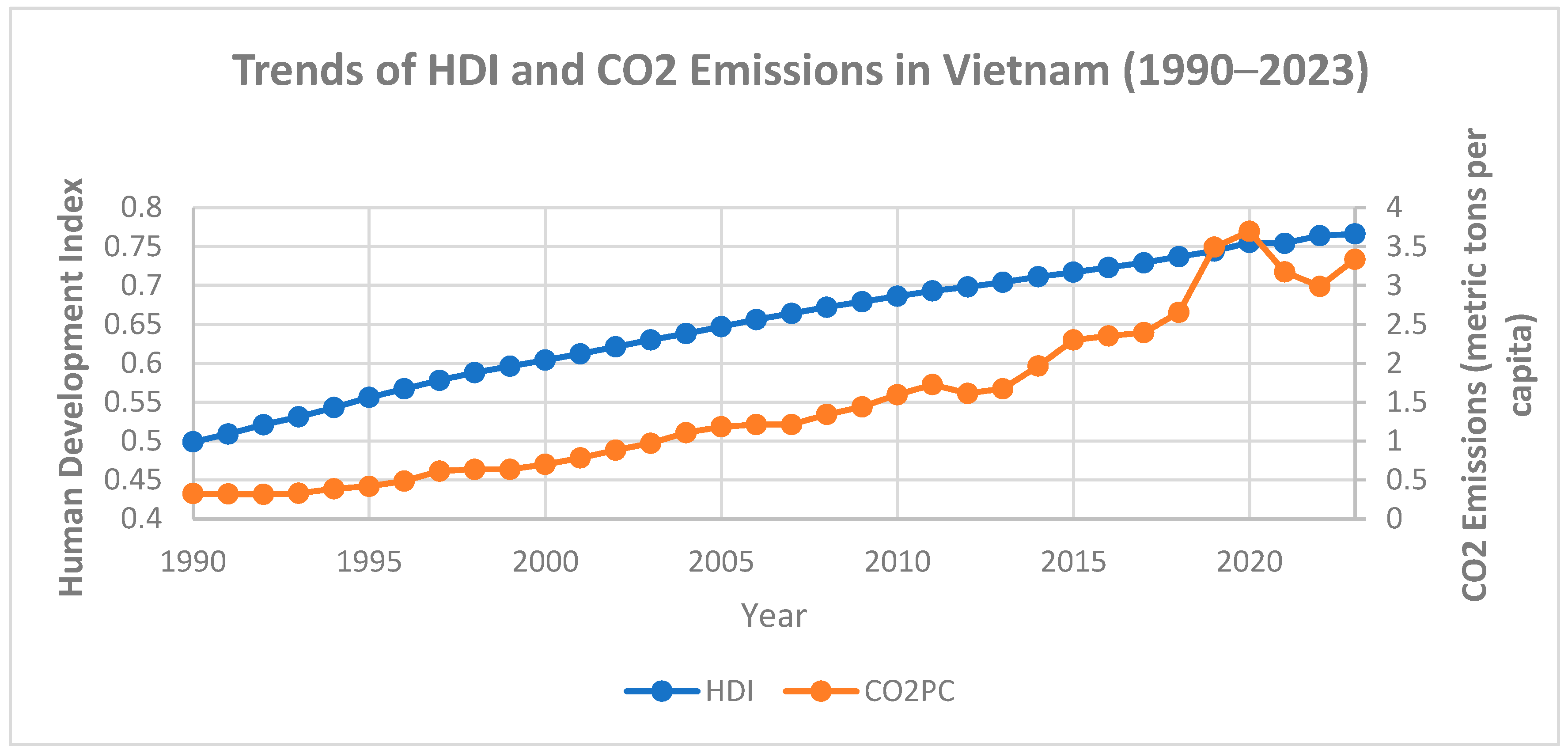
A preliminary visual inspection of the trends in
Figure 1 suggests that there is strong comovement between Vietnam’s HDI and CO
2 emissions per capita from 1990 to 2023. Both traces have a clear upward trend, as HDI increases from 0.50 to 0.77 and CO
2 emissions per capita increase from approximately 0.3 to 3.7 metric tons. The parallel paths suggest the presence of a long-run relationship, which the ensuing econometric analysis will formally determine.
4.2. Unit Root Tests
4.2.1. Augmented Dickey–Fuller (ADF) and Phillips–Perron (PP) Tests
The results for ADF AND PP unit root tests are presented in
Table 2.
Stationarity was initially assessed using the Augmented Dickey–Fuller (ADF) and Phillips-Perron (PP) tests (
Table 3). These preliminary results suggested that HDI, GDPPCG, and LE are I(0) stationary at level, while CO
2, TRADE, and UNEMP appear to be integrated of order one, I(1). However, these standard tests do not account for structural breaks, and the subsequent Zivot–Andrews test provides a more refined analysis in the following section.
4.2.2. Zivot–Andrews Test with Structural Breaks
The Zivot–Andrews test results (
Table 3) confirm the mixed order of integration, the critical requirement for the ARDL bounds testing approach, while identifying economically meaningful breakpoints. More precisely, GDP per capita growth and trade openness are both trend-stationary processes that had significant structural breaks in 1998 (representing the post-Asian Financial Crisis recovery) and 2010 (representing the matured benefits of WTO accession and post-Global Financial Crisis trade resurgence), respectively. In contrast, HDI, life expectancy, CO
2 emissions, and unemployment possess unit roots (I(1)) even after accounting for these individual structural breaks. This mix of I(0) and I(1) variables, now established in the presence of structural breaks, makes a strong case for using the ARDL method. The identified breakpoints align with Vietnam’s major policy reforms and external shocks, verifying that our modelling strategy is suitable to capture the dynamics in Vietnam’s development process.
4.3. Optimal Lag Selection
The lag order selection results from the ARDL model evaluations associated with
Table 4 are summarized in this section.
VAR lag order selection criteria suggest the optimal lag length of two based on Akaike information criterion (AIC), Sequential Modified LR, Schwarz Criterion (SC), and Hannan–Quinn Criterion (HQ). The lag structure was retained in the ARDL estimation to preserve well-specified dynamics and residual diagnostics satisfaction.
We thus chose to report the results of the ARDL(2,2,1,2,1,1) estimation using two lags of each of HDI, GDPPCG, and CO2 emissions, and a single lagged variable of life expectancy at birth (LE), TRADE, and unemployment (UNEMP).
4.4. ARDL Bounds Test
Table 5 lays out the results from the bounds test.
The ARDL bounds test rejects the null hypothesis of no cointegration strongly with an F-statistic value of 14.06, which is far greater than the 1% upper bound critical value of 4.15. This guarantees the presence of a long-run equilibrium relationship between HDI and its explanatory variables, thereby allowing further interpretation of the long-run as well as the short-run coefficients from the ARDL model.
4.5. ARDL Long-Run and Short-Run Results
The findings of the ARDL model are given in
Table 6.
In the long run, GDPPCG, CO2, and TRADE have a positive and significant influence on HDI, while UNEMP has a significantly negative influence. LE has an insignificant positive coefficient. In the short run, the dynamics in GDPPCG, LE, and TRADE are positively and significantly associated with the dynamics in HDI, while UNEMP has a marginally significant negative influence. The error correction term (−0.0715) is negative and highly significant, indicating that approximately 7.15% of deviations from the long-run equilibrium are corrected each year, indicating a moderate speed of adjustment.
4.6. Diagnostic Tests
The diagnostic checks are reported in
Table 7.
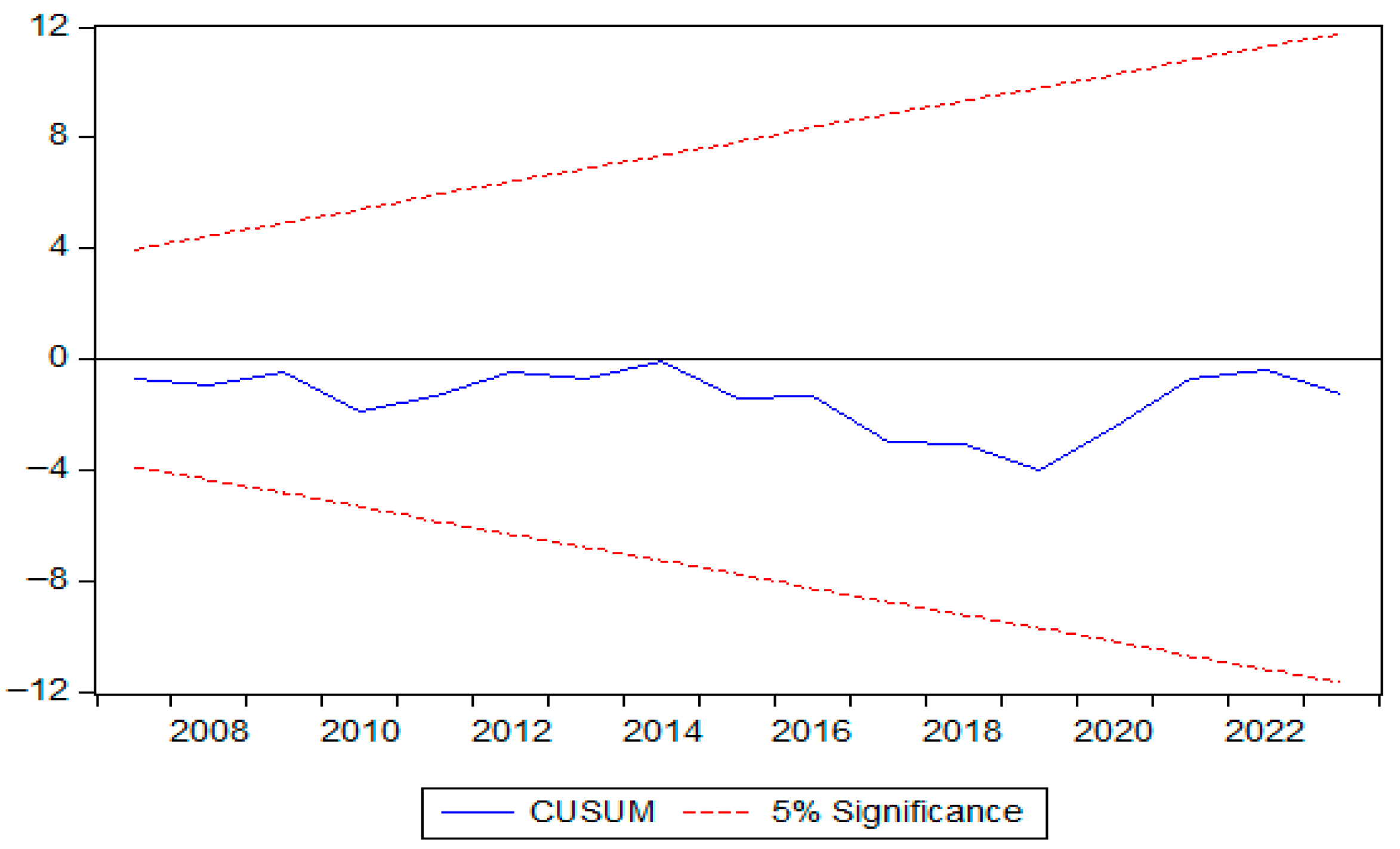
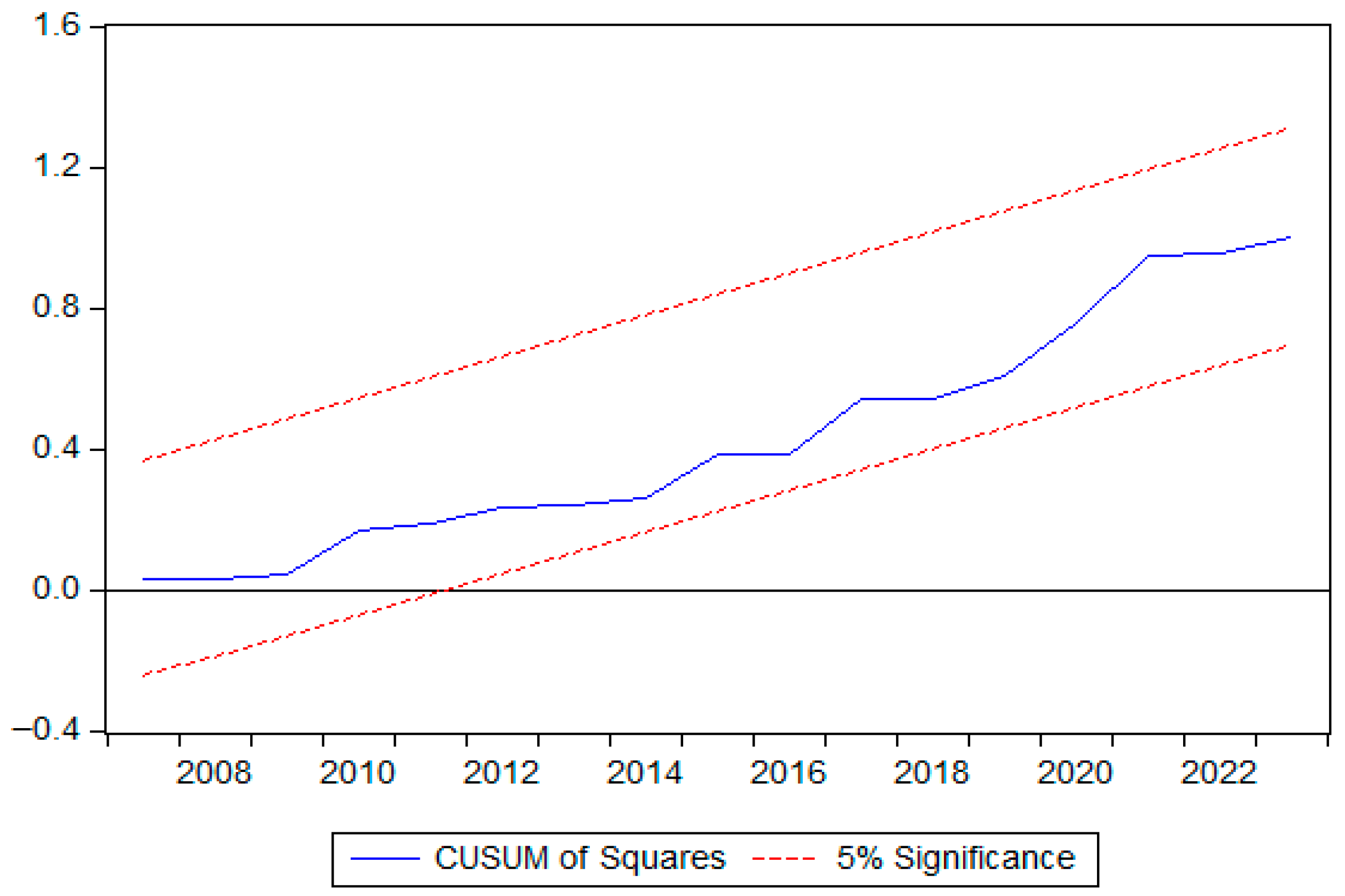
Diagnostic tests confirm that the ARDL model satisfies classical assumptions. The Jarque–Bera statistic does not reject the null hypothesis of normally distributed residuals. The Breusch–Godfrey LM test confirms no serial correlation, and the Breusch–Pagan–Godfrey test confirms homoskedasticity. The Ramsey RESET test confirms no functional form misspecification. CUSUM and CUSUM of Squares stability tests (
Figure 2 and
Figure 3) show that the model parameters are stable during the sample period, since plots continue to remain within the 5% significance region.
4.7. Impulse Response Functions (IRFs)
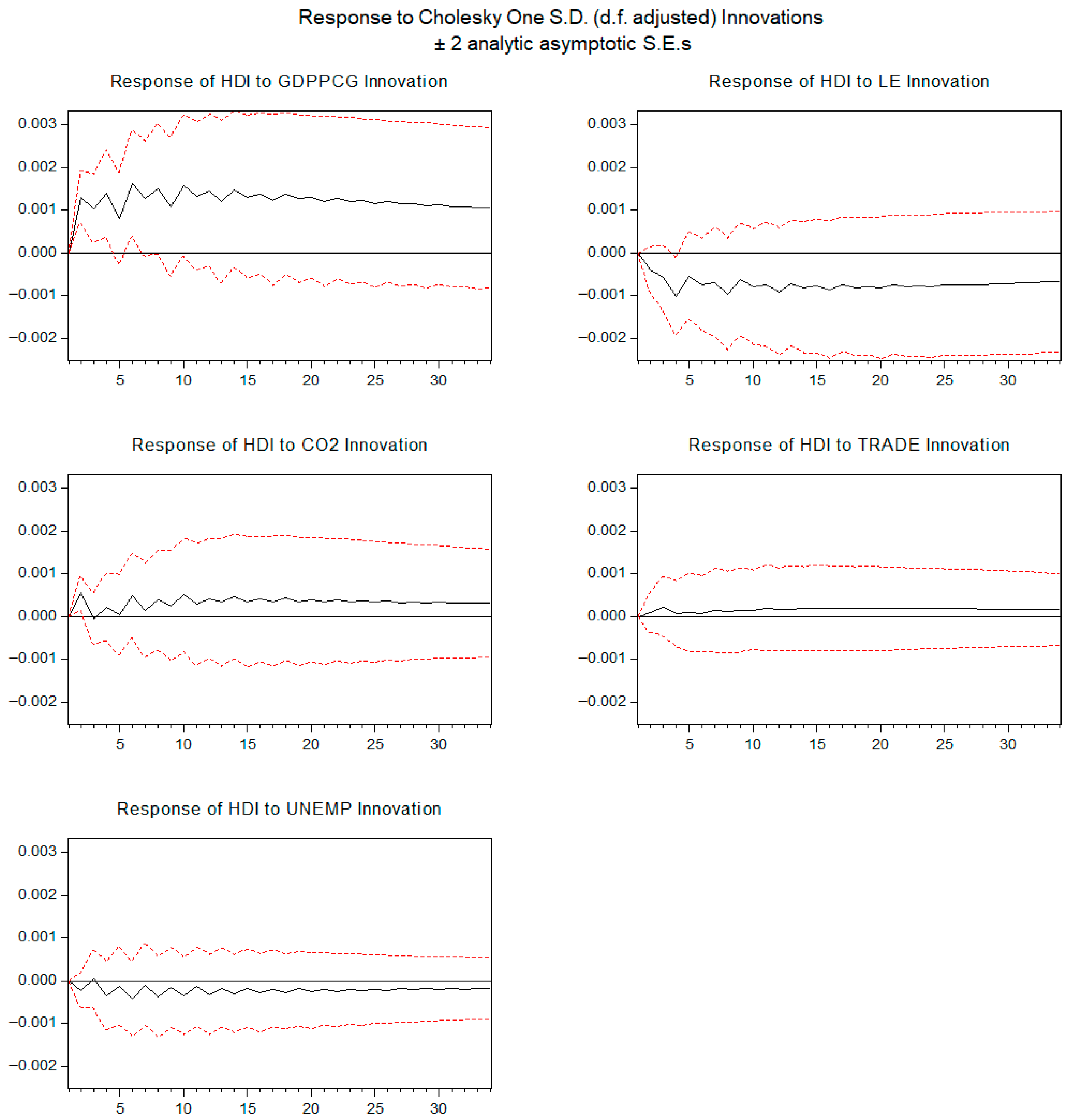
The dynamic responses of HDI to shocks in all variables are presented in
Figure 4.
The auxiliary VAR impulse response analysis provides graphical confirmation of the ARDL results, with a long-lasting positive response of HDI to both GDP and trade shocks, a long-lasting negative response to an unemployment shock, and a mixed, initially positive response to a CO2 shock, with all the effects small in magnitude and converging to the equilibrium, so confirming both the specific long-run relations and overall error correction mechanism obtained in the base ARDL results.
4.8. Robustness Checks
Robustness of the long-run ARDL results was assessed using FMOLS, DOLS, and CCR estimators. Results of these techniques are presented in
Table 8.
The robustness checks using FMOLS, DOLS, and CCR estimators strongly support the long-run ARDL findings. The persistent positive and significant coefficients of GDPPCG, CO2, and TRADE, and the negative and significant coefficient of UNEMP, employing all four methods, are evidence of the robustness of the said strong relationships.
5. Discussion
The empirical findings of the ARDL model provide further insights into the determinants of the Human Development Index (HDI) in Vietnam against the economic, social, and institutional context of Vietnam. Vietnam’s transition from a centrally planned to a dynamic market-oriented economic system over the past three decades has been characterized by unprecedented increases in living standards, public health, and education. Nevertheless, the issues persist, in particular regarding environmental sustainability and labour market efficiency, and this is reflected in the perceived variable impacts.
There is a positive and statistically significant impact of GDP per capita on HDI in the short run and the long run. This is consistent with rapid growth in Vietnam’s economy, with its economy averaging high growth rates since the 1990s, which has been translated into higher fiscal space with more social programmes and infrastructure. Growth, in the short run, triggers direct improvements in income and access to services and, in the long run, stimulates structural change, higher labour productivity, and wider human capital. Our findings are aligned with those of
Sasmita et al. (
2024),
Haj and Bustamam (
2025), and
Arisman (
2018), who also established positive correlations between HDI and economic growth in different contexts, reasserting the role of long-term growth as a driver of human development.
Life expectancy has a positive, albeit statistically insignificant, effect in the long run but a significantly positive short-run effect. This suggests that health improvement in Vietnam has short-run developmental payoff, possibly due to particular public health interventions, but the effects deteriorate in the long run unless complemented by structural reforms in the health system. Our results are consistent with those of
Sakinah et al. (
2022) and
Akbar et al. (
2021), who found short-run positive effects of health indicators on HDI. However, the lack of long-run significance differs from most of the literature, which reports long-lasting positive health effects on human development.
The strong and positive relationship between CO
2 emissions and HDI is a pivotal result, starkly contrary to OECD or Sub-Saharan African-based research (
Akbar et al., 2021;
Asongu & Odhiambo, 2020). The result should not be interpreted as the causal effect of pollution on development but rather as a diagnosis of the distinctive growth pattern of Vietnam. As
Figure 1 indicates, the parallel rising trajectories of HDI and per capita CO
2 since 1990 reflect a development path in which industrialization, energy consumption, and infrastructure investment, sources of short-term income and employment growth, have been inextricably linked to fossil fuel use. When contextualized with Vietnam’s substantial population growth from approximately 66 million in 1990 to over 100 million in 2023 (
World Bank, 2025), this correlation underscores a critical challenge: The remarkable human development progress has been coupled with a multiplied total national emissions burden, creating significant aggregate environmental pressure. This pattern, also observed in other rapidly industrializing nations (
Fakhri et al., 2024), highlights a fundamental sustainability dilemma. The use of an aggregate emissions variable, while a limitation, captures the net effect of this economy-wide trend.
Openness to trade has a significant and positive effect, both in the long and short term, which translates to enhanced deep integration of Vietnam within international markets, having a positive influence on human development. Vietnam’s export-led growth strategy, which is manufactured goods-based, textile-based, and more recently electronics-based, has generated employment opportunities, facilitated technology transfer, and enhanced government revenues. Short-term benefits accrue from increased economic activity and job creation, while long-term benefits accrue from increased productivity and diversification of the economy. Our results concur with
Hamdi and Hakimi (
2022), who also reported positive trade–HDI relationships, but disagree with
Dzihny et al. (
2023), who noted that political unrest could undo such benefits.
Unemployment negatively affects HDI in both views, with more long-run relevance. This is an indication of the adverse impact of unemployment on income security, access to health, and education. Official unemployment in the case of Vietnam is low, yet underemployment and informal sector employment remain serious issues, excluding the possibility of gaining living standards sustainably and inclusively. This aligns with our research and with that of
Runtunuwu (
2020), which also determined that unemployment hurts human development outcomes.
More broadly, the results for Vietnam are in line with cross-country evidence on the contribution of economic growth, trade, and employment to human development, and the positive correlation of CO2 emissions and HDI reflects the unique stage of the development of the country. That short-run benefits appear to be without permanent effect in the long term underlines the necessity of continual investment in structural health in order to ensure continued improvement. These findings taken together suggest that while Vietnam’s pattern of development has generally been successful in promoting HDI, future growth must be balanced with environmental responsibility and social equity if progress is to be sustained.
6. Conclusions and Policy Implications
The results of this study highlight the multidimensionality of human development in Vietnam. Growth in Vietnam was at all times a robust and permanent determinant of HDI in both the short and long run. Economic growth, thus, confirmed the primacy of persistent macroeconomic performance in enhancing living standards. Life expectancy, although positively correlated with HDI in the short term, was insignificant in the long term, suggesting that initial gains in health may be forfeited without more fundamental systemic transformation in the provision of healthcare. Per capita CO2 emissions were positively correlated with HDI in both periods, reflecting Vietnam’s current stage of industrialization, where environmental degradation is overshadowed by developmental advance. Openness to trade had a beneficial effect in the short and long run, highlighting integration into world markets’ development dividends. On the contrary, unemployment had a negative impact in both time frames, with a more robust long-run impact, which refers to labour market difficulties that continued despite general economic advancement.
While the chosen ARDL order (2,2,1,2,1,1) was identified by the Akaike Information Criterion (AIC) as the best fit to explain the dynamic relationships within our multivariate model, we also acknowledge the sample size limitation (N = 34). The diagnostic goodness of our model and the theoretical validity of the results provide us with confidence in our outcomes.
Our results suggest some policy directions. Maintaining vigorous economic growth must remain the central policy objective, backed by inclusive human capital and infrastructure investment. To achieve short-term health gains and translate them into long-term improvements, Vietnam must reinforce healthcare reform, expand rural and preventive care, and improve mechanisms for finance. The finding of a long-run positive relationship between CO2 emissions and HDI is an important alarm, diagnosing Vietnam’s current development path as carbon-based. Policy must therefore be implemented quickly to reverse this by decoupling growth from emissions by strategically investing in renewable power, imposing energy efficiency targets on industry, and encouraging green technology take-up. This will safeguard human development gains while ensuring long-term environmental stability. Concomitant integration through trade needs to be supported by upgrading and diversifying value chains for enhanced resilience to external shocks. Ultimately, focused labour market reforms like vocational training, formalization of informal employment, and support to small and medium enterprises are required in order to ease unemployment’s straitjacket on human development.
Working on these areas, Vietnam will be able to consolidate its development achievements while laying the foundation for a more inclusive and sustainable trajectory during the next decade.