You are currently viewing a new version of our website. To view the old version click .
Technologies
  • Article
  • Open Access

22 December 2018

Improved Parallel Legalization Schemes for Standard Cell Placement with Obstacles †

,
,
,
,
and
1
Computer Science, University of Thessaly, 35131 Lamia, Greece
2
Informatics and Telecommunications, University of Athens, 106 79 Athens, Greece
3
Computer Science and Biomedical Informatics, University of Thessaly, 35100 Lamia, Greece
4
Electrical and Computer Engineering, University of Thessaly, 382 21 Volos, Greece
This article belongs to the Special Issue Modern Circuits and Systems Technologies on Electronics

Abstract

In standard cell placement, a circuit is given consisting of cells with a standard height, (different widths) and the problem is to place the cells in the standard rows of a chip area so that no overlaps occur and some target function is optimized. The process is usually split into at least two phases. In a first pass, a global placement algorithm distributes the cells across the circuit area, while in the second step, a legalization algorithm aligns the cells to the standard rows of the power grid and alleviates any overlaps. While a few legalization schemes have been proposed in the past for the basic problem formulation, few obstacle-aware extensions exist. Furthermore, they usually provide extreme trade-offs between time performance and optimization efficiency. In this paper, we focus on the legalization step, in the presence of pre-allocated modules acting as obstacles. We extend two known algorithmic approaches, namely Tetris and Abacus, so that they become obstacle-aware. Furthermore, we propose a parallelization scheme to tackle the computational complexity. The experiments illustrate that the proposed parallelization method achieves a good scalability, while it also efficiently prunes the search space resulting in a superlinear speedup. Furthermore, this time performance comes at only a small cost (sometimes even improvement) concerning the typical optimization metrics.

1. Introduction

In the cell placement problem, an input circuit must be placed over a chip area so that the circuit’s cells do not overlap, and one or more target functions are optimized. Typical optimization targets considered include the following: total wirelength, routability, cell congestion, and so on. A common problem statement involves cells of a standard height (different width) that must be placed on a chip area that is split into standard height rows (capturing power grid lines). The problem is usually tackled in a step-wise fashion. At a first iteration, a global placement algorithm spreads the cells over the chip area, so that the area coverage and targeted optimization goals are achieved. The resulting cell positions might be unaligned to the chip standard rows. Thus, in a second step, a legalization algorithm is responsible for achieving cell–row alignment and alleviating all cell overlaps. Assuming an efficient global placement, the legalization step must be performed with as few changes to the original assignment as possible. Thus, the aggregated cell distance between the global and final placement (cell displacement) is usually considered as the performance metric for legalization algorithms.
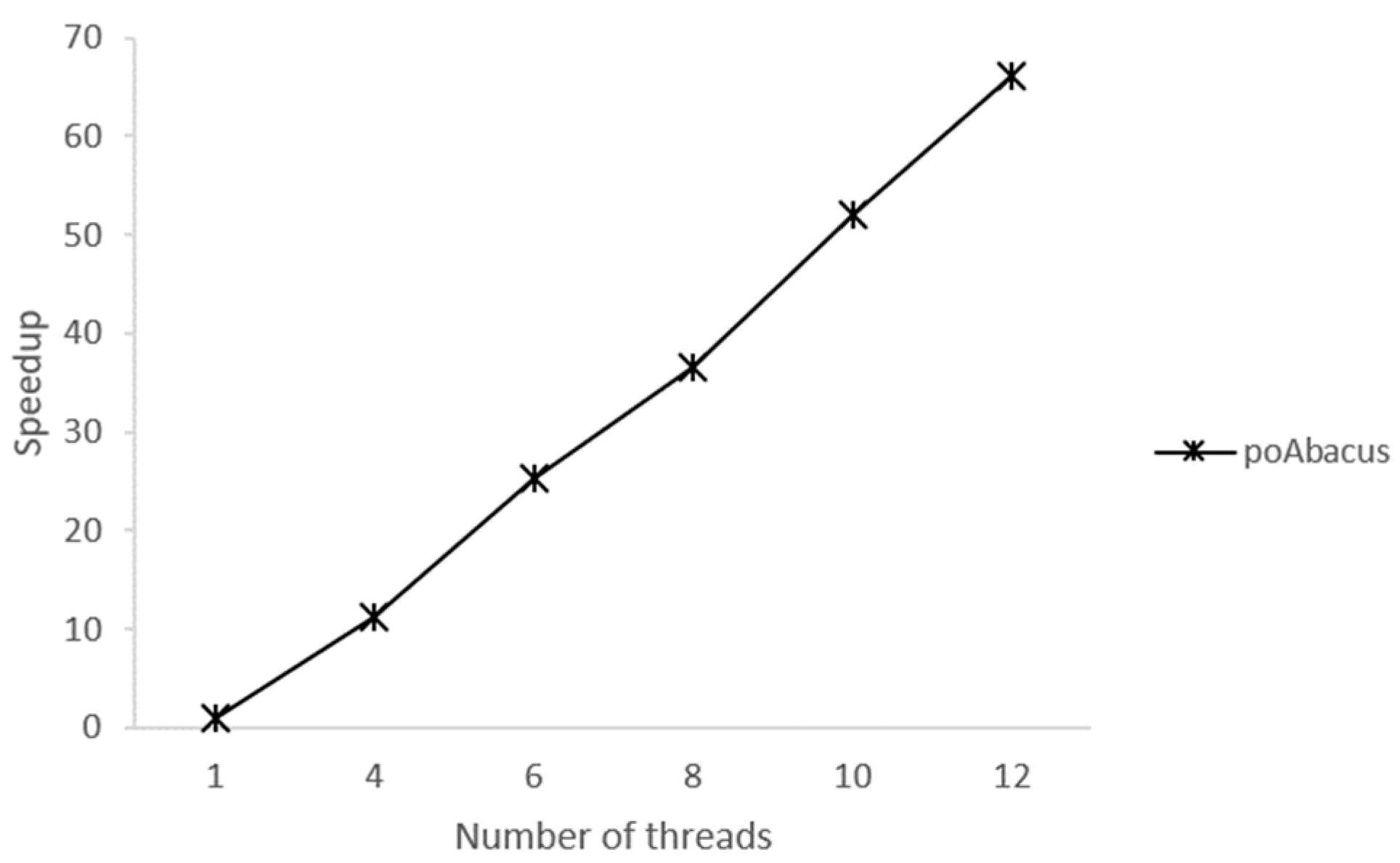
While extnsive literature exists on legalization schemes for standard cell placement (discussed in Section 2), the case where obstacles exist in the chip area has received less attention. Such obstacles might be the result of preplaced modules in the chip area at fixed positions, and may introduce additional constraints whereby cells cannot overlap with the obstacle areas. In this paper, we turn our attention to the legalization step in standard cell placement with obstacles. In particular, we propose and evaluate extensions for two well-known legalization algorithms, namely Tetris [] and Abacus [], which were originally designed to work for the case where no obstacles exist. The aforementioned algorithms account for different trade-offs between running time and optimization efficiency, with Abacus producing a better solution quality, but at a significantly higher computational overhead. The targeted extensions aim at making the algorithms obstacle-aware. Furthermore, in order to tackle the high running time of Abacus, we propose and evaluate a parallelization approach based on multi-threaded execution, whereby each thread handles a non-overlapping chip area partition. It turns out that the proposed parallelization method not only manages to reduce the running time of Abacus (Tetris too), but also does so without affecting the quality of the final placement (even improves it in some scenarios, particularly in the Tetris case). The initial results for the Tetris algorithm were presented in the literature []. Here, we extend and consolidate our previous work so as to account for the obstacle awareness and parallelization of the Abacus algorithm, which consists our primary contribution. Through experiments based on ibm circuits, the merits of our contributions are illustrated. Specifically, compared to the baseline Abacus algorithm, the parallel obstacle aware algorithm we propose (poAbacus) achieves a similar quality, but at a speedup that can reach 66 x with 12 cores.
The rest of the paper is organized as follows. Section 2 provides an overview of the research on the cell placement problem, as well as the legalization methods. Section 3 describes the proposed algorithms for obstacle aware legalization, while Section 4 presents the experimental results. Finally, Section 5 discusses the findings from the experiments and concludes the paper.

3. Obstacle-Aware Parallel Legalization Algorithms

In this section, we illustrate poAbacus and poTetris. Pseudocode 1 describes the basic Abacus algorithm that operates without considering obstacles. The cells are first ordered according to the x-coordinate (increasing fashion) (line 1). The algorithm then places the cells in an iterative manner, starting with the one of the minimum x-coordinate value (lines 2–13). In doing so, the best position at each candidate row is calculated (lines 3–11), and the best overall position (displacement wise, Manhattan distance) is selected among all of the possible candidates (line 9). The previous steps described for Abacus also hold true for Tetris. However, the algorithms differ in the manner they treat the case where an overlap might occur with a previously placed cell. Tetris simply places the overlapping cell at the first leftmost eligible position. On the other hand, Abacus calls for a function presented in Pseudocode 2. The function merges the overlapping cells into a cell cluster (line 10). It then computes the best cluster position (line 11). Obviously, the process might involve moving the already placed cells, thus, increasing their relevant (previously optimal) displacement. Thus, in order to identify the best possible total displacement change (in the whole cell cluster), the algorithm formulates the problem in a quadratic optimization fashion, and solves it using a dynamic programming method. This is done by the collapseClusters function (line 11), the details of which are described in the literature [].
Pseudocode 1: Abacus algorithm
input: circuit cells C, circuit rows R
output: C cells aligned in R rows without overlaps
1sort C based on x-coordinate
2foreach cell c i C do
3     bestCost : = INF
4     bestRow : = 1
5    foreach row r j R do
6       cost : = i n s e r t C e l l ( c i , r j , T R I A L )
7      if cost < bestCost then
8         bestCost : = cost
9         bestRow : = r j
10      end if
11    end for
12     i n s e r t C e l l ( c i , b e s t R o w , N O T R I A L )
13end for
Pseudocode 2: Function insertCell()
input: cell c i , row r j , mode
output: Manhattan distance of c i ’s displacement
1oldPlacement: = existing placement before C i is inserted
2if a r e a ( c i ) + o c c u p i e d A r e a ( r j ) > a r e a ( r j ) then
3   cost: = INF
4end if
5vertically align c i into r j //x-coordinate does not change
6if c i does not overlap with any cluster c l u then
7   create new cluster c l n e w containing c i
8   cost: = displacement of c i
9else
10   add c i into c l u with which it overlaps
12   cost: = collapseClusters( c l u )
12end if
13if mode = TRIAL then
14   restore oldPlacement
15end if
16 return cost
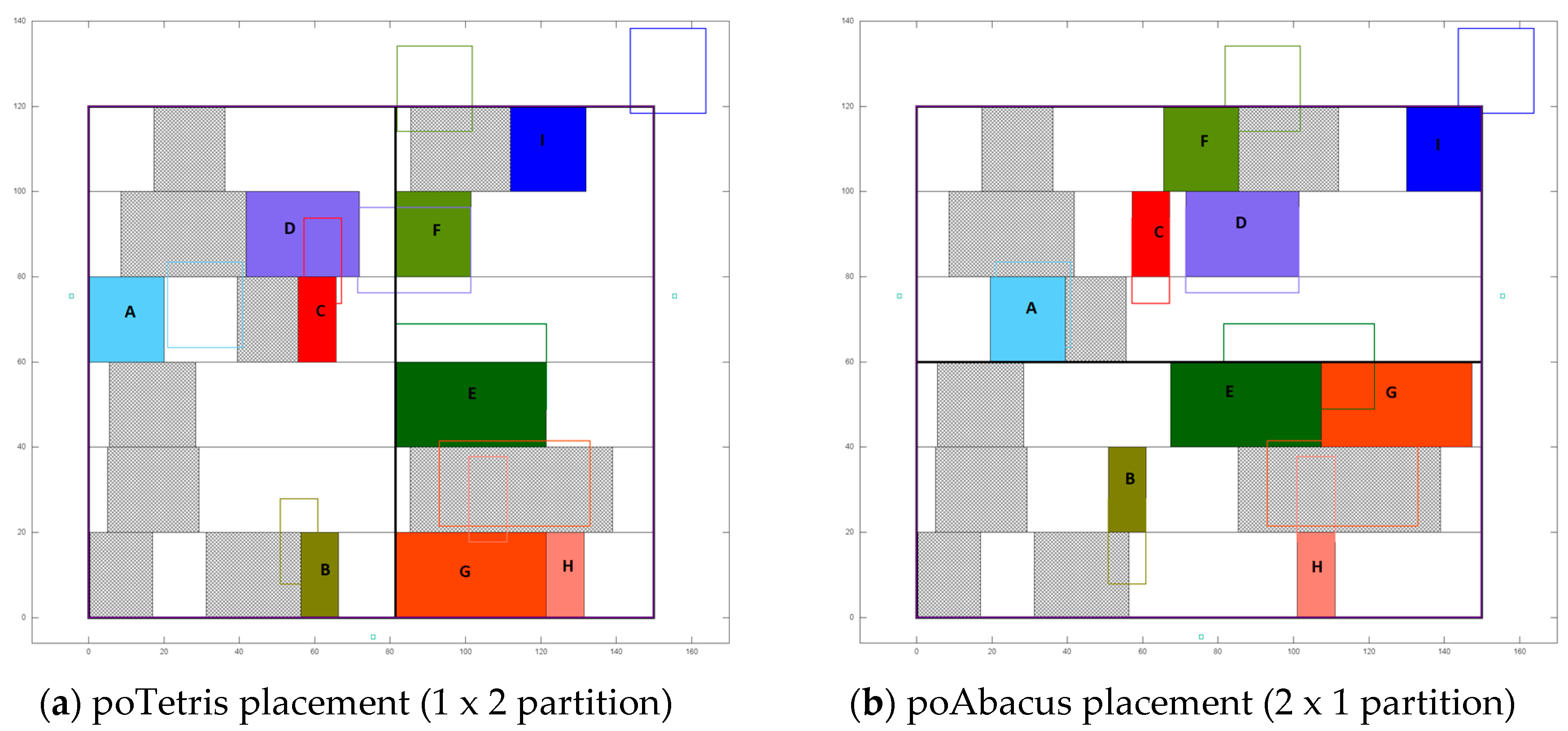
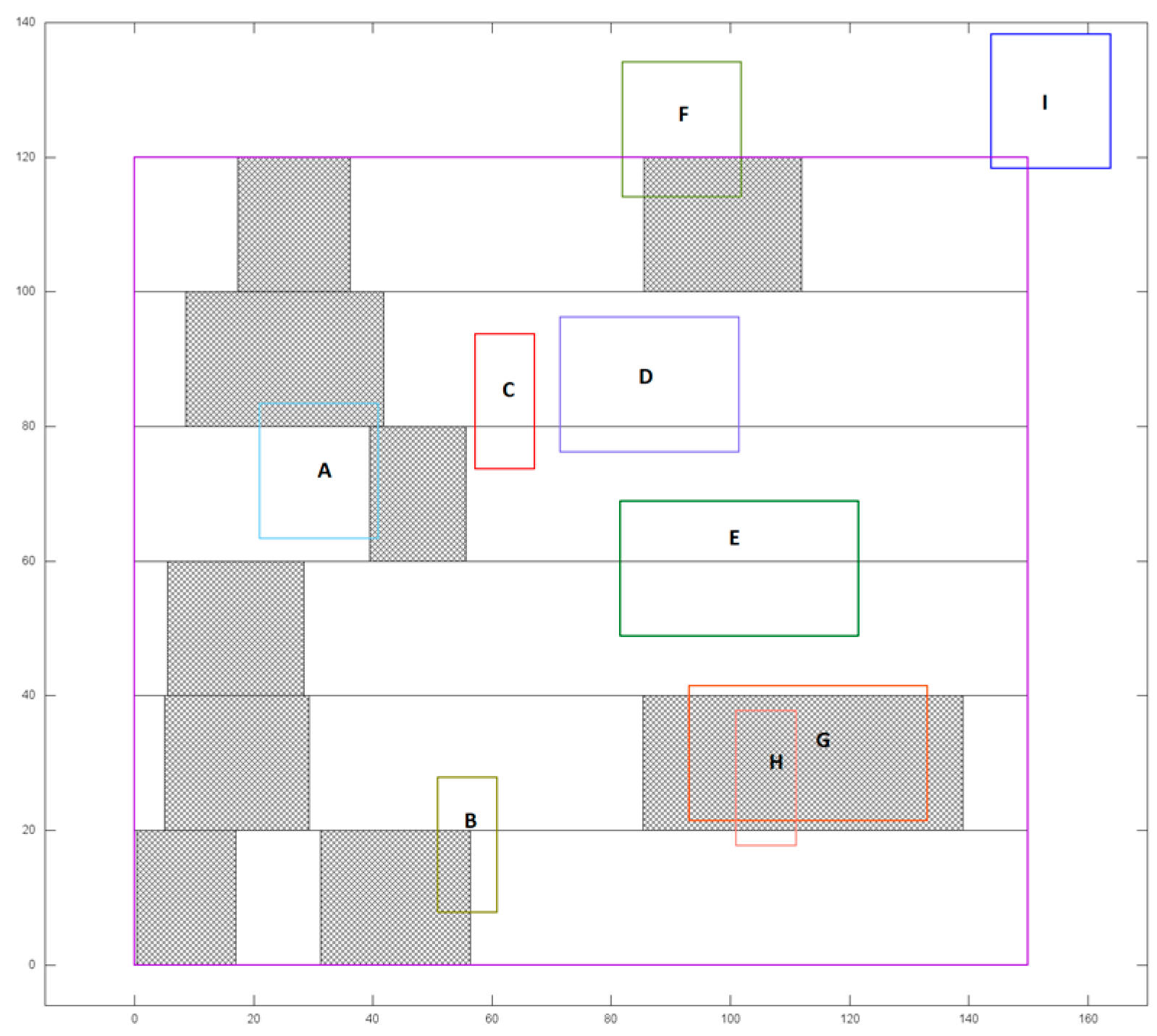
Both Tetris and Abacus are extended to account for obstacles in the following manner. We consider that each obstacle effectively splits all of the intersecting rows into sub-rows (before and after obstacle boundaries). Consider, for instance, the example of Figure 1, which shows an example placement scenario whereby the chip area is split into six standard rows; nine obstacles exist shown as grey areas; and the final position of nine cells A, B, …, and I must be defined. poTetris and poAbacus will operate by considering the induced sub-rows, whereby the initial rows are split because of the presence of the obstacles. In the example, three sub-rows exist in rows 1 and 5, while each of the rows 2, 3, 4, and 6 are split into two sub-rows. The total sub-rows induced by the obstaces in the example is 14, and they consist candidates for cell placement.
Figure 1. Example global placement
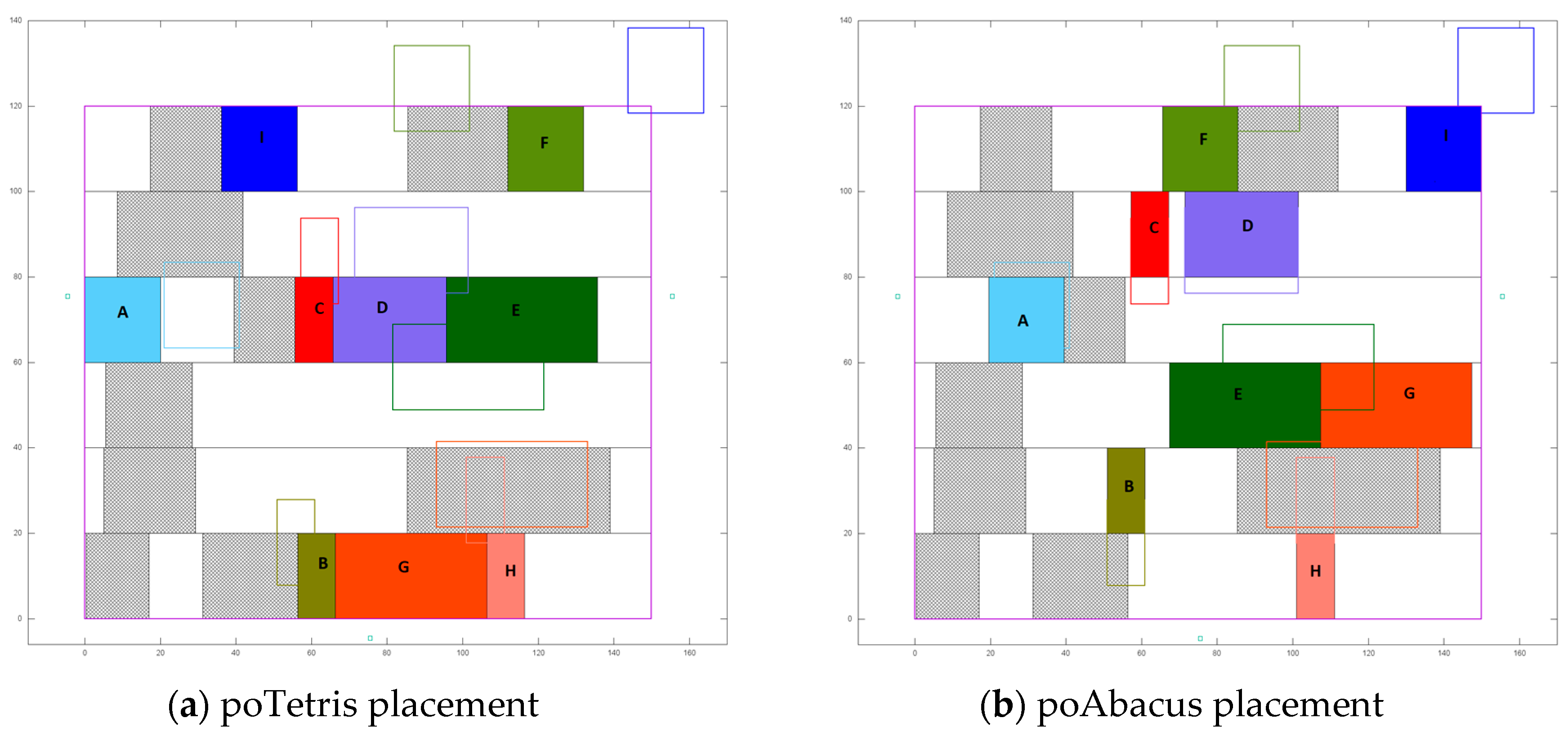
Continuing the example of Figure 1, in Figure 2a, the final placement achieved by poTetris is shown, and in Figure 2b, the one by poAbacus is shown. As it can be observed, the two algorithms lead to almost completely different results, with a closer look revealing that poAbacus results in a much smaller displacement compared with poTetris. To better understand why, consider, for instance, the case of E and G’s placement. In poTetris, these cells will be placed on different rows to the one they overlap most (row four). In poAbacus, on the other hand, after E is first placed at row four, G’s placement will result in forming a cluster with E and G. The algorithm then identifies the best position of the cluster as a whole.
Figure 2. Obstacle-aware placement examples
Depending on the number of obstacles and their height, the number of candidate positions both algorithms should check might drastically increase as multiple sub-rows are introduced. This might further hinder the algorithmic performance time wise, with the effects being more prominent in the case of poAbacus. For this reason, we tackle algorithmic parallelization not from the rather straightforward standpoint of spawning multiple threads to calculate each sub-row cell candidate position, but from the perspective of reducing the effective search space that is used for each cell placement decision. In Pseudocode 3, the proposed poAbacus is described. The algorithm is based on splitting the chip area into independent tile partitions (lines 2–14), and restricting the search space for each cell to the sub-rows contained in the tile it belongs to (line 18). On top, the cells of each tile are assigned to a separate thread in order to further the time gains with parallelization (line 15).
Pseudocode 3: poAbacus algorithm
input: circuit cells C, circuit rows R, number of horizontal partitions N, number of vertical partitions M
output: C cells aligned in R rows without overlaps
1 C r e m : = //stores the leftover cells
2 b = | R | / N
3split chip area into N-1 horizontal partitions of b rows each //the Nth partition will have the
//remaining rows: | R | ( N 1 ) b
4foreach horizontal partition h do
5  avgFreeSpace: = (area(h) − obstacleArea(h))/M
6  xoffset: = chipAreaWidth/s     //s is a tunable parameter
7  for v: = 1 to M-1 do
8   setTileBoundary(Thv, getTileBoundary(Th(v−1))+xoffset) // getTileBoundary(Th0) = 0
9   while freeArea(Thv) < avgFreeSpace do
10    setTileBoundary(Thv, getTileBoundary(Thv)+xoffset)
11   end while
12  end for
13  setTileBoundary(ThM, chipAreaWidth)
14end for
15par-foreachThvdo //each tile is assigned to a different thread
16   C h v : = {all cells contained in Thv}
17   R h v : = {all sub-rows contained in Thv}
18  Abacus ( C h v , R h v )
19  foreach ( c i , r j ) : c i C h v r j R h v c i is   placed   at r j do
20   if c i exceeds r j then
21    down(mutex)
22     C r e m = { c i }
23    up(mutex)
24   end if
25  end for
26end par-for
27barrier
28if C r e m then
29  Abacus( C r e m , R s u b ) // R s u b is the set of subrows existing in the whole chip area
30end if
In order to achieve tile independence (necessary for efficient parallelization), it is imperative that the cells of a tile must be placed within the tile, and not be allowed to overlap with neighboring tiles. Thus, it is possible that some cells can be left unplaced, as no suitable position might exist within their assigned tile (lines 20–24). Both in poTetris and poAbacus, after all of the tile threads terminate (line 27), any remaining cells are placed during a second phase, without considering tile boundary restrictions (line 29). This necessary second step might be a source of performance degradation, as most likely, the remaining cells will be placed in distant positions. In order to minimize the negative effects, the tile splitting process must aim at distributing the obstacle area judiciously among the tiles. This is achieved by first creating an N × M partition into roughly equally sized horizontal zones (line 2–3), and subsequently defining the vertical tile boundaries (lines 4–14). For this reason, the average free space per tile is calculated (line 5), and the x-axis is split into s candidate cutting points (line 6). In the experiments, s = 1,000. The candidate cutting points are scanned each time, defining tile vertical boundaries so that the free space per tile is close to the expected average (lines 7–14). The last tile within a horizontal zone is defined by the right chip area boundary (line 13).
Figure 3 continues the example of Figure 1, with two different partitioning scenarios for poTetris and poAbacus, respectively. It also points out the different impact that horizontal and vertical cuts have on algorithms’ performance. In Figure 3a, cells A, B, C, and D belong to the left tile, while the rest belong to the right. The introduction of a vertical cut forces poTetris to place E at its optimal position, whereas without it, the candidate position at the 4th row would have been just after the obstacle of the 4th row (for a larger displacement). In Figure 3b, the cells are also divided into two disjoint sets based on where their left-down x-coordinate belongs. Notice, that the final placement achieved by poAbacus is identical to the one of Figure 2b. However, the complexity of the individual cell placement decisions is almost halved, as seven sub-rows must be evaluated (the ones belonging to the relevant tile) instead of the 14 that exist in the total chip area.
Figure 3. Obstacle-aware placement with tiles

4. Experiments

4.1. Experimental Setup

Experiments were carried out using the ibm01-13 benchmark circuits provided by the authors of []. As these circuits have no obstacles, random obstacles were introduced so that they cumulatively cover a specific percentage of the free space (calculated by subtracting the total area of cells from the chip area). It should be noted that the introduction of the random obstacles rather accounts for the worst case algorithmic wise, notably for poAbacus. This is due to the fact that in real life designs, obstacles are independent rectangular areas with some spacing in between them. On the other hand, random obstacles may lead to non-rectangularly shaped continuous obstacle areas, which make tile partitioning harder. Different scenarios concerning free space were evaluated per circuit. For each scenario, 10 runs were conducted and the results were averaged. Performance evaluation was done across the following three metrics: net wirelength, displacement, and running time. Displacement was measured as the Manhattan distance between the starting and end cell position. Net wirelength was measured using the half perimeter wirelength (HPWL) of the minimum bounding rectangle, which contains all of the cells of a net. NTUplace3 [] was used as a global placer to obtain the starting cell positions. These positions formed the input upon which the proposed legalization methods were evaluated. Multithreaded parallelism was implemented using OpenMP. Experiments were conducted on a Linux server with two Intel Xeon E5-2630 processors (2.3 GHz) using hyper threading (12 physical cores total).

4.2. Standalone Tetris and Abacus Evaluation

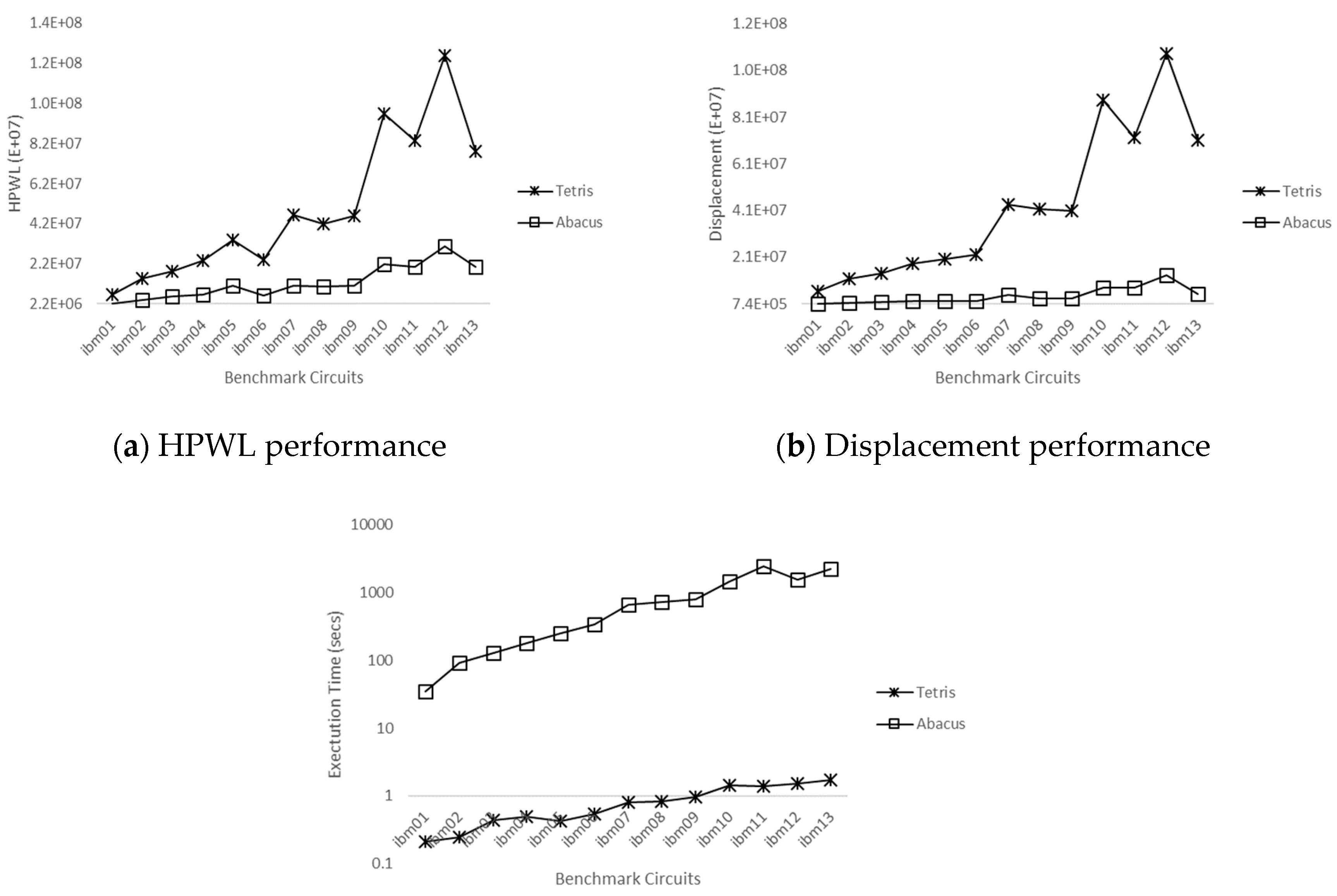
In a first experiment, we evaluated the performance of the standalone Tetris and Abacus. Figure 4 shows the resulting performance on the three metrics, for the case where 10% of the free space exists. It can be clearly seen that Abacus outperforms Tetris by even an order of magnitude (in certain cases) in both HPWL and displacement terms. On the other hand, as shown in Figure 4c, Abacus’ performance comes at the cost of a particularly higher running time, by three orders of magnitude in most cases. These first results undoubtedly illustrate the necessity of introducing faster approaches compared to the baseline Abacus algorithm.
Figure 4. Performance comparison standalone Tetris and Abacus. HPWL—half perimeter wirelength.

4.3. Evaluation of poTetris and poAbacus

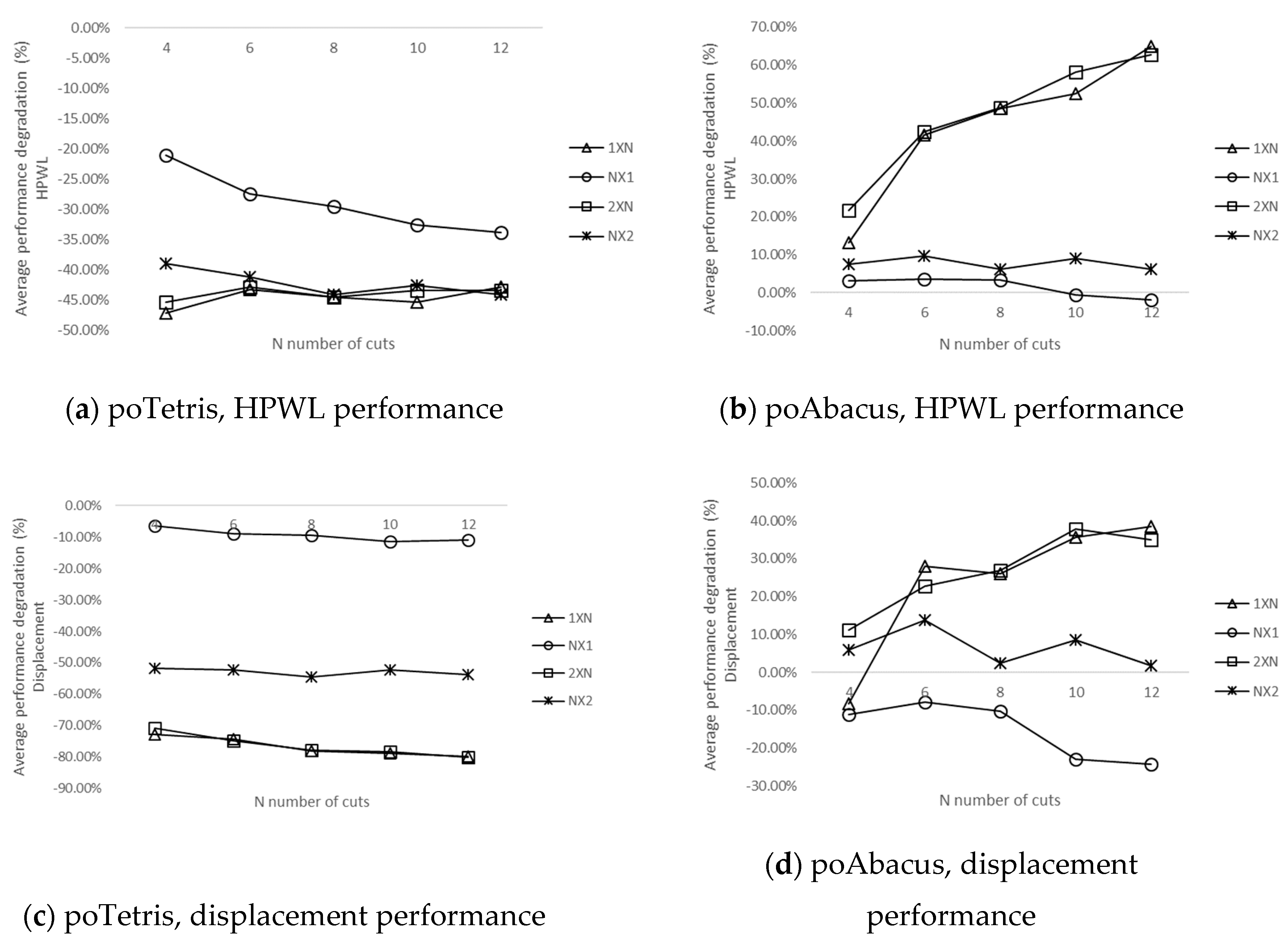
Next, we proceeded with evaluating the performance of poTetris and poAbacus. Figure 5 compiles the relevant performance degradation in HPWL and the displacement terms of poTetris and poAbacus as a percentage of the related Tetris and Abacus performance. Specifically, for poTetris, the degradation percentage is given by 100((perf(poTetris)-perf(Tetris)/perf(Tetris)), and similarly for poAbacus. Each point in the plots depict the average percentage results for the 13 benchmark circuits, assuming 20% free space. Figure 5 plots the performance of the algorithms for four different tile partitioning cases and five different number of cuts.
Figure 5. Solution quality performance comparison for different partitioning alternatives.
As it can be inferred by Figure 5a,c, poTetris outperforms Tetris in both HPWL and displacement terms (negative degradation means an improvement). In particular, the gains in displacement terms reach 80% when N vertical cuts are introduced. By comparison, the effects of the vertical partitioning appear to be the opposite in poAbacus, whereby introducing more horizontal cuts (N × 1 and N × 2 plots) apparently leads to z better solution quality compared with the other options. In fact, Figure 5d depicts a substantial improvement in the displacement terms, which can reach more than 20%. These results can be explained for the case of poTetris, as vertical cuts reduce the allowable displacement in the x-axis. On the other hand, poAbacus defines the optimal cluster position within each sub-row. Therefore, restricting the allowable cluster movements along the x-axis (as vertical cuts do) will likely hinder performance, whereas restricting the y-axis will not do so and might in fact prove beneficial in certain scenarios.
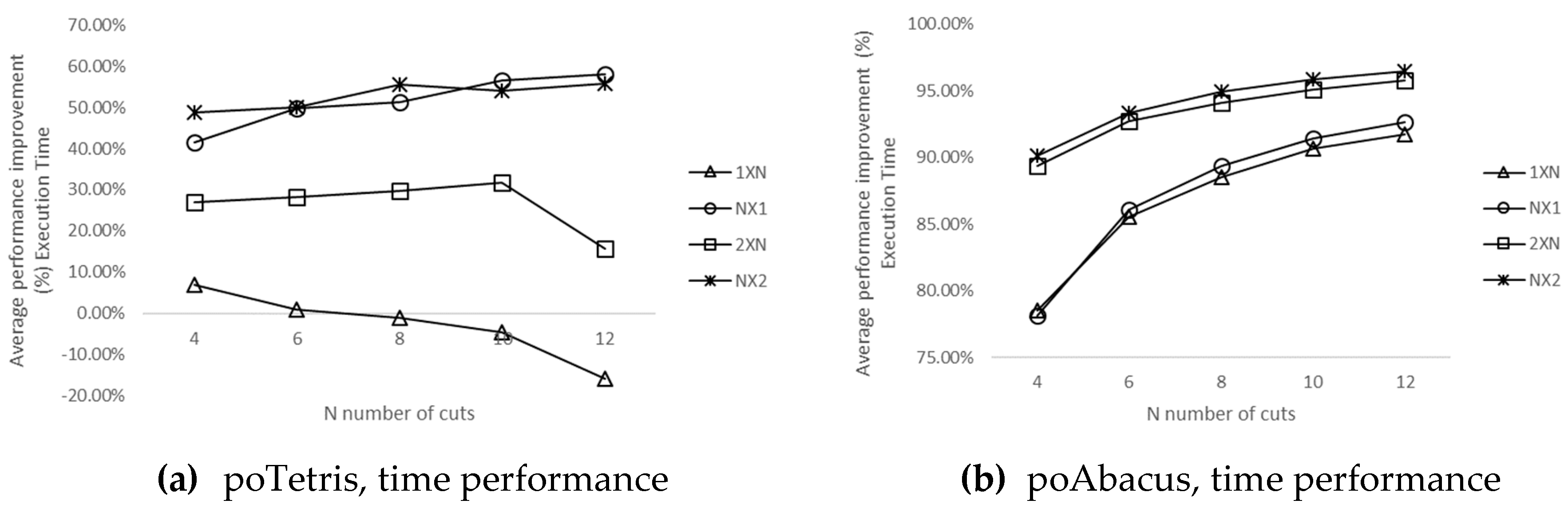
Figure 6 illustrates the time improvement of poTetris and poAbacus over their simple counterparts. Both algorithms achieve a reduced running time, with results for poAbacus being particularly impressive, demonstrating a reduction in running time that reaches 95%.
Figure 6. Time comparison for different partition alternatives.
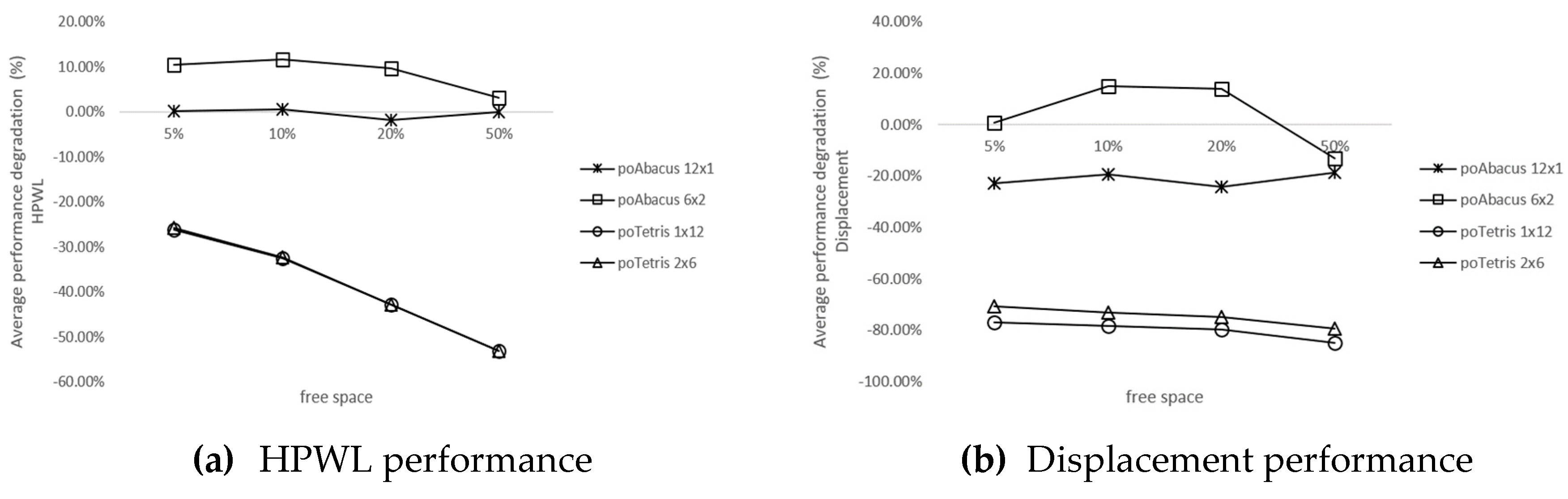
Next, we evaluate the solution quality of the algorithms for different free space percentages. Figure 7 shows the results. poTetris achieves an improved performance over Tetris, with the gains in the displacement being constantly around 80%. In poAbacus, the displacement gains vary between ±20%, depending on the particular case considered, while HPWL remains unaffected in the 12 × 1 case.
Figure 7. Solution quality performance comparison for different free space percentages.
Having established that in terms of solution quality, poAbacus has a comparable performance to Abacus and might even exhibit improvement, depending on the evaluation scenario, we proceed by plotting the speedup trends (time(Abacus)/time(poAbacus)) for the N × 1 partitioning as the number of threads increases. Results presented in Figure 8 demonstrate an impressive superlinear behavior, whereby the achievable speedup with 12 threads reaches 66. This is a strong testament on the merits of our approach, which combines multithreaded parallelism with search space pruning.
Figure 8. Speedup of poAbacus over Abacus.

5. Conclusions

In this paper, we tackled the problem of improving the performance of a state-of-the-art legalizer, and of a fast and greedy one in the presence of obstacles. This improvement was achieved by inducing a judicious tile partitioning of the chip area, which takes into consideration obstacles and allows for both reducing the search space and for the split of computations into independent tasks that can be trivially parallelized. The results are particularly encouraging, demonstrating an improvement in all aspects of HPWL, displacement, and time for Tetris. They also demonstrate that the proposed poAbacus scheme can achieve an impressive superlinear speedup over its simple counterpart without negatively affecting HPWL and displacement, if horizontally defined tiles are used.

Author Contributions

Conceptualization, P.O. and T.L.; methodology, A.N.D., K.K., and A.K.; software, P.O. and K.K.; validation, P.O., A.N.D., and A.K.; formal analysis, P.O. and K.K.; investigation, A.N.D. and T.L.; resources, S.G.I.; data curation, A.N.D.; writing (original draft preparation), P.O., A.N.D., K.K., T.L., and A.K.; writing (review and editing), G.I.S.; visualization, P.O. and T.L.; supervision, G.I.S.

Funding

This research received no external funding.

Conflicts of Interest

The authors declare no conflict of interest.

References

  1. Hill, D. Method and System for High Speed Detailed Placement of Cells within an Integrated Circuit Design. U.S. Patent 6370673 B1, 9 April 2002. [Google Scholar]
  2. Spindler, P.; Schlichtmann, U.; Johannes, F.M. Abacus: Fast Legalization of Standard Cell Circuits with Minimal Movement. In Proceedings of the 2008 International Symposium on Physical Design (ISPD ’08), Portland, OR, USA, 13–16 April 2008; ACM Press: New York, NY, USA, 2008. [Google Scholar]
  3. Oikonomou, P.; Dadaliaris, A.N.; Loukopoulos, T.; Kakarountas, A.; Stamoulis, G.I. A Tetris-based Legalization Heuristic for Standard Cell Placement with Obstacles. In Proceedings of the 7th International Conference on Modern Circuits and Systems Technologies (MOCAST), Thessaloniki, Greece, 7–9 May 2018; IEEE: Piscataway, NJ, USA, 2018. [Google Scholar]
  4. Cardoso, M.S.; Smaniotto, G.H.; Bubolz, A.A.O.; Moreira, M.T.; da Rosa, L.S.; de Souza Marques, F. Libra: An automatic design methodology for CMOS complex gates. IEEE Trans. Circuits Syst. II Express Br. 2018, 65, 1345–1349. [Google Scholar] [CrossRef]
  5. Guo, J.; Zhu, L.; Sun, Y.; Cao, H.; Huang, H.; Wang, T.; Qi, C.; Zhang, R.; Cao, X.; Xiao, L.; et al. Design of area-efficient and highly reliable RHBD 10T memory cell for aerospace applications. IEEE Trans. Very Larg. Scale Integr. Syst. 2018, 26, 991–994. [Google Scholar] [CrossRef]
  6. Mishra, V.K.; Chauhan, R.K. Area efficient layout design of CMOS circuit for high-density ICs. Int. J. Electron. 2018, 105, 73–87. [Google Scholar] [CrossRef]
  7. Dadaliaris, A.; Oikonomou, P.; Koziri, M.; Nerantzaki, E.; Hatzaras, Y.; Garyfallou, D.; Loukopoulos, T.; Stamoulis, G. Heuristics to augment the performance of tetris legalization: Making a fast but inferior method competitive. J. Low Power Electron. 2017, 13, 220–230. [Google Scholar] [CrossRef]
  8. Chou, S.; Ho, T.-Y. OAL: An obstacle-aware legalization in standard cell placement with displacement minimization. In Proceedings of the 2009 IEEE International SOC Conference (SOCC), Belfast, UK, 9–11 September 2009. [Google Scholar]
  9. Spindler, P.; Schlichtmann, U.; Johannes, F.M. Kraftwerk2—A fast force-directed quadratic placement approach using an accurate net model. IEEE Trans. Comput. Aided Des. Integr. Circuits Syst. 2008, 27, 1398–1411. [Google Scholar] [CrossRef]
  10. Chen, T.-C.; Jiang, Z.-W.; Hsu, T.-C.; Chen, H.-C.; Chang, Y.-W. NTUplace3: An analytical placer for large-scale mixed-size designs with preplaced blocks and density constraints. IEEE Trans. Comput. Aided Des. Integr. Circuits Syst. 2008, 27, 1228–1240. [Google Scholar] [CrossRef]
  11. Popovych, S.; Lai, H.-H.; Wang, C.-M.; Li, Y.-L.; Liu, W.-H.; Wang, T.-C. Density-Aware Detailed Placement with Instant Legalization. In Proceedings of the 51st Annual Design Automation Conference on Design Automation Conference (DAC ’14), San Francisco, CA, USA,, 1–5 June 2014; ACM Press: New York, NY, USA, 2014. [Google Scholar]
  12. Netto, R.; Guth, C.; Livramento, V.; Castro, M.; Pilla, L.L.; Guntzel, J.L. Exploiting parallelism to speed up circuit legalization. In Proceedings of the 2016 IEEE International Conference on Electronics, Circuits and Systems (ICECS), Monte Carlo, Monaco, 11–14 December 2016. [Google Scholar]
  13. Oikonomou, P.; Koziri, M.G.; Dadaliaris, A.N.; Loukopoulos, T.; Stamoulis, G.I. Domocus: Lock free parallel legalization in standard cell placement. In Proceedings of the 6th International Conference on Modern Circuits and Systems Technologies (MOCAST), Thessaloniki, Greece, 4–6 May 2017. [Google Scholar]
  14. Wang, C.-H.; Wu, Y.-Y.; Chen, J.; Chang, Y.-W.; Kuo, S.-Y.; Zhu, W.; Fan, G. An effective legalization algorithm for mixed-cell-height standard cells. In Proceedings of the 22nd Asia and South Pacific Design Automation Conference (ASP-DAC), Chiba, Japan, 16–19 January 2017. [Google Scholar]
  15. Kennings, A.; Darav, N.K.; Behjat, L. Detailed placement accounting for technology constraints. In Proceedings of the 2014 22nd International Conference on Very Large Scale Integration (VLSI-SoC), Playa del Carmen, Mexico, 6–8 October 2014. [Google Scholar]
  16. Sketopoulos, N.; Sotiriou, C.; Simoglou, S. Abax: 2D/3D legaliser supporting look-ahead legalisation and blockage strategies. In Proceedings of the 2018 Design, Automation and Test in Europe Conference and Exhibition (DATE), Dresden, Germany, 19–23 March 2018. [Google Scholar]
  17. Viswanathan, N.; Pan, M.; Chu, C. FastPlace 3.0: A fast multilevel quadratic placement algorithm with placement congestion control. In Proceedings of the 2007 Asia and South Pacific Design Automation Conference, Yokohama, Japan, 23–26 January 2007. [Google Scholar]
  18. Lu, J.; Chen, P.; Chang, C.-C.; Sha, L.; Huang, D.J.-H.; Teng, C.-C.; Cheng, C.-K. ePlace: Electrostatics-based placement using fast fourier transform and Nesterov’s method. ACM Trans. Des. Autom. Electron. Syst. 2015, 20, 1–34. [Google Scholar] [CrossRef]
  19. Lu, J.; Zhuang, H.; Chen, P.; Chang, H.; Chang, C.-C.; Wong, Y.-C.; Sha, L.; Huang, D.; Luo, Y.; Teng, C.-C.; et al. ePlace-MS: Electrostatics-based placement for mixed-size circuits. IEEE Trans. Comput. Aided Des. Integr. Circuits Syst. 2015, 34, 685–698. [Google Scholar] [CrossRef]
  20. Wu, G.; Chu, C. Detailed Placement Algorithm for VLSI Design with Double-Row Height Standard Cells. IEEE Trans. Comput. Aided Des. Integr. Circuits Syst. 2016, 35, 1569–1573. [Google Scholar] [CrossRef]
  21. Taghavi, T.; Yang, X.; Choi, B.-K. Dragon2005: Large-Scale Mixed-Size Placement Tool. In Proceedings of the 2005 International Symposium on Physical Design (ISPD ’05), San Francisco, CA, USA, 3–6 April 2005; ACM Press: New York, NY, USA, 2005. [Google Scholar]
  22. Ababei, C.; Navaratnasothie, S.; Bazargan, K.; Karypis, G. Multi-objective circuit partitioning for cutsize and path-based delay minimization. In Proceedings of the IEEE/ACM International Conference on Computer Aided Design (ICCAD 2002), San Jose, CA, USA, 10–14 November 2002. [Google Scholar]
  23. Kim, M.-C.; Lee, D.-J.; Markov, I.L. SimPL: An effective placement algorithm. IEEE Trans. Comput. Aided Des. Integr. Circuits Syst. 2012, 31, 50–60. [Google Scholar] [CrossRef]
  24. Brenner, U. VLSI legalization with minimum perturbation by iterative augmentation. In Proceedings of the 2012 Design, Automation and Test in Europe Conference and Exhibition (DATE), Dresden, Germany, 12–16 March 2012. [Google Scholar]
  25. Brenner, U. BonnPlace legalization: Minimizing movement by iterative augmentation. IEEE Trans. Comput. Aided Des. Integr. Circuits Syst. 2013, 32, 1215–1227. [Google Scholar] [CrossRef]
  26. Hu, J.; Zhou, Q.; Gao, W.; Qian, X.; Zhou, Q. An effective legalization approach based on multiple ordering. In Proceedings of the 2013 International Conference on Communications, Circuits and Systems (ICCCAS), Chengdu, China, 15–17 November 2013. [Google Scholar]
  27. Zhou, Q.; Hu, J.; Zhou, Q. An effective iterative density aware detailed placement algorithm. In Proceedings of the 2014 IEEE International Symposium on Circuits and Systems (ISCAS), Melbourne, VIC, Australia, 1–5 June 2014. [Google Scholar]
  28. Li, H.; Chow, W.-K.; Chen, G.; Young, E.F.Y.; Yu, B. Routability-driven and fence-aware legalization for mixed-cell-height circuits. In Proceedings of the 55th Annual Design Automation Conference on (DAC ’18), San Francisco, CA, USA, 24–29 June 2018; ACM Press: New York, NY, USA, 2018. [Google Scholar]
  29. Darav, N.K.; Bustany, I.S.; Kennings, A.; Westwick, D.; Behjat, L. Eh?Legalizer: A high performance standard-cell legalizer observing technology constraints. ACM Trans. Des. Autom. Electron. Syst. 2018, 23, 1–25. [Google Scholar] [CrossRef]
  30. Cho, M.; Ren, H.; Xiang, H.; Puri, R. History-Based VLSI Legalization Using Network Flow. In Proceedings of the 47th Design Automation Conference (DAC ’10), Anaheim, CA, USA, 13–18 June 2010; ACM Press: New York, NY, USA, 2010. [Google Scholar]
  31. Fabre, S.; Guntzel, J.L.; Pilla, L.; Netto, R.; Fontana, T.; Livramento, V. Enhancing Multi-threaded legalization through $k$-d tree circuit partitioning. In Proceedings of the 2018 31st Symposium on Integrated Circuits and Systems Design (SBCCI), Bento Goncalves, Brazil, 27–31 August 2018; pp. 1–6. [Google Scholar]
  32. Yan, C.; Salman, E. Mono3D: Open source cell library for monolithic 3-D integrated circuits. IEEE Trans. Circuits Syst. I Regul. Pap. 2018, 65, 1075–1085. [Google Scholar] [CrossRef]
  33. Xu, Q.; Chen, S.; Xu, X.; Yu, B. Clustered fault tolerance TSV planning for 3-D integrated circuits. IEEE Trans. Comput. Aided Des. Integr. Circuits Syst. 2017, 36, 1287–1300. [Google Scholar] [CrossRef]
  34. Lepercq, É.; Blaquière, Y.; Savaria, Y. A pattern-based routing algorithm for a novel electronic system prototyping platform. Integration 2018, 62, 224–237. [Google Scholar] [CrossRef]
  35. Carbajal-Gomez, V.; Tlelo-Cuautle, E.; Sanchez-Lopez, C.; Fernandez-Fernandez, F. PVT-robust CMOS programmable chaotic oscillator: Synchronization of two 7-scroll attractors. Electronics 2018, 7, 252. [Google Scholar] [CrossRef]
  36. Abbas, Z.; Olivieri, M.; Ripp, A. Yield-driven power-delay-optimal CMOS full-adder design complying with automotive product specifications of PVT variations and NBTI degradations. J. Comput. Electron. 2016, 15, 1424–1439. [Google Scholar] [CrossRef]
  37. ISPD04 Benchmark Circuits. Available online: http://vlsicad.eecs.umich.edu/BK/Slots/cache/www.public. iastate.edu/~nataraj/ISPD04_Bench.html (accessed on 21 December 2018).
Article Metrics

Citations

Article Access Statistics

Multiple requests from the same IP address are counted as one view.