
Physical AI: A Data-Driven Survey of Foundations, Technologies, and Applications

Abstract
1. Introduction
2. Physical AI
3. Research Methodology
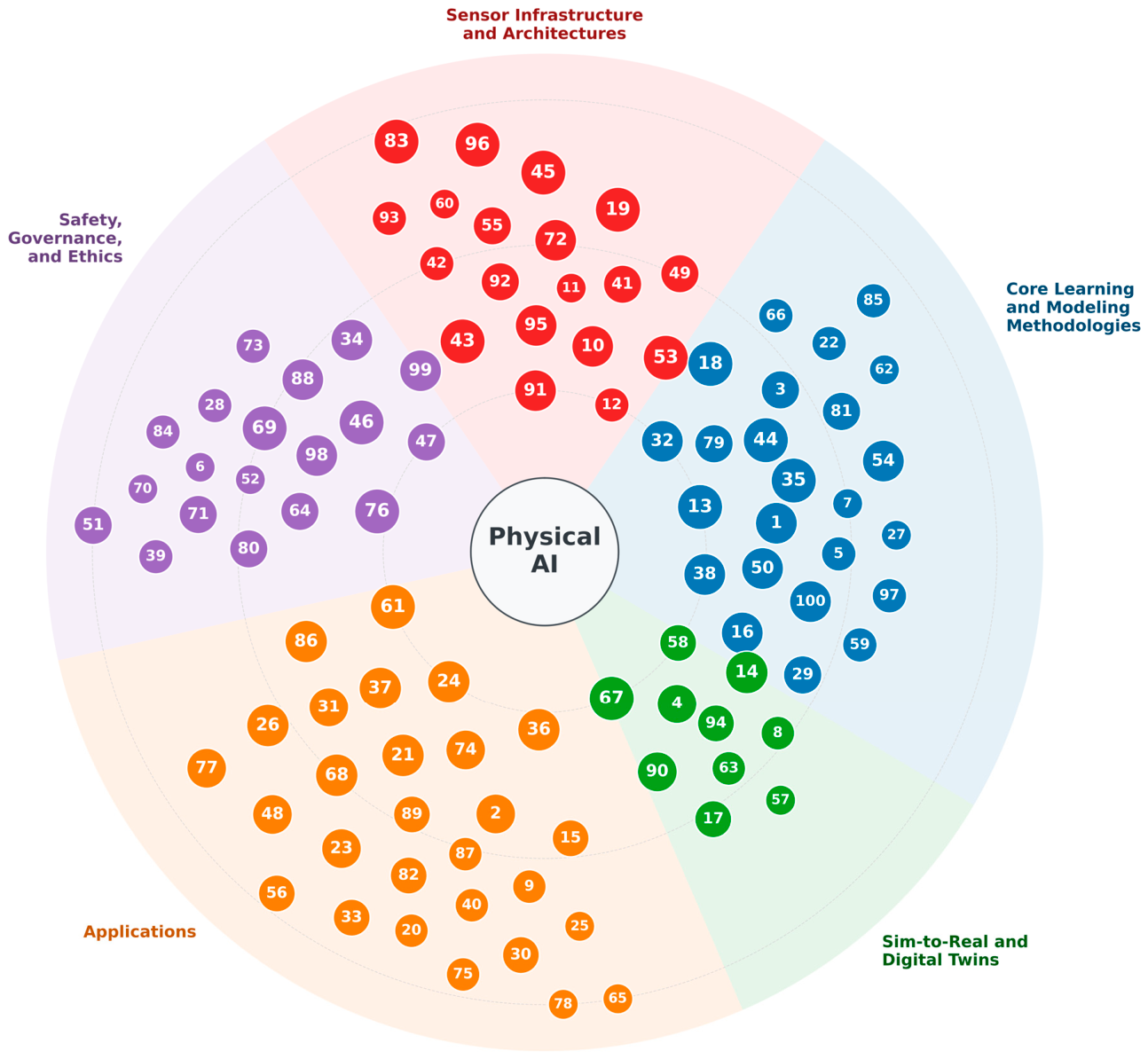
- The background sector shading denotes cluster membership, thereby delineating thematic groupings and facilitating clear cross-cluster comparisons.
- Bubble size operationalizes each manuscript’s strength of association with its respective cluster, as quantified by our cluster-specific scoring mechanism, where larger bubbles indicate a stronger conceptual centrality.
- Radial distance from the center represents the publication’s conceptual alignment with the core paradigm of Physical AI, with closer proximity to the center signifying a higher degree of thematic relevance.

| Research Stream | Mean Relevance (μ) | Standard Deviation (σ) |
|---|---|---|
| Sensor Infrastructure and Architectures | 79.99 | 12.76 |
| Core Learning and Modeling Methodologies | 84.78 | 11.29 |
| Sim-to-Real and Digital Twins | 76.50 | 14.68 |
| Applications | 83.13 | 11.86 |
| Safety, Governance, and Ethics | 78.78 | 12.31 |
4. Sensor Infrastructure and Architectures
4.1. Morphological Sensing and Material Embodiment
4.2. Multimodal Perception and Communication Networks
4.3. Edge Orchestration and System Architecture
4.4. Standardization and Ecosystem Integration
5. Core Learning and Modeling Methodologies
5.1. Foundations of World Models and Generative AI
5.2. Physics-Informed Learning and Active Inference
5.3. Embodiment and Evaluation Frameworks
6. Sim-to-Real and Digital Twins
6.1. Bridging the Reality Gap
6.2. Simulation Paradigms and Domain Randomization
6.3. Hybrid Digital Twin Architectures
6.4. Synthetic Data and Scalable Embodiment
7. Applications
7.1. Industrial Automation and Manufacturing
7.2. Healthcare Robotics
7.3. Autonomous Logistics and Smart Infrastructure
7.4. Emerging Domains: Scientific Discovery and Maintenance
7.5. Tangible Benefits and Practical Implementation
8. Safety, Governance, and Ethics
8.1. Safety: Reliability, Verification, and Risk Mitigation
8.2. Governance and Standardization
8.3. Ethics: Societal Impact and Interaction
8.4. Future Outlook: A Roadmap to Trustworthy Physical AI
9. Conclusions
Author Contributions
Funding
Data Availability Statement
Acknowledgments
Conflicts of Interest
Abbreviations
| AI | Artificial Intelligence |
| API | Application Programming Interface |
| CPS | Cyber-Physical System |
| DAO | Decentralized Autonomous Organization |
| FedAvg | Federated Averaging |
| FFT | Fast Fourier Transform |
| FPGA | Field-Programmable Gate Array |
| IoT | Internet of Things |
| LLM | Large Language Model |
| MLIPs | Machine Learning Interatomic Potentials |
| PADA | Physics-Aware Data Augmentation |
| RF | Radio Frequency |
| RL | Reinforcement Learning |
| SRT-H | Surgical Robot Transformer |
| VLA | Vision-Language-Action |
Appendix A
Appendix A.1
Appendix A.2
References
- Wu, E.-H.; Liu, Y.-Q.; Xu, T.-C.; Ren, L.-X.; Qin, Y.-M.; Wei, M.-Y.; He, X.-W.; Yuan, D.-Y.; Hou, W.-C.; Ma, Z.-W.; et al. Physical AI: Evolution, Progress, Challenges, and Prospects. J. Comput. Sci. Technol. 2026, 41, 271–288. [Google Scholar] [CrossRef] [Scilit]
- Dewi, R.S.; Kawakib, A.N.; Laili, M.N.; Fauziah, A.L.; Sabrina, S.R.; Hana, R.L. A Systematic Review of Physical Artificial Intelligence (Physical AI): Concepts, Applications, Challenges, and Future Directions. J. Artif. Intell. Eng. Appl. 2025, 4, 2246–2253. [Google Scholar] [CrossRef] [Scilit]
- Miriyev, A.; Kovač, M. Skills for Physical Artificial Intelligence. Nat. Mach. Intell. 2020, 2, 658–660. [Google Scholar] [CrossRef] [Scilit]
- Biswas, P.; Kim, T.M.; Kim, W.S. Integration of Digital Twins and Physical AI in Cyber-Physical Systems. Intell. Syst. Appl. 2026, 30, 200649. [Google Scholar] [CrossRef] [Scilit]
- Agarwal, N.; Ali, A.; Bala, M.; Balaji, Y.; Barker, E.; Cai, T.; Chattopadhyay, P.; Chen, Y.; Cui, Y.; Ding, Y.; et al. Cosmos World Foundation Model Platform for Physical AI. arXiv 2025, arXiv:2501.03575. [Google Scholar] [CrossRef] [Scilit]
- Li, Y.; Li, Z.; Duan, Y.; Spulber, A.-B. Physical Artificial Intelligence (PAI): The next-Generation Artificial Intelligence. Front. Inform. Technol. Electron. Eng. 2023, 24, 1231–1238. [Google Scholar] [CrossRef] [Scilit]
- Liu, D.; Zhang, J.; Dinh, A.-D.; Park, E.; Zhang, S.; Mian, A.; Shah, M.; Xu, C. Generative Physical AI in Vision: A Survey. arXiv 2025. [Google Scholar] [CrossRef] [Scilit]
- Aditi; Agarwal, N.; Ali, A.; Allen, J.; Antolini, M.; Aubame, A.; Azzolini, A.; Bai, J.; Bala, M.; Balaji, Y.; et al. Cosmos 3: Omnimodal World Models for Physical AI. arXiv 2026, arXiv:2606.02800. [Google Scholar] [CrossRef] [Scilit]
- Shaw, R.J.; Chen, B. Physical Artificial Intelligence in Nursing: Robotics. Nurs. Outlook 2025, 73, 102495. [Google Scholar] [CrossRef] [Scilit] [PubMed]
- Bousetouane, F. Physical AI Agents: Integrating Cognitive Intelligence with Real-World Action. arXiv 2025. [Google Scholar] [CrossRef] [Scilit]
- Lee, S.; Chae, J.; Jeon, H.; Kim, T.; Hong, Y.-G.; Um, D.-S.; Kim, T.; Park, K.-J. Cyber-Physical AI: Systematic Research Domain for Integrating AI and Cyber-Physical Systems. ACM Trans. Cyber-Phys. Syst. 2025, 9, 1–33. [Google Scholar] [CrossRef] [Scilit]
- Salehi, V. Fundamentals of Physical AI. J. Intell. Syst. Syst. Lifecycle Manag. 2025, 2, 1–38. [Google Scholar] [CrossRef] [Scilit]
- Xiang, K.; Zhang, T.J.; Huang, Y.; He, J.; Liu, Z.; Tang, Y.; Zhou, R.; Luo, L.; Wen, Y.; Chen, X.; et al. Aligning Perception, Reasoning, Modeling and Interaction: A Survey on Physical AI. IEEE Trans. Pattern Anal. Mach. Intell. 2026, 48, 12938–12957. [Google Scholar] [CrossRef] [Scilit] [PubMed]
- Muratore, F.; Gienger, M.; Peters, J. Assessing Transferability From Simulation to Reality for Reinforcement Learning. IEEE Trans. Pattern Anal. Mach. Intell. 2021, 43, 1172–1183. [Google Scholar] [CrossRef] [Scilit] [PubMed]
- Li, Y.; Duan, Y.; Spulber, A.-B.; Che, H.; Maamar, Z.; Li, Z.; Yang, C.; Lei, Y. Physical Artificial Intelligence: The Concept Expansion of Next-Generation Artificial Intelligence. arXiv 2021. [Google Scholar] [CrossRef] [Scilit]
- Gaba, S.; Rana, K.; Sai, S.; Chamola, V.; Niyato, D. A Comprehensive Review of Generative Physical Artificial Intelligence. IEEE Internet Things J. 2026, 13, 20452–20476. [Google Scholar] [CrossRef] [Scilit]
- Cao, Z.; Li, M.; Ling, F.; Jia, J.; Wen, Y.; Yin, J.; See, S. Transforming Future Data Center Operations and Management via Physical AI. IEEE Intell. Syst. 2026, 41, 91–100. [Google Scholar] [CrossRef] [Scilit]
- de Vries, B. Active Inference for Physical AI Agents—An Engineering Perspective. arXiv 2026, arXiv:2603.20927. [Google Scholar] [CrossRef] [Scilit]
- Jia, A.; Cai, Z.; Liu, X.; Zheng, K.; Liu, J. From Sensor-Empowered Ubiquitous Computing to Embodied Intelligence: Architectures, Paradigm Evolution, and Emerging Challenges. Sensors 2026, 26, 4352. [Google Scholar] [CrossRef] [Scilit] [PubMed]
- Jeon, J.; Yoon, J.; Kim, W.; Kim, Y.; Chung, S. SAW-Based Active Cleaning Cover Lens for Physical AI Optical Sensors. Symmetry 2026, 18, 347. [Google Scholar] [CrossRef] [Scilit]
- Tan, J.; Shi, J.; Wu, L.; Chen, B.; Tang, H.; Zhang, C.; Zhang, W.; Wang, S.; Wan, J. Embodied Intelligence Empowering Customized Manufacturing: Architecture, Opportunities, and Challenges. IEEE Access 2025, 13, 92740–92755. [Google Scholar] [CrossRef] [Scilit]
- Zhou, F.; Huang, J.; Li, J.; Ramanan, D.; Shi, H. PAI-Bench: A Comprehensive Benchmark For Physical AI. arXiv 2025. [Google Scholar] [CrossRef] [Scilit]
- Gu, N.; Hayashibe, M.; Kutsuzawa, K.; Yu, H. Deep Learning-Based Robotic Cloth Manipulation Applications: Systematic Review, Challenges and Opportunities for Physical AI. Front. Robot. AI 2026, 13, 1752914. [Google Scholar] [CrossRef] [Scilit] [PubMed]
- Abeyruwan, S.; Ainslie, J.; Alayrac, J.-B.; Arenas, M.G.; Armstrong, T.; Balakrishna, A.; Baruch, R.; Bauza, M.; Blokzijl, M.; Bohez, S.; et al. Gemini Robotics: Bringing AI into the Physical World. arXiv 2025, arXiv:2503.20020. [Google Scholar] [CrossRef] [Scilit]
- Coelho, M.; Labrune, J.-B. Large Language Objects: The Design of Physical AI and Generative Experiences. Interactions 2024, 31, 43–48. [Google Scholar] [CrossRef] [Scilit]
- Kawchak, K. Federated Learning Physical AI Oncology Trials Unification. Zenodo 2026. [Google Scholar] [CrossRef]
- Dai, Y.; Ananthanarayanan, G.; Cox, L.; Foukas, X.; Radunovic, B.; Netravali, R. Kairos: A Scalable Serving System for Physical AI. arXiv 2026. [Google Scholar] [CrossRef] [Scilit]
- VerWey, J. Physical AI; Research Report; Center for Security and Emerging Technology: Washington, DC, USA, 2026. [Google Scholar]
- Yang, L.; Dong, H.; El Saddik, A. Physical AI Labeling. IEEE Consum. Electron. Mag. 2026, 1–3. [Google Scholar] [CrossRef] [Scilit]
- Varela, L.; Putnik, G.D.; Ferreira, L.; Kumar Manupati, V.; Pinheiro, P.; Alves, C.; Avila, P.; Castro, H. A Review of Applied Artificial Intelligence in Manufacturing: Emergent AI Models in Cyber–Physical Systems for Manufacturing. Future Internet 2026, 18, 253. [Google Scholar] [CrossRef] [Scilit]
- Lee, S.; Chae, J.; Park, K.-J. Integrating ROS 2 and Physical AI: Architecture and Challenges. In Proceedings of the 2025 Sixteenth International Conference on Ubiquitous and Future Networks (ICUFN), Lisbon, Portugal, 8–11 July 2025; IEEE: Piscataway, NJ, USA, 2025; pp. 9–11. [Google Scholar]
- Manoonpong, P.; Shigaki, S.; Chaichaowarat, R.; Shamonin, M. Editorial: Physical AI and Robotics—Outputs from IS-PAIR 2025 and Beyond. Front. Robot. AI 2026, 13, 1881555. [Google Scholar] [CrossRef] [Scilit] [PubMed]
- Kawchak, K. National MCP Servers for Physical AI Oncology Clinical Trial Systems. Zenodo 2026. [Google Scholar] [CrossRef]
- Wang, T.; Li, F.; Dai, Y.; Ye, W.; Liu, D.; Cheng, Z. Adversarial Robustness in Embodied AI: A Closed-Loop Perspective on Attacks and Defenses. TechRxiv 2026. [Google Scholar] [CrossRef] [Scilit] [PubMed]
- Oh, I.-S. A Tutorial on World Models and Physical AI. arXiv 2026, arXiv:2606.12783. [Google Scholar] [CrossRef] [Scilit]
- Nguyen, P.H.; Kovač, M. Adopting Physical Artificial Intelligence in Soft Aerial Robots. IOP Conf. Ser. Mater. Sci. Eng. 2022, 1261, 012006. [Google Scholar] [CrossRef] [Scilit]
- Oh, N.; Jung, K.-H.; Choi, G.-S. Physical AI Goes to the Operating Room: Are We Ready for the Surgical Data Factory? Ann. Surg. Treat. Res. 2026, 110, 135. [Google Scholar] [CrossRef] [Scilit] [PubMed]
- Kang, Y. Physical AI: The Convergence of Foundation Models, Sim-to-Real Transfer, and Embodied Intelligence. J. Multimed. Inf. Syst. 2026, 13, 53–60. [Google Scholar] [CrossRef] [Scilit]
- Liang, Q.; Ollier-Malaterre, A. Intimacy with Socially Interactive AI: Humans’ Preferences Between Physical Robots and Virtual Agents in Different Types of Relationships. Int. J. Hum.–Comput. Interact. 2026, 1–34. [Google Scholar] [CrossRef] [Scilit]
- Tao, W.; Chun, H.; Han, B. Decoding Structural Complexity with Machine Learning to Empower Physical AI Driven Electrocatalyst Design. Appl. Surf. Sci. Adv. 2026, 34, 100984. [Google Scholar] [CrossRef] [Scilit]
- Xu, B.; Banerjee, A.; Gupta, S. MERINDA: Model Recovery in FPGA-Based Dynamic Architecture for Edge and Physical AI. ACM Trans. Des. Autom. Electron. Syst. 2026, 31, 1–36. [Google Scholar] [CrossRef] [Scilit]
- Kwon, J.-W.; Kim, W.-T. A Novel Execution Time Prediction Scheme for Efficient Physical AI Resource Management. Electronics 2025, 14, 4903. [Google Scholar] [CrossRef] [Scilit]
- Lee, S.; Kang, S.; Sung, S.; Jeon, Y.P.; Park, W. Realizing Physical AI through a Proprioceptive Wearable Interface: Semantic Understanding of Gestures and Objects. Sens. Actuators A Phys. 2026, 398, 117309. [Google Scholar] [CrossRef] [Scilit]
- Hashash, O.; Thomas, C.K.; Saad, W.; Debbah, M.; Friston, K.; Razi, A. Active Inference as the Test-Time Scaling Law for Physical AI Agents. arXiv 2026. [Google Scholar] [CrossRef] [Scilit]
- Kumbhar, F.H.; Dev, K.; Khowaja, S.A.; Boulogeorgos, A.-A.A.; Bennis, M.; Liu, Y. Physical-AI: From Channel Awareness to Environmental Intelligence in 6G Wireless Networks. arXiv 2026. [Google Scholar] [CrossRef]
- Morabito, R.; Tatipamula, M. The Internet of Physical AI Agents: Interoperability, Longevity, and the Cost of Getting It Wrong. arXiv 2026. [Google Scholar] [CrossRef] [Scilit]
- Shah, A.P.; Liu, M.; Huang, J.; Tandra, B.P.; Wang, Y.; Agarwal, S.; Wu, P.; Konwer, A.; Rozga, R.; Kondamuri, S.P.; et al. Physical AI: The Next Frontier in AI and Robotics to Build Truly Autonomous Machines. Preprints 2026. [Google Scholar] [CrossRef] [Scilit]
- El-Sattar, H.K.A.; Elshambakey, M.; Saleh, A.; Antar, S. Integrating Physical Modeling with Artificial Intelligence for Predicting Fish Survival Zones in Polluted Rivers to Maintain a Sustainable Aquaculture Industry. Sci. Rep. 2026, 16, 19009. [Google Scholar] [CrossRef] [Scilit] [PubMed]
- Wang, L.; Shui, T.; Saad, W.; Adjakple, P. World Model-Enabled Causal Digital Twins for Semantic Communications in Physical AI Systems. arXiv 2026. [Google Scholar] [CrossRef] [Scilit]
- Wang, F.; You, S.; Zhang, Q.; Huang, T.; Fu, Z.; Zheng, Z.; Xi, Y.; Lv, F.; Wu, X.; Liu, Z.; et al. Kairos: A Regret-Aware Native World-Action Model Stack for Physical AI. arXiv 2026, arXiv:2606.16533. [Google Scholar] [CrossRef] [Scilit]
- Ballandies, M.C.; Spychiger, F.; Serdült, U.; Tessone, C.J. DAO-Enabled Decentralized Physical AI: A New Paradigm for Human-Machine Collaboration. arXiv 2026. [Google Scholar] [CrossRef] [Scilit]
- Dawson, C. Breaking Things So You Don’t Have to: Risk Assessment and Failure Prediction for Cyber-Physical AI. Ph.D. Dissertation, Massachusetts Institute of Technology, Cambridge, MA, USA, 2024. Available online: https://hdl.handle.net/1721.1/155397 (accessed on 12 July 2026).
- Choi, Y.R.; Park, S.; Kim, H.-S. [Emerging Ideas] Artificial Tripartite Intelligence: A Bio-Inspired, Sensor-First Architecture for Physical AI. In Proceedings of the 24th Annual International Conference on Mobile Systems, Applications and Services, Cambridge, UK, 21–25 June 2026; ACM: New York, NY, USA, 2026; pp. 839–853. [Google Scholar] [CrossRef] [Scilit]
- Dai, Y.; Chen, Z.; Yang, L.; Netravali, R. Geometry Guided Self-Consistency for Physical AI. arXiv 2026. [Google Scholar] [CrossRef] [Scilit]
- Goolla, N.B. Physical AI: The Next Frontier of Industrial Digitalization. Int. Res. J. Eng. Technol. 2025, 12, 584–593. [Google Scholar]
- Hübel, M.; Nirmala, N.; Deligant, M.; Li, L. Hybrid Physical-AI Based System Modeling and Simulation Approach Demonstrated on an Automotive Fuel Cell. In Proceedings of the Asian Modelica Conference 2022, Tokyo, Japan, 24–25 November 2022. [Google Scholar]
- Kim, M.; Park, J.; Park, K.; Lee, Y.-J.; Jeon, S. Streamlining Human–Robot Interaction: Integrating LLM-Based Planning into Modular Robotic Frameworks. Sensors 2026, 26, 1978. [Google Scholar] [CrossRef] [Scilit] [PubMed]
- Lin, X.; Lian, S.; Yu, B.; Yang, R.; Shen, Z.; Wu, C.; Miao, Y.; Jin, Y.; Shi, Y.; He, J.; et al. PhysBrain: Human Egocentric Data as a Bridge from Vision Language Models to Physical Intelligence. arXiv 2025. [Google Scholar] [CrossRef] [Scilit]
- Lisondra, M.; Benhabib, B.; Nejat, G. Embodied AI with Foundation Models for Mobile Service Robots: A Systematic Review. Robotics 2026, 15, 55. [Google Scholar] [CrossRef] [Scilit]
- Ion, A.; Majidi, C.; Yao, L.; Alavi, A.H. Bridging Disciplines for a New Era in Physical AI. In Proceedings of the 37th Annual ACM Symposium on User Interface Software and Technology, Pittsburgh, PA, USA, 13–16 October 2024; ACM: New York, NY, USA, 2024; pp. 1–3. [Google Scholar]
- Thakur, A.; Kaipa, K.; Banerjee, A.G.; Cappelleri, D.J.; Krovi, V.N.; Gupta, S. Physical Artificial Intelligence for Powering the Next Revolution in Robotics. J. Comput. Inf. Sci. Eng. 2025, 25, 120809. [Google Scholar] [CrossRef] [Scilit]
- Liu, S.; Qin, X.; Wu, X.; Xia, X.; Ding, N.; Liu, J.; Tang, J. Data Standards for Humanoid Robotics: The Missing Infrastructure for Physical AI. arXiv 2026. [Google Scholar] [CrossRef] [Scilit]
- Lim, H.; Choi, J.B. Splat2Real: Novel-View Scaling for Physical AI with 3D Gaussian Splatting. arXiv 2026. [Google Scholar] [CrossRef] [Scilit]
- Chen, J. AEGIS: A Backup Reflex for Physical AI. arXiv 2026. [Google Scholar] [CrossRef] [Scilit]
- Yan, Z.; Liu, X.; Labrune, J.; Coelho, M. Colorimia: Color Picking and Image Generation with a Physical AI. In Proceedings of the Nineteenth International Conference on Tangible, Embedded, and Embodied Interaction, Bordeaux/Talence France, 4–7 March 2025; ACM: New York, NY, USA, 2025; pp. 1–6. [Google Scholar]
- Betteti, S.; Laurenti, L. Hybrid Energy-Based Models for Physical AI: Provably Stable Identification of Port-Hamiltonian Dynamics. arXiv 2026. [Google Scholar] [CrossRef] [Scilit]
- Thomas, C.K.; Hashash, O.; Saad, W. From Passive Mirrors to Active Agents: Holonic Digital Twins for Physical Artificial Intelligence Over Networks. IEEE Veh. Technol. Mag. 2026, 21, 18–36. [Google Scholar] [CrossRef] [Scilit]
- Long, X.; Zhao, Q.; Zhang, K.; Zhang, Z.; Wang, D.; Liu, Y.; Shu, Z.; Lu, Y.; Wang, S.; Wei, X.; et al. A Survey: Learning Embodied Intelligence from Physical Simulators and World Models. arXiv 2025. [Google Scholar] [CrossRef] [Scilit]
- Kim, H.M.; Lee, E.H. Structural Limits of Installation-Time Integrity Assurance: A Lifecycle-Based Accountability Framework for Over-the-Air-Enabled Physical AI Systems. IEEE Access 2026, 14, 89260–89282. [Google Scholar] [CrossRef] [Scilit]
- Chheda, S. Topic-Examining Physical Artificial Intelligence: Alexa & Siri, It’s Impact on Human Mind; Department of Psychology, St. Xavier’s College: Mumbai, India, 2023. [Google Scholar]
- Stocker, A.; Richter, A.; Ebinger, N. Feature-Specific Trust Calibration in Physical AI Systems. In Proceedings of the ICIS 2025 Proceedings, Nashville, TN, USA, 14–17 December 2025. [Google Scholar]
- Ratnayake, L.; Dabare, D.; Rupasinghe, S.; Jayakumar, W.; Marasinghe, D.; Edussooriya, C.U.S.; Madanayake, A. Agentic Physical-AI for Self-Aware RF Systems. arXiv 2026. [Google Scholar] [CrossRef] [Scilit]
- Borth, M.; Tiemann, C.; Barbini, L. Meets Expectations: System Health Analysis and Prognosis for Embedded and Cyber-Physical AI. PHM Soc. Eur. Conf. 2026, 9, 1–8. [Google Scholar] [CrossRef] [Scilit]
- Zhang, J.; Shen, C.; Zhu, Z.; Tong, H.; Fang, Q. Embodied Intelligence Technology for Next-Generation Soft Robots: A Survey. Eng. Sci. 2026, 40, 2073. [Google Scholar] [CrossRef] [Scilit]
- Wang, W.; Swain, S.; Lee, J.; Lin, Z.; Canales, B.; Aljović, A.; Liu, Y.; Li, Q.; Marin-Llobet, A.; Liu, M.; et al. Agentic Lab: An Agentic-Physical AI System for Cell and Organoid Experimentation and Manufacturing. bioRxiv 2025. [Google Scholar] [CrossRef] [Scilit] [PubMed]
- Harris, M.; Madden, D. Extrinsic Safeguarding Mechanism Requirements for Trustworthy Physical AI. In Proceedings of the 2025 IEEE 33rd International Requirements Engineering Conference Workshops (REW), Valencia, Spain, 1–5 September 2025; IEEE: Piscataway, NJ, USA, 2025; pp. 475–483. [Google Scholar]
- Yan, Q.; Ma, Y.; Yang, Z.; Song, Z.; Zheng, W.; Liu, Y.; Wang, Y.; Hong, J. A Novel Hybrid Physical-Ai Approach for Zero-Shot Diagnosis of Rotor Bolted Joint Conditions During Operation. SSRN 2025. [Google Scholar] [CrossRef] [Scilit]
- Thalhammer, P.; Wiethoff, A. MediMomo: Designing a Physical AI Platform for Content Accessibility in Healthcare. In Proceedings of the CHI Conference on Human Factors in Computing Systems, Yokohama, Japan, 26 April–1 May 2025. [Google Scholar]
- Liu, H.; Guo, D.; Cangelosi, A. Embodied Intelligence: A Synergy of Morphology, Action, Perception and Learning. ACM Comput. Surv. 2025, 57, 1–36. [Google Scholar] [CrossRef] [Scilit]
- Li, Y.; Spulber, A.-B.; Duan, Y. The Governance of Physical Artificial Intelligence. arXiv 2023. [Google Scholar] [CrossRef] [Scilit]
- Wu, Y. An Evaluation of State-of-the-Art Physical AI: Video-Based Benchmark of World Foundation Models and Vision-Language Models; UCLA: Los Angeles, CA, USA, 2025. [Google Scholar]
- Ezhilarasi, E.; Abishek Antony, T.; Roshan, R.A. Homeyx: A Low-Cost Distributed Physical AI Framework for Multimodal Assistive Robotics with Safety-Constrained Medical Advisory. In Proceedings of the 2026 International Conference on Recent Advances in Electrical, Electronics, Ubiquitous Communication, and Computational Intelligence (RAEEUCCI), Chennai, India, 22–24 April 2026; IEEE: Piscataway, NJ, USA, 2026; pp. 1–6. [Google Scholar] [CrossRef] [Scilit]
- Bae, J.B.; Kim, M.G.; Park, Y.; Lee, D.; Ahn, M.; Lee, G. Influence of Terrestrial LiDAR Scanning Conditions on Registration Results for Physical AI Development. KIEAE J. 2026, 26, 35–46. [Google Scholar] [CrossRef] [Scilit]
- Habeeb, R.; Yang, S.; Shao, Z. PARTEE: Trustworthy Real-Time Containers for the Physical AI Era. 2026. Available online: https://partee.systems/assets/whitepaper-feb-2026.pdf (accessed on 14 September 2026).
- McGuire, M.; Capelle, T.; Hodges, J. SENPAI: Self-ExperimentatioN for Physical AI an Observability-Based Research Harness. In Proceedings of the ICML 2026 AI for Science Workshop, Seoul, Republic of Korea, 10 July 2026. [Google Scholar]
- Ghosh, D.; Ghosh, D.; Prasad, D. PeaceComplex: The Science of Living Together with Psychology-Grounded Multi-Agent Physical AI. Preprint 2025. [Google Scholar] [CrossRef]
- Chang, E.; Kuang, Q.; Coelho, M. The Stochastic Parrot: A Physical AI Cohabitant. In Proceedings of the 39th Conference on Neural Information Processing Systems (NeurIPS 2025), San Diego, CA, USA, 2–7 December 2025. [Google Scholar]
- Prathipati, M. The S-A-D-A-L Loop: A Reliability-Gated Architecture for Forensic-Ready Cyber-Physical AI Systems. SSRN 2026. [Google Scholar] [CrossRef] [Scilit]
- Munoz-Perales, V. Accelerating Electrolyte Discovery via a Closed-Loop Physical AI Platform. In Proceedings of the AI4X—Accelerate Conference 2026, Singapore, 16–19 June 2026. [Google Scholar]
- Duarte, J.; Sousa, P. Design and Simulation Validation of an Open-Source Robot for Physical AI Data Collection and STEM Education. ResearchGate, 2026; preprint. Available online: https://www.researchgate.net/publication/405961902 (accessed on 13 July 2026).
- Chin, C. Wave-Based Neuromorphic Physical AI for Full-Body Humanoid Control: Distributed HBN Synapse Cavity Networks Mimicking Spinal, Peripheral, and Autonomic Neural Ar-Chitecture. J. Artif. Intell. Virtual Real. Hum.-Centered Comput. 2026, 2, 1–16. [Google Scholar]
- Zeng, L. Collaborative Edge AI for Physical Agents. In Proceedings of the 24th Annual International Conference on Mobile Systems, Applications and Services Companion, Cambridge, UK, 21–25 June 2026; ACM: New York, NY, USA, 2026; pp. 110–111. [Google Scholar]
- Motgi, P.P. Heterogeneous edge to cloud infrastructure blueprints for physical AI and autonomous systems. Int. J. Eng. Technol. Res. Manag. 2026, 10, 110–120. [Google Scholar] [CrossRef]
- Ali, A.; Bai, J.; Bala, M.; Balaji, Y.; Blakeman, A.; Cai, T.; Cao, J.; Cao, T.; Cha, E.; Chao, Y.-W.; et al. World Simulation with Video Foundation Models for Physical AI. arXiv 2025, arXiv:2511.00062. [Google Scholar] [CrossRef] [Scilit]
- Han, V.Y.; Gonzalez, J.T.; Yang, C.; Wang, Z.; Hudson, S.E.; Ion, A. Towards Unobtrusive Physical AI: Augmenting Everyday Objects with Intelligence and Robotic Movement for Proactive Assistance. In Proceedings of the 38th Annual ACM Symposium on User Interface Software and Technology, Busan, Republic of Korea, 28 September–1 October 2025; ACM: New York, NY, USA, 2025; pp. 1–16. [Google Scholar]
- Mishra, A.; de Souza, J.H.I.; Popovski, P. Temporal Windows of Integration for Multisensory Wireless Systems as Enablers of Physical AI. arXiv 2025. [Google Scholar] [CrossRef] [Scilit]
- Dong, H.; Yang, J. Physical Artificial Intelligence in Consumer Electronics. IEEE Consum. Electron. Mag. 2026, 15, 9–11. [Google Scholar] [CrossRef] [Scilit]
- Lee, S.; Chae, J.; Park, K.-J. Harness Engineering for Physical AI: Robot Middleware Is the Harness Layer. arXiv 2026. [Google Scholar] [CrossRef] [Scilit]
- Ray, P.P. Physical AI: Bridging the Sim-to-Real Divide Toward Embodied, Ethical, and Autonomous Intelligence. Mach. Learn. Comput. Sci. Eng. 2025, 2, 1. [Google Scholar] [CrossRef] [Scilit]
- Xiong, T.; Wang, S.; Liu, G.; Dong, Y.; Li, M.; Huang, H.; Kautz, J.; Yu, Z. PhyCritic: Multimodal Critic Models for Physical AI. arXiv 2026. [Google Scholar] [CrossRef] [Scilit]
- Gartner. Top 10 Strategic Technology Trends for 2026. Available online: https://www.gartner.com/en/articles/top-technology-trends-2026 (accessed on 17 July 2026).
- Wiener, N. Cybernetics: Or Control and Communication in the Animal and the Machine; MIT Press: Cambridge, MA, USA, 1948. [Google Scholar]
- Moravec, H. Mind Children: The Future of Robot and Human Intelligence; Harvard University Press: Cambridge, MA, USA, 1988. [Google Scholar]
- Gusenbauer, M. Google Scholar to overshadow them all? Comparing the sizes of 12 academic search engines and bibliographic databases. Scientometrics 2019, 118, 177–214. [Google Scholar] [CrossRef] [Scilit]
- Stübinger, J.; Metz, F.; Knoll, J. Trading on Sentiment: Leveraging Generative Artificial Intelligence for Financial Market Predictions. In The Human Side of Service Engineering; AHFE International: Orlando, FL, USA, 2025; Volume 182, pp. 11–18. [Google Scholar] [CrossRef] [Scilit]
- Stübinger, J.; Metz, F. Understanding AI Agents—A Data-Driven Literature Review. Mathematics 2026, 14, 1478. [Google Scholar] [CrossRef] [Scilit]


| Domain | Application | Key Technologies | Objective | Hardware Platform | Ref. |
|---|---|---|---|---|---|
| Healthcare | Robot-assisted surgery | Shared control, Force feedback | Precision and safety | Surgical robotic systems | [37,61] |
| Healthcare | Autonomous suturing | SRT-H, Imitation learning | Goal decomposition | STAR robotic effectors | [37] |
| Healthcare | Elderly care support | Reinforcement Learning, LLaMA 3, Affective computing | Autonomous assistance | Mobile robotic platforms | [61,82] |
| Healthcare | Oncology trials | Procedure State Machines, FedAvg | Regulatory compliance | Telemetry sensor networks | [26,33] |
| Healthcare | Gait rehabilitation | Multimodal sensor fusion | Personalized therapy | Exoskeletons | [61,82] |
| Manufacturing | Fault diagnosis | Hybrid Physical AI (FFT, PADA) | Real-time health monitoring | Dual-rotor testbeds | [77] |
| Manufacturing | Production scheduling | Reinforcement Learning, Digital Twins, LLMs | Workflow optimization | IoT edge nodes | [21] |
| Robotics | Bimanual manipulation | Action Chunking with Transformers, VLA models | Fine-grained coordination | Dual-arm robotic cells | [24,68] |
| Materials Science | Material discovery | MLIPs, Graph Neural Networks, Active learning | Accelerated synthesis | Automated lab platforms | [40,89] |
Disclaimer/Publisher’s Note: The statements, opinions and data contained in all publications are solely those of the individual author(s) and contributor(s) and not of MDPI and/or the editor(s). MDPI and/or the editor(s) disclaim responsibility for any injury to people or property resulting from any ideas, methods, instructions or products referred to in the content. |
© 2026 by the authors. Licensee MDPI, Basel, Switzerland. This article is an open access article distributed under the terms and conditions of the Creative Commons Attribution (CC BY) license.
Share and Cite
Stübinger, J.; Metz, F. Physical AI: A Data-Driven Survey of Foundations, Technologies, and Applications. Technologies 2026, 14, 588. https://doi.org/10.3390/technologies14090588
Stübinger J, Metz F. Physical AI: A Data-Driven Survey of Foundations, Technologies, and Applications. Technologies. 2026; 14(9):588. https://doi.org/10.3390/technologies14090588
Chicago/Turabian StyleStübinger, Johannes, and Fabio Metz. 2026. "Physical AI: A Data-Driven Survey of Foundations, Technologies, and Applications" Technologies 14, no. 9: 588. https://doi.org/10.3390/technologies14090588
APA StyleStübinger, J., & Metz, F. (2026). Physical AI: A Data-Driven Survey of Foundations, Technologies, and Applications. Technologies, 14(9), 588. https://doi.org/10.3390/technologies14090588