
PGA-LLM: A Probability-Guided Alignment Large Language Model Framework for Fault Diagnosis


Abstract
1. Introduction
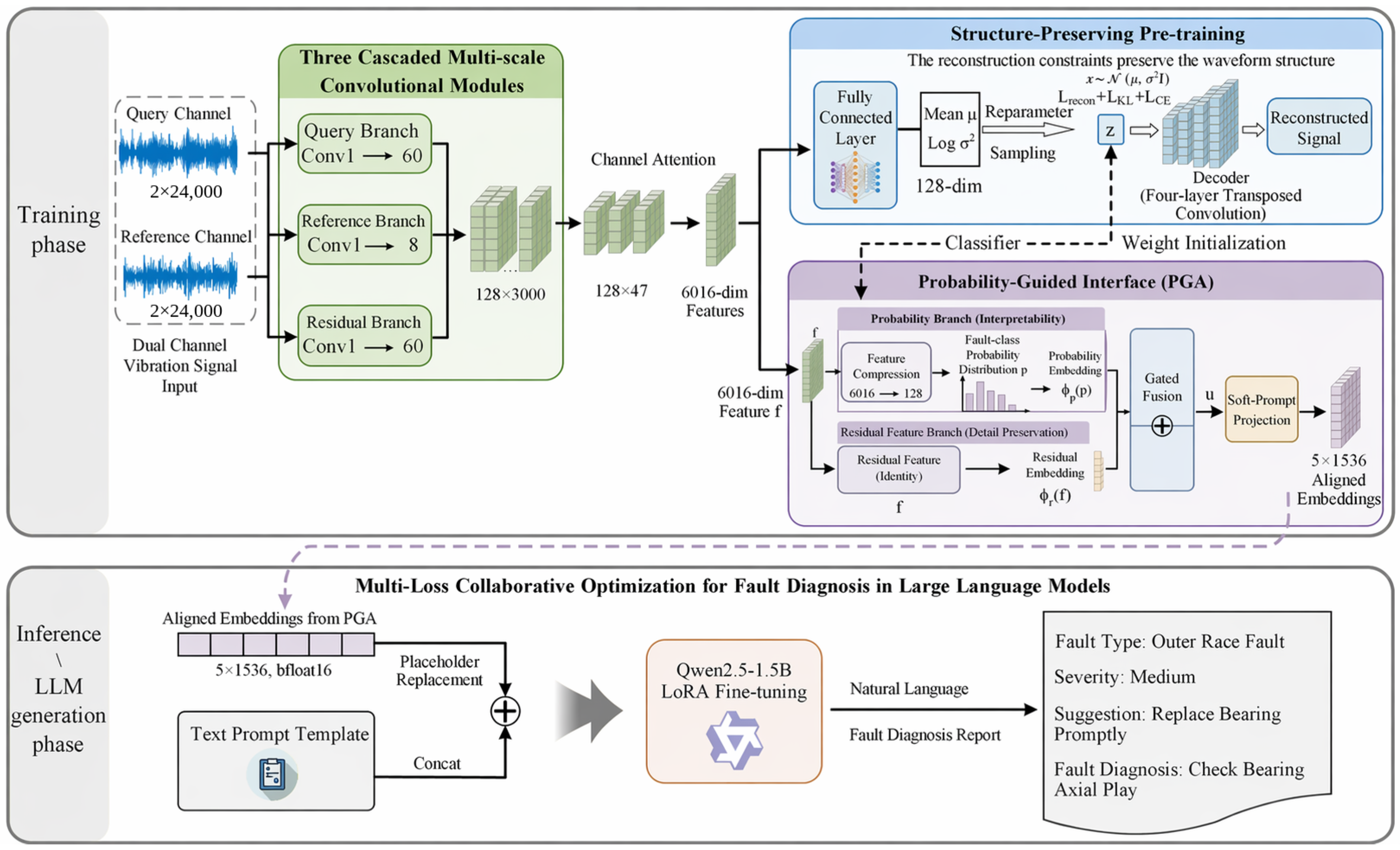
- A structure-preserving signal representation learning strategy for fault diagnosis is proposed, in which reconstruction and category supervision are combined to train the encoder for the subsequent interface.
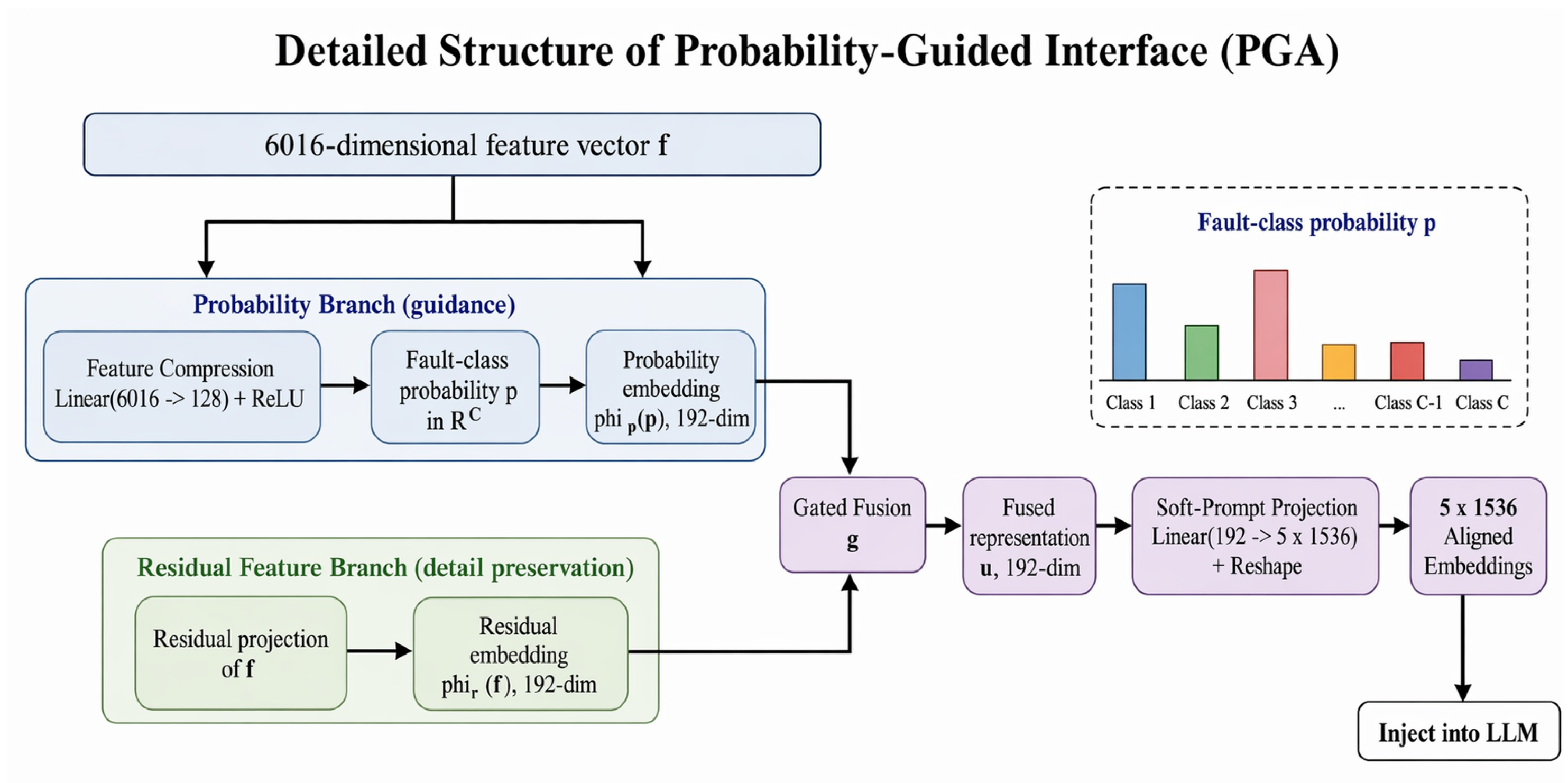
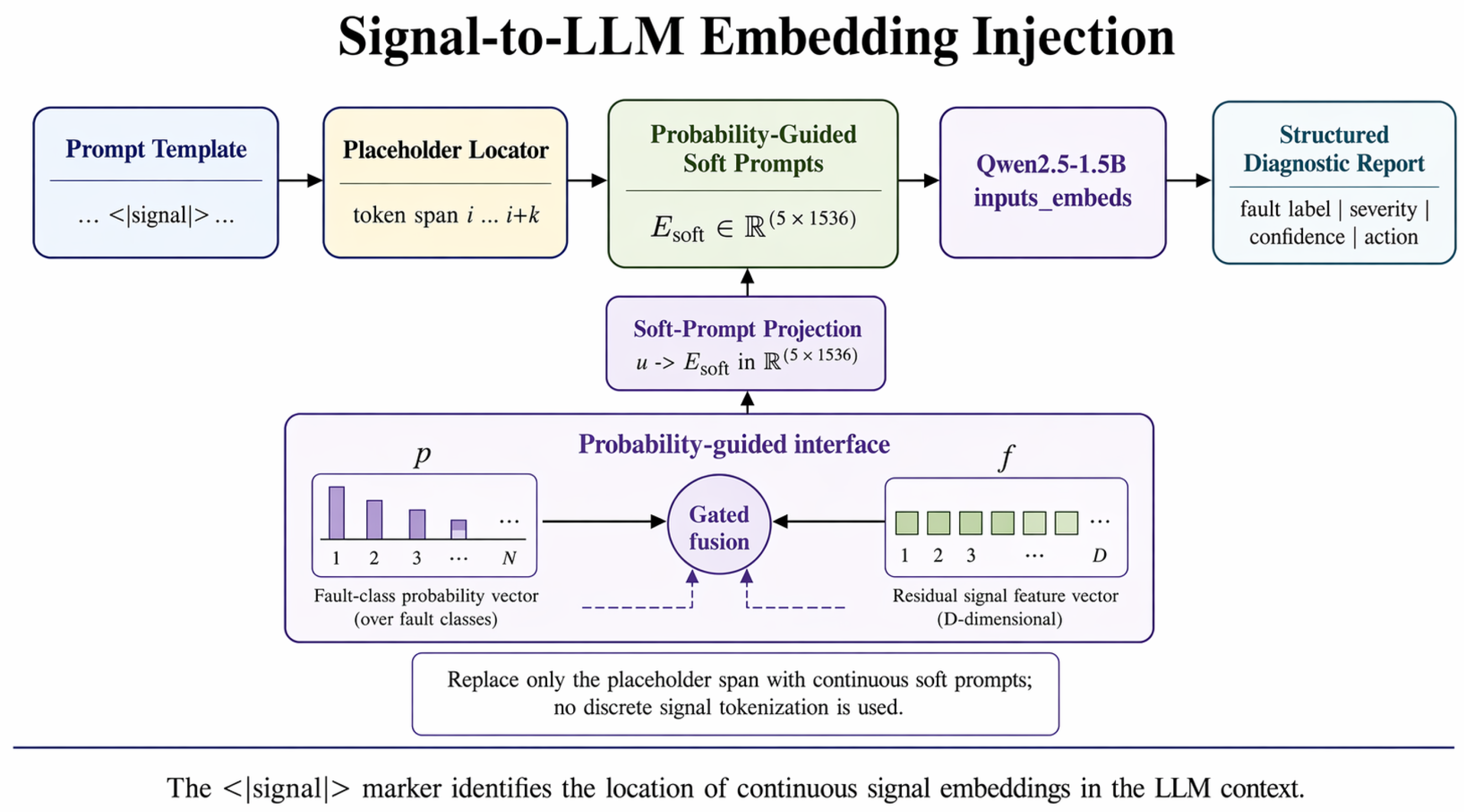
- A probability-guided alignment module is designed, combining fault-class probability guidance with a residual feature path, and projects their gated fusion into the embedding space of the large language model.
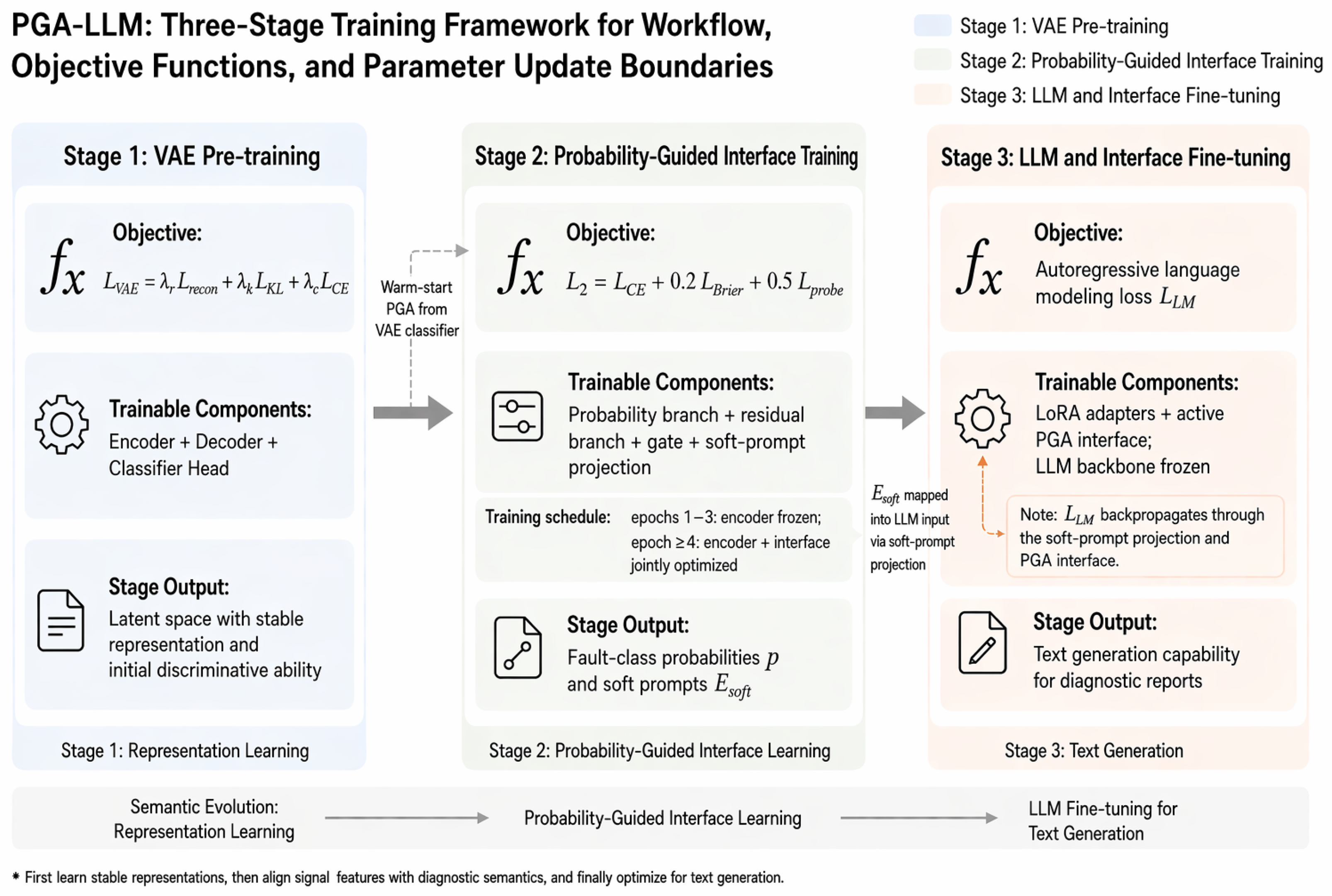
- A progressive three-stage optimization framework is constructed which unifies encoder pre-training, alignment module learning, and language model adaptation into one training workflow. Qwen2.5-1.5B and LoRA are adapted after signal-side representation learning and interface optimization.
2. Related Work
2.1. Vibration Signal Representation Learning for Diagnosis
2.2. Semantic Alignment Methods for Mapping Vibration Signals to Language Models
2.3. Progressive Optimization Strategy for Diagnostic Generation
3. Methodology
3.1. Problem Definition
3.2. PGA-LLM Method
3.2.1. Multi-Scale Convolution-Based Feature Embedding
3.2.2. Structure-Preserving Pre-Training
3.2.3. Probability-Guided Alignment
3.2.4. Signal-to-LLM Embedding Injection
3.2.5. LLM Fault Diagnosis Based on Multi-Loss Collaborative Optimization
System Prompt: You are an industrial diagnostic reporting assistant. Return exactly one JSON object with the string fields fault_label, severity, confidence_or_uncertainty, and maintenance_action. Do not add explanation, signal mechanisms, frequency analysis, or text outside JSON. The confidence field is a fixed signal-side posterior-source identifier.
User Prompt: <|signal|> The prompt also supplies a fixed CWRU candidate glossary that enumerates every permitted label-to-fault, severity, and maintenance-action mapping, but does not disclose the sample prediction or ground-truth label. Produce the constrained diagnostic report for this vibration input.
4. Experiments
4.1. Dataset Introduction and Partitioning
4.2. Hyperparameter Settings
4.3. Experimental Results
4.4. Ablation Results
4.5. Practical Deployment Considerations
5. Conclusions
Supplementary Materials
Author Contributions
Funding
Institutional Review Board Statement
Informed Consent Statement
Data Availability Statement
Acknowledgments
Conflicts of Interest
Abbreviations
| LLM | Large Language Model |
| PGA | Probability-Guided Alignment |
| VAE | Variational Autoencoder |
| LoRA | Low-Rank Adaptation |
| CWRU | Case Western Reserve University |
| MBHM | Machinery Bearing Health Management |
References
- Matania, O.; Dattner, I.; Bortman, J.; Kenett, R.S.; Parmet, Y. A systematic literature review of deep learning for vibration-based fault diagnosis of critical rotating machinery: Limitations and challenges. J. Sound Vib. 2024, 590, 118562. [Google Scholar] [CrossRef] [Scilit]
- Lei, Y.; Yang, B.; Jiang, X.; Jia, F.; Li, N.; Nandi, A.K. Applications of machine learning to machine fault diagnosis: A review and roadmap. Mech. Syst. Signal Process. 2020, 138, 106587. [Google Scholar] [CrossRef] [Scilit]
- Zhao, R.; Yan, R.; Chen, Z.; Mao, K.; Wang, P.; Gao, R.X. Deep learning and its applications to machine health monitoring. Mech. Syst. Signal Process. 2019, 115, 213–237. [Google Scholar] [CrossRef] [Scilit]
- Zhang, W.; Li, C.; Peng, G.; Chen, Y.; Zhang, Z. A deep convolutional neural network with new training methods for bearing fault diagnosis under noisy environment and different working load. Mech. Syst. Signal Process. 2018, 100, 439–453. [Google Scholar] [CrossRef] [Scilit]
- Rezazadeh, N.; Caputo, F.; Aversano, A.; Lamanna, G.; De Luca, A.; Perfetto, D. Prototype-attention domain adaptation for explainable bearing fault diagnosis. Procedia Struct. Integr. 2026, 80, 411–417. [Google Scholar] [CrossRef] [Scilit]
- Rezazadeh, N.; Perfetto, D.; de Oliveira, M.; De Luca, A.; Lamanna, G. A fine-tuning deep learning framework to palliate data distribution shift effects in rotary machine fault detection. Struct. Health Monit. 2024, 25, 661–683. [Google Scholar] [CrossRef] [Scilit]
- Chen, Z.; Gryllias, K.; Li, W. Intelligent fault diagnosis for rotary machinery using transferable convolutional neural network. IEEE Trans. Ind. Inform. 2020, 16, 339–349. [Google Scholar] [CrossRef] [Scilit]
- Liao, J.X.; Dong, H.C.; Sun, Z.Q.; Sun, J.; Zhang, S.; Fan, F.L. Attention-Embedded Quadratic Network (Qttention) for Effective and Interpretable Bearing Fault Diagnosis. IEEE Trans. Instrum. Meas. 2023, 72, 3511113. [Google Scholar] [CrossRef] [Scilit]
- Wang, J.; Chen, Y.; Hao, S.; Peng, X.; Hu, L. A deep transfer learning method for intelligent fault diagnosis of machines with unlabeled data. IEEE Trans. Ind. Inform. 2018, 14, 3925–3935. [Google Scholar]
- Zhao, B.; Zhang, X.; Li, H.; Yang, Z. Applications of unsupervised deep transfer learning to intelligent fault diagnosis: A survey and comparative study. IEEE Trans. Instrum. Meas. 2021, 70, 3525828. [Google Scholar] [CrossRef] [Scilit]
- Wu, H.; Hu, T.; Liu, Y.; Zhou, H.; Wang, J.; Long, M. TimesNet: Temporal 2D-variation modeling for general time series analysis. IEEE Trans. Pattern Anal. Mach. Intell. 2023, 45, 10751–10765. [Google Scholar]
- Choi, H.; Kang, P. Multi-task self-supervised time-series representation learning. Inf. Sci. 2024, 671, 120654. [Google Scholar] [CrossRef] [Scilit]
- Yue, Z.; Wang, Y.; Duan, J.; Yang, T.; Huang, C.; Tong, Y.; Xu, B. TS2Vec: Towards universal representation of time series. Proc. AAAI Conf. Artif. Intell. 2022, 36, 8980–8987. [Google Scholar] [CrossRef] [Scilit]
- Zhang, W.; Yang, L.; Geng, S.; Hong, S. Self-supervised time series representation learning via cross reconstruction transformer. IEEE Trans. Neural Netw. Learn. Syst. 2023, 35, 16129–16138. [Google Scholar] [CrossRef] [Scilit] [PubMed]
- Xiao, Y.; Shao, H.; Wang, J.; Yan, S.; Liu, B. Bayesian variational transformer: A generalizable model for rotating machinery fault diagnosis. Mech. Syst. Signal Process. 2024, 207, 110936. [Google Scholar] [CrossRef] [Scilit]
- Zhang, J.; Zhang, K.; An, Y.; Luo, H.; Yin, S. An integrated multitasking intelligent bearing fault diagnosis scheme based on representation learning under imbalanced sample condition. IEEE Trans. Neural Netw. Learn. Syst. 2024, 35, 6231–6242. [Google Scholar] [CrossRef] [Scilit] [PubMed]
- Fu, D.; Liu, J.; Zhong, H.; Zhang, X.; Zhang, F. A novel self-supervised representation learning framework based on time-frequency alignment and interaction for mechanical fault diagnosis. Knowl.-Based Syst. 2024, 295, 111846. [Google Scholar] [CrossRef] [Scilit]
- Zhou, T.; Niu, P.; Wang, X.; Sun, L.; Jin, R. One Fits All: Power General Time Series Analysis by Pretrained LM. In Proceedings of the Advances in Neural Information Processing Systems; Neural Information Processing Systems Foundation, Inc. (NeurIPS): La Jolla, CA, USA, 2023; Volume 36. [Google Scholar] [CrossRef] [Scilit]
- Ansari, A.F.; Stella, L.; Turkmen, C.; Zhang, X.; Mercado, P.; Shen, H.; Shchur, O.; Rangapuram, S.S.; Pineda Arango, S.; Kapoor, S.; et al. Chronos: Learning the Language of Time Series. arXiv 2024. [Google Scholar] [CrossRef] [Scilit]
- Goswami, M.; Szafer, K.; Choudhry, A.; Cai, Y.; Li, S.; Dubrawski, A. MOMENT: A Family of Open Time-series Foundation Models. In Proceedings of the 41st International Conference on Machine Learning, Vienna, Austria, 21–27 July 2024; Volume 235, pp. 16115–16152. [Google Scholar] [CrossRef] [Scilit]
- Liu, Y.; Qin, G.; Huang, X.; Wang, J.; Long, M. AutoTimes: Autoregressive Time Series Forecasters via Large Language Models. In Proceedings of the Advances in Neural Information Processing Systems, Vancouver, BC, Canada, 9–15 December 2024; Volume 37. [Google Scholar] [CrossRef] [Scilit]
- Qaid, H.A.A.M.; Zhang, B.; Su, S.; Li, D.; Ng, S.K.; Li, W. Large language models for explainable fault diagnosis of machines. Eng. Appl. Artif. Intell. 2026, 163, 113131. [Google Scholar] [CrossRef] [Scilit]
- Zhang, J.; Zhang, C.; Lu, J.; Zhao, Y. Domain-specific large language models for fault diagnosis of heating, ventilation, and air conditioning systems by labeled-data-supervised fine-tuning. Appl. Energy 2025, 377, 124378. [Google Scholar] [CrossRef] [Scilit]
- Wang, J.; Li, T.; Yang, Y.; Chen, S.; Zhai, W. DiagLLM: Multimodal reasoning with large language model for explainable bearing fault diagnosis. Sci. China Inf. Sci. 2025, 68, 160103. [Google Scholar] [CrossRef] [Scilit]
- Li, D.; Pang, Z.; Chen, Y.; Yang, K.; Shao, J.; Luo, Y.; Zeng, Y.; He, C.; Gao, Y. FD-MVLLM: Fault diagnosis based on multimodal vibration data and large language model for bearing system. Mech. Syst. Signal Process. 2025, 239, 113226. [Google Scholar] [CrossRef] [Scilit]
- Radford, A.; Kim, J.W.; Hallacy, C.; Ramesh, A.; Goh, G.; Agarwal, S.; Sastry, G.; Askell, A.; Mishkin, P.; Clark, J.; et al. Learning transferable visual models from natural language supervision. In Proceedings of the International Conference on Machine Learning, Virtual, 18–24 July 2021; pp. 8748–8763. [Google Scholar] [CrossRef] [Scilit]
- Alayrac, J.B.; Donahue, J.; Luc, P.; Miech, A.; Barr, I.; Hasson, Y.; Lenc, K.; Mensch, A.; Millican, K.; Reynolds, M.; et al. Flamingo: A Visual Language Model for Few-Shot Learning. In Proceedings of the Advances in Neural Information Processing Systems, Orleans, LA, USA, 28 November–9 December 2022; Volume 35. [Google Scholar] [CrossRef] [Scilit]
- Li, J.; Li, D.; Savarese, S.; Hoi, S. BLIP-2: Bootstrapping Language-Image Pre-training with Frozen Image Encoders and Large Language Models. In Proceedings of the 40th International Conference on Machine Learning, Honolulu, HI, USA, 23–29 July 2023; Volume 202, pp. 19730–19742. [Google Scholar] [CrossRef] [Scilit]
- Liu, H.; Li, C.; Wu, Q.; Lee, Y.J. Visual instruction tuning. Adv. Neural Inf. Process. Syst. 2023, 36, 34892–34916. [Google Scholar] [CrossRef] [Scilit]
- Ding, N.; Qin, Y.; Yang, G.; Wei, F.; Yang, Z.; Su, Y.; Hu, S.; Chen, Y.; Chan, C.M.; Chen, W.; et al. Parameter-efficient fine-tuning of large-scale pre-trained language models. Nat. Mach. Intell. 2023, 5, 220–235. [Google Scholar] [CrossRef] [Scilit]
- Li, Y.F.; Wang, H.; Sun, M. ChatGPT-like large-scale foundation models for prognostics and health management: A survey and roadmaps. Reliab. Eng. Syst. Saf. 2024, 243, 109850. [Google Scholar] [CrossRef] [Scilit]
- Tao, L.; Li, S.; Liu, H.; Huang, Q.; Ma, L.; Ning, G.; Chen, Y.; Wu, Y.; Li, B.; Zhang, W.; et al. An outline of Prognostics and health management Large Model: Concepts, Paradigms, and challenges. Mech. Syst. Signal Process. 2025, 232, 112683. [Google Scholar] [CrossRef] [Scilit]
- Hendriks, J.; Dumond, P.; Knox, D. Towards better benchmarking using the CWRU bearing fault diagnosis dataset. Mech. Syst. Signal Process. 2022, 169, 108732. [Google Scholar] [CrossRef] [Scilit]
- Peng, H.; Liu, J.; Du, J.; Gao, J.; Wang, W. BearLLM: A Prior Knowledge-Enhanced Bearing Health Management Framework with Unified Vibration Signal Representation. In Proceedings of the AAAI Conference on Artificial Intelligence, Philadelphia, PA, USA, 25 February–4 March 2025; Volume 39, pp. 19866–19874. [Google Scholar] [CrossRef] [Scilit]






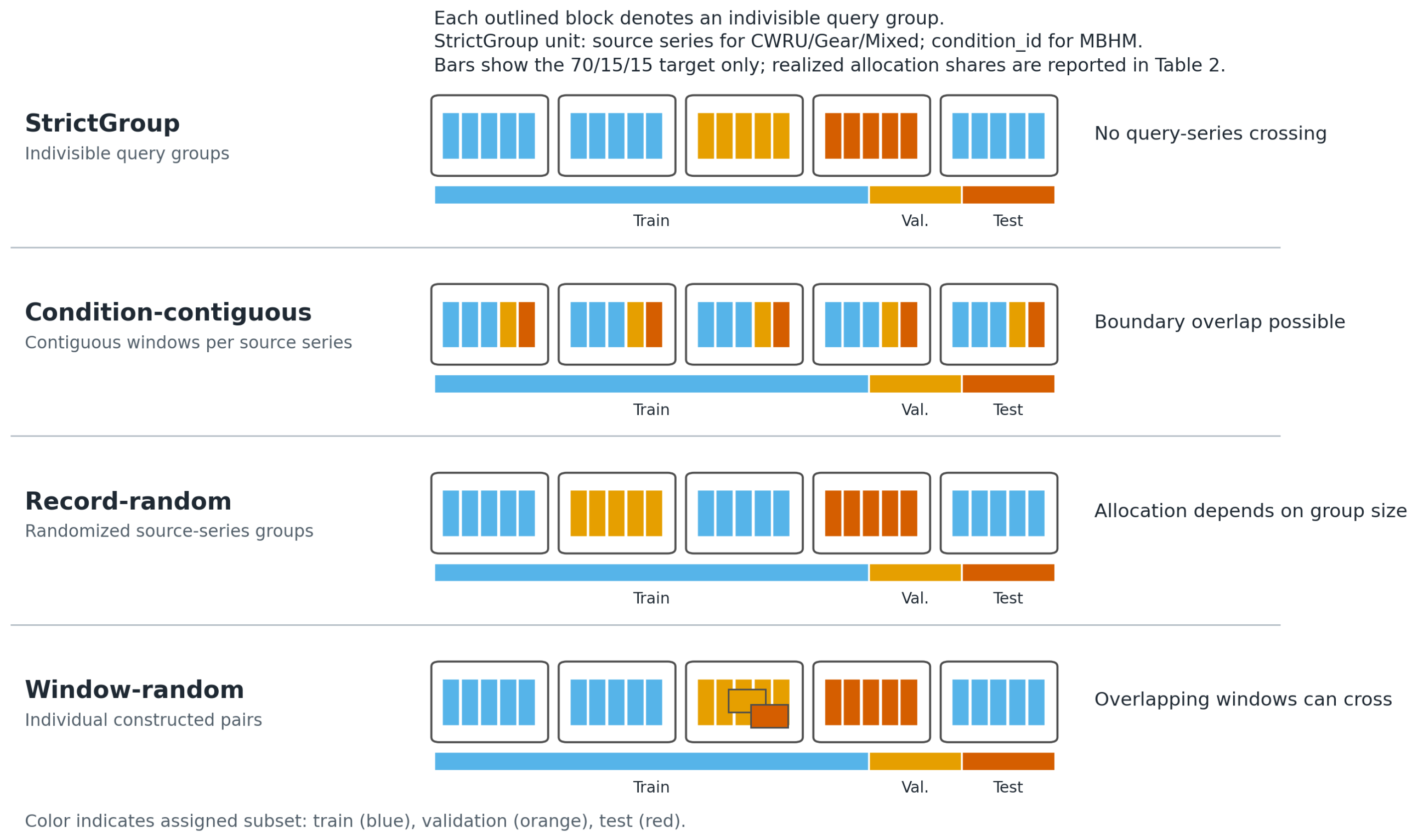
| Dataset | No. Classes | Source Series/Files | Query-Ref. Instances | Format | Fault Type |
|---|---|---|---|---|---|
| CWRU [33] | 10 | 40 | 456 | JSON | Bearing faults: normal + inner race/rolling element/outer race faults × 3 severity levels |
| Gear | 2 | 48 | 1524 | JSON | Gearbox faults: normal/broken tooth |
| Mixed | 15 | 64 | 2488 | JSON | 5 bearing fault classes + 4 gear fault classes + 6 compound fault classes |
| MBHM [34] | 10 | 135,516 files (122,792 eligible) | 368,376 | HDF5 | Multi-condition bearing faults: normal + inner race/rolling element/outer race faults × 3 severity levels |
| Dataset | Group Unit | Instances (Train/Val/Test) | Groups (Train/Val/Test) | Share (%) (Train/Val/Test) | Min. Test | Max Imbalance |
|---|---|---|---|---|---|---|
| CWRU | source series | 231.3/112.3/112.3 | 20.0/10.0/10.0 | 50.7/24.6/24.6 | 9 | 4.222 |
| Gear | source series | 1090.7/256.7/176.7 | 34.3/8.0/5.7 | 71.6/16.8/11.6 | 65 | 1.477 |
| Mixed | source series | 1320.0/584.0/584.0 | 34.0/15.0/15.0 | 53.1/23.5/23.5 | 38 | 1.026 |
| MBHM | condition ID | 265.4 k/57.9 k/45.0 k | 180.0/40.3/37.7 | 72.1/15.7/12.2 | 3 | 10,447 |
| Hyperparameter | VAE Pre-Training | Adapter Training |
|---|---|---|
| Optimizer | AdamW | AdamW |
| Learning rate | ||
| Weight decay | ||
| Batch size | 32 (128 for MBHM) | 32 (128 for MBHM) |
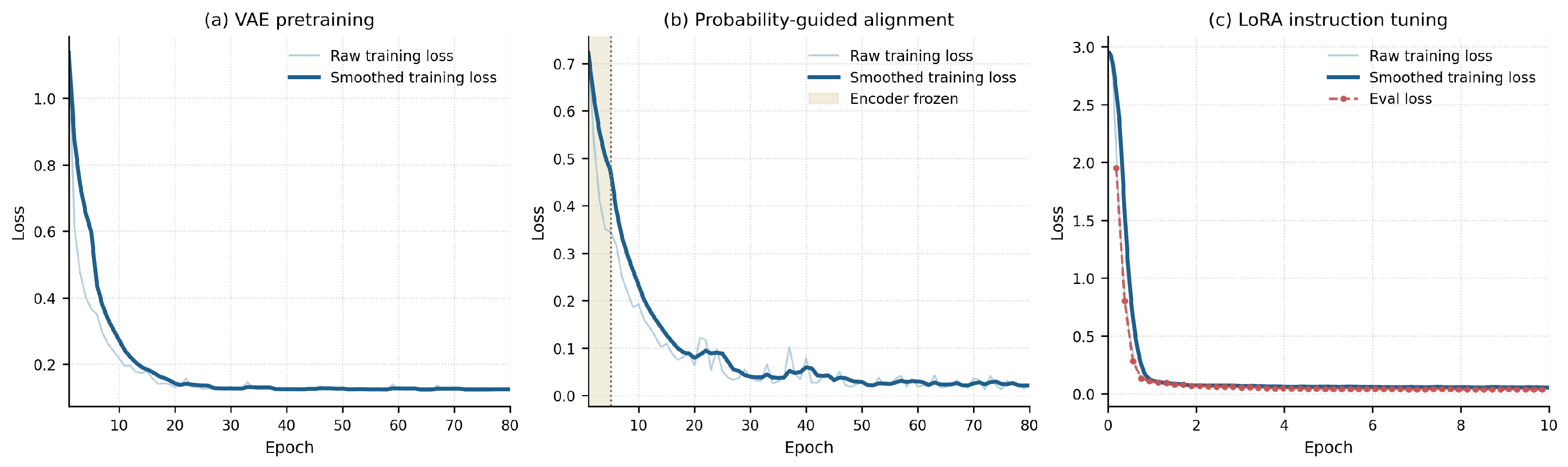
| Training epochs | 80 | 80 |
| LR scheduler | ReduceLROnPlateau | ReduceLROnPlateau |
| Gradient clipping | 1.0 | 1.0 |
| Frozen encoder epochs | – | 3 |
| Latent dimension | 128 | 128 |
| Description token count | – | 5 |
| LLM hidden dimension | – | 1536 |
| Item | Configuration |
|---|---|
| Protocol and records | CWRU StrictGroup audit (seed 42); 180/90 training/validation records; 18/9 records per class. |
| Backbone and LoRA | Frozen Qwen2.5-1.5B (bfloat16); LoRA , , dropout 0.05 on attention and MLP projections. |
| Optimization | AdamW; LoRA/PGA learning rates /; weight decay , clipping 1.0; batch size 1, four-step accumulation, 12 epochs. |
| Decoding and selection | Greedy decoding, at most 128 new tokens; EOS or <|im_end|> termination; checkpoint with minimum validation language-modeling loss. |
| Parameter accounting | 1.565 B instantiated parameters; 11.946 M trainable parameters (active PGA bridge and LoRA). |
| Environment and duration | Two RTX A5000 GPUs (24,564 MiB each); CUDA 12.4, PyTorch 2.6.0, Transformers 4.57.3; PEFT 0.18.0, Accelerate 1.12.0; Stage 3 loop: 539.96 s after initialization. |
| Method | CWRU (10 Classes) | Gear (2 Classes) | Mixed (15 Classes) | MBHM (10 Classes) |
|---|---|---|---|---|
| BearLLM_FCN | 96.92 ± 2.21 | 91.87 ± 5.79 | 55.94 ± 3.31 | 93.22 ± 2.64 |
| WDCNN | 61.20 ± 9.80 | 83.80 ± 7.05 | 40.24 ± 6.32 | 77.98 ± 2.76 |
| QCNN | 66.81 ± 10.31 | 91.69 ± 5.54 | 32.71 ± 5.83 | 78.31 ± 5.54 |
| TCNN | 54.42 ± 5.72 | 73.40 ± 12.51 | 35.56 ± 4.99 | 79.59 ± 3.94 |
| BearingFM | 89.74 ± 5.86 | 97.93 ± 2.93 | 64.90 ± 9.81 | 84.61 ± 3.22 |
| PGA-LLM (w/o PGA) | 94.7 | 97.4 | 90.2 | 93.9 |
| PGA-LLM (signal-side) | 97.1 | 99.0 | 93.4 | 96.3 |
| Dataset | StrictGroup | CondContig | RecordRandom | WindowRandom |
|---|---|---|---|---|
| CWRU | 97.10 | 98.40 | 97.80 | 99.20 |
| Gear | 99.00 | 99.20 | 99.10 | 100.00 |
| Mixed | 93.40 | 95.60 | 93.40 | 98.90 |
| MBHM | 96.30 | – | 98.60 | 99.30 |
| Method | StrictGroup | CondContig | RecordRandom | WindowRandom |
|---|---|---|---|---|
| PGA-LLM (VAE) | 94.70 | 96.50 | 95.20 | 98.40 |
| PGA-LLM (Adapter) | 97.10 | 98.40 | 97.80 | 99.20 |
| BearLLM_FCN | 95.80 | 100.00 | 95.80 | 100.00 |
| BearingFM | 91.60 | 98.97 | 91.60 | 100.00 |
| WDCNN | 66.39 | 90.72 | 66.39 | 95.95 |
| QCNN | 76.47 | 93.81 | 76.47 | 93.24 |
| TCNN | 59.66 | 90.72 | 59.66 | 93.24 |
| Method | StrictGroup | CondContig | RecordRandom | WindowRandom |
|---|---|---|---|---|
| PGA-LLM (VAE) | 97.40 | 98.30 | 97.80 | 99.50 |
| PGA-LLM (Adapter) | 99.00 | 99.20 | 99.10 | 100.00 |
| BearLLM_FCN | 88.65 | 96.64 | 88.65 | 100.00 |
| BearingFM | 100.00 | 98.74 | 100.00 | 100.00 |
| WDCNN | 82.70 | 96.64 | 82.70 | 98.68 |
| QCNN | 88.65 | 94.54 | 88.65 | 100.00 |
| TCNN | 69.73 | 92.86 | 69.73 | 100.00 |
| Method | StrictGroup | CondContig | RecordRandom | WindowRandom |
|---|---|---|---|---|
| PGA-LLM (VAE) | 90.20 | 93.10 | 90.20 | 96.80 |
| PGA-LLM (Adapter) | 93.40 | 95.60 | 93.40 | 98.90 |
| BearLLM_FCN | 53.42 | 90.18 | 53.42 | 94.49 |
| BearingFM | 57.53 | 94.20 | 57.53 | 98.43 |
| WDCNN | 46.23 | 75.22 | 46.23 | 85.56 |
| QCNN | 36.30 | 76.12 | 36.30 | 88.98 |
| TCNN | 29.11 | 75.89 | 29.11 | 87.14 |
| Method | StrictGroup | CondContig | RecordRandom | WindowRandom |
|---|---|---|---|---|
| PGA-LLM (VAE) | 93.90 | – | 97.20 | 98.70 |
| PGA-LLM (Adapter) | 96.30 | – | 98.60 | 99.30 |
| BearLLM_FCN | 92.81 | – | 99.45 | 99.88 |
| BearingFM | 85.90 | – | 95.16 | 99.62 |
| WDCNN | 74.16 | – | 90.03 | 95.55 |
| QCNN | 71.55 | – | 88.81 | 93.44 |
| TCNN | 82.97 | – | 90.07 | 90.34 |
| Fault Type | Precision | Recall | F1-Score | Support |
|---|---|---|---|---|
| Normal condition | 1.00 | 1.00 | 1.00 | 18 |
| Inner race fault (minor) | 1.00 | 1.00 | 1.00 | 9 |
| Inner race fault (moderate) | 1.00 | 1.00 | 1.00 | 9 |
| Inner race fault (severe) | 1.00 | 1.00 | 1.00 | 9 |
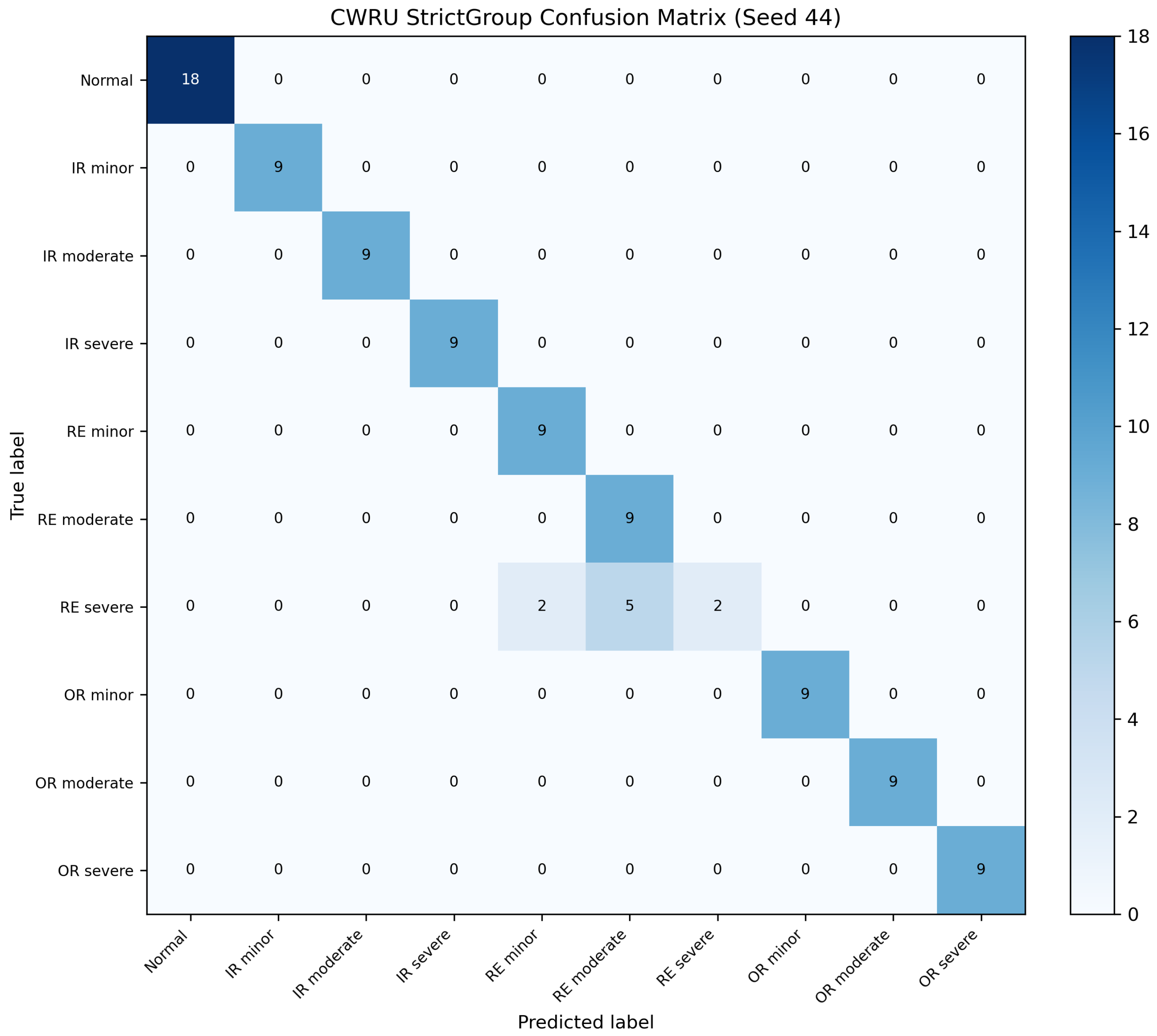
| Rolling element fault (minor) | 0.82 | 1.00 | 0.90 | 9 |
| Rolling element fault (moderate) | 0.64 | 1.00 | 0.78 | 9 |
| Rolling element fault (severe) | 1.00 | 0.22 | 0.36 | 9 |
| Outer race fault (minor) | 1.00 | 1.00 | 1.00 | 9 |
| Outer race fault (moderate) | 1.00 | 1.00 | 1.00 | 9 |
| Outer race fault (severe) | 1.00 | 1.00 | 1.00 | 9 |
| Macro average | 0.95 | 0.92 | 0.90 | 99 |
| Weighted average | 0.95 | 0.93 | 0.91 | 99 |
| Dataset | PGA-LLM | w/o PGA | Only PGA | Reduced Training Epochs | No Encoder Freezing |
|---|---|---|---|---|---|
| MBHM | 96.3 | 93.9 | 94.6 | 94.8 | 95.7 |
| CWRU | 97.1 | 94.7 | 95.2 | 95.4 | 96.2 |
| Gear | 99.0 | 97.4 | 97.8 | 98.0 | 98.6 |
| Mixed | 93.4 | 90.2 | 91.0 | 91.3 | 92.1 |
| Route | Parameters | Mean/P95 Latency (ms) | Peak Memory (MiB) | FLOPs |
|---|---|---|---|---|
| Signal-side classifier | 6.02 M | 2.10/2.17 | 36.87 | 6.17 M |
| Classifier + template | 6.02 M | 2.13/2.22 | 36.87 | 6.17 M |
| Full PGA-LLM report | 1.565 B | 4260/5539 | 3091.12 | 1.30 T |
Disclaimer/Publisher’s Note: The statements, opinions and data contained in all publications are solely those of the individual author(s) and contributor(s) and not of MDPI and/or the editor(s). MDPI and/or the editor(s) disclaim responsibility for any injury to people or property resulting from any ideas, methods, instructions or products referred to in the content. |
© 2026 by the authors. Licensee MDPI, Basel, Switzerland. This article is an open access article distributed under the terms and conditions of the Creative Commons Attribution (CC BY) license.
Share and Cite
Wang, T.; Di, Y.; Feng, S.; Liu, Q.; Cui, H.; Liu, Q. PGA-LLM: A Probability-Guided Alignment Large Language Model Framework for Fault Diagnosis. Technologies 2026, 14, 494. https://doi.org/10.3390/technologies14080494
Wang T, Di Y, Feng S, Liu Q, Cui H, Liu Q. PGA-LLM: A Probability-Guided Alignment Large Language Model Framework for Fault Diagnosis. Technologies. 2026; 14(8):494. https://doi.org/10.3390/technologies14080494
Chicago/Turabian StyleWang, Tao, Yanqiang Di, Shaochong Feng, Qiongyao Liu, Haohao Cui, and Qing Liu. 2026. "PGA-LLM: A Probability-Guided Alignment Large Language Model Framework for Fault Diagnosis" Technologies 14, no. 8: 494. https://doi.org/10.3390/technologies14080494
APA StyleWang, T., Di, Y., Feng, S., Liu, Q., Cui, H., & Liu, Q. (2026). PGA-LLM: A Probability-Guided Alignment Large Language Model Framework for Fault Diagnosis. Technologies, 14(8), 494. https://doi.org/10.3390/technologies14080494