This is an early access version, the complete PDF, HTML, and XML versions will be available soon.
Article

Robust Integration of Fault-Tolerant Observer and CBF Safety Control: A Separation Principle Approach


1
School of Automation, Southeast University, Nanjing 210018, China
2
China Unicom Internet of Things Co., Ltd., Nanjing 210016, China
3
China Unicom Digital Technology Co., Ltd., Beijing 100032, China
*
Author to whom correspondence should be addressed.
Technologies 2026, 14(5), 309; https://doi.org/10.3390/technologies14050309

Submission received: 14 April 2026 / Revised: 15 May 2026 / Accepted: 16 May 2026 / Published: 20 May 2026

Abstract

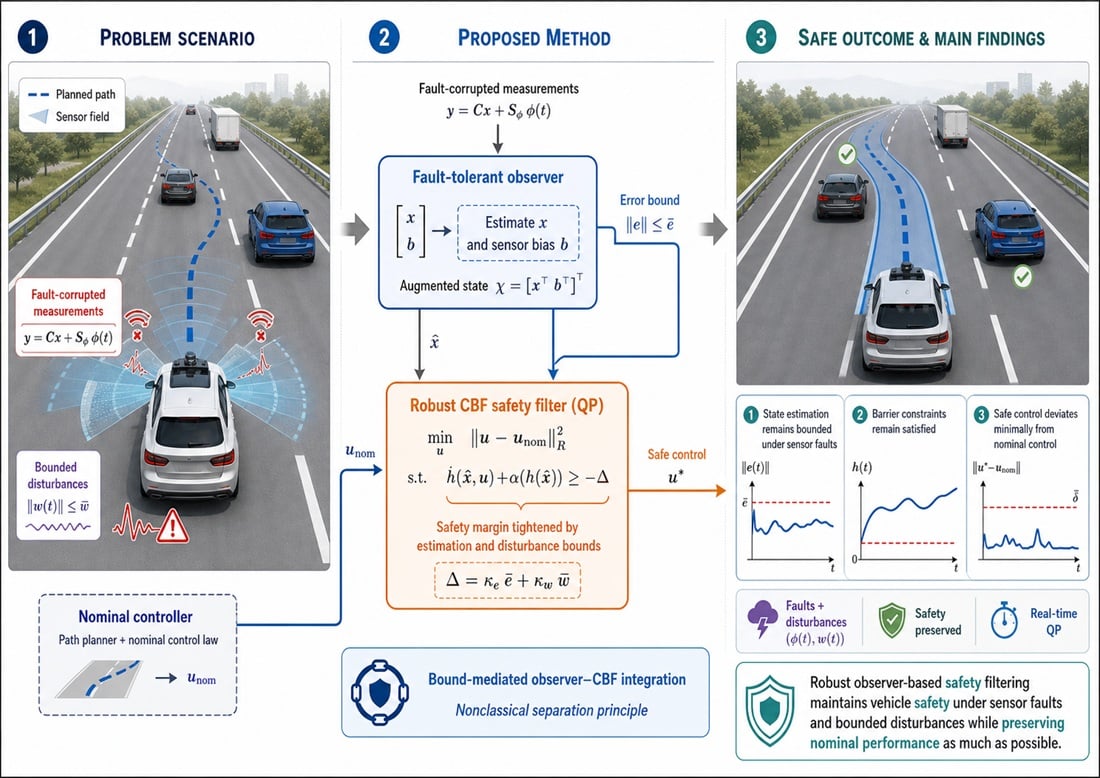
Autonomous vehicles must enforce safety constraints even when their state estimates are corrupted by sensor faults and disturbances. This paper develops a separation-based robust safety-control framework that couples a fault-tolerant observer with a control barrier function (CBF) safety filter through an explicit estimation-error envelope. First, a uniformly ultimately bounded observer-error estimate is derived. This bound is then injected into an estimated-state robust CBF condition, yielding safety margins that account for both observation error and bounded disturbances. The construction is further extended to time-varying safe sets induced by moving obstacles. For implementation, the resulting condition is realized as a quadratic-program safety filter with high-order obstacle and lane constraints. Simulations on a nonlinear 3-DOF bicycle model evaluate bias faults, gust-like disturbances, dense traffic, and tightened stress tests. Compared with a standard CBF baseline and observer/safety-filter ablations, the proposed method preserves nonnegative safety margins while keeping slack activation negligible. Additional sensitivity experiments quantify the trade-off among safety margin, slack usage, observer accuracy, control conservatism, and QP computation time. The results support the proposed architecture as a practical bridge between bounded state estimation and fault-aware safety filtering.
Keywords: autonomous driving; control barrier function; fault-tolerant observer; safety filter; sensor faults; robust safety control autonomous driving; control barrier function; fault-tolerant observer; safety filter; sensor faults; robust safety control
Graphical Abstract