
Article

Multi-Factor Statistical Analysis and Numerical Modeling of an Anode-Supported SOFC Fueled by Synthetic Diesel Using Taguchi Orthogonal Arrays

by
Alan Uriel Estrada-Herrera
1,
Ismael Urbina-Salas
1,2,
David Aaron Rodriguez-Alejandro
1,
José de Jesús Ramírez-Minguela
3,
Martin Valtierra-Rodriguez
4,* and
Francisco Elizalde-Blancas
1,*
1
Departamento de Ingeniería Mecánica, Universidad de Guanajuato, Carretera Salamanca-Valle de Santiago km. 3.5 + 1.8, Comunidad de Palo Blanco, Salamanca 36885, Mexico
2
Departamento de Ingeniería Mecatrónica, Tecnológico Nacional de México, ITS Guanajuato (ITESG), Carr. Guanajuato a Puentecillas km 10.5, Guanajuato 36262, Mexico
3
Departamento de Ingeniería Química, Universidad de Guanajuato, Col. Noria Alta s/n, Guanajuato 36050, Mexico
4
Facultad de Ingeniería, Universidad Autónoma de Querétaro (UAQ), Campus San Juan del Río, Río Moctezuma 249, Col. San Cayetano, San Juan del Río 76807, Mexico
*
Authors to whom correspondence should be addressed.
Technologies 2026, 14(5), 271; https://doi.org/10.3390/technologies14050271
Submission received: 26 March 2026 / Revised: 22 April 2026 / Accepted: 26 April 2026 / Published: 29 April 2026
(This article belongs to the Special Issue Emerging Renewable Energy Technologies and Smart Long-Term Planning)

Abstract

The global transition toward carbon-neutral energy solutions has established Solid Oxide Fuel Cells (SOFCs) as a key technology for next-generation power generation. This work presents a comprehensive numerical study and multi-factor statistical analysis of an anode-supported SOFC fueled by synthetic diesel. A three-dimensional computational fluid dynamics model, validated against experimental data, was integrated with a Taguchi L27 orthogonal array to systematically evaluate the influence of six key parameters: temperature, fuel mass flow rate, operating pressure, current load, flow channel configuration, and methane molar fraction. Statistical analysis through the signal-to-noise ratio and analysis of variance identified the operating current as the most significant factor affecting cell voltage, followed by the fuel mass flow rate and temperature. The experiments showed that the highest levels of all factors (except for the current, which had the lowest level) maximize electrochemical performance while maintaining a steam-to-carbon ratio (S/C) within a range of 0.83 to 0.92, calculated based on total carbon content, ensuring sufficient humidification for internal reforming across all tested fuel compositions. Furthermore, a multiple linear regression model was developed as a computationally efficient surrogate, demonstrating exceptional predictive accuracy with an R2 of 0.9954 and a mean relative error of 1.76% across independent validation cases. These results provide a robust methodology for rapid design and sensitivity analysis of internal-reforming SOFCs, offering a precise tool for optimizing fuel utilization in high-temperature electrochemical systems.

1. Introduction

The global transition toward carbon-neutral energy systems has positioned Solid Oxide Fuel Cells (SOFCs) as a cornerstone technology for future power generation. Due to their high thermodynamic efficiency and fuel flexibility, SOFCs offer a unique advantage over low-temperature counterparts, as they can operate directly with a wide range of fuels beyond pure hydrogen [1,2,3,4]. In this study, synthetic diesel refers to the gaseous reformate produced after the primary reforming of liquid hydrocarbons. This mixture, primarily composed of H2, CO, and residual CH4, is what directly interacts with the anode’s triple-phase boundaries and drives the internal reforming processes.
Operating at temperatures between 873 K and 1273 K, these systems facilitate the internal electrochemical oxidation of hydrocarbons through integrated reforming processes, making them highly compatible with existing fuel infrastructures [4,5,6,7]. This versatility is particularly critical for heavy-duty transport and decentralized power units where liquid energy carriers, such as diesel, remain the most viable option due to their superior volumetric energy density [8,9]. Beyond SOFC technology, various types of fuel cells have been developed depending on electrolyte nature and operating temperature, including Proton Exchange Membrane Fuel Cells (PEMFC), Molten Carbonate Fuel Cells (MCFC), and Phosphoric Acid Fuel Cells (PAFC). While PEMFCs operate at low temperatures and require high-purity hydrogen, limiting their tolerance to fuel impurities, MCFCs and SOFCs operate at elevated temperatures, enabling internal reforming and broader fuel flexibility [10]. Among these, SOFCs stand out for their high electrical efficiency, reduced dependence on noble metals, and direct utilization of hydrocarbons [11].
Furthermore, SOFC configurations can be broadly categorized into tubular and planar geometries. Planar designs offer higher power density, improved stacking compactness, and reduced ohmic losses due to shorter current paths, making them particularly attractive for stationary and transport-related applications [12]. Anode-supported planar SOFCs, in particular, provide enhanced mechanical stability and reduced electrolyte thickness, contributing to lower internal resistance and improved electrochemical performance [13]. However, the utilization of diesel-derived fuels in SOFCs introduces significant technical complexities that require advanced thermal and chemical management. The gaseous mixture resulting from diesel steam reforming is characterized by high concentrations of hydrogen and carbon monoxide, along with residual fractions of methane and heavier hydrocarbons [14,15]. The presence of these species triggers internal methane steam reforming (MSR) and water-gas shift (WGS) reactions within the Ni-YSZ porous anode, which provide a localized cooling effect that can mitigate thermal gradients across the cell [4,6,16]. Compared to lighter hydrocarbons such as methane or biogas, diesel and synthetic diesel fuels offer superior volumetric energy density and compatibility with existing fuel logistics infrastructure, which is crucial for heavy-duty transport and remote power applications [17]. However, long-chain hydrocarbons exhibit more complex reforming pathways and a higher propensity to form carbon than methane-based systems [18]. This trade-off between energy density and reforming complexity justifies the need for advanced modeling and thermal management strategies when operating SOFCs with diesel-derived fuels. Nevertheless, these reactions also increase the risk of carbon deposition, or coking, which can lead to rapid structural degradation of the anode’s triple-phase boundaries and subsequent loss of electrochemical activity [7,15,19]. Consequently, recent research has focused on optimizing the steam-to-carbon (S/C) ratio and developing more resilient anode microstructures to ensure long-term stability [20,21,22]. The fundamental understanding of mass and charge transport phenomena in multi-channel SOFC architectures has been significantly advanced through numerical simulations [21,23]. Yet, a persistent gap remains in the literature regarding the systematic, multi-factor statistical analysis of operational parameters when using methane-enriched diesel fuel in the cell. Most existing studies rely on single-variable sensitivity analyses, which often fail to capture the complex synergistic interactions between operating pressure, fuel mass flow rate, and current density [24,25,26]. Traditional optimization approaches in SOFC research have relied on parametric sweeps and single-factor sensitivity analyses [27]. However, such methods often neglect interactions among operating variables. Advanced optimization strategies, including multi-objective optimization, response surface methodology, artificial intelligence-assisted surrogate modeling, and design of experiments (DoE), have gained increasing attention for improving computational efficiency while preserving predictive accuracy [3,25]. Among these, the Taguchi method offers a statistically robust and computationally efficient framework for exploring large operational spaces with a reduced number of simulations, making it particularly suitable for high-fidelity CFD-based SOFC models [1,28]. Furthermore, while high-fidelity three-dimensional (3D) computational fluid dynamics (CFD) models provide unparalleled detail on the internal electrochemical environment, their prohibitive computational cost often precludes the exploration of the entire operational design space [23,29,30,31]. To address these challenges, robust statistical methodologies, such as Taguchi design of experiments (DoE), have emerged as powerful tools for analyzing high-temperature fuel cell systems [1,32,33,34]. When coupled with machine learning or linear regression surrogates, these methods allow researchers to bridge the gap between complex numerical analysis and practical system optimization [31,35,36]. Recent advancements in internal reforming kinetics have further underscored the need for these integrated approaches to utilize long-chain hydrocarbons [37,38,39,40].
In this work, a comprehensive numerical framework is presented to optimize the performance of an anode-supported SOFC operating under synthetic diesel conditions. A 3D-CFD model is integrated with a Taguchi L27 orthogonal array to evaluate the sensitivity of cell voltage to six critical parameters: temperature, pressure, fuel mass flow, current, number of channels, and fuel composition. This study contributes to the field by not only identifying the optimal operational configuration but also by deriving a highly accurate linear regression surrogate model (R2 = 0.9954), offering a verified and precise instrument for the development of advanced control strategies in high-temperature electrochemical systems.

2. SOFC Theoretical Basis and Model

2.1. Electrochemical Reactions

In SOFC systems fueled by synthetic diesel, cell performance is governed by the simultaneous coupling of transport phenomena, electrochemical kinetics, and chemical thermodynamics. Unlike Proton Exchange Membrane Fuel Cells (PEMFCs), the high operating temperatures of SOFCs facilitate direct electrochemical oxidation and internal reforming, effectively eliminating the need for rigorous CO purification steps, as CO can be utilized as a fuel rather than acting as a catalyst poison [41]. The fundamental energy conversion process initiates at the porous cathode, where ambient oxygen is electrochemically reduced to oxygen ions. The dense ceramic electrolyte functions as a selective ionic conductor, transporting these ions to the anode interface while blocking electron flow [19]. The cathodic reduction is described by Equation (1):
O 2 + 4 e 2 O 2
At the anodic Triple-Phase Boundary (TPB), oxygen ions transported from the cathode oxidize the fuel species. While hydrogen exhibits faster oxidation kinetics, recent micro-kinetic studies confirm that carbon monoxide also actively participates in current generation within Ni-YSZ anodes [16]. The primary anodic electrochemical reactions are:
H 2 +   O 2 H 2 O + 2 e
C O + O 2 C O 2 + 2 e
When using a fuel stream containing CH4, the species must be converted to electrochemically active components (H2 and CO) before reaching the TPB. This conversion occurs primarily via the MSR reaction over the catalytic nickel surface of the anode [19,41]:
C H 4 + H 2 O   C O + 3 H 2
Concurrently, CO participates in the WGS reaction. Under high-temperature operating conditions (1023–1123 K), this reversible reaction often approaches thermodynamic equilibrium more rapidly than the direct electrochemical oxidation of CO. The WGS reaction allows for the production of additional hydrogen [19]:
C O + H 2 O   C O 2 + H 2
Consequently, the global electrochemical oxidation of the hydrogen-rich fuel mixture and the cathodic oxygen reduction can be summarized as [41]:
H 2 + C O + 2 O 2 H 2 O + C O 2 + 4 e
A critical challenge in hydrocarbon-fueled SOFC operation is anode degradation due to solid carbon formation (coking). Carbon deposition obstructs electrode pores and deactivates Nickel active sites, leading to an irreversible loss of electrochemical performance. The thermodynamic pathway for carbon formation is carried out by the reduction of CO (Equation (7)) [6]:
C O + H 2 C + H 2 O
Furthermore, particularly under conditions of low steam-to-carbon ratios or high hydrocarbon concentrations, direct methane cracking becomes a predominant degradation mechanism [6,42]:
C H 4 C + 2 H 2

2.2. Numerical Modeling

To predict the electrochemical performance and thermal behavior of the planar, anode-supported SOFC, a 3D CFD model was developed using the commercial software Ansys Fluent 2022 R2. The simulation couples the governing conservation equations for mass, momentum, energy, and species transport. Unlike macro-models that discretize the electrolyte layer, the model resolves the electric potential field within the porous electrode domains and current collectors. In contrast, the electrolyte is modeled as an impermeable interface, with electrochemical reactions and Nernst potential jumps computed at the interface. The numerical framework, encompassing fluid flow, heat transfer, species transport, and electrochemical reactions, is governed by the fundamental conservation equations formulated under steady-state and laminar flow conditions. The conservation of mass is described by Equation (9), where S m represents the mass source term due to chemical and electrochemical reactions:
· ( ρ v ) = S m
Momentum conservation is resolved via Equation (10), which accounts for the static pressure ( p ), the stress tensor ( τ ̿ ), and external body forces ( F ), including those arising from porous media resistance:
ρ ( v · v ) = p + · ( τ ̿ ) + ρ g + F
Regarding the thermal field, the energy conservation equation (Equation (11)) accounts for the effective thermal conductivity ( k e f f ), enthalpy diffusion fluxes, and a volumetric heat source term ( S H ) that represents chemical and ohmic contributions. E represents the total energy per unit mass, encompassing both internal and kinetic energy. The term J i denotes the mass diffusion flux of species i, while hi represents the specific enthalpy of that species. The volumetric source term S H encompasses the heat of chemical reactions and ohmic heating generated within the electrically conducting zones.
· [ v ( ρ E + p ) ] = [ k e f f T i h i J i + ( τ ̿ · v ) ] + S H
The transport of the i gaseous species is governed by the conservation equation (Equation (12)), where J i represents the diffusion flux and S i is the source term due to electrochemical reactions:
· [ ρ v Y i ] = · J i + S i
For the electric and ionic charge transport, the conservation of charge follows Ohm’s law, resolved separately for the electronic potential in the solid phase ( φ s ) and the ionic potential in the electrolyte phase ( φ l ):
· ( σ s φ s ) + S φ s = 0
· ( σ l φ l ) + S φ l = 0
where σ represents the electrical or ionic conductivity, and S φ denotes the volumetric current source terms at the catalyst layers.
The electrochemical behavior is coupled to the potential field through a ‘potential jump’ condition at the electrode–electrolyte interface. While the cell voltage is a macroscopic parameter, the model distinguishes the contributions of each species to the overpotentials by solving coupled charge- and species-transport equations. The activation overpotentials ( η a c t ) are determined by the Butler–Volmer kinetics for each reactive species, where the local current density is the sum of the partial currents from H2 and CO oxidation. This approach follows the methodology of Suwanwarangkul et al. [42], ensuring that the different energy barriers for each mechanism are accounted for within the global potential drop.
V j u m p = V N e r n s t η o h m η a c t , a η a c t , c η s
The ideal Nernst potential ( V N e r n s t ) was calculated from the local partial pressures of the hydrogen-rich stream (Equation (16)). Under the high-temperature operating conditions considered in this study (1023–1123 K), the WGS reaction (Equation (5)) proceeds rapidly and approaches thermodynamic equilibrium within the porous anode. As reported by Andersson et al. [43], when the WGS reaction is near equilibrium, the gas-phase composition satisfies the equilibrium constraint (Equation (17)), which causes the Nernst potentials derived from the H2/H2O and CO/CO2 redox couples to converge to the same value. Consequently, although the formal Nernst expressions for hydrogen and carbon monoxide oxidation are not identical, the establishment of the WGS equilibrium ensures a single effective electrochemical potential within the anode. Under these conditions, the hydrogen-based Nernst equation provides a valid and thermodynamically consistent representation of the overall electrochemical potential of the fuel mixture.
V N e r n s t = E 0 + R T 2 F l n ( P H 2 P O 2 0.5 P H 2 O )
K W G S = p H 2 p C O 2 p C O p H 2 O
E 0 , in Equation (16), represents the standard open-circuit voltage, R is the universal gas constant (8.314 J/mol·K), T is the absolute temperature, and F is the Faraday constant (96,485 C/mol). The activation overpotentials arise from the energy barrier required for electrochemical reactions. The relationship between the current density and the activation overpotential is described by the Butler–Volmer equation:
j = j 0 [ e α a n F η a c t R T e α c n F η a c t R T ]
In this study, the electrochemical model implemented in Ansys Fluent uses a total current density to maintain global charge balance. However, the numerical framework internally distinguishes the contributions of each reactive species (H2 and CO) to the overall electrochemical process. The local current density is resolved by coupling the Butler–Volmer kinetics with the transport of H2 and CO through the porous anode. This approach ensures that, although a single potential field is solved, the activation and concentration overpotentials accurately reflect the competitive oxidation of both fuels. By using the ‘potential jump’ condition at the electrode–electrolyte interface, the model effectively splits the source terms based on the local availability and reactivity of each species, which is consistent with the modeling strategies for syngas-fueled SOFCs reported in the literature [42,43]. The ionic conductivity of the YSZ electrolyte ( σ e l ) is modeled following an Arrhenius-type dependence, which accounts for the reduction in ohmic losses as temperature increases:
σ e l = A e l e E e l R T
where A e l is the pre-exponential factor, and E e l is the activation energy. Electric charge transport is modeled by solving the charge conservation equation for the electric potential field ( V ). Since electronic conduction in the electrodes and current collectors is governed by Ohm’s law, the governing equation is the Laplace equation:
· ( σ V ) = 0
Electrochemical reactions are coupled to the species transport equations through volumetric source terms ( S i ). According to Faraday’s law, the rate of production or consumption of a species is proportional to the local current density:
S i = a i j n F
To resolve the simultaneous electrochemical oxidation of H2 and CO, the electrochemical model implemented in Ansys Fluent utilizes a split factor ( α ) (Equation (22)) to distribute the total current density between the two species. This parameter is based on the local molar fractions, reflecting the competitive availability of reactants at the Triple-Phase Boundary (TPB). While the inherent electrochemical activity of H2 is higher than that of CO, this assumption provides a robust numerical convergence for CFD models where MSR and WGS reactions (Equations (4) and (5)) continuously modify the local gas composition. This treatment aligns with the findings of Andersson et al. [43], who noted that although H2 is the primary current carrier, the high CO concentration in synthetic diesel necessitates its inclusion in the total charge transfer to avoid underestimating cell performance.
α = X H 2 X H 2 + X C O
Consequently, the species source terms on the anode side are modified to account for this competitive oxidation:
S H 2 = α j 2 F
S H 2 O = α j 2 F
S C O = ( 1 α ) j 2 F
S C O 2 = ( 1 α ) j 2 F
S O 2 = j 2 F

3. Numerical Setup

3.1. Geometries and Mesh Independence

Geometric models were developed in Ansys DesignModeler, and the computational mesh was generated in Ansys Meshing. The simulation domain represents a planar, anode-supported SOFC with a total active area of 336 mm2 (112 mm length × 3 mm width), comprising a porous Ni-YSZ anode, a porous LSM cathode, and their respective nickel and platinum current collectors, as shown in Figure 1. The thicknesses for the anode, cathode, and current collector were 0.5 mm, 0.3 mm, and 1 mm, respectively, while the dense YSZ electrolyte was modeled with a thickness of 10 mµ. This thin electrolyte layer is characteristic of anode-supported architectures, focusing the mechanical load on the Ni-YSZ substrate while significantly reducing the cell’s ohmic overpotential ( η o h m ). While commercial cathodes are often thinner, this thickness was selected for the numerical domain to ensure a robust evaluation of concentration overpotentials across the planar active area. Regarding the material, LSM was chosen for its high thermal stability and well-documented performance in diesel-reformate environments [13,29]. The anode thickness encompasses the entire anode structure, including both the thin functional layer where electrochemical reactions occur and the thicker mechanical support. This total thickness is consistent with industrial standards for anode-supported cells [13,35], ensuring that the model accurately captures the diffusion resistance and concentration overpotentials (ηconc) associated with the transport of complex diesel reformate species through the porous substrate. Finally, the cell height was set to 4.8 mm. To evaluate the effect of flow distribution, three distinct geometric configurations featuring 1, 2, and 3 channels were analyzed (Figure 2). A geometric constraint was applied to maintain a constant total flow cross-sectional area of 1 mm2 for both the anode and cathode across all designs; thus, while the channel height remained constant, the channel width was varied from 3 mm (1-channel) to 0.5 mm (2-channel) and 0.333 mm (3-channel).
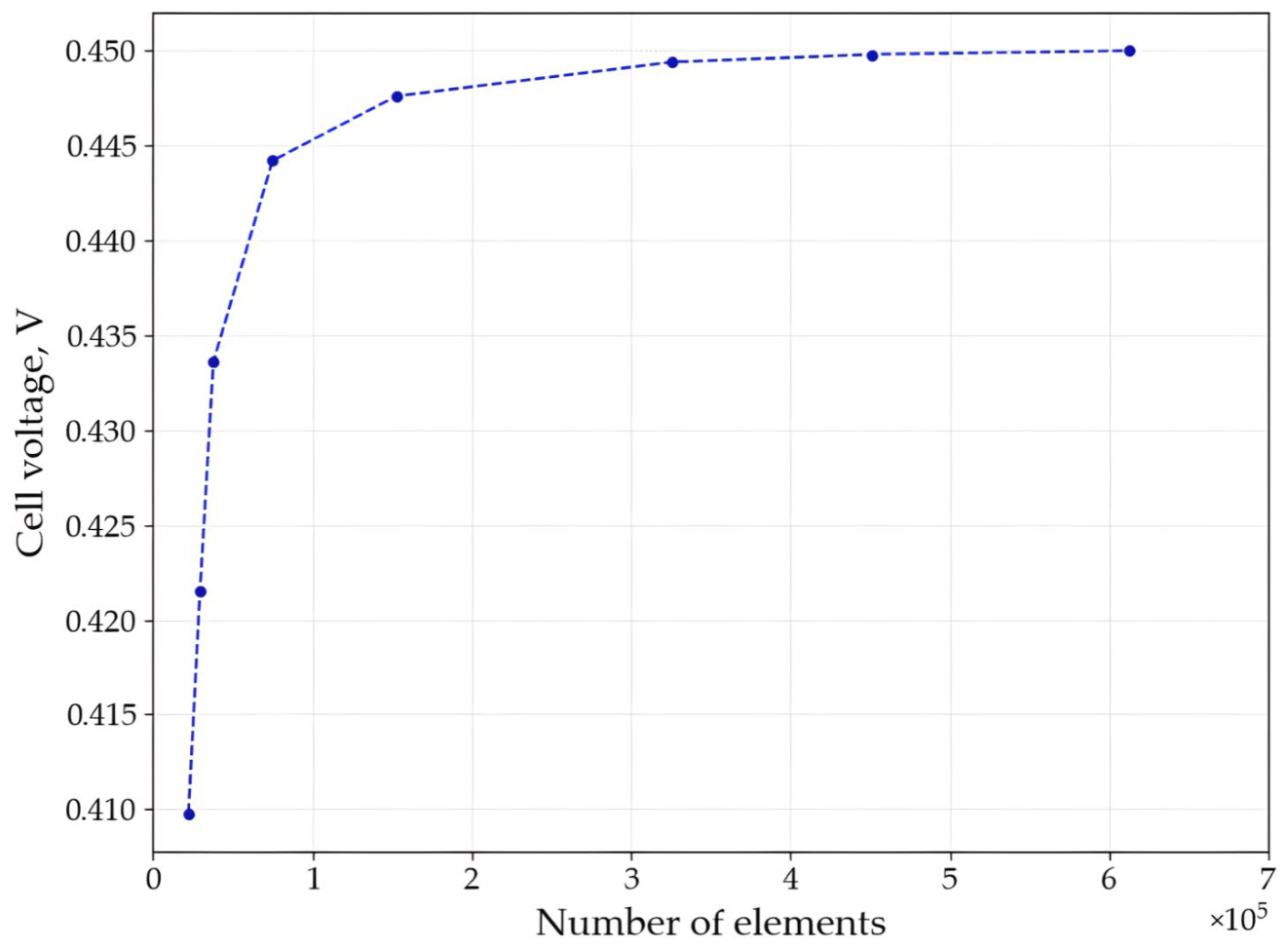
The mesh independence analysis was conducted by generating several mesh configurations with increasing total element counts and evaluating the cell voltage stability until asymptotic behavior was achieved. This global refinement approach ensures that the numerical solution is independent of the discretization scale across all spatial dimensions. Table 1 shows the operational parameters used during this characterization.
Figure 3 illustrates the convergence profile of the cell voltage as a function of the total element count. As shown in the curve, the predicted voltage is highly sensitive at lower element counts but asymptotically stabilizes as the mesh is refined. Specifically, the relative voltage difference between the selected mesh (151,500 elements) and the finest grid studied (612,482 elements) is only 0.53%, while the difference between the last two refinement steps is negligible (<0.05%). This demonstrates that the model has reached a stable asymptotic state in which the solution is independent of the discretization scale. It is important to emphasize that these cell voltages are physically consistent with the high-load conditions applied to the geometry, which features an active area of 336 mm2 (112 mm length × 3 mm width). For instance, at a baseline current of 5 A, the cell operates at a high current density of approximately 1.48 A/cm2, which explains the observed potential when fueled with synthetic diesel. This high level of mesh independence ensures that the subsequent Taguchi statistical analysis captures genuine physical trends, such as the effects of internal reforming and channel configuration, without interference from numerical truncation errors.
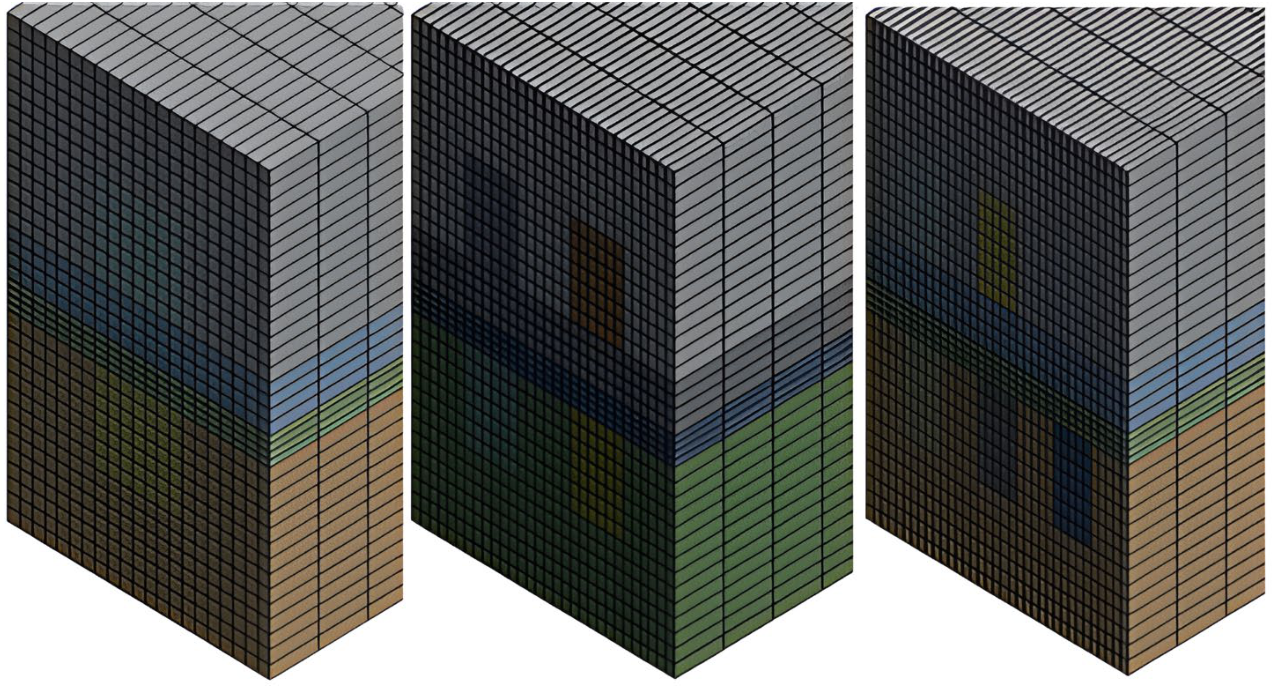
Consequently, a 151,500-element grid was selected for all subsequent simulations of 1 channel. Hexahedral meshes were generated for the entire control volume. Table 2 shows the characteristics of the meshes used in each of the three cases. It can be observed that, for each of the fuel cells, the minimum orthogonal quality (deformation that an element suffers concerning the adjacent elements) was 0.9123, which turns out to be good because it is sought that all the orthogonal attributes are equal to 1. Moreover, the maximum aspect ratio (the ratio of the hexahedra’s dimensions) was 8.4, which was also favorable. Lawlor et al. [44] showed that an aspect ratio of 35 is sufficient for applying the SOFC model of Ansys Fluent. This work used a lower aspect ratio to achieve more precise voltage measurements. Figure 4 shows the meshes of the three cells.

3.2. Boundary Conditions, Solver Settings, and Physics

In this modeling framework, the electrolyte and electrode interlayers are not discretized as volumetric domains; instead, they are treated as impermeable walls and wall–shadow interfaces separating the anode and cathode fluid domains. Consequently, species consumption, energy sources, and sinks resulting from electrochemical reactions are computed at this interface and added as volumetric source terms to the adjacent computational cells. The boundary conditions were defined to replicate the experimental setup in a co-flow arrangement, in which the fuel and oxidant streams enter the parallel channels in the same direction. Hydrodynamically, the channel inlets were specified as mass flow with rates ranging from 2.886 × 10⁻⁶ kg/s to 3.224 × 10⁻⁶ kg/s. At the same time, the outlets were set as pressure outlets with operating pressures of 1 atm, 7.5 atm, and 10 atm, depending on the specific design point. Thermally, the external walls were defined as fixed-temperature boundary conditions to simulate the isothermal environment of the test furnace, investigating three temperature levels: 1023 K, 1073 K and 1123 K. From an electrical perspective, the cell was simulated under galvanostatic control; the anode-side interconnect was grounded (0 V), and a fixed current load was applied to the cathode contact, with levels set at 5 A, 6 A, and 7 A. The fuel composition was also varied to assess the impact of internal reforming, with methane molar fractions (XCH4) of 0.0225, 0.04855, and 0.0746. The fuel composition was defined to represent a typical diesel reformate stream, where long-chain hydrocarbons have been pre-converted into electrochemically active species and residual methane. Calculations were conducted under steady-state conditions using a pressure-based solver with double precision. Given the micro-scale dimensions of the channels, the flow regime was laminar for both fuel and air streams. The working fluids were modeled as incompressible ideal gases, with thermodynamic and transport properties, such as thermal conductivity and dynamic viscosity, calculated using the ideal gas mixing law. For the solution of the governing transport equations, the second-order Upwind discretization scheme was employed, while the SIMPLE algorithm was selected for pressure-velocity coupling. The convergence criteria were set strictly, requiring the residuals for continuity, momentum, energy, species, and the user-defined scalars (UDS) for electrochemical potential to fall below 1 × 10⁻⁶. To simulate MSR and WGS reactions, Fluent uses the Arrhenius model, which has the following form:
K f , r = A r T β r e E r R T
where β r is the temperature exponent, A r is the pre-exponential factor, and E r is the activation energy. The constants for the MSR and WGS reactions, as determined by the Arrhenius model and best matching the experimental results, were used for both validation and analysis of the experiments and are shown in Table 3.

4. Validation Process

One of the most common methods for performing a validation process is to compare polarization curves. These curves describe the voltage–current density relationship. The selected curves of the experimental data are presented in [26], along with the cell’s geometric characteristics and operating conditions. Table 4, Table 5, Table 6, Table 7, Table 8 and Table 9 show the geometric and operational parameters of the experimental work from the literature, as well as the properties of the materials used. It is important to note that the geometric parameters in Table 8 (cathode thickness of 30 µm) correspond strictly to the experimental setup used for validation, whereas the sensitivity analysis in Section 3 uses a slightly modified geometry to explore a broader operational range.
To set up a replica, modeling is performed using available experimental data, and the remaining data is approximated.
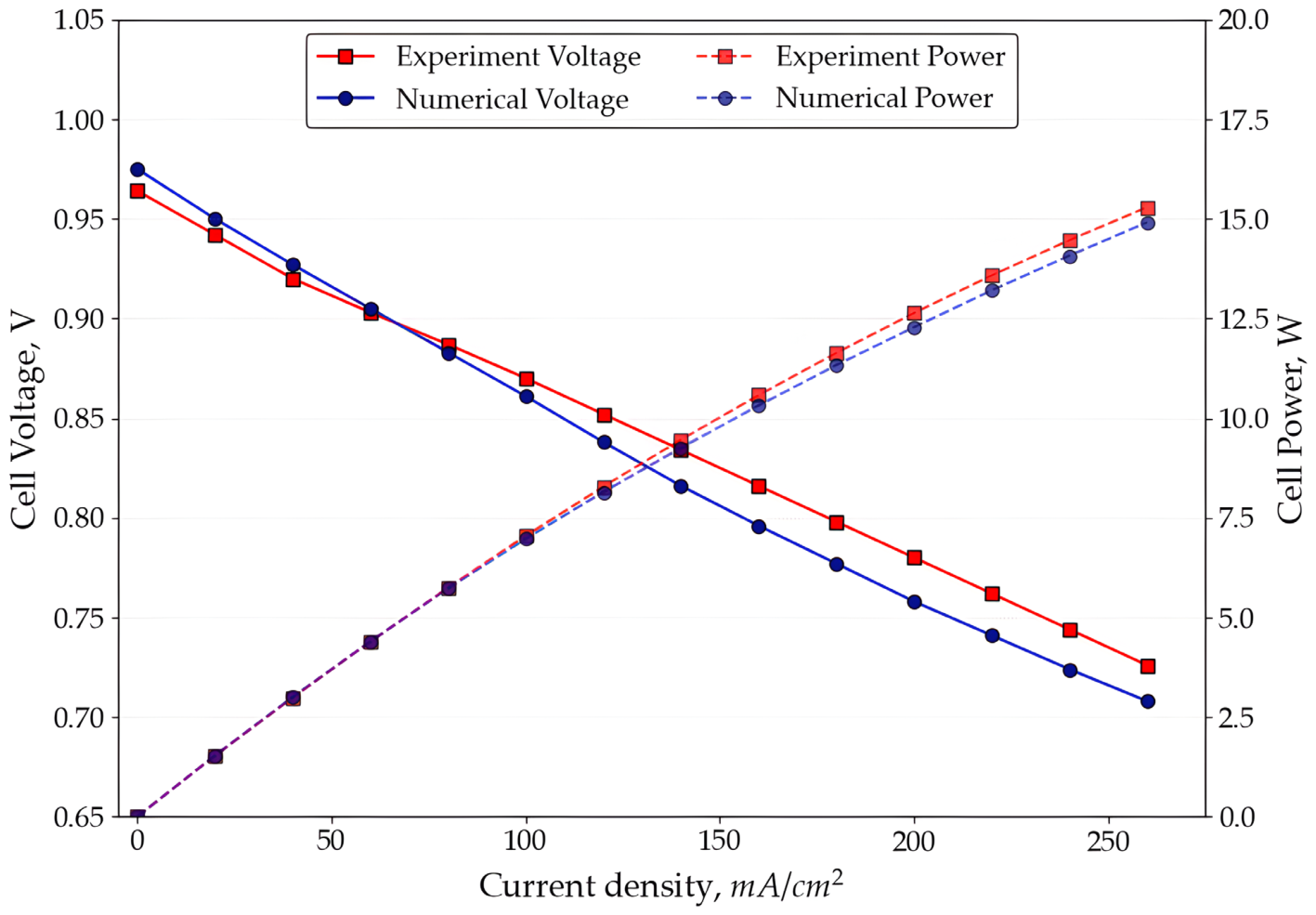
The cell used for the validation process is an anode-supported SOFC (ASC). The experimental model area is 100 cm2. The anode is considerably thicker because it provides mechanical support to the cell. The operating and geometric parameters were introduced into the electrochemical model implemented in Ansys Fluent to reproduce the physical cell’s operation accurately. Schluckner et al. [29] report the operating curves of the experimental cell at 800 °C. Specifically, the validation fuel consisted of a reformate mixture with the following molar fractions: H2 (0.154), CO (0.137), CH4 (0.0225), H2O (0.113), CO2 (0.098), and N2 (0.4755), reflecting the experimental conditions reported in [29]. The validation of the 3D numerical model against experimental data at 800 °C is established through a rigorous comparative analysis of the cell voltage and power output under synthetic diesel. To quantitatively assess the model’s fidelity, four statistical indicators were used: Mean Absolute Error (MAE), Root Mean Square Error (RMSE), Coefficient of Determination (R2), and Mean Absolute Percentage Error (MAPE). The results (Figure 5) demonstrate a high degree of correlation, particularly for cell voltage, with a MAPE of 1.72% and an R2 of 0.9545. These metrics indicate that the numerical framework accurately captures the underlying electrochemical and transport phenomena within the industrial-sized anode-supported cell. Regarding the polarization curve, the model effectively replicates the transition through the different loss regimes. At open-circuit conditions, the experimental voltage was measured at 0.964 V. At the same time, the numerical simulation predicted 0.975 V. This marginal overestimation, resulting in a relative error of 1.14%, is consistent with Schluckner et al. [29], where localized gas leakages or internal micro-short circuits in the physical assembly are not accounted for in the idealized CFD environment. As current density increases, the model shows exceptional accuracy in the activation-to-ohmic transition region, specifically near 60 mA/cm2, where the relative error reaches a minimum of 0.22%. This alignment confirms the precision of the implemented exchange current densities and the characterization of the activation overpotential using Equation (18). In the high-load region, particularly at current densities exceeding 180 mA/cm2, a slight deviation is observed, with the numerical voltage being approximately 2.6% lower than the experimental values. This phenomenon suggests that the mass transport parameters, such as the porosity and tortuosity defined for the 300 μm-thick anode substrate, may impose slightly more conservative diffusion limits in the simulation than those observed in the real porous structure. Despite this, the power density curve demonstrates a nearly perfect correlation with an R2 of 0.9967 and a MAPE of 1.77%. The experimental peak power of 15.3 W at 260 mA/cm2 closely matches the numerical prediction of 14.9 W, yielding a minimal discrepancy of 0.4 W. The overall statistical consistency, characterized by errors consistently below 1.8%, provides robust validation of the integrated modeling approach. The proximity between the numerical and experimental datasets confirms that the detailed heterogeneous reaction mechanism for methane reforming accurately describes the chemical conversion of the gas reformer into electrochemically active species. Consequently, the model is proven to be a reliable tool for predicting the performance and identifying critical regions susceptible to degradation, such as carbon deposition at the anode inlet, under realistic operating conditions.

5. Design of Experiments

A Taguchi orthogonal array L27 was selected to systematically analyze six independent factors, each with three discrete levels, yielding 27 experimental runs. The cell voltage was defined as the primary response variable and subsequently optimized using the ‘larger-the-better’ signal-to-noise (SNR) criterion in Minitab 20. The specific factors and their corresponding levels are detailed in Table 10.
As detailed in Table 10, the molar fraction of CH4 serves as a primary design factor, and its variation fundamentally influences the concentrations of the remaining fuel constituents. In this study, the molar fractions of CO2 and CO were maintained constant to isolate the impact of CH4 variability. Consequently, the concentrations of H2O and H2 were governed by two rigorous operational constraints: a steam-to-carbon (S/C) ratio maintained within a stable interval of 0.83–0.92 (considering the total carbon species) and the total fuel availability, which was calibrated to meet a limiting current threshold of 9.33 A. While the S/C ratio relative only to reactive carbon species was held at 1.4, the total S/C ratio effectively scales with the methane molar fraction to ensure localized chemical stability. The resulting fuel mixture compositions, corresponding to the three discrete levels of methane molar fractions, are systematically presented in Table 11.

6. Results and Discussion

This section presents the comprehensive results derived from the numerical simulations based on the previously defined L27 Taguchi orthogonal array. The study evaluates the influence of key operational and design parameters, including temperature, fuel mass flow rate, operating pressure, current, flow channel configuration, and CH4 fraction, on the cell’s electrochemical performance.

6.1. DoE Numerical Results

Table 12 summarizes the voltage responses from the 27 experimental simulations, providing the fundamental dataset for subsequent statistical analysis of SOFC operation under reforming conditions.
The results presented in Table 12 reveal a complex dependence of cell voltage on boundary and operating conditions, with observed potentials ranging from 0.3406 V to significantly higher values under elevated pressure and temperature conditions. A clear positive trend is observed during the increase in operating temperature (from 1023 K to 1123 K) and the resulting cell voltage. This behavior is primarily attributable to the endothermic nature of the MSR reaction and the concurrent reduction in the ohmic resistance of the YSZ electrolyte. At higher temperatures, charge-transfer kinetics at the TPB are significantly enhanced, thereby reducing activation overpotentials, a phenomenon consistent with observations from industrial-sized cells reported by Schluckner et al. [29]. A critical finding in the dataset is the influence of operating pressure. Increasing the pressure from 1 atm to 10 atm favors the Nernst potential (Equation (16)) and mitigates concentration losses. However, this effect is intrinsically linked to the methane fraction. An increased methane fraction (Level 3) serves as a chemical “reservoir” for hydrogen via internal reforming. While MSR requires heat for conversion, its presence ensures a more uniform hydrogen partial pressure along the flow channel, preventing the abrupt voltage drops associated with fuel depletion that typically occur at high current densities. The results indicate that increasing the number of channels and the fuel mass flow rate (3.224 × 10⁻⁶ kg/s) improves the distribution of reactive species. Higher flow velocities reduce the thickness of the diffusion boundary layer within the porous anode, facilitating the transport of reactants toward the anode/electrolyte interface. This is particularly evident in experimental runs where, despite a high current demand (7 A), the voltage remains at competitive levels, suggesting that the channel design effectively optimizes convective mass transfer. It is noteworthy that the response voltage is primarily penalized by increasing the operational current, as seen in the experiments. Nonetheless, the model’s robustness demonstrates that even under the fuel availability constraint (limiting current to 9.33 A), the cell operates without entering an extreme concentration polarization regime. This validates the selected humidification strategy. Although the total S/C ratio investigated in this work (0.83–0.92) is slightly below the conventional thermodynamic threshold of 1, the cell remains electrochemically stable without excessively compromising the thermodynamic potential. This performance is justified by two factors: (1) the high operating temperatures (above 1023 K), which thermodynamically favor the forward Boudouard reaction, effectively suppressing carbon accumulation, and (2) the high concentration of CO2 in the mixture. This strategy aligns with the findings of Schluckner et al. [29], who demonstrated that CO2-rich environments provide an inherent gasification mechanism that enables stable operation even at reduced steam concentrations. This numerical observation is consistent with the experimental findings of Schluckner et al. [29], who reported that industrial-sized anode-supported cells could maintain electrochemical stability with S/C ratios as low as 0.5–1.0 when operating under CO2-rich reformate conditions. Their work confirmed that the synergistic effect of high operating temperatures and CO2-assisted gasification mitigates the risk of coking, thereby validating the low-humidification strategy explored in our study.
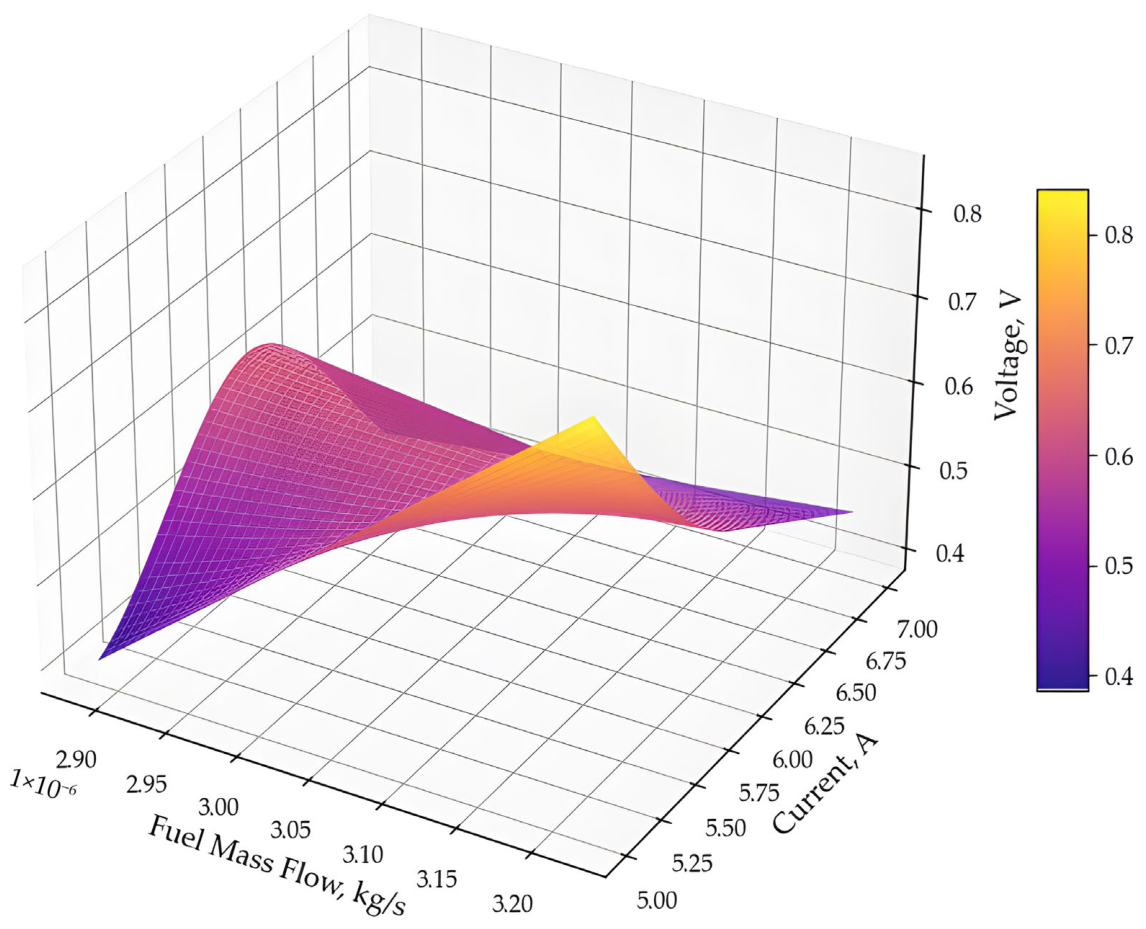
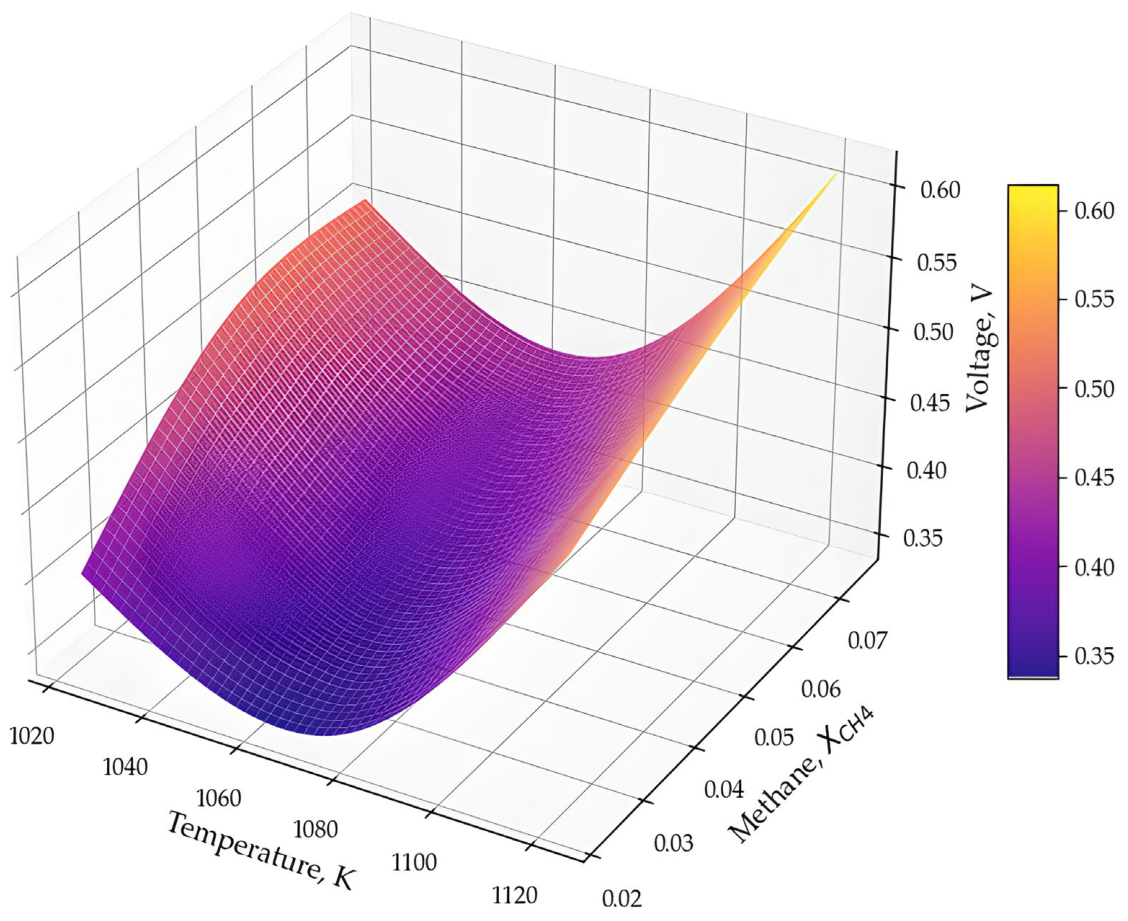
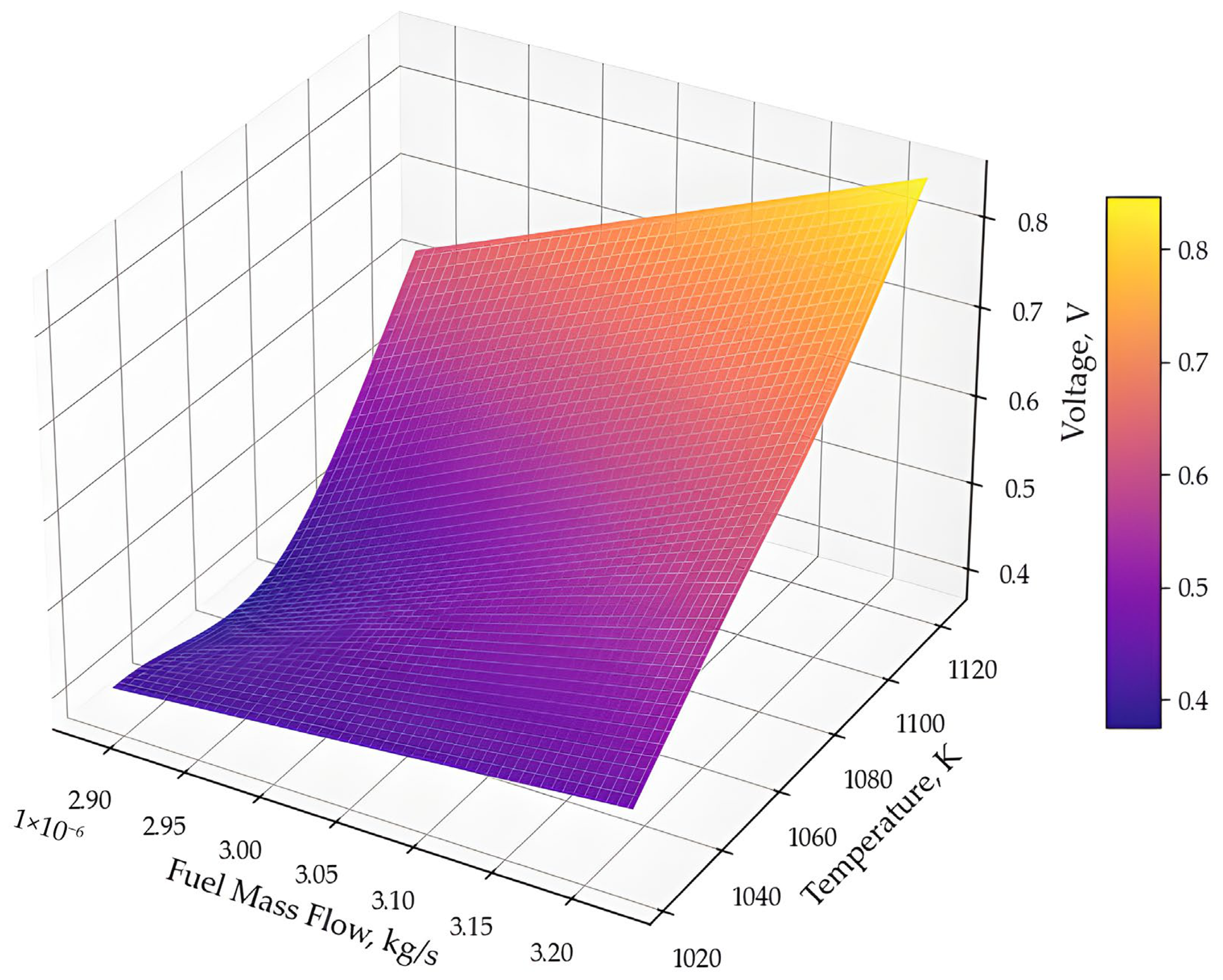
The influence of each operational and design factor on cell voltage was quantified using a Taguchi design of experiments. To further elucidate the complex interactions between the dominant operational factors, three-dimensional response surfaces were generated (Figure 6, Figure 7 and Figure 8). These surfaces provide a visual representation of how the cell voltage behaves within the design space defined by the Taguchi array. Figure 6 illustrates the interaction between fuel mass flow rate and operating current. A significant voltage drop is observed as the current increases toward 7 A, particularly at lower fuel mass flow rates, where the surface shifts toward the purple region (lower potentials). This trend highlights the onset of concentration overpotentials; however, increasing the fuel mass flow rate effectively mitigates this drop by enhancing the convective transport of reactants to the triple-phase boundary, shifting the response toward the yellow region (higher stability). This stabilization occurs because higher mass flow rates reduce concentration polarization (ηconc) by maintaining a high H2 partial pressure at the triple-phase boundary, even under high current demands that would otherwise lead to localized fuel starvation. The synergy between temperature and methane molar fraction is presented in Figure 7. The surface reveals that while an increase in methane content provides a greater chemical energy source, its positive impact on cell voltage is more pronounced at higher temperatures (1123 K). This behavior is physically consistent with the endothermic nature of the Methane Steam Reforming (MSR) reaction, which requires higher thermal energy to achieve faster reaction kinetics and, consequently, higher hydrogen production rates at the anode. Furthermore, the temperature increase significantly lowers the ohmic overpotential ( η o h m ) due to the Arrhenius-like behavior of the electrolyte’s ionic conductivity, while simultaneously reducing the activation overpotential ( η a c t ) by accelerating charge-transfer kinetics via the Butler–Volmer equation. Finally, Figure 8 shows the interaction between fuel mass flow and temperature. The response surface displays an ascending diagonal trend, reaching the maximum voltage (yellow peak) when both parameters are at their highest levels. This confirms that the electrochemical performance is optimized under conditions that simultaneously promote high ionic conductivity in the electrolyte and a robust supply of fuel, ensuring that the cell operates far from the transport-limited regime. The synergy shown in Figure 8 illustrates that optimal performance is reached when thermal enhancement of the internal reforming reactions (reducing chemical polarization) is coupled with efficient convective transport (minimizing mass-transport losses).
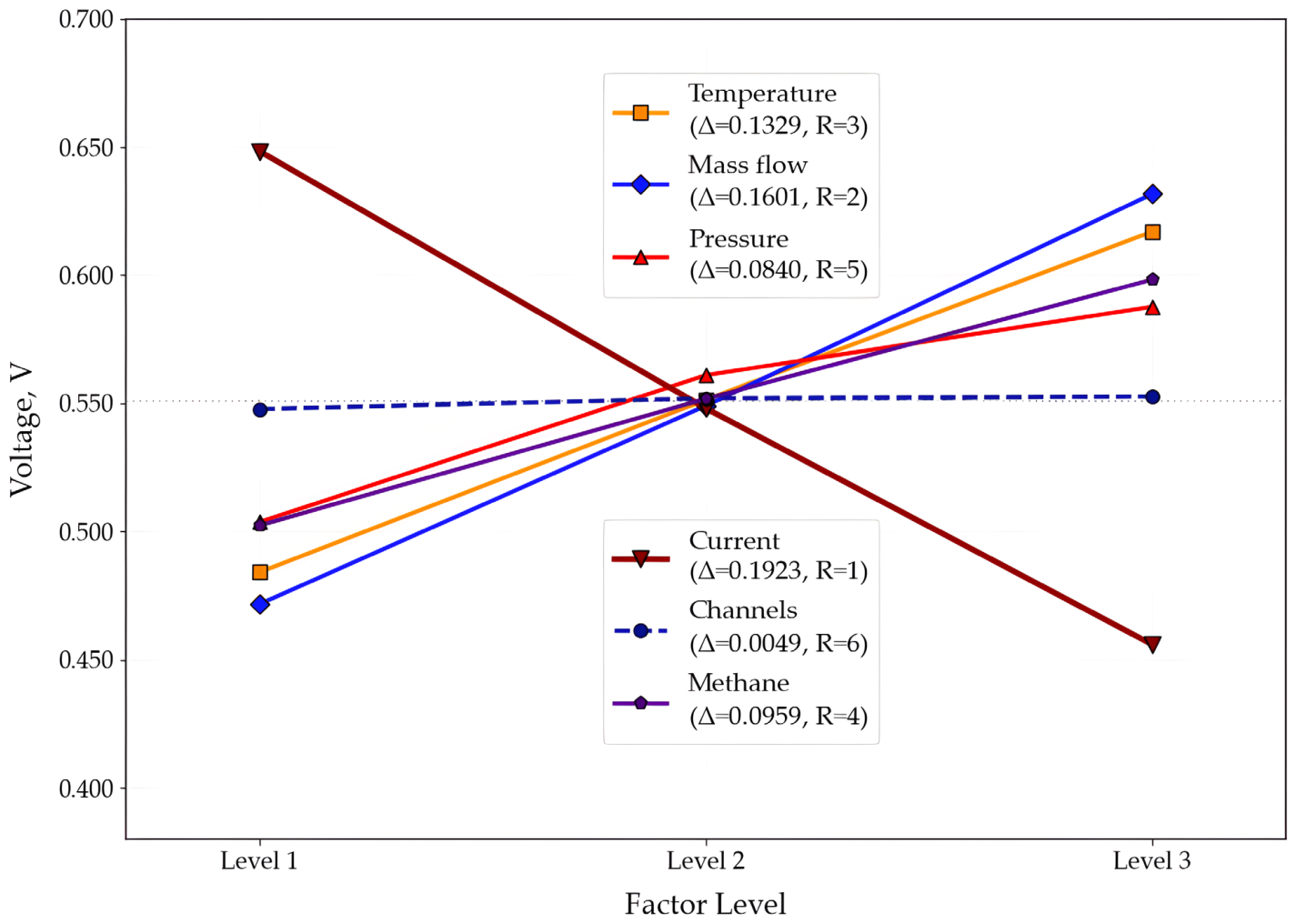
The response table for mean voltage values (Table 13) and the corresponding main effects plot (Figure 9) provide a comprehensive visualization of the SOFC’s electrochemical voltage sensitivity to variations in the selected parameters across three discrete levels. Based on the calculated Δ values and the resulting hierarchy, the operating current was identified as the most significant factor affecting cell voltage (Δ = 0.1923, Rank = 1), followed by fuel mass flow rate (Δ = 0.1601, Rank = 2), operating temperature (Δ = 0.1329, Rank = 3), and methane molar fraction (Δ = 0.0959, Rank = 4). Operating pressure (Δ = 0.0840, Rank = 5) and the number of flow channels (Δ = 0.0049, Rank = 6) exhibited a comparatively lower impact on the overall performance. The predominant role of current density is expected, as it directly dictates the magnitude of activation, ohmic, and concentration overpotentials. The sharp decline in voltage observed as current increases from Level 1 to Level 3 reflects increased consumption of reactive species and associated resistive losses in the electrolyte and electrodes. In contrast, the fuel mass flow rate and operating temperature exhibit a strong positive correlation with the response variable. An increase in temperature from 1023 K to 1123 K enhances the ionic conductivity of the YSZ electrolyte and accelerates internal reforming kinetics, thereby mitigating overall polarization losses. The molar fraction of CH4 ranked fourth in influence, surpassing operating pressure. This suggests that the chemical energy density from internal CH4 reforming is more decisive in maintaining the cell’s potential than the thermodynamic gain from increased pressure within the studied range (1–10 atm). The number of channels had the least influence (Δ = 0.0049), indicating that while the flow-field geometry aids distribution, the global mass flow rate remains the primary driver of convective transport efficiency in this configuration. The convergence of all factors near the mean voltage of 0.551 V at Level 2 underscores a balanced operational state before diverging toward their respective optimal or suboptimal levels.

6.2. Multiple-Factor Linear Regression Model Results

A multiple-factor linear regression model was developed to provide a predictive tool for the SOFC’s voltage response within the defined design space. The resulting equation (Equation (29)) integrates the linear contributions of all factors analyzed in Table 13, allowing for rapid performance estimation without the computational cost of full CFD simulations:
V o l t a g e = 1.8956 + 473537 ( F u e l   m a s s   f l o w ) + 0.001329 ( T e m p ) + 0.009230 ( P r e s s u r e ) 0.09617 ( C u r r e n t ) + 0.00243 ( N u m b e r   o f   c h a n n e l s ) + 1.8415 ( M e t h a n e )
To assess the regression model’s predictive capability, fifteen additional simulations were conducted using factor combinations not included in the original L27 matrix. A comparison between the voltages calculated by the regression equation and those obtained with Ansys Fluent (Table 14) yielded relative differences ranging from 0.85% to 2.52%. These minimal discrepancies are all below the 3% threshold, statistically validating the regression model as a robust approximation for exploring the SOFC’s operational envelope under reforming conditions. The statistical analysis performed in Minitab successfully identified the configuration that maximizes the cell voltage, a temperature of 1123 K (Level 3), a mass flow rate of 3.224 × 10⁻⁶ kg/s (Level 3), a pressure of 10 atm (Level 3), a current of 5 A (Level 1), three flow channels (Level 3), and a methane fraction of 0.0746 (Level 3). Under these optimal conditions, the model achieves a maximized predicted mean voltage of 0.8815 V. This result confirms the effectiveness of the Taguchi method in navigating the complex interactions of SOFC operational variables to achieve peak electrochemical performance. To rigorously evaluate the reliability of the derived mathematical framework, a comprehensive validation was conducted by comparing voltage predictions from the multiple linear regression model (VEq) with high-fidelity numerical results obtained with Ansys Fluent (VAnsys). This validation phase, summarized in Table 14, utilized a secondary experimental matrix comprising 15 distinct operational configurations. These cases were strategically selected to cover the entire design space, including intermediate values and boundary conditions not previously explored in the L27 Taguchi array.
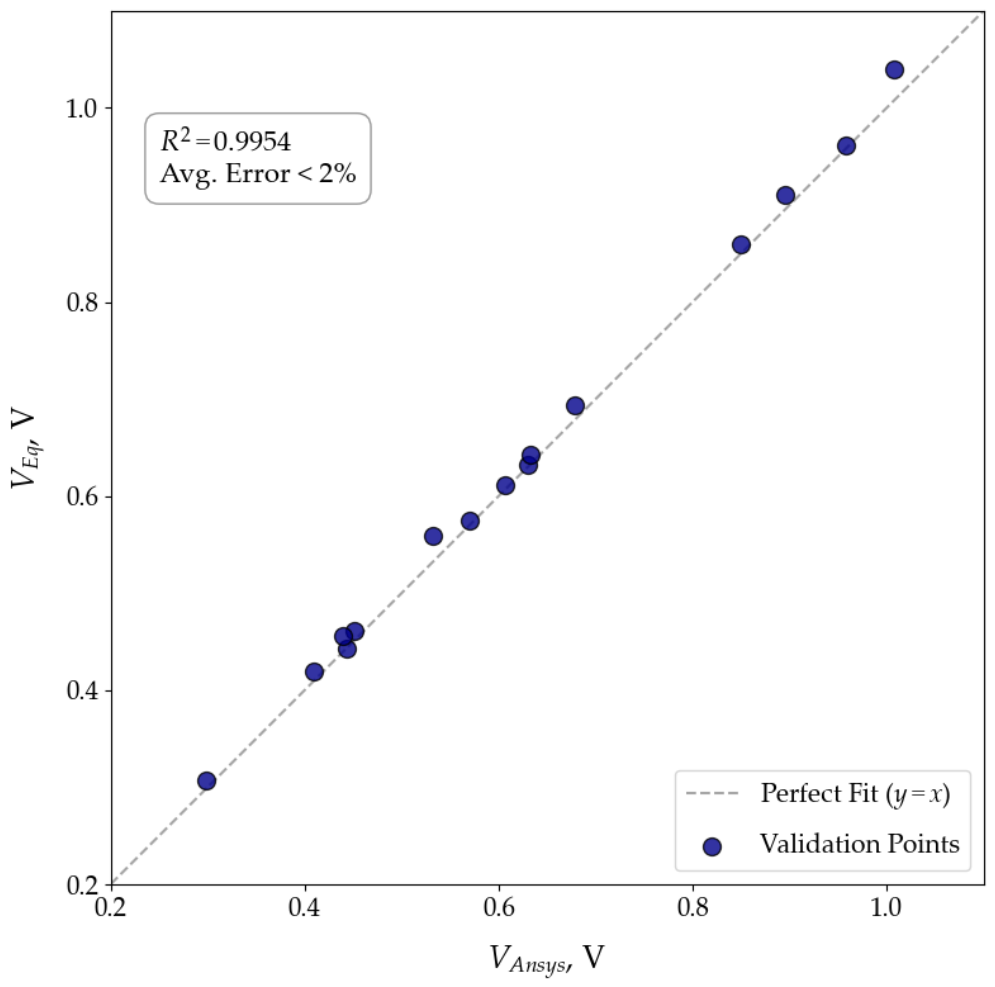
The correlation between the predictive model and the CFD simulations is visually demonstrated in the parity plot presented in Figure 10. The data points exhibit an exceptional alignment along the 45° identity line, yielding an R2 of 0.9954. To further scrutinize the reliability of the multiple linear regression model, the absolute error (Eabs) and relative error (Erel) were calculated for each validation case, as detailed in Table 14. The absolute error, which represents the direct difference between the CFD results (VAnsys) and the regression predictions (VEq), remained consistently low, generally below 0.02 V. This precision is particularly relevant for electrochemical systems, where small voltage deviations can reflect significant changes in predicted overpotentials. Regarding the relative error (Erel), the model demonstrated exceptional consistency across the entire operational envelope, where the mean relative error was 1.76%. These metrics indicate that even in high-load regimes where non-linear concentration polarizations begin to manifest, the linear approximation remains a robust surrogate. The fact that Erel remains below the 5% threshold for all 15 independent cases confirms that the model does not suffer from systematic bias and can be confidently used for real-time sensitivity analysis and optimization of the SOFC performance. These statistical metrics confirm that the linear regression model effectively captures more than 99% of the system’s variance, demonstrating a near-perfect linear relationship between the simplified analytical approach and the complex 3D transport phenomena solved by the CFD solver. The decision to implement a multiple linear regression model was predicated on the need for a low-cost computational tool capable of performing rapid multi-objective optimization. While SOFC electrochemical processes are inherently non-linear due to activation and concentration overpotentials, the results in Table 14 indicate that within the studied operational envelope (1023–1123 K and 1–10 atm), a linear approximation provides sufficient accuracy for engineering design. The mean relative error across the 15 validation points was 1.76%, with a maximum deviation of only 2.52%. Such high predictive proximity, even at low-voltage regimes where mass-transport limitations become dominant, validates the regression equation as a robust surrogate model. Furthermore, the consistency observed in Figure 10 across a wide range of potentials (from 0.3 V to >1.0 V) demonstrates that the model is free of significant systematic bias. This capability is of paramount importance for the practical integration of SOFC systems, as it enables researchers to predict performance degradation or to optimize fuel utilization rates in real time, bypassing the intensive CPU time required for full-scale 3D numerical simulations. Consequently, the predictive model developed in this work serves as a verified and precise tool for developing control strategies and scaling anode-supported SOFCs fueled by synthetic diesel.
It is important to emphasize that while the numerical coefficients are specific to this SOFC configuration, the underlying methodology for constructing the surrogate model is universal. This framework provides a scalable template for transforming complex, multi-physics CFD data into simplified analytical tools, which are essential for developing real-time digital twins and advanced control architectures across various high-temperature electrochemical energy systems.

6.3. Design Guidelines for Catalyst Layers in Hydrocarbon-Fueled SOFCs

Based on the multi-factor analysis, several design guidelines for the catalyst layers can be established. First, the anode structure should incorporate a graded microstructural design, with porosity increasing toward the flow channels to minimize concentration polarization (ηconc), as high fuel mass flow rates were shown to be critical for stability. Second, the Triple-Phase Boundary (TPB) density must be maximized within the first 10–20 µm of the anode–electrolyte interface to accommodate the competitive electrochemical oxidation of H2 and CO [39]. Furthermore, since the internal reforming of synthetic diesel is highly endothermic, the catalyst layer should ideally feature a higher Nickel-to-YSZ ratio at the inlet region to promote faster MSR kinetics, followed by a more balanced composition downstream to prevent excessive localized cooling and subsequent thermal stress. Finally, to ensure long-term stability under the investigated steam-to-carbon ratios (0.83–0.92), the interface between the electrode and the electrolyte should be designed with high ionic conductivity to mitigate the localized increase in ohmic resistance ( η o h m ) under high-current operation.

7. Limitations and Future Research Directions

While this study provides a robust framework for optimizing the performance of synthetic diesel-fueled SOFCs, certain limitations offer significant opportunities for future investigation. The current 3D-CFD model and the subsequent multiple linear regression surrogate were developed under steady-state conditions. Therefore, a critical next step involves the transition to transient numerical analysis to evaluate the cell’s dynamic response to rapid load changes or fluctuations in synthetic diesel composition, which is essential for heavy-duty transport applications.
Furthermore, although the humidification strategy (S/C ratio of 0.83–0.92) effectively maintained electrochemical stability in the simulations, the long-term effects of carbon deposition kinetics were not explicitly modeled over extended operational periods. Future research could integrate sub-models for Ni-catalyst deactivation to predict the cell’s degradation rate and optimize preventive maintenance schedules. Finally, while the multiple linear regression model achieved a high coefficient of determination (R2 = 0.9954), exploring non-linear machine learning algorithms, such as artificial neural networks, could further enhance predictive accuracy in extreme concentration polarization regimes where electrochemical behavior becomes highly non-linear.

8. Conclusions

This study successfully integrated a 3D CFD numerical framework with a Taguchi-based Design of Experiments (DoE) to optimize the electrochemical performance of an anode-supported SOFC operating with synthetic diesel reformat. The statistical analysis through the Taguchi L27 framework identified the operating current as the most influential factor on cell voltage, followed by the fuel mass flow rate and operating temperature. In contrast, the number of flow channels had the least significant impact, suggesting that, within the studied range, convective transport is primarily driven by the global mass flow rate rather than the manifold geometry.
The statistical analysis process determined that the maximum cell performance is achieved at 1123 K, 3.224 × 10⁻⁶ kg/s, 10 atm, and 0.0746 methane molar fraction, while maintaining a low current load of 5 A. This specific configuration maximizes the internal reforming kinetics and minimizes ohmic and activation overpotentials. Furthermore, the implementation of a steam-to-carbon ratio in the range of 0.83 to 0.92 (total carbon basis) demonstrated high efficacy in ensuring stable electrochemical operation while preventing severe concentration polarization, even as the methane fraction was increased to enrich the fuel mixture. This adaptive humidification approach ensures that internal reforming kinetics are sufficiently supported regardless of the specific fuel reforming composition.
A critical contribution of this research was the development of a multiple-factor linear regression model, which was validated against 15 independent CFD simulation cases. This predictive tool demonstrated exceptional accuracy, achieving a coefficient of determination R2 of 0.9954 and a mean relative error of 1.76%. Such high predictive proximity confirms that the regression equation is a robust, low-cost computational surrogate for predicting SOFC behavior within the defined operational envelope. Ultimately, the methodology presented in this work provides a verified instrument for the rapid design and sensitivity analysis of high-temperature fuel cells. The results reveal that the electrochemical potential is governed by a delicate balance between the endothermic methane steam reforming kinetics and convective transport efficiency. By capturing 99.54% of the system’s variance, this linear surrogate model proves that complex 3D transport phenomena can be reduced to efficient analytical tools without losing physical significance. This establishes a robust framework for developing real-time digital twins and advanced control strategies for SOFC systems fueled by complex hydrocarbons in heavy-duty applications.

Author Contributions

A.U.E.-H. conducted the investigation, the DoE implementation, and formal analysis; F.E.-B. and J.d.J.R.-M. established the methodology for the CFD analysis; I.U.-S., D.A.R.-A. and M.V.-R. contributed to the writing and revision of the article. All authors have read and agreed to the published version of the manuscript.

Funding

This research received no external funding.

Institutional Review Board Statement

Not applicable.

Informed Consent Statement

Not applicable.

Data Availability Statement

The original contributions presented in the study are included in the article; further inquiries can be directed to the corresponding author.

Acknowledgments

A. U. Estrada-Herrera, F. Elizalde-Blancas, I. Urbina-Salas, D. A. Rodríguez-Alejandro, J. J. Ramírez-Minguela, and M. Valtierra-Rodríguez gratefully acknowledge the financial support of the Secretariat of Science, Humanities, Technology, and Innovation (SECIHTI), México, under its SNII program. A. U. Estrada-Herrera also acknowledges the financial support of SECIHTI, under its national scholarship program under grant No. 144982 (CVU-1007481).

Conflicts of Interest

The authors declare no conflicts of interest.

References

  1. Matsumoto, K.; Tachikawa, Y.; Lyth, S.M.; Matsuda, J.; Sasaki, K. Performance and durability of Ni–Co alloy cermet anodes for solid oxide fuel cells. Int. J. Hydrog. Energy 2022, 47, 29441–29455. [Google Scholar] [CrossRef]
  2. Lin, C.; Kerscher, F.; Herrmann, S.; Steinrücken, B.; Spliethoff, H. Analysis on temperature uniformity in methane-rich internal reforming solid oxide fuel cells. Int. J. Hydrog. Energy 2024, 57, 769–788. [Google Scholar] [CrossRef]
  3. Gheorghe, L.; Lucian, M.; Dorel, S.; Florentina-Cătălina, N. The Transition to an Eco-Friendly City as a First Step Toward Climate Neutrality with Green Hydrogen. Technologies 2025, 13, 95. [Google Scholar] [CrossRef]
  4. Zhu, R.; Li, Y.; Huang, X.; Xia, Y.; Tu, Y.; Zheng, B.; Qiu, J.; Zhang, X. Carbon Emission Reduction Capability Analysis of Electricity–Hydrogen Integrated Energy Storage Systems. Technologies 2025, 13, 472. [Google Scholar] [CrossRef]
  5. Śreniawski, K.K.; Moździerz, M.; Brus, G.; Szmyd, J.S. Transport phenomena in a banded solid oxide fuel cell stack—Part 2: Numerical analysis. Energies 2023, 16, 4512. [Google Scholar] [CrossRef]
  6. Cui, D.; Sciazko, A.; Komatsu, Y.; Nakamura, A.; Hara, T.; Wu, S.; Xiao, R.; Shikazono, N. Three-dimensional microstructures of carbon deposition on Ni-YSZ anodes under polarization. J. Energy Chem. 2023, 87, 359–367. [Google Scholar] [CrossRef]
  7. Shi, J.; Xue, X. Microstructure optimization designs for anode-supported planar solid oxide fuel cells. J. Fuel Cell Sci. Technol. 2011, 8, 10–18. [Google Scholar] [CrossRef]
  8. Subotić, V.; Schluckner, C.; Stoeckl, B.; Reichholf, D.; Lawlor, V.; Pofahl, S.; Schröttner, H.; Hochenauer, C. In-operando detection of carbon depositions and carbon formation predictions for industrial-sized SOFCs fueled with synthetic diesel reformate. ECS Meet. Abstr. 2017, MA2017-03, 210. [Google Scholar] [CrossRef]
  9. Subotić, V.; Thaller, T.; Königshofer, B.; Menzler, N.H.; Bucher, E.; Egger, A.; Hochenauer, C. Performance assessment of industrial-sized solid oxide cells operated in a reversible mode: Detailed numerical and experimental study. Int. J. Hydrog. Energy 2020, 45, 29166–29185. [Google Scholar] [CrossRef]
  10. Ali, A.B.M.; Nemah, A.K.; Al Bahadli, Y.A.; Kianfar, E. Principles, performance, types, advantages and disadvantages of fuel cells: A review. Case Stud. Chem. Environ. Eng. 2024, 10, 100920. [Google Scholar] [CrossRef]
  11. Rabuni, M.F.; Li, T.; Othman, M.H.D.; Adnan, F.H.; Li, K. Progress in solid oxide fuel cells with hydrocarbon fuels. Energies 2023, 16, 6404. [Google Scholar] [CrossRef]
  12. Wang, Y.; Li, X.; Guo, Z.; Wang, K.; Cao, Y. Effect of the reactant transportation on performance of a planar solid oxide fuel cell. Energies 2021, 14, 1212. [Google Scholar] [CrossRef]
  13. Mirzaee Fashalameh, K.; Sadeghian, Z.; Ebrahimi, R. A high-performance planar anode-supported solid oxide fuel cell with hierarchical porous structure through slurry-based three-dimensional printing. J. Alloys Compd. 2022, 916, 165406. [Google Scholar] [CrossRef]
  14. Mehrabian, M.; Mahmoudimehr, J. Optimizing steam-to-carbon and air-to-carbon ratios in internal autothermal reforming of a biogas-fed solid oxide fuel cell using computational fluid dynamics and artificial intelligence. Energy Convers. Manag. 2026, 348, 120763. [Google Scholar] [CrossRef]
  15. Lu, Y.; Gasper, P.; Pal, U.B.; Gopalan, S.; Basu, S.N. Improving intermediate temperature performance of Ni-YSZ cermet anodes for solid oxide fuel cells by liquid infiltration of nickel nanoparticles. J. Power Sources 2018, 396, 257–264. [Google Scholar] [CrossRef]
  16. Szaro, N.A.; Ammal, S.C.; Chen, F.; Heyden, A. Theoretical investigation of the electrochemical oxidation of H2 and CO fuels on a Ruddlesden–Popper SrLaFeO4-δ anode. ACS Appl. Mater. Interfaces 2023, 15, 30139–30151. [Google Scholar] [CrossRef] [PubMed]
  17. Pukazhselvan, D.; Sandhya, K.S.; Fagg, D.P.; Blaabjerg, F. The future of clean transportation: Hydrogen, batteries, ammonia, and green methane in perspective. Renew. Sustain. Energy Rev. 2026, 226, 116286. [Google Scholar] [CrossRef]
  18. Bhuiyan, M.M.H.; Siddique, Z. Hydrogen as an alternative fuel: A comprehensive review of challenges and opportunities in production, storage, and transportation. Int. J. Hydrog. Energy 2025, 102, 1026–1044. [Google Scholar] [CrossRef]
  19. Wu, Z.; Zhu, P.; Huang, Y.; Yao, J.; Yang, F.; Zhang, Z.; Ni, M. A comprehensive review of modeling of solid oxide fuel cells: From large systems to fine electrodes. Chem. Rev. 2025, 125, 2184–2268. [Google Scholar] [CrossRef]
  20. Gohar, O.; Khan, M.Z.; Saleem, M.; Chun, O.; Babar, Z.U.D.; Rehman, M.M.U.; Hussain, A.; Zheng, K.; Koh, J.-H.; Ghaffar, A.; et al. Navigating the future of solid oxide fuel cells: Comprehensive insights into fuel electrode-related degradation mechanisms and mitigation strategies. Adv. Colloid Interface Sci. 2024, 331, 103241. [Google Scholar] [CrossRef]
  21. Larminie, J.; Dicks, A. Fuel Cell Systems Explained, 2nd ed.; Wiley: Chichester, UK, 2013. [Google Scholar]
  22. Boudghene, S. Fuel cells: The expectations for an environmental-friendly and sustainable source of energy. Renew. Sustain. Energy Rev. 2011, 15, 4507–4520. [Google Scholar] [CrossRef]
  23. Sembler, W.J.; Kumar, S. Optimization of a single-cell solid oxide fuel cell using computational fluid dynamics. J. Fuel Cell. Sci. Technol. 2011, 8, 021007. [Google Scholar] [CrossRef]
  24. Bertei, A.; Nucci, B.; Nicolella, C. Microstructural modeling for prediction of transport properties and electrochemical performance in SOFC composite electrodes. Chem. Eng. Sci. 2013, 101, 175–190. [Google Scholar] [CrossRef]
  25. El-Fergany, A.A.; Agwa, A.M. Red-Billed Blue Magpie Optimizer for Electrical Characterization of Fuel Cells with Prioritizing Estimated Parameters. Technologies 2024, 12, 156. [Google Scholar] [CrossRef]
  26. Schluckner, C.; Subotic, V.; Lawlor, V.; Hochenauer, C. Three-dimensional numerical and experimental investigation of an industrial-sized SOFC fueled by diesel reformate—Part I: Creation of a base model for further carbon deposition modeling. Int. J. Hydrog. Energy 2014, 39, 19102–19118. [Google Scholar] [CrossRef]
  27. Zhang, X.; Espinoza, M.; Li, T.; Andersson, M. Parametric study for electrode microstructure influence on SOFC performance. Int. J. Hydrog. Energy 2021, 46, 37440–37459. [Google Scholar] [CrossRef]
  28. Tikiz, I.; Taymaz, I.; Pehlivan, H. CFD modelling and experimental validation of cell performance in a 3-D planar SOFC. Int. J. Hydrog. Energy 2019, 44, 15441–15455. [Google Scholar] [CrossRef]
  29. Schluckner, C.; Subotic, V.; Lawlor, V.; Hochenauer, C. Three-dimensional numerical and experimental investigation of an industrial-sized SOFC fueled by diesel reformate—Part II: Detailed reformed chemistry and carbon deposition analysis. Int. J. Hydrog. Energy 2015, 40, 10943–10959. [Google Scholar] [CrossRef]
  30. Subotić, V.; Schluckner, C.; Hochenauer, C. An experimental and numerical study of performance of large planar ESC-SOFCs and experimental investigation of carbon depositions. J. Energy Inst. 2016, 89, 121–137. [Google Scholar] [CrossRef]
  31. Chan, S.H.; Khor, K.A.; Xia, Z.T. A complete polarization model of a solid oxide fuel cell and its sensitivity to the change of cell component thickness. J. Power Sources 2001, 93, 130–140. [Google Scholar] [CrossRef]
  32. Ni, M.; Leung, M.K.H.; Leung, D.Y.C. Parametric study of solid oxide fuel cell performance. Energy Convers. Manag. 2007, 48, 1525–1535. [Google Scholar] [CrossRef]
  33. Haseli, Y. Maximum conversion efficiency of hydrogen fuel cell. Int. J. Hydrog. Energy 2018, 43, 9015–9021. [Google Scholar] [CrossRef]
  34. Khazaee, I.; Rava, A. Numerical simulation of the performance of solid oxide fuel cell with different flow channel geometries. Energy 2017, 119, 235–244. [Google Scholar] [CrossRef]
  35. O’Hayre, R.; Cha, S.-W.; Colella, W.; Prinz, F.B. Fuel Cell Fundamentals, 3rd ed.; John Wiley & Sons: Hoboken, NJ, USA, 2016. [Google Scholar]
  36. Ramírez-Minguela, J.J. Energy and entropy study of a SOFC using biogas from different sources considering internal reforming of methane. Int. J. Heat. Mass. Transf. 2018, 120, 1044–1054. [Google Scholar] [CrossRef]
  37. Jo, D.H.; Chun, J.H.; Park, K.T.; Hwang, J.W.; Lee, J.Y.; Jung, H.W.; Kim, S.H. Optimization of physical parameters of solid oxide fuel cell electrode using electrochemical model. Korean J. Chem. Eng. 2011, 28, 1884–1890. [Google Scholar] [CrossRef]
  38. Fan, L.; Dimitriou, E.; Pourquie, M.J.B.M.; Liu, M.; Verkooijen, A.H.M.; Aravind, P.V. Prediction of the performance of a solid oxide fuel cell fuelled with biosyngas: Influence of different steam-reforming reaction kinetic parameters. Int. J. Hydrog. Energy 2013, 38, 510–524. [Google Scholar] [CrossRef]
  39. Vakouftsi, E.; Marnellos, G.E.; Athanasiou, C.; Coutelieris, F. CFD modeling of a biogas fuelled SOFC. Solid State Ion. 2011, 192, 458–463. [Google Scholar] [CrossRef]
  40. Sumi, H. Co-electrolysis SOEC and internal reforming SOFC for achieving a carbon-neutral society. RSC Sustain. 2024, 2, 1568–1581. [Google Scholar] [CrossRef]
  41. Rokni, M. Biomass gasification integrated with a solid oxide fuel cell and Stirling engine. Energy 2014, 77, 6–18. [Google Scholar] [CrossRef]
  42. Suwanwarangkul, R.; Croiset, E.; Entchev, E.; Charojrochkul, S.; Pritzker, M.D.; Fowler, M.W.; Douglas, P.L.; Chewathanakup, S.; Mahaudom, H. Experimental and modeling study of solid oxide fuel cell operating with syngas fuel. J. Power Sources 2006, 161, 308–322. [Google Scholar] [CrossRef]
  43. Andersson, M.; Yuan, J.; Sundén, B. SOFC modeling considering hydrogen and carbon monoxide as electrochemical reactants. J. Power Sources 2013, 232, 42–54. [Google Scholar] [CrossRef]
  44. Lawlor, V.; Hochenauer, C.; Griesser, S.; Zauner, G.; Buchinger, G.; Meissner, D.; Olabi, A.G.; Klein, K.; Kuehn, S.; Cordiner, S.; et al. The use of a high-temperature wind tunnel for MT-SOFC testing—Part II: Use of computational fluid dynamics software in order to study previous measurements. J. Fuel Cell Sci. Technol. 2011, 8, 061019. [Google Scholar] [CrossRef]
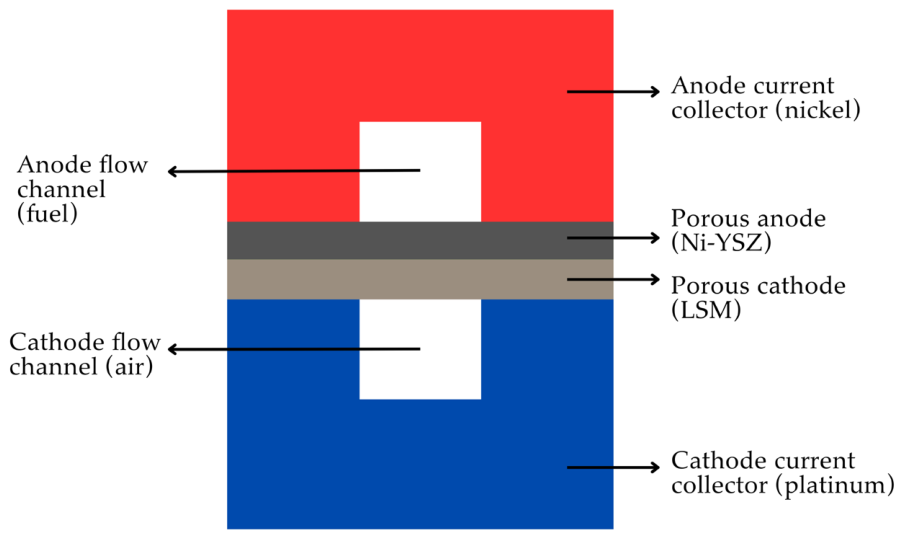
Figure 1. Schematic representation of the SOFC components.
Technologies 14 00271 g001
Figure 2. Fuel cell front views (1, 2, and 3 channels, respectively).
Technologies 14 00271 g002
Figure 3. Independence mesh analysis, varying the elements in the whole cell.
Technologies 14 00271 g003
Figure 4. Cell mesh for the 1, 2, and 3 channels models.
Technologies 14 00271 g004
Figure 5. Experimental and numerical polarization and power density curves at 800 °C.
Technologies 14 00271 g005
Figure 6. Response surface of cell voltage as a function of fuel mass flow and operating current.
Technologies 14 00271 g006
Figure 7. Response surface of cell voltage as a function of temperature and methane molar fraction.
Technologies 14 00271 g007
Figure 8. Response surface of cell voltage as a function of temperature and fuel mass flow.
Technologies 14 00271 g008
Figure 9. Main effects plot for mean voltage across three discrete levels for each operational and design parameter.
Technologies 14 00271 g009
Figure 10. Parity plot comparing predicted voltages from the regression model versus simulated voltages from Ansys Fluent for the validation dataset.
Technologies 14 00271 g010
Table 1. Operating conditions for mesh independence analysis [29].
ParameterValue
Cell channels1
Temperature1073 K
Pressure1 atm
CO mol fraction0.137
CH4 mol fraction0.0225
CO2 mol fraction0.098
H2O mol fraction 0.113
H2 mol fraction0.154
N2 mol fraction0.4755
Current5 A
Fuel mass flow rate4.974 × 10−6 kg/s
Air mass flow rate2.886 × 10−6 kg/s
Table 2. Mesh features for the three models.
Number of ChannelsElementsNodesAspect RatioQuality
1151,500163,9158.40.9123
2216,000230,5478.40.9123
3252,000267,7328.40.9123
Table 3. Constants for the MSR and WGS reactions for the Arrhenius model [26].
ConstantMSRWGS
E r , J/kmol8.2 × 10711.6 × 104
A r , kmol/m3·s4.274 × 1082.56 × 107
Table 4. Anode properties [29].
ElementValueUnits
Electrical conductivity3.33 × 105(Ω·m)−1
Contact resistance1 × 10−7Ω·m2
Density3030kg/m3
Specific heat595.1J/kg·K
Thermal conductivity6.23W/m·K
Porosity0.3-
Tortuosity3-
Anodic transfer coefficient0.5-
MaterialNi-YSZ-
Table 5. Cathode properties [29].
ElementValueUnits
Electrical conductivity7937(Ω·m)−1
Contact resistance1 × 10−8Ω·m2
Density4375kg/m3
Specific heat565J/kg·K
Thermal conductivity1.15W/m·K
Porosity0.3-
Tortuosity3-
Anodic transfer coefficient0.5-
MaterialLSM-
Table 6. Anode collector properties [29].
ElementValueUnits
Electrical conductivity1.5 × 107(Ω·m)−1
Density8900kg/m3
Specific heat446J/kg·K
Thermal conductivity91W/m·K
MaterialNickel-
Table 7. Cathode collector properties [29].
ElementValueUnits
Electrical conductivity1.5 × 107(Ω·m)−1
Density21,200kg/m3
Specific heat140J/kg·K
Thermal conductivity72W/m·K
MaterialPlatinum-
Table 8. Geometric parameters [29].
ElementValueUnits
Anode thickness300µm
Cathode thickness30µm
Channel width0.0025m
Channel height0.002m
Cell length0.09m
Electrolyte thickness10µm
Table 9. Additional parameters [29].
ElementValueUnits
Current sub-relaxation factor0.3-
Air mass flow rate2.886 × 10−6kg/s
Fuel mass flow rate4.974 × 10−6kg/s
Electrolyte materialYSZ-
Electrolyte resistanceEquation (19)Ω·m
Table 10. Factors and levels of the design of experiments.
Factors
Levels
Temp, KFuel Mass Flow, kg/sPressure, atmCurrent, ANumber of ChannelsMethane, XCH4
110232.886 × 10−61510.0225
210733.055 × 10−67.5620.04855
311233.224 × 10−610730.0746
Table 11. Fuel mixture composition at three CH4 levels under S/C range (0.83–0.92) [29].
SpecieLevel 1Level 2Level 3
CH40.02250.048550.0746
H20.15910.078550.1143
H2O0.22330.25980.2962
CO0.13700.13700.1370
N20.34810.36610.3822
CO20.110.110.11
Table 12. Simulated voltage results for the multi-factor statistical analysis of the SOFC performance.
Factors
Levels
Temp, KFuel Mass Flow, kg/sPressure, atmCurrent, ANumber of ChannelsMethane, XCH4Voltage, V
110232.886 × 10−61510.02250.4026
210232.886 × 10−61520.048550.4548
310232.886 × 10−61530.07460.5065
410233.055 × 10−67.5610.02250.4460
510233.055 × 10−67.5620.048550.4991
610233.055 × 10−67.5630.07460.5521
710233.224 × 10−610710.02250.4533
810233.224 × 10−610720.048550.5064
910233.224 × 10−610730.07460.5594
1010732.886 × 10−67.5710.048550.3835
1110732.886 × 10−67.5720.07460.4365
1210732.886 × 10−67.5730.02250.3406
1310733.055 × 10−610510.048550.6800
1410733.055 × 10−610520.07460.7330
1510733.055 × 10−610530.02250.6371
1610733.224 × 10−61610.048550.5782
1710733.224 × 10−61620.07460.6346
1810733.224 × 10−61630.02250.5322
1911232.886 × 10−610610.07460.6175
2011232.886 × 10−610620.02250.5215
2111232.886 × 10−610630.048550.5746
2211233.055 × 10−61710.07460.5173
2311233.055 × 10−61720.02250.4260
2411233.055 × 10−61730.048550.4745
2511233.224 × 10−67.5510.07460.8511
2611233.224 × 10−67.5520.02250.7552
2711233.224 × 10−67.5530.048550.8082
Table 13. Response table for mean voltage values, including factor hierarchy and Delta analysis.
LevelTempFuel Mass FlowPressureCurrentNumber of ChannelsMethane
10.48400.47160.50360.64830.54770.5023
20.55130.54900.56090.54800.55190.5517
30.61690.63160.58760.45590.55260.5982
Δ 0.13290.16010.08400.19230.00490.0959
Rank325164
Table 14. Voltage comparison between the multiple-factor linear regression model and Ansys.
CaseTemp, KFuel Mass Flow, kg/sPressure, atmCurrent, ANumber of ChannelsMethane, XCH4VEqVAnsysErelEabs
110483.0550 × 10−685.540.061500.61170.60650.860.0052
210732.8860 × 10−65650.022500.41970.40962.470.0101
310233.1395 × 10−64.56.520.048550.46130.45122.240.0101
410732.9705 × 10−62.57.510.035500.30660.29892.580.0077
511233.2240 × 10−67560.074600.85920.84991.090.0093
610603.2073 × 10−67.64.920.030630.69340.67852.200.0149
710293.1788 × 10−66.45.660.025440.55880.53264.920.0262
810953.2032 × 10−617.410.038350.44270.44310.090.0004
910753.0320 × 10−63.6520.024930.57500.57010.860.0049
1011202.9647 × 10−61.8540.049290.63180.62980.320.0020
1110822.9017 × 10−66.52.120.071940.91100.89541.740.0156
1211203.1592 × 10−63.71.640.035061.03991.00773.200.0322
1310913.0922 × 10−68.52.110.035980.96160.95870.300.0029
1410892.9914 × 10−65.74.660.024130.64210.63251.520.0096
1511073.0380 × 10−64.6760.032710.45600.43993.660.0161
Disclaimer/Publisher’s Note: The statements, opinions and data contained in all publications are solely those of the individual author(s) and contributor(s) and not of MDPI and/or the editor(s). MDPI and/or the editor(s) disclaim responsibility for any injury to people or property resulting from any ideas, methods, instructions or products referred to in the content.