1. Introduction
The rapid expansion of digital imaging technologies in areas such as telemedicine, satellite remote sensing, and the Internet of Things has increased the need for effective security measures that provide not only confidentiality and bit-exact reconstruction, but also high standards of reliability and integrity in the critical areas of medical diagnosis and digital forensics. Even small amounts of distortion introduced by lossy encryption can result in incorrect conclusions based on the images being evaluated or the integrity of the evidence being assessed. Reversible image encryption has, thus, become an essential research focus to ensure decrypted data remains strictly identical to the source. Although pragmatic approaches to counter the aforementioned statistical attacks have been proposed [
1,
2,
3], finding a scheme satisfying strong cryptographic security, perfect reversibility, and ease of deployment is still not trivial.
Conventional cryptography techniques like AES and DES have been specifically engineered for images because of their high degree of redundancy and spatial correlation amongst the pixels. Thus, they are unable to achieve the required decorrelation of pixels to be encoded. This drawback has been addressed using the chaotic approach [
4,
5,
6]. The chaotic technique makes use of chaotic mapping in combination with the permutation and diffusion mechanism, taking advantage of the properties of ergodicity, pseudorandomness, and high sensitivity to initial conditions.
Despite the success achieved using chaos-based image encryption algorithms, several drawbacks still exist in many of the current implementations. Firstly, many schemes depend on chaotic systems that use floating points, and hence rounding errors may occur in the calculations preventing perfect lossless reconstruction of the input image [
7]. This particular issue becomes vital in situations such as medical imaging or digital forensics where it is necessary to perform lossless reconstruction. Secondly, there are numerous schemes that propose the use of static or weak key generation processes, which may become vulnerable to replay attacks. Lastly, most of the schemes only incorporate the permutation–diffusion framework without integrating any established cryptographically secure processes for key space enhancement or secure communication [
8,
9].
This paper introduces a novel hybrid multilayer reversible color image encryption approach which utilizes chaotic diffusion, transformations using linear algebra, and cryptography methods in one single architecture. This approach is intended to overcome limitations found in other systems by ensuring strong confusion and diffusion characteristics, dynamic key generation on a session-by-session basis, and accurate reconstruction of the input image. Moreover, this approach is based on modern communication tools such as ChaCha20 stream cipher and HMAC-SHA256 authentication algorithm.
These limitations of Chaos Theory-based Encryption demonstrate that there is a requirement for a reversible scheme that is safe, that can be implemented in practical situations and matches strong cryptographic security to the extent that exact reconstruction is possible and that is compatible with contemporary communication systems.
Consequently, this study introduces a Hybrid Multi-Layer method to perform reversible color image encryption combining Linear Algebra operations with Non-Linear Chaos Theory elements, while also providing compatibility with present-day security standards.
In contrast to several chaos-based cryptosystems, which primarily depend upon statistics for security, the present system not only concentrates on cryptographic security but also ensures the reversibility of the algorithm by implementing the system based on integers.
The main components of this work are as follows:
Dynamic Key Management: This involves the creation of session-specific keys through HKDF-SHA256 (RFC 5869) and entropy from timestamps.
Hybrid Multi-layered Confusion-Diffusion Architecture: Four core layers will be used to provide confusion and diffusion to encrypted images, which will consist of linear and nonlinear components that use integer modular arithmetic and Q16.16 fixed-point arithmetic.
Integration of Transport Security Standards: The use of ChaCha20 stream encryption and HMAC-SHA256 authentication will provide confidentiality, integrity and be effective for such environments.
The remaining parts of this paper will be organized as follows:
Section 2 summarizes previous research findings about image encryption and highlights some research gaps that exist. In
Section 3, the newly proposed Hybrid Multi-Layer Scheme is presented along with mathematical representations, algorithm processes, and invertibility conditions. In
Section 4, experimental analysis and security evaluations will be reported using various performance measures.
Section 5 analyzes the proposed scheme compared to other schemes.
2. Related Work
In recent years, image encryption methods have garnered attention due to the rapid expansion of multimedia communication and the increasing demand for secure image transmission. Numerous approaches have been proposed to enhance the confidentiality of images by exploiting the approaches reported in the literature, such as chaotic systems, permutation–diffusion structures and hybrid cryptographic frameworks.
A few have researchers studied the use of classic encryption algorithms, for example, AES or DES algorithms, for protecting images. Classic encryption algorithms are highly efficient and ensure high-security guarantees; however, they are not intended for protecting images. Images, as a rule, are highly redundant and contain strong correlation between pixels. Moreover, images represent huge amounts of data [
10].
As is clear from the analysis above, there are some difficulties in encrypting images via classic methods. The use of chaos-based encryption algorithms has proven highly effective in protecting sensitive data [
11,
12]. Chaotic systems can be used to design image encryption algorithms due to several advantages that characterize them.
Some image encryption algorithms are based on hyper-chaos and DNA coding algorithms. The use of chaotic systems and DNA coding algorithms increases the difficulty of the encryption process and enhances the randomization of encryption sequences [
13,
14].
Even though much improvement has been made recently, many chaos-based cryptographic schemes proposed in the literature still have several shortcomings from the point of view of security. One typical problem is related to the use of floating-point operations that can cause truncation error in the process of encrypting and decrypting images, making them incapable of reconstructing images accurately [
15].
Furthermore, another important challenge concerns key management and system robustness. In several proposed algorithms, key generation strategies remain relatively simple or static, which may expose the encryption system to replay attacks or reduced key-space security [
16]. Furthermore, some schemes exhibit insufficient diffusion capabilities, resulting in residual statistical correlations that may be exploited through cryptanalytic techniques [
17].
In addition, recent studies have also examined the security evaluation and cryptanalysis of chaos-based image encryption algorithms, revealing vulnerabilities in some previously proposed approaches due to predictable structures or inadequate diffusion mechanisms [
18]. More recent research has explored hybrid encryption frameworks that combine chaotic systems with classical cryptographic techniques in order to improve both security and computational efficiency. Such hybrid approaches aim to leverage the advantages of nonlinear chaotic behavior together with well-established cryptographic primitives to enhance diffusion, confusion and resistance to cryptanalysis [
19].
Indeed, other works have investigated the use of high-dimensional chaotic systems and hyper-chaotic maps to increase the complexity of encryption processes. These approaches typically employ multiple chaotic sequences to strengthen permutation and diffusion stages while improving the statistical properties of encrypted images [
20].
Similarly, several studies have proposed dynamic substitution mechanisms and adaptive diffusion that enhance resistance against statistical and differential attacks. These methods rely on dynamically generated S-boxes or key-dependent transformations to improve unpredictability in encryption operations [
21].
Recent developments have also emphasized the importance of secure key generation and lightweight encryption architectures for deployment in many environments such as IoT and cloud computing. Efficient encryption schemes designed for distributed systems must balance strong security with computational efficiency and scalability [
22].
Furthermore, current research continues to focus on improving reversible image encryption techniques, particularly for applications requiring lossless reconstruction, such as medical imaging and remote sensing. These approaches aim to eliminate numerical inaccuracies while preserving strong security and efficient performance [
23].
As shown in
Table 1, the existing literature highlights that despite significant progress in chaos-based and hybrid image encryption methods, there is still a need for robust architectures that deliver strong cryptographic security, efficient key management, and exact reconstruction of encrypted images. Motivated by these gaps, this work introduces a reversible multi-layer hybrid image encryption scheme that combines linear algebra-based transformations, chaotic processes, and standardized cryptographic protocols to improve both security and practical applicability. The following section describes the proposed scheme in detail. The details of the proposed scheme are presented in the following section.
3. Proposed Methodology: Hybrid Multi-Layer Architecture for Reversible Color Image Encryption
This section provides a detailed description of the proposed hybrid multi-layer encryption framework. For clarity, the complete encryption process is decomposed into three main stages: dynamic key generation, hybrid confusion–diffusion operations, and secure transport protection. Each stage is designed to maintain strict reversibility while strengthening the security properties of the encrypted image.
3.1. Architecture Overview
Within the encryption process, the three spectral channels (Red, Green, Blue) are processed independently to maximize entropy. The architecture is decomposed into three major phases:
Dynamic Key Management: Derivation of unique session keys based on time and a master key using standard protocols.
Hybrid Cryptographic Core: A succession of confusion and diffusion layers exploiting chaos and linear algebra.
Transport Security: Final encryption and integrity authentication.
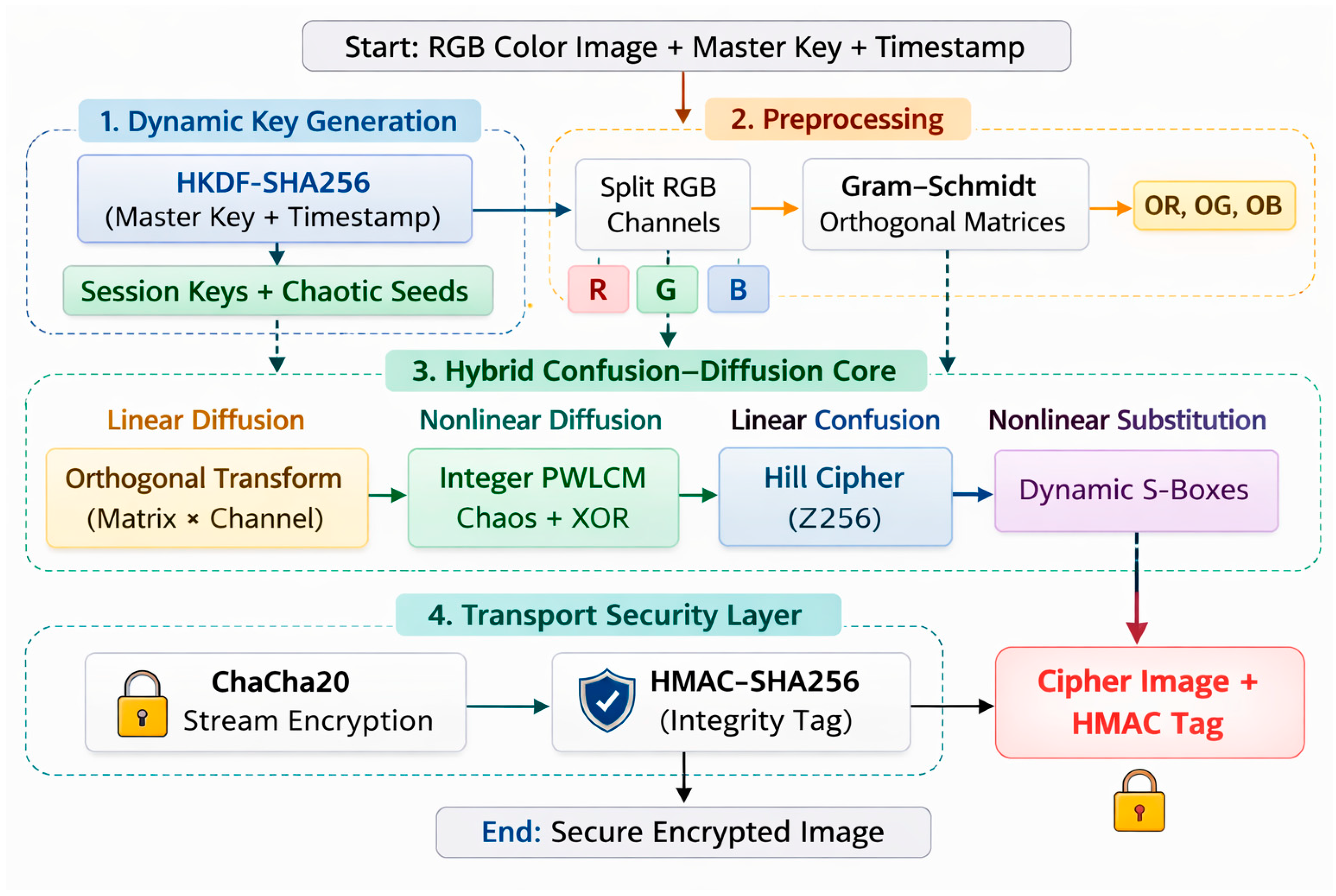
As can be seen from
Figure 1, the suggested RGB image encryption architecture includes four primary phases that are responsible for maintaining high levels of security and perfection during reconstruction. First, session-dependent keys and chaotic seeds are produced with the help of HKDF in combination with HMAC SHA256, ensuring the uniqueness of keys for each separate session and making any replay attacks impossible. Second, the image is split into its three separate channels, R, G, and B, and Gram–Schmidt-based matrices are derived for each channel to increase randomness. Further, the key hybrid confusion–diffusion module works as follows:
Orthogonal transformation (linear diffusion),
Integer PWLCM-based chaotic diffusion with XOR chaining,
Hill cipher (linear confusion over ),
Dynamic S-box substitution (nonlinear).
Finally, the intermediate result undergoes ChaCha20 stream encryption for confidentiality, completed by HMAC-SHA256 authentication to produce the secure encrypted image and its integrity tag.
3.2. Dynamic Generation of Orthogonal Matrices
The derivation of chaotic seeds, matrix construction via Gram–Schmidt and the generation of three distinct orthogonal matrices, , , , are performed with strict arithmetic constraints. The matrices are perfectly invertible since . To ensure no numerical loss, Gram–Schmidt is implemented using fixed-point arithmetic with sufficient precision to guarantee exact invertibility. While Gram–Schmidt provides controllable orthogonality, future work could explore integer-reversible transforms such as Racah for even lower complexity.
It is important to clarify the role of fixed-point arithmetic in the construction of the orthogonal matrices. The Gram–Schmidt procedure is used only during the matrix generation stage to obtain linearly independent vectors from chaotic sequences. This step is performed using Q16.16 fixed-point precision in order to maintain deterministic numerical behavior across implementations. After the orthogonalization stage, the resulting matrix is quantized into integer coefficients in ℤ256 using the mapping defined in Equation (6). Once this conversion is performed, all subsequent encryption operations are executed strictly in modular integer arithmetic. The encryption and decryption stages therefore involve only integer-to-integer mappings, ensuring exact reversibility.
To guarantee invertibility in ℤ256, the determinant of the quantized matrix is required to be coprime with 256. If this condition is not satisfied after quantization, a minimal perturbation is applied until gcd(det(O),256) = 1. The modular inverse matrix is then computed using the adjugate matrix and the Extended Euclidean Algorithm. Therefore, although fixed-point arithmetic is used during matrix construction, the actual encryption and decryption processes rely exclusively on integer modular operations, ensuring bit-exact lossless reconstruction of the original image.
3.2.1. Derivation of Chaotic Seeds
The initial seeds
required for matrix generation are derived via a Key Derivation Function (KDF) combining the master key
and a timestamp
. HKDF (HMAC-based Key Derivation Function) is used as per RFC 5869 for standard compliance:
This mechanism guarantees the uniqueness of chaotic trajectories at each session, thus preventing replay attacks.
3.2.2. Matrix Construction via Gram–Schmidt Orthonormalization
Three basis vectors,
, are constructed from three chaotic sequences,
, generated using the logistic map:
The logistic map is iterated with (close to the onset of full chaos without divergence) and initial values derived from , and then scaled and quantized to fixed-point representation before feeding into Gram–Schmidt.
The Gram–Schmidt orthonormalization algorithm is applied to obtain an orthogonal matrix
. Given linearly independent vectors,
, an orthogonal basis,
, is computed as follows:
where the equation denotes the Euclidean inner product. All divisions are computed via modular inverse in fixed-point representation:
(Q16.16 format). After orthogonalization, vectors are normalized and quantized to eight-bit integers for pixel operations:
Critical Invertibility Constraint: Since
is a ring, not a field (
), the property
(true over
) does not generally hold. For the matrix
to be invertible in
, its determinant must be odd (coprime with 256):
If
is even after quantization, a minimal perturbation to
is applied until the condition is satisfied (typically ≤ 3 iterations). The modular inverse is computed via the adjugate matrix and Extended Euclidean Algorithm:
where
satisfies
. Then, three distinct matrices,
, are generated for each color channel via circular permutations of the rows of
, reinforcing inter-channel independence:
where
denotes a circular upward shift in rows by
positions. The complete process is summarized in Algorithm 1 below:
| Algorithm 1: Gram–Schmidt-Based Orthogonal Matrix Construction with Invertibility Assurance |
| Input: Chaotic seeds |
| Output: Orthogonal matrices and their inverses: |
Generate three basis vectors , , : using the logistic map (Equation (2)) with initial values derived from chaotic seeds and parameter Apply Gram–Schmidt orthonormalization in fixed-point Q16.16 precision: Normalize and quantize to (Equation (6)): Ensure invertibility modulo 256: while is even (i.e., ) do end while Compute modular inverse: // Using adjugate matrix + Extended Euclidean Algorithm Generate channel-specific matrices by circular row shifts: // Red channel: no shift // Green channel: shift up by 1 row // Blue channel: shift up by 2 rows Compute inverses for each channel (using the same modular inverse process): Return: (, , , , , )
|
The resulting channel-specific orthogonal matrices, , , , and their inverses ensure strict invertibility over while preserving exact reversibility throughout the encryption process.
3.3. Phase 2: Hybrid Confusion and Diffusion
In this phase, the core of the scheme is constituted, alternating linearity and nonlinearities to saturate the statistical properties of the image.
3.3.1. Nonlinear Diffusion (Chaotic—Integer Version)
To make sure that the process will be completely reversible and lossless (floating point precision issues can result in lossiness), the floating point logistic map is replaced by a new map known as the integer PWLCM, which is defined as follows:
where
is chosen to align with 8-bit pixel representation, thereby avoiding additional reduction steps and preserving computational efficiency. The control parameters
and
are integers selected for strong chaotic behavior (e.g.,
,
). Specifically, these values ensure a positive Lyapunov exponent
, guaranteeing maximal sensitivity. Consequently, the output sequence
remains strictly integer-valued.
The diffusion is applied in a reversible CBC-like mode using XOR operations to enhance nonlinearity while maintaining lossless properties. For a pixel
, the diffused value
is defined by the following:
where
corresponds to the previously encrypted pixel. The initialization vector
is derived securely via
The chain dependency mechanism creates a significant avalanche effect, where the modification of a single plaintext pixel affects all subsequent pixels, greatly enhancing diffusion and security. Furthermore, the process remains completely reversible, allowing the original data to be recovered without any loss.
The same integer sequence is regenerated from the session seed, ensuring perfect reconstruction without any information loss. Parameter selection for the integer PWLCM map was chosen to ensure strong chaotic behavior while maintaining compatibility with the 8-bit modular arithmetic used in the encryption process. Several parameter combinations satisfying 0 < q < M and p > 1 were experimentally tested. The pair (p = 139, q = 101) was selected because it consistently produced high entropy values and stable NPCR/UACI results across benchmark images. Additional experiments with nearby parameter values showed negligible variations in statistical metrics, confirming that the encryption performance is not overly sensitive to small parameter changes.
3.3.2. Linear Confusion (Hill Cipher)
Pixels are regrouped into RGB vector blocks,
. A linear transformation is applied via a key matrix,
, which is constructed from chaotic sequences derived from
:
Invertibility condition: To guarantee decryption, the determinant of must be coprime with 256 (i.e., ), which implies that must be odd. This guarantees the existence of the modular inverse via the extended Euclidean algorithm.
It is important to note that the Hill cipher matrix is not static. The key matrix K is dynamically generated from chaotic sequences derived from the session seed S0 produced by the HKDF-based key derivation mechanism. Since S0 depends on both the master key and the session timestamp, a different Hill matrix is generated for each encryption session. Although the Hill cipher itself is a linear transformation and theoretically vulnerable to known-plaintext attacks, the proposed architecture mitigates this weakness through multiple nonlinear protection layers. In particular, the chaotic diffusion stage (PWLCM-based XOR chaining) and the dynamic S-box substitution introduce strong nonlinearity and inter-pixel dependency before and after the Hill transformation.
Consequently, the linear structure of the Hill cipher cannot be isolated by an attacker, which significantly reduces the feasibility of matrix-recovery attacks based on plaintext–ciphertext pairs.
3.3.3. Nonlinear Substitution (Dynamic S-Box)
A unique S-Box is generated for each session from a SHA-256 hash of the session parameters. Bijectivity is guaranteed by construction: the generation process yields a full permutation of (e.g., via hash-driven Fisher–Yates shuffle or chaotic sorting). Each byte of the encrypted block is then substituted via this S-Box, breaking the residual linear relationships left by the Hill cipher. The substitution is The inverse S-Box exists and is used during decryption.
3.4. Phase 3: Transport Security and Integrity
A final protection layer is added to adapt the scheme to distributed environments (Cloud).
Final Encryption (ChaCha20)
To ensure nonce uniqueness and prevent replay attacks, the ChaCha20 nonce is dynamically generated for each encryption session. The nonce is derived using a combination of the master key, session timestamp, and a session counter:
where
denotes the master key,
is the session timestamp, and
is a monotonically increasing session counter. The truncation to 96 bits follows the ChaCha20 specification.
This construction guarantees nonce uniqueness. During decryption, timestamp freshness is verified to immediately detect and abort replay attempts, ensuring robust protection in distributed environments.
3.5. Global Encryption Algorithm
The synthesis of the process is described in Algorithm 2 below.
| Algorithm 2: Multi-layer Encryption Process |
Input: Image , Master Key , Timestamp . Output: Secure Packet . Initialization: 3.1. Generate chaotic seeds via HKDF (Equation (1)). 3.2. Generate orthogonal matrices , , (Gram–Schmidt with fixed-point arithmetic). 3.3. Generate the dynamic S-Box and Hill matrix (from chaotic sequences). 3.4. Generate chaotic sequences via integer PWLCM (Equation (12)) and diffusion IV . 3.5. Generate ChaCha20 nonce: Loop over Channels (R, G, B): 4.1. Apply linear diffusion: 4.2. Apply chaotic diffusion (XOR CBC-like): . 4.3. Apply Hill cipher: . 4.4. Apply S-Box substitution. Final Protection: 5.1. Encrypt result with ChaCha20 using 5.2. Compute HMAC Tag. 5.3. Encapsulate . Return: Secure Packet .
|
This algorithm integrates the multi-layer process into a bijective sequence, ensuring lossless reversibility, strong confusion–diffusion, and secure transport via ChaCha20 + HMAC-SHA256.
3.6. Decryption Process (Symmetric Inverse Order)
The receiver verifies the timestamp and nonce uniqueness before decryption. If the nonce has been previously used, the packet is rejected to prevent replay attacks. Decryption is fully lossless and follows the exact inverse order of encryption. All operations are bijective integer modular arithmetic, ensuring perfect, lossless reconstruction of the original color image.
Verify Integrity: Compute HMAC-SHA256 on the received ciphertext; abort if the tag is invalid.
Stream Decryption: Decrypt with ChaCha20 using the derived key and nonce to recover intermediate data.
Inverse Substitution: Apply inverse substitution using .
Inverse Linear Confusion: Apply inverse Hill cipher:
Inverse Chaotic Diffusion: Invert diffusion using the reverse XOR chain and the same regenerated integer chaotic sequence:
Inverse Orthogonal Diffusion: Multiply by per channel (using fixed-point arithmetic to maintain precision).
Reconstruction: Recombine , , channels to restore Image .
The decryption process thus ensures that any tampering is detected and only valid inputs yield a perfect reconstruction of the original image.
4. Experimental Results and Security Analysis
This section evaluates the security, statistical randomness, and reversibility of the proposed hybrid multi-layer image encryption scheme using widely adopted benchmark images.
4.1. Experimental Setup
Table 2 and
Table 3 depict the graphical outputs generated by the developed encryption algorithm for three typical images: Mandril, Sailboat, and Airplane. The presentation style in the graph has been enhanced by increasing the size of the histograms and maintaining uniformity in the graphs of all four categories: original image, encrypted image, decrypted image, and histograms. The encrypted images look entirely noisy without revealing any structure, which is evidence that the confusion and diffusion process works effectively.
Even though the experimental results have been performed for the three popular test images, namely Mandril, Sailboat, and Air-plane, these images are widely employed in the literature due to the presence of varied textures within them. This is because the presented encryption system employs linear computational complexity O(N) in terms of operations on the pixels, making it resolution-independent and capable of being directly implemented in images regardless of their size and purpose. Thus, the system can be adapted to different application environments including medical imaging, remote sensing from satellites, and surveillance images.
However, the decrypted images are almost identical to the plain images, indicating the successful performance of the encryption process. The histogram test also indicates how successful the technique is: whereas the plain images have non-uniform histograms, which show their natural structure, the encrypted images have almost perfectly uniform histograms, meaning that the statistical information in them has been successfully concealed. These results are obtained using carefully chosen parameters, including the logistic map with r = 3.99, PWLCM integer parameters μ = 3 and N = 256, a Q16.16 fixed-point format, and a key derivation mechanism based on HKDF-SHA256 using a 128-bit master key and a timestamp. Together, these settings guarantee strong chaotic behavior while maintaining the integer-based constraints required for exact, lossless image reconstruction.
4.2. Visual Analysis of Encryption Results
The encrypted images exhibit noise-like patterns with no discernible visual structures, and the decrypted images are bit-exact reconstructions of the original images, confirming the perfect reversibility of the proposed encryption scheme.
4.3. Statistical Security Analysis
4.3.1. Histogram Uniformity Analysis
The Chi-square test evaluates the deviation between observed and expected pixel distributions:
At a significance level of 0.05, the critical threshold for the chi-square test is . Values below this limit indicate that the observed histogram distribution does not significantly deviate from the expected uniform distribution.
Table 4 shows
values below the critical threshold for all RGB channels of the test images. This indicates near-uniform histograms, confirming strong resistance to statistical and histogram-based attacks and effective removal of the original images’ statistical features.
All values are below the critical threshold, indicating near-uniform histograms and resistance to histogram-based attacks.
4.3.2. Pixel Correlation Analysis
Table 5 shows correlation coefficients of adjacent pixels averaged over RGB channels. Plain images exhibit high correlations, reflecting strong pixel dependency, while encrypted images display correlation values close to 0 in all directions. This near-complete decorrelation confirms excellent confusion–diffusion and strong resistance to statistical and correlation-based attacks.
4.4. Quantitative Security Metrics
4.4.1. Information Entropy
Table 6 shows information entropy values for both the original and encrypted images. Plain images have lower entropy due to natural redundancy, whereas the encrypted images reach values close to the ideal, indicating almost perfect randomness. This confirms the effective removal of statistical redundancy and strong resistance to entropy-based cryptanalysis.
4.4.2. Differential Attack Resistance
Differential attack resistance is evaluated using NPCR and UACI metrics
Number of Pixels Change Rate (NPCR):
NPCR measures the proportion of pixels changing between two encrypted images (
,
) when one pixel is altered [
24]. A value near 100% indicates high sensitivity to input changes, crucial for resisting attacks. NPCR is defined as follows:
where W, H: image dimensions and
.
An NPCR value around 99.61% reflects high sensitivity to input changes, indicating strong resistance to differential attacks.
Unified Average Changing Intensity (UACI):
UACI measures the average intensity difference between two encrypted images
and
[
25,
26]. A value near
indicates strong diffusion. UACI is defined as follows:
where the denominator 255 corresponds to the maximum pixel intensity in eight-bit images.
A UACI value around 33% reflects strong diffusion properties and uniform propagation of small changes throughout the ciphertext.
Table 7 reports NPCR and UACI values for the encrypted test images, with NPCR around 99.6% and UACI around 33.4%, both very close to their ideal targets. The results indicate high sensitivity to single-pixel changes and excellent diffusion, demonstrating strong resistance to differential attacks.
To further validate the statistical significance of the obtained NPCR and UACI values, a hypothesis test was performed according to the theoretical model of an ideal random cipher. For a 512 × 512 image, the expected NPCR value is approximately 99.6094% and the expected UACI value is approximately 33.4635%. The observed NPCR values (≈99.60–99.61%) and UACI values (≈33.42–33.45%) fall within the theoretical confidence interval for random encryption systems. Using the standard normal approximation for differential metrics, the calculated p-values are greater than the significance threshold (α = 0.05), indicating that the measured values are statistically indistinguishable from those expected for an ideal random cipher. This confirms that the proposed encryption scheme provides strong resistance against differential attacks.
4.4.3. Lossless Reconstruction
Reconstruction accuracy is evaluated using Mean Squared Error (MSE) and Peak Signal-to-Noise Ratio (PSNR).
Peak Signal-to-Noise Ratio
Table 8 presents the MSE and PSNR values comparing the original images with the decrypted ones. For all test images, MSE = 0 and PSNR = ∞ dB, confirming that the reconstruction is perfectly identical, with no distortion or loss. This demonstrates the perfect reversibility of the proposed scheme, achieved via integer modular arithmetic and fixed-point precision.
4.5. Key Sensitivity and Key Space Analysis
A secure encryption system should be extremely sensitive to even the smallest change in the encryption key. To test this, we altered just one bit of the key and compared the resulting encrypted images. The results are as follows:
These results confirm that even a minimal key modification produces completely different ciphertexts, demonstrating strong key sensitivity.
The effective key space of the proposed scheme exceeds , which is sufficiently large to resist brute-force attacks. The observed high NPCR and UACI values obtained after modifying a single bit of the encryption key demonstrate the strong key sensitivity of the proposed scheme. This property implies that even minimal variations in the key produce completely different ciphertext images, preventing attackers from exploiting structural relationships between plaintext–ciphertext pairs. Consequently, this behavior contributes to improving the resistance of the proposed encryption framework against potential known-plaintext and structured-input attacks.
4.6. Computational Complexity Analysis
For an RGB image of size , the total number of processed pixels is . The proposed scheme first applies the hybrid confusion–diffusion encryption core, which consists of orthogonal diffusion, chaotic diffusion, Hill cipher transformation, and dynamic S-box substitution. These operations form the primary image-domain encryption mechanism. After this stage, an additional protection layer based on ChaCha20 and HMAC-SHA256 is applied. This component is not intended to reinforce the internal image encryption itself, but rather to secure the transmission and storage of the encrypted image in distributed environments such as cloud systems or IoT infrastructures. Consequently, the ChaCha20 stage acts as a transport security layer providing standardized confidentiality and integrity guarantees during data exchange.
Orthogonal diffusion: matrix–vector multiplication → O(N).
Chaotic diffusion (integer PWLCM): map evaluation + XOR chaining → O(N).
Hill cipher: matrix–vector multiplication over → O(N).
Dynamic S-box substitution: constant-time lookup (generation O(256), negligible) → O(N).
ChaCha20 encryption: linear block processing → O(N).
The overall time and memory complexities are , dominated by image storage and small auxiliary buffers, ensuring linear scalability and suitability for high-resolution and real-time environments.
4.7. Execution Time Analysis
To evaluate the practical performance of the proposed encryption scheme, execution time measurements were conducted on the same experimental platform used for the previous experiments (Python 3.10 with NumPy and cryptography libraries on Google Colab with Tesla T4 GPU).
The average encryption and decryption times were measured for standard 512 × 512 RGB images. The results show that the encryption process requires approximately 38 ms, while the decryption process requires approximately 36 ms for a 512 × 512 RGB image.
These results confirm that the proposed scheme can process images efficiently and is suitable for practical applications. Combined with the linear computational complexity O(N), the measured execution times indicate that the algorithm can be considered appropriate for near real-time image protection in distributed and cloud-based environments.
4.8. Robustness and Generalization
To further validate the robustness of the proposed encryption scheme, additional experiments were conducted on benchmark images with different structural characteristics. The results confirm that the encryption algorithm consistently produces noise-like ciphertext images with uniform histogram distributions and very low pixel correlation.
These observations indicate that the proposed encryption framework maintains strong statistical security properties across different image contents and textures. This additional validation further confirms the robustness and general applicability of the proposed encryption scheme.
4.9. Impact of Orthogonal Matrix Perturbation
To guarantee invertibility of the orthogonal matrices in ℤ256, a minimal perturbation is applied when the determinant of the quantized matrix becomes even after fixed-point quantization. In such cases, the element O(0,0) is incremented by one (mod 256) until the condition gcd(det(O),256) = 1 is satisfied.
To evaluate whether this perturbation affects the statistical properties of the encryption scheme, an empirical analysis was conducted. Two configurations were tested:
The encryption performance was then evaluated using entropy, correlation, NPCR, and UACI metrics across the benchmark images.
As shown in
Table 9, the experimental results indicate that the differences between the two configurations are negligible. In particular, entropy values remain close to the theoretical ideal (≈8 bits), while NPCR and UACI remain close to their expected values. These observations confirm that the perturbation step does not significantly affect the diffusion or statistical security properties of the encryption scheme. Instead, it guarantees the mathematical invertibility required for exact lossless reconstruction while preserving the cryptographic strength of the system.
5. Discussion
Our experimental results indicate that the proposed hybrid encryption architecture provides a high level of security and efficiency for color image protection. The generated ciphertext images exhibit high entropy values, demonstrating strong randomness and resistance against statistical analysis.
As shown in
Table 10, we compare the proposed scheme with several recent chaos-based and hybrid image encryption methods reported in the literature. Most recent approaches achieve high entropy values close to the theoretical limit of 8 bits and strong resistance to differential attacks with NPCR values around
and UACI values near
[
27]. However, many existing schemes rely on floating-point chaotic systems, which may introduce rounding errors and therefore cannot guarantee exact lossless reconstruction. In contrast, the proposed architecture maintains comparable statistical security metrics while ensuring perfect reversibility. Consequently, the method achieves both strong cryptographic security and bit-exact recovery.
In addition to statistical security indicators, the computational efficiency of an image encryption scheme is an important factor for practical deployment. The proposed hybrid encryption framework mainly relies on integer modular arithmetic operations, including matrix–vector multiplications over ℤ256, XOR-based diffusion, and lookup-table substitutions. These operations have low computational overhead and are well suited for efficient implementation in software environments. In contrast, several existing chaos-based image encryption methods rely on floating-point chaotic systems or high-dimensional hyperchaotic models, which may introduce higher computational complexity and numerical instability. Furthermore, the final ChaCha20 encryption stage benefits from an optimized stream cipher implementation widely used in modern secure communication protocols. As a result, the proposed scheme maintains linear computational complexity O(N) with respect to the number of pixels while providing strong security properties, making it suitable for high-resolution images and near real-time applications.
Although the hybrid confusion–diffusion structure already achieves near-ideal statistical properties (entropy ≈ 7.999 bits), the ChaCha20–HMAC layer serves a different purpose. It provides standardized transport security and authentication for the encrypted image when transmitted through distributed environments such as cloud storage or network communication channels. Therefore, this layer should be interpreted as a secure encapsulation mechanism rather than an additional image encryption stage.
The security performance of the proposed encryption framework results from the combined effect of several complementary cryptographic layers. The orthogonal matrix transformation introduces spatial diffusion between pixel values and reduces statistical dependencies across color channels. The integer chaotic diffusion layer based on the PWLCM map provides strong sensitivity to input variations through the XOR chaining mechanism, generating a significant avalanche effect. The Hill cipher transformation further strengthens confusion by mixing RGB pixel components through invertible linear operations in ℤ256. Finally, the dynamically generated S-box introduces nonlinear substitution that breaks residual linear relationships and enhances resistance to cryptanalytic attacks. The combination of these components forms a hybrid confusion–diffusion structure where each layer contributes to strengthening different security aspects of the encryption process, thereby improving the overall robustness of the scheme.
6. Conclusions
This paper presented a hybrid multi-layer architecture for reversible color image encryption that integrates chaos-based diffusion mechanisms, linear algebra transformations, and standardized cryptographic primitives. The proposed framework ensures strict lossless reconstruction through integer-based operations while providing strong confusion–diffusion properties.
Experimental evaluations show that the generated images possess nearly ideal statistical properties, with entropies approaching 8 bits, zero-pixel correlation, and robustness against differential attacks. Furthermore, the recovered images are exactly alike the original images, indicating the precise reversibility of the approach.
Further research should involve testing of the framework on other datasets with diverse resolutions and different application areas, such as medical imaging and remote sensing.
Author Contributions
Conceptualization, S.D. and F.G.; methodology, S.D. and F.G.; software, S.D. and F.G.; validation, S.D. and F.G.; formal analysis, S.D. and F.G.; investigation, S.D., F.G., and M.C.; visualization, M.C.; supervision, S.D. and F.G.; project administration, F.G., and M.C.; funding acquisition, S.D., F.G., and M.C. All authors have read and agreed to the published version of the manuscript.
Funding
This research received no external funding.
Institutional Review Board Statement
This study did not involve humans or animals; therefore, ethical review and approval were not required.
Informed Consent Statement
This study did not involve humans; therefore, informed consent was not required.
Data Availability Statement
The raw data supporting the conclusions of this article will be made available by the authors on request.
Conflicts of Interest
The authors declare that there are no conflicts of interest.
References
- Ren, Y.; Qin, J.; Xiang, X.; Tan, Y. Reversible data hiding in encrypted images based on Lasso regression predictor and dynamic secret sharing. Appl. Intell. 2025, 55, 95. [Google Scholar] [CrossRef] [Scilit]
- Yang, Y.; He, H. Reversible Data Hiding in Encrypted Images Based on Variational Lossless Compression and Dual Encryption. In Proceedings of the ICASSP 2025–2025 IEEE International Conference on Acoustics, Speech and Signal Processing (ICASSP), Hyderabad, India, 6–11 April 2025; pp. 1–5. [Google Scholar] [CrossRef] [Scilit]
- Aleksandrova, E.B.; Bezborodko, A.I.; Lavrova, D.S. The Use of Generative-Adversarial Networks to Counter Steganalysis. Autom. Control. Comput. Sci. 2024, 58, 1283–1288. [Google Scholar] [CrossRef] [Scilit]
- Lu, W.; Jin, C.; Wang, J.; Liu, X.; Liu, J.; Zhai, Z. A novel image encryption scheme using 3D chaotic maps with Josephus permutation and dynamic diffusion. J. King Saud Univ. Comput. Inf. Sci. 2025, 37, 254. [Google Scholar] [CrossRef] [Scilit]
- Dinu, A.; Frunzete, M. Image Encryption Using Chaotic Maps: Development, Application, and Analysis. Mathematics 2025, 13, 2588. [Google Scholar] [CrossRef] [Scilit]
- Sethi, J.; Mishra, S.K.; Dash, P.P.; Bhutani, M. Secure Image Encryption with Optimized Chaotic Sequences and Multi-layer Cryptographic Operations. SN Comput. Sci. 2025, 6, 879. [Google Scholar] [CrossRef] [Scilit]
- Zhang, B.; Liu, L. Chaos-Based Image Encryption: Review, Application, and Challenges. Mathematics 2023, 11, 2585. [Google Scholar] [CrossRef] [Scilit]
- Abodawood, M.; Khalil, A.T.; Amer, H.M.; Ata, M.M. Enhancing image encryption using chaotic maps: A multi-map approach for robust security and performance optimization. Clust. Comput. 2024, 27, 14611–14635. [Google Scholar] [CrossRef] [Scilit]
- El-Aziem, A.H.A.; Mohamed, M.H.; Abdelhafeez, A. High-Security Image Encryption Using Baker Map Confusion and Extended PWAM Chaotic Diffusion. Computers 2026, 15, 106. [Google Scholar] [CrossRef] [Scilit]
- Alghamdi, Y.; Munir, A. Image Encryption Algorithms: A Survey of Design and Evaluation Metrics. J. Cybersecur. Priv. 2024, 4, 126–152. [Google Scholar] [CrossRef] [Scilit]
- Mahalakshmi, K.; Nagarajan, S. Comprehensive Review and Analysis of Image Encryption Techniques. IEEE Access 2025, 13, 109783–109813. [Google Scholar] [CrossRef] [Scilit]
- Fan, W.; Zhang, D.; Wu, J.; Li, T. Color image encryption based on a fractional-order hyperchaotic system and cross-plane bit-level permutation and eight-base DNA-level diffusion. Phys. Scr. 2025, 100, 095225. [Google Scholar] [CrossRef] [Scilit]
- Kolivand, H.; Hamood, S.F.; Asadianfam, S.; Rahim, M.S.M.; Hurst, W. Image encryption framework based on multi-chaotic maps and equal pixel values quantization. Multimed. Tools Appl. 2025, 84, 17769–17804. [Google Scholar] [CrossRef] [Scilit]
- Sanjay, J.; Anusha Bamini, A.M. Image based Key Management for Enhanced File Encryption. In Proceedings of the 2024 3rd International Conference on Applied Artificial Intelligence and Computing (ICAAIC), Salem, India, 5–7 June 2024; pp. 1513–1518. [Google Scholar] [CrossRef] [Scilit]
- Moghimi Moghaddam, S.S.; Rashtchi, V.; Azarpeyvand, A. Parallel chaos-based image encryption algorithm: High-level synthesis and FPGA implementation. J. Supercomput. 2024, 80, 10985–11013. [Google Scholar] [CrossRef] [Scilit]
- Ganesh, R.; Khan, B.U.I.; Khan, A.R.; Bin Kamsin, A. A panoramic survey of the advanced encryption standard: From architecture to security analysis, key management, real-world applications, and post-quantum challenges. Int. J. Inf. Secur. 2025, 24, 216. [Google Scholar] [CrossRef] [Scilit]
- Xie, Z.; Xie, W.; Cheng, X.; Yuan, Z.; Cheng, W.; Lin, Y. Image Privacy Protection Communication Scheme by Fibonacci Interleaved Diffusion and Non-Degenerate Discrete Chaos. Entropy 2025, 27, 790. [Google Scholar] [CrossRef] [Scilit]
- Khan, M.; Munir, N. Cryptanalysis of Image Confidentiality Scheme Based on Hybrid Chaotic Maps. J. King Saud Univ. Comput. Inf. Sci. 2025, 37, 130–140. [Google Scholar] [CrossRef] [Scilit]
- Khan, M.R.K.; Titu, M.F.S.; Ahammed, I.; Khan, R. Enhancing Image Security with Hybrid Chaos-Kyber Encryption: A Post-Quantum Approach. In Proceedings of the 2025 International Conference on Quantum Photonics, Artificial Intelligence, and Networking (QPAIN), Rangpur, Bangladesh, 31 July–2 August 2025; pp. 1–6. [Google Scholar] [CrossRef] [Scilit]
- Yu, H.; Zhang, J.; Xiang, Z.; Liu, B.; Feng, H. Lossless Reversible Data Hiding in Encrypted Image for Multiple Data Hiders Based on Pixel Value Order and Secret Sharing. Sensors 2023, 23, 4865. [Google Scholar] [CrossRef] [Scilit] [PubMed]
- Boobalan, S.; Gurunathan Arthanari, S.K. Lorenz and Chua Chaotic Key-Based Dynamic Substitution Box for Efficient Image Encryption. Symmetry 2025, 17, 1296. [Google Scholar] [CrossRef] [Scilit]
- Oladipupo, E.T.; Abikoye, O.C.; Awotunde, J.B. A Lightweight Image Cryptosystem for Cloud-Assisted Internet of Things. Appl. Sci. 2024, 14, 2808. [Google Scholar] [CrossRef] [Scilit]
- Liu, R.; Zhou, Q.; Liu, J.; Zhang, Y.; Hui, Z.; Zhang, X. Separable Reversible Data Hiding in Encrypted Images for Remote Sensing Images. Entropy 2023, 25, 1632. [Google Scholar] [CrossRef] [Scilit]
- Vidhya, R.; Brindha, M.; Gounden, N.A. Analysis of zig-zag scan based modified feedback convolution algorithm against differential attacks and its application to image encryption. Appl. Intell. 2020, 50, 3101–3124. [Google Scholar] [CrossRef] [Scilit]
- Chaudhary, N.; Shahi, T.B.; Neupane, A. Secure Image Encryption Using Chaotic, Hybrid Chaotic and Block Cipher Approach. J. Imaging 2022, 8, 167. [Google Scholar] [CrossRef] [Scilit] [PubMed]
- Jiang, M.; Yang, H. Image Encryption Using a New Hybrid Chaotic Map and Spiral Transformation. Entropy 2023, 25, 1516. [Google Scholar] [CrossRef] [Scilit] [PubMed]
- Ayari, M.; El Touati, Y.; Gharbi, A.; Klai, Z. High-performance image encryption framework using 2D nonuniform FFT and TDES for securing cognitive applications. Int. J. Cogn. Comput. Eng. 2026, 7, 287–299. [Google Scholar] [CrossRef] [Scilit]
- Shao, S.; Li, J.; Shao, P.; Xu, G. Chaotic image encryption using piecewise-logistic-sine map. IEEE Access 2023, 11, 27477–27488. [Google Scholar] [CrossRef] [Scilit]
- Wang, L.; Song, W.; Di, J.; Zhang, X.; Zou, C. Image encryption method based on three-dimensional chaotic systems and V-shaped scrambling. Entropy 2025, 27, 84. [Google Scholar] [CrossRef] [Scilit]
- Güvenoğlu, E. An image encryption algorithm based on multi-layered chaotic maps and its security analysis. Connect. Sci. 2024, 36, 2312108. [Google Scholar] [CrossRef] [Scilit]
- Gao, J.; Shen, Y.; Li, S.; Zhang, J. An enhanced hybrid chaotic system and its application in image encryption. J. King Saud Univ. Comput. Inf. Sci. 2025, 37, 295. [Google Scholar] [CrossRef] [Scilit]
| Disclaimer/Publisher’s Note: The statements, opinions and data contained in all publications are solely those of the individual author(s) and contributor(s) and not of MDPI and/or the editor(s). MDPI and/or the editor(s) disclaim responsibility for any injury to people or property resulting from any ideas, methods, instructions or products referred to in the content. |