Review

ISRU and ISFR Science and Technology—A Review of the Last 15 Years

1
Department of Mechanical, Chemical and Materials Engineering, University of Cagliari, Via Marengo 2, 09123 Cagliari, Italy
2
Interdepartmental Center of Environmental Science and Engineering (CINSA), University of Cagliari, Via San Giorgio 12, 09124 Cagliari, Italy
3
3D Aerospazio, Via Pintor 5, 07026 Olbia, Italy
4
Innovative Materials Srl, Laboratorio Chimico Merceologico Della Sardegna, Via Emilio Segrè 2A-Zona Industriale, 09132 Elmas, Italy
*
Author to whom correspondence should be addressed.
Technologies 2026, 14(4), 220; https://doi.org/10.3390/technologies14040220
Submission received: 22 February 2026 / Revised: 31 March 2026 / Accepted: 3 April 2026 / Published: 10 April 2026
(This article belongs to the Section Innovations in Materials Science and Materials Processing)

Abstract

In situ resource utilization (ISRU) and in situ fabrication and repair (ISFR) are critical research and technological paradigms for future space exploration. They aim to reduce reliance on Earth-supplied materials by utilizing resources available on celestial bodies, while enabling on-site fabrication and repair through the use and processing of local resources. ISRU and ISFR are strongly interconnected, with the shared objective of enabling more sustainable and autonomous long-duration missions to the Moon, Mars, and beyond. This work presents a comprehensive and critical review of scientific and patent literature published primarily between 2010 and 2025, complemented by selected earlier seminal contributions for context. The analysis provides an integrated perspective on major technological developments, key challenges, and emerging research directions in low-gravity and microgravity environments.

1. Introduction

Human and robotic missions beyond low Earth orbit face persistent challenges due to the high cost and operational risks associated with transporting consumables, structural materials, and replacement parts from Earth. To mitigate these constraints, In Situ Resource Utilization (ISRU) has been proposed as a key enabling strategy, aiming to use or convert indigenous planetary materials into critical mission products such as propellants, life-support consumables, and construction feedstocks [1,2,3,4,5].
Complementary to ISRU, In Situ Fabrication and Repair (ISFR) encompass a suite of technologies that enable on-demand manufacturing, finishing, and restoration of parts and systems in space or on planetary surfaces. The performance envelope of ISFR (including additive manufacturing, joining, welding, and non-destructive evaluation) depends not only on material feedstock availability, often derived from ISRU, but also on environmental factors such as reduced gravity, vacuum, and extreme thermal cycling [6,7,8,9].
Consequently, ISRU and ISFR should not be regarded as independent research domains, but as tightly coupled elements of integrated exploration architectures. This consideration motivated our research group to investigate several processes for space exploration from both scientific and technological perspectives, including the development of integrated processes for the production of structural materials from in situ resources, the design of manufacturing pathways for extraterrestrial infrastructures, and the investigation of ISRU-based systems for resource conversion and bioproduction under space-relevant conditions, resulting in contributions that have been reported in the literature [10,11,12,13,14], although they are not discussed in the present review. Understanding the interdependence between ISRU and ISFR technologies is therefore essential for the design of sustainable long-duration missions beyond Earth orbit.
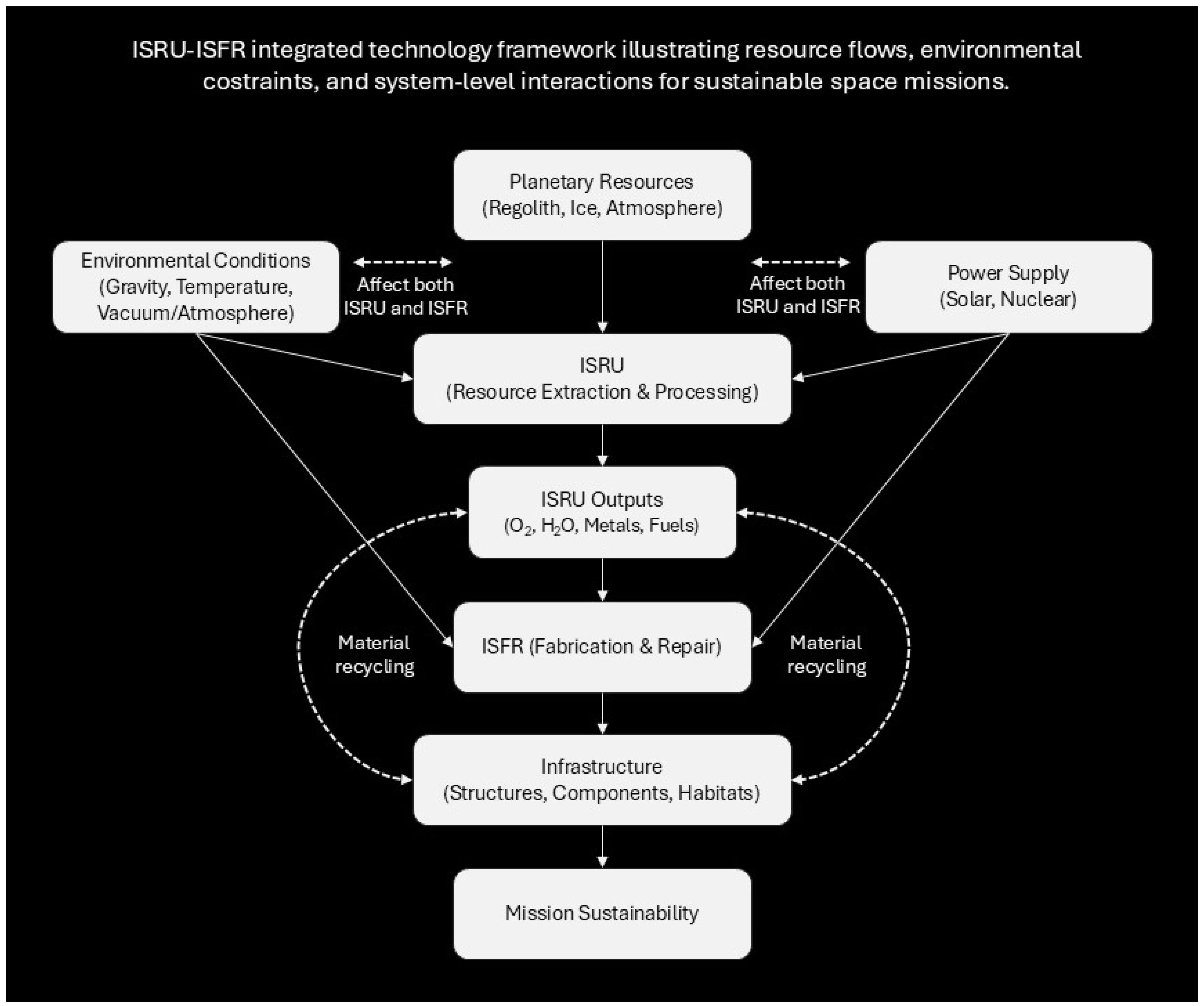
From a system-level perspective, ISRU and ISFR technologies cannot be considered as independent processes, as their performance is jointly determined by resource flows, environmental constraints, and energy availability, with additional feedback mechanisms arising from material recycling.
The strong interdependence between ISRU and ISFR within a mission context is illustrated in Figure 1, which highlights the coupling between resource extraction, processing, and in situ fabrication and repair, as well as the role of environmental constraints, energy supply, and material recycling loops.
This integrated representation emphasizes that the effectiveness of ISRU–ISFR systems ultimately depends on their coordinated design within a constrained and resource-limited mission environment.
Several recent review papers have addressed specific aspects of ISRU technologies, such as oxygen production, regolith processing, and additive manufacturing [5,12,15,16,17,18,19,20,21,22,23].
However, these contributions generally focus on individual technological domains and only partially capture the strong interdependence between resource utilization and in situ fabrication and repair. In contrast, this work adopts an integrated, cross-domain perspective, treating ISRU and ISFR as complementary elements of future space exploration architectures.
Accordingly, the review is structured to highlight these interdependencies across the main technological domains and operating conditions relevant to space environments.
The analysis is based on scientific and patent literature published primarily between 2010 and 2025, complemented by selected earlier seminal contributions for context, with a focus on ISRU and ISFR technologies under reduced gravity and microgravity conditions.
The analysis covers oxygen and water extraction, fuel production, regolith-based additive manufacturing and construction, life-support systems, non-destructive evaluation, automated fabrication and repair technologies, and welding. Emphasis is placed on the effects of reduced gravity and other space environmental factors (including illumination conditions, temperature extremes, and atmospheric compositions) on process performance, energy efficiency, scalability, and the qualification of in situ manufactured components, with the aim of identifying key technological gaps and research priorities for future lunar, Martian, and deep space missions.

1.1. Review Methodology

This review is based on a structured analysis of scientific and patent literature published primarily between 2010 and 2025, selected to capture the most relevant developments in ISRU and ISFR technologies over the past fifteen years. Earlier seminal works were also included where necessary to provide historical background and technical context.
The literature survey was conducted using major scientific databases, including Scopus and Web of Science, complemented by patent databases such as Espacenet and Google Patents. The search strategy combined keywords related to resource utilization, manufacturing, and space environments, including terms such as “ISRU”, “ISFR”, “lunar regolith”, “Martian resources”, and “additive manufacturing”.
The selection of the literature was guided by relevance to ISRU and ISFR technologies, applicability to space environments, and technological significance. Particular attention was given to studies addressing reduced-gravity effects, system-level implications, and demonstrable progress in technology maturation.
In addition to peer-reviewed papers and patents, selected technical reports and institutional sources were considered when they provided relevant engineering insights.
This work does not aim to provide a fully systematic or exhaustive survey, but rather a structured and critical analysis of representative studies, with the objective of identifying major trends, technological gaps, and emerging research directions.

1.2. Challenges Related to ISRU and ISFR

Despite sustained progress in laboratory experiments, numerical modelling, and small-scale demonstrations, the deployment of ISRU and ISFR technologies in operational space missions remains constrained by a set of interconnected technical and system-level challenges. These challenges extend beyond individual processes and instead emerge from the complex interaction between resource extraction, manufacturing, environmental conditions, and overall mission architecture.
The technologies summarized in Table 1 were selected from the reviewed literature to reflect these challenges and to illustrate representative solutions spanning resource extraction, processing, fabrication, and repair. Together, they provide a snapshot of current research directions and highlight recurring bottlenecks that must be addressed to enable operational ISRU–ISFR systems for future extraterrestrial missions.
The technologies summarized in Table 1 span a wide range of maturity levels, reflecting the heterogeneous development status of ISRU and ISFR processes.
To provide a consistent basis for comparison, these technologies are associated with indicative Technology Readiness Levels (TRLs), based on available experimental validation, system complexity, and demonstrated performance in relevant environments, as summarized in Table 2.
These TRL ranges are interpreted in conjunction with the qualitative development stages defined below.
However, it should be noted that TRL assignments for ISRU and ISFR technologies are not always consistently reported in the literature and often depend on mission-specific criteria, system boundaries, and scaling assumptions.
While Technology Readiness Levels (TRLs) provide a useful framework for assessing technology maturity, their application to ISRU and ISFR systems remains inherently context-dependent and not always directly comparable across different studies. For this reason, the TRL values provided in this work should be interpreted as approximate and comparative rather than absolute.
To complement this assessment, technology maturity is also discussed in terms of qualitative development stages, which better capture the current state of research in cases where formal TRL classification is ambiguous. In particular, the following categories are adopted throughout the discussion:
(i)
laboratory-scale validation,
(ii)
prototype or pilot-scale demonstration, and
(iii)
system-level or mission-relevant validation.
These categories provide a consistent framework to interpret the indicative TRL ranges summarized in Table 2. In this context, the TRL-based classification enables a clearer identification of technological gaps and development priorities across ISRU and ISFR domains.
The comparison highlights the heterogeneous maturity levels of ISRU and ISFR technologies and underscores the need for further validation and system-level integration, as also reflected in the indicative TRL ranges summarized in Table 2. The TRL distribution highlights a clear gap between mature electrochemical systems and emerging high-temperature regolith-based processes, indicating that future research should prioritize reactor durability, thermal management, and scalability.
A primary limitation common to both ISRU and ISFR is energy availability. Many resource-processing pathways (including water electrolysis, molten regolith electrochemistry, thermal ice mining, and regolith sintering) are energy intensive and require continuous, high-power operation. On planetary surfaces, solar power generation is often intermittent or geographically constrained, particularly in Permanently Shadowed Regions (PSRs) where water ice may be present. As a result, process feasibility is tightly coupled with resource location and the availability of suitable power in infrastructure.
Reduced gravity represents an additional challenge for many processes that are routinely performed under terrestrial conditions. Experimental and numerical studies have shown that gravity level significantly affects gas–liquid separation, bubble dynamics, heat transfer, and melt-pool behavior in electrochemical and thermal processes [24,25,39]. These effects directly influence process efficiency and hardware design, especially for water electrolysis and molten regolith electrochemistry (technologies that are central for the extraction of oxygen and metals) [26,27,47].
Another critical challenge lies in the integration of ISRU outputs with ISFR processes. The physical form, purity, and compositional variability of locally derived feedstocks directly influence the reliability of in situ manufacturing and repair techniques [33]. Variations in regolith mineralogy, grain size distribution, and volatile content introduce uncertainties that propagate through fabrication workflows, thus complicating process control and quality assurance.
Technology readiness and scalability further limit near-term implementation. While several ISRU and ISFR processes have reached mid-range technology readiness levels through ground-based testing and analog campaigns, few of them have been demonstrated to perform in space-relevant environments or at scales compatible with sustained operations. Scaling laboratory successes to mission-relevant throughput requires advances in automation, fault tolerance, and autonomous monitoring, particularly in scenarios where human intervention is limited or delayed.
Within this context, space agencies have increasingly adopted challenge-driven and roadmap-based approaches to guide technological development. The European Space Agency (ESA), through initiatives coordinated with the European Space Resources Innovation Centre (ESRIC), has emphasized the importance of aligning ISRU and ISFR research with mission-driven requirements, system integration, and long-term sustainability goals. Rather than pursuing isolated process optimization, current strategies prioritize the development of integrated resource–manufacturing ecosystems capable of operating reliably under extraterrestrial conditions [48].
The TRL-based classification presented in Table 2 is used throughout the following sections to contextualize the technological maturity of the reviewed ISRU and ISFR processes.

2. ISRU Research and Technologies

2.1. Oxygen Extraction

In situ oxygen extraction represents a foundational capability for prolonged human presence on the Moon and Mars, as oxygen is required not only for life-support systems but also as an oxidizer for chemical propulsion. A range of technological pathways has been proposed to enable oxygen production from extraterrestrial resources, primarily based on either water-derived processes or the direct reduction of oxygen-bearing minerals contained in planetary regolith, with representative maturity levels summarized in Table 2, which provides a comparative overview of technology readiness across the main ISRU and ISFR processes discussed in this review.
The comparison highlights that water-based oxygen production technologies generally exhibit higher maturity levels (TRL 3–5) compared to regolith-based electrochemical processes (TRL 2–4), which remain more sensitive to system complexity and high-temperature operation constraints.

2.1.1. Water-Derived Oxygen Production

The production of oxygen through water electrolysis has been widely investigated, particularly in the context of lunar polar regions where water ice has been identified within PSRs. In this scenario, water extracted from icy regolith can be electrolyzed to produce hydrogen and oxygen, which may subsequently be utilized directly or stored for propulsion and life-support applications. Key challenges associated with this approach include operation under extremely low temperature conditions, the efficient extraction of water bound within regolith, and the substantial power requirements of electrolysis-based systems.
Although water electrolysis is a mature terrestrial technology, its performance under reduced-gravity conditions differs significantly from that observed at 1 g.
Despite its maturity on Earth, its implementation in extraterrestrial environments remains at intermediate TRLs due to gravity-dependent limitations (see Table 2). This positioning reflects the partial technological maturity of the core process, contrasted with the limited validation under reduced gravity conditions, which remains a key barrier for full system qualification.
Under terrestrial gravity, buoyancy-driven gas bubble detachment promotes phase separation at electrode surfaces, whereas under reduced gravity this mechanism is strongly suppressed.
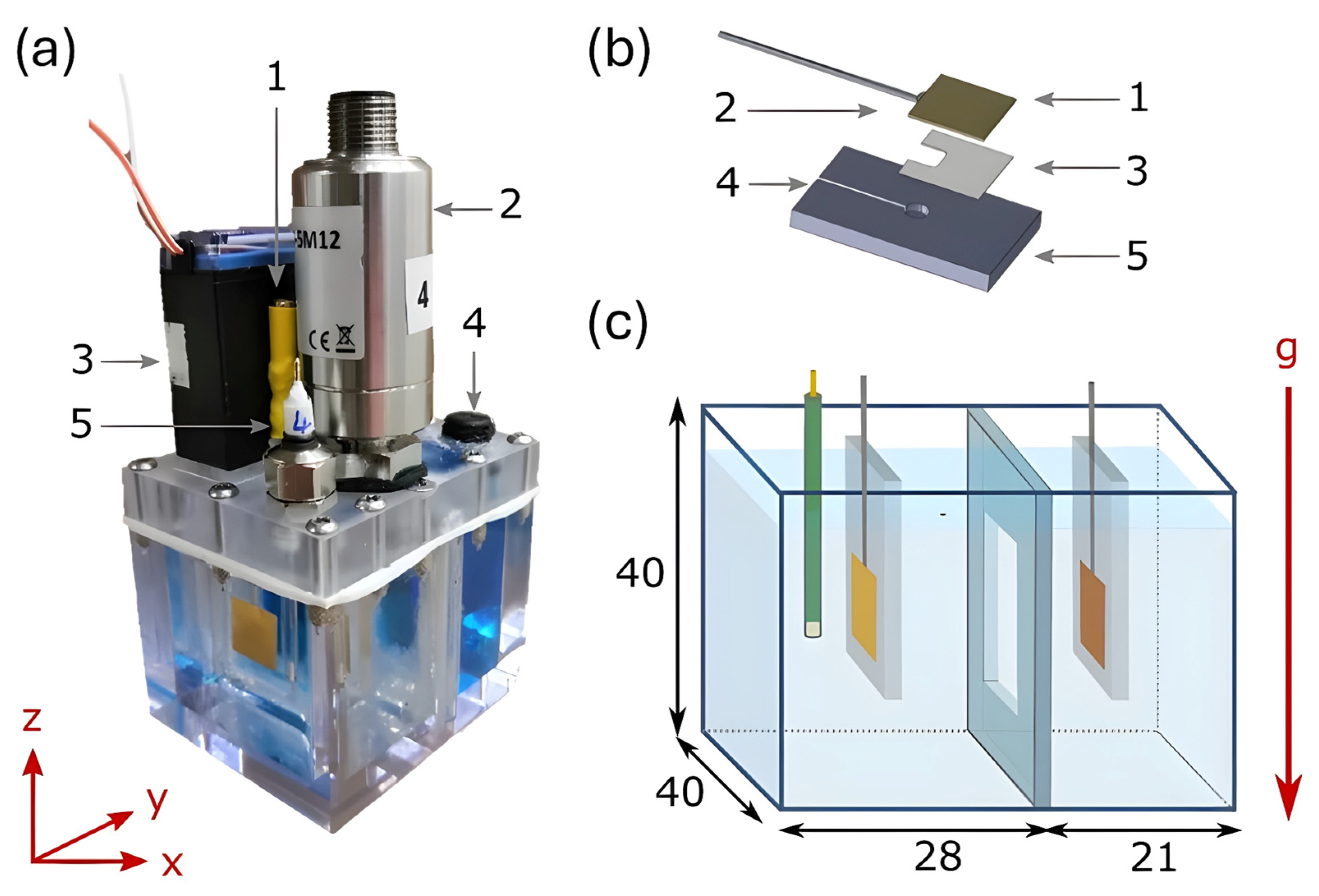
Experimental investigations by Lomax et al. [24] under variable gravity conditions show that reduced gravity alters bubble nucleation, growth, and residence time. This leads to partial electrode coverage and a reduced effective reaction area. Previous studies report that oxygen production under lunar and Martian gravity is reduced by approximately 11% and 6%, respectively, compared to operation at 1 g using the same electrochemical system, with the electrolysis cell design and electrode configuration as illustrated in Figure 2, which shows the electrolysis cell configuration and electrode arrangement.
The authors also demonstrated that the operating potential of the electrolytic cell exhibits a logarithmic dependence on the gravitational acceleration g. Although this relationship does not constitute a universal scaling law for oxygen production, it provides a quantitative measure of the sensitivity of the electrolysis system to gravity. This sensitivity is interpreted as a reduction in the practical oxygen production capability under reduced-gravity conditions, arising from the loss of electrochemically active electrode area due to gravity-dependent gas bubble dynamics. Conversely, an increase in oxygen production capability is observed when hypergravity conditions are simulated using centrifuges, owing to enhanced bubble detachment and improved electrode utilization. Based on these results, the authors concluded that cost-effective hypergravity experiments conducted with centrifuges may be employed to characterize system performance and extrapolate electrochemical behavior under reduced gravity conditions, offering a practical pathway for system development in the absence of extended spaceflight testing.
To mitigate gas bubble accumulation at electrode surfaces under microgravity conditions, recent concepts have explored the introduction of forced convective transport. However, such approaches generally entail increased system mass, mechanical complexity, and energy consumption. As an alternative, Akay et al. [39] demonstrated a magnetic field-assisted strategy to control gas bubble behavior during water electrolysis in microgravity. Experiments conducted in a 146 m drop tower facility showed that magnetic interactions, including diamagnetic and magnetohydrodynamic effects, can significantly enhance bubble detachment and transport away from the electrode surfaces. Under optimized conditions, oxygen bubble removal efficiency increased by up to 240%, indicating that magnetic field-assisted electrolysis may enable more compact and energy-efficient oxygen generation systems without reliance on mechanical phase separation mechanisms.

2.1.2. Regolith-Based Oxygen Extraction

In addition to water-derived pathways, oxygen can be extracted directly from the metal oxides that constitute a major fraction of lunar and Martian regolith. From a system-level perspective, these approaches are particularly attractive because oxygen is chemically bound to minerals that are widely distributed across planetary surfaces, independent of the presence of localized water-ice deposits.
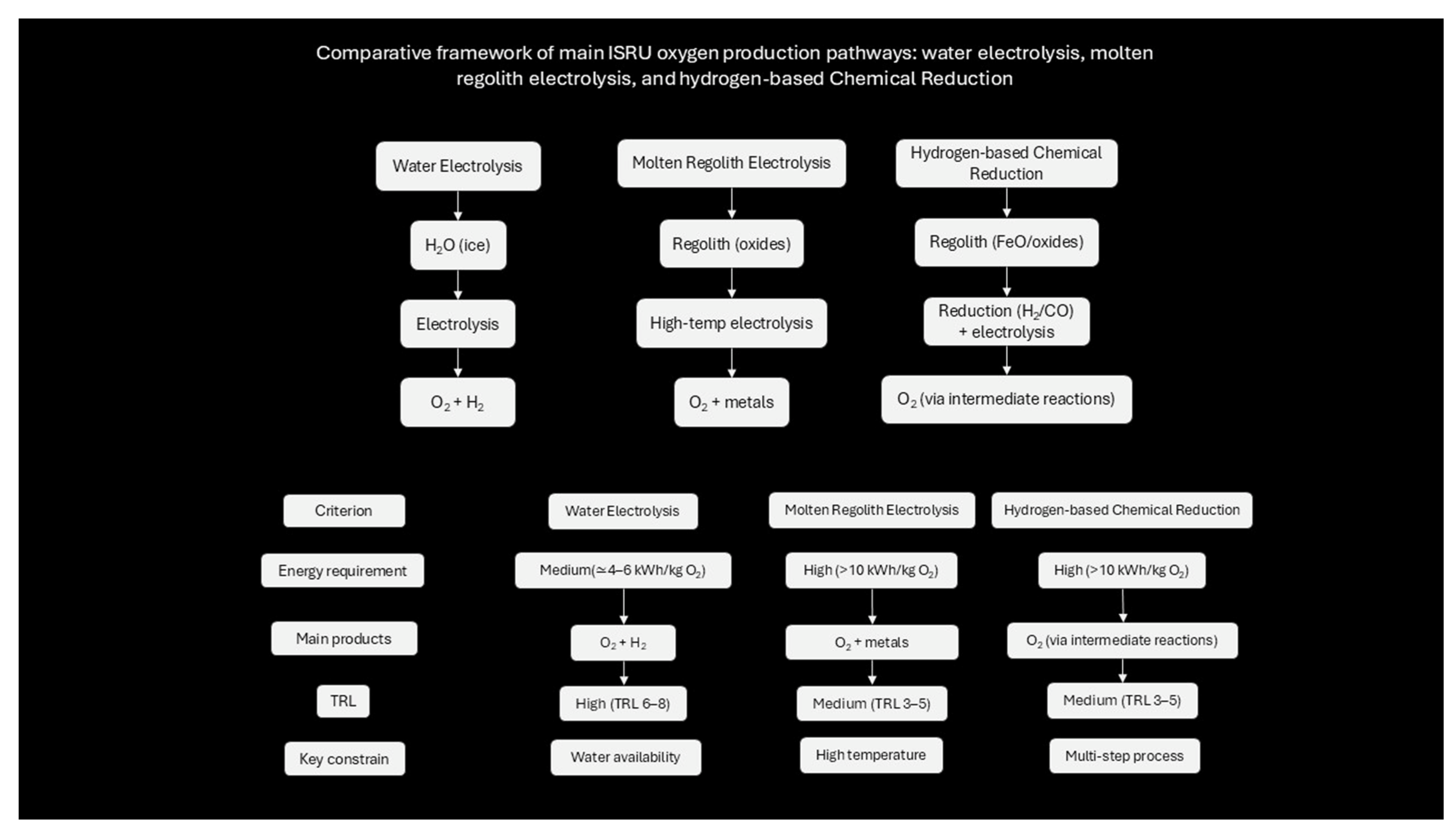
A schematic overview of the main oxygen production pathways is provided in Figure 3, highlighting the fundamental differences between water-derived, electrochemical, and chemical reduction routes in terms of process configuration and resource dependency.
Molten regolith and molten salt electrochemical processes have been investigated as promising routes for direct oxygen extraction while simultaneously producing metallic or alloy by-products. These technologies rely on high-temperature electrochemical reduction of oxide phases and are strongly influenced by gravity-dependent physical phenomena, including electrolytic bubble nucleation, growth, detachment, and melt convection [25,26,27,47].
From a quantitative perspective, the influence of reduced gravity on ISRU and ISFR processes can be interpreted in terms of dimensionless parameters and scaling laws governing multiphase transport and heat transfer. In electrochemical systems, reduced gravity affects bubble detachment dynamics and gas–liquid separation, altering mass transport and effective electrode area. These effects are described by the balance between buoyancy and surface tension forces. This balance is commonly expressed through Bond and Capillary numbers. Both decrease significantly under reduced gravity conditions.
In high-temperature processes such as molten regolith electrolysis, reduced buoyancy-driven convection leads to diffusion-dominated transport. This affects both heat transfer and species distribution within the melt. In additive manufacturing processes, gravity influences melt pool stability, layer consolidation, and defect formation, with reduced gravity potentially affecting interlayer bonding and microstructural evolution.
Although fully predictive quantitative models remain limited, these scaling considerations highlight that process performance is strongly coupled to gravitational acceleration, and that gravity-sensitive phenomena must be explicitly accounted for in the design and optimization of ISRU-ISFR systems.
These processes are currently at relatively low to intermediate TRLs, reflecting their early-stage experimental validation and the challenges associated with high-temperature operation in reduced gravity. Compared to water electrolysis, regolith-based electrochemical processes exhibit lower TRL levels (see Table 2), reflecting that these technologies are still in early experimental stages and require substantial advances in reactor design, thermal management, and multiphase control before scaling to mission-relevant systems.
In this context, computational fluid dynamics simulations were performed to compare the effects of reduced gravity on water electrolysis, molten salt electrolysis, and molten regolith electrolysis. Consistent with the findings of Lomax et al. [24], Burke et al. [25] showed that gravity level, electrode surface morphology, fluid properties, and electrode orientation play a critical role in determining electrolytic efficiency and process stability. Under certain conditions, delayed bubble detachment can significantly reduce current efficiency or even inhibit electrolysis entirely, highlighting the need for gravity-aware reactor architectures and electrode designs in regolith-based oxygen extraction systems.
In a less recent work, a comprehensive comparative assessment of oxygen extraction strategies from lunar materials was provided by Schwandt et al. [26]. They reviewed a wide range of chemical, thermal, and electrochemical methods proposed for ISRU applications by analyzing pathways including hydrogen and methane reduction, vapor-phase pyrolysis, sulphuric acid leaching, and molten oxide electrolysis. A key conclusion of this work was that molten electrochemical processes offer distinct advantages for lunar deployment, particularly due to their applicability across both mare and highland regolith compositions. Importantly, the authors emphasized that even if substantial water-ice deposits at the lunar poles are confirmed and exploited, oxygen production at non-polar locations remains strategically relevant, reinforcing the importance of regolith-based extraction techniques applicable across the lunar surface.
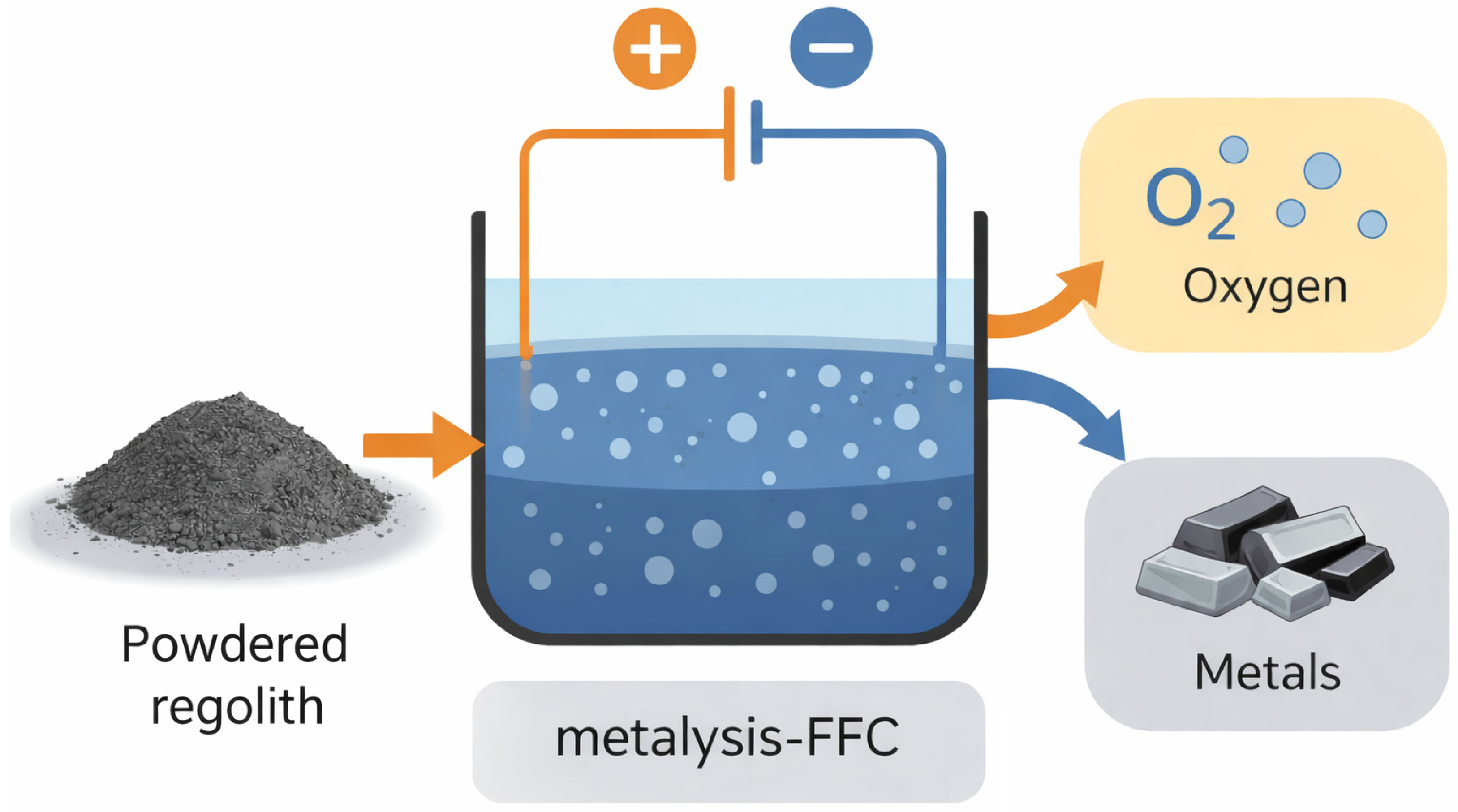
Building upon this conceptual framework, subsequent experimental work demonstrated the feasibility of simultaneously extracting oxygen and metals from lunar regolith simulants using electrochemical reduction processes. Lomax et al. [27] investigated the applicability of the industrially established Metalysis Fray–Farthing–Chen (FFC) process to regolith-like materials, employing an oxygen-evolving SnO2 anode to electro-deoxidize powdered solid-state lunar regolith simulant. This study provided the first detailed characterization and quantification of both anodic and cathodic products generated during regolith electro-deoxidation. Analysis of the resulting metallic powder showed that approximately 96% of the total oxygen content was removed from the simulant to yield a mixed metal alloy product. Only around one-third of the extracted oxygen was detected in the off-gas, while the remaining fraction was attributed to parasitic losses associated with corrosion of reactor components. With appropriate optimization of reactor configuration and operating conditions, near-complete oxygen recovery from lunar regolith simulants was identified as achievable. The electro-deoxidation process and reactor configuration employed in this study are illustrated in Figure 4.

2.1.3. Hydrogen-Based Chemical Reduction

In addition to electrochemical approaches, chemical reduction of oxygen-bearing minerals has long been considered a viable pathway for oxygen production from lunar regolith. Oxygen is commonly present in iron-rich lunar minerals and glasses in the form of iron oxides, which can be reduced by heating regolith to temperatures exceeding 900 °C in the presence of hydrogen, producing metallic iron and water according to the reaction [40,41]:
FeO + H2 → Fe + H2O.
Accordingly, hydrogen reduction pathways remain at relatively low TRLs, primarily due to their high energy demand and system integration complexity (Table 2).
Subsequent electrolysis of the produced water enables oxygen recovery while recycling hydrogen, making this approach conceptually attractive for closed-loop ISRU systems. The feasibility of hydrogen-based reduction processes has been significantly influenced by the detection of hydrogen-bearing regolith at the lunar poles by the Clementine mission, which increased interest in coupling chemical reduction with polar resource utilization strategies [49].
However, these processes remain highly energy intensive and require sustained high-temperature operation, introducing challenges related to reactor materials, thermal management, and system integration under lunar environmental conditions. Moreover, oxygen may not be produced directly by the reduction step but only through subsequent water electrolysis, implying that hydrogen-based reduction pathways are most attractive when integrated with complementary ISRU technologies rather than as stand-alone oxygen production systems.
A comparative assessment of the main oxygen production pathways is provided in Table 3, highlighting key differences in operating conditions, energy demand, system complexity, and technological maturity.
In addition to the parameters reported in Table 3, the influence of reduced-gravity conditions on these technologies is discussed in Section 4.2, where gravity-dependent phenomena are analyzed in relation to process performance and system limitations.
The comparison highlights a trade-off between technological maturity and system complexity, with water electrolysis representing the most mature approach, while regolith-based processes offer greater resource independence at the cost of higher thermal and engineering constraints.

2.1.4. Mineral-Derived Materials and By-Products

Lunar regolith also contains abundant oxide-rich minerals that may serve as sources of both oxygen and structural materials: highland regions are rich in anorthite, which can be processed to yield aluminum, calcium, oxygen, and silica glass through appropriate metallurgical routes. Beyond oxygen production, anorthite-derived products are relevant for in situ fabrication of glass, fiberglass, and ceramic components, directly linking oxygen extraction processes with construction and manufacturing applications [50].
Overall, the analysis of oxygen extraction pathways highlights that no single approach is universally optimal, as each technology presents trade-offs in terms of energy demand, system complexity, scalability, and dependence on local resource availability.
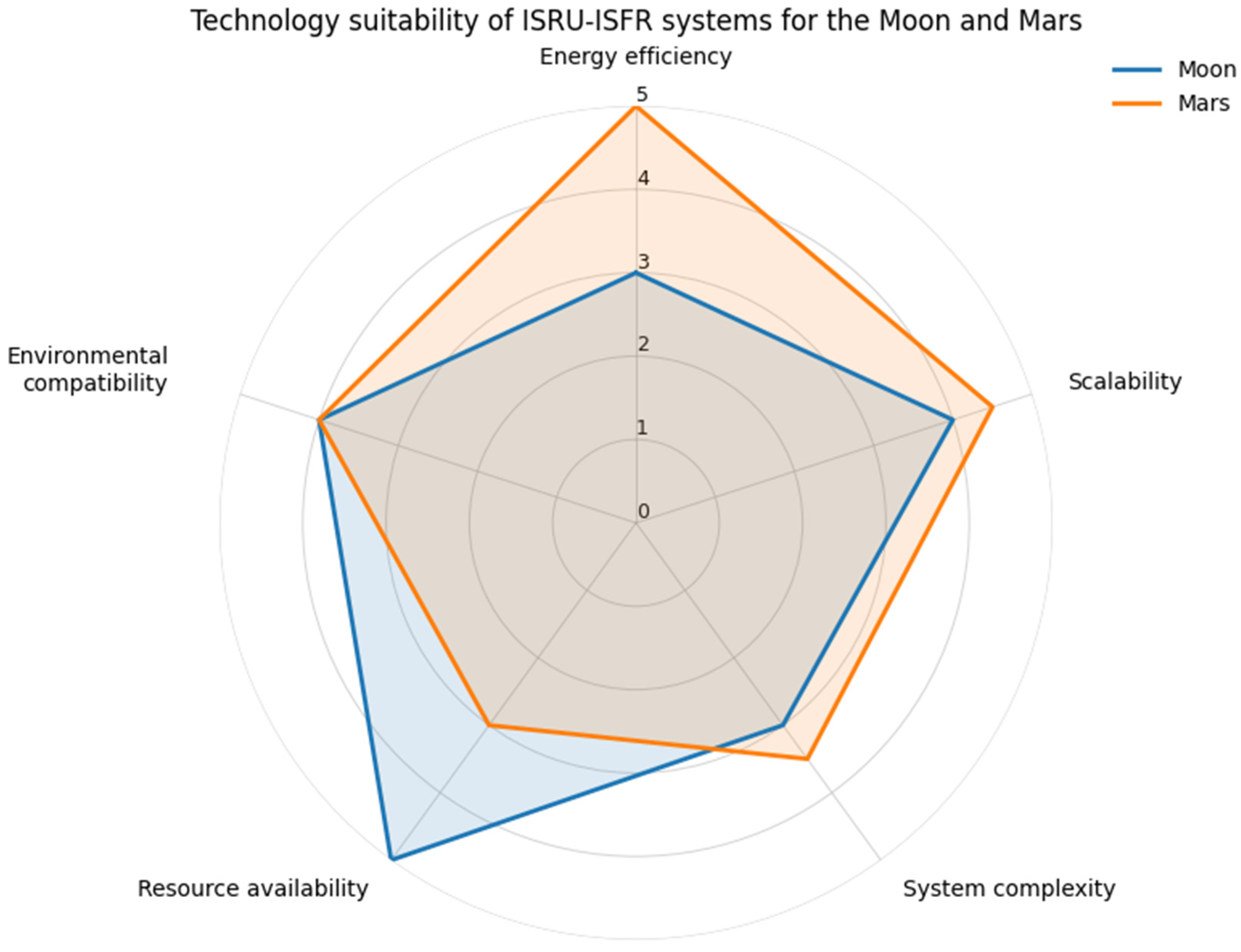
A qualitative and comparative assessment of ISRU–ISFR technology suitability for different celestial bodies is presented in Figure 5, highlighting the relative performance of key criteria including energy efficiency, scalability, system complexity, resource availability, and environmental compatibility for the Moon and Mars.
These considerations further emphasize the importance of resource-specific strategies, particularly in relation to water availability, which plays a central role in both oxygen production and broader ISRU–ISFR system integration

2.2. Water

The presence of water on the Moon and Mars represents one of the most strategically important resources for future space exploration, as water is not only essential for life-support systems but also enables propellant production and serves as a feedstock for oxygen generation and a wide range of industrial and chemical processes. On the Moon, water is predominantly located within permanently shadowed regions (PSRs) near the poles, where extremely low temperatures allow the long-term stability of water ice within the regolith. More broadly, extraterrestrial water has been identified in multiple forms across the Solar System, including chemically bound water in regolith minerals, subsurface ice deposits, permafrost-like materials, and tenuous atmospheric vapor.
Since the early hypothesis proposed by Watson et al. [51] regarding the accumulation of volatiles in PSRs at the lunar poles, extensive remote-sensing observations and impact-detection experiments have provided compelling evidence that lunar water ice exists primarily in the form of icy lunar regolith (ILR) within PSRs [52]. While, on planetary bodies with a tenuous atmosphere, such as Mars, water may be harvested directly from the atmosphere using adsorption techniques, including concepts such as the Water Vapor Adsorption Reactor (WAVAR) [53].
However, the practical exploitation of these resources requires spatially resolved characterization at scales significantly finer than those achievable through orbital remote sensing alone. In situ exploration of ILR using high-speed kinetic penetrators has been proposed as a promising process, as it mitigates challenges associated with limited illumination, restricted accessibility, and the high mechanical strength of ice-rich regolith in PSR environments. These methods enable rapid subsurface assessment while minimizing system complexity and power requirements [28].
PSRs lack direct solar illumination and exhibit cryogenic conditions, with temperatures as low as 40 K [54]. These conditions pose substantial challenges for resource extraction, including the lack of solar power availability, extreme thermal gradients, and the mechanical properties of ice-rich regolith. Nevertheless, PSRs are widely regarded as prime targets for lunar water mining due to the potentially high concentration of water ice hosted within these regions.
The maturity of water extraction technologies spans early conceptual designs to prototype demonstrations, as reflected in the TRL ranges reported in Table 2.

2.2.1. Solar Thermal Extraction

In this context, water extraction methods that exploit solar energy as a primary power source have been explored. In particular, the mining of polar permafrost on the Moon and Mars has been conceptualized using radiant gas-dynamic techniques designed to release and capture volatile species. These concepts typically envision near-polar outposts supported by high-altitude or elevated solar arrays, enabling sustained power delivery while exploiting subsurface ice deposits [55].
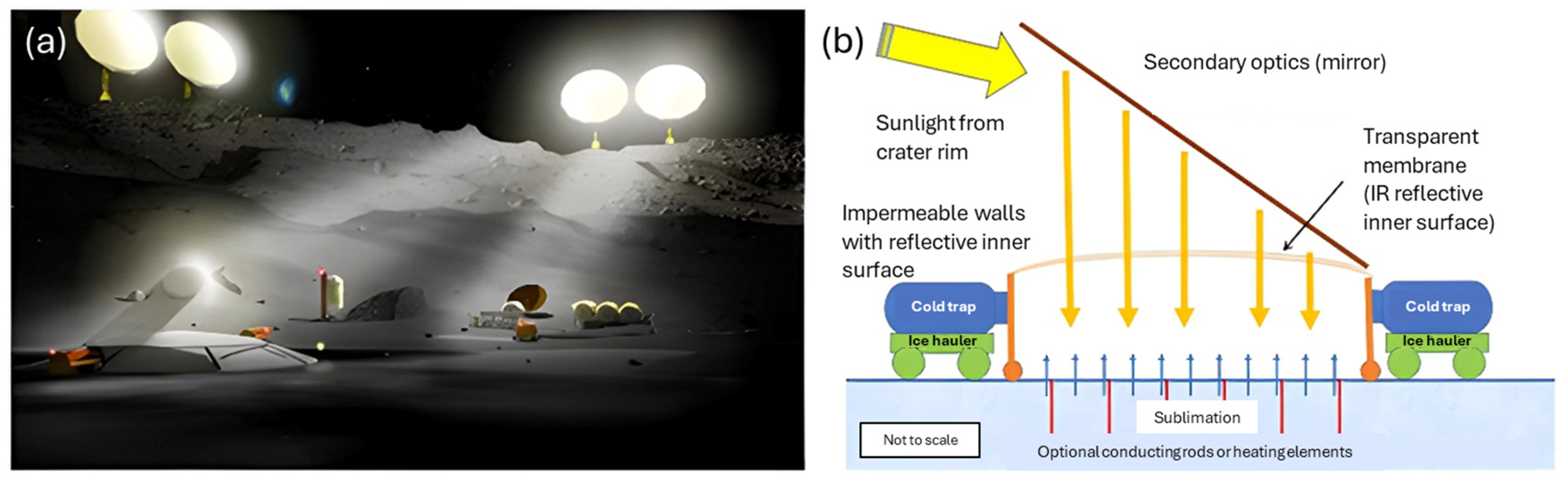
Additional concepts have proposed to access, release, and capture volatile species in subsurface permafrost on the Moon and Mars. Zhang et al. [42] presented a comprehensive review of the historical development of ISRU and recent advances in lunar water acquisition technologies and proposed a conceptual solar-thermal extraction scheme in which concentrated solar energy is used to heat icy regolith, releasing water vapor that is subsequently collected and condensed (Figure 6).

2.2.2. Radioisotope Power System

Radioisotope power systems (RPS), capable of providing both thermal and electrical energy, have been proposed as enabling technologies for in situ water extraction in PSRs. Mazzotti et al. [29] investigated the feasibility of a lunar ice-mining rover concept powered by an Americium-241–based RPS designed for autonomous operation. Owing to its long half-life (432 years), 241 Am can provide stable electrical and thermal power over mission durations extending to several decades. In the proposed system, the electricity powers the rover and its subsystems while waste heat is used for thermal ice extraction. The rover design incorporates a sublimation plate that irradiates the underlying regolith to induce ice sublimation, along with a cold trap for the capture of released volatiles. The feasibility of the concept was assessed using a dedicated thermal management system model, validated through three-dimensional finite element simulations conducted by varying water-ice contents from 0 to 10 vol.%. The results indicate that RPS-powered thermal ice extraction in lunar PSRs is feasible, with performance strongly dependent on the ice content of the regolith.

2.2.3. Mechanical Properties of Icy Lunar Regolith

For the design of effective extraction systems, significant effort has been devoted to characterizing the mechanical behavior of icy lunar regolith, as it directly influences drilling, excavation, and penetration strategies. Experimental investigations on Earth using icy lunar regolith simulants have shown that water ice content is a key parameter governing regolith strength and deformation behavior.
Pitcher et al. [56] conducted a series of laboratory studies on icy NorthUp Lunar Highlands Type 2 Modified (NU-LHT-2M) simulant prepared at varying water saturation levels. Their results indicate that saturation occurs at water mass fractions between 13% and 17%. Cone penetration testing revealed a marked increase in penetration resistance at water contents as low as 5 ± 1%, while uniaxial compression tests showed that regolith strength increases with both water mass fraction and density, with the rate of strengthening diminishing as saturation is approached.
Following these studies, Liu et al. [57] investigated the Uniaxial Compressive Strength (UCS) of simulated icy lunar regolith over a wide range of parameters, including raw material composition, water content between 5 and 25 wt.%, dry density, and low temperatures (from −240 to −10 °C). The analysis of their results indicated that only raw material composition exerted minor influence compared to the other parameters. Below −180 °C, the sensitivity of UCS to temperature variations is significantly reduced, while UCS increases nonlinearly with increasing dry density. Maximum strength values were observed under saturated conditions. By combining experimental results with remote sensing data, the authors proposed depth-dependent models for dry density, temperature, and water content, enabling predictions of UCS and drillability as a function of depth. These findings provide quantitative guidance for the design of drilling and excavation systems intended for water-ice detection and extraction in PSRs.

2.3. Fuel Production

The production of rocket propellants from local resources represents one of the most transformative applications of ISRU, as propellant mass typically dominates the launch mass of deep-space missions. The capability to generate both fuel and oxidizer in situ enables refueling operations and supports extended mission durations and more flexible exploration architectures.
These approaches are currently at varying levels of technological maturity, generally ranging from conceptual to laboratory or prototype-scale validation (Table 2). In particular, most fuel production pathways remain within TRL 2–4, indicating that they are largely limited to laboratory or early prototype validation, with significant gaps in system integration and long-duration operational testing.

2.3.1. Lunar Fuel Production Concepts

In situ fuel production on the Moon represents a critical capability for future exploration, as it supports refueling operations in cis-lunar space and enables missions to more distant destinations, including Mars [58]. Infrastructure concepts such as NASA’s Lunar Gateway and the International Lunar Research Station (ILRS) have been proposed as elements of a broader exploration architecture in which lunar-derived propellants contribute to sustained deep-space operations [59,60].
Analyses of lunar regolith samples returned by the Chang’E-5 mission have revealed the presence of mineral phases capable of catalyzing chemical reactions relevant to oxygen and fuel production. Sun et al. [30] reported that lunar soil fragments can enable sunlight-driven conversion of water and carbon dioxide into oxygen and hydrocarbon compounds by exploiting photothermal catalytic effects intrinsic to the regolith itself. In this approach, water obtained from various sources and carbon dioxide potentially supplied by human respiration serve as the primary reactants. Under solar irradiation, water is dissociated into oxygen and hydrogen, after which hydrogen reacts with carbon dioxide to produce hydrocarbons such as methane. The authors describe this mechanism as a form of extraterrestrial photosynthesis, in which mineral catalysts replace biological systems, offering a novel pathway toward closed-loop oxygen and fuel generation on the lunar surface.
Beyond photothermal catalytic approaches, alternative propellant concepts for lunar applications have been proposed. Hydrogen peroxide (H2O2) has been considered as a monopropellant that could, in principle, be synthesized from locally available water, offering simplified storage and propulsion system architectures [61]. In parallel, metallic fuels derived from lunar regolith (particularly aluminum and other light metals) have been investigated as potential energy carriers, with propulsion concepts based on metal–water reactions to generate thrust [61]. These approaches highlight the diversity of possible fuel strategies enabled by lunar resources, each involving distinct trade-offs in terms of energy efficiency, system complexity, and operational flexibility.

2.3.2. Martian Propellant Production

For Mars exploration, in situ propellant production has long been recognized as a critical enabler for return missions and surface mobility. Early mission architectures assumed that key propellant components, particularly hydrogen, would need to be transported from Earth, and therefore proposed dedicated precursor flight demonstrations aimed at validating in situ propellant production hardware ahead of human exploration [62]. As scientific understanding of Martian subsurface ice deposits improved, ISRU strategies progressively evolved toward fully closed-loop architectures relying exclusively on locally available resources, eliminating the need for Earth-supplied reactants [2,3].
One of the most extensively studied approaches is methane production via the Sabatier reaction [63], in which methane and water are synthesized from atmospheric carbon dioxide and hydrogen according to the following reaction scheme:
CO2 + 4H2 → CH4 + 2H2O.
In this configuration, produced methane serves as fuel, while oxygen is separated by electrolyzing the water generated during the same reaction and hydrogen is recycled back into the Sabatier process.
An alternative chemical pathway for Martian ISRU is the reverse water gas shift (RWGS) reaction:
CO2 + H2 → CO + H2O.
This reaction proceeds efficiently in the presence of iron–chromium catalysts at temperatures of approximately 400 °C and has been demonstrated in ground-based test facilities [64]. In RWGS-based architectures, oxygen is typically produced via subsequent electrolysis of the generated water, while hydrogen is recycled. Compared with the Sabatier process, RWGS systems emphasize oxygen production over fuel synthesis and may offer advantages in simplicity for certain mission profiles.
Beyond these approaches, in situ oxygen production from the Martian atmosphere has been experimentally demonstrated through technology validation experiments such as the Mars Oxygen In Situ Resource Utilization Experiment (MOXIE) [15,22]. The latter, deployed aboard the Mars 2020 Perseverance rover, demonstrated the feasibility of producing oxygen by high-temperature solid-oxide electrolysis of atmospheric CO2, directly extracting molecular oxygen for potential use in life-support systems and as an oxidizer for future propellant production. Cycles based on iron oxides have been proposed to enable the production of oxygen, hydrogen, and carbon monoxide from Martian resources.
Another proposed approach involves the in situ production of oxygen, hydrogen and CO from Martian hematite deposits through a two-step thermochemical CO2/H2O splitting process [65,66], specifically employing the magnetite/wüstite redox cycle. Although direct thermolysis represents the simplest conceptual route for molecular dissociation, it is impractical for H2O or CO2 due to the extremely high temperatures required (>2500 °C), which introduce severe challenges related to reactor materials, product recombination, and radiative losses when concentrated solar heat is used [67]. The magnetite/wüstite cycle, originally proposed by Nakamura [68] for terrestrial solar applications, mitigates these issues by distributing the energy input over two reaction steps. In this cycle, first magnetite (Fe3O4) is thermally decomposed in wüstite (FeO) and oxygen (O2), then the obtained wüstite (FeO) reacts with water or carbon dioxide to form magnetite (Fe3O4) while releasing and hydrogen or carbon monoxide:
Fe3O4 → 3FeO + 0.5O2,
3FeO + H2O → Fe3O4 + H2,
3FeO + CO2 → Fe3O4 + CO.
The process is repeated cyclically, resulting in a substantial reduction in the required thermal energy input compared to single-step thermolysis.
Although neither wüstite nor magnetite are naturally abundant on Mars, previous studies report that large amounts of hematite (Fe2O3) are located near Terra Meridiani [69]. The reduction of hematite to magnetite is a well-established industrial process on Earth [70] and may proceed via the following reactions:
3Fe2O3 + H2 → 2Fe3O4 + H2O,
3Fe2O3 + CO → 2Fe3O4 + CO2.

2.3.3. Fuel and Propellant Production from Small Bodies

Beyond planetary surfaces, propellant production from asteroids and other small bodies has been proposed to support in-space transportation, life-support consumables, and manufacturing activities. Concepts have been described for systems capable of extracting water and volatile organic compounds from carbonaceous asteroids through thermal processing. In such approaches, water bound to clay minerals is released via heating, while organic material may be gasified to produce hydrogen, carbon monoxide, and carbon dioxide. These species can subsequently serve as feedstocks for oxygen generation, fuel synthesis, and the production of polymers and plastics [71].

2.4. Life-Support Systems

Water and oxygen management constitute central pillars of life-support systems for sustained human presence beyond Earth. In fact, the sustained presence of humans in space habitats (whether in orbit or on planetary surfaces) requires reliable and efficient oxygen generation systems. Current life-support architectures, such as those employed aboard the International Space Station (ISS), rely on water electrolysis [72].
Within the framework of in situ resource utilization (ISRU), water is not only required for direct human consumption but also serves as a feedstock for oxygen generation, cultivation of higher plants and microalgae, radiation shielding, and a wide range of industrial and manufacturing processes. Consequently, the availability, extraction, purification, and recycling of oxygen and water are tightly coupled challenges in the design of extraterrestrial habitats.

2.4.1. Solar Concentrator Reactor System

A solar concentrator reactor system has been proposed to support high-temperature thermochemical processing and power generation using solar energy and regolith. While the concentrated solar thermal reactor is not a life-support system per se, it can act as an enabling subsystem within integrated ISRU–life-support system architectures by providing high-temperature thermal energy for oxygen extraction and resource processing. In this context, the reactor indirectly assists life-support functions by enabling the production of breathable oxygen and stabilizing energy-intensive processes. In this concept, vertically oriented solar concentrators are employed to transfer heat into falling regolith particles, enabling efficient thermal energy transfer and precise temperature control. This configuration facilitates oxygen extraction, metal production, and continuous slag extrusion. In addition to improving the efficiency of oxygen production, such systems may support the fabrication of mechanical and structural components through extrusion-based additive manufacturing or casting techniques. The resulting slag products may further serve as thermal mass for energy storage, enhancing system survivability during extended periods of low solar illumination and enabling integrated construction–power generation architectures [31]. The patented reactor concept proposed by Brewer and Garvey [31] is representative of the growing industrial interest in solar-driven ISRU systems. However, despite its potential for integrated oxygen extraction and thermal energy management, its current maturity remains limited by the absence of validation under reduced-gravity and mission-relevant operating conditions.

2.4.2. Integrated Water Production, Purification

An integrated system and methodology to produce purified water, hydrogen, and oxygen from contaminated water sources has been proposed by Finger et al. [32]. In this approach, contaminated water vapor (originating from regolith-derived resources or other extraterrestrial sources) is introduced into a cold trap, where water selectively condenses and freezes while volatile contaminants remain in the gas phase. Subsequent controlled heating re-vaporizes the purified water, generating a gas stream that may be further treated using chemical scrubbers and ionomer membrane technology to separate water vapor from residual gases. In this way, purified water can be safely supplied directly to life-support systems or allocated to other operational uses. Similarly, the patent by Finger et al. [32] highlights the relevance of integrated purification and gas-production systems within closed-loop architectures. Its main strength lies in process integration, although its practical implementation in extraterrestrial environments still requires further experimental validation and system-level assessment.

3. ISFR Research and Technologies

ISFR technologies encompass the capability to manufacture, maintain, and restore components directly in their operational extraterrestrial environment.
Unlike ISRU, which primarily focuses on the extraction and processing of local resources, ISFR emphasizes the transformation of available materials (either Earth-supplied or in situ-derived) into functional hardware, as well as the repair of damaged or degraded systems.
Similarly to ISRU, ISFR technologies are characterized by heterogeneous maturity levels, with most processes currently positioned within low to intermediate TRL ranges (Table 2).
In general, ISFR technologies tend to lag behind ISRU processes in terms of system-level validation, with most approaches remaining below TRL 5 and therefore requiring further development to achieve operational reliability.
Recent international initiatives highlight the growing strategic importance of permanent surface infrastructure on the Moon. Plans have been reported for the development of an Italian lunar habitation module within the Artemis program framework [73,74], while South Korea has announced long-term objectives aimed at establishing a lunar base by 2045 [75]. In parallel, China has advanced the concept of the ILRS in collaboration with other international partners, with recent developments communicated by the Deep Space Exploration Laboratory [59]. These initiatives underscore the need for construction technologies capable of operating under lunar environmental conditions, including vacuum, reduced gravity, extreme thermal cycling, and abrasive dust.
Analogous motivations apply to Mars exploration, where 3D printing has been widely discussed as a means of supporting long-duration surface missions by reducing logistical mass and enabling on-site fabrication of habitats and infrastructure [76]. Conceptual studies have further explored Mars-specific architectural solutions tailored to local environmental constraints and in situ construction paradigms [77].

3.1. Regolith-Based Materials and Additive Manufacturing

Within the ISFR framework, the ability to produce building materials derived from local resources and to process them through additive manufacturing constitutes a critical step toward the realization of permanent extraterrestrial stations. In this context, material development, manufacturing processes, and performance validation are closely interconnected and are therefore discussed in an integrated manner. Additive manufacturing technologies for space applications are generally at prototype or laboratory validation stages, as reflected in the TRL ranges reported in Table 2. These TRLs indicate that, despite promising experimental demonstrations, additive manufacturing processes for space applications are still far from reliable, large-scale deployment.

3.1.1. Material Development

To this aim, Mukbaniani et al. [33] investigated the viability of the fabrication of composite building blocks based on artificial Martian ground (AMG) mixed with epoxy resin (type ED-20) modified with tetraethoxysilane (TEOS). The resulting polymer–regolith composites were characterized in terms of mechanical strength, softening temperature, and water absorption. Experimental results demonstrated that such composite materials exhibited higher ultimate strength, improved flexibility, increased softening temperatures, and reduced water absorption compared to unmodified formulations. These findings indicate that polymer–regolith composites may provide mechanically robust and environmentally resilient materials suitable for extraterrestrial construction, particularly in Martian surface environments where temperature variations and dust exposure are significant.
Comparative analyses of cementitious and concrete-like materials derived from Martian soil compositions have demonstrated that multiple binder systems with acceptable mechanical performance can be produced from locally available resources. Soureshjani et al. [44] conducted a comprehensive structural-engineering-oriented assessment of eleven candidate Martian cement and concrete formulations, evaluating parameters such as mechanical behavior, structural loading conditions, raw material accessibility, energy and water requirements, curing conditions, compatibility with additive manufacturing, long-term durability, and resistance to galactic cosmic rays and solar energetic particles. Using multi-criteria decision analysis supported by weighted radar and spider diagrams, the study identified the most viable material systems for sustainable Martian construction.
Asteroid mining has been proposed as a source of metallic feedstock for in-space construction, as asteroids contain metals primarily in oxide or silicate form [78]. Owing to their extremely low gravitational acceleration, asteroids enable transport of the extracted materials with significantly lower energy requirements than massive planetary bodies, offering potential advantages over sourcing equivalent materials from Earth or other large bodies with deep gravitational potential wells, such as the Moon or Mars. Early assessments of asteroid metal content were often based on limited and outdated datasets, resulting in substantial uncertainties. More recent analyses drawing on extensive meteorite collections have provided updated estimates of elemental abundances in likely asteroid materials, allowing comparison with terrestrial ore deposits. From a survey of 83 elements, a subset has been identified, including platinum group metals (PGMs: Rh, Ru, Pd, Os, Ir, and Pt) and base metals such as Fe, Mg, Al, and Si. These studies indicate that maximum PGM contents may be lower than previously assumed. Consequently, the in situ processing of asteroid materials may be required to obtain PGM-enriched concentrates. In addition, base metals can be chemically reduced and employed to support in-space manufacturing, thereby reducing the mass that must be transported to other celestial bodies.
These material sources, whether planetary or asteroidal, are closely linked to the subsequent development of manufacturing processes, particularly additive manufacturing technologies, which enable their transformation into functional structures and components.

3.1.2. Additive Manufacturing Processes

The application of additive manufacturing (AM) technologies within the framework of ISFR has received increasing attention as a means of enabling on-demand fabrication, customization, and replacement of components during space missions. AM is particularly attractive for space applications due to its efficient use of material, reduced dependence on dedicated tooling, and inherent compatibility with automated and robotic systems. These characteristics make AM well suited to environments where logistical constraints, limited up-mass, and delayed resupply impose strict limitations on conventional manufacturing and repair strategies. Owing to the relatively recent adoption of additive manufacturing technologies in space-related contexts, only a limited number of studies have investigated the performance and reliability of additively manufactured components in measurement, characterization, and operational applications under space-relevant or extreme conditions.
Solar-Based Additive Manufacturing for Construction Materials
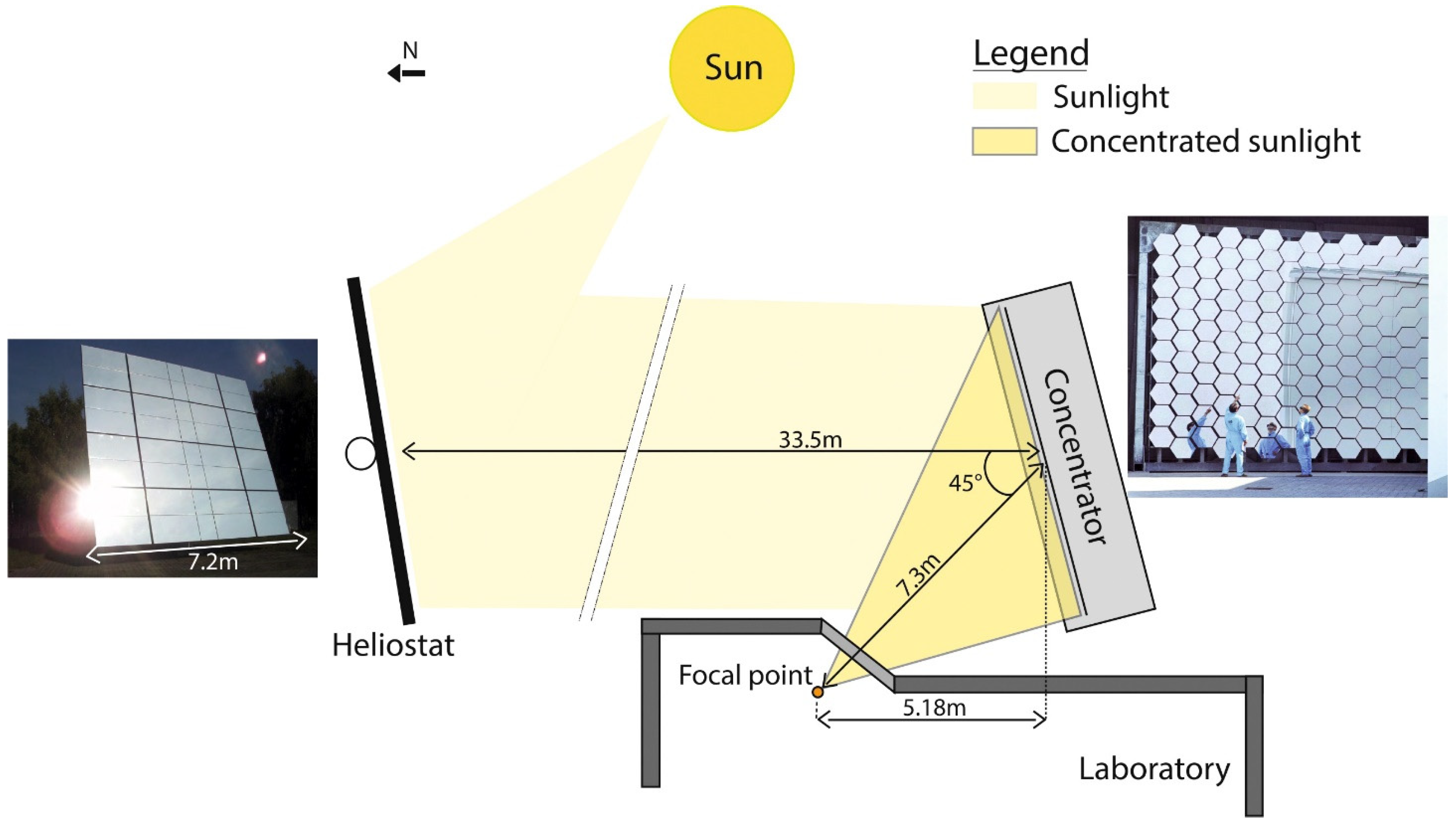
The feasibility of solar-based additive manufacturing using lunar regolith simulants has been experimentally demonstrated by Meurisse et al. [34], who investigated layer-by-layer sintering of regolith simulants using concentrated sunlight. A schematic of the experimental solar furnace setup, including the heliostat and multi-mirror concentrator used to focus sunlight for regolith sintering, is shown in Figure 7.
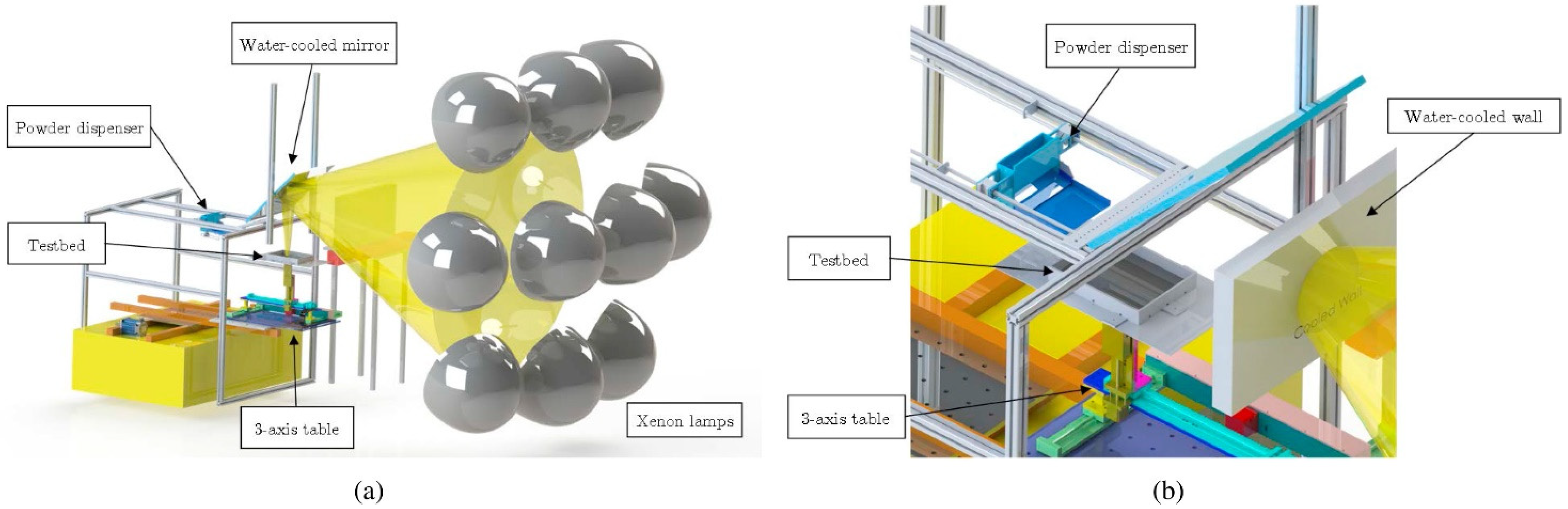
Initial experiments employing natural solar concentration resulted in inhomogeneous sintering due to temporal variations in atmospheric conditions affecting the incident energy flux. Subsequent trials utilizing xenon light sources provided stable thermal conditions, enabling the successful fabrication of the first solar 3D-printed brick composed of lunar regolith simulant. The configuration employing xenon light as a power source is illustrated in Figure 8 as a 3D rendering of the layer-by-layer manufacturing system. Mechanical testing revealed compressive strengths below 5 MPa. This limits their use in load-bearing applications. Microstructural analysis showed high porosity and weak interlayer bonding, although improvements were achieved through reduction in thermal gradients and optimization of cooling intervals between successive layers. These results demonstrate both the feasibility and current limitations of solar-driven additive manufacturing for lunar construction, highlighting the need for further process optimization to achieve structurally relevant performance.
Another concept that uses lunar illumination conditions as a power source envisions 3D printing systems designed to operate autonomously on the Moon, exploiting in situ resources as primary feedstocks. Such approach integrates regolith excavation, crushing, and additive fabrication within a mobile robotic platform capable of operating inside lunar craters. In this concept, concentrated solar energy (focused through Fresnel optics and reflective elements) is used to supply the thermal energy required for processing and printing operations. By employing lunar soil as the primary raw material, this strategy aims to minimize the mass and cost associated with transporting construction materials from Earth while enabling scalable, on-site fabrication of infrastructure elements.
A more recent and interesting brick fabrication technique using lunar regolith has also been proposed. China has developed a prototype regolith brick-making system designed to fabricate structural elements for permanent lunar installations [59,79]. The concept relies on a solar-driven additive manufacturing approach in which concentrated solar radiation is used to melt processed regolith, enabling the formation of dense building blocks through controlled solidification. In this system, incident solar energy is concentrated using a parabolic reflector and transmitted through optical fibers to further intensify the thermal flux at the processing site. The reflector geometry and optical fiber system are designed to maximize concentration efficiency, achieving concentration factors (CF), defined as the ratio between the solar irradiance at the focal point and the incident solar flux, exceeding 3000×. This level of solar energy densification enables temperatures on the order of 1300 °C to be reached at the focal melting region under lunar illumination conditions. The process is compatible with the integration of volatile removal steps, enabling the collection of water and oxygen for other uses while purifying the remaining regolith material, which can then be melted and shaped into high-quality structural blocks. The resulting bricks exhibit high density and mechanical robustness, making them suitable for habitat shielding, roadways, and surface platforms [79].
Microwave-Based System for Construction Materials
An alternative fabrication approach based on microwave sintering has been proposed for extraterrestrial construction, provided that a suitable electrical power source is available. These systems consolidate loose mineral feedstock into solid ceramic components through the combined action of mechanical compression and microwave heating [43]. In such configurations, mineral feedstock is confined within a sintering chamber lined with thermally insulating materials, while microwave dipole arrays induce volumetric heating and densification. This approach offers potential advantages in terms of process controllability and independence from direct solar illumination, although it introduces additional system complexity and power requirements.
Printing Mechanical Parts
Unlike construction-scale AM systems aimed at producing large structural elements, these concepts focus on the fabrication of functional components, tools, and replacement parts.
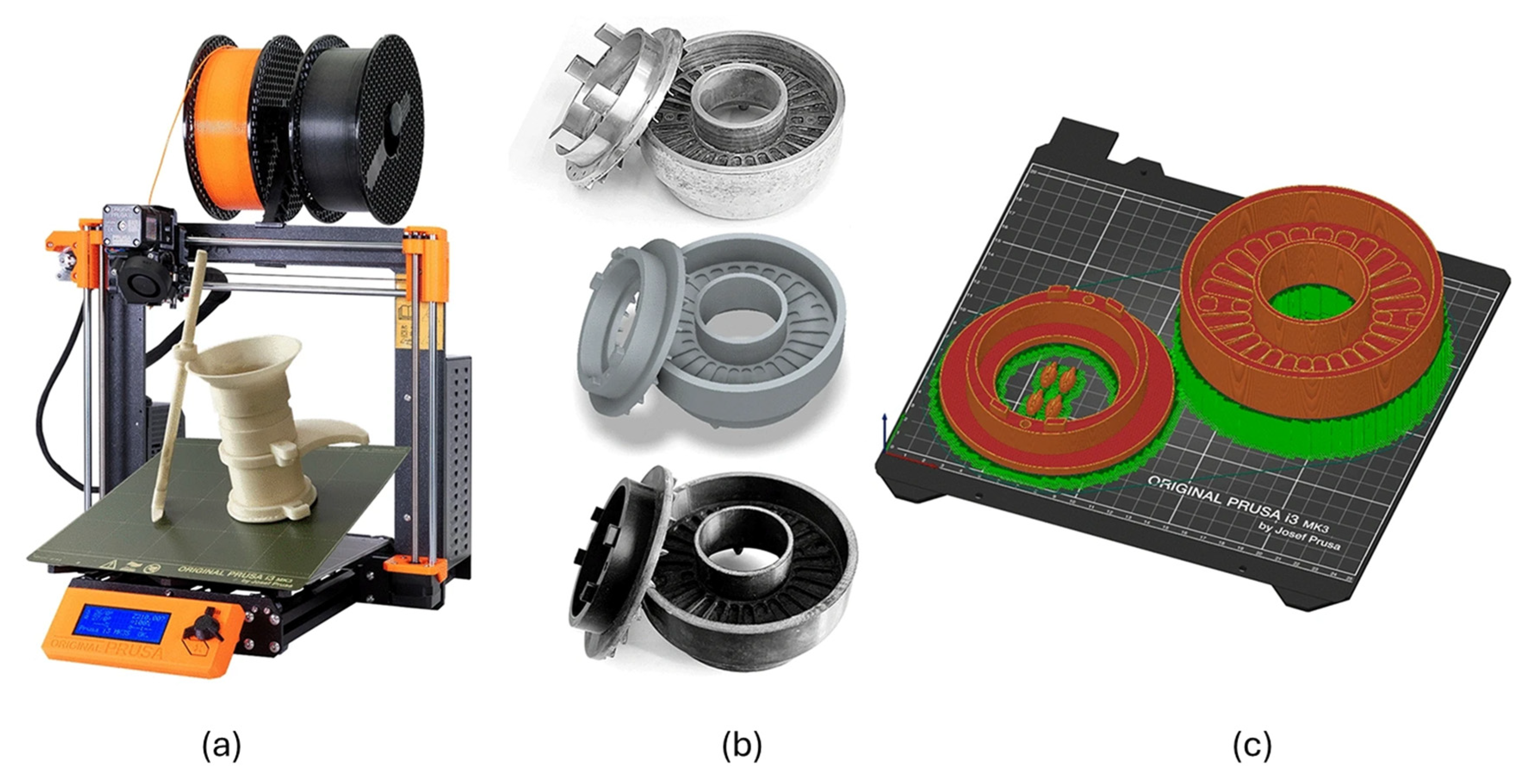
Divis et al. [80] examined the use of additively manufactured measuring instruments produced via material extrusion techniques for the characterization of granular materials. In their study, instruments traditionally fabricated from aluminum or steel were replaced with polymer-based components manufactured using fused filament fabrication (FFF). A comprehensive experimental campaign was conducted to assess the suitability of these instruments, including Schulze ring shear tests, Freeman FT4 shear tests, compressibility measurements, and flow rate and stability analyses. Lunar Highlands Simulant—1 (LHS-1) and Lunar Mare Simulant—1 (LMS-1), produced by CLASS Exolith Lab, were employed as representative test materials. Comparison of the results obtained using metallic instruments and their additively manufactured counterparts revealed deviations within approximately 5%, demonstrating that 3D-printed tools can provide measurement performance comparable to conventional equipment for granular material characterization. In addition to functional equivalence, the use of additively manufactured instruments offers several advantages, including reduced mass, rapid on-demand fabrication, ease of replacement, enhanced customization of standardized geometries, and significantly lower manufacturing costs. Examples of the 3D-printed experimental equipment and test configurations employed in this study are shown in Figure 9.
Townsend et al. [35] proposed a compact 3D print head apparatus specifically designed for ISFR applications in space and planetary environments. The print head integrates material storage, controlled feeding and agitation, extrusion, thermal management, and environmental control within a single modular unit compatible with robotic platforms and automated or semi-autonomous fabrication workflows. Basalt-based regolith simulants combined with thermoplastic binders were investigated as candidate materials, enabling extrusion-based fabrication under controlled thermal conditions. The print head incorporates active heating and temperature regulation to ensure stable material flow, as well as air management and fume extraction subsystems to maintain print quality and operational reliability. Such an approach demonstrated that adapting terrestrial extrusion-based additive manufacturing principles to robotic ISFR scenarios is viable, while avoiding the mass, volume, and complexity associated with large-scale fabrication systems.
Overall, the combined development of regolith-based materials and additive manufacturing processes highlights the strong interdependence between material formulation, processing techniques, and performance outcomes, which is a key aspect in the design of scalable ISFR systems for future space missions.

3.1.3. Habitat Concept

Despite these advances, it is widely acknowledged that regolith-derived bricks alone are unlikely to constitute fully habitable structures. Instead, such elements are primarily envisaged as protective layers, providing shielding against micrometeoroid impacts, radiation, and thermal extremes. Their effective use therefore depends on integration with rigid load-bearing structures and, potentially, inflatable habitat modules. Current development roadmaps envision an initial phase of lunar base construction near the south pole by approximately 2035, followed by progressive expansion toward 2040 [59]. To assess long-term durability, samples of regolith-derived bricks have reportedly been delivered to the Tiangong space station for exposure to vacuum, radiation, and thermal cycling, with the aim of evaluating their suitability as protective construction materials under space-relevant conditions [81].
Spectrally self-adaptive absorber/emitter systems capable of dynamically combining photothermal energy conversion with radiative cooling have demonstrated the ability to efficiently harvest solar energy while rejecting excess heat to deep space. Such systems enable temperature control under highly variable environmental conditions and may enhance the feasibility of energy-intensive fabrication processes on planetary surfaces [82].
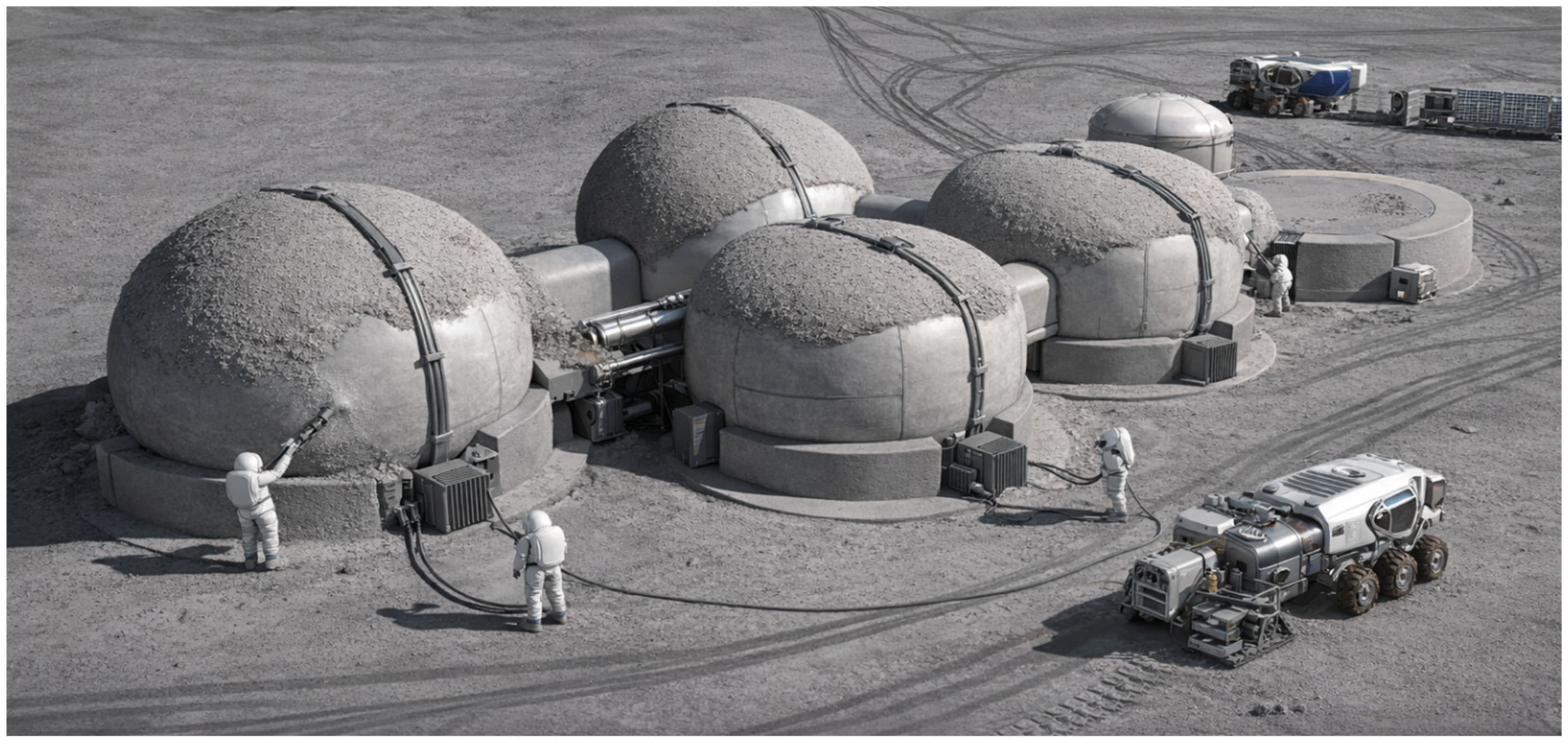
In parallel with resource extraction technologies, habitat concepts have been actively explored. The Aerospace Corporation has proposed the Regishell lunar habitat concept, based on lightweight inflatable structures that can be transported in a compact configuration and subsequently deployed and rigidized on the lunar surface [36]. An example of a conceptual lunar surface station employing Regishell-based habitat elements as part of an integrated infrastructure is shown in Figure 10.
Following deployment, an alkali-based binder, produced either on Earth or from lunar resources, is mixed with local regolith and applied via spraying or injection to form a hardened external shell. Experimental investigations have focused on identifying binder formulations capable of curing under vacuum conditions and within the temperature extremes of the lunar environment. Additional reinforcement may be achieved through the incorporation of basaltic materials and multilayer membrane architectures, enhancing mechanical strength and structural integrity.
Overall, the patent literature reviewed in this work shows strong conceptual and industrial activity in ISRU–ISFR technologies, particularly in construction, water processing, and automated fabrication. Nevertheless, many patented concepts remain at low to intermediate maturity levels and are often supported by limited experimental evidence under space-relevant conditions.

3.2. Solar Cell Production

The possibility of manufacturing solar cells directly from materials available in lunar regolith has been discussed for several decades. Key constituents required for photovoltaic device fabrication, including silicon, aluminum, and glass, are present in substantial quantities in lunar soil and could, in principle, be processed to enable local solar cell production. In addition, the natural high-vacuum environment of the lunar surface offers favorable conditions for thin-film fabrication techniques, such as direct vacuum deposition, which are commonly employed in the production of photovoltaic materials [50].
Solar arrays fabricated on the lunar surface could support a wide range of applications, including power generation for surface operations as well as for spacecraft and satellites operating in cis-lunar space. In specific mission architectures, locally produced solar arrays may prove more cost-effective than systems manufactured on Earth and subsequently transported to the Moon. However, the economic viability of in situ photovoltaic manufacturing is strongly dependent on the scale of deployment, the intended operational lifetime, and the availability of supporting infrastructure.
Despite the conceptual attractiveness of in situ photovoltaic manufacturing, significant technical challenges remain. The limited controllability of processing conditions in the lunar environment constrains achievable material quality, resulting in relatively low reported conversion efficiencies, typically in the range of 5–10%. In addition, prolonged exposure to ionizing radiation and extreme thermal cycling during the lunar day–night cycle is expected to accelerate degradation, potentially reducing energy conversion efficiency by approximately 30% over operational lifetimes. Similar environmental stressors, including dust deposition and temperature extremes, are anticipated to affect the performance of solar energy systems on Mars, motivating the development of dedicated instrumentation packages for in situ characterization of photovoltaic performance under extraterrestrial conditions [83].
As an alternative to conventional photovoltaic approaches, Ellery [84] proposed a solar-electric power generation concept based on the use of a Fresnel lens coupled with thermionic energy conversion. In this system, concentrated solar radiation is used to heat a thermionic emitter, enabling direct conversion of thermal energy into electrical power. Reported conversion efficiencies for this approach range from approximately 15% to 20%, with the potential for further improvement through technological refinement. Although such concepts offer attractive performance gains, their implementation remains constrained by system complexity and the challenges associated with high-temperature operation in the lunar environment. Consequently, while solar irradiance is abundant on the Moon, the efficient conversion of this energy into usable electrical power (particularly for energy-intensive processes such as laser-based additive manufacturing) remains a significant challenge under current technological limitations.

3.3. Non-Destructive Evaluation (NDE)

The qualification and certification of components fabricated or repaired directly in space or on extraterrestrial surfaces represent one of the most critical challenges associated with ISFR. Unlike terrestrial manufacturing, in situ operations are constrained by limited equipment, restricted crew time, and harsh environmental conditions. Post-production inspection capabilities are therefore significantly reduced. As a result, robust qualification strategies that integrate process control with NDE techniques are essential to ensure the safety, reliability, and functional integrity of in situ-manufactured or -repaired hardware. Most NDE techniques for space applications remain at laboratory to early system-integration stages, corresponding to mid-range TRLs (Table 2).
A central concept in ISFR qualification is the distinction between process certification and part-specific verification. Manufacturing and repair processes can be extensively defined, calibrated, and validated on Earth, including control of feedstock properties, processing parameters, and expected material behavior. Once a process has been certified under terrestrial conditions, an equivalent or “analog” process must be verified for in situ operation, accounting for differences in gravity, ambient environment, thermal conditions, and power availability. This approach reduces the need for exhaustive in situ testing while maintaining confidence in the performance of fabricated components [45].
Part-specific verification in space relies heavily on in situ monitoring and non-destructive inspection rather than destructive testing [38]. Acceptance testing performed entirely in situ is inherently limited, whereas qualification activities can leverage preflight validation, ground-based heritage data, and comparative analysis using representative test coupons where feasible. Any deviations observed during in situ fabrication or repair must be assessed against predefined acceptance criteria to determine whether corrective actions, such as localized repair or re-fabrication, are required [45].
A wide range of NDE techniques has been proposed and evaluated for applicability in space environments. These include thermal imaging for defect detection and process monitoring, laser-based inspection methods for dimensional accuracy and surface integrity assessment, electronic and electromagnetic sensing techniques, acoustic and ultrasonic inspection, X-ray–based methods, and chemical analysis approaches. Each technique presents specific advantages and limitations in terms of mass and power consumption, inspection depth, spatial resolution, and compatibility with reduced-gravity and vacuum conditions [46].
Crew-assisted inspection concepts also remain relevant within the ISFR framework, particularly for surface operations on planetary bodies. Visual inspection aided by portable probes, cameras, and sensor-equipped tools may complement automated NDE systems, enabling rapid identification of surface flaws, cracks, or material degradation in metallic and composite structures (cf. Figure 2 in Bassler et al. (2006) [45]).
Several factors can influence the repeatability and reliability of in situ fabrication and repair processes and must therefore be considered within qualification strategies. These include reduced gravity, ambient environment variability, material aging, fluctuations in locally sourced material purity, power availability, equipment calibration drift, and limitations in remote inspection fidelity. Discrepancies that could compromise part performance must be identified early through NDE and resolved through appropriate control measures, repair actions, or process adjustments. Overall, the integration of NDE within ISFR is fundamental to enabling safe and reliable in-space manufacturing and repair. By combining rigorous process certification on Earth with targeted in situ verification and inspection, ISFR systems can achieve qualification standards aligned with those required for flight hardware [45].

3.4. Automated Repair Technologies

Automated repair technologies (ARTs) are a key component of the ISFR paradigm, enabling the restoration of functionality in damaged or degraded systems without reliance on Earth-based resupply. For long-duration missions and planetary surface operations, in situ repair is essential to maintain system availability, reduce spare-part inventories, and mitigate mission risk. Automated repair technologies are currently among the least mature ISFR processes, generally positioned at early TRL stages (Table 2). The low TRL of automated repair technologies highlights a critical gap in current ISFR capabilities, particularly for long-duration missions requiring high system autonomy.
Repair strategies within ISFR are closely linked to fabrication and qualification processes and may be required following defect detection, prolonged use, or damage caused by environmental exposure, mechanical wear, or micrometeoroid impacts. In contrast to terrestrial maintenance, in situ repair must operate under reduced gravity, limited tooling, constrained crew time, and variable environmental conditions, requiring highly reliable solutions compatible with automated or semi-autonomous execution. ARTs can be broadly categorized as replacement-based or restorative. To ensure functional and safety compliance, repair operations must be integrated with verification and inspection activities (in situ NDE techniques to assess defect mitigation, geometric accuracy, and structural integrity).
Several factors influence the feasibility and effectiveness of automated repair in space. These include the mechanical and thermal properties of the materials involved, the accessibility of damaged regions, the precision and robustness of robotic manipulation systems, and the availability of power and thermal control. In addition, variability in material properties (particularly when locally sourced materials are used) introduces further complexity, requiring repair strategies that are tolerant to compositional and microstructural heterogeneity [45].
From a system-level perspective, automated repair technologies are expected to play a progressively larger role as missions transition from short-duration exploration to sustained habitation and industrial activity. On planetary surfaces, repair systems may be integrated into robotic construction platforms or maintenance rovers, enabling continuous upkeep of habitats, power systems, and surface infrastructure. In orbital environments, automated repair supports the maintenance and upgrade of space stations, manufacturing platforms, and large deployable structures. Overall, automated repair represents a critical enabler for resilient and self-sufficient space operations. By reducing dependence on Earth-based logistics and enabling rapid recovery from component degradation or failure, automated repair technologies enhance mission robustness and support the long-term viability of ISFR-driven exploration architecture.

3.5. Welding and Joining Technologies

Welding and joining technologies represent a critical enabling capability within the ISFR framework, as they allow the assembly, modification, and restoration of structural and functional components directly in space or on planetary surfaces. These processes are particularly relevant for the construction and maintenance of habitats, pressure vessels, support frames, and mechanical subsystems, where structural integrity and reliability are paramount. The development of joining techniques compatible with vacuum, reduced gravity, and extreme thermal environments is therefore a central focus of in-space manufacturing research [46]. In contrast, certain welding and joining technologies have reached relatively higher TRLs due to experimental validation in relevant environments (Table 2).
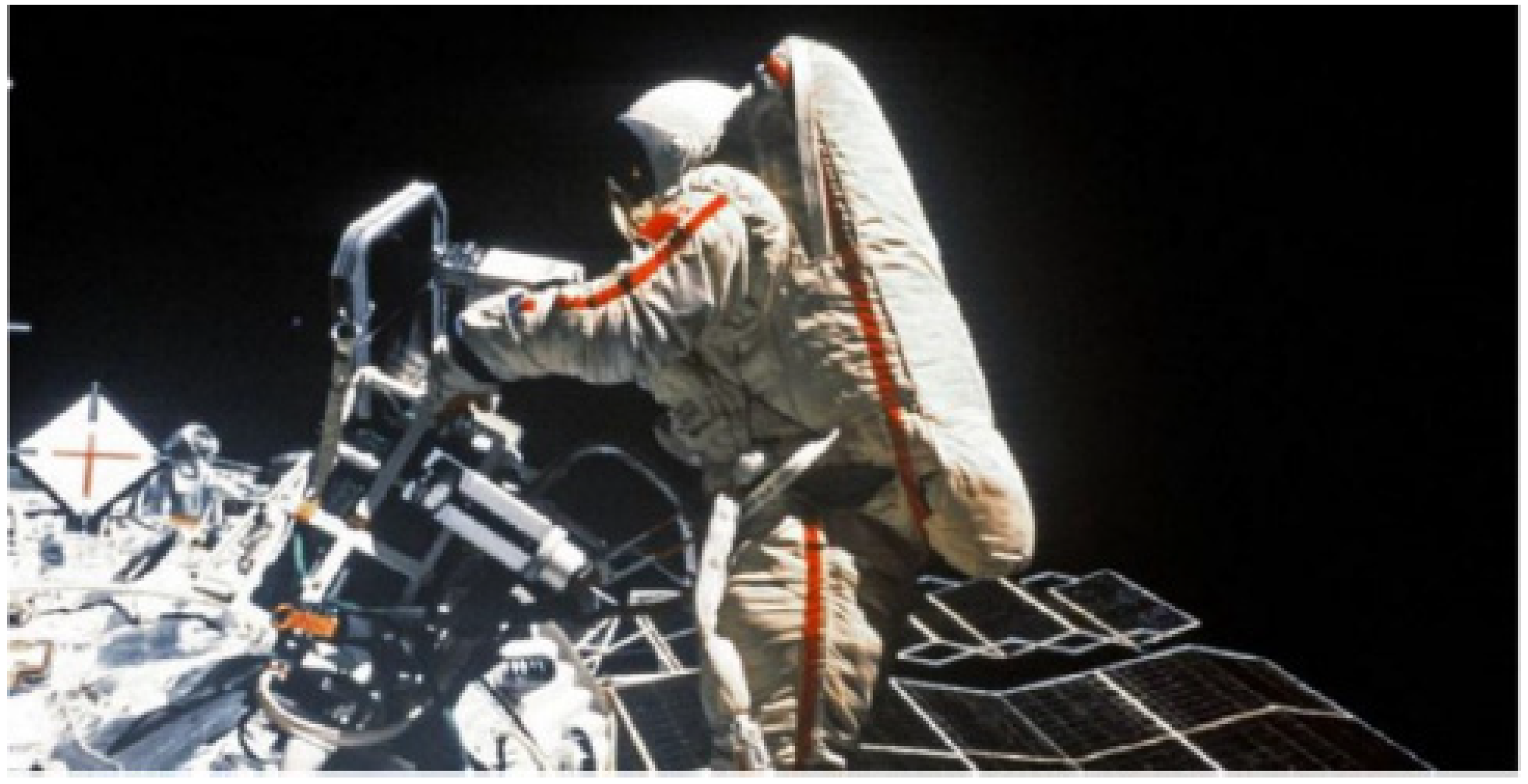
Research into space welding technologies has a long history, extending back to the early years of human spaceflight. Early investigations conducted by Soviet and U.S. programs demonstrated the feasibility of welding and cutting operations under microgravity conditions, including electron beam, gas metal arc, and plasma arc approaches [46,85,86]. These pioneering studies established the technical basis for later developments in in-space joining and repair (Figure 11).
In recent years, renewed interest in in-space welding has shifted the focus from feasibility demonstrations to process stability, defect control, and weld quality under reduced-gravity and vacuum conditions, with particular attention to arc- and laser-based joining technologies [37,38,46].
More recent work has expanded the range of viable joining techniques for space applications, including gas hollow tungsten arc (GHTA) welding of aluminum and titanium alloys under simulated space environments achieved through parabolic flight campaigns [37]. These studies demonstrated that stable arc welding and high-quality joints can be achieved in microgravity when appropriate process control strategies are employed.
Laser beam welding (LBW) has emerged as a promising joining technique for in situ resource utilization and in-space manufacturing applications due to its high energy density, precise control of heat input, and inherent compatibility with automated and robotic systems. LBW enables localized melting with minimal heat-affected zones, reducing distortion and residual stress in welded components. These characteristics make it well suited for joining a wide range of aerospace-relevant metallic alloys and composite materials, particularly in environments where thermal management and process stability are critical. Recent experimental investigations examined pulsed LBW of aerospace-relevant alloys (including Aluminum 2219, Ti–6Al–4V, and 316 L stainless steel) under gravity conditions ranging from terrestrial gravity to lunar gravity and microgravity. These experiments were conducted during parabolic flight campaigns using a high-vacuum welding chamber equipped with a pulsed laser system. Weld quality was assessed through detailed characterization of porosity formation and microstructural features using computed tomography, scanning electron microscopy, and electron backscatter diffraction. The results demonstrated that pulsed LBW produces consistent weld bead morphology across all gravity regimes and effectively suppresses gravity-driven melt pool convection due to rapid solidification. In reduced-gravity conditions, welds exhibited smaller and more spherical pores, indicating enhanced process stability [38].
These recent studies indicate that welding research is moving beyond historical proof-of-concept demonstrations toward more application-oriented investigations focused on process robustness, defect mitigation, and qualification for space manufacturing scenarios.

4. Critical Analysis

4.1. Summary of Core Achievements

This work synthesizes the major scientific and technological advances achieved over the past fifteen years in the fields of ISRU and ISFR, two tightly interconnected pillars of future human space exploration. Rather than addressing these domains in isolation, the review highlights their mutual dependence in enabling sustained operations beyond Earth through the combined exploitation of extraterrestrial resources and the in situ fabrication, maintenance, and repair of critical infrastructure. Drawing on scientific literature, patents, and experimental studies, the analysis has covered oxygen and fuel production, water extraction and management, additive manufacturing and construction, life-support systems, and automated repair technologies relevant to long-duration missions to the Moon, Mars, and beyond.
In addition to the activities conducted by NASA, ESA, and CNSA, significant contributions have also been made by other spacefaring nations. Russia has continued to pursue lunar exploration strategies, including the Luna-25 mission, aimed at investigating polar regions and supporting future resource utilization efforts, despite its partial mission failure [87]. Japan has advanced resource prospecting technologies through the Martian Moons eXploration (MMX) mission, which focuses on the characterization and potential utilization of Phobos regolith [88]. India has also contributed to lunar exploration through the Chandrayaan program, particularly with the detection and mapping of water ice in permanently shadowed regions [89].
These efforts highlight the increasingly global nature of ISRU-related research and confirm that the development of resource utilization technologies is no longer limited to a small number of agencies, but is progressively becoming part of a broader international technological landscape.
The ambition to extend human presence beyond Earth has driven substantial progress in ISRU technologies, particularly in the extraction of oxygen and metals from lunar and Martian regolith through molten regolith electrolysis, metal reduction processes, and water electrolysis under reduced-gravity conditions. In parallel, fuel production pathways—most notably methane synthesis via the Sabatier reaction on Mars and emerging concepts for photothermal and catalytic processes on the Moon—have gained increasing attention as enablers of sustainable exploration architectures. Water has emerged as a central resource linking life support and propulsion, with permanently shadowed regions at the lunar poles representing a strategic asset and motivating the development of innovative extraction, drilling, and processing systems.
ISFR has evolved alongside these advances, with additive manufacturing establishing itself as a cornerstone of in-space fabrication. Experimental demonstrations using regolith simulants have shown the feasibility of producing ceramics, structural elements, and protective materials through sintering, solar concentration, and microwave-based processes. In particular, the subject of cold sintering has been recently addressed in the literature [90] in a comprehensive review paper. At smaller scales, the use of polymer-based additive manufacturing for tools, instruments, and replacement parts has demonstrated the potential to reduce logistical burdens and enhance operational flexibility. Equally important, progress in non-destructive evaluation, welding, and joining technologies has confirmed that high-quality fabrication and repair operations can be performed under reduced-gravity and vacuum conditions, supporting the qualification and long-term reliability of in situ-manufactured components.

4.2. Existing Challenges

Despite the significant progress achieved in recent years, several challenges continue to limit the large-scale deployment of ISRU and ISFR technologies. Energy efficiency remains a primary constraint, particularly for electrochemical and thermal processing routes that require substantial and continuous power input. In addition, long-term durability under extreme radiation, temperature cycling, and abrasive dust environments has yet to be demonstrated at operational scales. Translating laboratory-scale results into flight-ready systems requires advances in automation and process control. It also demands system-level integration of resource extraction, manufacturing, inspection, and repair.
Notably, different ISRU pathways exhibit distinct trade-offs. Water electrolysis systems, for instance, are relatively mature but strongly dependent on the availability of accessible ice deposits. In contrast, regolith-based oxygen extraction processes offer broader applicability across planetary surfaces, yet require significantly higher temperatures and energy inputs. Similarly, additive manufacturing approaches enable flexible in situ production, but remain constrained by material variability and process stability under reduced-gravity conditions.
The TRL-based comparison further highlights that, although several individual technologies have reached intermediate maturity levels (TRL 3–6). A major limitation lies in the lack of integrated, system-level validation under space-relevant conditions. A further limitation emerging from the literature is the absence of consistent benchmarking across technologies, particularly under reduced-gravity environments. This lack of standardization complicates direct performance comparison and hinders the identification of robust scaling criteria for mission design. In addition, the literature reveals non-negligible discrepancies in reported performance metrics, process efficiencies, and material behavior, often arising from differences in experimental setups, feedstock composition, boundary conditions, and the limited availability of data obtained under reduced-gravity conditions.
These technical challenges are further compounded by emerging geopolitical and regulatory considerations associated with the utilization of extraterrestrial resources, which may influence mission architectures, technology deployment strategies, and international collaboration frameworks.
Moreover, the presence of reactive species such as perchlorates and peroxides, particularly in Martian regolith, may have significant implications for ISRU and ISFR processes. These compounds can affect chemical stability, material processing, and system durability, while also posing challenges for handling, storage, and crew safety. Their impact on reaction pathways, corrosion phenomena, and long-term material performance remains insufficiently understood and requires further investigation.
Overall, a significant gap persists between technology readiness levels and actual mission readiness, as many processes validated under laboratory or simulated conditions have yet to demonstrate reliable, scalable, and integrated operation within fully functional space systems.

4.3. Future Research Priorities

Future research should prioritize the transition from isolated process development toward integrated, scalable, and system-level ISRU–ISFR architectures capable of reliable operation under space-relevant conditions. In this context, a system-oriented approach is essential to ensure that resource extraction, material processing, manufacturing, inspection, and repair are conceived and developed as interdependent components of a unified operational framework.
Particular attention should be given to improving energy efficiency, advancing autonomous and fault-tolerant operation, and enabling robust process control under reduced-gravity environments. The integration of resource extraction, manufacturing, and repair into closed-loop architectures represents a key objective for long-duration missions, as it directly impacts resource efficiency, system resilience, and mission sustainability.
Further experimental validation under relevant environmental conditions is required to bridge the gap between laboratory-scale demonstrations and operational deployment. This includes testing in reduced gravity, vacuum, and extreme thermal environments, as well as the qualification of in situ-manufactured components through advanced non-destructive evaluation techniques.
In addition to the research directions outlined above, a set of emerging and potentially disruptive technologies is gaining increasing attention in the context of ISRU–ISFR systems. These approaches, although still at an early stage of development, offer promising pathways for enhancing system efficiency, material performance, and resource utilization under space conditions. These include, among others, in situ solar cell manufacturing, cold sintering processes, and magnetohydrodynamic-assisted electrochemical systems, which are currently being investigated for their potential to improve energy efficiency, reduce processing temperatures, and enhance process integration in extraterrestrial environments [20,90].
At the system level, artificial intelligence and data-driven methodologies are increasingly being explored for the optimization and control of ISRU and ISFR processes. Machine learning techniques can support adaptive process control, fault detection, and predictive maintenance. They also enable autonomous repair operations. This allows a transition toward more resilient systems capable of operating under communication delays and uncertain conditions.
In parallel, circular resource utilization strategies are emerging as a key element of sustainable space architectures. These include recycling, reprocessing, and remanufacturing of in situ materials and end-of-life components, as well as the valorization of process by-products within integrated resource loops. Such approaches have the potential to reduce material losses, improve system efficiency, and contribute to the development of more integrated ISRU–ISFR ecosystems.
Finally, early-stage concepts such as 3D bioprinting for life-support applications have been proposed, particularly in the context of regenerative systems and in situ production of biological materials. However, these approaches remain at a low level of technological maturity and require substantial experimental validation under space-relevant conditions. These developments further reinforce the need for a multidisciplinary and system-oriented approach to ISRU-ISFR technologies.
Overall, ISRU and ISFR represent essential and complementary enablers for the sustainable exploration and utilization of the Moon, Mars, and other celestial bodies. While proof-of-concept demonstrations and early field trials have confirmed the feasibility of several individual processes, the coming decade will require a decisive shift toward integrated, robust, and scalable systems capable of reliable operation in extraterrestrial environments. Achieving this transition will not only support a sustained human presence beyond Earth, but also lay the technological foundations for future extraterrestrial industries and infrastructures.

Author Contributions

Conceptualization, G.C. and A.D.; writing—original draft preparation, S.M.; writing—review and editing, G.C., A.C. (Alberto Cincotti), A.C. (Alessandro Concas), G.F., N.L., R.L., A.M.L., R.O. and G.T.; visualization, G.T. and G.F.; supervision, G.C. and A.D.; project administration, G.C.; funding acquisition, G.C. All authors have read and agreed to the published version of the manuscript.

Funding

This work was funded by the project “SMS—Space Manufacturing in-situ—Realizzazione in contesti spaziali di manufatti” project (cod. ARS01_01361), sponsored by the Italian Ministry of Education, University and Research, Italy (Cod. CUP: B25F21001330005) and the project eINS-Ecosystem of Innovation for Next Generation Sardinia (cod. ECS 00000038), funded by the Italian Ministry for Research and Education (MUR) under the National Recovery and Resilience Plan (PNRR)—MISSION 4 COMPONENT 2, “From research to business” INVESTMENT 1.5, “Creation and strengthening of Ecosystems of innovation” and construction of “Territorial R&D Leaders”.

Institutional Review Board Statement

Not applicable.

Informed Consent Statement

Not applicable.

Data Availability Statement

Data sharing is not applicable to this article as no datasets were generated or analyzed during the current study.

Acknowledgments

During the preparation of this manuscript, the authors used ChatGPT (GPT-5.2, OpenAI; accessed 13 February 2026) for the purpose of generating the graphical abstract. The authors have reviewed and edited the output and take full responsibility for the content of this publication.

Conflicts of Interest

Author A.D. was employed by the company 3D Aerospazio. Author S.M. was employed by the company Innovative Materials Srl. The remaining authors declare that the research was conducted in the absence of any commercial or financial relationships that could be construed as potential conflicts of interest.

Abbreviations

The following abbreviations are used in this manuscript:
AMAdditive Manufacturing
AMGArtificial Martian Ground
ARTAutomated Repair Technology
CFDComputational Fluid Dynamics
ESAEuropean Space Agency
ESRICEuropean Space Resources Innovation Centre
FFCFray–Farthing–Chen
FFFFused Filament Fabrication
GHTAGas Hollow Tungsten Arc
ILRIcy Lunar Regolith
ILRSInternational Lunar Research Station
ISFRIn Situ Fabrication and Repair
ISRUIn Situ Resource Utilization
ISSInternational Space Station
LBWLaser beam welding
LHS-1Lunar Highlands Simulant—1
LMS-1Lunar Mare Simulant—1
MOXIEMars Oxygen In Situ Resource Utilization Experiment
MREMolten regolith electrolysis
MSEMolten salt electrolysis
NDENon-Destructive Evaluation
NU-LHT-2MNorthUp Lunar Highlands Type 2 Modified
PGMPlatinum Group Metal
PSRPermanently Shadowed Region
RPSRadioisotope power systems
RWGSReverse Water Gas Shift
TEOStetraethoxysilane
UCSUniaxial Compressive Strength
WAVARWater Vapor Adsorption Reactor

References

  1. Sacksteder, K.R.; Sanders, G.B. In-Situ Resource Utilization for lunar and Mars exploration. In Proceedings of the Collection of Technical Papers–45th AIAA Aerospace Sciences Meeting, Reno, NV, USA, 8–11 January 2007; Volume 6, pp. 4232–4237. [Google Scholar]
  2. Starr, S.O.; Muscatello, A.C. Mars in situ resource utilization: A review. Planet. Space Sci. 2020, 182, 104824. [Google Scholar] [CrossRef] [Scilit]
  3. Pajares, A.; Govea-Alvarez, P.; Chen, Z.; Conti, M.; Michielsen, B. From local resources to in situ propellant and chemical production on Mars. A possible pathway. Chem. Eng. J. 2025, 513, 162490. [Google Scholar] [CrossRef] [Scilit]
  4. Anand, M.; Crawford, I.A.; Balat-Pichelin, M.; Abanades, S.; Van Westrenen, W.; Péraudeau, G.; Jaumann, R.; Seboldt, W. A brief review of chemical and mineralogical resources on the Moon and likely initial in situ resource utilization (ISRU) applications. Planet. Space Sci. 2012, 74, 42–48. [Google Scholar] [CrossRef] [Scilit]
  5. Sanders, G.J.; Kleinhenz, J. Progress Review of NASA Lunar ISRU Development: 2019 to 2025. In Luxembourg Space Resources Week. In Proceedings of the Luxembourg Space Resources Week; European Space Research and Technology Centre: Noordwijk, The Netherlands, 2025. [Google Scholar]
  6. Miyazaki, E.; Odawara, O. SHS technology for in situ utilization in Space. Int. J. Self-Propag. High-Temp. Synth. 2003, 12, 323–332. [Google Scholar]
  7. Mlyazaki, E. Odawara Osamu Effects of Microgravity and Pressure on Combustion Synthesis Applied to In-Situ Resource Utilization. J. Space Technol. Sci. 2002, 18, 1_17–1_25. [Google Scholar] [CrossRef]
  8. Moore, J.J.; Zhang, X.; Yi, H.C.; Guigné, J.Y.; Mannerbino, A. The application of self-propagating high temperature (combustion) synthesis (SHS) for in-space fabrication and repair. In Proceedings of the Space Resources Roundtable VI Program and Abstracts, Toronto, ON, Canada, 1–3 November 2004; p. 2004. [Google Scholar]
  9. Faierson, E.J.; Logan, K.V.; Stewart, B.K.; Hunt, M.P. Demonstration of concept for fabrication of lunar physical assets utilizing lunar regolith simulant and a geothermite reaction. Acta Astronaut. 2010, 67, 38–45. [Google Scholar] [CrossRef] [Scilit]
  10. Cao, G.; Concas, A.; Corrias, G.; Licheri, R.; Orru′, R.; Pisu, M. Process for the Production of Useful Materials for Sustaining Manned Space Missions on Mars Through in-Situ Resources Utilization. U.S. Patent 8978293B2, 17 March 2015. [Google Scholar]
  11. Cao, G.; Concas, A.; Pisu, M.; Orru, R.; Licheri, R.; Corrias, G.; Zanotti, C. Process for Manufacturing Physical Assets for Civil and/or Industrial Facilities on Moon, Mars and/or Asteroid. E.P. 2598716B1, 13 March 2013. [Google Scholar]
  12. Cao, G.; Concas, A.; Orrù, R.; Licheri, R.; Sani, E.; Dell’Oro, A.; Fais, G.; Manis, C.; Manca, A.; Uras, G.; et al. Recent advances on ISRU technologies and study of microgravity impact on blood cells for deep space exploration. Front. Space Technol. 2023, 4, 1146461. [Google Scholar] [CrossRef] [Scilit]
  13. Casula, M.; Caboni, P.; Fais, G.; Dessì, D.; Scano, P.; Lai, N.; Cincotti, A.; Cao, G.; Concas, A. In-situ resource utilization to produce Haematococcus pluvialis biomass in simulated Martian environment. Algal Res. 2024, 79, 103489. [Google Scholar] [CrossRef] [Scilit]
  14. Fais, G.; Manca, A.; Concas, A.; Pantaleo, A.; Cao, G. A novel process to grow edible microalgae on Mars by exploiting in situ-available resources: Experimental investigation. Acta Astronaut. 2022, 201, 454–463. [Google Scholar] [CrossRef] [Scilit]
  15. Hecht, M.; Hoffman, J.; Rapp, D. MOXIE Mars Oxygen ISRU Experiment–Certified. MOXIE. Space Sci. Rev. 2021, 217, 9. [Google Scholar] [CrossRef] [Scilit]
  16. Yan, Z.; Kawasaki, S. Review of In Situ Resource Utilization-Based Biocementation and Regolith Consolidation Techniques for Space Applications. Buildings 2025, 15, 1815. [Google Scholar] [CrossRef] [Scilit]
  17. Bangar, P.; Singh, S.; Sharma, V.; Pant, B. Advances in additive manufacturing for space applications: Technologies, innovations, and future directions. Eur. Phys. J. Spec. Top. 2026, 234, 27. [Google Scholar] [CrossRef] [Scilit]
  18. Olawade, D.B.; Ijiwade, J.O.; Wada, O.Z. Sustainable Water Systems in Space: A Review of Current Technologies and Future Prospects. Water Resour. Res. 2026, 62, e2025WR041273. [Google Scholar] [CrossRef] [Scilit]
  19. Guerrero-Gonzalez, F.J.; Rützler, A.; Donten, M.L.; Lomax, B.A.; Lindner, R.; Reiss, P. Electrochemical Processing of Planetary Regolith in Molten Salts–A Review. J. Electrochem. Soc. 2026, 173, 072502. [Google Scholar] [CrossRef] [Scilit]
  20. Jiang, Q.; Wang, B.; Cheng, Y.; Wang, Y.; Zhao, H.; Lu, Y. Emerging Chemical and Biological Materials Technologies in the Extraplanetary Environment. Nano-Micro Lett. 2026, 18, 151. [Google Scholar] [CrossRef] [Scilit]
  21. Carlson, A.; Andersen, N.; Ostendorp, K.; Collins, J. Evaluating Lunar Water Processing System Model Configurations for Small Scale Oxygen and Hydrogen Production Within JAXA’S ISRU Technology. In Proceedings of the Lunar Surface Innovation Consortium 2024 Fall Meeting, Laurel, MD, USA, 29–31 October 2024. [Google Scholar]
  22. Hoffman, J.A.; Hecht, M.H.; Rapp, D.; Hartvigsen, J.J.; SooHoo, J.G.; Aboobaker, A.M.; McClean, J.B.; Liu, A.M.; Hinterman, E.D.; Nasr, M.; et al. Mars Oxygen ISRU Experiment (MOXIE)-Preparing for human Mars exploration. Sci. Adv. 2022, 8, eabp8636. [Google Scholar] [CrossRef] [Scilit]
  23. Meurisse, A.; Makaya, A.; Willsch, C.; Sperl, M.; Bishop, E.S.; Mostafa, S.; Pakvasa, M.; Luu, H.H.; Lee, M.J.; Wolf, J.M.; et al. Mars in situ resource utilization (ISRU) with focus on atmospheric processing for near-term application—A historical review and appraisal. Appl. Sci. 2026, 9, 653. [Google Scholar]
  24. Lomax, B.A.; Just, G.H.; McHugh, P.J.; Broadley, P.K.; Hutchings, G.C.; Burke, P.A.; Roy, M.J.; Smith, K.L.; Symes, M.D. Predicting the efficiency of oxygen-evolving electrolysis on the Moon and Mars. Nat. Commun. 2022, 13, 583. [Google Scholar] [CrossRef] [Scilit]
  25. Burke, P.A.; Nord, M.E.; Hibbitts, C.A.; Berdis, J.R. Modeling electrolysis in reduced gravity: Producing oxygen from in-situ resources at the moon and beyond. Front. Space Technol. 2024, 5, 1304579. [Google Scholar] [CrossRef] [Scilit]
  26. Schwandt, C.; Hamilton, J.A.; Fray, D.J.; Crawford, I.A. The production of oxygen and metal from lunar regolith. Planet. Space Sci. 2012, 74, 49–56. [Google Scholar] [CrossRef] [Scilit]
  27. Lomax, B.A.; Conti, M.; Khan, N.; Bennett, N.S.; Ganin, A.Y.; Symes, M.D. Proving the viability of an electrochemical process for the simultaneous extraction of oxygen and production of metal alloys from lunar regolith. Planet. Space Sci. 2020, 180, 104748. [Google Scholar] [CrossRef] [Scilit]
  28. Xiao, J.; Tang, J.; Lu, Z.; Chi, C.; Sun, M.; Zhang, W.; Chi, R.; Jiang, S. Dynamic behavior and modeling of icy lunar regolith subjected to dynamic loading. Acta Astronaut. 2023, 211, 600–615. [Google Scholar] [CrossRef] [Scilit]
  29. Mazzotti, M.; Sargeant, H.M.; Barco, A.; Mesalam, R.; Watkinson, E.J.; Ambrosi, R.; Lavagna, M. Ice-mining lunar rover using Americium-241 radioisotope power systems. Acta Astronaut. 2024, 225, 801–811. [Google Scholar] [CrossRef] [Scilit]
  30. Sun, J.; Gao, W.; Ding, X.; Lu, Z.; Li, H.; Zhang, M.; Tu, W.; Chen, Z.; Zhou, Y.; Yao, W.; et al. Inherent lunar water enabled photothermal CO2 catalysis. Joule 2025, 9, 102006. [Google Scholar] [CrossRef] [Scilit]
  31. ARENA. Concentrated Solar Thermal; Australian Renewable Energy Agency (ARENA): Sydney, NSW, Australia, 2025. [Google Scholar]
  32. Finger, B.W.; Kelsey, L.K.; Bower, C.E. In-situ Resource Utilization-Derived Water Purification and Hydrogen and Oxygen Production. U.S. Patent No 11168013, 2021. [Google Scholar]
  33. Mukbaniani, O.V.; Aneli, J.N.; Markarashvili, E.G.; Tarasashvili, M.V.; Aleksidze, N.D. Polymeric composites on the basis of Martian ground for building future mars stations. Int. J. Astrobiol. 2016, 15, 155–160. [Google Scholar] [CrossRef] [Scilit]
  34. Meurisse, A.; Makaya, A.; Willsch, C.; Sperl, M. Solar 3D printing of lunar regolith. Acta Astronaut. 2018, 152, 800–810. [Google Scholar] [CrossRef] [Scilit]
  35. Townsend, I.; Mueller, R.; Gelino, N.; Smith, J.; Nugent, M.; Nick, A.; Schuler, J.; Buckles, B. Three Dimensional Print Head Apparatus. U.S. Patent No. 11951684, 2024. [Google Scholar]
  36. Taylor, A.B.; Helvajian, H.; Villahermosa, R.M.; Woods, L.F. Method for producing Regishell inflatable environment. U.S. Patent No. 11,091,929, 17 August 2021. [Google Scholar]
  37. Suita, Y.; Kurokawa, T.; Sato, J.; Shobako, S.; Kohno, T.; Tsukuda, Y.; Terajima, N.; Masubuchi, K. GHTA spot-welding experiments of aluminum and titanium plates under a simulated space environment. Trans. Jpn. Soc. Aeronaut. Space Sci. 2002, 45, 139–145. [Google Scholar] [CrossRef] [Scilit]
  38. Riffel, K.C.; Choi, E.; Brimmer, A.; McAuley, W.; Panton, B.; Ramirez, A.J. Pulsed Laser Welding for In-Space Applications. In Proceedings of the 2026 TMS Annual Meeting & Exhibition, Symposium: Materials Research in Reduced Gravity. Available online: https://www.programmaster.org/PM/PM.nsf/ApprovedAbstracts/FA1B89900386D40085258CC8004F0C1C (accessed on 2 April 2026).
  39. Akay, Ö.; Monfort-Castillo, M.; St Francis, T.; Becker, J.; Saravanabavan, S.; Romero-Calvo, Á.; Brinkert, K. Magnetically induced convection enhances water electrolysis in microgravity. Nat. Chem. 2025, 17, 1673–1679. [Google Scholar] [CrossRef] [Scilit]
  40. Hegde, U.; Balasubramaniam, R.; Gokoglu, S. Development and validation of a model for hydrogen reduction of JSC-1A. In Proceedings of the 47th AIAA Aerospace Sciences Meeting including the New Horizons Forum and Aerospace Exposition, Orlando, FL, USA, 5–8 January 2009; p. 1389. [Google Scholar]
  41. Sanders, G.B.; Larson, W.E. Integration of in-situ resource utilization into lunar/mars exploration through field analogs. Adv. Space Res. 2011, 47, 20–29. [Google Scholar] [CrossRef] [Scilit]
  42. Zhang, P.; Dai, W.; Niu, R.; Zhang, G.; Liu, G.; Liu, X.; Bo, Z.; Wang, Z.; Zheng, H.; Liu, C.; et al. Overview of the Lunar In Situ Resource Utilization Techniques for Future Lunar Missions. Space Sci. Technol. 2023, 3, 37. [Google Scholar] [CrossRef] [Scilit]
  43. Small, J.G.; Sercel, J.C. Fabrication of Ceramics from Celestial Materials using Microwave sintering and Mechanical Compression. U.S. Patent 12,215,926, 4 February 2025. [Google Scholar]
  44. Soureshjani, O.K.; Massumi, A.; Nouri, G. Martian buildings: Feasible cement/concrete for onsite sustainable construction from the structural point of view. Acta Astronaut. 2025, 226, 494–520. [Google Scholar] [CrossRef] [Scilit]
  45. Bassler, J.A.; Bodiford, M.P.; Hammond, M.S.; King, R.; Mclemore, C.A.; Hall, N.R.; Fiske, M.R.; Ray, J.A. In situ fabrication and repair (ISFR) technologies; New challenges for exploration. In Proceedings of the Collection of Technical Papers–44th AIAA Aerospace Sciences Meeting, Reno, NV USA, 9–12 January 2006; Volume 6, pp. 4166–4172. [Google Scholar]
  46. Cho, W.-I.; Na, S.-J.; Zhang, L.; Ning, J.; Long, J.; Wang, X. A Review of Laser Welding Research in Space Environments. J. Weld. Join. 2024, 42, 575–586. [Google Scholar] [CrossRef] [Scilit]
  47. Curreri, P.A.; Ethridge, E.C.; Hudson, S.B.; Miller, T.Y.; Grugel, R.N.; Sen, S.; Sadoway, D.R. Process Demonstration For Lunar In Situ Resource Utilization-Molten Oxide Electrolysis (MSFC Independent Research and Development Project No. 5-81); NASA Center for Aerospace Information: Hanover, MD, USA, 2006; Volume 1. [Google Scholar]
  48. Cilliers, J.; Hadler, K.; Rasera, J. Toward the utilisation of resources in space: Knowledge gaps, open questions, and priorities. Npj Microgravity 2023, 9, 22. [Google Scholar] [CrossRef] [Scilit] [PubMed]
  49. Nozette, S.; Lichtenberg, C.L.; Spudis, P.; Bonner, R.; Ort, W.; Malaret, E.; Robinson, M.; Shoemaker, E.M. The Clementine bistatic radar experiment. Science 1996, 274, 1495–1498. [Google Scholar] [CrossRef] [Scilit]
  50. Landis, G.A. Materials Refining for Solar Array Production on the Moon. In Proceedings of the 29th Photovoltaic Specialists Conference, New Orleans, LA, USA, 18–25 May 2005. [Google Scholar]
  51. Dobar, W.I. Behavior of Lava on the Lunar Surface. Ann. NY Acad. Sci. 1965, 123, 495–515. [Google Scholar] [CrossRef] [Scilit]
  52. Crawford, I.A. Lunar resources: A review. Prog. Phys. Geogr. 2015, 39, 137–167. [Google Scholar] [CrossRef] [Scilit]
  53. Coons, S.C.; Williams, J.D.; Bruckner, A.P. Feasibility study of water Vapor adsorption on mars for in situ resource utilization. In Proceedings of the 33rd Joint Propulsion Conference and Exhibit, Seattle, WA, USA, 6–9 July 1997; p. 2765. [Google Scholar]
  54. Paige, D.A.; Foote, M.C.; Greenhagen, B.T.; Schofield, J.T.; Calcutt, S.; Vasavada, A.R.; Preston, D.J.; Taylor, F.W.; Allen, C.C.; Snook, K.J.; et al. The lunar reconnaissance orbiter diviner lunar radiometer experiment. Space Sci. Rev. 2010, 150, 125–160. [Google Scholar] [CrossRef] [Scilit]
  55. Sercel, J.C.; Longman, A.; Small, J. Systems and methods for radiant gas dynamic mining of permafrost for propellant extraction. U.S. Patent 11143026B2, 12 October 2021. [Google Scholar]
  56. Pitcher, C.; Kömle, N.; Leibniz, O.; Morales-Calderon, O.; Gao, Y.; Richter, L. Investigation of the properties of icy lunar polar regolith simulants. Adv. Space Res. 2016, 57, 1197–1208. [Google Scholar] [CrossRef] [Scilit]
  57. Liu, J.; Zhang, W.; Tian, Y.; Tao, L.; Li, P.; Jiang, S. Analysis and prediction of uniaxial compressive strength of icy lunar regolith under extreme temperature. Adv. Space Res. 2022, 69, 4391–4407. [Google Scholar] [CrossRef] [Scilit]
  58. Musk, E. Making life multi-planetary. New Space 2018, 6, 2–11. [Google Scholar] [CrossRef] [Scilit]
  59. China’s Military Strategy The State Council Information Office of the People’s Republic of China May 2015. Aerosp. China 2015, 1, 10–17.
  60. Lehnhardt, E.; Travis, T.; Connell, D. The Gateway Program as Part of NASA’s Plans for Human Exploration Beyond Low Earth Orbit. In Proceedings of the IEEE Aerospace Conference Proceedings, Big Sky, MT, USA, 7–14 March 2020; IEEE: New York, NY, USA, 2024; pp. 1–6. [Google Scholar]
  61. Hepp, A.F.; Linne, D.L.; Groth, M.F.; Landis, G.A.; Colvin, J.E. Production and use of metals and oxygen for lunar propulsion. J. Propuls. Power 1991, 10, 834–840. [Google Scholar] [CrossRef] [Scilit]
  62. Kaplan, D.I.; Ratliff, J.E.; Baird, R.S.; Sanders, G.B.; Johnson, K.R.; Karlmann, P.B.; Baraona, C.R.; Landis, G.A.; Jenkins, P.P.; Scheiman, D.A. The Mars In-Situ-Propellant-Production Precursor (MIP) Flight Demonstration. In Proceedings of the Workshop on Mars 2001: Integrated Science in Preparation for Sample Return and Human Exploration, Houston, TX, USA, 2–4 October 1999. [Google Scholar]
  63. Landis, G.A.; Linne, D.L. Mars rocket vehicle using in situ propellants. J. Spacecr. Rocket. 2001, 38, 730–735. [Google Scholar] [CrossRef] [Scilit]
  64. Hal, L. Overview: In-Situ Resource Utilization. Available online: http://www.nasa.gov/isru/overview (accessed on 2 April 2026).
  65. Roeb, M.; Neises, M.; Monnerie, N.; Call, F.; Simon, H.; Sattler, C.; Schmücker, M.; Pitz-Paal, R. Materials-related aspects of thermochemical water and carbon dioxide splitting: A review. Materials 2012, 5, 2015–2054. [Google Scholar] [CrossRef] [Scilit]
  66. Arias, F.J. On the feasibility of a thermodynamic combined heating-depressurization process and the direct use of surface wind energy for mining the Martian regolith for water. Space Colon. J. 2016, 1, 1–17. [Google Scholar]
  67. Ermanoski, I.; Siegel, N.P.; Stechel, E.B. A new reactor concept for efficient solar-thermochemical fuel production. J. Sol. Energy Eng. Trans. ASME 2013, 135, 31002. [Google Scholar] [CrossRef] [Scilit]
  68. Nakamura, T. Hydrogen production from water utilizing solar heat at high temperatures. Sol. Energy 1977, 19, 467–475. [Google Scholar] [CrossRef] [Scilit]
  69. Hartmann, W.K. A Traveler’s Guide to Mars: The Mysterious Landscapes of the Red Planet; Workman Publishing: New York, NY, USA, 2003; ISBN 0761126066. [Google Scholar]
  70. Abu Tahari, M.N.; Salleh, F.; Tengku Saharuddin, T.S.; Samsuri, A.; Samidin, S.; Yarmo, M.A. Influence of hydrogen and carbon monoxide on reduction behavior of iron oxide at high temperature: Effect on reduction gas concentrations. Int. J. Hydrog. Energy 2021, 46, 24791–24805. [Google Scholar] [CrossRef] [Scilit]
  71. Berggren, M.; Nizamov, B.; Zubrin, R.; Siebarth, J. Methods and Apparatus for Recovery of Volatile and Carbonaceous Components from Unconventional Feeds. U.S. Patent Application No. 15/861,557, 12 July 2018. [Google Scholar]
  72. Raihan, A. Toward sustainable living in space: A review of environmental control and life support system technologies. Space Habitat. 2026, 2, 100047. [Google Scholar] [CrossRef] [Scilit]
  73. Kulu, E. In-Space Economy in 2025–Analysis and Deep Dives into In-Space Transportation and Reentry Vehicles. In Proceedings of the 23rd IAA Symposium on Building Blocks for Future Space Exploration and Development, Sydney, NSW, Australia, 29 September–3 October 2025; International Astronautical Federation (IAF): Paris, France, 2026; pp. 514–537. [Google Scholar] [CrossRef] [Scilit]
  74. Parsonson, A. ASI Awards New Lunar Habitat Contract to Thales Alenia Space; European Spaceflight: Paris, France, 2025. [Google Scholar]
  75. Shin, S. South Korea’s Space Policy and Leap to Space Power. Asia Policy 2024, 19, 50–59. [Google Scholar] [CrossRef] [Scilit]
  76. Khalilidermani, M.; Knez, D. A Survey on Extraterrestrial Habitation Structures with a Focus on Energy-Saving 3D Printing Techniques. Appl. Sci. 2023, 13, 12913. [Google Scholar] [CrossRef] [Scilit]
  77. Sun, H.; Duan, M.; Wu, Y.; Zeng, Y.; Zhao, H.; Wu, S.; Lin, B.; Yang, R.; Tan, G. Designing sustainable built environments for Mars habitation: Integrating innovations in architecture, systems, and human well-being. Nexus 2024, 1, 100030. [Google Scholar] [CrossRef] [Scilit]
  78. Cannon, K.M.; Gialich, M.; Acain, J. Precious and structural metals on asteroids. Planet. Space Sci. 2023, 225, 105608. [Google Scholar] [CrossRef] [Scilit]
  79. Hu, T.; Kwan, T.H.; Yang, H.; Wu, L.; Liu, W.; Wang, Q.; Pei, G. Photothermal conversion potential of full-band solar spectrum based on beam splitting technology in concentrated solar thermal utilization. Energy 2023, 268, 126763. [Google Scholar] [CrossRef] [Scilit]
  80. Divis, J.; Hlosta, J.; Zurovec, D.; Rozbroj, J.; Kruszelnicka, W.; Necas, J.; Zegzulka, J. 3D printed laboratory equipment to measure bulk materials in extreme conditions. Sci. Rep. 2022, 12, 17331. [Google Scholar] [CrossRef] [Scilit]
  81. Jones, A. China to Test Lunar-Soil Bricks in Space to Pave the Way for Its Planned Moon Base. 2024. Available online: https://www.space.com/china-moon-bricks-test-tiangong-space-station (accessed on 2 April 2026).
  82. Ao, X.; Li, B.; Zhao, B.; Hu, M.; Ren, H.; Yang, H.; Liu, J.; Cao, J.; Feng, J.; Yang, Y.; et al. Self-adaptive integration of photothermal and radiative cooling for continuous energy harvesting from the sun and outer space. Proc. Natl. Acad. Sci. USA 2022, 119, e2120557119. [Google Scholar] [CrossRef] [Scilit]
  83. Landis, G.A.; Jenkins, P.; Scheiman, D.; Baraona, C. MATE and DART–An instrument package for characterizing solar energy and atmospheric dust on Mars. Concepts Approaches Mars Explor. 2000. Available online: https://ntrs.nasa.gov/citations/20010020463 (accessed on 2 April 2026).
  84. Ellery, A. Generating and storing power on the moon using in situ resources. Proc. Inst. Mech. Eng. Part G J. Aerosp. Eng. 2022, 236, 1045–1063. [Google Scholar] [CrossRef] [Scilit]
  85. Paton, B.E. 25 Ears of Welding in Open Space. Paton Weld. J. 2009, 2–3. Available online: https://patonpublishinghouse.com/tpwj/pdf/2009/tpwj200907all.pdf (accessed on 2 April 2026).
  86. Strelko, O. Stages of development, improvement and application of equipment for welding in space, created with the participation of Ukrainian scientists. Stud. Hist. Sci. 2021, 20, 263–283. [Google Scholar] [CrossRef] [Scilit]
  87. Litvak, M.; Kozlova, T.; Ilyin, A.; Kiselev, A.; Kozyrev, A.; Mitrofanov, I.; Tretyakov, V.; Yakovlev, V. Luna–25 robotic arm: Results of experiment with analog of lunar regolith in lunar like conditions. Acta Astronaut. 2022, 200, 282–290. [Google Scholar] [CrossRef] [Scilit]
  88. Kuramoto, K.; Kawakatsu, Y.; Fujimoto, M.; Araya, A.; Barucci, M.A.; Genda, H.; Hirata, N.; Ikeda, H.; Imamura, T.; Helbert, J.; et al. Martian moons exploration MMX: Sample return mission to Phobos elucidating formation processes of habitable planets. Earth Planets Space 2022, 74, 12. [Google Scholar] [CrossRef] [Scilit]
  89. Kereszturi, A. Polar Ice on the Moon. In Encyclopedia of Lunar Science; Springer: Berlin/Heidelberg, Germany, 2023; pp. 971–980. [Google Scholar]
  90. Mamaghani, K.R.; Parvin, N. Cold sintering for in-space materials fabrication: A science, engineering, and future directions. Multiscale Multidiscip. Model. Exp. Des. 2026, 9, 86. [Google Scholar] [CrossRef] [Scilit]
Figure 1. ISRU–ISFR integrated technology system framework illustrating the functional coupling between resource extraction, processing, and in situ fabrication and repair within a unified mission architecture. The diagram highlights the influence of energy supply systems and environmental constraints, as well as feedback loops enabling material recycling and long-term mission sustainability.
Technologies 14 00220 g001
Figure 2. Electrolysis cell design. (a) The polycarbonate cell showing (1) the electrode connection, (2) pressure sensor, (3) pressure release valve, (4) vent, (5) reference electrode; (b) Electrode preparation method showing: (1) the foil electrode, (2) soldered wire, (3) epoxy glue layer, (4) epoxy-filled groove for wire and solder, and (5) polycarbonate electrode holder; (c) the spatial arrangement of the gold anode, Ag/AgCl reference electrode (shown as green for clarity), Nafion membrane window, and copper cathode. Numbers indicate cell dimensions (in mm). Figure reproduced without modification from Lomax et al. (2022) [24], under CC BY 4.0 (https://creativecommons.org/licenses/by/4.0/). Accessed on 2 April 2026.
Technologies 14 00220 g002
Figure 3. Comparative diagram of the main ISRU oxygen production pathways. The upper section illustrates the process flows for water electrolysis, molten regolith electrolysis, and hydrogen-based chemical reduction routes, while the lower section provides a structured comparison in terms of energy requirements, main products, technology readiness levels (TRL), and key operational constraints.
Technologies 14 00220 g003
Figure 4. Conceptual schematic of the Metalysis-FFC electro-deoxidation process for simultaneous oxygen and metal extraction from lunar regolith simulants. The schematic is an original illustration adapted from the process description reported by Lomax et al. [27].
Technologies 14 00220 g004
Figure 5. Technology suitability comparison of ISRU–ISFR systems for the Moon and Mars using a qualitative multi-criteria assessment. The blue and orange lines represent the Moon and Mars, respectively. The evaluation is based on energy efficiency, scalability, system complexity, resource availability, and environmental compatibility, reflecting the technological trends and constraints discussed in this review. Scores (1 = low, 5 = high) are assigned as follows: Moon (3, 4, 3, 5, 4) and Mars (5, 4, 3, 3, 4) for energy efficiency, scalability, system complexity, resource availability, and environmental compatibility, respectively. Note: scores are qualitatively assigned based on literature trends and system-level considerations discussed in this review.
Technologies 14 00220 g005
Figure 6. The solar-thermal extraction process of water from icy lunar regolith in PSRs at the lunar poles: (a) a 3D rendering of extraction sites; (b) the schematic diagram of the extraction process. Figure reproduced without modification from Zhang et al. (2023) [42] under CC BY 4.0 (https://creativecommons.org/licenses/by/4.0/). Accessed on 2 April 2026.
Technologies 14 00220 g006
Figure 7. Schematic of the experimental solar furnace setup. The system includes a heliostat and a multi-mirror concentrator used to focus sunlight for regolith sintering. Reproduced without modification from Meurisse et al. [34] under a CC BY-NC-ND 4.0 license. Accessed on 2 April 2026.
Technologies 14 00220 g007
Figure 8. 3D rendering of the layer-by-layer manufacturing system using xenon light as a heat source: (a) during regolith sintering and (b) during deposition of a new regolith simulant layer. Reproduced without modification from Meurisse et al. [34] under a CC BY-NC-ND 4.0 license. Accessed on 2 April 2026.
Technologies 14 00220 g008
Figure 9. Fused filament fabrication-printed equipment: (a) Prusa i3 MKS3 printer with FT4’s 3D printed blade and vessel; (b) Schulze’s S-size shear cell with lid (from top to bottom—aluminium, 3D CAD by Autodesk Inventor 2021, 3D printed); (c) Schulze’s shear cell sliced in PrusaSlicer version 2.3.0. Figure reproduced without modification from Divis et al. (2022) [80], under CC BY 4.0 (https://creativecommons.org/licenses/by/4.0/). Accessed on 2 April 2026.
Technologies 14 00220 g009
Figure 10. Conceptual illustration of a lunar surface station architecture incorporating Regishell-based inflatable and rigidized habitat elements. The image is an original conceptual rendering inspired by regolith-shell habitat approaches described by Taylor et al. (2021) [36].
Technologies 14 00220 g010
Figure 11. Historical overview of welding experiments conducted in space environments. reproduced without modification from Cho et al. (2024) [46], under the Creative Commons Attribution–NonCommercial–NoDerivatives 4.0 International License.
Technologies 14 00220 g011
Table 1. Representative ISRU and ISFR technologies discussed in this review.
ProcessBrief DescriptionReferences
Water electrolysisEffect of reduced gravity conditions on gas-evolving water electrolysis Lomax et al. [24]
Water electrolysis, Molten Salt Electrolysis (MSE), and Molten Regolith Electrolysis (MRE)Computational Fluid Dynamics (CFD) analysis of bubble dynamics in water, molten salt, and molten regolith electrolysis under reduced gravityBurke et al. [25]
Molten salt electrochemistrySimultaneous extraction of oxygen and metals from lunar materials via molten salt electrochemistrySchwandt et al. [26]
Electrochemical oxygen
and metal extraction
Electro-deoxidation of lunar regolith simulants using oxygen-evolving anodesLomax et al. [27]
Lunar ice resource explorationIn situ exploration of icy lunar regolith using high speed kinetic penetratorsXiao et al. [28]
Thermal ice miningRadioisotope-powered rover for thermal ice extraction in lunar permanently shadowed regionsMazzotti et al. [29]
Oxygen and fuel production
using regolith catalysts
Sunlight-driven conversion of water and CO2 into oxygen and hydrocarbon fuels using lunar soil catalystsSun et al. [30]
Solar concentrator reactorSolar thermochemical reactor for oxygen extraction and energy generationBrewer & Garvey [31]
Water purification
and gas production
Cold trap-based purification and separation of water, hydrogen, and oxygen from contaminated sourcesFinger et al. [32]
Regolith-based compositesPolymer–regolith composites for Martian construction materialsMukbaniani et al. [33]
Regolith-based 3D printed bricksLayer-by-layer sintering of lunar regolith simulants using concentrated solar energyMeurisse et al. [34]
Robotic 3D printing systemRobotic extrusion-based print head for automated additive constructionTownsend et al. [35]
Inflatable lunar habitatsDeployable regolith-reinforced inflatable habitat concepts for lunar surface habitationTaylor et al. [36]
Space weldingMicrogravity gas hollow tungsten arc welding of aluminum and titanium alloysSuita et al. [37]
Laser beam weldingLaser-based joining techniques for in-space manufacturing and repairRiffel et al. [38]
Table 2. Indicative correspondence between ISRU–ISFR technologies, development stage, and Technology Readiness Levels (TRLs).
Technology/ProcessDevelopment StageIndicative TRL RangeKey References
Water electrolysis (reduced gravity)Laboratory validation with partial system testingTRL 3–5[24,25,39]
Molten regolith electrolysis (MRE)Laboratory-scale experimental validationTRL 2–4[25,26,27]
Molten salt electrolysis (MSE)Laboratory to pilot-scale validationTRL 3–5[25,26]
Hydrogen reduction of regolithLaboratory validation with system-level conceptsTRL 3–4[40,41]
Solar-driven oxygen extraction/oxygen-fuel productionPrototype and conceptual system demonstrationTRL 2–4[30,31,42]
Lunar ice mining (thermal/mechanical)Prototype concepts and subsystem validationTRL 2–4[28,29]
Regolith-based solar sintering (AM)Experimental demonstration of printed elementsTRL 3–5[34]
Microwave sinteringLaboratory validationTRL 2–4[43]
Polymer–regolith compositesLaboratory-scale material characterizationTRL 3–4[33,44]
Additive manufacturing systems for regolith-based fabricationPrototype subsystem developmentTRL 3–5[34,35]
In-space welding (GHTA, LBW)Experimental validation in relevant environmentsTRL 4–5[37,38]
Non-destructive evaluation (NDE)Laboratory validation and partial system integrationTRL 3–5[45,46]
Automated repair technologies (ART)Conceptual and early prototype stageTRL 2–4[45,46]
Table 3. Comparative assessment of main oxygen production pathways for ISRU applications.
ProcessOperating Temperature (°C)Indicative Energy Demand (kWh/kg O2)Oxygen PurityBy-ProductsSystem ComplexityKey LimitationsTRL RangeReferences
Water electrolysis (reduced gravity)80–120~4–6High (≥99%)H2MediumGas bubble management under reduced gravity; phase separation3–5[12,27]
Molten regolith electrolysis (MRE)1500–1700>10HighMetals/alloysHighExtreme operating temperature; material durability; melt handling2–4[13,14,15]
Hydrogen reduction of regolith800–1100Indirect/high *Medium–HighMetals + H2O (recycled)HighMulti-step process; dependence on H2 production and recycling efficiency3–4[30,31]
* The overall energy demand depends on hydrogen production and recycling efficiency. Values are indicative and may vary depending on system configuration and operating conditions.
Disclaimer/Publisher’s Note: The statements, opinions and data contained in all publications are solely those of the individual author(s) and contributor(s) and not of MDPI and/or the editor(s). MDPI and/or the editor(s) disclaim responsibility for any injury to people or property resulting from any ideas, methods, instructions or products referred to in the content.