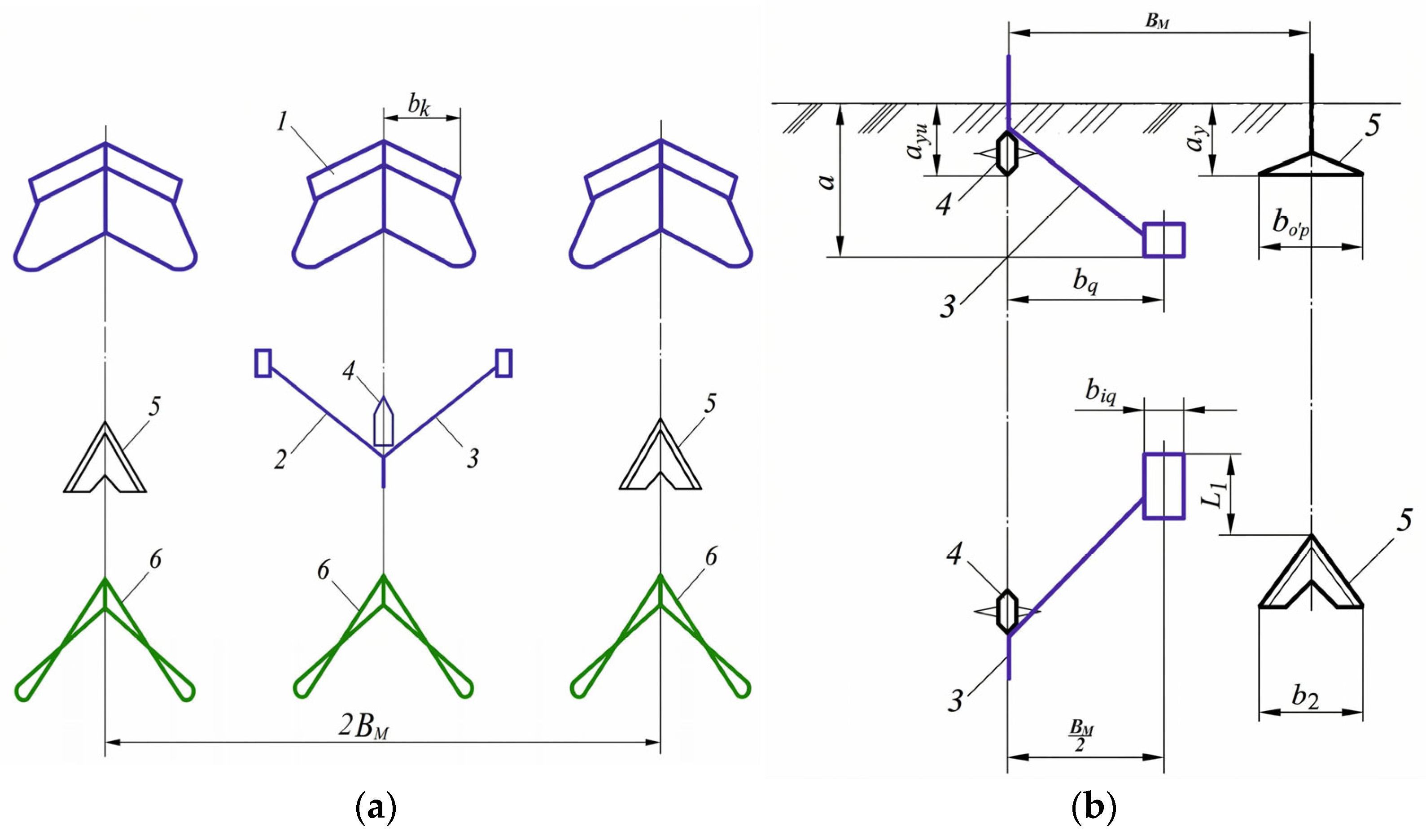
Figure 1.
Arrangement of the working elements of a combined soil preparation unit: (a) transverse arrangement of residue-fragmenting, soil loosening, and ridge-forming elements along the working width BM; (b) geometric parameters and relative positioning of the working elements in the longitudinal plane.
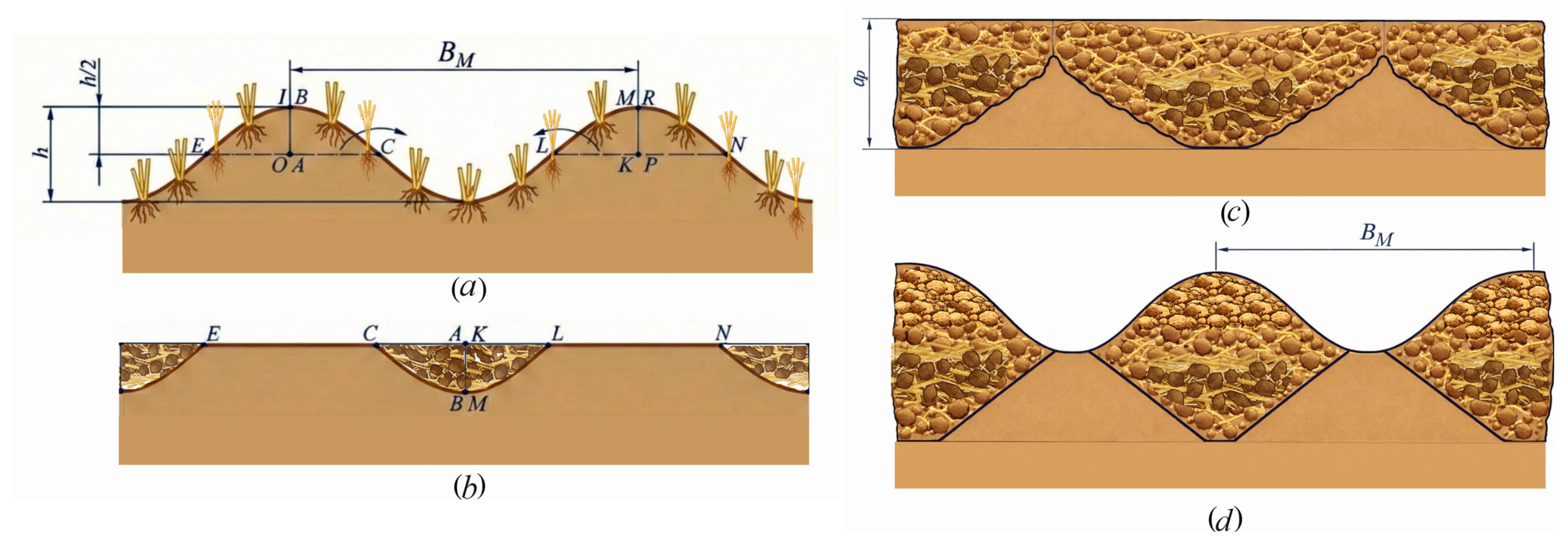
Figure 1.
Arrangement of the working elements of a combined soil preparation unit: (a) transverse arrangement of residue-fragmenting, soil loosening, and ridge-forming elements along the working width BM; (b) geometric parameters and relative positioning of the working elements in the longitudinal plane.
Figure 2.
Schematic illustration of ridge formation in operation of combined soil preparation system: (a) changing soil surface profile at the time of ridge formation; (b) redistribution of soil at working width BM; (c) initial state of the soil surface prior to processing; (d) formation profile of the ridge with incorporated plant residues.
Figure 2.
Schematic illustration of ridge formation in operation of combined soil preparation system: (a) changing soil surface profile at the time of ridge formation; (b) redistribution of soil at working width BM; (c) initial state of the soil surface prior to processing; (d) formation profile of the ridge with incorporated plant residues.
Figure 3.
Parameters of the chisel-type loosener with wings: (a) rear view; (b) top view, where 1 denotes the chisel, and 2 denotes the wing elements of the loosener.
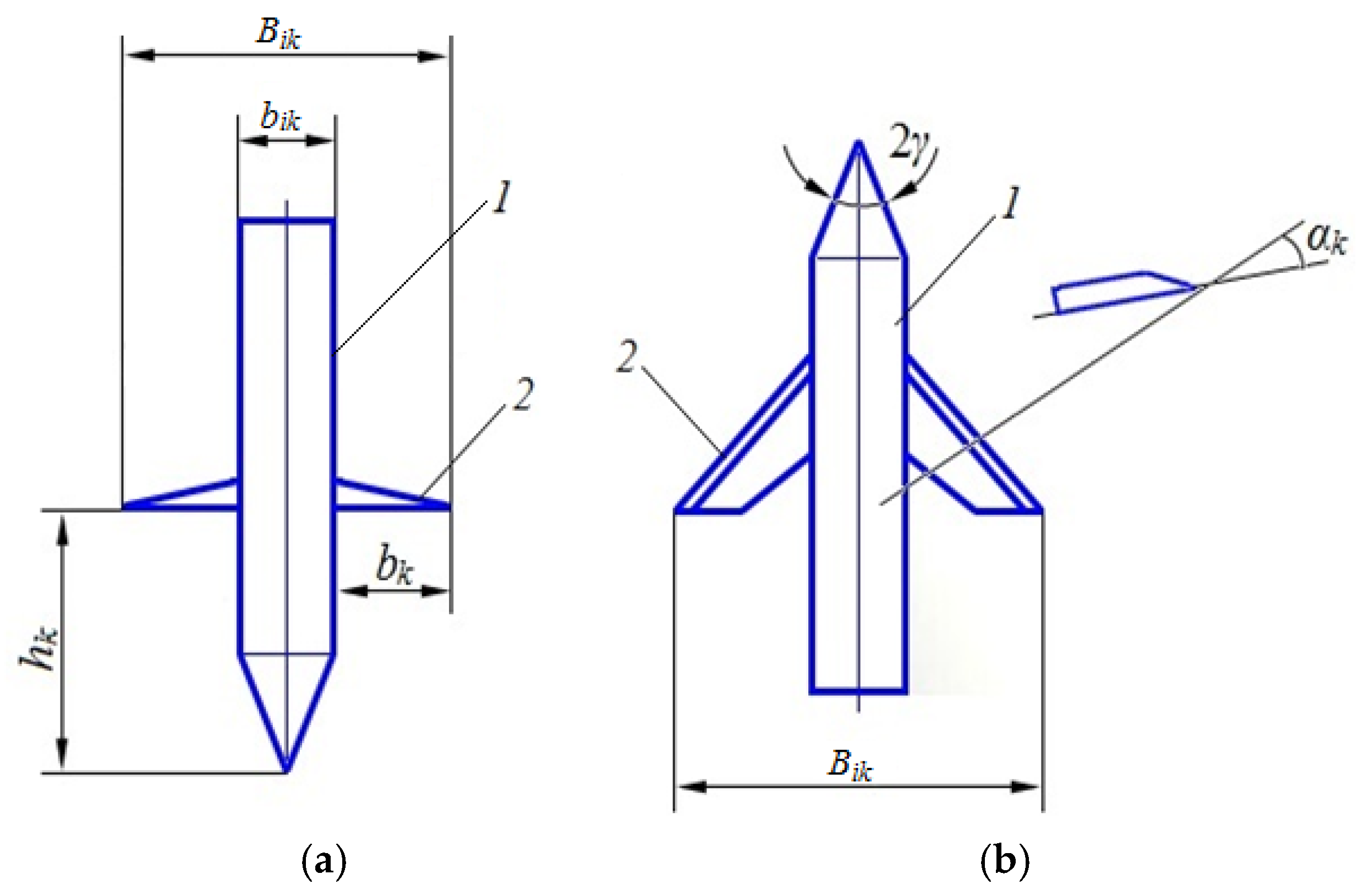
Figure 3.
Parameters of the chisel-type loosener with wings: (a) rear view; (b) top view, where 1 denotes the chisel, and 2 denotes the wing elements of the loosener.
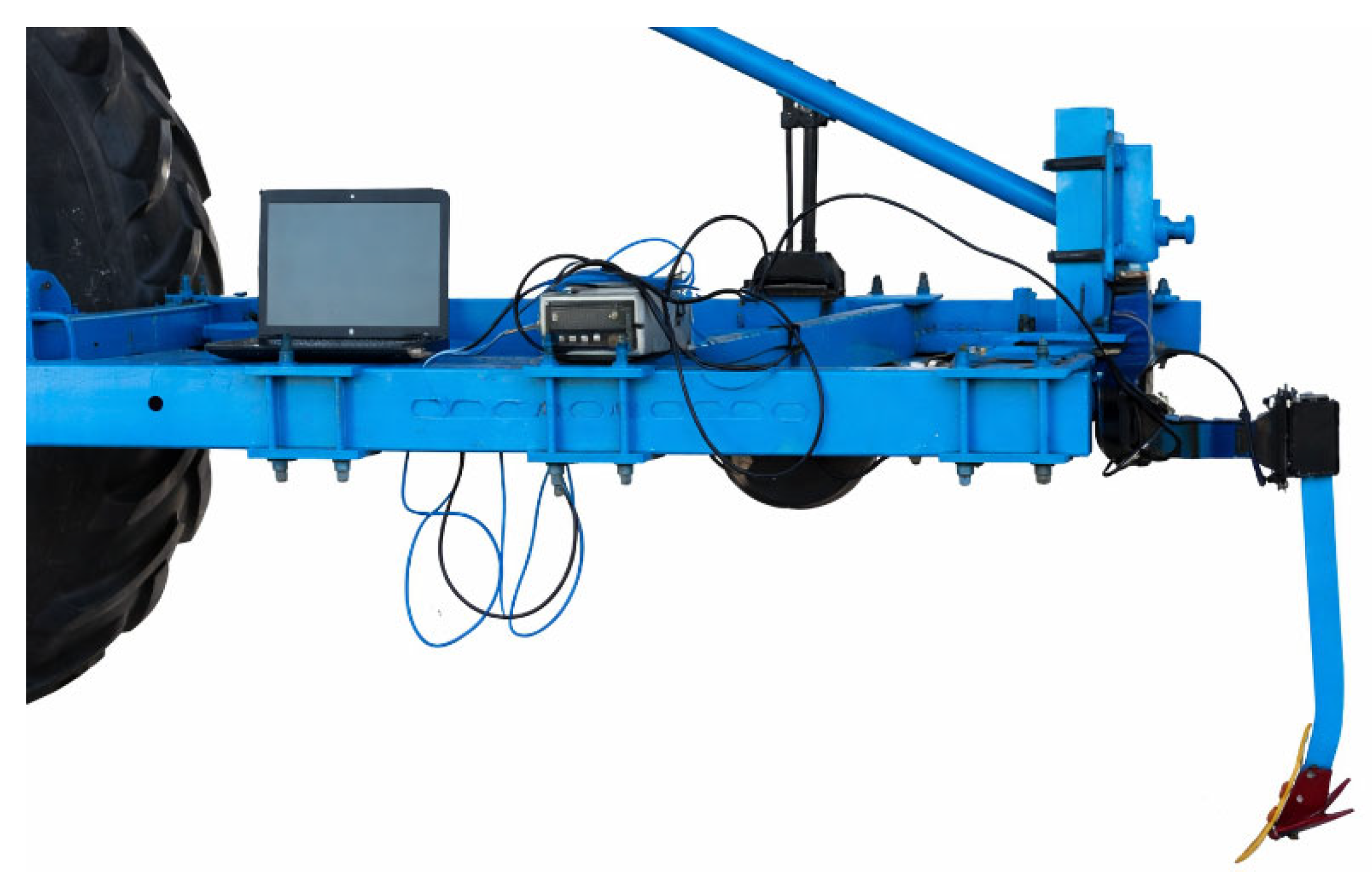
Figure 4.
General view of the laboratory–field test facility.
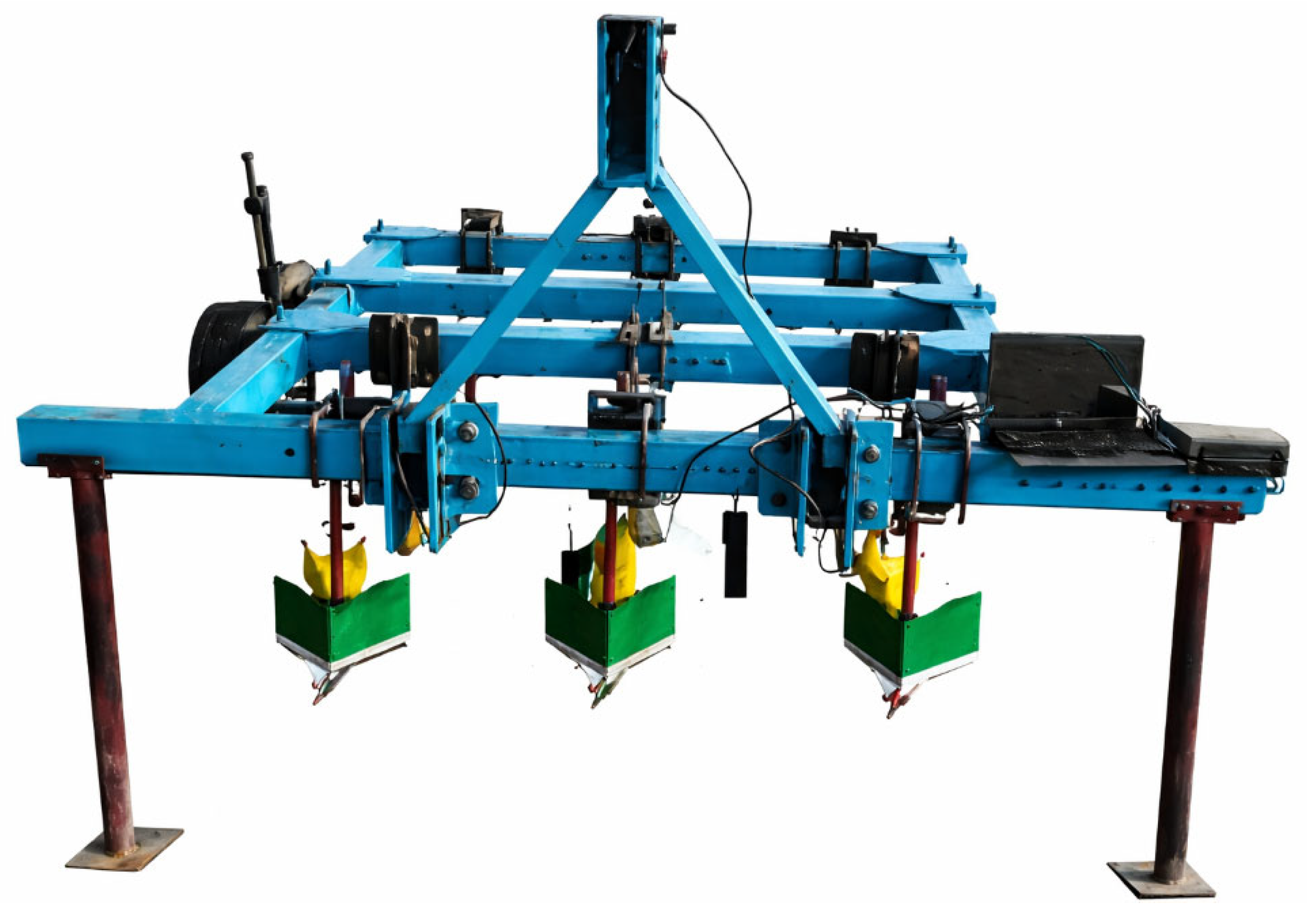
Figure 4.
General view of the laboratory–field test facility.
Figure 5.
Installation of the L-shaped strain-gauge beam on the laboratory–field test facility for determining the draft resistance of the subsoiler.
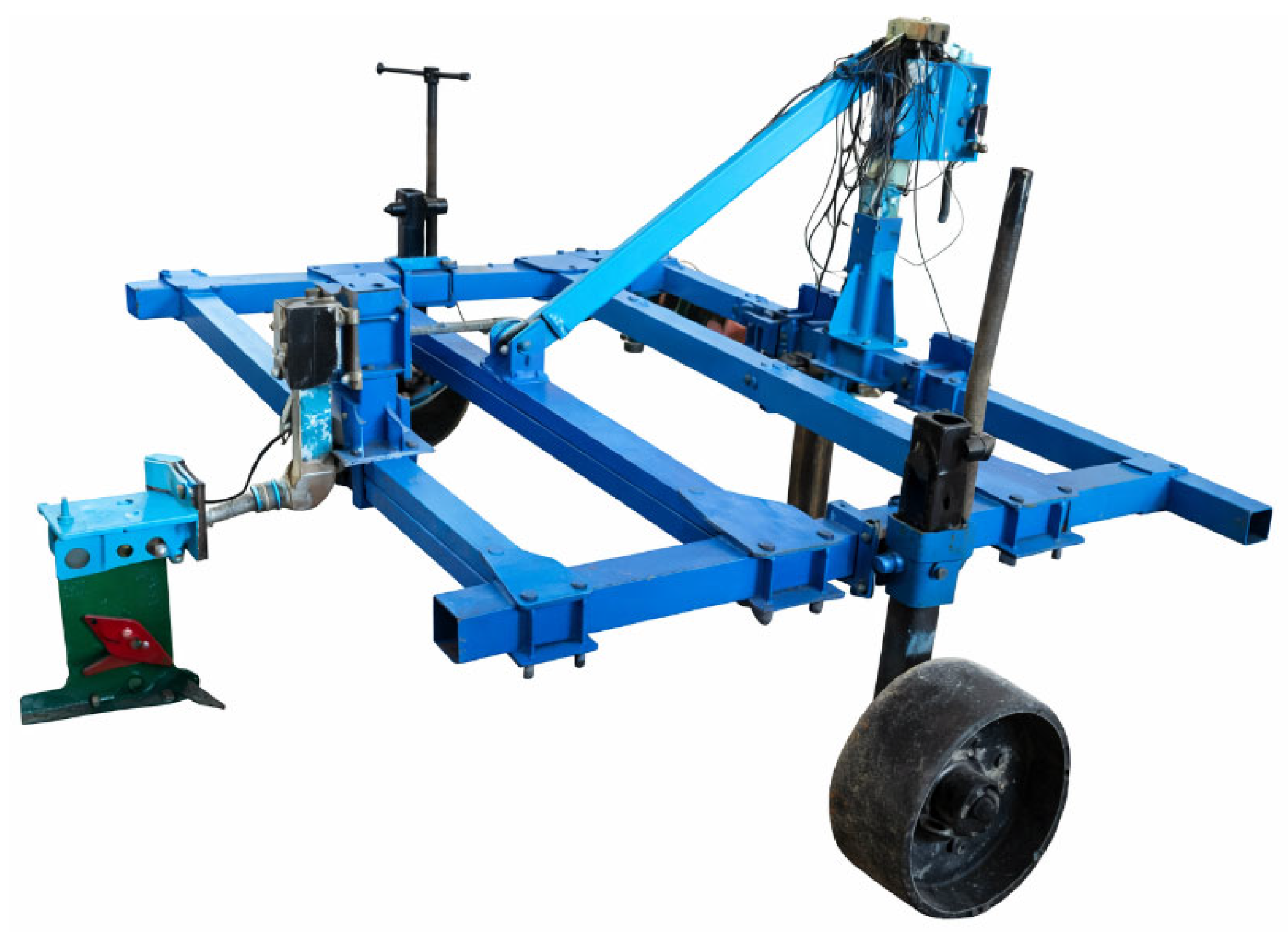
Figure 5.
Installation of the L-shaped strain-gauge beam on the laboratory–field test facility for determining the draft resistance of the subsoiler.
Figure 6.
Measurement of the draft resistance of the chisel-type loosener with wings using the L-shaped strain-gauge beam.
Figure 6.
Measurement of the draft resistance of the chisel-type loosener with wings using the L-shaped strain-gauge beam.
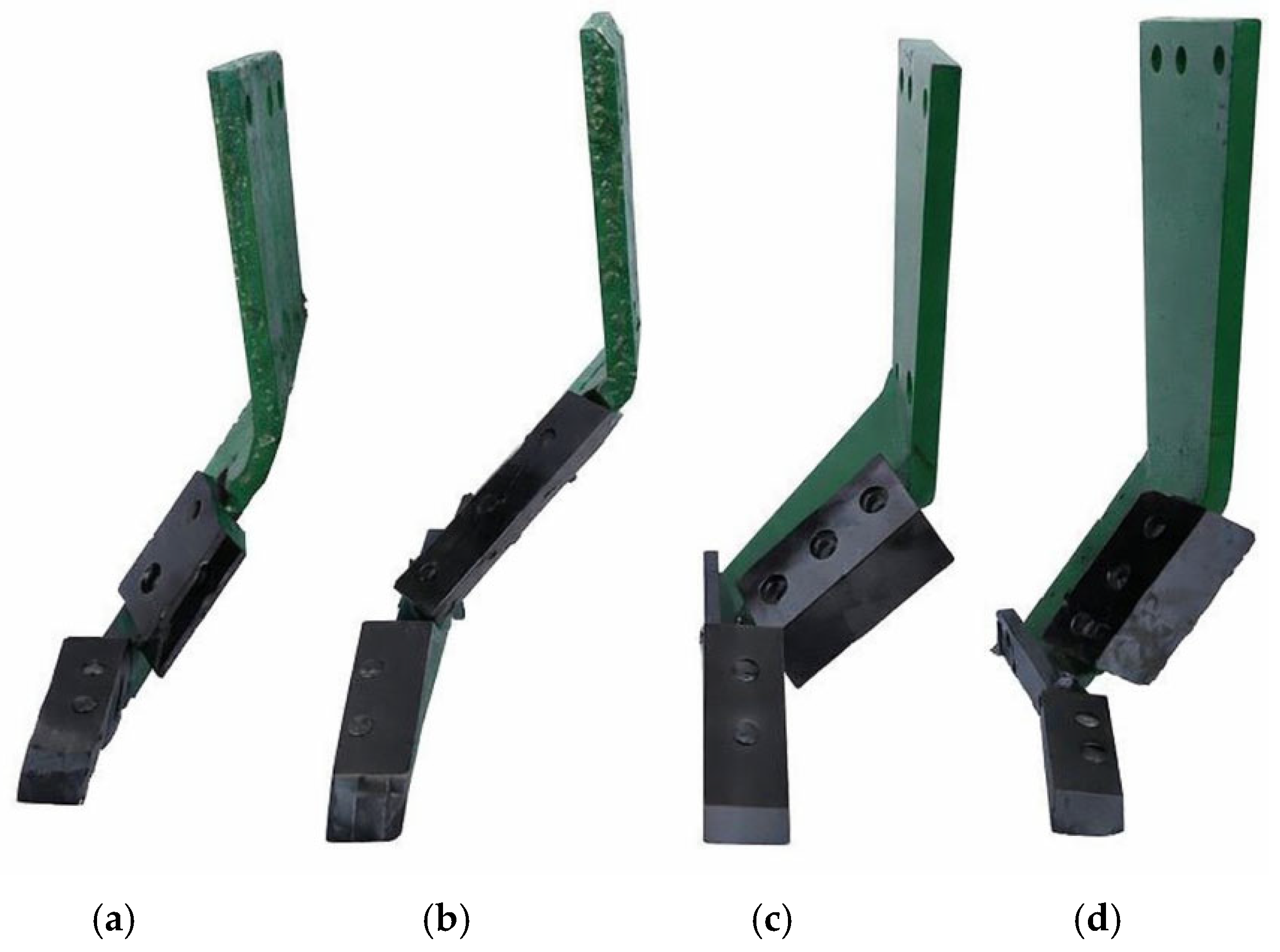
Figure 7.
Subsoilers with different working widths: (a) 22 cm; (b) 26 cm; (c) 30 cm; (d) 34 cm.
Figure 7.
Subsoilers with different working widths: (a) 22 cm; (b) 26 cm; (c) 30 cm; (d) 34 cm.
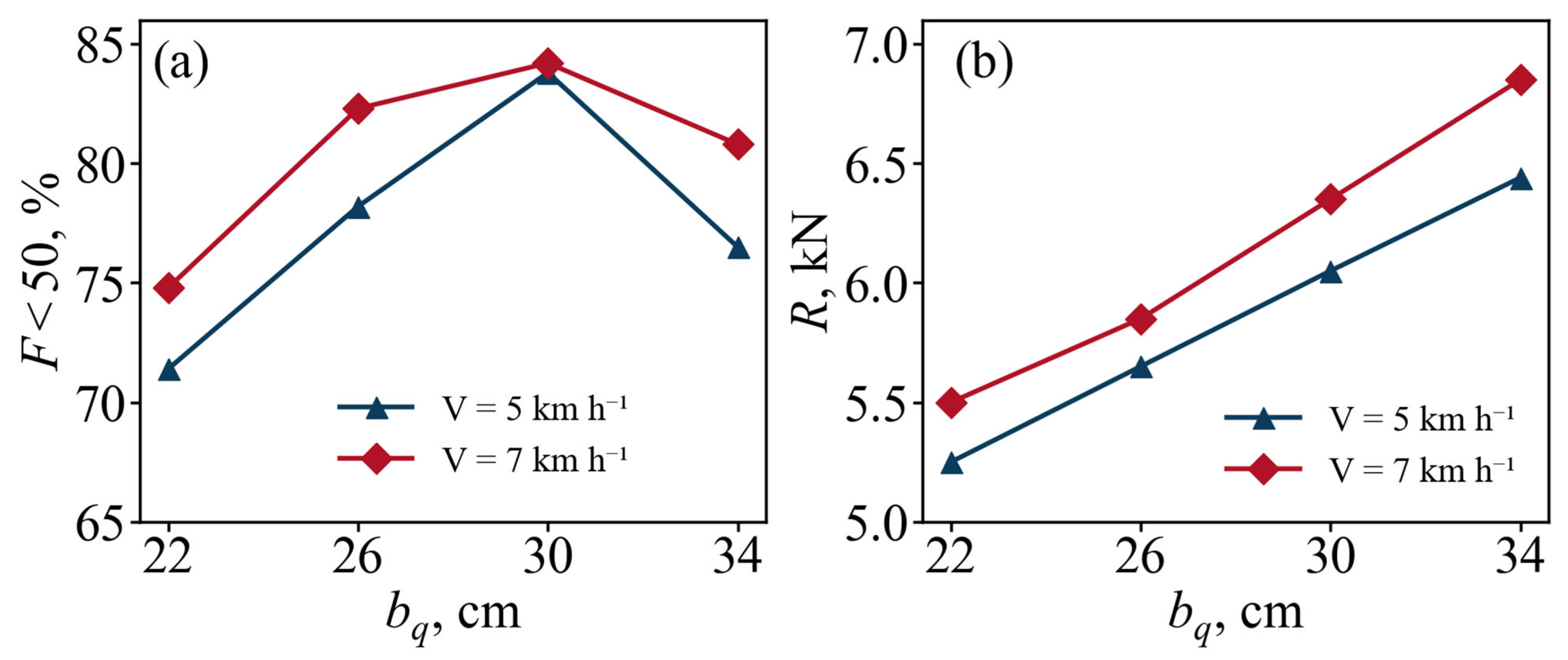
Figure 8.
Dependence of soil fragmentation degree (F < 50%) and draft resistance of the inclined-shank subsoiler on its working width: (a) soil fragmentation degree; (b) draft resistance.
Figure 8.
Dependence of soil fragmentation degree (F < 50%) and draft resistance of the inclined-shank subsoiler on its working width: (a) soil fragmentation degree; (b) draft resistance.
Figure 9.
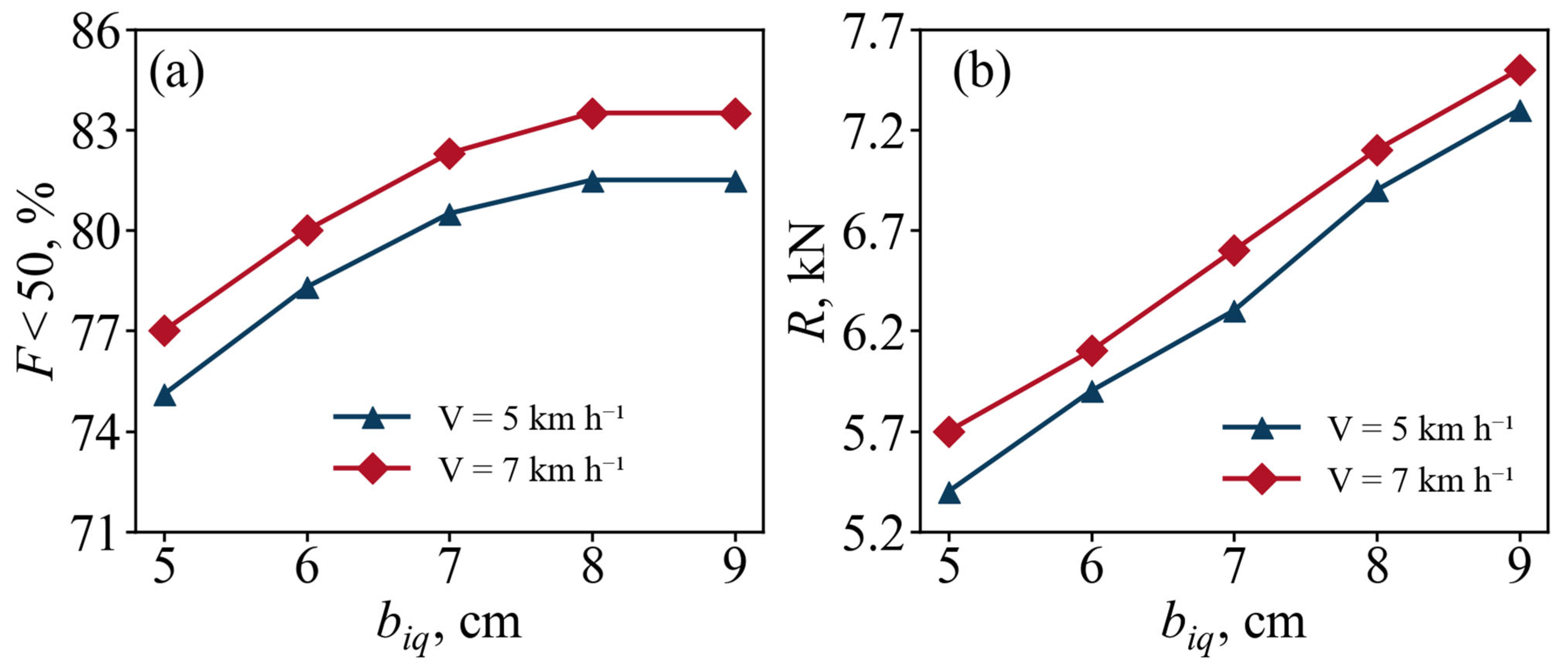
Dependence of the inclined-shank subsoiler performance on the chisel width (biq): (a) soil fragmentation degree (F < 50%); (b) draft resistance (R).
Figure 9.
Dependence of the inclined-shank subsoiler performance on the chisel width (biq): (a) soil fragmentation degree (F < 50%); (b) draft resistance (R).
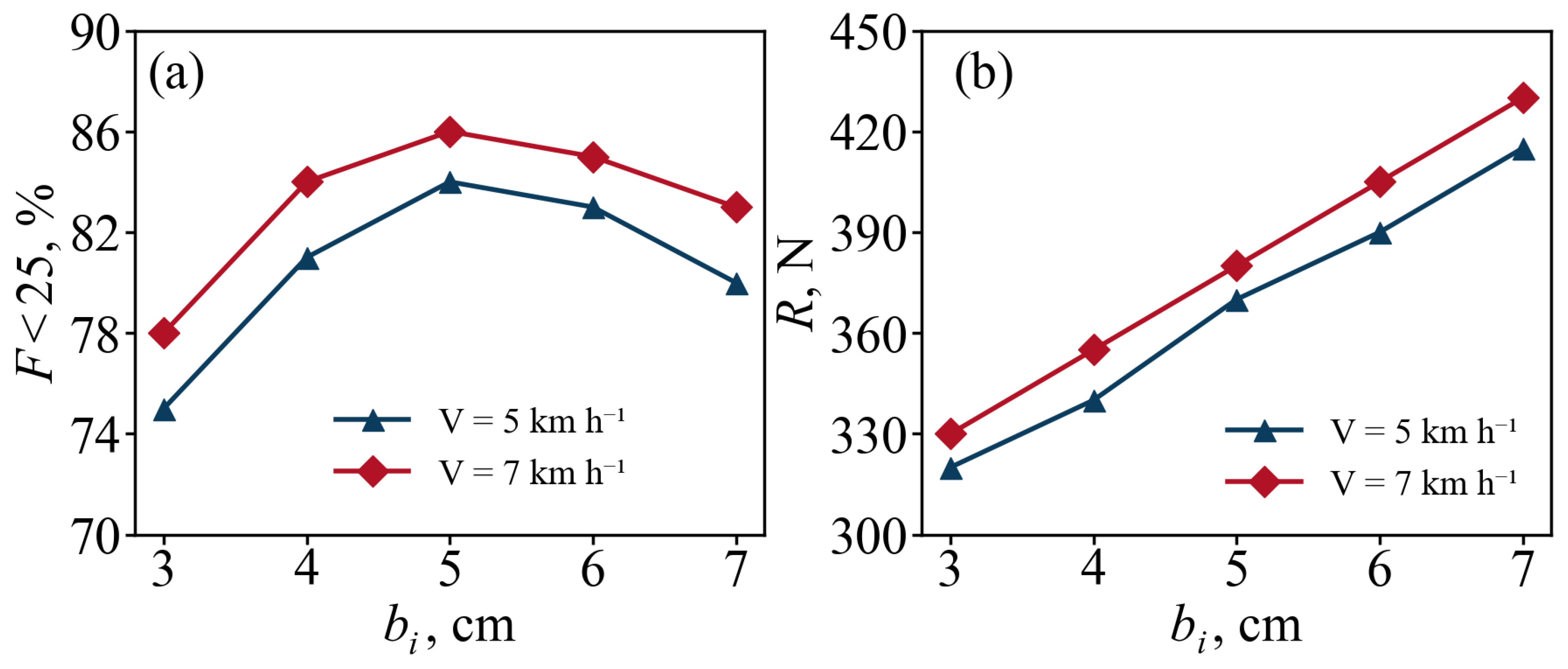
Figure 10.
Dependence of the winged sweep share performance on the chisel width (bi): (a) soil fragmentation degree (F < 25%); (b) draft resistance (R).
Figure 10.
Dependence of the winged sweep share performance on the chisel width (bi): (a) soil fragmentation degree (F < 25%); (b) draft resistance (R).
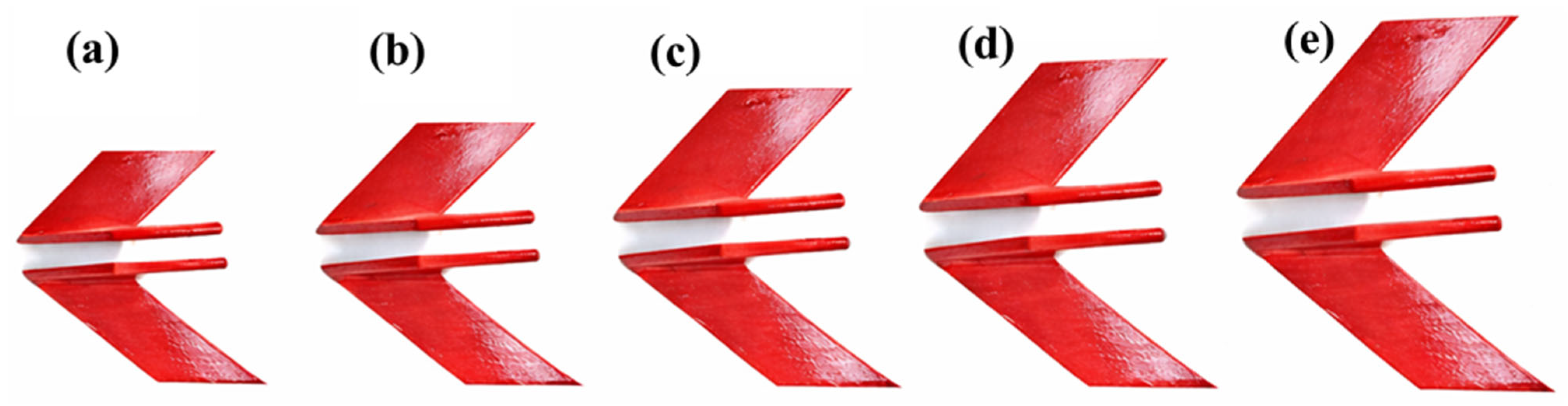
Figure 11.
Right and left wings of the sweep share with different working widths: (a) 120 mm; (b) 140 mm; (c) 160 mm; (d) 180 mm; (e) 200 mm.
Figure 11.
Right and left wings of the sweep share with different working widths: (a) 120 mm; (b) 140 mm; (c) 160 mm; (d) 180 mm; (e) 200 mm.
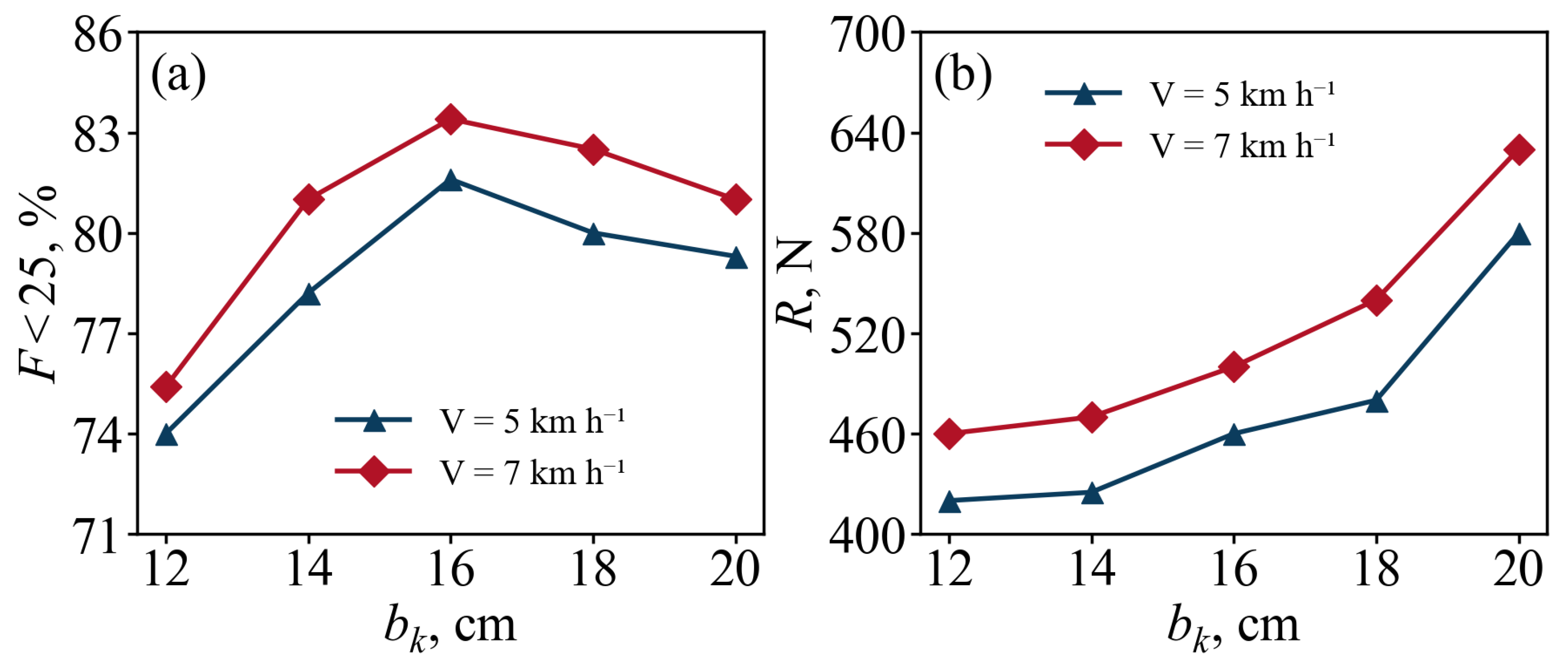
Figure 12.
Dependence of the winged sweep share performance on the wing working width bk: (a) soil fragmentation degree (F < 25%); (b) draft resistance.
Figure 12.
Dependence of the winged sweep share performance on the wing working width bk: (a) soil fragmentation degree (F < 25%); (b) draft resistance.
Figure 13.
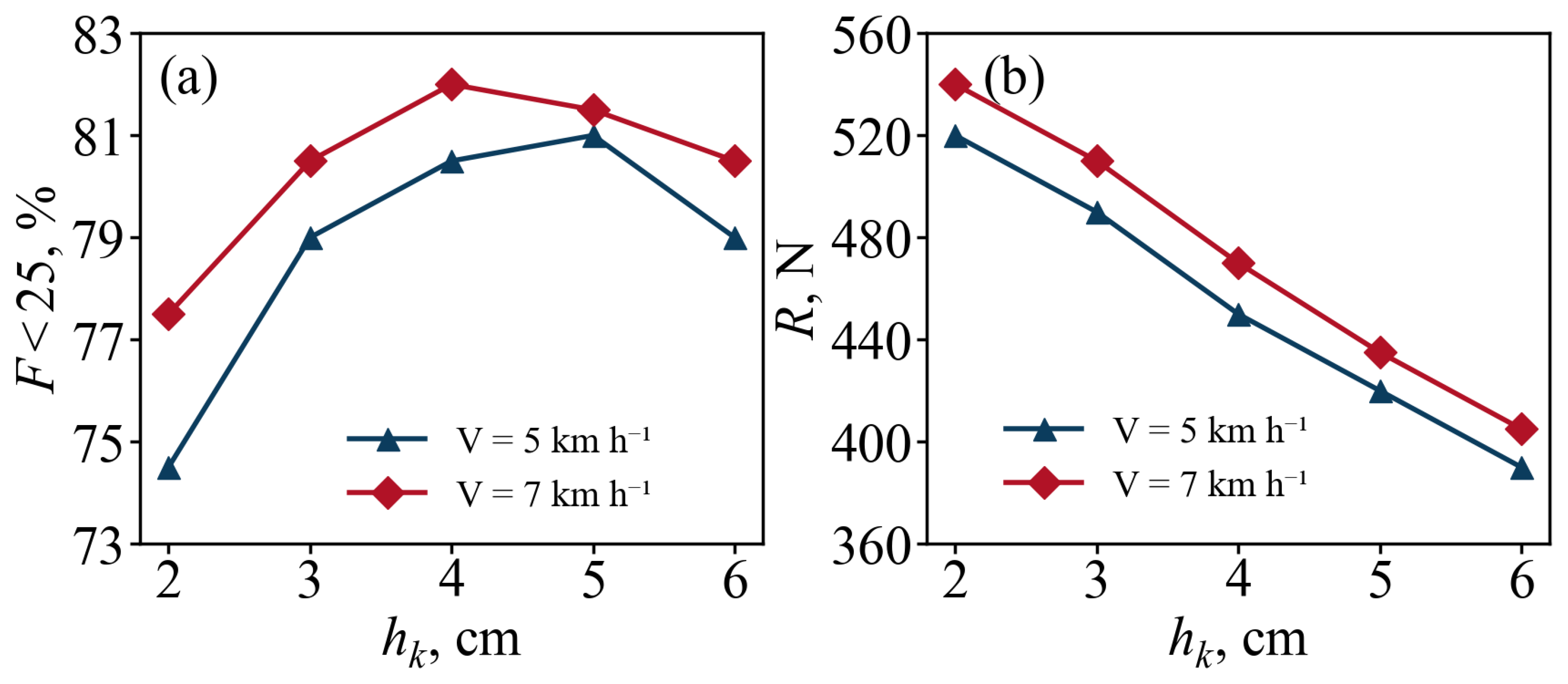
Influence of wing installation height hk relative to the chisel cutting edge on soil fragmentation degree and draft resistance of the winged sweep share: (a) soil fragmentation degree; (b) draft resistance.
Figure 13.
Influence of wing installation height hk relative to the chisel cutting edge on soil fragmentation degree and draft resistance of the winged sweep share: (a) soil fragmentation degree; (b) draft resistance.
Figure 14.
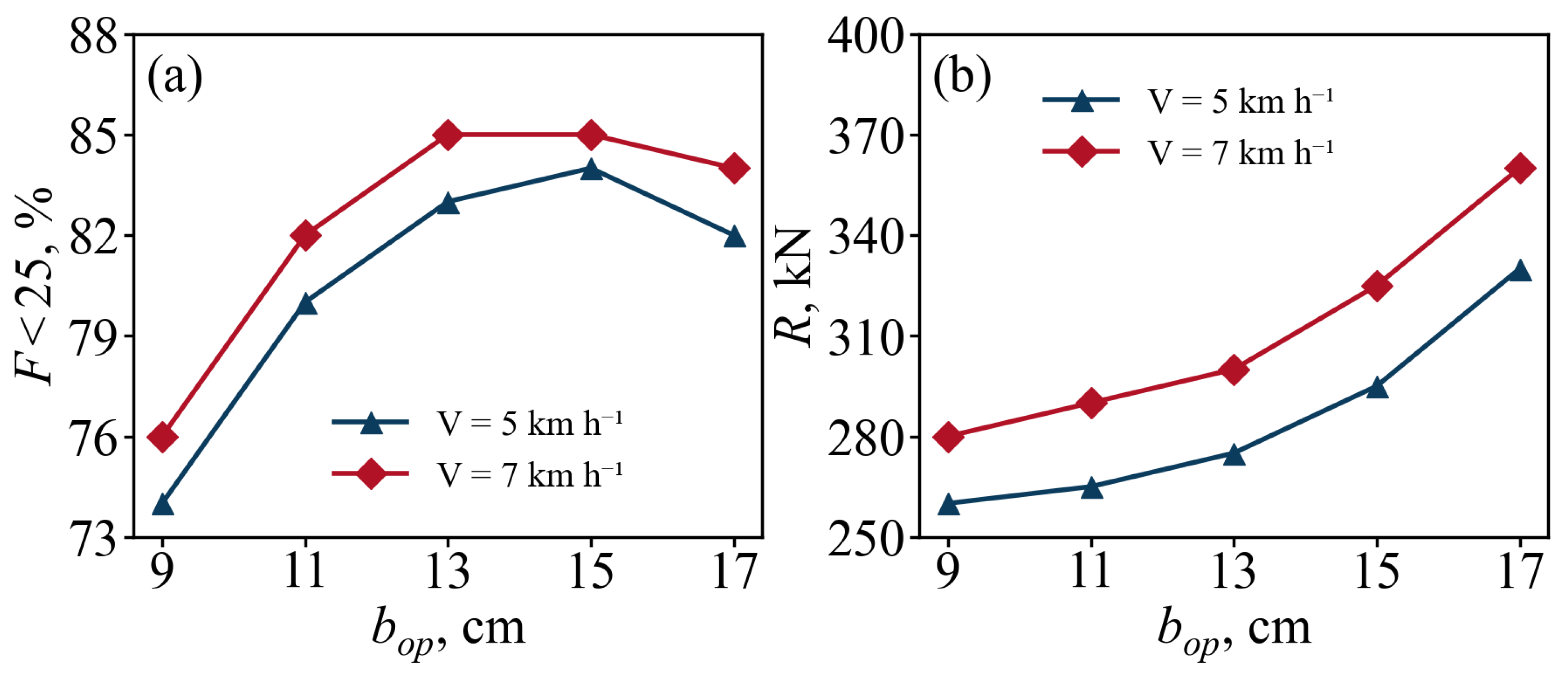
Influence of the working width of the sweep share bop on soil fragmentation degree and its draft resistance: (a) soil fragmentation degree; (b) draft resistance.
Figure 14.
Influence of the working width of the sweep share bop on soil fragmentation degree and its draft resistance: (a) soil fragmentation degree; (b) draft resistance.
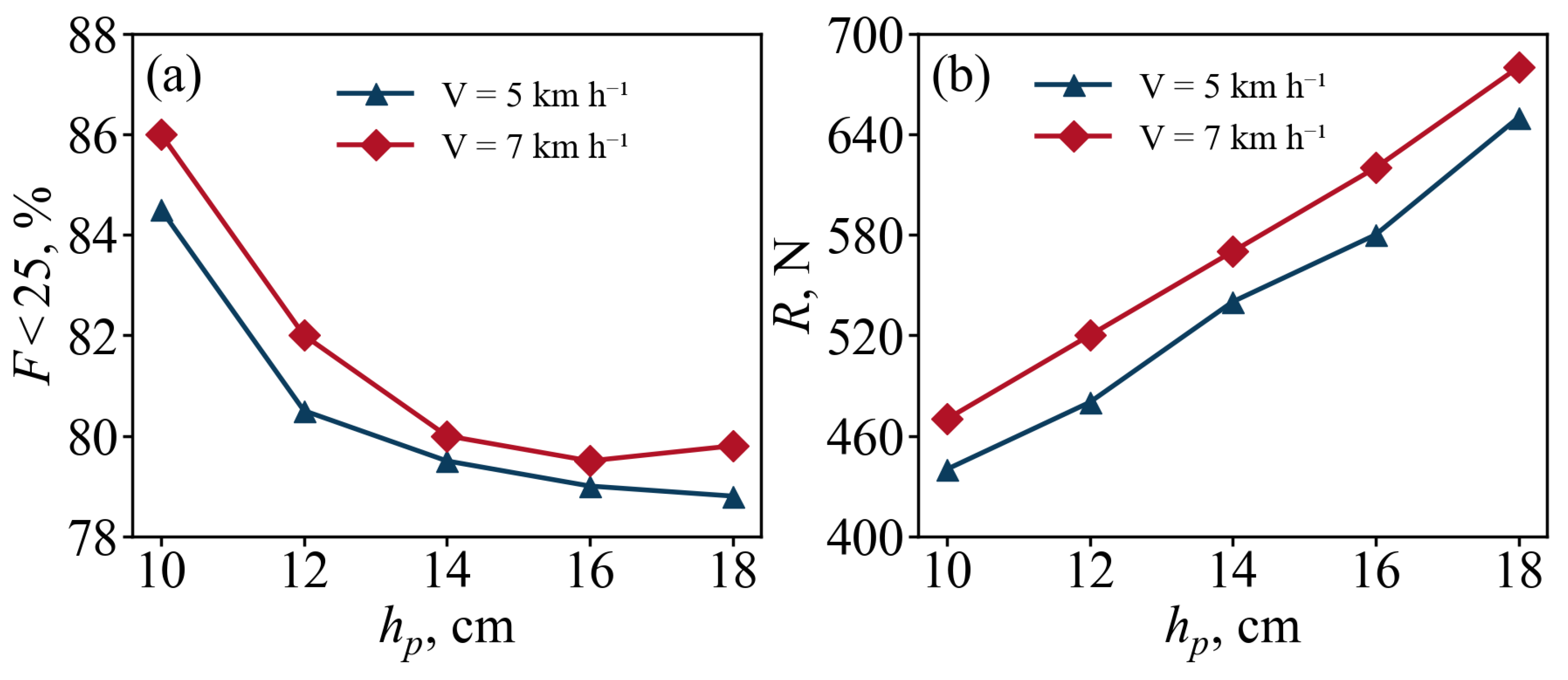
Figure 15.
Influence of sweep share operating depth on soil fragmentation degree and its draft resistance: (a) soil fragmentation degree; (b) draft resistance.
Figure 15.
Influence of sweep share operating depth on soil fragmentation degree and its draft resistance: (a) soil fragmentation degree; (b) draft resistance.
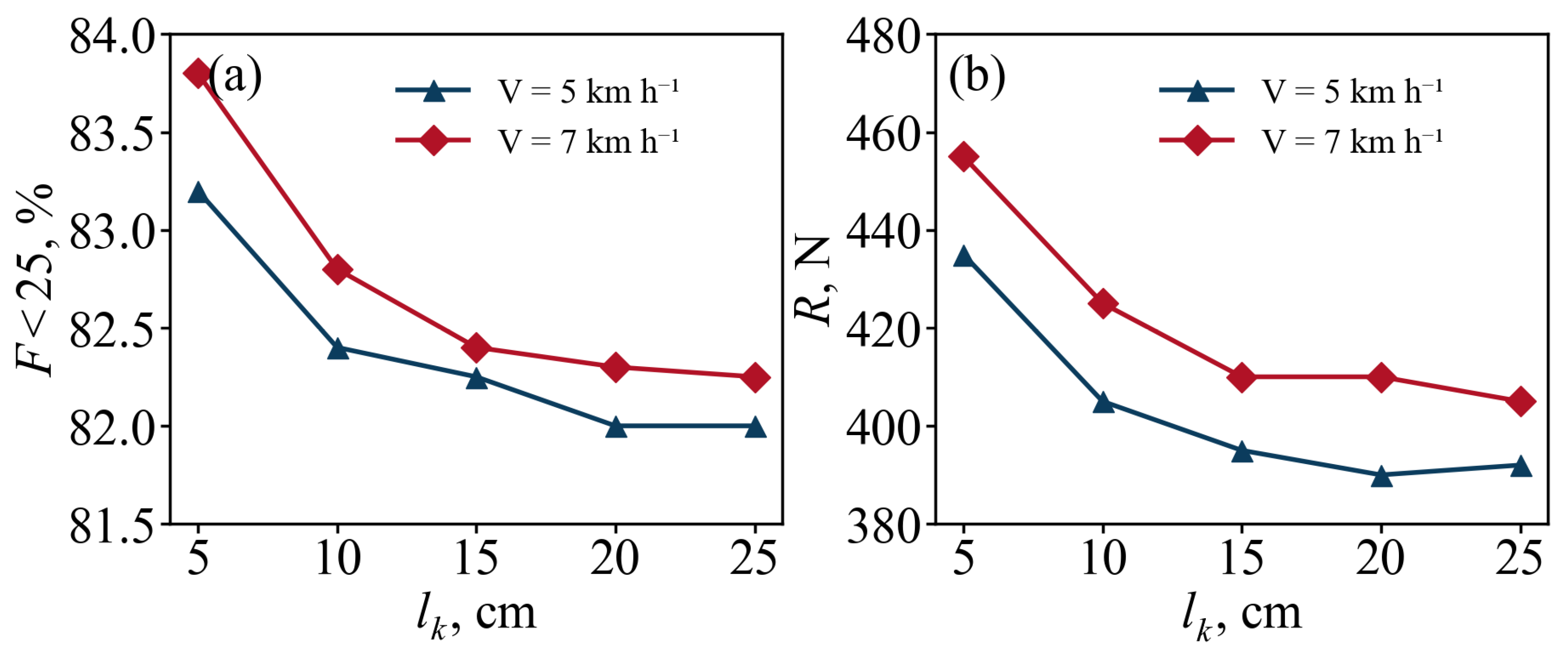
Figure 16.
Dependence of soil fragmentation degree (F < 25%) and draft resistance of the winged sweep share on the longitudinal distance between the subsoiler shank and the sweep share: (a) soil fragmentation degree; (b) draft resistance.
Figure 16.
Dependence of soil fragmentation degree (F < 25%) and draft resistance of the winged sweep share on the longitudinal distance between the subsoiler shank and the sweep share: (a) soil fragmentation degree; (b) draft resistance.
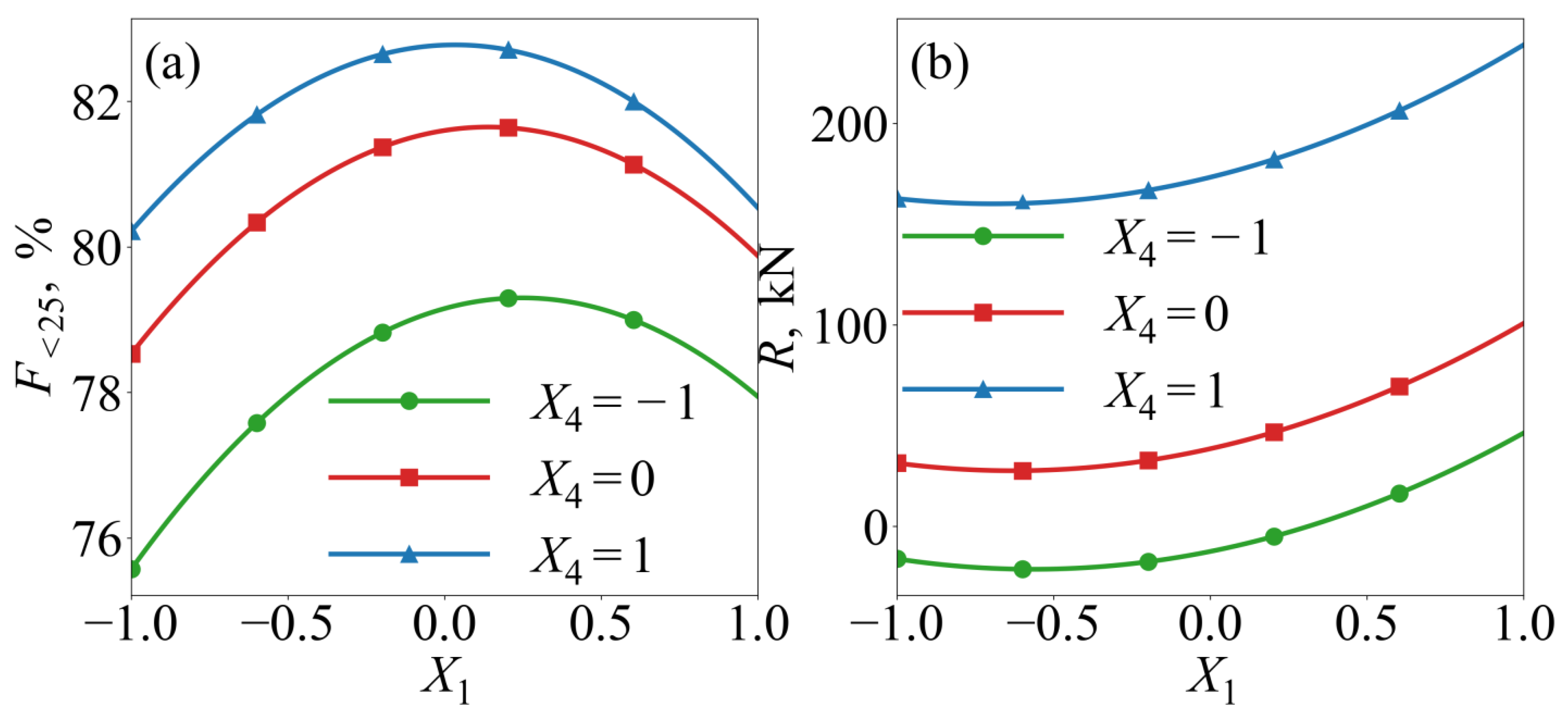
Figure 17.
Influence of factor X1 on soil fragmentation degree and draft resistance of the chisel-type loosener with wings: (a) soil fragmentation degree; (b) draft resistance.
Figure 17.
Influence of factor X1 on soil fragmentation degree and draft resistance of the chisel-type loosener with wings: (a) soil fragmentation degree; (b) draft resistance.
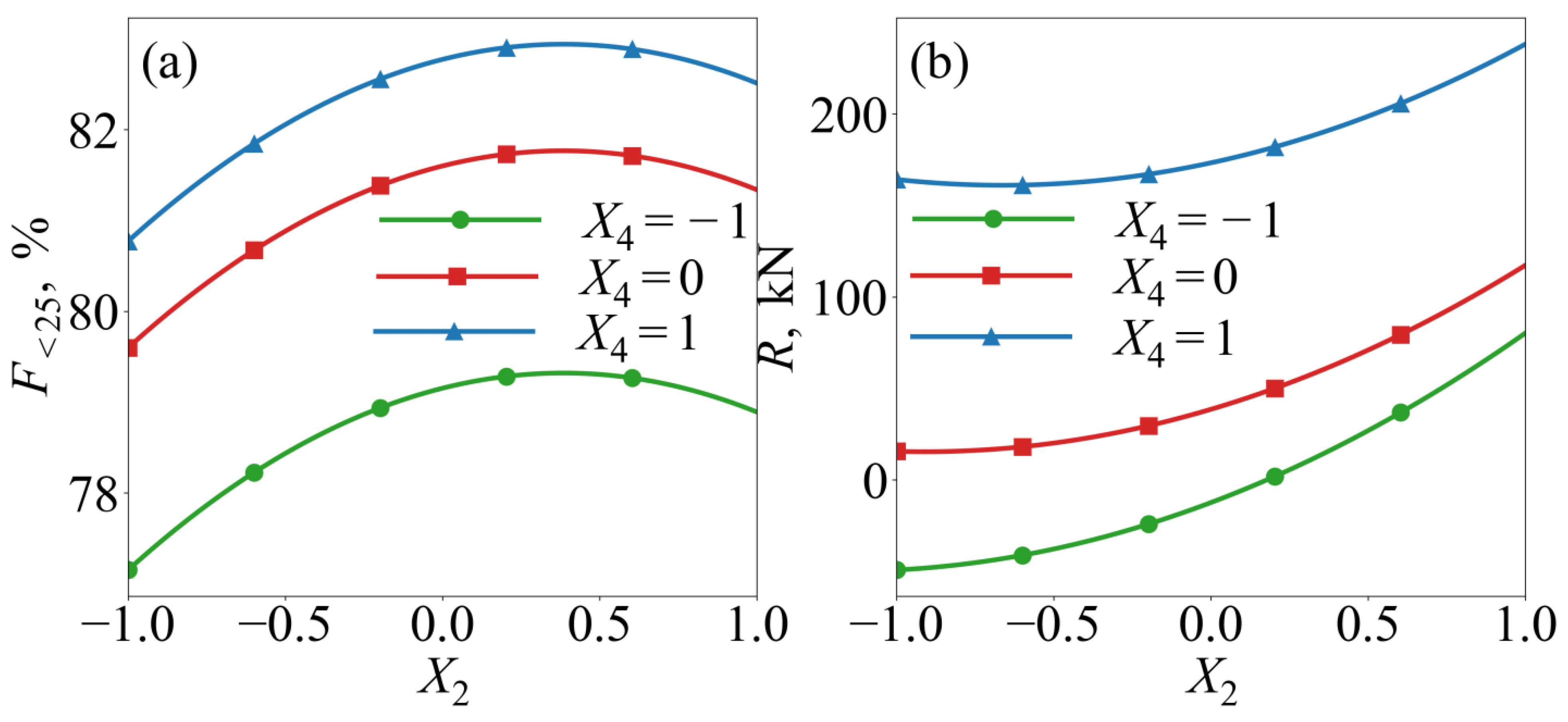
Figure 18.
Influence of factor X2 on soil fragmentation degree and draft resistance of the chisel-type loosener with wings: (a) soil fragmentation degree; (b) draft resistance.
Figure 18.
Influence of factor X2 on soil fragmentation degree and draft resistance of the chisel-type loosener with wings: (a) soil fragmentation degree; (b) draft resistance.
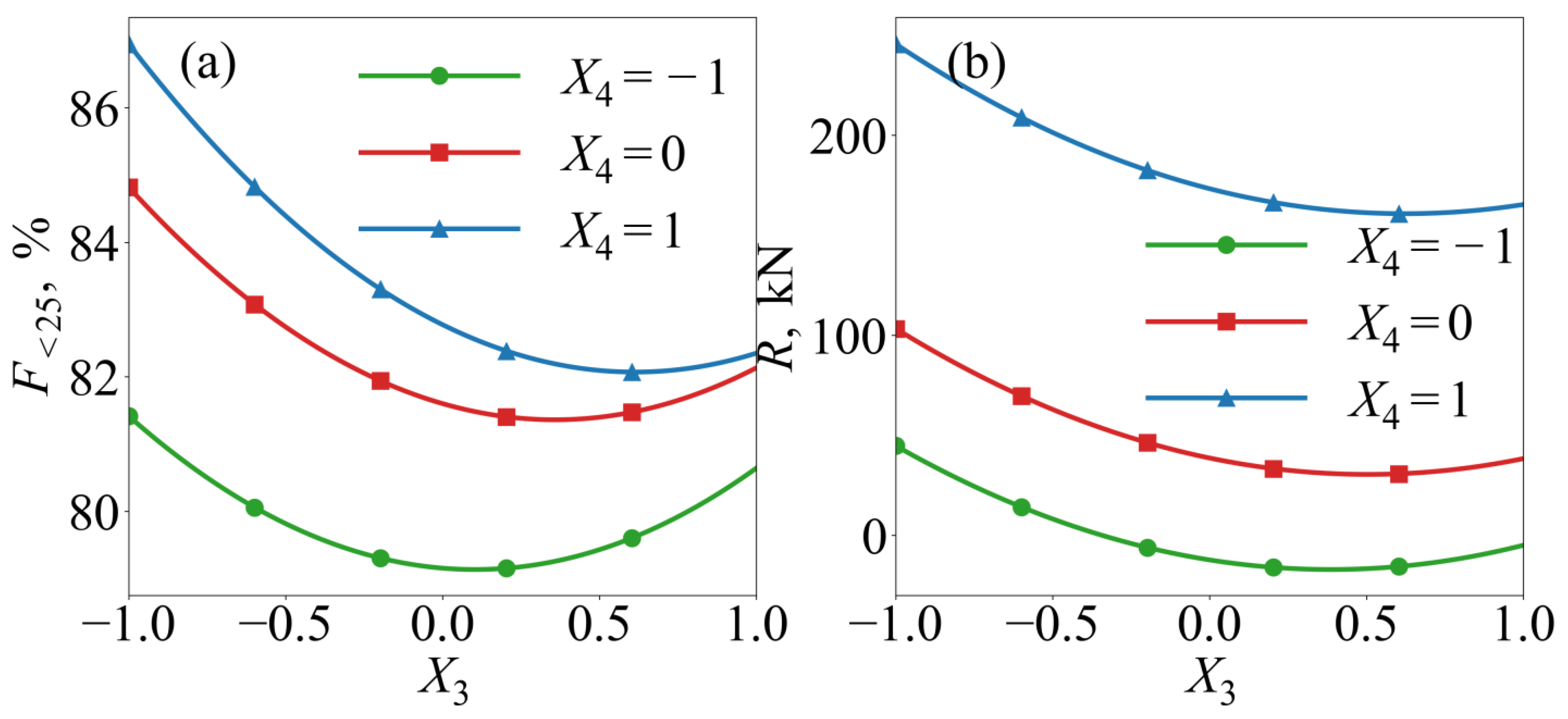
Figure 19.
Influence of factor X3 on soil fragmentation degree and draft resistance of the chisel-type loosener with wings: (a) soil fragmentation degree; (b) draft resistance.
Figure 19.
Influence of factor X3 on soil fragmentation degree and draft resistance of the chisel-type loosener with wings: (a) soil fragmentation degree; (b) draft resistance.
Figure 20.
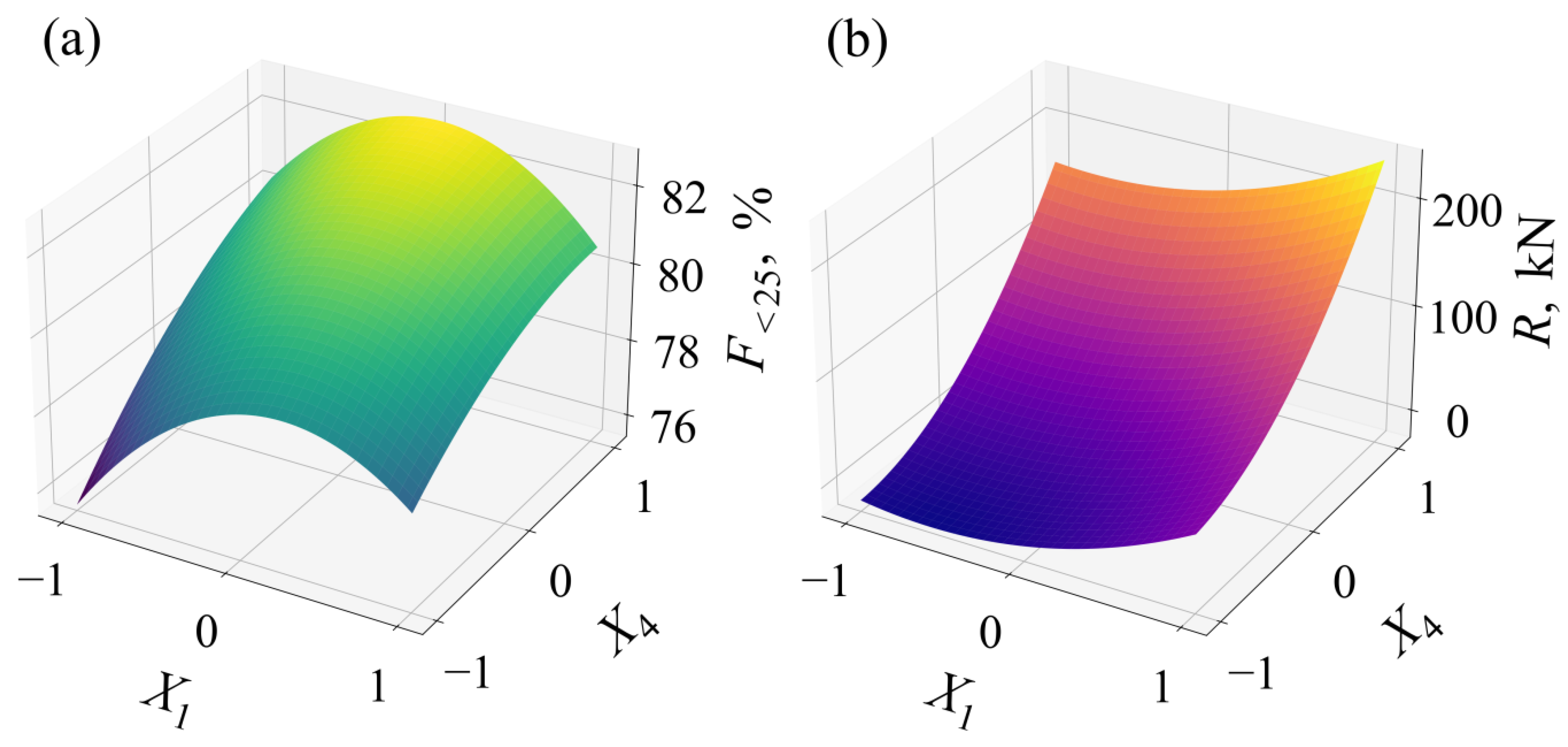
Three-dimensional response surfaces of the main performance indicators as functions of X1 and X4: (a) F < 25, % (Equation (33)); (b) R, kN (Equation (34)) at X2 = 0 and X3 = 0.
Figure 20.
Three-dimensional response surfaces of the main performance indicators as functions of X1 and X4: (a) F < 25, % (Equation (33)); (b) R, kN (Equation (34)) at X2 = 0 and X3 = 0.
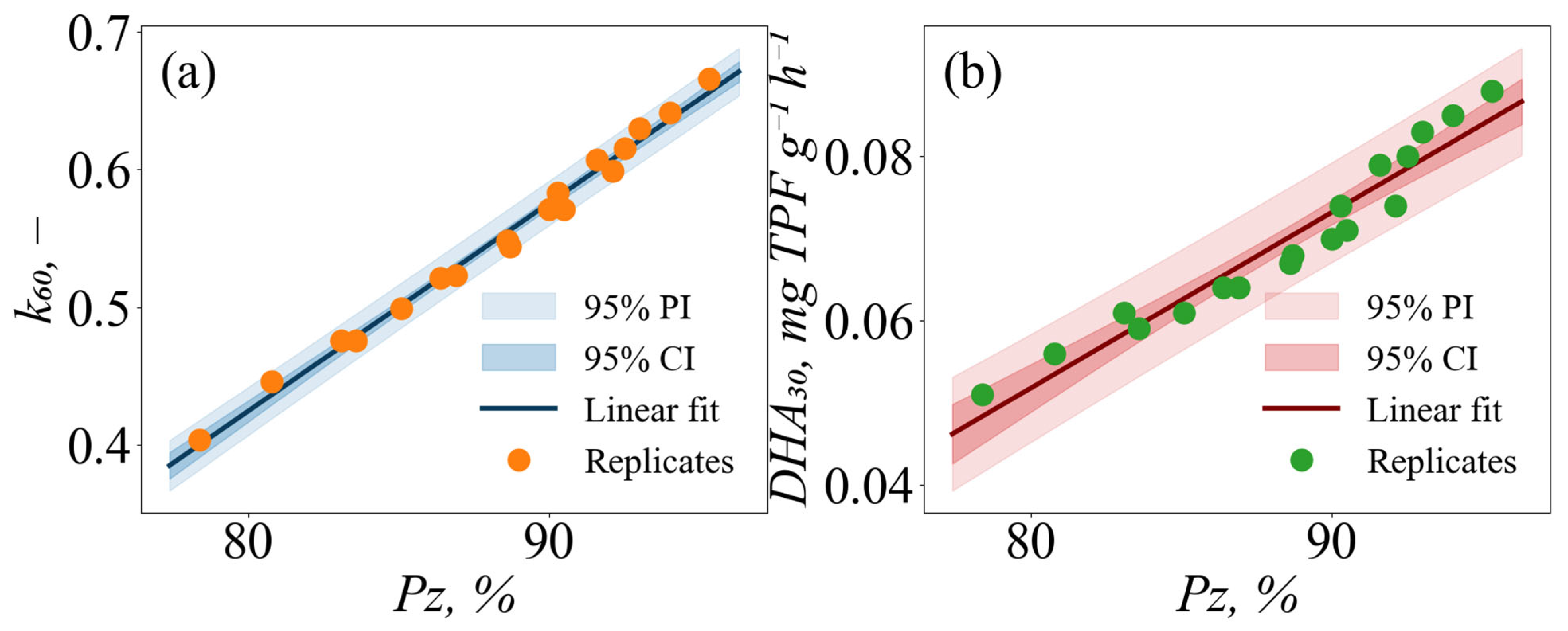
Figure 21.
Relationships between residue incorporation completeness (Pz) and (a) the biodegradation coefficient after 60 days (k60) and (b) dehydrogenase activity after 30 days (DHA30) under combined soil preparation.
Figure 21.
Relationships between residue incorporation completeness (Pz) and (a) the biodegradation coefficient after 60 days (k60) and (b) dehydrogenase activity after 30 days (DHA30) under combined soil preparation.
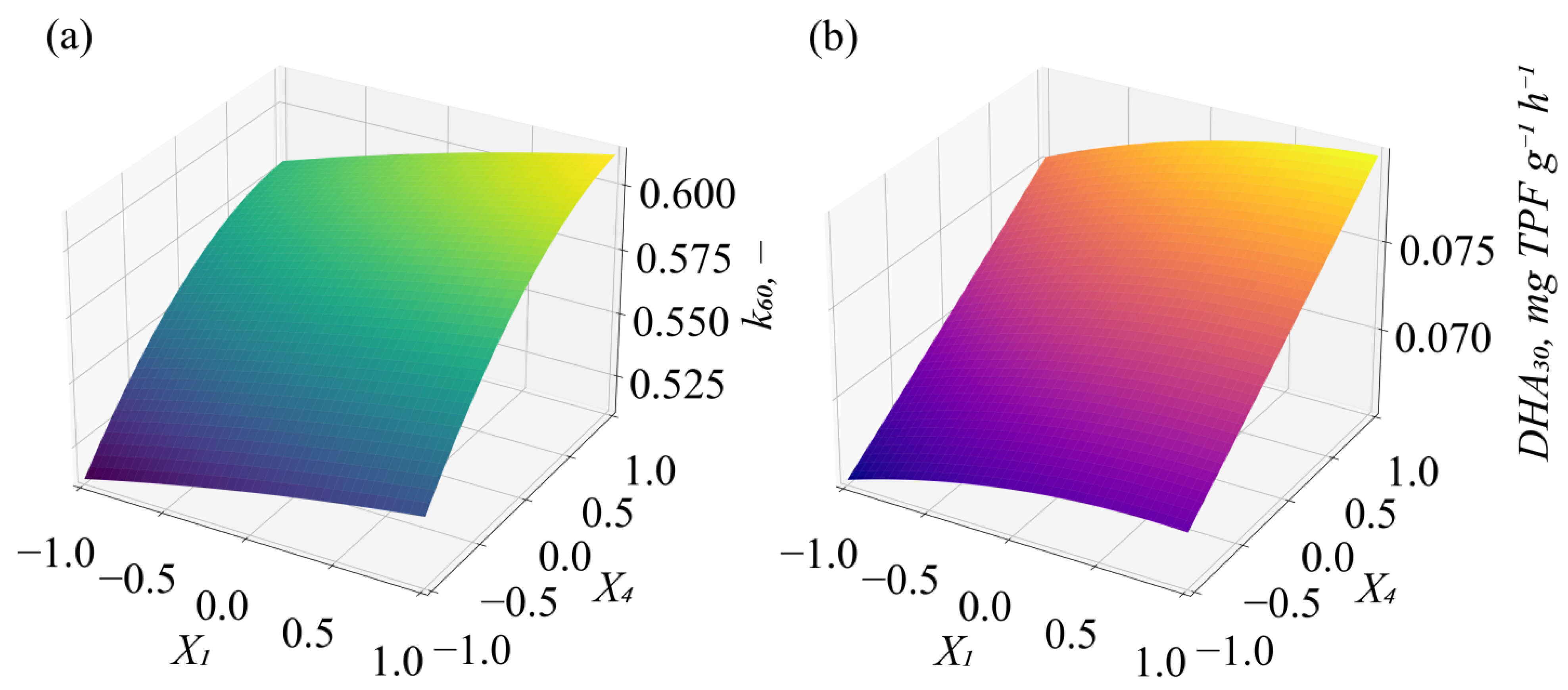
Figure 22.
Three-dimensional response surfaces of (a) the biodegradation coefficient after 60 days (k60) and (b) dehydrogenase activity after 30 days (DHA30) as functions of the coded factors X1 (chisel width) and X4 (operating speed) at the central levels of X2 and X3, obtained from the regression models (35) and (36).
Figure 22.
Three-dimensional response surfaces of (a) the biodegradation coefficient after 60 days (k60) and (b) dehydrogenase activity after 30 days (DHA30) as functions of the coded factors X1 (chisel width) and X4 (operating speed) at the central levels of X2 and X3, obtained from the regression models (35) and (36).
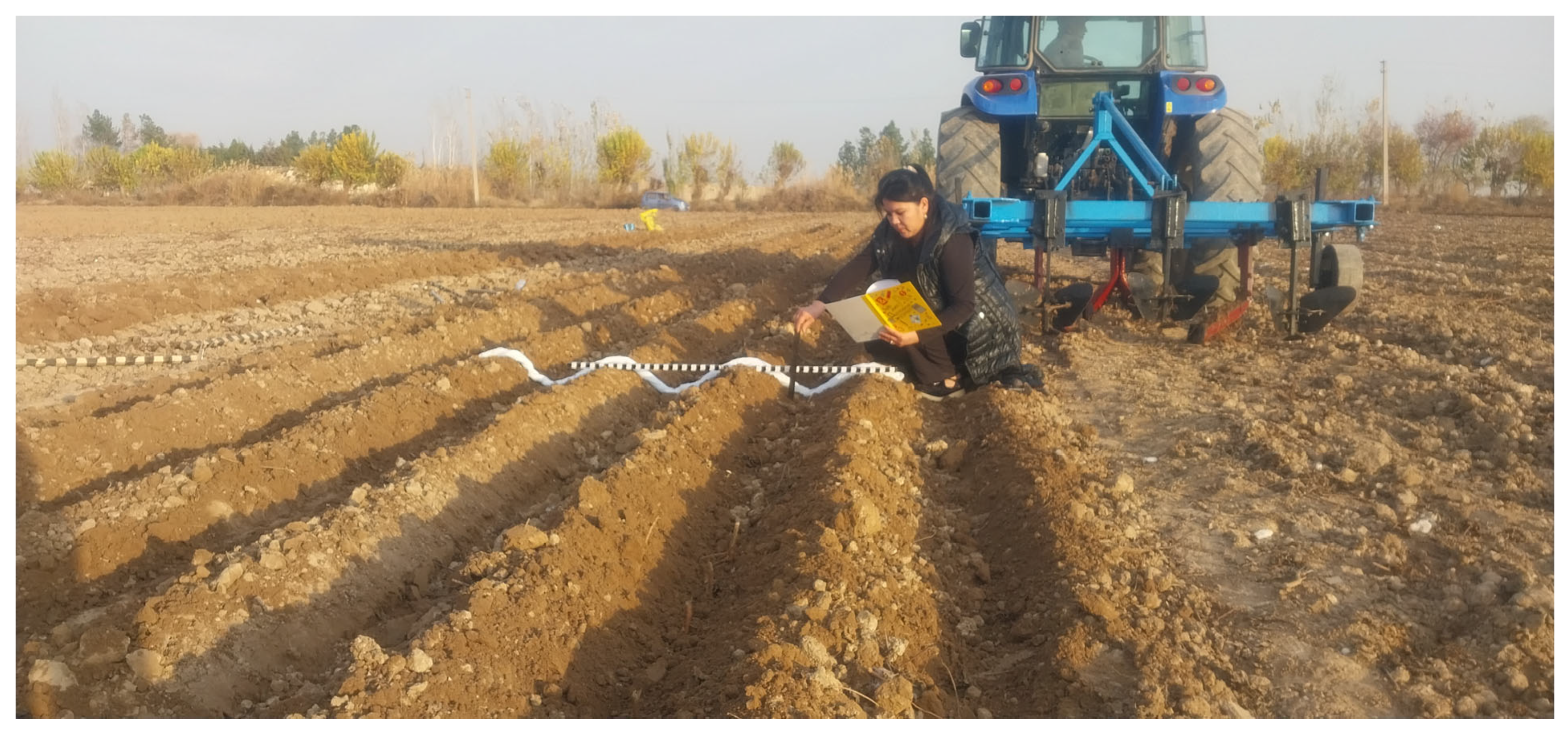
Figure 23.
In situ procedure for verification of ridge geometry during the field validation trials: recording of the transverse ridge profile using a flexible profile gauge immediately after machine operation.
Figure 23.
In situ procedure for verification of ridge geometry during the field validation trials: recording of the transverse ridge profile using a flexible profile gauge immediately after machine operation.
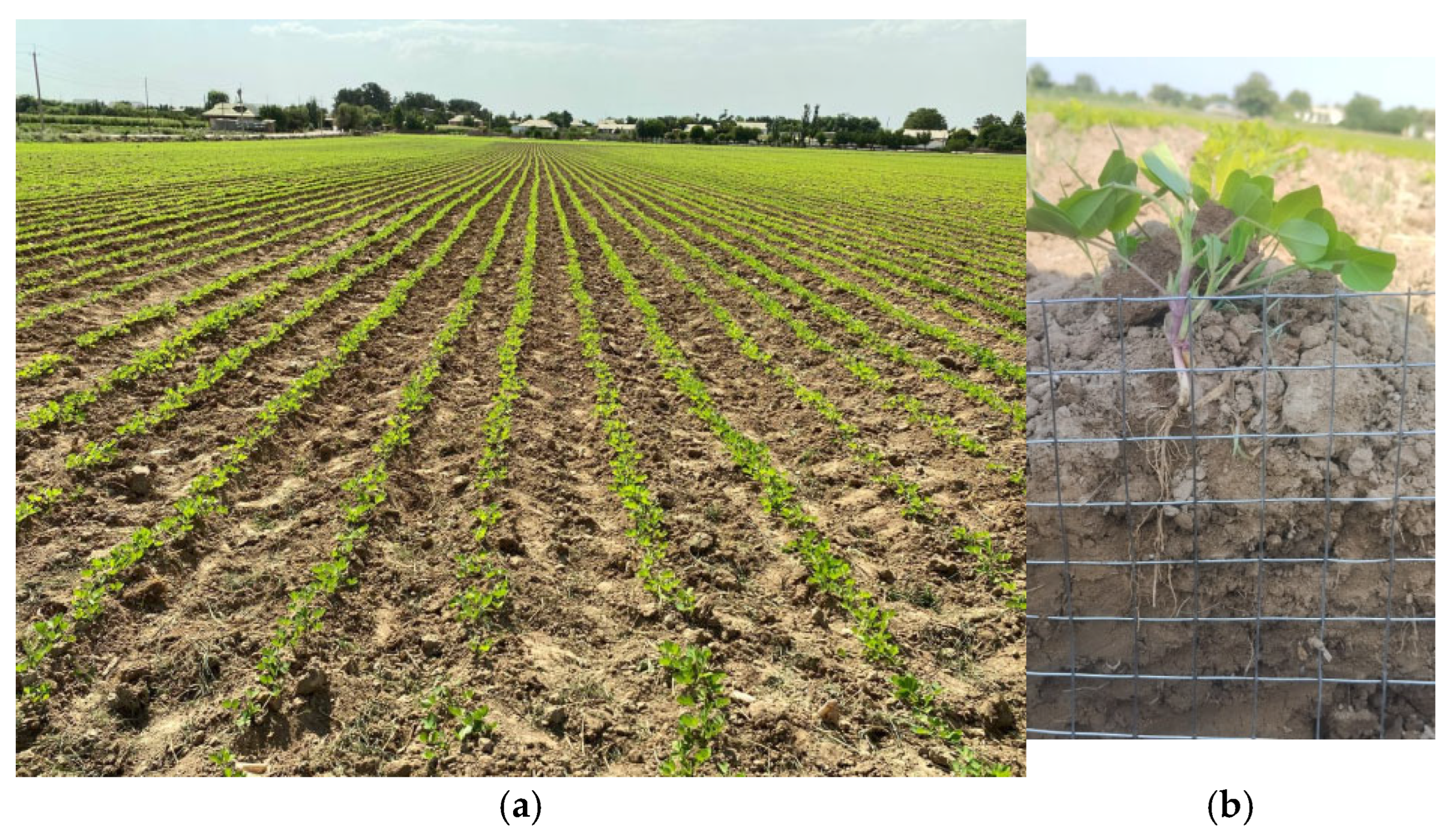
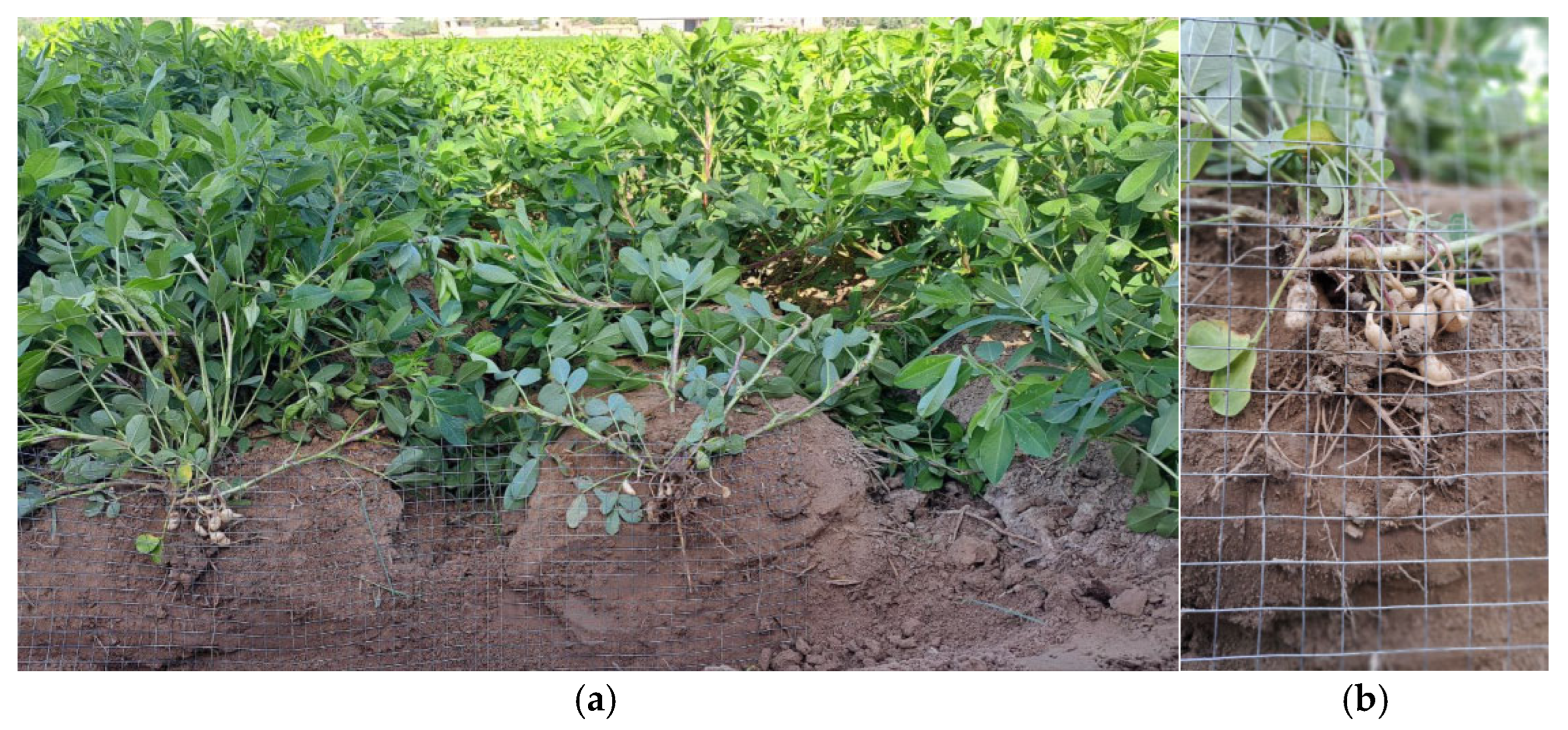
Figure 24.
Field validation of ridge uniformity and root-zone structure after one-pass operation of the prototype combined machine: (a) general view of uniform ridge rows and plant establishment along the field; (b) cross-sectional view of the formed ridge showing the rooting zone and structural stability of the cultivated layer.
Figure 24.
Field validation of ridge uniformity and root-zone structure after one-pass operation of the prototype combined machine: (a) general view of uniform ridge rows and plant establishment along the field; (b) cross-sectional view of the formed ridge showing the rooting zone and structural stability of the cultivated layer.
Figure 25.
Field validation of plant development and pod formation inside the ridge formed by the prototype machine: (a) canopy development and ridge surface stability during the vegetation period; (b) distribution of the pod formation zone and root system within the ridge profile.
Figure 25.
Field validation of plant development and pod formation inside the ridge formed by the prototype machine: (a) canopy development and ridge surface stability during the vegetation period; (b) distribution of the pod formation zone and root system within the ridge profile.
Table 1.
Comparison of conventional multi-pass soil preparation systems and the proposed combined technology.
Table 1.
Comparison of conventional multi-pass soil preparation systems and the proposed combined technology.
| Parameter | Conventional Multi-Pass System | Proposed Combined Technology |
|---|
| Number of field passes | 3–4 operations | Single operation |
| Fuel consumption | High | Reduced |
| Soil compaction risk | Increased due to repeated traffic | Reduced |
| Residue incorporation | Partial and uneven | Uniform incorporation |
| Operational productivity | Lower | Higher |
| Biological residue decomposition | Limited stimulation | Enhanced |
Table 2.
Coding scheme and experimental domain of the optimisation variables.
Table 2.
Coding scheme and experimental domain of the optimisation variables.
| No. | Factor | Unit | Coded Symbol | Variation Interval (Δ) | −1 | 0 | +1 |
|---|
| 1 | Chisel width of the chisel-type tool with wing | mm | X1 | 1 | 4 | 5 | 6 |
| 2 | Working width of the expander (wing width) | mm | X2 | 20 | 140 | 160 | 180 |
| 3 | Longitudinal distance between the expander and the subsoiler shank | mm | X3 | 20 | 130 | 150 | 170 |
| 4 | Operating speed of the unit | km h−1 | X4 | 1.5 | 5.0 | 6.0 | 7.0 |
Table 3.
Statistical significance and adequacy of the principal models describing soil fragmentation and draft resistance.
Table 3.
Statistical significance and adequacy of the principal models describing soil fragmentation and draft resistance.
| Experimental Series/Response | Main Factor(s) | F-Value | R2 | Adj. R2 | Lack-of-Fit, p |
|---|
| Subsoiler working width → F < 50 | b, v | 42.8 | 0.941 | 0.926 | 0.214 |
| Subsoiler working width → R | b, v | 118.6 | 0.978 | 0.972 | 0.331 |
| Subsoiler chisel width → F < 50 | b, v | 36.9 | 0.928 | 0.911 | 0.287 |
| Subsoiler chisel width → R | b, v | 104.2 | 0.971 | 0.964 | 0.354 |
| Winged sweep share → F < 25 | b, v | 51.4 | 0.952 | 0.939 | 0.198 |
| Winged sweep share → R | b, v | 133.7 | 0.982 | 0.977 | 0.402 |
| Wing installation height → F < 50 | h, v | 31.6 | 0.917 | 0.896 | 0.271 |
| Wing installation height → R | h, v | 96.4 | 0.969 | 0.961 | 0.366 |
| Multifactor model for F < 25 | X1–X4 | 29.4 | 0.963 | 0.948 | 0.184 |
| Multifactor model for R | X1–X4 | 37.8 | 0.972 | 0.960 | 0.229 |
Table 4.
Multivariate analysis of variance (MANOVA) for the combined system response.
Table 4.
Multivariate analysis of variance (MANOVA) for the combined system response.
| Source of Variation | Wilks’ λ | F-Value | p-Value |
|---|
| X1 | 0.421 | 9.87 | 0.002 |
| X2 | 0.398 | 11.26 | 0.001 |
| X3 | 0.712 | 3.94 | 0.021 |
| X4 | 0.356 | 13.42 | <0.001 |
| X1 × X4 | 0.533 | 6.18 | 0.008 |
| Overall model | 0.287 | 15.76 | <0.001 |
Table 5.
Combined ANOVA and regression coefficient significance for multifactor models.
Table 5.
Combined ANOVA and regression coefficient significance for multifactor models.
| Source/Coefficient | F-Value (F < 25) | F-Value (R) | t-Value (F < 25) | t-Value (R) |
|---|
| X1 | 14.82 | 21.37 | 3.85 | 4.97 |
| X2 | 19.54 | 17.92 | 4.41 | 4.26 |
| X3 | 4.21 | 8.64 | 2.16 | 2.93 |
| X4 | 16.77 | 26.15 | 4.02 | 5.74 |
| X12 | — | — | 3.57 | 4.11 |
| X22 | — | — | 4.26 | 3.74 |
| X42 | — | — | 3.94 | 4.63 |
| X1 × X4 | 8.93 | 11.74 | 3.08 | 3.46 |
| X2 × X4 | — | — | 2.44 | 2.67 |
| Quadratic terms (overall) | 12.35 | 15.48 | — | — |
Table 6.
Effect of the working width of the subsoiler with an inclined-shank on quality, draft and derived efficiency indicators.
Table 6.
Effect of the working width of the subsoiler with an inclined-shank on quality, draft and derived efficiency indicators.
| No. | Working Width of Subsoiler, bq (cm) | Operating Speed, v (km h−1) | Tillage Depth (cm) | Soil Fragmentation Degree, F < 50 (%) | Draft Force, R (kN) | Specific Load Indicator, R/bq (kN cm−1) | Fragmentation Efficiency, F/R (% kN−1) |
|---|
| 1 | 22 | 5 | 34.7 | 71.4 | 5.25 | 0.239 | 13.60 |
| 2 | 26 | 5 | 34.9 | 78.2 | 5.65 | 0.217 | 13.85 |
| 3 | 30 | 5 | 35.2 | 83.8 | 6.05 | 0.202 | 13.85 |
| 4 | 34 | 5 | 35.6 | 76.5 | 6.44 | 0.189 | 11.88 |
| 5 | 22 | 7 | 34.8 | 74.8 | 5.50 | 0.250 | 13.60 |
| 6 | 26 | 7 | 35.2 | 82.3 | 5.85 | 0.225 | 14.07 |
| 7 | 30 | 7 | 35.4 | 84.2 | 6.35 | 0.212 | 13.26 |
| 8 | 34 | 7 | 35.1 | 80.8 | 6.85 | 0.202 | 11.80 |
Table 7.
Effect of the chisel width of the subsoiler with an inclined-shank on soil fragmentation and draft, including derived efficiency indicators.
Table 7.
Effect of the chisel width of the subsoiler with an inclined-shank on soil fragmentation and draft, including derived efficiency indicators.
| No. | Chisel Width, biq (cm) | Operating Speed, v (km h−1) | Tillage Depth (cm) | Soil Fragmentation Degree, F < 50 (%) | Draft Force, R (kN) | Specific Load Indicator, R/biq (kN cm−1) | Fragmentation Efficiency, F/R (% kN−1) |
|---|
| 1 | 5 | 5 | 34.9 | 75.1 | 5.40 | 1.080 | 13.91 |
| 2 | 6 | 5 | 35.1 | 78.3 | 5.90 | 0.983 | 13.27 |
| 3 | 7 | 5 | 35.3 | 80.5 | 6.30 | 0.900 | 12.78 |
| 4 | 8 | 5 | 35.8 | 81.5 | 6.90 | 0.863 | 11.81 |
| 5 | 9 | 5 | 36.1 | 81.5 | 7.30 | 0.811 | 11.16 |
| 6 | 5 | 7 | 35.0 | 77.0 | 5.70 | 1.140 | 13.51 |
| 7 | 6 | 7 | 35.2 | 80.0 | 6.10 | 1.017 | 13.11 |
| 8 | 7 | 7 | 35.4 | 82.3 | 6.60 | 0.943 | 12.47 |
| 9 | 8 | 7 | 35.9 | 83.5 | 7.10 | 0.888 | 11.76 |
| 10 | 9 | 7 | 36.3 | 83.5 | 7.50 | 0.833 | 11.13 |
Table 8.
Effect of the chisel width of the winged sweep share with expander on soil fragmentation and draft, including derived efficiency indicators.
Table 8.
Effect of the chisel width of the winged sweep share with expander on soil fragmentation and draft, including derived efficiency indicators.
| No. | Chisel Width, bi (cm) | Operating Speed, v (km h−1) | Tillage Depth (cm) | Soil Fragmentation Degree, F < 25 (%) | Draft Force, R (N) | Specific Load Indicator, R/bi (N cm−1) | Fragmentation Efficiency, F/R (% N−1) |
|---|
| 1 | 3 | 5 | 10.2 | 75.2 | 320 | 106.67 | 0.235 |
| 2 | 4 | 5 | 10.2 | 81.4 | 340 | 85.00 | 0.239 |
| 3 | 5 | 5 | 10.3 | 84.2 | 370 | 74.00 | 0.228 |
| 4 | 6 | 5 | 10.4 | 83.1 | 390 | 65.00 | 0.213 |
| 5 | 7 | 5 | 10.9 | 80.1 | 415 | 59.29 | 0.193 |
| 6 | 3 | 7 | 10.4 | 78.1 | 330 | 110.00 | 0.237 |
| 7 | 4 | 7 | 10.5 | 84.4 | 355 | 88.75 | 0.238 |
| 8 | 5 | 7 | 10.5 | 86.2 | 380 | 76.00 | 0.227 |
| 9 | 6 | 7 | 11.4 | 85.3 | 405 | 67.50 | 0.211 |
| 10 | 7 | 7 | 11.9 | 83.2 | 430 | 61.43 | 0.194 |
Table 9.
Effect of the working width of the expander of the winged sweep share on soil fragmentation and draft, including derived efficiency indicators.
Table 9.
Effect of the working width of the expander of the winged sweep share on soil fragmentation and draft, including derived efficiency indicators.
| No. | Expander Working Width, bk (mm) | Operating Speed, v (km h−1) | Tillage Depth (cm) | Soil Fragmentation Degree, F < 25 (%) | Draft Force, R (N) | Specific Load Indicator, R/bk (N mm−1) | Fragmentation Efficiency, F/R (% N−1) |
|---|
| 1 | 120 | 5 | 7.8 | 74.1 | 210 | 1.750 | 0.354 |
| 2 | 140 | 5 | 7.5 | 78.3 | 215 | 1.536 | 0.364 |
| 3 | 160 | 5 | 6.2 | 81.5 | 230 | 1.438 | 0.354 |
| 4 | 180 | 5 | 6.1 | 80.1 | 245 | 1.361 | 0.327 |
| 5 | 200 | 5 | 6.0 | 79.5 | 290 | 1.450 | 0.274 |
| 6 | 120 | 7 | 7.7 | 75.3 | 230 | 1.917 | 0.327 |
| 7 | 140 | 7 | 7.3 | 81.1 | 240 | 1.714 | 0.338 |
| 8 | 160 | 7 | 6.2 | 83.5 | 250 | 1.563 | 0.334 |
| 9 | 180 | 7 | 6.0 | 82.5 | 270 | 1.500 | 0.306 |
| 10 | 200 | 7 | 5.6 | 81.2 | 315 | 1.575 | 0.258 |
Table 10.
Effect of the installation height of the expander relative to the chisel edge on soil fragmentation and draft of the winged sweep share, including derived efficiency indicators.
Table 10.
Effect of the installation height of the expander relative to the chisel edge on soil fragmentation and draft of the winged sweep share, including derived efficiency indicators.
| No. | Expander Installation Height, hk (cm) | Operating Speed, v (km h−1) | Tillage Depth (cm) | Soil Fragmentation Degree, F < 50 (%) | Draft Force, R (N) | Specific Load Indicator, R/hk (N cm−1) | Fragmentation Efficiency, F/R (% N−1) |
|---|
| 1 | 2 | 5 | 10.8 | 74.5 | 520 | 260.00 | 0.143 |
| 2 | 3 | 5 | 10.4 | 79.1 | 485 | 161.67 | 0.163 |
| 3 | 4 | 5 | 10.1 | 80.5 | 445 | 111.25 | 0.181 |
| 4 | 5 | 5 | 9.7 | 81.2 | 420 | 84.00 | 0.193 |
| 5 | 6 | 5 | 9.2 | 79.3 | 380 | 63.33 | 0.209 |
| 6 | 2 | 7 | 11.0 | 77.5 | 540 | 270.00 | 0.144 |
| 7 | 3 | 7 | 10.9 | 80.5 | 500 | 166.67 | 0.161 |
| 8 | 4 | 7 | 10.2 | 82.2 | 470 | 117.50 | 0.175 |
| 9 | 5 | 7 | 9.7 | 81.5 | 435 | 87.00 | 0.187 |
| 10 | 6 | 7 | 9.1 | 80.5 | 400 | 66.67 | 0.201 |
Table 11.
Effect of the working width of the sweep share on soil fragmentation and draft, including derived efficiency indicators.
Table 11.
Effect of the working width of the sweep share on soil fragmentation and draft, including derived efficiency indicators.
| No. | Working Width of Sweep Share, bop (mm) | Operating Speed, v (km h−1) | Tillage Depth (cm) | Soil Fragmentation Degree, F < 50 (%) | Draft Force, R (N) | Specific Load Indicator, R/bop (N mm−1) | Fragmentation Efficiency, F/R (% N−1) |
|---|
| 1 | 90 | 5 | 11.7 | 74.1 | 260 | 2.889 | 0.285 |
| 2 | 110 | 5 | 11.9 | 80.3 | 265 | 2.409 | 0.303 |
| 3 | 130 | 5 | 12.1 | 83.2 | 275 | 2.115 | 0.303 |
| 4 | 150 | 5 | 12.2 | 84.1 | 295 | 1.967 | 0.285 |
| 5 | 170 | 5 | 11.8 | 82.2 | 330 | 1.941 | 0.249 |
| 6 | 90 | 7 | 11.8 | 76.1 | 280 | 3.111 | 0.272 |
| 7 | 110 | 7 | 12.0 | 82.1 | 290 | 2.636 | 0.283 |
| 8 | 130 | 7 | 12.2 | 84.5 | 300 | 2.308 | 0.282 |
| 9 | 150 | 7 | 12.3 | 85.2 | 325 | 2.167 | 0.262 |
| 10 | 170 | 7 | 12.1 | 84.1 | 360 | 2.118 | 0.234 |
Table 12.
Effect of the tillage depth of the sweep share on soil fragmentation and draft, including derived efficiency indicators.
Table 12.
Effect of the tillage depth of the sweep share on soil fragmentation and draft, including derived efficiency indicators.
| No. | Tillage Depth, hp (cm) | Operating Speed, v (km h−1) | Soil Fragmentation Degree, F < 50 (%) | Draft Force, R (N) | Specific Load Indicator, R/hp (N cm−1) | Fragmentation Efficiency, F/R (% N−1) |
|---|
| 1 | 10 | 5 | 85.0 | 440 | 44.00 | 0.193 |
| 2 | 12 | 5 | 80.5 | 480 | 40.00 | 0.168 |
| 3 | 14 | 5 | 79.5 | 550 | 39.29 | 0.145 |
| 4 | 16 | 5 | 79.0 | 580 | 36.25 | 0.136 |
| 5 | 18 | 5 | 78.8 | 650 | 36.11 | 0.121 |
| 6 | 10 | 7 | 86.0 | 470 | 47.00 | 0.183 |
| 7 | 12 | 7 | 82.0 | 520 | 43.33 | 0.158 |
| 8 | 14 | 7 | 80.0 | 570 | 40.71 | 0.140 |
| 9 | 16 | 7 | 79.5 | 620 | 38.75 | 0.128 |
| 10 | 18 | 7 | 79.7 | 675 | 37.50 | 0.118 |
Table 13.
Effect of the longitudinal distance between the inclined-shank subsoiler and the winged sweep share on soil fragmentation and draft, including derived efficiency indicators.
Table 13.
Effect of the longitudinal distance between the inclined-shank subsoiler and the winged sweep share on soil fragmentation and draft, including derived efficiency indicators.
| No. | Longitudinal Distance, lk (cm) | Operating Speed, v (km h−1) | Tillage Depth (cm) | Soil Fragmentation Degree, F < 25 (%) | Draft Force, R (N) | Specific Load Indicator, R/lk (N cm−1) | Fragmentation Efficiency, F/R (% N−1) |
|---|
| 1. | 5 | 5 | 9.8 | 83.2 | 435 | 87.00 | 0.191 |
| 2 | 10 | 5 | 10.1 | 82.4 | 405 | 40.50 | 0.204 |
| 3 | 15 | 5 | 10.1 | 82.3 | 395 | 26.33 | 0.208 |
| 4 | 20 | 5 | 10.2 | 82.5 | 390 | 19.50 | 0.212 |
| 5 | 25 | 5 | 9.3 | 82.3 | 390 | 15.60 | 0.211 |
| 6 | 5 | 7 | 10.0 | 83.8 | 455 | 91.00 | 0.184 |
| 7 | 10 | 7 | 10.5 | 82.8 | 425 | 42.50 | 0.195 |
| 8 | 15 | 7 | 10.1 | 82.4 | 410 | 27.33 | 0.201 |
| 9 | 20 | 7 | 10.1 | 82.35 | 410 | 20.50 | 0.201 |
| 10 | 25 | 7 | 9.6 | 82.2 | 405 | 16.20 | 0.203 |
Table 14.
Optimal combinations of the control factors for the chisel-type tool with expander obtained from the joint optimisation of soil fragmentation and draft.
Table 14.
Optimal combinations of the control factors for the chisel-type tool with expander obtained from the joint optimisation of soil fragmentation and draft.
| No. | Operating Speed, X4 (Coded) | Operating Speed, v (km h−1) | Chisel Width, X1 (Coded) | Chisel Width, b (cm) | Expander Working Width, X2 (Coded) | Expander Working Width, B (mm) | Longitudinal Distance, X3 (Coded) | Longitudinal Distance, l (mm) |
|---|
| 1 | 1.0000 | 7.0 | −0.2532 | 4.75 | 0.6914 | 173.83 | 0.0845 | 151.69 |
| 2 | 0.0000 | 6.0 | −0.7286 | 4.27 | 0.5314 | 170.63 | −0.6075 | 137.85 |
| 3 | −1.0000 | 5.0 | 0.1732 | 5.17 | 0.4195 | 168.39 | −0.7615 | 134.77 |
Table 15.
Residue incorporation performance and initial incorporated biomass (mean ± SD, n = 3).
Table 15.
Residue incorporation performance and initial incorporated biomass (mean ± SD, n = 3).
| Treatment/Operating Mode | Forward Speed, km h−1 | Working Depth, cm | Pz, % | Surface Residue Remaining After Pass, m2/m1, % | m0, kg m−2 | m0, t ha−1 | CV of m0, % | 95% CI of m0, kg m−2 |
|---|
| Conventional soil preparation (control) | 7 | 10–12 | 80.1 ± 2.4 | 19.9 ± 2.4 | 1.202 ± 0.036 | 12.02 | 3.00 | 1.202 ± 0.089 |
| Combined soil preparation | 5 | 11–13 | 89.8 ± 1.9 | 10.2 ± 1.9 | 1.347 ± 0.028 | 13.47 | 2.12 | 1.347 ± 0.071 |
| Combined soil preparation | 7 | 11–13 | 91.6 ± 1.7 | 8.4 ± 1.7 | 1.374 ± 0.025 | 13.74 | 1.86 | 1.374 ± 0.063 |
Table 16.
Vertical distribution of incorporated residues at Day 0, fraction of m0 (mean ± SD, n = 3).
Table 16.
Vertical distribution of incorporated residues at Day 0, fraction of m0 (mean ± SD, n = 3).
| Treatment/Operating Mode | Forward Speed, km h−1 | 0–5 cm, % of m0 | 5–10 cm, % of m0 | 10–15 cm, % of m0 | Stratification Index SI = (0–5)/(10–15) |
|---|
| Conventional soil preparation (control) | 7 | 52.3 ± 3.0 | 34.6 ± 2.6 | 13.1 ± 1.9 | 3.99 |
| Combined soil preparation | 5 | 42.6 ± 2.8 | 41.8 ± 3.0 | 15.6 ± 2.1 | 2.73 |
| Combined soil preparation | 7 | 40.9 ± 2.6 | 43.5 ± 2.9 | 15.6 ± 2.0 | 2.62 |
Table 17.
In situ biodegradation and dehydrogenase activity at 30 and 60 days (mean ± SD, n = 3).
Table 17.
In situ biodegradation and dehydrogenase activity at 30 and 60 days (mean ± SD, n = 3).
| Treatment/Operating Mode | Forward Speed, km h−1 | m30, kg m−2 | k30 | DHA30, mg TPF g−1 h−1 | m60, kg m−2 | k60 | DHA60, mg TPF g−1 h−1 |
|---|
| Conventional soil preparation (control) | 7 | 0.86 ± 0.05 | 0.285 ± 0.032 | 0.056 ± 0.005 | 0.67 ± 0.05 | 0.442 ± 0.038 | 0.047 ± 0.004 |
| Combined soil preparation | 5 | 0.79 ± 0.04 | 0.414 ± 0.030 | 0.073 ± 0.006 | 0.57 ± 0.04 | 0.577 ± 0.036 | 0.061 ± 0.005 |
| Combined soil preparation | 7 | 0.76 ± 0.04 | 0.447 ± 0.028 | 0.079 ± 0.006 | 0.54 ± 0.04 | 0.607 ± 0.035 | 0.066 ± 0.005 |
Table 18.
Soil organic carbon and total nitrogen in the 0–12 cm layer (mean ± SD, n = 3).
Table 18.
Soil organic carbon and total nitrogen in the 0–12 cm layer (mean ± SD, n = 3).
| Treatment/Operating Mode | Forward Speed, km h−1 | Time | SOC (Corg), % | Ntotal, % | C/N |
|---|
| Conventional soil preparation (control) | 7 | Before treatment | 1.24 ± 0.03 | 0.112 ± 0.003 | 11.1 |
| Conventional soil preparation (control) | 7 | 60 days | 1.25 ± 0.03 | 0.112 ± 0.003 | 11.2 |
| Combined soil preparation | 5 | Before treatment | 1.25 ± 0.03 | 0.112 ± 0.003 | 11.2 |
| Combined soil preparation | 5 | 60 days | 1.28 ± 0.03 | 0.114 ± 0.003 | 11.2 |
| Combined soil preparation | 7 | Before treatment | 1.25 ± 0.03 | 0.113 ± 0.003 | 11.1 |
| Combined soil preparation | 7 | 60 days | 1.30 ± 0.03 | 0.115 ± 0.003 | 11.3 |
Table 19.
Field performance of the prototype machine for peanut seedbed preparation, including compliance indicators.
Table 19.
Field performance of the prototype machine for peanut seedbed preparation, including compliance indicators.
| No. | Performance Indicator | Unit | Agrotechnical Requirement | Test Result | Deviation from Requirement | Compliance |
|---|
| 1 | Operating speed | km h−1 | 5–7 | 5–7 | 0 | Yes |
| 2 | Tillage depth under ridges, mean value | cm | 30–35 | 33.2 | +3.2/−1.8 (within range) | Yes |
| | Coefficient of variation in depth | % | <10 | 5.63 | −4.37 | Yes |
| 3 | Soil fraction content after loosening: <50 mm | % | – | 5.9 | – | – |
| | Soil fraction content after loosening: 50–25 mm | % | – | 11.8 | – | – |
| | Soil fraction content after loosening: <25 mm | % | >80 | 82.3 | +2.3 | Yes |
| 4 | Weed and residue burial rate | % | >90 | 90.7 | +0.7 | Yes |
| 5 | Ridge height | cm | 30 ± 2 | 31.4 | +1.4 | Yes |
| 6 | Row spacing | cm | 60 ± 3 | 60.8 | +0.8 | Yes |
| 7 | Field capacity (effective time) | ha h−1 | – | 1.71 | – | – |
| | Field capacity (shift time) | ha h−1 | – | 1.27 | – | – |
| 8 | Fuel consumption | kg ha−1 | – | 23.5 | – | – |






 ,
,