



Artificial Intelligence Applications for Cleaner Production and Sustainable Development in Southeast Asia: A Systematic Review and Future Research Directions

 ,
,  ,
,  , , and
Abstract
1. Introduction
- What are the prevalent themes, application areas, and sustainability dimensions (environmental, economic, social) addressed by AI research in SEA?
- To what extent are AI methodologies employed to improve cleaner production and sustainable development outcomes in SEA?
- What are the barriers, challenges, and future research directions for AI applications for cleaner production and sustainable development in SEA?
2. Overview of Sustainability in SEA
3. Methodology
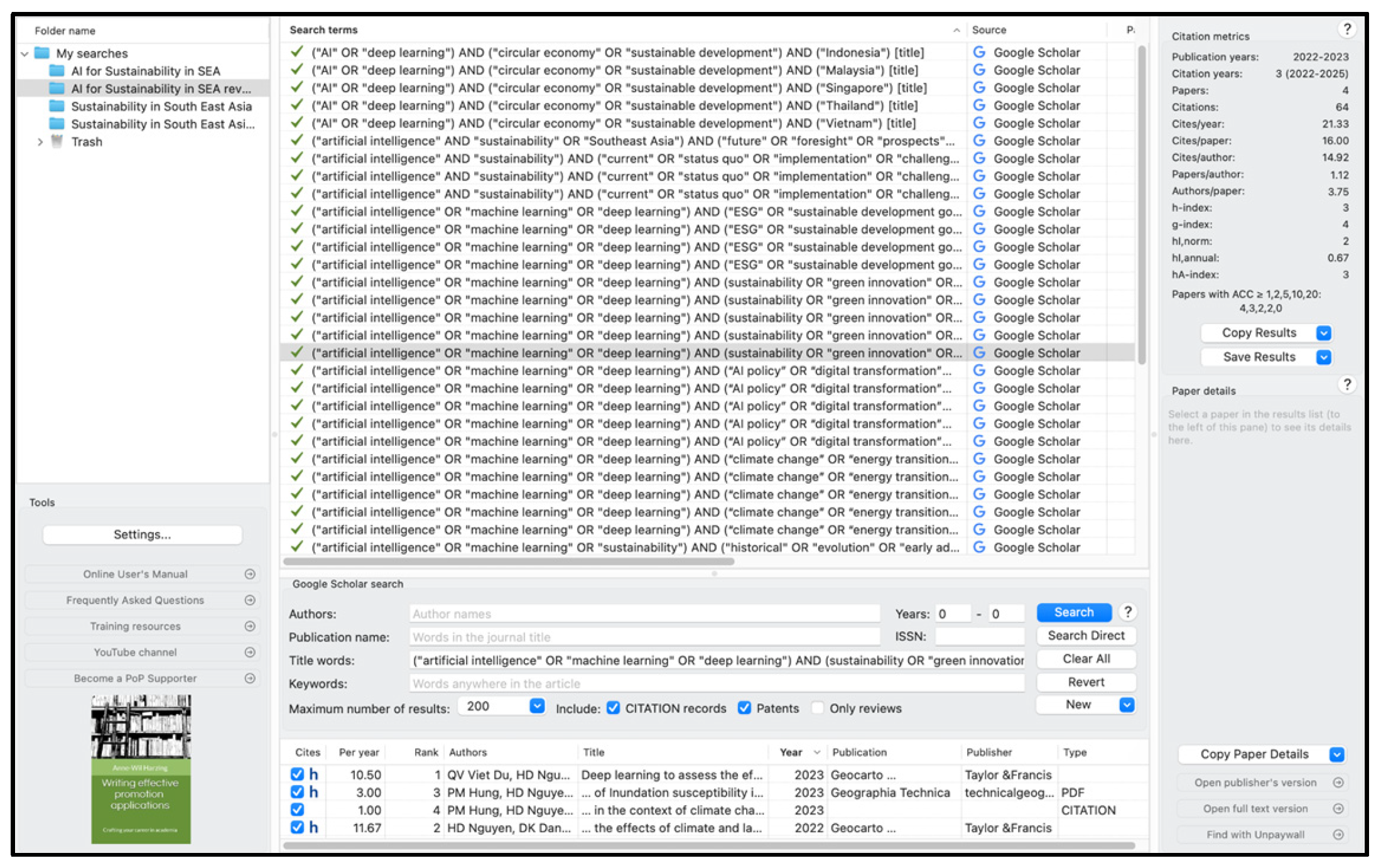
3.1. Search Strategy and Study Identification
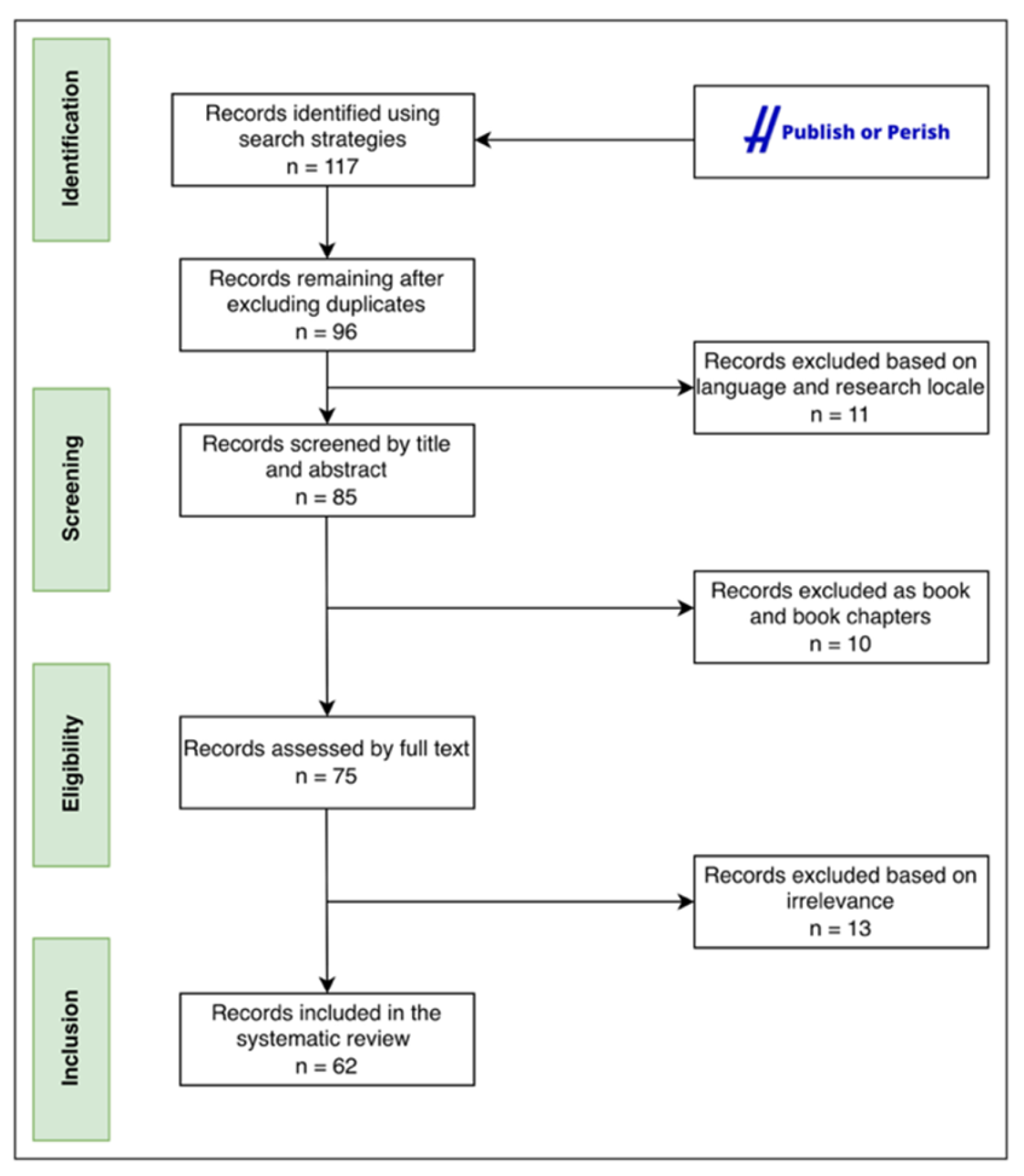
3.2. Screening and Eligibility Assessment
3.3. Quality Assessment
3.4. Coding and Extraction
- AI methodology (e.g., regression-based models, supervised and unsupervised learning, deep learning, optimization-based approaches, explainable AI, NLP, and hybrid models).
- Functional role of AI categorized as predictive (e.g., forecasting, estimation, and risk prediction), prescriptive (optimization, decision support, and process improvement), and governance-level (e.g., policy analysis, regulation, ethical assessment).
- Application areas.
- Sustainability dimensions (environmental, economic, or social sustainability).
3.5. Coding Validation
4. Results
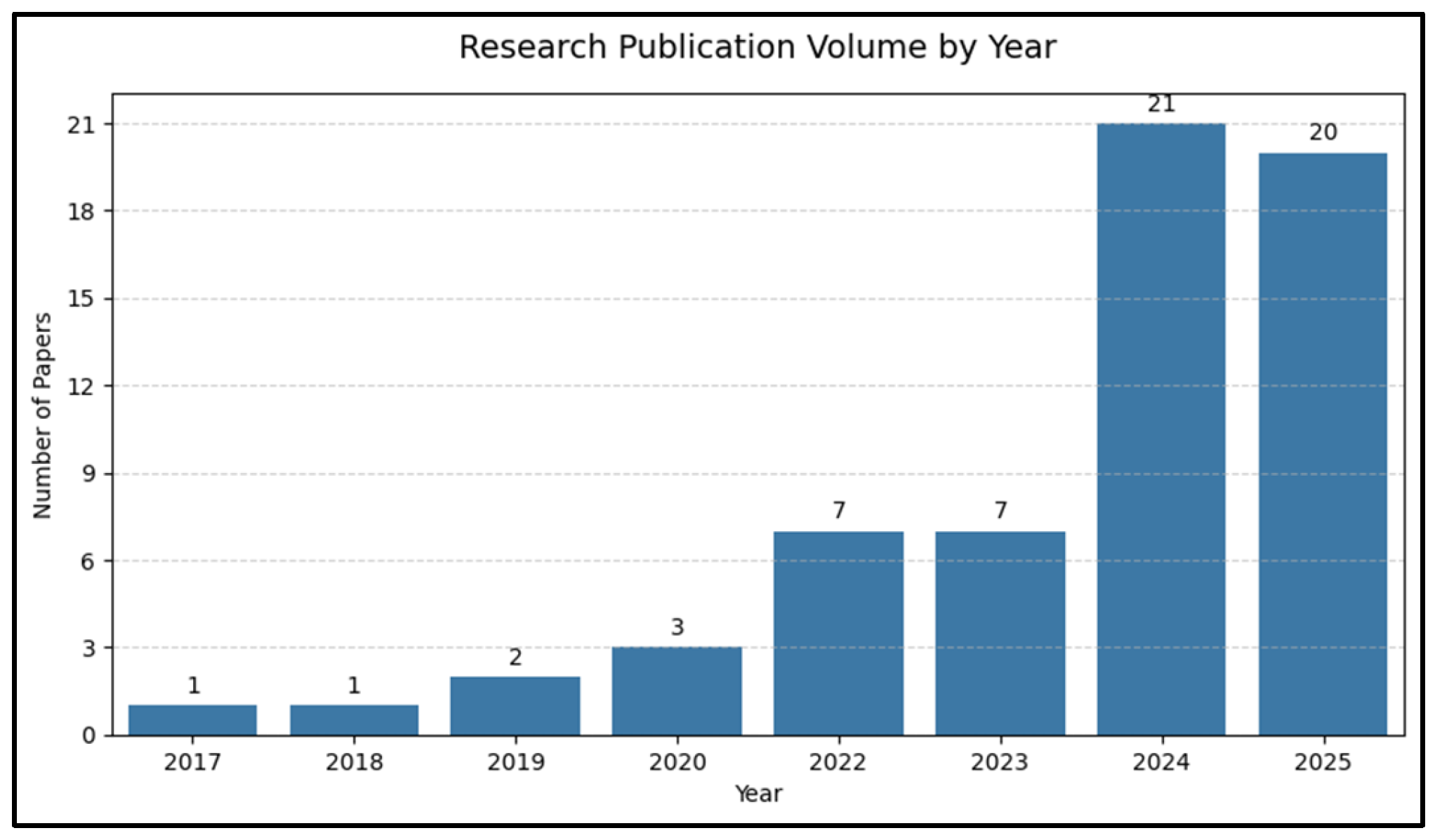
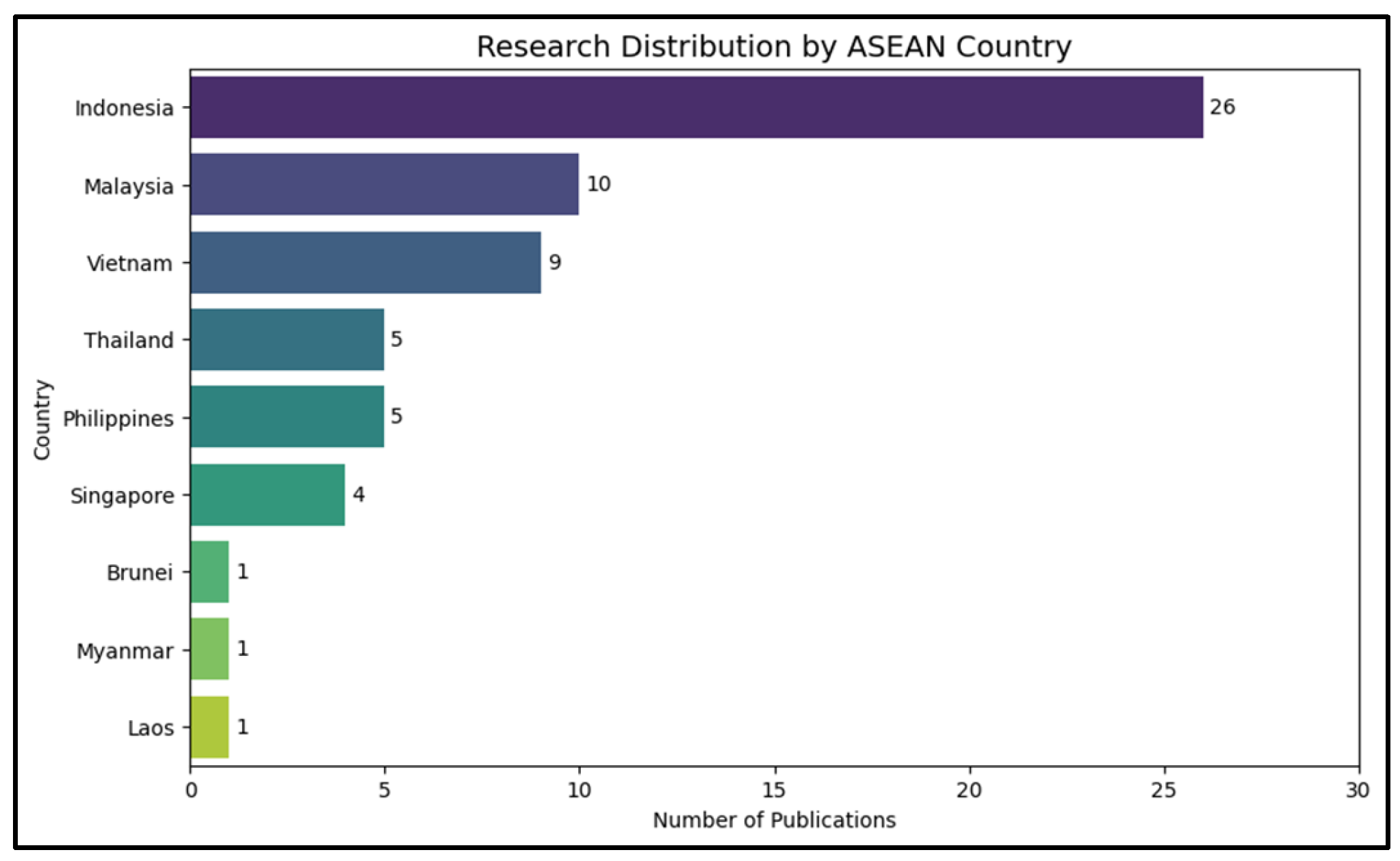
4.1. Descriptive Analysis
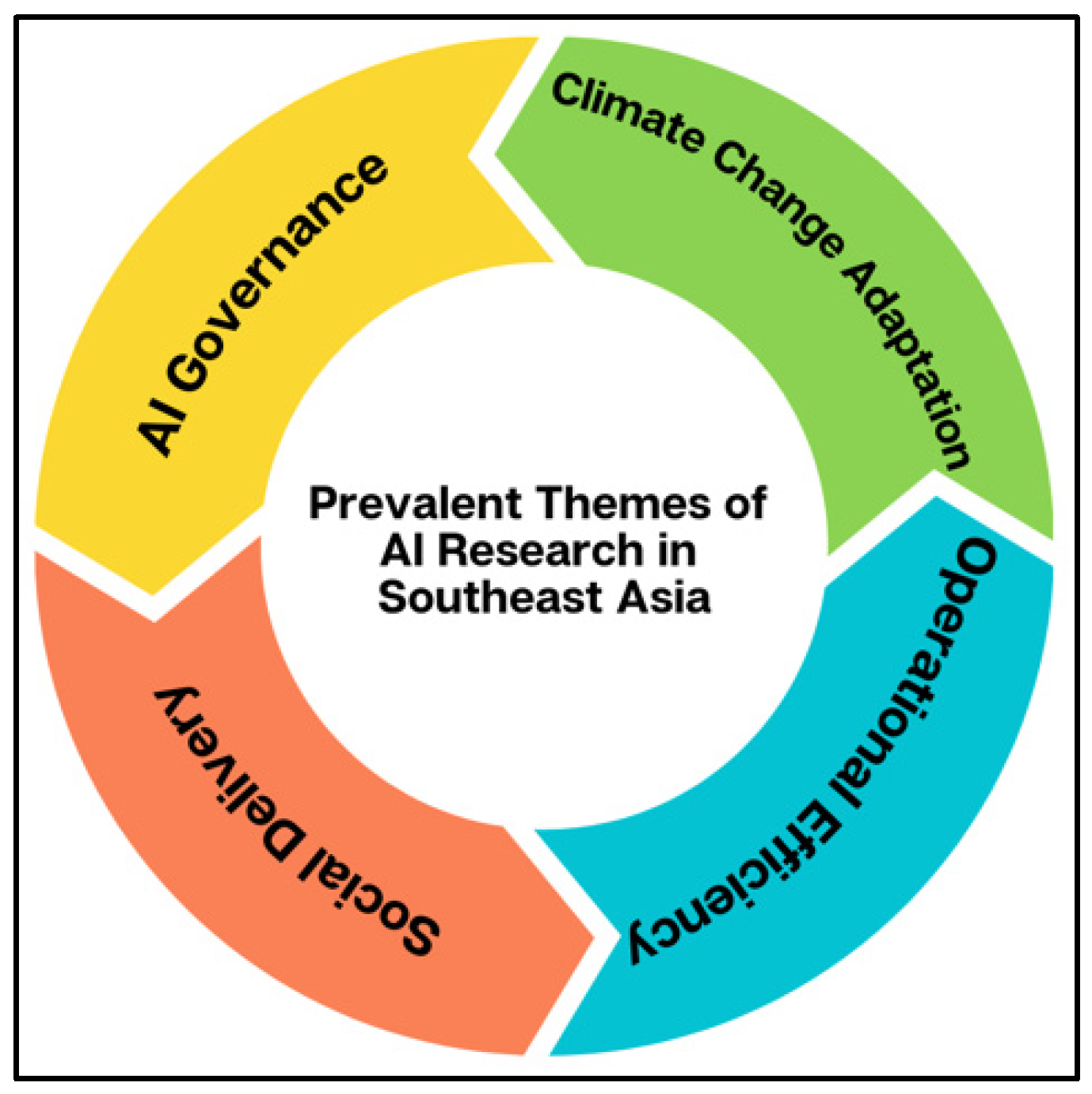
4.2. Prevalent Themes of AI Research in SEA
4.2.1. AI Governance
4.2.2. Climate Change Adaptation
4.2.3. Operational Efficiency
4.2.4. Social Delivery
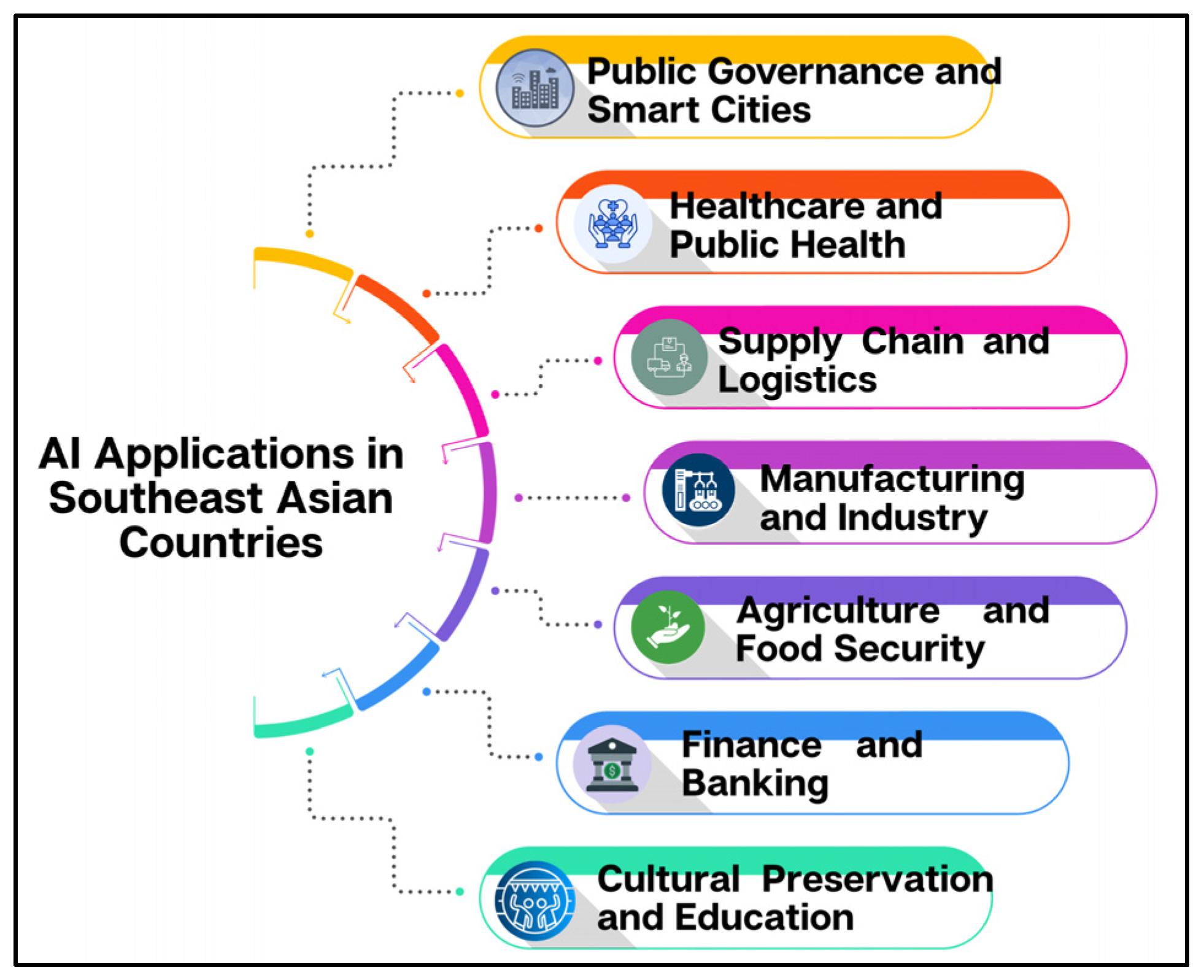
4.3. Application Areas of AI in SEA Countries
4.3.1. Public Governance and Smart Cities
4.3.2. Healthcare and Public Health
4.3.3. Supply Chain and Logistics
4.3.4. Manufacturing and Industry
4.3.5. Agriculture and Food Security
4.3.6. Finance and Banking
4.3.7. Cultural Preservation and Education
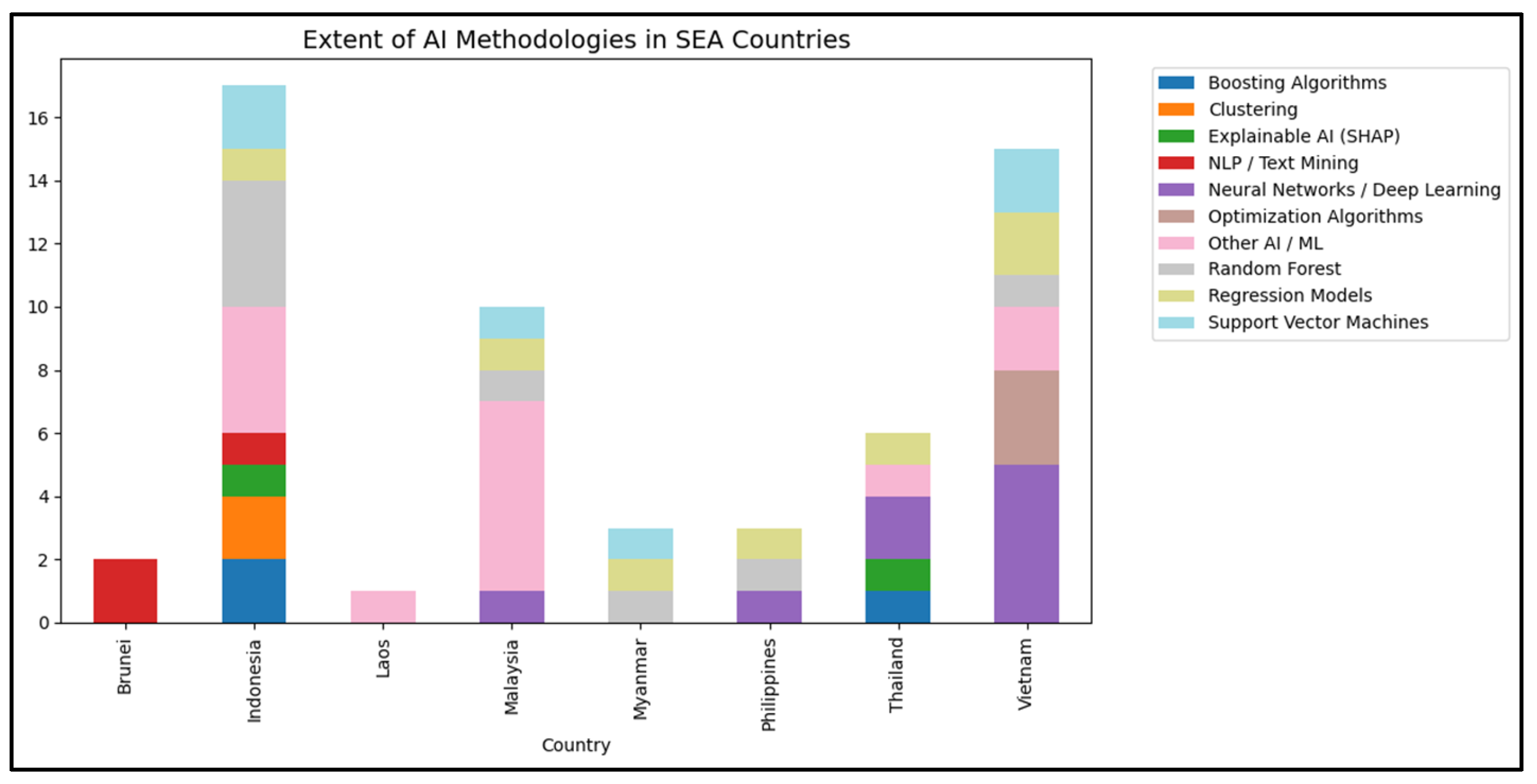
4.4. Extent of AI Methodologies for Cleaner Production and Sustainable Development in SEA
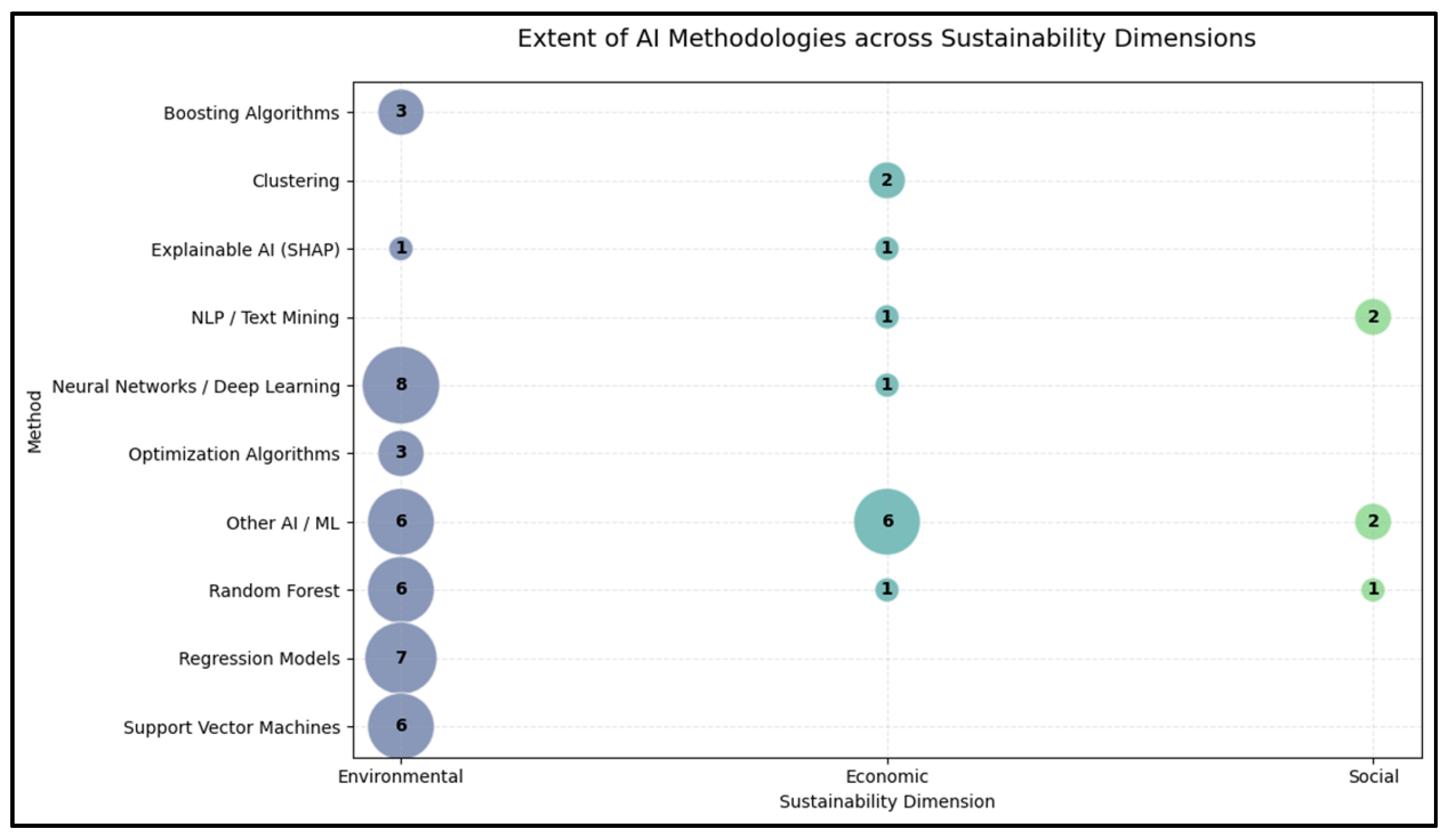
4.5. Cross-Tabulation of AI Methodologies and Sustainability Dimensions
4.6. Methodological Maturity and Functional Roles of AI Applications
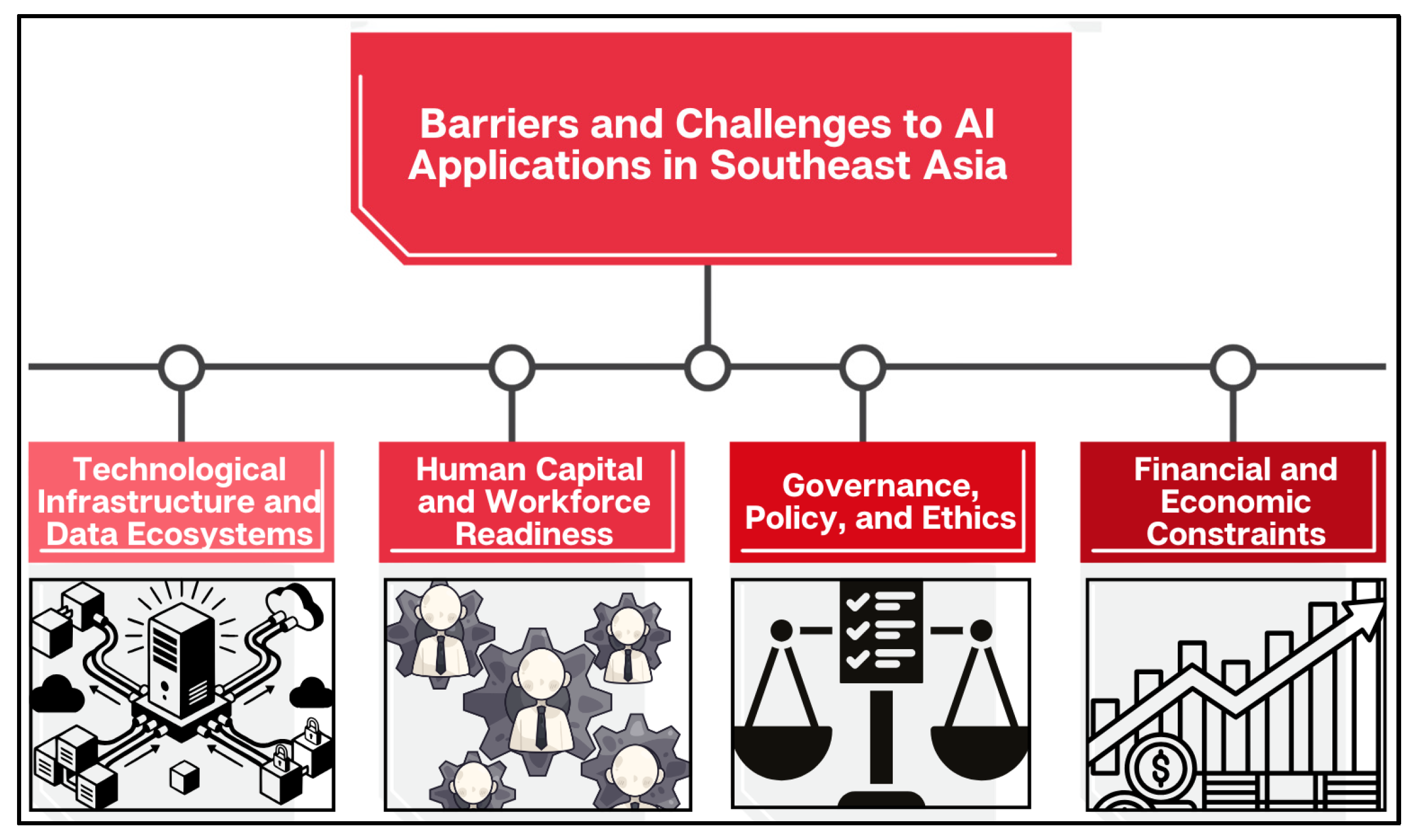
4.7. Barriers and Challenges to AI Applications in SEA
4.7.1. Technological Infrastructure and Data Ecosystems
4.7.2. Human Capital and Workforce Readiness
4.7.3. Governance, Policy, and Ethics
4.7.4. Financial and Economic Constraints
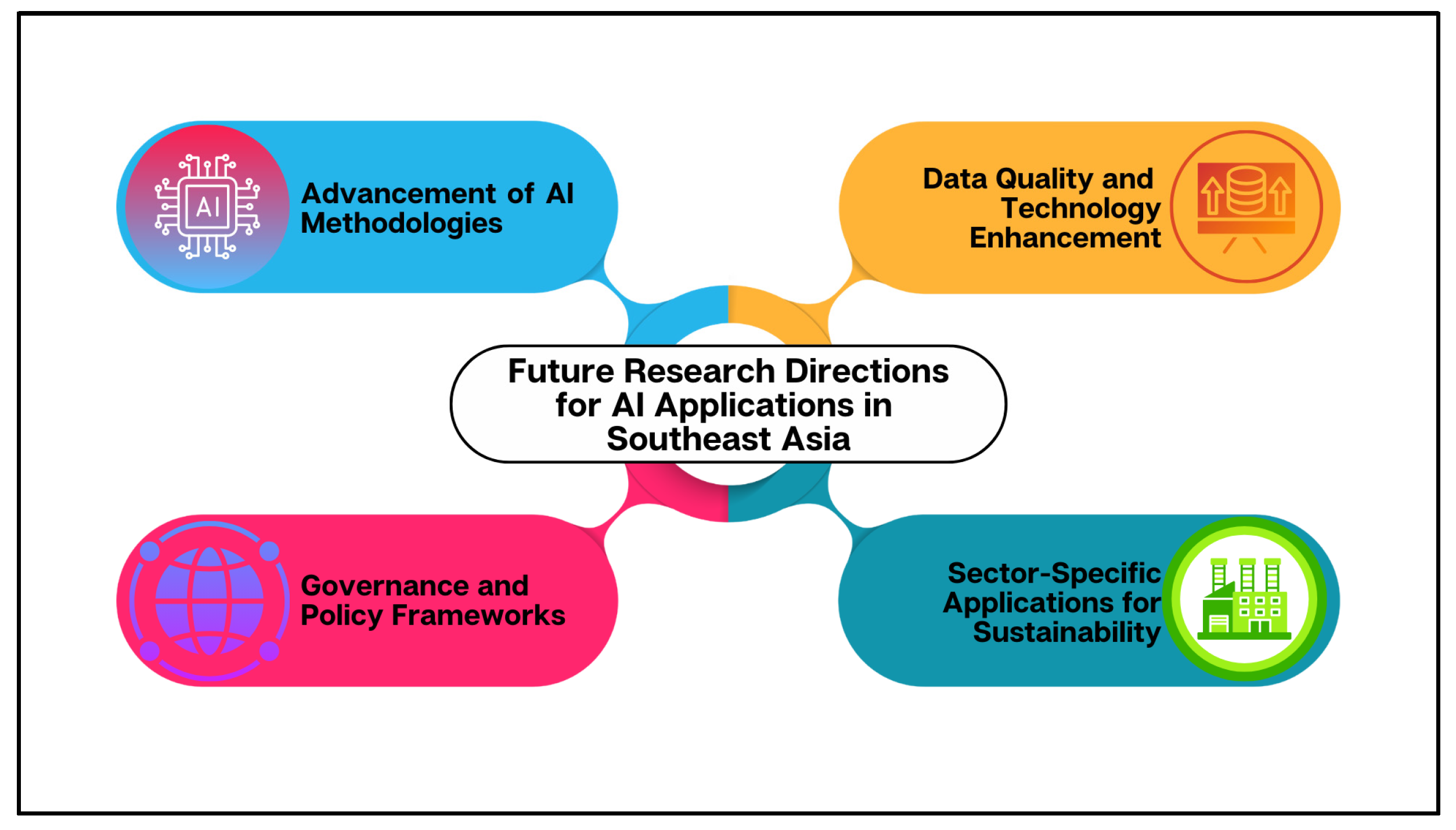
4.8. Future Research Directions
4.8.1. Advancements of AI Methodologies
4.8.2. Data Quality and Technology Enhancement
4.8.3. Governance and Policy Frameworks
4.8.4. Sector-Specific Applications for Sustainability
5. Discussion
6. Conclusions and Limitations
Supplementary Materials
Author Contributions
Funding
Institutional Review Board Statement
Informed Consent Statement
Data Availability Statement
Conflicts of Interest
Appendix A

| Search Strategy | Keywords Combination |
|---|---|
| 1 | (“artificial intelligence” OR “machine learning”) AND (“sustainability” OR “cleaner production”) AND (“Southeast Asia” OR “ASEAN” OR “SEA” OR “Brunei” OR “Cambodia” OR “East Timor” OR “Timor Leste” OR “Indonesia” OR “Laos” OR “Malaysia” OR “Myanmar” OR “Philippines” OR “Singapore” OR “Thailand” OR “Vietnam”) |
| 2 | (“artificial intelligence” OR “machine learning” OR “deep learning”) AND (sustainability OR “green innovation” OR “climate change” OR “energy efficiency” OR “environmental management”) AND (“Southeast Asia” OR “ASEAN” OR “SEA” OR “Brunei” OR “Cambodia” OR “East Timor” OR “Timor Leste” OR “Indonesia” OR “Laos” OR “Malaysia” OR “Myanmar” OR “Philippines” OR “Singapore” OR “Thailand” OR “Vietnam”) |
| 3 | (“artificial intelligence” OR “machine learning” OR “deep learning”) AND (“AI policy” OR “digital transformation” OR “governance”) AND (“Southeast Asia” OR “ASEAN” OR “SEA” OR “Brunei” OR “Cambodia” OR “East Timor” OR “Timor Leste” OR “Indonesia” OR “Laos” OR “Malaysia” OR “Myanmar” OR “Philippines” OR “Singapore” OR “Thailand” OR “Vietnam”) |
| 4 | (“artificial intelligence” OR “machine learning” OR “deep learning”) AND (“climate change” OR “energy transition” OR “carbon neutrality”) AND (“Southeast Asia” OR “ASEAN” OR “SEA” OR “Brunei” OR “Cambodia” OR “East Timor” OR “Timor Leste” OR “Indonesia” OR “Laos” OR “Malaysia” OR “Myanmar” OR “Philippines” OR “Singapore” OR “Thailand” OR “Vietnam”) |
| 5 | (“AI” OR “deep learning”) AND (“circular economy” OR “sustainable development”) AND (“Southeast Asia” OR “ASEAN” OR “SEA” OR “Brunei” OR “Cambodia” OR “East Timor” OR “Timor Leste” OR “Indonesia” OR “Laos” OR “Malaysia” OR “Myanmar” OR “Philippines” OR “Singapore” OR “Thailand” OR “Vietnam”) |
| 6 | (“artificial intelligence” OR “machine learning”) AND (“social sustainability” OR “inclusive growth” OR “AI ethics” OR “education for sustainability” OR “community resilience”) AND (“Southeast Asia” OR “ASEAN” OR “SEA” OR “Brunei” OR “Cambodia” OR “East Timor” OR “Timor Leste” OR “Indonesia” OR “Laos” OR “Malaysia” OR “Myanmar” OR “Philippines” OR “Singapore” OR “Thailand” OR “Vietnam”) |
| 7 | (“artificial intelligence” OR “data-driven” OR “neural network” OR “AI-driven” OR “intelligent system”) AND (“clean technology” OR “energy efficiency” OR “sustainable industry”) AND (“Southeast Asia” OR “ASEAN” OR “SEA” OR “Brunei” OR “Cambodia” OR “East Timor” OR “Timor Leste” OR “Indonesia” OR “Laos” OR “Malaysia” OR “Myanmar” OR “Philippines” OR “Singapore” OR “Thailand” OR “Vietnam”) |
| 8 | (“artificial intelligence” OR “machine learning” OR “deep learning”) AND (“ESG” OR “sustainable development goals”) AND (“Southeast Asia” OR “ASEAN” OR “SEA” OR “Brunei” OR “Cambodia” OR “East Timor” OR “Timor Leste” OR “Indonesia” OR “Laos” OR “Malaysia” OR “Myanmar” OR “Philippines” OR “Singapore” OR “Thailand” OR “Vietnam”) |
| 9 | (“artificial intelligence” AND “sustainability”) AND (“current” OR “status quo” OR “implementation” OR “challenges” OR “present scenario”) AND (“Southeast Asia” OR “ASEAN” OR “SEA” OR “Brunei” OR “Cambodia” OR “East Timor” OR “Timor Leste” OR “Indonesia” OR “Laos” OR “Malaysia” OR “Myanmar” OR “Philippines” OR “Singapore” OR “Thailand” OR “Vietnam”) |
| 10 | (“artificial intelligence” OR “machine learning” OR “sustainability”) AND (“historical” OR “evolution” OR “early adoption” OR “development history”) AND (“Southeast Asia” OR “ASEAN” OR “SEA” OR “Brunei” OR “Cambodia” OR “East Timor” OR “Timor Leste” OR “Indonesia” OR “Laos” OR “Malaysia” OR “Myanmar” OR “Philippines” OR “Singapore” OR “Thailand” OR “Vietnam”) |
| 11 | (“artificial intelligence” AND “sustainability” OR “Southeast Asia”) AND (“future” OR “foresight” OR “prospects” OR “responsible AI” OR “green AI” OR “emerging trends”) AND (“Southeast Asia” OR “ASEAN” OR “SEA” OR “Brunei” OR “Cambodia” OR “East Timor” OR “Timor Leste” OR “Indonesia” OR “Laos” OR “Malaysia” OR “Myanmar” OR “Philippines” OR “Singapore” OR “Thailand” OR “Vietnam”) |
References
- Guerra, J.B.S.O.A.; Hoffmann, M.; Bianchet, R.T.; Medeiros, P.; Provin, A.P.; Iunskovski, R. Sustainable development goals and ethics: Building “the future we want”. Environ. Dev. Sustain. 2022, 24, 9407–9428. [Google Scholar] [CrossRef]
- United Nations Environment Programme. Emissions Gap Report 2024; UNEP: Nairobi, Kenya, 2024; Available online: https://www.unep.org/resources/emissions-gap-report-2024 (accessed on 27 November 2025).
- United Nations University Institute for Environment and Human Security. What Is Earth Overshoot Day and Why Does It Matter? United Nations University: Tokyo, Japan, 2025; Available online: https://unu.edu/ehs/article/what-earth-overshoot-day-and-why-does-it-matter (accessed on 27 November 2025).
- United Nations. Population; United Nations: New York, NY, USA, 2024; Available online: https://www.un.org/en/global-issues/population (accessed on 27 November 2025).
- United Nations Development Programme. Sustainable Development Goals; United Nations Development Programme: New York, NY, USA, 2024; Available online: https://www.undp.org/sustainable-development-goals (accessed on 3 February 2026).
- Giannetti, B.F.; Agostinho, F.; Eras, J.C.; Yang, Z.; Almeida, C.M.V.B. Cleaner production for achieving the sustainable development goals. J. Clean. Prod. 2020, 271, 122127. [Google Scholar] [CrossRef]
- Rame, R.; Purwanto, P.; Sudarno, S. Industry 5.0 and sustainability: An overview of emerging trends and challenges for a green future. Innov. Green Dev. 2024, 3, 100173. [Google Scholar] [CrossRef]
- Sarker, I.H. AI-based modeling: Techniques, applications and research issues towards automation, intelligent and smart systems. SN Comput. Sci. 2022, 3, 158. [Google Scholar] [CrossRef]
- Walk, J.; Kühl, N.; Saidani, M.; Schatte, J. Artificial intelligence for sustainability: Facilitating sustainable smart product–service systems with computer vision. J. Clean. Prod. 2023, 402, 136748. [Google Scholar] [CrossRef]
- Barbhuiya, S.; Das, B.B.; Adak, D. A comprehensive review on integrating sustainable practices and circular economy principles in the concrete industry. J. Environ. Manag. 2024, 370, 122702. [Google Scholar] [CrossRef]
- Wang, Y.; Pan, W. The contribution of cleaner production in the material industry to reducing embodied energy and emissions in China’s building sector. Build. Environ. 2023, 242, 110555. [Google Scholar] [CrossRef]
- Source of Asia. AI in Southeast Asia 2025–2026; Source of Asia: Ho Chi Minh City, Vietnam, 2025. Available online: https://www.sourceofasia.com/ai-in-southeast-asia-2025-2026/ (accessed on 27 November 2025).
- Zafarullah, H.; Mehnaz, M. Balancing economic growth and sustainability for environmental protection in Southeast Asia: A regional perspective. Southeast Asia A Multidiscip. J. 2025, 25, 95–107. [Google Scholar] [CrossRef]
- Wadipalapa, R.P.; Katharina, R.; Nainggolan, P.P.; Aminah, S.; Apriani, T.; Ma’rifah, D.; Anisah, A.L. An ambitious artificial intelligence policy in a decentralised governance system: Evidence from Indonesia. J. Curr. Southeast Asian Aff. 2024, 43, 65–93. [Google Scholar] [CrossRef]
- Muhammad, S.M. Is Southeast Asia the Next Frontier for AI? Economic Research Institute for ASEAN and East Asia (ERIA): Jakarta, Indonesia, 2024; Available online: https://www.eria.org/news-and-views/is-southeast-asia-the-next-frontier-for-ai- (accessed on 27 November 2025).
- Meyer, M.; Bhattacharya, I.; Shivraj, A.; Anand, D.; Fajardo, J. Unlocking Southeast Asia’s AI Potential; Boston Consulting Group: Boston, MA, USA, 2025; Available online: https://www.bcg.com/publications/2025/southeast-asia-unlocking-ai-potential (accessed on 27 November 2025).
- B&Company. Vietnam AI Landscape 2025: Government Policy, Key Players and Startup Ecosystem; B&Company: Tokyo, Japan, 2025; Available online: https://b-company.jp/vietnam-ai-landscape-2025-government-policy-key-players-and-startup-ecosystem/ (accessed on 27 November 2025).
- Chayora. Malaysia: A Prime Destination for AI, Cloud, and Content Companies; Chayora: Suzhou, China, 2024; Available online: https://chayora.com/en/malaysia-a-prime-destination-for-ai-cloud-and-content-companies/ (accessed on 27 November 2025).
- OpenGov Asia. Indonesia: AI for Sustainable Growth and Citizen Experience; OpenGov Asia: Singapore, 2024; Available online: https://opengovasia.com/indonesia-ai-for-sustainable-growth-and-citizen-experience/ (accessed on 27 November 2025).
- Quimba, F.M.A.; Moreno, N.I.S.; Salazar, A.M.C. Readiness for AI Adoption of Philippine Business and Industry: The Government’s Role in Fostering Innovation- and AI-Driven Industrial Development; PIDS Discussion Paper Series; PIDS Publications: Quezon City, Philippines, 2024; pp. 2024–2035. [Google Scholar] [CrossRef]
- Carrera-Rivera, A.; Ochoa, W.; Larrinaga, F.; Lasa, G. How-to conduct a systematic literature review: A quick guide for computer science research. MethodsX 2022, 9, 101895. [Google Scholar] [CrossRef]
- Harzing, A.W. Publish or Perish. 2007. Available online: https://harzing.com/resources/publish-or-perish (accessed on 27 November 2025).
- Tiwari, S.; Wee, H.M.; Daryanto, Y. Big data analytics in supply chain management between 2010 and 2016: Insights to industries. Comput. Ind. Eng. 2018, 115, 319–330. [Google Scholar] [CrossRef]
- Agrawal, S.; Oza, P.; Kakkar, R.; Tanwar, S.; Jetani, V.; Undhad, J.; Singh, A. Analysis and recommendation system-based on PRISMA checklist to write systematic review. Assess. Writ. 2024, 61, 100866. [Google Scholar] [CrossRef]
- Page, M.J.; McKenzie, J.E.; Bossuyt, P.M.; Boutron, I.; Hoffmann, T.C.; Mulrow, C.D.; Shamseer, L.; Tetzlaff, J.M.; Akl, E.A.; Brennan, S.E.; et al. The PRISMA 2020 statement: An updated guideline for reporting systematic reviews. Int. J. Surg. 2021, 88, 105906. [Google Scholar] [CrossRef] [PubMed]
- Xiao, Y.; Watson, M. Guidance on conducting a systematic literature review. J. Plan. Educ. Res. 2017, 39, 93–112. [Google Scholar] [CrossRef]
- Jebbor, I.; Benmamoun, Z.; Hachmi, H. Revolutionizing cleaner production: The role of artificial intelligence in enhancing sustainability across industries. J. Infrastruct. Policy Dev. 2024, 8, 7455. [Google Scholar] [CrossRef]
- Hon, K. Generative AI in higher education: A systematic review of its effects on learning outcomes and academic performance. J. Educ. Technol. Syst. 2025, 54, 537–560. [Google Scholar] [CrossRef]
- Tran, H.T.; Dang, B.H.; Nguyen, M.T.T.; Pham, Q.T.T.; Nguyen, P.V. Artificial intelligence ethics in authoritarian Vietnam: Governance, trust, and societal tensions. Policy Des. Pract. 2025, 8, 427–441. [Google Scholar] [CrossRef]
- Keith, A.J. Governance of artificial intelligence in Southeast Asia. Glob. Policy 2024, 15, 937–954. [Google Scholar] [CrossRef]
- Alibašić, H. Harmonizing artificial intelligence (AI) governance: A comparative analysis of Singapore and France’s AI policies and the influence of international organizations. Glob. Public Policy Gov. 2025, 5, 93–113. [Google Scholar] [CrossRef]
- Nilgiriwala, K.; Mahajan, U.; Ahmad, R.; de Castro, R.; Lazo, L.; Kong, J.D.; Siew Hoong, A.L.; Veerakumarasivam, A.; Sharef, N.; Demidenko, S. Navigating the Governance of Artificial Intelligence (AI) in Asian Nations: A Focus on India, Indonesia, Malaysia and the Philippines. Indonesia, Malaysia and the Philippines. 2024. Available online: https://papers.ssrn.com/sol3/papers.cfm?abstract_id=4735279 (accessed on 27 November 2025).
- Aman, N.; Panyametheekul, S.; Pawarmart, I.; Sudhibrabha, S.; Manomaiphiboon, K. A visibility-based historical PM2.5 estimation for four decades (1981–2022) using machine learning in Thailand: Trends, meteorological normalization, and influencing factors using SHAP analysis. Aerosol Air Qual. Res. 2025, 25, 4. [Google Scholar] [CrossRef]
- Subramanian, A.; Palanichamy, N.; Ng, K.W.; Aneja, S. Climate change analysis in Malaysia using machine learning. J. Inform. Web Eng. 2025, 4, 307–319. [Google Scholar] [CrossRef]
- Baltazar, R.G. Forecasting the impact of climate change on rice crop yields under RCP4.5 and RCP8.5 scenarios in Central Luzon, Philippines, using machine learning algorithms. Cienc. Investig. Agrar. 2024, 51, 10–26. [Google Scholar] [CrossRef]
- Ali, K.; Putri, S.M.D.; Rizaldi, M.A.; Widiyanto, A.F.; Suratman, S.; Azizah, R. Mapping and visualization of research on climate change adaptation using artificial intelligence in Indonesia: A bibliometric analysis. J. Air Pollut. Health 2025, 10, 291–310. [Google Scholar] [CrossRef]
- Ahmad, M.F.; Husin, N.A.A.; Ahmad, A.N.A.; Abdullah, H.; Wei, C.S.; Mohd Nawi, M.N. Digital transformation: Exploring barriers and challenges in the practice of artificial intelligence in manufacturing firms in Malaysia. J. Adv. Res. Appl. Sci. Eng. Technol. 2022, 29, 110–117. [Google Scholar] [CrossRef]
- Prathama, T.M. Influence of implementing artificial intelligence by PT. Gojek Indonesia to increase operational efficiency, business sustainability, decision-making speed, and competitive excellence in Indonesia’s technology industry. In Proceedings of the International Students Conference on Business, Education, Economics, Accounting, and Management (ISC-BEAM), Universitas Negeri Jakarta (UNJ), Indonesia, 12 November 2024; Volume 3, pp. 279–334. [Google Scholar] [CrossRef]
- Hernandez, A.A.; Caballero, A.R.; Albina, E.M.; Balmes, I.L.; Niguidula, J.D. Artificial intelligence for sustainability: Evidence from select small and medium enterprises in the Philippines. In Proceedings of the 2023 8th International Conference on Business and Industrial Research (ICBIR), Bangkok, Thailand, 18–19 May 2023; pp. 818–823. [Google Scholar] [CrossRef]
- Khoa, B.Q. Influential factors of artificial intelligence (AI) in the digital transformation of the human resources recruitment process sector in Vietnam. Int. J. Multidiscip. Res. Growth Eval. 2024, 5, 1181–1193. [Google Scholar] [CrossRef]
- Harahap, S.K.; Ismayani, I.; Sibarani, M.T. Legal transformation in the digital age: Analysis of legal changes to artificial intelligence regulations in Indonesia. Focus Huk. UPMI 2022, 1, 1–14. [Google Scholar] [CrossRef]
- Sumari, A.D.W. The contributions of artificial intelligence in achieving sustainable development goals: Indonesia case. In IOP Conference Series: Materials Science and Engineering; IOP Publishing: Bristol, UK, 2020; Volume 982, p. 012063. [Google Scholar] [CrossRef]
- Alibudbud, R.C.; Aruta, J.J.B.R.; Sison, K.A.; Guinto, R.R. Artificial intelligence in the era of planetary health: Insights on its application for the climate change–mental health nexus in the Philippines. Int. Rev. Psychiatry 2025, 37, 21–32. [Google Scholar] [CrossRef]
- Wah, K.; Ng, J. Transforming Mental Health and Wellness in Malaysia: Reviewing the Integration of Artificial Intelligence Technologies Within the Framework of Sustainable Development Goals (SDGs) and Their Implications for Healthcare and Society; SSRN: Rochester, NY, USA, 2024. [Google Scholar] [CrossRef]
- Funa, A.A.; Gabay, R.A.E. Policy guidelines and recommendations on AI use in teaching and learning: A meta-synthesis study. Soc. Sci. Humanit. Open 2025, 11, 101221. [Google Scholar] [CrossRef]
- Tian, M.A.W. The impact of artificial intelligence on governance and policy-making in Malaysia. World Conf. Gov. Soc. Sci. 2024, 2, 1–8. [Google Scholar]
- Latif, S.D.; Hazrin, N.A.B.; Younes, M.K.; Ahmed, A.N.; Elshafie, A. Evaluating different machine learning models for predicting municipal solid waste generation: A case study of Malaysia. Environ. Dev. Sustain. 2024, 26, 12489–12512. [Google Scholar] [CrossRef]
- Bandara, N. The role of green technology and AI in the development of the smart and sustainable town in Asia: Singapore. In Proceedings of the 2nd International Conference on Sustainable & Digital Business, Malabe, Sri Lanka, 14–15 December 2023. [Google Scholar] [CrossRef]
- Maharani, A. Leveraging artificial intelligence for green social innovation: Enhancing human resource development in Indonesia. In Proceedings of the 2025 IEEE International Conference on Cybernetics and Innovations (ICCI), Chonburi, Thailand, 2–4 April 2025; pp. 1–5. [Google Scholar] [CrossRef]
- Hanifa, S.; Wicaksono, K.E. Digital transformation of health services in Indonesia through the utilization of artificial intelligence, big data, and telemedicine: Systematic literature review-VOSviewer. In Proceedings of the International Conference of Innovation, Science, Technology, Education, Children, and Health (ICISTECH), Online, 26 June 2025; Volume 5, pp. 181–192. [Google Scholar] [CrossRef]
- Ta, A.W.A.; Goh, H.L.; Ang, C.; Koh, L.Y.; Poon, K.; Miller, S.M. Two Singapore public healthcare AI applications for national screening programs and other examples. Health Care Sci. 2022, 1, 41–57. [Google Scholar] [CrossRef]
- Kasrim, K. Digital transformation in realized integrated logistics with artificial intelligence (AI) in companies FedEx Express Indonesia. Interdiscip. J. Glob. Multidiscip. 2025, 1, 227–234. Available online: https://jurnal-ijgam.or.id/index.php/IJGAM/article/view/57 (accessed on 3 February 2026).
- Le, L.T.; Xuan-Thi-Thu, T. Discovering supply chain operation towards sustainability using machine learning and DES techniques: A case study in Vietnam seafood. Marit. Bus. Rev. 2024, 9, 243–262. [Google Scholar] [CrossRef]
- Omar, S.A.; Hasbolah, F.; Ulfah, M.Z. The diffusion of artificial intelligence in governance of public listed companies in Malaysia. Int. J. Bus. Econ. Law 2017, 14, 1–9. [Google Scholar]
- Suanpang, P.; Pothipassa, P. Integrating generative AI and IoT for sustainable smart tourism destinations. Sustainability 2024, 16, 7435. [Google Scholar] [CrossRef]
- Anggara, A.A.; Kaukab, M.E. Is the energy transition in Indonesia too costly? A true cost accounting projection leveraging artificial intelligence, blockchain, and big data. AKSES J. Ekon. Bis. 2025, 20, 13–21. [Google Scholar] [CrossRef]
- Tirkaamiana, D.; Basuki, S.S.A. Enhancing ESG insights using machine learning: A case study of top performing banks in Indonesia. J. Appl. Inform. Comput. 2025, 9, 810–818. [Google Scholar] [CrossRef]
- Adam, M.I.A.B.; Osman, I.Y.I.; Osman, M.E.M.I.; Aljounaidi, A.; Alharbi, F.S.S.A.; Ateik, A.; Jafre, S.M.B.M. The role of audit assurance management on climate change disclosures in selected companies in Malaysia: Mediating role of artificial intelligence. J. Hunan Univ. Nat. Sci. 2024, 51, 7. [Google Scholar] [CrossRef]
- Syakirunni’am, L.; Sain, Z.H.; Marier, S.M.; Jamil, S. Artificial intelligence and the transformation of digital services in Islamic banking: A case study of Bank Syariah Indonesia. LogicLink 2025, 2, 78–91. [Google Scholar] [CrossRef]
- Muawanah, U.; Marini, A.; Sarifah, I. The interconnection between digital literacy, artificial intelligence, and the use of E-learning applications in enhancing the sustainability of regional languages: Evidence from Indonesia. Soc. Sci. Humanit. Open 2024, 10, 101169. [Google Scholar] [CrossRef]
- Ulla, M.B.; Advincula, M.J.C.; Mombay, C.D.S.; Mercullo, H.M.A.; Nacionales, J.P.; Entino-Señorita, A.D. How can GenAI foster an inclusive language classroom? A critical language pedagogy perspective from Philippine university teachers. Comput. Educ. Artif. Intell. 2024, 7, 100314. [Google Scholar] [CrossRef]
- Chatwattana, P.; Yangthisarn, P.; Tabubpha, A. The educational recommendation system with artificial intelligence chatbot: A case study in Thailand. Int. J. Eng. Pedag. 2024, 14, 51–64. [Google Scholar] [CrossRef]
- Murwantara, I.M.; Yugopuspito, P.; Hermawan, R. Comparison of machine learning performance for earthquake prediction in Indonesia using 30 years historical data. TELKOMNIKA (Telecommun. Comput. Electron. Control) 2020, 18, 1331–1342. [Google Scholar] [CrossRef]
- Hidayat, B.; Nugroho, M.J.; Bahartyan, E.; Raymond, R. Implementation of artificial intelligence system using automated object detection (identification, monitoring, and live reporting) for sustainability asset management on 5 different power plants in Indonesia. In Proceedings of the 2022 IEEE International Conference on Power Systems Technology (POWERCON), Kuala Lumpur, Malaysia, 8–9 December 2022; pp. 1–4. [Google Scholar] [CrossRef]
- Tahyudin, I.; Nugroho, H.A.; Bejo, A.; Suryana, Y.; Nurhopipah, A.; Lestari, P. Advancing sustainability: Machine learning projections of palm oil product emissions in Indonesia. In Proceedings of the 2023 IEEE 7th International Conference on Information Technology, Information Systems and Electrical Engineering (ICITISEE), Purwokerto, Indonesia, 29–30 November 2023; pp. 331–336. [Google Scholar] [CrossRef]
- Gufroni, A.I.; Hoeronis, I.; Fajar, N.; Rachman, A.N.; Ramdani, C.M.S.; Sulastri, H. Implementation of ensemble machine learning classifier and synthetic minority oversampling technique for sentiment analysis of sustainable development goals in Indonesia. JOIV Int. J. Inform. Vis. 2024, 8, 678–685. [Google Scholar] [CrossRef]
- Christanto, U.N.; Miftahurrohmah, B.; Bariyah, T.; Kuswanto, H.; Faria, N. Cluster-based machine learning approaches for predicting daily maximum temperatures in Indonesia under climate change. JITK (J. Ilmu Pengetah. Dan Teknol. Komput.) 2025, 11, 236–249. [Google Scholar] [CrossRef]
- Herdiyeni, Y.; Juanda, B.; Zhafira, N.; Anggraeni, L.; Probokawuryan, M. Machine-learning-based assessment and prediction of digital transformation performance for MSMEs in Indonesia. Int. J. Inf. Technol. Decis. Mak. 2025, 1, 339–367. [Google Scholar] [CrossRef]
- Rochmanto, H.B.; Al Azies, H. Understanding gender inequality in Indonesia: An AI approach to evaluating socio-economic factors for sustainable development. In Proceedings of the International Conference on Politics, Social Science, and Humanities, Beijing, China, 25–27 April 2025; Volume 1, pp. 1–9. [Google Scholar]
- Li, D.; Tang, J.; Hu, Q.; Dong, M.; Chithpanya, S. Spatiotemporal urban evolution along the China–Laos railway in Laos determined using multiple sources of remote-sensed landscape indicators and interpretable machine learning. Land 2024, 13, 2094. [Google Scholar] [CrossRef]
- Nur-Al-Ahad, M.; Syeda, N.; Vagavi, P. Nexus between corporate governance and firm performance in Malaysia: Supervised machine learning approach. Financ. Mark. Inst. Risks 2019, 3, 115–130. [Google Scholar] [CrossRef]
- Abang Abdurahman, A.Z.; Wan Yaacob, W.F.; Md Nasir, S.A.; Jaya, S.; Mokhtar, S. Using machine learning to predict visitors to totally protected areas in Sarawak, Malaysia. Sustainability 2022, 14, 2735. [Google Scholar] [CrossRef]
- Oo, T.K.; Arunrat, N.; Sereenonchai, S.; Ussawarujikulchai, A.; Chareonwong, U.; Nutmagul, W. Comparing four machine learning algorithms for land cover classification in gold mining: A case study of Kyaukpahto Gold Mine, Northern Myanmar. Sustainability 2022, 14, 10754. [Google Scholar] [CrossRef]
- Jiranantacharoen, P.; Bonprasert, K.; Le, N.T.; Benjapolakul, W. Energy efficiency evaluation of Thailand PV rooftop systems using machine learning techniques. In Proceedings of the 33rd International Technical Conference on Circuits/Systems, Computers and Communications (ITC-CSCC 2018), Bangkok, Thailand, 7–10 July 2018; pp. 4–7. [Google Scholar]
- Praserthdam, S. Development of public catalytic materials database constructed via techniques in quantum chemistry, artificial intelligence, and high-throughput experimentation to enhance environmental friendliness and sustainability of gas and coal-fired stationary power plants in Thailand. Rep. Grant-Support. Res. Asahi Glass Found. 2023, 92, 2023_101. [Google Scholar] [CrossRef]
- Prathom, C.; Champrasert, P. General circulation model downscaling using interpolation–machine learning model combination—Case study: Thailand. Sustainability 2023, 15, 9668. [Google Scholar] [CrossRef]
- Giang, N.H.; Wang, Y.-R.; Hieu, T.D.; Ngu, N.H.; Dang, T.-T. Estimating land-use change using machine learning: A case study on five central coastal provinces of Vietnam. Sustainability 2022, 14, 5194. [Google Scholar] [CrossRef]
- Nguyen, H.D.; Dang, D.K.; Nguyen, Q.H.; Bui, Q.T.; Petrisor, A.I. Evaluating the effects of climate and land use change on the future flood susceptibility in the central region of Vietnam by integrating land change modeler, machine learning methods. Geocarto Int. 2022, 37, 12810–12845. [Google Scholar] [CrossRef]
- Hung, P.M.; Nguyen, H.D.; Van, C.P. Assessment of inundation susceptibility in the context of climate change, based on machine learning and remote sensing: Case study in Vinh Phuc province of Vietnam. Geogr. Tech. 2023, 18, 93–112. [Google Scholar] [CrossRef]
- Viet Du, Q.V.; Nguyen, H.D.; Pham, V.T.; Nguyen, C.H.; Nguyen, Q.H.; Bui, Q.T.; Petrisor, A.I. Deep learning to assess the effects of land use/land cover and climate change on landslide susceptibility in the Tra Khuc river basin of Vietnam. Geocarto Int. 2023, 38, 2172218. [Google Scholar] [CrossRef]
- Escolano, V.J.C.; Yee, Y.-M.; Shiang, W.-J.; Hernandez, A.A.; Nang, D.V. Generative AI recommendations for environmental sustainability: A hybrid SEM–ANN analysis of Gen Z users in the Philippines. Information 2026, 17, 203. [Google Scholar] [CrossRef]
- Arifin, R.; Masyhar, A.; Sumardiana, B.; Ramada, D.P.; Kamal, U.; Fikri, S. Indonesian sustainable development policy: How the government ensures the environment for future generations. IOP Conf. Ser. Earth Environ. Sci. 2024, 1355, 012005. [Google Scholar] [CrossRef]
- Segovia-Vargas, M.J.; Camacho-Miñano, M.D.M. Economic, social and environmental sustainability in uncertainty times. Glob. Policy 2024, 15, 4–7. [Google Scholar] [CrossRef]
- Pham, H.T.; Nong, D.; Simshauser, P.; Nguyen, G.H.; Duong, K.T. Artificial intelligence (AI) development in Vietnam’s energy and economic systems: A critical review. J. Clean. Prod. 2024, 438, 140692. [Google Scholar] [CrossRef]
- Chen, T.; Gil-Garcia, J.R.; Gasco-Hernandez, M. Understanding social sustainability for smart cities: The importance of inclusion, equity, and citizen participation as both inputs and long-term outcomes. J. Smart Cities Soc. 2022, 1, 135–148. [Google Scholar] [CrossRef]
- Siripipatthanakul, S.; Phuangsuwan, P.; Limna, P.; Muthmainnha, S.; Vui, C.N.; Jaipong, P. Artificial intelligence (AI) influencing sustainable governance: Governance adopting AI. In Proceedings of the International Conference on Data Analytics & Management; Springer Nature: Singapore, 2024; pp. 551–568. [Google Scholar] [CrossRef]
- Indriasari, E.; Gaol, F.L.; Matsuo, T. Digital banking transformation: Application of artificial intelligence and big data analytics for leveraging customer experience in the Indonesia banking sector. In Proceedings of the 2019 8th International Congress on Advanced Applied Informatics (IIAI-AAI), Toyama, Japan, 7–11 July 2019; pp. 863–868. [Google Scholar] [CrossRef]
- Lisaldy, F.; Ismail, I.; Iryani, D. Lex AI: Solution for governance of artificial intelligence in Indonesia. DiH J. Ilmu Hukum. 2024, 20, 50–67. [Google Scholar] [CrossRef]
- Anh, D.N.; Duc, P.M. Social responsibility of small and medium enterprises in Vietnam through digital transformation and application of artificial intelligence. LatIA 2024, 2, 99. [Google Scholar] [CrossRef]
- Samsurijan, M.S.; Ebekozien, A.; Nor Azazi, N.A.; Shaed, M.M.; Radin Badaruddin, R.F. Artificial intelligence in urban services in Malaysia: A review. PSU Res. Rev. Int. J. 2024, 8, 321–340. [Google Scholar] [CrossRef]
- Puspita, A.F.; Palil, M.R.B.; Puspaningrum, A.; Suman, A. Taxing artificial intelligence: Value impacts and governance in the tax sector (study in Indonesia and Malaysia). Pakistan J. Life Soc. Sci. 2024, 22, 4623–4633. [Google Scholar] [CrossRef]
- Fajri, F.; Perdana, K.A.; Manurung, D.U.; Dharmawan, P.K.N.; Dewi, N.G. The role of early adoption of artificial intelligence in supporting the growth of micro and ultra-micro enterprises in Indonesia: Challenges and opportunities. J. Akunt. Dan Bisnis 2024, 10, 133–143. [Google Scholar] [CrossRef]
- Keindahan, B.K.A.; Nasri, M.A. Analysis of Gen Z’s readiness to leverage AI in green jobs. J. Indones. Sustain. Dev. Plan. 2025, 6, 149–172. [Google Scholar] [CrossRef]






| Year | Country | AI Methodology | Cleaner Production Outcome | Sustainability Dimension | Source |
|---|---|---|---|---|---|
| 2024 | Brunei | NLP, Topic Modeling | Legal and Regulatory Implications | Social | [30] |
| 2020 | Indonesia | Multinomial Logistic Regression, Support Vector Machine and Naïve Bayes | Biodiversity Protection | Environmental | [63] |
| 2022 | Indonesia | Computer Vision, YOLO V5 | Health and Safety Enhancements | Social | [64] |
| 2023 | Indonesia | Gradient Boosting Regressor, Random Forest Regressor, AdaBoost Regressor | Emissions Reduction | Environmental | [65] |
| 2024 | Indonesia | Ensemble Machine Learning Classifier (EMLC) with the Synthetic Minority Oversampling Technique (SMOTE) | Community Well-being | Social | [66] |
| 2025 | Indonesia | Support Vector Regression, Random Forest, XGBoost | Biodiversity Protection | Environmental | [67] |
| 2025 | Indonesia | DBSCAN, NLP | Revenue Generation | Economic | [57] |
| 2025 | Indonesia | Gaussian Mixture Model (GMM), Random Forest classification, SHAP Analysis | Competitive Advantage | Economic | [68] |
| 2025 | Indonesia | Random Forest Regressor | Ethical and Equity Considerations | Social | [69] |
| 2024 | Laos | Interpretable Machine Learning with Remote Sensing Imagery | Enhanced Compliance with Environmental Regulations | Environmental | [70] |
| 2019 | Malaysia | Support Vector Machine (SVM) | Ethical and Equity Considerations | Social | [71] |
| 2022 | Malaysia | KNN, Naive Bayes, Decision Tree | Revenue Generation | Economic | [72] |
| 2024 | Malaysia | GPR, Ensemble of Trees, Neural Networks | Waste Minimization | Environmental | [47] |
| 2025 | Malaysia | Support Vector Regression (SVR), Random Forest Regression (RFR), Linear Regression (LR) | Biodiversity Protection | Environmental | [34] |
| 2022 | Myanmar | Random Forest (RF), Support Vector Machine (SVM), Classification and Regression Trees (CART) | Biodiversity Protection | Environmental | [73] |
| 2024 | Philippines | ANN, Random Forest (RF), Gradient Boosting (GB) Linear Regression (LR) | Biodiversity Protection | Environmental | [35] |
| 2018 | Thailand | Bootstrap ANOVA, Multiple Linear Regression | Cost Reduction | Environmental | [74] |
| 2023 | Thailand | ANN | Efficiency Improvements | Environmental | [75] |
| 2023 | Thailand | IDW-ANN | Biodiversity Protection | Environmental | [76] |
| 2025 | Thailand | Light Gradient Boosting Machine (LightGBM), SHAP Analysis | Emissions Reduction | Environmental | [33] |
| 2022 | Vietnam | Multivariate Adaptive Regression Splines (MARS), Random Forest Regression (RFR), Lasso Linear Regression (LLR) | Biodiversity Protection | Environmental | [77] |
| 2022 | Vietnam | SVM with Social Ski Driver Optimization (SSD), Fruit Fly Optimization (FFO), Sailfish Optimization (SFO), and Particle Swarm Optimization (PSO) | Biodiversity Protection | Environmental | [78] |
| 2023 | Vietnam | Catboost, Support Vector Machine, and Extratrees | Water Conservation | Environmental | [79] |
| 2023 | Vietnam | Radial Basis Function Neural Networks–Search and Rescue Optimization (RBFNN–SARO), Radial Basis Function Neural Network–Queuing Search Algorithm (RBFNN–QSA), Radial Basis Function Neural Network–Life Choice-based Optimizer (RBFNN–LCBO), Radial Basis Function Neural Network–Dragonfly Optimization (RBFNN–DO) | Biodiversity Protection | Environmental | [80] |
| 2024 | Vietnam | ANN | Cost Reduction | Economic | [53] |
| AI Functional Role | AI Methodologies | Sustainability Dimension | Methodological Maturity |
|---|---|---|---|
| Predictive AI | Deep learning, Random Forest, SVM, regression models | Environmental | Moderate to High |
| Prescriptive AI | Hybrid AI-optimization, decision support systems | Environmental, Economic | Moderate |
| Governance-Level AI | NLP, Explainable AI | Social, Economic | Low |
Disclaimer/Publisher’s Note: The statements, opinions and data contained in all publications are solely those of the individual author(s) and contributor(s) and not of MDPI and/or the editor(s). MDPI and/or the editor(s) disclaim responsibility for any injury to people or property resulting from any ideas, methods, instructions or products referred to in the content. |
© 2026 by the authors. Licensee MDPI, Basel, Switzerland. This article is an open access article distributed under the terms and conditions of the Creative Commons Attribution (CC BY) license.
Share and Cite
Escolano, V.J.C.; Yee, Y.-M.; Hernandez, A.A.; Saflor, C.S.R.; Nang, D.V.; Lagman, A.C. Artificial Intelligence Applications for Cleaner Production and Sustainable Development in Southeast Asia: A Systematic Review and Future Research Directions. Technologies 2026, 14, 182. https://doi.org/10.3390/technologies14030182
Escolano VJC, Yee Y-M, Hernandez AA, Saflor CSR, Nang DV, Lagman AC. Artificial Intelligence Applications for Cleaner Production and Sustainable Development in Southeast Asia: A Systematic Review and Future Research Directions. Technologies. 2026; 14(3):182. https://doi.org/10.3390/technologies14030182
Chicago/Turabian StyleEscolano, Victor James C., Yann-Mey Yee, Alexander A. Hernandez, Charmine Sheena R. Saflor, Do Van Nang, and Ace C. Lagman. 2026. "Artificial Intelligence Applications for Cleaner Production and Sustainable Development in Southeast Asia: A Systematic Review and Future Research Directions" Technologies 14, no. 3: 182. https://doi.org/10.3390/technologies14030182
APA StyleEscolano, V. J. C., Yee, Y.-M., Hernandez, A. A., Saflor, C. S. R., Nang, D. V., & Lagman, A. C. (2026). Artificial Intelligence Applications for Cleaner Production and Sustainable Development in Southeast Asia: A Systematic Review and Future Research Directions. Technologies, 14(3), 182. https://doi.org/10.3390/technologies14030182