
Affective Intelligent Systems in Healthcare: A Systematic Review

 ,
,  , and
, and
Abstract
1. Introduction
- This work provides a systematic literature review of 170 articles published between 2013 and 2025, incorporating significant research from 2024 and 2025 to reflect recent technological shifts.
- We identify and categorize the transition from classical machine learning to advanced deep learning architectures, such as CNN–LSTM and attention-based mechanisms, specifically for physiological signal processing.
- The study offers a critical evaluation of data protection strategies, identifying a significant gap in which 57% of recent studies do not explicitly address regulatory compliance or encryption methods.
- We highlight the emergence of privacy-by-design frameworks, such as homomorphic encryption in affective pipelines, and multimodal fusion strategies as a new frontier for trustworthy intelligent systems.
- This research identifies practical constraints to inform the design of future affective systems, ensuring that next-generation wearables meet stringent security standards and data integrity requirements.
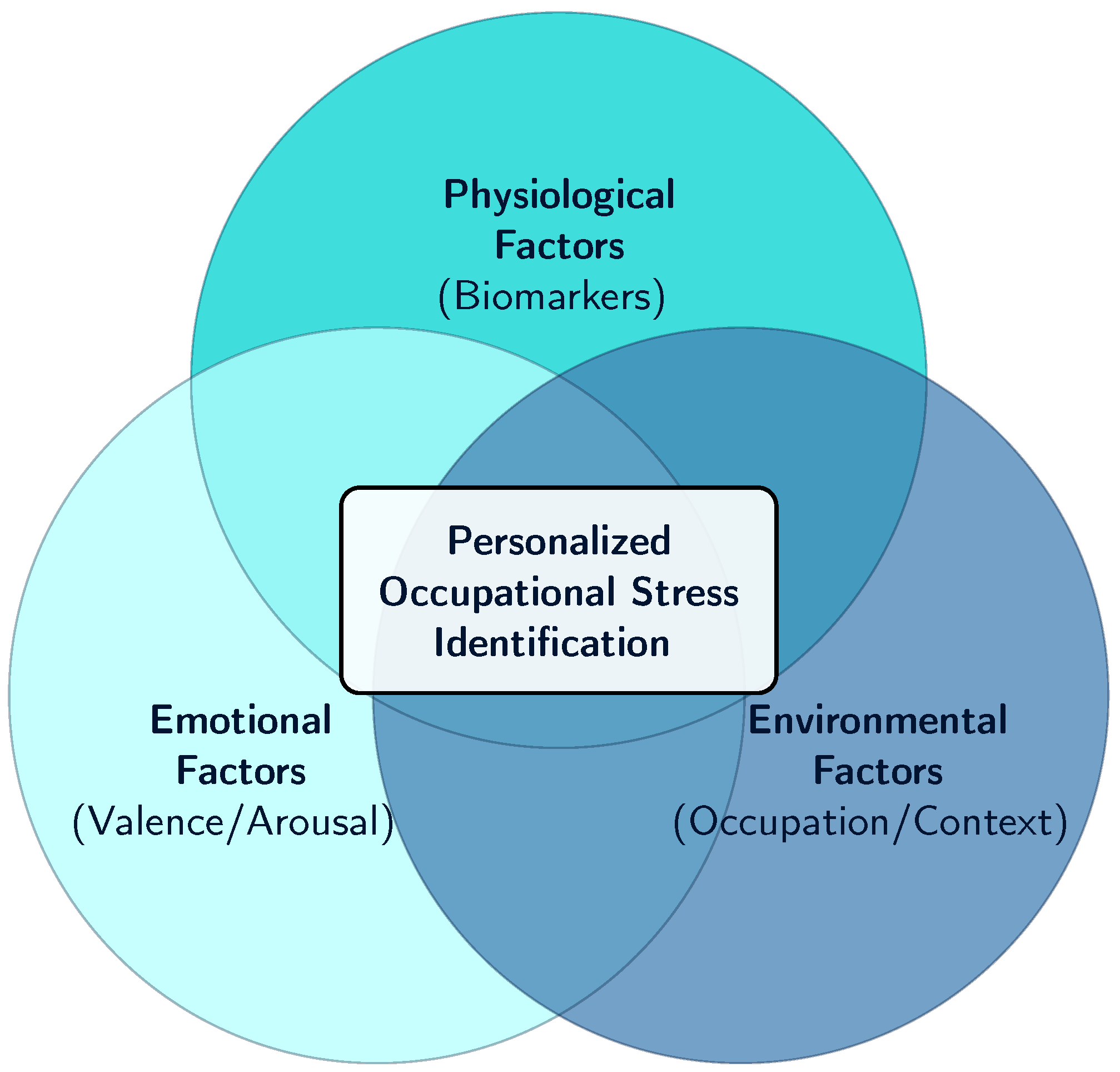
- Furthermore, we observed a declining trend in occupational stress studies, revealing that individual predispositions, as well as environmental and emotional determinants of distress, remain critically under-researched.
2. Methods
- (RQ1)—What are the main focus areas of the studies identified in this review?
- (RQ2)—What are the applications and social impacts of affective intelligent systems?
- (RQ3)—How are security and privacy addressed in the selected studies?
- (RQ4)—Which datasets were used, and what types of features were considered?
- (RQ5)—Which artificial intelligence techniques were employed, and which evaluation metrics were used?
2.1. Selection Criteria
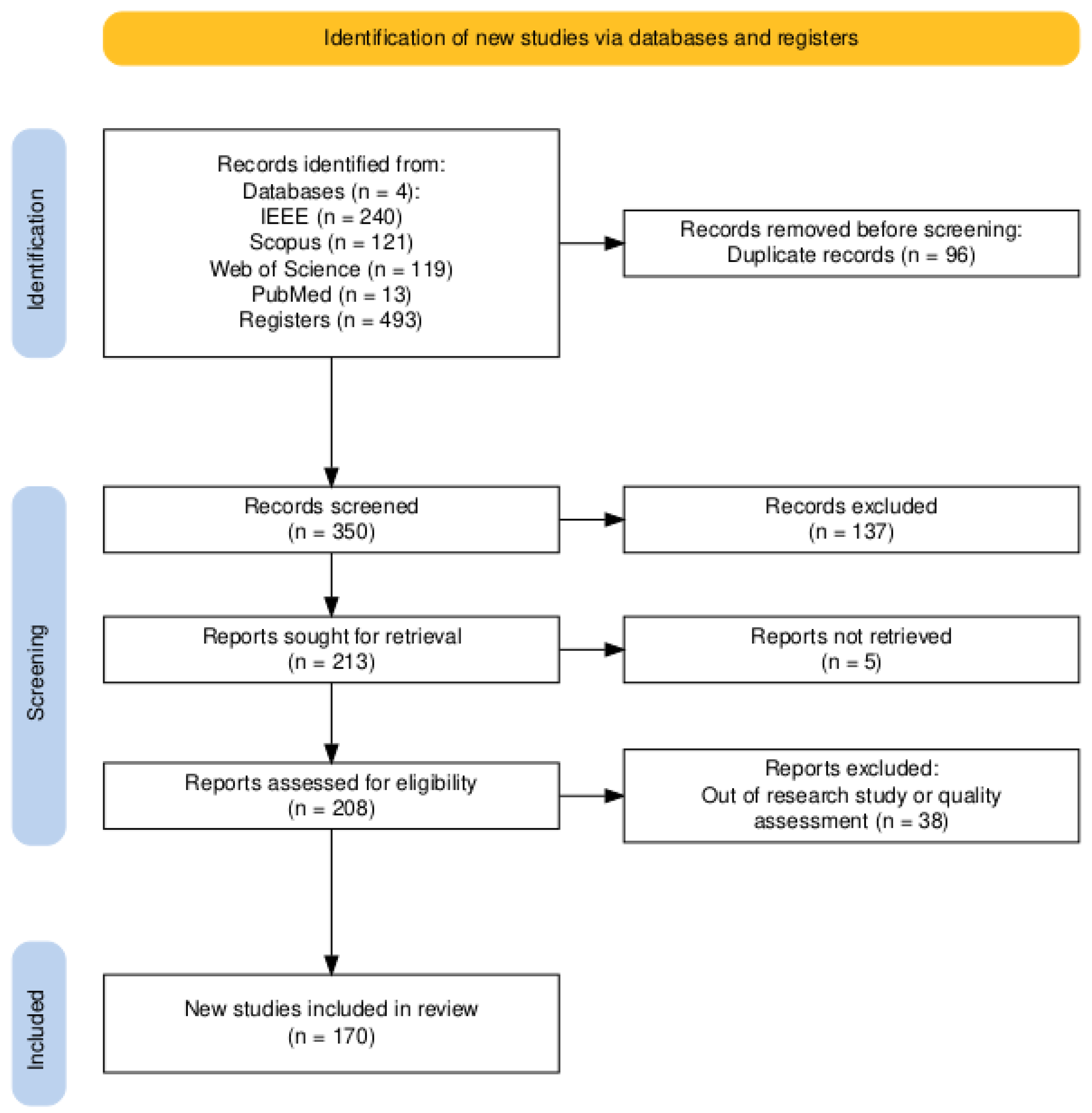
2.2. Selection Process
- P—Affective Intelligent Systems in Healthcare.
- C—Emotion recognition, stress, and emotional states.
- C—Application context, including domains, techniques, and aspects related to social impact and security.
2.3. Data Items and Outcome Measures
2.4. Selected Articles
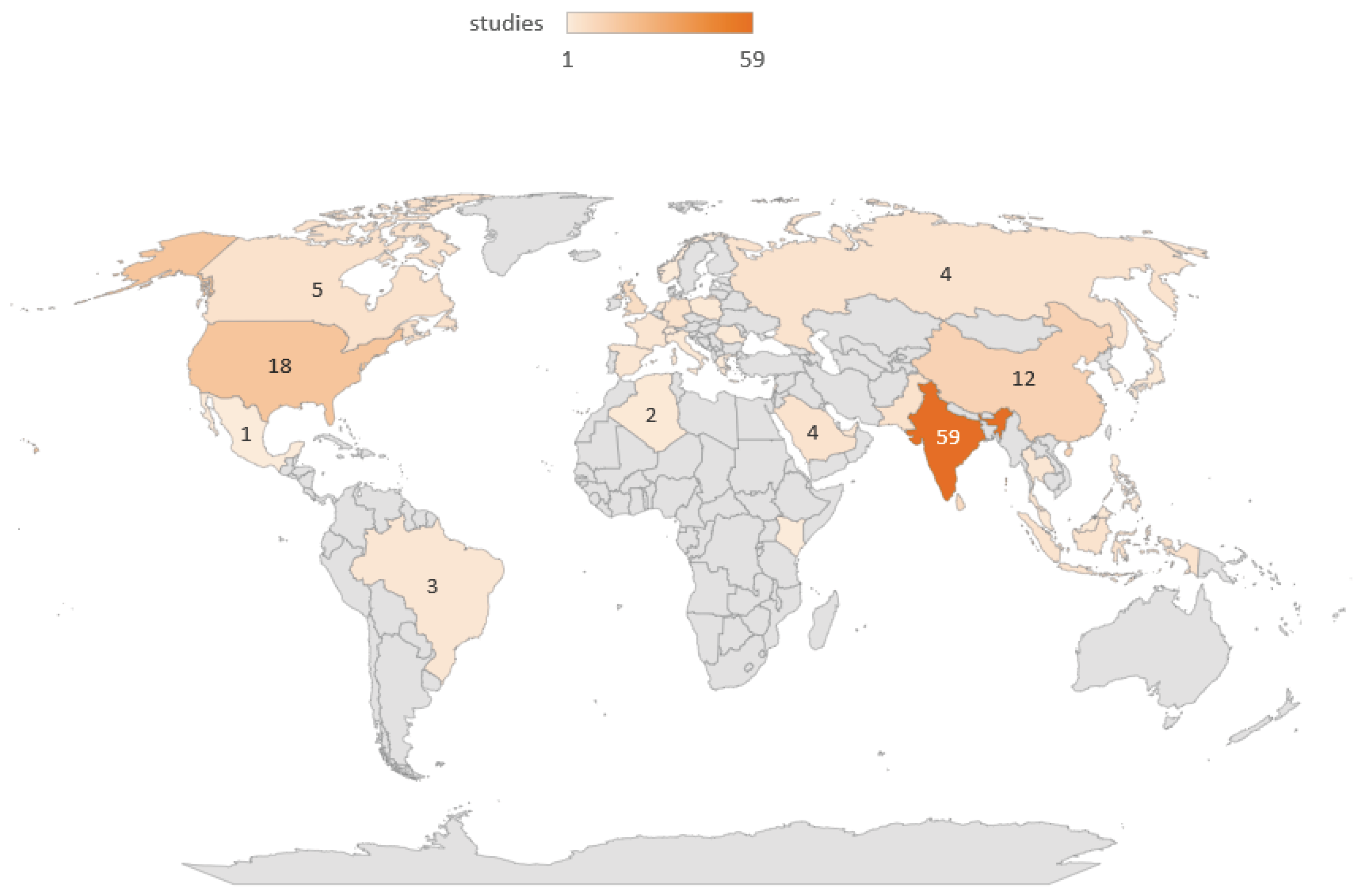
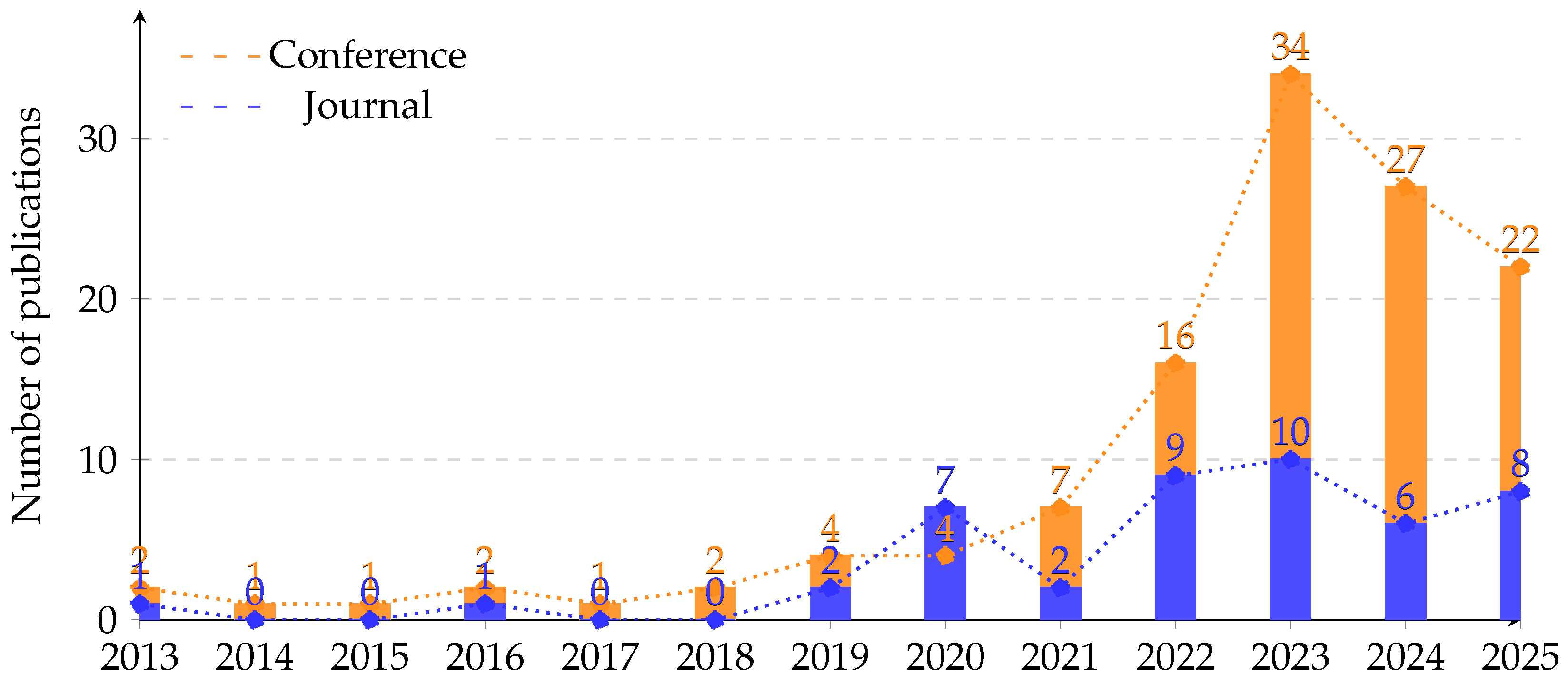
2.5. Geographic and Temporal Distribution of the Included Studies
3. Results
3.1. RQ1—What Are the Main Focus Areas of the Studies Identified in This Review?
3.1.1. Emotions and Emotional States
3.1.2. Stress, Depression, and Anxiety
3.1.3. Other
3.2. RQ2—What Are the Applications and Social Impacts of Affective Intelligent Systems?
3.2.1. Emotion Detection and Practical Applications
3.2.2. Mental Health and Well-Being
3.2.3. Education, Work, and High-Performance Scenarios
3.2.4. Integration of IoT and Affective Computing
3.3. RQ3—How Are Security and Privacy Addressed in the Studies?

| References | Security and Privacy Strategies |
|---|---|
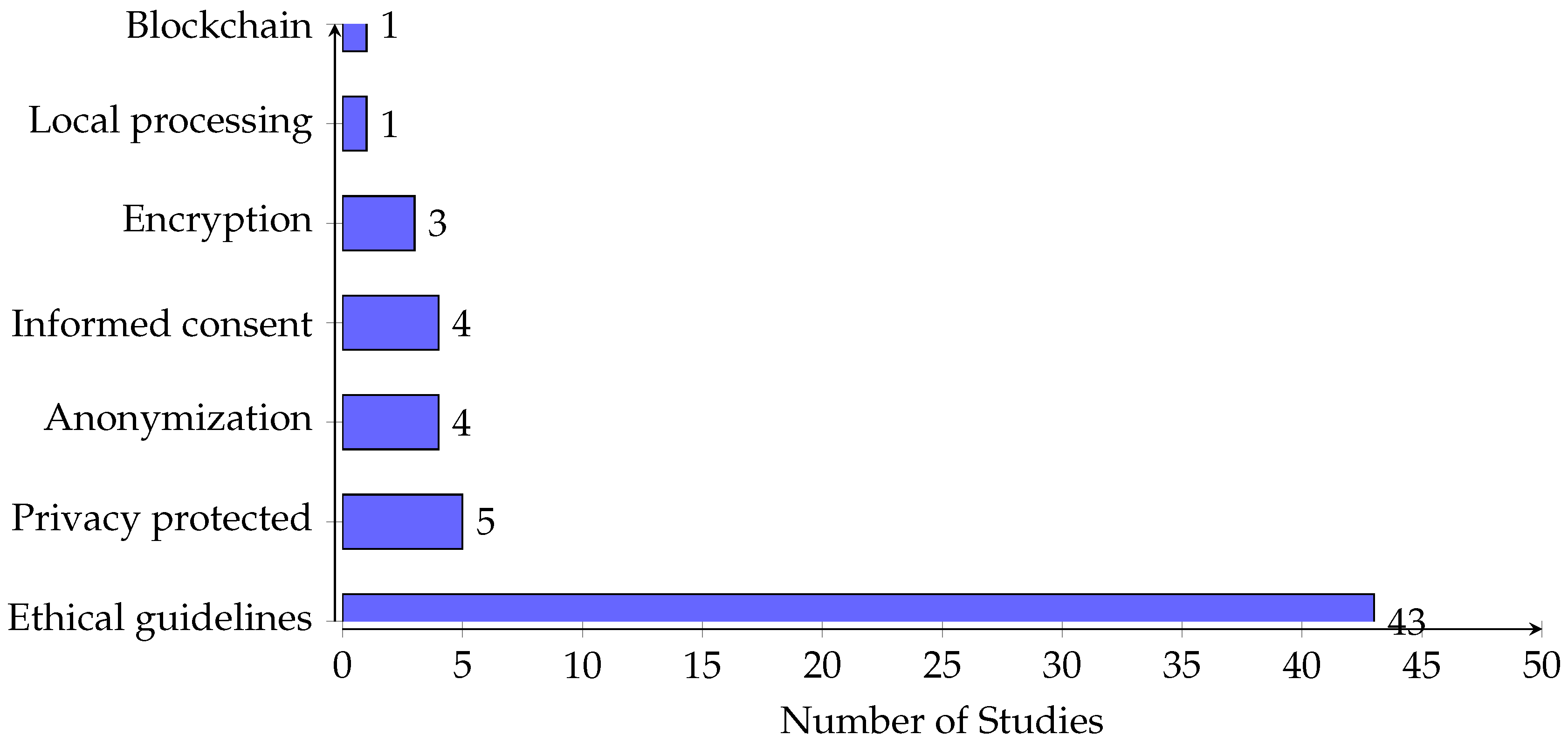
| [2,3,4,8,9,21,24,25,26,31,34,35,36,37,38,46,49,50,60,62,68,70,71,72,73,74,76,77,78,111,112,116,120,123,126,127,145,161,162,168,169,180,181] | Ethical guidelines |
| [3,21,36,37,60] | Privacy protected (no technical details reported) |
| [10,60,112,145,157] | Anonymization |
| [2,3,112,161] | Informed consent |
| [10,45,52] | Encryption |
| [9] | Local processing |
| [52] | Blockchain |
3.3.1. Adopted Strategies
3.3.2. Identified Gaps and Shortcomings
3.4. RQ4—Which Datasets Were Used, and What Types of Resources Were Employed?
Datasets Used
3.5. RQ5—Which Artificial Intelligence Techniques Were Identified, and Which Evaluation Metrics Were Used?
4. Discussion
4.1. The Evolution of Affective Architectures and Temporal Modeling
4.2. Individual Biomarkers and Environmental Context in Occupational Stress
4.3. Social and Ethical Implications: The Privacy-by-Design Milestone
5. Conclusions
Author Contributions
Funding
Conflicts of Interest
References
- Picard, R.W. Affective Computing; MIT Press: Cambridge, MA, USA, 1997. [Google Scholar]
- Broek, E.L.V.D.; Sluis, F.V.D.; Dijkstra, T. Cross-validation of bimodal health-related stress assessment. Pers. Ubiquitous Comput. 2013, 17, 215–227. [Google Scholar] [CrossRef]
- Liu, Y.; Jiang, C. Recognition of Shooter’s Emotions under Stress Based on Affective Computing. IEEE Access 2019, 7, 62338–62343. [Google Scholar] [CrossRef]
- Giuntini, F.T.; Moraes, K.L.D.; Cazzolato, M.T.; Kirchner, L.D.F.; Reis, M.D.J.D.D.; Traina, A.J.; Campbell, A.T.; Ueyama, J. Tracing the Emotional Roadmap of Depressive Users on Social Media through Sequential Pattern Mining. IEEE Access 2021, 9, 97621–97635. [Google Scholar] [CrossRef]
- Andreu-Perez, J.; Solnais, C.; Sriskandarajah, K. EALab (Eye Activity Lab): A MATLAB Toolbox for variable extraction, multivariate analysis and classification of eye-movement data. Neuroinformatics 2016, 14, 51–67. [Google Scholar] [CrossRef] [PubMed]
- Qazi, A.S.; Farooq, M.S.; Rustam, F.; Villar, M.G.; Rodríguez, C.L.; Ashraf, I. Emotion Detection Using Facial Expression Involving Occlusions and Tilt. Appl. Sci. 2022, 12, 11797. [Google Scholar] [CrossRef]
- Mou, L.; Zhao, Y.; Zhou, C.; Nakisa, B.; Rastgoo, M.N.; Ma, L.; Huang, T.; Yin, B.; Jain, R.; Gao, W. Driver Emotion Recognition with a Hybrid Attentional Multimodal Fusion Framework. IEEE Trans. Affect. Comput. 2023, 14, 2970–2981. [Google Scholar] [CrossRef]
- Jyotsna, C.; Amudha, J.; Ram, A.; Fruet, D.; Nollo, G. PredictEYE: Personalized Time Series Model for Mental State Prediction Using Eye Tracking. IEEE Access 2023, 11, 128383–128409. [Google Scholar] [CrossRef]
- Jiang, S.; Firouzi, F.; Chakrabarty, K.; Elbogen, E.B. A Resilient and Hierarchical IoT-Based Solution for Stress Monitoring in Everyday Settings. IEEE Internet Things J. 2022, 9, 10224–10243. [Google Scholar] [CrossRef]
- Xu, H.; Wu, X.; Liu, X. A measurement method for mental health based on dynamic multimodal feature recognition. Front. Public Health 2022, 10, 990235. [Google Scholar] [CrossRef]
- Lefter, I.; Nefs, H.T.; Jonker, C.M.; Rothkrantz, L.J. Cross-corpus analysis for acoustic recognition of negative interactions. In 2015 International Conference on Affective Computing and Intelligent Interaction (ACII); IEEE: New York, NY, USA, 2015; pp. 132–138. [Google Scholar] [CrossRef]
- Machanje, D.I.; Orero, J.O.; Marsala, C. Distress recognition from speech analysis: A pairwise association rules-based approach. In 2019 IEEE Symposium Series on Computational Intelligence (SSCI); IEEE: Piscataway, NJ, USA, 2019; pp. 842–849. [Google Scholar] [CrossRef]
- Chowdhury, A.; Andreu-Perez, J. Clinical brain–computer interface challenge 2020 (CBCIC at WCCI2020): Overview, methods and results. IEEE Trans. Med. Robot. Bionics 2021, 3, 661–670. [Google Scholar] [CrossRef]
- Chaudhary, L.; Girdhar, N.; Sharma, D.; Andreu-Perez, J.; Doucet, A.; Renz, M. A review of deep learning models for twitter sentiment analysis: Challenges and opportunities. IEEE Trans. Comput. Soc. Syst. 2023, 11, 3550–3579. [Google Scholar] [CrossRef]
- Ekambaram, G.; Rakkiannan, T.; Palanisamy, N.; Jayakkavin, E. Transfer Learning based Deep Learning Model for the Identification of Facial Expression. In 2025 3rd International Conference on Intelligent Data Communication Technologies and Internet of Things (IDCIoT); IEEE: New York, NY, USA, 2025; pp. 2030–2037. [Google Scholar] [CrossRef]
- Garzón-Partida, A.P.; Magaña-Plascencia, K.; Martínez-Fernández, D.E.; García-Estrada, J.; Luquín, S.; Fernández-Quezada, D. Development of a Cohesive Predictive Model for Substance Use Disorder Rehabilitation Using Passive Digital Biomarkers, Psychological Assessments, and Automated Facial Emotion Recognition. JMIR Res. Protoc. 2025, 14, e71374. [Google Scholar] [CrossRef] [PubMed]
- Singh, P.; Gupta, A.; Kumar, M.J.; Singh, P.P. AnnoSense: A Framework for Physiological Emotion Data Collection in Everyday Settings for AI. Proc. ACM Interact. Mob. Wearable Ubiquitous Technol. 2025, 9, 131. [Google Scholar] [CrossRef]
- Bamanikar, A.A.; Patil, R.V.; Patil, L.V.; Mahajan, S.A. Evaluating the Effectiveness of Various Feature Extraction Techniques for Emotion Classification using EEG Signals. In 2025 International Conference on Emerging Systems and Intelligent Computing (ESIC); IEEE: New York, NY, USA, 2025; pp. 380–382. [Google Scholar] [CrossRef]
- Vijayalakshmi, S.; Disney Sandhya, A.; Nimala Deve, P. AI-Powered Holistic Mental Health Monitoring: Integrating Facial Emotion Recognition, Chatbot, and Voicebot for Personalized Support. In 2025 International Conference on Data Science, Agents & Artificial Intelligence (ICDSAAI); IEEE: New York, NY, USA, 2025; pp. 1–6. [Google Scholar] [CrossRef]
- Can, Y.S.; Benouis, M.; Mahesh, B.; André, E. Application of Multimodal Self-Supervised Architectures for Daily Life Affect Recognition. IEEE Trans. Affect. Comput. 2025, 16, 2454–2465. [Google Scholar] [CrossRef]
- Taylor, S.; Jaques, N.; Nosakhare, E.; Sano, A.; Picard, R. Personalized Multitask Learning for Predicting Tomorrow’s Mood, Stress, and Health. IEEE Trans. Affect. Comput. 2020, 11, 200–213. [Google Scholar] [CrossRef]
- Cha, G.; Park, D.; Choi, Y.; Park, E.; Lee, J.W. Real-Time Encrypted Emotion Recognition Using Homomorphic Encryption. Proc. ACM Interact. Mob. Wearable Ubiquitous Technol. 2025, 9, 163. [Google Scholar] [CrossRef]
- Bacchini, P.H.; Lopes, E.C.; Barbosa, M.A.G.d.A.; Ferreira, J.O.; da Silva Neto, O.C.; Da Rocha, A.F.; Barbosa, T.M.G.d.A. Developing an affective Point-of-Care technology. In 2014 IEEE Symposium on Computational Intelligence in Healthcare and e-Health (CICARE); IEEE: New York, NY, USA, 2014; pp. 77–84. [Google Scholar] [CrossRef]
- Rishitha, G.M.; Sahithi, T.L.; Vishnu, R.K.; Sree, R.P.; Murthy, Y.V.S. Recommending Music tracks based on Listener’s Emotional State using various Architectures. In 2023 IEEE 20th India Council International Conference, INDICON 2023; Institute of Electrical and Electronics Engineers Inc.: New York, NY, USA, 2023; pp. 1287–1292. [Google Scholar] [CrossRef]
- Cacciatori, F.; Nikolaev, S.; Grigorev, D.; Archangelskaya, A. On Developing Facial Stress Analysis and Expression Recognition Platform. In 2023 International Conference on Artificial Intelligence Science and Applications in Industry and Society, CAISAIS 2023; Institute of Electrical and Electronics Engineers Inc.: New York, NY, USA, 2023. [Google Scholar] [CrossRef]
- Gupta, A.; Raj, M.A.; Singh, K.; Deshmukh, R. REDE—Detecting human emotions using CNN and RASA. In 2022 International Conference for Advancement in Technology, ICONAT 2022; Institute of Electrical and Electronics Engineers Inc.: New York, NY, USA, 2022. [Google Scholar] [CrossRef]
- Morales, A.S.; Ourique, F.d.O.; Cazella, S.C. A comprehensive review on the challenges for intelligent systems related with internet of things for medical decision. In Enhanced Telemedicine and e-Health: Advanced IoT Enabled Soft Computing Framework; Springer: Cham, Switzerland, 2021; pp. 221–240. [Google Scholar] [CrossRef]
- Morales, A.S.; de Oliveira Ourique, F.; Morás, L.D.; Cazella, S.C. Exploring interpretable machine learning methods and biomarkers to classifying occupational stress of the health workers. In Machine Learning for Smart Environments/Cities: An IoT Approach; Springer: Cham, Switzerland, 2022; pp. 105–124. [Google Scholar] [CrossRef]
- Morales, A.; Barbosa, M.; Moras, L.; Cazella, S.C.; Sgobbi, L.F.; Sene, I.; Marques, G. Occupational stress monitoring using biomarkers and smartwatches: A systematic review. Sensors 2022, 22, 6633. [Google Scholar] [CrossRef]
- Dhanasekar, V.; Preethi, Y.; Vishali, S.; Joe, I.R.P.; Poolan, M.B. A Chatbot to promote Students Mental Health through Emotion Recognition. In 3rd International Conference on Inventive Research in Computing Applications, ICIRCA 2021; Institute of Electrical and Electronics Engineers Inc.: New York, NY, USA, 2021; pp. 1412–1416. [Google Scholar] [CrossRef]
- Abraar, S.F.; Thuduhenage, D.T.; Balasubramaniyam, V.P.; Mohanraj, S.R.; Wimalaratne, G.; Rajapaksha, S. SMART DIARY: Autonomous System for Daily Diary Creation and Prioritization of Daily Activities for Improved Well-Being Using Neural Networks and Machine Learning. In 4th International Conference on Advancements in Computing, ICAC 2022—Proceeding; Institute of Electrical and Electronics Engineers Inc.: New York, NY, USA, 2022; pp. 78–83. [Google Scholar] [CrossRef]
- Mahdi, A.; Kazim, A.; Alhammadi, A.; Pangracious, V. EmoGo: A Smart Wearable IoT System for Human Emotion Detection. In 2022 14th Annual Undergraduate Research Conference on “ICT for Resilient and Sustainable Infrastructure”, URC 2022; Institute of Electrical and Electronics Engineers Inc.: New York, NY, USA, 2022. [Google Scholar] [CrossRef]
- Vasile, F.; Vizziello, A.; Brondino, N.; Savazzi, P. Stress State Classification Based on Deep Neural Network and Electrodermal Activity Modeling. Sensors 2023, 23, 2504. [Google Scholar] [CrossRef]
- Romaniszyn-Kania, P.; Pollak, A.; Bugdol, M.D.; Bugdol, M.N.; Kania, D.; Mańka, A.; Danch-Wierzchowska, M.; Mitas, A.W. Affective state during physiotherapy and its analysis using machine learning methods. Sensors 2021, 21, 4853. [Google Scholar] [CrossRef]
- Ghosh, S.; Ekbal, A.; Bhattacharyya, P. What Does Your Bio Say? Inferring Twitter Users’ Depression Status From Multimodal Profile Information Using Deep Learning. IEEE Trans. Comput. Soc. Syst. 2022, 9, 1484–1494. [Google Scholar] [CrossRef]
- Dharmagunarathna, S.J.; Premarathne, D.; Harishchandra, D.; Ranasgala, C.; Thilakarathne, T.; Harshanath, B. AI Powered Virtual Stress Management Assistant for IT Professionals. In ICAC 2023—5th International Conference on Advancements in Computing: Technological Innovation for a Sustainable Economy, Proceedings; Institute of Electrical and Electronics Engineers Inc.: New York, NY, USA, 2023; pp. 692–695. [Google Scholar] [CrossRef]
- Jayasuriya, A.; Gunarathne, Y.; Karawita, S.; Abeywickrama, T.; Weerathunga, I. AI-Based Psychology Experts Centralized Support Platform for Post Traumatic Stress Disorder. In ICAC 2023—5th International Conference on Advancements in Computing: Technological Innovation for a Sustainable Economy, Proceedings; Institute of Electrical and Electronics Engineers Inc.: New York, NY, USA, 2023; pp. 561–566. [Google Scholar] [CrossRef]
- Augsburger, M.; Galatzer-Levy, I.R. Utilization of machine learning to test the impact of cognitive processing and emotion recognition on the development of PTSD following trauma exposure. BMC Psychiatry 2020, 20, 325. [Google Scholar] [CrossRef] [PubMed]
- Page, M.J.; McKenzie, J.E.; Bossuyt, P.M.; Boutron, I.; Hoffmann, T.C.; Mulrow, C.D.; Shamseer, L.; Tetzlaff, J.M.; Akl, E.A.; Brennan, S.E.; et al. The PRISMA 2020 statement: An updated guideline for reporting systematic reviews. BMJ 2021, 372, n71. [Google Scholar] [CrossRef] [PubMed]
- Ouzzani, M.; Hammady, H.M.; Fedorowicz, Z.; Elmagarmid, A.K. Rayyan—A web and mobile app for systematic reviews. Syst. Rev. 2016, 5, 210. [Google Scholar] [CrossRef] [PubMed]
- Haddaway, N.R.; Page, M.J.; Pritchard, C.C.; McGuinness, L.A. PRISMA2020: An R package and Shiny app for producing PRISMA 2020-compliant flow diagrams, with interactivity for optimised digital transparency and Open Synthesis. Campbell Syst. Rev. 2022, 18, e1230. [Google Scholar] [CrossRef]
- Oliveira Araújo, W.C. Recuperação da informação em saúde: Construção, modelos e estratégias. ConCI Convergências Ciência Inform. 2020, 3, 100–134. [Google Scholar] [CrossRef]
- Dzieżyc, M.; Gjoreski, M.; Kazienko, P.; Saganowski, S.; Gams, M. Can we ditch feature engineering? End-to-end deep learning for affect recognition from physiological sensor data. Sensors 2020, 20, 6535. [Google Scholar] [CrossRef]
- Liakopoulos, L.; Stagakis, N.; Zacharaki, E.I.; Moustakas, K. CNN-based stress and emotion recognition in ambulatory settings. In IISA 2021—12th International Conference on Information, Intelligence, Systems and Applications; Institute of Electrical and Electronics Engineers Inc.: New York, NY, USA, 2021. [Google Scholar] [CrossRef]
- Limbachia, J.; Damani, Y.; Dave, S.; Sagvekar, V. MOODIFY: Tailored, Personal and Multifaceted AI Assistant for Young Adult Mental Health Issues. In 2023 6th IEEE International Conference on Advances in Science and Technology, ICAST 2023; Institute of Electrical and Electronics Engineers Inc.: New York, NY, USA, 2023; pp. 106–110. [Google Scholar] [CrossRef]
- Roshani, O.V.; Ayuwardhana, H.M.; Rodrigo, P.H.; Hewageegana, R.U.; Fernando, H.; Silva, D.I.D. Novel Approach for Enhancing Mental Well-Being Through Machine Learning Techniques. In ICAC 2023—5th International Conference on Advancements in Computing: Technological Innovation for a Sustainable Economy, Proceedings; Institute of Electrical and Electronics Engineers Inc.: New York, NY, USA, 2023; pp. 651–656. [Google Scholar] [CrossRef]
- Jain, M.P.; Dasmohapatra, S.S.; Correia, S. Mental health state detection using open CV and sentimental analysis. In 3rd International Conference on Intelligent Sustainable Systems, ICISS 2020; Institute of Electrical and Electronics Engineers Inc.: New York, NY, USA, 2020; pp. 465–470. [Google Scholar] [CrossRef]
- Hosseini, E.; Fang, R.; Zhang, R.; Rafatirad, S.; Homayoun, H. Emotion and Stress Recognition Utilizing Galvanic Skin Response and Wearable Technology: A Real-time Approach for Mental Health Care. In 2023 IEEE International Conference on Bioinformatics and Biomedicine, BIBM 2023; Institute of Electrical and Electronics Engineers Inc.: New York, NY, USA, 2023; pp. 1125–1131. [Google Scholar] [CrossRef]
- Motogna, V.; Lupu-Florian, G.; Lupu, E. Strategy for Affective Computing Based on HRV and EDA. In 2021 9th E-Health and Bioengineering Conference, EHB 2021; Institute of Electrical and Electronics Engineers Inc.: New York, NY, USA, 2021. [Google Scholar] [CrossRef]
- Kulatilake, T.T.; Liyanage, P.L.; Deemud, G.H.; Silva, U.S.D.; Sriyaratna, D.; Kugathasan, A. PRODEP: Smart Social Media Procrastination and Depression Tracker. In 2022 17th International Workshop on Semantic and Social Media Adaptation and Personalization, SMAP 2022; Institute of Electrical and Electronics Engineers Inc.: New York, NY, USA, 2022. [Google Scholar] [CrossRef]
- Nayak, S.; Panda, S.K.; Uttarkabat, S. A Non-contact Framework based on Thermal and Visual Imaging for Classification of Affective States during HCI. In 2020 4th International Conference on Trends in Electronics and Informatics (ICOEI)(48184); IEEE: New York, NY, USA, 2020; pp. 653–660. [Google Scholar] [CrossRef]
- Kiridena, I.; Marasinghe, D.; Karunarathne, R.; Wijethunga, K.; Fernando, H. Emotion and Mentality Monitoring Assistant (EMMA). In 8th International Conference on Communication and Electronics Systems, ICCES 2023; Institute of Electrical and Electronics Engineers Inc.: New York, NY, USA, 2023; pp. 1572–1579. [Google Scholar] [CrossRef]
- Harshinni, M.; Sindhu, V.; Jegan, S.; Joel, J.D.; Kannathal, A.R. A Deep Learning Approach for Human Stress Detection using Haar-Cascade Algorithm. In 7th International Conference on Trends in Electronics and Informatics, ICOEI 2023—Proceedings; Institute of Electrical and Electronics Engineers Inc.: New York, NY, USA, 2023; pp. 1122–1126. [Google Scholar] [CrossRef]
- Geetha, R.; Krishnamoorthy, N.V.; Murugan, K.H.S.; Gnanaprakasam, C.; Swarna, M. A Novel Deep Learning based Stress Analysis and Detection Scheme using Characteristic Data. In 2023 8th IEEE International Conference on Science, Technology, Engineering and Mathematics, ICONSTEM 2023; Institute of Electrical and Electronics Engineers Inc.: New York, NY, USA, 2023. [Google Scholar] [CrossRef]
- Liu, L.; Ji, Y.; Gao, Y.; Li, T.; Xu, W. A Novel Stress State Assessment Method for College Students Based on EEG. Comput. Intell. Neurosci. 2022, 2022, 4565968. [Google Scholar] [CrossRef]
- Prasetio, B.H.; Widasari, E.R.; Bachtiar, F.A. A Study of Stressed Facial Recognition Based on Histogram Information. Informatica 2022, 46, 179–185. [Google Scholar] [CrossRef]
- Varsha, S.K.; Sri, R.L.; Anuvidhya, K. An Intelligent Machine Learning System for Real-Time Stress Management Based on a Mini-Xception Algorithm and Deep Neural Network Models. In IEEE InC4 2023—2023 IEEE International Conference on Contemporary Computing and Communications; Institute of Electrical and Electronics Engineers Inc.: New York, NY, USA, 2023. [Google Scholar] [CrossRef]
- Khan, H.A.; Nguyen, T.N.; Shafiq, G.; Mirza, J.; Javed, M.A. A Secure Wearable Framework for Stress Detection in Patients Affected by Communicable Diseases. IEEE Sens. J. 2023, 23, 981–988. [Google Scholar] [CrossRef]
- Santos, O.C.; Uria-Rivas, R.; Rodriguez-Sanchez, M.C.; Boticario, J.G. An Open Sensing and Acting Platform for Context-Aware Affective Support in Ambient Intelligent Educational Settings. IEEE Sens. J. 2016, 16, 3865–3874. [Google Scholar] [CrossRef]
- Liu, J.; He, L.; Chen, Z.; Chen, Z.; Hao, Y.; Jiang, D. Context-Aware EEG-Based Perceived Stress Recognition based on Emotion Transition Paradigm. In 2023 11th International Conference on Affective Computing and Intelligent Interaction Workshops and Demos, ACIIW 2023; Institute of Electrical and Electronics Engineers Inc.: New York, NY, USA, 2023. [Google Scholar] [CrossRef]
- Prasanalakshmi, B.; Kumar, T.A. Deep Regression hybridized Neural Network in human stress detection. In 1st IEEE International Conference on Smart Technologies and Systems for Next Generation Computing, ICSTSN 2022; Institute of Electrical and Electronics Engineers Inc.: New York, NY, USA, 2022. [Google Scholar] [CrossRef]
- Dobbins, C.; Fairclough, S. Detecting negative emotions during real-life driving via dynamically labelled physiological data. In 2018 IEEE International Conference on Pervasive Computing and Communications Workshops (PerCom Workshops); IEEE: New York, NY, USA, 2018; pp. 830–835. [Google Scholar] [CrossRef]
- Golgouneh, A.; Tarvirdizadeh, B. Fabrication of a portable device for stress monitoring using wearable sensors and soft computing algorithms. Neural Comput. Appl. 2020, 32, 7515–7537. [Google Scholar] [CrossRef]
- Ming, F.J.; Anhum, S.S.; Islam, S.; Hooi, K.K. Facial Emotion Recognition System for Mental Stress Detection among University Students. In International Conference on Electrical, Computer, Communications and Mechatronics Engineering, ICECCME 2023; Institute of Electrical and Electronics Engineers Inc.: New York, NY, USA, 2023. [Google Scholar] [CrossRef]
- Rashid, N.; Chen, L.; Dautta, M.; Jimenez, A.; Tseng, P.; Faruque, M.A.A. Feature Augmented Hybrid CNN for Stress Recognition Using Wrist-based Photoplethysmography Sensor. In Annual International Conference of the IEEE Engineering in Medicine and Biology Society, EMBS; Institute of Electrical and Electronics Engineers Inc.: New York, NY, USA, 2021; pp. 2374–2377. [Google Scholar] [CrossRef]
- Roy, A.; Acharya, A.; Biswas, S.; Ray, S.; Ganguly, B. Identification and Classification of Human Mental Stress using Physiological Data: A Low-Power Hybrid Approach. In 2022 6th International Conference on Condition Assessment Techniques in Electrical Systems, CATCON 2022; Institute of Electrical and Electronics Engineers Inc.: New York, NY, USA, 2022; pp. 135–139. [Google Scholar] [CrossRef]
- Saputra, N.H.; Nafiiyah, N. Identification of Human Stress Based on EEG Signals Using Machine Learning. In 2022 1st International Conference on Information System and Information Technology, ICISIT 2022; Institute of Electrical and Electronics Engineers Inc.: New York, NY, USA, 2022; pp. 176–180. [Google Scholar] [CrossRef]
- Patel, A.; Nariani, D.; Rai, A. Mental Stress Detection using EEG and Recurrent Deep Learning. In APSCON 2023—IEEE Applied Sensing Conference, Symposium Proceedings; Institute of Electrical and Electronics Engineers Inc.: New York, NY, USA, 2023. [Google Scholar] [CrossRef]
- Rajkumar, S.D.; Dewpura, I.U.; Fernandez, P.; Maduka, C.; Fernando, H.; Rajapakshe, S. MindRelax: Smart System for Emotion and Mental Stress Monitoring, Detection and Management. In ICAC 2023—5th International Conference on Advancements in Computing: Technological Innovation for a Sustainable Economy, Proceedings; Institute of Electrical and Electronics Engineers Inc.: New York, NY, USA, 2023; pp. 268–273. [Google Scholar] [CrossRef]
- Sethi, A.; Walambe, R.; Jain, P.; Kotecha, K. Multimodal Mental Workload Classification Using Maus Dataset. In 3rd International Conference on Advanced Computing Technologies and Applications, ICACTA 2023; Institute of Electrical and Electronics Engineers Inc.: New York, NY, USA, 2023. [Google Scholar] [CrossRef]
- Zhu, L.; Spachos, P.; Gregori, S. Multimodal Physiological Signals and Machine Learning for Stress Detection by Wearable Devices. In 2022 IEEE International Symposium on Medical Measurements and Applications, MeMeA 2022—Conference Proceedings; Institute of Electrical and Electronics Engineers Inc.: New York, NY, USA, 2022. [Google Scholar] [CrossRef]
- Prajod, P.; André, E. On the Generalizability of ECG-based Stress Detection Models. In 21st IEEE International Conference on Machine Learning and Applications, ICMLA 2022; Institute of Electrical and Electronics Engineers Inc.: New York, NY, USA, 2022; pp. 549–554. [Google Scholar] [CrossRef]
- Mummadi, S.; Nithyasree, A.; Hemavathi, A.; Swathi, B. Periodical Analysis of Stress in Working Professionals. In 2023 14th International Conference on Computing Communication and Networking Technologies, ICCCNT 2023; Institute of Electrical and Electronics Engineers Inc.: New York, NY, USA, 2023. [Google Scholar] [CrossRef]
- Bousefsaf, F.; Maaoui, C.; Pruski, A. Remote assessment of the heart rate variability to detect mental stress. In 2013 7th International Conference on Pervasive Computing Technologies for Healthcare and Workshops, PervasiveHealth 2013; IEEE: New York, NY, USA, 2013; pp. 348–351. [Google Scholar] [CrossRef][Green Version]
- Zhu, L.; Spachos, P.; Ng, P.C.; Yu, Y.; Wang, Y.; Plataniotis, K.; Hatzinakos, D. Stress Detection Through Wrist-Based Electrodermal Activity Monitoring and Machine Learning. IEEE J. Biomed. Health Inform. 2023, 27, 2155–2165. [Google Scholar] [CrossRef] [PubMed]
- Rashid, N.; Mortlock, T.; Faruque, M.A.A. Stress Detection Using Context-Aware Sensor Fusion From Wearable Devices. IEEE Internet Things J. 2023, 10, 14114–14127. [Google Scholar] [CrossRef]
- Panganiban, F.C.; Leon, F.A.D. Stress Detection Using Smartphone Extracted Photoplethysmography. In TENSYMP 2021—2021 IEEE Region 10 Symposium; Institute of Electrical and Electronics Engineers Inc.: New York, NY, USA, 2021. [Google Scholar] [CrossRef]
- Pajong, W.; Eiamcharoen, P.; Srisomboon, K.; Lee, W. Time Series based Emotion Classification Algorithm exploiting Deep Learning. In 4th Research, Invention, and Innovation Congress: Innovative Electricals and Electronics: Innovation for Better Life, RI2C 2023; Institute of Electrical and Electronics Engineers Inc.: New York, NY, USA, 2023; pp. 151–154. [Google Scholar] [CrossRef]
- Gunasekaran, S.; Kathirvel, S.; Kavin, A.; Logeshwaran, K.; Patmesh, S. An AI-powered smart health companion that detects stress to aid medical support using artificial intelligence/machine learning. In 2024 4th International Conference on Advancement in Electronics & Communication Engineering (AECE); IEEE: New York, NY, USA, 2024; pp. 555–559. [Google Scholar] [CrossRef]
- Singh, M.K.; Kumar, S. Stress Detection During Social Interactions with Natural Language Processing and Machine Learning. In 2024 International Conference on Expert Clouds and Applications (ICOECA); IEEE: New York, NY, USA, 2024; pp. 297–301. [Google Scholar] [CrossRef]
- Huang, M.; Yang, H.; Sun, N.; Chen, G.; Li, D.; Zhu, T.; Liang, Y.; Lin, G. Study of a Hybrid CNN-SVM Model for Stress Detection with Automated Heart Rate Variability Feature Extraction Method. In 2024 3rd International Conference on Health Big Data and Intelligent Healthcare (ICHIH); IEEE: New York, NY, USA, 2024; pp. 316–319. [Google Scholar] [CrossRef]
- Tarun, M.; Jonnalagadda, V.K.; Sai, A.J.; Nivas, K.; Mohan, P.V. Stress Detection by Deep Learning Technique. In 2024 Third International Conference on Intelligent Techniques in Control, Optimization and Signal Processing (INCOS); IEEE: New York, NY, USA, 2024; pp. 1–6. [Google Scholar] [CrossRef]
- Umer, L.; Iqbal, J.; Ayaz, Y.; Imam, H.; Ahmad, A.; Asgher, U. StressSpeak: A Speech-Driven Framework for Real-Time Personalized Stress Detection and Adaptive Psychological Support. Diagnostics 2025, 15, 2871. [Google Scholar] [CrossRef] [PubMed]
- Raju, T.Y.; Karuna, V.; Riyaz, S.; Jakivulla, N.S.; Arshiya, S.; Mujeebuddin, S. Comprehensive Psychological State Assessment Platform Integrating Facial Recognition Technology and Survey-based Stress Evaluation with ML Classification. In 2025 4th International Conference on Innovative Mechanisms for Industry Applications (ICIMIA); IEEE: New York, NY, USA, 2025; pp. 1011–1018. [Google Scholar] [CrossRef]
- Miura, Y.; Hishida, H.; Kurono, A. Basic Study on the development of a stress detection system by voice using machine learning. In Proceedings of the 29th World Multi-Conference on Systemics, Cybernetics and Informatics: WMSCI 2025; International Institute of Informatics and Systemics: Winter Garden, FL, USA, 2025; pp. 142–146. [Google Scholar] [CrossRef]
- Paikrao, P.; Bhalke Daulappa, G.G.; Kawtikwar, P.; Katakwar, L.; Pitale, A. Designing a Novel Voice-Driven System for Socio-economic Stress Detection in Fintech Professionals and Consumers. In 2025 Global Conference in Emerging Technology (GINOTECH); IEEE: New York, NY, USA, 2025. [Google Scholar] [CrossRef]
- Sarangan, R.; Anjana, P.; Menon, H.P.; Nair, L.S.; Cheriyan, J. Smart Learning with Stress Detection: Enhancing Online Education Through AI-Driven Question Answering and Emotional Well-Being Monitoring. In 2025 11th International Conference on Communication and Signal Processing (ICCSP); IEEE: New York, NY, USA, 2025; pp. 1444–1449. [Google Scholar] [CrossRef]
- Shah, A.; Jain, R. Facial Emotion Recognition System for Mental Stress Detection in Students: A Kiosk-Based Approach Using Raspberry Pi. In International Conference on Business and Technology; Springer: Cham, Switzerland, 2025; Volume 1574, pp. 124–135. [Google Scholar] [CrossRef]
- Bhaskar, N.; Bidwai, P.; Mahesh, K.; Trishan, B.; Khandelwal, S.S.; Vishvith Shetty, N. A Deep Learning Approach for Enhanced Detection of Mental Stress and Emotion Analysis. In Proceedings of the International Conference on Computer & Communication Technologies; Springer: Singapore, 2024; Volume 1356, pp. 407–415. [Google Scholar] [CrossRef]
- Kumar, G.S.; Cheriyan, J.; Aparna, N.; Swathy, J. Unleashing Facial Expression Recognition for Stress Detection Using Deep CNN Model. Procedia Comput. Sci. 2025, 259, 306–315. [Google Scholar] [CrossRef]
- Swedheetha, C.; Nihil Sankar, E.; Ramkishan, C.B. Mental Stress Prediction Using Machine Learning and Facial Emotion Recognition. In 2025 IEEE 14th International Conference on Communication Systems and Network Technologies (CSNT); IEEE: New York, NY, USA, 2025; pp. 239–244. [Google Scholar] [CrossRef]
- Iswarya, M.M.E.; Susitra, K.M.E.; Harinarayanan, A.; Lakshmi Narayanan, S.; Elaiyavanan, A. Mental Health Tracker. In 2025 International Conference on Computing and Communication Technologies (ICCCT); IEEE: New York, NY, USA, 2025; pp. 1–5. [Google Scholar] [CrossRef]
- Almadhor, A.S.; Ojo, S.A.; Nathaniel, T.I.; Ukpong, K.; Alsubai, S.; Al-Hejaili, A.R. A cross-domain framework for emotion and stress detection using WESAD, SCIENTISST-MOVE, and DREAMER datasets. Front. Bioeng. Biotechnol. 2025, 13, 1659002. [Google Scholar] [CrossRef]
- Chauhan, T.; P N, R. Utilizing Machine Learning to foster employee mental health in modern workplace environment. In 2024 IEEE International Students’ Conference on Electrical, Electronics and Computer Science (SCEECS); IEEE: New York, NY, USA, 2024; pp. 1–5. [Google Scholar] [CrossRef]
- Dapit, A.S.A.R.; Othman, M.; Azuddin, M.; Puzi, A.A.; Rahardja, U. A Computational Model for Stress Intervention using Affective Brain-Computer Interfaces. In 2025 IEEE International Conference on Artificial Intelligence in Engineering and Technology (IICAIET); IEEE: New York, NY, USA, 2025; pp. 114–119. [Google Scholar] [CrossRef]
- Vural, Ş.F.; Yurdusever, B.; Oktay, A.B.; Uzun, I. Stress recognition from facial images in children during physiotherapy with serious games. Expert Syst. Appl. 2024, 238, 121837. [Google Scholar] [CrossRef]
- Onda, R.; Kirita, R.; Takahi, A.; Nishikawa, S.; Igasaki, T. Profile of Mood States 2nd Edition-based Emotion Intensity Estimation by Electroencephalogram and Heart Rate Variability with Support Vector Machines. In 2025 47th Annual International Conference of the IEEE Engineering in Medicine and Biology Society (EMBC); IEEE: New York, NY, USA, 2025; pp. 1–6. [Google Scholar] [CrossRef]
- Noronha, V.S.; C V, V.; M K, P.K. The Language of Emotions: Algorithmic Reasoning for Stress and Mood Identification. In 2025 3rd International Conference on Intelligent Cyber Physical Systems and Internet of Things (ICoICI); IEEE: New York, NY, USA, 2025; pp. 1691–1696. [Google Scholar] [CrossRef]
- Ruzicky, E.; Lacko, J.; Kozak, S.; Sramka, M.; Čeresnik, M. Using Virtual Reality to Monitor Worker Stress and Fatigue in Industry. In 2025 Cybernetics & Informatics (K&I); IEEE: New York, NY, USA, 2025; pp. 1–9. [Google Scholar] [CrossRef]
- Khan, A.M.; Lawo, M. Developing a system for recognizing the emotional states using physiological devices. In 2016 12th International Conference on Intelligent Environments (IE); IEEE: Piscataway, NJ, USA, 2016; pp. 48–53. [Google Scholar] [CrossRef]
- Ghosh, S.; Sahu, S.; Ganguly, N.; Mitra, B.; De, P. EmoKey: An emotion-aware smartphone keyboard for mental health monitoring. In 2019 11th International Conference on Communication Systems & Networks (COMSNETS); IEEE: New York, NY, USA, 2019; pp. 496–499. [Google Scholar] [CrossRef]
- Nita, S.; Bitam, S.; Heidet, M.; Mellouk, A. A new data augmentation convolutional neural network for human emotion recognition based on ECG signals. Biomed. Signal Process. Control 2022, 75, 103580. [Google Scholar] [CrossRef]
- Maningo, J.M.Z.; Bandala, A.A.; Vicerra, R.R.P.; Dadios, E.P.; Bedoya, K.A.L.; Carandang, A.L.A.; Maniaul, P.J.Y.; Tabalan, A.R.V. A Smart Space with Music Selection Feature Based on Face and Speech Emotion and Expression Recognition. In 2020 IEEE Region 10 Conference (TENCON); IEEE: New York, NY, USA, 2020; pp. 696–701. [Google Scholar] [CrossRef]
- Rovinska, S.; Khan, N. Affective State Recognition with Convolutional Autoencoders. In Annual International Conference of the IEEE Engineering in Medicine and Biology Society, EMBS; Institute of Electrical and Electronics Engineers Inc.: New York, NY, USA, 2022; pp. 4664–4667. [Google Scholar] [CrossRef]
- Deepa, R.N.A.; Karlapati, P.; Mulagondla, M.R.; Amaranayani, P.; Toram, A.P. An Innovative Emotion Recognition and Solution Recommendation Chatbot. In 8th International Conference on Advanced Computing and Communication Systems, ICACCS 2022; Institute of Electrical and Electronics Engineers Inc.: New York, NY, USA, 2022; pp. 1100–1105. [Google Scholar] [CrossRef]
- Abramov, S.; Korotin, A.; Somov, A.; Burnaev, E.; Stepanov, A.; Nikolaev, D.; Titova, M.A. Analysis of Video Game Players’ Emotions and Team Performance: An Esports Tournament Case Study. IEEE J. Biomed. Health Inform. 2022, 26, 3597–3606. [Google Scholar] [CrossRef]
- Shubhangi, D.C.; Gadgay, B.; Nagaratnamma. Automatic Speech Emotion Recognition and Mind Status Classification Based on Deep Learning. In 5th IEEE International Conference on Cybernetics, Cognition and Machine Learning Applications, ICCCMLA 2023; Institute of Electrical and Electronics Engineers Inc.: New York, NY, USA, 2023; pp. 459–463. [Google Scholar] [CrossRef]
- Shrara, H.; Ammar, H.; Nasseredine, M.; Charara, J.; Sbeity, F. An EEG-Based Emotion Recognition Study Using Machine Learning and Deep Learning. In International Conference on Advances in Biomedical Engineering, ICABME; Institute of Electrical and Electronics Engineers Inc.: New York, NY, USA, 2023; pp. 125–129. [Google Scholar] [CrossRef]
- Gumelar, A.B.; Yuniarno, E.M.; Adi, D.P.; Sooai, A.G.; Sugiarto, I.; Purnomo, M.H. BiLSTM-CNN Hyperparameter Optimization for Speech Emotion and Stress Recognition. In International Electronics Symposium 2021: Wireless Technologies and Intelligent Systems for Better Human Lives, IES 2021—Proceedings; Institute of Electrical and Electronics Engineers Inc.: New York, NY, USA, 2021; pp. 156–161. [Google Scholar] [CrossRef]
- Bojanić, M.; Delić, V.; Karpov, A. Call redistribution for a call center based on speech emotion recognition. Appl. Sci. 2020, 10, 4653. [Google Scholar] [CrossRef]
- Immanuel, R.R. Identifying different emotions of human using eeg signals using deep learning techniques. J. Theor. Appl. Inf. Technol. 2023, 101. [Google Scholar]
- Alemu, Y.; Chen, H.; Duan, C.; Caulley, D.; Arriaga, R.I.; Sezgin, E. Detecting Clinically Relevant Emotional Distress and Functional Impairment in Children and Adolescents: Protocol for an Automated Speech Analysis Algorithm Development Study. JMIR Res. Protoc. 2023, 12, e46970. [Google Scholar] [CrossRef] [PubMed]
- Aggarwal, V.; Kaur, H.; Sharma, D.; Singhal, A. Emotion Classification of Social Media Posts using Artificial Intelligence and Machine Learning. In International Conference on Computational Intelligence and Sustainable Engineering Solution, CISES 2023; Institute of Electrical and Electronics Engineers Inc.: New York, NY, USA, 2023; pp. 999–1004. [Google Scholar] [CrossRef]
- Ahamed, S.S.; Jabez, J.; Prithiviraj, M. Emotion Detection using Speech and Face in Deep Learning. In International Conference on Sustainable Computing and Smart Systems, ICSCSS 2023—Proceedings; Institute of Electrical and Electronics Engineers Inc.: New York, NY, USA, 2023; pp. 317–324. [Google Scholar] [CrossRef]
- Baliga, S.; Ali, N.; Anusha, L.S.; Vishruthh, P. Emotion Recognition and Stress Reduction Based on Electroencephalograph (EEG) Signals validated by Machine Learning Algorithms. In International Conference on Smart Systems for Applications in Electrical Sciences, ICSSES 2023; Institute of Electrical and Electronics Engineers Inc.: New York, NY, USA, 2023. [Google Scholar] [CrossRef]
- Antonio, N.J.; Nobel, Y.R.; Ho, H.C.; Astuti, W. Emotion Recognition based on Heart Rate Detection using Logistic Regression for Automation Food Healing Application. In International Conference on Education and Technology, ICET. Institute of Electrical and Electronics Engineers; IEEE: New York, NY, USA, 2022; pp. 118–122. [Google Scholar] [CrossRef]
- Uddin, M.Z.; Nilsson, E.G. Emotion recognition using speech and neural structured learning to facilitate edge intelligence. Eng. Appl. Artif. Intell. 2020, 94, 103775. [Google Scholar] [CrossRef]
- Vuppalapati, C.; Kedari, S.; Ilapakurti, A.; Kedari, S.; Shankar, J. Emotional health: A data driven approach to understand our emotions and improve our health. In 22nd IEEE International Conference on Computational Science and Engineering and 17th IEEE International Conference on Embedded and Ubiquitous Computing, CSE/EUC 2019; Institute of Electrical and Electronics Engineers Inc.: New York, NY, USA, 2019; pp. 339–347. [Google Scholar] [CrossRef]
- Rao, K.P.V.; Ashwini, H.K.; Akshatha, S. Emotional stress recognition system using EEG and psychophysiological signals. In 2021 International Conference on Advancements in Electrical, Electronics, Communication, Computing and Automation, ICAECA 2021; Institute of Electrical and Electronics Engineers Inc.: New York, NY, USA, 2021. [Google Scholar] [CrossRef]
- Zenonos, A.; Khan, A.; Kalogridis, G.; Vatsikas, S.; Lewis, T.; Sooriyabandara, M. HealthyOffice: Mood recognition at work using smartphones and wearable sensors. In 2016 IEEE International Conference on Pervasive Computing and Communication Workshops (PerCom Workshops); IEEE: New York, NY, USA, 2016; pp. 1–6. [Google Scholar] [CrossRef]
- Ruangdit, T.; Sungkhin, T.; Phenglong, W.; Phaisangittisagul, E. Integration of Facial and Speech Expressions for Multimodal Emotional Recognition. In IEEE Region 10 Annual International Conference, Proceedings/TENCON; Institute of Electrical and Electronics Engineers Inc.: New York, NY, USA, 2023; pp. 519–523. [Google Scholar] [CrossRef]
- Das, S.; Goswami, N.N.; Kalaskar, A.P.; Mondal, S.; Samanta, P.K.; Gannamaneni, S.K. IoT Based Framework Design for Automated Human Emotion Recognition. In 2023 2nd International Conference on Ambient Intelligence in Health Care, ICAIHC 2023; Institute of Electrical and Electronics Engineers Inc.: New York, NY, USA, 2023. [Google Scholar] [CrossRef]
- Bhattacharya, S.; Islam, A.; Shahnawaz, S. TEmoDec: Emotion Detection from Handwritten Text using Agglomerative Clustering. In 2022 1st International Conference on Artificial Intelligence Trends and Pattern Recognition, ICAITPR 2022; Institute of Electrical and Electronics Engineers Inc.: New York, NY, USA, 2022. [Google Scholar] [CrossRef]
- Kumar, A.; Sharma, K.; Sharma, A. MEmoR: A Multimodal Emotion Recognition using affective biomarkers for smart prediction of emotional health for people analytics in smart industries. Image Vis. Comput. 2022, 123, 104483. [Google Scholar] [CrossRef]
- Naveen, D.; Rachana, P.; Swetha, S.; Sarvashni, S. Mental Health Monitor using Facial Recognition. In 2023 2nd International Conference for Innovation in Technology, INOCON 2023; Institute of Electrical and Electronics Engineers Inc.: New York, NY, USA, 2023. [Google Scholar] [CrossRef]
- Majumder, A.J.A.; McWhorter, T.M.; Ni, Y.; Nie, H.; Iarve, J.; Ucci, D.R. SEmoD: A personalized emotion detection using a smart holistic embedded IoT system. In 2019 IEEE 43rd Annual Computer Software and Applications Conference (COMPSAC); IEEE: New York, NY, USA, 2019; Volume 1, pp. 850–859. [Google Scholar] [CrossRef]
- Aldrich, B.; Liu, Y.; Almousa, M.; Anwar, M. Translating Keystroke and Mouse Dynamics Data to Classify Human Mood. In 2023 5th International Conference on Transdisciplinary AI, TransAI 2023; Institute of Electrical and Electronics Engineers Inc.: New York, NY, USA, 2023; pp. 79–86. [Google Scholar] [CrossRef]
- Jose, J.J. Leveraging Sentiment Analysis and Emotion Detection for Mental Health Insights. In 2024 IEEE International Conference on Future Machine Learning and Data Science (FMLDS); IEEE: New York, NY, USA, 2024; pp. 493–498. [Google Scholar] [CrossRef]
- Kaur, G.; Gupta, M.; Kumar, R.T. Classifying Human Emotions through EEG data with Machine Learning. In 2025 International Conference on Intelligent Systems and Computational Networks (ICISCN); IEEE: New York, NY, USA, 2024; pp. 632–636. [Google Scholar] [CrossRef]
- Govarthan, P.K.; Peddapalli, S.K.; Ganapathy, N.; Ronickom, J.F.A. Emotion classification using electrocardiogram and machine learning: A study on the effect of windowing techniques. Expert Syst. Appl. 2024, 254, 124371. [Google Scholar] [CrossRef]
- Barigala, V.K.; Swarubini, P.J.; Ganapathy, N.; Karthik, P.A.; Kumar, D.; Ronickom, J.F.A. Evaluating the effectiveness of machine learning in identifying the optimal facial electromyography location for emotion detection. Biomed. Signal Process. Control 2025, 100, 107012. [Google Scholar] [CrossRef]
- Loor, J.; Li, R. Human Emotion Recognition in Collaborative Tasks Using Virtual Reality Games. In 2024 International Conference on Networking, Sensing and Control (ICNSC); IEEE: New York, NY, USA, 2024; pp. 1–6. [Google Scholar] [CrossRef]
- Thakur, S.; Bele, R.; Yarlagadda, T.; Chaubey, V.P.; Sharma, S.; Gochhait, S. Speech Emotion Recognition Using Deep Learning Techniques and Traditional Classifiers. In 2024 International Conference on Innovation and Intelligence for Informatics, Computing, and Technologies (3ICT); IEEE: New York, NY, USA, 2024; pp. 306–311. [Google Scholar] [CrossRef]
- Hussein Mohammed, M.; Noaman Kadhim, M.N.; Al-Shammary, D.; Ibaida, A. EEG-Based Emotion Detection Using Roberts Similarity and PSO Feature Selection. IEEE Access 2025, 13, 79353–79366. [Google Scholar] [CrossRef]
- Toupin, G.; Dehgan, A.; Buffo, M.; Feyt, C.; Alamian, G.; Jerbi, K.; Saive, A.L. Decoding Humor-Induced Amusement via Facial Expression Analysis: Toward Emotion-Aware Applications. Appl. Sci. 2025, 15, 7499. [Google Scholar] [CrossRef]
- Wan, J.; Fang, Y.; Guo, C.; Ju, Z.; Zhou, D. Emotion Classification based on Multi Physiological Signals Using Hybrid Fusion Strategy. In 2024 30th International Conference on Mechatronics and Machine Vision in Practice (M2VIP); IEEE: New York, NY, USA, 2024. [Google Scholar] [CrossRef]
- Mishra, S.; Pradhan, C.; V, J. Mood Melody Matchmaker System Using Deep Learning Model. In 2024 Ninth International Conference on Science Technology Engineering and Mathematics (ICONSTEM); IEEE: New York, NY, USA, 2024; pp. 1–4. [Google Scholar] [CrossRef]
- Sumathi, K.; Dhanavarsha, N.; Gayathri, S.; Pavithra, N. BCI Based Ambient Assisted Living with Music Therapy For Lock-In Syndrome. In 2024 International Conference on Communication, Computing and Internet of Things (IC3IoT); IEEE: New York, NY, USA, 2024; pp. 1–6. [Google Scholar] [CrossRef]
- Martin, L.C.; Kumar, S.; Ismail, A.S.; Jayaraj, R. EEG-Based Emotion Detection and AI-Generated Music: A Computational Approach to Personalized Emotion Modulation. In 2025 International Conference on Data Science and Business Systems (ICDSBS); IEEE: New York, NY, USA, 2025; pp. 1–14. [Google Scholar] [CrossRef]
- Kumar, S.P.; Fredo Agastinose Ronickom, J. Emotion Classification Through Optimal Segments of EDA and Texture Analysis of Time-Encoded Images with Artificial Intelligence. IEEE Trans. Instrum. Meas. 2025, 74, 2501615. [Google Scholar] [CrossRef]
- Wickramasuriya, D.S.; Faghih, R.T. A bayesian filtering approach for tracking arousal from binary and continuous skin conductance features. IEEE Trans. Biomed. Eng. 2020, 67, 1749–1760. [Google Scholar] [CrossRef] [PubMed]
- Subathra, P.; Malarvizhi, S. A Comparative Analysis of Regression Algorithms for Prediction of Emotional States using Peripheral Physiological Signals. In 2023 International Conference on Recent Advances in Electrical, Electronics, Ubiquitous Communication, and Computational Intelligence, RAEEUCCI 2023; Institute of Electrical and Electronics Engineers Inc.: New York, NY, USA, 2023. [Google Scholar] [CrossRef]
- Cheng, J.; Deng, Y.; Meng, H.; Wang, Z. A facial expression based continuous emotional state monitoring system with GPU acceleration. In 2013 10th IEEE International Conference and Workshops on Automatic Face and Gesture Recognition (FG); IEEE: New York, NY, USA, 2013; pp. 1–6. [Google Scholar] [CrossRef]
- Zitouni, M.S.; Park, C.Y.; Lee, U.; Hadjileontiadis, L.; Khandoker, A. Arousal-Valence Classification from Peripheral Physiological Signals Using Long Short-Term Memory Networks. In Annual International Conference of the IEEE Engineering in Medicine and Biology Society, EMBS; Institute of Electrical and Electronics Engineers Inc.: New York, NY, USA, 2021; pp. 686–689. [Google Scholar] [CrossRef]
- Althobaiti, T.; Katsigiannis, S.; West, D.; Ramzan, N. Examining Human-Horse Interaction by Means of Affect Recognition via Physiological Signals. IEEE Access 2019, 7, 77857–77867. [Google Scholar] [CrossRef]
- Hamieh, S.; Heiries, V.; Al Osman, H.; Godin, C. Multi-modal Fusion for Continuous Emotion Recognition by Using Auto-Encoders. In Proceedings of the 2nd on Multimodal Sentiment Analysis Challenge; MuSe ’21; Association for Computing Machinery: New York, NY, USA, 2021; pp. 21–27. [Google Scholar] [CrossRef]
- Amiriparian, S.; Gerczuk, M.; Lutz, J.; Strube, W.; Papazova, I.; Hasan, A.; Kathan, A.; Schuller, B.W. Non-Invasive Suicide Risk Prediction Through Speech Analysis. In 2024 E-Health and Bioengineering Conference (EHB); IEEE: New York, NY, USA, 2024; pp. 1–4. [Google Scholar] [CrossRef]
- Nazareth, P.; Nikhil, G.B.; Chirag, G.; Prathik, N.R.; Pratham, P. Exploring the Efficacy of Mental Health Care Chatbots: A Comprehensive Review. In 2024 15th International Conference on Computing Communication and Networking Technologies (ICCCNT); IEEE: New York, NY, USA, 2024; pp. 1–6. [Google Scholar] [CrossRef]
- Rayasam, N.; Sridhar, V.S.; Pushkar, N.; Mathur, O.; Ghei, A.; Krishnan, D.R.; Srinivas, K.S. Multimodal Sentiment Analysis for Interviews and Proctoring. In 2024 IEEE 9th International Conference on Computational Intelligence and Applications (ICCIA); IEEE: New York, NY, USA, 2024; pp. 115–119. [Google Scholar] [CrossRef]
- Song, X.; Zheng, J.; He, J. Study on Promoting College Students’ Mental Health by AI Music Therapy Based on Big Data Analysis. In 2025 IEEE/IEIE International Conference on Consumer Electronics-Asia (ICCE-Asia); IEEE: New York, NY, USA, 2025; pp. 1–6. [Google Scholar] [CrossRef]
- Tsai, Y.; Wu, G.; Chen, Y.; Lin, Y.F.F.; Wu, J.; Hsu, C.; Liao, L. Emerging trends and clinical challenges in AI-enhanced emotion diagnosis using physiological data. Med. Biol. Eng. Comput. 2025, 64, 27–48. [Google Scholar] [CrossRef] [PubMed]
- K, M.; Sridevi, C.; B, K.; Ganesh Roy, M.T. Emotional Resonance in Brainwaves: EEG based Classification of Emotional Dynamics. In 2024 Tenth International Conference on Bio Signals, Images, and Instrumentation (ICBSII); IEEE: New York, NY, USA, 2024; pp. 1–11. [Google Scholar] [CrossRef]
- Vaidya, S.; Bhatnagar, A.; Patel, S.; Tiwari, M.; Khare, P. Emotion Analysis in Smart Journals: Bridging ML and NLP for Holistic Mental Health Monitoring. In 2024 International Conference on Emerging Trends in Networks and Computer Communications (ETNCC); IEEE: New York, NY, USA, 2024; pp. 153–158. [Google Scholar] [CrossRef]
- Khan, A.; Siddiqui, M.A. Evaluation of Emotional Intelligence for Academic Stress Analysis. In 2024 8th International Conference on I-SMAC; IEEE: New York, NY, USA, 2024; pp. 997–1002. [Google Scholar] [CrossRef]
- Li, K. Using biosensors and machine learning algorithms to analyse the influencing factors of study tours on students’ mental health. MCB Mol. Cell. Biomech. 2024, 21, 328. [Google Scholar] [CrossRef]
- Hayette, H.; Hemmje, M.; Zineb, H.; Vu, B.; Abdelkrim, M. Applied Gaming-Based Emotion-Driven on Disaster Resilience Training. In 2024 1st International Conference on Innovative and Intelligent Information Technologies (IC3IT); IEEE: New York, NY, USA, 2024; pp. 1–6. [Google Scholar] [CrossRef]
- Sagar, P.; Dwivedi, U.; Jain, N.K.; Jindal, G.; Kumar, A. Explainable Contrastive Learning Framework for EEG-Based Affective Computing in Privacy-Preserving Consumer Devices. IEEE Trans. Consum. Electron. 2025, 71, 11935–11943. [Google Scholar] [CrossRef]
- Brunyé, T.T.; Okano, K.; McIntyre, J.; Sandone, M.K.; Townsend, L.N.; Lee, M.M.; Smith, M.; Hughes, G.I. Inferring Mental States via Linear and Non-Linear Body Movement Dynamics: A Pilot Study. Sensors 2025, 25, 6990. [Google Scholar] [CrossRef]
- Khemani, B.; Patil, S.S.; Malave, S.H.; Gupta, J. Improved graph convolutional network for emotion analysis in social media text. MethodsX 2025, 14, 103325. [Google Scholar] [CrossRef]
- Kuchibhotla, S.; Dogga, S.S.; Thota, N.V.V.; Puli, G.; Niranjan, M.S.; Vankayalapati, H.D. Depression Detection from Speech Emotions using MFCC based Recurrent Neural Network. In ViTECoN 2023—2nd IEEE International Conference on Vision Towards Emerging Trends in Communication and Networking Technologies, Proceedings; Institute of Electrical and Electronics Engineers Inc.: New York, NY, USA, 2023. [Google Scholar] [CrossRef]
- Oh, J.; Lee, T.; Chung, E.S.; Kim, H.; Cho, K.; Kim, H.; Choi, J.; Sim, H.H.; Lee, J.; Choi, I.Y.; et al. Development of depression detection algorithm using text scripts of routine psychiatric interview. Front. Psychiatry 2023, 14, 1256571. [Google Scholar] [CrossRef]
- Marín-Morales, J.; Llanes-Jurado, J.; Minissi, M.E.; Gómez-Zaragozá, L.; Altozano, A.; Alcaniz, M. Gaze and Head Movement Patterns of Depressive Symptoms During Conversations with Emotional Virtual Humans. In 2023 11th International Conference on Affective Computing and Intelligent Interaction, ACII 2023; Institute of Electrical and Electronics Engineers Inc.: New York, NY, USA, 2023. [Google Scholar] [CrossRef]
- Hassan, A.; Bernadin, S. A Comprehensive Analysis of Speech Depression Recognition Systems. In SoutheastCon 2024; IEEE: New York, NY, USA, 2024; pp. 1509–1518. [Google Scholar] [CrossRef]
- Vo, N.P.; Phan, H.K.; Ha, A.T.; Le, Q.; Le, N.T. EAX: An Emotion and Action Unit Extraction Framework for Real Time Depression Recognition. In 2025 International Conference on Activity and Behavior Computing (ABC); IEEE: New York, NY, USA, 2025; pp. 1–9. [Google Scholar] [CrossRef]
- Muhammad, F.; Al-Ahmadi, S. Human state anxiety classification framework using EEG signals in response to exposure therapy. PLoS ONE 2022, 17, e0265679. [Google Scholar] [CrossRef]
- Sundaravadivel, P.; Goyal, V.; Tamil, L. i-rise: An iot-based semi-immersive affective monitoring framework for anxiety disorders. In 2020 IEEE International Conference on Consumer Electronics (ICCE); IEEE: New York, NY, USA, 2020; pp. 1–5. [Google Scholar] [CrossRef]
- Wickramasuriya, D.S.; Faghih, R.T. Online and offline anger detection via electromyography analysis. In 2017 IEEE Healthcare Innovations and Point of Care Technologies (HI-POCT); IEEE: New York, NY, USA, 2017; pp. 52–55. [Google Scholar] [CrossRef]
- Osipov, A.; Pleshakova, E.; Liu, Y.; Gataullin, S. Machine learning methods for speech emotion recognition on telecommunication systems. J. Comput. Virol. Hacking Tech. 2023, 20, 415–428. [Google Scholar] [CrossRef]
- Indoria, D.; Singh, J.; Rubi; Singh, Y.P.; Kumar, B.V.; Singh, P. Utilizing Sentiment Analysis for Assessing Suicidal Risk in Personal Journal Entries. In 2023 3rd International Conference on Innovative Sustainable Computational Technologies, CISCT 2023; Institute of Electrical and Electronics Engineers Inc.: New York, NY, USA, 2023. [Google Scholar] [CrossRef]
- Batra, A.; Saraswat, P.; Agrawal, R.; Yadav, K. Employing Neural Networks for Speech Recognition. In 2024 IEEE International Conference on Computing, Power and Communication Technologies (IC2PCT); IEEE: New York, NY, USA, 2024; pp. 1279–1283. [Google Scholar] [CrossRef]
- Zhou, E.; Khatri, K.; Zhao, Y.; Krishnamachari, B. AffectEval: A Modular and Customizable Affective Computing Framework. In 2025 IEEE/ACM Conference on Connected Health: Applications, Systems and Engineering Technologies (CHASE); IEEE: New York, NY, USA, 2025; pp. 304–308. [Google Scholar] [CrossRef]
- Wang, S.; Dhakal, S.; Upadhyay, B.P. Sentiment Analysis and Emotion Detection of COVID-19 Geo-Tagged Twitter Data. In 2024 9th International Conference on Big Data Analytics (ICBDA); IEEE: New York, NY, USA, 2024; pp. 180–185. [Google Scholar] [CrossRef]
- Das, S.; Nath, I.; Dey, D.; Bhattacharyya, R.; Kar, P.; Guha, A.; Ghosh, S. An Intelligent Approach for Detrimental Emotion Classification and Healthcare Management. In 2024 International Conference on Computational Intelligence for Green and Sustainable Technologies (ICCIGST); IEEE: New York, NY, USA, 2024; pp. 1–5. [Google Scholar] [CrossRef]
- Adeleye, A.; Madanian, S.; Adeleye, O. Emotion variation detection in discrete english speech: A wavelet transform use case in mental health monitoring. In Proceedings of the 2024 Australasian Computer Science Week; Association for Computing Machinery: New York, NY, USA, 2024; pp. 115–119. [Google Scholar] [CrossRef]
- Venkataraman, S.; Uma, G.; Kannan, V.; Devi, V.L. AI-Enhanced Cognitive Therapy: Personalized Guidance via Adaptive Agents with Voice Analysis and Stress Detection. In 2024 9th International Conference on Communication and Electronics Systems (ICCES); IEEE: New York, NY, USA, 2024; pp. 2130–2135. [Google Scholar] [CrossRef]
- Nataraj, B.; Prabha, K.R.; Idhaya Bharathi, S.; Jeynth, A.; Monish Kumar, R. AI-Enhanced Wearable for Remote Healthcare Monitoring to Manage Stress. In 2025 Fourth International Conference on Smart Technologies, Communication and Robotics (STCR); IEEE: New York, NY, USA, 2025; pp. 1–5. [Google Scholar] [CrossRef]
- Thakor, V.A.; Razzaque, M.A.; Khandaker, M.R.A. Lightweight Cryptography Algorithms for Resource-Constrained IoT Devices: A Review, Comparison and Research Opportunities. IEEE Access 2021, 9, 28177–28193. [Google Scholar] [CrossRef]
- European Union. The EU Artificial Intelligence Act. 2024. Available online: https://artificialintelligenceact.eu/ (accessed on 10 January 2026).
- Brasil. LEI Nº 13.709—Lei Geral de Proteção de Dados Pessoais (General Law on the Protection of Personal Data). 2018. Available online: https://www.planalto.gov.br/ccivil_03/_ato2015-2018/2018/lei/l13709.htm (accessed on 10 January 2026).
- Dobbins, C.; Fairclough, S.; Lisboa, P.; Navarro, F.F.G. A Lifelogging Platform Towards Detecting Negative Emotions in Everyday Life using Wearable Devices. In 2018 IEEE International Conference on Pervasive Computing and Communications Workshops (PerCom Workshops); IEEE: New York, NY, USA, 2018; pp. 306–311. [Google Scholar] [CrossRef]
- Joshi, V.M.; Ghongade, R.B. Optimal number of electrode selection for EEG based emotion recognition using linear formulation of differential entropy. Biomed. Pharmacol. J. 2020, 13, 645–653. [Google Scholar] [CrossRef]
- Guo, H.; Zhang, J.; Jiang, Y.; Qi, Y.; Chen, S.; Chen, Z.; Lin, W.; Cao, J.; Li, S. EMO-Music: Emotion Recognition Based Music Therapy with Deep Learning on Physiological Signals. In 2024 IEEE First International Conference on Artificial Intelligence for Medicine, Health and Care (AIMHC); IEEE: New York, NY, USA, 2024; pp. 10–13. [Google Scholar] [CrossRef]
- Sehgal, D.; Bansal, D.; Singh, C.; Jain, P. Mental Health Awareness Using Machine Learning. In 2025 International Conference on Networks and Cryptology (NETCRYPT); IEEE: New York, NY, USA, 2025; pp. 547–551. [Google Scholar] [CrossRef]
- Madhavikatamaneni; Riya, S.K.; Shathik, J.A.; Poornapushkala, K. A Healthcare System for detecting Stress from ECG signals and improving the human emotional. In 2022 International Conference on Advanced Computing Technologies and Applications, ICACTA 2022; Institute of Electrical and Electronics Engineers Inc.: New York, NY, USA, 2022. [Google Scholar] [CrossRef]
- Warrier, L.C.; Ragesh, G.; Samarth, B.R.; Gurumurthy, K. Privacy-Preserved Stress Detection from Wearables using Federated Learning. In 2024 IEEE 5th India Council International Subsections Conference (INDISCON); IEEE: New York, NY, USA, 2024; pp. 1–6. [Google Scholar]
- Sharma, N.; Gedeon, T. Objective measures, sensors and computational techniques for stress recognition and classification: A survey. Comput. Methods Programs Biomed. 2012, 108, 1287–1301. [Google Scholar] [CrossRef]
- Panisson, A.R.; Morales, A.S. Argumentation Schemes for Stress Inference. In Brazilian Conference on Intelligent Systems—Lecture Notes in Computer Science; Springer International Publishing: Cham, Switzerland, 2025; Volume 16179, pp. 177–192. [Google Scholar] [CrossRef]
- Masri, G.; Al-Shargie, F.; Tariq, U.; Almughairbi, F.; Babiloni, F.; Al-Nashash, H. Mental Stress Assessment in the Workplace: A Review. IEEE Trans. Affect. Comput. 2024, 15, 958–976. [Google Scholar] [CrossRef]
- De Jesus, R.A.F.; Ourique, F.D.O.; Lau, J.; Rodrigues-Filho, R.; Frigo, L.B.; Panisson, A.R.; Morales, A.S. An Implementation Framework Supporting Privacy by Design in Mobile Health Applications. In 2025 IEEE 38th International Symposium on Computer-Based Medical Systems (CBMS); IEEE: New York, NY, USA, 2025; pp. 457–462. [Google Scholar]
- Adnan, A.; Kausar, F.; Shoaib, M.; Iqbal, F.; Altaf, A.; Asif, H.M. A Secure and Privacy-Preserving Approach to Healthcare Data Collaboration. Symmetry 2025, 17, 1139. [Google Scholar] [CrossRef]
- Park, J.; Kim, D.; Kim, J.; Kim, S.; Jung, W.; Cheon, J.H.; Ahn, J.H. Toward Practical Privacy-Preserving Convolutional Neural Networks Exploiting Fully Homomorphic Encryption. arXiv 2023, arXiv:2310.16530. Available online: http://arxiv.org/abs/2310.16530 (accessed on 10 January 2026).


| Inclusion Criteria | Exclusion Criteria |
|---|---|
| Articles addressing affective computing | Duplicate articles |
| Articles written in English | Articles in preprint or early access format |
| Articles contributing to the research questions | Systematic reviews or systematic mapping studies |
| Articles available in full text | Articles with inaccessible full text |
| Peer-reviewed articles | Articles outside the scope of the study |
| Database | Search String |
|---|---|
| Scopus, Web of Science, IEEE Xplore | (“Affective Computing” OR “Emotion AI” OR “Emotional Technology” OR “artificial emotional intelligence” OR “machine learning”) AND (“Healthcare” OR “Health Care” OR “Health System” OR “Health Problems” OR “Health Problem” OR “Health Insurance” OR “Medical Care” OR “Health” OR “Treatment” OR “Diagnosis” OR “Medicine”) AND (“Emotion recognition” AND “Stress”) |
| PubMed | (“Affective Computing” OR “Emotion AI” OR “Emotional Technology” OR “artificial emotional intelligence” OR “machine learning”) AND (“Emotion recognition” AND “Stress”) |
| References | Application Area |
|---|---|
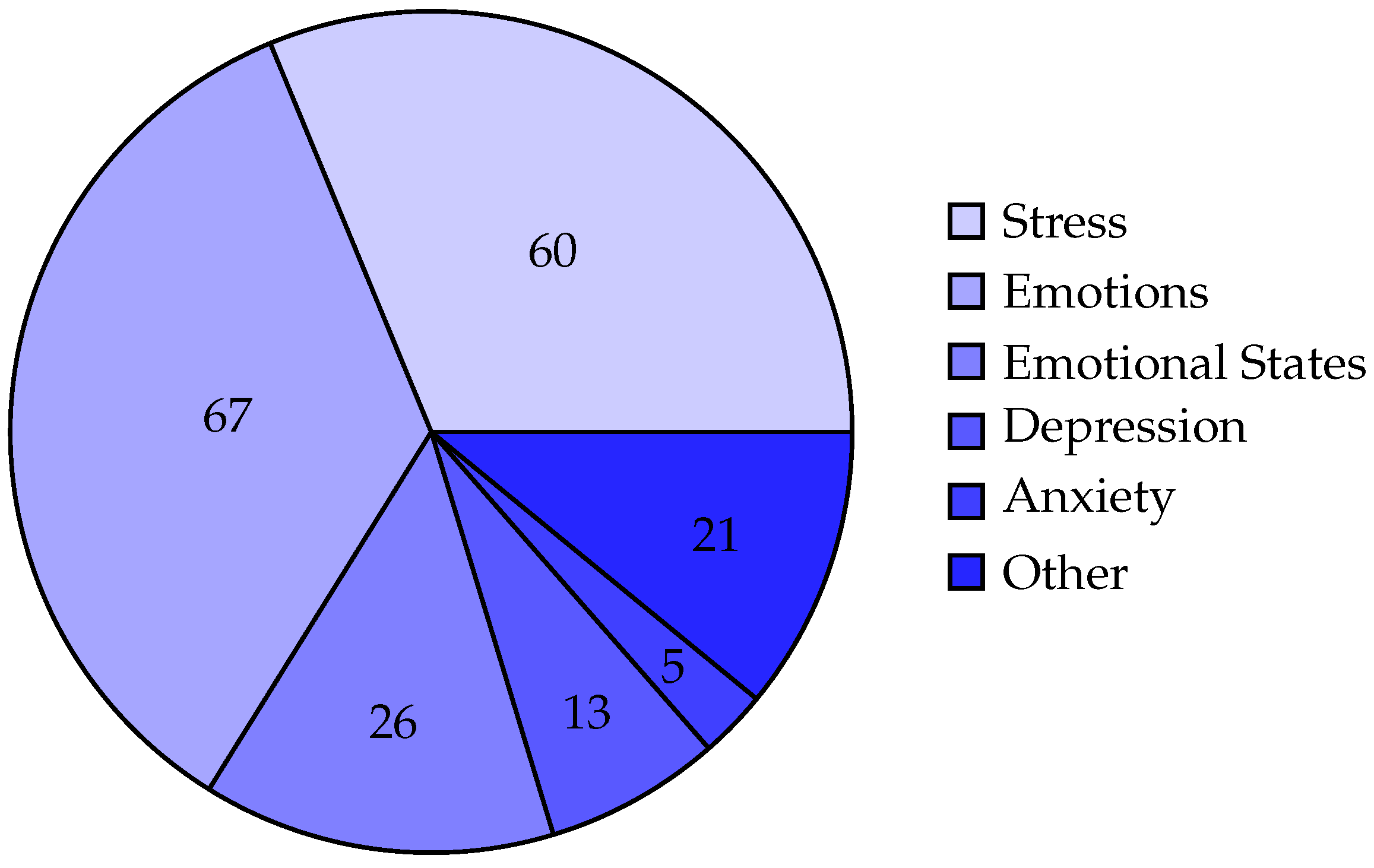
| [2,8,9,10,21,33,43,44,45,46,48,51,52,53,54,55,56,57,58,59,60,61,62,63,64,65,66,67,68,69,70,71,72,73,74,75,76,77,78,79,80,81,82,83,84,85,86,87,88,89,90,91,92,93,94,95,96,97,98,99] | Stress |
| [3,4,6,12,15,19,20,22,24,25,26,30,32,34,36,43,44,45,46,47,49,52,78,98,100,101,102,103,104,105,106,107,108,109,110,111,112,113,114,115,116,117,118,119,120,121,122,123,124,125,126,127,128,129,130,131,132,133,134,135,136,137,138,139,140] | Emotions |
| [7,8,20,48,97,98,100,111,127,135,141,142,143,144,145,146,147,148,149,150,151,152,153,154,155,156,157,158,159] | Emotional States (arousal and valence) |
| [4,10,26,35,47,50,51,52,160,161,162,163,164] | Depression |
| [10,51,52,165,166] | Anxiety |
| [11,12,19,21,23,31,37,38,50,129,132,139,167,168,169,170,171,172,173,174,175] | Other |
| Context | Main Methodological Limitation | References |
|---|---|---|
| Occupational stress | Most studies rely on generalized models trained on population-level data and do not incorporate subject-specific baselines or individualized calibration. This limitation constrains personalization, reduces robustness across users, and weakens applicability in real-world workplace environments. | [3,7,11,36,44,51,57,70,73,86,94,99,101,107,110,117,120,124,168] |
| References | Dataset Type |
|---|---|
| [2,3,4,7,8,11,12,16,18,19,21,23,24,30,31,33,34,35,36,37,38,45,46,51,52,55,59,60,62,63,67,68,73,74,75,77,78,79,80,82,83,84,85,86,87,88,89,91,94,95,97,98,99,100,101,108,110,111,112,115,116,117,118,120,122,123,124,127,128,133,135,137,142,143,144,145,146,147,148,149,150,151,153,154,155,156,158,160,161,162,163,164,166,167,168,169,170,174,180,182,183,184] | Private/Custom |
| [6,56] | JAFFE Dataset (Zenodo) |
| [9,17,20,22,43,44,48,49,58,61,65,71,72,76,81,93,104,132,136,140,171] | WESAD |
| [10,25,26,44,47,50,53,57,64,66,90,92,96,125,175] | FER2013 |
| [70] | MAUS Dataset (IEEE Dataport) |
| [93,102,139,152] | DREAMER (Zenodo) |
| [152] | GAMEEMO (Kaggle) |
| [10,26,69,103,106,107,121,126] | RAVDESS (Kaggle) |
| [105] | Emotions (Kaggle) |
| [113] | SAVEE/SemEval2018 (Kaggle) |
| [129,134,138] | EEG Brainwave (Kaggle) |
| [130,131,140] | CASE |
| [141] | Neurological Status (Physionet)/PsPM-HRA1 (Zenodo) |
| [171] | Anxiety Phases Dataset (APD) |
| [172] | COVID-19 Tweets |
| [157,181] | DEAP (Kaggle) |
| [165] | DASPS (IEEE Dataport) |
| [159] | Tweet/Emotion Analysis (Kaggle) |
| Ref. | Data Type | Target | Algorithm |
|---|---|---|---|
| [2] | Speech | Stress | MLP, SVM, k-NN |
| [3] | Phys. Signals | Emotions | k-NN, PSO |
| [4] | Text | Emotions | PrefixSpan |
| [6] | Images | Emotions | CNN |
| [7] | Eye Tracking, Vehicle Data, Environmental Context | Dominance, Arousal, Valence | ConvLSTM, Hybrid Attention Mechanism |
| [8] | Phys. Signals | Stress | LSTM, RF |
| [9] | Phys. Signals | Stress | CNN, CondConv, Matching Network, SNN, SVM |
| [10] | Video, Audio, Facial Features | Stress, Anxiety, Depression | DNN, Ensemble Learning, Transfer Learning |
| [16] | Movement and Bio-signals | Emotions | ML Classifiers and Fusion Models |
| [17] | Physiological Signals | Emotions, Stress | Hybrid CNN-LSTM and Attention Mechanisms |
| [20] | Multimodal (HRV, EDA, Temp, Acc) | Emotions, Stress, States | Self-Supervised and Contrastive Learning |
| [21] | Text, Physiology, Smartphone Data, Weather Data | Mood, Stress | HBLR, MTMKL, MTL |
| [22] | Encrypted Phys. Signals | Others (Privacy), Emotions | CNN on Fully Homomorphic Encryption |
| [33] | Phys. Signals | Stress | DNN |
| [34] | Phys. Signals | Emotions | JMI, PCA, k-NN |
| [35] | Text | Depression | Deep Multimodal Multitask System |
| [38] | Text | PTSD | Boosted Trees, CART, Neural Networks, RF, SVM |
| [43] | Phys. Signals | Emotions, Stress | CNN-LSTM, Encoder, FCN, MCDCNN, MLP, MLP-LSTM, ResNet, StresNet, TPE, TPEFCN, Time-CNN |
| [55] | EEG Signals | Stress | ELM, IELM, AdaBoost |
| [56] | Facial Data | Stress | SVM, Tree-based Algorithm |
| [58] | Multimodal | Stress | K-NN, LDA, RF, SVM, Naive Bayes, NN and Ensemble Learning |
| [59] | Phys. Signals | Stress | Rule-based |
| [63] | Phys. Signals | Stress | ANN, ANFIS, SVR, SVM, k-NN |
| [75] | Phys. Signals | Stress | k-NN, Logistic Regression, Naive Bayes, RF, SVM |
| [76] | Phys. Signals | Stress | AdaBoost, RF, SELF-CARE |
| [93] | Multimodal (ECG, EDA, EEG) | Emotions, Stress | CNN-LSTM, Random Forest, and XGBoost |
| [96] | Facial Images (Video) | Stress | Modified VGG-Face (Deep Learning) |
| [102] | Phys. Signals | Emotions | CNN |
| [106] | Speech and Game Logs | Emotions | CNN, LSTM, MLP, RF, SVM |
| [110] | Speech | Emotions | LDA, k-NN |
| [111] | Phys. Signals | Dominance, Arousal, Valence | DCNNER |
| [112] | Speech | Emotions | GMM, RNN-LSTM |
| [117] | Speech, MFCC | Emotions | NSL |
| [124] | Phys. Signals | Emotions | ResNet50, CNN |
| [130] | Multimodal | Emotions | RF, SVM, XGBoost, CNN, ATTN |
| [131] | Multimodal | Emotions | LR, SVM, RF |
| [134] | EEG and Speech | Emotions | Roberts Similarity and PSO Selection |
| [135] | Multimodal (videos) | Emotional States | RF, Leave-One-Group-Out (LOGO) |
| [140] | Physiological Signals (EDA) | Emotions | LR, RF, XGB, MLP, RFECV |
| [141] | Phys. Signals | Arousal | Bayesian Filtering, Point Process State-Space Model |
| [145] | Phys. Signals | Arousal, Valence | DT, LDA, LSVM, SVM-RBF, k-NN |
| [151] | Physiological (HRV, EEG, GSR) | Emotions, States | Review of ML/DL models (CNN, RNN) |
| [155] | Phys. Signals | Emotional States | BDNN-CSMHPM |
| [157] | Multimodal | Emotions, high × low emotional valence | Supervised Contrastive Learning (SCL), SHAP, t-SNE |
| [158] | Body Movement (Kinematics) | Emotional States | Linear and Non-linear Dynamics Analysis |
| [159] | Text (Social Media) | Emotions, Depression, Anxiety | RF, DT, LR, LightGBM, GCN, IGCN |
| [161] | Speech | Depression | XGBoost |
| [165] | Phys. Signals | Anxiety | FFT, RF |
| [168] | Phys. Signals | Panic | F2D-CapsNetF |
| [181] | Phys. Signals | Emotions | BiLSTM |
Disclaimer/Publisher’s Note: The statements, opinions and data contained in all publications are solely those of the individual author(s) and contributor(s) and not of MDPI and/or the editor(s). MDPI and/or the editor(s) disclaim responsibility for any injury to people or property resulting from any ideas, methods, instructions or products referred to in the content. |
© 2026 by the authors. Licensee MDPI, Basel, Switzerland. This article is an open access article distributed under the terms and conditions of the Creative Commons Attribution (CC BY) license.
Share and Cite
Morales, A.S.; Reis, T.d.L.; Panisson, A.R.; Ourique, F.; Sene, I.G., Jr. Affective Intelligent Systems in Healthcare: A Systematic Review. Technologies 2026, 14, 188. https://doi.org/10.3390/technologies14030188
Morales AS, Reis TdL, Panisson AR, Ourique F, Sene IG Jr. Affective Intelligent Systems in Healthcare: A Systematic Review. Technologies. 2026; 14(3):188. https://doi.org/10.3390/technologies14030188
Chicago/Turabian StyleMorales, Analúcia Schiaffino, Thiago de Luca Reis, Alison R. Panisson, Fabrício Ourique, and Iwens G. Sene, Jr. 2026. "Affective Intelligent Systems in Healthcare: A Systematic Review" Technologies 14, no. 3: 188. https://doi.org/10.3390/technologies14030188
APA StyleMorales, A. S., Reis, T. d. L., Panisson, A. R., Ourique, F., & Sene, I. G., Jr. (2026). Affective Intelligent Systems in Healthcare: A Systematic Review. Technologies, 14(3), 188. https://doi.org/10.3390/technologies14030188