1. Introduction
Whole-body vibration (WBV) exposure remains a central concern in the design and operation of modern transportation systems, affecting ride comfort, occupational health and long-term human well-being. Drivers and passengers of road vehicles, railway systems, off-road machinery and heavy-duty equipment are routinely exposed to complex vibration environments generated by road or track irregularities, vehicle dynamics and seat–human interaction mechanisms [
1,
2,
3]. As a result, WBV assessment has become a multidisciplinary research topic spanning vehicle engineering, biomechanics, ergonomics and occupational safety, and it is primarily based on the frequency-weighted acceleration metrics defined in ISO 2631-1 [
4], while occupational health limits and exposure action values are regulated at the European level by Directive 2002/44/EC [
5]. Practical implementation and interpretation issues are further discussed in EU-OSHA guidance documents [
6].
Over the past decades, a wide range of vibration metrics and evaluation methodologies have been proposed and adopted, both in standards and in the scientific literature. International standards such as ISO 2631-1 [
7] and ISO 8608 [
8], together with regulatory frameworks including the European Directive 2002/44/EC, provide structured approaches for quantifying vibration exposure and defining action and limit values. At the same time, numerous comfort-related indicators—such as root mean square (RMS) acceleration, vibration dose value (VDV), overall vibration total value (OVTV), motion sickness incidence (MSI), seat effective amplitude transmissibility (SEAT) and absorbed power—are extensively employed in experimental and numerical studies. However, despite their widespread use, these metrics often lead to divergent or even contradictory assessments when applied to the same vibration signals, particularly in non-stationary or transient conditions typical of real-world driving scenarios.
A critical challenge in current WBV research lies in the fragmentation of evaluation practices. Many studies focus on a single metric, vehicle type, or experimental configuration, without explicitly addressing the limitations of the selected indicators or their suitability for specific use cases. As a consequence, the literature frequently reports comfort or exposure levels that are difficult to compare across studies, vehicle classes or operational conditions. This lack of harmonization is further amplified by differences in excitation modeling (e.g., stochastic road profiles versus measured time histories), biodynamic representations of the human body and experimental or simulation platforms, ranging from field measurements to driving simulators and hardware-in-the-loop systems.
Several review papers have addressed specific aspects of WBV, such as health effects, biodynamic modeling, or vibration mitigation technologies, e.g., [
9,
10,
11,
12,
13]. Nevertheless, a comprehensive and integrative synthesis that critically compares evaluation metrics, modeling approaches and application domains—while explicitly linking standards, engineering practice and emerging technologies—remains limited. In particular, recent developments in semi-active and intelligent suspension systems, advanced sensing technologies and data-driven comfort estimation methods based on artificial intelligence have introduced new opportunities, but also new challenges, for WBV assessment and interpretation.
The objective of this review is to address these gaps by providing a structured and critical overview of WBV evaluation methods in vehicle environments. Rather than offering a purely descriptive survey, the present work aims to (i) analyze the applicability and limitations of widely used vibration metrics across different use cases, (ii) examine biodynamic and seat–human interaction models in relation to comfort prediction accuracy, (iii) discuss the role of road surface representation and excitation modeling in WBV assessment and (iv) evaluate the impact of emerging simulation platforms and control-oriented technologies on comfort evaluation. Furthermore, this review proposes a harmonized framework intended to support consistent and application-oriented selection of WBV metrics and methodologies.
To ensure a balanced and methodologically coherent review, the literature discussed in this paper was selected to reflect both established practices and recent developments in whole-body vibration assessment for vehicle applications. Priority was given to internationally recognized standards, foundational methodological contributions and peer-reviewed journal articles that provide clear insight into vibration metrics, biodynamic response, road excitation modeling and experimental or simulation-based evaluation. The selection primarily covers publications from the last five years, complemented by seminal works that underpin current evaluation frameworks. Major scientific databases, including Scopus and Web of Science, were used to identify relevant studies. Rather than aiming for exhaustive coverage, the review focuses on contributions that offer methodological clarity, comparative value or practical relevance for vehicle design and vibration comfort evaluation.
The remainder of the paper is organized as follows.
Section 2 describes the review methodology and literature selection process.
Section 3 summarizes the normative and regulatory frameworks relevant to WBV assessment and discusses their practical limitations.
Section 4 and
Section 5 present and critically compare vibration metrics, including a metrics-to-use-case analysis.
Section 6 and
Section 7 address biodynamic modeling and excitation representation, respectively.
Section 8 reviews simulation and experimental platforms, including driving simulators.
Section 9 discusses vibration control strategies and emerging technologies.
Section 10 presents an analysis of limitations, research gaps and a proposed harmonized evaluation framework. Finally,
Section 11 concludes the paper and outlines future research directions.
2. Methodology of the Review and Literature Selection
This review was conducted following a structured and transparent methodology in order to ensure comprehensive coverage of the scientific literature and to minimize selection bias. The adopted approach was designed to reflect the interdisciplinary nature of whole-body vibration (WBV) research, which spans vehicle dynamics, biomechanics, ergonomics and occupational health.
2.1. Literature Search Strategy
A systematic literature search was performed using major scientific databases, including Scopus, Web of Science, ScienceDirect and the MDPI journal platform. Additional relevant documents were identified through cross-referencing and citation tracking of key articles and standards. The search focused on publications issued between 2000 and 2025, while seminal earlier works were included where necessary to provide theoretical or methodological context.
The search queries combined terms related to vibration exposure, comfort evaluation and vehicle applications. Representative keywords included whole-body vibration, ride comfort, ISO 2631, ISO 8608, vibration dose value, OVTV, motion sickness, seat transmissibility, biodynamic model, road roughness, vehicle suspension and simulation and experimental methods.
2.2. Inclusion and Exclusion Criteria
To ensure relevance and consistency, explicit inclusion and exclusion criteria were applied. Studies were included if they
addressed WBV exposure or ride comfort in vehicle-related environments, including passenger cars, heavy-duty vehicles, off-road machinery, railway vehicles, or driving simulators;
reported or analyzed quantitative vibration metrics (e.g., RMS, VDV, OVTV, MSI, SEAT, absorbed power);
employed experimental measurements, numerical simulations, or combined approaches relevant to engineering applications;
were published in peer-reviewed journals, conference proceedings, or recognized standards and regulatory documents.
Studies focusing exclusively on hand–arm vibration, purely clinical or medical investigations without an engineering context, or non-vehicle-related vibration environments were excluded. Manufacturer application notes and technical guides were selectively included when they provided methodological insights relevant to measurement or data interpretation.
2.3. Classification Framework and Data Synthesis
The selected literature was organized according to a classification framework reflecting the main dimensions of WBV assessment. Specifically, the reviewed studies were grouped into the following categories [
1,
6,
14]:
Normative and regulatory frameworks, including international standards and directives;
Vibration and comfort metrics, with emphasis on their theoretical basis, applicability and reported limitations;
Biodynamic and seat–human interaction models, used to interpret or predict WBV effects;
Excitation modeling, including road surface representation and stochastic inputs;
Simulation, experimental and control-oriented approaches, ranging from field measurements to driving simulators and intelligent suspension systems.
Rather than quantitatively aggregating results, the review adopts a qualitative and comparative synthesis approach. Emphasis is placed on identifying recurring trends, methodological inconsistencies and reported discrepancies in WBV assessment outcomes. Where available, comparative findings from different studies are discussed to highlight how the choice of metric, model, or experimental setup influences the resulting comfort or exposure evaluation.
This methodological approach supports the critical objectives of the review: to clarify the practical implications of existing WBV assessment methods, to identify gaps and limitations in current practice and to provide application-oriented guidance for researchers and engineers.
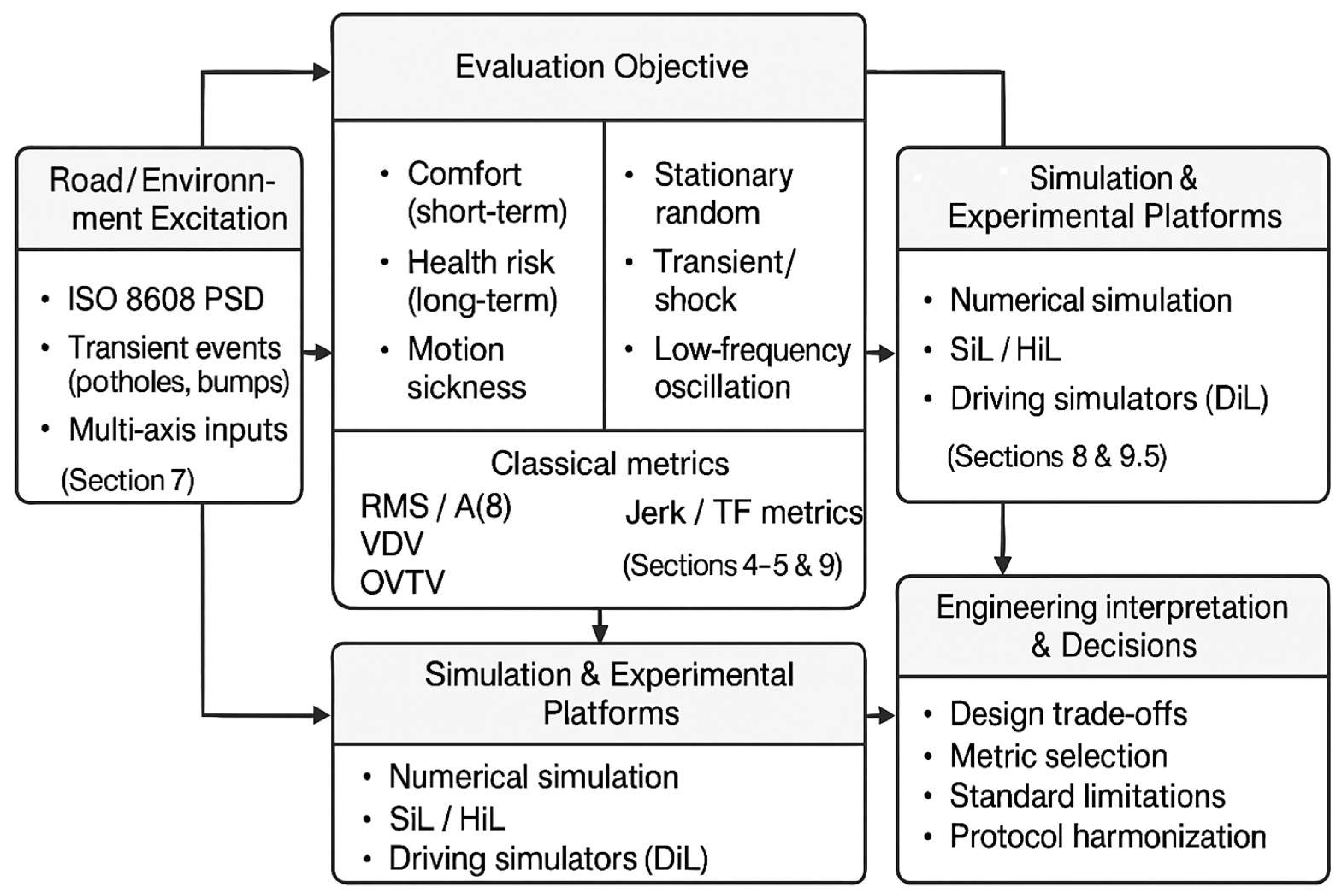
To clarify the integrative perspective adopted in this review and to highlight the relationships between excitation modeling, biodynamic response, evaluation metrics and engineering decision-making,
Figure 1 presents a conceptual framework for whole-body vibration assessment. The diagram illustrates how different evaluation objectives and vibration signal characteristics govern the selection and interpretation of WBV metrics, while also positioning simulation platforms and in-the-loop methodologies as enabling tools for repeatable and human-centered comfort assessment.
3. Normative Framework for Whole-Body Vibration Assessment
Standardization plays a central role in the evaluation of whole-body vibration (WBV), providing reference methodologies, frequency weightings and exposure metrics intended to support both occupational health protection and engineering decision-making. However, while international standards and regulatory directives offer a necessary foundation, their practical application in vehicle comfort assessment is often accompanied by ambiguities, limitations and interpretative challenges.
3.1. International Standards for WBV Evaluation
The ISO 2631-1 standard remains the primary international reference for the evaluation of human exposure to whole-body vibration. It defines frequency-weighted acceleration metrics, exposure durations and evaluation methods based on root mean square (RMS) acceleration and vibration dose value (VDV). These indicators are intended to capture both comfort-related and health-related aspects of WBV exposure, depending on the time scale and vibration characteristics [
7,
8,
15].
In parallel, ISO 8608 provides a standardized framework for characterizing road surface irregularities through power spectral density (PSD) functions and roughness classes. This standard is widely used to generate representative excitation inputs for numerical simulations and to compare road profiles in experimental studies. While ISO 8608 does not directly address human exposure, it plays an essential supporting role in WBV research by linking infrastructure characteristics to vehicle dynamic response.
ISO 2631-5 [
16] extends the assessment framework toward multiple shocks and repeated transient vibration events, particularly in heavy-duty and off-road vehicle applications. Although its adoption is less widespread than ISO 2631-1, it addresses scenarios where impulsive loads dominate and where classical RMS-based approaches may underestimate exposure severity.
3.2. Regulatory Context and Occupational Exposure Limits
At the regulatory level, the European Directive 2002/44/EC establishes minimum health and safety requirements for workers exposed to vibration, defining exposure action values and limit values for both hand–arm and whole-body vibration. The directive primarily targets occupational health protection and compliance, rather than ride comfort optimization. As such, it relies on standardized exposure metrics that are robust and conservative but not necessarily sensitive to short-term comfort perception or transient events [
5,
17].
In practice, this distinction often leads to a dual interpretation of WBV metrics: one oriented toward regulatory compliance and long-term health risk and another oriented toward comfort assessment and vehicle design. Studies focusing on vehicle comfort frequently operate below regulatory thresholds, yet still report significant differences in perceived comfort depending on vibration characteristics, seat design and suspension behavior. This divergence highlights a fundamental limitation of applying occupational exposure metrics directly to comfort-driven engineering problems.
3.3. Practical Limitations and Interpretative Challenges
Despite their widespread use, current standards exhibit several limitations when applied to real-world vehicle environments [
4,
18]. First, RMS-based metrics assume stationary or quasi-stationary vibration signals, whereas actual driving conditions often involve non-stationary, transient and impulsive excitations. Under such conditions, RMS values may mask short-duration high-magnitude events that are perceptually or physiologically significant.
Second, frequency weightings defined in ISO 2631-1 are derived from averaged human sensitivity data and may not fully capture individual variability, posture effects, or seat–human coupling characteristics. Consequently, studies using identical vibration inputs but different experimental setups or biodynamic models may report inconsistent WBV assessments.
Third, the use of ISO 8608-based road profiles in simulations introduces an additional layer of abstraction. While PSD-based representations facilitate standardized comparisons, they may fail to reproduce localized defects, discrete obstacles, or real driving maneuvers that strongly influence comfort perception. As a result, discrepancies frequently arise between simulation-based predictions and field measurements.
These limitations have motivated the development and application of complementary metrics and evaluation strategies in the literature, including VDV, OVTV, motion sickness incidence, absorbed power and jerk-based indicators. However, the absence of explicit guidance within standards regarding metric selection for specific use cases has contributed to fragmented evaluation practices and reduced comparability across studies.
3.4. Implications for Engineering Practice
From an engineering perspective, standards should be regarded as a baseline rather than a comprehensive solution for WBV assessment. While compliance with ISO and regulatory frameworks is essential—particularly in occupational contexts—vehicle comfort evaluation and optimization often require additional metrics, modeling approaches and interpretative judgment. A critical understanding of what standardized indicators represent and where they may fall short, is therefore necessary to avoid misleading conclusions [
19,
20].
This review builds upon the normative framework by systematically analyzing how standardized and non-standardized metrics are applied across different vehicle classes and operating conditions. By explicitly addressing the strengths and limitations of the existing standards, the paper aims to support more informed and application-oriented WBV assessment strategies.
4. Metrics for Whole-Body Vibration and Ride Comfort Assessment
The evaluation of whole-body vibration relies on a set of quantitative metrics intended to represent complex, multi-axial vibration signals in a form suitable for interpretation and decision-making. Although many of these metrics are formally defined in standards or widely used in the literature, their applicability and reliability vary significantly depending on signal characteristics, exposure duration and evaluation objectives. This section critically reviews the most commonly employed WBV metrics, emphasizing their strengths, limitations and reported performance in vehicle-related applications.
4.1. Root Mean Square (RMS) Acceleration Metrics
The main characteristic value defined by ISO 2631-1 for comfort evaluation of time continuous or quasi time continuous vibration is
, is defined as
where
is the acceleration weighted by frequency and
is the duration of measurement. The weighting functions (Wk/Wb for vertical vibrations and Wd for lateral/longitudinal vibrations) account for the unequal sensitivity of the human body to different frequencies and prioritize those resonance bands that are most critical in terms of comfort and adverse health effects.
Root mean square (RMS) acceleration remains the most widely used metric for WBV evaluation due to its simplicity and direct implementation within standardized frameworks such as ISO 2631-1. RMS values provide an energy-based representation of vibration intensity over a given time interval and are particularly suitable for stationary or quasi-stationary vibration signals with relatively stable statistical properties [
7,
21,
22].
In vehicle applications, RMS metrics are commonly used to assess ride comfort during steady-state driving on uniform road surfaces or tracks. Numerous studies report reasonable correlations between RMS acceleration levels and subjective comfort ratings under such conditions. However, the limitations of RMS-based evaluation become evident in the presence of transient events, such as road obstacles, joints, or abrupt maneuvers. Short-duration, high-amplitude events may contribute marginally to RMS values while having a disproportionate impact on human perception and discomfort.
As a result, reliance on RMS metrics alone may lead to underestimation of discomfort or exposure severity in real-world driving scenarios characterized by non-stationary excitation. This limitation has been widely acknowledged in the literature and has motivated the adoption of complementary indicators.
4.2. Vibration Dose Value (VDV)
The vibration dose value (VDV) was introduced to enhance sensitivity to impulsive and transient vibration components by incorporating the fourth power of acceleration over time. In contrast to RMS metrics, VDV places greater emphasis on peak events and has been shown to provide more conservative and perceptually relevant assessments under non-stationary conditions [
7,
18].
VDV is the fourth root of the integral of the weighted acceleration to the fourth power:
The fourth power makes peaks in the acceleration signal stand out, hence VDV is very sensitive to shock like events. Many works support that VDV correlates with higher correlation coefficients than RMS factor in relation with the discomfort perceived by subjects on potholes, off-road operation and operating at a construction site.
In vehicle-related studies, VDV is frequently applied to off-road machinery, heavy-duty vehicles and urban driving environments where transient excitations dominate. Comparative investigations demonstrate that VDV-based assessments often yield higher relative severity levels than RMS-based approaches when identical signals are analyzed. This discrepancy highlights the importance of metric selection, as different indicators may lead to fundamentally different conclusions regarding comfort or exposure risk.
Nevertheless, VDV also presents practical challenges. Its strong sensitivity to peaks may result in overemphasis of isolated events that are not representative of overall driving conditions. Moreover, the interpretation of VDVs in terms of comfort thresholds is less intuitive than RMS-based metrics, particularly outside occupational health contexts.
4.3. Overall Vibration Total Value (OVTV)
The overall vibration total value (OVTV) represents a multi-axial aggregation of frequency-weighted accelerations and is intended to provide a comprehensive scalar representation of WBV exposure.
By integrating contributions from multiple axes, OVTV addresses a limitation of single-axis metrics and aligns more closely with the multi-directional nature of vehicle-induced vibration.
Several studies, e.g., [
23,
24], report improved consistency between OVTV-based assessments and subjective comfort evaluations, especially in scenarios involving complex vibration patterns. OVTV has also been applied in bridge–vehicle interaction studies and long-span structures, where multi-directional excitation is pronounced.
However, OVTV does not inherently resolve the sensitivity limitations associated with transient events and its effectiveness remains dependent on the underlying weighting functions and time-domain processing. As such, OVTV should be regarded as a complementary rather than universally superior metric.
4.4. Motion Sickness Incidence (MSI)
Motion sickness incidence (MSI) represents a specialized metric designed to quantify the likelihood of motion-induced discomfort, particularly under low-frequency vibration conditions. MSI is most relevant in applications involving long-duration exposure to low-frequency vertical and lateral motions, such as maritime transport, rail vehicles and autonomous driving scenarios [
14,
25,
26].
where
is the frequency-weighted acceleration over time,
is the reference acceleration,
exponent (typically 3 for MSI) and
T exposure duration.
In vehicle studies, MSI has been used to assess discomfort in passengers rather than drivers and to evaluate the effectiveness of suspension or control strategies in mitigating motion sickness. While MSI captures aspects of human response not addressed by traditional acceleration-based metrics, its applicability is limited to specific frequency ranges and exposure scenarios. Consequently, MSI is not suitable as a general-purpose WBV metric but provides valuable insight in targeted applications.
4.5. Seat Effective Amplitude Transmissibility (SEAT)
The seat effective amplitude transmissibility (SEAT) index quantifies the attenuation or amplification of vibration transmitted from the vehicle structure to the occupant through the seat. SEAT values are widely used to evaluate seat performance and to compare seat designs under controlled excitation conditions [
27,
28].
Although SEAT provides a useful measure of seat isolation effectiveness, it does not directly reflect human perception or discomfort. Identical SEAT values may correspond to different comfort outcomes depending on vibration frequency content, posture and biodynamic coupling. Therefore, SEAT is best interpreted as a system-level indicator rather than a direct comfort metric.
4.6. Absorbed Power and Energy-Based Metrics
Energy-based metrics, such as absorbed power, aim to quantify the mechanical energy transmitted to and absorbed by the human body during vibration exposure. These approaches are grounded in biodynamic modeling and have been proposed as more physiologically meaningful indicators of WBV effects [
29,
30].
Experimental and numerical studies suggest that absorbed power correlates with certain health-related outcomes and provides insight into load distribution across the body. However, practical implementation requires detailed force measurements or validated biodynamic models, limiting widespread adoption. Furthermore, absorbed power metrics are sensitive to modeling assumptions and experimental variability, which complicates standardization.
4.7. Emerging Metrics: Jerk and Time–Frequency Indicators
Recent studies have explored the use of jerk, defined as the time derivative of acceleration, as an additional indicator of vibration severity and discomfort. Jerk-based metrics are particularly sensitive to rapid changes in acceleration and have been investigated in railway and automotive contexts to capture perceptually relevant transients [
31,
32]. Practical aspects of signal conditioning, differentiation and measurement uncertainty are discussed in detail in [
33].
Time–frequency approaches and hybrid indicators combining amplitude, frequency and temporal characteristics have also been proposed. While these methods show promise, their lack of standardization and limited validation across vehicle types currently restrict their practical use.
Overall, the reviewed metrics capture complementary but sometimes conflicting aspects of whole-body vibration exposure. RMS-based indicators remain robust for stationary and long-duration comfort assessment, yet they may underestimate transient or shock-dominated excitation typical of off-road or heavy-duty vehicles. In contrast, VDV and peak-sensitive metrics emphasize cumulative and impulsive effects but can lead to conservative interpretations when applied outside their intended context. These findings indicate that no single metric is universally valid and motivate the need for a structured, objective-driven selection strategy, which is further developed in the comparative analysis presented in
Section 5.
5. Comparative Analysis of Comfort Metrics Across Use Cases
The diversity of vibration environments encountered in vehicle operation makes it unlikely that a single metric can adequately represent whole-body vibration effects across all applications. As demonstrated in the previous section, different metrics emphasize distinct signal characteristics, such as energy content, transient severity, frequency sensitivity, or directional contributions. This section provides a comparative analysis of commonly used WBV metrics, focusing on their suitability for specific vehicle types and operating scenarios.
5.1. Metrics-to-Use-Case Comparison
The applicability of vibration metrics depends strongly on the nature of excitation, exposure duration and evaluation objectives. For example, passenger cars operating on relatively smooth roads are often characterized by quasi-stationary vibration, for which RMS-based metrics can provide meaningful comfort assessments. In contrast, off-road vehicles, construction machinery and heavy-duty trucks are exposed to impulsive and highly non-stationary excitation, where VDV and energy-based metrics are more sensitive to discomfort and exposure risk [
18,
22,
23,
24].
Similarly, metrics such as OVTV, which integrate multi-axial vibration components, are better suited to scenarios involving complex spatial excitation, including bridge–vehicle interaction and uneven terrain. Motion sickness incidence metrics are particularly relevant for long-duration, low-frequency motion environments, such as public transport systems and autonomous vehicles, where traditional acceleration-based indicators may fail to capture perceptual discomfort.
Table 1 and
Table 2 synthesizes the principal whole-body vibration metrics reported in the literature by explicitly mapping each indicator to its typical use cases, sensitivity to excitation characteristics, exposure duration and relevance to comfort, health risk or motion sickness assessment. Rather than promoting a single “best” metric, the table highlights the context-dependent nature of metric selection and the sources of divergence reported across studies.
While
Table 1 summarizes the relative suitability of commonly used WBV metrics across representative use cases, it is important to emphasize that these qualitative ratings reflect fundamental differences in the physical aggregation of vibration signals and the associated human response mechanisms, rather than simple methodological preferences. In particular, RMS-based indicators primarily represent average vibration energy and therefore perform best under stationary or quasi-stationary conditions. In contrast, VDV amplifies the contribution of high-amplitude events through fourth-power time integration, making it more sensitive to transient shocks and intermittent severe excitation.
As a result, metrics that appear equivalent under steady conditions may diverge substantially in non-stationary environments. This divergence explains why RMS-based comfort indicators often underestimate perceived severity in heavy-duty or off-road applications, whereas VDV-based measures provide more conservative and physiologically relevant assessments. The ratings in
Table 1 should therefore be interpreted in conjunction with the physical and physiological rationale summarized in
Table 2.
A duration-normalized form of the weighted RMS acceleration (Equation (7)) is reported in
Table 2 to support the qualitative assessment presented in
Table 2.
where
is the frequency-weighted RMS acceleration and
the duration of the real exposure.
It should be noted that A(8) does not represent a distinct comfort metric and is intended for occupational health risk assessment and regulatory compliance.
5.2. Reported Discrepancies in Comfort Assessment
Beyond individual metric definitions, WBV assessment inherently involves a trade-off between evaluation objectives (e.g., short-term comfort, long-term health risk, motion sickness, or seat performance) and signal characteristics (stationary versus transient excitation, dominant frequency content and exposure duration). Metrics optimized for one objective may be poorly suited for another, which explains the inconsistencies reported across studies when different indicators are applied to identical vibration data. Recognizing these trade-offs is essential for interpreting comparative results and for selecting appropriate metrics in engineering design, validation and regulatory contexts.
A recurring observation in the literature is that identical vibration signals may lead to different comfort or exposure classifications depending on the selected metric. Studies comparing RMS- and VDV-based evaluations frequently report cases where RMS values remain within acceptable comfort ranges, while VDV indicates elevated severity due to the presence of transient peaks. Similarly, OVTV-based assessments may identify multi-axial discomfort not apparent in single-axis analyses [
18,
36].
These discrepancies are not merely methodological artifacts but reflect fundamental differences in how metrics weight amplitude, duration and frequency content. Consequently, conclusions drawn from WBV assessments must be interpreted in light of the chosen metric and its underlying assumptions. Failure to acknowledge these differences can result in misleading comparisons between vehicles, suspension systems, or operating conditions.
5.3. Implications for Engineering Decision-Making
From an engineering perspective, the selection of WBV metrics should be guided by the intended application rather than by convenience or convention. For early-stage design and benchmarking on smooth excitation, RMS-based metrics may provide sufficient insight with minimal computational effort. For durability assessment, occupational exposure, or evaluation of advanced suspension systems under realistic driving conditions, metrics sensitive to transients and multi-axial effects become increasingly important [
19,
37].
In practice, several studies advocate the combined use of complementary metrics to obtain a more robust and nuanced assessment of WBV effects. For instance, pairing RMS and VDV can help distinguish between overall vibration energy and transient severity, while supplementing acceleration-based metrics with SEAT or absorbed power provides additional insight into seat performance and human–vehicle interaction.
5.4. Recommended Metric Selection Strategy
Based on the comparative analysis presented in this review, the following general recommendations can be formulated [
7,
18,
21,
23,
24]:
No single metric should be used in isolation for comprehensive WBV assessment in complex vehicle environments.
Metric selection should be explicitly justified based on vehicle type, excitation characteristics and evaluation objectives.
Complementary metrics should be employed when transient events, multi-axial vibration or long-duration exposure are relevant.
Standardized metrics should be interpreted critically, with awareness of their assumptions and limitations.
These recommendations form the basis for the harmonized evaluation framework proposed later in this paper.
The comparative review highlights that metric selection can substantially alter comfort rankings and engineering conclusions for identical excitation signals. Discrepancies reported across studies often stem not from contradictory data, but from implicit differences in evaluation objectives, exposure duration and signal characteristics. This reinforces the importance of transparent metric justification and motivates the use of decision-support tools, such as metrics using case mappings, when comparing suspension or seat solutions in practice.
6. Biodynamic Response and Human–Seat–Vehicle Interaction Models
The human response to whole-body vibration is governed by complex biodynamic interactions between the vehicle structure, the seat and the occupant. The accurate assessment of WBV effects therefore requires not only appropriate vibration metrics but also representative models capable of capturing the dynamic behavior of the human body and its coupling with the seating system. This section reviews the principal modeling approaches used in the literature, with emphasis on their applicability, limitations and implications for comfort evaluation.
6.1. Lumped-Parameter and Multi-Body Biodynamic Models
Lumped-parameter models represent the human body as a system of discrete masses connected by springs and dampers, typically aligned along the vertical axis. These models have been widely adopted due to their simplicity, computational efficiency and ease of integration into vehicle dynamics simulations. Early formulations, as well as subsequent refinements, demonstrate that lumped-parameter models can reproduce key resonance phenomena observed in seated human subjects, particularly in the frequency range relevant to WBV exposure [
38,
39,
40].
However, the accuracy of such models is inherently limited by their simplified structure. Parameter identification often relies on averaged experimental data, which may not adequately capture inter-individual variability, posture-dependent effects, or nonlinear contact conditions at the seat interface. As a result, predicted accelerations or forces at the seat–human interface may deviate significantly from measured values, especially under non-linear or transient excitation [
35,
41,
42].
Multi-body models extend lumped-parameter approaches by representing body segments and joints explicitly, allowing for more detailed simulation of posture, muscle activity and load distribution. While these models offer improved anatomical realism, they require extensive parameterization and validation and their computational cost may limit their applicability in large-scale parametric studies or real-time simulations.
6.2. Seat Transmissibility and the SEAT Index
Seat transmissibility plays a central role in the evaluation of WBV mitigation strategies, as the seat represents the primary interface through which vibration is transmitted to the occupant. The seat effective amplitude transmissibility (SEAT) index provides a normalized measure of vibration attenuation or amplification by comparing weighted accelerations measured at the seat and at the vehicle floor [
27,
28].
SEAT values are particularly useful for benchmarking seat designs and assessing isolation performance under controlled excitation conditions. However, SEAT does not directly account for human perception or discomfort and identical SEAT values may correspond to different comfort outcomes depending on vibration frequency content, directionality and occupant posture. Furthermore, SEAT assessments are sensitive to measurement locations, sensor mounting and filtering procedures, which can introduce variability across studies.
Consequently, SEAT should be interpreted as a system-level performance indicator rather than a standalone comfort metric. Its integration with complementary vibration metrics and biodynamic models is essential for meaningful WBV evaluation.
6.3. Absorbed Power and Energy-Based Approaches
While absorbed power is introduced in
Section 4.6 as an evaluation metric, it is revisited here from a modeling perspective, where it serves as a bridge between experimental measurements and biodynamic model validation.
Energy-based approaches, such as absorbed power, aim to quantify the mechanical energy transmitted to and dissipated within the human body during vibration exposure. These metrics are grounded in biodynamic theory and are often considered more physiologically meaningful than acceleration-based indicators, as they account for both force and velocity components [
29,
30].
Studies investigating absorbed power report correlations with discomfort and potential health outcomes, particularly in scenarios involving prolonged exposure or significant vertical loading. However, practical implementation of absorbed power metrics poses several challenges. Accurate estimation requires either direct force measurements at the seat–human interface or validated biodynamic models capable of predicting internal forces, both of which introduce uncertainty.
Moreover, absorbed power estimates are sensitive to modeling assumptions, boundary conditions and individual anthropometric differences. These factors complicate standardization and limit the widespread adoption of energy-based metrics in routine engineering practice, despite their conceptual appeal.
6.4. Physiological and Perceptual Correlations
Beyond mechanical modeling, WBV research increasingly recognizes the importance of linking biodynamic responses to physiological and perceptual outcomes. Experimental studies demonstrate that resonance frequencies of the seated human body, posture-induced variations and muscle activation can significantly influence vibration perception and discomfort [
41,
43,
44,
45].
However, establishing direct quantitative relationships between biodynamic variables and subjective comfort remains challenging. Perceptual responses are influenced by cognitive, contextual and individual factors that are not captured by purely mechanical models. As a result, biodynamic models should be viewed as tools for interpreting trends and relative differences rather than precise predictors of subjective comfort.
6.5. Implications for WBV Assessment
The reviewed modeling approaches highlight a fundamental trade-off between model fidelity and practical applicability. Simplified biodynamic models facilitate integration with vehicle dynamics and control systems but may overlook important human response mechanisms. Conversely, detailed models offer improved realism at the cost of increased complexity and reduced generalizability.
For WBV assessment, this trade-off underscores the need to align model selection with evaluation objectives. In early-stage design and comparative studies, simplified models may provide sufficient insight, while detailed models are better suited for targeted investigations of seat design, posture effects or specific health-related concerns. Importantly, the limitations of each modeling approach should be explicitly acknowledged when interpreting WBV evaluation results.
Biodynamic models provide essential insight into vibration transmission mechanisms and human sensitivity, yet their predictive value is strongly influenced by assumptions regarding posture, anthropometry and linearity. While lumped-parameter and multibody formulations successfully reproduce dominant resonances, their direct translation into comfort criteria remains limited without coupling to perceptual or physiological metrics. This underscores the need for integrated evaluation frameworks combining mechanical response, human perception and application-specific metrics.
7. Road Surface Representation and Excitation Modeling
The accuracy of whole-body vibration assessment is fundamentally dependent on how external excitation is represented. In vehicle applications, road or track irregularities constitute the primary source of vibration and their characterization directly influences predicted vehicle response, seat transmissibility and perceived comfort. This section reviews the most common approaches used to model road surface excitation, highlighting their assumptions, advantages and limitations.
7.1. ISO 8608 Road Classification and PSD-Based Models
ISO 8608 provides a standardized method for classifying road surface roughness based on the power spectral density (PSD) of vertical road profile displacement. This classification has been widely adopted in vehicle dynamics simulations, as it enables reproducible generation of stochastic road profiles corresponding to defined roughness classes [
8,
21].
PSD-based road models offer several practical advantages, including statistical consistency, ease of implementation and compatibility with frequency-domain vehicle models. Consequently, they are extensively used for comparative studies, parametric analyses and early-stage design evaluations. However, ISO 8608-based representations are inherently statistical and assume spatial stationarity, which limits their ability to capture localized defects, discrete obstacles, or abrupt changes in surface quality.
As a result, comfort predictions based solely on PSD-generated profiles may underestimate transient vibration components that are perceptually significant, particularly in urban environments or degraded infrastructure.
7.2. Stochastic and Time-Domain Excitation Models
To address the limitations of purely PSD-based approaches, numerous studies have employed stochastic and time-domain excitation models derived from measured road profiles. These models preserve spatial and temporal characteristics of real surfaces, enabling more realistic reproduction of transient events and non-stationary excitation [
34,
46,
47].
Stochastic modeling techniques based on filtered white noise, autoregressive processes, or spectral factorization have been used to generate road inputs with controlled statistical properties while retaining time-domain realism. Such approaches are particularly valuable for investigating the sensitivity of WBV metrics to transient events and for validating vibration assessment methods under representative operating conditions.
Notably, several authors have emphasized the importance of excitation realism when interpreting comfort evaluation results. Discrepancies between simulated and measured WBV responses are often traced back to simplified excitation models rather than deficiencies in vehicle or seat models.
7.3. Influence of Excitation Modeling on Comfort Assessment
The choice of road excitation model has a pronounced impact on the resulting WBV metrics. RMS-based indicators are relatively insensitive to localized irregularities when excitation is statistically stationary, whereas VDV, jerk-based metrics and time–frequency indicators respond strongly to transient components present in measured profiles.
Comparative studies demonstrate that identical vehicle and seat configurations may be classified differently depending on whether excitation is represented by ISO 8608-compliant stochastic profiles or by measured time histories [
19,
21,
46]. This observation reinforces the need for consistency between excitation modeling and evaluation objectives. For example, PSD-based models may be sufficient for benchmarking suspension concepts, while measured profiles are more appropriate for assessing comfort in real driving environments.
7.4. Road–Vehicle Interaction and Multi-Dimensional Excitation
In practical scenarios, road excitation is not limited to vertical displacement. Longitudinal and lateral irregularities, as well as vehicle maneuvers such as braking and cornering, contribute to multi-dimensional vibration input. While many studies focus on vertical excitation for simplicity, neglecting multi-axis effects can lead to incomplete WBV assessments, particularly when metrics such as OVTV or absorbed power are considered [
20,
48].
Advanced modeling approaches incorporate multi-directional road inputs and vehicle–road interaction effects, enabling more comprehensive evaluation of WBV exposure. However, such models require additional data and increased computational effort, which may limit their use in routine engineering analyses.
7.5. Implications for WBV Modeling and Evaluation
The reviewed approaches highlight that excitation modeling is not a neutral choice but a critical determinant of WBV assessment outcomes. Simplified excitation models facilitate standardized comparisons but may obscure comfort-relevant phenomena, while high-fidelity representations improve realism at the cost of complexity and data requirements.
For robust WBV evaluation, excitation models should be selected in alignment with the intended application and the chosen vibration metrics. Explicit documentation of excitation assumptions and limitations is essential to ensure transparency and comparability across studies.
Table 3 illustrates that, although a substantial body of experimental WBV research exists, direct comparison across studies is often limited by differences in instrumentation, sensor placement, excitation characteristics and evaluation metrics. Some studies rely on seat pan accelerations alone, while others incorporate backrest forces, absorbed power, or multi-axis transmissibility, leading to fundamentally different interpretations of vibration severity. In addition, variations in exposure duration, filtering and road or excitation classification further complicate cross-study synthesis. These observations reinforce the need for harmonized measurement and reporting practices and explain why results derived under different protocols may not be directly comparable, even when nominally similar metrics are used.
8. Simulation Frameworks, Experimental Platforms and Driving Simulators
Whole-body vibration assessment relies increasingly on the combined use of numerical simulations and experimental platforms. While simulations enable systematic exploration of design parameters and operating conditions, experimental validation remains essential for ensuring realism and credibility. This section reviews commonly used simulation frameworks and experimental approaches, emphasizing their respective roles and limitations in WBV evaluation.
8.1. Numerical Simulation of Vehicle–Seat–Human Systems
Numerical simulations constitute the backbone of modern WBV studies, enabling integration of vehicle dynamics, suspension models, seat characteristics and human biodynamic representations within a unified framework. Typical implementations range from simplified quarter-car and half-car models to full vehicle multi-body simulations incorporating seat dynamics and occupant models [
27,
50,
51,
52,
53,
54].
Simulation-based approaches are particularly valuable during early design stages, where rapid parametric analysis and comparative assessment of alternative configurations are required. They also facilitate sensitivity analyses that would be difficult or impractical to perform experimentally. However, the predictive accuracy of simulations is inherently limited by modeling assumptions, parameter uncertainty and simplifications in excitation representation.
As highlighted in previous sections, discrepancies between simulated and measured WBV responses often arise not from deficiencies in vehicle models but from oversimplified representations of road excitation or human–seat interaction.
8.2. Experimental Measurement and Validation Platforms
Experimental studies remain indispensable for WBV assessment, providing direct measurements of accelerations, forces and transmissibility under controlled or real-world conditions. Typical setups involve instrumented vehicles or test rigs equipped with accelerometers at the vehicle floor, seat base, seat cushion and occasionally at the occupant interface [
36,
49].
Standards such as ISO 2631 provide guidance on sensor placement, frequency weighting and signal processing, ensuring consistency and comparability of measurements. Nevertheless, experimental WBV studies face practical challenges, including variability in driving conditions, differences in occupant posture and limitations in repeatability. These factors necessitate careful experimental design and transparent reporting of test conditions.
Importantly, experimental data play a critical role in validating simulation models and calibrating biodynamic parameters, thereby improving the reliability of numerical predictions.
8.3. Hardware-in-the-Loop and Real-Time Simulation
Hardware-in-the-loop (HiL) and real-time simulation platforms bridge the gap between purely numerical models and full-scale experiments. In these setups, physical components such as seats or suspension elements are integrated into a real-time simulation environment, allowing their dynamic behavior to be evaluated under realistic excitation [
37,
55].
HiL approaches are particularly advantageous for assessing semi-active or active control strategies, as they enable rapid testing of control algorithms without the need for extensive road testing. However, achieving stable real-time performance and accurate synchronization between hardware and software components remains technically demanding.
While HiL platforms are primarily intended for real-time validation of control strategies and hardware feasibility, their role within broader comfort evaluation workflows—including integration with subjective assessment—is discussed separately in
Section 9.5.
8.4. Driving Simulators and Motion Platforms
Driving simulators equipped with motion platforms provide a controlled environment for investigating WBV perception, comfort and driver response. These systems allow systematic variation in excitation characteristics, seat properties and control strategies while maintaining experimental repeatability [
56,
57,
58].
Despite their potential, driving simulators introduce additional challenges related to motion cueing fidelity and perceptual validity. Limited platform stroke and bandwidth may necessitate compromises that affect the realism of reproduced vibration signals. Consequently, simulator-based studies should explicitly acknowledge these limitations and avoid overgeneralization of results.
8.5. Complementarity of Simulation and Experimentation
Rather than viewing simulation and experimentation as competing approaches, contemporary WBV research increasingly emphasizes their complementarity. Simulations provide insight into underlying mechanisms and enable efficient exploration of design spaces, while experiments offer empirical grounding and validation.
Effective WBV assessment frameworks leverage this complementarity by iteratively refining models based on experimental data and using simulations to interpret and generalize experimental findings. Such integrated approaches enhance both scientific rigor and practical relevance.
Simulation and experimental platforms play complementary roles in WBV assessment. While numerical models enable parametric exploration and system-level optimization, experimental and real-time platforms remain essential for validation and perception-related assessment. However, differences in excitation reproduction, sensor placement and boundary conditions across platforms directly affect comparability, highlighting the importance of harmonized protocols and cross-platform validation strategies.
9. Advanced Evaluation Metrics and Emerging Approaches
The increasing complexity of vehicle systems and the growing availability of high-resolution measurement data have stimulated the development of advanced metrics and data-driven approaches for whole-body vibration assessment. These methods aim to overcome the limitations of classical indicators by incorporating temporal dynamics, multi-axis excitation and perceptual factors. This section reviews recent advances while critically examining their applicability and limitations.
9.1. Multi-Axis and Time–Frequency Metrics
Traditional WBV metrics are primarily formulated in the time or frequency domain and are often applied independently along each axis. However, real-world vibration exposure is inherently multi-dimensional and non-stationary. To address this, recent studies have introduced multi-axis metrics that combine directional components into unified indicators, such as overall vibration total values (OVTV).
Time–frequency analysis techniques, including short-time Fourier transforms and wavelet-based methods, have also been applied to WBV signals to capture transient events and evolving spectral characteristics. These approaches provide richer information than stationary metrics but increase methodological complexity and sensitivity to parameter selection [
31,
33].
While advanced time–frequency metrics offer improved insight into vibration characteristics, their practical adoption remains limited due to challenges in interpretation and standardization.
9.2. Motion Sickness Indicators and Low-Frequency Effects
Motion sickness-related metrics, such as motion sickness incidence (MSI), extend WBV assessment beyond mechanical exposure toward physiological response. These indicators are particularly relevant in low-frequency vibration environments, including long-duration vehicle travel and automated driving scenarios [
25,
26,
59].
MSI-based approaches emphasize the importance of frequency content and exposure duration, capturing effects that may be overlooked by acceleration-based comfort metrics. However, their applicability to short-term comfort evaluation and occupational exposure assessment remains subject to debate. Moreover, individual susceptibility and contextual factors introduce variability that complicates quantitative prediction.
9.3. Data-Driven and Artificial Intelligence-Based Methods
Recent years have seen growing interest in applying machine learning and artificial intelligence techniques to WBV assessment. Neural networks, support vector machines and hybrid data-driven models have been used to map measured vibration signals to subjective comfort ratings or to classify driving conditions [
31,
60].
These approaches offer the potential to capture complex, nonlinear relationships that are difficult to model explicitly. However, they also introduce new challenges, particularly related to interpretability, data requirements and generalization. Models trained on limited datasets may perform well under specific conditions but fail when applied to different vehicles, seats, or road profiles.
Consequently, data-driven methods should be viewed as complementary tools rather than replacements for physically grounded metrics and models.
9.4. Hybrid Metrics and Integrated Frameworks
Hybrid approaches combine classical vibration metrics with biodynamic or perceptual models to improve comfort prediction. Examples include metrics that integrate frequency-weighted accelerations with absorbed power estimates or combine RMS-based indicators with transient-sensitive measures such as VDV [
24,
32].
Integrated frameworks aim to leverage the strengths of multiple evaluation methods while mitigating their individual limitations. However, the increased complexity of such frameworks necessitates careful validation and transparent reporting to avoid obscuring the underlying physical meaning of results.
9.5. Driving Simulators and SiL/HiL/DiL Frameworks for Whole-Body Vibration Assessment
Building upon the real-time and hardware-in-the-loop concepts introduced in
Section 8, this subsection focuses on driving simulators and SiL/HiL/DiL frameworks as integrated tools for whole-body vibration assessment, where human perception, repeatability and scenario control are central.
In recent years, driving simulators and software- and hardware-in-the-loop (SiL/HiL), as well as driver-in-the-loop (DiL), frameworks have gained increasing attention as tools for vibration assessment and suspension-system development, particularly in contexts where repeatability, parameter control and the safe exploration of extreme conditions are critical. Unlike purely field-based measurements, these real-time simulation environments where numerical vehicle and human models interact with physical components and hardware enable controlled reproduction of excitation scenarios while maintaining a direct link to human perception, making them especially relevant for whole-body vibration (WBV) studies [
56,
57,
58].
Driving simulators provide a unique environment in which objective vibration inputs and subjective comfort responses can be investigated simultaneously under repeatable conditions. By decoupling road excitation, vehicle dynamics and driver input, simulators allow systematic variation in parameters such as road roughness class, vehicle speed, suspension characteristics and seating configuration. This capability directly addresses one of the recurring limitations identified in WBV literature: the difficulty of comparing results across studies due to inconsistent operating conditions and uncontrolled excitation variability [
37,
55].
Building on the simulation and experimental platforms described in
Section 8, this subsection focuses on how SiL, HiL and DiL frameworks can be combined into an integrated methodology for future-oriented whole-body vibration comfort evaluation.
Driving simulators and in-the-loop development frameworks are increasingly recognized as key enablers for future vibration comfort assessment and control-system development. In contrast to traditional road testing, which is costly and difficult to reproduce, simulation-based approaches enable systematic, repeatable and progressively higher-fidelity evaluation of suspension concepts, control strategies and comfort metrics under controlled excitation conditions.
Within this context, Software-in-the-Loop (SiL) environments are typically used at early development stages to evaluate suspension architectures, control laws and comfort metrics using numerical vehicle–road–human models. SiL enables rapid parametric studies across standardized road profiles and excitation spectra (e.g., ISO 8608 classes), facilitating the preliminary selection of vibration indicators and controller tuning strategies without hardware constraints.
Hardware-in-the-Loop (HiL) frameworks introduce real-time execution and physical components, such as electronic control units or semi-active dampers, while retaining simulated vehicle and road dynamics. HiL testing supports validation of controller robustness, latency sensitivity and actuator bandwidth limitations under realistic vibration inputs. Importantly, HiL configurations bridge the gap between purely numerical comfort indices and their implementation feasibility, particularly for semi-active and active suspension systems operating under broadband excitation. Within this workflow, HiL testing (
Section 8.3) serves as an intermediate validation stage, ensuring that comfort-oriented control strategies remain feasible under real-time and actuator constraints before DiL evaluation.
At the highest integration level, Driver-in-the-Loop (DiL) and advanced driving simulator environments enable the simultaneous assessment of objective vibration metrics and subjective comfort perception. Recent work on compact full-spectrum driving simulators optimized for NVH applications demonstrates that combined reproduction of low-frequency motion, broadband vibration and acoustic cues is critical for valid comfort evaluation, particularly for whole-body vibration phenomena dominated by frequencies below 20 Hz [
61]. Such simulators enable controlled generation of repeatable excitation events—such as speed bumps, potholes, rough pavement segments, or bridge expansion joints—allowing systematic comparison of suspension solutions and comfort metrics under identical driving scenarios.
A key advantage of DiL approaches lies in their ability to correlate objective indicators (e.g., frequency-weighted RMS acceleration, VDV, transmissibility-based indices, motion sickness predictors) with subjective ratings obtained under controlled and repeatable exposure conditions. This capability directly supports the integrated objective–subjective comfort evaluation paradigm discussed throughout this review and enables the identification of metric sensitivities that may not be evident from field data alone.
Nevertheless, simulator-based comfort assessment is subject to important limitations and threats to validity. Motion platform stroke, bandwidth, cueing algorithms and system latency constrain the fidelity of vibration reproduction, particularly for transient or high-amplitude events. Furthermore, simulator sickness, sensory incongruence and learning effects may influence subjective responses and reduce direct transferability to real-vehicle conditions. These limitations underscore the need for careful validation of simulator fidelity and for the complementary use of SiL, HiL, DiL and on-road testing rather than reliance on a single evaluation modality.
Overall, driving simulators and in-the-loop workflows provide a structured pathway for integrating comfort metrics, human perception and suspension control development, offering a promising framework for harmonized and repeatable whole-body vibration assessment in future vehicle design processes.
9.6. Challenges and Research Directions
Despite significant progress, several challenges remain in advancing WBV evaluation methods. Standardization of advanced metrics, validation across diverse operating conditions and integration with design workflows are ongoing issues. Additionally, balancing model complexity with practical usability remains a central concern.
Future research is likely to focus on developing interpretable, hybrid approaches that combine physical insight with data-driven adaptability. Such methods have the potential to enhance both predictive accuracy and acceptance in engineering practice.
Emerging metrics, data-driven approaches and in-the-loop frameworks offer promising avenues for overcoming limitations of traditional WBV assessment. Nevertheless, their effectiveness depends critically on signal fidelity, human-in-the-loop validity and transparent linkage to established standards. Without such integration, advanced methods risk becoming application-specific or non-transferable, reinforcing the need for structured synthesis and engineering-oriented interpretation.
10. Discussion: Implications for Vehicle Design, Evaluation and Standardization
The preceding sections highlight the multifaceted nature of whole-body vibration assessment and the challenges associated with translating vibration measurements into meaningful comfort and health-related conclusions. This discussion synthesizes the reviewed findings and examines their implications for vehicle design, evaluation methodologies and standardization practices.
10.1. Implications for Vehicle and Seat Design
From a design perspective, WBV assessment should be viewed as an integral component of vehicle development rather than a post hoc evaluation step. Suspension characteristics, seat design and control strategies jointly influence vibration transmission and human response. Simplified reliance on a single metric may lead to design choices that optimize one aspect of vibration exposure while neglecting others [
19,
20,
37].
The reviewed literature suggests that design decisions based solely on RMS-weighted accelerations may underestimate the impact of transient events and low-frequency excitation. Incorporating complementary metrics such as VDV or absorbed power during the design process can provide a more comprehensive picture of vibration exposure and guide more robust design solutions.
10.2. Interpretation of WBV Metrics in Engineering Practice
A recurring theme across the literature is the context-dependent interpretation of WBV metrics. Identical numerical values may correspond to different perceptual outcomes depending on excitation characteristics, exposure duration and occupant posture. This observation underscores the importance of interpreting WBV metrics as indicators rather than absolute predictors of comfort or health effects [
7,
12,
13,
18,
21].
In engineering practice, WBV assessment should therefore emphasize comparative evaluation and trend analysis rather than strict threshold-based classification. Transparent reporting of measurement conditions, excitation models and processing methods is essential to ensure meaningful interpretation and comparability of results.
Results from simulator-based DiL studies (
Section 9.5) highlight that the sensitivity of commonly used WBV metrics can vary significantly under controlled but repeatable excitation scenarios, underscoring the importance of contextual interpretation in engineering practice.
10.3. Role and Limitations of Current Standards
Standards such as ISO 2631 and ISO 8608 provide indispensable frameworks for WBV evaluation and road surface characterization. Their widespread adoption has facilitated consistency and comparability across studies and applications. However, the reviewed evidence also highlights limitations in their scope and applicability [
5,
7,
17,
18].
ISO 2631 primarily addresses stationary vibration exposure and may not fully capture the effects of transient or highly non-stationary excitation. Similarly, ISO 8608-based road representations offer statistical consistency but may overlook localized irregularities that significantly affect comfort perception. These limitations do not diminish the value of existing standards but emphasize the need for informed application and, potentially, future refinement.
10.4. Bridging Research and Standardization
The evolution of WBV assessment methods presents an opportunity to bridge the gap between research advances and standardization. Emerging metrics and modeling approaches can inform future updates of standards by providing evidence-based insights into human response mechanisms and comfort perception [
1,
18].
However, integration into standards requires careful validation, reproducibility and clarity. Overly complex or opaque methods may hinder acceptance, even if they offer theoretical advantages. Therefore, researchers should prioritize transparency and practical relevance when proposing extensions or alternatives to established standards.
Driving simulators and in-the-loop frameworks provide a controlled environment in which candidate metrics and exposure limits can be systematically evaluated before consideration in standardization efforts. In this sense, DiL methodologies (
Section 9.5) offer a missing link between laboratory research, field measurements and normative frameworks.
10.5. Practical Recommendations
Based on the reviewed literature, several practical recommendations can be articulated:
WBV assessment should employ multiple complementary metrics rather than a single indicator.
Excitation modeling and measurement conditions should be selected to match the intended application.
Simulation results should be validated against experimental data whenever possible.
Advanced methods should be used judiciously and interpreted in the context of their limitations.
These recommendations aim to support informed decision-making and promote responsible application of WBV evaluation methods.
To support decision-oriented interpretation, the relationships between evaluation objectives, available assessment tools and typical application contexts are summarized in
Table 4. In particular, driving simulators and SiL/HiL/DiL frameworks are positioned as enabling technologies for repeatable testing, early-stage controller development and objective–subjective correlation, complementing both field measurements and numerical modeling rather than replacing them.
For advanced comfort development and controller tuning, a staged evaluation strategy is recommended: SiL for metric sensitivity and controller concept screening; HiL for real-time feasibility and robustness verification; and DiL or driving simulator testing for integrated objective–subjective comfort assessment under repeatable excitation conditions. This integrated perspective highlights how different evaluation approaches can be combined coherently depending on the stage of development and the specific vibration-related research question.
The synthesis of experimental evidence summarized in
Table 3 further illustrates why harmonized evaluation approaches remain challenging in whole-body vibration research. Across representative studies, substantial variability is observed in instrumentation choices (seat pan, backrest, floor, or multi-axis measurements), excitation conditions (laboratory versus real-world operation), exposure duration and metric selection. These methodological differences directly influence reported vibration levels and comfort interpretations and they explain why results obtained under nominally similar operating conditions may not be directly comparable. By explicitly linking these experimental inconsistencies to the decision-oriented framework summarized in
Table 4, the present review highlights how integrated workflows—combining field measurements, modeling and in-the-loop evaluation—can mitigate some of these limitations by improving repeatability, transparency and interpretability.
Driving simulators and in-the-loop frameworks, detailed in
Section 9.5, play a central role in operationalizing the integrated evaluation workflow summarized in
Table 3.
In this context,
Table 3 should be interpreted not as an exhaustive survey of experiments, but as evidence of recurring methodological divergence that motivates the harmonized and integrated evaluation strategies proposed in this section.
Within this integrated perspective,
Table 1 and
Table 2 provides a first-level decision framework by linking commonly used WBV metrics to specific operating conditions, exposure characteristics and assessment objectives. When interpreted alongside
Table 3, which summarizes representative experimental studies and their measurement configurations and
Table 4, which embeds comfort evaluation within a simulation–experiment–design workflow, the combined tables offer a structured pathway from raw vibration data to engineering-relevant conclusions. Together, they support informed metric selection, improve cross-study comparability and facilitate the translation of research findings into vehicle and seat design practice.
11. Conclusions and Future Perspectives
This review has examined contemporary approaches to whole-body vibration assessment in vehicle applications, with particular emphasis on the interplay between excitation modeling, biodynamic response, evaluation metrics and practical implementation. By synthesizing methodological, experimental and modeling perspectives, the paper highlights both the strengths and limitations of the existing assessment frameworks.
A central conclusion emerging from the reviewed literature is that no single metric or modeling approach can fully characterize WBV exposure and its effects on human comfort and health. Classical indicators such as frequency-weighted RMS acceleration remain valuable due to their simplicity and standardization, but they are insufficient to capture transient, non-stationary and multi-axis vibration phenomena commonly encountered in real-world driving conditions. Complementary metrics, including VDV, OVTV, absorbed power and motion sickness indicators, provide additional insight but introduce methodological complexity and interpretation challenges.
Biodynamic modeling of the human–seat–vehicle system plays a crucial role in understanding vibration transmission mechanisms. Simplified models enable efficient simulation and comparative studies, whereas more detailed representations offer improved realism at the cost of increased parameter uncertainty and computational effort. The review underscores the importance of aligning model complexity with assessment objectives and explicitly acknowledging model limitations.
Road surface representation and excitation modeling were shown to be critical determinants of WBV assessment outcomes. While ISO 8608-based stochastic profiles support standardized comparisons, measured and time-domain excitation models are essential for capturing comfort-relevant transient effects. The choice of excitation model must therefore be consistent with the intended application and evaluation goals.
Advanced and emerging approaches, including time–frequency analysis, hybrid metrics and data-driven methods, offer promising avenues for improving WBV assessment. However, their adoption should be guided by considerations of interpretability, validation and compatibility with existing standards. Data-driven techniques, in particular, should complement rather than replace physically grounded models and metrics.
From a practical standpoint, the review emphasizes that WBV assessment should be integrated into vehicle and seat design processes, supported by both simulation and experimental validation. Standards such as ISO 2631 and ISO 8608 remain indispensable reference frameworks, but their informed application requires awareness of their scope and limitations.
Future research in WBV assessment is expected to focus on the following:
The development of hybrid evaluation frameworks combining physical modeling and data-driven adaptability;
Improved representation of non-stationary and multi-axis excitation;
Stronger links between biodynamic response, physiological effects and subjective perception;
Validation of advanced metrics across diverse vehicles, seats and operating conditions;
The translation of research findings into practical guidelines and future standard updates.
By advancing these directions, the field can move toward more comprehensive, transparent and practically relevant WBV assessment methodologies that better support vehicle design, comfort evaluation and occupational health considerations.