
Article

Hybrid Plasmonic–Photonic Panda-Ring Antenna Embedded with a Gold Grating for Dual-Mode Transmission


by
Sirigiet Phunklang
1,
Atawit Jantaupalee
2,
Patawee Mesawad
3,
Preecha Yupapin
4 and
Piyaporn Krachodnok
1,*
1
School of Telecommunication Engineering, Institute of Engineering, Suranaree University of Technology, Nakhon Ratchasima 30000, Thailand
2
Ratchaburi Learning Park, King Mongkut’s University of Technology Thonburi (KMUTT), Ratchaburi 70150, Thailand
3
Center for Educational Innovation and Technology, Suranaree University of Technology, Nakhon Ratchasima 30000, Thailand
4
Department of Physics, Faculty of Science, King Mongkut’s Institute of Technology Ladkrabang, Bangkok 10520, Thailand
*
Author to whom correspondence should be addressed.
Technologies 2026, 14(2), 113; https://doi.org/10.3390/technologies14020113
Submission received: 31 December 2025 / Revised: 5 February 2026 / Accepted: 8 February 2026 / Published: 11 February 2026
(This article belongs to the Section Information and Communication Technologies)

Abstract

This paper presents a systematic numerical investigation of a hybrid plasmonic–photonic Panda-ring antenna with an embedded gold grating, designed to enable efficient dual-mode radiation for optical and terahertz communication systems. The proposed structure integrates high-Q whispering-gallery mode (WGM) confinement in a multi-ring dielectric resonator with plasmonic out-coupling at the metal–dielectric interface, allowing controlled conversion of resonantly stored photonic energy into free-space radiation. The electromagnetic behavior is analyzed through a hierarchical structural evolution, progressing from a linear silicon waveguide to single-ring, add–drop, and Panda-ring resonator configurations. Gold is modeled using a dispersive Drude formulation with complex permittivity to accurately capture frequency-dependent plasmonic response at 1.55 µm. Power redistribution within the resonator system is described using coupled-mode theory, with coupling and loss parameters evaluated consistently from full-wave numerical simulations. Full-wave simulations using OptiFDTD and CST Studio Suite demonstrate that purely photonic resonators exhibit strong WGM confinement but negligible radiation, while plasmonic gratings alone suffer from low efficiency due to the absence of coherent photonic excitation. In contrast, the proposed hybrid Panda-ring antenna achieves stable and directive far-field radiation under WGM excitation, with a realized gain of approximately 8.05 dBi at 193.5 THz. The performance enhancement originates from synergistic hybrid SPP–WGM coupling, establishing a WGM-driven radiation mechanism suitable for Li-Fi and terahertz wireless applications.

1. Introduction

The rapid evolution of wireless and optical communication systems has led to increasing demand for high-frequency, high-efficiency antennas supporting multi-band operation with minimal losses. Millimeter-wave (mmWave) antennas are crucial enablers for fifth-generation (5G) systems due to their high-speed and low-latency connectivity requirements; however, they also present significant design challenges, including miniaturization and fabrication precision at higher frequencies [1]. Terahertz (THz) frequency bands have been identified as promising candidates for future sixth-generation (6G) communication systems, offering vast bandwidth and ultrahigh data rates, while simultaneously imposing severe challenges related to high propagation loss and compact high-gain antenna realization [2,3]. Next-generation 5G/6G antennas for embedded and Internet-of-Things (IoT) applications further emphasize compact size, reliability, and energy-efficient performance, motivating extensive research into advanced compact and plasmonic antenna architectures [4]. Consequently, emerging design paradigms such as plasmonic antennas are being actively explored for integration into mmWave and THz systems to provide subwavelength confinement, improved gain, and reconfigurable resonance behavior [5].
Plasmonic antennas and related nanostructures have attracted considerable attention due to their ability to manipulate electromagnetic energy at nanometric scales through surface plasmon polaritons (SPPs), enabling enhanced near-field localization and tailored radiation characteristics for high-frequency applications. Several plasmonic heterostructures and nanoantenna configurations have been reviewed for telecommunication purposes, including beam steering, wave guiding, and signal modulation in emerging 6G systems [6]. Plasmonic antennas supporting intense electric or magnetic field hot spots have also been theoretically investigated, highlighting their potential for strong electromagnetic-field control despite intrinsic ohmic losses [7]. To mitigate the limitations of purely plasmonic devices, hybrid plasmonic–photonic waveguide structures have been proposed, combining dielectric waveguide modes with surface plasmon modes to balance field confinement and propagation loss [8]. Furthermore, integration strategies that merge plasmonic elements with dielectric photonic circuits demonstrate how hybrid designs can exploit the advantages of both domains, which is essential for efficient optical communication systems [9].
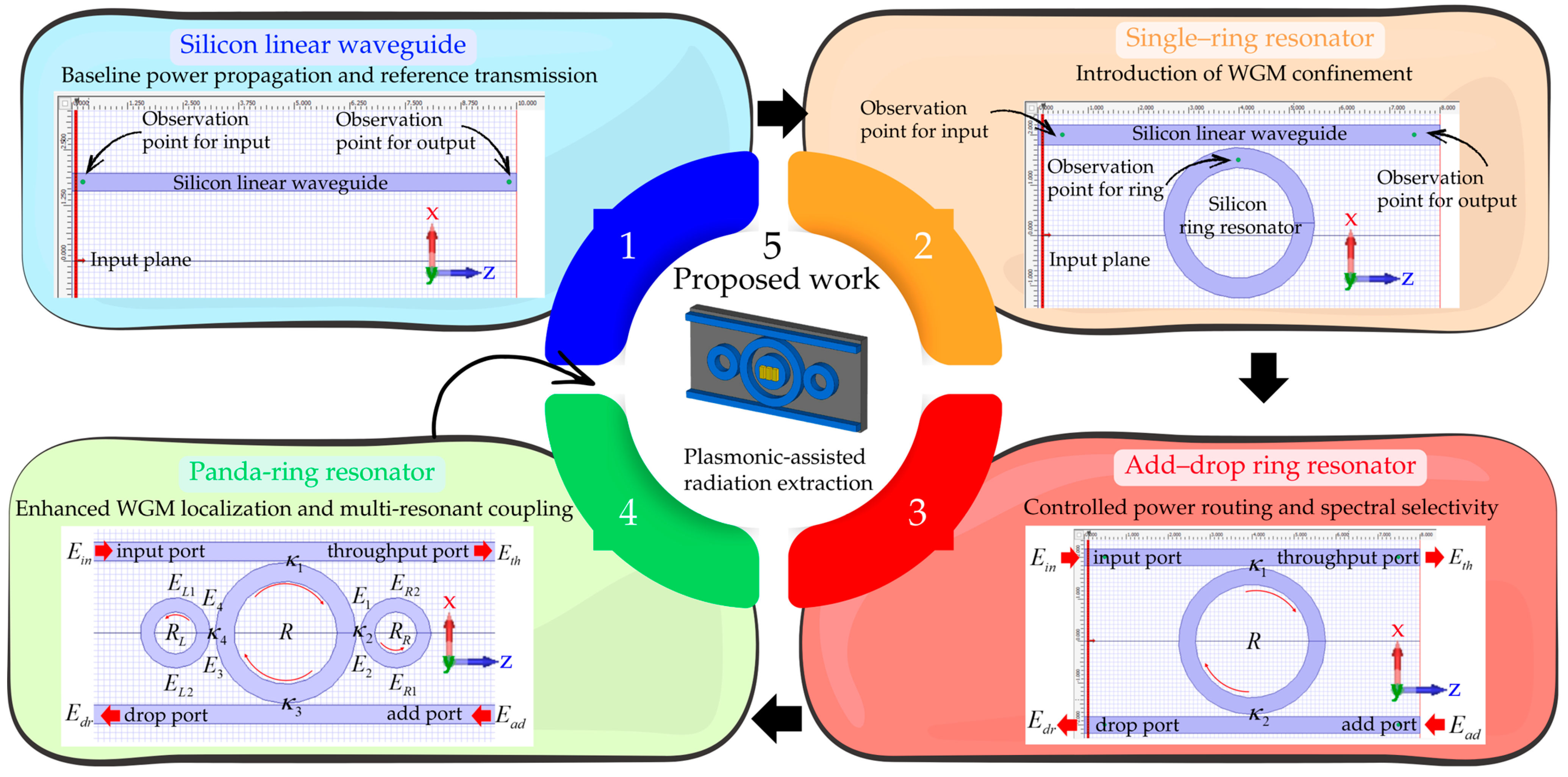
Among various resonant structures, the Panda-ring resonator [10,11,12,13,14,15,16]—a derivative of the microring resonator [17,18,19,20]—has attracted significant attention due to its capability to support whispering-gallery modes (WGMs), which enhance optical field confinement and coupling efficiency. WGMs enable high-Q resonances through total internal reflection along curved dielectric interfaces, allowing precise control of resonant wavelengths and power distribution among multiple ports. Integrating plasmonic elements such as metallic gratings into these dielectric resonators further improves light–matter interaction, facilitating hybrid SPP–WGM coupling and enabling additional radiative pathways [21,22]. This hybridization forms the foundation of dual-mode plasmonic operation, where both plasmonic and photonic modes coexist and can be selectively excited depending on system requirements. Dual-mode architectures are particularly advantageous in next-generation communication systems, enabling seamless transitions between wired (fiber-optic) and wireless (Li-Fi or THz) transmission [23]. Compared with conventional microring, disk, and metamaterial resonators, the Panda-ring resonator offers enhanced modal controllability, high-Q whispering-gallery confinement, and precise multi-port power routing [24,25]. Its multi-ring topology provides a versatile platform for hybrid plasmonic–photonic integration, enabling efficient dual-mode operation with improved radiation efficiency and subwavelength field confinement. These characteristics make the Panda-ring resonator particularly suitable for next-generation Li-Fi and terahertz (THz) communication systems [6,26,27]. Building upon these principles, this study proposes a computationally optimized plasmonic Panda-ring antenna embedded with a gold grating, designed to enhance both near-field confinement and far-field radiation characteristics through a hybrid plasmonic–photonic approach. To systematically investigate the evolution of mode confinement and coupling behavior, the proposed design is developed through a hierarchical resonator architecture, starting from a conventional silicon linear waveguide, followed by silicon ring resonators coupled to single and double linear waveguides. These intermediate configurations provide fundamental insight into power routing, resonance stability, and mode interaction within photonic resonator systems. Based on this progression, the final Panda-ring structure integrates a central microring with two side rings and an embedded gold grating, forming a hybrid antenna capable of supporting strong whispering-gallery mode (WGM) resonance and efficient surface plasmon polariton (SPP) excitation. The overall structural evolution and the final proposed configuration are illustrated in Figure 1.
The embedded gold grating strengthens plasmonic field excitation at the metal–dielectric interface while maintaining high-Q WGM confinement within the silicon waveguide network. This synergy between SPPs and WGMs enables efficient energy redistribution from confined resonant modes toward radiative channels, directional far-field radiation behavior demonstrated in the optical frequency domain, with potential scalability toward terahertz frequencies. In addition, the proposed design addresses key limitations of conventional plasmonic antennas by enhancing electromagnetic field localization and facilitating improved energy coupling, rather than relying solely on purely plasmonic radiation mechanisms. Comprehensive numerical simulations using OptiFDTD 16.0.1 and CST Studio Suite 2025 are performed to analyze the antenna’s spectral response, field distribution, gain, and directivity. The simulation results demonstrate that the proposed Panda-ring configuration achieves stable dual-mode transmission with enhanced far-field radiation characteristics, making it well suited for integration into Li-Fi transmitters, future 6G communication modules, and hybrid photonic–plasmonic circuits.

2. Materials and Methods

This section presents the theoretical basis, structural design, and computational approach used to analyze the proposed plasmonic Panda-ring antenna embedded with a gold grating. The study combines analytical modeling and numerical simulations to investigate the antenna’s dual-mode plasmonic behavior, governed by the interaction between surface plasmon polaritons (SPPs) and whispering-gallery modes (WGMs).
The gold grating enhances plasmonic confinement at the metal–dielectric interface, while the Panda-ring configuration supports high-Q optical resonance and efficient mode coupling. Full-wave simulations using OptiFDTD and CST Studio Suite are performed to evaluate spectral response, field distribution, and radiation characteristics. The following subsections describe the theoretical foundation, material parameters, and computational setup employed in this work.

2.1. Theoretical Foundation

This section presents the theoretical framework, structural design, and computational methodology used to analyze the proposed plasmonic Panda-ring antenna embedded with a gold grating. The study integrates analytical modeling with full-wave numerical simulations to investigate the dual-mode plasmonic behavior arising from hybrid surface plasmon polariton (SPP) and whispering-gallery mode (WGM) interactions. In the proposed architecture, the embedded gold grating enhances plasmonic field confinement at the metal–dielectric interface, while the Panda-ring resonator supports high-Q optical resonances and efficient mode coupling. Full-wave simulations using Optiwave finite-difference time-domain (FDTD) and CST Studio Suite are conducted to evaluate the spectral response, near-field distribution, and far-field radiation characteristics. The following subsections describe the physical principles, material properties, structural configuration, and computational setup employed in this work.

2.1.1. Surface Plasmon Polaritons (SPPs)

SPPs are electromagnetic waves that propagate along the interface between a metal and a dielectric, resulting from the collective oscillation of free electrons in the metal when excited by incident light. This interaction allows subwavelength field confinement and enhanced near-field coupling [28,29]. The dispersion relation of SPPs is given by the equation:
β = k 0 ε m ε d ε m + ε d
where β is the propagation constant of the SPP, k 0 is the free-space wavevector, and ε m and ε d represent the complex permittivities of the metal and dielectric, respectively. SPPs exist when the real part of ε m is negative, a condition typically satisfied by noble metals such as gold (Au) and silver (Ag) in the optical and terahertz (THz) frequency ranges. The dielectric function of gold is modeled using the Drude model [30,31], which describes the frequency-dependent behavior of conduction electrons as follows:
ε m ω = ε ω p 2 ω 2 + j ω γ
where ε is the high-frequency permittivity, ω p is the plasma frequency, and γ represents the damping constant associated with electron collisions. This formulation enables accurate modeling of plasmonic resonance within the gold grating structure, which plays a critical role in enhancing field confinement and radiation efficiency.

2.1.2. Whispering-Gallery Modes (WGMs)

WGMs arise when light is confined within a circular dielectric resonator through total internal reflection, forming standing waves that circulate along the perimeter of the resonator. These modes support high quality factors (Q-factors), enabling strong optical confinement and resonance stability [32,33]. The resonance wavelength condition of a WGM is expressed as follows:
λ m = 2 π r n e f f m
where λ m is the resonant wavelength, r is the radius of the microring, n e f f is the effective refractive index, and m denotes the mode number. In the proposed design, WGMs are excited within the Panda-ring structure composed of a central microring coupled with two side rings. This configuration enhances resonance control and stability, supporting efficient optical energy exchange among the input, throughput, add, and drop ports.
By embedding a gold grating within the central microring, strong hybrid coupling between SPPs and WGMs is achieved [9,23,24]. The metallic grating perturbs the dielectric resonance field, allowing simultaneous excitation of plasmonic and photonic modes, which results in dual-mode transmission. The interaction between these modes improves impedance matching and enhances radiation gain. Moreover, the hybrid coupling minimizes propagation losses by redistributing the electromagnetic field energy between the plasmonic (metallic) and photonic (dielectric) domains [34]. This dual-mode mechanism forms the theoretical basis of the proposed antenna, enabling efficient mode conversion between plasmonic and photonic channels—a key feature for high-performance Li-Fi, 6G, and on-chip optical communication applications [5,9].

2.2. Structural Design of the Proposed Antenna

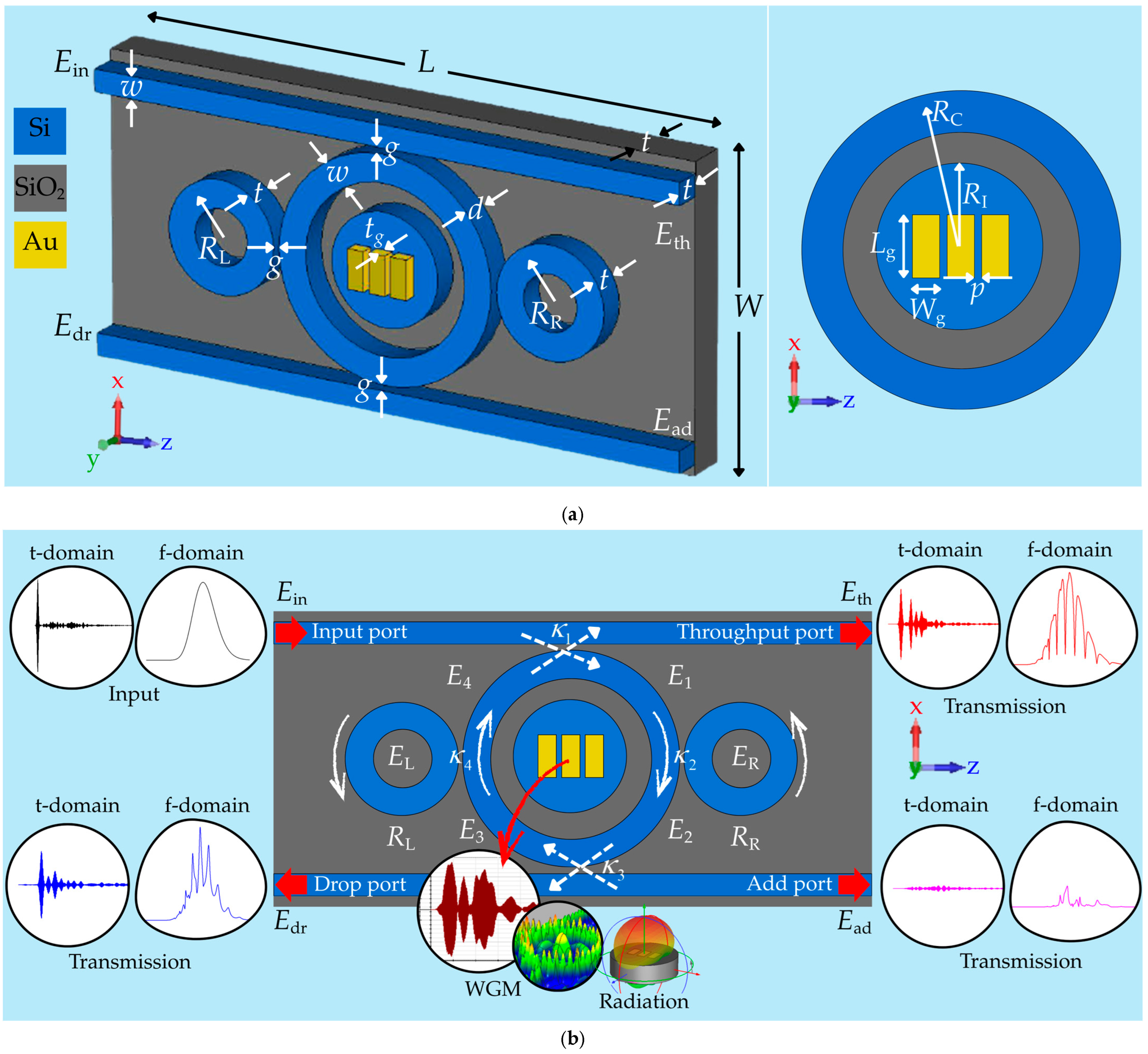
The proposed plasmonic Panda-ring antenna is designed to achieve strong electromagnetic field confinement and efficient radiation by integrating plasmonic and photonic mechanisms within a compact resonator-based architecture. The structural configuration, illustrated in Figure 2, is based on a Panda-ring resonator circuit composed of a central microring coupled to two side rings and double linear waveguides. This multi-ring topology enhances modal interaction, resonance controllability, and power routing capability, while maintaining compact dimensions suitable for optical and terahertz-frequency operation. As shown in Figure 2a, the structure is implemented on a silicon (Si) waveguide platform supported by a silicon dioxide (SiO2) substrate. A gold (Au) grating is embedded at the center of the main ring, forming a plasmonic island that enables strong surface plasmon polariton (SPP) excitation at the metal–dielectric interface. The propagation of SPP waves occurs along the metal–dielectric boundary with an evanescent decay in the transverse direction, where the collective oscillation of free electrons in the metal is described by the Drude model. The resulting plasmonic modes exhibit transverse magnetic (TM) polarization and strong field localization, which are essential for efficient near-field enhancement and plasmonic radiation. The Panda-ring resonator supports whispering-gallery modes (WGMs) within the dielectric microring structure, where optical fields circulate along the curved interfaces through total internal reflection.
In this work, the spectral characteristics associated with plasmonic excitation are identified from the WGM resonance response of the Panda-ring system, enabling effective hybridization between photonic WGMs and plasmonic SPPs. This hybrid SPP–WGM interaction forms the basis of dual-mode operation, where confined photonic energy and localized plasmonic fields coexist and interact coherently within the same structure. As illustrated in Figure 2b, the optical input field Ein is injected into the linear silicon waveguide and subsequently coupled into the Panda-ring resonator, where the energy is redistributed among the throughput, drop, and add ports according to the resonant coupling conditions. The throughput port (Eth) primarily carries the forward-propagating component of the input signal and represents the direct transmission path along the bus waveguide. The drop port (Edr) extracts resonantly coupled energy from the Panda-ring structure, exhibiting strong spectral selectivity associated with whispering-gallery mode (WGM) excitation. In contrast, the add port (Ead) is only weakly excited under single-input operation, resulting in a significantly lower output amplitude compared with the throughput and drop ports. This behavior arises from the asymmetric coupling configuration and power redistribution within the Panda-ring resonator, where the add port does not serve as a primary transmission channel in the present excitation scheme. In related photonic systems, this port is often employed as a secondary input to enable dual-input operation or modulation functionality, rather than as a dominant output port. The coupling behavior between the rings and the waveguides is governed by coupling coefficients and attenuation parameters, which determine energy transfer, resonance balance, and phase evolution within the structure. These parameters are obtained from the resonant transmission characteristics of the corresponding waveguide–resonator configurations, ensuring physically consistent energy redistribution among all ports. As a result, the Panda-ring architecture achieves stable resonance behavior, low insertion loss, and strong interaction between neighboring resonators. A summary of the key design parameters and material properties used in the computational modeling is provided in Table 1.
Based on the structural configuration shown in Figure 2b, the electric-field evolution within the Panda-ring resonator circuit can be described using a coupled-mode analytical model [35]. The field amplitudes at the throughput, drop, and add ports are governed by the coupling coefficients, insertion losses, and phase accumulation along each ring, and can be expressed as follows:
E t h = 1 γ 1 1 κ 1 E i 1 + j κ 1 E 4 e α 2 L D 4 j k n L D 4
E d r = 1 γ 3 1 κ 3 E i 2 + j κ 3 E 2 e α 2 L D 4 j k n L D 4
E a d = 1 γ 3 1 κ 3 E d + j κ 3 E 2 e α 2 L D 4 j k n L D 4
where
E 1 = 1 γ 1 1 κ 1 E 4 e α 2 L D 2 j k n L D 2 + j κ 1 E i 1 e α 2 L D 4 j k n L D 4
E 2 = 1 γ 2 1 κ 2 E 1 + j κ 2 E R R e α 2 L R j k n L R
E 3 = 1 γ 3 1 κ 3 E 2 e α 2 L D 2 j k n L D 2 + j κ 3 E i 2 e α 2 L D 4 j k n L D 4
E 4 = 1 γ 4 1 κ 4 E 3 + j κ 4 E R L e α 2 L L j k n L L
In these expressions, Ein, Eth, Edr, and Ead denote the complex electric-field amplitudes at the input, throughput, drop, and add ports, respectively, while E1E4 represent the circulating field amplitudes at different coupling sections within the Panda-ring resonator. Ei1 and Ei2 denote the incident field components at the corresponding coupling junctions, while Ed represents the field component coupled toward the drop port. The terms ERR and ERL correspond to the circulating electric-field amplitudes within the right and left auxiliary rings, respectively. The parameters κ i and γ i correspond to the power coupling ratios and insertion-loss factors of the directional couplers, respectively, and α denotes the effective propagation loss coefficient of the waveguide–ring system, accounting for material absorption and radiation-related attenuation. The quantities LD, LR, and LL represent the optical path lengths of the center, right, and left rings, respectively, and k n = 2 π n e f f is the effective propagation constant of the resonant guided mode supported by the Panda-ring structure.
The coupling and loss parameters employed in the coupled-mode formulation are evaluated consistently with the full-wave resonant responses of the corresponding structures, ensuring agreement between the analytical representation and the numerically observed spectral behavior. These parameters are subsequently used to interpret the power redistribution characteristics discussed in Section 3.2. Under harmonic steady-state conditions, the optical intensity at each port is obtained from the corresponding complex electric-field amplitude extracted from numerical simulations. The optical intensity is proportional to the squared magnitude of the electric field and can be expressed as
I = 1 2 n e f f c ε 0 E 2
where n e f f is the effective refractive index of the guiding medium, ε 0 is the vacuum permittivity, c is the speed of light in free space, and E denotes the complex electric-field amplitude at the observation port. This relation is applied consistently to all ports of the resonator structures, including the throughput, drop, and add ports.

2.3. Computational Modeling and Simulation Setup

To comprehensively investigate the dual-mode plasmonic behavior of the proposed Panda-ring antenna embedded with a gold grating, full-wave numerical simulations were conducted using two complementary electromagnetic solvers: Optiwave Finite-Difference Time-Domain (FDTD) and CST Studio Suite. This combined simulation framework enables accurate characterization of near-field photonic–plasmonic interactions in the optical domain, followed by consistent evaluation of far-field radiation behavior under whispering-gallery mode (WGM) excitation.
OptiFDTD was employed to model the optical-domain behavior of the resonator-based structures, To suppress artificial boundary reflections, anisotropic perfectly matched layer (APML) boundary conditions were applied in all spatial directions. The APML consists of 15 absorbing layers with a reflection coefficient of approximately 1.0 × 10⁻¹², providing effective absorption of both propagating and evanescent plasmonic waves. A uniform spatial discretization of Δx = Δy = Δz = 0.045 µm was employed to accurately resolve subwavelength field confinement at the metal–dielectric interface. The computational domain comprises 308 × 55 × 353 mesh cells along the X, Y, and Z-axes, respectively. A Gaussian pulse centered at 1.55 µm was launched through the silicon linear waveguide. Time-domain electric-field responses were recorded at the throughput, drop, add, and central resonator (island) regions, and subsequently transformed into the spectral domain using discrete Fourier transform (DFT) analysis. To ensure steady-state resonance conditions, the simulation was performed over 20,000 round trips.
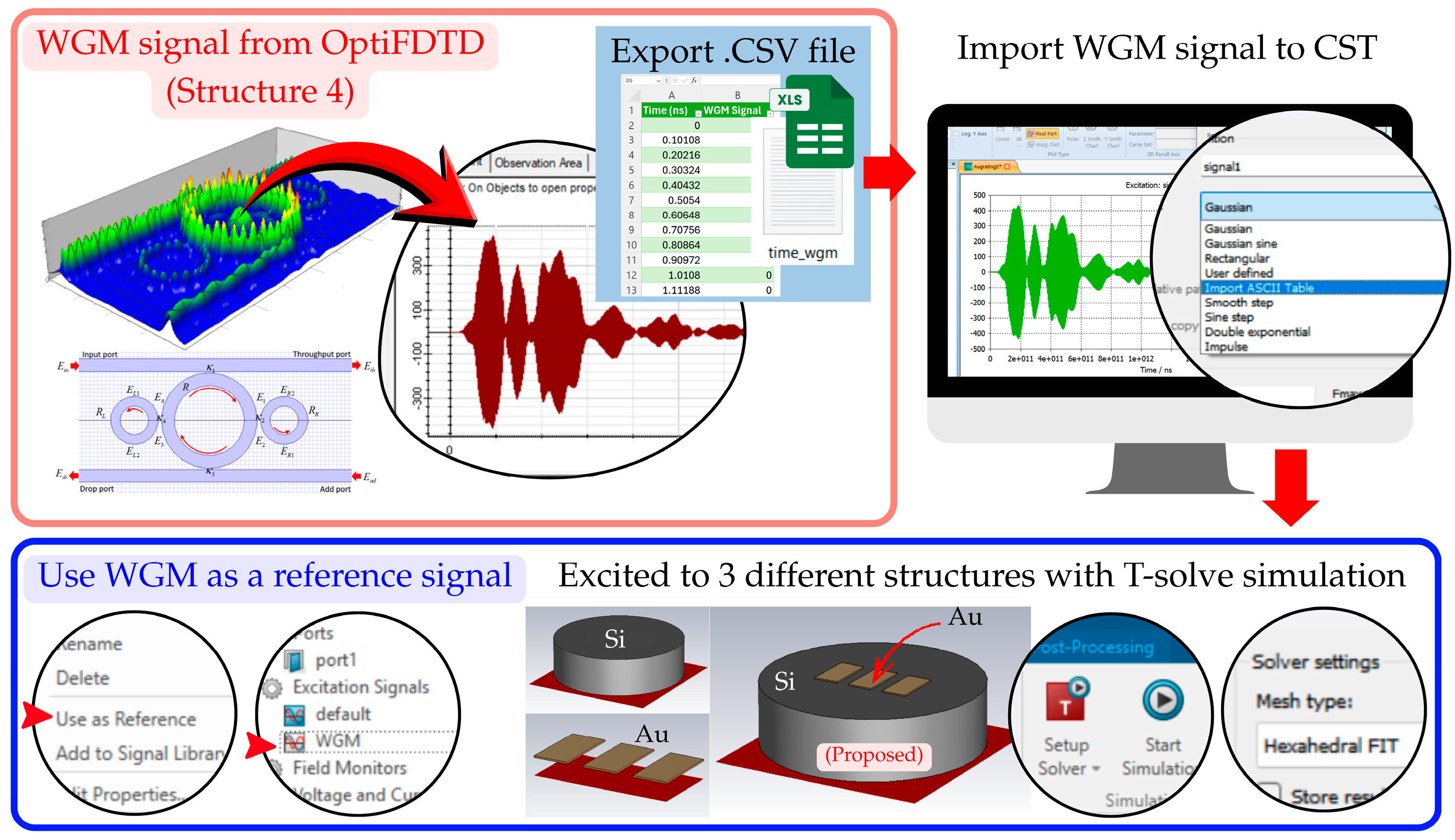
This configuration provides reliable evaluation of electric-field distributions and spectral power characteristics, which serve as the basis for extracting the WGM excitation signal used in subsequent radiation analysis. To investigate the antenna radiation characteristics, including gain, and far-field patterns, CST Studio Suite was utilized. Instead of employing an idealized or analytical excitation source, the optical WGM waveform obtained from the OptiFDTD resonator analysis was used as the excitation signal. Specifically, the time-domain WGM response extracted from the Panda-ring resonator (Structure 4) was exported as a CSV file, enabling direct inspection and post-processing using spreadsheet-based tools such as Microsoft Excel [36]. The extracted waveform was then imported into CST Studio Suite as a user-defined excitation via a waveguide port, ensuring physically consistent mode excitation.
The imported WGM signal was defined as a reference excitation signal and subsequently applied to three different island configurations: (i) silicon cylinder only, (ii) gold grating only, and (iii) the proposed hybrid structure, under identical excitation and solver settings. This procedure ensures that any observed differences in far-field radiation characteristics arise solely from structural variations rather than excitation inconsistencies. Far-field radiation patterns were computed at 193.5 THz, corresponding to the dominant resonance frequency identified from the optical-domain analysis. Figure 3 illustrates the complete WGM-based excitation transfer procedure from OptiFDTD to CST Studio Suite. By directly mapping the resonator-generated WGM signal into the antenna simulation environment, the proposed methodology establishes a physically consistent link between near-field photonic resonance and far-field electromagnetic radiation.
The combination of OptiFDTD and CST Studio Suite provides a unified computational framework that bridges photonic resonance behavior and antenna radiation analysis. This multi-scale simulation strategy ensures physical consistency between near-field plasmonic–photonic interactions and far-field electromagnetic radiation, thereby enabling reliable assessment of the proposed antenna’s dual-mode transmission capability. The simulation methodology adopted in this work directly supports the electric-field, power intensity, and radiation results discussed in Section 3, confirming the effectiveness of the proposed hybrid plasmonic–photonic Panda-ring antenna design as a proof-of-concept numerical demonstration.

3. Results

This section presents the numerical results of the proposed plasmonic Panda-ring antenna, focusing on the evolution of electromagnetic behavior from resonator-based photonic structures to the hybrid plasmonic–photonic configuration. The analysis includes electric-field distributions, spectral power intensity responses, and far-field radiation characteristics, providing insight into the hybrid SPP–WGM coupling mechanism and its role in enabling dual-mode transmission and enhanced antenna performance.

3.1. Electric-Field Distribution in Resonator-Based Structures

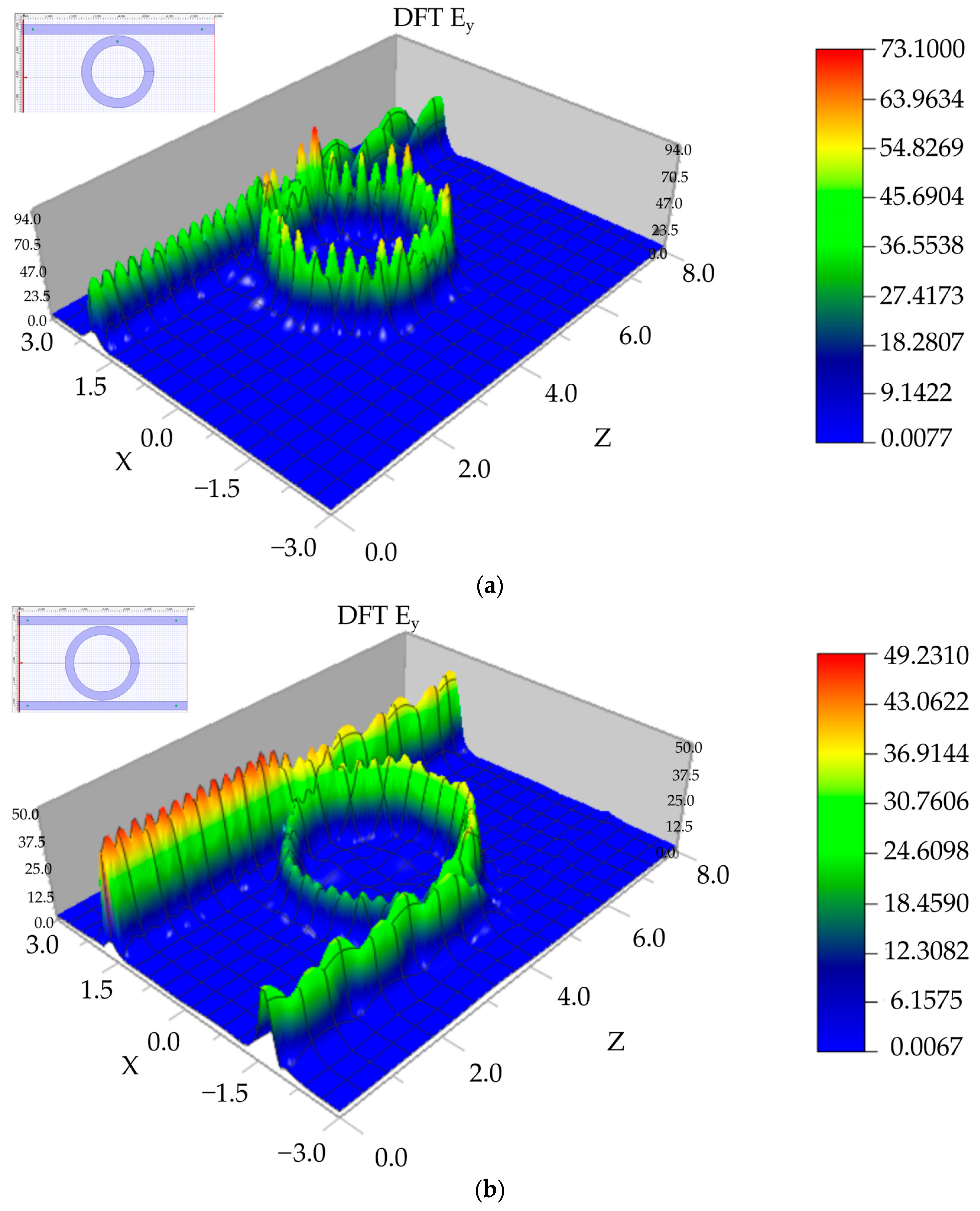
The electric-field distributions of the resonator-based configurations and the proposed structure are summarized in Figure 4 to provide a comparative visualization of field confinement, coupling behavior, and resonant-mode evolution as the structural complexity increases. Unlike the linear waveguide baseline, which primarily supports forward-guided propagation with limited field localization, the resonator-based structures exhibit pronounced field enhancement arising from resonant circulation and evanescent coupling mechanisms. This progressive evolution of the field distribution establishes the physical foundation for the hybrid plasmonic–photonic response and dual-mode operation of the proposed antenna. For Structure 1, which consists of a simple silicon linear waveguide, no detailed electric-field distribution analysis is presented. In general, propagation loss in a straight waveguide accumulates with transmission length due to material absorption and scattering effects. However, in this work the waveguide length is intentionally designed to be extremely short, on the order of a few micrometers, resulting in negligible attenuation over the propagation distance considered. Consequently, the linear waveguide primarily serves as a reference for guided-wave transmission rather than a resonant structure. The subsequent analysis therefore focuses on resonator-based configurations (Structures 2–5), where field localization, resonant buildup, and coupling-induced redistribution dominate the electromagnetic behavior and are directly relevant to the dual-mode operation of the proposed antenna.
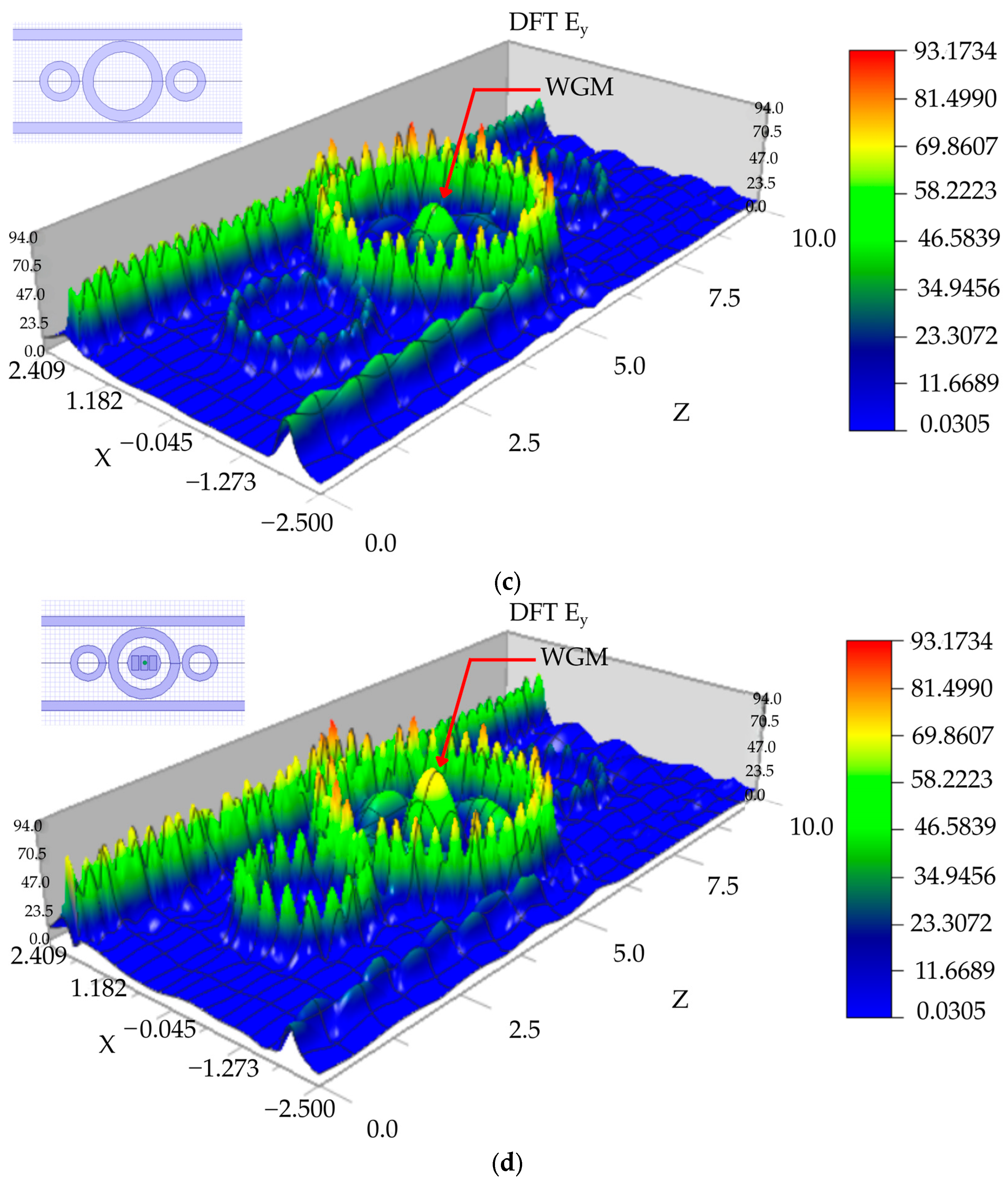
For the silicon ring resonator coupled to a single linear waveguide (Structure 2), the electric-field distribution demonstrates a clear buildup of circulating fields along the ring perimeter, indicating the excitation of whispering-gallery-like resonant modes. Strong field localization is observed near the coupling region between the straight waveguide and the ring, confirming efficient evanescent coupling and power transfer from the bus waveguide into the resonator cavity. Outside the coupling zone, the field intensity decays rapidly, highlighting effective spatial confinement within the resonator. This configuration represents the fundamental resonant behavior, where energy is primarily stored and recirculated within a single ring, providing a baseline for subsequent multi-resonator coupling analysis. When the resonator topology is extended to include a double linear waveguide configuration (Structure 3), the electric-field distribution reveals a more complex coupling pattern. In addition to the circulating field within the ring, enhanced field intensity appears along both bus waveguides, indicating bidirectional energy exchange through multiple coupling interfaces. The presence of two waveguides introduces additional coupling paths, leading to increased field redistribution and partial symmetry breaking in the spatial field profile. This configuration enables more flexible power routing between input, throughput, drop, and add ports, while maintaining strong resonant confinement inside the ring, consistent with the multi-port coupling scheme illustrated in Figure 2b. The resulting field pattern illustrates how multi-port access can be achieved without significantly degrading resonance stability, an essential feature for integrated photonic circuits and antenna feeding networks. Further enhancement of resonant interaction is observed in the Panda-ring resonator configuration without plasmonic loading (Structure 4), where a central ring is coupled to two side rings. The electric-field distribution shows strong field localization not only within the main ring but also in the adjacent side rings, indicating efficient inter-ring coupling and collective mode formation. The coupled-ring topology promotes energy exchange among the resonators, leading to extended field circulation paths and increased effective interaction length. As a result, higher field intensity and improved confinement are achieved compared with single-ring configurations, indicating its suitability as a high-Q WGM excitation and energy-feeding platform. The presence of multiple resonant pathways also facilitates mode splitting and stabilization, which is advantageous for achieving controlled resonance behavior and enhanced spectral selectivity.
The most significant modification of the electric-field distribution occurs in the proposed hybrid plasmonic–photonic Panda-ring structure embedded with a gold grating (Structure 5). As shown in Figure 4, the field intensity is strongly enhanced at the central ring region where the metallic grating is embedded, while high-intensity circulating fields are preserved along the dielectric ring perimeter. This behavior indicates the simultaneous excitation of whispering-gallery modes within the dielectric resonator and surface plasmon polaritons at the metal–dielectric interface. The strong spatial overlap between the evanescent plasmonic field supported by the gold grating and the circulating WGM field confined in the silicon ring confirms the formation of hybrid SPP–WGM coupling. The hybrid coupling mechanism significantly alters the field distribution by redistributing electromagnetic energy between plasmonic and photonic domains. While the dielectric resonator maintains high-Q confinement and stable circulation, the metallic grating introduces localized plasmonic hotspots that enhance near-field intensity and facilitate controlled radiative leakage. Figure 4c,d are plotted using the same color scale to enable direct visual comparison. Although the color bars are identical, the WGM field intensity at the center of the ring in Figure 4d is clearly higher than that in Figure 4c. This enhancement arises from the presence of the plasmonic gold grating, which strengthens local field confinement through plasmonic–photonic coupling, rather than from any difference in color normalization.
This dual behavior enables efficient conversion between guided photonic modes and radiative plasmonic modes, thereby supporting dual-mode transmission. The resulting field pattern exhibits both strong near-field localization, characteristic of plasmonic excitation, and extended circulating fields associated with photonic resonance, providing a physical basis for the observed improvements in radiation efficiency and gain. Comparing the field distributions across all resonator-based structures highlights the critical role of structural evolution in enabling dual-mode operation. Single-ring and multi-bus configurations primarily enhance photonic resonance and power routing, whereas the Panda-ring topology introduces cooperative resonant coupling that strengthens field confinement. The integration of the gold grating further extends this capability by activating plasmonic modes that interact constructively with WGMs. This synergy enhances impedance matching, reduces propagation loss through energy redistribution, and improves far-field radiation characteristics without sacrificing resonance stability.

3.2. Spectral Power Intensity Analysis of Resonator-Based Structures

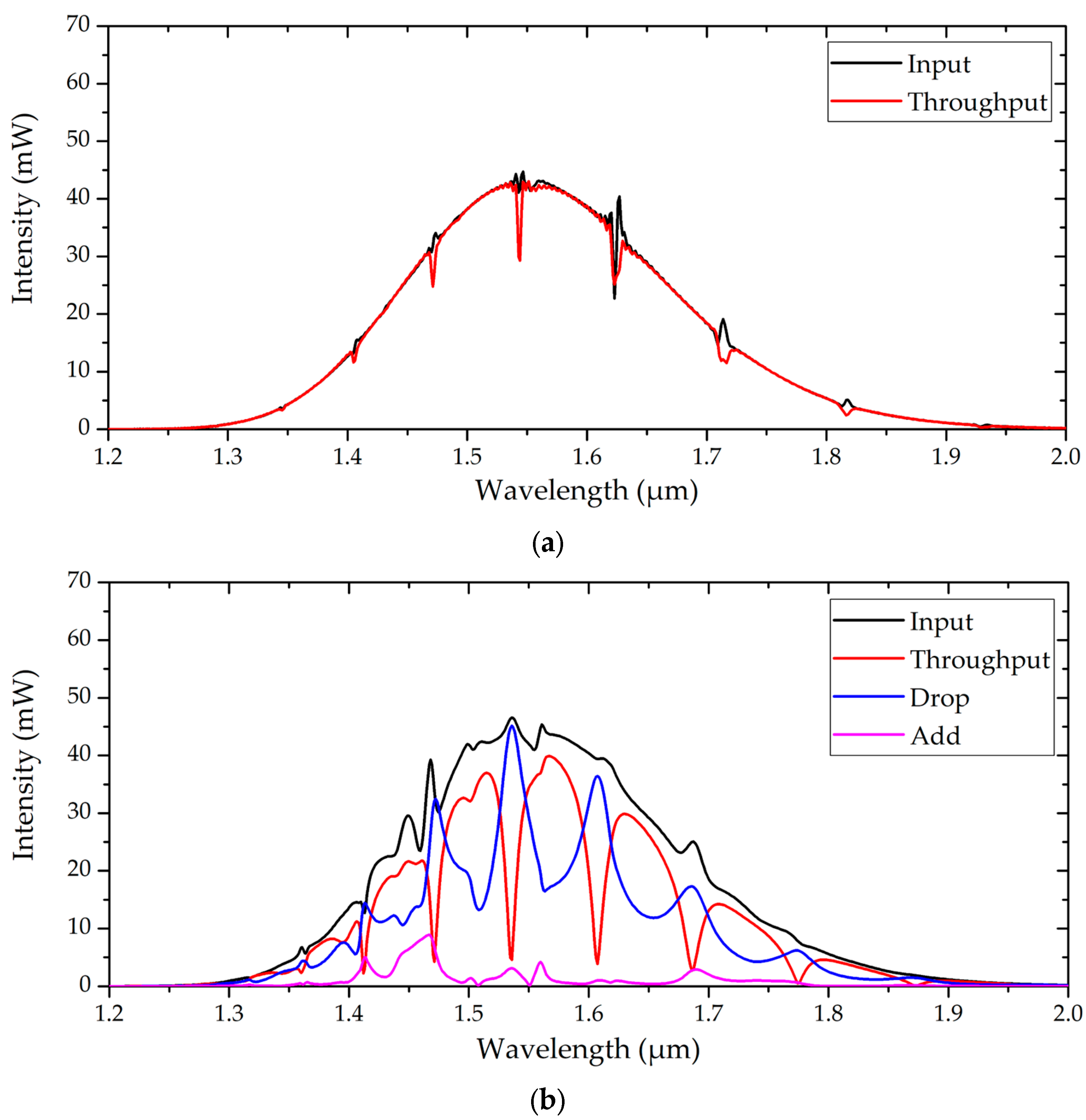
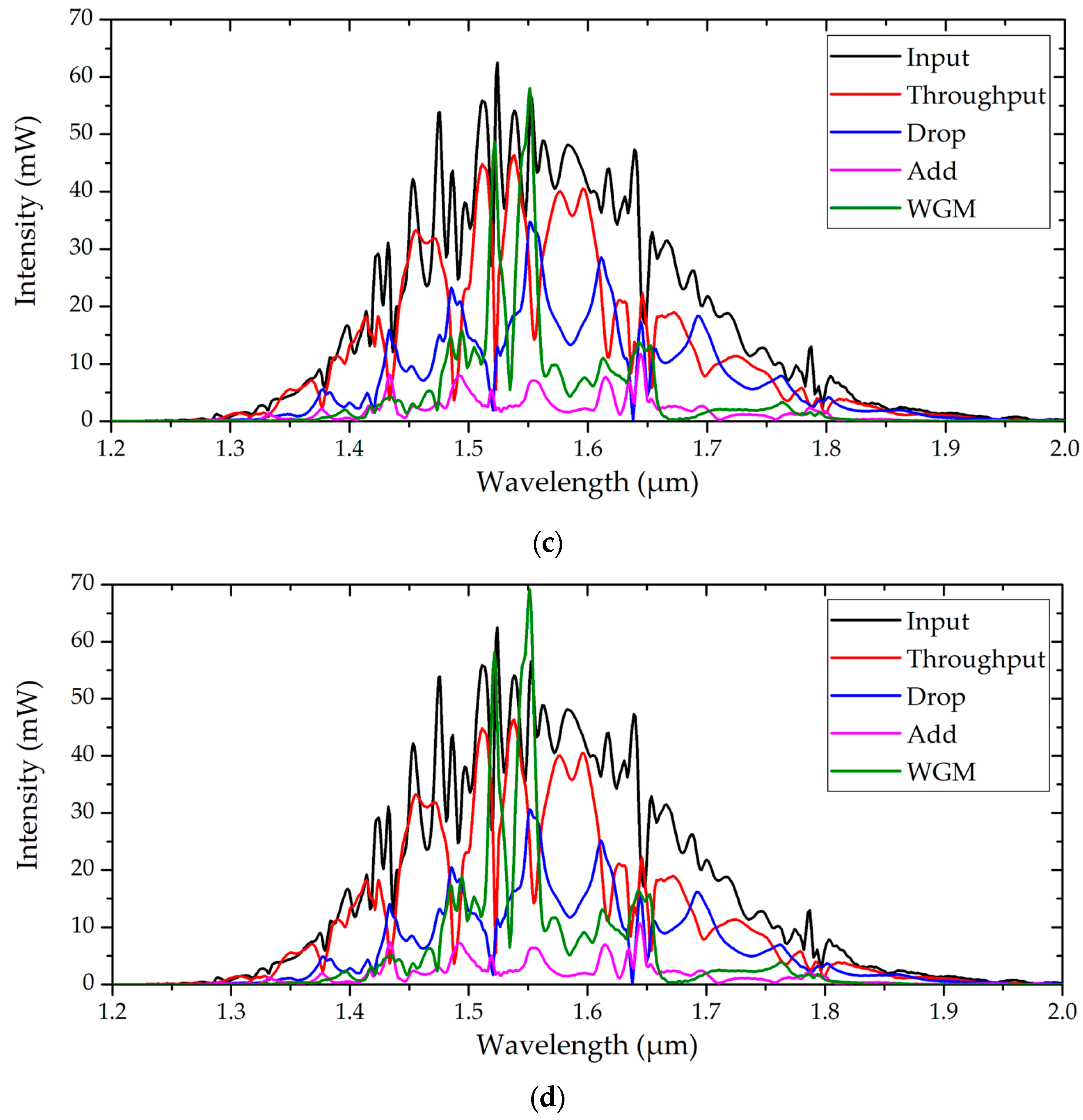
Figure 5 presents the simulated power intensity spectra of the resonator-based configurations, illustrating the evolution of spectral characteristics from purely photonic resonators to the proposed hybrid plasmonic Panda-ring antenna. The results provide insight into wavelength-dependent power redistribution, resonant-mode formation, and the transition toward dual-mode operation governed by hybrid surface plasmon polariton (SPP) and whispering-gallery mode (WGM) coupling mechanisms. For Structure 2, which consists of a silicon ring resonator coupled to a single linear waveguide, the power intensity response is dominated by fundamental WGM resonances. As shown in Figure 5a, the throughput port exhibits attenuation notches at resonance wavelengths, corresponding to efficient coupling of optical energy into the ring cavity. The complementary behavior observed at the drop port in Figure 5b confirms selective wavelength extraction characteristic of add–drop filter operation. In this configuration, energy redistribution is primarily controlled by photonic resonance, with limited modal interaction and negligible add-port excitation, consistent with conventional add–drop resonator behavior dominated by single-ring WGM confinement.
The introduction of a second linear waveguide in Structure 3 significantly modifies the spectral response. As illustrated in Figure 5b, the throughput, drop, and add ports simultaneously exhibit pronounced resonance features. The presence of dual bus waveguides enables bidirectional coupling and increases the number of accessible coupling paths, resulting in enhanced power routing flexibility, consistent with the multi-port coupling scheme illustrated in Figure 2b. Compared with the single-waveguide configuration, Structure 3 demonstrates increased resonance density and stronger port-to-port interaction, indicating improved controllability of photonic power flow while maintaining stable WGM confinement. Figure 5c shows the power intensity spectra of Structure 4, employing a Panda-ring resonator composed of a central microring coupled to two auxiliary side rings. The multi-ring topology introduces coherent inter-ring coupling, leading to mode splitting and resonance broadening across the wavelength spectrum. Strong WGM intensity peaks are observed, accompanied by deeper attenuation at the throughput port and enhanced extraction at the drop port. The add port also exhibits noticeable modulation, reflecting bidirectional energy exchange enabled by the coupled resonator system. These results confirm that the Panda-ring architecture significantly enhances modal interaction and resonance controllability compared with conventional single-ring configurations, serving as a critical intermediate step toward hybrid plasmonic integration, particularly as a stable high-Q WGM excitation platform. The spectral response of the proposed Structure 5, shown in Figure 5d, reveals a pronounced enhancement in power intensity characteristics due to the incorporation of a gold grating within the Panda-ring resonator. Sharp and high-amplitude WGM peaks appear near the central resonance wavelengths, indicating strong electromagnetic field localization induced by efficient SPP excitation at the metal–dielectric interface. Compared with the purely photonic Panda-ring, the hybrid structure exhibits deeper throughput attenuation, stronger drop-port extraction, and increased add-port modulation, demonstrating effective hybridization between plasmonic and photonic modes.
The coexistence of enhanced WGM resonances and redistributed port intensities confirms the emergence of dual-mode operation in Structure 5. In this regime, photonic WGMs provide resonance stability and efficient power routing, while plasmonic SPPs contribute subwavelength field confinement and localized field enhancement. The hybrid SPP–WGM interaction improves impedance matching and energy transfer efficiency, resulting in superior spectral selectivity and power redistribution compared with all preceding photonic configurations.

3.3. Far-Field Radiation and Gain Characteristics Under WGM Excitation

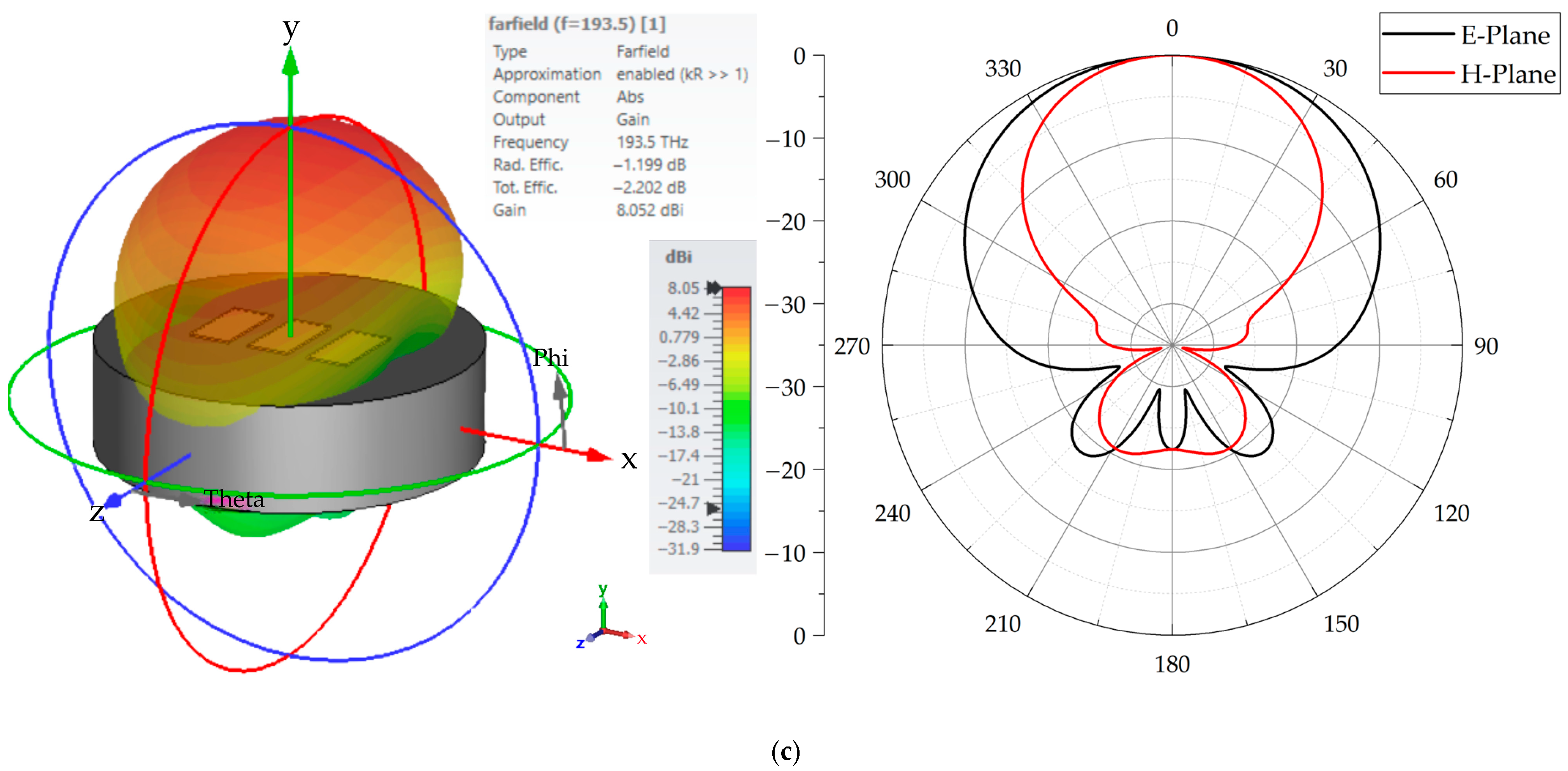
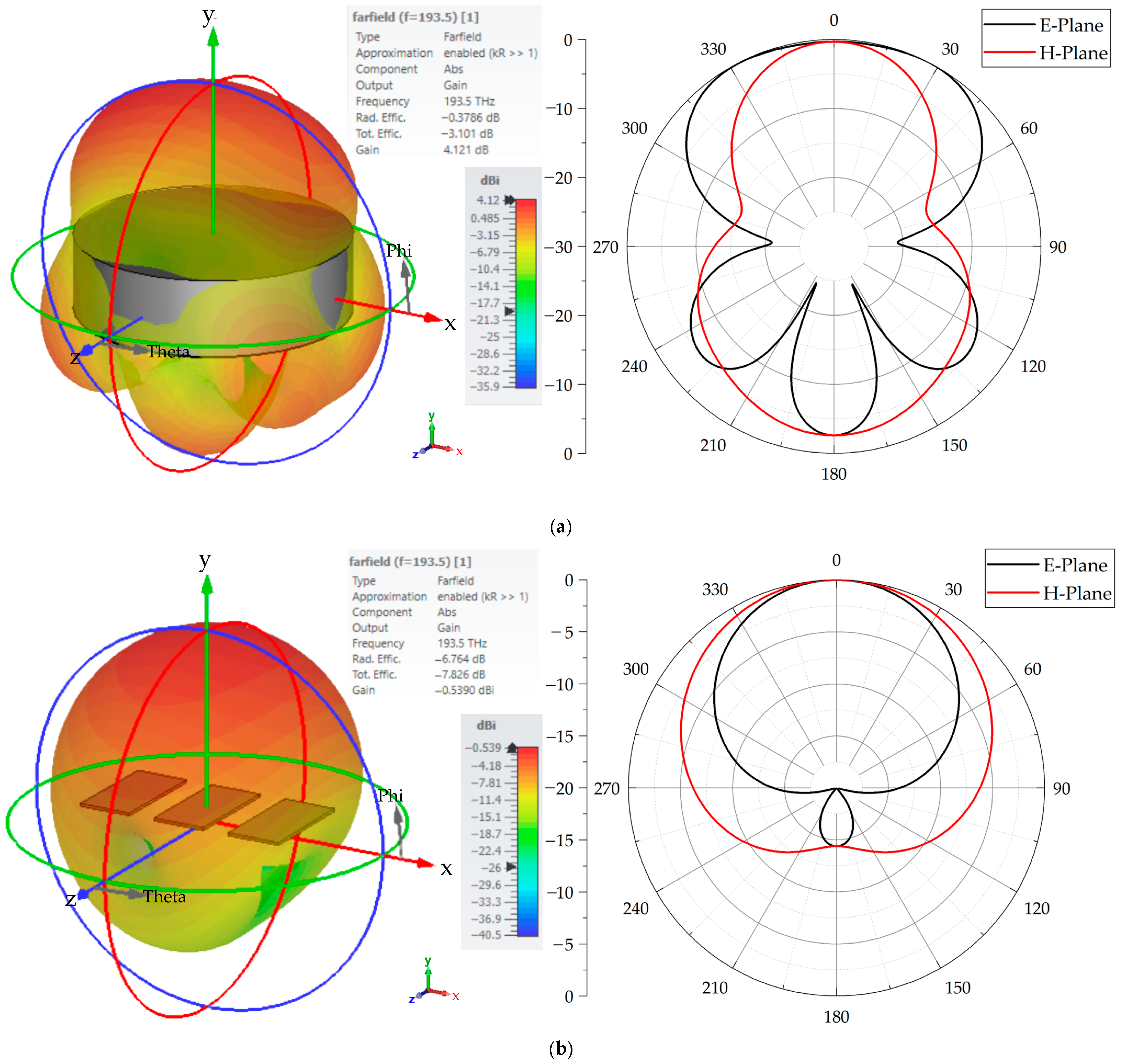
The far-field radiation performance of the proposed antenna is evaluated under whispering-gallery mode (WGM) excitation at an operating frequency of 193.5 THz (corresponding to a wavelength of approximately 1.55 µm). To ensure a fair and physically consistent comparison, the same WGM waveform extracted from the Panda-ring resonator is applied as the excitation source for all investigated island configurations. Three cases are considered: a silicon cylinder only, a gold grating only, and the proposed hybrid Panda-ring antenna. For the silicon-cylinder-only configuration shown in Figure 6a, the realized gain reaches 4.12 dBi, while the radiation efficiency and total efficiency are −0.3786 dB and −3.101 dB, respectively. These results indicate that although the dielectric resonator supports strong WGM confinement with relatively low material loss, a large fraction of the electromagnetic energy remains stored within the high-Q resonator, resulting in limited conversion into free-space radiation and consequently moderate gain.
When the gold-grating-only configuration is considered, as illustrated in Figure 6b, the realized gain decreases to −0.539 dBi, accompanied by a radiation efficiency of −6.764 dB and a total efficiency of −7.826 dB. This configuration is structurally analogous to the plasmonic antenna reported in Ref. [10], where a similar grating-based radiating element was investigated; the reported radiated power was approximately 0.9 mW, corresponding to about −0.5 dB on a logarithmic scale, which shows good quantitative agreement with the gain level obtained in this work. Minor discrepancies can be attributed to differences in the material platform and surrounding dielectric environment, which affect plasmonic confinement, ohmic loss, and impedance matching. Despite these differences, both studies exhibit a cardioid-like radiation pattern in the magnetic field (H-plane), indicating a common plasmonic radiation mechanism governed by asymmetric surface current distribution along the grating. Nevertheless, in the absence of a coherent photonic energy-feeding mechanism, plasmonic fields remain weakly organized and strongly affected by ohmic dissipation, resulting in limited radiation efficiency and degraded overall performance.
In contrast, the proposed hybrid Panda-ring antenna shown in Figure 6c exhibits a pronounced enhancement in far-field radiation characteristics. The realized gain increases to 8.05 dBi, while the radiation efficiency and total efficiency improve to −1.20 dB and −2.20 dB, respectively. The radiation pattern is dominated by a stable broadside main lobe with improved angular symmetry and controlled sidelobe levels, indicating efficient and directive energy extraction from the resonator into free space. Compared with the silicon-only configuration, the hybrid structure achieves an approximate gain enhancement of 3.9 dB and a total-efficiency improvement of nearly 0.9 dB. Relative to the gold-grating-only case, the gain enhancement exceeds 8.5 dB, accompanied by a total-efficiency improvement of more than 5.6 dB. These results demonstrate that neither dielectric WGM confinement nor plasmonic radiation alone is sufficient to achieve high-performance radiation under WGM excitation. Similar gain enhancement trends have been reported in hybrid plasmonic nanoantenna systems [3], where the introduction of gold-based plasmonic elements resulted in measurable gain improvement due to enhanced radiation efficiency and effective mode conversion.
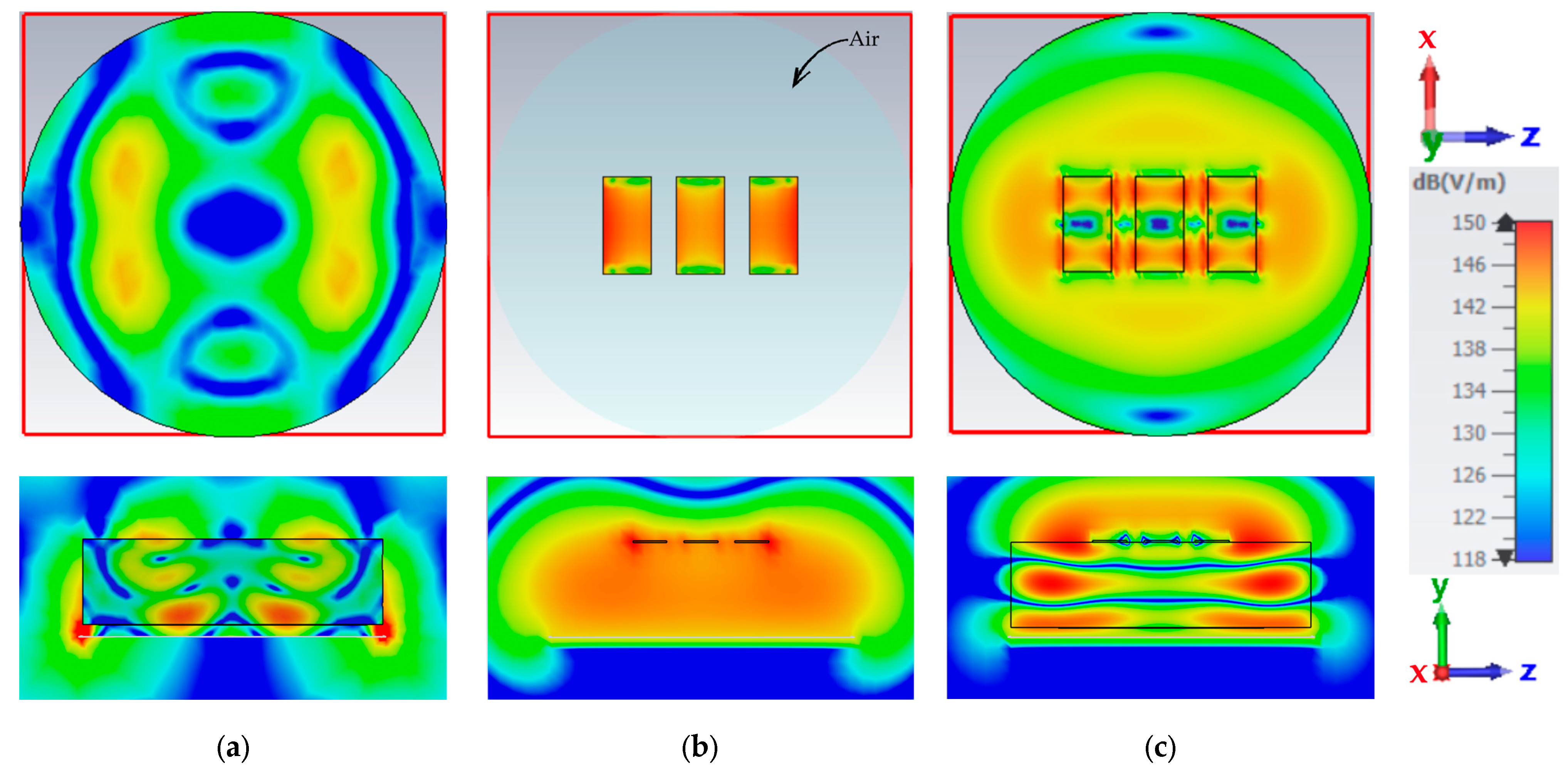
The electric-field distributions in Figure 7 provide direct physical insight into these far-field behaviors. Under identical WGM excitation, the silicon-only configuration (Figure 7a) exhibits strong field confinement along the resonator boundary with minimal leakage into free space, explaining its moderate gain and limited total efficiency. For the gold-grating-only case (Figure 7b), localized plasmonic excitation is observed around the metallic elements; however, the field distribution lacks global coherence and is strongly affected by ohmic loss, consistent with the poor radiation efficiency obtained in the far-field analysis.
By contrast, the proposed hybrid Panda-ring antenna (Figure 7c) exhibits spatially coherent electric-field localization simultaneously within the dielectric resonator and at the metal–dielectric interface of the embedded gold grating. This redistribution reflects efficient overlap between whispering-gallery modes and surface plasmon polaritons, enabling momentum matching and controlled radiative out-coupling. As a result, resonantly stored energy is efficiently extracted into free space without compromising resonance stability. These observations confirm that the enhanced gain and efficiency originate from the synergistic WGM-assisted plasmonic radiation mechanism, establishing the proposed Panda-ring antenna as a promising platform for Li-Fi transmitters, terahertz wireless links, and integrated photonic–plasmonic communication systems.

4. Discussion

This section discusses the physical implications and performance trends derived from the comparative investigation of the five studied structures summarized in Table 2. Rather than reiterating numerical results, the discussion focuses on the evolution of dominant electromagnetic mechanisms, governing the transition from purely photonic energy confinement to efficient whispering-gallery mode (WGM)-driven radiation in the proposed hybrid plasmonic–photonic Panda-ring antenna. Particular emphasis is placed on how incremental structural evolution modifies field localization, spectral controllability, and radiation efficiency, ultimately enabling stable dual-mode transmission suitable for high-frequency Li-Fi and terahertz (THz) applications.

4.1. Evolution from Linear Photonic Guiding to Resonator-Based Confinement

The linear silicon waveguide (Structure 1) serves as a fundamental reference, supporting guided-wave propagation without resonant enhancement. Owing to the absence of feedback and modal confinement mechanisms, electromagnetic energy remains weakly localized and does not contribute to radiation. While such waveguides are indispensable as optical interconnects and excitation channels in integrated photonic systems, their functionality is inherently limited to signal transport rather than energy storage or radiation [37,38,39]. Accordingly, Structure 1 is treated solely as a transmission baseline and excluded from detailed radiation analysis. Introducing a ring resonator with a single bus waveguide (Structure 2) enables whispering-gallery mode (WGM) formation through total internal reflection along the curved dielectric interface [32,37,40]. This configuration significantly enhances optical field confinement compared with linear waveguides; however, the energy remains largely trapped within the resonator due to its high-Q nature and minimal radiation leakage. Consequently, Structure 2 is well suited for optical filtering and refractive-index sensing but remains ineffective as a radiating element [33,41,42].
The dual-bus (add–drop) ring resonator (Structure 3) extends this concept by providing controlled power routing through distinct throughput and drop ports [33]. Although spectral selectivity and functional versatility improve, the dominant physical mechanism remains linear WGM confinement, and radiation leakage remains weak, unintentional, and poorly directed, indicating that conventional add–drop resonators are not inherently compatible with efficient antenna operation [17,18,19,20,43]. These observations are consistent with the spectral redistribution results presented in Section 3.2, confirm that port engineering alone is insufficient to enable efficient antenna radiation

4.2. Panda-Ring Resonator as a High-Q WGM Excitation Platform

The Panda-ring resonator (Structure 4), composed of a central ring coupled with two auxiliary side rings, represents a significant advancement in modal controllability and resonance stability. The multi-ring topology supports strongly coupled WGMs with enhanced quality factors, enabling precise control over resonance conditions and power distribution among multiple coupling paths [10,11,12,14,15,16]. Despite its improved modal richness and higher stored electromagnetic energy, Structure 4 remains predominantly non-radiative, as demonstrated by its limited far-field response under WGM excitation. Importantly, this behavior highlights a critical distinction: the Panda-ring resonator functions most effectively as a high-Q WGM excitation and energy-feeding platform rather than as a direct radiating element [13,15,35]. The ability of Structure 4 to generate stable, coherent WGM waveforms forms a crucial bridge between photonic resonators and antenna systems, enabling controlled excitation of downstream radiating structures without compromising resonance stability.

4.3. Hybrid SPP–WGM Coupling and Dual-Mode Radiation Mechanism

The proposed structure (Structure 5) introduces a fundamental shift in physical behavior by embedding a gold (Au) grating into the Panda-ring resonator. This modification facilitates strong coupling between WGMs and surface plasmon polaritons (SPPs) at the metal–dielectric interface [28,29,30], resulting in a hybrid plasmonic–photonic system. Unlike purely photonic resonators, this hybrid configuration enables subwavelength field confinement and momentum matching, allowing confined energy to couple into free-space radiation modes [22,23]. The electric-field and power intensity distributions demonstrate pronounced localization at the Au grating region, confirming the excitation of plasmonic modes. Importantly, comparative analysis with silicon-only and gold-grating-only configurations confirms that plasmonic excitation alone lacks sufficient coherence and radiation efficiency in the absence of photonic energy feeding. When driven by WGM-based excitation from Structure 4, the proposed antenna exhibits stable and directional far-field radiation with enhanced gain across multiple optical and THz frequencies. This behavior validates the proposed dual-mode transmission mechanism, where photonic WGMs provide high-Q energy storage and plasmonic SPPs act as an efficient radiation channel [10,11,24]. From a broader perspective, the present results extend the hybrid plasmonic antenna concept introduced in Ref. [3] by demonstrating that plasmon-assisted gain enhancement can be effectively driven by high-Q whispering-gallery mode excitation rather than direct plasmonic feeding.
Unlike Ref. [10], which effectively corresponds to the gold-grating-only configuration relying on localized plasmonic excitation, the present work demonstrates that such a structure alone is insufficient to achieve efficient and directive radiation. By introducing WGM-assisted photonic energy feeding through the Panda-ring resonator, the proposed hybrid architecture establishes a distinct radiation mechanism based on coherent plasmonic–photonic coupling. The observed conversion of WGM-confined energy into directional radiation can be interpreted through plasmon-mediated emission dynamics, analogous to propagating surface-plasmon-induced photon emission processes previously reported in quantum emitter–plasmon systems [45]. Compared with conventional plasmonic antennas, which often suffer from excessive ohmic losses and poor impedance matching [6,7], the proposed hybrid architecture balances confinement and radiation efficiency through coordinated photonic–plasmonic interaction, results in superior performance relative to both purely photonic and purely plasmonic designs [8,9,25,26]
From an application perspective, the comparative analysis clearly illustrates that only the proposed hybrid Panda-ring antenna achieves the necessary combination of field confinement, spectral controllability, and radiation capability required for next-generation communication systems. Structures 1–3 are limited to guided-wave or resonator-based photonic applications, while Structure 4 functions optimally as a non-radiative WGM excitation platform. In contrast, Structure 5 enables direct conversion of confined optical energy into directional electromagnetic radiation. These characteristics make the proposed antenna particularly attractive for Li-Fi transmitters, THz wireless links, and photonic–plasmonic transceivers, where seamless integration between optical signal processing and wireless radiation is required. Furthermore, the computational design framework adopted in this work allows scalable optimization across frequency bands, supporting future extensions toward tunable or reconfigurable hybrid antenna systems.
From an application perspective, the comparative analysis clearly illustrates that only the proposed hybrid Panda-ring antenna simultaneously achieves strong field confinement, spectral controllability, and efficient radiation, which are essential for next-generation communication systems. Structures 1–3 remain limited to guided-wave or resonator-based photonic applications, while Structure 4 functions optimally as a non-radiative WGM excitation platform. In contrast, Structure 5 enables direct conversion of confined optical energy into directional electromagnetic radiation, making it particularly attractive for Li-Fi transmitters, THz wireless links, and photonic–plasmonic transceivers. From a practical standpoint, the proposed hybrid plasmonic–photonic Panda-ring antenna should be regarded as a proof-of-concept platform for demonstrating WGM-driven radiation extraction. While the numerical results confirm the feasibility of optical-domain radiation, challenges related to fabrication tolerance, metallic ohmic loss, and efficient out-coupling remain. The coupling gap, intentionally designed to enhance plasmonic–photonic interaction, is expected to be sensitive to fabrication variations. Qualitatively, increasing the gap weakens coupling and radiation leakage, whereas reducing it enhances coupling at the expense of increased loss. Although a detailed tolerance analysis is beyond the scope of this work, the present results establish a clear operating principle and provide a reference for future tolerance-aware optimization and experimental validation.

5. Conclusions

This work has presented a systematic numerical investigation of a hybrid plasmonic–photonic Panda-ring antenna incorporating an embedded gold grating, with the aim of enabling efficient dual-mode radiation for high-frequency optical and terahertz communication systems. By progressively evolving the structure from a linear silicon waveguide to increasingly complex resonator-based configurations, the study has clarified the respective roles of photonic confinement, resonant coupling, and plasmonic radiation in determining antenna performance. The results confirm that conventional photonic structures, including single-ring and add–drop microring resonators, primarily support whispering-gallery mode (WGM) confinement with negligible radiation, making them unsuitable for antenna applications despite their effectiveness in filtering and sensing. The Panda-ring resonator composed of three coupled rings significantly enhances modal controllability and resonance stability, but remains predominantly non-radiative, functioning instead as an efficient high-Q WGM excitation and energy storage platform.
A fundamental transition in electromagnetic behavior is achieved by embedding a metallic gold grating into the Panda-ring resonator, thereby activating strong hybrid coupling between WGMs and surface plasmon polaritons (SPPs) at the metal–dielectric interface. This hybrid SPP–WGM interaction enables subwavelength field localization while simultaneously facilitating efficient momentum matching and controlled radiative leakage. Comparative analyses demonstrate that plasmonic structures alone are insufficient to produce efficient and directive radiation in the absence of coherent photonic energy feeding. In contrast, the proposed hybrid architecture exploits WGM-assisted excitation to convert confined photonic energy into stable and directional free-space radiation, establishing a physically distinct dual-mode radiation mechanism. Full-wave simulations performed using OptiFDTD and CST Studio Suite demonstrate that the proposed hybrid Panda-ring antenna achieves stable far-field radiation with a realized gain of approximately 8.05 dBi at the dominant resonant optical frequency of 1.55 µm (≈193.5 THz), while maintaining acceptable radiation and total efficiencies despite intrinsic plasmonic losses. The observed radiation behavior is attributed to plasmon-mediated emission dynamics enabled by the embedded gold grating, which functions as a controlled out-coupling interface rather than a passive scattering element. In contrast to previously reported gold-grating-only configurations, such as Ref. [10], the present design establishes a WGM-driven radiation mechanism based on coherent plasmonic–photonic coupling, leading to substantially improved radiation coherence, gain, and overall efficiency.
Overall, the results demonstrate that the hybrid plasmonic–photonic Panda-ring antenna effectively combines the advantages of high-Q photonic resonators and plasmonic radiators, overcoming key limitations associated with each individual domain. The proposed structure provides a compact and versatile platform for seamless optical-to-wireless energy conversion, making it promising for future Li-Fi transmitters, terahertz wireless links, and integrated photonic–plasmonic transceivers. It should be emphasized that the present study represents a proof-of-concept demonstration based on numerical analysis; further investigations addressing fabrication tolerances, material dispersion and loss modeling, and experimental validation will be required to advance the design toward practical implementation.

Author Contributions

Conceptualization, S.P., A.J., P.M., P.Y. and P.K.; methodology S.P., A.J., P.M., P.Y. and P.K.; software, S.P. and A.J.; validation, S.P., A.J., P.Y. and P.K.; formal analysis, S.P., A.J. and P.K.; investigation, A.J., S.P. and P.K.; resources, S.P., A.J. and P.K.; data curation, S.P., A.J. and P.K.; writing—original draft preparation, S.P., A.J. and P.K.; writing—review and editing, P.Y. and P.K.; visualization, P.M.; supervision, P.Y. and P.K.; project administration, P.K.; funding acquisition, P.K. All authors have read and agreed to the published version of the manuscript.

Funding

This research was funded by Suranaree University of Technology (SUT), Thailand Science Research and Innovation (TSRI), and National Science Research and Innovation Fund (NSRF) (NRIIS no. 204225).

Institutional Review Board Statement

Not applicable.

Informed Consent Statement

Not applicable.

Data Availability Statement

The raw data supporting the conclusions of this article will be made available by the authors on request.

Acknowledgments

The authors gratefully acknowledge Suranaree University of Technology (SUT) for providing access to computational resources, simulation software, and technical facilities that were essential for performing the numerical modeling and analysis presented in this study. The supportive research environment and continuous academic encouragement from the university significantly contributed to the successful completion of this work.

Conflicts of Interest

The authors declare no conflicts of interest.

References

  1. Yang, Y.; Mao, M.; Xu, J.; Liu, H.; Wang, J.; Song, K. Millimeter-Wave Antennas for 5G Wireless Communications: Technologies, Challenges, and Future Trends. Sensors 2025, 25, 5424. [Google Scholar] [CrossRef] [PubMed]
  2. Pant, R.; Malviya, L. THz antennas design, developments, challenges, and applications: A review. Int. J. Commun. Syst. 2023, 36, e5474. [Google Scholar] [CrossRef]
  3. Phunklang, S.; Wongsa, F.; Krachodnok, P. High-Gain InP-Based Hybrid Plasmonic Nanoantennas Design Using SiO2-Graphene-Au Stacked Waveguide. In Proceedings of the ICPEI 2024—Proceedings of the 6th International Conference on Power, Energy and Innovations, Nakhon Ratchasima, Thailand, 16–18 October 2024; pp. 124–128. [Google Scholar] [CrossRef]
  4. Saleh, S.; Saeidi, T.; Timmons, N.; Razzaz, F. A comprehensive review of recent methods for compactness and performance enhancement in 5G and 6G wearable antennas. Alex. Eng. J. 2024, 95, 132–163. [Google Scholar] [CrossRef]
  5. Ibili, H.; Blatter, T.; Baumann, M.; Kulmer, L.; Vukovic, B.; Smajic, J.; Leuthold, J. Modeling Plasmonic Antennas for the Millimeterwave & THz Range. IEEE J. Sel. Top. Quantum Electron. 2023, 29, 18501115. [Google Scholar] [CrossRef]
  6. Carvalho, W.O.F.; Mejía-Salazar, J.R. Plasmonics for Telecommunications Applications. Sensors 2020, 20, 2488. [Google Scholar] [CrossRef]
  7. Hrtoň, M.; Konečná, A.; Horák, M.; Šikola, T.; Křápek, V. Plasmonic Antennas with Electric, Magnetic, and Electromagnetic Hot Spots Based on Babinet’s Principle. Phys. Rev. Appl. 2020, 13, 054045. [Google Scholar] [CrossRef]
  8. Khodadadi, M.; Nozhat, N.; Nasari, H. A comprehensive review on hybrid plasmonic waveguides: Structures, applications, challenges, and future perspectives. Nanotechnol. Rev. 2025, 14. [Google Scholar] [CrossRef]
  9. Magno, G.; Yam, V.; Dagens, B. Integration of Plasmonic Structures in Photonic Waveguides Enables Novel Electromagnetic Functionalities in Photonic Circuits. Appl. Sci. 2023, 13, 12551. [Google Scholar] [CrossRef]
  10. Arumona, A.E.; Amiri, I.S.; Yupapin, P. Plasmonic Micro-Antenna Characteristics Using Gold Grating Embedded in a Panda-Ring Circuit. Plasmonics 2019, 15, 279–285. [Google Scholar] [CrossRef]
  11. Arumona, A.E.; Punthawanunt, S.; Ray, K.; Phunklang, S.; Yupapin, P. Electron cloud spin generated by microring space-time control circuit for 3D quantum printing. Microw. Opt. Technol. Lett. 2020, 62, 3702–3708. [Google Scholar] [CrossRef]
  12. Amiri, I.S.; Afroozeh, A.; Bahadoran, M. Simulation and Analysis of Multisoliton Generation Using a PANDA Ring Resonator System. Chin. Phys. Lett. 2011, 28, 104205. [Google Scholar] [CrossRef]
  13. Daud, S.; Amiri, I.S.; Ali, J. HALF-PANDA RING RESONATOR USED TO GENERATE 100 MHZ REPETITION RATE FEMTOSECOND SOLITON. J. Teknol. Sci. Eng. 2016, 78, 179–183. [Google Scholar] [CrossRef][Green Version]
  14. Cao, Y.; Zhao, Y.; Yu, X.; Han, J.; Zhang, J. Design and characterization of 16-mode PANDA polarization-maintaining few-mode ring-core fiber for spatial division multiplexing. Opt. Eng. 2017, 56, 116102. [Google Scholar] [CrossRef]
  15. Amiri, I.S.; Ali, J. Generating Highly Dark–Bright Solitons by Gaussian Beam Propagation in a PANDA Ring Resonator. J. Comput. Theor. Nanosci. 2014, 11, 1092–1099. [Google Scholar] [CrossRef]
  16. Sripakdee, C. The Investigation of WGM Effective Potential from Micro PANDA Ring Resonator. Appl. Mech. Mater. 2017, 866, 337–340. [Google Scholar] [CrossRef]
  17. Ali, L.; Mohammed, M.U.; Khan, M.; Bin Yousuf, A.H.; Chowdhury, M.H. High-Quality Optical Ring Resonator-Based Biosensor for Cancer Detection. IEEE Sensors J. 2019, 20, 1867–1875. [Google Scholar] [CrossRef]
  18. Wongsa, F.; Phunklang, S.; Yueanket, A.; Kornsing, S.; Santalunai, N.; Mesawad, P.; Santalunai, S.; Narakaew, S.; Krachodnok, P. Quantitative Detection of Carbamate Pesticide Residues in Vegetables Using a Microwave Ring Resonator Sensor. Appl. Sci. 2025, 15, 11775. [Google Scholar] [CrossRef]
  19. Wongsa, F.; Sritan, N.; Phunklang, S.; Krachodnok, P. A Study of the Frequency Response of a Microwave Ring Resonator Circuit for Use as a Sensor. In Proceedings of the ITC-CSCC 2022—37th International Technical Conference on Circuits/Systems, Computers and Communications, Phuket, Thailand, 5–8 July 2022; pp. 926–929. [Google Scholar] [CrossRef]
  20. Rahman, T.; Ebon, I.R.; Sana, A.K.; Hossain, J. Computational Analysis of a GST-Based Long-Wave Infrared Microring Resonator on a ZnSe Platform as a Photonic Sensor. Adv. Photon. Res. 2025, e202500198. [Google Scholar] [CrossRef]
  21. Halendy, M.; Ertman, S. Whispering-Gallery Mode Micro-Ring Resonator Integrated with a Single-Core Fiber Tip for Refractive Index Sensing. Sensors 2023, 23, 9424. [Google Scholar] [CrossRef]
  22. Wang, B.; Yu, P.; Wang, W.; Zhang, X.; Kuo, H.; Xu, H.; Wang, Z.M. High-Q Plasmonic Resonances: Fundamentals and Applications. Adv. Opt. Mater. 2021, 9, 2001520. [Google Scholar] [CrossRef]
  23. Chen, Y.; Yin, Y.; Ma, L.; Schmidt, O.G. Recent Progress on Optoplasmonic Whispering-Gallery-Mode Microcavities. Adv. Opt. Mater. 2021, 9, 2100143. [Google Scholar] [CrossRef]
  24. Bozzola, A.; Perotto, S.; De Angelis, F. Hybrid plasmonic–photonic whispering gallery mode resonators for sensing: A critical review. Analyst 2017, 142, 883–898. [Google Scholar] [CrossRef] [PubMed]
  25. Sun, X.; Dai, D.; Thylén, L.; Wosinski, L. Double-Slot Hybrid Plasmonic Ring Resonator Used for Optical Sensors and Modulators. Photonics 2015, 2, 1116–1130. [Google Scholar] [CrossRef]
  26. Zhou, L.; Sun, X.; Li, X.; Chen, J. Miniature Microring Resonator Sensor Based on a Hybrid Plasmonic Waveguide. Sensors 2011, 11, 6856–6867. [Google Scholar] [CrossRef]
  27. Zhu, J.; Özdemir, Ş.K.; Yilmaz, H.; Peng, B.; Dong, M.; Tomes, M.; Carmon, T.; Yang, L. Interfacing whispering-gallery microresonators and free space light with cavity enhanced Rayleigh scattering. Sci. Rep. 2014, 4, 6396. [Google Scholar] [CrossRef]
  28. Raether, H.; Hohler, G.; Niekisch, E.A. Surface Plasmons on Smooth and Rough Surfaces and on Gratings; Springer Tracts in Modern Physics; Springer: Berlin/Heidelberg, Germany, 1988; Volume 111, 136p. [Google Scholar] [CrossRef]
  29. Barnes, W.L.; Dereux, A.; Ebbesen, T.W. Surface plasmon subwavelength optics. Nature 2003, 424, 824–830. [Google Scholar] [CrossRef]
  30. Johnson, P.B.; Christy, R.W. Optical Constants of the Noble Metals. Phys. Rev. B 1972, 6, 4370. [Google Scholar] [CrossRef]
  31. Ordal, M.A.; Long, L.L.; Bell, R.J.; Bell, S.E.; Bell, R.R.; Alexander, R.W., Jr.; Ward, C.A. Optical properties of the metals Al, Co, Cu, Au, Fe, Pb, Ni, Pd, Pt, Ag, Ti, and W in the infrared and far infrared. Appl. Opt. 1983, 22, 1099–1119. [Google Scholar] [CrossRef]
  32. Vahala, K.J. Optical microcavities. Nature 2003, 424, 839–846. [Google Scholar] [CrossRef]
  33. Little, B.E.; Chu, S.T.; Haus, H.A.; Foresi, J.; Laine, J.P. Microring resonator channel dropping filters. J. Light. Technol. 1997, 15, 998–1005. [Google Scholar] [CrossRef]
  34. Russell, P.S.J.; Hölzer, P.; Chang, W.; Abdolvand, A.; Travers, J.C. Hollow-core photonic crystal fibres for gas-based nonlinear optics. Nat. Photon. 2014, 8, 278–286. [Google Scholar] [CrossRef]
  35. Chaiwong, K.; Bahadoran, M.; Amiri, I.S.; Youplao, P.; Pornsuwancharoen, N.; Yupapin, P. Electro-optic conversion circuit incorporating a fiber optic loop for light fidelity up-down link use. Microw. Opt. Technol. Lett. 2018, 61, 526–531. [Google Scholar] [CrossRef]
  36. Klaichaiyaphum, S.; Siripak, P.; Aunrit, A.; Phuakpradit, R.; Thungsiri, B.; Wechtaisong, C.; Pao-la-or, P. Development of an Excel-Based Room Reservation System to Address Peak Holiday Periods. In Proceedings of the 18th South East Asian Technical University Consortium (SEATUC) Symposium 2024, Tokyo, Japan, 27–28 February 2024. [Google Scholar] [CrossRef]
  37. Bogaerts, W.; De Heyn, P.P.; Van Vaerenbergh, T.T.; De Vos, K.K.; Selvaraja, S.K.; Claes, T.T.; Dumon, P.; Bienstman, P.; Van Thourhout, D.D.; Baets, R.R. Silicon microring resonators. Laser Photon. Rev. 2012, 6, 47–73. [Google Scholar] [CrossRef]
  38. Thomson, D.; Zilkie, A.; Bowers, J.E.; Komljenovic, T.; Reed, G.T.; Vivien, L.; Marris-Morini, D.; Cassan, E.; Virot, L.; Fédéli, J.-M.; et al. Roadmap on silicon photonics. J. Opt. 2016, 18, 073003. [Google Scholar] [CrossRef]
  39. Reed, G.T.; Mashanovich, G.; Gardes, F.Y.; Thomson, D.J. Silicon optical modulators. Nat. Photonics 2010, 4, 518–526. [Google Scholar] [CrossRef]
  40. Sun, S.; Xiong, X.; Chang, M.; Xu, Y.; Kong, M.; Shen, L. Dispersion-engineered subwavelength grating microring resonator for high-sensitivity and wide-range on-chip sensing. Photon. Res. 2025, 13, 3362–3373. [Google Scholar] [CrossRef]
  41. Igarashi, A.; Ohtera, Y.; Yoshinobu, T.; Yamada, H. Nanograting Microring Optical Resonators for Enhanced Refractive Index Sensitivity. IEEE Sensors Lett. 2025, 9, 5000204. [Google Scholar] [CrossRef]
  42. Liu, L.; Hu, Z.; Ye, M.; Yu, Z.; Ma, C.; Li, J. On-Chip Refractive Index Sensor With Ultra-High Sensitivity Based on Sub-Wavelength Grating Racetrack Microring Resonators and Vernier Effect. IEEE Photon. J. 2022, 14, 1–7. [Google Scholar] [CrossRef]
  43. Li, L.; Xie, Y.; Jiang, X.; Su, Y.; Chen, Z.; Jin, C.; Li, Z.; Tang, Y. Nonlinear dynamics of add-drop microring resonator subject to double optical feedbacks. Nonlinear Dyn. 2025, 113, 21001–21012. [Google Scholar] [CrossRef]
  44. Garhwal, A.; Bunruangses, M.; Arumona, A.E.; Youplao, P.; Ray, K.; Suwandee, S.; Yupapin, P. Integrating Metamaterial Antenna Node and LiFi for Privacy Preserving Intelligent COVID-19 Hospital Patient Management. Cogn. Comput. 2021, 16, 1623–1636. [Google Scholar] [CrossRef]
  45. Srisangyingcharoen, P.; Klinkla, R.; Boonchui, S. Dynamics of propagating surface plasmon induced photon emission from quantum dots: Quantum history approach. J. Phys. B At. Mol. Opt. Phys. 2015, 48, 215501. [Google Scholar] [CrossRef]
Figure 1. Systematic design evolution of the proposed hybrid plasmonic–photonic Panda-ring antenna. The design starts from a conventional silicon linear waveguide serving as a baseline transmission reference (Structure 1). A single-ring resonator is then introduced to enable whispering-gallery mode (WGM) confinement (Structure 2). An add–drop configuration with double linear waveguides is employed to achieve controlled power routing and spectral selectivity (Structure 3). The Panda-ring resonator further enhances WGM localization and multi-resonant coupling (Structure 4). Finally, the proposed hybrid Panda-ring antenna integrates a plasmonic gold grating to extract radiation from the confined WGM, enabling antenna-like far-field emission (Structure 5).
Technologies 14 00113 g001
Figure 2. Schematic illustration and operating principle of the proposed hybrid plasmonic–photonic Panda-ring antenna: (a) Three-dimensional structural configuration of the Panda-ring resonator implemented on a silicon (Si) waveguide platform with a silicon dioxide (SiO2) substrate and an embedded gold (Au) grating at the central ring, including geometric parameters, coupling gaps, and port definitions; (b) Conceptual illustration of whispering-gallery mode (WGM) excitation and signal evolution in both time and frequency domains, showing energy coupling among the input, throughput, drop, and add ports, as well as the WGM-assisted plasmonic radiation mechanism enabled by the embedded Au grating.
Technologies 14 00113 g002
Figure 3. Procedure for WGM-based excitation signal transfer from OptiFDTD to CST Studio Suite: The WGM signal is first extracted from the time-domain response of the Panda-ring resonator (Structure 4) using OptiFDTD. The extracted WGM waveform is exported as a CSV file and subsequently imported into CST Studio Suite as a user-defined excitation signal. This WGM signal is then used as a common reference excitation to drive three different island configurations—silicon cylinder only, gold grating only, and the proposed hybrid structure—under identical excitation conditions using the time-domain solver. This approach ensures consistent mode excitation and enables a fair comparison of radiation characteristics among different structures.
Technologies 14 00113 g003
Figure 4. Simulated electric-field (E-field) distributions of resonator-based structures showing the transition from photonic whispering-gallery modes to hybrid plasmonic–photonic field confinement: (a) single-waveguide ring resonator; (b) double-waveguide ring resonator; (c) Panda-ring resonator; and (d) hybrid plasmonic Panda-ring antenna with embedded gold grating.
Technologies 14 00113 g004aTechnologies 14 00113 g004b
Figure 5. Power intensity spectra of the resonator-based configurations: (a) silicon ring resonator with a single linear waveguide (Structure 2); (b) silicon ring resonator with double linear waveguides (Structure 3); (c) Panda-ring resonator (Structure 4); and (d) hybrid plasmonic Panda-ring antenna embedded with a gold grating (Structure 5).
Technologies 14 00113 g005aTechnologies 14 00113 g005b
Figure 6. Far-field radiation characteristics under identical WGM-driven excitation at 193.5 THz for three different island configurations: (a) silicon cylinder only; (b) gold grating only, (c) the proposed hybrid Panda-ring antenna with embedded gold grating.
Technologies 14 00113 g006aTechnologies 14 00113 g006b
Figure 7. Electric-field distribution at 193.5 THz under identical WGM excitation for (a) silicon cylinder only, (b) gold grating only, and (c) the proposed hybrid Panda-ring antenna. The hybrid structure exhibits significantly enhanced field localization and coherent plasmonic–photonic coupling compared with the individual components.
Technologies 14 00113 g007
Table 1. Design parameters of the proposed plasmonic Panda-ring antenna.
SymbolParameterValueUnit
LLength of silicon linear waveguide, Length of SiO2 substrate10µm
WWidth of silicon linear waveguide, Width of SiO2 substrate0.3µm
tThickness of silicon linear waveguide, Thickness of SiO2 substrate, Thickness of center ring, Thickness of center ring0.5µm
RCRadius of center ring1.55µm
wWidth of center ring, Width of both small rings0.3µm
RL, RRRadius of both small rings0.88µm
gGap size0.05µm
-Silicon refractive index3.42-
-Silicon non-linear refractive index1.3 × 10−13-
-Gold refractive indexDispersive Drude model
(complex ε(ω))
-
tgGold thickness10nm
LgGold length400nm
WgGold width200nm
pGrating period300nm
Table 2. Comparative analysis of the investigated structures and their application relevance.
Configuration
Description
Dominant
Physical
Mechanism
Field Confinement,
Spectral Behavior
Radiation
Capability
Application
Relevance
Ref.
Linear waveguideGuided-wave
propagation
(Linear photonic)
Weak confinement;
no resonance
No effective
radiation
Optical interconnect baseline, reference structure[37,38,39]
Ring resonator with
single bus waveguide
WGM
(Linear resonator)
Basic WGM
confinement; limited spectral control
Very weak
radiation
(trapped energy)
Optical filtering,
sensing
[33,37,40,41,42]
Ring resonator with dual bus waveguides (add–drop)WGM with port
coupling
(Linear resonator)
Improved power
routing; defined through/drop response
Weak radiation
leakage
Resonator-based
modulation, sensing, photonic routing
[17,18,19,20,43]
Panda-ring resonator (three coupled rings)Coupled WGM
(Linear high-Q resonators)
Strong confinement;
excellent modal
controllability
Indirect radiation;
suitable as feeder
WGM-based excitation source, optical signal processing[10,11,12,13,14,15,16,35]
Panda-ring with
embedded Au/Ag
grating
(Proposed)
Hybrid SPP–WGM
coupling (Hybrid
plasmonic–photonic)
Subwavelength
confinement; dual-mode behavior
Enhanced field
localization/energy
redistribution
Li-Fi transmitters,
THz antennas,
photonic–plasmonic transceivers
[10,11,44]
Disclaimer/Publisher’s Note: The statements, opinions and data contained in all publications are solely those of the individual author(s) and contributor(s) and not of MDPI and/or the editor(s). MDPI and/or the editor(s) disclaim responsibility for any injury to people or property resulting from any ideas, methods, instructions or products referred to in the content.