Abstract
This study investigates radio frequency (RF) wave propagation in sandstone and limestone cave environments, emphasizing the use of LiDAR-derived three-dimensional (3D) models to characterize cave geometry and support waveguide-based propagation analysis incorporating skin depth effects. RF transmission and reception measurements were conducted under line-of-sight (LOS) conditions across frequency bands from Low Frequency (LF) to Ultra-High Frequency (UHF). Comparative results reveal distinct attenuation behaviors governed by differences in cave geometry and electrical properties. The sandstone cave, with a more uniform geometry and relatively higher electrical conductivity, exhibits lower attenuation across most frequency bands, whereas the limestone cave shows higher attenuation due to its irregular structure. LiDAR-based 3D models are employed to extract key geometric parameters, including cavity dimensions, wall roughness, and wall inclination, which are incorporated into the proposed analytical framework. The model is further validated using experimental field measurements, demonstrating that the inclusion of LiDAR-derived geometry and skin depth effects enables a more realistic representation of underground RF propagation for communication system analysis.
1. Introduction
Electromagnetic waves have long been employed in mining and underground environments for communication, rescue operations, and subsurface structural exploration. In particular, radio waves are widely used for in-mine communication systems, while Ground Penetrating Radar (GPR) utilizes electromagnetic signals to investigate subsurface features. Previous studies have demonstrated the application of low-frequency GPR for identifying limestone fault boundaries [1], have utilized low-frequency GPR to investigate limestone fault boundaries, and GPR has also been applied to detect buried objects [2,3]. The effectiveness of these techniques relies on the signal frequency and the electrical properties of the subsurface materials. In the area of communication, electromagnetic waves have been extensively used in mining systems. Research by [4] explored in-mine communication systems, which were mostly wired, offering stable signals but lacking flexibility in dynamic environments. Recently, wireless communication systems have attracted attention for underground use. Prior studies have explored RF wave propagation in tunnels, mine shafts, and uniform caves, covering frequency bands from UHF to super-high frequency (SHF). Previous research on RF propagation in caves and underground environments has largely concentrated on path loss characterization under various geological conditions. Initial investigations were conducted in underground mine tunnels operating at the UHF band (2.4 GHz), where empirical path loss models were derived from in situ measurements [5]. Similar methodologies were subsequently applied to lava tubes at the same frequency band, highlighting the influence of tunnel geometry on signal attenuation [6]. Later studies extended the analysis to coal mine tunnels and limestone caves, incorporating both UHF and SHF bands (typically 1.3 GHz, 2.4 GHz, 5.0 GHz, and 5.8 GHz), with path loss reported as a function of distance and frequency [7,8,9,10]. Additional investigations in granite quarries and railway tunnels further confirmed that higher-frequency bands generally experience increased attenuation due to surface roughness and material losses [11].
Beyond natural caves, several studies examined RF propagation in man-made tunnels across the UHF band (374 MHz to 2.4 GHz), providing comparative insights into propagation mechanisms in engineered underground structures [12,13]. A limited number of studies considered environments composed of both sandstone and limestone; however, these investigations typically focused on UHF frequencies below 1 GHz and relied on empirical path loss models without explicitly incorporating three-dimensional geometry or frequency-dependent material properties [14]. Consequently, most existing studies treat underground environments as simplified or uniform structures. Despite these contributions, the explicit integration of high-resolution three-dimensional cave geometry and frequency-dependent skin depth effects remains largely unexplored, particularly over a broad frequency range spanning from low-frequency (LF) to UHF bands. Moreover, achieving long-range wireless communication in caves remains challenging due to complex morphologies, including curved passages, stalactites, and stalagmites, which significantly affect signal propagation. Experimental studies have demonstrated that non-uniform cave structures can cause substantial attenuation variations, especially in limestone caves with irregular geometries [15,16]. In contrast, sandstone caves with more uniform cavity structures have been shown to exhibit relatively stable attenuation characteristics [17]. Furthermore, comparative studies between conventional waveguide models and skin depth-based waveguide models have revealed that electromagnetic waves can propagate even below the theoretical cutoff frequency in the LF and MF bands [18].
To address these limitations, this paper presents a LiDAR-based waveguide propagation model incorporating skin depth effects for RF wave propagation in sandstone and limestone caves, specifically Patihan Cave and Chiang Dao Cave, respectively. The proposed approach combines high-resolution LiDAR-derived three-dimensional cave geometry, analytical attenuation modeling, and experimental validation over a wide frequency range from 300 kHz to 3 GHz. By accounting for spatial variations in cave geometry, wall roughness, inclination, and rock conductivity, this study aims to enhance the accuracy of underground RF propagation modeling and provide valuable insights for the design of more reliable wireless communication systems in complex underground environments.
2. Materials and Methods
This section outlines the materials and methods used to analyze electromagnetic wave propagation in cave environments. The proposed approach combines a LiDAR-based analytical model, electrical characterization of sandstone and limestone, and experimental propagation measurements to evaluate signal attenuation and validate the analytical results.
2.1. LiDAR-Based Analytical Model Workflow
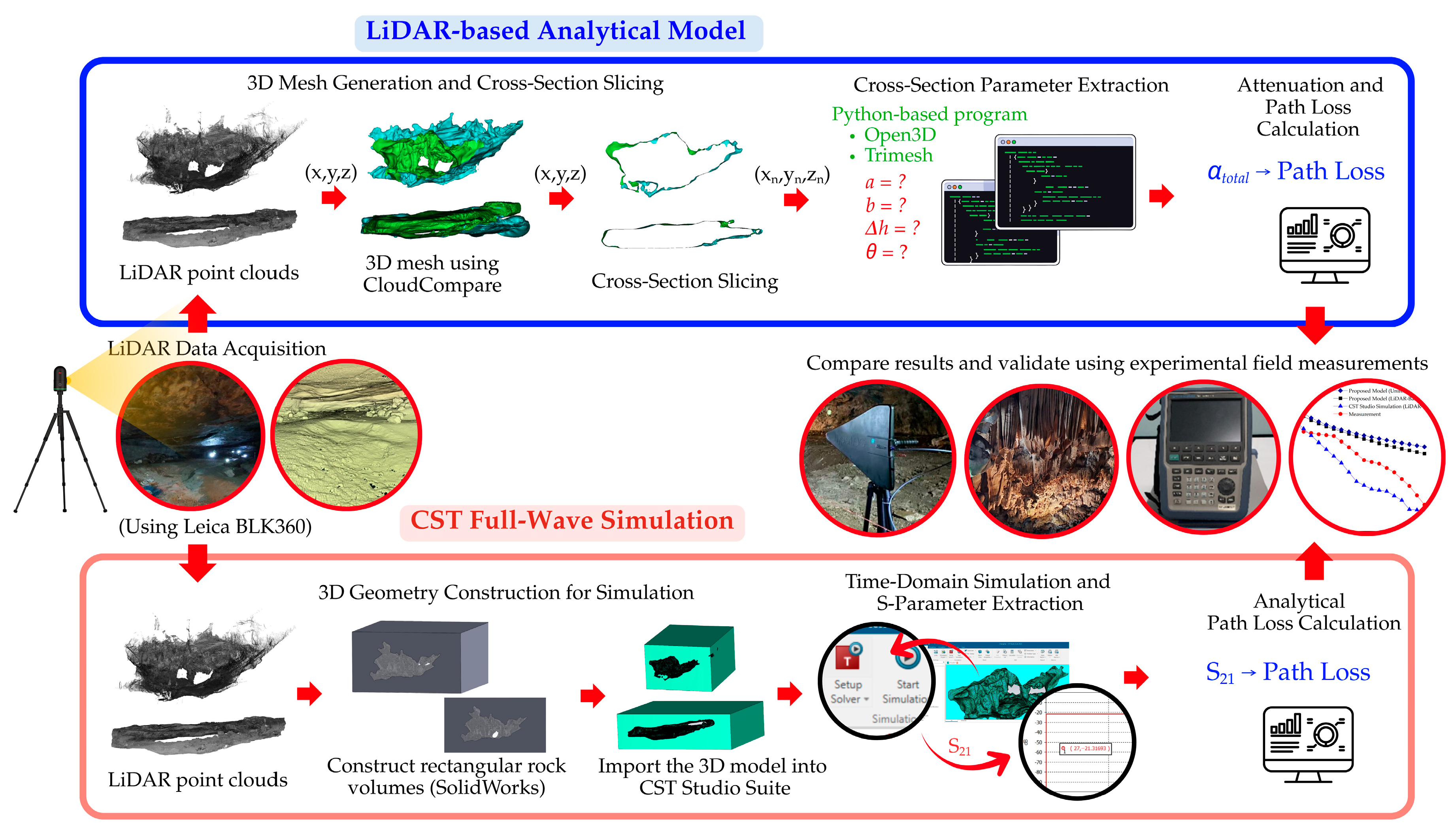
Electromagnetic wave propagation inside cave environments exhibits mechanisms that differ fundamentally from free-space propagation due to the confined geometry of the cave cavity and the electrical properties of the surrounding geological materials. As waves propagate along a cave passage, part of the electromagnetic energy is guided through the tunnel-like structure, while another part penetrates into the cave walls. These walls, composed of dielectric materials such as sandstone and limestone, introduce reflection, refraction, scattering, and attenuation of the propagating waves. Consequently, wave behavior inside caves is strongly dependent on both the operating frequency and the electrical characteristics of the surrounding rock. An overview of the proposed analytical and numerical methodology adopted in this study is illustrated in Figure 1.
Figure 1.
Overview of the LiDAR-based analytical methodology used to model electromagnetic wave propagation and path loss in cave environments.
Early investigations into underground wave propagation were conducted by [19,19,20], who developed waveguide-based models to describe radio-wave behavior in coal mine tunnels. These studies, primarily focused on UHF frequencies in the range of 200–4000 MHz, demonstrated that attenuation inside confined environments arises from multiple mechanisms, including diffraction from the walls, ceiling, and floor; losses induced by surface roughness and wall inclination; and additional attenuation caused by refractive interactions at the tunnel boundaries. These mechanisms form the theoretical basis of the analytical model adopted in this work. As shown in Figure 1, the proposed workflow begins with the acquisition of high-resolution LiDAR point clouds inside the cave environment. The LiDAR data capture the detailed three-dimensional geometry of the cave cavity, including wall irregularities and spatial non-uniformity, and are processed using CloudCompare (version 2.13) to generate a three-dimensional mesh representing the cave interior. This 3D mesh serves as the fundamental geometric input to the analytical model. To account for spatial variations along the propagation path, the mesh is systematically sliced along the longitudinal propagation direction (Y-axis), producing a sequence of cross-sections at discrete positions along the cave passage.
For each cross-section, key geometric parameters are extracted and incorporated into a waveguide-based analytical formulation. Due to the electrical characteristics of cave walls, attenuation within a cave differs substantially from free-space path loss. The received power (
) in dB at a distance d can therefore be expressed as:
where
is transmitted power (dB),
and
are the transmitting and receiving antenna gains (dB),
is the distance between the transmitter and receiver antenna along the Y-axis,
where
and
denote the installation positions of the transmitter and receiver antennas, respectively.
is free-space path loss
,
is the wavelength of the signal, and
is the total attenuation caused by various factors. However, in practice, wideband measurements were conducted using several broadband antennas, making it necessary to normalize the gains of both the transmitting and receiving antennas in order to isolate and evaluate only the signal loss due to wave propagation within the cave passage itself. This can be expressed by Equation (2).
The total attenuation equation, which integrates these multiple loss mechanisms during wave propagation inside the cave cavity, is expressed in (3), with attenuation measured in decibels per meter (dB/m).
Numerous studies have extended waveguide-based models to further investigate electromagnetic wave propagation in natural caves [7,8,10,11,12,14]. However, previous research has primarily focused on high-frequency bands. To extend the analysis to a broader frequency range, an investigation into low- and medium-frequency propagation in limestone caves was conducted [15]. Their 2024 findings demonstrated that, under certain conditions, LF and MF waves can partially penetrate cave walls due to the intrinsic electrical properties of limestone, which support surface-wave propagation at lower frequencies.
In [18], the skin depth was analyzed as a function of wave frequency and the electrical properties of the cave wall, alongside the physical dimensions of the cave cavity. These factors contribute to attenuation resulting from refraction. This attenuation, which involves skin depth considerations, arises from the fact that waves propagating within a cave cavity partially penetrate the low-conductivity dielectric walls. The resulting skin depth depends on both the material’s conductivity and the operating frequency, as shown in (4) [21]. This phenomenon offers practical advantages, particularly for applications such as Through-The-Earth (TTE) communication systems.
where
is the skin depth (m),
is the angular frequency (rad/m),
is permeability (H/m), and
is conductivity (S/m). The attenuation caused by refraction depends on the primary polarization of the wave and the shape of the cave cavity. Equations (5) and (6) show the attenuation due to refraction within a rectangular cavity for vertical and horizontal polarization, respectively.
In [22], a wave propagation model for tunnels with various shapes was proposed. While natural caves are often not rectangular, they commonly exhibit shapes closer to circular. Equations (7) and (8) provide the attenuation equations for a circular cavity, addressing both vertical and horizontal polarization. These equations have been modified in this study to also incorporate an analysis of skin depth.
where
is the wavelength (m),
is the relative permittivity of the horizontal floor (F/m),
is the relative permittivity of the wall (F/m),
is the width of the cave cavity (m), and
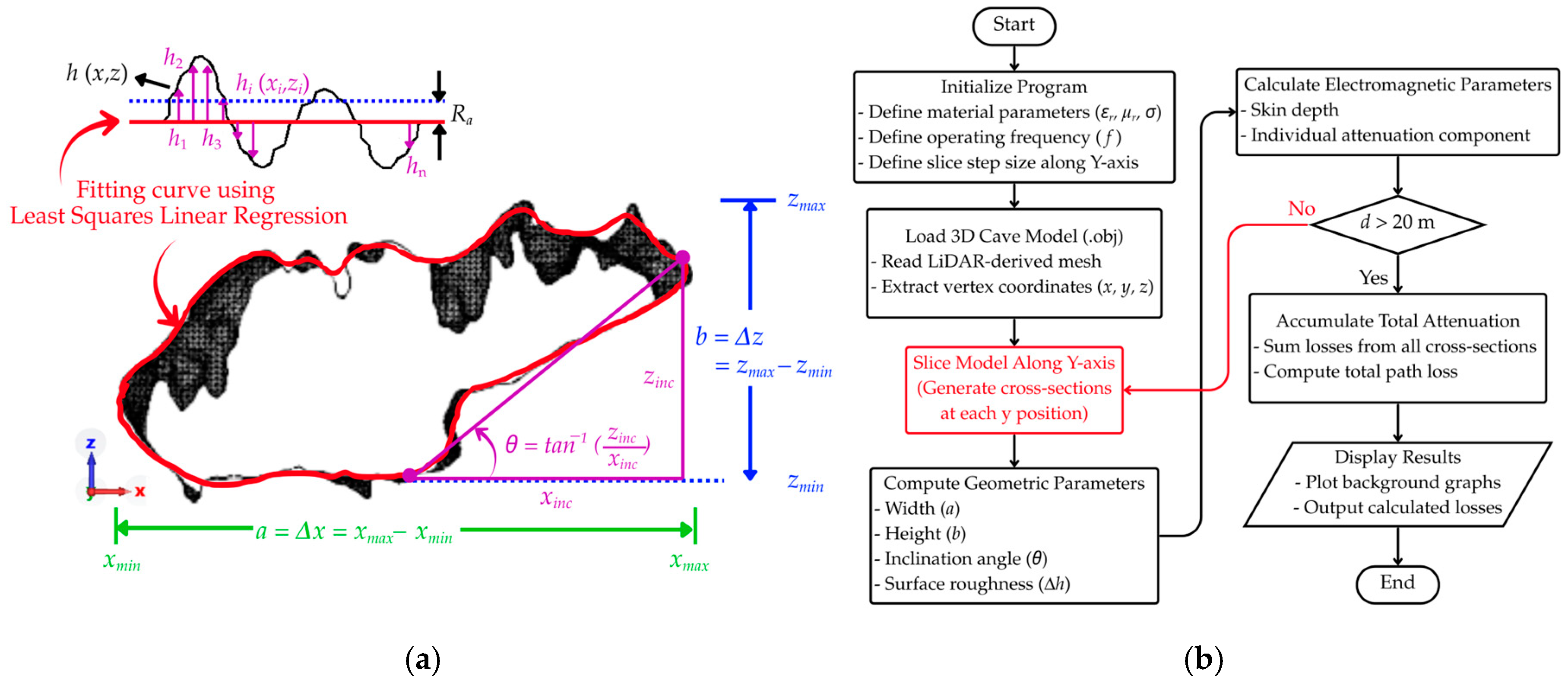
is the height of the cave cavity (m), as illustrated in Figure 2a. In terms of roughness-induced attenuation, the uneven surfaces of the cave walls and floors contribute to wave scattering and energy loss. This effect is further examined through the concept of skin depth, as shown in (9).
Figure 2.
LiDAR-based analytical procedure: (a) Extraction of geometric parameters from cave cross-sections; (b) Computational flowchart of the attenuation analysis.
The surface roughness of the cave walls is quantified using the root-mean-square (RMS) roughness height, denoted as
, which characterizes small-scale geometric irregularities along the cave boundary [23]. As illustrated in Figure 2a, the cave wall profile extracted from a LiDAR-derived cross-section exhibits local height variations relative to an idealized reference surface. The RMS roughness height is defined as
where
is the mean square roughness,
is the total number of sampled points along the cave wall profile, and
represents the local deviation of the wall surface
at the i-th point. The parameters
and
correspond to the horizontal and vertical deviations, respectively, between the actual cave wall contour and the fitted reference line obtained using least-squares linear regression [24,25,26], as depicted in Figure 2a. This definition allows the roughness parameter to be directly derived from the LiDAR-based cross-sectional geometry.
In addition to surface roughness, the inclination of the cave walls relative to the propagation direction introduces an additional attenuation mechanism. As shown in Figure 2a, the wall inclination angle
is defined as the angle between the fitted wall profile and the longitudinal axis of wave propagation. This inclination effectively increases the interaction length between the propagating wave and the cave boundary, resulting in enhanced attenuation due to repeated scattering and refraction effects. The attenuation associated with wall inclination is expressed as (11).
The computational implementation of this analytical workflow is summarized in Figure 2b. The analytical program processes each cross-section sequentially along the propagation axis, calculates geometric and electromagnetic parameters, and accumulates the attenuation contributions to obtain the total path loss. By integrating LiDAR-derived geometric information, waveguide-based theory, and skin depth analysis, the proposed workflow provides a realistic representation of electromagnetic wave propagation in complex cave environments and forms the foundation for the numerical and experimental validation presented in subsequent sections.
2.2. Electrical Properties of Rocks
The electrical properties of rocks, including electrical conductivity and permittivity, play a crucial role in governing electromagnetic wave propagation within cave environments. These properties vary with rock type, and each type influences wave behavior in distinct ways. For instance, limestone and sandstone caves exhibit markedly different geological characteristics stemming from their respective formation processes. In the context of this study, these electrical properties directly influence attenuation behavior through frequency-dependent skin depth and dielectric losses, which are explicitly incorporated into the analytical model described in Section 2.1.
Limestone is typically formed through the gradual accumulation of marine sediments over millions of years. Subsequent geological transformations, together with erosion driven by slightly acidic groundwater, contribute to the development of limestone caves [27,28,29]. In this study, Chiang Dao Cave is selected as a representative example of a limestone cave system, reflecting the characteristic geological formation and internal morphology commonly associated with karst environments. In contrast, sandstone caves—especially those found in northeastern Thailand, including Patihan Cave—are primarily composed of coarser-grained silicon-based sediments, in comparison with the finer calcium-rich sediments characteristic of limestone. The higher porosity associated with sandstone facilitates the infiltration of electrically conductive metallic minerals into the rock matrix, resulting in generally higher electrical conductivity compared to limestone.
The electrical conductivity of cave walls directly affects the transmission characteristics of electromagnetic waves and can be incorporated into waveguide-based propagation models. Moreover, the formation of Patihan Cave is dominated by mechanical weathering processes, such as physical erosion, rather than chemical dissolution as observed in limestone environments. This difference produces a more heterogeneous internal structure in sandstone caves. The increased porosity and mechanical fragmentation create multiple dielectric layers (air, sand, and soil), that introduce attenuation and reflection at each interface during wave propagation [30,31,32]. This phenomenon follows the Debye relaxation behavior [33,34], in which dielectric permittivity decreases with increasing frequency while the loss component rises, reflecting the frequency-dependent dielectric dispersion commonly observed in geological materials. In contrast, Chiang Dao Cave exhibits a more homogeneous internal composition due to its predominantly continuous limestone mass, resulting in fewer dielectric discontinuities [35,36,37,38]. A comparison of the relative permittivity and permeability of limestone and sandstone—representative of Chiang Dao Cave and Patihan Cave, respectively—is provided in Table 1.
Table 1.
Comparison of relative permittivity and permeability for limestone and sandstone at different frequencies.
2.3. Propagation Measurement
The propagation measurements conducted in this study follow experimental methodologies established in previous research, in which electromagnetic waves are transmitted and received directly within cave environments to quantify path loss along the propagation path. These measurements are designed to provide experimental validation for the LiDAR-based analytical model described in Section 2.1 and to reflect the frequency-dependent electrical properties of the surrounding rock materials discussed in Section 2.2. An initial investigation by [15] examined low-frequency (LF) and medium-frequency (MF) wave behavior in Chiang Dao Cave, a limestone cave representative of one of Thailand’s predominant geological formations. In the same year, parallel study was conducted in Patihan Cave, a sandstone cave that typifies another major cave morphology found in the region, employing selected frequencies spanning the LF to ultra-high-frequency (UHF) bands [17]. Subsequently, the methodology was expanded by performing continuous frequency measurements from LF through UHF in Chiang Dao Cave, thereby providing a more comprehensive characterization across the full spectrum [16].
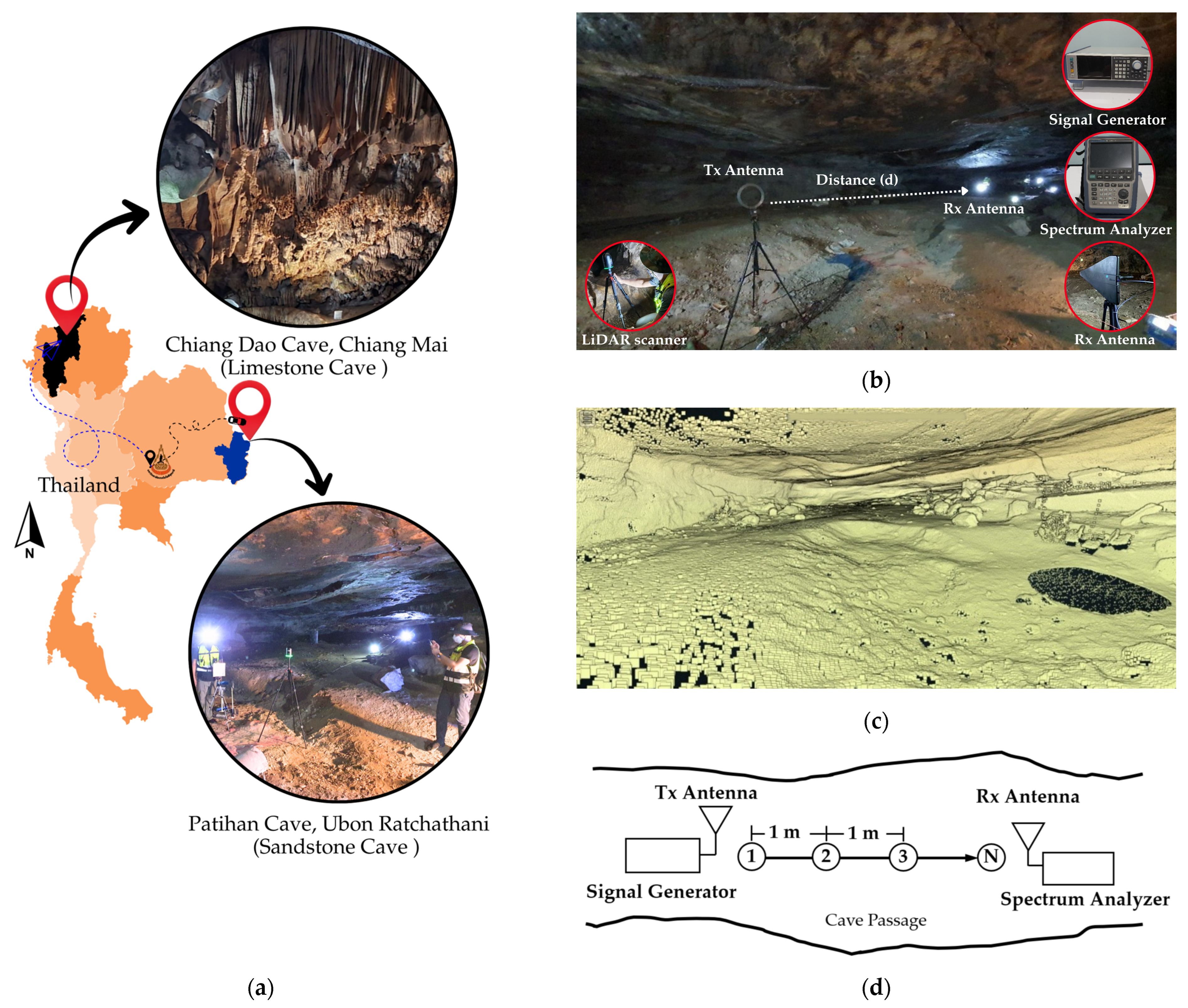
Given the contrasting physical structures and electrical properties of the two caves, the present study extends this approach by performing continuous LF-to-UHF frequency measurements in Patihan Cave as well, enabling a direct comparative analysis between sandstone and limestone environments. This section describes the experimental arrangement for wave transmission and reception, together with the measurement equipment and configuration employed, as illustrated in Figure 3.
Figure 3.
Experimental setup for the wave propagation measurements: (a) locations of the measurement sites; (b) equipment setup for transmitter and receiver; (c) LiDAR-derived 3D point-cloud model of the cave passage used for geometric parameter extraction; (d) Schematic diagram of the propagation measurement.
Figure 3a,b illustrate the measurement location inside Patihan Cave, situated in the central section of the cave where no tourist infrastructure is present, thereby minimizing external interference. A three-dimensional model of the cave passage was reconstructed using a LiDAR scanner (Leica BLK360, Leica Geosystems, Wetzlar, Germany). The processed LiDAR data reveal that the passage has an average width of approximately 17 m and an average height of about 2.8 m, as shown in the 3D visualization presented in Figure 3c. The transmitting system, composed of a signal generator and transmitting antenna, was positioned at the entrance of the selected cave passage. The receiving system, which included a receiving antenna and a spectrum analyzer, measured the received signal strength at 1-m intervals along the passage, continuing up to a maximum distance of 20 m, as illustrated in Figure 3d. This propagation distance matches the longitudinal extent considered in the analytical cross-section slicing process along the Y-axis
The frequency range employed in this study extends from the upper portion of the LF band to the upper limit of the UHF band. For each frequency band, representative frequencies were selected from the lower, middle, and upper regions to capture the characteristic behavior across the entire band, including frequency-dependent attenuation effects. The specific test frequencies used in the measurements are summarized in Table 2. However, the experiment was subject to an important limitation: frequencies below 300 kHz could not be tested due to the potential disturbance they may cause to bat populations residing within the caves. As demonstrated in [43,44], many bat species rely on ultrasonic echolocation signals in the 20–200 kHz range for navigation and foraging. Therefore, these frequency bands were deliberately excluded from the measurement campaign to prevent any interference with natural bat behavior.
Table 2.
Representative frequencies used for the propagation measurements in this study.
The propagation measurements utilized a set of antennas selected specifically for their compatibility with each frequency band, as summarized in Table 3. The CW test signal was generated using a signal generator (SMB100B, Rohde & Schwarz, Munich, Germany), which provides a narrow-band continuous wave output. This signal was delivered to the transmitting antennas through a low-loss 50-ohm coaxial cable (LMR-240, Times Microwave Systems, Wallingford, CT, USA). On the receiving side, a spectrum analyzer (FPH, Rohde & Schwarz, Munich, Germany) was employed together with band-appropriate antennas. For the 300 kHz–30 MHz range, the HE400HF antenna module (HE400HF (8.3 kHz–30 MHz), Rohde & Schwarz, Munich, Germany) was used. For the 35 MHz–300 MHz range, the HE400UWB module (HE400UWB (30 MHz–6 GHz), Rohde & Schwarz, Munich, Germany) was deployed. For the 350 MHz–3 GHz range, the HyperLOG 3080 antenna (HyperLOG 3080 (380 MHz–8 GHz), Aaronia, Strickscheid, Germany) was utilized.
Table 3.
Antenna types and specifications used for the LF-to-UHF propagation measurements.
3. Results and Discussion
This section presents the results of the electromagnetic wave propagation analysis obtained using the proposed LiDAR-based analytical model, full-wave simulations, and experimental field measurements. The results are organized to progressively demonstrate the impact of modeling assumptions and geometric complexity on propagation behavior. First, uniform cavity models are examined to establish baseline attenuation characteristics under idealized conditions. Next, LiDAR-derived non-uniform cave geometry is incorporated to capture spatial variations along the propagation path. Finally, the analytical and numerical results are compared with in situ measurement data to assess model validity and highlight differences between sandstone and limestone cave environments.
3.1. Uniform Cavity
Waveguide-based propagation models describe electromagnetic behavior inside confined environments using a set of fundamental geometric parameters, including cavity width, height, wall-surface roughness, and wall inclination. These parameters are commonly obtained from field surveys conducted along cave passages. Table 4 summarizes the representative physical characteristics of the sandstone and limestone caves examined in this study, based on measurements collected from Patihan Cave and Chiang Dao Cave, respectively. Since these parameters are averaged from multiple sampling locations, they provide simplified geometric representations that may not fully capture the natural variability of real cave structures. Nevertheless, such averaged parameters are intentionally adopted in this section to construct idealized uniform cavity models, which serve as baseline references for evaluating the fundamental behavior of the proposed analytical formulation.
Table 4.
Physical cavity parameters used in the uniform waveguide model.
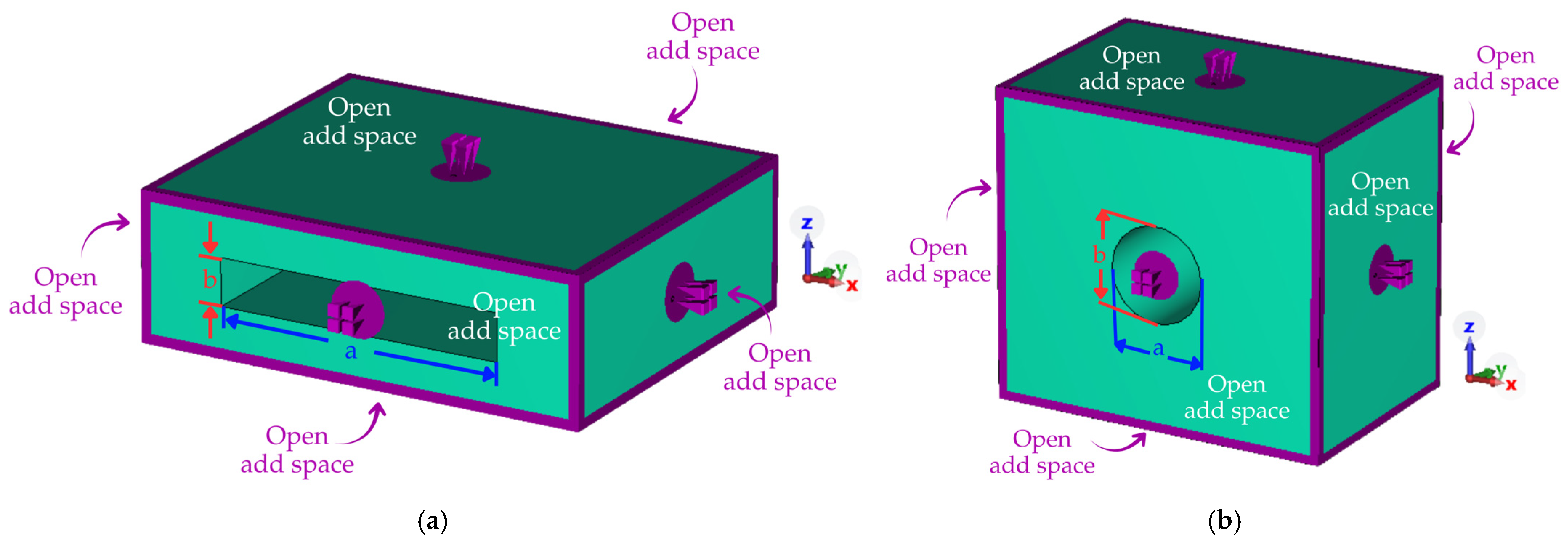
To ensure consistency between the analytical assumptions and numerical validation, corresponding uniform cavity geometries were constructed in CST Studio Suite, as illustrated in Figure 4, where both geometries are considered to examine the sensitivity of the analytical formulation to idealized cavity shape. Both rectangular and circular cross-sectional models were implemented using the width a and height b values listed in Table 4. The electromagnetic properties of the surrounding rock were assigned based on representative values reported in the literature. For sandstone, the relative permittivity
was set to 6, the relative permeability
to 1, and the electrical conductivity
to 0.5 mS/m. For limestone,
= 7,
= 1, and a lower conductivity of
= 0.03 mS/m were used. Time-domain simulations were performed using a hexahedral mesh, with the total number of mesh cells determined by both geometry and material properties. Specifically, the sandstone cavity employed 976,800 and 1,605,240 mesh cells for the circular and rectangular geometries, respectively, whereas the limestone cavity required 1,378,216 and 1,921,696 mesh cells. Open boundary conditions were applied along the X, Y, and Z axes to emulate an unbounded environment. A waveguide port (Port 1) was positioned at the entrance of the cavity to excite the propagating wave, while Port 2 was placed at a predefined separation distance to measure the transmission coefficient (S21). The resulting S21 parameter serves as the primary indicator of path loss within the simplified uniform cavity model.
Figure 4.
Simulation setup in CST Studio Suite: (a) Uniform rectangular model; (b) Uniform circular model.
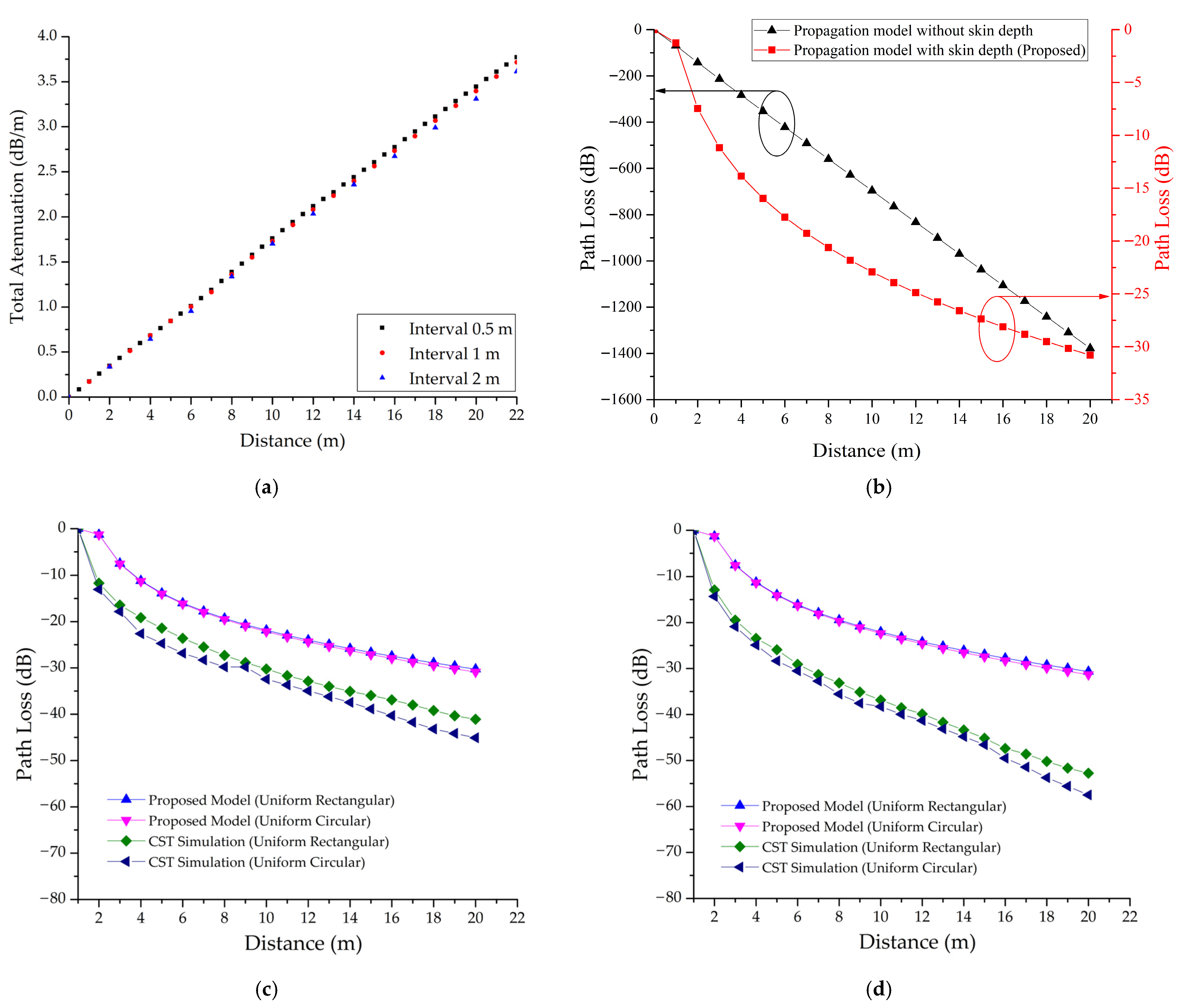
Figure 5 presents a comparison of attenuation characteristics for a uniform cavity at 27 MHz. Figure 5a illustrates the influence of the slicing interval on the computed total attenuation obtained from the analytical model. Using a fine slicing interval of 0.5 m provides a more detailed spatial representation of attenuation along the propagation path; however, this increased resolution is achieved at the expense of higher computational cost and longer processing time. When the slicing interval is increased to 1 m and 2 m, the resulting attenuation curves exhibit nearly identical trends, with only minor deviations observed at longer distances. This indicates that the analytical model is not highly sensitive to the slicing interval within this range and that coarser discretization still preserves the dominant attenuation behavior. Based on this observation, and to maintain consistency with the field measurement configuration, which was conducted at 1 m intervals, a slicing interval of 1 m is selected for subsequent analyses. This choice provides a suitable balance between computational efficiency and sufficient spatial resolution for capturing the attenuation characteristics of the cave environment.
Figure 5.
Attenuation and path loss characteristics for a uniform cavity at 27 MHz: (a) Effect of cross-section slicing interval (0.5, 1, and 2 m) on the analytical uniform-cavity model; (b) Effect of skin depth on the analytical propagation model; (c) Comparison between the proposed model and CST simulations for Patihan Cave; (d) Comparison between the proposed model and CST simulations for Chiang Dao Cave.
Figure 5b further illustrates the impact of incorporating skin depth into the analytical propagation model by comparing the predicted path loss with and without this effect. When skin depth is neglected, the analytical model predicts an unrealistically large path loss, decreasing from approximately 0 dB to nearly −1600 dB as the propagation distance increases from 0 to 20 m. Such extreme attenuation is not physically plausible and does not correspond to values observed in practical underground measurements. This outcome indicates that a model based solely on idealized waveguide attenuation significantly overestimates loss when interactions between the electromagnetic field and the cave walls are ignored. Figure 5b further illustrates the impact of incorporating skin depth into the analytical propagation model by comparing the predicted path loss with and without this effect. When skin depth is neglected, the analytical model predicts an unrealistically large path loss, decreasing from approximately 0 dB to nearly −1600 dB as the propagation distance increases from 0 to 20 m. Such extreme attenuation is not physically plausible and does not correspond to values observed in practical underground measurements. This outcome indicates that a model based solely on idealized waveguide attenuation significantly overestimates loss when interactions between the electromagnetic field and the cave walls are ignored. These results demonstrate that skin depth plays a critical role in underground propagation analysis. By capturing surface-wave interactions and frequency-dependent penetration into the cave walls, the proposed model yields path-loss predictions that are more consistent with real measurement conditions, thereby providing a more reliable basis for subsequent comparisons with CST simulations and field data.
Figure 5c,d compare the proposed uniform-cavity analytical model with CST Studio Suite simulations at 27 MHz for Patihan Cave and Chiang Dao Cave, respectively. When only waveguide-based attenuation and skin depth effects are considered, both the uniform rectangular and circular models systematically underestimate attenuation relative to the CST results as distance increases. This discrepancy reflects the limitations of the uniform-cavity assumption, which oversimplifies natural cave geometries that exhibit non-parallel walls and spatially varying cross-sections. Including free-space loss (FSL) in the analytical model improves agreement with the CST simulations, indicating that propagation inside real cave corridors follows a hybrid mechanism combining partial waveguiding and geometric spreading. This effect is more pronounced in Chiang Dao Cave, where large and irregular cross-sections reduce wave confinement and enhance free-space-like propagation.
Comparing the two cave types, Patihan Cave shows better agreement between the uniform model and CST due to its flatter and more consistent sandstone geometry, which produces smoother attenuation trends. In contrast, the highly irregular limestone structure of Chiang Dao Cave leads to stronger multipath effects, including reflections, scattering, and mode conversion, which are captured by CST but not by the uniform analytical model. Overall, these results demonstrate that while the uniform-cavity model captures general attenuation trends, incorporating free-space loss is essential for improving consistency with full-wave simulations, particularly in geometrically complex cave environments.
3.2. LiDAR-Based Modeling
As noted in the previous section, manual measurements of cavity dimensions—such as width, height, wall roughness, and inclination—often lack precision, particularly in natural caves where the geometry is highly irregular and varies significantly along the passage. To overcome these limitations, this study employs LiDAR-based 3D modeling, which provides a more accurate and detailed representation of the cave morphology. Comprehensive 3D models of both Chiang Dao Cave and Patihan Cave were generated using a terrestrial LiDAR scanner. These models encompass entire cave chambers and capture intricate structural features, including variations in wall texture, the presence of stalactites and stalagmites, and accumulations of fallen rock material. The high spatial resolution of the LiDAR data enables precise characterization of the physical attributes that influence electromagnetic wave propagation.
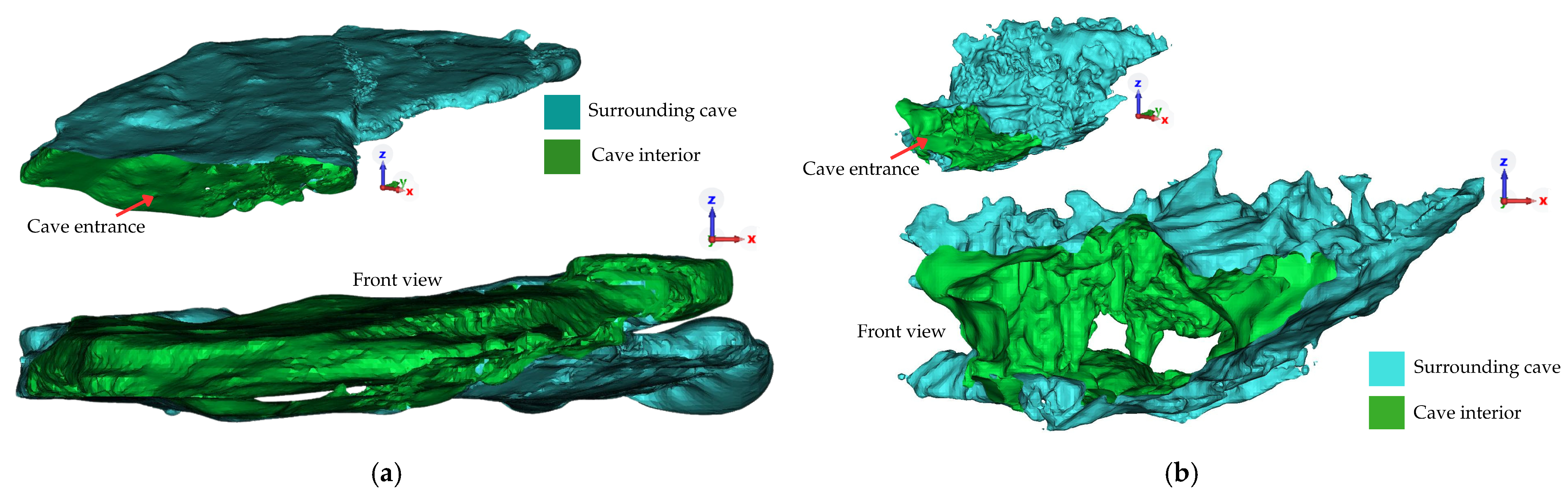
For the purpose of this study, the full 3D scans were refined by extracting only the specific cave segments where propagation measurements were conducted. The filtered data were then converted into point clouds, consisting of dense sets of three-dimensional coordinates (X, Y, and Z) that represent the surfaces of the cave walls and floor with high fidelity. These point clouds correspond to the propagation test sections and serve as the geometric foundation for subsequent numerical analysis of attenuation behavior. Figure 6 illustrates the LiDAR-derived point clouds for both cave environments. Patihan Cave (sandstone), shown in Figure 6a, exhibits a relatively elongated and uniform passage, whereas Chiang Dao Cave (limestone), shown in Figure 6b, displays more complex and irregular structural features characteristic of its geological formation.
Figure 6.
LiDAR-derived 3D point clouds of the surveyed cave sections used for propagation analysis: (a) Patihan Cave (sandstone) and (b) Chiang Dao Cave (limestone).
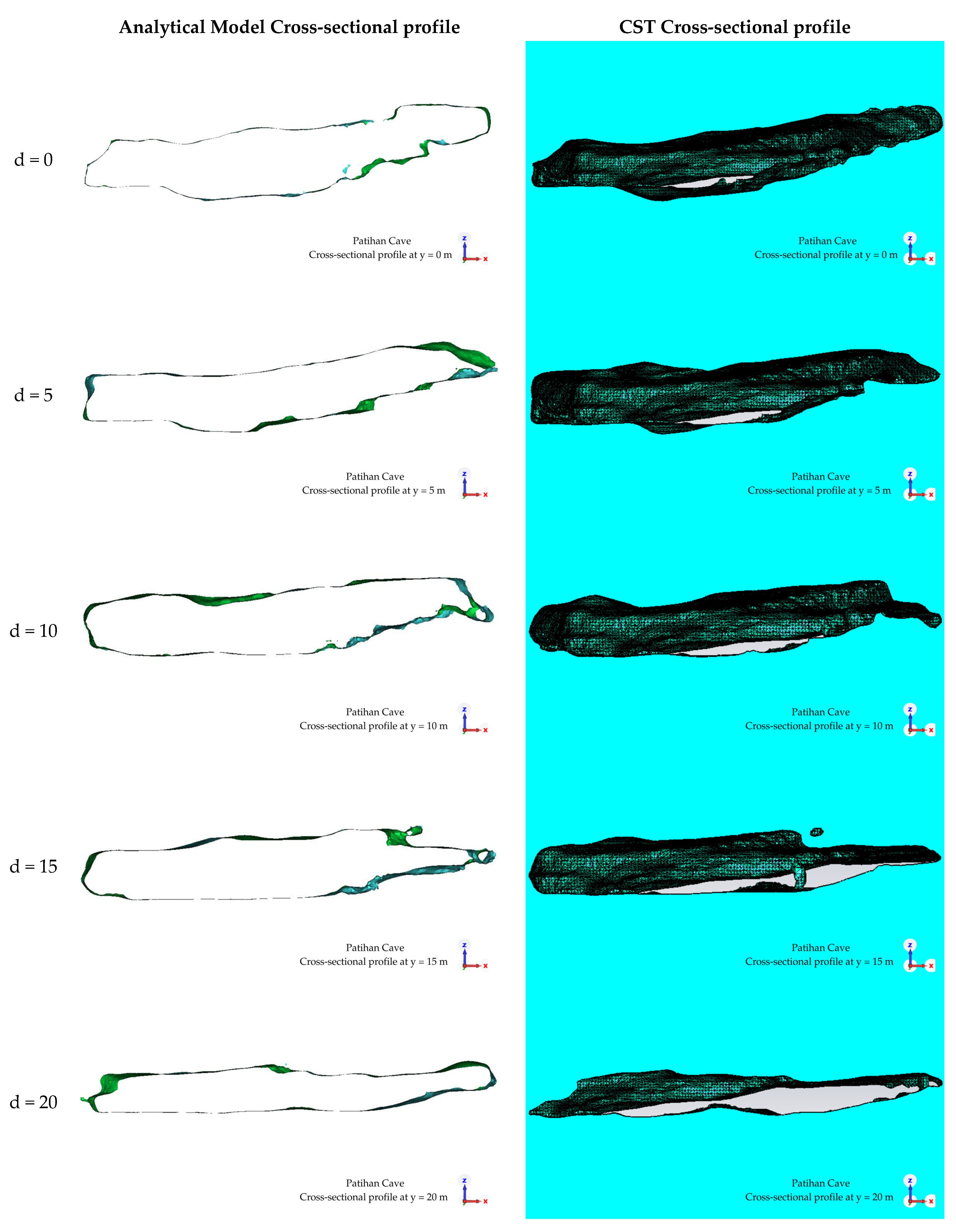
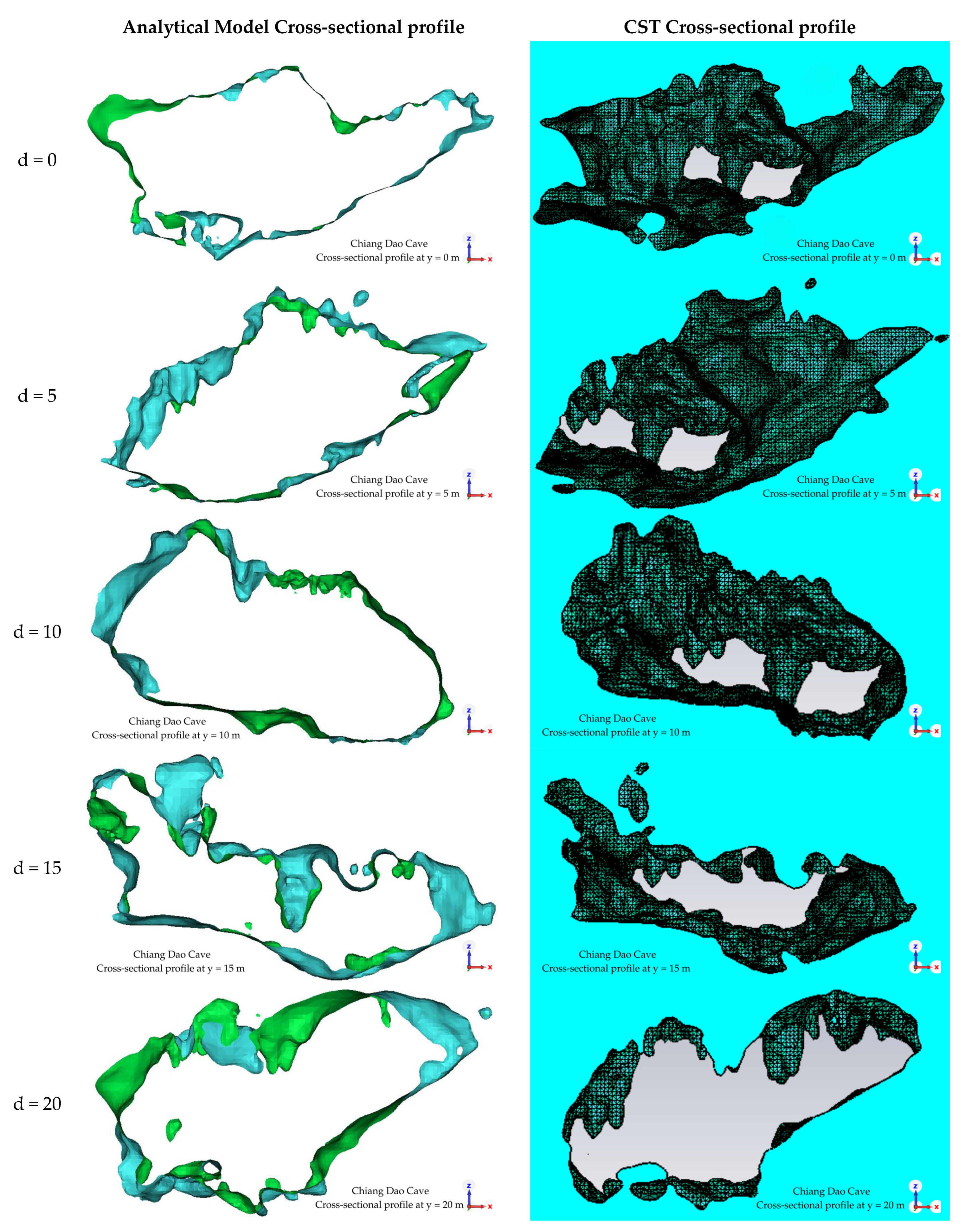
To extract the geometric parameters required for attenuation analysis—including cavity width, height, wall roughness, and wall inclination—a dedicated computational program was developed to process the LiDAR-derived point clouds obtained from both Patihan Cave and Chiang Dao Cave. Using a cross-sectional slicing approach along the longitudinal propagation direction (Y-axis), the program systematically analyzed the cave geometry at discrete positions, enabling accurate determination of spatially varying physical dimensions along the propagation path. These geometry-dependent parameters were subsequently incorporated into the proposed analytical model to evaluate the cumulative attenuation associated with non-uniform cave structures. The evolution of the cave geometry along the propagation path is illustrated through representative cross-sectional profiles shown in Figure 7 and Figure 8 for Patihan Cave and Chiang Dao Cave, respectively. In each figure, cross-sections extracted at distances d = 0, 5, 10, 15, and 20 m from the transmitter are presented, comparing the profiles derived from the LiDAR-based analytical model with those implemented in CST Studio Suite. The close geometric correspondence between the analytical and simulation domains confirms that the essential morphological features of the caves—including wall irregularities, variations in ceiling height, and cross-sectional asymmetry—are preserved in both modeling approaches.
Figure 7.
Comparison of LiDAR-derived analytical and CST-simulated cross-sectional profiles of Patihan Cave along the Y-axis at d = 0, 5, 10, 15, and 20 m.
Figure 8.
Comparison of LiDAR-derived analytical and CST-simulated cross-sectional profiles of Chiang Dao Cave along the Y-axis at d = 0, 5, 10, 15, and 20 m.
Although only selected cross-sections are presented for clarity, the complete analysis employed a finer slicing interval of 1 m along the entire propagation path. This dense spatial sampling allows the analytical model to capture gradual geometric variations, including local narrowing, expansions, and changes in surface roughness. Such variations are particularly pronounced in the limestone structure of Chiang Dao Cave, in contrast to the relatively uniform sandstone geometry of Patihan Cave. Following the geometric reconstruction, the LiDAR-derived three-dimensional cave models were imported into CST Studio Suite for full-wave electromagnetic simulation. The sandstone and limestone cave models were discretized using hexahedral meshes consisting of 727,804 and 925,724 cells, respectively, to adequately represent the geometric complexity obtained from field measurements. The simulation setup was configured to replicate the experimental measurement conditions by placing the transmitting port (Port 1) at the same location as the field transmitter and incrementally shifting the receiving port (Port 2) along the Y-axis to correspond with the receiver positions used during on-site measurements. This consistent configuration across analytical modeling, numerical simulation, and experimental observation enables a reliable evaluation of attenuation characteristics in both cave environments.
The resulting attenuation distributions were evaluated on a cross-sectional basis and accumulated along the full propagation path, enabling direct assessment of how spatially varying cave geometry influences propagation loss. Geometric variations captured by the LiDAR-based slicing process—including changes in cavity width and height, asymmetric wall profiles, surface roughness, and wall inclination—contribute differently to signal attenuation at each location along the corridor. The total attenuation at each cross-section was calculated using the unified formulation in Equation (3), which integrates refraction-related attenuation described by Equations (5)–(8), roughness-induced scattering modeled by Equation (9), and additional loss associated with wall inclination as expressed in Equation (11). The influence of material properties is explicitly incorporated through the skin depth formulation in Equation (4), which accounts for frequency-dependent electromagnetic penetration into the surrounding rock. By combining geometry-dependent parameters extracted from LiDAR data with frequency-dependent electrical properties, the proposed analytical framework captures the cumulative attenuation arising from both non-uniform cave morphology and conductive wall interactions, in accordance with the workflow described in Section 2.1.
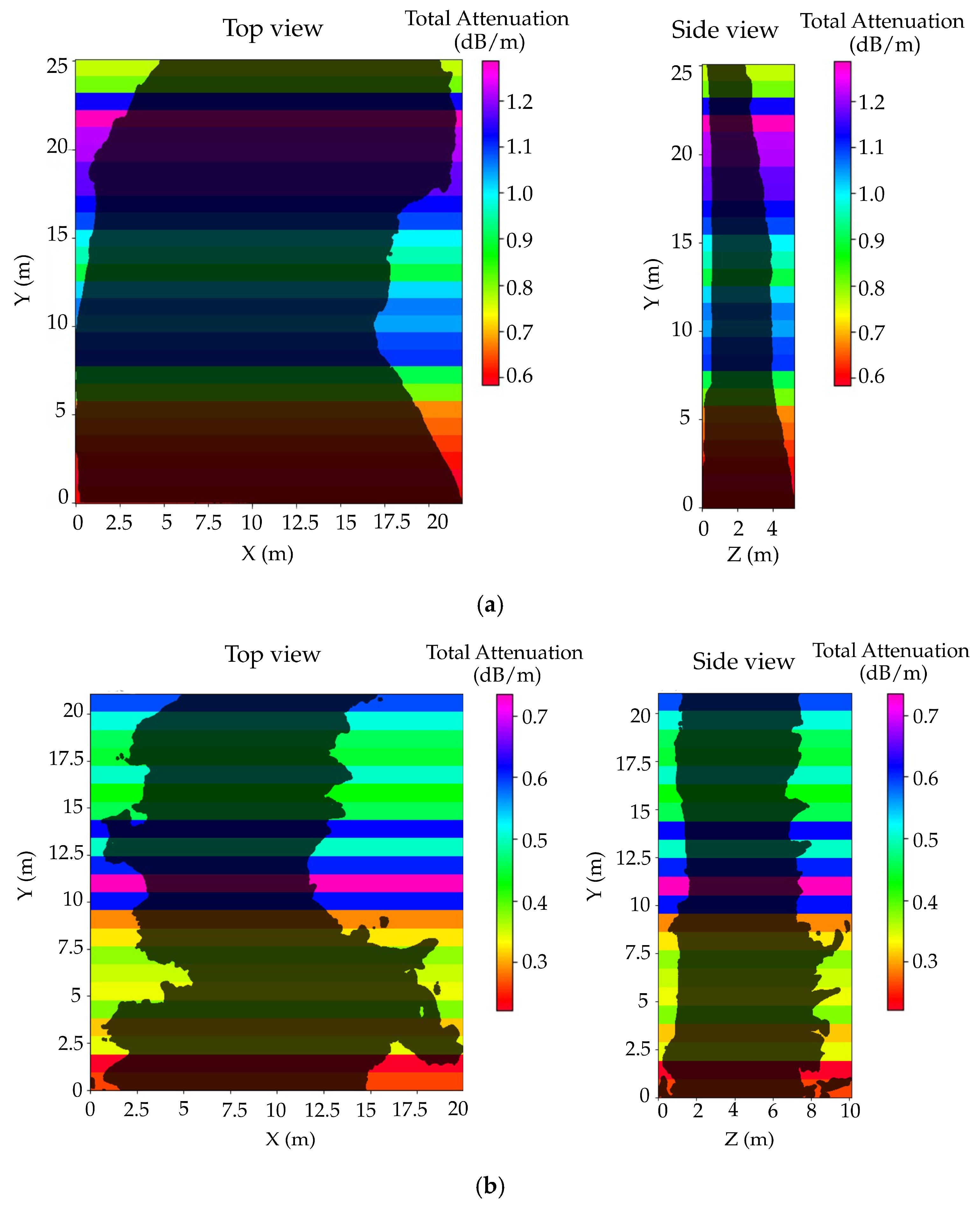
Figure 9 illustrates the spatial distribution of the computed total attenuation at 27 MHz for both Patihan Cave and Chiang Dao Cave, highlighting clear differences in propagation behavior arising from their contrasting geological and geometric characteristics.
Figure 9.
Spatial distribution of total attenuation at 27 MHz computed using the proposed waveguide–skin depth analytical model applied to LiDAR-derived 3D cave geometries: (a) Patihan Cave (sandstone) and (b) Chiang Dao Cave (limestone). The color maps represent the local total loss (dB/m) evaluated at successive cross-sections along the Y-axis propagation path, shown in top and side views.
The attenuation maps reveal that Patihan Cave (sandstone), shown in Figure 9a, exhibits consistently higher loss along most sections of the propagation path. This behavior is attributed to the combined effects of higher electrical conductivity, relatively lower ceiling height, and more pronounced geometric irregularities, which increase wave–wall interaction and energy dissipation within the cave structure. In contrast, Chiang Dao Cave (limestone) in Figure 9b shows noticeably lower total attenuation across the same propagation distances. The larger cross-sectional dimensions, lower conductivity, and more homogeneous wall structure of the limestone environment reduce repeated wall interactions and scattering, allowing electromagnetic energy to propagate more efficiently along the passage. As a result, attenuation levels in Chiang Dao Cave remain lower and spatially smoother compared to those observed in Patihan Cave. Overall, the spatial attenuation patterns demonstrate that underground RF propagation is strongly governed by the interplay between cave geometry and material properties. These results underscore the importance of incorporating realistic, spatially varying cave structures—rather than uniform assumptions—when modeling electromagnetic wave propagation in natural cave environments.
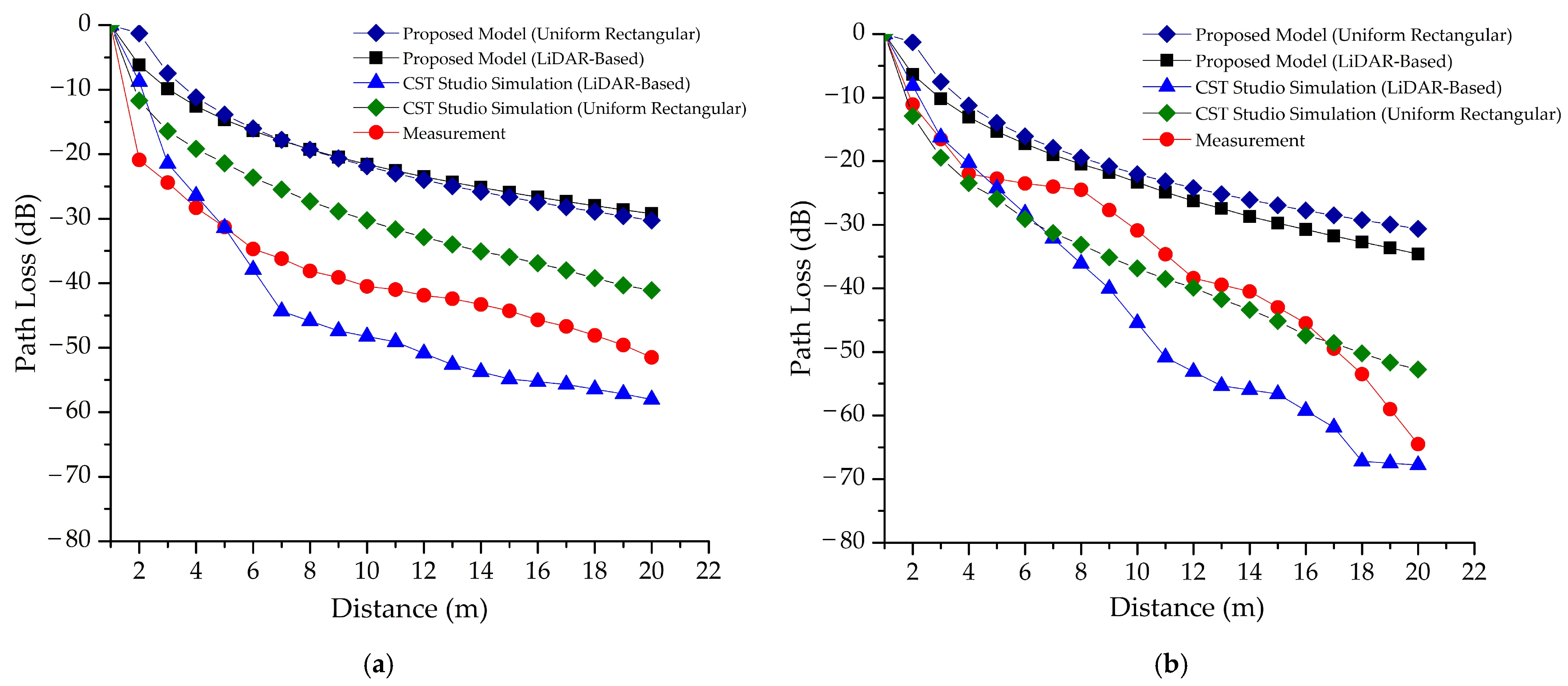
The comparison among the proposed LiDAR-based analytical model, CST Studio Suite simulations using LiDAR-derived three-dimensional cave geometries, and experimental measurements at 27 MHz is shown in Figure 10. The results indicate that incorporating realistic cave geometry into the attenuation analysis leads to closer correspondence with measured path-loss trends when compared with the earlier uniform-cavity assumption. By explicitly accounting for spatial variations in cross-sectional dimensions, wall roughness, and localized geometric irregularities along the propagation path, the LiDAR-based model is able to reflect key physical features that influence electromagnetic wave behavior inside natural caves. For Patihan Cave, the LiDAR-based analytical results in Figure 9a follow the measured path-loss trend reasonably well, particularly within the first 10–12 m from the transmitter. This behavior can be attributed to the model’s ability to represent gradual changes in cavity width, ceiling height, and wall inclination along the propagation direction, which are not considered in simplified uniform-cavity formulations. In contrast, the CST simulations based on the full three-dimensional geometry predict higher attenuation and exhibit more pronounced fluctuations with distance. These variations are consistent with the full-wave nature of the CST solver, which inherently includes diffuse scattering from wall roughness, diffraction around localized protrusions, and multipath interactions associated with uneven sandstone surfaces.
Figure 10.
Comparison of the proposed attenuation model, CST Studio Suite simulations using LiDAR-derived 3D cave geometries, and measurement data at 27 MHz: (a) Patihan Cave (b) Chiang Dao Cave.
A comparable tendency is observed for Chiang Dao Cave, as shown in Figure 9b, although the differences between the models are more evident. The LiDAR-based analytical model again shows reasonable agreement with the measured data in the near-field region, whereas the CST simulations yield larger attenuation values and stronger fluctuations along the propagation path. This behavior is consistent with the highly irregular limestone morphology of Chiang Dao Cave, characterized by abrupt changes in cross-sectional shape, steep wall inclinations, and the presence of stalactites and stalagmites. Such structural features promote multipath propagation, mode conversion, and localized field distortion, which are inherently captured by full-wave simulations but only partially represented in the analytical formulation. Taken together, the results in Figure 9 suggest that the LiDAR-based analytical approach provides a practical compromise between simplified uniform models and computationally intensive full-wave simulations. While the analytical model does not capture all fine-scale scattering effects, it reproduces the dominant attenuation trends observed in the measurements with substantially lower computational cost. The comparison also indicates that geological and geometric differences between sandstone and limestone caves influence propagation behavior, with Patihan Cave exhibiting smoother attenuation characteristics and Chiang Dao Cave showing greater variability. These observations motivate the use of LiDAR-derived geometric information as an effective means of improving analytical path-loss modeling in complex underground environments, while retaining computational efficiency.
3.3. Measurement Results
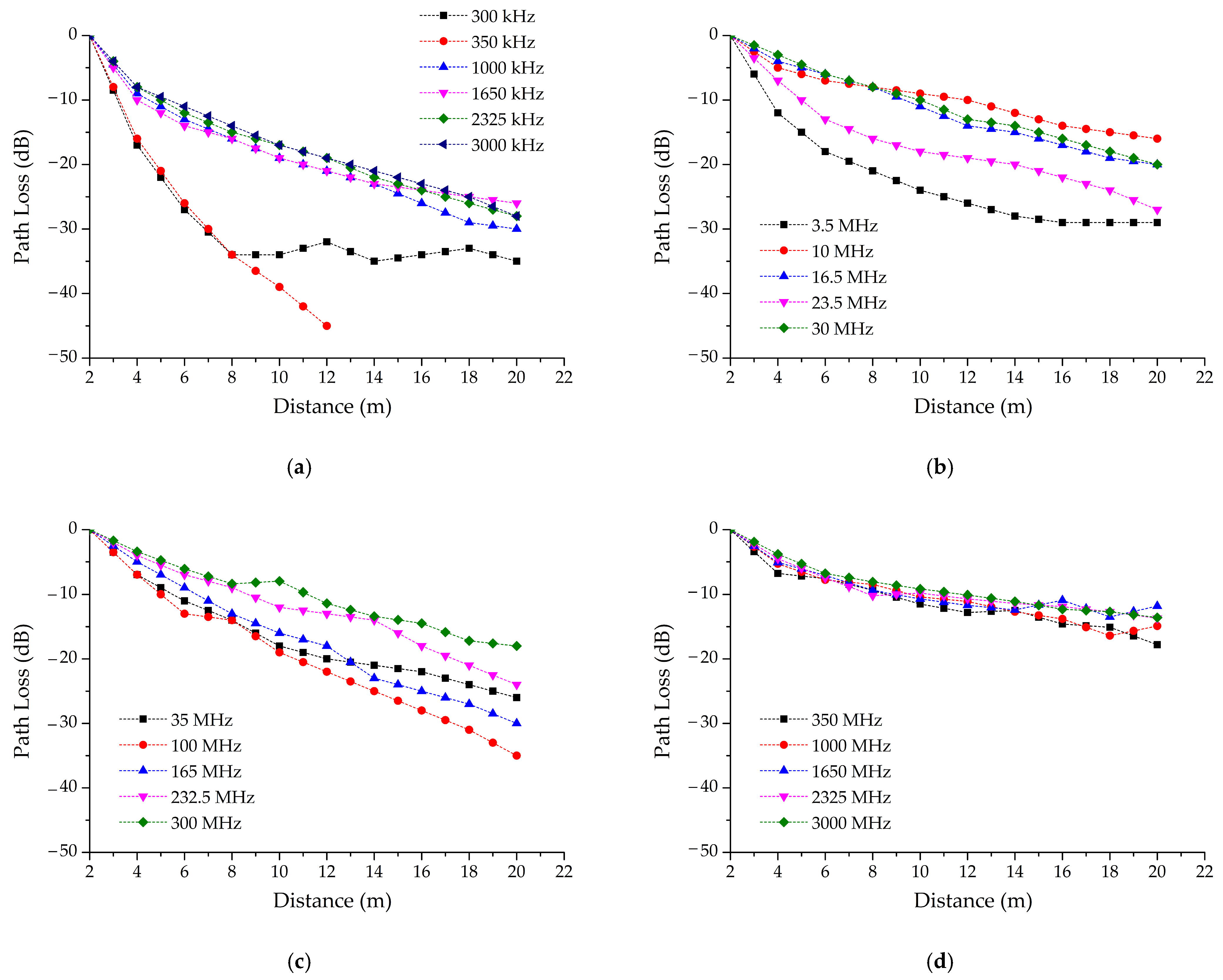
Figure 11 summarizes the line-of-sight (LOS) propagation measurements conducted inside Patihan Cave across the LF, MF, HF, VHF, and UHF frequency bands. Each subplot presents the measured received signal level as a function of propagation distance, illustrating distinct attenuation trends associated with different frequency ranges. The results indicate that electromagnetic wave behavior inside the cave varies systematically with frequency, reflecting differences in wavelength, dominant propagation mechanisms, and interactions with the cave geometry and surrounding rock materials. In the LF and MF bands, as shown in Figure 11a, the measured signals exhibit relatively rapid attenuation with increasing distance. This behavior is governed primarily by the propagation of surface waves. Long-wavelength components tend to penetrate the cave walls rather than being efficiently guided along the passage, resulting in high attenuation within this frequency range. However, the sandstone walls of Patihan Cave exhibit relatively higher electrical conductivity than limestone, causing waves in this frequency band to propagate within the cave passage more effectively than into the surrounding walls when compared with limestone. Consequently, attenuation within sandstone caves is lower than in limestone caves. Because the wavelengths at these frequencies are much larger than the dimensions of the cave, classical waveguide theory is not applicable, and propagation is dominated by losses due to interactions with the cave walls rather than by waveguiding effects within the passage itself.
Figure 11.
The measurement result (a) LF and MF band (b) HF band (c) VHF band (d) UHF band.
In the HF band shown in Figure 11b, the measured attenuation generally decreases compared to the LF and MF bands, indicating a gradual transition in propagation behavior. At these frequencies, the wavelengths become more comparable to the cave dimensions, allowing the cavity to contribute more effectively to signal transmission. However, as frequency increases within the HF band, the measurements show renewed increases in attenuation. This behavior is consistent with increased sensitivity to geometric features inside the cave, such as wall irregularities, ceiling variations, and floor undulations, which can introduce additional scattering and partial absorption along the propagation path. The VHF-band results in Figure 11c demonstrate comparatively lower attenuation, suggesting more efficient propagation within the cave passage. At these frequencies, the shorter wavelengths allow stronger reflections from the cave boundaries, which can help confine energy within the passage. At the same time, noticeable fluctuations in the received signal level are observed. These variations are indicative of multipath effects, arising from the superposition of direct and reflected wave components with varying phase relationships. In the UHF band shown in Figure 11d, attenuation remains relatively low over the measured distances, and the overall trends are consistent with propagation dominated by direct-wave and waveguide-like effects. Nevertheless, the measured signals exhibit increased short-range variability compared to the VHF band. This behavior suggests heightened sensitivity to small-scale geometric features, such as wall roughness, local protrusions, and slight changes in wall inclination, which can enhance scattering and polarization-related effects at shorter wavelengths.
Overall, the measurement results highlight the strong frequency dependence of electromagnetic wave propagation in natural cave environments. Lower-frequency bands are characterized by higher attenuation associated with wall interactions, while higher-frequency bands show improved transmission efficiency but increased susceptibility to multipath-induced fluctuations. These experimentally observed trends provide a critical reference for assessing the validity and limitations of both the uniform-cavity and LiDAR-based propagation models discussed in the preceding sections.
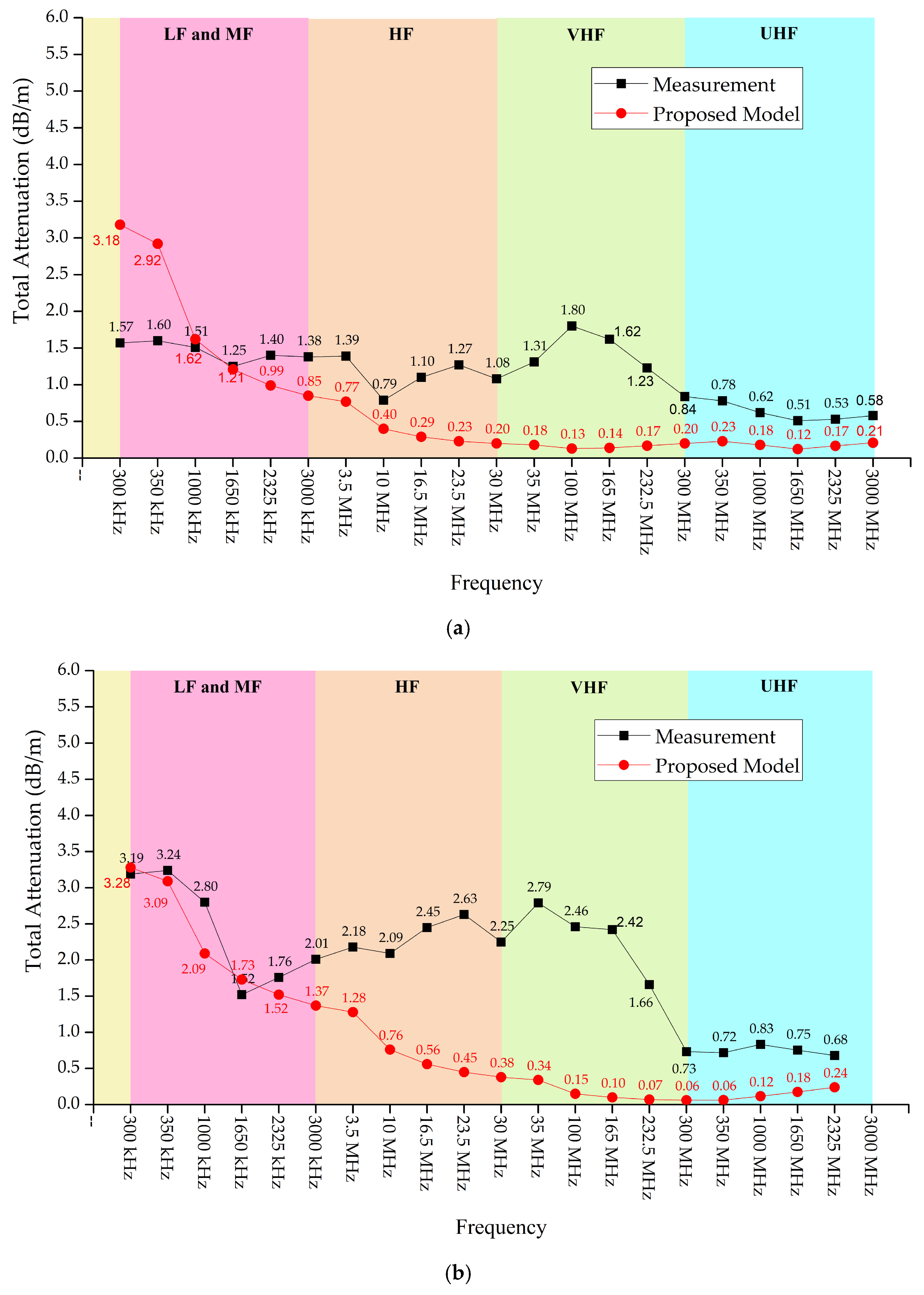
Previous studies, such as those reported in [12,13,14], have employed path-loss trends derived from in situ measurements to characterize electromagnetic wave propagation inside cave environments, typically expressed in terms of attenuation per meter. Most of these studies focused on limestone caves under comparable propagation distances and frequency ranges. In the present work, attenuation values obtained from measurements in Patihan Cave were compared with those from Chiang Dao Cave to examine differences between sandstone and limestone environments. The comparative results are summarized in Figure 12, which presents the transmission loss per meter under line-of-sight conditions for both measurement data and the proposed analytical model across multiple frequency bands. Across all frequency bands, the limestone cave generally exhibits higher attenuation per meter than the sandstone cave, with larger fluctuations observed in the measured results. This difference is particularly evident in the LF and MF bands. In the limestone cave, attenuation values reach approximately 3.19 dB/m at 300 kHz and gradually decrease toward higher MF frequencies. In contrast, the sandstone cave shows consistently lower attenuation over the same frequency range. These observations suggest that wave interaction with the surrounding rock plays a significant role at low frequencies, where the wavelength is much larger than the cave dimensions and classical waveguide behavior is not dominant. Under these conditions, propagation is more strongly influenced by surface-wave effects and wall interactions.
Figure 12.
Comparison of attenuation per meter obtained from LOS measurements and the proposed skin depth-based model across multiple frequency bands: (a) Patihan Cave (sandstone) (b) Chiang Dao Cave (limestone).
In the HF band, the measured results indicate a transition in propagation behavior, accompanied by changes in the attenuation gradient. For both caves, attenuation initially decreases compared to LF and MF, but increases again at higher HF frequencies. This trend is more pronounced in the limestone cave, where steeper attenuation gradients are observed over certain frequency intervals. The increased loss may be associated with enhanced interaction between the propagating waves and internal cave features, such as irregular wall surfaces and natural obstructions. While the proposed model captures the general frequency-dependent trend, discrepancies remain, particularly in the limestone environment, indicating that some loss mechanisms related to geometric complexity are not fully represented in the analytical formulation. In the VHF and UHF bands, attenuation per meter is generally lower for both caves compared to lower-frequency bands.
The shorter wavelengths of the VHF and UHF bands favor direct-wave propagation, as these wavelengths can propagate more effectively through obstacles and reflect off cave walls in a manner similar to waveguide propagation. In both caves, attenuation is generally lower in the VHF and UHF bands than in the HF band, with shorter wavelengths traversing the cave cavity more efficiently. Although these bands are less influenced by cave geometry, some signal attenuation is still observed, likely due to multipath fading. In this phenomenon, signals reflected from cave walls may either constructively or destructively interfere with the direct wave, depending on the signal phase at the receiver location.
A quantitative comparison of the total attenuation derived from the measurements and the proposed model across multiple frequency bands provides additional insight into the level of agreement observed in Figure 12. In the LF, MF, and UHF bands, the total attenuation trends for both sandstone and limestone caves show strong consistency between the measured data and the analytical predictions, indicating good overall alignment. In the HF and VHF bands, small discrepancies are observed; however, these differences remain limited. For Patihan Cave (sandstone), the deviation in total attenuation does not exceed 1.67 dB/m, while for Chiang Dao Cave (limestone), the corresponding difference remains within 2.45 dB/m. Considering the inherent variability of natural cave geometries, measurement uncertainty, and frequency-dependent propagation mechanisms, these deviations can be regarded as moderate and acceptable. The results suggest that the proposed model is capable of capturing the dominant attenuation behavior across a wide frequency range, while minor discrepancies at intermediate frequencies likely arise from increased sensitivity to local geometric irregularities and multipath effects that are not fully represented in the analytical formulation. Although the observed signal attenuation in both caves is relatively low, the proposed model indicates higher attenuation at higher frequencies in the UHF band, which is consistent with previous studies conducted in this frequency range [7,8,10,11,14]. These studies report that as frequency increases, the influence of cave cross-sectional dimensions on attenuation becomes less significant, while attenuation due to wall roughness and wall inclination increases. This results in enhanced scattering and greater polarization reversal of the propagating waves [14].
4. Conclusions
This study investigated radio frequency (RF) wave propagation in two contrasting cave environments: a sandstone cave (Patihan Cave) and a limestone cave (Chiang Dao Cave). LiDAR-derived three-dimensional (3D) cave models were employed to characterize the physical geometry of each cave and to support a waveguide-based analytical framework incorporating skin depth effects. RF transmission and reception measurements were conducted under line-of-sight (LOS) conditions across frequency bands ranging from Low Frequency (LF) to Ultra-High Frequency (UHF). The LiDAR data enabled the extraction of key geometric features, including cave dimensions, wall inclination, surface roughness, and major structural irregularities, which were subsequently incorporated into the analytical model. Numerical simulations using CST Studio Suite were used as a complementary tool to support the interpretation of the analytical and experimental results. The measurement results indicate that attenuation behavior differs substantially between the two cave types, particularly at lower frequencies. In the LF and MF bands, higher attenuation was observed in the limestone cave compared to the sandstone cave. This behavior is consistent with surface-wave-dominated propagation, where electromagnetic energy partially penetrates the cave walls. The lower electrical conductivity and more heterogeneous structure of limestone appear to promote greater energy dissipation, whereas the higher conductivity and more uniform geometry of the sandstone cave are associated with reduced attenuation. In the HF band, propagation gradually transitions toward direct-wave mechanisms, accompanied by increased sensitivity to internal obstructions. Structural features such as stalactites, stalagmites, and irregular wall profiles—more prevalent in the limestone cave—are associated with steeper attenuation trends in this frequency range. At VHF and UHF frequencies, both caves exhibit lower overall attenuation, consistent with more efficient direct-wave or quasi-waveguide propagation. Nevertheless, noticeable signal fluctuations remain, which are attributed to multipath effects arising from wall roughness, wall inclination, and local geometric variations. These effects become more pronounced at higher frequencies, where shorter wavelengths are increasingly sensitive to small-scale surface features.
Overall, the results demonstrate that cave geometry and material properties play a critical role in shaping underground RF propagation across a wide frequency range. While the proposed LiDAR-based analytical model captures the dominant attenuation trends observed in the measurements, it does not fully represent complex interactions associated with discrete obstacles and fine-scale roughness. These limitations suggest that further refinement of analytical formulations, potentially incorporating more detailed representations of internal cave features, would improve predictive accuracy. The findings underline the importance of site-specific geometric characterization when analyzing or designing RF communication systems for underground environments and provide practical insight into the benefits and limitations of LiDAR-assisted propagation modeling.
Author Contributions
Conceptualization, A.J., S.P., P.K. (Peerasan Khamsalee), R.W. and P.K. (Piyaporn Krachodnok); methodology, A.J., S.P., P.K. (Peerasan Khamsalee), R.W. and P.K. (Piyaporn Krachodnok); software, A.J. and S.P.; validation, A.J., P.K. (Peerasan Khamsalee) and R.W.; formal analysis, A.J., S.P., P.K. (Peerasan Khamsalee) and P.K. (Piyaporn Krachodnok); investigation, A.J., S.P. and P.K. (Piyaporn Krachodnok); resources, A.J., P.K. (Peerasan Khamsalee) and R.W.; data curation, A.J., P.K. (Peerasan Khamsalee) and R.W.; writing—original draft preparation, A.J., S.P. and P.K. (Piyaporn Krachodnok); writing—review and editing, P.K. (Peerasan Khamsalee), R.W., and P.K. (Piyaporn Krachodnok); visualization, A.J. and S.P.; supervision, P.K. (Peerasan Khamsalee), R.W. and P.K. (Piyaporn Krachodnok); project administration, P.K. (Piyaporn Krachodnok); funding acquisition, P.K. (Piyaporn Krachodnok) All authors have read and agreed to the published version of the manuscript.
Funding
This work was supported by the Suranaree University of Technology (SUT) Research and Development Fund under Grant IRD7-709-68-12-19.
Institutional Review Board Statement
Not applicable.
Informed Consent Statement
Not applicable.
Data Availability Statement
The raw data supporting the conclusions of this article will be made available by the authors on request.
Acknowledgments
This research was supported by the Research and Development Fund of Suranaree University of Technology (SUT). The authors gratefully acknowledge the university’s support in providing access to laboratory equipment, measurement tools, simulation software, and technical facilities, which were essential for conducting experiments and analyzing the data. The constructive environment and continuous encouragement from the university significantly contributed to the successful completion of this study.
Conflicts of Interest
The authors declare no conflicts of interest.
References
- Zajc, M.; Gosar, A.; Celarc, B. Low-frequency ground penetrating radar survey for limestone-flysch thrust-fault analysis (Karstic thrust edge, SW Slovenia). In Proceedings of the 2017 9th International Workshop on Advanced Ground Penetrating Radar, IWAGPR 2017-Proceedings, Edinburgh, UK, 28–30 June 2017. [Google Scholar] [CrossRef]
- Lu, Q.; Liu, C.; Wang, Y.; Liu, S.; Zeng, Z.; Feng, X.; She, S. Ground Penetrating Radar Applications in Mapping Underground Utilities. In Proceedings of the 2018 17th International Conference on Ground Penetrating Radar, GPR 2018, Rapperswil, Switzerland, 18–21 June 2018. [Google Scholar] [CrossRef]
- Lombardi, F.; Griffiths, H.D.; Balleri, A. Landmine internal structure detection from ground penetrating radar images. In Proceedings of the 2018 IEEE Radar Conference (RadarConf18), Oklahoma City, OK, USA, 23–27 April 2018; pp. 1201–1206. [Google Scholar] [CrossRef]
- Yarkan, S.; Güzelgöz, S.; Arslan, H.; Murphy, R. Underground mine communications: A survey. IEEE Commun. Surv. Tutor. 2009, 11, 125–142. [Google Scholar] [CrossRef]
- Lamri, I.E.; Nedil, M.; Temmar, M.N.E.; Kandil, N. Near-Ground Propagation Channel Modeling and Analysis in Underground Mining Environment at 2.4 GHz. IEEE Open J. Antennas Propag. 2025, 6, 445–459. [Google Scholar] [CrossRef]
- Loredo, S.; León, G.; Arias, M.; Pérez-Eijo, L.; Pendás-Rccondo, Á.; Gómez-Sanjuan, A.M.; Gandini, E.; Turchi, L. Propagation Analysis Inside Lunar Caves. In Proceedings of the EuCAP 2025-19th European Conference on Antennas and Propagation, Stockholm, Sweden, 30 March–4 April 2025. [Google Scholar] [CrossRef]
- Javaid, F.; Wang, A.; Sana, M.U.; Husain, A.; Ashraf, I. An Optimized Approach to Channel Modeling and Impact of Deteriorating Factors on Wireless Communication in Underground Mines. Sensors 2021, 21, 5905. [Google Scholar] [CrossRef]
- Bedford, M.D.; Hrovat, A.; Kennedy, G.; Javornik, T.; Foster, P. Modeling Microwave Propagation in Natural Caves Using LiDAR and Ray Tracing. IEEE Trans. Antennas Propag. 2020, 68, 3878–3888. [Google Scholar] [CrossRef]
- Soo, Q.P.; Lim, S.Y.; Lim, D.W.G.; Yap, K.M.; Lau, S.L. Propagation measurement of a natural cave-turned-wine-cellar. IEEE Antennas Wirel. Propag. Lett. 2018, 17, 743–746. [Google Scholar] [CrossRef]
- Bedford, M.D.; Kennedy, G.A. Modeling microwave propagation in natural caves passages. IEEE Trans. Antennas Propag. 2014, 62, 6463–6471. [Google Scholar] [CrossRef]
- Bedford, M.D.; Kennedy, G.A.; Foster, P.J. Radio transmission characteristics in tunnel environments. Trans. Inst. Min. Metall. Sect. A Min. Technol. 2017, 126, 77–87. [Google Scholar] [CrossRef]
- Boutin, M.; Benzakour, A.; Despins, C.L.; Affes, S. Radio wave characterization and modeling in underground mine tunnels. IEEE Trans. Antennas Propag. 2008, 56, 540–549. [Google Scholar] [CrossRef]
- Kjeldsen, E.; Hopkins, M. An experimental look at RF propagation in narrow tunnels. In Proceedings of the IEEE Military Communications Conference MILCOM, Washington, DC, USA, 23–25 October 2006. [Google Scholar] [CrossRef]
- Rak, M.; Pechac, P. UHF propagation in caves and subterranean galleries. IEEE Trans. Antennas Propag. 2007, 55, 1134–1138. [Google Scholar] [CrossRef]
- Jantaupalee, A.; Khamsalee, P.; Wongsan, R. Low-Frequency Wave Propagation in the Cave. In Proceedings of the 2023 20th International Conference on Electrical Engineering/Electronics, Computer, Telecommunications and Information Technology, ECTI-CON 2023, Nakhon Phanom, Thailand, 9–12 May 2023. [Google Scholar] [CrossRef]
- Jantaupalee, A.; Wongsan, R.; Khamsalee, P.; Wannakomol, A.; Tansuwan, K. A Study of Radio Wave Propagation in the Cave for Developing the Through-the-Earth Application. GEOMATE J. 2024, 26, 74–86. [Google Scholar] [CrossRef]
- Julthochai, S.; Jantaupalee, A.; Khamsalee, P.; Wongsan, R. An Experimental Study of Wave Propagation in Sandstone Cave. In Proceedings of the 2023 IEEE International Symposium on Antennas and Propagation, ISAP 2023, Kuala Lumpur, Malaysia, 30 October–2 November 2023. [Google Scholar] [CrossRef]
- Jantaupalee, A.; Wongsan, R.; Wannakomol, A.; Khamsalee, P.; Tansuwan, K. A modeling of rf propagation for low frequency in natural caves with 3d model simulation. Suranaree J. Sci. Technol. 2024, 31, 1–11. [Google Scholar] [CrossRef]
- Emslie, A.G.; Lagace, R.L.; Strong, P.F. Theory of the Propagation of UHF Radio Waves in Coal Mine Tunnels. IEEE Trans. Antennas Propag. 1975, 23, 192–205. [Google Scholar] [CrossRef]
- Emslie, A.G.; Lagace, R.L. Propagation of low and medium frequency radio waves in a coal seam. Radio. Sci. 1976, 11, 253–261. [Google Scholar] [CrossRef]
- Balanis, C.A. Advanced Engineering Electromagnetics, 2nd ed.; Wiley: Hoboken, NJ, USA, 2012. [Google Scholar]
- Changsen, Z.; Yan, M. Effects of cross section of mine tunnel on the propagation characteristics of UHF radio wave. In Proceedings of the 2006 7th International Symposium on Antennas, Propagation & EM Theory, Guilin, China, 26–29 October 2006. [Google Scholar] [CrossRef]
- Darmon, M.; Dorval, V.; Baqué, F. Acoustic Scattering Models from Rough Surfaces: A Brief Review and Recent Advances. Appl. Sci. 2020, 10, 8305. [Google Scholar] [CrossRef]
- Ong, D.C.Y.; Bukhori, I.; Sim, K.S.; Gan, K.B. Adaptive Optimizable Gaussian Process Regression Linear Least Squares Regression Filtering Method for SEM Images. IEEE Access 2025, 13, 93574–93592. [Google Scholar] [CrossRef]
- Herrera-Gomez, A.; Porter, R.M.; Porter, B.R.M.; Herrera-Gomez Aherrerag, A.; Herrera-Gomez, A.; Porter, R.M. Shortcut derivatives for mixed linear-nonlinear least squares regression. Boletín De La Soc. Matemática Mex. 2025, 31, 120. [Google Scholar] [CrossRef]
- Brown, S.R. Fluid flow through rock joints: The effect of surface roughness. J. Geophys. Res. Solid. Earth 1987, 92, 1337–1347. [Google Scholar] [CrossRef]
- Daniels, D.J. Ground Penetrating Radar; Institution of Engineering and Technology: London, UK, 2004. [Google Scholar] [CrossRef]
- Gunn, J. Encyclopedia of Caves and Karst Science; Routledge: New York, NY, USA, 2004. [Google Scholar] [CrossRef]
- Baker, G.S.; Jordan, T.E.; Pardy, J. An Introduction to Ground Penetrating Radar (GPR); Geological Society of America: Boulder, CO, USA, 2007; Volume 432. [Google Scholar] [CrossRef]
- Niu, R.; Jiang, X.-W.; Ouyang, K.; Yang, X.; Wang, X.-S.; Huang, J.-Z.; Yan, H.-B.; Wan, L. Rock moisture dynamics in sandstone caves responsible for weathering: Field observations and numerical modeling. Eng. Geol. 2025, 354, 108185. [Google Scholar] [CrossRef]
- Jiang, X.-W.; Ouyang, K.-G.; Tang, X.-L.; Tan, S.-C.; Shi, J.-X.; Li, N.; Yan, H.-B.; Ren, J.-G.; Wan, L. The source of rock moisture in a sandstone cave in arid northern China: Rainfall infiltration or vapor condensation? Hydrogeol. J. 2023, 32, 267–277. [Google Scholar] [CrossRef]
- Urtans, J.; Eniņš, G. Latvian sandstone caves as cultural phenomena. J. Balt. Stud. 2001, 32, 95–99. [Google Scholar] [CrossRef]
- Wongsa, F.; Phunklang, S.; Yueanket, A.; Kornsing, S.; Santalunai, N.; Mesawad, P.; Santalunai, S.; Narakaew, S.; Krachodnok, P. Quantitative Detection of Carbamate Pesticide Residues in Vegetables Using a Microwave Ring Resonator Sensor. Appl. Sci. 2025, 15, 11775. [Google Scholar] [CrossRef]
- Kornsing, S.; Phunklang, S.; Thongsopa, C.; Krachodnok, P.; Santalunai, N.; Santalunai, S. Development of a Dielectric Heating System for Selective Thermal Targeting of Liver Fluke Regions in Cirrhinus microlepis. Appl. Sci. 2025, 15, 5466. [Google Scholar] [CrossRef]
- Dunkley, J.; Ellis, M.; Bolger, T. Unusual caves and karst-like features in sandstone and conglomerate in Thailand. Helictite 2017, 43, 15. [Google Scholar]
- Deharveng, L.; Ellis, M.; Bedos, A.; Jantarit, S. Tham Chiang Dao: A Hotspot of Subterranean Biodiversity in Northern Thailand. Diversity 2023, 15, 1076. [Google Scholar] [CrossRef]
- Turrini, P.; Chebbi, A.; Riggio, F.P.; Visca, P. The geomicrobiology of limestone, sulfuric acid speleogenetic, and volcanic caves: Basic concepts and future perspectives. Front Microbiol. 2024, 15, 1370520. [Google Scholar] [CrossRef]
- Antić, A.; Geomythology, A.M. Geomythology, caves, and tourism: History and future perspectives. Int. J. Tour. Anthropol. 2023, 9, 99–112. [Google Scholar] [CrossRef]
- Mount, G.J.; Comas, X. Estimating porosity and solid dielectric permittivity in the Miami Limestone using high-frequency ground penetrating radar (GPR) measurements at the laboratory scale. Water Resour. Res. 2014, 50, 7590–7605. [Google Scholar] [CrossRef]
- Freitas, T.S.; Guimarães, A.S.; Roels, S.; de Freitas, V.P.; Cataldo, A. Is the Time-Domain Reflectometry (TDR) Technique Suitable for Moisture Content Measurement in Low-Porosity Building Materials? Sustainability 2020, 12, 7855. [Google Scholar] [CrossRef]
- Hubbard, S.S.; Peterson, J.E.; Majer, E.L.; Zawislanski, P.T.; Williams, K.H.; Roberts, J.; Wobber, F. Estimation of permeable pathways and water content using tomographic radar data. Lead. Edge 1997, 16, 1623. [Google Scholar] [CrossRef]
- Ivashov, S.; Bugaev, A.; Razevig, V. Discussion of the Non-Destructive Testing Possibilities for the Study of the Great Pyramid of Giza. Heritage 2023, 6, 5867–5882. [Google Scholar] [CrossRef]
- Jones, G.; Holderied, M.W. Bat echolocation calls: Adaptation and convergent evolution. Proc. R. Soc. B Biol. Sci. 2007, 274, 905–912. [Google Scholar] [CrossRef] [PubMed]
- Moss, C.F. Auditory Mechanisms of Echolocation in Bats. In Oxford Research Encyclopedia of Neuroscience; Oxford University Press: Oxford, UK, 2018. [Google Scholar] [CrossRef]
- A.H. Systems Inc. SAS-565L Passive Loop Antenna Datasheet. Available online: https://www.ahsystems.com/datasheets/SAS-565L_Passive_Loop_Antenna_Datasheet.pdf (accessed on 22 November 2025).
- Isotron Antennas. AM Broadcast Band Isotron Antenna Model 200/300 Watt. Available online: https://isotronantennas.com/index.php?main_page=product_info&products_id=15 (accessed on 22 November 2025).
- A.H. Systems Inc. SAS-564 Passive Loop Antenna Datasheet. Available online: https://www.ahsystems.com/datasheets/SAS-564_Passive_Loop_Antenna_Datasheet.pdf (accessed on 22 November 2025).
- Aaronia AG. BicoLOG Biconical Antennas Datasheet. Available online: https://downloads.aaronia.com/datasheets/antennas/BicoLOG/Aaronia_BicoLOG_Biconical_Antennas.pdf (accessed on 22 November 2025).
- Khan, N.I.; Azim, A.; Islam, S. Radiation Characteristics of a Quarter-Wave Monopole Antenna above Virtual Ground. J. Clean. Energy Technol. 2014, 2, 339–342. [Google Scholar] [CrossRef]
Disclaimer/Publisher’s Note: The statements, opinions and data contained in all publications are solely those of the individual author(s) and contributor(s) and not of MDPI and/or the editor(s). MDPI and/or the editor(s) disclaim responsibility for any injury to people or property resulting from any ideas, methods, instructions or products referred to in the content. |
© 2026 by the authors. Licensee MDPI, Basel, Switzerland. This article is an open access article distributed under the terms and conditions of the Creative Commons Attribution (CC BY) license.