Article

Optimization of Compressor Preheating to Increase Efficiency, Comfort, and Lifespan

Pingyang Institute of Intelligent Manufacturing, Wenzhou University, Wenzhou 325409, China
Technologies 2025, 13(12), 590; https://doi.org/10.3390/technologies13120590
Submission received: 11 November 2025 / Revised: 27 November 2025 / Accepted: 10 December 2025 / Published: 15 December 2025

Abstract

Various compressors found in appliances such as air conditioners, refrigerators, dehumidifiers, etc., are gaining more popularity in different areas, including industry, retail, consumer electronics, and others. This market is growing fast, attracting numerous manufacturers who are closely competing with each other. Simultaneously, the requirements for compressor drive efficiency and for reducing their carbon footprint are becoming tougher, which is prompting manufacturers to pay serious attention to this problem. Compressor drives operate in many modes, and almost all of them have been studied and optimized. The exception to this is the preheating mode, which is required to warm the lubricating oil before beginning compressor operations. This mode is rarely used in warm climates; therefore, previous researchers have ignored it. However, with the spread of compressor applications into countries with colder climates, the significance of the preheating mode has increased. This study examines the preheating mode of compressor drives and proposes several techniques that increase their efficiency by 4.15% and decrease the preheating time by 3.6 times. Furthermore, the author developed an algorithm that makes the load to the inverter and motor phases more even, thus increasing the lifespan of compressors and reducing their carbon footprint.

1. Introduction

The current world market of home appliances is growing fast [1,2] and reached a value of USD 700 billion in 2025 [3]; consequently, this market attracts numerous players, which closely compete with each other to promote their devices and attract customers [4,5,6]. One of the key directions for attracting buyers is reducing energy consumption [7,8], which saves energy [9,10,11], decreases CO2 emissions [12], and cuts electricity bills [13]. Moreover, national efficiency standards are periodically tightened by regulators, making research in this area essential [14]. This direction is especially important for compressor-equipped devices, such as refrigerators [15,16,17], air conditioners (aircons) [18,19,20], dehumidifiers [21,22,23], etc., all of which constitute some of the biggest power consumers in households [24]. As a result, manufacturers are currently making significant efforts to increase the efficiency of compressor motor drives [25]. As a result, this area is well studied, and new breakthroughs at the current level of science are almost impossible; therefore, even minor improvements in efficiency (0.1~0.2%) are considered good results.
Another key factor attracting buyers is the long lifespan of home appliances [26]. It directly impacts household expenses by reducing the number of purchased devices [27] and indirectly decreases the carbon footprint by reducing demands [28]. Therefore, manufacturers of home appliances pay significant attention to increasing the reliability of home appliances and extending their lifetime [29].
Despite the intensive work of numerous researchers in both of these directions, it was discovered that they have paid almost no attention to the preheating mode of compressor operation [30]. This mode is activated before the compressor starts and is used to heat the oil in the compressor to the minimum required temperature, where its viscosity decreases and proper lubrication is guaranteed [31]. This mode has largely been ignored due to being rarely used, since compressors are usually used in hotter climates [32]. However, in recent decades, the functionality of numerous heating, ventilation, and air conditioning (HVAC) equipment and their method of usage have significantly changed. Many HVAC devices have been enhanced with various heat pump modes [33], making them capable of heating. Therefore, their usage in cold countries has significantly increased [34]. Additionally, refrigerators are frequently installed in loggias or balconies, which saves space inside apartments; however, they consequently have to operate in colder temperatures. In these scenarios, ambient temperatures inside are typically 3~4 degrees higher than outside the buildings; furthermore, these outdoor temperatures frequently reach negative values. Currently, the majority of convenience stores and small cafés place their refrigerators at their entrances, outside the buildings, which increases indoor space; however, these devices have to operate under significant variations in ambient temperatures. As can be seen, compressor operation in cold environments has become very common; thus, the usage of preheating modes has intensified, and their importance has increased. Therefore, this research focuses on the optimization of compressor motor drive efficiency in preheating modes and the elimination of the negative impacts on the drive’s lifespan.

1.1. Compressor Preheating

Compressors in home appliances mainly include reciprocating, scroll, and vane machines, which include numerous fractioning parts, such as shafts, bearings, scrolls, vanes, pistons, etc. [35]. All of them require proper lubrication in order to work correctly and extend their lifetime, and, thus, these compressors are equipped with greasing systems. The simplest implementation includes an oil sump, used for collecting and storing oil [36], and an oil pump, which is used to transfer the oil from the bottom of the compressor to the moving parts [37].
In order to facilitate proper greasing and operation of the oil pump, the viscosity of the lubricant has to be within a specified range [38]. If the oil cools below the minimum working temperature, its viscosity rises, causing a decrease in lubrication ability and pumping volume over time. In order to avoid these problems, normal compressor operation requires the oil to be heated to the minimum working temperature [39].
Simultaneously, compressors are frequently located in cold places, e.g., outdoor units of air conditioners are placed outside rooms, outdoor freezers are typically located at the entrances to shops, etc. As a result, after long idle cycles, the compressor temperature decreases to the ambient temperature and may leave the working range [40]. Therefore, before starting the compressor, the oil inside has to be heated [41], which is typically achieved with the help of a preheater [42] or using the motor as a source of heat [43]. However, due to the latest strategies in pricing, manufacturers of compressor drives focus on cost optimization, thus giving priority to methods that heat the lubricant using power dissipated in the motor [44].
After warming the lubricant, the compressor starts and heats further due to power loss inside it, e.g., power loss inside the motor, friction, gas pressurizing, etc. [45]. The dissipating energy is enough to keep the oil temperature within the desired range and ensure normal greasing and proper operation of all mechanical parts [46,47].

1.2. Preheating Approaches

The simplest and most conventional way to heat the oil is by using special devices called preheaters. They are constructed as resistive heaters and can be internal or externally located, depending on the way they are mounted. The preheaters are controlled by simple power converters, which are required in order to provide the desired current to the heating elements [48]. These converters are usually implemented as separate circuits in the inverter boards and contain one power switch operating in chopping mode.
The internal preheaters are buried inside the oil and sealed inside the shell of the compressor. They directly transfer heat to the oil, thus demonstrating the lowest power dissipation, faster heating, and highest efficiency. At the same time, they cost more and are more difficult to maintain. The external preheaters are mounted on the outer surface of compressors, at the bottom, closer to the oil sump. Their construction is simpler compared to internal-type preheaters; thus, they are cheaper. Due to outside placement, their maintenance and installation are simple. However, a distant location from the lubricant increases the heating path, thus increasing power dissipation, extending time, and decreasing efficiency [49]. The electronic circuits used to control both external and internal preheaters are identical, with the only difference lying in their control algorithms.
At the same time, the usage of preheaters complicates compressor maintenance. Furthermore, internal preheaters are welded inside the compressor shell; therefore, they demonstrate poor repairability. As a result, elimination of the preheaters can significantly improve these characteristics and significantly optimize compressor costs, which is extremely important in highly competitive environments. In order to exclude preheaters and optimize compressor costs, several manufacturers proposed a cold-start approach [50]. In this method, the compressor starts up with cold lubricant, which does not ensure proper greasing. However, in order to exclude damage to the mechanical parts, the compressor load has to be reduced. During operation with reduced load, the compressor heats due to power loss within it, causing the lubricant temperature to increase. When the oil temperature reaches the minimum operational level, the compressor may be loaded to full [51]. The most significant disadvantage of this method is the long operational time under low load, which may extend to tens of minutes [52]. The main reason for this problem is operation at low load, which results in lower power loss, which in turn increases the time required to operate under limited load. Simultaneously, after starting compressor operation, the consumer prefers to run the device at maximum power immediately in order to adjust the room climate to the desired conditions. Therefore, a cold start, which significantly limits compressor operation right after turning on, creates significant discomfort for customers and decreases the competitiveness of the appliance.
Since the considered conventional techniques have serious disadvantages, a relatively new approach that uses a compressor motor as a preheater is gaining popularity in the market. It allows for the exclusion of preheaters, implemented as separate devices, thereby reducing production and maintenance costs. This technique allows the inverter to inject current into the motor windings; furthermore, all the injected power is transferred into heat and dissipated in windings and motor steel. In order to prevent motor rotation, the injected current should be either DC or high-frequency AC. All of these result in Joule loss in motor windings. However, the AC component causes power loss in steel as well. At the same time, in order to make the steel power loss comparable to Joule loss, the frequency of the injected signal should be several tens of kilohertz [53], which increases the inverter switching loss [54]. Therefore, to avoid reducing preheating efficiency, injection of a DC current is a more popular solution. At the same time, this prospective preheating approach has several drawbacks, which will be considered in the next section.

1.3. Preheating Problems

When the inverter injects DC current into the motor, the energy is mainly dissipated in the stator windings, heating wires in the process, and is transferred to the oil through the motor and compressor parts. Since the heating oil and heat source are far apart, this approach requires more time, compared to the usage of a preheater of similar power. Furthermore, all parts located in the heat path should be warmed, which requires additional power and decreases efficiency. The increased heat path increases power dissipation to ambient conditions, which also decreases efficiency. As a result, the preheating efficiency, when the motor is used as a heater, is about 10~30%, which decreases the overall efficiency of the compressor, calculated over an average operational cycle. In order to decrease dissipation to the ambient and increase customer comfort, shortening of the preheating time is required. However, low winding resistances and small rated currents of compressor motors significantly limit the maximum power that can be transferred.
Another problem that appears during the injection of DC current in the preheating mode is acoustic noise, which occurs at the modulation frequency. This noise is not significant and typically not audible when the compressor operates. However, when it is stopped, the noise can be clearly detected and may irritate customers. The simplest solution is to increase the modulation frequency over 16 kHz, which makes the noise inaudible to human ears [55]. However, this causes an increase in inverter commutation loss and decreases preheating efficiency [56].
Finally, the injection of a DC current causes unsymmetrical operation of the inverter when its phases and switches are loaded unevenly. As a result, some inverter switches undergo more working cycles than others, shortening the lifespan of the inverter. In order to solve this issue and increase the lifetime of the entire appliance device, the load on the inverter switches has to be evened out. For this purpose, the authors of [57] proposed a random number generator, which selects the inverter’s active state. This solution makes the load phase more even, considering the series of preheating operations. However, it operates with an uneven load inside one operation.

1.4. Contribution

This research develops solutions for the abovementioned problems, which arise during the compressor preheating mode. This study proposes an approach to define the optimal modulation frequency, balancing efficiency and the mitigation of audible noise. The author proposes an approach to reduce preheating time, making the use of compressors more convenient for customers. In turn, this decrease reduces power dissipation to ambient, thus raising the efficiency of preheating. Then, this study proposes a simple approach that makes the load on the inverter and motor phases more even, thus increasing their lifespans. The main contributions of this research are summarized below:
  • Development of an approach to define the modulation frequency that balances efficiency optimization and the mitigation of audible noise;
  • Development of a technique to decrease the preheating time, thus increasing customers’ comfort and efficiency of preheating;
  • Development of an algorithm that makes the load on the inverter and motor phases more even and increases the lifespan of the device;
  • Experimental verification of the developed algorithms and evaluation of their contributions to the resulting efficiency.

2. Theoretical Basis

This chapter provides the theoretical basis required for further discussion. It considers the construction of typical compressors and demonstrates formulae, illustrating compressor operation in the preheating mode.

2.1. Construction of Scroll Compressor

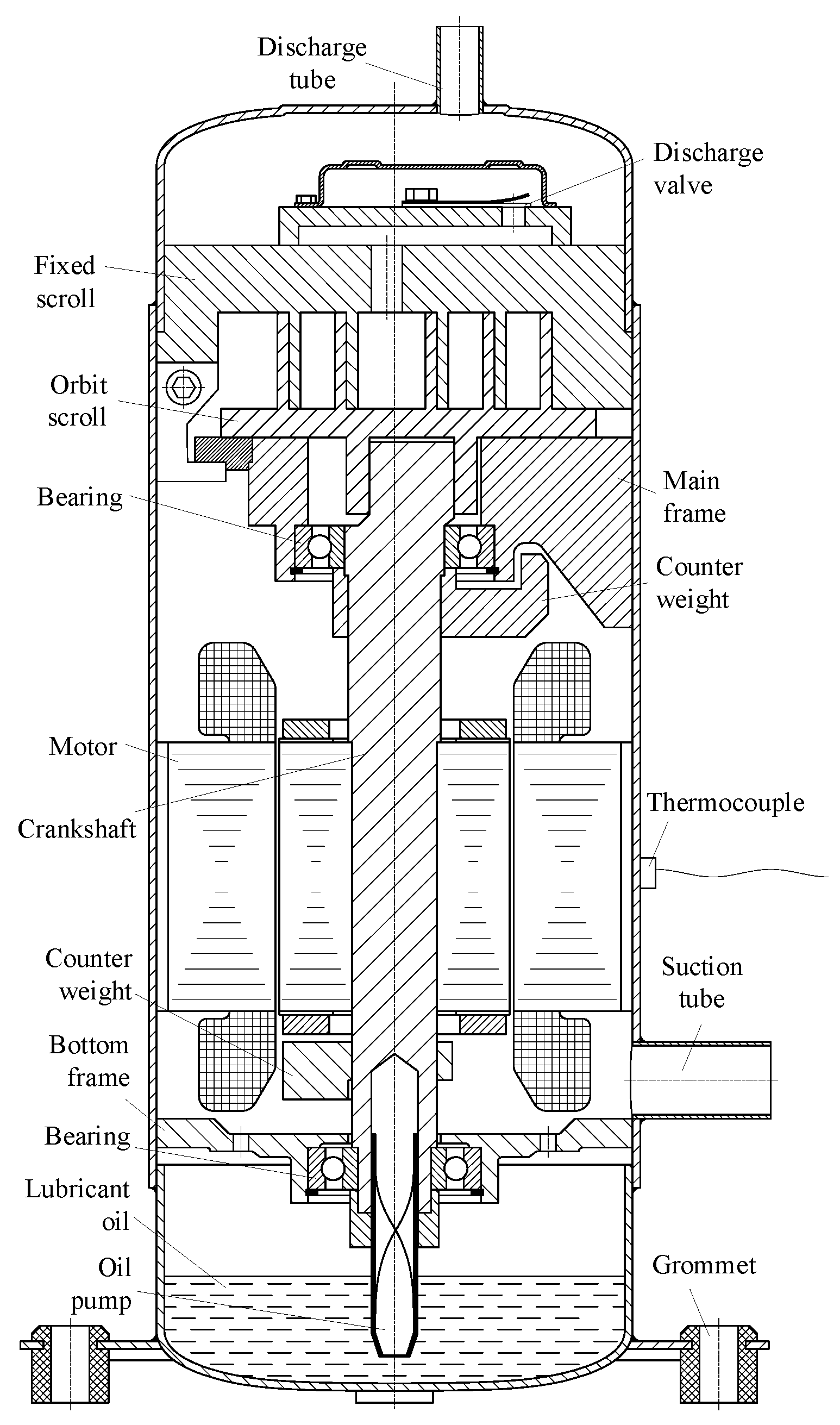
The construction of a typical scroll compressor is demonstrated in Figure 1. The refrigerant is pressurized by means of two eccentric scrolls located at the top of the compressor. They are rotated at 180° and share the same volume. However, the top scroll is fixed tightly, whilst the bottom scroll orbits, driven by the motor via a crankshaft. The bottom scroll moves closer to the static scroll at several points, creating several enclosed areas. When the orbiting scroll starts moving, the enclosed areas move toward the center of the spiral, simultaneously decreasing in volume. As a result, each portion of gas is pressurized when it reaches the center of the spiral, where the discharge hole is located [58]. After passing through the discharge hole, the gas goes through the discharge valve, which is required to prevent gas reverse flow, and enters the high-pressure side. Then, the refrigerant goes through to the discharge pipe, which leads to a heat exchanger [59,60].
The compressor oil, used for lubricating moving parts, is stored in the oil sump at the bottom of the compressor. It is transported to the moving parts at the top by means of an oil pump implemented inside the motor shaft. All unused oil, after lubrication, flows down to the oil sump due to gravity. Additional explanations on compressor operation and construction can be obtained in [61].
It should be noted that compressors are frequently equipped with thermocouples, which are used to prevent motor overheating. They are mounted at the outer surface of the compressor shell, close to the motor; therefore, their maximum temperature can be roughly evaluated. This protection is necessary in order to pass certification and satisfy 60,730 family standards, class B [62,63]. This means that all possible hazardous situations can be prevented via software protection; therefore, a protective relay may be excluded, which significantly decreases the cost [64].

2.2. Structure of Motor Drive

The proposed technique assumes that the motor drive used to rotate the compressor includes a three-phase star-connected interior permanent magnet synchronous motor (IPMSM), which has high torque-to-weight [65] and torque-to-space [66] ratios. It demonstrates high efficiency [67], which is crucial for following the latest tendencies on green energy [68,69] and satisfying the required standards for household devices [70,71].
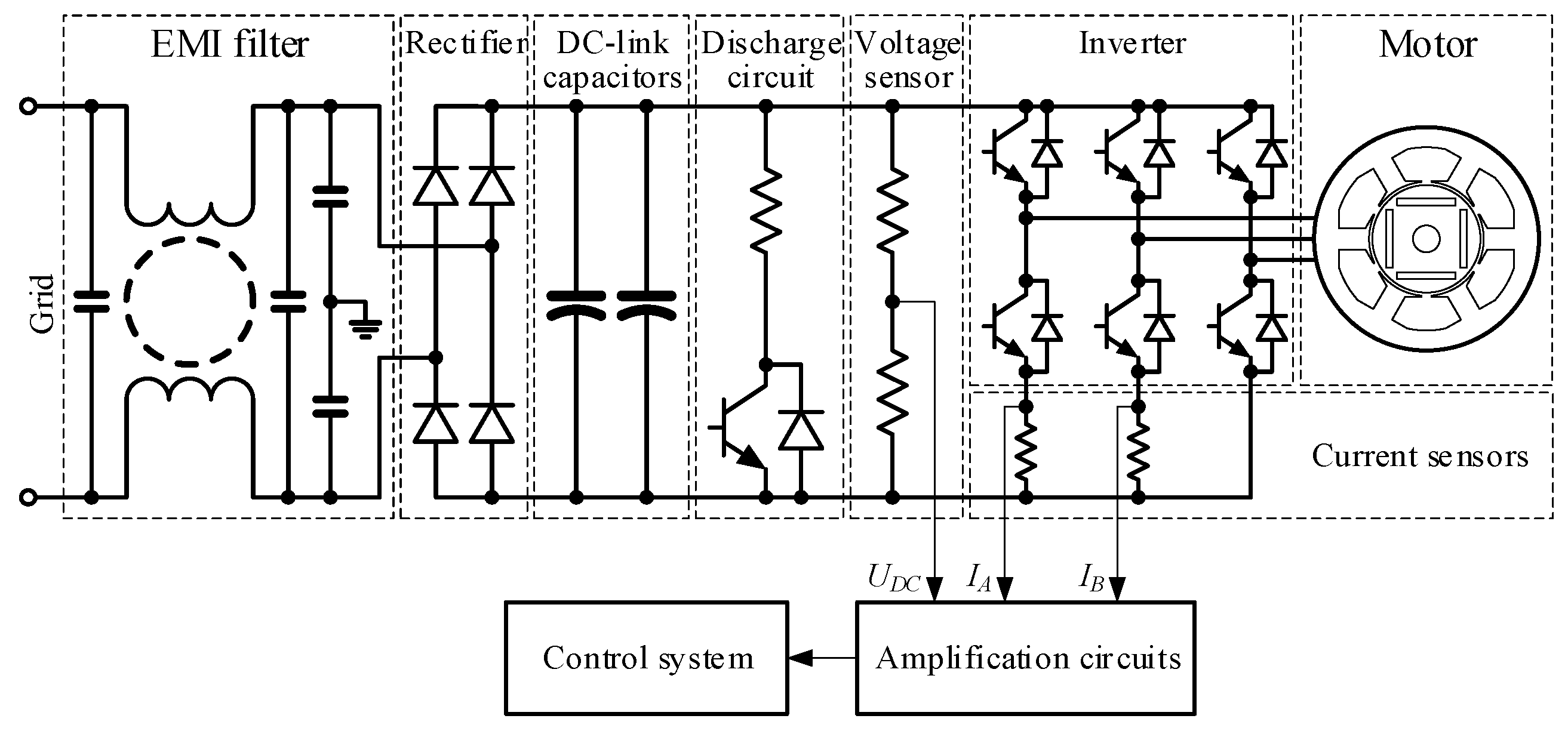
The motor is controlled by a three-phase inverter designed to ensure sensorless control of IPMSMs, which is essential for compressor drives [72,73,74]. The inverter implements the most popular topology used in low-cost applications, as demonstrated in Figure 2. It includes a resistive divider for sensing DC-link voltage and two current sensors based on measurement shunts. The motor current in the third phase is calculated using measured currents in two other phases, whilst the phase voltages are reconstructed using the commanded duty factors and measured DC-link voltage [75,76]. The heatsink, used for the thermal management of power switches, is optimized as proposed in [77]. To ensure the safety of inverter maintenance, the DC-link is equipped with a discharge circuit that reduces the voltage across the electrolytic capacitors after inverter disconnection from the grid [78,79].

2.3. Control Scheme

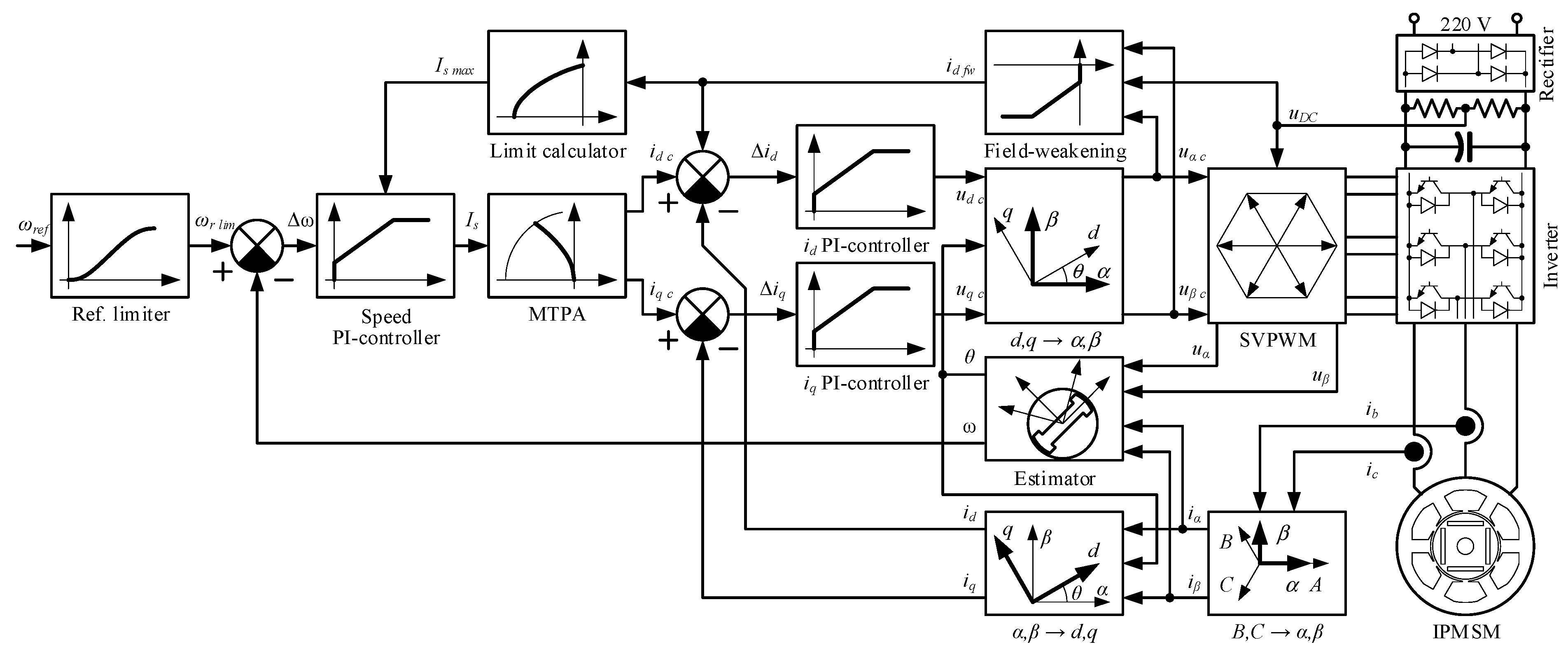
The typical compressor drive uses conventional FOC, enhanced with additional algorithms, to enable efficient operation. The motor control software architecture is shown in Figure 3. It involves a speed loop for controlling motor velocity and two inner current loops in the dq reference frame to control the current trajectory. This control scheme implements sensorless control of the motor, where electrical speed and position of the rotor are estimated using measured values of currents and voltages. The considered software uses a next-step current estimator, which is reported in [80,81] in detail. The starting of the motor is implemented in an open loop with one-step closing upon reaching the predefined speed, as discussed in [82].
The performance of the control system is extended by the use of maximum torque per ampere (MTPA) and field-weakening (FW) techniques. The first method is used for full utilization of motor potential and minimization of copper loss. The considered control scheme uses an adapting technique, recommended in [83]. FW control is required to extend the motor speed range and reach higher speeds [84]. The considered control scheme uses an optimized technique proposed in [85], which implements anti-windup of the speed loop.

2.4. Preheating by Injection of DC Current

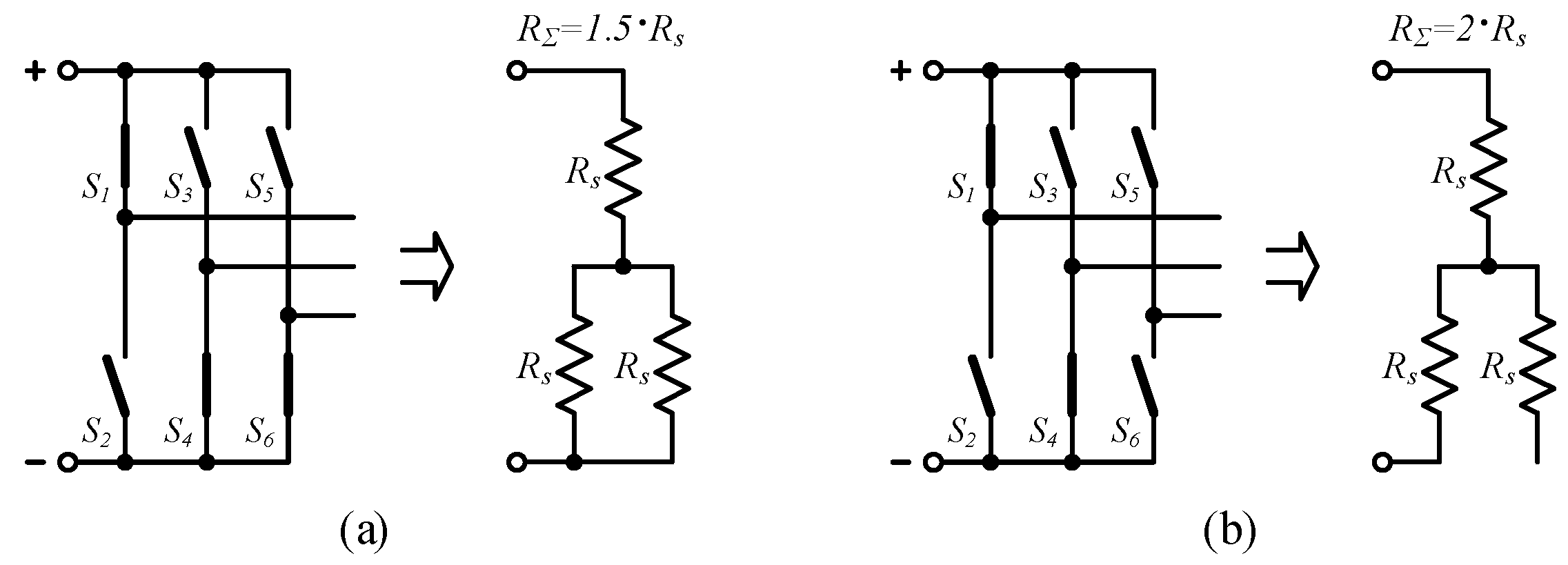
The most common solution for heating the compressor lubricant is the injection of DC current. In the most popular configuration of motor drives considered above, this injection can be implemented in two ways, as demonstrated in Figure 4.
The first approach involves three phases of a motor, connected as shown in Figure 4a. The phase involvement may differ, depending on the exact commutation of inverter switches. However, in all active connections (the motor is connected to the voltage source), one motor phase is always serially connected to two other phases, commutated in parallel. The resulting resistance RΣ is equal to 1.5 Rs, where Rs is the stator phase resistance. These phase connections are obtained during operation of the space vector power width modulation (SVPWM) algorithm, which is used in field-oriented control (FOC). Considering that FOC is used in the overwhelming majority of compressor drives, the implementation of compressor preheating using a three-phase connection is a simple task, which does not require the development of any additional algorithms. At the same time, the main disadvantage of this connection is low resulting resistance. Considering that the maximum injected current is limited by motor specification, low resistance limits the maximum power transferred to the motor. Furthermore, SVPWM with continuous modulation commutates six switches per PWM period, which increases commutation loss and decreases the efficiency of preheating. Additionally, the inverter and motor are loaded unevenly, where one phase operates at 100%, whilst two others work under 50% load. This increases stress on one phase and decreases the lifespan of the motor drive.
The second approach involves two phases of a motor, connected as demonstrated in Figure 4b. The phase involvement may differ depending on the exact commutation of inverter switches; however, in all active connections, one motor phase is always disconnected, whilst two others are connected serially. The resulting resistance RΣ is equal to 2 Rs; therefore, this connection enables an increase in transferring power to 33%. However, this phase connection is used in rectangular control, which is implemented quite rarely. As a result, the usage of a two-phase connection will require the development of additional control algorithms. The main disadvantage of this connection is uneven load on the inverter and motor phases: two phases operate at 100% load, whilst the third phase is unloaded.

2.5. Parameters of Preheating

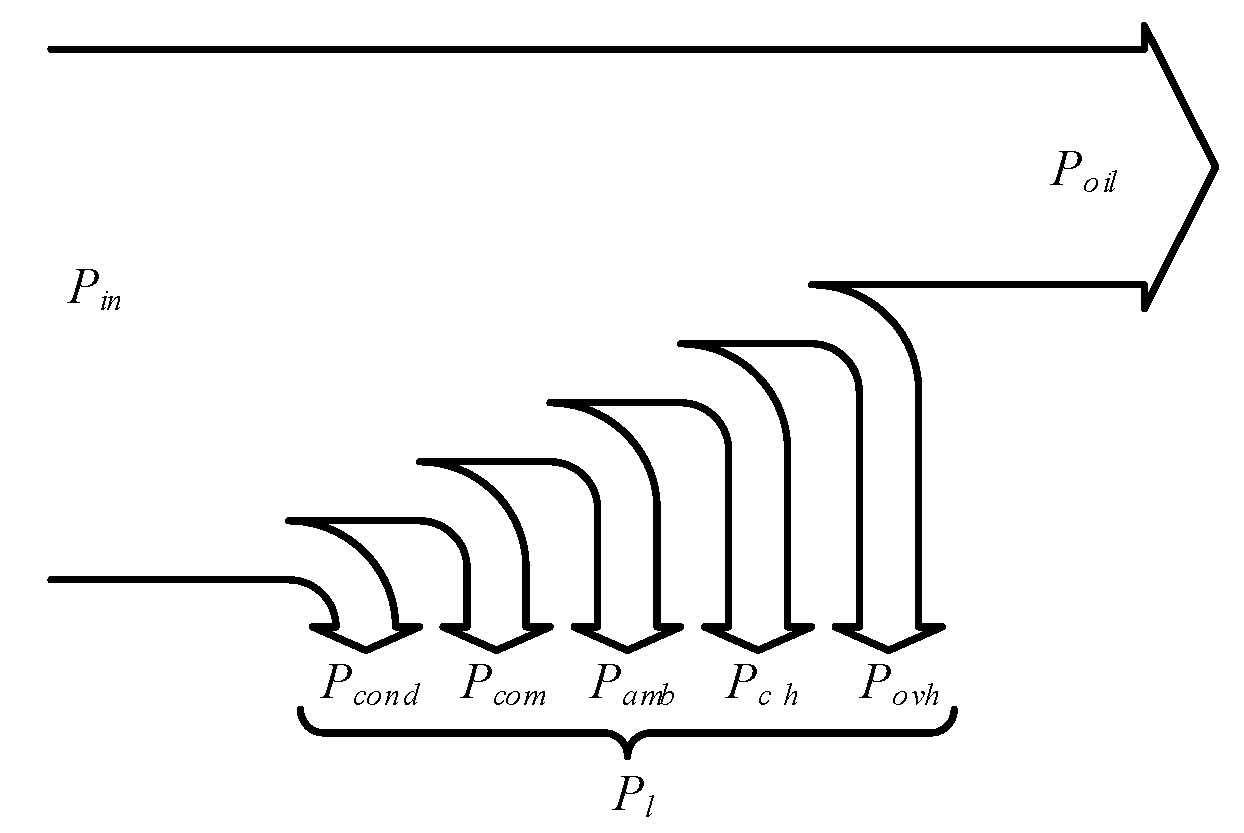
In order to propose techniques to increase efficiency, the energy flow in the preheating mode should be analyzed. The flow diagram, which includes the most significant power losses, is demonstrated in Figure 5. The input power consumed during preheating is denoted as Pin, whilst the useful power, spent to heat oil to the required temperature, is denoted as Poil. The total power loss is denoted as Pl and includes five main components: Pcond—conduction loss, which occurs in all conductors, except motor windings; Pcom—commutation loss, which occurs in power switches during their turning on and off; Pamb—power dissipation to ambient, which comes from all heat-transferring parts; Pc h—power used to heat the compressor parts, except oil; Povh—power required to overheat some volumes of oil due to uneven heating.
The preheating efficiency can be evaluated as
η h = P o i l P i n = P o i l P o i l + P l P o i l P o i l + P c o m + P c o n d + P c h + P a m b + P o v h .
In this expression, Poil can be found as
P o i l = Q o i l t h = c o i l m o i l T 2 T 1 t h ,
where Qoil is the energy required to heat the oil; th is the heating time; coil is the heat capacity; moil is the oil mass; and T1 and T2 are the initial and target temperatures of the oil.
One of the most important parameters of the preheating process is the maximum heating time, th max, which is defined as the time required to heat the lubricant from the compressor’s minimum operating temperatures to the minimum starting temperatures. For the ideal heating process, where all supplied power is used only for oil warming without any power dissipation, it can be calculated as
t h m a x i d e a l = c o i l m o i l T s m i n T a m i n P h ,
where Ph is the heating power (preheater power or power dissipated in the motor), and Ta min and Ts min are the minimum ambient and starting operating temperatures.
However, real heating processes are more complicated, with numerous parameters affecting the result. Therefore, it is almost impossible to provide the exact formulae for the calculation of the maximum heating time. Manufacturers typically provide simplified expressions for the upper estimates of th max, which is obtained empirically for each compressor in series. The typical values of th max for internal preheaters are 1.05~1.1 of th  max ideal; 1.2~1.4 of th max ideal for external preheaters; and 3.0~7.0 of th max ideal for motors, which are used as preheaters.
As can be clearly seen, the preheating process is significantly longer when the motor is used as a preheater, which is usually inconvenient for customers. In order to accelerate this, heating power is increased via the injection of the maximum motor current, which shortens the preheating time to half of the previous preheating time. However, it is still significantly longer compared to conventional preheaters and requires improvement.

3. Proposed Improvements

This chapter proposes several improvements to the compressor preheating technique, which uses a motor as a preheater. They aim to improve efficiency, increase customer comfort by reducing preheating time, and enhance the lifespan of the compressor motor drive. Furthermore, the improved efficiency and the enhanced lifespan, which decrease the demand for similar devices, reduce the carbon footprint.

3.1. Optimization Directions

After analysis of all power loss components, it can be concluded that the most significant improvements can be made to commutation loss Pcom by decreasing the commutation frequency and power dissipation to ambient Pamb by decreasing the heating time.
Preheating techniques, which use the motor as a heater and inject DC current into motor windings, adapt Joule loss for heating. It seems that the commutation frequency of inverter switches can be easily decreased, thus decreasing power loss and increasing efficiency. However, a change in the switching frequency significantly impacts the ripples of the injected current. When the commutation periods are increased, the amplitudes of ripples rise, resulting in increased acoustic noise, which irritates customers. Therefore, when varying the modulation frequency, acoustic pollution has to be analyzed as well.
The maximum power transferred to the compressor is limited by the rated motor current and maximum stator resistance. As a result, the heating time is difficult to reduce, which irritates customers and increases power dissipation to ambient conditions. Therefore, any improvements in this direction may improve and optimize two parameters simultaneously: they improve efficiency and make the appliance more attractive to users, thus increasing its competitiveness.
To increase the lifespan of the motor drive, a method for evenly distributing the load across all phases should be developed. Even load heats all switches and materials equally, which decreases thermal stress and prevents the occurrence of microcracks.

3.2. Decrease in Preheating Time

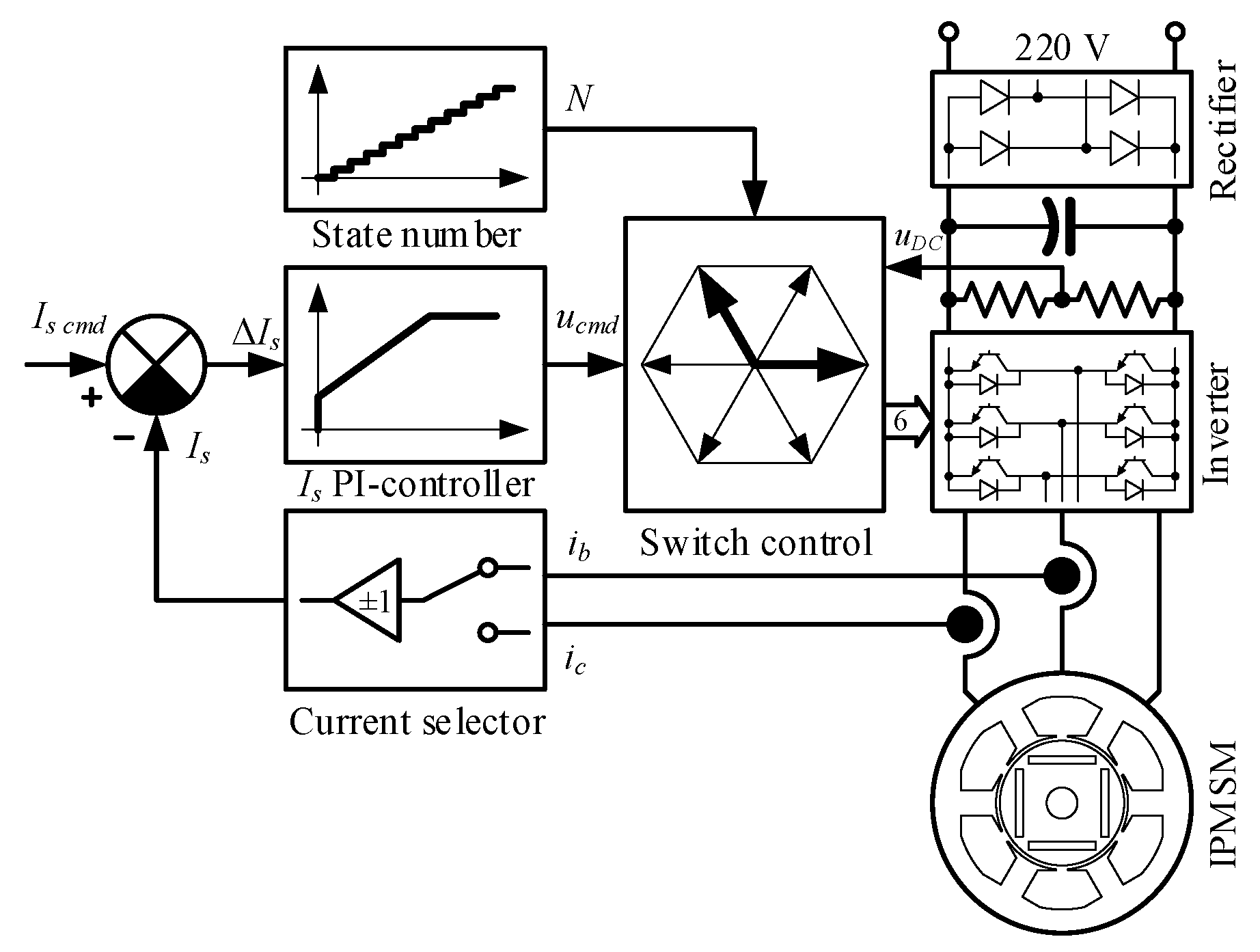
Several simultaneous improvements in preheating can be achieved by reducing preheating time. This reduces power dissipation, making the device more comfortable to use and more attractive to customers. This time can be decreased either by modification of the heat transfer path or by increasing the transferred power. The first approach requires redesign of the compressor; therefore, it is not applicable. However, the second approach is promising for investigation. The transferred power is limited by the equivalent resistance and rated current of the motor. In order to increase resistance, two-phase commutation is proposed, as depicted in Figure 4b. At the same time, conventional FOC schemes are not capable of such commutations; therefore, this paper proposes simple modifications to motor control software, which can implement the required connections.
This control scheme is demonstrated in Figure 6. As can be clearly seen, the proposed method is significantly simpler than the considered FOC: it contains one control loop, whereas the FOC uses three, which require personal tuning. Furthermore, the proposed control scheme is dedicated to static operation only; therefore, it does not require implementation and tuning of any phase transformations and dynamic models. As a result, it can be easily implemented in the same MCU.
The SVPWM block is substituted with a switch control block, which performs two-phase commutations of inverter switches. There are six possible combinations of switches across the different phases that can be implemented. The current is controlled by modulating the applied voltage with one of two switches operating in PWM mode while another transistor is turned on. The active switch, which operates in PWM mode, can be selected as top or bottom; therefore, there are only twelve possible combinations. The active combination is commanded by the “State number” block using one of the criteria considered below. The PI controller is similar to the controller used in the FOC; therefore, its implementation does not require additional resources. Moreover, considering that the control object is the same and its parameters are unchanged, the current controller gains should be the same as the gains of the d-current controller in FOC. Therefore, tuning of the proposed scheme is quite simple.
Another minor modification relates to the sensing of motor currents. In order to exclude the impact of measured current in the disconnected phase on the resulting precision, the current processing algorithm is simplified to a selector, which chooses current from the proper shunt and defines its polarity depending on the active combination of switches.
One more improvement that can increase the transferred power is an increase in the injected current. As mentioned, the motor current is limited to the rated value, which is defined by motor designers considering steady-state operation. At the same time, the motor current can be higher, provided it does not overheat the motor and does not demagnetize the rotor’s magnets. Therefore, this study proposes the injection of maximum inverter current, which is defined by the limitations of inverter switches. It should be noted that the injected power is proportional to the squared current; therefore, even a minor increase in the injected current results in a significant increase in the transferred power. Simultaneously, in order to increase motor current unproblematically, the proposed value of the injected current should be approved by motor designers. However, the overwhelming majority of IPMSMs can accept injected current at 200% of the rated current without demagnetization; therefore, only the winding temperature should be controlled. For this purpose, in the experimental section, a temperature increase test is conducted, and winding temperature is monitored during preheating.

3.3. Optimization of Modulation Frequency

As mentioned above, one prospective approach to increasing the efficiency of the preheating mode is to reduce switching losses. This can be achieved by decreasing the number of commutating switches and decreasing their commutation frequency. The number of commutating switches used for the injection of DC current can be decreased to one; however, this requires the use of direct switch control. Simultaneously, it can be easily implemented using the modified control scheme proposed in Figure 6. However, a decrease in the commutation frequency increases current ripples, which create acoustic noise. This noise is not audible when the compressor is operating; however, during preheating, the compressor is stopped, and noise can be heard. Therefore, modification of the modulation frequency is a tradeoff between efficiency and customer comfort.
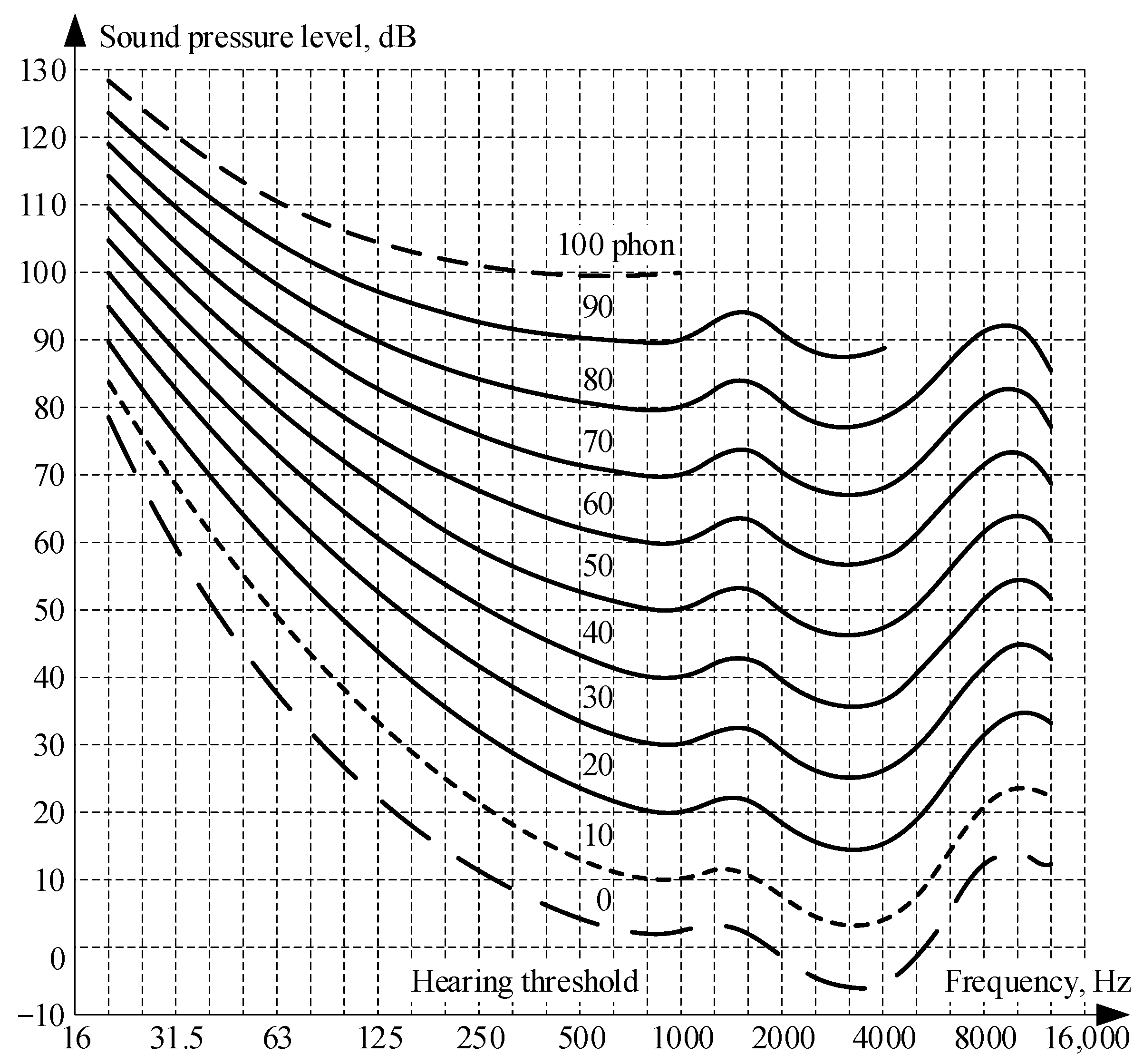
Considering that the evaluation of noise pollution and comfort depends on the human ear, it is worth analyzing its specifics. The human ear demonstrates non-linear characteristics, whereby signal amplification depends on frequency. Therefore, customers are more sensitive to audible noise at some frequencies and less sensitive to noise of the same intensity but radiated at different frequencies. The characteristics of the human ear are specified in the standard ISO 226:2003 [86], which defines equal loudness contours. Each contour, demonstrated in Figure 7, specifies the average dependency of air pressure on its frequency, which is treated by people as having the same intensity. It can be clearly seen that these mentioned contours have several maxima, where the human ear is less sensitive, and that at frequencies over 15 kHz, the noise is almost inaudible.
The first local maximum is located at 1.5 kHz and has a narrow bandwidth. The second maximum is located at 10 kHz and has a wider bandwidth. Therefore, the most promising modulation frequencies for DC current injection are 1.5, 8, 10, 12, 15, and 20 kHz. For comparative analysis, two more frequencies, 4 and 6 kHz, were added. However, those frequencies belong to the frequency range where the human ear is the most sensitive. All these frequencies have to be evaluated in a hearing test involving people, and the lowest that satisfies the focus group should be selected.

3.4. Enhancing the Lifespan

In order to increase the lifespan of the compressor motor drive, the load to its phases should be equal; therefore, thermal processes in all phases should be similar. Furthermore, even distribution of the load decreases maximum temperatures in the previously overloaded phases, thus reducing thermal and mechanical stresses.
In order to make the load phase even, it is proposed to change the active state of the inverter after every operation during tst time, where tst is selected in the experiments after definition of the preheating time th. If the following active states correspond to the next voltage vectors, the rotor will rotate at 60 electrical degrees, and total rotation during the preheating process will be 1~3 mechanical revolutions. Considering that the load is insignificant, this rotation is acceptable, even with cold lubricant.
It is explained above that the inverter has 12 active states; therefore, the time of each active state should be selected as
t s t = t h 12 k , k = 1 , 2 . .   .
It is recommended that the integer number k is selected to provide tst in the range of 8–15 s, which results in relatively even heating of all inverter switches. The time of each active state tst mainly depends on the time constants of heating transients and heating power, which define the temperature difference between the hottest and coldest points of the device. The recommended range was selected in experiments on temperature increases by controlling the temperature difference to within the desired range. It should be noted that the limits of the operational period tst may vary depending on the system. However, the main criterion in its definition is the temperature difference, which determines the device’s stress.

4. Materials and Methods

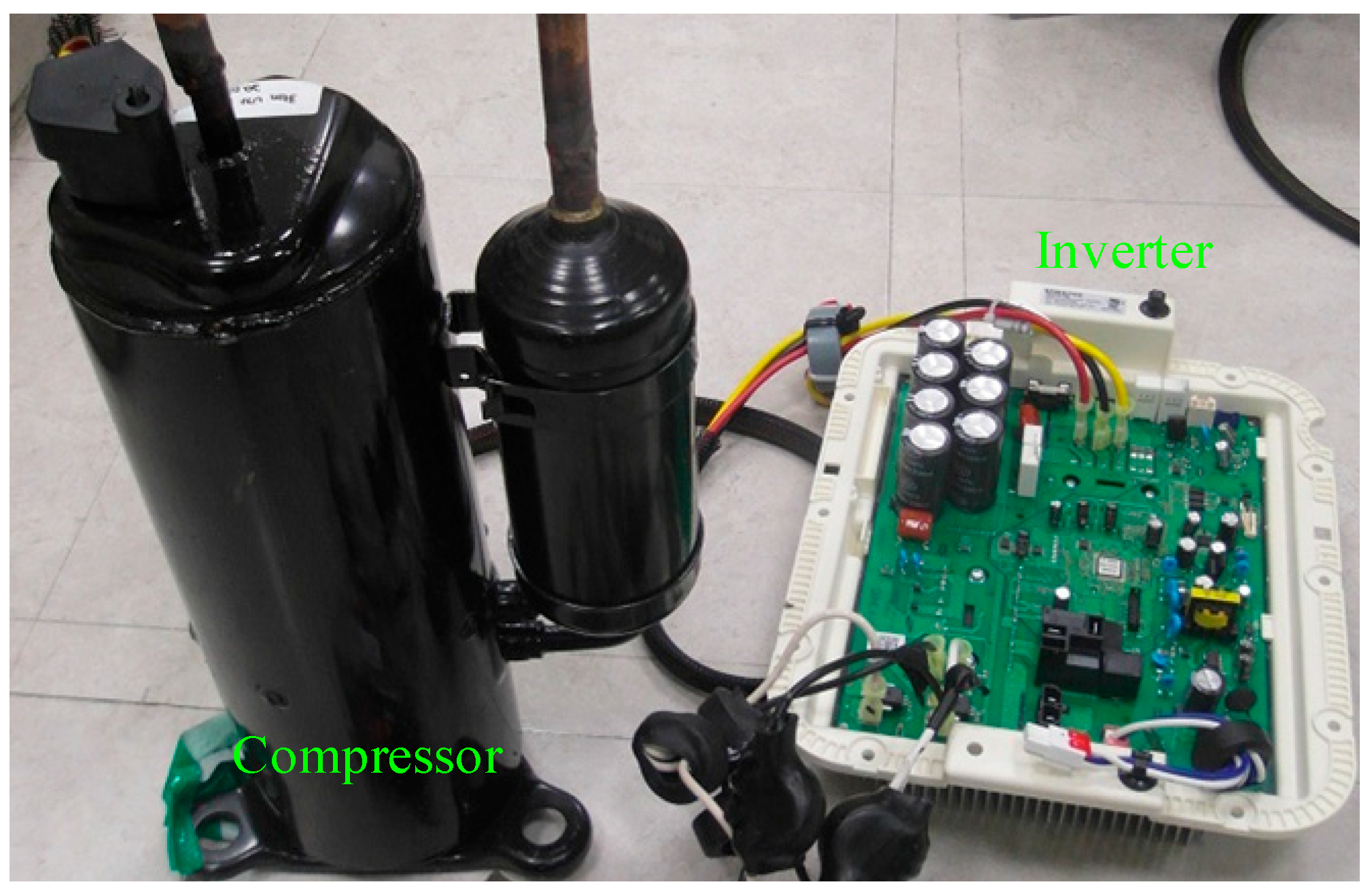
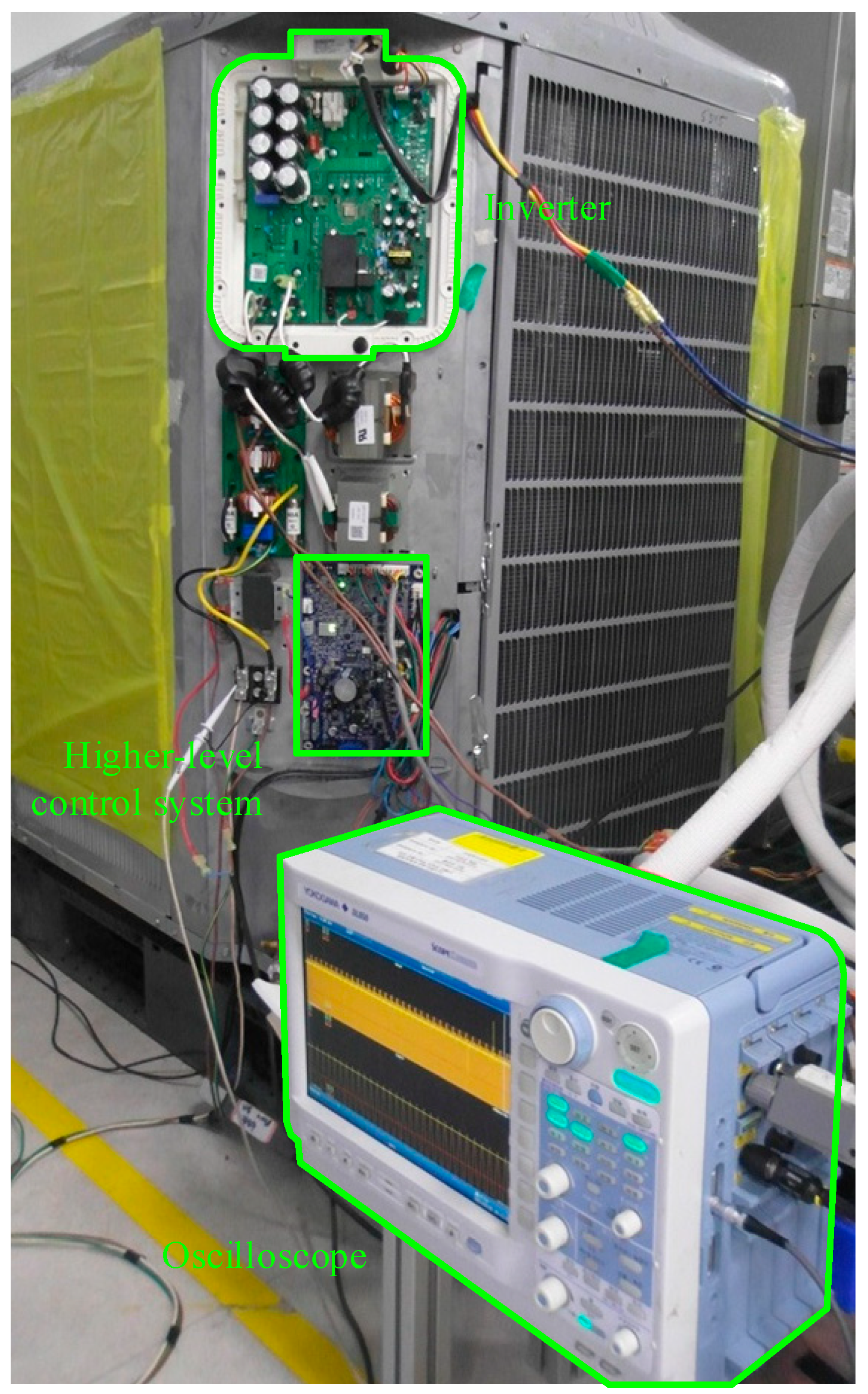
All test units used in the experimental verification of the proposed techniques are commercial devices currently produced for various markets. Figure 8 demonstrates the test compressor and inverter detached from the outdoor units for evaluation of preheating. At the same time, Figure 9 illustrates an assembled outdoor unit with the compressor inside, which was used in acoustic tests. In these tests, the cooling fan was turned off because, unlike the main operational mode, heat dissipation during preheating is undesired. Moreover, no other additional devices were active during preheating. Simultaneously, acoustic tests were performed with all aircon devices assembled and connected inside the outdoor unit. This condition is essential because mechanical connections significantly impact resonant frequencies and the acoustic profile of the whole unit.
It should be emphasized that the main purpose of the acoustic test was to define customer comfort. In other words, how much the modulation frequency can be decreased without irritating people. Therefore, personal impressions are more significant than the air pressure. As a result, no acoustic measurement equipment was used in this test. At the same time, significant attention was paid to the composition of the focus group, which included people of various ages with equal diversity in sex.
The compressor used in these experiments is a scroll-type device, with parameters shown in Table 1.
The motor used to rotate the compressor is a representative of a series of motors specifically designed for operation with scroll compressors. It is an IPMSM machine, which was optimized using recommendations provided in [87,88,89], focusing on an increase in efficiency in order to decrease CO2 emissions [90]. The key motor parameters are provided in Table 2.
The inverter used in the experimental verification was also a commercial device developed for sensorless operation of compressor applications, which is a must for most [91]. It has a topology conventional for low-cost applications, which is demonstrated in Figure 2. The inverter is intended for operation in control structures, typical for air conditioner applications [92]. It controls the compressor motor using commands obtained from the high-level control system. Communication is performed via an RS-485 interface, which provides the required communication rate and immunity to electromagnetic noise. These devices implement the MODBUS protocol, which provides protection and flexibility in commands and data monitoring. In order to exclude redundant chains from the command line during experiments and directly initiate arbitrary compressor operational modes, the PC with MODBUS communicator was connected to this network and assumed control functions.
The motor drive used in the experiments involves conventional FOC, enhanced with additional algorithms, required for the efficient operation of compressor drives. This control system is demonstrated in Figure 3 and used in mass production. However, for the experiments, it was enhanced with debugging and monitoring functions.
Various protections used to prevent hazardous situations form an important part of control systems used in home appliances; therefore, the considered control system uses algorithms reported in [93,94,95], which implement all required protections in software, thus excluding external protections, such as relays or breakers. The control code is optimized for execution on low-cost microcontrollers by employing special coding approaches, e.g., as proposed in [96].
In order to perform temperature-increase tests, the climate chamber was used. It is capable of controlling the temperature inside it from −50 to 80 °C with a precision of ±0.5 °C. In order to digitize current and voltage signals, a Yokogawa DL-850 oscilloscope (Yokogawa, Tokyo, Japan) was used. It can save pictures and raw data as well as perform fast Fourier transformation, which makes it ideal for multidisciplinary research. All power data, including efficiency, were evaluated using a Yokogawa WT1800 power analyzer (Yokogawa, Tokyo, Japan). The temperature was measured by means of thermocouples connected to an FX1000 data recorder (Yokogawa, Tokyo, Japan).
According to the device specification, the measurement error of the oil temperature was 0.5 °C, whilst the error of power and energy measurements was 0.1%. The preheating time was evaluated using temperature data and defined as the time required for heating to 5 °C. The sampling time for temperature data was 0.25 s; therefore, the measurement uncertainty of the time measurements was equal to two sampling intervals: 0.5°s. In the experimental results, this value was used to calculate measurement uncertainties of time-related values.
The preheating efficiency in the experiments was evaluated as
η h = E o i l E i n ,
where Eoil and Ein are the energy required to heat the oil in the temperature-increase test and consumed energy, respectively. The first parameter was evaluated by compressor designers as 52.87 ± 0.08 kJ, whilst the second was measured by a power meter. Therefore, the efficiency evaluation error is
Δ η h = Δ E o i l E i n 2 + E o i l Δ E i n E i n 2 2 ,
where ΔEoil and ΔEin are the evaluation errors of the corresponding energies.
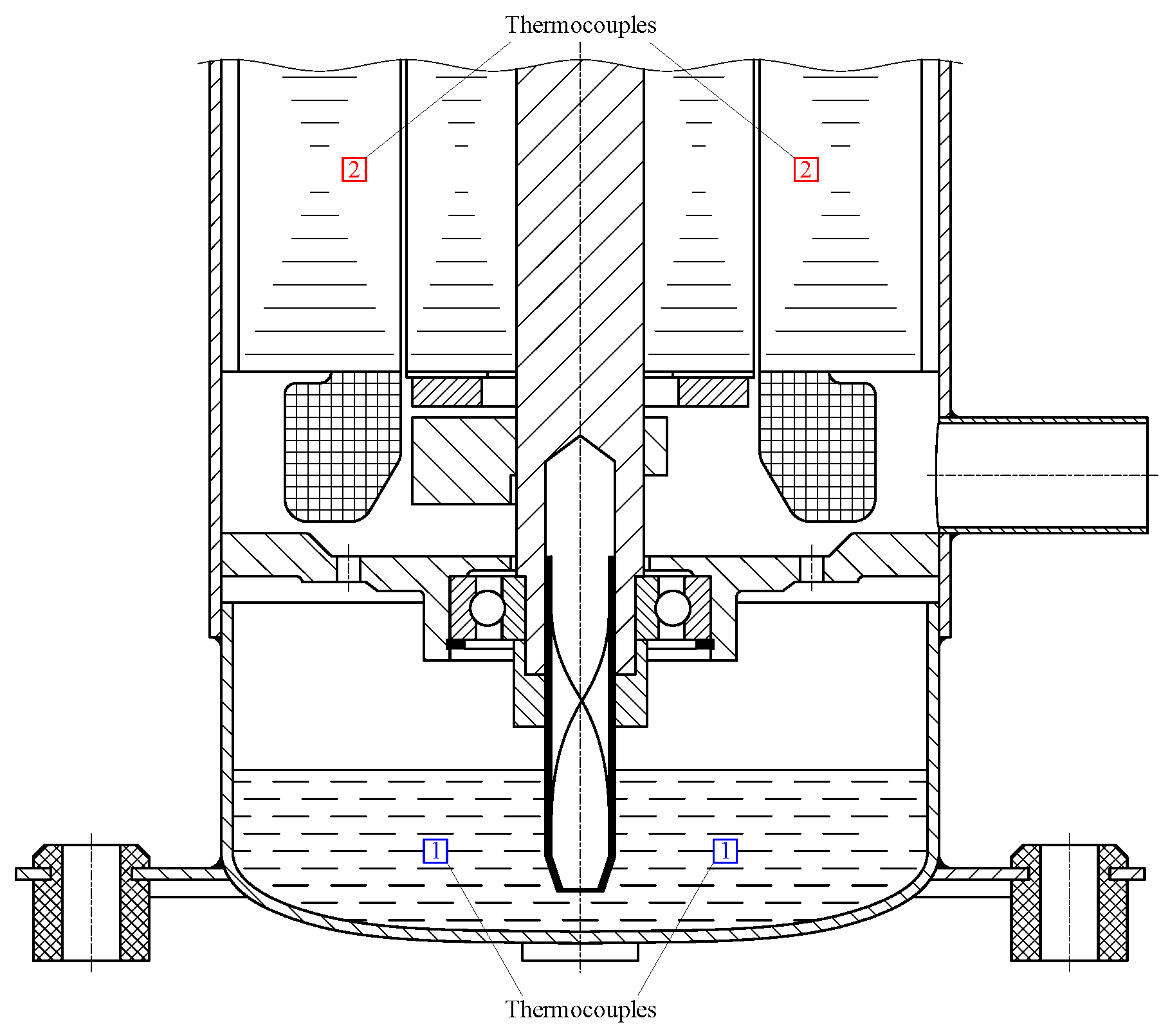
In order to perform temperature-increase tests, four thermocouples were mounted inside the compressor, as demonstrated in Figure 10. Two of them were dedicated to the evaluation of oil temperature and mounted at point #1, the coldest area in the lubricant. They were located at the same distance from the central axis of the compressor and used to reduce measurement errors. The temperature information obtained from them was averaged and used as the oil temperature in the following experiments. Two more thermocouples were mounted at point #2, located in the stator winding at the central cross-section. These thermocouples are used to evaluate the maximum temperature in the motor and verify that current injection would not damage insulation and plastic parts. Both thermocouples measured the temperature of phase A. However, they were located at opposite ends. Their temperatures were also averaged and used as motor winding temperatures in the following experiments.
In order to guarantee that all parts inside the compressor were properly cooled and at ambient temperature, the compressor was placed in the climate room at a temperature of −20 °C two hours prior to the temperature-increase test.

5. Experimental Results

This section demonstrates the results of the evaluation of the conventional preheating algorithm before optimization. After, the proposed improvements were implemented, and compressor operation in preheating mode was evaluated again after each improvement.

5.1. Evaluation of Preheating Before Optimization

At the beginning of the experiment, conventional preheating was evaluated. In this mode, the standard control software, as shown in Figure 3, was used, with the speed loop deactivated, direct current set to equal the motor-rated current (18 A), and quadrature current set to zero. The modulation frequency used for preheating was not modified and was the same as for FOC: 12.5 kHz.
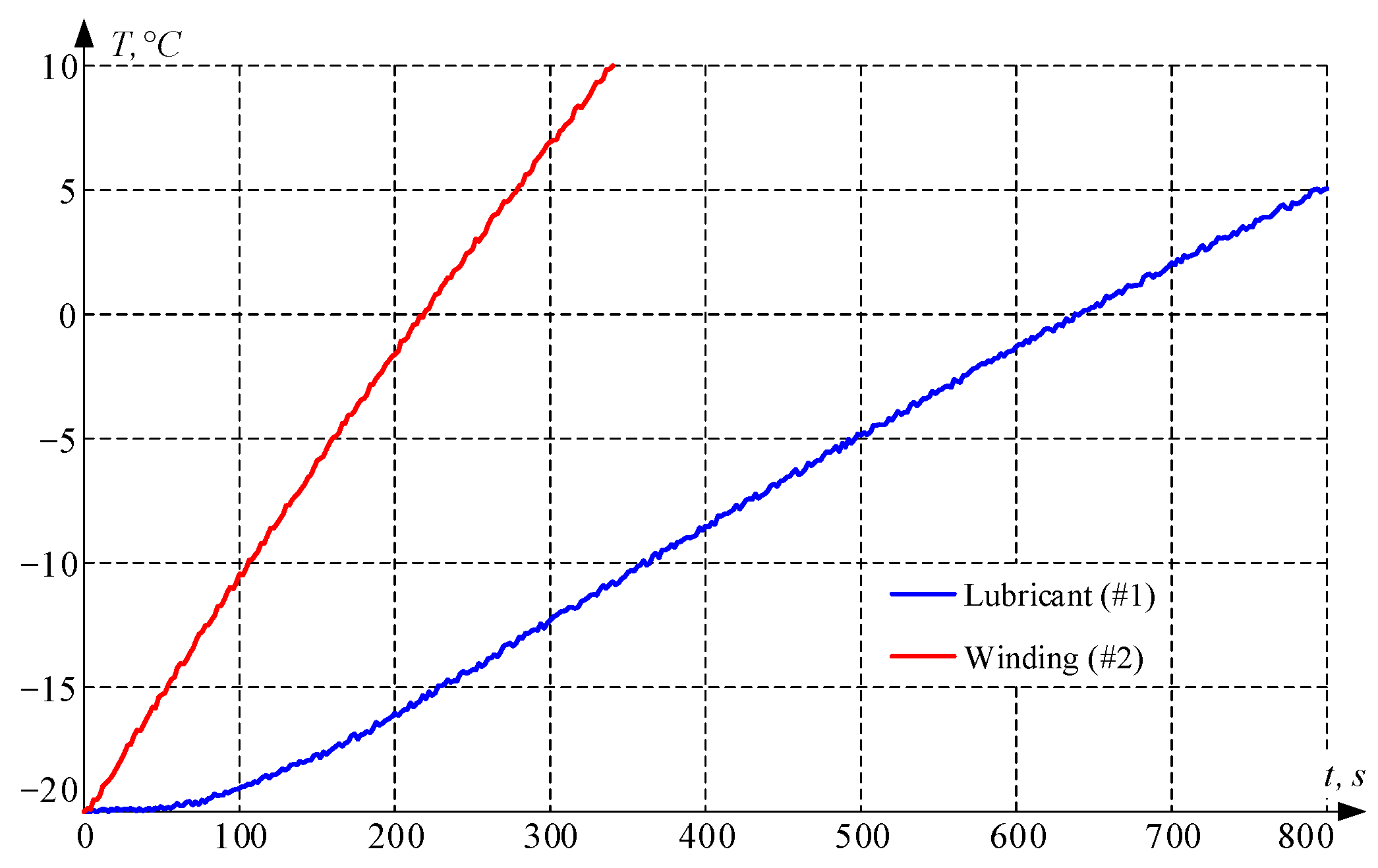
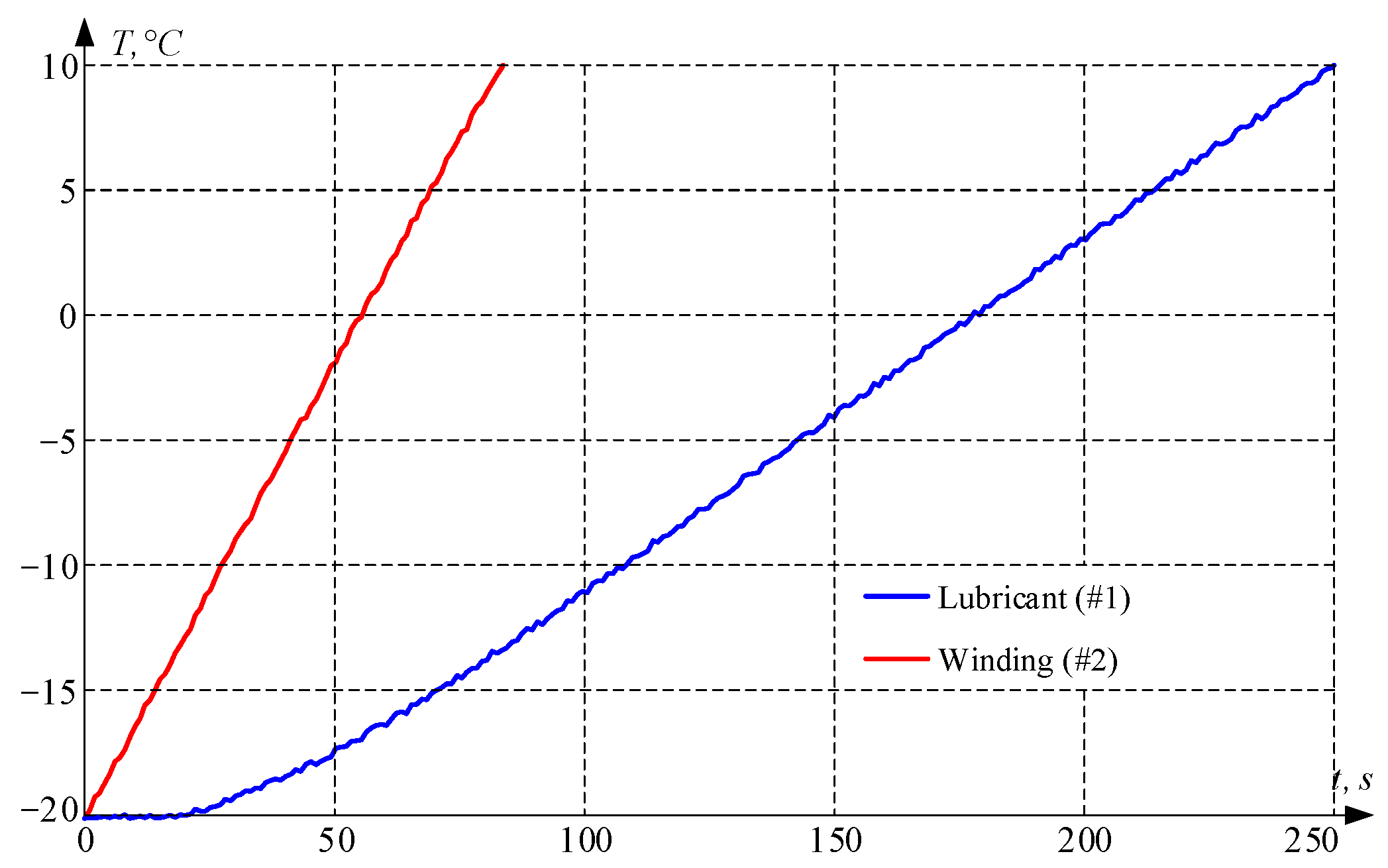
The temperature-increase test is demonstrated in Figure 11, where the blue line illustrates the lubricant temperature and the red line shows the temperature of the motor windings. The maximum preheating time required to heat the oil from −20 °C to +5 °C was 792 s. During this process, the winding temperature rose to 40.1 °C. During the preheating process, the compressor motor drive consumed 204.9 kJ, resulting in an operational efficiency of 25.80 ± 0.07%.

5.2. Optimization of Preheating Time

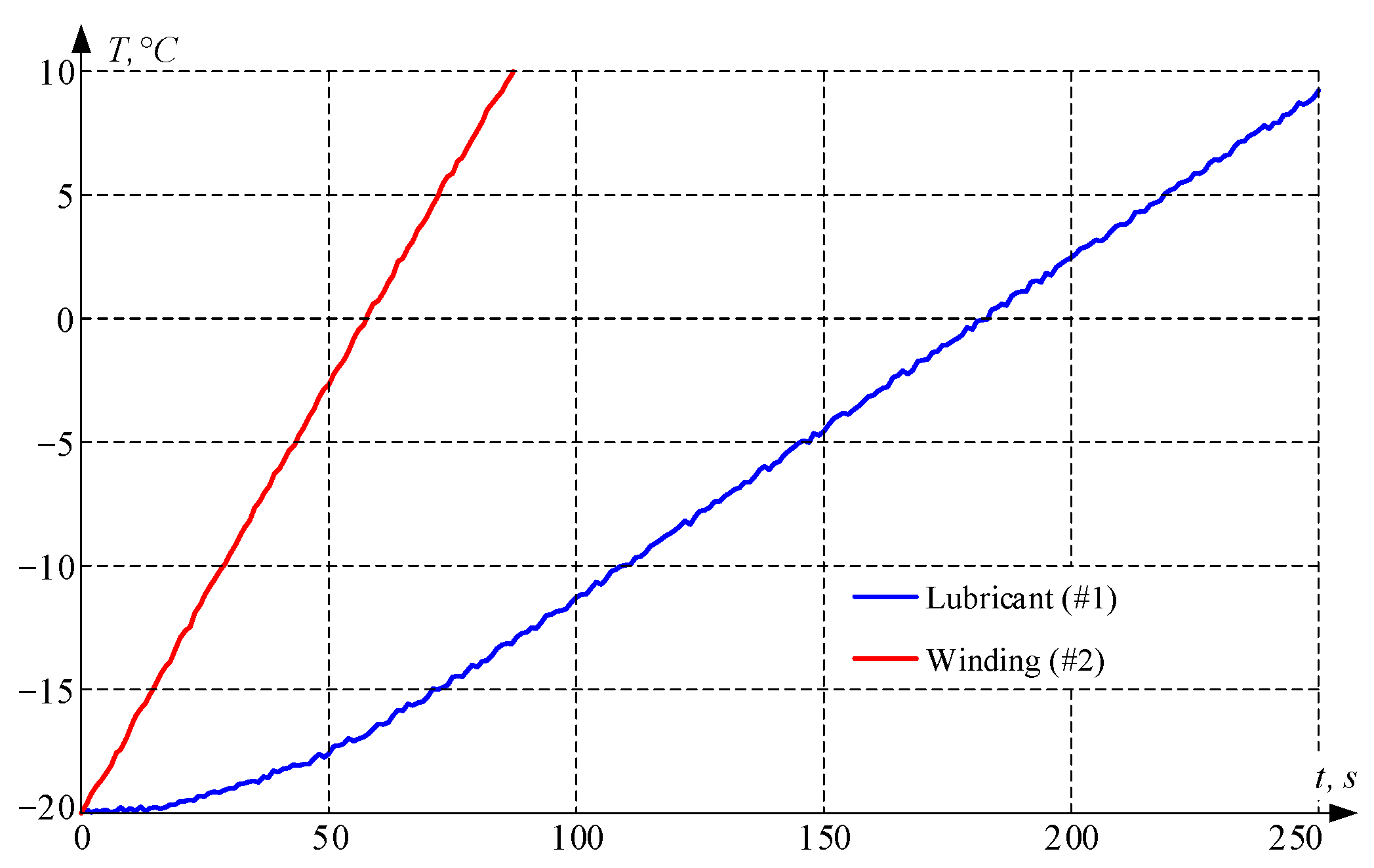
In this experiment, the control scheme was modified as proposed in Figure 6, enabling two-phase commutation of motor phases. The injected current was increased to the maximum inverter current (30 A), whilst the modulation frequency was unchanged (12.5 kHz). At the same time, two transistors in active phases operated in PWM mode. After these modifications were made, the temperature-increase test was repeated. The results are demonstrated in Figure 12, where the blue line illustrates the lubricant temperature, and the red line shows the temperature of the motor windings. The maximum preheating time required to heat the oil from −20 °C to +5 °C was 213 s; thus, it was decreased 3.7 times, with the measurement uncertainty below 1.1%. During this process, the winding temperature increased to 54.2 °C, which is significantly lower than the maximum allowed temperature. During the preheating process, the compressor motor drive consumed 196.2 kJ, resulting in an operational efficiency of 26.95 ± 0.07%.

5.3. Optimization of Modulation Frequency

In the next experiment, several modifications aimed at reducing commutation loss were evaluated. Initially, the control scheme was modified to operate only one transistor in PWM mode, which decreases switching loss. After, the acoustic performance of the compressor drive was evaluated at previously selected frequencies: 1.5, 4, 6, 8, 10, 12, 15, and 20 kHz. For this evaluation, a small focus group of 10 people, consisting of an equal number of male and female evaluators, was used. Participants stood at a distance of 2 m from the assembled outdoor aircon unit with the target compressor inside, while the compressor operated in the preheating mode at various frequencies. Their impressions were evaluated as follows: very annoying, annoying, audible, and not audible. The results of their evaluations are demonstrated in Table 3. It can be clearly seen that the minimum PWM frequency, which was not evaluated as “annoying” by at least one evaluator, is 8 kHz. Therefore, this frequency is considered balanced between efficiency and comfort, and it will be used as the optimized value.
After selecting a new modulation frequency for the preheating mode, the temperature-increase test was repeated. The injected current was set to the maximum inverter current (30 A), and the modulation frequency was modified to 8 kHz. The results of the temperature-increase tests are demonstrated in Figure 13, where the blue line illustrates lubricant temperature, and the red line shows the temperature of the motor windings. The maximum preheating time required to heat the oil from −20 °C to +5°C was 220 s; thus, it was decreased 3.6 times, with the measurement uncertainty below 1.1%. During this process, the winding temperature increased to 52.7 °C, which is significantly lower than the maximum allowed temperature. During the preheating process, the compressor motor drive consumed 176.5 kJ, resulting in an operational efficiency of 29.95 ± 0.08%. Therefore, the efficiency of preheating was improved to 4.15 ± 0.11%.

5.4. Improvement in Load Distribution

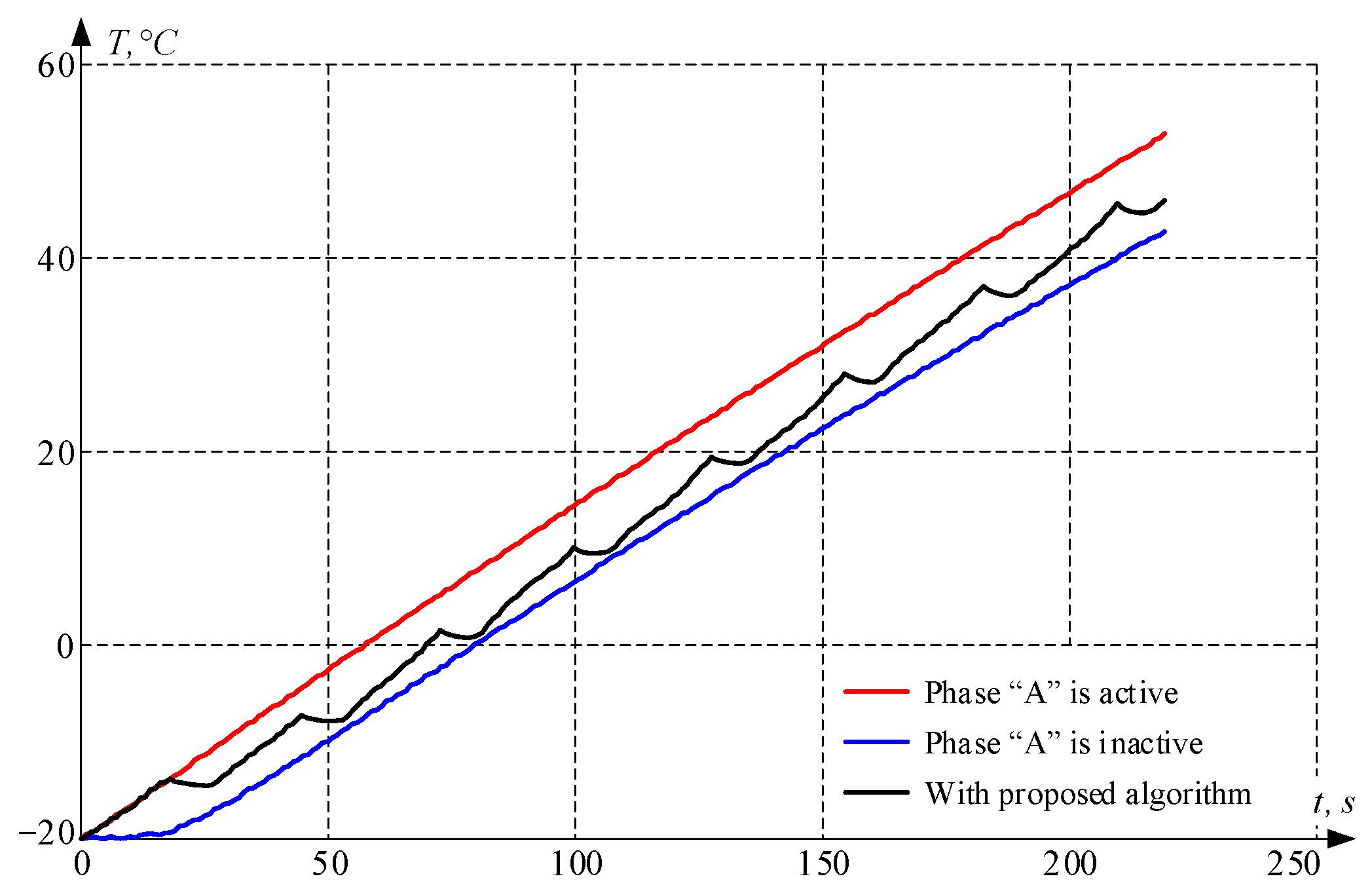
In order to load motor and inverter phases evenly, it was proposed to change the active switches after a period of time. According to Equation (4), the operation period for each phase combination was set to 9.17 s, resulting in two rounds of twelve inverter states. Considering that the motor rotates through 1 electrical revolution every six states, during the preheating process, it will rotate through 4 electrical revolutions, which corresponds to 1.33 mechanical revolutions. This movement is negligible and does not significantly impact the compressor parts. At the same time, the proposed algorithm decreases the temperature gradient between phases and reduces the maximum temperature, which decreases the temperature and mechanical stresses. In order to evaluate the temperature distributions, several temperature rising tests were carried out, in which the preheating algorithm was configured according to propositions. The results are demonstrated in Figure 14. In the first test, the preheating involved phase “A”, and its temperature is illustrated with a red line. In the second test, phase “A” was not active and was heated by other motor phases. Its temperature is indicated with a blue line. In the third test, the proposed technique was involved, and the temperature of phase “A” for this case is demonstrated by a black line. The proposed technique switches the inverter’s active state after an operation period of 9.17 s, thus executing 24 states over 220 s. As a result, each phase is active for 18.34 s and inactive for 9.17 s. When the phase is active, its temperature increases; when it becomes inactive, its temperature decreases. However, after several seconds of inactivity, heat from the neighboring active phases reaches the inactive phase, and the temperature of the inactive phase starts to increase. It can be clearly seen that the conventional algorithm results in a temperature gradient of about 10 °C, whilst the proposed technique decreases it to 3 °C.
The estimation of the increase in lifespan is quite difficult and depends on many factors, such as mechanical design, analysis of thermal behavior of various materials and joints, composition of the averaged compressor operational cycle, environmental conditions, frequency of operation in preheating modes, etc. Therefore, a detailed analysis is out of the scope of this paper. At the same time, mechanical engineers roughly evaluated this parameter. For devices operating outside and used in moderate climates, the frequency of initialization of preheating mode is about 40% annually. Using this value for analysis, as well as data on decreasing temperature differences, the mechanical engineers evaluated an increase in the average lifetime (number of cycles of operation) of 8%, with a probability of 95%.

6. Discussion

It should be noted that a minor increase in the preheating time, when the modulation frequency was changed from 12.5 to 8 kHz, is caused by a reduction in power losses in motor steel, which depends on the frequency of current ripples.
Noise pollution depends not only on the source of vibrations and their frequencies. The mechanical environment highly impacts the emitting noise; therefore, the noise test of only the compressor drive is meaningless. In order to obtain adequate results, the noise test should be carried out for the entire mechanical unit, which includes the compressor drive. In this research, an outdoor air conditioning unit was used. However, if other devices are selected for evaluation, this test should be repeated.
After analysis of noise test results, it can be concluded that the most promising frequencies for evaluation are those defined using equal loudness contours: 8, 10, 12, and 15 kHz. Frequencies over 15 kHz are almost inaudible due to the specifics of the human ear; therefore, they provide perfect comfort. However, they increase switching losses. Frequencies below 6 kHz cause significant current ripples and belong to the bandwidth where the human ear is more sensitive.
Another promising direction for further optimization is increasing the injected current. In order to accomplish this, several verifications must be conducted. Motor designers have to check the demagnetization current and approve an increase in the injected current. During injection, the winding temperature has to be evaluated and verified to be below the acceptable level. Manufacturers of power switches need to estimate the junction temperature at higher current levels and verify that it remains at a safe level. Considering that the preheating mode is activated at low temperatures, usually below 0 °C, the thermal management of power semiconductors may allow for an increase in injected current over the rated value.
This research focuses on decreasing commutation loss and dissipation to ambient conditions. However, the main power losses stem from the necessity to heat the compressor parts along the heat transfer path. The most significant of these are motor and compressor shells. These power losses can be decreased only by modifying the compressor and motor design, e.g., by lightening some parts and shortening heating paths. Another excellent direction is a decrease in power loss, which is required in order to prevent overheating some volumes of the oil. For this purpose, lubricant heating should be more even, which can be achieved via oil mixing or in various other ways.
The proposed method was developed for a three-phase, star-connected IPMSM. However, it can be easily extended to machines of other types, machines with different numbers of phases, and their connections.

7. Conclusions

This study proposes several optimizations for the compressor preheating technique, which uses motor phases as a heater. The conventional approach demonstrates low efficiency and a long heating time, which irritates customers. Furthermore, the uneven load of motor and inverter phases, inherent to the conventional method, decreases the lifespan of compressor motor drives, thus increasing demand. The proposed innovations increase efficiency by 4.15% and reduce the preheating time by 3.6 times. Furthermore, the developed algorithm used to ensure even load distribution among motor drive phases reduces thermal and mechanical stresses, thereby increasing the lifetime. All these improvements result in a reduction in carbon footprint and an increase in customer comfort. In turn, it significantly improves the appliance’s competitiveness in the marketplace and provides profitable environments for manufacturers.

Funding

This research and APC were funded by Anton Dianov.

Informed Consent Statement

Not applicable.

Data Availability Statement

Data are contained within the article.

Conflicts of Interest

The author declares no conflicts of interest.

References

  1. Setz, B.; Graef, S.; Ivanova, D.; Tiessen, A.; Aiello, M. A comparison of open-source home automation systems. IEEE Access 2021, 9, 167332–167352. [Google Scholar] [CrossRef]
  2. Demidova, G.; Usoltchev, A.; Poliakov, N.; Lukichev, D.; Lukin, A.; Anuchin, A. Optimal Selection of High-Frequency Solid-State Transformer Topology for Dual Active Bridge Applications. In Proceedings of the IEEE 10th International Power Electronics and Motion Control Conference, Chengdu, China, 17–20 May 2024; pp. 3851–3856. [Google Scholar]
  3. Household Appliances—Worldwide. Available online: https://www.statista.com/outlook/cmo/household-appliances/worldwide (accessed on 9 December 2025).
  4. Garrido-Zafra, J.; Gil-de-Castro, A.R.; Fernandez, R.S.; Linan-Reyes, M.; Garcia-Torres, F.; Moreno-Munoz, A. IoT cloud-based power quality extended functionality for grid-interactive appliance controllers. IEEE Trans. Ind. Appl. 2022, 58, 3909–3921. [Google Scholar] [CrossRef]
  5. Kim, T.; Lee, K.-W.; Kwak, S. Dual motor drive for HVAC applications based on a multifunctional bidirectional energy conversion system. IEEE Trans. Energy Convers. 2015, 30, 1556–1564. [Google Scholar] [CrossRef]
  6. Sutar, P.; Sarkar, S.A.; Tagare, A.; Pawar, A. A Review on IoT-Enabled Smart Homes Using AI. In Proceedings of the 15th International Conference on Computing, Communication and Networking Technologies, Himachal Pradesh, India, 24–28 June 2024; pp. 1–6. [Google Scholar]
  7. Plumed, E.; Lope, I.; Acero, J.; Burdío, J.M. Domestic induction heating system with standard primary inductor for reduced-size and high distance cookware. IEEE Trans. Ind. Appl. 2022, 58, 7562–7571. [Google Scholar] [CrossRef]
  8. Chen, M.-Y. Establishing a cybersecurity home monitoring system for the elderly. IEEE Trans. Ind. Inform. 2022, 18, 4838–4845. [Google Scholar] [CrossRef]
  9. Kwon, Y.D.; Freijedo, F.D.; Wijekoon, T.; Liserre, M. A multiport partial power converter for smart home applications. IEEE Trans. Power Electron. 2024, 39, 8824–8833. [Google Scholar] [CrossRef]
  10. Nevoloso, C.; Foti, S.; Scaglione, G.; Di Tommaso, A.O.; De Caro, S.; Testa, A.; Miceli, R. On the Inadequacy of IEC 60034-2-3 and IEC 60034-30-2 Standards for Power Losses, Efficiency and Energy Class Evaluation in PWM Multilevel Inverter-Driven PMSM. IEEE Open J. Ind. Electron. Soc. 2025, 6, 962–981. [Google Scholar] [CrossRef]
  11. Goman, V.; Oshurbekov, S.; Kazakbaev, V.; Prakht, V.; Dmitrievskii, V. Energy Efficiency Analysis of Fixed-Speed Pump Drives with Various Types of Motors. Appl. Sci. 2019, 9, 529. [Google Scholar] [CrossRef]
  12. Yang, Y.; Sun, X.; Dianov, A.; Demidova, G.; Prakht, V.; Wang, Y.; Han, S. Model predictive torque control of six-phase switched reluctance motors based on improved voltage vector strategy. IEEE Trans. Transp. Electrif. 2025, 11, 7650–7661. [Google Scholar] [CrossRef]
  13. Dale, M.R.; Carichner, D. Motor conversion for reduced energy consumption: Compressor applications use more energy than applications with newer technologies. IEEE Ind. Appl. Mag. 2015, 21, 57–59. [Google Scholar] [CrossRef]
  14. Malinowski, J.; Hoyt, W.; Zwanziger, P.; Finley, B. Motor and drive-system efficiency regulations: Review of regulations in the United States and Europe. IEEE Ind. Appl. Mag. 2017, 23, 34–41. [Google Scholar] [CrossRef]
  15. Lee, K.-W.; Kim, D.K.; Kim, B.T.; Kwon, B.I. A Novel Starting Method of the Surface Permanent-Magnet BLDC Motors Without Position Sensor for Reciprocating Compressor. IEEE Trans. Ind. Appl. 2008, 44, 85–92. [Google Scholar] [CrossRef]
  16. Carvajal, A.; Muetze, A. A Research Overview on Household Refrigerator Hermetic Reciprocating Compressor Drives. In Proceedings of the IEEE Energy Conversion Congress and Exposition, Phoenix, AZ, USA, 20–24 October 2024; pp. 6175–6180. [Google Scholar]
  17. Dianov, A. Stoppage noise reduction of reciprocating compressors. IEEE Trans. Ind. Appl. 2021, 57, 4376–4384. [Google Scholar] [CrossRef]
  18. Chen, L.; Hui, H. Model Predictive Control-Based Active/Reactive Power Regulation of Inverter Air Conditioners for Improving Voltage Quality of Distribution Systems. IEEE Trans. Ind. Inform. 2025, 21, 922–931. [Google Scholar] [CrossRef]
  19. Huo, J.; Zhao, N.; Gao, R.; Wang, G.; Zhang, G.; Xu, D. Torque ripple compensation with anti-overvoltage for electrolytic capacitorless PMSM compressor drives. IEEE J. Emerg. Sel. Top. Power Electron. 2022, 10, 6148–6159. [Google Scholar] [CrossRef]
  20. Hui, H.; Ding, Y.; Chen, T.; Rahman, S.; Song, Y. Dynamic and stability analysis of the power system with the control loop of inverter air conditioners. IEEE Trans. Ind. Electron. 2021, 68, 2725–2736. [Google Scholar] [CrossRef]
  21. Kusche, S. Energy Optimised Control of the Dehumidification Process in HVAC Systems. In Proceedings of the 7th International Conference on Control, Decision and Information Technologies, Prague, Czech Republic, 29 June–2 July 2020; pp. 994–999. [Google Scholar]
  22. Lee, K.-W.; Park, S.; Jeong, S. A Seamless Transition Control of Sensorless PMSM Compressor Drives for Improving Efficiency Based on a Dual-Mode Operation. IEEE Trans. Power Electron. 2015, 30, 1446–1456. [Google Scholar] [CrossRef]
  23. Yang, Y.; Ding, Y.; Wang, Y.; Gong, C.; Chen, F.; Lv, L. Power Optimal Matching and Humidity Intelligent Control of Ring Main Unit Dehumidification System. In Proceedings of the IECON 2019—45th Annual Conference of the IEEE Industrial Electronics Society, Lisbon, Portugal, 14–17 October 2019; pp. 491–496. [Google Scholar]
  24. Batek, A.; Aliprantis, D. Improving Home Appliance Energy Use Scheduling: Insights from a Remodeled, Energy Efficient Home. In Proceedings of the 2016 IEEE Power & Energy Society Innovative Smart Grid Technologies Conference, Minneapolis, MN, USA, 6–9 September 2016; pp. 1–5. [Google Scholar]
  25. Guo, J.; Liu, Y.; Yang, R.; Sun, W.; Xiang, J. Ensemble difference mode decomposition based on transmission path elimination technology for rotating machinery fault diagnosis. Mech. Syst. Signal Process 2024, 212, 111330. [Google Scholar] [CrossRef]
  26. Lyu, D.; Liu, E.; Zhang, B.; Zio, E.; Yang, T.; Xiang, J. Threshold-varying assessment for prognostics and health management. IEEE Trans. Syst. Man Cybern. Syst. 2025, 55, 685–698. [Google Scholar] [CrossRef]
  27. Demidova, G.; Chen, H.; Li, Y.; Lukichev, D.; Anuchin, A. Reviewing Fault Diagnosis Methods in Electric Drives: Power Subsystem and Electrical Machine. In Proceedings of the IEEE 24th International Conference of Young Professionals in Electron Devices and Materials, Novosibirsk, Russia, 29 June–3 July 2023; pp. 1680–1688. [Google Scholar]
  28. Iqbal, M.N.; Kütt, L.; Lehtonen, M.; Millar, R.J.; Püvi, V.; Rassõlkin, A.; Demidova, G.L. Travel activity based stochastic modelling of load and charging state of electric vehicles. Sustainability 2021, 13, 1550. [Google Scholar] [CrossRef]
  29. Chen, J.; Fang, B.; Dianov, A.; Xiang, J. Numerical model-aided intelligent diagnosis method to detect faults in induction motors. IEEE Sens. J. 2025, 25, 32194–32208. [Google Scholar] [CrossRef]
  30. Bloch, H.P.; Bannister, K.E. Practical Lubrication for Industrial Facilities, Practical Lubrication for Industrial Facilities; River Publishers: New York, NY, USA, 2017. [Google Scholar]
  31. Fu, L.; Qu, M.; Ma, Z.; Xiang, J.; Tan, D.; Xu, F. Recursive variational mode transform for weak fault feature recognition in rotor-bearing systems. IEEE Sens. J. 2025, 25, 26398–26411. [Google Scholar] [CrossRef]
  32. Sundaresan, S.G. Compressor Lubrication-The Key to Performance. In Proceedings of the IOP Conference Series: Materials Science and Engineering, London, UK, 7–9 September 2015; IOP Publishing: Bristol, UK, 2015; Volume 90, p. 12001. [Google Scholar]
  33. Jastrzebski, R.P.; Kepsu, D.; Putkonen, A.; Martikainen, I.; Zhuravlev, A.; Madanzadeh, S. Competitive Technology Analysis of a Double Stage Kinetic Compressor for 0.5 MW Heat Pumps for Industrial and Residential Heating. In Proceedings of the IEEE International Electric Machines & Drives Conference, Hartford, CT, USA, 17–20 May 2021; pp. 1–7. [Google Scholar]
  34. Mistry, R.; Maynus, R. Crucial for Rotating Machines: Types and Properties of Lubricants and Proper Lubrication Methods. IEEE Ind. Appl. Mag. 2016, 22, 10–18. [Google Scholar] [CrossRef]
  35. Gokarakonda, S.; Treeck, C.; Rawal, R.; Thomas, S. Energy performance of room air-conditioners and ceiling fans in mixed-mode buildings. Energies 2023, 16, 6807. [Google Scholar] [CrossRef]
  36. Sumeru, K.; Pramudantoro, T.P.; Setyawan, A.; Muliawan, R.; Tohir, T.; Sukri, T.F. Effect of compressor-discharge-cooler heat-exchanger length using condensate water on the performance of a split-type air conditioner using R32 as working fluid. Energies 2022, 15, 8024. [Google Scholar] [CrossRef]
  37. Dianov, A.; Choi, J.Y.; Lee, K.W.; Lee, J.H. Sensorless Vector Controlled Drive for Reciprocating Compressor. In Proceedings of the IEEE Power Electronics Specialists Conference, Orlando, FL, USA, 17–21 June 2007; pp. 580–586. [Google Scholar]
  38. Mistry, R.; Maynus, R. Lubrication—Crucial for Rotating Machines. In Proceedings of the Petroleum and Chemical Industry Conference, New Orleans, LA, USA, 24–26 September 2012; pp. 1–9. [Google Scholar]
  39. Hu, Y.; Zhang, R.; Zhang, J.; Song, Q.; Chen, Q. Friction-excited oscillation of air conditioner rotary compressors: Measurements and numerical simulations. Lubricants 2022, 10, 50. [Google Scholar] [CrossRef]
  40. Zhao, M.; Pang, L.; Liu, M.; Yu, S.; Mao, X. Control strategy for helicopter thermal management system based on liquid cooling and vapor compression refrigeration. Energies 2020, 13, 2177. [Google Scholar] [CrossRef]
  41. Luo, Z.; Xiong, S.; Wen, M.; Zhao, J.; Zhang, Y. Experimental study on R290 performance of an integrated thermal management system for electric vehicle. Energies 2025, 18, 802. [Google Scholar] [CrossRef]
  42. Gajewski, J.B.; Glogowski, M.J. Additives contents in PAG and synthetic motor base oils and their effect on electrostatic phenomena in a rotating shaft-oil-lip seal system. IEEE Trans. Dielectr. Electr. Insul. 2013, 20, 1561–1566. [Google Scholar] [CrossRef]
  43. Sun, X.; Wu, M.; Lei, G.; Guo, Y.; Zhu, J. An improved model predictive current control for PMSM drives based on current track circle. IEEE Trans. Ind. Electron. 2021, 68, 3782–3793. [Google Scholar] [CrossRef]
  44. Yu, Y.; Chen, Z.; Singh Dhupia, J.; Tang, L.; Liu, Z.; Xiang, J. An enhanced partial transfer fault diagnosis network aided by dual-force boundary refinement and inverse-forward adaptive alignment. IEEE Sens. J. 2025, 25, 3821–3836. [Google Scholar] [CrossRef]
  45. Lim, J.; Yoon, M.S.; Al-Qahtani, T.; Nam, Y. Feasibility study on variable-speed air conditioner under hot climate based on real-scale experiment and energy simulation. Energies 2019, 12, 1489. [Google Scholar] [CrossRef]
  46. Dmitrievskii, V.; Prakht, V.; Kazakbaev, V.; Anuchin, A. Comparison of interior permanent magnet and synchronous homopolar motors for a mining dump truck traction drive operated in wide constant power speed range. Mathematics 2022, 10, 1581. [Google Scholar] [CrossRef]
  47. Liu, Z.; Lou, F.; Qi, X.; Shen, Y. Enhancing heating performance of low-temperature air source heat pumps using compressor casing thermal storage. Energies 2020, 13, 3269. [Google Scholar] [CrossRef]
  48. Sun, X.; Li, T.; Yao, M.; Lei, G.; Guo, Y.; Zhu, J. Improved finite-control-set model predictive control with virtual vectors for PMSHM drives. IEEE Trans. Energy Convers. 2022, 37, 1885–1894. [Google Scholar] [CrossRef]
  49. Zhang, Y.; Cai, M.; Kong, D. Overall Energy Efficiency of Lubricant-Injected Rotary Screw Compressors and Aftercoolers. In Proceedings of the Asia-Pacific Power and Energy Engineering Conference, Wuhan, China, 27–31 March 2009; pp. 1–5. [Google Scholar]
  50. Valenti, G.; Murgia, S.; Costanzo, I.; Scarnera, M.; Battistella, F. Experimental determination of the performances during the cold start-up of an air compressor unit for electric and electrified heavy-duty vehicles. Energies 2021, 14, 3664. [Google Scholar] [CrossRef]
  51. Valenti, G.; Murgia, S.; Costanzo, I.; Ravidà, A.; Piscopiello, G.P. Experimental Investigation on the Extreme Cold Start-Up of an Air Compressor for Electric Heavy Vehicles. In Proceedings of the IOP Conference Series: Materials Science and Engineering, London, UK, 9–11 September 2019; Volume 604, pp. 1–7. [Google Scholar]
  52. Lu, D.; Warsinger, D. Energy savings of retrofitting residential buildings with variable air volume systems across different climates. J. Build. Eng. 2020, 30, 101223. [Google Scholar] [CrossRef]
  53. Liu, W.; Zhou, H.; Long, T.; Xu, Y.; Bi, R.; Hu, B.; Zhang, G.; Wang, G. A Novel Modulation Algorithm for Efficient Heating of Air Conditioning Compressor. In Proceedings of the IEEE 7th International Electrical and Energy Conference, Harbin, China, 10–12 May 2024; pp. 3451–3456. [Google Scholar]
  54. Amirpour, S.; Soltanipour, S.; Thiringer, T.; Katta, P. Adaptive Determination of Optimum Switching Frequency in SiC-PWM-Based Motor Drives: A Speed-Dependent Core Loss Correction Approach. IEEE Open J. Ind. Electron. Soc. 2025, 6, 883–897. [Google Scholar] [CrossRef]
  55. Dianov, A. Compressor Acoustic Profile Improvement in Preheating Mode. In Proceedings of the XIX International Scientific Technical Conference Alternating Current Electric Drives (ACED), Ekaterinburg, Russia, 23–25 May 2023; pp. 1–6. [Google Scholar]
  56. Sharp, A.; Monir, S.; Day, R.J.; Vagapov, Y.; Dianov, A. A Test Rig for Thermal Analysis of Heat Sinks for Power Electronic Applications. In Proceedings of the IEEE East-West Design & Test Symposium, Batumi, Georgia, 22–25 September 2023; pp. 1–4. [Google Scholar]
  57. Dianov, A.; Kang, J.-W. Decreasing noise pollution of the automotive compressor in preheating mode. IEEE Trans. Energy Convers. 2025, 40, 3093–3103. [Google Scholar] [CrossRef]
  58. Seong, J.; Yoon, S.W.; Park, S.; Kim, M.; Lim, J.; Jeon, J.; Han, H. Multiphysics Simulation Analysis and Design of Integrated Inverter Power Module for Electric Compressor Used in 48-V Mild Hybrid Vehicles. IEEE J. Emerg. Sel. Topics Power Electron. 2019, 7, 1668–1676. [Google Scholar] [CrossRef]
  59. Shim, H.; Wang, S.; Lee, K. 3-D Optimal Design of Induction Motor Used in High-Pressure Scroll Compressor. IEEE Trans. Magn. 2009, 45, 2076–2084. [Google Scholar] [CrossRef]
  60. Griffith, T.; Bogh, D.; Krukowski, J. Synchronous motors to compressors: Properties and behavior of reciprocating types of driven mechanical equipment. IEEE Ind. Appl. Mag. 2014, 20, 14–23. [Google Scholar] [CrossRef]
  61. Yoo, B.K.; Lee, B.C.; Kiem, M.K.; Kim, S.C. Structure Design of a Scroll Compressor Using CAE Analysis. In Proceedings of the International Compressor Engineering Conference, West Lafayette, IN, USA, 17–20 July 2006; pp. 1–8. [Google Scholar]
  62. Dianov, A. A Novel Phase Loss Detection Method for Low-Cost Motor Drives. IEEE Trans. Power Electron. 2022, 37, 6660–6668. [Google Scholar] [CrossRef]
  63. Demidova, G.; Privalov, D.; Semenov, D.; Lukichev, D.; Liu, Z.; Anuchin, A. Fault Detection in Electric Drives Based on LSTM Autoencoder Model Machine Learning Approach. In Proceedings of the IEEE 25th International Conference of Young Professionals in Electron Devices and Materials, Altai, Russia, 28 June–2 July 2024; pp. 1670–1675. [Google Scholar]
  64. Dianov, A.; Anuchin, A. Phase loss detection using voltage signals and motor models: A Review. IEEE Sens. J. 2021, 21, 26488–26502. [Google Scholar] [CrossRef]
  65. Li, K.; Ding, J.; Sun, X.; Lei, G.; Dianov, A.; Demidova, G.; Prakht, V. Compensation control of PMSMs based on a high-order sliding mode observer with inertia identification. IEEE J. Emerg. Sel. Top. Power Electron. 2025, 13, 5084–5096. [Google Scholar] [CrossRef]
  66. Rassõlkin, A.; Rjabtšikov, V.; Kuts, V.; Vaimann, T.; Kallaste, A.; Asad, B.; Partyshev, A. Interface Development for Digital Twin of an Electric Motor Based on Empirical Performance Model. IEEE Access 2022, 10, 15635–15643. [Google Scholar] [CrossRef]
  67. Lukin, A.; Demidova, G.; Rassõlkin, A.; Lukichev, D.; Vaimann, T.; Anuchin, A. Small Magnus Wind Turbine: Modeling Approaches. Appl. Sci. 2022, 12, 1884. [Google Scholar] [CrossRef]
  68. Zhang, G.; Zhao, X.; Wang, Q.; Ding, D.; Li, B.; Wang, G.; Xu, D. PR Internal Mode Extended State Observer-Based Iterative Learning Control for Thrust Ripple Suppression of PMLSM Drives. IEEE Trans. Power Electron. 2024, 39, 10095–10105. [Google Scholar] [CrossRef]
  69. Zhang, G.; Yan, Y.; Wang, Q.; Ding, D.; Wang, G.; Ding, L.; Li, Y.; Xu, D. Adaptive Step-Size Predictive PLL Based Rotor Position Estimation Method for Sensorless IPMSM Drives. IEEE Trans. Power Electron. 2024, 39, 6136–6147. [Google Scholar] [CrossRef]
  70. Vinnikov, D.; Chub, A.; Kosenko, R.; Sidorov, V.; Lindvest, A. Implementation of global maximum power point tracking in photovoltaic microconverters: A survey of challenges and opportunities. IEEE J. Emerg. Sel. Top. Power Electron. 2023, 11, 2259–2280. [Google Scholar] [CrossRef]
  71. Li, T.; Sun, X.; Su, Z.; Zha, X.; Dianov, A.; Prakht, V.; Demidova, G.; Ma, J. Model-free predictive control for harmonic suppression of PMSMs based on adaptive resonant controller. IEEE Trans. Energy Convers. 2025, 40, 3104–3114. [Google Scholar] [CrossRef]
  72. Xu, H.; Wang, L.; Li, C.; Li, W.; Zhao, M.; Shi, J. SiC MOSFETs: The inevitable trend for 800V electric vehicle air conditioning compressors. IEEE Trans. Veh. Technol. 2025, 74, 2620–2634. [Google Scholar] [CrossRef]
  73. Al-Adsani, A.S.; AlSharidah, M.E.; Beik, O. BLDC motor drives: A single hall sensor method and a 160° commutation strategy. IEEE Trans. Energy Convers. 2021, 36, 2025–2035. [Google Scholar] [CrossRef]
  74. Zhang, G.; Zhou, H.; Wang, G.; Li, C.; Xu, D. Current sensor fault-tolerant control for encoderless IPMSM drives based on current space vector error reconstruction. IEEE J. Emerg. Sel. Top. Power Electron. 2020, 8, 3658–3668. [Google Scholar] [CrossRef]
  75. Zhang, G.; Wang, G.; Wang, H.; Xiao, D.; Li, L.; Xu, D. Pseudorandom-Frequency Sinusoidal Injection for Position Sensorless IPMSM Drives Considering Sample and Hold Effect. IEEE Trans. Power Electron. 2019, 34, 9929–9941. [Google Scholar] [CrossRef]
  76. Anuchin, A.; Gulyaeva, M.; Zharkov, A.; Lashkevich, M.; Hao, C.; Dianov, A. Increasing Current Loop Performance Using Variable Accuracy Feedback for GaN Inverters. In Proceedings of the 21st International Symposium on Power Electronics (Ee), Novi Sad, Serbia, 27–30 October 2021; pp. 1–5. [Google Scholar]
  77. Sharp, A.; Niedermayer, J.M.; Akinsolu, M.O.; Vagapov, Y.; Monir, S.; Dianov, A. Numerical Optimisation of Air-Cooled Heat Sink Geometry to Improve Temperature Gradient of Power Semiconductor Modules. In Proceedings of the XV International Symposium on Industrial Electronics and Applications, Banja Luka, Bosnia and Herzegovina, 6–8 November 2024; pp. 1–6. [Google Scholar]
  78. Sun, X.; Li, T.; Tian, X.; Zhu, J. Fault-tolerant operation of a six-phase permanent magnet synchronous hub motor based on model predictive current control with virtual voltage vectors. IEEE Trans. Energy Convers. 2022, 37, 337–346. [Google Scholar] [CrossRef]
  79. Dianov, A.; Sun, X.; Kang, J.-W.; Demidova, G.; Prakht, V.; Tarlavin, N.; Xiang, J. Recommendations and typical errors on usage of wirewound resistors in design of power converters. IEEE Open J. Ind. Electron. Soc. 2025, 6, 669–684. [Google Scholar] [CrossRef]
  80. Dianov, A.; Kim, Y.K.; Lee, S.J.; Lee, S.T.; Yoon, T.H. Sensorless IPMSM based drive for reciprocating compressor. In Proceedings of the 13th International Power Electronics and Motion Control Conference, Poznan, Poland, 1–3 September 2008; pp. 1002–1008. [Google Scholar]
  81. Song, X.; Fang, J.; Han, B.; Zheng, S. Adaptive compensation method for high-speed surface PMSM sensorless drives of EMF-based position estimation error. IEEE Trans. Power Electron. 2016, 31, 1438–1449. [Google Scholar] [CrossRef]
  82. Dianov, A. Instant Closing of Permanent Magnet Synchronous Motor Control Systems at Open-Loop Start. Sustainability 2022, 14, 12665. [Google Scholar] [CrossRef]
  83. Dianov, A.; Anuchin, A. Design of constraints for seeking maximum torque per ampere techniques in an interior permanent magnet synchronous motor control. Mathematics 2021, 9, 2785. [Google Scholar] [CrossRef]
  84. Dianov, A. Improved field-weakening control of PM motors for home appliances excluding speed loop windup. IEEE/ASME Trans. Mechatron. 2025, 1–10. [Google Scholar] [CrossRef]
  85. Dianov, A. Optimized Field-Weakening Strategy for Control of PM Synchronous Motors. In Proceedings of the 29th International Workshop on Electric Drives: Advances in Power Electronics for Electric Drives, Moscow, Russia, 26–29 January 2022; pp. 1–6. [Google Scholar]
  86. ISO 226:2003; Acoustics—Normal Equal-Loudness-Level Contours. International Organization for Standardization: Geneva, Switzerland, 2003.
  87. Brown, I.P.; Critchley, M.W.; Yin, J.; Memory, S.B.; Sizov, G.Y.; Elbel, S.W. Design and evaluation of interior permanent-magnet compressor motors for commercial transcritical CO2 (R-744) heat pump water heaters. IEEE Trans. Ind. Appl. 2015, 51, 576–586. [Google Scholar] [CrossRef]
  88. Prakht, V.; Ibrahim, M.N.; Kazakbaev, V. Energy Efficiency Improvement of Electric Machines without Rare-Earth Magnets. Energies 2023, 16, 3573. [Google Scholar] [CrossRef]
  89. Jahns, T.M.; Sarlioglu, B. The incredible shrinking motor drive: Accelerating the transition to integrated motor drives. IEEE Power Electron. Mag. 2020, 7, 18–27. [Google Scholar] [CrossRef]
  90. Bolam, R.C.; Roque, J.P.C.; Vagapov, Y.; Dianov, A. Prototype testing of rim driven fan technology for high-speed aircraft electrical propulsion. In Proceedings of the 59th International Universities Power Engineering Conference, Cardiff, UK, 2–6 September 2024; pp. 1–5. [Google Scholar]
  91. Anuchin, A.; Shpak, D.; Kotelnikova, A.; Dmitriev, A.; Bogdanov, A.; Demidova, G. Encoderless Rotor Position Estimation of a Switched Reluctance Drive Operated Under Model Predictive Control. In Proceedings of the IEEE 61th International Scientific Conference on Power and Electrical Engineering of Riga Technical University, Riga, Latvia, 5–7 November 2020; pp. 1–6. [Google Scholar]
  92. Sun, X.; Cai, F.; Yang, Z.; Tian, X. Finite position control of interior permanent magnet synchronous motors at low speed. IEEE Trans. Power Electron. 2022, 37, 7729–7738. [Google Scholar] [CrossRef]
  93. Gardell, J.D.; Kumar, P. Adjustable-Speed Drive Motor Protection Applications and Issues. IEEE Trans. Ind. Appl. 2014, 50, 1364–1372. [Google Scholar] [CrossRef]
  94. Lörsch, A.; Schmilinsky, M.; Vagapov, Y.; Bolam, R.C.; Dianov, A. Practical Learning of DSP-Based Motor Control for Engineering Students. In Proceedings of the 59th International Universities Power Engineering Conference, Cardiff, UK, 2–6 September 2024; pp. 1–5. [Google Scholar]
  95. Ibrahim, M.; Rassõlkin, A.; Vaimann, T.; Kallaste, A. Overview on Digital Twin for Autonomous Electrical Vehicles Propulsion Drive System. Sustainability 2022, 14, 601. [Google Scholar] [CrossRef]
  96. Dianov, A.; Anuchin, A. Fast Square Root Calculation for Control Systems of Power Electronics. In Proceedings of the 23rd International Conference on Electrical Machines and Systems, Hamamatsu, Japan, 24–27 November 2020; pp. 438–443. [Google Scholar]
Figure 1. Scroll compressor.
Technologies 13 00590 g001
Figure 2. Topology of air conditioner motor drive.
Technologies 13 00590 g002
Figure 3. Control scheme of the test motor drive for air conditioners.
Technologies 13 00590 g003
Figure 4. Motor phase connections: (a) three-phase; (b) two-phase.
Technologies 13 00590 g004
Figure 5. Power flow in compressor preheating mode.
Technologies 13 00590 g005
Figure 6. Modification to the conventional FOC for implementation of two-phase commutation.
Technologies 13 00590 g006
Figure 7. Equal loudness contours taken from [86].
Technologies 13 00590 g007
Figure 8. Compressor and inverter.
Technologies 13 00590 g008
Figure 9. Outdoor unit.
Technologies 13 00590 g009
Figure 10. Location of thermocouples.
Technologies 13 00590 g010
Figure 11. Temperature-increase test before optimization.
Technologies 13 00590 g011
Figure 12. Temperature-increase test after optimization of preheating time.
Technologies 13 00590 g012
Figure 13. Temperature-increase test after optimization of switching algorithm.
Technologies 13 00590 g013
Figure 14. Motor windings temperature-increase tests.
Technologies 13 00590 g014
Table 1. Compressor parameters.
ParametersSymbolUnitsValue
Compressor type--Scroll
PowerPcW3600
Supply voltageUsV/Hz220/60
Life timeTLcycles230,000
Operating ambient temperatureTa°C−20~55
Lubricant type--POE
Oil charge @ 20 °CVoilcc1250
Oil temperature at startTs  min°C5
Oil density @ 20 °Cρoilkg/m3 940
Oil heat capacitycoilJ/(kg∙K)1800
Table 2. Motor parameters.
ParametersSymbolUnitsValue
Pole pairs numberp-3
Rated powerPmW3600
Rated currentIrA18
Maximum current *ImaxA30
Maximum winding temperatureTw  max°C115
Stator resistanceRsΩ0.46
d-axis inductanceLdmH4.9
q-axis inductanceLqmH6.4
Rotor flux linkageψmV·s/rad0.123
* With control of winding insulation temperature.
Table 3. Evaluation of acoustic noise.
Frequency, kHz1.546810121520
Evaluation
Very annoying92100000
Annoying16400000
Hearable02564420
Not hearable000466810
Disclaimer/Publisher’s Note: The statements, opinions and data contained in all publications are solely those of the individual author(s) and contributor(s) and not of MDPI and/or the editor(s). MDPI and/or the editor(s) disclaim responsibility for any injury to people or property resulting from any ideas, methods, instructions or products referred to in the content.