


Abstract
This paper assesses the effect of the recent 2014–2015 oil price slump on the financial stability in the Gulf Cooperation Council (GCC) region. The first objective of this paper is to assess how oil price shock propagates within the macroeconomy and how the macro shocks transmit to GCC banks’ balance sheets. This part of the paper implements a System Generalized Method of Moments (GMM) and a Panel Fixed Effect Model to estimate the response of nonperforming loans (NPLs) to its macroeconomic determinants. The second objective of this paper is to assess any negative feedback effects between the GCC banking systems and the economy. The paper, therefore, implements a Panel VAR model to explore the macro-financial linkages between GCC banking systems and the real economy. The results indicate that oil price, non-oil GDP, interest rate, stock prices, and housing prices are major determinants of NPLs across GCC banks and the overall financial stability in the region. Credit risk shock tends to propagate disturbances to non-oil GDP, credit growth, and stock prices across GCC economies. A higher level of NPLs restricts banks’ credit growth and can dampen economic growth in these economies. The results support the notion that disturbances in banking systems lead to unwanted economic consequences for the real sector.
JEL Classification:
G21; Q43; G32
1. Introduction
The recent 2014–2015 oil price slump has negatively affected the macroeconomic performance of oil exporting economies and their banking systems. With the current global macroeconomic conditions, international oil markets could enter a sustained period of low oil prices. While the macroeconomic consequences of low oil prices on oil exporting economies are well documented, the impact of the oil price slump on financial stability has not received as much attention. This paper, therefore, focuses on the effect of the oil price slump on the GCC (Gulf Cooperation Council) banking stability. The works of Espinoza and Prasad [1], Nkusu [2], Louzis et al. [3], and Klein [4] find evidence that supports the role of macroeconomic variables in determining the movements of nonperforming loans. While Espinoza and Prasad [1] study the macroeconomic determinants of nonperforming loans across GCC banks, they do not test the role of oil price in their model arguing that oil price does not vary across GCC countries and therefore brings less country specific information about these economies. While the argument sounds reasonable, it ignores the severe impact that oil price fluctuations might have on the entire GCC economies and banking systems.1 Therefore, this paper aims to explore the impact of oil prices on GCC banks’ balance sheets and assess how oil price shock propagates within the macroeconomy. The first objective of this paper is to assess the oil price shock transmission channels, along with other macroeconomic shocks, to GCC banks’ balance sheets. This part of the paper implements a System Generalized Method of Moments (GMM) model of Blundell and Bond [5] and a Panel Fixed Effect Model to estimate the response of nonperforming loans (NPLs) to its macroeconomic determinants. The second objective of this paper is to assess any negative feedback effects between the GCC banking systems and the real economy. This second part of the paper implements a Panel VAR model to explore financial linkages between GCC banking systems and the real economy. The results find strong linkages between oil price fluctuations and NPLs and further negative feedback effects from instability in banking systems to the GCC macroeconomy. Declines in oil prices increase NPLs, as do the declines in non-oil GDP and stock.
2. Literature Review
The global financial crisis triggered interest in the two-way linkages between financial system stability and macroeconomic performance. The work of Bernanke et al. [6] lays a theoretical model with financial acceleration that links incomplete financial markets and the real economy; and provide insights on how endogenously determined credit frictions propagate disturbance and spread to the macroeconomy. The theoretical foundation of the role of credit risk shocks and its implications on the real economy are also well grounded in the literature. The relevant literature to this paper are (i) the determinants of nonperforming loans, as a measurement for credit risk in the banking systems; and (ii) the feedback relationship between the financial instability in banking systems and the real economy.
The literature on NPLs recognizes two major determinants of the variation in NPLs. The first strand of the literature assesses the macroeconomic determinants of NPLs, which influence the banks’ balance sheets and the debt-service capacity of the borrowers. The macroeconomic determinants of NPLs include business cycles, exchange rate pressure, unemployment rates, and lending rates. The second strand of this literature focuses on bank-specific determinants of NPLs, which vary across banks. The bank-specific determinants of NPLs include differences in risk managements, operation costs, and the sizes of the banks. A review of both these strands of literature is covered by Kaminsky and Reinhart [7], Espinoza and Prasad [1], Nkusu [2], and Klein [4].
The work of Keeton and Morris [8] is one of the early studies that discuss the causes of loan loss variation across banks. They study the insured commercial banks in the United States and the effect of loan loss variations across these banks on managerial risk preferences and the local economic conditions. Berger and DeYoung [9] use Granger causality techniques to examine the relationships among loan quality, cost efficiency, and bank capital across commercial banks in the United States. They find loan quality Granger causes cost efficiency and vice-versa. Furthermore, the study finds that a low level of cost efficiency is preceded by an increase in NPLs.
Kaminsky and Reinhart [7] demonstrate that the instability of banking systems may trigger the beginning of a financial crisis. The study finds evidence from the 1990s crisis of emerging economies, which indicates that credit risks in banking systems typically lead to a currency crisis. The study finds that a currency crisis deepens the banking system crises and later spreads to the entire economy. This strand of the literature focuses on the adverse impact of credit risks on the stability of the financial sector.
Jesus and Gabriel [10] find empirical evidence of a positive lagged relationship between rapid credit growth and NPLs. Their work examines the lending cycle and the required conditions and standards of the loans. The study empirically confirms that the banks, during the economic booms, tend to be more tolerant in both screening borrowers and collateral requirements.
Marcucci and Quagliariello [11] study credit risks and the business cycles across different credit risk regimes in Italy. Their results confirm that the effect of business cycles on credit risks is more evident in weak financial conditions and hence there is a strong relationship between the severity of the financial crisis and the state of the economy. In another study, Marcucci and Quagliariello [12] further examine the default rates of borrowers on Italian banks and their cyclical behavior. The results find default rates in the Italian banking system fall in economic booms and rise in economic recessions. The results confirm the intuitive relationship between credit risk and weak economic conditions.
The paper of Espinoza and Prasad [1] is one of the few studies in the literature that examines the determinants of NPLs in the GCC region. They find that the NPL ratio increases as economic growth weakens and interest rates rises. However, Espinoza and Prasad [1] cover the GCC banks before the financial crisis of 2008 and do not include oil prices. As oil exporting economies, oil prices are major and relevant determinant of NPLs across this region. The main focus of this paper is to examine the effect of the oil price slump on the GCC banking stability.
Nkusu [2] studies the link between NPLs and macroeconomic variables in advanced economies. The study finds that an adverse macroeconomic shock leads to a higher level of NPLs. Furthermore, the study shows that a sharp increase in NPLs leads to poor macroeconomic performance and weak economic growth. Louzis et al. [3] examine the determinants of NPLs in the Greek banking system. The study finds that macroeconomic determinants in Greece have a strong impact on NPLs across the banks. In particular, NPLs are largely explained by the GDP growth, the unemployment rate, the lending rate, and the public debt.
The work of Klein [4] examines the NPLs in Central, Eastern and South-Eastern Europe (CESEE). The study looks at both bank-specific and macroeconomic factors and finds that the macroeconomic conditions have a stronger explanatory power across the CESEE region. Particularly, NPLs respond to GDP growth, unemployment and inflation across the region. Messai and Jouini [13] study the determinants of NPLs in Italy, Greece and, Spain which suffered the most from the 2008 subprime crisis. The study finds that the increase in GDP growth lowers the credit risk as does a decline in unemployment rates.
3. Oil Price Fluctuations and Oil Exporting Economies
3.1. The Economies of Gulf Cooperation Council Region
Saudi Arabia, United Arab Emirates (UAE), Qatar, Kuwait, Bahrain, and Oman are GCC oil exporters and any fluctuations in international oil price could influence their GDP growth, government budgets, fiscal revenues, development programs and exports. As shown in Table 1, the fossil fuel exports in Saudi Arabia, Qatar, and Kuwait exceeded 80% of total exports. For UAE, Oman, and Bahrain, this ratio exceeded 60% of total exports. The oil revenues account for more than 50% of total government revenues in these economies. The high oil-dependency suggests a high level of vulnerability of GCC economies to external shocks that could threaten the financial markets and banking system stability. The speed with which the oil price shocks would transmit to the macro economy and the banking system, however, varies since it is helped by the high oil prices; GCC countries accumulated substantial financial buffers that could help to smooth the impact of severe fluctuations in international oil prices. The low debt-to-GDP ratio in most GCC countries also indicates that these economies have the capacity and the fiscal space to maintain a sustainable level of debt if needed.
Table 1.
GCC Countries.
3.2. The Effect of Oil Price Fluctuations on Banking Systems in Oil Exporting Economies
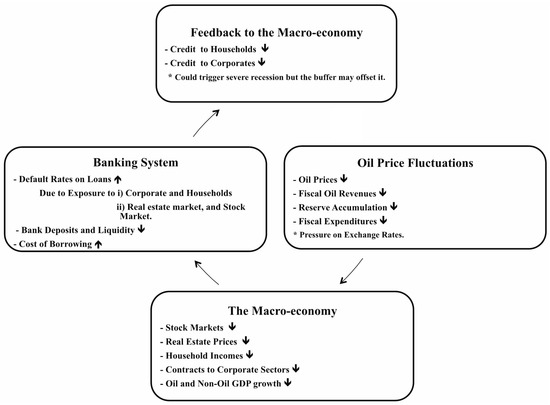
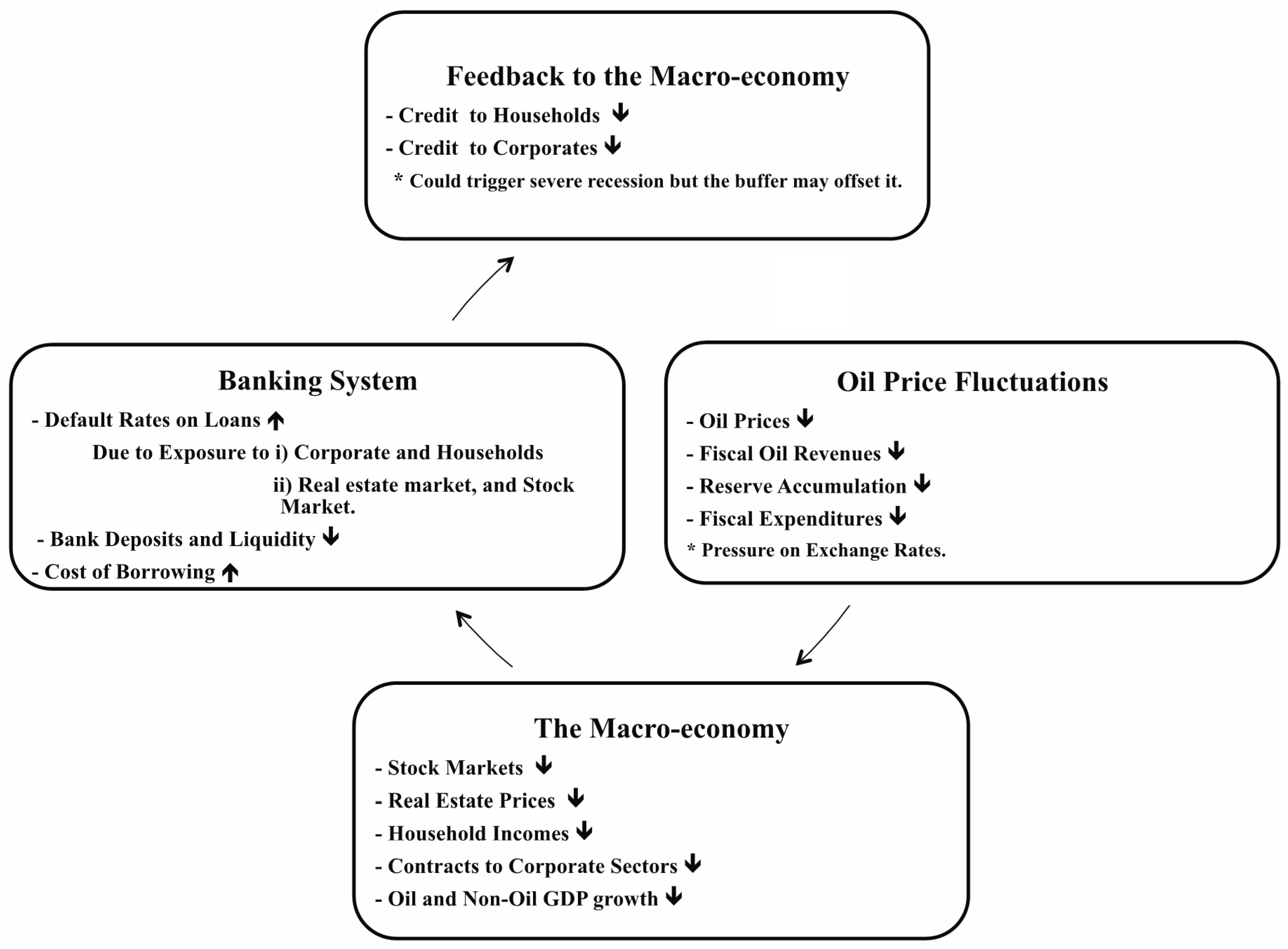
Figure 1 lays out the potential dynamic of oil price slump on oil exporting economies and its transmission channels to the banks’ balance sheets. As discussed earlier, fluctuations in international oil price influence the GCC economic growth and their banking systems. A sustained decline in oil prices, however, could lead to a decline in the liquidity and deposits of the GCC banking system. The GCC banks are particularly exposed to investments in non-oil sectors that include real estate, stock market, and loans to households and corporate sectors.
Figure 1.
Possible scenario of the transmission channel of oil price slump to banking systems. *: possible effects on GCC economies.
Oil revenues influence the size of businesses and the depth of GCC financial and banking systems. GCC governments’ expenditures on construction and infrastructure programs drive domestic non-oil GDP growth. GCC banks are particularly exposed to corporate sectors and households in these sectors. The channels of this exposure to non-oil GDP sectors are either through financing investments in stock markets, real estate projects, or through collateral requirements.
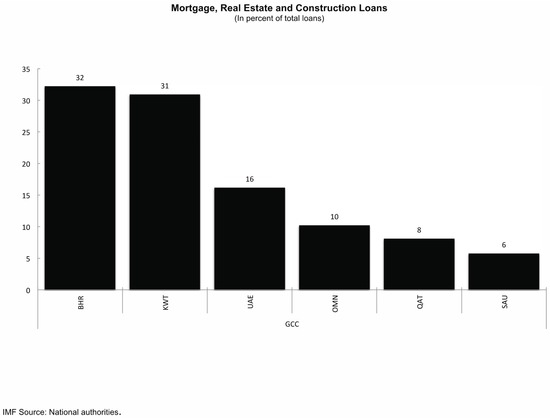
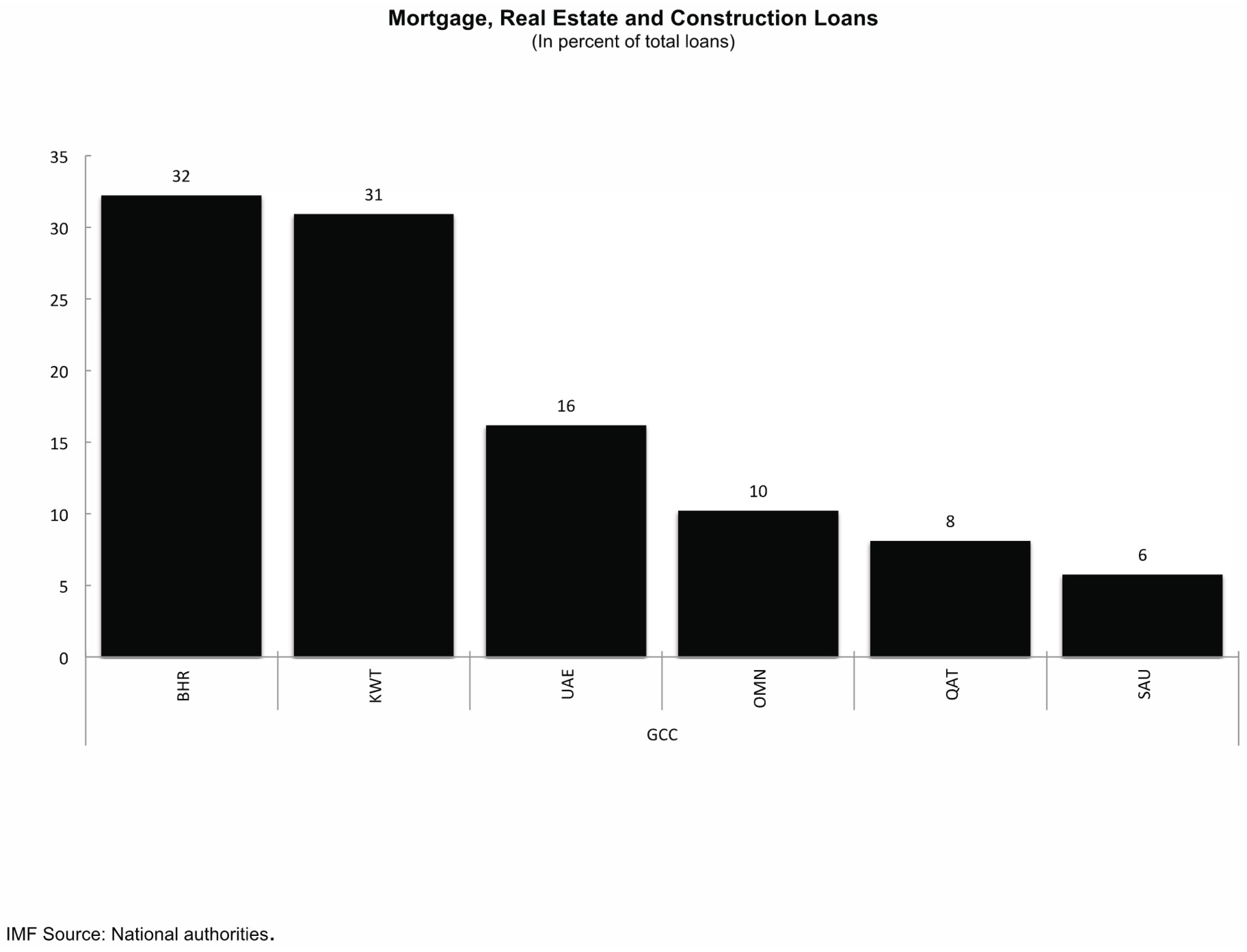
Figure 2 shows the exposure of GCC banks to real estate and construction loans. With more than 30%, Bahraini and Kuwaiti banks have the highest exposure rates to real estate and construction sectors. Given the above scenarios, this paper considers oil price, non-oil GDP, lending interest rate, stock price, housing prices, and credit growth to examine the credit risk implications of the recent oil price slump on GCC banking systems.
Figure 2.
Shares of real estate in GCC (Gulf Cooperation Council) banking loans (see [14]).
4. Data Description
This paper considers a panel data of GCC individual banks’ balance sheets from Fitch’s database spanning 2000–2014 and macroeconomic data from the IMF. These include nonperforming loans ratio (NPL), international oil price, real non-oil GDP, lending interest rate, three-year average of credit growth, stock prices, and housing prices. There are no indexes for GCC housing prices; however, this paper utilizes CPI components of Housing, Water, Electricity and Other Fuels as a proxy for the housing price indexes. In the GCC region, the water and electricity are subsidized and the movements in this component of the CPI are mostly due to movements in housing prices. The paper acknowledges that it may not be the optimal proxy for GCC housing prices, but it might be the best feasible proxy for these prices. The list of all the banks used in this paper are reported in Table A1 in Appendix A. The variables and data sources are reported in Table A2 in Appendix A under data descriptions. Overall, however, this paper acknowledges that the sample size (38 banks) and the time span (2000–2014) of the GCC banks considered for this paper are relatively small for obtaining precise estimates or a precise causal effect between oil price fluctuations and GCC banking stability.
5. Methodology
5.1. Methodology: Dynamic Panel Models
This part of the paper examines the transmission channels of oil price fluctuations to GCC banks’ balance sheets and their macroeconomic determinants. This paper employs a dynamic system GMM and Fixed Effect models to estimate the response of nonperforming loans to different macroeconomic shocks, particularly to oil price fluctuations.
is the log of NPL of the ith bank at time t, where i = 1, …, N and t = 1, …, T, is the 3-years average total gross loans of the ith bank at time t, where i = 1, …, N and t = 1, …, T. is the international oil price for each ith bank at time t where t = 1, …, T. is a vector of exogenous variables of the jth country associated with the ith bank at time t, where j = 1, …, J and t = 1, …, T. is the panel-level fixed effect, and are i.i.d residuals. The analysis of this part considers two alternative econometric techniques to estimate the dynamic panel model: (i) Fixed Effect model; and (ii) Dynamic System GMM Model. The former approach removes the unobserved heterogeneity across the banks but has a limitation once the lagged dependent variable is included. The fixed effect model with lagged dependent variable suffers “Dynamic Panel bias”. This is a result of the correlation between the error term and the lagged dependent variable after the demeaning process. To avoid the issue of panel dynamic bias, the latter econometric technique implemented is a Dynamic System GMM model of Blundell and Bond [5]. The collapsing method of Holtz-Eakin et al. [15] is implemented to reduce the number of instruments in the model. Roodman [16,17] provides an excellent review of the Dynamic System GMM Models. In this paper, the Dynamic System GMM Models are estimated following the techniques provided by Roodman’s work.
The Econometric Results of Dynamic Panel Models
As a macroeconomic determinant of NPLs in the GCC region, a decline in oil price contributes to a higher level of NPLs as well as the declines in Non-oil GDP, and stock prices. The results in Table 2 of the system GMM model (3) show that a one-percentage point decline in oil price growth leads to a statistically significant increase in NPLs by 0.458%. A one-percentage point decline in Non-oil GDP leads to a statistically significant increase in NPLs by 0.708%. A one-percentage point increase in interest rate leads to a statistically significant increase in NPLs by 0.0219%. A one-percentage point decline in stock prices leads to a statistically significant increase in NPLs by 0.397%. A one-percentage point decline in housing prices leads to a statistically significant increase in NPLs by 0.860%. The results indicate that bank-specific credit growth rates are an insignificant determinant of NPLs in the region. Perhaps, this insignificant explanatory power of bank-specific credit growth reflects the macro-prudential measures and the strong financial regulation in the GCC region. The results are qualitatively and quantitatively robust using logit transformation of NPLs in Table 3.
Table 2.
Econometric results of Fixed Effect and System GMM Models.
Table 3.
Econometric results of Fixed Effect and System GMM Models—Logit transformation of NPLs.3
5.2. Methodology: Panel Vector Auto Regressions (PVAR) Model
In the second part of this paper, a Panel Vector Auto Regressions (PVAR) model is implemented to assess the feedback effects between the banking systems and the real economy. To assess the feedback effect of disturbances in the banking system, the analysis focuses on the impulse responses to various structural shocks, particularly to credit risk shock and macroeconomic shocks. To avoid the earlier discussed issue of panel dynamic bias, the model follows Helmert transformation to demean the variables as in Love and Zicchino [18]. Canova and Ciccarelli [19] and Love and Zicchino [18] provide a comprehensive review of Panel VAR models. The Panel VAR used in this part is specified as:
is a vector of endogenous variables at time t, where i = 1, …, N and t = 1, …, T. is a vector of exogenous variables of the jth country associated with ith bank at time t where j = 1, …, J and t = 1, …, T, is a vector of exogenous international variables for each ith bank at time t where t = 1, …, T. is the panel-level fixed effect, and are i.i.d residuals.
The identification scheme in this part of the paper is a recursive Cholesky decomposition. Oil price is modeled as an exogenous variable in the identification of this paper. The domestic variables are ordered as [Interest Rate, Non-oil GDP, Credit Growth, NPLs]. The macro variables are set first as Interest Rate, and then Non-oil GDP. The interest rate is set first as GCC central banks adopt fixed exchange rate regimes and hence follow the U.S. Federal Fund Rate in setting domestic policy interest rate. The bank-specific variables are ordered as Credit Growth, then NPLs. Credit Growth responds contemporaneously to Interest Rate and Non-oil GDP, but with a lag to NPLs. NPLs respond contemporaneously to all the variables in model.
Results of Panel Vector Auto Regressions (PVAR) Model
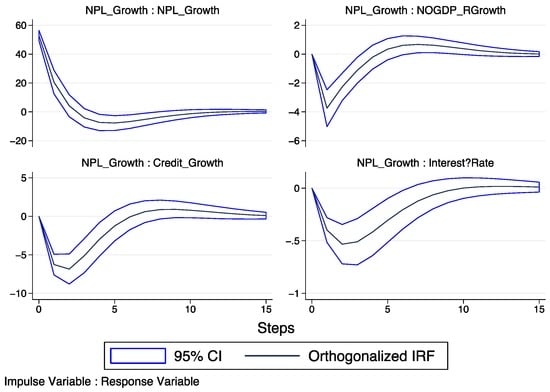
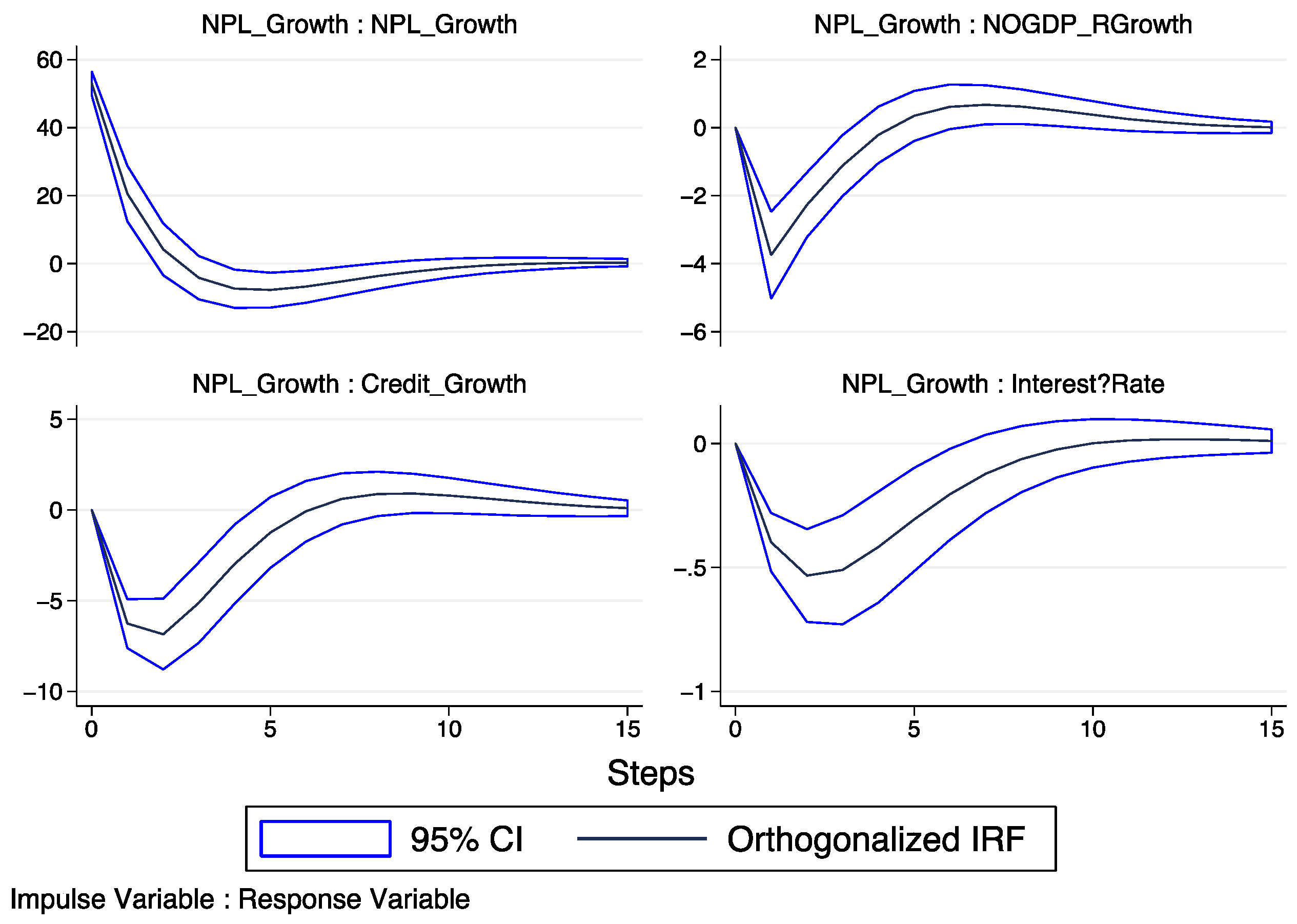
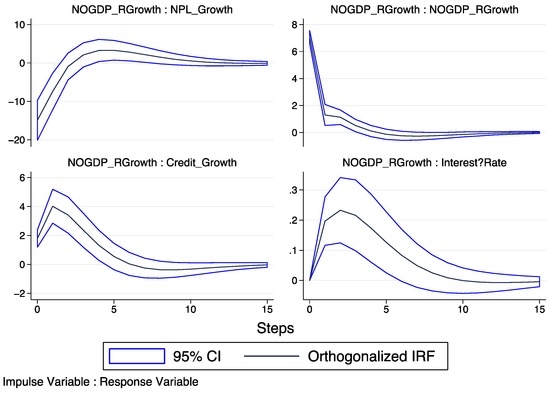
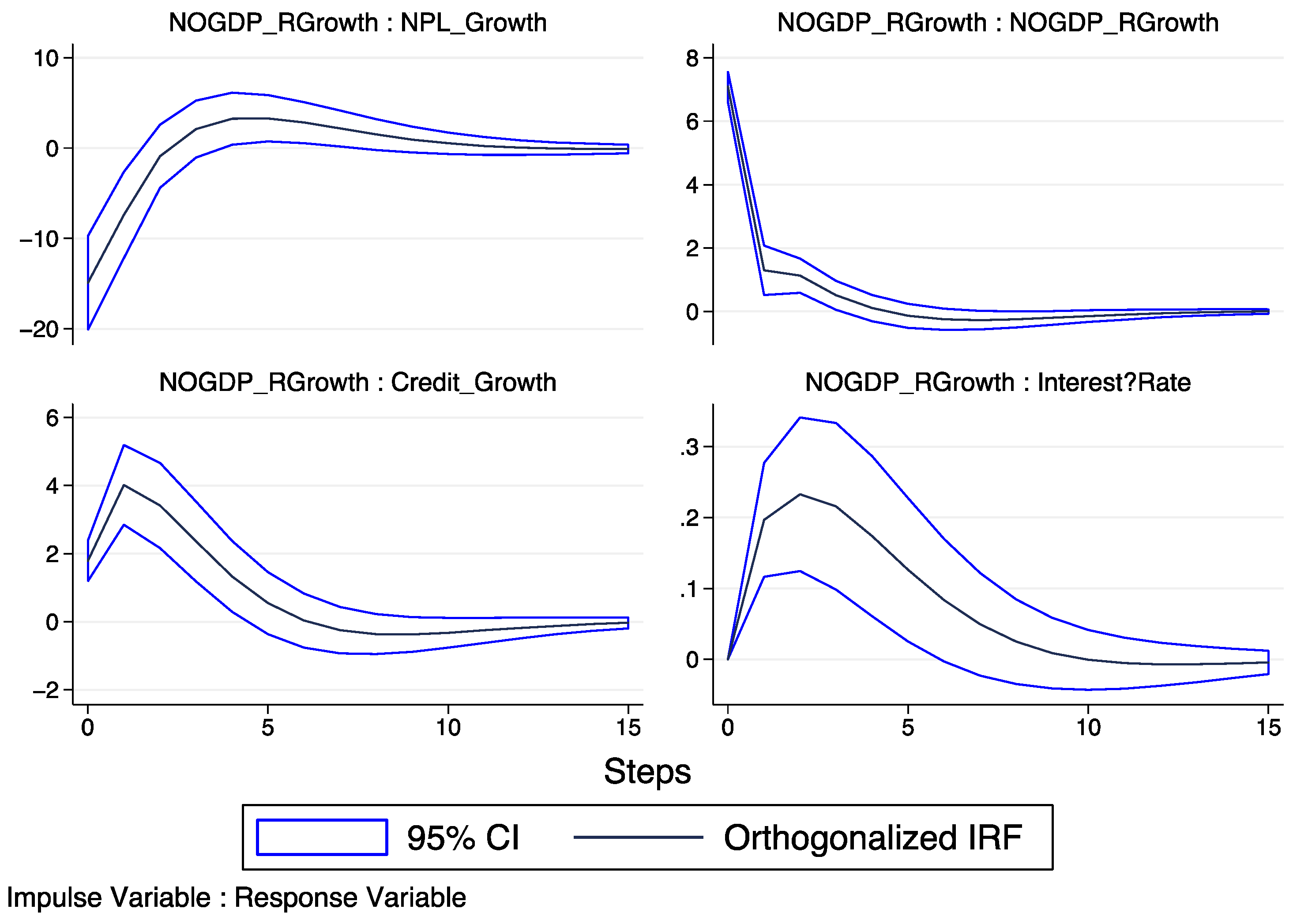
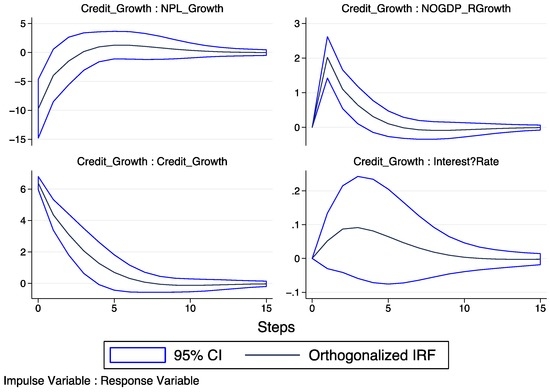
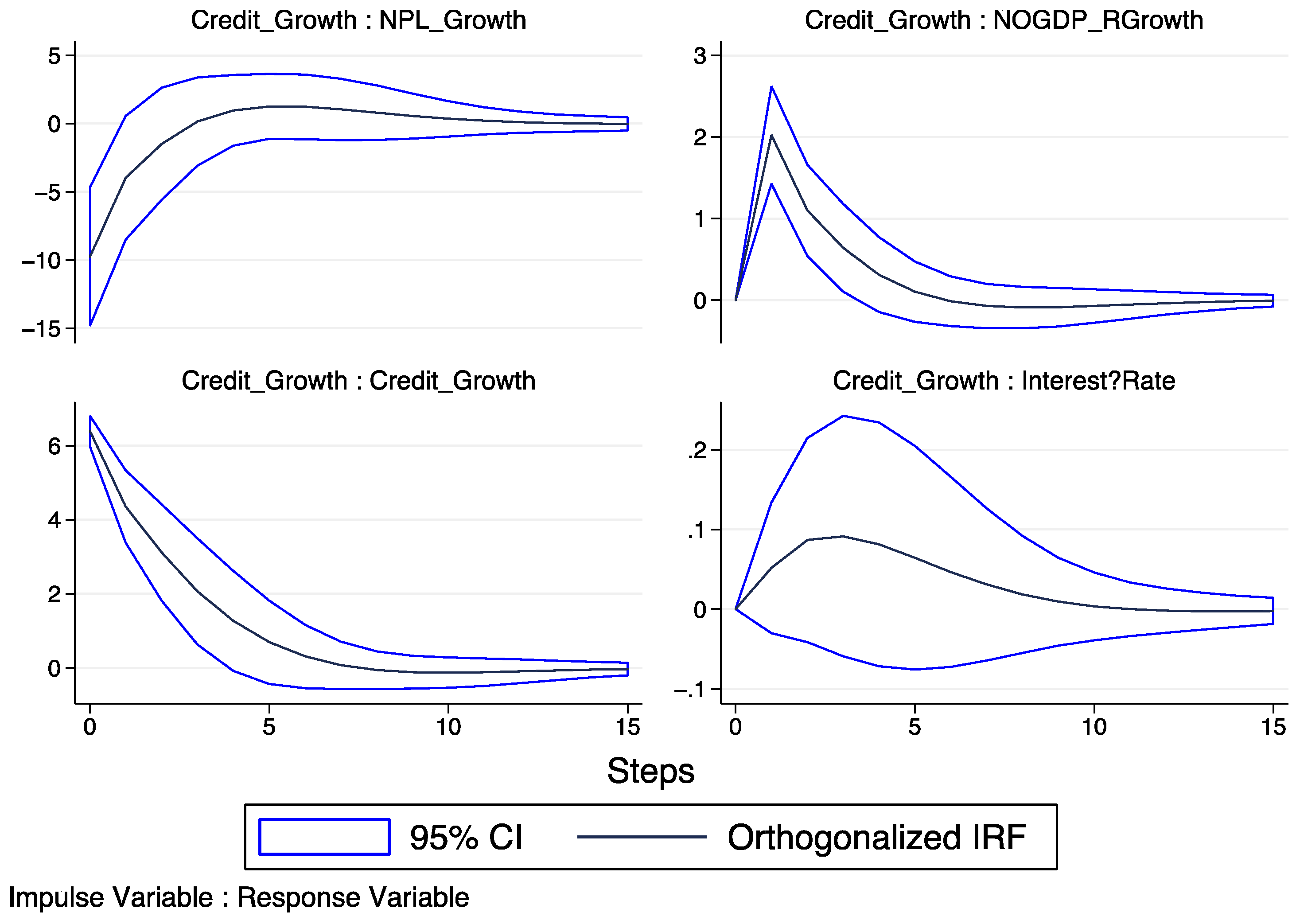
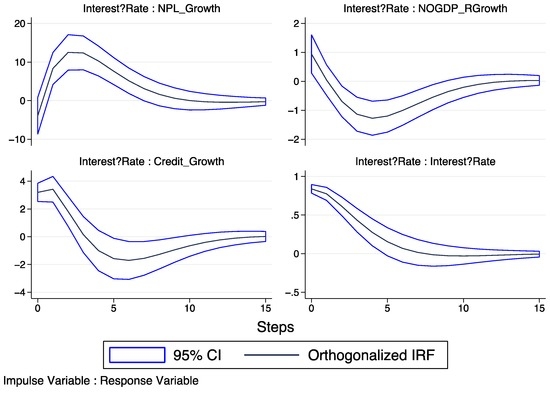
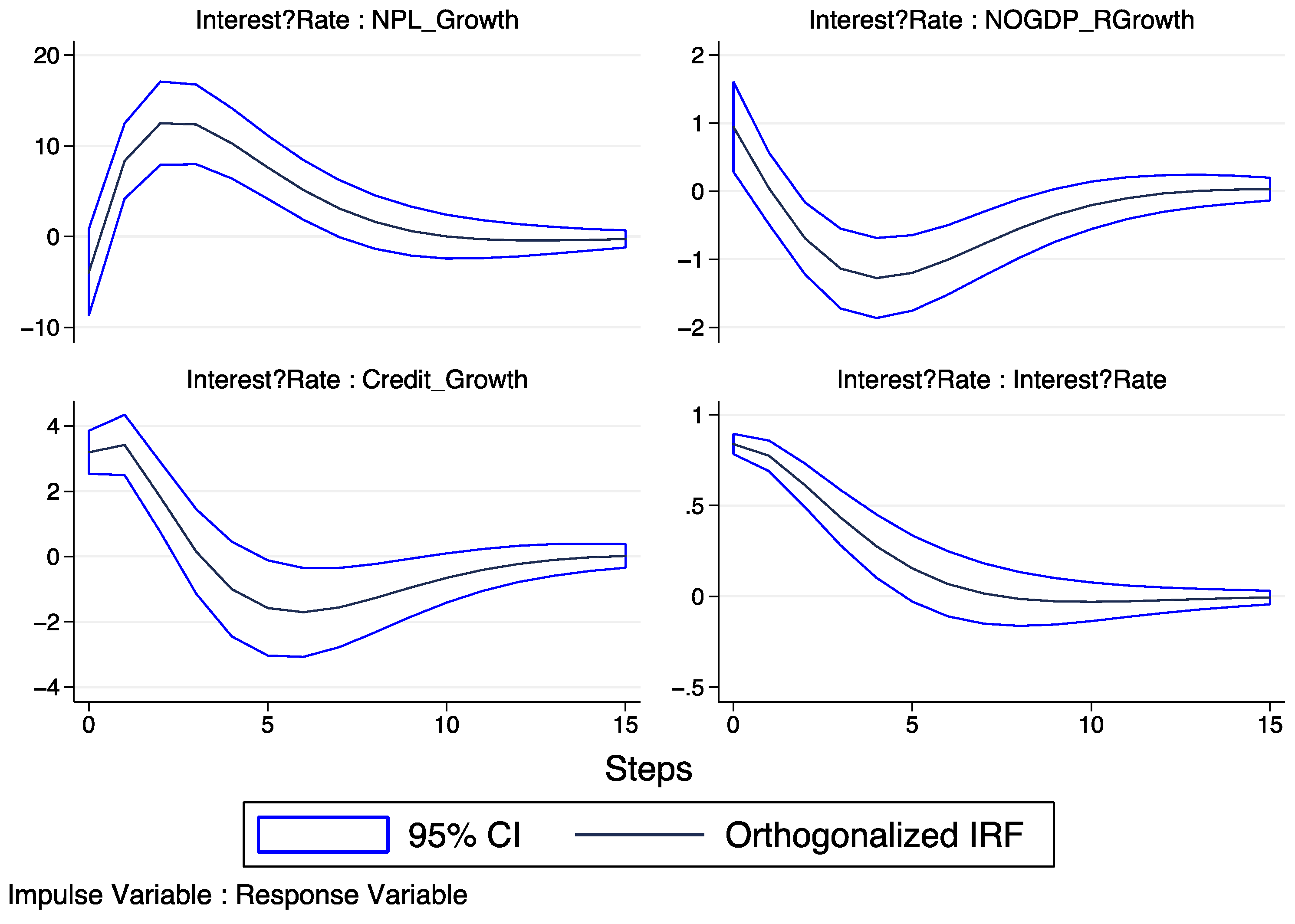
The results of the PVAR model are reported in Figure 3, Figure 4, Figure 5 and Figure 6 and Table 4, Table 5 and Table 6. Figure 3 indicates credit risk shock, as a shock to nonperforming loans tends to restrict credit growth across the banks and dampens economic growth in GCC economies. The interest rate declines in response to credit risk shock. The results confirm significant negative feedback between the banking system instability and the real economy. A positive Non-oil GDP shock expands the credit growth across the banks and lowers NPLs. However, Non-oil GDP shock increases the interest rate (see Figure 4). An interest rate shock increases the cost of borrowing and hence leads to a higher level of NPLs and could slowdown the GCC economic growth. A positive shock to credit growth across GCC banks leads to higher economic growth and lowers the NPLs across the region.
Figure 3.
Impulse responses to credit risk shock.
Figure 4.
Impulse responses to Non-oil GDP shock.
Figure 5.
Impulse responses to Credit Growth shock.
Figure 6.
Impulse responses to Interest Rate shock.
Table 4.
The forecast error variance decomposition of interest rates in the GCC region.
Table 5.
The forecast error variance decomposition of Non-oil GDP in the GCC region.
Table 6.
The forecast error variance decomposition of Credit Growth in the GCC region.
The variance decompositions are reported in Table 4, Table 5 and Table 6. The variance decomposition of Non-oil GDP (see Table 5) across GCC economies indicates that oil price shock explains about 35% of Non-oil GDP variation, while NPLs explains almost 30% of the Non-oil GDP variation. The variance decomposition of GCC credit growth (see Table 6) indicates that Non-oil GDP shock explains about 17% of credit growth variation, interest rate shock explains about 11% of credit growth variation, and NPL shock explains about 40% of credit growth variation.
6. Conclusions
While the macroeconomic implications of oil price fluctuations on GCC economies are significant and well studied, its implications on GCC banking systems has received less attention. This paper aims to understand the impact of the recent oil price slump on GCC banks’ balance sheets and examine any negative feedback effects between the GCC banking systems and the macroeconomy. The results show that macro economic variables, including the oil price, Non-oil GDP, interest rate, stock prices, and housing prices are major determinants of NPLs across GCC banks, and, therefore, of financial stability in the region. The Credit risk shock adversely impacts non-oil GDP, and credit growth across GCC economies. A higher level of NPLs restricts banks’ credit growth and can dampen economic recovery in these economies. These results support the notion that disturbances in banking systems lead to adverse economic consequences in the real sector. The results are qualitatively robust across different specifications. Counter-cyclical policies that limit the GDP slowdown can promote financial stability across the GCC region. Policy makers with financial stability objectives need to monitor the developments in international oil markets and smooth the potential effects to GCC banking systems. GCC countries implement fixed exchange rate regimes, and, therefore, exchange rates do not impose serious credit risks in the region. The GCC economies, however, accumulated a large amount of oil stabilization buffers and have the fiscal space to limit any negative feedback to the real economy.
Acknowledgments
The work of this paper was originally developed while Saleh Alodayni was an intern at the International Monetary Fund (IMF)—Summer of 2015—in Washington, D.C. under the supervision of Inutu Lukonga. We thank all the IMF staff, especially the staff of the Middle East and Central Asia’s Regional Studies Division. We thank Raphael Espinoza for his technical help and all the participants in the Middle East and Central Asia discussion Form.
Conflicts of Interest
The author declares no conflict of interest.
Appendix A. Data Description.
Table A1.
List of the GCC Banks Sample—Fitch.
Table A2.
Variable description and data sources.
References
- R.A. Espinoza, and A. Prasad. “Nonperforming Loans in the GCC Banking System and Their Macroeconomic Effects.” IMF Working Papers. 2010. Available online: http://www.imf.org/external/pubs/cat/longres.aspx?sk=24258.0 (accessed on 30 June 2015).
- M. Nkusu. “Nonperforming Loans and Macrofinancial Vulnerabilities in Advanced Economies.” IMF Working Papers. 2011. Available online: https://www.imf.org/external/pubs/cat/longres.aspx?sk=25026.0 (accessed on 30 June 2015).
- D.P. Louzis, A.T. Vouldis, and V.L. Metaxas. “Macroeconomic and bank-specific determinants of non-performing loans in Greece: A comparative study of mortgage, business and consumer loan portfolios.” J. Bank. Financ. 36 (2012): 1012–1027. [Google Scholar] [CrossRef]
- N. Klein. “Non-performing loans in CESEE: Determinants and impact on macroeconomic performance.” IMF Working Papers. 2013. Available online: https://www.imf.org/external/pubs/cat/longres.aspx?sk=40413.0 (accessed on 30 June 2015).
- R. Blundell, and S. Bond. “Initial conditions and moment restrictions in dynamic panel data models.” J. Econom. 87 (1998): 115–143. [Google Scholar] [CrossRef]
- B.S. Bernanke, M. Gertler, and S. Gilchrist. “Chapter 21 The financial accelerator in a quantitative business cycle framework.” In Handbook of Macroeconomics. Amsterdam, The Netherlands: Elsevier, 1999, Volume 1, Part C; pp. 1341–1393. [Google Scholar]
- G.L. Kaminsky, and C.M. Reinhart. “The twin crises: The causes of banking and balance-of-payments problems.” Am. Econ. Rev. 89 (1999): 473–500. [Google Scholar] [CrossRef]
- W.R. Keeton, and C.S. Morris. “Why Do Banks’ Loan Losses Differ? ” Econ. Rev. 72 (1987): 3–21. [Google Scholar]
- A.N. Berger, and R. DeYoung. “Problem loans and cost efficiency in commercial banks.” J. Bank. Financ. 21 (1997): 849–870. [Google Scholar] [CrossRef]
- S. Jesus, and J. Gabriel. “Credit cycles, credit risk, and prudential regulation.” Int. J. Cent. Bank. 2 (2006): 65–98. [Google Scholar]
- J. Marcucci, and M. Quagliariello. “Asymmetric effects of the business cycle on bank credit risk.” J. Bank. Financ. 33 (2009): 1624–1635. [Google Scholar] [CrossRef]
- J. Marcucci, and M. Quagliariello. “Is bank portfolio riskiness procyclical?: Evidence from Italy using a vector autoregression.” J. Int. Financ. Mark. Inst. Money 18 (2008): 46–63. [Google Scholar] [CrossRef]
- A.S. Messai, and F. Jouini. “Micro and macro determinants of non-performing loans.” Int. J. Econ. Financ. Issues 3 (2013): 852–860. [Google Scholar]
- Lukonga, and et al. “IMF Staff Discussion Note.” In preparation.
- D. Holtz-Eakin, W. Newey, and H.S. Rosen. “Estimating vector autoregressions with panel data.” Econometrica 56 (1988): 1371–1395. [Google Scholar] [CrossRef]
- D. Roodman. “How to Do xtabond2: An Introduction to Difference and System GMM in Stata.” Stata J. 9 (2009): 86–136. [Google Scholar] [CrossRef]
- D. Roodman. XTABOND2: Stata Module to Extend Xtabond Dynamic Panel Data Estimator. Statistical Software Components; Boston, MA, USA: Boston College Department of Economics, 2015. [Google Scholar]
- I. Love, and L. Zicchino. “Financial development and dynamic investment behavior: Evidence from panel VAR.” Q. Rev. Econ. Financ. 46 (2006): 190–210. [Google Scholar] [CrossRef]
- F. Canova, and M. Ciccarelli. “Panel Vector Autoregressive Models: A Survey. (The Views Expressed in This Article are Those of the Authors and Do Not Necessarily Reflect Those of the ECB or the Eurosystem).” In VAR Models in Macroeconomics—New Developments and Applications: Essays in Honor of Christopher A. Sims (Advances in Econometrics, Volume 32). Edited by T.B. Fomby, L. Kilian and A. Murphy. Frankfurt am Main, Germany: Emerald Group Publishing Limited, 2013, pp. 205–246. [Google Scholar]
- 1Please see Figure 1 for more details on possible scenario of the transmission channels of oil price slump to GCC banking systems.
- 2.
- 3.

© 2016 by the author; licensee MDPI, Basel, Switzerland. This article is an open access article distributed under the terms and conditions of the Creative Commons Attribution (CC-BY) license (http://creativecommons.org/licenses/by/4.0/).