1. Introduction
In global equity markets, it is common practice to maintain a separate trading platform for smaller and high-growth companies that do not yet meet the more rigorous listing requirements of the Main Board. In Hong Kong, the Growth Enterprise Market (GEM), which officially launched and commenced trading in November 1999, has served as a transitional venue for firms with significant growth potential, providing access to public capital and facilitating their eventual progression to the Main Board upon meeting the requisite criteria.
The primary objective of establishing these platforms is to facilitate capital raising for emerging enterprises by providing increased visibility, regulatory oversight tailored to their developmental stage, and the opportunity to establish a track record in preparation for eventual migration to the Main Board. A key feature of the GEM board is its relatively lower entry barriers. Unlike the Main Board, which typically imposes requirements related to profitability history, minimum market capitalization, and stringent corporate governance standards, the GEM board offers more flexible and accessible listing criteria for early-stage companies. These firms often demonstrate substantial growth potential, particularly in innovative or rapidly evolving sectors, but lack the financial history or scale required for a Main Board listing. The GEM framework thus fosters economic development by enabling such firms to access public capital markets, enhance corporate governance practices, and attract both institutional and retail investors.
The establishment of the GEM board in Hong Kong can be traced back to the HKSAR Chief Executive’s 1998 Policy Address, which explicitly committed to “study proposals for a Venture Board for smaller and emerging technology companies’ stocks” (
Hong Kong Special Administrative Region Government, 1998). This initiative recognized the necessity of accommodating innovative enterprises that could not meet the Main Board’s stricter requirements. Officially launched in November 1999 by Hong Kong Exchanges and Clearing Limited (HKEx), the GEM board represented a significant milestone in the city’s capital market development. Its introduction coincided with the global high-tech boom of the late 1990s, a period marked by heightened investor enthusiasm for technology-driven companies and those promising rapid growth potential.
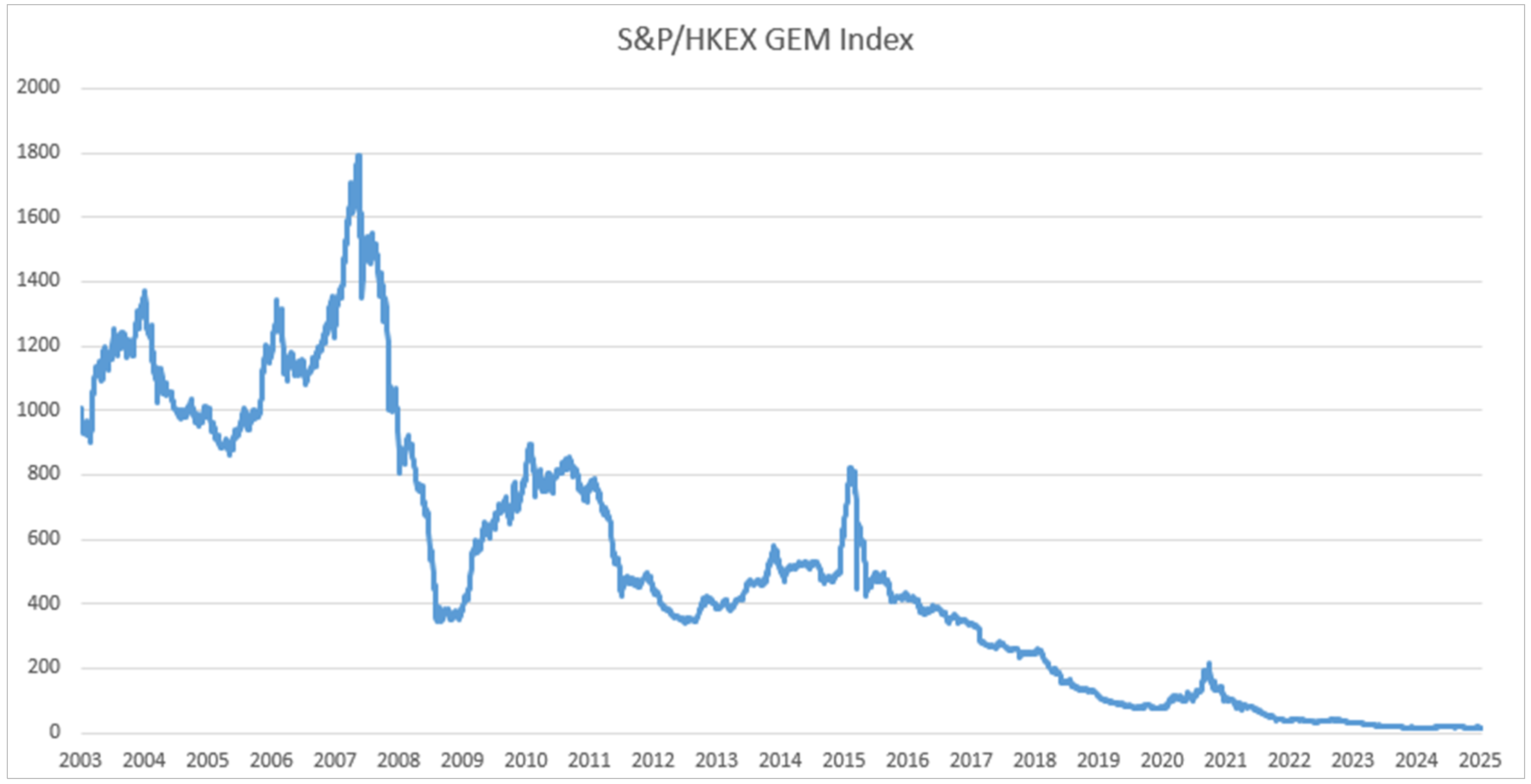
In its formative years, the Hong Kong GEM board garnered significant attention from both issuers and investors eager to seize opportunities in the burgeoning technology sector. Nevertheless, this initial enthusiasm was quickly dampened by the collapse of the global high-tech bubble in the early 2000s, which triggered a sharp and sustained decline in the share prices of GEM-listed companies and fundamentally shifted the market’s trajectory. This trend is illustrated by the S&P/HKEX GEM Index, which tracks approximately 75% of the market capitalization of the Hong Kong GEM Board and serves as a key benchmark for GEM-listed stocks (
S&P Dow Jones Indices, 2024). As of 30 June 2025, the index had plummeted to just 17 points, a staggering drop of over 98% from its initial base of 1000 on 28 February 2003 (
Figure 1). This dramatic downturn highlights the persistent challenges faced by the GEM board, including low liquidity, diminishing investor interest, and the enduring impact of early market volatility. This severe decline may be due to a shortage of companies delivering strong and sustainable returns, which has discouraged investor participation. Given the persistently weak share price performance of the majority of GEM stocks, the market has faced considerable difficulty in recovering from the repercussions of the global high-tech bubble’s collapse since March 2000, leaving both institutional and retail investors cautious about technology-focused growth markets.
Despite being established over 25 years ago, the Hong Kong GEM board represents only a small fraction of the city’s capital markets. As of 30 June 2025, the Hong Kong GEM board comprised 316 listed companies with a combined market capitalization of approximately HKD 59 billion, equivalent to just 0.14% of the Main Board’s capitalization, which stood at HKD 42,625 billion. Trading activity on the GEM board also remains subdued; during the first half of 2025, the average daily turnover was only HKD 85 million, accounting for less than 0.1% of the total turnover in the Hong Kong stock market (
Hong Kong Exchanges and Clearing Limited, 2025). This persistently low liquidity not only highlights limited investor interest but also hampers GEM-listed companies’ ability to raise capital effectively and attract broader market participation.
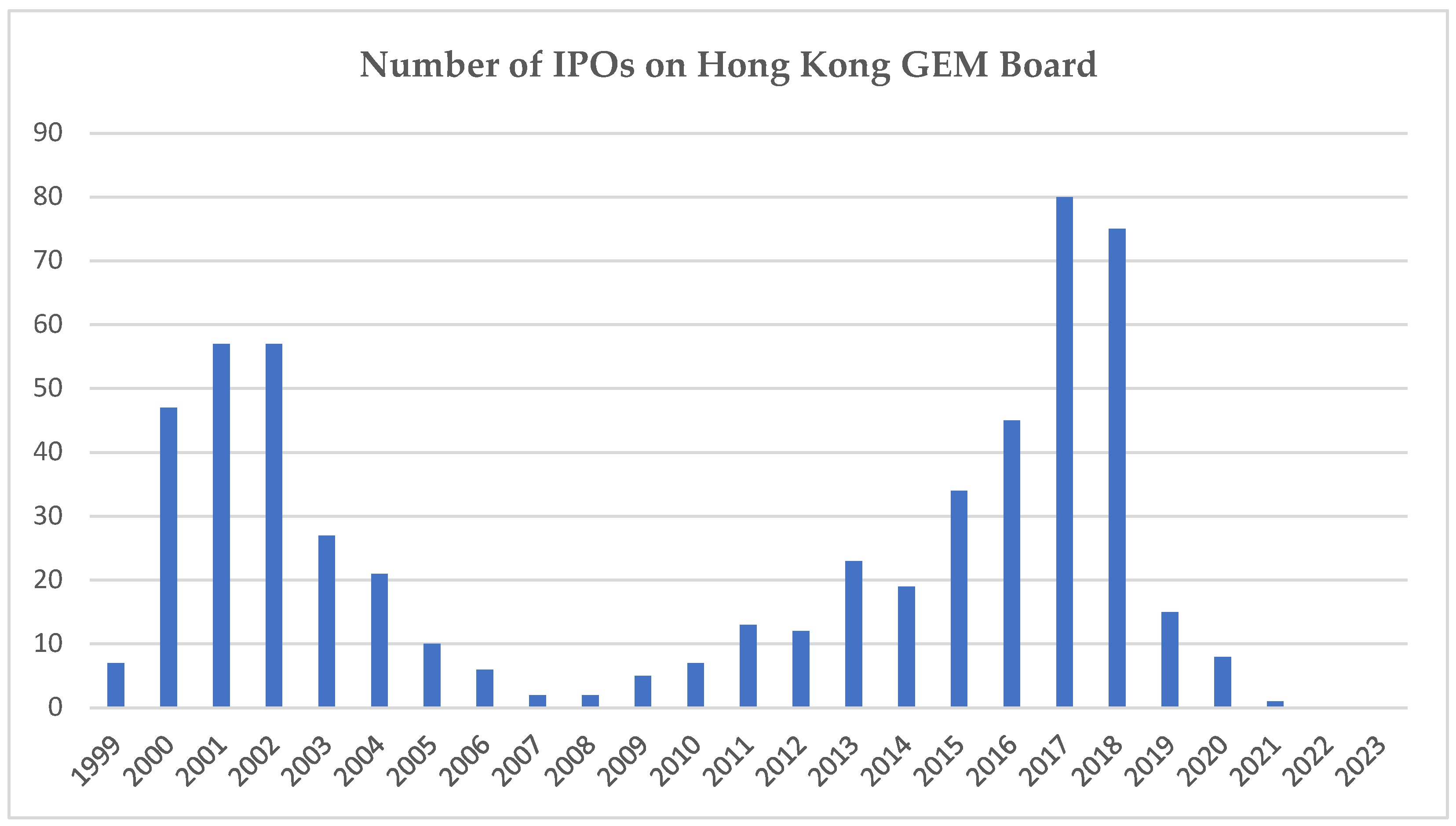
Furthermore, the Hong Kong GEM board has faced persistent challenges in attracting new issuers, as evidenced by the listing of only one new company between 2021 and 2023 (
Figure 2). This exceptionally low IPO rate underscores the board’s ongoing struggle to position itself as a vibrant platform for emerging enterprises. One might attribute this decline in Hong Kong GEM IPO activity to the disruption caused by the COVID-19 pandemic; however, a closer examination of IPO trends across other markets suggests otherwise. For instance, over the same period, the Hong Kong Main Board and China’s major A-share markets maintained considerably higher levels of IPO activity (
Table 1). The Hong Kong Main Board recorded 136, 96 and 80 IPOs during 2020 to 2022, a robust performance compared to the GEM’s mere eight, one, and zero listings during the same period. The Shanghai and Shenzhen A-share markets, particularly the STAR Market and ChiNext, which are Nasdaq-style boards to support technology and innovation firms with less stringent listing requirements, have continued to attract new issuers with hundreds of IPOs during the pandemic and its aftermath. These figures indicate that while overall market conditions of the COVID-19 pandemic might have influenced investor sentiment, such factors did not result in a uniformly suppressed IPO market in the Hong Kong Main Board and China.
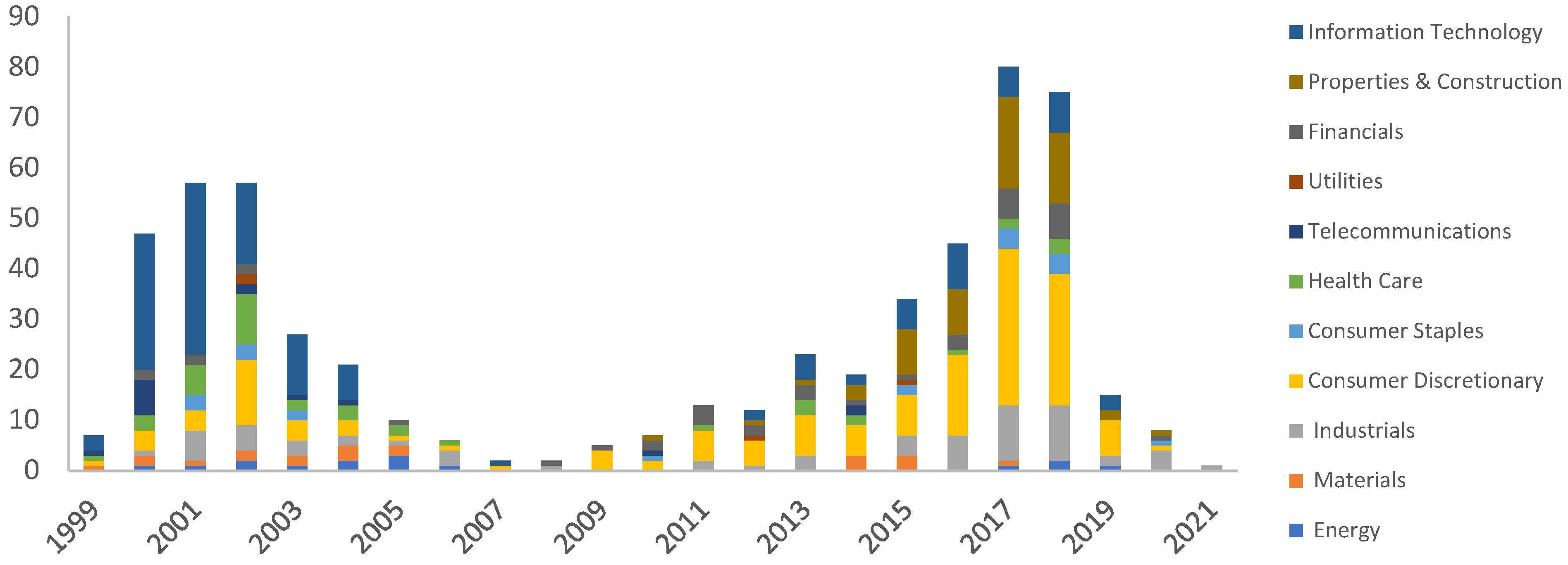
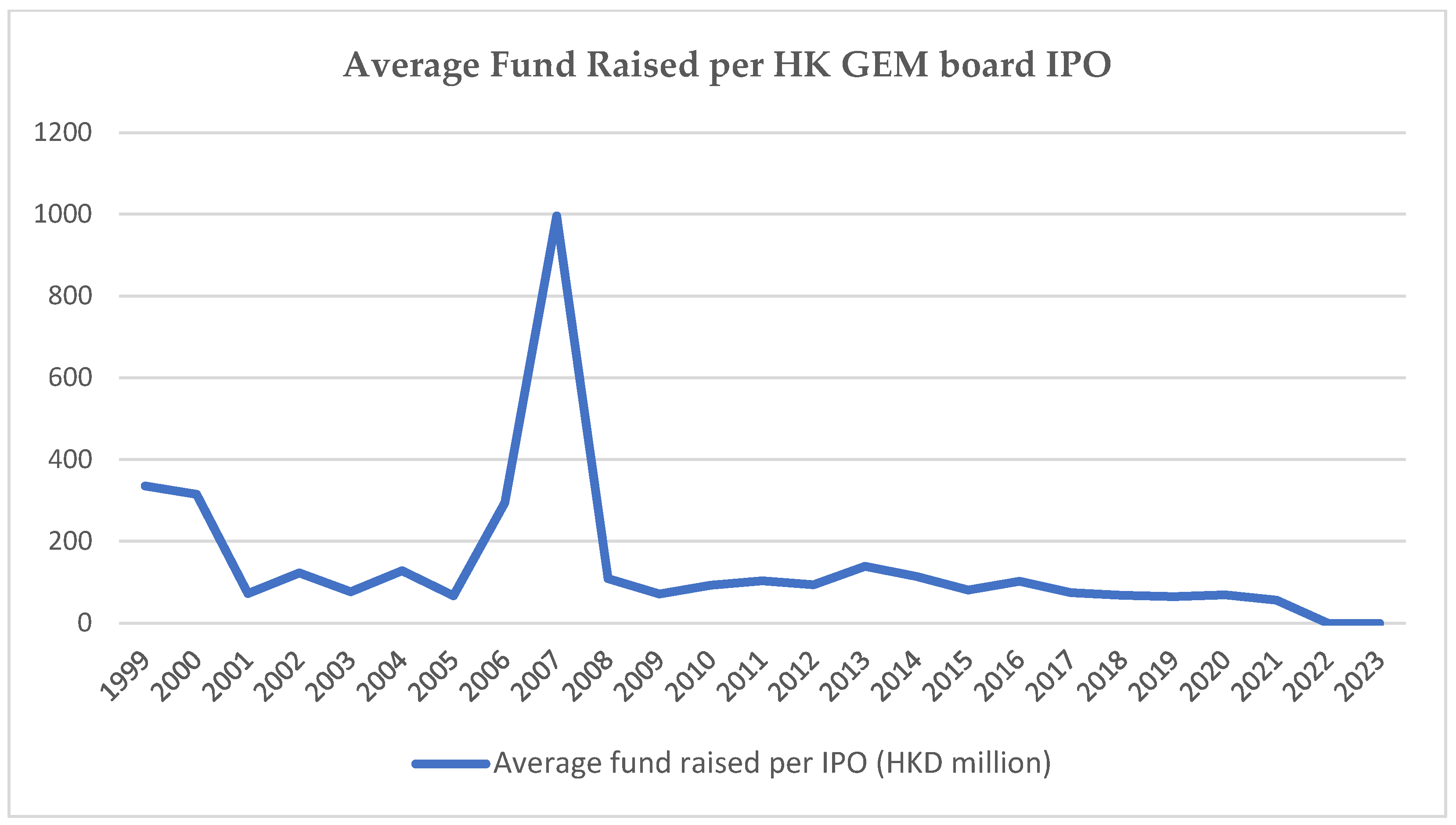
Figure 3 illustrates the distribution of Hong Kong GEM Board listings by industry classification. In the early 2000s, shortly after the board’s inception, a significant proportion of listed companies operated in the information technology sector. This pattern reflected the board’s original objective to promote innovation and support technology-oriented enterprises. However, the proportion of information technology firms has declined, while the share of companies in the consumer discretionary sector has increased in recent years. This shift in industry composition helps explain the persistently low funding size of the Hong Kong GEM board. Information technology firms, particularly during their early development stages, often require substantial capital investment to support research, development, and rapid scaling. In contrast, consumer discretionary companies typically have lower initial capital requirements and less intensive funding needs. As the industry mix has shifted away from capital-intensive sectors toward those with more modest funding demands, it explains the decline in the amount of funds raised, which dropped further to below HKD 70 million in the late 2010s (
Figure 4).
The poor long-term performance of the Hong Kong GEM board may be attributed to the inability of many listed companies to achieve sustainable earnings growth. As illustrated in
Table 2, approximately two-thirds of GEM-listed firms have persistently struggled with profitability. The number of Hong Kong GEM companies publishing annual reports from 2020 to 2024 was approximately three hundred per year. The average net loss attributable to shareholders of the parent company ranged from HKD 11.9 million to HKD 20.1 million. Among the three hundred Hong Kong GEM stocks that published annual reports, only 111, 117, 96, 101, and 91 companies, respectively, reported positive profits during the period from 2020 to 2024. Nearly two-thirds of GEM companies consistently report losses. Taking 2024 as a representative example, a total of 215 GEM companies posted losses, with the average loss reaching HKD 25.7 million and the maximum loss amounting to HKD 412.9 million.
These data underscore a fundamental reason for the GEM board’s weak performance: the majority of its constituent companies are unable to deliver stable or positive returns over time. The widespread incidence of substantial losses among most firms erodes investor confidence and interest, thereby contributing to the board’s persistent underperformance. The ongoing prevalence of deficits, coupled with the fact that only a minority of firms achieve profitability, reinforces the perception of GEM as a high-risk market with limited capacity for generating sustainable value relative to other segments of Hong Kong’s stock market.
The Hong Kong GEM board has also been characterized by a limited capacity for capital raising, as evidenced by the average and median funding amounts of HKD115.9 million and HKD 64.0 million per listing across 573 listed companies from its inception in November 1999 through December 2023. This relatively modest scale of fundraising reflects both the target profile and structural constraints of the Hong Kong GEM board. Established primarily to serve small- and medium-sized enterprises and early-stage ventures, the Hong Kong GEM board has attracted issuers with inherently lower capital requirements than those typical of Hong Kong’s Main Board. These issuers frequently encounter significant barriers to accessing larger pools of institutional funding, stemming from limited investor interest and low market liquidity. The majority of institutional investors direct their resources toward more established firms, resulting in a constrained funding environment for GEM-listed companies.
Moreover, the perception of the Hong Kong GEM board as a transitional rather than a terminal market has reduced its appeal to high-growth enterprises, many of which instead pursue listings on the Main Board or in alternative international markets. The relatively high listing costs on the Hong Kong GEM board, when considered as a proportion of capital raised, further discourage participation. Competition from other American and Asian small-cap equity markets also diverts potential issuers. Collectively, these factors have restricted fundraising activity and diminished the GEM board’s role as a significant platform for capital formation within Hong Kong’s financial ecosystem.
The combination of underperformance, low market capitalization, scant trading volume, and a dearth of new listings on the Hong Kong GEM board underscores structural deficiencies that have hindered its effectiveness as a platform for supporting early-stage and high-growth companies. Why has the once-prosperous Hong Kong GEM board performed so disappointingly in recent years? A potential inflection point for the GEM board’s fortunes likely occurred with the amendment of the GEM Listing Rules regarding the IPO allocation method, which took effect on 15 February 2018 (
Hong Kong Exchanges and Clearing Limited, 2017). These reforms introduced a mandatory public-offering requirement for at least 10 percent of all GEM IPOs, ending the previous practice of listings conducted solely through private placements without a minimum public tranche. The allocation mechanism for offer shares was also revised to align with the Main Board’s Practice Note 18, which includes a clawback system that reallocates shares to the public tranche in the event of oversubscription.
Although these reforms sought to strengthen transparency and market discipline, they also curtailed issuers’ latitude to tailor allocations and may have diminished the board’s investment appeal. A pivotal concern is whether stricter public-offering quotas have depressed first-day IPO returns, the primary attraction for many GEM participants who trade overwhelmingly for debut-day gains. Academic evidence from international markets shows that initial returns are typically higher when offers rely on institutional placement and secondary sales but exclude a retail subscription leg, because bookrunners can price more aggressively and reward informed investors with larger stakes (
Benveniste & Spindt, 1989). If an IPO includes a public subscription tranche for retail investors, particularly when there is strong demand and high oversubscription from this segment, underwriters are more likely to set a higher offer price. This practice typically results in smaller initial price jumps when the stock begins trading, as the offer price more closely reflects the market’s efficient valuation. By transplanting these insights to the Hong Kong GEM board, the compulsory public tranche likely compresses the initial price jump that sophisticated investors seek, eroding their incentive to commit capital and provide liquidity.
The “Winner’s Curse” phenomenon in
Rock’s (
1986) model addresses the phenomenon of IPO underpricing by considering the dynamics between informed and uninformed investors. In Rock’s framework, investors are classified as either informed (those possessing superior knowledge regarding the true value of an IPO) or uninformed (who lack such information and subscribe indiscriminately to offerings). Informed investors participate selectively, targeting IPOs they expect to be underpriced, while avoiding those they believe to be overpriced. Consequently, uninformed investors receive a greater proportion of allocations in fairly valued or overpriced IPOs, which tend to underperform post-listing. This allocation mechanism exposes uninformed investors to the “Winner’s Curse”, whereby larger share allocations are associated with less attractive offerings, as informed investors have strategically opted out. To encourage continued participation from uninformed investors, issuers are incentivized to set IPO offer prices below expected market value. This underpricing serves as compensation for adverse selection risk and ensures that uninformed investors’ expected returns remain sufficiently attractive to sustain their involvement in IPO markets.
Lower debut-day returns may propagate a negative feedback loop: diminished initial performance erodes investor enthusiasm, which in turn suppresses trading turnover, and lower liquidity exacerbates stock price volatility, causing both existing investors and prospective issuers to view the market as riskier and less attractive. As a result, high-potential companies may bypass the Hong Kong GEM board, further reducing the quality and volume of new listings and perpetuating the cycle of underperformance. Importantly, the period following the 2018 allocation reform, which mandated a minimum public-offering tranche, highlights this trend: only one GEM IPO was completed between 2021 and 2023, which is consistent with the contractionary effects of well-intentioned but inflexible regulation. Without recalibration, such rigid allocation rules can transform protective measures into structural hindrances that suppress first-day returns, reduce investor appeal and threaten the long-term sustainability of Hong Kong’s secondary growth market. These observations are consistent with international IPO research documenting the adverse impacts of diminished liquidity and regulatory inflexibility on aftermarket performance and listing activity (
Chang et al., 2014).
To address the persistent challenges facing the Hong Kong GEM board, we propose a study examining the IPO allocation method and its potential influence on market outcomes. Specifically, our research investigates whether the way shares are allocated in GEM IPOs is associated with the initial day returns of newly listed stocks. Our study encompasses all 573 GEM listings since the inception of the GEM board from 25 November 1999 to 31 December 2023. By systematically analyzing IPO allocation methods and their association with first-day stock price performance, this study seeks to identify significant patterns and correlations within the Hong Kong GEM board market. Specifically, our objectives are to assess whether particular allocation structures are linked to higher or lower first-day returns and to quantify the average level of underpricing in GEM IPOs, as measured by the closing price on the first trading day. The study also examines the impact of market and firm-specific factors—such as investor sentiment, industry classification, and issue size—on initial returns. Finally, we will analyze the effects of the tightening of GEM listing requirements on 15 February 2018 and determine their influence on observed first-day returns.
We organize the rest of the paper as follows.
Section 2 discusses the listing methods of the Hong Kong GEM board.
Section 3 presents a summary of the literature review.
Section 4 discusses the data and the methodology.
Section 5 reports and interprets the empirical results.
Section 6 concludes.
2. Listing Methods of the GEM Board in Hong Kong
According to
Ritter and Welch (
2002), when bookbuilding is used, the allocation of IPO shares is predominantly managed by underwriters, who exercise significant discretion in determining the recipients of these shares. The process is heavily influenced by bookbuilding mechanisms, which grant underwriters substantial flexibility and often result in different treatment for institutional and retail investors. Institutional investors, recognized for their large investment sizes and superior access to information, are typically perceived as more informed and valuable clients. Empirical research, such as
Aggarwal et al. (
2002), demonstrates that bookbuilding frequently leads to preferential allocations for institutional investors who exhibit strong premarket demand. This practice aligns with bookbuilding theories, suggesting that the chosen allocation method may reflect the issuer’s strategic intent to target either institutional or retail investors. In particular, bookbuilding has proven especially effective in attracting institutional participation.
A variety of listing methods have been developed on the Hong Kong GEM board to accommodate the diverse needs of companies seeking access to public capital. Prior to the GEM Listing Rule amendment effective 15 February 2018, the most notable feature for the Hong Kong GEM board was the ability for IPO allocations to proceed without a public subscription tranche. This afforded issuers significant flexibility in structuring offerings and targeting specific investor groups. The main listing methods on the GEM board include: (i) placement; (ii) sale of shares by pre-initial public-offering (pre-IPO) shareholders; (iii) public subscription; and (iv) introduction. Many GEM IPOs employed hybrid approaches, combining these methods to maximize demand and achieve strategic capital-raising objectives.
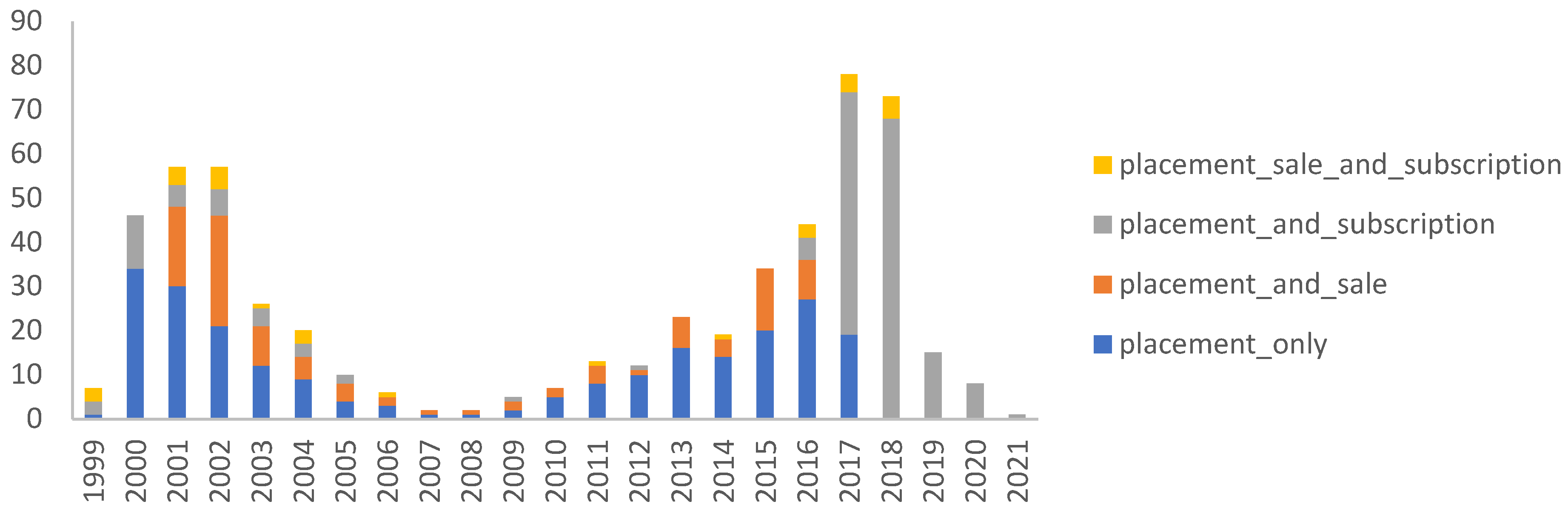
Table 3 summarizes the allocation methods used by Hong Kong GEM-listed companies from 1999 to 2023, while
Figure 5 illustrates annual trends in the use of these methods, highlighting how issuer preferences and regulatory changes have shaped the GEM’s evolving listing landscape.
The following outlines the four principal listing approaches available to GEM candidates:
Unlike public subscription, which offers shares to the general public, placement is characterized by the targeted distribution of shares to selected investors, predominantly institutions or professional investors, under conditions of controlled negotiation and bookbuilding. The foundation of this mechanism lies in the pursuit of greater flexibility, expedient capital raising, and the cultivation of a stable and supportive shareholder base at the time of listing.
In the context of GEM, the placement process commences with the appointment of underwriters and/or placing agents, whose responsibilities include identifying appropriate investors and assessing their interest in the offering. The allocation of shares is then determined at the discretion of these intermediaries, who evaluate factors such as investor reputation, anticipated holding period, and the potential to support post-listing liquidity, etc. The discretionary authority granted to underwriters in this process aligns with findings in the international IPO literature, where allocation decisions are often strategically made to balance issuer objectives and underwriter relationship management (
Ritter & Welch, 2002). This discretion will probably introduce agency concerns, as underwriters may be incentivized to favor clients who offer reciprocal business opportunities or possess longstanding commercial ties, which might not always be in the best interest of the issuer.
As evidenced by
Table 3 and
Figure 5, placement has emerged as the predominant allocation method for IPOs prior to the GEM Listing Rule amendment in 2018. This approach involves distributing shares to select groups of investors, with a pronounced emphasis on institutional and professional participants rather than the general public. While regulatory requirements mandate that a minimum percentage of shares be held by “the public” and that there are a sufficient number of shareholders, these criteria can be satisfied by both institutional and individual investors.
Although individual investors may participate in placements if selected by the underwriter or placing agent, the allocation of significant quantities of shares to such investors has historically been limited. From a strategic perspective, issuers tend to favor institutional allocation for several reasons. Institutional investors are generally considered more sophisticated, possessing enhanced analytical capabilities and a superior ability to contribute to effective price discovery. Their involvement can confer reputational benefits on the IPO, thereby bolstering market confidence in companies that may lack an established public track record. Such placements can mitigate the degree of IPO underpricing, particularly when the investor base comprises actively engaged and informed parties.
As illustrated in
Figure 5, there have been no placement-only IPOs on the GEM board since 2018. This change is the result of major reforms to the GEM Listing Rules implemented by the Hong Kong Stock Exchange (HKEx). One of the cornerstone changes to these reforms was the introduction of a mandatory public-offering requirement for all GEM IPOs, stipulating that at least 10 percent of the total offering must be allocated to the public through a public subscription tranche (
Hong Kong Exchanges and Clearing Limited, 2017). Since this rule came into effect on 15 February 2018, it has no longer been possible to conduct a placement-only GEM IPO after that date.
- (ii)
Sale of Shares by Pre-IPO Shareholders
The sale of shares by pre-IPO shareholders is also a notable allocation method for companies seeking to list on the Hong Kong GEM board. This process permits existing shareholders, such as founders, employees, or early-stage venture capital investors, to divest part or all of their equity holdings concurrently with an initial public offering. Typically, this method occurs alongside a conventional IPO that might involve the issuance of new shares, thereby combining primary and secondary offerings in a single gateway to public markets.
This mechanism confers a dual benefit: it provides liquidity to early investors, enabling them to realize returns on their initial capital, while simultaneously expanding the company’s shareholder base as new public investors acquire the divested shares. Since the transactions pertain solely to the redistribution of existing shares, there is no dilution of ownership for the remaining shareholders. The company’s outstanding share capital remains unchanged, ensuring that control is not diminished by an increase in the total number of shares.
A critical implication of this approach is that, although it provides early investors with liquidity, the company itself does not obtain new capital from the sale of secondary shares. Nonetheless, companies may still opt for such allocations even when additional funding is not required. As noted by
Pagano et al. (
1998), some companies choose to go public not primarily to raise capital for new investments, but to enable insiders to rebalance their portfolios following periods of rapid expansion and investment. The process of going public is also frequently associated with a reduction in the cost of credit and increased turnover in corporate control, thereby offering additional incentives for listing that extend beyond the pursuit of fresh capital. The disposal of shares by pre-IPO shareholders thus constitutes a strategic mechanism within the broader context of IPO objectives and outcomes, particularly in the case of the Hong Kong GEM board.
- (iii)
Public Subscription
Public subscription involves the offering of newly issued shares to the general public during the IPO process. This mechanism not only broadens the issuer’s investor base but also fosters widespread market participation and contributes to the diversification of the shareholder pool. Following amendments to the GEM Listing Rules on 15 February 2018, “placement together with public subscription” has become the predominant method for conducting IPOs on the GEM board. Under this framework, issuers retain discretion over the allocation ratio, albeit within the constraints of regulatory mechanisms such as the clawback provision, which mandates an increase in the public tranche in response to exceptionally high retail demand.
A distinctive characteristic of IPOs conducted through public subscription is the prevalence of underpricing.
Chambers and Dimson (
2009) document that, over the past century, since World War I, the offer prices of IPO shares in the United Kingdom have consistently been significantly lower than the closing prices on the first day of trading.
Loughran and Ritter (
2004) also record that the average IPO first-day returns were 7% in the 1980s, 15% in 1990–1998, 65% in 1999–2000, and 12% in 2001–2003. The theoretical rationale for this phenomenon is grounded in
Rock’s (
1986) seminal model, which highlights information asymmetry among different categories of investors. According to
Rock (
1986), there exists a group of investors with superior information relative to the issuing firm and to other market participants. If new shares were priced at their expected value, these privileged investors would dominate the allocation of attractive offerings, while withdrawing from the market when less favorable issues are presented. Consequently, to ensure participation by uninformed investors, public subscription mechanisms typically price shares at a discount, thereby compensating these investors for their informational disadvantage.
In practice, GEM board public subscription allocations commonly occur on a pro rata or lottery basis, a process that provides retail investors equal formal access to shares but also subjects them to the underlying risks outlined in Rock’s model. Only when shares are notably underpriced will informed investors subscribe, leaving uninformed subscribers concentrated in less valuable offerings. To attract robust, widespread demand and to meet regulatory obligations regarding shareholder dispersion and liquidity, issuers systematically price their IPOs below estimated intrinsic value, reinforcing the persistent pattern of underpricing in Hong Kong’s public subscription offerings.
Loughran and Ritter (
2004) highlight that the magnitude of IPO underpricing has changed over time, partially in response to competitive shifts in the market and evolving issuer and underwriter objectives. On the Hong Kong GEM board, the public subscription approach not only facilitates broad investor participation and enhances market liquidity but also strengthens the incentive for issuers to underprice new listings in order to stimulate oversubscription and foster favorable aftermarket performance.
- (iv)
Introduction
Listing by introduction is a specialized mechanism for allowing a company’s shares to commence trading on the Hong Kong GEM board without the issuance of new shares or the raising of additional capital. In contrast to traditional IPOs, which involve capital-raising activities, this method suits companies with an existing broad shareholder base or those that have made private placements. Although listing by introduction does not generate immediate capital for the issuer, it offers significant advantages such as increased market visibility, a stronger corporate profile, and the development of a liquid secondary market.
Kabir (
1998) notes that this approach is suitable for firms that do not require immediate capital but seek the advantages of public listing, including greater transparency and investor access. It also allows companies to transition to public status more smoothly and cost-effectively.
Given its unique characteristics, the introduction method is subject to rigorous scrutiny to ensure it does not undermine the objectives of maintaining orderly and equitable market conditions. The process entails a thorough review by the Hong Kong Stock Exchange (HKEx) to verify that fundamental requirements—particularly those related to liquidity and shareholder dispersion—are satisfied. Under the GEM Listing Rules, applicants must demonstrate the existence of a broad shareholder base and the likelihood of sufficient share trading upon listing. The Exchange also evaluates the potential risk of excessive share concentration among a limited group of insiders. These regulatory safeguards are designed to preserve market integrity and fairness, thereby minimizing the risks of price manipulation or post-listing illiquidity.
Derrien and Kecskés (
2007) propose that some firms opt for listing by introduction because simultaneous listing and equity issuance may expose the value of shares to great uncertainty and result in underpricing. In order to mitigate this valuation uncertainty, firms may adopt a two-stage approach, i.e., initially listing by introduction to establish a public market for existing shares, and then followed by a subsequent issuance of new shares.
Derrien and Kecskés (
2007) believe that this two-stage offering strategy is more cost-effective, as trading activity in the secondary market helps to reduce valuation uncertainty prior to the equity issuance. Their findings indicate that initial returns for such firms are 10% to 30% lower than those observed for comparable traditional IPOs. Moreover, their study reveals that these firms tend to time the market strategically, both at the point of listing and during subsequent equity offerings.
Ritter (
2021) delineates the advantages and disadvantages of direct listings by using Amplitude as a case study. Unlike traditional IPOs, direct listings forego the “road show” and instead hold investor education meetings without underwriter participation or order collection. This structure eliminates underwriting fees and reduces the “money left on the table” due to IPO underpricing. For instance, Amplitude avoided the customary 6% gross spread and a potential 30% first-day price surge, which for a USD 300 million IPO would have resulted in USD 90 million foregone by the issuer. Moreover, direct listings impose no lock-up provisions for enabling immediate share sales by existing shareholders, and offer greater transparency as market demand sets the opening price rather than underwriter discretion.
Despite their advantages, direct listings have notable constraints. Because this route does not provide new capital for the company, Amplitude was required to obtain significant outside funding prior to listing, specifically raising USD 200 million through a Series F round. Securing such substantial pre-listing financing can present considerable challenges. The absence of underwriters also means no price stabilization, leading to heightened volatility. Furthermore, without underwriter-led roadshows, companies must independently manage investor education, which can be resource-intensive and may restrict initial investor engagement.
3. The Literature Review
Secondary stock markets have become an integral part of global financial infrastructure, offering vital capital-raising avenues for small and growing enterprises. The academic literature highlights both the necessity and motivation for developing secondary markets.
Vismara et al. (
2012) demonstrated that these markets provide firms with essential opportunities to raise capital at both the IPO stage and through follow-on offerings. Most IPOs on these platforms are directed exclusively to institutional investors, effectively functioning as sophisticated private placements. The Canadian experience, as documented by
Carpentier and Suret (
2018), further illustrates that well-structured secondary markets can dominate national IPO activity by listing very small firms in early development stages, fostering entrepreneurial growth despite challenging long-term investor returns.
The rationale for secondary markets extends beyond simple capital provision.
Honjo and Kurihara (
2023) found that approximately 40% of firms listed on the Tokyo Stock Exchange junior markets (as of December 2020) eventually graduated to the main market, demonstrating the role of these platforms as developmental stepping stones for emerging companies. This graduation pattern affirms the conceptualization of secondary markets as transitional venues that support small companies in their progression toward Main Board market participation.
A common feature of the GEM board is the prevalence of more pronounced underpricing than the Main Board, which suggests higher perceived risks associated with these companies. This compels underwriters to set lower offer prices, thereby providing greater compensation to attract risk-averse investors.
Vong and Zhao (
2008) show that the Hong Kong GEM board, operating under more relaxed listing requirements to accommodate smaller growth firms, experiences significantly higher underpricing than the Main Board. This disparity is primarily attributed to greater ex-post volatility in aftermarket returns and elevated investment risk. Similarly,
Chen et al. (
2004) find that Chinese growth markets systematically exhibit higher underpricing, which is directly correlated with increased firm-specific risk and information asymmetry.
Ellul and Pagano (
2006), in their analysis of 337 British IPOs from 1998 to 2000, identify systematic differences between London’s Main Market and the Alternative Investment Market (AIM), which is designed for small companies with limited operating histories and less than three years of accounting profits. Their findings indicate that AIM IPOs exhibit significantly higher underpricing, suggesting that liquidity and liquidity risk play a particularly important role in the underpricing of firms listed on AIM, as small firms typically suffer from lower liquidity compared to their larger counterparts.
Asian IPO research underscores that underpricing on regional exchanges is closely tied to institutional and regulatory features.
Albada and Yong (
2020) review the evidence on IPO underpricing across Asia and conclude that cross-country differences in regulatory environments, listing frameworks, and investor-protection mechanisms are the most plausible sources of the higher average initial returns observed in many Asian markets. Their survey highlights the importance of allocation practices, lock-up provisions and disclosure standards in shaping both the level and variability of first-day returns.
Within this broader Asian context,
Kitano (
2015) offers a detailed comparison of Hong Kong’s GEM and Singapore’s Catalist, emphasizing that both markets target emerging growth enterprises and rely on sponsor systems, yet differ in listing criteria, subsequent capital-raising patterns, and the clarity of their positioning relative to the Main Boards. These institutional contrasts suggest that junior markets’ design choices—particularly around entry requirements, sponsor obligations, and investor access—have first-order implications for issuer quality and the incidence of speculative trading. Situating GEM within this literature motivates our focus on how allocation methods and the 2018 reform, which tightened public subscription requirements, should affect first-day returns. Accordingly, we proceed to formulate hypotheses that link placement-dominated versus retail-oriented allocation structures and regulatory tightening to IPO underpricing on the Hong Kong GEM.
To analyze underpricing in GEM board IPOs, it is essential to first address the fundamental question: why is IPO underpricing so prevalent? The most widely cited explanation is
Rock’s (
1986) model, which attributes underpricing to information asymmetry between informed and uninformed investors. According to this model, adverse selection and the “Winner’s Curse” arise because informed investors subscribe aggressively to underpriced IPOs and withdraw from fairly or overpriced offerings, leaving uninformed investors with less desirable allocations. If IPOs were priced at their expected value, uninformed investors would consistently receive inferior shares and eventually exit the market. Underpricing thus serves as a necessary incentive to attract and retain uninformed investors, safeguarding the long-term viability of the primary equity market. This theory has received substantial empirical support, such as
Cornelli and Goldreich (
2001),
Aggarwal et al. (
2002), and
Ellul and Pagano (
2006).
In contrast to Rock’s model,
Ritter and Welch (
2002) contend that asymmetric information is not the primary driver of many IPO phenomena.
Loughran and Ritter (
2002) offer an agency theory perspective, suggesting that underpricing serves as an indirect form of compensation to underwriters. For example, it is widely recognized within the industry that underpricing facilitates the placement of IPO shares by reducing marketing costs and enables underwriters to allocate underpriced shares to favored clients, thereby strengthening valuable buy-side relationships. If an investment banker does not underprice sufficiently, they risk losing potential investors; however, excessive underpricing may deter the issuer. Thus, IPO pricing represents an equilibrium game between attracting investors and meeting the issuer’s interests (
Beatty & Ritter, 1986). Another study from
Loughran and Ritter (
2004) also notes that there was less emphasis on maximizing IPO proceeds and a greater focus on securing research coverage in the early 2000s. Allocations of “hot” IPOs to the personal brokerage accounts of issuing firm executives also incentivized issuers to engage underwriters known for significant underpricing.
However, IPOs commonly exhibit a striking paradox: substantial first-day gains are frequently followed by persistent long-term underperformance. This phenomenon, termed the “new issues puzzle” by
Loughran and Ritter (
1995), is among the most thoroughly documented empirical regularities in finance.
Ritter (
1991) provides evidence that, for a sample of 1526 IPOs issued between 1975 and 1984, investors who purchased shares at the first-day closing price and held them for three years earned only
$0.83 per dollar invested, compared to matched seasoned firms on the American and New York stock exchanges. This reversal in performance is attributed to factors such as misvaluation at the time of the IPO (
Loughran & Ritter, 1995), behavioral biases, or high post-IPO investment activity. This persistent pattern cautions against buy-and-hold IPO strategies and highlights structural inefficiencies within primary equity markets.
Recent evidence further highlights how regulatory design and information frictions shape primary market outcomes beyond traditional underpricing models.
Botta and Colombo (
2019) show that seasoned equity offering announcements for European banks generate negative returns in both stock and bond markets between 2008 and 2014, indicating that information asymmetry and signaling effects remain powerful drivers of pricing even beyond the IPO stage. Their findings reinforce the view that investors continuously reprice equity in response to shifts in issuer quality and financing policy, consistent with the winner’s curse emphasized for growth markets.
Botta and Colombo (
2020) exploit institutional reforms in Italian cooperative banks as a quasi-natural experiment to quantify how changes in voting rights and listing rules alter market valuations. Framing the 2018 GEM allocation reforms in a similar quasi-experimental spirit would allow this study to link the sharp post-2018 decline in GEM IPO activity and first-day returns to an exogenous regulatory shock, thereby positioning Hong Kong’s GEM within the broader comparative literature on policy-driven changes in equity market design.
The literature studies support the view that secondary stock markets are instrumental in fostering entrepreneurial growth and enabling small and emerging firms to access capital. These markets function as developmental platforms, supporting companies’ progression toward Main Board participation while addressing challenges related to underpricing and liquidity constraints. The widespread occurrence of IPO underpricing, which is driven by information asymmetry, agency problems, and investor incentives, etc. highlights the inherent complexities of pricing in growth-focused markets. Nevertheless, the persistent long-term underperformance of IPOs points to structural inefficiencies and underscores the necessity of prudent investment strategies. As secondary markets continue to develop, thoughtful design and effective regulation are essential to balancing the pursuit of growth opportunities with the imperative of investor protection.
4. Data and Methodology
4.1. Data
This study investigates all 573 listings from the inception of the Hong Kong GEM board on 25 November 1999 to 31 December 2023. The data are obtained from a range of reputable sources and official records. Information pertaining to IPO listings, including allocation methods, breakdowns of funds raised, quantities of shares distributed through different allocation channels, offer prices, total number of shares issued, and subscription rates, etc., was obtained from the Hong Kong Exchanges and Clearing Limited (HKEx) and the official HKGEM website. Initial closing prices and Hang Seng Index values are collected from Bloomberg and the Webb-site Who’s Who database. Pre-listing data such as offer prices, intended offer sizes, final allotments, subscription rates, market capitalizations, allocation method specifics, and industry classifications, etc., are gathered from individual IPO prospectuses and annual financial statements. Additional relevant information is sourced from academic journals, research reports, reputable online platforms, and various forms of publicly available media.
Table 4 presents descriptive statistics for the sample, including subscription rates, the number of shares offered, funds raised, and market capitalization calculated at the offer price. The 90th and 75th percentiles of the offer price are HKD 1.34 and HKD 0.80, respectively, indicating that the majority of GEM issues were priced near HKD 1 (approximately 12.5 US cents), a strategy likely intended to appeal to potential retail investors. The mean subscription rate is 33.5 times, reflecting substantial oversubscription whenever a public tranche is available. This finding suggests that the availability of a public tranche is perceived as a significant investment opportunity by the public, particularly retail investors, consistent with patterns observed in international markets outside Hong Kong. The average market capitalization for the entire sample period is HKD 240 million. Notably, this average increased to approximately HKD 250 million after 2017 following the rise in the minimum market capitalization requirement for GEM listings. This development has important implications, as it coincides with a contraction in the number of eligible small and medium-sized enterprises, reflecting the impact of the stricter listing rules implemented in 2018.
As an initial step, IPOs are categorized based on their allocation methods in four main categories: (i) 237 companies utilized placement only; (ii) 189 employed a combination of placement and public subscription; (iii) 108 involved both placement and offers for sale; and (iv) 31 listings combined placement, offers for sale, and public subscription (
Table 3). In addition to these four categories, 4 stocks were listed exclusively via public subscription, 2 used a combination of offers for sale and subscription, and 2 were admitted by introduction. Owing to the limited sample sizes of these latter three categories, they are excluded from the subsequent empirical analysis.
Table 5 and
Table 6 report the total and average funds raised by year and allocation method, excluding listings by introduction, as these do not generate new equity capital.
Table 7 presents statistics on funds raised (in HKD million) distributed across the four primary combinations of allocation methods. While placement-only listings constitute the majority allocation method (237 out of 573 cases), they represent just 36% of the total funds raised. In contrast, although the subscription approach is less frequently used, IPOs employing a combination of placement and public subscription account for 41% of total funds raised, illustrating its effectiveness in capital generation despite lower usage relative to placement-only allocations.
A natural candidate control in IPO studies is issuer age, typically measured as the difference between the IPO year and the year of incorporation of the listed company. In the Hong Kong GEM context, however, this measure is not economically meaningful for a large share of issuers. Many GEM listings are conducted through offshore holding companies incorporated in jurisdictions such as Bermuda or the Cayman Islands shortly before the IPO, while the underlying operating businesses in Hong Kong or the PRC remain as one or more subsidiaries of this vehicle. The “year of incorporation” recorded for the listed entity, therefore, reflects the establishment of the offshore holding company for listing purposes, rather than the operating history of the business. Moreover, the incorporation years of all relevant subsidiaries are not available in a consistent, structured format for our full sample. As a result, we are unable to construct a reliable and comparable operating-age variable for all 573 GEM IPOs over 1999–2023.
4.2. First-Day Returns on Listing and the IPO Allocation Method
The first part of this study investigates the relationship between first-day returns on listing and the IPO allocation method. The first-day return of stock
i is measured using the following formula:
where
represent the listing-day closing price and the initial offer price of stock
i. For the calculation of market return,
where
denote the closing values of the Hang Seng Index on the first trading day of stock
i and on the trading day immediately preceding the listing of stock
i. Other calculations employed in this study include the market capitalization at the offer price and the amount of funds raised:
where again
represent the initial offer price. The amount of funds raised as a percentage of total market capitalization is estimated as follows:
Then we will present the distributions of key metrics for Hong Kong GEM listings with the following dimensions:
First-day returns—reported conditional on different combinations of IPO allocation methods.
Company size—measured and compared according to the allocation strategies employed.
Total market capitalization—calculated at the offer price and analyzed conditionally by allocation mix.
Conditional distribution of initial day returns—providing a nuanced view of how allocation methods may relate to immediate post-listing performance.
These joint and conditional distributions are designed to facilitate a statistical assessment of whether significant differences exist across allocation structures. Specifically, they allow for the examination of whether variations in first-day returns, company size, and market capitalization can be attributed to differences in allocation approaches.
To formally test these potential differences, the study employs t-tests to compare the means of each metric between any two allocation method combinations. The testing framework is structured around the following null hypotheses:
There is no difference in first-day returns between any two allocation method combinations.
There is no difference in company sizes between any two allocation method combinations.
There is no difference in market capitalization (or firm size) between any two allocation method combinations.
is the mean of sample 1;
is the standard deviation of sample 1;
is the sample size of sample 1;
is the mean of sample 2;
is the standard deviation of sample 2;
is the sample size in sample 2.
This approach provides a robust statistical basis for identifying and interpreting systematic differences associated with the choice of IPO allocation strategy on the GEM board.
4.3. Multiple Regression Analysis
The second part of this study investigates the influence and magnitude of various factors on first-day returns using multiple regression analysis. The regression framework is specified as follows:
where y denotes the first-day return, and the explanatory variables x
1, x
2, …, x
n include:
The percentage of shares allocated through placement, sale, and subscription, respectively (calculated as the sum of shares offered by each allocation method divided by the total shares issued).
A dummy variable indicating availability for public subscription (1 = available; 0 = not available).
Subscription rate (expressed as the number of times subscribed).
Amount of funds raised (in HKD millions, in logarithmic scale).
Market capitalization at listing (in HKD millions, in logarithmic scale).
Market volatility, measured by the volatility of the Hang Seng Index (in logarithmic scale).
We expect the results of this regression analysis to demonstrate that the proportions of shares allocated through different methods offer valuable insights into information asymmetry and the winner’s curse phenomenon. When issuers or promoters seek to exploit the informational disadvantages of less sophisticated investors, a larger proportion of shares is allocated to the public subscription tranche. We hypothesize that the first-day return will be negatively correlated with the percentage of shares offered to the public, as larger public tranches may require greater underpricing to attract uninformed investors. The first-day returns are likely to be higher when the issue is allocated entirely to professional or institutional investors. We also anticipate a positive relationship between the public subscription rate and first-day returns, as the subscription rate serves as a proxy for investor demand and higher rates of oversubscription typically drive up initial day prices and returns.
4.4. Self-Selection into Allocation Methods and Identification
A central empirical challenge in this setting is that firms are not randomly assigned to allocation methods. Instead, issuers and underwriters select among placement-only, placement plus public subscription, and other combinations based on internal assessments of firm quality, valuation uncertainty, and anticipated investor demand. Many of these determinants are only imperfectly captured by observable IPO-level variables such as offer size, market capitalization, sector, or contemporaneous market conditions.
Our empirical strategy mitigates this concern by providing detailed descriptive evidence on how observable firm and issue characteristics differ across allocation categories. This allows us to assess whether systematic differences in size, funds raised, industry composition, or market conditions plausibly explain the cross-sectional variation in first-day returns. Our regression analysis also conditions on a rich set of covariates, including measures of the percentage of shares allocated through placement, sale, and subscription respectively, availability for public subscription, subscription rate, amount of funds raised, market capitalization, market volatility, etc. By controlling for these observable dimensions, we substantially reduce, though cannot fully eliminate, the scope for omitted-variable bias arising from self-selection.
We considered more formal selection-correction methods, such as Heckman two-stage models or propensity score matching. However, implementing these approaches in a credible way would require instruments or additional pre-IPO covariates that influence the choice of allocation method but do not directly affect first-day returns. In our setting, such exclusion restrictions are not available in a sufficiently convincing form. Many plausible candidates (e.g., underwriter identity, industry, market conditions) are likely to be correlated with both allocation choice and price formation. Rather than relying on strong and untestable assumptions, we adopt a transparent reduced-form approach with extensive controls and explicitly highlight the residual selection concern as a limitation.
5. Empirical Findings
Table 8 reports the first-day returns for the four primary combinations of allocation methods. The data reveal a stark dichotomy in IPO first-day returns depending on whether public subscription mechanisms are included. IPOs using only placement-only and placement + sale methods yield first-day returns of 200.9% and 231.0%, respectively, while those that incorporate public subscription (placement + subscription and placement + sale + subscription) show significantly lower returns of 32.5% and 10.5%. This represents an 85% to 95% reduction in first-day returns when retail participation is present, which aligns with Rock’s “Winner’s Curse” hypothesis (
Rock, 1986;
Keloharju, 1993)—i.e., uninformed retail investors are more likely to be allocated overpriced IPO offerings, resulting in lower average first-day returns for this group and necessitating greater underpricing as compensation. The superior performance of placement-only and placement + sale IPOs may also be attributed to the exclusive involvement of sophisticated institutional investors, who possess advanced information processing capabilities (
Chemmanur et al., 2010). Underpricing tends to be greater when more shares are allocated to institutional investors, as strong demand from individual investors typically results in higher IPO prices (
Derrian, 2005). The absence of retail participation enables underwriters to pursue aggressive pricing strategies, which institutional investors are better equipped to assess and accept based on fundamental analysis.
The analysis of the
t-test results for the original first-day returns across different allocation methods is shown in
Table 9. The comparison between placement-only and placement + sale shows no significant difference (t = −0.579,
p = 0.564), suggesting these two methods yield similar average first-day returns, with both means around 2.009 and 2.310 respectively. However, the comparisons between placement-only and placement + subscription, as well as placement-only and placement + sale + subscription, exhibit highly significant differences (
t-values of 5.697 and 6.802,
p < 0.001), indicating that including subscription or sale components in the allocation method substantially impacts return outcomes. The comparison between placement + sale and placement + sale + subscription” also shows a significant difference (t = 4.971,
p < 0.001), further emphasizing the effect of the inclusion of subscription strategies on initial returns. The comparison of placement + subscription versus placement + sale + subscription approaches yields a marginally significant result (t = 1.908,
p ≈ 0.058), hinting at a possible difference, though less pronounced. Overall, these results suggest that allocation methods incorporating subscription and sale components tend to be associated with lower first-day returns compared to simple placement strategies, and the significant t-values reinforce that these differences are statistically meaningful. This insight could influence how investors or underwriters select allocation methods to optimize initial returns.
To address the potential impact of extreme return values,
t-tests are also performed using 5% winsorized first-day returns to mitigate the influence of outliers. The lowest and highest 5% of returns are replaced with the nearest values within that range, producing a modified dataset on which the mean is calculated. As indicated in
Table 10, the results remain robust and closely align with those presented in
Table 9, even after applying the 5% winsorization threshold.
Table 11 presents regression results where the dependent variable is the first-day return of IPOs. The specification includes eight independent variables: the percentage of shares offered for placement, sale and subscription; a dummy variable for availability for public subscription; subscription rate; the natural logarithm of funds raised; the natural logarithm of market capitalization at listing; and the natural logarithm of market volatility. Industry fixed effects at twelve classifications control for sectoral differences.
The findings reveal an intriguing dynamic in the relationship between first-day returns and the composition of shares offered during an IPO. There is a positive association between first-day returns and the percentage of shares offered for placement, but a negative association with the percentage of shares offered for sales. This result is particularly noteworthy given that both placement shares and sales shares are typically allocated to professional and institutional investors, who are presumed to possess advanced informational sophistication and bargaining power (
Benveniste & Spindt, 1989).
The crucial distinction of IPO placement and sales lies in the source of the shares. Placement shares are distributed by underwriters, often utilizing the bookbuilding process to match demand to select investors; whereas shares offered for sale usually originate from existing shareholders, such as founders or early investors who are seeking to liquidate their holdings. Despite the prevailing literature suggesting that professional and institutional investors seek out IPOs with strong initial return potential, the source and context of the shares significantly influence post-IPO performance. Our findings indicate that a higher proportion of shares offered for sale is linked to increased first-day returns. This may be because substantial selling by insiders or founders signals concerns about future growth of the companies, leading to discounted pricing and weaker long-term performance, even in the presence of institutional investors.
These results challenge conventional assumptions about institutional investor behavior and the impact of share composition on IPO outcomes. Although placement shares are generally intended to attract sophisticated investors and enhance initial returns, our findings indicate that sale shares, despite being offloaded by existing shareholders, may also drive higher first-day returns. This underscores the complex informational dynamics and signaling effects associated with share composition in the IPO process.
The regression reveals the percentage share offered for subscription is negatively related to first-day returns, a result aligning with the winner’s curse hypothesis of
Rock (
1986). Under this framework, public subscribers tend to be awarded larger allocations mainly when an IPO is less attractive (so-called “lemons” in the industry, which means a sour return), which are associated with poor short-term performance. This pattern is well documented in the IPO literature, where uninformed retail investors disproportionately receive more shares when the prospects for gains are weak, as institutional investors tend to avoid such offerings (
Cornelli & Goldreich, 2001).
The analysis also indicates that the subscription rate, a direct indicator of excess demand for new listings, is significantly and positively correlated with first-day returns. This finding aligns with
Agarwal et al. (
2008), who examined Hong Kong’s Main Board IPO market and suggested that higher oversubscription rates signal heightened investor enthusiasm that translates into greater initial price jumps. However,
Agarwal et al. (
2008) also observed that IPOs with high investor demand tend to experience substantial positive initial returns but negative long-run excess returns, whereas IPOs with lower demand typically show negative initial returns followed by positive long-run excess returns. These results indicate that investors’ pre-offering demand for IPOs is at least partly driven by their tendency to overreact or underreact to information about the firm’s future prospects after issuance. While IPOs that attract unusually high or low demand may initially trade at prices that depart from their intrinsic values in the aftermarket, these prices tend to adjust and eventually align with the firms’ fundamental values over time.
The results are consistent with the view that market volatility is negatively correlated with IPO first-day returns. Higher volatility typically reflects increased uncertainty, prompting investors to adopt greater risk aversion and consequently diminishing demand for equities, including newly issued IPO shares. This reduced demand translates into lower buying pressure for new IPO stocks, ultimately resulting in weaker first-day returns.
Although these studies primarily examine Main Board IPOs and large-cap markets, their insights are directly relevant to Hong Kong’s GEM, where regulatory changes to allocation rules can have disproportionately large effects on thinly traded growth stocks. The extremely high first-day returns observed in placement-only and placement plus sale GEM IPOs before 2018 should be interpreted with caution. These returns may not simply reflect compensation for information asymmetries, but may also indicate episodes of shell manufacturing or “pump-and-dump” price inflation in a thinly traded micro-cap market. In such placements, share allocations might be highly discretionary and heavily concentrated among institutional and professional investors, with minimal retail participation and a limited free float. This structure may facilitate sharp price spikes that were not necessarily rooted in fundamental value. The reform package introduced in 2018 directly limited the use of pure placement-only IPOs, reducing the potential for highly concentrated, lightly scrutinized deals that could serve as shells. Following these reforms, we observe two clear patterns: GEM listing activity collapsed, and average first-day underpricing declined significantly as allocation structures now require a retail tranche. While our empirical approach cannot fully disentangle the effects of the winner’s curse from regulatory efforts to suppress manipulation, the evidence supports a dual interpretation: the mandatory public tranche both reduces informational rents extracted from uninformed investors and curbs the extreme price swings seen in speculative placement-only deals.
A brief comparison with Hong Kong’s Main Board suggests these changes are unique to the GEM micro-cap segment, not a symptom of declining retail demand across the market. The number of GEM IPOs fell from 75 in 2018 to 15, eight, one, and zero between 2019 and 2023, while the Main Board IPOs still maintained a much higher and more stable number of 130, 147, 136, 96, 80 and 68 from 2018 to 2023 (
Table 1). This indicates that higher listing standards and compulsory public tranches had a disproportionately contractionary effect on the smallest, most fragile segment of the market. The post-2018 decline in underpricing is best understood as the combined result of less winner’s curse-driven underpricing and effective regulatory intervention against extreme price distortions in GEM’s micro-cap IPOs. These findings underscore the importance of treating regulatory reforms and allocation mechanisms as quasi-exogenous shocks to the information environment and investor mix. Our study contributes to this literature by examining how the 2018 GEM reform and the introduction of a mandatory public subscription tranche are associated with first-day returns on Hong Kong’s growth board.
In addition to the regression analysis conducted on the full sample of 565 IPOs as presented in
Table 11, we also performed separate regressions for four primary subsamples defined by different combinations of allocation methods. This subsample approach enabled us to tailor the independent variables to each specific allocation context. For instance, when analyzing placement-only allocations, variables pertaining to the percentage of shares offered for sale and subscription were excluded as they are not relevant in this context.
The results of these subsample regressions are summarized in
Table 12. Most associations between the independent variables and first-day returns remain consistent with those observed in the full sample, with two notable exceptions: (i) for the placement + sales allocation method, the percentage of shares offered for sale is negatively associated with first-day returns; and (ii) for placement + sales + subscription, the percentages of shares offered through both placement and sales are positively associated with first-day returns. These results deviate from the general trend observed in the full dataset, highlighting the importance of accounting for specific allocation methods when analyzing the determinants of first-day IPO returns.
Our empirical specifications deliberately employ a parsimonious set of controls that can be constructed consistently for all GEM IPOs over 1999–2023. While this design supports market-wide coverage, it also implies that several well-known determinants of IPO underpricing, such as underwriter reputation, issuer age, and venture capital backing, are not explicitly modeled because comparable data are not available for all issues. Our estimates should be viewed as conditional on observable issue size, industry, timing, allocation method, and major regulatory shifts, but they may still reflect residual omitted-variable bias along dimensions correlated with intermediary quality or issuer lifecycle. This limitation does not undermine the descriptive patterns we document but suggests that future research with richer micro-level data could integrate these additional factors to provide a more granular account of underpricing on the Hong Kong GEM.
6. Conclusions
This comprehensive analysis of IPOs on the Hong Kong GEM board from 1999 to 2023 provides strong evidence that IPO allocation methods have a significant impact on first-day returns and market dynamics. The findings reveal a pronounced disparity in performance: IPOs utilizing placement-only or placement combined with sale method achieved much higher first-day returns (200.9% and 231.0%, respectively) than those involving public subscription components (32.5% and 10.45%). This 85–95% reduction in initial returns when retail participation is present strongly supports the winner’s curse hypothesis. Public subscription investors, typically “uninformed investors” from retail or less sophisticated participants, lack access to detailed information and rely largely on public disclosures or general market sentiment. In contrast, placement and sale investors are generally “informed investors” with more informed and superior insights into the true value of IPO shares. Our results show that uninformed retail investors are systematically allocated larger portions of less attractive offerings, which is consistent with the analysis of
Rock (
1986).
The regression analysis is consistent with the view that the percentage of shares allocated through public subscription is negatively correlated with first-day returns, while subscription rates are positively associated, indicating that higher investor demand leads to greater initial price appreciation. Market volatility exerts a negative effect on IPO performance, reflecting heightened risk aversion during periods of uncertainty. These findings highlight the complex informational dynamics that shape IPO pricing and allocation decisions in secondary growth markets.
The policy implications of this study are especially relevant in light of the Hong Kong Stock Exchange’s 2018 regulatory reforms, which require a minimum 10% public offering for all GEM IPOs. Although these reforms aimed to enhance transparency and market discipline, they appear to have produced unintended consequences. The sharp decline in new listings from 75 IPOs in 2018 to just one between 2021 and 2023, along with the S&P/HKEX GEM Index’s 98% drop since 2003, suggests that rigid allocation requirements may have diminished the board’s appeal.
Our findings indicate that the mandatory public subscription requirement has reduced the initial price surges sought by sophisticated investors, potentially triggering a negative feedback loop of waning investor enthusiasm, lower liquidity, and declining issuer interest. This regulatory inflexibility may have transformed protective measures into structural barriers, jeopardizing the long-term sustainability of Hong Kong’s secondary growth market. Future policy should strive to balance investor protection with market flexibility, potentially introducing more adaptive allocation frameworks that can respond to changing market conditions and issuer needs while maintaining robust safeguards for retail investors.
A key limitation of our analysis is the possibility that firms self-select into different allocation methods. Issuers do not randomly choose between placement-only, placement plus sale, and public subscription structures; rather, these decisions may reflect underlying firm quality, valuation uncertainty, or strategic objectives. Consequently, our estimates should be interpreted as conditional associations rather than structural causal effects. In principle, one could address this issue by modeling selection explicitly—using approaches such as Heckman-type two-stage procedures, propensity score matching across allocation types, or difference-in-differences designs that leverage the 2018 reform as a regulatory shock. However, implementing these methods would require stronger identifying assumptions and considerably greater modeling complexity. For these reasons, we leave a full structural analysis of issuer self-selection and the causal effects of allocation rules to future research and position our contribution as a comprehensive descriptive study of GEM IPO pricing outcomes under different allocation regimes.
Another limitation concerns issuer age. In principle, IPO age could help control for lifecycle effects in underpricing. However, for GEM issuers that list via newly incorporated Bermuda or Cayman holding companies above older operating subsidiaries, the legal incorporation year of the listed entity does not capture the firm’s true operating history, and consistent incorporation dates for all subsidiaries are not observable. Consequently, we are unable to incorporate a meaningful and comparable IPO-age variable for the full sample and instead interpret our results as conditional on observable size, industry, timing, allocation structure, and market conditions.