3.1. Network Plot
The findings of the network plot are aimed at uncovering the intervariable association between the constructs included in the model. The findings of the network plot are reported in
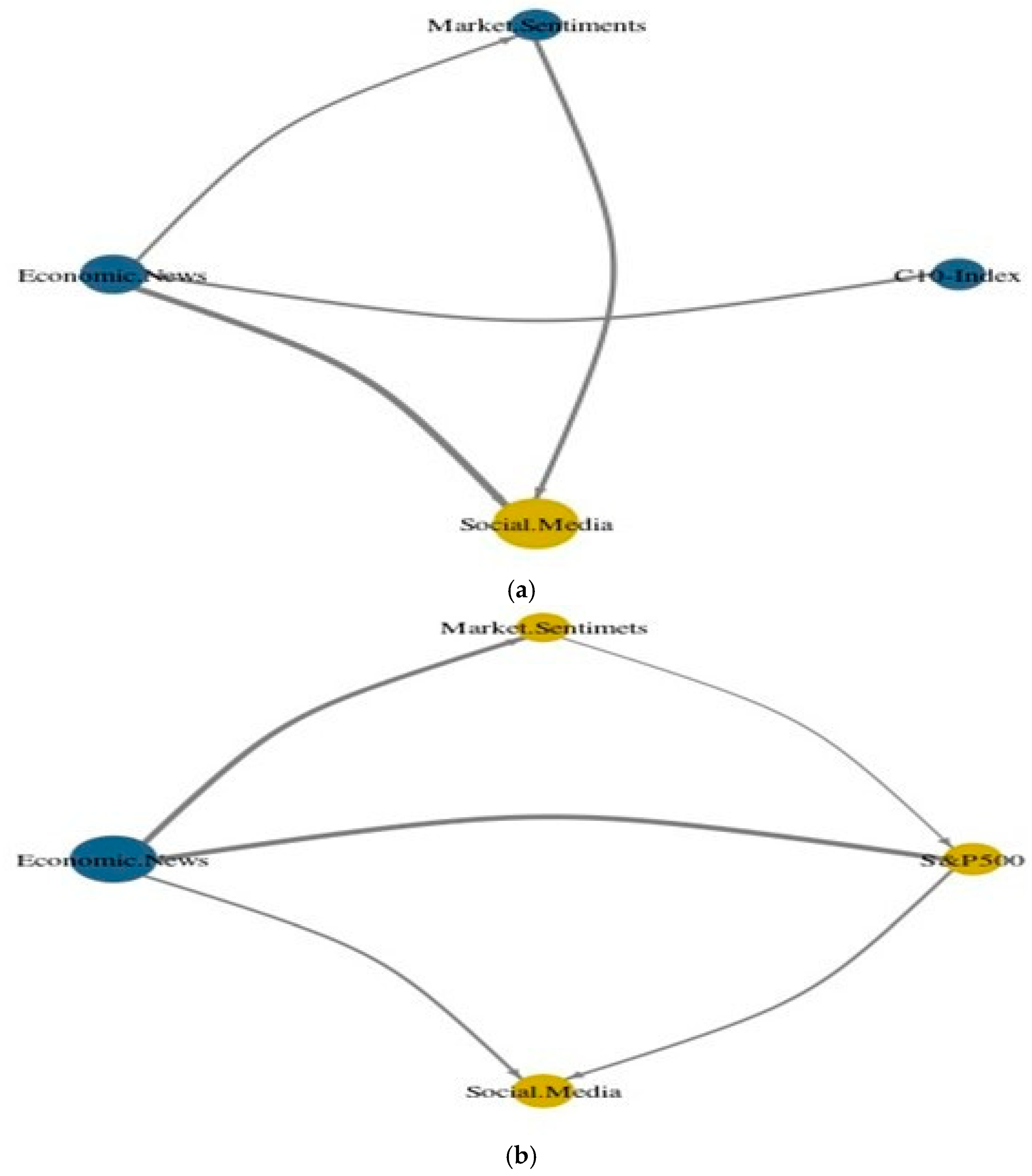
Figure 2a,b for S&P cryptocurrency and the S&P 500 index. The plot not only shows direction but also the degree of association between the variables. The blue indicators represent net transmitters, and the yellow color represents net receivers in the model, while the magnitude of the relationship is represented through the thickness of the link.
Figure 2.
(
a) Network between C-10 index, crypto market sentiments, economic news sentiments, and social media sentiments. Source: Study findings from
Table 5a. (
b) Network between S&P 500 index, stock market sentiments, economic news sentiments, and social media sentiments. Source: Study findings from
Table 5b.
Figure 2.
(
a) Network between C-10 index, crypto market sentiments, economic news sentiments, and social media sentiments. Source: Study findings from
Table 5a. (
b) Network between S&P 500 index, stock market sentiments, economic news sentiments, and social media sentiments. Source: Study findings from
Table 5b.
Table 5.
(a) Average connectedness of C-10 index, crypto market sentiments, economic news sentiments, and social media sentiments. (b) Average connectedness of S&P 500 index, stock market sentiments, economic news sentiments, and social media sentiments.
Table 5.
(a) Average connectedness of C-10 index, crypto market sentiments, economic news sentiments, and social media sentiments. (b) Average connectedness of S&P 500 index, stock market sentiments, economic news sentiments, and social media sentiments.
| (a) |
|---|
| | C10-Index | Market Sentiments | Economic News | Social Media | FROM |
|---|
| C10-Index | 086.50 | 009.57 | 002.08 | 001.84 | 013.50 |
| Market Sentiments | 009.22 | 086.25 | 002.38 | 002.14 | 013.75 |
| Economic News | 003.02 | 001.60 | 093.15 | 002.23 | 006.85 |
| Social media | 001.88 | 003.14 | 003.79 | 091.19 | 008.81 |
| TO | 014.12 | 014.32 | 008.25 | 006.22 | 042.90 |
| Inc. Own | 100.62 | 100.57 | 101.40 | 097.41 | cTCI/TCI |
| NET | 000.62 | 000.57 | 001.40 | −002.59 | 14.30/10.73 |
| (b) |
| | S&P500 | Market Sentiments | Economic News | Social Media | FROM |
| S&P500 | 065.58 | 020.62 | 010.01 | 003.79 | 034.42 |
| Market Sentiments | 018.92 | 063.43 | 012.70 | 004.94 | 036.57 |
| Economic News | 005.04 | 007.34 | 083.37 | 004.25 | 016.63 |
| Social media | 006.58 | 005.50 | 007.16 | 080.75 | 019.25 |
| TO | 030.55 | 033.46 | 029.88 | 012.98 | 106.86 |
| Inc. Own | 096.13 | 096.89 | 113.25 | 093.73 | cTCI/TCI |
| NET | −003.87 | −003.11 | 013.25 | −006.27 | 35.62/26.72 |
Figure 2a uncovers the relationship of the S&P cryptocurrency index with market, economic news, and social media sentiments. The analysis uncovers that the cryptocurrency index is weakly associated with economic news sentiments, whereas no visible association exists for market and social media sentiments towards cryptocurrencies. These findings are aligned with the study of
Rognone et al. (
2020) who found a significant association of cryptocurrencies with economic news, and are unable to validate the findings of
Kyriazis et al. (
2023) and
Wang et al. (
2024) regarding market and social media sentiments. This can be attributed to the interlinkage between different types of sentiments. This interlinkage can also be observed from
Figure 2a, where economic news (market sentiments) is found to be a strong (weak) driver of social media sentiments, while economic news is also found to be weakly influencing the market sentiments, thereby establishing that the cryptocurrency market and related sentiments are highly sensitive to the variation in economic sentiments.
Figure 2b is associated with the return of S&P500-selected types of sentiments in the model. The findings uncovered that all economic news and stock market news plays a significant role in determining the behavior of S&P500 return, whereas the former dominates this association with a much higher association, while the latter has a weak influence. These findings are aligned with existing studies of
Farrell and O’Connor (
2025),
Gong et al. (
2022),
Q. Liu et al. (
2023),
Tan et al. (
2023), and
Verma and Verma (
2025). These findings validate that investors in stock markets are much more influenced by sentiments and act irrationally, leading these sentiments to predict stock markets. The study also established that market behavior alongside economic and market sentiments act as a driving agent for social media sentiments. The interlinkage between these sentiments established and affirmed economic news sentiments as the sole dominating force in the stock market.
3.2. Static Connectedness Analysis
This section focuses on presenting the average connectedness among the returns of the market index and selected types of sentiments. The section is divided into two categories to present findings related to cryptocurrency and stock market analysis in
Table 5a,b. The dominance of diagonal values of each variable indicates that the highest influence on prices and sentiments is self-driven and is attributable to their shocks and movement, and is consistent with the existing literature on spillover (
Abakah et al., 2023;
Frankovic et al., 2022;
Yousaf et al., 2023).
The findings related to the S&P cryptocurrency index and sentiments are reported in
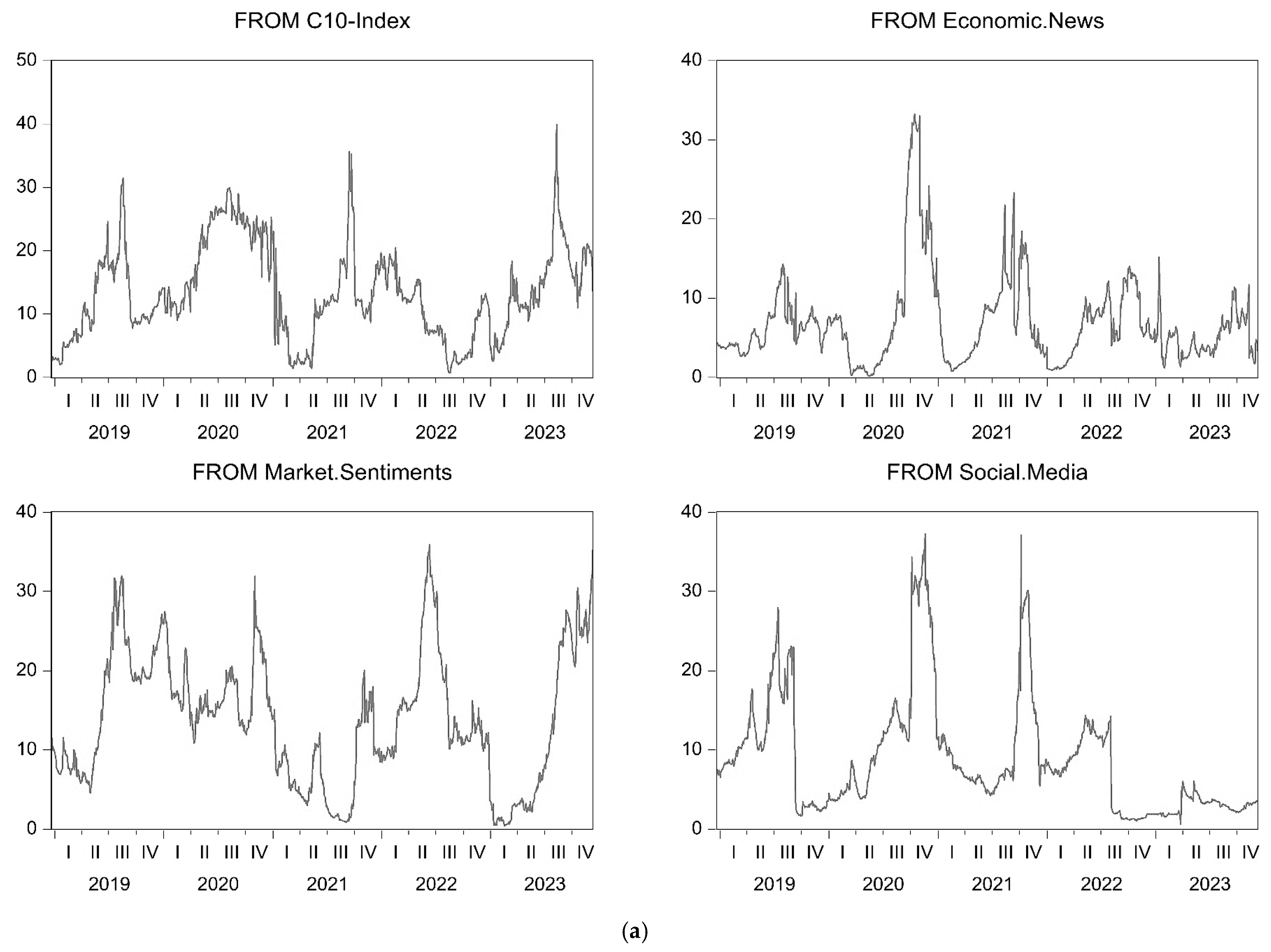
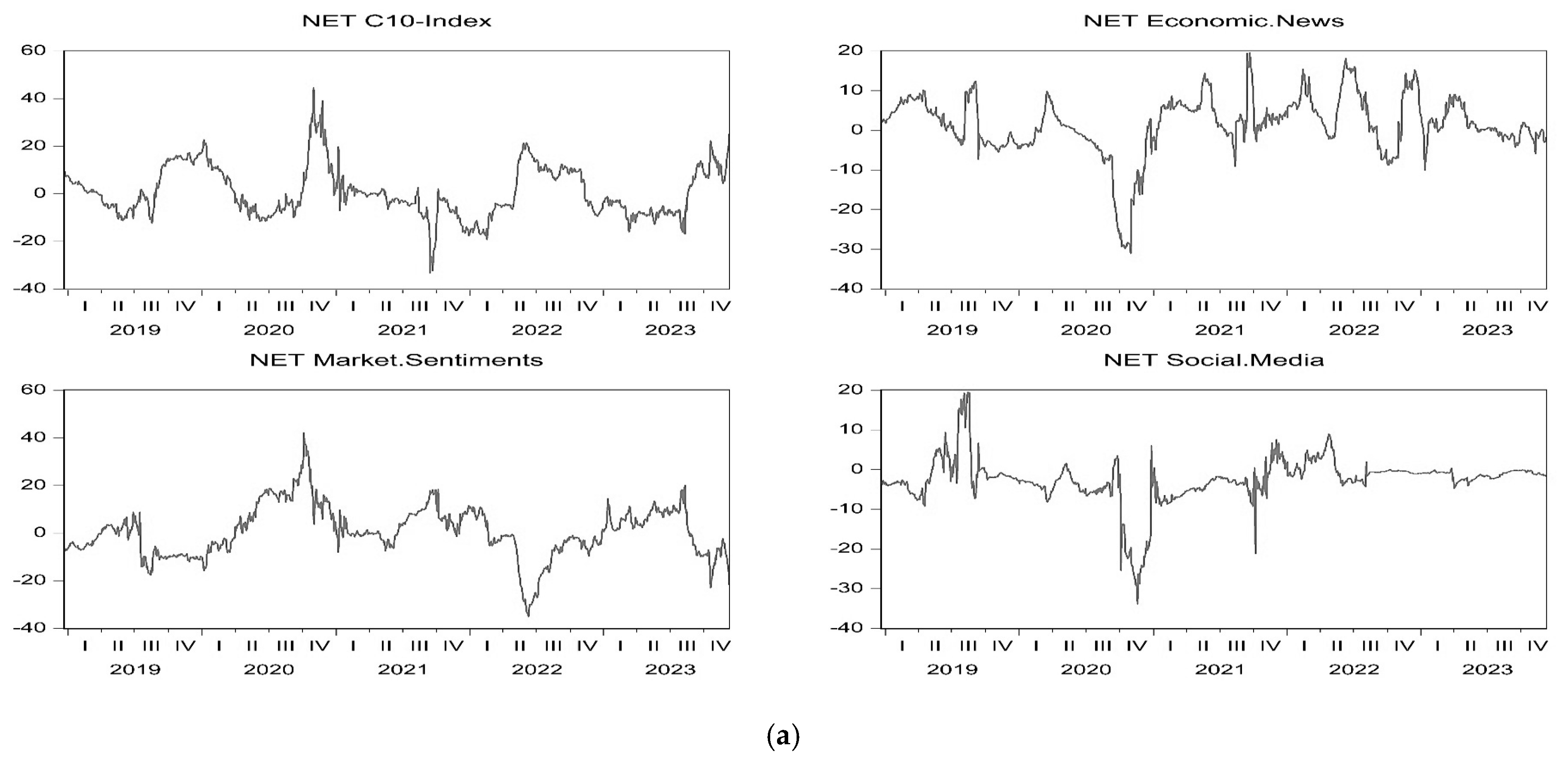
Table 5a. The findings of the total connectedness index (TCI) revealed a weak association between sentiments and cryptocurrency returns at 14.30%. The findings suggest that economic news sentiments act as a driving factor for spillover across cryptocurrency returns (
Philander, 2023;
Rognone et al., 2020;
Umar et al., 2021). The findings of the study align these findings with the work of
Karaa et al. (
2024) showing that associated investors’ behavior relies on behavioral patterns and trends reflected by investors’ sentiments, hence affirming the presence of irrational and noise trading derived from biased behavioral factors. Conclusively, variation in behavioral market sentiments is found to shape the cryptocurrency returns (
Caferra, 2020). The findings uncover that economic news is the sole dominating factor in the cryptocurrency environment, which shapes market and social media sentiments to shape cryptocurrency behavior. In a speculative market like cryptocurrency, where the market valuation of an asset is solely driven by investors’ sentiments, they became a vital indicator for investors, managers, practitioners, initial coin offerings, and regulators (
Domingo et al., 2020). Stakeholders should carefully consider trends and persistent economic sentiments to plan and execute their financial decisions to gain optimal results.
Similarly, the findings related to the S&P 500 stock indices and sentiments are reported in
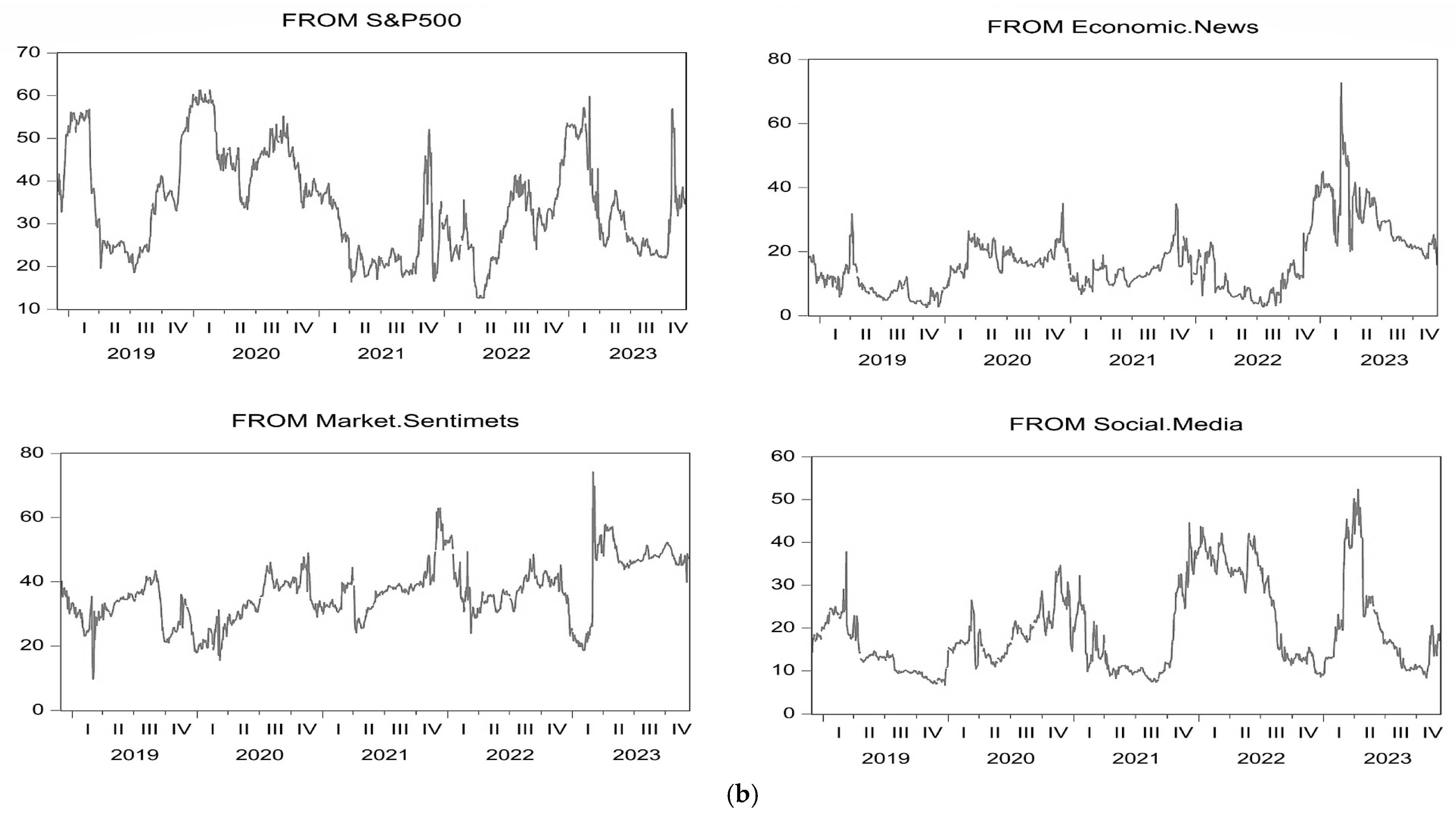
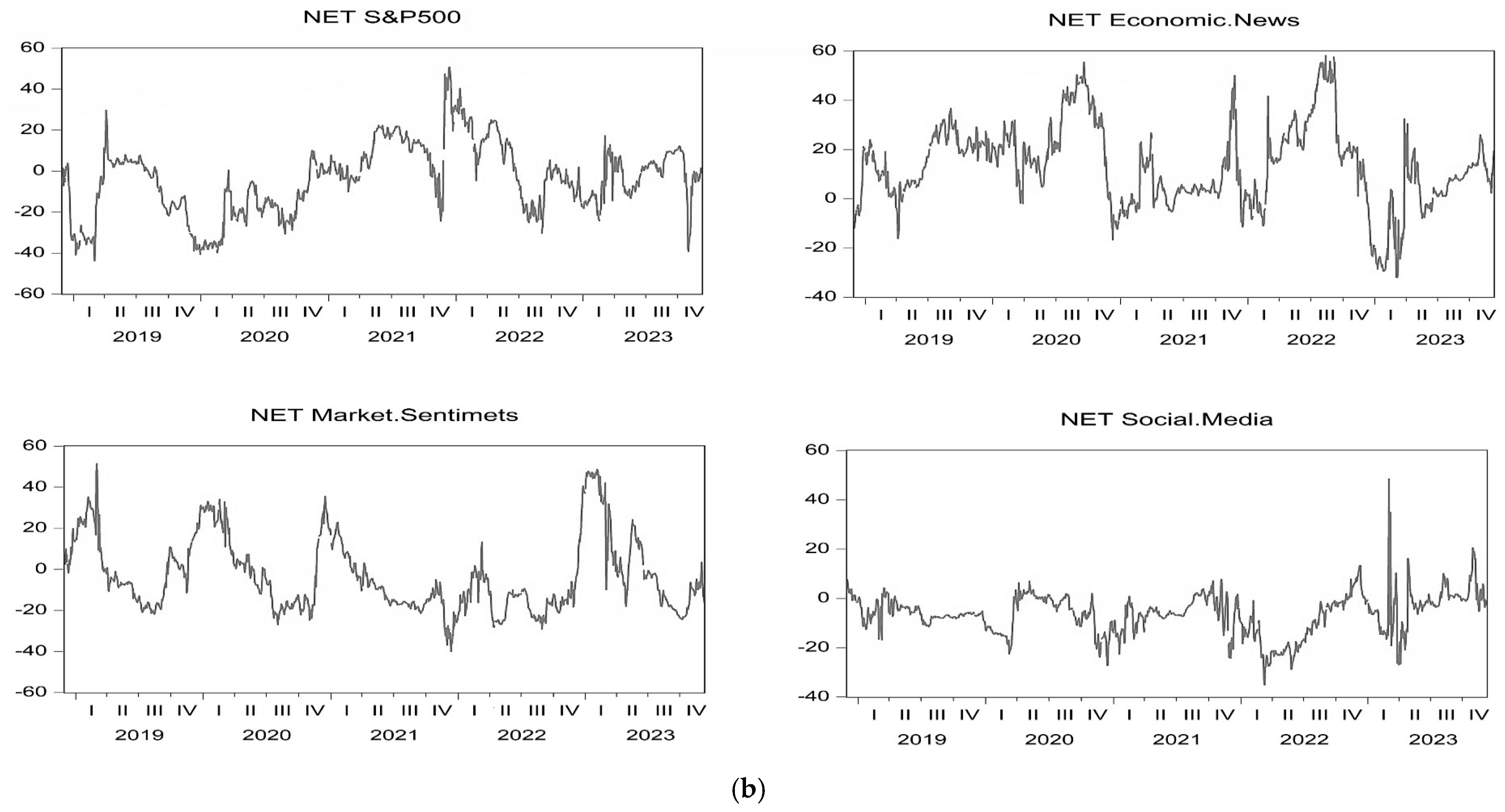
Table 5b. The findings of the evaluation established moderate spillover between market returns and sentiments at 35.62%. The findings suggest that economic and market sentiments act as a driving force for stock market movements (
Farrell & O’Connor, 2025;
Verma & Verma, 2025) while economic news acts as the primary factor influencing market and social media sentiments and hence establishes itself as the driving force for the stock market movements. The findings of the study highlighted that social media sentiments do not determine stock market, but instead they are generated in consequence of the economic sentiments, market sentiments, and stock movements. Therefore, a more appropriate measure to consider for investors is economic news and stock market movements. Given that existing literature like
Rasheed et al. (
2023) and
Tan et al. (
2024) posits that the driving force behind economic and market sentiments are also biased and resulted from investor over- or underreaction to information, investors can utilize this nexus among sentiments to determine the market direction and expected valuation for return optimization.
3.4. Robustness Analysis
To further validate the findings of the study and uncover further insights from the dataset, a simple linear regression model and Granger causality analysis are applied as robustness measures. Two separate regression models are applied against the S&P cryptocurrency index return and S&P 500 stock returns through E-Views.
The results for cryptocurrency returns are reported in
Table 6a; the overall fitness of the model is assessed using the significance of F statistics. The Durbin–Watson test for multicollinearity and unit root test for stationarity of series is applied and reported. The findings indicate that models have sufficient statistical validity and reliability. The inferential findings indicate that only market sentiments are a significant determinant of cryptocurrency returns at (
p < 0.01), while results regarding economic sentiments and social media sentiments are statistically insignificant. This validates the earlier inference that the cryptocurrency market is an isolated environment with self-driving sentiments and remains alienated from outside macroeconomic factors.
Subsequently, an analysis of S&P 500 stock returns is reported in
Table 6b. The model indices comprising F statistics, Durbin–Watson statistics, and unit root analysis reveal reliability and validity of the statistical model. The findings of the analysis uncovered that market sentiments are a significant driver of market return at (
p < 0.01) while the findings related to economic news sentiments are also significant but at (
p < 0.1). The influence of social media sentiments on the stock market is also insignifican, thereby establishing that stock markets are more influenced by overall economic and market sentiments and are much more prone to fluctuations in external factors.
Lastly, to further extend the analysis into the significance of the two-way association among each set of variables, Granger causality tests are applied based on F-statistics and results are reported in
Table 7 for both cryptocurrency- and stock-related variables. The findings related to cryptocurrency-related variables validate the findings of spillover and regression analysis and establish that there exists two-way causality among market sentiments and index returns. Apart from that, causality between sentiments and market returns is not significant.
Similarly, for the casualty of S&P500 index return and market sentiments, similar bidirectional and significant outcomes are revealed, but similar to spillover and regression analysis, it additionally reported significant bidirectional influence of economic news sentiments on stock index return. Meanwhile, economic news and market sentiments are also significantly affecting each other. These unique findings affirm the insights uncovered during earlier analysis regarding the greater sensitivity of the stock market against sentiments as compared to the cryptocurrency market. The bidirectional significant influence validates that the S&P500 index is a significant and integrated part of the overall economic system, with a change in one influencing the other significantly.
Social media sentiments are found to be consistently influencing economic news sentiments, a findings aligned with the earlier findings of
Gong et al. (
2022) which determined that social media has influenced economic news in recent times. The pioneering nature of this particular avenue makes it a significant theoretical and practical contribution for all the relevant stakeholders while also opening new behavioral avenues for future researchers.
These results reveal the way that sentiments are distributed among various information sources and how these sentiments are associated with the movements of stock and cryptocurrency markets.
Cryptocurrency results and analysis reveal that there is substantial bidirectional causality between the market sentiments and cryptocurrency index returns for cryptocurrencies. The past market sentiment drives returns of cryptocurrencies at the same time that past returns of cryptocurrencies drive future market sentiment. The cryptocurrency market is very dynamic, with investors reacting on their emotional and speculative instincts, driving the market as much as the market drives them. Volatile cryptocurrency prices can cause investors to change their expectations of the markets, and these are reflected in their subsequent actions. The cryptocurrency markets thus seem to be in what looks like a feedback loop of sentiment returning. With the exception of the relationship between market sentiments and cryptocurrency returns, the causality between other sentiment variables and cryptocurrency returns seems negligible. These indicate, in a sense, that the economic news sentiment and social media sentiment have less direct impacts on the returns of cryptocurrencies. The reason may be that the cryptocurrency markets tend to react more to internal market indicators, investor sentiment, market liquidity, investor speculation, and the narratives built around certain platforms rather than to official economic data. For this reason, although sentiment does matter in the cryptocurrency market, the results suggest that the market-level sentiment metric is more predictive than other economic indicators or sentiment measures based on social media.
As far as the findings relating to S&P 500 are concerned, they provide much-interconnected dynamics. The association of return and market sentiments is found to be similar to the cryptocurrency market. This uncovers investor sentiment as the driving force for stock market returns, and that changes in stock market sentiment help explain future movements in stock returns. In such a feedback relationship, stock market actors react to price signals as well as to investor sentiment or collective investor expectations. When returns rise, it boosts investor confidence; however, if a company performs poorly, investor confidence will decline, changing investors’ future expectations for that company. One of the major discrepancies seems to lie in the power of economic news sentiments. The S&P 500 index return has much stronger bidirectional causality relations with economic news sentiments, unlike the cryptocurrency market. This result indicates that the behavior of the stock market is more sensitively influenced by economic news. Companies included in the S&P 500 are heavily linked to the broader economy, so investors are paying attention to related indicators like inflation, interest rates, employment, GDP growth, monetary policy, and other aspects of the economy. Meanwhile, financial markets are also impacting the way economic conditions are reported in the public and financial media. When the stock market climbs, it bolsters the positive economic outcomes, and when the stock market drops, the negative news framing boosts.
The Granger causality results overall show a generally stronger sentiment transmission in the stock market than in the cryptocurrency market. The impact of sentiment on social media is found to have important links to economic news sentiments, which have spillovers to market sentiment; and both economic news sentiment and market sentiment have connectedness to the returns of the S&P 500. This trend indicates that peoples’ sentiment moves via a series of interlinked channels and influences stock market behavior. The cryptocurrency market, by contrast, has a more restricted causal network, predominantly focused on the causality between market sentiments and cryptocurrency returns.
The results reveal a significant disparity in the two markets, stock versus cryptocurrencies. The stock market is more influenced by the informational and economic outlooks because the stock market is still linked to the real economy, and the performance of companies, business expectations and the investments that institutions are making. The cryptocurrency market, on the other hand, seems more sentiment-driven at the market level, with weaker direct one-to-one relationships between the economic news sentiments.
The bi-directional relationships in this study also warrant that sentiments and returns should not be considered as one-directional relationships. Sentiments are not the only factor driving market movements. They also influence opinion in the long run. The feedback process is significant to investors, policymakers, analysts, and researchers because it demonstrates market behavior developing via the ongoing exchange of information, interpretation, and price change.
Overall, the Granger causality findings reaffirm that there is dynamic sentiment transmission among financial markets and support the notion of significant differences between the behavior of stock and cryptocurrency markets. The S&P 500 is well-integrated with economic news and market sentiments as it is closely aligned with the overall economic system. There is a smaller causal structure around cryptocurrency returns, primarily associated with market sentiment. This finding, in turn, confirms that it is the sentiment and informational breadth that dominates the behavior of stock markets while sentiment-return dynamics continue to have a stronger impact in cryptocurrency markets.