Article

Climate Risk, CSR, and Financial Performance: An Interaction Perspective on Corporate Resilience in Europe

1
Department of Finance and Accounting, Faculty of Economics and Management of Tunis (FSEGT), Tunis El Manar University, Tunis 1068, Tunisia
2
Business and Administration Management Department, IUT Saint Etienne, Jean-Monnet University, 42100 Saint-Étienne, France
*
Author to whom correspondence should be addressed.
Int. J. Financial Stud. 2026, 14(6), 143; https://doi.org/10.3390/ijfs14060143
Submission received: 19 March 2026 / Revised: 26 April 2026 / Accepted: 9 May 2026 / Published: 2 June 2026
(This article belongs to the Special Issue Corporate Financial Performance and Sustainability Practices)

Abstract

This paper explores the impact of climate risk on corporate social responsibility engagement and examines whether CSR moderates the relationship between climate risk and financial performance among European firms. The study is based on a panel of 3304 observations relating to companies in the STOXX Europe 600. We use two-stage least squares estimation with instrumental variables (2SLS-IV) to account for endogeneity issues. The results show that the companies most exposed to climate risk increase their CSR commitments, a relationship that remains particularly robust for environmentally sensitive firms. More importantly, the empirical results show a significant interaction between climate risk and CSR; while climate risk negatively affects financial performance, CSR engagement serves as a critical moderating mechanism that reduces this adverse effect. The strength of this moderating effect significantly increases following the Paris Agreement.

1. Introduction

Climate change has become a major source of economic and environmental risk, attracting growing attention in the literature. While the Earth’s climate has naturally varied over geological timescales, recent decades have witnessed a discernible acceleration of these changes. This intensification has spurred considerable public inquiry regarding the fundamental reality, underlying drivers, evolving patterns, and, critically, the immediate and protracted consequences for human well-being, ecological stability, and economic systems. Consequently, continued academic investigation remains essential to better understand its long-term implications for the planet and future generations.
Acknowledging this, significant policy responses are emerging globally, exemplified by the United Nations’ 50% reduction in greenhouse gas emissions by 2030 (Bagh et al., 2024), and the European Commission introducing the European Green Deal with the objective of reaching carbon neutrality and eliminating net greenhouse gas emissions within European Union member states by 2050.
The European Union has strengthened environmental protection through several regulatory initiatives governing corporate disclosure on climate change and sustainability. In 2019, the European Commission (European Commission, 2019) issued guidelines to support firms in effectively reporting climate-related information. This was followed by the adoption of the EU Taxonomy Regulation, in order to classify economic activities according to their environmental sustainability. In recent years, the European Union introduced the Corporate Sustainability Reporting Directive (CSRD) and the Corporate Sustainability Due Diligence Directive (CSDDD), in order to enhance transparency and encourage firms to adopt more sustainable and responsible practices. In this context, the European Sustainability Reporting Standards (ESRS), particularly those associated with climate change, provide a structured framework to guide firms in complying with these new requirements. At the international level, the International Sustainability Standards Board (ISSB) is also aiming for the development of global sustainability reporting standards. Overall, both the broader international community and the European Union are increasingly promoting more corporate transparency and better environmental practices.
Despite ambitious commitments such as the European Union’s objective of achieving climate neutrality by 2050, climate projections still suggest significant temperature increases during this century, implying continued exposure to climate-related risks.
This underscores that the ramifications of climate change will be significant even under increasingly optimistic scenarios aiming to limit warming to 1.5 °C. In response to societal demands for corporate responsibility and alignment with regulatory frameworks, the UN Sustainable Development Goals (SDGs) and the Paris Agreement, sustainable investments have witnessed a notable surge. The Intergovernmental Panel on Climate Change (IPCC) defines climate risk as the likelihood that climate-related hazards will generate adverse impacts on human societies and ecosystems through their interaction with exposed and vulnerable systems (Field & Barros, 2014).
The GIES report (2022) highlights the accelerating pace of climate change under anthropogenic influence, leading to profound planetary transformations. This resultant climate instability—manifesting as extreme weather events, evolving environmental regulations, and the volatility of natural resources—generates significant risks, potentially culminating in negative financial consequences for corporations (Kolk & Pinkse, 2005). These financial risks can permeate various facets of a company’s performance, including operational expenditures, supply chain resilience, future capital investments, and reputational standing.
Prior research suggests that CSR can play an important role in reducing firm risk. From a stakeholder theory perspective, CSR engagement may strengthen relationships with stakeholders and provide protection against potential downside risks (Godfrey, 2005; Boubaker et al., 2020). Moreover, CSR practices may enhance firms’ resilience by reducing financial distress and stock price crash risk (Shiu & Yang, 2017).
However, the link between CSR and financial performance remains widely debated. While some studies support stakeholder theory and report a positive effect of CSR on firm performance (Y. Li et al., 2018; Bagh et al., 2024), others argue that CSR initiatives may impose additional costs that could negatively affect financial outcomes (Garcia & Orsato, 2020; Nguyen et al., 2022). In addition, several studies report mixed or context-dependent results, suggesting that the impact of CSR may differ across firms and industries (McWilliams & Siegel, 2001; Zaiane & Ellouze, 2023).
Despite these debates, limited focus has been devoted to directly examining the influence of climate risk on financial performance. Most existing studies have prioritized CSR’s risk-reducing role or its reputational benefits, while only a handful have attempted to isolate and quantify how climate-related threats translate into financial outcomes for firms.
While growing interest has emerged regarding the connection between climate risk, CSR, and firm performance, the number of empirical studies addressing this triadic relationship remains limited (Ozkan et al., 2023; Bagh et al., 2024).
Against this background, this paper examines whether CSR engagement can weaken the impact of climate risk on firms’ financial performance among European companies.
The empirical analysis focuses on firms listed in the STOXX Europe 600 index over the period 2009–2019, enabling an examination of the relationship between climate risk, CSR engagement, and firm financial performance within a relatively homogeneous European institutional environment.
In doing so, the paper contributes to the literature in several ways. First, by using a comprehensive European sample, we investigate the nexus through which climate risk, as it impacts financial performance, drives enhanced CSR engagement. This examination is particularly important given the escalating vulnerabilities to climate change across Europe, despite the region’s advancements in emissions reduction with the European Green Deal’s objective of attaining climate neutrality by 2050 underscoring the EU’s key role in global climate action under the Paris Agreement.
Moreover, a global sample as used by Ozkan et al. (2023) introduces significant institutional and regulatory heterogeneity, limiting the generalizability of the results. In contrast, our study focuses specifically on Europe—a region characterized by strong climate-related regulations, and institutional environment and a strong sustainability pressure, which would reinforce the role of CSR as a strategic mechanism for managing climate risks.
Second, to the best of our knowledge, this study offers a novel contribution by specifically focusing on the moderating influence of CSR on the relationship between climate risk and firm performance within the European context, explicitly testing the impact of the post-Paris Agreement framework, and addressing a gap in the European literature where such interactions remain underexplored. In fact, the intensified regulatory landscape and heightened emphasis on sustainability objectives across European nations following the Paris Agreement render this investigation timely, providing fresh insights into how firms can strategically leverage CSR to align with evolving regulations and potentially buffer against adverse financial consequences arising from climate risk exposure. By rigorously testing this moderating role, particularly within the post-Paris Agreement, we aim to elucidate the potential of proactive CSR initiatives to shield firms from climate-related financial vulnerabilities.
Third, our research enriches the broader climate change discourse by shedding light on the implications of climate risks for a spectrum of stakeholders. Specifically, it deepens the understanding of the mechanisms through which corporate CSR practices can either attenuate or amplify the financial ramifications of climate-related risk factors, thereby offering valuable intelligence for businesses, investors, and policymakers navigating the complexities of climate change.
Forth, our findings provide actionable insights for investors and policymakers by demonstrating that firms with stronger CSR profiles may be more resilient to climate-related financial shocks—a particularly relevant implication as European capital markets increasingly integrate ESG criteria into risk pricing.
The subsequent sections of this paper are organized as follows. Section 2 provides a comprehensive review of the relevant literature and articulates the study’s hypotheses. Section 3 details the data sources, defines the key variables employed, and presents pertinent descriptive statistics. Section 4 outlines the primary empirical findings and their corresponding analysis. Finally, Section 5 concludes the paper with a thorough discussion of the theoretical and practical implications derived from our analysis.

2. Literature Review and Hypothesis Development

2.1. Climate Risk and CSR

Several studies have explored the interplay between climate risk and CSR, highlighting the underlying motivations for intensifying engagement in CSR. As climate change poses increasing risks, firms are obliged to adopt CSR strategies to mitigate these risks. However, firms are systematically faced with deep uncertainty, which hinders decision making and delays low-carbon investments (Haas et al., 2023). Huang and Lin (2022) showed that differences in beliefs regarding climate change influence firm choices in committing to CSR. They explained that firms located in areas where people believe that climate change is an important problem will try to enhance their environmental, social, and governance (ESG) scores. They can, for instance, reduce carbon emissions and improve their environmental sustainability activities in order to face global climate change. However, firms might engage in such CSR activities without being aware of climate risk.
Meanwhile, Ozkan et al. (2023) explained that the relation between CSR and climate risk varies with religion and national culture. They revealed that firms in countries that are more exposed to climate risk tend to show higher levels of CSR engagement by investing in environmentally friendly products, to reinforce stakeholder support, and to create social trust. He et al. (2022) found that CSR engagement increases after the occurrence of a serious natural disaster.
According to Hossain and Masum (2022), firms exposed to higher climate risks may engage more in CSR activities to manage these risks and safeguard their long-term sustainability. In turn, CSR enhances corporate resilience against firm-level climate change risk and contributes to reducing climate risk. This resilience is particularly evident during periods of economic and health instability.
Prior studies show that firms with strong CSR performance are more resilient in times of crises (Lins et al., 2017; Rupp & Limpaphayom, 2024).
Moreover, climate risk is gaining prominence among institutional investors, who are increasingly demanding a higher level of climate risk disclosures (Krueger et al., 2020; Ilhan et al., 2023; Bolton & Kacperczyk, 2021; Stroebel & Wurgler, 2021; Engle et al., 2020). This investor focus reinforces the broader impact of climate risk perceptions on CSR efforts. Jung et al. (2018) suggested that lenders consider climate exposure as an important factor increasing risk in their portfolios and assign higher risk premiums on borrowers with an important carbon footprint to compensate for the increased risk related to emissions. Such increased financial costs can drive companies into financial difficulty. Additionally, Kabir and Thai (2021) highlighted that carbon-intensive companies are more likely to suffer reputational damages caused by stakeholders’ environmental awareness, which could result in revenue loss and a decline in market share.
Mbanyele and Muchenje (2022) found that companies are significantly raising their CSR standards in response to shocks related to climate change risks. They noted that CSR performance became more responsive to climate risk following the Paris Agreement and the release of the Stern Review. This effect is especially strong for companies in climate-sensitive industries, those with significant growth potential, those with high governance standards, and those operating in highly competitive sectors. Moreover, they explained the positive effect of climate risk on CSR by noting that increased climate risk can raise operating costs, encouraging firms to invest more in CSR as a risk management strategy. According to the stakeholder theory perspective, companies might be incentivized to improve their environmental performance in response to climate change shocks in order to enhance their reputation and attractiveness in capital markets. However, from the risk management perspective, in order to reduce their risk, firms can engage in more CSR activities (Albuquerque et al., 2018; Z. Li et al., 2020) and protect themselves from negative capital market reactions (Lins et al., 2017).
Liu et al. (2025) examined how growing concerns about climate risk influence firms’ ESG performance, emphasizing the underlying mechanisms and the boundary conditions of this relationship. Drawing on panel data from over 2000 Chinese A-share listed firms between 2010 and 2021, they employed a firm-year fixed effects model to examine the mechanisms through which climate-related pressures translate into improved ESG outcomes. Their findings suggested that the positive association is partly mediated by green innovation and corporate governance practices, and is further shaped by the degree of financial constraints experienced by firms. The effect is particularly evident among state-owned enterprises, environmentally intensive sectors, and firms based in China’s Midwest region.
Building on this theoretical foundation, our study explores the pathways through which climate risk influences CSR. Thus, we formulate our first hypothesis as follows:
Hypothesis 1.
Climate risk has a positive effect on CSR and intensifies firm engagement.

2.2. The Moderating Effect of CSR on the Relation Between Climate Risk and Financial Performance

This section highlights the major theoretical mechanisms linking climate risk, CSR and firm performance. Most research examining the effect of climate risk on financial performance reveals a negative association (Ozkan et al., 2023; Al-Khalaf et al., 2023). This finding supports the value-enhancing paradigm of CSR (Hossain & Masum, 2022). Several studies have examined the impact of CSR initiatives on stakeholders. According to their findings, companies engaging in CSR activities can potentially soften stakeholders’ negative reactions during difficult times (Qiu et al., 2021). These initiatives can assure stakeholders about the company’s initiatives to protect their interests and shield them from the adverse effects of these challenging periods. In particular, authors such as Christensen (2016) and Flammer (2013) have emphasized the importance of communication and transparency in CSR initiatives to inform stakeholders about the company’s efforts. These findings highlight the significance of engaging in CSR to build a trusting relationship with stakeholders.
Yu et al. (2016) argued that investing in environmental protection enhances operational performance by minimizing waste. This supports the view that being environmentally conscious can create a win-win scenario, benefiting both the environment and the company’s operational efficiency. Kim et al. (2014) and Muthuri et al. (2009) emphasized that companies can gain social trust and build social capital by investing in social responsibility, which represents one of the most effective ways to reduce the negative impact of the climate crisis on their performance.
Lins et al. (2017) examined the role of social capital in protecting firms from the negative effects of crises. Similarly, Ahn and Park (2018) stated that companies that focus solely on their financial performance risk compromising their long-term survival. Indeed, CSR commitments can play a crucial role in companies’ resilience to future challenges. In the same vein, Naseem et al. (2020) explained that creating strong social capital can improve the company’s reputation and foster better relationships with stakeholders, which can lead to greater long-term financial performance.
According to Bagh et al. (2024), investing in ESG initiatives can help reduce climate-related risks and offers a more holistic alternative to conventional CSR practices. They suggested that integrating ESG practices can reduce climate risks while improving financial performance through proactive risk management, cost savings, enhancing reputation, access to capital, innovation, and supporting alignment with the Sustainable Development Goals.
Meraj et al. (2025) demonstrated, using structural equation modeling (SEM), that CSR, green innovation, and the three dimensions of sustainable finance significantly boost the environmental performance of Indian banks. Their findings highlight that the strategic integration of these practices not only responds to regulatory pressures but also constitutes a key lever for financial performance under climate related challenges.
Khemiri et al. (2025) highlighted that banks operating in the MENA region with a robust commitment to CSR experience a notable reduction in the adverse impact of climate risk on their profitability. Their findings indicated that CSR practices play a key role in strengthening the positive relationship between managing climate risk and financial performance.
Maztoul and Oueglissi (2026) showed that climate risks negatively affect bank performance, while improved ESG performance significantly weakens this effect. Using a sample of 146 OECD banks over the period 2009–2019, the authors emphasized that environmental and social dimensions play a particularly important role in reducing the impact of climate risks on bank profitability.
Overall, previous studies show that CSR plays an important role in shaping how firms’ performance respond to climate risk. Thus, we formulate our second hypothesis as follows:
Hypothesis 2.
CSR moderates the negative impact of climate risk on firm performance.
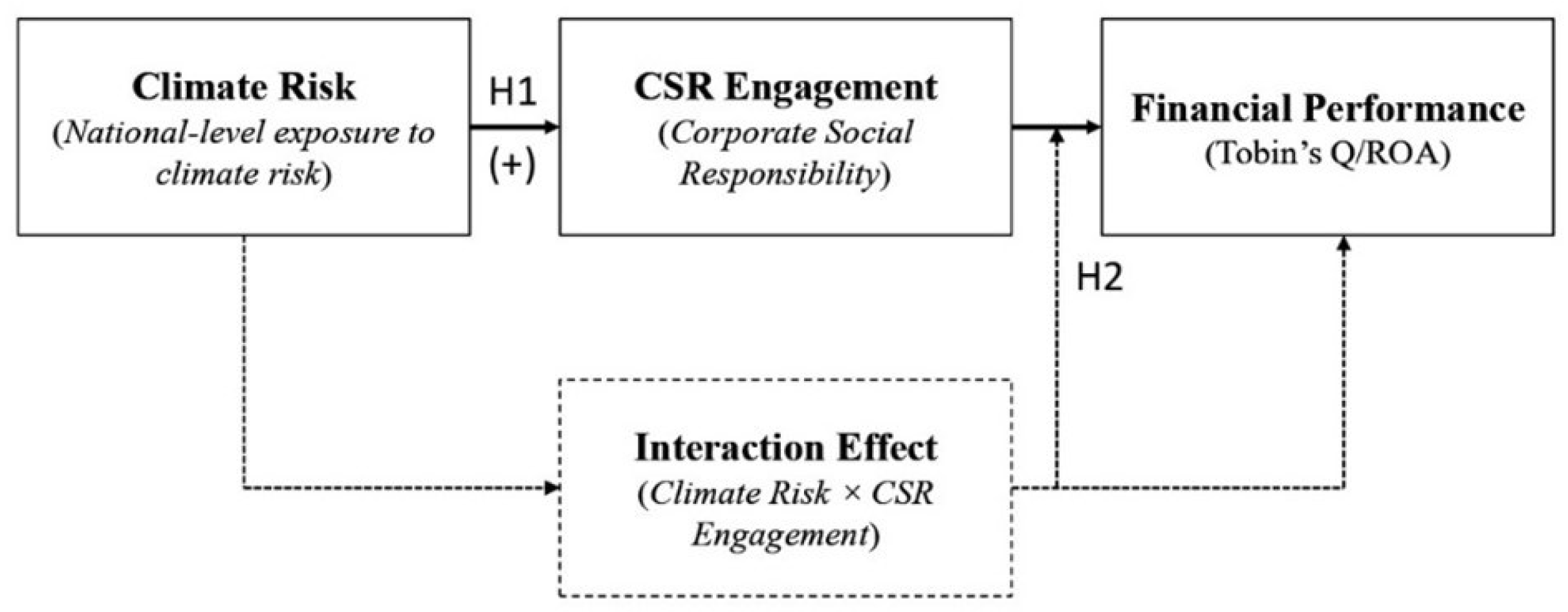
The research model showing the interaction between climate risk, CSR, and financial performance is presented in Figure 1.

3. Data, Variables, and Descriptive Statistics

3.1. Sample Selection

Our empirical analysis is based on companies in the STOXX Europe 600 index, covering the period from 2009 to 2019. Companies in the financial sector were excluded from the sample due to their specific legal frameworks, capital structures, and financial reporting standards. These sector-specific characteristics can influence the relationship between climate change, CSR, and financial performance, making comparisons with non-financial companies problematic.
Furthermore, financial firms often face systemic risks and operate under prudential regulation frameworks that shape their risk exposure differently. To maintain sample homogeneity and align with recent empirical research examining the performance implications of climate risk and CSR (Duan et al., 2025; Wang et al., 2024), our study focuses exclusively on non-financial sectors.
The focus on European countries is motivated by both institutional and empirical considerations. The region offers a homogeneous regulatory environment, thanks to certain European regulations such as the Green Deal and the directive on the disclosure of non-financial information, which promote consistency in CSR and climate information. Moreover, European firms benefit from high-quality and widely available ESG data, improving the reliability of cross-country comparisons. Europe’s leading role in climate policy and its firm commitment to the Sustainable Development Goals make it a timely and relevant framework for studying the link between climate change, CSR and financial performance in light of the Paris Agreement.
The final dataset includes 3304 firm-year observations, representing 17 European countries and spanning nine distinct industries, as outlined in Table 1. To quantify climate risk, we use the Global Climate Risk Index 2020, which assesses the vulnerability of countries and regions to extreme weather-related events. The index integrates the most current data for 2019, along with historical data from 2000 to 2019, providing a comprehensive assessment of climate-related risks.
The choice of the period from 2009 to 2019 is justified by several factors. First of all, this timeframe captures the latest developments in climate risk exposure and its potential influence on ESG practices. The year 2009 is significant as it follows the global financial crisis, a period during which sustainability and climate-related risks began to be more strategically integrated into corporate agendas. Next, 2019 is the last year retained in our sample, selected to ensure that data on ESG score and climate risk are not only available but also comparable between companies and countries. Although more recent editions of the Global Climate Risk Index (e.g., 2026) are available, extending the sample beyond 2019 would raise comparability issues due to methodological revisions of the index and evolving ESG reporting frameworks. In particular, the alignment between national-level climate risk indicators and company-level ESG data becomes less consistent after 2019, which can lead to structural breaks and compromise the internal validity of the panel analysis. Then, the choice of 2019 as the closing year is justified by the need to ensure the consistency and, above all, the comparability of the data used and our empirical results with currently published research on climate risks. Indeed, studies exploring the relationship between climate risk and ESG criteria have adopted similar time periods.
For instance, Duan et al. (2025) used text analysis to examine firms’ climate risk disclosures and their impact on ESG performance, focusing on data from 2010 to 2019. Although their study was published more recently, the empirical analysis was concluded in 2019, coinciding with the availability of the most up-to-date and comprehensive climate risk data. This approach is consistent with ours, ensuring comparability across studies in the field. Similarly, Wang et al. (2024) selected the 2010 to 2019 period for their study in China, aiming to capture recent developments in climate risks and CSR while using the most current data for a consistent comparison of regional climate risks and corporate behavior. In the same vein, Mbanyele and Muchenje (2022) concluded their empirical analysis in 2019, further supporting the use of this year as a consistent endpoint in climate risk and CSR research. Their choice of 2019 aligns with the availability of comprehensive data, making it a suitable cutoff for assessing the latest trends and impacts in climate risk.
Finally, the 2019 analysis allows us to avoid the extreme structural volatility and confounding variables introduced by the global pandemic and the geopolitical instability following the Russo-Ukrainian war. This reassures us that our empirical results reflect the fundamental relationship between CSR and climate risk under relatively stable energy and market conditions.

3.2. Definitions and Measurement of Variables

3.2.1. Dependent Variable

We have chosen the ESG score as our main dependent variable, reflecting each company’s societal commitment. This score encompasses environmental, social, and governance commitments. It ranges from 0 to 100. The higher the score, the more robust the company’s societal approach. This score is sourced from the Asset4 database (Thomson Reuters, headquartered in Toronto, ON, Canada).

3.2.2. Independent Variables

The first independent variable is climate risk, measured using an index published annually by Greenwatch since 2006. This index reflects the magnitude of weather events including deaths and associated economic damage in value and their weight in GDP.
Importantly, the index is constructed using meteorological data from two years prior to its publication, with the latest data retained in our sample is the year 2019. To complement this measure, we include a long-term climate risk variable derived from data on major weather events over the past twenty years. Since we multiplied this measure by −1, a high value indicates a high risk. This is the measure of climate risk. We also used another measure, referring to the ND-GAIN index, which reflects a country’s biophysical vulnerability to climate risk. Together, these three measures provide a comprehensive framework for capturing different dimensions of climate risk and enable a more robust examination of its relationship with CSR engagement and financial performance.

3.2.3. Control Variables

Firm Size (Size): Most previous studies have shown the significant impact of firm size on its performance. Economies of scale, as well as the diversification that is a major characteristic of large firms, can help them increase their financial performance (Pekovic & Vogt, 2021; Habash & Abuzarour, 2022; Giannopoulos, 2022). Therefore, we predict a positive sign for the size variable, which in our study is measured by the natural logarithm of total assets.
Leverage: The impact of leverage on firm performance can be both positive and negative. On one hand, excessive leverage increases the risk of financial distress and bankruptcy, potentially reducing performance. On the other hand, leverage can facilitate investments that generate returns greater than the debt costs, thus improving performance. In this study, we focus on the long-term debt ratio (Jo & Harjoto, 2011).
Tangible assets (PPE): this is the proportion of tangible assets relative to total assets, reflecting the company’s fixed investment.
Board Independence (BIndep): Independent directors contribute to higher CSR scores by bringing expertise, objectivity, and critical insights into decision-making, thus fostering more responsible corporate practices.
Board Diversity (BDiv): Gender diversity on boards is positively associated with improved CSR performance, as female directors tend to emphasize the interests of diverse stakeholders and are particularly committed to enhancing CSR practices (Liao et al., 2015). The positive relationship is supported by socialization theory, resource dependence theory, and critical mass theory. The measure used in our study is the percentage of women on each company’s board of directors. We note that we used the Refinitiv Eikon database for data collection.
Furthermore, we used variables reflecting the specific economic characteristics of each country, including GDP growth rate and inflation rate, collected from the World Bank website.
Table 2 presents the descriptive statistics of all variables included in the study, providing an overview of their distributions through summary measures including the mean, standard deviation, minimum, and maximum values.
Table 3 presents the correlation matrix. The values show that all correlation coefficients are below the threshold proposed by Kennedy (1985), and therefore the problem of multicollinearity is not present.

4. Empirical Results and Analysis

Our first model tests the effect of climate risk on CSR.
C S R i , t =   α +   β 1 C l i m a t e R i s k c , t +   γ k C o n t r o l s k , i , t 1 +   δ i +   λ t +   ϵ i , t
  • CSRi,t represents the CSR performance of firm i at time t.
  • ClimateRiskc,t is our primary independent variable, measuring the exposure to climate change at the country level.
  • Controlsk,i,t−1: To limit the risk of endogeneity, we shifted the country and firm control variables by one year.
  • δi and λt: fixed effect of individual and country.
  • εi,t: error term.
To ensure the robustness of our empirical results, we employ a multilevel strategy. First, we consider country, sector, and year fixed effects to reduce potential bias related to unobserved national regulatory frameworks and industry-specific risks. Furthermore, since our Climate Risk variable is measured at the national level, while observations are made at the firm level, we use pooled national standard errors. This econometric strategy corrects for potential error correlations within countries and assures us that statistical significance is not overestimated due to shared national shocks. Finally, we adopt a weighted least squares (WLS) approach to correct for differences in sample size between countries, leading to a more rigorous estimate by relaxing the assumption of independence within geographic groups.

4.1. The Effect of Climate Risk on CSR

The results of our first model are presented in Table 4. We note that climate risk positively affects CSR performance (β = 0.038, p < 0.01). Our result corroborates that of Huang and Lin (2022), who confirmed that countries with high public concern about climate change exhibit high ESG scores. In such contexts, companies are more inclined to implement responsible practices, including reducing carbon emissions and adopting environmental protection measures, as part of their strategic response to climate challenges. Consistent with this, Ozkan et al. (2023) reported that firms located in regions with greater exposure to climate risks engage more actively in CSR engagement activities—such as promoting sustainable products, protecting stakeholder interests, and fostering social relationships. Moreover, Mbanyele and Muchenje (2022) suggested that the uncertainties generated by climate change motivate firms to reinforce their CSR efforts to absorb both regulatory and physical risks. Nonetheless, initiatives like the Emissions Trading System and advancements in green technologies have alleviated some of the regulatory burden by enabling more efficient compliance.
The results show a positive impact of company size and tangible assets on CSR. This relationship likely reflects their enhanced resource capacity and heightened stakeholder scrutiny. On the other hand, the results show that the high level of debt translates into less societal commitment since CSR actions represent a heavy burden for these heavily indebted companies. Furthermore, macroeconomic indicator “GDP” growth is negatively related to CSR engagement, highlighting the potential impact of economic fluctuations on corporate responsibility efforts.
For governance-related control variables, gender diversity and board independence show positive coefficients, consistent with role congruence and resource dependence theories (Pfeffer & Salancik, 2003; Liao et al., 2015). However, these relationships are not statistically significant in our initial specifications. The lack of significance suggests that, for European companies, institutional factors and climate risk prevail over individual board characteristics in explaining CSR commitments.

4.2. The Impact of Climate Risk on CSR: Comparison Between Sensitive and Non Sensitive Firms

In this paragraph, we elaborate further on our analysis by distinguishing between environmentally sensitive companies (belonging to a polluting sector) and environmentally insensitive companies (belonging to non-polluting sectors). This allows us to study whether companies with a larger environmental footprint, and therefore more exposed to the risks of climate change, use CSR as an adaptation strategy or for managing their reputation. Furthermore, to test the robustness of our results, we used the moderating effect of industry sensitivity according to Chow (1960) and examined the statistical difference between the two subsamples by introducing the interaction term (Climate Risk × Sensitivity) in a pooled regression model.
The results are shown in Table 5. For climate-sensitive industries, Climate Risk positively and significantly affects CSR (coefficient = 0.139 and p < 10%), thus recognizing the adoption of a CSR approach as a strategic adaptation mechanism. However, the coefficient is not significant for non-climate-sensitive industries. This distinction confirms that firms’ CSR commitment is a targeted response to actual exposure to climate change rather than a uniform capability. Besides, Table 6 shows that the interaction term is positive and significant (β = 0.084, p < 0.01), which confirms that firms in polluting industries have higher CSR scores than those in non-sensitive sectors.

4.3. Robustness Check: Other Measures of Climate Change

As a robustness test, we consider using other measures of climate risk, namely exposure and long-term climate risk.
Regarding the exposure variable, we use an OLS model with fixed effects for industry and year. This variable, being measured at the country level, is time-invariant for each firm and would therefore be omitted in a firm-only model. Furthermore, we maintain the WLS approach and apply robust country-level clustering to correct for within-group error correlation.
As shown in Table 6, both proxies remain positively associated with CSR, thereby reinforcing the reliability of our main results and confirming the consistency of the observed relationship across different specifications.

4.4. Effect of Climate Risk on CSR Dimensions

To better understand the impact of climate risk on CSR, we will test the impact on each pillar: environmental, social, and governance.
Table 7 shows a positive and significant relationship between climate risk and the environmental dimension, as indicated by the coefficient of 0.048 (p < 0.01). This shows that companies located in regions more vulnerable to climate change tend to adopt more rigorous environmental practices, possibly to better manage their risk exposure and meet the pressing expectations of stakeholders. Furthermore, the lack of a significant correlation between climate risk and the social and governance scores reveals that firms do not necessarily perceive these dimensions as immediate strategic tools for mitigating climate risk. Thus, the governance dimension, which reflects internal control structures, and the social dimension, which primarily reflects the overall well-being of stakeholders, do not appear to be directly affected by exogenous climate shocks, unlike environmental strategies. This relevant empirical finding highlights the asymmetrical impact of climate risk, which primarily catalyzes operational environmental improvements (e.g., energy efficiency and carbon emission reductions) rather than changes in governance or social structures.

4.5. Climate Risk and Financial Performance: The Moderating Effect of CSR

In this section, we move on to what is most important in our study, namely, the moderating role of CSR in the relationship between climate risk and firm performance (Perf). To do so, we estimate the second model:
P e r f i , t =   α +   β 1   C S R i , t ^ +   β 2 C l i m a t e R i s k c , t +   β 3 C S R i , t ^   ×   C l i m a t e R i s k c , t +   γ k C o n t r o l s k , i , t 1 +   δ i +   λ t + ϵ i ,   t
  • Perfi,t is the financial performance of firm i at time t, (Tobin’s Q and ROA).
  • C S R i , t ^ is the predicted values of CSR, extracted from the first-stage instrumental variable (2SLS) regression.
  • ClimateRiskc,t is the country-level climate risk index for country c at time t.
  • Controlsk,i,t−1 control variables relatives to firms and countries are lagged by one period;
  • δi and λt: firm fixed effects and year fixed effects.
  • εi,c,t is the idiosyncratic error term.
Endogeneity, a well-established concern in corporate finance and econometric research, can yield biased and inconsistent parameter estimates when employing ordinary least squares (OLS) or fixed-effects panel data estimation. In this study, we address the potential endogeneity arising from the inherent relationship between climate risk and CSR within our primary model. Specifically, the simultaneous inclusion of climate risk and CSR as explanatory variables in the firm performance equation may introduce bias.
To address potential biases of endogeneity, simultaneity, and reverse causality that often affect the relationship between CSR and corporate financial performance, we employ two-stage least squares (2SLS-IV) analysis. First, we use the one-year lagged value of CSR (RSEt-1) as an external instrumental variable in order to ensure a valid exclusion restriction. Our rationale is that current financial performance can impact current CSR strategies but cannot influence the previous year’s CSR engagement. Consequently, the lagged CSR variable provides a source of exogenous variation that is strongly correlated with current CSR (relevance) but uncorrelated with the error term in the financial performance equation (validity). Then, to reasonably test the moderating effect, we instrument both CSR and the interaction term (instrumented CSR × Climate Risk) using the lagged instrument (RSEt-1) and its interaction with climate risk (RSEt-1 × Climate Risk).
Table 8 presents the results of the two-stage least squares (2SLS) estimation. Column 1 shows a Cragg-Donald Wald F-statistic of 1201.52, exceeding the Stock-Yogo critical values, demonstrating the robustness of our instruments. The regressions from the second stage show that instrumented CSR positively impacts financial performance. The results of the first stage of 2SLS confirm a significant positive effect of climate risk on CSR (β = 0.021, p < 0.05). However, the results of the second stage (displayed in columns 2 and 3) show a negative impact of climate risk on Tobin’s Q (β = −0.444, p < 0.05) and on ROA (β = −0.010, p < 0.05). Specifically, predicted CSR positively affects Tobin’s Q (β = 0.119, p < 0.05) and ROA (β = 0.079, p < 0.05). Furthermore, the interaction term between instrumented CSR and climate risk shows a positive impact on Tobin’s Q (β = 0.113, p < 0.01) and ROA (β = 0.087, p < 0.05). These results clearly confirm that CSR acts as a strategic buffer, minimizing the effect of climate change on firm performance, even after accounting for endogeneity. Overall, our results presented in Table 8 confirm Hypothesis 2 and highlight the crucial moderating role of CSR in mitigating the negative effects of climate risk on corporate financial performance. To explain this result, we refer to two main transmission channels. First, a high CSR score minimizes information asymmetries and strengthens investor confidence, thereby reducing financing costs. Similarly, Boubaker et al. (2020) and Jung et al. (2018) suggest that CSR is not merely an ethical response, but also a strategic lever for financial stability in the face of climate change. The authors explain that by taking advantage of reduced risk premiums and easier access to green capital markets, socially responsible companies have a stronger financial buffer to absorb climate-related shocks.
Furthermore, we refine our analysis by incorporating a temporal dimension, using a binary variable, to examine whether the moderating effect of CSR regarding the impact of climate risk on the financial performance of companies has been strengthened following the institutional change induced by the Paris Agreement. The objective of this agreement (which came into force in November 2016 but was adopted in 2015) is to limit global warming to below 2 °C.
To properly study the impact of the Paris Agreement, we use a triple interaction specification (CSR × Climate Risk × Paris Agreement) within our 2SLS model. We introduced a dummy variable (Paris Agreement) that takes the value 1 for the period after 2015, and 0 otherwise. This approach allows us to detect a structural change in the moderating role of CSR, while maintaining the integrity of the sample and ensuring the explanatory power of the model. The results of this enhanced estimation, presented in Table 9, allow us to rigorously test how the institutional context could change the financial relevance of CSR in the face of climate risk. The Paris Agreement has been widely recognized as a catalyst for changes in corporate environmental behavior, increasing the salience of climate risk in investor decision-making and policy frameworks. By capturing this structural shift, our analysis contributes to the literature by showing that the CSR–Climate Risk interaction becomes more impactful in a regulatory environment that explicitly demands greater sustainability performance.
The results summarized in Table 9 clearly show that the dummy variable measuring the Paris Agreement positively affects Tobin’s Q (β = 0.612, p < 0.01). Furthermore, the interaction term (CSR × Climate Risk) is not statistically significant for the specification relating to the pre-2015 period. This result suggests that priority to the entry into force of this global framework, markets and firms had not yet fully integrated CSR as a strategic lever for mitigating physical climate-related threats. In contrast, the triple interaction term (CSR × Climate Risk × Paris Agreement) shows a positive and statistically significant coefficient (β = 0.820, p < 0.05). This result provides formal evidence of a structural shift in how CSR influences firm value. It demonstrates that the Paris Agreement has acted as a powerful institutional signal, increasing stakeholder sensitivity to climate resilience. Since 2015, CSR efforts are no longer seen as mere philanthropic expenditures, but now function as a credible insurance mechanism, effectively protecting financial performance against exposure to climate risks. These findings are consistent with those of Mbanyele and Muchenje (2022), who document the effect of climate vulnerability on CSR strategies.

5. Conclusions and Implications

There is a growing emphasis among firms on integrating CSR initiatives into their investment strategies to pursue sustainability objectives. Prior research has increasingly investigated the adverse effects of climate change on corporate financial performance and the potential for CSR engagement to weaken these negative consequences, particularly in the context of the legally binding Paris Agreement, which fosters global collaboration in climate change mitigation and adaptation. To investigate this dynamic, we analyzed a panel dataset comprising 3304 firm-year observations for 401 European firms listed on the STOXX 600 index spanning the period from 2009 to 2019.
To examine the relationship between climate change and CSR, we used weighted least squares (WLS). Then, to highlight the moderating effect of CSR, we used 2SLS with instrumental variables which allowed us to account for endogeneity issues. Finally, we addressed the moderating role of CSR in light of the Paris Agreement.
The key findings of this study are summarized as follows. First, climate risk exhibits a positive influence on CSR engagement. Specifically, European firms facing greater exposure to the adverse consequences of climate change demonstrate a higher propensity to engage effectively in CSR initiatives. Furthermore, this positive effect is more pronounced when considering the environmental dimension of CSR. Second, we identify a negative effect of climate risk on Tobin’s Q. Third, our analysis provides compelling evidence that CSR performance is associated with a reduction in negative effect, particularly in the post-Paris Agreement period. This observation aligns with the increased regulatory pressure imposed by the Paris Agreement, which incentivizes firms to increase investment in less polluting activities. Notably, our results demonstrate robustness across various model specifications.
Our robust empirical results have significant implications for management, but they are also of interest to public policymakers and, of course, researchers in the field. For managers, it is important to integrate climate risk into their strategies for managing various risks within the company, given that it negatively impacts the company’s financial performance and therefore its long-term viability. Furthermore, the positive link between CSR and firm financial performance suggests the strategic value of integrating socially responsible practices as core management principles, rather than mere compliance measures, to navigate the evolving climate landscape and contribute to global mitigation efforts.
For investors, our results provide an empirical basis for evaluating investment decisions by considering the trade-off between potential financial losses due to climate risk exposure and the mitigating benefits associated with strong CSR performance.
From a policy perspective, the study results regarding CSR’s moderating effect offers a compelling rationale for fostering collaboration between policymakers and companies. This could include incentivizing CSR investment through mechanisms such as green financing policies (e.g., green subsidies and tax credits), thereby potentially aligning financial performance goals with climate change mitigation.
Beyond its practical relevance, this study makes several important academic contributions. First, it extends the scope of CSR theory by suggesting that firms facing elevated climate risk may engage in CSR not only for normative or reputational reasons, but as a deliberate strategic response to external environmental pressures. In this sense, CSR serves as a form of adaptive behavior, enabling firms to respond proactively to systemic risk. Second, the findings contribute to the literature on financial risk management by indicating that CSR can be associated with an attenuation of the adverse effects of climate risk on firm performance. This suggests that CSR may function as a non-financial risk management mechanism. Third, the study offers new insight into institutional theory by illustrating how regulatory developments, particularly the Paris Agreement, are associated with shifts in corporate behavior.
Despite the significant contributions of our research, it must be acknowledged that our results should be interpreted with some limitations. First, although we addressed the potential discrepancy between country-level climate risk and firm-level outcomes by using country-clustered errors and retaining fixed effects per year, country, and industry, we acknowledge that climate exposure data for each firm could enhance our analyses. Second, despite our rigorous identification strategy in 2SLS used to address the endogeneity problem, we recognize the complexity of establishing definitive causality; therefore, our empirical results are presented as robust associations. Third, while we clearly explained the rationale for choosing the study period extending to 2019 in Section 3 concerning the choice of sample and period, the limited number of years following the Paris Agreement may not fully capture long-term structural transformations. However, we addressed this issue by using a formal triple interaction specification with a post Paris Agreement dummy variable to maximize statistical power. Note that while this timeframe is consistent with other recent studies, we acknowledge that events after 2019, particularly the implementation of the European Green Deal, could alter corporate priorities. The shift from voluntary to mandatory reporting, in accordance with the Non-Financial Reporting Directive (NFRD) and the Green Deal, could strengthen the transparency mechanisms used in our study. Finally, ESG measures certainly have limitations and cannot directly reflect commitments specifically related to climate, such as transition strategies or mitigation plans. These various limitations offer attractive avenues for further research into the evolution of corporate climate responsibility.


Author Contributions

Conceptualization, S.Z. and F.B.M.; Methodology, S.Z., F.B.M. and R.L.; Software, F.B.M. and R.L.; Writing—original draft, S.Z., R.L. and S.M.; Writing—review & editing, S.Z., F.B.M. and S.M. All authors have read and agreed to the published version of the manuscript.

Funding

This research received no external funding.

Institutional Review Board Statement

Not applicable.

Informed Consent Statement

Not applicable.

Data Availability Statement

The original contributions presented in this study are included in the article. Further inquiries can be directed to the corresponding author.

Acknowledgments

Financial support by the Coactis Research Center is gratefully acknowledged.

Conflicts of Interest

The authors declare no conflicts of interest.

References

  1. Ahn, S. Y., & Park, D. J. (2018). Corporate social responsibility and corporate longevity: The mediating role of social capital and moral legitimacy in Korea. Journal of Business Ethics, 150, 117–134. [Google Scholar] [CrossRef]
  2. Albuquerque, R., Koskinen, Y., & Zhang, C. (2018). Corporate social responsibility and firm risk: Theory and empirical evidence. Management Science, 65(10), 4451–4469. [Google Scholar] [CrossRef]
  3. Al-Khalaf, A. A., Nasser, M. G., & Hosni, E. M. (2023). Global potential distribution of Sarcophaga dux and Sarcophaga haemorrhoidalis under climate change. Diversity, 15(8), 903. [Google Scholar] [CrossRef]
  4. Bagh, T., Fuwei, J., & Khan, M. A. (2024). From risk to resilience: Climate change risk, ESG investments engagement and firm’s value. Heliyon, 10(5), e26757. [Google Scholar] [CrossRef]
  5. Bolton, P., & Kacperczyk, M. (2021). Do investors care about carbon risk? Journal of Financial Economics, 142(2), 517–549. [Google Scholar] [CrossRef]
  6. Boubaker, S., Cellier, A., Manita, R., & Saeed, A. (2020). Does corporate social responsibility reduce financial distress risk? Economic Modelling, 91, 835–851. [Google Scholar] [CrossRef]
  7. Chow, G. C. (1960). Tests of equality between sets of coefficients in two linear regressions. Econometrica, 28(3), 591–605. [Google Scholar] [CrossRef]
  8. Christensen, D. M. (2016). Corporate accountability reporting and high-profile misconduct. The Accounting Review, 91(2), 377–399. [Google Scholar] [CrossRef]
  9. Duan, Y., Zhang, Y., & Chen, L. (2025). Climate risk disclosure and corporate performance: Evidence from European firms. Journal of Business Ethics, 178(2), 345–367. [Google Scholar]
  10. Engle, R. F., Giglio, S., Kelly, B., Lee, H., & Stroebel, J. (2020). Hedging climate change news. The Review of Financial Studies, 33(3), 1184–1216. [Google Scholar] [CrossRef]
  11. European Commission. (2019). Guidelines on non-financial reporting: Supplement on reporting climate-related information (2019/C 209/01). Official Journal of the European Union. [Google Scholar]
  12. Field, C. B., & Barros, V. R. (Eds.). (2014). Climate change 2014: Impacts, adaptation, and vulnerability. Part A: Global and sectoral aspects. Cambridge University Press. [Google Scholar]
  13. Flammer, C. (2013). Corporate social responsibility and shareholder reaction: The environmental awareness of investors. Academy of Management Journal, 56(3), 758–781. [Google Scholar] [CrossRef]
  14. Garcia, A. S., & Orsato, R. J. (2020). Testing the institutional difference hypothesis: A study about environmental, social, governance, and financial performance. Business Strategy and the Environment, 29(8), 3261–3272. [Google Scholar] [CrossRef]
  15. Giannopoulos, G. (2022). CSR and corporate financial performance: A multi-country analysis. International Journal of Economics and Finance, 14(1), 72–85. [Google Scholar]
  16. Godfrey, P. C. (2005). The relationship between corporate philanthropy and shareholder wealth: A risk management perspective. The Academy of Management Review, 30(4), 777–798. [Google Scholar] [CrossRef]
  17. Haas, C., Jahns, H., Kempa, K., & Moslener, U. (2023). Deep uncertainty and the transition to a low-carbon economy. Energy Research and Social Science, 100, 103060. [Google Scholar] [CrossRef]
  18. Habash, N., & Abuzarour, A. (2022). Board gender diversity and firm financial performance dispersion: Evidence from the Middle East. The Journal of Asian Finance, Economics and Business, 9(3), 365–375. [Google Scholar]
  19. He, Z., Guo, B., Shi, Y., & Zhao, Y. (2022). Natural disasters and CSR: Evidence from China. Pacific-Basin Finance Journal, 73, 101777. [Google Scholar] [CrossRef]
  20. Hossain, A. T., & Masum, A. A. (2022). Does corporate social responsibility help mitigate firm-level climate change risk? Finance Research Letters, 47, 102791. [Google Scholar] [CrossRef]
  21. Huang, Q., & Lin, M. (2022). Do climate risk beliefs shape corporate social responsibility? Global Finance Journal, 53, 100739. [Google Scholar] [CrossRef]
  22. Ilhan, E., Krueger, P., Sautner, Z., & Starks, L. T. (2023). Climate risk disclosure and institutional investors. The Review of Financial Studies, 36(7), 2617–2650. [Google Scholar] [CrossRef]
  23. Jo, H., & Harjoto, M. A. (2011). Corporate governance and firm value: The impact of corporate social responsibility. Journal of Business Ethics, 103(3), 351–383. [Google Scholar] [CrossRef]
  24. Jung, J., Herbohn, K., & Clarkson, P. (2018). Carbon risk, carbon risk awareness and the cost of debt financing. Journal of Business Ethics, 150(4), 1151–1171. [Google Scholar] [CrossRef]
  25. Kabir, R., & Thai, H. M. (2021). Key factors determining corporate social responsibility practices of Vietnamese firms and the joint effects of foreign ownership. Journal of Multinational Financial Management, 59, 100676. [Google Scholar] [CrossRef]
  26. Kennedy, P. (1985). A guide to econometrics (2nd ed.). MIT Press. [Google Scholar]
  27. Khemiri, M. A., Saidi, H., & Hakimi, A. (2025). Climate risk and bank performance: What role does corporate social responsibility play? International Journal of Energy Economics and Policy, 15(4), 73–82. [Google Scholar] [CrossRef]
  28. Kim, J., Ha, S., & Fong, C. (2014). Retailers’ CSR: The effects of legitimacy and social capital. International Journal of Retail and Distribution Management, 42(2), 131–150. [Google Scholar] [CrossRef]
  29. Kolk, A., & Pinkse, J. (2005). Business responses to climate change: Identifying emergent strategies. California Management Review, 17(5), 387–403. [Google Scholar] [CrossRef]
  30. Krueger, P., Sautner, Z., & Starks, L. T. (2020). The importance of climate risks for institutional investors. The Review of Financial Studies, 33(3), 1067–1111. [Google Scholar] [CrossRef]
  31. Li, Y., Gong, M., Zhang, X. Y., & Koh, L. (2018). The impact of environmental, social, and governance disclosure on firm value: The role of CEO power. The British Accounting Review, 50(1), 60–75. [Google Scholar] [CrossRef]
  32. Li, Z., Liao, G., & Albitar, K. (2020). Does corporate environmental responsibility engagement affect firm value? The mediating role of corporate innovation. Business Strategy and the Environment, 29(3), 1045–1055. [Google Scholar] [CrossRef]
  33. Liao, L., Luo, L., & Tang, Q. (2015). Gender diversity, board independence, environmental committee and greenhouse gas disclosure. The British Accounting Review, 47, 409–424. [Google Scholar] [CrossRef]
  34. Lins, K. V., Servaes, H., & Tamayo, A. (2017). Social capital, trust, and firm performance: The value of corporate social responsibility during the financial crisis. The Journal of Finance, 72(4), 1785–1824. [Google Scholar] [CrossRef]
  35. Liu, Y., Dong, K., Nepal, R., & Afi, H. (2025). How do climate risks affect corporate ESG performance? Micro evidence from China. Research in International Business and Finance, 76, 102855. [Google Scholar] [CrossRef]
  36. Maztoul, D., & Oueglissi, R. (2026). Climate risk, sustainability, and financial performance: Insights from the OECD banking sector. International Journal of Sustainable Economy, 18(1), 19–39. [Google Scholar] [CrossRef]
  37. Mbanyele, W., & Muchenje, L. T. (2022). Climate change exposure, risk management and corporate social responsibility: Cross-country evidence. Journal of Multinational Financial Management, 66, 100771. [Google Scholar] [CrossRef]
  38. McWilliams, A., & Siegel, D. (2001). Corporate social responsibility: A theory of the firm perspective. Academy of Management Review, 26(1), 117–127. [Google Scholar] [CrossRef]
  39. Meraj, M., Afzal, M., Kaur, M., & Chauhan, J. (2025). Impact of CSR, green finance and green innovation on environmental performance of banks in India. Managing Global Transition, 23(2), 201–231. [Google Scholar] [CrossRef]
  40. Muthuri, J. N., Matten, D., & Moon, J. (2009). Employee volunteering and social capital: Contributions to corporate social responsibility. British Journal of Management, 20(1), 75–89. [Google Scholar] [CrossRef]
  41. Naseem, T., Shahzad, F., Asim, G. A., Rehman, I. U., & Nawaz, F. (2020). Corporate social responsibility engagement and firm performance in Asia Pacific: The role of enterprise risk management. Corporate Social Responsibility and Environmental Management, 27(2), 501–513. [Google Scholar] [CrossRef]
  42. Nguyen, C. T., Nguyen, L. T., Nguyen, N. Q., & McMillan, D. (2022). Corporate social responsibility and financial performance: The case in Vietnam. Cogent Economics and Finance, 10(1), 2075600. [Google Scholar] [CrossRef]
  43. Ozkan, A., Huseyin, T., & Yildiz, Y. (2023). Climate risk, corporate social responsibility, and firm performance. British Journal of Management, 34(4), 1791–1810. [Google Scholar] [CrossRef]
  44. Pekovic, S., & Vogt, S. (2021). The fit between corporate social responsibility and corporate governance: The impact on a firm’s financial performance. Review of Managerial Science, 15(4), 1095–1125. [Google Scholar] [CrossRef]
  45. Pfeffer, J., & Salancik, G. R. (2003). The external control of organizations: A resource dependence perspective. Stanford Business Books. [Google Scholar]
  46. Qiu, S. C., Jiang, J., Liu, X., Chen, M. H., & Yuan, X. (2021). Can corporate social responsibility protect firm value during the COVID-19 pandemic? International Journal of Hospitality Management, 93, 102759. [Google Scholar] [CrossRef] [PubMed]
  47. Rupp, A., & Limpaphayom, P. (2024). Benefits of corporate social responsibility during a pandemic: Evidence from stock price reaction to COVID-19 related news. Research in International Business and Finance, 68, 102169. [Google Scholar] [CrossRef]
  48. Shiu, Y.-M., & Yang, S.-L. (2017). Does engagement in corporate social responsibility provide strategic insurance-like effects? Strategic Management Journal, 38(2), 455–470. [Google Scholar] [CrossRef]
  49. Stroebel, J., & Wurgler, J. (2021). What do you think about climate finance? Journal of Financial Economics, 142(2), 487–498. [Google Scholar] [CrossRef]
  50. Wang, Q., Li, Y., & Zhang, H. (2024). Regional climate risk and corporate social responsibility: Evidence from China. Emerging Markets Finance and Trade, 60(1), 55–72. [Google Scholar] [CrossRef]
  51. Yu, Y., Wang, D. D., Li, S., & Shi, Q. (2016). Assessment of U.S. firm-level climate change performance and strategy. Energy Policy, 92, 432–443. [Google Scholar] [CrossRef]
  52. Zaiane, S., & Ellouze, D. (2023). Corporate social responsibility and firm financial performance: The moderating effects of size and industry sensitivity. Journal of Management and Governance, 27(4), 1147–1187. [Google Scholar] [CrossRef]
Figure 1. Research Model. Note: Solid represent the direct relationship hypothesized in H1 and H2. Dashed Arrows capture the moderating role of the interaction between climate risk and CSR engagement financial performance. (+) indicates a positive association. ROA: Return on assets.
Ijfs 14 00143 g001
Table 1. Percentage of companies in each sector.
IndustryNumber%
Consumer cyclicals12029.92
Utilities11628.92
Industrials5714.21
Health care276.73
Energy256.23
Technology215.23
Telecommunications174.23
Consumer non-cyclicals112.74
Basic materials71.74
Total401100
Table 2. Descriptive Statistics.
VariablesMeanStd. DevMinimumMaximum
Climate Risk−0.660.237−1.405−0.075
CSR0.6710.1940.0450.975
Size16.81.73411.2621.799
Leverage0.430.68805.082
PPE0.6291.025−0.3276.722
BIndep0.6130.2120.0331
BDiv0.2660.1150.0450.636
GDP1.6422.041−5.69324.37
Inflation1.2781.003−4.4783.856
Table 3. Correlation Matrix.
VariablesClimate RiskSizeLeveragePPEBIndepBDivGDPInflation
Climate Risk1
Size0.1281
Leverage−0.3150.046 **1
PPE0.366−0.2860.581
BIndep0.2010.077 *0.0313 **0.015 **1
BDiv−0.076 *0.041 **0.1930.1920.1041
GDP−0.159−0.084 *0.094 *0.1050.036 **0.083 *1
Inflation−0.037 **0.042 **−0.018 **0.012 **−0.375−0.055 *−0.079 *1
Notes: This table presents pairwise Pearson correlation coefficients. * and ** denote statistical significance at the 10%, and 5%, levels, respectively.
Table 4. The Impact of Climate Risk on CSR Engagement: Multivariate Analysis.
VariablesCSR
Climate Risk0.038 ***
(0.011)
Size0.066 ***
(0.007)
Leverage−0.036 **
(0.017)
PPE0.043 ***
(0.013)
GDP Growth−0.011 ***
(0.002)
Inflation−0.008
(0.013)
Board Independence0.033
(0.049)
Board Diversity−0.149
(0.136)
Constant−0.712 ***
(0.095)
Year Fixed EffectsYes
Industry Fixed EffectsYes
WLS WeightingYes
Clustered SE (Country)Yes
Observations3304
R-squared0.432
Notes: Standard error values are shown in parentheses. **, and *** represent statistical significance at the 5%, and 1% levels. We estimated the models using weighted least squares.
Table 5. Impact of Climate Risk on CSR—Sensitive vs. Non-Sensitive Industries.
VariablesNon-SensitiveSensitivePooled Sample (Interaction)
Climate Risk−0.0350.140 *0.018
(0.064)(0.074)(0.049)
Sensitive Industry--0.128 **
(0.053)
Interaction (Climate Risk × Sensitive)--0.084 ***
(0.0255)
Firm Size0.056 ***0.069 ***0.069 ***
(0.009)(0.015)(0.004)
Leverage−0.043−0.038−0.020
(0.027)(0.026)(0.014)
PPE0.038 ***0.041 *0.029 ***
(0.012)(0.024)(0.010)
GDP Growth−0.010 **−0.015−0.009 ***
(0.004)(0.010)(0.001)
Inflation0.009−0.029−0.006
(0.018)(0.020)(0.011)
Board Independence−0.0480.1350.014
(0.059)(0.085)(0.040)
Board Diversity−0.151−0.3290.166 **
(0.102)(0.276)(0.069)
Constant−0.346 **−0.528 **−0.569 ***
(0.147)(0.238)(0.060)
Year fixed effectYesYesYes
WLS WeightingYesYesYes
Clustered SE (country)YesYesYes
Observations153617683304
R-squared0.25170.38500.3679
Wald Test (p-Value)--p = 0.001
Notes: Standard error values are shown in parentheses. *, **, and *** represent statistical significance at the 10%, 5%, and 1% levels. We estimated the models using weighted least squares.
Table 6. The impact of Climate Risk on CSR—Alternative Measures of Climate Risk.
VariablesLong-TermExposure
Long-term Climate Risk0.242 ***
(0.037)
Exposure 0.476 ***
(0.161)
Firm Size0.065 ***0.071 ***
(0.006)(0.007)
Leverage−0.032 *−0.044 **
(0.018)(0.018)
PPE0.046 **0.039 ***
(0.017)(0.012)
GDP Growth−0.010 ***−0.011 ***
(0.003)(0.002)
Inflation−0.007−0.014
(0.013)(0.015)
Board Independence0.0330.022
(0.050)(0.045)
Board Diversity−0.129−0.172
(0.132)(0.138)
Constant−0.690 ***−0.987 ***
(0.085)(0.215)
Year FEYesYes
Industry FEYesYes
WLSYesYes
Clustered SE (country)YesYes
Observations33043304
R-squared0.4330.437
Clusters2626
Notes: Standard error values are shown in parentheses. *, **, and *** represent statistical significance at the 10%, 5%, and 1% levels. We estimated the models using weighted least squares.
Table 7. The Impact of Climate Risk on ESG Dimensions.
VariablesENVScrSOCScrGOVScr
Climate Risk0.0488 ***0.06260.0524
(0.0030)(0.0404)(0.0418)
Firm Size0.0732 ***0.0590 ***0.0661 ***
(0.0090)(0.0066)(0.0069)
Leverage−0.0378 **−0.0346 *−0.0362 **
(0.0172)(0.0191)(0.0174)
PPE0.0336 **0.0518 ***0.0427 ***
(0.0137)(0.0135)(0.0130)
GDP Growth−0.0113 ***−0.0102 ***−0.0107 ***
(0.0026)(0.0031)(0.0025)
Inflation−0.0103−0.0048−0.0076
(0.0126)(0.0160)(0.0133)
Board Independence0.05420.01260.0334
(0.0494)(0.0641)(0.0489)
Board Diversity−0.1052−0.1935−0.1493
(0.1221)(0.1683)(0.1359)
Industry FEYesYesYes
Year FEYesYesYes
Constant−0.9026 ***−0.5215 ***−0.7120 ***
(0.1146)(0.1022)(0.0952)
WLSYesYesYes
Clustered SE (country)YesYesYes
Observations330433043304
R20.4510.3450.433
Notes: Standard error values are shown in parentheses. *, **, and *** represent statistical significance at the 10%, 5%, and 1% levels. We estimated the models using weighted least squares.
Table 8. The impact of Climate Risk on Firm Performance: testing the Moderating Role of CSR.
Variables(1) CSR(2) Tobin’s Q(3) ROA
CSR (t − 1)0.829 ***
(0.024)
Climate Risk0.021 **−0.444 **−0.010 *
(0.009)(0.193)(0.005)
CSR (instrumented) 0.119 **0.079 **
(0.042)(0.036)
CSR × Climate Risk 0.113 ***0.087 *
(0.034)(0.051)
Firm Size0.004 *−0.354 ***−0.017 ***
(0.002)(0.027)(0.001)
Leverage−0.008 **−0.013−0.007 **
(0.004)(0.080)(0.003)
PPE0.0020.0820.009 *
(0.002)(0.113)(0.005)
GDP Growth0.0010.001−0.000
(0.002)(0.010)(0.001)
Inflation0.004−0.129 ***−0.007 ***
(0.005)(0.040)(0.002)
Board Independence0.008−0.257−0.005
(0.017)(0.181)(0.008)
Board Diversity0.0640.4890.033
(0.039)(0.643)(0.021)
Constant0.130 **7.128 ***0.273 ***
(0.048)(0.702)(0.029)
Industry & Year FEYesYesYes
Observations241724172417
R-squared0.8680.4920.418
Clusters262626
First stage F-stat (Cragg-Donald)1201.52
Stock-Yogo Critical Value (10%)7.03
Instruments (lagged CSR, lagged interaction
Notes: Standard error values are shown in parentheses. *, **, and *** represent statistical significance at the 10%, 5%, and 1% levels. We estimated the models using weighted least squares.
Table 9. Relationship between Climate Risk and Firm Performance considering the Moderating Role of CSR—Sensitivity to Time Periods.
Variables(1) CSR(2) Tobin’s Q(3) ROA
CSR (t − 1)0.829 ***
(0.024)
Climate Risk0.021 **−0.631 ***−0.054
(0.009)(0.244)(0.034)
Paris Agreement0.032 **0.612 ***−0.000
(0.013)(0.154)(0.012)
CSR (instrumented) 1.365 *0.078 **
(0.702)(0.033)
CSR × Climate Risk 0.7270.093 *
(0.727)(0.052)
CSR × Climate Risk × Paris Agreement 0.820 **−0.010
(0.339)(0.016)
Firm Size0.004 *−0.338 ***−0.015 ***
(0.002)(0.029)(0.001)
Leverage−0.008 **−0.027−0.007 **
(0.004)(0.058)(0.003)
PPE0.0020.0720.009 *
(0.002)(0.106)(0.005)
GDP Growth0.0010.024 *0.002 **
(0.002)(0.013)(0.001)
Inflation0.004−0.0420.000
(0.005)(0.065)(0.004)
Board Independence0.008−0.0630.013
(0.017)(0.206)(0.008)
Board Diversity0.0640.2040.010
(0.039)(0.705)(0.024)
Constant0.130 **6.068 ***0.240 ***
(0.048)(0.421)(0.026)
Industry & Year FEYesYesYes
Observations241724172417
R-squared0.8680.3820.257
Clusters262626
Notes: Standard error values are shown in parentheses. *, **, and *** represent statistical significance at the 10%, 5%, and 1% levels. We estimated the models using weighted least squares.
Disclaimer/Publisher’s Note: The statements, opinions and data contained in all publications are solely those of the individual author(s) and contributor(s) and not of MDPI and/or the editor(s). MDPI and/or the editor(s) disclaim responsibility for any injury to people or property resulting from any ideas, methods, instructions or products referred to in the content.