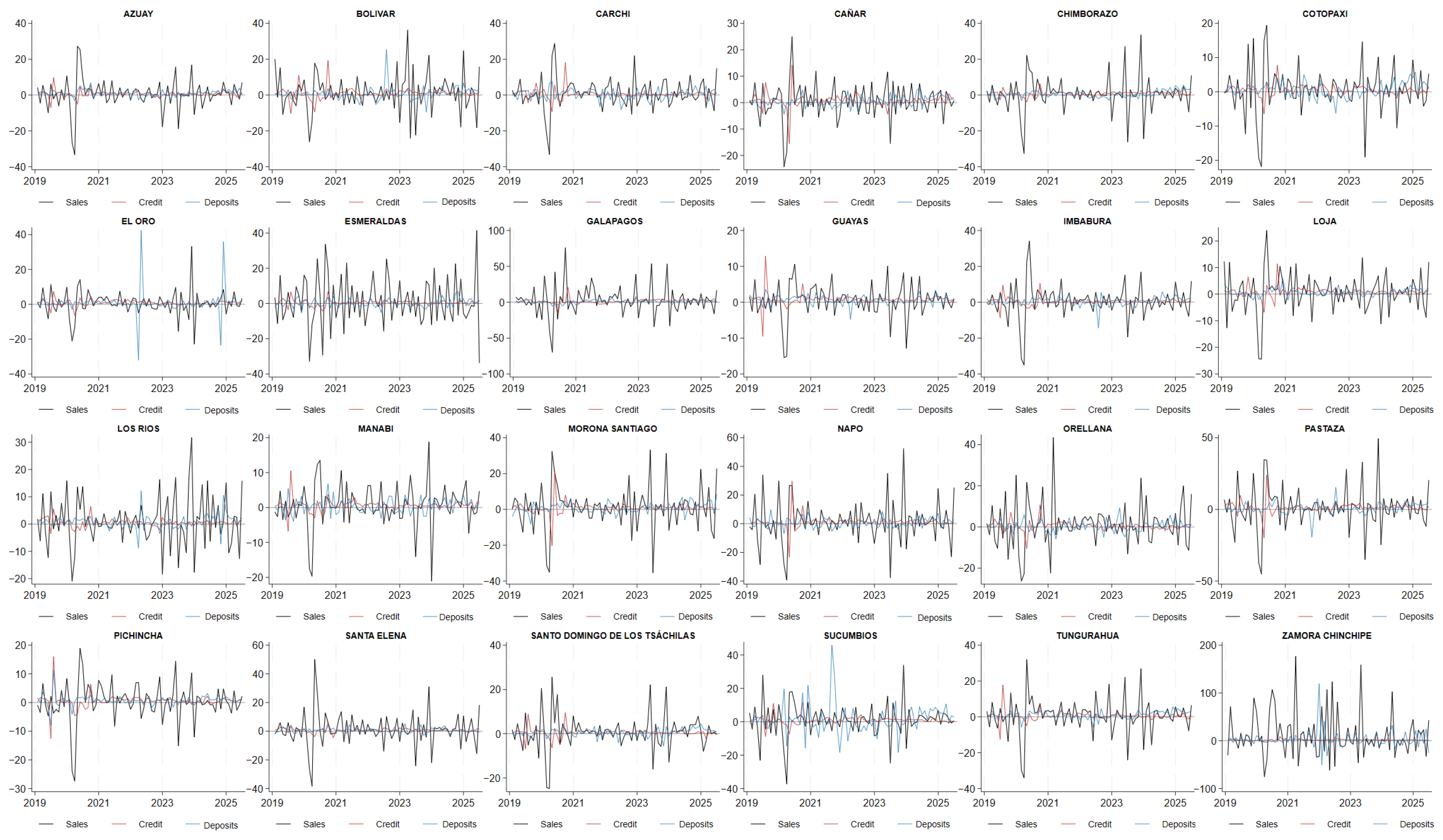
4.1. Preliminary Evidence and Model Adequacy
The unit root tests of
Levin et al. (
2002), reported in
Table 3, decisively reject the null hypothesis of non-stationarity for all three variables in first differences. The CIPS test of
Pesaran (
2007) confirms this result in the presence of possible cross-sectional dependence. Both tests support the estimation of the system on stationary transformed variables.
The results of the
Dumitrescu and Hurlin (
2012) panel Granger causality test, presented in
Table 4, reveal a directional pattern consistent with the central hypothesis of the study. Deposits and credit exhibit significant predictive capacity over the evolution of provincial sales, whereas sales show no statistical predictive capacity over the financial variables. The only additional significant linkage runs from credit to deposits, suggesting an internal interaction within the territorial financial system. This result is consistent with the supply-leading hypothesis documented by
Rousseau and Wachtel (
2000) and is in line with the evidence reported by
Sahoo (
2014),
Shah et al. (
2023), and
Awad et al. (
2025), all of whom document temporal precedence from credit to output. The absence of causality running from sales to the financial variables marks a departure from studies where demand-following or mutual feedback patterns prevail, such as
Mushtaq (
2016),
Shan et al. (
2001), and
Zhou and Tewari Dev (
2020).
Table 5 presents the comparison of specifications using the MMSC criteria of
Andrews and Lu (
2001). The criteria do not converge on a single optimal order: the MMSC-BIC and MMSC-HQIC favour one lag, while the MMSC-AIC selects two. The two-lag specification is adopted as the main model because it captures the more gradual transmission of credit to sales, a central aspect of the study’s second hypothesis. The one-lag version is employed as a robustness check.
The econometric diagnostics of the main model are summarised in
Table 6. The Hansen statistic does not reject the null hypothesis of joint instrument validity (
p = 0.288), and the stability condition is satisfied, with the maximum eigenvalue modulus below unity. The auxiliary
Arellano and Bond (
1991)-type tests confirm the expected significance of AR(1) and do not reject the absence of second-order autocorrelation at the 5% level, although the AR(2)
p-values lie close to the conventional threshold (0.091 for deposits, 0.099 for credit, and 0.075 for sales), which warrants caution in the interpretation.
4.2. Estimated Coefficients and Transmission Across Financial Channels
Table 7 reports the coefficients of the main model with two lags. The relationship between financial intermediation and provincial sales is dynamic and heterogeneous across financial channels. In the deposits equation, autoregressive persistence is high (0.654 at the first lag), one-period lagged credit exerts a significant positive effect, and lagged sales display a positive coefficient of smaller magnitude. This latter result, absent in the bivariate Granger test reported in
Table 4, reflects a conditional feedback that emerges when the simultaneous dynamics of all variables in the system are controlled for.
In the credit equation, own inertia dominates. The first-lag coefficient reaches 0.841, and no robust effects from deposits or sales are observed. Provincial credit dynamics depend, to a large extent, on their own past values—a feature compatible with lending processes subject to prior portfolio decisions, risk assessment, and bank supply conditions. This evidence echoes the findings of
Mushtaq (
2016) and
Awad et al. (
2025), who show that credit does not always respond immediately to variations in economic activity.
The central result of the study is concentrated in the sales equation. One-period lagged deposits exert a positive and statistically significant effect, while credit operates through its second lag, as the first lag is not significant. The temporal difference between the two channels supports the study’s second hypothesis and suggests that deposits function as a faster-transmitting liquidity component, whereas credit requires an additional period to translate into observable commercial activity. This pattern is consistent with the evidence of
Rousseau and Wachtel (
2000),
Sahoo (
2014), and
Shah et al. (
2023), although it adds a nuance that
Cheng and Hou (
2020) had already anticipated: the effects of the financial system depend on the composition of the service analysed and the time horizon considered.
The estimated coefficients in the sales equation can be read as short-run elasticities, given that all variables enter the model in first differences in natural logarithms. A one per cent increase in deposits in the previous month is associated with an increase of approximately 0.31 per cent in provincial sales in the current month, while a one per cent increase in credit two months earlier is associated with an increase of approximately 0.21 per cent in current sales. The deposit elasticity is therefore larger in magnitude than the credit elasticity, although the latter materialises one period later. This pattern is consistent with the second hypothesis on the differential timing of transmission across financial channels. Both elasticities are economically meaningful at the provincial scale, where commercial activity is closely tied to available liquidity and to the financing capacity of the productive sector. In a dollarised economy that operates without the buffer of an autonomous monetary policy, magnitudes of this order justify treating the calibration of credit and liquidity policy as a key instrument for regional economic activity.
The coefficients of the pandemic exogenous variable display signs consistent with expectations: positive in the deposits equation, negative in credit, with the largest contraction estimated for sales. The increase in deposits is consistent with a greater preference for liquidity and precautionary saving, the decline in credit reflects a more cautious supply in a high-uncertainty environment, and the contraction in sales indicates that the most intense adjustment fell on commercial activity. This evidence is consistent with the literature documenting disruptions in transmission channels during crisis periods (
Jeke et al., 2025;
Li & Zhang, 2022;
Obed et al., 2024).
4.3. Dynamic Responses to Financial Shocks
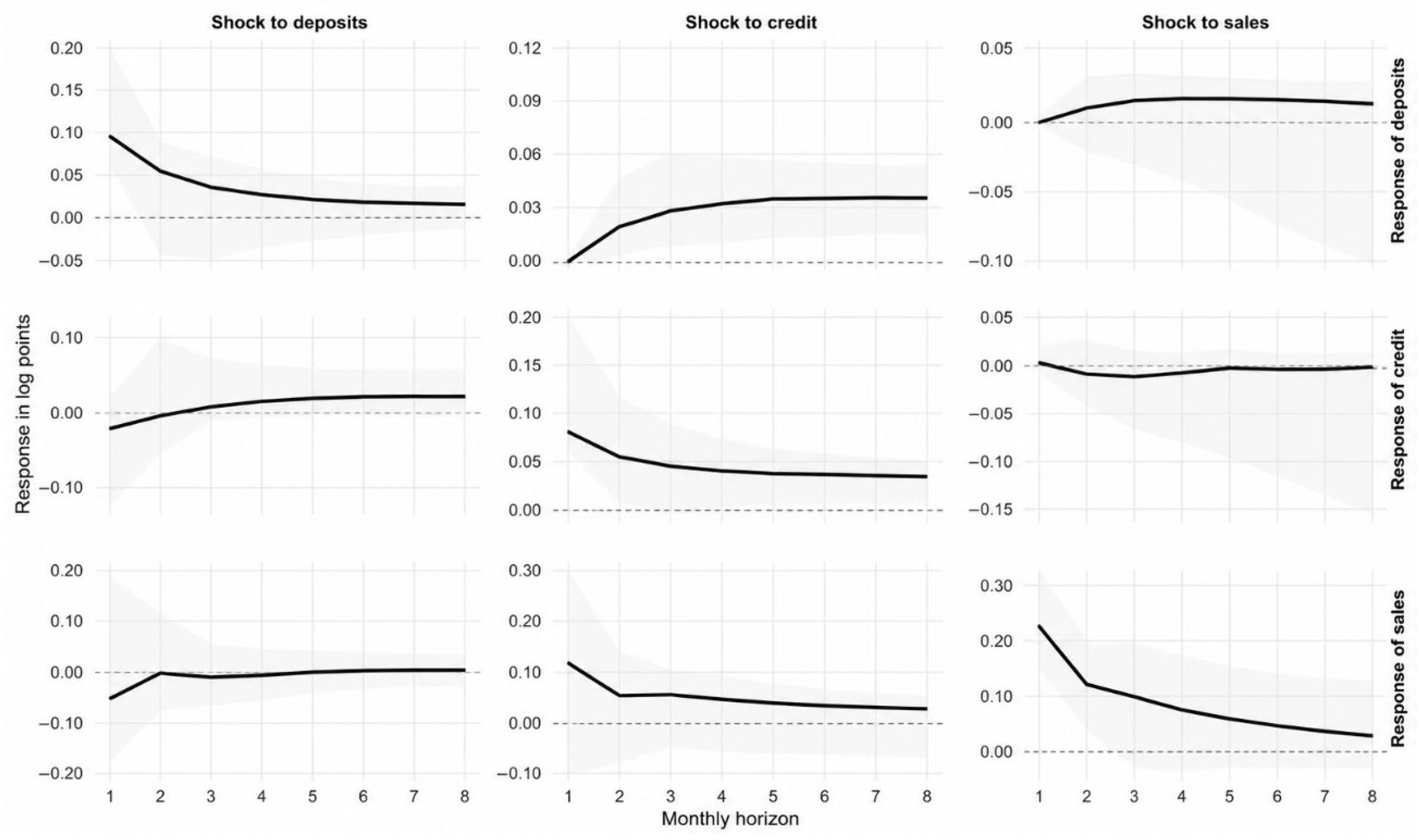
Figure 2 reports the generalised impulse-response functions of the baseline Panel VAR-GMM model. The figure is organised as a response-by-shock matrix: shocks are displayed in columns and response variables in rows. The solid line represents the point response, while the shaded areas denote 90% bootstrap confidence bands. Since the magnitude of the responses differs across variables, each panel is displayed with its own vertical scale. Responses are expressed in log points to a one-standard-deviation shock and should therefore be interpreted as dynamic responses to innovations, rather than as one-to-one elasticities.
The main result is the response of sales to a credit shock. In the baseline two-lag specification, the point estimates show a positive response throughout the eight-month horizon. The initial response is 0.123 log points and gradually declines to 0.027 log points by the eighth month. This pattern suggests that credit may operate as a dynamic channel for provincial economic activity. However, the bootstrap confidence bands indicate that the estimated responses should be interpreted with caution, since statistical precision varies across horizons. The evidence therefore points to an economically meaningful credit-sales transmission in terms of magnitude, but not to a uniformly significant response across all horizons.
The response of sales to a deposit shock is weaker and less direct. It is initially negative and then remains close to zero, suggesting that higher deposits do not translate automatically into immediate commercial expansion. This result is consistent with a more indirect liquidity mechanism, in which deposits may support activity only if they are subsequently channelled into credit or transactional spending. By contrast, sales display a strong own response, indicating short-run persistence in provincial commercial activity.
Feedback from the real sector to the financial block is present but more moderate. A shock to sales generates positive responses in credit and deposits after the initial periods, but these effects are smaller than the response of sales to credit shocks and are estimated with wider confidence bands. Overall, the impulse-response evidence does not suggest a symmetric feedback structure. Rather, it points to a dynamic system in which the financial block—particularly credit—retains greater precedence over provincial sales.
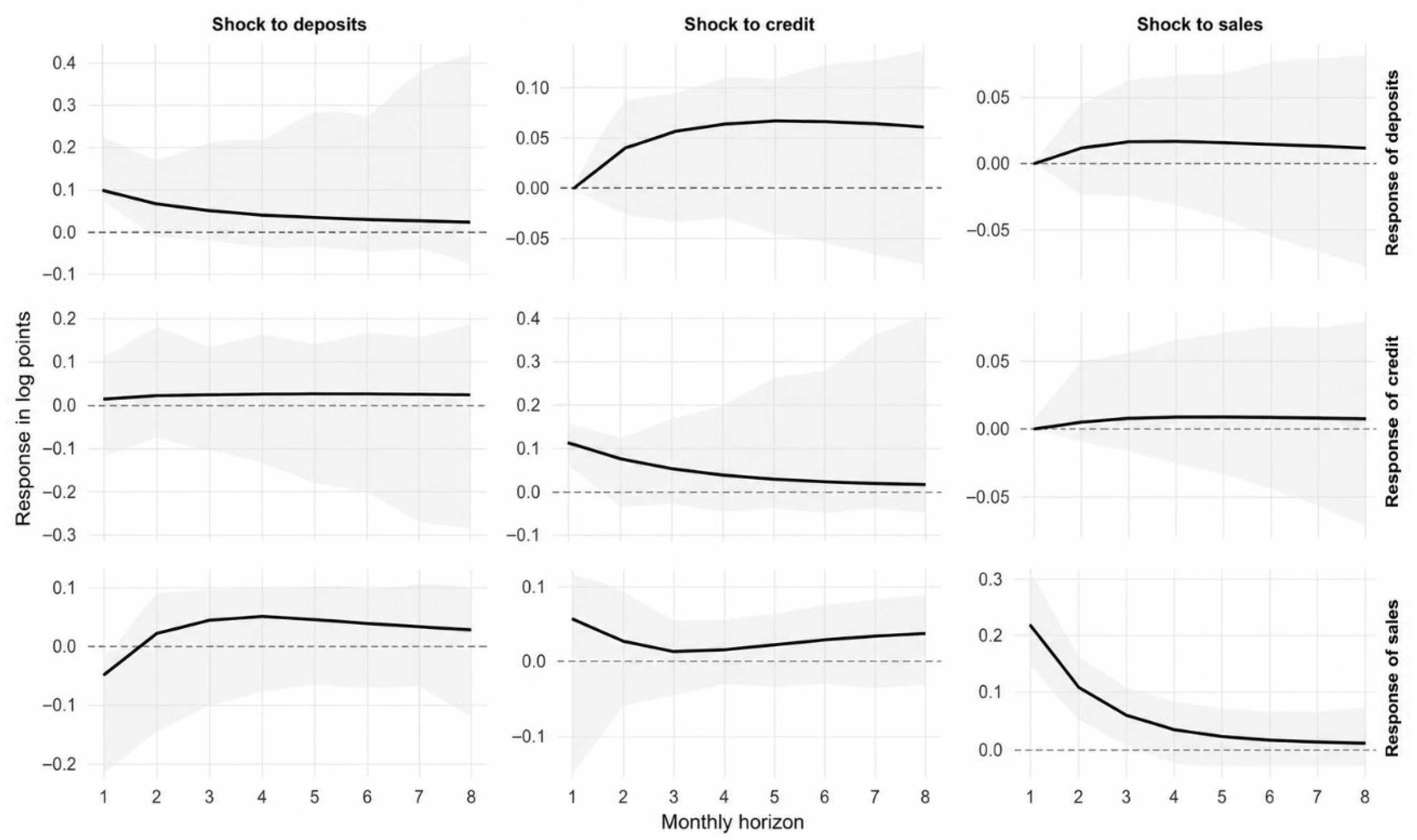
Appendix A reports the corresponding orthogonalised impulse-response functions and the one-lag robustness specification, all including 90% bootstrap confidence bands to assess the precision of the estimated responses.
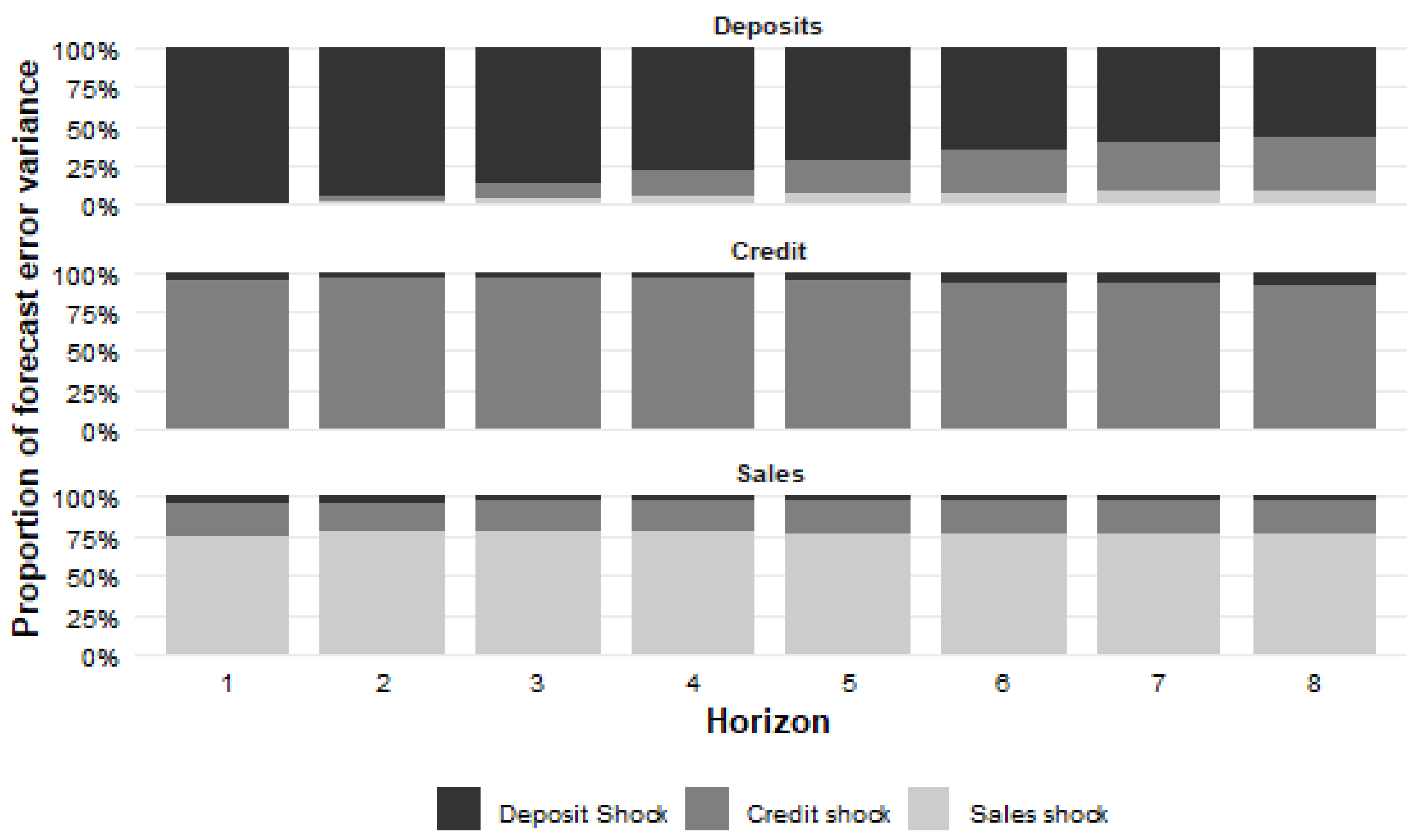
Figure 3 presents the forecast error variance decomposition over the eight-month horizon. For deposits, own shocks explain all forecast error variance in the first period, but their contribution declines progressively to 57.2% by horizon 8. At the same horizon, credit shocks explain 34.2% of deposit forecast error variance, while sales shocks account for 8.6%. This pattern indicates that deposit dynamics are initially dominated by their own innovations, but become increasingly connected to credit conditions as the forecast horizon expands.
Credit exhibits the greatest autonomy within the system. Own credit shocks explain 94.7% of credit forecast error variance in the first period and still account for 91.4% by horizon 8. The contribution of deposit shocks increases moderately from 5.3% to 8.4%, while sales shocks explain less than 1% of credit variability throughout the horizon. This suggests that credit is highly persistent and largely self-driven, with limited contemporaneous dependence on innovations originating in sales.
For sales, own shocks remain the dominant source of forecast error variance, explaining 74.7% in the first period and 75.8% at horizon 8. However, credit shocks account for a sizeable and increasing share of sales variability, rising from 20.5% in the first period to 21.5% by horizon 8. In contrast, deposit shocks explain a relatively small and declining fraction, from 4.8% to 2.7%. Read jointly with the estimated coefficients and the impulse-response functions in
Figure 2, the variance decomposition reinforces the interpretation that credit is the main financial transmission channel in the system. This evidence should be read as complementary to the impulse-response analysis, since FEVD quantifies the relative contribution of each innovation to forecast uncertainty rather than providing a standalone causal estimate.
4.4. Robustness
To assess the sensitivity of the results to instrument construction, additional specifications were estimated using more restrictive instrument sets. In particular, two-lag models were re-estimated by further limiting the GMM-style instruments while maintaining collapsed matrices and the same first-difference transformation. However, the two-lag specifications in which the number of instruments was forced below the number of provincial units led to Hansen test p-values below the conventional 5% threshold, indicating rejection of the overidentifying restrictions. For this reason, these specifications were not retained. Instead, a stricter one-lag Panel VAR specification is reported, in which the number of instruments does not exceed the number of cross-sectional units. This model provides a conservative robustness check focused on instrument parsimony, while the two-lag specification is retained as the baseline because it better captures the delayed credit-sales transmission mechanism and satisfies the Hansen test under collapsed and restricted instruments.
Table 8 reports the coefficients of the alternative specification with a single lag and 24 instruments. Credit continues to exert a positive and significant effect on deposits, and deposits retain a positive effect on sales. The overall direction of the system does not change. The Hansen statistic remains within a range compatible with instrument validity (
p = 0.126), and the system preserves the stability condition (maximum eigenvalue of 0.937). The main difference appears in the sales equation: the effect of credit ceases to be significant when the system is restricted to a single lag. This result does not invalidate the central conclusion but confirms that the transmission of credit to sales is not instantaneous and requires a broader time horizon to become visible, as suggested by the dynamic trajectories in
Figure 2. The deposit channel, by contrast, remains significant under both specifications, reinforcing its role as a more immediate transmission component.
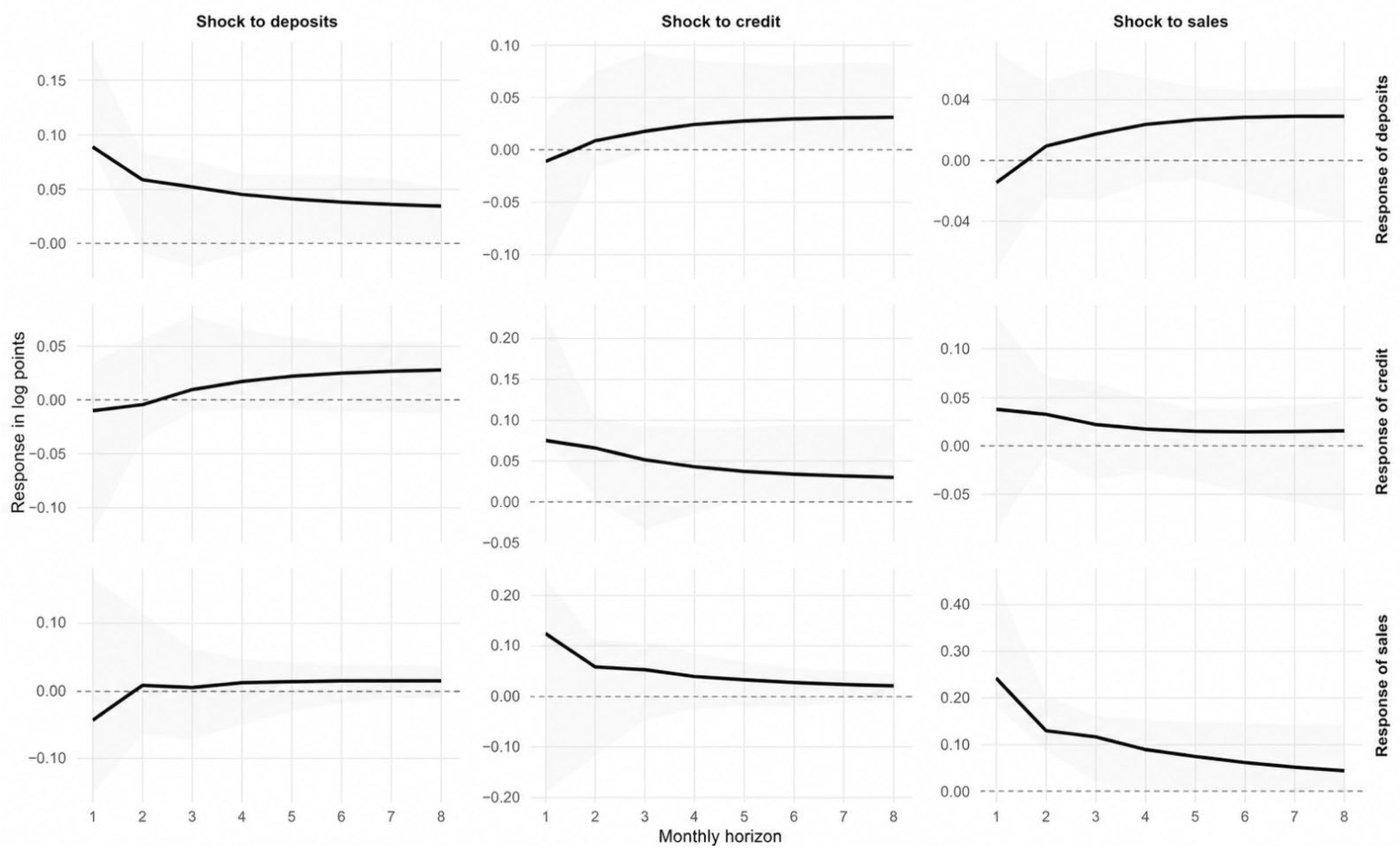
The impulse-response evidence reinforces this interpretation. The GIRFs from the one-lag specification are qualitatively consistent with the baseline model: sales continue to respond positively to credit shocks throughout the eight-month horizon, although the response is more gradual and less pronounced than in the two-lag specification. Deposits and sales also exhibit positive and persistent own responses, while feedback from sales to the financial variables remains moderate. The main sensitivity across specifications concerns the response of sales to deposit shocks, which changes more noticeably with the lag structure. Overall, the robustness exercise indicates that the credit-sales transmission is the most stable cross-variable result, whereas the deposit-sales mechanism should be interpreted with greater caution.
As a complementary check,
Appendix B reports both generalised and orthogonalised impulse-response functions for the baseline and robustness specifications, all including 90% bootstrap confidence bands. These figures confirm that the main dynamic trajectories are not driven by the specific presentation of the baseline GIRF.
As an additional sensitivity exercise, the baseline two-lag Panel VAR-GMM was re-estimated excluding the COVID-19 dummy. This exercise evaluates whether the dynamic relationships among deposits, credit, and sales are mechanically driven by the inclusion of the pandemic-period control. The model without COVID uses 30 instruments and preserves the same first-difference transformation, collapsed instrument matrix, and restricted GMM-style lag structure. The Hansen test does not reject the overidentifying restrictions at the 5% level, although the
p-value decreases to 0.064, indicating that the specification without the pandemic control is less satisfactory in terms of instrument validity than the baseline model. The results of this sensitivity specification are reported in
Table 9.
The exclusion of COVID modifies the coefficient estimates in the sales equation. In particular, the second lag of credit is no longer statistically significant, while sales remain strongly persistent and deposits continue to exert a positive effect. This suggests that the pandemic period represents a relevant common shock in the monthly provincial system. When it is omitted, part of the extraordinary variation associated with 2020–2021 is absorbed by the autoregressive structure of the model, weakening the direct credit coefficient in the sales equation.
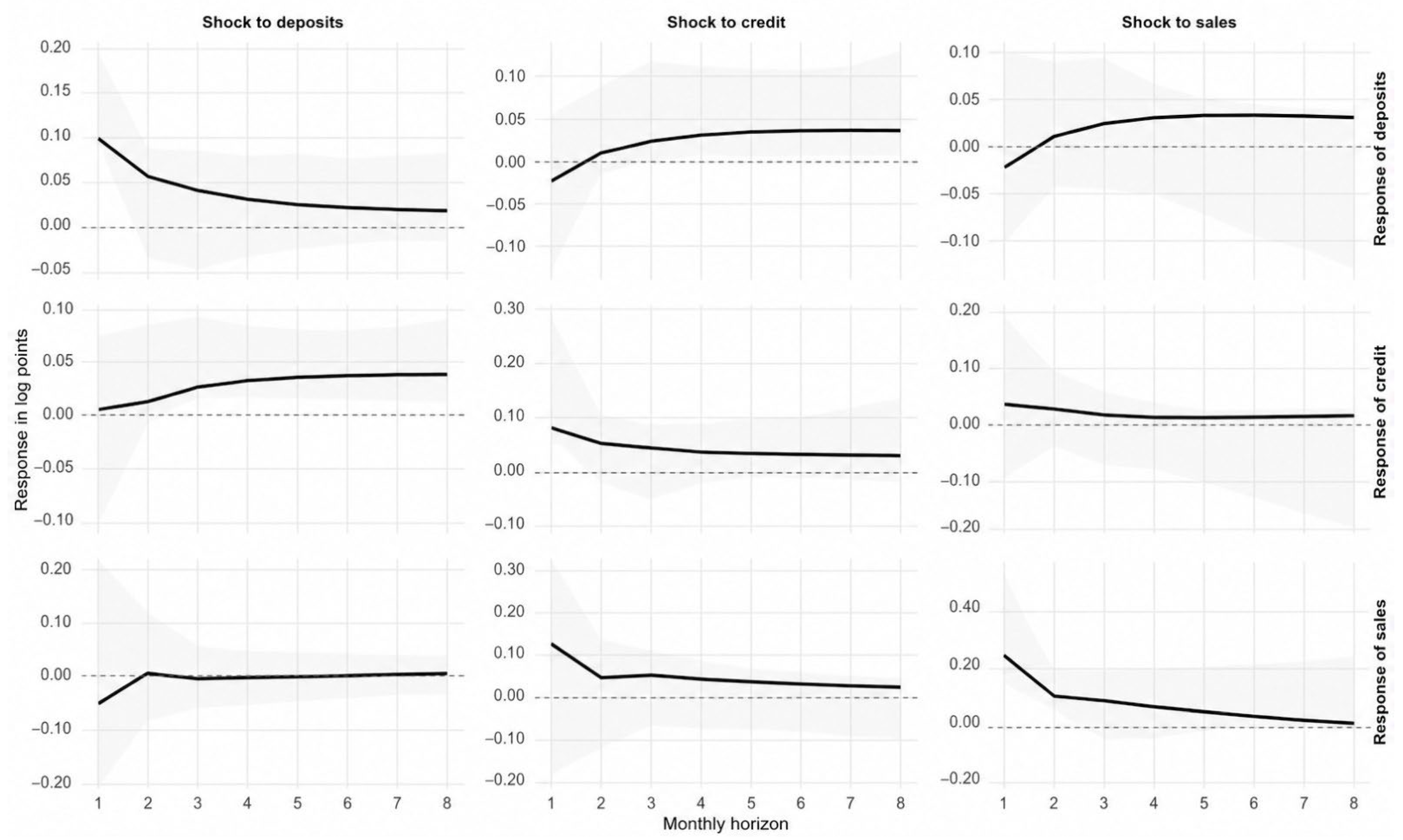
However, the generalised impulse-response functions, reported in
Appendix C, remain qualitatively consistent with the baseline specification. The response of sales to a credit shock remains positive throughout the eight-month horizon. The initial response is 0.124 log points in the model without COVID, compared with 0.123 log points in the baseline model, and gradually declines to 0.022 log points by the eighth month. This similarity indicates that the main dynamic credit-sales trajectory is not mechanically generated by the COVID dummy. Nevertheless, given the lower Hansen
p-value and the loss of significance in the direct credit coefficient, the model without COVID is interpreted as a sensitivity check rather than as the preferred specification.
This exercise also clarifies the role of the COVID variable in the baseline model. The dummy is not intended to measure the heterogeneous intensity of the pandemic across provinces, but to control for a common disruptive period that simultaneously affected deposits, credit, and sales. Therefore, the pandemic coefficient is interpreted cautiously as a period control, while the central conclusions of the paper are based on the dynamic responses of the financial-real system rather than on a structural interpretation of the COVID dummy itself.




 ,
,