
AI for Financial Advice, Fraud Loss, and the Moderating Effect of Financial Knowledge Miscalibration

Abstract
1. Introduction
2. Literature Review
2.1. Artificial Intelligence (AI)–Financial Information and Advice
2.2. Artificial Intelligence (AI)–Fraud Detection
2.3. Financial Fraud
2.4. Theory
3. Methods
3.1. Data
3.2. Measures
3.2.1. Dependent Variable
3.2.2. Independent Variables
3.2.3. Covariates
3.3. Empirical Analyses
4. Results
4.1. Bivariate Results
4.2. Multivariate Results
Robustness Check and Diagnostics
5. Discussion
5.1. Limitations
5.2. Future Research
6. Conclusions
Author Contributions
Funding
Institutional Review Board Statement
Informed Consent Statement
Data Availability Statement
Conflicts of Interest
Appendix A

| Questions | Response Options | |
|---|---|---|
| 1 | Suppose you had $100 in a savings account and the interest rate was 2% per year. After 5 years, how much do you think you would have in the account if you left the money to grow? |
|
| 2 | Imagine that the interest rate on your savings account was 1% per year and inflation was 2% per year. After 1 year, how much would you be able to buy with the money in this account? |
|
| 3 | If interest rates rise, what will typically happen to bond prices? |
|
| 4 | Suppose you owe $1000 on a loan and the interest rate you are charged is 20% per year compounded annually. If you did not pay anything off, at this interest rate, how many years would it take for the amount you owe to double? |
|
| 5 | Which of the following indicates the highest probability of getting a particular disease? |
|
| 6 | A 15-year mortgage typically requires higher monthly payments than a 30-year mortgage, but the total interest paid over the life of the loan will be less. |
|
| 7 | Buying a single company’s stock usually provides a safer return than a stock mutual fund. |
|
References
- Achen, C. H. (2005). Let’s put garbage-can regressions and garbage-can probits where they belong. Conflict Management and Peace Science, 22(4), 327–339. [Google Scholar] [CrossRef]
- Association of Certified Fraud Examiners. (n.d.). Fraud 101: What is fraud? Available online: https://www.acfe.com/fraud-resources/fraud-101-what-is-fraud (accessed on 6 February 2026).
- Association of Certified Fraud Examiners. (2024). Occupational fraud 2024: A report to the nations. Available online: https://www.acfe.com/-/media/files/acfe/pdfs/rttn/2024/2024-report-to-the-nations.pdf (accessed on 6 February 2026).
- Bagherifam, N., Naghdi, S., Ahmadian, V., Fazlzadeh, A., & Baghalzadeh Shishehgarkhaneh, M. (2025). Digital regulatory governance: The role of RegTech and SupTech in transforming financial oversight and administrative capacity. International Journal of Financial Studies, 13(4), 217. [Google Scholar] [CrossRef]
- Bar Lev, E., Maha, L. G., & Topliceanu, S. C. (2022). Financial frauds’ victim profiles in developing countries. Frontiers in Psychology, 13, 999053. [Google Scholar] [CrossRef]
- Beals, M., DeLiema, M., & Deevy, M. (2015). Framework for a taxonomy of fraud. Stanford Center on Longevity & FINRA Investor Education Foundation. Available online: https://longevity.stanford.edu/wp-content/uploads/2016/03/Full-Taxonomy-report.pdf (accessed on 6 February 2026).
- Belanche, D., Casaló, L. V., & Flavián, C. (2019). Artificial intelligence in fintech: Understanding robo-advisors adoption among customers. Industrial Management & Data Systems, 119(7), 1411–1430. [Google Scholar] [CrossRef]
- Bello, O. A., & Olufemi, K. (2024). Artificial intelligence in fraud prevention: Exploring techniques and applications, challenges, and opportunities. Computer Science & IT Research Journal, 5(6), 1505–1520. [Google Scholar] [CrossRef]
- Britt, S. L., Canale, A., Fernatt, F., Stutz, K., & Tibbetts, R. (2015). Financial stress and financial counseling: Helping college students. Journal of Financial Counseling and Planning, 26(2), 172–186. [Google Scholar] [CrossRef]
- Brown, E. H., & Riley, K. (2025). When (financial) knowledge isn’t power: How race disrupts financial literacy’s relationship to health precarity. Sociology Compass, 19(9), e70115. [Google Scholar] [CrossRef]
- Brüggen, E. C., Hogreve, J., Holmlund, M., Kabadayi, S., & Löfgren, M. (2017). Financial well-being: A conceptualization and research agenda. Journal of Business Research, 79, 228–237. [Google Scholar] [CrossRef]
- Burnes, D., Henderson, C. R., Jr., Sheppard, C., Zhao, R., Pillemer, K., & Lachs, M. S. (2017). Prevalence of financial fraud and scams among older adults in the United States: A systematic review and meta-analysis. American Journal of Public Health, 107(8), e13–e21. [Google Scholar] [CrossRef]
- CFP Board. (2015, April 13). Stress test: Americans, especially women and younger people, stressed by finances. CFP Board. Available online: https://www.cfp.net/news/2015/04/stress-test-americans-especially-women-and-younger-people-stressed-by-finances (accessed on 6 February 2026).
- Chang, C.-Y. M., Park, S., & Dinh, M. C. (2026). Advice by algorithms: Dual dimensions of trust in AI financial service adoption. Journal of Retailing and Consumer Services, 88, 104537. [Google Scholar] [CrossRef]
- Cohen, L. E., & Felson, M. (1979). Social change and crime rate trends: A routine activity approach. American Sociological Review, 44(4), 588–608. [Google Scholar] [CrossRef]
- COSO & Association of Certified Fraud Examiners. (2023). Fraud risk management guide (2nd ed.). ACFE. [Google Scholar]
- Cucinelli, D., & Soana, M. G. (2023). Are financially illiterate individuals all the same? A study on incorrect and “do not know” answers to financial knowledge questions. International Journal of Bank Marketing, 41(4), 697–726. [Google Scholar] [CrossRef]
- D’Acunto, F., Prabhala, N., & Rossi, A. G. (2019). The promises and pitfalls of robo-advising. The Review of Financial Studies, 32(5), 1983–2020. [Google Scholar] [CrossRef]
- Davis, F. D. (1989). Perceived usefulness, perceived ease of use, and user acceptance of information technology. MIS Quarterly, 13(3), 319–340. [Google Scholar] [CrossRef] [PubMed]
- DeLiema, M., Deevy, M., Lusardi, A., & Mitchell, O. S. (2020). Financial fraud among older Americans: Evidence and implications. The Journals of Gerontology: Series B, 75(4), 861–868. [Google Scholar] [CrossRef] [PubMed]
- DeLiema, M., Fletcher, E., Kieffer, C. N., Mottola, G. R., Pessanha, R., & Trumpower, M. (2019, September). Exposed to scams: What separates victims from non-victims? Stanford Center on Longevity, FINRA Investor Education Foundation, & BBB Institute for Marketplace Trust. Available online: https://www.finrafoundation.org/sites/finrafoundation/files/exposed-to-scams-what-separates-victims-from-non-victims_0_0.pdf (accessed on 6 February 2026).
- DeLiema, M., Li, Y., & Mottola, G. (2023). Correlates of responding to and becoming victimized by fraud: Examining risk factors by scam type. International Journal of Consumer Studies, 47(3), 1042–1059. [Google Scholar] [CrossRef]
- Dietvorst, B. J., Simmons, J. P., & Massey, C. (2015). Algorithm aversion: People erroneously avoid algorithms after seeing them err. Journal of Experimental Psychology: General, 144(1), 114–126. [Google Scholar] [CrossRef]
- Engels, C., Kumar, K., & Philip, D. (2021). Financial literacy and fraud detection. In J. O. S. Wilson, G. A. Panos, & C. Adcock (Eds.), Financial literacy and responsible finance in the FinTech era: Capabilities and challenges (pp. 124–146). Routledge. [Google Scholar] [CrossRef]
- Fan, J. X., & Yu, Z. (2022). Prevalence and risk factors of consumer financial fraud in China. Journal of Family and Economic Issues, 43(2), 384–396. [Google Scholar] [CrossRef]
- Faulhaber, E., & Chaffin, C. (2024). Artificial intelligence in accounting, medicine, and law with potential implications for financial planning: A review of literature. Financial Services Review, 32(4), 1–11. [Google Scholar] [CrossRef]
- Federal Trade Commission. (2024). Consumer sentinel network data book 2024. Available online: https://www.ftc.gov/system/files/ftc_gov/pdf/csn-annual-data-book-2024.pdf (accessed on 6 February 2026).
- Federal Trade Commission. (2025, March 10). New FTC data show a big jump in reported losses to fraud to $12.5 billion in 2024. Available online: https://www.ftc.gov/news-events/news/press-releases/2025/03/new-ftc-data-show-big-jump-reported-losses-fraud-125-billion-2024 (accessed on 6 February 2026).
- FINRA Investor Education Foundation. (2025). 2024 national financial capability study. Available online: https://finrafoundation.org/national-financial-capability-study (accessed on 6 February 2026).
- FINRA Investor Education Foundation & AARP Fraud Watch Network. (2022). Blame and shame in the context of financial fraud: A movement to change our societal response to a rampant and growing crime. Available online: https://www.finrafoundation.org/sites/finrafoundation/files/Blame-and-Shame-in-the-Context-of-Financial-Fraud.pdf (accessed on 6 February 2026).
- Golladay, K. A., & Snyder, J. A. (2023). Financial fraud victimization: An examination of distress and financial complications. Journal of Financial Crime, 30(6), 1606–1628. [Google Scholar] [CrossRef]
- Gottfried, J., Park, E., & Anderson, M. (2025, July 31). Online scams and attacks in America today. Pew Research Center. Available online: https://www.pewresearch.org/internet/2025/07/31/online-scams-and-attacks-in-america-today/ (accessed on 6 February 2026).
- Hermann, E., & Alberhasky, M. (2025). The trusted partner for financial decision making: Romantic partner or AI? Computers in Human Behavior, 177, 108877. [Google Scholar] [CrossRef]
- Hollis-Peel, M. E., Reynald, D. M., Van Bavel, M., Elffers, H., & Welsh, B. C. (2011). Guardianship for crime prevention: A critical review of the literature. Crime, Law and Social Change, 56(1), 53–70. [Google Scholar] [CrossRef]
- Hussain, S., & Rasheed, A. (2023). Risk tolerance as mediating factor in individual financial investment decisions: A developing-country study. Studies in Economics and Econometrics, 47(2), 185–198. [Google Scholar] [CrossRef]
- Isaia, E., Oggero, N., & Sandretto, D. (2024). Is financial literacy a protection tool from online fraud in the digital era? Journal of Behavioral and Experimental Finance, 44, 100977. [Google Scholar] [CrossRef]
- Jung, D., Dorner, V., Weinhardt, C., & Pusmaz, H. (2018). Designing a robo-advisor for risk-averse, low-budget consumers. Electronic Markets, 28(3), 367–380. [Google Scholar] [CrossRef]
- Kadoya, Y., Khan, M. S. R., Narumoto, J., & Watanabe, S. (2021). Who is next? A study on victims of financial fraud in Japan. Frontiers in Psychology, 12, 649565. [Google Scholar] [CrossRef]
- Li, P., Li, Q., & Du, S. (2024). Does digital literacy help residents avoid becoming victims of frauds? Empirical evidence based on a survey of residents in six provinces of east China. International Review of Economics & Finance, 91, 364–377. [Google Scholar] [CrossRef]
- Lin, J. T., Bumcrot, C., Valdes, O., Mottola, G., Sarver, S., Ganem, R., Kieffer, C., & Walsh, G. (2025). Investors in the United States: A report of the National Financial Capability Study. FINRA Investor Education Foundation. Available online: https://www.finrafoundation.org/InvestorReport2024 (accessed on 6 February 2026).
- Lloyds Banking Group. (2024). What is the emotional impact of fraud? Available online: https://www.lloydsbankinggroup.com/insights/what-is-the-emotional-impact-of-fraud.html (accessed on 6 February 2026).
- Mastercard. (2025). $362 billion in fraud: How insights can help reduce losses and improve the digital experience. Available online: https://www.mastercard.com/global/en/news-and-trends/Insights/2025/362-billion-in-fraud-how-insights-can-help-reduce-losses-and-improve-the-digital-experience.html (accessed on 6 February 2026).
- Miró, F. (2014). Routine activity theory. In J. M. Miller (Ed.), The encyclopedia of theoretical criminology. Wiley. [Google Scholar] [CrossRef]
- Ngai, E. W., Hu, Y., Wong, Y. H., Chen, Y., & Sun, X. (2011). The application of data mining techniques in financial fraud detection: A classification framework and an academic review of literature. Decision Support Systems, 50(3), 559–569. [Google Scholar] [CrossRef]
- Ouyang, C., Crandall, T., & Chatterjee, S. (2025). The impact of the COVID-19 income shock on debt management: A mediation analysis. Financial Services Review, 33(1), 1–27. [Google Scholar] [CrossRef]
- Pandey, S., Guillemette, M. A., & Asebedo, S. D. (2024). Human capital and pandemic-related stimulus usage. Financial Planning Review, 7(2), e1178. [Google Scholar] [CrossRef]
- Piehlmaier, D. M. (2022). Overconfidence and the adoption of robo-advice: Why overconfident investors drive the expansion of automated financial advice. Financial Innovation, 8(1), 14. [Google Scholar] [CrossRef]
- Podaná, Z. (2017). Violent victimization of youth from a cross-national perspective: An analysis inspired by routine activity theory. International Review of Victimology, 23(3), 325–340. [Google Scholar] [CrossRef]
- Porto, N., & Xiao, J. J. (2016). Financial literacy overconfidence and financial advice seeking. Journal of Financial Service Professionals, 70(4), 78–88. [Google Scholar]
- Pratt, T. C., & Turanovic, J. J. (2016). Lifestyle and routine activity theories revisited: The importance of “risk” to the study of victimization. Victims & Offenders, 11(3), 335–354. [Google Scholar] [CrossRef]
- Simon, H. A. (1955). A behavioral model of rational choice. The Quarterly Journal of Economics, 69(1), 99–118. [Google Scholar] [CrossRef]
- Simon, H. A. (1956). Rational choice and the structure of the environment. Psychological Review, 63(2), 129–138. [Google Scholar] [CrossRef]
- Simon, H. A. (2000). Bounded rationality in social science: Today and tomorrow. Mind & Society, 1(1), 25–39. [Google Scholar] [CrossRef]
- Sun, G., Ling, Z., Li, Y., & Xie, C. (2025). Artificial intelligence and financial fraud. Pacific-Basin Finance Journal, 93, 102830. [Google Scholar] [CrossRef]
- Suzuki, A., Shikata, K., & Shimada, T. (2025). Patterns and predictors of cyber fraud victimization: Testing routine activity theory and general theory of crime in Japan. Journal of Economic Criminology, 9, 100186. [Google Scholar] [CrossRef]
- Venkatesh, V., Morris, M. G., Davis, G. B., & Davis, F. D. (2003). User acceptance of information technology: Toward a unified view. MIS Quarterly, 27(3), 425–478. [Google Scholar] [CrossRef]
- Wilder, M. (2025, January). Top 5 fraud trends of 2025. ACFE Insights Blog. Available online: https://www.acfe.com/acfe-insights-blog/blog-detail?s=top-fraud-trends-2025 (accessed on 6 February 2026).
- Williams, W. (2025, September 2). Survey: Consumers increasingly turn to AI for financial advice. ABA Banking Journal. Available online: https://bankingjournal.aba.com/2025/09/survey-consumers-increasingly-turn-to-ai-for-financial-advice/ (accessed on 6 February 2026).
- Wysocki, A. C., Lawson, K. M., & Rhemtulla, M. (2022). Statistical control requires causal justification. Advances in Methods and Practices in Psychological Science, 5(2). [Google Scholar] [CrossRef]
- Xiao, X., Li, X., & Zhou, Y. (2022). Financial literacy overconfidence and investment fraud victimization. Economics Letters, 212, 110308. [Google Scholar] [CrossRef]
- Zhu, H., Pysander, E. L. S., & Söderberg, I. L. (2023). Not transparent and incomprehensible: A qualitative user study of an AI-empowered financial advisory system. Data and Information Management, 7(3), 100041. [Google Scholar] [CrossRef]
- Zhu, H., Vigren, O., & Söderberg, I.-L. (2024). Implementing artificial intelligence empowered financial advisory services: A literature review and critical research agenda. Journal of Business Research, 174, 114494. [Google Scholar] [CrossRef]


| Variables | N (%) | |
|---|---|---|
| Willingness to use AI for financial advice | 1 (Yes) | 4986 (19.5%) |
| Financial Loss due to fraud | 1 (Yes) | 1644 (6.4%) |
| Gender | Male | 12,512 (49.0%) |
| Marital Status | Married | 11,185 (43.8%) |
| Single | 9567 (37.5%) | |
| Separated | 458 (1.8%) | |
| Divorced | 3056 (12.0%) | |
| Widowed/er | 1272 (5.0%) | |
| Employment Status | Self-employed | 1916 (7.5%) |
| Work full-time | 9851(38.6%) | |
| Work part-time | 2459 (9.6%) | |
| Homemaker | 1565 (6.1%) | |
| Full-time student | 764 (3.0%) | |
| Permanently sick, disabled, or unable to work | 1228 (4.8%) | |
| Unemployed or temporarily laid off | 2200 (8.6%) | |
| Retired | 5556 (21.8%) | |
| Household Income | Less than $15,000 | 2889 (11.3%) |
| At least $15,000 but less than $25,000 | 2480 (9.7%) | |
| At least $25,000 but less than $35,000 | 2637 (10.3%) | |
| At least $35,000 but less than $50,000 | 3586 (14.0%) | |
| At least $50,000 but less than $75,000 | 4769 (18.7%) | |
| At least $75,000 but less than $100,000 | 3431 (13.4%) | |
| At least $100,000 but less than $150,000 | 3282 (12.9%) | |
| At least $150,000 but less than $200,000 | 1377 (5.4%) | |
| At least $200,000 but less than $300,000 | 754 (3.0%) | |
| $300,000 or more | 336 (1.3%) | |
| Subjective financial knowledge | M = 4.89, SD = 1.39 | Min = 1, Max = 7 |
| Objective financial knowledge | M = 3.03, SD = 1.71 | Min = 0, Max = 7 |
| Risk tolerance | M = 4.72, SD = 2.67 | Min = 1, Max = 10 |
| Variable (N = 3689) | Targeted and Lost Money Due to Fraud (N = 1644) | Targeted but Did Not Lose Money Due to Fraud (N = 2045) | Test Statistic |
|---|---|---|---|
| Willingness to use AI for financial advice | 560 (34.1) | 439 (21.5) | χ2 (1) = 73.34, p < 0.001 |
| Subjective financial knowledge | 4.79 (1.58) | 5.09 (1.30) | t (3648) = −6.24, p < 0.001 |
| Objective financial knowledge | 2.76 (1.58) | 3.51 (1.69) | t (3687) = −13.79, p < 0.001 |
| Financial knowledge miscalibration | 0.07 (1.36) | −0.15 (1.17) | t (3648) = 5.47, p < 0.001 |
| Risk tolerance | 5.38 (2.98) | 4.97 (2.61) | t (3634) = 4.32, p < 0.001 |
| Male | 859 (52.3) | 1150 (56.2) | χ2 (1) = 5.83, p = 0.016 |
| Marital status | — | — | χ2 (4) = 103.32, p < 0.001 |
| Employment status | — | — | χ2 (7) = 132.24, p < 0.001 |
| Household income | — | — | χ2 (9) = 181.83, p < 0.001 |
| Predictor (vs. Reference) | β | OR | 95% CI | β | OR | 95% CI | β | OR | 95% CI |
|---|---|---|---|---|---|---|---|---|---|
| Model 1 (OFK) | Model 2 (SFK) | Model 3 (Miscalibration) | |||||||
| Interaction terms | |||||||||
| AIAdvice × OFK | −0.091 | 0.913 | [0.765, 1.090] | — | — | — | — | — | — |
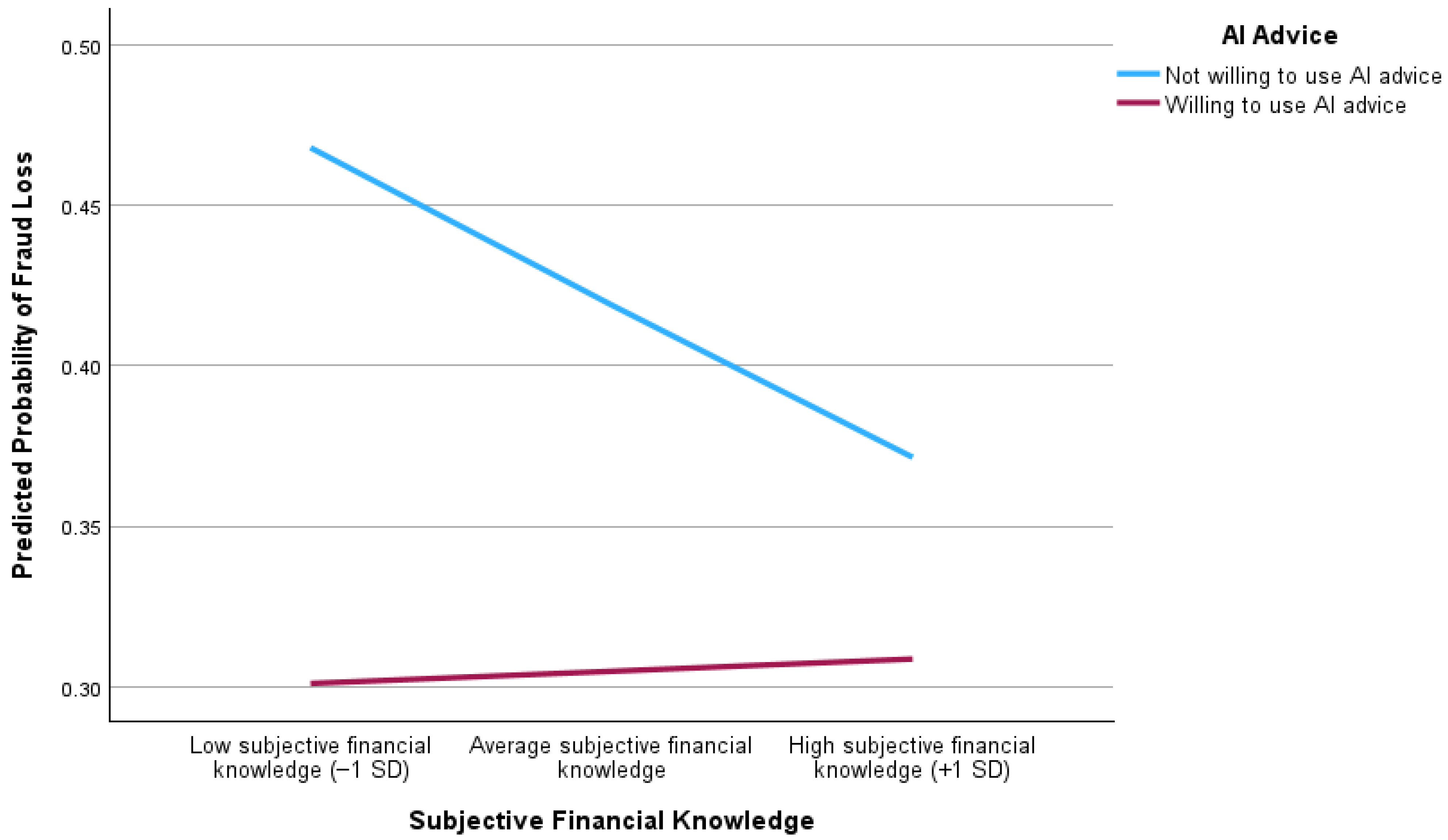
| AIAdvice × SFK | — | — | — | 0.217 ** | 1.242 | [1.063, 1.452] | — | — | — |
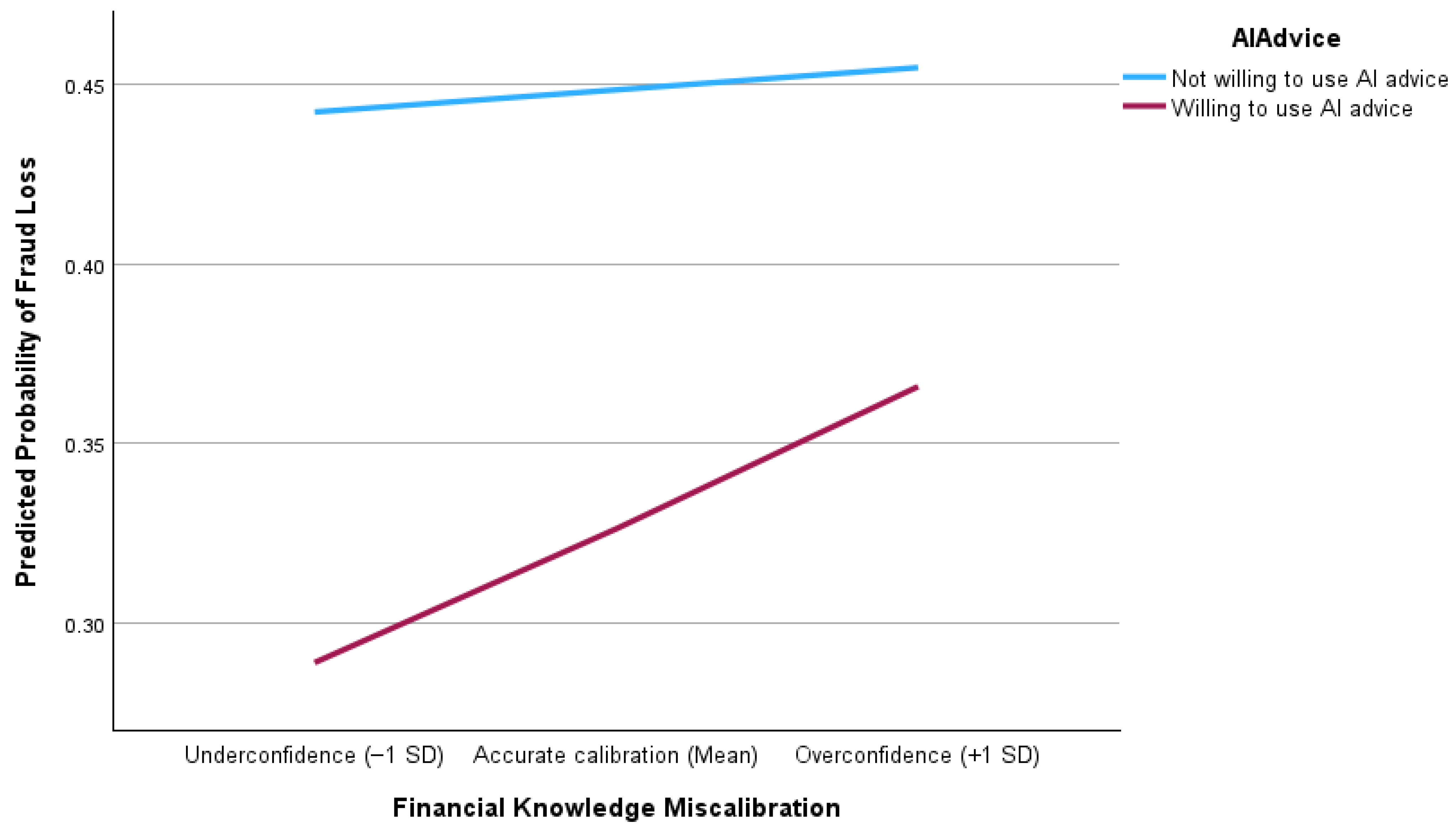
| AIAdvice × Miscalibration | — | — | — | — | — | — | 0.150 * | 1.162 | [1.024, 1.318] |
| Main effects | |||||||||
| AI Advice (1 vs. 0) | −0.527 *** | 0.591 | [0.494, 0.706] | −0.498 *** | 0.608 | [0.509, 0.726] | −0.518 *** | 0.596 | [0.499, 0.712] |
| Objective financial knowledge (z) | −0.276 *** | 0.759 | [0.684, 0.842] | — | — | — | — | — | — |
| Subjective financial knowledge (z) | — | — | — | −0.199 *** | 0.820 | [0.743, 0.905] | — | — | — |
| Financial knowledge miscalibration | — | — | — | — | — | — | 0.025 | 1.025 | [0.947, 1.111] |
| Risk tolerance | 0.054 *** | 1.056 | [1.024, 1.088] | 0.058 *** | 1.060 | [1.027, 1.094] | 0.041 * | 1.042 | [1.010, 1.074] |
| Marital status (ref = Married) | |||||||||
| Single | 0.174 | 1.191 | [0.978, 1.449] | 0.180 | 1.197 | [0.984, 1.457] | 0.198 * | 1.219 | [1.002, 1.484] |
| Separated | 0.814 * | 2.257 | [1.205, 4.228] | 0.777 * | 2.175 | [1.135, 4.167] | 0.870 ** | 2.387 | [1.253, 4.548] |
| Divorced | 0.351 ** | 1.421 | [1.095, 1.843] | 0.321 * | 1.378 | [1.063, 1.787] | 0.325 * | 1.384 | [1.068, 1.793] |
| Widowed/widower | 0.509 ** | 1.664 | [1.136, 2.438] | 0.541 ** | 1.718 | [1.171, 2.520] | 0.549 ** | 1.731 | [1.183, 2.534] |
| Employment status (ref = Full-time employee) | |||||||||
| Self-employed | 0.220 | 1.246 | [0.947, 1.638] | 0.200 | 1.222 | [0.928, 1.609] | 0.183 | 1.200 | [0.913, 1.579] |
| Work part-time | −0.030 | 0.970 | [0.735, 1.281] | 0.003 | 1.003 | [0.761, 1.322] | −0.033 | 0.968 | [0.734, 1.275] |
| Homemaker | 0.222 | 1.249 | [0.838, 1.863] | 0.264 | 1.302 | [0.873, 1.940] | 0.267 | 1.306 | [0.876, 1.947] |
| Full-time student | 0.311 | 1.365 | [0.827, 2.254] | 0.298 | 1.348 | [0.816, 2.227] | 0.319 | 1.375 | [0.831, 2.275] |
| Permanently sick/disabled | 0.099 | 1.104 | [0.756, 1.611] | 0.099 | 1.104 | [0.756, 1.612] | 0.116 | 1.123 | [0.769, 1.639] |
| Unemployed/laid off | 0.019 | 1.019 | [0.740, 1.405] | −0.008 | 0.992 | [0.718, 1.370] | 0.000 | 1.000 | [0.724, 1.382] |
| Retired | −0.593 *** | 0.553 | [0.431, 0.708] | −0.653 *** | 0.521 | [0.406, 0.668] | −0.711 *** | 0.491 | [0.384, 0.629] |
| Gender (male = 1) | 0.142 | 1.153 | [0.975, 1.364] | 0.181 * | 1.198 | [1.014, 1.416] | 0.177 * | 1.193 | [1.010, 1.410] |
| Household income (ref = $50 k–$74,999) | |||||||||
| <$15,000 | 0.450 ** | 1.569 | [1.138, 2.164] | 0.576 *** | 1.778 | [1.294, 2.443] | 0.557 *** | 1.746 | [1.269, 2.402] |
| $15 k–$24,999 | 0.333 * | 1.396 | [1.022, 1.906] | 0.453 ** | 1.573 | [1.153, 2.147] | 0.443 ** | 1.558 | [1.141, 2.126] |
| $25 k–$34,999 | 0.123 | 1.131 | [0.843, 1.519] | 0.194 | 1.214 | [0.905, 1.629] | 0.193 | 1.212 | [0.904, 1.626] |
| $35 k–$49,999 | 0.131 | 1.140 | [0.858, 1.513] | 0.157 | 1.170 | [0.883, 1.551] | 0.142 | 1.153 | [0.870, 1.528] |
| $75 k–$99,999 | −0.267 | 0.766 | [0.580, 1.011] | −0.264 | 0.768 | [0.583, 1.012] | −0.286 * | 0.751 | [0.570, 0.990] |
| $100 k–$149,999 | −0.443 ** | 0.642 | [0.479, 0.861] | −0.511 *** | 0.600 | [0.448, 0.804] | −0.536 *** | 0.585 | [0.437, 0.784] |
| $150 k–$199,999 | −0.227 | 0.797 | [0.538, 1.181] | −0.373 | 0.688 | [0.464, 1.022] | −0.394 | 0.675 | [0.455, 1.001] |
| $200 k–$299,999 | −0.480 * | 0.619 | [0.384, 0.997] | −0.588 * | 0.555 | [0.347, 0.890] | −0.622 * | 0.537 | [0.335, 0.860] |
| ≥$300,000 | −1.128 ** | 0.324 | [0.147, 0.712] | −1.132 ** | 0.322 | [0.147, 0.708] | −1.186 ** | 0.306 | [0.139, 0.672] |
| Constant | −0.247 | 0.781 | — | −0.327 | 0.721 | — | −0.207 | 0.813 | — |
| Nagelkerke R2 | 0.153 | 0.138 | 0.137 | ||||||
| −2 Log Likelihood | 3638.51 | 3633.80 | 3637.00 | ||||||
| n | 2982 | 2956 | 2956 | ||||||
Disclaimer/Publisher’s Note: The statements, opinions and data contained in all publications are solely those of the individual author(s) and contributor(s) and not of MDPI and/or the editor(s). MDPI and/or the editor(s) disclaim responsibility for any injury to people or property resulting from any ideas, methods, instructions or products referred to in the content. |
© 2026 by the authors. Licensee MDPI, Basel, Switzerland. This article is an open access article distributed under the terms and conditions of the Creative Commons Attribution (CC BY) license.
Share and Cite
Chawla, I.; Joseph, M.; White, K.; Scantling, C.W. AI for Financial Advice, Fraud Loss, and the Moderating Effect of Financial Knowledge Miscalibration. Int. J. Financial Stud. 2026, 14, 137. https://doi.org/10.3390/ijfs14060137
Chawla I, Joseph M, White K, Scantling CW. AI for Financial Advice, Fraud Loss, and the Moderating Effect of Financial Knowledge Miscalibration. International Journal of Financial Studies. 2026; 14(6):137. https://doi.org/10.3390/ijfs14060137
Chicago/Turabian StyleChawla, Isha, Mindy Joseph, Kenneth White, and Chasity Winder Scantling. 2026. "AI for Financial Advice, Fraud Loss, and the Moderating Effect of Financial Knowledge Miscalibration" International Journal of Financial Studies 14, no. 6: 137. https://doi.org/10.3390/ijfs14060137
APA StyleChawla, I., Joseph, M., White, K., & Scantling, C. W. (2026). AI for Financial Advice, Fraud Loss, and the Moderating Effect of Financial Knowledge Miscalibration. International Journal of Financial Studies, 14(6), 137. https://doi.org/10.3390/ijfs14060137