1. Introduction
Digital technology’s rapid development is reshaping the global financial landscape. In this context, global stablecoins—cryptocurrencies pegged to fiat currencies—have expanded from crypto-asset trading into broader use cases such as cross-border trade and supply chain finance. According to
CoinMarketCap (
2025) and the Bank for International Settlements (
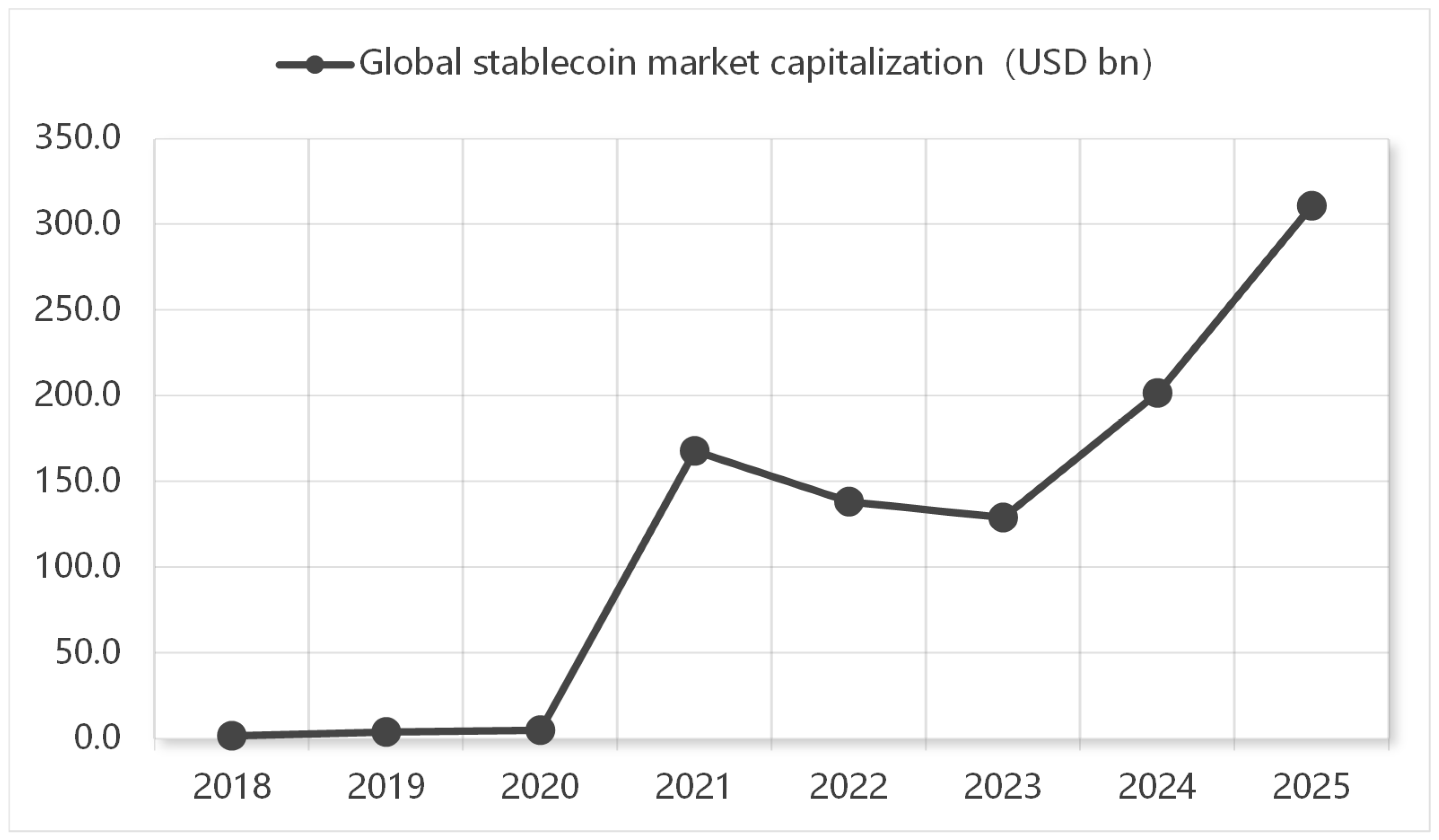
Bank for International Settlements [BIS], 2024), the total market capitalization of global stablecoins exceeded USD 300 billion in late 2025, with USDT and USDC accounting for more than 80% of the market. Daily stablecoin transaction volumes frequently exceed USD 80 billion, highlighting their growing systemic relevance in global digital financial markets. While stablecoins can improve payment efficiency, their cross-border mobility and pseudonymity also pose potential threats to national monetary sovereignty and financial stability, potentially leading to “digital dollarization” risks for emerging markets.
As the world’s second-largest economy, China faces a unique dual situation: on the one hand, as the largest trading nation, it has a genuine demand for efficient cross-border payments; on the other hand, it must rigorously safeguard financial security and its capital account management framework. The People’s Bank of China has already banned domestic activities involving non-sovereign cryptocurrencies, shifting focus to how to address the risk transmission from external stablecoins. Meanwhile, the rollout of the digital renminbi (e-CNY)—particularly its interest-bearing feature—has become an important strategy to reinforce monetary sovereignty.
Existing research has mostly focused on macro-level currency competition, lacking in-depth analysis of the micro-level pathways through which risks are transmitted, and overlooking China’s unique defensive mechanisms under a regime of capital controls alongside a sovereign digital currency. In addition, the systematic embedding of RegTech in risk monitoring remains to be explored.
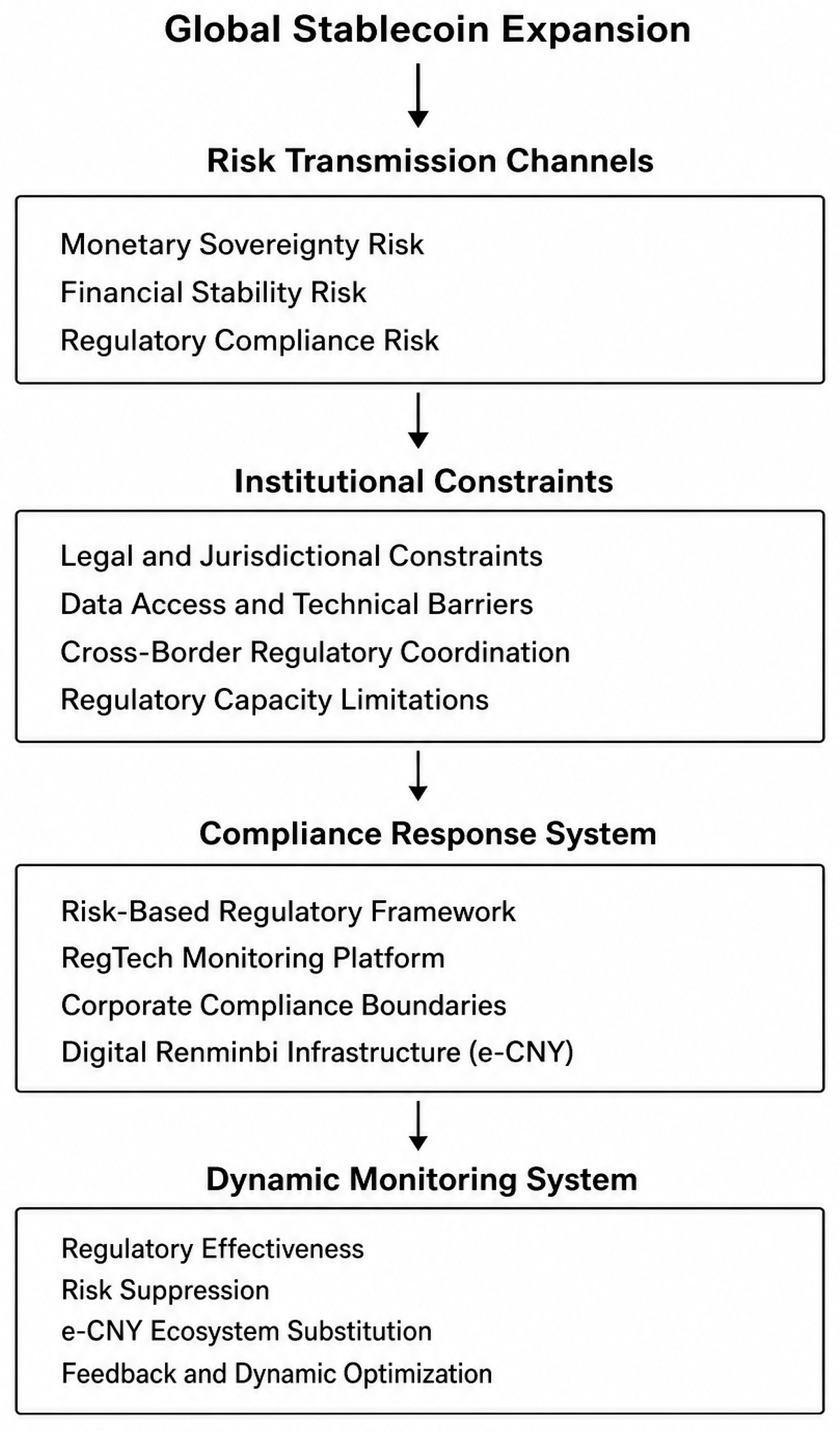
To fill these gaps, this paper constructs an integrated analytical framework of “risk identification—transmission mechanism–institutional constraints–compliance response”, combining financial risk theory and institutional economics perspectives, with the aim of revealing the internal logic of stablecoin risk formation and transmission. This study contributes by integrating conceptual analysis with preliminary empirical evidence, providing a structured framework for understanding stablecoin risk transmission under China’s institutional context. Methodologically, it adopts a normative analysis coupled with comparative study, focusing on risk scenarios and institutional frictions. Practically, it seeks to provide a roadmap for building a dynamic compliance system centered on the digital renminbi and supported by RegTech, thereby contributing academic insight to safeguarding national financial security in the digital age.
Figure 1 presents the evolution of global stablecoin market capitalization based on publicly available data.
3. Global Stablecoin Risk Transmission Mechanisms
This study adopts a qualitative analytical framework combining regulatory analysis, institutional economics, and descriptive statistical evidence. The research integrates a literature review, institutional analysis, and comparative policy analysis to examine the transmission mechanisms of stablecoin-related financial risks.
Before examining the specific transmission channels of monetary sovereignty risks, it is important to note that regulatory sensitivity toward global stablecoins is not unique to China. In several continental European countries, particularly France, concerns surrounding stablecoins are closely linked to long-standing governance traditions rather than purely technical or financial considerations. France has historically emphasized the role of the state in safeguarding strategic infrastructures and has articulated the notion of institutional governance approaches to justify public intervention in areas considered foundational to national sovereignty (
Kristoufek, 2021). This institutional philosophy extends naturally to the monetary and payment domains, where currency issuance and settlement systems are viewed as public governance arrangements rather than neutral outcomes of private market innovation. Such a governance-oriented perspective helps explain why certain jurisdictions adopt a precautionary stance toward privately issued global stablecoins, prioritizing monetary sovereignty and systemic resilience over market-driven experimentation.
In the Chinese context, although domestic use is restricted, offshore stablecoin activities may still create indirect channels of exposure. BIS estimates suggest that Asia accounts for a substantial proportion of global stablecoin-related flows, indicating indirect exposure channels (
Bank for International Settlements [BIS], 2024).
The rapid development of global stablecoins is both an outcome of technological evolution and a factor reshaping the global financial order. Because stablecoins are pegged to fiat currencies and built on distributed ledger technology, they simultaneously improve cross-border payment efficiency and generate a complex, interrelated spectrum of risks. These risks can be transmitted to sovereign countries’ financial systems and economies through specific channels. From an institutional economics perspective, the essence of stablecoin risk transmission lies in the friction between a new digital institutional arrangement (global stablecoins) and traditional institutional systems. This friction is especially pronounced in cross-border scenarios, where institutional lag can exacerbate the micro-level incentives for cross-jurisdictional risk transmission. Accordingly, this section dissects the risk transmission pathways from three dimensions.
3.1. Monetary Sovereignty Erosion Risk and Transmission Path
Monetary sovereignty is a core component of a nation’s economic sovereignty, fundamentally embodied in the exclusive power of a state to issue and manage its legal tender. Widespread use of global stablecoins—especially those pegged to major international currencies like the U.S. dollar—could pose a potential erosion of a country’s monetary sovereignty.
Firstly, there is the risk of payment system substitution and the crowding-out of local currency usage. If non-residents (or even domestic actors) begin using global stablecoins for pricing and settling cross-border trade and investment, the share of the home country’s currency in international transactions will shrink. This phenomenon of “currency substitution” could manifest rapidly in the digital realm. Even under a capital-controlled environment, stablecoins can weaken the local currency’s cross-border payment function via online transactions, payments for virtual goods and services, and other channels. Over the long-term, this could impede the internationalization progress of the domestic currency and diminish its influence in regional or global economic activity (
Saengchote & Samphantharak, 2024).
Secondly, stablecoins might undermine the effectiveness of monetary policy transmission. Central bank monetary policy achieves its aims through calibrated control of base money, interest rates, and other tools. Although global stablecoins are prohibited from circulating onshore in China, their active use offshore could create a de facto “shadow currency system”. If domestic economic entities (especially firms engaged in cross-border business) hold or use stablecoins abroad for asset allocation and liquidity management, their behavior may diverge from the orientation of onshore monetary policy (
Griffin & Shams, 2020). For example, during a domestic monetary tightening, firms could obtain financing via stablecoin channels offshore, counteracting domestic credit tightening measures. This would blunt the precision and efficacy of monetary policy transmission (
Li & Chen, 2024).
Of course, the magnitude of the above transmission risks depends on factors like the network scale and user base of the stablecoins, as well as the depth and resilience of the domestic economic and financial system. Nonetheless, remaining vigilant about these potential transmission paths is a vital precondition for safeguarding a nation’s monetary sovereignty. Defending monetary sovereignty is not only about economic power, but also entwined with cultural identity and governance models. This is especially evident in Europe, particularly France. France has long championed the principle of “institutional governance approaches”, seeing it as core to preserving national identity and soft power. In the context of global stablecoins, this concern extends from audiovisual services into the financial domain. French academics and policymakers widely perceive the stablecoin ecosystem led by American tech giants as imbued with different regulatory traditions that could subtly erode the social market economy model and oversight-intensive financial culture that continental Europe espouses. Thus, France’s wariness of global stablecoins stems not only from defending the euro’s monetary sovereignty, but also from a deeper worry that its own economic governance culture could be undermined. This perspective, linking monetary issues with cultural and governance sovereignty, enriches our understanding of the complex connotations of monetary sovereignty.
3.2. Financial Stability Shock Risk and Transmission Mechanism
The operating model of global stablecoins and their potential interconnections with the traditional financial system mean that stablecoins could become a source of systemic financial risk or act as an amplifier of such risk. Recent industry statistics indicate that stablecoins represent a significant share of cryptocurrency market liquidity. According to CoinMarketCap data, stablecoins accounted for more than 60% of the total crypto trading volume during several periods in 2024–2025 (
CoinMarketCap, 2025).
First, cross-border abnormal capital flows may intensify. Because global stablecoins run on blockchain networks, they enable real-time cross-border value transfers, lowering the technical barriers and time costs of moving capital. Especially during information-driven market sentiment swings, capital can use stablecoin channels to rapidly flow into or out of a country on a large scale. Such abrupt short-term capital movements can sharply impact asset prices (exchange rates, interest rates, securities prices), heightening financial market volatility and potentially triggering or amplifying localized financial crises, thereby challenging macro-prudential management frameworks. For example, during the 2022 collapse of the Terra/Luna algorithmic stablecoin, panic sentiment transmitted swiftly through on-chain networks to stock markets and cross-border payment platforms, leading to a localized liquidity crisis.
Second, risk contagion across markets and regions accelerates. In traditional systems, financial risk contagion typically occurs through channels like interbank markets or payment and settlement systems, often with some time lag. In contrast, the speed of risk contagion on global stablecoin networks is exponentially higher. For instance, if a major stablecoin issuer faces deteriorating reserve asset quality, a run, or a significant cybersecurity incident, panic can spread rapidly across a highly interconnected digital asset network. This could not only impact other stablecoins and crypto-asset markets, but also transmit via intermediaries (such as financial institutions holding related assets) into the traditional financial system, causing cross-market risk resonance. The Terra/Luna collapse partially demonstrated this rapid on-chain risk transmission characteristic. The concern is that a stablecoin failure can reverberate almost instantaneously across different markets and jurisdictions (
Rogoff, 2022).
Third, there is the potential for systemic importance and the “too big to fail” dilemma. If one or several global stablecoins grow significantly in scale and become deeply embedded with key financial institutions or core financial market infrastructures, they could themselves evolve into systemically important financial nodes. If such a stablecoin fell into crisis, regulators would face a difficult dilemma over whether to intervene with a bailout to prevent a broader systemic financial meltdown.
3.3. Regulatory Arbitrage Risk and Legal Challenges
Global stablecoins, by virtue of their cross-border and cross-sector characteristics, face extremely complex issues of jurisdiction and legal applicability. This not only creates potential room for illicit activities, but also directly challenges existing regulatory frameworks.
First, stablecoins may facilitate illegal cross-border capital flows. Stablecoin transactions often offer anonymity or pseudonymity, along with the convenience of peer-to-peer transfers across borders. This makes them attractive for use in money laundering, terrorist financing, tax evasion, unauthorized capital flight, and other illicit activities. Even with innovations like the “travel rule” requiring certain information to accompany crypto transactions, fully effective customer due diligence and transaction monitoring remain extremely difficult in a global, decentralized network environment. These challenges make it hard for regulators to comprehensively detect and deter illicit financial activities conducted via stablecoins.
Second, the legal characterization of stablecoins is ambiguous and jurisdictional conflicts abound. Different jurisdictions define the legal nature of stablecoins differently (e.g., as securities, payment instruments, commodities, etc.), resulting in uncertainty in legal treatment. The automatic execution of smart contracts can conflict with traditional legal rules on contract validity, liability for breach, and so on. When cross-border disputes arise, determining jurisdiction, serving legal process, and enforcing judgments become exceedingly complex. This legal uncertainty not only raises the compliance costs for market participants, but also creates obstacles for regulatory enforcement.
Third, regulators face data access and risk monitoring dilemmas. Effective financial regulation relies on sufficient, accurate, and timely data. However, stablecoin transaction data are distributed across network nodes (some overseas), stored on public or consortium blockchains. Although blockchain transactions are publicly visible, important supervisory challenges remain, particularly in linking wallet addresses to identifiable entities and in consolidating data across multiple chains and platforms. Effective monitoring therefore requires advanced analytical tools and regulatory technology. Obstacles in data access mean that regulators cannot precisely gauge the overall stablecoin market size, capital flows, or risk concentrations, undermining the proactiveness and effectiveness of oversight (
Saengchote & Samphantharak, 2024).
In sum, the risk transmission mechanisms of global stablecoins form a complex system spanning multiple dimensions and interlinked channels. These transmission paths manifest in the realms of monetary sovereignty, financial stability, and regulatory compliance. Clearly mapping these paths is an important theoretical prerequisite for accurate risk identification and effective risk prevention. It should be noted that our analysis considers the impacts of global stablecoins as external variables. Given Chinese regulators’ strict prohibition of related activities domestically, our discussion operates under the policy premise of “vigorously guarding against external risk inflows and maintaining domestic financial security”. A deep understanding of the risk transmission mechanisms only underscores the urgency and necessity of strengthening compliance boundaries and advancing the digital renminbi.
The scale of the threat depends on network adoption and transaction intensity. Available observations suggest that stablecoin trading activity may rise during periods of financial stress, potentially intensifying capital-flow volatility. The associated risk is therefore conditional and may become more material as adoption expands.
4. Discussion: China’s Institutional and Technological Constraints
The transmission of global stablecoin risks into a domestic economic and financial system is not a frictionless process. The extent and scope of impact are constrained by the receiving country’s institutional framework, technical capabilities, and regulatory effectiveness. China has explicitly banned domestic stablecoin-related businesses and has worked to build robust defenses for financial security. However, in the process of effectively identifying, monitoring, and blocking external risk inflows, China still faces certain institutional and technical constraints that could affect the timeliness and efficacy of risk prevention (
Bank for International Settlements [BIS], 2024).
4.1. Legal Constraints: Cross-Border Regulatory Collaboration and Jurisdictional Conflicts
The cross-border, cross-sector nature of global stablecoins means that effective risk management heavily relies on international regulatory cooperation. However, the current global regulatory landscape and legal frameworks are fragmented, which significantly constrains China’s ability to implement cross-border risk controls.
There are challenges in the mutual recognition of regulatory standards and coordinated enforcement. Different countries’ legal regimes vary in how they define stablecoins (e.g., as securities, payment instruments, etc.) and in their regulatory requirements (such as reserve management or disclosure standards). Such disparities create opportunities for regulatory arbitrage. For example, a stablecoin issuer might choose to operate in the jurisdiction with the laxest requirements, yet can offer services globally via digital networks. If a risk event occurs, Chinese regulators may take measures under Chinese law, but enforcement in the issuer’s home jurisdiction may not be forthcoming. Obtaining account books, transaction data, or freezing assets of a foreign-based stablecoin issuer might require complex judicial assistance procedures, leading to insufficient timeliness and certainty, thus missing the optimal window for risk containment. Notably, the United States and Switzerland have attempted to address this by signing a memorandum of understanding to share stablecoin regulatory data, and the EU leverages mechanisms like the European Data Protection Board (EDPB) to pursue unified cross-border enforcement. Drawing on these precedents, China could explore specialized judicial assistance agreements with major trading partners to overcome jurisdictional conflicts.
Moreover, the automatic execution of smart contracts poses compatibility challenges with the current legal system, creating deep legal constraints. Smart contracts operate based on code rules under the logic of “code is law”, which can conflict with traditional legal principles based on intent, fault liability, or changed circumstances in contract interpretation. If a smart contract’s outcome is unfair, or if a bug in its code causes losses, how should remedies be provided under China’s Civil Code or contract law? This remains largely uncharted and uncertain in current judicial practice. Such uncertainty in legal application increases the potential legal risks for market participants and raises the difficulty for regulators in exercising effective oversight according to law.
4.2. Data Access Challenges and Technical Standards Barriers in Risk Monitoring
The effective identification and early warning of stablecoin risks depend on comprehensive, timely data on transaction volumes, fund flows, and holder composition. However, on a technical level, there are significant hurdles in data acquisition and the interoperability of standards.
Although blockchain transactions are publicly visible, regulators still face significant practical challenges in monitoring stablecoin activities. The main difficulty lies not in accessing transaction records themselves, but in identifying the real-world entities behind blockchain addresses and in aggregating fragmented data across multiple chains, exchanges, and custodial platforms. In addition, cross-chain transfers, decentralized exchanges, and offshore service providers further complicate risk identification. As a result, effective supervision requires advanced blockchain analytics tools and cross-jurisdictional regulatory cooperation. In addition, stablecoin transactions often involve cross-chain transfers, decentralized exchanges, and offshore service providers, which complicates regulatory monitoring and risk identification. As a result, effective supervision requires advanced blockchain analytics tools and cross-jurisdictional regulatory cooperation.
This makes it very difficult to analyze and preemptively detect patterns of large-scale capital movement or abnormal transactions, thereby affecting the foresight and initiative of regulation.
Additionally, differences in technical standards and interoperability issues compound monitoring difficulties. Major international stablecoins typically utilize technical architectures based on Western cryptographic standards (e.g., secp256k1 elliptic curves), whereas China’s financial sector is promoting indigenous cryptographic algorithms (the SM series). These two ecosystems differ markedly in underlying algorithms, signature mechanisms, and data protocols, leading to interoperability barriers. In addressing such technical standard challenges, the strategic choices of the EU—spearheaded by France—offer an important reference. France actively pushes for “technological sovereignty” at the EU level, aiming to reduce reliance on external tech systems. In digital finance, the European Blockchain Services Infrastructure (EBSI) project, led by France, seeks to establish a consortium blockchain standard aligned with EU regulations and values (such as GDPR). This initiative clearly signals an intent to shape regional technical norms and claim the right to set rules in digital space. France’s experience shows that tackling global stablecoin technical standards is not just about technical compatibility, but a strategic project tied to future dominance over the digital financial order. For China, this suggests elevating the development of indigenous cryptography and active participation (even leadership) in regional and global digital finance standards-setting to a strategic priority—using standard-setting to safeguard financial security and enhance international discourse power. Evidently, if a monitoring system needs to directly interface with and parse on-chain data from mainstream stablecoins, it will face technical adaptation challenges. An extra translation layer or middleware may be required, increasing the system complexity and regulatory cost.
4.3. “One Country, Two Systems”: Challenges in Coordinated Cross-Border Risk Prevention
Hong Kong, as an international financial center, operates under a different financial regulatory regime from Mainland China under the “one country, two systems” framework. While this arrangement facilitates offshore RMB business, it also complicates the coordinated prevention of cross-border financial risks exemplified by stablecoins. The main challenge lies in constructing risk “firewalls” and synchronizing regulatory policies between jurisdictions.
Hong Kong, under its own legal framework, has moved to establish a regulatory sandbox and licensing regime for stablecoins, whereas the Mainland enforces a strict prohibition policy. This regulatory divergence necessitates a robust financial firewall between the two markets to prevent risks from spilling over—through either legal or illicit channels—from Hong Kong to the Mainland financial system. Effective containment demands extremely efficient and seamless coordination in information sharing, risk alerting, and enforcement cooperation between regulators in both jurisdictions. Any delay or gap in coordination could be exploited as a channel for stablecoin risk transmission, posing a latent threat to Mainland financial security. In practice, this calls for establishing close day-to-day communication mechanisms, joint surveillance and early warning systems, and coordinated enforcement actions between, for example, the People’s Bank of China/China Securities Regulatory Commission and the Hong Kong Monetary Authority/Securities and Futures Commission. The complexity is ensuring this cooperation while respecting the legal and institutional boundaries of each side, and without undermining Hong Kong’s status and vitality as an international financial center.
4.4. Limitations in Regulatory Awareness and Technological Capacity
In an era of rapid digital innovation and iterative fintech development, regulators face an inherent gap between the pace of technology evolution and the speed of regulatory cognitive updates and tech deployment.
There is a speed gap between regulatory understanding and technological evolution. Financial regulation is built on existing rules and past experience and tends to be relatively stable. In contrast, underlying technologies for stablecoins—blockchain, cryptography, etc.—are evolving quickly, continuously spawning new business models and risk forms. This mismatch between “technology iteration velocity” and “regulatory rule-making cycle” can result in regulators being temporarily behind the curve in recognizing certain new risks or facing regulatory blind spots as novel issues emerge.
Moreover, the overall capacity for RegTech adoption by regulators still needs improvement. Although there is broad recognition of RegTech’s importance, large-scale and deep integration of RegTech into supervisory practice faces challenges. Examples include training more precise algorithmic models to detect illicit stablecoin-based transactions, building risk analytics platforms that integrate on-chain and off-chain data, and cultivating interdisciplinary talent versed in both financial regulation and frontier technologies. Developing these capabilities requires prolonged investment and accumulation, meaning that they currently act as constraints on the efficacy of the risk prevention system. In other words, there are medium- to long-term limitations in areas such as advanced analytics of blockchain data, AI-driven anomaly detection, and the regulatory workforce’s technical proficiency. These limitations must be addressed to enhance the effectiveness of the overall risk management framework.
In summary, China currently faces multiple constraints in addressing global stablecoin risks, including insufficient cross-border legal coordination, technical standard barriers, complex regional policy coordination, and the need to boost internal regulatory capabilities. A clear understanding of these constraints allows for a more objective assessment of the complexity of the risk prevention task, thus enabling more targeted solutions to be proposed.
5. Policy Discussion: Compliance Response System
Based on the analysis of global stablecoin risk transmission mechanisms and the constraints on domestic risk prevention, it is necessary for China to construct a multi-layered, integrated compliance response system. This system should, while strictly observing domestic regulatory prohibitions, effectively block external stablecoin risk inflows and enhance the resilience of China’s financial system.
5.1. Enhancing the Regulatory Framework: From Institutional Oversight to Risk-Based Penetrative Governance
To address the cross-border, cross-sector risks of global stablecoins, China’s traditional institution-based regulatory model requires transformation—specifically, moving toward a “risk-based”, penetrative risk governance approach. The core is to build a dynamic and forward-looking regulatory framework.
Clarify legal applicability and jurisdiction. Given that stablecoin functions can involve payments and settlement, securities issuance, asset custody, etc., China’s existing legal system must clearly map these activities to corresponding regulatory regimes. Financial regulatory authorities should take the lead in issuing targeted risk advisories and interpretative rules, explicitly linking various types of stablecoin-related activities to the current body of laws and regulations (e.g., banking laws, securities laws, anti-money laundering laws, etc.), eliminating gray areas in legal characterization. For cross-border activities, regulators should uphold a “substance over form” principle: if the activity is substantively directed at domestic users, then regardless of where the operator or technology is located, China should assert jurisdiction. At the same time, China must strengthen international cooperation to explore and implement avenues for exercising such jurisdiction. On this foundation, it is crucial to further embed RegTech into the regulatory system.
Strengthen the embedding and application of RegTech. To overcome data bottlenecks, regulators should build and continuously upgrade a national digital financial risk monitoring platform. This platform must be capable of integrating multiple data sources (on-chain and off-chain) and employing digital technology to achieve real-time monitoring and the intelligent analysis of key indicators such as cross-border stablecoin flow volumes, direction of funds, and transaction frequencies. By deploying anomaly detection models, the platform can identify patterns characteristic of using stablecoins for money laundering, illicit capital transfers, and other illegal activities, and issue timely alerts. The technical architecture could follow a three-tier design of “on-chain data capture, multi-source information fusion, and AI-based risk modeling”. Concretely, regulators may establish analytical interfaces with public blockchain nodes to facilitate large-scale data collection and monitoring to major public blockchain nodes (e.g., Ethereum) for real-time capture of stablecoin transaction data; employ federated learning to combine this with off-chain data (e.g., cross-border payment records, AML databases) in a privacy-compliant way; and utilize graph neural networks (GNNs) to build anomaly detection models that focus on high-frequency large transfers and addresses linked to mixing services. In sum, by vigorously developing and deploying RegTech, regulators can shift from passive response to proactive discovery and early intervention, thereby continually improving the precision and effectiveness of supervision.
5.2. Clarifying Corporate Compliance Boundaries: Strict Prohibition and Risk Prevention Requirements
Under the current regulations, any involvement by domestic firms or individuals in stablecoin issuance, trading, or redemption—even providing technology support or marketing services—is illegal. Therefore, corporate compliance management should pivot completely from “how to use” to “how to avoid” and “how to prevent” involvement with stablecoins.
Establish internal compliance screening and risk isolation mechanisms. Chinese companies engaged in cross-border business—especially multinationals, cross-border e-commerce platforms, and import-export traders—must include “strictly prohibit involvement in stablecoin-related activities” as a key clause in internal compliance policies. Employee codes of conduct should explicitly ban any business related to stablecoins; financial management rules should forbid using any non-sovereign digital currency for pricing or settlement. Due diligence procedures for counterparties (suppliers, customers) should include checks for any involvement in stablecoin activities. Corporate leadership must recognize the legal risks (administrative penalties, criminal liability) and reputational damage from violations, and ensure that all employees understand these compliance requirements.
Utilize compliant financial tools to replace potential needs. Firms with legitimate needs in areas like cross-border payments or exchange rate risk management should turn to state-sanctioned financial infrastructure. In particular, the expanding pilot programs for cross-border use of the digital renminbi and existing cross-border RMB settlement channels represent the optimal compliant alternatives. Embracing these official channels not only avoids stablecoin-related risks, but also supports the national financial strategy and allows enterprises to benefit from policy incentives—a prudent choice that aligns risk management with business interests.
5.3. Anchoring Role of the Digital Renminbi: Core Infrastructure of a Compliant Ecosystem
Positioning the digital renminbi as foundational infrastructure to counter global stablecoin risks reflects the strategic value of the e-CNY. Its promotion and adoption are key to building a compliant ecosystem and mitigating stablecoin threats.
Accelerate the digital renminbi’s ecosystem in cross-border scenarios. Targeted regions such as the Guangdong–Hong Kong–Macao Greater Bay Area and free trade zones should be leveraged to expand and promote the use of e-CNY in cross-border trade, supply chain finance, services trade, and other applications. By continuously improving user experience and reducing transaction costs, the aim is to make e-CNY the preferred choice for market participants, thereby reducing reliance on global stablecoins. It is also important to publicize the full functionality of the digital renminbi—especially its “payment vs. settlement” capability and controllable anonymity—so that users appreciate that it can deliver efficiency while allowing transaction traceability for regulators. These features make the e-CNY the optimal compliance path for cross-border payments, satisfying both user needs and regulatory requirements.
Leverage the digital renminbi’s unique functions in risk monitoring. As China’s legal digital currency, the e-CNY system can provide regulators with real-time, transparent, systemic data. Its centralized ledger and controllable distributed design enable regulators, under privacy-protection preconditions, to obtain accurate, macro-aggregated, de-identified data on fund flows in real-time. This offers an exceptionally reliable tool to gauge the overall state of the payments arena and monitor abnormal fund movements, thereby enhancing macro-prudential oversight. In terms of system architecture, the e-CNY’s controllable anonymity allows regulators to set up “front-end voluntary, back-end real-name” interfaces, obtaining de-sensitized flow data. For example, in cross-border scenarios, smart contracts could enforce threshold-based alerts (such as automatically flagging when a single day’s cross-border outflow via e-CNY exceeds a certain amount, e.g., ¥100 million), and allow for two-way interaction with the State Administration of Foreign Exchange’s systems, achieving panoramic monitoring of capital flows. In short, the e-CNY can serve not just as a safe transactional medium, but also as a tool for real-time surveillance and early warning of risk, thereby anchoring the broader compliance framework.
5.4. Deepening International Regulatory Coordination: From Consensus to Action in Global Governance
Fully neutralizing the risks of global stablecoins is beyond the reach of any single country’s regulatory efforts; China must actively engage in and promote international regulatory collaboration.
Elevate China’s voice in international financial governance. China should proactively help develop unified global standards for stablecoin regulation through multilateral platforms such as the Financial Stability Board (FSB) and the Bank for International Settlements (BIS), advocating for broad regulatory consensus. Key aspects include pushing for minimum standards on reserve asset audits, information disclosure, corporate governance, and risk resolution. At the same time, China can utilize regional cooperation mechanisms to pilot regulatory information-sharing and joint risk response initiatives. France’s experience in driving the EU’s MiCA provides instructive lessons. French regulators, drawing on their strong legal traditions and bureaucratic expertise, were instrumental in precisely defining asset classifications, strictly setting reserve requirements, and insisting on entry restrictions for non-EU stablecoin issuers during MiCA negotiations. This process demonstrated how to translate national regulatory demands into regional rules by adhering to core principles and astute negotiation within a supranational body. For China, France’s approach of amplifying its influence via the EU suggests another path to global governance: within frameworks where China holds significant sway (such as the Belt and Road Initiative or RCEP), China could emulate this strategy. By championing and even leading the creation of cooperative digital finance oversight initiatives and standards that align with participants’ common interests, China could transform its compliance practices and risk-control models into regional public goods.
Strengthen bilateral regulatory cooperation with key jurisdictions. China should also enhance collaboration between Mainland and Hong Kong regulators through close daily communication, information sharing, and coordinated enforcement to jointly prevent cross-boundary stablecoin risks. In addition, deeper cooperation with regulators in other major global financial centers (such as Singapore, London, New York) is vital. China can engage in dialogues and pragmatic cooperation on stablecoin risk monitoring and resolution with these jurisdictions. Bilateral or multilateral memoranda of understanding can be established to formalize data sharing and coordinated action when dealing with cross-border stablecoin incidents.
In summary, constructing an effective compliance system for China’s response to global stablecoin risks requires concerted efforts by regulators, enterprises, market infrastructure, and the international community. Building this system is not about stifling technological innovation, but guiding digital financial technologies to serve the real economy’s high-quality development and national financial security within the bounds of compliance. The proposed systemic framework also lays a foundation for dynamically monitoring and evaluating its effectiveness over time.
6. Dynamic Monitoring of External Risks
To continuously assess changes in external risks from global stablecoins and accurately gauge the performance of the compliance response system, dynamic monitoring is necessary. This ensures precision in risk prevention and adaptability of response strategies, thereby forming a management closed-loop of “risk identification, response implementation, performance monitoring, and dynamic optimization”.
6.1. Multi-Dimensional Framework for Evaluating Compliance System Effectiveness
The effectiveness of the compliance response system should be evaluated along three dimensions: regulatory effectiveness, degree of risk suppression, and ecosystem substitution effect. Each dimension can be measured with a composite index.
Regulatory effectiveness evaluation: This measures how well regulatory measures detect, warn, and block potential stablecoin risks. Key metrics include regulatory response efficiency, for example, the average time from detecting an abnormal cross-border capital flow to initiating an investigation, and the success rate in handling identified violations; RegTech empowerment level—quantified by metrics such as the accuracy of risk detection models in identifying illicit transaction patterns and the false-positive rate of alerts; and policy adaptability—reflected indirectly by how promptly regulatory rules are updated or supplemented to address new risk forms (e.g., emergence of novel mixing services), indicating the responsiveness of the legal framework.
Risk suppression degree evaluation: This evaluates the extent to which risk control objectives are achieved. Key indicators might include the abnormal capital flow index—monitoring trends in estimated volumes of capital moving cross-border through unofficial channels (including stablecoins) to see if volatility is decreasing (a flattening trend would indicate improved control); incidence of illicit activities involving stablecoins—tracking the number of cases and amounts involved in money laundering, illegal fundraising, etc., using stablecoins, to determine whether such occurrences are effectively curbed; and systemic risk linkage—analyzing whether correlations between domestic financial asset prices (exchange rates, interest rates) and major global stablecoin price fluctuations weaken over time, where a lower correlation would suggest more effective risk isolation.
Digital renminbi ecosystem substitution effect: This gauges the long-term efficacy of the response by measuring how well the e-CNY ecosystem can substitute stablecoins. Key metrics include cross-border usage penetration—the share and growth of cross-border economic transactions in key pilot regions (like the Greater Bay Area) settled in e-CNY, indicating uptake; user adoption rate—the proportion of transactions by market entities (especially those engaged in external business) using e-CNY among the available payment options, reflecting voluntary preference; and international acceptance—the number of partner countries and projects that accept e-CNY for payments, showing progress in its cross-border reach.
6.2. Early Warning Indicator System for External Risk Dynamics
To capture shifts in risk sources promptly and provide a basis for adjusting response strategies, it is necessary to establish an early-warning indicator system tracking changes in global stablecoin external risks. This system should cover three levels: macro, meso, and micro.
Macro-level indicators: Focus on the overall scale and interconnectedness of global stablecoins. Examples include the total market capitalization of stablecoins relative to global GDP, and the degree of linkage between stablecoins and the traditional financial system (such as the number and type of financial institutions holding stablecoin reserve assets). If a particular stablecoin grows overly large or becomes too entwined with traditional finance, its risk alert level should be raised accordingly.
Meso-level indicators: Evaluate the soundness of major stablecoin projects. This involves monitoring the composition, transparency, and quality of their reserve assets (e.g., proportion of high-liquidity assets), and whether their smart contracts have undergone authoritative audits without major vulnerabilities. Any deterioration in reserve asset quality or occurrence of technical security incidents for a stablecoin should trigger an appropriate level of warning.
Micro-level indicators: Identify abnormal transactional behaviors. Utilizing RegTech, regulators can monitor on-chain data for patterns such as specific addresses rapidly accumulating and then offloading funds, or frequent transactions with addresses in high-risk jurisdictions. The frequency and scale of these anomalous patterns serve as early signals of potential money laundering, illicit capital transfer, or other risks. For instance, an uptick in the usage of mixing services or sudden spikes in stablecoin flows to certain regions could prompt closer scrutiny.
6.3. Feedback and Dynamic Optimization of Response Strategies
The ultimate value of monitoring lies in creating a complete feedback loop that drives continuous optimization of the compliance response system. This requires institutionalizing a routine reporting mechanism and a structured consultation and decision-making process.
Regular monitoring evaluation reports: These reports should clearly present performance scores for each dimension of the compliance system, the alert levels of external risks, and trends in these metrics. If certain key indicators show insufficient effectiveness or rising risks, pre-set response plans must be activated in a timely manner. For example, if the monitoring reveals a significant uptick in the incidence of illicit activities involving stablecoins, authorities should automatically trigger enhanced measures—such as deploying more advanced RegTech algorithms, launching targeted enforcement campaigns, or strengthening cross-border regulatory coordination.
Robust consultation and decision processes: Monitoring results should directly inform adjustments to current strategies. If data indicate that e-CNY penetration in specific cross-border scenarios is growing slowly, promotional strategies should be adjusted—perhaps by further optimizing technical interfaces, reducing transaction fees, or intensifying outreach and education. If alerts show an emerging risk pattern (e.g., a new type of stablecoin tightly integrated with DeFi protocols), regulators should promptly formulate targeted rules or guidance to address that threat. Through this cycle of monitoring, evaluation, and strategy refinement, China can enhance the scientific rigor of its compliance response system and flexibly address the evolving risk landscape of global stablecoins.
In essence, a dynamic monitoring framework extends risk prevention from static institutional design to an ongoing, measurable management practice. By systematically evaluating the system’s effectiveness, providing early warnings of changing external risks, and enabling real-time optimization of responses, China can ensure it maintains proactive control over financial security amid the global wave of financial digitalization, and that the digital renminbi ecosystem develops in a healthy and secure manner.
7. Conclusions
7.1. Key Findings
Based on an analytical framework of “risk transmission—institutional constraints—compliance system—performance monitoring”, this study examines the challenges posed by global stablecoins to China’s financial security and possible response pathways. The core findings are as follows.
Global stablecoin risks are multi-dimensional with chain-like transmission characteristics. These risks form a complex network through three intertwined channels: monetary sovereignty, financial stability, and regulatory compliance. Specifically, stablecoins may weaken the cross-border payment role of local currency and disrupt monetary policy transmission; rely on blockchain networks to exacerbate abnormal cross-border capital flows, and via asset linkages, amplify systemic risk contagion; and their cross-border nature clashes with existing legal regimes, and coupled with limited data visibility, creates regulatory blind spots that could abet illicit financial activity. Single-dimensional countermeasures are insufficient for addressing such complex transmission mechanisms.
China faces multiple institutional and technical constraints in effectively mitigating stablecoin risks. These constraints delineate the practical boundaries of risk management and include limited efficiency in cross-border regulatory coordination and conflicts in jurisdiction undermining enforcement; difficulties in obtaining data from distributed ledgers and interoperability challenges between technical standards; and the unique demands of coordinating risk prevention between the Mainland and Hong Kong under “one country, two systems”. Recognizing these constraints clearly is a prerequisite for formulating effective strategies.
Establishing a multi-level, dynamic compliance governance system is key to mitigating risks. This system should encompass four pillars: shifting the regulatory paradigm from institution-based oversight to a “risk-based” penetrative governance approach, bolstered by RegTech to enhance monitoring capabilities; clearly delineating and strictly enforcing compliance red lines to guide market participants to proactively avoid risk; positioning the digital renminbi as the core infrastructure of the digital payment ecosystem and enhancing its convenience and appeal in cross-border use, thereby fundamentally shrinking the space for global stablecoins; and actively participating in and leading the development of global regulatory rules, using deeper international cooperation to improve the ability to address cross-border risks at their source.
The theoretical contribution of this study lies in integrating risk transmission, institutional constraints, compliance construction, and dynamic monitoring into a unified analytical framework, forming a complete logical chain from risk identification to policy optimization. This provides systematic academic support for maintaining financial security in the era of sovereign digital currencies.
7.2. Policy Recommendations
Based on the above conclusions, this paper offers the following policy recommendations.
Develop RegTech and build an intelligent risk control system: It is recommended that financial regulatory authorities spearhead the creation of a national digital financial risk monitoring platform. This platform should integrate on-chain data, cross-border payment information, and other data sources, leveraging artificial intelligence to construct intelligent identification and early-warning models for anomalous transaction patterns such as money laundering and illicit financing. In parallel, a cross-agency coordination mechanism (involving the central bank, foreign exchange regulator, securities regulator, etc.) should be established for stablecoin risk handling, enabling rapid assessment and joint response to nascent risks.
Promote further research and pilot applications of the digital renminbi in cross-border payment scenarios and establish a compliant main channel for cross-border payments: The most proactive response is to expedite the ecosystem development of the e-CNY in cross-border scenarios. Given that the current interest-bearing design of the e-CNY enhances its appeal, it is advisable to vigorously promote e-CNY use for pricing and settlement in key areas like the Greater Bay Area and free trade zones, across scenarios such as cross-border trade and supply chain finance—improving user experience and lowering costs to make it the preferred option for businesses. Simultaneously, actively expand its use in emerging fields like cross-border e-commerce and services trade.
Deepen international multilateral cooperation and enhance global financial governance influence: China should be active in forums like the FSB and BIS to push for the establishment of global minimum regulatory standards for stablecoins, covering aspects such as reserve management, information disclosure, and risk resolution. Within regional frameworks like the Belt and Road Initiative and RCEP, China can explore setting up regional mechanisms for regulatory information sharing and emergency response, thus converting its domestic compliance practices and risk–control models into regional public goods that help shape international norms.
Uphold the risk bottom line and guard against external risk inflows: Intensify risk education for market participants and investors, clearly communicating the illegality and high risks of engaging in stablecoin-related activities. Strictly crack down on any acts that indirectly facilitate overseas stablecoin businesses. At the same time, adhere to the principle of “separating blockchain technology from cryptocurrencies” by encouraging blockchain innovations in real economy applications like supply chain management and e-governance, steering technological development to serve the real economy rather than speculative finance.
7.3. Research Limitations and Future Outlook
This study has certain limitations. For example, the interaction of stablecoins with decentralized finance (DeFi) protocols may give rise to novel hybrid risks; the transmission paths and impact intensity of such risks require further analysis. Additionally, the effectiveness and sensitivity of the compliance system performance indicators proposed in this paper need to be tested and refined in practice.
Future research can focus on two areas. First, an in-depth exploration of how cutting-edge technologies like quantum computing might impact the cryptographic foundations of stablecoins, and the resulting evolution of global risk patterns and countermeasures. Second, ongoing tracking of the digital renminbi’s internationalization progress, examining its interactions with various digital currencies and the micro-level effects on domestic monetary policy transmission. Such research will help further enrich the theory of financial risk prevention in the digital era.