1. Introduction
Tax compliance remains a central concern in public finance and economic governance, particularly in the context of globalization and increasing cross-border investment flows. Foreign investment enterprises (FIEs) play a crucial role in host economies by contributing to employment, technological transfer, and fiscal revenues. However, due to their complex organizational structures, access to international tax planning mechanisms, and exposure to heterogeneous institutional environments, these firms often have greater opportunities for tax avoidance compared to domestically oriented firms (
Chan & Chow, 1997;
Bilicka, 2019;
Bustos et al., 2019;
Bajgar et al., 2025;
Ahn & Shevlin, 2025).
Given these characteristics, understanding the drivers of tax compliance among FIEs is particularly important, as their behavior has significant implications for public revenues and fiscal sustainability. In this study, enforcement-based economic factors, tax planning capacity, and institutional and governance quality are conceptualized as distinct yet interrelated constructs representing regulatory pressure, firm-level capabilities, and the broader institutional environment.
To contextualize the analysis, it is important to consider the regulatory environment in which these firms operate. In Azerbaijan, foreign-invested enterprises are generally subject to the same tax legislation as domestic firms, reflecting the principle of non-discrimination embedded in the Tax Code. However, certain deviations may arise under specific tax regimes—such as production sharing agreements and special economic zones—which are based on sectoral or activity-specific incentives rather than ownership distinctions.
The traditional economic approach to tax compliance, introduced by
Allingham and Sandmo (
1972), conceptualizes compliance behavior as a rational cost–benefit decision. Firms compare the expected benefits of tax evasion with the expected costs associated with detection probability and penalty severity. Subsequent research has extended this enforcement-based perspective by demonstrating that audit probability, financial sanctions, and monitoring mechanisms are closely associated with compliance decisions (
Alm & McKee, 2006;
Richardson, 2006;
Goerke & Runkel, 2006;
Slemrod, 2019;
Ernest et al., 2022;
Kim & Lee, 2020). However, recent studies suggest that enforcement alone may not fully explain observed compliance patterns, particularly for multinational and foreign-owned firms operating in complex regulatory environments.
In addition to enforcement mechanisms, institutional economics highlights the role of governance quality, legal certainty, and administrative capacity in shaping corporate tax behavior. Weak institutional environments—characterized by corruption, regulatory instability, and ineffective tax administration—can undermine enforcement credibility and increase the likelihood of tax evasion (
Torgler & Schneider, 2009;
Khan & Siddiqui, 2021;
International Monetary Fund, 2016;
Bayram et al., 2017;
Hasikova & Hanousek, 2025;
Lisi, 2015). In contrast, stronger institutional environments enhance transparency, predictability, and trust in the tax system, thereby strengthening firms’ incentives to comply with tax regulations. This dimension is particularly relevant for FIEs, which operate across jurisdictions and are highly sensitive to institutional differences (
Chan et al., 2015;
Gavoille & Zasova, 2021).
Another important dimension emphasized in recent research is the role of firms’ internal capabilities in managing tax obligations. Firms operating in complex environments often develop internal tax planning systems, professional expertise, and structured compliance procedures to manage tax risks and ensure accurate reporting (
Hanlon & Heitzman, 2010;
Armstrong et al., 2012;
Cyan et al., 2016;
Armstrong et al., 2015). These capabilities—referred to as tax planning capacity—enable firms to interpret regulations, coordinate tax strategies, and interact effectively with tax authorities. In this sense, tax planning capacity can be viewed as a key organizational mechanism linking external enforcement pressures with compliance-related behavior.
Despite the growing body of research, several gaps remain. First, although multinational firms have been widely studied, foreign-owned firms have received relatively limited attention as a distinct analytical category. Second, existing studies often examine enforcement mechanisms, institutional conditions, or tax planning in isolation, rather than integrating these factors into a unified analytical framework. Third, the combined direct, indirect (mediating), and moderating effects of these constructs remain underexplored, particularly in the context of Azerbaijan.
To address these gaps, this study aims to investigate how enforcement-based economic factors influence tax compliance behavior among foreign investment enterprises, both directly and indirectly through tax planning capacity, and to examine how institutional and governance quality moderates the relationship between enforcement and tax planning capacity.
In addition, it is important to clarify the scope of this study. The analysis focuses on foreign investment enterprises (FIEs) with an established physical presence in Azerbaijan, as the empirical data are derived from legally registered and operational firms within the domestic tax system. Therefore, multinational enterprises operating without physical presence, particularly digital platform-based firms, are not included in the scope of this research.
This delimitation is particularly relevant in light of recent international tax reforms—especially those developed under the OECD/G20 Inclusive Framework, such as the Global Anti-Base Erosion (GloBE) Model Rules—which aim to address the challenges associated with digitalization and profit allocation across jurisdictions. While these developments are highly relevant at the global level, the present study adopts a firm-level perspective, focusing on how enforcement mechanisms, institutional quality, and organizational capabilities shape tax compliance behavior within a specific national context (
OECD, 2026).
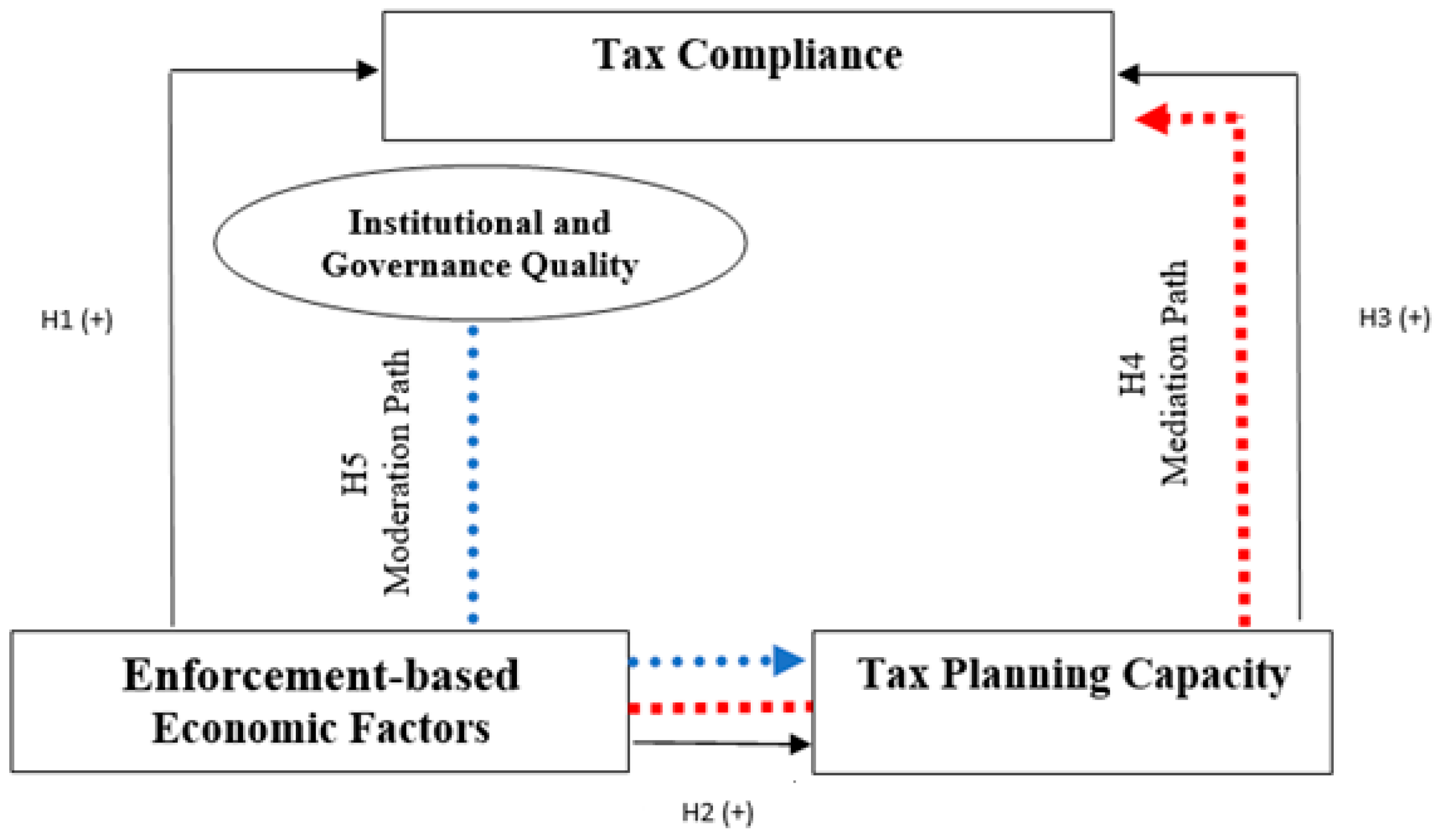
In line with this objective, the study develops and tests a moderated-mediation structural equation model. The model examines whether enforcement-based economic factors affect tax compliance directly, as well as indirectly through firms’ tax planning capacity. It also tests whether institutional and governance quality is associated with the relationship between enforcement mechanisms and tax planning capacity. Accordingly, the study proposes five hypotheses: (H1) enforcement-based economic factors positively influence tax compliance behavior; (H2) enforcement-based economic factors positively influence tax planning capacity; (H3) tax planning capacity positively influences tax compliance behavior; (H4) tax planning capacity mediates the relationship between enforcement-based economic factors and tax compliance behavior; and (H5) institutional and governance quality moderates the relationship between enforcement-based economic factors and tax planning capacity.
While the study is theoretically grounded in causal mechanisms derived from deterrence and institutional theories, the empirical design is cross-sectional and based on perceptual data. Therefore, the results should be interpreted as indicative of statistically significant associations rather than definitive causal relationships. The direction of relationships is theory-driven; however, potential endogeneity concerns, including reverse causality, cannot be fully ruled out within the current research design.
The findings of this research are expected to make several contributions to the literature and policy discussions. From a theoretical perspective, the study integrates enforcement-based economic factors, firm-level tax planning capacity, and institutional quality into a unified analytical framework. From a policy perspective, the results provide insights for tax authorities and policymakers on how enforcement strategies and institutional reforms can jointly enhance corporate tax compliance among foreign investment enterprises. Finally, the study offers practical implications for foreign-owned firms by highlighting the importance of internal tax management capabilities and institutional credibility in shaping corporate tax compliance behavior.
2. Literature Review and Hypothesis Development
2.1. Theoretical Foundation
This study is grounded in two main theoretical perspectives: early economic (deterrence) theory and institutional theory.
The early economic approach to tax compliance, particularly the model developed by
Allingham and Sandmo (
1972), explains compliance behavior as a rational decision-making process based on cost–benefit analysis. Firms evaluate the expected gains from non-compliance against the probability of detection and the severity of penalties. This framework provides the foundation for understanding the role of enforcement-based economic factors in shaping tax compliance behavior.
In addition, institutional theory provides a complementary perspective by emphasizing the role of governance quality, regulatory stability, and institutional credibility in shaping firm behavior. According to institutional theory, firms seek legitimacy by aligning their practices with the rules and expectations of the institutional environment (
North, 1990;
Kostova & Zaheer, 1999;
Frey & Torgler, 2007). In this context, institutional and governance quality influences how firms interpret enforcement mechanisms and whether they develop internal capabilities such as tax planning capacity.
By integrating these two perspectives, the study develops a comprehensive framework in which enforcement mechanisms represent external economic incentives, while institutional quality shapes the effectiveness of these incentives and firms’ organizational responses.
Building on this integrated theoretical framework, it becomes essential to examine how enforcement-based economic factors influence tax compliance behavior at the firm level. In this regard, the relationship between enforcement and tax compliance has long been a central issue in tax research.
2.2. Effect of Enforcement-Based Factors on Tax Compliance
The relationship between enforcement and tax compliance has long been a central issue in tax research. Early economic theory explains compliance as a rational decision. In this view, firms compare the benefits of non-compliance with the expected costs of detection, penalties, and additional assessments. When audit probability and sanctions increase, the expected cost of evasion also increases, and compliance becomes more likely (
Allingham & Sandmo, 1972;
Alm et al., 1992;
Lange & Melsom, 2024;
Agyemang, 2025;
Kasper & Alm, 2022;
Rachidi & El Moudden, 2025).
A large part of the literature supports this deterrence-based argument. Audit intensity is often identified as one of the strongest enforcement tools.
Alm and McKee (
2006) show that greater audit certainty improves compliance because taxpayers adjust their reporting behavior when they expect a higher chance of being audited.
Andreoni et al. (
1998) also conclude that enforcement remains a key determinant of compliance, especially when detection and punishment are credible. More recent studies reach similar conclusions.
Gulzar et al. (
2024) find that tax audits and penalties positively affect compliance, confirming that stronger enforcement can discourage tax violations.
Angeliki and Thomas (
2025) also report that enforcement-related variables remain important determinants of compliance in difficult fiscal settings.
At the same time, recent evidence shows that the effect of audits is not always simple or uniform.
Kasper and Alm (
2022) find that audits can improve post-audit compliance, especially when audits are effective and provide clear signals to taxpayers about the risk of future detection. This supports the view that enforcement has a lasting compliance effect. However,
Kasper and Rablen (
2023) show that post-audit responses may differ across contexts. In some cases, audited taxpayers become more compliant, while in other cases compliance may weaken after the audit experience.
Christiansen (
2024) also shows that the dynamic effects of audits can vary over time and depend on how taxpayers interpret the audit process and future enforcement risk. These studies do not reject the importance of enforcement. Rather, they show that enforcement can produce different magnitudes of effect across settings.
While the above studies primarily focus on the direct behavioral effects of audits on compliance decisions, a complementary strand of research extends this perspective by examining how enforcement influences broader firm-level outcomes. In this regard, audits generate not only behavioral responses but also tangible economic consequences for firms.
Belnap et al. (
2024) show that tax audits affect not only reporting behavior but also firm-level decisions and operational activities, indicating that enforcement can shape business conduct more broadly. This broader impact is particularly relevant for corporate taxpayers, as compliance decisions are closely intertwined with financial planning, reporting systems, and overall management strategy.
The literature on corporate and multinational taxation further strengthens the relevance of enforcement-based factors. Foreign investment enterprises operate in complex regulatory environments, which increases the importance of effective enforcement mechanisms in shaping compliance behavior.
Bustos et al. (
2019) show that monitoring multinational firms is especially difficult because of the complexity of their structures and transactions. Earlier studies on China also show that tax audits play an important role in controlling non-compliance in international transfer pricing settings (
Chan & Chow, 1997;
Chan et al., 2015;
Chan et al., 2006). Research on multinational firms further suggests that such firms may use tax planning strategies, profit shifting, and internal debt arrangements when enforcement is weak or incomplete (
Bilicka, 2019;
Buettner & Wamser, 2013;
Davies et al., 2018;
Cristea & Nguyen, 2016;
Johannesen et al., 2020;
Le & Zamarian, 2025;
Joshi et al., 2020). In this context, stronger audits, a higher probability of detection, and the risk of financial sanctions become especially important for compliance.
This argument is consistent with the measurement structure of enforcement-based factors used in this study. The selected items focus on core economic and rational dimensions of enforcement: the strength of audit mechanisms, the severity of penalties, the probability of detection, the possibility of additional tax assessments, and the expected financial losses from sanctions. These dimensions reflect the main channels through which enforcement can influence firm behavior. They capture how firms assess regulatory pressure and financial risk when making tax reporting decisions.
Although the literature widely accepts that enforcement matters, an important gap remains. A large body of research examines tax compliance in the general population, among multinational firms, across firms of varying size and age, or within domestic business contexts. Other studies focus on multinational tax avoidance strategies or on the technical challenges of auditing cross-border firms. However, fewer studies directly examine how core enforcement-based economic and rational factors shape the tax compliance behavior of foreign investment enterprises as a distinct group.
Addressing this gap is important because it helps clarify whether traditional deterrence mechanisms remain effective in the context of foreign investment enterprises. It also provides evidence on whether audit-related risks and sanction-related costs continue to function as central drivers of compliance in increasingly complex international business environments.
From a theoretical perspective, this relationship is grounded in deterrence theory, which posits that enforcement mechanisms—such as audits, penalties, and detection probability—increase the expected cost of non-compliance, thereby making compliance the rational choice for firms. In this sense, enforcement-based economic factors operate as external constraints that shape firm behavior through cost–benefit calculations.
Building on this theoretical and empirical foundation, and considering the identified research gap, it becomes necessary to empirically examine whether enforcement-based economic factors remain a significant determinant of tax compliance among foreign investment enterprises.
In addition to deterrence theory, the relationship between enforcement and tax compliance can also be interpreted through the lens of institutional theory. While deterrence theory emphasizes the role of external economic incentives, institutional theory highlights how firms respond to the broader regulatory environment in which these enforcement mechanisms are embedded. In particular, the effectiveness of audits, penalties, and detection probability depends not only on their economic magnitude but also on their perceived legitimacy, consistency, and credibility within the institutional context.
From this perspective, firms are not only rational actors responding to cost–benefit calculations but also institutional actors seeking legitimacy by aligning their behavior with regulatory expectations. Therefore, enforcement-based economic factors may influence tax compliance not only directly through deterrence but also indirectly through institutional mechanisms that shape firms’ perceptions of fairness, trust, and regulatory stability.
Accordingly, the following hypothesis is proposed:
H1. Enforcement-based economic factors exert a positive influence on tax compliance behavior among foreign investment enterprises.
2.3. Enforcement-Based Economic Factors and Tax Planning Capacity
While prior research has primarily examined enforcement as a determinant of tax compliance, a growing body of literature suggests that enforcement-based economic factors also play a critical role in shaping firms’ internal tax planning capabilities. Rather than influencing only whether firms comply, enforcement conditions increasingly determine how firms organize, structure, and manage their tax-related activities at the organizational level.
In modern corporate environments, tax planning is not limited to minimizing liabilities but involves the systematic coordination of internal knowledge, managerial decision-making, regulatory monitoring, and external advisory support. In this study, tax planning capacity is conceptualized as an organizational capability that enables firms to structure, analyze, and manage tax-related decisions under regulatory constraints.
This perspective aligns with the view that corporate tax behavior is embedded within broader organizational and strategic frameworks. In particular, multinational firms develop structured tax planning approaches that integrate internal expertise with institutional and regulatory constraints (
Dyreng & Hanlon, 2019).
One important channel through which enforcement affects tax planning is the need for organizational capability development. Firms operating under stricter enforcement conditions face higher regulatory uncertainty and financial risk, which encourages them to invest in internal competencies related to tax analysis, documentation, and strategic planning. International tax planning literature shows that firms actively evaluate tax rules, cross-border regulations, and reporting requirements in order to identify legally acceptable optimization opportunities (
Ftouhi & Ghardallou, 2020;
Lancee et al., 2023). This process requires continuous knowledge accumulation and internal coordination across financial and managerial functions.
At the same time, enforcement pressure does not operate solely through internal mechanisms. It also increases firms’ reliance on external expertise and advisory networks. The growing complexity of tax systems—particularly in multinational contexts involving transfer pricing, digital reporting, and cross-jurisdictional obligations—makes it difficult for firms to rely exclusively on internal resources. As a result, firms increasingly combine internal capabilities with external professional support to design and implement effective tax strategies (
Dyreng & Hanlon, 2019;
Ftouhi & Ghardallou, 2020;
Giang et al., 2021;
Zeynalova et al., 2025).
Another critical dimension relates to the role of digital transformation in tax administration. Recent OECD frameworks emphasize that tax authorities are rapidly adopting data-driven, real-time monitoring systems, including e-invoicing, digital reporting platforms, and advanced analytics (
OECD, 2022a,
2025). These developments significantly increase transparency and reduce information asymmetry between firms and tax authorities. As enforcement becomes more technology-based, firms need to improve their internal systems to meet digital reporting and compliance requirements.
Empirical evidence further suggests that digitalization strengthens the link between enforcement and organizational adaptation.
Souguir et al. (
2025) show that digital transformation in tax systems not only enhances monitoring capacity but also reshapes firms’ tax-related decision-making processes. Firms must respond by improving internal data management, strengthening reporting accuracy, and developing more integrated tax planning frameworks. In this environment, tax planning becomes increasingly dependent on the firm’s ability to process information, coordinate across departments, and adapt to evolving regulatory technologies.
Importantly, enforcement does not necessarily lead to a simple increase in compliance; instead, it may encourage firms to adopt more structured and sophisticated approaches to managing tax obligations. Firms facing stronger regulatory pressure are more likely to formalize tax processes, invest in professional expertise, and develop proactive strategies that balance compliance requirements with optimization opportunities. This reflects a shift from reactive compliance toward strategic tax management, where firms actively organize their tax functions to mitigate risk and improve efficiency.
In light of the above discussion, it is important to examine how enforcement-based economic factors contribute to the development of firm-level tax planning capacity among foreign investment enterprises. Accordingly, the following hypothesis is proposed:
H2. Enforcement-based economic factors exert a significant positive influence on tax planning capacity among foreign investment enterprises.
2.4. Tax Planning Capacity and Tax Compliance Behavior
Having established how enforcement-based factors contribute to the development of tax planning capacity, the next step is to examine whether and how this capability translates into actual tax compliance behavior.
While tax planning capacity reflects a firm’s ability to organize and manage tax-related processes, its influence on tax compliance behavior is better understood through the lens of behavioral, institutional, and governance-based perspectives rather than purely operational efficiency.
From a behavioral standpoint, tax compliance is influenced not only by economic incentives and enforcement mechanisms but also by psychological and social factors. Firms consider reputational risks, fairness perceptions, and ethical standards when making tax-related decisions. According to
Kirchler (
2007), tax behavior is shaped by a combination of deterrence and trust-based factors, suggesting that firms with stronger internal tax capabilities are better able to align their actions with regulatory expectations and social norms.
Another key mechanism linking tax planning capacity to compliance is corporate governance. Firms with stronger governance structures tend to incorporate tax decision-making into broader accountability and control systems. This reduces opportunistic behavior and supports more transparent reporting practices. As highlighted in the literature, effective governance mechanisms can constrain aggressive tax strategies and promote compliance-oriented outcomes (
Kovermann & Velte, 2019;
Pratama & Muhammad, 2025). In this context, tax planning capacity strengthens the integration between tax strategy and governance frameworks, improving overall compliance behavior.
Tax planning capacity also enhances compliance through improved tax risk assessment. Firms with advanced capabilities are more likely to systematically evaluate risks associated with audits, penalties, and reputational damage. This leads to more cautious and sustainable tax positions. By improving risk awareness, tax planning capacity encourages firms to prioritize long-term compliance over short-term tax savings (
Kovermann & Velte, 2019).
In addition, modern tax administration increasingly relies on cooperative approaches between tax authorities and firms. The OECD’s cooperative compliance framework emphasizes transparency, information sharing, and mutual trust as key elements of effective tax systems. Firms with stronger tax planning capacity are better equipped to engage in such cooperative relationships, reducing uncertainty and improving compliance outcomes (
OECD, 2013).
The role of organizational ethics and corporate reputation is also significant. Firms that integrate tax planning into broader corporate responsibility frameworks are more likely to adopt compliant and transparent tax practices. Empirical evidence suggests that stakeholders tend to react negatively to aggressive tax strategies, as such practices can damage corporate reputation and influence consumer behavior (
Hardeck & Hertl, 2014). Consistent with this view, the findings indicate that as the share of foreign institutional investors increases, firms are less likely to engage in aggressive tax avoidance. This relationship can be explained by the fact that foreign investors typically demand higher levels of transparency, accountability, and corporate governance. Through their monitoring role, they constrain managerial opportunism and encourage more cautious, risk-averse, and structured tax strategies (
Hasan et al., 2022). Therefore, firms with stronger tax planning capacity may adopt compliance-oriented strategies to protect their reputational capital.
For foreign investment enterprises, the relationship between tax planning capacity and compliance becomes even more critical due to institutional complexity. Operating across multiple regulatory environments requires firms to maintain legitimacy in host countries. Institutional theory suggests that firms must align their practices with local norms and expectations to sustain legitimacy and avoid regulatory conflicts (
Kostova & Zaheer, 1999;
Santoso et al., 2025;
Ariff & Kamarudin, 2019). In this context, tax planning capacity supports compliance by enabling firms to adapt to diverse institutional environments and regulatory requirements.
Tax planning capacity should be understood as an organizational capability related to the management of tax-related activities rather than being defined in terms of compliance outcomes. Accordingly, its relationship with tax compliance is treated as an empirical issue to be examined rather than a definitional assumption.
The relationship proposed in H3 is grounded in the integration of behavioral and institutional perspectives, which emphasize that firms with stronger internal capabilities are more likely to align their actions with regulatory expectations and institutional norms.
Taken together, these arguments indicate that tax planning capacity affects tax compliance through multiple complementary channels, including behavioral alignment, governance structures, risk management, and institutional adaptation. Firms with stronger tax planning capacity are better able to interpret regulatory expectations, manage tax-related risks, and align their practices with both formal rules and informal norms. As a result, they are more likely to exhibit consistent and compliant tax behavior.
Based on these arguments, the following hypothesis is proposed:
H3. Tax planning capacity exerts a significant positive influence on tax compliance behavior among foreign investment enterprises.
2.5. The Mediating Role of Tax Planning Capacity in the Relationship Between Enforcement-Based Economic Factors and Tax Compliance Behavior
While prior sections have examined the individual relationships between enforcement-based economic factors, tax planning capacity, and tax compliance behavior, this section focuses on how these elements interact within an integrated mechanism. In particular, tax planning capacity is expected to function as an organizational channel through which enforcement pressures are translated into compliance outcomes.
Rather than affecting compliance solely through direct deterrence, enforcement-based economic factors may influence how firms internally organize their tax-related processes. Firms exposed to higher audit probability, stricter monitoring, and stronger penalty regimes are more likely to formalize their tax management systems, invest in internal expertise, and develop structured procedures for tax reporting and risk control. These adjustments reflect the development of tax planning capacity as a response to external regulatory pressure (
Hanlon & Heitzman, 2010;
Armstrong et al., 2012).
Once developed, tax planning capacity enables firms to process tax-related information more effectively, coordinate compliance activities across departments, and align internal practices with regulatory requirements. In this sense, tax planning capacity transforms external enforcement signals into internal organizational responses that support consistent and accurate compliance behavior.
From a theoretical perspective, this mediating mechanism can be explained through the integration of deterrence theory and institutional theory. While deterrence theory emphasizes that enforcement mechanisms increase the expected costs of non-compliance, it does not fully explain how firms translate these external pressures into internal organizational responses. Institutional theory complements this view by suggesting that firms internalize regulatory pressures and adapt their structures and processes accordingly in order to maintain legitimacy and reduce uncertainty.
In this context, tax planning capacity emerges as an organizational response that enables firms to process enforcement signals, interpret regulatory expectations, and align their internal practices with institutional requirements. Therefore, tax planning capacity functions as a transmission mechanism through which enforcement-based economic factors influence tax compliance behavior.
This mediating mechanism is particularly relevant for foreign investment enterprises, which operate in complex regulatory environments and face multiple layers of tax obligations. For these firms, enforcement pressures alone may not be sufficient to ensure compliance unless they are supported by internal capabilities that allow firms to interpret regulations, manage tax risks, and implement appropriate reporting systems.
Recent empirical evidence also supports the existence of such mediating relationships. For example,
Andikasari et al. (
2025) show that tax planning mechanisms can mediate the relationship between organizational factors and corporate tax compliance, suggesting that internal capabilities play a critical role in translating external pressures into compliance outcomes.
Taken together, these arguments indicate that enforcement-based economic factors influence tax compliance not only directly but also indirectly by shaping firms’ internal organizational capabilities. In particular, enforcement pressures encourage the development of tax planning capacity, which in turn enables firms to better manage tax-related risks, interpret regulatory requirements, and ensure consistent compliance behavior. This indirect pathway highlights the mediating role of tax planning capacity as an organizational mechanism linking enforcement-based economic factors to tax compliance behavior.
Based on this reasoning, the following hypothesis is proposed:
H4. Tax planning capacity mediates the relationship between enforcement-based economic factors and tax compliance behavior among foreign investment enterprises.
2.6. The Moderating Role of Institutional and Governance Quality in the Relationship Between Enforcement-Based Economic Factors and Tax Planning Capacity
While the previous section focused on the mediating role of tax planning capacity, it is equally important to consider the contextual conditions under which these relationships may vary. In particular, institutional and governance quality may shape how firms respond to enforcement pressures.
In high-quality institutional environments, enforcement mechanisms are more likely to be perceived as credible, consistent, and predictable, which strengthens firms’ incentives to develop structured tax planning capabilities. Therefore, the relationship between enforcement-based economic factors and tax planning capacity is expected to be stronger at higher levels of institutional and governance quality.
Institutional and governance quality influences the credibility, consistency, and transparency of regulatory systems. In high-quality institutional environments, tax rules are more clearly defined, enforcement practices are more predictable, and regulatory decisions are more consistently applied. Under such conditions, firms are more likely to perceive enforcement mechanisms as legitimate and reliable, which increases their willingness to invest in internal systems that support tax planning capacity (
Slemrod, 2019;
OECD, 2022b;
Mandasari, 2024).
By contrast, in environments characterized by weak governance, enforcement actions may be perceived as inconsistent, selective, or uncertain. This reduces the signaling effect of enforcement mechanisms and weakens firms’ incentives to develop structured tax planning processes. As a result, the same level of enforcement pressure may produce different organizational responses depending on the institutional context (
Torgler & Schneider, 2009;
Khan & Siddiqui, 2021;
Night & Bananuka, 2020). This argument is further supported by recent empirical evidence suggesting that the strength of such relationships varies depending on institutional quality. For example,
Hasan et al. (
2022) show that the influence of external monitoring mechanisms—such as foreign investors—is stronger in countries with high-quality institutional environments, where legal and governance systems function more effectively, and weaker in contexts with less developed institutional frameworks.
For foreign investment enterprises, this moderating effect becomes particularly important. These firms operate across multiple institutional environments and must continuously evaluate the reliability of regulatory systems in host countries. When institutional quality is high, enforcement signals are more credible and informative, encouraging firms to formalize tax planning structures, strengthen internal expertise, and align their tax strategies with regulatory expectations. Conversely, when institutional quality is weak, firms may rely less on structured internal systems and respond to enforcement pressures in a more fragmented or inconsistent manner.
Recent research also suggests that governance quality enhances the effectiveness of regulatory monitoring by improving information transparency and reducing uncertainty. Strong institutional frameworks, including digital governance systems and transparent administrative procedures, increase the visibility of firms’ tax-related activities and strengthen the link between external enforcement and internal organizational responses (
OECD, 2022a;
Beuselinck et al., 2024;
Saptono et al., 2023;
Nasir et al., 2025).
Taken together, these arguments indicate that institutional and governance quality does not directly determine firms’ tax planning capacity, but rather conditions the strength of the relationship between enforcement-based economic factors and tax planning capacity. In other words, enforcement mechanisms are more likely to translate into stronger organizational capabilities when they operate within high-quality institutional environments.
Accordingly, the following hypothesis is proposed:
H5. Institutional and governance quality positively moderates the relationship between enforcement-based economic factors and tax planning capacity, such that the relationship becomes stronger at higher levels of institutional and governance quality.
3. Materials and Methods
This study adopts a quantitative research design to examine the relationships among enforcement-based economic factors, tax planning capacity, institutional and governance quality, and tax compliance behavior among foreign investment enterprises. Data were collected using a structured questionnaire based on validated measurement scales widely used in the tax compliance and corporate taxation literature.
The survey was conducted between June and November 2025 and targeted foreign investment companies operating in Azerbaijan. The sample included firms with foreign ownership that operate in different sectors of the economy, including manufacturing, services, trade, and logistics. These firms frequently interact with the tax administration and are subject to complex reporting requirements, including transfer pricing regulations and cross-border tax rules.
Given the regulatory complexity faced by foreign investment enterprises, the questionnaire items were carefully contextualized to reflect corporate tax decision-making processes rather than individual taxpayer behavior. The survey focused on firms’ perceptions of enforcement mechanisms, institutional conditions, internal tax management capabilities, and their overall tax reporting and compliance practices.
To ensure content and face validity, as well as contextual relevance, the questionnaire was pilot tested with a small group of managers and financial specialists working in foreign-owned firms (n = 20). During the pilot phase, respondents evaluated the clarity, relevance, and comprehensiveness of the items in relation to corporate tax practices, including tax reporting procedures, compliance monitoring, interactions with tax authorities, and strategic tax decision-making. Based on the feedback received, minor wording adjustments were made to improve clarity, eliminate ambiguity, and ensure that the survey items accurately captured the corporate taxation environment.
Taken together, these considerations informed the operationalization of the study’s core constructs. In this research, tax compliance is conceptualized as a firm-level behavioral construct reflecting reporting accuracy and adherence to tax regulations, while enforcement mechanisms are treated as economic incentives that increase the perceived costs of non-compliance. Tax planning capacity, in turn, reflects firms’ internal capabilities to manage tax-related processes and risks.
3.1. Measurement Instruments
The research model includes four main constructs measured using multi-item reflective scales. All measurement items were evaluated using a five-point Likert scale ranging from 1 (strongly disagree) to 5 (strongly agree).
The measurement items were adapted from prior validated studies in the tax compliance and corporate taxation literature, including
Alm and McKee (
2006),
Hanlon and Heitzman (
2010), and OECD frameworks. All responses were collected in accordance with standard ethical research procedures, with voluntary participation, informed consent, anonymity, and confidentiality ensured throughout the study. The measurement details for each construct are presented below.
3.1.1. Enforcement-Based Economic Factors
This construct captures the extent to which firms incorporate enforcement-related considerations into their tax reporting decisions. It reflects firms’ perceptions of audit strength, the severity of financial penalties, the probability of detection, and the potential financial consequences associated with tax non-compliance. Rather than focusing solely on deterrence, this construct emphasizes how enforcement conditions shape firms’ decision-making processes and risk assessments in tax reporting. The specific measurement items for this construct are presented in
Appendix A.
More specifically, this construct includes audit frequency and intensity, probability of detection of tax violations, severity of penalties and sanctions, likelihood of additional tax assessments, and expected financial losses arising from non-compliance.
3.1.2. Institutional and Governance Quality
Institutional and governance quality reflects the broader regulatory and administrative environment within which firms operate. Specifically, it captures firms’ perceptions of the rule of law, corruption levels, the effectiveness and professionalism of tax authorities, regulatory stability, and the availability of reliable dispute resolution mechanisms. It also includes the role of digital tax systems and real-time reporting infrastructures in enhancing transparency and administrative efficiency. Together, these institutional characteristics shape both the credibility of tax enforcement and firms’ trust in the tax system. The measurement items used to assess this construct are presented in
Appendix A.
3.1.3. Tax Planning Capacity
Tax planning capacity reflects the extent to which firms are able to organize, coordinate, and implement tax-related strategies in a structured and informed manner. This includes the availability of internal expertise, the presence of knowledgeable managerial decision-makers, the continuous analysis of tax regulations, and the use of external professional advisory support. Importantly, it also captures the firm’s ability to integrate internal capabilities with external expertise when managing tax-related activities. Such capacity enables firms to address complex tax obligations, particularly in cross-border contexts, and to align tax strategies with regulatory requirements. The measurement items used to operationalize tax planning capacity are presented in
Appendix A.
To clarify its operational structure, this construct includes four key dimensions: (i) internal resources such as qualified staff and technological infrastructure, (ii) managerial competencies related to tax decision-making, (iii) structured processes such as formal tax policies and continuous regulatory monitoring, and (iv) strategic practices including structured tax planning approaches and the use of external advisory support.
3.1.4. Tax Compliance Behavior
Tax compliance behavior reflects the extent to which firms adhere to tax laws and reporting requirements in practice. It includes the accurate reporting of taxable income, the timely and correct submission of tax declarations, compliance with regulations even when such compliance involves administrative or financial costs, and active cooperation with tax authorities during audits or inspections. In this study, tax compliance is conceptualized as an organizational and behavioral construct reflecting managerial practices and firm-level reporting behavior rather than directly observable administrative outcomes. Accordingly, perception-based measures are used to capture how firms assess and implement compliance-related activities within their organizational context. This approach is consistent with prior literature, where objective firm-level tax data are often inaccessible due to confidentiality constraints.
3.2. Research Framework
Having defined the study constructs and their measurement approach, the overall research framework corresponding to the hypotheses developed in
Section 2 is presented in
Figure 1.
3.3. Sampling and Data Collection
Data collection was conducted between June and November 2025 using a combination of online surveys and targeted outreach to foreign investment enterprises operating in Azerbaijan. The sampling strategy focused on firms with foreign ownership that actively participate in the national economy and regularly interact with the tax administration.
The sample included foreign-owned enterprises operating across several sectors, including manufacturing, trade, services, logistics, and information technology. These firms were selected because they actively engage in corporate tax reporting and regularly interact with tax authorities. Such firms provide an appropriate empirical context for examining the proposed relationships in the study.
Firms without foreign ownership or with limited engagement in corporate tax reporting processes were excluded from the sample. This ensured that all participating firms possessed relevant experience related to tax compliance procedures, regulatory enforcement mechanisms, and institutional conditions affecting corporate taxation.
To facilitate access to eligible firms and enhance respondent outreach, the study collaborated with consulting companies providing legal and financial advisory services. These firms enabled access to their client networks and supported direct communication with company executives, thereby improving participation rates and response quality.
Given the sensitivity of firm-level tax information, data collection procedures were designed to ensure ethical compliance and encourage candid responses. Participation in the survey was entirely voluntary, and respondents were informed about the academic purpose of the research prior to completing the questionnaire. All responses were collected anonymously and treated with strict confidentiality throughout the study.
The selected enterprises represent a diverse group of foreign investment firms operating within Azerbaijan’s corporate tax environment. Their inclusion allows the study to capture firm-level perspectives under varying regulatory pressures and institutional conditions. The composition of the sample is presented in
Table 1.
Table 1 summarizes the main characteristics of the sampled firms. The final dataset consists of 266 foreign investment enterprises operating across various sectors of the Azerbaijani economy, with the largest shares concentrated in the services and manufacturing sectors. In terms of ownership structure, firms exhibit different levels of foreign participation, with the highest proportion falling within the 26–50% ownership range.
To contextualize the sample, official statistics from the State Statistical Committee of the Republic of Azerbaijan indicate that the number of foreign-owned enterprises increased from 4050 in 2023 to 4320 in 2024. These firms are predominantly micro enterprises, followed by small and medium-sized entities, reflecting a gradual expansion of foreign involvement in the SME segment (
ARDSK, 2025, p. 32).
The empirical data were collected from 350 contacted firms, of which 266 valid responses were retained after data screening procedures. While the sample captures diversity across sectors and ownership structures and is adequate for structural equation modeling (SEM) analysis, it is based on a combined sampling strategy that integrates elements of random selection with a network-based approach to facilitate access to eligible firms. Therefore, the sample should be considered analytically sufficient for SEM estimation, rather than fully statistically representative of the entire population of foreign investment enterprises in Azerbaijan.
The survey targeted respondents in managerial and decision-making positions, including chief executive officers, owners, senior managers, and finance executives. These individuals are directly involved in strategic and financial processes and are well positioned to provide informed assessments of tax compliance practices and the institutional environment in which their firms operate.
3.4. Data Analysis Procedures, Common Method Bias, and Non-Response Bias Assessment
The proposed relationships were tested using structural equation modeling (SEM), which enables the simultaneous estimation of direct, mediating, and moderating effects among latent variables. The use of cross-sectional SEM with perceptual measures is consistent with a substantial body of literature in tax compliance and corporate governance research, where key constructs—such as compliance behavior, institutional perceptions, and managerial capabilities—are not directly observable (e.g.,
Kirchler, 2007;
Hanlon & Heitzman, 2010;
Kovermann & Velte, 2019). In such contexts, SEM provides an appropriate analytical framework for examining theoretically grounded relationships among latent variables.
However, SEM does not, in itself, establish causality. Given the cross-sectional nature of the data and the reliance on self-reported measures, the estimated relationships should be interpreted as associative rather than strictly causal. In addition, potential endogeneity concerns, including reverse causality and omitted variable bias, cannot be fully ruled out. For instance, while the model assumes that tax planning capacity influences tax compliance behavior, it is also plausible that firms with higher levels of compliance are more likely to develop structured tax planning capabilities. To address these concerns, the model specification is grounded in well-established theoretical frameworks (deterrence theory and institutional theory), and the direction of relationships follows dominant assumptions in prior literature.
Before proceeding to the main SEM analysis, the measurement instrument’s reliability and preliminary validity were reassessed using pilot study results and initial diagnostic procedures. The results indicated satisfactory internal consistency across all constructs (Cronbach’s α > 0.70), and exploratory factor analysis confirmed acceptable indicator loadings and preliminary construct validity.
The data analysis followed several sequential steps. First, descriptive statistics were examined to summarize sample characteristics and assess data distribution, including the identification of potential missing values or inconsistencies. Second, reliability was evaluated using Cronbach’s alpha and composite reliability (CR), with values above 0.70 indicating acceptable internal consistency. Third, construct validity was assessed. Convergent validity was evaluated based on standardized factor loadings and the average variance extracted (AVE), with a threshold of 0.50 indicating adequate validity. Discriminant validity was examined using the Fornell–Larcker criterion and the heterotrait–monotrait ratio (HTMT), ensuring that the constructs were empirically distinct.
Fourth, confirmatory factor analysis (CFA) was conducted to validate the measurement model and assess the extent to which the observed indicators represent their respective latent constructs. Model fit was evaluated using standard goodness-of-fit indices, including χ2/df, CFI, TLI, RMSEA, and SRMR. Following the validation of the measurement model, the structural model was estimated to test the proposed hypotheses. The analysis examined the direct effects among constructs (H1–H3), as well as the mediating effect of tax planning capacity (H4) and the moderating effect of institutional and governance quality (H5). Mediation was assessed through the significance of indirect effects, while moderation was tested by incorporating an interaction term between enforcement-based economic factors and institutional and governance quality.
Given the use of cross-sectional and self-reported data, additional procedures were implemented to assess potential common method bias. Harman’s single-factor test indicated that no single factor accounted for the majority of variance. In addition, a common latent factor (CLF) was incorporated into the CFA model, and the results showed no substantial changes in factor loadings or structural relationships, suggesting that common method bias is unlikely to pose a serious concern.
To assess non-response bias, early and late respondents were compared using independent-sample t-tests. No statistically significant differences were observed across the main constructs (p > 0.10), indicating that non-response bias is unlikely to affect the results.
Overall, these procedures confirm the reliability and validity of the measurement model and provide a robust basis for examining the proposed relationships.
4. Results
4.1. Reliability and Validity Analyses
The measurement model was assessed in several stages to ensure the reliability and validity of the constructs. SPSS 22 and AMOS 21 were used for the empirical analyses. Items with standardized factor loadings below 0.60 were removed to improve measurement quality. After this refinement, all constructs satisfied the recommended reliability and validity criteria.
4.1.1. Reliability and Convergent Validity
Reliability was evaluated using Cronbach’s alpha and composite reliability (CR). All constructs exceeded the recommended threshold of 0.70, indicating satisfactory internal consistency. Convergent validity was assessed using standardized factor loadings and the average variance extracted (AVE). All factor loadings were above 0.60, and AVE values exceeded the recommended threshold of 0.50, demonstrating adequate convergent validity (See
Table 2).
4.1.2. Discriminant Validity
Discriminant validity was assessed using both the Fornell–Larcker criterion and the heterotrait–monotrait ratio (HTMT). According to the Fornell–Larcker criterion, the square root of AVE for each construct exceeds its correlations with other constructs, indicating that each construct shares more variance with its own indicators than with others (See
Table 3).
Additionally, HTMT values were below the recommended threshold of 0.85, further confirming that the constructs are empirically distinct (See
Table 4).
Overall, the results of reliability, convergent validity, and discriminant validity analyses confirm that the measurement model is statistically robust and appropriate for further structural modeling.
4.1.3. Confirmatory Factor Analysis
Following the assessment of reliability and validity, confirmatory factor analysis (CFA) was conducted to evaluate the overall fit of the measurement model. The results indicate that the model fits the data well, as all fit indices meet or exceed the recommended threshold values.
The chi-square-to-degrees of freedom ratio (χ2/df = 1.874) is below the acceptable limit of 3, indicating a satisfactory level of model parsimony. The root mean square error of approximation (RMSEA = 0.045) suggests a close fit between the model and the data.
Furthermore, incremental and absolute fit indices confirm the adequacy of the model, with CFI = 0.967, TLI = 0.958, GFI = 0.941, and NFI = 0.928, all exceeding the recommended threshold of 0.90 (See
Table 5).
4.1.4. Common Method Bias Assessment
To assess the potential impact of common method variance (CMV), the common latent factor (CLF) approach was employed. The comparison between models with and without the inclusion of a common latent factor revealed only negligible differences in standardized factor loadings.
This result indicates that common method bias is unlikely to significantly affect the validity of the measurement model.
4.2. Model Hypothesis Testing
The structural relationships among the constructs were examined based on the proposed model. Path coefficient analysis was applied to evaluate the direct relationships proposed in the research model. Specifically, the model examines whether enforcement-based economic factors influence tax compliance behavior and tax planning capacity, and whether tax planning capacity contributes to higher levels of tax compliance among foreign investment enterprises.
In addition, the mediating role of tax planning capacity in the relationship between enforcement-based economic factors and tax compliance behavior was examined. Furthermore, the moderating role of institutional and governance quality was tested to determine whether the institutional environment strengthens or weakens the relationship between enforcement-based economic factors and tax planning capacity. The detailed structural results are presented in
Table 6.
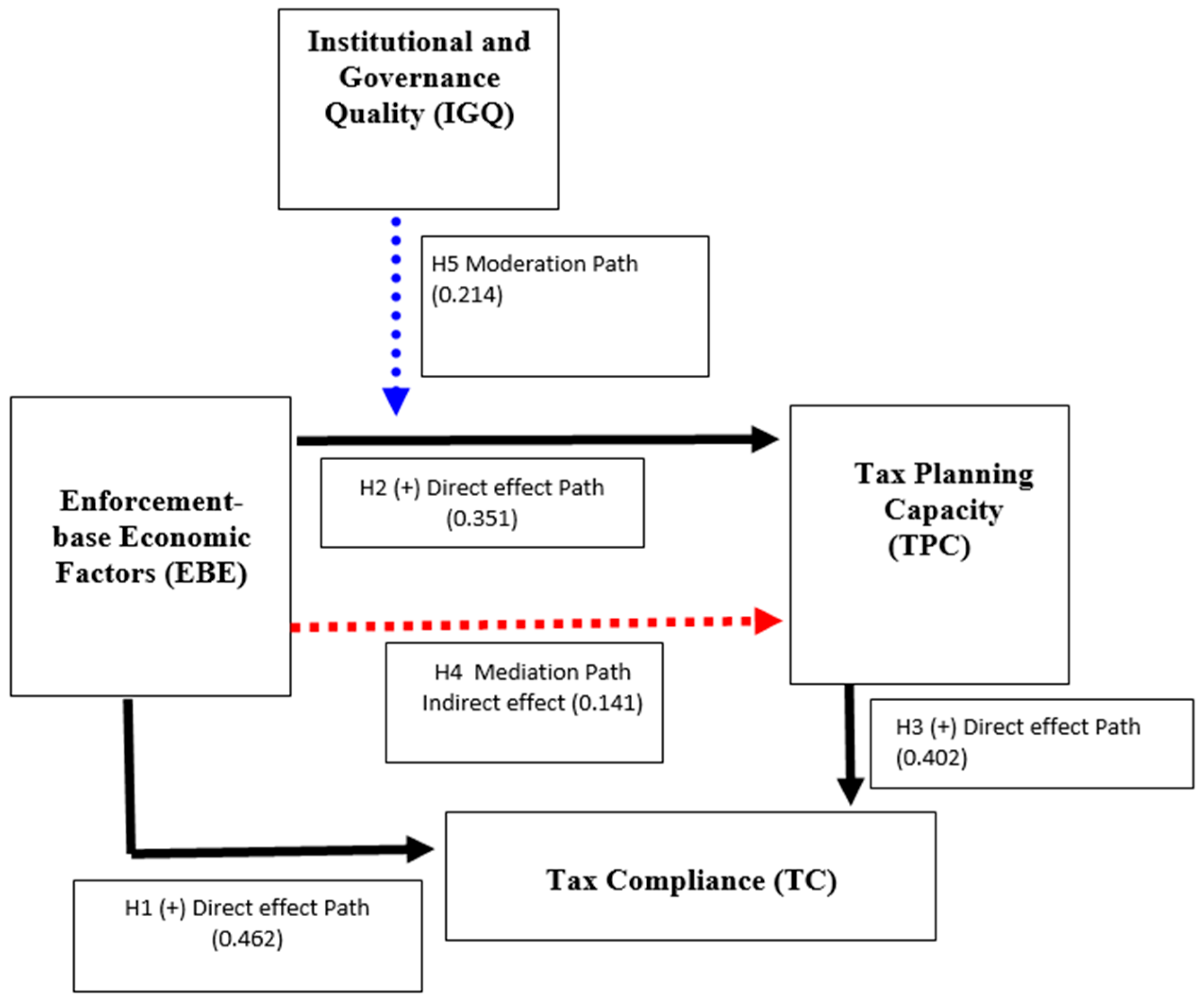
The results show that enforcement-based economic factors are positively and significantly associated with tax compliance behavior (β = 0.462, p < 0.001). This finding supports H1 and suggests that stronger enforcement mechanisms are associated with higher levels of tax compliance among foreign investment enterprises with tax regulations.
Beyond its direct influence on tax compliance, enforcement-based economic factors also play a critical role in shaping firms’ internal capacities. Specifically, the results indicate a significant positive effect on tax planning capacity (β = 0.351, p < 0.001), supporting H2. This suggests that stronger enforcement environments do not merely impose external pressure but actively encourage firms to develop more structured and systematic approaches to managing their tax obligations.
In turn, this enhanced tax planning capacity translates into higher levels of tax compliance. The findings show that tax planning capacity has a positive and statistically significant effect on tax compliance behavior (β = 0.402, p < 0.001), supporting H3. This indicates that firms equipped with stronger analytical and organizational capabilities in tax planning are better positioned to comply with regulatory requirements in a consistent and effective manner.
To test H4, the mediating effect of tax planning capacity in the relationship between enforcement-based economic factors and tax compliance behavior was examined. The results indicate that the indirect path from enforcement-based economic factors to tax compliance behavior through tax planning capacity is statistically significant, confirming that tax planning capacity partially mediates this relationship See
Table 7.
Finally, the moderating role of institutional and governance quality was tested to evaluate H5. The interaction term between enforcement-based economic factors and institutional quality was included in the model to examine its effect on tax planning capacity.
The results provide support for H5, indicating that institutional and governance quality moderates the relationship between enforcement-based economic factors and tax planning capacity. The interaction term is statistically significant (β = 0.214,
p < 0.01), confirming the presence of a moderating effect (See
Table 8).
This implies that the influence of enforcement-based economic factors on tax planning capacity varies depending on the level of institutional and governance quality. In particular, the results suggest that the relationship differs across institutional contexts characterized by varying levels of regulatory quality and administrative effectiveness.
The positive and statistically significant interaction term (β = 0.214, p < 0.01) supports H5 and indicates that institutional and governance quality strengthens the relationship between enforcement-based economic factors and tax planning capacity.
Overall, the SEM results support all proposed hypotheses and highlight the important roles of enforcement mechanisms, tax planning capacity, and institutional quality in shaping tax compliance behavior among foreign investment enterprises.
Figure 2 summarizes the structural relationships identified in the model. The results are consistent with the findings reported in
Table 6, confirming the positive and significant effects of enforcement-based factors on both tax compliance and tax planning capacity, as well as the mediating and moderating mechanisms.
Second, enforcement-based economic factors demonstrate a significant positive influence on tax planning capacity, confirming H2. This finding suggests that stronger enforcement environments motivate firms to develop more structured and strategic approaches to managing their tax obligations. In other words, firms operating under stronger enforcement conditions tend to enhance their capacity to organize tax planning activities and manage tax-related risks more effectively.
Third, the path from tax planning capacity to tax compliance behavior is positive and statistically significant, supporting H3. This result indicates that firms with greater capability to analyze tax regulations, coordinate tax strategies, and manage complex tax obligations are more likely to maintain higher levels of tax compliance.
The results further demonstrate that tax planning capacity serves as a key mediating mechanism in the relationship between enforcement-based economic factors and tax compliance behavior, supporting H4. Specifically, the findings suggest that enforcement mechanisms influence tax compliance not only directly but also indirectly by encouraging firms to strengthen their internal tax planning capabilities.
The mediating effect was tested using a bootstrapping procedure with 5000 resamples in AMOS. The results indicate that the indirect effect of enforcement-based economic factors on tax compliance behavior through tax planning capacity is positive and statistically significant (β = 0.141, p < 0.01). At the same time, the direct effect remains significant (β = 0.462, p < 0.001), confirming the presence of partial mediation. The standardized total effect is β = 0.603, of which approximately 23% is transmitted through tax planning capacity. These findings highlight that tax planning capability functions as an important transmission channel through which enforcement measures shape corporate tax compliance.
While this mediating mechanism explains how enforcement influences compliance through internal capabilities, it does not fully capture the conditions under which this relationship becomes stronger or weaker. To address this, the moderating role of institutional and governance quality was examined.
The results provide support for H5, indicating that institutional and governance quality significantly moderates the relationship between enforcement-based economic factors and tax planning capacity (β = 0.214, p = 0.001). This suggests that the effectiveness of enforcement mechanisms depends on the broader institutional context. In particular, in environments characterized by stronger rule of law, more effective tax administration, and greater regulatory stability, enforcement measures are more likely to stimulate firms to develop structured and strategic tax planning practices.
5. Discussion
The findings provide empirical support for the proposed relationships among enforcement-based factors, tax planning capacity, institutional quality, and tax compliance behavior.
5.1. Enforcement-Based Factors and Tax Compliance Behavior
The empirical results reveal a strong and statistically significant positive relationship between enforcement-based economic factors and tax compliance behavior, thereby supporting H1. This finding indicates that firms adjust their tax reporting practices in response to perceived enforcement pressures, including audit probability, penalty severity, and detection risk.
From a theoretical perspective, this result is consistent with classical deterrence models of tax compliance, which suggest that firms make rational decisions by comparing the expected costs and benefits of non-compliance (
Allingham & Sandmo, 1972). As enforcement mechanisms increase the expected cost of tax evasion, firms are more likely to adopt compliant reporting behavior. This interpretation is supported by a substantial body of empirical evidence emphasizing the role of audit intensity, financial sanctions, and enforcement credibility in shaping compliance decisions (
Andreoni et al., 1998;
Alm & McKee, 2006;
Gulzar et al., 2024;
Angeliki & Thomas, 2025;
Slemrod, 2019).
At the same time, prior research suggests that the effectiveness of enforcement is not uniform and may depend on how firms perceive and respond to regulatory signals. These mixed findings imply that enforcement operates within broader behavioral and institutional contexts, which can shape its overall impact on compliance (
Kasper & Alm, 2022;
Kasper & Rablen, 2023;
Christiansen, 2024).
The empirical findings of this study support the assumptions of deterrence theory by confirming that enforcement-based factors significantly influence tax compliance behavior. At the same time, the results also align with institutional theory, as the effectiveness of enforcement varies depending on the institutional environment.
Furthermore, the significant role of behavioral and psychological factors indicates that compliance is not purely a rational economic decision but also depends on internal perceptions shaped by institutional conditions. This confirms the complementary role of institutional and behavioral perspectives in explaining tax compliance among foreign investment enterprises.
These findings also highlight the importance of enforcement in complex tax environments. Firms operating across jurisdictions face multiple regulatory requirements and increased opportunities for tax optimization. In such contexts, credible enforcement mechanisms play a critical role in limiting aggressive tax behavior and encouraging alignment with domestic tax regulations.
5.2. Enforcement Mechanisms and Firms’ Tax Planning Capacity
The results reveal a significant positive relationship between enforcement-based economic factors and firms’ tax planning capacity, thereby supporting H2. This finding indicates that stronger enforcement environments encourage firms to develop more advanced internal capabilities for managing tax-related activities.
In particular, enforcement pressure appears to stimulate firms to invest in internal expertise, strengthen tax-related systems, and utilize external professional advisory support. As regulatory scrutiny increases, firms face stronger incentives to improve their ability to interpret tax regulations, manage reporting obligations, and coordinate tax-related decision-making processes. This result is consistent with prior studies suggesting that firms respond to regulatory pressure by strengthening internal organizational capacities and tax-related competencies (
Dyreng & Hanlon, 2019;
Ftouhi & Ghardallou, 2020).
From a broader perspective, these findings support the argument that enforcement acts as a driver of organizational capability development. Increasing regulatory complexity and monitoring requirements encourage firms to adopt more structured, knowledge-based, and system-oriented approaches to tax management. This interpretation aligns with recent evidence emphasizing the role of digitalization, regulatory transparency, and data-driven oversight in shaping firms’ internal tax management practices (
OECD, 2022b,
2025;
Souguir et al., 2025).
However, the findings are not fully consistent with all strands of the literature. Some studies suggest that stronger enforcement may instead encourage firms to adopt more sophisticated tax planning strategies aimed at minimizing tax liabilities (
Davies et al., 2018;
Bustos et al., 2023). In this perspective, enforcement may trigger strategic adaptation rather than internal capability development.
In contrast, the results of this study indicate that, in the context of foreign investment enterprises, enforcement mechanisms are more strongly associated with the development of structured and system-based tax planning capabilities. This may be explained by the higher level of regulatory scrutiny, increased transparency requirements, and more formalized reporting obligations faced by such firms, which incentivize investment in internal expertise, systems, and coordinated tax management processes.
5.3. Tax Planning Capacity and Corporate Tax Compliance
The analysis further indicates that tax planning capacity has a positive and statistically significant effect on tax compliance behavior, thereby confirming H3. The analysis reveals that firms with stronger tax-related capabilities are better able to interpret tax regulations, manage complex reporting requirements, and coordinate tax-related decisions within their organizational structures.
This result is consistent with prior research emphasizing that well-developed tax planning systems contribute to improved compliance outcomes by enhancing internal control mechanisms, documentation processes, and reporting accuracy (
Hanlon & Heitzman, 2010;
Armstrong et al., 2012). Firms with greater tax planning capacity are less likely to make unintentional errors and are better equipped to align their financial reporting practices with regulatory requirements.
From a theoretical perspective, these findings highlight the importance of internal organizational capabilities in shaping compliance behavior. Tax planning capacity enables firms to establish structured processes for managing tax obligations, improve the consistency of reporting practices, and reduce the likelihood of errors associated with complex regulatory requirements.
However, the findings are not fully aligned with all strands of the literature. Some studies suggest that tax planning activities may encourage aggressive tax avoidance strategies, particularly in contexts where firms have greater flexibility in structuring their tax positions (
Desai & Dharmapala, 2009;
Rego, 2010). According to this perspective, stronger tax planning capabilities may increase firms’ ability to engage in strategic tax minimization rather than support compliance-oriented behavior.
Overall, the results indicate that tax planning capacity is empirically associated with firms’ reporting practices, compliance-related risk management, and their ability to meet regulatory requirements, rather than being defined in terms of compliance outcomes.
5.4. The Mediating Role of Tax Planning Capacity
The mediation analysis indicates that tax planning capacity partially mediates the relationship between enforcement-based economic factors and tax compliance behavior, thereby supporting H4. This result indicates that enforcement mechanisms influence compliance not only directly but also indirectly through firms’ internal tax-related capabilities.
These results highlight a linking mechanism between external regulatory pressure and observable compliance behavior. In particular, they demonstrate that part of the impact of enforcement is transmitted through firms’ ability to organize, structure, and manage their tax-related activities more effectively.
From a theoretical perspective, this finding contributes to the literature by identifying an intermediate pathway through which enforcement operates. Rather than acting solely as an external constraint, enforcement also shapes internal organizational responses that facilitate the translation of regulatory pressure into compliance outcomes.
Overall, the results emphasize that tax planning capacity serves as a critical connecting mechanism that links enforcement conditions with firms’ tax compliance behavior.
5.5. The Moderating Role of Institutional and Governance Quality
The results provide support for H5, indicating that institutional and governance quality positively moderates the relationship between enforcement-based economic factors and tax planning capacity. The positive and statistically significant interaction term suggests that the marginal effect of enforcement-based economic factors on tax planning capacity increases as institutional and governance quality improves.
This finding indicates that the strength of this relationship depends on the broader institutional environment in which firms operate. In institutional contexts characterized by a high level of rule of law, effective tax administration, and regulatory stability, enforcement mechanisms are more likely to be perceived as credible, predictable, and consistently applied. This enhances firms’ responsiveness to regulatory signals and supports the development of more structured tax planning capabilities.
These results are consistent with institutional theory, which emphasizes that the effectiveness of formal rules depends on the credibility, transparency, and quality of governance systems (
North, 1990;
OECD, 2022b). In such environments, regulatory actions are more likely to be perceived as legitimate and reliable, which is associated with higher levels of trust in tax authorities and more systematic firm responses (
Slemrod, 2019;
OECD, 2025).
Conversely, in weaker institutional environments, the relationship tends to be weaker, as regulatory signals may be perceived as inconsistent or unreliable. This reduces the extent to which firms respond systematically to enforcement pressures.
Overall, the results highlight that institutional and governance quality functions as a critical boundary condition that shapes how effectively enforcement-related factors translate into firm-level responses.
6. Conclusions
This study contributes to the literature on corporate tax behavior by providing an integrated perspective on how external regulatory conditions and internal organizational capabilities jointly shape firms’ compliance outcomes. Rather than examining enforcement, institutional quality, or tax planning in isolation, the study highlights the interconnected nature of these factors within a unified analytical framework.
A key contribution of the study lies in demonstrating that corporate tax compliance is not solely associated with external enforcement pressures, but also depends on firms’ internal capacity to manage tax-related activities. In this respect, tax planning capacity emerges as a central organizational mechanism that enables firms to respond effectively to regulatory environments. This perspective extends existing approaches by shifting the focus from purely deterrence-based explanations toward a more comprehensive understanding that incorporates capability development and organizational adaptation.
The findings also underscore the importance of institutional context in shaping the effectiveness of regulatory frameworks. The results suggest that the impact of regulatory conditions is contingent upon the quality of governance systems, which influence how firms interpret and respond to external signals. This highlights the need to consider not only the design of enforcement policies but also the broader institutional environment in which such policies are implemented.
From a practical standpoint, the study suggests that improving corporate tax compliance requires a multidimensional approach. Policymakers should focus not only on strengthening enforcement mechanisms but also on enhancing institutional quality and supporting firms in developing structured tax management capabilities. In particular, improving regulatory transparency, administrative consistency, and digital tax systems can facilitate more effective interactions between firms and tax authorities.
Despite its contributions, this study has several limitations. First, the use of cross-sectional survey data does not capture changes in corporate behavior over time and limits the ability to draw strong causal inferences. Second, although procedural and statistical remedies were applied, the reliance on self-reported data from single respondents may still introduce common method bias, affecting the accuracy of the results. Third, the use of latent variables in the SEM model may involve some degree of measurement error, despite acceptable reliability and validity levels. Fourth, potential endogeneity issues, including reverse causality and omitted variable bias, cannot be fully ruled out within the current research design.
In addition, the country-specific context of Azerbaijan may limit the generalizability of the findings to other institutional settings. Finally, self-reported measures of tax compliance may be influenced by social desirability bias, particularly given the sensitive nature of tax-related behavior.
Future research can address these limitations by using longitudinal or panel data, incorporating multi-source or objective measures, and applying more advanced econometric techniques to better account for endogeneity and causal relationships.
Author Contributions
Conceptualization, M.M., N.N. and Z.Z.; Methodology, M.M., N.N. and Z.Z.; Software, M.M., N.N. and Z.Z.; Validation, M.M., N.N. and Z.Z.; Formal analysis, M.M., N.N. and Z.Z.; Investigation, M.M., N.N. and Z.Z.; Resources, M.M., N.N. and Z.Z.; Data curation, M.M., N.N. and Z.Z.; Writing—original draft, M.M., N.N. and Z.Z.; Writing—review & editing, M.M., N.N. and Z.Z.; Visualization, M.M., N.N. and Z.Z.; Supervision, M.M., N.N. and Z.Z.; Project administration, M.M., N.N. and Z.Z.; Funding acquisition, M.M., N.N. and Z.Z. All authors have read and agreed to the published version of the manuscript.
Funding
This research received no external funding.
Institutional Review Board Statement
The study was conducted in accordance with the ethical principles outlined. Ethical approval for this research was obtained from the Ethics Committee of Economic Think (protocol code: 20255; approval date: 17 January 2025). This study did not involve clinical trials.
Informed Consent Statement
Informed consent was obtained from all participants involved in the study prior to their participation.
Data Availability Statement
The original contributions presented in this study are included in the article. Further inquiries can be directed to the corresponding author.
Conflicts of Interest
The authors declare no conflicts of interest.
Appendix A
Table A1.
Measurement items.
Table A1.
Measurement items.
| | Enforcement-Based Economic Factors |
| EB1. | The strength of audit mechanisms influences our firm’s tax reporting practices. |
| EB2. | The severity of tax penalties and financial sanctions is considered in our firm’s tax compliance decisions. |
| EB3. | Our firm considers the probability of detection when making tax reporting decisions. |
| EB4. | The possibility of additional tax assessments is taken into account in our firm’s tax reporting practices. |
| EB5. | Our firm considers potential financial losses related to tax penalties when making tax-related decisions. |
| | Institutional and Governance Quality Factors |
| IMQ1 | The rule of law and the level of corruption influence our firm’s compliance with tax regulations. |
| IMQ2 | The professionalism and effectiveness of tax authorities influence our firm’s tax compliance decisions. |
| IMQ3 | Political and regulatory stability facilitates our firm’s long-term adherence to tax rules. |
| IMQ4 | Effective dispute resolution mechanisms influence our firm’s confidence in the tax system. |
| IMQ5 | Real-time reporting and digital tax systems influence our firm’s tax transparency and compliance practices. |
| | Tax Planning Capacity |
| TPC1 | Our firm possesses sufficient internal expertise to design and implement effective tax planning strategies. |
| TPC2 | Our firm has managers with the necessary knowledge to make informed tax planning decisions. |
| TPC3 | Our firm regularly analyzes tax regulations to ensure that tax strategies are consistent with applicable laws and regulations. |
| TPC4 | Our firm utilizes external professional expertise to improve the quality of its tax planning processes. |
| TPC5 | Our firm effectively integrates internal capabilities and external advisory support in managing tax-related activities. |
| | Tax Compliance |
| TC1 | Our firm reports taxable income accurately in accordance with tax legislation. |
| TC2 | Our firm submits tax declarations correctly and on time. |
| TC3 | Our firm complies with tax regulations even when compliance involves additional administrative or financial burdens. |
| TC4 | Management in our firm encourages employees to follow tax laws and reporting standards. |
| TC5 | Our firm cooperates with tax authorities during audits or inspections. |
References
- Agyemang, J. K. (2025). Ownership structure and corporate tax avoidance: Does audit quality and firm size matter? Journal of Information Systems Engineering & Management, 10(25s), 511–531. [Google Scholar] [CrossRef]
- Ahn, D., & Shevlin, T. (2025). The role of tax planning incentives in the use of earnouts in taxable acquisitions. Journal of Risk and Financial Management, 18, 253. [Google Scholar] [CrossRef]
- Allingham, M. G., & Sandmo, A. (1972). Income tax evasion: A theoretical analysis. Journal of Public Economics, 1(3–4), 323–338. [Google Scholar] [CrossRef]
- Alm, J., Jackson, B. R., & McKee, M. (1992). Estimating the determinants of taxpayer compliance with experimental data. National Tax Journal, 45(1), 107–114. [Google Scholar] [CrossRef]
- Alm, J., & McKee, M. (2006). Audit certainty, audit productivity, and taxpayer compliance. National Tax Journal, 59(4), 801–816. [Google Scholar] [CrossRef]
- Andikasari, N., Susbiyani, N. A., Martini, N. N. P., & Herlambang, T. (2025). Determinants of corporate taxpayer compliance through the mediation role of tax planning. Jurnal Reviu Akuntansi dan Keuangan, 15(3), 678–693. [Google Scholar] [CrossRef]
- Andreoni, J., Erard, B., & Feinstein, J. (1998). Tax compliance. Journal of Economic Literature, 36(2), 818–860. [Google Scholar]
- Angeliki, S. V., & Thomas, D. K. (2025). Tax compliance determinants in a challenging fiscal environment: Evidence from a Greek experiment. International Journal of Financial Studies, 13(2), 83. [Google Scholar] [CrossRef]
- Ariff, A. M., & Kamarudin, K. A. (2019). Institutional quality, tax avoidance, and analysts’ forecast: International evidence. Capital Markets Review, 27(2), 15–35. [Google Scholar]
- Armstrong, C. S., Blouin, J. L., Jagolinzer, A. D., & Larcker, D. F. (2015). Corporate governance, incentives, and tax avoidance. Journal of Accounting and Economics, 60(1), 1–17. [Google Scholar] [CrossRef]
- Armstrong, C. S., Blouin, J. L., & Larcker, D. F. (2012). The incentives for tax planning. Journal of Accounting and Economics, 53(1–2), 391–411. [Google Scholar] [CrossRef]
- Azərbaycan Respublikasının Dövlət Statistika Komitəsi. (2025). Azərbaycanda mikro, kiçik və orta sahibkarlıq: Statistika məcmuəsi. (The State Statistical Committee of the Republic of Azerbaijan. (2025). Micro, small and medium entrepreneurship in Azerbaijan: Statistical yearbook). Available online: https://www.stat.gov.az/special_version/news/index.php?id=6534 (accessed on 14 December 2025).
- Bajgar, M., Janský, P., & Tuinsma, T. (2025). Tax compliance of multinationals and industry concentration in the European Union. (EU Tax Observatory Working Paper No. 38). EU Tax Observatory. [Google Scholar]
- Bayram, N., Aydemir-Dev, M., Yıldırım, Z., & Leba, R. (2017). Confirmatory factor analysis on tax compliance intentions, general fairness, procedural fairness and social norms. Business and Economics Research Journal, 8(4), 689–702. [Google Scholar] [CrossRef]
- Belnap, A., Hoopes, J. L., Maydew, E. L., & Turk, A. (2024). Real effects of tax audits. Review of Accounting Studies, 29(1), 665–700. [Google Scholar] [CrossRef]
- Beuselinck, C., Karavitis, P., Kazakis, P., & Mouna, N. (2024). E-government and corporate tax planning: International evidence. MPRA Paper 122742. University Library of Munich. [Google Scholar]
- Bilicka, K. A. (2019). Comparing UK tax returns of foreign multinationals to matched domestic firms. American Economic Review, 109(8), 2921–2953. [Google Scholar] [CrossRef]
- Buettner, T., & Wamser, G. (2013). Internal debt and multinational profit shifting: Empirical evidence from firm-level panel data. National Tax Journal, 66(1), 63–95. [Google Scholar] [CrossRef]
- Bustos, S., Pomeranz, D., Suárez Serrato, J. C., Vila-Belda, J., & Zucman, G. (2023). The race between tax enforcement and tax planning: Evidence from a natural experiment in Chile. Available online: https://gabriel-zucman.eu/files/BPSVZ2023.pdf (accessed on 14 December 2025).
- Bustos, S., Pomeranz, D., Vila-Belda, J., & Zucman, G. (2019). Challenges of monitoring tax compliance by multinational firms: Evidence from Chile. AEA Papers and Proceedings, 109, 500–505. [Google Scholar] [CrossRef]
- Chan, K. H., & Chow, L. (1997). An empirical study of tax audits in China on international transfer pricing. Journal of Accounting and Economics, 23(1), 83–112. [Google Scholar] [CrossRef]
- Chan, K. H., Lo, A. W. Y., & Mo, P. L. L. (2006). Managerial autonomy and tax compliance: An empirical study on international transfer pricing. Journal of the American Taxation Association, 28(2), 1–22. [Google Scholar] [CrossRef]
- Chan, K. H., Lo, A. W. Y., & Mo, P. L. L. (2015). An empirical analysis of the changes in tax audit focus on international transfer pricing. Journal of International Accounting, Auditing and Taxation, 24, 94–104. [Google Scholar] [CrossRef]
- Christiansen, T. G. (2024). Dynamic effects of tax audits and the role of intentions. Journal of Public Economics, 234, 105121. [Google Scholar] [CrossRef]
- Cristea, A. D., & Nguyen, D. X. (2016). Transfer pricing by multinational firms: New evidence from foreign firm ownerships. American Economic Journal: Economic Policy, 8(3), 170–202. [Google Scholar] [CrossRef]
- Cyan, M. R., Koumpias, A. M., & Martinez-Vazquez, J. (2016). The determinants of tax morale in Pakistan. Journal of Asian Economics, 47, 23–34. [Google Scholar] [CrossRef]
- Davies, R. B., Martin, J., Parenti, M., & Toubal, F. (2018). Knocking on tax haven’s door: Multinational firms and transfer pricing. The Review of Economics and Statistics, 100(1), 120–134. [Google Scholar] [CrossRef]
- Desai, M. A., & Dharmapala, D. (2009). Corporate tax avoidance and firm value. The Review of Economics and Statistics, 91(3), 537–546. [Google Scholar] [CrossRef]
- Dyreng, S. D., & Hanlon, M. (2019). Tax avoidance and multinational firm behavior. In F. Foley, J. Hines, & D. Wessel (Eds.), Multinational corporations in a changing global economy. Brookings Institution Press. Available online: https://www.brookings.edu/wp-content/uploads/2019/12/Dyreng-Hanlon-12.14.19.pdf (accessed on 14 December 2025).
- Ernest, B.-T., Schutte, D., & Asare, N. (2022). Determinants of tax compliance costs of small and medium enterprises in emerging economies: Evidence from Ghana. Social Sciences & Humanities Open, 6(1), 100343. [Google Scholar] [CrossRef]
- Frey, B. S., & Torgler, B. (2007). Tax morale and conditional cooperation. Journal of Comparative Economics, 35(1), 136–159. [Google Scholar] [CrossRef]
- Ftouhi, K., & Ghardallou, W. (2020). International tax planning techniques: A review of the literature. Journal of Applied Accounting Research, 21(2), 329–343. [Google Scholar] [CrossRef]
- Gavoille, N., & Zasova, A. (2021). Foreign ownership and labor tax evasion: Evidence from Latvia. Economics Letters, 207, 110030. [Google Scholar] [CrossRef]
- Giang, Q. T., Nguyen, K. H., Duong, T. M. P., Huynh, V. B. T., & Nguyen, A. H. (2021). Factors affecting corporate income tax compliance: A case study of FDI enterprises in Vietnam. Academy of Accounting and Financial Studies Journal, 25, 8. [Google Scholar]
- Goerke, L., & Runkel, M. (2006). Profit tax evasion under oligopoly with endogenous market structure. National Tax Journal, 59(4), 801–818. [Google Scholar] [CrossRef]
- Gulzar, S., Sarwar, U., Sattar, S., & Jehanger. (2024). Tax audit, tax penalty, religiosity and tax compliance. Journal of Asian Development Studies, 13(3), 776–791. [Google Scholar] [CrossRef]
- Hanlon, M., & Heitzman, S. (2010). A review of tax research. Journal of Accounting and Economics, 50(2–3), 127–178. [Google Scholar] [CrossRef]
- Hardeck, I., & Hertl, R. (2014). Consumer reactions to corporate tax strategies: Effects on corporate reputation and purchasing behavior. Journal of Business Ethics, 123(2), 309–326. [Google Scholar] [CrossRef]
- Hasan, I., Kim, I., Teng, H., & Wu, Q. (2022). The effect of foreign institutional ownership on corporate tax avoidance: International evidence. Journal of International Accounting, Auditing and Taxation, 46, 100440. [Google Scholar] [CrossRef]
- Hasikova, I., & Hanousek, J. (2025). VAT (non)compliance in the EU: Damaging corruption and shadow economy spillovers vs. government effectiveness and efficiency (MENDELU Working Papers in Business and Economics 2025-100). Mendel University in Brno, Faculty of Business and Economics. [Google Scholar]
- International Monetary Fund. (2016). Enhancing the effectiveness of external support in building tax capacity in developing countries (IMF policy paper). Available online: https://www.imf.org/external/np/pp/eng/2016/072016.pdf (accessed on 14 December 2025).
- Johannesen, N., Tørsløv, T., & Wier, L. (2020). Are less developed countries more exposed to multinational tax avoidance? Method and evidence from micro data. The World Bank Economic Review, 34(3), 790–809. [Google Scholar] [CrossRef]
- Joshi, P., Outslay, E., Persson, A., Shevlin, T., & Venkat, A. (2020). Does public country-by-country reporting deter tax avoidance and income shifting? Evidence from the European banking industry. Contemporary Accounting Research, 37(4), 2357–2397. [Google Scholar] [CrossRef]
- Kasper, M., & Alm, J. (2022). Audits, audit effectiveness, and post-audit tax compliance. Journal of Economic Behavior & Organization, 195, 87–102. [Google Scholar] [CrossRef]
- Kasper, M., & Rablen, M. D. (2023). Tax compliance after an audit: Higher or lower? Journal of Economic Behavior & Organization, 207, 157–171. [Google Scholar] [CrossRef]
- Khan, K., & Siddiqui, D. A. (2021). The effect of institutional and political environment quality on tax evasion: Evidence from South Asian countries. SSRN. Available online: https://ssrn.com/abstract=3941983 (accessed on 14 December 2025).
- Kim, H.-S., & Lee, H.-A. (2020). Associations among procedural fairness, tax compliance, and tax re-audits. Journal of Asian Finance, Economics and Business, 7(7), 187–198. [Google Scholar] [CrossRef]
- Kirchler, E. (2007). The economic psychology of tax behaviour. Cambridge University Press. [Google Scholar] [CrossRef]
- Kostova, T., & Zaheer, S. (1999). Organizational legitimacy under conditions of complexity: The case of the multinational enterprise. Academy of Management Review, 24(1), 64–81. [Google Scholar] [CrossRef]
- Kovermann, J., & Velte, P. (2019). The impact of corporate governance on corporate tax avoidance: A literature review. Journal of International Accounting, Auditing and Taxation, 36, 100270. [Google Scholar] [CrossRef]
- Lancee, B., Rossel, L., & Kasper, M. (2023). When the agency wants too much: Experimental evidence on unfair audits and tax compliance. Journal of Economic Behavior & Organization, 214, 406–442. [Google Scholar] [CrossRef]
- Lange, T., & Melsom, A. M. (2024). Tax compliance among managers: Evidence from randomized audits. Nordic Tax Journal, 2024(1), 1–29. [Google Scholar] [CrossRef]
- Le, M. D., & Zamarian, M. (2025). Tax avoidance profit shifting by multinational firms: Evidence from Vietnam. Economic Systems, 49(2), 101286. [Google Scholar] [CrossRef]
- Lisi, G. (2015). Tax morale, tax compliance and the optimal tax policy. Economic Analysis and Policy, 45, 27–32. [Google Scholar] [CrossRef]
- Mandasari, N. (2024). The effect of taxation digitalization (electronic system) on increasing individual taxpayer compliance. Advances in Taxation Research, 2(3), 153–167. [Google Scholar] [CrossRef]
- Nasir, F. B., Audi, M., & Ali, A. (2025). Determinants of corporate tax planning strategies among multinational corporations in the United Arab Emirates. Contemporary Journal of Social Science Review (CJSSR), 3(2), 2187–2196. [Google Scholar]
- Night, S., & Bananuka, J. (2020). The mediating role of adoption of an electronic tax system in the relationship between attitude towards electronic tax system and tax compliance. Journal of Economics, Finance and Administrative Science, 25(49), 73–88. [Google Scholar] [CrossRef]
- North, D. C. (1990). Institutions, institutional change and economic performance. Cambridge University Press. [Google Scholar]
- OECD. (2013). Co-operative compliance: A framework: From enhanced relationship to co-operative compliance. OECD Publishing. [Google Scholar] [CrossRef]
- OECD. (2022a). Digital transformation maturity model. OECD. Available online: https://www.oecd.org/tax/forum-on-tax-administration/publications-and-products/digital-transformation-maturity-model.htm (accessed on 14 December 2025).
- OECD. (2022b). Tax administration 2020: Comparative information on OECD and other advanced and emerging economies. OECD Publishing. [Google Scholar]
- OECD. (2025). Tax administration digitalisation and digital transformation initiatives. OECD Publishing. [Google Scholar] [CrossRef]
- OECD & OECD. (2026). Tax challenges arising from the digitalisation of the economy—Global Anti-Base Erosion Model Rules (Pillar Two), side-by-side package: Inclusive Framework on BEPS. OECD. Available online: https://www.oecd.org/en/publications/tax-challenges-arising-from-digitalisation-of-the-economy-global-anti-base-erosion-model-rules-pillar-two_782bac33-en.html (accessed on 14 December 2025).
- Pratama, A., & Muhammad, K. (2025). Optimizing tax compliance: Understanding the link between company tax administration and tax avoidance. Economies, 13(7), 194. [Google Scholar] [CrossRef]
- Rachidi, M., & El Moudden, A. (2025). Corporate income tax differential and subsidiaries’ profitability in Morocco: Profit-shifting evidence from a pseudo-ordinary least squares framework. International Journal of Financial Studies, 13, 236. [Google Scholar] [CrossRef]
- Rego, S. O. (2010). Tax-avoidance activities of U.S. multinational corporations. Contemporary Accounting Research, 27(3), 805–833. [Google Scholar] [CrossRef]
- Richardson, G. (2006). Determinants of tax evasion: A cross-country investigation. Journal of International Accounting, Auditing and Taxation, 15(2), 150–169. [Google Scholar] [CrossRef]
- Santoso, R. A., Harefa, T., & Mukhtaruddin, M. (2025). Systematic literature review: The effect of tax planning and tax management on financial performance. Dinasti International Journal of Management Science, 6(4), 864–878. [Google Scholar] [CrossRef]
- Saptono, P. B., Hodžić, S., Khozen, I., Mahmud, G., Pratiwi, I., Purwanto, D., Aditama, M. A., Haq, N., & Khodijah, S. (2023). Quality of e-tax system and tax compliance intention: The mediating role of user satisfaction. Informatics, 10(1), 22. [Google Scholar] [CrossRef]
- Slemrod, J. (2019). Tax compliance and enforcement. Journal of Economic Literature, 57(4), 904–954. [Google Scholar] [CrossRef]
- Souguir, Z., Lassoued, N., Khanchel, I., & Bejaoui, E. (2025). Behind the screens: Digital transformation and tax policy. Journal of Risk and Financial Management, 18, 390. [Google Scholar] [CrossRef]
- Torgler, B., & Schneider, F. (2009). The impact of tax morale and institutional quality on the shadow economy. Journal of Economic Psychology, 30(2), 228–245. [Google Scholar] [CrossRef]
- Zeynalova, Z., Namazova, N., & Musayeva, G. (2025). Digital pathways to tax compliance: Evidence from the self-employed. Review of Studies on Sustainability. [Google Scholar] [CrossRef]
| Disclaimer/Publisher’s Note: The statements, opinions and data contained in all publications are solely those of the individual author(s) and contributor(s) and not of MDPI and/or the editor(s). MDPI and/or the editor(s) disclaim responsibility for any injury to people or property resulting from any ideas, methods, instructions or products referred to in the content. |