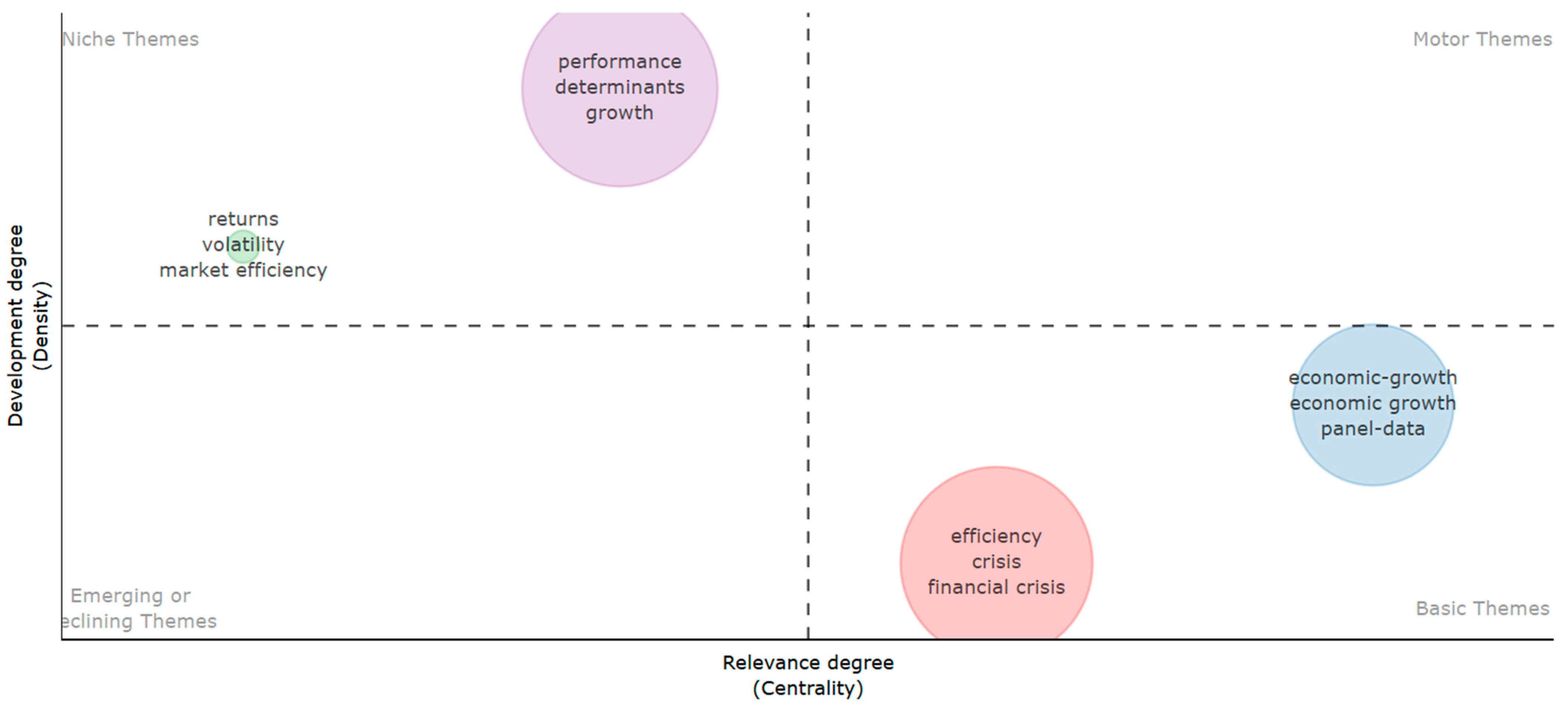
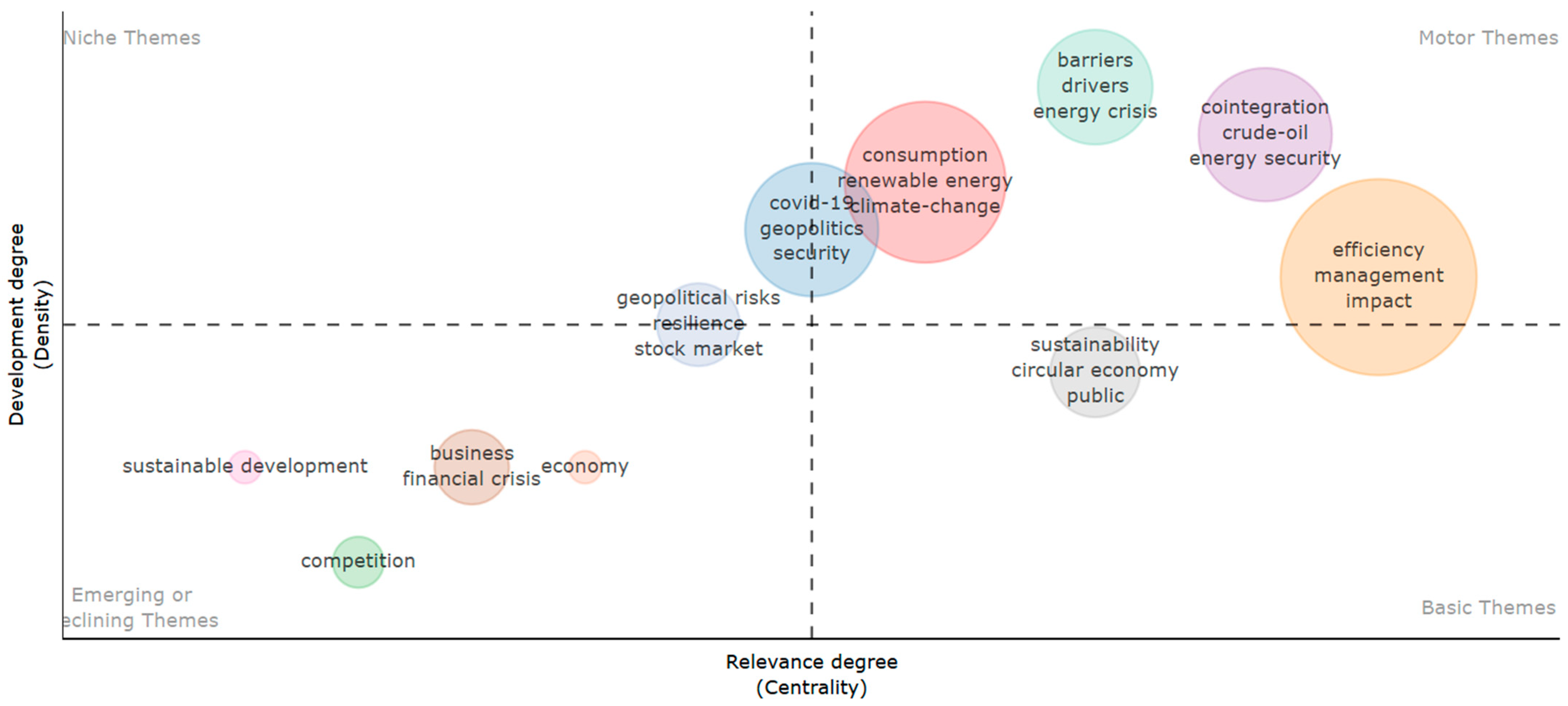
1. Introduction
Economic and financial efficiency is an essential pillar of the functioning of markets and institutions, as it reflects the capacity to transform resources into economic value under conditions of competition; however, the stability of this balance between performance optimization, disciplined resource allocation, financial sustainability, and the containment of systemic risk is frequently challenged in times of economic, financial, and geopolitical crisis, when shocks disrupt normal market mechanisms and test the adaptive capacity of institutions (
Mateev et al., 2024). Economic, financial, or geopolitical crises disrupt the normal mechanisms of the economy, changing the way resources are allocated, information is processed, and decisions are made. In such moments of instability, efficiency becomes not only an indicator of performance, but also a barometer of the system’s ability to adapt and withstand shocks (
Siminică et al., 2025;
A. G. Manta & Gherțescu, 2025).
The concept of efficiency has multiple meanings in the economic literature, reflecting its use across different analytical traditions and levels of analysis. In its modern formalization, the notion of efficiency is commonly traced back to
Farrell (
1957), who distinguished between technical efficiency and allocative efficiency and defined efficiency as the ability of an entity to obtain maximum output from a given set of inputs or to use the minimum inputs required for a given output level. This foundational perspective positions efficiency as a measure of how effectively resources are transformed into results. In financial economics, a related but distinct interpretation appears in the informational efficiency derived from the Efficient Market Hypothesis (
Fama, 1965), according to which prices rapidly incorporate all available information, limiting the possibility of systematically obtaining abnormal returns.
Within this theoretical continuum, efficiency and performance are closely connected yet conceptually distinct. Efficiency concerns the quality of resource utilization, whereas performance refers to the outcomes generated. Contemporary research, particularly in sustainability-oriented finance, increasingly evaluates performance not only through short-term financial indicators but also through long-term resilience, stability, and environmental or social outcomes. From this perspective, efficiency can be understood as a structural condition that supports sustainable performance, since optimal allocation of resources and disciplined operational processes enhance an institution’s capacity to produce stable and durable results over time.
The relationship between efficiency and performance becomes more complex under crisis conditions. Periods of instability characterized by high volatility, speculative dynamics, and policy interventions can disrupt market mechanisms and generate deviations from the theoretical equilibrium (
Basu, 1977;
L. F. Manta et al., 2025). In this context,
Fox and Sklar (
2009) argue that excessive reliance on the assumption of market efficiency contributed to the underestimation of systemic risks prior to the 2007 global financial crisis, whereas
Ball (
2009) maintains that the issue lay not in the theory itself but in its misinterpretation. Extending this perspective, the Adaptive Market Hypothesis proposed by
Lo (
2004) suggests that efficiency should be viewed as a dynamic property that evolves with changing market conditions and investor behavior rather than as a fixed state.
On the other hand, operational efficiency refers to the ability of organizations to use available resources in a productive and sustainable manner. In periods of economic growth, companies seek to optimize their costs and processes, but during crises this approach becomes insufficient (
Gherțescu et al., 2024). Events such as the global financial crisis (2007–2009), the COVID-19 pandemic, or the military conflict between Russia and Ukraine have shown that efficiency achieved under stable conditions can become a vulnerability in times of severe stress (
Ammy-Driss & Garcin, 2023;
Ahmed et al., 2022).
Chen and Capener (
2025) show, for example, that companies with a high level of operational efficiency weathered the financial crisis better, but, in the context of the pandemic, when economic activity was paralyzed, efficiency was no longer a competitive advantage.
Geopolitical crises add an extra layer to this analysis. Political instability, armed conflicts, and disruptions to international trade directly affect production costs, supply chains, and global financial flows (
Kareem et al., 2025;
Boffardi et al., 2025).
Caldara and Iacoviello (
2022), through the Geopolitical Risk Index, show that the intensification of geopolitical risks is associated with a decline in investor confidence and reduced liquidity in international markets (
Jordà et al., 2016). Under these conditions, efficiency becomes a relative notion: “optimized” systems may be efficient in times of stability but fragile in the face of external shocks (
Yap & Yang, 2024;
Yi et al., 2025).
At the same time, new approaches in complexity theory and entropic analysis offer useful tools for understanding market behavior in times of crisis.
Papla and Siedlecki (
2024) use Shannon entropy to assess the degree of uncertainty in stock markets and find that during crises, the level of entropy decreases, signaling a reduction in informational efficiency and an increase in external control over the market. These results confirm the idea that economic turmoil limits the freedom of movement of markets, transforming them from open and competitive systems into structures dependent on state or central bank intervention (
Lee et al., 2024).
From a managerial perspective, contingency and resilience theories emphasize the need to adapt strategies to the context. In stable times, organizations can pursue maximum efficiency by reducing costs and eliminating redundancies; in times of crisis, however, survival depends on flexibility and responsiveness (
Kojic et al., 2025;
Kotcharin & Jantadej, 2024).
Kareem et al. (
2025) show that firms that manage to combine efficiency with resilience by diversifying sources, maintaining strategic reserves, or adapting quickly to market demand increase their chances of post-crisis recovery and consolidation.
The need for this study stems from the profound transformations of the international banking system over the last two decades, marked by successive economic, financial, and geopolitical crises that have simultaneously affected the stability and efficiency of financial institutions. In the current context, banking efficiency can no longer be assessed exclusively through traditional performance indicators but must be analyzed in relation to banks’ ability to manage the complex systemic risks generated by macroeconomic instability, geopolitical tensions, and the digital and ecological transition. This study adopts a descriptive bibliometric perspective, meaning that it aims to map how these topics appear and connect in the literature rather than to test causal relationships between them. Unlike the existing literature, which treats banking efficiency predominantly through the lens of financial performance or stability, this study highlights its distinct role in times of crisis, showing how banking efficiency mediates the relationship between digital transformation, sustainability-oriented strategic management, and organizational resilience in an integrated systemic framework. Through a bibliometric and conceptual approach, the research provides a systematic mapping of the evolution of knowledge and positions banking efficiency as an essential strategic capacity for strengthening financial stability and sustainable development in contexts of uncertainty. Therefore, the contribution of the paper lies primarily in clarifying the structure, trends, and research directions of the field.
In this context, the study formulates as a central issue the way in which banking efficiency shapes sustainable digital innovation processes and contributes to strengthening the organizational resilience of financial institutions in contexts marked by economic and geopolitical crises, understood here as an exploration of how the literature discusses these links, not as an empirical demonstration.
In this study, banking efficiency is approached at a general conceptual level, being used as an integrative notion that brings together the various forms of efficiency identified in the literature (technical, allocative, cost, managerial, or informational). This approach is justified by the bibliometric and synthetic nature of the analysis, which aims to capture the systemic role of efficiency in banks’ adaptation to economic and geopolitical crises, without restricting the analytical framework to a single specific type of efficiency, while acknowledging that a broader scope allows a comprehensive overview but limits the depth of analysis for each individual dimension.
The research questions of this study are as follows:
RQ1. What are the dominant thematic clusters in the literature on banking efficiency related to economic and financial crises compared with those addressing geopolitical contexts, and how have these themes evolved conceptually over time?
RQ2. What patterns of scientific collaboration among authors can be identified in studies on banking efficiency, and to what extent do these patterns indicate distinct research streams focused on financial stability versus geopolitical risk?
RQ3. What institutional publication patterns characterize research on banking efficiency in economic–financial crisis contexts compared with geopolitical contexts, and which institutions emerge as the most influential contributors in each domain?
RQ4. How is international scientific production on banking efficiency distributed geographically across countries, and what differences can be observed between research focusing on economic–financial vulnerabilities and that addressing geopolitical risks?
RQ5. What emerging themes, research fronts, and underexplored directions can be identified in the literature that links banking efficiency with crisis-related contexts, based on bibliometric trend analysis?
The structure of the paper is organized as follows:
Section 1 presents the introduction and general research context;
Section 2 provides the literature review, focusing on three dimensions—banking efficiency and economic–financial crises, banking efficiency and geopolitical crises, and a comparison between the effects of financial and geopolitical crises on banking efficiency and their implications;
Section 3 describes the materials and methods used;
Section 4 presents the results;
Section 5 includes the discussions; and
Section 6 outlines the main conclusions of the study.
2. Literature Review
Banking efficiency represents the ability of banks to optimally use resources (e.g., operating expenses, capital, and labor) to generate financial services (loans, deposits, other products) and profit (
Siminică et al., 2025). In the literature, banking efficiency is often measured using quantitative methods such as data envelopment analysis (DEA) or stochastic frontier analysis (SFA), which calculate technical or cost efficiency scores for each bank (
Fukuyama et al., 2025). A high level of efficiency indicates that the bank produces at minimum cost for a given level of output, while low efficiency signals waste of resources or inefficient processes (
A. G. Manta et al., 2023;
A. G. Manta et al., 2024a). Bank efficiency is closely linked to the performance and stability of financial institutions: studies show that inefficient banks tend to have long-term financial problems and a higher probability of failure, a hypothesis known as the “bad management hypothesis” (
Fethi & Pasiouras, 2010;
Fiordelisi et al., 2011;
Othman et al., 2016). According to this hypothesis, poor management is reflected in low operational efficiency, which often precedes the accumulation of non-performing loans and financial vulnerabilities (
Belas et al., 2012;
Shah et al., 2023). On the other hand, there is also the “skimping” perspective, according to which some banks may have very low costs and high efficiency in the short term by underinvesting in risk control procedures, but this behavior can subsequently lead to losses and crises (
Berger & Humphrey, 1997;
Sestino et al., 2020). Thus, the relationship between efficiency and risk is complex; efficiency can contribute to profitability and resilience, but efficiency achieved through excessive cost cutting can increase risks (
Sestino et al., 2020).
For analytical clarity and coherence, the following sections review prior studies that examine the relationship between banking efficiency and two major contexts of instability—economic–financial crises and geopolitical crises. Since the concept of efficiency is defined and operationalized in multiple ways in the banking literature, the discussion emphasizes those definitions, dimensions, and perspectives most frequently addressed across existing research and that can be aligned with the thematic patterns identified through the bibliometric analysis. In this way, the section establishes the conceptual foundation of the study and synthesizes the current state of knowledge, providing a structured basis for the subsequent interpretation of the bibliometric findings.
In times of crisis, the concept of efficiency becomes particularly relevant. Economic and financial crises put pressure on both banks’ revenues and costs, while geopolitical crises can disrupt markets and affect the investment climate. The literature has examined how systemic shocks influence banking efficiency and how, in turn, efficiency can mitigate or exacerbate the effects of crises.
2.1. Banking Efficiency During Economic and Financial Crises
Financial crises strongly affect the operating environment of banks, which can lead to both a decline in efficiency and an improvement in the post-crisis phase through restructuring (
Schaeck & Cihák, 2014). Theoretically, in the run-up to a crisis, excessive credit expansion and relaxed standards can mask inefficiencies (
Chortareas et al., 2012). Once the shock occurs, bank revenues decline, losses increase, and cost efficiency deteriorates as banks face high fixed costs and declining revenues (
Isik & Folkinshteyn, 2017). In the midst of a crisis, many banks have excess staff, oversized networks, and impaired assets, leading to much lower efficiency scores (
Andrieș & Ursu, 2016;
Moradi-Motlagh & Babacan, 2015). For example, the cyclical hypothesis suggests that banking efficiency follows the economic cycle: it deteriorates in a recession (when revenues decline faster than costs can be adjusted) and recovers in an expansion (
Diallo, 2018). Another thesis is that of “survival of the fittest”: banks that are more efficient before a crisis are more likely to survive the shock, while inefficient institutions either go bankrupt or are forced to consolidate, raising the average level of efficiency in the post-crisis banking system (
Isik & Uygur, 2021;
Álvarez-Franco & Restrepo-Tobón, 2016). Thus, financial crises act as a stress test that highlights the weaknesses of institutions: poor management and operational inefficiencies become much more visible and can precipitate bank failure (
Pruteanu-Podpiera & Podpiera, 2008). At the same time, interventions by the authorities (e.g., bailout programs or forced consolidation) can influence long-term efficiency: for example, mergers between banks in crisis can generate economies of scale and improve efficiency if carried out strategically, but they can also reduce competition, affecting incentives for efficiency (
Beck et al., 2013;
Gallizo et al., 2016). However, such interventions can also generate moral hazard effects, particularly in the case of large banks perceived as “too big to fail.” When bank managers expect public support in the event of failure, incentives for prudent risk-taking may weaken, leading to excessive risk-taking that artificially inflates short-term efficiency while increasing systemic vulnerability in the long run.
The empirical literature has extensively documented the effects of financial crises on banking efficiency, using various methodologies and international datasets. A robust finding, confirmed in multiple studies, is that banking efficiency tends to decline before and during a financial crisis, reaching a low point at the peak of the crisis, then gradually recovering post-crisis (
Diallo, 2018;
Asimakopoulos et al., 2018).
Isik and Uygur (
2021) show, in a comprehensive analysis of banking crises in emerging markets, that bank efficiency scores gradually deteriorated before the onset of the crisis, reached their lowest level during the years of acute crisis, and returned to an upward trajectory in the following years. This pattern was first observed by
Isik and Hassan (
2003) for the 1994 Turkish banking crisis and then reconfirmed by numerous studies on the 2007–2009 global financial crisis.
The 2007–2009 global financial crisis (GFC) provided ample ground for analysis, and research shows consistent effects on banking efficiency in various regions.
In Europe, the following study by
Andrieș and Ursu (
2016), who analyzed 783 European commercial banks, showed that the GFC had a significant negative impact on the cost efficiency and profitability of European banks. On average, cost efficiency declined in 2008–2009 compared to the pre-crisis period (2006–2007), which was attributed to lower revenues and higher provisions, which disrupted cost indicators (
Andrieș & Ursu, 2016). The study also highlights regional differences: banks in the peripheral economies of the euro area (e.g., Greece and Spain) suffered greater declines in efficiency compared to banks in core economies (e.g., Germany and France) (
Asimakopoulos et al., 2018).
Asimakopoulos et al. (
2018) point out that there is an asymmetry in how the eurozone crisis affected efficiency: banks in peripheral countries (hit by the sovereign debt crisis) saw their technical efficiency affected much more severely than banks in core countries, suggesting that sovereign shocks and local recessions amplified inefficiencies.
Gallizo et al. (
2016) examined 29 European countries (the enlarged EU) and found that the global crisis interrupted the process of convergence in banking efficiency between countries: before 2008, there was a trend towards a gradual equalization of efficiency levels between national banking systems, but the crisis reversed this trend, leading to greater divergences (
Gallizo et al., 2016). In other words, the shock affected banks in some countries more than others, increasing efficiency disparities.
In the United States, the subprime crisis directly hit the American banking system, and the efficiency of American banks was severely affected in 2008–2009.
Moradi-Motlagh and Babacan (
2015) show that the pure technical efficiency of the largest US banks declined significantly in 2008 compared to previous years, using a bootstrap DEA. They also highlight that the small banks in the sample were operating, on average, below increasing returns to scale before the crisis, suggesting that they could have achieved greater efficiencies through expansion; however, after the crisis, many small banks were either absorbed by larger ones or adjusted their size, so that average scale efficiency improved (
Moradi-Motlagh & Babacan, 2015). Another study, by
Wheelock and Wilson (
2017), indicates that cost efficiency at US community banks declined during the recession but began to return to pre-crisis levels after 2010 as banks reduced expenses and cleaned up their balance sheets. In addition,
Álvarez-Franco and Restrepo-Tobón (
2016) examined US banks that failed in 2007–2009 vs. those that survived, finding that failed institutions had previously exhibited significantly lower levels of managerial efficiency. This confirms that inefficiency was a factor contributing to the vulnerability of banks to the crisis, supporting the bad management hypothesis in the context of the Great Recession (
Álvarez-Franco & Restrepo-Tobón, 2016).
The crisis caused by the COVID-19 pandemic generated simultaneous shocks to demand and supply, profoundly affecting the global banking sector, unlike the 2008 crisis, which originated within the financial system (
Demir & Danisman, 2021). In the early months of the pandemic, bank stocks fell sharply, reflecting expectations of major pressures on profitability and financial intermediation (
Demir & Danisman, 2021). However, the coordinated response of the authorities—interest rate cuts, liquidity injections, moratoriums, and public guarantees—prevented a systemic financial crisis, allowing banks to maintain their core functions (
Elnahass et al., 2021;
Goodell, 2020). Despite the recession, the global banking system continued to function relatively normally, but financial and operational efficiency was temporarily affected by declining profitability and increased risks (
Elnahass et al., 2021). An analysis of 1090 banks in 116 countries shows that the pandemic reduced financial performance and amplified liquidity and credit risks, although signs of recovery were already visible in the second quarter of 2020 (
Goodell, 2020). The impact of support policies has been mixed: liquidity measures and moratoriums have mitigated the decline in efficiency, but for undercapitalized banks they have had adverse effects by prolonging uncertainty (
Beck et al., 2013). In emerging economies, the relaxation of market discipline allowed inefficiencies to persist (
Rizal & Amran, 2022), while in the MENA region, Islamic banks demonstrated greater resilience due to their pre-existing efficiency (
Mateev et al., 2023;
Mamat et al., 2024). However, other studies indicate better performance by conventional banks in operational terms (
Lassoued et al., 2025). Overall, rapid interventions and higher capitalization compared to 2008 maintained the stability of the banking system, while revenue diversification and digitalization contributed to maintaining more robust efficiency (
Wang et al., 2022;
Bartczak, 2021).
Overall, economic and financial crises have a clear negative impact on short-term banking efficiency, as banks find it difficult to quickly adjust their costs when revenues decline (
Khan et al., 2021;
Shahbaz et al., 2022). Cost efficiency and profit efficiency typically decline during crisis years (
Pasiouras et al., 2009). However, in the medium and long term, there are also indirect positive effects: crises eliminate the weakest players or force them to reform, and banking systems emerge healthier and more efficient after the crisis (
Beck et al., 2013;
Isik & Folkinshteyn, 2017). For example, in the European Union, the average efficiency of the banking sector increased again after 2011, following the restructuring and recapitalization imposed by the authorities, although it remained below pre-crisis highs in many countries (
A. G. Manta & Bădîrcea, 2014). As another example, in Romania, studies after 2009 showed an improvement in efficiency in the banking sector as banks optimized their networks and costs (
Nițoi, 2009). So, the lesson from the literature is that banking efficiency matters: banks with efficient management and well-controlled costs are more resilient to crises, and supervisory policies should take efficiency indicators into account as early warning signals (
Podpiera & Weill, 2008;
Barth et al., 2013). In addition, the degree of regulation and supervision influences this dynamic—cross-country research that shows that some macroprudential regulations adopted after the 2008 crisis (higher capital requirements and risk limits) had a beneficial effect on efficiency by disciplining bank management, although excessive regulation can also have costs (
Chortareas et al., 2012;
Allen et al., 2019).
2.2. Banking Efficiency Under the Influence of Geopolitical Crises
Geopolitical crises—including wars, terrorism, severe political instability, and international tensions—affect the banking sector through different channels than traditional financial crises. In a geopolitical crisis, the initial problem is not an internal one within the financial system, but rather an external shock (e.g., military conflict or international sanctions) that induces extreme uncertainty, increases credit risk (businesses and people in affected areas may become non-performing), reduces investment, and disrupts markets (
Compaoré et al., 2020). All of this can erode banking efficiency: bank revenues decline (fewer loans granted, declining economic activity), while costs may increase (need for increased security, higher provisions for expected losses, and cost of funding may increase due to perceived risk). A tense geopolitical environment may also force banks to maintain excess liquidity and capital as a precautionary measure, which, although prudent, reduces the efficiency of resource allocation. From a theoretical perspective, increased geopolitical risk is seen as a factor that undermines the efficiency of financial intermediation: banks become more reluctant to lend (or demand higher risk premiums), which reduces intermediation and, implicitly, the intermediary efficiency of banks (
Demir & Danisman, 2021;
Almustafa et al., 2023). There has been much talk lately about the Geopolitical Risk Index developed by
Caldara and Iacoviello (
2022), which quantifies the frequency of geopolitical tensions; high levels of this index are correlated with financial volatility and increased risk aversion, conditions that affect banks’ decisions. Banks exposed to countries in conflict or under sanctions may see increases in the probability of default in their loan portfolios to those countries (
Avril et al., 2023). Domestically, severe political uncertainty (e.g., riots and sudden regime changes) can lead to massive deposit withdrawals and difficulties in the interbank market, putting pressure on operational efficiency (
Sweidan, 2023).
An important point is that the geopolitical effects on efficiency are not uniform: the geography and specifics of the crisis matter. For example, banks in emerging economies may be more vulnerable to geopolitical shocks (due to weaker institutions and concentration of exposures) compared to banks in developed economies, which have more globally diversified portfolios (
Adel & Naili, 2024). At the same time, the size and financial strength of banks play a role—larger and well-capitalized banks can more easily absorb the losses or additional costs induced by geopolitical crises, maintaining their relatively higher efficiency compared to small banks (
H. T. Phan et al., 2019). For example,
H. T. Phan et al. (
2019) argue that the negative impact of geopolitical risk on banking stability is mitigated for large and well-capitalized banks, which also implies better maintenance of efficiency under stress conditions. In contrast, small, less diversified banks may suffer sharp declines in efficiency in the face of local shocks (
Ghosh, 2015).
The empirical literature on the influence of geopolitical crises on banks has developed more intensively over the last decade, against the backdrop of events such as the Arab Spring, the conflict in Ukraine, global trade tensions, and increased security risks. Several recent studies directly explore the link between geopolitical risk, usually measured by the Caldara–Iacoviello index or similar indicators, and banking performance or efficiency (
Caldara & Iacoviello, 2022).
Thus, in relation to geopolitical risk and lending or intermediation efficiency,
Demir and Danisman (
2021) investigated a sample of emerging economies and observed that economic uncertainty significantly reduces bank credit growth, while geopolitical risk itself has a less clear effect on total credit volume. In other words, in some studies, geopolitical risk does not appear to be a major factor in credit contraction after controlling for other variables (
Demir & Danisman, 2021). On the other hand, subsequent research has found stronger effects: for example,
Avril et al. (
2023) show that banks with high exposure to countries affected by geopolitical tensions experience a greater deterioration in their loan portfolios and reduce their cross-border lending to those risky jurisdictions. In addition, the ECB study (
Avril et al., 2023) highlights that, although international banks reduce direct lending to risky countries (thus becoming more prudent, which may affect their allocative efficiency), they often maintain lending through local subsidiaries, probably in the hope of a recovery (a finding exemplified by the case of Western banks in Russia after 2014). This “persistent” behavior may, however, affect their consolidated efficiency, as they maintain operations in adverse environments (
Avril et al., 2023).
Regarding geopolitical risk and bank stability or profitability, a set of studies focuses on stability indicators (such as the z-score or capital ratio) and profitability (ROA and ROE) as proxies for efficient performance.
H. T. Phan et al. (
2019) provide strong evidence that an increase in geopolitical risk is associated with a decline in bank stability, i.e., banks’ z-scores tend to decline. They note that the negative effect is less pronounced for large and well-capitalized banks, suggesting that balance sheet strength partially offsets the impact (
H. T. Phan et al., 2019).
Several studies have focused on specific episodes.
Compaoré et al. (
2020), in an IMF analysis focused on developing countries, showed that the incidence of armed conflict and political instability increases the likelihood of a systemic banking crisis.
In other words, countries affected by civil wars, revolutions, or major terrorist attacks are much more likely to experience banking crises, which have drastic effects on the efficiency and performance of banks (
Compaoré et al., 2020). A current example is the conflict in Ukraine (2022): initial analyses indicate a severe decline in the operational efficiency of Ukrainian banks amid the conflict, as many branches have suspended operations, risk costs have skyrocketed, and staff and infrastructure have been affected (anecdotal evidence from local reports). At the same time, European banks with exposure to Russia have had to set aside massive provisions and exit the market, which has temporarily affected their efficiency and profitability (
Avril et al., 2023). In the Middle East, chronic instability since 2011 (the Arab Spring, the Syrian conflict, and tensions in Iraq) has led to an increase in non-performing loans and a decline in efficiency in many banking systems in the region—for example, in Lebanon, banking efficiency eroded before the recent financial crisis, against a backdrop of an increasingly fragile political and economic environment (
Lucey & Lagoarde-Segot, 2009;
Soedarmono et al., 2013).
Jabbouri et al. (
2022) examined the stability of banks in North African and Middle Eastern countries undergoing economic transformation and concluded that political instability and conflict have a significant negative effect on the stability and operational efficiency of banks, confirming similar conclusions by
Ghosh (
2015) and
Lucey and Lagoarde-Segot (
2009) on the vulnerability of the MENA region to geopolitical shocks.
Given this evidence, it becomes clear that geopolitical risks are an important dimension of the banking operating environment, which can trigger or exacerbate financial crises. While in the 2000s–2010s, the focus was mainly on macroeconomic indicators in explaining banking performance (GDP growth, inflation, etc.), recent research emphasizes that geopolitical indicators should also be integrated into models, especially for emerging countries (
Adel & Naili, 2024;
Berkman, 2022). A notable finding is that the effect of geopolitical risk on banks can be indirect: for example, political uncertainty can lead to lower sovereign ratings and higher financing costs for banks, thus affecting their financial efficiency. In this context, information imperfections and expectations of public support can further amplify systemic risk, as both efficient and inefficient banks may underestimate downside risks. The experience of the 2007–2009 global financial crisis illustrates how the perception of implicit guarantees for large institutions contributed to risk accumulation, while the absence of support in the case of Lehman Brothers triggered a sudden loss of confidence and systemic contagion.
The response of authorities also matters—central banks and governments that provide support (liquidity lines and guarantees) to banks during periods of geopolitical tension can mitigate the decline in efficiency (for example, government guarantees on loans granted in conflict zones can prevent a massive increase in provisions) (
Chidaushe, 2025;
Soltani et al., 2021). Finally, the literature suggests that geographical diversification helps banks with an international presence offset losses in a region affected by geopolitical crisis with revenues from other regions, thereby maintaining their aggregate efficiency better (
Udeaja et al., 2024). In contrast, local banks concentrated in a conflict-ridden country bear the full brunt of the shock.
2.3. Comparison Between the Effects of Financial and Geopolitical Crises on Banking Efficiency and Implications
The literature review highlights both differences and similarities in how financial versus geopolitical crises affect banking efficiency. In economic and financial crises (endogenous to the financial system), the decline in efficiency stems mainly from financial imbalances and economic shocks: the explosion of non-performing loans, the collapse of asset markets, and economic contraction reduce banks’ revenues and impose additional costs, leading to inefficiency. These crises may be predictable to a certain extent (e.g., previous vulnerabilities can be identified) and, once triggered, the decline in efficiency is widespread throughout the system, followed by a process of consolidation and “cleaning up” that improves long-term efficiency (
Isik & Uygur, 2021;
Beck et al., 2013). Geopolitical (exogenous) crises, on the other hand, act by increasing uncertainty and non-financial risks. Their effects can be more heterogeneous: they depend on each bank’s exposure to the conflict area and the management’s ability to respond. For example, while any severe recession (such as in 2008–2009) negatively affects almost all major banks in the world (to varying degrees, but in a similar direction), a geopolitical conflict strongly affects banks in the country/region involved and much less those elsewhere. Thus, the localized nature of geopolitical crises can lead to drastic declines in efficiency for some institutions and have a negligible impact on others. However, when geopolitical crises escalate and have global implications (e.g., rising energy prices and international financial sanctions), they can become a systemic factor affecting banking efficiency on a large scale—one example being the increase in global risks after the invasion of Ukraine in 2022, which brought inflation and monetary tightening, influencing banks’ efficiency indicators by increasing financing costs and the probability of default (
Berkman, 2022). However, this stabilizing role is conditional on the quality and distribution of information, as imperfect and asymmetric information can amplify systemic risk, leading to situations in which both efficient and inefficient banks are simultaneously affected during crises. When information imperfections distort risk perception, asset valuation, and interbank trust, systemic shocks can propagate across the financial network, undermining even well-managed and operationally efficient institutions.
A common feature of both types of crises is that banks that are more efficient and better managed initially are more likely to weather the storm without major damage. The literature consistently shows that pre-crisis efficiency is a good predictor of resilience: before the 2008 crisis, banks with lower cost/income ratios and high efficiency had lower losses and a better ability to maintain profitability (
Luo & Sun, 2024;
D. H. B. Phan et al., 2022). Similarly, prior to geopolitical shocks, banks with strict cost control disciplines and prudent diversification navigated tense periods better (
Brandt & Gao, 2019). On the other hand, marked inefficiency can exacerbate a crisis: if inefficient banks face a shock, they lack the necessary buffers (in terms of profits and capital) and may fail, amplifying the crisis. Thus, for both financial and geopolitical crises, banking efficiency has predictive and preventive value—maintaining efficient banks contributes to the stability of the entire financial system (
Tzeremes, 2015).
Public policy implications and future research directions: Given the conclusions of the 2002–2025 literature, several directions emerge. First, supervisory authorities should monitor not only traditional indicators (liquidity and solvency), but also efficiency indicators (cost/income ratio and frontier efficiency) as early signals of banking weaknesses (
Pruteanu-Podpiera & Podpiera, 2008;
Tzeremes, 2015). Banks with large deviations from the frontier may need efficiency recovery plans, especially during boom periods, to prevent problems in a crisis. Second, macroprudential policies must also take geopolitical risks into account: for example, stress tests for banks under geopolitical shock scenarios (regional war and sanctions) could highlight vulnerabilities that would otherwise go unnoticed (
Compaoré et al., 2020;
Jabbouri et al., 2022). Banks, in turn, can invest in geopolitical risk management and diversification strategies to protect their operational efficiency in the face of such shocks (
Levine, 1997). Third, the consolidation of the banking sector in the wake of crises should be viewed with nuance: post-crisis mergers and acquisitions can increase average efficiency (by eliminating redundancies and weak banks), but excessive concentration can lead to a quiet life (less competitive pressure for efficiency) (
Patnaik, 1997;
Gilhespy, 1999).
Barth et al. (
2013) suggest optimizing the regulatory framework to strike a balance between stability and efficiency—strict supervision can prevent the excesses that lead to crises, but it should also encourage innovation and competition, which are ingredients that stimulate efficiency.
Last but not least, future research could better integrate the geopolitical dimension into models for assessing bank performance. As
Berkman (
2022) notes, there is still a gap in understanding the exact channels through which geopolitical events influence bank solvency and efficiency. Recent studies, such as that by
D. H. B. Phan et al. (
2022) for G7 countries, are beginning to fill this gap, finding, for example, that combined economic and geopolitical uncertainty has strong effects on bank prudence and interest margins. Integrating these risks into stress tests and internal management strategies will be essential in a world increasingly marked by political uncertainty. In conclusion, banking efficiency remains both a barometer of the financial sector’s health and a determinant of its resilience to shocks, whether economic or geopolitical (
Ghosh, 2015;
Chidaushe, 2025). A comprehensive approach that takes both types of crises into account is necessary to ensure the robustness of the banking system and the efficient financing of the economy, even in times of turmoil.
2.4. Theoretical Synthesis and Conceptual Gaps in the Analysis of Banking Efficiency Under Economic, Financial, and Geopolitical Crises
The reviewed literature shows that economic and financial crises and geopolitical crises affect banking efficiency through distinct but partially overlapping mechanisms. Financial crises, endogenous to the financial system, primarily undermine efficiency through deteriorating asset quality, declining revenues, and rigid cost structures, leading to widespread and relatively predictable efficiency losses followed by post-crisis consolidation and restructuring. In contrast, geopolitical crises act as exogenous shocks that amplify uncertainty, disrupt markets, and generate heterogeneous effects on banking efficiency, depending on banks’ geographical exposure, size, diversification, and risk management capacity. While financial crises tend to produce systemic and synchronized efficiency declines, geopolitical crises often generate localized yet severe efficiency disruptions that may escalate into systemic risks when global spillovers occur.
Despite this growing body of evidence, the literature remains fragmented. Existing studies largely analyze economic–financial and geopolitical crises separately, focusing on efficiency, stability, or profitability in isolation. Consequently, limited attention has been paid to the integrated role of banking efficiency as a strategic mechanism that connects crisis exposure with adaptive responses such as digital transformation, sustainability-oriented management, and organizational resilience. In particular, the literature lacks a systemic perspective explaining how banking efficiency mediates the relationship between different types of crises and the capacity of banks to engage in sustainable digital innovation.
This conceptual gap motivates the present study, which advances the literature by positioning banking efficiency not merely as an outcome affected by crises, but as a dynamic capability that shapes banks’ strategic responses to both economic–financial and geopolitical shocks within sustainability-oriented digital ecosystems.
3. Materials and Methods
Bibliometric analysis is a rigorous scientific method for quantitative and visual investigation of academic output, based on statistical and computational principles designed to highlight the structure, dynamics, and influence of knowledge in a given field (
Mishra et al., 2024;
Ball & Dirk, 2005;
Zupic & Čater, 2015). In the context of economic and financial research, it allows the identification of the most relevant theoretical contributions, institutional collaboration networks, and emerging trends that define the evolution of banking science (
Moral-Muñoz et al., 2020;
Donthu et al., 2021). The Bibliometrix package, developed in the R programming language (
Aria & Cuccurullo, 2017), is an advanced and internationally validated tool for performing complex bibliometric analyses on data extracted from established databases such as Web of Science and Scopus.
The use of the RStudio (Version: 2024.12.1+563) environment ensures the reproducibility and transparency of the analysis, offering the possibility of automatic metadata processing, the construction of bibliometric indicators, and the visualization of conceptual structures through dynamic maps and graphs (
Gaviria-Marin et al., 2018). The functions integrated into the package, such as biblioAnalysis(), summary(), networkPlot(), and thematicMap(), facilitate the exploration of co-authorship, co-citation, and co-occurrence networks of keywords, contributing to the identification of central nodes of knowledge and interdisciplinary relationships (
Sánchez-Meca & Marín-Martínez, 2010). At the same time, the Biblioshiny interface extends the accessibility of this tool through an interactive graphical environment, allowing the analysis of scientific performance, publication impact, and thematic evolution in an intuitive but methodologically robust manner (
Suharso et al., 2021). Thus, the integration of Bibliometrix into the RStudio environment provides researchers with a solid methodological framework for the systematic analysis of scientific output on banking efficiency in times of crisis, facilitating the mapping of global trends, author interconnectivity, and dominant paradigms in the literature (
Passas, 2024).
The bibliometric analysis was conducted following a structured and transparent procedure designed to ensure clarity, consistency, and reproducibility. The data were collected from the Web of Science Core Collection database, which was selected due to its standardized indexing system, rigorous selection criteria, and its widespread use in bibliometric research. The use of a single database also allowed the construction of a consistent dataset and avoided duplicate records that may occur when merging multiple sources. The objective of the study is not to compare databases, but to compare how the concept of efficiency is addressed across two distinct crisis contexts. At the same time, it is important to acknowledge that relying on a single database may entail coverage limitations, particularly for interdisciplinary topics that span multiple research domains. Although Web of Science provides high-quality indexing and broad coverage in economics, finance, and management, some relevant publications indexed exclusively in other databases may not be captured. This trade-off was considered acceptable given the study’s emphasis on dataset consistency, transparency, and replicability, which are essential in bibliometric analyses.
The search was performed in the Topic field of Web of Science, and the data were extracted on 12 October 2025. Two separate searches were conducted in order to construct two independent queries corresponding to the analytical dimensions investigated. The first search targeted the literature on efficiency in the context of economic–financial crises using the expression “efficiency and economic–financial crises,” while the second targeted efficiency in the context of geopolitical crises using the expression “efficiency and geopolitical crises.” These expressions were introduced as phrase queries. To better capture the banking dimension of the research field, the additional keywords “bank efficiency” and “bank sector” were included using the operator OR, allowing the retrieval of studies referring either to general efficiency or specifically to banking efficiency. The OR operator was used intentionally because it allows the search to capture articles that use different terms but refer to the same idea, ensuring that relevant studies are not missed simply due to wording differences. This approach is especially useful in interdisciplinary fields, where authors may use varied terminology for similar concepts, while the subsequent subject-area filtering ensures that the results remain relevant to the topic of research.
The search results were limited to publications written in English and included journal articles, conference papers, and review articles. No temporal restriction was applied so that the dataset could reflect the full evolution of research on efficiency in crisis contexts. In order to ensure thematic relevance, Web of Science subject category filters were applied and only publications indexed in Economics, Business Finance, and Management were retained (
Table 1). No manual exclusion of titles or abstracts was performed, as the study relied exclusively on database classification filters in order to preserve methodological transparency and replicability. This methodological choice involves a trade-off. While the absence of manual screening reduces subjective bias and enhances procedural clarity, it may increase the likelihood that some contributions only marginally related to banking efficiency are retained, particularly given the interdisciplinary and relatively general nature of the search expressions. However, the application of subject category filters and the inclusion of banking-related keywords were intended to mitigate this risk and maintain thematic coherence. In addition, the resulting dataset was systematically checked to ensure that the retained publications belonged to the financial and economic research domain, confirming the thematic relevance of the corpus. The decision to avoid manual intervention was therefore guided by the objective of ensuring full reproducibility of the dataset construction process, even if this implies a broader thematic inclusion at the margins of the corpus.
Therefore, the bibliometric analysis followed established scientometric guidelines and was conducted using a structured Boolean query applied to the Web of Science Core Collection. The query consisted of three conceptual blocks: (i) banking-related terms, (ii) efficiency-related terms, and (iii) crisis- and systemic uncertainty-related terms. Synonyms within each block were connected using OR operators, while the three conceptual blocks were combined using AND operators to ensure conceptual alignment with the research focus.
To further enhance thematic relevance and disciplinary coherence, Web of Science subject category filters were applied at the data collection stage. Only publications indexed under the categories Economics, Business Finance, and Management were retained in the final dataset. This filtering strategy is widely used in bibliometric research to delimit the intellectual domain under investigation and to exclude marginally related contributions from adjacent fields (e.g., engineering, environmental sciences, or health studies) that may share generic terms such as “efficiency” or “crisis” but fall outside the intended analytical scope (
Zupic & Čater, 2015;
Aria & Cuccurullo, 2017;
Donthu et al., 2021).
Moreover, the resulting dataset constitutes a time-bounded and frozen bibliometric snapshot, extracted in October 2025. Given the continuous expansion and retrospective updating of bibliographic databases, executing the same query at different points in time would inevitably generate different document sets, citation structures, and network configurations. In bibliometric research, reproducibility is therefore ensured through transparent reporting of the search logic, applied filters, and extraction date, rather than through numerical identity of results across time (
Zupic & Čater, 2015;
Aria & Cuccurullo, 2017;
Donthu et al., 2021).
All subsequent analytical stages, including co-occurrence network construction, thematic mapping, and cluster interpretation, were performed exclusively on this fixed corpus. Re-running the query at later stages of the review process would not represent a refinement of the same analysis, but the construction of a new bibliometric dataset requiring full reprocessing of the analytical pipeline, with potentially different structural and thematic outcomes (
Zupic & Čater, 2015;
Aria & Cuccurullo, 2017;
Donthu et al., 2021). The adopted approach preserves internal consistency, analytical coherence, and methodological rigor, particularly in network-based analyses that are highly sensitive to changes in dataset composition.
In addition to database-level filters, thematic relevance was ensured through the application of Web of Science subject category restrictions (Economics, Business Finance, and Management). This step effectively excluded marginal or discipline-external contributions at the data collection stage, thereby reducing the necessity for extensive manual screening. Such category-based filtering is a recognized and widely applied strategy in bibliometric research to maintain disciplinary focus and thematic coherence.
After applying these criteria, the final dataset consisted of 977 records related to efficiency and economic–financial crises and 59 records related to efficiency and geopolitical crises. All records were exported from Web of Science in BibTeX format and imported into the RStudio (Version: 2024.12.1+563) environment for processing. The analysis was conducted using the Bibliometrix package and the Biblioshiny interface, which enabled the structuring of metadata and the generation of bibliometric indicators, co-authorship networks, co-citation structures, keyword co-occurrence maps, and thematic evolution analyses. These tools supported the systematic exploration of the literature and allowed the identification of major research directions, intellectual structures, and thematic developments related to banking efficiency in different crisis contexts.
However, it must be acknowledged that the bibliometric approach has certain limitations: it is based exclusively on available metadata and does not capture the conceptual content of each study in depth, and the use of a single database may lead to the exclusion of relevant contributions indexed in other sources. Consequently, the results should be interpreted as a systematic mapping of the dominant trends and structures in the existing literature, rather than as an exhaustive assessment of all possible contributions in the field.
4. Results
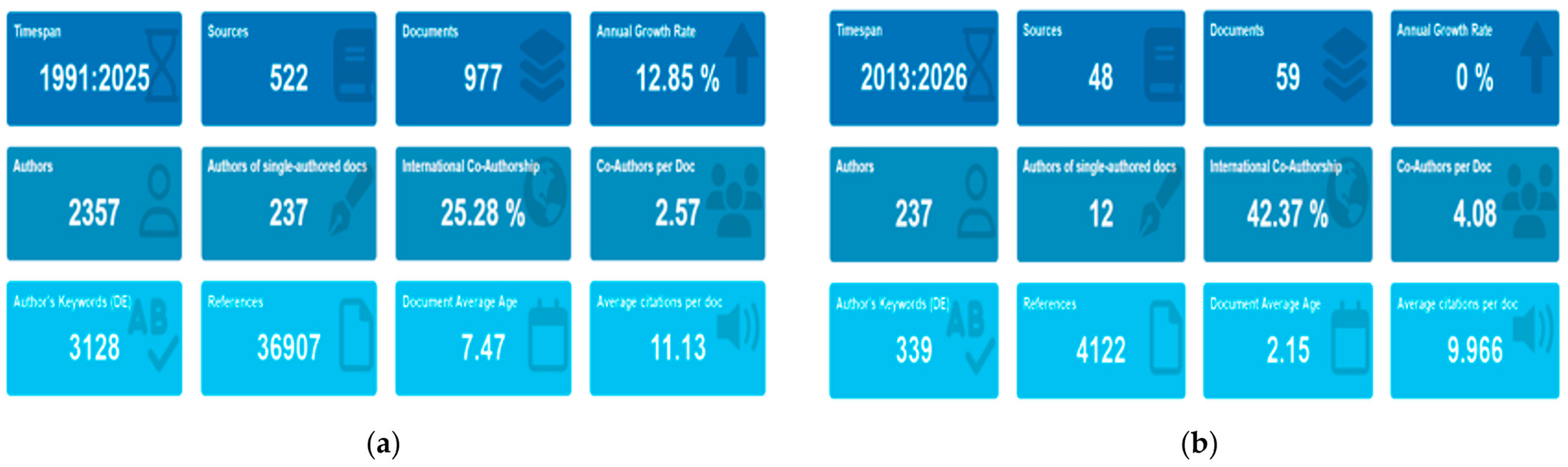
Figure 1a,b show the evolution and structure of research dedicated to the topic of efficiency in crisis contexts, differentiated between the economic–financial and geopolitical spheres. In the case represented by
Figure 1a, the field of efficiency correlated with economic and financial crises (1991–2025) emerges as a mature field of study, with sustained dynamics and an average annual growth rate of 12.85%. The 977 papers identified, published in 522 sources, demonstrate the breadth and diversity of research, and the involvement of 2357 authors, of whom 237 are unique, indicates intense scientific activity and a moderate level of collaboration (2.57 co-authors/article). The internationalization rate of 25.28% reflects global openness, but with a regional predominance, while the 3128 keywords and over 36,000 references attest to the conceptual complexity of the field. With an average document age of 7.47 years and an average of 11.13 citations per article, research has gradually consolidated into a solid theoretical framework, illustrating a constant concern for resilience and economic performance in times of financial instability.
In contrast,
Figure 1b highlights an early stage of studies addressing efficiency in relation to geopolitical crises (2013–2026). With only 59 papers published in 48 sources, the field is in an emerging phase, characterized by extensive collaboration (4.08 co-authors/article) and a high level of internationalization (42.37%), reflecting an interdisciplinary and transnational orientation. The 339 keywords and 4122 references indicate a thematic focus on security, energy, and economic stability issues, while the average age of 2.15 years and the average of 9.97 citations per article confirm the timeliness and increased visibility of this research. Although the average annual growth rate is reported as zero, this value results from the short time span and limited number of observations in the dataset rather than from a lack of development. Therefore, the characterization of this segment as emerging is based on its recent publication timeline, small corpus size, and increasing international collaboration, all of which are typical indicators of an early stage research field.
Therefore, a comparative analysis between
Figure 2 shows that studies on the efficiency associated with economic and financial crises are based on a consolidated tradition and extensive scientific output, while research dedicated to geopolitical crises is more recent but characterized by increased international cooperation and a focus on emerging topics, which outlines a promising direction for the future literature.
4.1. Annual Distribution of Scientific Output
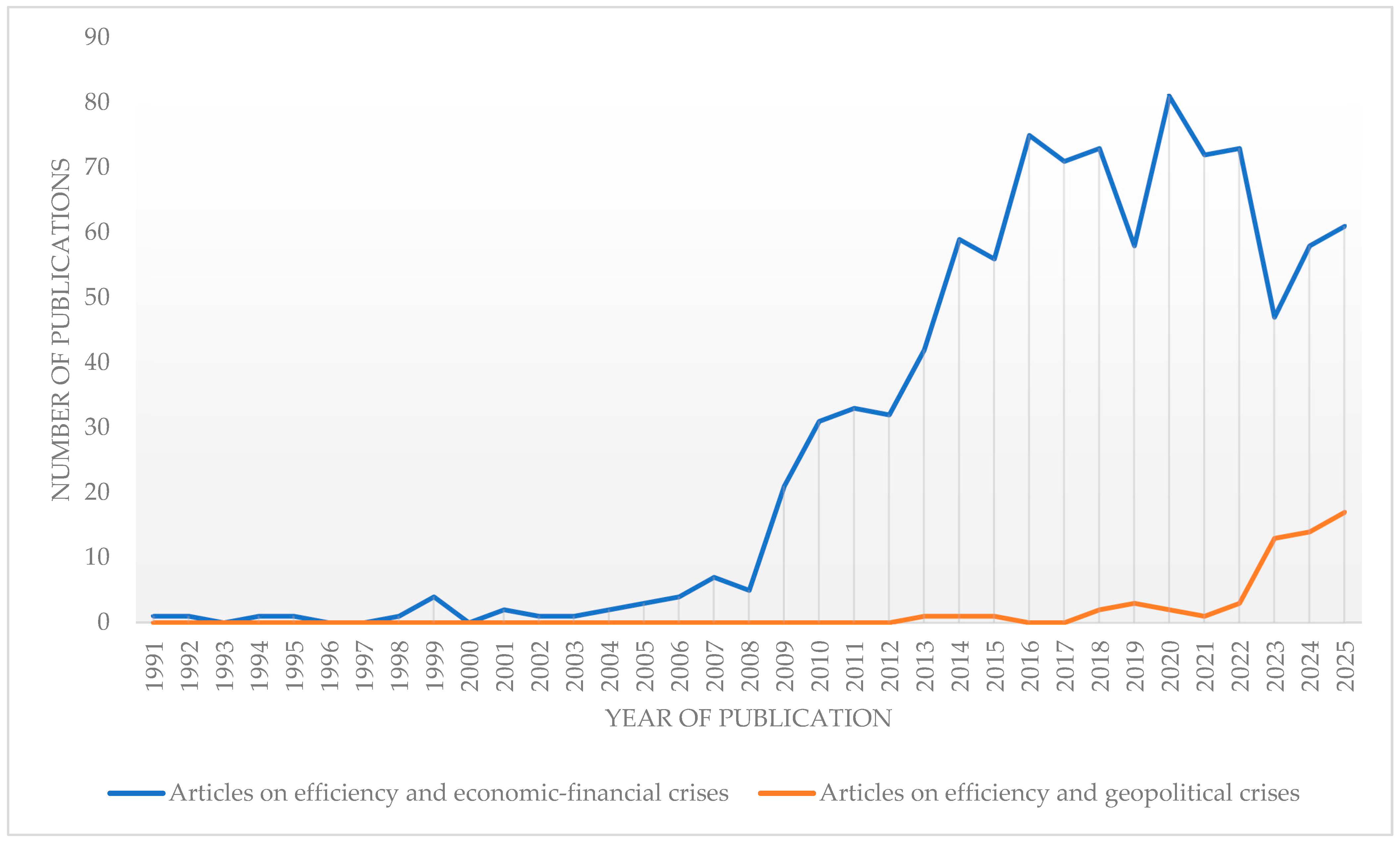
Figure 2 highlights the evolution of research on banking efficiency in relation to two major types of economic–financial and geopolitical crises between 1991 and 2025. The dynamics presented show a significant difference between the two directions, both in terms of publication rate and the moment when scientific interest began to manifest itself consistently.
In the first stage (1991–2007), the literature on banking efficiency in economic and financial contexts is limited in volume, with fewer than ten papers published annually. A notable change occurred after 2008, with the outbreak of the global financial crisis, when the number of publications increased from five articles in 2008 to 21 in 2009 and 31 in 2010. This upward trend continued in the following decade, reaching a peak between 2015 and 2021, with between 56 and 81 articles published annually, reflecting the growing academic interest in the analysis of banking efficiency, post-crisis structural reforms, and the role of financial innovation in improving performance.
In recent years, there has been a slight decline in the pace of publication, but the number remains high, indicating the maturation of the field and its establishment as a central pillar of economic and financial research.
By comparison, studies on banking efficiency and geopolitical crises are relatively recent, with the first contributions appearing after 2013. Until 2020, the number of publications was very low, with only a few isolated articles, but researchers’ interest increased significantly after 2022, in the context of geopolitical tensions and the conflict in Ukraine. Thus, the number of papers increased from three articles in 2022 to 13 in 2023, 14 in 2024, and 17 in 2025, signaling the emergence of a new research direction focused on the impact of geopolitical instability on banking performance and stability.
4.2. Co-Compete Network Analysis of Keywords
To answer RQ1, keyword analysis was performed to identify the main conceptual themes and the relationships between them, highlighting how the literature on banking efficiency has developed and differentiated in the context of economic, financial, and geopolitical crises. This approach allows for the observation of emerging trends, interdisciplinary connections, and thematic dynamics that structure the field of research.
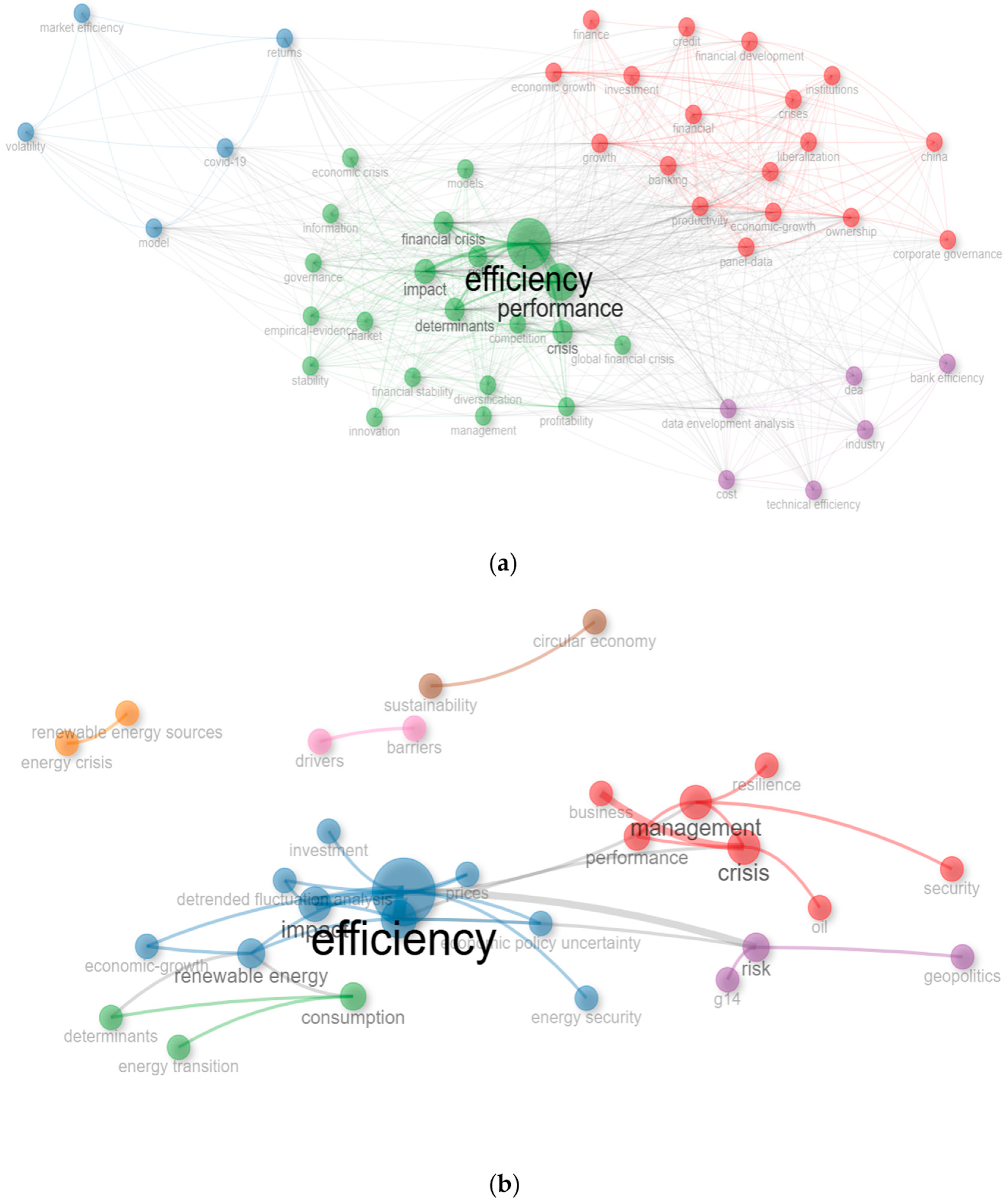
Keyword co-occurrence networks highlight clear differences between the thematic structure of the literature on banking efficiency and economic–financial crises (
Figure 3a) and that on banking efficiency and geopolitical crises (
Figure 3b).
In
Figure 3a, the theme of “efficiency–crisis” is articulated around a dense conceptual core consisting of terms such as efficiency, performance, financial crisis, determinants, stability, and impact, indicating a theoretically and empirically consolidated field. The network is structured around several interconnected clusters: the green cluster, focused on “financial crisis,” “competition,” “management,” and “profitability,” illustrates the orientation towards the analysis of financial performance and the determinants of efficiency; the red cluster, associated with the terms “finance,” “investment,” “economic growth,” and “banking,” reflects the link between efficiency, financial development, and economic growth; and the purple cluster, centered on “bank efficiency,” “DEA,” and “technical efficiency,” highlights the use of quantitative methods, particularly efficiency frontier analysis. On the left, the blue cluster, with terms such as “market efficiency,” “volatility,” and “COVID-19,” captures the recent expansion of the theme to the volatile dimension of markets and the effects of health crises on efficiency.
In contrast,
Figure 3b, dedicated to efficiency and geopolitical crises, reveals a more fragmented network, but with emerging thematic cores. The concept of “efficiency” remains central, but the connections extend to terms such as renewable energy, risk, security, management, geopolitics, and resilience, which shows the orientation of research towards sustainability and energy security. The blue cluster, focused on “renewable energy,” “economic growth,” “investment,” and “energy security,” highlights the relationship between efficiency, energy transition, and economic stability. The red cluster, focused on “management,” “crisis,” “performance,” and “resilience,” reflects concerns about strategies for adapting to geopolitical uncertainty and external risks. Similarly, the purple cluster, formed around the terms “risk,” “oil,” and “geopolitics,” marks the dimension of analysis of security and global tensions on economic efficiency. Isolated elements such as “circular economy” and “sustainability” indicate emerging directions that are in the process of conceptual integration into the literature on efficiency and geopolitical crises. The relatively limited visibility of explicitly banking-related keywords in this network reflects the interdisciplinary nature of the field, where banking efficiency is often analyzed indirectly through macroeconomic, energy, and risk-related frameworks rather than through sector-specific terminology.
Comparatively, the network related to economic and financial crises reflects a mature, well-connected, and methodologically developed field, while the one related to geopolitical crises describes an early but rapidly expanding phase, where efficiency is approached through the prism of energy security, sustainability, and geopolitical risk. This transition from a traditional financial model to a complex, multidimensional, and geopolitical one suggests an evolution of the concept of efficiency toward an integrated perspective on global economic resilience.
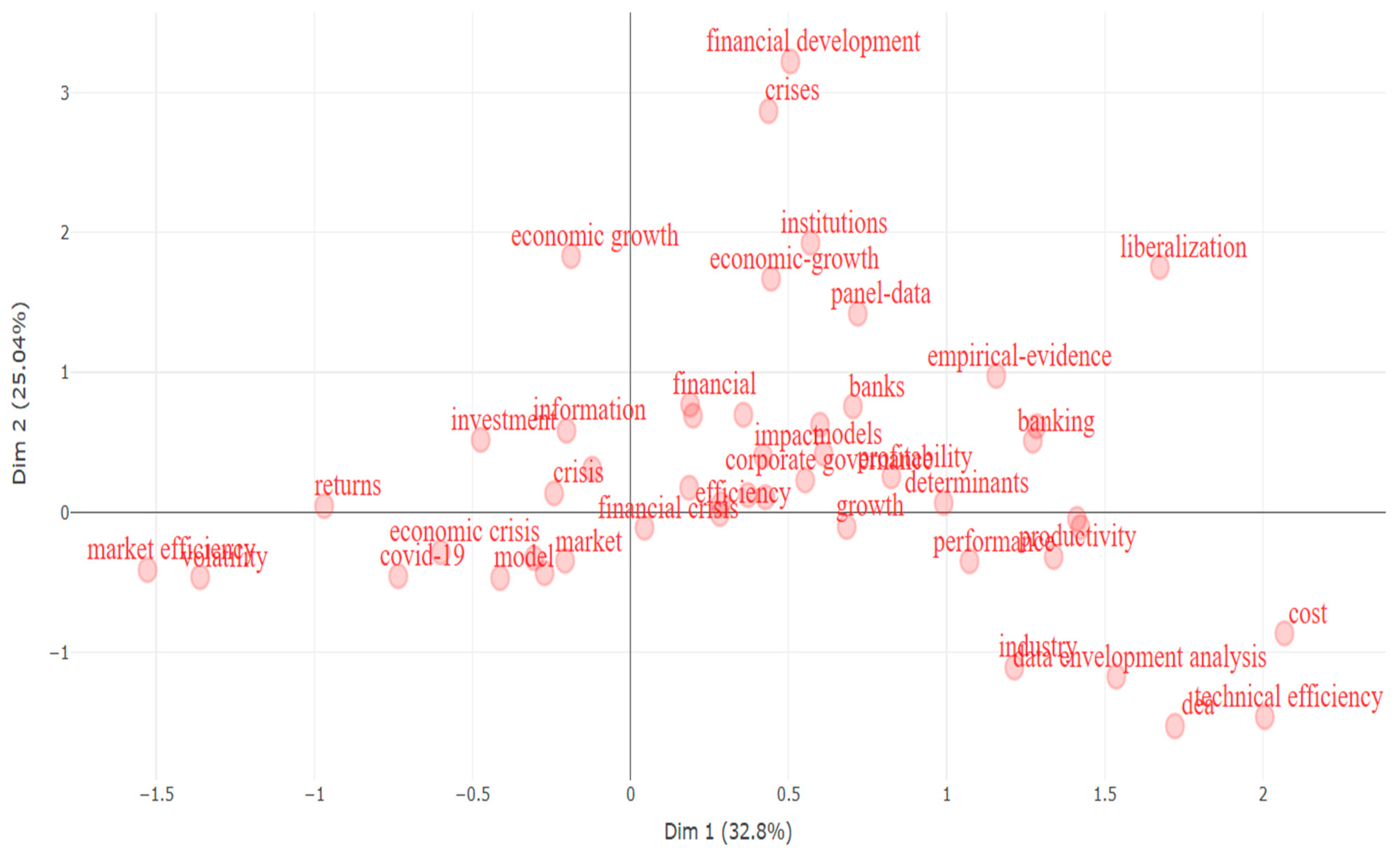
Two-dimensional representations of keywords (through co-occurrence analysis and co-word mapping) provide a comparative perspective on how the topic of banking efficiency is integrated into the literature on economic and financial crises and geopolitical crises, respectively.
In
Figure 4, dedicated to the relationship between efficiency and economic and financial crises, the distribution of terms across the two dimensions (Dim 1 = 32.8%, Dim 2 = 25.04%) shows a concentration around the concepts of financial crisis, efficiency, performance, corporate governance, profitability, and determinants, confirming the mature and well-defined nature of the field. In factorial mapping, these dimensions represent latent semantic axes extracted from the co-occurrence structure of keywords, meaning that each dimension reflects an underlying thematic gradient that organizes the literature conceptually. The terms located in the right quadrant (“financial development,” “institutions,” “liberalization,” and “panel data”) indicate the empirical and institutional directions of research, oriented towards analyzing the relationship between financial development and banking efficiency. In the lower right corner, the grouping of terms DEA, data envelopment analysis, technical efficiency, and cost stands out, defining the methodological side of the studies, based on measuring efficiency frontiers. Their spatial proximity indicates that these concepts frequently appear together in the same studies, suggesting a strong methodological cluster within the field. At the same time, the appearance of the words market efficiency, volatility, and COVID-19 on the left axis highlights the extension of the analysis to the dimension of markets and the influence of global shocks on financial stability. The percentage values associated with each dimension indicate the proportion of total variance in keyword relationships explained by that axis, meaning that higher percentages correspond to stronger explanatory power of the conceptual structure.
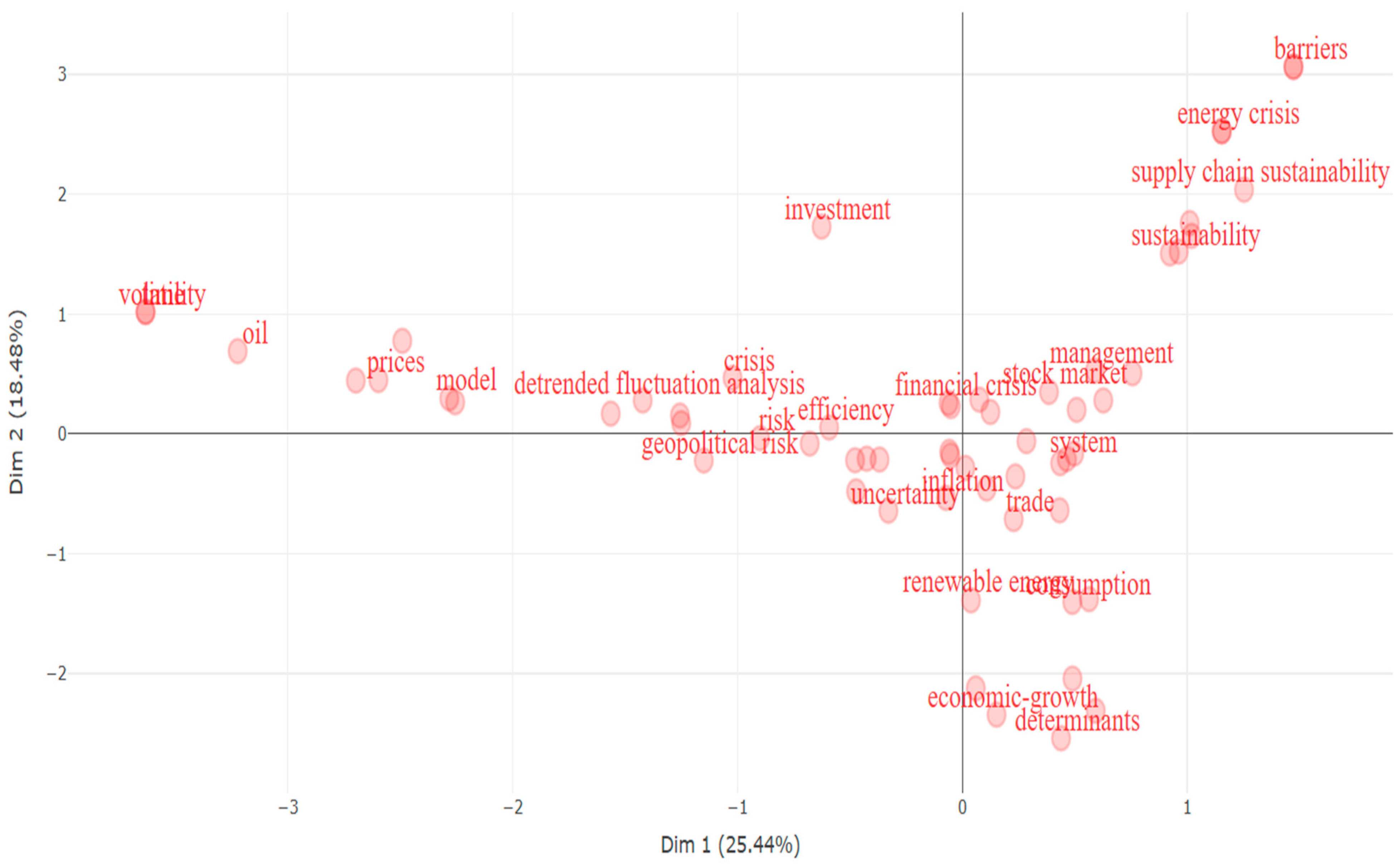
In
Figure 5, relating to banking efficiency and geopolitical crises, the structure is more dispersed, and the explained variance (Dim 1 = 25.44%, Dim 2 = 18.48%) reveals an emerging thematic diversification. Compared with
Figure 4, the lower explained variance indicates a less consolidated conceptual structure, which is typical for newer research areas where thematic patterns are still forming. The central terms—efficiency, financial crisis, geopolitical risk, uncertainty, and risk analysis—define the conceptual core of this new research direction. On the positive axis of the first dimension, the concepts of sustainability, supply chain sustainability, energy crisis, and barriers appear, indicating a strong connection between banking efficiency, geopolitical risks, and energy transition. The terms renewable energy, consumption, economic growth, and trade suggest an expansion of the theme towards the real economy and energy security issues. On the left, the grouping of volatility, oil, prices, and model illustrates the orientation of research towards the analysis of market risk and price volatility in unstable geopolitical contexts. The greater spatial dispersion of keywords compared with
Figure 4 reflects weaker thematic clustering, which is consistent with an interdisciplinary and still-developing research field.
Comparatively,
Figure 5 confirms that the literature on banking efficiency and economic and financial crises is a stable field, dominated by quantitative analyses and empirical models, focused on performance, profitability, and financial stability. In contrast,
Figure 6 shows that research on banking efficiency and geopolitical crises is in a formative phase, increasingly focusing on interdisciplinary topics such as sustainability, energy security, and geopolitical risks. Taken together, the factorial analysis complements the co-occurrence network by not only showing which keywords are connected, but also revealing the latent conceptual structure that organizes the field along major thematic dimensions. This evolution highlights the transition of the literature from a traditional economic perspective to a global and integrated one, in which banking efficiency is analyzed as a key element of economic resilience and international systemic stability.
4.3. Authors’ Co-Citation Network
To answer RQ2, the co-author network was analyzed to capture the structure of scientific collaborations, identifying research clusters, the degree of connectivity, and the formation of two distinct directions of analysis—one focused on financial stability, the other on geopolitical risks. This analysis reveals the dynamics of academic interactions and the impact of collaborations on strengthening the field of banking efficiency.
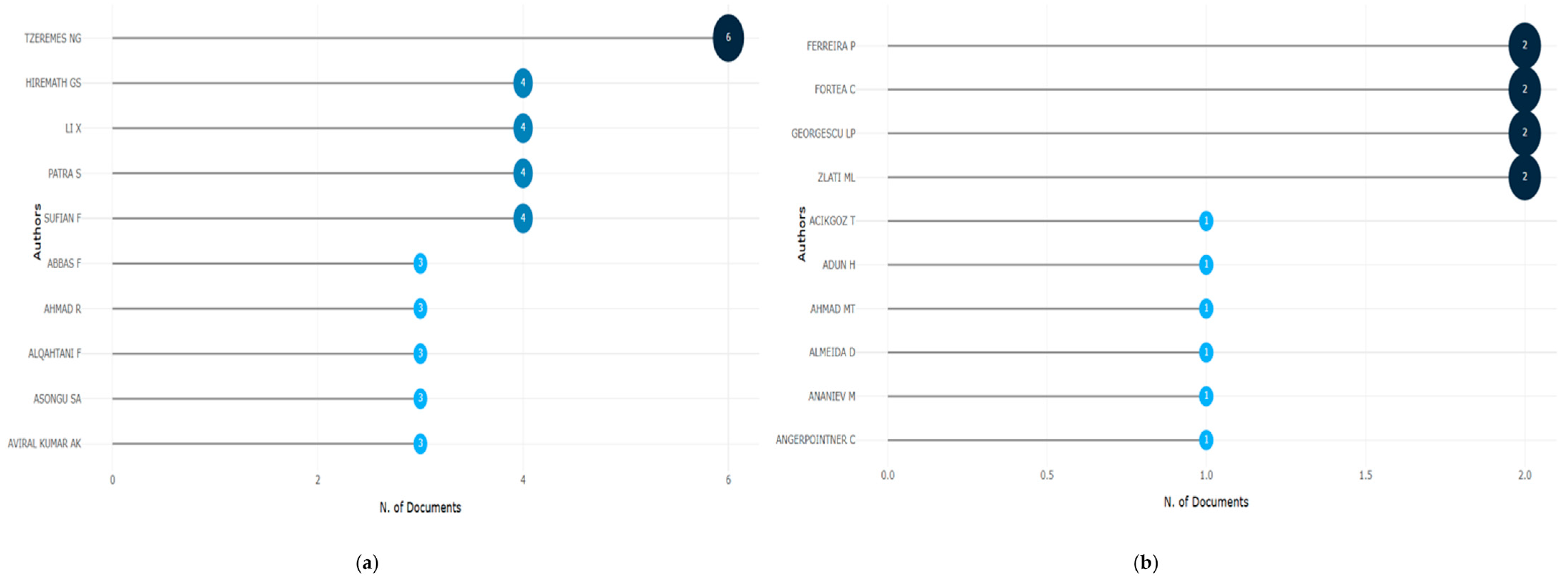
In the field of efficiency and economic and financial crises, scientific output is characterized by a relatively dispersed authorship structure rather than being dominated by a tightly consolidated group of specialists. The leader is Tzeremes N.G., with six published works, followed by Hiremath G.S., Li X., Patra S., and Sufian F., each with four articles. Other important authors, such as Abbas F., Ahmad R., Alqahtani F., Asongu S.A., and Aviral Kumar A.K., have published three papers each (
Figure 6a). Given the total sample size, these figures indicate a broad distribution of contributions across many researchers, addressing topics such as the performance of banking institutions, market liberalization, and financial resilience. This pattern suggests a mature but widely distributed research field in which contributions are produced by a large and heterogeneous scholarly community rather than concentrated within a narrow core of authors.
In contrast, the literature on banking efficiency and geopolitical crises (
Figure 6b) shows a smaller yet relatively more concentrated authorship pattern, characterized by a limited number of active contributors. The most productive authors—Ferreira P., Fortea C., Georgescu L.P., and Zlati M.L.—have published two papers each, while the rest (Acikgoz T., Adun H., Ahmad M.T., Almeida D., Ananiev M., and Angerpointner C.) have one article each. Although the absolute number of publications is modest, the proportion of contributions attributable to the leading authors is comparatively higher than in the economic–financial crisis dataset, indicating a moderate level of concentration typical of emerging research niches.
This fragmented distribution reflects the early stage of research on the interaction between banking efficiency and geopolitical crises, where contributions come from different geographical areas and disciplines, without the existence of a central core of dominant authors. However, the involvement of European and Asian researchers indicates an emerging trend toward internationalization and an interdisciplinary focus on economic security, geopolitical risk, and financial sustainability, suggesting that the field is currently transitioning from an exploratory phase toward a more structured research trajectory.
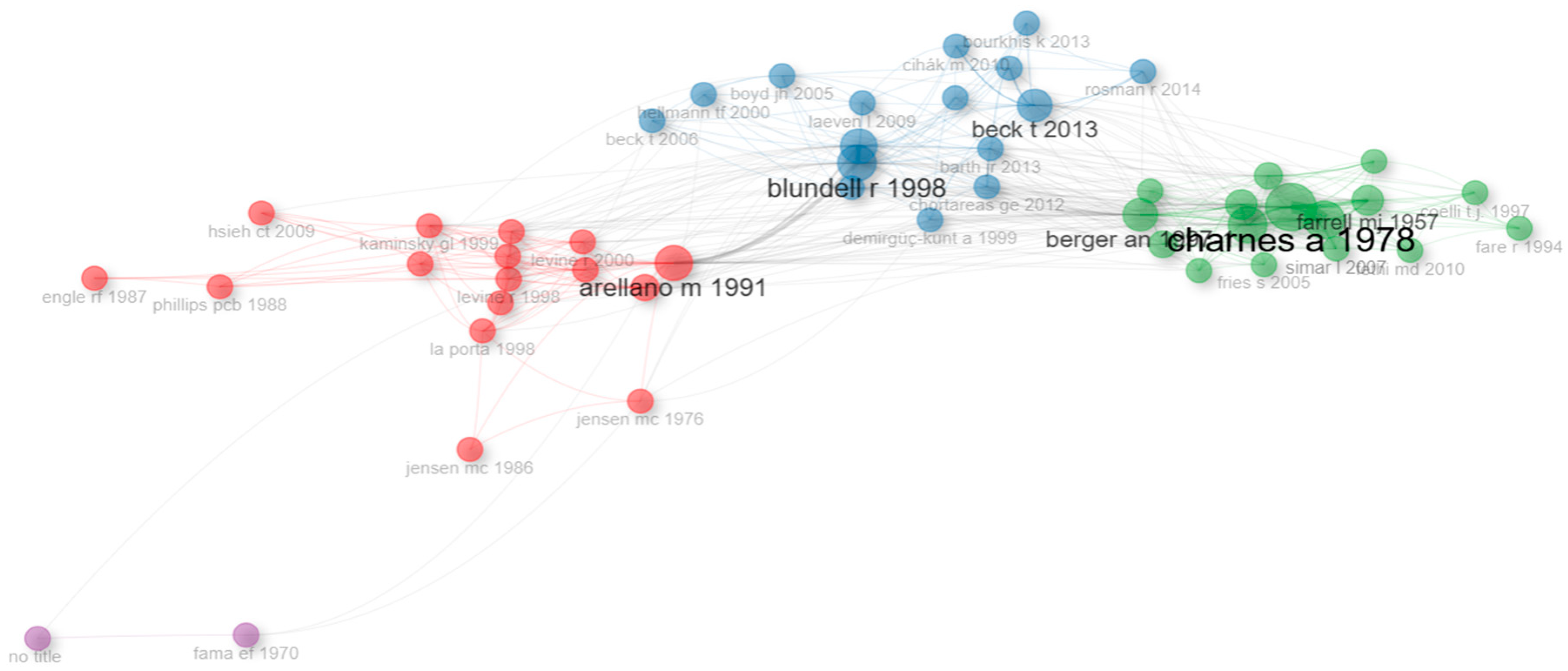
Co-citation maps highlight the intellectual structure of the field of “banking efficiency and crises,” outlining two major directions of scientific development. The first direction, devoted to economic and financial crises, reflects a mature and well-established theoretical field, while the second, focused on geopolitical crises, indicates an emerging area undergoing an accelerated process of conceptual consolidation. Together, they illustrate the transition from a strict financial approach to an integrated one, combining economic, geopolitical, and sustainability dimensions (
Figure 7).
In the literature on banking efficiency in times of economic and financial crisis, the conceptual structure is complex and highly interconnected. Three major centers of influence can be distinguished. The first group includes the classic works of Charnes, Farrell, and Berger, which underpin efficiency analysis through data envelopment analysis models and stochastic frontiers. These studies have contributed to defining the methodologies used in assessing banking performance and productivity. The second group is represented by the research of
Beck et al. (
2013), which extends the analysis to the applied dimension of financial stability, using dynamic panel models and GMM estimation methods. These contributions have facilitated a better understanding of the relationship between financial development, banking regulations, and the impact of crises on efficiency. The third group is associated with the authors Arellano, Levine, and La Porta, who make an essential methodological contribution by applying advanced econometrics to studies on corporate governance, financial liberalization, and institutional performance. Therefore, the literature in this area presents a robust theoretical and empirical framework based on the interdependence between efficiency, financial stability, and economic reforms.
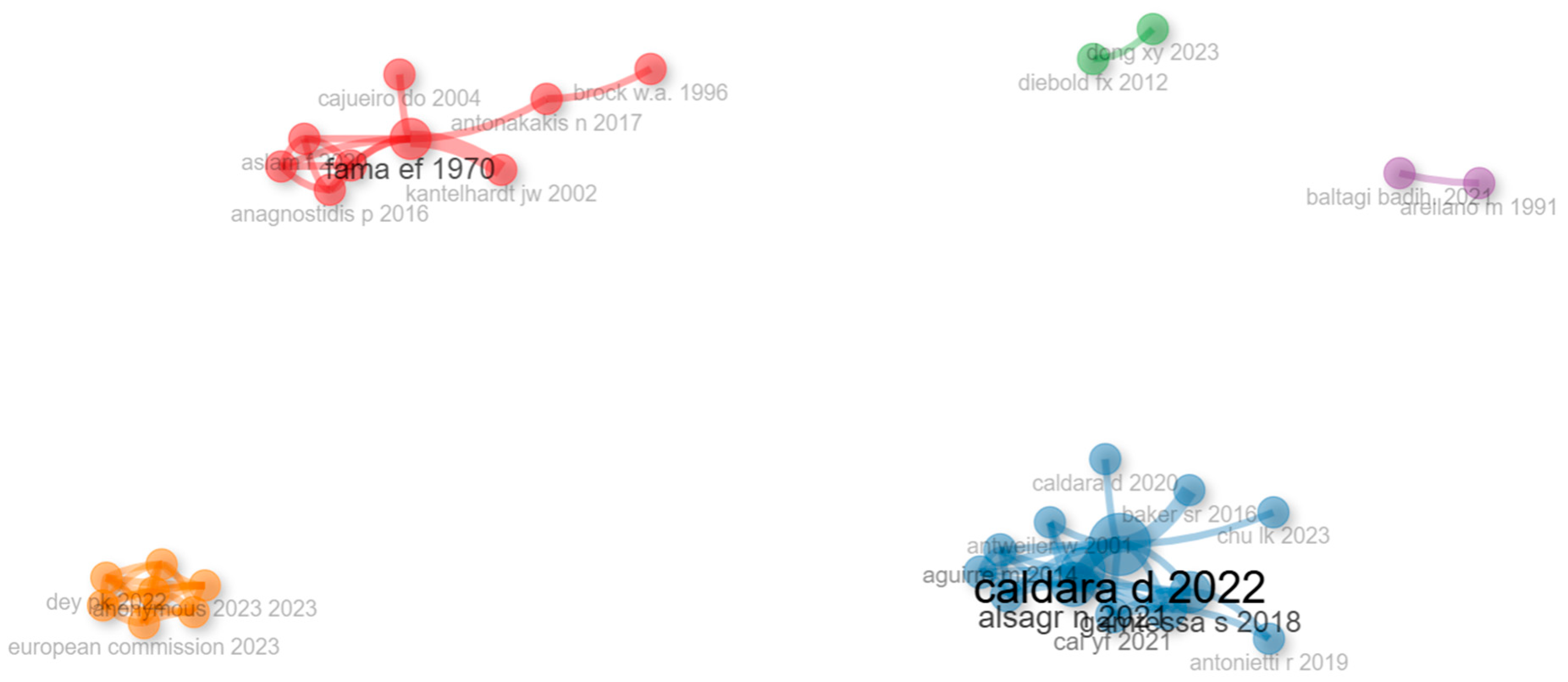
In contrast, the literature on banking efficiency in the context of geopolitical crises is at an early stage of development but shows significant thematic diversification (
Figure 8). The co-citation analysis shows a fragmented structure, consisting of several groups of papers with limited links between them, but with emerging directions of high relevance. The most important core is formed around the research of Caldara and Alsagr, who introduce the concept of the “Geopolitical Risk Index” and explore the link between geopolitical uncertainty, financial volatility, and economic efficiency. Another important group, centered around Fama’s theory of efficient markets, provides the basis for analyzing market reactions to geopolitical tensions and external shocks.
Recent contributions by the European Commission and authors Dey and Ahmed bring an institutional and political dimension, focusing on energy security and financial sustainability. At the same time, the work of Diebold and Dong focuses on market risk and the correlations between volatility, investment, and trade flows, while the studies by Arellano and Baltagi ensure methodological continuity through the application of dynamic panel models.
Therefore, a comparative analysis of the two networks confirms differences in maturity and conceptual coherence. Studies on banking efficiency in economic and financial crises are based on a solid scientific tradition and a consolidated methodology, while research on banking efficiency in the context of geopolitical crises represents a new interdisciplinary direction, oriented towards the integration of geopolitical risk, energy security and economic sustainability.
4.4. Collaborative Institutional Analysis of Co-Authors
To answer RQ3, institutional networks and academic affiliations involved in banking efficiency research were investigated to highlight differences between centers focused on economic and financial crises and those focused on geopolitics. This analysis provides insight into how institutional distribution influences the thematic orientation and global visibility of research.
The evolution of institutional productivity highlighted in the two graphs shows significant differences between the academic structure of research on banking efficiency and economic and financial crises and that on banking efficiency and geopolitical crises. The analysis reveals not only the degree of maturity of the two fields, but also the profile of the universities involved and the dynamics of research internationalization.
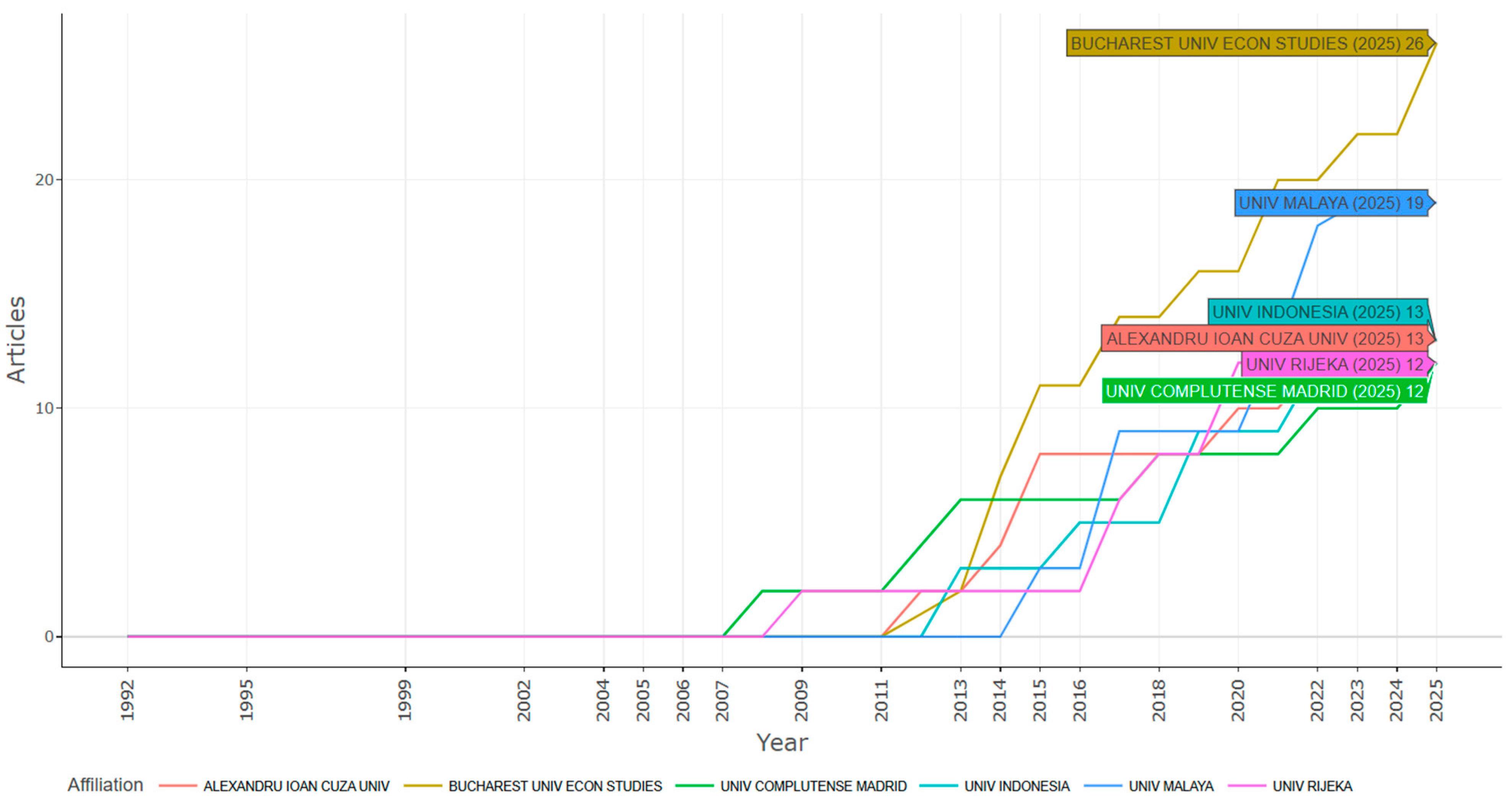
In the first case (
Figure 9), that of the literature dedicated to banking efficiency in economic and financial contexts, there has been a steady and sustained increase in the number of publications since 2010. The most active institutions are the Bucharest University of Economic Studies, with 26 articles published by 2025, and the University of Malaya, with 19 articles, followed by the University of Indonesia and the Alexandru Ioan Cuza University in Iași, both with 13 papers, as well as the University of Rijeka and Complutense University of Madrid, each with 12 articles. Despite the visibility of these leading institutions, their contributions represent only a limited share of the total dataset, indicating that scientific production is distributed across a broad range of universities rather than concentrated in a small institutional core. These results indicate a significant concentration of research in universities in Central and South-Eastern Europe, but also an expansion towards Asian institutions, confirming the global nature of interest in the topic of banking efficiency in times of economic crisis. The growth rate of publications, especially after 2014, coincides with the intensification of debates on post-crisis reforms and digital transformations in the banking system, which also explains the strengthening of the position of Romanian and Asian institutions in this field.
In contrast, the analysis of banking efficiency in relation to geopolitical crises (
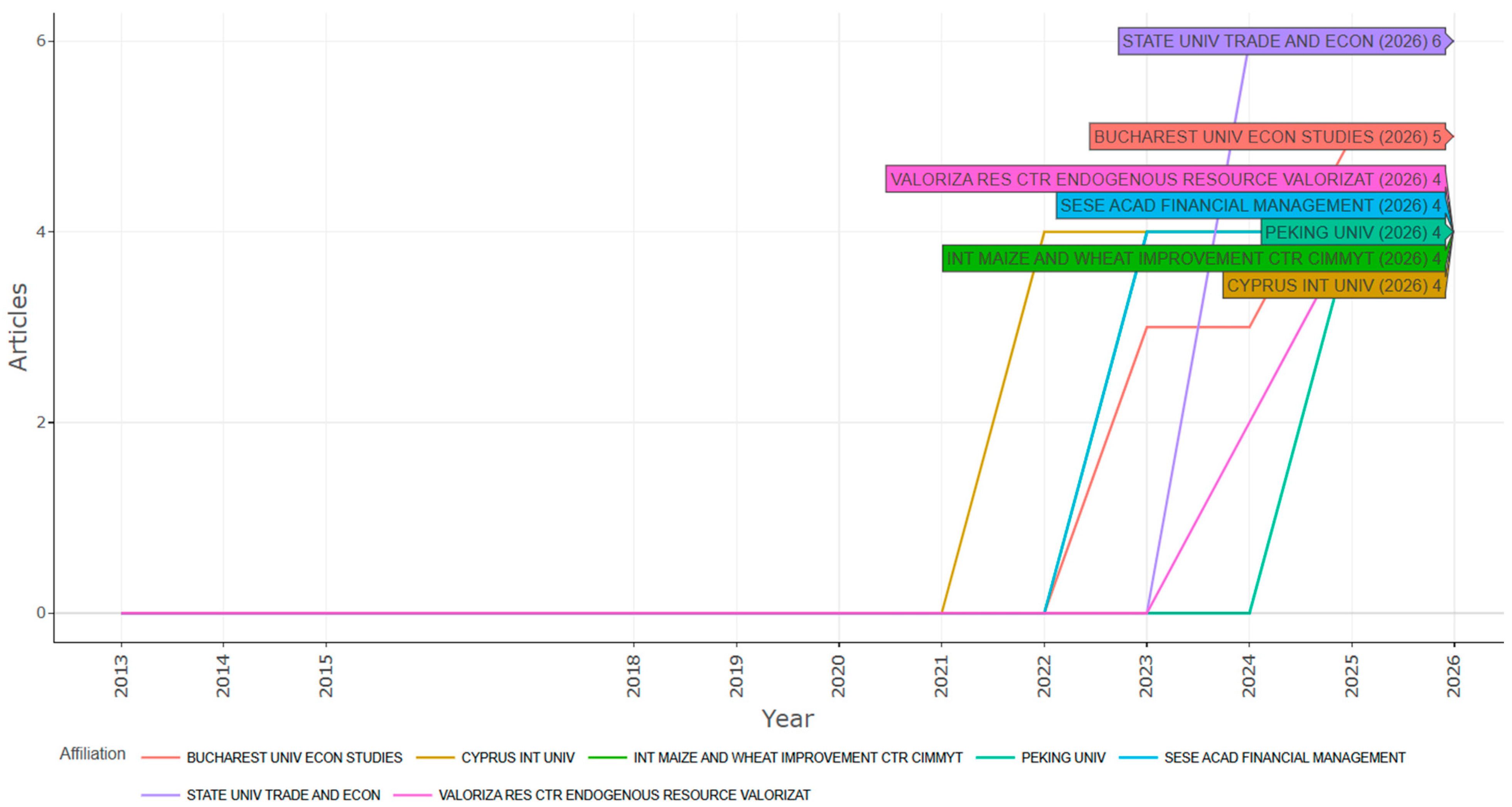
Figure 10) paints a different, more recent and relatively more concentrated institutional landscape. The first notable contributions appear after 2020, and the growth dynamic only accelerates after 2022, against the backdrop of amplified geopolitical risks and conflict in Eastern Europe. The most active academic centers are the State University of Trade and Economics, with six publications, the Bucharest University of Economic Studies, with five papers, and a group of institutions with four articles each, including Peking University, Cyprus International University, the International Maize and Wheat Improvement Center (CIMMYT), the SESE Academy of Financial Management, and the Valoriza Research Center for Endogenous Resource Valorization. Given the relatively small total number of publications in this strand, the share attributable to the leading institutions is proportionally higher, which explains the apparent concentration observed in the figure. This institutional diversity reflects an interdisciplinary approach that integrates economics, geopolitics, risk management, and sustainability, marking an expansion of scientific interest beyond the traditional financial domain. Thus, compared with the economic–financial crisis literature, the geopolitical strand is not institutionally fragmented but rather characterized by a compact yet still developing institutional structure typical of emerging research areas.
4.5. Country-Level Research Analysis and Collaboration
To answer RQ4, the international collaboration network was analyzed to determine the geographical distribution, intensity of cooperation, and degree of internationalization of research on banking efficiency. This perspective allows for a comparison of how countries approach efficiency based on economic and financial vulnerabilities and exposure to geopolitical risks.
International collaboration maps provide a comparative picture of the geographical distribution and intensity of academic cooperation in the field of banking efficiency, analyzed from the perspective of economic and financial crises and geopolitical crises.
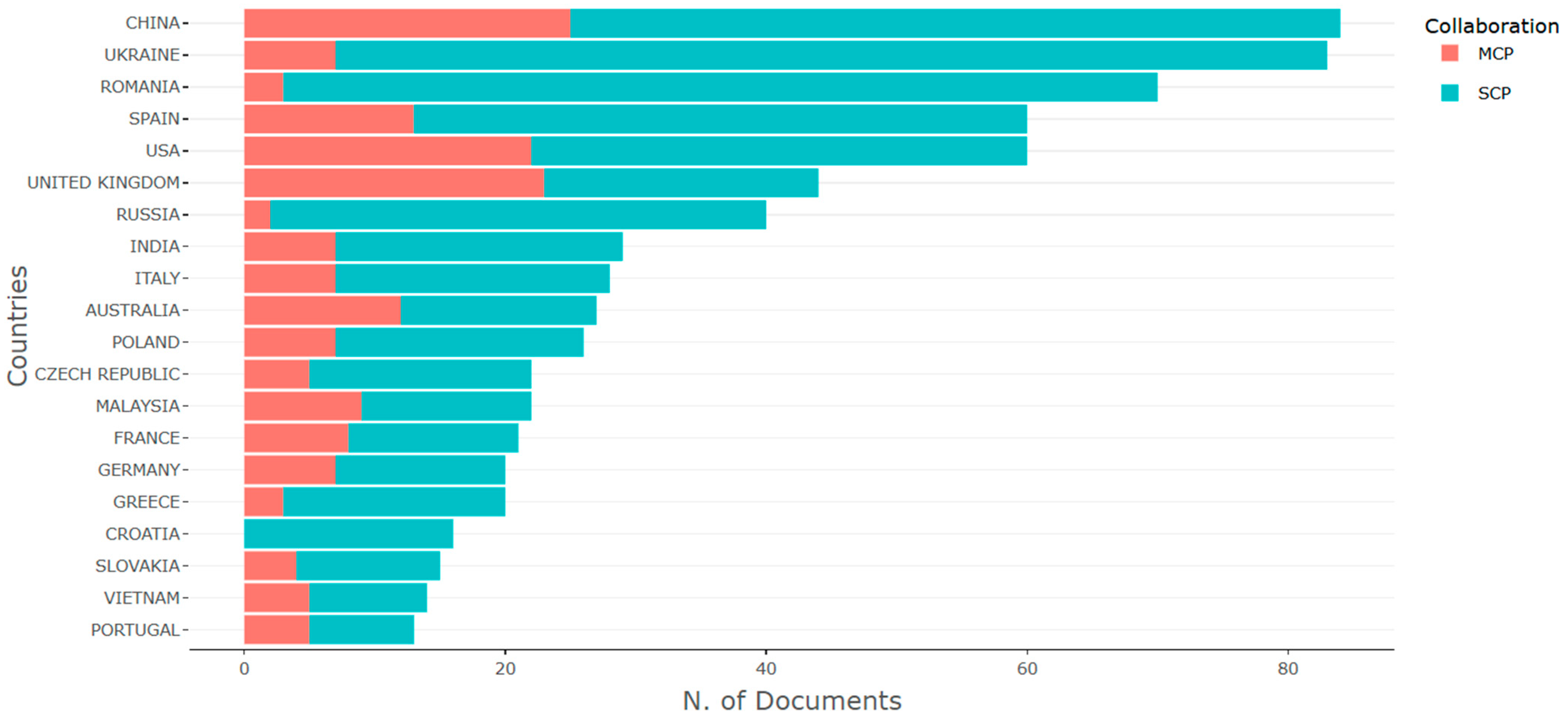
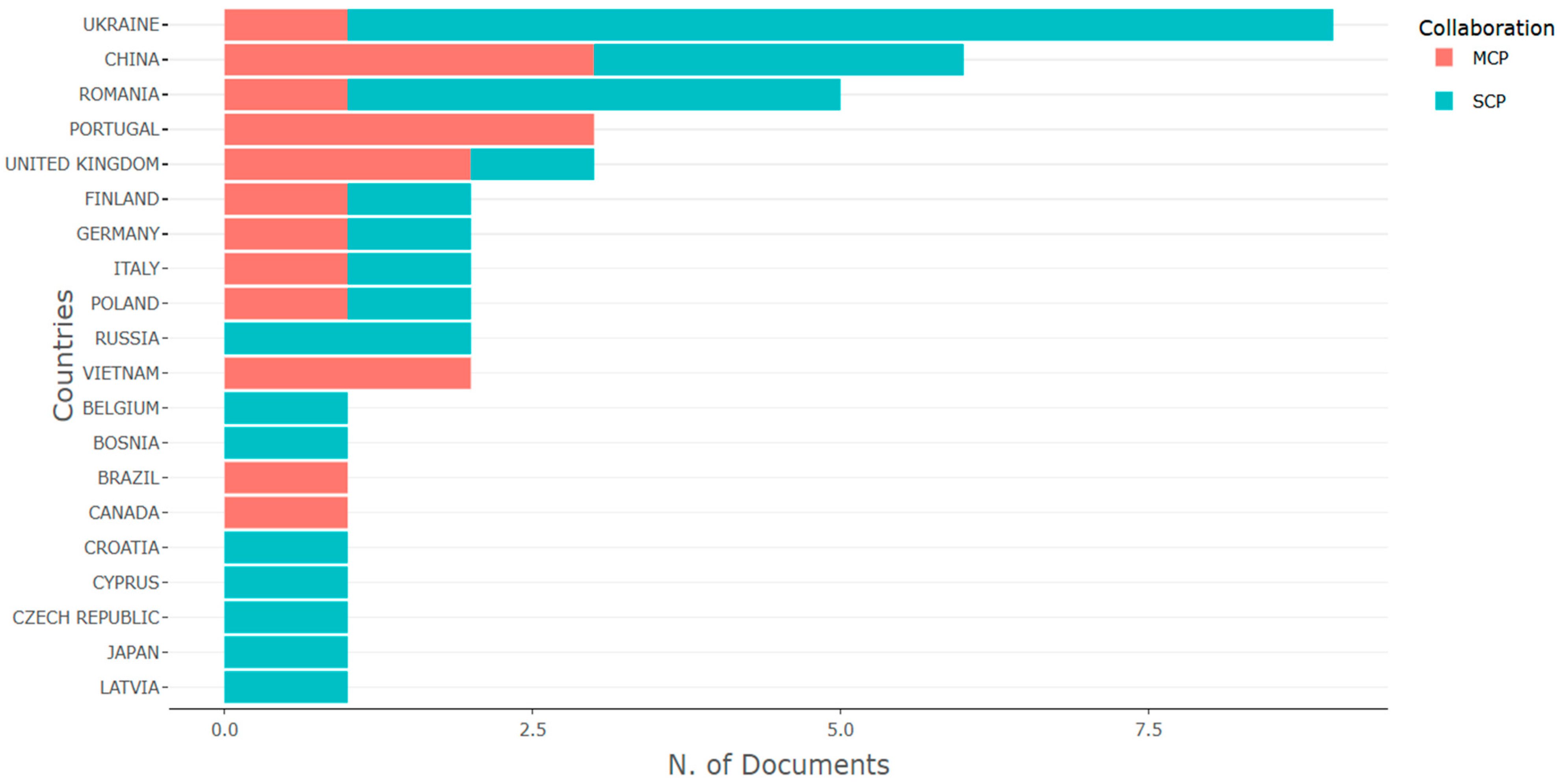
The analysis of the distribution of publications by country and type of collaboration highlights the main centers of scientific production and models of international cooperation that define studies on banking efficiency in crisis contexts. The results illustrate how different countries contribute to the development of this area of research, with significant variations in the volume of publications, the degree of internal and international collaboration, and institutional involvement in global knowledge networks.
Figure 11, which reflects the literature on banking efficiency and economic and financial crises, shows a balanced global distribution, with a high number of publications from developed and emerging economies. China ranks first globally, with over 80 documents, followed by Ukraine and Romania, each with a substantial contribution, demonstrating the growing interest in analyzing banking performance and the resilience of financial systems in the context of economic instability. Other major centers of scientific production are Spain, the United States, the United Kingdom, Russia, India, and Italy, complemented by regional players such as Australia, Poland, and the Czech Republic.
In terms of the type of collaboration, single-author or internal collaboration articles (SCPs—Single-Country Publications) predominate, but a significant proportion of international collaborations (MCPs—Multiple-Country Publications), particularly between China, Romania, Ukraine, and Western European countries, indicate a high degree of scientific openness. The strong presence of Romania and Ukraine in the top positions reflects the regional dynamics of Eastern Europe, where economic transition and post-crisis challenges have stimulated an intensification of research on banking efficiency. Overall, the field is characterized by a dense, internationalized, and multidimensional scientific network, confirming the academic maturity of studies on banking efficiency in a financial context.
In contrast, the graph on banking efficiency and geopolitical crises illustrates a more restricted structure, dominated by a few emerging research centers (
Figure 12). Ukraine ranks as the main contributor, followed by China, Romania, and Portugal, while countries such as the United Kingdom, Finland, Germany, Italy, Poland, and Russia play secondary roles.
Although the total number of publications is significantly lower, the collaborative pattern reveals an increase in international collaborations, reflected in a relatively high number of articles produced in partnership (MCPs). This trend confirms that the topic of banking efficiency in correlation with geopolitical crises is still in its conceptual formative phase, attracting the attention of researchers from countries directly affected by recent geopolitical tensions, particularly in Eastern Europe. At the same time, the presence of Asian (China, Vietnam, and Japan) and Western European (United Kingdom, Germany, and Finland) countries demonstrates a gradual expansion of the collaboration network and an interesting convergence between developed and emerging economies.
4.6. Future Research Directions
To answer RQ5, the analysis of future research directions focused on identifying emerging themes and the connections between them, with the aim of formulating an integrated framework that correlates banking efficiency, economic and financial crises, and geopolitical challenges. This stage contributes to anticipating future developments in the field by integrating digital, green, and global resilience dimensions.
The conceptual analysis of the two thematic maps provides a detailed picture of current and future research directions on banking efficiency from the perspective of economic and financial crises and geopolitical crises. The positioning of the themes in the density–centrality quadrants indicates the stage of development of each subdomain, the degree of theoretical integration, and the potential for evolution towards new scientific paradigms.
In
Figure 13, dedicated to efficiency and economic and financial crises, a well-defined structure can be observed, dominated by two main directions. The Basic Themes quadrant includes “efficiency,” “crisis,” and “financial crisis,” confirming that the analysis of financial performance and resilience is the conceptual foundation of the field. These themes have a high centrality, which gives them the role of pillars of empirical research on banking stability in times of economic turmoil. At the same time, the theme “economic growth—panel data,” also located in the basic quadrant, suggests methodological consolidation, as future research will continue to use panel data models and advanced econometric techniques (FMOLS, GMM, and quantile regression) to analyze the impact of digitization, crises, and structural reforms on efficiency.
In the niche themes quadrant, the cluster composed of “performance,” “determinants,” and “growth” reflects a specialized but internally well-developed line of research rather than a motor theme of the field. Its position indicates high thematic density but relatively lower centrality, meaning that these topics are conceptually cohesive yet less structurally connected to the broader thematic core. Also, the presence of the themes “returns,” “volatility,” and “market efficiency” in the niche quadrant shows an emerging interest in analyzing the behavior of financial markets and the dynamics of returns in times of uncertainty, a direction that may evolve toward predictive models integrated into banking performance analysis. Looking ahead, future research will tend to correlate banking efficiency more strongly with macroeconomic sustainability and stability, emphasizing the convergence between institutional analysis and financial governance instruments.
In
Figure 14, dedicated to efficiency and geopolitical crises, the thematic landscape is much more diverse and interdisciplinary, indicating a phase of conceptual expansion. The driving themes are “efficiency,” “management,” and “impact,” suggesting that future research directions will focus on assessing the ability of banking institutions to respond to geopolitical risks through strategic management geared toward resilience and sustainability. The emergence of the concepts of “energy crisis,” “energy security,” and “cointegration” signals the integration of the energy and security dimensions into efficiency analysis, opening up a new interdisciplinary framework between finance, geopolitics, and the green economy.
Themes in the central quadrant, such as “geopolitics,” “security,” “COVID-19,” and “renewable energy,” outline emerging trends that may define future research paradigms. In particular, the intersection between efficiency, geopolitics, and climate change offers opportunities to develop new models for analyzing systemic risk and assessing the impact of energy transition policies on the banking sector. At the same time, the themes in the lower left quadrant—sustainable development, competition, and financial crisis—represent emerging directions that can be expanded through comparative studies on how banks adopt sustainable practices in volatile geopolitical contexts.
In the long term, research developments will be marked by the development of an integrated agenda focused on the interdependence between financial efficiency, energy security, and geopolitical stability, with an emphasis on analyzing the bidirectional causality between the performance of financial institutions and global risks.
Themes on efficiency and economic–financial crises tend to stabilize around quantitative analyses and traditional determinants of performance, while research on efficiency and geopolitical crises is evolving towards an integrative, interdisciplinary approach that connects economics, security, and sustainability. This transition indicates that the future of research will increasingly focus on systemic and multidimensional models capable of capturing the complex interactions between banking resilience, geopolitical risks, and global economic transformations.
5. Discussion
The bibliometric results offer a structured and evidence-based perspective on how banking efficiency has been conceptualized in academic research in relation to economic, financial, and geopolitical crises. Rather than measuring efficiency itself, the analysis traces how scholars have framed, connected, and discussed this concept across different thematic contexts. In this sense, the findings reveal patterns in scientific discourse and research priorities, not empirical causal relationships between efficiency and external factors. It is important to acknowledge that bibliometric methods identify trends in published research (
Gherțescu et al., 2025) rather than test theoretical propositions or validate empirical mechanisms, which limits their capacity to directly assess the practical or predictive relevance of future research directions.
Regarding RQ1, the literature shows a clear shift in how banking efficiency is positioned conceptually. Earlier studies tended to examine efficiency primarily through traditional indicators such as cost or profit optimization, whereas more recent research increasingly situates it within broader analytical contexts involving crises, uncertainty, and systemic risk. This shift does not imply that efficiency has been empirically demonstrated to function as an adaptive mechanism, but it does indicate that scholars are progressively embedding the concept within more complex theoretical frameworks. Thus, the evolution observed is intellectual rather than operational: it reflects how research attention has expanded the interpretative scope of efficiency.
The results corresponding to RQ2 indicate that collaboration patterns vary depending on thematic focus. Research on economic and financial crises tends to be organized around relatively stable scholarly communities, suggesting a mature field with established methodological traditions. By contrast, studies addressing geopolitical crises display smaller and more recent collaboration networks, which is typical of developing research areas. These differences should be understood as characteristics of scientific production structures rather than as indicators of real-world banking behavior or institutional effectiveness.
The institutional patterns observed for RQ3 further support this interpretation. Established universities and long-standing research centers are more prominent in publications dealing with traditional aspects of banking efficiency, while newer or more specialized institutions appear more frequently in emerging thematic areas. This distribution reflects how knowledge production evolves as new topics gain academic attention. It does not indicate institutional superiority or influence on banking systems, but rather illustrates how different types of institutions contribute at different stages of research development.
The geographical analysis addressing RQ4 highlights variation in the spatial distribution of scientific output. Studies on financial crises are widely dispersed across countries and regions, indicating a well-established and internationally integrated research domain. In contrast, publications on geopolitical crises are more regionally concentrated and temporally recent. This pattern suggests differences in the diffusion and maturity of research themes rather than structural differences between national banking systems. In other words, the maps describe where research is produced, not where banking efficiency is higher or lower.
For RQ5, the thematic clustering and keyword evolution analysis identifies directions that appear repeatedly in the literature. These directions should be interpreted as observable research tendencies rather than prescriptive recommendations. The bibliometric evidence indicates growing scholarly attention to interdisciplinary connections, particularly those linking efficiency with sustainability, risk, and macroeconomic stability. Such patterns signal expanding conceptual boundaries within the academic debate, without implying that these relationships have been empirically validated. Consequently, the proposed research avenues should be understood as analytically inferred trajectories grounded in publication trends, whose empirical relevance remains to be tested by future quantitative or qualitative investigations.
The future research avenues summarized in
Table 2 are therefore grounded in recurring thematic configurations detected in the bibliometric maps, reflecting patterns such as the association of efficiency with digital transformation, geopolitical risk, sustainability, market volatility, and cross-country comparisons identified in the analyzed literature. They are presented as analytically supported possibilities for further investigation, not as normative agendas, since each proposed direction derives from observable keyword clusters and thematic trajectories rather than from prescriptive assumptions. Their corresponding methodological suggestions illustrate how future empirical studies might examine these themes using appropriate analytical tools, ensuring that the proposed directions remain anchored in bibliometric evidence while recognizing that additional empirical validation is necessary to establish their explanatory or practical relevance.
Overall, the results indicate that the literature on banking efficiency is gradually moving toward broader conceptual integration, incorporating perspectives from adjacent domains such as sustainability studies, risk analysis, and political economy (
Bădîrcea et al., 2020;
Adel & Naili, 2024;
A. G. Manta et al., 2024b;
Udeaja et al., 2024). This transformation should be interpreted as a change in the intellectual structure of the field rather than as evidence of changes in banking practice itself. The main contribution of this study therefore lies in mapping the evolution of the research landscape and clarifying how themes, collaborations, and conceptual orientations have developed over time. Accordingly, the study’s conclusions are intended to describe the development of scholarly knowledge rather than to predict future developments in banking systems or policy outcomes.
6. Conclusions, Recommendations, Implications, Future Directions and Limitations
This study shows that banking efficiency functions as a key enabling capability that supports sustainability-oriented digital innovation and the consolidation of adaptive organizational architectures under systemic uncertainty. Within the scope of the present bibliometric analysis, this characterization is derived from recurring thematic associations observed in the literature rather than from direct empirical measurement of efficiency outcomes. Beyond its traditional role as a technical indicator of performance, efficiency is conceptualized as a systemic capability that helps align digital innovation initiatives with sustainability objectives and strengthens an organization’s capacity to withstand, absorb, and adjust to disruptions. This interpretation reflects how the concept is framed across scholarly publications, as evidenced by thematic clusters and keyword co-occurrence patterns.
The findings also indicate a clear evolution in academic discourse. The literature has moved from a predominantly financial performance and macro-stability framing toward a more integrated perspective in which banking efficiency is embedded in sustainability-oriented strategic management and digital transformation agendas. This conclusion is supported by the temporal and thematic distribution of keywords and clusters identified in the bibliometric maps. Within this broader framing, banking efficiency is increasingly discussed as a strategic mechanism that enhances the coherence of sustainability and digitalization efforts, improves coordination across financial and innovation ecosystems, and reinforces organizational adaptability amid financial, geopolitical, and environmental shocks. These patterns describe developments in the academic debate rather than verified causal effects in banking systems. Overall, the study positions banking efficiency as an important driver of long-term sustainability outcomes and adaptive capacity within digitally enabled economic systems, in the sense that it is recurrently treated as such in the literature analyzed.
From a theoretical standpoint, banking efficiency functions as a bridge between two scientific paradigms: the economic–financial paradigm, consolidated through econometric modeling, performance indicators, and theories of market stability, and the emerging geopolitical paradigm, which integrates variables related to security, sustainability, and global governance. This bridging role is inferred from the coexistence of these thematic domains within the same bibliometric clusters and citation networks. This convergence underscores a fundamental shift in perspective—from internal institutional efficiency toward systemic efficiency capable of absorbing external shocks and contributing to macroeconomic equilibrium during periods of instability, as reflected in the evolution of research themes over time.
Methodologically, future research directions point toward the development of an integrated analytical framework based on dynamic econometric models, network analysis, machine learning techniques, and multidimensional stress testing. These methodological avenues are proposed on the basis of analytical approaches frequently referenced within the mapped literature and should therefore be interpreted as research tendencies rather than prescriptive recommendations. The combination of these approaches will enable a deeper understanding of the mechanisms through which banking efficiency responds to global crises and contributes to both macroeconomic and geopolitical stability. However, testing such mechanisms requires empirical investigation beyond bibliometric evidence. In this sense, banking efficiency can be regarded as the “hidden systems link” connecting economic and geopolitical vulnerabilities, acting as a systemic resilience factor within the architecture of the global economy, as suggested by recurrent conceptual linkages identified across thematic clusters.
The implications of this study are both theoretical and policy-relevant, as they refine how banking efficiency is understood under systemic uncertainty and clarify why higher efficiency is repeatedly associated in the literature with stronger adaptive capacity during episodes of economic–financial disruption and geopolitical stress. This association reflects patterns observed in prior studies rather than relationships demonstrated within the present analysis. From a theoretical standpoint, the study extends conventional efficiency frameworks by embedding them within a sustainability- and risk-oriented perspective. In this approach, efficiency is not treated as an isolated operational outcome, but as a capability that interacts with sustainability objectives, energy security constraints, and geopolitical risk exposures, thereby supporting a more integrated research agenda at the intersection of environmental economics, innovation studies, and financial stability, as indicated by the interdisciplinary thematic structures identified.
These conceptual insights carry direct relevance for policymakers and supervisors because they point to practical ways in which supervisory architecture can better capture the efficiency–sustainability–digitalization nexus during periods of heightened uncertainty. Such implications should be interpreted as analytically informed reflections derived from the literature structure rather than as policy prescriptions validated by empirical testing. In particular, the results suggest that efficiency metrics can be used more productively when they are interpreted in a forward-looking manner and embedded in supervisory assessments alongside risk governance and operational capacity, rather than being viewed primarily as retrospective performance ratios. This suggestion is consistent with the analytical directions emphasized in the reviewed studies.
Moreover, the study indicates that stress-testing practices can be made more informative by explicitly linking efficiency to digital capabilities and sustainability-relevant shocks. When scenario design reflects the compound nature of recent crises—such as credit and liquidity tightening coinciding with energy price spikes, abrupt geopolitical risk repricing, or transition policy shocks affecting carbon-intensive counterparties—supervisors can assess not only capital and profitability outcomes, but also the operational capacity to sustain prudent lending decisions and maintain financing for sustainability-oriented investment when uncertainty is elevated. This orientation is particularly pertinent for innovation ecosystems that depend on stable access to finance, where interruptions can translate rapidly into delayed adoption and diffusion of sustainable technologies.
In parallel, the findings reinforce the role of data and digital supervisory capacity in reducing information frictions that become more acute during shocks. Policymakers can therefore draw on the study’s insights to support early warning functions that use more granular and timely signals—such as shifts in delinquency transitions, sectoral concentration dynamics, changes in collateral valuations, or exposures that are sensitive to energy and transition risks—while ensuring robust standards for model governance, validation, and accountability when advanced analytics or AI-enabled tools are used. By improving the timeliness and comparability of supervisory information, such approaches can reduce monitoring costs, strengthen risk sensitivity, and indirectly support efficiency through better-informed allocation decisions.
The results also have implications for governance expectations, because they underline that efficiency gains are most likely to support sustainability-oriented digital innovation when they are accompanied by strong oversight and auditability. This suggests that regulatory guidance can place greater emphasis on board-level accountability for digital transformation programs, including controls around automated decision processes, outsourcing and third-party dependencies, and the explainability of analytics used in credit assessment and risk monitoring. In crisis contexts, this alignment matters: efficiency pursued as undifferentiated cost cutting can weaken underwriting and oversight, whereas efficiency pursued through disciplined process redesign and digitally enabled risk governance can support continuity, transparency, and decision quality.
Finally, the study implies that public policy instruments intended to accelerate green transformation can be designed to reward intermediation quality rather than lending volume alone. Where guarantees, subsidized credit lines, or blended finance arrangements are used, policymakers can strengthen incentives by linking eligibility or pricing conditions to verifiable screening and monitoring practices, reliable use-of-proceeds tracking, and consistent reporting on sustainability-related outcomes. Complementing this, more standardized disclosure and taxonomy-aligned reporting frameworks can reduce due diligence burdens and improve comparability, which is particularly valuable when geopolitical events or policy shifts increase uncertainty and widen information asymmetries. Taken together, these implications position banking efficiency not merely as a managerial concern, but as a policy-relevant lever that, when embedded in scenario-based supervision, data-driven monitoring, and governance standards, can help sustain prudent intermediation and support sustainability-oriented digital innovation under persistent systemic stress.
This study presents two major limitations that should be considered when interpreting the results. First, the bibliometric approach, while enabling a systematic analysis of the field’s evolution, does not fully capture the causal relationships and empirical implications between banking efficiency, economic crises, and geopolitical disruptions. Second, the exclusive selection of articles from the Web of Science database may limit the representativeness of the findings, as it excludes relevant contributions from other scientific sources or emerging regions. Therefore, future research should combine bibliometric analysis with econometric modeling based on real financial and geopolitical data to validate and extend the current conclusions.
Future empirical research should test these relationships using cross-country panel datasets that combine banking efficiency measures (DEA/SFA), digitalization indicators, ESG metrics, and geopolitical risk indices in order to identify causal and nonlinear effects across different crisis regimes. In addition, comparative empirical studies employing dynamic panel models, quantile-based approaches, or machine learning techniques could assess how variations in efficiency influence banks’ capacity to sustain digital innovation and organizational resilience under economic, geopolitical, and energy-related shocks.
In conclusion, banking efficiency should be understood not merely as an indicator of institutional performance, but as a systemic dimension of global economic resilience, operating through concrete mechanisms such as prudent resource allocation, enhanced risk governance, digital monitoring of vulnerabilities, and the capacity of institutions to adapt organizational structures under conditions of economic and geopolitical turbulence, as reflected in the dominant conceptual interpretations present in the analyzed body of literature, rather than as a direct empirical finding of this study.



 ,
,