1. Introduction
U.S. Treasury bonds occupy an important place in investors’ portfolios. The government, to finance its budget deficits, must also find willing holders for its bonds. To understand investors’ demand for bonds and the government’s ability to borrow, it is necessary to consider bonds’ risk characteristics.
Bonds’ risks should depend on their comovements with stocks. As
Campbell et al. (
2025) discussed, stocks are negatively correlated with the stochastic discount factor (SDF). They are thus risky. If bonds covary positively with stocks, they are also risky and investors will require a higher return to hold them. Campbell et al. reported that bond and stock prices covaried positively from the 1970s until around 2000. Their covariances then turned negative.
Many have investigated what causes bond–stock covariances to be positive or negative.
Cieslak and Pflueger (
2023), for instance, distinguished between “good” and “bad” inflation. In a New Keynesian framework, beneficial inflation is caused by demand-side factors. Demand shocks will cause inflation to be procyclical. Since falling inflation raises bond prices, bond prices will rise during recessions when consumption and output are low. Since low output is correlated with lower stock prices, bond–stock comovements will be negative in this case. Bad inflation is driven by supply shocks. These will cause inflation to be countercyclical. Inflation during a recession will thus cause bond prices to decrease at the same time as reduced output causes stock prices to fall. Bond–stock comovements will be positive in this case.
Pflueger (
2025) calibrated a New Keynesian model centered around the 1980s and the 2000s. The first period saw volatile supply shocks and anti-inflationary monetary policy. The second witnessed quiescent supply shocks and dovish monetary policy. Her model generated positive bond–stock comovements during the first period and negative comovements during the second period. Counterfactual simulations indicated that both volatile supply shocks and hawkish monetary policy are necessary to produce positive bond–stock covariances in the later period.
This paper investigates bond–stock comovements beginning in the 1960s. During the early and middle 1960s, inflation was procyclical and inflation expectations remained quiescent. At this time, bond–stock comovements were either negative or zero. Investors viewed bonds as safe (
Greenspan, 1994). However, in the late 1960s, when large budget deficits may have stoked inflationary expectations and when the Fed focused on fighting inflation, bond–stock comovements turned positive.
Impulse–response evidence indicates that monetary policy innovations caused stocks and bonds to move in the same direction beginning in 1967 and extending over the next 15 years. As
Pierce (
1979) discussed, during this period, monetary policy alternated between being the tightest ever experienced to being overly expansionary. These extreme monetary policy swings contributed to positive bond–stock comovements.
This paper also investigates the exposure of a cross-section of asset returns to monetary policy and inflation news over the 1973–1991 period. The results indicate that news of both these factors moved bonds and stocks in the same direction in the lion’s share of the months investigated. Inflation, like monetary policy, experienced wild swings over this period. It exceeded 11% in 1974 before falling. It then approached 14% in 1980 before tumbling. These extreme shocks to inflation and monetary policy drove bonds and stocks in the same direction and thus contributed to positive bond–stock comovements.
Much of the period from the late 1960s to the early 1990s corresponds to what
Pflueger (
2025) described as a “perfect storm”. Volatile inflationary shocks and aggressive anti-inflationary monetary policy magnified the risks of holding bonds. Policymakers at present need to be careful not to revive this dangerous combination. Fiscal policymakers in particular should be vigilant that they do not stoke inflation.
The next section reviews literature on the determinants of bond–stock comovements.
Section 3 highlights macroeconomic policy, supply shocks, and inflationary outcomes between 1964 and 1991.
Section 4 reports bond–stock betas over this period.
Section 5 presents evidence from impulse–response functions indicating that monetary policy contributed to bond–stock comovements.
Section 6 contains evidence from a multifactor model concerning how news of monetary policy and inflation impacted bond and stock returns.
Section 7 discusses the findings.
Section 8 concludes.
2. Understanding Bond–Stock Comovements
Campbell et al. (
2025) investigated the risk characteristics of stocks and bonds. An asset’s risk premium over the risk-free rate (r
f) depends on its covariance with the SDF. An asset’s Sharpe ratio (the ratio of its expected return over r
f divided by the standard deviation of its return over r
f) depends on its correlation with the SDF. Assets with high negative correlations with the SDF pay less at risky times when the SDF is high. They must offer higher expected returns relative to r
f and thus have higher Sharpe ratios. Since stocks have high Sharpe ratios, they tend to be negatively correlated with the SDF. Campbell et al. thus treated the correlation of other assets with stocks as a proxy for their correlation with the SDF.
Campbell et al. (
2025) showed that the risk premium on a two-period nominal bond depends positively on the SDF’s correlation with real bond returns and current and expected future inflation. Higher inflation lowers bond prices. When current or expected inflation covary positively with the SDF, bond returns are lower when the SDF is higher. Since investors value returns more when the SDF is higher, they will treat bonds as risky in this case and require a higher expected return to hold them. When current or expected inflation covary negatively with the SDF, bond returns are higher when the SDF is higher. Investors will treat bonds as hedges in this case and accept a lower risk premium or even a negative premium to hold them.
In consumption-based asset pricing models, innovations in the SDF are related to innovations in current and future consumption. With
Epstein and Zin (
1989) preferences and assumptions about the coefficient of relative risk aversion, the intertemporal elasticity substitution, and the time discount factor,
Campbell et al. (
2025) showed that innovations in the SDF are negatively related to innovations in current and future consumption. Interpreting stocks as a claim on consumption, stocks under plausible assumptions will have a strong negative correlation with the SDF. Campbell et al. then demonstrated that nominal bonds will covary positively with stocks when innovations in current and expected inflation are negatively correlated with innovations in current and expected consumption growth. In other words, stock and bond prices move together when inflation is countercyclical.
Pflueger (
2025) endogenized consumption and production decisions within a three-equation New Keynesian model. She employed a consumption Euler equation, a Phillips Curve, and a monetary policy rule equation. She solved for the dynamics of the output gap, wage inflation, and the nominal risk-free rate as functions of shocks to the three equations. Price inflation then depends on wage inflation and productivity.
Pflueger (
2025) calibrated her model over two periods, one centered around the 1980s and the other after 2000. In the first period, supply shocks were volatile and the monetary policy rule assigned a high weight to inflation. In the second period, demand shocks dominated, supply shock volatility was lower, and monetary policy assigned less weight to fighting inflation. Consistent with historical experience, the bond–stock comovements generated during the first period are positive and the bond–stock comovements during the second period are negative.
Pflueger (
2025) then ran a counterfactual scenario to try to obtain positive bond–stock comovements using the calibration from the 2000s. She reported that supply shock volatility is necessary but not sufficient to generate the large positive bond–stock betas observed in the 1980s. Monetary policy also has to assign a high weight to inflation. Intuitively, if monetary policy allows the real rate to decrease following a negative supply shock, the economy will avoid a recession. Thus, while bond prices fall due to inflation, stock prices do not fall because monetary policy cushions the output decline. On the other hand, if monetary policy is hawkish, the higher inflation due to the supply shock will be accompanied by a decrease in output. The higher inflation reduces bond returns, and the decline in output reduces stock returns. Thus, stock and bond prices will move together.
3. Macroeconomic Policy, Supply Shocks, and Inflation Between 1964 and 1991
In February 1964, the U.S. government cut personal and corporate taxes. The Federal Reserve kept interest rates constant (
Okun, 1970). President Johnson then escalated U.S. involvement in the Vietnam War. Johnson ignored his economic advisors by increasing spending on both the war and on domestic programs without raising taxes. The budget deficit relative to GDP in 1968 approached 3%. This was its highest level in more than 20 years. By 1969, the inflation rate approached 6%. This was also the highest level in 20 years.
Rudd (
2022) documented how the Fed in the 1960s got far behind the curve in containing inflation. To remedy this, it focused on fighting inflation from the end of 1967 until the end of 1969. It restricted money supply growth, leading the federal funds rate to grow by more than 600 basis points. Contractionary monetary policy caused short- and long-term interest rates to soar.
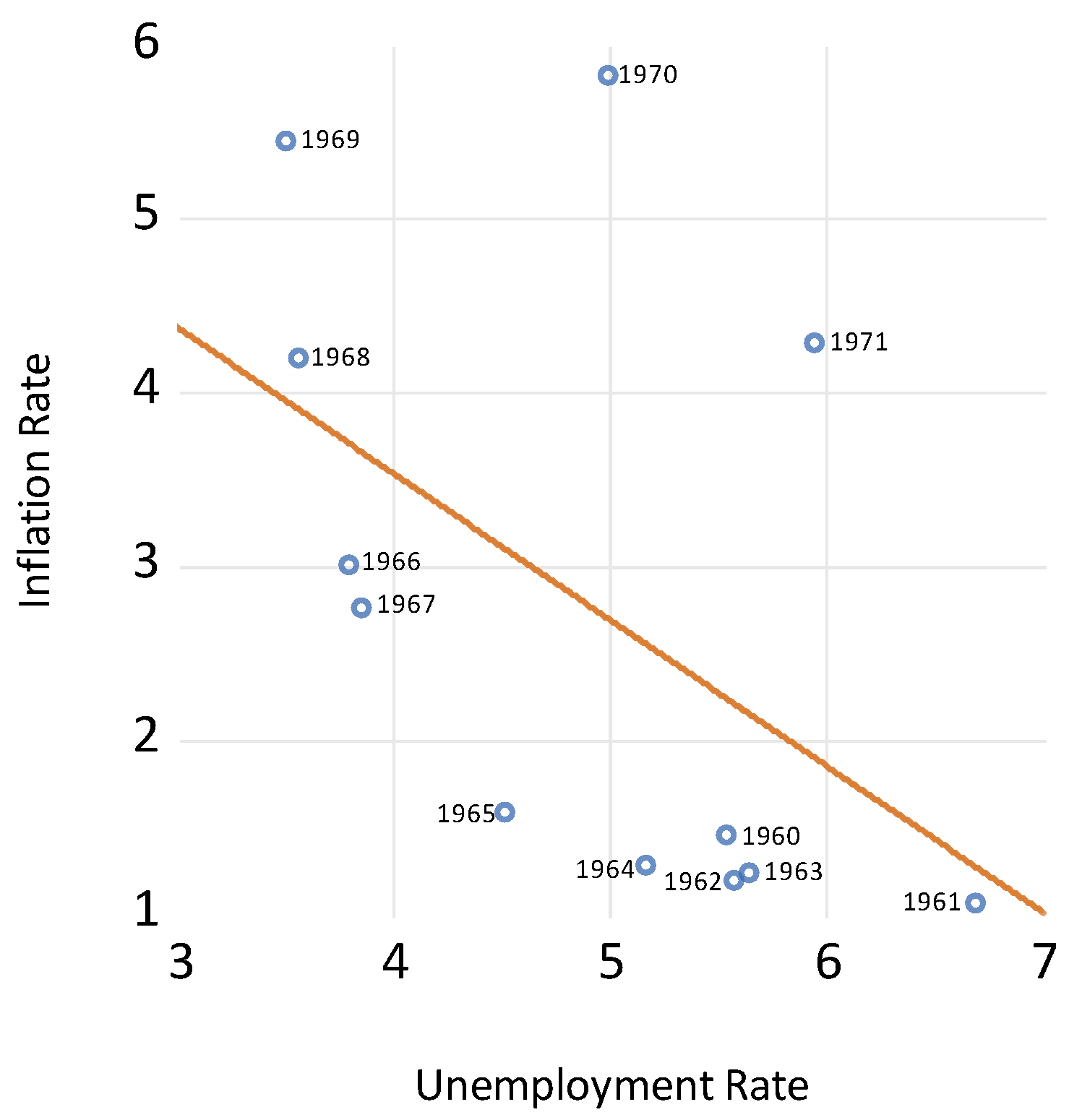
Figure 1 plots unemployment and inflation between 1960 and 1971. It indicates that inflation between 1960 and 1969 was procyclical.
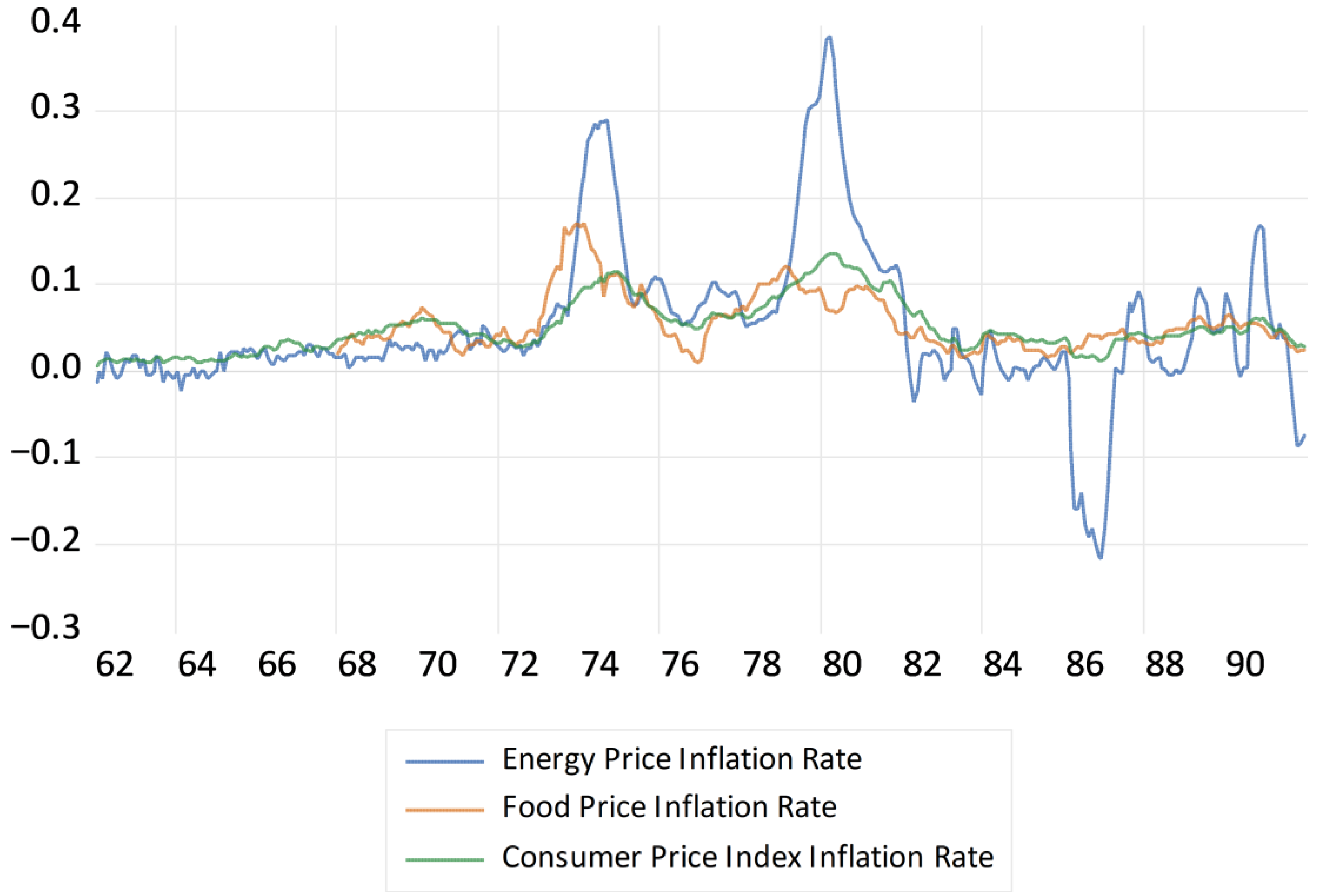
Figure 2 presents the overall consumer price index (CPI) and the CPI for both energy and food. There were no spikes in energy and food prices over the 1960–1971 period. Few supply shocks hit the U.S. economy at this time.
1 However, expansionary fiscal policy could have raised expected inflation. As
Pflueger (
2025) noted, fiscal policy that raises inflationary expectations can have the same impact as an upward shift in the Phillips Curve. In
Figure 1, the worsening of the inflation-unemployment tradeoff between 1969 and 1971 may have reflected an increase in inflationary expectations caused by expansionary fiscal policy.
Beginning in 1972, adverse supply shocks multiplied. In the summer of 1972, the U.S. government engaged in the largest grain sale in history to the Soviet Union. U.S. grain stocks plummeted and prices soared (
Coppess, 2019). The dollar depreciated 20% between August 1971 and July 1973, increasing food exports and raising domestic food prices (
Pierce & Enzler, 1974). In 1972, El Nino weather patterns decimated the Peruvian anchovy catch. Feedstock makers replaced anchovies with soybeans, raising soybean prices. Flooding in the Midwest further lifted soybean prices. Rising prices for soybeans used in animal feed also increased prices for meat.
Figure 2 shows that these factors contributed to food inflation in 1973 of 17%.
Pierce (
1979) observed that monetary policy was too expansionary between 1971 and 1973. President Nixon instituted wage and price controls at this time. Fed Chairman Arthur Burns believed that these controls would contain inflation and focused on stimulating the economy. As Pierce noted, what happened instead was the wage and price controls combined with stimulative policies unleashed inflationary pressures.
Inflation then exploded when Arab oil-producing countries stopped selling oil to the U.S. between October 1973 and March 1974. Oil prices in the U.S. quadrupled. As
Figure 2 shows, U.S. energy price inflation reached almost 30% in 1974.
Pierce (
1979) noted that energy and food inflation drove CPI inflation for the first four months of 1974, and that removing wage and price controls after this further increased inflation. The CPI inflation rate in 1974 exceeded 11%.
Bernanke et al. (
1997), using vector autoregression (VAR) techniques, reported that the surge in inflation led to contractionary monetary policy in 1974. The funds rate rose by 400 basis points between February and June 1974.
Pierce (
1979) called this the tightest monetary policy ever implemented in the U.S. Okun said in June 1974 that the public supported the Fed’s inflation fight because it viewed inflation as public enemy number one (Quoted in
Pierce, 1979). Longer-term interest rates also increased, decimating housing, automaking and other interest-sensitive sectors. The unemployment rate increased by 4 percentage points, peaking at 9% in May 1975. This painful medicine contributed to reducing the core inflation rate by 2 percentage points between 1974 and 1976 (
Ball, 1994).
A second oil price shock arrived in 1979. It was precipitated by the Iranian Revolution and reinforced by the Iran–Iraq War. As
Figure 2 shows, the shock contributed to energy prices increasing by 40%. The overall inflation rate in 1980 approached 14%.
Fed Chairman Paul Volcker then implemented even tighter monetary policy than the Fed had employed in 1974. He used nonborrowed reserves as an intermediate instrument to reduce money supply growth. The funds rate increased by 8 percentage points, and long-term corporate and Treasury rates increased by 5 percentage points. Spending on housing and durable good plummeted, and the U.S. experienced the deepest recession since the Great Depression. The unemployment rate at the end of 1982 approached 11%.
Ball (
1994) reported that trend inflation fell 8 percentage points between 1979 and 1982. In July 1982, the Fed eased policy. The funds rate fell from 14.92% on 2 July 1982 to 10.4% on 3 September 1982 (
Dupor, 2025). The Fed also implemented a series of discount rate cuts. The recession ended in November 1982.
The economy then expanded for almost 9 years. At the time, this was the longest peacetime expansion. As
Figure 2 shows, inflation also remained contained. The figure also shows that there was a large positive supply shock in 1986 as oil and energy prices plummeted.
Fed policy remained measured. It increased the funds rate by 320 basis points between March 1988 and March 1989 to fight inflation. It then lowered the funds rate by 540 basis points up to the end of 1991.
Figure 2 shows there was a spike in oil prices in late 1991 associated with Iraq’s invasion of Kuwait.
4. Estimating Bond Market Betas
This paper aims to estimate bond/stock betas beginning before they turned positive. To do this requires data starting in the 1960s.
Campbell et al. (
2025) estimated betas using U.S. 10-year nominal Treasury return data calculated from
Gürkaynak et al.’s (
2007) yield data. These data begin in the third quarter of 1971. However,
Gürkaynak et al. (
2007) also provided data for 7-year nominal Treasury yields beginning in the 1960s. Changes in 7-year yields move very closely with changes in 10-year yields. Regressing the change in the 7-year yield on the change in the 10-year yield over the August 1971 to November 2025 period gives a coefficient of 0.99 and a t-statistic of 455. This paper thus uses 7-year yields.
Nominal yields on 7-year zero coupon Treasury securities are used to calculate bond returns. Bond returns are then regressed on returns on the Standard and Poor’s 500. Daily data are used. Regressions are performed using 90-day windows beginning in the first quarter of 1964 and extending to the last quarter of 1991. The estimated equation takes the form:
where
R7,t equals the daily nominal U.S. government bond return on 7-year bonds and
RS&P,t equals the daily return on the Standard and Poor’s 500 Index.
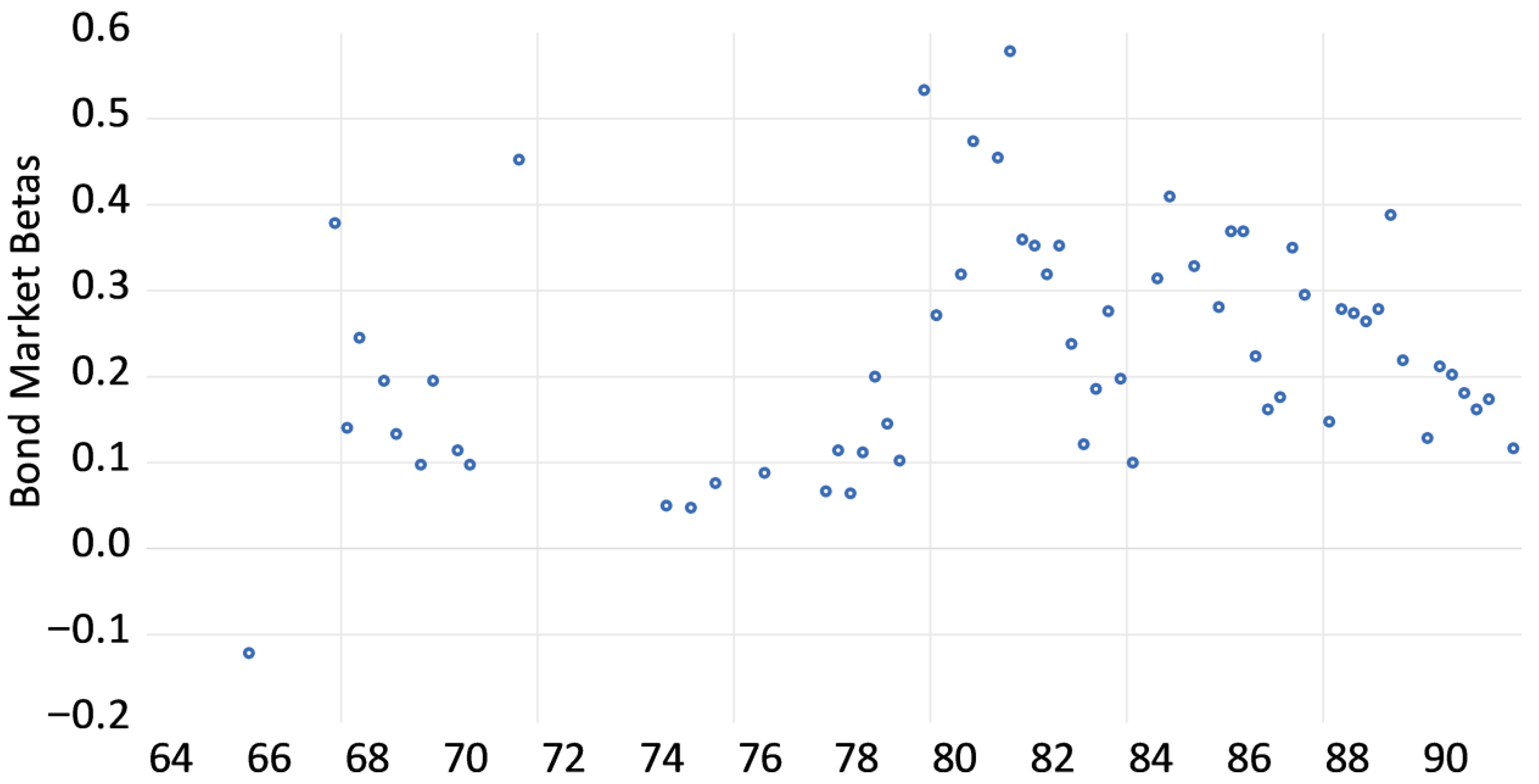
Figure 3 plots betas that are statistically significant at least the ten percent level. Between 1964Q1 and 1967Q3, the betas are never positive and statistically significant. The beta is negative and statistically significant in 1966Q1. Betas then become positive and significant beginning in 1967Q4. At this time, inflation accelerated and the Fed aggressively fought inflation. Between 1967Q4 and 1971Q3, betas are positive and statistically significant in 10 of the 16 quarters.
There are no statistically significant betas between 1971Q4 and 1974Q2. Monetary policy remained dovish for much of this time, even though inflationary supply shocks multiplied. After this, betas are positive and significant in 49 quarters. They are never negative.
The betas are especially large between 1979Q4 and 1981Q3. When statistically significant, they average above 0.50 over this period. During this time, the Iran Crisis pushed energy prices up 40%, and the Federal Reserve fought inflation.
An increase in the betas is closely related to an increase in the yield on the 7-year Treasury bond. Regressing average yields on 7-year zero coupon Treasury securities in quarter
t (Yield
7,t) on the bond betas for quarter
t obtained from estimating Equation (1) (
) produces
2:
Adjusted R-squared = 0.304, Standard Error of Regression = 184.1, N = 64, The parentheses report HAC standard errors. *** indicates statistical significance at the 1% level.
The results indicate that a ten-basis point increase in is associated with a 92-basis point increase in yields. This implies that as bonds become riskier, as measured by their betas with stocks, their yields soar. Investors require higher interest rates to hold bonds as they become riskier. This in turn multiplies government debt service costs.
5. How Monetary Policy Affects Stock and Bond Returns
Pflueger (
2025),
Campbell et al. (
2025), and others have presented evidence indicating that monetary policy shocks may contribute to positive bond–stock comovements.
Christiano et al. (
1996) employed a VAR to identify monetary policy shocks over the 1960Q1–1992Q4 period. They included gross domestic product, the consumer price index, commodity prices, the funds rate, nonborrowed and total reserves, and then the variable under investigation in their VARs. They measured monetary policy shocks by innovations in the federal funds rate and sometimes in nonborrowed reserves.
Thorbecke (
1997) used
Christiano et al.’s (
1996) identification strategy and monthly data to investigate how monetary policy shocks impact asset returns. He employed the July 1967 to December 1990 sample period. The VAR included industrial production growth, inflation, an index of sensitive commodities (measured in logs), the funds rate, the log of both nonborrowed reserves and total reserves, asset returns, a constant, and six lags. Following Christiano et al., he used federal fund rate orthogonalized innovations to measure monetary policy. He also followed their order of orthogonalization, with the variables ordered as listed above. The last variable he included was asset returns. Since investors should rapidly capitalize how news of monetary policy shocks impact future discount factors and cash flows, he examined the response of asset returns in the initial period to monetary policy shocks.
This identification strategy is employed here.
3 VARs are estimated over five-year periods beginning in 1962–1966, then 1963–1967, and so on until 1987–1991. The responses of both bond and stock returns are investigated. Data on industrial production, nonborrowed and total reserves, and the funds rate come from the FRBSL FRED database. Data on the CPI inflation rate, the return on 20-year Treasury bonds, and the return on the Standard and Poor’s 500 index are obtained from
Ibbotson Associates (
1994). Data on the Dow Jones Spot Average for commodity prices are available from the online data appendix accompanying
Uhlig (
2005).
4Table 1 presents the results for bond and stock returns. It reports all of the periods when there is a statistically significant response at at least the 10% level of bond or stock returns to federal funds rate innovations. Positive federal funds rate shocks first started decreasing both bonds and stocks over the 1967–1971 period. They continued to decrease both assets returns up until the 1976 to 1980 period.
5 The response of bond and stock returns to funds rate changes is also quantitatively important. On average, over the 1967 to 1979 period, a 100-basis point positive innovation in the funds rate lowered bond returns by 2.9% and stock returns by 3.7%.
Bernanke and Kuttner (
2005), using daily data on unexpected funds rate changes over the 1989–2002 period, reported in their baseline model that a 100 basis point funds rate increase decreased U.S. stock returns by between 2.6% and 4.7%. Thus, the stock market responses reported here are similar to those that Bernanke and Kuttner found.
While federal funds rate shocks did not impact bond returns over the 1977–1981 and 1978–1982 periods, it is important to note that nonborrowed reserve rather than the funds rate was the intermediate target for monetary policy over the October 1979 to August 1982 period. A one-standard deviation unexpected increase in nonborrowed reserves raised stock returns by 1.8% and bond returns by 2.0 percent over this period.
6 In both cases, the responses are significant at the 1% level. Since decreases in nonborrowed reserves represent contractionary policy, the results over the 1979–1982 period are consistent with the results over previous years, indicating that federal funds rate increases decreased stock and bond returns.
Positive funds rate innovations reduce stock returns for all five-year periods between 1967 and 1984. They also reduce stock returns over the 1982–1986 period. Positive funds rate innovations reduce bond returns over the 1983–1987 and 1985–1989 periods. After 1982, however, there are no five-year periods when federal funds rate changes were simultaneously impacting bond and stock returns.
6. Evidence from a Multi-Factor Asset Pricing Model
As
Ross (
2001) showed, in a multi-factor asset pricing model such as the Arbitrage Pricing Theory, returns on an asset are given by:
where
Ri is the
ex-post return on asset
i, λ
0 is the return on the risk-free asset, λ
j is the risk price associated with macroeconomic factor
j,
βi,j is the beta or factor loading of asset
i to factor
j, f
j is the unexpected change in factor
j and ε
i is a mean-zero error term capturing the effect of idiosyncratic news on asset
i. In Equation (2),
βi,1 equals the exposure of asset i to macroeconomic factor 1 (e.g., monetary policy),
βI,2 equals the exposure of asset i to macroeconomic factor 2 (e.g., inflation), and so on.
McElroy and Burmeister (
1988) stacked Equation (2) across assets and estimated the system using an iterated nonlinear seemingly unrelated regression (INLSUR) method. This approach permits imposition of the nonlinear cross-equation restrictions that the intercept terms depend on the risk prices (λ
j). McElroy and Burmeister showed that this technique yielded consistent estimates of the parameters.
The system
McElroy and Burmeister (
1988) estimated can be represented as:
where R
i − λ
0 is the realized return on asset
i minus the risk-free return. X is a matrix whose elements are the sum of innovations in the systematic factors and the risk prices for each macroeconomic variable,
βi is a vector of factor loadings, and ε
i is a vector of error terms. It is posited that E(ε
1, ε
2, …, ε
n) = 0
nT, E(ε
1, ε
2, …, ε
n)’(ε
1, ε
2, …, ε
n) = ∑⊗I
T, and ∑
i,j = cov((ε
i,t, ε
j,t). INLSUR estimation is used to estimate the system (4).
The macroeconomic factors used here build on the variables employed by
Chen et al. (
1986). They used the difference between returns on Treasury bonds and Treasury bills (the horizon premium), the difference between returns on corporate bonds and Treasury bonds (the default premium), unexpected inflation, the change in expected inflation, and the growth rate of industrial production. Since these variables are noisy, Chen et al. treated them as innovations.
The difference between returns on Treasury bonds and Treasury bills reflect both monetary policy and inflation. Long-term Treasury rates are influenced by news of inflation (
Campbell & Ammer, 1993). The spread of 10-year Treasury rates over short-term rates is affected by monetary policy (
Bernanke & Blinder, 1992). To separately measure the impact of monetary policy and inflation, the difference in returns between Treasury bonds and Treasury bills (the horizon premium) is dropped, and inflation and monetary policy factors are used instead.
Following
Boudoukh et al. (
1994), unexpected inflation is calculated by regressing monthly inflation on lagged inflation and on current and lagged Treasury bill rates. Current Treasury bill rates are included because they are known at the beginning of the period. Unexpected inflation is thus the residual (ε
t) from the regression:
where π
t is the inflation rate in month
t and r
t is the interest rate on one-month Treasury bills. The change in expected inflation is also calculated from Equation (4). Following
Chen et al. (
1986), the growth rate of industrial production and the default premium are also included as factors.
To calculate monetary policy, innovations in the federal funds rate are used. This follows a large literature including
Bernanke and Blinder (
1992) and
Christiano et al. (
1996) indicating that federal funds rate innovations provide a good measure of surprise monetary policy changes between the 1960s and 1990s. Unexpected changes in the federal funds rate are measured as the residuals from an autoregressive integrated moving average model for the log of the federal funds rate:
where ffr
t is the log of the federal funds rate in month
t and ε
t is a white noise error term. The number of lags M and N is determined to minimize the Akaike Information Criterion. M is set equal to 3 and N to 4.
The left-hand side variables include returns on 61 assets including industry portfolios, assets related to gold and silver, and the return on 20-year Treasury securities. A variety of asset returns are included to try to increase the cross-sectional variation of asset returns. The return on one-month Treasury bills is treated as the risk-free rate and subtracted from all of the asset returns.
Data on asset returns are obtained from the Datastream database and from
Ibbotson Associates (
1994). Data on the CPI inflation rate and industrial production come from the Federal Reserve Bank of St. Louis FRED database. Data on industry portfolio returns are available from Datastream beginning in 1973. The sample period thus extends from February 1973 to December 1991. This sample contains 227 observations.
Over this sample period, both inflation and monetary policy loomed large on the horizon. If investors foresaw higher inflation, they would purchase assets that benefit from inflation and sell assets exposed to inflation. This would increase returns on assets with positive factor loadings to inflation and decrease returns on assets with negative factor loadings to inflation. Asset returns should thus be positively correlated with inflation factor loadings on months when investors expect higher inflation. They should be negatively correlated on months when investors expect lower inflation. The same logic applies to asset returns and their monetary policy betas on months when monetary policy news arrives.
In a second stage regression, returns on the 61 assets each month are regressed on their inflation and monetary policy betas. This approach provides high frequency evidence on how inflation and monetary policy news impact financial markets. The evidence can also indicate if this news contributes to positive bond–stock comovements.
Table 2 presents assets’ betas to inflation and monetary policy. For inflation, 43 out of the 61 assets have statistically significant exposures at the 5% level, and 6 more have statistically significant exposures at the 10% level. For monetary policy, 32 assets have statistically significant exposures at the 5% level and 14 more have statistically significant exposures at the 10% level. The evidence that so many assets are exposed to inflation and monetary policy should increase the precision of the second stage regression estimates.
The risk prices for the macroeconomic variables are reported in
Table 3. To understand the magnitudes of the coefficient for unexpected inflation, it is multiplied by the average factor loadings for the three assets most exposed to unexpected inflation. These factor loadings average −5.68. The associated risk premium thus equals 0.003 (equals −5.68 times −0.00047). Thus, these assets pay an increment of 0.3 percent per month (ppm) because they are exposed to unexpected inflation. Doing similar calculations for the three assets most exposed to the other factors, they pay a decrement of 0.72 ppm for their exposure to the federal funds rate; an increment of 0.37 ppm for their exposure to the default premium; an increment of 1.46 ppm for their exposure to industrial production; and a decrement of 0.0036 ppm for their exposure to expected inflation changes.
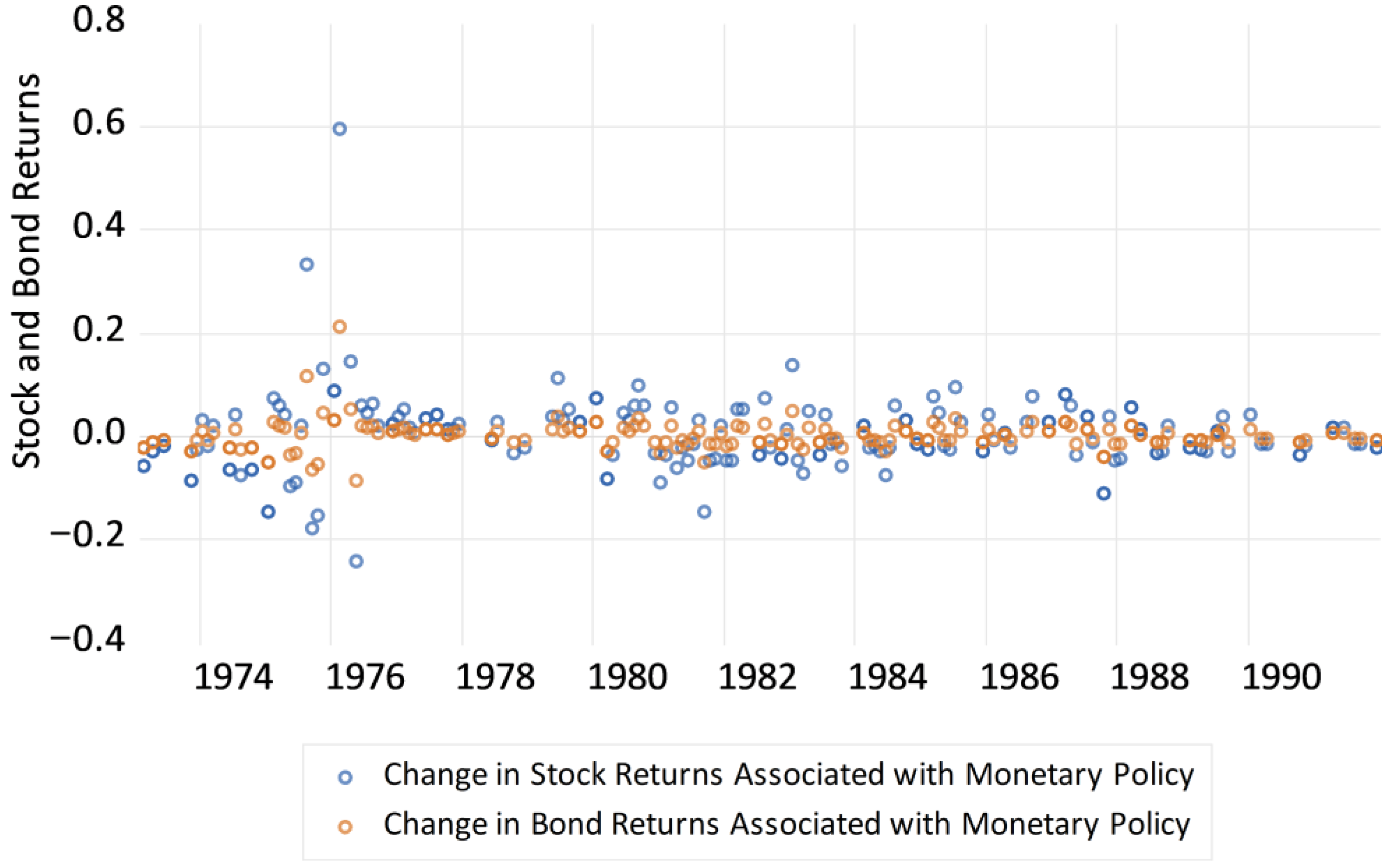
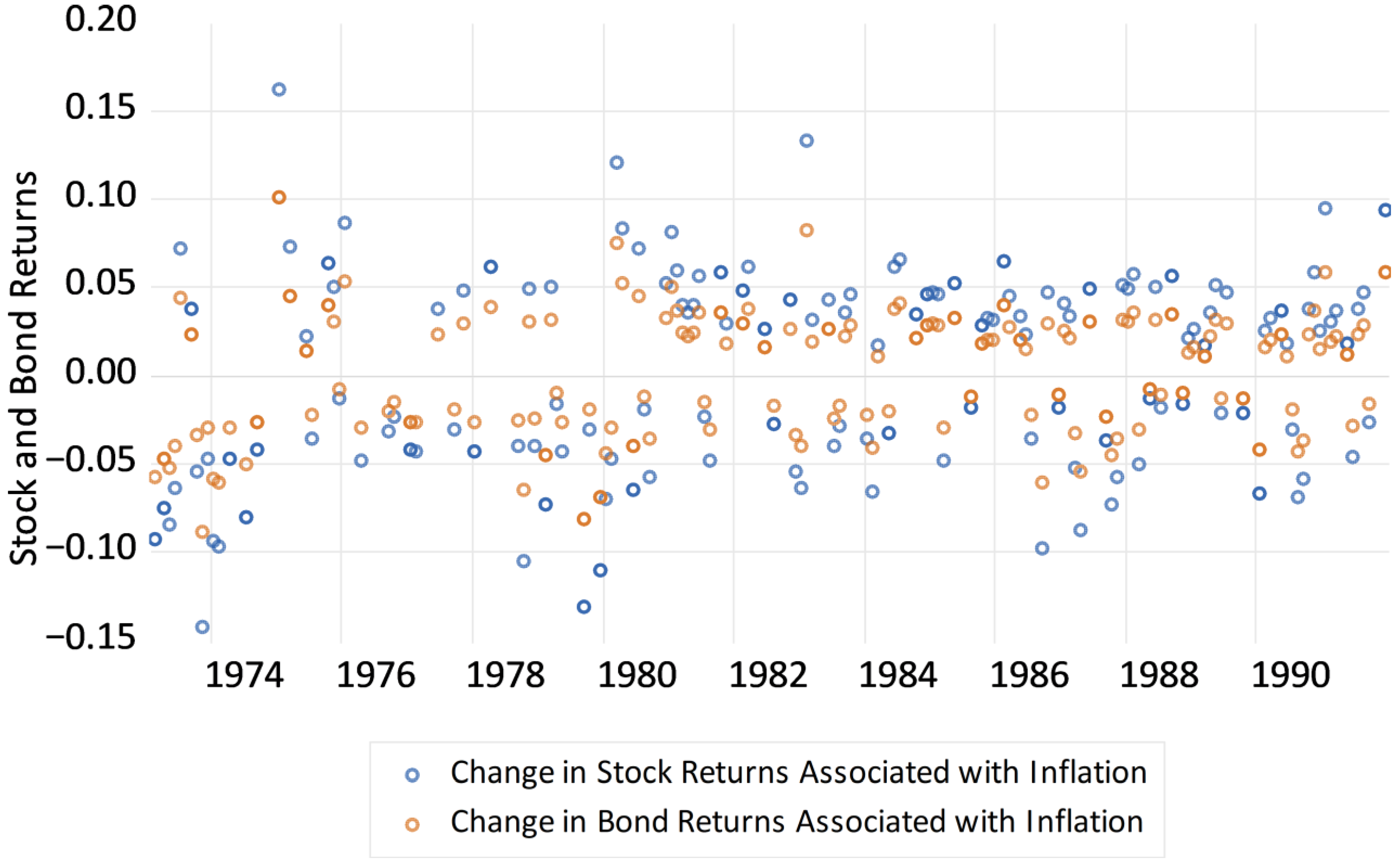
Figure 4 and
Figure 5 plot the findings from regressing the 61 asset returns each month on their inflation and monetary policy betas. To facilitate interpretation, the monthly cross sectional regression coefficients are multiplied by the betas for the three stock portfolios most exposed to inflation and the betas for the three stock portfolios most exposed to contractionary monetary policy. Since the inflation and monetary policy betas are negative for the most exposed assets, the products of the monthly regression coefficients and the betas for the three assets most exposed to inflation and monetary policy are positive when investors expect lower inflation or easier monetary policy. The products are negative when investors expect higher inflation or tighter monetary policy.
To also shed light on how bonds are impacted by inflation and monetary policy news, the monthly cross-sectional regression coefficients are also multiplied by the inflation and monetary policy betas for Treasury bonds.
Table 2 reports that higher inflation and contractionary monetary policy reduce Treasury bond returns.
Figure 4 and
Figure 5 plot all of the months when the monthly regression coefficients are significant at at least the 10% percent level. The results in
Figure 4 indicate that news of monetary policy influenced stock and bond returns in 143 of the 227 months. The results in
Figure 5 indicate that news of inflation influenced stock and bond returns in 145 of the 227 months. The findings also indicate that monetary policy and inflation news are driving stocks and bonds in the same direction. On average, monetary policy news caused stock returns to change by 5.3% and bond returns by 1.9%. On average, inflation news caused stock returns to change by 5.1% and bond returns by 3.1%. Thus, this news contributed to large and positive bond–stock comovements over the 1973–1991 period.
7. Discussion
This paper investigates bond–stock comovements before and while they became positive from the 1960s to the 1990s. The results indicate that there was not a statistically significant positive relationship between bond and stock returns until the 1967Q4. At this point, large budget deficits associated with President Johnson’s domestic and Vietnam War initiatives may have driven inflation expectations higher. The Fed, after waffling on inflation, also embraced anti-inflationary monetary policy at this time.
Pflueger (
2025) found that supply shock volatility combined with hawkish monetary policy are necessary to generate positive bond–stock betas. There were no major supply shocks in the late 1960s. As
Pflueger (
2025) noted, an inflationary expectations shock due to expansionary fiscal policy can have the same impact as a negative supply shock. When combined with the hawkish monetary policy that the Fed embraced at the end of 1967, it could explain why bond–stock comovements became positive at this time.
Bond market betas remained positive and statistically significant until 1971Q3. They were then not statistically significant until 1974Q3. As
Pierce (
1979) reported, monetary policy was overly expansionary between 1971 and 1973. President Nixon instituted wage and price controls in August 1971, and Fed Chairman Burns believed this would contain inflation. The Fed thus stimulated the economy even as inflationary supply shocks arrived in spades. In 1974, as Pierce discussed, the Fed decided that inflation was public enemy number one. The combination of massive supply shock volatility and contractionary monetary policy helps explain why bond–stock comovements again turned positive in 1974.
Bond market betas remained positive and soared between 1979 and 1981. When statistically significant, they average above 0.50 between 1979Q4 and 1981Q3. This was the largest over the entire 1964–1991 sample period. The combination of negative supply shocks arising from the Iranian Revolution and the Iran–Iraq War and Paul Volcker’s war on inflation drove positive bond–stock comovements. Bond–stock covariances remained positive until the end of the sample period in 1991.
Campbell et al. (
2025),
Pflueger (
2025), and others highlighted how monetary policy can contribute to positive bond–stock comovements. Evidence from impulse–response functions reported in
Table 1 indicate that monetary policy first began contributing to positive bond–stock covariances over the 1967 to 1971 period. This was when the combination of expansionary fiscal policy that may have driven inflation expectations and contractionary monetary policy arrived. Monetary policy then continued contributing to positive bond–stock comovements until 1982.
Figure 4 and
Figure 5 present higher frequency evidence of how monetary policy and inflation news influenced bond and stock returns over the 1973 to 1991 period. They show that news of both monetary policy and inflation pushed bonds and stocks in the same direction in the majority of months between 1973 and 1991.
Positive bond–stock covariances thus arose beginning in the 1967–1971 period, when profligate fiscal policy and anti-inflationary monetary policy arrived. As supply shocks multiplied, news of inflation and monetary policy then contributed to positive bond–stock movements until the end of 1991.
The sample period in this paper ends in 1991. It thus predates the widespread adoption of inflation targeting, forward guidance, and unconventional monetary policy tools. Even when the instruments of monetary policy differed, the combination of inflationary shocks and anti-inflationary monetary policy generated positive bond–stock comovements as
Pflueger (
2025) found they did more recently.