Exploring the Impact of Executives’ Digital Attention on Corporate Sustainable Development: Evidence from China


Abstract
1. Introduction
2. Literature Review and Research Hypothesis
2.1. Literature Review
2.1.1. Upper Echelons Theory
2.1.2. Attention-Based View
2.1.3. Resource Orchestration Theory
2.1.4. Influencing Factors of Corporate Sustainable Development
2.2. Research Hypothesis
2.2.1. Executives’ Digital Attention and Corporate Sustainable Development
2.2.2. The Mechanism of Resource Orchestration
2.2.3. The Moderating Role of Corporate Financing Constraints
2.2.4. The Moderating Role of Media Attention
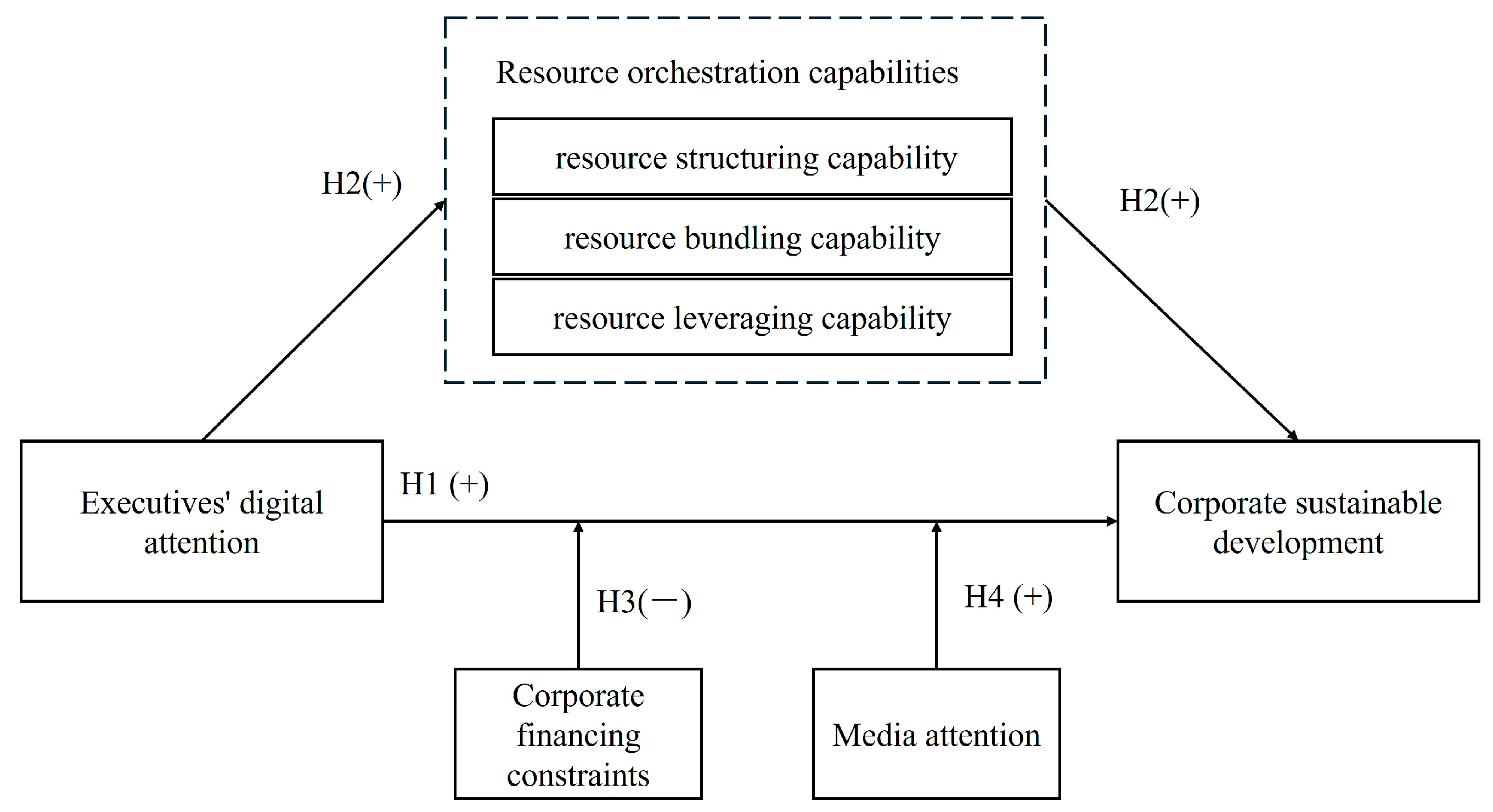
2.2.5. Conceptual Model
3. Research Design
3.1. Data Source and Sample Selection
3.2. Variables
3.2.1. Corporate Sustainable Development
- -
- The entropy weight method is an objective technique that assigns indicator weights according to the information each indicator provides. Drawing on the research of X. H. Zhang et al. (2024), the specific calculation steps for the corporate sustainable development performance (CSP) in this paper are as follows.
3.2.2. Executives’ Digital Attention
3.2.3. Control Variables
4. Model Construction
4.1. Empirical Analysis
4.1.1. Descriptive Statistics
4.1.2. Benchmark Regression Analysis
4.1.3. Endogeneity Test
4.1.4. Robustness Tests
4.1.5. Heterogeneity Analysis
5. Further Analysis
5.1. Mechanism Analysis
5.1.1. Resource Structuring Mechanism
5.1.2. Resource Bundling Mechanism
5.1.3. Resource Leveraging Mechanism
5.2. Moderating Effects Analysis
5.2.1. Financing Constraints Pressure
5.2.2. Media Attention Pressure
5.3. Dimension-Wise Tests
6. Discussion
7. Conclusions and Implications
7.1. Conclusions
7.2. Practical Implications
7.3. Limitations and Future Directions
Author Contributions
Funding
Institutional Review Board Statement
Informed Consent Statement
Data Availability Statement
Conflicts of Interest
References
- Adao, R., Kolesar, M., & Morales, E. (2019). Shift-share designs: Theory and inference. Quarterly Journal of Economics, 134(4), 1949–2010. [Google Scholar] [CrossRef]
- Alexopoulos, I., Kounetas, K., & Tzelepis, D. (2018). Environmental and financial performance. Is there a win-win or a win-loss situation? Evidence from the Greek manufacturing. Journal of Cleaner Production, 197, 1275–1283. [Google Scholar] [CrossRef]
- Ali, J. (2024). Convergence innovation for sustainable development: Unraveling post-COVID dynamics for a resilient future. Sustainable Development, 32(3), 2858–2868. [Google Scholar] [CrossRef]
- Amit, R., & Han, X. (2017). Value creation through novel resource configurations in a digitally enabled world. Strategic Entrepreneurship Journal, 11(3), 228–242. [Google Scholar] [CrossRef]
- Bittencourt, B. A., dos Santos, D. A. G., & Mignoni, J. (2021). Resource orchestration in innovation ecosystems: A comparative study between innovation ecosystems at different stages of development. International Journal of Innovation, 9(1), 108–130. [Google Scholar] [CrossRef]
- Borusyak, K., Hull, P., & Jaravel, X. (2022). Quasi-experimental shift-share research designs. Review of Economic Studies, 89(1), 181–213. [Google Scholar] [CrossRef] [PubMed]
- Cannavale, C., Zohoorian Nadali, I., & Esempio, A. (2020). Entrepreneurial orientation and firm performance in a sanctioned economy—Does the CEO play a role? Journal of Small Business and Enterprise Development, 27(6), 1005–1027. [Google Scholar] [CrossRef]
- Carnes, C. M., Chirico, F., Hitt, M. A., Huh, D. W., & Pisano, V. (2017). Resource orchestration for innovation: Structuring and bundling resources in growth-and maturity-stage firms. Long Range Planning, 50(4), 472–486. [Google Scholar] [CrossRef]
- Chams, N., & García-Blandón, J. (2019). On the importance of sustainable human resource management for the adoption of sustainable development goals. Resources, Conservation and Recycling, 141, 109–122. [Google Scholar] [CrossRef]
- Chen, W. H., Kang, M. P., & Butler, B. (2019). How does top management team composition matter for continual growth? Reinvestigating Penrose’s growth theory through the lens of upper echelons theory. Management Decision, 57(1), 41–70. [Google Scholar] [CrossRef]
- Cheng, S., Fan, Q., & Dagestani, A. A. (2024). Opening the black box between strategic vision on digitalization and SMEs digital transformation: The mediating role of resource orchestration. Kybernetes, 53(2), 580–599. [Google Scholar] [CrossRef]
- Cui, M., & Pan, S. L. (2015). Developing focal capabilities for e-commerce adoption: A resource orchestration perspective. Information & Management, 52(2), 200–209. [Google Scholar] [CrossRef]
- Cui, R., Xia, E., & Guo, X. (2025). Antecedent configurations toward radical green innovation: Based on resource orchestration theory. Technological Forecasting and Social Change, 214, 124038. [Google Scholar] [CrossRef]
- Cui, Y. W., Liu, H., & Zhang, J. (2024). Top management team attention and firm digital innovation: Empirical evidence from Chinese A-share listed companies. Science of Science and Management of S. & T., 45(6), 178–196. [Google Scholar] [CrossRef]
- Duch-Brown, N., & Rossetti, F. (2020). Digital platforms across the European regional energy markets. Energy Policy, 144, 111612. [Google Scholar] [CrossRef]
- Feng, X. B., Xiao, B. W., & Zheng, H. Z. (2025). Impact of institutional pressure on ambidextrous digital innovation: Moderating effect of digital attention of top managers. R&D Management, 37(5), 15–27. [Google Scholar] [CrossRef]
- Galbreath, J. (2018). Do boards of directors influence corporate sustainable development? An attention-based analysis. Business Strategy and the Environment, 27(6), 742–756. [Google Scholar] [CrossRef]
- Guandalini, I. (2022). Sustainability through digital transformation: A systematic literature review for research guidance. Journal of Business Research, 148, 456–471. [Google Scholar] [CrossRef]
- Guo, X. C., Fu, X. R., & Li, P. C. (2024). Top managerial cognition, open innovation and digital transformation of enterprises: An empirical study based on high-tech enterprises. Scientific Management Research, 42(3), 66–75. [Google Scholar] [CrossRef]
- Hambrick, D. C., & Mason, P. A. (1984). Upper echelons: The organization as a reflection of its top managers. Academy of Management Review, 9(2), 193–206. [Google Scholar] [CrossRef]
- Huang, S. K. (2013). The impact of CEO characteristics on corporate sustainable development. Corporate Social Responsibility and Environmental Management, 20(4), 234–244. [Google Scholar] [CrossRef]
- Hussain, N., Rigoni, U., & Orij, R. P. (2018). Corporate governance and sustainability performance: Analysis of triple bottom line performance. Journal of Business Ethics, 149(2), 411–432. [Google Scholar] [CrossRef]
- Jin, L., & Wang, R. X. (2025). Impact of environmental protection inspection on corporate sustainable performance. Journal of Systems & Management, 34(3), 736–752. [Google Scholar]
- Li, C., Wang, Y., Zhou, Z., Wang, Z., & Mardani, A. (2023). Digital finance and enterprise financing constraints: Structural characteristics and mechanism identification. Journal of Business Research, 165, 114074. [Google Scholar] [CrossRef]
- Li, L., Su, F., Zhang, W., & Mao, J. Y. (2018). Digital transformation by SME entrepreneurs: A capability perspective. Information Systems Journal, 28(6), 1129–1157. [Google Scholar] [CrossRef]
- Li, L., Yang, S. L., & Chen, N. (2021). “Internet+”, technological heterogeneity and innovation efficiency: Research based on panel data of provincial industrial enterprises. Journal of China University of Geosciences (Social Sciences Edition), 21(3), 125–141. [Google Scholar] [CrossRef]
- Li, S., Gao, D., & Hui, X. (2021). Corporate governance, agency costs, and corporate sustainable development: A mediating effect analysis. Discrete Dynamics in Nature and Society, 2021(1), 5558175. [Google Scholar] [CrossRef]
- Li, S., Gao, L., Han, C., Gupta, B., Alhalabi, W., & Almakdi, S. (2023). Exploring the effect of digital transformation on firms’ innovation performance. Journal of Innovation & Knowledge, 8(1), 100317. [Google Scholar] [CrossRef]
- Li, X. S., Dang, L., & Zhao, C. Y. (2022). Digital transformation, global innovation network and innovation performance. China Industrial Economics, (10), 43–61. [Google Scholar] [CrossRef]
- Liu, F., & Tian, G. L. (2019). Does information technology replace employment? Evidence based on China’s listed companies. Finance & Economics, (7), 95–107. Available online: https://link.cnki.net/urlid/51.1104.F.20190731.1644.014 (accessed on 1 December 2025).
- Minutolo, M. C., Kristjanpoller, W. D., & Stakeley, J. (2019). Exploring environmental, social, and governance disclosure effects on the S&P 500 financial performance. Business Strategy and the Environment, 28(6), 1083–1095. [Google Scholar] [CrossRef]
- Noviaristanti, S., Acur, N., Mendibil, K., & Miranda, E. (2024). The network orchestration role of accelerators for value creation. IEEE Transactions on Engineering Management, 71, 3795–3806. [Google Scholar] [CrossRef]
- Ocasio, W. (1997). Towards an attention-based view of the firm. Strategic Management Journal, 18(S1), 187–206. [Google Scholar] [CrossRef]
- Saiyed, A. A., Tatoglu, E., Ali, S., & Dutta, D. K. (2023). Entrepreneurial orientation, CEO power and firm performance: An upper echelons theory perspective. Management Decision, 61(6), 1773–1797. [Google Scholar] [CrossRef]
- Sapir, E. (1944). Grading, a study in semantics. Philosophy of Science, 11(2), 93–116. [Google Scholar] [CrossRef]
- Shen, K., Qiao, G., & Lin, J. (2024). Intelligent manufacturing policy and high-quality development of Chinese enterprises. Journal of Quantitative & Technological Economics, 41(2), 5–25. [Google Scholar] [CrossRef]
- Sirmon, D. G., Hitt, M. A., & Ireland, R. D. (2007). Managing firm resources in dynamic environments to create value: Looking inside the black box. Academy of Management Review, 32(1), 273–292. [Google Scholar] [CrossRef]
- Sirmon, D. G., Hitt, M. A., Ireland, R. D., & Gilbert, B. A. (2011). Resource orchestration to create competitive advantage: Breadth, depth, and life cycle effects. Journal of Management, 37(5), 1390–1412. [Google Scholar] [CrossRef]
- Soleymanzadeh, O., & Hajipour, B. (2025). A bibliometric analysis of resource orchestration research: Current status, emerging trends and future research agenda. Management Research Review, 48(4), 643–664. [Google Scholar] [CrossRef]
- Song, Y. Y., Feng, X., & Yan, H. (2025). Will subsidiary coordination complexity enhance firm digital attention? An empirical analysis based on the attention-based view. Foreign Economics & Management, 47(2), 20–37. [Google Scholar] [CrossRef]
- Tang, Y. J., Wang, Y., & Tang, C. H. (2022). Digital economy, market structure and innovation performance. China Industrial Economics, (10), 62–80. [Google Scholar] [CrossRef]
- Wang, B., Ma, M., Zhang, Z., & Li, C. (2024). How do the key capabilities of the industrial internet platform support its growth? A longitudinal case study based on the resource orchestration perspective. Technological Forecasting and Social Change, 200, 123186. [Google Scholar] [CrossRef]
- Wang, F. R., Guo, M., Yin, S. Q., & Gao, X. X. (2025). Impact of top management team’s attention on digital transformation of manufacturing enterprises: A case study of HIKVISION. Science of Science and Management of S. & T., 46(9), 154–165+181. [Google Scholar] [CrossRef]
- Wang, G., Li, W. L., & Wei, L. S. (2025). New quality productivity, green innovation and enterprise sustainable development performance. Scientific Decision Making, 4, 124–141. [Google Scholar]
- Wang, H. Y. (2023). Does capital market liberalization improve enterprises’ sustainable development capacity? A study based on enterprises’ ESG performance. Research on Financial and Economic Issues, 2023(7), 116–128. [Google Scholar] [CrossRef]
- Wang, K. H., Zhao, Y. X., Jiang, C. F., & Li, Z. Z. (2022). Does green finance inspire sustainable development? Evidence from a global perspective. Economic Analysis and Policy, 75, 412–426. [Google Scholar] [CrossRef]
- Wang, N., Bai, Y., Guo, Z., Fan, Y., & Meng, F. (2024). Synergies between the circular economy and carbon emission reduction. Science of the Total Environment, 951, 175603. [Google Scholar] [CrossRef] [PubMed]
- Wang, S. Q., Han, D. M., & Wang, X. T. (2022). TMT attention, resource orchestration and strategy renewal in continuous transformation: A case study based on Neusoft. Nankai Business Review, 25(6), 183–192+I0037, I0038. [Google Scholar]
- Wang, T., Zhao, X., & Li, X. (2025). Geographical influences, media attention and enterprise digital transformation. Technological Forecasting and Social Change, 210, 123853. [Google Scholar] [CrossRef]
- Wang, Y., Qiu, Y., & Luo, Y. (2022a). CEO foreign experience and corporate sustainable development: Evidence from China. Business Strategy and the Environment, 31(5), 2036–2051. [Google Scholar] [CrossRef]
- Wang, Y., Wang, H. Y., & Xue, S. (2022b). Greening of tax system and corporate ESG performance: A quasi-natural experiment based on the Environmental Protection Tax Law. Journal of Finance and Economics, 48(9), 47–62. [Google Scholar] [CrossRef]
- Wu, Z. R., & Li, Q. Y. (2025). Mandatory ESG disclosure policies in destination countries and the entry of green investors to Chinese suppliers: Evidence from China’s export trade. Journal of International Trade, 2025(11), 48–62. [Google Scholar] [CrossRef]
- Xi, L. S., & Zhao, H. (2022). Senior executive dual environmental cognition, green innovation and enterprise sustainable development performance. Economic Management Journal, 44(3), 139–158. [Google Scholar] [CrossRef]
- Yang, G. H. (2025). Mechanism of how green technological innovation influences firm sustainable development performance: The perspective of value network. Science & Technology Progress and Policy, 1–9. [Google Scholar] [CrossRef]
- Yin, Y., Zhao, L., Li, L., Chen, L., & Li, Y. (2025). How CEO digital embeddedness drives firm performance: Evidence from the upper echelons theory. Industrial Management & Data Systems, 125(12), 3133–3153. [Google Scholar] [CrossRef]
- Yu, H. C., & Tsai, B. Y. (2018). Environmental policy and sustainable development: An empirical study on carbon reduction among Chinese enterprises. Corporate Social Responsibility and Environmental Management, 25(5), 1019–1026. [Google Scholar] [CrossRef]
- Yu, X., Niu, B., & Wan, Z. M. (2025). A study on the impact of “people and data” coordination on the high-quality development of enterprises from the perspective of value chain. Science Research Management, 46(3), 60–68. [Google Scholar] [CrossRef]
- Zada, M., Zada, S., Dhar, B. K., Ping, C., & Sarkar, S. (2025). Digital leadership and sustainable development: Enhancing firm sustainability through green innovation and top management innovativeness. Sustainable Development. ahead-of-print. [Google Scholar] [CrossRef]
- Zhang, C., & Wang, Y. (2024). Is enterprise digital transformation beneficial to shareholders? Insights from the cost of equity capital. International Review of Financial Analysis, 92, 103104. [Google Scholar] [CrossRef]
- Zhang, F., & Zhu, L. (2019). Enhancing corporate sustainable development: Stakeholder pressures, organizational learning, and green innovation. Business Strategy and the Environment, 28(6), 1012–1026. [Google Scholar] [CrossRef]
- Zhang, X. H., Zhao, J. Q., & Zhang, Y. (2024). The impact of institutional investors’ shareholding on corporate sustainability: A corporate governance-based perspective. Financial Theory and Practice, (1), 66–78. Available online: https://link.cnki.net/urlid/41.1078.F.20240229.1626.014 (accessed on 1 November 2025).
- Zhang, X. Y., Liu, Z. Y., & Shi, B. (2025). Digital transformation and corporate ESG performance: Based on the analysis of resource acquisition and allocation. Commercial Research, 67(1), 122–131. [Google Scholar] [CrossRef]
- Zhang, Z., Zhu, H., Zhou, Z., & Zou, K. (2022). How does innovation matter for sustainable performance? Evidence from small and medium-sized enterprises. Journal of Business Research, 153, 251–265. [Google Scholar] [CrossRef]
- Zhang, Z. M., Wang, C., Jiang, B. L., & Zhao, L. B. (2025). Executive environmental attention and corporate ESG performance: An empirical study based on Chinese A-share listed companies. Soft Science, 39(5), 109–116. [Google Scholar] [CrossRef]
- Zhao, C. Y., Wang, W. C., & Li, X. S. (2021). How does digital transformation affect the total factor productivity of enterprises? Finance & Trade Economics, 42(7), 114–129. [Google Scholar] [CrossRef]
- Zhen, H. X., Wang, X., & Fang, H. X. (2023). Administrative protection of intellectual property rights and corporate digital transformation. Economic Research Journal, 58(11), 62–79. [Google Scholar]
- Zhou, W. H., Guo, Z. J., & Wang, S. Q. (2025). Can business-finance integration promote corporate sustainable development? A study based on large language models. Securities Market Herald, (9), 46–56. Available online: https://kns.cnki.net/kcms2/article/abstract?v=zWoS8hcslzCpjdSOOhbPMRshZRpYIDZenFhBzkLLsQ1QyY4Up6f31J9zO86iv8qbKgFk3ZsYzx6Oo7rXZpWQuAhId3ve1kavpud6ns84XX26Ou4-f2JMvqiXnFz7rCp_gjPGby7jV19Gr-eyPet38N88FDRxAB5-Ws_1OAGsKeHUWgctn49Xn50TMWdyksCe&uniplatform=NZKPT&language=CHS (accessed on 1 November 2025).
- Zhou, Z., & Li, Z. (2023). Corporate digital transformation and trade credit financing. Journal of Business Research, 160, 113793. [Google Scholar] [CrossRef]
- Zou, H., Yang, X., & Wang, R. (2024). Keeping pace with competitors in CSR: From a perspective of competitive dynamics. Chinese Management Studies. ahead-of-print. [Google Scholar] [CrossRef]



| Dimension | Categorized Terms | Segmentation Lexicon |
|---|---|---|
| Digital Technology Application | Data, Digital, Digitalization | Data management, data mining, data network, data platform, data center, data science, digital control, digital technology, digital communication, digital network, digital intelligence, digital terminal, digital marketing, digitalization, big data, cloud computing, cloud IT, cloud ecosystem, cloud service, cloud platform, blockchain, Internet of Things (IoT), machine learning |
| Internet Application | Internet, Internet-based, E-commerce | Mobile Internet, Industrial Internet, Industrial Internet Solutions, Internet technology, Internet thinking, Internet initiatives, Internet business, mobile Internet, Internet applications, Internet marketing, Internet strategy, Internet platform, Internet model, Internet business model, Internet ecosystem, e-commerce, electronic commerce, Internet, “Internet +”, online-offline, online to offline, online and offline, O2O, B2B, C2C, B2C, C2B |
| Intelligent Manufacturing | Intelligent, Intellectualization, Automatic, Numerical Control, Integration, Integration | Artificial intelligence, high-end intelligence, industrial intelligence, mobile intelligence, intelligent control, intelligent terminal, mobile intelligence, intelligent management, smart factory, intelligent logistics, intelligent manufacturing, intelligent warehousing, intelligent technology, intelligent equipment, intelligent production, intelligent connectivity, intelligent system, intellectualization, automatic control, automatic monitoring, automatic supervision, automatic detection, automatic production, numerical control, integration, integration, integrated solutions, integrated control, integrated system, industrial cloud, future factory, intelligent fault diagnosis, lifecycle management, manufacturing execution system (MES), virtualization, virtual manufacturing |
| Modern Information System | Information, Informatization, Networkization | Information sharing, information management, information integration, information software, information system, information network, information terminal, information center, informatization, networkization, industrial information, industrial communication |
| VarName | Obs | Mean | SD | Min | P25 | Median | P75 | Max |
|---|---|---|---|---|---|---|---|---|
| CSP | 8360 | 0.1391 | 0.1759 | 0.0002 | 0.0096 | 0.0750 | 0.1889 | 0.9920 |
| EDA | 8360 | 2.4948 | 1.3065 | 0.0000 | 1.6094 | 2.5649 | 3.4012 | 6.6821 |
| Age | 8360 | 2.5177 | 0.6672 | 0.6931 | 2.1972 | 2.7081 | 3.0445 | 3.4012 |
| Top1 | 8360 | 36.3845 | 16.1058 | 7.9318 | 23.7478 | 34.6546 | 47.9264 | 76.9525 |
| TobinQ | 8360 | 1.9887 | 1.4179 | 0.8062 | 1.1201 | 1.4961 | 2.2577 | 8.8351 |
| Manag | 8360 | 7.2674 | 5.9150 | 0.6987 | 3.3766 | 5.7554 | 9.2199 | 36.7924 |
| Indir | 8360 | 0.3780 | 0.0554 | 0.3333 | 0.3333 | 0.3636 | 0.4286 | 0.5714 |
| Growth | 8360 | 9.5291 | 21.3706 | −72.5836 | 0.3494 | 10.1669 | 20.8480 | 67.8227 |
| Lev | 8360 | 1.4389 | 1.1544 | 0.4717 | 0.9972 | 1.0969 | 1.3639 | 9.0194 |
| Cashflow | 8360 | 0.0648 | 0.0662 | −0.1082 | 0.0231 | 0.0594 | 0.1019 | 0.2639 |
| Variables | (1) | (2) | (3) |
|---|---|---|---|
| CSP | CSP | CSP | |
| EDA | 0.0212 *** | 0.0095 *** | 0.0085 *** |
| (0.0015) | (0.0028) | (0.0028) | |
| Age | −0.0051 | ||
| (0.0053) | |||
| Top1 | 0.0006 ** | ||
| (0.0002) | |||
| TobinQ | −0.0043 ** | ||
| (0.0020) | |||
| Manag | −0.0005 * | ||
| (0.0003) | |||
| Indir | 0.0303 | ||
| (0.0507) | |||
| Growth | 0.0001 | ||
| (0.0001) | |||
| Lev | 0.0000 | ||
| (0.0000) | |||
| Cashflow | 0.1207 *** | ||
| (0.0350) | |||
| cons | 0.0863 *** | 0.1153 *** | 0.1012 *** |
| (0.0041) | (0.0075) | (0.0271) | |
| Adjusted R-square | 0.025 | 0.329 | 0.336 |
| Ind | No | Yes | Yes |
| Year | No | Yes | Yes |
| N | 8360 | 8360 | 8360 |
| Variables | (1) | (2) | (3) | (4) |
|---|---|---|---|---|
| EDA | CSP | CSP | CSP | |
| IV | 0.0357 *** | |||
| (0.0009) | ||||
| EDA | 0.0069 * | 0.0072 ** | 0.0073 *** | |
| (0.0042) | (0.0029) | (0.0027) | ||
| Age | −0.0110 | −0.0046 | −0.0049 | −0.0057 |
| (0.0229) | (0.0069) | (0.0056) | (0.0053) | |
| Top1 | 0.0020 ** | 0.0007 ** | 0.0005 ** | 0.0005 ** |
| (0.0008) | (0.0003) | (0.0003) | (0.0002) | |
| TobinQ | 0.0044 | −0.0045 ** | −0.0071 *** | −0.0073 *** |
| (0.0069) | (0.0023) | (0.0024) | (0.0022) | |
| Manag | −0.0009 | −0.0004 * | −0.0023 *** | −0.0026 *** |
| (0.0013) | (0.0003) | (0.0005) | (0.0005) | |
| Indir | 0.2371 | 0.0269 | 0.0207 | 0.0283 |
| (0.2093) | (0.0580) | (0.0564) | (0.0534) | |
| Growth | 0.0008 *** | 0.0001 | 0.0001 | 0.0001 |
| (0.0003) | (0.0001) | (0.0001) | (0.0001) | |
| Lev | −0.0010 | −0.0000 | −0.0067 *** | −0.0060 *** |
| (0.0019) | (0.0006) | (0.0018) | (0.0017) | |
| Cashflow | 0.0325 | 0.1142 *** | 0.1368 *** | 0.1190 *** |
| (0.1548) | (0.0415) | (0.0400) | (0.0361) | |
| Ind | Yes | Yes | Yes | Yes |
| Year | Yes | Yes | Yes | Yes |
| N | 6378 | 6378 | 6949 | 8352 |
| Kleibergen-Paap rk LM Statistic | 324.171 *** | |||
| Kleibergen-Paap rk Wald F Statistic | 1689.613 [16.38] |
| Variables | (1) | (2) | (3) | (4) | (5) | (6) |
|---|---|---|---|---|---|---|
| Replacement of Dependent Variable | Replacing the Independent Variable | One-Period Lagged Independent Variable | Excluding High-Tech Industries | Adding Individual Effects | Adding City Effects | |
| CSP2 | CSP | CSP | CSP | CSP | CSP | |
| EDA | 0.0053 *** | 0.0048 * | 0.0090 *** | 0.0084 ** | 0.0077 *** | 0.0075 *** |
| (0.0011) | (0.0027) | (0.0032) | (0.0035) | (0.0026) | (0.0028) | |
| Age | −0.0026 | −0.0055 | −0.0051 | −0.0133 * | 0.0379 *** | −0.0031 |
| (0.0020) | (0.0053) | (0.0069) | (0.0072) | (0.0134) | (0.0057) | |
| Top1 | 0.0003 *** | 0.0006 *** | 0.0006 ** | 0.0004 | 0.0000 | 0.0005 * |
| (0.0001) | (0.0002) | (0.0003) | (0.0003) | (0.0004) | (0.0003) | |
| TobinQ | 0.0035 *** | −0.0045 ** | −0.0045 ** | −0.0045 | 0.0037 ** | −0.0036 * |
| (0.0008) | (0.0020) | (0.0023) | (0.0029) | (0.0016) | (0.0019) | |
| Manag | −0.0003 | −0.0006 * | −0.0005 * | −0.0004 | −0.0001 | −0.0005 * |
| (0.0002) | (0.0003) | (0.0003) | (0.0003) | (0.0001) | (0.0003) | |
| Indir | 0.0153 | 0.0328 | 0.0296 | 0.1095 * | 0.0737 | 0.0332 |
| (0.0190) | (0.0509) | (0.0575) | (0.0627) | (0.0456) | (0.0540) | |
| Growth | 0.0002 *** | 0.0001 | 0.0001 | 0.0001 | −0.0000 | 0.0001 |
| (0.0000) | (0.0001) | (0.0001) | (0.0001) | (0.0000) | (0.0001) | |
| Lev | −0.0001 ** | −0.0000 | −0.0001 | −0.0000 | 0.0000 | −0.0002 |
| (0.0000) | (0.0000) | (0.0006) | (0.0000) | (0.0004) | (0.0003) | |
| Cashflow | 0.2938 *** | 0.1205 *** | 0.1127 *** | 0.1203 *** | 0.0353 | 0.1059 *** |
| (0.0186) | (0.0352) | (0.0410) | (0.0437) | (0.0273) | (0.0346) | |
| cons | 0.1657 *** | 0.1140 *** | 0.1071 *** | 0.0958 *** | −0.0127 | 0.1018 *** |
| (0.0100) | (0.0265) | (0.0328) | (0.0352) | (0.0415) | (0.0285) | |
| Adjusted R-square | 0.468 | 0.335 | 0.317 | 0.346 | 0.656 | 0.399 |
| Ind | Yes | Yes | Yes | Yes | Yes | Yes |
| Year | Yes | Yes | Yes | Yes | Yes | Yes |
| N | 8360 | 8360 | 6472 | 4880 | 8360 | 8354 |
| Variables | (1) | (2) | (3) | (4) | (5) | (6) | (7) |
|---|---|---|---|---|---|---|---|
| Large-Scale Enterprises | Small-Scale Enterprises | Stronger Industry Competitive Advantage | Weaker Industry Competitive Advantage | Eastern Region | Central Region | Western Region | |
| CSP | CSP | CSP | CSP | CSP | CSP | CSP | |
| EDA | 0.0081 * | −0.0005 | 0.0135 *** | 0.0024 | 0.0084 *** | 0.0106 | 0.0091 |
| (0.0045) | (0.0029) | (0.0036) | (0.0036) | (0.0032) | (0.0085) | (0.0059) | |
| Age | −0.0149 | −0.0091 * | −0.0063 | −0.0036 | 0.0006 | −0.0162 | −0.0334 * |
| (0.0094) | (0.0055) | (0.0064) | (0.0069) | (0.0059) | (0.0146) | (0.0182) | |
| Top1 | 0.0004 | 0.0003 | 0.0004 | 0.0009 *** | 0.0007 ** | 0.0008 | −0.0003 |
| (0.0004) | (0.0003) | (0.0003) | (0.0003) | (0.0003) | (0.0007) | (0.0006) | |
| TobinQ | −0.0059 | 0.0011 | −0.0046 * | −0.0038 | −0.0031 | −0.0099 ** | 0.0007 |
| (0.0041) | (0.0018) | (0.0025) | (0.0029) | (0.0021) | (0.0046) | (0.0060) | |
| Manag | −0.0004 | −0.0005 | −0.0004 | −0.0008 * | −0.0004 * | −0.0017 | −0.0034 ** |
| (0.0005) | (0.0003) | (0.0003) | (0.0004) | (0.0002) | (0.0012) | (0.0014) | |
| Indir | 0.0411 | −0.0220 | 0.0281 | 0.0382 | 0.0767 | −0.0952 | −0.0801 |
| (0.0713) | (0.0591) | (0.0638) | (0.0658) | (0.0605) | (0.1312) | (0.1148) | |
| Growth | 0.0002 | 0.0000 | 0.0001 * | 0.0000 | 0.0001 | −0.0000 | 0.0000 |
| (0.0001) | (0.0001) | (0.0001) | (0.0001) | (0.0001) | (0.0002) | (0.0002) | |
| Lev | −0.0005 | 0.0000 | 0.0000 | −0.0002 | 0.0002 | 0.0000 | −0.0014 |
| (0.0007) | (0.0000) | (0.0000) | (0.0006) | (0.0003) | (0.0000) | (0.0028) | |
| Cashflow | 0.0766 | 0.0899 ** | 0.0917 * | 0.1498 *** | 0.1020 *** | 0.1362 | 0.2252 ** |
| (0.0574) | (0.0380) | (0.0477) | (0.0442) | (0.0385) | (0.0936) | (0.1026) | |
| cons | 0.1644 *** | 0.1242 *** | 0.1061 *** | 0.0941 *** | 0.0631 ** | 0.1914 *** | 0.2607 *** |
| (0.0449) | (0.0298) | (0.0346) | (0.0345) | (0.0308) | (0.0710) | (0.0724) | |
| Adjusted R-square | 0.391 | 0.318 | 0.331 | 0.347 | 0.355 | 0.361 | 0.414 |
| Ind | Yes | Yes | Yes | Yes | Yes | Yes | Yes |
| Year | Yes | Yes | Yes | Yes | Yes | Yes | Yes |
| N | 4126 | 4234 | 4359 | 4001 | 6011 | 1243 | 1106 |
| Variables | (1) | (2) | (3) | (4) | (5) | (6) |
|---|---|---|---|---|---|---|
| Structuring | CSP | Bundling | CSP | Leveraging | CSP | |
| EDA | 0.0926 * | 0.0073 *** | 0.0049 *** | 0.0061 ** | 0.0363 *** | 0.0078 *** |
| (0.0533) | (0.0027) | (0.0008) | (0.0028) | (0.0074) | (0.0028) | |
| Structuring | 0.0127 *** | |||||
| (0.0016) | ||||||
| Bundling | 0.4770 *** | |||||
| (0.0782) | ||||||
| Leveraging | 0.0186 * | |||||
| (0.0102) | ||||||
| Age | 0.1330 | −0.0068 | −0.0044 *** | −0.0030 | 0.0411 *** | −0.0059 |
| (0.0813) | (0.0052) | (0.0015) | (0.0052) | (0.0122) | (0.0053) | |
| Top1 | 0.0079 ** | 0.0005 ** | −0.0000 | 0.0006 ** | 0.0032 *** | 0.0006 ** |
| (0.0040) | (0.0002) | (0.0001) | (0.0002) | (0.0006) | (0.0002) | |
| TobinQ | −0.2934 *** | −0.0006 | −0.0005 | −0.0040 ** | −0.0078 * | −0.0041 ** |
| (0.0416) | (0.0017) | (0.0004) | (0.0020) | (0.0045) | (0.0020) | |
| Manag | −0.0181 * | −0.0003 | 0.0001 | −0.0006 ** | −0.0052 * | −0.0004 * |
| (0.0099) | (0.0002) | (0.0001) | (0.0003) | (0.0029) | (0.0003) | |
| Indir | 0.5576 | 0.0232 | 0.0001 | 0.0302 | −0.1809 | 0.0336 |
| (0.8928) | (0.0490) | (0.0159) | (0.0499) | (0.1342) | (0.0504) | |
| Growth | 0.0029 *** | 0.0000 | 0.0000 ** | 0.0001 | 0.0008 *** | 0.0001 |
| (0.0010) | (0.0001) | (0.0000) | (0.0001) | (0.0001) | (0.0001) | |
| Lev | 0.0006 | −0.0000 | 0.0000 * | −0.0000 | 0.0000 | 0.0000 |
| (0.0006) | (0.0000) | (0.0000) | (0.0000) | (0.0000) | (0.0000) | |
| Cashflow | 1.4687 ** | 0.1021 *** | 0.0465 *** | 0.0985 *** | 0.8680 *** | 0.1045 *** |
| (0.6320) | (0.0338) | (0.0112) | (0.0340) | (0.1090) | (0.0356) | |
| cons | 19.3394 *** | −0.1438 *** | 0.0342 *** | 0.0849 *** | 0.3941 *** | 0.0939 *** |
| (0.4392) | (0.0398) | (0.0074) | (0.0270) | (0.0695) | (0.0274) | |
| Adjusted R-square | 0.281 | 0.360 | 0.227 | 0.348 | 0.426 | 0.338 |
| Ind | Yes | Yes | Yes | Yes | Yes | Yes |
| Year | Yes | Yes | Yes | Yes | Yes | Yes |
| N | 8360 | 8360 | 8360 | 8360 | 8360 | 8360 |
| Percentage of indirect effects | 16.08% | 38.23% | 8.69% | |||
| 95% confidence interval | [0.004, 0.010] (Z = 4.55) | [0.002, 0.009] (Z = 3.14) | [0.005, 0.011] (Z = 4.75) | |||
| Variables | (1) | (2) |
|---|---|---|
| CSP | CSP | |
| EDA | 0.0066 ** | 0.0084 *** |
| (0.0027) | (0.0028) | |
| SA | −0.1061 *** | |
| (0.0139) | ||
| EDA × SA | −0.0228 *** | |
| (0.0082) | ||
| Media | 0.0004 *** | |
| (0.0001) | ||
| EDA × Media | 0.0002 *** | |
| (0.0001) | ||
| Age | 0.0138 ** | −0.0034 |
| (0.0056) | (0.0053) | |
| Top1 | 0.0005 * | 0.0006 *** |
| (0.0002) | (0.0002) | |
| TobinQ | −0.0037 * | −0.0039 ** |
| (0.0020) | (0.0020) | |
| Manag | −0.0005 * | −0.0005 * |
| (0.0003) | (0.0003) | |
| Indir | −0.0173 | 0.0263 |
| (0.0500) | (0.0504) | |
| Growth | 0.0001 | 0.0001 |
| (0.0001) | (0.0001) | |
| Lev | −0.0000 | 0.0000 |
| (0.0000) | (0.0000) | |
| Cashflow | 0.1255 *** | 0.1139 *** |
| (0.0343) | (0.0348) | |
| cons | 0.0978 *** | 0.1175 *** |
| (0.0255) | (0.0259) | |
| Adjusted R-square | 0.360 | 0.340 |
| Ind | Yes | Yes |
| Year | Yes | Yes |
| N | 8360 | 8360 |
| Variables | (1) | (2) |
|---|---|---|
| Financial Performance | Environmental Performance | |
| EDA | 0.0010 | 0.7658 *** |
| (0.0006) | (0.2509) | |
| Age | −0.0079 *** | −0.4629 |
| (0.0013) | (0.4772) | |
| Top1 | 0.0001 *** | 0.0557 ** |
| (0.0000) | (0.0225) | |
| TobinQ | 0.0085 *** | −0.3866 ** |
| (0.0011) | (0.1809) | |
| Manag | −0.0001 | −0.0483 * |
| (0.0001) | (0.0275) | |
| Indir | −0.0015 | 2.7373 |
| (0.0122) | (4.5885) | |
| Growth | 0.0001 *** | 0.0078 |
| (0.0000) | (0.0052) | |
| Lev | −0.0000 | 0.0002 |
| (0.0000) | (0.0013) | |
| Cashflow | 0.3374 *** | 10.9161 *** |
| (0.0195) | (3.1669) | |
| cons | 0.0302 *** | 9.1347 *** |
| (0.0075) | (2.4537) | |
| Adjusted R-square | 0.486 | 0.336 |
| Ind | Yes | Yes |
| Year | Yes | Yes |
| N | 8360 | 8360 |
Disclaimer/Publisher’s Note: The statements, opinions and data contained in all publications are solely those of the individual author(s) and contributor(s) and not of MDPI and/or the editor(s). MDPI and/or the editor(s) disclaim responsibility for any injury to people or property resulting from any ideas, methods, instructions or products referred to in the content. |
© 2026 by the authors. Licensee MDPI, Basel, Switzerland. This article is an open access article distributed under the terms and conditions of the Creative Commons Attribution (CC BY) license.
Share and Cite
Zhang, Q.; Wang, Y.; Zhu, L.; Song, S. Exploring the Impact of Executives’ Digital Attention on Corporate Sustainable Development: Evidence from China. Int. J. Financial Stud. 2026, 14, 36. https://doi.org/10.3390/ijfs14020036
Zhang Q, Wang Y, Zhu L, Song S. Exploring the Impact of Executives’ Digital Attention on Corporate Sustainable Development: Evidence from China. International Journal of Financial Studies. 2026; 14(2):36. https://doi.org/10.3390/ijfs14020036
Chicago/Turabian StyleZhang, Quan, Yichuan Wang, Le Zhu, and Suying Song. 2026. "Exploring the Impact of Executives’ Digital Attention on Corporate Sustainable Development: Evidence from China" International Journal of Financial Studies 14, no. 2: 36. https://doi.org/10.3390/ijfs14020036
APA StyleZhang, Q., Wang, Y., Zhu, L., & Song, S. (2026). Exploring the Impact of Executives’ Digital Attention on Corporate Sustainable Development: Evidence from China. International Journal of Financial Studies, 14(2), 36. https://doi.org/10.3390/ijfs14020036